Ce document présente une étude et une mise en œuvre d'un progiciel en mode SaaS pour le métier d'assurance, réalisée dans le cadre d'un stage. Il traite des généralités sur la structure d'accueil, analyse des systèmes existants, et définit les besoins fonctionnels et techniques. La recherche inclut également une conception détaillée et une estimation financière liée au projet.
République de Côted’Ivoire Ministère de l’Enseignement Supérieur
Union – Discipline - Travail et de la Recherche Scientifique
THEME :
ETUDE ET IMPLEMENTATION D’UN PROGICIEL EN
MODE SAAS POUR LE METIER D’ASSURANCE
Soutenu par : HAUHOUOT Fabrice Jean-Cédric
En vue de l’obtention du diplôme d’Ingénieur de conception en Informatique
Période de stage : du 30 Avril 2012 au 31 Juillet 2012
Encadreur Pédagogique Tuteur de Stage
M. Ninmin Richard
Dr. Tanoh Tanoh Lambert
Directeur Recherche et
Enseignant à l’INPHB
Développement
PARTIE I: GENERALITES
CHAPITRE 1: Présentation de la structure d’accueil
PARTIE I
1.1 Présentation de la structure d’accueil
Chapitre 1
Chapitre 2 AUSTINS SEPORINI est un cabinet d’actuariat et de génie
logiciel.
PARTIE II
Chapitre 3
Chapitre 4 Conseils et études techniques
Chapitre 5 Formations et gestion d’intérim
Chapitre 6
Solutions logicielles et technologiques
Chapitre 7
PARTIE III
Chapitre 8
Chapitre 9
Chapitre 10
6.
PARTIE I: GENERALITES
CHAPITRE 1: Présentation de la structure d’accueil
PARTIE I
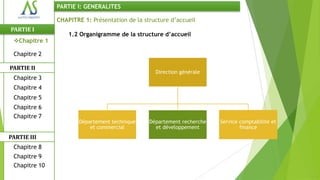
1.2 Organigramme de la structure d’accueil
Chapitre 1
Chapitre 2
PARTIE II
Direction générale
Chapitre 3
Chapitre 4
Chapitre 5
Chapitre 6
Chapitre 7
Département technique Département recherche Service comptabilité et
et commercial et développement finance
PARTIE III
Chapitre 8
Chapitre 9
Chapitre 10
7.
PARTIE I: GENERALITES
CHAPITRE 2: Etude de l’existant
PARTIE I
2.1 Présentation de l’existant
Chapitre 1
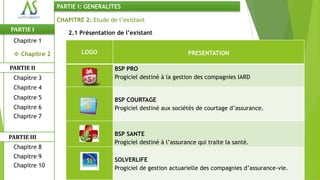
Chapitre 2 LOGO PRESENTATION
PARTIE II BSP PRO
Chapitre 3 Progiciel destiné à la gestion des compagnies IARD
Chapitre 4
Chapitre 5 BSP COURTAGE
Chapitre 6 Progiciel destiné aux sociétés de courtage d’assurance.
Chapitre 7
BSP SANTE
PARTIE III
Progiciel destiné à l’assurance qui traite la santé.
Chapitre 8
Chapitre 9
SOLVERLIFE
Chapitre 10 Progiciel de gestion actuarielle des compagnies d’assurance-vie.
8.
PARTIE I: GENERALITES
CHAPITRE 2: Etude de l’existant
PARTIE I
2.1 Présentation de l’existant
Chapitre 1
Chapitre 2
PARTIE II
Chapitre 3
Chapitre 4
Chapitre 5
Chapitre 6
Chapitre 7
PARTIE III
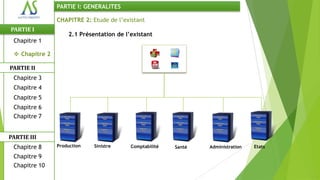
Chapitre 8 Production Sinistre Comptabilité Santé Administration Etats
Chapitre 9
Chapitre 10
9.
PARTIE I: GENERALITES
CHAPITRE 2: Etude de l’existant
PARTIE I
2.1 Présentation de l’existant
Chapitre 1
Chapitre 2
PARTIE II
Chapitre 3
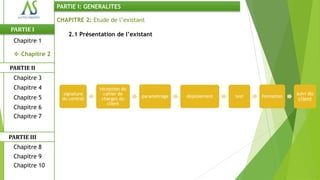
Chapitre 4 réception du
signature cahier de suivi du
Chapitre 5 paramétrage déploiement test formation
du contrat charges du client
client
Chapitre 6
Chapitre 7
PARTIE III
Chapitre 8
Chapitre 9
Chapitre 10
10.
PARTIE I: GENERALITES
CHAPITRE 2: Etude de l’existant
PARTIE I
2.2 Critique de l’existant
Chapitre 1
Chapitre 2 Redondance de fonctionnalités
Architecture de déploiement 2-tiers
PARTIE II
Chapitre 3 Utilisation de la même base de données pour toutes les
Chapitre 4 applications
Chapitre 5 HyperFileSQL de WinDev est la seule base de données supportée
Chapitre 6
par l’application
Chapitre 7
Gestion centralisée des droits et des utilisateurs
PARTIE III Processus long et couteux de livraison des applications aux
Chapitre 8 clients
Chapitre 9
Exigence matérielle très grande pour le déploiement
Chapitre 10
PARTIE II: ETUDECONCEPTUELLE
CHAPITRE 3: Méthode d’analyse et de conception
PARTIE I
3.1 Merise
Chapitre 1
Chapitre 2 Méthode systémique d’analyse et de conception des systèmes
d’information
PARTIE II
Chapitre 3 Séparation de l’analyse et la conception des données de celui des
Chapitre 4 opérations
Chapitre 5
Chapitre 6
Chapitre 7
PARTIE III
Chapitre 8
Chapitre 9
Chapitre 10
13.
PARTIE II: ETUDECONCEPTUELLE
CHAPITRE 3: Méthode d’analyse et de conception
PARTIE I
3.1 Processus Unifié (Unified Process)
Chapitre 1
Chapitre 2 Centré sur l’architecture
Piloté par les cas d’utilisation
PARTIE II
Chapitre 3 Itératif et incrémental
Chapitre 4 Utilise le langage UML
Chapitre 5 Implémentations
Chapitre 6
RUP (Rational Unified Process) : Instanciation UP par
Chapitre 7
IBM
PARTIE III XUP (eXtrem Programming UP) : eXtrem Programming
Chapitre 8 2TUP (2 Track UP) : Cycle en Y proposée par Valtech
Chapitre 9
Chapitre 10
14.
PARTIE II: ETUDECONCEPTUELLE
CHAPITRE 3: Méthode d’analyse et de conception
PARTIE I
3.1 Choix de la méthode
Chapitre 1
Chapitre 2 Nous optons pour le Processus Unifié
Bonne modélisation métier
PARTIE II
Solution modulaire
Chapitre 3
Chapitre 4 Solution évolutive
Chapitre 5 Solution maintenable
Chapitre 6 Déploiement simplifié
Chapitre 7
Implémentation : 2TUP
Meilleure gestion des risques liés à un projet
PARTIE III
Prise en compte des évolutions perpétuelles des SI
Chapitre 8
Chapitre 9 Adaptation aux petits, moyens et grands projets.
Chapitre 10
15.
PARTIE II: ETUDECONCEPTUELLE
CHAPITRE 4: Etude préliminaire
PARTIE I
4.1 Cahier de charges
Chapitre 1
Chapitre 2 Meilleure structuration des services du logiciel
Exploitation de différents SGBDR et de fichiers de données
PARTIE II
Chapitre 3 Décentralisation de la gestion des droits et des utilisateurs
Chapitre 4 Flexibilité pour l’intégration d’autres futures solutions de
Chapitre 5 l’entreprise
Chapitre 6
Intégration d’un outil simple pour le déploiement et l’administration
Chapitre 7
de la solution
PARTIE III Large portabilité de la solution
Chapitre 8
Chapitre 9
Chapitre 10
16.
PARTIE II: ETUDECONCEPTUELLE
CHAPITRE 4: Etude préliminaire
PARTIE I
4.1 Cahier de charges
Chapitre 1
Chapitre 2 Progiciel
PARTIE II SaaS (Software as a Service)
Chapitre 3
Assurance
Chapitre 4
Chapitre 5
Chapitre 6
Chapitre 7
PARTIE III
Chapitre 8
Chapitre 9
Chapitre 10
17.
PARTIE II: ETUDECONCEPTUELLE
CHAPITRE 4: Etude préliminaire
PARTIE I
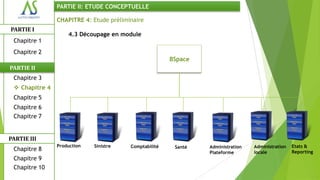
4.3 Découpage en module
Chapitre 1
Chapitre 2
BSpace
PARTIE II
Chapitre 3
Chapitre 4
Chapitre 5
Chapitre 6
Chapitre 7
PARTIE III
Production Sinistre Comptabilité Santé Administration Administration Etats &
Chapitre 8 locale Reporting
Plateforme
Chapitre 9
Chapitre 10
18.
PARTIE II: ETUDECONCEPTUELLE
CHAPITRE 5: Capture des besoins fonctionnels
PARTIE I
Chapitre 1
Chapitre 2
PARTIE II
Chapitre 3
Chapitre 4
Chapitre 5
Chapitre 6
Chapitre 7
PARTIE III
Chapitre 8
Chapitre 9
Chapitre 10
19.
PARTIE II: ETUDECONCEPTUELLE
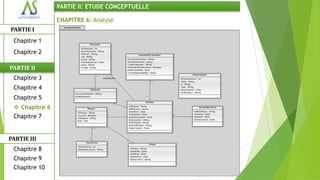
CHAPITRE 6: Analyse
PARTIE I
Chapitre 1
Chapitre 2
PARTIE II
Chapitre 3
Chapitre 4
Chapitre 5
Chapitre 6
Chapitre 7
PARTIE III
Chapitre 8
Chapitre 9
Chapitre 10
20.
PARTIE II: ETUDECONCEPTUELLE
CHAPITRE 7: Capture des besoins techniques
PARTIE I
7.1 Architecture logicielle de l’application
Chapitre 1
Couches logicielles
Chapitre 2
Présentation
Métier
PARTIE II Couche d’accès aux données
Chapitre 3
Chapitre 4 Architecture
1 tiers
Chapitre 5 2 tiers
Chapitre 6 3 tiers
Chapitre 7 N-tiers
Choix : Architecture 3 tiers
Trois niveaux physiques de déploiement
PARTIE III
Sécurité et intégrité des données
Chapitre 8 Répartition de la charge de travail
Chapitre 9
Chapitre 10
21.
PARTIE II: ETUDECONCEPTUELLE
CHAPITRE 7: Capture des besoins techniques
PARTIE I
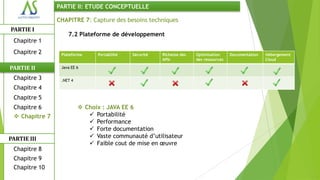
7.2 Plateforme de développement
Chapitre 1
Chapitre 2 Plateforme Portabilité Sécurité Richesse des Optimisation Documentation Hébergement
APIs des ressources Cloud
PARTIE II Java EE 6
Chapitre 3 .NET 4
Chapitre 4
Chapitre 5
Chapitre 6 Choix : JAVA EE 6
Chapitre 7 Portabilité
Performance
Forte documentation
PARTIE III Vaste communauté d’utilisateur
Faible cout de mise en œuvre
Chapitre 8
Chapitre 9
Chapitre 10
22.
PARTIE II: ETUDECONCEPTUELLE
CHAPITRE 7: Capture des besoins techniques
PARTIE I
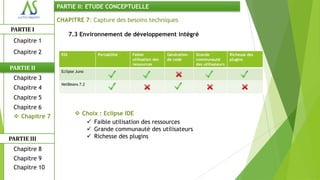
7.3 Environnement de développement intégré
Chapitre 1
Chapitre 2 EDI Portabilité Faible Génération Grande Richesse des
utilisation des de code communauté plugins
ressources des utilisateurs
PARTIE II Eclipse Juno
Chapitre 3
NetBeans 7.2
Chapitre 4
Chapitre 5
Chapitre 6
Chapitre 7 Choix : Eclipse IDE
Faible utilisation des ressources
Grande communauté des utilisateurs
PARTIE III Richesse des plugins
Chapitre 8
Chapitre 9
Chapitre 10
23.
PARTIE II: ETUDECONCEPTUELLE
CHAPITRE 7: Capture des besoins techniques
PARTIE I
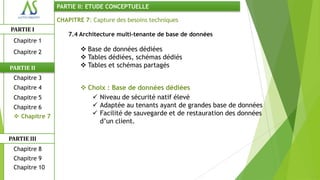
7.4 Architecture multi-tenante de base de données
Chapitre 1
Chapitre 2 Base de données dédiées
Tables dédiées, schémas dédiés
PARTIE II Tables et schémas partagés
Chapitre 3
Chapitre 4 Choix : Base de données dédiées
Chapitre 5 Niveau de sécurité natif élevé
Chapitre 6 Adaptée au tenants ayant de grandes base de données
Chapitre 7 Facilité de sauvegarde et de restauration des données
d’un client.
PARTIE III
Chapitre 8
Chapitre 9
Chapitre 10
24.
PARTIE II: ETUDECONCEPTUELLE
CHAPITRE 7: Capture des besoins techniques
PARTIE I
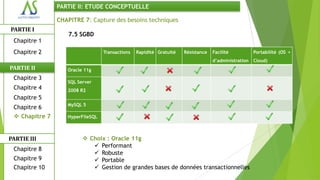
7.5 SGBD
Chapitre 1
Chapitre 2 Transactions Rapidité Gratuité Résistance Facilité Portabilité (OS +
d’administration Cloud)
PARTIE II Oracle 11g
Chapitre 3
SQL Server
Chapitre 4 2008 R2
Chapitre 5
MySQL 5
Chapitre 6
Chapitre 7 HyperFileSQL
PARTIE III Choix : Oracle 11g
Performant
Chapitre 8
Robuste
Chapitre 9 Portable
Chapitre 10 Gestion de grandes bases de données transactionnelles
25.
PARTIE II: ETUDECONCEPTUELLE
CHAPITRE 7: Capture des besoins techniques
PARTIE I
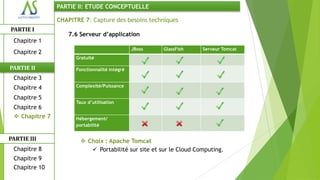
7.6 Serveur d’application
Chapitre 1
JBoss GlassFish Serveur Tomcat
Chapitre 2
Gratuité
PARTIE II Fonctionnalité intégré
Chapitre 3
Chapitre 4 Complexité/Puissance
Chapitre 5
Taux d’utilisation
Chapitre 6
Chapitre 7 Hébergement/
portabilité
PARTIE III Choix : Apache Tomcat
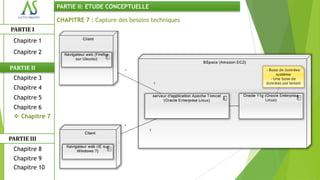
Chapitre 8 Portabilité sur site et sur le Cloud Computing.
Chapitre 9
Chapitre 10
26.
PARTIE II: ETUDECONCEPTUELLE
CHAPITRE 7: Capture des besoins techniques
PARTIE I
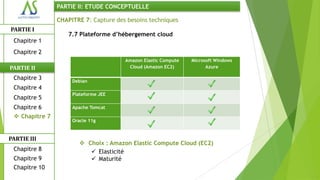
7.7 Plateforme d’hébergement cloud
Chapitre 1
Chapitre 2
Amazon Elastic Compute Microsoft Windows
PARTIE II Cloud (Amazon EC2) Azure
Chapitre 3 Debian
Chapitre 4
Plateforme JEE
Chapitre 5
Chapitre 6 Apache Tomcat
Chapitre 7
Oracle 11g
PARTIE III
Choix : Amazon Elastic Compute Cloud (EC2)
Chapitre 8 Elasticité
Chapitre 9 Maturité
Chapitre 10
27.
PARTIE II: ETUDECONCEPTUELLE
CHAPITRE 7: Capture des besoins techniques
PARTIE I
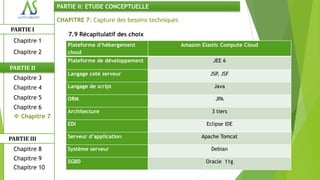
7.9 Récapitulatif des choix
Chapitre 1
Plateforme d’hébergement Amazon Elastic Compute Cloud
Chapitre 2 cloud
Plateforme de développement JEE 6
PARTIE II
Langage coté serveur JSP, JSF
Chapitre 3
Chapitre 4 Langage de script Java
Chapitre 5 ORM JPA
Chapitre 6
Architecture 3 tiers
Chapitre 7
EDI Eclipse IDE
PARTIE III Serveur d’application Apache Tomcat
Chapitre 8 Système serveur Debian
Chapitre 9 SGBD Oracle 11g
Chapitre 10
28.
PARTIE II: ETUDECONCEPTUELLE
CHAPITRE 7 : Capture des besoins techniques
PARTIE I
Chapitre 1
Chapitre 2
PARTIE II
Chapitre 3
Chapitre 4
Chapitre 5
Chapitre 6
Chapitre 7
PARTIE III
Chapitre 8
Chapitre 9
Chapitre 10
PARTIE III: IMPLEMENTATION
CHAPITRE 8 : Conception détaillée
PARTIE I
Chapitre 1
Chapitre 2
PARTIE II
Chapitre 3
Chapitre 4
Chapitre 5
Chapitre 6
Chapitre 7
PARTIE III
Chapitre 8
Chapitre 9
Chapitre 10
31.
PARTIE III: IMPLEMENTATION
CHAPITRE 8 : Conception détaillée
PARTIE I
Chapitre 1
Chapitre 2
PARTIE II
Chapitre 3
Chapitre 4
Chapitre 5
Chapitre 6
Chapitre 7
PARTIE III
Chapitre 8
Chapitre 9
Chapitre 10
32.
PARTIE III: IMPLEMENTATION
CHAPITRE 9 : Estimation financière du projet
PARTIE I
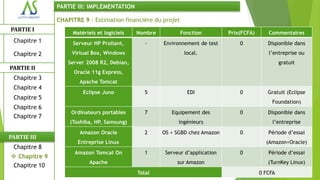
Matériels et logiciels Nombre Fonction Prix(FCFA) Commentaires
Chapitre 1 Serveur HP Proliant, - Environnement de test 0 Disponible dans
Chapitre 2 Virtual Box, Windows local. l’entreprise ou
Server 2008 R2, Debian, gratuit
PARTIE II
Oracle 11g Express,
Chapitre 3
Apache Tomcat
Chapitre 4
Eclipse Juno 5 EDI 0 Gratuit (Eclipse
Chapitre 5
Foundation)
Chapitre 6
Ordinateurs portables 7 Equipement des 0 Disponible dans
Chapitre 7
(Toshiba, HP, Samsung) ingénieurs l’entreprise
Amazon Oracle 2 OS + SGBD chez Amazon 0 Période d’essai
PARTIE III
Entreprise Linux (Amazon+Oracle)
Chapitre 8
Amazon Tomcat On 1 Serveur d’application 0 Période d’essai
Chapitre 9
Apache sur Amazon (TurnKey Linux)
Chapitre 10
Total 0 FCFA
33.
PARTIE III: IMPLEMENTATION
CHAPITRE 9 : Estimation financière du projet
PARTIE I
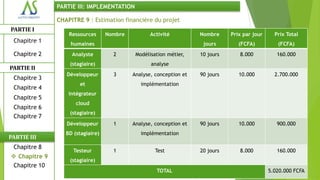
Ressources Nombre Activité Nombre Prix par jour Prix Total
Chapitre 1 humaines jours (FCFA) (FCFA)
Chapitre 2 Analyste 2 Modélisation métier, 10 jours 8.000 160.000
(stagiaire) analyse
PARTIE II
Développeur 3 Analyse, conception et 90 jours 10.000 2.700.000
Chapitre 3
et implémentation
Chapitre 4
intégrateur
Chapitre 5
cloud
Chapitre 6
(stagiaire)
Chapitre 7
Développeur 1 Analyse, conception et 90 jours 10.000 900.000
BD (stagiaire) implémentation
PARTIE III
Chapitre 8
Testeur 1 Test 20 jours 8.000 160.000
Chapitre 9
(stagiaire)
Chapitre 10
TOTAL 5.020.000 FCFA
34.
PARTIE III: IMPLEMENTATION
CHAPITRE 10 : Présentation de la solution
PARTIE I
Chapitre 1
Chapitre 2
PARTIE II
Chapitre 3
Chapitre 4
Chapitre 5
Chapitre 6
Chapitre 7
PARTIE III
Chapitre 8
Chapitre 9
Chapitre 10
35.
PARTIE III: IMPLEMENTATION
CHAPITRE 10 : Présentation de la solution
PARTIE I
Chapitre 1
Chapitre 2
PARTIE II
Chapitre 3
Chapitre 4
Chapitre 5
Chapitre 6
Chapitre 7
PARTIE III
Chapitre 8
Chapitre 9
Chapitre 10