Time management Dr Earl Stevens, October 2009 12. Sales Training10/08/111
Time: its attributesTime is neutralTime cannot be saved for future useEach activity requires a minimum quantum of timeTime has a value like currencyTime is cumulative in nature10/08/112
Time Management10/08/113
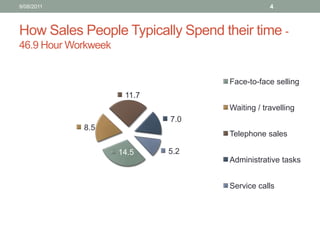
How Sales People Typically Spend their time - 46.9 Hour Workweek10/08/114
Very Common Time WastersNot enough time scheduled for necessary, top priority tasksInterruptions, drop-in visitors, distractions, telephone callsDoing-it-yourself, involved in too many detailed, routine tasksAlways crises, fire-fightingLack of objectives, deadlines and prioritiesLots of paperwork, reports, reading materialLeaving tasks partly done, jumping from task to taskProcrastination, indecision, daydreamingLack of self disciplineSocializing, idle conversationFailure to do top priority tasks firstConstantly switching priorities10/08/115
Understand the value of your time...10/08/116
Time ManagementTime is life, do not waste itIdentify major thieves of time and eject themMake a realistic list of things to do and act on itEliminate unnecessary activitiesMemory aids such as diaries and tape recorders are usefulAnalyse how time is spentNever take on more than is necessary, learn to say noAnalyse yourself and operate within your strengthsGet on by being organizedEmploy a programme of physical and mental fitnessManage backlogEmploy a schedule or planner to chart the way aheadNever cease striving to become more efficient and effectiveTreat each day as your last, maximize it.10/08/117
Principles of Time ManagementSet goals and Establish prioritiesSpot the Time WastersLive Time ManagementThink quality not quantity of TimeOrganize Yourself for success – Prioritize, Clear your desk, delicate work to others, stay healthy in body and mind, Act purposefully and positively.Write a Daily Time schedule: - Time, Activity, Priority (mark each activity according to how important it is (A: Extremely important; B: Important; C: relatively unimportant), Effectiveness and then evaluate the complete time plan of the day. Work to suit your preferred lifestyle10/08/118
How to plan your dayVisualise your long term goalTry to do your planning at the same time every day.Use only one planner to keep track of your appointmentsWrite out a To do list every dayDon’t jam your day full of activities.Do it now.Always plan time for balance; include family, fitness, recreation, Social and spiritual activities.10/08/119
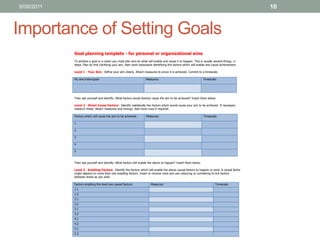
Importance of Setting Goals10/08/1110
Problems and Solutions for Proper Time ManagementPersonal:ü     Know priorities of doing thingsü     Be organizedü     Spend some time as leisure timePsychological:ü     Have self disciplineü     Learn to say “No” if it demandsü     Believe in team workü     Have a watch on the work entrusted10/08/1111
Problems and Solutions for Proper Time ManagementExternal:ü     Maintain proper relationship with friends 	and colleaguesü     Never attempt indirect interactionsSocial:ü     Allot some time to spend with nature with 	parents, to love, to listen, to dream to and 	to thinkü     Morning 4.00am to 9.00am is the best time 	for work 10/08/1112
Problems and Solutions for Proper Time Management	Postponement: Postponement or procrastination is mainly due to a lack of interest or pleasantness in work and the complexity of work.ü     Unpleasant tasksü     Complex projectsü     Fear of failureü     Lack of interestü     Perfectionismü     Distraction, lack of focus10/08/1113
Organize Your TimeThe money hoursorganize your day around the money hours – the hours when you can and should be talking with prospects and customershandle non-revenue generating activities before or after the money hoursProspecting hours dedicate a certain percentage of money hours to prospectingto increase the probability of reaching prospects, vary the time of day you prospectschedule it, do it, love it Follow-up queue up and standardize your most frequently used follow-up pieces for easy production and distributiondocument follow-up immediately – don't set it asideProfessional development schedule non-money hours for sales skill development or improving industry and/ or product knowledgeunderstand the value of your time...10/08/1114
Organize your TimeSales days be aware of the sales days for each month and quarterknow where you are in the sales timeline and plan accordinglySales stats understand and track your sales stats so you can plan effectivelydials to contactscontacts to qualified leadsqualified leads to proposalsproposals to contractscontracts to customersdials per hourfollow up calls per hourfollow up attempts before dropping determine the value of each sales hour given your earnings level/ target10/08/1115
Organize your TimeExtra time choose a reasonable extra amount of time to dedicate to sales each day (23 minutes each sales day adds one extra sales day each month)Productive down time always have something to read... always... for flight delays, waiting rooms and linesuse drive time for sales development and phone calls (get a headset if you can)The extra call one extra call a day is more than 250 extra contacts in a yearremember time management basics...Start early not only for the day, but also for the week, month and quarterstart early on projects and sales appointments10/08/1116
Organize your timePlan ahead look ahead to sales days around holidays, end of the month and end of the quarter and plan accordingly be aware of the sales "timeline" for your product – where you are in the month and where you are with the prospectRespect time your time, your prospect's time, your customer's timeprofessionals don't waste time and prospects and customers respect those who understand this... be punctual and be succinct10/08/1117
Tips for Successful Time ManagementDoing things with concentration, dedication conflicts and commitment and not in a careless manner.
Trust others and distribute works to others
Never think about unnecessary things and never interfere in others matters
Postponement of planned events is an avoidable bad habit

12. sales training time management

  • 1.
    Time management DrEarl Stevens, October 2009 12. Sales Training10/08/111
  • 2.
    Time: its attributesTimeis neutralTime cannot be saved for future useEach activity requires a minimum quantum of timeTime has a value like currencyTime is cumulative in nature10/08/112
  • 3.
  • 4.
    How Sales PeopleTypically Spend their time - 46.9 Hour Workweek10/08/114
  • 5.
    Very Common TimeWastersNot enough time scheduled for necessary, top priority tasksInterruptions, drop-in visitors, distractions, telephone callsDoing-it-yourself, involved in too many detailed, routine tasksAlways crises, fire-fightingLack of objectives, deadlines and prioritiesLots of paperwork, reports, reading materialLeaving tasks partly done, jumping from task to taskProcrastination, indecision, daydreamingLack of self disciplineSocializing, idle conversationFailure to do top priority tasks firstConstantly switching priorities10/08/115
  • 6.
    Understand the valueof your time...10/08/116
  • 7.
    Time ManagementTime islife, do not waste itIdentify major thieves of time and eject themMake a realistic list of things to do and act on itEliminate unnecessary activitiesMemory aids such as diaries and tape recorders are usefulAnalyse how time is spentNever take on more than is necessary, learn to say noAnalyse yourself and operate within your strengthsGet on by being organizedEmploy a programme of physical and mental fitnessManage backlogEmploy a schedule or planner to chart the way aheadNever cease striving to become more efficient and effectiveTreat each day as your last, maximize it.10/08/117
  • 8.
    Principles of TimeManagementSet goals and Establish prioritiesSpot the Time WastersLive Time ManagementThink quality not quantity of TimeOrganize Yourself for success – Prioritize, Clear your desk, delicate work to others, stay healthy in body and mind, Act purposefully and positively.Write a Daily Time schedule: - Time, Activity, Priority (mark each activity according to how important it is (A: Extremely important; B: Important; C: relatively unimportant), Effectiveness and then evaluate the complete time plan of the day. Work to suit your preferred lifestyle10/08/118
  • 9.
    How to planyour dayVisualise your long term goalTry to do your planning at the same time every day.Use only one planner to keep track of your appointmentsWrite out a To do list every dayDon’t jam your day full of activities.Do it now.Always plan time for balance; include family, fitness, recreation, Social and spiritual activities.10/08/119
  • 10.
    Importance of SettingGoals10/08/1110
  • 11.
    Problems and Solutionsfor Proper Time ManagementPersonal:ü     Know priorities of doing thingsü     Be organizedü     Spend some time as leisure timePsychological:ü     Have self disciplineü     Learn to say “No” if it demandsü     Believe in team workü     Have a watch on the work entrusted10/08/1111
  • 12.
    Problems and Solutionsfor Proper Time ManagementExternal:ü     Maintain proper relationship with friends and colleaguesü     Never attempt indirect interactionsSocial:ü     Allot some time to spend with nature with parents, to love, to listen, to dream to and to thinkü     Morning 4.00am to 9.00am is the best time for work 10/08/1112
  • 13.
    Problems and Solutionsfor Proper Time Management Postponement: Postponement or procrastination is mainly due to a lack of interest or pleasantness in work and the complexity of work.ü     Unpleasant tasksü     Complex projectsü     Fear of failureü     Lack of interestü     Perfectionismü     Distraction, lack of focus10/08/1113
  • 14.
    Organize Your TimeThemoney hoursorganize your day around the money hours – the hours when you can and should be talking with prospects and customershandle non-revenue generating activities before or after the money hoursProspecting hours dedicate a certain percentage of money hours to prospectingto increase the probability of reaching prospects, vary the time of day you prospectschedule it, do it, love it Follow-up queue up and standardize your most frequently used follow-up pieces for easy production and distributiondocument follow-up immediately – don't set it asideProfessional development schedule non-money hours for sales skill development or improving industry and/ or product knowledgeunderstand the value of your time...10/08/1114
  • 15.
    Organize your TimeSalesdays be aware of the sales days for each month and quarterknow where you are in the sales timeline and plan accordinglySales stats understand and track your sales stats so you can plan effectivelydials to contactscontacts to qualified leadsqualified leads to proposalsproposals to contractscontracts to customersdials per hourfollow up calls per hourfollow up attempts before dropping determine the value of each sales hour given your earnings level/ target10/08/1115
  • 16.
    Organize your TimeExtratime choose a reasonable extra amount of time to dedicate to sales each day (23 minutes each sales day adds one extra sales day each month)Productive down time always have something to read... always... for flight delays, waiting rooms and linesuse drive time for sales development and phone calls (get a headset if you can)The extra call one extra call a day is more than 250 extra contacts in a yearremember time management basics...Start early not only for the day, but also for the week, month and quarterstart early on projects and sales appointments10/08/1116
  • 17.
    Organize your timePlanahead look ahead to sales days around holidays, end of the month and end of the quarter and plan accordingly be aware of the sales "timeline" for your product – where you are in the month and where you are with the prospectRespect time your time, your prospect's time, your customer's timeprofessionals don't waste time and prospects and customers respect those who understand this... be punctual and be succinct10/08/1117
  • 18.
    Tips for SuccessfulTime ManagementDoing things with concentration, dedication conflicts and commitment and not in a careless manner.
  • 19.
    Trust others anddistribute works to others
  • 20.
    Never think aboutunnecessary things and never interfere in others matters
  • 21.
    Postponement of plannedevents is an avoidable bad habit