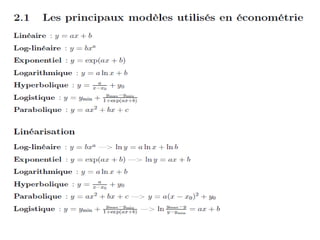
Les hypothèses à vérifier
Analyse des régression linéaires
simple
alors...?
.
possible..
petit
plus
le
être
doit
D
2
1
1
2
2
2
1
1
2
b
a,
b
a,
)
(
:
est
droite
la
à
écarts
des
carrés
des
somme
la
,....,
1
,
:
aux
les
liant
suivante
équation
l'
et
,...,
,
:
ns
observatio
a
on
l'
Si
.
aux
méthode
la
à
correspond
2
critère
Le
min
.
2
min
1.
:
és
possibilit
Plusieurs
minimiser
faut
Il
i
i
n
i
n
i
i
i
i
i
i
i
n
n
i i
i i
i
i
i
i
ax
b
y
D
n
i
ax
b
y
x
y
)
,y
(x
)
,y
(x
)
,y
(x
n
ax
b
y























carrés
moindres
Analyse des régression linéaires simple
 
 
bien...
ou
0
0
:
par
données
sont
de
et
de
estimées
valeurs
Les
)
(
2
)
(
2
)
(
zéro.
à
égales
pose
les
on
et
partielles
dérivées
...
n
1
i
n
1
i
1
1
1
2































i
i
i
i
i
n
i
i
i
i
n
i
i
i
n
i
i
i
ax
b
y
x
ax
b
y
b
a
ax
b
y
x
a
D
ax
b
y
b
D
ax
b
y
D
Analyse des régression linéaires
simple










































n
i
i
n
n
i
i
n
n
i
i
n
i
i
i
n
i
i
n
i
i
n
i
i
n
i
i
n
i
i
i
n
i
i
n
i
i
n
i
i
n
y
n
y
y
y
n
x
n
x
x
x
x
a
x
b
y
x
x
a
nb
y
x
a
x
b
y
x
x
a
nb
y
1
1
1
1
1
2
1
1
1
1
1
2
1
1
1
1
...
et
...
:
part
autre
D'
dire...
-
à
-
est
C'
0
0
exemple
Numéro de l'essai ‘X’ Masse ‘Y’ Longueur mi
2
mili
i mi li
1 2 42.0 4.0 84.0
2 4 48.4 16.0 193.6
3 6 51.3 36.0 307.8
4 8 56.3 64.0 450.4
5 10 58.6 100.0 586.0
n=5 30

 i
m 5
,
256

 i
l 220
2

 i
m 1622

 i
il
m
Balance à ressort
y = 2.055x + 38.99
30.0
35.0
40.0
45.0
50.0
55.0
60.0
65.0
0 2 4 6 8 10 12
Masse (kg)
Longueur
(cm)
  
 
38,99
2,055
















 
 

5
30
055
,
2
5
5
,
256
5
900
220
5
5
,
256
30
1622
2
2
n
m
a
n
l
b
n
m
m
n
l
m
l
m
a
i
i
i
i
i
i
i
i






2
2
)
(
2
)
ˆ
(
)
x
x
n
y
y
S(a
i
i
i
)]
(
);
(
[ )
2
,
2
/
(
)
2
,
2
/
( a
S
t
a
a
S
t
a
a n
n 
 

 

L’écart type de la pente a, estimé à partir de l’échantillon est noté S(a):
On peut alors déterminer l’intervalle de confiance de la pente (cf cours L1)
Si 0 apparaît dans cet intervalle, alors la pente ne peut être considérée comme
significativement différente de 0. On peut conclure qu’il n’existe pas de corrélation
significative entre les deux variables.
C’est l’ordonnée
estimée à partir du
modèle linéaire:

ˆ i
i
y ax b
 
Propriétés des estimateurs
    2
2
2
)
ˆ
(
ˆ y
y
y
y
y
y i
i
i
i 



 


Somme des carrés
totale (SCT)
Somme des carrés
des résidus (SCR)
Somme des carrés
de la régression (SCE)
Variation totale = variation inexpliquée + variation expliquée
R2 = Variation expliquée / variation totale
R2 est le coefficient de détermination, proportion de la variation
de y qui s’explique par la présence de x.
Plus R2 est grand, plus SCR est petit.
Coefficient de détermination
R2 =

2 2
2 2
2 2 2
ˆ
( ) *cov( , ) ( )
( ) ( ) ( )( )
i
i
y y X Y xy xy
y y V Y x x y y

 
 
  


2 2
1
( )
n
i y
i
SCT y y ns

  

Propriétés des estimateurs

économétrie.pdf

  • 3.
  • 4.
    Analyse des régressionlinéaires simple alors...? . possible.. petit plus le être doit D 2 1 1 2 2 2 1 1 2 b a, b a, ) ( : est droite la à écarts des carrés des somme la ,...., 1 , : aux les liant suivante équation l' et ,..., , : ns observatio a on l' Si . aux méthode la à correspond 2 critère Le min . 2 min 1. : és possibilit Plusieurs minimiser faut Il i i n i n i i i i i i i n n i i i i i i i i ax b y D n i ax b y x y ) ,y (x ) ,y (x ) ,y (x n ax b y                        carrés moindres
  • 5.
    Analyse des régressionlinéaires simple     bien... ou 0 0 : par données sont de et de estimées valeurs Les ) ( 2 ) ( 2 ) ( zéro. à égales pose les on et partielles dérivées ... n 1 i n 1 i 1 1 1 2                                i i i i i n i i i i n i i i n i i i ax b y x ax b y b a ax b y x a D ax b y b D ax b y D
  • 6.
    Analyse des régressionlinéaires simple                                           n i i n n i i n n i i n i i i n i i n i i n i i n i i n i i i n i i n i i n i i n y n y y y n x n x x x x a x b y x x a nb y x a x b y x x a nb y 1 1 1 1 1 2 1 1 1 1 1 2 1 1 1 1 ... et ... : part autre D' dire... - à - est C' 0 0
  • 8.
    exemple Numéro de l'essai‘X’ Masse ‘Y’ Longueur mi 2 mili i mi li 1 2 42.0 4.0 84.0 2 4 48.4 16.0 193.6 3 6 51.3 36.0 307.8 4 8 56.3 64.0 450.4 5 10 58.6 100.0 586.0 n=5 30   i m 5 , 256   i l 220 2   i m 1622   i il m Balance à ressort y = 2.055x + 38.99 30.0 35.0 40.0 45.0 50.0 55.0 60.0 65.0 0 2 4 6 8 10 12 Masse (kg) Longueur (cm)      38,99 2,055                      5 30 055 , 2 5 5 , 256 5 900 220 5 5 , 256 30 1622 2 2 n m a n l b n m m n l m l m a i i i i i i i i
  • 9.
          2 2 ) ( 2 ) ˆ ( ) x x n y y S(a i i i )] ( ); ( [ ) 2 , 2 / ( ) 2 , 2 / ( a S t a a S t a an n        L’écart type de la pente a, estimé à partir de l’échantillon est noté S(a): On peut alors déterminer l’intervalle de confiance de la pente (cf cours L1) Si 0 apparaît dans cet intervalle, alors la pente ne peut être considérée comme significativement différente de 0. On peut conclure qu’il n’existe pas de corrélation significative entre les deux variables. C’est l’ordonnée estimée à partir du modèle linéaire:  ˆ i i y ax b  
  • 10.
  • 11.
  • 12.
  • 13.
  • 20.
       2 2 2 ) ˆ ( ˆ y y y y y y i i i i         Somme des carrés totale (SCT) Somme des carrés des résidus (SCR) Somme des carrés de la régression (SCE) Variation totale = variation inexpliquée + variation expliquée R2 = Variation expliquée / variation totale R2 est le coefficient de détermination, proportion de la variation de y qui s’explique par la présence de x. Plus R2 est grand, plus SCR est petit.
  • 21.
    Coefficient de détermination R2=  2 2 2 2 2 2 2 ˆ ( ) *cov( , ) ( ) ( ) ( ) ( )( ) i i y y X Y xy xy y y V Y x x y y           2 2 1 ( ) n i y i SCT y y ns     
  • 22.