HACCP TRAINING PROGRAM
PROJECT , PRACTIES & ACTIONS
Introduction , History & Definitions : Food is the most basic instinct in human life, Handling Or
Processing & Serving food is one of the hardest job around the world as much as we can save others life ,
We can feel more proud like HEROES .
Try to think depth on words definition after asking lots of questions like WHY? WHEN? WHAT? &
WHERE? After asking that much question you will know the right way then you can WALK-IN .
Food one of life Problem & Solve , sometimes food can kill others and sometimes can save them , imagine
the connection of both to know how handling food is very Difficult & Serious it is one of daily life habits
from our Un-Consciousness & Consciousness .
What is the right definition of HACCP?The best way to prevent Harmful, Problems & Food illness Before
happened Or some process can save people daily life needs. We can also say it is most important methods
can help people to feel satisfaction ,
Specialists in the biological science say that the definition of HACCP is a Systematic , Scientifically based
approach to Food Safety.
It is a Method for identifying hazards in the production of food and implementing control measures to
prevent eliminate Or reduce significant hazard to an acceptable level .
It is not a Standalone program but a part of a comprehensive food safety management system FSMS
to ensure the production of safe food , the program is sticky the Prerequisite Program PRP’S & Good
Manufacturing Practices GMPS .
Why HACCP ? Hazard Analysis Critical Control Point . Repeatedly demonstrated that it is the most
effective system to ensure food safety , is the disciplined application of scientific process to each specific
food process , Ensure food safety lead to effective control of identified food safety hazards.
Become a key component of food safety regulation globally but the greatest growth can be attributed to
customer demands for greater food safety .
International food chains fined that HACCP delivers additional benefits when properly implemented
improvement in product Consistency & Inventory control as well as evidence of reeducation in food safety
related Customer Complaints that could result in significant losses have been cited as an additional
advantage to implementing a FSMS based on HACCP.
Identifying & Controlling hazard significant for food safety are heart of HACCP, seeking to control hazard
significant for food safety the word significant is important since HACCP managers must judge which
hazard are important for food safety . Requirements for a comprehensive based on food safety
management system FSMS.
Reasons for HACCP , Disciplined application of science to each specific food process leads to effective
control of identified food safety hazard. Guides & Encourages organizations to accept responsibility for
food safety instead of relying upon compliance with official regulations and inspections by food safety
regulation.
People responsible for food processes become involved in Planning & Implementing food protection
controls and become aware of their roles and responsibilities for food safety .
Improves the design of food products and processes for achieving safe food , Prepares an organization for
HACCP based food safety regulation trade specifications and customer requirements for a comprehensive
based food safety management system FSMS .
Who Required The organizations who is requires in HACCP at US is FDA & USDA , also we can say all
people who is handling food production Process or Progress
The world health organization defines safe food as Assurance that food will not case harm to the
customer
When it is prepared and or eaten according to its intended use.
USDAFDA
United States Department of AgricultureFood & Drug Administration Regulates
Responsible for Farm & Foreign Agriculture
service,
Food nutrition & Consumer service , food safety
marketing and regulatory program .
Natural resources & Environment , Research m
education & economics Or rural developments
Latest update from the USDA is Intensive Grazing
Systems, It is a type of rotational grazing that uses
higher per acre stocking rates in smaller grazing
units, Can provide multiple benefits for farmers and
the environment. Can help maintain & enhance farm
profitability while reducing labor and input costs.
Can result in improved soil health, increase in
sequestered carbon and decreased emissions of
other greenhouse gases.
Most of food except Meat , Poultry & Pasteurized
egg products ,
Medical and Occupational products , Cosmetics &
animal feeds
FDA requires processes involved in the production of
the following food implement HACCP
Juices Processes , Seafood , Retail food service
facilities utilizing special processes such as Smoking
or Curing food , using food additives as a method of
preservation ,
Packaging of food using reduced oxygen packaging
methods , sale of molluscan & shellfish from a tank ,
Custom processing of animals for personal use ,
production of sprouted beans Or seeds for sale
HACCP History :As a food safety concept was developed in the 1960 .
NACMCF was established in 1988 in the unite state , In 1985 the national academy of sciences released its
report an evaluation of the role of microbiological criteria for food and made recommendations that led to
the formation and appointment of NACMCF ,
NACMCF developed and released HACCP principle for food production in November of 1989 and has worked
to standardized the principle of HACCP for all members of the food industry
At 1992 the document was updated by NACMCF as the hazard analysis and critical control point system
In 1997 it was revised to be consistent with the WHO's CODEX HACCP
In 1988 the international commission on microbiological specifications for food ICMSF published
microorganisms in food.
The CODEX committee on food hygiene developed draft HACCP principle in June 1991 CPDEX officially
adopted its HACCP guidelines in October 1993 , in 1993 NACMCF revised the guidance standard codifying
the currently used five preliminary steps and seven principle of HACCP
CODEX & NACMCF amended their standards in 1997
2003 NACMCF integrated the us definition of HACCP with successful implementation and sustenance of
the HACCP process .
Types of hazards in food: Biological , Chemical Or Physical
As per the last data in USA from the Center for Disease Control CDC & local health departments it is
estimated that each year US residents experience 48 million food borne illnesses , 128,000
hospitalizations 3000 death & 10 billions of dollars losses ,
Reducing food born illness by 1% can prevent about 500,000 from getting sick annually and by 10 % keep
about 5 million from getting sick
5 risk factors that result in food borne illnesses
Food Improper holding Inadequate Cooking Poor Contaminated equipments unsafe
from Time & Temperature Personal Hygiene &
resource Prevention of contamination
Biological Hazard : Microbiological Hazards Contaminates cause illnesses as below
Below is the name of Bacteria's , Viruses & Parasites that can cause food borne illness for most of the
food organization the microorganism of greatest concern are the following
Clostridium botulinum can be fatal recovery by an infected person is slow and treatment can be expensive
incidents from commercially canned foods
Salmonella is an common food born disease , it is spread through contamination of processed material with
raw products , it is killed by right storage and cooking right temperature
staphylococcus aurous cause of an intoxication the organism must be present and have proper growth
condition and have a lack of competitive organisms
Clostridium Perfringensare frequently associated with food service operations , it may survive improper
cooking temperature abuse particularly failure to hold large cooked cuts of meat or poultry at 140 or above
listeriosis monocylogenes can be found in meat , poultry or dairy product and vegetables , a special concern
with it the ability to grow at low temperature such as those found in refrigerated process area
toxin-mediated infectionIntoxicationsInfections
An illness caused by the ingestion
of a bacteria that while in the
intestinal tract included Shigella
species & Shiga toxin producing
E-Coli
An illness caused by the ingestion
of a bacterial toxin produced by a
microorganism ,
Staphylococcal poisoning &
Botulinum intoxication
An illness caused by the ingestion
of a sufficient number of
pathogenic microorganisms cause
to an adverse health affected by
salmonella , listeriosis.
We can say that it is the
organism itself that causes illness
we can’t see by eyes.
Enterovirulent Escherichia coli is a serious food borne hazard it is a commonly spread to food from water
contaminated with human or animal feces , it can lead to die
Shigella it is responsible for many food borne illnesses each year from poor personal hygiene and food
handling
Campylobacter is a serious liver disease caused by the hepatitis , can easily pass the disease to others
within the same householders it can cause death
Hepatitis A is the most common bacterial cause of diarrheal illness , children and young adults are the
most commonly affected
Noro Virus are a group of related viruses that case acute gastroenteritis in humans
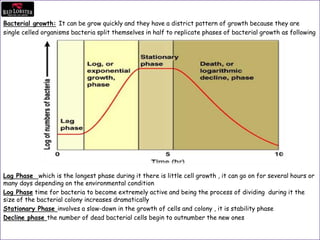
Bacterial growth: It can be grow quickly and they have a district pattern of growth because they are
single celled organisms bacteria split themselves in half to replicate phases of bacterial growth as following
Lag Phase which is the longest phase during it there is little cell growth , it can go on for several hours or
many days depending on the environmental condition
Log Phase time for bacteria to become extremely active and being the process of dividing during it the
size of the bacterial colony increases dramatically
Stationary Phase involves a slow-down in the growth of cells and colony , it is stability phase
Decline phase the number of dead bacterial cells begin to outnumber the new ones
To much question come into mind storms When we see the phases such as :
How long can food sit out at room temp? Potentially hazardous food that stays in the
temperature "danger zone", 40-140 °F (4-60 °C), for more than 2 hours should be discarded.
Potentially hazardous foods are those foods that spoil most easily, such as unshelled eggs, raw
meats, fish, shell fish, dairy products, almost all cooked foods.
How long does it take for bacteria to grow on food? Bacteria grow most rapidly in the range of
temperatures between 40 ° & 140 °F, doubling in number in as little as 20 minutes. This range of
temperatures is often called the “Danger Zone” That's why the Meat and Poultry advises
consumers to never leave food out of refrigeration over 2 hours.
What temperature does bacteria grow on food? The temperature range in which most bacteria
grow is between 40 degrees F (5 degrees C) and 140 degrees F (60 degrees C). Raw and cooked
foods should not be kept in this danger zone any longer than absolutely necessary.
Factors influencing bacterial growth One of the primary objectives of a HACCP program is to
establish processes to inhibit microorganisms capable of causing food borne illness . The ability of
an organism to pass a hazard can be destroyed by a number of factors including ;
Nutrients Food
PH - Acidity Or
Alkalinity
Atmosphere
Oxygen presence
Time - Time it takes
to grow
Water Activity
Moisture
Temperature
Competition - Other
bacteria & Microbial
interaction
Inhibitors -
substances such as
preservatives
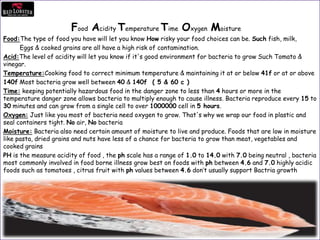
Food Acidity Temperature Time Oxygen Moisture
Food:The type of food you have will let you know How risky your food choices can be. Such fish, milk,
Eggs & cooked grains are all have a high risk of contamination.
Acid:The level of acidity will let you know if it's good environment for bacteria to grow Such Tomato &
vinegar.
Temperature:Cooking food to correct minimum temperature & maintaining it at or below 41f or at or above
140f Most bacteria grow well between 40 & 140f ( 5 & 60 c )
Time: keeping potentially hazardous food in the danger zone to less than 4 hours or more in the
temperature danger zone allows bacteria to multiply enough to cause illness. Bacteria reproduce every 15 to
30 minutes and can grow from a single cell to over 1000000 cell in 5 hours.
Oxygen: Just like you most of bacteria need oxygen to grow. That's why we wrap our food in plastic and
seal containers tight. No air, No bacteria
Moisture: Bacteria also need certain amount of moisture to live and produce. Foods that are low in moisture
like pasta, dried grains and nuts have less of a chance for bacteria to grow than meat, vegetables and
cooked grains
PH is the measure acidity of food , the ph scale has a range of 1.0 to 14.0 with 7.0 being neutral , bacteria
most commonly involved in food borne illness grow best on foods with ph between 4.6 and 7.0 highly acidic
foods such as tomatoes , citrus fruit with ph values between 4.6 don’t usually support Bactria growth
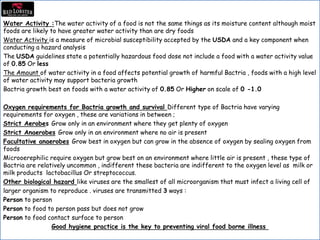
Water Activity :The water activity of a food is not the same things as its moisture content although moist
foods are likely to have greater water activity than are dry foods
Water Activity is a measure of microbial susceptibility accepted by the USDA and a key component when
conducting a hazard analysis
The USDA guidelines state a potentially hazardous food dose not include a food with a water activity value
of 0.85 Or less
The Amount of water activity in a food affects potential growth of harmful Bactria , foods with a high level
of water activity may support bacteria growth
Bactria growth best on foods with a water activity of 0.85 Or Higher on scale of 0 -1.0
Oxygen requirements for Bactria growth and survival Different type of Bactria have varying
requirements for oxygen , these are variations in between ;
Strict Aerobes Grow only in an environment where they get plenty of oxygen
Strict Anaerobes Grow only in an environment where no air is present
Facultative anaerobes Grow best in oxygen but can grow in the absence of oxygen by sealing oxygen from
foods
Microoerephilic require oxygen but grow best on an environment where little air is present , these type of
Bactria are relatively uncommon , indifferent these bacteria are indifferent to the oxygen level as milk or
milk products lactobacillus Or streptococcus.
Other biological hazard like viruses are the smallest of all microorganism that must infect a living cell of
larger organism to reproduce . viruses are transmitted 3 ways :
Person to person
Person to food to person pass but does not grow
Person to food contact surface to person
Good hygiene practice is the key to preventing viral food borne illness
Physical hazards :Is depending on How the food is handled Or prepared , proper handling may be
sufficient to remove , prevent or reduce a microbiological hazard to an acceptable level
Now it is time to ask How we can Avoid this happened to our products & How we can carry out the hazard
before happened that is the game as team worker or managers or much better leaders we are working to
avoid problems before happen not to wait until happened and start to think of solve .
There are 5 sources of physical hazard
Inadvertent materials from the soil ( stones , metal , insects , thorns , wood or small animals )
Inadvertent materials from Processing & Handling ( bone , glass , metal , wood , nuts, bolts , screening and
wire , cloth, paint chips , rust )
Materials entering the food during distribution ( insects, metal , soil , stones )
Materials intentionally placed in food ( employee sabotage Or tampering )
Miscellaneous debris and other materials
To Prevention physical hazard you can fowling below 7 methods
Effective systems for pest control ( Following , Evaluating & Reporting )
Implementing system for removing foreign objects such as Bones Or Stone , Glass from the product
Ensure that the general condition of the facility shipping , receiving practices facility maintenance
procedures , Product storage facilities & procedure
Review of packaging materials and handling procedures
Review of agricultural practices to identify potential of physical hazard
Review of personnel practices staff like jewelry , buttons and finger nails
Evaluation of packaging materials to identify physical contamination that may occur from tampering from
packaging .
Chemical hazard : Generally it is associated with cleaning and sanitizing
( Equipments , Machines , Products, Utensils and Or Human )
Some statistic from the USA government of food allergens into human :
1 in 25 suffer from food allergies , 30000 visit hospital emergency annually ,150 die annually 190 food
items may cause an adverse physical reaction when consumed Such as milk & milk production , Eggs and the
products , Peanuts and products tree nuts and products , soybeans and products , fish and products ,
shellfish and products , cereals containing gluten
Discussed the prevention of Chemical Hazard through out MSDS as per concept approval Certificate Or
follow manufacture procedures with right Handling , Shipping , Receiving & Storage .
Below is the sources of chemical hazards
Agricultural chemicals include Pesticides , Antibiotics Or Fungicides
Industrial chemical included Cleaners & Sanitizers Or Materials used to fabricate or operate
manufacturing, storage , transport Or equipments
Naturally occurring toxicants included products of Plant , Animal Or Microbial metabolites such as Alfa-
toxins and Myo-toxins
Food processing chemical included Preservatives , Stabilizers & Color enhancers
Allergens chemical ( proteins ) that cause abnormal response triggered by the body immune system , it is
reactions to food can sometimes cause serious illness and death
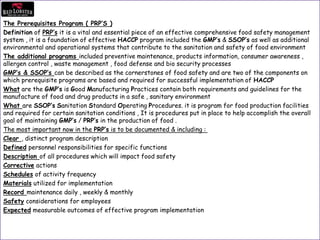
The Prerequisites Program ( PRP’S )
Definition of PRP’s it is a vital and essential piece of an effective comprehensive food safety management
system , it is a foundation of effective HACCP program included the GMP’s & SSOP’s as well as additional
environmental and operational systems that contribute to the sanitation and safety of food environment
The additional programs included preventive maintenance, products information, consumer awareness ,
allergen control , waste management , food defense and bio security processes
GMP’s & SSOP’s can be described as the cornerstones of food safety and are two of the components on
which prerequisite programs are based and required for successful implementation of HACCP
What are the GMP’s is Good Manufacturing Practices contain both requirements and guidelines for the
manufacture of food and drug products in a safe , sanitary environment
What are SSOP’s Sanitation Standard Operating Procedures. it is program for food production facilities
and required for certain sanitation conditions , It is procedures put in place to help accomplish the overall
goal of maintaining GMP’s / PRP’s in the production of food .
The most important now in the PRP’s is to be documented & including :
Clear , distinct program description
Defined personnel responsibilities for specific functions
Description of all procedures which will impact food safety
Corrective actions
Schedules of activity frequency
Materials utilized for implementation
Record maintenance daily , weekly & monthly
Safety considerations for employees
Expected measurable outcomes of effective program implementation
The common of PRP’s program included but not limited into below mention points :
Employees health & hygiene: It is an individual general state of health, hygienic practices and habits.The
personal cleanliness of person and clothing
Clothing and any personal belongings must be stored away from food or food contact items as equipment’s ,
no jewelry or other objects that may fall into food , equipment’s or packing , hair must be restrained by
hair nets , handling food with clean and specials gloves
The proper washing hands very important to avoid that contaminated food process and if the employees
have a gastrointestinal illness or an infected lesion , it is reducing the spread of microorganisms in food
facility .
Employee Training: Training included the practicing can led to successful business it is the heart and soul
of consistency , the training program should be documented and assessed for continued effectiveness
considerations for employee training Should Include;
Nature and composition of the food produced
Processing , packaging and warehousing of products
Facilities and equipment
Method of delivery and transport
Employees culture and experiences including language , beliefs level of comprehension
Employee expectations
Facilities Design & Equipment Maintenance: The buildings in food is handled and processed must be
designed and constructed in keeping with sanitary principles , it is necessary to adjust the existing
environment to accommodate a variety of product or processing considerations including :
Type of food
Product flow
Refrigeration , Processing , Sanitation , Ventilation requirements
Dry storage & Warehousing
Accessibility of hand washing facilities
Storage of chemicals
Lighting requirements
Employees rest room , break and change room
To prevent harborage of pets or any other sources of contamination, the ultimate goal to protect food
product include raw and finished product from contaminated the design of buildings who use to work on
food production as following
Premises , surroundings and site of building include parking lots
Exterior , interior and construction features
Operational flow and facility layout
Example ;
Food contact surfaces , food handling and inspection areas , Floor, Walls and Ceilings , Cold storage
facilities Heating equipments , Dry storage , Floors , Drains & Waste traps , hand washing stations ,
sanitary facilities , toilet and change room , preventive maintenance program , chemicals and storage ,
potable and non-potable water , cross connections and backflow prevention
Sanitation: The most effective point which is can help us to avoid food from harmful as FDA & SSOP
sanitation standard operating procedures require attention to the following:
Safety of water source
Food contact surface
Prevention of cross-contamination
Maintenance of hand washing and toilet facilities
Protection from contamination
Proper labeling , storage and use of toxic materials
Control of employee health
Exclusion of pests
Effective cleaning & sanitation TO
Reduce the risk of cross contamination
Increase the working life of equipments
Minimize attraction of insects and rodents
Reduces the risk for a food borne illness outbreak
Chemical usage and safety Employees are the key of ensure that handling or storing and using it by
proper way and proper labeling or storing , To further ensure safe use:
Employees must have access to chemical information included MSDS
Chemical must be approved for use in food facility
Employees must be trained in emergency procedures
Pest control Most of pests is source of physical contamination and can be carry pathogenic microorganisms
and contaminate food or food borne illness , should be doing it with more carefully and with specialized
company as per agreements
Receiving , storage and transport Items and products should be revived on the proper temperatures and
must be Handel , Store & Transported to minimize the possibility of contamination , damage or other types
of compromise to raw material , packaging and finished
When constructing to receiving, and storage there is some key elements such as
Supplier approval
Raw materials/ packing
Employee training
Inspection protocol
Documentation
Equipment’s Calibration To be measure Intrinsic & Extrinsic factors in food are accurate and reliable and
to be ensure , this is can be achieve when implemented and documented and put in mind that there is some
of the calibrated equipment for accuracy against a national standard or as per manufacture equipment.
To ensure that all the equipment's and machines provide accurate reliable results you should follow your
effective calibration program contain :
Identify & Document all equipment requiring calibration As weights, scales , PH meters , Water activity
meters , Thermometers , Hygrometers , Metal detection devices.
Document calibration method & schedule Daily , Weekly & Monthly Or Annually
Identify responsible employee to perform or manage calibration label all instruments as appropriate
Identify record and frequency ( Accuracy Check vs. Calibration )
Supplier Approval Program ( APL )Most effective point is the source of our supple if it is from the right
Or wrong source that is the big question mark can be effective if our ingredient sources is capable of
consistently delivering safe , quality & on time supplies according the specific equipments and the receiving
guidelines assures that :
Product safety & quality is protected
Raw materials meet agreed with specifications , consistency of raw material & finished product
that can be happened when supplier following below key elements
New supplier approval protocol ( specifications , legal requirements , expectations , 3rd audit result
letters of guarantee )
Required food safety and quality management system
Ongoing supplier evaluation
Data collection , microbiological , chemical and physical hazard assessments
Quality , audit , defects , temperature on time delivery , product integrity
Pre receipt of raw materials verification (certificate of analysis trailer seal integrity )
Product traceability & recall Ensure that compromised product can be rapidly removed from circulation
provides assurance that product is easily identifiable and traceable to the customer and to the raw
material suppliers , Traceable -One forward-One back
Documents clear and concise instruction for alerting the appropriate regulatory agencies , customers and
supplies.
product withdrawal/recall Any time there is a need to withdraw or recall a product , it is inconvenient and
disruptive . circumstances leading to this drastic action are always unexpected ,therefore , advance
5 preliminary steps to developing a HACCP plan :
The only right way to implemented the 7 HACCP principle and to make it effective we will follow the steps
to developing a HACCP plan is
Assemble HACCP team
Should be involvement of both Management & Subordinates the team will be responsible to implement the
basics of HACCP system and PRP‘s program , Also they focusing to identify significant food safety hazards
to be controlled by the system of HACCP in the place and they verify the effective implementation of the
HACCP plan and they have continues responsibility for the Revision , Validation & Verifications of HACCP in
order to accommodate changes to food Products , Process Or Technologies .
HACCP plan must have clear identify of what is the products and process will be covered clear tasks with
range of each product such as some already we received RTE .
Describe the product
The most important part is to know the right definition of the products we use to start processing the
production till we finished, here team will be responsible for the documentation such as day dots or a
labeling system including Row Materials & Ingredients, recipes of production, physical and chemical
characteristic packing and storages , distributed with full of documentation & evidence.
Identify the intended use
Identify the intended use the team will be responsible to consider the potential use of the product and the
targeted consumer including who are Elderly , Infants & Malnourished , ill or immune-compromised such as
cancer or kidney patients , they will be ensure that the consumer will be receiving fresh , clean and
uncontaminated food item such as implementing the effective allergy system on the place who work and
focusing with cooking procedures or handling frozen and fresh fish in house system and following up with
crew members with guided , effected and knowledgeable .
Construct flow diagrams
Once the team has identified the scope of plan to be developed including the product , processes and
targeted consumer , it is time to document the process steps included in the plan , an effective method to
document is to constructing a flow diagram as below
Receive raw materials & Packing Load , Ship & Distribute
Warehouse / Storage Finishing the Product
Storage & Preparation Packaging
Processes
Frozen chicken breast
To frozen storage
Thawed in walk-in cooler move to prep area
Handel under right temperature and with PVC
Cooked over right procedure and temperature
Serve immediately hot and out of danger zone
The team must verify its accuracy by literally walking through the facility and observation, firsthand the
processes to confirm that all steps are identified and accurately describes effective Daily checklists with
comments, target and action
Perform an on-site verification of flow diagrams
The 7 principles of HACCP
Will be divided into 2 category, The identification of significant hazards ( HA hazard analysis ) &
The control of those hazards ( CCP critical control point )
The 7 Principle of HACCP as below:
Conduct a hazard analysis
Determine the critical control point's CCP
Establish critical limits
Establish a system to monitor critical limits
Establish corrective actions for critical limit violations
Establish procedures for verification of the HACCP plan
Establish a record keeping system
Conduct a hazard analysis:The process of identifying a significant risk related to food product Or
manufactures , Once a HACCP team will identify & document the hazard it will be able to reduce and
prevent it to an acceptable level for consumers .
The team must be measure and control it as step that can prevent eliminate or reduce hazard Including
Sanitation control , Receiving process &Temperature , PH Or Water Activity.
The likelihood ( Refer to how probable it is that a hazard may become a problem ) of occurrence &
potential severity ( Considers the significant impact if this hazard is not controlled )
To performing a hazard analysis, we are able to include below mention steps
The occurrence & severity of each hazard
The qualitative & evaluation of the presence of hazards
The multiplication characteristic of the microorganism for biological hazards
The conditions that contribute to each hazard
Persistence of toxins, chemical or physical agents in foods
Identify The CCP:Here we should understand and know what is the different between CP & CCP
CP is any step in your process where control can be applied to a potential hazard. There may be dozens of
cp’s within a food preparation process, a CCP is a point during the preparation Or processing of food where
steps must be taken to reduce or eliminate a significant food safety hazard
CP are points where you can exercise control & CCP are points where you must exercise control to prevent ,
reduce significant hazard to acceptable level to be safety consumed from our customer .
CCP may include , But are not limited to below points
Cook temperature
Cook time
Freezing time
Labile control for allergens
Wash/rinse step for ready to eat produce
Metal detection
In-line screens or magnets
x-ray detection
Experienced team of HACCP we should not mix between CCP & CP after we got it the HACCP plan will be
able to only address CCP as per the different facilities that prepare the same food may identify different
hazards , the points , steps or procedures may have different CCP due to differences in layout, equipment's
ingredients or processes , it is essential that the unique condition within each facility be considered during
the development of a HACCP plan
Tools to identifying CCP it is very important to use here to helping us for determine its CCP such as daily
HACCP check list , monthly HOH audit with tracking results.
Establish Critical Limits:Is an measurement Or observation that separates what is acceptable from what
is not acceptable , each CCP will have one or more control measures associated with each significant hazard
a control must be applied with the preventing significant hazard to an acceptable level and when limit is
violated a corrective action must be instituted
When we establish the limits it will be necessary to consider the capability of equipment and personnel to
monitor the critical limit as well as the cost and the necessary monitoring frequency , it should not be
confused with target level or tolerance , Targeted level is associated with goals of the facility wants to
achieve while critical limits are mandatory. it is detected by regulation or government association such as
minimum cooking or storage temperatures or holding time or cooking time
critical limit can be quantitative – rely on a value that must be met Or not exceeded or qualitative rely on a
descriptive value.
Establish Monitoring Procedures:is an action and planned sequences of observations and measurements to
assess whether a CCP is under control , it is assuring that the HACCP is functioning properly .
The core purpose of monitoring is the confirmation of critical limits compliance , there is 2 way of
monitoring procedure is Continuous Or Non-continues.
The right monitoring system and procedure will help us to prevent hazard before happened or can be
warning alarm system for us to focusing with process or procedure on handling food items
Below is the correct procedure of doing right monitoring
What describe the critical limit
How describe the monitoring procedure in details
Where must be done at the appropriate location to accurately measure the critical limit
Who access to the CCP. Skills & knowledge
When continuous Or periodic may require sampling
Types of monitoring
Observation usually applied to qualitative , descriptive critical limits , such as any foreign materials present
it is includes sensory and visual observation for physical characteristics like appearance or metal , glass ,
bone & wood.
Measurement applies to quantitative , numerical critical limits such as time , temperature and ph will be
recorded on daily sheet , use always calibrated utensils
Establish Corrective Action:Must be start and do when a critical limit is violated will be determine the
disposition of the non conforming product , should be documented for each critical limit at each CCP
Procedure should be conservative , taking into consideration the risk involved if the product were to be
consumed .
Who is Responsible
Action taken in the process should the process be stopped
Disposition of the suspect product ( segregated or disposed of )
What is the root cause of the non-conformance
Documentation & Reporting
Example frozen Meat
Critical limit finished product labels for product processed must contain a sulfating agent declaration
Corrective action segregate and re-label improperly labeled product , segregate and return label stock that
does not contain the proper declaration
Establish procedures for verificationThe function of verification is to provide a degree of confidence that
the plan is based on solid process .
Below is type of verification activities include
Initial validation take place before the HACCP plan is implemented is the plan effective in producing a safe
product. HACCP system verification contain the validation of HACCP plan focusing on collecting & evaluating
scientific and technical data to determine whether the HACCP plan when properly implemented will
effectively control the identified hazards.
CCP verification Consists of regularly scheduled activities such as calibration of Monitoring Devices,
Reviewing Records , Targeted Sampling & Testing
Regulatory Verification Depending on the industry and product or as per government requirements
The data assemble to validate a HACCP plan is 2 types
Theoretical principle expert advice from processing authorities scientific data or other information
demonstrating the particular process control measure can adequately address specified hazards such as
studies establishing the temperature necessary to kill organisms of concern
In-Plant Observations measurements , test results or other information demonstrating that the control
measures as written into a HACCP plan , can be operated within a particular establishment to achieve the
intended food safety objective.
Recordkeeping Once the HACCP team has completed the process, it should be documented and recorded as
most of organization they records associated with their HACCP system and related to HACCP plan
development to their daily operations and for verification activities as some of the records will be defined
by regulatory requirements
Requirements Of Records must exist for the five preliminary steps and the six HACCP steps already
Scope of the HACCP plan
Products & Processes covered by the plan
Use of the products
Flow diagram produced
Hazard analysis including the preventive measures identified
CCP determinations
Information & data collected to justify critical limits
Schedule & types of monitoring
Sampling plans
Corrective action plans
Sample records
Schedule and types of verification procedures and Validation data
Most of the records associated with HACCP system are for monitoring and corrective actions can be
simple a check list or data sheet , can do it manually or automatically collected , continually Or
intermittently collect the choice of the record type depends on the data collected
The checklists can be designed to easily interpret results and demonstrate trends and highlight subtle
changes , Data we need all records must be dated , signed by 2 persons in charge one for completed and one
to reviewing or verifying.
Below is common errors we should be Avoided
Entering information ahead of time
Entering false information
Failing to correlate time of day with the record
Failing to record information that allows it to be tracked or followed through with other record
Failing to record process deviations or corrective actions and
Failing to record calibration of equipments .

HACCP Training Program ( Red Lobster Ryd. )

  • 1.
    HACCP TRAINING PROGRAM PROJECT, PRACTIES & ACTIONS
  • 2.
    Introduction , History& Definitions : Food is the most basic instinct in human life, Handling Or Processing & Serving food is one of the hardest job around the world as much as we can save others life , We can feel more proud like HEROES . Try to think depth on words definition after asking lots of questions like WHY? WHEN? WHAT? & WHERE? After asking that much question you will know the right way then you can WALK-IN . Food one of life Problem & Solve , sometimes food can kill others and sometimes can save them , imagine the connection of both to know how handling food is very Difficult & Serious it is one of daily life habits from our Un-Consciousness & Consciousness . What is the right definition of HACCP?The best way to prevent Harmful, Problems & Food illness Before happened Or some process can save people daily life needs. We can also say it is most important methods can help people to feel satisfaction , Specialists in the biological science say that the definition of HACCP is a Systematic , Scientifically based approach to Food Safety. It is a Method for identifying hazards in the production of food and implementing control measures to prevent eliminate Or reduce significant hazard to an acceptable level . It is not a Standalone program but a part of a comprehensive food safety management system FSMS to ensure the production of safe food , the program is sticky the Prerequisite Program PRP’S & Good Manufacturing Practices GMPS .
  • 3.
    Why HACCP ?Hazard Analysis Critical Control Point . Repeatedly demonstrated that it is the most effective system to ensure food safety , is the disciplined application of scientific process to each specific food process , Ensure food safety lead to effective control of identified food safety hazards. Become a key component of food safety regulation globally but the greatest growth can be attributed to customer demands for greater food safety . International food chains fined that HACCP delivers additional benefits when properly implemented improvement in product Consistency & Inventory control as well as evidence of reeducation in food safety related Customer Complaints that could result in significant losses have been cited as an additional advantage to implementing a FSMS based on HACCP. Identifying & Controlling hazard significant for food safety are heart of HACCP, seeking to control hazard significant for food safety the word significant is important since HACCP managers must judge which hazard are important for food safety . Requirements for a comprehensive based on food safety management system FSMS. Reasons for HACCP , Disciplined application of science to each specific food process leads to effective control of identified food safety hazard. Guides & Encourages organizations to accept responsibility for food safety instead of relying upon compliance with official regulations and inspections by food safety regulation.
  • 4.
    People responsible forfood processes become involved in Planning & Implementing food protection controls and become aware of their roles and responsibilities for food safety . Improves the design of food products and processes for achieving safe food , Prepares an organization for HACCP based food safety regulation trade specifications and customer requirements for a comprehensive based food safety management system FSMS . Who Required The organizations who is requires in HACCP at US is FDA & USDA , also we can say all people who is handling food production Process or Progress The world health organization defines safe food as Assurance that food will not case harm to the customer When it is prepared and or eaten according to its intended use.
  • 5.
    USDAFDA United States Departmentof AgricultureFood & Drug Administration Regulates Responsible for Farm & Foreign Agriculture service, Food nutrition & Consumer service , food safety marketing and regulatory program . Natural resources & Environment , Research m education & economics Or rural developments Latest update from the USDA is Intensive Grazing Systems, It is a type of rotational grazing that uses higher per acre stocking rates in smaller grazing units, Can provide multiple benefits for farmers and the environment. Can help maintain & enhance farm profitability while reducing labor and input costs. Can result in improved soil health, increase in sequestered carbon and decreased emissions of other greenhouse gases. Most of food except Meat , Poultry & Pasteurized egg products , Medical and Occupational products , Cosmetics & animal feeds FDA requires processes involved in the production of the following food implement HACCP Juices Processes , Seafood , Retail food service facilities utilizing special processes such as Smoking or Curing food , using food additives as a method of preservation , Packaging of food using reduced oxygen packaging methods , sale of molluscan & shellfish from a tank , Custom processing of animals for personal use , production of sprouted beans Or seeds for sale
  • 6.
    HACCP History :Asa food safety concept was developed in the 1960 . NACMCF was established in 1988 in the unite state , In 1985 the national academy of sciences released its report an evaluation of the role of microbiological criteria for food and made recommendations that led to the formation and appointment of NACMCF , NACMCF developed and released HACCP principle for food production in November of 1989 and has worked to standardized the principle of HACCP for all members of the food industry At 1992 the document was updated by NACMCF as the hazard analysis and critical control point system In 1997 it was revised to be consistent with the WHO's CODEX HACCP In 1988 the international commission on microbiological specifications for food ICMSF published microorganisms in food. The CODEX committee on food hygiene developed draft HACCP principle in June 1991 CPDEX officially adopted its HACCP guidelines in October 1993 , in 1993 NACMCF revised the guidance standard codifying the currently used five preliminary steps and seven principle of HACCP CODEX & NACMCF amended their standards in 1997 2003 NACMCF integrated the us definition of HACCP with successful implementation and sustenance of the HACCP process .
  • 7.
    Types of hazardsin food: Biological , Chemical Or Physical As per the last data in USA from the Center for Disease Control CDC & local health departments it is estimated that each year US residents experience 48 million food borne illnesses , 128,000 hospitalizations 3000 death & 10 billions of dollars losses , Reducing food born illness by 1% can prevent about 500,000 from getting sick annually and by 10 % keep about 5 million from getting sick 5 risk factors that result in food borne illnesses Food Improper holding Inadequate Cooking Poor Contaminated equipments unsafe from Time & Temperature Personal Hygiene & resource Prevention of contamination
  • 8.
    Biological Hazard :Microbiological Hazards Contaminates cause illnesses as below Below is the name of Bacteria's , Viruses & Parasites that can cause food borne illness for most of the food organization the microorganism of greatest concern are the following Clostridium botulinum can be fatal recovery by an infected person is slow and treatment can be expensive incidents from commercially canned foods Salmonella is an common food born disease , it is spread through contamination of processed material with raw products , it is killed by right storage and cooking right temperature staphylococcus aurous cause of an intoxication the organism must be present and have proper growth condition and have a lack of competitive organisms Clostridium Perfringensare frequently associated with food service operations , it may survive improper cooking temperature abuse particularly failure to hold large cooked cuts of meat or poultry at 140 or above listeriosis monocylogenes can be found in meat , poultry or dairy product and vegetables , a special concern with it the ability to grow at low temperature such as those found in refrigerated process area toxin-mediated infectionIntoxicationsInfections An illness caused by the ingestion of a bacteria that while in the intestinal tract included Shigella species & Shiga toxin producing E-Coli An illness caused by the ingestion of a bacterial toxin produced by a microorganism , Staphylococcal poisoning & Botulinum intoxication An illness caused by the ingestion of a sufficient number of pathogenic microorganisms cause to an adverse health affected by salmonella , listeriosis. We can say that it is the organism itself that causes illness we can’t see by eyes.
  • 9.
    Enterovirulent Escherichia coliis a serious food borne hazard it is a commonly spread to food from water contaminated with human or animal feces , it can lead to die Shigella it is responsible for many food borne illnesses each year from poor personal hygiene and food handling Campylobacter is a serious liver disease caused by the hepatitis , can easily pass the disease to others within the same householders it can cause death Hepatitis A is the most common bacterial cause of diarrheal illness , children and young adults are the most commonly affected Noro Virus are a group of related viruses that case acute gastroenteritis in humans
  • 10.
    Bacterial growth: Itcan be grow quickly and they have a district pattern of growth because they are single celled organisms bacteria split themselves in half to replicate phases of bacterial growth as following Lag Phase which is the longest phase during it there is little cell growth , it can go on for several hours or many days depending on the environmental condition Log Phase time for bacteria to become extremely active and being the process of dividing during it the size of the bacterial colony increases dramatically Stationary Phase involves a slow-down in the growth of cells and colony , it is stability phase Decline phase the number of dead bacterial cells begin to outnumber the new ones
  • 11.
    To much questioncome into mind storms When we see the phases such as : How long can food sit out at room temp? Potentially hazardous food that stays in the temperature "danger zone", 40-140 °F (4-60 °C), for more than 2 hours should be discarded. Potentially hazardous foods are those foods that spoil most easily, such as unshelled eggs, raw meats, fish, shell fish, dairy products, almost all cooked foods. How long does it take for bacteria to grow on food? Bacteria grow most rapidly in the range of temperatures between 40 ° & 140 °F, doubling in number in as little as 20 minutes. This range of temperatures is often called the “Danger Zone” That's why the Meat and Poultry advises consumers to never leave food out of refrigeration over 2 hours. What temperature does bacteria grow on food? The temperature range in which most bacteria grow is between 40 degrees F (5 degrees C) and 140 degrees F (60 degrees C). Raw and cooked foods should not be kept in this danger zone any longer than absolutely necessary. Factors influencing bacterial growth One of the primary objectives of a HACCP program is to establish processes to inhibit microorganisms capable of causing food borne illness . The ability of an organism to pass a hazard can be destroyed by a number of factors including ; Nutrients Food PH - Acidity Or Alkalinity Atmosphere Oxygen presence Time - Time it takes to grow Water Activity Moisture Temperature Competition - Other bacteria & Microbial interaction Inhibitors - substances such as preservatives
  • 12.
    Food Acidity TemperatureTime Oxygen Moisture Food:The type of food you have will let you know How risky your food choices can be. Such fish, milk, Eggs & cooked grains are all have a high risk of contamination. Acid:The level of acidity will let you know if it's good environment for bacteria to grow Such Tomato & vinegar. Temperature:Cooking food to correct minimum temperature & maintaining it at or below 41f or at or above 140f Most bacteria grow well between 40 & 140f ( 5 & 60 c ) Time: keeping potentially hazardous food in the danger zone to less than 4 hours or more in the temperature danger zone allows bacteria to multiply enough to cause illness. Bacteria reproduce every 15 to 30 minutes and can grow from a single cell to over 1000000 cell in 5 hours. Oxygen: Just like you most of bacteria need oxygen to grow. That's why we wrap our food in plastic and seal containers tight. No air, No bacteria Moisture: Bacteria also need certain amount of moisture to live and produce. Foods that are low in moisture like pasta, dried grains and nuts have less of a chance for bacteria to grow than meat, vegetables and cooked grains PH is the measure acidity of food , the ph scale has a range of 1.0 to 14.0 with 7.0 being neutral , bacteria most commonly involved in food borne illness grow best on foods with ph between 4.6 and 7.0 highly acidic foods such as tomatoes , citrus fruit with ph values between 4.6 don’t usually support Bactria growth
  • 13.
    Water Activity :Thewater activity of a food is not the same things as its moisture content although moist foods are likely to have greater water activity than are dry foods Water Activity is a measure of microbial susceptibility accepted by the USDA and a key component when conducting a hazard analysis The USDA guidelines state a potentially hazardous food dose not include a food with a water activity value of 0.85 Or less The Amount of water activity in a food affects potential growth of harmful Bactria , foods with a high level of water activity may support bacteria growth Bactria growth best on foods with a water activity of 0.85 Or Higher on scale of 0 -1.0 Oxygen requirements for Bactria growth and survival Different type of Bactria have varying requirements for oxygen , these are variations in between ; Strict Aerobes Grow only in an environment where they get plenty of oxygen Strict Anaerobes Grow only in an environment where no air is present Facultative anaerobes Grow best in oxygen but can grow in the absence of oxygen by sealing oxygen from foods Microoerephilic require oxygen but grow best on an environment where little air is present , these type of Bactria are relatively uncommon , indifferent these bacteria are indifferent to the oxygen level as milk or milk products lactobacillus Or streptococcus. Other biological hazard like viruses are the smallest of all microorganism that must infect a living cell of larger organism to reproduce . viruses are transmitted 3 ways : Person to person Person to food to person pass but does not grow Person to food contact surface to person Good hygiene practice is the key to preventing viral food borne illness
  • 14.
    Physical hazards :Isdepending on How the food is handled Or prepared , proper handling may be sufficient to remove , prevent or reduce a microbiological hazard to an acceptable level Now it is time to ask How we can Avoid this happened to our products & How we can carry out the hazard before happened that is the game as team worker or managers or much better leaders we are working to avoid problems before happen not to wait until happened and start to think of solve . There are 5 sources of physical hazard Inadvertent materials from the soil ( stones , metal , insects , thorns , wood or small animals ) Inadvertent materials from Processing & Handling ( bone , glass , metal , wood , nuts, bolts , screening and wire , cloth, paint chips , rust ) Materials entering the food during distribution ( insects, metal , soil , stones ) Materials intentionally placed in food ( employee sabotage Or tampering ) Miscellaneous debris and other materials
  • 15.
    To Prevention physicalhazard you can fowling below 7 methods Effective systems for pest control ( Following , Evaluating & Reporting ) Implementing system for removing foreign objects such as Bones Or Stone , Glass from the product Ensure that the general condition of the facility shipping , receiving practices facility maintenance procedures , Product storage facilities & procedure Review of packaging materials and handling procedures Review of agricultural practices to identify potential of physical hazard Review of personnel practices staff like jewelry , buttons and finger nails Evaluation of packaging materials to identify physical contamination that may occur from tampering from packaging .
  • 16.
    Chemical hazard :Generally it is associated with cleaning and sanitizing ( Equipments , Machines , Products, Utensils and Or Human ) Some statistic from the USA government of food allergens into human : 1 in 25 suffer from food allergies , 30000 visit hospital emergency annually ,150 die annually 190 food items may cause an adverse physical reaction when consumed Such as milk & milk production , Eggs and the products , Peanuts and products tree nuts and products , soybeans and products , fish and products , shellfish and products , cereals containing gluten Discussed the prevention of Chemical Hazard through out MSDS as per concept approval Certificate Or follow manufacture procedures with right Handling , Shipping , Receiving & Storage . Below is the sources of chemical hazards Agricultural chemicals include Pesticides , Antibiotics Or Fungicides Industrial chemical included Cleaners & Sanitizers Or Materials used to fabricate or operate manufacturing, storage , transport Or equipments Naturally occurring toxicants included products of Plant , Animal Or Microbial metabolites such as Alfa- toxins and Myo-toxins Food processing chemical included Preservatives , Stabilizers & Color enhancers Allergens chemical ( proteins ) that cause abnormal response triggered by the body immune system , it is reactions to food can sometimes cause serious illness and death
  • 17.
    The Prerequisites Program( PRP’S ) Definition of PRP’s it is a vital and essential piece of an effective comprehensive food safety management system , it is a foundation of effective HACCP program included the GMP’s & SSOP’s as well as additional environmental and operational systems that contribute to the sanitation and safety of food environment The additional programs included preventive maintenance, products information, consumer awareness , allergen control , waste management , food defense and bio security processes GMP’s & SSOP’s can be described as the cornerstones of food safety and are two of the components on which prerequisite programs are based and required for successful implementation of HACCP What are the GMP’s is Good Manufacturing Practices contain both requirements and guidelines for the manufacture of food and drug products in a safe , sanitary environment What are SSOP’s Sanitation Standard Operating Procedures. it is program for food production facilities and required for certain sanitation conditions , It is procedures put in place to help accomplish the overall goal of maintaining GMP’s / PRP’s in the production of food . The most important now in the PRP’s is to be documented & including : Clear , distinct program description Defined personnel responsibilities for specific functions Description of all procedures which will impact food safety Corrective actions Schedules of activity frequency Materials utilized for implementation Record maintenance daily , weekly & monthly Safety considerations for employees Expected measurable outcomes of effective program implementation
  • 18.
    The common ofPRP’s program included but not limited into below mention points : Employees health & hygiene: It is an individual general state of health, hygienic practices and habits.The personal cleanliness of person and clothing Clothing and any personal belongings must be stored away from food or food contact items as equipment’s , no jewelry or other objects that may fall into food , equipment’s or packing , hair must be restrained by hair nets , handling food with clean and specials gloves The proper washing hands very important to avoid that contaminated food process and if the employees have a gastrointestinal illness or an infected lesion , it is reducing the spread of microorganisms in food facility . Employee Training: Training included the practicing can led to successful business it is the heart and soul of consistency , the training program should be documented and assessed for continued effectiveness considerations for employee training Should Include; Nature and composition of the food produced Processing , packaging and warehousing of products Facilities and equipment Method of delivery and transport Employees culture and experiences including language , beliefs level of comprehension Employee expectations
  • 19.
    Facilities Design &Equipment Maintenance: The buildings in food is handled and processed must be designed and constructed in keeping with sanitary principles , it is necessary to adjust the existing environment to accommodate a variety of product or processing considerations including : Type of food Product flow Refrigeration , Processing , Sanitation , Ventilation requirements Dry storage & Warehousing Accessibility of hand washing facilities Storage of chemicals Lighting requirements Employees rest room , break and change room To prevent harborage of pets or any other sources of contamination, the ultimate goal to protect food product include raw and finished product from contaminated the design of buildings who use to work on food production as following Premises , surroundings and site of building include parking lots Exterior , interior and construction features Operational flow and facility layout Example ; Food contact surfaces , food handling and inspection areas , Floor, Walls and Ceilings , Cold storage facilities Heating equipments , Dry storage , Floors , Drains & Waste traps , hand washing stations , sanitary facilities , toilet and change room , preventive maintenance program , chemicals and storage , potable and non-potable water , cross connections and backflow prevention
  • 20.
    Sanitation: The mosteffective point which is can help us to avoid food from harmful as FDA & SSOP sanitation standard operating procedures require attention to the following: Safety of water source Food contact surface Prevention of cross-contamination Maintenance of hand washing and toilet facilities Protection from contamination Proper labeling , storage and use of toxic materials Control of employee health Exclusion of pests Effective cleaning & sanitation TO Reduce the risk of cross contamination Increase the working life of equipments Minimize attraction of insects and rodents Reduces the risk for a food borne illness outbreak Chemical usage and safety Employees are the key of ensure that handling or storing and using it by proper way and proper labeling or storing , To further ensure safe use: Employees must have access to chemical information included MSDS Chemical must be approved for use in food facility Employees must be trained in emergency procedures
  • 21.
    Pest control Mostof pests is source of physical contamination and can be carry pathogenic microorganisms and contaminate food or food borne illness , should be doing it with more carefully and with specialized company as per agreements Receiving , storage and transport Items and products should be revived on the proper temperatures and must be Handel , Store & Transported to minimize the possibility of contamination , damage or other types of compromise to raw material , packaging and finished When constructing to receiving, and storage there is some key elements such as Supplier approval Raw materials/ packing Employee training Inspection protocol Documentation Equipment’s Calibration To be measure Intrinsic & Extrinsic factors in food are accurate and reliable and to be ensure , this is can be achieve when implemented and documented and put in mind that there is some of the calibrated equipment for accuracy against a national standard or as per manufacture equipment. To ensure that all the equipment's and machines provide accurate reliable results you should follow your effective calibration program contain : Identify & Document all equipment requiring calibration As weights, scales , PH meters , Water activity meters , Thermometers , Hygrometers , Metal detection devices. Document calibration method & schedule Daily , Weekly & Monthly Or Annually Identify responsible employee to perform or manage calibration label all instruments as appropriate Identify record and frequency ( Accuracy Check vs. Calibration )
  • 22.
    Supplier Approval Program( APL )Most effective point is the source of our supple if it is from the right Or wrong source that is the big question mark can be effective if our ingredient sources is capable of consistently delivering safe , quality & on time supplies according the specific equipments and the receiving guidelines assures that : Product safety & quality is protected Raw materials meet agreed with specifications , consistency of raw material & finished product that can be happened when supplier following below key elements New supplier approval protocol ( specifications , legal requirements , expectations , 3rd audit result letters of guarantee ) Required food safety and quality management system Ongoing supplier evaluation Data collection , microbiological , chemical and physical hazard assessments Quality , audit , defects , temperature on time delivery , product integrity Pre receipt of raw materials verification (certificate of analysis trailer seal integrity ) Product traceability & recall Ensure that compromised product can be rapidly removed from circulation provides assurance that product is easily identifiable and traceable to the customer and to the raw material suppliers , Traceable -One forward-One back Documents clear and concise instruction for alerting the appropriate regulatory agencies , customers and supplies. product withdrawal/recall Any time there is a need to withdraw or recall a product , it is inconvenient and disruptive . circumstances leading to this drastic action are always unexpected ,therefore , advance
  • 23.
    5 preliminary stepsto developing a HACCP plan : The only right way to implemented the 7 HACCP principle and to make it effective we will follow the steps to developing a HACCP plan is Assemble HACCP team Should be involvement of both Management & Subordinates the team will be responsible to implement the basics of HACCP system and PRP‘s program , Also they focusing to identify significant food safety hazards to be controlled by the system of HACCP in the place and they verify the effective implementation of the HACCP plan and they have continues responsibility for the Revision , Validation & Verifications of HACCP in order to accommodate changes to food Products , Process Or Technologies . HACCP plan must have clear identify of what is the products and process will be covered clear tasks with range of each product such as some already we received RTE . Describe the product The most important part is to know the right definition of the products we use to start processing the production till we finished, here team will be responsible for the documentation such as day dots or a labeling system including Row Materials & Ingredients, recipes of production, physical and chemical characteristic packing and storages , distributed with full of documentation & evidence.
  • 24.
    Identify the intendeduse Identify the intended use the team will be responsible to consider the potential use of the product and the targeted consumer including who are Elderly , Infants & Malnourished , ill or immune-compromised such as cancer or kidney patients , they will be ensure that the consumer will be receiving fresh , clean and uncontaminated food item such as implementing the effective allergy system on the place who work and focusing with cooking procedures or handling frozen and fresh fish in house system and following up with crew members with guided , effected and knowledgeable . Construct flow diagrams Once the team has identified the scope of plan to be developed including the product , processes and targeted consumer , it is time to document the process steps included in the plan , an effective method to document is to constructing a flow diagram as below Receive raw materials & Packing Load , Ship & Distribute Warehouse / Storage Finishing the Product Storage & Preparation Packaging Processes
  • 25.
    Frozen chicken breast Tofrozen storage Thawed in walk-in cooler move to prep area Handel under right temperature and with PVC Cooked over right procedure and temperature Serve immediately hot and out of danger zone The team must verify its accuracy by literally walking through the facility and observation, firsthand the processes to confirm that all steps are identified and accurately describes effective Daily checklists with comments, target and action Perform an on-site verification of flow diagrams
  • 26.
    The 7 principlesof HACCP Will be divided into 2 category, The identification of significant hazards ( HA hazard analysis ) & The control of those hazards ( CCP critical control point ) The 7 Principle of HACCP as below: Conduct a hazard analysis Determine the critical control point's CCP Establish critical limits Establish a system to monitor critical limits Establish corrective actions for critical limit violations Establish procedures for verification of the HACCP plan Establish a record keeping system Conduct a hazard analysis:The process of identifying a significant risk related to food product Or manufactures , Once a HACCP team will identify & document the hazard it will be able to reduce and prevent it to an acceptable level for consumers . The team must be measure and control it as step that can prevent eliminate or reduce hazard Including Sanitation control , Receiving process &Temperature , PH Or Water Activity. The likelihood ( Refer to how probable it is that a hazard may become a problem ) of occurrence & potential severity ( Considers the significant impact if this hazard is not controlled ) To performing a hazard analysis, we are able to include below mention steps The occurrence & severity of each hazard The qualitative & evaluation of the presence of hazards The multiplication characteristic of the microorganism for biological hazards The conditions that contribute to each hazard Persistence of toxins, chemical or physical agents in foods
  • 27.
    Identify The CCP:Herewe should understand and know what is the different between CP & CCP CP is any step in your process where control can be applied to a potential hazard. There may be dozens of cp’s within a food preparation process, a CCP is a point during the preparation Or processing of food where steps must be taken to reduce or eliminate a significant food safety hazard CP are points where you can exercise control & CCP are points where you must exercise control to prevent , reduce significant hazard to acceptable level to be safety consumed from our customer . CCP may include , But are not limited to below points Cook temperature Cook time Freezing time Labile control for allergens Wash/rinse step for ready to eat produce Metal detection In-line screens or magnets x-ray detection Experienced team of HACCP we should not mix between CCP & CP after we got it the HACCP plan will be able to only address CCP as per the different facilities that prepare the same food may identify different hazards , the points , steps or procedures may have different CCP due to differences in layout, equipment's ingredients or processes , it is essential that the unique condition within each facility be considered during the development of a HACCP plan Tools to identifying CCP it is very important to use here to helping us for determine its CCP such as daily HACCP check list , monthly HOH audit with tracking results.
  • 28.
    Establish Critical Limits:Isan measurement Or observation that separates what is acceptable from what is not acceptable , each CCP will have one or more control measures associated with each significant hazard a control must be applied with the preventing significant hazard to an acceptable level and when limit is violated a corrective action must be instituted When we establish the limits it will be necessary to consider the capability of equipment and personnel to monitor the critical limit as well as the cost and the necessary monitoring frequency , it should not be confused with target level or tolerance , Targeted level is associated with goals of the facility wants to achieve while critical limits are mandatory. it is detected by regulation or government association such as minimum cooking or storage temperatures or holding time or cooking time critical limit can be quantitative – rely on a value that must be met Or not exceeded or qualitative rely on a descriptive value.
  • 29.
    Establish Monitoring Procedures:isan action and planned sequences of observations and measurements to assess whether a CCP is under control , it is assuring that the HACCP is functioning properly . The core purpose of monitoring is the confirmation of critical limits compliance , there is 2 way of monitoring procedure is Continuous Or Non-continues. The right monitoring system and procedure will help us to prevent hazard before happened or can be warning alarm system for us to focusing with process or procedure on handling food items Below is the correct procedure of doing right monitoring What describe the critical limit How describe the monitoring procedure in details Where must be done at the appropriate location to accurately measure the critical limit Who access to the CCP. Skills & knowledge When continuous Or periodic may require sampling Types of monitoring Observation usually applied to qualitative , descriptive critical limits , such as any foreign materials present it is includes sensory and visual observation for physical characteristics like appearance or metal , glass , bone & wood. Measurement applies to quantitative , numerical critical limits such as time , temperature and ph will be recorded on daily sheet , use always calibrated utensils
  • 30.
    Establish Corrective Action:Mustbe start and do when a critical limit is violated will be determine the disposition of the non conforming product , should be documented for each critical limit at each CCP Procedure should be conservative , taking into consideration the risk involved if the product were to be consumed . Who is Responsible Action taken in the process should the process be stopped Disposition of the suspect product ( segregated or disposed of ) What is the root cause of the non-conformance Documentation & Reporting Example frozen Meat Critical limit finished product labels for product processed must contain a sulfating agent declaration Corrective action segregate and re-label improperly labeled product , segregate and return label stock that does not contain the proper declaration Establish procedures for verificationThe function of verification is to provide a degree of confidence that the plan is based on solid process . Below is type of verification activities include Initial validation take place before the HACCP plan is implemented is the plan effective in producing a safe product. HACCP system verification contain the validation of HACCP plan focusing on collecting & evaluating scientific and technical data to determine whether the HACCP plan when properly implemented will effectively control the identified hazards.
  • 31.
    CCP verification Consistsof regularly scheduled activities such as calibration of Monitoring Devices, Reviewing Records , Targeted Sampling & Testing Regulatory Verification Depending on the industry and product or as per government requirements The data assemble to validate a HACCP plan is 2 types Theoretical principle expert advice from processing authorities scientific data or other information demonstrating the particular process control measure can adequately address specified hazards such as studies establishing the temperature necessary to kill organisms of concern In-Plant Observations measurements , test results or other information demonstrating that the control measures as written into a HACCP plan , can be operated within a particular establishment to achieve the intended food safety objective. Recordkeeping Once the HACCP team has completed the process, it should be documented and recorded as most of organization they records associated with their HACCP system and related to HACCP plan development to their daily operations and for verification activities as some of the records will be defined by regulatory requirements
  • 32.
    Requirements Of Recordsmust exist for the five preliminary steps and the six HACCP steps already Scope of the HACCP plan Products & Processes covered by the plan Use of the products Flow diagram produced Hazard analysis including the preventive measures identified CCP determinations Information & data collected to justify critical limits Schedule & types of monitoring Sampling plans Corrective action plans Sample records Schedule and types of verification procedures and Validation data Most of the records associated with HACCP system are for monitoring and corrective actions can be simple a check list or data sheet , can do it manually or automatically collected , continually Or intermittently collect the choice of the record type depends on the data collected
  • 33.
    The checklists canbe designed to easily interpret results and demonstrate trends and highlight subtle changes , Data we need all records must be dated , signed by 2 persons in charge one for completed and one to reviewing or verifying. Below is common errors we should be Avoided Entering information ahead of time Entering false information Failing to correlate time of day with the record Failing to record information that allows it to be tracked or followed through with other record Failing to record process deviations or corrective actions and Failing to record calibration of equipments .