Introduction au Microsoft
.NET Framework 4.0
Dans ce module, nous allons voir :
Leçon 1 : Introduction au Microsoft .NET.
Démonstration.
Leçon 1 : Introduction au Microsoft .NET.
1. Introduction au Microsoft .NET.
2. Les bénéfices du Microsoft .NET.
3. Les composants du .NET Framework.
4. La complication.
5. Les langages de programmation.
Leçon 1 : Introduction au Microsoft .NET.
1. Introduction au Microsoft .NET
• .NET Framework est la plate forme de développement Microsoft.
• .NET Framework (1.0, 1.1, 2.0, 3.0, 3.5 et 4.0).
• Visual Studio 2010.
Leçon 1 : Introduction au Microsoft .NET.
2. Les bénéfices du Microsoft .NET.
• Une seule plate forme, plusieurs langages de développement.
• Visual Studio, IDE de développement complet.
• Les éditions Express de Visual Studio sont gratuite pour une utilisation
commerciale.
• Organisation logique des assemblys via des espaces de noms et des types
pour une utilisation simple.
• Commentaires XML.
• Développer des applications Windows, Web, Mobile, Services Web…
Leçon 1 : Introduction au Microsoft .NET.
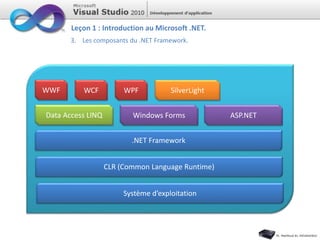
3. Les composants du .NET Framework.
Système d’exploitation
CLR (Common Language Runtime)
.NET Framework
Data Access LINQ
WCFWWF
ASP.NETWindows Forms
WPF SilverLight
Leçon 1 : Introduction au Microsoft .NET.
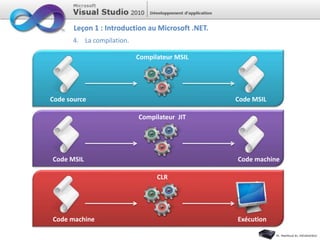
4. La compilation.
Compilateur MSIL
Code source Code MSIL
Compilateur JIT
Code MSIL Code machine
CLR
Code machine Exécution
Leçon 1 : Introduction au Microsoft .NET.
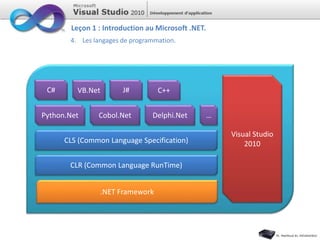
4. Les langages de programmation.
.NET Framework
CLR (Common Language RunTime)
C#
Visual Studio
2010
VB.Net J# C++
…Python.Net Cobol.Net Delphi.Net
CLS (Common Language Specification)
Introduction au microsoft .net framework 4.0

Introduction au microsoft .net framework 4.0

  • 1.
  • 2.
    Dans ce module,nous allons voir : Leçon 1 : Introduction au Microsoft .NET. Démonstration.
  • 3.
    Leçon 1 :Introduction au Microsoft .NET.
  • 4.
    Leçon 1 :Introduction au Microsoft .NET. 1. Introduction au Microsoft .NET. 2. Les bénéfices du Microsoft .NET. 3. Les composants du .NET Framework. 4. La complication. 5. Les langages de programmation.
  • 5.
    Leçon 1 :Introduction au Microsoft .NET. 1. Introduction au Microsoft .NET • .NET Framework est la plate forme de développement Microsoft. • .NET Framework (1.0, 1.1, 2.0, 3.0, 3.5 et 4.0). • Visual Studio 2010.
  • 6.
    Leçon 1 :Introduction au Microsoft .NET. 2. Les bénéfices du Microsoft .NET. • Une seule plate forme, plusieurs langages de développement. • Visual Studio, IDE de développement complet. • Les éditions Express de Visual Studio sont gratuite pour une utilisation commerciale. • Organisation logique des assemblys via des espaces de noms et des types pour une utilisation simple. • Commentaires XML. • Développer des applications Windows, Web, Mobile, Services Web…
  • 7.
    Leçon 1 :Introduction au Microsoft .NET. 3. Les composants du .NET Framework. Système d’exploitation CLR (Common Language Runtime) .NET Framework Data Access LINQ WCFWWF ASP.NETWindows Forms WPF SilverLight
  • 8.
    Leçon 1 :Introduction au Microsoft .NET. 4. La compilation. Compilateur MSIL Code source Code MSIL Compilateur JIT Code MSIL Code machine CLR Code machine Exécution
  • 9.
    Leçon 1 :Introduction au Microsoft .NET. 4. Les langages de programmation. .NET Framework CLR (Common Language RunTime) C# Visual Studio 2010 VB.Net J# C++ …Python.Net Cobol.Net Delphi.Net CLS (Common Language Specification)