Intervention du Parlementeuropéen encomitologieles casd’application de la réforme de 2006 et leTraité de LisbonneAnna Dekalchuk & RiccardoMezzasalma,le 12 mars 2010
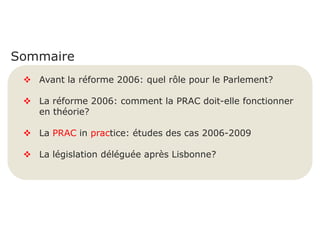
SommaireAvant la réforme 2006: quelrôle pour le Parlement?
La réforme 2006: comment la PRAC doit-ellefonctionner en théorie?
LaPRACinpractice: études des cas 2006-2009
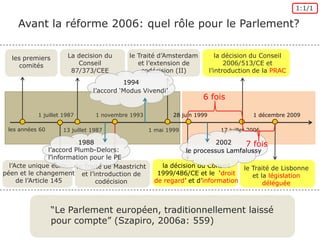
La législation déléguée après Lisbonne?1:1/1Avant la réforme 2006: quelrôle pour le Parlement?La decision du Conseil 87/373/CEEle Traité d’Amsterdam et l’extension de codécision (II)la décision du Conseil 2006/513/CE et l’introduction de la PRACles premiers comités1994l’accord ‘Modus Vivendi’6 fois1 novembre 199328 juin 19991 décembre 20091 juillet 1987les années 6013 juillet 19871 mai 199917 juillet 2006198820027 foisl’accord Plumb-Delors: l’information pour le PE le processus Lamfalussyla décision du Conseil 1999/486/CE et le  ‘droit de regard’ et d’informationl’Acte unique euro-péen et le changement de l’Article 145le Traité de Maastricht et l’introduction de codécisionle Traité de Lisbonne et la législationdéléguée“Le Parlementeuropéen, traditionnellement laissé pour compte” (Szapiro, 2006a: 559)
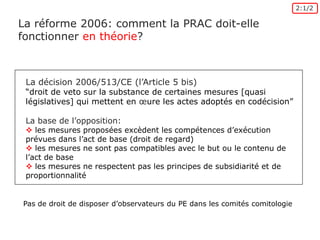
2:1/2La réforme 2006: comment la PRAC doit-ellefonctionneren théorie?La décision2006/513/CE (l’Article 5 bis)“droit de veto sur la substance de certainesmesures [quasi législatives] qui mettent en œure les actesadoptés en codécision”La base de l’opposition:les mesures proposées excèdent les compétences d’exécution prévues dans l’act de base (droit de regard)
 les mesures ne sont pas compatibles avec le but ou le contenu de l’act de base
 les mesures ne respectent pas les principes de subsidiarité et de proportionnalitéPas de droit de disposer d’observateurs du PE dans les comités comitologie
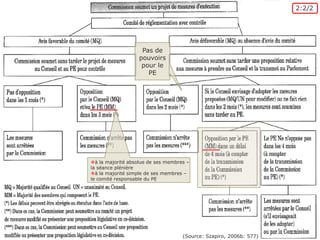
2:2/2Pas de pouvoirs pour le PEà la majorité absolue de ses membres – la séance plénière
à la majorité simple de ses membres – le comité responsable du PE(Source: Szapiro, 2006b: 577)
3:1/5LaPRACinpractice: études des cas 2006-2009
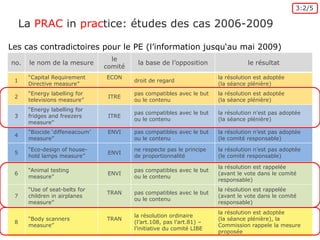
3:2/5LaPRACinpractice: études des cas 2006-2009Les cas contradictoires pour le PE (l’informationjusqu‘aumai 2009)
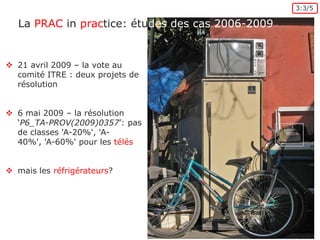
3:3/5LaPRACinpractice: étudesdes cas 2006-200921 avril 2009 – la vote au comité ITRE : deuxprojets de résolution
6 mai 2009 – la résolution ‘P6_TA-PROV(2009)0357’: pas de classes 'A-20%', 'A-40%', 'A-60%' pour les télés
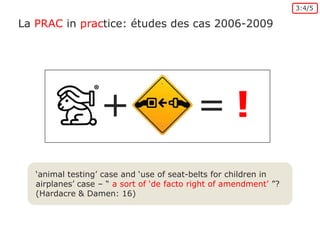
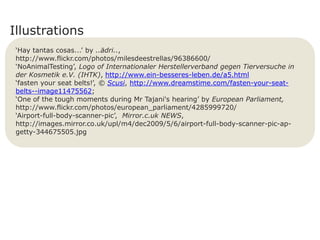
mais les réfrigérateurs?3:4/5LaPRACinpractice: études des cas 2006-2009+=!‘animal testing’ case and ‘use of seat-belts for children in airplanes’ case – “ a sort of ‘de facto right of amendment’ ”? (Hardacre & Damen: 16)
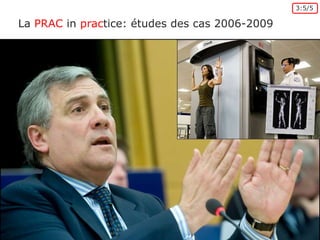
3:5/5LaPRACinpractice: études des cas 2006-2009
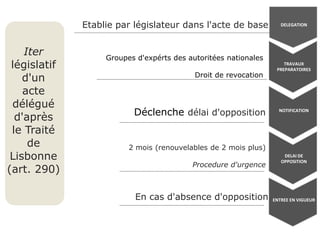
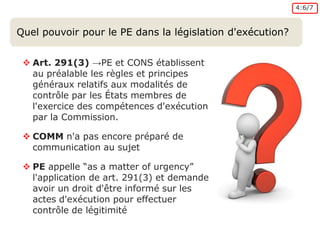
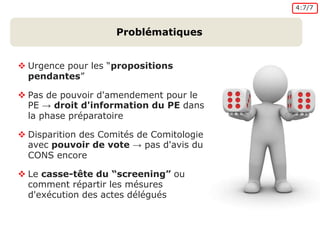
4:1/7La législationdéléguée après LisbonneLe mot “comitologie” vadisparaître
Legislation déléguée:
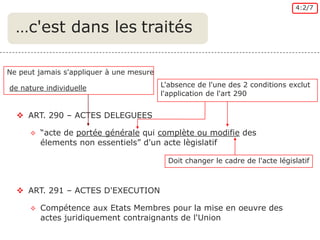
Actesdélégués
Actesd'exécution

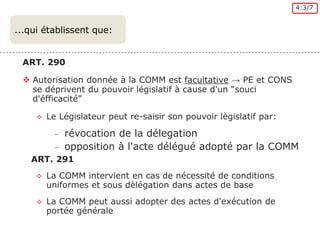
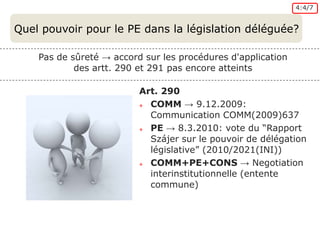
La PRAC et le Traité de Lisbonne

  • 1.
    Intervention du Parlementeuropéenencomitologieles casd’application de la réforme de 2006 et leTraité de LisbonneAnna Dekalchuk & RiccardoMezzasalma,le 12 mars 2010
  • 2.
    SommaireAvant la réforme2006: quelrôle pour le Parlement?
  • 3.
    La réforme 2006:comment la PRAC doit-ellefonctionner en théorie?
  • 4.
  • 5.
    La législation déléguéeaprès Lisbonne?1:1/1Avant la réforme 2006: quelrôle pour le Parlement?La decision du Conseil 87/373/CEEle Traité d’Amsterdam et l’extension de codécision (II)la décision du Conseil 2006/513/CE et l’introduction de la PRACles premiers comités1994l’accord ‘Modus Vivendi’6 fois1 novembre 199328 juin 19991 décembre 20091 juillet 1987les années 6013 juillet 19871 mai 199917 juillet 2006198820027 foisl’accord Plumb-Delors: l’information pour le PE le processus Lamfalussyla décision du Conseil 1999/486/CE et le ‘droit de regard’ et d’informationl’Acte unique euro-péen et le changement de l’Article 145le Traité de Maastricht et l’introduction de codécisionle Traité de Lisbonne et la législationdéléguée“Le Parlementeuropéen, traditionnellement laissé pour compte” (Szapiro, 2006a: 559)
  • 6.
    2:1/2La réforme 2006:comment la PRAC doit-ellefonctionneren théorie?La décision2006/513/CE (l’Article 5 bis)“droit de veto sur la substance de certainesmesures [quasi législatives] qui mettent en œure les actesadoptés en codécision”La base de l’opposition:les mesures proposées excèdent les compétences d’exécution prévues dans l’act de base (droit de regard)
  • 7.
    les mesuresne sont pas compatibles avec le but ou le contenu de l’act de base
  • 8.
    les mesuresne respectent pas les principes de subsidiarité et de proportionnalitéPas de droit de disposer d’observateurs du PE dans les comités comitologie
  • 9.
    2:2/2Pas de pouvoirspour le PEà la majorité absolue de ses membres – la séance plénière
  • 10.
    à la majoritésimple de ses membres – le comité responsable du PE(Source: Szapiro, 2006b: 577)
  • 11.
  • 12.
    3:2/5LaPRACinpractice: études descas 2006-2009Les cas contradictoires pour le PE (l’informationjusqu‘aumai 2009)
  • 13.
    3:3/5LaPRACinpractice: étudesdes cas2006-200921 avril 2009 – la vote au comité ITRE : deuxprojets de résolution
  • 14.
    6 mai 2009– la résolution ‘P6_TA-PROV(2009)0357’: pas de classes 'A-20%', 'A-40%', 'A-60%' pour les télés
  • 15.
    mais les réfrigérateurs?3:4/5LaPRACinpractice:études des cas 2006-2009+=!‘animal testing’ case and ‘use of seat-belts for children in airplanes’ case – “ a sort of ‘de facto right of amendment’ ”? (Hardacre & Damen: 16)
  • 16.
  • 17.
    4:1/7La législationdéléguée aprèsLisbonneLe mot “comitologie” vadisparaître
  • 18.
  • 19.
  • 20.

Notes de l'éditeur

  • #2 Good afternoon. As you can see, today we are going to speak about the role of the Parliament in comitology procedure from a very practical point of view.
  • #3 We will proceed as follows: the first two parts are somehow a very short introduction into the topic. The part “la PRAC in practice” is devoted to the casestudies of how they used the procedure introduced by the 2006 reform. And the last part examines the latest developments brought by the Reform treaty.
  • #4 Here it is the history scheme of how the Parliament gradually expanded its powers in comitology. Basically, the most important thing with this history is that during two last decades the pressure, both formal and informal (click), from the Parliament to give it more powers in the procedure was constant and severe. But at the same time the usage of the powers gained by the EP in each reform round was more then modest (click). In between 1999 and 2006 the EP used its right of scrutiny only 6 times and after the 2006 reform and until the Lisbon treaty there were only 7 attempts to adopt opposing resolutions under the PRAC. Maybe this is the result of inability of the EP to exercise its powers or its unwillingness to do so or maybe the Commission just does its work very well and doesn’t provoke disputes.
  • #5 I’m sure you all know how the PRAC works in theory. In a nutshell, it is a right of veto on the substance of the quisi-legislative acts adopted under the co-decision. But the exercise of veto by the EP must be justified. Here it is three conditions allowing the EP to oppose. The presence of one of these conditions is already enough to adopt an opposing resolution.
  • #6 Here it is the scheme of how the PRAC works. The only interesting thing for us here is (click) that the EP votes under absolute majority to adopt resolution in the plenary session. Yet, before this stage the committee responsible for the draft-measure votes the draft-resolution under simple majority. And this has the potential of failure of the draft-resolution in the plenary though it could have passed the committee because it is easier to find simple majority then absolute one. And you will see that there was one such case.
  • #7 As you can see the PRAC is not that frequently used. Though, as our contact person said in 2009 there had been an increase of usage of the PRAC and he estimated a number of about 200 usages but no precise number is now available.
  • #8 So, this is a table which sums up all the controversial cases for the EP where the PRAC was to be applied. Despite the fact that there were only 7 not 8 attempts to adopt opposing resolution under the PRAC the table consists of 8 cases and as you will see is not a mistake. Due to the time constrains I’m going to speak only about three cases (click) which are representative and at the same time the most interesting ones.
  • #9 The first two cases I’m going to speak about are the most recent ones – new ‘energy labelling for TV sets measure’ and new ’energy labelling for fridges measure’. For both measures proposed by the Commission the EP committee responsible for consideration of these measures successfully voted two draft-resolutions referring to the fact that the proposed measures are not compatible with the aim of the legislative act and that new proposed classes such as A-20% or A-40% only add to confusion about whether class 'A' represents an efficient or an inefficient product. But when it came to voting in the plenary session only one opposing resolution was finally adopted – concerning TV-sets. As the EP Press-release states opposing resolution for fridges was not backed by the necessary majority of MEPs. So, basically, this is an example of the failure-in-the-plenary potential I was speaking about two slides ago which shows that only measure which doesn’t satisfy a wide number of MEPs would be opposed.
  • #10 Another two cases represent a very interesting practice which was not even foreseen in the procedure. Two draft-resolutions were withdrawn by the EP committee even before voting in the committee. That was done after the Commission indicated in the letters to the EP that the modifications required by the EP would be taken into account in a subsequent revision of the implementing measure. So, Hardacre and Damen argue that this communication exercise between two institutions could have appeared to be a ‘de facto right’ of amendment for the EP. But it wouldn’t be the case as the Lisbon treaty changes things with comitology drastically. But still this example shows the very loyal cooperation between institutions involved.
  • #11 The last case is a famous body scanners case. The zest of this case is that the resolution adopted against the measure proposed by the Commission was not an opposing resolution under the PRAC, but was ordinary parliament resolution which is not legally binding for the Commission. Moreover, this resolution was initiated by LIBE committee not by the Transport and tourism committee which was formally responsible to consider the issue. And the most interesting thing here is that when the resolution was adopted in the plenary the Commission and, personally Mister Tajani, decided to withdraw the measure because of the mass media critics which supported the idea of LIBE committee about the violation of the private life by examining people with body scanners. So, this case shows how the EP can force the Commission to withdraw the measure using public opinion and mass media without even exercising its formal right under the PRAC.