LE P.O.D.
Le pronom d’objet direct
It replaces:
• The direct object:

Il cherche sa voiture.
              voiture
SUBJECT       VERB (ACTION)   DIRECT OBJECT
IL            CHERCHE         SA VOITURE
THE DOP’s
Their position:
1. Present:                            Il me cherche.

2. Passé composé                       Il m’a cherché

3. Near future                         Il va me chercher

4. With verbs of preference            Il aime me chercher.

5. Negation with present.              Il ne me cherche pas.

6. Negation with P.C.                  Il ne m’a pas cherché

7. Negation with near future.          Il ne va pas me chercher.

8. Negation with verbs of preference   Il n’aime pas me chercher.
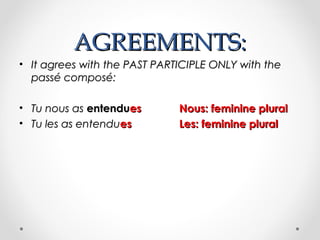
AGREEMENTS:
• It agrees with the PAST PARTICIPLE ONLY with the
  passé composé:

• Tu nous as entendues        Nous: feminine plural
• Tu les as entendues         Les: feminine plural
AGREEMENTS:
• It agrees with the PAST PARTICIPLE ONLY with the
  passé composé:

• Tu nous as entendues        Nous: feminine plural
• Tu les as entendues         Les: feminine plural

Le pronom d'objet direct

  • 1.
    LE P.O.D. Le pronomd’objet direct
  • 2.
    It replaces: • Thedirect object: Il cherche sa voiture. voiture SUBJECT VERB (ACTION) DIRECT OBJECT IL CHERCHE SA VOITURE
  • 3.
  • 4.
    Their position: 1. Present: Il me cherche. 2. Passé composé Il m’a cherché 3. Near future Il va me chercher 4. With verbs of preference Il aime me chercher. 5. Negation with present. Il ne me cherche pas. 6. Negation with P.C. Il ne m’a pas cherché 7. Negation with near future. Il ne va pas me chercher. 8. Negation with verbs of preference Il n’aime pas me chercher.
  • 5.
    AGREEMENTS: • It agreeswith the PAST PARTICIPLE ONLY with the passé composé: • Tu nous as entendues Nous: feminine plural • Tu les as entendues Les: feminine plural
  • 6.
    AGREEMENTS: • It agreeswith the PAST PARTICIPLE ONLY with the passé composé: • Tu nous as entendues Nous: feminine plural • Tu les as entendues Les: feminine plural