Mobile Health (mHealth)
Shristina Shrestha
Idaho State University
MBA5520
Introduction
Mobile Health is the use of mobile devices such as smartphones, smartwatches, and
wearables such as Fitbit for various reasons such as managing medical information, finding
physicians, finding disease related information and patient communities. Mobile Health includes
both smartphones applications as well as devices such as Fitbit and Apple Watch that may or
may not need additional software applications. As the popularity of smartphones and mobile
devices continues to grow, more people are inclined to use mHealth apps. Connection of
mHealth apps to social media and people’s confidence in these apps have helped in increasing
the mobile health app market.
Mobile Health app market
The mobile health app market has boomed over the years and especially since
smartphones and mobile devices have become commonplace. Mobile health app market is over
$ 400 million.1
The current number of health apps in the market is over 165000.2
Most apps are
compatible with both iOS and android operating systems. Popular mHealth apps such as
Myfitnesspal®, Weight Watchers® and Fitnesskeeper® can be found in both iOS and android
systems. Similarly, mHealth apps such as Fitness Pro™, Runstastic Pro® and Cascarun® are
also compatible with Blackberry OS so that Blackberry users can also utilize the benefits of
these apps.6
The number of health apps are growing by the day has almost doubled in the past
two years. The mobile health app market was worth less than $100 million in 2010.1
Uses of mobile health apps
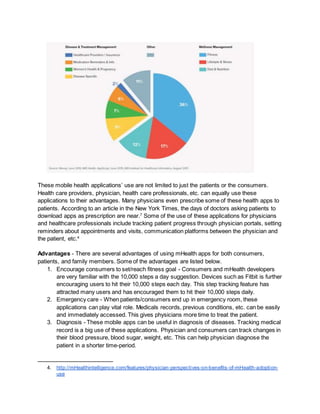
Mobile Health’s use can be classified into two main categories.3
1. Disease and Treatment Management
2. Wellness Management
1. Disease and Treatment Management - This category mainly deals with providing mobile
services for patients who have been diagnosed with health conditions. mySugr falls
under this category. It is a mobile health (mHealth) app that focuses on treatment and
management of diabetes. People who are already diagnosed with diabetes or have
family members who are diabetic are the primary users of this mobile health app. Other
mHealth apps include Diabetik, Blood Pressure Companion, Cardiograph, etc.
2. Wellness Management - This category mainly deals with prevention and promotion of
wellness of consumer health. Consumers may or may not be diagnosed with any health
conditions. They may also be using it to simply track weight loss/gain, amount of
exercise, fitness goals, etc. This category consists of ⅔ of the total mHealth applications
in the market.3
Some of the popular apps are Myfitnesspal, Couch to 5k, sworkit, etc.
Devices that support these apps are smart phones, Fitbit, smart watches etc.
1
1. 1
http://mHealthintelligence.com/news/mHealth-app-market-sees-400-million-growth-in-five-years
2. http://searchhealthit.techtarget.com/blog/Health-IT-Pulse/A-fraction-of-mobile-health-apps-
control-download-market
3. http://www.imedicalapps.com/2015/09/ims-health-apps-report/
These mobile health applications’ use are not limited to just the patients or the consumers.
Health care providers, physician, health care professionals, etc. can equally use these
applications to their advantages. Many physicians even prescribe some of these health apps to
patients. According to an article in the New York Times, the days of doctors asking patients to
download apps as prescription are near.7
Some of the use of these applications for physicians
and healthcare professionals include tracking patient progress through physician portals, setting
reminders about appointments and visits, communication platforms between the physician and
the patient, etc.4
Advantages - There are several advantages of using mHealth apps for both consumers,
patients, and family members. Some of the advantages are listed below.
1. Encourage consumers to set/reach fitness goal - Consumers and mHealth developers
are very familiar with the 10,000 steps a day suggestion. Devices such as Fitbit is further
encouraging users to hit their 10,000 steps each day. This step tracking feature has
attracted many users and has encouraged them to hit their 10,000 steps daily.
2. Emergency care - When patients/consumers end up in emergency room, these
applications can play vital role. Medicals records, previous conditions, etc. can be easily
and immediately accessed. This gives physicians more time to treat the patient.
3. Diagnosis - These mobile apps can be useful in diagnosis of diseases. Tracking medical
record is a big use of these applications. Physician and consumers can track changes in
their blood pressure, blood sugar, weight, etc. This can help physician diagnose the
patient in a shorter time-period.
4. http://mHealthintelligence.com/features/physician-perspectives-on-benefits-of-mHealth-adoption-
use
4. Health Education - There are several apps that focus on informing the patients about
medical conditions, health myths and promote healthy habits. Patients that are suffering
from rare conditions can find more information about their disease on the touch of a
button.
Disadvantages - There are several disadvantages of mHealth apps. Some of the
disadvantages are listed below.
1. Inaccurate information - There is no governing body currently to demand legitimacy of
information that many health apps are providing. There are some mHealth apps that
partner with FDA to provide most accurate information such as WebMD app. But there
are other hundreds of apps that operate independently. Earlier this year, death of a
Chinese actress sparked controversy over use of traditional Chinese medicine instead of
chemotherapy for lymphoma. This shows that inaccurate and health myth can cause
people to lose their lives. Consumers could use information from these mHealth apps
that are not regulated and witness disastrous results.2
2. Lack of Privacy - HIPAA is the governing body when it comes to privacy of consumer
health information. Many of the apps do not follow the HIPAA guidelines. Many of these
apps are not required to. This brings up the concern that these mHealth app companies
could be fiddling with consumer health information.
3. Integration with provider system 5
- There are so many mHealth apps out in the market.
There is no one app that all patients use. Therefore, it becomes hard for healthcare
provider to develop a system that can access patient information instantaneously from
all these different mHealth apps. Adding compatibility to all these different mHealth app
can add additional to cost to the already high priced EHR or other similar systems.
Approval from FDA and following HIPPA guidelines have become “nice to have” features for
mHealth app companies. They are not mandated. This could result in several consequences.
Conclusion
Mobile Health market is booming and it has not shown any signs of slowing down. Every day
new mHealth apps are being launched. Companies are using new strategies and trying to find
fun ways to keep users interactive. mHealth apps have a lot of advantages for the patients or
the users however it also has a lot of disadvantages if one is not cautious. The government
currently does not have any fixed mandatory process for many of these apps. However, there
are certain ways for new emerging app companies to become a player in the market.
2
5. https://www.aimseducation.edu/blog/pros-and-cons-of-mobile-technology-in-health-care/
6. http://crackberry.com/top-health-and-fitness-blackberry-10
7. http://www.nytimes.com/2012/08/20/technology/coming-next-doctors-prescribing-apps-to-patients.html
Checklist for new app company
1. Solving a problem - This is the best way to enter a market. Finding the flaws of different
mHealth apps and finding a way to solve the problem for the users can help app
companies remain in the market. Second mover advantages can play an important role.
Companies should study the benefits and disadvantages of the existing competitors.
2. FDA and HIPAA guidelines- Following FDA and HIPAA guidelines can help a mHealth
app but it might also increase the time for apps to get launched which could result in
increase in the price for the consumers. This could look like cost but it might just end up
being a short-term cost and help companies in long run and help them avoid legal issues
that may arise later.
3. Use of expert power - Having physician or healthcare provider use the app and
recommend it to their patients or their family members can be very useful for a company.
There are patient communities for various conditions and having (good) doctors
recommend a health app can go a long way for a mHealth app company.
4. Develop Interactive app - Many mHealth apps get lost because a lot of users don’t find it
fun or interesting to use the app. For any app company, it is vital to incentivize the users
to keep on using the app.
5. Social media - The best way for an mHealth app to work is to get user groups.
Generating a sense of competition can be very helpful. If users can post on their
Facebook or blogs or get bragging rights for a week, it is all good for the app company.
This will give the app more visibility in social media atmosphere.

MobileHealth_Shrestha

  • 1.
    Mobile Health (mHealth) ShristinaShrestha Idaho State University MBA5520
  • 2.
    Introduction Mobile Health isthe use of mobile devices such as smartphones, smartwatches, and wearables such as Fitbit for various reasons such as managing medical information, finding physicians, finding disease related information and patient communities. Mobile Health includes both smartphones applications as well as devices such as Fitbit and Apple Watch that may or may not need additional software applications. As the popularity of smartphones and mobile devices continues to grow, more people are inclined to use mHealth apps. Connection of mHealth apps to social media and people’s confidence in these apps have helped in increasing the mobile health app market. Mobile Health app market The mobile health app market has boomed over the years and especially since smartphones and mobile devices have become commonplace. Mobile health app market is over $ 400 million.1 The current number of health apps in the market is over 165000.2 Most apps are compatible with both iOS and android operating systems. Popular mHealth apps such as Myfitnesspal®, Weight Watchers® and Fitnesskeeper® can be found in both iOS and android systems. Similarly, mHealth apps such as Fitness Pro™, Runstastic Pro® and Cascarun® are also compatible with Blackberry OS so that Blackberry users can also utilize the benefits of these apps.6 The number of health apps are growing by the day has almost doubled in the past two years. The mobile health app market was worth less than $100 million in 2010.1 Uses of mobile health apps Mobile Health’s use can be classified into two main categories.3 1. Disease and Treatment Management 2. Wellness Management 1. Disease and Treatment Management - This category mainly deals with providing mobile services for patients who have been diagnosed with health conditions. mySugr falls under this category. It is a mobile health (mHealth) app that focuses on treatment and management of diabetes. People who are already diagnosed with diabetes or have family members who are diabetic are the primary users of this mobile health app. Other mHealth apps include Diabetik, Blood Pressure Companion, Cardiograph, etc. 2. Wellness Management - This category mainly deals with prevention and promotion of wellness of consumer health. Consumers may or may not be diagnosed with any health conditions. They may also be using it to simply track weight loss/gain, amount of exercise, fitness goals, etc. This category consists of ⅔ of the total mHealth applications in the market.3 Some of the popular apps are Myfitnesspal, Couch to 5k, sworkit, etc. Devices that support these apps are smart phones, Fitbit, smart watches etc. 1 1. 1 http://mHealthintelligence.com/news/mHealth-app-market-sees-400-million-growth-in-five-years 2. http://searchhealthit.techtarget.com/blog/Health-IT-Pulse/A-fraction-of-mobile-health-apps- control-download-market 3. http://www.imedicalapps.com/2015/09/ims-health-apps-report/
  • 3.
    These mobile healthapplications’ use are not limited to just the patients or the consumers. Health care providers, physician, health care professionals, etc. can equally use these applications to their advantages. Many physicians even prescribe some of these health apps to patients. According to an article in the New York Times, the days of doctors asking patients to download apps as prescription are near.7 Some of the use of these applications for physicians and healthcare professionals include tracking patient progress through physician portals, setting reminders about appointments and visits, communication platforms between the physician and the patient, etc.4 Advantages - There are several advantages of using mHealth apps for both consumers, patients, and family members. Some of the advantages are listed below. 1. Encourage consumers to set/reach fitness goal - Consumers and mHealth developers are very familiar with the 10,000 steps a day suggestion. Devices such as Fitbit is further encouraging users to hit their 10,000 steps each day. This step tracking feature has attracted many users and has encouraged them to hit their 10,000 steps daily. 2. Emergency care - When patients/consumers end up in emergency room, these applications can play vital role. Medicals records, previous conditions, etc. can be easily and immediately accessed. This gives physicians more time to treat the patient. 3. Diagnosis - These mobile apps can be useful in diagnosis of diseases. Tracking medical record is a big use of these applications. Physician and consumers can track changes in their blood pressure, blood sugar, weight, etc. This can help physician diagnose the patient in a shorter time-period. 4. http://mHealthintelligence.com/features/physician-perspectives-on-benefits-of-mHealth-adoption- use
  • 4.
    4. Health Education- There are several apps that focus on informing the patients about medical conditions, health myths and promote healthy habits. Patients that are suffering from rare conditions can find more information about their disease on the touch of a button. Disadvantages - There are several disadvantages of mHealth apps. Some of the disadvantages are listed below. 1. Inaccurate information - There is no governing body currently to demand legitimacy of information that many health apps are providing. There are some mHealth apps that partner with FDA to provide most accurate information such as WebMD app. But there are other hundreds of apps that operate independently. Earlier this year, death of a Chinese actress sparked controversy over use of traditional Chinese medicine instead of chemotherapy for lymphoma. This shows that inaccurate and health myth can cause people to lose their lives. Consumers could use information from these mHealth apps that are not regulated and witness disastrous results.2 2. Lack of Privacy - HIPAA is the governing body when it comes to privacy of consumer health information. Many of the apps do not follow the HIPAA guidelines. Many of these apps are not required to. This brings up the concern that these mHealth app companies could be fiddling with consumer health information. 3. Integration with provider system 5 - There are so many mHealth apps out in the market. There is no one app that all patients use. Therefore, it becomes hard for healthcare provider to develop a system that can access patient information instantaneously from all these different mHealth apps. Adding compatibility to all these different mHealth app can add additional to cost to the already high priced EHR or other similar systems. Approval from FDA and following HIPPA guidelines have become “nice to have” features for mHealth app companies. They are not mandated. This could result in several consequences. Conclusion Mobile Health market is booming and it has not shown any signs of slowing down. Every day new mHealth apps are being launched. Companies are using new strategies and trying to find fun ways to keep users interactive. mHealth apps have a lot of advantages for the patients or the users however it also has a lot of disadvantages if one is not cautious. The government currently does not have any fixed mandatory process for many of these apps. However, there are certain ways for new emerging app companies to become a player in the market. 2 5. https://www.aimseducation.edu/blog/pros-and-cons-of-mobile-technology-in-health-care/ 6. http://crackberry.com/top-health-and-fitness-blackberry-10 7. http://www.nytimes.com/2012/08/20/technology/coming-next-doctors-prescribing-apps-to-patients.html
  • 5.
    Checklist for newapp company 1. Solving a problem - This is the best way to enter a market. Finding the flaws of different mHealth apps and finding a way to solve the problem for the users can help app companies remain in the market. Second mover advantages can play an important role. Companies should study the benefits and disadvantages of the existing competitors. 2. FDA and HIPAA guidelines- Following FDA and HIPAA guidelines can help a mHealth app but it might also increase the time for apps to get launched which could result in increase in the price for the consumers. This could look like cost but it might just end up being a short-term cost and help companies in long run and help them avoid legal issues that may arise later. 3. Use of expert power - Having physician or healthcare provider use the app and recommend it to their patients or their family members can be very useful for a company. There are patient communities for various conditions and having (good) doctors recommend a health app can go a long way for a mHealth app company. 4. Develop Interactive app - Many mHealth apps get lost because a lot of users don’t find it fun or interesting to use the app. For any app company, it is vital to incentivize the users to keep on using the app. 5. Social media - The best way for an mHealth app to work is to get user groups. Generating a sense of competition can be very helpful. If users can post on their Facebook or blogs or get bragging rights for a week, it is all good for the app company. This will give the app more visibility in social media atmosphere.