COST OF GOVERNANCE: ADJUSTING THE STRUCTURES
(A Review of the Oronsaye Committee Report and the Federal Government White Paper)
Centre for Social Justice (CSJ)
(Mainstreaming Social Justice in Public Life)
Cost of Governance: Adjusting the Structures
Cost of Governance: Adjusting the Structures Page
Page
Page
Page ii
ii
ii
ii
Written By
Kalu Onuoha Esq and Eze Onyekpere Esq
First Published in September 2014
By
Centre for Social Justice Ltd by Guarantee
(Mainstreaming Social Justice in Public Life)
No. 17 (Flat 2), Yaounde Street, Wuse Zone 6,
P.O. Box 11418 Garki, Abuja
Tel: 08055070909, 08127235995
Website: www.csj-ng.org; Blog: csj-blog.org. Email: censoj@gmail.com
Twitter: @Censoj Facebook: CSJ Nigeria
ISBN:
Copyright @CSJ
Centre for Social Justice (CSJ)
Cost of Governance: Adjusting the Structures
Cost of Governance: Adjusting the Structures Page
Page
Page
Page iii
iii
iii
iii
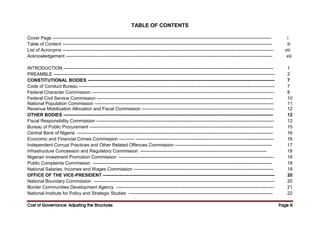
TABLE OF CONTENTS
Cover Page ------------------------------------------------------------------------------------------------------------------------------------------------ i
Table of Content ------------------------------------------------------------------------------------------------------------------------------------------ iii
List of Acronyms ------------------------------------------------------------------------------------------------------------------------------------------- viii
Acknowledgement ---------------------------------------------------------------------------------------------------------------------------------------- xiii
INTRODUCTION ------------------------------------------------------------------------------------------------------------------------------------------ 1
PREAMBLE -------------------------------------------------------------------------------------------------------------------------------------------------- 2
CONSTITUTIONAL BODIES --------------------------------------------------------------------------------------------------------------------------- 7
Code of Conduct Bureau --------------------------------------------------------------------------------------------------------------------------------- 7
Federal Character Commission ------------------------------------------------------------------------------------------------------------------------ 8
Federal Civil Service Commission -------------------------------------------------------------------------------------------------------------------- 10
National Population Commission ---------------------------------------------------------------------------------------------------------------------- 11
Revenue Mobilization Allocation and Fiscal Commission --------------------------------------------------------------------------------------- 12
OTHER BODIES ------------------------------------------------------------------------------------------------------------------------------------------ 12
Fiscal Responsibility Commission --------------------------------------------------------------------------------------------------------------------- 12
Bureau of Public Procurement ------------------------------------------------------------------------------------------------------------------------- 15
Central Bank of Nigeria --------------------------------------------------------------------------------------------------------------------------------- 16
Economic and Financial Crimes Commission ---------- ------------------------------------------------------------------------------------------- 16
Independent Corrupt Practices and Other Related Offences Commission ---------------------------------------------------------------- 17
Infrastructure Concession and Regulatory Commission ----------------------------------------------------------------------------------- 18
Nigerian Investment Promotion Commission ------------------------------------------------------------------------------------------------------ 18
Public Complaints Commission ---------------------------------------------------------------------------------------------------------------------- 18
National Salaries, Incomes and Wages Commission -------------------------------------------------------------------------------------------- 19
OFFICE OF THE VICE-PRESIDENT ----------------------------------------------------------------------------------------------------------------- 20
National Boundary Commission ----------------------------------------------------------------------------------------------------------------------- 20
Border Communities Development Agency -------------------------------------------------------------------------------------------------------- 21
National Institute for Policy and Strategic Studies ----------------------------------------------------------------------------------------------- 22
Cost of Governance: Adjusting the Structures
Cost of Governance: Adjusting the Structures Page
Page
Page
Page iv
iv
iv
iv
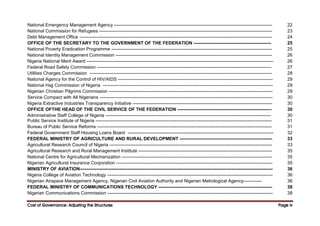
National Emergency Management Agency -------------------------------------------------------------------------------------------------------- 22
National Commission for Refugees ------------------------------------------------------------------------------------------------------------------ 23
Debt Management Office ------------------------------------------------------------------------------------------------------------------------------- 24
OFFICE OF THE SECRETARY TO THE GOVERNMENT OF THE FEDERATION --------------------------------------------------- 25
National Poverty Eradication Programme ---------------------------------------------------------------------------------------------------------- 25
National Identity Management Commission ------------------------------------------------------------------------------------------------------- 26
Nigeria National Merit Award --------------------------------------------------------------------------------------------------------------------------- 26
Federal Road Safety Commission ------------------------------------------------------------------------------------------------------------------- 27
Utilities Charges Commission ------------------------------------------------------------------------------------------------------------------------ 28
National Agency for the Control of HIV/AIDS ------------------------------------------------------------------------------------------------------ 29
National Hajj Commission of Nigeria ---------------------------------------------------------------------------------------------------------------- 29
Nigerian Christian Pilgrims Commission ------------------------------------------------------------------------------------------------------------ 29
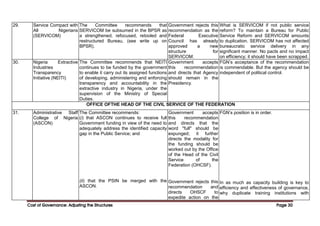
Service Compact with All Nigerians ------------------------------------------------------------------------------------------------------------------ 30
Nigeria Extractive Industries Transparency Initiative -------------------------------------------------------------------------------------------- 30
OFFICE OFTHE HEAD OF THE CIVIL SERVICE OF THE FEDERATION -------------------------------------------------------------- 30
Administrative Staff College of Nigeria ------------------------------------------------------------------------------------------------------------- 30
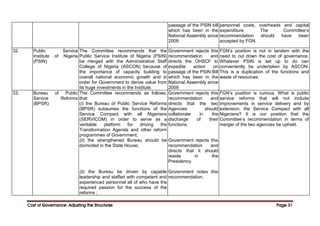
Public Service Institute of Nigeria -------------------------------------------------------------------------------------------------------------------- 31
Bureau of Public Service Reforms ------------------------------------------------------------------------------------------------------------------- 31
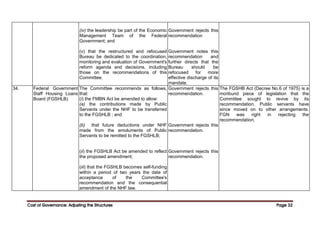
Federal Government Staff Housing Loans Board ------------------------------------------------------------------------------------------------ 32
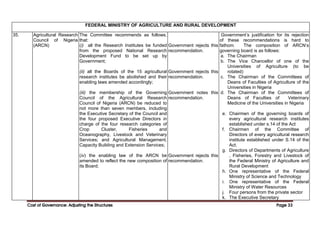
FEDERAL MINISTRY OF AGRICULTURE AND RURAL DEVELOPMENT ------------------------------------------------------------- 33
Agricultural Research Council of Nigeria ----------------------------------------------------------------------------------------------------------- 33
Agricultural Research and Rural Management Institute ---------------------------------------------------------------------------------------- 35
National Centre for Agricultural Mechanization --------------------------------------------------------------------------------------------------- 35
Nigerian Agricultural Insurance Corporation ------------------------------------------------------------------------------------------------------- 35
MINISTRY OF AVIATION------------------------------------------------------------------------------------------------------------------------------- 36
Nigeria College of Aviation Technology ------------------------------------------------------------------------------------------------------------- 36
Nigerian Airspace Management Agency, Nigerian Civil Aviation Authority and Nigerian Metrological Agency------------ 36
FEDERAL MINISTRY OF COMMUNICATIONS TECHNOLOGY --------------------------------------------------------------------------- 38
Nigerian Communications Commission ------------------------------------------------------------------------------------------------------------- 38
Cost of Governance: Adjusting the Structures
Cost of Governance: Adjusting the Structures Page
Page
Page
Page v
v
v
v
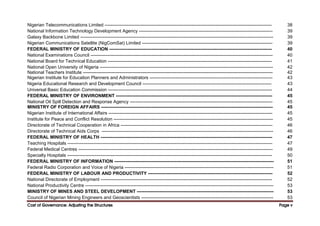
Nigerian Telecommunications Limited -------------------------------------------------------------------------------------------------------------- 38
National Information Technology Development Agency ---------------------------------------------------------------------------------------- 39
Galaxy Backbone Limited ------------------------------------------------------------------------------------------------------------------------------- 39
Nigerian Communications Satellite (NigComSat) Limited -------------------------------------------------------------------------------------- 39
FEDERAL MINISTRY OF EDUCATION ----------------------------------------------------------------------------------------------------------- 40
National Examinations Council ------------------------------------------------------------------------------------------------------------------------ 40
National Board for Technical Education ------------------------------------------------------------------------------------------------------------ 41
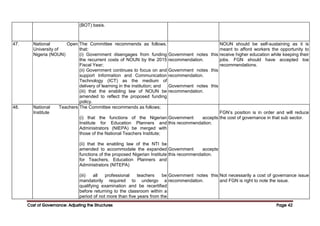
National Open University of Nigeria ------------------------------------------------------------------------------------------------------------------ 42
National Teachers Institute ----------------------------------------------------------------------------------------------------------------------------- 42
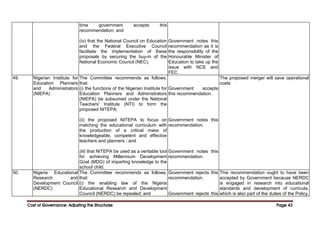
Nigerian Institute for Education Planners and Administrators --------------------------------------------------------------------------------- 43
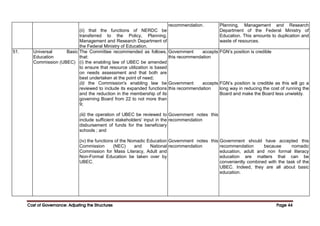
Nigeria Educational Research and Development Council ------------------------------------------------------------------------------------- 43
Universal Basic Education Commission ------------------------------------------------------------------------------------------------------------ 44
FEDERAL MINISTRY OF ENVIRONMENT ------------------------------------------------------------------------------------------------------- 45
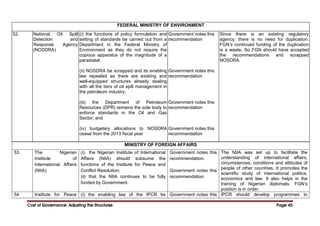
National Oil Spill Detection and Response Agency ---------------------------------------------------------------------------------------------- 45
MINISTRY OF FOREIGN AFFAIRS ----------------------------------------------------------------------------------------------------------------- 45
Nigerian Institute of International Affairs ------------------------------------------------------------------------------------------------------------ 45
Institute for Peace and Conflict Resolution --------------------------------------------------------------------------------------------------------- 45
Directorate of Technical Cooperation in Africa ---------------------------------------------------------------------------------------------------- 46
Directorate of Technical Aids Corps ----------------------------------------------------------------------------------------------------------------- 46
FEDERAL MINISTRY OF HEALTH ----------------------------------------------------------------------------------------------------------------- 47
Teaching Hospitals --------------------------------------------------------------------------------------------------------------------------------------- 47
Federal Medical Centres -------------------------------------------------------------------------------------------------------------------------------- 49
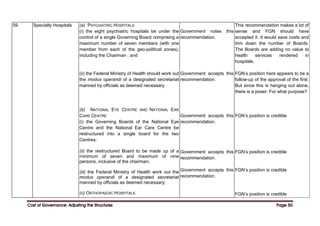
Specialty Hospitals --------------------------------------------------------------------------------------------------------------------------------------- 50
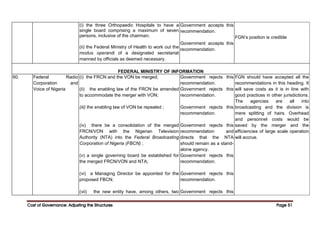
FEDERAL MINISTRY OF INFORMATION --------------------------------------------------------------------------------------------------------- 51
Federal Radio Corporation and Voice of Nigeria -------------------------------------------------------------------------------------------------- 51
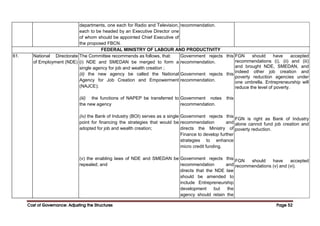
FEDERAL MINISTRY OF LABOUR AND PRODUCTIVITY ---------------------------------------------------------------------------------- 52
National Directorate of Employment ----------------------------------------------------------------------------------------------------------------- 52
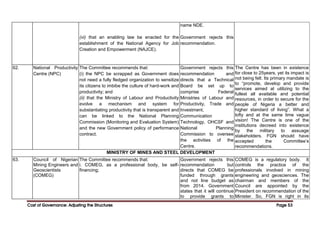
National Productivity Centre ---------------------------------------------------------------------------------------------------------------------------- 53
MINISTRY OF MINES AND STEEL DEVELOPMENT ------------------------------------------------------------------------------------------ 53
Council of Nigerian Mining Engineers and Geoscientists --------------------------------------------------------------------------------------- 53
Cost of Governance: Adjusting the Structures
Cost of Governance: Adjusting the Structures Page
Page
Page
Page vi
vi
vi
vi
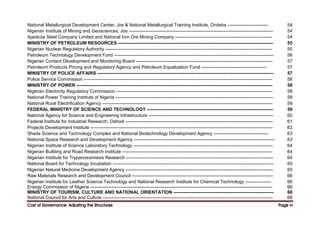
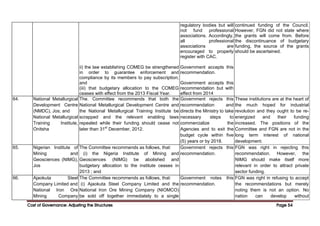
National Metallurgical Development Center, Jos & National Metallurgical Training Institute, Onitsha --------------------------- 54
Nigerian Institute of Mining and Geosciences, Jos ----------------------------------------------------------------------------------------------- 54
Ajaokuta Steel Company Limited and National Iron Ore Mining Company ---------------------------------------------------------------- 54
MINISTRY OF PETROLEUM RESOURCES ------------------------------------------------------------------------------------------------------ 55
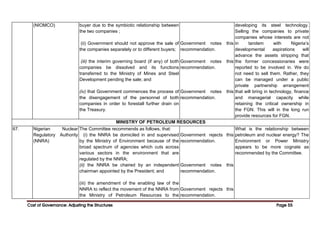
Nigerian Nuclear Regulatory Authority -------------------------------------------------------------------------------------------------------------- 55
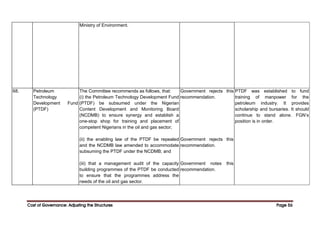
Petroleum Technology Development Fund --------------------------------------------------------------------------------------------------------- 56
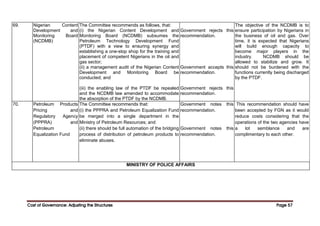
Nigerian Content Development and Monitoring Board ------------------------------------------------------------------------------------------ 57
Petroleum Products Pricing and Regulatory Agency and Petroleum Equalization Fund ------------------------------------------- 57
MINISTRY OF POLICE AFFAIRS -------------------------------------------------------------------------------------------------------------------- 57
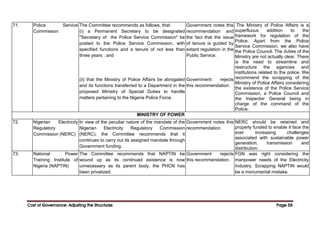
Police Service Commission ---------------------------------------------------------------------------------------------------------------------------- 58
MINISTRY OF POWER --------------------------------------------------------------------------------------------------------------------------------- 58
Nigerian Electricity Regulatory Commission ------------------------------------------------------------------------------------------------------- 58
National Power Training Institute of Nigeria -------------------------------------------------------------------------------------------------------- 58
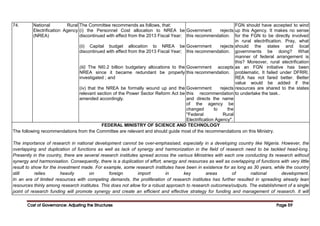
National Rural Electrification Agency ---------------------------------------------------------------------------------------------------------------- 59
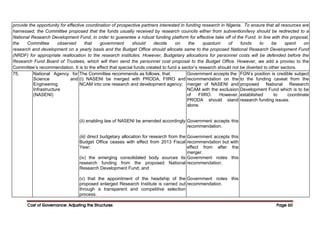
FEDERAL MINISTRY OF SCIENCE AND TECHNOLOGY ----------------------------------------------------------------------------------- 59
National Agency for Science and Engineering Infrastructure ---------------------------------------------------------------------------------- 60
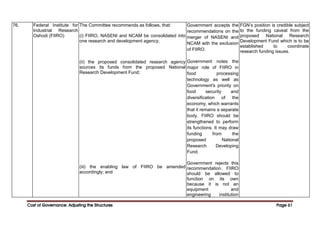
Federal Institute for Industrial Research, Oshodi ------------------------------------------------------------------------------------------------- 61
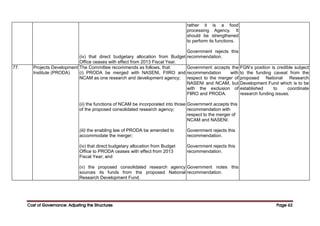
Projects Development Institute ------------------------------------------------------------------------------------------------------------------------ 62
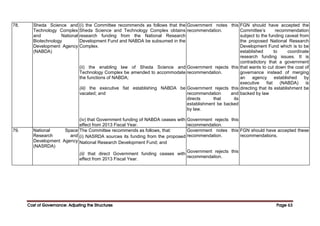
Sheda Science and Technology Complex and National Biotechnology Development Agency ------------------------------------ 63
National Space Research and Development Agency --------------------------------------------------------------------------------------------- 63
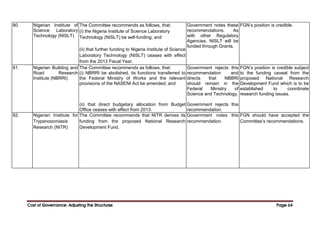
Nigerian Institute of Science Laboratory Technology -------------------------------------------------------------------------------------------- 64
Nigerian Building and Road Research Institute --------------------------------------------------------------------------------------------------- 64
Nigerian Institute for Trypanosomiasis Research ------------------------------------------------------------------------------------------------- 64
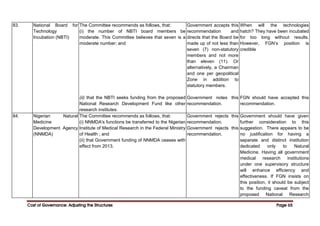
National Board for Technology Incubation ---------------------------------------------------------------------------------------------------------- 65
Nigerian Natural Medicine Development Agency ------------------------------------------------------------------------------------------------- 65
Raw Materials Research and Development Council --------------------------------------------------------------------------------------------- 66
Nigerian Institute for Leather Science Technology and National Research Institute for Chemical Technology ----------------- 66
Energy Commission of Nigeria ------------------------------------------------------------------------------------------------------------------------ 66
MINISTRY OF TOURISM, CULTURE AND NATIONAL ORIENTATION ------------------------------------------------------------------ 68
National Council for Arts and Culture ---------------------------------------------------------------------------------------------------------------- 68
Cost of Governance: Adjusting the Structures
Cost of Governance: Adjusting the Structures Page
Page
Page
Page vii
vii
vii
vii
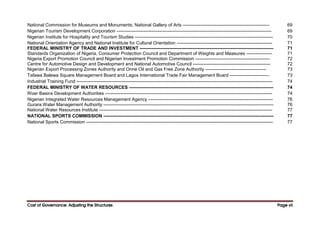
National Commission for Museums and Monuments; National Gallery of Arts --------------------------------------------------------- 69
Nigerian Tourism Development Corporation ------------------------------------------------------------------------------------------------------ 69
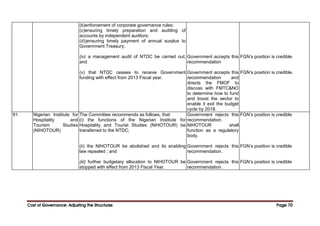
Nigerian Institute for Hospitality and Tourism Studies ------------------------------------------------------------------------------------------- 70
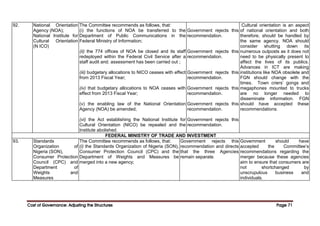
National Orientation Agency and National Institute for Cultural Orientation --------------------------------------------------------------- 71
FEDERAL MINISTRY OF TRADE AND INVESTMENT ---------------------------------------------------------------------------------------- 71
Standards Organization of Nigeria, Consumer Protection Council and Department of Weights and Measures ----------------- 71
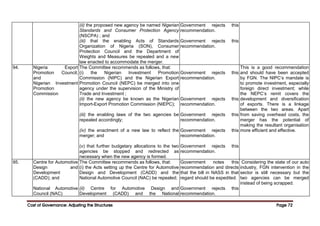
Nigeria Export Promotion Council and Nigerian Investment Promotion Commission ------------------------------------------------- 72
Centre for Automotive Design and Development and National Automotive Council --------------------------------------------------- 72
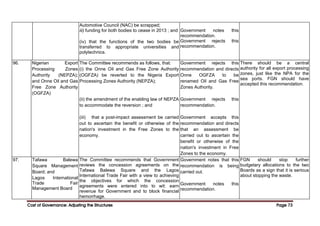
Nigerian Export Processing Zones Authority and Onne Oil and Gas Free Zone Authority ---------------------------------------- 73
Tafawa Balewa Square Management Board and Lagos International Trade Fair Management Board -------------------------- 73
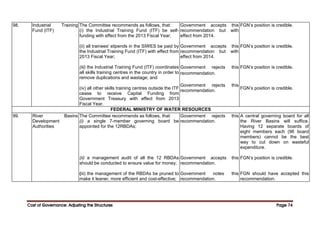
Industrial Training Fund --------------------------------------------------------------------------------------------------------------------------------- 74
FEDERAL MINISTRY OF WATER RESOURCES ----------------------------------------------------------------------------------------------- 74
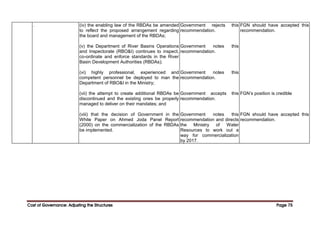
River Basins Development Authorities -------------------------------------------------------------------------------------------------------------- 74
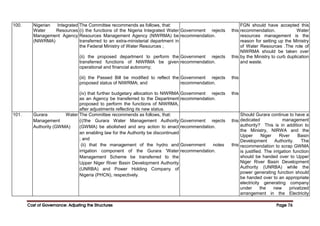
Nigerian Integrated Water Resources Management Agency ---------------------------------------------------------------------------------- 76
Gurara Water Management Authority ---------------------------------------------------------------------------------------------------------------- 76
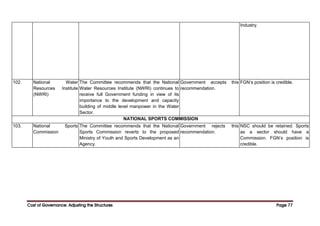
National Water Resources Institute ------------------------------------------------------------------------------------------------------------------ 77
NATIONAL SPORTS COMMISSION ---------------------------------------------------------------------------------------------------------------- 77
National Sports Commission --------------------------------------------------------------------------------------------------------------------------- 77
Cost of Governance: Adjusting the Structures
Cost of Governance: Adjusting the Structures Page
Page
Page
Page viii
viii
viii
viii
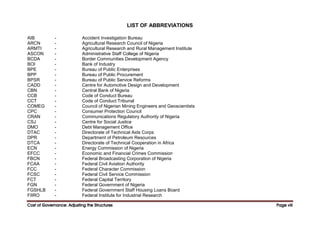
LIST OF ABBREVIATIONS
AIB - Accident Investigation Bureau
ARCN - Agricultural Research Council of Nigeria
ARMTI - Agricultural Research and Rural Management Institute
ASCON - Administrative Staff College of Nigeria
BCDA - Border Communities Development Agency
BOI - Bank of Industry
BPE - Bureau of Public Enterprises
BPP - Bureau of Public Procurement
BPSR - Bureau of Public Service Reforms
CADD - Centre for Automotive Design and Development
CBN - Central Bank of Nigeria
CCB - Code of Conduct Bureau
CCT - Code of Conduct Tribunal
COMEG - Council of Nigerian Mining Engineers and Geoscientists
CPC - Consumer Protection Council
CRAN - Communications Regulatory Authority of Nigeria
CSJ - Centre for Social Justice
DMO - Debt Management Office
DTAC - Directorate of Technical Aids Corps
DPR - Department of Petroleum Resources
DTCA - Directorate of Technical Cooperation in Africa
ECN - Energy Commission of Nigeria
EFCC - Economic and Financial Crimes Commission
FBCN - Federal Broadcasting Corporation of Nigeria
FCAA - Federal Civil Aviation Authority
FCC - Federal Character Commission
FCSC - Federal Civil Service Commission
FCT - Federal Capital Territory
FGN - Federal Government of Nigeria
FGSHLB - Federal Government Staff Housing Loans Board
FIIRO - Federal Institute for Industrial Research
Cost of Governance: Adjusting the Structures
Cost of Governance: Adjusting the Structures Page
Page
Page
Page ix
ix
ix
ix
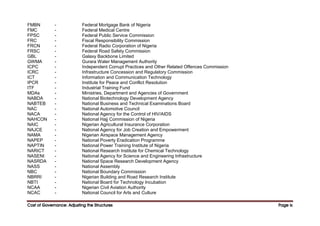
FMBN - Federal Mortgage Bank of Nigeria
FMC - Federal Medical Centre
FPSC - Federal Public Service Commission
FRC - Fiscal Responsibility Commission
FRCN - Federal Radio Corporation of Nigeria
FRSC - Federal Road Safety Commission
GBL - Galaxy Backbone Limited
GWMA - Gurara Water Management Authority
ICPC - Independent Corrupt Practices and Other Related Offences Commission
ICRC - Infrastructure Concession and Regulatory Commission
ICT - Information and Communication Technology
IPCR - Institute for Peace and Conflict Resolution
ITF - Industrial Training Fund
MDAs - Ministries, Department and Agencies of Government
NABDA - National Biotechnology Development Agency
NABTEB - National Business and Technical Examinations Board
NAC - National Automotive Council
NACA - National Agency for the Control of HIV/AIDS
NAHCON - National Hajj Commission of Nigeria
NAIC - Nigerian Agricultural Insurance Corporation
NAJCE - National Agency for Job Creation and Empowerment
NAMA - Nigerian Airspace Management Agency
NAPEP - National Poverty Eradication Programme
NAPTIN - National Power Training Institute of Nigeria
NARICT - National Research Institute for Chemical Technology
NASENI - National Agency for Science and Engineering Infrastructure
NASRDA - National Space Research Development Agency
NASS - National Assembly
NBC - National Boundary Commission
NBRRI - Nigerian Building and Road Research Institute
NBTI - National Board for Technology Incubation
NCAA - Nigerian Civil Aviation Authority
NCAC - National Council for Arts and Culture
Cost of Governance: Adjusting the Structures
Cost of Governance: Adjusting the Structures Page
Page
Page
Page x
x
x
x
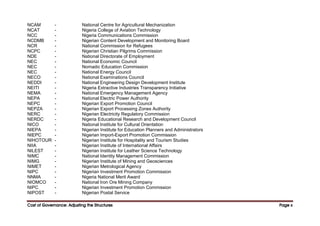
NCAM - National Centre for Agricultural Mechanization
NCAT - Nigeria College of Aviation Technology
NCC - Nigeria Communications Commission
NCDMB - Nigerian Content Development and Monitoring Board
NCR - National Commission for Refugees
NCPC - Nigerian Christian Pilgrims Commission
NDE - National Directorate of Employment
NEC - National Economic Council
NEC - Nomadic Education Commission
NEC - National Energy Council
NECO - National Examinations Council
NEDDI - National Engineering Design Development Institute
NEITI - Nigeria Extractive Industries Transparency Initiative
NEMA - National Emergency Management Agency
NEPA - National Electric Power Authority
NEPC - Nigerian Export Promotion Council
NEPZA - Nigerian Export Processing Zones Authority
NERC - Nigerian Electricity Regulatory Commission
NERDC - Nigeria Educational Research and Development Council
NICO - National Institute for Cultural Orientation
NIEPA - Nigerian Institute for Education Planners and Administrators
NIEPC - Nigerian Import-Export Promotion Commission
NIHOTOUR - Nigerian Institute for Hospitality and Tourism Studies
NIIA - Nigerian Institute of International Affairs
NILEST - Nigerian Institute for Leather Science Technology
NIMC - National Identity Management Commission
NIMG - Nigerian Institute of Mining and Geosciences
NIMET - Nigerian Metrological Agency
NIPC - Nigerian Investment Promotion Commission
NNMA - Nigeria National Merit Award
NIOMCO - National Iron Ore Mining Company
NIPC - Nigerian Investment Promotion Commission
NIPOST - Nigerian Postal Service
Cost of Governance: Adjusting the Structures
Cost of Governance: Adjusting the Structures Page
Page
Page
Page xi
xi
xi
xi
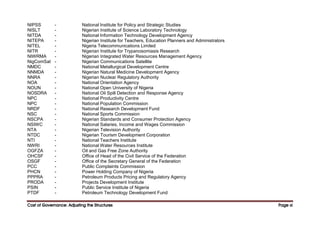
NIPSS - National Institute for Policy and Strategic Studies
NISLT - Nigerian Institute of Science Laboratory Technology
NITDA - National Information Technology Development Agency
NITEPA - Nigerian Institute for Teachers, Education Planners and Administrators
NITEL - Nigeria Telecommunications Limited
NITR - Nigerian Institute for Trypanosomiasis Research
NIWRMA - Nigerian Integrated Water Resources Management Agency
NigComSat - Nigerian Communications Satellite
NMDC - National Metallurgical Development Centre
NNMDA - Nigerian Natural Medicine Development Agency
NNRA - Nigerian Nuclear Regulatory Authority
NOA - National Orientation Agency
NOUN - National Open University of Nigeria
NOSDRA - National Oil Spill Detection and Response Agency
NPC - National Productivity Centre
NPC - National Population Commission
NRDF - National Research Development Fund
NSC - National Sports Commission
NSCPA - Nigerian Standards and Consumer Protection Agency
NSIWC - National Salaries, Income and Wages Commission
NTA - Nigerian Television Authority
NTDC - Nigerian Tourism Development Corporation
NTI - National Teachers Institute
NWRI - National Water Resources Institute
OGFZA - Oil and Gas Free Zone Authority
OHCSF - Office of Head of the Civil Service of the Federation
OSGF - Office of the Secretary General of the Federation
PCC - Public Complaints Commission
PHCN - Power Holding Company of Nigeria
PPPRA - Petroleum Products Pricing and Regulatory Agency
PRODA - Projects Development Institute
PSIN - Public Service Institute of Nigeria
PTDF - Petroleum Technology Development Fund
Cost of Governance: Adjusting the Structures
Cost of Governance: Adjusting the Structures Page
Page
Page
Page xii
xii
xii
xii
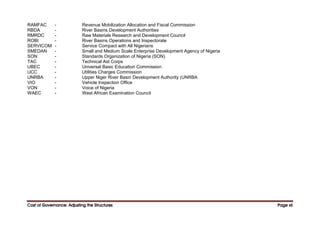
RAMFAC - Revenue Mobilization Allocation and Fiscal Commission
RBDA - River Basins Development Authorities
RMRDC - Raw Materials Research and Development Council
ROBI - River Basins Operations and Inspectorate
SERVICOM - Service Compact with All Nigerians
SMEDAN - Small and Medium Scale Enterprise Development Agency of Nigeria
SON - Standards Organization of Nigeria (SON)
TAC - Technical Aid Corps
UBEC - Universal Basic Education Commission
UCC - Utilities Charges Commission
UNRBA - Upper Niger River Basin Development Authority (UNRBA
VIO - Vehicle Inspection Office
VON - Voice of Nigeria
WAEC - West African Examination Council
Cost of Governance: Adjusting the Structures
Cost of Governance: Adjusting the Structures Page
Page
Page
Page xiii
xiii
xiii
xiii
ACKNOWLEDGEMENT
Centre for Social Justice acknowledges the support of participants and contributors to the cost of governance workshop. We are
grateful to Ken Ukoha of the National Association of Nigerian Traders, Chioma Osuji of CSACEFA, Kalu Onuoha Esq, Oluseun
Onigbinde of BudgIT, Emeka Ononamadu of Publish What You Pay, Captain Dele Ore of the Aviation Roundtable and Chibuike
Onwusoro Esq for their inputs.
Cost of Governance: Adjusting the Structures
Cost of Governance: Adjusting the Structures Page
Page
Page
Page 1
1
1
1
PART 1: INTRODUCTION
A. BACKGROUND
Cost of Governance: Adjusting the Structures is a review of the report and recommendations of the Oronsaye Presidential
Committee (the Committee) and the White Paper that stated the position of the Federal Government of Nigeria (FGN) on the
recommendations. It will be recalled that the Committee was set up by the FGN with a mandate to recommend for restructuring and
rationalization, FGN’s parastatals, commissions and agencies. The approach of CSJ in this Review is to examine the Committee’s
recommendations and the White Paper’s position against the background of the terms of reference of the Committee and national
and international fit and good practices. The purpose is to ensure that the original idea of reducing the cost of governance through
the restructuring and rationalisation of agencies is not lost in the political mill of intrigues that characterize government’s processes
and policy implementation.
Generally, the Committee’s recommendations were far reaching and if properly implemented, could reduce the cost of governance.
But there were few errors of judgement which would not serve the best of public interest if implemented, for example, the decision
to scrap the Fiscal Responsibility Commission. However, the FGN White Paper reversed a good number of the gains that would
have accrued from the full implementation of the Committee’s recommendations. The White Paper employed extraordinary caution
and at the end of the day watered down some of the recommendations. On the other hand, our recommendations seek to strike a
balance between the two positions.
This Review was necessitated by the need to ensure that the challenge of cost of governance is kept in the front burner of public
discourse and not relegated to the background. CSJ is mindful of the need to ensure that raw politicking does not triumph
governance and to guarantee that all political actors are made accountable to the people through their positions on this vexed
national phenomenon of rising governance costs. This phenomenon has led to decreased expenditures on the capital budget and
thereby heightened the physical and social infrastructure deficit. National development has been held back and Nigeria’s quest to
be among the top economies in the world will remain a dream until the challenge of the cost of governance is addressed.
In a democracy, the right to participate in governance does not start and end with voting. It is part of the duty of citizens as the
custodians of power and the ultimate sovereigns to exercise oversight over the formulation, management and administration of
government policies and programmes in such a way and manner that contributes to the overall progress of society. The
Cost of Governance: Adjusting the Structures
Cost of Governance: Adjusting the Structures Page
Page
Page
Page 2
2
2
2
implementation or non-implementation of the Committee’s recommendations will have serious implications for the security and
welfare of the Nigerian society. As such, it is too important to be left with government officials and technocrats. Those who stand to
be affected one way or the other should consider themselves duty bound to contribute to the discourse until a good decision is
reached. Most of the agencies to be restructured were set up by law and will need legislative action for their restructuring to be
effective. This could come by way of amendments, repeals or the enactment of new laws. It is therefore imperative to present the
legislature with alternative points of view to facilitate the discharge of their duties to make laws for the peace, order and good
government of the Federal Republic of Nigeria.
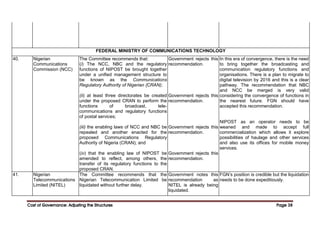
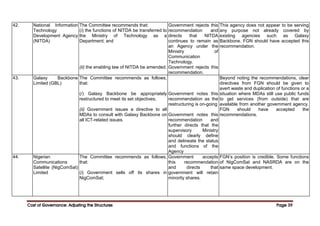
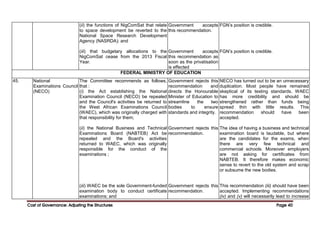
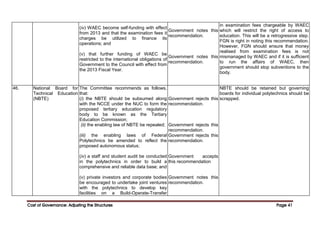
The main body of the work is divided into five columns stating a serial number, the ministry, department, parastatal, etc, the
Committee’s recommendations, FGN’s position and finally our recommendations and position. This Review did not necessarily
follow the sequence in the FGN White Paper. It did not address all the issues raised in the White Paper but is limited to what CSJ
considered very important. The Review reproduces below the background, terms of reference, scope and methodology, rationale
and principles that guided the Committee in its work; and the background to the work of the White Paper Committee.
B. PREAMBLE
1. The Federal Government runs its business through the efficient and effective operations of the Public Service. In 1970, the
Federal Government expanded the scope of the operations of the Public Service from core policy implementation to active
participation in all sectors of the economy through the establishment of Agencies, Parastatals, and Commissions. The additional
Bodies were to be the drivers of the socio-economic objectives of the Federal Government. Some of them were set up on ad hoc
basis to address specific challenges.
2. Over the years, the Bodies transmuted into permanent institutions with overlapping functions in some cases, and successive
Administrations had further created more Bodies without regard to their efficacy in the attainment of the socio-economic Agenda of
the Federal Government leading to escalation in cost of governance.
3. To redress this situation, His Excellency, the President and Commander-in-Chief of the Armed Forces, Dr. Goodluck Ebele
Jonathan, GCFR, inaugurated, on the 18th August, 2011, a Seven-Member Presidential Committee to advice on the Restructuring
and Rationalisation of the Federal Government's Agencies, Parastatals and Commissions.
Cost of Governance: Adjusting the Structures
Cost of Governance: Adjusting the Structures Page
Page
Page
Page 3
3
3
3
4. The Presidential Committee comprised of the following members—
(a) Stephen Oronsaye, CFR .. .. .. Chairman
(b) Japh CT Nwosu .. .. .. .. Member
(c) Rabiu D. Abubakar .. .. .. .. Member
{d) N. Salman Mann, mni .. .. .. .. Member
(e) Hamza A. Tahir, mni .. .. .. .. Member
(f) Adetunji Adesunkanmi .. .. .. .. Member
(g) Umar A. Mohammed .. .. .. Member
5. The Terms of Reference of the Presidential Committee were as follows:
(a) study and review all previous reports and records on the restructuring of Federal Parastatals and advise on whether they were
still relevant;
(b).examine the enabling Acts of all the Federal Agencies, Parastatals and Commissions and classify them into various sectors;
(c) examine critically, the mandate of the existing Federal Agencies, Parastatals and Commissions and determine areas of overlap
or duplication of functions and make appropriate recommendations to either restructure, merge or scrap some to eliminate such
overlaps, duplications or redundancies; and
(d) advise on any other matter incidental to the foregoing which might be relevant to the desire of Government to prune down the
cost of governance.
Cost of Governance: Adjusting the Structures
Cost of Governance: Adjusting the Structures Page
Page
Page
Page 4
4
4
4
6. SCOPE AND METHODOLOGY
In carrying out its mandate, the Presidential Committee:
(a) had interactive sessions with Federal Government Ministries, Agencies, Parastatals and Commissions, reviewed their
submissions and their mandates;
(b) referred to previous Reports on Government White Paper on Review, Harmonisation and Rationalisation of Federal
Parastatals, Institutions and Agencies;
(c) involved major stakeholders within the Public Service;
(d) sent out templates to Ministries and Offices for comprehensive list of Agencies, Parastatals and Commissions, enabling Acts
and Mandates;
(e) invited memoranda from members of the public through advertisements in four national dailies;
(f) obtained copies of Appropriation Acts from 2009- 2011, to ascertain Government financial involvement; and
(g) dialogued with the Ministries, Agencies, Parastatals and Commissions and leaders of past Administrations and the National
Assembly.
7. RATIONALE
The rational for restructuring and rationalisation of Agencies, Parastatals and Commissions is to meet the global socio-economic
challenges which have rendered it inevitable for the Government to cut the cost of governance while ensuring accountability.
8. PRINCIPLES
In carrying out the assignment, the Presidential Committee was guided by the following principles:
(a) the economic challenges and the need for Government to make more efficient use of its resources to achieve its development
objectives and goals;
Cost of Governance: Adjusting the Structures
Cost of Governance: Adjusting the Structures Page
Page
Page
Page 5
5
5
5
(b) the fact that Nigeria had undertaken reforms in the past;
(c) it was imperative to reform to meet the challenges of a better socio-political and economic society;
(d) there was no need to create another body to perform the functions of an already existing statutory entity. The fact that an
institution was inefficient and ineffective should not warrant the creation of a new one; and
(e) the reform would ensure efficient and effective management of Government structures and functionaries to guarantee better
service delivery and good governance.
9. The Presidential Committee observed that the rationalisation of Agencies, Parastatals and Commissions would help the
Government to reposition the Ministries to supervise the mandates of the Parastatals. It recognised that the Reform would have
human dimensions and cost implications and recommended that Government should focus on empowering the MDAs “to do more
for less”
THE WHITE PAPER DRAFTING COMMITTEE
10. The White Paper Drafting Committee was set up by Government with the following as members:
(a) Mr. Mohammed Bello Adoke, SAN Honourable Attorney-General of the Federation
and Minister of Justice .. .. .. .. .. Chairman
(b) Ms. Ama Pepple, CFR Hon. Minister of Land, Housing/Urban Development .. .. Member
(c) Alhaji Isa Bello Sali, Head of the Civil Service of the Federation .. .. Member
(d) Chief Emeka Wogu, Hon. Minister of Labour and Productivity .. .. Member
(e) Mrs Omobola Johnson, Hon. Minister of Communication Technology .. .. .. Member
Cost of Governance: Adjusting the Structures
Cost of Governance: Adjusting the Structures Page
Page
Page
Page 6
6
6
6
(f) Dr. Shamsuddeen Usman, CON, Hon. Minister/Deputy Chairman,
National Planning Commission .. .. .. .. ... Member
(g) Dr (Mrs) A. J. Awosika, Permanent Secretary, Ministry of Power .. .. .. .. Member
(h) Engr. Emeka Eze, Director-General, Bureau of Public Procurement .. .. Member
(e) Dr. Ochi C. Achinuvu, Senior Special Assistant, Economic Matters,
Office of the COS to the President .. .. Member
(f) Mr Femi Olayisade, Permanent Secretary, General Services Office (OSGF) .. Member/Secretary
11. The Drafting Committee was given the following Terms of Reference:
(a) to study and analyse the findings and recommendations contained in the Report of the Presidential Committee on the
Restructuring and Rationalisation of Government Parastatals, Commissions and Agencies; and
(b) to produce and submit a draft White Paper on the Report for the consideration of Government.
12. The Drafting Committee sat on a number of days to consider the report of the Committee.
13. The White Paper is structured in a tabular format showing the Parastatals and Agencies, Recommendations of the Presidential
Committee and Comments indicating recommendations accepted, noted or rejected by the Government.
Cost of Governance: Adjusting the Structures
Cost of Governance: Adjusting the Structures Page
Page
Page
Page 7
7
7
7
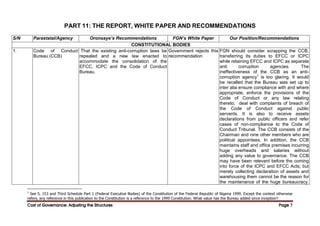
PART 11: THE REPORT, WHITE PAPER AND RECOMMENDATIONS
S/N Parastatal/Agency Oronsaye’s Recommendations FGN’s White Paper Our Position/Recommendations
CONSTITUTIONAL BODIES
1. Code of Conduct
Bureau (CCB)
That the existing anti-corruption laws be
repealed and a new law enacted to
accommodate the consolidation of the
EFCC, ICPC and the Code of Conduct
Bureau.
Government rejects this
recommendation
FGN should consider scrapping the CCB,
transferring its duties to EFCC or ICPC
while retaining EFCC and ICPC as separate
anti corruption agencies. The
ineffectiveness of the CCB as an anti-
corruption agency1
is too glaring. It would
be recalled that the Bureau was set up to
inter alia ensure compliance with and where
appropriate, enforce the provisions of the
Code of Conduct or any law relating
thereto; deal with complaints of breach of
the Code of Conduct against public
servants. It is also to receive assets
declarations from public officers and refer
cases of non-compliance to the Code of
Conduct Tribunal. The CCB consists of the
Chairman and nine other members who are
political appointees. In addition, the CCB
maintains staff and office premises incurring
huge overheads and salaries without
adding any value to governance. The CCB
may have been relevant before the coming
into force of the ICPC and EFCC Acts; but
merely collecting declaration of assets and
warehousing them cannot be the reason for
the maintenance of the huge bureaucracy.
1
See S. 153 and Third Schedule Part 1 (Federal Executive Bodies) of the Constitution of the Federal Republic of Nigeria 1999. Except the context otherwise
refers, any reference in this publication to the Constitution is a reference to the 1999 Constitution. What value has the Bureau added since inception?
Cost of Governance: Adjusting the Structures
Cost of Governance: Adjusting the Structures Page
Page
Page
Page 8
8
8
8
Even if FGN insists on retaining the CCB, it
does not need 10 members; between 4 and
5 members would be enough.
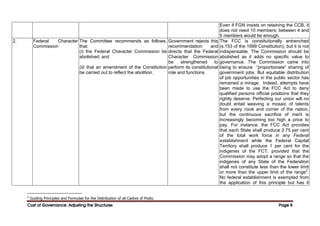
2. Federal Character
Commission
The Committee recommends as follows,
that:
(i) the Federal Character Commission be
abolished; and
(ii) that an amendment of the Constitution
be carried out to reflect the abolition.
Government rejects this
recommendation and
directs that the Federal
Character Commission
be strengthened to
perform its constitutional
role and functions.
The FCC is constitutionally entrenched
(s.153 of the 1999 Constitution), but it is not
indispensable. The Commission should be
abolished as it adds no specific value to
governance. The Commission came into
being to ensure “proportionate” sharing of
government jobs. But equitable distribution
of job opportunities in the public sector has
remained a mirage. Indeed, attempts have
been made to use the FCC Act to deny
qualified persons official positions that they
rightly deserve. Perfecting our union will no
doubt entail weaving a mosaic of talents
from every nook and corner of the nation,
but the continuous sacrifice of merit is
increasingly becoming too high a price to
pay. For instance, the FCC Act provides
that each State shall produce 2.75 per cent
of the total work force in any Federal
establishment while the Federal Capital
Territory shall produce 1 per cent for the
indigenes of the FCT, provided that the
Commission may adopt a range so that the
indigenes of any State of the Federation
shall not constitute less than the lower limit
or more than the upper limit of the range2
.
No federal establishment is exempted from
the application of this principle but has it
2
Guiding Principles and Formulae for the Distribution of all Cadres of Posts.
Cost of Governance: Adjusting the Structures
Cost of Governance: Adjusting the Structures Page
Page
Page
Page 9
9
9
9
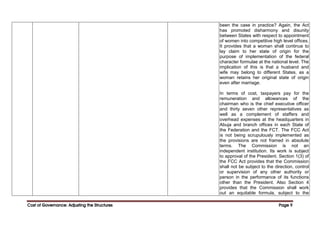
been the case in practice? Again, the Act
has promoted disharmony and disunity
between States with respect to appointment
of women into competitive high level offices.
It provides that a woman shall continue to
lay claim to her state of origin for the
purpose of implementation of the federal
character formulae at the national level. The
implication of this is that a husband and
wife may belong to different States, as a
woman retains her original state of origin
even after marriage.
In terms of cost, taxpayers pay for the
remuneration and allowances of the
chairman who is the chief executive officer
and thirty seven other representatives as
well as a complement of staffers and
overhead expenses at the headquarters in
Abuja and branch offices in each State of
the Federation and the FCT. The FCC Act
is not being scrupulously implemented as
the provisions are not framed in absolute
terms. The Commission is not an
independent institution. Its work is subject
to approval of the President. Section 1(3) of
the FCC Act provides that the Commission
shall not be subject to the direction, control
or supervision of any other authority or
person in the performance of its functions
other than the President. Also Section 4
provides that the Commission shall work
out an equitable formula, subject to the
Cost of Governance: Adjusting the Structures
Cost of Governance: Adjusting the Structures Page
Page
Page
Page 10
10
10
10
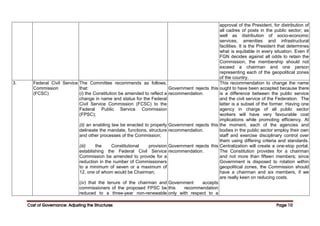
approval of the President, for distribution of
all cadres of posts in the public sector; as
well as distribution of socio-economic
services, amenities and infrastructural
facilities. It is the President that determines
what is equitable in every situation. Even if
FGN decides against all odds to retain the
Commission, the membership should not
exceed a chairman and one person
representing each of the geopolitical zones
of the country.
3. Federal Civil Service
Commission
(FCSC)
The Committee recommends as follows,
that:
(i) the Constitution be amended to reflect a
change in name and status for the Federal
Civil Service Commission (FCSC) to the
Federal Public Service Commission
(FPSC);
(ii) an enabling law be enacted to properly
delineate the mandate, functions, structure
and other processes of the Commission;
(iii) the Constitutional provision
establishing the Federal Civil Service
Commission be amended to provide for a
reduction in the number of Commissioners
to a minimum of seven or a maximum of
12, one of whom would be Chairman;
(iv) that the tenure of the chairman and
commissioners of the proposed FPSC be
reduced to a three-year non-renewable
Government rejects this
recommendation.
Government rejects this
recommendation.
Government rejects this
recommendation.
Government accepts
this recommendation
only with respect to a
This recommendation to change the name
ought to have been accepted because there
is a difference between the public service
and the civil service of the Federation. The
latter is a subset of the former. Having one
agency in charge of all public sector
workers will have very favourable cost
implications while promoting efficiency. At
the moment, each of the agencies and
bodies in the public sector employ their own
staff and exercise disciplinary control over
them using differing criteria and standards.
Centralization will create a one-stop portal.
The Constitution provides for a chairman
and not more than fifteen members; since
Government is disposed to rotation within
geopolitical zones, the Commission should
have a chairman and six members, if we
are really keen on reducing costs.
Cost of Governance: Adjusting the Structures
Cost of Governance: Adjusting the Structures Page
Page
Page
Page 11
11
11
11
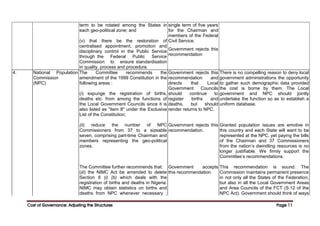
term to be rotated among the States in
each geo-political zone; and
(v) that there be the restoration of
centralised appointment, promotion and
disciplinary control in the Public Service
through the Federal Public Service
Commission to ensure standardisation
in quality, process and procedure.
single term of five years
for the Chairman and
members of the Federal
Civil Service.
Government rejects this
recommendation
4. National Population
Commission
(NPC)
The Committee recommends the
amendment of the 1999 Constitution in the
following areas :
(i) expunge the registration of births,
deaths etc. from among the functions of
the Local Government Councils since it is
also listed as "item 8" under the Exclusive
List of the Constitution;
(ii) reduce the number of NPC
Commissioners from 37 to a sizeable
seven, comprising part-time Chairman and
members representing the geo-political
zones.
The Committee further recommends that:
(iii) the NIMC Act be amended to delete
Section 6 (i) (b) which deals with the
registration of births and deaths in Nigeria.
NIMC may obtain statistics on births and
deaths from NPC whenever necessary ;
Government rejects this
recommendation and
directs that Local
Government Councils
should continue to
register births and
deaths, but should
render returns to NPC.
Government rejects this
recommendation.
Government accepts
this recommendation.
There is no compelling reason to deny local
government administrations the opportunity
to gather such demographic data provided
the cost is borne by them. The Local
government and NPC should jointly
undertake the function so as to establish a
uniform database.
Granted population issues are emotive in
this country and each State will want to be
represented at the NPC, yet paying the bills
of the Chairman and 37 Commissioners
from the nation’s dwindling resources is no
longer justifiable. We firmly support the
Committee’s recommendations.
This recommendation is sound. The
Commission maintains permanent presence
in not only all the States of the Federation,
but also in all the Local Government Areas
and Area Councils of the FCT (S.12 of the
NPC Act). Government should think of ways
Cost of Governance: Adjusting the Structures
Cost of Governance: Adjusting the Structures Page
Page
Page
Page 12
12
12
12
and
(iv) migration issues/statistics presently
being handled by the National Commission
for Refugees be transferred to the NPC in
line with National Policy for Sustainable
Development and NPC Act Cap. N67,
2004.
Government notes this
recommendation.
of deploying ICT to reduce the cost of
continuous registration of births and deaths
5. Revenue Mobilization
Allocation and Fiscal
Commission
The Committee recommends as follows,
that:
(i) the Fiscal Responsibility Commission
(FRC) be abolished and its enabling law
repealed;
(ii) the enabling law of the National
Salaries, Income and Wages Commission
(NS1WC) be repealed and the functions of
the Commission subsumed under the
Revenue Mobilization Allocation and Fiscal
Commission (RMAFC); and
(iii) the enabling law of the Revenue
Mobilization, Allocation and Fiscal
Commission (RMAFC) be amended to
accommodate the functions of the FRC as
well as those of the National Salaries,
Income and Wages Commission (NSIWC).
Government accepts all
the recommendations
and directs the
Honourable Attorney-
General of the
Federation and the
Minister of Justice to
initiate necessary action
for the abolition of the
FRC. Government
further directs that the
RMAFC should perform
the functions of the
FRC. Government
accepts this
recommendation on the
NSIWC.
The orientation and mandate of the RMAFC
can accommodate the functions of the
NSIWC, but certainly not those of the FRC.
RMAFC can therefore undertake the
functions and powers of the NSIWC and
has no business with the functions and
powers of the FRC.
RMAFC is an unwieldy body of 37 members
which by all reasonable standards is too
large. The membership should not exceed a
chairperson and six members representing
the six geopolitical zones of Nigeria.
OTHER BODIES
6. Fiscal Responsibility
Commission (FRC)
The Committee recommends that the
Fiscal Responsibility Commission be
abolished and its enabling law repealed as
Government accepts
this recommendation
and directs the Attorney-
The Constitution does not contain any
provision empowering RMAFC to undertake
any of the functions assigned to the FRC by
Cost of Governance: Adjusting the Structures
Cost of Governance: Adjusting the Structures Page
Page
Page
Page 13
13
13
13
RMAFC is already empowered by the
Constitution to carry out the functions.
General of the
Federation and
Honourable Minister of
Justice to take
necessary action.
the Fiscal Responsibility Act. The
constitutional functions of the RMAFC as
set out in Part 1 of the Third Schedule to
the 1999 Constitution are: (a) to monitor
accruals to and disbursement of revenue
from the Federation Account; (b) to review,
from time to time, the revenue allocation
formulae and principles in operation to
ensure conformity with changing realities;
(c) to advise the Federal Government on
fiscal efficiency and methods by which their
revenue can be increased; and (d) to
determine the remuneration appropriate for
certain political office holders.
The FRC was specifically set up to enable
the country realise the ideals in the
economic objectives enshrined in the 1999
Constitution. Although the Commission has
not lived up to expectations, its raison d’être
is still compelling in view of the pervasive
fiscal indiscipline and financial
recklessness in the public sector as well as
the continued inability of MDAs to
voluntarily toe the narrow path of prudence
in the management of the nation’s
economic resources. The Commission
should continue to be clothed with a
separate legal personality in order to be
able to vindicate its position in courts of law
and also to be able to hold land and other
immovable property in its own name.
Cost of Governance: Adjusting the Structures
Cost of Governance: Adjusting the Structures Page
Page
Page
Page 14
14
14
14
There are so many reasons for the retention
of the FRC and these include: Scrapping
the FRC and transferring its functions to
another agency that has a primary political
function, not centred on fiscal governance
will defeat the aims and objectives of the
FRA. It will therefore leave the FRA without
a sound body to oversee its implementation
on a day to day basis; it will send a
dangerous signal to states to also scrap
their respective FRCs; FRC is not a
spending/cost centre, as such, it has
recovered a lot money - operating surplus
from scheduled MDAs since inception; it will
not be in tandem with international fit and
good practices; RMAFC is an unwieldy
body without the competence to work on
fiscal responsibility. It has not been able to
discharge its primary responsibilities of
monitoring accruals to the Federation
Account or midwife a new revenue
allocation formula. Why add new
responsibilities to RMAFC? Other countries
such as India, Mexico, Brazil, Hungary, etc
who operate Fiscal Responsibility Laws all
have FRCs: Why should Nigeria be
different? The other reasons include the
need to implement the provisions of Vision
20:2020; affirm our international obligations;
promote consistency in government policy
and cut waste in the system. Nigeria cannot
continue with the current “one step forward
and two steps backward” regime. It is
Cost of Governance: Adjusting the Structures
Cost of Governance: Adjusting the Structures Page
Page
Page
Page 15
15
15
15
unacceptable. Fiscal responsibility is not a
matter to be subjected to the whims of
politics.
RMAFC has always coveted the functions
and powers of the FRC. When the Bill for
the Act was being considered by the
National Assembly, RMAFC presented a
memorandum at the public hearing in which
it opposed the creation of the FRC. This
seems to be a continuation of that
opposition by another means.
7. Bureau of Public
Procurement (BPP)
The Committee recommends the following,
that:
(i) the BPP Act be reviewed to address the
challenges posed by its Council
membership composition as presently
provided for by its enabling law;
(ii) a periodic audit of the activities of BPP
be instituted as a continuous improvement
mechanism for the operations of the BPP;
and
Government notes this
recommendation as the
review of the Act is in
process.
Government accepts
this recommendation.
On the first recommendation, FGN should
expeditiously move to establish the Council
There is nothing wrong with the
membership of the Council as presently
constituted. It is a clear act of impunity and
defiance of the law for the President to have
failed, refused and neglected to constitute
the Council since 2007 and despite several
motions passed by the Senate and House
of Representatives for the constitution of
the Council. Therefore, there is nothing for
FGN to note. The Council should be
constituted before further consideration of
any proposal for amendment of the Act.
This recommendation and FGN’s position
makes eminent sense.
Cost of Governance: Adjusting the Structures
Cost of Governance: Adjusting the Structures Page
Page
Page
Page 16
16
16
16
(iii) that BPP be domiciled in the State
House.
Government notes this
recommendation.
The BPP is supposed to be an independent
body and oversights procurement functions
including that of the State House. It should
therefore not be domiciled in the State
House which is also a spending agency.
8 Central Bank of
Nigeria (CBN)
None None To enhance good corporate governance in
the Bank, S.6 of the CBN Act should be
amended to create an independent
supervisory Board that will not be under the
control of the Governor. This will increase
accountability and transparency in the CBN
and eventual remittance of increased
operating surplus to the treasury.
9. Economic and
Financial Crimes
Commission (EFCC)
The Committee recommends as follows,
(EFCC) that:
(i) the Code of Conduct Tribunal be
renamed "Anti-Corruption Tribunal" and
upgraded to the status of a Court of
Superior Record with the responsibility for
handling only corruption cases from the
proposed merger of ICPC, EFCC and the
Code of Conduct Bureau ;
(ii) that the existing anti-corruption laws be
repealed and a new law enacted to
accommodate the consolidation of the
EFCC, ICPC and the Code of Conduct
Bureau;
Government rejects this
recommendation.
Government rejects this
recommendation.
FGN’s position is credible. The EFCC has
nothing to do with adjudication; it detects,
investigates and prosecutes offenders.
Recommendations bordering on special
courts and conversion of the CCT are
misplaced here. However, the idea of a
special anti-corruption court to speed up
corruption trials is a good one. This should
be considered, not necessarily from the
purview of cost of governance but from the
need to speed up the administration of
criminal justice.
There is the need to strengthen agencies as
they currently exist to ensure that beyond
value for money and reducing the cost of
administration, criminal investigations and
prosecutions relating to corruption cases
Cost of Governance: Adjusting the Structures
Cost of Governance: Adjusting the Structures Page
Page
Page
Page 17
17
17
17
(iii) the establishment of strong
departments, among others in the
proposed consolidated structure to handle
the following:
(a) Prosecution;
(b) investigation;
(c) prevention (advocacy); and
(d) asset Declaration/Forfeiture; and
(iv) that the Nigeria Financial Intelligence
Unit (NFIU) be made autonomous.
Government rejects this
recommendation.
Government accepts
this recommendation.
are handled with the requisite speed and
competence. The agencies should not be
merged.
FGN’s position is credible.
This is a sound recommendation.
10. Independent Corrupt
Practices and Other
Related Offences
Commission (ICPC)
The Committee recommends as follows
that:
(i) the EFCC, ICPC and the Code of
Conduct Bureau be consolidated into one
anti-corruption agency ;
(ii) that the existing enabling laws of the
EFCC, ICPC and the Code of Conduct
Bureau be repealed and a new law
enacted to accommodate the proposed
anti-corruption agency ; and
(iii) the establishment of strong
departments, among others, in the
proposed consolidated structure to handle
the following :
(a) prosecution ;
(b) investigation ;
(c) prevention (advocacy) ; and
(d) asset Declaration/Forfeiture.
Government rejects this
recommendation
Government rejects this
recommendation
Government rejects this
recommendation
There is the need to strengthen agencies as
they currently exist to ensure that beyond
value for money and reducing the cost of
administration, criminal investigations and
prosecutions relating to corruption cases
are handled with the requisite speed and
competence. The agencies should not be
merged.
Cost of Governance: Adjusting the Structures
Cost of Governance: Adjusting the Structures Page
Page
Page
Page 18
18
18
18
11. Infrastructure
Concession and
Regulatory
Commission (ICRC)
The Committee recommends that
Infrastructure Concession and Regulatory
Commission (ICRC) be subsumed in the
Bureau of Public Enterprises (BPE) for
greater synergy and their enabling laws
amended accordingly.
Government rejects this
recommendation.
Government ought to have accepted this
recommendation. BPE has been involved in
the privatisation and commercialisation of
public enterprises. It has the institutional
knowledge and experience to handle public
private partnership arrangements. Why
create another agency just for infrastructure
concessioning, when BPE can effectively
and efficiently handle the issue?
12. Nigerian Investment
Promotion
Commission (NI PC)
The Committee recommends that the
Nigerian Investment Promotion
Commission (NIPC) currently domiciled in
the Presidency be relocated to the Ministry
of Trade and Investment and merged with
the Nigerian Export Promotion Council
(NEPC) to synergise for management and
utilisation of resources.
Government notes this
recommendation.
This is a good recommendation and FGN
“noting” (whatever that means) this
recommendation creates confusion since it
neither accepted nor rejected the
recommendation. The NIPC‘s mandate is to
promote investment, especially foreign
direct investment; while the NEPC‘s remit
covers the development and diversification
of exports. There is a linkage between the
two issues. Apart from saving overhead
costs, the merger has the potential of
making the resultant organisation more
efficient and effective.
13. Public Complaints
Commission (PCC)
The Committee recommends as follows:
(i) that the Public Complaints Commission
(PCC) be abolished;
(ii) that the enabling law of the PCC be
repealed; and
(iii) that budgetary allocation to PCC
should cease with effect from 2013 Fiscal
Year
Government rejects this
recommendation.
Government rejects this
recommendation.
Government rejects this
recommendation.
Government should have accepted this
recommendation. What value is the PCC
adding to governance? What has it
achieved over the years? The PCC is no
longer relevant in the present dispensation.
The Commission was established in 1975
before the return to democratic governance
under the 1979 Constitution which
contained a bill of rights and abolished the
idea of sovereign immunity to suits. The
idea of having an administrative
Cost of Governance: Adjusting the Structures
Cost of Governance: Adjusting the Structures Page
Page
Page
Page 19
19
19
19
ombudsman that merely investigates
complaints with a view to making
recommendations to appropriate agencies
smacks of duplication and wastage. Little
wonder that the PCC has been moribund
over the years. However, the Commission
was recently revived by the National
Assembly with the appointment of a Chief
Commissioner and a member representing
each of the 36 States and the FCT. The
Commission maintains offices in the States
and the FCT in addition to its headquarters.
And each year, allocations are made to it
from the budget without any commensurate
output.
14. National Salaries,
Incomes and Wages
Commission (NSIWC)
The Committee recommends:
(i) that the salaries of both public and
political office holders be unified in the
RMAFC, which is a constitutional body;
(ii) that the National Salaries Income and
Wages Commission (NSIWC) be
abolished, its law repealed and its
functions transferred to the RMAFC;
(iii) that the RMAFC law be amended to
accommodate all categories of officers in
the Public Service; and
(iv) that the RMAFC law specifies
limitations of the parastatals in fixing the
wages of their Chief Executives.
Government rejects this
recommendation.
Government rejects this
recommendation.
Government rejects this
recommendation.
Government rejects this
recommendation.
The Committee’s recommendations make
eminent sense and should be accepted
because they have been earlier adopted by
the White Paper. In the early part of the
White Paper, the Committee accepted that
the mandate of the NSIWC be transferred
to the RMAFC. But they are rejecting it
here! There is a lot of sense in the
Committee’s recommendation that the
scope of the mandate of the RMAFC should
be extended to cover fixing of salaries for all
public servants beyond those mentioned in
Section 84 (4) of the Constitution. The
absence of a limitation on parastatals fixing
the wages of their chief executives leads to
the present sorry state of affairs. And simply
saying that “government rejects” is a
reaffirmation of the status quo.
Cost of Governance: Adjusting the Structures
Cost of Governance: Adjusting the Structures Page
Page
Page
Page 20
20
20
20
OFFICE OF THE VICE-PRESIDENT
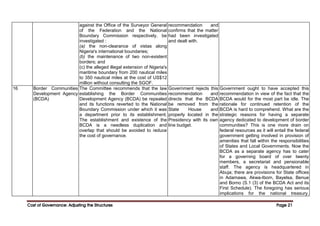
15. National Boundary
Commission (NBC)
The Committee recommends as follows:
(i) that the enabling law of the National
Boundary Commission be amended to
provide for a Governing Board that is
moderate in size, i.e. at least seven,
including the Chairman;
(ii) that the law establishing the Border
Communities Development Agency
(BCDA) be repealed and its functions be
reverted to the National Boundary
Commission under which it was a
department prior to its establishment; and
(iii) that the following allegations made
Government notes this
recommendation.
Government rejects this
recommendation and
directs that the BCDA
be removed from the
State House and
properly located in the
Presidency with its own
line budget.
Government notes this
FGN should have upheld the
recommendation. With over 20 members,
the composition of the Commission is very
unwieldy for decision making. As regards
costs, the fact that there are no full time
members does not mean that there would
be no meaningful sitting allowances.
FGN should have accepted this
recommendation considering that the BCDA
was a department in NBC prior to its
establishment. Pray, why do border
communities need a special agency for their
development? Can enhanced development
of the borders not be achieved through the
normal budgeting process? Evidently BCDA
has added no value to the life of border
communities and should be abolished..
Cost of Governance: Adjusting the Structures
Cost of Governance: Adjusting the Structures Page
Page
Page
Page 21
21
21
21
against the Office of the Surveyor General
of the Federation and the National
Boundary Commission respectively, be
investigated :
(a) the non-clearance of vistas along
Nigeria's international boundaries;
(b) the maintenance of two non-existent
borders; and
(c) the alleged illegal extension of Nigeria's
maritime boundary from 200 nautical miles
to 350 nautical miles at the cost of US$12
million without consulting the SGOF.
recommendation and
confirms that the matter
had been investigated
and dealt with.
16 Border Communities
Development Agency
(BCDA)
The Committee recommends that the law
establishing the Border Communities
Development Agency (BCDA) be repealed
and its functions reverted to the National
Boundary Commission under which it was
a department prior to its establishment.
The establishment and existence of the
BCDA is a needless duplication and
overlap that should be avoided to reduce
the cost of governance.
Government rejects this
recommendation and
directs that the BCDA
be removed from the
State House and
properly located in the
Presidency with its own
line budget.
Government ought to have accepted this
recommendation in view of the fact that the
BCDA would for the most part be idle. The
rationale for continued retention of the
BCDA is hard to comprehend. What are the
strategic reasons for having a separate
agency dedicated to development of border
communities? This is one more drain on
federal resources as it will entail the federal
government getting involved in provision of
amenities that fall within the responsibilities
of States and Local Governments. Now the
BCDA as a separate agency has to cater
for a governing board of over twenty
members, a secretariat and pensionable
staff. The agency is headquartered in
Abuja; there are provisions for State offices
in Adamawa, Akwa-Ibom, Bayelsa, Benue
and Borno (S.1 (3) of the BCDA Act and its
First Schedule). The foregoing has serious
implications for the national treasury.
Cost of Governance: Adjusting the Structures
Cost of Governance: Adjusting the Structures Page
Page
Page
Page 22
22
22
22
These expenditures could be better
managed by the merger of the NBC and the
BCDA; that is, if the latter is not to be
completely scrapped.
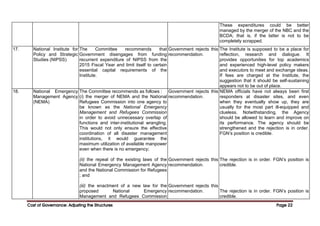
17. National Institute for
Policy and Strategic
Studies (NIPSS)
The Committee recommends that
Government disengages from funding
recurrent expenditure of NIPSS from the
2015 Fiscal Year and limit itself to certain
essential capital requirements of the
Institute.
Government rejects this
recommendation.
The Institute is supposed to be a place for
reflection, research and dialogue. It
provides opportunities for top academics
and experienced high-level policy makers
and executors to meet and exchange ideas.
If fees are charged at the Institute, the
suggestion that it should be self-sustaining
appears not to be out of place.
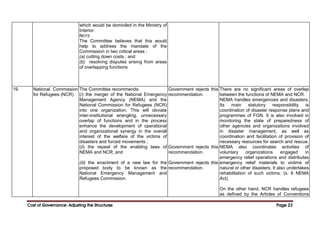
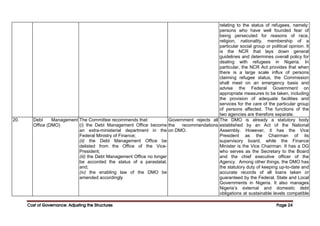
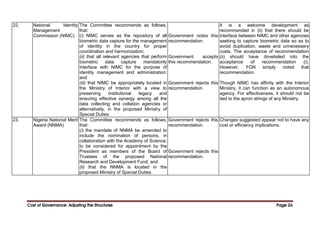
18. National Emergency
Management Agency
(NEMA)
The Committee recommends as follows :
(i) the merger of NEMA and the National
Refugees Commission into one agency to
be known as the National Emergency
Management and Refugees Commission
in order to avoid unnecessary overlap of
functions and inter-institutional wrangling.
This would not only ensure the effective
coordination of all disaster management
institutions, it would guarantee the
maximum utilization of available manpower
even when there is no emergency;
(ii) the repeal of the existing laws of the
National Emergency Management Agency
and the National Commission for Refugees
; and
(iii) the enactment of a new law for the
proposed National Emergency
Management and Refugees Commission
Government rejects this
recommendation.
Government rejects this
recommendation.
Government rejects this
recommendation.
NEMA officials have not always been first
responders at disaster sites, and even
when they eventually show up, they are
usually for the most part ill-equipped and
clueless. Notwithstanding, the Agency
should be allowed to learn and improve on
its performance. The agency should be
strengthened and the rejection is in order.
FGN’s position is credible.
The rejection is in order. FGN’s position is
credible.
The rejection is in order. FGN’s position is
credible.
Cost of Governance: Adjusting the Structures
Cost of Governance: Adjusting the Structures Page
Page
Page
Page 23
23
23
23
which would be domiciled in the Ministry of
Interior.
NOTE
The Committee believes that this would
help to address the mandate of the
Commission in two critical areas :
(a) cutting down costs ; and
(b) resolving disputes arising from areas
of overlapping functions
19. National Commission
for Refugees (NCR)
The Committee recommends:
(i) the merger of the National Emergency
Management Agency (NEMA) and the
National Commission for Refugees (NCR)
into one organization. This will obviate
inter-institutional wrangling, unnecessary
overlap of functions and in the process
enhance the development of operational
and organizational synergy in the overall
interest of the welfare of the victims of
disasters and forced movements ;
(ii) the repeal of the enabling laws of
NEMA and NCR; and
(iii) the enactment of a new law for the
proposed body to be known as the
National Emergency Management and
Refugees Commission.
Government rejects this
recommendation.
Government rejects this
recommendation.
Government rejects this
recommendation.
There are no significant areas of overlap
between the functions of NEMA and NCR.
NEMA handles emergencies and disasters.
Its main statutory responsibility is
coordination of disaster response plans and
programmes of FGN. It is also involved in
monitoring the state of preparedness of
other agencies and organizations involved
in disaster management, as well as
coordination and facilitation of provision of
necessary resources for search and rescue.
NEMA also coordinates activities of
voluntary organizations engaged in
emergency relief operations and distributes
emergency relief materials to victims of
natural or other disasters. It also undertakes
rehabilitation of such victims. (s. 6 NEMA
Act).
On the other hand, NCR handles refugees
as defined by the Articles of Conventions
Cost of Governance: Adjusting the Structures
Cost of Governance: Adjusting the Structures Page
Page
Page
Page 24
24
24
24
relating to the status of refugees, namely:
persons who have well founded fear of
being persecuted for reasons of race,
religion, nationality, membership of a
particular social group or political opinion. It
is the NCR that lays down general
guidelines and determines overall policy for
dealing with refugees in Nigeria. In
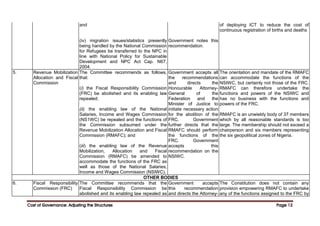
particular, the NCR Act provides that when
there is a large scale influx of persons
claiming refugee status, the Commission
shall meet on an emergency basis and
advise the Federal Government on
appropriate measures to be taken, including
the provision of adequate facilities and
services for the care of the particular group
of persons affected. The functions of the
two agencies are therefore separate.
20. Debt Management
Office (DMO)
The Committee recommends that:
(i) the Debt Management Office become
an extra-ministerial department in the
Federal Ministry of Finance;
(ii) the Debt Management Office be
delisted from the Office of the Vice-
President;
(iii) the Debt Management Office no longer
be accorded the status of a parastatal,
and;
(iv) the enabling law of the DMO be
amended accordingly
Government rejects all
the recommendations
on DMO.
The DMO is already a statutory body
established by an Act of the National
Assembly. However, it has the Vice
President as the Chairman of its
supervisory board, while the Finance
Minister is the Vice Chairman. It has a DG
who serves as the Secretary to the Board
and the chief executive officer of the
Agency. Among other things, the DMO has
the statutory duty of keeping up-to-date and
accurate records of all loans taken or
guaranteed by the Federal, State and Local
Governments in Nigeria. It also manages
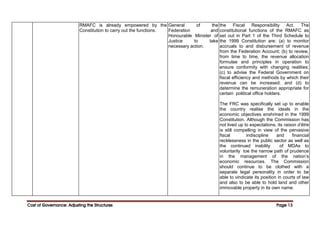
Nigeria’s external and domestic debt
obligations at sustainable levels compatible
Cost of Governance: Adjusting the Structures
Cost of Governance: Adjusting the Structures Page
Page
Page
Page 25
25
25
25
with desired economic activities for growth
and development (S. 6 DMO Act). In view of
the role the DMO plays in the management
of the national economy, we commend FGN
for rejecting the Committee’s
recommendations since their
implementation would have necessarily
whittled down the status of the Office and
its ability to effectively manage debt
obligations. Retaining the DMO is in line
with international fit and good practices.
OFFICE OF THE SECRETARY TO THE GOVERNMENT OF THE FEDERATION
21. National Poverty
Eradication
Programme (NAPEP)
The Committee recommends that:
(i) NAPEP be scrapped and its functions
transferred to the new body that will
emerge from the merger of the NDE and
SMEDAN;
(ii) the new proposed body shall be known
as the National Agency for Job Creation
and Empowerment (NAJCE); and
(iii) that the Bank of Industry (BOI)
provides the window for servicing the job-
and wealth-creation and empowerment
programmes.
Government accepts the
recommendation to
scrap NAPEP only.
Government rejects this
recommendation.
Government notes this
recommendation.
NAPEP as an intervention has been
overtaken by other programmes. NAPEP
should be scrapped and its functions
transferred to the new agency. Thus, FGN’s
position should not be limited to scrapping
NAPEP. However, it is imperative to note
that job creation is not a stand-alone
subject but is a result of a multiplicity of
policies and interventions from areas
including industry, trade, education,
housing, health, monetary and fiscal policy,
etc.
Cost of Governance: Adjusting the Structures
Cost of Governance: Adjusting the Structures Page
Page
Page
Page 26
26
26
26
22. National Identity
Management
Commission (NIMC)
The Committee recommends as follows,
that:
(i) NIMC serves as the repository of all
biometric data capture for the management
of identity in the country for proper
coordination and harmonization;
(ii) that all relevant agencies that perform
biometric data capture mandatorily
interface with NIMC for the purpose of
identity management and administration;
and
(iii) that NIMC be appropriately located in
the Ministry of Interior with a view to
preserving institutional legacy and
ensuring effective synergy among all the
data collecting and collation agencies or
alternatively, in the proposed Ministry of
Special Duties.
Government notes this
recommendation.
Government accepts
this recommendation.
Government rejects this
recommendation.
It is a welcome development as
recommended in (ii) that there should be
interface between NIMC and other agencies
seeking to capture biometric data so as to
avoid duplication, waste and unnecessary
costs. The acceptance of recommendation
(ii) should have dovetailed into the
acceptance of recommendation (i).
However, FGN simply noted that
recommendation.
Though NIMC has affinity with the Interior
Ministry, it can function as an autonomous
agency. For effectiveness, it should not be
tied to the apron strings of any Ministry.
23. Nigeria National Merit
Award (NNMA)
The Committee recommends as follows,
that:
(i) the mandate of NNMA be amended to
include the nomination of persons, in
collaboration with the Academy of Science,
to be considered for appointment by the
President as members of the Board of
Trustees of the proposed National
Research and Development Fund; and
(ii) that the NNMA is located in the
proposed Ministry of Special Duties.
Government rejects this
recommendation.
Government rejects this
recommendation.
Changes suggested appear not to have any
cost or efficiency implications.
Cost of Governance: Adjusting the Structures
Cost of Governance: Adjusting the Structures Page
Page
Page
Page 27
27
27
27
24. Federal Road Safety
Commission (FRSC)
The Committee recommends as follows,
that:
(i) the Act setting up the Federal Road
Safety Commission (FRSC) be repealed;
(ii) the road safety functions of the FRSC
be reverted to the highways department of
the Federal Ministry of Works;
(iii) the Commission's personnel be
redeployed to the relevant organizations
(the Police Service Commission, the
Federal Civil Service Commission and the
Vehicle Inspection Office (VIO) in the
Federal Capital Territory Authority) for due
regularization.
(iv) in line with best practice, the Police,
who have the core responsibility for
highways patrol, be in charge of the
activities related to road traffic accidents
and the removal of wreckage of vehicles
from the highways.
(v) clinics set up to address trauma cases
arising from road accidents to be
transferred to and managed by the Federal
Ministry of Health, which is the agency of
Government mandated to cater for health
services, including trauma cases and
ambulance service.
(vi) as a follow-up to recommendation
Government rejects this
recommendation.
Government rejects this
recommendation.
Government rejects this
recommendation.
Government rejects this
recommendation.
Government notes this
recommendation.
FGN should have accepted the
Committee’s recommendations with respect
to the FRSC. The Commission has radically
deviated from the vision of the founding
fathers. The FRSC was not meant to be
another revenue generation agency. Its
original mandate was to:
a. Make the highways safe for motorists
and other road users;
b. Recommend works and devices
designed to eliminate or minimize
accidents on the highways; and
c. Educate motorists and members of
the public on the importance of
discipline on the highways. (S.11 (2)
FRSC Act).
At inception, corps members concentrated
on prevention and minimising accidents on
the highways; clearing of obstructions on
any part of the highways; giving prompt
attention and care to victims of accidents;
and conducting researches into causes of
accidents and methods of preventing them
and putting into use the results of such
researches (S. 11(3) FRSC Act). Over the
years, successive leadership of the
Commission have clamoured for more
powers and have ended up being involved
in design and production of number plates
and drivers licences to the detriment of the
core responsibilities of their Agency.
Regulation of motorists on our roads is
Cost of Governance: Adjusting the Structures
Cost of Governance: Adjusting the Structures Page
Page
Page
Page 28
28
28
28
(v) above, the Federal Ministry of Health
develops standard trauma centres and
ambulance services to address
emergencies; and
(vii) that the centre for the collation of
vehicle licensing data remains the
responsibility of the Police via the Central
Motor Registry.
Note
It should be understood that the current
overwhelming bad-road-user behaviour is
a temporary phenomenon that an
interventionist body like the FRSC was set
up to address; thus, it should not be
allowed to grow beyond an ad hoc body
that can reintegrate into a parent body like
the Highways Department of the Federal
Ministry of Works
Government notes this
recommendation.
Government rejects this
recommendation and
directs the Federal
Road Safety
Commission to continue
to perform its functions
as prescribed by law..
increasingly becoming chaotic. The FRSC
corps members no longer limit their
operations to the highways as stipulated by
their enabling statute; with the result that
within one road in the metropolis, you may
find Vehicle Inspection Officers, Motor
Traffic Police Officers and FRSC Officers
operating simultaneously. FRSC has offices
and corps members all over the Federation.
The overhead and personnel costs are not
justified by the output as accidents have
continued unabated on our roads and
victims still die every day because of
delayed or complete absence of emergency
medical attention and support.
25. Utilities Charges
Commission (UCC)
The Committee recommends that:
(i) the Utilities Charges Commission be
abolished and its enabling law repealed.
(i) the staff of the Commission be deployed
to the Office of the Head of the Civil
Service of the Federation, provided they
are civil servants.
Government accepts
this recommendation
and directs that the
process of repealing the
enabling law should be
initiated by the OSGF.
Government notes this
recommendation.
The main function of UCC is to evaluate, on
a continuing basis, trends in tariffs charged
by public utilities providers with a view to
availing the Federal Government with
information to enable it fix reasonable
prices. The public corporations directly
mentioned in the UCC Act, such as NEPA,
NITEL, Nigeria Airways have been
privatised. There is no justification for
retaining the Commission.
Cost of Governance: Adjusting the Structures
Cost of Governance: Adjusting the Structures Page
Page
Page
Page 29
29
29
29
26. National Agency for
the Control of
HIV/AIDS (NACA)
The Committee recommends that:
(i) the enabling law of NACA be repealed;
and
(ii) that NACA and the division presently
handling HIV/AIDS in the Public Health
Department be merged as a Department
under the Centre for Disease Control in
the Federal Ministry of Health.
Government rejects this
recommendation.
Government rejects this
recommendation.
FGN should have accepted this
recommendation. There is no special value
being added by NACA that the Centre for
Disease Control in the Federal Ministry of
Health cannot handle. The CDC of the
Federal Ministry of Health can sustain the
awareness and other campaigns in
collaboration with the Information Ministry
and the NOA.
27. National Hajj
Commission of
Nigeria (NAHCON)
This is addressed together with those of
the Nigerian Christian Pilgrims,
Commission.
28. Nigerian Christian
Pilgrims Commission
(NCPC)
The Committee recommends as follows,
that:
(i) Government restricts itself only to the
provision of consular services and
vaccines to intending pilgrims;
(ii) Pilgrims be encouraged to save for their
individual religious obligations;
(iii) the National Hajj Commission of
Nigeria and the Nigerian Christian Pilgrims
Commission be abolished and their
functions transferred to a department
under the Ministry of Foreign Affairs;
(iv) the enabling laws of the two
Commissions be repealed accordingly;
(v) the Federal Government stops
sponsoring pilgrims and pilgrimages with
effect from the 2012 Fiscal Year; and
(vi) that Government stops granting
concessionary foreign exchange rate to
pilgrims.
Government rejects this
recommendation.
Government notes this
recommendation.
Government rejects this
recommendation.
Government rejects this
recommendation.
Government rejects this
recommendation.
Government notes this
recommendation.
FGN should have accepted these
recommendations. The Constitution forbids
the adoption of state religion. The continued
existence of these two bodies sends a
wrong message that the two religions are
more priviledged than other religions. Their
existence is apparently unconstitutional. It’s
discriminatory against other religions and
free- thinkers. Religion should be a private
matter between the realm of the individual
and his God. Religious tourism has not
impacted values and ethics. The two
agencies should have been abolished and
all the recommendations accepted.
Cost of Governance: Adjusting the Structures
Cost of Governance: Adjusting the Structures Page
Page
Page
Page 30
30
30
30
29. Service Compact with
All Nigerians
(SERVICOM)
The Committee recommends that
SERVICOM be subsumed in the BPSR as
a strengthened, refocused, retooled and
restructured Bureau, (see write up on
BPSR).
Government rejects this
recommendation as the
Federal Executive
Council has already
approved a new
structure for
SERVICOM.
What is SERVICOM if not public service
reform? To maintain a Bureau for Public
Service Reform and SERVICOM amounts
to duplication. SERVICOM has not affected
bureaucratic service delivery in any
significant manner. No pacts and no impact
on efficiency; it should have been scrapped.
30. Nigeria Extractive
Industries
Transparency
Initiative (NEITI)
The Committee recommends that NEITI
continues to be funded by the government
to enable it carry out its assigned functions
of developing, administering and enforcing
transparency and accountability in the
extractive industry in Nigeria, under the
supervision of the Ministry of Special
Duties.
Government accepts
this recommendation
and directs that Agency
should remain in the
Presidency.
FGN’s acceptance of the recommendation
is commendable. But the agency should be
independent of political control.
OFFICE OFTHE HEAD OF THE CIVIL SERVICE OF THE FEDERATION
31. Administrative Staff
College of Nigeria
(ASCON)
The Committee recommends:
(i) that ASCON continues to receive full
Government funding in view of the need to
adequately address the identified capacity
gap in the Public Service; and
(ii) that the PSIN be merged with the
ASCON.
Government accepts
this recommendation
and directs that the
word "full" should be
expunged; it further
directs the modality for
the funding should be
worked out by the Office
of the Head of the Civil
Service of the
Federation (OHCSF).
Government rejects this
recommendation and
directs OHSCF to
expedite action on the
FGN’s position is in order.
In as much as capacity building is key to
efficiency and effectiveness of governance,
why duplicate training institutions with
Cost of Governance: Adjusting the Structures
Cost of Governance: Adjusting the Structures Page
Page
Page
Page 31
31
31
31
passage of the PSIN bill
which has been in the
National Assembly since
2009.
personnel costs, overheads and capital
expenditure. The Committee’s
recommendation should have been
accepted by FGN.
32. Public Service
Institute of Nigeria
(PSIN)
The Committee recommends that the
Public Service Institute of Nigeria (PSIN)
be merged with the Administrative Staff
College of Nigeria (ASCON) because of
the importance of capacity building to
overall national economic growth and in
order for Government to derive value from
its huge investments in the Institute.
Government rejects this
recommendation and
directs the OHSCF to
expedite action on
passage of the PSIN Bill
which has been in the
National Assembly since
2009.
FGN’s position is not in tandem with the
need to cut down the cost of governance.
Whatever PSIN is set up to do can
conveniently be undertaken by ASCON.
This is a duplication of the functions and
waste of resources.
33. Bureau of Public
Service Reforms
(BPSR)
The Committee recommends as follows,
that:
(i) the Bureau of Public Service Reforms
(BPSR) subsumes the functions of the
Service Compact with all Nigerians
(SERVICOM) in order to serve as a
veritable platform for driving the
Transformation Agenda and other reform
programmes of Government;
(ii) the strengthened Bureau should be
domiciled in the State House;
(ii) the Bureau be driven by capable
leadership and staffed with competent and
experienced personnel all of who have the
required passion for the success of the
reforms ;
Government rejects this
recommendation and
directs that the two
Agencies should
collaborate in the
discharge of their
functions.
Government rejects this
recommendation and
directs that it should
reside in the
Presidency.
Government notes this
recommendation.
FGN’s position is curious. What is public
service reforms that will not include
improvements in service delivery and by
extension, the Service Compact with all
Nigerians? It is our position that the
Committee’s recommendation in terms of
merger of the two agencies be upheld.
Cost of Governance: Adjusting the Structures
Cost of Governance: Adjusting the Structures Page
Page
Page
Page 32
32
32
32
(iv) the leadership be part of the Economic
Management Team of the Federal
Government; and
(v) that the restructured and refocused
Bureau be dedicated to the coordination,
monitoring and evaluation of Government's
reform agenda and decisions, including
those on the recommendations of this
Committee.
Government rejects this
recommendation
Government notes this
recommendation and
further directs that the
Bureau should be
refocused for more
effective discharge of its
mandate.
34. Federal Government
Staff Housing Loans
Board (FGSHLB)
The Committee recommends as follows,
that:
(i) the FMBN Act be amended to allow:
(a) the contributions made by Public
Servants under the NHF to be transferred
to the FGSHLB ; and
(b) that future deductions under NHF
made from the emoluments of Public
Servants to be remitted to the FGSHLB;
(ii) the FGSHLB Act be amended to reflect
the proposed amendment;
(iii) that the FGSHLB becomes self-funding
within a period of two years the date of
acceptance of the Committee's
recommendation and the consequential
amendment of the NHF law.
Government rejects this
recommendation.
Government rejects this
recommendation.
Government rejects this
recommendation.
The FGSHB Act (Decree No.6 of 1975) is a
moribund piece of legislation that the
Committee sought to revive by its
recommendation. Public servants have
since moved on to other arrangements.
FGN was right in rejecting the
recommendation.
Cost of Governance: Adjusting the Structures
Cost of Governance: Adjusting the Structures Page
Page
Page
Page 33
33
33
33
FEDERAL MINISTRY OF AGRICULTURE AND RURAL DEVELOPMENT
35. Agricultural Research
Council of Nigeria
(ARCN)
The Committee recommends as follows,
that:
(i) all the Research Institutes be funded
from the proposed National Research
Development Fund to be set up by
Government;
(ii) all the Boards of the 15 agricultural
research institutes be abolished and their
enabling laws amended accordingly;
(iii) the membership of the Governing
Council of the Agricultural Research
Council of Nigeria (ARCN) be reduced to
not more than seven members, including
the Executive Secretary of the Council and
the four proposed Executive Directors in
charge of the four research categories of
Crop Cluster, Fisheries and
Oceanography, Livestock and Veterinary
Services; and Agricultural Management,
Capacity Building and Extension Services;
(iv) the enabling law of the ARCN be
amended to reflect the new composition of
its Board;
Government rejects this
recommendation.
Government rejects this
recommendation.
Government notes this
recommendation.
Government rejects this
recommendation.
Government’s justification for its rejection
of these recommendations is hard to
fathom. The composition of ARCN’s
governing board is as follows:
a. The Chairman
b. The Vice Chancellor of one of the
Universities of Agriculture (to be
rotated)
c. The Chairman of the Committees of
Deans of Faculties of Agriculture of the
Universities in Nigeria
d. The Chairman of the Committees of
Deans of Faculties of Veterinary
Medicine of the Universities in Nigeria
e. Chairmen of the governing boards of
every agricultural research institutes
established under s.14 of the Act
f. Chairmen of the Committee of
Directors of every agricultural research
institute established under S.14 of the
Act.
g. Directors of Departments of Agriculture
, Fisheries, Forestry and Livestock of
the Federal Ministry of Agriculture and
Rural Development
h. One representative of the Federal
Ministry of Science and Technology
i. One representative of the Federal
Ministry of Water Resources
j. Four persons from the private sector
k. The Executive Secretary
Cost of Governance: Adjusting the Structures
Cost of Governance: Adjusting the Structures Page
Page
Page
Page 34
34
34
34
(v) urgent steps be taken by the
Ministry/ARCN for a micro-restructuring of
the research institutes to bring them at par
with the global best practice of a 1:3 ratio
of technical to administrative staff in the
institutes ; and
(vi) that each College of Agriculture be
attached to an Institute of Research for the
purpose of fostering the linkage between
research extension and learning.
Government notes this
recommendation.
Government notes this
recommendation.
It must be costing Government a lot to foot
bills emanating from this kind of large
Board. Travelling expenses and other
allowances for members would be quite
substantial. So the Committee’s
recommendation that the Board be pruned
makes a lot of sense.
The continued retention of this large board
and 15 other boards whose contributions to
the economy are doubtful contradicts the
cost reduction objective of the FGN. Also,
the idea of funding agricultural research
institutes from a National Research
Development Fund is very reasonable. It
would make the funding competitive and
ensure that institutes determine their
relevance in the scheme of things through
evidence of their output and results.
Reducing the ratio of administrative staff
and increasing technical personnel will
guarantee that institutes deliver value for
money. Thus, merely noting the
recommendation goes to no issue. The
recommendation of the Committee should
have been accepted.
Again, the recommendation of the
Committee which was merely noted should
have been accepted for the alignment of
town and gown, improved quality of
education and dissemination of research
Cost of Governance: Adjusting the Structures
Cost of Governance: Adjusting the Structures Page
Page
Page
Page 35
35
35
35
results.
36. Agricultural Research
and Rural
Management Institute
(ARMTI)
The Committee recommends that in view
of the services rendered and having been
in existence for 32 years, that the
Agricultural Research and Rural
Management Institute (ARMTI) be self-
funding within 24 months commencing
from the time a decision is taken on this
recommendation.
Government rejects this
recommendation and
directs the Hounourable
Minister of Agriculture to
look into the issue of
self funding.
What has ARMTI been researching on this
past 32 years? If its findings were of value
to agriculturists, it would be in a position to
generate funds to at least take care of its
recurrent expenditure. However, FGN’s
position is in order.
37. National Centre for
Agricultural
Mechanization
(NCAM)
The Committee recommends as follows
that:
(i) the enabling law of the National Centre
for Agricultural Mechanization (NCAM) be
repealed; and
(ii) that the statutory functions being
performed by NCAM be transferred to the
proposed enlarged and revitalized
research and development agency
comprising NASENI, PRODA and FIIRO all
in the Federal Ministry of Science and
Technology.
Government rejects this
recommendation.
Government rejects this
recommendation.
The enabling legislation should be repealed
and the Centre shut down. There are other
technological research and development
institutions that can take over the work of
NCAM without the overhead expenses
being incurred at the Centre. Pray, what
value has the Centre added since
inception?
38. Nigerian Agricultural
Insurance
Corporation (NAIC)
The Committee recommends as follows
that:
(i) the National Agricultural Insurance
Corporation (NAIC) be fully
commercialized; and
Government accepts
this recommendation.
NAIC should be privatized. Government
has proved itself incapable of running a
profitable business venture. FGN’s position
is credible.
Cost of Governance: Adjusting the Structures
Cost of Governance: Adjusting the Structures Page
Page
Page
Page 36
36
36
36
(ii) that the enabling law of NAIC be
amended to allow other Insurance
Companies to participate in the new
Agricultural Insurance Scheme.
Government accepts
this recommendation.
MINISTRY OF AVIATION
39. Nigeria College of
Aviation Technology
(NCAT)
The Committee recommends as follows,
that:
(i) a management audit of all the agencies
in the Aviation Sector be carried out;
(ii) the Accident Investigation Bureau (AIB)
be developed into a unified accident
investigation bureau for the entire transport
sector;
Government notes this
recommendation.
Government rejects this
recommendation.
Investigation of aviation accidents is a
specialized field and too important to be
mixed up with other matters. FGN is right in
rejecting this recommendation.
39A. Nigerian Airspace
Management Agency
(NAMA), Nigerian
Civil Aviation
Authority (NCAA) and
the Nigerian
Metrological Agency
(NIMET)
(iii) the trio of the Nigerian Airspace
Management Agency (NAMA), Nigerian
Civil Aviation Authority (NCAA) and the
Nigerian Metrological Agency (NIMET) be
merged into a new body to be known as
the Federal Civil Aviation Authority (FCAA)
and their respective enabling laws
amended accordingly to reflect the merger
;
Government accepts
this recommendation.
NCAA should be allowed to stand alone as
the regulator in the aviation industry.
Indeed, there is no basis for the merger of
the three agencies. Their independent
existence and good performance were
instrumental to the approvals and good
rating the aviation sector got from
international agencies and advanced
countries. This recommendation is
retrogressive and its acceptance by FGN
will set the sector backward.
(iv) the Federal Airports Authority of
Nigeria (FAAN) be privatized without
further delay:
Government rejects this
recommendation in view
of the security situation
in the country.
FGN’s position is credible.
Cost of Governance: Adjusting the Structures
Cost of Governance: Adjusting the Structures Page
Page
Page
Page 37
37
37
37
(v) the enabling law of the Nigerian College
of Aviation Technology (NCAT) be
amended and the college restructured,
strengthened and empowered;
(vi) NCAT charges appropriate fees for its
services;
(vi) Government disengages from the
provision of Recurrent funding for NCAT
from 2014 Fiscal Year;
(viii) Government limits itself to the funding
of essential capital projects of NCAT;
(ix) that the 5% of total ticket sales being
tax and other internally generated revenue
by NCAA, NAMA and NIMET be fully paid
into the Treasury and their expenditure
provided for through the budgetary process
; and
(x) that an institutional framework of
advance releases from the Revenue Fund
(CRF) against budgetary approval be put
in place to address the operational costs of
NCAA, NAMA and NIMET.
Government accepts
this recommendation.
Government notes this
recommendation.
Government notes this
recommendation.
Government notes this
recommendation.
Government notes this
recommendation.
Government notes this
recommendation.
FGN’s position is credible
It is not clear what FGN intends to do by
merely noting these recommendations.
Cost of Governance: Adjusting the Structures
Cost of Governance: Adjusting the Structures Page
Page
Page
Page 38
38
38
38
FEDERAL MINISTRY OF COMMUNICATIONS TECHNOLOGY
40. Nigerian
Communications
Commission (NCC)
The Committee recommends that:
(i) The NCC, NBC and the regulatory
functions of NIPOST be brought together
under a unified management structure to
be known as the Communications
Regulatory Authority of Nigerian {CRAN);
(ii) at least three directorates be created
under the proposed CRAN to perform the
functions of broadcast, tele-
communications and regulatory functions
of postal services;
(iii) the enabling laws of NCC and NBC be
repealed and another enacted for the
proposed Communications Regulatory
Authority of Nigeria (CRAN); and
(iv) that the enabling law of NIPOST be
amended to reflect, among others, the
transfer of its regulatory functions to the
proposed CRAN.
Government rejects this
recommendation.
Government rejects this
recommendation.
Government rejects this
recommendation.
Government rejects this
recommendation.
In this era of convergence, there is the need
to bring together the broadcasting and
communication regulatory functions and
organisations. There is a plan to migrate to
digital television by 2016 and this is a clear
pathway. The recommendation that NBC
and NCC be merged is very valid
considering the convergence of functions in
the nearest future. FGN should have
accepted this recommendation.
NIPOST as an operator needs to be
weaned and made to accept full
commercialization which allows it explore
possibilities of haulage and other services
and also use its offices for mobile money
services.
41. Nigerian
Telecommunications
Limited (NITEL)
The Committee recommends that the
Nigerian Telecommunication Limited be
liquidated without further delay.
Government notes this
recommendation as
NITEL is already being
liquidated.
FGN’s position is credible but the liquidation
needs to be done expeditiously.
Cost of Governance: Adjusting the Structures
Cost of Governance: Adjusting the Structures Page
Page
Page
Page 39
39
39
39
42. National Information
Technology
Development Agency
(NITDA)
The Committee recommends that:
(i) the functions of NITDA be transferred to
the Ministry of Technology as a
Department; and
(ii) the enabling law of NITDA be amended.
Government rejects this
recommendation and
directs that NITDA
continues to remain as
an Agency under the
Ministry of
Communication
Technology.
Government rejects this
recommendation.
This agency does not appear to be serving
any purpose not already covered by
existing agencies such as Galaxy
Backbone. FGN should have accepted this
recommendation.
43. Galaxy Backbone
Limited (GBL)
The Committee recommends as follows,
that:
(/) Galaxy Backbone be appropriately
restructured to meet its set objectives;
(ii) Government issues a directive to all
MDAs to consult with Galaxy Backbone on
all ICT-related issues.
Government notes this
recommendation as the
restructuring is on-going
Government notes this
recommendation and
further directs that the
supervisory Ministry
should clearly define
and delineate the status
and functions of the
Agency
Beyond noting the recommendations, clear
directives from FGN should be given to
avert waste and duplication of functions or a
situation where MDAs still use public funds
to get services (from outside) that are
available from another government agency.
FGN should have accepted the
recommendations.
44. Nigerian
Communications
Satellite (NigComSat)
Limited
The Committee recommends as follows,
that:
(i) Government sells off its shares in
NigComSat;
Government accepts
this recommendation
and directs that
government will retain
minority shares.
FGN’s position is credible. Some functions
of NigComSat and NASRDA are on the
same space development.
Cost of Governance: Adjusting the Structures
Cost of Governance: Adjusting the Structures Page
Page
Page
Page 40
40
40
40
(ii) the functions of NigComSat that relate
to space development be reverted to the
National Space Research Development
Agency (NASRDA); and
(iii) that budgetary allocations to the
NigComSat cease from the 2013 Fiscal
Year.
Government accepts
this recommendation.
Government accepts
this recommendation as
soon as the privatisation
is effected
FGN’s position is credible.
FEDERAL MINISTRY OF EDUCATION
45. National
Examinations Council
(NECO)
The Committee recommends as follows,
that :
(i) the Act establishing the National
Examination Council (NECO) be repealed
and the Council's activities be returned to
the West African Examinations Council
(WAEC), which was originally charged with
that responsibility for them;
(ii) the National Business and Technical
Examinations Board (NABTEB) Act be
repealed and the Board's activities
returned to WAEC, which was originally
responsible for the conduct of the
examinations ;
(iii) WAEC be the sole Government-funded
examination body to conduct certificate
examinations; and
Government rejects this
recommendation and
directs the Honourable
Minister of Education to
streamline the two
bodies to ensure
standards and integrity.
Government rejects this
recommendation.
Government rejects this
recommendation.
NECO has turned out to be an unnecessary
duplication. Most people have remained
skeptical of its testing standards. WAEC
has more credibility and should be
strengthened rather than funds being
spread thin with little results. This
recommendation should have been
accepted.
The idea of having a business and technical
examination board is laudable, but where
are the candidates for the exams, when
there are very few technical and
commercial schools. Moreover employers
are not asking for certificates from
NABTEB. It therefore makes economic
sense to revert to the old system and scrap
or subsume the new bodies.
This recommendation (iii) should have been
accepted. Implementing recommendations
(iv) and (v) will necessarily lead to increase
Cost of Governance: Adjusting the Structures
Cost of Governance: Adjusting the Structures Page
Page
Page
Page 41
41
41
41
(iv) WAEC become self-funding with effect
from 2013 and that the examination fees it
charges be utilized to finance its
operations; and
(v) that further funding of WAEC be
restricted to the international obligations of
Government to the Council with effect from
the 2013 Fiscal Year.
Government notes this
recommendation.
Government notes this
recommendation.
in examination fees chargeable by WAEC
which will restrict the right of access to
education. This will be a retrogressive step.
FGN is right in noting this recommendation.
However, FGN should ensure that money
realised from examination fees is not
mismanaged by WAEC and if it is sufficient
to run the affairs of WAEC, then
government should stop subventions to the
body.
46. National Board for
Technical Education
(NBTE)
The Committee recommends as follows,
that:
(i) the NBTE should be subsumed along
with the NCCE under the NUC to form the
proposed tertiary education regulatory
body to be known as the Tertiary
Education Commission;
(ii) the enabling law of NBTE be repealed;
(iii) the enabling laws of Federal
Polytechnics be amended to reflect the
proposed autonomous status;
(iv) a staff and student audit be conducted
in the polytechnics in order to build a
comprehensive and reliable data base; and
(v) private investors and corporate bodies
be encouraged to undertake joint ventures
with the polytechnics to develop key
facilities on a Build-Operate-Transfer
Government rejects this
recommendation.
Government rejects this
recommendation.
Government rejects this
recommendation.
Government accepts
this recommendation
Government notes this
recommendation.
NBTE should be retained but governing
boards for individual polytechnics should be
scrapped.
Cost of Governance: Adjusting the Structures
Cost of Governance: Adjusting the Structures Page
Page
Page
Page 42
42
42
42
(BOT) basis.
47. National Open
University of
Nigeria (NOUN)
The Committee recommends as follows,
that:
(i) Government disengages from funding
the recurrent costs of NOUN by the 2015
Fiscal Year;
(ii) Government continues to focus on and
support Information and Communication
Technology (ICT) as the medium of
delivery of learning in the institution; and
(iii) that the enabling law of NOUN be
amended to reflect the proposed funding
policy.
Government notes this
recommendation.
Government notes this
recommendation.
Government notes this
recommendation.
NOUN should be self-sustaining as it is
meant to afford workers the opportunity to
receive higher education while keeping their
jobs. FGN should have accepted toe
recommendations.
48. National Teachers
Institute
The Committee recommends as follows;
(i) that the functions of the Nigerian
Institute for Education Planners and
Administrators (NIEPA) be merged with
those of the National Teachers Institute;
(ii) that the enabling law of the NTI be
amended to accommodate the expanded
functions of the proposed Nigerian Institute
for Teachers, Education Planners and
Administrators (NITEPA)
(iii) all professional teachers be
mandatorily required to undergo a
qualifying examination and be recertified
before returning to the classroom within a
period of not more than five years from the
Government accepts
this recommendation.
Government accepts
this recommendation.
Government notes this
recommendation.
FGN’s position is in order and will reduce
the cost of governance in that sub sector.
Not necessarily a cost of governance issue
and FGN is right to note the issue.
Cost of Governance: Adjusting the Structures
Cost of Governance: Adjusting the Structures Page
Page
Page
Page 43
43
43
43
time government accepts this
recommendation; and
(iv) that the National Council on Education
and the Federal Executive Council
facilitate the implementation of these
proposals by securing the buy-in of the
National Economic Council (NEC).
Government notes this
recommendation as it is
the responsibility of the
Honourable Minister of
Education to take up the
issue with NCE and
FEC.
49. Nigerian Institute for
Education Planners
and Administrators
(NIEPA)
The Committee recommends as follows,
that:
(i) the functions of the Nigerian Institute for
Education Planners and Administrators
(NIEPA) be subsumed under the National
Teachers' Institute (NTI) to form the
proposed NITEPA;
(ii) the proposed NITEPA to focus on
matching the educational curriculum with
the production of a critical mass of
knowledgeable, competent and effective
teachers and planners ; and
(iii) that NITEPA be used as a veritable tool
for achieving Millennium Development
Goal (MDG) of imparting knowledge to the
school child.
Government accepts
this recommendation.
Government notes this
recommendation.
Government notes this
recommendation.
The proposed merger will save operational
costs
50. Nigeria Educational
Research and
Development Council
(NERDC)
The Committee recommends as follows,
that:
(i) the enabling law of the Nigeria
Educational Research and Development
Council (NERDC) be repealed; and
Government rejects this
recommendation.
Government rejects this
This recommendation ought to have been
accepted by Government because NERDC
is engaged in research into educational
standards and development of curricula,
which is also part of the duties of the Policy,
Cost of Governance: Adjusting the Structures
Cost of Governance: Adjusting the Structures Page
Page
Page
Page 44
44
44
44
(ii) that the functions of NERDC be
transferred to the Policy, Planning,
Management and Research Department of
the Federal Ministry of Education.
recommendation. Planning, Management and Research
Department of the Federal Ministry of
Education. This amounts to duplication and
waste of resources.
51. Universal Basic
Education
Commission (UBEC)
The Committee recommended as follows,
that:
(i) the enabling law of UBEC be amended
to ensure that resource utilization is based
on needs assessment and that both are
best undertaken at the point of need;
(ii) the Commission's enabling law be
reviewed to include its expanded functions
and the reduction in the membership of its
governing Board from 22 to not more than
9;
(iii) the operation of UBEC be reviewed to
include sufficient stakeholders' input in the
disbursement of funds for the beneficiary
schools ; and
(iv) the functions of the Nomadic Education
Commission (NEC) and National
Commission for Mass Literacy, Adult and
Non-Formal Education be taken over by
UBEC.
Government accepts
this recommendation
Government accepts
this recommendation
Government notes this
recommendation
Government notes this
recommendation
FGN’s position is credible
FGN’s position is credible as this will go a
long way in reducing the cost of running the
Board and make the Board less unwieldy.
Government should have accepted this
recommendation because nomadic
education, adult and non formal literacy
education are matters that can be
conveniently combined with the task of the
UBEC. Indeed, they are all about basic
education.
Cost of Governance: Adjusting the Structures
Cost of Governance: Adjusting the Structures Page
Page
Page
Page 45
45
45
45
FEDERAL MINISTRY OF ENVIRONMENT
52. National Oil Spill
Detection and
Response Agency
(NOSDRA)
(i) the functions of policy formulation and
setting of standards be carried out from a
Department in the Federal Ministry of
Environment as they do not require the
copious apparatus of the magnitude of a
parastatal;
(ii) NOSDRA be scrapped and its enabling
law repealed as there are existing and
well-equipped structures already dealing
with all the tiers of oil spill management in
the petroleum industry;
(iii) the Department of Petroleum
Resources (DPR) remains the sole body to
enforce standards in the Oil and Gas
Sector; and
(iv) budgetary allocations to NOSDRA
cease from the 2013 fiscal year
Government notes this
recommendation
Government notes this
recommendation
Government notes this
recommendation
Government notes this
recommendation
Since there is an existing regulatory
agency, there is no need for duplication.
FGN’s continued funding of the duplication
is a waste. So FGN should have accepted
the recommendations and scrapped
NOSDRA.
MINISTRY OF FOREIGN AFFAIRS
53. The Nigerian
Institute of
International Affairs
(NIIA)
(i) the Nigerian Institute of International
Affairs (NIIA) should subsume the
functions of the Institute for Peace and
Conflict Resolution;
(ii) that the NIIA continues to be fully
funded by Government.
Government notes this
recommendation.
Government notes this
recommendation.
The NIIA was set up to facilitate the
understanding of international affairs,
circumstances, conditions and attitudes of
people of other countries, It promotes the
scientific study of international politics,
economics and law. It also helps in the
training of Nigerian diplomats. FGN’s
position is in order.
54 Institute for Peace (i) the enabling law of the IPCR be Government notes this IPCR should develop programmes to
Cost of Governance: Adjusting the Structures
Cost of Governance: Adjusting the Structures Page
Page
Page
Page 46
46
46
46
and Conflict
Resolution
repealed and its functions transferred to
the Department of Strategic Studies in the
NIIA ; and
(ii) that budgetary allocation to IPCR
ceases with effect from the 2013 Fiscal
Year..
recommendation.
Government notes this
recommendation.
promote peace and mutual understanding
internally, while NIIA continues to focus on
external relations and diplomacy. FGN’s
position is in order.
55. The Directorate of
Technical
Cooperation in
Africa (DTCA)
(i) the Directorate of Technical
Cooperation in Africa (DTCA) be
abolished and its functions, along with
those of the Technical Aids Corps,
transferred to an appropriate Department
in the Ministry of Foreign Affairs; and
(ii) that further funding of the DTCA, as an
agency, should cease with effect from the
2013 Fiscal Year.
Government accepts
this recommendation
only to the effect that
DTCA be merged with
DTAC.
Government accepts
this recommendation.
This is a good recommendation and FGN
was right to have accepted it because of
the present economic realities we are
facing.
56. The Directorate of
Technical Aids
Corps (DTAC)
(i) the Directorate of Technical Aids Corps
(DTAC) be abolished as a stand-alone
parastatal and its enabling law amended
to reflect this new status accordingly; and
(ii) the functions of the DTAC and the
Directorate of Technical Cooperation in
Africa (DTCA) be consolidated into one
Department in the Ministry of Foreign
Affairs for the proper coordination and
effective monitoring of Nigeria's aids
assistance to Africa and the world.
Government rejects
this recommendation
Government rejects
this recommendation
and directs that the
Technical Aid Corps
(TAC) be merged with
the Directorate of
Technical Cooperation
in Africa (DTCA) and
This is in line with the earlier position of
FGN.
FGN’s position is credible.
Cost of Governance: Adjusting the Structures
Cost of Governance: Adjusting the Structures Page
Page
Page
Page 47
47
47
47
be renamed the
Directorate of
Technical Aid and
Cooperation and be
retained as an agency.
The Agency is to be
regulated by the
Ministry of Foreign
Affairs for proper
coordination and
effective monitoring of
Nigeria's aids/
assistance to Africa
and the rest of the
World.
FEDERAL MINISTRY OF HEALTH
57. Teaching Hospitals (i) the 19 Teaching Hospitals remain as
individual entities with separate governing
Boards having membership of not less than
seven and not more than ten persons, who
have competence, requisite knowledge and
experience in the medical profession;
Government notes this
recommendation.
Both the recommendation of the
Committee and FGN’s position
which merely noted the
recommendation cannot contribute
to cost saving and efficient
operations in Teaching Hospitals.
It is our recommendation a
National Board for Teaching
Hospitals should be set up, instead
of each hospital having its own
Board. Alternatively, FGN can
consider setting up six zonal
Boards to take care of the
Cost of Governance: Adjusting the Structures
Cost of Governance: Adjusting the Structures Page
Page
Page
Page 48
48
48
48
(ii') the membership of the boards be based on
merit;
(iii) a management/staff audit (with biometric
capturing) of the institutions be carried out in
order to rationalize the manpower needs of the
hospitals and ensure that their manning levels
are fit-for-purpose ; and
Government notes this
recommendation.
Government notes this
recommendation.
Teaching Hospitals in each
geopolitical zone of the country.
This will guarantee cost reduction
and greater efficiency. FGN
should also have accepted Board
membership of not less than seven
and not more than ten persons to
avert very large and unwieldy
Boards.
This recommendation which is tied
to a part of the first - merit,
competence, requisite knowledge
and experience in the medical
profession cannot simply be noted
if FGN wants improved service
delivery and cost saving. It is a
recommendation that should have
been accepted.
The need for biometric capture and
the extension of the IPPIS to the
Teaching Hospitals cannot be
over-emphasised. FGN should
have accept this recommendation.
Cost of Governance: Adjusting the Structures
Cost of Governance: Adjusting the Structures Page
Page
Page
Page 49
49
49
49
(iv) Government continues to fund the Teaching
Hospitals because of the critical nature of the
health sector to the socioeconomic development
of the country ;
Government notes this
recommendation.
58. Federal Medical
Centres
(i) all the Federal Medical Centres should no
longer be administered by governing boards, as
the Centres do not have enabling laws;
(ii) each Federal Medical Centre be administered
through a strengthened, competent,
professionalized management team, which will
take over the responsibilities of the governing
board;
(iii) the management teams of the Federal
Medical Centres be coordinated through the
Hospital Services Department of the Federal
Ministry of Health; and
(iv) the management/staff audit of the Federal
Medical Centres to be carried out in order to
rationalize the manpower needs of the Centres
and ensure that their manning levels are fit-for-
purpose.
Government notes this
recommendation.
Government rejects this
recommendation.
Government rejects this
recommendation.
Government notes this
recommendation.
There is absolutely no justification
for constituting a governing board
for each FMC. FGN should have
accepted this recommendation.
FGN should have accepted this
recommendation as the Boards are
adding no value to the
improvements of health services
rendered in the FMCs.
The Management Teams should be
allowed operational autonomy whilst
reporting to the Ministry.
FGN should have accepted this
recommendation.
Cost of Governance: Adjusting the Structures
Cost of Governance: Adjusting the Structures Page
Page
Page
Page 50
50
50
50
59. Specialty Hospitals (a) PSYCHIATRIC HOSPITALS
(i) the eight psychiatric hospitals be under the
control of a single Governing Board comprising a
maximum number of seven members (with one
member from each of the geo-political zones),
including the Chairman ; and
(ii) the Federal Ministry of Health should work out
the modus operandi of a designated secretariat
manned by officials as deemed necessary.
(b) NATIONAL EYE CENTRE AND NATIONAL EAR
CARE CENTRE
(i) the Governing Boards of the National Eye
Centre and the National Ear Care Centre be
restructured into a single board for the two
Centres;
(ii) the restructured Board to be made up of a
minimum of seven and maximum of nine
persons, inclusive of the chairman;
(iii) the Federal Ministry of Health work out the
modus operandi of a designated secretariat
manned by officials as deemed necessary;
(c) ORTHOPAEDIC HOSPITALS
Government notes this
recommendation.
Government accepts this
recommendation.
Government accepts this
recommendation.
Government accepts this
recommendation.
Government accepts this
recommendation.
This recommendation makes a lot of
sense and FGN should have
accepted it. It would save costs and
trim down the number of Boards.
The Boards are adding no value to
health services rendered in
hospitals.
FGN’s position here appears to be a
follow-up of the approval of the first.
But since this is hanging out alone,
there is a poser: For what purpose?
FGN’s position is credible
Cost of Governance: Adjusting the Structures
Cost of Governance: Adjusting the Structures Page
Page
Page
Page 51
51
51
51
(i) the three Orthopaedic Hospitals to have a
single board comprising a maximum of seven
persons, inclusive of the chairman;
(ii) the Federal Ministry of Health to work out the
modus operandi of a designated secretariat
manned by officials as deemed necessary.
Government accepts this
recommendation.
Government accepts this
recommendation.
FGN’s position is credible
FEDERAL MINISTRY OF INFORMATION
60. Federal Radio
Corporation and
Voice of Nigeria
(i) the FRCN and the VON be merged;
(ii) the enabling law of the FRCN be amended
to accommodate the merger with VON;
(iii) the enabling law of VON be repealed ;
(iv) there be a consolidation of the merged
FRCN/VON with the Nigerian Television
Authority (NTA) into the Federal Broadcasting
Corporation of Nigeria (FBCN) ;
(v) a single governing board be established for
the merged FRCN/VON and NTA;
(vi) a Managing Director be appointed for the
proposed FBCN;
(vii) the new entity have, among others, two
Government rejects this
recommendation.
Government rejects this
recommendation.
Government rejects this
recommendation.
Government rejects this
recommendation and
directs that the NTA
should remain as a stand-
alone agency.
Government rejects this
recommendation.
Government rejects this
recommendation.
Government rejects this
FGN should have accepted all the
recommendations in this heading. It
will save costs as it is in line with
good practices in other jurisdictions.
The agencies are all into
broadcasting and the division is
mere splitting of hairs. Overhead
and personnel costs would be
saved by the merger and the
efficiencies of large scale operation
will accrue.
Cost of Governance: Adjusting the Structures
Cost of Governance: Adjusting the Structures Page
Page
Page
Page 52
52
52
52
departments, one each for Radio and Television,
each to be headed by an Executive Director one
of whom should be appointed Chief Executive of
the proposed FBCN.
recommendation.
FEDERAL MINISTRY OF LABOUR AND PRODUCTIVITY
61. National Directorate
of Employment (NDE)
The Committee recommends as follows, that:
(i) NDE and SMEDAN be merged to form a
single agency for job and wealth creation ;
(ii) the new agency be called the National
Agency for Job Creation and Empowerment
(NAJCE);
(iii) the functions of NAPEP be transferred to
the new agency
(iv) the Bank of Industry (BOI) serves as a single
point for financing the strategies that would be
adopted for job and wealth creation;
(v) the enabling laws of NDE and SMEDAN be
repealed; and
Government rejects this
recommendation.
Government rejects this
recommendation.
Government notes this
recommendation.
Government rejects this
recommendation and
directs the Ministry of
Finance to develop further
strategies to enhance
micro credit funding.
Government rejects this
recommendation and
directs that the NDE law
should be amended to
include Entrepreneurship
development but the
agency should retain the
FGN should have accepted
recommendations (i), (ii) and (iii)
and brought NDE, SMEDAN, and
indeed other job creation and
poverty reduction agencies under
one umbrella. Entrepreneurship will
reduce the level of poverty.
FGN is right as Bank of Industry
alone cannot fund job creation and
poverty reduction.
FGN should have accepted
recommendations (v) and (vi).
Cost of Governance: Adjusting the Structures
Cost of Governance: Adjusting the Structures Page
Page
Page
Page 53
53
53
53
(vi) that an enabling law be enacted for the
establishment of the National Agency for Job
Creation and Empowerment (NAJCE).
name NDE.
Government rejects this
recommendation.
62. National Productivity
Centre (NPC)
The Committee recommends that:
(i) the NPC be scrapped as Government does
not need a fully fledged organization to sensitize
its citizens to imbibe the culture of hard-work and
productivity; and
(ii) that the Ministry of Labour and Productivity
evolve a mechanism and system for
substantiating productivity that is transparent and
can be linked to the National Planning
Commission (Monitoring and Evaluation System)
and the new Government policy of performance
contract.
Government rejects this
recommendation and
directs that a Technical
Board be set up to
comprise Federal
Ministries of Labour and
Productivity, Trade and
Investment,
Communication
Technology, OHCSF and
National Planning
Commission to oversee
the activities of the
Centre.
The Centre has been in existence
for close to 25years, yet its impact is
not being felt. Its primary mandate is
to “promote, develop and provide
services aimed at utilizing to the
fullest all available and potential
resources, in order to secure for the
people of Nigeria a better and
higher standard of living”. What a
lofty and at the same time vague
vision! The Centre is one of the
institutions decreed into existence
by the military to assuage
stakeholders. FGN should have
accepted the Committee’s
recommendations.
MINISTRY OF MINES AND STEEL DEVELOPMENT
63. Council of Nigerian
Mining Engineers and
Geoscientists
(COMEG)
The Committee recommends that:
i. COMEG, as a professional body, be self-
financing;
Government rejects this
recommendation but
directs that COMEG be
funded through grants
and not line budget as
from 2014. Government
states that it will continue
to provide grants to
COMEG is a regulatory body. It
controls the practice of the
professionals involved in mining
engineering and geosciences. The
chairman and members of the
Council are appointed by the
President on recommendation of the
Minister. So, FGN is right in its
Cost of Governance: Adjusting the Structures
Cost of Governance: Adjusting the Structures Page
Page
Page
Page 54
54
54
54
ii) the law establishing COMEG be strengthened
in order to guarantee enforcement and
compliance by its members to pay subscription;
and
(iii) that budgetary allocation to the COMEG
ceases with effect from the 2013 Fiscal Year.
regulatory bodies but will
not fund professional
associations. Accordingly,
all professional
associations are
encouraged to properly
register with CAC.
Government accepts this
recommendation.
Government accepts this
recommendation but with
effect from 2014
continued funding of the Council.
However, FGN did not state where
the grants will come from. Before
the discontinuance of budgetary
funding, the source of the grants
should be ascertained.
64. National Metallurgical
Development Centre
(NMDC), Jos; and
National Metallurgical
Training Institute,
Onitsha
The. Committee recommends that both the
National Metallurgical Development Centre and
the National Metallurgical Training Institute be
scrapped and the relevant enabling laws
repealed while their funding should cease not
later than 31st
December, 2012.
Government rejects this
recommendation and
directs the Ministry to take
necessary steps to
commercialize the
Agencies and to exit the
budget cycle within five
(5) years or by 2018.
These institutions are at the heart of
the much hoped for industrial
revolution and they ought to be re-
energized and their funding
increased. The positions of the
Committee and FGN are not in the
long term interest of national
development.
65. Nigerian Institute of
Mining and
Geosciences (NIMG),
Jos
The Committee recommends as follows, that:
(i) the Nigeria Institute of Mining and
Geosciences (NIMG) be abolished and
budgetary allocation to the institute ceases in
2013 ; and
Government rejects this
recommendation.
FGN was right in rejecting this
recommendation. However, the
NIMG should make itself more
relevant in order to attract private
sector funding.
66. Ajaokuta Steel
Company Limited and
National Iron Ore
Mining Company
The Committee recommends as follows, that:
(i) Ajaokuta Steel Company Limited and the
National Iron Ore Mining Company (NIOMCO)
be sold off together immediately to a single
Government notes this
recommendation.
FGN was right in refusing to accept
the recommendations but merely
noting them is not an option. No
nation can develop without
Cost of Governance: Adjusting the Structures
Cost of Governance: Adjusting the Structures Page
Page
Page
Page 55
55
55
55
(NIOMCO) buyer due to the symbiotic relationship between
the two companies ;
(ii) Government should not approve the sale of
the companies separately or to different buyers;
(iii) the interim governing board (if any) of both
companies be dissolved and its functions
transferred to the Ministry of Mines and Steel
Development pending the sale; and
(iv) that Government commences the process of
the disengagement of the personnel of both
companies in order to forestall further drain on
the Treasury.
Government notes this
recommendation.
Government notes this
recommendation.
Government notes this
recommendation.
developing its steel technology.
Selling the companies to private
companies whose interests are not
in tandem with Nigeria’s
developmental aspirations will
advance the assets stripping that
the former concessionaries were
reported to be involved in. We do
not need to sell them. Rather, they
can be managed under a public
private partnership arrangement
that will bring in technology, finance
and managerial capacity while
retaining the critical ownership in
the FGN. This will in the long run
provide resources for FGN.
MINISTRY OF PETROLEUM RESOURCES
67. Nigerian Nuclear
Regulatory Authority
(NNRA)
The Committee recommends as follows, that:
(i) the NNRA be domiciled in and supervised
by the Ministry of Environment because of the
broad spectrum of agencies which cuts across
various sectors in the environment that are
regulated by the NNRA;
(ii) the NNRA be chaired by an independent
chairman appointed by the President; and
(iii) the amendment of the enabling law of the
NNRA to reflect the movement of the NNRA from
the Ministry of Petroleum Resources to the
Government rejects this
recommendation.
Government notes this
recommendation.
Government rejects this
recommendation.
What is the relationship between
petroleum and nuclear energy? The
Environment or Power Ministry
appears to be more cognate as
recommended by the Committee.
Cost of Governance: Adjusting the Structures
Cost of Governance: Adjusting the Structures Page
Page
Page
Page 56
56
56
56
Ministry of Environment.
68. Petroleum
Technology
Development Fund
(PTDF)
The Committee recommends as follows, that:
(i) the Petroleum Technology Development Fund
(PTDF) be subsumed under the Nigerian
Content Development and Monitoring Board
(NCDMB) to ensure synergy and establish a
one-stop shop for training and placement of
competent Nigerians in the oil and gas sector;
(ii) the enabling law of the PTDF be repealed
and the NCDMB law amended to accommodate
subsuming the PTDF under the NCDMB; and
(iii) that a management audit of the capacity
building programmes of the PTDF be conducted
to ensure that the programmes address the
needs of the oil and gas sector.
Government rejects this
recommendation.
Government rejects this
recommendation.
Government notes this
recommendation.
PTDF was established to fund
training of manpower for the
petroleum industry. It provides
scholarship and bursaries. It should
continue to stand alone. FGN’s
position is in order.
Cost of Governance: Adjusting the Structures
Cost of Governance: Adjusting the Structures Page
Page
Page
Page 57
57
57
57
69. Nigerian Content
Development and
Monitoring Board
(NCDMB)
The Committee recommends as follows, that:
(i) the Nigerian Content Development and
Monitoring Board (NCDMB) subsumes the
Petroleum Technology Development Fund
(PTDF) with a view to ensuring synergy and
establishing a one-stop shop for the training and
placement of competent Nigerians in the oil and
gas sector;
(ii) a management audit of the Nigerian Content
Development and Monitoring Board be
conducted; and
(iii) the enabling law of the PTDF be repealed
and the NCDMB law amended to accommodate
the absorption of the PTDF by the NCDMB.
Government rejects this
recommendation.
Government accepts this
recommendation.
Government rejects this
recommendation.
The objective of the NCDMB is to
ensure participation by Nigerians in
the business of oil and gas. Over
time, it is expected that Nigerians
will build enough capacity to
become major players in the
industry. NCDMB should be
allowed to stabilize and grow. It
should not be burdened with the
functions currently being discharged
by the PTDF.
70. Petroleum Products
Pricing and
Regulatory Agency
(PPPRA) and
Petroleum
Equalization Fund
The Committee recommends that:
(i) the PPPRA and Petroleum Equalization Fund
be merged into a single department in the
Ministry of Petroleum Resources; and
(ii) there should be full automation of the bridging
process of distribution of petroleum products to
eliminate abuses.
Government notes this
recommendation.
Government notes this
recommendation.
This recommendation should have
been accepted by FGN as it would
reduce costs considering that the
operations of the two agencies have
a lot semblance and are
complimentary to each other.
MINISTRY OF POLICE AFFAIRS
Cost of Governance: Adjusting the Structures
Cost of Governance: Adjusting the Structures Page
Page
Page
Page 58
58
58
58
71. Police Service
Commission
The Committee recommends as follows, that:
(i) a Permanent Secretary to be designated
"Secretary of the Police Service Commission" be
posted to the Police Service Commission, with
specified functions and a tenure of not less than
three years ; and
(ii) that the Ministry of Police Affairs be abrogated
and its functions transferred to a Department in the
proposed Ministry of Special Duties to handle
matters pertaining to the Nigeria Police Force.
Government notes this
recommendation and
the fact that the issue
of tenure is guided by
extant regulation in the
Public Service.
Government rejects
this recommendation.
The Ministry of Police Affairs is a
superfluous addition to the
framework for regulation of the
Police. Apart from the Police
Service Commission, we also have
the Police Council. The duties of the
Ministry are not actually clear. There
is the need to streamline and
restructure the agencies and
institutions related to the police. We
recommend the scrapping of the
Ministry of Police Affairs considering
the existence of the Police Service
Commission, a Police Council and
the Inspector General being in
charge of the command of the
Police.
MINISTRY OF POWER
72. Nigerian Electricity
Regulatory
Commission (NERC)
In view of the peculiar nature of the mandate of the
Nigerian Electricity Regulatory Commission
(NERC), the Committee recommends that it
continues to carry out its assigned mandate through
Government funding.
Government notes this
recommendation.
NERC should be retained and
properly funded to enable it face the
ever increasing challenges
associated with sustainable power
generation, transmission and
distribution.
73. National Power
Training Institute of
Nigeria (NAPTIN)
The Committee recommends that NAPTIN be
wound up as its continued existence is now
unnecessary as its parent body, the PHCN has
been privatized.
Government rejects
this recommendation.
FGN was right considering the
manpower needs of the Electricity
Industry. Scrapping NAPTIN would
be a monumental mistake.
Cost of Governance: Adjusting the Structures
Cost of Governance: Adjusting the Structures Page
Page
Page
Page 59
59
59
59
74. National Rural
Electrification Agency
(NREA)
The Committee recommends as follows, that:
(i) the Personnel Cost allocation to NREA be
discontinued with effect from the 2013 Fiscal Year;
(ii) Capital budget allocation to NREA be
discontinued with effect from the 2013 Fiscal Year;
(iii) The NI0.2 billion budgetary allocations to the
NREA since it became redundant be properly
investigated ; and
(iv) that the NREA be formally wound up and the
relevant section of the Power Sector Reform Act be
amended accordingly.
Government rejects
this recommendation.
Government rejects
this recommendation.
Government accepts
this recommendation.
Government rejects
this recommendation
and directs the name
of the agency be
changed to the
"Federal Rural
Electrification Agency".
FGN should have accepted to wind
up this Agency. It makes no sense
for the FGN to be directly involved
in rural electrification. Pray, what
should the states and local
governments be doing? What
manner of federal arrangement is
this? Moreover, rural electrification
as an FGN initiative has been
problematic. It failed under DFRRI.
REA has not fared better. Better
value would be added if the
resources are shared to the states
to undertake the task..
FEDERAL MINISTRY OF SCIENCE AND TECHNOLOGY
The following recommendations from the Committee are relevant and should guide most of the recommendations on this Ministry.
The importance of research in national development cannot be over-emphasised, especially in a developing country like Nigeria. However, the
overlapping and duplication of functions as well as lack of synergy and harmonization in the field of research need to be tackled head-long.
Presently in the country, there are several research institutes spread across the various Ministries with each one conducting its research without
synergy and harmonisation. Consequently, there is a duplication of effort, energy and resources as well as overlapping of functions with very little
result to show for the investment made. For example, some research institutes have been in existence for as long as 30 years, while the country
still relies heavily on foreign import in key areas of national development.
In an era of limited resources with competing demands, the proliferation of research institutes has further resulted in spreading already lean
resources thinly among research institutes. This does not allow for a robust approach to research outcomes/outputs. The establishment of a single
point of research funding will promote synergy and create an efficient and effective strategy for funding and management of research. It will
Cost of Governance: Adjusting the Structures
Cost of Governance: Adjusting the Structures Page
Page
Page
Page 60
60
60
60
provide the opportunity for effective coordination of prospective partners interested in funding research in Nigeria. To ensure that all resources are
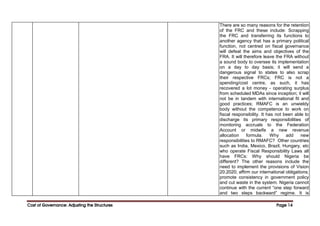
harnessed, the Committee proposed that the funds usually received by research councils either from subvention/levy should be redirected to a
National Research Development Fund, in order to guarantee a robust funding platform for effective take off of the Fund. In line with this proposal,
the Committee observed that government should decide on the quantum of funds to be spent on
research and development on a yearly basis and the Budget Office should allocate same to the proposed National Research Development Fund
(NRDF) for appropriate reallocation to the research institutes. However, Budgetary allocations for personnel costs will be defended before the
Research Fund Board of Trustees, which will then send the personnel cost proposal to the Budget Office. However, we add a proviso to the
Committee’s recommendation. It is to the effect that special funds created to fund a sector’s research should not be diverted to other sectors.
75. National Agency for
Science and
Engineering
Infrastructure
(NASENI)
The Committee recommends as follows, that:
(i) NASENI be merged with PRODA, FIIRO and
NCAM into one research and development agency;
(ii) enabling law of NASENI be amended accordingly
(iii) direct budgetary allocation for research from the
Budget Office ceases with effect from 2013 Fiscal
Year;
(iv) the emerging consolidated body sources its
research funding from the proposed National
Research Development Fund; and
(v) that the appointment of the headship of the
proposed enlarged Research Institute is carried out
through a transparent and competitive selection
process.
Government accepts the
recommendation on the
merger of NASENI and
NCAM with the exclusion
of FIIRO. However,
PRODA should stand
alone.
Government accepts this
recommendation.
Government accepts this
recommendation but with
effect from after the
merger.
Government notes this
recommendation.
Government notes this
recommendation.
FGN’s position is credible subject
to the funding caveat from the
proposed National Research
Development Fund which is to be
established to coordinate
research funding issues.
Cost of Governance: Adjusting the Structures
Cost of Governance: Adjusting the Structures Page
Page
Page
Page 61
61
61
61
76. Federal Institute for
Industrial Research
Oshodi (FIIRO)
The Committee recommends as follows, that:
(i) FIIRO, NASENI and NCAM be consolidated into
one research and development agency;
(ii) the proposed consolidated research agency
sources its funds from the proposed National
Research Development Fund;
(iii) the enabling law of FIIRO be amended
accordingly; and
Government accepts the
recommendations on the
merger of NASENI and
NCAM with the exclusion
of FIIRO.
Government notes the
major role of FIIRO in
food processing
technology as well as
Government's priority on
food security and
diversification of the
economy, which warrants
that it remains a separate
body. FIIRO should be
strengthened to perform
its functions. It may draw
funding from the
proposed National
Research Developing
Fund.
Government rejects this
recommendation. FIIRO
should be allowed to
function on its own
because it is not an
equipment and
engineering institution
FGN’s position is credible subject
to the funding caveat from the
proposed National Research
Development Fund which is to be
established to coordinate
research funding issues.
Cost of Governance: Adjusting the Structures
Cost of Governance: Adjusting the Structures Page
Page
Page
Page 62
62
62
62
(iv) that direct budgetary allocation from Budget
Office ceases with effect from 2013 Fiscal Year.
rather it is a food
processing Agency. It
should be strengthened
to perform its functions.
Government rejects this
recommendation.
77. Projects Development
Institute (PRODA)
The Committee recommends as follows, that:
(i) PRODA be merged with NASENI, FIIRO and
NCAM as one research and development agency;
(ii) the functions of NCAM be incorporated into those
of the proposed consolidated research agency;
(iii) the enabling law of PRODA be amended to
accommodate the merger;
(iv) that direct budgetary allocation from Budget
Office to PRODA ceases with effect from 2013
Fiscal Year; and
(v) the proposed consolidated research agency
sources its funds from the proposed National
Research Development Fund.
Government accepts the
recommendation with
respect to the merger of
NASENI and NCAM, but
with the exclusion of
FllRO and PRODA.
Government accepts this
recommendation with
respect to the merger of
NCAM and NASENI.
Government rejects this
recommendation.
Government rejects this
recommendation.
Government notes this
recommendation.
FGN’s position is credible subject
to the funding caveat from the
proposed National Research
Development Fund which is to be
established to coordinate
research funding issues.
Cost of Governance: Adjusting the Structures
Cost of Governance: Adjusting the Structures Page
Page
Page
Page 63
63
63
63
78. Sheda Science and
Technology Complex
and National
Biotechnology
Development Agency
(NABDA)
(i) the Committee recommends as follows that the
Sheda Science and Technology Complex obtains
research funding from the National Research
Development Fund and NABDA be subsumed in the
Complex.
(ii) the enabling law of Sheda Science and
Technology Complex be amended to accommodate
the functions of NABDA;
(iii) the executive fiat establishing NABDA be
vacated; and
(iv) that Government funding of NABDA ceases with
effect from 2013 Fiscal Year.
Government notes this
recommendation.
Government rejects this
recommendation.
Government rejects this
recommendation and
directs that its
establishment be backed
by law.
Government rejects this
recommendation.
FGN should have accepted the
Committee’s recommendation
subject to the funding caveat from
the proposed National Research
Development Fund which is to be
established to coordinate
research funding issues. It is
contradictory that a government
that wants to cut down the cost of
governance instead of merging
an agency established by
executive fiat (NABDA) is
directing that its establishment be
backed by law
79. National Space
Research and
Development Agency
(NASRDA)
The Committee recommends as follows, that:
(i) NASRDA sources its funding from the proposed
National Research Development Fund; and
(ii) that direct Government funding ceases with
effect from 2013 Fiscal Year.
Government notes this
recommendation.
Government rejects this
recommendation.
FGN should have accepted these
recommendations.
Cost of Governance: Adjusting the Structures
Cost of Governance: Adjusting the Structures Page
Page
Page
Page 64
64
64
64
80. Nigerian Institute of
Science Laboratory
Technology (NISLT)
The Committee recommends as follows, that:
(i) the Nigeria Institute of Science Laboratory
Technology (NISLT) be self-funding; and
(ii) that further funding to Nigeria Institute of Science
Laboratory Technology (NISLT) ceases with effect
from the 2013 Fiscal Year.
Government notes these
recommendations. As
with other Regulatory
Agencies, NISLT will be
funded through Grants.
FGN’s position is credible.
81. Nigerian Building and
Road Research
Institute (NBRRI)
The Committee recommends as follows, that:
(i) NBRRI be abolished, its functions transferred to
the Federal Ministry of Works and the relevant
provisions of the NASENI Act be amended; and
(ii) that direct budgetary allocation from Budget
Office ceases with effect from 2013.
Government rejects this
recommendation and
directs that NBBRI
should remain in the
Federal Ministry of
Science and Technology.
Government rejects this
recommendation.
FGN’s position is credible subject
to the funding caveat from the
proposed National Research
Development Fund which is to be
established to coordinate
research funding issues.
82. Nigerian Institute for
Trypanosomiasis
Research (NITR)
The Committee recommends that NITR derives its
funding from the proposed National Research
Development Fund.
Government notes this
recommendation.
FGN should have accepted the
Committee’s recommendations.
Cost of Governance: Adjusting the Structures
Cost of Governance: Adjusting the Structures Page
Page
Page
Page 65
65
65
65
83. National Board for
Technology
Incubation (NBTI)
The Committee recommends as follows, that:
(i) the number of NBTI board members be
moderate. This Committee believes that seven is a
moderate number; and
(ii) that the NBTI seeks funding from the proposed
National Research Development Fund like other
research institutes.
Government accepts this
recommendation and
directs that the Board be
made up of not less than
seven (7) non-statutory
members and not more
than eleven (11). Or
alternatively, a Chairman
and one per geopolitical
Zone in addition to
statutory members.
Government notes this
recommendation.
When will the technologies
hatch? They have been incubated
for too long without results.
However, FGN’s position is
credible
FGN should have accepted this
recommendation.
84. Nigerian Natural
Medicine
Development Agency
(NNMDA)
The Committee recommends as follows, that:
(i) NNMDA's functions be transferred to the Nigerian
Institute of Medical Research in the Federal Ministry
of Health ; and
(ii) that Government funding of NNMDA ceases with
effect from 2013.
Government rejects this
recommendation.
Government rejects this
recommendation.
Government should have given
further consideration to this
suggestion. There appears to be
no justification for having a
separate and distinct institution
dedicated only to Natural
Medicine. Having all government
medical research institutions
under one supervisory structure
will enhance efficiency and
effectiveness. If FGN insists on
this position, it should be subject
to the funding caveat from the
proposed National Research
Cost of Governance: Adjusting the Structures
Cost of Governance: Adjusting the Structures Page
Page
Page
Page 66
66
66
66
Development Fund which is to be
established to coordinate
research funding issues.
85. Raw Materials
Research and
Development Council
(RMRDC)
The Committee recommends as follows, that:
(i) the Raw Materials Research and Development
Council (RMRDC) be abolished and its enabling law
repealed;
(ii) the functions of RMRDC be transferred to the
Department of Planning, Research and Statistics of
the Federal Ministry of Science and Technology;
and
iii) the fund paid to RMRDC henceforth be remitted
to the pool of funds for the proposed National
Research Development Fund (NRDF).
Government rejects this
recommendation.
Government rejects this
recommendation.
Government notes this
recommendation.
FGN’s position is credible subject
to the funding caveat from the
proposed National Research
Development Fund which is to be
established to coordinate
research funding issues.
However, RMRDC should
consider commercializing some of
their findings to raise funds.
86. Nigerian Institute for
Leather Science
Technology
(NlLEST); and
National Research
Institute for Chemical
Technology
(NARICT)
The Committee recommends as follows, that:
(i) NILEST and NARICT be merged; and
(ii) that the merged body derives its research
funding from the proposed National Research
Development Fund.
Government rejects this
recommendation.
Government rejects this
recommendation.
FGN is right in refusing this
merger considering that the two
institutes have different
mandates. But this should be
subject to the funding caveat from
the proposed National Research
Development Fund which is to be
established to coordinate
research funding issues
87. Energy Commission
of Nigeria (ECN)
The Committee recommends as follows, that:
(i) the Energy Commission of Nigeria (ECN) be
abolished :
(ii) the ECN Act be repealed;
Government rejects this
recommendation.
Government rejects this
ECN should be retained and
strengthened to coordinate
implementation of the national
energy policy
Cost of Governance: Adjusting the Structures
Cost of Governance: Adjusting the Structures Page
Page
Page
Page 67
67
67
67
(iii) the functions of the ECN be transferred to the
Ministry of Power; and
(iv) that the National Energy Council (NEC) be
scrapped as it has outlived its mandate and
relevance.
The Committee strongly recommends that a
management audit be carried out on all the following
Centres :
(i) Regional Centre for Technology Management
Lagos.
(ii) National Engineering Design Development
Institute (NEDDI), Nnewi.
(iii) Africa Regional Centre for Space Science and
Technology, Ile-Ife.
(iv) Centre for Satellite Technology Development,
Abuja.
(v) Centre for Space Transport and Propulsion,
Lagos.
(vi) Centre for Basic Space Science, Nsukka.
(vii) Centre for Geodesy and Geodynamics, Toro,
Bauchi State.
(viii) Sokoto Energy Research Centre.
(ix) Centre for Energy Research and Development,
Nsukka
(x) National Centre for Energy Efficiency and
Conservation, University of Lagos.
(xi) National Centre for Hydropower Research and
Development, University of Ilorin.
(xii) National Centre for Energy Research and
Development, Abubakar Tafawa Balewa University,
Bauchi.
(xiii) National Centre for Energy and Environment,
recommendation.
Government rejects this
recommendation.
Government rejects this
recommendation.
Government accepts this
recommendation
Too many Centres and Institutes;
FGN’s position is in order. Funds
should not be earned
automatically; they should
compete for funds from the
proposed National Research
Development Fund.
Cost of Governance: Adjusting the Structures
Cost of Governance: Adjusting the Structures Page
Page
Page
Page 68
68
68
68
University of Benin.
MINISTRY OF TOURISM, CULTURE AND NATIONAL ORIENTATION
88. National Council for
Arts and Culture
(NCAC)
The Committee recommends as follows, that:
(i) the National Council of Arts and Culture (NCAC)
be merged with the National Troupe and the
National Theatre into one agency;
(ii) the merged entity retains the name: National
Council of Arts and Culture (NCAC);
(iii) the enabling law of the National Troupe and
National Theatre be repealed and their functions
transferred to the NCAC; and
(iv) that the enabling law of the NCAC be amended
to accommodate the merger of the agencies and
their functions.
Government accepts this
recommendation but
directs the NCAC should
stand alone.
Government rejects this
recommendation and
directs the merged entity
be renamed National
Theatre of Nigeria.
Government rejects this
recommendation.
Government rejects this
recommendation.
The work of the NCAC goes
beyond theatre and dancing.
FGN’s position is credible. The
National Troupe and the National
Theatre can be merged since
their functions are similar and can
be managed under one agency.
FGN’s position is credible and is
tandem with the first position.
FGN’s position is credible and is
tandem with the first position.
FGN’s position is credible and is
tandem with the first position.
Cost of Governance: Adjusting the Structures
Cost of Governance: Adjusting the Structures Page
Page
Page
Page 69
69
69
69
89. National Commission
for Museums and
Monuments; National
Gallery of Arts
The Committee recommends as follows, that:
(i) a staff audit of the National Commission for
Museums and Monuments and the National Gallery
of Art should be carried out;
(ii) the merger of both the National Commission for
Museums and Monuments and the National Gallery
of Arts into a single entity to be known as National
Commission for Museums, Monuments and Arts;
(iii) the repeal of the laws setting up the National
Commission for Museums and Monuments and the
National Gallery of Art; and
(iv) the enactment of a new law to accommodate the
merger.
Government accepts this
recommendation. The
Heritage Museum and
Monument potentials
with respect to revenue
yield should be fully
exploited.
Government accepts this
recommendation.
Government accepts this
recommendation.
Government accepts this
recommendation.
The two institutions are related;
the marriage will be peaceful and
productive. FGN’s position is
credible.
FGN’s position is credible.
90. Nigerian Tourism
Development
Corporation (NTDC)
The Committee recommends as follows, that:
(i) the Nigerian Tourism Development Corporation
(NTDC) be fully commercialized with effect from
2013 Fiscal Year;
(ii) the enabling law of NTDC be amended to reflect
the proposed commercialization, subsuming of the
functions of NIHOTOUR and a strong independent
professional board be appointed for NTDC;
(iii) the Board be responsible for:
(a) general policy direction of NTDC;
Government accepts
this recommendation and
directs that the Agency to
be fully commercialized
within five (5) years or by
2018.
Government notes the
recommendation.
Government notes this
recommendation.
FGN’s position is credible.
Cost of Governance: Adjusting the Structures
Cost of Governance: Adjusting the Structures Page
Page
Page
Page 70
70
70
70
(b)enforcement of corporate governance rules;
(c)ensuring timely preparation and auditing of
accounts by independent auditors;
(d))ensuring timely payment of annual surplus to
Government Treasury;
(iv) a management audit of NTDC be carried out;
and
(v) that NTDC ceases to receive Government
funding with effect from 2013 Fiscal year.
Government accepts this
recommendation
Government accepts this
recommendation and
directs the FMOF to
discuss with FMTC&NO
to determine how to fund
and boost the sector to
enable it exit the budget
cycle by 2018.
FGN’s position is credible.
91. Nigerian Institute for
Hospitality and
Tourism Studies
(NIHOTOUR)
The Committee recommends as follows, that:
(i) the functions of the Nigerian Institute for
Hospitality and Tourist Studies (NIHOTOUR) be
transferred to the NTDC;
(ii) the NIHOTOUR be abolished and its enabling
law repealed ; and
(iii) further budgetary allocation to NIHOTOUR be
stopped with effect from 2013 Fiscal Year.
Government rejects this
recommendation.
NIHOTOUR shall
function as a regulatory
body.
Government rejects this
recommendation.
Government rejects this
recommendation.
FGN’s position is credible
Cost of Governance: Adjusting the Structures
Cost of Governance: Adjusting the Structures Page
Page
Page
Page 71
71
71
71
92. National Orientation
Agency (NOA);
National Institute for
Cultural Orientation
(N ICO)
The Committee recommends as follows, that:
(i) the functions of NOA be transferred to the
Department of Public Communications in the
Federal Ministry of Information;
(ii) the 774 offices of NOA be closed and its staff
redeployed within the Federal Civil Service after a
staff audit and. assessment has been carried out ;
(iii) budgetary allocations to NICO ceases with effect
from 2013 Fiscal Year;
(iv) that budgetary allocations to NOA ceases with
effect from 2013 Fiscal Year;
(v) the enabling law of the National Orientation
Agency (NOA) be amended;
(vi) the Act establishing the National Institute for
Cultural Orientation (NICO) be repealed and the
Institute abolished.
Government rejects this
recommendation.
Government rejects this
recommendation.
Government rejects this
recommendation.
Government rejects this
recommendation.
Government rejects this
recommendation.
Government rejects this
recommendation.
Cultural orientation is an aspect
of national orientation and both
therefore, should be handled by
the same agency. NOA should
consider shutting down its
numerous outposts as it does not
need to be physically present to
affect the lives of its publics.
Advances in ICT are making
institutions like NOA obsolete and
FGN should change with the
times. Town criers’ gongs and
megaphones mounted to trucks
are no longer needed to
disseminate information. FGN
should have accepted these
recommendations.
FEDERAL MINISTRY OF TRADE AND INVESTMENT
93. Standards
Organization of
Nigeria (SON),
Consumer Protection
Council (CPC) and
Department of
Weights and
Measures
The Committee recommends as follows, that:
(i) the Standards Organization of Nigeria (SON),
Consumer Protection Council (CPC) and the
Department of Weights and Measures be
merged into a new agency;
Government rejects this
recommendation and directs
that the three Agencies
remain separate.
Government should have
accepted the Committee’s
recommendations regarding the
merger because these agencies
aim to ensure that consumers are
not shortchanged by
unscrupulous business and
individuals.
Cost of Governance: Adjusting the Structures
Cost of Governance: Adjusting the Structures Page
Page
Page
Page 72
72
72
72
(ii) the proposed new agency be named Nigerian
Standards and Consumer Protection Agency
(NSCPA) ; and
(iii) that the enabling Acts of Standards
Organization of Nigeria (SON), Consumer
Protection Council and the Department of
Weights and Measures be repealed and a new
law enacted to accommodate the merger.
Government rejects this
recommendation.
Government rejects this
recommendation.
94. Nigeria Export
Promotion Council;
and
Nigerian Investment
Promotion
Commission
The Committee recommends as follows, that:
(i) the Nigerian Investment Promotion
Commission (NIPC) and the Nigerian Export
Promotion Council (NEPC) be merged into one
agency under the supervision of the Ministry of
Trade and Investment ;
(ii) the new agency be known as the Nigerian
Import-Export Promotion Commission (NIEPC);
(iii) the enabling laws of the two agencies be
repealed accordingly;
(iv) the enactment of a new law to reflect the
merger; and
(v) that further budgetary allocations to the two
agencies be stopped and redirected as
necessary when the new agency is formed.
Government rejects this
recommendation.
Government rejects this
recommendation.
Government rejects this
recommendation.
Government rejects this
recommendation.
Government rejects this
recommendation.
This is a good recommendation
and should have been accepted
by FGN. The NIPC‘s mandate is
to promote investment, especially
foreign direct investment; while
the NEPC‘s remit covers the
development and diversification
of exports. There is a linkage
between the two areas. Apart
from saving overhead costs, the
merger has the potential of
making the resultant organisation
more efficient and effective.
95. Centre for Automotive
Design and
Development
(CADD); and
National Automotive
Council (NAC)
The Committee recommends as follows, that:
(i) the Acts setting up the Centre for Automotive
Design and Development (CADD) and the
National Automotive Council (NAC) be repealed;
(ii) Centre for Automotive Design and
Development (CADD) and the National
Government notes this
recommendation and directs
that the bill in NASS in that
regard should be expedited.
Government rejects this
recommendation.
Considering the state of our auto
industry, FGN intervention in the
sector is still necessary but the
two agencies can be merged
instead of being scrapped.
Cost of Governance: Adjusting the Structures
Cost of Governance: Adjusting the Structures Page
Page
Page
Page 73
73
73
73
Automotive Council (NAC) be scrapped;
iii) funding for both bodies to cease in 2013 ; and
(iv) that the functions of the two bodies be
transferred to appropriate universities and
polytechnics.
Government notes this
recommendation.
Government rejects this
recommendation.
96. Nigerian Export
Processing Zones
Authority (NEPZA);
and Onne Oil and Gas
Free Zone Authority
(OGFZA)
The Committee recommends as follows, that:
(i) the Onne Oil and Gas Free Zone Authority
(OGFZA) be reverted to the Nigeria Export
Processing Zones Authority (NEPZA);
(ii) the amendment of the enabling law of NEPZA
to accommodate the reversion ; and
(iii) that a post-impact assessment be carried
out to ascertain the benefit or otherwise of the
nation's investment in the Free Zones to the
economy.
Government rejects this
recommendation and directs
Onne OGFZA to be
renamed Oil and Gas Free
Zones Authority.
Government rejects this
recommendation.
Government accepts this
recommendation and directs
that an assessment be
carried out to ascertain the
benefit or otherwise of the
nation's investment in Free
Zones to the economy.
There should be a central
authority for all export processing
zones, just like the NPA for the
sea ports. FGN should have
accepted this recommendation.
97. Tafawa Balewa
Square Management
Board; and
Lagos International
Trade Fair
Management Board
The Committee recommends that Government
reviews the concession agreements on the
Tafawa Balewa Square and the Lagos
International Trade Fair with a view to achieving
the objectives for which the concession
agreements were entered into to wit: earn
revenue for Government and to block financial
hemorrhage.
Government notes that this
recommendation is being
carried out.
Government notes this
recommendation.
FGN should stop further
budgetary allocations to the two
Boards as a sign that it is serious
about stopping the waste.
Cost of Governance: Adjusting the Structures
Cost of Governance: Adjusting the Structures Page
Page
Page
Page 74
74
74
74
98. Industrial Training
Fund (ITF)
The Committee recommends as follows, that:
(i) the Industrial Training Fund (ITF) be self-
funding with effect from the 2013 Fiscal Year;
(ii) all trainees' stipends in the SIWES be paid by
the Industrial Training Fund (ITF) with effect from
2013 Fiscal Year;
(iii) the Industrial Training Fund (ITF) coordinates
all skills training centres in the country in order to
remove duplications and wastage; and
(iv) all other skills training centres outside the ITF
cease to receive Capital Funding from
Government Treasury with effect from 2013
Fiscal Year.
Government accepts this
recommendation but with
effect from 2014.
Government accepts this
recommendation but with
effect from 2014.
Government rejects this
recommendation.
Government rejects this
recommendation.
FGN’s position is credible.
FEDERAL MINISTRY OF WATER RESOURCES
99. River Basins
Development
Authorities
The Committee recommends as follows, that:
(i) a single 7-member governing board be
appointed for the 12RBDAs;
(ii) a management audit of all the 12 RBDAs
should be conducted to ensure value for money;
(iii) the management of the RBDAs be pruned to
make it leaner, more efficient and cost-effective;
Government rejects this
recommendation.
Government accepts this
recommendation.
Government notes this
recommendation.
A central governing board for all
the River Basins will suffice.
Having 12 separate boards of
eight members each (96 board
members) cannot be the best
way to cut down on wasteful
expenditure.
FGN’s position is credible.
FGN should have accepted this
recommendation.
Cost of Governance: Adjusting the Structures
Cost of Governance: Adjusting the Structures Page
Page
Page
Page 75
75
75
75
. (iv) the enabling law of the RBDAs be amended
to reflect the proposed arrangement regarding
the board and management of the RBDAs;
(v) the Department of River Basins Operations
and Inspectorate (RBO&I) continues to inspect,
co-ordinate and enforce standards in the River
Basin Development Authorities (RBDAs);
(vi) highly professional, experienced and
competent personnel be deployed to man the
Department of RBO&I in the Ministry;
(vii) the attempt to create additional RBDAs be
discontinued and the existing ones be properly
managed to deliver on their mandates; and
(viii) that the decision of Government in the
White Paper on Ahmed Joda Panel Report
(2000) on the commercialization of the RBDAs
be implemented.
Government rejects this
recommendation.
Government notes this
recommendation.
Government notes this
recommendation.
Government accepts this
recommendation.
Government notes this
recommendation and directs
the Ministry of Water
Resources to work out a
way for commercialization
by 2017.
FGN should have accepted this
recommendation.
FGN’s position is credible
FGN should have accepted this
recommendation.
Cost of Governance: Adjusting the Structures
Cost of Governance: Adjusting the Structures Page
Page
Page
Page 76
76
76
76
100. Nigerian Integrated
Water Resources
Management Agency
(NIWRMA)
The Committee recommends as follows, that:
(i) the functions of the Nigeria Integrated Water
Resources Management Agency (NIWRMA) be
transferred to an extra-ministerial department in
the Federal Ministry of Water Resources ;
(ii) the proposed department to perform the
transferred functions of NIWRMA be given
operational and financial autonomy;
(iii) the Passed Bill be modified to reflect the
proposed status of NIWRMA; and
(iv) that further budgetary allocation to NIWRMA
as an Agency be transferred to the Department
proposed to perform the functions of NIWRMA,
after adjustments reflecting its new status.
Government rejects this
recommendation.
Government rejects this
recommendation.
Government rejects this
recommendation.
Government rejects this
recommendation.
FGN should have accepted this
recommendation. Water
resources management is the
reason for setting up the Ministry
of Water Resources .The role of
NIWRMA should be taken over
by the Ministry to curb duplication
and waste.
101. Gurara Water
Management
Authority (GWMA)
The Committee recommends as follows, that:
(i)'the Gurara Water Management Authority
(GWMA) be abolished and any action to enact
an enabling law for the Authority be discontinued
; and
(ii) that the management of the hydro and
irrigation component of the Gurara 'Water
Management Scheme be transferred to the
Upper Niger River Basin Development Authority
(UNRBA) and Power Holding Company of
Nigeria (PHCN), respectively.
Government rejects this
recommendation.
Government notes this
recommendation.
Should Gurara continue to have a
dedicated management
authority? This is in addition to
the Ministry, NIRWA and the
Upper Niger River Basin
Development Authority. The
recommendation to scrap GWMA
is justified. The irrigation function
should be handed over to Upper
Niger River Basin Development
Authority (UNRBA) while the
power generating function should
be handed over to an appropriate
electricity generating company
under the new privatized
arrangement in the Electricity
Cost of Governance: Adjusting the Structures
Cost of Governance: Adjusting the Structures Page
Page
Page
Page 77
77
77
77
Industry.
102. National Water
Resources Institute
(NWRI)
The Committee recommends that the National
Water Resources Institute (NWRI) continues to
receive full Government funding in view of its
importance to the development and capacity
building of middle level manpower in the Water
Sector.
Government accepts this
recommendation.
FGN’s position is credible.
NATIONAL SPORTS COMMISSION
103. National Sports
Commission
The Committee recommends that the National
Sports Commission reverts to the proposed
Ministry of Youth and Sports Development as an
Agency.
Government rejects this
recommendation.
NSC should be retained. Sports
as a sector should have a
Commission. FGN’s position is
credible.

ORONSANYE REPORT.pdf

  • 1.
    COST OF GOVERNANCE:ADJUSTING THE STRUCTURES (A Review of the Oronsaye Committee Report and the Federal Government White Paper) Centre for Social Justice (CSJ) (Mainstreaming Social Justice in Public Life)
  • 2.
    Cost of Governance:Adjusting the Structures Cost of Governance: Adjusting the Structures Cost of Governance: Adjusting the Structures Cost of Governance: Adjusting the Structures Page Page Page Page ii ii ii ii Written By Kalu Onuoha Esq and Eze Onyekpere Esq First Published in September 2014 By Centre for Social Justice Ltd by Guarantee (Mainstreaming Social Justice in Public Life) No. 17 (Flat 2), Yaounde Street, Wuse Zone 6, P.O. Box 11418 Garki, Abuja Tel: 08055070909, 08127235995 Website: www.csj-ng.org; Blog: csj-blog.org. Email: censoj@gmail.com Twitter: @Censoj Facebook: CSJ Nigeria ISBN: Copyright @CSJ Centre for Social Justice (CSJ)
  • 3.
    Cost of Governance:Adjusting the Structures Cost of Governance: Adjusting the Structures Cost of Governance: Adjusting the Structures Cost of Governance: Adjusting the Structures Page Page Page Page iii iii iii iii TABLE OF CONTENTS Cover Page ------------------------------------------------------------------------------------------------------------------------------------------------ i Table of Content ------------------------------------------------------------------------------------------------------------------------------------------ iii List of Acronyms ------------------------------------------------------------------------------------------------------------------------------------------- viii Acknowledgement ---------------------------------------------------------------------------------------------------------------------------------------- xiii INTRODUCTION ------------------------------------------------------------------------------------------------------------------------------------------ 1 PREAMBLE -------------------------------------------------------------------------------------------------------------------------------------------------- 2 CONSTITUTIONAL BODIES --------------------------------------------------------------------------------------------------------------------------- 7 Code of Conduct Bureau --------------------------------------------------------------------------------------------------------------------------------- 7 Federal Character Commission ------------------------------------------------------------------------------------------------------------------------ 8 Federal Civil Service Commission -------------------------------------------------------------------------------------------------------------------- 10 National Population Commission ---------------------------------------------------------------------------------------------------------------------- 11 Revenue Mobilization Allocation and Fiscal Commission --------------------------------------------------------------------------------------- 12 OTHER BODIES ------------------------------------------------------------------------------------------------------------------------------------------ 12 Fiscal Responsibility Commission --------------------------------------------------------------------------------------------------------------------- 12 Bureau of Public Procurement ------------------------------------------------------------------------------------------------------------------------- 15 Central Bank of Nigeria --------------------------------------------------------------------------------------------------------------------------------- 16 Economic and Financial Crimes Commission ---------- ------------------------------------------------------------------------------------------- 16 Independent Corrupt Practices and Other Related Offences Commission ---------------------------------------------------------------- 17 Infrastructure Concession and Regulatory Commission ----------------------------------------------------------------------------------- 18 Nigerian Investment Promotion Commission ------------------------------------------------------------------------------------------------------ 18 Public Complaints Commission ---------------------------------------------------------------------------------------------------------------------- 18 National Salaries, Incomes and Wages Commission -------------------------------------------------------------------------------------------- 19 OFFICE OF THE VICE-PRESIDENT ----------------------------------------------------------------------------------------------------------------- 20 National Boundary Commission ----------------------------------------------------------------------------------------------------------------------- 20 Border Communities Development Agency -------------------------------------------------------------------------------------------------------- 21 National Institute for Policy and Strategic Studies ----------------------------------------------------------------------------------------------- 22
  • 4.
    Cost of Governance:Adjusting the Structures Cost of Governance: Adjusting the Structures Cost of Governance: Adjusting the Structures Cost of Governance: Adjusting the Structures Page Page Page Page iv iv iv iv National Emergency Management Agency -------------------------------------------------------------------------------------------------------- 22 National Commission for Refugees ------------------------------------------------------------------------------------------------------------------ 23 Debt Management Office ------------------------------------------------------------------------------------------------------------------------------- 24 OFFICE OF THE SECRETARY TO THE GOVERNMENT OF THE FEDERATION --------------------------------------------------- 25 National Poverty Eradication Programme ---------------------------------------------------------------------------------------------------------- 25 National Identity Management Commission ------------------------------------------------------------------------------------------------------- 26 Nigeria National Merit Award --------------------------------------------------------------------------------------------------------------------------- 26 Federal Road Safety Commission ------------------------------------------------------------------------------------------------------------------- 27 Utilities Charges Commission ------------------------------------------------------------------------------------------------------------------------ 28 National Agency for the Control of HIV/AIDS ------------------------------------------------------------------------------------------------------ 29 National Hajj Commission of Nigeria ---------------------------------------------------------------------------------------------------------------- 29 Nigerian Christian Pilgrims Commission ------------------------------------------------------------------------------------------------------------ 29 Service Compact with All Nigerians ------------------------------------------------------------------------------------------------------------------ 30 Nigeria Extractive Industries Transparency Initiative -------------------------------------------------------------------------------------------- 30 OFFICE OFTHE HEAD OF THE CIVIL SERVICE OF THE FEDERATION -------------------------------------------------------------- 30 Administrative Staff College of Nigeria ------------------------------------------------------------------------------------------------------------- 30 Public Service Institute of Nigeria -------------------------------------------------------------------------------------------------------------------- 31 Bureau of Public Service Reforms ------------------------------------------------------------------------------------------------------------------- 31 Federal Government Staff Housing Loans Board ------------------------------------------------------------------------------------------------ 32 FEDERAL MINISTRY OF AGRICULTURE AND RURAL DEVELOPMENT ------------------------------------------------------------- 33 Agricultural Research Council of Nigeria ----------------------------------------------------------------------------------------------------------- 33 Agricultural Research and Rural Management Institute ---------------------------------------------------------------------------------------- 35 National Centre for Agricultural Mechanization --------------------------------------------------------------------------------------------------- 35 Nigerian Agricultural Insurance Corporation ------------------------------------------------------------------------------------------------------- 35 MINISTRY OF AVIATION------------------------------------------------------------------------------------------------------------------------------- 36 Nigeria College of Aviation Technology ------------------------------------------------------------------------------------------------------------- 36 Nigerian Airspace Management Agency, Nigerian Civil Aviation Authority and Nigerian Metrological Agency------------ 36 FEDERAL MINISTRY OF COMMUNICATIONS TECHNOLOGY --------------------------------------------------------------------------- 38 Nigerian Communications Commission ------------------------------------------------------------------------------------------------------------- 38
  • 5.
    Cost of Governance:Adjusting the Structures Cost of Governance: Adjusting the Structures Cost of Governance: Adjusting the Structures Cost of Governance: Adjusting the Structures Page Page Page Page v v v v Nigerian Telecommunications Limited -------------------------------------------------------------------------------------------------------------- 38 National Information Technology Development Agency ---------------------------------------------------------------------------------------- 39 Galaxy Backbone Limited ------------------------------------------------------------------------------------------------------------------------------- 39 Nigerian Communications Satellite (NigComSat) Limited -------------------------------------------------------------------------------------- 39 FEDERAL MINISTRY OF EDUCATION ----------------------------------------------------------------------------------------------------------- 40 National Examinations Council ------------------------------------------------------------------------------------------------------------------------ 40 National Board for Technical Education ------------------------------------------------------------------------------------------------------------ 41 National Open University of Nigeria ------------------------------------------------------------------------------------------------------------------ 42 National Teachers Institute ----------------------------------------------------------------------------------------------------------------------------- 42 Nigerian Institute for Education Planners and Administrators --------------------------------------------------------------------------------- 43 Nigeria Educational Research and Development Council ------------------------------------------------------------------------------------- 43 Universal Basic Education Commission ------------------------------------------------------------------------------------------------------------ 44 FEDERAL MINISTRY OF ENVIRONMENT ------------------------------------------------------------------------------------------------------- 45 National Oil Spill Detection and Response Agency ---------------------------------------------------------------------------------------------- 45 MINISTRY OF FOREIGN AFFAIRS ----------------------------------------------------------------------------------------------------------------- 45 Nigerian Institute of International Affairs ------------------------------------------------------------------------------------------------------------ 45 Institute for Peace and Conflict Resolution --------------------------------------------------------------------------------------------------------- 45 Directorate of Technical Cooperation in Africa ---------------------------------------------------------------------------------------------------- 46 Directorate of Technical Aids Corps ----------------------------------------------------------------------------------------------------------------- 46 FEDERAL MINISTRY OF HEALTH ----------------------------------------------------------------------------------------------------------------- 47 Teaching Hospitals --------------------------------------------------------------------------------------------------------------------------------------- 47 Federal Medical Centres -------------------------------------------------------------------------------------------------------------------------------- 49 Specialty Hospitals --------------------------------------------------------------------------------------------------------------------------------------- 50 FEDERAL MINISTRY OF INFORMATION --------------------------------------------------------------------------------------------------------- 51 Federal Radio Corporation and Voice of Nigeria -------------------------------------------------------------------------------------------------- 51 FEDERAL MINISTRY OF LABOUR AND PRODUCTIVITY ---------------------------------------------------------------------------------- 52 National Directorate of Employment ----------------------------------------------------------------------------------------------------------------- 52 National Productivity Centre ---------------------------------------------------------------------------------------------------------------------------- 53 MINISTRY OF MINES AND STEEL DEVELOPMENT ------------------------------------------------------------------------------------------ 53 Council of Nigerian Mining Engineers and Geoscientists --------------------------------------------------------------------------------------- 53
  • 6.
    Cost of Governance:Adjusting the Structures Cost of Governance: Adjusting the Structures Cost of Governance: Adjusting the Structures Cost of Governance: Adjusting the Structures Page Page Page Page vi vi vi vi National Metallurgical Development Center, Jos & National Metallurgical Training Institute, Onitsha --------------------------- 54 Nigerian Institute of Mining and Geosciences, Jos ----------------------------------------------------------------------------------------------- 54 Ajaokuta Steel Company Limited and National Iron Ore Mining Company ---------------------------------------------------------------- 54 MINISTRY OF PETROLEUM RESOURCES ------------------------------------------------------------------------------------------------------ 55 Nigerian Nuclear Regulatory Authority -------------------------------------------------------------------------------------------------------------- 55 Petroleum Technology Development Fund --------------------------------------------------------------------------------------------------------- 56 Nigerian Content Development and Monitoring Board ------------------------------------------------------------------------------------------ 57 Petroleum Products Pricing and Regulatory Agency and Petroleum Equalization Fund ------------------------------------------- 57 MINISTRY OF POLICE AFFAIRS -------------------------------------------------------------------------------------------------------------------- 57 Police Service Commission ---------------------------------------------------------------------------------------------------------------------------- 58 MINISTRY OF POWER --------------------------------------------------------------------------------------------------------------------------------- 58 Nigerian Electricity Regulatory Commission ------------------------------------------------------------------------------------------------------- 58 National Power Training Institute of Nigeria -------------------------------------------------------------------------------------------------------- 58 National Rural Electrification Agency ---------------------------------------------------------------------------------------------------------------- 59 FEDERAL MINISTRY OF SCIENCE AND TECHNOLOGY ----------------------------------------------------------------------------------- 59 National Agency for Science and Engineering Infrastructure ---------------------------------------------------------------------------------- 60 Federal Institute for Industrial Research, Oshodi ------------------------------------------------------------------------------------------------- 61 Projects Development Institute ------------------------------------------------------------------------------------------------------------------------ 62 Sheda Science and Technology Complex and National Biotechnology Development Agency ------------------------------------ 63 National Space Research and Development Agency --------------------------------------------------------------------------------------------- 63 Nigerian Institute of Science Laboratory Technology -------------------------------------------------------------------------------------------- 64 Nigerian Building and Road Research Institute --------------------------------------------------------------------------------------------------- 64 Nigerian Institute for Trypanosomiasis Research ------------------------------------------------------------------------------------------------- 64 National Board for Technology Incubation ---------------------------------------------------------------------------------------------------------- 65 Nigerian Natural Medicine Development Agency ------------------------------------------------------------------------------------------------- 65 Raw Materials Research and Development Council --------------------------------------------------------------------------------------------- 66 Nigerian Institute for Leather Science Technology and National Research Institute for Chemical Technology ----------------- 66 Energy Commission of Nigeria ------------------------------------------------------------------------------------------------------------------------ 66 MINISTRY OF TOURISM, CULTURE AND NATIONAL ORIENTATION ------------------------------------------------------------------ 68 National Council for Arts and Culture ---------------------------------------------------------------------------------------------------------------- 68
  • 7.
    Cost of Governance:Adjusting the Structures Cost of Governance: Adjusting the Structures Cost of Governance: Adjusting the Structures Cost of Governance: Adjusting the Structures Page Page Page Page vii vii vii vii National Commission for Museums and Monuments; National Gallery of Arts --------------------------------------------------------- 69 Nigerian Tourism Development Corporation ------------------------------------------------------------------------------------------------------ 69 Nigerian Institute for Hospitality and Tourism Studies ------------------------------------------------------------------------------------------- 70 National Orientation Agency and National Institute for Cultural Orientation --------------------------------------------------------------- 71 FEDERAL MINISTRY OF TRADE AND INVESTMENT ---------------------------------------------------------------------------------------- 71 Standards Organization of Nigeria, Consumer Protection Council and Department of Weights and Measures ----------------- 71 Nigeria Export Promotion Council and Nigerian Investment Promotion Commission ------------------------------------------------- 72 Centre for Automotive Design and Development and National Automotive Council --------------------------------------------------- 72 Nigerian Export Processing Zones Authority and Onne Oil and Gas Free Zone Authority ---------------------------------------- 73 Tafawa Balewa Square Management Board and Lagos International Trade Fair Management Board -------------------------- 73 Industrial Training Fund --------------------------------------------------------------------------------------------------------------------------------- 74 FEDERAL MINISTRY OF WATER RESOURCES ----------------------------------------------------------------------------------------------- 74 River Basins Development Authorities -------------------------------------------------------------------------------------------------------------- 74 Nigerian Integrated Water Resources Management Agency ---------------------------------------------------------------------------------- 76 Gurara Water Management Authority ---------------------------------------------------------------------------------------------------------------- 76 National Water Resources Institute ------------------------------------------------------------------------------------------------------------------ 77 NATIONAL SPORTS COMMISSION ---------------------------------------------------------------------------------------------------------------- 77 National Sports Commission --------------------------------------------------------------------------------------------------------------------------- 77
  • 8.
    Cost of Governance:Adjusting the Structures Cost of Governance: Adjusting the Structures Cost of Governance: Adjusting the Structures Cost of Governance: Adjusting the Structures Page Page Page Page viii viii viii viii LIST OF ABBREVIATIONS AIB - Accident Investigation Bureau ARCN - Agricultural Research Council of Nigeria ARMTI - Agricultural Research and Rural Management Institute ASCON - Administrative Staff College of Nigeria BCDA - Border Communities Development Agency BOI - Bank of Industry BPE - Bureau of Public Enterprises BPP - Bureau of Public Procurement BPSR - Bureau of Public Service Reforms CADD - Centre for Automotive Design and Development CBN - Central Bank of Nigeria CCB - Code of Conduct Bureau CCT - Code of Conduct Tribunal COMEG - Council of Nigerian Mining Engineers and Geoscientists CPC - Consumer Protection Council CRAN - Communications Regulatory Authority of Nigeria CSJ - Centre for Social Justice DMO - Debt Management Office DTAC - Directorate of Technical Aids Corps DPR - Department of Petroleum Resources DTCA - Directorate of Technical Cooperation in Africa ECN - Energy Commission of Nigeria EFCC - Economic and Financial Crimes Commission FBCN - Federal Broadcasting Corporation of Nigeria FCAA - Federal Civil Aviation Authority FCC - Federal Character Commission FCSC - Federal Civil Service Commission FCT - Federal Capital Territory FGN - Federal Government of Nigeria FGSHLB - Federal Government Staff Housing Loans Board FIIRO - Federal Institute for Industrial Research
  • 9.
    Cost of Governance:Adjusting the Structures Cost of Governance: Adjusting the Structures Cost of Governance: Adjusting the Structures Cost of Governance: Adjusting the Structures Page Page Page Page ix ix ix ix FMBN - Federal Mortgage Bank of Nigeria FMC - Federal Medical Centre FPSC - Federal Public Service Commission FRC - Fiscal Responsibility Commission FRCN - Federal Radio Corporation of Nigeria FRSC - Federal Road Safety Commission GBL - Galaxy Backbone Limited GWMA - Gurara Water Management Authority ICPC - Independent Corrupt Practices and Other Related Offences Commission ICRC - Infrastructure Concession and Regulatory Commission ICT - Information and Communication Technology IPCR - Institute for Peace and Conflict Resolution ITF - Industrial Training Fund MDAs - Ministries, Department and Agencies of Government NABDA - National Biotechnology Development Agency NABTEB - National Business and Technical Examinations Board NAC - National Automotive Council NACA - National Agency for the Control of HIV/AIDS NAHCON - National Hajj Commission of Nigeria NAIC - Nigerian Agricultural Insurance Corporation NAJCE - National Agency for Job Creation and Empowerment NAMA - Nigerian Airspace Management Agency NAPEP - National Poverty Eradication Programme NAPTIN - National Power Training Institute of Nigeria NARICT - National Research Institute for Chemical Technology NASENI - National Agency for Science and Engineering Infrastructure NASRDA - National Space Research Development Agency NASS - National Assembly NBC - National Boundary Commission NBRRI - Nigerian Building and Road Research Institute NBTI - National Board for Technology Incubation NCAA - Nigerian Civil Aviation Authority NCAC - National Council for Arts and Culture
  • 10.
    Cost of Governance:Adjusting the Structures Cost of Governance: Adjusting the Structures Cost of Governance: Adjusting the Structures Cost of Governance: Adjusting the Structures Page Page Page Page x x x x NCAM - National Centre for Agricultural Mechanization NCAT - Nigeria College of Aviation Technology NCC - Nigeria Communications Commission NCDMB - Nigerian Content Development and Monitoring Board NCR - National Commission for Refugees NCPC - Nigerian Christian Pilgrims Commission NDE - National Directorate of Employment NEC - National Economic Council NEC - Nomadic Education Commission NEC - National Energy Council NECO - National Examinations Council NEDDI - National Engineering Design Development Institute NEITI - Nigeria Extractive Industries Transparency Initiative NEMA - National Emergency Management Agency NEPA - National Electric Power Authority NEPC - Nigerian Export Promotion Council NEPZA - Nigerian Export Processing Zones Authority NERC - Nigerian Electricity Regulatory Commission NERDC - Nigeria Educational Research and Development Council NICO - National Institute for Cultural Orientation NIEPA - Nigerian Institute for Education Planners and Administrators NIEPC - Nigerian Import-Export Promotion Commission NIHOTOUR - Nigerian Institute for Hospitality and Tourism Studies NIIA - Nigerian Institute of International Affairs NILEST - Nigerian Institute for Leather Science Technology NIMC - National Identity Management Commission NIMG - Nigerian Institute of Mining and Geosciences NIMET - Nigerian Metrological Agency NIPC - Nigerian Investment Promotion Commission NNMA - Nigeria National Merit Award NIOMCO - National Iron Ore Mining Company NIPC - Nigerian Investment Promotion Commission NIPOST - Nigerian Postal Service
  • 11.
    Cost of Governance:Adjusting the Structures Cost of Governance: Adjusting the Structures Cost of Governance: Adjusting the Structures Cost of Governance: Adjusting the Structures Page Page Page Page xi xi xi xi NIPSS - National Institute for Policy and Strategic Studies NISLT - Nigerian Institute of Science Laboratory Technology NITDA - National Information Technology Development Agency NITEPA - Nigerian Institute for Teachers, Education Planners and Administrators NITEL - Nigeria Telecommunications Limited NITR - Nigerian Institute for Trypanosomiasis Research NIWRMA - Nigerian Integrated Water Resources Management Agency NigComSat - Nigerian Communications Satellite NMDC - National Metallurgical Development Centre NNMDA - Nigerian Natural Medicine Development Agency NNRA - Nigerian Nuclear Regulatory Authority NOA - National Orientation Agency NOUN - National Open University of Nigeria NOSDRA - National Oil Spill Detection and Response Agency NPC - National Productivity Centre NPC - National Population Commission NRDF - National Research Development Fund NSC - National Sports Commission NSCPA - Nigerian Standards and Consumer Protection Agency NSIWC - National Salaries, Income and Wages Commission NTA - Nigerian Television Authority NTDC - Nigerian Tourism Development Corporation NTI - National Teachers Institute NWRI - National Water Resources Institute OGFZA - Oil and Gas Free Zone Authority OHCSF - Office of Head of the Civil Service of the Federation OSGF - Office of the Secretary General of the Federation PCC - Public Complaints Commission PHCN - Power Holding Company of Nigeria PPPRA - Petroleum Products Pricing and Regulatory Agency PRODA - Projects Development Institute PSIN - Public Service Institute of Nigeria PTDF - Petroleum Technology Development Fund
  • 12.
    Cost of Governance:Adjusting the Structures Cost of Governance: Adjusting the Structures Cost of Governance: Adjusting the Structures Cost of Governance: Adjusting the Structures Page Page Page Page xii xii xii xii RAMFAC - Revenue Mobilization Allocation and Fiscal Commission RBDA - River Basins Development Authorities RMRDC - Raw Materials Research and Development Council ROBI - River Basins Operations and Inspectorate SERVICOM - Service Compact with All Nigerians SMEDAN - Small and Medium Scale Enterprise Development Agency of Nigeria SON - Standards Organization of Nigeria (SON) TAC - Technical Aid Corps UBEC - Universal Basic Education Commission UCC - Utilities Charges Commission UNRBA - Upper Niger River Basin Development Authority (UNRBA VIO - Vehicle Inspection Office VON - Voice of Nigeria WAEC - West African Examination Council
  • 13.
    Cost of Governance:Adjusting the Structures Cost of Governance: Adjusting the Structures Cost of Governance: Adjusting the Structures Cost of Governance: Adjusting the Structures Page Page Page Page xiii xiii xiii xiii ACKNOWLEDGEMENT Centre for Social Justice acknowledges the support of participants and contributors to the cost of governance workshop. We are grateful to Ken Ukoha of the National Association of Nigerian Traders, Chioma Osuji of CSACEFA, Kalu Onuoha Esq, Oluseun Onigbinde of BudgIT, Emeka Ononamadu of Publish What You Pay, Captain Dele Ore of the Aviation Roundtable and Chibuike Onwusoro Esq for their inputs.
  • 14.
    Cost of Governance:Adjusting the Structures Cost of Governance: Adjusting the Structures Cost of Governance: Adjusting the Structures Cost of Governance: Adjusting the Structures Page Page Page Page 1 1 1 1 PART 1: INTRODUCTION A. BACKGROUND Cost of Governance: Adjusting the Structures is a review of the report and recommendations of the Oronsaye Presidential Committee (the Committee) and the White Paper that stated the position of the Federal Government of Nigeria (FGN) on the recommendations. It will be recalled that the Committee was set up by the FGN with a mandate to recommend for restructuring and rationalization, FGN’s parastatals, commissions and agencies. The approach of CSJ in this Review is to examine the Committee’s recommendations and the White Paper’s position against the background of the terms of reference of the Committee and national and international fit and good practices. The purpose is to ensure that the original idea of reducing the cost of governance through the restructuring and rationalisation of agencies is not lost in the political mill of intrigues that characterize government’s processes and policy implementation. Generally, the Committee’s recommendations were far reaching and if properly implemented, could reduce the cost of governance. But there were few errors of judgement which would not serve the best of public interest if implemented, for example, the decision to scrap the Fiscal Responsibility Commission. However, the FGN White Paper reversed a good number of the gains that would have accrued from the full implementation of the Committee’s recommendations. The White Paper employed extraordinary caution and at the end of the day watered down some of the recommendations. On the other hand, our recommendations seek to strike a balance between the two positions. This Review was necessitated by the need to ensure that the challenge of cost of governance is kept in the front burner of public discourse and not relegated to the background. CSJ is mindful of the need to ensure that raw politicking does not triumph governance and to guarantee that all political actors are made accountable to the people through their positions on this vexed national phenomenon of rising governance costs. This phenomenon has led to decreased expenditures on the capital budget and thereby heightened the physical and social infrastructure deficit. National development has been held back and Nigeria’s quest to be among the top economies in the world will remain a dream until the challenge of the cost of governance is addressed. In a democracy, the right to participate in governance does not start and end with voting. It is part of the duty of citizens as the custodians of power and the ultimate sovereigns to exercise oversight over the formulation, management and administration of government policies and programmes in such a way and manner that contributes to the overall progress of society. The
  • 15.
    Cost of Governance:Adjusting the Structures Cost of Governance: Adjusting the Structures Cost of Governance: Adjusting the Structures Cost of Governance: Adjusting the Structures Page Page Page Page 2 2 2 2 implementation or non-implementation of the Committee’s recommendations will have serious implications for the security and welfare of the Nigerian society. As such, it is too important to be left with government officials and technocrats. Those who stand to be affected one way or the other should consider themselves duty bound to contribute to the discourse until a good decision is reached. Most of the agencies to be restructured were set up by law and will need legislative action for their restructuring to be effective. This could come by way of amendments, repeals or the enactment of new laws. It is therefore imperative to present the legislature with alternative points of view to facilitate the discharge of their duties to make laws for the peace, order and good government of the Federal Republic of Nigeria. The main body of the work is divided into five columns stating a serial number, the ministry, department, parastatal, etc, the Committee’s recommendations, FGN’s position and finally our recommendations and position. This Review did not necessarily follow the sequence in the FGN White Paper. It did not address all the issues raised in the White Paper but is limited to what CSJ considered very important. The Review reproduces below the background, terms of reference, scope and methodology, rationale and principles that guided the Committee in its work; and the background to the work of the White Paper Committee. B. PREAMBLE 1. The Federal Government runs its business through the efficient and effective operations of the Public Service. In 1970, the Federal Government expanded the scope of the operations of the Public Service from core policy implementation to active participation in all sectors of the economy through the establishment of Agencies, Parastatals, and Commissions. The additional Bodies were to be the drivers of the socio-economic objectives of the Federal Government. Some of them were set up on ad hoc basis to address specific challenges. 2. Over the years, the Bodies transmuted into permanent institutions with overlapping functions in some cases, and successive Administrations had further created more Bodies without regard to their efficacy in the attainment of the socio-economic Agenda of the Federal Government leading to escalation in cost of governance. 3. To redress this situation, His Excellency, the President and Commander-in-Chief of the Armed Forces, Dr. Goodluck Ebele Jonathan, GCFR, inaugurated, on the 18th August, 2011, a Seven-Member Presidential Committee to advice on the Restructuring and Rationalisation of the Federal Government's Agencies, Parastatals and Commissions.
  • 16.
    Cost of Governance:Adjusting the Structures Cost of Governance: Adjusting the Structures Cost of Governance: Adjusting the Structures Cost of Governance: Adjusting the Structures Page Page Page Page 3 3 3 3 4. The Presidential Committee comprised of the following members— (a) Stephen Oronsaye, CFR .. .. .. Chairman (b) Japh CT Nwosu .. .. .. .. Member (c) Rabiu D. Abubakar .. .. .. .. Member {d) N. Salman Mann, mni .. .. .. .. Member (e) Hamza A. Tahir, mni .. .. .. .. Member (f) Adetunji Adesunkanmi .. .. .. .. Member (g) Umar A. Mohammed .. .. .. Member 5. The Terms of Reference of the Presidential Committee were as follows: (a) study and review all previous reports and records on the restructuring of Federal Parastatals and advise on whether they were still relevant; (b).examine the enabling Acts of all the Federal Agencies, Parastatals and Commissions and classify them into various sectors; (c) examine critically, the mandate of the existing Federal Agencies, Parastatals and Commissions and determine areas of overlap or duplication of functions and make appropriate recommendations to either restructure, merge or scrap some to eliminate such overlaps, duplications or redundancies; and (d) advise on any other matter incidental to the foregoing which might be relevant to the desire of Government to prune down the cost of governance.
  • 17.
    Cost of Governance:Adjusting the Structures Cost of Governance: Adjusting the Structures Cost of Governance: Adjusting the Structures Cost of Governance: Adjusting the Structures Page Page Page Page 4 4 4 4 6. SCOPE AND METHODOLOGY In carrying out its mandate, the Presidential Committee: (a) had interactive sessions with Federal Government Ministries, Agencies, Parastatals and Commissions, reviewed their submissions and their mandates; (b) referred to previous Reports on Government White Paper on Review, Harmonisation and Rationalisation of Federal Parastatals, Institutions and Agencies; (c) involved major stakeholders within the Public Service; (d) sent out templates to Ministries and Offices for comprehensive list of Agencies, Parastatals and Commissions, enabling Acts and Mandates; (e) invited memoranda from members of the public through advertisements in four national dailies; (f) obtained copies of Appropriation Acts from 2009- 2011, to ascertain Government financial involvement; and (g) dialogued with the Ministries, Agencies, Parastatals and Commissions and leaders of past Administrations and the National Assembly. 7. RATIONALE The rational for restructuring and rationalisation of Agencies, Parastatals and Commissions is to meet the global socio-economic challenges which have rendered it inevitable for the Government to cut the cost of governance while ensuring accountability. 8. PRINCIPLES In carrying out the assignment, the Presidential Committee was guided by the following principles: (a) the economic challenges and the need for Government to make more efficient use of its resources to achieve its development objectives and goals;
  • 18.
    Cost of Governance:Adjusting the Structures Cost of Governance: Adjusting the Structures Cost of Governance: Adjusting the Structures Cost of Governance: Adjusting the Structures Page Page Page Page 5 5 5 5 (b) the fact that Nigeria had undertaken reforms in the past; (c) it was imperative to reform to meet the challenges of a better socio-political and economic society; (d) there was no need to create another body to perform the functions of an already existing statutory entity. The fact that an institution was inefficient and ineffective should not warrant the creation of a new one; and (e) the reform would ensure efficient and effective management of Government structures and functionaries to guarantee better service delivery and good governance. 9. The Presidential Committee observed that the rationalisation of Agencies, Parastatals and Commissions would help the Government to reposition the Ministries to supervise the mandates of the Parastatals. It recognised that the Reform would have human dimensions and cost implications and recommended that Government should focus on empowering the MDAs “to do more for less” THE WHITE PAPER DRAFTING COMMITTEE 10. The White Paper Drafting Committee was set up by Government with the following as members: (a) Mr. Mohammed Bello Adoke, SAN Honourable Attorney-General of the Federation and Minister of Justice .. .. .. .. .. Chairman (b) Ms. Ama Pepple, CFR Hon. Minister of Land, Housing/Urban Development .. .. Member (c) Alhaji Isa Bello Sali, Head of the Civil Service of the Federation .. .. Member (d) Chief Emeka Wogu, Hon. Minister of Labour and Productivity .. .. Member (e) Mrs Omobola Johnson, Hon. Minister of Communication Technology .. .. .. Member
  • 19.
    Cost of Governance:Adjusting the Structures Cost of Governance: Adjusting the Structures Cost of Governance: Adjusting the Structures Cost of Governance: Adjusting the Structures Page Page Page Page 6 6 6 6 (f) Dr. Shamsuddeen Usman, CON, Hon. Minister/Deputy Chairman, National Planning Commission .. .. .. .. ... Member (g) Dr (Mrs) A. J. Awosika, Permanent Secretary, Ministry of Power .. .. .. .. Member (h) Engr. Emeka Eze, Director-General, Bureau of Public Procurement .. .. Member (e) Dr. Ochi C. Achinuvu, Senior Special Assistant, Economic Matters, Office of the COS to the President .. .. Member (f) Mr Femi Olayisade, Permanent Secretary, General Services Office (OSGF) .. Member/Secretary 11. The Drafting Committee was given the following Terms of Reference: (a) to study and analyse the findings and recommendations contained in the Report of the Presidential Committee on the Restructuring and Rationalisation of Government Parastatals, Commissions and Agencies; and (b) to produce and submit a draft White Paper on the Report for the consideration of Government. 12. The Drafting Committee sat on a number of days to consider the report of the Committee. 13. The White Paper is structured in a tabular format showing the Parastatals and Agencies, Recommendations of the Presidential Committee and Comments indicating recommendations accepted, noted or rejected by the Government.
  • 20.
    Cost of Governance:Adjusting the Structures Cost of Governance: Adjusting the Structures Cost of Governance: Adjusting the Structures Cost of Governance: Adjusting the Structures Page Page Page Page 7 7 7 7 PART 11: THE REPORT, WHITE PAPER AND RECOMMENDATIONS S/N Parastatal/Agency Oronsaye’s Recommendations FGN’s White Paper Our Position/Recommendations CONSTITUTIONAL BODIES 1. Code of Conduct Bureau (CCB) That the existing anti-corruption laws be repealed and a new law enacted to accommodate the consolidation of the EFCC, ICPC and the Code of Conduct Bureau. Government rejects this recommendation FGN should consider scrapping the CCB, transferring its duties to EFCC or ICPC while retaining EFCC and ICPC as separate anti corruption agencies. The ineffectiveness of the CCB as an anti- corruption agency1 is too glaring. It would be recalled that the Bureau was set up to inter alia ensure compliance with and where appropriate, enforce the provisions of the Code of Conduct or any law relating thereto; deal with complaints of breach of the Code of Conduct against public servants. It is also to receive assets declarations from public officers and refer cases of non-compliance to the Code of Conduct Tribunal. The CCB consists of the Chairman and nine other members who are political appointees. In addition, the CCB maintains staff and office premises incurring huge overheads and salaries without adding any value to governance. The CCB may have been relevant before the coming into force of the ICPC and EFCC Acts; but merely collecting declaration of assets and warehousing them cannot be the reason for the maintenance of the huge bureaucracy. 1 See S. 153 and Third Schedule Part 1 (Federal Executive Bodies) of the Constitution of the Federal Republic of Nigeria 1999. Except the context otherwise refers, any reference in this publication to the Constitution is a reference to the 1999 Constitution. What value has the Bureau added since inception?
  • 21.
    Cost of Governance:Adjusting the Structures Cost of Governance: Adjusting the Structures Cost of Governance: Adjusting the Structures Cost of Governance: Adjusting the Structures Page Page Page Page 8 8 8 8 Even if FGN insists on retaining the CCB, it does not need 10 members; between 4 and 5 members would be enough. 2. Federal Character Commission The Committee recommends as follows, that: (i) the Federal Character Commission be abolished; and (ii) that an amendment of the Constitution be carried out to reflect the abolition. Government rejects this recommendation and directs that the Federal Character Commission be strengthened to perform its constitutional role and functions. The FCC is constitutionally entrenched (s.153 of the 1999 Constitution), but it is not indispensable. The Commission should be abolished as it adds no specific value to governance. The Commission came into being to ensure “proportionate” sharing of government jobs. But equitable distribution of job opportunities in the public sector has remained a mirage. Indeed, attempts have been made to use the FCC Act to deny qualified persons official positions that they rightly deserve. Perfecting our union will no doubt entail weaving a mosaic of talents from every nook and corner of the nation, but the continuous sacrifice of merit is increasingly becoming too high a price to pay. For instance, the FCC Act provides that each State shall produce 2.75 per cent of the total work force in any Federal establishment while the Federal Capital Territory shall produce 1 per cent for the indigenes of the FCT, provided that the Commission may adopt a range so that the indigenes of any State of the Federation shall not constitute less than the lower limit or more than the upper limit of the range2 . No federal establishment is exempted from the application of this principle but has it 2 Guiding Principles and Formulae for the Distribution of all Cadres of Posts.
  • 22.
    Cost of Governance:Adjusting the Structures Cost of Governance: Adjusting the Structures Cost of Governance: Adjusting the Structures Cost of Governance: Adjusting the Structures Page Page Page Page 9 9 9 9 been the case in practice? Again, the Act has promoted disharmony and disunity between States with respect to appointment of women into competitive high level offices. It provides that a woman shall continue to lay claim to her state of origin for the purpose of implementation of the federal character formulae at the national level. The implication of this is that a husband and wife may belong to different States, as a woman retains her original state of origin even after marriage. In terms of cost, taxpayers pay for the remuneration and allowances of the chairman who is the chief executive officer and thirty seven other representatives as well as a complement of staffers and overhead expenses at the headquarters in Abuja and branch offices in each State of the Federation and the FCT. The FCC Act is not being scrupulously implemented as the provisions are not framed in absolute terms. The Commission is not an independent institution. Its work is subject to approval of the President. Section 1(3) of the FCC Act provides that the Commission shall not be subject to the direction, control or supervision of any other authority or person in the performance of its functions other than the President. Also Section 4 provides that the Commission shall work out an equitable formula, subject to the
  • 23.
    Cost of Governance:Adjusting the Structures Cost of Governance: Adjusting the Structures Cost of Governance: Adjusting the Structures Cost of Governance: Adjusting the Structures Page Page Page Page 10 10 10 10 approval of the President, for distribution of all cadres of posts in the public sector; as well as distribution of socio-economic services, amenities and infrastructural facilities. It is the President that determines what is equitable in every situation. Even if FGN decides against all odds to retain the Commission, the membership should not exceed a chairman and one person representing each of the geopolitical zones of the country. 3. Federal Civil Service Commission (FCSC) The Committee recommends as follows, that: (i) the Constitution be amended to reflect a change in name and status for the Federal Civil Service Commission (FCSC) to the Federal Public Service Commission (FPSC); (ii) an enabling law be enacted to properly delineate the mandate, functions, structure and other processes of the Commission; (iii) the Constitutional provision establishing the Federal Civil Service Commission be amended to provide for a reduction in the number of Commissioners to a minimum of seven or a maximum of 12, one of whom would be Chairman; (iv) that the tenure of the chairman and commissioners of the proposed FPSC be reduced to a three-year non-renewable Government rejects this recommendation. Government rejects this recommendation. Government rejects this recommendation. Government accepts this recommendation only with respect to a This recommendation to change the name ought to have been accepted because there is a difference between the public service and the civil service of the Federation. The latter is a subset of the former. Having one agency in charge of all public sector workers will have very favourable cost implications while promoting efficiency. At the moment, each of the agencies and bodies in the public sector employ their own staff and exercise disciplinary control over them using differing criteria and standards. Centralization will create a one-stop portal. The Constitution provides for a chairman and not more than fifteen members; since Government is disposed to rotation within geopolitical zones, the Commission should have a chairman and six members, if we are really keen on reducing costs.
  • 24.
    Cost of Governance:Adjusting the Structures Cost of Governance: Adjusting the Structures Cost of Governance: Adjusting the Structures Cost of Governance: Adjusting the Structures Page Page Page Page 11 11 11 11 term to be rotated among the States in each geo-political zone; and (v) that there be the restoration of centralised appointment, promotion and disciplinary control in the Public Service through the Federal Public Service Commission to ensure standardisation in quality, process and procedure. single term of five years for the Chairman and members of the Federal Civil Service. Government rejects this recommendation 4. National Population Commission (NPC) The Committee recommends the amendment of the 1999 Constitution in the following areas : (i) expunge the registration of births, deaths etc. from among the functions of the Local Government Councils since it is also listed as "item 8" under the Exclusive List of the Constitution; (ii) reduce the number of NPC Commissioners from 37 to a sizeable seven, comprising part-time Chairman and members representing the geo-political zones. The Committee further recommends that: (iii) the NIMC Act be amended to delete Section 6 (i) (b) which deals with the registration of births and deaths in Nigeria. NIMC may obtain statistics on births and deaths from NPC whenever necessary ; Government rejects this recommendation and directs that Local Government Councils should continue to register births and deaths, but should render returns to NPC. Government rejects this recommendation. Government accepts this recommendation. There is no compelling reason to deny local government administrations the opportunity to gather such demographic data provided the cost is borne by them. The Local government and NPC should jointly undertake the function so as to establish a uniform database. Granted population issues are emotive in this country and each State will want to be represented at the NPC, yet paying the bills of the Chairman and 37 Commissioners from the nation’s dwindling resources is no longer justifiable. We firmly support the Committee’s recommendations. This recommendation is sound. The Commission maintains permanent presence in not only all the States of the Federation, but also in all the Local Government Areas and Area Councils of the FCT (S.12 of the NPC Act). Government should think of ways
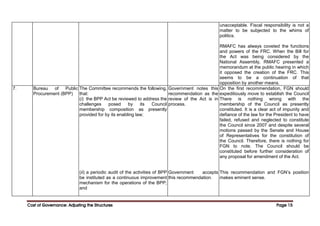
  • 25.
    Cost of Governance:Adjusting the Structures Cost of Governance: Adjusting the Structures Cost of Governance: Adjusting the Structures Cost of Governance: Adjusting the Structures Page Page Page Page 12 12 12 12 and (iv) migration issues/statistics presently being handled by the National Commission for Refugees be transferred to the NPC in line with National Policy for Sustainable Development and NPC Act Cap. N67, 2004. Government notes this recommendation. of deploying ICT to reduce the cost of continuous registration of births and deaths 5. Revenue Mobilization Allocation and Fiscal Commission The Committee recommends as follows, that: (i) the Fiscal Responsibility Commission (FRC) be abolished and its enabling law repealed; (ii) the enabling law of the National Salaries, Income and Wages Commission (NS1WC) be repealed and the functions of the Commission subsumed under the Revenue Mobilization Allocation and Fiscal Commission (RMAFC); and (iii) the enabling law of the Revenue Mobilization, Allocation and Fiscal Commission (RMAFC) be amended to accommodate the functions of the FRC as well as those of the National Salaries, Income and Wages Commission (NSIWC). Government accepts all the recommendations and directs the Honourable Attorney- General of the Federation and the Minister of Justice to initiate necessary action for the abolition of the FRC. Government further directs that the RMAFC should perform the functions of the FRC. Government accepts this recommendation on the NSIWC. The orientation and mandate of the RMAFC can accommodate the functions of the NSIWC, but certainly not those of the FRC. RMAFC can therefore undertake the functions and powers of the NSIWC and has no business with the functions and powers of the FRC. RMAFC is an unwieldy body of 37 members which by all reasonable standards is too large. The membership should not exceed a chairperson and six members representing the six geopolitical zones of Nigeria. OTHER BODIES 6. Fiscal Responsibility Commission (FRC) The Committee recommends that the Fiscal Responsibility Commission be abolished and its enabling law repealed as Government accepts this recommendation and directs the Attorney- The Constitution does not contain any provision empowering RMAFC to undertake any of the functions assigned to the FRC by
  • 26.
    Cost of Governance:Adjusting the Structures Cost of Governance: Adjusting the Structures Cost of Governance: Adjusting the Structures Cost of Governance: Adjusting the Structures Page Page Page Page 13 13 13 13 RMAFC is already empowered by the Constitution to carry out the functions. General of the Federation and Honourable Minister of Justice to take necessary action. the Fiscal Responsibility Act. The constitutional functions of the RMAFC as set out in Part 1 of the Third Schedule to the 1999 Constitution are: (a) to monitor accruals to and disbursement of revenue from the Federation Account; (b) to review, from time to time, the revenue allocation formulae and principles in operation to ensure conformity with changing realities; (c) to advise the Federal Government on fiscal efficiency and methods by which their revenue can be increased; and (d) to determine the remuneration appropriate for certain political office holders. The FRC was specifically set up to enable the country realise the ideals in the economic objectives enshrined in the 1999 Constitution. Although the Commission has not lived up to expectations, its raison d’être is still compelling in view of the pervasive fiscal indiscipline and financial recklessness in the public sector as well as the continued inability of MDAs to voluntarily toe the narrow path of prudence in the management of the nation’s economic resources. The Commission should continue to be clothed with a separate legal personality in order to be able to vindicate its position in courts of law and also to be able to hold land and other immovable property in its own name.
  • 27.
    Cost of Governance:Adjusting the Structures Cost of Governance: Adjusting the Structures Cost of Governance: Adjusting the Structures Cost of Governance: Adjusting the Structures Page Page Page Page 14 14 14 14 There are so many reasons for the retention of the FRC and these include: Scrapping the FRC and transferring its functions to another agency that has a primary political function, not centred on fiscal governance will defeat the aims and objectives of the FRA. It will therefore leave the FRA without a sound body to oversee its implementation on a day to day basis; it will send a dangerous signal to states to also scrap their respective FRCs; FRC is not a spending/cost centre, as such, it has recovered a lot money - operating surplus from scheduled MDAs since inception; it will not be in tandem with international fit and good practices; RMAFC is an unwieldy body without the competence to work on fiscal responsibility. It has not been able to discharge its primary responsibilities of monitoring accruals to the Federation Account or midwife a new revenue allocation formula. Why add new responsibilities to RMAFC? Other countries such as India, Mexico, Brazil, Hungary, etc who operate Fiscal Responsibility Laws all have FRCs: Why should Nigeria be different? The other reasons include the need to implement the provisions of Vision 20:2020; affirm our international obligations; promote consistency in government policy and cut waste in the system. Nigeria cannot continue with the current “one step forward and two steps backward” regime. It is
  • 28.
    Cost of Governance:Adjusting the Structures Cost of Governance: Adjusting the Structures Cost of Governance: Adjusting the Structures Cost of Governance: Adjusting the Structures Page Page Page Page 15 15 15 15 unacceptable. Fiscal responsibility is not a matter to be subjected to the whims of politics. RMAFC has always coveted the functions and powers of the FRC. When the Bill for the Act was being considered by the National Assembly, RMAFC presented a memorandum at the public hearing in which it opposed the creation of the FRC. This seems to be a continuation of that opposition by another means. 7. Bureau of Public Procurement (BPP) The Committee recommends the following, that: (i) the BPP Act be reviewed to address the challenges posed by its Council membership composition as presently provided for by its enabling law; (ii) a periodic audit of the activities of BPP be instituted as a continuous improvement mechanism for the operations of the BPP; and Government notes this recommendation as the review of the Act is in process. Government accepts this recommendation. On the first recommendation, FGN should expeditiously move to establish the Council There is nothing wrong with the membership of the Council as presently constituted. It is a clear act of impunity and defiance of the law for the President to have failed, refused and neglected to constitute the Council since 2007 and despite several motions passed by the Senate and House of Representatives for the constitution of the Council. Therefore, there is nothing for FGN to note. The Council should be constituted before further consideration of any proposal for amendment of the Act. This recommendation and FGN’s position makes eminent sense.
  • 29.
    Cost of Governance:Adjusting the Structures Cost of Governance: Adjusting the Structures Cost of Governance: Adjusting the Structures Cost of Governance: Adjusting the Structures Page Page Page Page 16 16 16 16 (iii) that BPP be domiciled in the State House. Government notes this recommendation. The BPP is supposed to be an independent body and oversights procurement functions including that of the State House. It should therefore not be domiciled in the State House which is also a spending agency. 8 Central Bank of Nigeria (CBN) None None To enhance good corporate governance in the Bank, S.6 of the CBN Act should be amended to create an independent supervisory Board that will not be under the control of the Governor. This will increase accountability and transparency in the CBN and eventual remittance of increased operating surplus to the treasury. 9. Economic and Financial Crimes Commission (EFCC) The Committee recommends as follows, (EFCC) that: (i) the Code of Conduct Tribunal be renamed "Anti-Corruption Tribunal" and upgraded to the status of a Court of Superior Record with the responsibility for handling only corruption cases from the proposed merger of ICPC, EFCC and the Code of Conduct Bureau ; (ii) that the existing anti-corruption laws be repealed and a new law enacted to accommodate the consolidation of the EFCC, ICPC and the Code of Conduct Bureau; Government rejects this recommendation. Government rejects this recommendation. FGN’s position is credible. The EFCC has nothing to do with adjudication; it detects, investigates and prosecutes offenders. Recommendations bordering on special courts and conversion of the CCT are misplaced here. However, the idea of a special anti-corruption court to speed up corruption trials is a good one. This should be considered, not necessarily from the purview of cost of governance but from the need to speed up the administration of criminal justice. There is the need to strengthen agencies as they currently exist to ensure that beyond value for money and reducing the cost of administration, criminal investigations and prosecutions relating to corruption cases
  • 30.
    Cost of Governance:Adjusting the Structures Cost of Governance: Adjusting the Structures Cost of Governance: Adjusting the Structures Cost of Governance: Adjusting the Structures Page Page Page Page 17 17 17 17 (iii) the establishment of strong departments, among others in the proposed consolidated structure to handle the following: (a) Prosecution; (b) investigation; (c) prevention (advocacy); and (d) asset Declaration/Forfeiture; and (iv) that the Nigeria Financial Intelligence Unit (NFIU) be made autonomous. Government rejects this recommendation. Government accepts this recommendation. are handled with the requisite speed and competence. The agencies should not be merged. FGN’s position is credible. This is a sound recommendation. 10. Independent Corrupt Practices and Other Related Offences Commission (ICPC) The Committee recommends as follows that: (i) the EFCC, ICPC and the Code of Conduct Bureau be consolidated into one anti-corruption agency ; (ii) that the existing enabling laws of the EFCC, ICPC and the Code of Conduct Bureau be repealed and a new law enacted to accommodate the proposed anti-corruption agency ; and (iii) the establishment of strong departments, among others, in the proposed consolidated structure to handle the following : (a) prosecution ; (b) investigation ; (c) prevention (advocacy) ; and (d) asset Declaration/Forfeiture. Government rejects this recommendation Government rejects this recommendation Government rejects this recommendation There is the need to strengthen agencies as they currently exist to ensure that beyond value for money and reducing the cost of administration, criminal investigations and prosecutions relating to corruption cases are handled with the requisite speed and competence. The agencies should not be merged.
  • 31.
    Cost of Governance:Adjusting the Structures Cost of Governance: Adjusting the Structures Cost of Governance: Adjusting the Structures Cost of Governance: Adjusting the Structures Page Page Page Page 18 18 18 18 11. Infrastructure Concession and Regulatory Commission (ICRC) The Committee recommends that Infrastructure Concession and Regulatory Commission (ICRC) be subsumed in the Bureau of Public Enterprises (BPE) for greater synergy and their enabling laws amended accordingly. Government rejects this recommendation. Government ought to have accepted this recommendation. BPE has been involved in the privatisation and commercialisation of public enterprises. It has the institutional knowledge and experience to handle public private partnership arrangements. Why create another agency just for infrastructure concessioning, when BPE can effectively and efficiently handle the issue? 12. Nigerian Investment Promotion Commission (NI PC) The Committee recommends that the Nigerian Investment Promotion Commission (NIPC) currently domiciled in the Presidency be relocated to the Ministry of Trade and Investment and merged with the Nigerian Export Promotion Council (NEPC) to synergise for management and utilisation of resources. Government notes this recommendation. This is a good recommendation and FGN “noting” (whatever that means) this recommendation creates confusion since it neither accepted nor rejected the recommendation. The NIPC‘s mandate is to promote investment, especially foreign direct investment; while the NEPC‘s remit covers the development and diversification of exports. There is a linkage between the two issues. Apart from saving overhead costs, the merger has the potential of making the resultant organisation more efficient and effective. 13. Public Complaints Commission (PCC) The Committee recommends as follows: (i) that the Public Complaints Commission (PCC) be abolished; (ii) that the enabling law of the PCC be repealed; and (iii) that budgetary allocation to PCC should cease with effect from 2013 Fiscal Year Government rejects this recommendation. Government rejects this recommendation. Government rejects this recommendation. Government should have accepted this recommendation. What value is the PCC adding to governance? What has it achieved over the years? The PCC is no longer relevant in the present dispensation. The Commission was established in 1975 before the return to democratic governance under the 1979 Constitution which contained a bill of rights and abolished the idea of sovereign immunity to suits. The idea of having an administrative
  • 32.
    Cost of Governance:Adjusting the Structures Cost of Governance: Adjusting the Structures Cost of Governance: Adjusting the Structures Cost of Governance: Adjusting the Structures Page Page Page Page 19 19 19 19 ombudsman that merely investigates complaints with a view to making recommendations to appropriate agencies smacks of duplication and wastage. Little wonder that the PCC has been moribund over the years. However, the Commission was recently revived by the National Assembly with the appointment of a Chief Commissioner and a member representing each of the 36 States and the FCT. The Commission maintains offices in the States and the FCT in addition to its headquarters. And each year, allocations are made to it from the budget without any commensurate output. 14. National Salaries, Incomes and Wages Commission (NSIWC) The Committee recommends: (i) that the salaries of both public and political office holders be unified in the RMAFC, which is a constitutional body; (ii) that the National Salaries Income and Wages Commission (NSIWC) be abolished, its law repealed and its functions transferred to the RMAFC; (iii) that the RMAFC law be amended to accommodate all categories of officers in the Public Service; and (iv) that the RMAFC law specifies limitations of the parastatals in fixing the wages of their Chief Executives. Government rejects this recommendation. Government rejects this recommendation. Government rejects this recommendation. Government rejects this recommendation. The Committee’s recommendations make eminent sense and should be accepted because they have been earlier adopted by the White Paper. In the early part of the White Paper, the Committee accepted that the mandate of the NSIWC be transferred to the RMAFC. But they are rejecting it here! There is a lot of sense in the Committee’s recommendation that the scope of the mandate of the RMAFC should be extended to cover fixing of salaries for all public servants beyond those mentioned in Section 84 (4) of the Constitution. The absence of a limitation on parastatals fixing the wages of their chief executives leads to the present sorry state of affairs. And simply saying that “government rejects” is a reaffirmation of the status quo.
  • 33.
    Cost of Governance:Adjusting the Structures Cost of Governance: Adjusting the Structures Cost of Governance: Adjusting the Structures Cost of Governance: Adjusting the Structures Page Page Page Page 20 20 20 20 OFFICE OF THE VICE-PRESIDENT 15. National Boundary Commission (NBC) The Committee recommends as follows: (i) that the enabling law of the National Boundary Commission be amended to provide for a Governing Board that is moderate in size, i.e. at least seven, including the Chairman; (ii) that the law establishing the Border Communities Development Agency (BCDA) be repealed and its functions be reverted to the National Boundary Commission under which it was a department prior to its establishment; and (iii) that the following allegations made Government notes this recommendation. Government rejects this recommendation and directs that the BCDA be removed from the State House and properly located in the Presidency with its own line budget. Government notes this FGN should have upheld the recommendation. With over 20 members, the composition of the Commission is very unwieldy for decision making. As regards costs, the fact that there are no full time members does not mean that there would be no meaningful sitting allowances. FGN should have accepted this recommendation considering that the BCDA was a department in NBC prior to its establishment. Pray, why do border communities need a special agency for their development? Can enhanced development of the borders not be achieved through the normal budgeting process? Evidently BCDA has added no value to the life of border communities and should be abolished..
  • 34.
    Cost of Governance:Adjusting the Structures Cost of Governance: Adjusting the Structures Cost of Governance: Adjusting the Structures Cost of Governance: Adjusting the Structures Page Page Page Page 21 21 21 21 against the Office of the Surveyor General of the Federation and the National Boundary Commission respectively, be investigated : (a) the non-clearance of vistas along Nigeria's international boundaries; (b) the maintenance of two non-existent borders; and (c) the alleged illegal extension of Nigeria's maritime boundary from 200 nautical miles to 350 nautical miles at the cost of US$12 million without consulting the SGOF. recommendation and confirms that the matter had been investigated and dealt with. 16 Border Communities Development Agency (BCDA) The Committee recommends that the law establishing the Border Communities Development Agency (BCDA) be repealed and its functions reverted to the National Boundary Commission under which it was a department prior to its establishment. The establishment and existence of the BCDA is a needless duplication and overlap that should be avoided to reduce the cost of governance. Government rejects this recommendation and directs that the BCDA be removed from the State House and properly located in the Presidency with its own line budget. Government ought to have accepted this recommendation in view of the fact that the BCDA would for the most part be idle. The rationale for continued retention of the BCDA is hard to comprehend. What are the strategic reasons for having a separate agency dedicated to development of border communities? This is one more drain on federal resources as it will entail the federal government getting involved in provision of amenities that fall within the responsibilities of States and Local Governments. Now the BCDA as a separate agency has to cater for a governing board of over twenty members, a secretariat and pensionable staff. The agency is headquartered in Abuja; there are provisions for State offices in Adamawa, Akwa-Ibom, Bayelsa, Benue and Borno (S.1 (3) of the BCDA Act and its First Schedule). The foregoing has serious implications for the national treasury.
  • 35.
    Cost of Governance:Adjusting the Structures Cost of Governance: Adjusting the Structures Cost of Governance: Adjusting the Structures Cost of Governance: Adjusting the Structures Page Page Page Page 22 22 22 22 These expenditures could be better managed by the merger of the NBC and the BCDA; that is, if the latter is not to be completely scrapped. 17. National Institute for Policy and Strategic Studies (NIPSS) The Committee recommends that Government disengages from funding recurrent expenditure of NIPSS from the 2015 Fiscal Year and limit itself to certain essential capital requirements of the Institute. Government rejects this recommendation. The Institute is supposed to be a place for reflection, research and dialogue. It provides opportunities for top academics and experienced high-level policy makers and executors to meet and exchange ideas. If fees are charged at the Institute, the suggestion that it should be self-sustaining appears not to be out of place. 18. National Emergency Management Agency (NEMA) The Committee recommends as follows : (i) the merger of NEMA and the National Refugees Commission into one agency to be known as the National Emergency Management and Refugees Commission in order to avoid unnecessary overlap of functions and inter-institutional wrangling. This would not only ensure the effective coordination of all disaster management institutions, it would guarantee the maximum utilization of available manpower even when there is no emergency; (ii) the repeal of the existing laws of the National Emergency Management Agency and the National Commission for Refugees ; and (iii) the enactment of a new law for the proposed National Emergency Management and Refugees Commission Government rejects this recommendation. Government rejects this recommendation. Government rejects this recommendation. NEMA officials have not always been first responders at disaster sites, and even when they eventually show up, they are usually for the most part ill-equipped and clueless. Notwithstanding, the Agency should be allowed to learn and improve on its performance. The agency should be strengthened and the rejection is in order. FGN’s position is credible. The rejection is in order. FGN’s position is credible. The rejection is in order. FGN’s position is credible.
  • 36.
    Cost of Governance:Adjusting the Structures Cost of Governance: Adjusting the Structures Cost of Governance: Adjusting the Structures Cost of Governance: Adjusting the Structures Page Page Page Page 23 23 23 23 which would be domiciled in the Ministry of Interior. NOTE The Committee believes that this would help to address the mandate of the Commission in two critical areas : (a) cutting down costs ; and (b) resolving disputes arising from areas of overlapping functions 19. National Commission for Refugees (NCR) The Committee recommends: (i) the merger of the National Emergency Management Agency (NEMA) and the National Commission for Refugees (NCR) into one organization. This will obviate inter-institutional wrangling, unnecessary overlap of functions and in the process enhance the development of operational and organizational synergy in the overall interest of the welfare of the victims of disasters and forced movements ; (ii) the repeal of the enabling laws of NEMA and NCR; and (iii) the enactment of a new law for the proposed body to be known as the National Emergency Management and Refugees Commission. Government rejects this recommendation. Government rejects this recommendation. Government rejects this recommendation. There are no significant areas of overlap between the functions of NEMA and NCR. NEMA handles emergencies and disasters. Its main statutory responsibility is coordination of disaster response plans and programmes of FGN. It is also involved in monitoring the state of preparedness of other agencies and organizations involved in disaster management, as well as coordination and facilitation of provision of necessary resources for search and rescue. NEMA also coordinates activities of voluntary organizations engaged in emergency relief operations and distributes emergency relief materials to victims of natural or other disasters. It also undertakes rehabilitation of such victims. (s. 6 NEMA Act). On the other hand, NCR handles refugees as defined by the Articles of Conventions
  • 37.
    Cost of Governance:Adjusting the Structures Cost of Governance: Adjusting the Structures Cost of Governance: Adjusting the Structures Cost of Governance: Adjusting the Structures Page Page Page Page 24 24 24 24 relating to the status of refugees, namely: persons who have well founded fear of being persecuted for reasons of race, religion, nationality, membership of a particular social group or political opinion. It is the NCR that lays down general guidelines and determines overall policy for dealing with refugees in Nigeria. In particular, the NCR Act provides that when there is a large scale influx of persons claiming refugee status, the Commission shall meet on an emergency basis and advise the Federal Government on appropriate measures to be taken, including the provision of adequate facilities and services for the care of the particular group of persons affected. The functions of the two agencies are therefore separate. 20. Debt Management Office (DMO) The Committee recommends that: (i) the Debt Management Office become an extra-ministerial department in the Federal Ministry of Finance; (ii) the Debt Management Office be delisted from the Office of the Vice- President; (iii) the Debt Management Office no longer be accorded the status of a parastatal, and; (iv) the enabling law of the DMO be amended accordingly Government rejects all the recommendations on DMO. The DMO is already a statutory body established by an Act of the National Assembly. However, it has the Vice President as the Chairman of its supervisory board, while the Finance Minister is the Vice Chairman. It has a DG who serves as the Secretary to the Board and the chief executive officer of the Agency. Among other things, the DMO has the statutory duty of keeping up-to-date and accurate records of all loans taken or guaranteed by the Federal, State and Local Governments in Nigeria. It also manages Nigeria’s external and domestic debt obligations at sustainable levels compatible
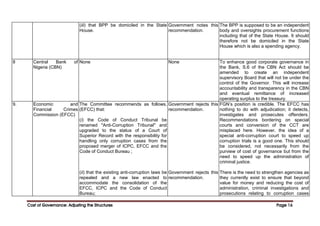
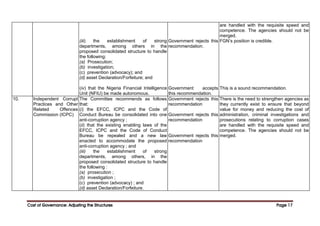
  • 38.
    Cost of Governance:Adjusting the Structures Cost of Governance: Adjusting the Structures Cost of Governance: Adjusting the Structures Cost of Governance: Adjusting the Structures Page Page Page Page 25 25 25 25 with desired economic activities for growth and development (S. 6 DMO Act). In view of the role the DMO plays in the management of the national economy, we commend FGN for rejecting the Committee’s recommendations since their implementation would have necessarily whittled down the status of the Office and its ability to effectively manage debt obligations. Retaining the DMO is in line with international fit and good practices. OFFICE OF THE SECRETARY TO THE GOVERNMENT OF THE FEDERATION 21. National Poverty Eradication Programme (NAPEP) The Committee recommends that: (i) NAPEP be scrapped and its functions transferred to the new body that will emerge from the merger of the NDE and SMEDAN; (ii) the new proposed body shall be known as the National Agency for Job Creation and Empowerment (NAJCE); and (iii) that the Bank of Industry (BOI) provides the window for servicing the job- and wealth-creation and empowerment programmes. Government accepts the recommendation to scrap NAPEP only. Government rejects this recommendation. Government notes this recommendation. NAPEP as an intervention has been overtaken by other programmes. NAPEP should be scrapped and its functions transferred to the new agency. Thus, FGN’s position should not be limited to scrapping NAPEP. However, it is imperative to note that job creation is not a stand-alone subject but is a result of a multiplicity of policies and interventions from areas including industry, trade, education, housing, health, monetary and fiscal policy, etc.
  • 39.
    Cost of Governance:Adjusting the Structures Cost of Governance: Adjusting the Structures Cost of Governance: Adjusting the Structures Cost of Governance: Adjusting the Structures Page Page Page Page 26 26 26 26 22. National Identity Management Commission (NIMC) The Committee recommends as follows, that: (i) NIMC serves as the repository of all biometric data capture for the management of identity in the country for proper coordination and harmonization; (ii) that all relevant agencies that perform biometric data capture mandatorily interface with NIMC for the purpose of identity management and administration; and (iii) that NIMC be appropriately located in the Ministry of Interior with a view to preserving institutional legacy and ensuring effective synergy among all the data collecting and collation agencies or alternatively, in the proposed Ministry of Special Duties. Government notes this recommendation. Government accepts this recommendation. Government rejects this recommendation. It is a welcome development as recommended in (ii) that there should be interface between NIMC and other agencies seeking to capture biometric data so as to avoid duplication, waste and unnecessary costs. The acceptance of recommendation (ii) should have dovetailed into the acceptance of recommendation (i). However, FGN simply noted that recommendation. Though NIMC has affinity with the Interior Ministry, it can function as an autonomous agency. For effectiveness, it should not be tied to the apron strings of any Ministry. 23. Nigeria National Merit Award (NNMA) The Committee recommends as follows, that: (i) the mandate of NNMA be amended to include the nomination of persons, in collaboration with the Academy of Science, to be considered for appointment by the President as members of the Board of Trustees of the proposed National Research and Development Fund; and (ii) that the NNMA is located in the proposed Ministry of Special Duties. Government rejects this recommendation. Government rejects this recommendation. Changes suggested appear not to have any cost or efficiency implications.
  • 40.
    Cost of Governance:Adjusting the Structures Cost of Governance: Adjusting the Structures Cost of Governance: Adjusting the Structures Cost of Governance: Adjusting the Structures Page Page Page Page 27 27 27 27 24. Federal Road Safety Commission (FRSC) The Committee recommends as follows, that: (i) the Act setting up the Federal Road Safety Commission (FRSC) be repealed; (ii) the road safety functions of the FRSC be reverted to the highways department of the Federal Ministry of Works; (iii) the Commission's personnel be redeployed to the relevant organizations (the Police Service Commission, the Federal Civil Service Commission and the Vehicle Inspection Office (VIO) in the Federal Capital Territory Authority) for due regularization. (iv) in line with best practice, the Police, who have the core responsibility for highways patrol, be in charge of the activities related to road traffic accidents and the removal of wreckage of vehicles from the highways. (v) clinics set up to address trauma cases arising from road accidents to be transferred to and managed by the Federal Ministry of Health, which is the agency of Government mandated to cater for health services, including trauma cases and ambulance service. (vi) as a follow-up to recommendation Government rejects this recommendation. Government rejects this recommendation. Government rejects this recommendation. Government rejects this recommendation. Government notes this recommendation. FGN should have accepted the Committee’s recommendations with respect to the FRSC. The Commission has radically deviated from the vision of the founding fathers. The FRSC was not meant to be another revenue generation agency. Its original mandate was to: a. Make the highways safe for motorists and other road users; b. Recommend works and devices designed to eliminate or minimize accidents on the highways; and c. Educate motorists and members of the public on the importance of discipline on the highways. (S.11 (2) FRSC Act). At inception, corps members concentrated on prevention and minimising accidents on the highways; clearing of obstructions on any part of the highways; giving prompt attention and care to victims of accidents; and conducting researches into causes of accidents and methods of preventing them and putting into use the results of such researches (S. 11(3) FRSC Act). Over the years, successive leadership of the Commission have clamoured for more powers and have ended up being involved in design and production of number plates and drivers licences to the detriment of the core responsibilities of their Agency. Regulation of motorists on our roads is
  • 41.
    Cost of Governance:Adjusting the Structures Cost of Governance: Adjusting the Structures Cost of Governance: Adjusting the Structures Cost of Governance: Adjusting the Structures Page Page Page Page 28 28 28 28 (v) above, the Federal Ministry of Health develops standard trauma centres and ambulance services to address emergencies; and (vii) that the centre for the collation of vehicle licensing data remains the responsibility of the Police via the Central Motor Registry. Note It should be understood that the current overwhelming bad-road-user behaviour is a temporary phenomenon that an interventionist body like the FRSC was set up to address; thus, it should not be allowed to grow beyond an ad hoc body that can reintegrate into a parent body like the Highways Department of the Federal Ministry of Works Government notes this recommendation. Government rejects this recommendation and directs the Federal Road Safety Commission to continue to perform its functions as prescribed by law.. increasingly becoming chaotic. The FRSC corps members no longer limit their operations to the highways as stipulated by their enabling statute; with the result that within one road in the metropolis, you may find Vehicle Inspection Officers, Motor Traffic Police Officers and FRSC Officers operating simultaneously. FRSC has offices and corps members all over the Federation. The overhead and personnel costs are not justified by the output as accidents have continued unabated on our roads and victims still die every day because of delayed or complete absence of emergency medical attention and support. 25. Utilities Charges Commission (UCC) The Committee recommends that: (i) the Utilities Charges Commission be abolished and its enabling law repealed. (i) the staff of the Commission be deployed to the Office of the Head of the Civil Service of the Federation, provided they are civil servants. Government accepts this recommendation and directs that the process of repealing the enabling law should be initiated by the OSGF. Government notes this recommendation. The main function of UCC is to evaluate, on a continuing basis, trends in tariffs charged by public utilities providers with a view to availing the Federal Government with information to enable it fix reasonable prices. The public corporations directly mentioned in the UCC Act, such as NEPA, NITEL, Nigeria Airways have been privatised. There is no justification for retaining the Commission.
  • 42.
    Cost of Governance:Adjusting the Structures Cost of Governance: Adjusting the Structures Cost of Governance: Adjusting the Structures Cost of Governance: Adjusting the Structures Page Page Page Page 29 29 29 29 26. National Agency for the Control of HIV/AIDS (NACA) The Committee recommends that: (i) the enabling law of NACA be repealed; and (ii) that NACA and the division presently handling HIV/AIDS in the Public Health Department be merged as a Department under the Centre for Disease Control in the Federal Ministry of Health. Government rejects this recommendation. Government rejects this recommendation. FGN should have accepted this recommendation. There is no special value being added by NACA that the Centre for Disease Control in the Federal Ministry of Health cannot handle. The CDC of the Federal Ministry of Health can sustain the awareness and other campaigns in collaboration with the Information Ministry and the NOA. 27. National Hajj Commission of Nigeria (NAHCON) This is addressed together with those of the Nigerian Christian Pilgrims, Commission. 28. Nigerian Christian Pilgrims Commission (NCPC) The Committee recommends as follows, that: (i) Government restricts itself only to the provision of consular services and vaccines to intending pilgrims; (ii) Pilgrims be encouraged to save for their individual religious obligations; (iii) the National Hajj Commission of Nigeria and the Nigerian Christian Pilgrims Commission be abolished and their functions transferred to a department under the Ministry of Foreign Affairs; (iv) the enabling laws of the two Commissions be repealed accordingly; (v) the Federal Government stops sponsoring pilgrims and pilgrimages with effect from the 2012 Fiscal Year; and (vi) that Government stops granting concessionary foreign exchange rate to pilgrims. Government rejects this recommendation. Government notes this recommendation. Government rejects this recommendation. Government rejects this recommendation. Government rejects this recommendation. Government notes this recommendation. FGN should have accepted these recommendations. The Constitution forbids the adoption of state religion. The continued existence of these two bodies sends a wrong message that the two religions are more priviledged than other religions. Their existence is apparently unconstitutional. It’s discriminatory against other religions and free- thinkers. Religion should be a private matter between the realm of the individual and his God. Religious tourism has not impacted values and ethics. The two agencies should have been abolished and all the recommendations accepted.
  • 43.
    Cost of Governance:Adjusting the Structures Cost of Governance: Adjusting the Structures Cost of Governance: Adjusting the Structures Cost of Governance: Adjusting the Structures Page Page Page Page 30 30 30 30 29. Service Compact with All Nigerians (SERVICOM) The Committee recommends that SERVICOM be subsumed in the BPSR as a strengthened, refocused, retooled and restructured Bureau, (see write up on BPSR). Government rejects this recommendation as the Federal Executive Council has already approved a new structure for SERVICOM. What is SERVICOM if not public service reform? To maintain a Bureau for Public Service Reform and SERVICOM amounts to duplication. SERVICOM has not affected bureaucratic service delivery in any significant manner. No pacts and no impact on efficiency; it should have been scrapped. 30. Nigeria Extractive Industries Transparency Initiative (NEITI) The Committee recommends that NEITI continues to be funded by the government to enable it carry out its assigned functions of developing, administering and enforcing transparency and accountability in the extractive industry in Nigeria, under the supervision of the Ministry of Special Duties. Government accepts this recommendation and directs that Agency should remain in the Presidency. FGN’s acceptance of the recommendation is commendable. But the agency should be independent of political control. OFFICE OFTHE HEAD OF THE CIVIL SERVICE OF THE FEDERATION 31. Administrative Staff College of Nigeria (ASCON) The Committee recommends: (i) that ASCON continues to receive full Government funding in view of the need to adequately address the identified capacity gap in the Public Service; and (ii) that the PSIN be merged with the ASCON. Government accepts this recommendation and directs that the word "full" should be expunged; it further directs the modality for the funding should be worked out by the Office of the Head of the Civil Service of the Federation (OHCSF). Government rejects this recommendation and directs OHSCF to expedite action on the FGN’s position is in order. In as much as capacity building is key to efficiency and effectiveness of governance, why duplicate training institutions with
  • 44.
    Cost of Governance:Adjusting the Structures Cost of Governance: Adjusting the Structures Cost of Governance: Adjusting the Structures Cost of Governance: Adjusting the Structures Page Page Page Page 31 31 31 31 passage of the PSIN bill which has been in the National Assembly since 2009. personnel costs, overheads and capital expenditure. The Committee’s recommendation should have been accepted by FGN. 32. Public Service Institute of Nigeria (PSIN) The Committee recommends that the Public Service Institute of Nigeria (PSIN) be merged with the Administrative Staff College of Nigeria (ASCON) because of the importance of capacity building to overall national economic growth and in order for Government to derive value from its huge investments in the Institute. Government rejects this recommendation and directs the OHSCF to expedite action on passage of the PSIN Bill which has been in the National Assembly since 2009. FGN’s position is not in tandem with the need to cut down the cost of governance. Whatever PSIN is set up to do can conveniently be undertaken by ASCON. This is a duplication of the functions and waste of resources. 33. Bureau of Public Service Reforms (BPSR) The Committee recommends as follows, that: (i) the Bureau of Public Service Reforms (BPSR) subsumes the functions of the Service Compact with all Nigerians (SERVICOM) in order to serve as a veritable platform for driving the Transformation Agenda and other reform programmes of Government; (ii) the strengthened Bureau should be domiciled in the State House; (ii) the Bureau be driven by capable leadership and staffed with competent and experienced personnel all of who have the required passion for the success of the reforms ; Government rejects this recommendation and directs that the two Agencies should collaborate in the discharge of their functions. Government rejects this recommendation and directs that it should reside in the Presidency. Government notes this recommendation. FGN’s position is curious. What is public service reforms that will not include improvements in service delivery and by extension, the Service Compact with all Nigerians? It is our position that the Committee’s recommendation in terms of merger of the two agencies be upheld.
  • 45.
    Cost of Governance:Adjusting the Structures Cost of Governance: Adjusting the Structures Cost of Governance: Adjusting the Structures Cost of Governance: Adjusting the Structures Page Page Page Page 32 32 32 32 (iv) the leadership be part of the Economic Management Team of the Federal Government; and (v) that the restructured and refocused Bureau be dedicated to the coordination, monitoring and evaluation of Government's reform agenda and decisions, including those on the recommendations of this Committee. Government rejects this recommendation Government notes this recommendation and further directs that the Bureau should be refocused for more effective discharge of its mandate. 34. Federal Government Staff Housing Loans Board (FGSHLB) The Committee recommends as follows, that: (i) the FMBN Act be amended to allow: (a) the contributions made by Public Servants under the NHF to be transferred to the FGSHLB ; and (b) that future deductions under NHF made from the emoluments of Public Servants to be remitted to the FGSHLB; (ii) the FGSHLB Act be amended to reflect the proposed amendment; (iii) that the FGSHLB becomes self-funding within a period of two years the date of acceptance of the Committee's recommendation and the consequential amendment of the NHF law. Government rejects this recommendation. Government rejects this recommendation. Government rejects this recommendation. The FGSHB Act (Decree No.6 of 1975) is a moribund piece of legislation that the Committee sought to revive by its recommendation. Public servants have since moved on to other arrangements. FGN was right in rejecting the recommendation.
  • 46.
    Cost of Governance:Adjusting the Structures Cost of Governance: Adjusting the Structures Cost of Governance: Adjusting the Structures Cost of Governance: Adjusting the Structures Page Page Page Page 33 33 33 33 FEDERAL MINISTRY OF AGRICULTURE AND RURAL DEVELOPMENT 35. Agricultural Research Council of Nigeria (ARCN) The Committee recommends as follows, that: (i) all the Research Institutes be funded from the proposed National Research Development Fund to be set up by Government; (ii) all the Boards of the 15 agricultural research institutes be abolished and their enabling laws amended accordingly; (iii) the membership of the Governing Council of the Agricultural Research Council of Nigeria (ARCN) be reduced to not more than seven members, including the Executive Secretary of the Council and the four proposed Executive Directors in charge of the four research categories of Crop Cluster, Fisheries and Oceanography, Livestock and Veterinary Services; and Agricultural Management, Capacity Building and Extension Services; (iv) the enabling law of the ARCN be amended to reflect the new composition of its Board; Government rejects this recommendation. Government rejects this recommendation. Government notes this recommendation. Government rejects this recommendation. Government’s justification for its rejection of these recommendations is hard to fathom. The composition of ARCN’s governing board is as follows: a. The Chairman b. The Vice Chancellor of one of the Universities of Agriculture (to be rotated) c. The Chairman of the Committees of Deans of Faculties of Agriculture of the Universities in Nigeria d. The Chairman of the Committees of Deans of Faculties of Veterinary Medicine of the Universities in Nigeria e. Chairmen of the governing boards of every agricultural research institutes established under s.14 of the Act f. Chairmen of the Committee of Directors of every agricultural research institute established under S.14 of the Act. g. Directors of Departments of Agriculture , Fisheries, Forestry and Livestock of the Federal Ministry of Agriculture and Rural Development h. One representative of the Federal Ministry of Science and Technology i. One representative of the Federal Ministry of Water Resources j. Four persons from the private sector k. The Executive Secretary
  • 47.
    Cost of Governance:Adjusting the Structures Cost of Governance: Adjusting the Structures Cost of Governance: Adjusting the Structures Cost of Governance: Adjusting the Structures Page Page Page Page 34 34 34 34 (v) urgent steps be taken by the Ministry/ARCN for a micro-restructuring of the research institutes to bring them at par with the global best practice of a 1:3 ratio of technical to administrative staff in the institutes ; and (vi) that each College of Agriculture be attached to an Institute of Research for the purpose of fostering the linkage between research extension and learning. Government notes this recommendation. Government notes this recommendation. It must be costing Government a lot to foot bills emanating from this kind of large Board. Travelling expenses and other allowances for members would be quite substantial. So the Committee’s recommendation that the Board be pruned makes a lot of sense. The continued retention of this large board and 15 other boards whose contributions to the economy are doubtful contradicts the cost reduction objective of the FGN. Also, the idea of funding agricultural research institutes from a National Research Development Fund is very reasonable. It would make the funding competitive and ensure that institutes determine their relevance in the scheme of things through evidence of their output and results. Reducing the ratio of administrative staff and increasing technical personnel will guarantee that institutes deliver value for money. Thus, merely noting the recommendation goes to no issue. The recommendation of the Committee should have been accepted. Again, the recommendation of the Committee which was merely noted should have been accepted for the alignment of town and gown, improved quality of education and dissemination of research
  • 48.
    Cost of Governance:Adjusting the Structures Cost of Governance: Adjusting the Structures Cost of Governance: Adjusting the Structures Cost of Governance: Adjusting the Structures Page Page Page Page 35 35 35 35 results. 36. Agricultural Research and Rural Management Institute (ARMTI) The Committee recommends that in view of the services rendered and having been in existence for 32 years, that the Agricultural Research and Rural Management Institute (ARMTI) be self- funding within 24 months commencing from the time a decision is taken on this recommendation. Government rejects this recommendation and directs the Hounourable Minister of Agriculture to look into the issue of self funding. What has ARMTI been researching on this past 32 years? If its findings were of value to agriculturists, it would be in a position to generate funds to at least take care of its recurrent expenditure. However, FGN’s position is in order. 37. National Centre for Agricultural Mechanization (NCAM) The Committee recommends as follows that: (i) the enabling law of the National Centre for Agricultural Mechanization (NCAM) be repealed; and (ii) that the statutory functions being performed by NCAM be transferred to the proposed enlarged and revitalized research and development agency comprising NASENI, PRODA and FIIRO all in the Federal Ministry of Science and Technology. Government rejects this recommendation. Government rejects this recommendation. The enabling legislation should be repealed and the Centre shut down. There are other technological research and development institutions that can take over the work of NCAM without the overhead expenses being incurred at the Centre. Pray, what value has the Centre added since inception? 38. Nigerian Agricultural Insurance Corporation (NAIC) The Committee recommends as follows that: (i) the National Agricultural Insurance Corporation (NAIC) be fully commercialized; and Government accepts this recommendation. NAIC should be privatized. Government has proved itself incapable of running a profitable business venture. FGN’s position is credible.
  • 49.
    Cost of Governance:Adjusting the Structures Cost of Governance: Adjusting the Structures Cost of Governance: Adjusting the Structures Cost of Governance: Adjusting the Structures Page Page Page Page 36 36 36 36 (ii) that the enabling law of NAIC be amended to allow other Insurance Companies to participate in the new Agricultural Insurance Scheme. Government accepts this recommendation. MINISTRY OF AVIATION 39. Nigeria College of Aviation Technology (NCAT) The Committee recommends as follows, that: (i) a management audit of all the agencies in the Aviation Sector be carried out; (ii) the Accident Investigation Bureau (AIB) be developed into a unified accident investigation bureau for the entire transport sector; Government notes this recommendation. Government rejects this recommendation. Investigation of aviation accidents is a specialized field and too important to be mixed up with other matters. FGN is right in rejecting this recommendation. 39A. Nigerian Airspace Management Agency (NAMA), Nigerian Civil Aviation Authority (NCAA) and the Nigerian Metrological Agency (NIMET) (iii) the trio of the Nigerian Airspace Management Agency (NAMA), Nigerian Civil Aviation Authority (NCAA) and the Nigerian Metrological Agency (NIMET) be merged into a new body to be known as the Federal Civil Aviation Authority (FCAA) and their respective enabling laws amended accordingly to reflect the merger ; Government accepts this recommendation. NCAA should be allowed to stand alone as the regulator in the aviation industry. Indeed, there is no basis for the merger of the three agencies. Their independent existence and good performance were instrumental to the approvals and good rating the aviation sector got from international agencies and advanced countries. This recommendation is retrogressive and its acceptance by FGN will set the sector backward. (iv) the Federal Airports Authority of Nigeria (FAAN) be privatized without further delay: Government rejects this recommendation in view of the security situation in the country. FGN’s position is credible.
  • 50.
    Cost of Governance:Adjusting the Structures Cost of Governance: Adjusting the Structures Cost of Governance: Adjusting the Structures Cost of Governance: Adjusting the Structures Page Page Page Page 37 37 37 37 (v) the enabling law of the Nigerian College of Aviation Technology (NCAT) be amended and the college restructured, strengthened and empowered; (vi) NCAT charges appropriate fees for its services; (vi) Government disengages from the provision of Recurrent funding for NCAT from 2014 Fiscal Year; (viii) Government limits itself to the funding of essential capital projects of NCAT; (ix) that the 5% of total ticket sales being tax and other internally generated revenue by NCAA, NAMA and NIMET be fully paid into the Treasury and their expenditure provided for through the budgetary process ; and (x) that an institutional framework of advance releases from the Revenue Fund (CRF) against budgetary approval be put in place to address the operational costs of NCAA, NAMA and NIMET. Government accepts this recommendation. Government notes this recommendation. Government notes this recommendation. Government notes this recommendation. Government notes this recommendation. Government notes this recommendation. FGN’s position is credible It is not clear what FGN intends to do by merely noting these recommendations.
  • 51.
    Cost of Governance:Adjusting the Structures Cost of Governance: Adjusting the Structures Cost of Governance: Adjusting the Structures Cost of Governance: Adjusting the Structures Page Page Page Page 38 38 38 38 FEDERAL MINISTRY OF COMMUNICATIONS TECHNOLOGY 40. Nigerian Communications Commission (NCC) The Committee recommends that: (i) The NCC, NBC and the regulatory functions of NIPOST be brought together under a unified management structure to be known as the Communications Regulatory Authority of Nigerian {CRAN); (ii) at least three directorates be created under the proposed CRAN to perform the functions of broadcast, tele- communications and regulatory functions of postal services; (iii) the enabling laws of NCC and NBC be repealed and another enacted for the proposed Communications Regulatory Authority of Nigeria (CRAN); and (iv) that the enabling law of NIPOST be amended to reflect, among others, the transfer of its regulatory functions to the proposed CRAN. Government rejects this recommendation. Government rejects this recommendation. Government rejects this recommendation. Government rejects this recommendation. In this era of convergence, there is the need to bring together the broadcasting and communication regulatory functions and organisations. There is a plan to migrate to digital television by 2016 and this is a clear pathway. The recommendation that NBC and NCC be merged is very valid considering the convergence of functions in the nearest future. FGN should have accepted this recommendation. NIPOST as an operator needs to be weaned and made to accept full commercialization which allows it explore possibilities of haulage and other services and also use its offices for mobile money services. 41. Nigerian Telecommunications Limited (NITEL) The Committee recommends that the Nigerian Telecommunication Limited be liquidated without further delay. Government notes this recommendation as NITEL is already being liquidated. FGN’s position is credible but the liquidation needs to be done expeditiously.
  • 52.
    Cost of Governance:Adjusting the Structures Cost of Governance: Adjusting the Structures Cost of Governance: Adjusting the Structures Cost of Governance: Adjusting the Structures Page Page Page Page 39 39 39 39 42. National Information Technology Development Agency (NITDA) The Committee recommends that: (i) the functions of NITDA be transferred to the Ministry of Technology as a Department; and (ii) the enabling law of NITDA be amended. Government rejects this recommendation and directs that NITDA continues to remain as an Agency under the Ministry of Communication Technology. Government rejects this recommendation. This agency does not appear to be serving any purpose not already covered by existing agencies such as Galaxy Backbone. FGN should have accepted this recommendation. 43. Galaxy Backbone Limited (GBL) The Committee recommends as follows, that: (/) Galaxy Backbone be appropriately restructured to meet its set objectives; (ii) Government issues a directive to all MDAs to consult with Galaxy Backbone on all ICT-related issues. Government notes this recommendation as the restructuring is on-going Government notes this recommendation and further directs that the supervisory Ministry should clearly define and delineate the status and functions of the Agency Beyond noting the recommendations, clear directives from FGN should be given to avert waste and duplication of functions or a situation where MDAs still use public funds to get services (from outside) that are available from another government agency. FGN should have accepted the recommendations. 44. Nigerian Communications Satellite (NigComSat) Limited The Committee recommends as follows, that: (i) Government sells off its shares in NigComSat; Government accepts this recommendation and directs that government will retain minority shares. FGN’s position is credible. Some functions of NigComSat and NASRDA are on the same space development.
  • 53.
    Cost of Governance:Adjusting the Structures Cost of Governance: Adjusting the Structures Cost of Governance: Adjusting the Structures Cost of Governance: Adjusting the Structures Page Page Page Page 40 40 40 40 (ii) the functions of NigComSat that relate to space development be reverted to the National Space Research Development Agency (NASRDA); and (iii) that budgetary allocations to the NigComSat cease from the 2013 Fiscal Year. Government accepts this recommendation. Government accepts this recommendation as soon as the privatisation is effected FGN’s position is credible. FGN’s position is credible. FEDERAL MINISTRY OF EDUCATION 45. National Examinations Council (NECO) The Committee recommends as follows, that : (i) the Act establishing the National Examination Council (NECO) be repealed and the Council's activities be returned to the West African Examinations Council (WAEC), which was originally charged with that responsibility for them; (ii) the National Business and Technical Examinations Board (NABTEB) Act be repealed and the Board's activities returned to WAEC, which was originally responsible for the conduct of the examinations ; (iii) WAEC be the sole Government-funded examination body to conduct certificate examinations; and Government rejects this recommendation and directs the Honourable Minister of Education to streamline the two bodies to ensure standards and integrity. Government rejects this recommendation. Government rejects this recommendation. NECO has turned out to be an unnecessary duplication. Most people have remained skeptical of its testing standards. WAEC has more credibility and should be strengthened rather than funds being spread thin with little results. This recommendation should have been accepted. The idea of having a business and technical examination board is laudable, but where are the candidates for the exams, when there are very few technical and commercial schools. Moreover employers are not asking for certificates from NABTEB. It therefore makes economic sense to revert to the old system and scrap or subsume the new bodies. This recommendation (iii) should have been accepted. Implementing recommendations (iv) and (v) will necessarily lead to increase
  • 54.
    Cost of Governance:Adjusting the Structures Cost of Governance: Adjusting the Structures Cost of Governance: Adjusting the Structures Cost of Governance: Adjusting the Structures Page Page Page Page 41 41 41 41 (iv) WAEC become self-funding with effect from 2013 and that the examination fees it charges be utilized to finance its operations; and (v) that further funding of WAEC be restricted to the international obligations of Government to the Council with effect from the 2013 Fiscal Year. Government notes this recommendation. Government notes this recommendation. in examination fees chargeable by WAEC which will restrict the right of access to education. This will be a retrogressive step. FGN is right in noting this recommendation. However, FGN should ensure that money realised from examination fees is not mismanaged by WAEC and if it is sufficient to run the affairs of WAEC, then government should stop subventions to the body. 46. National Board for Technical Education (NBTE) The Committee recommends as follows, that: (i) the NBTE should be subsumed along with the NCCE under the NUC to form the proposed tertiary education regulatory body to be known as the Tertiary Education Commission; (ii) the enabling law of NBTE be repealed; (iii) the enabling laws of Federal Polytechnics be amended to reflect the proposed autonomous status; (iv) a staff and student audit be conducted in the polytechnics in order to build a comprehensive and reliable data base; and (v) private investors and corporate bodies be encouraged to undertake joint ventures with the polytechnics to develop key facilities on a Build-Operate-Transfer Government rejects this recommendation. Government rejects this recommendation. Government rejects this recommendation. Government accepts this recommendation Government notes this recommendation. NBTE should be retained but governing boards for individual polytechnics should be scrapped.
  • 55.
    Cost of Governance:Adjusting the Structures Cost of Governance: Adjusting the Structures Cost of Governance: Adjusting the Structures Cost of Governance: Adjusting the Structures Page Page Page Page 42 42 42 42 (BOT) basis. 47. National Open University of Nigeria (NOUN) The Committee recommends as follows, that: (i) Government disengages from funding the recurrent costs of NOUN by the 2015 Fiscal Year; (ii) Government continues to focus on and support Information and Communication Technology (ICT) as the medium of delivery of learning in the institution; and (iii) that the enabling law of NOUN be amended to reflect the proposed funding policy. Government notes this recommendation. Government notes this recommendation. Government notes this recommendation. NOUN should be self-sustaining as it is meant to afford workers the opportunity to receive higher education while keeping their jobs. FGN should have accepted toe recommendations. 48. National Teachers Institute The Committee recommends as follows; (i) that the functions of the Nigerian Institute for Education Planners and Administrators (NIEPA) be merged with those of the National Teachers Institute; (ii) that the enabling law of the NTI be amended to accommodate the expanded functions of the proposed Nigerian Institute for Teachers, Education Planners and Administrators (NITEPA) (iii) all professional teachers be mandatorily required to undergo a qualifying examination and be recertified before returning to the classroom within a period of not more than five years from the Government accepts this recommendation. Government accepts this recommendation. Government notes this recommendation. FGN’s position is in order and will reduce the cost of governance in that sub sector. Not necessarily a cost of governance issue and FGN is right to note the issue.
  • 56.
    Cost of Governance:Adjusting the Structures Cost of Governance: Adjusting the Structures Cost of Governance: Adjusting the Structures Cost of Governance: Adjusting the Structures Page Page Page Page 43 43 43 43 time government accepts this recommendation; and (iv) that the National Council on Education and the Federal Executive Council facilitate the implementation of these proposals by securing the buy-in of the National Economic Council (NEC). Government notes this recommendation as it is the responsibility of the Honourable Minister of Education to take up the issue with NCE and FEC. 49. Nigerian Institute for Education Planners and Administrators (NIEPA) The Committee recommends as follows, that: (i) the functions of the Nigerian Institute for Education Planners and Administrators (NIEPA) be subsumed under the National Teachers' Institute (NTI) to form the proposed NITEPA; (ii) the proposed NITEPA to focus on matching the educational curriculum with the production of a critical mass of knowledgeable, competent and effective teachers and planners ; and (iii) that NITEPA be used as a veritable tool for achieving Millennium Development Goal (MDG) of imparting knowledge to the school child. Government accepts this recommendation. Government notes this recommendation. Government notes this recommendation. The proposed merger will save operational costs 50. Nigeria Educational Research and Development Council (NERDC) The Committee recommends as follows, that: (i) the enabling law of the Nigeria Educational Research and Development Council (NERDC) be repealed; and Government rejects this recommendation. Government rejects this This recommendation ought to have been accepted by Government because NERDC is engaged in research into educational standards and development of curricula, which is also part of the duties of the Policy,
  • 57.
    Cost of Governance:Adjusting the Structures Cost of Governance: Adjusting the Structures Cost of Governance: Adjusting the Structures Cost of Governance: Adjusting the Structures Page Page Page Page 44 44 44 44 (ii) that the functions of NERDC be transferred to the Policy, Planning, Management and Research Department of the Federal Ministry of Education. recommendation. Planning, Management and Research Department of the Federal Ministry of Education. This amounts to duplication and waste of resources. 51. Universal Basic Education Commission (UBEC) The Committee recommended as follows, that: (i) the enabling law of UBEC be amended to ensure that resource utilization is based on needs assessment and that both are best undertaken at the point of need; (ii) the Commission's enabling law be reviewed to include its expanded functions and the reduction in the membership of its governing Board from 22 to not more than 9; (iii) the operation of UBEC be reviewed to include sufficient stakeholders' input in the disbursement of funds for the beneficiary schools ; and (iv) the functions of the Nomadic Education Commission (NEC) and National Commission for Mass Literacy, Adult and Non-Formal Education be taken over by UBEC. Government accepts this recommendation Government accepts this recommendation Government notes this recommendation Government notes this recommendation FGN’s position is credible FGN’s position is credible as this will go a long way in reducing the cost of running the Board and make the Board less unwieldy. Government should have accepted this recommendation because nomadic education, adult and non formal literacy education are matters that can be conveniently combined with the task of the UBEC. Indeed, they are all about basic education.
  • 58.
    Cost of Governance:Adjusting the Structures Cost of Governance: Adjusting the Structures Cost of Governance: Adjusting the Structures Cost of Governance: Adjusting the Structures Page Page Page Page 45 45 45 45 FEDERAL MINISTRY OF ENVIRONMENT 52. National Oil Spill Detection and Response Agency (NOSDRA) (i) the functions of policy formulation and setting of standards be carried out from a Department in the Federal Ministry of Environment as they do not require the copious apparatus of the magnitude of a parastatal; (ii) NOSDRA be scrapped and its enabling law repealed as there are existing and well-equipped structures already dealing with all the tiers of oil spill management in the petroleum industry; (iii) the Department of Petroleum Resources (DPR) remains the sole body to enforce standards in the Oil and Gas Sector; and (iv) budgetary allocations to NOSDRA cease from the 2013 fiscal year Government notes this recommendation Government notes this recommendation Government notes this recommendation Government notes this recommendation Since there is an existing regulatory agency, there is no need for duplication. FGN’s continued funding of the duplication is a waste. So FGN should have accepted the recommendations and scrapped NOSDRA. MINISTRY OF FOREIGN AFFAIRS 53. The Nigerian Institute of International Affairs (NIIA) (i) the Nigerian Institute of International Affairs (NIIA) should subsume the functions of the Institute for Peace and Conflict Resolution; (ii) that the NIIA continues to be fully funded by Government. Government notes this recommendation. Government notes this recommendation. The NIIA was set up to facilitate the understanding of international affairs, circumstances, conditions and attitudes of people of other countries, It promotes the scientific study of international politics, economics and law. It also helps in the training of Nigerian diplomats. FGN’s position is in order. 54 Institute for Peace (i) the enabling law of the IPCR be Government notes this IPCR should develop programmes to
  • 59.
    Cost of Governance:Adjusting the Structures Cost of Governance: Adjusting the Structures Cost of Governance: Adjusting the Structures Cost of Governance: Adjusting the Structures Page Page Page Page 46 46 46 46 and Conflict Resolution repealed and its functions transferred to the Department of Strategic Studies in the NIIA ; and (ii) that budgetary allocation to IPCR ceases with effect from the 2013 Fiscal Year.. recommendation. Government notes this recommendation. promote peace and mutual understanding internally, while NIIA continues to focus on external relations and diplomacy. FGN’s position is in order. 55. The Directorate of Technical Cooperation in Africa (DTCA) (i) the Directorate of Technical Cooperation in Africa (DTCA) be abolished and its functions, along with those of the Technical Aids Corps, transferred to an appropriate Department in the Ministry of Foreign Affairs; and (ii) that further funding of the DTCA, as an agency, should cease with effect from the 2013 Fiscal Year. Government accepts this recommendation only to the effect that DTCA be merged with DTAC. Government accepts this recommendation. This is a good recommendation and FGN was right to have accepted it because of the present economic realities we are facing. 56. The Directorate of Technical Aids Corps (DTAC) (i) the Directorate of Technical Aids Corps (DTAC) be abolished as a stand-alone parastatal and its enabling law amended to reflect this new status accordingly; and (ii) the functions of the DTAC and the Directorate of Technical Cooperation in Africa (DTCA) be consolidated into one Department in the Ministry of Foreign Affairs for the proper coordination and effective monitoring of Nigeria's aids assistance to Africa and the world. Government rejects this recommendation Government rejects this recommendation and directs that the Technical Aid Corps (TAC) be merged with the Directorate of Technical Cooperation in Africa (DTCA) and This is in line with the earlier position of FGN. FGN’s position is credible.
  • 60.
    Cost of Governance:Adjusting the Structures Cost of Governance: Adjusting the Structures Cost of Governance: Adjusting the Structures Cost of Governance: Adjusting the Structures Page Page Page Page 47 47 47 47 be renamed the Directorate of Technical Aid and Cooperation and be retained as an agency. The Agency is to be regulated by the Ministry of Foreign Affairs for proper coordination and effective monitoring of Nigeria's aids/ assistance to Africa and the rest of the World. FEDERAL MINISTRY OF HEALTH 57. Teaching Hospitals (i) the 19 Teaching Hospitals remain as individual entities with separate governing Boards having membership of not less than seven and not more than ten persons, who have competence, requisite knowledge and experience in the medical profession; Government notes this recommendation. Both the recommendation of the Committee and FGN’s position which merely noted the recommendation cannot contribute to cost saving and efficient operations in Teaching Hospitals. It is our recommendation a National Board for Teaching Hospitals should be set up, instead of each hospital having its own Board. Alternatively, FGN can consider setting up six zonal Boards to take care of the
  • 61.
    Cost of Governance:Adjusting the Structures Cost of Governance: Adjusting the Structures Cost of Governance: Adjusting the Structures Cost of Governance: Adjusting the Structures Page Page Page Page 48 48 48 48 (ii') the membership of the boards be based on merit; (iii) a management/staff audit (with biometric capturing) of the institutions be carried out in order to rationalize the manpower needs of the hospitals and ensure that their manning levels are fit-for-purpose ; and Government notes this recommendation. Government notes this recommendation. Teaching Hospitals in each geopolitical zone of the country. This will guarantee cost reduction and greater efficiency. FGN should also have accepted Board membership of not less than seven and not more than ten persons to avert very large and unwieldy Boards. This recommendation which is tied to a part of the first - merit, competence, requisite knowledge and experience in the medical profession cannot simply be noted if FGN wants improved service delivery and cost saving. It is a recommendation that should have been accepted. The need for biometric capture and the extension of the IPPIS to the Teaching Hospitals cannot be over-emphasised. FGN should have accept this recommendation.
  • 62.
    Cost of Governance:Adjusting the Structures Cost of Governance: Adjusting the Structures Cost of Governance: Adjusting the Structures Cost of Governance: Adjusting the Structures Page Page Page Page 49 49 49 49 (iv) Government continues to fund the Teaching Hospitals because of the critical nature of the health sector to the socioeconomic development of the country ; Government notes this recommendation. 58. Federal Medical Centres (i) all the Federal Medical Centres should no longer be administered by governing boards, as the Centres do not have enabling laws; (ii) each Federal Medical Centre be administered through a strengthened, competent, professionalized management team, which will take over the responsibilities of the governing board; (iii) the management teams of the Federal Medical Centres be coordinated through the Hospital Services Department of the Federal Ministry of Health; and (iv) the management/staff audit of the Federal Medical Centres to be carried out in order to rationalize the manpower needs of the Centres and ensure that their manning levels are fit-for- purpose. Government notes this recommendation. Government rejects this recommendation. Government rejects this recommendation. Government notes this recommendation. There is absolutely no justification for constituting a governing board for each FMC. FGN should have accepted this recommendation. FGN should have accepted this recommendation as the Boards are adding no value to the improvements of health services rendered in the FMCs. The Management Teams should be allowed operational autonomy whilst reporting to the Ministry. FGN should have accepted this recommendation.
  • 63.
    Cost of Governance:Adjusting the Structures Cost of Governance: Adjusting the Structures Cost of Governance: Adjusting the Structures Cost of Governance: Adjusting the Structures Page Page Page Page 50 50 50 50 59. Specialty Hospitals (a) PSYCHIATRIC HOSPITALS (i) the eight psychiatric hospitals be under the control of a single Governing Board comprising a maximum number of seven members (with one member from each of the geo-political zones), including the Chairman ; and (ii) the Federal Ministry of Health should work out the modus operandi of a designated secretariat manned by officials as deemed necessary. (b) NATIONAL EYE CENTRE AND NATIONAL EAR CARE CENTRE (i) the Governing Boards of the National Eye Centre and the National Ear Care Centre be restructured into a single board for the two Centres; (ii) the restructured Board to be made up of a minimum of seven and maximum of nine persons, inclusive of the chairman; (iii) the Federal Ministry of Health work out the modus operandi of a designated secretariat manned by officials as deemed necessary; (c) ORTHOPAEDIC HOSPITALS Government notes this recommendation. Government accepts this recommendation. Government accepts this recommendation. Government accepts this recommendation. Government accepts this recommendation. This recommendation makes a lot of sense and FGN should have accepted it. It would save costs and trim down the number of Boards. The Boards are adding no value to health services rendered in hospitals. FGN’s position here appears to be a follow-up of the approval of the first. But since this is hanging out alone, there is a poser: For what purpose? FGN’s position is credible FGN’s position is credible FGN’s position is credible FGN’s position is credible
  • 64.
    Cost of Governance:Adjusting the Structures Cost of Governance: Adjusting the Structures Cost of Governance: Adjusting the Structures Cost of Governance: Adjusting the Structures Page Page Page Page 51 51 51 51 (i) the three Orthopaedic Hospitals to have a single board comprising a maximum of seven persons, inclusive of the chairman; (ii) the Federal Ministry of Health to work out the modus operandi of a designated secretariat manned by officials as deemed necessary. Government accepts this recommendation. Government accepts this recommendation. FGN’s position is credible FEDERAL MINISTRY OF INFORMATION 60. Federal Radio Corporation and Voice of Nigeria (i) the FRCN and the VON be merged; (ii) the enabling law of the FRCN be amended to accommodate the merger with VON; (iii) the enabling law of VON be repealed ; (iv) there be a consolidation of the merged FRCN/VON with the Nigerian Television Authority (NTA) into the Federal Broadcasting Corporation of Nigeria (FBCN) ; (v) a single governing board be established for the merged FRCN/VON and NTA; (vi) a Managing Director be appointed for the proposed FBCN; (vii) the new entity have, among others, two Government rejects this recommendation. Government rejects this recommendation. Government rejects this recommendation. Government rejects this recommendation and directs that the NTA should remain as a stand- alone agency. Government rejects this recommendation. Government rejects this recommendation. Government rejects this FGN should have accepted all the recommendations in this heading. It will save costs as it is in line with good practices in other jurisdictions. The agencies are all into broadcasting and the division is mere splitting of hairs. Overhead and personnel costs would be saved by the merger and the efficiencies of large scale operation will accrue.
  • 65.
    Cost of Governance:Adjusting the Structures Cost of Governance: Adjusting the Structures Cost of Governance: Adjusting the Structures Cost of Governance: Adjusting the Structures Page Page Page Page 52 52 52 52 departments, one each for Radio and Television, each to be headed by an Executive Director one of whom should be appointed Chief Executive of the proposed FBCN. recommendation. FEDERAL MINISTRY OF LABOUR AND PRODUCTIVITY 61. National Directorate of Employment (NDE) The Committee recommends as follows, that: (i) NDE and SMEDAN be merged to form a single agency for job and wealth creation ; (ii) the new agency be called the National Agency for Job Creation and Empowerment (NAJCE); (iii) the functions of NAPEP be transferred to the new agency (iv) the Bank of Industry (BOI) serves as a single point for financing the strategies that would be adopted for job and wealth creation; (v) the enabling laws of NDE and SMEDAN be repealed; and Government rejects this recommendation. Government rejects this recommendation. Government notes this recommendation. Government rejects this recommendation and directs the Ministry of Finance to develop further strategies to enhance micro credit funding. Government rejects this recommendation and directs that the NDE law should be amended to include Entrepreneurship development but the agency should retain the FGN should have accepted recommendations (i), (ii) and (iii) and brought NDE, SMEDAN, and indeed other job creation and poverty reduction agencies under one umbrella. Entrepreneurship will reduce the level of poverty. FGN is right as Bank of Industry alone cannot fund job creation and poverty reduction. FGN should have accepted recommendations (v) and (vi).
  • 66.
    Cost of Governance:Adjusting the Structures Cost of Governance: Adjusting the Structures Cost of Governance: Adjusting the Structures Cost of Governance: Adjusting the Structures Page Page Page Page 53 53 53 53 (vi) that an enabling law be enacted for the establishment of the National Agency for Job Creation and Empowerment (NAJCE). name NDE. Government rejects this recommendation. 62. National Productivity Centre (NPC) The Committee recommends that: (i) the NPC be scrapped as Government does not need a fully fledged organization to sensitize its citizens to imbibe the culture of hard-work and productivity; and (ii) that the Ministry of Labour and Productivity evolve a mechanism and system for substantiating productivity that is transparent and can be linked to the National Planning Commission (Monitoring and Evaluation System) and the new Government policy of performance contract. Government rejects this recommendation and directs that a Technical Board be set up to comprise Federal Ministries of Labour and Productivity, Trade and Investment, Communication Technology, OHCSF and National Planning Commission to oversee the activities of the Centre. The Centre has been in existence for close to 25years, yet its impact is not being felt. Its primary mandate is to “promote, develop and provide services aimed at utilizing to the fullest all available and potential resources, in order to secure for the people of Nigeria a better and higher standard of living”. What a lofty and at the same time vague vision! The Centre is one of the institutions decreed into existence by the military to assuage stakeholders. FGN should have accepted the Committee’s recommendations. MINISTRY OF MINES AND STEEL DEVELOPMENT 63. Council of Nigerian Mining Engineers and Geoscientists (COMEG) The Committee recommends that: i. COMEG, as a professional body, be self- financing; Government rejects this recommendation but directs that COMEG be funded through grants and not line budget as from 2014. Government states that it will continue to provide grants to COMEG is a regulatory body. It controls the practice of the professionals involved in mining engineering and geosciences. The chairman and members of the Council are appointed by the President on recommendation of the Minister. So, FGN is right in its
  • 67.
    Cost of Governance:Adjusting the Structures Cost of Governance: Adjusting the Structures Cost of Governance: Adjusting the Structures Cost of Governance: Adjusting the Structures Page Page Page Page 54 54 54 54 ii) the law establishing COMEG be strengthened in order to guarantee enforcement and compliance by its members to pay subscription; and (iii) that budgetary allocation to the COMEG ceases with effect from the 2013 Fiscal Year. regulatory bodies but will not fund professional associations. Accordingly, all professional associations are encouraged to properly register with CAC. Government accepts this recommendation. Government accepts this recommendation but with effect from 2014 continued funding of the Council. However, FGN did not state where the grants will come from. Before the discontinuance of budgetary funding, the source of the grants should be ascertained. 64. National Metallurgical Development Centre (NMDC), Jos; and National Metallurgical Training Institute, Onitsha The. Committee recommends that both the National Metallurgical Development Centre and the National Metallurgical Training Institute be scrapped and the relevant enabling laws repealed while their funding should cease not later than 31st December, 2012. Government rejects this recommendation and directs the Ministry to take necessary steps to commercialize the Agencies and to exit the budget cycle within five (5) years or by 2018. These institutions are at the heart of the much hoped for industrial revolution and they ought to be re- energized and their funding increased. The positions of the Committee and FGN are not in the long term interest of national development. 65. Nigerian Institute of Mining and Geosciences (NIMG), Jos The Committee recommends as follows, that: (i) the Nigeria Institute of Mining and Geosciences (NIMG) be abolished and budgetary allocation to the institute ceases in 2013 ; and Government rejects this recommendation. FGN was right in rejecting this recommendation. However, the NIMG should make itself more relevant in order to attract private sector funding. 66. Ajaokuta Steel Company Limited and National Iron Ore Mining Company The Committee recommends as follows, that: (i) Ajaokuta Steel Company Limited and the National Iron Ore Mining Company (NIOMCO) be sold off together immediately to a single Government notes this recommendation. FGN was right in refusing to accept the recommendations but merely noting them is not an option. No nation can develop without
  • 68.
    Cost of Governance:Adjusting the Structures Cost of Governance: Adjusting the Structures Cost of Governance: Adjusting the Structures Cost of Governance: Adjusting the Structures Page Page Page Page 55 55 55 55 (NIOMCO) buyer due to the symbiotic relationship between the two companies ; (ii) Government should not approve the sale of the companies separately or to different buyers; (iii) the interim governing board (if any) of both companies be dissolved and its functions transferred to the Ministry of Mines and Steel Development pending the sale; and (iv) that Government commences the process of the disengagement of the personnel of both companies in order to forestall further drain on the Treasury. Government notes this recommendation. Government notes this recommendation. Government notes this recommendation. developing its steel technology. Selling the companies to private companies whose interests are not in tandem with Nigeria’s developmental aspirations will advance the assets stripping that the former concessionaries were reported to be involved in. We do not need to sell them. Rather, they can be managed under a public private partnership arrangement that will bring in technology, finance and managerial capacity while retaining the critical ownership in the FGN. This will in the long run provide resources for FGN. MINISTRY OF PETROLEUM RESOURCES 67. Nigerian Nuclear Regulatory Authority (NNRA) The Committee recommends as follows, that: (i) the NNRA be domiciled in and supervised by the Ministry of Environment because of the broad spectrum of agencies which cuts across various sectors in the environment that are regulated by the NNRA; (ii) the NNRA be chaired by an independent chairman appointed by the President; and (iii) the amendment of the enabling law of the NNRA to reflect the movement of the NNRA from the Ministry of Petroleum Resources to the Government rejects this recommendation. Government notes this recommendation. Government rejects this recommendation. What is the relationship between petroleum and nuclear energy? The Environment or Power Ministry appears to be more cognate as recommended by the Committee.
  • 69.
    Cost of Governance:Adjusting the Structures Cost of Governance: Adjusting the Structures Cost of Governance: Adjusting the Structures Cost of Governance: Adjusting the Structures Page Page Page Page 56 56 56 56 Ministry of Environment. 68. Petroleum Technology Development Fund (PTDF) The Committee recommends as follows, that: (i) the Petroleum Technology Development Fund (PTDF) be subsumed under the Nigerian Content Development and Monitoring Board (NCDMB) to ensure synergy and establish a one-stop shop for training and placement of competent Nigerians in the oil and gas sector; (ii) the enabling law of the PTDF be repealed and the NCDMB law amended to accommodate subsuming the PTDF under the NCDMB; and (iii) that a management audit of the capacity building programmes of the PTDF be conducted to ensure that the programmes address the needs of the oil and gas sector. Government rejects this recommendation. Government rejects this recommendation. Government notes this recommendation. PTDF was established to fund training of manpower for the petroleum industry. It provides scholarship and bursaries. It should continue to stand alone. FGN’s position is in order.
  • 70.
    Cost of Governance:Adjusting the Structures Cost of Governance: Adjusting the Structures Cost of Governance: Adjusting the Structures Cost of Governance: Adjusting the Structures Page Page Page Page 57 57 57 57 69. Nigerian Content Development and Monitoring Board (NCDMB) The Committee recommends as follows, that: (i) the Nigerian Content Development and Monitoring Board (NCDMB) subsumes the Petroleum Technology Development Fund (PTDF) with a view to ensuring synergy and establishing a one-stop shop for the training and placement of competent Nigerians in the oil and gas sector; (ii) a management audit of the Nigerian Content Development and Monitoring Board be conducted; and (iii) the enabling law of the PTDF be repealed and the NCDMB law amended to accommodate the absorption of the PTDF by the NCDMB. Government rejects this recommendation. Government accepts this recommendation. Government rejects this recommendation. The objective of the NCDMB is to ensure participation by Nigerians in the business of oil and gas. Over time, it is expected that Nigerians will build enough capacity to become major players in the industry. NCDMB should be allowed to stabilize and grow. It should not be burdened with the functions currently being discharged by the PTDF. 70. Petroleum Products Pricing and Regulatory Agency (PPPRA) and Petroleum Equalization Fund The Committee recommends that: (i) the PPPRA and Petroleum Equalization Fund be merged into a single department in the Ministry of Petroleum Resources; and (ii) there should be full automation of the bridging process of distribution of petroleum products to eliminate abuses. Government notes this recommendation. Government notes this recommendation. This recommendation should have been accepted by FGN as it would reduce costs considering that the operations of the two agencies have a lot semblance and are complimentary to each other. MINISTRY OF POLICE AFFAIRS
  • 71.
    Cost of Governance:Adjusting the Structures Cost of Governance: Adjusting the Structures Cost of Governance: Adjusting the Structures Cost of Governance: Adjusting the Structures Page Page Page Page 58 58 58 58 71. Police Service Commission The Committee recommends as follows, that: (i) a Permanent Secretary to be designated "Secretary of the Police Service Commission" be posted to the Police Service Commission, with specified functions and a tenure of not less than three years ; and (ii) that the Ministry of Police Affairs be abrogated and its functions transferred to a Department in the proposed Ministry of Special Duties to handle matters pertaining to the Nigeria Police Force. Government notes this recommendation and the fact that the issue of tenure is guided by extant regulation in the Public Service. Government rejects this recommendation. The Ministry of Police Affairs is a superfluous addition to the framework for regulation of the Police. Apart from the Police Service Commission, we also have the Police Council. The duties of the Ministry are not actually clear. There is the need to streamline and restructure the agencies and institutions related to the police. We recommend the scrapping of the Ministry of Police Affairs considering the existence of the Police Service Commission, a Police Council and the Inspector General being in charge of the command of the Police. MINISTRY OF POWER 72. Nigerian Electricity Regulatory Commission (NERC) In view of the peculiar nature of the mandate of the Nigerian Electricity Regulatory Commission (NERC), the Committee recommends that it continues to carry out its assigned mandate through Government funding. Government notes this recommendation. NERC should be retained and properly funded to enable it face the ever increasing challenges associated with sustainable power generation, transmission and distribution. 73. National Power Training Institute of Nigeria (NAPTIN) The Committee recommends that NAPTIN be wound up as its continued existence is now unnecessary as its parent body, the PHCN has been privatized. Government rejects this recommendation. FGN was right considering the manpower needs of the Electricity Industry. Scrapping NAPTIN would be a monumental mistake.
  • 72.
    Cost of Governance:Adjusting the Structures Cost of Governance: Adjusting the Structures Cost of Governance: Adjusting the Structures Cost of Governance: Adjusting the Structures Page Page Page Page 59 59 59 59 74. National Rural Electrification Agency (NREA) The Committee recommends as follows, that: (i) the Personnel Cost allocation to NREA be discontinued with effect from the 2013 Fiscal Year; (ii) Capital budget allocation to NREA be discontinued with effect from the 2013 Fiscal Year; (iii) The NI0.2 billion budgetary allocations to the NREA since it became redundant be properly investigated ; and (iv) that the NREA be formally wound up and the relevant section of the Power Sector Reform Act be amended accordingly. Government rejects this recommendation. Government rejects this recommendation. Government accepts this recommendation. Government rejects this recommendation and directs the name of the agency be changed to the "Federal Rural Electrification Agency". FGN should have accepted to wind up this Agency. It makes no sense for the FGN to be directly involved in rural electrification. Pray, what should the states and local governments be doing? What manner of federal arrangement is this? Moreover, rural electrification as an FGN initiative has been problematic. It failed under DFRRI. REA has not fared better. Better value would be added if the resources are shared to the states to undertake the task.. FEDERAL MINISTRY OF SCIENCE AND TECHNOLOGY The following recommendations from the Committee are relevant and should guide most of the recommendations on this Ministry. The importance of research in national development cannot be over-emphasised, especially in a developing country like Nigeria. However, the overlapping and duplication of functions as well as lack of synergy and harmonization in the field of research need to be tackled head-long. Presently in the country, there are several research institutes spread across the various Ministries with each one conducting its research without synergy and harmonisation. Consequently, there is a duplication of effort, energy and resources as well as overlapping of functions with very little result to show for the investment made. For example, some research institutes have been in existence for as long as 30 years, while the country still relies heavily on foreign import in key areas of national development. In an era of limited resources with competing demands, the proliferation of research institutes has further resulted in spreading already lean resources thinly among research institutes. This does not allow for a robust approach to research outcomes/outputs. The establishment of a single point of research funding will promote synergy and create an efficient and effective strategy for funding and management of research. It will
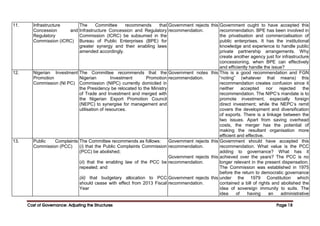
  • 73.
    Cost of Governance:Adjusting the Structures Cost of Governance: Adjusting the Structures Cost of Governance: Adjusting the Structures Cost of Governance: Adjusting the Structures Page Page Page Page 60 60 60 60 provide the opportunity for effective coordination of prospective partners interested in funding research in Nigeria. To ensure that all resources are harnessed, the Committee proposed that the funds usually received by research councils either from subvention/levy should be redirected to a National Research Development Fund, in order to guarantee a robust funding platform for effective take off of the Fund. In line with this proposal, the Committee observed that government should decide on the quantum of funds to be spent on research and development on a yearly basis and the Budget Office should allocate same to the proposed National Research Development Fund (NRDF) for appropriate reallocation to the research institutes. However, Budgetary allocations for personnel costs will be defended before the Research Fund Board of Trustees, which will then send the personnel cost proposal to the Budget Office. However, we add a proviso to the Committee’s recommendation. It is to the effect that special funds created to fund a sector’s research should not be diverted to other sectors. 75. National Agency for Science and Engineering Infrastructure (NASENI) The Committee recommends as follows, that: (i) NASENI be merged with PRODA, FIIRO and NCAM into one research and development agency; (ii) enabling law of NASENI be amended accordingly (iii) direct budgetary allocation for research from the Budget Office ceases with effect from 2013 Fiscal Year; (iv) the emerging consolidated body sources its research funding from the proposed National Research Development Fund; and (v) that the appointment of the headship of the proposed enlarged Research Institute is carried out through a transparent and competitive selection process. Government accepts the recommendation on the merger of NASENI and NCAM with the exclusion of FIIRO. However, PRODA should stand alone. Government accepts this recommendation. Government accepts this recommendation but with effect from after the merger. Government notes this recommendation. Government notes this recommendation. FGN’s position is credible subject to the funding caveat from the proposed National Research Development Fund which is to be established to coordinate research funding issues.
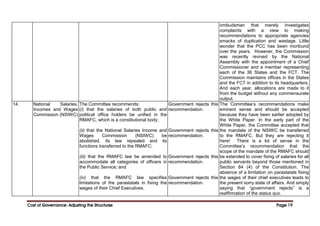
  • 74.
    Cost of Governance:Adjusting the Structures Cost of Governance: Adjusting the Structures Cost of Governance: Adjusting the Structures Cost of Governance: Adjusting the Structures Page Page Page Page 61 61 61 61 76. Federal Institute for Industrial Research Oshodi (FIIRO) The Committee recommends as follows, that: (i) FIIRO, NASENI and NCAM be consolidated into one research and development agency; (ii) the proposed consolidated research agency sources its funds from the proposed National Research Development Fund; (iii) the enabling law of FIIRO be amended accordingly; and Government accepts the recommendations on the merger of NASENI and NCAM with the exclusion of FIIRO. Government notes the major role of FIIRO in food processing technology as well as Government's priority on food security and diversification of the economy, which warrants that it remains a separate body. FIIRO should be strengthened to perform its functions. It may draw funding from the proposed National Research Developing Fund. Government rejects this recommendation. FIIRO should be allowed to function on its own because it is not an equipment and engineering institution FGN’s position is credible subject to the funding caveat from the proposed National Research Development Fund which is to be established to coordinate research funding issues.
  • 75.
    Cost of Governance:Adjusting the Structures Cost of Governance: Adjusting the Structures Cost of Governance: Adjusting the Structures Cost of Governance: Adjusting the Structures Page Page Page Page 62 62 62 62 (iv) that direct budgetary allocation from Budget Office ceases with effect from 2013 Fiscal Year. rather it is a food processing Agency. It should be strengthened to perform its functions. Government rejects this recommendation. 77. Projects Development Institute (PRODA) The Committee recommends as follows, that: (i) PRODA be merged with NASENI, FIIRO and NCAM as one research and development agency; (ii) the functions of NCAM be incorporated into those of the proposed consolidated research agency; (iii) the enabling law of PRODA be amended to accommodate the merger; (iv) that direct budgetary allocation from Budget Office to PRODA ceases with effect from 2013 Fiscal Year; and (v) the proposed consolidated research agency sources its funds from the proposed National Research Development Fund. Government accepts the recommendation with respect to the merger of NASENI and NCAM, but with the exclusion of FllRO and PRODA. Government accepts this recommendation with respect to the merger of NCAM and NASENI. Government rejects this recommendation. Government rejects this recommendation. Government notes this recommendation. FGN’s position is credible subject to the funding caveat from the proposed National Research Development Fund which is to be established to coordinate research funding issues.
  • 76.
    Cost of Governance:Adjusting the Structures Cost of Governance: Adjusting the Structures Cost of Governance: Adjusting the Structures Cost of Governance: Adjusting the Structures Page Page Page Page 63 63 63 63 78. Sheda Science and Technology Complex and National Biotechnology Development Agency (NABDA) (i) the Committee recommends as follows that the Sheda Science and Technology Complex obtains research funding from the National Research Development Fund and NABDA be subsumed in the Complex. (ii) the enabling law of Sheda Science and Technology Complex be amended to accommodate the functions of NABDA; (iii) the executive fiat establishing NABDA be vacated; and (iv) that Government funding of NABDA ceases with effect from 2013 Fiscal Year. Government notes this recommendation. Government rejects this recommendation. Government rejects this recommendation and directs that its establishment be backed by law. Government rejects this recommendation. FGN should have accepted the Committee’s recommendation subject to the funding caveat from the proposed National Research Development Fund which is to be established to coordinate research funding issues. It is contradictory that a government that wants to cut down the cost of governance instead of merging an agency established by executive fiat (NABDA) is directing that its establishment be backed by law 79. National Space Research and Development Agency (NASRDA) The Committee recommends as follows, that: (i) NASRDA sources its funding from the proposed National Research Development Fund; and (ii) that direct Government funding ceases with effect from 2013 Fiscal Year. Government notes this recommendation. Government rejects this recommendation. FGN should have accepted these recommendations.
  • 77.
    Cost of Governance:Adjusting the Structures Cost of Governance: Adjusting the Structures Cost of Governance: Adjusting the Structures Cost of Governance: Adjusting the Structures Page Page Page Page 64 64 64 64 80. Nigerian Institute of Science Laboratory Technology (NISLT) The Committee recommends as follows, that: (i) the Nigeria Institute of Science Laboratory Technology (NISLT) be self-funding; and (ii) that further funding to Nigeria Institute of Science Laboratory Technology (NISLT) ceases with effect from the 2013 Fiscal Year. Government notes these recommendations. As with other Regulatory Agencies, NISLT will be funded through Grants. FGN’s position is credible. 81. Nigerian Building and Road Research Institute (NBRRI) The Committee recommends as follows, that: (i) NBRRI be abolished, its functions transferred to the Federal Ministry of Works and the relevant provisions of the NASENI Act be amended; and (ii) that direct budgetary allocation from Budget Office ceases with effect from 2013. Government rejects this recommendation and directs that NBBRI should remain in the Federal Ministry of Science and Technology. Government rejects this recommendation. FGN’s position is credible subject to the funding caveat from the proposed National Research Development Fund which is to be established to coordinate research funding issues. 82. Nigerian Institute for Trypanosomiasis Research (NITR) The Committee recommends that NITR derives its funding from the proposed National Research Development Fund. Government notes this recommendation. FGN should have accepted the Committee’s recommendations.
  • 78.
    Cost of Governance:Adjusting the Structures Cost of Governance: Adjusting the Structures Cost of Governance: Adjusting the Structures Cost of Governance: Adjusting the Structures Page Page Page Page 65 65 65 65 83. National Board for Technology Incubation (NBTI) The Committee recommends as follows, that: (i) the number of NBTI board members be moderate. This Committee believes that seven is a moderate number; and (ii) that the NBTI seeks funding from the proposed National Research Development Fund like other research institutes. Government accepts this recommendation and directs that the Board be made up of not less than seven (7) non-statutory members and not more than eleven (11). Or alternatively, a Chairman and one per geopolitical Zone in addition to statutory members. Government notes this recommendation. When will the technologies hatch? They have been incubated for too long without results. However, FGN’s position is credible FGN should have accepted this recommendation. 84. Nigerian Natural Medicine Development Agency (NNMDA) The Committee recommends as follows, that: (i) NNMDA's functions be transferred to the Nigerian Institute of Medical Research in the Federal Ministry of Health ; and (ii) that Government funding of NNMDA ceases with effect from 2013. Government rejects this recommendation. Government rejects this recommendation. Government should have given further consideration to this suggestion. There appears to be no justification for having a separate and distinct institution dedicated only to Natural Medicine. Having all government medical research institutions under one supervisory structure will enhance efficiency and effectiveness. If FGN insists on this position, it should be subject to the funding caveat from the proposed National Research
  • 79.
    Cost of Governance:Adjusting the Structures Cost of Governance: Adjusting the Structures Cost of Governance: Adjusting the Structures Cost of Governance: Adjusting the Structures Page Page Page Page 66 66 66 66 Development Fund which is to be established to coordinate research funding issues. 85. Raw Materials Research and Development Council (RMRDC) The Committee recommends as follows, that: (i) the Raw Materials Research and Development Council (RMRDC) be abolished and its enabling law repealed; (ii) the functions of RMRDC be transferred to the Department of Planning, Research and Statistics of the Federal Ministry of Science and Technology; and iii) the fund paid to RMRDC henceforth be remitted to the pool of funds for the proposed National Research Development Fund (NRDF). Government rejects this recommendation. Government rejects this recommendation. Government notes this recommendation. FGN’s position is credible subject to the funding caveat from the proposed National Research Development Fund which is to be established to coordinate research funding issues. However, RMRDC should consider commercializing some of their findings to raise funds. 86. Nigerian Institute for Leather Science Technology (NlLEST); and National Research Institute for Chemical Technology (NARICT) The Committee recommends as follows, that: (i) NILEST and NARICT be merged; and (ii) that the merged body derives its research funding from the proposed National Research Development Fund. Government rejects this recommendation. Government rejects this recommendation. FGN is right in refusing this merger considering that the two institutes have different mandates. But this should be subject to the funding caveat from the proposed National Research Development Fund which is to be established to coordinate research funding issues 87. Energy Commission of Nigeria (ECN) The Committee recommends as follows, that: (i) the Energy Commission of Nigeria (ECN) be abolished : (ii) the ECN Act be repealed; Government rejects this recommendation. Government rejects this ECN should be retained and strengthened to coordinate implementation of the national energy policy
  • 80.
    Cost of Governance:Adjusting the Structures Cost of Governance: Adjusting the Structures Cost of Governance: Adjusting the Structures Cost of Governance: Adjusting the Structures Page Page Page Page 67 67 67 67 (iii) the functions of the ECN be transferred to the Ministry of Power; and (iv) that the National Energy Council (NEC) be scrapped as it has outlived its mandate and relevance. The Committee strongly recommends that a management audit be carried out on all the following Centres : (i) Regional Centre for Technology Management Lagos. (ii) National Engineering Design Development Institute (NEDDI), Nnewi. (iii) Africa Regional Centre for Space Science and Technology, Ile-Ife. (iv) Centre for Satellite Technology Development, Abuja. (v) Centre for Space Transport and Propulsion, Lagos. (vi) Centre for Basic Space Science, Nsukka. (vii) Centre for Geodesy and Geodynamics, Toro, Bauchi State. (viii) Sokoto Energy Research Centre. (ix) Centre for Energy Research and Development, Nsukka (x) National Centre for Energy Efficiency and Conservation, University of Lagos. (xi) National Centre for Hydropower Research and Development, University of Ilorin. (xii) National Centre for Energy Research and Development, Abubakar Tafawa Balewa University, Bauchi. (xiii) National Centre for Energy and Environment, recommendation. Government rejects this recommendation. Government rejects this recommendation. Government accepts this recommendation Too many Centres and Institutes; FGN’s position is in order. Funds should not be earned automatically; they should compete for funds from the proposed National Research Development Fund.
  • 81.
    Cost of Governance:Adjusting the Structures Cost of Governance: Adjusting the Structures Cost of Governance: Adjusting the Structures Cost of Governance: Adjusting the Structures Page Page Page Page 68 68 68 68 University of Benin. MINISTRY OF TOURISM, CULTURE AND NATIONAL ORIENTATION 88. National Council for Arts and Culture (NCAC) The Committee recommends as follows, that: (i) the National Council of Arts and Culture (NCAC) be merged with the National Troupe and the National Theatre into one agency; (ii) the merged entity retains the name: National Council of Arts and Culture (NCAC); (iii) the enabling law of the National Troupe and National Theatre be repealed and their functions transferred to the NCAC; and (iv) that the enabling law of the NCAC be amended to accommodate the merger of the agencies and their functions. Government accepts this recommendation but directs the NCAC should stand alone. Government rejects this recommendation and directs the merged entity be renamed National Theatre of Nigeria. Government rejects this recommendation. Government rejects this recommendation. The work of the NCAC goes beyond theatre and dancing. FGN’s position is credible. The National Troupe and the National Theatre can be merged since their functions are similar and can be managed under one agency. FGN’s position is credible and is tandem with the first position. FGN’s position is credible and is tandem with the first position. FGN’s position is credible and is tandem with the first position.
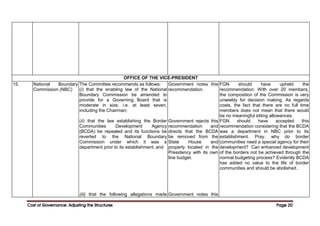
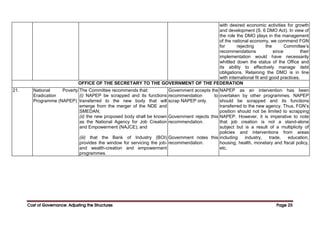
  • 82.
    Cost of Governance:Adjusting the Structures Cost of Governance: Adjusting the Structures Cost of Governance: Adjusting the Structures Cost of Governance: Adjusting the Structures Page Page Page Page 69 69 69 69 89. National Commission for Museums and Monuments; National Gallery of Arts The Committee recommends as follows, that: (i) a staff audit of the National Commission for Museums and Monuments and the National Gallery of Art should be carried out; (ii) the merger of both the National Commission for Museums and Monuments and the National Gallery of Arts into a single entity to be known as National Commission for Museums, Monuments and Arts; (iii) the repeal of the laws setting up the National Commission for Museums and Monuments and the National Gallery of Art; and (iv) the enactment of a new law to accommodate the merger. Government accepts this recommendation. The Heritage Museum and Monument potentials with respect to revenue yield should be fully exploited. Government accepts this recommendation. Government accepts this recommendation. Government accepts this recommendation. The two institutions are related; the marriage will be peaceful and productive. FGN’s position is credible. FGN’s position is credible. FGN’s position is credible. FGN’s position is credible. 90. Nigerian Tourism Development Corporation (NTDC) The Committee recommends as follows, that: (i) the Nigerian Tourism Development Corporation (NTDC) be fully commercialized with effect from 2013 Fiscal Year; (ii) the enabling law of NTDC be amended to reflect the proposed commercialization, subsuming of the functions of NIHOTOUR and a strong independent professional board be appointed for NTDC; (iii) the Board be responsible for: (a) general policy direction of NTDC; Government accepts this recommendation and directs that the Agency to be fully commercialized within five (5) years or by 2018. Government notes the recommendation. Government notes this recommendation. FGN’s position is credible. FGN’s position is credible. FGN’s position is credible.
  • 83.
    Cost of Governance:Adjusting the Structures Cost of Governance: Adjusting the Structures Cost of Governance: Adjusting the Structures Cost of Governance: Adjusting the Structures Page Page Page Page 70 70 70 70 (b)enforcement of corporate governance rules; (c)ensuring timely preparation and auditing of accounts by independent auditors; (d))ensuring timely payment of annual surplus to Government Treasury; (iv) a management audit of NTDC be carried out; and (v) that NTDC ceases to receive Government funding with effect from 2013 Fiscal year. Government accepts this recommendation Government accepts this recommendation and directs the FMOF to discuss with FMTC&NO to determine how to fund and boost the sector to enable it exit the budget cycle by 2018. FGN’s position is credible. FGN’s position is credible. 91. Nigerian Institute for Hospitality and Tourism Studies (NIHOTOUR) The Committee recommends as follows, that: (i) the functions of the Nigerian Institute for Hospitality and Tourist Studies (NIHOTOUR) be transferred to the NTDC; (ii) the NIHOTOUR be abolished and its enabling law repealed ; and (iii) further budgetary allocation to NIHOTOUR be stopped with effect from 2013 Fiscal Year. Government rejects this recommendation. NIHOTOUR shall function as a regulatory body. Government rejects this recommendation. Government rejects this recommendation. FGN’s position is credible FGN’s position is credible FGN’s position is credible
  • 84.
    Cost of Governance:Adjusting the Structures Cost of Governance: Adjusting the Structures Cost of Governance: Adjusting the Structures Cost of Governance: Adjusting the Structures Page Page Page Page 71 71 71 71 92. National Orientation Agency (NOA); National Institute for Cultural Orientation (N ICO) The Committee recommends as follows, that: (i) the functions of NOA be transferred to the Department of Public Communications in the Federal Ministry of Information; (ii) the 774 offices of NOA be closed and its staff redeployed within the Federal Civil Service after a staff audit and. assessment has been carried out ; (iii) budgetary allocations to NICO ceases with effect from 2013 Fiscal Year; (iv) that budgetary allocations to NOA ceases with effect from 2013 Fiscal Year; (v) the enabling law of the National Orientation Agency (NOA) be amended; (vi) the Act establishing the National Institute for Cultural Orientation (NICO) be repealed and the Institute abolished. Government rejects this recommendation. Government rejects this recommendation. Government rejects this recommendation. Government rejects this recommendation. Government rejects this recommendation. Government rejects this recommendation. Cultural orientation is an aspect of national orientation and both therefore, should be handled by the same agency. NOA should consider shutting down its numerous outposts as it does not need to be physically present to affect the lives of its publics. Advances in ICT are making institutions like NOA obsolete and FGN should change with the times. Town criers’ gongs and megaphones mounted to trucks are no longer needed to disseminate information. FGN should have accepted these recommendations. FEDERAL MINISTRY OF TRADE AND INVESTMENT 93. Standards Organization of Nigeria (SON), Consumer Protection Council (CPC) and Department of Weights and Measures The Committee recommends as follows, that: (i) the Standards Organization of Nigeria (SON), Consumer Protection Council (CPC) and the Department of Weights and Measures be merged into a new agency; Government rejects this recommendation and directs that the three Agencies remain separate. Government should have accepted the Committee’s recommendations regarding the merger because these agencies aim to ensure that consumers are not shortchanged by unscrupulous business and individuals.
  • 85.
    Cost of Governance:Adjusting the Structures Cost of Governance: Adjusting the Structures Cost of Governance: Adjusting the Structures Cost of Governance: Adjusting the Structures Page Page Page Page 72 72 72 72 (ii) the proposed new agency be named Nigerian Standards and Consumer Protection Agency (NSCPA) ; and (iii) that the enabling Acts of Standards Organization of Nigeria (SON), Consumer Protection Council and the Department of Weights and Measures be repealed and a new law enacted to accommodate the merger. Government rejects this recommendation. Government rejects this recommendation. 94. Nigeria Export Promotion Council; and Nigerian Investment Promotion Commission The Committee recommends as follows, that: (i) the Nigerian Investment Promotion Commission (NIPC) and the Nigerian Export Promotion Council (NEPC) be merged into one agency under the supervision of the Ministry of Trade and Investment ; (ii) the new agency be known as the Nigerian Import-Export Promotion Commission (NIEPC); (iii) the enabling laws of the two agencies be repealed accordingly; (iv) the enactment of a new law to reflect the merger; and (v) that further budgetary allocations to the two agencies be stopped and redirected as necessary when the new agency is formed. Government rejects this recommendation. Government rejects this recommendation. Government rejects this recommendation. Government rejects this recommendation. Government rejects this recommendation. This is a good recommendation and should have been accepted by FGN. The NIPC‘s mandate is to promote investment, especially foreign direct investment; while the NEPC‘s remit covers the development and diversification of exports. There is a linkage between the two areas. Apart from saving overhead costs, the merger has the potential of making the resultant organisation more efficient and effective. 95. Centre for Automotive Design and Development (CADD); and National Automotive Council (NAC) The Committee recommends as follows, that: (i) the Acts setting up the Centre for Automotive Design and Development (CADD) and the National Automotive Council (NAC) be repealed; (ii) Centre for Automotive Design and Development (CADD) and the National Government notes this recommendation and directs that the bill in NASS in that regard should be expedited. Government rejects this recommendation. Considering the state of our auto industry, FGN intervention in the sector is still necessary but the two agencies can be merged instead of being scrapped.
  • 86.
    Cost of Governance:Adjusting the Structures Cost of Governance: Adjusting the Structures Cost of Governance: Adjusting the Structures Cost of Governance: Adjusting the Structures Page Page Page Page 73 73 73 73 Automotive Council (NAC) be scrapped; iii) funding for both bodies to cease in 2013 ; and (iv) that the functions of the two bodies be transferred to appropriate universities and polytechnics. Government notes this recommendation. Government rejects this recommendation. 96. Nigerian Export Processing Zones Authority (NEPZA); and Onne Oil and Gas Free Zone Authority (OGFZA) The Committee recommends as follows, that: (i) the Onne Oil and Gas Free Zone Authority (OGFZA) be reverted to the Nigeria Export Processing Zones Authority (NEPZA); (ii) the amendment of the enabling law of NEPZA to accommodate the reversion ; and (iii) that a post-impact assessment be carried out to ascertain the benefit or otherwise of the nation's investment in the Free Zones to the economy. Government rejects this recommendation and directs Onne OGFZA to be renamed Oil and Gas Free Zones Authority. Government rejects this recommendation. Government accepts this recommendation and directs that an assessment be carried out to ascertain the benefit or otherwise of the nation's investment in Free Zones to the economy. There should be a central authority for all export processing zones, just like the NPA for the sea ports. FGN should have accepted this recommendation. 97. Tafawa Balewa Square Management Board; and Lagos International Trade Fair Management Board The Committee recommends that Government reviews the concession agreements on the Tafawa Balewa Square and the Lagos International Trade Fair with a view to achieving the objectives for which the concession agreements were entered into to wit: earn revenue for Government and to block financial hemorrhage. Government notes that this recommendation is being carried out. Government notes this recommendation. FGN should stop further budgetary allocations to the two Boards as a sign that it is serious about stopping the waste.
  • 87.
    Cost of Governance:Adjusting the Structures Cost of Governance: Adjusting the Structures Cost of Governance: Adjusting the Structures Cost of Governance: Adjusting the Structures Page Page Page Page 74 74 74 74 98. Industrial Training Fund (ITF) The Committee recommends as follows, that: (i) the Industrial Training Fund (ITF) be self- funding with effect from the 2013 Fiscal Year; (ii) all trainees' stipends in the SIWES be paid by the Industrial Training Fund (ITF) with effect from 2013 Fiscal Year; (iii) the Industrial Training Fund (ITF) coordinates all skills training centres in the country in order to remove duplications and wastage; and (iv) all other skills training centres outside the ITF cease to receive Capital Funding from Government Treasury with effect from 2013 Fiscal Year. Government accepts this recommendation but with effect from 2014. Government accepts this recommendation but with effect from 2014. Government rejects this recommendation. Government rejects this recommendation. FGN’s position is credible. FGN’s position is credible. FGN’s position is credible. FGN’s position is credible. FEDERAL MINISTRY OF WATER RESOURCES 99. River Basins Development Authorities The Committee recommends as follows, that: (i) a single 7-member governing board be appointed for the 12RBDAs; (ii) a management audit of all the 12 RBDAs should be conducted to ensure value for money; (iii) the management of the RBDAs be pruned to make it leaner, more efficient and cost-effective; Government rejects this recommendation. Government accepts this recommendation. Government notes this recommendation. A central governing board for all the River Basins will suffice. Having 12 separate boards of eight members each (96 board members) cannot be the best way to cut down on wasteful expenditure. FGN’s position is credible. FGN should have accepted this recommendation.
  • 88.
    Cost of Governance:Adjusting the Structures Cost of Governance: Adjusting the Structures Cost of Governance: Adjusting the Structures Cost of Governance: Adjusting the Structures Page Page Page Page 75 75 75 75 . (iv) the enabling law of the RBDAs be amended to reflect the proposed arrangement regarding the board and management of the RBDAs; (v) the Department of River Basins Operations and Inspectorate (RBO&I) continues to inspect, co-ordinate and enforce standards in the River Basin Development Authorities (RBDAs); (vi) highly professional, experienced and competent personnel be deployed to man the Department of RBO&I in the Ministry; (vii) the attempt to create additional RBDAs be discontinued and the existing ones be properly managed to deliver on their mandates; and (viii) that the decision of Government in the White Paper on Ahmed Joda Panel Report (2000) on the commercialization of the RBDAs be implemented. Government rejects this recommendation. Government notes this recommendation. Government notes this recommendation. Government accepts this recommendation. Government notes this recommendation and directs the Ministry of Water Resources to work out a way for commercialization by 2017. FGN should have accepted this recommendation. FGN’s position is credible FGN should have accepted this recommendation.
  • 89.
    Cost of Governance:Adjusting the Structures Cost of Governance: Adjusting the Structures Cost of Governance: Adjusting the Structures Cost of Governance: Adjusting the Structures Page Page Page Page 76 76 76 76 100. Nigerian Integrated Water Resources Management Agency (NIWRMA) The Committee recommends as follows, that: (i) the functions of the Nigeria Integrated Water Resources Management Agency (NIWRMA) be transferred to an extra-ministerial department in the Federal Ministry of Water Resources ; (ii) the proposed department to perform the transferred functions of NIWRMA be given operational and financial autonomy; (iii) the Passed Bill be modified to reflect the proposed status of NIWRMA; and (iv) that further budgetary allocation to NIWRMA as an Agency be transferred to the Department proposed to perform the functions of NIWRMA, after adjustments reflecting its new status. Government rejects this recommendation. Government rejects this recommendation. Government rejects this recommendation. Government rejects this recommendation. FGN should have accepted this recommendation. Water resources management is the reason for setting up the Ministry of Water Resources .The role of NIWRMA should be taken over by the Ministry to curb duplication and waste. 101. Gurara Water Management Authority (GWMA) The Committee recommends as follows, that: (i)'the Gurara Water Management Authority (GWMA) be abolished and any action to enact an enabling law for the Authority be discontinued ; and (ii) that the management of the hydro and irrigation component of the Gurara 'Water Management Scheme be transferred to the Upper Niger River Basin Development Authority (UNRBA) and Power Holding Company of Nigeria (PHCN), respectively. Government rejects this recommendation. Government notes this recommendation. Should Gurara continue to have a dedicated management authority? This is in addition to the Ministry, NIRWA and the Upper Niger River Basin Development Authority. The recommendation to scrap GWMA is justified. The irrigation function should be handed over to Upper Niger River Basin Development Authority (UNRBA) while the power generating function should be handed over to an appropriate electricity generating company under the new privatized arrangement in the Electricity
  • 90.
    Cost of Governance:Adjusting the Structures Cost of Governance: Adjusting the Structures Cost of Governance: Adjusting the Structures Cost of Governance: Adjusting the Structures Page Page Page Page 77 77 77 77 Industry. 102. National Water Resources Institute (NWRI) The Committee recommends that the National Water Resources Institute (NWRI) continues to receive full Government funding in view of its importance to the development and capacity building of middle level manpower in the Water Sector. Government accepts this recommendation. FGN’s position is credible. NATIONAL SPORTS COMMISSION 103. National Sports Commission The Committee recommends that the National Sports Commission reverts to the proposed Ministry of Youth and Sports Development as an Agency. Government rejects this recommendation. NSC should be retained. Sports as a sector should have a Commission. FGN’s position is credible.