Dr HelenWebster @scholastic_rat
Anglia Ruskin University
 To explore the potential of social media in our
work and in that of the academics we support
 To explore what it means to ‘teach’ social
media
 To introduce #10DoT as a way to help
academics explore to potential ofTwitter in
their work, develop digital literacy and build a
professional community
 Those who useTwitter - what do you use it
for, professionally, and what benefits have
you gained from it?
 Those who use other social media – what
other social media tools do you use to
achieve these aims?What benefits are there
of this approach?
 Those who use traditional approaches –
how do you achieve these aims?What
benefits are there of this approach?
Having identified our social networking needs and the
benefits social media might offer….
Do these groups have the same needs/benefits, or do
they have different ones to us?
 FacultyAcademics
 Early Career researchers
 Students
 Other central services professionals
What exactly are we
teaching?
But what IS digital literacy in
this context?!
So do we need to teach social
media?
University of Cambridge, Digital Humanities
Network
6 month project “to encourage Early Career
Researchers to develop advanced digital and
social media skills to enhance their
research, wider professional practice and
employability”
Not just to teach digital tools, but also:
 an awareness of the ways in which social media and
digital technologies can enhance or impact on your work
 an understanding of the issues raised by social media
and digital technologies, including potential
pitfalls, good practice and ways they are changing the
profession
 an awareness of, and ability to evaluate, new and future
digital tools and make informed decisions about your
own engagement with them
 Digital Literacy and Digital Literacies (Lea
and Street; Lea and Jones)
 Situated learning and communities of
practice (Lave andWenger;Wenger)
 Digital Residents andVisitors (White)
 Connectivism (Siemens) and Rhizomatic
learning (Cormier)
MOOCs, SPOCs and 23Things
 C-MOOCs (connectivist Massive Open Online Courses
 X-MOOCs (more traditional instructivist Massive Open
Online Courses)
 23Things
 Small Private Online Courses
 Blended learning
Access and
motivation
Online
Socialisation
Information
exchange
Knowledge
Construction
Development
Gilly Salmon
Blog
Twitter
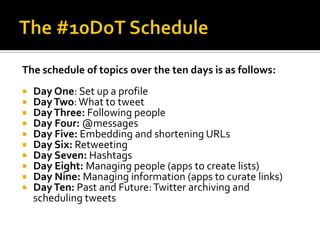
The schedule of topics over the ten days is as follows:
 Day One: Set up a profile
 DayTwo:What to tweet
 DayThree: Following people
 Day Four: @messages
 Day Five: Embedding and shortening URLs
 Day Six: Retweeting
 Day Seven: Hashtags
 Day Eight: Managing people (apps to create lists)
 Day Nine: Managing information (apps to curate links)
 DayTen: Past and Future:Twitter archiving and
scheduling tweets
Each post contains
 A need arising in the context of academic
practice
 Instructions for a small element ofTwitter
 Examples or suggestions of use in the context
of academic practice
 A small task to complete
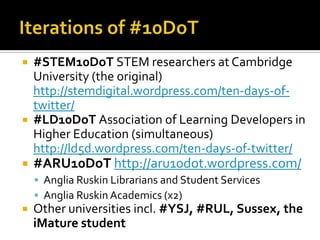
 #STEM10DoT STEM researchers at Cambridge
University (the original)
http://stemdigital.wordpress.com/ten-days-of-
twitter/
 #LD10DoT Association of Learning Developers in
Higher Education (simultaneous)
http://ld5d.wordpress.com/ten-days-of-twitter/
 #ARU10DoT http://aru10dot.wordpress.com/
 Anglia Ruskin Librarians and Student Services
 Anglia Ruskin Academics (x2)
 Other universities incl. #YSJ, #RUL, Sussex, the
iMature student
 What opportunities for staff/student
development can you see, and how can these
be maximised?
 What barriers to engagement can you
foresee, and how might these be overcome?
 How might you adapt #10DoT for your
context, or to teach other topics or tools?
 Overall comments
 What did you find most useful about the course?
 Conventions and terms
 Confidence
 Refining use
 Authenticity and embedded learning
 Which part of the course did you find least useful?
 Time
 Level
 Tailoring
 My own observations
#10DoT is freely available under a Creative
Commons License to be adapted and reused
CC BY-NC-SA
http://10daysoftwitter.wordpress.com/
Website contains
 What you need to set up
 What you need to do throughout
 Annotated materials
 Links to various iterations

Seda 10 dot

  • 1.
  • 2.
     To explorethe potential of social media in our work and in that of the academics we support  To explore what it means to ‘teach’ social media  To introduce #10DoT as a way to help academics explore to potential ofTwitter in their work, develop digital literacy and build a professional community
  • 4.
     Those whouseTwitter - what do you use it for, professionally, and what benefits have you gained from it?  Those who use other social media – what other social media tools do you use to achieve these aims?What benefits are there of this approach?  Those who use traditional approaches – how do you achieve these aims?What benefits are there of this approach?
  • 5.
    Having identified oursocial networking needs and the benefits social media might offer…. Do these groups have the same needs/benefits, or do they have different ones to us?  FacultyAcademics  Early Career researchers  Students  Other central services professionals
  • 6.
    What exactly arewe teaching? But what IS digital literacy in this context?! So do we need to teach social media?
  • 7.
    University of Cambridge,Digital Humanities Network 6 month project “to encourage Early Career Researchers to develop advanced digital and social media skills to enhance their research, wider professional practice and employability”
  • 9.
    Not just toteach digital tools, but also:  an awareness of the ways in which social media and digital technologies can enhance or impact on your work  an understanding of the issues raised by social media and digital technologies, including potential pitfalls, good practice and ways they are changing the profession  an awareness of, and ability to evaluate, new and future digital tools and make informed decisions about your own engagement with them
  • 10.
     Digital Literacyand Digital Literacies (Lea and Street; Lea and Jones)  Situated learning and communities of practice (Lave andWenger;Wenger)  Digital Residents andVisitors (White)  Connectivism (Siemens) and Rhizomatic learning (Cormier)
  • 11.
    MOOCs, SPOCs and23Things  C-MOOCs (connectivist Massive Open Online Courses  X-MOOCs (more traditional instructivist Massive Open Online Courses)  23Things  Small Private Online Courses  Blended learning
  • 12.
  • 13.
  • 14.
    The schedule oftopics over the ten days is as follows:  Day One: Set up a profile  DayTwo:What to tweet  DayThree: Following people  Day Four: @messages  Day Five: Embedding and shortening URLs  Day Six: Retweeting  Day Seven: Hashtags  Day Eight: Managing people (apps to create lists)  Day Nine: Managing information (apps to curate links)  DayTen: Past and Future:Twitter archiving and scheduling tweets
  • 15.
    Each post contains A need arising in the context of academic practice  Instructions for a small element ofTwitter  Examples or suggestions of use in the context of academic practice  A small task to complete
  • 16.
     #STEM10DoT STEMresearchers at Cambridge University (the original) http://stemdigital.wordpress.com/ten-days-of- twitter/  #LD10DoT Association of Learning Developers in Higher Education (simultaneous) http://ld5d.wordpress.com/ten-days-of-twitter/  #ARU10DoT http://aru10dot.wordpress.com/  Anglia Ruskin Librarians and Student Services  Anglia Ruskin Academics (x2)  Other universities incl. #YSJ, #RUL, Sussex, the iMature student
  • 17.
     What opportunitiesfor staff/student development can you see, and how can these be maximised?  What barriers to engagement can you foresee, and how might these be overcome?  How might you adapt #10DoT for your context, or to teach other topics or tools?
  • 18.
     Overall comments What did you find most useful about the course?  Conventions and terms  Confidence  Refining use  Authenticity and embedded learning  Which part of the course did you find least useful?  Time  Level  Tailoring  My own observations
  • 19.
    #10DoT is freelyavailable under a Creative Commons License to be adapted and reused CC BY-NC-SA http://10daysoftwitter.wordpress.com/ Website contains  What you need to set up  What you need to do throughout  Annotated materials  Links to various iterations

Notes de l'éditeur

  • #5 Collate thoughts on what a social network is for, and how various participants go about achieving this, whether twitter, other technological tools or old-fashioned methods
  • #8 Brief overview of what they initially wanted and the various areas I explored – blogging, information management and curation, social networking, media creation.
  • #14 What is it, strapline, followed by a description of how it works