GENC3003Personal Financial PlanningAndrew Hingstonandrew.hingston@unsw.edu.auUnit 2: Budgets
2What is a budget?It is a plan for your money over the next year:Income from working, parents, youth allowanceExpenses from …Income – Expenses = Savings (or Dis-saving if negative!)It is forward looking (over next year)But future is uncertain …So actual income and expenses will be differentBudget is a “best guess”Usually best to have “average monthly” and “total yearly”
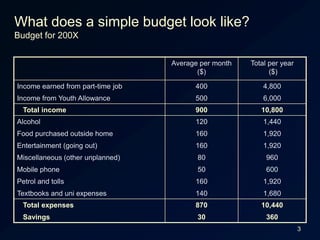
3What does a simple budget look like?Budget for 200X
4Why have a budget?Knowledge of your finances = power over themKnow where our money comes from (income)Know where the money is going (expenses)Identify areas of over-spending to cut back… which will find extra money to saveHelps us to be disciplined with our money
5DiscussionWhat do difficulties do you think people have when making a budget?What difficulties do they have sticking to budgets?
6Regularly tracking expensesTrack all income and expenses for two months… before making your first budget= much more accurate budget!Then track expenses after making budget… to see whether you are sticking to budget
7What are some tips?Make tracking expenses easy as possibleUse software (Quicken or Money or other)Make habit of collecting receiptsUse eftpos and download transactions from websiteBe realistic with your budgetAllocate enough money for having some funBe flexible – the future is uncertainAdd “miscellaneous” – preferably 10% of total expensesAim to always save at least 5% of your incomeIf you can’t, then get a casual job or cut back in expenses
8Expense tracking methodsExtreme trackingTrack every dollar, every month (using software)Best method but some people can’t keep it up!Electronic trackingTrack all eftpos transactions + total changes in cashGood but where is all the cash being spent?
9Audit trackingTrack every dollar for only two months a yearGood but what if they are not representative of the other months?Fixed savings tracking$X per month is withdrawn from transaction into savings accountYou are free to “spend” the restControls total expenses but where is it all going?Match method to personality typeIt must be sustainable over the long-term!
10Expense tracking assignmentSee course outline for detailed informationTrack all income & expensesUsing spreadsheet provided at websiteSubmit spreadsheet on website at checkpointsRead course outline for instructions on tricky issuesIrregular and large bills and expensesIrregular income and holiday workSpecial instructions for people living with their family
11Tips for recording expensesAsk for receipts whenever you buy something.Update your spreadsheet each dayUse “Task scheduler” to make it open at 8pm each dayCount cash at start of weekCount cash one week laterNote ATM withdrawals and expensesReconcile change in cash vs expensesMissed something? Put as “miscellaneous”
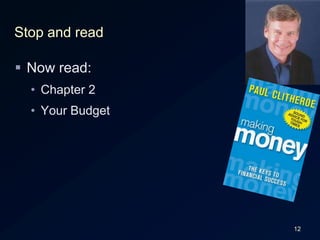
Stop and readNow read:Chapter 2Your Budget12

Unit 2a Budgets

  • 1.
    GENC3003Personal Financial PlanningAndrewHingstonandrew.hingston@unsw.edu.auUnit 2: Budgets
  • 2.
    2What is abudget?It is a plan for your money over the next year:Income from working, parents, youth allowanceExpenses from …Income – Expenses = Savings (or Dis-saving if negative!)It is forward looking (over next year)But future is uncertain …So actual income and expenses will be differentBudget is a “best guess”Usually best to have “average monthly” and “total yearly”
  • 3.
    3What does asimple budget look like?Budget for 200X
  • 4.
    4Why have abudget?Knowledge of your finances = power over themKnow where our money comes from (income)Know where the money is going (expenses)Identify areas of over-spending to cut back… which will find extra money to saveHelps us to be disciplined with our money
  • 5.
    5DiscussionWhat do difficultiesdo you think people have when making a budget?What difficulties do they have sticking to budgets?
  • 6.
    6Regularly tracking expensesTrackall income and expenses for two months… before making your first budget= much more accurate budget!Then track expenses after making budget… to see whether you are sticking to budget
  • 7.
    7What are sometips?Make tracking expenses easy as possibleUse software (Quicken or Money or other)Make habit of collecting receiptsUse eftpos and download transactions from websiteBe realistic with your budgetAllocate enough money for having some funBe flexible – the future is uncertainAdd “miscellaneous” – preferably 10% of total expensesAim to always save at least 5% of your incomeIf you can’t, then get a casual job or cut back in expenses
  • 8.
    8Expense tracking methodsExtremetrackingTrack every dollar, every month (using software)Best method but some people can’t keep it up!Electronic trackingTrack all eftpos transactions + total changes in cashGood but where is all the cash being spent?
  • 9.
    9Audit trackingTrack everydollar for only two months a yearGood but what if they are not representative of the other months?Fixed savings tracking$X per month is withdrawn from transaction into savings accountYou are free to “spend” the restControls total expenses but where is it all going?Match method to personality typeIt must be sustainable over the long-term!
  • 10.
    10Expense tracking assignmentSeecourse outline for detailed informationTrack all income & expensesUsing spreadsheet provided at websiteSubmit spreadsheet on website at checkpointsRead course outline for instructions on tricky issuesIrregular and large bills and expensesIrregular income and holiday workSpecial instructions for people living with their family
  • 11.
    11Tips for recordingexpensesAsk for receipts whenever you buy something.Update your spreadsheet each dayUse “Task scheduler” to make it open at 8pm each dayCount cash at start of weekCount cash one week laterNote ATM withdrawals and expensesReconcile change in cash vs expensesMissed something? Put as “miscellaneous”
  • 12.
    Stop and readNowread:Chapter 2Your Budget12