
Session 3 – Interaction
avec la base de données
Application Development Series
Bienvenue à la session 3
À PARTIR DE
15:00
CET
Application Development Series:
Session 3 – Interaction avec la
base de données
Présenté par
Tugdual Grall
Solutions Architect
MongoDB
Webinar Series:
Premiers Pas avec MongoDB
À PARTIR DE
MINUTES
05
About MetLife
MetLife, Inc. is a leading global provider of
insurance, annuities and employee benefit
programs, serving 90 million customers. Through
its subsidiaries and affiliates, MetLife holds leading
market positions in the United States, Japan, Latin
America, Asia, Europe and the Middle East.
Exemple d'utilisation du client
MetLife Leapfrogs Insurance Industry with MongoDB-Powered
Big Data Application
MetLife, Inc. selected MongoDB as the data engine for “The Wall”, an innovative customer
service application. Similar to the Facebook User Interface, The Wall provides a 360-
degree, consolidated view of MetLife customers, including policy details and transactions
across lines of business. The Wall improves customer satisfaction and boosts call centre
productivity.
MetLife built a working prototype in two weeks and was live in U.S. call centres in just 90
days. Currently, The Wall handles 45 million agreements with 140 million transactions.
By surfacing customer data in The Wall, MetLife has shown how global companies can
simultaneously leverage the data from 70+ existing systems with the flexibility of emerging
technology. The MetLife team employed both traditional and modern technologies,
exhibiting agility in applying solutions to dynamic needs.
Webinar Series:
Premiers Pas
avec MongoDB
Application
Development Series:
Session 3:
Interaction avec la
base de données
04
À PARTIR DE
MINUTES
Alcuni dei nostri clienti…
Webinar Series:
Premiers Pas
avec MongoDB
Application
Development Series:
Session 3:
Interaction avec la
base de données
03
À PARTIR DE
MINUTES
About Orange Digital
Orange Digital is a subsidiary of France Telecom -
Orange supplying digital services to EE in the UK
and Orange across Europe. Orange Digital maintains
the websites Orange, Orange World, and the Orange
Business site, as well as a number of EE‟s digital
assets.
Exemple d'utilisation du client
Managing such varied content is a mammoth undertaking, as
connection speeds increase and expectations grow
Under these circumstances, Orange Digital started to look for alternatives, both in terms of
database and delivery platform. After some deliberation, research and testing, the company
settled on abandoning hosting the data itself and instead moved to Amazon's cloud-based
web service.
Along with the move to Amazon, Orange Digital decided to use a non-relational database to
store content and metadata. After experimenting with several options Orange Digital chose
MongoDB due to its strong performance, ease of use but the decision was primarily due to
replication, auto sharding, failover and disaster recovery features which are especially relevant
on a cloud based infrastructure where hardware failures do happen. Orange Digital solutions
are designed to assume that failure will happen and must gracefully cope with failure.
"We tried several different databases, but the incredible performance, horizontal scalability
and automatic backup and failover functionality made MongoDB the natural choice for us -
and makes life easier for our developers," announced Orange.
02
Webinar Series:
Premiers Pas
avec MongoDB
Application
Development Series:
Session 3:
Interaction avec la
base de données
À PARTIR DE
MINUTES
Application Development Series:
Session 3 – Interaction avec la
base de données
Présenté par
Tugdual Grall
Solutions Architect
MongoDB
Webinar Series:
Premiers Pas avec MongoDB
À PARTIR DE
MINUTES
01
Application Development Series
Back to Basics
Interaction avec la base de données
Tugdual Grall
@tgrall
#MongoDBBasics
8
• Session Précédente : Rappel
• MongoDB Inserts & Queries
– ObjectId
– Récupération des Documents & Cursors
– Projections
• MongoDB Update
– Fixed Buckets
– Pre Aggregated Reports
• Write Concern
– Compromis : Durabilité / Performance
Agenda
9
• Virtual Genius Bar
– Utilisez la fenêtre de
chat
Q & A
Recap from last time….
11
• Architecture de l‟Application
– JSON / RESTful
– Basé sur Python
Architecture
Client-side
JSON
(eg AngularJS) (BSON)
Pymongo driver
Python web
app
HTTP(S) REST
12
• Design
• Articles
• Comments
• Interactions
• Users
Schema & Architecture
13
Modèle : Articles
• Creation d‟articles
• Insert
• Liste d‟articles
• Renvois d‟un Curseur
• Article Unique
{
'_id' : ObjectId(...),
'text': 'Article content…',
'date' : ISODate(...),
'title' : ‟Intro to MongoDB',
'author' : 'Dan Roberts',
'tags' : [ 'mongodb',
'database',
'nosql‟
]
}
Collection : Articles
METHODES
def get_article(article_id)
def get_articles():
def create_article():
14
Modèle : Comments
• Stockage des commentaires
• Récupération des
commentaires
• Ajout nouveau commentaire au
document
• „Bucketing‟
{
„_id‟ : ObjectId(..),
„article_id‟ : ObjectId(..),
„page‟ : 1,
„count‟ : 42
„comments‟ : [
{
„text‟ : „A great
article, helped me understand
schema design‟,
„date‟ : ISODate(..),
„author‟ : „johnsmith‟
},
…
}
Collection : Comments
METHODES
def add_comment(article_id):
def get_comments(article_id):
15
Modèle : Interactions
• Reporting
• Used for reporting on
articles
• Création de rapports
“pre-aggregé”
{
„_id‟ : ObjectId(..),
„article_id‟ : ObjectId(..),
„section‟ : „schema‟,
„date‟ : ISODate(..),
„daily‟: { „views‟ : 45,
„comments‟ : 150 }
„hours‟ : {
0 : { „views‟ : 10 },
1 : { „views‟ : 2 },
…
23 : { „views‟ : 14,
„comments‟ : 10 }
}
}
Collection : Interactions
METHODES def add_interaction(article_id, type):
Création / Requêtes
17
>db.articles.insert({
'text': 'Article content…‟,
'date' : ISODate(...),
'title' : ‟Intro to MongoDB‟,
'author' : 'Dan Roberts‟,
'tags' : [ 'mongodb',
'database',
'nosql‟
]
});
• Driver génère ObjectId() pour le _id
– Si non spécifié par l‟application
– 12 octets- 4-octets epoch, 3-octets machine id, a 2-octets process id, 3-octets
counter.
Ajout de documents
18
$gt, $gte, $in, $lt, $lte, $ne, $nin
• Utilisé pour requêter la base de données
• Logique: $or, $and, $not, $nor Element: $exists, $type
• Evalué: $mod, $regex, $where Geospatial: $geoWithin, $geoIntersects, $near, $nearSphere
Opérateurs: Comparaison
db.articles.find( { 'title' : ‟Intro to MongoDB‟ } )
db.articles.find( { ‟date' : { „$lt‟ :
{ISODate("2014-02-19T00:00:00.000Z") }} )
db.articles.find( { „tags‟ : { „$in‟ : [„nosql‟, „database‟] } } );
19
• Find retourne un curseur
– Utilisé pour naviguer dans le résultat
– Un curseur a plusieurs méthodes
Curseurs
>var cursor = db.articles.find ( { ‟author' : ‟Tug Grall‟ } )
>cursor.hasNext()
true
>cursor.next()
{ '_id' : ObjectId(...),
'text': 'Article content…‟,
'date' : ISODate(...),
'title' : ‟Intro to MongoDB‟,
'author' : 'Dan Roberts‟,
'tags' : [ 'mongodb', 'database‟, 'nosql’ ]
}
20
• Retourne uniquement certains attributs
– Booléen 0/1 pour sélectionner les attributs
– Plus efficace
Projections
>var cursor = db.articles.find( { ‟author' : ‟Tug Grall‟ } , {‘_id’:0, ‘title’:1})
>cursor.hasNext()
true
>cursor.next()
{ "title" : "Intro to MongoDB" }
Mises à jour
22
$each, $slice, $sort, $inc, $push
$inc, $rename, $setOnInsert, $set, $unset, $max, $min
$, $addToSet, $pop, $pullAll, $pull, $pushAll, $push
$each, $slice, $sort
Opérateur : Update
>db.articles.update(
{ '_id' : ObjectId(...)},
{ '$push' :
{'comments' : „Great
article!’ }
}
)
{ 'text': 'Article content…‟
'date' : ISODate(...),
'title' : ‟Intro to MongoDB‟,
'author' : ‟Tug Grall‟,
'tags' : ['mongodb',
'database‟,'nosql’ ],
’comments' :
[‘Great article!’ ]
}
23
Ajout d’élément à un tableau
$push, $each, $slice
Opérateur : Update
>db.articles.update(
{ '_id' : ObjectId(...)},
{ '$push' : {'comments' :
{
'$each' : [„Excellent‟],
'$slice' : -3}},
})
{ 'text': 'Article content…‟
'date' : ISODate(...),
'title' : ‟Intro to MongoDB‟,
'author' : 'Dan Roberts‟,
'tags' : ['mongodb',
'database‟,'nosql’ ],
’comments' :
[‘Great article!’,
‘More please’, ‘Excellent’ ]
}
24
• Ajout de commentaires dans un document (max : 10 - bucket).
• Création d‟un nouveau.
• Utilisation de {upsert: true} .
Opérateur : Update- Bucketing
>db.comments.update(
{„c‟: {„$lt‟:10}},
{
„$inc‟ : {c:1},
'$push' : {
'comments' :
„Excellent‟ }
},
{ upsert : true }
)
{
„_id‟ : ObjectId( … )
„c‟ : 3,
’comments' :
[‘Great article!’,
‘More please’,
‘Excellent’ ]
}
25
Analytique– Pre-Agrégation
• Reporting
• Rapports Pré-agregés
{
„_id‟ : ObjectId(..),
„article_id‟ : ObjectId(..),
„section‟ : „schema‟,
„date‟ : ISODate(..),
„daily‟: { „views‟ : 45,
„comments‟ : 150 }
„hours‟ : {
0 : { „views‟ : 10 },
1 : { „views‟ : 2 },
…
23 : { „views‟ : 14,
„comments‟ : 10 }
}
}
Collections : Interactions
METHODE def add_interaction(article_id, type):
26
• Utilisation de $inc pour incrémenter plusieurs compteurs.
• Opération atomique
• Incrémentation des compteurs par jour et heure
Compteurs : Incrément
>db.interactions.update(
{„article_id‟ : ObjectId(..)},
{
„$inc‟ : {
„daily.views‟:1,
„daily.comments‟:1
„hours.8.views‟:1
„hours.8.comments‟:1
}
)
{
„_id‟ : ObjectId(..),
„article_id‟ : ObjectId(..),
„section‟ : „schema‟,
„date‟ : ISODate(..),
„daily‟: { „views‟ : 45,
„comments‟ : 150 }
„hours‟ : {
0 : { „views‟ : 10 },
1 : { „views‟ : 2 },
…
23 : { „views‟ : 14,
„comments‟ : 10 }
}
}
27
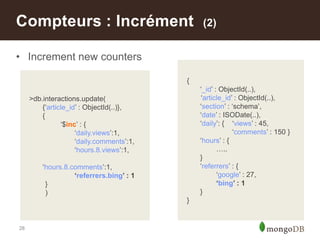
• Création de nouveaux compteurs
Compteurs : Incrément (2)
>db.interactions.update(
{„article_id‟ : ObjectId(..)},
{
„$inc‟ : {
„daily.views‟:1,
„daily.comments‟:1,
„hours.8.views‟:1,
„hours.8.comments‟:1,
‘referrers.bing’ : 1
}
)
{
„_id‟ : ObjectId(..),
„article_id‟ : ObjectId(..),
„section‟ : „schema‟,
„date‟ : ISODate(..),
„daily‟: { „views‟ : 45,
„comments‟ : 150 }
„hours‟ : {
…..
}
„referrers‟ : {
„google‟ : 27
}
}
28
• Increment new counters
Compteurs : Incrément (2)
>db.interactions.update(
{„article_id‟ : ObjectId(..)},
{
„$inc‟ : {
„daily.views‟:1,
„daily.comments‟:1,
„hours.8.views‟:1,
„hours.8.comments‟:1,
‘referrers.bing’ : 1
}
)
{
„_id‟ : ObjectId(..),
„article_id‟ : ObjectId(..),
„section‟ : „schema‟,
„date‟ : ISODate(..),
„daily‟: { „views‟ : 45,
„comments‟ : 150 }
„hours‟ : {
…..
}
„referrers‟ : {
„google‟ : 27,
‘bing’ : 1
}
}
Durabilité
30
Durabilité
• Avec MongoDB, plusieurs options
• Memoire/RAM
• Disque (primaire)
• Plusieurs serveur (replicats)
• Write Concerns
• Retour sur le status de l‟opération d‟écriture
• getLastError() appelé par le driver
• Compromis
• Latence
31
Unacknowledged
32
MongoDB Acknowledged
Default Write Concern
33
Wait for Journal Sync
34
Replica Sets
• Replica Set – 2 copies ou plus
• Tolérant aux pannes
• Répond à plusieurs contraintes:
- High Availability
- Disaster Recovery
- Maintenance
35
Wait for Replication
Résumé
37
• Interactions
– Requtes et projections
– Inserts & Upserts
– Opérateurs : Update
– Bucketing
– Rapports pre-agrégés
• Base pour les rapport analytiques
Résumé
38
– Indexation
• Stratégies/Options
• Optimisation
– Text Search
– Geo Spatial
– Query Profiler
Prochaine Session – 9 Avril
Tweet vos questions à
#mongoDBBasics
Risorsa WEBSITE URL
Enterprise Download mongodb.com/download
Training Online Gratuito education.mongodb.com
Webinars e Events mongodb.com/events
White Paper mongodb.com/white-papers
Casi d‟Uso mongodb.com/customers
Presentazioni mongodb.com/presentations
Documentazione docs.mongodb.org
2014 03-26-appdevseries-session3-interactingwiththedatabase-fr-phpapp01

2014 03-26-appdevseries-session3-interactingwiththedatabase-fr-phpapp01

  • 1.
    Session 3 –Interaction avec la base de données Application Development Series Bienvenue à la session 3 À PARTIR DE 15:00 CET
  • 2.
    Application Development Series: Session3 – Interaction avec la base de données Présenté par Tugdual Grall Solutions Architect MongoDB Webinar Series: Premiers Pas avec MongoDB À PARTIR DE MINUTES 05
  • 3.
    About MetLife MetLife, Inc.is a leading global provider of insurance, annuities and employee benefit programs, serving 90 million customers. Through its subsidiaries and affiliates, MetLife holds leading market positions in the United States, Japan, Latin America, Asia, Europe and the Middle East. Exemple d'utilisation du client MetLife Leapfrogs Insurance Industry with MongoDB-Powered Big Data Application MetLife, Inc. selected MongoDB as the data engine for “The Wall”, an innovative customer service application. Similar to the Facebook User Interface, The Wall provides a 360- degree, consolidated view of MetLife customers, including policy details and transactions across lines of business. The Wall improves customer satisfaction and boosts call centre productivity. MetLife built a working prototype in two weeks and was live in U.S. call centres in just 90 days. Currently, The Wall handles 45 million agreements with 140 million transactions. By surfacing customer data in The Wall, MetLife has shown how global companies can simultaneously leverage the data from 70+ existing systems with the flexibility of emerging technology. The MetLife team employed both traditional and modern technologies, exhibiting agility in applying solutions to dynamic needs. Webinar Series: Premiers Pas avec MongoDB Application Development Series: Session 3: Interaction avec la base de données 04 À PARTIR DE MINUTES
  • 4.
    Alcuni dei nostriclienti… Webinar Series: Premiers Pas avec MongoDB Application Development Series: Session 3: Interaction avec la base de données 03 À PARTIR DE MINUTES
  • 5.
    About Orange Digital OrangeDigital is a subsidiary of France Telecom - Orange supplying digital services to EE in the UK and Orange across Europe. Orange Digital maintains the websites Orange, Orange World, and the Orange Business site, as well as a number of EE‟s digital assets. Exemple d'utilisation du client Managing such varied content is a mammoth undertaking, as connection speeds increase and expectations grow Under these circumstances, Orange Digital started to look for alternatives, both in terms of database and delivery platform. After some deliberation, research and testing, the company settled on abandoning hosting the data itself and instead moved to Amazon's cloud-based web service. Along with the move to Amazon, Orange Digital decided to use a non-relational database to store content and metadata. After experimenting with several options Orange Digital chose MongoDB due to its strong performance, ease of use but the decision was primarily due to replication, auto sharding, failover and disaster recovery features which are especially relevant on a cloud based infrastructure where hardware failures do happen. Orange Digital solutions are designed to assume that failure will happen and must gracefully cope with failure. "We tried several different databases, but the incredible performance, horizontal scalability and automatic backup and failover functionality made MongoDB the natural choice for us - and makes life easier for our developers," announced Orange. 02 Webinar Series: Premiers Pas avec MongoDB Application Development Series: Session 3: Interaction avec la base de données À PARTIR DE MINUTES
  • 6.
    Application Development Series: Session3 – Interaction avec la base de données Présenté par Tugdual Grall Solutions Architect MongoDB Webinar Series: Premiers Pas avec MongoDB À PARTIR DE MINUTES 01
  • 7.
    Application Development Series Backto Basics Interaction avec la base de données Tugdual Grall @tgrall #MongoDBBasics
  • 8.
    8 • Session Précédente: Rappel • MongoDB Inserts & Queries – ObjectId – Récupération des Documents & Cursors – Projections • MongoDB Update – Fixed Buckets – Pre Aggregated Reports • Write Concern – Compromis : Durabilité / Performance Agenda
  • 9.
    9 • Virtual GeniusBar – Utilisez la fenêtre de chat Q & A
  • 10.
  • 11.
    11 • Architecture del‟Application – JSON / RESTful – Basé sur Python Architecture Client-side JSON (eg AngularJS) (BSON) Pymongo driver Python web app HTTP(S) REST
  • 12.
    12 • Design • Articles •Comments • Interactions • Users Schema & Architecture
  • 13.
    13 Modèle : Articles •Creation d‟articles • Insert • Liste d‟articles • Renvois d‟un Curseur • Article Unique { '_id' : ObjectId(...), 'text': 'Article content…', 'date' : ISODate(...), 'title' : ‟Intro to MongoDB', 'author' : 'Dan Roberts', 'tags' : [ 'mongodb', 'database', 'nosql‟ ] } Collection : Articles METHODES def get_article(article_id) def get_articles(): def create_article():
  • 14.
    14 Modèle : Comments •Stockage des commentaires • Récupération des commentaires • Ajout nouveau commentaire au document • „Bucketing‟ { „_id‟ : ObjectId(..), „article_id‟ : ObjectId(..), „page‟ : 1, „count‟ : 42 „comments‟ : [ { „text‟ : „A great article, helped me understand schema design‟, „date‟ : ISODate(..), „author‟ : „johnsmith‟ }, … } Collection : Comments METHODES def add_comment(article_id): def get_comments(article_id):
  • 15.
    15 Modèle : Interactions •Reporting • Used for reporting on articles • Création de rapports “pre-aggregé” { „_id‟ : ObjectId(..), „article_id‟ : ObjectId(..), „section‟ : „schema‟, „date‟ : ISODate(..), „daily‟: { „views‟ : 45, „comments‟ : 150 } „hours‟ : { 0 : { „views‟ : 10 }, 1 : { „views‟ : 2 }, … 23 : { „views‟ : 14, „comments‟ : 10 } } } Collection : Interactions METHODES def add_interaction(article_id, type):
  • 16.
  • 17.
    17 >db.articles.insert({ 'text': 'Article content…‟, 'date': ISODate(...), 'title' : ‟Intro to MongoDB‟, 'author' : 'Dan Roberts‟, 'tags' : [ 'mongodb', 'database', 'nosql‟ ] }); • Driver génère ObjectId() pour le _id – Si non spécifié par l‟application – 12 octets- 4-octets epoch, 3-octets machine id, a 2-octets process id, 3-octets counter. Ajout de documents
  • 18.
    18 $gt, $gte, $in,$lt, $lte, $ne, $nin • Utilisé pour requêter la base de données • Logique: $or, $and, $not, $nor Element: $exists, $type • Evalué: $mod, $regex, $where Geospatial: $geoWithin, $geoIntersects, $near, $nearSphere Opérateurs: Comparaison db.articles.find( { 'title' : ‟Intro to MongoDB‟ } ) db.articles.find( { ‟date' : { „$lt‟ : {ISODate("2014-02-19T00:00:00.000Z") }} ) db.articles.find( { „tags‟ : { „$in‟ : [„nosql‟, „database‟] } } );
  • 19.
    19 • Find retourneun curseur – Utilisé pour naviguer dans le résultat – Un curseur a plusieurs méthodes Curseurs >var cursor = db.articles.find ( { ‟author' : ‟Tug Grall‟ } ) >cursor.hasNext() true >cursor.next() { '_id' : ObjectId(...), 'text': 'Article content…‟, 'date' : ISODate(...), 'title' : ‟Intro to MongoDB‟, 'author' : 'Dan Roberts‟, 'tags' : [ 'mongodb', 'database‟, 'nosql’ ] }
  • 20.
    20 • Retourne uniquementcertains attributs – Booléen 0/1 pour sélectionner les attributs – Plus efficace Projections >var cursor = db.articles.find( { ‟author' : ‟Tug Grall‟ } , {‘_id’:0, ‘title’:1}) >cursor.hasNext() true >cursor.next() { "title" : "Intro to MongoDB" }
  • 21.
  • 22.
    22 $each, $slice, $sort,$inc, $push $inc, $rename, $setOnInsert, $set, $unset, $max, $min $, $addToSet, $pop, $pullAll, $pull, $pushAll, $push $each, $slice, $sort Opérateur : Update >db.articles.update( { '_id' : ObjectId(...)}, { '$push' : {'comments' : „Great article!’ } } ) { 'text': 'Article content…‟ 'date' : ISODate(...), 'title' : ‟Intro to MongoDB‟, 'author' : ‟Tug Grall‟, 'tags' : ['mongodb', 'database‟,'nosql’ ], ’comments' : [‘Great article!’ ] }
  • 23.
    23 Ajout d’élément àun tableau $push, $each, $slice Opérateur : Update >db.articles.update( { '_id' : ObjectId(...)}, { '$push' : {'comments' : { '$each' : [„Excellent‟], '$slice' : -3}}, }) { 'text': 'Article content…‟ 'date' : ISODate(...), 'title' : ‟Intro to MongoDB‟, 'author' : 'Dan Roberts‟, 'tags' : ['mongodb', 'database‟,'nosql’ ], ’comments' : [‘Great article!’, ‘More please’, ‘Excellent’ ] }
  • 24.
    24 • Ajout decommentaires dans un document (max : 10 - bucket). • Création d‟un nouveau. • Utilisation de {upsert: true} . Opérateur : Update- Bucketing >db.comments.update( {„c‟: {„$lt‟:10}}, { „$inc‟ : {c:1}, '$push' : { 'comments' : „Excellent‟ } }, { upsert : true } ) { „_id‟ : ObjectId( … ) „c‟ : 3, ’comments' : [‘Great article!’, ‘More please’, ‘Excellent’ ] }
  • 25.
    25 Analytique– Pre-Agrégation • Reporting •Rapports Pré-agregés { „_id‟ : ObjectId(..), „article_id‟ : ObjectId(..), „section‟ : „schema‟, „date‟ : ISODate(..), „daily‟: { „views‟ : 45, „comments‟ : 150 } „hours‟ : { 0 : { „views‟ : 10 }, 1 : { „views‟ : 2 }, … 23 : { „views‟ : 14, „comments‟ : 10 } } } Collections : Interactions METHODE def add_interaction(article_id, type):
  • 26.
    26 • Utilisation de$inc pour incrémenter plusieurs compteurs. • Opération atomique • Incrémentation des compteurs par jour et heure Compteurs : Incrément >db.interactions.update( {„article_id‟ : ObjectId(..)}, { „$inc‟ : { „daily.views‟:1, „daily.comments‟:1 „hours.8.views‟:1 „hours.8.comments‟:1 } ) { „_id‟ : ObjectId(..), „article_id‟ : ObjectId(..), „section‟ : „schema‟, „date‟ : ISODate(..), „daily‟: { „views‟ : 45, „comments‟ : 150 } „hours‟ : { 0 : { „views‟ : 10 }, 1 : { „views‟ : 2 }, … 23 : { „views‟ : 14, „comments‟ : 10 } } }
  • 27.
    27 • Création denouveaux compteurs Compteurs : Incrément (2) >db.interactions.update( {„article_id‟ : ObjectId(..)}, { „$inc‟ : { „daily.views‟:1, „daily.comments‟:1, „hours.8.views‟:1, „hours.8.comments‟:1, ‘referrers.bing’ : 1 } ) { „_id‟ : ObjectId(..), „article_id‟ : ObjectId(..), „section‟ : „schema‟, „date‟ : ISODate(..), „daily‟: { „views‟ : 45, „comments‟ : 150 } „hours‟ : { ….. } „referrers‟ : { „google‟ : 27 } }
  • 28.
    28 • Increment newcounters Compteurs : Incrément (2) >db.interactions.update( {„article_id‟ : ObjectId(..)}, { „$inc‟ : { „daily.views‟:1, „daily.comments‟:1, „hours.8.views‟:1, „hours.8.comments‟:1, ‘referrers.bing’ : 1 } ) { „_id‟ : ObjectId(..), „article_id‟ : ObjectId(..), „section‟ : „schema‟, „date‟ : ISODate(..), „daily‟: { „views‟ : 45, „comments‟ : 150 } „hours‟ : { ….. } „referrers‟ : { „google‟ : 27, ‘bing’ : 1 } }
  • 29.
  • 30.
    30 Durabilité • Avec MongoDB,plusieurs options • Memoire/RAM • Disque (primaire) • Plusieurs serveur (replicats) • Write Concerns • Retour sur le status de l‟opération d‟écriture • getLastError() appelé par le driver • Compromis • Latence
  • 31.
  • 32.
  • 33.
  • 34.
    34 Replica Sets • ReplicaSet – 2 copies ou plus • Tolérant aux pannes • Répond à plusieurs contraintes: - High Availability - Disaster Recovery - Maintenance
  • 35.
  • 36.
  • 37.
    37 • Interactions – Requteset projections – Inserts & Upserts – Opérateurs : Update – Bucketing – Rapports pre-agrégés • Base pour les rapport analytiques Résumé
  • 38.
    38 – Indexation • Stratégies/Options •Optimisation – Text Search – Geo Spatial – Query Profiler Prochaine Session – 9 Avril
  • 40.
    Tweet vos questionsà #mongoDBBasics
  • 41.
    Risorsa WEBSITE URL EnterpriseDownload mongodb.com/download Training Online Gratuito education.mongodb.com Webinars e Events mongodb.com/events White Paper mongodb.com/white-papers Casi d‟Uso mongodb.com/customers Presentazioni mongodb.com/presentations Documentazione docs.mongodb.org

Notes de l'éditeur

  • #32 Not really fire and forget. This return arrow is to confirm that the network successfully transferred the packet(s) of data.This confirms that the TCP ACK response was received.
  • #36 Presenter should mention:Default is w:1w:majority is what most people should use for durability. Majority is a special token here signifying more than half of the nodes in the set have acknowledged the write.