
Application Development Series
Back to Basics
Interaction avec la base de données
Tugdual Grall
@tgrall
#MongoDBBasics
2
• Session Précédente : Rappel
• MongoDB Inserts & Queries
– ObjectId
– Récupération des Documents & Cursors
– Projections
• MongoDB Update
– Fixed Buckets
– Pre Aggregated Reports
• Write Concern
– Compromis : Durabilité / Performance
Agenda
3
• Virtual Genius Bar
– Utilisez la fenêtre de
chat
Q & A
Recap from last time….
5
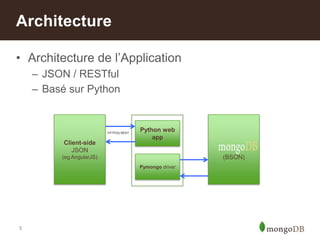
• Architecture de l‟Application
– JSON / RESTful
– Basé sur Python
Architecture
Client-side
JSON
(eg AngularJS) (BSON)
Pymongo driver
Python web
app
HTTP(S) REST
6
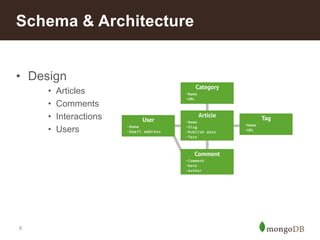
• Design
• Articles
• Comments
• Interactions
• Users
Schema & Architecture
7
Modèle : Articles
• Creation d‟articles
• Insert
• Liste d‟articles
• Renvois d‟un Curseur
• Article Unique
{
'_id' : ObjectId(...),
'text': 'Article content…',
'date' : ISODate(...),
'title' : ‟Intro to MongoDB',
'author' : 'Dan Roberts',
'tags' : [ 'mongodb',
'database',
'nosql‟
]
}
Collection : Articles
METHODES
def get_article(article_id)
def get_articles():
def create_article():
8
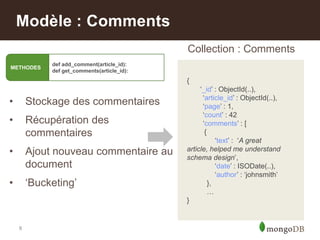
Modèle : Comments
• Stockage des commentaires
• Récupération des
commentaires
• Ajout nouveau commentaire au
document
• „Bucketing‟
{
„_id‟ : ObjectId(..),
„article_id‟ : ObjectId(..),
„page‟ : 1,
„count‟ : 42
„comments‟ : [
{
„text‟ : „A great
article, helped me understand
schema design‟,
„date‟ : ISODate(..),
„author‟ : „johnsmith‟
},
…
}
Collection : Comments
METHODES
def add_comment(article_id):
def get_comments(article_id):
9
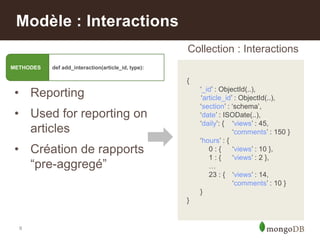
Modèle : Interactions
• Reporting
• Used for reporting on
articles
• Création de rapports
“pre-aggregé”
{
„_id‟ : ObjectId(..),
„article_id‟ : ObjectId(..),
„section‟ : „schema‟,
„date‟ : ISODate(..),
„daily‟: { „views‟ : 45,
„comments‟ : 150 }
„hours‟ : {
0 : { „views‟ : 10 },
1 : { „views‟ : 2 },
…
23 : { „views‟ : 14,
„comments‟ : 10 }
}
}
Collection : Interactions
METHODES def add_interaction(article_id, type):
Création / Requêtes
11
>db.articles.insert({
'text': 'Article content…‟,
'date' : ISODate(...),
'title' : ‟Intro to MongoDB‟,
'author' : 'Dan Roberts‟,
'tags' : [ 'mongodb',
'database',
'nosql‟
]
});
• Driver génère ObjectId() pour le _id
– Si non spécifié par l‟application
– 12 octets- 4-octets epoch, 3-octets machine id, a 2-octets process id, 3-octets
counter.
Ajout de documents
12
$gt, $gte, $in, $lt, $lte, $ne, $nin
• Utilisé pour requêter la base de données
• Logique: $or, $and, $not, $nor Element: $exists, $type
• Evalué: $mod, $regex, $where Geospatial: $geoWithin, $geoIntersects, $near, $nearSphere
Opérateurs: Comparaison
db.articles.find( { 'title' : ‟Intro to MongoDB‟ } )
db.articles.find( { ‟date' : { „$lt‟ :
{ISODate("2014-02-19T00:00:00.000Z") }} )
db.articles.find( { „tags‟ : { „$in‟ : [„nosql‟, „database‟] } } );
13
• Find retourne un curseur
– Utilisé pour naviguer dans le résultat
– Un curseur a plusieurs méthodes
Curseurs
>var cursor = db.articles.find ( { ‟author' : ‟Tug Grall‟ } )
>cursor.hasNext()
true
>cursor.next()
{ '_id' : ObjectId(...),
'text': 'Article content…‟,
'date' : ISODate(...),
'title' : ‟Intro to MongoDB‟,
'author' : 'Dan Roberts‟,
'tags' : [ 'mongodb', 'database‟, 'nosql’ ]
}
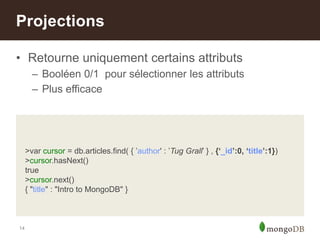
14
• Retourne uniquement certains attributs
– Booléen 0/1 pour sélectionner les attributs
– Plus efficace
Projections
>var cursor = db.articles.find( { ‟author' : ‟Tug Grall‟ } , {‘_id’:0, ‘title’:1})
>cursor.hasNext()
true
>cursor.next()
{ "title" : "Intro to MongoDB" }
Mises à jour
16
$each, $slice, $sort, $inc, $push
$inc, $rename, $setOnInsert, $set, $unset, $max, $min
$, $addToSet, $pop, $pullAll, $pull, $pushAll, $push
$each, $slice, $sort
Opérateur : Update
>db.articles.update(
{ '_id' : ObjectId(...)},
{ '$push' :
{'comments' : „Great
article!’ }
}
)
{ 'text': 'Article content…‟
'date' : ISODate(...),
'title' : ‟Intro to MongoDB‟,
'author' : ‟Tug Grall‟,
'tags' : ['mongodb',
'database‟,'nosql’ ],
’comments' :
[‘Great article!’ ]
}
17
Ajout d’élément à un tableau
$push, $each, $slice
Opérateur : Update
>db.articles.update(
{ '_id' : ObjectId(...)},
{ '$push' : {'comments' :
{
'$each' : [„Excellent‟],
'$slice' : -3}},
})
{ 'text': 'Article content…‟
'date' : ISODate(...),
'title' : ‟Intro to MongoDB‟,
'author' : 'Dan Roberts‟,
'tags' : ['mongodb',
'database‟,'nosql’ ],
’comments' :
[‘Great
article!’, ‘More
please’, ‘Excellent’ ]
}
18
• Ajout de commentaires dans un document (max : 10 - bucket).
• Création d‟un nouveau.
• Utilisation de {upsert: true} .
Opérateur : Update- Bucketing
>db.comments.update(
{„c‟: {„$lt‟:10}},
{
„$inc‟ : {c:1},
'$push' : {
'comments' :
„Excellent‟ }
},
{ upsert : true }
)
{
„_id‟ : ObjectId( … )
„c‟ : 3,
’comments' :
[‘Great article!’,
‘More please’,
‘Excellent’ ]
}
19
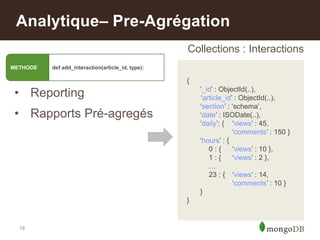
Analytique– Pre-Agrégation
• Reporting
• Rapports Pré-agregés
{
„_id‟ : ObjectId(..),
„article_id‟ : ObjectId(..),
„section‟ : „schema‟,
„date‟ : ISODate(..),
„daily‟: { „views‟ : 45,
„comments‟ : 150 }
„hours‟ : {
0 : { „views‟ : 10 },
1 : { „views‟ : 2 },
…
23 : { „views‟ : 14,
„comments‟ : 10 }
}
}
Collections : Interactions
METHODE def add_interaction(article_id, type):
20
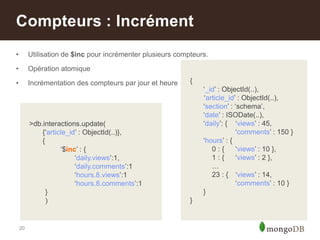
• Utilisation de $inc pour incrémenter plusieurs compteurs.
• Opération atomique
• Incrémentation des compteurs par jour et heure
Compteurs : Incrément
>db.interactions.update(
{„article_id‟ : ObjectId(..)},
{
„$inc‟ : {
„daily.views‟:1,
„daily.comments‟:1
„hours.8.views‟:1
„hours.8.comments‟:1
}
)
{
„_id‟ : ObjectId(..),
„article_id‟ : ObjectId(..),
„section‟ : „schema‟,
„date‟ : ISODate(..),
„daily‟: { „views‟ : 45,
„comments‟ : 150 }
„hours‟ : {
0 : { „views‟ : 10 },
1 : { „views‟ : 2 },
…
23 : { „views‟ : 14,
„comments‟ : 10 }
}
}
21
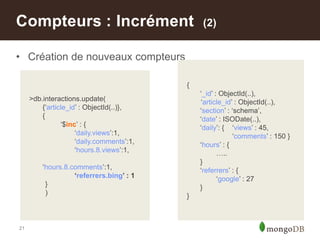
• Création de nouveaux compteurs
Compteurs : Incrément (2)
>db.interactions.update(
{„article_id‟ : ObjectId(..)},
{
„$inc‟ : {
„daily.views‟:1,
„daily.comments‟:1,
„hours.8.views‟:1,
„hours.8.comments‟:1,
‘referrers.bing’ : 1
}
)
{
„_id‟ : ObjectId(..),
„article_id‟ : ObjectId(..),
„section‟ : „schema‟,
„date‟ : ISODate(..),
„daily‟: { „views‟ : 45,
„comments‟ : 150 }
„hours‟ : {
…..
}
„referrers‟ : {
„google‟ : 27
}
}
22
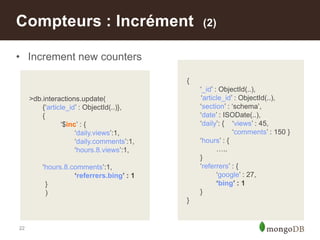
• Increment new counters
Compteurs : Incrément (2)
>db.interactions.update(
{„article_id‟ : ObjectId(..)},
{
„$inc‟ : {
„daily.views‟:1,
„daily.comments‟:1,
„hours.8.views‟:1,
„hours.8.comments‟:1,
‘referrers.bing’ : 1
}
)
{
„_id‟ : ObjectId(..),
„article_id‟ : ObjectId(..),
„section‟ : „schema‟,
„date‟ : ISODate(..),
„daily‟: { „views‟ : 45,
„comments‟ : 150 }
„hours‟ : {
…..
}
„referrers‟ : {
„google‟ : 27,
‘bing’ : 1
}
}
Durabilité
24
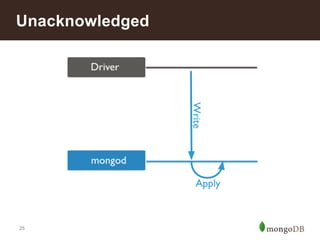
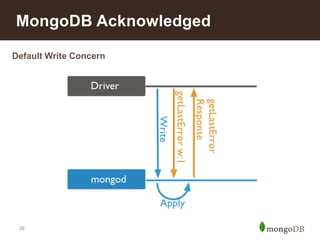
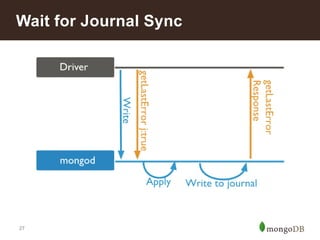
Durabilité
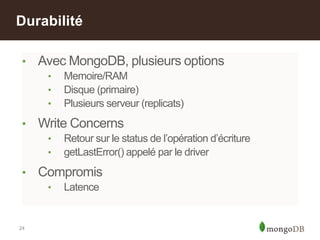
• Avec MongoDB, plusieurs options
• Memoire/RAM
• Disque (primaire)
• Plusieurs serveur (replicats)
• Write Concerns
• Retour sur le status de l‟opération d‟écriture
• getLastError() appelé par le driver
• Compromis
• Latence
25
Unacknowledged
26
MongoDB Acknowledged
Default Write Concern
27
Wait for Journal Sync
28
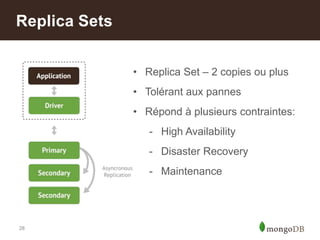
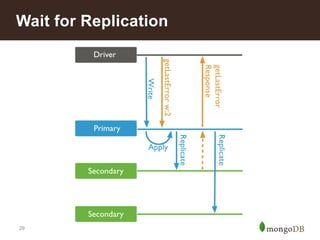
Replica Sets
• Replica Set – 2 copies ou plus
• Tolérant aux pannes
• Répond à plusieurs contraintes:
- High Availability
- Disaster Recovery
- Maintenance
29
Wait for Replication
Résumé
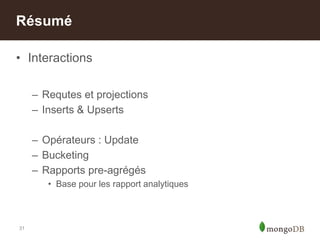
31
• Interactions
– Requtes et projections
– Inserts & Upserts
– Opérateurs : Update
– Bucketing
– Rapports pre-agrégés
• Base pour les rapport analytiques
Résumé
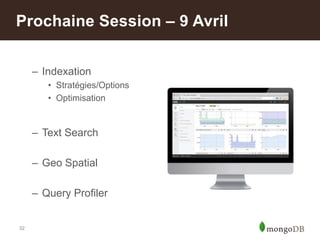
32
– Indexation
• Stratégies/Options
• Optimisation
– Text Search
– Geo Spatial
– Query Profiler
Prochaine Session – 9 Avril
Tweet vos questions à
#mongoDBBasics
Risorsa WEBSITE URL
Enterprise Download mongodb.com/download
Training Online Gratuito education.mongodb.com
Webinars e Events mongodb.com/events
White Paper mongodb.com/white-papers
Casi d‟Uso mongodb.com/customers
Presentazioni mongodb.com/presentations
Documentazione docs.mongodb.org
2014 03-26-appdevseries-session3-interactingwiththedatabase-fr-phpapp01-rev.

2014 03-26-appdevseries-session3-interactingwiththedatabase-fr-phpapp01-rev.

  • 1.
    Application Development Series Backto Basics Interaction avec la base de données Tugdual Grall @tgrall #MongoDBBasics
  • 2.
    2 • Session Précédente: Rappel • MongoDB Inserts & Queries – ObjectId – Récupération des Documents & Cursors – Projections • MongoDB Update – Fixed Buckets – Pre Aggregated Reports • Write Concern – Compromis : Durabilité / Performance Agenda
  • 3.
    3 • Virtual GeniusBar – Utilisez la fenêtre de chat Q & A
  • 4.
  • 5.
    5 • Architecture del‟Application – JSON / RESTful – Basé sur Python Architecture Client-side JSON (eg AngularJS) (BSON) Pymongo driver Python web app HTTP(S) REST
  • 6.
    6 • Design • Articles •Comments • Interactions • Users Schema & Architecture
  • 7.
    7 Modèle : Articles •Creation d‟articles • Insert • Liste d‟articles • Renvois d‟un Curseur • Article Unique { '_id' : ObjectId(...), 'text': 'Article content…', 'date' : ISODate(...), 'title' : ‟Intro to MongoDB', 'author' : 'Dan Roberts', 'tags' : [ 'mongodb', 'database', 'nosql‟ ] } Collection : Articles METHODES def get_article(article_id) def get_articles(): def create_article():
  • 8.
    8 Modèle : Comments •Stockage des commentaires • Récupération des commentaires • Ajout nouveau commentaire au document • „Bucketing‟ { „_id‟ : ObjectId(..), „article_id‟ : ObjectId(..), „page‟ : 1, „count‟ : 42 „comments‟ : [ { „text‟ : „A great article, helped me understand schema design‟, „date‟ : ISODate(..), „author‟ : „johnsmith‟ }, … } Collection : Comments METHODES def add_comment(article_id): def get_comments(article_id):
  • 9.
    9 Modèle : Interactions •Reporting • Used for reporting on articles • Création de rapports “pre-aggregé” { „_id‟ : ObjectId(..), „article_id‟ : ObjectId(..), „section‟ : „schema‟, „date‟ : ISODate(..), „daily‟: { „views‟ : 45, „comments‟ : 150 } „hours‟ : { 0 : { „views‟ : 10 }, 1 : { „views‟ : 2 }, … 23 : { „views‟ : 14, „comments‟ : 10 } } } Collection : Interactions METHODES def add_interaction(article_id, type):
  • 10.
  • 11.
    11 >db.articles.insert({ 'text': 'Article content…‟, 'date': ISODate(...), 'title' : ‟Intro to MongoDB‟, 'author' : 'Dan Roberts‟, 'tags' : [ 'mongodb', 'database', 'nosql‟ ] }); • Driver génère ObjectId() pour le _id – Si non spécifié par l‟application – 12 octets- 4-octets epoch, 3-octets machine id, a 2-octets process id, 3-octets counter. Ajout de documents
  • 12.
    12 $gt, $gte, $in,$lt, $lte, $ne, $nin • Utilisé pour requêter la base de données • Logique: $or, $and, $not, $nor Element: $exists, $type • Evalué: $mod, $regex, $where Geospatial: $geoWithin, $geoIntersects, $near, $nearSphere Opérateurs: Comparaison db.articles.find( { 'title' : ‟Intro to MongoDB‟ } ) db.articles.find( { ‟date' : { „$lt‟ : {ISODate("2014-02-19T00:00:00.000Z") }} ) db.articles.find( { „tags‟ : { „$in‟ : [„nosql‟, „database‟] } } );
  • 13.
    13 • Find retourneun curseur – Utilisé pour naviguer dans le résultat – Un curseur a plusieurs méthodes Curseurs >var cursor = db.articles.find ( { ‟author' : ‟Tug Grall‟ } ) >cursor.hasNext() true >cursor.next() { '_id' : ObjectId(...), 'text': 'Article content…‟, 'date' : ISODate(...), 'title' : ‟Intro to MongoDB‟, 'author' : 'Dan Roberts‟, 'tags' : [ 'mongodb', 'database‟, 'nosql’ ] }
  • 14.
    14 • Retourne uniquementcertains attributs – Booléen 0/1 pour sélectionner les attributs – Plus efficace Projections >var cursor = db.articles.find( { ‟author' : ‟Tug Grall‟ } , {‘_id’:0, ‘title’:1}) >cursor.hasNext() true >cursor.next() { "title" : "Intro to MongoDB" }
  • 15.
  • 16.
    16 $each, $slice, $sort,$inc, $push $inc, $rename, $setOnInsert, $set, $unset, $max, $min $, $addToSet, $pop, $pullAll, $pull, $pushAll, $push $each, $slice, $sort Opérateur : Update >db.articles.update( { '_id' : ObjectId(...)}, { '$push' : {'comments' : „Great article!’ } } ) { 'text': 'Article content…‟ 'date' : ISODate(...), 'title' : ‟Intro to MongoDB‟, 'author' : ‟Tug Grall‟, 'tags' : ['mongodb', 'database‟,'nosql’ ], ’comments' : [‘Great article!’ ] }
  • 17.
    17 Ajout d’élément àun tableau $push, $each, $slice Opérateur : Update >db.articles.update( { '_id' : ObjectId(...)}, { '$push' : {'comments' : { '$each' : [„Excellent‟], '$slice' : -3}}, }) { 'text': 'Article content…‟ 'date' : ISODate(...), 'title' : ‟Intro to MongoDB‟, 'author' : 'Dan Roberts‟, 'tags' : ['mongodb', 'database‟,'nosql’ ], ’comments' : [‘Great article!’, ‘More please’, ‘Excellent’ ] }
  • 18.
    18 • Ajout decommentaires dans un document (max : 10 - bucket). • Création d‟un nouveau. • Utilisation de {upsert: true} . Opérateur : Update- Bucketing >db.comments.update( {„c‟: {„$lt‟:10}}, { „$inc‟ : {c:1}, '$push' : { 'comments' : „Excellent‟ } }, { upsert : true } ) { „_id‟ : ObjectId( … ) „c‟ : 3, ’comments' : [‘Great article!’, ‘More please’, ‘Excellent’ ] }
  • 19.
    19 Analytique– Pre-Agrégation • Reporting •Rapports Pré-agregés { „_id‟ : ObjectId(..), „article_id‟ : ObjectId(..), „section‟ : „schema‟, „date‟ : ISODate(..), „daily‟: { „views‟ : 45, „comments‟ : 150 } „hours‟ : { 0 : { „views‟ : 10 }, 1 : { „views‟ : 2 }, … 23 : { „views‟ : 14, „comments‟ : 10 } } } Collections : Interactions METHODE def add_interaction(article_id, type):
  • 20.
    20 • Utilisation de$inc pour incrémenter plusieurs compteurs. • Opération atomique • Incrémentation des compteurs par jour et heure Compteurs : Incrément >db.interactions.update( {„article_id‟ : ObjectId(..)}, { „$inc‟ : { „daily.views‟:1, „daily.comments‟:1 „hours.8.views‟:1 „hours.8.comments‟:1 } ) { „_id‟ : ObjectId(..), „article_id‟ : ObjectId(..), „section‟ : „schema‟, „date‟ : ISODate(..), „daily‟: { „views‟ : 45, „comments‟ : 150 } „hours‟ : { 0 : { „views‟ : 10 }, 1 : { „views‟ : 2 }, … 23 : { „views‟ : 14, „comments‟ : 10 } } }
  • 21.
    21 • Création denouveaux compteurs Compteurs : Incrément (2) >db.interactions.update( {„article_id‟ : ObjectId(..)}, { „$inc‟ : { „daily.views‟:1, „daily.comments‟:1, „hours.8.views‟:1, „hours.8.comments‟:1, ‘referrers.bing’ : 1 } ) { „_id‟ : ObjectId(..), „article_id‟ : ObjectId(..), „section‟ : „schema‟, „date‟ : ISODate(..), „daily‟: { „views‟ : 45, „comments‟ : 150 } „hours‟ : { ….. } „referrers‟ : { „google‟ : 27 } }
  • 22.
    22 • Increment newcounters Compteurs : Incrément (2) >db.interactions.update( {„article_id‟ : ObjectId(..)}, { „$inc‟ : { „daily.views‟:1, „daily.comments‟:1, „hours.8.views‟:1, „hours.8.comments‟:1, ‘referrers.bing’ : 1 } ) { „_id‟ : ObjectId(..), „article_id‟ : ObjectId(..), „section‟ : „schema‟, „date‟ : ISODate(..), „daily‟: { „views‟ : 45, „comments‟ : 150 } „hours‟ : { ….. } „referrers‟ : { „google‟ : 27, ‘bing’ : 1 } }
  • 23.
  • 24.
    24 Durabilité • Avec MongoDB,plusieurs options • Memoire/RAM • Disque (primaire) • Plusieurs serveur (replicats) • Write Concerns • Retour sur le status de l‟opération d‟écriture • getLastError() appelé par le driver • Compromis • Latence
  • 25.
  • 26.
  • 27.
  • 28.
    28 Replica Sets • ReplicaSet – 2 copies ou plus • Tolérant aux pannes • Répond à plusieurs contraintes: - High Availability - Disaster Recovery - Maintenance
  • 29.
  • 30.
  • 31.
    31 • Interactions – Requteset projections – Inserts & Upserts – Opérateurs : Update – Bucketing – Rapports pre-agrégés • Base pour les rapport analytiques Résumé
  • 32.
    32 – Indexation • Stratégies/Options •Optimisation – Text Search – Geo Spatial – Query Profiler Prochaine Session – 9 Avril
  • 34.
    Tweet vos questionsà #mongoDBBasics
  • 35.
    Risorsa WEBSITE URL EnterpriseDownload mongodb.com/download Training Online Gratuito education.mongodb.com Webinars e Events mongodb.com/events White Paper mongodb.com/white-papers Casi d‟Uso mongodb.com/customers Presentazioni mongodb.com/presentations Documentazione docs.mongodb.org

Notes de l'éditeur

  • #26 Not really fire and forget. This return arrow is to confirm that the network successfully transferred the packet(s) of data.This confirms that the TCP ACK response was received.
  • #30 Presenter should mention:Default is w:1w:majority is what most people should use for durability. Majority is a special token here signifying more than half of the nodes in the set have acknowledged the write.