Les fondamentaux de vol

Une introduction à l'aérodynamique
Les quatre forces du vol
la portance
le poids de l'appareil
la motorisation/puissance/traction
la traînée
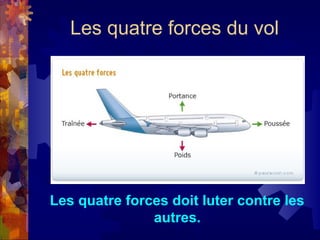
Les quatre forces du vol


Les quatre forces doit luter contre les
               autres.
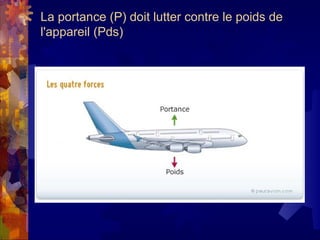
La portance (P) doit lutter contre le poids de
l'appareil (Pds)
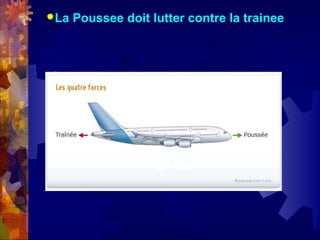
La   Poussee doit lutter contre la trainee
Donc!

  Pour un avion à décoller, la portance
  doit être supérieure au poids.

 Pour un avion à accélérer ,la poussée
 doit être supérieure à la traînée.
Comment peut-on créer une portance
    nous avons besoin d'air et de
    mouvement

 Comment
 pouvons-nous
 expliquer
 portance?

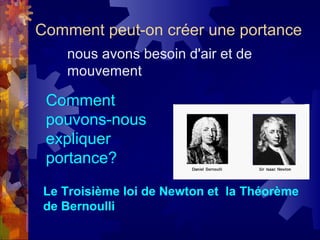
 Le Troisième loi de Newton et la Théorème
 de Bernoulli
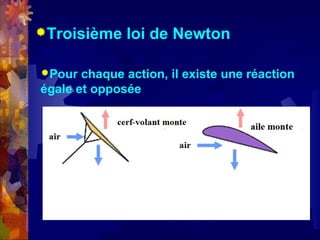
Troisième    loi de Newton

Pour  chaque action, il existe une réaction
égale et opposée
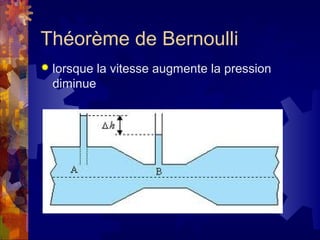
Théorème de Bernoulli
   lorsque la vitesse augmente la pression
    diminue
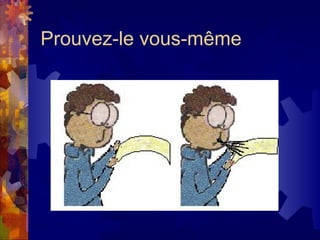
Prouvez-le vous-même
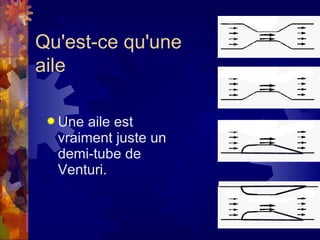
Qu'est-ce qu'une
aile

  Une aile est
  vraiment juste un
  demi-tube de
  Venturi.
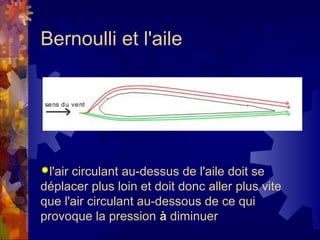
Bernoulli et l'aile


l'aircirculant au-dessus de l'aile doit se
déplacer plus loin et doit donc aller plus vite
que l'air circulant au-dessous de ce qui
provoque la pression à diminuer
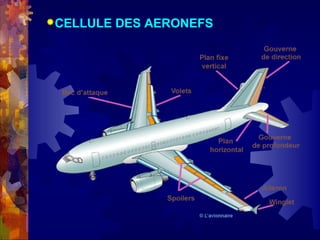
CELLULE   DES AERONEFS
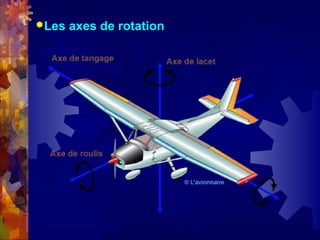
Les   axes de rotation
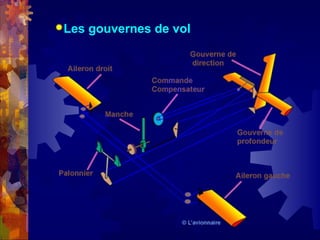
Les   gouvernes de vol
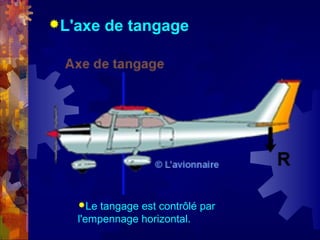
L'axe   de tangage


   Le  tangage est contrôlé par
   l'empennage horizontal.
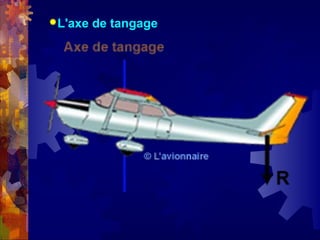
L'axe   de tangage
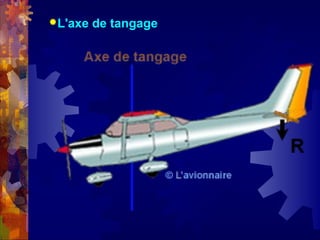
L'axe   de tangage
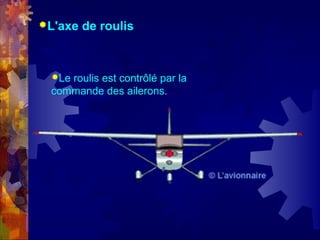
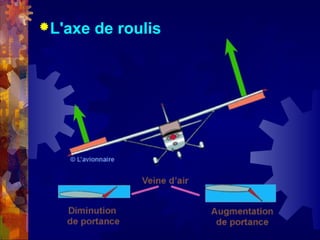
L'axe   de roulis


 Leroulis est contrôlé par la
 commande des ailerons.
L'axe   de roulis
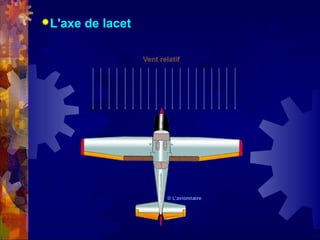
L'axe   de lacet
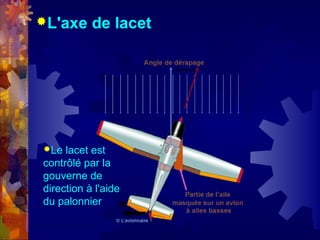
L'axe     de lacet


Le  lacet est
contrôlé par la
gouverne de
direction à l'aide
du palonnier
Questions?

French vol

Notes de l'éditeur

  • #2 This presentation as I go through it today may seem somewhat disjointed so let me explain what’s going on. I’ve posted this presentation on our website so all of you can access it. It’s a ‘slide bank’ more than one cohesive presentation I wanted to make it useful to you regardless of the grade level you’re teaching. So what you’ll see today is a mix of slides from different sources with different levels of explanation. You can pick and choose what will work for you in your classroom. I’ve also included notes on most slides. Some is scripting and there are also leads to website for more information or more illustrations. These first two slides are a good example – two different explanations of the same thing, each of which can stand alone in the presentation. Delete or hide the one you don’t want to use.
  • #3 Since the Wright brothers first flew in 1903, people have created a multitude of airplane types. But every one of them has dealt with the same four forces--lift, weight, thrust, and drag. Lift is the hardest to understand, so let’s tackle it first. We used a query response (I say “lift” you say “weight”, I say “thrust” you say “drag”) of the four forces to get the kids settled when we taught the Aviation Immersion to 3 rd , 4 th and 5 th graders at Cherry Creek Challenge School. Picture from: Plane Math http://www.planemath.com/activities/pmenterprises/forces/forces2.html (See Internet Resources Guide)
  • #8 You need a fluid (air acts like a fluid) and motion. You need air and you need the wing to be moving through the air (or air to be moving over the wing). ***So, if the lift off speed of a small aircraft is 50 kts, will it try to fly in a strong wind? You bet it will – that’s why we always tie airplanes down! Laws/principals proposed by Bernoulli & Newton are used to explain lift. (although neither of them proposed the theories for that reason)
  • #9 Illustration from Plane Math: http://www.planemath.com/ (See Internet Resources) Kite or How to send your wife to Home Depot to get a 4’ x 8’ sheet of plywood on a windy day.
  • #10 Understanding a Venturi tube is essential to understanding lift. As velocity in the constriction increases, pressure must decrease.
  • #12 Venturi tubes describe what happens over a wing. A wing acts like half a venturi tube.
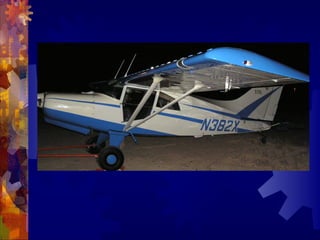
  • #14 This bush plane has a very pronounced curve in the airfoil shape. Why?