Le langage
Go
http://golang.org/
Orléans Tech Talks - Stéphane Legrand - Février 2015
Licence de ce document
Cette présentation est sous licence Creative Commons : Attribution - Pas d’
Utilisation Commerciale - Partage dans les Mêmes Conditions 4.0 International.
Pour accéder à une copie de cette licence, merci de vous rendre à l'adresse
suivante http://creativecommons.org/licenses/by-nc-sa/4.0/ ou envoyez un
courrier à Creative Commons, 444 Castro Street, Suite 900, Mountain View,
California, 94041, USA.
Sommaire
● Historique
● Objectifs
● Hello world
● Quelques spécificités
● Exemple API REST
● Conclusion
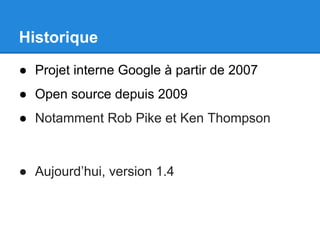
Historique
● Projet interne Google à partir de 2007
● Open source depuis 2009
● Notamment Rob Pike et Ken Thompson
● Aujourd’hui, version 1.4
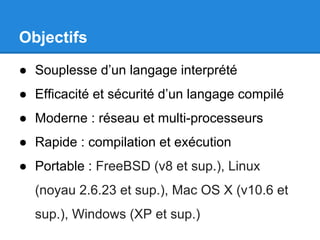
Objectifs
● Souplesse d’un langage interprété
● Efficacité et sécurité d’un langage compilé
● Moderne : réseau et multi-processeurs
● Rapide : compilation et exécution
● Portable : FreeBSD (v8 et sup.), Linux
(noyau 2.6.23 et sup.), Mac OS X (v10.6 et
sup.), Windows (XP et sup.)
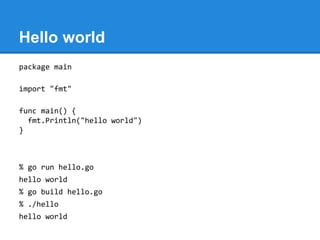
Hello world
package main
import "fmt"
func main() {
fmt.Println("hello world")
}
% go run hello.go
hello world
% go build hello.go
% ./hello
hello world
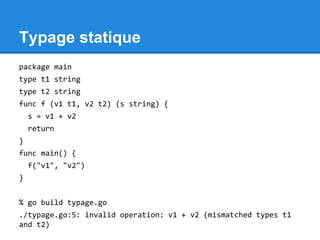
Typage statique
package main
type t1 string
type t2 string
func f (v1 t1, v2 t2) (s string) {
s = v1 + v2
return
}
func main() {
f("v1", "v2")
}
% go build typage.go
./typage.go:5: invalid operation: v1 + v2 (mismatched types t1
and t2)
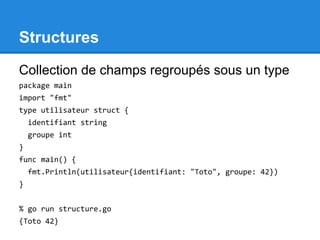
Structures
Collection de champs regroupés sous un type
package main
import "fmt"
type utilisateur struct {
identifiant string
groupe int
}
func main() {
fmt.Println(utilisateur{identifiant: "Toto", groupe: 42})
}
% go run structure.go
{Toto 42}
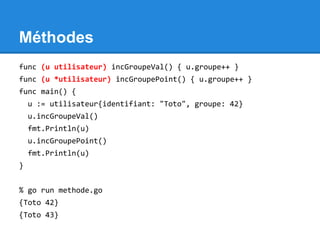
Méthodes
func (u utilisateur) incGroupeVal() { u.groupe++ }
func (u *utilisateur) incGroupePoint() { u.groupe++ }
func main() {
u := utilisateur{identifiant: "Toto", groupe: 42}
u.incGroupeVal()
fmt.Println(u)
u.incGroupePoint()
fmt.Println(u)
}
% go run methode.go
{Toto 42}
{Toto 43}
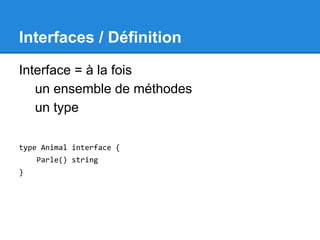
Interfaces / Définition
Interface = à la fois
un ensemble de méthodes
un type
type Animal interface {
Parle() string
}
Interfaces / OK
type Chien struct {}
func (c Chien) Parle() string { return "Wouf !" }
type Chat struct {}
func (c Chat) Parle() string { return "Miaou !" }
func main() {
animaux := []Animal{Chien{}, Chat{}}
for _, animal := range animaux { fmt.Println(animal.Parle()) }
}
% go build interface.go // COMPILATION OK
% ./interface
Wouf !
Miaou !
Interfaces / KO
type Chien struct {}
func (c Chien) Parle() string { return "Wouf !" }
type Chat struct {} // chat muet, pas de méthode Parle()
func main() {
animaux := []Animal{Chien{}, Chat{}}
for _, animal := range animaux { fmt.Println(animal.Parle()) }
}
% go build interface.go
./interface.go:16: cannot use Chat literal (type Chat) as type
Animal in array element:
Chat does not implement Animal (missing Parle method)
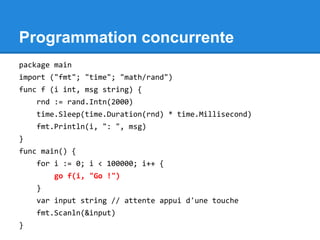
Programmation concurrente
package main
import ("fmt"; "time"; "math/rand")
func f (i int, msg string) {
rnd := rand.Intn(2000)
time.Sleep(time.Duration(rnd) * time.Millisecond)
fmt.Println(i, ": ", msg)
}
func main() {
for i := 0; i < 100000; i++ {
go f(i, "Go !")
}
var input string // attente appui d'une touche
fmt.Scanln(&input)
}
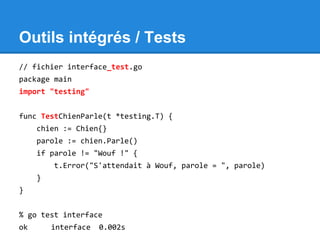
Outils intégrés / Tests
// fichier interface_test.go
package main
import "testing"
func TestChienParle(t *testing.T) {
chien := Chien{}
parole := chien.Parle()
if parole != "Wouf !" {
t.Error("S'attendait à Wouf, parole = ", parole)
}
}
% go test interface
ok interface 0.002s
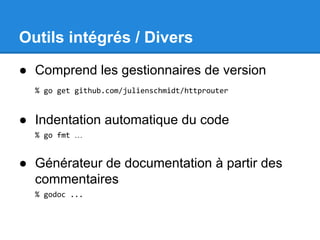
Outils intégrés / Divers
● Comprend les gestionnaires de version
% go get github.com/julienschmidt/httprouter
● Indentation automatique du code
% go fmt …
● Générateur de documentation à partir des
commentaires
% godoc ...
Rapidité de compilation
Pas trouvé de benchmarks (désolé)...
Mais il suffit de l’essayer
pour le constater.
VRAIMENT, VRAIMENT RAPIDE !
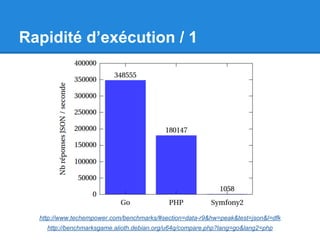
Rapidité d’exécution / 1
http://www.techempower.com/benchmarks/#section=data-r9&hw=peak&test=json&l=dfk
http://benchmarksgame.alioth.debian.org/u64q/compare.php?lang=go&lang2=php
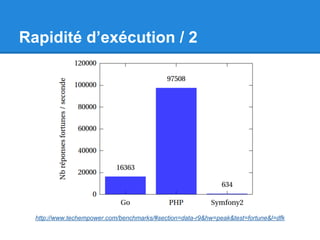
Rapidité d’exécution / 2
http://www.techempower.com/benchmarks/#section=data-r9&hw=peak&test=fortune&l=dfk
Richesse librairie standard
● (dé)compression : gzip, bzip2, zlib…
● (dé)chiffrement : aes, des, hmac, md5, rsa,
sha512…
● bases de données SQL (drivers tiers).
● encodage : base64, csv, json, xml…
● serveur HTTP
● expressions régulières
● opérations sur dates et heures
● Unicode
● ...
Bizarreries...
● Pas d’exceptions (mais v,err := f())
● Pas de type générique
● Erreur de pointeur nul possible
● Pas de librairie dynamique
● Pas d’héritage
http://tmikov.blogspot.fr/2015/02/you-dont-like-googles-go-because-you.html
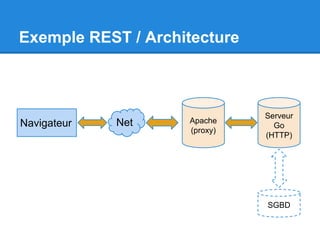
Exemple REST / Architecture
NetNavigateur Apache
(proxy)
Serveur
Go
(HTTP)
SGBD
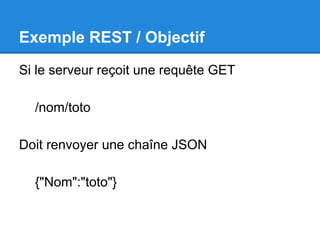
Exemple REST / Objectif
Si le serveur reçoit une requête GET
/nom/toto
Doit renvoyer une chaîne JSON
{"Nom":"toto"}
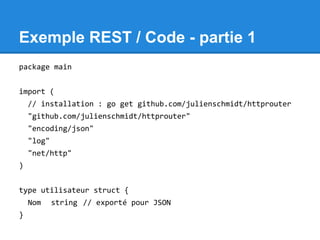
Exemple REST / Code - partie 1
package main
import (
// installation : go get github.com/julienschmidt/httprouter
"github.com/julienschmidt/httprouter"
"encoding/json"
"log"
"net/http"
)
type utilisateur struct {
Nom string // exporté pour JSON
}
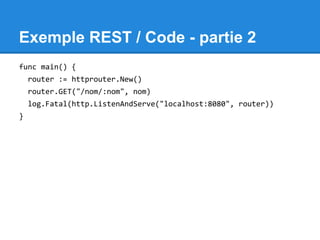
Exemple REST / Code - partie 2
func main() {
router := httprouter.New()
router.GET("/nom/:nom", nom)
log.Fatal(http.ListenAndServe("localhost:8080", router))
}
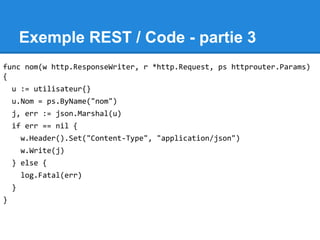
Exemple REST / Code - partie 3
func nom(w http.ResponseWriter, r *http.Request, ps httprouter.Params)
{
u := utilisateur{}
u.Nom = ps.ByName("nom")
j, err := json.Marshal(u)
if err == nil {
w.Header().Set("Content-Type", "application/json")
w.Write(j)
} else {
log.Fatal(err)
}
}
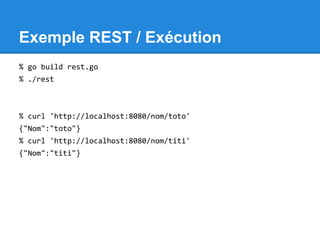
Exemple REST / Exécution
% go build rest.go
% ./rest
% curl 'http://localhost:8080/nom/toto'
{"Nom":"toto"}
% curl 'http://localhost:8080/nom/titi'
{"Nom":"titi"}
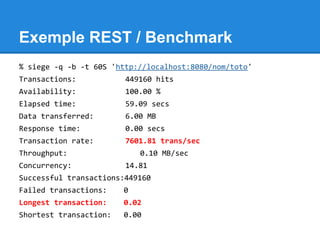
Exemple REST / Benchmark
% siege -q -b -t 60S 'http://localhost:8080/nom/toto'
Transactions: 449160 hits
Availability: 100.00 %
Elapsed time: 59.09 secs
Data transferred: 6.00 MB
Response time: 0.00 secs
Transaction rate: 7601.81 trans/sec
Throughput: 0.10 MB/sec
Concurrency: 14.81
Successful transactions:449160
Failed transactions: 0
Longest transaction: 0.02
Shortest transaction: 0.00
Conclusion
● Pragmatique !
● Beaucoup de potentiel
● Utiliser “golang” pour recherches sur internet
Merci
Merci de votre attention
Questions ?

Presentation langage go_19022015

  • 1.
    Le langage Go http://golang.org/ Orléans TechTalks - Stéphane Legrand - Février 2015
  • 2.
    Licence de cedocument Cette présentation est sous licence Creative Commons : Attribution - Pas d’ Utilisation Commerciale - Partage dans les Mêmes Conditions 4.0 International. Pour accéder à une copie de cette licence, merci de vous rendre à l'adresse suivante http://creativecommons.org/licenses/by-nc-sa/4.0/ ou envoyez un courrier à Creative Commons, 444 Castro Street, Suite 900, Mountain View, California, 94041, USA.
  • 3.
    Sommaire ● Historique ● Objectifs ●Hello world ● Quelques spécificités ● Exemple API REST ● Conclusion
  • 4.
    Historique ● Projet interneGoogle à partir de 2007 ● Open source depuis 2009 ● Notamment Rob Pike et Ken Thompson ● Aujourd’hui, version 1.4
  • 5.
    Objectifs ● Souplesse d’unlangage interprété ● Efficacité et sécurité d’un langage compilé ● Moderne : réseau et multi-processeurs ● Rapide : compilation et exécution ● Portable : FreeBSD (v8 et sup.), Linux (noyau 2.6.23 et sup.), Mac OS X (v10.6 et sup.), Windows (XP et sup.)
  • 6.
    Hello world package main import"fmt" func main() { fmt.Println("hello world") } % go run hello.go hello world % go build hello.go % ./hello hello world
  • 7.
    Typage statique package main typet1 string type t2 string func f (v1 t1, v2 t2) (s string) { s = v1 + v2 return } func main() { f("v1", "v2") } % go build typage.go ./typage.go:5: invalid operation: v1 + v2 (mismatched types t1 and t2)
  • 8.
    Structures Collection de champsregroupés sous un type package main import "fmt" type utilisateur struct { identifiant string groupe int } func main() { fmt.Println(utilisateur{identifiant: "Toto", groupe: 42}) } % go run structure.go {Toto 42}
  • 9.
    Méthodes func (u utilisateur)incGroupeVal() { u.groupe++ } func (u *utilisateur) incGroupePoint() { u.groupe++ } func main() { u := utilisateur{identifiant: "Toto", groupe: 42} u.incGroupeVal() fmt.Println(u) u.incGroupePoint() fmt.Println(u) } % go run methode.go {Toto 42} {Toto 43}
  • 10.
    Interfaces / Définition Interface= à la fois un ensemble de méthodes un type type Animal interface { Parle() string }
  • 11.
    Interfaces / OK typeChien struct {} func (c Chien) Parle() string { return "Wouf !" } type Chat struct {} func (c Chat) Parle() string { return "Miaou !" } func main() { animaux := []Animal{Chien{}, Chat{}} for _, animal := range animaux { fmt.Println(animal.Parle()) } } % go build interface.go // COMPILATION OK % ./interface Wouf ! Miaou !
  • 12.
    Interfaces / KO typeChien struct {} func (c Chien) Parle() string { return "Wouf !" } type Chat struct {} // chat muet, pas de méthode Parle() func main() { animaux := []Animal{Chien{}, Chat{}} for _, animal := range animaux { fmt.Println(animal.Parle()) } } % go build interface.go ./interface.go:16: cannot use Chat literal (type Chat) as type Animal in array element: Chat does not implement Animal (missing Parle method)
  • 13.
    Programmation concurrente package main import("fmt"; "time"; "math/rand") func f (i int, msg string) { rnd := rand.Intn(2000) time.Sleep(time.Duration(rnd) * time.Millisecond) fmt.Println(i, ": ", msg) } func main() { for i := 0; i < 100000; i++ { go f(i, "Go !") } var input string // attente appui d'une touche fmt.Scanln(&input) }
  • 14.
    Outils intégrés /Tests // fichier interface_test.go package main import "testing" func TestChienParle(t *testing.T) { chien := Chien{} parole := chien.Parle() if parole != "Wouf !" { t.Error("S'attendait à Wouf, parole = ", parole) } } % go test interface ok interface 0.002s
  • 15.
    Outils intégrés /Divers ● Comprend les gestionnaires de version % go get github.com/julienschmidt/httprouter ● Indentation automatique du code % go fmt … ● Générateur de documentation à partir des commentaires % godoc ...
  • 16.
    Rapidité de compilation Pastrouvé de benchmarks (désolé)... Mais il suffit de l’essayer pour le constater. VRAIMENT, VRAIMENT RAPIDE !
  • 17.
    Rapidité d’exécution /1 http://www.techempower.com/benchmarks/#section=data-r9&hw=peak&test=json&l=dfk http://benchmarksgame.alioth.debian.org/u64q/compare.php?lang=go&lang2=php
  • 18.
    Rapidité d’exécution /2 http://www.techempower.com/benchmarks/#section=data-r9&hw=peak&test=fortune&l=dfk
  • 19.
    Richesse librairie standard ●(dé)compression : gzip, bzip2, zlib… ● (dé)chiffrement : aes, des, hmac, md5, rsa, sha512… ● bases de données SQL (drivers tiers). ● encodage : base64, csv, json, xml… ● serveur HTTP ● expressions régulières ● opérations sur dates et heures ● Unicode ● ...
  • 20.
    Bizarreries... ● Pas d’exceptions(mais v,err := f()) ● Pas de type générique ● Erreur de pointeur nul possible ● Pas de librairie dynamique ● Pas d’héritage http://tmikov.blogspot.fr/2015/02/you-dont-like-googles-go-because-you.html
  • 21.
    Exemple REST /Architecture NetNavigateur Apache (proxy) Serveur Go (HTTP) SGBD
  • 22.
    Exemple REST /Objectif Si le serveur reçoit une requête GET /nom/toto Doit renvoyer une chaîne JSON {"Nom":"toto"}
  • 23.
    Exemple REST /Code - partie 1 package main import ( // installation : go get github.com/julienschmidt/httprouter "github.com/julienschmidt/httprouter" "encoding/json" "log" "net/http" ) type utilisateur struct { Nom string // exporté pour JSON }
  • 24.
    Exemple REST /Code - partie 2 func main() { router := httprouter.New() router.GET("/nom/:nom", nom) log.Fatal(http.ListenAndServe("localhost:8080", router)) }
  • 25.
    Exemple REST /Code - partie 3 func nom(w http.ResponseWriter, r *http.Request, ps httprouter.Params) { u := utilisateur{} u.Nom = ps.ByName("nom") j, err := json.Marshal(u) if err == nil { w.Header().Set("Content-Type", "application/json") w.Write(j) } else { log.Fatal(err) } }
  • 26.
    Exemple REST /Exécution % go build rest.go % ./rest % curl 'http://localhost:8080/nom/toto' {"Nom":"toto"} % curl 'http://localhost:8080/nom/titi' {"Nom":"titi"}
  • 27.
    Exemple REST /Benchmark % siege -q -b -t 60S 'http://localhost:8080/nom/toto' Transactions: 449160 hits Availability: 100.00 % Elapsed time: 59.09 secs Data transferred: 6.00 MB Response time: 0.00 secs Transaction rate: 7601.81 trans/sec Throughput: 0.10 MB/sec Concurrency: 14.81 Successful transactions:449160 Failed transactions: 0 Longest transaction: 0.02 Shortest transaction: 0.00
  • 28.
    Conclusion ● Pragmatique ! ●Beaucoup de potentiel ● Utiliser “golang” pour recherches sur internet
  • 29.
    Merci Merci de votreattention Questions ?