#backdaybyxebia
William Montaz - Jean-Pascal Thiery
Construire le SI de demain
Chercher la performance efficace
#backdaybyxebia#perfEfficace @willymontaz @jpthiery
La performance, c’est quoi ?
« Mon Application, elle poutre ! »
« Il faut moins de 2 heures à mon batch pour
s`exécuter.»
« Mon algorithme utilise moins de 10% du CPU.» 
- Ensemble de données chiffrables
- Des niveaux de tolérance qui dépendent du type de traitement.
#backdaybyxebia#perfEfficace @willymontaz @jpthiery
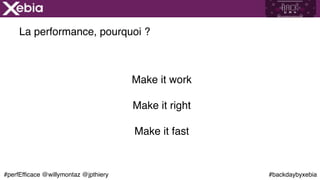
La performance, pourquoi ?
Make it work
Make it right
Make it fast
#backdaybyxebia#perfEfficace @willymontaz @jpthiery
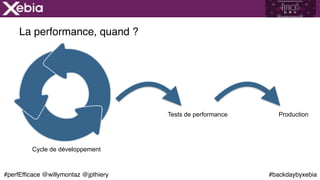
La performance, quand ?
Tests de performance Production
Cycle de développement
#backdaybyxebia#perfEfficace @willymontaz @jpthiery
La performance, comment ? L’environnement :
#backdaybyxebia#perfEfficace @willymontaz @jpthiery
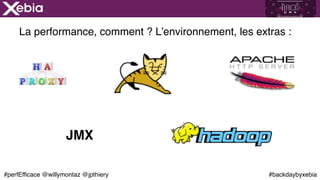
La performance, comment ? L’environnement, les extras :
JMX
#backdaybyxebia#perfEfficace @willymontaz @jpthiery
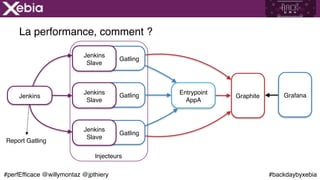
Injecteurs
Graphite
Gatling
Gatling
Gatling
La performance, comment ?
Jenkins
Jenkins

Slave
Jenkins

Slave
Jenkins

Slave
Entrypoint

AppA
Grafana
Report Gatling
#backdaybyxebia
Une démarche, quelques idées
#backdaybyxebia
BIG THANKS
Kodewerk, Kirk Pepperdine
Java Performance Tuning
#backdaybyxebia
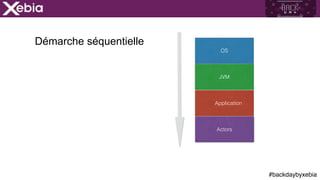
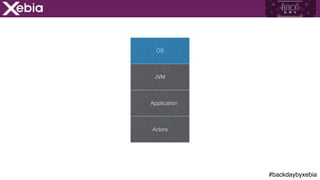
OS
JVM
Application
Actors
Démarche séquentielle
#backdaybyxebia
OS
JVM
Application
Actors
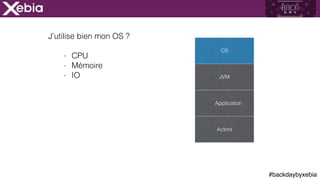
J’utilise bien mon OS ?
- CPU
- Mémoire
- IO
#backdaybyxebia
OS
JVM
Application
Actors
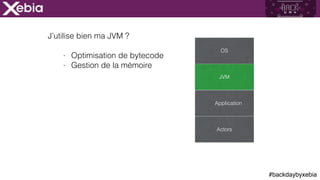
J’utilise bien ma JVM ?
- Optimisation de bytecode
- Gestion de la mémoire
#backdaybyxebia
OS
JVM
Application
Actors
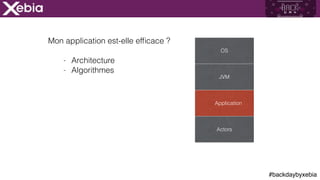
Mon application est-elle efficace ?
- Architecture
- Algorithmes
#backdaybyxebia
OS
JVM
Application
Actors
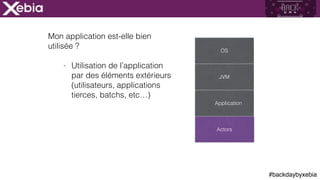
Mon application est-elle bien
utilisée ?
- Utilisation de l’application
par des éléments extérieurs
(utilisateurs, applications
tierces, batchs, etc…)
#backdaybyxebia
OS
JVM
Application
Actors
#backdaybyxebia
OS
2 questions
#backdaybyxebia
Suis-je seul ?
OS
#backdaybyxebia
TOP (!)
OS
#backdaybyxebia
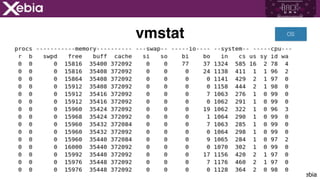
J’utilise 100% du CPU ?
OS
#backdaybyxebia
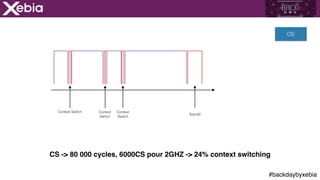
CS -> 80 000 cycles, 6000CS pour 2GHZ -> 24% context switching
Context Switch Context
Switch
Context
Switch
OS
Syscall
#backdaybyxebia
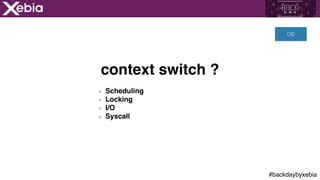
context switch ?
Scheduling
Locking
I/O
Syscall
OS
#backdaybyxebia
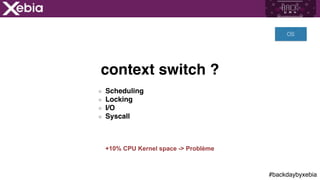
context switch ?
Scheduling
Locking
I/O
Syscall
OS
+10% CPU Kernel space -> Problème
#backdaybyxebia
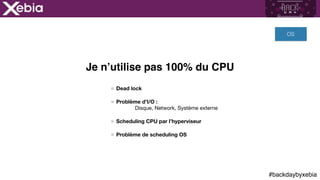
Dead lock
Problème d’I/O :
Disque, Network, Système externe

Scheduling CPU par l’hyperviseur
Problème de scheduling OS
Je n’utilise pas 100% du CPU
OS
#backdaybyxebia
vmstat OS
#backdaybyxebia
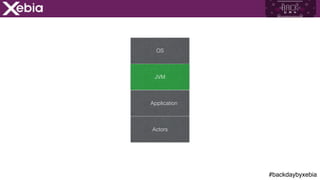
OS
JVM
Application
Actors
#backdaybyxebia
HotSpot
JVM
#backdaybyxebia
JIT Compiler
JVM
#backdaybyxebia
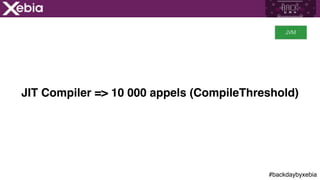
JIT Compiler => 10 000 appels (CompileThreshold)
JVM
#backdaybyxebia
Huge Methods
JVM
#backdaybyxebia
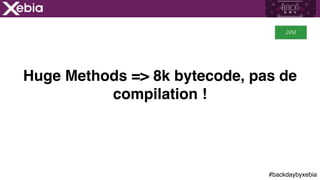
Huge Methods => 8k bytecode, pas de
compilation !
JVM
#backdaybyxebia
Inlining
JVM
#backdaybyxebia
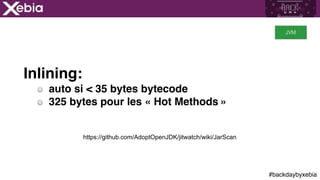
Inlining:
auto si < 35 bytes bytecode
325 bytes pour les « Hot Methods »
JVM
https://github.com/AdoptOpenJDK/jitwatch/wiki/JarScan
#backdaybyxebia
Call Stack & Récursivité
JVM
#backdaybyxebia
Chargement/Déchargement de classloader
JVM
#backdaybyxebia
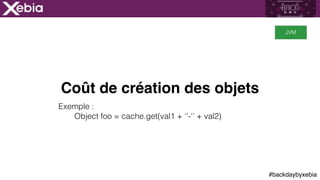
Coût de création des objets
JVM
#backdaybyxebia
Coût de création des objets
Exemple :
Object foo = cache.get(val1 + ‘’-‘’ + val2)
JVM
#backdaybyxebia
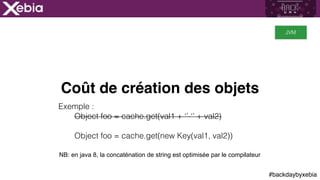
Coût de création des objets
Exemple :
Object foo = cache.get(val1 + ‘’-‘’ + val2)
Object foo = cache.get(new Key(val1, val2))
JVM
NB: en java 8, la concaténation de string est optimisée par le compilateur
#backdaybyxebia
Garbage Collection
JVM
#backdaybyxebia
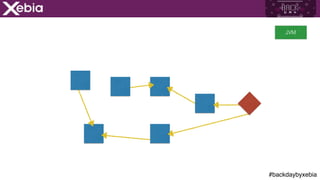
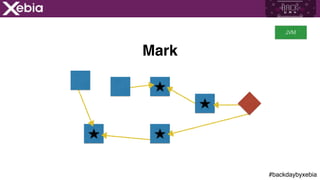
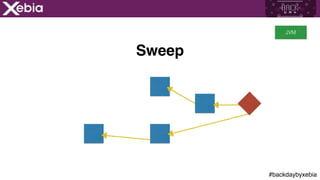
Mark & Sweep
JVM
#backdaybyxebia
JVM
#backdaybyxebia
Mark
JVM
#backdaybyxebia
Sweep
JVM
#backdaybyxebia
Hypothèse générationnelle
Beaucoup d’objets sont transients
Seulement quelques objets ont une longue durée de vie
JVM
#backdaybyxebia
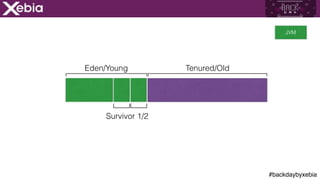
Eden/Young Tenured/Old
Survivor 1/2
JVM
#backdaybyxebia
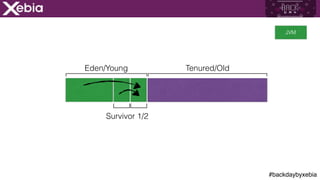
Eden/Young Tenured/Old
Survivor 1/2
JVM
#backdaybyxebia
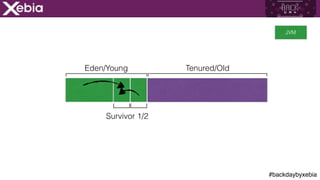
Eden/Young Tenured/Old
Survivor 1/2
JVM
#backdaybyxebia
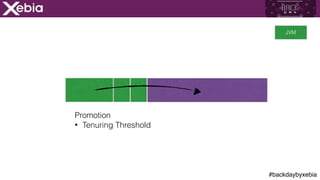
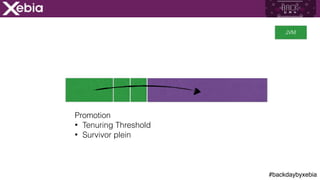
Promotion
• Tenuring Threshold
JVM
#backdaybyxebia
Promotion
• Tenuring Threshold
• Survivor plein
JVM
#backdaybyxebia
GC Roots ?
JVM
#backdaybyxebia
GC Roots ?
stack frames
JVM
#backdaybyxebia
GC Roots ?
stack frames
References JNI
JVM
#backdaybyxebia
GC Roots ?
stack frames
References JNI
Class loaders
JVM
#backdaybyxebia
GC Roots ?
stack frames
References JNI
Class loaders
Objets dans le Tenured Space !
JVM
#backdaybyxebia
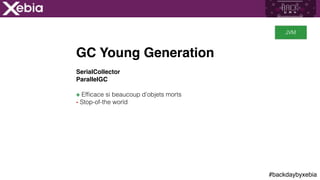
GC Young Generation
SerialCollector
ParallelGC
+ Efficace si beaucoup d’objets morts
- Stop-of-the world
JVM
#backdaybyxebia
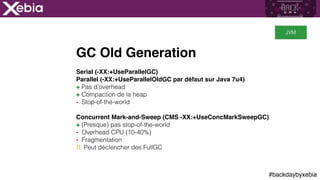
GC Old Generation
Serial (-XX:+UseParallelGC)
Parallel (-XX:+UseParallelOldGC par défaut sur Java 7u4)
+ Pas d’overhead
+ Compaction de la heap
- Stop-of-the-world
Concurrent Mark-and-Sweep (CMS -XX:+UseConcMarkSweepGC)
+ (Presque) pas stop-of-the-world
- Overhead CPU (10-40%)
- Fragmentation
!! Peut déclencher des FullGC
JVM
#backdaybyxebia
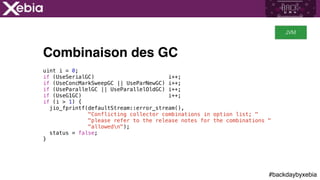
Combinaison des GC
uint i = 0;
if (UseSerialGC) i++;
if (UseConcMarkSweepGC || UseParNewGC) i++;
if (UseParallelGC || UseParallelOldGC) i++;
if (UseG1GC) i++;
if (i > 1) {
jio_fprintf(defaultStream::error_stream(),
"Conflicting collector combinations in option list; "
"please refer to the release notes for the combinations "
"allowedn");
status = false;
}
JVM
#backdaybyxebia
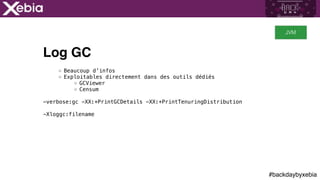
Log GC
Beaucoup d’infos
Exploitables directement dans des outils dédiés
GCViewer
Censum
-verbose:gc -XX:+PrintGCDetails -XX:+PrintTenuringDistribution
-Xloggc:filename
JVM
#backdaybyxebia
Memory Leak
JVM
#backdaybyxebia
Memory Leak
HEAP DUMP -> Memory Analysis Tool
JVM
#backdaybyxebia
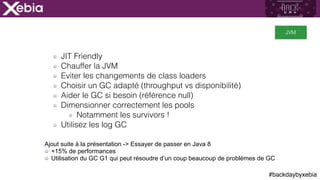
JIT Friendly
Chauffer la JVM
Eviter les changements de class loaders
Choisir un GC adapté (throughput vs disponibilité)
Aider le GC si besoin (référence null)
Dimensionner correctement les pools
Notamment les survivors !
Utilisez les log GC
JVM
Ajout suite à la présentation -> Essayer de passer en Java 8
+15% de performances
Utilisation du GC G1 qui peut résoudre d’un coup beaucoup de problèmes de GC
#backdaybyxebia
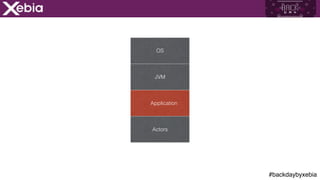
OS
JVM
Application
Actors
#backdaybyxebia
APP
Detecter les problèmes de lock
#backdaybyxebia
Detecter les problèmes de lock
THREAD DUMP !
APP
#backdaybyxebia
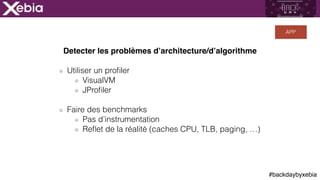
Detecter les problèmes d’architecture/d’algorithme
Utiliser un profiler
VisualVM
JProfiler
Faire des benchmarks
Pas d’instrumentation
Reflet de la réalité (caches CPU, TLB, paging, …)
APP
#backdaybyxebia
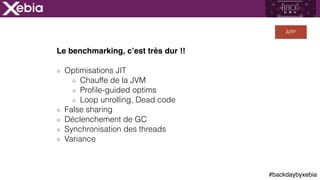
Le benchmarking, c’est très dur !!
Optimisations JIT
Chauffe de la JVM
Profile-guided optims
Loop unrolling, Dead code
False sharing
Déclenchement de GC
Synchronisation des threads
Variance
APP
#backdaybyxebia
JMH
public class JMHSample_03_States {
@State(Scope.Thread)
public static class ThreadState {
volatile double x = Math.PI;
}
@Benchmark
public void measureUnshared(ThreadState state) {
state.x++;
}
public static void main(String[] args) throws RunnerException {
Options opt = new OptionsBuilder()
.include(JMHSample_03_States.class.getSimpleName())
.warmupIterations(5)
.measurementIterations(5)
.threads(4)
.forks(1)
.build();
new Runner(opt).run();
}
}
APP
#backdaybyxebia
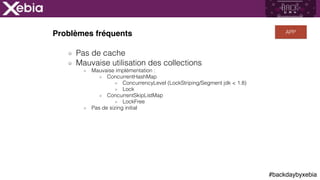
Problèmes fréquents
Pas de cache
APP
#backdaybyxebia
Problèmes fréquents
Pas de cache
Mauvaise utilisation des collections
Mauvaise implémentation :
ConcurrentHashMap
ConcurrencyLevel (LockStriping/Segment jdk < 1.8)
Lock
ConcurrentSkipListMap
LockFree
Pas de sizing initial
APP
#backdaybyxebia
Problèmes fréquents
Pas de cache
Mauvaise utilisation des collections
Mauvaise implémentation :
ConcurrentHashMap
ConcurrencyLevel (LockStriping/Segment jdk < 1.8)
Lock
ConcurrentSkipListMap
LockFree
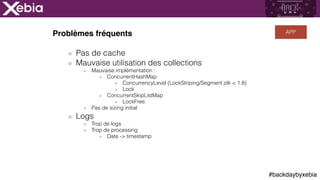
Pas de sizing initial
Logs
Trop de logs
Trop de processing
Date -> timestamp
APP
#backdaybyxebia
Problèmes fréquents
Pas de cache
Mauvaise utilisation des collections
Mauvaise implémentation :
ConcurrentHashMap
ConcurrencyLevel (LockStriping/Segment jdk < 1.8)
Lock
ConcurrentSkipListMap
LockFree
Pas de sizing initial
Logs
Trop de logs
Trop de processing
Date -> timestamp
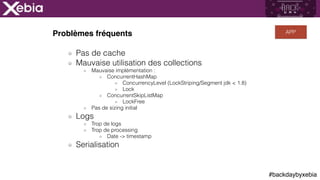
Serialisation
APP
#backdaybyxebia
Problèmes fréquents
Pas de cache
Mauvaise utilisation des collections
Mauvaise implémentation :
ConcurrentHashMap
ConcurrencyLevel (LockStriping/Segment jdk < 1.8)
Lock
ConcurrentSkipListMap
LockFree
Pas de sizing initial
Logs
Trop de logs
Trop de processing
Date -> timestamp
Serialisation
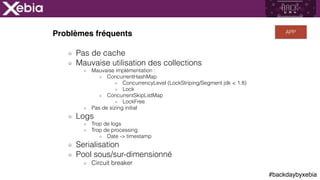
Pool sous/sur-dimensionné
Circuit breaker
APP
#backdaybyxebia
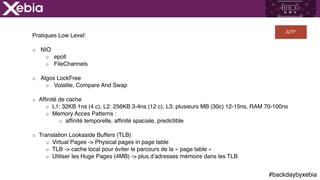
Pratiques Low Level:
NIO
epoll
FileChannels
Algos LockFree
Volatile, Compare And Swap
Affinité de cache
L1: 32KB 1ns (4 c), L2: 256KB 3-4ns (12 c), L3: plusieurs MB (30c) 12-15ns, RAM 70-100ns
Memory Acces Patterns :
affinité temporelle, affinité spaciale, predictible
Translation Lookaside Buffers (TLB)
Virtual Pages -> Physical pages in page table
TLB -> cache local pour éviter le parcours de la « page table »
Utiliser les Huge Pages (4MB) -> plus d’adresses mémoire dans les TLB
APP
#backdaybyxebia
http://openjdk.java.net/projects/code-tools/jmh/
http://www.7-cpu.com/cpu/SandyBridge.html
http://mechanical-sympathy.blogspot.fr/2013/07/java-garbage-collection-distilled.html
Dmitry Vyazelenko
http://martinfowler.com/articles/lmax.html
http://mechanical-sympathy.blogspot.fr/2012/08/memory-access-patterns-are-important.html
JDK (!)
Martin Thompson
Martin Fowler
Lecture

Backday xebia - Chercher la performance efficacement