Digital History :Digital History :
essais de définitionessais de définition
--
some definitions ?some definitions ?
Digital History: Histoire et Mémoire à
la portée de tous ?
122/02/2013
Digital Turn, Digital HistoryDigital Turn, Digital History ouou Digital HumanitiesDigital Humanities??
 Faut-il voir la révolution du numérique seulement comme une nouvelle “boîte à outils” comme
le carnet de recherche (blog) d’Emilien Ruiz et de Franziska Heimburger auteurs de l’essai:
“Has the Historian’s craft gone digital?“ quand ils affirment que “we do not have the
impression that the “digital revolution” will lead to a change in the fundamental epistemology
of historical research. That said, the historian’s craft is changing and it is subject to profound
evolution in [its] practices ….”
 Ou avec Claire Lemercier, qui, dans son interview à la revue Diacronie, parle des instruments
qui organisent l’écriture de l’histoire, un concept très restrictif qui ne tient pas compte des
attentes réelles et des accomplissements des Digital Humanities et de la Digital History?
 Les Digital Humanities naissent dans les trasformations des Humanities Computing qui
rencontrent le web: nouvelles demandes, nouvelles recherches grâce à de nouveaux
instruments, de nouveaux paradigmes critiques et de nouvelles modalités de communication
des résultats dans la toile permettent la naissance d’une transdisciplinetransdiscipline qui est aussi la Digital
History.
 La digital history est discipline “autogérée” -certes grâce aux boîtes à outils-, parfois avec des
formations spécifiques pour concevoir et utiliser les instruments nouveaux.
 Au niveau académique pourtant les digital humanities sont “officiellement» une nouvelle
discipline et la sous-discipline de la Digital History n’est toujours pas considérée.
 Des hiérarchies de l’approfondissement disciplinaire existent: de l’usage des instruments
numériques au fait de penser de manière différente la recherche et ses produits à travers le
numérique (communication) et grâce au numérique (conception) et, enfin, ce qui intéresse le
plus les historien publics: grâce à la participation à l’écriture de l’histoire et à ses différents
langages dans le numérique.
Digital History: Histoire et Mémoire à
la portée de tous ?
222/02/2013
First time usedFirst time used Digital HistoryDigital History ??
In 1997 in Charlottesville, University of Virginia:In 1997 in Charlottesville, University of Virginia:
“So far few historians have tried to define “digital
history”. We were probably the first to use the term
when Ed Ayers and I founded and named the Virginia
Center for Digital History (VCDH) in 1997-1998. We used
the term in essays and talks to describe The Valley of
the Shadow. In 1997 was taught an undergraduate
seminar”Digital History of the Civil War”. We began
calling such courses “digital history seminars”[...].
Later Steve Mintz started his site (in effect a digital
textbook) using the name Digital History.”,
(Willian G.Thomas III in “Interchange: The Promise of Digital History, in The
Journal of American History, 95/2, September 2008, pp.452-491).
13/06/13 3322/02/2013
Digital History: Histoire et Mémoire à
la portée de tous ?
Edward L.Ayers in 1999Edward L.Ayers in 1999
Why becoming a Digital Historian ?Why becoming a Digital Historian ?
“Historians need to understand the new media and its
implications as fully as possible, for both defensive and
hopeful reasons. We need to resist the dilution and
distortion of historical knowledge brought by the erosion
of our authority in a widely dispersed new medium. The
best way to wage that resistance is to seize for ourselves
the opportunities the medium offers, opportunities to
touch the past, present, and future in new ways.”
In: The Pasts and Futures of Digital History, URL:
[http://www.vcdh.virginia.edu/PastsFutures.html]
Edward L. Ayers. University of Virginia, 1999 (Later, from 2002, VCDH,
Virginia Center for Digital History)
4
Digital History: Histoire et Mémoire à
la portée de tous ?
22/02/2013
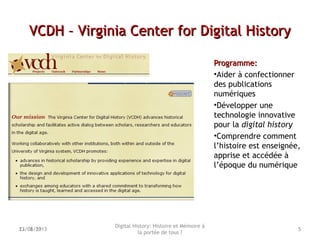
VCDH – Virginia Center for Digital HistoryVCDH – Virginia Center for Digital History
Programme:Programme:
•Aider à confectionner
des publications
numériques
•Développer une
technologie innovative
pour la digital history
•Comprendre comment
l’histoire est enseignée,
apprise et accédée à
l’époque du numérique
Digital History: Histoire et Mémoire à
la portée de tous ?
513/06/13 522/02/2013
Digital Historian: Roy A. RosenzweigDigital Historian: Roy A. Rosenzweig
• “Roy A. Rosenzweig, 57, a social and cultural
historian at George Mason University […]
became a prominent advocate for "digital
history," a field combining historical scholarship
with digital media's broad reach and interactive
possibilities….”
• At GMU's Center for History and New Media, Roy A. Rosenzweig oversaw
the creation of online history projects (Links to Washington Post article
by Adam Bernstein, Washington Post Staff Writer, Saturday, October 13,
2007)
6
Digital History: Histoire et Mémoire à
la portée de tous ?
22/02/2013
What is Digital History ?What is Digital History ?
CHNM, George Mason UniversityCHNM, George Mason University
• “Digital history is an approach to
examining and representing the
past that takes advantage of new
communication technologies such
as computers and the Web. It
draws on essential features of the
digital realm, such as databases,
hypertextualization, and
networks, to create and share
historical knowledge.
• Digital history complements other
forms of history—indeed, it draws
its strength and methodological
rigor from this age-old form of
human understanding while using
the latest technology.”
Digital History: Histoire et Mémoire à
la portée de tous ?
722/02/2013
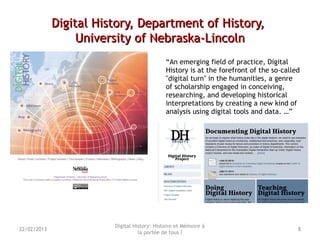
Digital History, Department of History,Digital History, Department of History,
University of Nebraska-LincolnUniversity of Nebraska-Lincoln
“An emerging field of practice, Digital
History is at the forefront of the so-called
"digital turn" in the humanities, a genre
of scholarship engaged in conceiving,
researching, and developing historical
interpretations by creating a new kind of
analysis using digital tools and data. …”
Digital History: Histoire et Mémoire à
la portée de tous ?
822/02/2013
BeyondBeyond Valley of the Shadow Project:Valley of the Shadow Project:
new research queries for the (digital) historiannew research queries for the (digital) historian
« Using digital media, we wanted
to give readers full access to a
scholarly argument, the
historiography about it, and
the evidence for it.[…].”
William G. Thomas III et Edward L. Ayers: “An
Overview: The Differences Slavery Made: A
Close Analysis of Two American
Communities.”, dans American Historical
Review, 108/5, 2003, pp.1299–1307.
Digital History: Histoire et Mémoire à
la portée de tous ?
922/02/2013
Modification des outils ou rénovationModification des outils ou rénovation
de la science historique ?de la science historique ?
“it already had altered modes of learning and teaching,
access to original sources and to information”
Jordanova ajoute
“it remains unclear in 2005 precisely how internet will
radically transform, if at all, the nature of historical
scholarship”. (Ludmilla Jordanova: History in practice., London,
Hodder Arnold - Bloomsbury Academic, 2006, 2nd edition, p.189
(Bloomsbury 2013, 3rd
edition).
Est-ce toujours d’actualité ? Est-ce que ce l’était en 2005
lors de la 2ème édition de son livre ?
Digital History: Histoire et Mémoire à
la portée de tous ?
1022/02/2013
Quels changements épistémologiques avecQuels changements épistémologiques avec
la digital history 2.0?la digital history 2.0?
• L’histoire numérique 2.0, en fonction de l’histoire elle-même, mais aussi
d’une digital history 1.0 préexistante, offre des changements
technologiques, peut-être de changements épistémologiques, mais sans
doute pas de changements ontologiques.
• Si l’on reste avec la digital history 1 ou 2, dans le domaine d’un champ de
l’histoire, se pose alors le problème de la révision des méthodes utiles
dans ce champ en tant historien.
• Les éléments d’une critique interne et externe de la documentation
numérisée, propres à l’approche que les médiévistes adoptent pour
affronter leurs documents, sont les points forts d’une méthode critique
nouvelle à déployer dans les contextes numériques.
• Le passage au Web 2.0 ne change pas les problèmes posés dès le départ au
métier d’historien par l’introduction du numérique, ni les nécessités de
l’élaboration d’une méthode critique adaptée au nouveau média internet.
Authentifier, mettre en contexte, décrire les sources avec précision, sont
des moments obligés de la recherche historique également dans le
domaine numérique.
Digital History: Histoire et Mémoire à
la portée de tous ?
1122/02/2013
La Digital History: nouvelles sources,La Digital History: nouvelles sources,
nouveaux instruments, nouveaux historiensnouveaux instruments, nouveaux historiens
• Pouvoir à l’utilisateur final, (end-user)
• P2P interactive communication
• Nouvelles formes d’écriture: blog, vlog, médias
sociaux, wiki, etc.
• Nouveaux instruments grâce aux codes open source:
mashup, etc. pour qui est capable techniquement
de les exploiter et aussi de les construire
Digital History: Histoire et Mémoire à
la portée de tous ?
1222/02/2013
Digital Turn in History ?Digital Turn in History ?
Jennifer Rutner and Roger C.Schonfeld: Supporting
the changing research practices of historians:
Final Report from ITHAKA S+R, December 10,
2012
“Based on interviews with dozens of historians,
librarians, archivists, and other support
services providers, this project has found
that the underlying research methods of
many historians remain fairly recognizable
even with the introduction of new tools and
technologies, but the day to day research
practices of all historians have changed
fundamentally […]. The findings and
recommendations from the present project
connect directly to efforts to best educate
PhD students for the field of history […].
We hope they will suggest opportunities at
both a field and a campus level to ensure
that academic historians and the field of
history is well served in its digital turn.”
(p.5).
Analysed Impact on:
 Archives
 Libraries
 Providers of digital/digitized
Resources
 Research notes management
systems
 History Departments
 Scholarly Societies
 Funders
Digital History: Histoire et Mémoire à
la portée de tous ?
1322/02/2013
Public and Digital HistoryPublic and Digital History
Kirsten Sword, (“Interchange: The Promise of Digital History”, Journal
of American History, 95/2, 2008, pp.452-491)
3 reasons:
• “New Archives/New Inquiry: Digital resources are expanding and
redefining the archival base for most fields and thereby redefining
the fields themselves. (This is driven more by libraries and the
tech industry than by historians.)
• Audience: New bridges between academic and popular/public
history.
• Collaboration: […] The best digital projects are collaborative,
involving multiple scholars and a technical team, and ideally an
institution committed to keeping the project alive after its
creators move on to other things. …”
Digital History: Histoire et Mémoire à
la portée de tous ?
1422/02/2013

Digital history, evolution or revolution ? Some definitions - 13 -6 -2013

  • 1.
    Digital History :DigitalHistory : essais de définitionessais de définition -- some definitions ?some definitions ? Digital History: Histoire et Mémoire à la portée de tous ? 122/02/2013
  • 2.
    Digital Turn, DigitalHistoryDigital Turn, Digital History ouou Digital HumanitiesDigital Humanities??  Faut-il voir la révolution du numérique seulement comme une nouvelle “boîte à outils” comme le carnet de recherche (blog) d’Emilien Ruiz et de Franziska Heimburger auteurs de l’essai: “Has the Historian’s craft gone digital?“ quand ils affirment que “we do not have the impression that the “digital revolution” will lead to a change in the fundamental epistemology of historical research. That said, the historian’s craft is changing and it is subject to profound evolution in [its] practices ….”  Ou avec Claire Lemercier, qui, dans son interview à la revue Diacronie, parle des instruments qui organisent l’écriture de l’histoire, un concept très restrictif qui ne tient pas compte des attentes réelles et des accomplissements des Digital Humanities et de la Digital History?  Les Digital Humanities naissent dans les trasformations des Humanities Computing qui rencontrent le web: nouvelles demandes, nouvelles recherches grâce à de nouveaux instruments, de nouveaux paradigmes critiques et de nouvelles modalités de communication des résultats dans la toile permettent la naissance d’une transdisciplinetransdiscipline qui est aussi la Digital History.  La digital history est discipline “autogérée” -certes grâce aux boîtes à outils-, parfois avec des formations spécifiques pour concevoir et utiliser les instruments nouveaux.  Au niveau académique pourtant les digital humanities sont “officiellement» une nouvelle discipline et la sous-discipline de la Digital History n’est toujours pas considérée.  Des hiérarchies de l’approfondissement disciplinaire existent: de l’usage des instruments numériques au fait de penser de manière différente la recherche et ses produits à travers le numérique (communication) et grâce au numérique (conception) et, enfin, ce qui intéresse le plus les historien publics: grâce à la participation à l’écriture de l’histoire et à ses différents langages dans le numérique. Digital History: Histoire et Mémoire à la portée de tous ? 222/02/2013
  • 3.
    First time usedFirsttime used Digital HistoryDigital History ?? In 1997 in Charlottesville, University of Virginia:In 1997 in Charlottesville, University of Virginia: “So far few historians have tried to define “digital history”. We were probably the first to use the term when Ed Ayers and I founded and named the Virginia Center for Digital History (VCDH) in 1997-1998. We used the term in essays and talks to describe The Valley of the Shadow. In 1997 was taught an undergraduate seminar”Digital History of the Civil War”. We began calling such courses “digital history seminars”[...]. Later Steve Mintz started his site (in effect a digital textbook) using the name Digital History.”, (Willian G.Thomas III in “Interchange: The Promise of Digital History, in The Journal of American History, 95/2, September 2008, pp.452-491). 13/06/13 3322/02/2013 Digital History: Histoire et Mémoire à la portée de tous ?
  • 4.
    Edward L.Ayers in1999Edward L.Ayers in 1999 Why becoming a Digital Historian ?Why becoming a Digital Historian ? “Historians need to understand the new media and its implications as fully as possible, for both defensive and hopeful reasons. We need to resist the dilution and distortion of historical knowledge brought by the erosion of our authority in a widely dispersed new medium. The best way to wage that resistance is to seize for ourselves the opportunities the medium offers, opportunities to touch the past, present, and future in new ways.” In: The Pasts and Futures of Digital History, URL: [http://www.vcdh.virginia.edu/PastsFutures.html] Edward L. Ayers. University of Virginia, 1999 (Later, from 2002, VCDH, Virginia Center for Digital History) 4 Digital History: Histoire et Mémoire à la portée de tous ? 22/02/2013
  • 5.
    VCDH – VirginiaCenter for Digital HistoryVCDH – Virginia Center for Digital History Programme:Programme: •Aider à confectionner des publications numériques •Développer une technologie innovative pour la digital history •Comprendre comment l’histoire est enseignée, apprise et accédée à l’époque du numérique Digital History: Histoire et Mémoire à la portée de tous ? 513/06/13 522/02/2013
  • 6.
    Digital Historian: RoyA. RosenzweigDigital Historian: Roy A. Rosenzweig • “Roy A. Rosenzweig, 57, a social and cultural historian at George Mason University […] became a prominent advocate for "digital history," a field combining historical scholarship with digital media's broad reach and interactive possibilities….” • At GMU's Center for History and New Media, Roy A. Rosenzweig oversaw the creation of online history projects (Links to Washington Post article by Adam Bernstein, Washington Post Staff Writer, Saturday, October 13, 2007) 6 Digital History: Histoire et Mémoire à la portée de tous ? 22/02/2013
  • 7.
    What is DigitalHistory ?What is Digital History ? CHNM, George Mason UniversityCHNM, George Mason University • “Digital history is an approach to examining and representing the past that takes advantage of new communication technologies such as computers and the Web. It draws on essential features of the digital realm, such as databases, hypertextualization, and networks, to create and share historical knowledge. • Digital history complements other forms of history—indeed, it draws its strength and methodological rigor from this age-old form of human understanding while using the latest technology.” Digital History: Histoire et Mémoire à la portée de tous ? 722/02/2013
  • 8.
    Digital History, Departmentof History,Digital History, Department of History, University of Nebraska-LincolnUniversity of Nebraska-Lincoln “An emerging field of practice, Digital History is at the forefront of the so-called "digital turn" in the humanities, a genre of scholarship engaged in conceiving, researching, and developing historical interpretations by creating a new kind of analysis using digital tools and data. …” Digital History: Histoire et Mémoire à la portée de tous ? 822/02/2013
  • 9.
    BeyondBeyond Valley ofthe Shadow Project:Valley of the Shadow Project: new research queries for the (digital) historiannew research queries for the (digital) historian « Using digital media, we wanted to give readers full access to a scholarly argument, the historiography about it, and the evidence for it.[…].” William G. Thomas III et Edward L. Ayers: “An Overview: The Differences Slavery Made: A Close Analysis of Two American Communities.”, dans American Historical Review, 108/5, 2003, pp.1299–1307. Digital History: Histoire et Mémoire à la portée de tous ? 922/02/2013
  • 10.
    Modification des outilsou rénovationModification des outils ou rénovation de la science historique ?de la science historique ? “it already had altered modes of learning and teaching, access to original sources and to information” Jordanova ajoute “it remains unclear in 2005 precisely how internet will radically transform, if at all, the nature of historical scholarship”. (Ludmilla Jordanova: History in practice., London, Hodder Arnold - Bloomsbury Academic, 2006, 2nd edition, p.189 (Bloomsbury 2013, 3rd edition). Est-ce toujours d’actualité ? Est-ce que ce l’était en 2005 lors de la 2ème édition de son livre ? Digital History: Histoire et Mémoire à la portée de tous ? 1022/02/2013
  • 11.
    Quels changements épistémologiquesavecQuels changements épistémologiques avec la digital history 2.0?la digital history 2.0? • L’histoire numérique 2.0, en fonction de l’histoire elle-même, mais aussi d’une digital history 1.0 préexistante, offre des changements technologiques, peut-être de changements épistémologiques, mais sans doute pas de changements ontologiques. • Si l’on reste avec la digital history 1 ou 2, dans le domaine d’un champ de l’histoire, se pose alors le problème de la révision des méthodes utiles dans ce champ en tant historien. • Les éléments d’une critique interne et externe de la documentation numérisée, propres à l’approche que les médiévistes adoptent pour affronter leurs documents, sont les points forts d’une méthode critique nouvelle à déployer dans les contextes numériques. • Le passage au Web 2.0 ne change pas les problèmes posés dès le départ au métier d’historien par l’introduction du numérique, ni les nécessités de l’élaboration d’une méthode critique adaptée au nouveau média internet. Authentifier, mettre en contexte, décrire les sources avec précision, sont des moments obligés de la recherche historique également dans le domaine numérique. Digital History: Histoire et Mémoire à la portée de tous ? 1122/02/2013
  • 12.
    La Digital History:nouvelles sources,La Digital History: nouvelles sources, nouveaux instruments, nouveaux historiensnouveaux instruments, nouveaux historiens • Pouvoir à l’utilisateur final, (end-user) • P2P interactive communication • Nouvelles formes d’écriture: blog, vlog, médias sociaux, wiki, etc. • Nouveaux instruments grâce aux codes open source: mashup, etc. pour qui est capable techniquement de les exploiter et aussi de les construire Digital History: Histoire et Mémoire à la portée de tous ? 1222/02/2013
  • 13.
    Digital Turn inHistory ?Digital Turn in History ? Jennifer Rutner and Roger C.Schonfeld: Supporting the changing research practices of historians: Final Report from ITHAKA S+R, December 10, 2012 “Based on interviews with dozens of historians, librarians, archivists, and other support services providers, this project has found that the underlying research methods of many historians remain fairly recognizable even with the introduction of new tools and technologies, but the day to day research practices of all historians have changed fundamentally […]. The findings and recommendations from the present project connect directly to efforts to best educate PhD students for the field of history […]. We hope they will suggest opportunities at both a field and a campus level to ensure that academic historians and the field of history is well served in its digital turn.” (p.5). Analysed Impact on:  Archives  Libraries  Providers of digital/digitized Resources  Research notes management systems  History Departments  Scholarly Societies  Funders Digital History: Histoire et Mémoire à la portée de tous ? 1322/02/2013
  • 14.
    Public and DigitalHistoryPublic and Digital History Kirsten Sword, (“Interchange: The Promise of Digital History”, Journal of American History, 95/2, 2008, pp.452-491) 3 reasons: • “New Archives/New Inquiry: Digital resources are expanding and redefining the archival base for most fields and thereby redefining the fields themselves. (This is driven more by libraries and the tech industry than by historians.) • Audience: New bridges between academic and popular/public history. • Collaboration: […] The best digital projects are collaborative, involving multiple scholars and a technical team, and ideally an institution committed to keeping the project alive after its creators move on to other things. …” Digital History: Histoire et Mémoire à la portée de tous ? 1422/02/2013