Imparfait v. Passé
Composé
Imparfait vs. Passé Composé
The imparfait and
the passé composé
are both used to
express past
occurrences, but
their uses are
distinctly different.
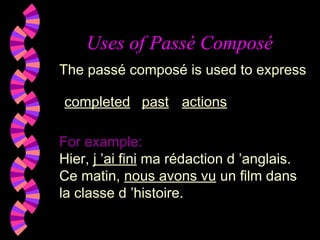
Uses of Passé Composé
The passé composé is used to express
completed
For example:
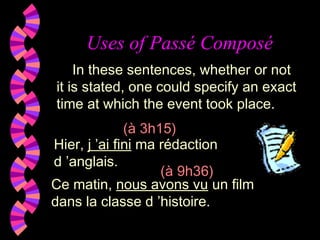
Hier, j ’ai fini ma rédaction d ’anglais.
Ce matin, nous avons vu un film dans
la classe d ’histoire.
actionspast
Uses of Passé Composé
Hier, j ’ai fini ma rédaction
d ’anglais.
In these sentences, whether or not
it is stated, one could specify an exact
time at which the event took place.
(à 3h15)
(à 9h36)
Ce matin, nous avons vu un film
dans la classe d ’histoire.
Uses of Imparfait
The imparfait, however, by definition,
means imperfect. Its uses are much
less clearly defined.
They fall into three basic categories:
 habitual past actions
 continuing past actions
 conditions (non-actions)
(used to do)
(was doing)
(did)
Habitual Past Actions
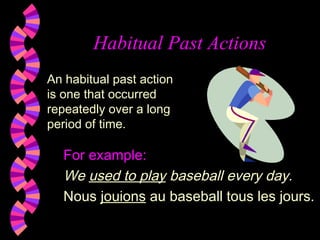
An habitual past action
is one that occurred
repeatedly over a long
period of time.
For example:
We used to play baseball every day.
Nous jouions au baseball tous les jours.
Habitual Past Actions
Careful! Habitual past actions are not
necessarily translated as « used to.. »
For example:
Quand j ’étais jeune, je me promenais à l ’école tous
les jours.
might be translated
When I was young, I walked to school every day.
The key is that the action occurred repeatedly in the
past.
Continuing Past Actions
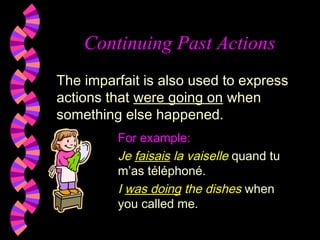
For example:
Je faisais la vaiselle quand tu
m’as téléphoné.
I was doing the dishes when
you called me.
The imparfait is also used to express
actions that were going on when
something else happened.
Continuing Past Actions
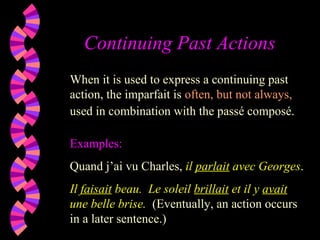
When it is used to express a continuing past
action, the imparfait is often, but not always,
used in combination with the passé composé.
Examples:
Quand j’ai vu Charles, il parlait avec Georges.
Il faisait beau. Le soleil brillait et il y avait
une belle brise. (Eventually, an action occurs
in a later sentence.)
Conditions (non-actions)
There is a class of
verbs which do not
express action at all.
Rather, they express
conditions, states of
being, or states of
mind. When these
verbs occur in a past
tense, it is almost
always the imparfait.
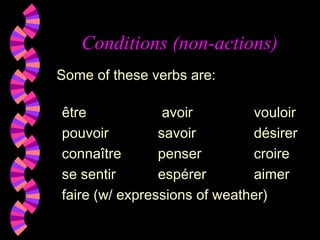
Conditions (non-actions)
Some of these verbs are:
être avoir vouloir
pouvoir savoir désirer
connaître penser croire
se sentir espérer aimer
faire (w/ expressions of weather)
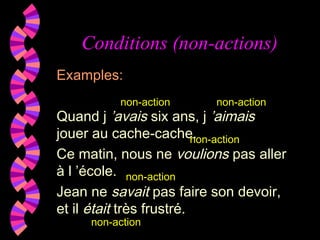
Conditions (non-actions)
Examples:
Quand j ’avais six ans, j ’aimais
jouer au cache-cache.
Ce matin, nous ne voulions pas aller
à l ’école.
Jean ne savait pas faire son devoir,
et il était très frustré.
non-action non-action
non-action
non-action
non-action
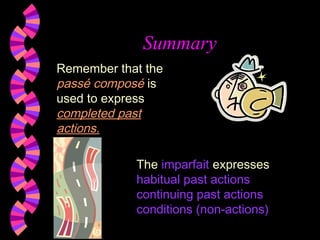
Summary
Remember that the
passé composé is
used to express
completed past
actions.
The imparfait expresses
habitual past actions
continuing past actions
conditions (non-actions)
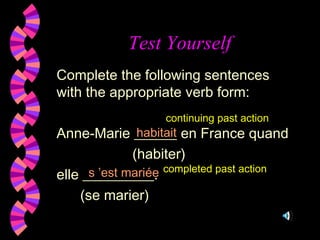
Test Yourself
Complete the following sentences
with the appropriate verb form:
Anne-Marie ______ en France quand
(habiter)
elle __________.
(se marier)
habitait
s ’est mariée
continuing past action
completed past action
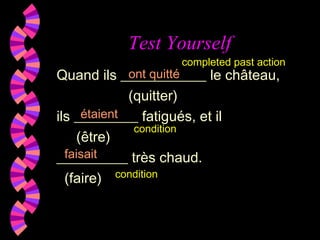
Test Yourself
Quand ils ____________ le château,
(quitter)
ils _________ fatigués, et il
(être)
__________ très chaud.
(faire)
ont quitté
faisait
étaient
completed past action
condition
condition
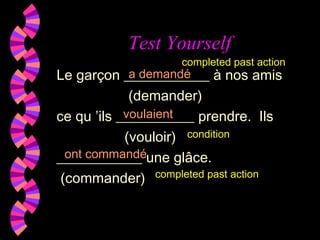
Test Yourself
Le garçon ____________ à nos amis
(demander)
ce qu ’ils ___________ prendre. Ils
(vouloir)
____________ une glâce.
(commander)
a demandé
ont commandé
voulaient
completed past action
condition
completed past action
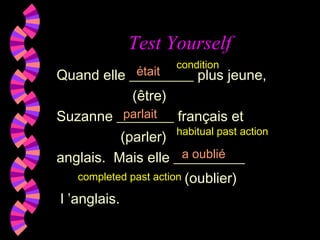
Test Yourself
Quand elle _________ plus jeune,
(être)
Suzanne ________ français et
(parler)
anglais. Mais elle __________
(oublier)
l ’anglais.
était
a oublié
parlait
condition
habitual past action
completed past action
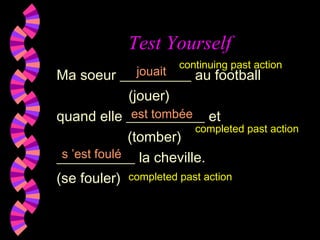
Test Yourself
Ma soeur __________ au football
(jouer)
quand elle ___________ et
(tomber)
___________ la cheville.
(se fouler)
jouait
s ’est foulé
est tombée
continuing past action
completed past action
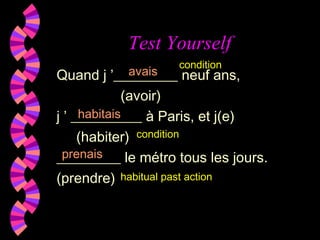
Test Yourself
Quand j ’_________ neuf ans,
(avoir)
j ’ __________ à Paris, et j(e)
(habiter)
_________ le métro tous les jours.
(prendre)
avais
prenais
habitais
condition
condition
habitual past action

Imparfait vs passe compose

  • 1.
  • 2.
    Imparfait vs. PasséComposé The imparfait and the passé composé are both used to express past occurrences, but their uses are distinctly different.
  • 3.
    Uses of PasséComposé The passé composé is used to express completed For example: Hier, j ’ai fini ma rédaction d ’anglais. Ce matin, nous avons vu un film dans la classe d ’histoire. actionspast
  • 4.
    Uses of PasséComposé Hier, j ’ai fini ma rédaction d ’anglais. In these sentences, whether or not it is stated, one could specify an exact time at which the event took place. (à 3h15) (à 9h36) Ce matin, nous avons vu un film dans la classe d ’histoire.
  • 5.
    Uses of Imparfait Theimparfait, however, by definition, means imperfect. Its uses are much less clearly defined. They fall into three basic categories:  habitual past actions  continuing past actions  conditions (non-actions) (used to do) (was doing) (did)
  • 6.
    Habitual Past Actions Anhabitual past action is one that occurred repeatedly over a long period of time. For example: We used to play baseball every day. Nous jouions au baseball tous les jours.
  • 7.
    Habitual Past Actions Careful!Habitual past actions are not necessarily translated as « used to.. » For example: Quand j ’étais jeune, je me promenais à l ’école tous les jours. might be translated When I was young, I walked to school every day. The key is that the action occurred repeatedly in the past.
  • 8.
    Continuing Past Actions Forexample: Je faisais la vaiselle quand tu m’as téléphoné. I was doing the dishes when you called me. The imparfait is also used to express actions that were going on when something else happened.
  • 9.
    Continuing Past Actions Whenit is used to express a continuing past action, the imparfait is often, but not always, used in combination with the passé composé. Examples: Quand j’ai vu Charles, il parlait avec Georges. Il faisait beau. Le soleil brillait et il y avait une belle brise. (Eventually, an action occurs in a later sentence.)
  • 10.
    Conditions (non-actions) There isa class of verbs which do not express action at all. Rather, they express conditions, states of being, or states of mind. When these verbs occur in a past tense, it is almost always the imparfait.
  • 11.
    Conditions (non-actions) Some ofthese verbs are: être avoir vouloir pouvoir savoir désirer connaître penser croire se sentir espérer aimer faire (w/ expressions of weather)
  • 12.
    Conditions (non-actions) Examples: Quand j ’avaissix ans, j ’aimais jouer au cache-cache. Ce matin, nous ne voulions pas aller à l ’école. Jean ne savait pas faire son devoir, et il était très frustré. non-action non-action non-action non-action non-action
  • 13.
    Summary Remember that the passécomposé is used to express completed past actions. The imparfait expresses habitual past actions continuing past actions conditions (non-actions)
  • 14.
    Test Yourself Complete thefollowing sentences with the appropriate verb form: Anne-Marie ______ en France quand (habiter) elle __________. (se marier) habitait s ’est mariée continuing past action completed past action
  • 15.
    Test Yourself Quand ils____________ le château, (quitter) ils _________ fatigués, et il (être) __________ très chaud. (faire) ont quitté faisait étaient completed past action condition condition
  • 16.
    Test Yourself Le garçon____________ à nos amis (demander) ce qu ’ils ___________ prendre. Ils (vouloir) ____________ une glâce. (commander) a demandé ont commandé voulaient completed past action condition completed past action
  • 17.
    Test Yourself Quand elle_________ plus jeune, (être) Suzanne ________ français et (parler) anglais. Mais elle __________ (oublier) l ’anglais. était a oublié parlait condition habitual past action completed past action
  • 18.
    Test Yourself Ma soeur__________ au football (jouer) quand elle ___________ et (tomber) ___________ la cheville. (se fouler) jouait s ’est foulé est tombée continuing past action completed past action completed past action
  • 19.
    Test Yourself Quand j ’_________neuf ans, (avoir) j ’ __________ à Paris, et j(e) (habiter) _________ le métro tous les jours. (prendre) avais prenais habitais condition condition habitual past action