Passé Composé ouPassé Composé ou
Imparfait?Imparfait?
Quand est-ce qu’on utilize PasséQuand est-ce qu’on utilize Passé
Composé?Composé?
 Always a completed action in the past.Always a completed action in the past.
 Something that happened, something somebodySomething that happened, something somebody
did.did.
Exemple: Ce matin, j’ai pris du café et un pain auExemple: Ce matin, j’ai pris du café et un pain au
chocolat. Puis, je suis allé à l’école. A 16h, jechocolat. Puis, je suis allé à l’école. A 16h, je
suis rentré chez moi.suis rentré chez moi.
Les Mots-ClésLes Mots-Clés
 Key words often require the use of passé composé:Key words often require the use of passé composé:
 Une semaine (2, 3, 4, etc semaines)Une semaine (2, 3, 4, etc semaines)
 Un mois (2, 3, 4, etc mois)Un mois (2, 3, 4, etc mois)
 Lundi, mardi, mercredi, etcLundi, mardi, mercredi, etc
 Un jour (2 jours, 3 jours, etc)Un jour (2 jours, 3 jours, etc)
 Un soir (2 soirs, 3 soirs, etc)Un soir (2 soirs, 3 soirs, etc)
 SoudainementSoudainement
 Tout à coupTout à coup
 Une fois, deux foix, etcUne fois, deux foix, etc
 EnfinEnfin
 FinalementFinalement
 Plusieur foisPlusieur fois
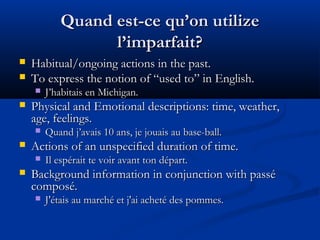
Quand est-ce qu’on utilizeQuand est-ce qu’on utilize
l’imparfait?l’imparfait?
 Habitual/ongoing actions in the past.Habitual/ongoing actions in the past.
 To express the notion of “used to” in English.To express the notion of “used to” in English.
 J’habitais en Michigan.J’habitais en Michigan.
 Physical and Emotional descriptions: time, weather,Physical and Emotional descriptions: time, weather,
age, feelings.age, feelings.
 Quand j’avais 10 ans, je jouais au base-ball.Quand j’avais 10 ans, je jouais au base-ball.
 Actions of an unspecified duration of time.Actions of an unspecified duration of time.
 Il espérait te voir avant ton départ.Il espérait te voir avant ton départ.
 Background information in conjunction with passéBackground information in conjunction with passé
composé.composé.
 J'étais au marché et j'ai acheté des pommes.J'étais au marché et j'ai acheté des pommes.
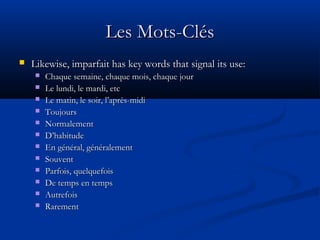
Les Mots-ClésLes Mots-Clés
 Likewise, imparfait has key words that signal its use:Likewise, imparfait has key words that signal its use:
 Chaque semaine, chaque mois, chaque jourChaque semaine, chaque mois, chaque jour
 Le lundi, le mardi, etcLe lundi, le mardi, etc
 Le matin, le soir, l’après-midiLe matin, le soir, l’après-midi
 ToujoursToujours
 NormalementNormalement
 D’habitudeD’habitude
 En général, généralementEn général, généralement
 SouventSouvent
 Parfois, quelquefoisParfois, quelquefois
 De temps en tempsDe temps en temps
 AutrefoisAutrefois
 RarementRarement
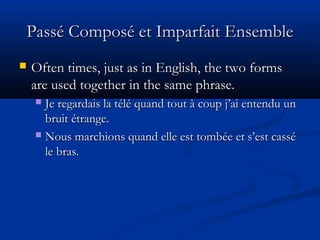
Passé Composé et Imparfait EnsemblePassé Composé et Imparfait Ensemble
 Often times, just as in English, the two formsOften times, just as in English, the two forms
are used together in the same phrase.are used together in the same phrase.
 Je regardais la télé quand tout à coup j’ai entendu unJe regardais la télé quand tout à coup j’ai entendu un
bruit étrange.bruit étrange.
 Nous marchions quand elle est tombée et s’est casséNous marchions quand elle est tombée et s’est cassé
le bras.le bras.
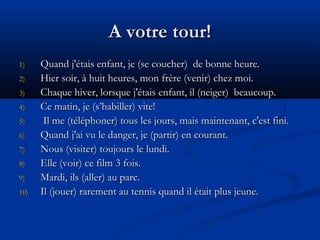
A votre tour!A votre tour!
1)1) Quand j'étais enfant, je (se coucher)  de bonne heure.Quand j'étais enfant, je (se coucher)  de bonne heure.
2)2) Hier soir, à huit heures, mon frère (venir) chez moi.Hier soir, à huit heures, mon frère (venir) chez moi.
3)3) Chaque hiver, lorsque j'étais enfant, il (neiger)  beaucoup.Chaque hiver, lorsque j'étais enfant, il (neiger)  beaucoup.
4)4) Ce matin, je (s’habiller) vite!Ce matin, je (s’habiller) vite!
5)5) Il me (téléphoner) tous les jours, mais maintenant, c'est fini.Il me (téléphoner) tous les jours, mais maintenant, c'est fini.
6)6) Quand j'ai vu le danger, je (partir) en courant.Quand j'ai vu le danger, je (partir) en courant.
7)7) Nous (visiter) toujours le lundi.Nous (visiter) toujours le lundi.
8)8) Elle (voir) ce film 3 fois.Elle (voir) ce film 3 fois.
9)9) Mardi, ils (aller) au parc.Mardi, ils (aller) au parc.
10)10) Il (jouer) rarement au tennis quand il était plus jeune.Il (jouer) rarement au tennis quand il était plus jeune.
Avez-vous desAvez-vous des
questions?questions?

Passé composé ou Imparfait?

  • 1.
    Passé Composé ouPasséComposé ou Imparfait?Imparfait?
  • 2.
    Quand est-ce qu’onutilize PasséQuand est-ce qu’on utilize Passé Composé?Composé?  Always a completed action in the past.Always a completed action in the past.  Something that happened, something somebodySomething that happened, something somebody did.did. Exemple: Ce matin, j’ai pris du café et un pain auExemple: Ce matin, j’ai pris du café et un pain au chocolat. Puis, je suis allé à l’école. A 16h, jechocolat. Puis, je suis allé à l’école. A 16h, je suis rentré chez moi.suis rentré chez moi.
  • 3.
    Les Mots-ClésLes Mots-Clés Key words often require the use of passé composé:Key words often require the use of passé composé:  Une semaine (2, 3, 4, etc semaines)Une semaine (2, 3, 4, etc semaines)  Un mois (2, 3, 4, etc mois)Un mois (2, 3, 4, etc mois)  Lundi, mardi, mercredi, etcLundi, mardi, mercredi, etc  Un jour (2 jours, 3 jours, etc)Un jour (2 jours, 3 jours, etc)  Un soir (2 soirs, 3 soirs, etc)Un soir (2 soirs, 3 soirs, etc)  SoudainementSoudainement  Tout à coupTout à coup  Une fois, deux foix, etcUne fois, deux foix, etc  EnfinEnfin  FinalementFinalement  Plusieur foisPlusieur fois
  • 4.
    Quand est-ce qu’onutilizeQuand est-ce qu’on utilize l’imparfait?l’imparfait?  Habitual/ongoing actions in the past.Habitual/ongoing actions in the past.  To express the notion of “used to” in English.To express the notion of “used to” in English.  J’habitais en Michigan.J’habitais en Michigan.  Physical and Emotional descriptions: time, weather,Physical and Emotional descriptions: time, weather, age, feelings.age, feelings.  Quand j’avais 10 ans, je jouais au base-ball.Quand j’avais 10 ans, je jouais au base-ball.  Actions of an unspecified duration of time.Actions of an unspecified duration of time.  Il espérait te voir avant ton départ.Il espérait te voir avant ton départ.  Background information in conjunction with passéBackground information in conjunction with passé composé.composé.  J'étais au marché et j'ai acheté des pommes.J'étais au marché et j'ai acheté des pommes.
  • 5.
    Les Mots-ClésLes Mots-Clés Likewise, imparfait has key words that signal its use:Likewise, imparfait has key words that signal its use:  Chaque semaine, chaque mois, chaque jourChaque semaine, chaque mois, chaque jour  Le lundi, le mardi, etcLe lundi, le mardi, etc  Le matin, le soir, l’après-midiLe matin, le soir, l’après-midi  ToujoursToujours  NormalementNormalement  D’habitudeD’habitude  En général, généralementEn général, généralement  SouventSouvent  Parfois, quelquefoisParfois, quelquefois  De temps en tempsDe temps en temps  AutrefoisAutrefois  RarementRarement
  • 6.
    Passé Composé etImparfait EnsemblePassé Composé et Imparfait Ensemble  Often times, just as in English, the two formsOften times, just as in English, the two forms are used together in the same phrase.are used together in the same phrase.  Je regardais la télé quand tout à coup j’ai entendu unJe regardais la télé quand tout à coup j’ai entendu un bruit étrange.bruit étrange.  Nous marchions quand elle est tombée et s’est casséNous marchions quand elle est tombée et s’est cassé le bras.le bras.
  • 7.
    A votre tour!Avotre tour! 1)1) Quand j'étais enfant, je (se coucher)  de bonne heure.Quand j'étais enfant, je (se coucher)  de bonne heure. 2)2) Hier soir, à huit heures, mon frère (venir) chez moi.Hier soir, à huit heures, mon frère (venir) chez moi. 3)3) Chaque hiver, lorsque j'étais enfant, il (neiger)  beaucoup.Chaque hiver, lorsque j'étais enfant, il (neiger)  beaucoup. 4)4) Ce matin, je (s’habiller) vite!Ce matin, je (s’habiller) vite! 5)5) Il me (téléphoner) tous les jours, mais maintenant, c'est fini.Il me (téléphoner) tous les jours, mais maintenant, c'est fini. 6)6) Quand j'ai vu le danger, je (partir) en courant.Quand j'ai vu le danger, je (partir) en courant. 7)7) Nous (visiter) toujours le lundi.Nous (visiter) toujours le lundi. 8)8) Elle (voir) ce film 3 fois.Elle (voir) ce film 3 fois. 9)9) Mardi, ils (aller) au parc.Mardi, ils (aller) au parc. 10)10) Il (jouer) rarement au tennis quand il était plus jeune.Il (jouer) rarement au tennis quand il était plus jeune.
  • 8.