Ce tutoriel n’est destiné qu’à être un complément de votre cours.  A TowerOfBabble Production by Frédéric Deloizy Passé Composé  avec Être
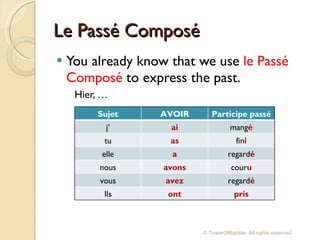
Le Passé Composé You already know that we use  le Passé Composé  to express the past. Hier, … © TowerOfBabble. All rights reserved. Sujet AVOIR Participe passé j’ ai mang é tu as fin i elle a regard é nous avons cour u vous avez regard é Ils ont pris
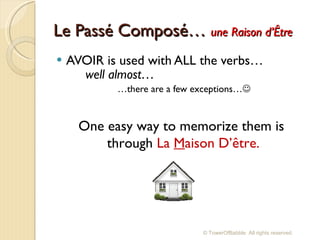
Le Passé  Composé…  une Raison d’Être AVOIR is used with ALL the verbs… well almost… … there are a few exceptions…  One easy way to memorize them is  through  La  M aison D’être. © TowerOfBabble. All rights reserved.
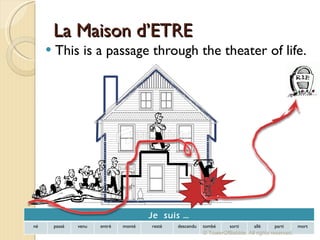
La Maison d’ETRE This is a passage through the theater of life. © TowerOfBabble. All rights reserved. Je  suis … né passé venu entré monté resté descendu tombé sorti allé parti mort
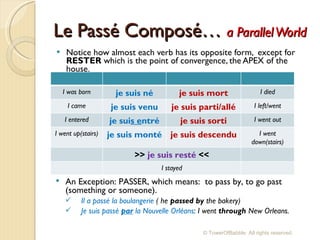
Le Passé  Composé…  a Parallel World Notice how almost each verb has its opposite form,  except for  RESTER  which is the point of convergence, the APEX of the house. An Exception: PASSER, which means:  to pass by, to go past (something or someone). Il a passé la boulangerie  ( he  passed by  the bakery) Je suis passé  par  la Nouvelle Orléans : I went  through  New Orleans. © TowerOfBabble. All rights reserved. I was born je suis né je suis mort I died I came je suis venu je suis parti/allé I left/went I entered je sui s e ntré je suis sorti I went out I went up(stairs) je suis monté je suis descendu I went down(stairs) >>  je suis resté  << I stayed
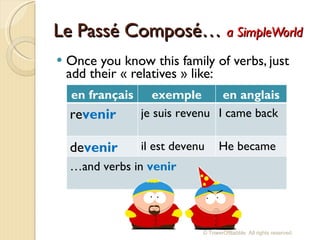
Le Passé  Composé…  a SimpleWorld Once you know this family of verbs, just add their « relatives » like: © TowerOfBabble. All rights reserved. en français exemple en anglais re venir je suis revenu I came back de venir il est devenu He became … and verbs in  venir
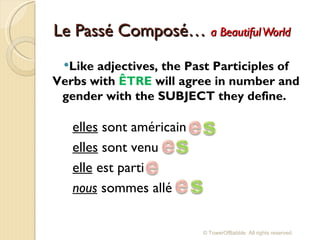
Le Passé  Composé…  a Beautiful World Like adjectives, the Past Participles of Verbs with  ÊTRE  will agree in number and gender with the SUBJECT they define.  © TowerOfBabble. All rights reserved. elles  sont américain elles  sont venu elle  est parti nous  sommes allé
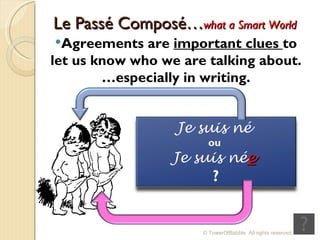
Le Passé Composé… what a Smart World Agreements are  important clues  to let us know who we are talking about.…especially in writing. © TowerOfBabble. All rights reserved. Je suis né  ou   Je suis né e   ?
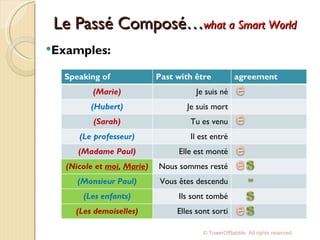
Le Passé Composé… what a Smart World Examples: © TowerOfBabble. All rights reserved. Speaking of Past with être agreement (Marie) Je suis né (Hubert) Je suis mort (Sarah) Tu es venu (Le professeur) Il est entré (Madame Paul) Elle est monté (Nicole et  moi ,  Marie ) Nous sommes resté (Monsieur Paul) Vous êtes descendu (Les enfants) Ils sont tombé (Les demoiselles) Elles sont sorti
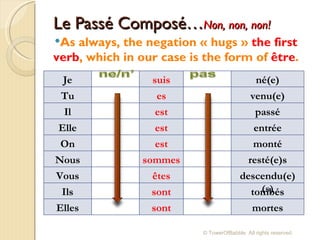
Le Passé Composé… Non, non, non! As always, the negation « hugs »  the first verb , which in our case is the form of  être . © TowerOfBabble. All rights reserved. Je suis né(e) Tu es venu(e) Il est passé Elle est entrée On est monté Nous sommes resté(e)s Vous êtes descendu(e)(s) Ils sont tombés Elles sont mortes
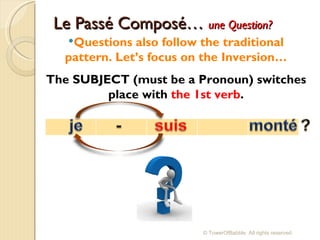
Le Passé Composé…  une Question? Questions also follow the traditional pattern. Let’s focus on the Inversion… The SUBJECT (must be a Pronoun) switches place with  the 1st verb . © TowerOfBabble. All rights reserved.
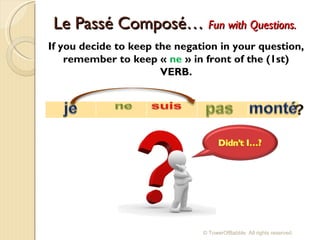
Le Passé Composé…  Fun with Questions. If you decide to keep the negation in your question, remember to keep «  ne  » in front of the (1st) VERB. © TowerOfBabble. All rights reserved.
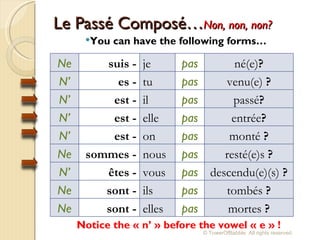
Le Passé Composé… Non, non, non? You can have the following forms… Notice the « n’ » before the vowel « e » ! © TowerOfBabble. All rights reserved. Ne suis - je pas né(e) ? N’ es - tu pas venu(e)  ? N’ est - il pas passé ? N’ est - elle pas entrée ? N’ est - on pas monté  ? Ne sommes - nous pas resté(e)s  ? N’ êtes - vous pas descendu(e)(s)  ? Ne sont - ils pas tombés  ? Ne sont - elles pas mortes  ?
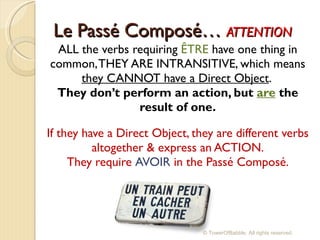
Le Passé  Composé…  ATTENTION ALL the verbs requiring  ÊTRE  have one thing in common, THEY ARE INTRANSITIVE, which means  they CANNOT have a Direct Object .  They don’t perform an action, but  are   the result of one. If they have a Direct Object, they are different verbs altogether & express an ACTION. They require  AVOIR  in the Passé Composé. © TowerOfBabble. All rights reserved.
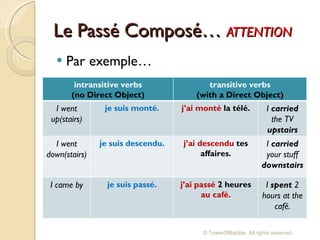
Le Passé  Composé…  ATTENTION Par exemple… © TowerOfBabble. All rights reserved. intransitive verbs (no Direct Object) transitive verbs (with a Direct Object) I went up(stairs) je suis monté. j’ai monté  la télé. I  carried  the TV  upstairs I went down(stairs) je suis descendu. j’ai descendu  tes affaires. I  carried  your stuff  downstairs I came by je suis passé. j’ai passé  2 heures  au café. I  spent  2 hours at the café.
Fin © TowerOfBabble. All rights reserved.

Participe Passé avec ETRE

  • 1.
    Ce tutoriel n’estdestiné qu’à être un complément de votre cours. A TowerOfBabble Production by Frédéric Deloizy Passé Composé avec Être
  • 2.
    Le Passé ComposéYou already know that we use le Passé Composé to express the past. Hier, … © TowerOfBabble. All rights reserved. Sujet AVOIR Participe passé j’ ai mang é tu as fin i elle a regard é nous avons cour u vous avez regard é Ils ont pris
  • 3.
    Le Passé Composé… une Raison d’Être AVOIR is used with ALL the verbs… well almost… … there are a few exceptions…  One easy way to memorize them is through La M aison D’être. © TowerOfBabble. All rights reserved.
  • 4.
    La Maison d’ETREThis is a passage through the theater of life. © TowerOfBabble. All rights reserved. Je suis … né passé venu entré monté resté descendu tombé sorti allé parti mort
  • 5.
    Le Passé Composé… a Parallel World Notice how almost each verb has its opposite form, except for RESTER which is the point of convergence, the APEX of the house. An Exception: PASSER, which means: to pass by, to go past (something or someone). Il a passé la boulangerie ( he passed by the bakery) Je suis passé par la Nouvelle Orléans : I went through New Orleans. © TowerOfBabble. All rights reserved. I was born je suis né je suis mort I died I came je suis venu je suis parti/allé I left/went I entered je sui s e ntré je suis sorti I went out I went up(stairs) je suis monté je suis descendu I went down(stairs) >> je suis resté << I stayed
  • 6.
    Le Passé Composé… a SimpleWorld Once you know this family of verbs, just add their « relatives » like: © TowerOfBabble. All rights reserved. en français exemple en anglais re venir je suis revenu I came back de venir il est devenu He became … and verbs in venir
  • 7.
    Le Passé Composé… a Beautiful World Like adjectives, the Past Participles of Verbs with ÊTRE will agree in number and gender with the SUBJECT they define. © TowerOfBabble. All rights reserved. elles sont américain elles sont venu elle est parti nous sommes allé
  • 8.
    Le Passé Composé…what a Smart World Agreements are important clues to let us know who we are talking about.…especially in writing. © TowerOfBabble. All rights reserved. Je suis né ou Je suis né e ?
  • 9.
    Le Passé Composé…what a Smart World Examples: © TowerOfBabble. All rights reserved. Speaking of Past with être agreement (Marie) Je suis né (Hubert) Je suis mort (Sarah) Tu es venu (Le professeur) Il est entré (Madame Paul) Elle est monté (Nicole et moi , Marie ) Nous sommes resté (Monsieur Paul) Vous êtes descendu (Les enfants) Ils sont tombé (Les demoiselles) Elles sont sorti
  • 10.
    Le Passé Composé…Non, non, non! As always, the negation « hugs » the first verb , which in our case is the form of être . © TowerOfBabble. All rights reserved. Je suis né(e) Tu es venu(e) Il est passé Elle est entrée On est monté Nous sommes resté(e)s Vous êtes descendu(e)(s) Ils sont tombés Elles sont mortes
  • 11.
    Le Passé Composé… une Question? Questions also follow the traditional pattern. Let’s focus on the Inversion… The SUBJECT (must be a Pronoun) switches place with the 1st verb . © TowerOfBabble. All rights reserved.
  • 12.
    Le Passé Composé… Fun with Questions. If you decide to keep the negation in your question, remember to keep «  ne  » in front of the (1st) VERB. © TowerOfBabble. All rights reserved.
  • 13.
    Le Passé Composé…Non, non, non? You can have the following forms… Notice the « n’ » before the vowel « e » ! © TowerOfBabble. All rights reserved. Ne suis - je pas né(e) ? N’ es - tu pas venu(e) ? N’ est - il pas passé ? N’ est - elle pas entrée ? N’ est - on pas monté ? Ne sommes - nous pas resté(e)s ? N’ êtes - vous pas descendu(e)(s) ? Ne sont - ils pas tombés ? Ne sont - elles pas mortes ?
  • 14.
    Le Passé Composé… ATTENTION ALL the verbs requiring ÊTRE have one thing in common, THEY ARE INTRANSITIVE, which means they CANNOT have a Direct Object . They don’t perform an action, but are the result of one. If they have a Direct Object, they are different verbs altogether & express an ACTION. They require AVOIR in the Passé Composé. © TowerOfBabble. All rights reserved.
  • 15.
    Le Passé Composé… ATTENTION Par exemple… © TowerOfBabble. All rights reserved. intransitive verbs (no Direct Object) transitive verbs (with a Direct Object) I went up(stairs) je suis monté. j’ai monté la télé. I carried the TV upstairs I went down(stairs) je suis descendu. j’ai descendu tes affaires. I carried your stuff downstairs I came by je suis passé. j’ai passé 2 heures au café. I spent 2 hours at the café.
  • 16.
    Fin © TowerOfBabble.All rights reserved.