Le passé ComposéMademoiselle Samantha M. Borashko2011 Octobre
Le Passé ComposéThe past tense in French!An action or state of beingcompleted in the past.Somethingthatisdone and over. I dancedwithher. Wereadthat book.Sheate the cake.
To create the pasttense one must first identify the subjectof the sentence (Je/tu/elles/etc.) and the verb. (manger/danser/ouvrir/etc.) The verbisaccompaniedby ahelpingverb, eitheravoir or être,. The helpingverbisconjugatedin accordance with the subject of the sentence. The action beingperformed, the verb, has a pastparticiplethatisaddedand placedafter the helpingverb. **If the helpingverbusedwas être, then one needs to make the subject and verbagree, if nessecary.Je suis parti(e) avec mes amis. = I leftwithmyfriends.
La forme Subject+ Conjugated avoir / être	 	 + Pastparticiple=Le Passe Compose
ExemplesRed=SubjectPurple=HelpingVerb(avoir/etre)     Green=PastParticipleJ’ai finimes devoirs. Ellea choisi la robe bleu. Jesuis rentréechez moi. Vousavez mort.Nous sommesdansé avec toute le monde.
avoirJ’aiTu asIl/Elle/On aNous avons	Vous avezIls/Elles ontThe majority of phrases in the passé composéwill use avoir as the helpingverb. Exemple: J’ai fait mes devoirs.
Verbsthat use AvoirFaireEtreFaireJouerMangerVoirBoireVouloirLireEcouterPouvoir OuvrirFermerSauterFrapperParlerRépondreReussirAlong withmany, manyothers!!
êtreJe suisTu esIl/Elle/On estNous sommesVous étésIls/Elles sontEtre isusedwith17 verbsonly! They are known as the house verbs or MRS. DR. VANDERTRAMPP verbs. Exemple: Elle est allée au café.
House VerbsTheseverbs use the helpingverb être. Memorize!
MRS. DR. VANDERTRAMPPMourirRetournerSortirDevenirRevenirVenirArriverNaîtreDescendreEntrerRentrerTomberResterAllerMonterPartirPasserTheseverbs use the helpingverb être. Memorize!
PastParticipleser é Jouer Joué Rentrer  Rentré Manger  Mangé re uDescendre  Descendu Perdre  PerduVendre  Venduir i Finir  FiniChoisir  ChoisiRéussir  Réussi This is the way to form a REGULAR pastparticiple. Verbsending in –er are the mostcommon. There are exceptions to this.
IrregularPastParticiplesMany of the verbsthatwe use again and again have irregularpastparticiples. Unfortunately, all youcan do ismemorizethem. As well as others. Faire  FaitEtre  Été Avoir  EuBoire  BuLire  LuMettre MisApprendre  ApprisPrendre  PrisPouvoir  PuSavoir  SuTeindre  TeintVivre  VécuNaitre  Né
Etre was the helpingverb? If youused être as the helpingverb and the subject of the verbisfeminineyou must makeitagree. Add an –e to the pastparticiple. If youused être as the helpingverb and the subject of the verbwas plural you must makeitagree. Add a –s to the pastparticiple. The subjectwasfeminine?The subjectwas plural?You do not need to makeagreements if the youused avoir as the helpingverb.
Exemples avec êtreJe suis tombé(e) dans la rue.Tu es arrivé(e) toute suite. Elle est allée au cinéma. Il est sorti avec ses amis. Nous sommes venu(e)s trop tard. Vous êtes rentré(e)(s).Elles ont parties sans moi. I fell in the street. You arrivedquickly. Shewent to the cinema. He went out withhisfriends. We came toolate. Theyreturned. They (girls) leftwithout me. FrançaisAnglais
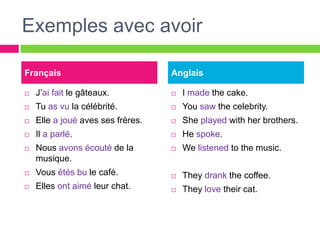
Exemples avec avoirJ’ai fait le gâteaux. Tu as vu la célébrité. Elle a joué aves ses frères.Il a parlé. Nous avons écouté de la musique.    Vous étés bu le café. Elles ont aimé leur chat. I made the cake.You sawthe celebrity. Sheplayedwithherbrothers. He spoke. Welistened to the music. Theydrank the coffee. Theylovetheir cat. FrançaisAnglais
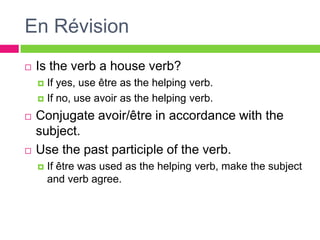
En RévisionIs the verb a house verb? If yes, use être as the helpingverb.If no, use avoir as the helpingverb. Conjugate avoir/être in accordance with the subject. Use the pastparticiple of the verb.If être wasused as the helpingverb, make the subject and verbagree.
CitationsSlide #5 - Eiffel Tower Picture - http://www.clker.com/clipart-14270.htmlSlide #9 – House Pictures - http://www.cliffsnotes.com/study_guide/The-Pass-Compos-with-tre.topicArticleId-25559,articleId-25534.html
C’est la fin!A tout a l’heure.

Le passé composé

  • 1.
    Le passé ComposéMademoiselleSamantha M. Borashko2011 Octobre
  • 2.
    Le Passé ComposéThepast tense in French!An action or state of beingcompleted in the past.Somethingthatisdone and over. I dancedwithher. Wereadthat book.Sheate the cake.
  • 3.
    To create thepasttense one must first identify the subjectof the sentence (Je/tu/elles/etc.) and the verb. (manger/danser/ouvrir/etc.) The verbisaccompaniedby ahelpingverb, eitheravoir or être,. The helpingverbisconjugatedin accordance with the subject of the sentence. The action beingperformed, the verb, has a pastparticiplethatisaddedand placedafter the helpingverb. **If the helpingverbusedwas être, then one needs to make the subject and verbagree, if nessecary.Je suis parti(e) avec mes amis. = I leftwithmyfriends.
  • 4.
    La forme Subject+Conjugated avoir / être + Pastparticiple=Le Passe Compose
  • 5.
    ExemplesRed=SubjectPurple=HelpingVerb(avoir/etre) Green=PastParticipleJ’ai finimes devoirs. Ellea choisi la robe bleu. Jesuis rentréechez moi. Vousavez mort.Nous sommesdansé avec toute le monde.
  • 6.
    avoirJ’aiTu asIl/Elle/On aNousavons Vous avezIls/Elles ontThe majority of phrases in the passé composéwill use avoir as the helpingverb. Exemple: J’ai fait mes devoirs.
  • 7.
    Verbsthat use AvoirFaireEtreFaireJouerMangerVoirBoireVouloirLireEcouterPouvoirOuvrirFermerSauterFrapperParlerRépondreReussirAlong withmany, manyothers!!
  • 8.
    êtreJe suisTu esIl/Elle/OnestNous sommesVous étésIls/Elles sontEtre isusedwith17 verbsonly! They are known as the house verbs or MRS. DR. VANDERTRAMPP verbs. Exemple: Elle est allée au café.
  • 9.
    House VerbsTheseverbs usethe helpingverb être. Memorize!
  • 10.
  • 11.
    PastParticipleser é JouerJoué Rentrer  Rentré Manger  Mangé re uDescendre  Descendu Perdre  PerduVendre  Venduir i Finir  FiniChoisir  ChoisiRéussir  Réussi This is the way to form a REGULAR pastparticiple. Verbsending in –er are the mostcommon. There are exceptions to this.
  • 12.
    IrregularPastParticiplesMany of theverbsthatwe use again and again have irregularpastparticiples. Unfortunately, all youcan do ismemorizethem. As well as others. Faire  FaitEtre  Été Avoir  EuBoire  BuLire  LuMettre MisApprendre  ApprisPrendre  PrisPouvoir  PuSavoir  SuTeindre  TeintVivre  VécuNaitre  Né
  • 13.
    Etre was thehelpingverb? If youused être as the helpingverb and the subject of the verbisfeminineyou must makeitagree. Add an –e to the pastparticiple. If youused être as the helpingverb and the subject of the verbwas plural you must makeitagree. Add a –s to the pastparticiple. The subjectwasfeminine?The subjectwas plural?You do not need to makeagreements if the youused avoir as the helpingverb.
  • 14.
    Exemples avec êtreJesuis tombé(e) dans la rue.Tu es arrivé(e) toute suite. Elle est allée au cinéma. Il est sorti avec ses amis. Nous sommes venu(e)s trop tard. Vous êtes rentré(e)(s).Elles ont parties sans moi. I fell in the street. You arrivedquickly. Shewent to the cinema. He went out withhisfriends. We came toolate. Theyreturned. They (girls) leftwithout me. FrançaisAnglais
  • 15.
    Exemples avec avoirJ’aifait le gâteaux. Tu as vu la célébrité. Elle a joué aves ses frères.Il a parlé. Nous avons écouté de la musique. Vous étés bu le café. Elles ont aimé leur chat. I made the cake.You sawthe celebrity. Sheplayedwithherbrothers. He spoke. Welistened to the music. Theydrank the coffee. Theylovetheir cat. FrançaisAnglais
  • 16.
    En RévisionIs theverb a house verb? If yes, use être as the helpingverb.If no, use avoir as the helpingverb. Conjugate avoir/être in accordance with the subject. Use the pastparticiple of the verb.If être wasused as the helpingverb, make the subject and verbagree.
  • 17.
    CitationsSlide #5 -Eiffel Tower Picture - http://www.clker.com/clipart-14270.htmlSlide #9 – House Pictures - http://www.cliffsnotes.com/study_guide/The-Pass-Compos-with-tre.topicArticleId-25559,articleId-25534.html
  • 18.
    C’est la fin!Atout a l’heure.