LE PASSÉ COMPOSÉ
Le passé composé
In French you use
the perfect tense
(le passé composé)
to say what you
have done at a
certain time in the
past.
Le passé composé
• In French this is called
the passé composé
because it is ‘composed’ of
two parts: the auxiliary or
‘helper’ and the past
participle.
Verbs with avoir
• The passé composé is usually
formed by using the present tense
of avoir and the past participle of
the verb, just as in English.
• You must then know the verb avoir
Le verbe avoir
• Singular
• J’ai I have
• Tu as You have
• Il/elle a He/she has
• Plural
• Nous avons We have
• Vous avez You have
• Ils/elles ont They have
THE VERB AVOIR
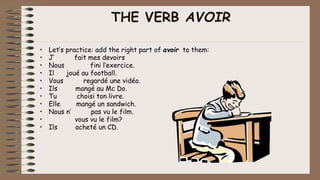
• Let’s practice: add the right part of avoir to them:
• J’ fait mes devoirs
• Nous fini l’exercice.
• Il joué au football.
• Vous regardé une vidéo.
• Ils mangé au Mc Do.
• Tu choisi ton livre.
• Elle mangé un sandwich.
• Nous n’ pas vu le film.
• vous vu le film?
• Ils acheté un CD.
How to form the past
participle
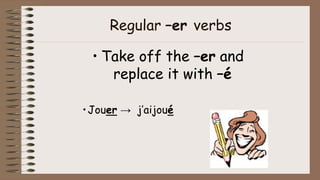
Regular –er verbs
• Take off the –er and
replace it with –é
•Jouer → j’aijoué
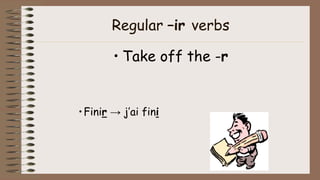
Regular –ir verbs
• Take off the -r
•Finir → j’ai fini
Regular –re verbs
• Take off the –re and
replace it with –u
•Répondre → j’ai répondu
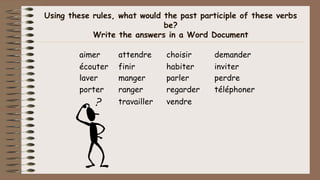
Using these rules, what would the past participle of these verbs
be?
Write the answers in a Word Document
aimer attendre choisir demander
écouter finir habiter inviter
laver manger parler perdre
porter ranger regarder téléphoner
travailler vendre
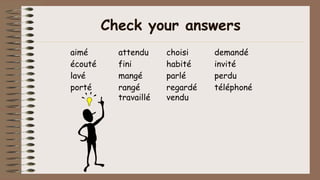
Check your answers
aimé attendu choisi demandé
écouté fini habité invité
lavé mangé parlé perdu
porté rangé regardé téléphoné
travaillé vendu
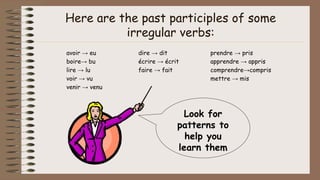
Here are the past participles of some
irregular verbs:
avoir → eu dire → dit prendre → pris
boire→ bu écrire → écrit apprendre → appris
lire → lu faire → fait comprendre→compris
voir → vu mettre → mis
venir → venu
Look for
patterns to
help you
learn them
THE PERFECT TENSE WITH AVOIR
Let’s practice: give the correct part of the verb in brackets
• J’ai (prendre) le bus.
• Il a (boire) du Coca.
• Nous avons (lire) ces magazines.
• J’ai (apprendre) le vocabulaire.
• As-tu (regarder) la télévision?
• Qu’est-ce que vous avez (faire) ?
• Il a (jouer) de la guitare.
• J’ai (finir) mes devoirs.
• Nous avons (écouter) de la musique.
• Elle n’a pas (comprendre) .
Verbs with être
As we have already
seen, in the perfect
tense most verbs take
avoir.
However, some take
être
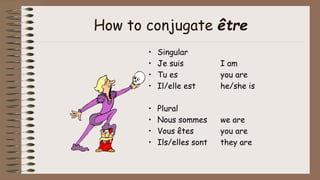
How to conjugate être
• Singular
• Je suis I am
• Tu es you are
• Il/elle est he/she is
• Plural
• Nous sommes we are
• Vous êtes you are
• Ils/elles sont they are
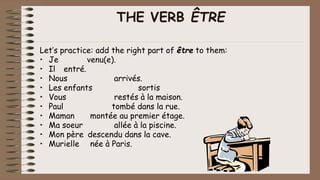
THE VERB ÊTRE
Let’s practice: add the right part of être to them:
• Je venu(e).
• Il entré.
• Nous arrivés.
• Les enfants sortis
• Vous restés à la maison.
• Paul tombé dans la rue.
• Maman montée au premier étage.
• Ma soeur allée à la piscine.
• Mon père descendu dans la cave.
• Murielle née à Paris.
Remember!
• Notice that with verbs which use
être as the auxiliary verb, the past
participle agrees with the subject
(the person or thing doing the
action).
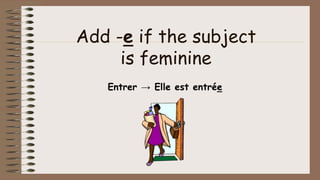
Add -e if the subject
is feminine
Entrer → Elle est entrée
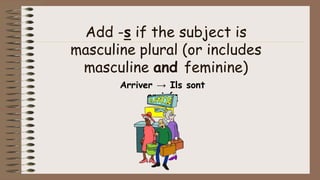
Add -s if the subject is
masculine plural (or includes
masculine and feminine)
Arriver → Ils sont
arrivés
Add –es if the subject is
feminine plural
Partir → elles sont parties
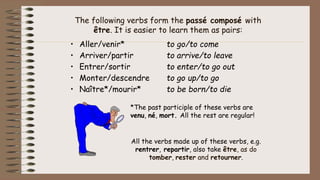
The following verbs form the passé composé with
être. It is easier to learn them as pairs:
• Aller/venir* to go/to come
• Arriver/partir to arrive/to leave
• Entrer/sortir to enter/to go out
• Monter/descendre to go up/to go
• Naître*/mourir* to be born/to die
*The past participle of these verbs are
venu, né, mort. All the rest are regular!
All the verbs made up of these verbs, e.g.
rentrer, repartir, also take être, as do
tomber, rester and retourner.
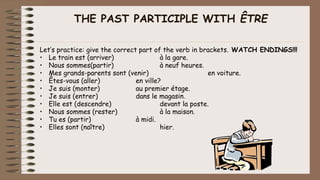
THE PAST PARTICIPLE WITH ÊTRE
Let’s practice: give the correct part of the verb in brackets. WATCH ENDINGS!!!
• Le train est (arriver) à la gare.
• Nous sommes(partir) à neuf heures.
• Mes grands-parents sont (venir) en voiture.
• Êtes-vous (aller) en ville?
• Je suis (monter) au premier étage.
• Je suis (entrer) dans le magasin.
• Elle est (descendre) devant la poste.
• Nous sommes (rester) à la maison.
• Tu es (partir) à midi.
• Elles sont (naître) hier.
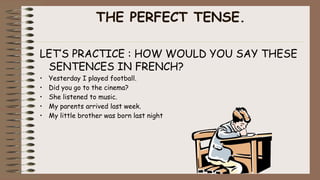
THE PERFECT TENSE.
LET’S PRACTICE : HOW WOULD YOU SAY THESE
SENTENCES IN FRENCH?
• Yesterday I played football.
• Did you go to the cinema?
• She listened to music.
• My parents arrived last week.
• My little brother was born last night
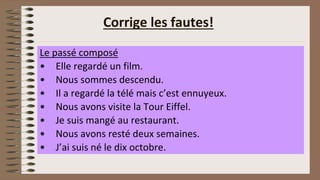
Corrige les fautes!
Le passé composé
• Elle regardé un film.
• Nous sommes descendu.
• Il a regardé la télé mais c’est ennuyeux.
• Nous avons visite la Tour Eiffel.
• Je suis mangé au restaurant.
• Nous avons resté deux semaines.
• J’ai suis né le dix octobre.
There you go. The perfect tense
has not got any secrets for you
any more. If you apply these rules
carefully you will always get it
perfect.
REFERENCES
• https://www.tes.com/teaching-resource
• https://francais.lingolia.com
• https://la-conjugaison.nouvelobs.com

LE_PASSÉ_COMPOSÉ.LE_PASSÉ_COMPOSÉLE_PASSÉ_COMPOSÉ

  • 1.
  • 2.
    Le passé composé InFrench you use the perfect tense (le passé composé) to say what you have done at a certain time in the past.
  • 3.
    Le passé composé •In French this is called the passé composé because it is ‘composed’ of two parts: the auxiliary or ‘helper’ and the past participle.
  • 4.
    Verbs with avoir •The passé composé is usually formed by using the present tense of avoir and the past participle of the verb, just as in English. • You must then know the verb avoir
  • 5.
    Le verbe avoir •Singular • J’ai I have • Tu as You have • Il/elle a He/she has • Plural • Nous avons We have • Vous avez You have • Ils/elles ont They have
  • 6.
    THE VERB AVOIR •Let’s practice: add the right part of avoir to them: • J’ fait mes devoirs • Nous fini l’exercice. • Il joué au football. • Vous regardé une vidéo. • Ils mangé au Mc Do. • Tu choisi ton livre. • Elle mangé un sandwich. • Nous n’ pas vu le film. • vous vu le film? • Ils acheté un CD.
  • 7.
    How to formthe past participle
  • 8.
    Regular –er verbs •Take off the –er and replace it with –é •Jouer → j’aijoué
  • 9.
    Regular –ir verbs •Take off the -r •Finir → j’ai fini
  • 10.
    Regular –re verbs •Take off the –re and replace it with –u •Répondre → j’ai répondu
  • 11.
    Using these rules,what would the past participle of these verbs be? Write the answers in a Word Document aimer attendre choisir demander écouter finir habiter inviter laver manger parler perdre porter ranger regarder téléphoner travailler vendre
  • 12.
    Check your answers aiméattendu choisi demandé écouté fini habité invité lavé mangé parlé perdu porté rangé regardé téléphoné travaillé vendu
  • 13.
    Here are thepast participles of some irregular verbs: avoir → eu dire → dit prendre → pris boire→ bu écrire → écrit apprendre → appris lire → lu faire → fait comprendre→compris voir → vu mettre → mis venir → venu Look for patterns to help you learn them
  • 14.
    THE PERFECT TENSEWITH AVOIR Let’s practice: give the correct part of the verb in brackets • J’ai (prendre) le bus. • Il a (boire) du Coca. • Nous avons (lire) ces magazines. • J’ai (apprendre) le vocabulaire. • As-tu (regarder) la télévision? • Qu’est-ce que vous avez (faire) ? • Il a (jouer) de la guitare. • J’ai (finir) mes devoirs. • Nous avons (écouter) de la musique. • Elle n’a pas (comprendre) .
  • 15.
    Verbs with être Aswe have already seen, in the perfect tense most verbs take avoir. However, some take être
  • 16.
    How to conjugateêtre • Singular • Je suis I am • Tu es you are • Il/elle est he/she is • Plural • Nous sommes we are • Vous êtes you are • Ils/elles sont they are
  • 17.
    THE VERB ÊTRE Let’spractice: add the right part of être to them: • Je venu(e). • Il entré. • Nous arrivés. • Les enfants sortis • Vous restés à la maison. • Paul tombé dans la rue. • Maman montée au premier étage. • Ma soeur allée à la piscine. • Mon père descendu dans la cave. • Murielle née à Paris.
  • 18.
    Remember! • Notice thatwith verbs which use être as the auxiliary verb, the past participle agrees with the subject (the person or thing doing the action).
  • 19.
    Add -e ifthe subject is feminine Entrer → Elle est entrée
  • 20.
    Add -s ifthe subject is masculine plural (or includes masculine and feminine) Arriver → Ils sont arrivés
  • 21.
    Add –es ifthe subject is feminine plural Partir → elles sont parties
  • 22.
    The following verbsform the passé composé with être. It is easier to learn them as pairs: • Aller/venir* to go/to come • Arriver/partir to arrive/to leave • Entrer/sortir to enter/to go out • Monter/descendre to go up/to go • Naître*/mourir* to be born/to die *The past participle of these verbs are venu, né, mort. All the rest are regular! All the verbs made up of these verbs, e.g. rentrer, repartir, also take être, as do tomber, rester and retourner.
  • 23.
    THE PAST PARTICIPLEWITH ÊTRE Let’s practice: give the correct part of the verb in brackets. WATCH ENDINGS!!! • Le train est (arriver) à la gare. • Nous sommes(partir) à neuf heures. • Mes grands-parents sont (venir) en voiture. • Êtes-vous (aller) en ville? • Je suis (monter) au premier étage. • Je suis (entrer) dans le magasin. • Elle est (descendre) devant la poste. • Nous sommes (rester) à la maison. • Tu es (partir) à midi. • Elles sont (naître) hier.
  • 24.
    THE PERFECT TENSE. LET’SPRACTICE : HOW WOULD YOU SAY THESE SENTENCES IN FRENCH? • Yesterday I played football. • Did you go to the cinema? • She listened to music. • My parents arrived last week. • My little brother was born last night
  • 25.
    Corrige les fautes! Lepassé composé • Elle regardé un film. • Nous sommes descendu. • Il a regardé la télé mais c’est ennuyeux. • Nous avons visite la Tour Eiffel. • Je suis mangé au restaurant. • Nous avons resté deux semaines. • J’ai suis né le dix octobre.
  • 26.
    There you go.The perfect tense has not got any secrets for you any more. If you apply these rules carefully you will always get it perfect.
  • 27.