Le Français IV
Midterm Review
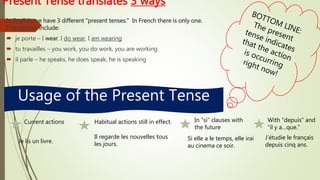
Present Tense translates 3 ways
In English, we have 3 different “present tenses.” In French there is only one.
Translations include:
 je porte – I wear, I do wear, I am wearing
 tu travailles – you work, you do work, you are working
 il parle – he speaks, he does speak, he is speaking
Usage of the Present Tense
Current actions Habitual actions still in effect. In “si” clauses with
the future
With “depuis” and
“il y a…que.”
Je lis un livre.
Il regarde les nouvelles tous
les jours.
Si elle a le temps, elle irai
au cinema ce soir.
J’étudie le français
depuis cinq ans.
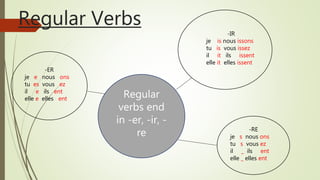
Regular Verbs
Regular
verbs end
in -er, -ir, -
re
-ER
je e nous ons
tu es vous ez
il e ils ent
elle e elles ent
-RE
je s nous ons
tu s vous ez
il _ ils ent
elle _ elles ent
-IR
je is nous issons
tu is vous issez
il it ils issent
elle it elles issent
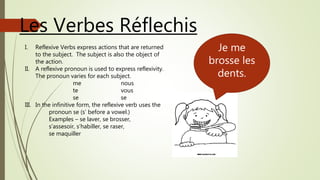
Les Verbes Réflechis
I. Reflexive Verbs express actions that are returned
to the subject. The subject is also the object of
the action.
II. A reflexive pronoun is used to express reflexivity.
The pronoun varies for each subject.
me nous
te vous
se se
III. In the infinitive form, the reflexive verb uses the
pronoun se (s’ before a vowel.)
Examples – se laver, se brosser,
s’assesoir, s’habiller, se raser,
se maquiller
Je me
brosse les
dents.
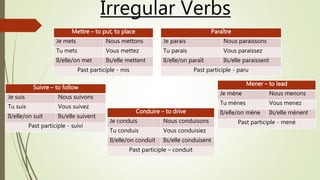
Conduire – to drive
Je conduis Nous conduisons
Tu conduis Vous conduisiez
Il/elle/on conduit Ils/elle conduisent
Past participle – conduit
Suivre – to follow
Je suis Nous suivons
Tu suis Vous suivez
Il/elle/on suit Ils/elle suivent
Past participle - suivi
Mener – to lead
Je mène Nous menons
Tu mènes Vous menez
Il/elle/on mène Ils/elle mènent
Past participle - mené
Mettre – to put, to place
Je mets Nous mettons
Tu mets Vous mettez
Il/elle/on met Ils/elle mettent
Past participle - mis
Paraître
Je parais Nous paraissons
Tu parais Vous paraissez
Il/elle/on paraît Ils/elle paraissent
Past participle - paru
Irregular Verbs
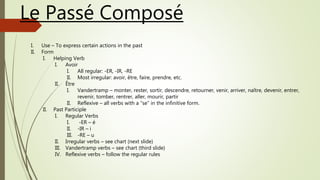
Le Passé Composé
I. Use – To express certain actions in the past
II. Form
I. Helping Verb
I. Avoir
I. All regular: -ER, -IR, -RE
II. Most irregular: avoir, être, faire, prendre, etc.
II. Être
I. Vandertramp – monter, rester, sortir, descendre, retourner, venir, arriver, naître, devenir, entrer,
revenir, tomber, rentrer, aller, mourir, partir
II. Reflexive – all verbs with a “se” in the infinitive form.
II. Past Participle
I. Regular Verbs
I. -ER – é
II. -IR – i
III. -RE – u
II. Irregular verbs – see chart (next slide)
III. Vandertramp verbs – see chart (third slide)
IV. Reflexive verbs – follow the regular rules
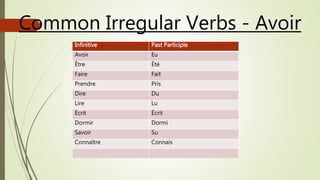
Common Irregular Verbs - Avoir
Infinitive Past Participle
Avoir Eu
Être Été
Faire Fait
Prendre Pris
Dire Du
Lire Lu
Écrit Écrit
Dormir Dormi
Savoir Su
Connaître Connais
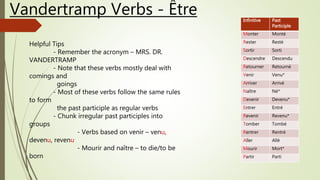
Vandertramp Verbs - Être Infinitive Past
Participle
Monter Monté
Rester Resté
Sortir Sorti
Descendre Descendu
Retourner Retourné
Venir Venu*
Arriver Arrivé
Naître Né*
Devenir Devenu*
Entrer Entré
Revenir Revenu*
Tomber Tombé
Rentrer Rentré
Aller Allé
Mourir Mort*
Partir Parti
Helpful Tips
- Remember the acronym – MRS. DR.
VANDERTRAMP
- Note that these verbs mostly deal with
comings and
goings
- Most of these verbs follow the same rules
to form
the past participle as regular verbs
- Chunk irregular past participles into
groups
- Verbs based on venir – venu,
devenu, revenu
- Mourir and naître – to die/to be
born
In Use
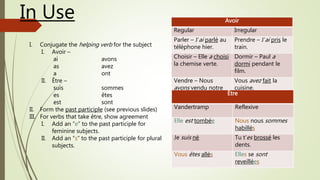
I. Conjugate the helping verb for the subject
I. Avoir –
ai avons
as avez
a ont
II. Être –
suis sommes
es êtes
est sont
II. Form the past participle (see previous slides)
III. For verbs that take être, show agreement
I. Add an “e” to the past participle for
feminine subjects.
II. Add an “s” to the past participle for plural
subjects.
Avoir
Regular Irregular
Parler – J’ai parlé au
téléphone hier.
Prendre – J’ai pris le
train.
Choisir – Elle a choisi
la chemise verte.
Dormir – Paul a
dormi pendant le
film.
Vendre – Nous
avons vendu notre
voiture.
Vous avez fait la
cuisine.
Être
Vandertramp Reflexive
Elle est tombée Nous nous sommes
habillés
Je suis né Tu t’es brossé les
dents.
Vous êtes allés Elles se sont
reveillées
L’Imparfait
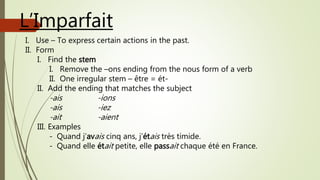
I. Use – To express certain actions in the past.
II. Form
I. Find the stem
I. Remove the –ons ending from the nous form of a verb
II. One irregular stem – être = ét-
II. Add the ending that matches the subject
-ais -ions
-ais -iez
-ait -aient
III. Examples
- Quand j’avais cinq ans, j’étais très timide.
- Quand elle était petite, elle passait chaque été en France.
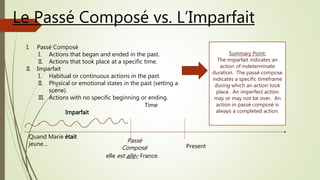
Le Passé Composé vs. L’Imparfait
I. Passé Composé
I. Actions that began and ended in the past.
II. Actions that took place at a specific time.
II. Imparfait
I. Habitual or continuous actions in the past.
II. Physical or emotional states in the past (setting a
scene).
III. Actions with no specific beginning or ending.
Time
Passé
Composé Present
Imparfait
Summary Point:
The imparfait indicates an
action of indeterminate
duration. The passé compose
indicates a specific timeframe
during which an action took
place. An imperfect action
may or may not be over. An
action in passé composé is
always a completed action.
Quand Marie était
jeune…
elle est allée France.
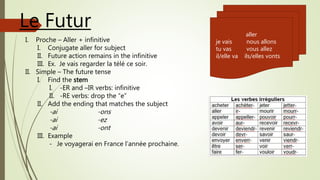
Le Futur
I. Proche – Aller + infinitive
I. Conjugate aller for subject
II. Future action remains in the infinitive
III. Ex. Je vais regarder la télé ce soir.
II. Simple – The future tense
I. Find the stem
I. -ER and –IR verbs: infinitive
II. -RE verbs: drop the “e”
II. Add the ending that matches the subject
-ai -ons
-ai -ez
-ai -ont
III. Example
- Je voyagerai en France l’année prochaine.
aller
je vais nous allons
tu vas vous allez
il/elle va ils/elles vonts
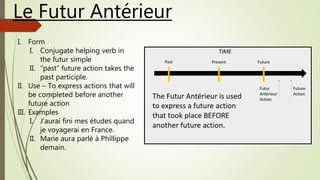
Le Futur Antérieur
I. Form
I. Conjugate helping verb in
the futur simple
II. “past” future action takes the
past participle.
II. Use – To express actions that will
be completed before another
future action
III. Examples
I. J’aurai fini mes études quand
je voyagerai en France.
II. Marie aura parlé à Phillippe
demain.
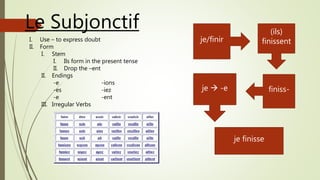
Le Subjonctif
I. Use – to express doubt
II. Form
I. Stem
I. Ils form in the present tense
II. Drop the –ent
II. Endings
-e -ions
-es -iez
-e -ent
III. Irregular Verbs
je/finir
(ils)
finissent
finiss-
je finisse
je  -e
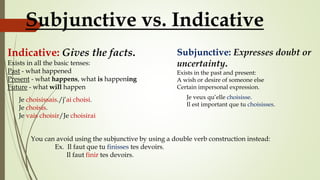
Indicative: Gives the facts.
Exists in all the basic tenses:
Past - what happened
Present - what happens, what is happening
Future - what will happen
Subjunctive: Expresses doubt or
uncertainty.
Exists in the past and present:
A wish or desire of someone else
Certain impersonal expression.
Subjunctive vs. Indicative
Je choisissais./j’ai choisi.
Je choisis.
Je vais choisir/Je choisirai
Je veux qu’elle choisisse.
Il est important que tu choisisses.
You can avoid using the subjunctive by using a double verb construction instead:
Ex. Il faut que tu finisses tes devoirs.
Il faut finir tes devoirs.
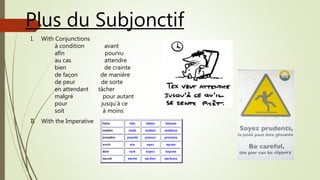
Plus du Subjonctif
I. With Conjunctions
à condition avant
afin pourvu
au cas attendre
bien de crainte
de façon de manière
de peur de sorte
en attendant tâcher
malgré pour autant
pour jusqu’à ce
soit à moins
II. With the Imperative
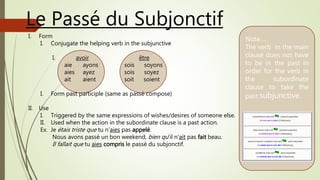
Le Passé du Subjonctif
I. Form
I. Conjugate the helping verb in the subjunctive
I. avoir être
aie ayons sois soyons
aies ayez sois soyez
ait aient soit soient
I. Form past participle (same as passé compose)
II. Use
I. Triggered by the same expressions of wishes/desires of someone else.
II. Used when the action in the subordinate clause is a past action.
Ex. Je étais triste que tu n’aies pas appelé.
Nous avons passé un bon weekend, bien qu’il n’ait pas fait beau.
Il fallait que tu aies compris le passé du subjonctif.
Note….
The verb in the main
clause does not have
to be in the past in
order for the verb in
the subordinate
clause to take the
past subjunctive.
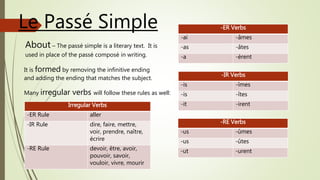
Le Passé Simple
About – The passé simple is a literary text. It is
used in place of the passé composé in writing.
-ER Verbs
-ai -âmes
-as -âtes
-a -èrent
-IR Verbs
-is -îmes
-is -îtes
-it -irent
-RE Verbs
-us -ûmes
-us -ûtes
-ut -urent
It is formed by removing the infinitive ending
and adding the ending that matches the subject.
Many irregular verbs will follow these rules as well:
Irregular Verbs
-ER Rule aller
-IR Rule dire, faire, mettre,
voir, prendre, naître,
écrire
-RE Rule devoir, être, avoir,
pouvoir, savoir,
vouloir, vivre, mourir
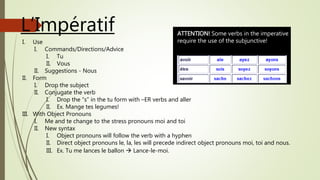
L’Impératif
I. Use
I. Commands/Directions/Advice
I. Tu
II. Vous
II. Suggestions - Nous
II. Form
I. Drop the subject
II. Conjugate the verb
I. Drop the “s” in the tu form with –ER verbs and aller
II. Ex. Mange tes legumes!
III. With Object Pronouns
I. Me and te change to the stress pronouns moi and toi
II. New syntax
I. Object pronouns will follow the verb with a hyphen
II. Direct object pronouns le, la, les will precede indirect object pronouns moi, toi and nous.
III. Ex. Tu me lances le ballon  Lance-le-moi.
ATTENTION! Some verbs in the imperative
require the use of the subjunctive!
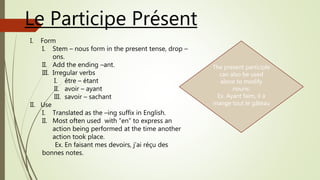
Le Participe Présent
I. Form
I. Stem – nous form in the present tense, drop –
ons.
II. Add the ending –ant.
III. Irregular verbs
I. être – étant
II. avoir – ayant
III. savoir – sachant
II. Use
I. Translated as the –ing suffix in English.
II. Most often used with “en” to express an
action being performed at the time another
action took place.
Ex. En faisant mes devoirs, j’ai réçu des
bonnes notes.
The present participle
can also be used
alone to modify
nouns:
Ex. Ayant faim, il a
mange tout le gâteau
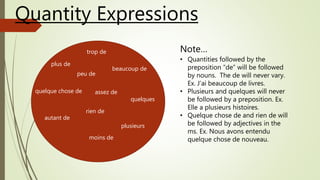
Quantity Expressions
plus de
trop de
rien de
beaucoup de
autant de
assez de
moins de
quelque chose de
plusieurs
quelques
peu de
Note…
• Quantities followed by the
preposition “de” will be followed
by nouns. The de will never vary.
Ex. J’ai beaucoup de livres.
• Plusieurs and quelques will never
be followed by a preposition. Ex.
Elle a plusieurs histoires.
• Quelque chose de and rien de will
be followed by adjectives in the
ms. Ex. Nous avons entendu
quelque chose de nouveau.
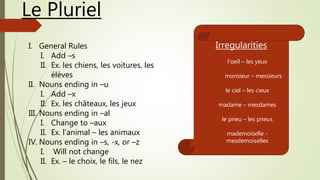
Le Pluriel
I. General Rules
I. Add –s
II. Ex. les chiens, les voitures, les
élèves
II. Nouns ending in –u
I. Add –x
II. Ex. les châteaux, les jeux
III. Nouns ending in –al
I. Change to –aux
II. Ex. l’animal – les animaux
IV. Nouns ending in –s, -x, or –z
I. Will not change
II. Ex. – le choix, le fils, le nez
Irregularities
l’oeil – les yeux
monsieur – messieurs
le ciel – les cieux
madame – mesdames
le pneu – les pneus
mademoiselle -
mesdemoiselles

Midterm review french iv

  • 1.
  • 2.
    Present Tense translates3 ways In English, we have 3 different “present tenses.” In French there is only one. Translations include:  je porte – I wear, I do wear, I am wearing  tu travailles – you work, you do work, you are working  il parle – he speaks, he does speak, he is speaking Usage of the Present Tense Current actions Habitual actions still in effect. In “si” clauses with the future With “depuis” and “il y a…que.” Je lis un livre. Il regarde les nouvelles tous les jours. Si elle a le temps, elle irai au cinema ce soir. J’étudie le français depuis cinq ans.
  • 3.
    Regular Verbs Regular verbs end in-er, -ir, - re -ER je e nous ons tu es vous ez il e ils ent elle e elles ent -RE je s nous ons tu s vous ez il _ ils ent elle _ elles ent -IR je is nous issons tu is vous issez il it ils issent elle it elles issent
  • 4.
    Les Verbes Réflechis I.Reflexive Verbs express actions that are returned to the subject. The subject is also the object of the action. II. A reflexive pronoun is used to express reflexivity. The pronoun varies for each subject. me nous te vous se se III. In the infinitive form, the reflexive verb uses the pronoun se (s’ before a vowel.) Examples – se laver, se brosser, s’assesoir, s’habiller, se raser, se maquiller Je me brosse les dents.
  • 5.
    Conduire – todrive Je conduis Nous conduisons Tu conduis Vous conduisiez Il/elle/on conduit Ils/elle conduisent Past participle – conduit Suivre – to follow Je suis Nous suivons Tu suis Vous suivez Il/elle/on suit Ils/elle suivent Past participle - suivi Mener – to lead Je mène Nous menons Tu mènes Vous menez Il/elle/on mène Ils/elle mènent Past participle - mené Mettre – to put, to place Je mets Nous mettons Tu mets Vous mettez Il/elle/on met Ils/elle mettent Past participle - mis Paraître Je parais Nous paraissons Tu parais Vous paraissez Il/elle/on paraît Ils/elle paraissent Past participle - paru Irregular Verbs
  • 6.
    Le Passé Composé I.Use – To express certain actions in the past II. Form I. Helping Verb I. Avoir I. All regular: -ER, -IR, -RE II. Most irregular: avoir, être, faire, prendre, etc. II. Être I. Vandertramp – monter, rester, sortir, descendre, retourner, venir, arriver, naître, devenir, entrer, revenir, tomber, rentrer, aller, mourir, partir II. Reflexive – all verbs with a “se” in the infinitive form. II. Past Participle I. Regular Verbs I. -ER – é II. -IR – i III. -RE – u II. Irregular verbs – see chart (next slide) III. Vandertramp verbs – see chart (third slide) IV. Reflexive verbs – follow the regular rules
  • 7.
    Common Irregular Verbs- Avoir Infinitive Past Participle Avoir Eu Être Été Faire Fait Prendre Pris Dire Du Lire Lu Écrit Écrit Dormir Dormi Savoir Su Connaître Connais
  • 8.
    Vandertramp Verbs -Être Infinitive Past Participle Monter Monté Rester Resté Sortir Sorti Descendre Descendu Retourner Retourné Venir Venu* Arriver Arrivé Naître Né* Devenir Devenu* Entrer Entré Revenir Revenu* Tomber Tombé Rentrer Rentré Aller Allé Mourir Mort* Partir Parti Helpful Tips - Remember the acronym – MRS. DR. VANDERTRAMP - Note that these verbs mostly deal with comings and goings - Most of these verbs follow the same rules to form the past participle as regular verbs - Chunk irregular past participles into groups - Verbs based on venir – venu, devenu, revenu - Mourir and naître – to die/to be born
  • 9.
    In Use I. Conjugatethe helping verb for the subject I. Avoir – ai avons as avez a ont II. Être – suis sommes es êtes est sont II. Form the past participle (see previous slides) III. For verbs that take être, show agreement I. Add an “e” to the past participle for feminine subjects. II. Add an “s” to the past participle for plural subjects. Avoir Regular Irregular Parler – J’ai parlé au téléphone hier. Prendre – J’ai pris le train. Choisir – Elle a choisi la chemise verte. Dormir – Paul a dormi pendant le film. Vendre – Nous avons vendu notre voiture. Vous avez fait la cuisine. Être Vandertramp Reflexive Elle est tombée Nous nous sommes habillés Je suis né Tu t’es brossé les dents. Vous êtes allés Elles se sont reveillées
  • 10.
    L’Imparfait I. Use –To express certain actions in the past. II. Form I. Find the stem I. Remove the –ons ending from the nous form of a verb II. One irregular stem – être = ét- II. Add the ending that matches the subject -ais -ions -ais -iez -ait -aient III. Examples - Quand j’avais cinq ans, j’étais très timide. - Quand elle était petite, elle passait chaque été en France.
  • 11.
    Le Passé Composévs. L’Imparfait I. Passé Composé I. Actions that began and ended in the past. II. Actions that took place at a specific time. II. Imparfait I. Habitual or continuous actions in the past. II. Physical or emotional states in the past (setting a scene). III. Actions with no specific beginning or ending. Time Passé Composé Present Imparfait Summary Point: The imparfait indicates an action of indeterminate duration. The passé compose indicates a specific timeframe during which an action took place. An imperfect action may or may not be over. An action in passé composé is always a completed action. Quand Marie était jeune… elle est allée France.
  • 12.
    Le Futur I. Proche– Aller + infinitive I. Conjugate aller for subject II. Future action remains in the infinitive III. Ex. Je vais regarder la télé ce soir. II. Simple – The future tense I. Find the stem I. -ER and –IR verbs: infinitive II. -RE verbs: drop the “e” II. Add the ending that matches the subject -ai -ons -ai -ez -ai -ont III. Example - Je voyagerai en France l’année prochaine. aller je vais nous allons tu vas vous allez il/elle va ils/elles vonts
  • 13.
    Le Futur Antérieur I.Form I. Conjugate helping verb in the futur simple II. “past” future action takes the past participle. II. Use – To express actions that will be completed before another future action III. Examples I. J’aurai fini mes études quand je voyagerai en France. II. Marie aura parlé à Phillippe demain.
  • 14.
    Le Subjonctif I. Use– to express doubt II. Form I. Stem I. Ils form in the present tense II. Drop the –ent II. Endings -e -ions -es -iez -e -ent III. Irregular Verbs je/finir (ils) finissent finiss- je finisse je  -e
  • 15.
    Indicative: Gives thefacts. Exists in all the basic tenses: Past - what happened Present - what happens, what is happening Future - what will happen Subjunctive: Expresses doubt or uncertainty. Exists in the past and present: A wish or desire of someone else Certain impersonal expression. Subjunctive vs. Indicative Je choisissais./j’ai choisi. Je choisis. Je vais choisir/Je choisirai Je veux qu’elle choisisse. Il est important que tu choisisses. You can avoid using the subjunctive by using a double verb construction instead: Ex. Il faut que tu finisses tes devoirs. Il faut finir tes devoirs.
  • 16.
    Plus du Subjonctif I.With Conjunctions à condition avant afin pourvu au cas attendre bien de crainte de façon de manière de peur de sorte en attendant tâcher malgré pour autant pour jusqu’à ce soit à moins II. With the Imperative
  • 17.
    Le Passé duSubjonctif I. Form I. Conjugate the helping verb in the subjunctive I. avoir être aie ayons sois soyons aies ayez sois soyez ait aient soit soient I. Form past participle (same as passé compose) II. Use I. Triggered by the same expressions of wishes/desires of someone else. II. Used when the action in the subordinate clause is a past action. Ex. Je étais triste que tu n’aies pas appelé. Nous avons passé un bon weekend, bien qu’il n’ait pas fait beau. Il fallait que tu aies compris le passé du subjonctif. Note…. The verb in the main clause does not have to be in the past in order for the verb in the subordinate clause to take the past subjunctive.
  • 18.
    Le Passé Simple About– The passé simple is a literary text. It is used in place of the passé composé in writing. -ER Verbs -ai -âmes -as -âtes -a -èrent -IR Verbs -is -îmes -is -îtes -it -irent -RE Verbs -us -ûmes -us -ûtes -ut -urent It is formed by removing the infinitive ending and adding the ending that matches the subject. Many irregular verbs will follow these rules as well: Irregular Verbs -ER Rule aller -IR Rule dire, faire, mettre, voir, prendre, naître, écrire -RE Rule devoir, être, avoir, pouvoir, savoir, vouloir, vivre, mourir
  • 19.
    L’Impératif I. Use I. Commands/Directions/Advice I.Tu II. Vous II. Suggestions - Nous II. Form I. Drop the subject II. Conjugate the verb I. Drop the “s” in the tu form with –ER verbs and aller II. Ex. Mange tes legumes! III. With Object Pronouns I. Me and te change to the stress pronouns moi and toi II. New syntax I. Object pronouns will follow the verb with a hyphen II. Direct object pronouns le, la, les will precede indirect object pronouns moi, toi and nous. III. Ex. Tu me lances le ballon  Lance-le-moi. ATTENTION! Some verbs in the imperative require the use of the subjunctive!
  • 20.
    Le Participe Présent I.Form I. Stem – nous form in the present tense, drop – ons. II. Add the ending –ant. III. Irregular verbs I. être – étant II. avoir – ayant III. savoir – sachant II. Use I. Translated as the –ing suffix in English. II. Most often used with “en” to express an action being performed at the time another action took place. Ex. En faisant mes devoirs, j’ai réçu des bonnes notes. The present participle can also be used alone to modify nouns: Ex. Ayant faim, il a mange tout le gâteau
  • 21.
    Quantity Expressions plus de tropde rien de beaucoup de autant de assez de moins de quelque chose de plusieurs quelques peu de Note… • Quantities followed by the preposition “de” will be followed by nouns. The de will never vary. Ex. J’ai beaucoup de livres. • Plusieurs and quelques will never be followed by a preposition. Ex. Elle a plusieurs histoires. • Quelque chose de and rien de will be followed by adjectives in the ms. Ex. Nous avons entendu quelque chose de nouveau.
  • 22.
    Le Pluriel I. GeneralRules I. Add –s II. Ex. les chiens, les voitures, les élèves II. Nouns ending in –u I. Add –x II. Ex. les châteaux, les jeux III. Nouns ending in –al I. Change to –aux II. Ex. l’animal – les animaux IV. Nouns ending in –s, -x, or –z I. Will not change II. Ex. – le choix, le fils, le nez Irregularities l’oeil – les yeux monsieur – messieurs le ciel – les cieux madame – mesdames le pneu – les pneus mademoiselle - mesdemoiselles