Unité 5
L’Avenir
Les Pronoms Y et EN
More Object Pronouns
Y
▪ Ce pronom remplace UNE CHOSE
précédée par une préposition.
Dans sur sous devant chez
derrière en à au aux à l’
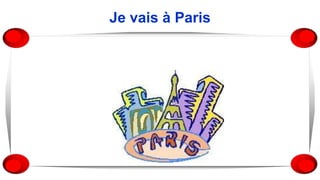
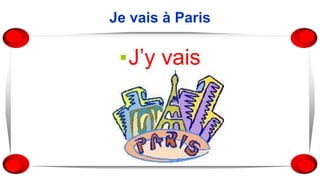
Je vais à Paris
Je vais à Paris
▪J’y vais
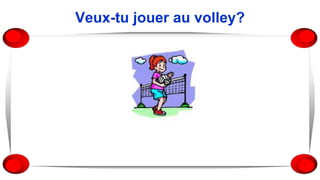
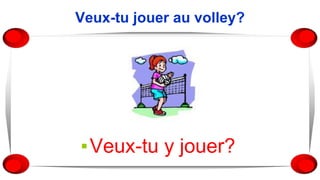
Veux-tu jouer au volley?
▪Veux-tu y jouer?
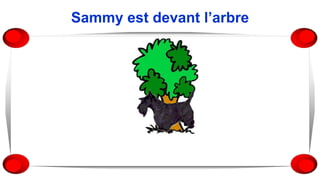
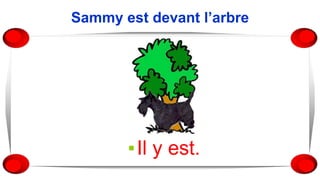
Sammy est devant l’arbre
▪Il y est.
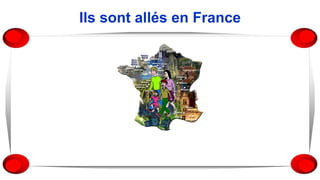
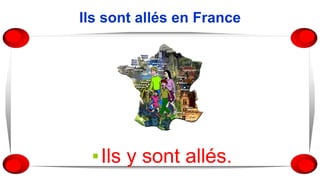
Ils sont allés en France
▪Ils y sont allés.
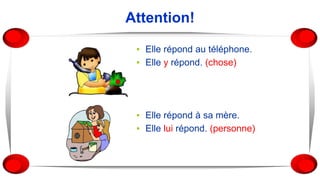
Attention!
▪ Elle répond au téléphone.
▪ Elle y répond. (chose)
▪ Elle répond à sa mère.
▪ Elle lui répond. (personne)
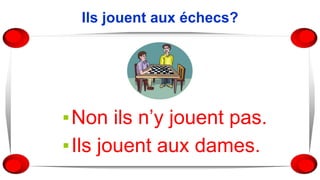
Ils jouent aux échecs?
▪Non ils n’y jouent pas.
▪Ils jouent aux dames.
EN
▪ Ce pronom remplace UNE CHOSE
précédée par une forme de
DE (de la, du, de l’, des, de) ou un
nombre (3, 15, 22, etc.).
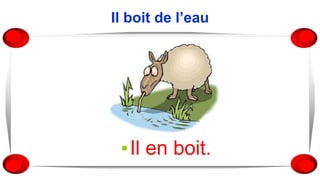
Il boit de l’eau
Il boit de l’eau
▪Il en boit.
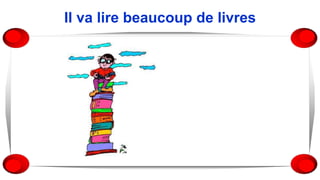
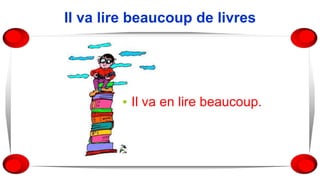
Il va lire beaucoup de livres
▪ Il va en lire beaucoup.
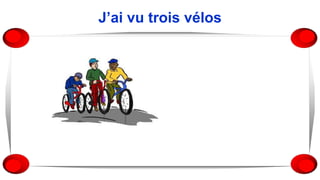
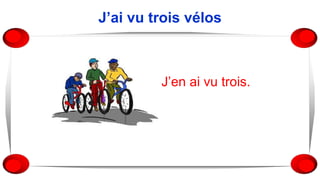
J’ai vu trois vélos
J’ai vu trois vélos
▪ J’en ai vu trois.
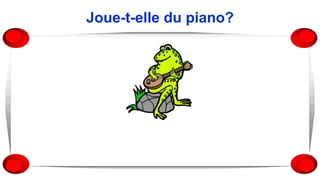
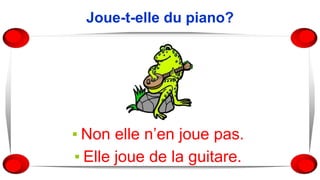
Joue-t-elle du piano?
▪ Non elle n’en joue pas.
▪ Elle joue de la guitare.
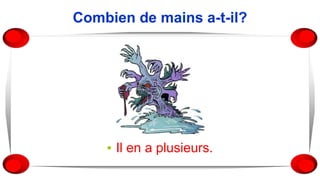
Combien de mains a-t-il?
▪ Il en a plusieurs.
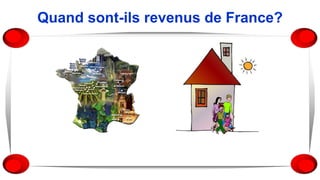
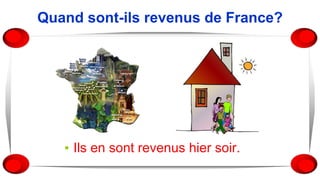
Quand sont-ils revenus de France?
▪ Ils en sont revenus hier soir.
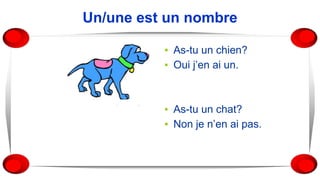
Un/une est un nombre
▪ As-tu un chien?
▪ Oui j’en ai un.
▪ As-tu un chat?
▪ Non je n’en ai pas.
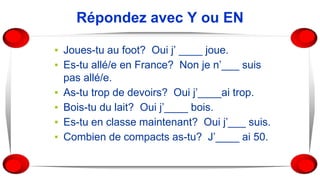
Répondez avec Y ou EN
▪ Joues-tu au foot? Oui j’ ____ joue.
▪ Es-tu allé/e en France? Non je n’___ suis
pas allé/e.
▪ As-tu trop de devoirs? Oui j’____ai trop.
▪ Bois-tu du lait? Oui j’____ bois.
▪ Es-tu en classe maintenant? Oui j’___ suis.
▪ Combien de compacts as-tu? J’____ ai 50.
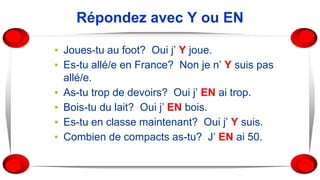
Répondez avec Y ou EN
▪ Joues-tu au foot? Oui j’ Y joue.
▪ Es-tu allé/e en France? Non je n’ Y suis pas
allé/e.
▪ As-tu trop de devoirs? Oui j’ EN ai trop.
▪ Bois-tu du lait? Oui j’ EN bois.
▪ Es-tu en classe maintenant? Oui j’ Y suis.
▪ Combien de compacts as-tu? J’ EN ai 50.
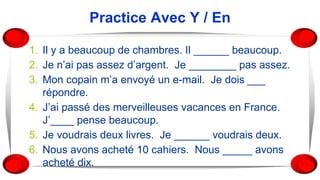
Practice Avec Y / En
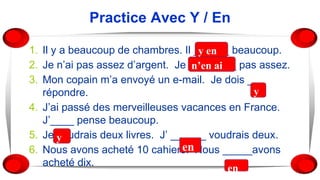
1. Il y a beaucoup de chambres. Il ______ beaucoup.
2. Je n’ai pas assez d’argent. Je ________ pas assez.
3. Mon copain m’a envoyé un e-mail. Je dois ___
répondre.
4. J’ai passé des merveilleuses vacances en France.
J’____ pense beaucoup.
5. Je voudrais deux livres. Je ______ voudrais deux.
6. Nous avons acheté 10 cahiers. Nous _____ avons
acheté dix.
Practice Avec Y / En
1. Il y a beaucoup de chambres. Il ______ beaucoup.
2. Je n’ai pas assez d’argent. Je ________ pas assez.
3. Mon copain m’a envoyé un e-mail. Je dois ___
répondre.
4. J’ai passé des merveilleuses vacances en France.
J’____ pense beaucoup.
5. Je voudrais deux livres. J’ ______ voudrais deux.
6. Nous avons acheté 10 cahiers. Nous _____avons
acheté dix.
y en
an’en ai
y
en
en
y
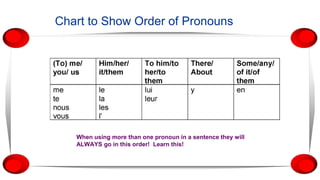
Chart to Show Order of Pronouns
When using more than one pronoun in a sentence they will
ALWAYS go in this order! Learn this!
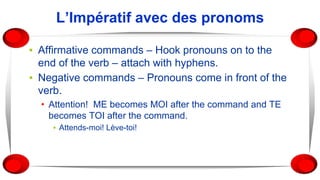
L’Impératif avec des pronoms
▪ Affirmative commands – Hook pronouns on to the
end of the verb – attach with hyphens.
▪ Negative commands – Pronouns come in front of the
verb.
• Attention! ME becomes MOI after the command and TE
becomes TOI after the command.
▪ Attends-moi! Lève-toi!
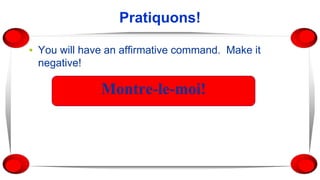
Pratiquons!
▪ You will have an affirmative command. Make it
negative!
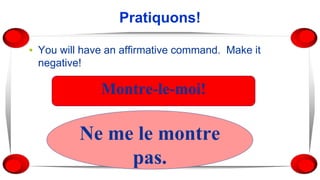
Montre-le-moi!
Pratiquons!
▪ You will have an affirmative command. Make it
negative!
Montre-le-moi!
Ne me le montre
pas.
Pratiquons!
▪ You will have an affirmative command. Make it
negative!
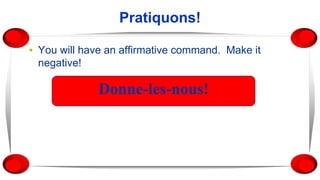
Donne-les-nous!
Pratiquons!
▪ You will have an affirmative command. Make it
negative!
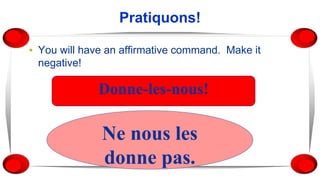
Donne-les-nous!
Ne nous les
donne pas.
Pratiquons!
▪ You will have an affirmative command. Make it
negative!
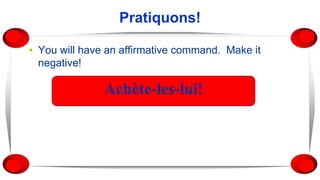
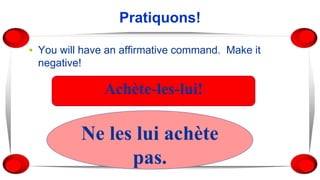
Achète-les-lui!
Pratiquons!
▪ You will have an affirmative command. Make it
negative!
Achète-les-lui!
Ne les lui achète
pas.
Pratiquons!
▪ You will have an affirmative command. Make it
negative!
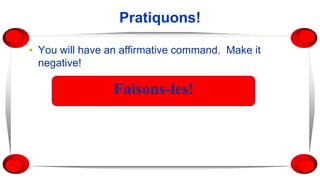
Faisons-les!
Pratiquons!
▪ You will have an affirmative command. Make it
negative!
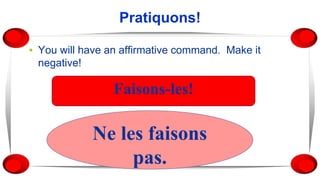
Faisons-les!
Ne les faisons
pas.
Pratiquons!
▪ You will have an affirmative command. Make it
negative!
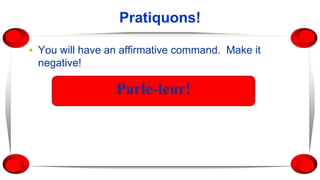
Parle-leur!
Pratiquons!
▪ You will have an affirmative command. Make it
negative!
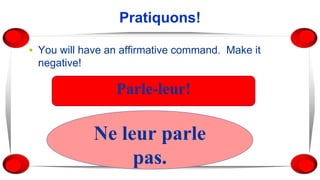
Parle-leur!
Ne leur parle
pas.
Pratiquons!
▪ You will have an affirmative command. Make it
negative!
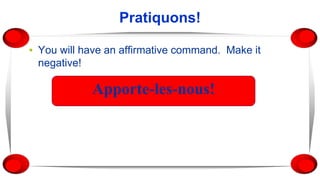
Apporte-les-nous!
Pratiquons!
▪ You will have an affirmative command. Make it
negative!
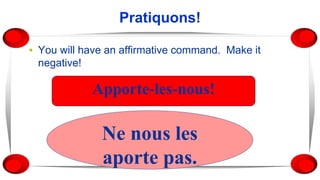
Apporte-les-nous!
Ne nous les
aporte pas.
Pratiquons!
▪ You will have an affirmative command. Make it
negative!
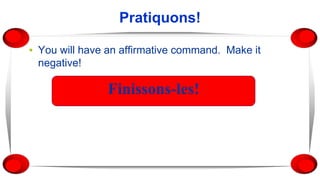
Finissons-les!
Pratiquons!
▪ You will have an affirmative command. Make it
negative!
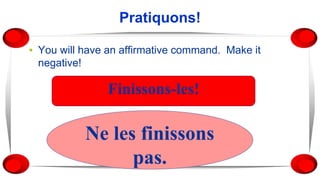
Finissons-les!
Ne les finissons
pas.
Pratiquons!
▪ You will have an affirmative command. Make it
negative!
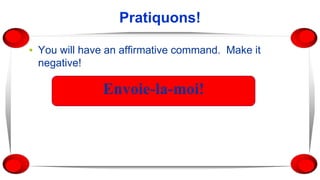
Envoie-la-moi!
Pratiquons!
▪ You will have an affirmative command. Make it
negative!
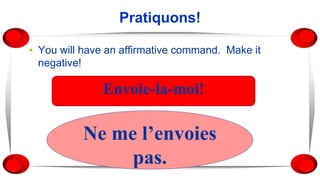
Envoie-la-moi!
Ne me l’envoies
pas.
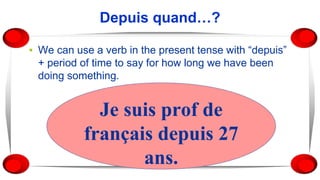
Depuis quand…?
▪ We can use a verb in the present tense with “depuis”
+ period of time to say for how long we have been
doing something.
Je suis prof de
français depuis 27
ans.
Pratiquons
▪ Pratiquons…say that the people have been doing the
activity for the time shown. (ils / parler français / 2
ans)
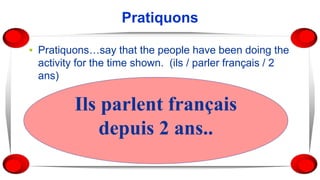
Pratiquons
▪ Pratiquons…say that the people have been doing the
activity for the time shown. (ils / parler français / 2
ans)
Ils parlent français
depuis 2 ans..
Pratiquons
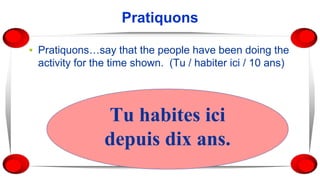
Pratiquons…say that the people have been doing the
activity for the time shown. (Tu / habiter ici / 10 ans)
Pratiquons
▪ Pratiquons…say that the people have been doing the
activity for the time shown. (Tu / habiter ici / 10 ans)
Tu habites ici
depuis dix ans.
Pratiquons
▪ Pratiquons…say that the people have been doing the
activity for the time shown. (nous / regarder ce
programme/ 6 mois)
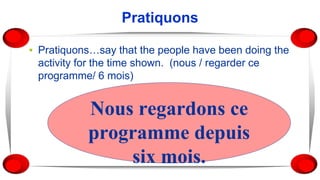
Pratiquons
▪ Pratiquons…say that the people have been doing the
activity for the time shown. (nous / regarder ce
programme/ 6 mois)
Nous regardons ce
programme depuis
six mois.
The future tense
1- Use
2- Formation
3- Time indicators
1- Use
■ The future tense is used to describe
something that is going to happen or will /
shall happen later on.
■ As in English, there are three main ways of
describing the future action.
2-1- The near future
(in English “going to” + verb)
■ The French structure is “aller” verb in
the present tense + an infinitive (that
is to say a verb ending in “ER”, “IR”
or “RE”).
■ Je vais jouer
■ Tu vas jouer
■ Il, Elle, On va faire
■ Nous allons faire
■ Vous allez finir
■ Ils, Elles vont finir (…)
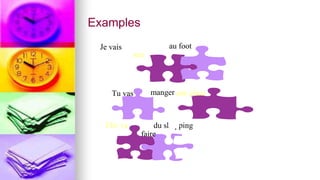
Examples
une glace
faire
du shopping
mangerTu vas
Elle va
jouer
au footJe vais
2-2- The future tense
(In English, will/shall + verb)
■ The French structure is the infinitive form of the
verb + the specific future endings.
■ Don’t forget to remove the “e” of “RE” verbs before
you do so!
■ Je jouer ai
■ Tu jouer as
■ Il, Elle, On choisir a
■ Nous choisir ons
■ Vous boire ez
■ Ils, Elles boire ont
2-3- The present (!)
■ You may express a future idea with a
present tense.
■ Examples:
Ce week-end, je reste à la maison.
L’année prochaine, je pars en Italie.
2-4- Irregular verbs
■ Here is the list of verbs that alter their stem
in the future tense. Once it is altered, it
stays the same at all persons.
■ Être ser + endings
■ Avoir aur + endings
■ Aller ir + endings
■ Faire fer + endings
■ Pouvoir pourr + endings
■ Savoir saur + endings
■ Vouloir voudr + endings
■ Venir viendr + endings
3- Time indicators
Demain (tomorrow)
Après (later)
Ce soir (tonight)
Cet après-midi (this afternoon)
Ensuite (after)
Plus tard (later on)
Pendant les vacances (during the holidays)
Le week-end prochain (Next week-end)
L’année prochaine (Next year)
Pratiquons….
■ Que feras-tu demain?
■ La semaine prochaine?
■ Le mois prochain?
■ Ecris trois phrases dans le chat….utilise le
futur!
V. Passerat
Le conditionnel
■ Says what would happen if conditions were
right.
■ I would speak – je parlerais
■ I would study – J’étudierais….
■ Learn the new forms!
V. Passerat
•How to use the conditional tense
•The stem and the endings
•Some irregularities
•Constructing hypothetical sentences
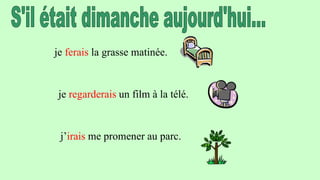
je ferais la grasse matinée.
je regarderais un film à la télé.
j’irais me promener au parc.
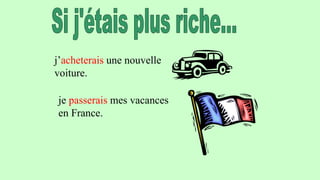
j’acheterais une nouvelle
voiture.
je passerais mes vacances
en France.
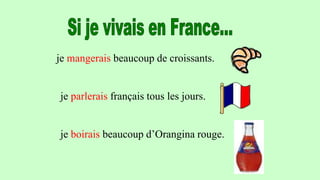
je mangerais beaucoup de croissants.
je parlerais français tous les jours.
je boirais beaucoup d’Orangina rouge.
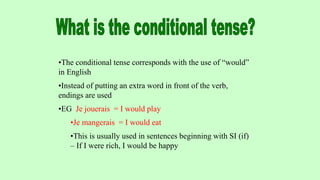
•The conditional tense corresponds with the use of “would”
in English
•Instead of putting an extra word in front of the verb,
endings are used
•EG Je jouerais = I would play
•Je mangerais = I would eat
•This is usually used in sentences beginning with SI (if)
– If I were rich, I would be happy
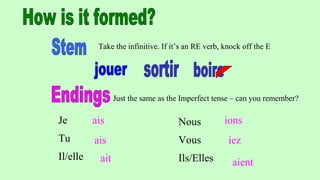
Take the infinitive. If it’s an RE verb, knock off the E
Just the same as the Imperfect tense – can you remember?
Je
Tu
Il/elle
Nous
Vous
Ils/Elles
ais
ais
ait
ions
iez
aient
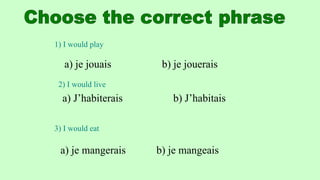
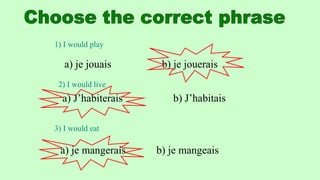
1) I would play
a) je jouais b) je jouerais
2) I would live
a) J’habiterais b) J’habitais
3) I would eat
a) je mangerais b) je mangeais
1) I would play
a) je jouais b) je jouerais
2) I would live
a) J’habiterais b) J’habitais
3) I would eat
a) je mangerais b) je mangeais
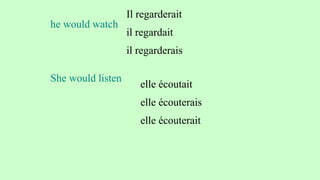
he would watch
Il regarderait
il regardait
il regarderais
She would listen
elle écoutait
elle écouterais
elle écouterait
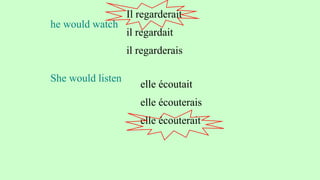
he would watch
Il regarderait
il regardait
il regarderais
She would listen
elle écoutait
elle écouterais
elle écouterait
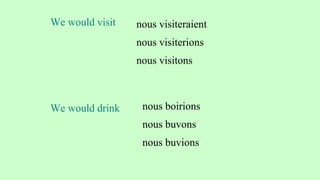
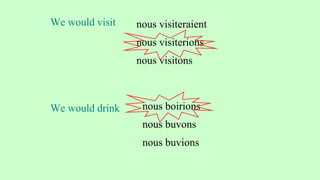
We would visit nous visiteraient
nous visiterions
nous visitons
We would drink nous boirions
nous buvons
nous buvions
We would visit nous visiteraient
nous visiterions
nous visitons
We would drink nous boirions
nous buvons
nous buvions
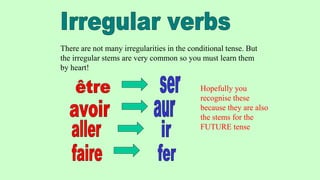
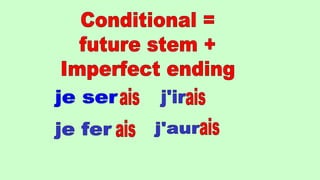
There are not many irregularities in the conditional tense. But
the irregular stems are very common so you must learn them
by heart!
Hopefully you
recognise these
because they are also
the stems for the
FUTURE tense
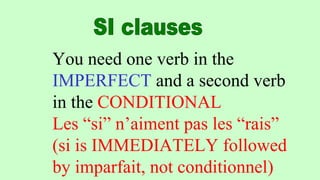
You need one verb in the
IMPERFECT and a second verb
in the CONDITIONAL
Les “si” n’aiment pas les “rais”
(si is IMMEDIATELY followed
by imparfait, not conditionnel)
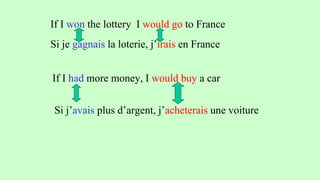
If I won the lottery I would go to France
Si je gagnais la loterie, j’irais en France
If I had more money, I would buy a car
Si j’avais plus d’argent, j’acheterais une voiture
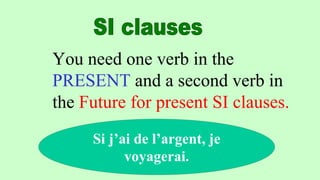
You need one verb in the
PRESENT and a second verb in
the Future for present SI clauses.
Si j’ai de l’argent, je
voyagerai.
Questions ou
problèmes?

5 rlc-fr3-unit 5

  • 1.
  • 2.
    Les Pronoms Yet EN More Object Pronouns
  • 3.
    Y ▪ Ce pronomremplace UNE CHOSE précédée par une préposition. Dans sur sous devant chez derrière en à au aux à l’
  • 4.
  • 5.
    Je vais àParis ▪J’y vais
  • 6.
  • 7.
    Veux-tu jouer auvolley? ▪Veux-tu y jouer?
  • 8.
  • 9.
    Sammy est devantl’arbre ▪Il y est.
  • 10.
    Ils sont allésen France
  • 11.
    Ils sont allésen France ▪Ils y sont allés.
  • 12.
    Attention! ▪ Elle répondau téléphone. ▪ Elle y répond. (chose) ▪ Elle répond à sa mère. ▪ Elle lui répond. (personne)
  • 13.
    Ils jouent auxéchecs? ▪Non ils n’y jouent pas. ▪Ils jouent aux dames.
  • 14.
    EN ▪ Ce pronomremplace UNE CHOSE précédée par une forme de DE (de la, du, de l’, des, de) ou un nombre (3, 15, 22, etc.).
  • 15.
    Il boit del’eau
  • 16.
    Il boit del’eau ▪Il en boit.
  • 17.
    Il va lirebeaucoup de livres
  • 18.
    Il va lirebeaucoup de livres ▪ Il va en lire beaucoup.
  • 19.
  • 20.
    J’ai vu troisvélos ▪ J’en ai vu trois.
  • 21.
  • 22.
    Joue-t-elle du piano? ▪Non elle n’en joue pas. ▪ Elle joue de la guitare.
  • 23.
    Combien de mainsa-t-il? ▪ Il en a plusieurs.
  • 24.
  • 25.
    Quand sont-ils revenusde France? ▪ Ils en sont revenus hier soir.
  • 26.
    Un/une est unnombre ▪ As-tu un chien? ▪ Oui j’en ai un. ▪ As-tu un chat? ▪ Non je n’en ai pas.
  • 27.
    Répondez avec You EN ▪ Joues-tu au foot? Oui j’ ____ joue. ▪ Es-tu allé/e en France? Non je n’___ suis pas allé/e. ▪ As-tu trop de devoirs? Oui j’____ai trop. ▪ Bois-tu du lait? Oui j’____ bois. ▪ Es-tu en classe maintenant? Oui j’___ suis. ▪ Combien de compacts as-tu? J’____ ai 50.
  • 28.
    Répondez avec You EN ▪ Joues-tu au foot? Oui j’ Y joue. ▪ Es-tu allé/e en France? Non je n’ Y suis pas allé/e. ▪ As-tu trop de devoirs? Oui j’ EN ai trop. ▪ Bois-tu du lait? Oui j’ EN bois. ▪ Es-tu en classe maintenant? Oui j’ Y suis. ▪ Combien de compacts as-tu? J’ EN ai 50.
  • 29.
    Practice Avec Y/ En 1. Il y a beaucoup de chambres. Il ______ beaucoup. 2. Je n’ai pas assez d’argent. Je ________ pas assez. 3. Mon copain m’a envoyé un e-mail. Je dois ___ répondre. 4. J’ai passé des merveilleuses vacances en France. J’____ pense beaucoup. 5. Je voudrais deux livres. Je ______ voudrais deux. 6. Nous avons acheté 10 cahiers. Nous _____ avons acheté dix.
  • 30.
    Practice Avec Y/ En 1. Il y a beaucoup de chambres. Il ______ beaucoup. 2. Je n’ai pas assez d’argent. Je ________ pas assez. 3. Mon copain m’a envoyé un e-mail. Je dois ___ répondre. 4. J’ai passé des merveilleuses vacances en France. J’____ pense beaucoup. 5. Je voudrais deux livres. J’ ______ voudrais deux. 6. Nous avons acheté 10 cahiers. Nous _____avons acheté dix. y en an’en ai y en en y
  • 31.
    Chart to ShowOrder of Pronouns When using more than one pronoun in a sentence they will ALWAYS go in this order! Learn this!
  • 32.
    L’Impératif avec despronoms ▪ Affirmative commands – Hook pronouns on to the end of the verb – attach with hyphens. ▪ Negative commands – Pronouns come in front of the verb. • Attention! ME becomes MOI after the command and TE becomes TOI after the command. ▪ Attends-moi! Lève-toi!
  • 33.
    Pratiquons! ▪ You willhave an affirmative command. Make it negative! Montre-le-moi!
  • 34.
    Pratiquons! ▪ You willhave an affirmative command. Make it negative! Montre-le-moi! Ne me le montre pas.
  • 35.
    Pratiquons! ▪ You willhave an affirmative command. Make it negative! Donne-les-nous!
  • 36.
    Pratiquons! ▪ You willhave an affirmative command. Make it negative! Donne-les-nous! Ne nous les donne pas.
  • 37.
    Pratiquons! ▪ You willhave an affirmative command. Make it negative! Achète-les-lui!
  • 38.
    Pratiquons! ▪ You willhave an affirmative command. Make it negative! Achète-les-lui! Ne les lui achète pas.
  • 39.
    Pratiquons! ▪ You willhave an affirmative command. Make it negative! Faisons-les!
  • 40.
    Pratiquons! ▪ You willhave an affirmative command. Make it negative! Faisons-les! Ne les faisons pas.
  • 41.
    Pratiquons! ▪ You willhave an affirmative command. Make it negative! Parle-leur!
  • 42.
    Pratiquons! ▪ You willhave an affirmative command. Make it negative! Parle-leur! Ne leur parle pas.
  • 43.
    Pratiquons! ▪ You willhave an affirmative command. Make it negative! Apporte-les-nous!
  • 44.
    Pratiquons! ▪ You willhave an affirmative command. Make it negative! Apporte-les-nous! Ne nous les aporte pas.
  • 45.
    Pratiquons! ▪ You willhave an affirmative command. Make it negative! Finissons-les!
  • 46.
    Pratiquons! ▪ You willhave an affirmative command. Make it negative! Finissons-les! Ne les finissons pas.
  • 47.
    Pratiquons! ▪ You willhave an affirmative command. Make it negative! Envoie-la-moi!
  • 48.
    Pratiquons! ▪ You willhave an affirmative command. Make it negative! Envoie-la-moi! Ne me l’envoies pas.
  • 49.
    Depuis quand…? ▪ Wecan use a verb in the present tense with “depuis” + period of time to say for how long we have been doing something. Je suis prof de français depuis 27 ans.
  • 50.
    Pratiquons ▪ Pratiquons…say thatthe people have been doing the activity for the time shown. (ils / parler français / 2 ans)
  • 51.
    Pratiquons ▪ Pratiquons…say thatthe people have been doing the activity for the time shown. (ils / parler français / 2 ans) Ils parlent français depuis 2 ans..
  • 52.
    Pratiquons Pratiquons…say that thepeople have been doing the activity for the time shown. (Tu / habiter ici / 10 ans)
  • 53.
    Pratiquons ▪ Pratiquons…say thatthe people have been doing the activity for the time shown. (Tu / habiter ici / 10 ans) Tu habites ici depuis dix ans.
  • 54.
    Pratiquons ▪ Pratiquons…say thatthe people have been doing the activity for the time shown. (nous / regarder ce programme/ 6 mois)
  • 55.
    Pratiquons ▪ Pratiquons…say thatthe people have been doing the activity for the time shown. (nous / regarder ce programme/ 6 mois) Nous regardons ce programme depuis six mois.
  • 56.
    The future tense 1-Use 2- Formation 3- Time indicators
  • 57.
    1- Use ■ Thefuture tense is used to describe something that is going to happen or will / shall happen later on. ■ As in English, there are three main ways of describing the future action.
  • 58.
    2-1- The nearfuture (in English “going to” + verb) ■ The French structure is “aller” verb in the present tense + an infinitive (that is to say a verb ending in “ER”, “IR” or “RE”). ■ Je vais jouer ■ Tu vas jouer ■ Il, Elle, On va faire ■ Nous allons faire ■ Vous allez finir ■ Ils, Elles vont finir (…)
  • 59.
    Examples une glace faire du shopping mangerTuvas Elle va jouer au footJe vais
  • 60.
    2-2- The futuretense (In English, will/shall + verb) ■ The French structure is the infinitive form of the verb + the specific future endings. ■ Don’t forget to remove the “e” of “RE” verbs before you do so! ■ Je jouer ai ■ Tu jouer as ■ Il, Elle, On choisir a ■ Nous choisir ons ■ Vous boire ez ■ Ils, Elles boire ont
  • 61.
    2-3- The present(!) ■ You may express a future idea with a present tense. ■ Examples: Ce week-end, je reste à la maison. L’année prochaine, je pars en Italie.
  • 62.
    2-4- Irregular verbs ■Here is the list of verbs that alter their stem in the future tense. Once it is altered, it stays the same at all persons. ■ Être ser + endings ■ Avoir aur + endings ■ Aller ir + endings ■ Faire fer + endings ■ Pouvoir pourr + endings ■ Savoir saur + endings ■ Vouloir voudr + endings ■ Venir viendr + endings
  • 63.
    3- Time indicators Demain(tomorrow) Après (later) Ce soir (tonight) Cet après-midi (this afternoon) Ensuite (after) Plus tard (later on) Pendant les vacances (during the holidays) Le week-end prochain (Next week-end) L’année prochaine (Next year)
  • 64.
    Pratiquons…. ■ Que feras-tudemain? ■ La semaine prochaine? ■ Le mois prochain? ■ Ecris trois phrases dans le chat….utilise le futur! V. Passerat
  • 65.
    Le conditionnel ■ Sayswhat would happen if conditions were right. ■ I would speak – je parlerais ■ I would study – J’étudierais…. ■ Learn the new forms! V. Passerat
  • 66.
    •How to usethe conditional tense •The stem and the endings •Some irregularities •Constructing hypothetical sentences
  • 67.
    je ferais lagrasse matinée. je regarderais un film à la télé. j’irais me promener au parc.
  • 68.
    j’acheterais une nouvelle voiture. jepasserais mes vacances en France.
  • 69.
    je mangerais beaucoupde croissants. je parlerais français tous les jours. je boirais beaucoup d’Orangina rouge.
  • 70.
    •The conditional tensecorresponds with the use of “would” in English •Instead of putting an extra word in front of the verb, endings are used •EG Je jouerais = I would play •Je mangerais = I would eat •This is usually used in sentences beginning with SI (if) – If I were rich, I would be happy
  • 71.
    Take the infinitive.If it’s an RE verb, knock off the E Just the same as the Imperfect tense – can you remember? Je Tu Il/elle Nous Vous Ils/Elles ais ais ait ions iez aient
  • 72.
    1) I wouldplay a) je jouais b) je jouerais 2) I would live a) J’habiterais b) J’habitais 3) I would eat a) je mangerais b) je mangeais
  • 73.
    1) I wouldplay a) je jouais b) je jouerais 2) I would live a) J’habiterais b) J’habitais 3) I would eat a) je mangerais b) je mangeais
  • 74.
    he would watch Ilregarderait il regardait il regarderais She would listen elle écoutait elle écouterais elle écouterait
  • 75.
    he would watch Ilregarderait il regardait il regarderais She would listen elle écoutait elle écouterais elle écouterait
  • 76.
    We would visitnous visiteraient nous visiterions nous visitons We would drink nous boirions nous buvons nous buvions
  • 77.
    We would visitnous visiteraient nous visiterions nous visitons We would drink nous boirions nous buvons nous buvions
  • 78.
    There are notmany irregularities in the conditional tense. But the irregular stems are very common so you must learn them by heart! Hopefully you recognise these because they are also the stems for the FUTURE tense
  • 80.
    You need oneverb in the IMPERFECT and a second verb in the CONDITIONAL Les “si” n’aiment pas les “rais” (si is IMMEDIATELY followed by imparfait, not conditionnel)
  • 81.
    If I wonthe lottery I would go to France Si je gagnais la loterie, j’irais en France If I had more money, I would buy a car Si j’avais plus d’argent, j’acheterais une voiture
  • 82.
    You need oneverb in the PRESENT and a second verb in the Future for present SI clauses. Si j’ai de l’argent, je voyagerai.
  • 83.