Bonjour et Bienvenue!
ça va
vous vous-appellez comment?
au revoir!
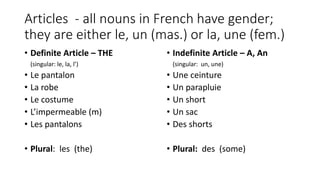
Articles - all nouns in French have gender;
they are either le, un (mas.) or la, une (fem.)
• Definite Article – THE
(singular: le, la, l’)
• Le pantalon
• La robe
• Le costume
• L’impermeable (m)
• Les pantalons
• Plural: les (the)
• Indefinite Article – A, An
(singular: un, une)
• Une ceinture
• Un parapluie
• Un short
• Un sac
• Des shorts
• Plural: des (some)
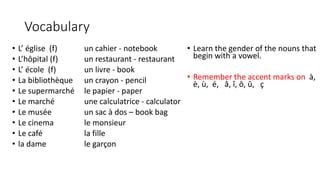
Vocabulary
• L’ église (f) un cahier - notebook
• L’hôpital (f) un restaurant - restaurant
• L’ école (f) un livre - book
• La bibliothèque un crayon - pencil
• Le supermarché le papier - paper
• Le marché une calculatrice - calculator
• Le musée un sac à dos – book bag
• Le cinema le monsieur
• Le café la fille
• la dame le garçon
• Learn the gender of the nouns that
begin with a vowel.
• Remember the accent marks on à,
è, ù, é, â, î, ô, û, ç
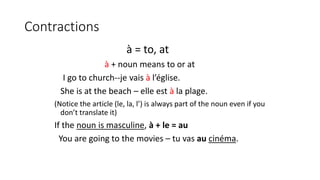
Contractions
à = to, at
à + noun means to or at
I go to church--je vais à l’église.
She is at the beach – elle est à la plage.
(Notice the article (le, la, l’) is always part of the noun even if you
don’t translate it)
If the noun is masculine, à + le = au
You are going to the movies – tu vas au cinéma.
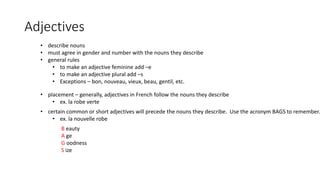
Adjectives
• describe nouns
• must agree in gender and number with the nouns they describe
• general rules
• to make an adjective feminine add –e
• to make an adjective plural add –s
• Exceptions – bon, nouveau, vieux, beau, gentil, etc.
• placement – generally, adjectives in French follow the nouns they describe
• ex. la robe verte
• certain common or short adjectives will precede the nouns they describe. Use the acronym BAGS to remember.
• ex. la nouvelle robe
B eauty
A ge
G oodness
S ize
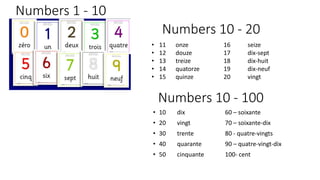
Numbers 1 - 10
• 10 dix 60 – soixante
• 20 vingt 70 – soixante-dix
• 30 trente 80 - quatre-vingts
• 40 quarante 90 – quatre-vingt-dix
• 50 cinquante 100- cent
Numbers 10 - 100
• 11 onze 16 seize
• 12 douze 17 dix-sept
• 13 treize 18 dix-huit
• 14 quatorze 19 dix-neuf
• 15 quinze 20 vingt
Numbers 10 - 20
60 - 79
• Numbers from 60 – 79 use soixante (60) as the base and add the
number needed:
• 61 soixante et un
• 63 soixante-trois
• 71 soixante et onze (60+11)
• (notice “et” used here, just like, 21, 31, 41, 51, 61)
• 73 soixante-treize (60+13)
• 77 soixante-dix-sept (60 +17)
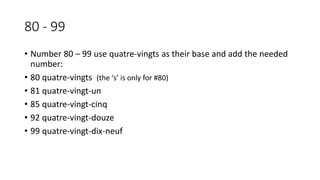
80 - 99
• Number 80 – 99 use quatre-vingts as their base and add the needed
number:
• 80 quatre-vingts (the ‘s’ is only for #80)
• 81 quatre-vingt-un
• 85 quatre-vingt-cinq
• 92 quatre-vingt-douze
• 99 quatre-vingt-dix-neuf
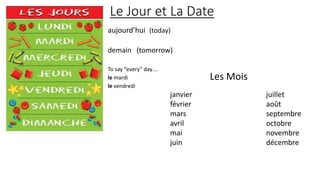
Le Jour et La Date
aujourd’hui (today)
demain (tomorrow)
To say “every” day….
le mardi
le vendredi
janvier juillet
février août
mars septembre
avril octobre
mai novembre
juin décembre
Les Mois
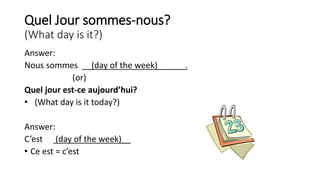
Quel Jour sommes-nous?
(What day is it?)
Answer:
Nous sommes __(day of the week)______.
(or)
Quel jour est-ce aujourd’hui?
• (What day is it today?)
Answer:
C’est (day of the week)__
• Ce est = c’est
Questions/Answers
• Quel jour sommes-nous?
• C’est mardi. (present)
• Nous sommes mardi.
• Quel jour serons-nous demain?
• Ça sera mercredi. (future)
-( Nous serons mercredi.)
Quelle heure est-il?
• Il est une heure – 1:00
• Il est cinq heures – 5:00
(Notice that “heure” is feminine—use une, not un)
(Notice the ‘s’ on heure when it’s more than one.)
Special vocabulary:
:30 – demie Ex. Il est sept heures et demie – 7:30
:15 – quart Ex. Il est deux heures et quart – 2:15
Telling Time
• After :30, there are two ways to give the time
• Il est six heures quarante – 6:40
• Il est sept heures moins vingt - 6:40
• Note:
• When subtracting 15 (quart), you need to use the article.
• Ex. Il est dix heures moins le quart – 9:45
Adding AM or PM
• Following the time, simply add:
• du matin – morning
• de l’après-midi – afternoon
• du soir – evening
• 3:00 pm – il est trois heures de l’après-midi
• 8:00 pm – il est huit heures du soir
• 11:00 am – il est onze heures du matin
Subject Pronouns
Singular
• je I
• tu you
• il he
• elle she
• ton ami, il…..
• ton amie, elle……
Plural
• nous we
• vous you
• ils they
• elles they
• Marie et moi, nous….
• John et Marie, ils …..
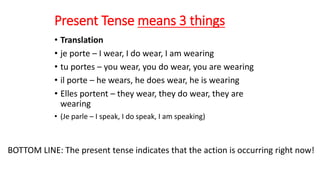
Present Tense means 3 things
• Translation
• je porte – I wear, I do wear, I am wearing
• tu portes – you wear, you do wear, you are wearing
• il porte – he wears, he does wear, he is wearing
• Elles portent – they wear, they do wear, they are
wearing
• (Je parle – I speak, I do speak, I am speaking)
BOTTOM LINE: The present tense indicates that the action is occurring right now!
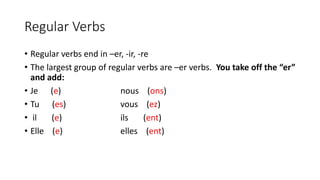
Regular Verbs
• Regular verbs end in –er, -ir, -re
• The largest group of regular verbs are –er verbs. You take off the “er”
and add:
• Je (e) nous (ons)
• Tu (es) vous (ez)
• il (e) ils (ent)
• Elle (e) elles (ent)
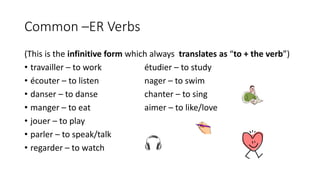
Common –ER Verbs
(This is the infinitive form which always translates as “to + the verb”)
• travailler – to work étudier – to study
• écouter – to listen nager – to swim
• danser – to danse chanter – to sing
• manger – to eat aimer – to like/love
• jouer – to play
• parler – to speak/talk
• regarder – to watch
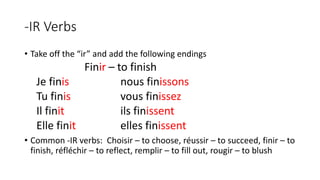
-IR Verbs
• Take off the “ir” and add the following endings
Finir – to finish
Je finis nous finissons
Tu finis vous finissez
Il finit ils finissent
Elle finit elles finissent
• Common -IR verbs: Choisir – to choose, réussir – to succeed, finir – to
finish, réfléchir – to reflect, remplir – to fill out, rougir – to blush
- RE Verbs
• Take off the “re” and add the following endings
Vendre – to sell
• Je vends nous vendons
• Tu vends vous vendez
• Il vend_ ils vendent
• Elle vend_ elles vendent
• Re verbs: descendre – to descend, perdre – to lose,
répondre – to answer, attendre – to wait
Regular Verb Summary
• French verbs usually end in –er, -ir, or –re.
• You take off the ending and add a new ending that must match the
subject. Look for patterns and similarities to help you remember.
• There are 3 different translations possible for each subject/verb in the
present tense.
• Example: tu travailles: you work
• you do work
you are working
Irregular Verbs
• French has irregular verbs, just like English. These verbs do not follow
the normal rules.
• You’ve already been learning and using some of these irregular verbs
in certain phrases.
• (il fait, je suis, il est, je vais, tu vas, j’ai, il a)
• (EX: Il fait beau, je vais bien, j’ai besoin de…)
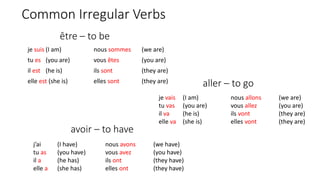
être – to be
je suis (I am) nous sommes (we are)
tu es (you are) vous êtes (you are)
il est (he is) ils sont (they are)
elle est (she is) elles sont (they are)
je vais (I am) nous allons (we are)
tu vas (you are) vous allez (you are)
il va (he is) ils vont (they are)
elle va (she is) elles vont (they are)
aller – to go
j’ai (I have) nous avons (we have)
tu as (you have) vous avez (you have)
il a (he has) ils ont (they have)
elle a (she has) elles ont (they have)
avoir – to have
Common Irregular Verbs
Irregular Verb Phrases
• être – comment es-tu/comment êtes-vous?
• aller – comment vas-tu/comment allez vous?, on y va/allons-y, allez-y
• avoir – avoir…ans, avoir besoin de, il y a, avoir envie de, avoir de la
chance, avoir chaud/froid, avoir faim/soif
Negation
• uses the phrase “ne…pas” which means not
• sandwiches the conjugated verb
• Ex. je n’aime pas travailler.
How to write a question
• 2 ways:
1. Invert the subject and verb
Tu aimes (you like)
Aimes-tu (do you like)
2. **Add “est-ce que” in front of subject & verb
Est-ce que tu aimes (do you like)
Est-ce que vous parlez (do you speak)
** Preferred way to make a question
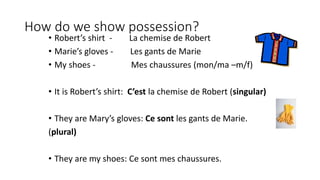
How do we show possession?
• Robert’s shirt - La chemise de Robert
• Marie’s gloves - Les gants de Marie
• My shoes - Mes chaussures (mon/ma –m/f)
• It is Robert’s shirt: C’est la chemise de Robert (singular)
• They are Mary’s gloves: Ce sont les gants de Marie.
(plural)
• They are my shoes: Ce sont mes chaussures.
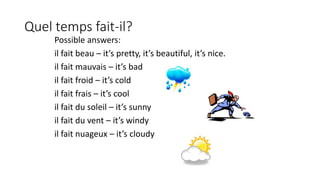
Quel temps fait-il?
Possible answers:
il fait beau – it’s pretty, it’s beautiful, it’s nice.
il fait mauvais – it’s bad
il fait froid – it’s cold
il fait frais – it’s cool
il fait du soleil – it’s sunny
il fait du vent – it’s windy
il fait nuageux – it’s cloudy
More weather phrases
• You can always add “très”
in front of the adjective:
• Il fait très beau.
• Il fait très mauvais
• (or make it negative)
• Il ne fait pas froid
• Il ne fait pas très chaud.
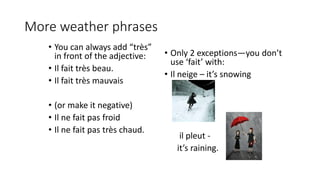
• Only 2 exceptions—you don’t
use ‘fait’ with:
• Il neige – it’s snowing
il pleut -
it’s raining.
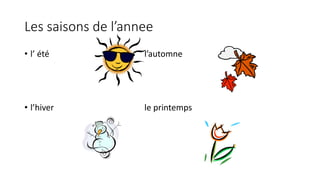
Les saisons de l’annee
• l’ été l’automne
• l’hiver le printemps
Merci et Au Revoir!
Bonne Chance!

Midterm review french i fall 2013

  • 1.
    Bonjour et Bienvenue! çava vous vous-appellez comment? au revoir!
  • 2.
    Articles - allnouns in French have gender; they are either le, un (mas.) or la, une (fem.) • Definite Article – THE (singular: le, la, l’) • Le pantalon • La robe • Le costume • L’impermeable (m) • Les pantalons • Plural: les (the) • Indefinite Article – A, An (singular: un, une) • Une ceinture • Un parapluie • Un short • Un sac • Des shorts • Plural: des (some)
  • 3.
    Vocabulary • L’ église(f) un cahier - notebook • L’hôpital (f) un restaurant - restaurant • L’ école (f) un livre - book • La bibliothèque un crayon - pencil • Le supermarché le papier - paper • Le marché une calculatrice - calculator • Le musée un sac à dos – book bag • Le cinema le monsieur • Le café la fille • la dame le garçon • Learn the gender of the nouns that begin with a vowel. • Remember the accent marks on à, è, ù, é, â, î, ô, û, ç
  • 4.
    Contractions à = to,at à + noun means to or at I go to church--je vais à l’église. She is at the beach – elle est à la plage. (Notice the article (le, la, l’) is always part of the noun even if you don’t translate it) If the noun is masculine, à + le = au You are going to the movies – tu vas au cinéma.
  • 5.
    Adjectives • describe nouns •must agree in gender and number with the nouns they describe • general rules • to make an adjective feminine add –e • to make an adjective plural add –s • Exceptions – bon, nouveau, vieux, beau, gentil, etc. • placement – generally, adjectives in French follow the nouns they describe • ex. la robe verte • certain common or short adjectives will precede the nouns they describe. Use the acronym BAGS to remember. • ex. la nouvelle robe B eauty A ge G oodness S ize
  • 6.
    Numbers 1 -10 • 10 dix 60 – soixante • 20 vingt 70 – soixante-dix • 30 trente 80 - quatre-vingts • 40 quarante 90 – quatre-vingt-dix • 50 cinquante 100- cent Numbers 10 - 100 • 11 onze 16 seize • 12 douze 17 dix-sept • 13 treize 18 dix-huit • 14 quatorze 19 dix-neuf • 15 quinze 20 vingt Numbers 10 - 20
  • 7.
    60 - 79 •Numbers from 60 – 79 use soixante (60) as the base and add the number needed: • 61 soixante et un • 63 soixante-trois • 71 soixante et onze (60+11) • (notice “et” used here, just like, 21, 31, 41, 51, 61) • 73 soixante-treize (60+13) • 77 soixante-dix-sept (60 +17)
  • 8.
    80 - 99 •Number 80 – 99 use quatre-vingts as their base and add the needed number: • 80 quatre-vingts (the ‘s’ is only for #80) • 81 quatre-vingt-un • 85 quatre-vingt-cinq • 92 quatre-vingt-douze • 99 quatre-vingt-dix-neuf
  • 9.
    Le Jour etLa Date aujourd’hui (today) demain (tomorrow) To say “every” day…. le mardi le vendredi janvier juillet février août mars septembre avril octobre mai novembre juin décembre Les Mois
  • 10.
    Quel Jour sommes-nous? (Whatday is it?) Answer: Nous sommes __(day of the week)______. (or) Quel jour est-ce aujourd’hui? • (What day is it today?) Answer: C’est (day of the week)__ • Ce est = c’est
  • 11.
    Questions/Answers • Quel joursommes-nous? • C’est mardi. (present) • Nous sommes mardi. • Quel jour serons-nous demain? • Ça sera mercredi. (future) -( Nous serons mercredi.)
  • 12.
    Quelle heure est-il? •Il est une heure – 1:00 • Il est cinq heures – 5:00 (Notice that “heure” is feminine—use une, not un) (Notice the ‘s’ on heure when it’s more than one.) Special vocabulary: :30 – demie Ex. Il est sept heures et demie – 7:30 :15 – quart Ex. Il est deux heures et quart – 2:15
  • 13.
    Telling Time • After:30, there are two ways to give the time • Il est six heures quarante – 6:40 • Il est sept heures moins vingt - 6:40 • Note: • When subtracting 15 (quart), you need to use the article. • Ex. Il est dix heures moins le quart – 9:45
  • 14.
    Adding AM orPM • Following the time, simply add: • du matin – morning • de l’après-midi – afternoon • du soir – evening • 3:00 pm – il est trois heures de l’après-midi • 8:00 pm – il est huit heures du soir • 11:00 am – il est onze heures du matin
  • 15.
    Subject Pronouns Singular • jeI • tu you • il he • elle she • ton ami, il….. • ton amie, elle…… Plural • nous we • vous you • ils they • elles they • Marie et moi, nous…. • John et Marie, ils …..
  • 16.
    Present Tense means3 things • Translation • je porte – I wear, I do wear, I am wearing • tu portes – you wear, you do wear, you are wearing • il porte – he wears, he does wear, he is wearing • Elles portent – they wear, they do wear, they are wearing • (Je parle – I speak, I do speak, I am speaking) BOTTOM LINE: The present tense indicates that the action is occurring right now!
  • 17.
    Regular Verbs • Regularverbs end in –er, -ir, -re • The largest group of regular verbs are –er verbs. You take off the “er” and add: • Je (e) nous (ons) • Tu (es) vous (ez) • il (e) ils (ent) • Elle (e) elles (ent)
  • 18.
    Common –ER Verbs (Thisis the infinitive form which always translates as “to + the verb”) • travailler – to work étudier – to study • écouter – to listen nager – to swim • danser – to danse chanter – to sing • manger – to eat aimer – to like/love • jouer – to play • parler – to speak/talk • regarder – to watch
  • 19.
    -IR Verbs • Takeoff the “ir” and add the following endings Finir – to finish Je finis nous finissons Tu finis vous finissez Il finit ils finissent Elle finit elles finissent • Common -IR verbs: Choisir – to choose, réussir – to succeed, finir – to finish, réfléchir – to reflect, remplir – to fill out, rougir – to blush
  • 20.
    - RE Verbs •Take off the “re” and add the following endings Vendre – to sell • Je vends nous vendons • Tu vends vous vendez • Il vend_ ils vendent • Elle vend_ elles vendent • Re verbs: descendre – to descend, perdre – to lose, répondre – to answer, attendre – to wait
  • 21.
    Regular Verb Summary •French verbs usually end in –er, -ir, or –re. • You take off the ending and add a new ending that must match the subject. Look for patterns and similarities to help you remember. • There are 3 different translations possible for each subject/verb in the present tense. • Example: tu travailles: you work • you do work you are working
  • 22.
    Irregular Verbs • Frenchhas irregular verbs, just like English. These verbs do not follow the normal rules. • You’ve already been learning and using some of these irregular verbs in certain phrases. • (il fait, je suis, il est, je vais, tu vas, j’ai, il a) • (EX: Il fait beau, je vais bien, j’ai besoin de…)
  • 23.
    être – tobe je suis (I am) nous sommes (we are) tu es (you are) vous êtes (you are) il est (he is) ils sont (they are) elle est (she is) elles sont (they are) je vais (I am) nous allons (we are) tu vas (you are) vous allez (you are) il va (he is) ils vont (they are) elle va (she is) elles vont (they are) aller – to go j’ai (I have) nous avons (we have) tu as (you have) vous avez (you have) il a (he has) ils ont (they have) elle a (she has) elles ont (they have) avoir – to have Common Irregular Verbs
  • 24.
    Irregular Verb Phrases •être – comment es-tu/comment êtes-vous? • aller – comment vas-tu/comment allez vous?, on y va/allons-y, allez-y • avoir – avoir…ans, avoir besoin de, il y a, avoir envie de, avoir de la chance, avoir chaud/froid, avoir faim/soif Negation • uses the phrase “ne…pas” which means not • sandwiches the conjugated verb • Ex. je n’aime pas travailler.
  • 25.
    How to writea question • 2 ways: 1. Invert the subject and verb Tu aimes (you like) Aimes-tu (do you like) 2. **Add “est-ce que” in front of subject & verb Est-ce que tu aimes (do you like) Est-ce que vous parlez (do you speak) ** Preferred way to make a question
  • 26.
    How do weshow possession? • Robert’s shirt - La chemise de Robert • Marie’s gloves - Les gants de Marie • My shoes - Mes chaussures (mon/ma –m/f) • It is Robert’s shirt: C’est la chemise de Robert (singular) • They are Mary’s gloves: Ce sont les gants de Marie. (plural) • They are my shoes: Ce sont mes chaussures.
  • 27.
    Quel temps fait-il? Possibleanswers: il fait beau – it’s pretty, it’s beautiful, it’s nice. il fait mauvais – it’s bad il fait froid – it’s cold il fait frais – it’s cool il fait du soleil – it’s sunny il fait du vent – it’s windy il fait nuageux – it’s cloudy
  • 28.
    More weather phrases •You can always add “très” in front of the adjective: • Il fait très beau. • Il fait très mauvais • (or make it negative) • Il ne fait pas froid • Il ne fait pas très chaud. • Only 2 exceptions—you don’t use ‘fait’ with: • Il neige – it’s snowing il pleut - it’s raining.
  • 29.
    Les saisons del’annee • l’ été l’automne • l’hiver le printemps
  • 30.
    Merci et AuRevoir! Bonne Chance!