AVOIR 
TO HAVE
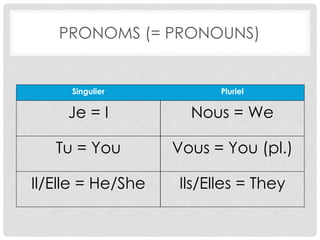
PRONOMS (= PRONOUNS) 
Singulier Pluriel 
Je = I Nous = We 
Tu = You Vous = You (pl.) 
Il/Elle = He/She Ils/Elles = They
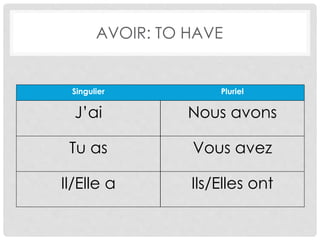
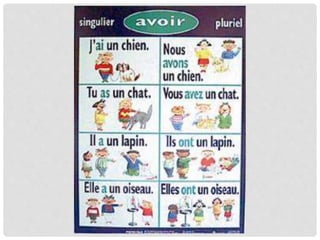
AVOIR: TO HAVE 
Singulier Pluriel 
J’ai Nous avons 
Tu as Vous avez 
Il/Elle a Ils/Elles ont
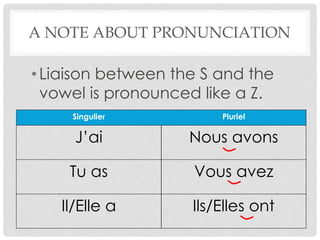
A NOTE ABOUT PRONUNCIATION 
• Liaison between the S and the 
vowel is pronounced like a Z. 
Singulier Pluriel 
J’ai Nous avons 
Tu as Vous avez 
Il/Elle a Ils/Elles ont
ABOUT AVOIR 
• Avoir is an irregular verb like être. 
The conjugations do not follow the 
same pattern as other verbs. 
•Avoir is used a lot in the present 
tense.
ABOUT AVOIR 
• Avoir is also a helping verb in the 
past tense 
• (ex. J’ai mangé = I ate). 
• You MUST memorize it because it 
will be used OVER & OVER!
EXPRESSIONS WITH AVOIR 
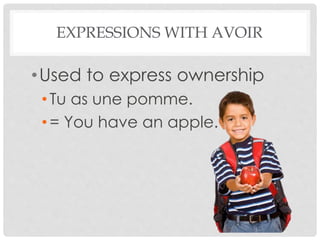
•Used to express ownership 
• Tu as une pomme. 
• = You have an apple.
EXPRESSIONS WITH AVOIR 
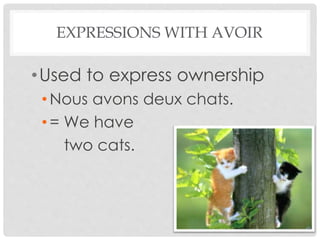
•Used to express ownership 
•Nous avons deux chats. 
• = We have 
two cats.
EXPRESSIONS WITH AVOIR 
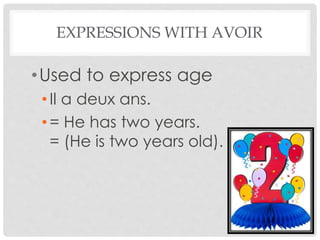
•Used to express age 
• Il a deux ans. 
• = He has two years. 
= (He is two years old).
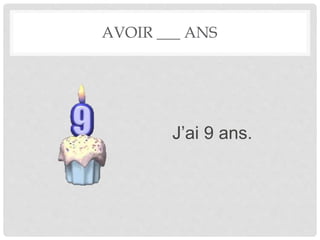
AVOIR ___ ANS 
J’ai 9 ans.
EXPRESSIONS WITH AVOIR 
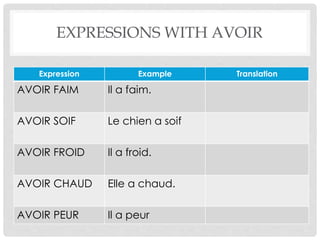
Expression Example Translation 
AVOIR FAIM Il a faim. 
AVOIR SOIF Le chien a soif 
AVOIR FROID Il a froid. 
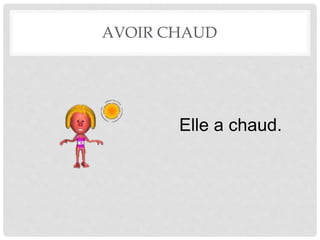
AVOIR CHAUD Elle a chaud. 
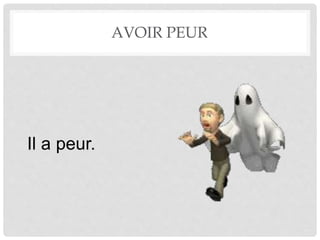
AVOIR PEUR Il a peur
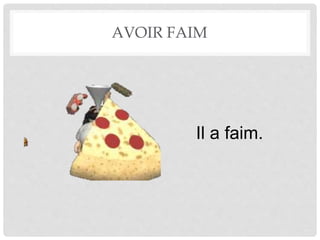
AVOIR FAIM 
Il a faim.
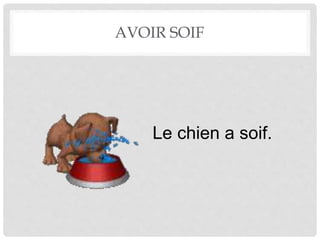
AVOIR SOIF 
Le chien a soif.
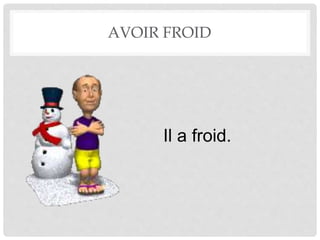
AVOIR FROID 
Il a froid.
AVOIR CHAUD 
Elle a chaud.
AVOIR PEUR 
Il a peur.
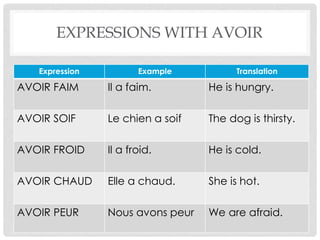
EXPRESSIONS WITH AVOIR 
Expression Example Translation 
AVOIR FAIM Il a faim. He is hungry. 
AVOIR SOIF Le chien a soif The dog is thirsty. 
AVOIR FROID Il a froid. He is cold. 
AVOIR CHAUD Elle a chaud. She is hot. 
AVOIR PEUR Nous avons peur We are afraid.
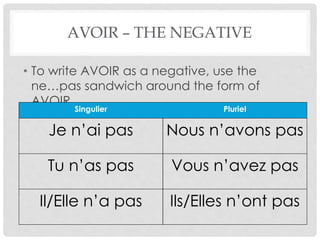
AVOIR – THE NEGATIVE 
• To write AVOIR as a negative, use the 
ne…pas sandwich around the form of 
AVOIR. 
Singulier Pluriel 
Je n’ai pas Nous n’avons pas 
Tu n’as pas Vous n’avez pas 
Il/Elle n’a pas Ils/Elles n’ont pas
AVOIR – THE NEGATIVE 
• Most of the time, the ne…pas 
sandwich can be used with all of the 
expressions above. 
• For example, 
• Je n’ai pas froid. 
• Il n’a pas peur.
AVOIR – THE NEGATIVE 
• When using the negative of AVOIR for 
possession of something, an important 
change is needed. 
• Tu as un pomme. 
• Tu n’as pas de pomme. 
• Notice that “un pomme” changes to 
“de pomme”.
AVOIR – THE NEGATIVE 
• For the negative of AVOIR for possession 
of something, the noun becomes singular 
(as shown below). 
• Nous avons deux chats. 
• Nous n’avons pas de chat. 
• J’ai deux chemises vertes. 
• Je n’ai pas de chemise verte.

Avoir = To Have

  • 1.
  • 2.
    PRONOMS (= PRONOUNS) Singulier Pluriel Je = I Nous = We Tu = You Vous = You (pl.) Il/Elle = He/She Ils/Elles = They
  • 3.
    AVOIR: TO HAVE Singulier Pluriel J’ai Nous avons Tu as Vous avez Il/Elle a Ils/Elles ont
  • 5.
    A NOTE ABOUTPRONUNCIATION • Liaison between the S and the vowel is pronounced like a Z. Singulier Pluriel J’ai Nous avons Tu as Vous avez Il/Elle a Ils/Elles ont
  • 6.
    ABOUT AVOIR •Avoir is an irregular verb like être. The conjugations do not follow the same pattern as other verbs. •Avoir is used a lot in the present tense.
  • 7.
    ABOUT AVOIR •Avoir is also a helping verb in the past tense • (ex. J’ai mangé = I ate). • You MUST memorize it because it will be used OVER & OVER!
  • 8.
    EXPRESSIONS WITH AVOIR •Used to express ownership • Tu as une pomme. • = You have an apple.
  • 9.
    EXPRESSIONS WITH AVOIR •Used to express ownership •Nous avons deux chats. • = We have two cats.
  • 10.
    EXPRESSIONS WITH AVOIR •Used to express age • Il a deux ans. • = He has two years. = (He is two years old).
  • 11.
    AVOIR ___ ANS J’ai 9 ans.
  • 12.
    EXPRESSIONS WITH AVOIR Expression Example Translation AVOIR FAIM Il a faim. AVOIR SOIF Le chien a soif AVOIR FROID Il a froid. AVOIR CHAUD Elle a chaud. AVOIR PEUR Il a peur
  • 13.
  • 14.
    AVOIR SOIF Lechien a soif.
  • 15.
  • 16.
  • 17.
  • 18.
    EXPRESSIONS WITH AVOIR Expression Example Translation AVOIR FAIM Il a faim. He is hungry. AVOIR SOIF Le chien a soif The dog is thirsty. AVOIR FROID Il a froid. He is cold. AVOIR CHAUD Elle a chaud. She is hot. AVOIR PEUR Nous avons peur We are afraid.
  • 19.
    AVOIR – THENEGATIVE • To write AVOIR as a negative, use the ne…pas sandwich around the form of AVOIR. Singulier Pluriel Je n’ai pas Nous n’avons pas Tu n’as pas Vous n’avez pas Il/Elle n’a pas Ils/Elles n’ont pas
  • 20.
    AVOIR – THENEGATIVE • Most of the time, the ne…pas sandwich can be used with all of the expressions above. • For example, • Je n’ai pas froid. • Il n’a pas peur.
  • 21.
    AVOIR – THENEGATIVE • When using the negative of AVOIR for possession of something, an important change is needed. • Tu as un pomme. • Tu n’as pas de pomme. • Notice that “un pomme” changes to “de pomme”.
  • 22.
    AVOIR – THENEGATIVE • For the negative of AVOIR for possession of something, the noun becomes singular (as shown below). • Nous avons deux chats. • Nous n’avons pas de chat. • J’ai deux chemises vertes. • Je n’ai pas de chemise verte.