DEFINATION
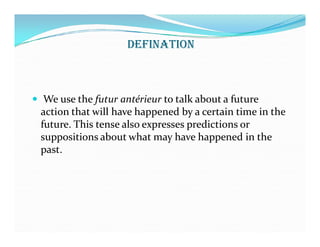
 We use the futur antérieur to talk about a future
action that will have happened by a certain time in the
future. This tense also expresses predictions orfuture. This tense also expresses predictions or
suppositions about what may have happened in the
past.
FORMATION
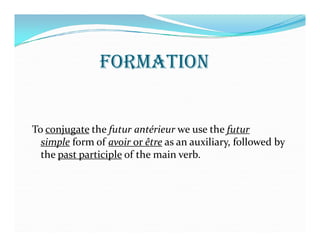
To conjugate the futur antérieur we use the futurTo conjugate the futur antérieur we use the futur
simple form of avoir or être as an auxiliary, followed by
the past participle of the main verb.
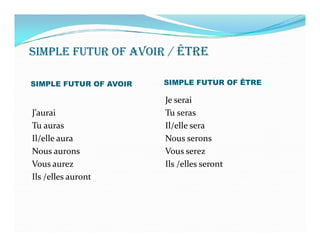
SIMPLE FUTUR OF AVOIR / ÊTRE
SIMPLE FUTUR OF AVOIR SIMPLE FUTUR OF ÊTRE
J’aurai
Tu auras
Je serai
Tu seras
Il/elle seraTu auras
Il/elle aura
Nous aurons
Vous aurez
Ils /elles auront
Il/elle sera
Nous serons
Vous serez
Ils /elles seront
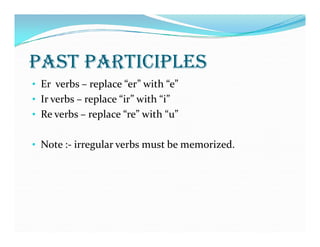
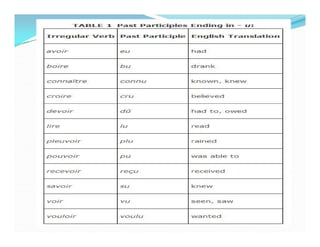
PAST PARTIcIPLES
• Er verbs – replace “er” with “e”
• Ir verbs – replace “ir” with “i”
• Re verbs – replace “re” with “u”
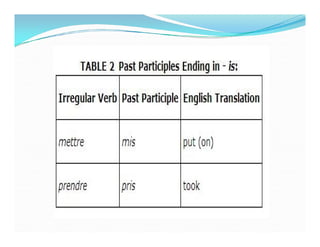
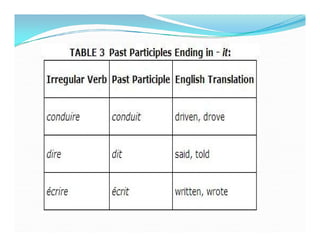
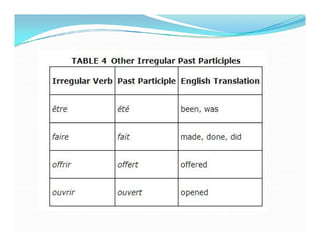
• Note :- irregular verbs must be memorized.
LIST OF PAST PARTIcIPLE
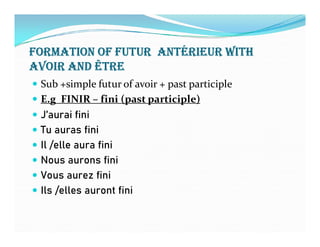
FORMATION OF FUTUR ANTéRIEUR wITh
AVOIR AND ÊTRE
 Sub +simple futur of avoir + past participle
 E.g FINIR – fini (past participle)
 J’aurai fini
Tu auras fini Tu auras fini
 Il /elle aura fini
 Nous aurons fini
 Vous aurez fini
 Ils /elles auront fini
 Sub +simple futur of être + past participle
 E.g partir – parti (past participle)
Je serai parti(e)
Tu seras parti(e)Tu seras parti(e)
Il/elle sera parti(e)
Nous serons parti(e)s
Vous serez parti(e)(s)
Ils /elles seront parti(e)s
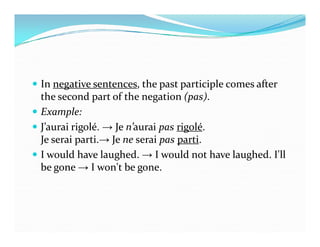
 In negative sentences, the past participle comes after
the second part of the negation (pas).
 Example:
 J’aurai rigolé. → Je n’aurai pas rigolé. J’aurai rigolé. → Je n’aurai pas rigolé.
Je serai parti.→ Je ne serai pas parti.
 I would have laughed. → I would not have laughed. I'll
be gone → I won't be gone.
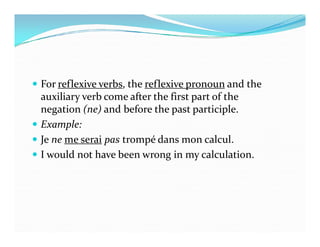
 For reflexive verbs, the reflexive pronoun and the
auxiliary verb come after the first part of the
negation (ne) and before the past participle.
 Example: Example:
 Je ne me serai pas trompé dans mon calcul.
 I would not have been wrong in my calculation.
Futur anterieur

Futur anterieur

  • 2.
    DEFINATION  We usethe futur antérieur to talk about a future action that will have happened by a certain time in the future. This tense also expresses predictions orfuture. This tense also expresses predictions or suppositions about what may have happened in the past.
  • 3.
    FORMATION To conjugate thefutur antérieur we use the futurTo conjugate the futur antérieur we use the futur simple form of avoir or être as an auxiliary, followed by the past participle of the main verb.
  • 4.
    SIMPLE FUTUR OFAVOIR / ÊTRE SIMPLE FUTUR OF AVOIR SIMPLE FUTUR OF ÊTRE J’aurai Tu auras Je serai Tu seras Il/elle seraTu auras Il/elle aura Nous aurons Vous aurez Ils /elles auront Il/elle sera Nous serons Vous serez Ils /elles seront
  • 5.
    PAST PARTIcIPLES • Erverbs – replace “er” with “e” • Ir verbs – replace “ir” with “i” • Re verbs – replace “re” with “u” • Note :- irregular verbs must be memorized.
  • 6.
    LIST OF PASTPARTIcIPLE
  • 12.
    FORMATION OF FUTURANTéRIEUR wITh AVOIR AND ÊTRE  Sub +simple futur of avoir + past participle  E.g FINIR – fini (past participle)  J’aurai fini Tu auras fini Tu auras fini  Il /elle aura fini  Nous aurons fini  Vous aurez fini  Ils /elles auront fini
  • 13.
     Sub +simplefutur of être + past participle  E.g partir – parti (past participle) Je serai parti(e) Tu seras parti(e)Tu seras parti(e) Il/elle sera parti(e) Nous serons parti(e)s Vous serez parti(e)(s) Ils /elles seront parti(e)s
  • 14.
     In negativesentences, the past participle comes after the second part of the negation (pas).  Example:  J’aurai rigolé. → Je n’aurai pas rigolé. J’aurai rigolé. → Je n’aurai pas rigolé. Je serai parti.→ Je ne serai pas parti.  I would have laughed. → I would not have laughed. I'll be gone → I won't be gone.
  • 15.
     For reflexiveverbs, the reflexive pronoun and the auxiliary verb come after the first part of the negation (ne) and before the past participle.  Example: Example:  Je ne me serai pas trompé dans mon calcul.  I would not have been wrong in my calculation.