By –
Gitanshi Arora
The Sovereign School ,Rohini
 what took place at that very moment: a specific
event or a succession of specific events, the main
storyline.
 Auxiliare (avoir/être) + participe passé Auxiliare (avoir/être) + participe passé
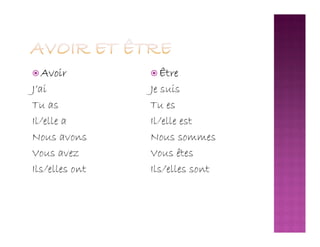
 Avoir
J’ai
Tu as
Il/elle a
 Être
Je suis
Tu es
Il/elle estIl/elle a
Nous avons
Vous avez
Ils/elles ont
Il/elle est
Nous sommes
Vous êtes
Ils/elles sont
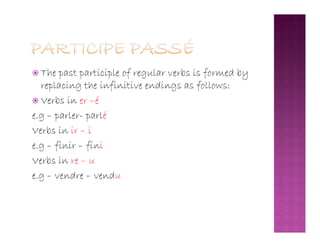
 The past participle of regular verbs is formed by
replacing the infinitive endings as follows:
 Verbs in er –é
e.g – parler- parlé
Verbs in ir – i
e.g – finir – fini
Verbs in re – u
e.g – vendre – vendu
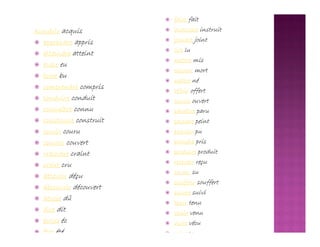
acquérir acquis
 apprendre appris
 atteindre atteint
 avoir eu
 boire bu
 comprendre compris
 conduire conduit
 connaître connu
 construire construit
 faire fait
 instruire instruit
 joindre joint
 lire lu
 mettre mis
 mourir mort
 naître né
 offrir offert
 ouvrir ouvert
 paraître paru
 peindre peintconstruire construit
 courir couru
 couvrir couvert
 craindre craint
 croire cru
 décevoir déçu
 découvrir découvert
 devoir dû
 dire dit
 écrire éc
 être été
 peindre peint
 pouvoir pu
 prendre pris
 produire produit
 recevoir reçu
 savoir su
 souffrir souffert
 suivre suivi
 tenir tenu
 venir venu
 vivre vécu
 voir vu
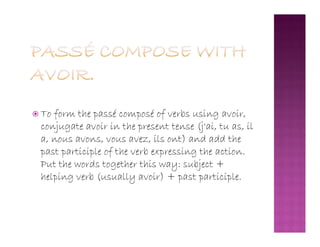
 To form the passé composé of verbs using avoir,
conjugate avoir in the present tense (j'ai, tu as, ilconjugate avoir in the present tense (j'ai, tu as, il
a, nous avons, vous avez, ils ont) and add the
past participle of the verb expressing the action.
Put the words together this way: subject +
helping verb (usually avoir) + past participle.
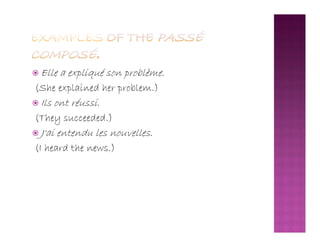
 Elle a expliqué son problème.
(She explained her problem.)
 Ils ont réussi.
(They succeeded.)(They succeeded.)
 J'ai entendu les nouvelles.
(I heard the news.)
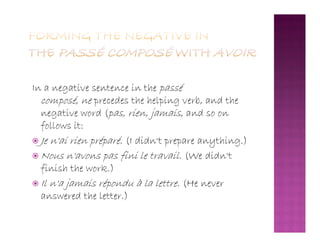
In a negative sentence in the passé
composé, ne precedes the helping verb, and the
negative word (pas, rien, jamais, and so on
follows it:follows it:
 Je n'ai rien préparé. (I didn't prepare anything.)
 Nous n'avons pas fini le travail. (We didn't
finish the work.)
 Il n'a jamais répondu à la lettre. (He never
answered the letter.)
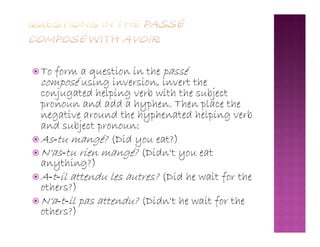
 To form a question in the passé
composé using inversion, invert the
conjugated helping verb with the subject
pronoun and add a hyphen. Then place the
negative around the hyphenated helping verb
and subject pronoun:and subject pronoun:
 As‐tu mangé? (Did you eat?)
 N'as‐tu rien mangé? (Didn't you eat
anything?)
 A‐t‐il attendu les autres? (Did he wait for the
others?)
 N'a‐t‐il pas attendu? (Didn't he wait for the
others?)
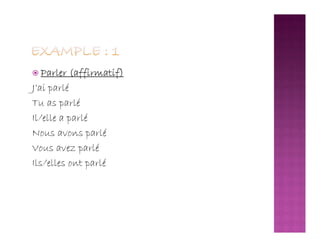
 Parler (affirmatif)
J’ai parlé
Tu as parlé
Il/elle a parléIl/elle a parlé
Nous avons parlé
Vous avez parlé
Ils/elles ont parlé
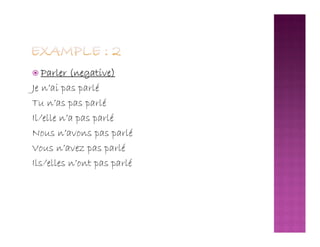
 Parler (negative)
Je n’ai pas parlé
Tu n’as pas parlé
Il/elle n’a pas parléIl/elle n’a pas parlé
Nous n’avons pas parlé
Vous n’avez pas parlé
Ils/elles n’ont pas parlé
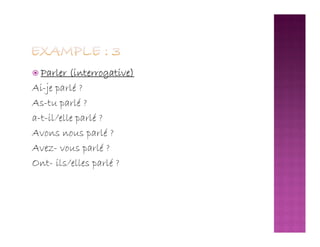
 Parler (interrogative)
Ai-je parlé ?
As-tu parlé ?
a-t-il/elle parlé ?a-t-il/elle parlé ?
Avons nous parlé ?
Avez- vous parlé ?
Ont- ils/elles parlé ?
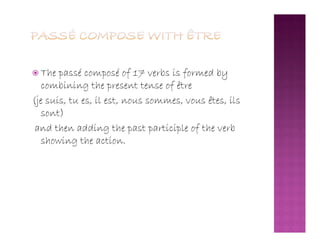
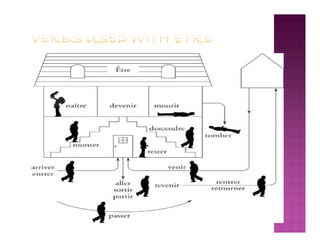
 The passé composé of 17 verbs is formed by
combining the present tense of être
(je suis, tu es, il est, nous sommes, vous êtes, ils
sont)
and then adding the past participle of the verband then adding the past participle of the verb
showing the action.
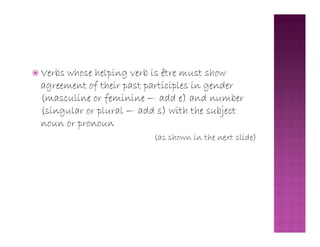
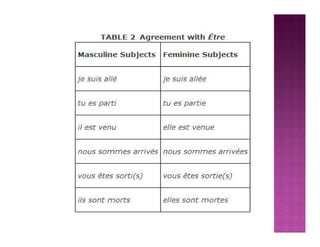
 Verbs whose helping verb is être must show
agreement of their past participles in gender
(masculine or feminine — add e) and number
(singular or plural — add s) with the subject
noun or pronounnoun or pronoun
(as shown in the next slide)
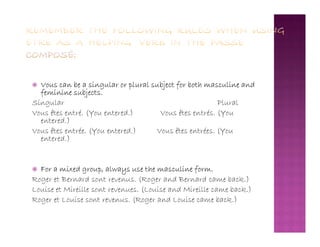
 Vous can be a singular or plural subject for both masculine and
feminine subjects.
Singular Plural
Vous êtes entré. (You entered.) Vous êtes entrés. (You
entered.)entered.)
Vous êtes entrée. (You entered.) Vous êtes entrées. (You
entered.)
 For a mixed group, always use the masculine form.
Roger et Bernard sont revenus. (Roger and Bernard came back.)
Louise et Mireille sont revenues. (Louise and Mireille came back.)
Roger et Louise sont revenus. (Roger and Louise came back.)
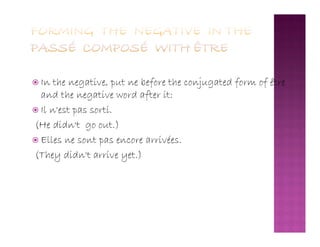
 In the negative, put ne before the conjugated form of être
and the negative word after it:
 Il n'est pas sorti.
(He didn't go out.)(He didn't go out.)
 Elles ne sont pas encore arrivées.
(They didn't arrive yet.)
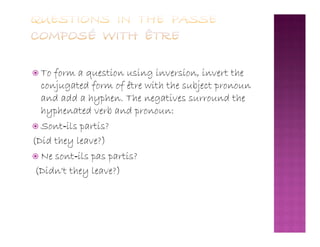
 To form a question using inversion, invert the
conjugated form of être with the subject pronoun
and add a hyphen. The negatives surround the
hyphenated verb and pronoun:
 Sont‐ils partis? Sont‐ils partis?
(Did they leave?)
 Ne sont‐ils pas partis?
(Didn't they leave?)
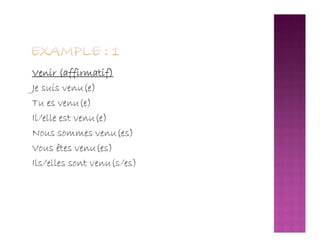
Venir (affirmatif)
Je suis venu(e)
Tu es venu(e)
Il/elle est venu(e)Il/elle est venu(e)
Nous sommes venu(es)
Vous êtes venu(es)
Ils/elles sont venu(s/es)
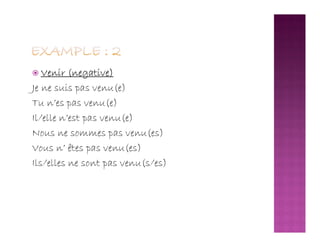
 Venir (negative)
Je ne suis pas venu(e)
Tu n’es pas venu(e)
Il/elle n’est pas venu(e)Il/elle n’est pas venu(e)
Nous ne sommes pas venu(es)
Vous n’ êtes pas venu(es)
Ils/elles ne sont pas venu(s/es)
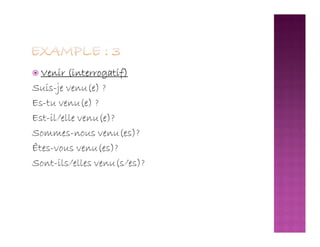
 Venir (interrogatif)
Suis-je venu(e) ?
Es-tu venu(e) ?
Est-il/elle venu(e)?Est-il/elle venu(e)?
Sommes-nous venu(es)?
Êtes-vous venu(es)?
Sont-ils/elles venu(s/es)?
power point presentation on passe compose (french)

power point presentation on passe compose (french)

  • 1.
    By – Gitanshi Arora TheSovereign School ,Rohini
  • 2.
     what tookplace at that very moment: a specific event or a succession of specific events, the main storyline.
  • 3.
     Auxiliare (avoir/être)+ participe passé Auxiliare (avoir/être) + participe passé
  • 4.
     Avoir J’ai Tu as Il/ellea  Être Je suis Tu es Il/elle estIl/elle a Nous avons Vous avez Ils/elles ont Il/elle est Nous sommes Vous êtes Ils/elles sont
  • 5.
     The pastparticiple of regular verbs is formed by replacing the infinitive endings as follows:  Verbs in er –é e.g – parler- parlé Verbs in ir – i e.g – finir – fini Verbs in re – u e.g – vendre – vendu
  • 6.
    acquérir acquis  apprendreappris  atteindre atteint  avoir eu  boire bu  comprendre compris  conduire conduit  connaître connu  construire construit  faire fait  instruire instruit  joindre joint  lire lu  mettre mis  mourir mort  naître né  offrir offert  ouvrir ouvert  paraître paru  peindre peintconstruire construit  courir couru  couvrir couvert  craindre craint  croire cru  décevoir déçu  découvrir découvert  devoir dû  dire dit  écrire éc  être été  peindre peint  pouvoir pu  prendre pris  produire produit  recevoir reçu  savoir su  souffrir souffert  suivre suivi  tenir tenu  venir venu  vivre vécu  voir vu
  • 7.
     To formthe passé composé of verbs using avoir, conjugate avoir in the present tense (j'ai, tu as, ilconjugate avoir in the present tense (j'ai, tu as, il a, nous avons, vous avez, ils ont) and add the past participle of the verb expressing the action. Put the words together this way: subject + helping verb (usually avoir) + past participle.
  • 8.
     Elle aexpliqué son problème. (She explained her problem.)  Ils ont réussi. (They succeeded.)(They succeeded.)  J'ai entendu les nouvelles. (I heard the news.)
  • 9.
    In a negativesentence in the passé composé, ne precedes the helping verb, and the negative word (pas, rien, jamais, and so on follows it:follows it:  Je n'ai rien préparé. (I didn't prepare anything.)  Nous n'avons pas fini le travail. (We didn't finish the work.)  Il n'a jamais répondu à la lettre. (He never answered the letter.)
  • 10.
     To forma question in the passé composé using inversion, invert the conjugated helping verb with the subject pronoun and add a hyphen. Then place the negative around the hyphenated helping verb and subject pronoun:and subject pronoun:  As‐tu mangé? (Did you eat?)  N'as‐tu rien mangé? (Didn't you eat anything?)  A‐t‐il attendu les autres? (Did he wait for the others?)  N'a‐t‐il pas attendu? (Didn't he wait for the others?)
  • 11.
     Parler (affirmatif) J’aiparlé Tu as parlé Il/elle a parléIl/elle a parlé Nous avons parlé Vous avez parlé Ils/elles ont parlé
  • 12.
     Parler (negative) Jen’ai pas parlé Tu n’as pas parlé Il/elle n’a pas parléIl/elle n’a pas parlé Nous n’avons pas parlé Vous n’avez pas parlé Ils/elles n’ont pas parlé
  • 13.
     Parler (interrogative) Ai-jeparlé ? As-tu parlé ? a-t-il/elle parlé ?a-t-il/elle parlé ? Avons nous parlé ? Avez- vous parlé ? Ont- ils/elles parlé ?
  • 14.
     The passécomposé of 17 verbs is formed by combining the present tense of être (je suis, tu es, il est, nous sommes, vous êtes, ils sont) and then adding the past participle of the verband then adding the past participle of the verb showing the action.
  • 17.
     Verbs whosehelping verb is être must show agreement of their past participles in gender (masculine or feminine — add e) and number (singular or plural — add s) with the subject noun or pronounnoun or pronoun (as shown in the next slide)
  • 19.
     Vous canbe a singular or plural subject for both masculine and feminine subjects. Singular Plural Vous êtes entré. (You entered.) Vous êtes entrés. (You entered.)entered.) Vous êtes entrée. (You entered.) Vous êtes entrées. (You entered.)  For a mixed group, always use the masculine form. Roger et Bernard sont revenus. (Roger and Bernard came back.) Louise et Mireille sont revenues. (Louise and Mireille came back.) Roger et Louise sont revenus. (Roger and Louise came back.)
  • 20.
     In thenegative, put ne before the conjugated form of être and the negative word after it:  Il n'est pas sorti. (He didn't go out.)(He didn't go out.)  Elles ne sont pas encore arrivées. (They didn't arrive yet.)
  • 21.
     To forma question using inversion, invert the conjugated form of être with the subject pronoun and add a hyphen. The negatives surround the hyphenated verb and pronoun:  Sont‐ils partis? Sont‐ils partis? (Did they leave?)  Ne sont‐ils pas partis? (Didn't they leave?)
  • 22.
    Venir (affirmatif) Je suisvenu(e) Tu es venu(e) Il/elle est venu(e)Il/elle est venu(e) Nous sommes venu(es) Vous êtes venu(es) Ils/elles sont venu(s/es)
  • 23.
     Venir (negative) Jene suis pas venu(e) Tu n’es pas venu(e) Il/elle n’est pas venu(e)Il/elle n’est pas venu(e) Nous ne sommes pas venu(es) Vous n’ êtes pas venu(es) Ils/elles ne sont pas venu(s/es)
  • 24.
     Venir (interrogatif) Suis-jevenu(e) ? Es-tu venu(e) ? Est-il/elle venu(e)?Est-il/elle venu(e)? Sommes-nous venu(es)? Êtes-vous venu(es)? Sont-ils/elles venu(s/es)?