Regular Verbs (Review)
      + New (-ir type 2 & -re)
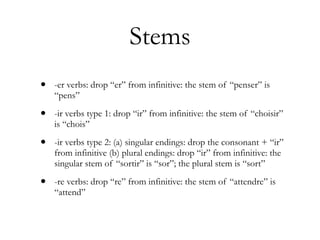
Stems
•   -er verbs: drop “er” from infinitive: the stem of “penser” is
    “pens”

•   -ir verbs type 1: drop “ir” from infinitive: the stem of “choisir”
    is “chois”

•   -ir verbs type 2: (a) singular endings: drop the consonant + “ir”
    from infinitive (b) plural endings: drop “ir” from infinitive: the
    singular stem of “sortir” is “sor”; the plural stem is “sort”

•   -re verbs: drop “re” from infinitive: the stem of “attendre” is
    “attend”
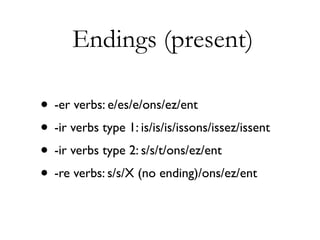
Endings (present)

• -er verbs: e/es/e/ons/ez/ent
• -ir verbs type 1: is/is/is/issons/issez/issent
• -ir verbs type 2: s/s/t/ons/ez/ent
• -re verbs: s/s/X (no ending)/ons/ez/ent
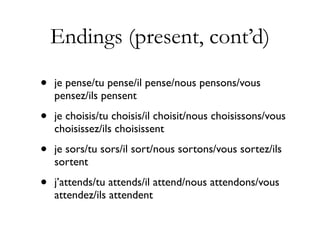
Endings (present, cont’d)

•   je pense/tu pense/il pense/nous pensons/vous
    pensez/ils pensent

•   je choisis/tu choisis/il choisit/nous choisissons/vous
    choisissez/ils choisissent

•   je sors/tu sors/il sort/nous sortons/vous sortez/ils
    sortent

•   j’attends/tu attends/il attend/nous attendons/vous
    attendez/ils attendent
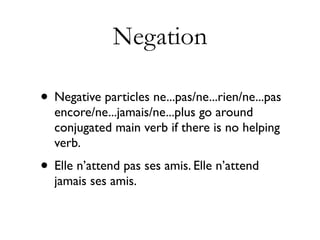
Negation

• Negative particles ne...pas/ne...rien/ne...pas
  encore/ne...jamais/ne...plus go around
  conjugated main verb if there is no helping
  verb.
• Elle n’attend pas ses amis. Elle n’attend
  jamais ses amis.
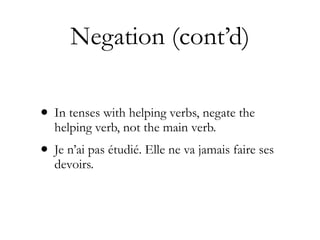
Negation (cont’d)

• In tenses with helping verbs, negate the
  helping verb, not the main verb.
• Je n’ai pas étudié. Elle ne va jamais faire ses
  devoirs.
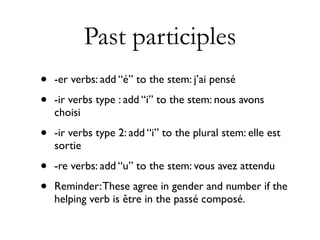
Past participles
•   -er verbs: add “é” to the stem: j’ai pensé

•   -ir verbs type : add “i” to the stem: nous avons
    choisi

•   -ir verbs type 2: add “i” to the plural stem: elle est
    sortie

•   -re verbs: add “u” to the stem: vous avez attendu

•   Reminder: These agree in gender and number if the
    helping verb is être in the passé composé.
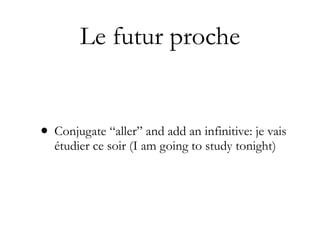
Le futur proche


• Conjugate “aller” and add an infinitive: je vais
  étudier ce soir (I am going to study tonight)
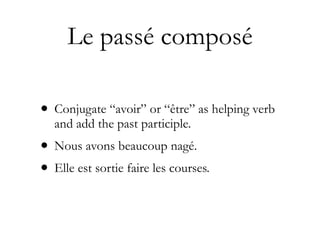
Le passé composé

• Conjugate “avoir” or “être” as helping verb
  and add the past participle.
• Nous avons beaucoup nagé.
• Elle est sortie faire les courses.
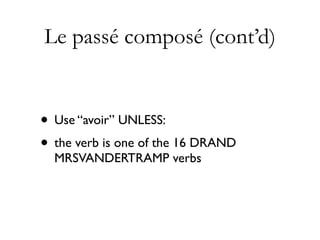
Le passé composé (cont’d)


• Use “avoir” UNLESS:
• the verb is one of the 16 DRAND
  MRSVANDERTRAMP verbs
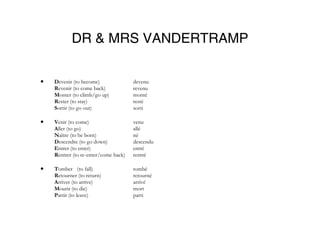
DR & MRS VANDERTRAMP


•   Devenir (to become)               devenu
    Revenir (to come back)            revenu
    Monter (to climb/go up)           monté
    Rester (to stay)                  resté
    Sortir (to go out)                sorti

•   Venir (to come)                   venu
    Aller (to go)                     allé
    Naître (to be born)               né
    Descendre (to go down)            descendu
    Entrer (to enter)                 entré
    Rentrer (to re-enter/come back)   rentré

•   Tomber (to fall)                  tombé
    Retourner (to return)             retourné
    Arriver (to arrive)               arrivé
    Mourir (to die)                   mort
    Partir (to leave)                 parti
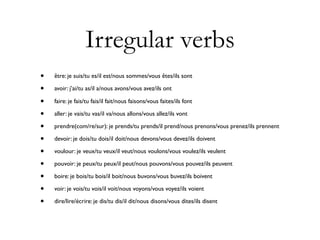
Irregular verbs
•   être: je suis/tu es/il est/nous sommes/vous êtes/ils sont

•   avoir: j’ai/tu as/il a/nous avons/vous avez/ils ont

•   faire: je fais/tu fais/il fait/nous faisons/vous faites/ils font

•   aller: je vais/tu vas/il va/nous allons/vous allez/ils vont

•   prendre(com/re/sur): je prends/tu prends/il prend/nous prenons/vous prenez/ils prennent

•   devoir: je dois/tu dois/il doit/nous devons/vous devez/ils doivent

•   voulour: je veux/tu veux/il veut/nous voulons/vous voulez/ils veulent

•   pouvoir: je peux/tu peux/il peut/nous pouvons/vous pouvez/ils peuvent

•   boire: je bois/tu bois/il boit/nous buvons/vous buvez/ils boivent

•   voir: je vois/tu vois/il voit/nous voyons/vous voyez/ils voient

•   dire/lire/écrire: je dis/tu dis/il dit/nous disons/vous dites/ils disent

French Verb Review (102:30)

  • 1.
    Regular Verbs (Review) + New (-ir type 2 & -re)
  • 2.
    Stems • -er verbs: drop “er” from infinitive: the stem of “penser” is “pens” • -ir verbs type 1: drop “ir” from infinitive: the stem of “choisir” is “chois” • -ir verbs type 2: (a) singular endings: drop the consonant + “ir” from infinitive (b) plural endings: drop “ir” from infinitive: the singular stem of “sortir” is “sor”; the plural stem is “sort” • -re verbs: drop “re” from infinitive: the stem of “attendre” is “attend”
  • 3.
    Endings (present) • -erverbs: e/es/e/ons/ez/ent • -ir verbs type 1: is/is/is/issons/issez/issent • -ir verbs type 2: s/s/t/ons/ez/ent • -re verbs: s/s/X (no ending)/ons/ez/ent
  • 4.
    Endings (present, cont’d) • je pense/tu pense/il pense/nous pensons/vous pensez/ils pensent • je choisis/tu choisis/il choisit/nous choisissons/vous choisissez/ils choisissent • je sors/tu sors/il sort/nous sortons/vous sortez/ils sortent • j’attends/tu attends/il attend/nous attendons/vous attendez/ils attendent
  • 5.
    Negation • Negative particlesne...pas/ne...rien/ne...pas encore/ne...jamais/ne...plus go around conjugated main verb if there is no helping verb. • Elle n’attend pas ses amis. Elle n’attend jamais ses amis.
  • 6.
    Negation (cont’d) • Intenses with helping verbs, negate the helping verb, not the main verb. • Je n’ai pas étudié. Elle ne va jamais faire ses devoirs.
  • 7.
    Past participles • -er verbs: add “é” to the stem: j’ai pensé • -ir verbs type : add “i” to the stem: nous avons choisi • -ir verbs type 2: add “i” to the plural stem: elle est sortie • -re verbs: add “u” to the stem: vous avez attendu • Reminder: These agree in gender and number if the helping verb is être in the passé composé.
  • 8.
    Le futur proche •Conjugate “aller” and add an infinitive: je vais étudier ce soir (I am going to study tonight)
  • 9.
    Le passé composé •Conjugate “avoir” or “être” as helping verb and add the past participle. • Nous avons beaucoup nagé. • Elle est sortie faire les courses.
  • 10.
    Le passé composé(cont’d) • Use “avoir” UNLESS: • the verb is one of the 16 DRAND MRSVANDERTRAMP verbs
  • 11.
    DR & MRSVANDERTRAMP • Devenir (to become) devenu Revenir (to come back) revenu Monter (to climb/go up) monté Rester (to stay) resté Sortir (to go out) sorti • Venir (to come) venu Aller (to go) allé Naître (to be born) né Descendre (to go down) descendu Entrer (to enter) entré Rentrer (to re-enter/come back) rentré • Tomber (to fall) tombé Retourner (to return) retourné Arriver (to arrive) arrivé Mourir (to die) mort Partir (to leave) parti
  • 12.
    Irregular verbs • être: je suis/tu es/il est/nous sommes/vous êtes/ils sont • avoir: j’ai/tu as/il a/nous avons/vous avez/ils ont • faire: je fais/tu fais/il fait/nous faisons/vous faites/ils font • aller: je vais/tu vas/il va/nous allons/vous allez/ils vont • prendre(com/re/sur): je prends/tu prends/il prend/nous prenons/vous prenez/ils prennent • devoir: je dois/tu dois/il doit/nous devons/vous devez/ils doivent • voulour: je veux/tu veux/il veut/nous voulons/vous voulez/ils veulent • pouvoir: je peux/tu peux/il peut/nous pouvons/vous pouvez/ils peuvent • boire: je bois/tu bois/il boit/nous buvons/vous buvez/ils boivent • voir: je vois/tu vois/il voit/nous voyons/vous voyez/ils voient • dire/lire/écrire: je dis/tu dis/il dit/nous disons/vous dites/ils disent