Leçon 3Verbs
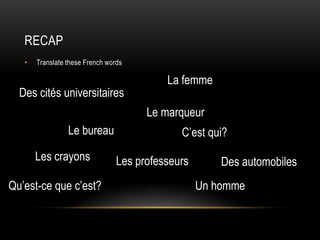
RecapTranslate these French wordsLa femmeDes citésuniversitairesLe marqueurLe bureauC’est qui?Les crayonsLes professeursDes automobilesUn hommeQu’est-cequec’est?
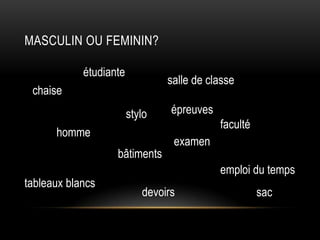
Masculinoufeminin?étudiantesalle de classechaiseépreuvesstylofacultéhommeexamenbâtimentsemploi du tempstableaux blancsdevoirssac
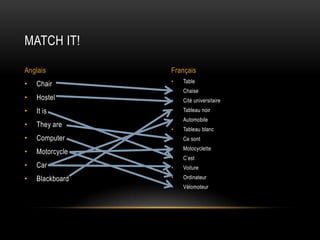
TableChaiseCitéuniversitaireTableau noirAutomobileTableau blancCesontMotocycletteC’estVoitureOrdinateurVélomoteurChairHostelIt isThey areComputerMotorcycleCarBlackboardMatch it!AnglaisFrançais
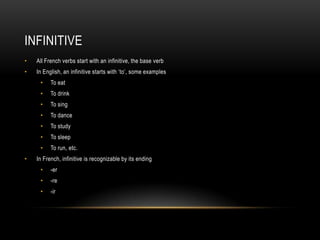
InfinitiveAll French verbsstartwith an infinitive, the base verbIn English, an infinitive startswith ‘to’, some examplesTo eatTo drinkTo singTo danceTo studyTo sleepTo run, etc.In French, infinitive isrecognizable by itsending-er-re-ir
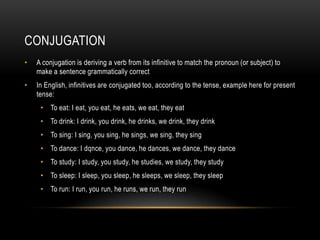
ConjugationA conjugationisderiving a verbfromits infinitive to match the pronoun (or subject) to make a sentence grammatically correctIn English, infinitives are conjugatedtoo, according to the tense, examplehere for presenttense:To eat: I eat, youeat, heeats, weeat, theyeatTo drink: I drink, you drink, he drinks, we drink, they drinkTo sing: I sing, yousing, hesings, wesing, theysingTo dance: I dqnce, you dance, hedances, we dance, they danceTo study: I study, youstudy, hestudies, westudy, theystudyTo sleep: I sleep, yousleep, hesleeps, wesleep, theysleepTo run: I run, yourun, heruns, werun, theyrun
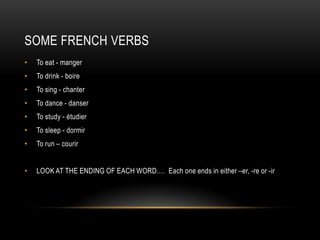
Some French VerbsTo eat - mangerTo drink - boireTo sing - chanterTo dance - danserTo study - étudierTo sleep - dormirTo run – courirLOOK AT THE ENDING OF EACH WORD….  Each one ends in either –er, -re or -ir
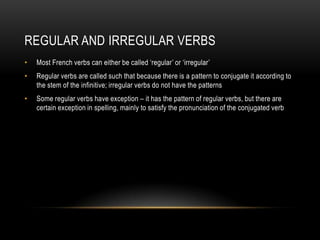
Regular and IrregularverbsMost French verbs can either be called ‘regular’ or ‘irregular’Regular verbs are called such that because there is a pattern to conjugate it according to the stem of the infinitive; irregular verbs do not have the patternsSome regular verbs have exception – it has the pattern of regular verbs, but there are certain exception in spelling, mainly to satisfy the pronunciation of the conjugated verb
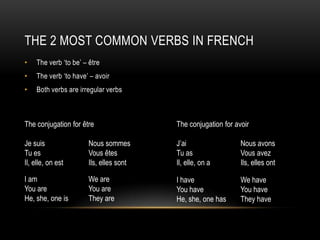
The 2 Most Common Verbs In FrenchThe verb ‘to be’ – êtreThe verb ‘to have’ – avoirBoth verbs are irregular verbsThe conjugation for êtreJe suis		Nous sommesTu es		Vous êtesIl, elle, on est	Ils, elles sontThe conjugation for avoirJ’ai		Nous avonsTu as		Vous avezIl, elle, on a	Ils, elles ontI amWeareYou are		You areHe, she, one isThey areI have		We haveYou have		You haveHe, she, one has	They have
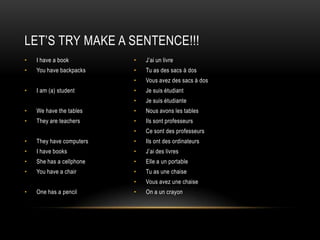
Let’sTryMake A Sentence!!!I have a bookYou have backpacksI am (a) studentWe have the tablesThey are teachersThey have computersI have booksShe has a cellphoneYou have a chairOne has a pencilJ’ai un livreTu as des sacs à dos Vous avez des sacs à dosJe suis étudiantJe suis étudianteNous avons les tablesIls sont professeursCe sont des professeursIls ont des ordinateursJ’ai des livresElle a un portableTu as une chaiseVous avez une chaiseOn a un crayon
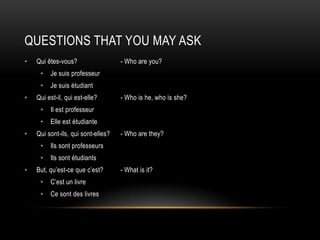
Questions that you may askQui êtes-vous?		- Who are you?Je suisprofesseurJe suisétudiantQui est-il, qui est-elle?	- Who is he, who is she?Il estprofesseurElle estétudianteQui sont-ils, qui sont-elles?	- Who are they?IlssontprofesseursIlssontétudiantsBut, qu’est-cequec’est?	- What is it?C’est un livreCesont des livres
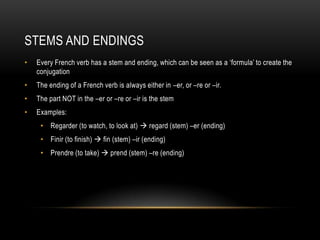
Stems and EndingsEvery French verb has a stem and ending, which can be seen as a ‘formula’ to create the conjugation The ending of a French verb is always either in –er, or –re or –ir.The part NOT in the –er or –re or –ir is the stemExamples:Regarder(to watch, to look at)  regard (stem) –er (ending)Finir(to finish)  fin (stem) –ir (ending)Prendre(to take)  prend(stem) –re (ending)
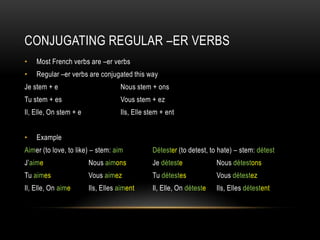
Conjugating regular –er verbsMost French verbs are –er verbsRegular –er verbs are conjugated this wayJe stem + e		Nous stem + onsTu stem + esVous stem + ezIl, Elle, On stem + e		Ils, Elle stem + entExampleAimer (to love, to like)– stem: aim	Détester (to detest, to hate) – stem: détestJ’aime		Nous aimonsJe détesteNous détestonsTuaimesVousaimezTudétestesVousdétestezIl, Elle, On aimeIls, EllesaimentIl, Elle, On détesteIls, Ellesdétestent
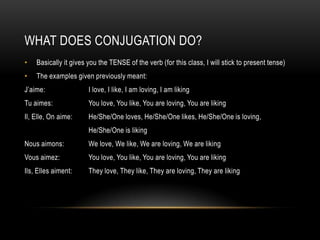
What does conjugation do?Basically it gives you the TENSE of the verb (for this class, I will stick to present tense)The examples given previously meant:J’aime: 		I love, I like, I am loving, I am likingTuaimes: 		You love, You like, You are loving, You are likingIl, Elle, On aime: 	He/She/One loves, He/She/One likes, He/She/One is loving, 	He/She/One is likingNous aimons:	We love, We like, We are loving, We are likingVousaimez:	You love, You like, You are loving, You are likingIls, Ellesaiment:	They love, They like, They are loving, They are liking
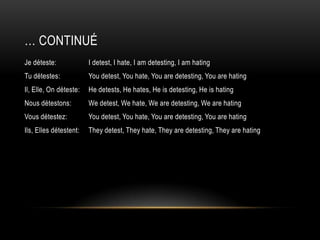
… continuéJe déteste:		I detest, I hate, I am detesting, I am hatingTudétestes:	You detest, You hate, You are detesting, You are hatingIl, Elle, On déteste:	He detests, He hates, He is detesting, He is hatingNous détestons:	We detest, We hate, We are detesting, We are hatingVousdétestez:	You detest, You hate, You are detesting, You are hatingIls, Ellesdétestent:	They detest, They hate, They are detesting, They are hating
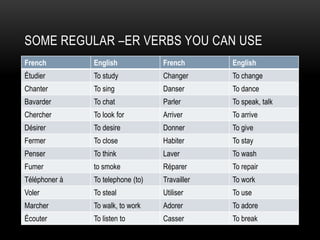
Some regular –er verbs you can use
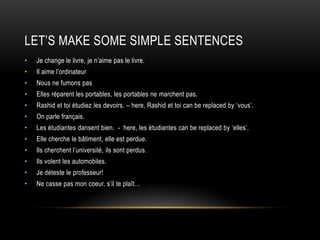
Let’s make some simple sentencesJe change le livre, je n’aime pas le livre.Il aimel’ordinateurNous ne fumonspasEllesréparent les portables, les portables ne marchentpas.Rashid et toiétudiez les devoirs. – here, Rashid et toi can be replaced by ‘vous’.On parlefrançais.Les étudiantesdansentbien.  -  here, les étudiantes can be replaced by ‘elles’.Elle cherche le bâtiment, elleestperdue.Ilscherchentl’université, ilssontperdus.Ilsvolent les automobiles.Je déteste le professeur!Ne casse pas moncoeur, s’ilteplaît…
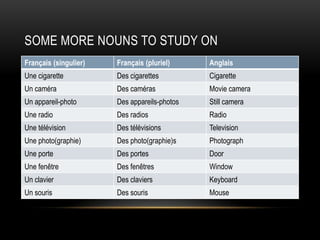
Some more nouns to study on
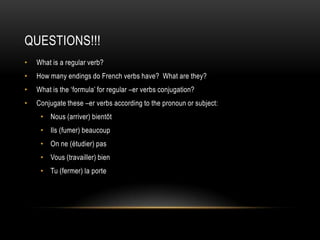
QUESTIONS!!!What is a regular verb?How many endings do French verbs have?  What are they?What is the ‘formula’ for regular –er verbs conjugation?Conjugate these –er verbs according to the pronoun or subject:Nous (arriver) bientôtIls (fumer) beaucoupOn ne (étudier) pasVous (travailler) bienTu (fermer) la porte
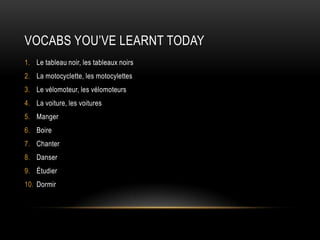
Vocabs you’ve learnt todayLe tableau noir, les tableaux noirsLa motocyclette, les motocylettesLe vélomoteur, les vélomoteursLa voiture, les voituresMangerBoireChanterDanserÉtudierDormir
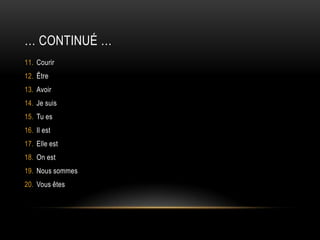
… continué …Courir ÊtreAvoirJe suisTu esIl estElle estOn estNous sommesVous êtes
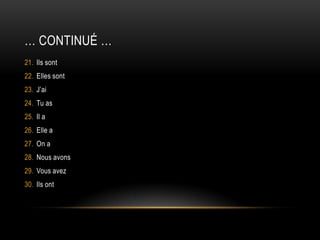
… continué …Ils sontElles sontJ’aiTu asIl aElle aOn aNous avonsVous avezIls ont
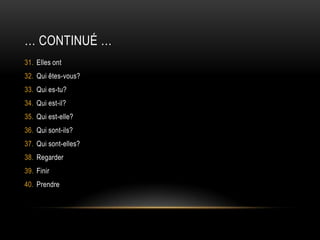
… continué …Elles ontQui êtes-vous?Qui es-tu?Qui est-il?Qui est-elle?Qui sont-ils?Qui sont-elles?RegarderFinirPrendre
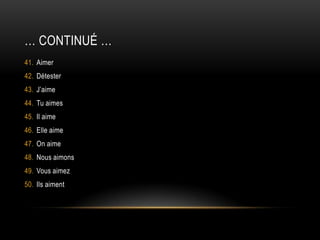
… continué …AimerDétesterJ’aimeTu aimesIl aimeElle aimeOn aimeNous aimonsVous aimezIls aiment
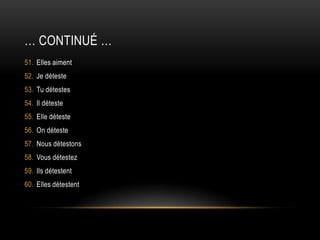
… continué …Elles aimentJe détesteTu détestesIl détesteElle détesteOn détesteNous détestonsVous détestezIls détestentElles détestent
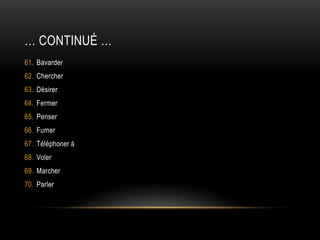
… continué …BavarderChercherDésirerFermerPenserFumerTéléphoner àVolerMarcherParler
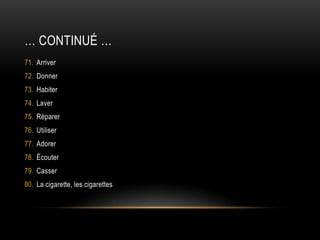
… continué …ArriverDonnerHabiterLaverRéparerUtiliserAdorerÉcouterCasserLa cigarette, les cigarettes
… continuéLe caméra, les camérasL’appareil-photo, les appareils-photosLa radio, les radiosLa photos, les photosLa photographie, les photographiesLa porte, les portesLa fenêtre, les fenêtresLe clavier, les claviersLe souris, les souris
Je vousvois la semaineprochaineLa FinBordeaux, France

Lecon04

  • 1.
  • 2.
    RecapTranslate these FrenchwordsLa femmeDes citésuniversitairesLe marqueurLe bureauC’est qui?Les crayonsLes professeursDes automobilesUn hommeQu’est-cequec’est?
  • 3.
  • 4.
  • 5.
    InfinitiveAll French verbsstartwithan infinitive, the base verbIn English, an infinitive startswith ‘to’, some examplesTo eatTo drinkTo singTo danceTo studyTo sleepTo run, etc.In French, infinitive isrecognizable by itsending-er-re-ir
  • 6.
    ConjugationA conjugationisderiving averbfromits infinitive to match the pronoun (or subject) to make a sentence grammatically correctIn English, infinitives are conjugatedtoo, according to the tense, examplehere for presenttense:To eat: I eat, youeat, heeats, weeat, theyeatTo drink: I drink, you drink, he drinks, we drink, they drinkTo sing: I sing, yousing, hesings, wesing, theysingTo dance: I dqnce, you dance, hedances, we dance, they danceTo study: I study, youstudy, hestudies, westudy, theystudyTo sleep: I sleep, yousleep, hesleeps, wesleep, theysleepTo run: I run, yourun, heruns, werun, theyrun
  • 7.
    Some French VerbsToeat - mangerTo drink - boireTo sing - chanterTo dance - danserTo study - étudierTo sleep - dormirTo run – courirLOOK AT THE ENDING OF EACH WORD…. Each one ends in either –er, -re or -ir
  • 8.
    Regular and IrregularverbsMostFrench verbs can either be called ‘regular’ or ‘irregular’Regular verbs are called such that because there is a pattern to conjugate it according to the stem of the infinitive; irregular verbs do not have the patternsSome regular verbs have exception – it has the pattern of regular verbs, but there are certain exception in spelling, mainly to satisfy the pronunciation of the conjugated verb
  • 9.
    The 2 MostCommon Verbs In FrenchThe verb ‘to be’ – êtreThe verb ‘to have’ – avoirBoth verbs are irregular verbsThe conjugation for êtreJe suis Nous sommesTu es Vous êtesIl, elle, on est Ils, elles sontThe conjugation for avoirJ’ai Nous avonsTu as Vous avezIl, elle, on a Ils, elles ontI amWeareYou are You areHe, she, one isThey areI have We haveYou have You haveHe, she, one has They have
  • 10.
    Let’sTryMake A Sentence!!!Ihave a bookYou have backpacksI am (a) studentWe have the tablesThey are teachersThey have computersI have booksShe has a cellphoneYou have a chairOne has a pencilJ’ai un livreTu as des sacs à dos Vous avez des sacs à dosJe suis étudiantJe suis étudianteNous avons les tablesIls sont professeursCe sont des professeursIls ont des ordinateursJ’ai des livresElle a un portableTu as une chaiseVous avez une chaiseOn a un crayon
  • 11.
    Questions that youmay askQui êtes-vous? - Who are you?Je suisprofesseurJe suisétudiantQui est-il, qui est-elle? - Who is he, who is she?Il estprofesseurElle estétudianteQui sont-ils, qui sont-elles? - Who are they?IlssontprofesseursIlssontétudiantsBut, qu’est-cequec’est? - What is it?C’est un livreCesont des livres
  • 12.
    Stems and EndingsEveryFrench verb has a stem and ending, which can be seen as a ‘formula’ to create the conjugation The ending of a French verb is always either in –er, or –re or –ir.The part NOT in the –er or –re or –ir is the stemExamples:Regarder(to watch, to look at)  regard (stem) –er (ending)Finir(to finish)  fin (stem) –ir (ending)Prendre(to take)  prend(stem) –re (ending)
  • 13.
    Conjugating regular –erverbsMost French verbs are –er verbsRegular –er verbs are conjugated this wayJe stem + e Nous stem + onsTu stem + esVous stem + ezIl, Elle, On stem + e Ils, Elle stem + entExampleAimer (to love, to like)– stem: aim Détester (to detest, to hate) – stem: détestJ’aime Nous aimonsJe détesteNous détestonsTuaimesVousaimezTudétestesVousdétestezIl, Elle, On aimeIls, EllesaimentIl, Elle, On détesteIls, Ellesdétestent
  • 14.
    What does conjugationdo?Basically it gives you the TENSE of the verb (for this class, I will stick to present tense)The examples given previously meant:J’aime: I love, I like, I am loving, I am likingTuaimes: You love, You like, You are loving, You are likingIl, Elle, On aime: He/She/One loves, He/She/One likes, He/She/One is loving, He/She/One is likingNous aimons: We love, We like, We are loving, We are likingVousaimez: You love, You like, You are loving, You are likingIls, Ellesaiment: They love, They like, They are loving, They are liking
  • 15.
    … continuéJe déteste: Idetest, I hate, I am detesting, I am hatingTudétestes: You detest, You hate, You are detesting, You are hatingIl, Elle, On déteste: He detests, He hates, He is detesting, He is hatingNous détestons: We detest, We hate, We are detesting, We are hatingVousdétestez: You detest, You hate, You are detesting, You are hatingIls, Ellesdétestent: They detest, They hate, They are detesting, They are hating
  • 16.
    Some regular –erverbs you can use
  • 17.
    Let’s make somesimple sentencesJe change le livre, je n’aime pas le livre.Il aimel’ordinateurNous ne fumonspasEllesréparent les portables, les portables ne marchentpas.Rashid et toiétudiez les devoirs. – here, Rashid et toi can be replaced by ‘vous’.On parlefrançais.Les étudiantesdansentbien. - here, les étudiantes can be replaced by ‘elles’.Elle cherche le bâtiment, elleestperdue.Ilscherchentl’université, ilssontperdus.Ilsvolent les automobiles.Je déteste le professeur!Ne casse pas moncoeur, s’ilteplaît…
  • 18.
    Some more nounsto study on
  • 19.
    QUESTIONS!!!What is aregular verb?How many endings do French verbs have? What are they?What is the ‘formula’ for regular –er verbs conjugation?Conjugate these –er verbs according to the pronoun or subject:Nous (arriver) bientôtIls (fumer) beaucoupOn ne (étudier) pasVous (travailler) bienTu (fermer) la porte
  • 20.
    Vocabs you’ve learnttodayLe tableau noir, les tableaux noirsLa motocyclette, les motocylettesLe vélomoteur, les vélomoteursLa voiture, les voituresMangerBoireChanterDanserÉtudierDormir
  • 21.
    … continué …CourirÊtreAvoirJe suisTu esIl estElle estOn estNous sommesVous êtes
  • 22.
    … continué …IlssontElles sontJ’aiTu asIl aElle aOn aNous avonsVous avezIls ont
  • 23.
    … continué …EllesontQui êtes-vous?Qui es-tu?Qui est-il?Qui est-elle?Qui sont-ils?Qui sont-elles?RegarderFinirPrendre
  • 24.
    … continué …AimerDétesterJ’aimeTuaimesIl aimeElle aimeOn aimeNous aimonsVous aimezIls aiment
  • 25.
    … continué …EllesaimentJe détesteTu détestesIl détesteElle détesteOn détesteNous détestonsVous détestezIls détestentElles détestent
  • 26.
  • 27.
  • 28.
    … continuéLe caméra,les camérasL’appareil-photo, les appareils-photosLa radio, les radiosLa photos, les photosLa photographie, les photographiesLa porte, les portesLa fenêtre, les fenêtresLe clavier, les claviersLe souris, les souris
  • 29.
    Je vousvois lasemaineprochaineLa FinBordeaux, France