Verbs
Mme Gillis
Avoir
To have
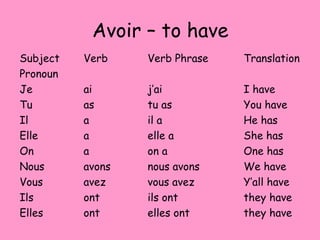
Avoir – to have
Subject Verb Verb Phrase Translation
Pronoun
Je ai j’ai I have
Tu as tu as You have
Il a il a He has
Elle a elle a She has
On a on a One has
Nous avons nous avons We have
Vous avez vous avez Y’all have
Ils ont ils ont they have
Elles ont elles ont they have
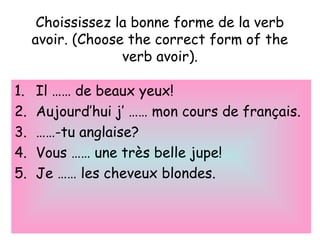
Choississez la bonne forme de la verb
avoir. (Choose the correct form of the
verb avoir).
1. Il …… de beaux yeux!
2. Aujourd’hui j’ …… mon cours de français.
3. ……-tu anglaise?
4. Vous …… une très belle jupe!
5. Je …… les cheveux blondes.
Faire
To make or To Do
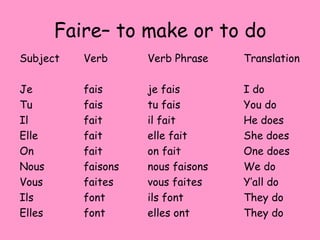
Faire– to make or to do
Subject Verb Verb Phrase Translation
Je fais je fais I do
Tu fais tu fais You do
Il fait il fait He does
Elle fait elle fait She does
On fait on fait One does
Nous faisons nous faisons We do
Vous faites vous faites Y’all do
Ils font ils font They do
Elles font elles ont They do
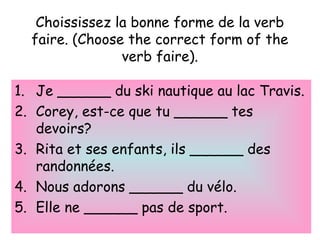
Choississez la bonne forme de la verb
faire. (Choose the correct form of the
verb faire).
1. Je ______ du ski nautique au lac Travis.
2. Corey, est-ce que tu ______ tes
devoirs?
3. Rita et ses enfants, ils ______ des
randonnées.
4. Nous adorons ______ du vélo.
5. Elle ne ______ pas de sport.
Regular –er
verbs
All Regular –er verbs
are formed the same
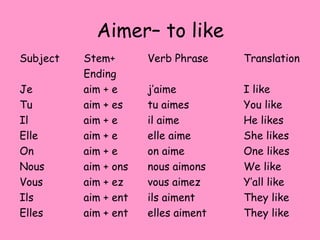
Aimer– to like
Subject Stem+ Verb Phrase Translation
Ending
Je aim + e j’aime I like
Tu aim + es tu aimes You like
Il aim + e il aime He likes
Elle aim + e elle aime She likes
On aim + e on aime One likes
Nous aim + ons nous aimons We like
Vous aim + ez vous aimez Y’all like
Ils aim + ent ils aiment They like
Elles aim + ent elles aiment They like
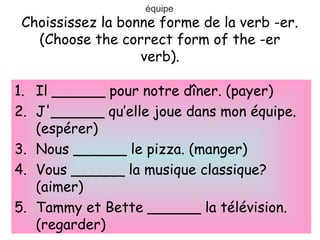
Choississez la bonne forme de la verb -er.
(Choose the correct form of the -er
verb).
1. Il ______ pour notre dîner. (payer)
2. J'______ qu’elle joue dans mon équipe.
(espérer)
3. Nous ______ le pizza. (manger)
4. Vous ______ la musique classique?
(aimer)
5. Tammy et Bette ______ la télévision.
(regarder)
équipe
–er verbs
ending in -ger
All verbs ending in –
ger verbs are formed
the same
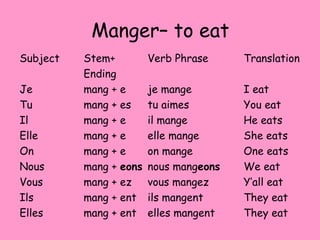
Manger– to eat
Subject Stem+ Verb Phrase Translation
Ending
Je mang + e je mange I eat
Tu mang + es tu aimes You eat
Il mang + e il mange He eats
Elle mang + e elle mange She eats
On mang + e on mange One eats
Nous mang + eons nous mangeons We eat
Vous mang + ez vous mangez Y’all eat
Ils mang + ent ils mangent They eat
Elles mang + ent elles mangent They eat
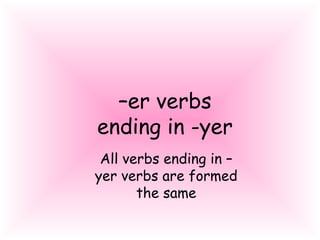
–er verbs
ending in -yer
All verbs ending in –
yer verbs are formed
the same
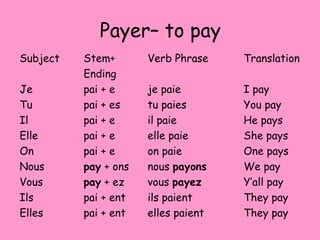
Payer– to pay
Subject Stem+ Verb Phrase Translation
Ending
Je pai + e je paie I pay
Tu pai + es tu paies You pay
Il pai + e il paie He pays
Elle pai + e elle paie She pays
On pai + e on paie One pays
Nous pay + ons nous payons We pay
Vous pay + ez vous payez Y’all pay
Ils pai + ent ils paient They pay
Elles pai + ent elles paient They pay
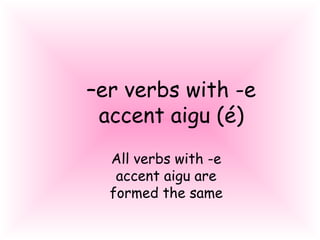
–er verbs with -e
accent aigu (é)
All verbs with -e
accent aigu are
formed the same
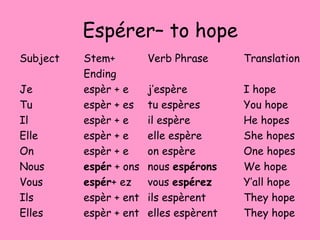
Espérer– to hope
Subject Stem+ Verb Phrase Translation
Ending
Je espèr + e j’espère I hope
Tu espèr + es tu espères You hope
Il espèr + e il espère He hopes
Elle espèr + e elle espère She hopes
On espèr + e on espère One hopes
Nous espér + ons nous espérons We hope
Vous espér+ ez vous espérez Y’all hope
Ils espèr + ent ils espèrent They hope
Elles espèr + ent elles espèrent They hope
Regular –re
verbs
All Regular –re verbs
are formed the same
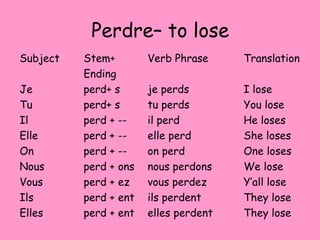
Perdre– to lose
Subject Stem+ Verb Phrase Translation
Ending
Je perd+ s je perds I lose
Tu perd+ s tu perds You lose
Il perd + -- il perd He loses
Elle perd + -- elle perd She loses
On perd + -- on perd One loses
Nous perd + ons nous perdons We lose
Vous perd + ez vous perdez Y’all lose
Ils perd + ent ils perdent They lose
Elles perd + ent elles perdent They lose
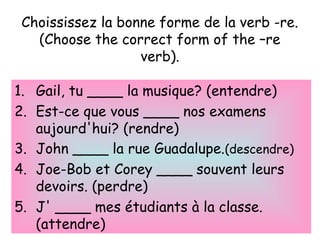
Choississez la bonne forme de la verb -re.
(Choose the correct form of the –re
verb).
1. Gail, tu ____ la musique? (entendre)
2. Est-ce que vous ____ nos examens
aujourd'hui? (rendre)
3. John ____ la rue Guadalupe.(descendre)
4. Joe-Bob et Corey ____ souvent leurs
devoirs. (perdre)
5. J' ____ mes étudiants à la classe.
(attendre)

Verb congugation

  • 1.
  • 2.
  • 3.
    Avoir – tohave Subject Verb Verb Phrase Translation Pronoun Je ai j’ai I have Tu as tu as You have Il a il a He has Elle a elle a She has On a on a One has Nous avons nous avons We have Vous avez vous avez Y’all have Ils ont ils ont they have Elles ont elles ont they have
  • 4.
    Choississez la bonneforme de la verb avoir. (Choose the correct form of the verb avoir). 1. Il …… de beaux yeux! 2. Aujourd’hui j’ …… mon cours de français. 3. ……-tu anglaise? 4. Vous …… une très belle jupe! 5. Je …… les cheveux blondes.
  • 5.
  • 6.
    Faire– to makeor to do Subject Verb Verb Phrase Translation Je fais je fais I do Tu fais tu fais You do Il fait il fait He does Elle fait elle fait She does On fait on fait One does Nous faisons nous faisons We do Vous faites vous faites Y’all do Ils font ils font They do Elles font elles ont They do
  • 7.
    Choississez la bonneforme de la verb faire. (Choose the correct form of the verb faire). 1. Je ______ du ski nautique au lac Travis. 2. Corey, est-ce que tu ______ tes devoirs? 3. Rita et ses enfants, ils ______ des randonnées. 4. Nous adorons ______ du vélo. 5. Elle ne ______ pas de sport.
  • 8.
    Regular –er verbs All Regular–er verbs are formed the same
  • 9.
    Aimer– to like SubjectStem+ Verb Phrase Translation Ending Je aim + e j’aime I like Tu aim + es tu aimes You like Il aim + e il aime He likes Elle aim + e elle aime She likes On aim + e on aime One likes Nous aim + ons nous aimons We like Vous aim + ez vous aimez Y’all like Ils aim + ent ils aiment They like Elles aim + ent elles aiment They like
  • 10.
    Choississez la bonneforme de la verb -er. (Choose the correct form of the -er verb). 1. Il ______ pour notre dîner. (payer) 2. J'______ qu’elle joue dans mon équipe. (espérer) 3. Nous ______ le pizza. (manger) 4. Vous ______ la musique classique? (aimer) 5. Tammy et Bette ______ la télévision. (regarder) équipe
  • 11.
    –er verbs ending in-ger All verbs ending in – ger verbs are formed the same
  • 12.
    Manger– to eat SubjectStem+ Verb Phrase Translation Ending Je mang + e je mange I eat Tu mang + es tu aimes You eat Il mang + e il mange He eats Elle mang + e elle mange She eats On mang + e on mange One eats Nous mang + eons nous mangeons We eat Vous mang + ez vous mangez Y’all eat Ils mang + ent ils mangent They eat Elles mang + ent elles mangent They eat
  • 13.
    –er verbs ending in-yer All verbs ending in – yer verbs are formed the same
  • 14.
    Payer– to pay SubjectStem+ Verb Phrase Translation Ending Je pai + e je paie I pay Tu pai + es tu paies You pay Il pai + e il paie He pays Elle pai + e elle paie She pays On pai + e on paie One pays Nous pay + ons nous payons We pay Vous pay + ez vous payez Y’all pay Ils pai + ent ils paient They pay Elles pai + ent elles paient They pay
  • 15.
    –er verbs with-e accent aigu (é) All verbs with -e accent aigu are formed the same
  • 16.
    Espérer– to hope SubjectStem+ Verb Phrase Translation Ending Je espèr + e j’espère I hope Tu espèr + es tu espères You hope Il espèr + e il espère He hopes Elle espèr + e elle espère She hopes On espèr + e on espère One hopes Nous espér + ons nous espérons We hope Vous espér+ ez vous espérez Y’all hope Ils espèr + ent ils espèrent They hope Elles espèr + ent elles espèrent They hope
  • 17.
    Regular –re verbs All Regular–re verbs are formed the same
  • 18.
    Perdre– to lose SubjectStem+ Verb Phrase Translation Ending Je perd+ s je perds I lose Tu perd+ s tu perds You lose Il perd + -- il perd He loses Elle perd + -- elle perd She loses On perd + -- on perd One loses Nous perd + ons nous perdons We lose Vous perd + ez vous perdez Y’all lose Ils perd + ent ils perdent They lose Elles perd + ent elles perdent They lose
  • 19.
    Choississez la bonneforme de la verb -re. (Choose the correct form of the –re verb). 1. Gail, tu ____ la musique? (entendre) 2. Est-ce que vous ____ nos examens aujourd'hui? (rendre) 3. John ____ la rue Guadalupe.(descendre) 4. Joe-Bob et Corey ____ souvent leurs devoirs. (perdre) 5. J' ____ mes étudiants à la classe. (attendre)