MISS FANNY FRANCAIS 1 [email_address] DECRIRE
les descriptions
French Determiners • Definite Determiners • Indefinite Determiners
Definite Determiners le  = use before a  male  noun that is singular (ex. le stylo) la  = use before a  female  noun that is singular (ex. la carte) (Definite determiners are translated as “the.”)
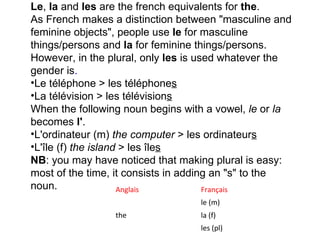
Le ,  la  and  les  are the french equivalents for  the .  As French makes a distinction between "masculine and feminine objects", people use  le  for masculine things/persons and  la  for feminine things/persons.  However, in the plural, only  les  is used whatever the gender is .          Le téléphone > les téléphone s   La télévision > les télévision s   When the following noun begins with a vowel,  le  or  la  becomes  l' .  L'ordinateur (m)  the computer  > les ordinateur s   L'île (f)  the island  > les île s   NB : you may have noticed that making plural is easy: most of the time, it consists in adding an "s" to the noun.  Anglais Français the le (m)  la (f)  les (pl)
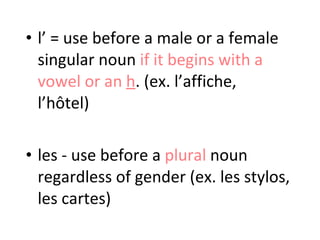
l’ = use before a male or a female singular noun  if it begins with a vowel or an  h . (ex. l’affiche, l’hôtel) les - use before a  plural  noun regardless of gender (ex. les stylos, les cartes)
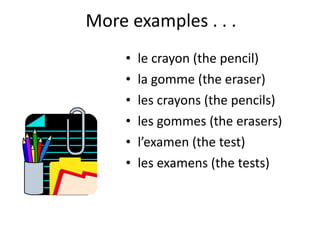
More examples . . . le crayon (the pencil) la gomme (the eraser) les crayons (the pencils) les gommes (the erasers) l’examen (the test) les examens (the tests)
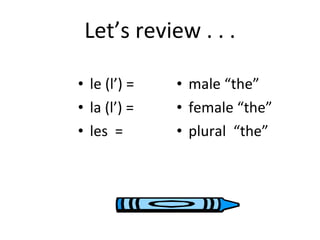
Let’s review . . . le (l’) = la (l’) = les  = male “the” female “the” plural  “the”
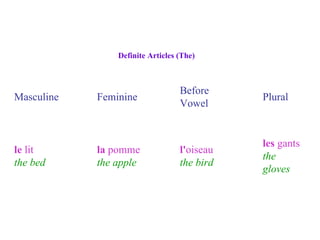
Definite Articles (The)   Masculine Feminine Before Vowel Plural le  lit the bed la  pomme the apple l' oiseau the bird les  gants the gloves
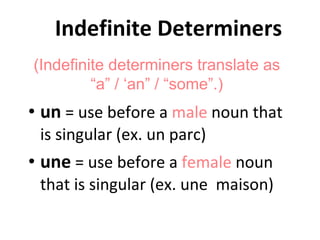
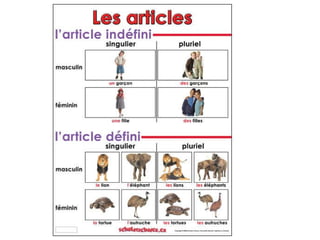
Indefinite Determiners un  = use before a  male  noun that is singular (ex. un parc) une  = use before a  female  noun that is singular (ex. une  maison) (Indefinite determiners translate as “a” / ‘an” / “some”.)
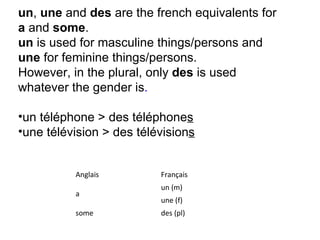
un ,  une  and  des  are the french equivalents for  a  and  some .  un  is used for masculine things/persons and  une  for feminine things/persons.  However, in the plural, only  des  is used whatever the gender is .           un téléphone > des téléphone s   une télévision > des télévision s   Anglais Français a un (m)  une (f)  some des (pl)
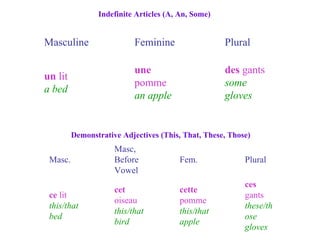
Indefinite Articles (A, An, Some)   Masculine Feminine Plural un  lit a bed une  pomme an apple des  gants some gloves Demonstrative Adjectives (This, That, These, Those)   Masc. Masc, Before Vowel Fem. Plural ce  lit this/that bed cet  oiseau this/that bird cette  pomme this/that apple ces  gants these/those gloves
 
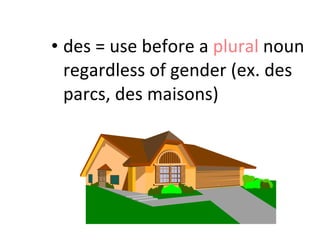
des = use before a  plural  noun regardless of gender (ex. des parcs, des maisons)
More examples . . . un bureau (a desk) une affiche (a poster) des bureaux (some desks) des affiches (some posters)
Let’s review . . . un = une = des =   male “a” female “a” plural “some”
• Definite Determiners = le/la/l’/les = the • Indefinite Determiners = un/une/des = a/an/some Have you got it?
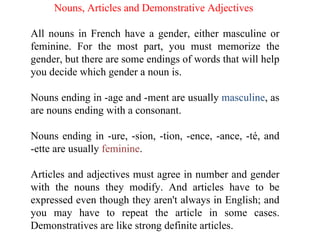
Nouns, Articles and Demonstrative Adjectives   All nouns in French have a gender, either masculine or feminine. For the most part, you must memorize the gender, but there are some endings of words that will help you decide which gender a noun is.  Nouns ending in -age and -ment are usually  masculine , as are nouns ending with a consonant.  Nouns ending in -ure, -sion, -tion, -ence, -ance, -té, and -ette are usually  feminine .  Articles and adjectives must agree in number and gender with the nouns they modify. And articles have to be expressed even though they aren't always in English; and you may have to repeat the article in some cases. Demonstratives are like strong definite articles.
Time to practice . . .
 
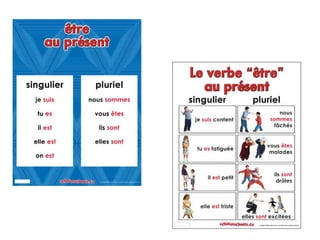
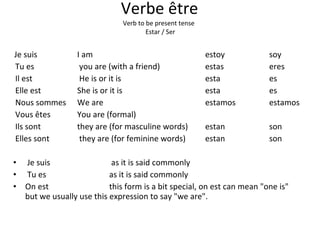
"être"  is an irregular verb whatever the tense is.  Examples:  Je suis heureux.       NB : do not pronounce the 'x' I am happy.   Nous sommes dans la cuisine.     We are in the kitchen.   Here is the conjugation in the present:
Verbe être  Verb to be present tense   Estar / Ser Je suis  I am estoy soy Tu es   you are (with a friend) estas eres Il est  He is or it is esta es Elle est She is or it is esta es Nous sommes  We are estamos estamos Vous êtes  You are (formal) Ils sont  they are (for masculine words) estan son Elles sont   they are (for feminine words) estan son Je suis  as it is said commonly Tu es  as it is said commonly On est this form is a bit special, on est can mean "one is" but we usually use this expression to say "we are".
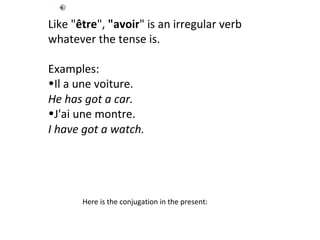
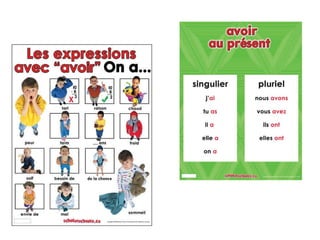
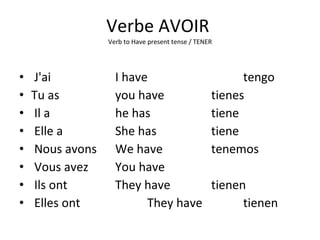
Like " être ",  "avoir " is an irregular verb whatever the tense is. Examples:  Il a une voiture.     He has got a car.   J'ai une montre.     I have got a watch.   Here is the conjugation in the present:
 
Verbe AVOIR  Verb to Have present tense / TENER J'ai  I have tengo Tu as    you have tienes Il a  he has tiene Elle a She has tiene Nous avons We have tenemos Vous avez  You have Ils ont  They have tienen Elles ont    They have tienen
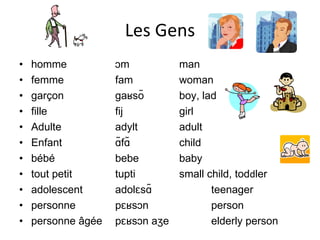
Les Gens homme ɔm man femme fam woman garçon gaʁsõ boy, lad fille fij girl Adulte adylt adult Enfant ɑ̃fɑ̃ child bébé bebe baby tout petit tupti small child, tod d ler adolescent adolɛsɑ̃ teenager personne pɛʁsɔn person personne âgée pɛʁsɔn aʒe elderly person
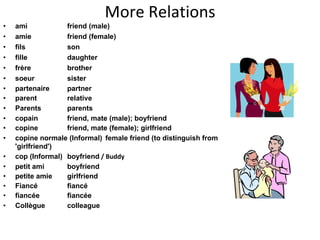
More Relations ami friend (male) amie friend (female) fils son fille daughter frère brother soeur sister partenaire partner parent relative Parents parents copain friend, mate (male); boyfriend copine friend, mate (female); girlfriend copine normale (Informal)   female friend (to distinguish from 'girlfriend') cop (Informal) boyfriend  / Buddy petit ami boyfriend petite amie girlfriend Fiancé fiancé fiancée fiancée Collègue colleague
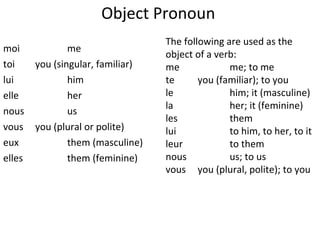
Object Pronoun moi me toi you (singular, familiar) lui him elle her nous us vous you (plural or polite) eux them (masculine) elles them (feminine) The following are used as the object of a verb: me me; to me te you (familiar); to you le him; it (masculine) la her; it (feminine) les them lui to him, to her, to it leur to them nous us; to us vous you (plural, polite); to you
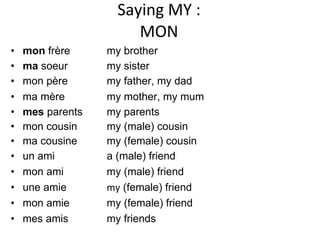
Saying MY : MON mon  frère my brother ma  soeur my sister mon père my father, my dad ma mère my mother, my mum mes  parents my parents mon cousin my (male) cousin ma cousine my (female) cousin un ami a (male) friend mon ami my (male) friend une amie my  (female) friend mon amie my (female) friend mes amis my friends
 
 
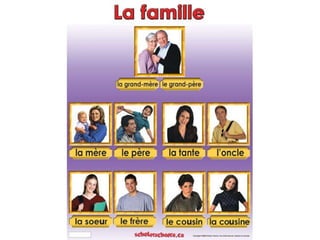
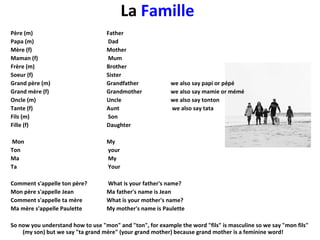
La  Famille Père (m)  Father Papa (m)  Dad Mère (f)  Mother Maman (f)  Mum Frère (m)    Brother Soeur (f)  Sister Grand père (m)  Grandfather  we also say papi or pépé Grand mère (f)  Grandmother  we also say mamie or mémé Oncle (m)  Uncle  we also say tonton Tante (f) Aunt   we also say tata Fils (m)  Son  Fille (f)  Daughter  Mon  My Ton   your Ma   My Ta  Your Comment s'appelle ton père?   What is your father's name? Mon père s'appelle Jean  Ma father's name is Jean Comment s'appelle ta mère  What is your mother's name? Ma mère s'appelle Paulette  My mother's name is Paulette So now you understand how to use "mon" and "ton", for example the word "fils" is masculine so we say "mon fils" (my son) but we say "ta grand mère" (your grand mother) because grand mother is a feminine word!
 
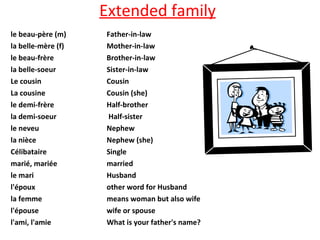
Extended family le beau-père (m)  Father-in-law la belle-mère (f)  Mother-in-law le beau-frère  Brother-in-law la belle-soeur  Sister-in-law Le cousin  Cousin La cousine  Cousin (she) le demi-frère  Half-brother la demi-soeur   Half-sister le neveu  Nephew la nièce  Nephew (she) Célibataire  Single marié, mariée  married le mari  Husband l'époux  other word for Husband la femme  means woman but also wife l'épouse  wife or spouse l'ami, l'amie  What is your father's name?
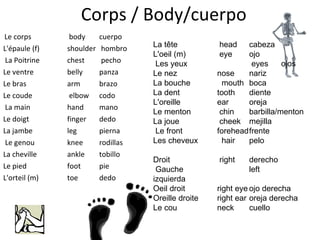
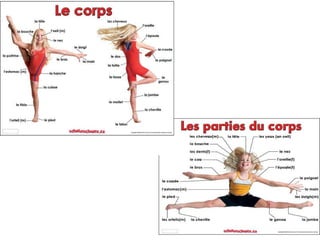
Corps / Body/cuerpo Le corps   body cuerpo L'épaule (f)  shoulder  hombro La Poitrine  chest   pecho Le ventre  belly panza Le bras arm  brazo Le coude   elbow codo La main    hand mano Le doigt    finger dedo La jambe   leg pierna Le genou  knee rodillas La cheville  ankle tobillo Le pied  foot pie L'orteil (m)  toe dedo La tête  head cabeza L'oeil (m)   eye ojo Les yeux   eyes ojos Le nez    nose nariz La bouche   mouth boca La dent    tooth diente L'oreille  ear oreja Le menton   chin barbilla/menton La joue   cheek mejilla Le front  forehead frente Les cheveux   hair pelo Droit   right derecho Gauche  left izquierda Oeil droit  right eye ojo derecha Oreille droite  right ear oreja derecha Le cou    neck cuello


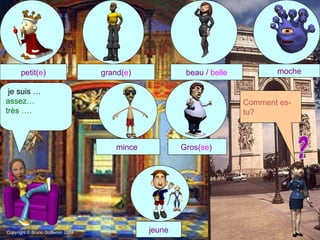
je   suis …  assez… très …. petit( e ) grand( e ) beau /  belle moche mince   Gros( se )  jeune Comment es-tu? ? Copyright © Bruno Guillemin 2004
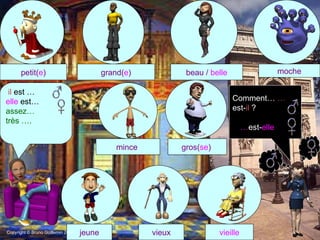
il  est …  elle  est…  assez… très …. petit( e ) grand( e ) beau /  belle moche mince   gros( se )  jeune Comment…  … est- il  ? vieux vieille … est- elle Copyright © Bruno Guillemin 2004
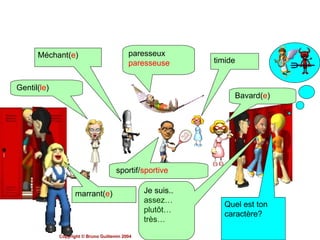
Quel est ton caractère? Je suis.. assez… plutôt… très… marrant( e ) Gentil( le ) Méchant( e ) paresseux paresseuse timide Bavard( e ) sportif/ sportive Copyright © Bruno Guillemin 2004
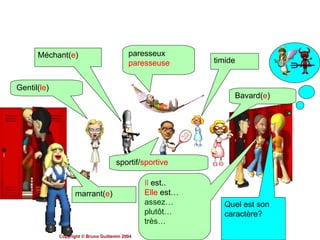
Quel est son caractère? Il  est.. Elle  est… assez… plutôt… très… marrant( e ) Gentil( le ) Méchant( e ) paresseux paresseuse timide Bavard( e ) sportif/ sportive Copyright © Bruno Guillemin 2004
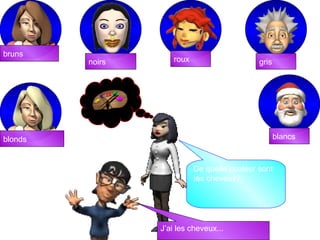
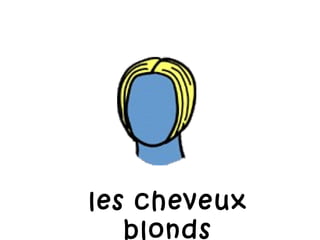
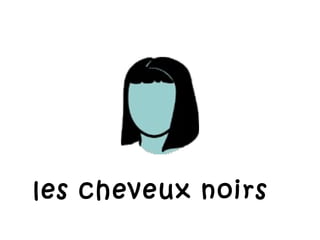
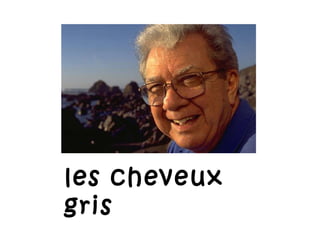
De quelle couleur sont tes cheveux? J’ai les cheveux... blonds bruns noirs roux gris blancs Copyright © Bruno Guillemin 2004
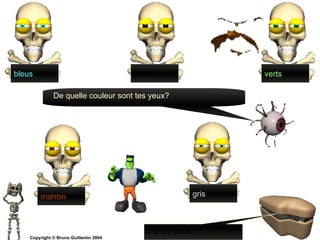
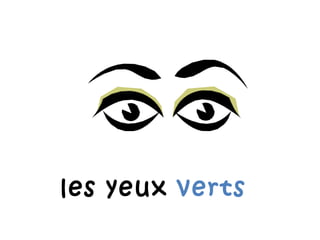
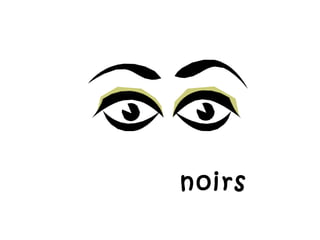
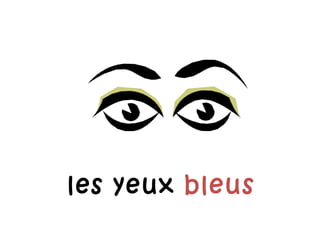
De quelle couleur sont tes yeux? J’ai les yeux... bleus verts noirs marron gris Copyright © Bruno Guillemin 2004
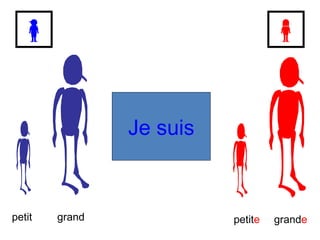
Je suis petit grand petit e grand e
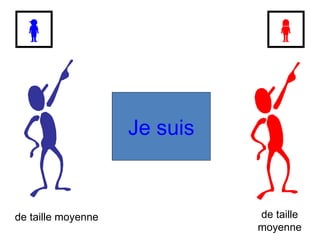
Je suis de taille moyenne de taille moyenne
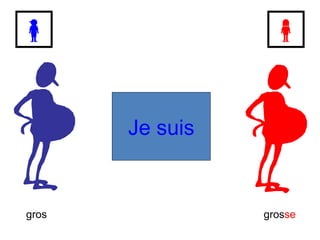
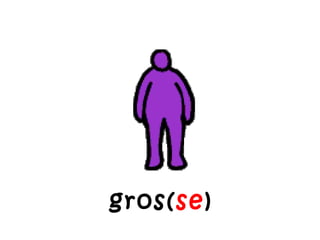
Je suis gros gros se
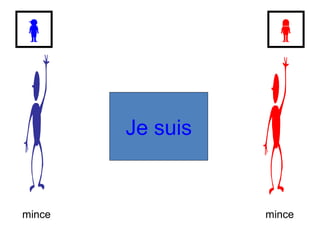
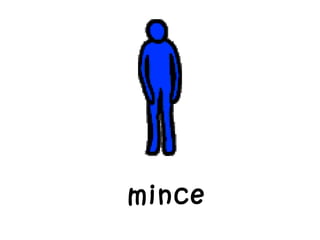
Je suis mince mince
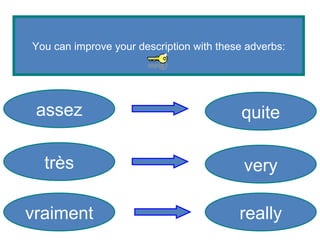
You can improve your description with these adverbs: assez très vraiment really very quite
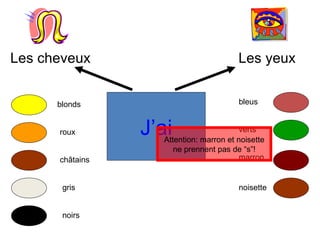
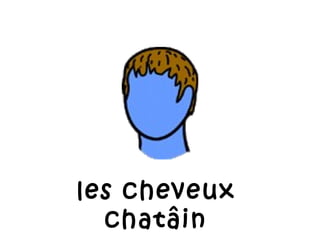
J’ai blonds roux châtains gris noirs bleus verts marron noisette Les cheveux Les yeux Attention: marron et noisette ne prennent pas de “s”!
You can improve your description with these adverbs: clairs foncés dark light
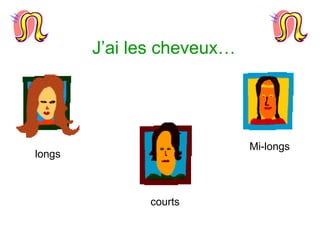
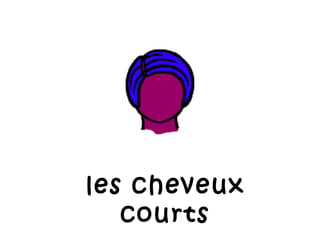
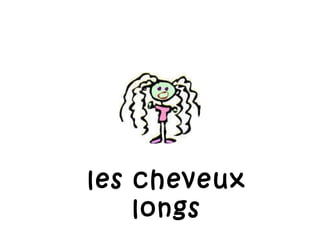
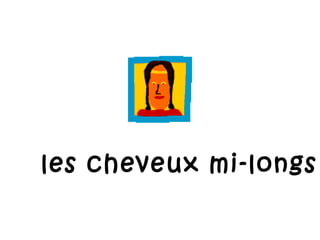
J’ai les cheveux… longs Mi-longs courts
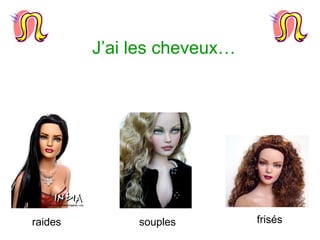
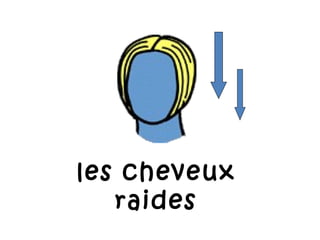
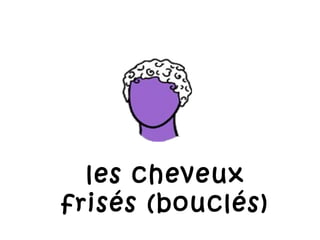
J’ai les cheveux… raides frisés souples
Voilà
Tu es comment?
Je suis…
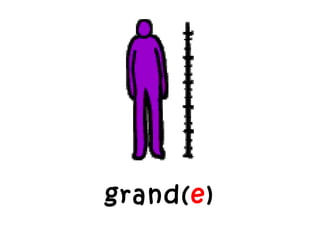
grand( e )
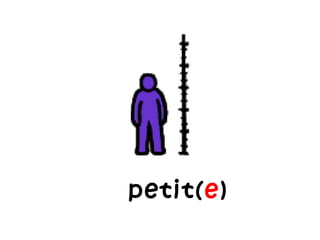
petit( e )
gros( se )
mince
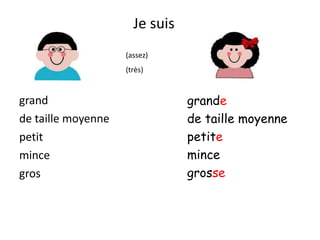
Je suis grand de taille moyenne petit mince gros grand e de taille moyenne petit e mince gros se (assez) (très)
J’ai…
les cheveux blonds
les cheveux chatâin
les cheveux noirs
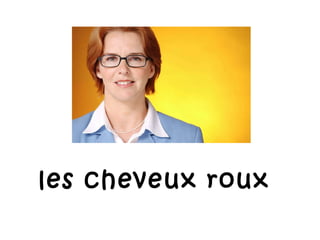
les cheveux roux
les cheveux gris
les cheveux raides
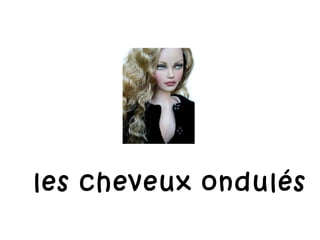
les cheveux ondulés
les cheveux frisés (bouclés)
les cheveux courts
les cheveux longs
les cheveux mi-longs
J’ai les cheveux ______,_____ et ______
J’ai…
les yeux  verts
les yeux  noirs
les yeux  bleus
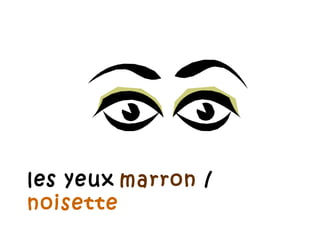
les yeux   marron  /  noisette
J’ai les yeux_______  J’ai les cheveux ____,  ____ et ____  Tu es comment?
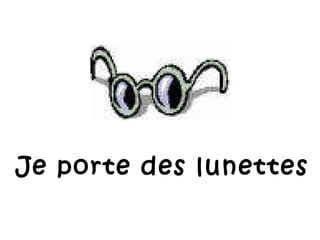
Je porte des lunettes
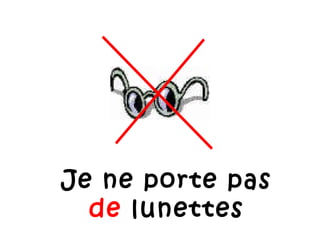
Je ne porte pas  de  lunettes
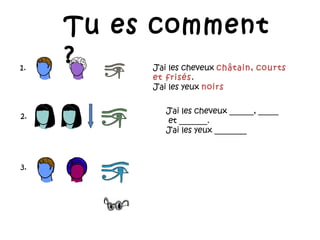
Tu es comment ?  1. 2. J’ai les cheveux  châtain,   courts  et frisés .  J’ai les yeux  noirs 3. J’ai les cheveux ______, _____ et _______.  J’ai les yeux ________
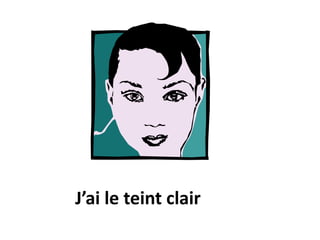
J’ai le teint clair
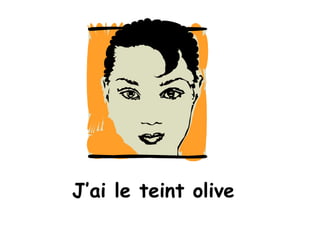
J’ai le teint olive
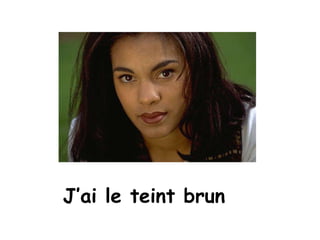
J’ai le teint brun
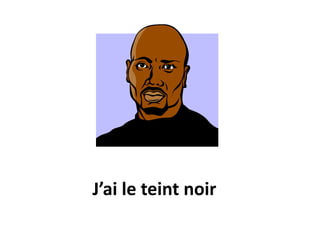
J’ai le teint noir
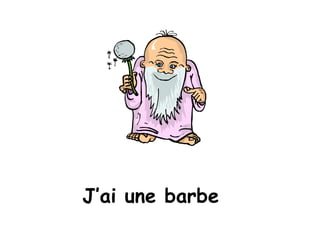
J’ai une barbe
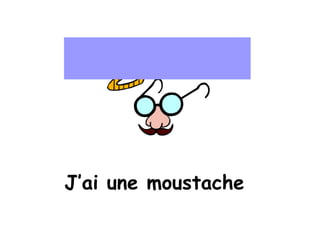
J’ai une moustache
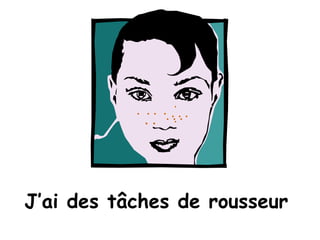
J’ai des tâches de rousseur .  . .  .  . . . . . . . . . .
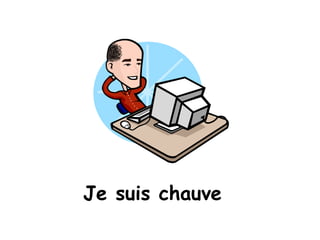
Je suis chauve
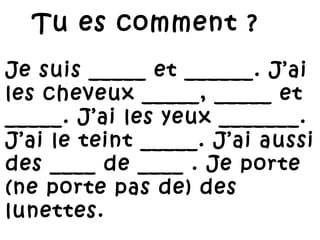
Je suis _____ et ______. J’ai les cheveux _____, _____ et _____. J’ai les yeux _______. J’ai le teint _____. J’ai aussi des ____ de ____ . Je porte (ne porte pas de) des lunettes. Tu es comment ?
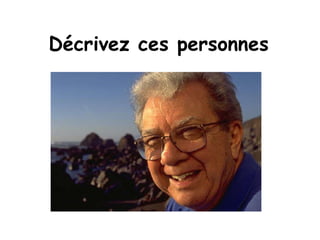
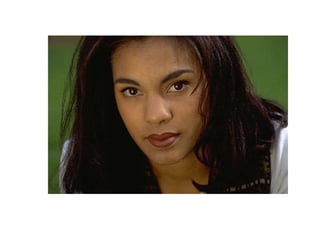
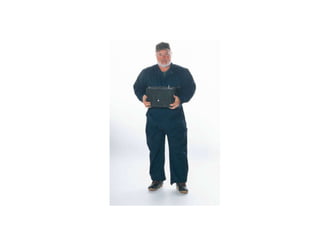
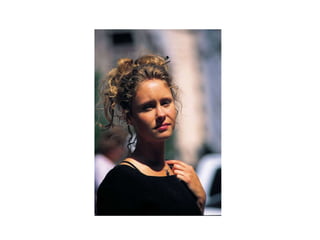
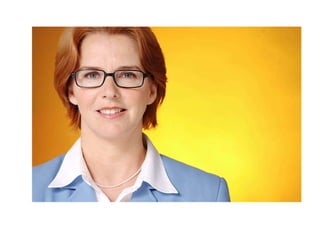
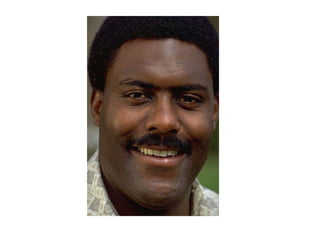
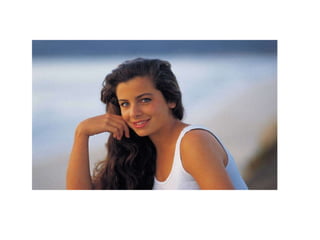
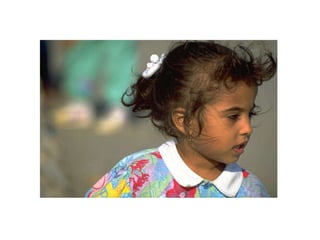
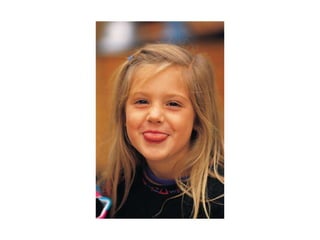
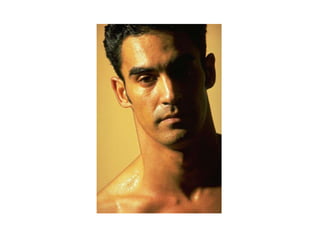
Décrivez ces personnes


Félicitations
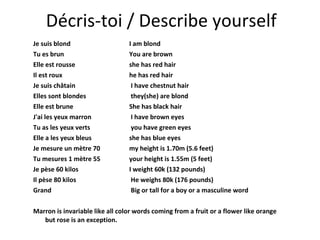
Décris-toi / Describe yourself Je suis blond  I am blond Tu es brun  You are brown Elle est rousse  she has red hair Il est roux  he has red hair Je suis châtain   I have chestnut hair Elles sont blondes   they(she) are blond Elle est brune  She has black hair J'ai les yeux marron  I have brown eyes Tu as les yeux verts   you have green eyes Elle a les yeux bleus  she has blue eyes Je mesure un mètre 70  my height is 1.70m (5.6 feet) Tu mesures 1 mètre 55  your height is 1.55m (5 feet) Je pèse 60 kilos  I weight 60k (132 pounds) Il pèse 80 kilos   He weighs 80k (176 pounds) Grand   Big or tall for a boy or a masculine word Marron is invariable like all color words coming from a fruit or a flower like orange but rose is an exception.
Grande  Big or tall for a girl or a feminine word Je suis grand    I am tall Elle est grande?   is she tall? Oui, elle est grande   Yes, she is Petit (m)  Small, little Petite (f)  Small, little Tu es petit?    Are you small? Non, je suis grand    No, I am not Je ne suis pas grand  I am not tall Mon pantalon est petit  My trousers are small Don't forget in French, trousers is singular
Something to know il y a there is; there are... y a (Informal) there is...; there are... c'est it's ce n'est pas it isn't... ceci est this is... ce n'est pas it isn't... Voil a here's..., there's... Voici here is... est-ce que... is it true that... (formula used to ask a question in French) est-ce qu'il y a...? is there...? j'ai... ʒe I have... avez-vous...? do you have...? je suis... I am... je ne suis pas... I'm not... êtes vous...? are you...? (en) anglais (in) English (en) français (in) French
 
 
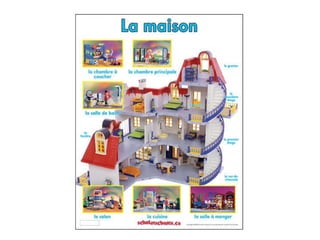
Maison / Home La cuisine   The kitchen La salle à manger   the dining room Le salon  the living room La chambre  the bedroom La salle de bain  the bathroom Les toilettes  the toilet  or Les wc   the toilet  (we usually say vc)
 
THE HOUSE Rooms and parts of the house in French le bureau de travail lə byʁot tʁavaj the office, study la chambre (à coucher) la ʃɑ̃bʁ (akuʃe) the bedroom la cuisine la kɥizin the kitchen l'entrée lɑ̃tʁe the hall l'escalier lɛscalje the stairs le grenier lə gʁənje the attic le jardin lə ʒaʁdæ̃ the garden une pièce yn pjɛs a room la salle de bains la saldəbæ̃ the bathroom/washroom la salle à manger la salamɑ̃ʒe the dining room le salon lə salõ the living room les toilettes le twalɛt the toilet, bathroom Furniture in French une armoire yn aʁmwaʁ a cupboard, closet un buffet æ̃ byfe a sideboard le canapé lə kanapé the sofa, settee une chaise yn ʃɛz a chair une commode yn cɔmɔd a chest of drawers la douche la duʃ the shower un fauteuil æ̃ fotœj an armchair une horloge yn ɔʁlɔʒ a clock une lampe yn lɑ̃p a lamp le lavabo lə lavabo the sink mon lit mõ li my bed le piano lə pjano the piano un placard æ̃ plakaʁ a cupboard, closet le sofa lə sofa the sofa une table yn tabl a table une table basse yn tabləbas a coffee table une table de chevet yn tab də ʃəve a bedside table des tables gigognes de tab ʒigɔnj nested tables la table de la salle à manger la tab də la salamɑ̃ʒe the dining room table la télé la tele the television, TV
Où habites-tu? / Where do you live? J'habite Londres / I live in London J'habite à Londres / I live in London La rue (f) / the street mon adresse (f) / my address Où habitez-vous?  / Where do you live? (formal) J'habite Paris / I live in Paris L'appartement (m) / the flat La ville / the town La campagne / the countryside
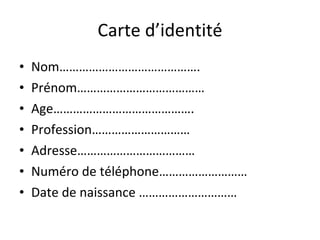
Carte d’identité Nom……………………………………. Prénom………………………………… Age……………………………………. Profession………………………… Adresse……………………………… Numéro de téléphone……………………… Date de naissance …………………………


L E C O N 3 Description

  • 1.
    MISS FANNY FRANCAIS1 [email_address] DECRIRE
  • 2.
  • 3.
    French Determiners •Definite Determiners • Indefinite Determiners
  • 4.
    Definite Determiners le = use before a male noun that is singular (ex. le stylo) la = use before a female noun that is singular (ex. la carte) (Definite determiners are translated as “the.”)
  • 5.
    Le , la and les are the french equivalents for the . As French makes a distinction between "masculine and feminine objects", people use le for masculine things/persons and la for feminine things/persons. However, in the plural, only les is used whatever the gender is .       Le téléphone > les téléphone s La télévision > les télévision s When the following noun begins with a vowel, le or la becomes l' . L'ordinateur (m) the computer > les ordinateur s L'île (f) the island > les île s NB : you may have noticed that making plural is easy: most of the time, it consists in adding an "s" to the noun. Anglais Français the le (m) la (f) les (pl)
  • 6.
    l’ = usebefore a male or a female singular noun if it begins with a vowel or an h . (ex. l’affiche, l’hôtel) les - use before a plural noun regardless of gender (ex. les stylos, les cartes)
  • 7.
    More examples .. . le crayon (the pencil) la gomme (the eraser) les crayons (the pencils) les gommes (the erasers) l’examen (the test) les examens (the tests)
  • 8.
    Let’s review .. . le (l’) = la (l’) = les = male “the” female “the” plural “the”
  • 9.
    Definite Articles (The) Masculine Feminine Before Vowel Plural le lit the bed la pomme the apple l' oiseau the bird les gants the gloves
  • 10.
    Indefinite Determiners un = use before a male noun that is singular (ex. un parc) une = use before a female noun that is singular (ex. une maison) (Indefinite determiners translate as “a” / ‘an” / “some”.)
  • 11.
    un , une and des are the french equivalents for a and some . un is used for masculine things/persons and une for feminine things/persons. However, in the plural, only des is used whatever the gender is .        un téléphone > des téléphone s une télévision > des télévision s Anglais Français a un (m) une (f) some des (pl)
  • 12.
    Indefinite Articles (A,An, Some) Masculine Feminine Plural un lit a bed une pomme an apple des gants some gloves Demonstrative Adjectives (This, That, These, Those) Masc. Masc, Before Vowel Fem. Plural ce lit this/that bed cet oiseau this/that bird cette pomme this/that apple ces gants these/those gloves
  • 13.
  • 14.
    des = usebefore a plural noun regardless of gender (ex. des parcs, des maisons)
  • 15.
    More examples .. . un bureau (a desk) une affiche (a poster) des bureaux (some desks) des affiches (some posters)
  • 16.
    Let’s review .. . un = une = des = male “a” female “a” plural “some”
  • 17.
    • Definite Determiners= le/la/l’/les = the • Indefinite Determiners = un/une/des = a/an/some Have you got it?
  • 18.
    Nouns, Articles andDemonstrative Adjectives All nouns in French have a gender, either masculine or feminine. For the most part, you must memorize the gender, but there are some endings of words that will help you decide which gender a noun is. Nouns ending in -age and -ment are usually masculine , as are nouns ending with a consonant. Nouns ending in -ure, -sion, -tion, -ence, -ance, -té, and -ette are usually feminine . Articles and adjectives must agree in number and gender with the nouns they modify. And articles have to be expressed even though they aren't always in English; and you may have to repeat the article in some cases. Demonstratives are like strong definite articles.
  • 19.
  • 20.
  • 21.
    "être" isan irregular verb whatever the tense is. Examples: Je suis heureux. NB : do not pronounce the 'x' I am happy. Nous sommes dans la cuisine. We are in the kitchen. Here is the conjugation in the present:
  • 22.
    Verbe être Verb to be present tense Estar / Ser Je suis I am estoy soy Tu es you are (with a friend) estas eres Il est He is or it is esta es Elle est She is or it is esta es Nous sommes We are estamos estamos Vous êtes You are (formal) Ils sont they are (for masculine words) estan son Elles sont they are (for feminine words) estan son Je suis as it is said commonly Tu es as it is said commonly On est this form is a bit special, on est can mean "one is" but we usually use this expression to say "we are".
  • 23.
    Like " être", "avoir " is an irregular verb whatever the tense is. Examples: Il a une voiture. He has got a car. J'ai une montre. I have got a watch. Here is the conjugation in the present:
  • 24.
  • 25.
    Verbe AVOIR Verb to Have present tense / TENER J'ai I have tengo Tu as you have tienes Il a he has tiene Elle a She has tiene Nous avons We have tenemos Vous avez You have Ils ont They have tienen Elles ont They have tienen
  • 26.
    Les Gens hommeɔm man femme fam woman garçon gaʁsõ boy, lad fille fij girl Adulte adylt adult Enfant ɑ̃fɑ̃ child bébé bebe baby tout petit tupti small child, tod d ler adolescent adolɛsɑ̃ teenager personne pɛʁsɔn person personne âgée pɛʁsɔn aʒe elderly person
  • 27.
    More Relations amifriend (male) amie friend (female) fils son fille daughter frère brother soeur sister partenaire partner parent relative Parents parents copain friend, mate (male); boyfriend copine friend, mate (female); girlfriend copine normale (Informal) female friend (to distinguish from 'girlfriend') cop (Informal) boyfriend / Buddy petit ami boyfriend petite amie girlfriend Fiancé fiancé fiancée fiancée Collègue colleague
  • 28.
    Object Pronoun moime toi you (singular, familiar) lui him elle her nous us vous you (plural or polite) eux them (masculine) elles them (feminine) The following are used as the object of a verb: me me; to me te you (familiar); to you le him; it (masculine) la her; it (feminine) les them lui to him, to her, to it leur to them nous us; to us vous you (plural, polite); to you
  • 29.
    Saying MY :MON mon frère my brother ma soeur my sister mon père my father, my dad ma mère my mother, my mum mes parents my parents mon cousin my (male) cousin ma cousine my (female) cousin un ami a (male) friend mon ami my (male) friend une amie my (female) friend mon amie my (female) friend mes amis my friends
  • 30.
  • 31.
  • 32.
    La FamillePère (m) Father Papa (m) Dad Mère (f) Mother Maman (f) Mum Frère (m) Brother Soeur (f) Sister Grand père (m) Grandfather we also say papi or pépé Grand mère (f) Grandmother we also say mamie or mémé Oncle (m) Uncle we also say tonton Tante (f) Aunt we also say tata Fils (m) Son Fille (f) Daughter Mon My Ton your Ma My Ta Your Comment s'appelle ton père? What is your father's name? Mon père s'appelle Jean Ma father's name is Jean Comment s'appelle ta mère What is your mother's name? Ma mère s'appelle Paulette My mother's name is Paulette So now you understand how to use "mon" and "ton", for example the word "fils" is masculine so we say "mon fils" (my son) but we say "ta grand mère" (your grand mother) because grand mother is a feminine word!
  • 33.
  • 34.
    Extended family lebeau-père (m) Father-in-law la belle-mère (f) Mother-in-law le beau-frère Brother-in-law la belle-soeur Sister-in-law Le cousin Cousin La cousine Cousin (she) le demi-frère Half-brother la demi-soeur Half-sister le neveu Nephew la nièce Nephew (she) Célibataire Single marié, mariée married le mari Husband l'époux other word for Husband la femme means woman but also wife l'épouse wife or spouse l'ami, l'amie What is your father's name?
  • 35.
    Corps / Body/cuerpoLe corps body cuerpo L'épaule (f) shoulder hombro La Poitrine chest pecho Le ventre belly panza Le bras arm brazo Le coude elbow codo La main hand mano Le doigt finger dedo La jambe leg pierna Le genou knee rodillas La cheville ankle tobillo Le pied foot pie L'orteil (m) toe dedo La tête head cabeza L'oeil (m) eye ojo Les yeux eyes ojos Le nez nose nariz La bouche mouth boca La dent tooth diente L'oreille ear oreja Le menton chin barbilla/menton La joue cheek mejilla Le front forehead frente Les cheveux hair pelo Droit right derecho Gauche left izquierda Oeil droit right eye ojo derecha Oreille droite right ear oreja derecha Le cou neck cuello
  • 36.
  • 37.
  • 38.
  • 39.
    je suis … assez… très …. petit( e ) grand( e ) beau / belle moche mince Gros( se ) jeune Comment es-tu? ? Copyright © Bruno Guillemin 2004
  • 40.
    il est… elle est… assez… très …. petit( e ) grand( e ) beau / belle moche mince gros( se ) jeune Comment… … est- il ? vieux vieille … est- elle Copyright © Bruno Guillemin 2004
  • 41.
    Quel est toncaractère? Je suis.. assez… plutôt… très… marrant( e ) Gentil( le ) Méchant( e ) paresseux paresseuse timide Bavard( e ) sportif/ sportive Copyright © Bruno Guillemin 2004
  • 42.
    Quel est soncaractère? Il est.. Elle est… assez… plutôt… très… marrant( e ) Gentil( le ) Méchant( e ) paresseux paresseuse timide Bavard( e ) sportif/ sportive Copyright © Bruno Guillemin 2004
  • 43.
    De quelle couleursont tes cheveux? J’ai les cheveux... blonds bruns noirs roux gris blancs Copyright © Bruno Guillemin 2004
  • 44.
    De quelle couleursont tes yeux? J’ai les yeux... bleus verts noirs marron gris Copyright © Bruno Guillemin 2004
  • 45.
    Je suis petitgrand petit e grand e
  • 46.
    Je suis detaille moyenne de taille moyenne
  • 47.
    Je suis grosgros se
  • 48.
  • 49.
    You can improveyour description with these adverbs: assez très vraiment really very quite
  • 50.
    J’ai blonds rouxchâtains gris noirs bleus verts marron noisette Les cheveux Les yeux Attention: marron et noisette ne prennent pas de “s”!
  • 51.
    You can improveyour description with these adverbs: clairs foncés dark light
  • 52.
    J’ai les cheveux…longs Mi-longs courts
  • 53.
    J’ai les cheveux…raides frisés souples
  • 54.
  • 55.
  • 56.
  • 57.
  • 58.
  • 59.
  • 60.
  • 61.
    Je suis grandde taille moyenne petit mince gros grand e de taille moyenne petit e mince gros se (assez) (très)
  • 62.
  • 63.
  • 64.
  • 65.
  • 66.
  • 67.
  • 68.
  • 69.
  • 70.
  • 71.
  • 72.
  • 73.
  • 74.
    J’ai les cheveux______,_____ et ______
  • 75.
  • 76.
    les yeux verts
  • 77.
    les yeux noirs
  • 78.
    les yeux bleus
  • 79.
    les yeux marron / noisette
  • 80.
    J’ai les yeux_______ J’ai les cheveux ____, ____ et ____ Tu es comment?
  • 81.
    Je porte deslunettes
  • 82.
    Je ne portepas de lunettes
  • 83.
    Tu es comment? 1. 2. J’ai les cheveux châtain, courts et frisés . J’ai les yeux noirs 3. J’ai les cheveux ______, _____ et _______. J’ai les yeux ________
  • 84.
  • 85.
  • 86.
  • 87.
  • 88.
  • 89.
  • 90.
    J’ai des tâchesde rousseur . . . . . . . . . . . . . .
  • 91.
  • 92.
    Je suis _____et ______. J’ai les cheveux _____, _____ et _____. J’ai les yeux _______. J’ai le teint _____. J’ai aussi des ____ de ____ . Je porte (ne porte pas de) des lunettes. Tu es comment ?
  • 93.
  • 94.
  • 95.
  • 96.
  • 97.
  • 98.
  • 99.
  • 100.
  • 101.
  • 102.
  • 103.
  • 104.
  • 105.
    Décris-toi / Describeyourself Je suis blond I am blond Tu es brun You are brown Elle est rousse she has red hair Il est roux he has red hair Je suis châtain I have chestnut hair Elles sont blondes they(she) are blond Elle est brune She has black hair J'ai les yeux marron I have brown eyes Tu as les yeux verts you have green eyes Elle a les yeux bleus she has blue eyes Je mesure un mètre 70 my height is 1.70m (5.6 feet) Tu mesures 1 mètre 55 your height is 1.55m (5 feet) Je pèse 60 kilos I weight 60k (132 pounds) Il pèse 80 kilos He weighs 80k (176 pounds) Grand Big or tall for a boy or a masculine word Marron is invariable like all color words coming from a fruit or a flower like orange but rose is an exception.
  • 106.
    Grande Bigor tall for a girl or a feminine word Je suis grand I am tall Elle est grande? is she tall? Oui, elle est grande Yes, she is Petit (m) Small, little Petite (f) Small, little Tu es petit? Are you small? Non, je suis grand No, I am not Je ne suis pas grand I am not tall Mon pantalon est petit My trousers are small Don't forget in French, trousers is singular
  • 107.
    Something to knowil y a there is; there are... y a (Informal) there is...; there are... c'est it's ce n'est pas it isn't... ceci est this is... ce n'est pas it isn't... Voil a here's..., there's... Voici here is... est-ce que... is it true that... (formula used to ask a question in French) est-ce qu'il y a...? is there...? j'ai... ʒe I have... avez-vous...? do you have...? je suis... I am... je ne suis pas... I'm not... êtes vous...? are you...? (en) anglais (in) English (en) français (in) French
  • 108.
  • 109.
  • 110.
    Maison / HomeLa cuisine The kitchen La salle à manger the dining room Le salon the living room La chambre the bedroom La salle de bain the bathroom Les toilettes the toilet or Les wc the toilet (we usually say vc)
  • 111.
  • 112.
    THE HOUSE Roomsand parts of the house in French le bureau de travail lə byʁot tʁavaj the office, study la chambre (à coucher) la ʃɑ̃bʁ (akuʃe) the bedroom la cuisine la kɥizin the kitchen l'entrée lɑ̃tʁe the hall l'escalier lɛscalje the stairs le grenier lə gʁənje the attic le jardin lə ʒaʁdæ̃ the garden une pièce yn pjɛs a room la salle de bains la saldəbæ̃ the bathroom/washroom la salle à manger la salamɑ̃ʒe the dining room le salon lə salõ the living room les toilettes le twalɛt the toilet, bathroom Furniture in French une armoire yn aʁmwaʁ a cupboard, closet un buffet æ̃ byfe a sideboard le canapé lə kanapé the sofa, settee une chaise yn ʃɛz a chair une commode yn cɔmɔd a chest of drawers la douche la duʃ the shower un fauteuil æ̃ fotœj an armchair une horloge yn ɔʁlɔʒ a clock une lampe yn lɑ̃p a lamp le lavabo lə lavabo the sink mon lit mõ li my bed le piano lə pjano the piano un placard æ̃ plakaʁ a cupboard, closet le sofa lə sofa the sofa une table yn tabl a table une table basse yn tabləbas a coffee table une table de chevet yn tab də ʃəve a bedside table des tables gigognes de tab ʒigɔnj nested tables la table de la salle à manger la tab də la salamɑ̃ʒe the dining room table la télé la tele the television, TV
  • 113.
    Où habites-tu? /Where do you live? J'habite Londres / I live in London J'habite à Londres / I live in London La rue (f) / the street mon adresse (f) / my address Où habitez-vous? / Where do you live? (formal) J'habite Paris / I live in Paris L'appartement (m) / the flat La ville / the town La campagne / the countryside
  • 114.
    Carte d’identité Nom…………………………………….Prénom………………………………… Age……………………………………. Profession………………………… Adresse……………………………… Numéro de téléphone……………………… Date de naissance …………………………
  • 115.
  • 116.