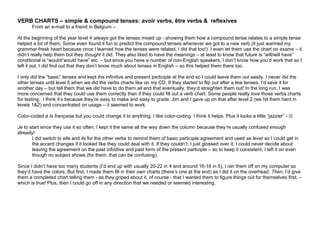
VERB CHARTS – simple & compound tenses: avoir verbs, être verbs & reflexives
       From an e-mail to a friend in Belgium –

At the beginning of the year level 4 always got the tenses mixed up - showing them how a compound tense relates to a simple tense
helped a lot of them. Some even found it fun to predict the compound tenses whenever we got to a new verb (it just warmed my
grammar-freak heart because once I learned how the tenses were related, I did that too!). I even let them use the chart on exams – it
didn’t really help them but they thought it did. They also liked to have the meanings – at least to know that future is “will/will have”
conditional is “would/’would have” etc. – but since you have a number of non-English speakers, I don’t know how you’d work that so I
left it out. I did find out that they don’t know much about tenses in English – so this helped them there too.

I only did the “basic” tenses and kept the infinitive and present participle at the end so I could leave them out easily. I never did the
other tenses until level 5 when we did the verbs charts like on my CD. If they started to flip out after a few tenses, I’d save it for
another day – but tell them that we did have to do them all and that eventually, they’d straighten them out! In the long run, I was
more concerned that they could use them correctly than if they could fill out a verb chart. Some people really love those verbs charts
for testing. I think it’s because they’re easy to make and easy to grade. Jim and I gave up on that after level 2 (we hit them hard in
levels 1&2) and concentrated on usage – it seemed to work.

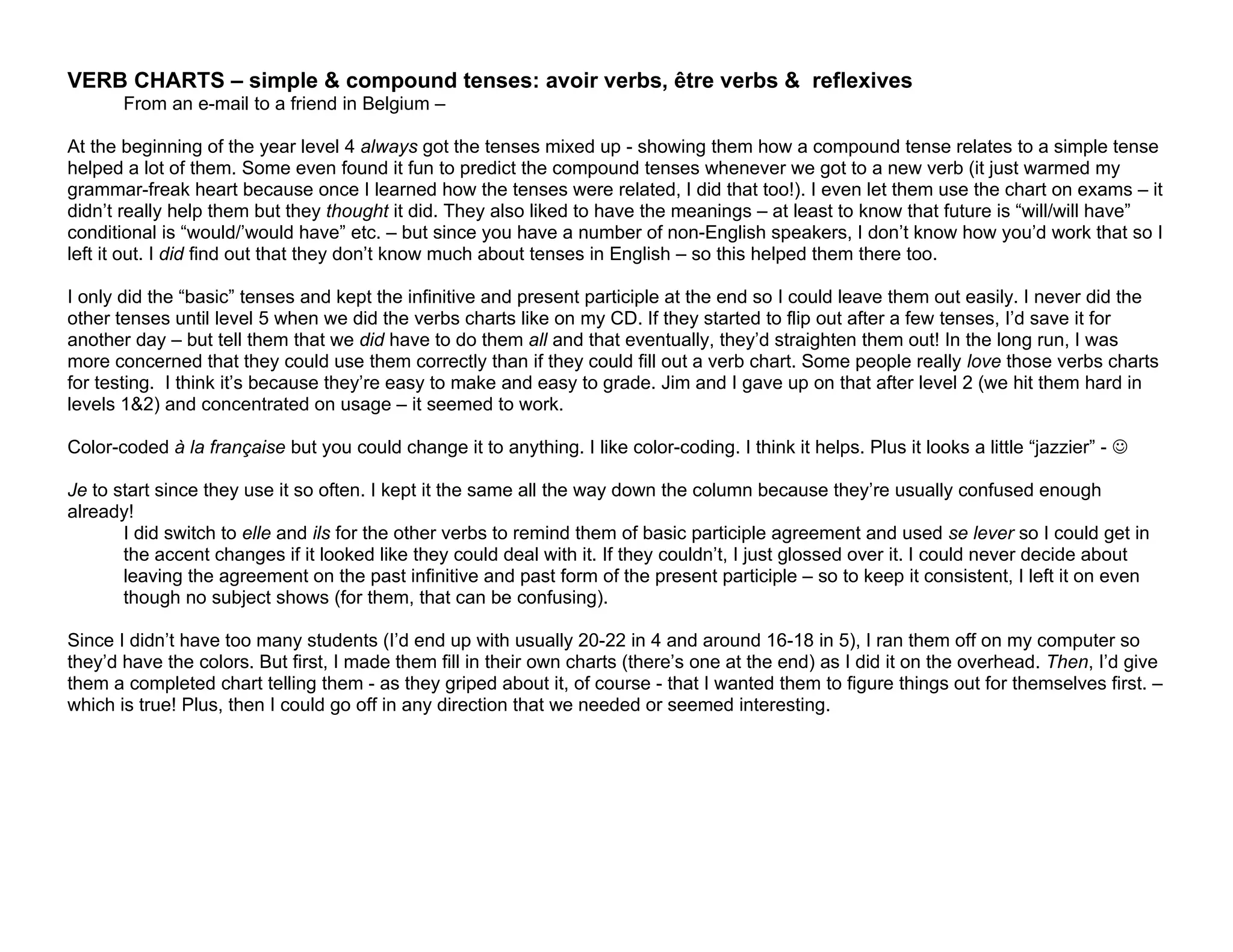
Color-coded à la française but you could change it to anything. I like color-coding. I think it helps. Plus it looks a little “jazzier” - 

Je to start since they use it so often. I kept it the same all the way down the column because they’re usually confused enough
already!
       I did switch to elle and ils for the other verbs to remind them of basic participle agreement and used se lever so I could get in
       the accent changes if it looked like they could deal with it. If they couldn’t, I just glossed over it. I could never decide about
       leaving the agreement on the past infinitive and past form of the present participle – so to keep it consistent, I left it on even
       though no subject shows (for them, that can be confusing).

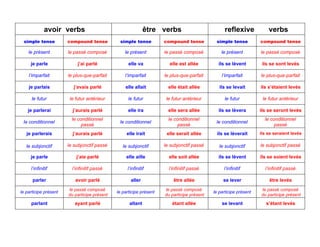
Since I didn’t have too many students (I’d end up with usually 20-22 in 4 and around 16-18 in 5), I ran them off on my computer so
they’d have the colors. But first, I made them fill in their own charts (there’s one at the end) as I did it on the overhead. Then, I’d give
them a completed chart telling them - as they griped about it, of course - that I wanted them to figure things out for themselves first. –
which is true! Plus, then I could go off in any direction that we needed or seemed interesting.
avoir verbs                                         être verbs                           reflexive            verbs
        avoir compound tense
 simple tense                                  simple tense          compound tense          simple tense          compound tense

    le présent         le passé composé           le présent         le passé composé           le présent         le passé composé

     je parle               j’ai parlé              elle va            elle est allée         ils se lèvent         ils se sont levés

    l’imparfait        le plus-que-parfait        l’imparfait        le plus-que-parfait        l’imparfait        le plus-que-parfait

    je parlais            j’avais parlé           elle allait          elle était allée        ils se levait       ils s’étaient levés

      le futur          le futur antérieur          le futur          le futur antérieur          le futur          le futur antérieur

    je parlerai          j’aurais parlé             elle ira           elle sera allée        ils se lèvera        ils se seront levés
                         le conditionnel                               le conditionnel                               le conditionnel
 le conditionnel                               le conditionnel                               le conditionnel
                              passé                                         passé                                         passé
   je parlerais          j’aurais parlé            elle irait         elle serait allée       ils se lèverait      ils se seraient levés

   le subjonctif       le subjonctif passé       le subjonctif       le subjonctif passé       le subjonctif       le subjonctif passé

     je parle              j’aie parlé             elle aille          elle soit allée        ils se lèvent        ils se soient levés

     l’infinitif         l’infinitif passé         l’infinitif         l’infinitif passé         l’infinitif         l’infinitif passé

      parler              avoir parlé                aller               être allée              se lever              être levés
                       le passé composé                              le passé composé                              le passé composé
le participe présent                          le participe présent                          le participe présent
                       du participe présent                          du participe présent                          du participe présent
     parlant              ayant parlé               allant               étant allée            se levant             s’étant levés
avoir verbs                             être verbs                    reflexive    verbs
simple tense   compound tense        simple tense   compound tense        simple tense   compound tense

 le présent    le passé composé       le présent    le passé composé       le présent    le passé composé


 l’imparfait   le plus-que-parfait    l’imparfait   le plus-que-parfait    l’imparfait   le plus-que-parfait
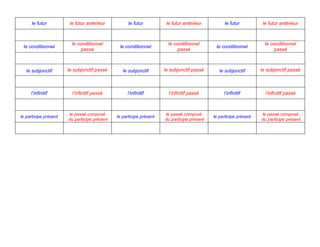
le futur          le futur antérieur          le futur          le futur antérieur          le futur          le futur antérieur


                         le conditionnel                               le conditionnel                               le conditionnel
 le conditionnel                               le conditionnel                               le conditionnel
                              passé                                         passé                                         passé


   le subjonctif       le subjonctif passé       le subjonctif       le subjonctif passé       le subjonctif       le subjonctif passé


     l’infinitif         l’infinitif passé         l’infinitif         l’infinitif passé         l’infinitif         l’infinitif passé


                       le passé composé                              le passé composé                              le passé composé
le participe présent                          le participe présent                          le participe présent
                       du participe présent                          du participe présent                          du participe présent

Verb tense chart

  • 1.
    VERB CHARTS –simple & compound tenses: avoir verbs, être verbs & reflexives From an e-mail to a friend in Belgium – At the beginning of the year level 4 always got the tenses mixed up - showing them how a compound tense relates to a simple tense helped a lot of them. Some even found it fun to predict the compound tenses whenever we got to a new verb (it just warmed my grammar-freak heart because once I learned how the tenses were related, I did that too!). I even let them use the chart on exams – it didn’t really help them but they thought it did. They also liked to have the meanings – at least to know that future is “will/will have” conditional is “would/’would have” etc. – but since you have a number of non-English speakers, I don’t know how you’d work that so I left it out. I did find out that they don’t know much about tenses in English – so this helped them there too. I only did the “basic” tenses and kept the infinitive and present participle at the end so I could leave them out easily. I never did the other tenses until level 5 when we did the verbs charts like on my CD. If they started to flip out after a few tenses, I’d save it for another day – but tell them that we did have to do them all and that eventually, they’d straighten them out! In the long run, I was more concerned that they could use them correctly than if they could fill out a verb chart. Some people really love those verbs charts for testing. I think it’s because they’re easy to make and easy to grade. Jim and I gave up on that after level 2 (we hit them hard in levels 1&2) and concentrated on usage – it seemed to work. Color-coded à la française but you could change it to anything. I like color-coding. I think it helps. Plus it looks a little “jazzier” -  Je to start since they use it so often. I kept it the same all the way down the column because they’re usually confused enough already! I did switch to elle and ils for the other verbs to remind them of basic participle agreement and used se lever so I could get in the accent changes if it looked like they could deal with it. If they couldn’t, I just glossed over it. I could never decide about leaving the agreement on the past infinitive and past form of the present participle – so to keep it consistent, I left it on even though no subject shows (for them, that can be confusing). Since I didn’t have too many students (I’d end up with usually 20-22 in 4 and around 16-18 in 5), I ran them off on my computer so they’d have the colors. But first, I made them fill in their own charts (there’s one at the end) as I did it on the overhead. Then, I’d give them a completed chart telling them - as they griped about it, of course - that I wanted them to figure things out for themselves first. – which is true! Plus, then I could go off in any direction that we needed or seemed interesting.
  • 2.
    avoir verbs être verbs reflexive verbs avoir compound tense simple tense simple tense compound tense simple tense compound tense le présent le passé composé le présent le passé composé le présent le passé composé je parle j’ai parlé elle va elle est allée ils se lèvent ils se sont levés l’imparfait le plus-que-parfait l’imparfait le plus-que-parfait l’imparfait le plus-que-parfait je parlais j’avais parlé elle allait elle était allée ils se levait ils s’étaient levés le futur le futur antérieur le futur le futur antérieur le futur le futur antérieur je parlerai j’aurais parlé elle ira elle sera allée ils se lèvera ils se seront levés le conditionnel le conditionnel le conditionnel le conditionnel le conditionnel le conditionnel passé passé passé je parlerais j’aurais parlé elle irait elle serait allée ils se lèverait ils se seraient levés le subjonctif le subjonctif passé le subjonctif le subjonctif passé le subjonctif le subjonctif passé je parle j’aie parlé elle aille elle soit allée ils se lèvent ils se soient levés l’infinitif l’infinitif passé l’infinitif l’infinitif passé l’infinitif l’infinitif passé parler avoir parlé aller être allée se lever être levés le passé composé le passé composé le passé composé le participe présent le participe présent le participe présent du participe présent du participe présent du participe présent parlant ayant parlé allant étant allée se levant s’étant levés
  • 3.
    avoir verbs être verbs reflexive verbs simple tense compound tense simple tense compound tense simple tense compound tense le présent le passé composé le présent le passé composé le présent le passé composé l’imparfait le plus-que-parfait l’imparfait le plus-que-parfait l’imparfait le plus-que-parfait
  • 4.
    le futur le futur antérieur le futur le futur antérieur le futur le futur antérieur le conditionnel le conditionnel le conditionnel le conditionnel le conditionnel le conditionnel passé passé passé le subjonctif le subjonctif passé le subjonctif le subjonctif passé le subjonctif le subjonctif passé l’infinitif l’infinitif passé l’infinitif l’infinitif passé l’infinitif l’infinitif passé le passé composé le passé composé le passé composé le participe présent le participe présent le participe présent du participe présent du participe présent du participe présent