
Past Tense
    Lesson Objectives
To recap how to form the past tense:
  • using verbs which take ‘avoir’.
   • using verbs which take ‘être’.
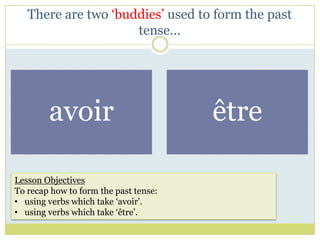
There are two ‘buddies’ used to form the past
                     tense…


        avoir                          être

Lesson Objectives
To recap how to form the past tense:
• using verbs which take ‘avoir’.
• using verbs which take ‘être’.
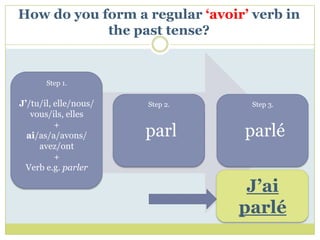
How do you form a regular ‘avoir’ verb in
            the past tense?


       Step 1.
       Step 1.
    Pronoun
J’/tu/il, elle/nous/         Step 2.               Step 3.
   vous/ils, elles
          +                  Step 2.
          +                                       Step 3.
present tense of
  ai/as/a/avons/            parl
                        Take off the ‘er’
                       ending of the verb
                                                 parlé
                                            Add ‘é’ to make the
      ‘avoir’
     avez/ont                                past participle.
                        to get the stem.
          +
          +
 Verb e.g. parler
      verb.
                                                J’ai
                                               parlé
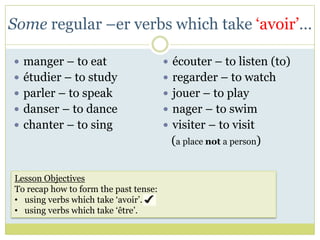
Some regular –er verbs which take ‘avoir’…

 manger – to eat                       écouter – to listen (to)
 étudier – to study                    regarder – to watch
 parler – to speak                     jouer – to play
 danser – to dance                     nager – to swim
 chanter – to sing                     visiter – to visit
                                        (a place not a person)


Lesson Objectives
To recap how to form the past tense:
• using verbs which take ‘avoir’.
• using verbs which take ‘être’.
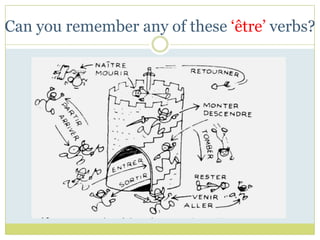
Can you remember any of these ‘être’ verbs?
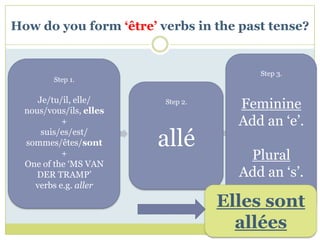
How do you form ‘être’ verbs in the past tense?


                                              Step 3.
         Step 1.
         Step 1.
       Pronoun
                                               Step 3.
     Je/tu/il, elle/
           +
  nous/vous/ils, elles
                             Step 2.
                             Step 2.      Feminine
                                          REMEMBER:
  present+  tense of       Find the       Add an ‘e’.
                                           Verbs which

                            allé
         ‘être’
      suis/es/est/                           take ‘être’
  sommes/êtes/sont
           +
                         correct past           agree.
            +
  A MS VAN DER
                          participle.        Plural
                                          Is it feminine?
  One of the ‘MS VAN                        Is it plural?
       TRAMP
     DER TRAMP’                           Add an ‘s’.
    verbs e.g. aller
         verb
                                        Elles sont
                                          allées
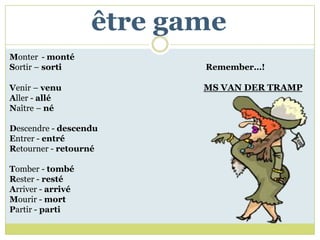
être game
Monter - monté
Sortir – sorti            Remember…!

Venir – venu              MS VAN DER TRAMP
Aller - allé
Naître – né

Descendre - descendu
Entrer - entré
Retourner - retourné

Tomber - tombé
Rester - resté
Arriver - arrivé
Mourir - mort
Partir - parti
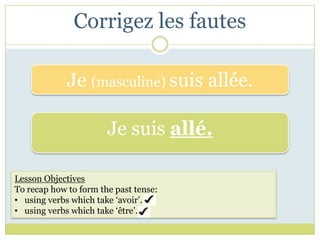
Corrigez les fautes

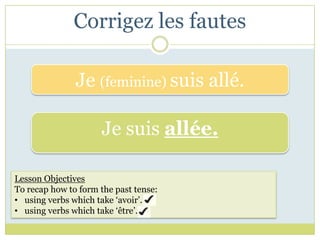
               Je (feminine) suis allé.

                     Je suis allée.

Lesson Objectives
To recap how to form the past tense:
• using verbs which take ‘avoir’.
• using verbs which take ‘être’.
Corrigez les fautes

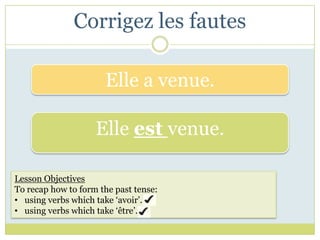
                      Elle a venue.

                    Elle est venue.

Lesson Objectives
To recap how to form the past tense:
• using verbs which take ‘avoir’.
• using verbs which take ‘être’.
Corrigez les fautes

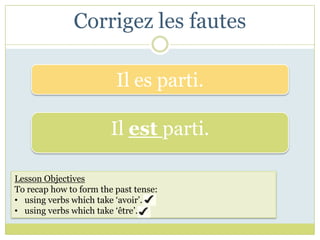
                         Il es parti.

                        Il est parti.

Lesson Objectives
To recap how to form the past tense:
• using verbs which take ‘avoir’.
• using verbs which take ‘être’.
Corrigez les fautes

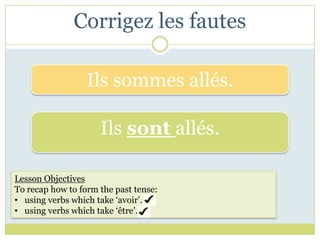
                  Ils sommes allés.

                     Ils sont allés.

Lesson Objectives
To recap how to form the past tense:
• using verbs which take ‘avoir’.
• using verbs which take ‘être’.
Corrigez les fautes

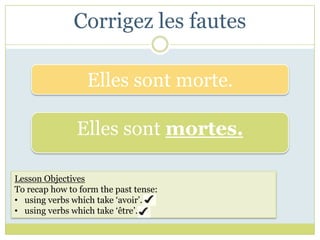
                  Elles sont morte.

               Elles sont mortes.

Lesson Objectives
To recap how to form the past tense:
• using verbs which take ‘avoir’.
• using verbs which take ‘être’.
Corrigez les fautes

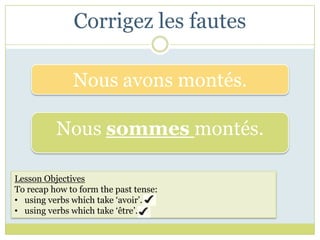
              Nous avons montés.

          Nous sommes montés.

Lesson Objectives
To recap how to form the past tense:
• using verbs which take ‘avoir’.
• using verbs which take ‘être’.
Corrigez les fautes

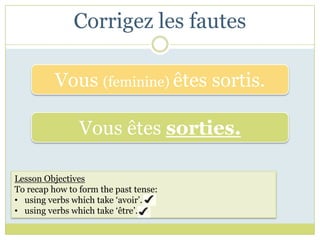
          Vous (feminine) êtes sortis.

                Vous êtes sorties.

Lesson Objectives
To recap how to form the past tense:
• using verbs which take ‘avoir’.
• using verbs which take ‘être’.
Corrigez les fautes

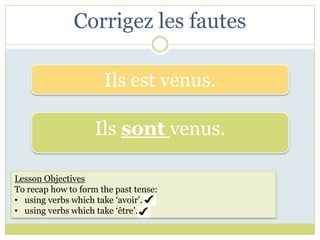
                      Ils est venus.

                    Ils sont venus.

Lesson Objectives
To recap how to form the past tense:
• using verbs which take ‘avoir’.
• using verbs which take ‘être’.
Corrigez les fautes

             Je (masculine) suis allée.

                       Je suis allé.

Lesson Objectives
To recap how to form the past tense:
• using verbs which take ‘avoir’.
• using verbs which take ‘être’.
Corrigez les fautes

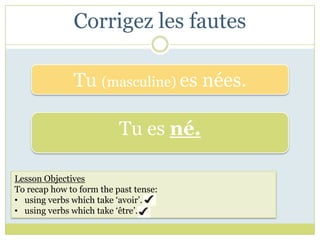
              Tu (masculine) es nées.

                          Tu es né.

Lesson Objectives
To recap how to form the past tense:
• using verbs which take ‘avoir’.
• using verbs which take ‘être’.
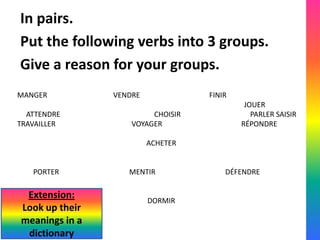
In pairs.
Put the following verbs into 3 groups.
Give a reason for your groups.
MANGER          VENDRE             FINIR
                                            JOUER
  ATTENDRE               CHOISIR              PARLER SAISIR
TRAVAILLER          VOYAGER                RÉPONDRE

                         ACHETER


   PORTER          MENTIR              DÉFENDRE

 Extension:              DORMIR
Look up their
meanings in a
 dictionary
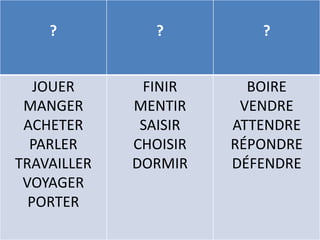
?           ?         ?


   JOUER      FINIR      BOIRE
 MANGER      MENTIR     VENDRE
 ACHETER      SAISIR   ATTENDRE
  PARLER     CHOISIR   RÉPONDRE
TRAVAILLER   DORMIR    DÉFENDRE
 VOYAGER
  PORTER
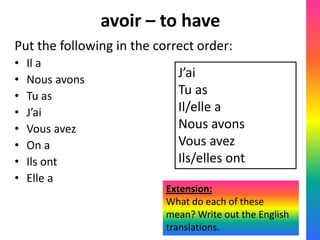
avoir – to have
Put the following in the correct order:
•   Il a
•   Nous avons
                             J’ai
•   Tu as                    Tu as
•   J’ai                     Il/elle a
•   Vous avez                Nous avons
•   On a                     Vous avez
•   Ils ont                  Ils/elles ont
•   Elle a
                           Extension:
                           What do each of these
                           mean? Write out the English
                           translations.
J’ai mangé du chocolat hier
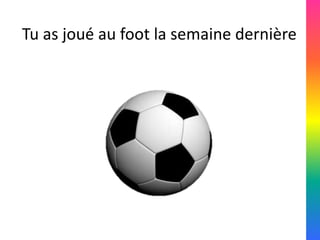
Tu as joué au foot la semaine dernière
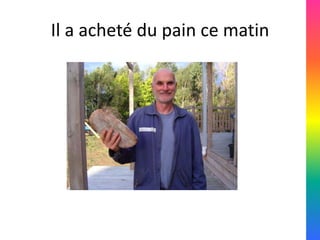
Il a acheté du pain ce matin
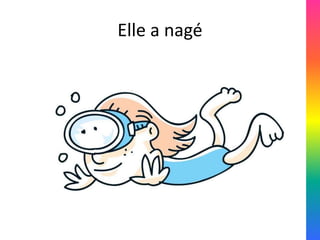
Elle a nagé
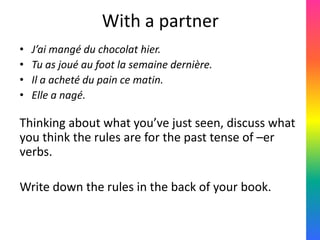
With a partner
•   J’ai mangé du chocolat hier.
•   Tu as joué au foot la semaine dernière.
•   Il a acheté du pain ce matin.
•   Elle a nagé.

Thinking about what you’ve just seen, discuss what
you think the rules are for the past tense of –er
verbs.

Write down the rules in the back of your book.
Now for the posh words bit
Pronoun + auxiliary + past participle
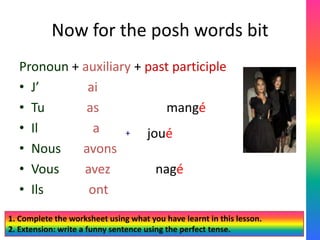
Now for the posh words bit
  Pronoun + auxiliary + past participle
  • J’       ai
  • Tu       as             mangé
  • Il        a     +   joué
  • Nous    avons
  • Vous    avez          nagé
  • Ils      ont
1. Complete the worksheet using what you have learnt in this lesson.
2. Extension: write a funny sentence using the perfect tense.
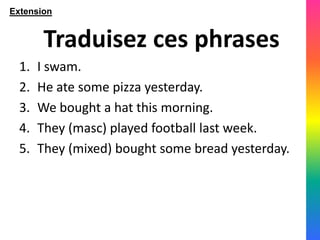
Extension


        Traduisez ces phrases
  1.   I swam.
  2.   He ate some pizza yesterday.
  3.   We bought a hat this morning.
  4.   They (masc) played football last week.
  5.   They (mixed) bought some bread yesterday.
What about –ir verbs?
• J’ai fini mes devoirs

• Il a servi les clients
What about –re verbs?
• Elle a perdu 1 kilo.

• Ils ont attendu le bus
La semaine dernière
Lesson objectives
To learn how to talk about something which
you have done (perfect tense).
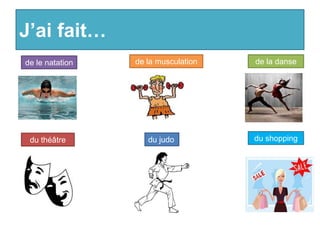
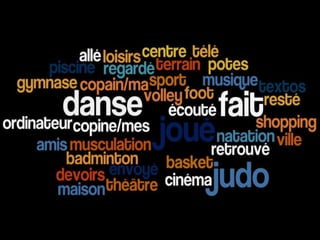
J’ai fait…
de le natation   de la musculation   de la danse


 du théâtre         du judo          du shopping
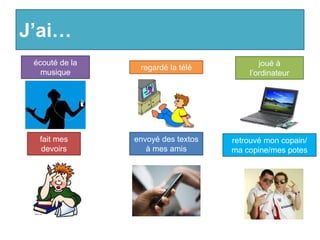
J’ai…
 écouté de la                              joué à
                 regardé la télé
   musique                              l’ordinateur


  fait mes      envoyé des textos   retrouvé mon copain/
   devoirs         à mes amis       ma copine/mes potes
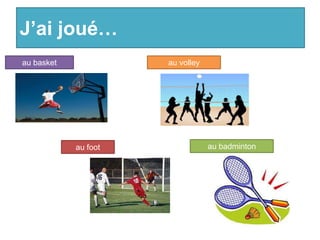
J’ai joué…
au basket             au volley


            au foot               au badminton
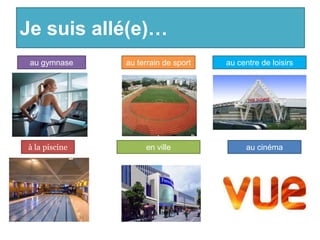
Je suis allé(e)…
 au gymnase    au terrain de sport   au centre de loisirs


à la piscine        en ville              au cinéma
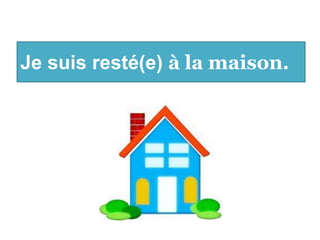
Je suis resté(e) à la maison.
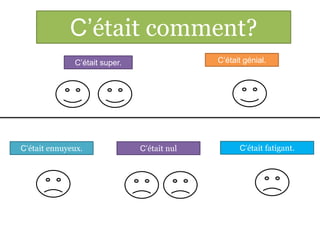
C’était comment?
              C’était super.                 C’était génial.


C’était ennuyeux.              C’était nul         C’était fatigant.
Perfect tense

Perfect tense

  • 1.
    Past Tense Lesson Objectives To recap how to form the past tense: • using verbs which take ‘avoir’. • using verbs which take ‘être’.
  • 2.
    There are two‘buddies’ used to form the past tense… avoir être Lesson Objectives To recap how to form the past tense: • using verbs which take ‘avoir’. • using verbs which take ‘être’.
  • 3.
    How do youform a regular ‘avoir’ verb in the past tense? Step 1. Step 1. Pronoun J’/tu/il, elle/nous/ Step 2. Step 3. vous/ils, elles + Step 2. + Step 3. present tense of ai/as/a/avons/ parl Take off the ‘er’ ending of the verb parlé Add ‘é’ to make the ‘avoir’ avez/ont past participle. to get the stem. + + Verb e.g. parler verb. J’ai parlé
  • 4.
    Some regular –erverbs which take ‘avoir’…  manger – to eat  écouter – to listen (to)  étudier – to study  regarder – to watch  parler – to speak  jouer – to play  danser – to dance  nager – to swim  chanter – to sing  visiter – to visit (a place not a person) Lesson Objectives To recap how to form the past tense: • using verbs which take ‘avoir’. • using verbs which take ‘être’.
  • 5.
    Can you rememberany of these ‘être’ verbs?
  • 6.
    How do youform ‘être’ verbs in the past tense? Step 3. Step 1. Step 1. Pronoun Step 3. Je/tu/il, elle/ + nous/vous/ils, elles Step 2. Step 2. Feminine REMEMBER: present+ tense of Find the Add an ‘e’. Verbs which allé ‘être’ suis/es/est/ take ‘être’ sommes/êtes/sont + correct past agree. + A MS VAN DER participle. Plural Is it feminine? One of the ‘MS VAN Is it plural? TRAMP DER TRAMP’ Add an ‘s’. verbs e.g. aller verb Elles sont allées
  • 7.
    être game Monter -monté Sortir – sorti Remember…! Venir – venu MS VAN DER TRAMP Aller - allé Naître – né Descendre - descendu Entrer - entré Retourner - retourné Tomber - tombé Rester - resté Arriver - arrivé Mourir - mort Partir - parti
  • 8.
    Corrigez les fautes Je (feminine) suis allé. Je suis allée. Lesson Objectives To recap how to form the past tense: • using verbs which take ‘avoir’. • using verbs which take ‘être’.
  • 9.
    Corrigez les fautes Elle a venue. Elle est venue. Lesson Objectives To recap how to form the past tense: • using verbs which take ‘avoir’. • using verbs which take ‘être’.
  • 10.
    Corrigez les fautes Il es parti. Il est parti. Lesson Objectives To recap how to form the past tense: • using verbs which take ‘avoir’. • using verbs which take ‘être’.
  • 11.
    Corrigez les fautes Ils sommes allés. Ils sont allés. Lesson Objectives To recap how to form the past tense: • using verbs which take ‘avoir’. • using verbs which take ‘être’.
  • 12.
    Corrigez les fautes Elles sont morte. Elles sont mortes. Lesson Objectives To recap how to form the past tense: • using verbs which take ‘avoir’. • using verbs which take ‘être’.
  • 13.
    Corrigez les fautes Nous avons montés. Nous sommes montés. Lesson Objectives To recap how to form the past tense: • using verbs which take ‘avoir’. • using verbs which take ‘être’.
  • 14.
    Corrigez les fautes Vous (feminine) êtes sortis. Vous êtes sorties. Lesson Objectives To recap how to form the past tense: • using verbs which take ‘avoir’. • using verbs which take ‘être’.
  • 15.
    Corrigez les fautes Ils est venus. Ils sont venus. Lesson Objectives To recap how to form the past tense: • using verbs which take ‘avoir’. • using verbs which take ‘être’.
  • 16.
    Corrigez les fautes Je (masculine) suis allée. Je suis allé. Lesson Objectives To recap how to form the past tense: • using verbs which take ‘avoir’. • using verbs which take ‘être’.
  • 17.
    Corrigez les fautes Tu (masculine) es nées. Tu es né. Lesson Objectives To recap how to form the past tense: • using verbs which take ‘avoir’. • using verbs which take ‘être’.
  • 18.
    In pairs. Put thefollowing verbs into 3 groups. Give a reason for your groups. MANGER VENDRE FINIR JOUER ATTENDRE CHOISIR PARLER SAISIR TRAVAILLER VOYAGER RÉPONDRE ACHETER PORTER MENTIR DÉFENDRE Extension: DORMIR Look up their meanings in a dictionary
  • 19.
    ? ? ? JOUER FINIR BOIRE MANGER MENTIR VENDRE ACHETER SAISIR ATTENDRE PARLER CHOISIR RÉPONDRE TRAVAILLER DORMIR DÉFENDRE VOYAGER PORTER
  • 20.
    avoir – tohave Put the following in the correct order: • Il a • Nous avons J’ai • Tu as Tu as • J’ai Il/elle a • Vous avez Nous avons • On a Vous avez • Ils ont Ils/elles ont • Elle a Extension: What do each of these mean? Write out the English translations.
  • 21.
    J’ai mangé duchocolat hier
  • 22.
    Tu as jouéau foot la semaine dernière
  • 23.
    Il a achetédu pain ce matin
  • 24.
  • 25.
    With a partner • J’ai mangé du chocolat hier. • Tu as joué au foot la semaine dernière. • Il a acheté du pain ce matin. • Elle a nagé. Thinking about what you’ve just seen, discuss what you think the rules are for the past tense of –er verbs. Write down the rules in the back of your book.
  • 26.
    Now for theposh words bit Pronoun + auxiliary + past participle
  • 27.
    Now for theposh words bit Pronoun + auxiliary + past participle • J’ ai • Tu as mangé • Il a + joué • Nous avons • Vous avez nagé • Ils ont 1. Complete the worksheet using what you have learnt in this lesson. 2. Extension: write a funny sentence using the perfect tense.
  • 28.
    Extension Traduisez ces phrases 1. I swam. 2. He ate some pizza yesterday. 3. We bought a hat this morning. 4. They (masc) played football last week. 5. They (mixed) bought some bread yesterday.
  • 29.
    What about –irverbs? • J’ai fini mes devoirs • Il a servi les clients
  • 30.
    What about –reverbs? • Elle a perdu 1 kilo. • Ils ont attendu le bus
  • 31.
    La semaine dernière Lessonobjectives To learn how to talk about something which you have done (perfect tense).
  • 32.
    J’ai fait… de lenatation de la musculation de la danse du théâtre du judo du shopping
  • 33.
    J’ai… écouté dela joué à regardé la télé musique l’ordinateur fait mes envoyé des textos retrouvé mon copain/ devoirs à mes amis ma copine/mes potes
  • 34.
    J’ai joué… au basket au volley au foot au badminton
  • 35.
    Je suis allé(e)… au gymnase au terrain de sport au centre de loisirs à la piscine en ville au cinéma
  • 36.
    Je suis resté(e)à la maison.
  • 37.
    C’était comment? C’était super. C’était génial. C’était ennuyeux. C’était nul C’était fatigant.