
COUCOU ET BIENVENUE CHEZ MISS FANNY sgriveau79 @hotmail.com Classe de Francais 1
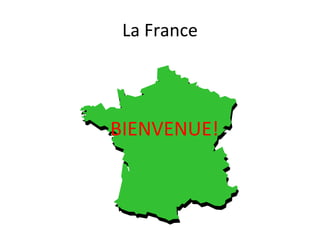
La France BIENVENUE!
Les francais
 
 
FRENCH ACCENTS There are four French accents for vowels and one accent for a consonant. For specific information on what the accents do to change the pronunciation of the letters they modify, please see the appropriate letter pages.  The accent aigu ´ (acute accent) can only be on an  E . At the beginning of a word, it often indicates that an S used to follow that vowel, e.g., étudiant (student). The accent grave ` (grave accent) can be found on an  A ,  E , or  U . On the A and U, it usually serves to distinguish between words that would otherwise be  homographs ; e.g., ou (or) vs  où (where). The accent circonflexe ˆ (circumflex) can be on an  A ,  E ,  I ,  O , or  U . The circumflex usually indicates that an S used to follow that vowel, e.g., forêt (forest). It also serves to distinguish between homographs; e.g., du ( contraction 11  of  de  +  le ) vs dû ( past participle 12  of  devoir ). The accent tréma ¨ (dieresis  or  umlaut) can be on an  E ,  I , or  U . It is used when two vowels are next to each other and both must be pronounced, e.g., naïve, Saül. The cédille ¸ (cedilla) is found only on the letter  C . It changes a hard C sound (like K) into a soft C sound (like S), e.g., garçon. The cedilla is never placed in front of E or I, because C always sounds like an S in front of these vowels. It is essential to put accents in their proper places - an incorrect or missing accent is a spelling mistake just as an incorrect or missing letter would be. The only exception to this is capital letters, which are often left unaccented.  You may not realize it, but French accents have a purpose. While some accents just signify that an S used to follow that vowel in Old French (e.g.,  étudiant  used to be spelled  estudiant ), most French accents indicate the correct pronunciation of the letter they modify. In addition, there are dozens of French word pairs which are spelled (though not always pronounced) the same other than accents. To avoid confusion, you should always distinguish between these words by using the correct accents.* a - third person singular of  avoir 1  (to have) à 2  - ( preposition 3 ) to, at, in
In French there are the 26 letters of the alfabet. Many have “accessories” : Accents are in the  AEIOU (è, é, etc...) or with the cedilla (ç).  When you are spelling your name ,  such as in a phone call, you need to know how to pronounce it en french:  A  B  C  D  E  F  G  H  I  J  K  L  M  N  O  P  Q  R  S  T  U  V  W  X  Y Z  Most of the time, do not pronounce final d, s, t or x in French words.  As an example, red letters are not pronounced in the following words:  un rebon d  (a bounce)  françai s   (French)  un sau t  (a jump)  heureu x   (happy)
Escucharás "on" en los siguientes ejemplos.  Francés  Español  une maison   una casa  un garçon  un chico  comprendre (*)  entender  un combat (*)  una lucha  ¡Ojo! (*) "On" antes de "p" o "b" se escribe "om". Pero hay una excepción: un bonbon  (un bombón).  Consejo: ¡Pronuncia "ou" como "u"!  Francés   Español  la tour Eiffel  la torre Eiffel  mourir  morir  un mouvement  un movimiento  vous  Usted/Ustedes  Escucharás " oi" en los siguientes ejemplos Francés Español une fois  una vez un toit  un techo un poisson  un pez croire  creer


A comme appel B comme ballon Paul? Présent!
C comme crayons D comme deux 2
E comme éléphant F comme fenêtre
G comme gomme H comme heure
I comme important J comme je HSCB Les devoirs pour le weekend!
K comme kangourou L comme livre
M comme maison N comme neuf 9
O comme orange P comme professeur
Q comme quatre R comme règle 4
S comme stylo T comme trousse
U comme un V comme vingt 1 20
W comme weekend X comme xylophone Samedi Dimanche
Y comme yaourt Z comme zoo
ABC Exercice 1 Most of the time , do not pronounce final  d ,  s ,  t  or  x  in French words.  As an example, red letters are not pronounced in the following words:  un rebon d  ( a bounce ) françai s  ( French ) un sau t  ( a jump ) heureu x  ( happy )
A comme appel Paul? Présent!
E comme éléphant
I comme important HSCB Les devoirs pour le weekend!
O comme orange
U comme un 1
F comme fenêtre
J comme je
C comme crayons
B comme ballon
G comme gomme
D comme deux 2
H comme heure
ABC Exercice 2
U comme un 1
O comme orange
I comme important HSCB Les devoirs pour le weekend!
E comme éléphant
A comme appel Paul? Présent!
L comme livre
P comme professeur
N comme neuf 9
Q comme quatre 4
M comme maison
R comme règle
K comme kangourou
E comme éléphant
A comme appel Paul? Présent!
O comme orange
U comme un 1
I comme important HSCB Les devoirs pour le weekend!
T comme trousse
X comme xylophone
V comme vingt 20
Z comme zoo
W comme weekend Samedi Dimanche
S comme stylo
Y comme yaourt


Les pronoms personnels Je Tu  Il/elle/ on Nous Vous Ils/elles Il = masculin singulier Elle = féminin singulier I You  non formal He/ She/one We You formal They  Ils = masculin pluriel Elles = feminin pluriel
Épeler les mots suivants Dimos Xenopoulous France Rue Avenue Bonjour Voilà Wagon Yen zen Homme Mademoiselle Enchante Gifle Jeune Karate Quoi
 
Les  Présentations
 
English   French   Reponses   English  What's your name? Comment  vous   appelez-vous  ?   (formal) Comment  t'appelles-tu  ?   (familiar)  Je   m'appelle ...  My name is... I'd like to introduce...  Je   vous   présente ...  (formal) Je   te   présente ... (familiar)  Enchanté (e)  Delighted This is... Voici ...      Il  s'appelle ...  His name is... Elle  s'appelle ...        Her name is...  Note:  The French verb  introduire  is a  false cognate ; you can't use it when talking about introducing one person to another.    Formal vs familiar -  Tu   vs   Vous
Se presenter Comment Comment t’appelles tu? Je m’appelle Qui c’est? C’est Mon ami(e) Et toi? Oui / non What What is your name (f) My name is Who is it? It’s … My friend And You? Yes / no
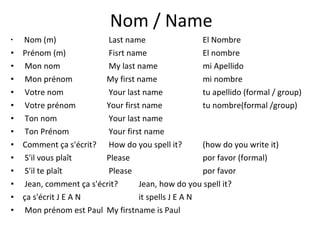
Nom / Name Nom (m)   Last name El Nombre Prénom (m)  Fisrt name El nombre Mon nom   My last name mi Apellido Mon prénom My first name mi nombre Votre nom  Your last name tu apellido (formal / group) Votre prénom   Your first name tu nombre (formal /group) Ton nom  Your last name Ton Prénom  Your first name Comment ça s'écrit?   How do you spell it? (how do you write it) S'il vous plaît  Please por favor (formal) S'il te plaît  Please por favor Jean, comment ça s'écrit?  Jean, how do you spell it? ça s'écrit J E A N  it spells J E A N Mon prénom est Paul  My firstname is Paul
tu  and  vous . In English, the second person subject pronoun is always  you , no matter how many people you're talking to, and whether you know them or not.  In French, these distinctions are very important - you must understand when and why to use each of them. Otherwise, you may inadvertantly insult someone by using the wrong  you . Vous  is the formal and plural  you . It is used to show respect or maintain a certain distance or formality with someone. Use  vous  when speaking to someone you don't know well an older person an authority figure anyone to whom you wish to show respect Vous  is also the plural  you  - you have to use it when talking to more than one person, no matter how close you are. French has two different words for  you : Tu  is the familiar  you , which demonstrates a certain closeness and informality.  Use  tu  when speaking to one friend peer / colleague relative child pet
Because the  tu  /  vous  distinction doesn't exist in English, beginning French students often have trouble with it.  Some people follow the guideline of using whatever the other person uses with them. This can be misleading: someone in authority may use  tu  with you, but that certainly doesn't mean that you can respond in kind. You can try asking  On  peut  se  tutoyer  ? 2 , but when in doubt, I tend to use  vous . I'd rather show someone too much respect than not enough! *There are even verbs to indicate which pronoun you're using:     tutoyer 3  = to use  tu     vouvoyer 4  = to use  vous
LES SALUTATIONS
Bonjour  la classe!
Bonjour  Monsieur! Bonjour  Bart!
Bonjour  Madame! Bonjour  Bart!
Bonjour  Mademoiselle ! Bonjour  Bart!
Bonjour Monsieur?  Bonjour Madame?  Bonjour Mademoiselle? Bonjour Monsieur! Bonjour Monsieur! Bonjour Madame! Bonjour Madame! Bonjour Mademoiselle ! Bonjour Mademoiselle !
Bonjour! Salut! Bonsoir! Bonne  nuit! Au revoir! 1. 2. 3. 4. 5.
1. 2. 3. 4. 5.
Ça va?
? Ça va? 1. Ça va très bien merci 2. Ça va 3. Bof! 4. Ça ne va pas du tout! 5.
C’est quelle phrase? ?
Le Morpion! 1. 2. 3. 4. 5. 6. 7. 8. 9.
Le Morpion! 1. 2.  3. 4. 5. 6. 7. 8. 9. ?
Comment tu t’appelles? Je m’appelle Benoît,  et toi? Benoît Je m’appelle Alice Alice ? Copyright © Bruno Guillemin 2004
Bonjour, Benoît Salut, Alice Copyright © Bruno Guillemin 2004
? Comment ça va? Très bien, merci Comme ci, comme ça Ça va mal Au revoir Copyright © Bruno Guillemin 2004
Saying Hello & Goodbye Bonjour Salut Au revoir Bonsoir Bonne nuit A bientot Hello Hi / goodbye Goodbye Good evening Goodnight See you soon
ça va?  Is everything alright? Como estas? Comment allez-vous?  How are you? (to a group or you don't know well the person) Comment vas-tu? How are you  (to a buddy, family member...) Bien  Well or Fine bien Pas trop mal  Not too bad Comment vous appelez-vous?  What is your name?  (to a group or you don't know well the person)   como te llamas? Comment t'appelles-tu?    What is your name?  (to a buddy, family member...) Je m'appelle Jean  My name is Jean me llamo Jean Monsieur  Sir or Mr Señor Madame   Madam  or Mrs Señora  Je m'appelle Paul, et vous, comment vous appellez-vous?
Hasta Luego / Bye à plus tard! see you later! à tout à l'heur e see you soon! see you in a while! à bientôt! see you soon! à tout de suite! see you in a little while  / in a second ! à demain! see you tomorrow! à plus! (Informal) TTFN!, laters! bonne journée! have a good day! bonne soirée! have a good evening! bonne chance! good luck! bonne route! have a good journey!
with your friends Salut can be used to say hello or goodbye Ca va ?  How are You? Ca va bien merci.  I am fine thank you Ca ne va pas tres bien.  I do not feel to well Et  toi?   And you? Bien merci.  Fine thank you
With strangers Comment allez  vous ?  How are you? Ca va bien merci  Etc….. Bonjour Madame  Good morning Madam Bonjour Monsieur  Good morning Sir Bonsoir  Good evening Mademoiselle  Miss Madame  Mrs Monsieur  Mr Enchante(e)  please to meet you Bonne journée  have a nice day Bonne soirée  have a nice evening
s'il vous  / te  plaît please pardon! excuse me!, sorry! pardon? excuse me?, sorry? merci! thank you! Merci beaucoup  Thank you very much de rien not at all!, no problem!, you're welcome! je vous  / t’ en prie you're welcome (formal) excusez-moi! excuse me, can I get past bon apétit! enjoy your meal! bon ap! (Informal) enjoy your meal! santé! Cheers! C'est très aimable à vous  Very nice of you Je suis désolé  I am sorry Ce n'est rien  It is nothing La Politesse
Help Au secours  Help Au feu!  Fire Au voleur!    Thief or Stop thief! Les pompiers (m)  Firemen Les pompiers c'est le 18  For the firemen dial 18 La police (f)  Police La police c'est le 17   For the police dial 17 Appelez la police  Call the police Le Samu    for medical emergencies Le Samu c'est le 15 / For the Samu dial 15
As-tu des frères ou des soeurs? J’  ai   un  frère, il s’appelle Robert J’ ai  une   soeur,  elle s’appelle Danielle Je  n’ ai   pas  de frères  ni de soeurs ? Copyright © Bruno Guillemin 2004
Monsieur King Kong, as-tu des frères ou des soeurs? Non, je  suis  fils  unique Mademoiselle Super woman, as-tu des frères ou des soeurs Non, je  suis   fille  unique Copyright © Bruno Guillemin 2004
Nombres/ Numeros
0. Zero 1. Un 2. Deux 3. Trois 4. Quatre (sometimes you can hear people saying Quat') 5. Cinq   (we sometimes say Cin') 6. Six 7. Sept 8. Huit 9. Neuf 10. Dix 11. Onze 12. Douze 13. Treize 14. Quatorze 15. Quinze 16. Seize 17. Dix-Sept 18. Dix-huit 19. Dix-neuf 20. Vingt
Les nombres 20-31 20  21 22 23 24 25 26 27 28 29 30 31 Vingt Vingt et un Vingt-deux Vingt-trois Vingt-quatre Vingt-cinq Vingt-six Vingt-sept Vingt-huit Vingt-neuf Trente Trente et un
Nombres  + 20 20 (vingt) 21 (vingt et un).22 (vingt deux).23.24.25.26.27.28.29 30 (trente).31 (trente et un).32.33.34.35.36.37.38.39 40 (quarante).41 (quarante et un).42.43.44.45.46.47.48.49 50 (cinquante).51 (cinquante et un).52.53.54.55.56.57.58.59 60 (soixante).61 (soixante et un).62.63.64.65.66.67.68.69 70 (soixante-dix) 71 (soixante et onze).72.73.74.75.76.77.78.79 80 (quatre-vingt).81 (quatre-vingt un).82.83.84.85.86.87.88.89 90 (quatre-vingt-dix) .91 (quatre-vingt onze).92.93.94.95.96.97.98.99 You can see that from 21 to 71 we use "and" "et" between the two numbers: "vingt ET un", "trente ET un", but for 81 and 91 no! -70,80,90 are pretty complicated as you can see: 70 is 60 10, 80 is 4 20 and 90 is 4 20 10, other french speaking countries use septante for 70, huitante for 80 and nonante for 90 which are more logical (Switzerland, Belgium). 9. 100. 1000. 1,000,000 . 1,000,000,000 101: cent un 200: deux cents 1023: mille vingt trois 2000: deux mille (no s at the end) 1,000,000: un million 1,000,000,000: un milliard
Qu.... ... ..-..? J’..  d..   a.. Copyright © Bruno Guillemin 2004
Nombres Ex An (m)   Year Un an  One year, take care of the connection between the 2 words. Quel âge as-tu?  How old are you? T'as quel âge? (most used)   How old are you? Quel âge avez-vous?  How old are you? (formal) J'ai 8 ans   I am 8 (in French we say I have 8 years) J'ai 15 ans  I am 15 Combien de frères as-tu?  How many brothers do you have? Combien de sœurs as-tu?  How many sisters do you have? J'ai deux frères et une (f) soeur (f)   I have 2 brothers and 1 sister Ton numéro de téléphone, s'il te plaît!   Your telephone number please! We have two words for numbers: "nombres" when you calculate and "numéro (m)" to point a thing like your telephone or your house number. So now, you know as to say "I have one” : j’ai
Quel âge as-tu? J’ai  dix   ans un cinq dix deux trois quatre six sept huit neuf onze douze treize quinze quatorze seize dix-sept dix-huit dix-neuf vingt Copyright © Bruno Guillemin 2004
Nom / Name Nom (m)   Last name El Nombre Prénom (m)  Fisrt name El nombre Mon nom   My last name mi Apellido Mon prénom My first name mi nombre Votre nom  Your last name tu apellido (formal / group) Votre prénom  Your first name tu nombre(formal /group) Ton nom  Your last name Ton Prénom  Your first name Comment ça s'écrit?   How do you spell it?  (how do you write it) S'il vous plaît  Please por favor (formal) S'il te plaît  Please por favor Jean, comment ça s'écrit?  Jean, how do you spell it? ça s'écrit J E A N  it spells J E A N Mon prénom est Paul  My firstname is Paul
Qu’est-ce que c’est?
Qu’est-ce que c’est? Ah, dis-moi, Qu’est-ce que c’est? Qu’est-ce que c’est? Ah, dis-moi, Qu’est-ce que c’est? Qu’est-ce que c’est? Ah, dis-moi, Qu’est-ce que c’est?
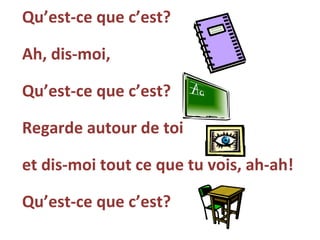
Qu’est-ce que c’est? Ah, dis-moi, Qu’est-ce que c’est? Regarde autour de toi  et dis-moi tout ce que tu vois, ah-ah! Qu’est-ce que c’est?
C’est un livre C’est un cahier C’est une fen être C’est le plancher C’est un tableau C’est le professeur
Nous voil à à nos pupitres Oh-là-là, c’est le directeur qui dit:
Qu’est-ce que c’est? Ah, dis-moi, Qu’est-ce que c’est? Qu’est-ce que c’est? Ah, dis-moi, Qu’est-ce que c’est? Qu’est-ce que c’est? Ah, dis-moi, Qu’est-ce que c’est?
Qu’est-ce que c’est? Ah, dis-moi, Qu’est-ce que c’est? Regarde autour de toi  et dis-moi tout ce que tu vois, ah-ah! Qu’est-ce que c’est?
C’est une chaise C’est un crayon C’est un magn étophone C’est le plafond C’est une règle C’est un ordinateur
Nous voil à à nos pupitres Oh-là-là, c’est le directeur qui dit:
Qu’est-ce que c’est? Ah, dis-moi, Qu’est-ce que c’est? Qu’est-ce que c’est? Ah, dis-moi, Qu’est-ce que c’est? Qu’est-ce que c’est? Ah, dis-moi, Qu’est-ce que c’est?
Qu’est-ce que c’est? Ah, dis-moi, Qu’est-ce que c’est? Regarde autour de toi  et dis-moi tout ce que tu vois, ah-ah! Qu’est-ce que c’est?
C’est un corridor C’est un escalier C’est une tr ès grande porte C’est un  écolier C’est la classe
C’est un visiteur Nous voil à à nos pupitres Oh-là-là, c’est le directeur qui dit:
Qu’est-ce que c’est? Ah, dis-moi, Qu’est-ce que c’est? Qu’est-ce que c’est? Ah, dis-moi, Qu’est-ce que c’est? Qu’est-ce que c’est? Ah, dis-moi, Qu’est-ce que c’est?
Qu’est-ce que c’est? Ah, dis-moi, Qu’est-ce que c’est? Regarde autour de toi  et dis-moi tout ce que tu vois…
Regarde autour de toi  et dis-moi tout ce que tu vois, Regarde autour de toi  et dis-moi tout ce que tu vois,  Ah-ah! Qu’est-ce que c’est?
LA FIN!

P P Lecon 1

  • 1.
    COUCOU ET BIENVENUECHEZ MISS FANNY sgriveau79 @hotmail.com Classe de Francais 1
  • 2.
  • 3.
  • 4.
  • 5.
  • 6.
    FRENCH ACCENTS Thereare four French accents for vowels and one accent for a consonant. For specific information on what the accents do to change the pronunciation of the letters they modify, please see the appropriate letter pages. The accent aigu ´ (acute accent) can only be on an E . At the beginning of a word, it often indicates that an S used to follow that vowel, e.g., étudiant (student). The accent grave ` (grave accent) can be found on an A , E , or U . On the A and U, it usually serves to distinguish between words that would otherwise be homographs ; e.g., ou (or) vs où (where). The accent circonflexe ˆ (circumflex) can be on an A , E , I , O , or U . The circumflex usually indicates that an S used to follow that vowel, e.g., forêt (forest). It also serves to distinguish between homographs; e.g., du ( contraction 11 of de + le ) vs dû ( past participle 12 of devoir ). The accent tréma ¨ (dieresis or umlaut) can be on an E , I , or U . It is used when two vowels are next to each other and both must be pronounced, e.g., naïve, Saül. The cédille ¸ (cedilla) is found only on the letter C . It changes a hard C sound (like K) into a soft C sound (like S), e.g., garçon. The cedilla is never placed in front of E or I, because C always sounds like an S in front of these vowels. It is essential to put accents in their proper places - an incorrect or missing accent is a spelling mistake just as an incorrect or missing letter would be. The only exception to this is capital letters, which are often left unaccented. You may not realize it, but French accents have a purpose. While some accents just signify that an S used to follow that vowel in Old French (e.g., étudiant used to be spelled estudiant ), most French accents indicate the correct pronunciation of the letter they modify. In addition, there are dozens of French word pairs which are spelled (though not always pronounced) the same other than accents. To avoid confusion, you should always distinguish between these words by using the correct accents.* a - third person singular of avoir 1 (to have) à 2 - ( preposition 3 ) to, at, in
  • 7.
    In French thereare the 26 letters of the alfabet. Many have “accessories” : Accents are in the AEIOU (è, é, etc...) or with the cedilla (ç). When you are spelling your name , such as in a phone call, you need to know how to pronounce it en french: A B C D E F G H I J K L M N O P Q R S T U V W X Y Z Most of the time, do not pronounce final d, s, t or x in French words. As an example, red letters are not pronounced in the following words: un rebon d (a bounce) françai s (French) un sau t (a jump) heureu x (happy)
  • 8.
    Escucharás "on" enlos siguientes ejemplos. Francés Español une maison una casa un garçon un chico comprendre (*) entender un combat (*) una lucha ¡Ojo! (*) "On" antes de "p" o "b" se escribe "om". Pero hay una excepción: un bonbon (un bombón). Consejo: ¡Pronuncia "ou" como "u"! Francés Español la tour Eiffel la torre Eiffel mourir morir un mouvement un movimiento vous Usted/Ustedes Escucharás " oi" en los siguientes ejemplos Francés Español une fois una vez un toit un techo un poisson un pez croire creer
  • 9.
  • 10.
  • 11.
  • 12.
  • 13.
    A comme appelB comme ballon Paul? Présent!
  • 14.
    C comme crayonsD comme deux 2
  • 15.
    E comme éléphantF comme fenêtre
  • 16.
    G comme gommeH comme heure
  • 17.
    I comme importantJ comme je HSCB Les devoirs pour le weekend!
  • 18.
    K comme kangourouL comme livre
  • 19.
    M comme maisonN comme neuf 9
  • 20.
    O comme orangeP comme professeur
  • 21.
    Q comme quatreR comme règle 4
  • 22.
    S comme styloT comme trousse
  • 23.
    U comme unV comme vingt 1 20
  • 24.
    W comme weekendX comme xylophone Samedi Dimanche
  • 25.
    Y comme yaourtZ comme zoo
  • 26.
    ABC Exercice 1Most of the time , do not pronounce final d , s , t or x in French words. As an example, red letters are not pronounced in the following words: un rebon d ( a bounce ) françai s ( French ) un sau t ( a jump ) heureu x ( happy )
  • 27.
    A comme appelPaul? Présent!
  • 28.
  • 29.
    I comme importantHSCB Les devoirs pour le weekend!
  • 30.
  • 31.
  • 32.
  • 33.
  • 34.
  • 35.
  • 36.
  • 37.
  • 38.
  • 39.
  • 40.
  • 41.
  • 42.
    I comme importantHSCB Les devoirs pour le weekend!
  • 43.
  • 44.
    A comme appelPaul? Présent!
  • 45.
  • 46.
  • 47.
  • 48.
  • 49.
  • 50.
  • 51.
  • 52.
  • 53.
    A comme appelPaul? Présent!
  • 54.
  • 55.
  • 56.
    I comme importantHSCB Les devoirs pour le weekend!
  • 57.
  • 58.
  • 59.
  • 60.
  • 61.
    W comme weekendSamedi Dimanche
  • 62.
  • 63.
  • 64.
  • 65.
  • 66.
  • 67.
    Les pronoms personnelsJe Tu Il/elle/ on Nous Vous Ils/elles Il = masculin singulier Elle = féminin singulier I You non formal He/ She/one We You formal They Ils = masculin pluriel Elles = feminin pluriel
  • 68.
    Épeler les motssuivants Dimos Xenopoulous France Rue Avenue Bonjour Voilà Wagon Yen zen Homme Mademoiselle Enchante Gifle Jeune Karate Quoi
  • 69.
  • 70.
  • 71.
  • 72.
    English French Reponses English What's your name? Comment vous appelez-vous ? (formal) Comment t'appelles-tu ? (familiar) Je m'appelle ... My name is... I'd like to introduce... Je vous présente ... (formal) Je te présente ... (familiar) Enchanté (e) Delighted This is... Voici ...     Il s'appelle ... His name is... Elle s'appelle ...       Her name is... Note: The French verb introduire is a false cognate ; you can't use it when talking about introducing one person to another.    Formal vs familiar - Tu vs Vous
  • 73.
    Se presenter CommentComment t’appelles tu? Je m’appelle Qui c’est? C’est Mon ami(e) Et toi? Oui / non What What is your name (f) My name is Who is it? It’s … My friend And You? Yes / no
  • 74.
    Nom / NameNom (m) Last name El Nombre Prénom (m) Fisrt name El nombre Mon nom My last name mi Apellido Mon prénom My first name mi nombre Votre nom Your last name tu apellido (formal / group) Votre prénom Your first name tu nombre (formal /group) Ton nom Your last name Ton Prénom Your first name Comment ça s'écrit? How do you spell it? (how do you write it) S'il vous plaît Please por favor (formal) S'il te plaît Please por favor Jean, comment ça s'écrit? Jean, how do you spell it? ça s'écrit J E A N it spells J E A N Mon prénom est Paul My firstname is Paul
  • 75.
    tu and vous . In English, the second person subject pronoun is always you , no matter how many people you're talking to, and whether you know them or not. In French, these distinctions are very important - you must understand when and why to use each of them. Otherwise, you may inadvertantly insult someone by using the wrong you . Vous is the formal and plural you . It is used to show respect or maintain a certain distance or formality with someone. Use vous when speaking to someone you don't know well an older person an authority figure anyone to whom you wish to show respect Vous is also the plural you - you have to use it when talking to more than one person, no matter how close you are. French has two different words for you : Tu is the familiar you , which demonstrates a certain closeness and informality. Use tu when speaking to one friend peer / colleague relative child pet
  • 76.
    Because the tu / vous distinction doesn't exist in English, beginning French students often have trouble with it. Some people follow the guideline of using whatever the other person uses with them. This can be misleading: someone in authority may use tu with you, but that certainly doesn't mean that you can respond in kind. You can try asking On peut se tutoyer  ? 2 , but when in doubt, I tend to use vous . I'd rather show someone too much respect than not enough! *There are even verbs to indicate which pronoun you're using:     tutoyer 3 = to use tu     vouvoyer 4 = to use vous
  • 77.
  • 78.
    Bonjour laclasse!
  • 79.
    Bonjour Monsieur!Bonjour Bart!
  • 80.
    Bonjour Madame!Bonjour Bart!
  • 81.
    Bonjour Mademoiselle! Bonjour Bart!
  • 82.
    Bonjour Monsieur? Bonjour Madame? Bonjour Mademoiselle? Bonjour Monsieur! Bonjour Monsieur! Bonjour Madame! Bonjour Madame! Bonjour Mademoiselle ! Bonjour Mademoiselle !
  • 83.
    Bonjour! Salut! Bonsoir!Bonne nuit! Au revoir! 1. 2. 3. 4. 5.
  • 84.
    1. 2. 3.4. 5.
  • 85.
  • 86.
    ? Ça va?1. Ça va très bien merci 2. Ça va 3. Bof! 4. Ça ne va pas du tout! 5.
  • 87.
  • 88.
    Le Morpion! 1.2. 3. 4. 5. 6. 7. 8. 9.
  • 89.
    Le Morpion! 1.2. 3. 4. 5. 6. 7. 8. 9. ?
  • 90.
    Le Morpion! 1.2. 3. 4. 5. 6. 7. 8. 9. ?
  • 91.
    Comment tu t’appelles?Je m’appelle Benoît, et toi? Benoît Je m’appelle Alice Alice ? Copyright © Bruno Guillemin 2004
  • 92.
    Bonjour, Benoît Salut,Alice Copyright © Bruno Guillemin 2004
  • 93.
    ? Comment çava? Très bien, merci Comme ci, comme ça Ça va mal Au revoir Copyright © Bruno Guillemin 2004
  • 94.
    Saying Hello &Goodbye Bonjour Salut Au revoir Bonsoir Bonne nuit A bientot Hello Hi / goodbye Goodbye Good evening Goodnight See you soon
  • 95.
    ça va? Is everything alright? Como estas? Comment allez-vous? How are you? (to a group or you don't know well the person) Comment vas-tu? How are you (to a buddy, family member...) Bien Well or Fine bien Pas trop mal Not too bad Comment vous appelez-vous? What is your name? (to a group or you don't know well the person) como te llamas? Comment t'appelles-tu? What is your name? (to a buddy, family member...) Je m'appelle Jean My name is Jean me llamo Jean Monsieur Sir or Mr Señor Madame Madam or Mrs Señora Je m'appelle Paul, et vous, comment vous appellez-vous?
  • 96.
    Hasta Luego /Bye à plus tard! see you later! à tout à l'heur e see you soon! see you in a while! à bientôt! see you soon! à tout de suite! see you in a little while / in a second ! à demain! see you tomorrow! à plus! (Informal) TTFN!, laters! bonne journée! have a good day! bonne soirée! have a good evening! bonne chance! good luck! bonne route! have a good journey!
  • 97.
    with your friendsSalut can be used to say hello or goodbye Ca va ? How are You? Ca va bien merci. I am fine thank you Ca ne va pas tres bien. I do not feel to well Et toi? And you? Bien merci. Fine thank you
  • 98.
    With strangers Commentallez vous ? How are you? Ca va bien merci Etc….. Bonjour Madame Good morning Madam Bonjour Monsieur Good morning Sir Bonsoir Good evening Mademoiselle Miss Madame Mrs Monsieur Mr Enchante(e) please to meet you Bonne journée have a nice day Bonne soirée have a nice evening
  • 99.
    s'il vous / te plaît please pardon! excuse me!, sorry! pardon? excuse me?, sorry? merci! thank you! Merci beaucoup Thank you very much de rien not at all!, no problem!, you're welcome! je vous / t’ en prie you're welcome (formal) excusez-moi! excuse me, can I get past bon apétit! enjoy your meal! bon ap! (Informal) enjoy your meal! santé! Cheers! C'est très aimable à vous Very nice of you Je suis désolé I am sorry Ce n'est rien It is nothing La Politesse
  • 100.
    Help Au secours Help Au feu! Fire Au voleur! Thief or Stop thief! Les pompiers (m) Firemen Les pompiers c'est le 18 For the firemen dial 18 La police (f) Police La police c'est le 17 For the police dial 17 Appelez la police Call the police Le Samu for medical emergencies Le Samu c'est le 15 / For the Samu dial 15
  • 101.
    As-tu des frèresou des soeurs? J’ ai un frère, il s’appelle Robert J’ ai une soeur, elle s’appelle Danielle Je n’ ai pas de frères ni de soeurs ? Copyright © Bruno Guillemin 2004
  • 102.
    Monsieur King Kong,as-tu des frères ou des soeurs? Non, je suis fils unique Mademoiselle Super woman, as-tu des frères ou des soeurs Non, je suis fille unique Copyright © Bruno Guillemin 2004
  • 103.
  • 104.
    0. Zero 1.Un 2. Deux 3. Trois 4. Quatre (sometimes you can hear people saying Quat') 5. Cinq (we sometimes say Cin') 6. Six 7. Sept 8. Huit 9. Neuf 10. Dix 11. Onze 12. Douze 13. Treize 14. Quatorze 15. Quinze 16. Seize 17. Dix-Sept 18. Dix-huit 19. Dix-neuf 20. Vingt
  • 105.
    Les nombres 20-3120 21 22 23 24 25 26 27 28 29 30 31 Vingt Vingt et un Vingt-deux Vingt-trois Vingt-quatre Vingt-cinq Vingt-six Vingt-sept Vingt-huit Vingt-neuf Trente Trente et un
  • 106.
    Nombres +20 20 (vingt) 21 (vingt et un).22 (vingt deux).23.24.25.26.27.28.29 30 (trente).31 (trente et un).32.33.34.35.36.37.38.39 40 (quarante).41 (quarante et un).42.43.44.45.46.47.48.49 50 (cinquante).51 (cinquante et un).52.53.54.55.56.57.58.59 60 (soixante).61 (soixante et un).62.63.64.65.66.67.68.69 70 (soixante-dix) 71 (soixante et onze).72.73.74.75.76.77.78.79 80 (quatre-vingt).81 (quatre-vingt un).82.83.84.85.86.87.88.89 90 (quatre-vingt-dix) .91 (quatre-vingt onze).92.93.94.95.96.97.98.99 You can see that from 21 to 71 we use "and" "et" between the two numbers: "vingt ET un", "trente ET un", but for 81 and 91 no! -70,80,90 are pretty complicated as you can see: 70 is 60 10, 80 is 4 20 and 90 is 4 20 10, other french speaking countries use septante for 70, huitante for 80 and nonante for 90 which are more logical (Switzerland, Belgium). 9. 100. 1000. 1,000,000 . 1,000,000,000 101: cent un 200: deux cents 1023: mille vingt trois 2000: deux mille (no s at the end) 1,000,000: un million 1,000,000,000: un milliard
  • 107.
    Qu.... ... ..-..?J’.. d.. a.. Copyright © Bruno Guillemin 2004
  • 108.
    Nombres Ex An(m) Year Un an One year, take care of the connection between the 2 words. Quel âge as-tu? How old are you? T'as quel âge? (most used) How old are you? Quel âge avez-vous? How old are you? (formal) J'ai 8 ans I am 8 (in French we say I have 8 years) J'ai 15 ans I am 15 Combien de frères as-tu? How many brothers do you have? Combien de sœurs as-tu? How many sisters do you have? J'ai deux frères et une (f) soeur (f) I have 2 brothers and 1 sister Ton numéro de téléphone, s'il te plaît! Your telephone number please! We have two words for numbers: "nombres" when you calculate and "numéro (m)" to point a thing like your telephone or your house number. So now, you know as to say "I have one” : j’ai
  • 109.
    Quel âge as-tu?J’ai dix ans un cinq dix deux trois quatre six sept huit neuf onze douze treize quinze quatorze seize dix-sept dix-huit dix-neuf vingt Copyright © Bruno Guillemin 2004
  • 110.
    Nom / NameNom (m) Last name El Nombre Prénom (m) Fisrt name El nombre Mon nom My last name mi Apellido Mon prénom My first name mi nombre Votre nom Your last name tu apellido (formal / group) Votre prénom Your first name tu nombre(formal /group) Ton nom Your last name Ton Prénom Your first name Comment ça s'écrit? How do you spell it? (how do you write it) S'il vous plaît Please por favor (formal) S'il te plaît Please por favor Jean, comment ça s'écrit? Jean, how do you spell it? ça s'écrit J E A N it spells J E A N Mon prénom est Paul My firstname is Paul
  • 111.
  • 112.
    Qu’est-ce que c’est?Ah, dis-moi, Qu’est-ce que c’est? Qu’est-ce que c’est? Ah, dis-moi, Qu’est-ce que c’est? Qu’est-ce que c’est? Ah, dis-moi, Qu’est-ce que c’est?
  • 113.
    Qu’est-ce que c’est?Ah, dis-moi, Qu’est-ce que c’est? Regarde autour de toi et dis-moi tout ce que tu vois, ah-ah! Qu’est-ce que c’est?
  • 114.
    C’est un livreC’est un cahier C’est une fen être C’est le plancher C’est un tableau C’est le professeur
  • 115.
    Nous voil àà nos pupitres Oh-là-là, c’est le directeur qui dit:
  • 116.
    Qu’est-ce que c’est?Ah, dis-moi, Qu’est-ce que c’est? Qu’est-ce que c’est? Ah, dis-moi, Qu’est-ce que c’est? Qu’est-ce que c’est? Ah, dis-moi, Qu’est-ce que c’est?
  • 117.
    Qu’est-ce que c’est?Ah, dis-moi, Qu’est-ce que c’est? Regarde autour de toi et dis-moi tout ce que tu vois, ah-ah! Qu’est-ce que c’est?
  • 118.
    C’est une chaiseC’est un crayon C’est un magn étophone C’est le plafond C’est une règle C’est un ordinateur
  • 119.
    Nous voil àà nos pupitres Oh-là-là, c’est le directeur qui dit:
  • 120.
    Qu’est-ce que c’est?Ah, dis-moi, Qu’est-ce que c’est? Qu’est-ce que c’est? Ah, dis-moi, Qu’est-ce que c’est? Qu’est-ce que c’est? Ah, dis-moi, Qu’est-ce que c’est?
  • 121.
    Qu’est-ce que c’est?Ah, dis-moi, Qu’est-ce que c’est? Regarde autour de toi et dis-moi tout ce que tu vois, ah-ah! Qu’est-ce que c’est?
  • 122.
    C’est un corridorC’est un escalier C’est une tr ès grande porte C’est un écolier C’est la classe
  • 123.
    C’est un visiteurNous voil à à nos pupitres Oh-là-là, c’est le directeur qui dit:
  • 124.
    Qu’est-ce que c’est?Ah, dis-moi, Qu’est-ce que c’est? Qu’est-ce que c’est? Ah, dis-moi, Qu’est-ce que c’est? Qu’est-ce que c’est? Ah, dis-moi, Qu’est-ce que c’est?
  • 125.
    Qu’est-ce que c’est?Ah, dis-moi, Qu’est-ce que c’est? Regarde autour de toi et dis-moi tout ce que tu vois…
  • 126.
    Regarde autour detoi et dis-moi tout ce que tu vois, Regarde autour de toi et dis-moi tout ce que tu vois, Ah-ah! Qu’est-ce que c’est?
  • 127.