L’École
L’Unité 10
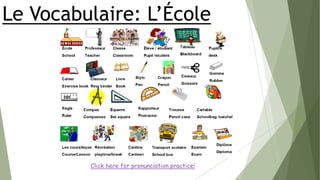
Le Vocabulaire: L’École

Click here for pronunciation practice!
Ordinal Numbers
• Ordinal numbers give the order of things or events.
• Ordinal numbers are formed by adding –ième after the
final consonant
• Ex. 2 – deux; 2nd – deuxième
• There are two irregular ordinal numbers:
• For 1st use the word “premier”
• For 9th the “f” in “neuf” will change to a “v”
• neuf – neuvième
• Other useful terms
• Prochain – next
• m/s – prochain
• f/s – prochaine
• m/p – prochains
• f/p - prochaines
• Dernier - last
• m/s – dernier
• f/s – dernière
• m/p – derniers
• f/p – dernières

Of all the ordinal numbers,
only “premier” will agree in
gender and number. Note the
following forms:
• m/s – premier
• f/s – première
• m/p – premiers
• f/p - premières
Number

French

1st

Premier

2nd

Deuxième

3rd

Troisième

4th

Quatrième

5th

Cinqième

6th

Sixième

7th

Septième

8th

Huitième

9th

Neuvième

10th

Dixième
Regular –RE Verbs
Semi-irregular –RE Verbs
• Compare the regular endings to
the following verbs; they are
similar, but not the same!
• Note the changes to the stems in
the plural form:
• nous and vous drops the “d”
• ils/elles drops the “d” an adds
an extra “n.”

prendre

apprendre

comprendre

je prends

j'apprends

je comprends

tu prends

tu apprends

tu comprends

il/elle prend

il/elle apprend

il/elle comprend

nous prenons

nous apprenons

nous comprenons

vous prenez

vous apprenez

vous comprenez

ils/elles prennent

ils/elles apprennent

ils/elles
comprennent
Savoir – to know (a fact)
je sais
tu sais
il/elle sait

nous savons
vous savez
ils/elles savent

Ex. Je sais la capitale de la France; c'est Paris. - I know the capital of France;
it's Paris. (fact)
Vous savez quelle heure est il? Oui, il est onze heure dix. - Do you know
what time it is? Yes, it's 11:10. (fact)
BUT.....
Je connais (connaître) Julie et Sandrine. Elles sont soeurs. - I know Julie
and Sandrine. They are sisters. (acquaintance)

NOTE: Savoir is only used
with facts, things that can
be right or wrong. Savoir
is NOT used to express
acquaintance with people,
places or works of
art/literature. The verb
for to be acquainted with
is connaître
Double Verb Constructions
While most verbs will follow this format in the double
verb construction, several verbs will require the use of
a preposition between verbs. These verbs include, but
are not limited to:
* venir - Elle vient de faire du ski.
* apprendre - J'apprends à parler allemand.
* commencer - Il commence à étudier.
* avoir besoin - Nous avons besoin de travailler.
Note also that the preposition used can change the
meaning of the verb:
* Je viens pour regarder la télé. - I come to watch to tv.
(I haven't yet begun watching tv.)
* Je viens de faire les devoirs - I come from doing
homework. (I just finished doing homework.)

Unit 10 l'école

  • 1.
  • 2.
    Le Vocabulaire: L’École Clickhere for pronunciation practice!
  • 3.
    Ordinal Numbers • Ordinalnumbers give the order of things or events. • Ordinal numbers are formed by adding –ième after the final consonant • Ex. 2 – deux; 2nd – deuxième • There are two irregular ordinal numbers: • For 1st use the word “premier” • For 9th the “f” in “neuf” will change to a “v” • neuf – neuvième • Other useful terms • Prochain – next • m/s – prochain • f/s – prochaine • m/p – prochains • f/p - prochaines • Dernier - last • m/s – dernier • f/s – dernière • m/p – derniers • f/p – dernières Of all the ordinal numbers, only “premier” will agree in gender and number. Note the following forms: • m/s – premier • f/s – première • m/p – premiers • f/p - premières Number French 1st Premier 2nd Deuxième 3rd Troisième 4th Quatrième 5th Cinqième 6th Sixième 7th Septième 8th Huitième 9th Neuvième 10th Dixième
  • 4.
  • 5.
    Semi-irregular –RE Verbs •Compare the regular endings to the following verbs; they are similar, but not the same! • Note the changes to the stems in the plural form: • nous and vous drops the “d” • ils/elles drops the “d” an adds an extra “n.” prendre apprendre comprendre je prends j'apprends je comprends tu prends tu apprends tu comprends il/elle prend il/elle apprend il/elle comprend nous prenons nous apprenons nous comprenons vous prenez vous apprenez vous comprenez ils/elles prennent ils/elles apprennent ils/elles comprennent
  • 6.
    Savoir – toknow (a fact) je sais tu sais il/elle sait nous savons vous savez ils/elles savent Ex. Je sais la capitale de la France; c'est Paris. - I know the capital of France; it's Paris. (fact) Vous savez quelle heure est il? Oui, il est onze heure dix. - Do you know what time it is? Yes, it's 11:10. (fact) BUT..... Je connais (connaître) Julie et Sandrine. Elles sont soeurs. - I know Julie and Sandrine. They are sisters. (acquaintance) NOTE: Savoir is only used with facts, things that can be right or wrong. Savoir is NOT used to express acquaintance with people, places or works of art/literature. The verb for to be acquainted with is connaître
  • 7.
    Double Verb Constructions Whilemost verbs will follow this format in the double verb construction, several verbs will require the use of a preposition between verbs. These verbs include, but are not limited to: * venir - Elle vient de faire du ski. * apprendre - J'apprends à parler allemand. * commencer - Il commence à étudier. * avoir besoin - Nous avons besoin de travailler. Note also that the preposition used can change the meaning of the verb: * Je viens pour regarder la télé. - I come to watch to tv. (I haven't yet begun watching tv.) * Je viens de faire les devoirs - I come from doing homework. (I just finished doing homework.)