An Introduction
       To
  The Passive
Les Français mangent toutes
sortes de choses que les Anglais
n’ont pas l’habitude de manger.
les escargots


les cuisses de
    grenouille
Oui! Les
                 Français
                 mangent
                 les
                 escargots!

Examinons ce phénomène du
 point de vue de l’escargot.
Les Français mangent les escargots.


              ou
Les escargots sont mangés par
           les Français.
Active sentence           Passive sentence
Les Français mangent les   Les escargots sont mangés
escargots.                 par les Français.
     Characteristics            Characteristics
The action is viewed from The action is viewed from
the point of view of the  the point of view of the
eater.                    eaten.

The verb is present and    The verb is present and
active.                    passive.
Les Français mangent les escargots.

            The active verb above is in the present tense...

...so put the verb être into the present tense, add the past participle of the verb
                  above and make it agree with its new subject.


  Les escargots sont mangés par les
              Français.
Le Français a mangé l’escargot!

            The active verb above is in the perfect tense...

...so put the verb être into the perfect tense, add the past participle of the verb
                  above and make it agree with its new subject.


       L’escargot a été mangé par le
                 Français!
Le Français mangera l’escargot!

            The active verb above is in the future tense...

...so put the verb être into the future tense, add the past participle of the verb
                 above and make it agree with its new subject.


        L’escargot sera mangé par le
                  Français!
Les Français mangeaient les escargots!

         The active verb above is in the imperfect tense...

...so put the verb être into the imperfect tense, add the past participle of the
              verb above and make it agree with its new subject.


Les escargots étaient mangés par les
              Français!
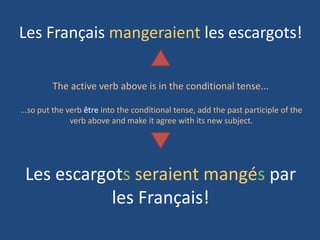
Les Français mangeraient les escargots!

         The active verb above is in the conditional tense...

...so put the verb être into the conditional tense, add the past participle of the
               verb above and make it agree with its new subject.


 Les escargots seraient mangés par
            les Français!
Can you make these sentences passive?

     Le garçon a embrassé la fille.
Can you make these sentences passive?

La fille a été embrassée par le garçon.
Can you make these sentences passive?

   Le professeur punira les élèves.
Can you make these sentences passive?

    Les élèves seront punis par le
             professeur.
Can you make these sentences passive?

     Tout le monde lit ce journal.
Can you make these sentences passive?

 Ce journal est lu par tout le monde.
Can you make these sentences passive?

   Le club de jeunes va organiser la
             discothèque.
Can you make these sentences passive?

 La discothèque sera organisée par le
           club de jeunes.
Can you make these sentences passive?

L’explosion a brisé toutes les fenêtres.
Can you make these sentences passive?

Toutes les fenêtres ont été brisées par
              l’explosion.
Introduction to the passive

Introduction to the passive

  • 1.
    An Introduction To The Passive
  • 2.
    Les Français mangenttoutes sortes de choses que les Anglais n’ont pas l’habitude de manger.
  • 3.
  • 4.
    Oui! Les Français mangent les escargots! Examinons ce phénomène du point de vue de l’escargot.
  • 5.
    Les Français mangentles escargots. ou Les escargots sont mangés par les Français.
  • 6.
    Active sentence Passive sentence Les Français mangent les Les escargots sont mangés escargots. par les Français. Characteristics Characteristics The action is viewed from The action is viewed from the point of view of the the point of view of the eater. eaten. The verb is present and The verb is present and active. passive.
  • 7.
    Les Français mangentles escargots. The active verb above is in the present tense... ...so put the verb être into the present tense, add the past participle of the verb above and make it agree with its new subject. Les escargots sont mangés par les Français.
  • 8.
    Le Français amangé l’escargot! The active verb above is in the perfect tense... ...so put the verb être into the perfect tense, add the past participle of the verb above and make it agree with its new subject. L’escargot a été mangé par le Français!
  • 9.
    Le Français mangeral’escargot! The active verb above is in the future tense... ...so put the verb être into the future tense, add the past participle of the verb above and make it agree with its new subject. L’escargot sera mangé par le Français!
  • 10.
    Les Français mangeaientles escargots! The active verb above is in the imperfect tense... ...so put the verb être into the imperfect tense, add the past participle of the verb above and make it agree with its new subject. Les escargots étaient mangés par les Français!
  • 11.
    Les Français mangeraientles escargots! The active verb above is in the conditional tense... ...so put the verb être into the conditional tense, add the past participle of the verb above and make it agree with its new subject. Les escargots seraient mangés par les Français!
  • 12.
    Can you makethese sentences passive? Le garçon a embrassé la fille.
  • 13.
    Can you makethese sentences passive? La fille a été embrassée par le garçon.
  • 14.
    Can you makethese sentences passive? Le professeur punira les élèves.
  • 15.
    Can you makethese sentences passive? Les élèves seront punis par le professeur.
  • 16.
    Can you makethese sentences passive? Tout le monde lit ce journal.
  • 17.
    Can you makethese sentences passive? Ce journal est lu par tout le monde.
  • 18.
    Can you makethese sentences passive? Le club de jeunes va organiser la discothèque.
  • 19.
    Can you makethese sentences passive? La discothèque sera organisée par le club de jeunes.
  • 20.
    Can you makethese sentences passive? L’explosion a brisé toutes les fenêtres.
  • 21.
    Can you makethese sentences passive? Toutes les fenêtres ont été brisées par l’explosion.