The present tense
Uses of the present tense
• What is happening now
Je fais du shopping avec ma mère.
• What is happening regularly
Je joue au foot tous les weekends avec mon père.
• Describes an event that started in the past and is still happening
now
J’habite en Angleterre depuis deux ans.
• What will happen in the near future
Nous allons en ville demain.
• Bringing historical events to life
Les frères de Lumière inventent le cinématographe en 1895.
• Reference to something that is timeless or universal
La Terre tourne autour du Soleil.
Forming the present tense
ER verbs (eg regarder = to watch)
Take off the ER and add the following endings:
Je regarde
Tu regardes
Il/Elle/On regarde
Nous regardons
Vous regardez
Ils/Elles regardent
Forming the present tense
IR verbs (eg finir = to finish)
Take off the IR and add the following endings:
Je finis
Tu finis
Il/Elle/On finit
Nous finissons
Vous finissez
Ils/Elles finissent
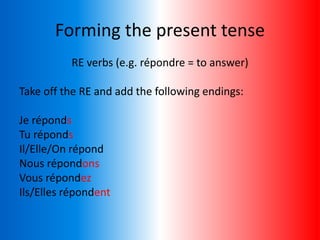
Forming the present tense
RE verbs (e.g. répondre = to answer)
Take off the RE and add the following endings:
Je réponds
Tu réponds
Il/Elle/On répond
Nous répondons
Vous répondez
Ils/Elles répondent
However, not all verbs have the same stems
when forming the present tense. The next few
slides show examples of irregular verbs in the
present tense.
Irregular verbs
Avoir = to have
J’ai
Tu as
Il/Elle/On a
Nous avons
Vous avez
Ils/Elles ont
Irregular verbs
Être = to be
Je suis
Tu es
Il/Elle/On est
Nous sommes
Vous êtes
Ils/Elles sont
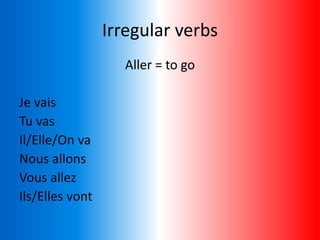
Irregular verbs
Aller = to go
Je vais
Tu vas
Il/Elle/On va
Nous allons
Vous allez
Ils/Elles vont
Irregular verbs
Faire = to do
Je fais
Tu fais
Il/Elle/On fait
Nous faisons
Vous faites
Ils/Elles font
Irregular verbs
Pouvoir = to be able to
Je peux
Tu peux
Il/Elle/On peut
Nous pouvons
Vous pouvez
Ils/Elles peuvent
Irregular verbs
Devoir = to have to do
Je dois
Tu dois
Il/Elle/On doit
Nous devons
Vous devez
Ils/Elles doivent
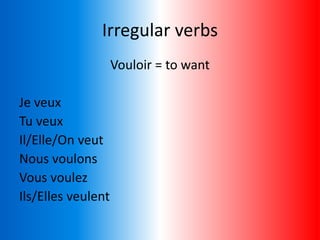
Irregular verbs
Vouloir = to want
Je veux
Tu veux
Il/Elle/On veut
Nous voulons
Vous voulez
Ils/Elles veulent
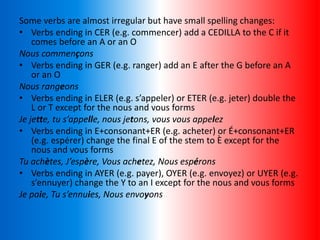
Some verbs are almost irregular but have small spelling changes:
• Verbs ending in CER (e.g. commencer) add a CEDILLA to the C if it
comes before an A or an O
Nous commençons
• Verbs ending in GER (e.g. ranger) add an E after the G before an A
or an O
Nous rangeons
• Verbs ending in ELER (e.g. s’appeler) or ETER (e.g. jeter) double the
L or T except for the nous and vous forms
Je jette, tu s’appelle, nous jetons, vous vous appelez
• Verbs ending in E+consonant+ER (e.g. acheter) or É+consonant+ER
(e.g. espérer) change the final E of the stem to È except for the
nous and vous forms
Tu achètes, J’espère, Vous achetez, Nous espérons
• Verbs ending in AYER (e.g. payer), OYER (e.g. envoyez) or UYER (e.g.
s’ennuyer) change the Y to an I except for the nous and vous forms
Je paie, Tu s’ennuies, Nous envoyons

The present tense

  • 1.
  • 2.
    Uses of thepresent tense • What is happening now Je fais du shopping avec ma mère. • What is happening regularly Je joue au foot tous les weekends avec mon père. • Describes an event that started in the past and is still happening now J’habite en Angleterre depuis deux ans. • What will happen in the near future Nous allons en ville demain. • Bringing historical events to life Les frères de Lumière inventent le cinématographe en 1895. • Reference to something that is timeless or universal La Terre tourne autour du Soleil.
  • 3.
    Forming the presenttense ER verbs (eg regarder = to watch) Take off the ER and add the following endings: Je regarde Tu regardes Il/Elle/On regarde Nous regardons Vous regardez Ils/Elles regardent
  • 4.
    Forming the presenttense IR verbs (eg finir = to finish) Take off the IR and add the following endings: Je finis Tu finis Il/Elle/On finit Nous finissons Vous finissez Ils/Elles finissent
  • 5.
    Forming the presenttense RE verbs (e.g. répondre = to answer) Take off the RE and add the following endings: Je réponds Tu réponds Il/Elle/On répond Nous répondons Vous répondez Ils/Elles répondent
  • 6.
    However, not allverbs have the same stems when forming the present tense. The next few slides show examples of irregular verbs in the present tense.
  • 7.
    Irregular verbs Avoir =to have J’ai Tu as Il/Elle/On a Nous avons Vous avez Ils/Elles ont
  • 8.
    Irregular verbs Être =to be Je suis Tu es Il/Elle/On est Nous sommes Vous êtes Ils/Elles sont
  • 9.
    Irregular verbs Aller =to go Je vais Tu vas Il/Elle/On va Nous allons Vous allez Ils/Elles vont
  • 10.
    Irregular verbs Faire =to do Je fais Tu fais Il/Elle/On fait Nous faisons Vous faites Ils/Elles font
  • 11.
    Irregular verbs Pouvoir =to be able to Je peux Tu peux Il/Elle/On peut Nous pouvons Vous pouvez Ils/Elles peuvent
  • 12.
    Irregular verbs Devoir =to have to do Je dois Tu dois Il/Elle/On doit Nous devons Vous devez Ils/Elles doivent
  • 13.
    Irregular verbs Vouloir =to want Je veux Tu veux Il/Elle/On veut Nous voulons Vous voulez Ils/Elles veulent
  • 14.
    Some verbs arealmost irregular but have small spelling changes: • Verbs ending in CER (e.g. commencer) add a CEDILLA to the C if it comes before an A or an O Nous commençons • Verbs ending in GER (e.g. ranger) add an E after the G before an A or an O Nous rangeons • Verbs ending in ELER (e.g. s’appeler) or ETER (e.g. jeter) double the L or T except for the nous and vous forms Je jette, tu s’appelle, nous jetons, vous vous appelez • Verbs ending in E+consonant+ER (e.g. acheter) or É+consonant+ER (e.g. espérer) change the final E of the stem to È except for the nous and vous forms Tu achètes, J’espère, Vous achetez, Nous espérons • Verbs ending in AYER (e.g. payer), OYER (e.g. envoyez) or UYER (e.g. s’ennuyer) change the Y to an I except for the nous and vous forms Je paie, Tu s’ennuies, Nous envoyons