Le subjonctif: 
Introduction
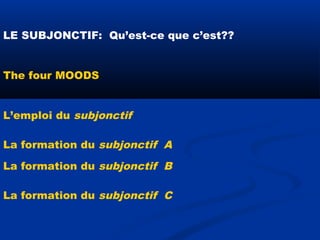
LE SUBJONCTIF: Qu’est-ce que c’est?? 
The four MOODS 
L’emploi du subjonctif 
La formation du subjonctif A 
La formation du subjonctif B 
La formation du subjonctif C
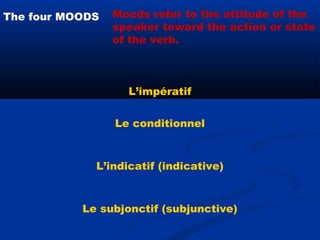
The four MOODS 
Moods refer to the attitude of the 
speaker toward the action or state 
of the verb. 
L’impératif 
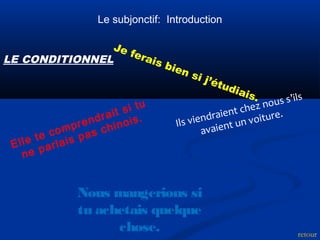
Le conditionnel 
L’indicatif (indicative) 
Le subjonctif (subjunctive)
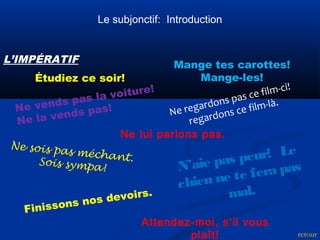
Le subjonctif: Introduction 
L’IMPÉRATIF 
Étudiez ce soir! 
Mange tes carottes! 
Mange-les! 
N’aie pas peur! Le 
c hien ne te fera pas 
mal. 
Ne vends pas la voiture! 
Ne la vends pas! 
Ne sois pas méchant. 
Sois sympa! 
Attendez-moi, s’il vous 
plaît! 
Finissons nos devoirs. 
Ne regardons pas ce film-ci! 
regardons ce film-là. 
Ne lui parlons pas. 
retour
Le subjonctif: Introduction 
Je ferais bien si j’étudiais. 
LE CONDITIONNEL 
Nous mangerions si 
tu achetais quelque 
chose. 
Ils viendraient chez nous s’ils 
avaient un voiture. 
E l l e t e c o m p r e n d r a i t s i t u 
n e p a r l a i s p a s c h i n o i s . 
retour
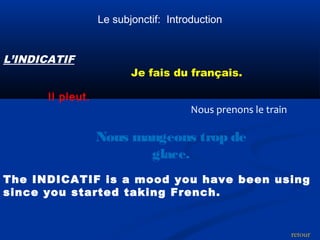
L’INDICATIF 
Je fais du français. 
Nous mangeons trop de 
glace. 
Nous prenons le train 
Il pleut. 
The INDICATIF is a mood you have been using 
since you started taking French. 
retour 
Le subjonctif: Introduction
L’INDICATIF 
The INDICATIF is a mood you have been using 
since you started taking French. 
retour 
Le subjonctif: Introduction
Le subjonctif: Introduction 
The INDICATIF is a mood you have been using 
since you started taking French. 
retour 
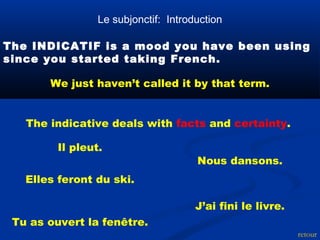
We just haven’t called it by that term. 
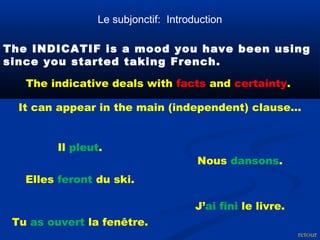
The indicative deals with facts and certainty. 
Il pleut. 
Tu as ouvert la fenêtre. 
Nous dansons. 
Elles feront du ski. 
J’ai fini le livre.
Le subjonctif: Introduction 
The INDICATIF is a mood you have been using 
since you started taking French. 
retour 
We just haven’t called it by that term. 
The indicative deals with facts and certainty.
Le subjonctif: Introduction 
The INDICATIF is a mood you have been using 
since you started taking French. 
The indicative deals with facts and certainty. 
It can appear in the main (independent) clause... 
retour 
Il pleut. 
Tu as ouvert la fenêtre. 
Nous dansons. 
Elles feront du ski. 
J’ai fini le livre.
Le subjonctif: Introduction 
The INDICATIF is a mood you have been using 
since you started taking French. 
The indicative deals with facts and certainty. 
It can appear in the main (independent) clause... 
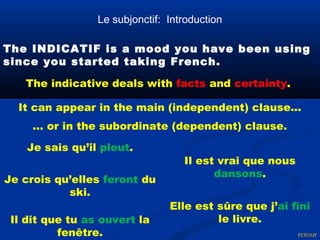
... or in the subordinate (dependent) clause. 
Je sais qu’il pleut. 
retour 
Il dit que tu as ouvert la 
fenêtre. 
Il est vrai que nous 
Je crois qu’elles feront du dansons. 
ski. 
Elle est sûre que j’ai fini 
le livre.
Le subjonctif (subjunctive) 
retour 
Le subjonctif: Introduction
Le subjonctif: Introduction 
LE SUBJONCTIF, QU’EST-CE QUE C’EST? 
Partie I: L’emploi 
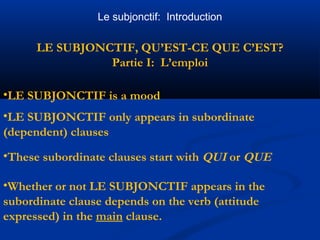
•LE SUBJONCTIF is a mood 
•LE SUBJONCTIF only appears in subordinate 
(dependent) clauses 
•These subordinate clauses start with QUI or QUE 
•Whether or not LE SUBJONCTIF appears in the 
subordinate clause depends on the verb (attitude 
expressed) in the main clause.
Le subjonctif: Introduction 
LE SUBJONCTIF, QU’EST-CE QUE C’EST? 
Partie I: L’emploi 
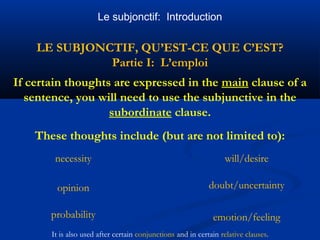
If certain thoughts are expressed in the main clause of a 
sentence, you will need to use the subjunctive in the 
subordinate clause. 
These thoughts include (but are not limited to): 
necessity will/desire 
opinion 
probability 
doubt/uncertainty 
emotion/feeling 
It is also used after certain conjunctions and in certain relative clauses.
Le subjonctif: Introduction 
LE SUBJONCTIF, QU’EST-CE QUE C’EST? 
Partie I: L’emploi 
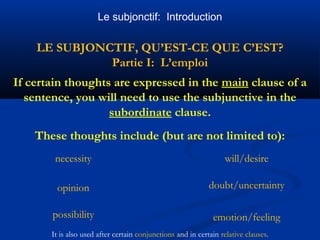
If certain thoughts are expressed in the main clause of a 
sentence, you will need to use the subjunctive in the 
subordinate clause. 
These thoughts include (but are not limited to): 
necessity will/desire 
opinion 
possibility 
doubt/uncertainty 
emotion/feeling 
It is also used after certain conjunctions and in certain relative clauses.
Le subjonctif: Introduction 
LE SUBJONCTIF, QU’EST-CE QUE C’EST? 
Partie I: L’emploi 
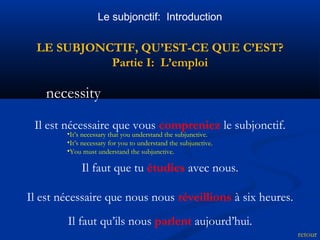
necessity 
retour 
Il est nécessaire que vous compreniez le subjonctif. 
•It’s necessary that you understand the subjunctive. 
•It’s necessary for you to understand the subjunctive. 
•You must understand the subjunctive. 
Il faut que tu étudies avec nous. 
Il est nécessaire que nous nous réveillions à six heures. 
Il faut qu’ils nous parlent aujourd’hui.
Le subjonctif: Introduction 
LE SUBJONCTIF, QU’EST-CE QUE C’EST? 
Partie I: L’emploi 
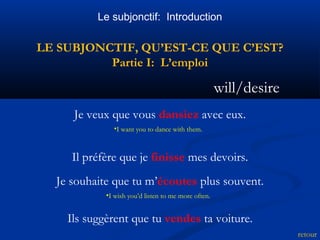
will/desire 
retour 
Je veux que vous dansiez avec eux. 
•I want you to dance with them. 
Il préfère que je finisse mes devoirs. 
Je souhaite que tu m’écoutes plus souvent. 
•I wish you’d listen to me more often. 
Ils suggèrent que tu vendes ta voiture.
Le subjonctif: Introduction 
LE SUBJONCTIF, QU’EST-CE QUE C’EST? 
Partie I: L’emploi 
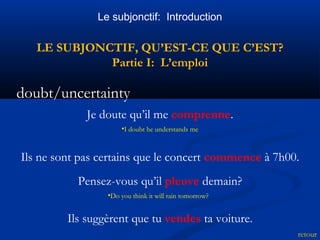
doubt/uncertainty 
retour 
Je doute qu’il me comprenne. 
•I doubt he understands me 
Ils ne sont pas certains que le concert commence à 7h00. 
Pensez-vous qu’il pleuve demain? 
•Do you think it will rain tomorrow? 
Ils suggèrent que tu vendes ta voiture.
Le subjonctif: Introduction 
LE SUBJONCTIF, QU’EST-CE QUE C’EST? 
Partie I: L’emploi 
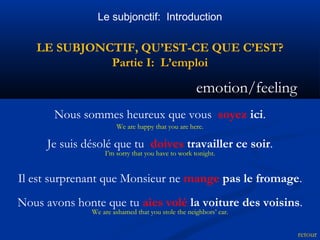
emotion/feeling 
retour 
Nous sommes heureux que vous soyez ici. 
We are happy that you are here. 
Je suis désolé que tu doives travailler ce soir. 
I’m sorry that you have to work tonight. 
Il est surprenant que Monsieur ne mange pas le fromage. 
Nous avons honte que tu aies volé la voiture des voisins. 
We are ashamed that you stole the neighbors’ car.
Le subjonctif: Introduction 
LE SUBJONCTIF, QU’EST-CE QUE C’EST? 
Partie I: L’emploi 
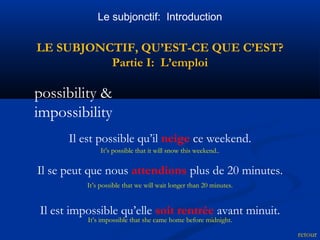
possibility & 
impossibility 
retour 
Il est possible qu’il neige ce weekend. 
It’s possible that it will snow this weekend.. 
Il se peut que nous attendions plus de 20 minutes. 
It’s possible that we will wait longer than 20 minutes. 
Il est impossible qu’elle soit rentrée avant minuit. 
It’s impossible that she came home before midnight.
Le subjonctif: Introduction 
LE SUBJONCTIF, QU’EST-CE QUE C’EST? 
Partie I: L’emploi 
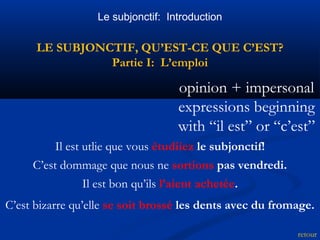
opinion + impersonal 
expressions beginning 
with “il est” or “c’est” 
retour 
Il est utlie que vous étudiiez le subjonctif! 
C’est dommage que nous ne sortions pas vendredi. 
Il est bon qu’ils l’aient achetée. 
C’est bizarre qu’elle se soit brossé les dents avec du fromage.
Le subjonctif: Introduction 
LE SUBJONCTIF, QU’EST-CE QUE C’EST? 
Partie I: L’emploi 
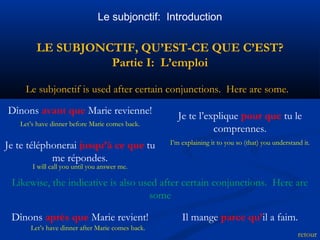
I’m explaining it to you so (that) you understand it. 
retour 
Le subjonctif is used after certain conjunctions. Here are some. 
Dînons avant que Marie revienne! 
Let’s have dinner before Marie comes back. 
Je te téléphonerai jusqu’à ce que tu 
I will call you until you answer me. 
Likewise, the indicative is also used after certain conjunctions. Here are 
some 
me répondes. 
Je te l’explique pour que tu le 
comprennes. 
Dînons après que Marie revient! Il mange parce qu’il a faim. 
Let’s have dinner after Marie comes back.
Le subjonctif: Introduction 
LE SUBJONCTIF, QU’EST-CE QUE C’EST? 
Partie I: L’emploi 
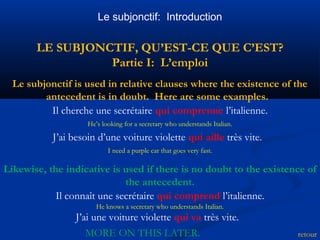
Le subjonctif is used in relative clauses where the existence of the 
retour 
antecedent is in doubt. Here are some examples. 
Il cherche une secrétaire qui comprenne l’italienne. 
He’s looking for a secretary who understands Italian. 
J’ai besoin d’une voiture violette qui aille très vite. 
I need a purple car that goes very fast. 
Likewise, the indicative is used if there is no doubt to the existence of 
the antecedent. 
Il connaît une secrétaire qui comprend l’italienne. 
He knows a secretary who understands Italian. 
J’ai une voiture violette qui va très vite. 
MORE ON THIS LATER.
Le subjonctif: Introduction 
LE SUBJONCTIF, QU’EST-CE QUE C’EST? 
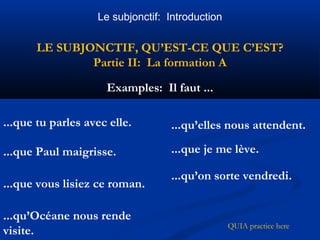
Partie II: La formation A 
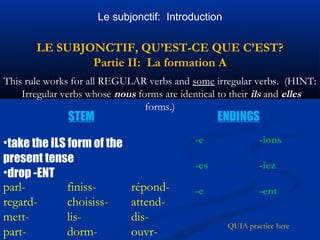
This rule works for all REGULAR verbs and some irregular verbs. (HINT: 
Irregular verbs whose nous forms are identical to their ils and elles 
forms.) STEM ENDINGS 
•take the ILS form of the 
present tense 
•drop -ENT 
parl- finiss- répond-regard- 
choisiss- attend-mett- 
lis- dis-part- 
dorm- ouvr- 
-e -ions 
-es -iez 
-e -ent 
QUIA practice here
Le subjonctif: Introduction 
LE SUBJONCTIF, QU’EST-CE QUE C’EST? 
Partie II: La formation A 
Examples: Il faut ... 
...que tu parles avec elle. 
...que Paul maigrisse. 
...que vous lisiez ce roman. 
...qu’Océane nous rende 
visite. QUIA practice here 
...qu’elles nous attendent. 
...que je me lève. 
...qu’on sorte vendredi.
Le subjonctif: Introduction 
LE SUBJONCTIF, QU’EST-CE QUE C’EST? 
Partie II: La formation B 
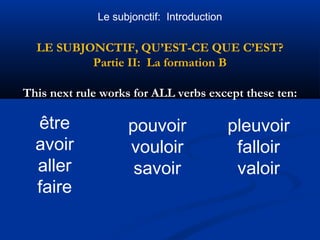
This next rule works for ALL verbs except these ten: 
être 
pouvoir 
pleuvoir 
avoir 
vouloir 
falloir 
aller 
savoir 
valoir 
faire
Le subjonctif: Introduction 
LE SUBJONCTIF, QU’EST-CE QUE C’EST? 
Partie II: La formation B 
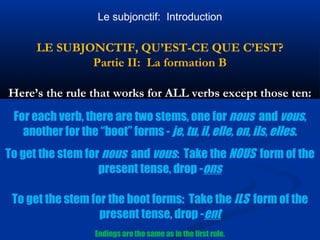
Here’s the rule that works for ALL verbs except those ten: 
For each verb, there are two stems, one for nous and vous, 
another for the “boot” forms - je, tu, il, elle, on, ils, elles. 
To get the stem for nous and vous: Take the NOUS form of the 
present tense, drop -ons 
To get the stem for the boot forms: Take the ILS form of the 
present tense, drop -ent 
Endings are the same as in the first rule.
Le subjonctif: Introduction 
LE SUBJONCTIF, QU’EST-CE QUE C’EST? 
Partie II: La formation B 
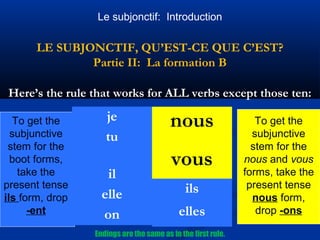
Here’s the rule that works for ALL verbs except those ten: 
je 
tu 
il 
elle 
on 
nous 
vous 
ils 
elles 
Endings are the same as in the first rule. 
To get the 
subjunctive 
stem for the 
nous and vous 
forms, take the 
present tense 
nous form, 
drop -ons 
To get the 
subjunctive 
stem for the 
boot forms, 
take the 
present tense 
ils form, drop 
-ent
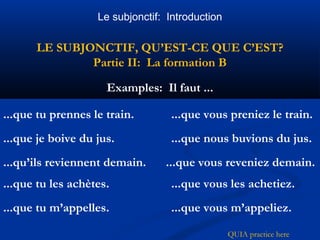
Le subjonctif: Introduction 
LE SUBJONCTIF, QU’EST-CE QUE C’EST? 
Partie II: La formation B 
Examples: Il faut ... 
...que tu prennes le train. 
...que vous preniez le train. 
...que je boive du jus. ...que nous buvions du jus. 
...qu’ils reviennent demain. ...que vous reveniez demain. 
...que tu les achètes. ...que vous les achetiez. 
...que tu m’appelles. ...que vous m’appeliez. 
QUIA practice here
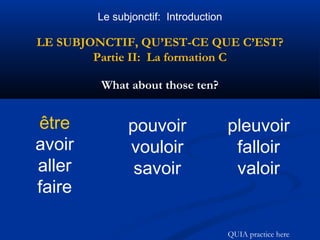
Le subjonctif: Introduction 
LE SUBJONCTIF, QU’EST-CE QUE C’EST? 
Partie II: La formation C 
What about those ten? 
être 
avoir 
aller 
faire 
pouvoir 
vouloir 
savoir 
pleuvoir 
falloir 
valoir 
QUIA practice here
Le subjonctif: Introduction 
LE SUBJONCTIF, QU’EST-CE QUE C’EST? 
Partie II: La formation C 
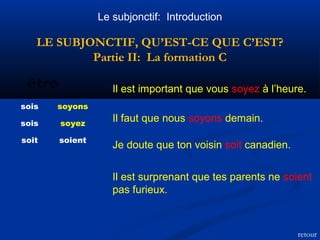
être Il est important que vous soyez à l’heure. 
sois soyons 
sois soyez 
soit soient 
Il faut que nous soyons demain. 
Je doute que ton voisin soit canadien. 
Il est surprenant que tes parents ne soient 
pas furieux. 
retour
Le subjonctif: Introduction 
LE SUBJONCTIF, QU’EST-CE QUE C’EST? 
Partie II: La formation C 
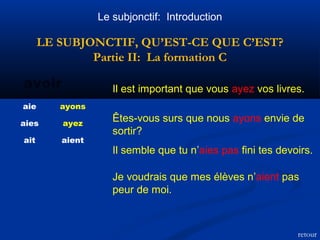
avoir Il est important que vous ayez vos livres. 
aie ayons 
aies ayez 
ait aient 
Êtes-vous surs que nous ayons envie de 
sortir? 
Il semble que tu n’aies pas fini tes devoirs. 
Je voudrais que mes élèves n’aient pas 
peur de moi. 
retour
Le subjonctif: Introduction 
LE SUBJONCTIF, QU’EST-CE QUE C’EST? 
Partie II: La formation C 
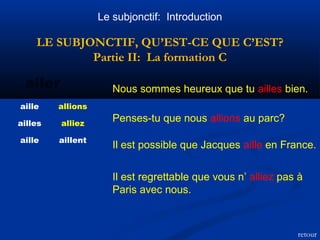
aller Nous sommes heureux que tu ailles bien. 
aille allions 
ailles alliez 
aille aillent 
Penses-tu que nous allions au parc? 
Il est possible que Jacques aille en France. 
Il est regrettable que vous n’ alliez pas à 
Paris avec nous. 
retour
Le subjonctif: Introduction 
LE SUBJONCTIF, QU’EST-CE QUE C’EST? 
Partie II: La formation C 
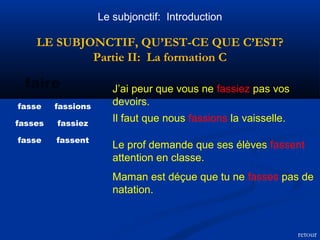
faire J’ai peur que vous ne fassiez pas vos 
fasse fassions 
fasses fassiez 
fasse fassent 
devoirs. 
Il faut que nous fassions la vaisselle. 
Le prof demande que ses élèves fassent 
attention en classe. 
Maman est déçue que tu ne fasses pas de 
natation. 
retour
Le subjonctif: Introduction 
LE SUBJONCTIF, QU’EST-CE QUE C’EST? 
Partie II: La formation C 
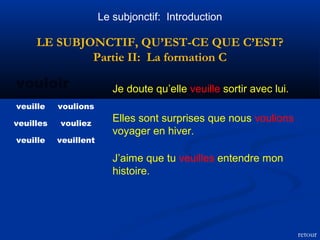
vouloir Je doute qu’elle veuille sortir avec lui. 
veuille voulions 
veuilles vouliez 
veuille veuillent 
Elles sont surprises que nous voulions 
voyager en hiver. 
J’aime que tu veuilles entendre mon 
histoire. 
retour
Le subjonctif: Introduction 
LE SUBJONCTIF, QU’EST-CE QUE C’EST? 
Partie II: La formation C 
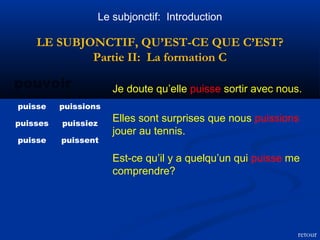
pouvoir Je doute qu’elle puisse sortir avec nous. 
puisse puissions 
puisses puissiez 
puisse puissent 
Elles sont surprises que nous puissions 
jouer au tennis. 
Est-ce qu’il y a quelqu’un qui puisse me 
comprendre? 
retour
Le subjonctif: Introduction 
LE SUBJONCTIF, QU’EST-CE QUE C’EST? 
Partie II: La formation C 
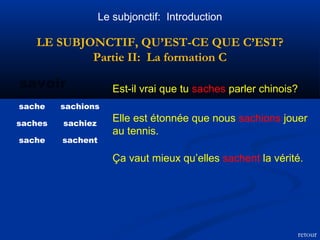
savoir Est-il vrai que tu saches parler chinois? 
sache sachions 
saches sachiez 
sache sachent 
Elle est étonnée que nous sachions jouer 
au tennis. 
Ça vaut mieux qu’elles sachent la vérité. 
retour
Le subjonctif: Introduction 
LE SUBJONCTIF, QU’EST-CE QUE C’EST? 
Partie II: La formation C 
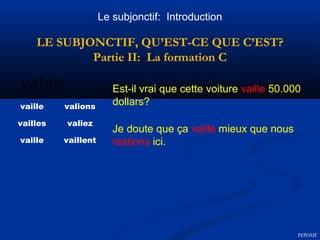
valoir Est-il vrai que cette voiture vaille 50.000 
vaille valions 
vailles valiez 
vaille vaillent 
dollars? 
retour 
Je doute que ça vaille mieux que nous 
restions ici.
Le subjonctif: Introduction 
LE SUBJONCTIF, QU’EST-CE QUE C’EST? 
Partie II: La formation C 
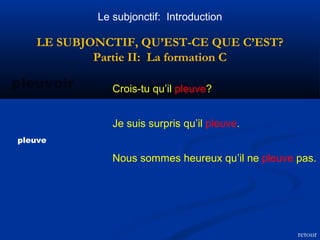
pleuvoir Crois-tu qu’il pleuve? 
pleuve 
Je suis surpris qu’il pleuve. 
Nous sommes heureux qu’il ne pleuve pas. 
retour
Le subjonctif: Introduction 
LE SUBJONCTIF, QU’EST-CE QUE C’EST? 
Partie II: La formation C 
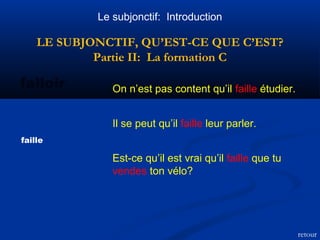
falloir On n’est pas content qu’il faille étudier. 
faille 
Il se peut qu’il faille leur parler. 
Est-ce qu’il est vrai qu’il faille que tu 
vendes ton vélo? 
retour

001 subjonctif-intro

  • 1.
  • 2.
    LE SUBJONCTIF: Qu’est-ceque c’est?? The four MOODS L’emploi du subjonctif La formation du subjonctif A La formation du subjonctif B La formation du subjonctif C
  • 3.
    The four MOODS Moods refer to the attitude of the speaker toward the action or state of the verb. L’impératif Le conditionnel L’indicatif (indicative) Le subjonctif (subjunctive)
  • 4.
    Le subjonctif: Introduction L’IMPÉRATIF Étudiez ce soir! Mange tes carottes! Mange-les! N’aie pas peur! Le c hien ne te fera pas mal. Ne vends pas la voiture! Ne la vends pas! Ne sois pas méchant. Sois sympa! Attendez-moi, s’il vous plaît! Finissons nos devoirs. Ne regardons pas ce film-ci! regardons ce film-là. Ne lui parlons pas. retour
  • 5.
    Le subjonctif: Introduction Je ferais bien si j’étudiais. LE CONDITIONNEL Nous mangerions si tu achetais quelque chose. Ils viendraient chez nous s’ils avaient un voiture. E l l e t e c o m p r e n d r a i t s i t u n e p a r l a i s p a s c h i n o i s . retour
  • 6.
    L’INDICATIF Je faisdu français. Nous mangeons trop de glace. Nous prenons le train Il pleut. The INDICATIF is a mood you have been using since you started taking French. retour Le subjonctif: Introduction
  • 7.
    L’INDICATIF The INDICATIFis a mood you have been using since you started taking French. retour Le subjonctif: Introduction
  • 8.
    Le subjonctif: Introduction The INDICATIF is a mood you have been using since you started taking French. retour We just haven’t called it by that term. The indicative deals with facts and certainty. Il pleut. Tu as ouvert la fenêtre. Nous dansons. Elles feront du ski. J’ai fini le livre.
  • 9.
    Le subjonctif: Introduction The INDICATIF is a mood you have been using since you started taking French. retour We just haven’t called it by that term. The indicative deals with facts and certainty.
  • 10.
    Le subjonctif: Introduction The INDICATIF is a mood you have been using since you started taking French. The indicative deals with facts and certainty. It can appear in the main (independent) clause... retour Il pleut. Tu as ouvert la fenêtre. Nous dansons. Elles feront du ski. J’ai fini le livre.
  • 11.
    Le subjonctif: Introduction The INDICATIF is a mood you have been using since you started taking French. The indicative deals with facts and certainty. It can appear in the main (independent) clause... ... or in the subordinate (dependent) clause. Je sais qu’il pleut. retour Il dit que tu as ouvert la fenêtre. Il est vrai que nous Je crois qu’elles feront du dansons. ski. Elle est sûre que j’ai fini le livre.
  • 12.
    Le subjonctif (subjunctive) retour Le subjonctif: Introduction
  • 13.
    Le subjonctif: Introduction LE SUBJONCTIF, QU’EST-CE QUE C’EST? Partie I: L’emploi •LE SUBJONCTIF is a mood •LE SUBJONCTIF only appears in subordinate (dependent) clauses •These subordinate clauses start with QUI or QUE •Whether or not LE SUBJONCTIF appears in the subordinate clause depends on the verb (attitude expressed) in the main clause.
  • 14.
    Le subjonctif: Introduction LE SUBJONCTIF, QU’EST-CE QUE C’EST? Partie I: L’emploi If certain thoughts are expressed in the main clause of a sentence, you will need to use the subjunctive in the subordinate clause. These thoughts include (but are not limited to): necessity will/desire opinion probability doubt/uncertainty emotion/feeling It is also used after certain conjunctions and in certain relative clauses.
  • 15.
    Le subjonctif: Introduction LE SUBJONCTIF, QU’EST-CE QUE C’EST? Partie I: L’emploi If certain thoughts are expressed in the main clause of a sentence, you will need to use the subjunctive in the subordinate clause. These thoughts include (but are not limited to): necessity will/desire opinion possibility doubt/uncertainty emotion/feeling It is also used after certain conjunctions and in certain relative clauses.
  • 16.
    Le subjonctif: Introduction LE SUBJONCTIF, QU’EST-CE QUE C’EST? Partie I: L’emploi necessity retour Il est nécessaire que vous compreniez le subjonctif. •It’s necessary that you understand the subjunctive. •It’s necessary for you to understand the subjunctive. •You must understand the subjunctive. Il faut que tu étudies avec nous. Il est nécessaire que nous nous réveillions à six heures. Il faut qu’ils nous parlent aujourd’hui.
  • 17.
    Le subjonctif: Introduction LE SUBJONCTIF, QU’EST-CE QUE C’EST? Partie I: L’emploi will/desire retour Je veux que vous dansiez avec eux. •I want you to dance with them. Il préfère que je finisse mes devoirs. Je souhaite que tu m’écoutes plus souvent. •I wish you’d listen to me more often. Ils suggèrent que tu vendes ta voiture.
  • 18.
    Le subjonctif: Introduction LE SUBJONCTIF, QU’EST-CE QUE C’EST? Partie I: L’emploi doubt/uncertainty retour Je doute qu’il me comprenne. •I doubt he understands me Ils ne sont pas certains que le concert commence à 7h00. Pensez-vous qu’il pleuve demain? •Do you think it will rain tomorrow? Ils suggèrent que tu vendes ta voiture.
  • 19.
    Le subjonctif: Introduction LE SUBJONCTIF, QU’EST-CE QUE C’EST? Partie I: L’emploi emotion/feeling retour Nous sommes heureux que vous soyez ici. We are happy that you are here. Je suis désolé que tu doives travailler ce soir. I’m sorry that you have to work tonight. Il est surprenant que Monsieur ne mange pas le fromage. Nous avons honte que tu aies volé la voiture des voisins. We are ashamed that you stole the neighbors’ car.
  • 20.
    Le subjonctif: Introduction LE SUBJONCTIF, QU’EST-CE QUE C’EST? Partie I: L’emploi possibility & impossibility retour Il est possible qu’il neige ce weekend. It’s possible that it will snow this weekend.. Il se peut que nous attendions plus de 20 minutes. It’s possible that we will wait longer than 20 minutes. Il est impossible qu’elle soit rentrée avant minuit. It’s impossible that she came home before midnight.
  • 21.
    Le subjonctif: Introduction LE SUBJONCTIF, QU’EST-CE QUE C’EST? Partie I: L’emploi opinion + impersonal expressions beginning with “il est” or “c’est” retour Il est utlie que vous étudiiez le subjonctif! C’est dommage que nous ne sortions pas vendredi. Il est bon qu’ils l’aient achetée. C’est bizarre qu’elle se soit brossé les dents avec du fromage.
  • 22.
    Le subjonctif: Introduction LE SUBJONCTIF, QU’EST-CE QUE C’EST? Partie I: L’emploi I’m explaining it to you so (that) you understand it. retour Le subjonctif is used after certain conjunctions. Here are some. Dînons avant que Marie revienne! Let’s have dinner before Marie comes back. Je te téléphonerai jusqu’à ce que tu I will call you until you answer me. Likewise, the indicative is also used after certain conjunctions. Here are some me répondes. Je te l’explique pour que tu le comprennes. Dînons après que Marie revient! Il mange parce qu’il a faim. Let’s have dinner after Marie comes back.
  • 23.
    Le subjonctif: Introduction LE SUBJONCTIF, QU’EST-CE QUE C’EST? Partie I: L’emploi Le subjonctif is used in relative clauses where the existence of the retour antecedent is in doubt. Here are some examples. Il cherche une secrétaire qui comprenne l’italienne. He’s looking for a secretary who understands Italian. J’ai besoin d’une voiture violette qui aille très vite. I need a purple car that goes very fast. Likewise, the indicative is used if there is no doubt to the existence of the antecedent. Il connaît une secrétaire qui comprend l’italienne. He knows a secretary who understands Italian. J’ai une voiture violette qui va très vite. MORE ON THIS LATER.
  • 24.
    Le subjonctif: Introduction LE SUBJONCTIF, QU’EST-CE QUE C’EST? Partie II: La formation A This rule works for all REGULAR verbs and some irregular verbs. (HINT: Irregular verbs whose nous forms are identical to their ils and elles forms.) STEM ENDINGS •take the ILS form of the present tense •drop -ENT parl- finiss- répond-regard- choisiss- attend-mett- lis- dis-part- dorm- ouvr- -e -ions -es -iez -e -ent QUIA practice here
  • 25.
    Le subjonctif: Introduction LE SUBJONCTIF, QU’EST-CE QUE C’EST? Partie II: La formation A Examples: Il faut ... ...que tu parles avec elle. ...que Paul maigrisse. ...que vous lisiez ce roman. ...qu’Océane nous rende visite. QUIA practice here ...qu’elles nous attendent. ...que je me lève. ...qu’on sorte vendredi.
  • 26.
    Le subjonctif: Introduction LE SUBJONCTIF, QU’EST-CE QUE C’EST? Partie II: La formation B This next rule works for ALL verbs except these ten: être pouvoir pleuvoir avoir vouloir falloir aller savoir valoir faire
  • 27.
    Le subjonctif: Introduction LE SUBJONCTIF, QU’EST-CE QUE C’EST? Partie II: La formation B Here’s the rule that works for ALL verbs except those ten: For each verb, there are two stems, one for nous and vous, another for the “boot” forms - je, tu, il, elle, on, ils, elles. To get the stem for nous and vous: Take the NOUS form of the present tense, drop -ons To get the stem for the boot forms: Take the ILS form of the present tense, drop -ent Endings are the same as in the first rule.
  • 28.
    Le subjonctif: Introduction LE SUBJONCTIF, QU’EST-CE QUE C’EST? Partie II: La formation B Here’s the rule that works for ALL verbs except those ten: je tu il elle on nous vous ils elles Endings are the same as in the first rule. To get the subjunctive stem for the nous and vous forms, take the present tense nous form, drop -ons To get the subjunctive stem for the boot forms, take the present tense ils form, drop -ent
  • 29.
    Le subjonctif: Introduction LE SUBJONCTIF, QU’EST-CE QUE C’EST? Partie II: La formation B Examples: Il faut ... ...que tu prennes le train. ...que vous preniez le train. ...que je boive du jus. ...que nous buvions du jus. ...qu’ils reviennent demain. ...que vous reveniez demain. ...que tu les achètes. ...que vous les achetiez. ...que tu m’appelles. ...que vous m’appeliez. QUIA practice here
  • 30.
    Le subjonctif: Introduction LE SUBJONCTIF, QU’EST-CE QUE C’EST? Partie II: La formation C What about those ten? être avoir aller faire pouvoir vouloir savoir pleuvoir falloir valoir QUIA practice here
  • 31.
    Le subjonctif: Introduction LE SUBJONCTIF, QU’EST-CE QUE C’EST? Partie II: La formation C être Il est important que vous soyez à l’heure. sois soyons sois soyez soit soient Il faut que nous soyons demain. Je doute que ton voisin soit canadien. Il est surprenant que tes parents ne soient pas furieux. retour
  • 32.
    Le subjonctif: Introduction LE SUBJONCTIF, QU’EST-CE QUE C’EST? Partie II: La formation C avoir Il est important que vous ayez vos livres. aie ayons aies ayez ait aient Êtes-vous surs que nous ayons envie de sortir? Il semble que tu n’aies pas fini tes devoirs. Je voudrais que mes élèves n’aient pas peur de moi. retour
  • 33.
    Le subjonctif: Introduction LE SUBJONCTIF, QU’EST-CE QUE C’EST? Partie II: La formation C aller Nous sommes heureux que tu ailles bien. aille allions ailles alliez aille aillent Penses-tu que nous allions au parc? Il est possible que Jacques aille en France. Il est regrettable que vous n’ alliez pas à Paris avec nous. retour
  • 34.
    Le subjonctif: Introduction LE SUBJONCTIF, QU’EST-CE QUE C’EST? Partie II: La formation C faire J’ai peur que vous ne fassiez pas vos fasse fassions fasses fassiez fasse fassent devoirs. Il faut que nous fassions la vaisselle. Le prof demande que ses élèves fassent attention en classe. Maman est déçue que tu ne fasses pas de natation. retour
  • 35.
    Le subjonctif: Introduction LE SUBJONCTIF, QU’EST-CE QUE C’EST? Partie II: La formation C vouloir Je doute qu’elle veuille sortir avec lui. veuille voulions veuilles vouliez veuille veuillent Elles sont surprises que nous voulions voyager en hiver. J’aime que tu veuilles entendre mon histoire. retour
  • 36.
    Le subjonctif: Introduction LE SUBJONCTIF, QU’EST-CE QUE C’EST? Partie II: La formation C pouvoir Je doute qu’elle puisse sortir avec nous. puisse puissions puisses puissiez puisse puissent Elles sont surprises que nous puissions jouer au tennis. Est-ce qu’il y a quelqu’un qui puisse me comprendre? retour
  • 37.
    Le subjonctif: Introduction LE SUBJONCTIF, QU’EST-CE QUE C’EST? Partie II: La formation C savoir Est-il vrai que tu saches parler chinois? sache sachions saches sachiez sache sachent Elle est étonnée que nous sachions jouer au tennis. Ça vaut mieux qu’elles sachent la vérité. retour
  • 38.
    Le subjonctif: Introduction LE SUBJONCTIF, QU’EST-CE QUE C’EST? Partie II: La formation C valoir Est-il vrai que cette voiture vaille 50.000 vaille valions vailles valiez vaille vaillent dollars? retour Je doute que ça vaille mieux que nous restions ici.
  • 39.
    Le subjonctif: Introduction LE SUBJONCTIF, QU’EST-CE QUE C’EST? Partie II: La formation C pleuvoir Crois-tu qu’il pleuve? pleuve Je suis surpris qu’il pleuve. Nous sommes heureux qu’il ne pleuve pas. retour
  • 40.
    Le subjonctif: Introduction LE SUBJONCTIF, QU’EST-CE QUE C’EST? Partie II: La formation C falloir On n’est pas content qu’il faille étudier. faille Il se peut qu’il faille leur parler. Est-ce qu’il est vrai qu’il faille que tu vendes ton vélo? retour