L’imparfait
un autre temps qui décrit le passé
Quand est-ce qu’on
utilise l’imparfait?
to describe how things and people
were in the past
Pierre était égoïste quand il était petit.
to describe how things and people
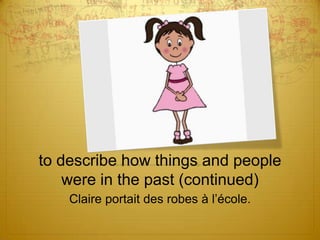
were in the past (continued)
Claire portait des robes à l’école.
to describe weather or general
conditions in the past
Il fasait froid.
to talk about what used to happen or
to tell about repeated/habitual actions
in the past
J’allais au parc avec mon frère le samedi.
to tell how something used to be using
the phrase c’était + un adjectif
C’était magnifigue!
Les phrases qui peuvent
indiquer l’imparfait…
 d’habitude  usually, normally
 souvent  often
 tous les jours  every day

 de temps en temps  from time to time
 quand j’étais petit(e)/jeune  When I was young
Comment est-ce qu’on
forme l’imparfait?
 C’est facile!
 Unlike le passé composé (helping verb + past
participle), l’imparfait only uses one verb 

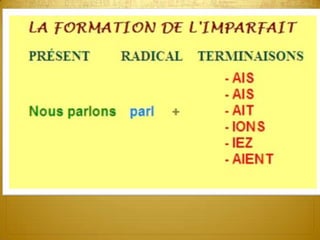
 Step one: drop the –ons from the present tense nous
form
 Step two: add imparfait endings (all of the endings are
the same for every verb in imparfait!! )
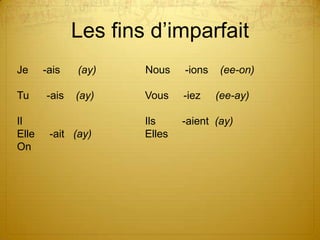
Les fins d’imparfait
Je
Tu
Il
Elle
On

-ais

(ay)

Nous

-ions

(ay)

Vous

-iez

-aient (ay)

-ait (ay)

Ils
Elles

-ais

(ee-on)
(ee-ay)
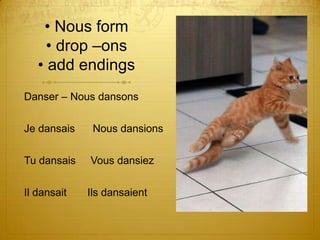
• Nous form
• drop –ons
• add endings
Danser – Nous dansons
Je dansais

Nous dansions

Tu dansais

Vous dansiez

Il dansait

Ils dansaient
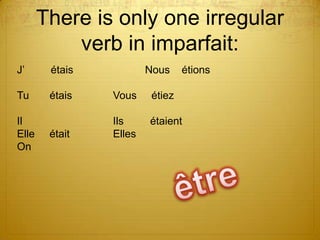
There is only one irregular
verb in imparfait:
J’

étais

Tu

étais

Vous

étiez
étaient

était

Ils
Elles

Il
Elle
On

Nous

étions
Questions?

L'imparfait

  • 1.
    L’imparfait un autre tempsqui décrit le passé
  • 2.
  • 3.
    to describe howthings and people were in the past Pierre était égoïste quand il était petit.
  • 4.
    to describe howthings and people were in the past (continued) Claire portait des robes à l’école.
  • 5.
    to describe weatheror general conditions in the past Il fasait froid.
  • 6.
    to talk aboutwhat used to happen or to tell about repeated/habitual actions in the past J’allais au parc avec mon frère le samedi.
  • 7.
    to tell howsomething used to be using the phrase c’était + un adjectif C’était magnifigue!
  • 8.
    Les phrases quipeuvent indiquer l’imparfait…  d’habitude  usually, normally  souvent  often  tous les jours  every day  de temps en temps  from time to time  quand j’étais petit(e)/jeune  When I was young
  • 9.
    Comment est-ce qu’on formel’imparfait?  C’est facile!  Unlike le passé composé (helping verb + past participle), l’imparfait only uses one verb   Step one: drop the –ons from the present tense nous form  Step two: add imparfait endings (all of the endings are the same for every verb in imparfait!! )
  • 10.
  • 12.
    • Nous form •drop –ons • add endings Danser – Nous dansons Je dansais Nous dansions Tu dansais Vous dansiez Il dansait Ils dansaient
  • 13.
    There is onlyone irregular verb in imparfait: J’ étais Tu étais Vous étiez étaient était Ils Elles Il Elle On Nous étions
  • 14.