Télécom Paristech
La voitureconnectée:
Comment sécuriser
les communications V2X ?
Houda Labiod
houda.labiod@telecom-paristech.fr
Equipe SdR (Sécurité des Réseaux)
Département INFRES, Telecom ParisTech
Colloque scientifique IMT - 10 Novembre 2017 – Telecom
ParisTech
2.
Télécom Paristech
Les systèmesde transport intelligents , C-ITS
2
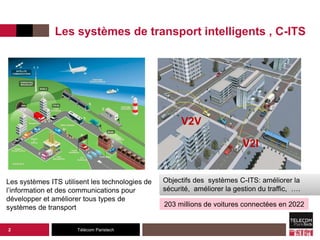
Les systèmes ITS utilisent les technologies de
l’information et des communications pour
développer et améliorer tous types de
systèmes de transport
V2V
V2I
V2V
V2I
Objectifs des systèmes C-ITS: améliorer la
sécurité, améliorer la gestion du traffic, ….
203 millions de voitures connectées en 2022
3.
Télécom Paristech
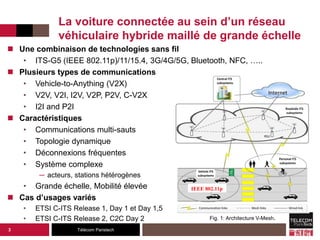
Fig. 1:Architecture V-Mesh.
La voiture connectée au sein d’un réseau
véhiculaire hybride maillé de grande échelle
3
Une combinaison de technologies sans fil
• ITS-G5 (IEEE 802.11p)/11/15.4, 3G/4G/5G, Bluetooth, NFC, …..
Plusieurs types de communications
• Vehicle-to-Anything (V2X)
• V2V, V2I, I2V, V2P, P2V, C-V2X
• I2I and P2I
Caractéristiques
• Communications multi-sauts
• Topologie dynamique
• Déconnexions fréquentes
• Système complexe
─ acteurs, stations hétérogènes
• Grande échelle, Mobilité élevée
Cas d’usages variés
• ETSI C-ITS Release 1, Day 1 et Day 1,5
• ETSI C-ITS Release 2, C2C Day 2
IEEE 802.11p
4.
Télécom Paristech
4
Cybersécurité
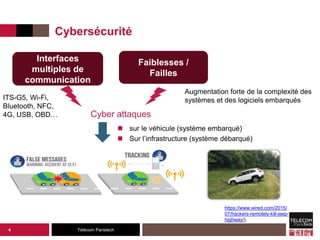
Augmentation fortede la complexité des
systèmes et des logiciels embarqués
Interfaces
multiples de
communication
Faiblesses /
Failles
Cyber attaques
ITS-G5, Wi-Fi,
Bluetooth, NFC,
4G, USB, OBD…
Source : wired.com
sur le véhicule (système embarqué)
Sur l’infrastructure (système débarqué)
https://www.wired.com/2015/
07/hackers-remotely-kill-jeep-
highway/).
5.
Télécom Paristech
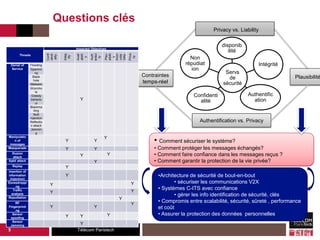
Questions clés
5
Plausibilité
Authentificationvs. Privacy
Contraintes
temps-réel
Privacy vs. Liability
Servs
de
sécurité
disponib
ilité
Intégrité
Non
répudiat
ion
Confidenti
alité
Authentific
ation
Threats
Impacted Objectives
Confi
denti
ality
Integ
rity
Avail
abilit
y
Auth
entici
ty
Plau
sibilit
y
Acco
unta
bility
Priva
cy
Denial of
Service
Flooding
Y
Spammi
ng
Black
hole
Malware
Wormho
le
Greedy
behavio
ur
Blackma
iling
fault
injection
Reflectio
n attack
Jammin
g
Manipulatio
n of
messages
Y Y
Y
Masquerade Y Y
Illusion
attack Y Y
Sybil attack Y
Replay Y
Insertion of
information
(injection)
Y
Eavesdroppi
ng Y Y
Traffic
analysis Y Y
Repudiation Y
RF
Fingerprinti
ng
Y Y
Y
Sensor
spoofing Y Y Y
Sensor
Jamming Y
• Comment sécuriser le système?
• Comment protéger les messages échangés?
• Comment faire confiance dans les messages reçus ?
• Comment garantir la protection de la vie privée?
•Architecture de sécurité de bout-en-bout
• sécuriser les communications V2X
• Systèmes C-ITS avec confiance
• gérer les info identification de sécurité, clés
• Compromis entre scalabilité, sécurité, sûreté , performance
et coût
• Assurer la protection des données personnelles
6.
Télécom Paristech
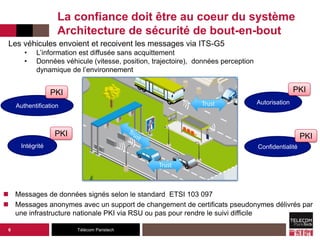
La confiancedoit être au coeur du système
Architecture de sécurité de bout-en-bout
Les véhicules envoient et recoivent les messages via ITS-G5
• L’information est diffusée sans acquittement
• Données véhicule (vitesse, position, trajectoire), données perception
dynamique de l’environnement
6
Messages de données signés selon le standard ETSI 103 097
Messages anonymes avec un support de changement de certificats pseudonymes délivrés par
une infrastructure nationale PKI via RSU ou pas pour rendre le suivi difficile
Authentification
Autorisation
Intégrité Confidentialité
PKI PKI
PKI PKI
7.
Télécom Paristech
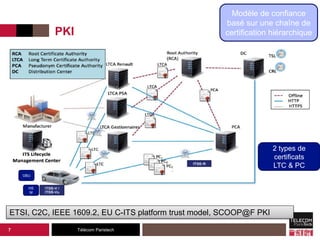
PKI
7
2 typesde
certificats
LTC & PC
ETSI, C2C, IEEE 1609.2, EU C-ITS platform trust model, SCOOP@F PKI
Modèle de confiance
basé sur une chaîne de
certification hiérarchique
OBU
HS
M
8.
Télécom Paristech
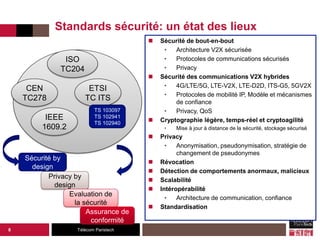
Standards sécurité:un état des lieux
8
Sécurité de bout-en-bout
• Architecture V2X sécurisée
• Protocoles de communications sécurisés
• Privacy
Sécurité des communications V2X hybrides
• 4G/LTE/5G, LTE-V2X, LTE-D2D, ITS-G5, 5GV2X
• Protocoles de mobilité IP, Modèle et mécanismes
de confiance
• Privacy, QoS
Cryptographie légère, temps-réel et cryptoagilité
• Mise à jour à distance de la sécurité, stockage sécurisé
Privacy
• Anonymisation, pseudonymisation, stratégie de
changement de pseudonymes
Révocation
Détection de comportements anormaux, malicieux
Scalabilité
Intéropérabilité
• Architecture de communication, confiance
Standardisation
ISO
TC204
CEN
TC278
ETSI
TC ITS
IEEE
1609.2
TS 103097
TS 102941
TS 102940
Sécurité by
design
Privacy by
design
Evaluation de
la sécurité
Assurance de
conformité
9.
Télécom Paristech
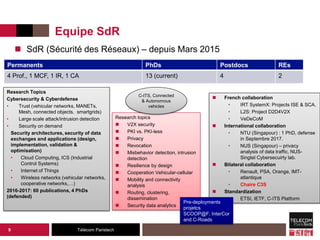
Equipe SdR
SdR (Sécurité des Réseaux) – depuis Mars 2015
9
Permanents PhDs Postdocs REs
4 Prof., 1 MCF, 1 IR, 1 CA 13 (current) 4 2
Research Topics
Cybersecurity & Cyberdefense
• Trust (vehicular networks, MANETs,
Mesh, connected objects, smartgrids)
• Large scale attack/intrusion detection
• Security on demand
Security architectures, security of data
exchanges and applications (design,
implementation, validation &
optimisation)
• Cloud Computing, ICS (Industrial
Control Systems)
• Internet of Things
• Wireless networks (vehicular networks,
cooperative networks,…)
2016-2017: 60 publications, 4 PhDs
(defended)
Research topics
V2X security
PKI vs. PKI-less
Privacy
Revocation
Misbehavior detection, intrusion
detection
Resilience by design
Cooperation Vehicular-cellular
Mobility and connectivity
analysis
Routing, clustering,
dissemination
Security data analytics
C-ITS, Connected
& Autonomous
vehicles
French collaboration
• IRT SystemX: Projects ISE & SCA.
• L2S: Project D2D4V2X
• VeDeCoM
International collaboration
• NTU (Singapour) : 1 PhD, defense
in Septembre 2017.
• NUS (Singapour) – privacy
analysis of data traffic, NUS-
Singtel Cybersecuirty lab.
Bilateral collaboration
• Renault, PSA, Orange, IMT-
atlantique
• Chaire C3S
Standardization
• ETSI, IETF, C-ITS Platform
Pre-deployments
projetcs
SCOOP@F, InterCor
and C-Roads
10.
Télécom Paristech
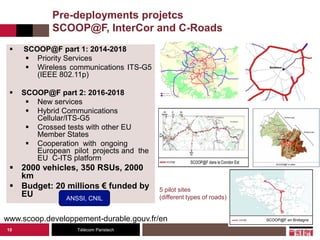
SCOOP@Fpart 1: 2014-2018
Priority Services
Wireless communications ITS-G5
(IEEE 802.11p)
SCOOP@F part 2: 2016-2018
New services
Hybrid Communications
Cellular/ITS-G5
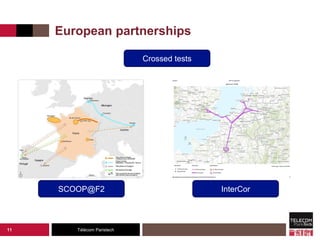
Crossed tests with other EU
Member States
Cooperation with ongoing
European pilot projects and the
EU C-ITS platform
2000 vehicles, 350 RSUs, 2000
km
Budget: 20 millions € funded by
EU
10
Pre-deployments projetcs
SCOOP@F, InterCor and C-Roads
www.scoop.developpement-durable.gouv.fr/en
5 pilot sites
(different types of roads)
ANSSI, CNIL
Télécom Paristech
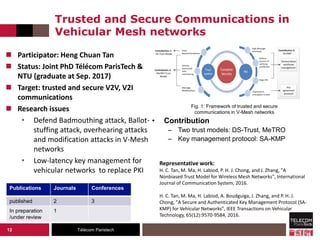
Trusted andSecure Communications in
Vehicular Mesh networks
12
Participator: Heng Chuan Tan
Status: Joint PhD Télécom ParisTech &
NTU (graduate at Sep. 2017)
Target: trusted and secure V2V, V2I
communications
Research issues
• Defend Badmouthing attack, Ballot-
stuffing attack, overhearing attacks
and modification attacks in V-Mesh
networks
• Low-latency key management for
vehicular networks to replace PKI
Publications Journals Conferences
published 2 3
In preparation
/under review
1
Fig. 1: Framework of trusted and secure
communications in V-Mesh networks
• Contribution
– Two trust models: DS-Trust, MeTRO
– Key management protocol: SA-KMP
Representative work:
H. C. Tan, M. Ma, H. Labiod, P. H. J. Chong, and J. Zhang, "A
Nonbiased Trust Model for Wireless Mesh Networks", International
Journal of Communication System, 2016.
H. C. Tan, M. Ma, H. Labiod, A. Boudguiga, J. Zhang, and P. H. J.
Chong, "A Secure and Authenticated Key Management Protocol (SA-
KMP) for Vehicular Networks", IEEE Transactions on Vehicular
Technology, 65(12):9570-9584, 2016.
13.
Télécom Paristech
13
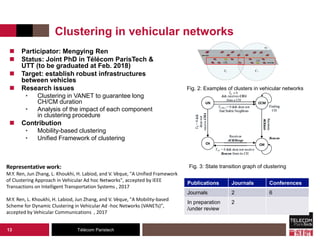
Clustering invehicular networks
Participator: Mengying Ren
Status: Joint PhD in Télécom ParisTech &
UTT (to be graduated at Feb. 2018)
Target: establish robust infrastructures
between vehicles
Research issues
• Clustering in VANET to guarantee long
CH/CM duration
• Analysis of the impact of each component
in clustering procedure
Contribution
• Mobility-based clustering
• Unified Framework of clustering
Publications Journals Conferences
Journals 2 6
In preparation
/under review
2
Fig. 2: Examples of clusters in vehicular networks
Fig. 3: State transition graph of clustering
Representative work:
M.Y. Ren, Jun Zhang, L. Khoukhi, H. Labiod, and V. Vèque, "A Unified Framework
of Clustering Approach in Vehicular Ad hoc Networks", accepted by IEEE
Transactions on Intelligent Transportation Systems , 2017
M.Y. Ren, L. Khoukhi, H. Labiod, Jun Zhang, and V. Vèque, "A Mobility-based
Scheme for Dynamic Clustering in Vehicular Ad -hoc Networks (VANETs)",
accepted by Vehicular Communications , 2017
14.
Télécom Paristech
Data disseminationin vehicular networks
14
Participator: Jun Zhang
Status: Postdoc researcher
Target: enable high-speed transmission in vehicular networks
Research issues
• Information dissemination via evolutionary game theory (EGT)
• Offloading in hybrid LTE-vehicle networks
• Mobility pattern prediction for vehicles
• Analytical model for clustering in vehicular networks
• Privacy-aware data delivery in hybrid D2D-V2V networks
Contribution
• EGT-based information dissemination scheme
• Joint active time and flow selection model for cellular content retrieval through ITS
• Simulator-independent clustering algorithms comparison framework
• Machin learning based link duration prediction
Publications Journals Conferences
Journals 5 9
Representative work:
Jun Zhang, Mengying Ren, Houda Labiod, and Lyes Khoukhi, "
Link Duration Prediction in VANETs via AdaBoost", in IEEE
GLOBECOM 2017
Jun Zhang, Vincent Gauthier, Houda Labiod, Abhik Banerjee,
and Hossam Afifi, "Information Dissemination in Vehicular
Networks via Evolutionary Game Theory", in IEEE ICC 2014
15.
Télécom Paristech
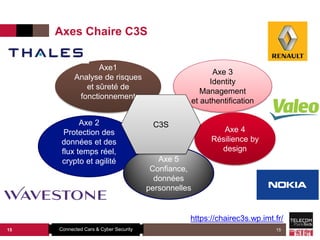
Axes ChaireC3S
15
Axe 3
Identity
Management
et authentification
Axe 2
Protection des
données et des
flux temps réel,
crypto et agilité
Axe1
Analyse de risques
et sûreté de
fonctionnement
Axe 4
Résilience by
design
Axe 5
Confiance,
données
personnelles
C3S
Connected Cars & Cyber Security
https://chairec3s.wp.imt.fr/
15