Le paradoxe de la fiction Elena Pasquinelli
Le paradoxe de la fiction La fiction comme simulation Limites de la théorie de la simulation Simuler les émotions (Daniela Tagliafico) Simuler dans l’abstraction
Le paradoxe de la fiction en bref Comment peut-on s’émouvoir pour le destin de Anna Karenina? (Radford, 1975) Si on prouve des émotions c’est qu’on croit à la réalité de Anna Karenina Mais nous savons qu’Anna Karenina n’existe pas Pourtant, nous éprouvons des émotions pour Anna Karenina Donc, nous avons une reaction irrationnelle face aux oeuvres de fiction
3 stratégies pour sortir du paradoxe Nier 1: Théorie de la Pensée (Carroll, 1990); Théorie de la Simulation (Currie, 1995) Nier 2: Théorie de l’Illusion (Anderson, 1996) Nier 3: Théorie du Faire semblant (Walton, 1978) Images et sons sont “Props”  pour imaginer, entrer dans un jeu de faire semblant où on ressent des quasi-émotions pour des objets de fiction  Imaginer = construire des vérités de fiction, des propositions du type: “Il est fictionnellement vrai que …” La même activité d’imagination est impliquée dans le cas des oeuvres figuratives et abstraites
Rôles possibles de la bande son (Thom, 1999) Telling a film story, like telling any kind of story, is about creating connections between  characters, places, objects, experiences, and ideas.  You try to invent a world which is  complex and many layered, like the real world.  But unlike most of real life (which tends  to be badly written and edited), in a good film a set of themes emerge which embody a  clearly identifiable line or arc, which is the story.   […]  The description above doesn’t say anything specific about the possible use of sound in  this story, but I have chosen basic story elements which hold vast potential for sound. First, it will be natural to tell the story more-or-less through the pov of our  central character.  But that’s not all.  A steel mill gives us a huge palette for sound.  Most importantly, it is a place which we can manipulate to produce a set of sounds  which range from banal to exciting to frightening to weird to comforting to ugly to  beautiful.  The place can therefore become a character, and have its own voice, with a  range of "emotions"  and "moods."   And the sounds of the mill can resonate with a wide  variety of elements elsewhere in the story.  None of this good stuff is likely to happen  unless we write, shoot, and edit the story in a way that allows it to happen.  
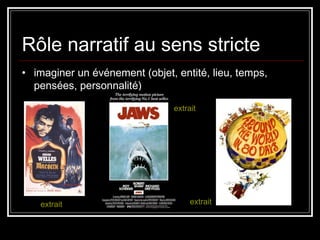
Rôle narratif au sens stricte imaginer un événement (objet, entité, lieu, temps, pensées, personnalité) extrait extrait extrait
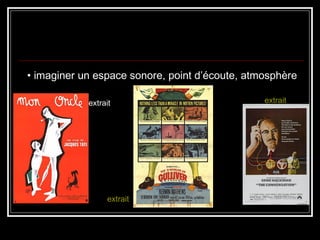
imaginer un espace sonore, point d’écoute, atmosphère extrait extrait extrait
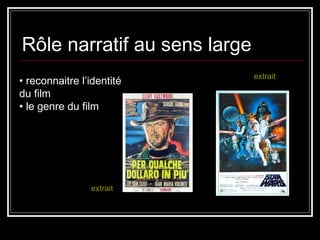
Rôle narratif au sens large reconnaitre l’identité  du film le genre du film extrait extrait
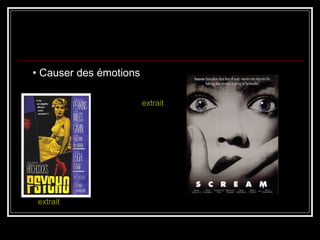
extrait Causer des émotions extrait
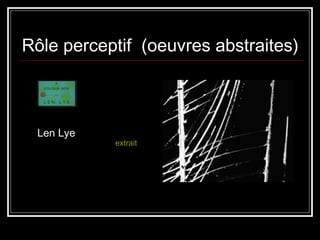
Rôle perceptif  (oeuvres abstraites) Len Lye extrait
Quel type de fonctions cognitives sont en cause dans le cas d’œuvres sans contenu narratif ? Sont-elles différentes des fonctions qui sont en cause dans le cas de la fiction narrative ? Peut-on encore parler d’imagination (Walton 2001)?
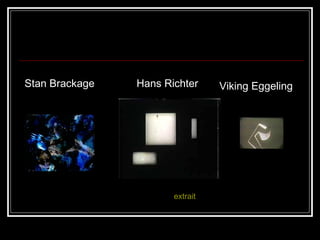
Stan Brackage Hans Richter Viking Eggeling extrait
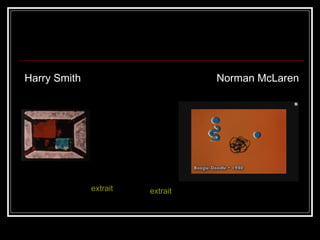
Harry Smith Norman McLaren extrait extrait
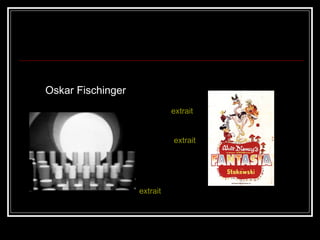
Oskar Fischinger  extrait extrait extrait
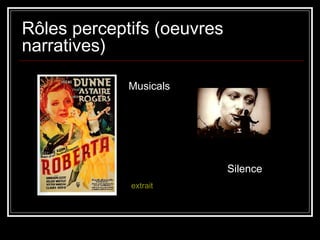
Rôles perceptifs (oeuvres narratives) Musicals extrait Silence
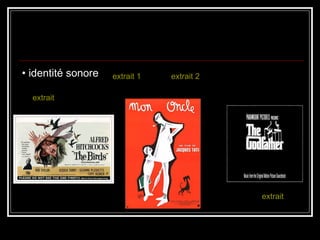
extrait extrait extrait  1 extrait  2 identité sonore

Le paradoxe de la fiction

  • 1.
    Le paradoxe dela fiction Elena Pasquinelli
  • 2.
    Le paradoxe dela fiction La fiction comme simulation Limites de la théorie de la simulation Simuler les émotions (Daniela Tagliafico) Simuler dans l’abstraction
  • 3.
    Le paradoxe dela fiction en bref Comment peut-on s’émouvoir pour le destin de Anna Karenina? (Radford, 1975) Si on prouve des émotions c’est qu’on croit à la réalité de Anna Karenina Mais nous savons qu’Anna Karenina n’existe pas Pourtant, nous éprouvons des émotions pour Anna Karenina Donc, nous avons une reaction irrationnelle face aux oeuvres de fiction
  • 4.
    3 stratégies poursortir du paradoxe Nier 1: Théorie de la Pensée (Carroll, 1990); Théorie de la Simulation (Currie, 1995) Nier 2: Théorie de l’Illusion (Anderson, 1996) Nier 3: Théorie du Faire semblant (Walton, 1978) Images et sons sont “Props” pour imaginer, entrer dans un jeu de faire semblant où on ressent des quasi-émotions pour des objets de fiction Imaginer = construire des vérités de fiction, des propositions du type: “Il est fictionnellement vrai que …” La même activité d’imagination est impliquée dans le cas des oeuvres figuratives et abstraites
  • 5.
    Rôles possibles dela bande son (Thom, 1999) Telling a film story, like telling any kind of story, is about creating connections between  characters, places, objects, experiences, and ideas.  You try to invent a world which is  complex and many layered, like the real world.  But unlike most of real life (which tends  to be badly written and edited), in a good film a set of themes emerge which embody a  clearly identifiable line or arc, which is the story.   […] The description above doesn’t say anything specific about the possible use of sound in  this story, but I have chosen basic story elements which hold vast potential for sound. First, it will be natural to tell the story more-or-less through the pov of our  central character.  But that’s not all.  A steel mill gives us a huge palette for sound.  Most importantly, it is a place which we can manipulate to produce a set of sounds  which range from banal to exciting to frightening to weird to comforting to ugly to  beautiful. The place can therefore become a character, and have its own voice, with a  range of "emotions"  and "moods."   And the sounds of the mill can resonate with a wide  variety of elements elsewhere in the story.  None of this good stuff is likely to happen  unless we write, shoot, and edit the story in a way that allows it to happen.  
  • 6.
    Rôle narratif ausens stricte imaginer un événement (objet, entité, lieu, temps, pensées, personnalité) extrait extrait extrait
  • 7.
    imaginer un espacesonore, point d’écoute, atmosphère extrait extrait extrait
  • 8.
    Rôle narratif ausens large reconnaitre l’identité du film le genre du film extrait extrait
  • 9.
    extrait Causer desémotions extrait
  • 10.
    Rôle perceptif (oeuvres abstraites) Len Lye extrait
  • 11.
    Quel type defonctions cognitives sont en cause dans le cas d’œuvres sans contenu narratif ? Sont-elles différentes des fonctions qui sont en cause dans le cas de la fiction narrative ? Peut-on encore parler d’imagination (Walton 2001)?
  • 12.
    Stan Brackage HansRichter Viking Eggeling extrait
  • 13.
    Harry Smith NormanMcLaren extrait extrait
  • 14.
    Oskar Fischinger extrait extrait extrait
  • 15.
    Rôles perceptifs (oeuvresnarratives) Musicals extrait Silence
  • 16.
    extrait extrait extrait 1 extrait 2 identité sonore