L E S A D J E C T I F S QU A L I FI C A T I F S .
PO S S E S I F S
D E M O N S T R T I FS
LES ADJECTIFS
LES ADJECTIFS QUALIFICATIFS
 ADJECTIVES QUALIFY A NOUN
 IN FRENCH GRAMMER , ADJECTIVES AGREE IN
NUMBER AND GENDER WITH THE NOUN.
 MOST ADJECTIVES IN FRENCH ARE PLACED
AFTER THE NOUN
 SOME SHORT AND COMMONLY USED
ADJECTIVES PRECEDE THE NOUNS
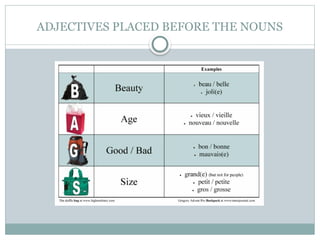
ADJECTIVES PLACED BEFORE THE NOUNS
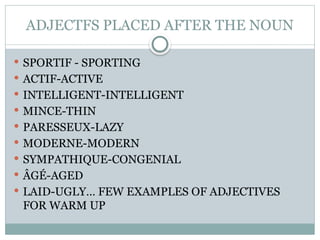
ADJECTFS PLACED AFTER THE NOUN
 SPORTIF - SPORTING
 ACTIF-ACTIVE
 INTELLIGENT-INTELLIGENT
 MINCE-THIN
 PARESSEUX-LAZY
 MODERNE-MODERN
 SYMPATHIQUE-CONGENIAL
 ÂGÉ-AGED
 LAID-UGLY… FEW EXAMPLES OF ADJECTIVES
FOR WARM UP
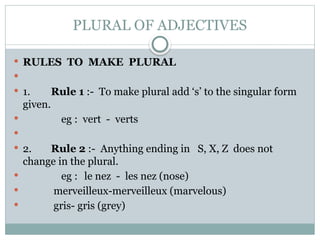
PLURAL OF ADJECTIVES
 RULES TO MAKE PLURAL

 1. Rule 1 :- To make plural add ‘s’ to the singular form
given.
 eg : vert - verts

 2. Rule 2 :- Anything ending in S, X, Z does not
change in the plural.
 eg : le nez - les nez (nose)
 merveilleux-merveilleux (marvelous)
 gris- gris (grey)
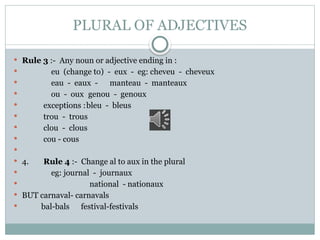
PLURAL OF ADJECTIVES
 Rule 3 :- Any noun or adjective ending in :
 eu (change to) - eux - eg: cheveu - cheveux
 eau - eaux - manteau - manteaux
 ou - oux genou - genoux
 exceptions :bleu - bleus
 trou - trous
 clou - clous
 cou - cous

 4. Rule 4 :- Change al to aux in the plural
 eg: journal - journaux
 national - nationaux
 BUT carnaval- carnavals
 bal-bals festival-festivals
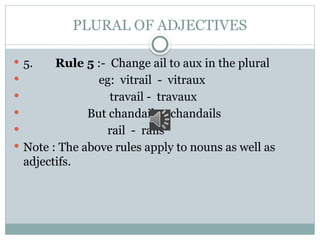
PLURAL OF ADJECTIVES
 5. Rule 5 :- Change ail to aux in the plural
 eg: vitrail - vitraux
 travail - travaux
 But chandail - chandails
 rail - rails
 Note : The above rules apply to nouns as well as
adjectifs.
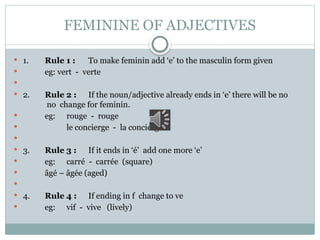
FEMININE OF ADJECTIVES
 1. Rule 1 : To make feminin add ‘e’ to the masculin form given
 eg: vert - verte

 2. Rule 2 : If the noun/adjective already ends in ‘e’ there will be no
no change for feminin.
 eg: rouge - rouge
 le concierge - la concierge

 3. Rule 3 : If it ends in ‘é’ add one more ‘e’
 eg: carré - carrée (square)
 âgé – âgée (aged)

 4. Rule 4 : If ending in f change to ve
 eg: vif - vive (lively)
FEMININ OF ADJECTIVES
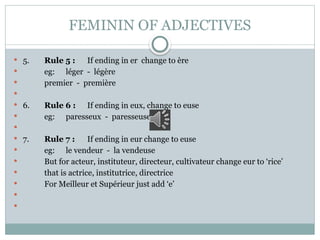
 5. Rule 5 : If ending in er change to ère
 eg: léger - légère
 premier - première

 6. Rule 6 : If ending in eux, change to euse
 eg: paresseux - paresseuse

 7. Rule 7 : If ending in eur change to euse
 eg: le vendeur - la vendeuse
 But for acteur, instituteur, directeur, cultivateur change eur to ‘rice’
 that is actrice, institutrice, directrice
 For Meilleur et Supérieur just add ‘e’


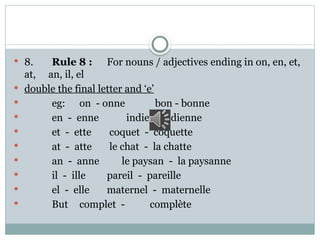
 8. Rule 8 : For nouns / adjectives ending in on, en, et,
at, an, il, el
 double the final letter and ‘e’
 eg: on - onne bon - bonne
 en - enne indien- indienne
 et - ette coquet - coquette
 at - atte le chat - la chatte
 an - anne le paysan - la paysanne
 il - ille pareil - pareille
 el - elle maternel - maternelle
 But complet - complète
IRREQULARS FOR FEMININ
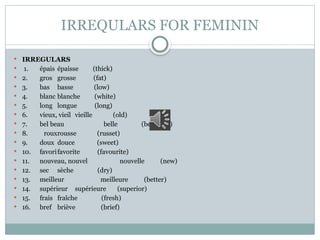
 IRREGULARS
 1. épais épaisse (thick)
 2. gros grosse (fat)
 3. bas basse (low)
 4. blanc blanche (white)
 5. long longue (long)
 6. vieux, vieil vieille (old)
 7. bel beau belle (beautiful)
 8. rouxrousse (russet)
 9. doux douce (sweet)
 10. favorifavorite (favourite)
 11. nouveau, nouvel nouvelle (new)
 12. sec sèche (dry)
 13. meilleur meilleure (better)
 14. supérieur supérieure (superior)
 15. frais fraîche (fresh)
 16. bref briève (brief)
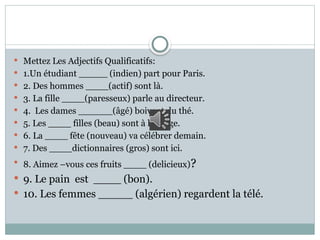
 Mettez Les Adjectifs Qualificatifs:
 1.Un étudiant _____ (indien) part pour Paris.
 2. Des hommes ____(actif) sont là.
 3. La fille ____(paresseux) parle au directeur.
 4. Les dames ______(âgé) boivent du thé.
 5. Les ____ filles (beau) sont à la plage.
 6. La ____ fête (nouveau) va célébrer demain.
 7. Des ____dictionnaires (gros) sont ici.
 8. Aimez –vous ces fruits ____ (delicieux)?
 9. Le pain est ____ (bon).
 10. Les femmes _____ (algérien) regardent la télé.
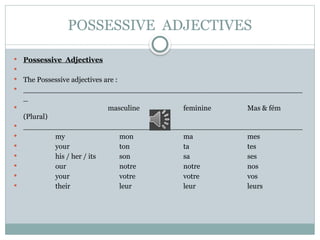
POSSESSIVE ADJECTIVES
 Possessive Adjectives

 The Possessive adjectives are :
 _____________________________________________________________
_
 masculine feminine Mas & fém
(Plural)
 _____________________________________________________________
 my mon ma mes
 your ton ta tes
 his / her / its son sa ses
 our notre notre nos
 your votre votre vos
 their leur leur leurs
 The possessive adjectives agree in number and gender, with the noun that follows, and it has also to
keep track of the person in which the verb is conjugated.
 eg: Je donne mon livre au garçon.
 [masculine+singular] + 1st PS [Je]
 Very important rule to these adjectives is, if a noun is feminine and it begins with a vowel, then the
possessive adjective used will be masculine.
 eg:1) mon amie : (feminin noun begining with a vowel) so for my friend it will be
 mon amie and not ma amie

 MA will be MON before a
TA TON e
 SA SON i
o
 u
 h(muet)

 eg: 2)Not [ma] but mon oreille feminine noun beginning with a vowel
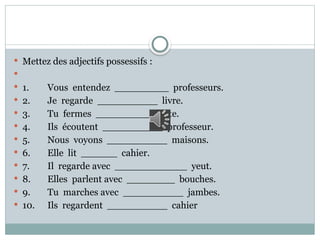
 Mettez des adjectifs possessifs :

 1. Vous entendez _________ professeurs.
 2. Je regarde __________ livre.
 3. Tu fermes _________ porte.
 4. Ils écoutent __________ professeur.
 5. Nous voyons __________ maisons.
 6. Elle lit ______ cahier.
 7. Il regarde avec ____________ yeut.
 8. Elles parlent avec ________ bouches.
 9. Tu marches avec __________ jambes.
 10. Ils regardent __________ cahier
DEMONSTRATIVE AJECTIVES
 Demonstrative Adjectives (Les adjectifs démonstratifs)
 The demonstrative adjectives in french are :
 Ce masculine singular
 This or That Cet masculine singular (beginning with a vowel)
 Cette feminine singular
 These or Those Ces masculine & feminine plural

 These adjectives are put according to the number and gender of the noun it follows.
 For Eg: 1.cette fille ( this/that girl) 2. ces bateaux (these /those boats)
 But for masculine singular nouns beginning with a vowel, instead of ‘Ce’ put ‘Cet’
 For Eg 1):Not ‘Ce’ but Cet homme [‘homme’ is masuline singular noun begining with a vowel]
 Ex 2) Cet oiseau (‘oiseau’ is masculine singular noun beginning with a vowel)
 Therefore ‘Ce’ will be ‘Cet’ before masculine singular nouns beginning with a vowel


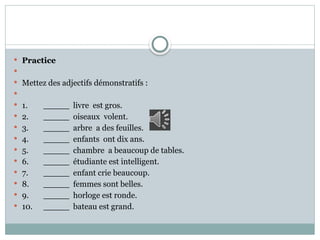
 Practice

 Mettez des adjectifs démonstratifs :

 1. _____ livre est gros.
 2. _____ oiseaux volent.
 3. _____ arbre a des feuilles.
 4. _____ enfants ont dix ans.
 5. _____ chambre a beaucoup de tables.
 6. _____ étudiante est intelligent.
 7. _____ enfant crie beaucoup.
 8. _____ femmes sont belles.
 9. _____ horloge est ronde.
 10. _____ bateau est grand.

ADJECTIVES, pronom personelles for different persons

  • 1.
    L E SA D J E C T I F S QU A L I FI C A T I F S . PO S S E S I F S D E M O N S T R T I FS LES ADJECTIFS
  • 2.
    LES ADJECTIFS QUALIFICATIFS ADJECTIVES QUALIFY A NOUN  IN FRENCH GRAMMER , ADJECTIVES AGREE IN NUMBER AND GENDER WITH THE NOUN.  MOST ADJECTIVES IN FRENCH ARE PLACED AFTER THE NOUN  SOME SHORT AND COMMONLY USED ADJECTIVES PRECEDE THE NOUNS
  • 3.
  • 4.
    ADJECTFS PLACED AFTERTHE NOUN  SPORTIF - SPORTING  ACTIF-ACTIVE  INTELLIGENT-INTELLIGENT  MINCE-THIN  PARESSEUX-LAZY  MODERNE-MODERN  SYMPATHIQUE-CONGENIAL  ÂGÉ-AGED  LAID-UGLY… FEW EXAMPLES OF ADJECTIVES FOR WARM UP
  • 5.
    PLURAL OF ADJECTIVES RULES TO MAKE PLURAL   1. Rule 1 :- To make plural add ‘s’ to the singular form given.  eg : vert - verts   2. Rule 2 :- Anything ending in S, X, Z does not change in the plural.  eg : le nez - les nez (nose)  merveilleux-merveilleux (marvelous)  gris- gris (grey)
  • 6.
    PLURAL OF ADJECTIVES Rule 3 :- Any noun or adjective ending in :  eu (change to) - eux - eg: cheveu - cheveux  eau - eaux - manteau - manteaux  ou - oux genou - genoux  exceptions :bleu - bleus  trou - trous  clou - clous  cou - cous   4. Rule 4 :- Change al to aux in the plural  eg: journal - journaux  national - nationaux  BUT carnaval- carnavals  bal-bals festival-festivals
  • 7.
    PLURAL OF ADJECTIVES 5. Rule 5 :- Change ail to aux in the plural  eg: vitrail - vitraux  travail - travaux  But chandail - chandails  rail - rails  Note : The above rules apply to nouns as well as adjectifs.
  • 8.
    FEMININE OF ADJECTIVES 1. Rule 1 : To make feminin add ‘e’ to the masculin form given  eg: vert - verte   2. Rule 2 : If the noun/adjective already ends in ‘e’ there will be no no change for feminin.  eg: rouge - rouge  le concierge - la concierge   3. Rule 3 : If it ends in ‘é’ add one more ‘e’  eg: carré - carrée (square)  âgé – âgée (aged)   4. Rule 4 : If ending in f change to ve  eg: vif - vive (lively)
  • 9.
    FEMININ OF ADJECTIVES 5. Rule 5 : If ending in er change to ère  eg: léger - légère  premier - première   6. Rule 6 : If ending in eux, change to euse  eg: paresseux - paresseuse   7. Rule 7 : If ending in eur change to euse  eg: le vendeur - la vendeuse  But for acteur, instituteur, directeur, cultivateur change eur to ‘rice’  that is actrice, institutrice, directrice  For Meilleur et Supérieur just add ‘e’  
  • 10.
     8. Rule8 : For nouns / adjectives ending in on, en, et, at, an, il, el  double the final letter and ‘e’  eg: on - onne bon - bonne  en - enne indien- indienne  et - ette coquet - coquette  at - atte le chat - la chatte  an - anne le paysan - la paysanne  il - ille pareil - pareille  el - elle maternel - maternelle  But complet - complète
  • 11.
    IRREQULARS FOR FEMININ IRREGULARS  1. épais épaisse (thick)  2. gros grosse (fat)  3. bas basse (low)  4. blanc blanche (white)  5. long longue (long)  6. vieux, vieil vieille (old)  7. bel beau belle (beautiful)  8. rouxrousse (russet)  9. doux douce (sweet)  10. favorifavorite (favourite)  11. nouveau, nouvel nouvelle (new)  12. sec sèche (dry)  13. meilleur meilleure (better)  14. supérieur supérieure (superior)  15. frais fraîche (fresh)  16. bref briève (brief)
  • 12.
     Mettez LesAdjectifs Qualificatifs:  1.Un étudiant _____ (indien) part pour Paris.  2. Des hommes ____(actif) sont là.  3. La fille ____(paresseux) parle au directeur.  4. Les dames ______(âgé) boivent du thé.  5. Les ____ filles (beau) sont à la plage.  6. La ____ fête (nouveau) va célébrer demain.  7. Des ____dictionnaires (gros) sont ici.  8. Aimez –vous ces fruits ____ (delicieux)?  9. Le pain est ____ (bon).  10. Les femmes _____ (algérien) regardent la télé.
  • 13.
    POSSESSIVE ADJECTIVES  PossessiveAdjectives   The Possessive adjectives are :  _____________________________________________________________ _  masculine feminine Mas & fém (Plural)  _____________________________________________________________  my mon ma mes  your ton ta tes  his / her / its son sa ses  our notre notre nos  your votre votre vos  their leur leur leurs
  • 14.
     The possessiveadjectives agree in number and gender, with the noun that follows, and it has also to keep track of the person in which the verb is conjugated.  eg: Je donne mon livre au garçon.  [masculine+singular] + 1st PS [Je]  Very important rule to these adjectives is, if a noun is feminine and it begins with a vowel, then the possessive adjective used will be masculine.  eg:1) mon amie : (feminin noun begining with a vowel) so for my friend it will be  mon amie and not ma amie   MA will be MON before a TA TON e  SA SON i o  u  h(muet)   eg: 2)Not [ma] but mon oreille feminine noun beginning with a vowel
  • 15.
     Mettez desadjectifs possessifs :   1. Vous entendez _________ professeurs.  2. Je regarde __________ livre.  3. Tu fermes _________ porte.  4. Ils écoutent __________ professeur.  5. Nous voyons __________ maisons.  6. Elle lit ______ cahier.  7. Il regarde avec ____________ yeut.  8. Elles parlent avec ________ bouches.  9. Tu marches avec __________ jambes.  10. Ils regardent __________ cahier
  • 16.
    DEMONSTRATIVE AJECTIVES  DemonstrativeAdjectives (Les adjectifs démonstratifs)  The demonstrative adjectives in french are :  Ce masculine singular  This or That Cet masculine singular (beginning with a vowel)  Cette feminine singular  These or Those Ces masculine & feminine plural   These adjectives are put according to the number and gender of the noun it follows.  For Eg: 1.cette fille ( this/that girl) 2. ces bateaux (these /those boats)  But for masculine singular nouns beginning with a vowel, instead of ‘Ce’ put ‘Cet’  For Eg 1):Not ‘Ce’ but Cet homme [‘homme’ is masuline singular noun begining with a vowel]  Ex 2) Cet oiseau (‘oiseau’ is masculine singular noun beginning with a vowel)  Therefore ‘Ce’ will be ‘Cet’ before masculine singular nouns beginning with a vowel  
  • 17.
     Practice   Mettezdes adjectifs démonstratifs :   1. _____ livre est gros.  2. _____ oiseaux volent.  3. _____ arbre a des feuilles.  4. _____ enfants ont dix ans.  5. _____ chambre a beaucoup de tables.  6. _____ étudiante est intelligent.  7. _____ enfant crie beaucoup.  8. _____ femmes sont belles.  9. _____ horloge est ronde.  10. _____ bateau est grand.