ALF
Parser Bottom-Up
Bibliographie pour aujourd'hui
Keith Cooper, Linda Torczon, Engineering a Compiler
– Chapitre 3
• 3.4
Alfred V. Aho, Monica S. Lam, Ravi Sethi, Jeffrey D.
Ullman, Compilers: Principles, Techniques, and Tools (2nd
Edition)
– Chapitre 4
• 4.5
• 4.6
• 4.7.4
Contenu
• LR
• SLR
• LALR
Limor Fried
• Américain
• MIT
• Adafruit
• STEM
Slides
Partie de slides sont écrie par
Bogdan Nitulescu
Notation BNF
RFC 2616 HTTP/1.1 June 1999
HTTP-date = rfc1123-date | rfc850-date | asctime-date
rfc1123-date = wkday "," SP date1 SP time SP "GMT“
rfc850-date = weekday "," SP date2 SP time SP "GMT“
asctime-date = wkday SP date3 SP time SP 4DIGIT
date1 = 2DIGIT SP month SP 4DIGIT
; day month year (e.g., 02 Jun 1982)
date2 = 2DIGIT "-" month "-" 2DIGIT
; day-month-year (e.g., 02-Jun-82)
date3 = month SP ( 2DIGIT | ( SP 1DIGIT ))
; month day (e.g., Jun 2)
time = 2DIGIT ":" 2DIGIT ":" 2DIGIT
; 00:00:00 - 23:59:59
wkday = "Mon" | "Tue" | "Wed“
| "Thu" | "Fri" | "Sat" | "Sun“
weekday = "Monday" | "Tuesday" | "Wednesday“
| "Thursday" | "Friday" | "Saturday" | "Sunday“
month = "Jan" | "Feb" | "Mar" | "Apr“
| "May" | "Jun" | "Jul" | "Aug"
| "Sep" | "Oct" | "Nov" | "Dec"
Arbre de dérivation / syntactique
E  E + E
E  E * E
E  n
n : [0-9]+
Lexer
2 * 3 + 4 * 5
n * n + n * n
2 3 4 5
parser
n n n n
2 3 4 5
* *
+
n n n n
2 3 4 5
E * E E * E
E + E
E
• jetons (tokens)
• Valeurs
• Grammaire
• Arbre de dérivation
• Arbre syntactique
Types d’analyse syntactique
 Descendent (top-down)
 Avec backtracking
 Prédictive
 Descendent récursive, LL avec un tableau
 Ascendant (bottom-up)
 Avec backtracking
 Shift-reduce
 LR(0),SLR,LALR, LR canonique
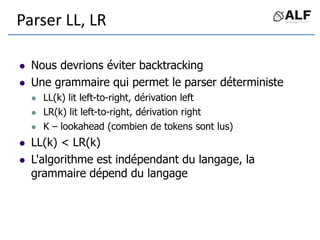
Parser LL, LR
 Nous devrions éviter backtracking
 Une grammaire qui permet le parser déterministe
 LL(k) lit left-to-right, dérivation left
 LR(k) lit left-to-right, dérivation right
 K – lookahead (combien de tokens sont lus)
 LL(k) < LR(k)
 L'algorithme est indépendant du langage, la
grammaire dépend du langage
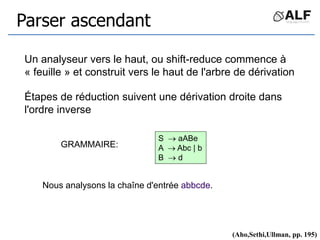
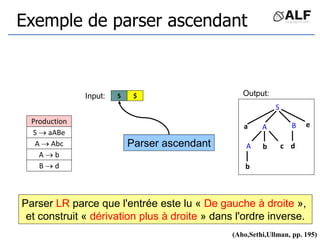
Parser ascendant
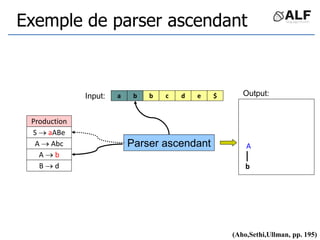
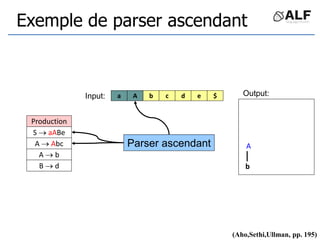
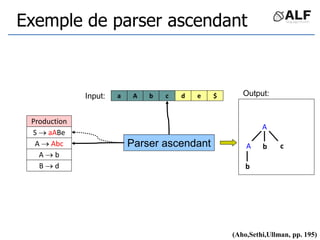
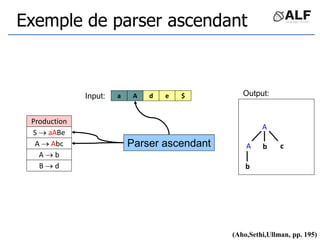
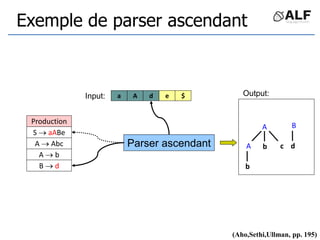
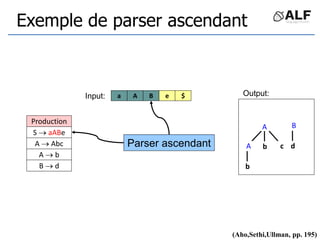
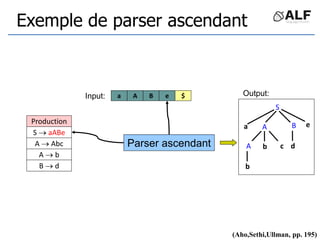
Un analyseur vers le haut, ou shift-reduce commence à
« feuille » et construit vers le haut de l'arbre de dérivation
Étapes de réduction suivent une dérivation droite dans
l'ordre inverse
S  aABe
A  Abc | b
B  d
GRAMMAIRE:
Nous analysons la chaîne d'entrée abbcde.
(Aho,Sethi,Ullman, pp. 195)
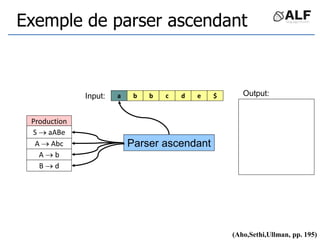
Exemple de parser ascendant
a d
b
b c
Input:
Parser ascendant
e Output:
$
Production
S  aABe
A  Abc
A  b
B  d
(Aho,Sethi,Ullman, pp. 195)
S  aABe
Exemple de parser ascendant
a d
b
b c
Parser ascendant
e
A
b
$
S  aABe
A  Abc
A  b
B  d
(Aho,Sethi,Ullman, pp. 195)
Input: Output:
Production
Exemple de parser ascendant
a d
b
A c
Parser ascendant
e
A
b
$
S  aABe
A  Abc
A  b
B  d
(Aho,Sethi,Ullman, pp. 195)
Input: Output:
Production
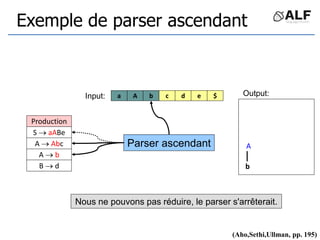
Nous ne pouvons pas réduire, le parser s'arrêterait.
Exemple de parser ascendant
a d
b
A c
Parser ascendant
e
A
b
$
S  aABe
A  Abc
A  b
B  d
(Aho,Sethi,Ullman, pp. 195)
Input: Output:
Production
Exemple de parser ascendant
a d
b
A c
Parser ascendant
e
A
b
$
S  aABe
A  Abc
A  b
B  d
c
A
b
(Aho,Sethi,Ullman, pp. 195)
Input: Output:
Production
Exemple de parser ascendant
a d
A
Parser ascendant
e
A c
A
b
$
S  aABe
A  Abc
A  b
B  d
b
(Aho,Sethi,Ullman, pp. 195)
Input: Output:
Production
Exemple de parser ascendant
a d
A
Parser ascendant
e
A c
A
b
$
S  aABe
A  Abc
A  b
B  d
b
B
d
(Aho,Sethi,Ullman, pp. 195)
Input: Output:
Production
Exemple de parser ascendant
a B
A
Parser ascendant
e
A c
A
b
$
S  aABe
A  Abc
A  b
B  d
b
B
d
(Aho,Sethi,Ullman, pp. 195)
Input: Output:
Production
Exemple de parser ascendant
a B
A
Parser ascendant
e
A c
A
b
$
S  aABe
A  Abc
A  b
B  d
b
B
d
a
S
e
(Aho,Sethi,Ullman, pp. 195)
Input: Output:
Production
Exemple de parser ascendant
S
Parser ascendant A c
A
b
$
S  aABe
A  Abc
A  b
B  d
b
B
d
a
S
e
Parser LR parce que l'entrée este lu « De gauche à droite »,
et construit « dérivation plus à droite » dans l'ordre inverse.
(Aho,Sethi,Ullman, pp. 195)
Input: Output:
Production
Exemple de parser ascendant
• Analyse les productions pour le match
avec le texte d'entrée
• Backtracking
• Inefficace
• Pouvons-nous faire mieux?
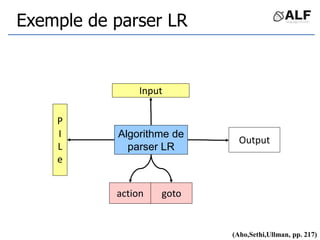
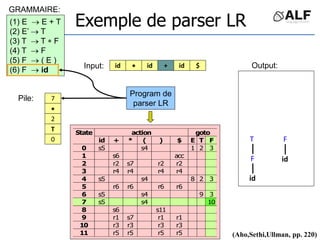
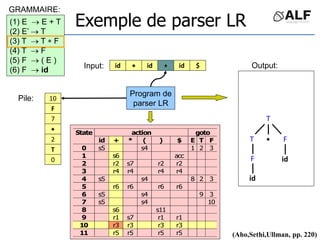
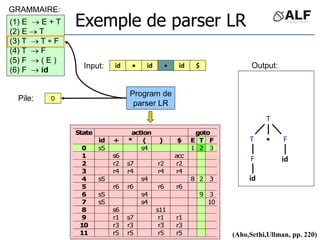
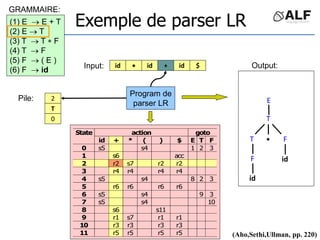
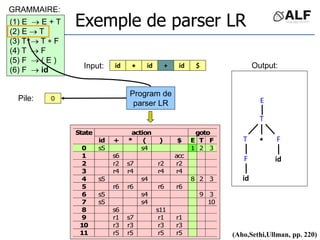
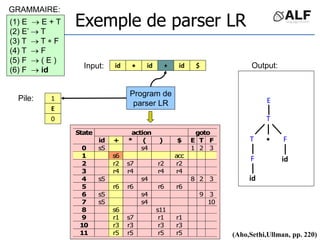
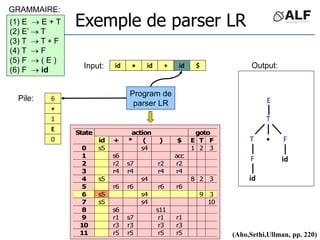
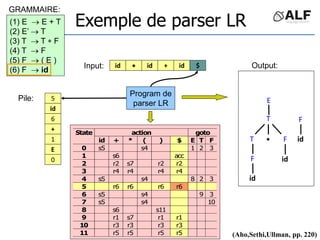
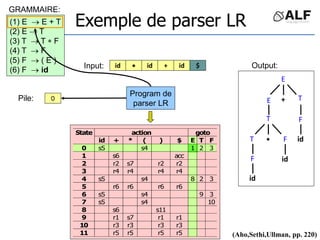
Exemple de parser LR
Input
P
I
L
e
Algorithme de
parser LR
action goto
Output
(Aho,Sethi,Ullman, pp. 217)
Exemple de parser LR
action goto
State
id + * ( ) $ E T F
0 s5 s4 1 2 3
1 s6 acc
2 r2 s7 r2 r2
3 r4 r4 r4 r4
4 s5 s4 8 2 3
5 r6 r6 r6 r6
6 s5 s4 9 3
7 s5 s4 10
8 s6 s11
9 r1 s7 r1 r1
10 r3 r3 r3 r3
11 r5 r5 r5 r5
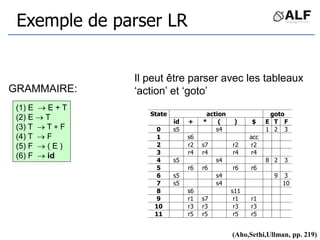
GRAMMAIRE:
(1) E  E + T
(2) E  T
(3) T  T  F
(4) T  F
(5) F  ( E )
(6) F  id
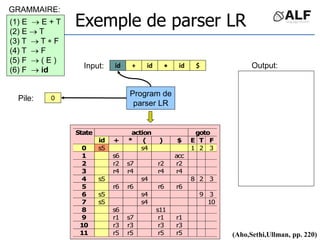
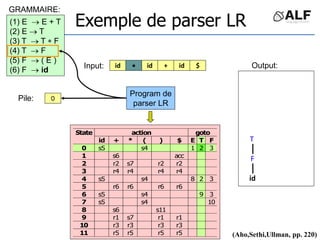
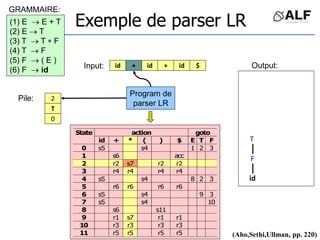
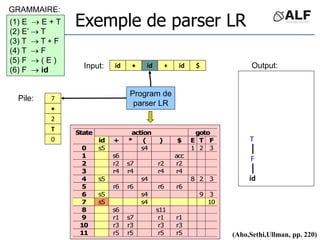
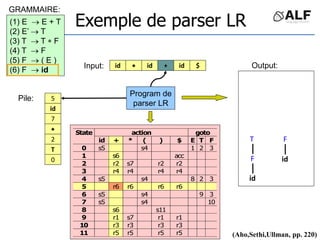
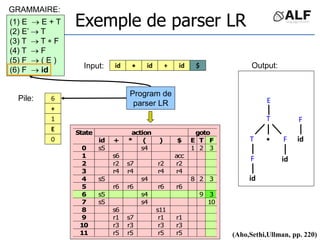
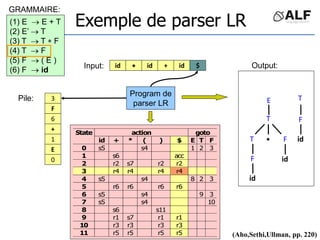
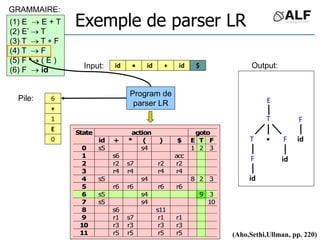
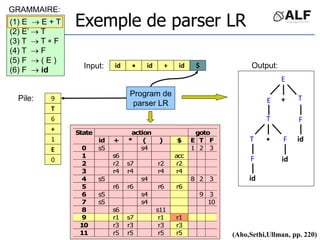
Il peut être parser avec les tableaux
‘action’ et ‘goto’
(Aho,Sethi,Ullman, pp. 219)
Exemple de parser LR
id id
id
+ 
Input: $
Pile: E
0
(1) E  E + T
(2) E  T
(3) T  T  F
(4) T  F
(5) F  ( E )
(6) F  id
Program de
parser LR
action goto
State
id + * ( ) $ E T F
0 s5 s4 1 2 3
1 s6 acc
2 r2 s7 r2 r2
3 r4 r4 r4 r4
4 s5 s4 8 2 3
5 r6 r6 r6 r6
6 s5 s4 9 3
7 s5 s4 10
8 s6 s11
9 r1 s7 r1 r1
10 r3 r3 r3 r3
11 r5 r5 r5 r5
GRAMMAIRE:
Output:
(Aho,Sethi,Ullman, pp. 220)
id id
id
 + $
(1) E  E + T
(2) E  T
(3) T  T  F
(4) T  F
(5) F  ( E )
(6) F  id
E
5
id
0
action goto
State
id + * ( ) $ E T F
0 s5 s4 1 2 3
1 s6 acc
2 r2 s7 r2 r2
3 r4 r4 r4 r4
4 s5 s4 8 2 3
5 r6 r6 r6 r6
6 s5 s4 9 3
7 s5 s4 10
8 s6 s11
9 r1 s7 r1 r1
10 r3 r3 r3 r3
11 r5 r5 r5 r5
F
id
(Aho,Sethi,Ullman, pp. 220)
Exemple de parser LR
Input:
Pile:
Program de
parser LR
GRAMMAIRE:
Output:
0
id id
id
 + $
(1) E  E + T
(2) E  T
(3) T  T  F
(4) T  F
(5) F  ( E )
(6) F  id
action goto
State
id + * ( ) $ E T F
0 s5 s4 1 2 3
1 s6 acc
2 r2 s7 r2 r2
3 r4 r4 r4 r4
4 s5 s4 8 2 3
5 r6 r6 r6 r6
6 s5 s4 9 3
7 s5 s4 10
8 s6 s11
9 r1 s7 r1 r1
10 r3 r3 r3 r3
11 r5 r5 r5 r5
F
id
(Aho,Sethi,Ullman, pp. 220)
Exemple de parser LR
Input:
Pile:
Program de
parser LR
GRAMMAIRE:
Output:
E
3
F
0
id id
id
 + $
(1) E  E + T
(2) E  T
(3) T  T  F
(4) T  F
(5) F  ( E )
(6) F  id
action goto
State
id + * ( ) $ E T F
0 s5 s4 1 2 3
1 s6 acc
2 r2 s7 r2 r2
3 r4 r4 r4 r4
4 s5 s4 8 2 3
5 r6 r6 r6 r6
6 s5 s4 9 3
7 s5 s4 10
8 s6 s11
9 r1 s7 r1 r1
10 r3 r3 r3 r3
11 r5 r5 r5 r5
T
F
id
(Aho,Sethi,Ullman, pp. 220)
Exemple de parser LR
Input:
Pile:
Program de
parser LR
GRAMMAIRE:
Output:
0
id id
id
 + $
(1) E  E + T
(2) E  T
(3) T  T  F
(4) T  F
(5) F  ( E )
(6) F  id
action goto
State
id + * ( ) $ E T F
0 s5 s4 1 2 3
1 s6 acc
2 r2 s7 r2 r2
3 r4 r4 r4 r4
4 s5 s4 8 2 3
5 r6 r6 r6 r6
6 s5 s4 9 3
7 s5 s4 10
8 s6 s11
9 r1 s7 r1 r1
10 r3 r3 r3 r3
11 r5 r5 r5 r5
T
F
id
(Aho,Sethi,Ullman, pp. 220)
Exemple de parser LR
Input:
Pile:
Program de
parser LR
GRAMMAIRE:
Output:
id id
id
 + $
(1) E  E + T
(2) E  T
(3) T  T  F
(4) T  F
(5) F  ( E )
(6) F  id
E
2
T
0
action goto
State
id + * ( ) $ E T F
0 s5 s4 1 2 3
1 s6 acc
2 r2 s7 r2 r2
3 r4 r4 r4 r4
4 s5 s4 8 2 3
5 r6 r6 r6 r6
6 s5 s4 9 3
7 s5 s4 10
8 s6 s11
9 r1 s7 r1 r1
10 r3 r3 r3 r3
11 r5 r5 r5 r5
T
F
id
(Aho,Sethi,Ullman, pp. 220)
Exemple de parser LR
Input:
Pile:
Program de
parser LR
GRAMMAIRE:
Output:
id id
id
 + $
(1) E  E + T
(2) E’  T
(3) T  T  F
(4) T  F
(5) F  ( E )
(6) F  id
action goto
State
id + * ( ) $ E T F
0 s5 s4 1 2 3
1 s6 acc
2 r2 s7 r2 r2
3 r4 r4 r4 r4
4 s5 s4 8 2 3
5 r6 r6 r6 r6
6 s5 s4 9 3
7 s5 s4 10
8 s6 s11
9 r1 s7 r1 r1
10 r3 r3 r3 r3
11 r5 r5 r5 r5
E
7

2
T
0 T
F
id
(Aho,Sethi,Ullman, pp. 220)
Exemple de parser LR
Input:
Pile:
Program de
parser LR
GRAMMAIRE:
Output:
id id
id
 + $
(1) E  E + T
(2) E’  T
(3) T  T  F
(4) T  F
(5) F  ( E )
(6) F  id
E
5
id
7

2
T
0
action goto
State
id + * ( ) $ E T F
0 s5 s4 1 2 3
1 s6 acc
2 r2 s7 r2 r2
3 r4 r4 r4 r4
4 s5 s4 8 2 3
5 r6 r6 r6 r6
6 s5 s4 9 3
7 s5 s4 10
8 s6 s11
9 r1 s7 r1 r1
10 r3 r3 r3 r3
11 r5 r5 r5 r5
T
F
id
F
id
(Aho,Sethi,Ullman, pp. 220)
Exemple de parser LR
Input:
Pile:
Program de
parser LR
GRAMMAIRE:
Output:
id id
id
 + $
(1) E  E + T
(2) E’  T
(3) T  T  F
(4) T  F
(5) F  ( E )
(6) F  id
E
7

2
T
0
action goto
State
id + * ( ) $ E T F
0 s5 s4 1 2 3
1 s6 acc
2 r2 s7 r2 r2
3 r4 r4 r4 r4
4 s5 s4 8 2 3
5 r6 r6 r6 r6
6 s5 s4 9 3
7 s5 s4 10
8 s6 s11
9 r1 s7 r1 r1
10 r3 r3 r3 r3
11 r5 r5 r5 r5
T
F
id
F
id
(Aho,Sethi,Ullman, pp. 220)
Exemple de parser LR
Input:
Pile:
Program de
parser LR
GRAMMAIRE:
Output:
id id
id
 + $
(1) E  E + T
(2) E’  T
(3) T  T  F
(4) T  F
(5) F  ( E )
(6) F  id
E
10
F
7

2
T
0
action goto
State
id + * ( ) $ E T F
0 s5 s4 1 2 3
1 s6 acc
2 r2 s7 r2 r2
3 r4 r4 r4 r4
4 s5 s4 8 2 3
5 r6 r6 r6 r6
6 s5 s4 9 3
7 s5 s4 10
8 s6 s11
9 r1 s7 r1 r1
10 r3 r3 r3 r3
11 r5 r5 r5 r5
T

T F
F
id
id
(Aho,Sethi,Ullman, pp. 220)
Exemple de parser LR
Input:
Pile:
Program de
parser LR
GRAMMAIRE:
Output:
0
id id
id
 + $
(1) E  E + T
(2) E  T
(3) T  T  F
(4) T  F
(5) F  ( E )
(6) F  id
action goto
State
id + * ( ) $ E T F
0 s5 s4 1 2 3
1 s6 acc
2 r2 s7 r2 r2
3 r4 r4 r4 r4
4 s5 s4 8 2 3
5 r6 r6 r6 r6
6 s5 s4 9 3
7 s5 s4 10
8 s6 s11
9 r1 s7 r1 r1
10 r3 r3 r3 r3
11 r5 r5 r5 r5
T

T F
F
id
id
(Aho,Sethi,Ullman, pp. 220)
Exemple de parser LR
Input:
Pile:
Program de
parser LR
GRAMMAIRE:
Output:
id id
id
 + $
(1) E  E + T
(2) E  T
(3) T  T  F
(4) T  F
(5) F  ( E )
(6) F  id
2
T
0 T

T F
F
id
id
action goto
State
id + * ( ) $ E T F
0 s5 s4 1 2 3
1 s6 acc
2 r2 s7 r2 r2
3 r4 r4 r4 r4
4 s5 s4 8 2 3
5 r6 r6 r6 r6
6 s5 s4 9 3
7 s5 s4 10
8 s6 s11
9 r1 s7 r1 r1
10 r3 r3 r3 r3
11 r5 r5 r5 r5
E
(Aho,Sethi,Ullman, pp. 220)
Exemple de parser LR
Input:
Pile:
Program de
parser LR
GRAMMAIRE:
Output:
0
id id
id
 + $
(1) E  E + T
(2) E  T
(3) T  T  F
(4) T  F
(5) F  ( E )
(6) F  id
action goto
State
id + * ( ) $ E T F
0 s5 s4 1 2 3
1 s6 acc
2 r2 s7 r2 r2
3 r4 r4 r4 r4
4 s5 s4 8 2 3
5 r6 r6 r6 r6
6 s5 s4 9 3
7 s5 s4 10
8 s6 s11
9 r1 s7 r1 r1
10 r3 r3 r3 r3
11 r5 r5 r5 r5
T

T F
F
id
id
E
(Aho,Sethi,Ullman, pp. 220)
Exemple de parser LR
Input:
Pile:
Program de
parser LR
GRAMMAIRE:
Output:
id id
id
 + $
(1) E  E + T
(2) E’  T
(3) T  T  F
(4) T  F
(5) F  ( E )
(6) F  id
1
E
0
action goto
State
id + * ( ) $ E T F
0 s5 s4 1 2 3
1 s6 acc
2 r2 s7 r2 r2
3 r4 r4 r4 r4
4 s5 s4 8 2 3
5 r6 r6 r6 r6
6 s5 s4 9 3
7 s5 s4 10
8 s6 s11
9 r1 s7 r1 r1
10 r3 r3 r3 r3
11 r5 r5 r5 r5
T

T F
F
id
id
E
(Aho,Sethi,Ullman, pp. 220)
Exemple de parser LR
Input:
Pile:
Program de
parser LR
GRAMMAIRE:
Output:
id id
id
 + $
(1) E  E + T
(2) E’  T
(3) T  T  F
(4) T  F
(5) F  ( E )
(6) F  id
action goto
State
id + * ( ) $ E T F
0 s5 s4 1 2 3
1 s6 acc
2 r2 s7 r2 r2
3 r4 r4 r4 r4
4 s5 s4 8 2 3
5 r6 r6 r6 r6
6 s5 s4 9 3
7 s5 s4 10
8 s6 s11
9 r1 s7 r1 r1
10 r3 r3 r3 r3
11 r5 r5 r5 r5
T

T F
F
id
id
E
6
+
1
E
0
(Aho,Sethi,Ullman, pp. 220)
Exemple de parser LR
Input:
Pile:
Program de
parser LR
GRAMMAIRE:
Output:
id id
id
 + $
(1) E  E + T
(2) E’  T
(3) T  T  F
(4) T  F
(5) F  ( E )
(6) F  id
action goto
State
id + * ( ) $ E T F
0 s5 s4 1 2 3
1 s6 acc
2 r2 s7 r2 r2
3 r4 r4 r4 r4
4 s5 s4 8 2 3
5 r6 r6 r6 r6
6 s5 s4 9 3
7 s5 s4 10
8 s6 s11
9 r1 s7 r1 r1
10 r3 r3 r3 r3
11 r5 r5 r5 r5
T

T F
F
id
id
E
5
id
6
+
1
E
0
F
id
(Aho,Sethi,Ullman, pp. 220)
Exemple de parser LR
Input:
Pile:
Program de
parser LR
GRAMMAIRE:
Output:
id id
id
 + $
(1) E  E + T
(2) E’  T
(3) T  T  F
(4) T  F
(5) F  ( E )
(6) F  id
T

T F
F
id
id
E
6
+
1
E
0
F
id
action goto
State
id + * ( ) $ E T F
0 s5 s4 1 2 3
1 s6 acc
2 r2 s7 r2 r2
3 r4 r4 r4 r4
4 s5 s4 8 2 3
5 r6 r6 r6 r6
6 s5 s4 9 3
7 s5 s4 10
8 s6 s11
9 r1 s7 r1 r1
10 r3 r3 r3 r3
11 r5 r5 r5 r5 (Aho,Sethi,Ullman, pp. 220)
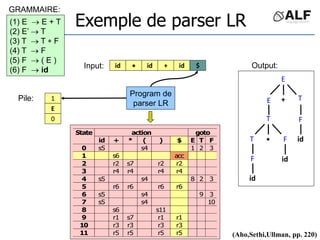
Exemple de parser LR
Input:
Pile:
Program de
parser LR
GRAMMAIRE:
Output:
id id
id
 + $
(1) E  E + T
(2) E’  T
(3) T  T  F
(4) T  F
(5) F  ( E )
(6) F  id
action goto
State
id + * ( ) $ E T F
0 s5 s4 1 2 3
1 s6 acc
2 r2 s7 r2 r2
3 r4 r4 r4 r4
4 s5 s4 8 2 3
5 r6 r6 r6 r6
6 s5 s4 9 3
7 s5 s4 10
8 s6 s11
9 r1 s7 r1 r1
10 r3 r3 r3 r3
11 r5 r5 r5 r5
T

T F
F
id
id
E
3
F
6
+
1
E
0
F
id
T
(Aho,Sethi,Ullman, pp. 220)
Exemple de parser LR
Input:
Pile:
Program de
parser LR
GRAMMAIRE:
Output:
id id
id
 + $
(1) E  E + T
(2) E’  T
(3) T  T  F
(4) T  F
(5) F  ( E )
(6) F  id
T

T F
F
id
id
E
6
+
1
E
0
F
id
action goto
State
id + * ( ) $ E T F
0 s5 s4 1 2 3
1 s6 acc
2 r2 s7 r2 r2
3 r4 r4 r4 r4
4 s5 s4 8 2 3
5 r6 r6 r6 r6
6 s5 s4 9 3
7 s5 s4 10
8 s6 s11
9 r1 s7 r1 r1
10 r3 r3 r3 r3
11 r5 r5 r5 r5 (Aho,Sethi,Ullman, pp. 220)
Exemple de parser LR
Input:
Pile:
Program de
parser LR
GRAMMAIRE:
Output:
id id
id
 + $
(1) E  E + T
(2) E’  T
(3) T  T  F
(4) T  F
(5) F  ( E )
(6) F  id
action goto
State
id + * ( ) $ E T F
0 s5 s4 1 2 3
1 s6 acc
2 r2 s7 r2 r2
3 r4 r4 r4 r4
4 s5 s4 8 2 3
5 r6 r6 r6 r6
6 s5 s4 9 3
7 s5 s4 10
8 s6 s11
9 r1 s7 r1 r1
10 r3 r3 r3 r3
11 r5 r5 r5 r5
T

T F
F
id
id
E
9
T
6
+
1
E
0
F
id
T
E
+
(Aho,Sethi,Ullman, pp. 220)
Exemple de parser LR
Input:
Pile:
Program de
parser LR
GRAMMAIRE:
Output:
id id
id
 + $
(1) E  E + T
(2) E  T
(3) T  T  F
(4) T  F
(5) F  ( E )
(6) F  id
0
action goto
State
id + * ( ) $ E T F
0 s5 s4 1 2 3
1 s6 acc
2 r2 s7 r2 r2
3 r4 r4 r4 r4
4 s5 s4 8 2 3
5 r6 r6 r6 r6
6 s5 s4 9 3
7 s5 s4 10
8 s6 s11
9 r1 s7 r1 r1
10 r3 r3 r3 r3
11 r5 r5 r5 r5
T

T F
F
id
id
E
F
id
T
E
+
(Aho,Sethi,Ullman, pp. 220)
Exemple de parser LR
Input:
Pile:
Program de
parser LR
GRAMMAIRE:
Output:
id id
id
 + $
(1) E  E + T
(2) E’  T
(3) T  T  F
(4) T  F
(5) F  ( E )
(6) F  id
action goto
State
id + * ( ) $ E T F
0 s5 s4 1 2 3
1 s6 acc
2 r2 s7 r2 r2
3 r4 r4 r4 r4
4 s5 s4 8 2 3
5 r6 r6 r6 r6
6 s5 s4 9 3
7 s5 s4 10
8 s6 s11
9 r1 s7 r1 r1
10 r3 r3 r3 r3
11 r5 r5 r5 r5
T

T F
F
id
id
E
1
E
0 F
id
T
E
+
(Aho,Sethi,Ullman, pp. 220)
Exemple de parser LR
Input:
Pile:
Program de
parser LR
GRAMMAIRE:
Output:
Construction de tableaux de parser
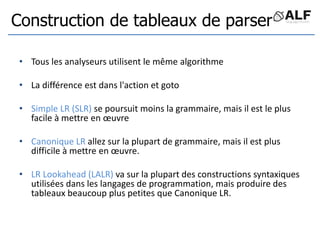
• Tous les analyseurs utilisent le même algorithme
• La différence est dans l'action et goto
• Simple LR (SLR) se poursuit moins la grammaire, mais il est le plus
facile à mettre en œuvre
• Canonique LR allez sur la plupart de grammaire, mais il est plus
difficile à mettre en œuvre.
• LR Lookahead (LALR) va sur la plupart des constructions syntaxiques
utilisées dans les langages de programmation, mais produire des
tableaux beaucoup plus petites que Canonique LR.
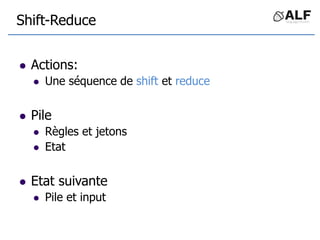
Shift-Reduce
 Actions:
 Une séquence de shift et reduce
 Pile
 Règles et jetons
 Etat
 Etat suivante
 Pile et input
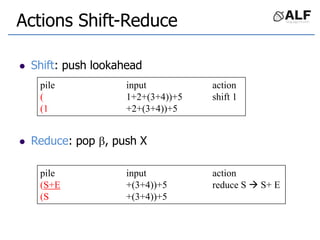
Actions Shift-Reduce
 Shift: push lookahead
 Reduce: pop , push X
pile input action
( 1+2+(3+4))+5 shift 1
(1 +2+(3+4))+5
pile input action
(S+E +(3+4))+5 reduce S  S+ E
(S +(3+4))+5
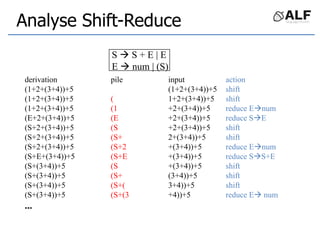
Analyse Shift-Reduce
derivation pile input action
(1+2+(3+4))+5 (1+2+(3+4))+5 shift
(1+2+(3+4))+5 ( 1+2+(3+4))+5 shift
(1+2+(3+4))+5 (1 +2+(3+4))+5 reduce Enum
(E+2+(3+4))+5 (E +2+(3+4))+5 reduce SE
(S+2+(3+4))+5 (S +2+(3+4))+5 shift
(S+2+(3+4))+5 (S+ 2+(3+4))+5 shift
(S+2+(3+4))+5 (S+2 +(3+4))+5 reduce Enum
(S+E+(3+4))+5 (S+E +(3+4))+5 reduce SS+E
(S+(3+4))+5 (S +(3+4))+5 shift
(S+(3+4))+5 (S+ (3+4))+5 shift
(S+(3+4))+5 (S+( 3+4))+5 shift
(S+(3+4))+5 (S+(3 +4))+5 reduce E num
...
S  S + E | E
E  num | (S)
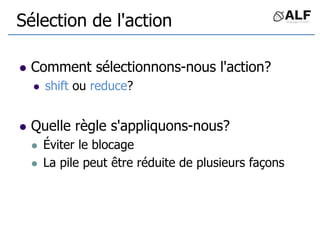
Sélection de l'action
 Comment sélectionnons-nous l'action?
 shift ou reduce?
 Quelle règle s'appliquons-nous?
 Éviter le blocage
 La pile peut être réduite de plusieurs façons
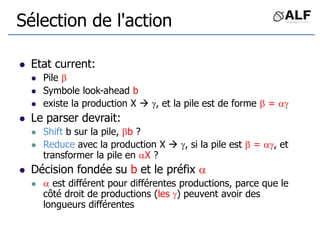
Sélection de l'action
 Etat current:
 Pile 
 Symbole look-ahead b
 existe la production X  , et la pile est de forme  = 
 Le parser devrait:
 Shift b sur la pile, b ?
 Reduce avec la production X  , si la pile est  = , et
transformer la pile en X ?
 Décision fondée su b et le préfix 
  est différent pour différentes productions, parce que le
côté droit de productions (les ) peuvent avoir des
longueurs différentes
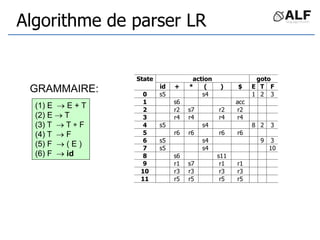
Algorithme de parser LR
action goto
State
id + * ( ) $ E T F
0 s5 s4 1 2 3
1 s6 acc
2 r2 s7 r2 r2
3 r4 r4 r4 r4
4 s5 s4 8 2 3
5 r6 r6 r6 r6
6 s5 s4 9 3
7 s5 s4 10
8 s6 s11
9 r1 s7 r1 r1
10 r3 r3 r3 r3
11 r5 r5 r5 r5
GRAMMAIRE:
(1) E  E + T
(2) E  T
(3) T  T  F
(4) T  F
(5) F  ( E )
(6) F  id
Tableau de parser LR
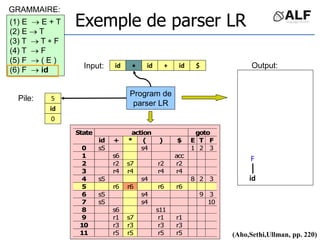
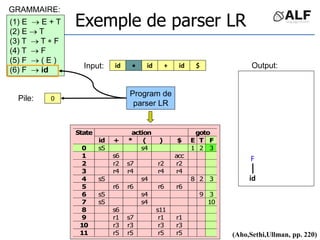
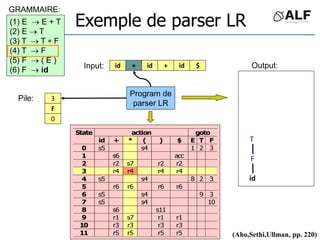
 Algorithme: état curent S si token C au input
 Si Action[S,C] = s(S’) shift et aller sur S’:
 push(C), push(S’)
 Si Action[S,C] = X  reduce:
 pop(2*||), S’= top(), push(X), push(Goto[S’,X])
Action et
etat prochaine
Etat prochaine
Jeton (Token) Regle
Etat
Tableau ‘action’ Tableau‘Goto’
Element LR(0)
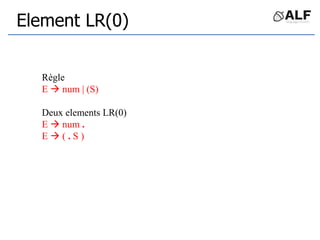
Règle
E  num | (S)
Deux elements LR(0)
E  num .
E  ( . S )
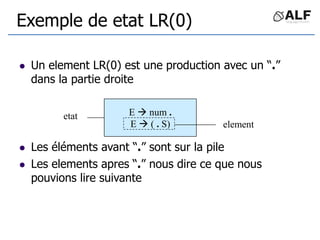
Exemple de etat LR(0)
 Un element LR(0) est une production avec un “.”
dans la partie droite
 Les éléments avant “.” sont sur la pile
 Les elements apres “.” nous dire ce que nous
pouvions lire suivante
E  num .
E  ( . S)
etat
element
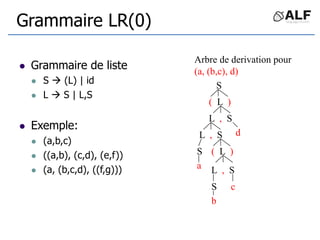
Grammaire LR(0)
 Grammaire de liste
 S  (L) | id
 L  S | L,S
 Exemple:
 (a,b,c)
 ((a,b), (c,d), (e,f))
 (a, (b,c,d), ((f,g)))
S
( L )
L , S
L , S
( L )
S
a L , S
S
b
c
d
Arbre de derivation pour
(a, (b,c), d)
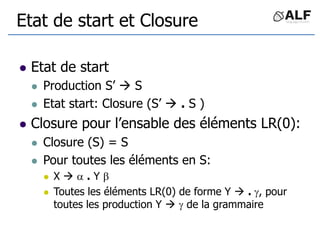
Etat de start et Closure
 Etat de start
 Production S’  S
 Etat start: Closure (S’  . S )
 Closure pour l’ensable des éléments LR(0):
 Closure (S) = S
 Pour toutes les éléments en S:
 X   . Y 
 Toutes les éléments LR(0) de forme Y  . , pour
toutes les production Y   de la grammaire
Exemple
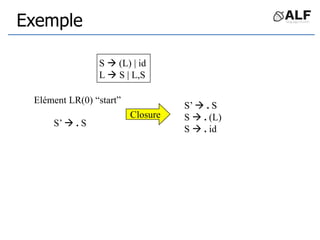
S  (L) | id
L  S | L,S
Elément LR(0) “start”
S’  . S
Closure
S’  . S
S  . (L)
S  . id
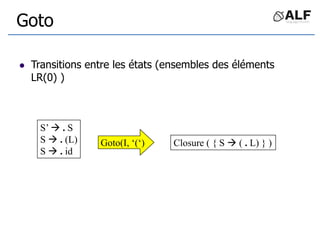
Goto
 Transitions entre les états (ensembles des éléments
LR(0) )
S’  . S
S  . (L)
S  . id
Goto(I, ‘(‘) Closure ( { S  ( . L) } )
Questions
I = { [E’  . E]}, Closure (I) = ??
I = { [E’  E . ], [E  E . + T] }, Goto(I,+) = ??
E’  E
E  E + T | T
T  T * F | F
F  (E) | id
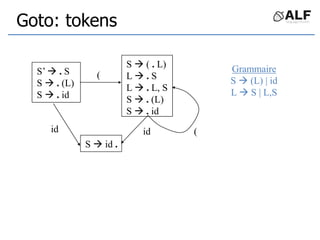
Goto: tokens
S’  . S
S  . (L)
S  . id
S  ( . L)
L  . S
L  . L, S
S  . (L)
S  . id
S  id .
id
(
id (
Grammaire
S  (L) | id
L  S | L,S
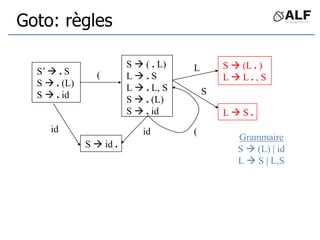
Goto: règles
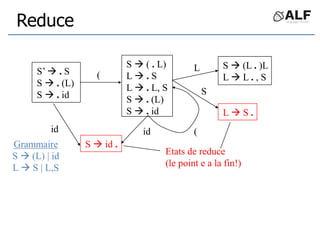
S’  . S
S  . (L)
S  . id
S  ( . L)
L  . S
L  . L, S
S  . (L)
S  . id
S  id .
id
(
id (
Grammaire
S  (L) | id
L  S | L,S
S  (L . )
L  L . , S
L  S .
L
S
Reduce
S’  . S
S  . (L)
S  . id
S  ( . L)
L  . S
L  . L, S
S  . (L)
S  . id
S  id .
id
(
id (
Grammaire
S  (L) | id
L  S | L,S
S  (L . )L
L  L . , S
L  S .
L
S
Etats de reduce
(le point e a la fin!)
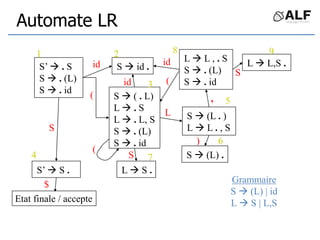
Automate LR
S’  . S
S  . (L)
S  . id
S  ( . L)
L  . S
L  . L, S
S  . (L)
S  . id
S  id .
id
(
id
(
S  (L . )
L  L . , S
L  S .
S
L  L , . S
S  . (L)
S  . id
L  L,S .
S  (L) .
S’  S .
Etat finale / accepte
1 2 8 9
6
5
3
7
4
S
,
)
S
$
id
L
Grammaire
S  (L) | id
L  S | L,S
(
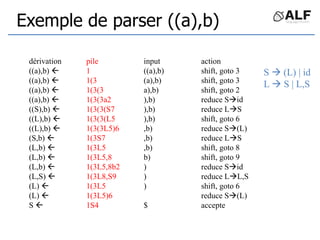
Exemple de parser ((a),b)
dérivation pile input action
((a),b)  1 ((a),b) shift, goto 3
((a),b)  1(3 (a),b) shift, goto 3
((a),b)  1(3(3 a),b) shift, goto 2
((a),b)  1(3(3a2 ),b) reduce Sid
((S),b)  1(3(3(S7 ),b) reduce LS
((L),b)  1(3(3(L5 ),b) shift, goto 6
((L),b)  1(3(3L5)6 ,b) reduce S(L)
(S,b)  1(3S7 ,b) reduce LS
(L,b)  1(3L5 ,b) shift, goto 8
(L,b)  1(3L5,8 b) shift, goto 9
(L,b)  1(3L5,8b2 ) reduce Sid
(L,S)  1(3L8,S9 ) reduce LL,S
(L)  1(3L5 ) shift, goto 6
(L)  1(3L5)6 reduce S(L)
S  1S4 $ accepte
S  (L) | id
L  S | L,S
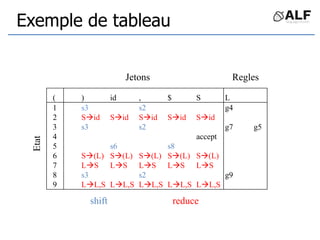
Tableau de parser LR(0)
 Etats = états de Automate LR
 S  S’ avec jeton C:
 Action[S,C] += Shift(S’)
 S  S’ avec la règle N:
 Goto[S,N] += S’
 Si S est état de réduction X  .:
 Action[S,*] += Reduce(X  )
Exemple de tableau
( ) id , $ S L
1 s3 s2 g4
2 Sid Sid Sid Sid Sid
3 s3 s2 g7 g5
4 accept
5 s6 s8
6 S(L) S(L) S(L) S(L) S(L)
7 LS LS LS LS LS
8 s3 s2 g9
9 LL,S LL,S LL,S LL,S LL,S
Etat
Jetons Regles
reduce
shift
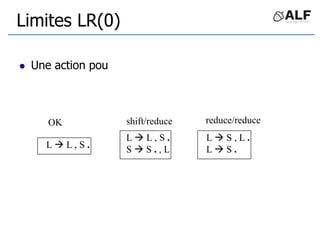
Limites LR(0)
 Une action pou
L  L , S .
L  L , S .
S  S . , L
L  S , L .
L  S .
OK shift/reduce reduce/reduce
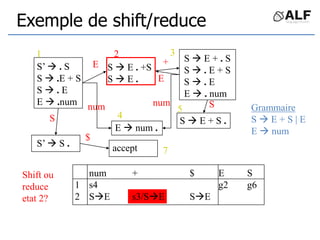
num + $ E S
1 s4 g2 g6
2 SE s3/SE SE
Exemple de shift/reduce
S’  . S
S  .E + S
S  . E
E  .num
E  num .
S  E . +S
S  E .
E
num
+
S  E + S .
accept
S
S  E + . S
S  . E + S
S  . E
E  . num
S’  S .
1 2
5
3
7
4
S Grammaire
S  E + S | E
E  num
$
E
num
Shift ou
reduce
etat 2?
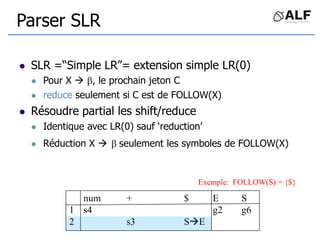
Parser SLR
 SLR =“Simple LR”= extension simple LR(0)
 Pour X  , le prochain jeton C
 reduce seulement si C est de FOLLOW(X)
 Résoudre partial les shift/reduce
 Identique avec LR(0) sauf ‘reduction’
 Réduction X   seulement les symboles de FOLLOW(X)
num + $ E S
1 s4 g2 g6
2 s3 SE
Exemple: FOLLOW(S) = {$}
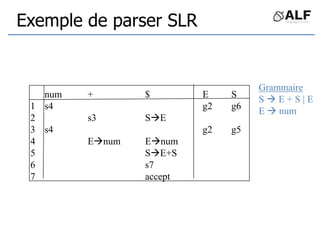
Exemple de parser SLR
num + $ E S
1 s4 g2 g6
2 s3 SE
3 s4 g2 g5
4 Enum Enum
5 SE+S
6 s7
7 accept
Grammaire
S  E + S | E
E  num
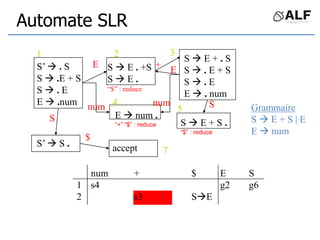
Automate SLR
S’  . S
S  .E + S
S  . E
E  .num
E  num .
“+” “$” : reduce
S  E . +S
S  E .
“$” : reduce
E
num
+
S  E + S .
“$” : reduce
accept
S
S  E + . S
S  . E + S
S  . E
E  . num
S’  S .
1 2
5
3
7
4 S Grammaire
S  E + S | E
E  num
$
E
num
num + $ E S
1 s4 g2 g6
2 s3 SE
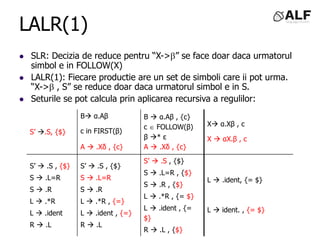
LALR(1)
 SLR: Decizia de reduce pentru “X->” se face doar daca urmatorul
simbol e in FOLLOW(X)
 LALR(1): Fiecare productie are un set de simboli care ii pot urma.
“X-> , S” se reduce doar daca urmatorul simbol e in S.
 Seturile se pot calcula prin aplicarea recursiva a regulilor:
S’ .S, {$}
B α.Aβ
c in FIRST(β)
A  .Xδ , {c}
B  α.Aβ , {c}
c  FOLLOW(β)
β * ε
A  .Xδ , {c}
X α.Xβ , c
X  αX.β , c
S’  .S , {$}
S  .L=R
S  .R
L  .*R
L  .ident
R  .L
S’  .S , {$}
S  .L=R
S  .R
L  .*R , {=}
L  .ident , {=}
R  .L
S’  .S , {$}
S  .L=R , {$}
S  .R , {$}
L  .*R , {= $}
L  .ident , {=
$}
R  .L , {$}
L  .ident, {= $}
L  ident. , {= $}
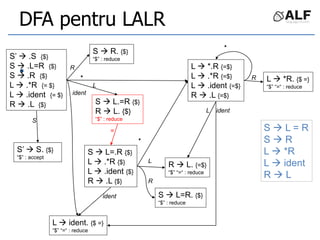
DFA pentru LALR
•
S  L = R
S  R
L  *R
L  ident
R  L
S’  .S {$}
S  .L=R {$}
S  .R {$}
L  .*R {= $}
L  .ident {= $}
R  .L {$}
S’  S. {$}
“$” : accept
S  L.=R {$}
R  L. {$}
“$” : reduce
S  R. {$}
“$” : reduce
L  *.R {=$}
L  .*R {=$}
L  .ident {=$}
R  .L {=$}
L  ident. {$ =}
“$” “=“ : reduce
S  L=.R {$}
L  .*R {$}
L  .ident {$}
R  .L {$}
L  *R. {$ =}
“$” “=“ : reduce
R  L. {=$}
“$” “=“ : reduce
S  L=R. {$}
“$” : reduce
S
L
L
L
R
R
R
*
*
ident
ident
*
ident
=
Sujets
• LR
• SLR
• LALR
Questions

ALF 6 - Parser

  • 1.
  • 2.
    Bibliographie pour aujourd'hui KeithCooper, Linda Torczon, Engineering a Compiler – Chapitre 3 • 3.4 Alfred V. Aho, Monica S. Lam, Ravi Sethi, Jeffrey D. Ullman, Compilers: Principles, Techniques, and Tools (2nd Edition) – Chapitre 4 • 4.5 • 4.6 • 4.7.4
  • 3.
  • 4.
    Limor Fried • Américain •MIT • Adafruit • STEM
  • 5.
    Slides Partie de slidessont écrie par Bogdan Nitulescu
  • 6.
    Notation BNF RFC 2616HTTP/1.1 June 1999 HTTP-date = rfc1123-date | rfc850-date | asctime-date rfc1123-date = wkday "," SP date1 SP time SP "GMT“ rfc850-date = weekday "," SP date2 SP time SP "GMT“ asctime-date = wkday SP date3 SP time SP 4DIGIT date1 = 2DIGIT SP month SP 4DIGIT ; day month year (e.g., 02 Jun 1982) date2 = 2DIGIT "-" month "-" 2DIGIT ; day-month-year (e.g., 02-Jun-82) date3 = month SP ( 2DIGIT | ( SP 1DIGIT )) ; month day (e.g., Jun 2) time = 2DIGIT ":" 2DIGIT ":" 2DIGIT ; 00:00:00 - 23:59:59 wkday = "Mon" | "Tue" | "Wed“ | "Thu" | "Fri" | "Sat" | "Sun“ weekday = "Monday" | "Tuesday" | "Wednesday“ | "Thursday" | "Friday" | "Saturday" | "Sunday“ month = "Jan" | "Feb" | "Mar" | "Apr“ | "May" | "Jun" | "Jul" | "Aug" | "Sep" | "Oct" | "Nov" | "Dec"
  • 7.
    Arbre de dérivation/ syntactique E  E + E E  E * E E  n n : [0-9]+ Lexer 2 * 3 + 4 * 5 n * n + n * n 2 3 4 5 parser n n n n 2 3 4 5 * * + n n n n 2 3 4 5 E * E E * E E + E E • jetons (tokens) • Valeurs • Grammaire • Arbre de dérivation • Arbre syntactique
  • 8.
    Types d’analyse syntactique Descendent (top-down)  Avec backtracking  Prédictive  Descendent récursive, LL avec un tableau  Ascendant (bottom-up)  Avec backtracking  Shift-reduce  LR(0),SLR,LALR, LR canonique
  • 9.
    Parser LL, LR Nous devrions éviter backtracking  Une grammaire qui permet le parser déterministe  LL(k) lit left-to-right, dérivation left  LR(k) lit left-to-right, dérivation right  K – lookahead (combien de tokens sont lus)  LL(k) < LR(k)  L'algorithme est indépendant du langage, la grammaire dépend du langage
  • 10.
    Parser ascendant Un analyseurvers le haut, ou shift-reduce commence à « feuille » et construit vers le haut de l'arbre de dérivation Étapes de réduction suivent une dérivation droite dans l'ordre inverse S  aABe A  Abc | b B  d GRAMMAIRE: Nous analysons la chaîne d'entrée abbcde. (Aho,Sethi,Ullman, pp. 195)
  • 11.
    Exemple de parserascendant a d b b c Input: Parser ascendant e Output: $ Production S  aABe A  Abc A  b B  d (Aho,Sethi,Ullman, pp. 195) S  aABe
  • 12.
    Exemple de parserascendant a d b b c Parser ascendant e A b $ S  aABe A  Abc A  b B  d (Aho,Sethi,Ullman, pp. 195) Input: Output: Production
  • 13.
    Exemple de parserascendant a d b A c Parser ascendant e A b $ S  aABe A  Abc A  b B  d (Aho,Sethi,Ullman, pp. 195) Input: Output: Production
  • 14.
    Nous ne pouvonspas réduire, le parser s'arrêterait. Exemple de parser ascendant a d b A c Parser ascendant e A b $ S  aABe A  Abc A  b B  d (Aho,Sethi,Ullman, pp. 195) Input: Output: Production
  • 15.
    Exemple de parserascendant a d b A c Parser ascendant e A b $ S  aABe A  Abc A  b B  d c A b (Aho,Sethi,Ullman, pp. 195) Input: Output: Production
  • 16.
    Exemple de parserascendant a d A Parser ascendant e A c A b $ S  aABe A  Abc A  b B  d b (Aho,Sethi,Ullman, pp. 195) Input: Output: Production
  • 17.
    Exemple de parserascendant a d A Parser ascendant e A c A b $ S  aABe A  Abc A  b B  d b B d (Aho,Sethi,Ullman, pp. 195) Input: Output: Production
  • 18.
    Exemple de parserascendant a B A Parser ascendant e A c A b $ S  aABe A  Abc A  b B  d b B d (Aho,Sethi,Ullman, pp. 195) Input: Output: Production
  • 19.
    Exemple de parserascendant a B A Parser ascendant e A c A b $ S  aABe A  Abc A  b B  d b B d a S e (Aho,Sethi,Ullman, pp. 195) Input: Output: Production
  • 20.
    Exemple de parserascendant S Parser ascendant A c A b $ S  aABe A  Abc A  b B  d b B d a S e Parser LR parce que l'entrée este lu « De gauche à droite », et construit « dérivation plus à droite » dans l'ordre inverse. (Aho,Sethi,Ullman, pp. 195) Input: Output: Production
  • 21.
    Exemple de parserascendant • Analyse les productions pour le match avec le texte d'entrée • Backtracking • Inefficace • Pouvons-nous faire mieux?
  • 22.
    Exemple de parserLR Input P I L e Algorithme de parser LR action goto Output (Aho,Sethi,Ullman, pp. 217)
  • 23.
    Exemple de parserLR action goto State id + * ( ) $ E T F 0 s5 s4 1 2 3 1 s6 acc 2 r2 s7 r2 r2 3 r4 r4 r4 r4 4 s5 s4 8 2 3 5 r6 r6 r6 r6 6 s5 s4 9 3 7 s5 s4 10 8 s6 s11 9 r1 s7 r1 r1 10 r3 r3 r3 r3 11 r5 r5 r5 r5 GRAMMAIRE: (1) E  E + T (2) E  T (3) T  T  F (4) T  F (5) F  ( E ) (6) F  id Il peut être parser avec les tableaux ‘action’ et ‘goto’ (Aho,Sethi,Ullman, pp. 219)
  • 24.
    Exemple de parserLR id id id +  Input: $ Pile: E 0 (1) E  E + T (2) E  T (3) T  T  F (4) T  F (5) F  ( E ) (6) F  id Program de parser LR action goto State id + * ( ) $ E T F 0 s5 s4 1 2 3 1 s6 acc 2 r2 s7 r2 r2 3 r4 r4 r4 r4 4 s5 s4 8 2 3 5 r6 r6 r6 r6 6 s5 s4 9 3 7 s5 s4 10 8 s6 s11 9 r1 s7 r1 r1 10 r3 r3 r3 r3 11 r5 r5 r5 r5 GRAMMAIRE: Output: (Aho,Sethi,Ullman, pp. 220)
  • 25.
    id id id  +$ (1) E  E + T (2) E  T (3) T  T  F (4) T  F (5) F  ( E ) (6) F  id E 5 id 0 action goto State id + * ( ) $ E T F 0 s5 s4 1 2 3 1 s6 acc 2 r2 s7 r2 r2 3 r4 r4 r4 r4 4 s5 s4 8 2 3 5 r6 r6 r6 r6 6 s5 s4 9 3 7 s5 s4 10 8 s6 s11 9 r1 s7 r1 r1 10 r3 r3 r3 r3 11 r5 r5 r5 r5 F id (Aho,Sethi,Ullman, pp. 220) Exemple de parser LR Input: Pile: Program de parser LR GRAMMAIRE: Output:
  • 26.
    0 id id id  +$ (1) E  E + T (2) E  T (3) T  T  F (4) T  F (5) F  ( E ) (6) F  id action goto State id + * ( ) $ E T F 0 s5 s4 1 2 3 1 s6 acc 2 r2 s7 r2 r2 3 r4 r4 r4 r4 4 s5 s4 8 2 3 5 r6 r6 r6 r6 6 s5 s4 9 3 7 s5 s4 10 8 s6 s11 9 r1 s7 r1 r1 10 r3 r3 r3 r3 11 r5 r5 r5 r5 F id (Aho,Sethi,Ullman, pp. 220) Exemple de parser LR Input: Pile: Program de parser LR GRAMMAIRE: Output:
  • 27.
    E 3 F 0 id id id  +$ (1) E  E + T (2) E  T (3) T  T  F (4) T  F (5) F  ( E ) (6) F  id action goto State id + * ( ) $ E T F 0 s5 s4 1 2 3 1 s6 acc 2 r2 s7 r2 r2 3 r4 r4 r4 r4 4 s5 s4 8 2 3 5 r6 r6 r6 r6 6 s5 s4 9 3 7 s5 s4 10 8 s6 s11 9 r1 s7 r1 r1 10 r3 r3 r3 r3 11 r5 r5 r5 r5 T F id (Aho,Sethi,Ullman, pp. 220) Exemple de parser LR Input: Pile: Program de parser LR GRAMMAIRE: Output:
  • 28.
    0 id id id  +$ (1) E  E + T (2) E  T (3) T  T  F (4) T  F (5) F  ( E ) (6) F  id action goto State id + * ( ) $ E T F 0 s5 s4 1 2 3 1 s6 acc 2 r2 s7 r2 r2 3 r4 r4 r4 r4 4 s5 s4 8 2 3 5 r6 r6 r6 r6 6 s5 s4 9 3 7 s5 s4 10 8 s6 s11 9 r1 s7 r1 r1 10 r3 r3 r3 r3 11 r5 r5 r5 r5 T F id (Aho,Sethi,Ullman, pp. 220) Exemple de parser LR Input: Pile: Program de parser LR GRAMMAIRE: Output:
  • 29.
    id id id  +$ (1) E  E + T (2) E  T (3) T  T  F (4) T  F (5) F  ( E ) (6) F  id E 2 T 0 action goto State id + * ( ) $ E T F 0 s5 s4 1 2 3 1 s6 acc 2 r2 s7 r2 r2 3 r4 r4 r4 r4 4 s5 s4 8 2 3 5 r6 r6 r6 r6 6 s5 s4 9 3 7 s5 s4 10 8 s6 s11 9 r1 s7 r1 r1 10 r3 r3 r3 r3 11 r5 r5 r5 r5 T F id (Aho,Sethi,Ullman, pp. 220) Exemple de parser LR Input: Pile: Program de parser LR GRAMMAIRE: Output:
  • 30.
    id id id  +$ (1) E  E + T (2) E’  T (3) T  T  F (4) T  F (5) F  ( E ) (6) F  id action goto State id + * ( ) $ E T F 0 s5 s4 1 2 3 1 s6 acc 2 r2 s7 r2 r2 3 r4 r4 r4 r4 4 s5 s4 8 2 3 5 r6 r6 r6 r6 6 s5 s4 9 3 7 s5 s4 10 8 s6 s11 9 r1 s7 r1 r1 10 r3 r3 r3 r3 11 r5 r5 r5 r5 E 7  2 T 0 T F id (Aho,Sethi,Ullman, pp. 220) Exemple de parser LR Input: Pile: Program de parser LR GRAMMAIRE: Output:
  • 31.
    id id id  +$ (1) E  E + T (2) E’  T (3) T  T  F (4) T  F (5) F  ( E ) (6) F  id E 5 id 7  2 T 0 action goto State id + * ( ) $ E T F 0 s5 s4 1 2 3 1 s6 acc 2 r2 s7 r2 r2 3 r4 r4 r4 r4 4 s5 s4 8 2 3 5 r6 r6 r6 r6 6 s5 s4 9 3 7 s5 s4 10 8 s6 s11 9 r1 s7 r1 r1 10 r3 r3 r3 r3 11 r5 r5 r5 r5 T F id F id (Aho,Sethi,Ullman, pp. 220) Exemple de parser LR Input: Pile: Program de parser LR GRAMMAIRE: Output:
  • 32.
    id id id  +$ (1) E  E + T (2) E’  T (3) T  T  F (4) T  F (5) F  ( E ) (6) F  id E 7  2 T 0 action goto State id + * ( ) $ E T F 0 s5 s4 1 2 3 1 s6 acc 2 r2 s7 r2 r2 3 r4 r4 r4 r4 4 s5 s4 8 2 3 5 r6 r6 r6 r6 6 s5 s4 9 3 7 s5 s4 10 8 s6 s11 9 r1 s7 r1 r1 10 r3 r3 r3 r3 11 r5 r5 r5 r5 T F id F id (Aho,Sethi,Ullman, pp. 220) Exemple de parser LR Input: Pile: Program de parser LR GRAMMAIRE: Output:
  • 33.
    id id id  +$ (1) E  E + T (2) E’  T (3) T  T  F (4) T  F (5) F  ( E ) (6) F  id E 10 F 7  2 T 0 action goto State id + * ( ) $ E T F 0 s5 s4 1 2 3 1 s6 acc 2 r2 s7 r2 r2 3 r4 r4 r4 r4 4 s5 s4 8 2 3 5 r6 r6 r6 r6 6 s5 s4 9 3 7 s5 s4 10 8 s6 s11 9 r1 s7 r1 r1 10 r3 r3 r3 r3 11 r5 r5 r5 r5 T  T F F id id (Aho,Sethi,Ullman, pp. 220) Exemple de parser LR Input: Pile: Program de parser LR GRAMMAIRE: Output:
  • 34.
    0 id id id  +$ (1) E  E + T (2) E  T (3) T  T  F (4) T  F (5) F  ( E ) (6) F  id action goto State id + * ( ) $ E T F 0 s5 s4 1 2 3 1 s6 acc 2 r2 s7 r2 r2 3 r4 r4 r4 r4 4 s5 s4 8 2 3 5 r6 r6 r6 r6 6 s5 s4 9 3 7 s5 s4 10 8 s6 s11 9 r1 s7 r1 r1 10 r3 r3 r3 r3 11 r5 r5 r5 r5 T  T F F id id (Aho,Sethi,Ullman, pp. 220) Exemple de parser LR Input: Pile: Program de parser LR GRAMMAIRE: Output:
  • 35.
    id id id  +$ (1) E  E + T (2) E  T (3) T  T  F (4) T  F (5) F  ( E ) (6) F  id 2 T 0 T  T F F id id action goto State id + * ( ) $ E T F 0 s5 s4 1 2 3 1 s6 acc 2 r2 s7 r2 r2 3 r4 r4 r4 r4 4 s5 s4 8 2 3 5 r6 r6 r6 r6 6 s5 s4 9 3 7 s5 s4 10 8 s6 s11 9 r1 s7 r1 r1 10 r3 r3 r3 r3 11 r5 r5 r5 r5 E (Aho,Sethi,Ullman, pp. 220) Exemple de parser LR Input: Pile: Program de parser LR GRAMMAIRE: Output:
  • 36.
    0 id id id  +$ (1) E  E + T (2) E  T (3) T  T  F (4) T  F (5) F  ( E ) (6) F  id action goto State id + * ( ) $ E T F 0 s5 s4 1 2 3 1 s6 acc 2 r2 s7 r2 r2 3 r4 r4 r4 r4 4 s5 s4 8 2 3 5 r6 r6 r6 r6 6 s5 s4 9 3 7 s5 s4 10 8 s6 s11 9 r1 s7 r1 r1 10 r3 r3 r3 r3 11 r5 r5 r5 r5 T  T F F id id E (Aho,Sethi,Ullman, pp. 220) Exemple de parser LR Input: Pile: Program de parser LR GRAMMAIRE: Output:
  • 37.
    id id id  +$ (1) E  E + T (2) E’  T (3) T  T  F (4) T  F (5) F  ( E ) (6) F  id 1 E 0 action goto State id + * ( ) $ E T F 0 s5 s4 1 2 3 1 s6 acc 2 r2 s7 r2 r2 3 r4 r4 r4 r4 4 s5 s4 8 2 3 5 r6 r6 r6 r6 6 s5 s4 9 3 7 s5 s4 10 8 s6 s11 9 r1 s7 r1 r1 10 r3 r3 r3 r3 11 r5 r5 r5 r5 T  T F F id id E (Aho,Sethi,Ullman, pp. 220) Exemple de parser LR Input: Pile: Program de parser LR GRAMMAIRE: Output:
  • 38.
    id id id  +$ (1) E  E + T (2) E’  T (3) T  T  F (4) T  F (5) F  ( E ) (6) F  id action goto State id + * ( ) $ E T F 0 s5 s4 1 2 3 1 s6 acc 2 r2 s7 r2 r2 3 r4 r4 r4 r4 4 s5 s4 8 2 3 5 r6 r6 r6 r6 6 s5 s4 9 3 7 s5 s4 10 8 s6 s11 9 r1 s7 r1 r1 10 r3 r3 r3 r3 11 r5 r5 r5 r5 T  T F F id id E 6 + 1 E 0 (Aho,Sethi,Ullman, pp. 220) Exemple de parser LR Input: Pile: Program de parser LR GRAMMAIRE: Output:
  • 39.
    id id id  +$ (1) E  E + T (2) E’  T (3) T  T  F (4) T  F (5) F  ( E ) (6) F  id action goto State id + * ( ) $ E T F 0 s5 s4 1 2 3 1 s6 acc 2 r2 s7 r2 r2 3 r4 r4 r4 r4 4 s5 s4 8 2 3 5 r6 r6 r6 r6 6 s5 s4 9 3 7 s5 s4 10 8 s6 s11 9 r1 s7 r1 r1 10 r3 r3 r3 r3 11 r5 r5 r5 r5 T  T F F id id E 5 id 6 + 1 E 0 F id (Aho,Sethi,Ullman, pp. 220) Exemple de parser LR Input: Pile: Program de parser LR GRAMMAIRE: Output:
  • 40.
    id id id  +$ (1) E  E + T (2) E’  T (3) T  T  F (4) T  F (5) F  ( E ) (6) F  id T  T F F id id E 6 + 1 E 0 F id action goto State id + * ( ) $ E T F 0 s5 s4 1 2 3 1 s6 acc 2 r2 s7 r2 r2 3 r4 r4 r4 r4 4 s5 s4 8 2 3 5 r6 r6 r6 r6 6 s5 s4 9 3 7 s5 s4 10 8 s6 s11 9 r1 s7 r1 r1 10 r3 r3 r3 r3 11 r5 r5 r5 r5 (Aho,Sethi,Ullman, pp. 220) Exemple de parser LR Input: Pile: Program de parser LR GRAMMAIRE: Output:
  • 41.
    id id id  +$ (1) E  E + T (2) E’  T (3) T  T  F (4) T  F (5) F  ( E ) (6) F  id action goto State id + * ( ) $ E T F 0 s5 s4 1 2 3 1 s6 acc 2 r2 s7 r2 r2 3 r4 r4 r4 r4 4 s5 s4 8 2 3 5 r6 r6 r6 r6 6 s5 s4 9 3 7 s5 s4 10 8 s6 s11 9 r1 s7 r1 r1 10 r3 r3 r3 r3 11 r5 r5 r5 r5 T  T F F id id E 3 F 6 + 1 E 0 F id T (Aho,Sethi,Ullman, pp. 220) Exemple de parser LR Input: Pile: Program de parser LR GRAMMAIRE: Output:
  • 42.
    id id id  +$ (1) E  E + T (2) E’  T (3) T  T  F (4) T  F (5) F  ( E ) (6) F  id T  T F F id id E 6 + 1 E 0 F id action goto State id + * ( ) $ E T F 0 s5 s4 1 2 3 1 s6 acc 2 r2 s7 r2 r2 3 r4 r4 r4 r4 4 s5 s4 8 2 3 5 r6 r6 r6 r6 6 s5 s4 9 3 7 s5 s4 10 8 s6 s11 9 r1 s7 r1 r1 10 r3 r3 r3 r3 11 r5 r5 r5 r5 (Aho,Sethi,Ullman, pp. 220) Exemple de parser LR Input: Pile: Program de parser LR GRAMMAIRE: Output:
  • 43.
    id id id  +$ (1) E  E + T (2) E’  T (3) T  T  F (4) T  F (5) F  ( E ) (6) F  id action goto State id + * ( ) $ E T F 0 s5 s4 1 2 3 1 s6 acc 2 r2 s7 r2 r2 3 r4 r4 r4 r4 4 s5 s4 8 2 3 5 r6 r6 r6 r6 6 s5 s4 9 3 7 s5 s4 10 8 s6 s11 9 r1 s7 r1 r1 10 r3 r3 r3 r3 11 r5 r5 r5 r5 T  T F F id id E 9 T 6 + 1 E 0 F id T E + (Aho,Sethi,Ullman, pp. 220) Exemple de parser LR Input: Pile: Program de parser LR GRAMMAIRE: Output:
  • 44.
    id id id  +$ (1) E  E + T (2) E  T (3) T  T  F (4) T  F (5) F  ( E ) (6) F  id 0 action goto State id + * ( ) $ E T F 0 s5 s4 1 2 3 1 s6 acc 2 r2 s7 r2 r2 3 r4 r4 r4 r4 4 s5 s4 8 2 3 5 r6 r6 r6 r6 6 s5 s4 9 3 7 s5 s4 10 8 s6 s11 9 r1 s7 r1 r1 10 r3 r3 r3 r3 11 r5 r5 r5 r5 T  T F F id id E F id T E + (Aho,Sethi,Ullman, pp. 220) Exemple de parser LR Input: Pile: Program de parser LR GRAMMAIRE: Output:
  • 45.
    id id id  +$ (1) E  E + T (2) E’  T (3) T  T  F (4) T  F (5) F  ( E ) (6) F  id action goto State id + * ( ) $ E T F 0 s5 s4 1 2 3 1 s6 acc 2 r2 s7 r2 r2 3 r4 r4 r4 r4 4 s5 s4 8 2 3 5 r6 r6 r6 r6 6 s5 s4 9 3 7 s5 s4 10 8 s6 s11 9 r1 s7 r1 r1 10 r3 r3 r3 r3 11 r5 r5 r5 r5 T  T F F id id E 1 E 0 F id T E + (Aho,Sethi,Ullman, pp. 220) Exemple de parser LR Input: Pile: Program de parser LR GRAMMAIRE: Output:
  • 46.
    Construction de tableauxde parser • Tous les analyseurs utilisent le même algorithme • La différence est dans l'action et goto • Simple LR (SLR) se poursuit moins la grammaire, mais il est le plus facile à mettre en œuvre • Canonique LR allez sur la plupart de grammaire, mais il est plus difficile à mettre en œuvre. • LR Lookahead (LALR) va sur la plupart des constructions syntaxiques utilisées dans les langages de programmation, mais produire des tableaux beaucoup plus petites que Canonique LR.
  • 47.
    Shift-Reduce  Actions:  Uneséquence de shift et reduce  Pile  Règles et jetons  Etat  Etat suivante  Pile et input
  • 48.
    Actions Shift-Reduce  Shift:push lookahead  Reduce: pop , push X pile input action ( 1+2+(3+4))+5 shift 1 (1 +2+(3+4))+5 pile input action (S+E +(3+4))+5 reduce S  S+ E (S +(3+4))+5
  • 49.
    Analyse Shift-Reduce derivation pileinput action (1+2+(3+4))+5 (1+2+(3+4))+5 shift (1+2+(3+4))+5 ( 1+2+(3+4))+5 shift (1+2+(3+4))+5 (1 +2+(3+4))+5 reduce Enum (E+2+(3+4))+5 (E +2+(3+4))+5 reduce SE (S+2+(3+4))+5 (S +2+(3+4))+5 shift (S+2+(3+4))+5 (S+ 2+(3+4))+5 shift (S+2+(3+4))+5 (S+2 +(3+4))+5 reduce Enum (S+E+(3+4))+5 (S+E +(3+4))+5 reduce SS+E (S+(3+4))+5 (S +(3+4))+5 shift (S+(3+4))+5 (S+ (3+4))+5 shift (S+(3+4))+5 (S+( 3+4))+5 shift (S+(3+4))+5 (S+(3 +4))+5 reduce E num ... S  S + E | E E  num | (S)
  • 50.
    Sélection de l'action Comment sélectionnons-nous l'action?  shift ou reduce?  Quelle règle s'appliquons-nous?  Éviter le blocage  La pile peut être réduite de plusieurs façons
  • 51.
    Sélection de l'action Etat current:  Pile   Symbole look-ahead b  existe la production X  , et la pile est de forme  =   Le parser devrait:  Shift b sur la pile, b ?  Reduce avec la production X  , si la pile est  = , et transformer la pile en X ?  Décision fondée su b et le préfix    est différent pour différentes productions, parce que le côté droit de productions (les ) peuvent avoir des longueurs différentes
  • 52.
    Algorithme de parserLR action goto State id + * ( ) $ E T F 0 s5 s4 1 2 3 1 s6 acc 2 r2 s7 r2 r2 3 r4 r4 r4 r4 4 s5 s4 8 2 3 5 r6 r6 r6 r6 6 s5 s4 9 3 7 s5 s4 10 8 s6 s11 9 r1 s7 r1 r1 10 r3 r3 r3 r3 11 r5 r5 r5 r5 GRAMMAIRE: (1) E  E + T (2) E  T (3) T  T  F (4) T  F (5) F  ( E ) (6) F  id
  • 53.
    Tableau de parserLR  Algorithme: état curent S si token C au input  Si Action[S,C] = s(S’) shift et aller sur S’:  push(C), push(S’)  Si Action[S,C] = X  reduce:  pop(2*||), S’= top(), push(X), push(Goto[S’,X]) Action et etat prochaine Etat prochaine Jeton (Token) Regle Etat Tableau ‘action’ Tableau‘Goto’
  • 54.
    Element LR(0) Règle E num | (S) Deux elements LR(0) E  num . E  ( . S )
  • 55.
    Exemple de etatLR(0)  Un element LR(0) est une production avec un “.” dans la partie droite  Les éléments avant “.” sont sur la pile  Les elements apres “.” nous dire ce que nous pouvions lire suivante E  num . E  ( . S) etat element
  • 56.
    Grammaire LR(0)  Grammairede liste  S  (L) | id  L  S | L,S  Exemple:  (a,b,c)  ((a,b), (c,d), (e,f))  (a, (b,c,d), ((f,g))) S ( L ) L , S L , S ( L ) S a L , S S b c d Arbre de derivation pour (a, (b,c), d)
  • 57.
    Etat de startet Closure  Etat de start  Production S’  S  Etat start: Closure (S’  . S )  Closure pour l’ensable des éléments LR(0):  Closure (S) = S  Pour toutes les éléments en S:  X   . Y   Toutes les éléments LR(0) de forme Y  . , pour toutes les production Y   de la grammaire
  • 58.
    Exemple S  (L)| id L  S | L,S Elément LR(0) “start” S’  . S Closure S’  . S S  . (L) S  . id
  • 59.
    Goto  Transitions entreles états (ensembles des éléments LR(0) ) S’  . S S  . (L) S  . id Goto(I, ‘(‘) Closure ( { S  ( . L) } )
  • 60.
    Questions I = {[E’  . E]}, Closure (I) = ?? I = { [E’  E . ], [E  E . + T] }, Goto(I,+) = ?? E’  E E  E + T | T T  T * F | F F  (E) | id
  • 61.
    Goto: tokens S’ . S S  . (L) S  . id S  ( . L) L  . S L  . L, S S  . (L) S  . id S  id . id ( id ( Grammaire S  (L) | id L  S | L,S
  • 62.
    Goto: règles S’ . S S  . (L) S  . id S  ( . L) L  . S L  . L, S S  . (L) S  . id S  id . id ( id ( Grammaire S  (L) | id L  S | L,S S  (L . ) L  L . , S L  S . L S
  • 63.
    Reduce S’  .S S  . (L) S  . id S  ( . L) L  . S L  . L, S S  . (L) S  . id S  id . id ( id ( Grammaire S  (L) | id L  S | L,S S  (L . )L L  L . , S L  S . L S Etats de reduce (le point e a la fin!)
  • 64.
    Automate LR S’ . S S  . (L) S  . id S  ( . L) L  . S L  . L, S S  . (L) S  . id S  id . id ( id ( S  (L . ) L  L . , S L  S . S L  L , . S S  . (L) S  . id L  L,S . S  (L) . S’  S . Etat finale / accepte 1 2 8 9 6 5 3 7 4 S , ) S $ id L Grammaire S  (L) | id L  S | L,S (
  • 65.
    Exemple de parser((a),b) dérivation pile input action ((a),b)  1 ((a),b) shift, goto 3 ((a),b)  1(3 (a),b) shift, goto 3 ((a),b)  1(3(3 a),b) shift, goto 2 ((a),b)  1(3(3a2 ),b) reduce Sid ((S),b)  1(3(3(S7 ),b) reduce LS ((L),b)  1(3(3(L5 ),b) shift, goto 6 ((L),b)  1(3(3L5)6 ,b) reduce S(L) (S,b)  1(3S7 ,b) reduce LS (L,b)  1(3L5 ,b) shift, goto 8 (L,b)  1(3L5,8 b) shift, goto 9 (L,b)  1(3L5,8b2 ) reduce Sid (L,S)  1(3L8,S9 ) reduce LL,S (L)  1(3L5 ) shift, goto 6 (L)  1(3L5)6 reduce S(L) S  1S4 $ accepte S  (L) | id L  S | L,S
  • 66.
    Tableau de parserLR(0)  Etats = états de Automate LR  S  S’ avec jeton C:  Action[S,C] += Shift(S’)  S  S’ avec la règle N:  Goto[S,N] += S’  Si S est état de réduction X  .:  Action[S,*] += Reduce(X  )
  • 67.
    Exemple de tableau () id , $ S L 1 s3 s2 g4 2 Sid Sid Sid Sid Sid 3 s3 s2 g7 g5 4 accept 5 s6 s8 6 S(L) S(L) S(L) S(L) S(L) 7 LS LS LS LS LS 8 s3 s2 g9 9 LL,S LL,S LL,S LL,S LL,S Etat Jetons Regles reduce shift
  • 68.
    Limites LR(0)  Uneaction pou L  L , S . L  L , S . S  S . , L L  S , L . L  S . OK shift/reduce reduce/reduce
  • 69.
    num + $E S 1 s4 g2 g6 2 SE s3/SE SE Exemple de shift/reduce S’  . S S  .E + S S  . E E  .num E  num . S  E . +S S  E . E num + S  E + S . accept S S  E + . S S  . E + S S  . E E  . num S’  S . 1 2 5 3 7 4 S Grammaire S  E + S | E E  num $ E num Shift ou reduce etat 2?
  • 70.
    Parser SLR  SLR=“Simple LR”= extension simple LR(0)  Pour X  , le prochain jeton C  reduce seulement si C est de FOLLOW(X)  Résoudre partial les shift/reduce  Identique avec LR(0) sauf ‘reduction’  Réduction X   seulement les symboles de FOLLOW(X) num + $ E S 1 s4 g2 g6 2 s3 SE Exemple: FOLLOW(S) = {$}
  • 71.
    Exemple de parserSLR num + $ E S 1 s4 g2 g6 2 s3 SE 3 s4 g2 g5 4 Enum Enum 5 SE+S 6 s7 7 accept Grammaire S  E + S | E E  num
  • 72.
    Automate SLR S’ . S S  .E + S S  . E E  .num E  num . “+” “$” : reduce S  E . +S S  E . “$” : reduce E num + S  E + S . “$” : reduce accept S S  E + . S S  . E + S S  . E E  . num S’  S . 1 2 5 3 7 4 S Grammaire S  E + S | E E  num $ E num num + $ E S 1 s4 g2 g6 2 s3 SE
  • 73.
    LALR(1)  SLR: Deciziade reduce pentru “X->” se face doar daca urmatorul simbol e in FOLLOW(X)  LALR(1): Fiecare productie are un set de simboli care ii pot urma. “X-> , S” se reduce doar daca urmatorul simbol e in S.  Seturile se pot calcula prin aplicarea recursiva a regulilor: S’ .S, {$} B α.Aβ c in FIRST(β) A  .Xδ , {c} B  α.Aβ , {c} c  FOLLOW(β) β * ε A  .Xδ , {c} X α.Xβ , c X  αX.β , c S’  .S , {$} S  .L=R S  .R L  .*R L  .ident R  .L S’  .S , {$} S  .L=R S  .R L  .*R , {=} L  .ident , {=} R  .L S’  .S , {$} S  .L=R , {$} S  .R , {$} L  .*R , {= $} L  .ident , {= $} R  .L , {$} L  .ident, {= $} L  ident. , {= $}
  • 74.
    DFA pentru LALR • S L = R S  R L  *R L  ident R  L S’  .S {$} S  .L=R {$} S  .R {$} L  .*R {= $} L  .ident {= $} R  .L {$} S’  S. {$} “$” : accept S  L.=R {$} R  L. {$} “$” : reduce S  R. {$} “$” : reduce L  *.R {=$} L  .*R {=$} L  .ident {=$} R  .L {=$} L  ident. {$ =} “$” “=“ : reduce S  L=.R {$} L  .*R {$} L  .ident {$} R  .L {$} L  *R. {$ =} “$” “=“ : reduce R  L. {=$} “$” “=“ : reduce S  L=R. {$} “$” : reduce S L L L R R R * * ident ident * ident =
  • 75.
  • 76.