
Les Bus de Terrain Quels Bus dans quels cas ? Quel Avenir ?
Agenda Pourquoi le Contrôle Digital Bus de Terrain HART Modbus As-i DeviceNet Profibus Foundation Fieldbus Ethernet Industriel Quel bus? Quand Utiliser Ethernet & Quand Utiliser les Bus de Terrain
Connections Process Frontières Ethernet Industriel : Armoires Marshaling Interface niveau 0 – niveau 1 - Level 0 Communications Capteurs connectés au process Niveau 2 Niveau 3 Niveau 4 Firewall Analyser Firewall FF HART Analogique Ethernet Industriel Système de  Contrôle Données  Archives Réseaux Entreprise Niveau 0 Niveau 1 ® Connexions process
Signaux d’Instrumentation Les communications Digitales sont la prochaine étape technologiques dans le monde de l’automatisation des process. 1940  1960  1980  2000 Technologie Dominante Time Pneumatique Digital Propriétaire Analogique Bus de Terrain
Avantages de la technologie Bus de Terrain Réduction des coûts d’installation  Plus faible nombre de terminaison Plusieurs instruments sur un même segment Réduction des coûts d’installation des câbles Moins d’instruments Transmetteurs intelligents Multivariables Plus faible encombrement Moins d’armoires I/O Moins de place occupée en Bâtiment/HVAC Réduit les besoins en fonctions systèmes grâce aux instruments “Intelligents” Contrôle sur le terrain Données Diagnostiques
Avantages de la technologie Bus de Terrain Intégrité du Signal Limites des instruments = Limite haute et limite basse Limite Basse = Valeur 4 mA Limite Haute = Valeur 20 mA
Avantages de la technologie Bus de Terrain Réduction des coûts d’installation Intégrité du signal améliorée vs. analog Augmente la capacité fonctionnelle des instruments (“intelligence”) Augmente les plages d’utilisation
Positionnement des Bus de Terrain Bit-Level Equipement Contrôlel Instrumentation Corporate Information ATM / FDDI Discrete Process Continu AS-i Seriplex Impacc SensorPlex CAN Interbus-S Foundation Fieldbus HSE Foundation Fieldbus H1 PROFIBUS FMS ControlNet Modbus + / DH+ ECHELON PROFIBUS DP DeviceNet SDS PROFIBUS PA LONworks HART ProfiNET
Instruments Smart Avantages : Plus d’informations Communications Bidirectionnelles avec des variables plus complexes Meilleure Précision, Intégrité Mise en fonction plus rapide Configuration facilité, calibration maintenance, et support Echanges : Interopérabilité limitée Manque des fonctionnalités multidrop Manque les contrôles de performances des boucles Nécessite des interfaces système spéciales Supports d’instruments spéciaux Instruments hybrides ou intelligents avec des interfaces personnalisées Analyzer Interfaces propriétaires ou customisées PLC
HART HART Communications Foundation www.hartcomm.org
Protocole HART
HART Protocol
Modbus www.modbus.org Tutorial at:  http://www.modicon.com/techpubs/toc7.html
Modbus : Couches Physiques Pas de couches physiques spécifiques, peut être utilisé sur tout type de réseaux; RS-232/RS-422 (point-to-point) RS-485 (multidrop bus) Bell 202 modem (switched et lignes louées) Asynchrone, Trames orientées Octets
Couche Application Deux Types de Messages: Question/réponse – Adressage spécifique “ Broadcast” - Adresse 00, Pas de réponse requise Code Fonction: Ce que l’esclave doit faire Dans quel partie de la “zone mémoire” l’information doit elle être placée eg. Coil Status, Input Status, Entrée Registre, Holding Register
Couche Application Le code fonction indique la zone mémoire concernée “ Data offset” est relatif au début de cette zone Exemple : code fonction 01 correspond à la lecture du “coil status” L’adresse mémoire commence au début de la zone coil. Nombre de points à lire inclus cet emplacement.
MODBUS communication stack
AS-i Actuator Sensor Interface http://www.as-interface.net/
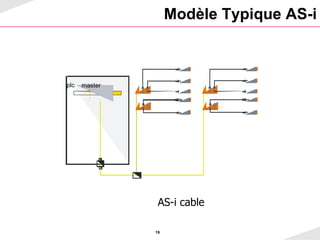
Modèle Typique AS-i AS-i cable plc master
Couche Physique Lien de communication et alimentation. 31 esclaves possibles. 1 seul module maître. Topologie : Bus, Anneau ou Hiérarchique. Câble plat avec cross section unique.  Câble 2 fils non armé également possible.
AS-i Câble Plat Un profil spécial prévient des inversions de polarité. Installation peu onéreuse liée au type de câble Un seul module de couplage pour une large gamme d’applications (I/O modules, branches, nœuds, Boîtes de dérivation) Différentes qualités de câbles: Câble caoutchouc auto cicatrisant. Résistance aux huiles : câble PUR Résistance à l’eau : câble PVC  cable color yellow (ASi) cable color black (ext. 24 V)
Utilisations Typiques Factory Automation Instruments On/off logiques Installation en zones standards
DeviceNet Open Device Vendors Association http://www.odva.org/
Topologie Bus Linéaire (Trunkline-dropline ) Node Node Node Node Node Node Node Node Node Alimentation (24Vdc, 8A) & et communication avec tous les instruments sur un seul câble Longueur des segments: 0 - 6 mètres Branchement & Daisy-Chain Topologie Bus Linéaire  (Trunkline-dropline)
DeviceBus Systems Basé sur le “Controller Area Network” (CAN) Développé pour l’automobile pour la gestion des carburants et systèmes d’ignition.  Pas de gestion de maître ou de jeton Utilise CSMA/CA comme philosophie de base
Specifications Réseau Contraintes cumulées 156m @ 125Kbaud 78m @ 250Kbaud 39m @ 500Kbaud (Maximum of 6m chaque) Distance des Segments et vitesse 100m Max. avec câble fin 500m @ 125Kbaud (thick) 250m @ 250Kbaud (thick) 100m @ 500Kbaud (thick) (4Km avec Répéteurs) Nb Maxi d’instruments 64 Nœuds par Réseau Media Physique (Paires Torsadées armées) Communications et  Alim Epais - Tronc fin – Tronc ou terminaisons Câblage terminaisons Terminaison simple Daisy-chaine Branchement Connections Instruments T-Taps Zero-drop Résistances de Terminaison 120   à chaque extrémité Alimentation Réseau 24vDC pour les instruments Tronc principal : 8 amps Câble fins : 3 amps Messaging Services Producer/Consumer High-speed I/O Programming Configuration Diagnostics
Profibus Profibus Trade Organisation www.profibus.org
Protocole Profibus PA-Profiles Device Profiles IEC Interface* ProfiNet IEC 1158-2 User Layer (3)-(6) Application (7) Data Link (2) Physique (1) not used PA EN 50 170 PROFIBUS profiles DP DP-Extensions Fieldbus Data Link (FDL) Fieldbus Message Specification (FMS) DP-Profiles RS-485 / Fiber Optic DP Basic Functions
Profibus un Système intégré Ethernet/TCP/IP TCP/IP/Ethernet PROFINet PROFIBUS-DP PROFIBUS-PA Niveau Usine Temps de cycle du bus  < 1000 ms PC/VME Niveau Terrain Temps de cycle du bus < 10 ms CNC VME/PC PLC DCS Zone Controleur Niveau Cellule Temps de cycle du bus < 100 ms
Profibus DP Organisation Typique
Maîtres. Contrôlent le bus. Appellent également les stations actives Esclaves Transmetteurs/capteurs/…. Acquittement uniquement des messages reçus. Deux types principaux de ressources
Gestion des jetons. Jeton transmis de station maître à station maître dans l’ordre ascendant. Quand une station maître reçoit un jeton d’un autre maître elle transfert alors le message. Couche Data Link
Profibus DP Système Multi Maîtres Plusieurs DP - maîtres peuvent accéder à un DP - esclaves en lecture - multiples Maîtres (Classe 1 or 2) - de 1 à. 124 DP-esclaves max - max. 126 Instruments sur le même bus DP-Maître (Classe 1) Entrées/Sorties distribuées PROFIBUS-P DP - Esclaves  PLC PROFIBUS - DP PC DP-Maître (Classe 2) DP-Maître (Classe 1) Entrées/Sorties distribuées CNC
Configuration Profibus PA Typique PROFIBUS-DP RS 485 jusqu’à to 12 MBit/s DCS (PLC) Engineering  ou Monitoring  Tool PROFIBUS-PA  IEC 1158-2 with 31.25 kBit/s I Segment  coupleur/link Transmetteur H2 H1 Alim
Foundation Fieldbus www.fieldbus.org
Encodage au niveau du Bit Ajout d’une référence au temps sur le signal pour déterminer les limites du bit. Méthode d’encodage : Manchester Encodage des données Donnée Codée 1 1 1 0 0 0 1 1 1 1 1 0 0 0 Data Horloge
Couches Physiques Serveur Bus Principal Cartes  Entrées/Sorties Point à Point Bus segments (ou drops) Arbre JB Daisy Chain
Utilisation des Bus de terrain Aujourd’hui Large base installée > 2/3 des instruments smart vendus ont des capacités HART > 20 millions d’instruments HART installés dans le monde >700,000 instruments FF, 10,000 systèmes >700,000 instruments Profibus PA Les Mega-systèmes (>10K instruments) deviennent courants Les grandes sociétés standardisent les bus de terrains pour les fonctions de contrôle Meilleure disponibilité, Meilleure stabilité, réduit les temps de “commisioning” Préconisés pour les nouveaux projets Augmentation de l’utilisation des bus pour le contrôle en ligne.
Développement des Réseaux industriels Automation Contrôle Interbus Loop Interbus Instruments Information ASI Profibus DP Profibus FMS CAN CCLink ControlNet DeviceNet LonWorks ETHERNET Profibus PA HART F Fieldbus
Repartition par type des instruments Ethernet. Unit: Thousands of Nodes Source: ARC Advisory Group 2003 2002 Percent 2007 Percent  CAGR PLCs 27.4 9.5% 777.9 12.8% 95.3% Remote I/O 93.4 32.5% 2245.8 37.0% 88.9% DCS I/O 34.4 12.0% 94.3 1.6% 22.4% Recorders/ Dataloggers 5.3 1.8% 133.7 2.2% 91.0% HMI/OIT 14.9 5.2% 973.7 16.1% 130.8% AC Drives 9.7 3.4% 522.5 8.6% 121.9% Servo / Stepper Drives 0.0 0.0% 153.8 2.5% N/A Motion Controllers 16.8 5.9% 54.3 0.9% 26.5% Network Infrastructure 35.9 12.5% 572.7 9.4% 74.0% Devices Servers, Gateways 24.0 8.4% 252.2 4.2% 60.0% Vision Sensors and Smart Cameras 22.3 7.8% 150.4 2.5% 46.5% Other 2.9 1.0% 132.0 2.2% 115.0% Total 287.0 100.0% 6063.3 100.0% 84.1%
Modèle ISO/OSI-7 Ethernet TCP/IP OS Email, HTTP, FTP, etc. 7 6 5 4 3 2 1 Application Layer Présentation Layer Session Layer Transport Layer Network Layer Data Link Layer Physical Layer Protocols/services for applications Selection of type of dialog Identification and Authorisation Representation of data Definition of coding type Definition of used characters Dialog control Synchronisation of session connection Sequencing of application data Control of start/end of transmission Error detection and clearing Routing, priorization Setup/release of connections Flow Control Framing Sequence Control Flow Control Bit transmission Coding Synchronisation
Modèles TCP/IP et OSI TCP Application Presentation Session Transport Network Data Link Physical Ethernet  Transmission  Media HTTP Serial  Interface FTP Telnet SMTP PPP/ SLIP Ethernet IP ICMP ARP UDP DNS SNMP
Protocoles industriels et Ethernet Source: ARC Advisory Group 2003 http://www.iaona.org/home/downloads.php DCOM, PROFI-net Object Model UDP, TCP plus proprietary Complex Machinery  Profibus International PROFInet IDA Object model (Modbus/TCP) TCP Discrete manufacturing especially motion control IDA Group, Schneider, Jetter, Sick, Kuka, Phoenix Contact IDA-Modbus Fieldbus Function Blocks UDP Process control Fieldbus Foundation Foundation Fieldbus-HSE Control and Information Protocol (CIP) TCP and UDP Any discrete or hybrid manufacturing  ODVA, Control-Net International, Rockwell Automation, Omron,  EtherNet/IP Couche Application Couches Transport  Applications Cîbles Sponsoring Organisations Protocoles
HSE and Wireless Phased Development Control System Host Asset Managing Host HSE HSE May be Combined ISA 100 Wireless Mesh Network ISA100-FF Wireless Gateway  SP100 in HART out FF out HART in FF in Wireless Phase 1 HSE-RIO Phase 1 HSE-RIO Phase 2 Wireless Phase 2 Other Protocols RIO Node Conventional I/O HART AI HART AO RIO Node Conventional I/O HART AI HART AO Other Protocols & FFB RIO Node Conventional I/O HART AI HART AO HSE COTS Wireless E’net
Which bus to catch? Buses have different strengths, limitations: Host system support Area Classification Distance limitations Equipment cost Signal Mix – ‘analog’ (numerical) vs. discrete Facility History Process needs & speed of response Availability of devices capable of desired measurements Best choice is often a combination of buses Different processes in different parts of the operation Different end uses – motor controls vs. process controls Trade-off: system more complex with more buses
Fieldbus vs. Ethernet + ++ + Availability/ Redundancy - ++ + Interoperability ++ ++ + Low total cost of ownership + ++ - Bandwidth + + ++ Intrinsic Safety - + ++ Single Line Power - + ++ Noise Immunity ++ -  ++  with fiber + Distance  + + ++ DCS Support Wireless Ethernet Fieldbus  
Où trouver plus d’informations Les sites suivants vous permettrons de mieux appréhender ces technologies http://www.mtl-fieldbus.com http://www.relcominc.com/fieldbus/fbtechinfo.htm http://www.iceweb.com.au/Instrument/fieldbus.htm Les sites suivants vous donnerons des informations sur le déploiement de l’ethernet industriel Warriors of the Net (vidéo): warriorsofthe.net IAONA: http://www.iaona.org/home/downloads.php
Références  Ian Verhappen & Augusto Pereira Phone: (919) 549-8411  E-mail Address: info@isa.org Jonas Berge Dick Caro
Périmètre de fourniture dans une usine digitale MTL Instruments   strategy is to compete in the space between the DCS system and the field instruments/valves. Remote I/O

Bus presentation

  • 1.
    Les Bus deTerrain Quels Bus dans quels cas ? Quel Avenir ?
  • 2.
    Agenda Pourquoi leContrôle Digital Bus de Terrain HART Modbus As-i DeviceNet Profibus Foundation Fieldbus Ethernet Industriel Quel bus? Quand Utiliser Ethernet & Quand Utiliser les Bus de Terrain
  • 3.
    Connections Process FrontièresEthernet Industriel : Armoires Marshaling Interface niveau 0 – niveau 1 - Level 0 Communications Capteurs connectés au process Niveau 2 Niveau 3 Niveau 4 Firewall Analyser Firewall FF HART Analogique Ethernet Industriel Système de Contrôle Données Archives Réseaux Entreprise Niveau 0 Niveau 1 ® Connexions process
  • 4.
    Signaux d’Instrumentation Lescommunications Digitales sont la prochaine étape technologiques dans le monde de l’automatisation des process. 1940 1960 1980 2000 Technologie Dominante Time Pneumatique Digital Propriétaire Analogique Bus de Terrain
  • 5.
    Avantages de latechnologie Bus de Terrain Réduction des coûts d’installation Plus faible nombre de terminaison Plusieurs instruments sur un même segment Réduction des coûts d’installation des câbles Moins d’instruments Transmetteurs intelligents Multivariables Plus faible encombrement Moins d’armoires I/O Moins de place occupée en Bâtiment/HVAC Réduit les besoins en fonctions systèmes grâce aux instruments “Intelligents” Contrôle sur le terrain Données Diagnostiques
  • 6.
    Avantages de latechnologie Bus de Terrain Intégrité du Signal Limites des instruments = Limite haute et limite basse Limite Basse = Valeur 4 mA Limite Haute = Valeur 20 mA
  • 7.
    Avantages de latechnologie Bus de Terrain Réduction des coûts d’installation Intégrité du signal améliorée vs. analog Augmente la capacité fonctionnelle des instruments (“intelligence”) Augmente les plages d’utilisation
  • 8.
    Positionnement des Busde Terrain Bit-Level Equipement Contrôlel Instrumentation Corporate Information ATM / FDDI Discrete Process Continu AS-i Seriplex Impacc SensorPlex CAN Interbus-S Foundation Fieldbus HSE Foundation Fieldbus H1 PROFIBUS FMS ControlNet Modbus + / DH+ ECHELON PROFIBUS DP DeviceNet SDS PROFIBUS PA LONworks HART ProfiNET
  • 9.
    Instruments Smart Avantages: Plus d’informations Communications Bidirectionnelles avec des variables plus complexes Meilleure Précision, Intégrité Mise en fonction plus rapide Configuration facilité, calibration maintenance, et support Echanges : Interopérabilité limitée Manque des fonctionnalités multidrop Manque les contrôles de performances des boucles Nécessite des interfaces système spéciales Supports d’instruments spéciaux Instruments hybrides ou intelligents avec des interfaces personnalisées Analyzer Interfaces propriétaires ou customisées PLC
  • 10.
    HART HART CommunicationsFoundation www.hartcomm.org
  • 11.
  • 12.
  • 13.
    Modbus www.modbus.org Tutorialat: http://www.modicon.com/techpubs/toc7.html
  • 14.
    Modbus : CouchesPhysiques Pas de couches physiques spécifiques, peut être utilisé sur tout type de réseaux; RS-232/RS-422 (point-to-point) RS-485 (multidrop bus) Bell 202 modem (switched et lignes louées) Asynchrone, Trames orientées Octets
  • 15.
    Couche Application DeuxTypes de Messages: Question/réponse – Adressage spécifique “ Broadcast” - Adresse 00, Pas de réponse requise Code Fonction: Ce que l’esclave doit faire Dans quel partie de la “zone mémoire” l’information doit elle être placée eg. Coil Status, Input Status, Entrée Registre, Holding Register
  • 16.
    Couche Application Lecode fonction indique la zone mémoire concernée “ Data offset” est relatif au début de cette zone Exemple : code fonction 01 correspond à la lecture du “coil status” L’adresse mémoire commence au début de la zone coil. Nombre de points à lire inclus cet emplacement.
  • 17.
  • 18.
    AS-i Actuator SensorInterface http://www.as-interface.net/
  • 19.
    Modèle Typique AS-iAS-i cable plc master
  • 20.
    Couche Physique Liende communication et alimentation. 31 esclaves possibles. 1 seul module maître. Topologie : Bus, Anneau ou Hiérarchique. Câble plat avec cross section unique. Câble 2 fils non armé également possible.
  • 21.
    AS-i Câble PlatUn profil spécial prévient des inversions de polarité. Installation peu onéreuse liée au type de câble Un seul module de couplage pour une large gamme d’applications (I/O modules, branches, nœuds, Boîtes de dérivation) Différentes qualités de câbles: Câble caoutchouc auto cicatrisant. Résistance aux huiles : câble PUR Résistance à l’eau : câble PVC cable color yellow (ASi) cable color black (ext. 24 V)
  • 22.
    Utilisations Typiques FactoryAutomation Instruments On/off logiques Installation en zones standards
  • 23.
    DeviceNet Open DeviceVendors Association http://www.odva.org/
  • 24.
    Topologie Bus Linéaire(Trunkline-dropline ) Node Node Node Node Node Node Node Node Node Alimentation (24Vdc, 8A) & et communication avec tous les instruments sur un seul câble Longueur des segments: 0 - 6 mètres Branchement & Daisy-Chain Topologie Bus Linéaire (Trunkline-dropline)
  • 25.
    DeviceBus Systems Basésur le “Controller Area Network” (CAN) Développé pour l’automobile pour la gestion des carburants et systèmes d’ignition. Pas de gestion de maître ou de jeton Utilise CSMA/CA comme philosophie de base
  • 26.
    Specifications Réseau Contraintescumulées 156m @ 125Kbaud 78m @ 250Kbaud 39m @ 500Kbaud (Maximum of 6m chaque) Distance des Segments et vitesse 100m Max. avec câble fin 500m @ 125Kbaud (thick) 250m @ 250Kbaud (thick) 100m @ 500Kbaud (thick) (4Km avec Répéteurs) Nb Maxi d’instruments 64 Nœuds par Réseau Media Physique (Paires Torsadées armées) Communications et Alim Epais - Tronc fin – Tronc ou terminaisons Câblage terminaisons Terminaison simple Daisy-chaine Branchement Connections Instruments T-Taps Zero-drop Résistances de Terminaison 120  à chaque extrémité Alimentation Réseau 24vDC pour les instruments Tronc principal : 8 amps Câble fins : 3 amps Messaging Services Producer/Consumer High-speed I/O Programming Configuration Diagnostics
  • 27.
    Profibus Profibus TradeOrganisation www.profibus.org
  • 28.
    Protocole Profibus PA-ProfilesDevice Profiles IEC Interface* ProfiNet IEC 1158-2 User Layer (3)-(6) Application (7) Data Link (2) Physique (1) not used PA EN 50 170 PROFIBUS profiles DP DP-Extensions Fieldbus Data Link (FDL) Fieldbus Message Specification (FMS) DP-Profiles RS-485 / Fiber Optic DP Basic Functions
  • 29.
    Profibus un Systèmeintégré Ethernet/TCP/IP TCP/IP/Ethernet PROFINet PROFIBUS-DP PROFIBUS-PA Niveau Usine Temps de cycle du bus < 1000 ms PC/VME Niveau Terrain Temps de cycle du bus < 10 ms CNC VME/PC PLC DCS Zone Controleur Niveau Cellule Temps de cycle du bus < 100 ms
  • 30.
  • 31.
    Maîtres. Contrôlent lebus. Appellent également les stations actives Esclaves Transmetteurs/capteurs/…. Acquittement uniquement des messages reçus. Deux types principaux de ressources
  • 32.
    Gestion des jetons.Jeton transmis de station maître à station maître dans l’ordre ascendant. Quand une station maître reçoit un jeton d’un autre maître elle transfert alors le message. Couche Data Link
  • 33.
    Profibus DP SystèmeMulti Maîtres Plusieurs DP - maîtres peuvent accéder à un DP - esclaves en lecture - multiples Maîtres (Classe 1 or 2) - de 1 à. 124 DP-esclaves max - max. 126 Instruments sur le même bus DP-Maître (Classe 1) Entrées/Sorties distribuées PROFIBUS-P DP - Esclaves PLC PROFIBUS - DP PC DP-Maître (Classe 2) DP-Maître (Classe 1) Entrées/Sorties distribuées CNC
  • 34.
    Configuration Profibus PATypique PROFIBUS-DP RS 485 jusqu’à to 12 MBit/s DCS (PLC) Engineering ou Monitoring Tool PROFIBUS-PA IEC 1158-2 with 31.25 kBit/s I Segment coupleur/link Transmetteur H2 H1 Alim
  • 35.
  • 36.
    Encodage au niveaudu Bit Ajout d’une référence au temps sur le signal pour déterminer les limites du bit. Méthode d’encodage : Manchester Encodage des données Donnée Codée 1 1 1 0 0 0 1 1 1 1 1 0 0 0 Data Horloge
  • 37.
    Couches Physiques ServeurBus Principal Cartes Entrées/Sorties Point à Point Bus segments (ou drops) Arbre JB Daisy Chain
  • 38.
    Utilisation des Busde terrain Aujourd’hui Large base installée > 2/3 des instruments smart vendus ont des capacités HART > 20 millions d’instruments HART installés dans le monde >700,000 instruments FF, 10,000 systèmes >700,000 instruments Profibus PA Les Mega-systèmes (>10K instruments) deviennent courants Les grandes sociétés standardisent les bus de terrains pour les fonctions de contrôle Meilleure disponibilité, Meilleure stabilité, réduit les temps de “commisioning” Préconisés pour les nouveaux projets Augmentation de l’utilisation des bus pour le contrôle en ligne.
  • 39.
    Développement des Réseauxindustriels Automation Contrôle Interbus Loop Interbus Instruments Information ASI Profibus DP Profibus FMS CAN CCLink ControlNet DeviceNet LonWorks ETHERNET Profibus PA HART F Fieldbus
  • 40.
    Repartition par typedes instruments Ethernet. Unit: Thousands of Nodes Source: ARC Advisory Group 2003 2002 Percent 2007 Percent CAGR PLCs 27.4 9.5% 777.9 12.8% 95.3% Remote I/O 93.4 32.5% 2245.8 37.0% 88.9% DCS I/O 34.4 12.0% 94.3 1.6% 22.4% Recorders/ Dataloggers 5.3 1.8% 133.7 2.2% 91.0% HMI/OIT 14.9 5.2% 973.7 16.1% 130.8% AC Drives 9.7 3.4% 522.5 8.6% 121.9% Servo / Stepper Drives 0.0 0.0% 153.8 2.5% N/A Motion Controllers 16.8 5.9% 54.3 0.9% 26.5% Network Infrastructure 35.9 12.5% 572.7 9.4% 74.0% Devices Servers, Gateways 24.0 8.4% 252.2 4.2% 60.0% Vision Sensors and Smart Cameras 22.3 7.8% 150.4 2.5% 46.5% Other 2.9 1.0% 132.0 2.2% 115.0% Total 287.0 100.0% 6063.3 100.0% 84.1%
  • 41.
    Modèle ISO/OSI-7 EthernetTCP/IP OS Email, HTTP, FTP, etc. 7 6 5 4 3 2 1 Application Layer Présentation Layer Session Layer Transport Layer Network Layer Data Link Layer Physical Layer Protocols/services for applications Selection of type of dialog Identification and Authorisation Representation of data Definition of coding type Definition of used characters Dialog control Synchronisation of session connection Sequencing of application data Control of start/end of transmission Error detection and clearing Routing, priorization Setup/release of connections Flow Control Framing Sequence Control Flow Control Bit transmission Coding Synchronisation
  • 42.
    Modèles TCP/IP etOSI TCP Application Presentation Session Transport Network Data Link Physical Ethernet Transmission Media HTTP Serial Interface FTP Telnet SMTP PPP/ SLIP Ethernet IP ICMP ARP UDP DNS SNMP
  • 43.
    Protocoles industriels etEthernet Source: ARC Advisory Group 2003 http://www.iaona.org/home/downloads.php DCOM, PROFI-net Object Model UDP, TCP plus proprietary Complex Machinery Profibus International PROFInet IDA Object model (Modbus/TCP) TCP Discrete manufacturing especially motion control IDA Group, Schneider, Jetter, Sick, Kuka, Phoenix Contact IDA-Modbus Fieldbus Function Blocks UDP Process control Fieldbus Foundation Foundation Fieldbus-HSE Control and Information Protocol (CIP) TCP and UDP Any discrete or hybrid manufacturing ODVA, Control-Net International, Rockwell Automation, Omron, EtherNet/IP Couche Application Couches Transport Applications Cîbles Sponsoring Organisations Protocoles
  • 44.
    HSE and WirelessPhased Development Control System Host Asset Managing Host HSE HSE May be Combined ISA 100 Wireless Mesh Network ISA100-FF Wireless Gateway SP100 in HART out FF out HART in FF in Wireless Phase 1 HSE-RIO Phase 1 HSE-RIO Phase 2 Wireless Phase 2 Other Protocols RIO Node Conventional I/O HART AI HART AO RIO Node Conventional I/O HART AI HART AO Other Protocols & FFB RIO Node Conventional I/O HART AI HART AO HSE COTS Wireless E’net
  • 45.
    Which bus tocatch? Buses have different strengths, limitations: Host system support Area Classification Distance limitations Equipment cost Signal Mix – ‘analog’ (numerical) vs. discrete Facility History Process needs & speed of response Availability of devices capable of desired measurements Best choice is often a combination of buses Different processes in different parts of the operation Different end uses – motor controls vs. process controls Trade-off: system more complex with more buses
  • 46.
    Fieldbus vs. Ethernet+ ++ + Availability/ Redundancy - ++ + Interoperability ++ ++ + Low total cost of ownership + ++ - Bandwidth + + ++ Intrinsic Safety - + ++ Single Line Power - + ++ Noise Immunity ++ - ++ with fiber + Distance + + ++ DCS Support Wireless Ethernet Fieldbus  
  • 47.
    Où trouver plusd’informations Les sites suivants vous permettrons de mieux appréhender ces technologies http://www.mtl-fieldbus.com http://www.relcominc.com/fieldbus/fbtechinfo.htm http://www.iceweb.com.au/Instrument/fieldbus.htm Les sites suivants vous donnerons des informations sur le déploiement de l’ethernet industriel Warriors of the Net (vidéo): warriorsofthe.net IAONA: http://www.iaona.org/home/downloads.php
  • 48.
    Références IanVerhappen & Augusto Pereira Phone: (919) 549-8411 E-mail Address: info@isa.org Jonas Berge Dick Caro
  • 49.
    Périmètre de fournituredans une usine digitale MTL Instruments strategy is to compete in the space between the DCS system and the field instruments/valves. Remote I/O

Notes de l'éditeur

  • #2 The digital world continues to grow all around us and the same is true in the industrial environment. Fieldbus technologies and connectivity between various systems continues to evolve. Today’s integrated companies and control systems are often a combination of technologies, depending on the task to be performed. Industrial communications is no different with many “low speed” and now Ethernet based solutions available for specific needs. The challenge becomes selecting the right bus, correct route, and making sure that you have the proper connections for you complete trip. In addition to providing some insight into future developments in the process control communications arena (the route ahead), this presentation will provide participants an overview on the fieldbus options available and some general guidelines when to select which technology for the task at hand (correct route and bus).
  • #4 Legend: Thick black lines represent multiconductor cables Thin black line for single pair analogue cable Orange line for Fieldbus cable Parallel MOXA green line for Industrial Ethernet LAN Parallel black lines for Commercial LAN market (i.e. CISCO)
  • #5 Each of the communications techniques used in control have their “era” and the digital era has now begun with Fieldbus as the first and other such as wireless and ethernet in their infancy. Each generation has had a more rapid adoption rate than it predecessor.
  • #6 These are just a few of the capital savings that are possible from using fieldbus technology (FF, Profibus, etc.) Fewer Terminations: In the case of FF approximately 50% reduction is possible Reduced Cable tray requirements: fewer cables and also multi-core cables but of smaller size. HART is also capable of multi-drop but I do not know of anyone doing it for control and only 1 or 2 people make I/O cards capable of doing so. Can explain in person so you can make your notes for that if you want.
  • #7 Digital transmitters transmit the actual value and do not have the limitation of calibrated range. As long as the signal is in the operating range it is possible to get a reading. In addition digital transmitters have an order of magnitude more rangeability than analogue transmitters.
  • #8 Installation cost – 2 slides earlier Signal integrity – previous slide Intelligence – diagnostics and signal processing Utility – broader range and flexibility
  • #9 Some of the many different protocols and where they fit on the control/application spectrum CAN – used in automobiles and the basis for several other protocols LONworks – predominantly building automation, including most modern elevators Message here is that you must select the right protocol/tool for the job you are trying to do. FDT/DTM is one tool to provide you a more consistent interface across all the protocols.
  • #10 Each protocol has varying degrees of each of these features including things like: Ease of access to the data (polling versus published) Speed at which data is available (network communication speed) Now will discuss each of the major protocols supported by FDT in more detail
  • #11 Most widely used protocol in the process automation sector and most of today’s analog instruments support this capability. Latest version is HART 7, which includes WirelessHART. Each of the recent editions of the HART protocol have been adding increased functionality/features found in Foundation Fieldbus.
  • #12 Frequency Shift Key (FSK) based protocol that is superimposed on the analogue signal. Maximum (burst) baud rate is 19.6 kbaud, though typical HART modem “speed” is 9600 baud.
  • #13 Typical HART message showing how the analogue signal is changing and the magnitude/amplitude of the FSK message stays the same along the slope. HART can communicate additional PV information using protocol. Typically up to 4 process variables though more are possible. Communications are based on polling from master location so any information must be requested from the device by the host or asset management system. Depending on the size of the system it can take an extended period of time to access all the devices in a network.
  • #14 Most widely used form of fieldbus communications. Use serial communications and also has an Ethernet “flavour” Modbus/TCP Two versions of Modbus RTU and ASCII. Modbus+ is Modicon proprietary and is not open.
  • #15 Refer back to OSI model so that different methods of communications support the protocol. Most commonly used within a facility is RS-485 because it is multidrop. Bell 202 for SCADA systems that have not migrated to Modbus/TCP which is based on Ethernet.
  • #16 Function codes fully defined by the specification and expected response. Example on next slide.
  • #17 Ranges for various registers defined during configuration of the devices
  • #18 Shows how Modbus (Layer 7 protocol) can be used with a variety of different physical layers, including Ethernet packets for Modbus/TCP without change being needed to the “Modbus specification” itself.
  • #20 AS-i is a master slave communications protocol. VERY fast because each message is only 4 bits. Have the ability to support analogue by combining 2 messages and hence 8 bit resolution.
  • #25 Supports both branching and daisy chain installation with Power in same cable as communications. Cable typically a thick (Like coax) 5 conductor cable.
  • #26 Collision Sensing Multiple Access/Collision Arbritration (CSMA/CA) similar to original Ethernet
  • #27 I simply read through each of the boxes on this page normally “clumped” together by topic Network power/Physical Media Terminators/Connections Wiring/maximum devices Distance/Drop budget Messaging Services Producer/Consumer means message is between 2 points on the network (one producing (generating) the message and the other consuming (receiving) it)
  • #29 Relationships between different “flavours” of Profibus. Shows how Profibus PA must “flow through” Profibus DP for communications. OSI model for reference of where the similarities and common parts reside. IEC 1158-2 is the same as FF H1. 3 flavours of ProfNET as well. Slow (COM/DCOM), Medium (TCP/IP), and VERY FAST (IRT) which they developed the stack themselves for 3 axis controllers in factory automation. Has millisecond resolution.
  • #30 Levels and traffic/loading at different levels of control system. DP &amp; PA at Level 0 – sensor or field level Level 1 = Cell Level or controllers Level 2 = Factory Level or
  • #31 Profibus DP requires separate power to each device. Typically used for On/Off and communications with motors Intrinsically Safe version of DP is now available as well.
  • #34 2 classes of Master. Class 2 is subservient to Class 1, though Class 1 can talk to each other peer-to-peer.
  • #35 Note requirement for segment coupler/link. Typically as shown the coupler also serves as the Power Conditioner on the network as PA provides both power and signal.
  • #37 Combining clock and data means there is a change a maximum of every 32 microseconds. – helps confirm network is working Transition from Up-&gt;Down = 0 and Down-&gt;Up =1 so magnitude is not what determines bit. Helps reduce susceptibility to noise.
  • #38 Different ways to configure as per specifications though not all are used or recommended. Point to Point too expensive but is really a Tree with 0 spurs. Daisy Chain is like the Christmas Tree where if one bulb fails all lights are out and is therefore not used Spur is any drop of &gt; 1 meter (3 feet) Can combine tree and spur, or like a tree have many JB with branches along a single trunk.
  • #40 Increasing implementation of software (SCADA, OPC, SQL etc) Increasing use and emphasis on networks for process information and for real time control, communication and visualisation. Use of open networks with multi level communications (shop floor to top floor) providing integrated information and control systems. More intelligence (&amp; diagnostics) at device level, greater speed and throughput. Greater interoperability and flexibility between manufacturers kit. Convergence of front office and production floor processes through s/ware. Increasing outsourcing of services eg project engineering and support functions (IT) Continual EU drive to lower cost of ownership, ROI and production costs The big question about the future of networks in the manufacturing environment is how many different networks do you need?
  • #42 It’s important to realise that Ethernet is only the bottom two layers of the 7 layer model, although it often refers to the TCP/IP protocol suite as well. The OS is usually Windows but could be Unix or Linux for example. Email is a typical application, but then so is Internet Explorer! Each layer is independent of the ones above and below it. All the layers have to do is conform to the interfacing standards. This means that in theory instead of using TCP/IP you could use layers 3 and 4 of Profibus and run that on Ethernet! Alternatively you could run TCP/IP on the bottom two layers of Profibus.
  • #49 Offer to answer any questions. Remind participants that ISA is the leading source of information for automation professionals and practitioners. Thank the attendees in Houston and online. Remind the Houston attendees that they can obtain the related resources as they leave the theater and save on shipping costs.