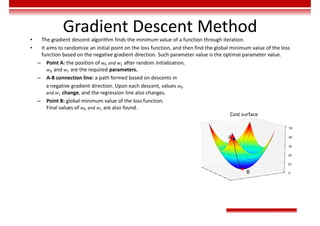
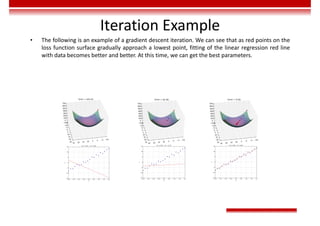
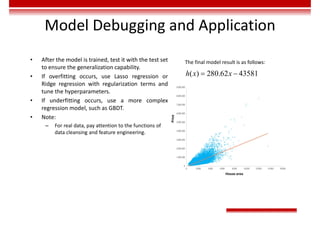
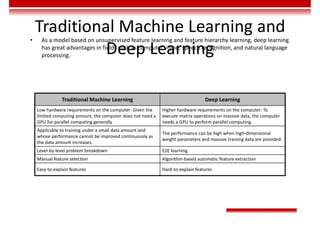
1
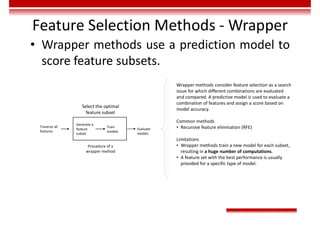
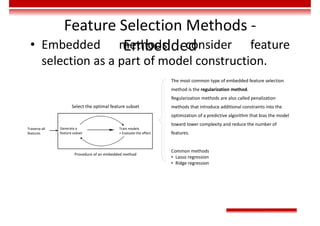
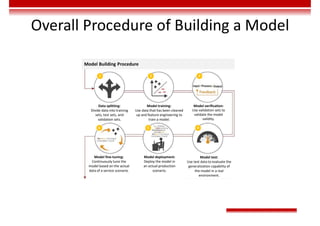
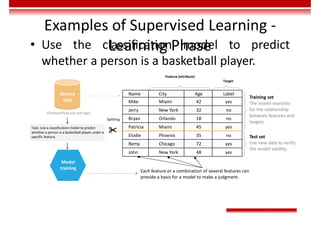
Intelligence
Artificielle
Réalisé par :
Imen BEN CHAABANE
Agenda
1. Historique
2. Définition de l’IA
3. Applications
4. cadre juridique
5. Métiers
6. Risque et futur de l’IA
2
Imen BEN CHAABANE
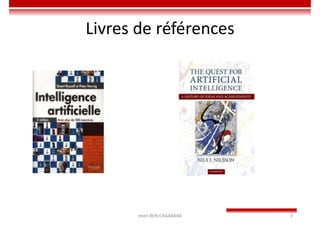
Livres de références
Imen BEN CHAABANE 3
Dictionnaires
• Qu’est-ce que l’intelligence ?
• Qu’est-ce que l’artificiel ?
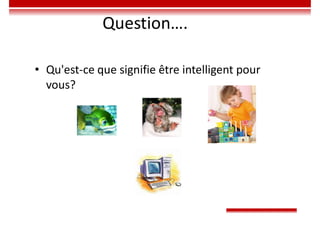
Question….
• Qu'est-ce que signifie être intelligent pour
vous?
Le quotient intellectuel ou QI
Les tests qui sont utilisés pour mesurer
l'intelligence des gens
Tests
Memoir1
Memoir2
http://faculty.washington.edu/chudler/experi.html
7
Qu’est ce qu’être intelligent ?
• Apprendre
– élaborer un système de connaissances et pouvoir intégrer
de nouvelles connaissances
• Raisonner, déduire, anticiper
– à partir du système de connaissances et des données de
l’expérience pouvoir produire de nouvelles connaissances
• Posséder une histoire
• Posséder une conscience
• Posséder des sentiments
Intelligence ?
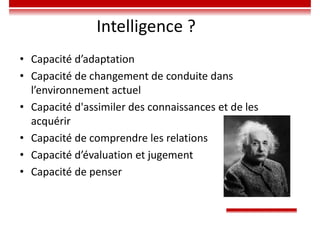
• Capacité d’adaptation
• Capacité de changement de conduite dans
l’environnement actuel
• Capacité d'assimiler des connaissances et de les
acquérir
• Capacité de comprendre les relations
• Capacité d’évaluation et jugement
• Capacité de penser
Imen BEN CHAABANE 9
• La définition du terme « intelligence » change.
• L’intelligence est liée à l’homme dans ses facultés de compréhension, et
d’apprentissage, et observable grâce au comportement (adaptabilité).
• Renvoi à des questions fondamentales : qu ’est-ce que la compréhension?
Qu ’est-ce que l ’apprentissage ? Qu ’est-ce que la connaissance ?
Intelligence ?
Imen BEN CHAABANE 10
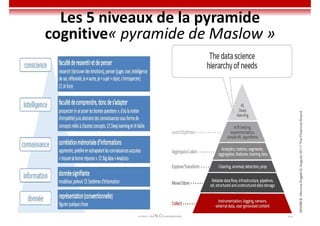
Les 5 niveaux de la pyramide
cognitive« pyramide de Maslow »
Imen BEN CHAABANE 11
La définition générale
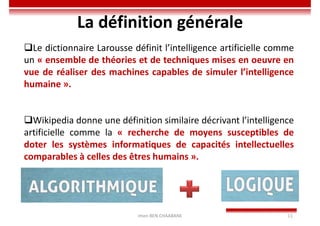
Le dictionnaire Larousse définit l’intelligence artificielle comme
un « ensemble de théories et de techniques mises en oeuvre en
vue de réaliser des machines capables de simuler l’intelligence
humaine ».
Wikipedia donne une définition similaire décrivant l’intelligence
artificielle comme la « recherche de moyens susceptibles de
doter les systèmes informatiques de capacités intellectuelles
comparables à celles des êtres humains ».
Imen BEN CHAABANE 12
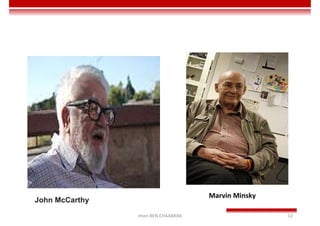
John McCarthy
Marvin Minsky
13
Qq Définition de l’IA
– Apprendre aux ordinateurs à être plus intelligents
permettra sans doute d’apprendre à l’homme à être plus
intelligent (P. H. Winston, 1984)
– L’IA est l’étude des idées qui permettent aux ordinateurs
d’être intelligents (P. H. Winston)
– L’IA est l’étude des facultés mentales à l’aide de modèles
de type calculatoire (McDermott & Charniak)
– L’IA a pour but de faire exécuter par l’ordinateur des tâches
pour lesquelles l’homme dans un contexte donné est
aujourd’hui meilleur que la machine (Alliot et Schiex 1994)
Imen BEN CHAABANE 14
La définition technique
Le Centre National de Ressources Textuelles et Lexicales donne une définition
technique de l’intelligence artificielle : « La recherche de moyens susceptibles de
doter les systèmes informatiques de capacités intellectuelles comparables à
celles des êtres humains »
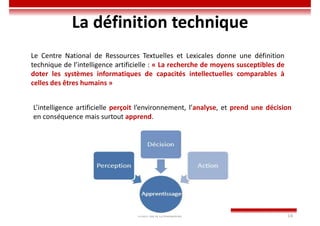
L’intelligence artificielle perçoit l’environnement, l’analyse, et prend une décision
en conséquence mais surtout apprend.
Imen BEN CHAABANE 15
La définition technique
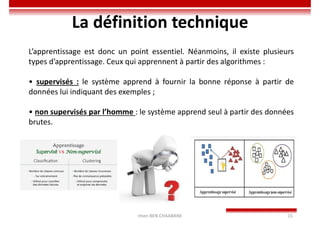
L’apprentissage est donc un point essentiel. Néanmoins, il existe plusieurs
types d’apprentissage. Ceux qui apprennent à partir des algorithmes :

• supervisés : le système apprend à fournir la bonne réponse à partir de
données lui indiquant des exemples ;
• non supervisés par l’homme : le système apprend seul à partir des données
brutes.

Imen BEN CHAABANE 16
La définition technique
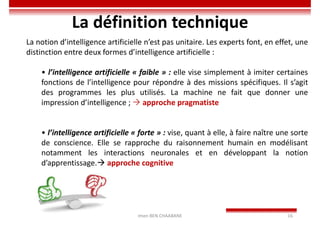
La notion d’intelligence artificielle n’est pas unitaire. Les experts font, en effet, une
distinction entre deux formes d’intelligence artificielle :
• l’intelligence artificielle « faible » : elle vise simplement à imiter certaines
fonctions de l’intelligence pour répondre à des missions spécifiques. Il s’agit
des programmes les plus utilisés. La machine ne fait que donner une
impression d’intelligence ;  approche pragmatiste
• l’intelligence artificielle « forte » : vise, quant à elle, à faire naître une sorte
de conscience. Elle se rapproche du raisonnement humain en modélisant
notamment les interactions neuronales et en développant la notion
d’apprentissage. approche cognitive
Imen BEN CHAABANE 17
Histoire de l'IA
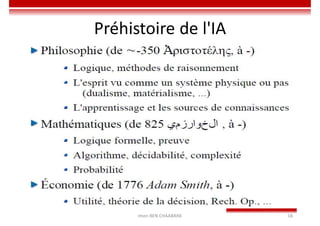
Préhistoire de l'IA
Imen BEN CHAABANE 18
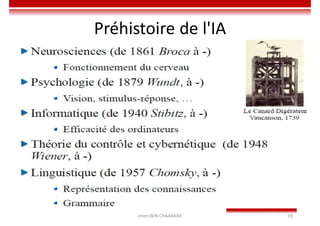
Préhistoire de l'IA
Imen BEN CHAABANE 19
Imen BEN CHAABANE 20
20
Automates de Vaucanson
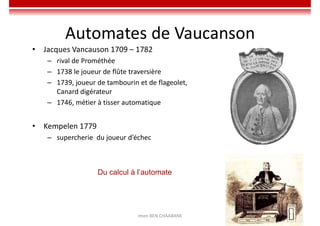
• Jacques Vancauson 1709 – 1782
– rival de Prométhée
– 1738 le joueur de flûte traversière
– 1739, joueur de tambourin et de flageolet,
Canard digérateur
– 1746, métier à tisser automatique
• Kempelen 1779
– supercherie du joueur d’échec
Du calcul à l’automate
21
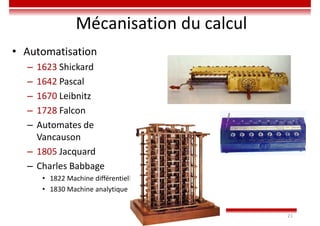
Mécanisation du calcul
• Automatisation
– 1623 Shickard
– 1642 Pascal
– 1670 Leibnitz
– 1728 Falcon
– Automates de
Vancauson
– 1805 Jacquard
– Charles Babbage
• 1822 Machine différentielle
• 1830 Machine analytique
Imen BEN CHAABANE 22
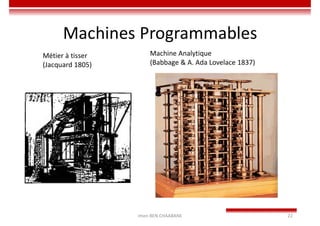
Machines Programmables
Métier à tisser
(Jacquard 1805)
Machine Analytique
(Babbage & A. Ada Lovelace 1837)
23
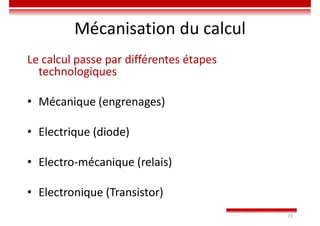
Mécanisation du calcul
Le calcul passe par différentes étapes
technologiques
• Mécanique (engrenages)
• Electrique (diode)
• Electro-mécanique (relais)
• Electronique (Transistor)
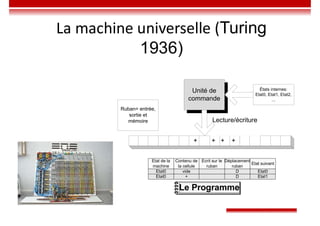
+ + + +
Lecture/écriture
Unité de
commande
États internes:
Etat0, Etat1, Etat2,
...
Ruban= entrée,
sortie et
mémoire
Etat de la
machine
Contenu de
la cellule
Ecrit sur le
ruban
Déplacement
ruban
Etat suivant
Etat0 vide D Etat0
Etat0 + D Etat1
Le Programme
La machine universelle (Turing
1936)
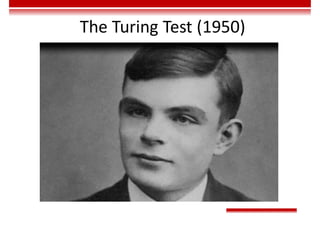
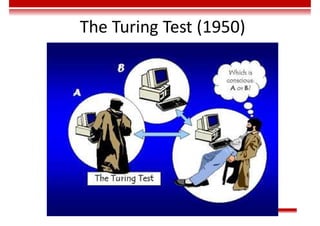
The Turing Test (1950)
27
Naissance de l’IA
• Débuts pendant la 2nde guerre mondiale
– décryptage  traduction
– Mise au point d’un traducteur automatique en 5 ans
– Comment représenter les connaissances ?
– Comment les extraire d’un individu ?
• 1956 John McCarthy, Dartmouth College
• Objectifs ambitieux
– Traduction automatique
– Jouer aux échecs et battre les grands maîtres
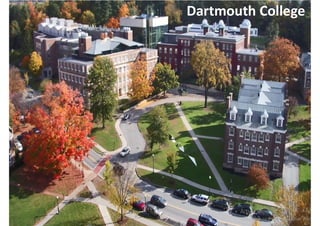
Dartmouth College
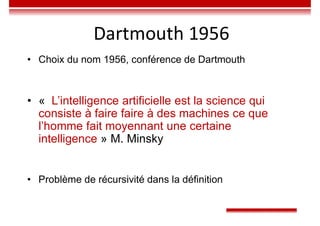
• Choix du nom 1956, conférence de Dartmouth
• « L’intelligence artificielle est la science qui
consiste à faire faire à des machines ce que
l’homme fait moyennant une certaine
intelligence » M. Minsky
• Problème de récursivité dans la définition
Dartmouth 1956
Imen BEN CHAABANE 30
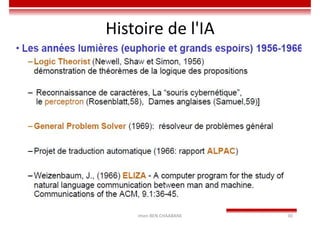
Histoire de l'IA
Imen BEN CHAABANE 32
Imen BEN CHAABANE 33
Exemples typiques de problèmes
(années 50-60)
• Le fermier, le loup, la chèvre et le choux
• Les recipients : comment obtenir 1 litre
d’eau, avec deux récipients de capacité
2 litres et 5 litres (ce dernier étant rempli
au départ)
• Intégration symbolique de sin(x). cos(x)
Imen BEN CHAABANE 35
Histoire de l'IA
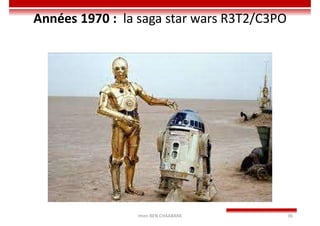
Années 1970 : la saga star wars R3T2/C3PO
Imen BEN CHAABANE 36
Imen BEN CHAABANE 37
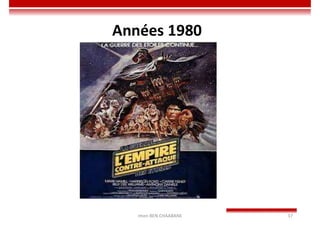
Années 1980
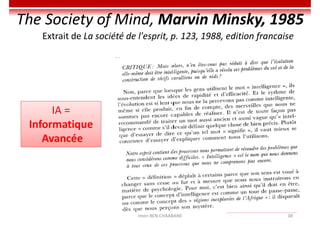
The Society of Mind, Marvin Minsky, 1985
Extrait de La société de l'esprit, p. 123, 1988, edition francaise
Imen BEN CHAABANE 38
IA =
Informatique
Avancée
Imen BEN CHAABANE 39
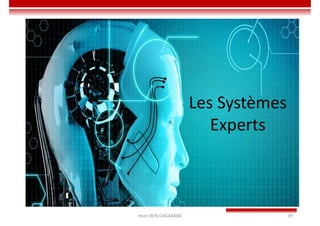
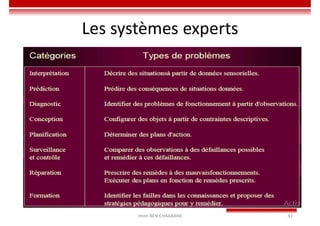
Les Systèmes
Experts
Systems Expert (SE)
Un des premiers programmes développes en IA
1960s et 1970
“… an intelligent computer system that uses
knowledge and inference procedures to solve
problems that are difficult enough to require
significant human expertise for their solution.”
(Feigenbaum)
programmes qui imitèrent les décisions
d’une experte humaine
Les systèmes experts
Imen BEN CHAABANE 41
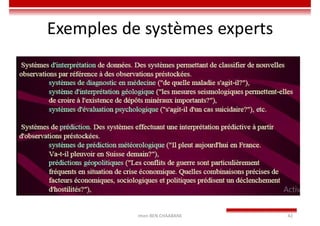
Exemples de systèmes experts
Imen BEN CHAABANE 42
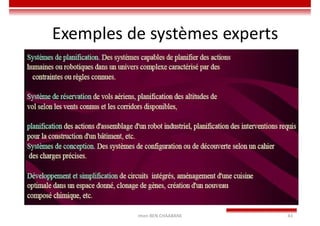
Imen BEN CHAABANE 43
Exemples de systèmes experts
Année 1990-2000
Imen BEN CHAABANE 44
Les années 2000
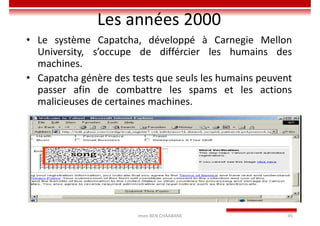
• Le système Capatcha, développé à Carnegie Mellon
University, s’occupe de différcier les humains des
machines.
• Capatcha génère des tests que seuls les humains peuvent
passer afin de combattre les spams et les actions
malicieuses de certaines machines.
Imen BEN CHAABANE 45
Les années 2000
Imen BEN CHAABANE 46
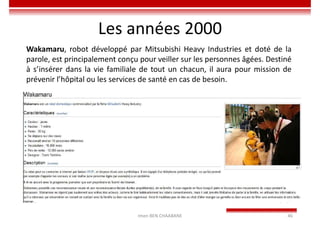
Wakamaru, robot développé par Mitsubishi Heavy Industries et doté de la
parole, est principalement conçu pour veiller sur les personnes âgées. Destiné
à s’insérer dans la vie familiale de tout un chacun, il aura pour mission de
prévenir l’hôpital ou les services de santé en cas de besoin.
Imen BEN CHAABANE 47
Les années 2000
Le 13 janvier 2004, une firme québécoise rapporte dans le
Medical Post la mise en marché d’un système portatif d’alerte
cardiaque appelé Vital Positionning System (VPS)
Incluant un téléphone cellulaire, un ordinateur de poche et un
GPS, ce système peut détecter l’approche d’une attaque
cardiaque 8 minutes vant que les premières symptômes ne
soient humainement perceptibles.
Il appelle alors automatiquement l’hôpital le plus proche et
précise l’emplacement du futur patient
Imen BEN CHAABANE 48
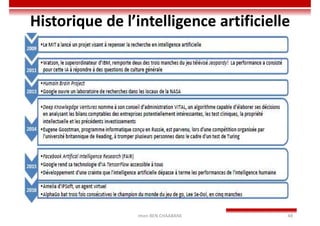
Historique de l’intelligence artificielle
Massachusetts Institute of Technology
Imen BEN CHAABANE 50
L'IA aujourd'hui
Imen BEN CHAABANE
51
Exemples d’IA (irréalistes ?)
• Exemples (Science-Fiction)
– TRON
– La Guerre des Etoiles (Z6PO)
– IA (Spielberg)
– I, Robot
– K 2000
– Galactica (Cylons)
– 2001 L’Odyssée de l’espace
– Matrix
– Terminator
– …
Imen BEN CHAABANE 52
LES GRANDS ACTEURS DE
L’INTELLIGENCE ARTIFICIELLE
Google, Apple, Facebook et Amazon ne pouvaient pas
ne pas s’investir fortement dans l’intelligence artificielle
alors qu’ils possèdent des données en énorme quantité.
Imen BEN CHAABANE 53
Google
Google, très impliqué dans l’intelligence artificielle, procède
habituellement par rachat.
En 2014, Google a acheté la société anglaise DeepMind, qui avait
développé des réseaux de neurones pour jouer aux jeux vidéo. Mais l’objectif
avoué de DeepMind est actuellement de « comprendre ce qu’est
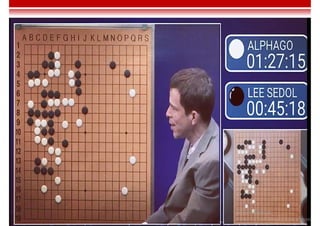
l’intelligence ». DeepMind est célèbre pour son programme AlphaGo, qui a
battu le champion du monde de go.
En octobre 2017, le programme a franchi une étape supplémentaire : en
jouant contre lui-même, non seulement son apprentissage a été plus court,
mais surtout il est devenu plus fort que la version précédente . Nous avons ici
un premier exemple d’apprentissage non supervisé, facilité par le fait que le
contexte, à savoir les règles du jeu de go, est parfaitement mathématisable.
 Google a aussi son propre moteur de recommandation nommé Google
Home, un haut-parleur et un assistant vocal disponible en trois versions
différentes.
Imen BEN CHAABANE 55
Trump versus Macron dans une
requête Google
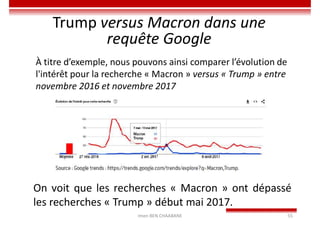
À titre d’exemple, nous pouvons ainsi comparer l’évolution de
l'intérêt pour la recherche « Macron » versus « Trump » entre
novembre 2016 et novembre 2017
On voit que les recherches « Macron » ont dépassé
les recherches « Trump » début mai 2017.
Imen BEN CHAABANE 56
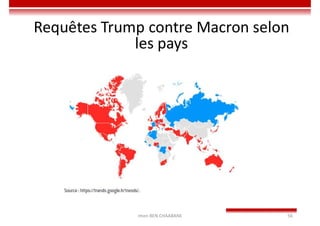
Requêtes Trump contre Macron selon
les pays
Imen BEN CHAABANE 57
Google I/O est une conférence annuelle de deux jours,
organisée par Google au Moscone Center de San Francisco,
en Californie. Le "I" et le "O" signifient respectivement "Input"
et "Output« ou "Innovation in the Open"
Imen BEN CHAABANE 58
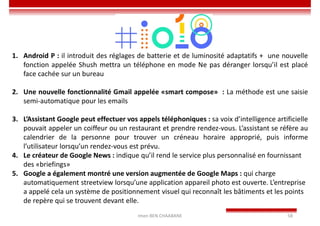
1. Android P : il introduit des réglages de batterie et de luminosité adaptatifs + une nouvelle
fonction appelée Shush mettra un téléphone en mode Ne pas déranger lorsqu’il est placé
face cachée sur un bureau
2. Une nouvelle fonctionnalité Gmail appelée «smart compose» : La méthode est une saisie
semi-automatique pour les emails
3. L’Assistant Google peut effectuer vos appels téléphoniques : sa voix d’intelligence artificielle
pouvait appeler un coiffeur ou un restaurant et prendre rendez-vous. L’assistant se réfère au
calendrier de la personne pour trouver un créneau horaire approprié, puis informe
l’utilisateur lorsqu’un rendez-vous est prévu.
4. Le créateur de Google News : indique qu’il rend le service plus personnalisé en fournissant
des «briefings»
5. Google a également montré une version augmentée de Google Maps : qui charge
automatiquement streetview lorsqu’une application appareil photo est ouverte. L’entreprise
a appelé cela un système de positionnement visuel qui reconnaît les bâtiments et les points
de repère qui se trouvent devant elle.
Imen BEN CHAABANE 59
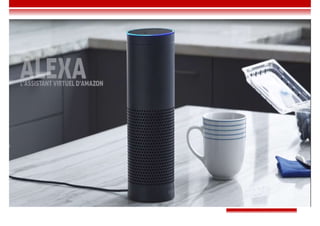
Amazon utilise de l’intelligence artificielle dans son moteur de
recommandation, nommé Echo,
et dans ses assistants basés sur son système de
reconnaissance vocale, Alexa, disponible en sept versions
différentes.
Via son offre de services dans le cloud, Amazon propose
également des services fondés sur l’intelligence artificielle,
comme la reconnaissance de la parole ou des robots de
discussion, les fameux chatbot
Imen BEN CHAABANE 60
Systèmes de recommandation
Amazon
- L'un des premiers adoptants
des systèmes de recommandation
- Grand impact sur les ventes
• Prix de Netflix
- Grand prix de $ 1,000,000
pour l'algorithme qui bat Netflix algorithme
Imen BEN CHAABANE 63
Facebook est un énorme utilisateur d’intelligence artificielle. Il
choisit les messages qu’il affiche en utilisant un moteur de type
moteur de recommandation.
Récemment, Facebook a mis en place un moteur d’intelligence
artificielle pour détecter les tendances suicidaires .
Comme le dit Joaquin Candela, directeur du département
d’intelligence artificielle appliquée, « Facebook n’existerait pas
sans intelligence artificielle ».
Imen BEN CHAABANE 64
 Apple investit énormément dans l’intelligence artificielle
et propose même un blog où sont expliquées ses
recherches.
 Siri en est l’expression la plus évidente : ce système de
reconnaissance de la parole très performant utilise des
réseaux de neurones de dernière génération qui
permettent de comprendre des commandes même dans
des environnements très bruyants, comme dans la rue.
 Apple va également bientôt lancer son propre moteur de
recommandation, nommé HomePod, un haut-parleur
connecté avec Apple Music.
Imen BEN CHAABANE 65
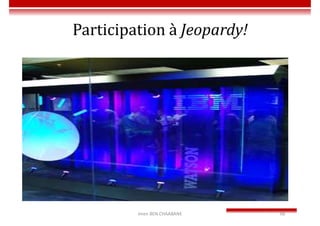
IBM a créé Watson, un système d’intelligence artificielle pour jouer, à ses
débuts, au jeu Jeopardy, l’équivalent américain de l’émission française Questions
pour un champion. Watson a analysé 200 millions de pages 27 pour finalement
battre les anciens champions et ainsi gagner le premier prix. Maintenant,
Watson est proposé par IBM dans d’autres domaines, comme la médecine ou le
droit. IBM présente aussi un blog sur le sujet de l’intelligence artificielle.
Jeopardy!
Imen BEN CHAABANE 66
Applications actuelles et futures
Imen BEN CHAABANE 67
Imen BEN CHAABANE 68
Google DeepMind, Microsoft et IBM sont rejoints par
Facebook et Amazon pour former un partenariat sur
l’intelligence artificielle au profit des populations et
de la société.
répondre aux défis mondiaux importantsle
changement climatique, la nourriture, l’inégalité, la
santé et l’éducation.
Imen BEN CHAABANE 69
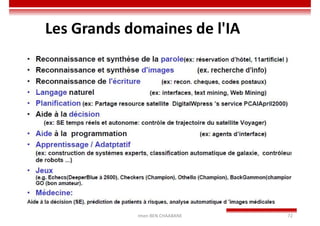
Les domaines de l'IA
Imen BEN CHAABANE 70
UNE AMBITION POUR VALORISER L’INTELLIGENCE ARTIFICIELLE
DANS LES ENTREPRISES
L’intelligence artificielle n’est pas une filière à part
entière mais apparaît de manière transversale dans
plusieurs domaines.
Elle est spécialement présente en robotique mais ne
se limite pas à ce secteur.
Imen BEN CHAABANE 71
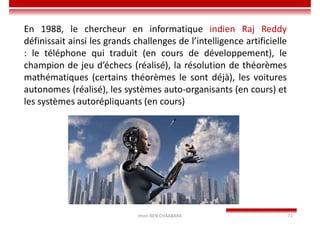
En 1988, le chercheur en informatique indien Raj Reddy
définissait ainsi les grands challenges de l’intelligence artificielle
: le téléphone qui traduit (en cours de développement), le
champion de jeu d’échecs (réalisé), la résolution de théorèmes
mathématiques (certains théorèmes le sont déjà), les voitures
autonomes (réalisé), les systèmes auto-organisants (en cours) et
les systèmes autorépliquants (en cours)
Imen BEN CHAABANE 72
Les Grands domaines de l'IA
Imen BEN CHAABANE 73
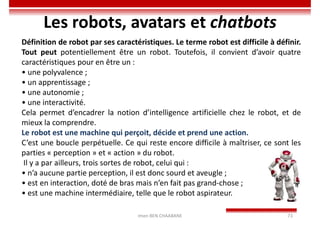
Les robots, avatars et chatbots
Définition de robot par ses caractéristiques. Le terme robot est difficile à définir.
Tout peut potentiellement être un robot. Toutefois, il convient d’avoir quatre
caractéristiques pour en être un :
• une polyvalence ;
• un apprentissage ;
• une autonomie ;
• une interactivité.
Cela permet d’encadrer la notion d’intelligence artificielle chez le robot, et de
mieux la comprendre.
Le robot est une machine qui perçoit, décide et prend une action.
C’est une boucle perpétuelle. Ce qui reste encore difficile à maîtriser, ce sont les
parties « perception » et « action » du robot.
Il y a par ailleurs, trois sortes de robot, celui qui :
• n’a aucune partie perception, il est donc sourd et aveugle ;
• est en interaction, doté de bras mais n’en fait pas grand-chose ;
• est une machine intermédiaire, telle que le robot aspirateur.
Imen BEN CHAABANE 74
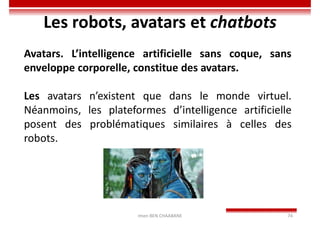
Les robots, avatars et chatbots
Avatars. L’intelligence artificielle sans coque, sans
enveloppe corporelle, constitue des avatars.
Les avatars n’existent que dans le monde virtuel.
Néanmoins, les plateformes d’intelligence artificielle
posent des problématiques similaires à celles des
robots.
Imen BEN CHAABANE 75
Les robots, avatars et chatbots
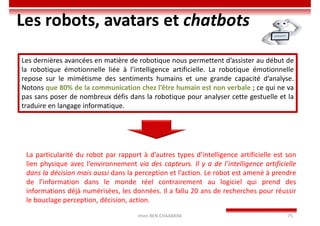
Les dernières avancées en matière de robotique nous permettent d’assister au début de
la robotique émotionnelle liée à l’intelligence artificielle. La robotique émotionnelle
repose sur le mimétisme des sentiments humains et une grande capacité d’analyse.
Notons que 80% de la communication chez l’être humain est non verbale ; ce qui ne va
pas sans poser de nombreux défis dans la robotique pour analyser cette gestuelle et la
traduire en langage informatique.
La particularité du robot par rapport à d’autres types d’intelligence artificielle est son
lien physique avec l’environnement via des capteurs. Il y a de l’intelligence artificielle
dans la décision mais aussi dans la perception et l’action. Le robot est amené à prendre
de l’information dans le monde réel contrairement au logiciel qui prend des
informations déjà numérisées, les données. Il a fallu 20 ans de recherches pour réussir
le bouclage perception, décision, action.
Imen BEN CHAABANE 76
Les robots, avatars et chatbots
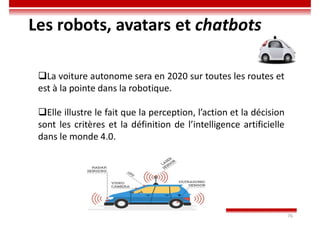
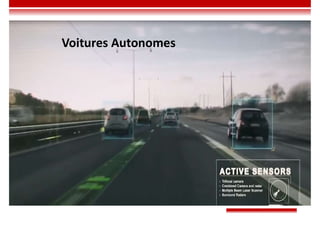
La voiture autonome sera en 2020 sur toutes les routes et
est à la pointe dans la robotique.
Elle illustre le fait que la perception, l’action et la décision
sont les critères et la définition de l’intelligence artificielle
dans le monde 4.0.
Imen BEN CHAABANE 77
Les robots, avatars et chatbots
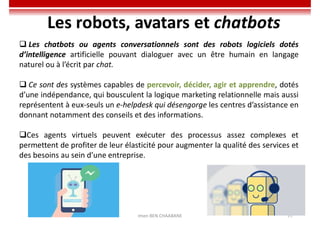
 Les chatbots ou agents conversationnels sont des robots logiciels dotés
d’intelligence artificielle pouvant dialoguer avec un être humain en langage
naturel ou à l’écrit par chat.
 Ce sont des systèmes capables de percevoir, décider, agir et apprendre, dotés
d’une indépendance, qui bousculent la logique marketing relationnelle mais aussi
représentent à eux-seuls un e-helpdesk qui désengorge les centres d’assistance en
donnant notamment des conseils et des informations.
Ces agents virtuels peuvent exécuter des processus assez complexes et
permettent de profiter de leur élasticité pour augmenter la qualité des services et
des besoins au sein d’une entreprise.
Imen BEN CHAABANE 78
Les robots, avatars et chatbots
Imen BEN CHAABANE 79
Robotique
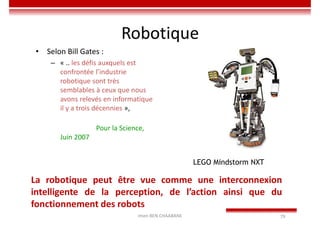
• Selon Bill Gates :
– « .. les défis auxquels est
confrontée l’industrie
robotique sont très
semblables à ceux que nous
avons relevés en informatique
il y a trois décennies »,
Pour la Science,
Juin 2007
LEGO Mindstorm NXT
La robotique peut être vue comme une interconnexion
intelligente de la perception, de l’action ainsi que du
fonctionnement des robots
Imen BEN CHAABANE 80
80
Robotique
• Chaînes de production :
– automobile,
– Informatique
– Industrie en général
• Concours de robots pour
résoudre un problème
donné
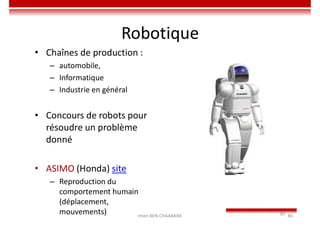
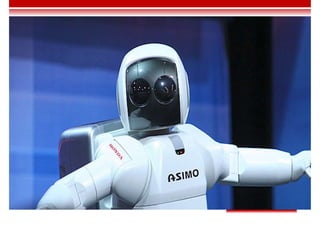
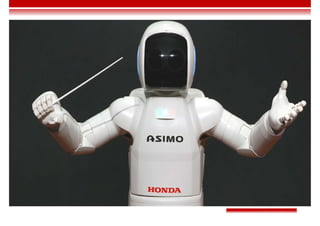
• ASIMO (Honda) site
– Reproduction du
comportement humain
(déplacement,
mouvements)
Compétences physiques
Conduire une voiture
• 2007 DARPA Grand
• Challenge
• le "Urban Challenge"
• 2 millions de dollars a été lauréat
• Tartan Racing
• trace de 96 km
• obéir à toutes les réglementations du trafic
• de négocier avec d'autres véhicules et les obstacles
• intégration dans le trafic
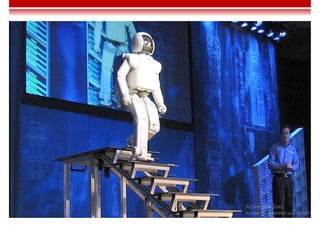
Marcher
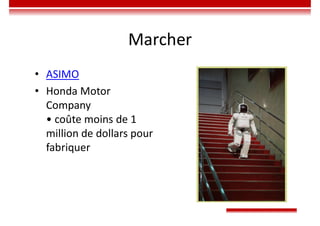
• ASIMO
• Honda Motor
Company
• coûte moins de 1
million de dollars pour
fabriquer
Imen BEN CHAABANE 86
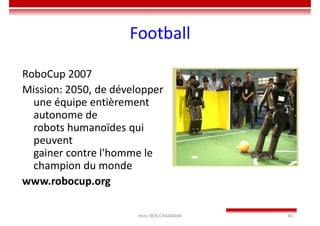
Football
RoboCup 2007
Mission: 2050, de développer
une équipe entièrement
autonome de
robots humanoïdes qui
peuvent
gainer contre l'homme le
champion du monde
www.robocup.org
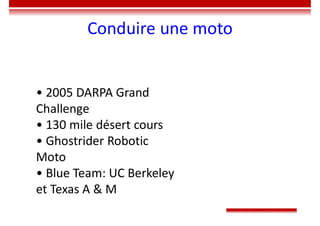
Conduire une moto
• 2005 DARPA Grand
Challenge
• 130 mile désert cours
• Ghostrider Robotic
Moto
• Blue Team: UC Berkeley
et Texas A & M
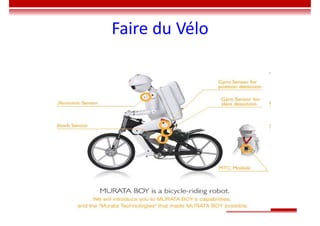
Faire du Vélo
Imen BEN CHAABANE 89
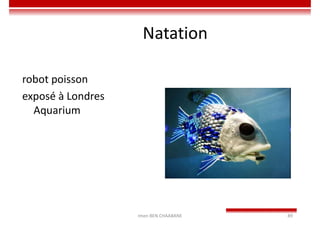
Natation
robot poisson
exposé à Londres
Aquarium
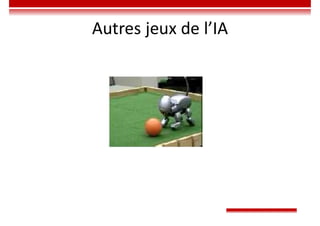
Autres jeux de l’IA
Imen BEN CHAABANE 91
Imen BEN CHAABANE 92
Imen BEN CHAABANE 93
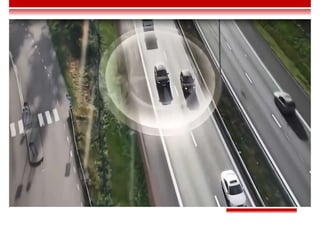
Voitures Autonomes
Imen BEN CHAABANE 96
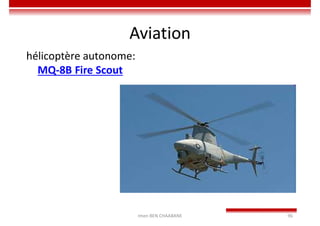
Aviation
hélicoptère autonome:
MQ-8B Fire Scout
Imen BEN CHAABANE 97
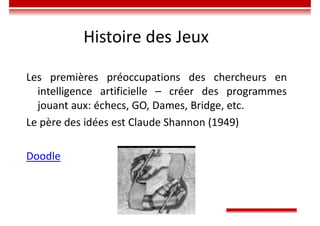
Histoire des Jeux
Les premières préoccupations des chercheurs en
intelligence artificielle – créer des programmes
jouant aux: échecs, GO, Dames, Bridge, etc.
Le père des idées est Claude Shannon (1949)
Doodle
Imen BEN CHAABANE 100
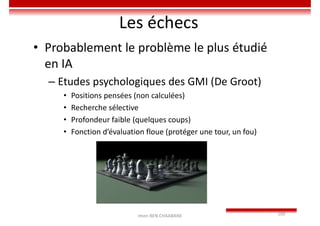
Les échecs
• Probablement le problème le plus étudié
en IA
– Etudes psychologiques des GMI (De Groot)
• Positions pensées (non calculées)
• Recherche sélective
• Profondeur faible (quelques coups)
• Fonction d’évaluation floue (protéger une tour, un fou)
Imen BEN CHAABANE 101
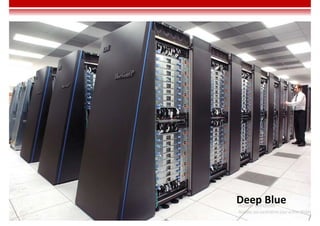
Deep Blue
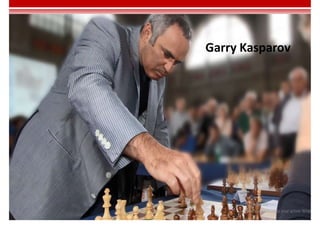
Garry Kasparov
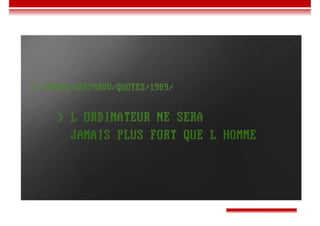
Deep Blue a gagné contre Garry Kasparov en 1997
- 6 jeux : 2 victoires, 1 perte, 3 tirages
- La force brute approche
- IBM Deep Blue a pris sa retraite
immédiatement après le match
Votre tour a joue!!!
Les échecs
Imen BEN CHAABANE 105
Dames
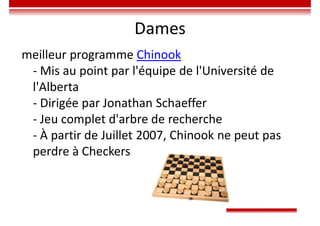
meilleur programme Chinook
- Mis au point par l'équipe de l'Université de
l'Alberta
- Dirigée par Jonathan Schaeffer
- Jeu complet d'arbre de recherche
- À partir de Juillet 2007, Chinook ne peut pas
perdre à Checkers
Ping-Pong
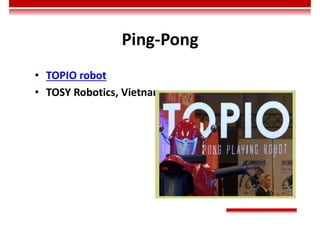
• TOPIO robot
• TOSY Robotics, Vietnam
Imen BEN CHAABANE 109
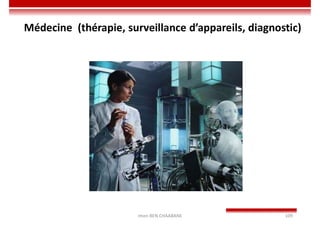
Médecine (thérapie, surveillance d’appareils, diagnostic)
Imen BEN CHAABANE 110
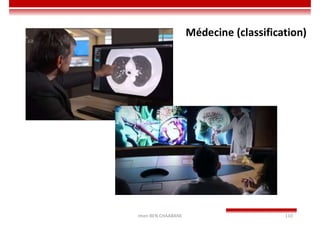
Médecine (classification)
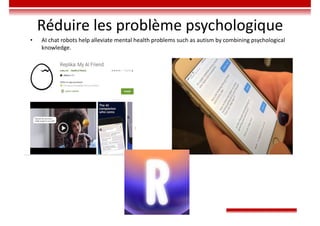
Réduire les problème psychologique
• AI chat robots help alleviate mental health problems such as autism by combining psychological
knowledge.
Imen BEN CHAABANE 112
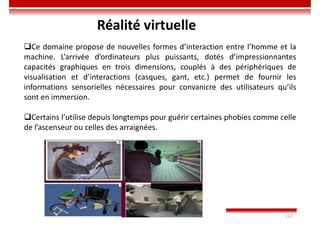
Réalité virtuelle
Ce domaine propose de nouvelles formes d’interaction entre l’homme et la
machine. L’arrivée d’ordinateurs plus puissants, dotés d’impressionnantes
capacités graphiques en trois dimensions, couplés à des périphériques de
visualisation et d’interactions (casques, gant, etc.) permet de fournir les
informations sensorielles nécessaires pour convanicre des utilisateurs qu’ils
sont en immersion.
Certains l’utilise depuis longtemps pour guérir certaines phobies comme celle
de l’ascenseur ou celles des arraignées.
Imen BEN CHAABANE 113
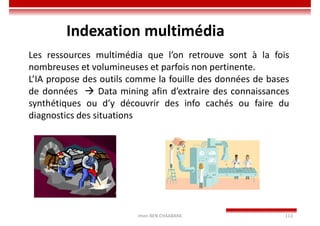
Indexation multimédia
Les ressources multimédia que l’on retrouve sont à la fois
nombreuses et volumineuses et parfois non pertinente.
L’IA propose des outils comme la fouille des données de bases
de données  Data mining afin d’extraire des connaissances
synthétiques ou d’y découvrir des info cachés ou faire du
diagnostics des situations
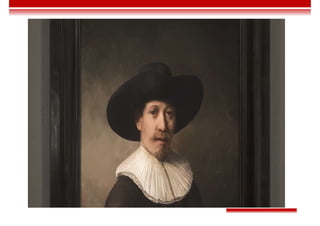
Musique
• David Cope
• Expériences en musique
Intelligence (EMI)
• prend des échantillons de travaux par un
compositeur en entrée
• analyser le style d'entrée
• générer de nouveaux travaux dans le
même style
Sculpture
L’Art
Imen BEN CHAABANE 115
L’Art
Peinture
• AARON
• kurzweilcyberart.com
• mis au point par Harold
Cohen
• les peintures sur papier
avec une
pinceau
Imen BEN CHAABANE 117
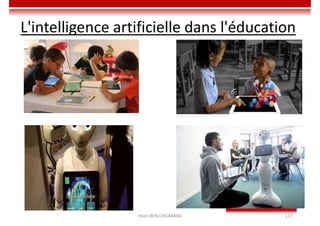
L'intelligence artificielle dans l'éducation
Imen BEN CHAABANE 118
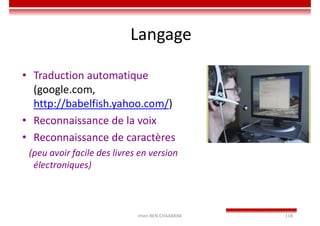
Langage
• Traduction automatique
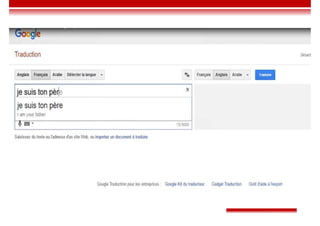
(google.com,
http://babelfish.yahoo.com/)
• Reconnaissance de la voix
• Reconnaissance de caractères
(peu avoir facile des livres en version
électroniques)
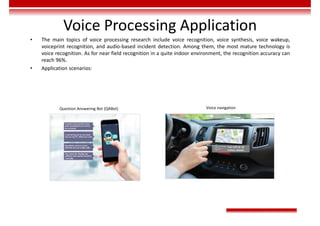
Voice Processing Application
• The main topics of voice processing research include voice recognition, voice synthesis, voice wakeup,
voiceprint recognition, and audio-based incident detection. Among them, the most mature technology is
voice recognition. As for near field recognition in a quite indoor environment, the recognition accuracy can
reach 96%.
• Application scenarios:
Question Answering Bot (QABot) Voice navigation
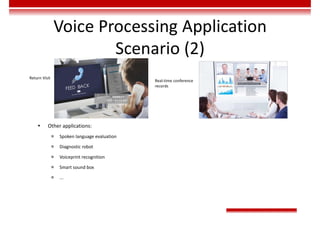
Voice Processing Application
Scenario (2)
Return Visit
Real-time conference
records
 Other applications:
 Spoken language evaluation
 Diagnostic robot
 Voiceprint recognition
 Smart sound box
 ...
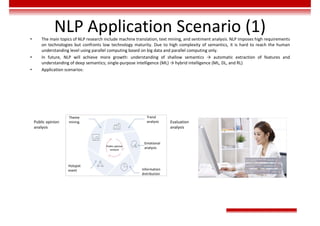
NLP Application Scenario (1)
• The main topics of NLP research include machine translation, text mining, and sentiment analysis. NLP imposes high requirements
on technologies but confronts low technology maturity. Due to high complexity of semantics, it is hard to reach the human
understanding level using parallel computing based on big data and parallel computing only.
• In future, NLP will achieve more growth: understanding of shallow semantics → automatic extraction of features and
understanding of deep semantics; single-purpose intelligence (ML) → hybrid intelligence (ML, DL, and RL)
• Application scenarios:
Public opinion
analysis
Evaluation
analysis
Theme
mining
Hotspot
event
Trend
analysis
Emotional
analysis
Information
distribution
Public opinion
analysis
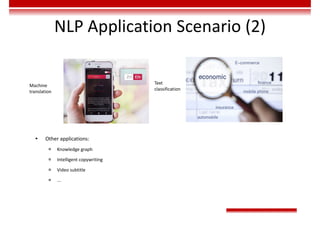
NLP Application Scenario (2)
Machine
translation
Text
classification
 Other applications:
 Knowledge graph
 Intelligent copywriting
 Video subtitle
 ...
123
La Reconnaissance de Formes / Sons
• Image :
– Imagerie médicale
– Environnement (déforestation, inondations)
– Espionnage militaire
– Sécurité (reconnaissance du visage)
• Son
– Ecriture
– Domotique
– Sécurité (reconnaissance de la voix)
• Biométrie
• Lecture optique de documents
• synthèse d’image
Les progrès en reconnaissance d’images vidéo permettant à la police de
repérer une cible dans une foule
Imen BEN CHAABANE 124
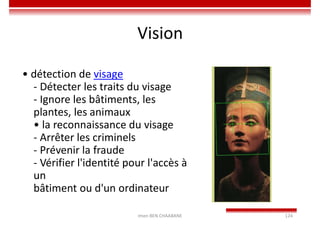
Vision
• détection de visage
- Détecter les traits du visage
- Ignore les bâtiments, les
plantes, les animaux
• la reconnaissance du visage
- Arrêter les criminels
- Prévenir la fraude
- Vérifier l'identité pour l'accès à
un
bâtiment ou d'un ordinateur
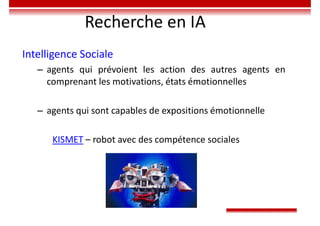
Recherche en IA
Intelligence Sociale
– agents qui prévoient les action des autres agents en
comprenant les motivations, états émotionnelles
– agents qui sont capables de expositions émotionnelle
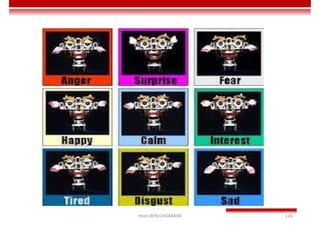
KISMET – robot avec des compétence sociales
Imen BEN CHAABANE 126
Recherche en IA
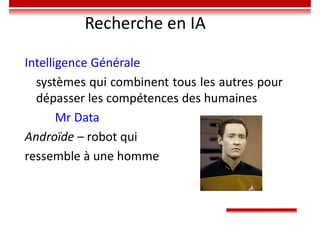
Intelligence Générale
systèmes qui combinent tous les autres pour
dépasser les compétences des humaines
Mr Data
Androïde – robot qui
ressemble à une homme
Le commerce et l'industrie
En 2006, 30% de tous les métiers de stock ont été
automatisés par des programmes
- Qui devrait atteindre 50% en 2010
- Des logiciels de trading automatique
moniteurs de mesure des nouvelles positives
et les opinions négatives sur les stocks
- La vitesse de la négociation est de plus en plus
- Microsecondes peuvent déterminer
si le commerce est rentable
Imen BEN CHAABANE 129
Detection de spam
• la détection automatique des courriels
pourriel
• en utilisant l'apprentissage machine
technique pour le texte classification
• doivent constamment s'adapter aux
de nouvelles techniques de
pollupostage
• conférence annuelle de Pourriel le
pourriel automatisé de détection, a
commencé 2003
Recherche en IA
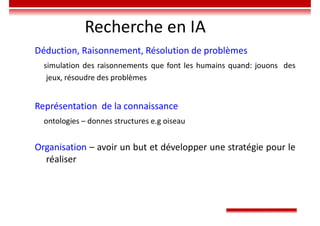
Déduction, Raisonnement, Résolution de problèmes
simulation des raisonnements que font les humains quand: jouons des
jeux, résoudre des problèmes
Représentation de la connaissance
ontologies – donnes structures e.g oiseau
Organisation – avoir un but et développer une stratégie pour le
réaliser
Recherche en IA
Apprentissage YooName
Traitement du langage naturel
• Vérification automatique d’orthographe et de
grammaire
• Service téléphonique automatique (Emily Bell)
• Recherche automatique de textes sur un sujet
donne et création automatique de résumés de
textes
• Outils de traduction automatique
Recherche en IA
Motion et manipulation - Robotiques
Perception
reconnaissance de la voix
reconnaissance du visage
reconnaissance des objectes
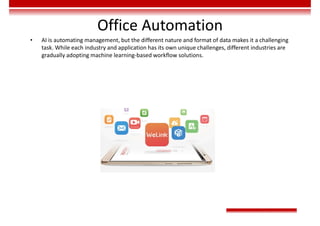
Office Automation
• AI is automating management, but the different nature and format of data makes it a challenging
task. While each industry and application has its own unique challenges, different industries are
gradually adopting machine learning-based workflow solutions.
Imen BEN CHAABANE 134
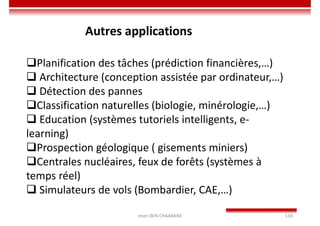
Planification des tâches (prédiction financières,…)
 Architecture (conception assistée par ordinateur,…)
 Détection des pannes
Classification naturelles (biologie, minérologie,…)
 Education (systèmes tutoriels intelligents, e-
learning)
Prospection géologique ( gisements miniers)
Centrales nucléaires, feux de forêts (systèmes à
temps réel)
 Simulateurs de vols (Bombardier, CAE,…)
Autres applications
Imen BEN CHAABANE 135
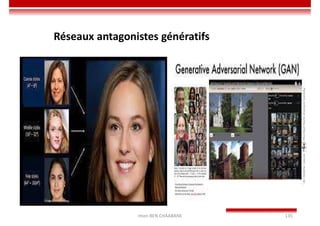
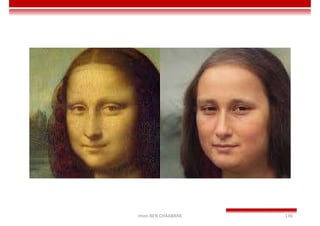
Réseaux antagonistes génératifs
Imen BEN CHAABANE 136
Imen BEN CHAABANE 137
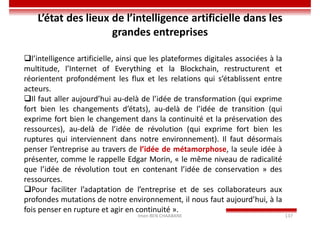
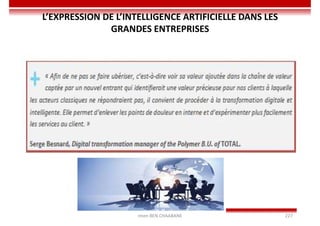
l’intelligence artificielle, ainsi que les plateformes digitales associées à la
multitude, l’Internet of Everything et la Blockchain, restructurent et
réorientent profondément les flux et les relations qui s’établissent entre
acteurs.
Il faut aller aujourd’hui au-delà de l’idée de transformation (qui exprime
fort bien les changements d’états), au-delà de l’idée de transition (qui
exprime fort bien le changement dans la continuité et la préservation des
ressources), au-delà de l’idée de révolution (qui exprime fort bien les
ruptures qui interviennent dans notre environnement). Il faut désormais
penser l’entreprise au travers de l’idée de métamorphose, la seule idée à
présenter, comme le rappelle Edgar Morin, « le même niveau de radicalité
que l’idée de révolution tout en contenant l’idée de conservation » des
ressources.
Pour faciliter l’adaptation de l’entreprise et de ses collaborateurs aux
profondes mutations de notre environnement, il nous faut aujourd’hui, à la
fois penser en rupture et agir en continuité ».
L’état des lieux de l’intelligence artificielle dans les
grandes entreprises
Imen BEN CHAABANE 138
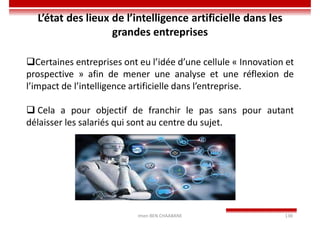
Certaines entreprises ont eu l’idée d’une cellule « Innovation et
prospective » afin de mener une analyse et une réflexion de
l’impact de l’intelligence artificielle dans l’entreprise.
 Cela a pour objectif de franchir le pas sans pour autant
délaisser les salariés qui sont au centre du sujet.
L’état des lieux de l’intelligence artificielle dans les
grandes entreprises
Imen BEN CHAABANE 139
L’IMPACT DE L’INTELLIGENCE ARTIFICIELLE POUR LES
ENTREPRISES
Aujourd’hui l’intelligence artificielle génère déjà de nombreux bénéfices pour les entreprises, notamment
en :
• Répondant aux enjeux du Big data ; l’intelligence artificielle repose en effet pour une grande partie sur la
fouille et l’analyse de masse de données à partir desquelles elle pourra apprendre ;
• Augmentant l’expertise humaine d’aide à la décision, assistant d’aide en ligne : une société à Hong Kong,
Deep knowledge venture (DKV), spécialisée dans les investissements en capitalrisque, possède par
exemple une intelligence artificielle à son conseil d’administration, nommée Vital (Validating Investment
Tool for Advancing Life sciences) qui fait des recommandations en matière d’investissement et possède
également un droit de vote ;
• Optimisant les services et produits : amélioration de la connaissance client, de la prise de décision, mais
aussi des processus opérationnels ;
• Renforçant la sécurité des systèmes : en matière de cybersécurité, l’intelligence artificielle devient un
élément structurant des infrastructures IT, afin de sécuriser les réseaux. Michael Hack, Senior Vice-
President EMEA Operations, Ipswitch, affirme en effet que « la reconnaissance automatique est désormais
bien établie pour la détection des fraudes, et des développements sont en cours pour créer des
algorithmes qui identifieront les menaces que les cerveaux humains et les mécanismes de sécurité
traditionnels échouent à reconnaître. »
• Aidant à faire des découvertes : certaines entreprises dans le domaine de la santé utilisent par exemple
Watson pour analyser toutes les publications scientifiques ayant trait à un domaine particulier de
recherche, ce qui leur permet de chercher de nouvelles propriétés, de nouvelles molécules.
Imen BEN CHAABANE 140
LE CADRE JURIDIQUE
Il n’existe pas aujourd’hui de cadre juridique propre à l’intelligence artificielle.
 Aucune disposition française ou européenne spécifique à l’intelligence
artificielle n’existe ou ne prend en considération les spécificités des
algorithmes, de ses capacités décisionnelles, d’apprentissage et d’autonomie, ni
même de sa coopération avec l’être humain.
Il est cependant nécessaire de mettre en avant
les aspects juridiques majeurs liés au
développement considérable tant du point de
vue quantitatif que qualitatif de l’intelligence
artificielle.
LE CADRE JURIDIQUE
La problématique juridique générale s’articule autour des axes suivants :
• quelle protection pour l’intelligence artificielle ?
Les problématiques juridiques majeures plus spécifiques auxquelles est confrontée
aujourd’hui l’intelligence artificielle sont tout d’abord la protection des concepts
innovants développés par les chercheurs en intelligence artificielle, notamment sur le
plan de la propriété intellectuelle, la protection des données à caractère personnel,
mais également des problématiques liées à la mise en oeuvre de la responsabilité de
l’intelligence artificielle en cas de dommage
• quelle responsabilité en cas de dommage causé par une intelligence artificielle ?
L’entreprise qui développe l’intelligence artificielle devra tenir une attention pour toute
particulière pour la protection de son innovation. Toutes les entreprises en transition
intelligente devront analyser les contrats les liant avec le fabriquant d’intelligence
artificielle.
LE REFERENTIEL LEGAL DE
L’INTELLIGENCE ARTIFICIELLE
A ce jour, l’intelligence artificielle apparaît uniquement dans deux définitions
légales et normatives.
La norme ISO 2382-28 définit l’intelligence artificielle comme la « capacité d'une
unité fonctionnelle à exécuter des fonctions généralement associées à l'intelligence
humaine, telles que le raisonnement et l'apprentissage ».
Le terme « autonomie » est défini par la norme ISO 8373:2012 comme la « capacité
d'exécuter des tâches prévues à partir de l'état courant et des détections, sans
intervention humaine ».
LE CADRE JURIDIQUE
L’action à venir de la Commission européenne concerne
l’adaptation de la législation à la robotique et à l’intelligence
artificielle et serait fondée sur l’article 114 du traité sur le
fonctionnement de l’Unioneuropéenne pour légiférer et l’article
5§3 du Traité sur l’Union européenne instaure, quant à lui, le
principe de subsidiarité, permettant à l’Union européenne
d’intervenir dans les cas où « les objectifs de l’action envisagée ne
peuvent pas être atteints de manière suffisante par les États
membres ».
LA PROTECTION DE L’INTELLIGENCE ARTIFICIELLE PAR
LA PROPRIETE INTELLECTUELLE
La protection des différents composants de la
machine, qu’il s’agisse d’un robot ou de tout type
d’autre machine, doit se distinguer de la protection de
l’intelligence artificielle en tant que telle, qui donne à
la machine une « autonomie », ou une « conscience »
pour reprendre l’expression de certains chercheurs.
La protection de l’innovation par le
droit d’auteur
Droit d’auteur. Le concept innovant comportant de l’intelligence artificielle doit
être protégé en tant
que tel par le droit d’auteur sous réserve de réunir trois conditions cumulatives :
• une forme d’expression ;
• qui soit susceptible d’être qualifiée d’oeuvre de l’esprit ;
• et ayant un caractère original.
L’originalité de l’intelligence artificielle, qui lui donne
un aspect unique, ressort nécessairement de
l’algorithme qui en est le fondement, et qui doit faire
l’objet d’une protection.
La protection des algorithmes
Les algorithmes, entendus comme des méthodes ou des principes mathématiques, ne
sont pas protégés « en tant que tels » par le droit d’auteur. Toutefois, la mise en forme
de ces algorithmes par des documents ou encore le logiciel incorporant l’algorithme
pourrait être protégé par le droit d’auteur, à condition de comporter un certain degré
d’originalité.
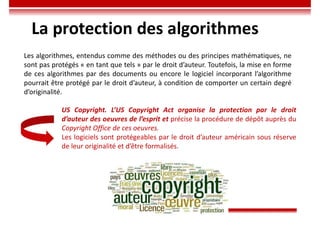
US Copyright. L’US Copyright Act organise la protection par le droit
d’auteur des oeuvres de l’esprit et précise la procédure de dépôt auprès du
Copyright Office de ces oeuvres.
Les logiciels sont protégeables par le droit d’auteur américain sous réserve
de leur originalité et d’être formalisés.
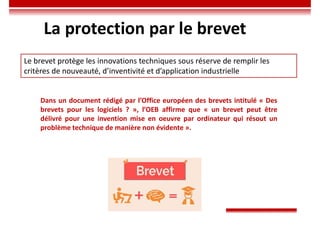
La protection par le brevet
Le brevet protège les innovations techniques sous réserve de remplir les
critères de nouveauté, d’inventivité et d’application industrielle
Dans un document rédigé par l’Office européen des brevets intitulé « Des
brevets pour les logiciels ? », l’OEB affirme que « un brevet peut être
délivré pour une invention mise en oeuvre par ordinateur qui résout un
problème technique de manière non évidente ».
Les algorithmes et donc l’intelligence artificielle sont susceptibles de
constituer un savoir faire protégeable s’ils font partie d’un ensemble
d’informations pratiques non brevetées, résultant de l’expérience, du savoir-
faire et testées.
En revanche, le savoir-faire ne donne pas lieu à un droit privatif (droit de
propriété intellectuelle ou autre droit de propriété).
Son détournement peut cependant donner lieu à des actions civiles en
concurrence déloyale ou parasitaire, voire à des actions pénales.
LA PROTECTION DU SAVOIR-FAIRE
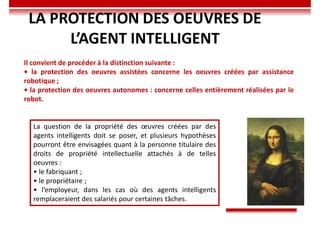
LA PROTECTION DES OEUVRES DE
L’AGENT INTELLIGENT
Il convient de procéder à la distinction suivante :
• la protection des oeuvres assistées concerne les oeuvres créées par assistance
robotique ;
• la protection des oeuvres autonomes : concerne celles entièrement réalisées par le
robot.
La question de la propriété des œuvres créées par des
agents intelligents doit se poser, et plusieurs hypothèses
pourront être envisagées quant à la personne titulaire des
droits de propriété intellectuelle attachés à de telles
oeuvres :
• le fabriquant ;
• le propriétaire ;
• l’employeur, dans les cas où des agents intelligents
remplaceraient des salariés pour certaines tâches.
Il n’existe encore aucune protection spécifique à
ce sujet. Si cela arrivait, il faudrait alors consacrer
une personnalité juridique à part entière au
bénéfice des agents intelligents afin qu’ils
puissent jouir de droits de propriété
intellectuelle sur leurs créations ou cocréations.
LA PROTECTION DES OEUVRES DE
L’AGENT INTELLIGENT
LES DONNEES A CARACTERE
PERSONNEL ET VIE PRIVEE
Le recours à des algorithmes prédictifs et aux données
d’apprentissage de l’intelligence artificielle doit être encadré
conformément aux dispositions applicables en matière de
protection des données à caractère personnel
Les
Les données sont considérées comme nouvelle matière
première de l’entreprise, et sont aujourd’hui au centre de
l’activité des entreprises et indispensables pour l’intelligence
artificielle.
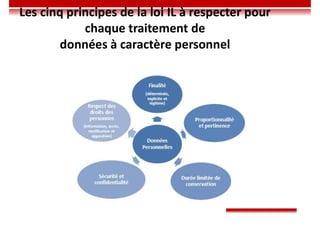
Les cinq principes de la loi IL à respecter pour
chaque traitement de
données à caractère personnel
LA RESPONSABILITE
La détermination du responsable d’un dommage impliquant
une intelligence artificielle est une question complexe dans la
mesure où il y a une pluralité d’acteurs :
• le concepteur ;
• le programmeur ;
• l’intégrateur ;
• l’utilisateur ;
• voire de l’intelligence artificielle elle-même.
La responsabilité pénale de l’entreprise peut également être
engagée dès lors que l’infraction de l’intelligence artificielle a
été commise pour le compte de cette personne morale.
La responsabilité pénale
Dans le Droit pénal général, l’infraction est caractérisée
par la réunion de trois éléments :
• un élément matériel : la commission d’un fait ou
l’abstention d’exécuter une obligation ;
• un élément légal : un fait ou une obligation prévue
par la loi ;
• un élément moral : l’intention, c’est à dire la
conscience d’enfreindre la loi.
L’auteur de l’infraction est en principe une personne
physique.
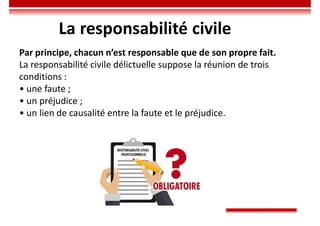
La responsabilité civile
Par principe, chacun n’est responsable que de son propre fait.
La responsabilité civile délictuelle suppose la réunion de trois
conditions :
• une faute ;
• un préjudice ;
• un lien de causalité entre la faute et le préjudice.
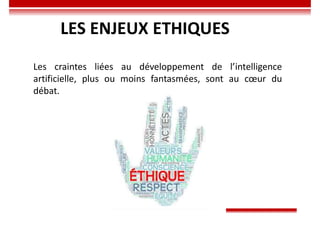
LES ENJEUX ETHIQUES
Les craintes liées au développement de l’intelligence
artificielle, plus ou moins fantasmées, sont au cœur du
débat.
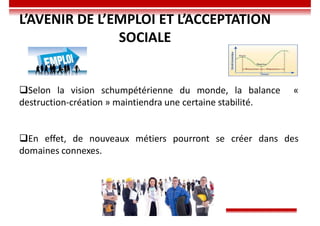
L’AVENIR DE L’EMPLOI ET L’ACCEPTATION
SOCIALE
Selon la vision schumpétérienne du monde, la balance «
destruction-création » maintiendra une certaine stabilité.
En effet, de nouveaux métiers pourront se créer dans des
domaines connexes.
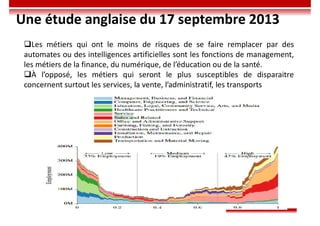
Une étude anglaise du 17 septembre 2013
Les métiers qui ont le moins de risques de se faire remplacer par des
automates ou des intelligences artificielles sont les fonctions de management,
les métiers de la finance, du numérique, de l’éducation ou de la santé.
À l’opposé, les métiers qui seront le plus susceptibles de disparaitre
concernent surtout les services, la vente, l’administratif, les transports
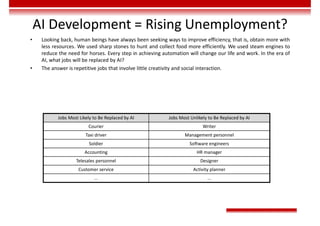
AI Development = Rising Unemployment?
• Looking back, human beings have always been seeking ways to improve efficiency, that is, obtain more with
less resources. We used sharp stones to hunt and collect food more efficiently. We used steam engines to
reduce the need for horses. Every step in achieving automation will change our life and work. In the era of
AI, what jobs will be replaced by AI?
• The answer is repetitive jobs that involve little creativity and social interaction.
Jobs Most Likely to Be Replaced by AI Jobs Most Unlikely to Be Replaced by AI
Courier Writer
Taxi driver Management personnel
Soldier Software engineers
Accounting HR manager
Telesales personnel Designer
Customer service Activity planner
... ...
Imen BEN CHAABANE 161
Imen BEN CHAABANE 162
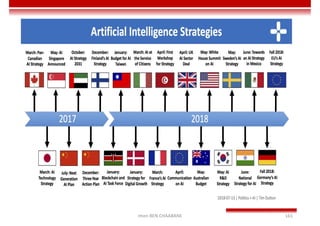
Lancement de la stratégie nationale de l'IA
Imen BEN CHAABANE 163
Merci pour Votre Attention
Imen BEN CHAABANE
Imen.benchaabane@isetcom.tn
Imen BEN CHAABANE 164
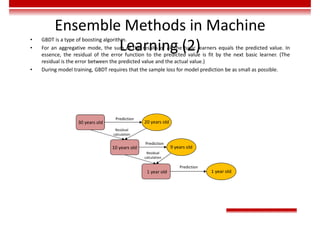
Machine Learning
Imen BEN CHAABANE 165
L’EXPRESSION DE L’INTELLIGENCE
ARTIFICIELLE
La matérialisation
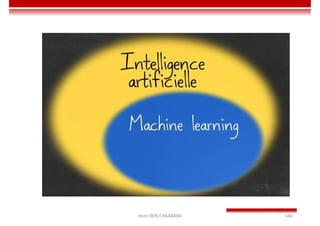
L’intelligence artificielle a intégré depuis plusieurs
décennies de nombreuses applications et divers
processus.
 Aujourd’hui, certaines technologies d’intelligence
artificielle permettent de mieux répondre aux
exigences du Big data. C’est le cas du Machine Learning
notamment.
Imen BEN CHAABANE 166
Imen BEN CHAABANE 167
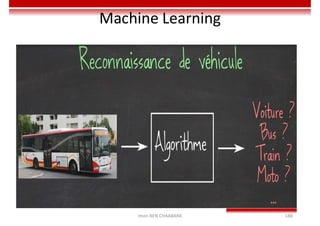
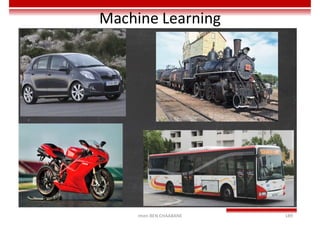
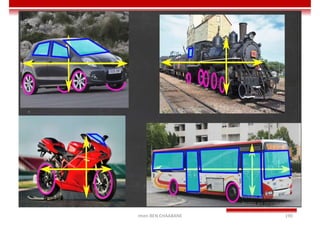
Le Machine Learning
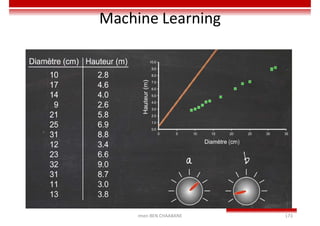
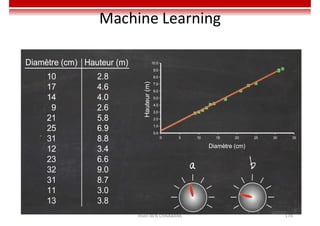
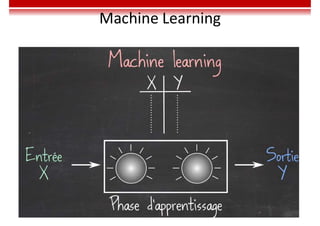
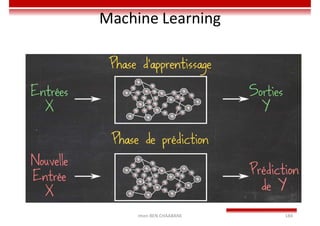
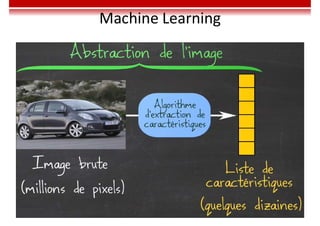
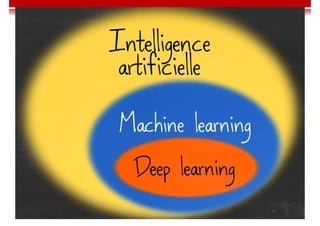
Le Machine Learning regroupe des algorithmes qui apprennent à partir
d’exemples, de données.
Le Machine Learning essaie de prédire des valeurs à partir de jeux de données
qui lui servent d’exemples.
La qualité du Machine Learning dépend de la qualité des données. Une rupture
risque donc de se créer entre les entreprises qui ont les données (de qualité) et
celles qui ne les ont pas.
Cela permet une analyse prédictive afin de détecter notamment les risques, les
usages et les besoins.
Google utilise notamment le Machine Learning avec Youtube afin de classer
toutes les vidéos.
L’objectif est d’obtenir une prédiction dotée d’une grande puissance.
Imen BEN CHAABANE 168
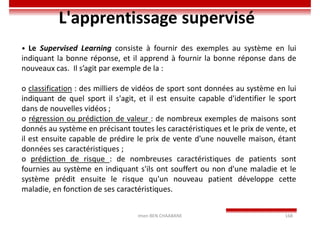
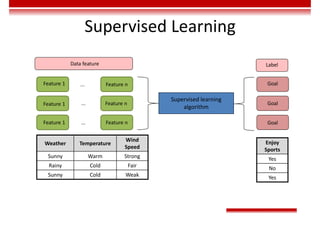
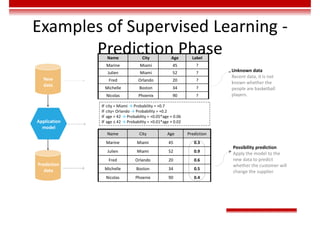
L'apprentissage supervisé
• Le Supervised Learning consiste à fournir des exemples au système en lui
indiquant la bonne réponse, et il apprend à fournir la bonne réponse dans de
nouveaux cas. Il s’agit par exemple de la :
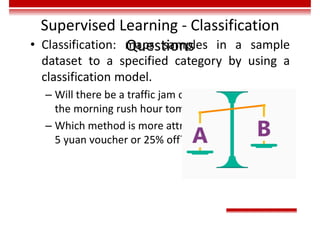
o classification : des milliers de vidéos de sport sont données au système en lui
indiquant de quel sport il s'agit, et il est ensuite capable d'identifier le sport
dans de nouvelles vidéos ;
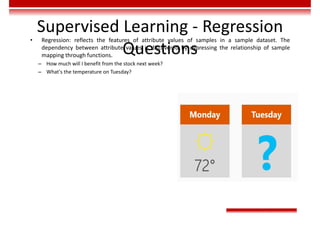
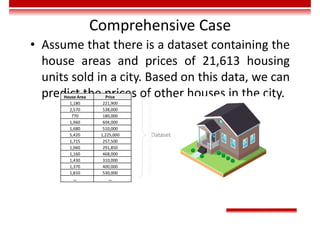
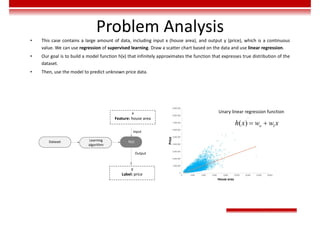
o régression ou prédiction de valeur : de nombreux exemples de maisons sont
donnés au système en précisant toutes les caractéristiques et le prix de vente, et
il est ensuite capable de prédire le prix de vente d'une nouvelle maison, étant
données ses caractéristiques ;
o prédiction de risque : de nombreuses caractéristiques de patients sont
fournies au système en indiquant s'ils ont souffert ou non d'une maladie et le
système prédit ensuite le risque qu'un nouveau patient développe cette
maladie, en fonction de ses caractéristiques.
Imen BEN CHAABANE 169
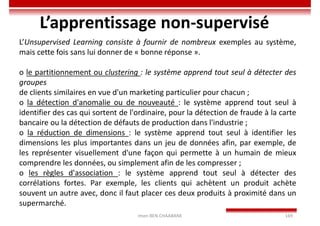
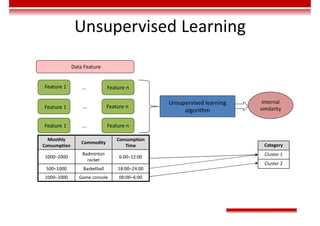
L’apprentissage non-supervisé
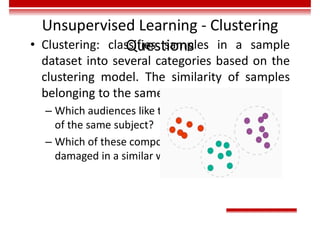
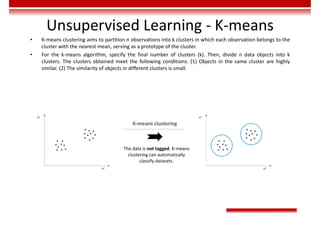
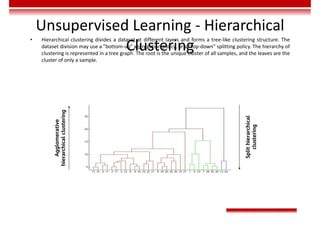
L’Unsupervised Learning consiste à fournir de nombreux exemples au système,
mais cette fois sans lui donner de « bonne réponse ».
o le partitionnement ou clustering : le système apprend tout seul à détecter des
groupes
de clients similaires en vue d'un marketing particulier pour chacun ;
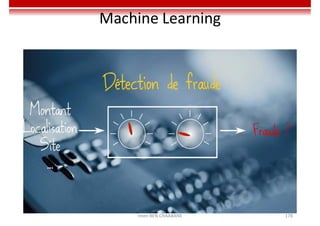
o la détection d'anomalie ou de nouveauté : le système apprend tout seul à
identifier des cas qui sortent de l'ordinaire, pour la détection de fraude à la carte
bancaire ou la détection de défauts de production dans l'industrie ;
o la réduction de dimensions : le système apprend tout seul à identifier les
dimensions les plus importantes dans un jeu de données afin, par exemple, de
les représenter visuellement d'une façon qui permette à un humain de mieux
comprendre les données, ou simplement afin de les compresser ;
o les règles d'association : le système apprend tout seul à détecter des
corrélations fortes. Par exemple, les clients qui achètent un produit achète
souvent un autre avec, donc il faut placer ces deux produits à proximité dans un
supermarché.
Imen BEN CHAABANE 170
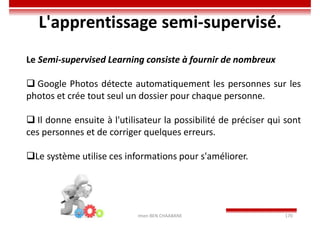
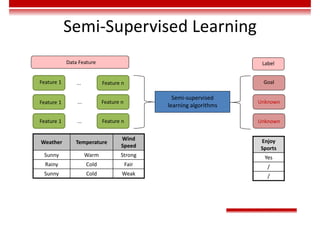
L'apprentissage semi-supervisé.
Le Semi-supervised Learning consiste à fournir de nombreux
 Google Photos détecte automatiquement les personnes sur les
photos et crée tout seul un dossier pour chaque personne.
 Il donne ensuite à l'utilisateur la possibilité de préciser qui sont
ces personnes et de corriger quelques erreurs.
Le système utilise ces informations pour s'améliorer.
Imen BEN CHAABANE 171
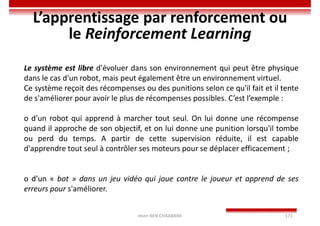
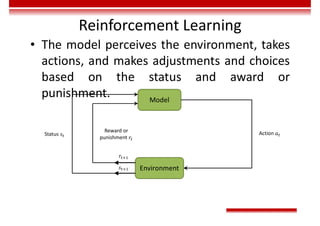
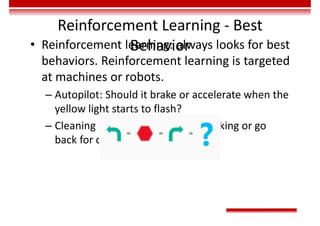
L’apprentissage par renforcement ou
le Reinforcement Learning
Le système est libre d'évoluer dans son environnement qui peut être physique
dans le cas d'un robot, mais peut également être un environnement virtuel.
Ce système reçoit des récompenses ou des punitions selon ce qu'il fait et il tente
de s'améliorer pour avoir le plus de récompenses possibles. C’est l’exemple :
o d’un robot qui apprend à marcher tout seul. On lui donne une récompense
quand il approche de son objectif, et on lui donne une punition lorsqu'il tombe
ou perd du temps. A partir de cette supervision réduite, il est capable
d'apprendre tout seul à contrôler ses moteurs pour se déplacer efficacement ;
o d’un « bot » dans un jeu vidéo qui joue contre le joueur et apprend de ses
erreurs pour s'améliorer.
Imen BEN CHAABANE 172
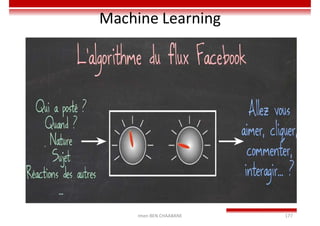
Machine Learning
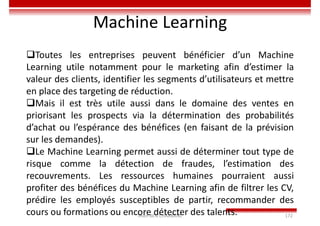
Toutes les entreprises peuvent bénéficier d’un Machine
Learning utile notamment pour le marketing afin d’estimer la
valeur des clients, identifier les segments d’utilisateurs et mettre
en place des targeting de réduction.
Mais il est très utile aussi dans le domaine des ventes en
priorisant les prospects via la détermination des probabilités
d’achat ou l’espérance des bénéfices (en faisant de la prévision
sur les demandes).
Le Machine Learning permet aussi de déterminer tout type de
risque comme la détection de fraudes, l’estimation des
recouvrements. Les ressources humaines pourraient aussi
profiter des bénéfices du Machine Learning afin de filtrer les CV,
prédire les employés susceptibles de partir, recommander des
cours ou formations ou encore détecter des talents.
Machine Learning
Imen BEN CHAABANE 173
Machine Learning
Imen BEN CHAABANE 174
Machine Learning
Imen BEN CHAABANE 175
Imen BEN CHAABANE 176
Machine Learning
Imen BEN CHAABANE 177
Machine Learning
Imen BEN CHAABANE 178
Machine Learning
Imen BEN CHAABANE 179
Machine Learning
Imen BEN CHAABANE 180
Machine Learning
Imen BEN CHAABANE 181
Machine Learning
Imen BEN CHAABANE 182
Machine Learning
Imen BEN CHAABANE 183
Machine Learning
Imen BEN CHAABANE 184
Machine Learning
Imen BEN CHAABANE 185
Machine Learning
Imen BEN CHAABANE 186
Machine Learning
Imen BEN CHAABANE 187
Machine Learning
Imen BEN CHAABANE 188
Machine Learning
Imen BEN CHAABANE 189
Imen BEN CHAABANE 190
Machine Learning
Imen BEN CHAABANE 191
Machine Learning
Imen BEN CHAABANE 192
Machine Learning
Imen BEN CHAABANE 193
Imen BEN CHAABANE 194
Imen BEN CHAABANE 195
Imen BEN CHAABANE 196
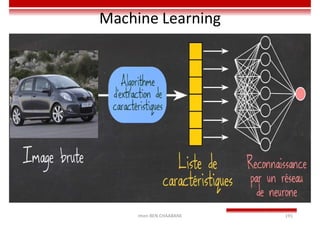
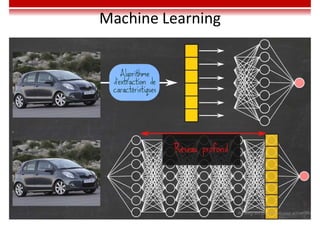
Le Deep Learning
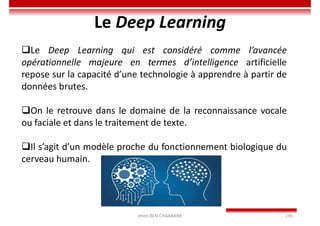
Le Deep Learning qui est considéré comme l’avancée
opérationnelle majeure en termes d’intelligence artificielle
repose sur la capacité d’une technologie à apprendre à partir de
données brutes.
On le retrouve dans le domaine de la reconnaissance vocale
ou faciale et dans le traitement de texte.
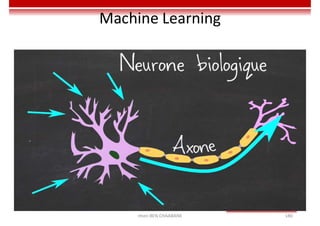
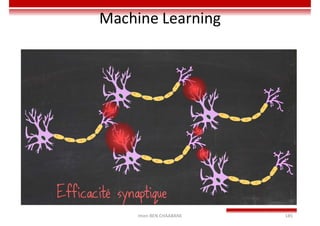
Il s’agit d’un modèle proche du fonctionnement biologique du
cerveau humain.
Imen BEN CHAABANE 197
Le Deep Learning
Le Deep Learning a été développé progressivement depuis les
années 1950, avec des périodes de grandes promesses et des
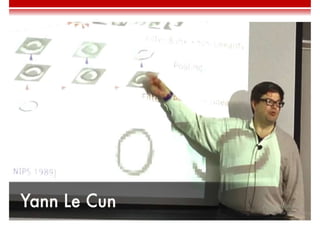
périodes de gel. Parmi les grands noms du Deep Learning, il faut
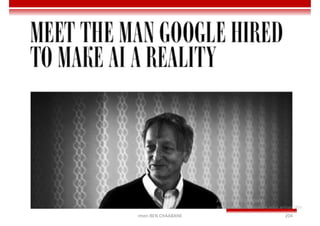
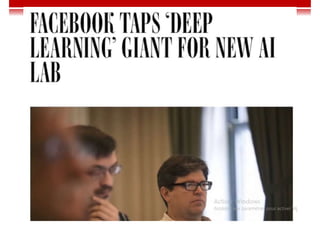
citer Yann LeCun, chercheur en intelligence artificielle, vision
artificielle et robotique, professeur à l’Université de New York et
directeur de Facebook AI Research (FAIR), qui a développé des
systèmes de reconnaissance de caractères ultra-performants à
base de réseaux de neurones.
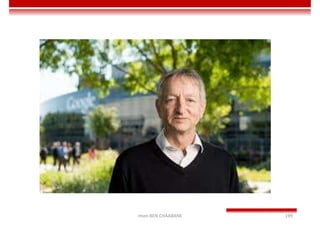
Mais aussi, Geoffrey Hinton, psychologue spécialisé en cognition
et informaticien, chercheur en intelligence artificielle, professeur à
l’Université de Toronto et employé chez Google, qui est parvenu à
entrainer des réseaux de neurones profonds avec des techniques
nouvelles en 2006.
Imen BEN CHAABANE 198
Imen BEN CHAABANE 199
Imen BEN CHAABANE 200
Le Deep Learning
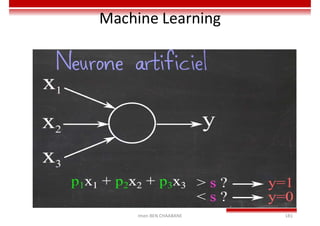
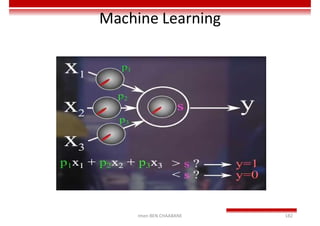
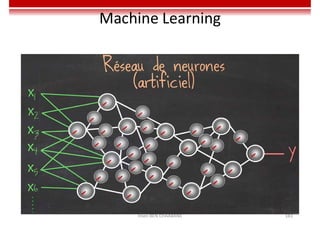
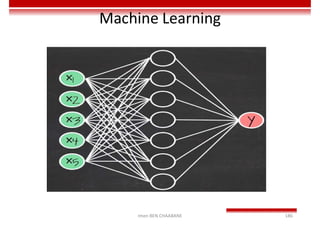
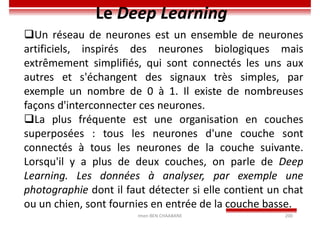
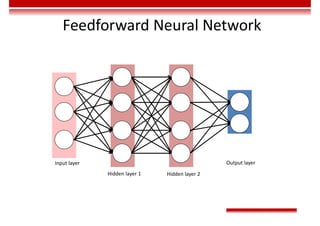
Un réseau de neurones est un ensemble de neurones
artificiels, inspirés des neurones biologiques mais
extrêmement simplifiés, qui sont connectés les uns aux
autres et s'échangent des signaux très simples, par
exemple un nombre de 0 à 1. Il existe de nombreuses
façons d'interconnecter ces neurones.
La plus fréquente est une organisation en couches
superposées : tous les neurones d'une couche sont
connectés à tous les neurones de la couche suivante.
Lorsqu'il y a plus de deux couches, on parle de Deep
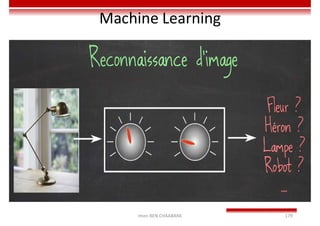
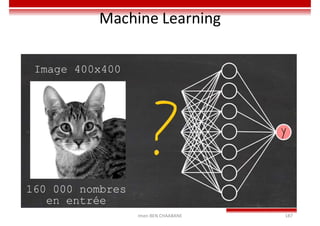
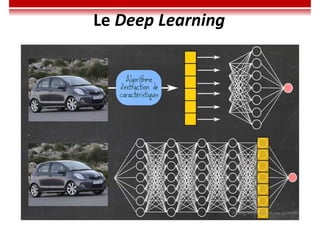
Learning. Les données à analyser, par exemple une
photographie dont il faut détecter si elle contient un chat
ou un chien, sont fournies en entrée de la couche basse.
Imen BEN CHAABANE 201
Le Deep Learning est donc très puissant
mais aussi coûteux
Certains neurones s'activent et envoient des
signaux à la couche supérieure, et ainsi de suite
jusqu'à la couche la plus haute, parfois constituée
d'un seul neurone. Dans l'exemple précédent, si ce
neurone s'active c'est un chat, sinon c'est un chien.
Entrainer le réseau de neurones consiste à lui
donner de nombreux exemples de photographies et
à corriger légèrement la force de connexion entre
chaque neurone lorsque le système fait une erreur,
de façon à réduire cette erreur.
Imen BEN CHAABANE 202
Le Deep Learning
Imen BEN CHAABANE 203
Le Deep Learning
Imen BEN CHAABANE 204
Imen BEN CHAABANE 205
Imen BEN CHAABANE 206
Imen BEN CHAABANE 207
Imen BEN CHAABANE 208
Stanford University
Imen BEN CHAABANE 210
Imen BEN CHAABANE 211
Imen BEN CHAABANE 212
Imen BEN CHAABANE 213
Deep Learning
Imen BEN CHAABANE 214
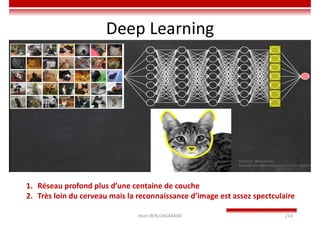
1. Réseau profond plus d’une centaine de couche
2. Très loin du cerveau mais la reconnaissance d’image est assez spectculaire
Imen BEN CHAABANE 215
Imen BEN CHAABANE 216
Imen BEN CHAABANE 217
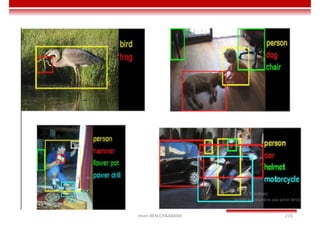
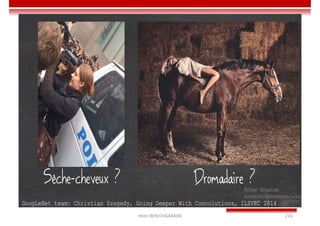
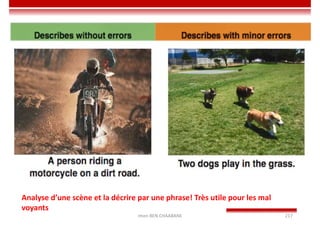
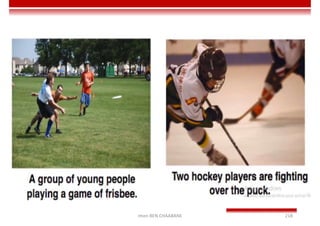
Analyse d’une scène et la décrire par une phrase! Très utile pour les mal
voyants
Imen BEN CHAABANE 218
Imen BEN CHAABANE 219
Imen BEN CHAABANE 220
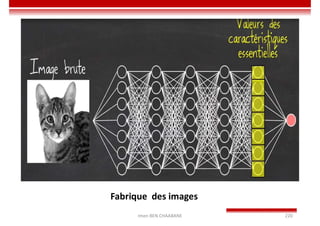
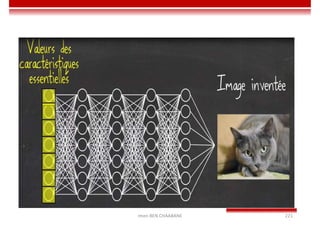
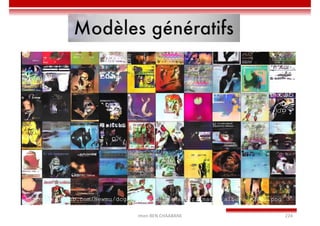
Fabrique des images
Imen BEN CHAABANE 221
Imen BEN CHAABANE 222
Imen BEN CHAABANE 223
Imen BEN CHAABANE 224
Imen BEN CHAABANE 225
L’EXPRESSION DE L’INTELLIGENCE ARTIFICIELLE DANS
LES GRANDES ENTREPRISES
Imen BEN CHAABANE 226
L’EXPRESSION DE L’INTELLIGENCE ARTIFICIELLE DANS
LES GRANDES ENTREPRISES
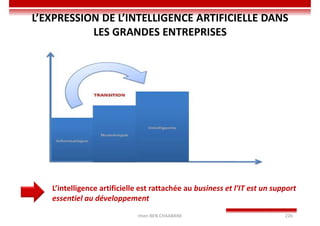
L’intelligence artificielle est rattachée au business et l’IT est un support
essentiel au développement
Imen BEN CHAABANE 227
L’EXPRESSION DE L’INTELLIGENCE ARTIFICIELLE DANS LES
GRANDES ENTREPRISES
Imen BEN CHAABANE 228
L’EXPRESSION DE L’INTELLIGENCE ARTIFICIELLE DANS LES
GRANDES ENTREPRISES
Imen BEN CHAABANE 229
L’état des lieux de l’intelligence artificielle dans les
grandes entreprises
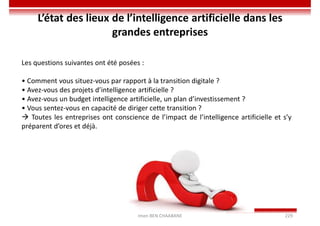
Les questions suivantes ont été posées :
• Comment vous situez-vous par rapport à la transition digitale ?
• Avez-vous des projets d’intelligence artificielle ?
• Avez-vous un budget intelligence artificielle, un plan d’investissement ?
• Vous sentez-vous en capacité de diriger cette transition ?
 Toutes les entreprises ont conscience de l’impact de l’intelligence artificielle et s’y
préparent d’ores et déjà.
Imen BEN CHAABANE 230
LES CHALLENGES
Les enjeux culturels
Comment anticiper cette transformation à la fois technique et culturelle, au
sein d’une grande organisation ?
Les principaux challenges culturels portent sur le développement et la mise
en oeuvre du Machine Learning. Il faut développer une pédagogie, informer les
équipes, mettre en place des systèmes de veille, etc.
Certaines entreprises ont déjà des outils en intelligence artificielle, des
applications pour lutter contre la fraude par exemple, mais n’ont pas de
services centralisés.
Imen BEN CHAABANE 231
LES CHALLENGES
Les enjeux organisationnels
Certaines grandes entreprises sont très actives sur
l’intelligence artificielle en R&D et ont parfois des équipes de
prospectives dédiées, sur une période donnée, à ce sujet.
 Même si ces entités comprennent parfois peu de personnel, il
y a une ambition commune qui est de faire émerger une
communauté autour de l’intelligence artificielle au niveau
national et international.
Imen BEN CHAABANE 232
DE NOUVELLES MANIERE DE TRAVAILLER
Le domaine du management de l’intelligence artificielle doit aussi s’interroger sur sa
propre disparition car si l’intelligence artificielle peut renforcer l’automatisation de
tâches pénibles pour l‘homme, elle peut aussi remplacer ou compléter des fonctions à
hautes responsabilités.
En effet, si l’on prend comme exemple la société japonaise Hitachi, une intelligence
artificielle serait capable de tenir le rôle de manager en donnant « des instructions aux
employés, basées sur de grandes analyses de données et les routines des travailleurs ».
Dans un communiqué du 4 septembre 2015, la société annonce qu’au-delà de
l’amélioration de l’efficacité du travail et du gain du temps, l’intelligence artificielle est
aussi capable d’anticiper d’éventuels problèmes grâce à des analyses de données
extérieures en temps réel : « Si à cause d’une tempête de neige vous êtes en retard et
que cela peut retarder une échéance, l’intelligence artificielle est déjà au courant du
mauvais temps, a déjà procédé à des corrections et fournit des instructions de travail
appropriées »
Imen BEN CHAABANE 233
La dimension stratégique du management ne peut pour l’instant se
soumettre à une intelligence artificielle, sans oublier l’importance du contact
humain, des capacités relationnelles pour l’organisation du travail et les
décisions stratégiques.
Autrement dit, l’intelligence artificielle ne saurait trouver sa place dans les
entreprises sans intelligence humaine pour la superviser. Il s’agit avant tout
d’une aide à la décision.
DE NOUVELLES MANIERE DE TRAVAILLER
Imen BEN CHAABANE 234
DE NOUVELLES OPPORTUNITES BUSINESS :
L’EXEMPLE BANCAIRE
À la différence de l'approche Big Data analytics qui cherche à accumuler des
connaissances sur le client en vue de « pousser des produits » vers le client, le « push
product », l'IA incite à faire pivoter la relation.
La capacité à se mettre à la place du client en se posant les bonnes questions, à
considérer ses intérêts dans son propre système de valeurs, deviendra l'élément
premier de la relation, pour entretenir un « pouvoir d’attraction » envers le client et
pour qu’il considère à tout moment l’entreprise en question comme un acteur
pertinent
Il s'agit ainsi de passer du « push product » au « pull client ».
Seeing = Believing?
• With the development of computer vision technologies, reliability of images and videos is decreasing. Fake
images can be produced with technologies such as PS and generative adversarial networks (GAN), making it
hard to identify whether images are true or not.
• Example:
– A suspect provided fake evidence by forging an image in which the suspect is in a place where he has never been to or
with someone he has never seen using PS technologies.
– In advertisements for diet pills, people's appearances before and after weight loss can be changed with PS technologies
to exaggerate the effect of the pills.
– Lyrebird, a tool for simulating voice of human beings based on recording samples of minutes, may be used by criminals.
– Household images released on rent and hotel booking platforms may be generated through GAN.
Problems to Be Solved
• Are AI-created works protected by copyright laws?
• Who gives authority to robots?
• What rights shall be authorized to robots?
• ...
Development Trends of AI
Technologies
• Framework: easier-to-use development framework
• Algorithm: algorithm models with better performance and smaller size
• Computing power: comprehensive development of device-edge-cloud computing
• Data: more comprehensive basic data service industry and more secure data sharing
• Scenario: continuous breakthroughs in industry applications
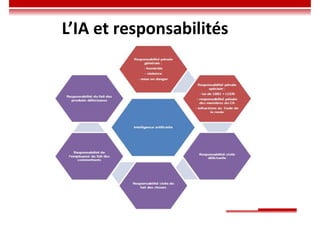
L’IA et responsabilités
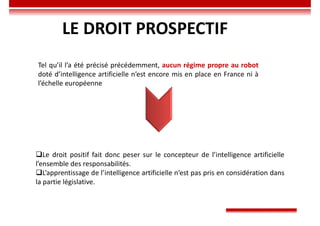
LE DROIT PROSPECTIF
Tel qu’il l’a été précisé précédemment, aucun régime propre au robot
doté d’intelligence artificielle n’est encore mis en place en France ni à
l’échelle européenne
Le droit positif fait donc peser sur le concepteur de l’intelligence artificielle
l’ensemble des responsabilités.
L’apprentissage de l’intelligence artificielle n’est pas pris en considération dans
la partie législative.
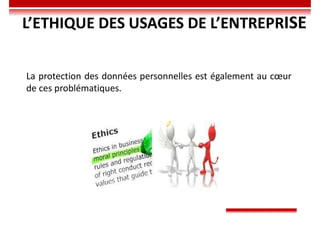
L’ETHIQUE DES USAGES DE L’ENTREPRISE
La protection des données personnelles est également au cœur
de ces problématiques.
L’ETHIQUE BY DESIGN
Il convient d’être prudent et de faire des tests avant une mise sur le
marché. On pourrait ainsi éviter une partie des risques grâce :
• A la certification et/ou l’autorisation de mise sur le marché ;
• A la mise en place d’un droit à l’oubli et d’un droit au refus : il faudrait que tout
utilisateur puisse refuser de confier ses données personnelles à une intelligence
artificielle. Il faut avoir la possibilité de refuser l’accès d’une intelligence artificielle à son
compte Twitter, Facebook dont l’analyse des données permette déjà de déduire si une
personne est solvable pour un prêt bancaire, par exemple.
Sur de nombreux sites internet, il y a déjà de l’intelligence artificielle, nos comportements
sont tracés en permanence (suivi des navigations, sites précédemment visités). Comment
faire pour vivre dans une société imprégnée d’intelligence artificielle ? Un individu qui
exercerait ce droit au refus et/ou à l’oubli ne risquerait-il pas d’être mis au ban de cette
société ?
• A la séparation des intelligences artificielles : dans une vision plus extrémiste, il s’agirait
de rendre techniquement impossible une fusion de toutes les intelligences artificielles
entre elles, afin de les empêcher d’apprendre les unes des autres.
Problems to Be Solved
• Are AI-created works protected by copyright laws?
• Who gives authority to robots?
• What rights shall be authorized to robots?
• ...
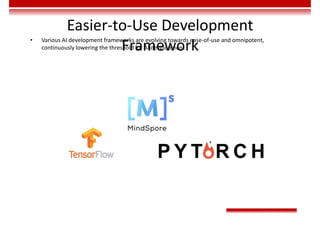
Easier-to-Use Development
Framework
• Various AI development frameworks are evolving towards ease-of-use and omnipotent,
continuously lowering the threshold for AI development.
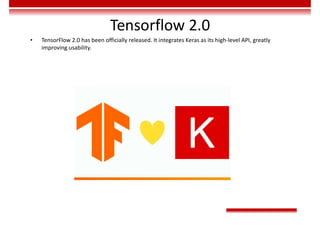
Tensorflow 2.0
• TensorFlow 2.0 has been officially released. It integrates Keras as its high-level API, greatly
improving usability.
L’IA constitue la prochaine révolution informatique et culturelle des entreprises.
Pour s’y préparer, les convictions des grandes entreprises, participantes du Cercle IA,
sont :
• De ne pas hésiter à affecter des budgets spécifiques à l’IA, qui devrait dépasser le
stade POC et pouvoir se développer rapidement, avec une vraie stratégie
d’entreprise ;
• Anticiper l’évolution des infrastructures IT : la puissance de calcul liée à
l’exécution d’algorithmes d’apprentissage nécessite de passer d’architectures
séquentielles à des architectures parallèles et distribuées ;
• Attirer et valoriser les nouveaux talents : la France est leader dans le domaine des
mathématiques et regorge de talents dans l’ingénierie et dans la recherche
scientifique. Les grandes entreprises ont besoin de ces compétences d’excellence et
doivent les valoriser dansles nouveaux métiers liés à l’IA (développeurs, roboticiens,
data scientists) ;
• Développer le travail de prospective au sein des entreprises pour mieux orienter
les stratégies à partir de différents scénarios possibles d’émergence de l’IA ;
• Dé-siloter les Métiers et développer une culture d’API au sein de l’entreprise ;
• Enfin, l’IA étant évidemment un sujet business, il est important pour l’IT d’être un
support, voire un pilote de ces nouveaux business models.
Synthèse
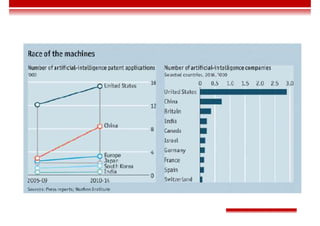
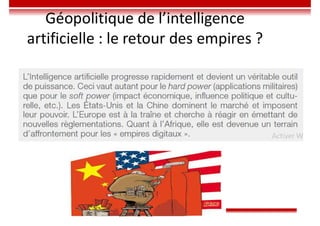
Géopolitique de l’intelligence
artificielle : le retour des empires ?
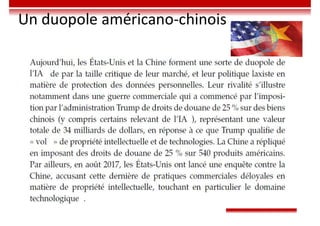
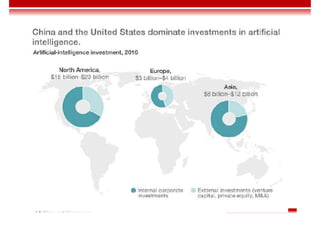
Un duopole américano-chinois
L’Afrique : le grand champ de bataille?
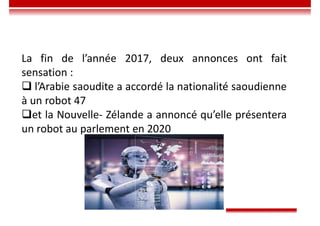
La fin de l’année 2017, deux annonces ont fait
sensation :
 l’Arabie saoudite a accordé la nationalité saoudienne
à un robot 47
et la Nouvelle- Zélande a annoncé qu’elle présentera
un robot au parlement en 2020
LE FUTUR
Une question souvent entendue est la suivante : que reste-t-
il à l’humain que la machine ne sache pas faire ?
 L’intuition ? Mais l’intuition n’est-elle pas la qualité
indispensable surtout lorsque l’on manque de données ?
 L’empathie ? Mais l’informatique affective est un des
grands sujets de recherche actuellement ; par exemple, le
Massachusetts Institute of Technology (MIT) a consacré à
ce thème un département entier, sous la direction de
Rosalind Picard 40.
La créativité ? C’est aussi un sujet d’exploration de IBM
Watson 41 qui, à la mi-2016, a créé une bande-annonce
pour un film d’horreur
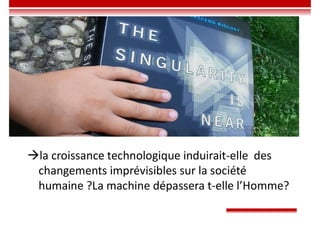
la croissance technologique induirait-elle des
changements imprévisibles sur la société
humaine ?La machine dépassera t-elle l’Homme?
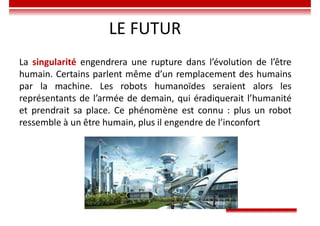
LE FUTUR
La singularité engendrera une rupture dans l’évolution de l’être
humain. Certains parlent même d’un remplacement des humains
par la machine. Les robots humanoïdes seraient alors les
représentants de l’armée de demain, qui éradiquerait l’humanité
et prendrait sa place. Ce phénomène est connu : plus un robot
ressemble à un être humain, plus il engendre de l’inconfort
Imen BEN CHAABANE 254
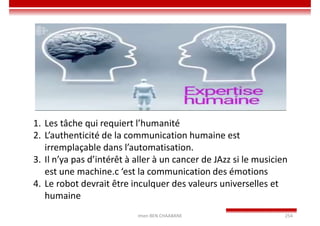
1. Les tâche qui requiert l’humanité
2. L’authenticité de la communication humaine est
irremplaçable dans l’automatisation.
3. Il n’ya pas d’intérêt à aller à un cancer de JAzz si le musicien
est une machine.c ‘est la communication des émotions
4. Le robot devrait être inculquer des valeurs universelles et
humaine
Imen BEN CHAABANE 255
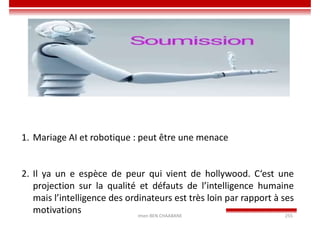
1. Mariage AI et robotique : peut être une menace
2. Il ya un e espèce de peur qui vient de hollywood. C‘est une
projection sur la qualité et défauts de l’intelligence humaine
mais l’intelligence des ordinateurs est très loin par rapport à ses
motivations
Imen BEN CHAABANE 256
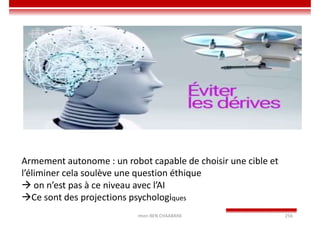
Armement autonome : un robot capable de choisir une cible et
l’éliminer cela soulève une question éthique
 on n’est pas à ce niveau avec l’AI
Ce sont des projections psychologiques
Imen BEN CHAABANE 257
Perte de contrôle  Ils peuvent des craintes injustifiées
Similaire à : Biotechnologie dans les années 70 modifier le
génome/code génétique humain on a interdit ceci
Imen BEN CHAABANE 258
On définit la biotechnologie comme « l’application à des
organismes vivants des principes scientifiques et de
l'ingénierie à la transformation de matériaux vivants ou
non-vivants aux fins de la production de connaissances,
de biens et de services. ».
Conclusion
• Aujourd’hui l’IA est partout sans que l’on s’en
rende compte ou préoccupe.
• Rôle de plus en plus important dans la conception,
les interfaces, internet, les robots, ...
• Une meilleure intégration de l'IA dans les
applications informatiques
• Une démarche génie logiciel n ’est pas toujours
facile. Des environnements: JAVA, Prolog,
Smalltalk, etc.
• Évolution de l'IA intelligence Artificielle vers l'IA
informatique avancée
Imen BEN CHAABANE 259
Conclusion
• Nous sommes encore loin des espoirs et
désepoirs prédits par les auteurs de science-
fiction dans les films
• Le but ultime de l’IA n’est pas de remplacer
l’humain mais bien de décharger afin qu’il puisse
se concentrer sur des tâches plus créatives ou
agréables.
• Timm Menzies a dit : je rêve un jour où mon
processeur Word écrirait un article comme celui-
ci pendant que je vais à la plage!!Y arrivera t-on
un jour?Peut être…
Imen BEN CHAABANE 260
Part 2
Seeing = Believing?
• With the development of computer vision technologies, reliability of images and videos is decreasing. Fake
images can be produced with technologies such as PS and generative adversarial networks (GAN), making it
hard to identify whether images are true or not.
• Example:
– A suspect provided fake evidence by forging an image in which the suspect is in a place where he has never been to or
with someone he has never seen using PS technologies.
– In advertisements for diet pills, people's appearances before and after weight loss can be changed with PS technologies
to exaggerate the effect of the pills.
– Lyrebird, a tool for simulating voice of human beings based on recording samples of minutes, may be used by criminals.
– Household images released on rent and hotel booking platforms may be generated through GAN.
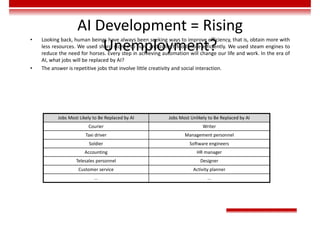
AI Development = Rising
Unemployment?
• Looking back, human beings have always been seeking ways to improve efficiency, that is, obtain more with
less resources. We used sharp stones to hunt and collect food more efficiently. We used steam engines to
reduce the need for horses. Every step in achieving automation will change our life and work. In the era of
AI, what jobs will be replaced by AI?
• The answer is repetitive jobs that involve little creativity and social interaction.
Jobs Most Likely to Be Replaced by AI Jobs Most Unlikely to Be Replaced by AI
Courier Writer
Taxi driver Management personnel
Soldier Software engineers
Accounting HR manager
Telesales personnel Designer
Customer service Activity planner
... ...
Problems to Be Solved
• Are AI-created works protected by copyright laws?
• Who gives authority to robots?
• What rights shall be authorized to robots?
• ...
Development Trends of AI
Technologies
• Framework: easier-to-use development framework
• Algorithm: algorithm models with better performance and smaller size
• Computing power: comprehensive development of device-edge-cloud computing
• Data: more comprehensive basic data service industry and more secure data sharing
• Scenario: continuous breakthroughs in industry applications
Easier-to-Use Development
Framework
• Various AI development frameworks are evolving towards ease-of-use and omnipotent,
continuously lowering the threshold for AI development.
Tensorflow 2.0
• TensorFlow 2.0 has been officially released. It integrates Keras as its high-level API, greatly
improving usability.
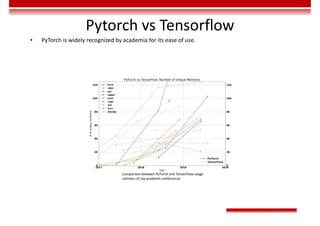
Pytorch vs Tensorflow
• PyTorch is widely recognized by academia for its ease of use.
Comparison between PyTorch and TensorFlow usage
statistics of top academic conferences
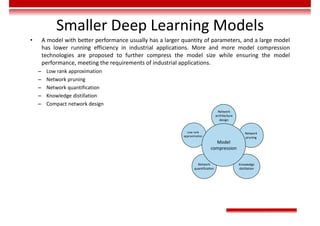
Smaller Deep Learning Models
• A model with better performance usually has a larger quantity of parameters, and a large model
has lower running efficiency in industrial applications. More and more model compression
technologies are proposed to further compress the model size while ensuring the model
performance, meeting the requirements of industrial applications.
– Low rank approximation
– Network pruning
– Network quantification
– Knowledge distillation
– Compact network design
Knowledge
distillation
Network
pruning
Model
compression
Network
quantification
Low rank
approximation
Network
architecture
design
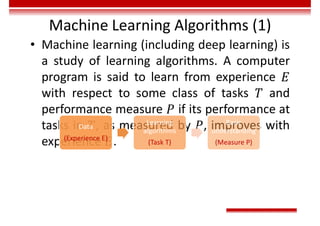
Machine Learning Algorithms (1)
• Machine learning (including deep learning) is
a study of learning algorithms. A computer
program is said to learn from experience
with respect to some class of tasks and
performance measure if its performance at
tasks in , as measured by , improves with
experience .
Data
(Experience E)
Learning
algorithms
(Task T)
Basic
understanding
(Measure P)
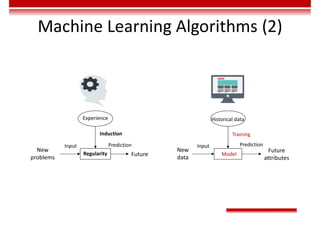
Machine Learning Algorithms (2)
Experience
Regularity
Induction
Prediction
Input
New
problems
Future
Historical data
Model
Training
Prediction
Input
New
data
Future
attributes
Created by: Jim Liang
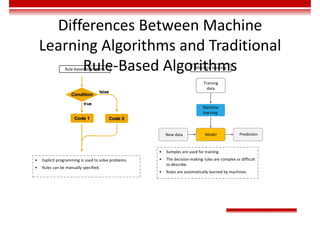
Differences Between Machine
Learning Algorithms and Traditional
Rule-Based Algorithms
• Samples are used for training.
• The decision-making rules are complex or difficult
to describe.
• Rules are automatically learned by machines.
Rule-based algorithms Machine learning
Training
data
Machine
learning
Model Prediction
New data
• Explicit programming is used to solve problems.
• Rules can be manually specified.
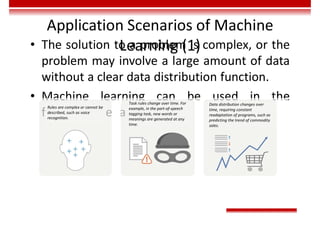
Application Scenarios of Machine
Learning (1)
• The solution to a problem is complex, or the
problem may involve a large amount of data
without a clear data distribution function.
• Machine learning can be used in the
following scenarios:
Rules are complex or cannot be
described, such as voice
recognition.
Task rules change over time. For
example, in the part-of-speech
tagging task, new words or
meanings are generated at any
time.
Data distribution changes over
time, requiring constant
readaptation of programs, such as
predicting the trend of commodity
sales.
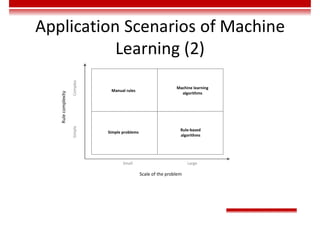
Application Scenarios of Machine
Learning (2)
Manual rules
Simple problems
Rule-based
algorithms
Small Large
Simple
Complex
Scale of the problem
Rule
complexity
Machine learning
algorithms
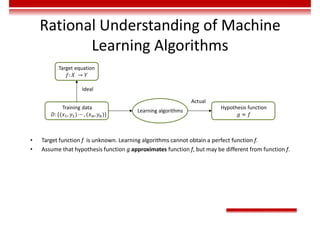
Rational Understanding of Machine
Learning Algorithms
• Target function f is unknown. Learning algorithms cannot obtain a perfect function f.
• Assume that hypothesis function g approximates function f, but may be different from function f.
Target equation
𝑓: 𝑋 → 𝑌
Learning algorithms
Training data
𝐷: {(𝑥 , 𝑦 ) ⋯ , (𝑥 , 𝑦 )}
Hypothesis function
𝑔 ≈ 𝑓
Ideal
Actual
Main Problems Solved by Machine
Learning
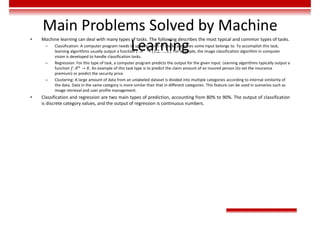
• Machine learning can deal with many types of tasks. The following describes the most typical and common types of tasks.
– Classification: A computer program needs to specify which of the k categories some input belongs to. To accomplish this task,
learning algorithms usually output a function 𝑓: 𝑅 → (1,2, … , 𝑘). For example, the image classification algorithm in computer
vision is developed to handle classification tasks.
– Regression: For this type of task, a computer program predicts the output for the given input. Learning algorithms typically output a
function 𝑓: 𝑅 → 𝑅. An example of this task type is to predict the claim amount of an insured person (to set the insurance
premium) or predict the security price.
– Clustering: A large amount of data from an unlabeled dataset is divided into multiple categories according to internal similarity of
the data. Data in the same category is more similar than that in different categories. This feature can be used in scenarios such as
image retrieval and user profile management.
• Classification and regression are two main types of prediction, accounting from 80% to 90%. The output of classification
is discrete category values, and the output of regression is continuous numbers.
Contents
1. Machine Learning Definition
2. Machine Learning Types
3. Machine Learning Process
4. Other Key Machine Learning Methods
5. Common Machine Learning Algorithms
6. Case study
Machine Learning Classification
• Supervised learning: Obtain an optimal model with required performance through training and learning based on the
samples of known categories. Then, use the model to map all inputs to outputs and check the output for the purpose of
classifying unknown data.
• Unsupervised learning: For unlabeled samples, the learning algorithms directly model the input datasets. Clustering is a
common form of unsupervised learning. We only need to put highly similar samples together, calculate the similarity
between new samples and existing ones, and classify them by similarity.
• Semi-supervised learning: In one task, a machine learning model that automatically uses a large amount of unlabeled
data to assist learning directly of a small amount of labeled data.
• Reinforcement learning: It is an area of machine learning concerned with how agents ought to take actions in an
environment to maximize some notion of cumulative reward. The difference between reinforcement learning and
supervised learning is the teacher signal. The reinforcement signal provided by the environment in reinforcement learning
is used to evaluate the action (scalar signal) rather than telling the learning system how to perform correct actions.
Machine Learning Classification
• Supervised learning: Obtain an optimal model with required performance through training and learning based on the
samples of known categories. Then, use the model to map all inputs to outputs and check the output for the purpose of
classifying unknown data.
• Unsupervised learning: For unlabeled samples, the learning algorithms directly model the input datasets. Clustering is a
common form of unsupervised learning. We only need to put highly similar samples together, calculate the similarity
between new samples and existing ones, and classify them by similarity.
• Semi-supervised learning: In one task, a machine learning model that automatically uses a large amount of unlabeled
data to assist learning directly of a small amount of labeled data.
• Reinforcement learning: It is an area of machine learning concerned with how agents ought to take actions in an
environment to maximize some notion of cumulative reward. The difference between reinforcement learning and
supervised learning is the teacher signal. The reinforcement signal provided by the environment in reinforcement learning
is used to evaluate the action (scalar signal) rather than telling the learning system how to perform correct actions.
Supervised Learning
Feature 1
Feature 1
Feature 1
Feature n
Feature n
Feature n
...
...
...
Goal
Goal
Goal
Data feature Label
Supervised learning
algorithm
Weather Temperature
Wind
Speed
Sunny Warm Strong
Rainy Cold Fair
Sunny Cold Weak
Enjoy
Sports
Yes
No
Yes
Supervised Learning - Regression
Questions
• Regression: reflects the features of attribute values of samples in a sample dataset. The
dependency between attribute values is discovered by expressing the relationship of sample
mapping through functions.
– How much will I benefit from the stock next week?
– What's the temperature on Tuesday?
Supervised Learning - Classification
Questions
• Classification: maps samples in a sample
dataset to a specified category by using a
classification model.
– Will there be a traffic jam on XX road during
the morning rush hour tomorrow?
– Which method is more attractive to customers:
5 yuan voucher or 25% off?
Unsupervised Learning
Feature 1
Feature 1
Feature 1
Feature n
Feature n
Feature n
...
...
...
Data Feature
Unsupervised learning
algorithm
Monthly
Consumption
Commodity
Consumption
Time
1000–2000
Badminton
racket
6:00–12:00
500–1000 Basketball 18:00–24:00
1000–2000 Game console 00:00–6:00
Internal
similarity
Category
Cluster 1
Cluster 2
Unsupervised Learning - Clustering
Questions
• Clustering: classifies samples in a sample
dataset into several categories based on the
clustering model. The similarity of samples
belonging to the same category is high.
– Which audiences like to watch movies
of the same subject?
– Which of these components are
damaged in a similar way?
Semi-Supervised Learning
Feature 1
Feature 1
Feature 1
Feature n
Feature n
Feature n
...
...
...
Goal
Unknown
Unknown
Data Feature Label
Semi-supervised
learning algorithms
Weather Temperature
Wind
Speed
Sunny Warm Strong
Rainy Cold Fair
Sunny Cold Weak
Enjoy
Sports
Yes
/
/
Reinforcement Learning
• The model perceives the environment, takes
actions, and makes adjustments and choices
based on the status and award or
punishment. Model
Environment
𝑟
𝑠
Reward or
punishment 𝑟
Status 𝑠 Action 𝑎
Reinforcement Learning - Best
Behavior
• Reinforcement learning: always looks for best
behaviors. Reinforcement learning is targeted
at machines or robots.
– Autopilot: Should it brake or accelerate when the
yellow light starts to flash?
– Cleaning robot: Should it keep working or go
back for charging?
Contents
1. Machine learning algorithm
2. Machine Learning Classification
3. Machine Learning Process
4. Other Key Machine Learning Methods
5. Common Machine Learning Algorithms
6. Case study
Machine Learning Process
Data
collection
Data cleansing
Model
training
Model
evaluation
Feature
extraction and
selection
Model
deployment and
integration
Feedback and iteration
Basic Machine Learning Concept —
Dataset
• Dataset: a collection of data used in machine learning
tasks. Each data record is called a sample. Events or
attributes that reflect the performance or nature of a
sample in a particular aspect are called features.
• Training set: a dataset used in the training process,
where each sample is referred to as a training sample.
The process of creating a model from data is called
learning (training).
• Test set: Testing refers to the process of using the
model obtained after learning for prediction. The
dataset used is called a test set, and each sample is
called a test sample.
Checking Data Overview
• Typical dataset form
No. Area School Districts Direction House Price
1 100 8 South 1000
2 120 9 Southwest 1300
3 60 6 North 700
4 80 9 Southeast 1100
5 95 3 South 850
Feature 2
Feature 1 Feature 3 Label
Training
set
Test set
Data
preprocessing
Importance of Data Processing
• Data is crucial to models. It is the ceiling of
model capabilities. Without good data, there
is no good model.
Fill in missing values,
and detect and
eliminate causes of
dataset exceptions.
Data cleansing
Simplify data attributes to
avoid dimension
explosion.
Data dimension
reduction
Normalize data to reduce
noise and improve model
accuracy.
Data normalization
Workload of Data Cleansing
• Statistics on data scientists' work in machine
learning
3% Remodeling training datasets
9% Mining modes from data
19% Collecting datasets
60% Cleansing and sorting data
CrowdFlower Data Science Report 2016
5% Others
4% Optimizing models
Data Cleansing
• Most machine learning models process features,
which are usually numeric representations of
input variables that can be used in the model.
• In most cases, the collected data can be used by
algorithms only after being preprocessed. The
preprocessing operations include the following:
– Data filtering
– Processing of lost data
– Processing of possible exceptions, errors, or
abnormal values
– Combination of data from multiple data sources
– Data consolidation
Dirty Data (1)
• Generally, real data may have some quality problems.
– Incompleteness: contains missing values or the data that lacks attributes
– Noise: contains incorrect records or exceptions.
– Inconsistency: contains inconsistent records.
Dirty Data (2)
# Id Name Birthday Gender
IsTea
cher
#Stu
dent
s
Country City
1 111 John 31/12/1990 M 0 0 Ireland Dublin
2 222 Mery 15/10/1978 F 1 15 Iceland
3 333 Alice 19/04/2000 F 0 0 Spain Madrid
4 444 Mark 01/11/1997 M 0 0 France Paris
5 555 Alex 15/03/2000 A 1 23 Germany Berlin
6 555 Peter 1983-12-01 M 1 10 Italy Rome
7 777 Calvin 05/05/1995 M 0 0 Italy Italy
8 888 Roxane 03/08/1948 F 0 0 Portugal Lisbon
9 999 Anne 05/09/1992 F 0 5 Switzerland
Genev
a
10 101010 Paul 14/11/1992 M 1 26 Ytali Rome
Invalid duplicate item
Incorrect format Attribute dependency
Misspelling
Value that should
be in another
column
Missing value
Invalid value
Data Conversion
• After being preprocessed, the data needs to be converted into a representation form suitable for the
machine learning model. Common data conversion forms include the following:
– With respect to classification, category data is encoded into a corresponding numerical representation.
– Value data is converted to category data to reduce the value of variables (for age segmentation).
– Other data
• In the text, the word is converted into a word vector through word embedding (generally using the word2vec model, BERT
model, etc).
• Process image data (color space, grayscale, geometric change, Haar feature, and image enhancement)
– Feature engineering
• Normalize features to ensure the same value ranges for input variables of the same model.
• Feature expansion: Combine or convert existing variables to generate new features, such as the average.
Necessity of Feature Selection
• Generally, a dataset has many features, some
of which may be redundant or irrelevant to
the value to be predicted.
• Feature selection is necessary in the
following aspects: Simplify
models to
make them
easy for users
to interpret
Reduce the
training time
Avoid
dimension
explosion
Improve
model
generalization
and avoid
overfitting
Feature Selection Methods - Filter
• Filter methods are independent of the model
during feature selection.
Traverse all
features
Select the
optimal feature
subset
Train models Evaluate the
performance
Procedure of a filter method
By evaluating the correlation between each feature
and the target attribute, these methods use a
statistical measure to assign a value to each feature.
Features are then sorted by score, which is helpful for
preserving or eliminating specific features.
Common methods
• Pearson correlation coefficient
• Chi-square coefficient
• Mutual information
Limitations
• The filter method tends to select redundant
variables as the relationship between features is not
considered.
Feature Selection Methods - Wrapper
• Wrapper methods use a prediction model to
score feature subsets.
Procedure of a
wrapper method
Wrapper methods consider feature selection as a search
issue for which different combinations are evaluated
and compared. A predictive model is used to evaluate a
combination of features and assign a score based on
model accuracy.
Common methods
• Recursive feature elimination (RFE)
Limitations
• Wrapper methods train a new model for each subset,
resulting in a huge number of computations.
• A feature set with the best performance is usually
provided for a specific type of model.
Traverse all
features
Generate a
feature
subset
Train
models
Evaluate
models
Select the optimal
feature subset
Feature Selection Methods -
Embedded
• Embedded methods consider feature
selection as a part of model construction.
The most common type of embedded feature selection
method is the regularization method.
Regularization methods are also called penalization
methods that introduce additional constraints into the
optimization of a predictive algorithm that bias the model
toward lower complexity and reduce the number of
features.
Common methods
• Lasso regression
• Ridge regression
Procedure of an embedded method
Traverse all
features
Generate a
feature subset
Train models
+ Evaluate the effect
Select the optimal feature subset
Overall Procedure of Building a Model
Model Building Procedure
Data splitting:
Divide data into training
sets, test sets, and
validation sets.
Model training:
Use data that has been cleaned
up and feature engineering to
train a model.
Model verification:
Use validation sets to
validate the model
validity.
Model fine-tuning:
Continuously tune the
model based on the actual
data of a service scenario.
Model deployment:
Deploy the model in
an actual production
scenario.
Model test:
Use test data to evaluate the
generalization capability of
the model in a real
environment.
1 2 3
4
5
6
Examples of Supervised Learning -
Learning Phase
• Use the classification model to predict
whether a person is a basketball player.
Task: Use a classification model to predict
whether a person is a basketball player under a
specific feature.
Splitting
(Cleansed features and tags)
Model
training
Name City Age Label
Mike Miami 42 yes
Jerry New York 32 no
Bryan Orlando 18 no
Patricia Miami 45 yes
Elodie Phoenix 35 no
Remy Chicago 72 yes
John New York 48 yes
Target
Feature (attribute)
Training set
The model searches
for the relationship
between features and
targets.
Test set
Use new data to verify
the model validity.
Each feature or a combination of several features can
provide a basis for a model to make a judgment.
Service
data
Unknown data
Recent data, it is not
known whether the
people are basketball
players.
Possibility prediction
Apply the model to the
new data to predict
whether the customer will
change the supplier.
Application
model
Examples of Supervised Learning -
Prediction Phase
New
data
New
data
Prediction
data
IF city = Miami → Probability = +0.7
IF city= Orlando → Probability = +0.2
IF age > 42 → Probability = +0.05*age + 0.06
IF age ≤ 42 → Probability = +0.01*age + 0.02
Name City Age Label
Marine Miami 45 ?
Julien Miami 52 ?
Fred Orlando 20 ?
Michelle Boston 34 ?
Nicolas Phoenix 90 ?
Name City Age Prediction
Marine Miami 45 0.3
Julien Miami 52 0.9
Fred Orlando 20 0.6
Michelle Boston 34 0.5
Nicolas Phoenix 90 0.4
What Is a Good Model?
• Generalization capability
Can it accurately predict the actual service data?
• Interpretability
Is the prediction result easy to interpret?
• Prediction speed
How long does it take to predict each piece of data?
• Practicability
Is the prediction rate still acceptable when the service
volume increases with a huge data volume?
Model Validity (1)
• Generalization capability: The goal of machine learning is that the model obtained after learning should
perform well on new samples, not just on samples used for training. The capability of applying a model to
new samples is called generalization or robustness.
• Error: difference between the sample result predicted by the model obtained after learning and the actual
sample result.
– Training error: error that you get when you run the model on the training data.
– Generalization error: error that you get when you run the model on new samples. Obviously, we prefer a model
with a smaller generalization error.
• Underfitting: occurs when the model or the algorithm does not fit the data well enough.
• Overfitting: occurs when the training error of the model obtained after learning is small but the
generalization error is large (poor generalization capability).
Model Validity (2)
• Model capacity: model's capability of fitting functions, which is also called model complexity.
– When the capacity suits the task complexity and the amount of training data provided, the algorithm effect is
usually optimal.
– Models with insufficient capacity cannot solve complex tasks and underfitting may occur.
– A high-capacity model can solve complex tasks, but overfitting may occur if the capacity is higher than that
required by a task.
Underfitting
Not all features are learned.
Good fitting Overfitting
Noises are learned.
Overfitting Cause — Error
• Total error of final prediction = Bias2 + Variance + Irreducible error
• Generally, the prediction error can be divided into two types:
– Error caused by "bias"
– Error caused by "variance"
• Variance:
– Offset of the prediction result from the average value
– Error caused by the model's sensitivity to small fluctuations
in the training set
• Bias:
– Difference between the expected (or average) prediction value and the correct
value we are trying to predict.
Variance
Bias
Variance and Bias
• Combinations of variance and bias are as follows:
– Low bias & low variance –> Good model
– Low bias & high variance
– High bias & low variance
– High bias & high variance –> Poor model
• Ideally, we want a model that can accurately
capture the rules in the training data and
summarize the invisible data (new data). However,
it is usually impossible for the model to complete
both tasks at the same time.
High bias & low
variance
Low bias & high
variance
Model Complexity and Error
• As the model complexity increases, the
training error decreases.
• As the model complexity increases, the test
error decreases to a certain point and then
increases in the reverse direction, forming a
convex curve.
Testing error
Training error
Error
Model Complexity
Machine Learning Performance
Evaluation - Regression
• The closer the Mean Absolute Error (MAE) is to 0, the better the model can fit the training data.
𝑀𝐴𝐸 =
1
m
𝑦 − 𝑦
• Mean Square Error (MSE)
𝑀𝑆𝐸 =
1
m
𝑦 − 𝑦
• The value range of R2
is (–∞, 1]. A larger value indicates that the model can better fit the training data. TSS
indicates the difference between samples. RSS indicates the difference between the predicted value and
sample value.
𝑅 = 1 −
𝑅𝑆𝑆
𝑇𝑆𝑆
= 1 −
∑ 𝑦 − 𝑦
∑ 𝑦 − 𝑦
Machine Learning Performance
Evaluation - Classification (1)
• Terms and definitions:
– 𝑃: positive, indicating the number of real positive cases
in the data.
– 𝑁: negative, indicating the number of real negative cases
in the data.
– 𝑇P : true positive, indicating the number of positive cases that are correctly
classified by the classifier.
– 𝑇𝑁: true negative, indicating the number of negative cases that are correctly classified by the classifier.
– 𝐹𝑃: false positive, indicating the number of positive cases that are incorrectly classified by the classifier.
– 𝐹𝑁: false negative, indicating the number of negative cases that are incorrectly classified by the classifier.
• Confusion matrix: at least an 𝑚 × 𝑚 table. 𝐶𝑀 , of the first 𝑚 rows and 𝑚 columns indicates the number of cases that
actually belong to class 𝑖 but are classified into class 𝑗 by the classifier.
– Ideally, for a high accuracy classifier, most prediction values should be located in the diagonal from 𝐶𝑀 , to 𝐶𝑀 , of the table
while values outside the diagonal are 0 or close to 0. That is, 𝐹𝑃 and 𝐹𝑃 are close to 0.
Confusion matrix
Estimated
amount
Actual amount
yes no Total
yes 𝑇𝑃 𝐹𝑁 𝑃
no 𝐹𝑃 𝑇𝑁 𝑁
Total 𝑃 𝑁 𝑃 + 𝑁
Machine Learning Performance
Evaluation - Classification (2)
Measurement Ratio
Accuracy and recognition rate
𝑇𝑃 + 𝑇𝑁
𝑃 + 𝑁
Error rate and misclassification rate
𝐹𝑃 + 𝐹𝑁
𝑃 + 𝑁
Sensitivity, true positive rate, and recall
𝑇𝑃
𝑃
Specificity and true negative rate
𝑇𝑁
𝑁
Precision
𝑇𝑃
𝑇𝑃 + 𝐹𝑃
𝐹 , harmonic mean of the recall rate and
precision
2 × 𝑝𝑟𝑒𝑐𝑖𝑠𝑖𝑜𝑛 × 𝑟𝑒𝑐𝑎𝑙𝑙
𝑝𝑟𝑒𝑐𝑖𝑠𝑖𝑜𝑛 + 𝑟𝑒𝑐𝑎𝑙𝑙
𝐹 , where 𝛽 is a non-negative real
number
(1 + 𝛽 ) × 𝑝𝑟𝑒𝑐𝑖𝑠𝑖𝑜𝑛 × 𝑟𝑒𝑐𝑎𝑙𝑙
𝛽 × 𝑝𝑟𝑒𝑐𝑖𝑠𝑖𝑜𝑛 + 𝑟𝑒𝑐𝑎𝑙𝑙
Example of Machine Learning Performance Evaluation
• We have trained a machine learning model to identify whether the object in an image is a cat.
Now we use 200 pictures to verify the model performance. Among the 200 images, objects in
170 images are cats, while others are not. The identification result of the model is that objects in
160 images are cats, while others are not.
Precision: 𝑃 = = = 87.5%
Recall: 𝑅 = = = 82.4%
Accuracy: 𝐴𝐶𝐶 = = = 75%
Estimated amount
Actual
amount
𝒚𝒆𝒔 𝒏𝒐 Total
𝑦𝑒𝑠 140 30 170
𝑛𝑜 20 10 30
Total 160 40 200
Contents
1. Machine Learning Definition
2. Machine Learning Types
3. Machine Learning Process
4. Other Key Machine Learning Methods
5. Common Machine Learning Algorithms
6. Case study
Machine Learning Training Method -
Gradient Descent (1)
• The gradient descent method uses the negative gradient
direction of the current position as the search direction,
which is the steepest direction. The formula is as follows:
• In the formula, 𝜂 indicates the learning rate and 𝑖 indicates
the data record number 𝑖. The weight parameter w indicates
the change in each iteration.
• Convergence: The value of the objective function changes
very little, or the maximum number of iterations is reached.
1 ( )
k
i
k k w
w w f x

   
Cost surface
Machine Learning Training Method -
Gradient Descent (2)
• Batch Gradient Descent (BGD) uses the samples (m in
total) in all datasets to update the weight parameter
based on the gradient value at the current point.
• Stochastic Gradient Descent (SGD) randomly selects a
sample in a dataset to update the weight parameter
based on the gradient value at the current point.
• Mini-Batch Gradient Descent (MBGD) combines the
features of BGD and SGD and selects the gradients of
n samples in a dataset to update the weight
parameter.
1
1
1
( )



  
 k
m
i
k k w
i
w w f x
m
1 ( )
k
i
k k w
w w f x

   
1
1
t
1
( )
k
t n
i
k k w
i
w w f x
n

 


  

Machine Learning Training Method -
Gradient Descent (3)
• Comparison of three gradient descent methods
– In the SGD, samples selected for each training are stochastic. Such instability causes the loss function to be
unstable or even causes reverse displacement when the loss function decreases to the lowest point.
– BGD has the highest stability but consumes too many computing resources. MBGD is a method that balances SGD
and BGD.
BGD
Uses all training samples for training each time.
SGD
Uses one training sample for training each time.
MBGD
Uses a certain number of training samples for training
each time.
Parameters and Hyperparameters in
Models
• The model contains not only parameters but
also hyperparameters. The purpose is to
enable the model to learn the optimal
parameters.
– Parameters are automatically learned by models.
– Hyperparameters are manually set.
Training
Use hyperparameters to
control training.
Model
Model parameters are
"distilled" from data.
Hyperparameters of a Model
• Often used in model parameter
estimation processes.
• Often specified by the practitioner.
• Can often be set using heuristics.
• Often tuned for a given predictive
modeling problem.
Model hyperparameters are
external configurations of models.
• λ during Lasso/Ridge regression
• Learning rate for training a neural
network, number of iterations, batch
size, activation function, and number
of neurons
• 𝐶 and 𝜎 in support vector machines
(SVM)
• K in k-nearest neighbor (KNN)
• Number of trees in a random forest
Common model hyperparameters
Hyperparameter Search Procedure and
Method
Procedure for
searching
hyperparameters
1. Dividing a dataset into a training set, validation set, and test set.
2. Optimizing the model parameters using the training set based on the model performance
indicators.
3. Searching for the model hyper-parameters using the validation set based on the model
performance indicators.
4. Perform step 2 and step 3 alternately. Finally, determine the model parameters and
hyperparameters and assess the model using the test set.
Search algorithm (step
3)
•Grid search
•Random search
• Heuristic intelligent search
• Bayesian search
Hyperparameter Searching Method
- Grid Search
• Grid search attempts to exhaustively search all possible
hyperparameter combinations to form a hyperparameter value
grid.
• In practice, the range of hyperparameter values to search is
specified manually.
• Grid search is an expensive and time-consuming method.
– This method works well when the number of hyperparameters
is relatively small. Therefore, it is applicable to generally
machine learning algorithms but inapplicable to neural networks
(see the deep learning part).
Hyperparameter
1
0 1
Hyperparameter 2
5
1
2
3
4
5
Grid search
2 3 4
Hyperparameter Searching Method
- Random Search
• When the hyperparameter search space is large, random
search is better than grid search.
• In random search, each setting is sampled from the
distribution of possible parameter values, in an attempt to
find the best subset of hyperparameters.
• Note:
– Search is performed within a coarse range, which then will be
narrowed based on where the best result appears.
– Some hyperparameters are more important than others, and the
search deviation will be affected during random search.
Random search
Parameter
1
Parameter 2
Cross Validation (1)
• Cross validation: It is a statistical analysis method used to validate the performance of a classifier. The basic
idea is to divide the original dataset into two parts: training set and validation set. Train the classifier using
the training set and test the model using the validation set to check the classifier performance.
• k-fold cross validation (𝑲 − 𝑪𝑽):
– Divide the raw data into 𝑘 groups (generally, evenly divided).
– Use each subset as a validation set, and use the other 𝑘 − 1 subsets as the training set. A total of 𝑘 models can be
obtained.
– Use the mean classification accuracy of the final validation sets of 𝑘 models as the performance indicator of the 𝐾 − 𝐶𝑉
classifier.
Cross Validation (2)
• Note: The K value in K-fold cross validation is
also a hyperparameter.
Entire dataset
Training set Test set
Test set
Training set Validation set
Contents
1. Machine Learning Definition
2. Machine Learning Types
3. Machine Learning Process
4. Other Key Machine Learning Methods
5. Common Machine Learning Algorithms
6. Case study
Machine Learning Algorithm
Overview
Supervised learning Unsupervised learning
Clustering
Classification Regression
Machine learning
Others
SVM
Naive Bayes
KNN
Linear regression
Decision tree
Neural network
K-means
Hierarchical
clustering
Neural network
Logistic regression
Decision tree
Correlation rule
Random forest Random forest
Density-based
clustering
GBDT GBDT
SVM
Principal component
analysis (PCA)
Gaussian mixture
model (GMM)
Linear Regression (1)
• Linear regression: a statistical analysis method to determine the quantitative relationships
between two or more variables through regression analysis in mathematical statistics.
• Linear regression is a type of supervised learning.
Unary linear regression Multi-dimensional linear regression
Linear Regression (2)
• The model function of linear regression is as follows, where 𝑤 indicates the weight parameter, 𝑏 indicates the bias, and 𝑥
indicates the sample attribute.
• The relationship between the value predicted by the model and actual value is as follows, where 𝑦 indicates the actual
value, and 𝜀 indicates the error.
• The error 𝜀 is influenced by many factors independently. According to the central limit theorem, the error 𝜀 follows
normal distribution. According to the normal distribution function and maximum likelihood estimation, the loss function
of linear regression is as follows:
• To make the predicted value close to the actual value, we need to minimize the loss value. We can use the gradient
descent method to calculate the weight parameter 𝑤 when the loss function reaches the minimum, and then complete
model building.
( ) T
w
h x w x b
 

  
T
y w x b
 
2
1
( ) ( )
2
w
J w h x y
m
 

Linear Regression Extension -
Polynomial Regression
• Polynomial regression is an extension of linear regression. Generally, the complexity of a dataset
exceeds the possibility of fitting by a straight line. That is, obvious underfitting occurs if the
original linear regression model is used. The solution is to use polynomial regression.
Comparison between linear regression and
polynomial regression
2
1 2
( ) n
w n
h x w x w x w x b
    

 where, the nth power is a polynomial regression
dimension (degree).
 Polynomial regression belongs to linear regression as
the relationship between its weight parameters 𝑤 is still
linear while its nonlinearity is reflected in the feature
dimension.
Linear Regression and Overfitting
Prevention
• Regularization terms can be used to reduce overfitting. The value of 𝑤 cannot be too large or too
small in the sample space. You can add a square sum loss on the target function.
• Regularization terms (norm): The regularization term here is called L2-norm. Linear regression
that uses this loss function is also called Ridge regression.
• Linear regression with absolute loss is called Lasso regression.
 
2
2
2
1
( ) ( ) +
2

 
 
w
J w h x y w
m
 
2
1
1
( ) ( ) +
2

 
 
w
J w h x y w
m
Logistic Regression (1)
• Logistic regression: The logistic regression model is used to solve classification problems. The
model is defined as follows:
𝑃 𝑌 = 1 𝑥 =
𝑒
1 + 𝑒
𝑃 𝑌 = 0 𝑥 =
1
1 + 𝑒
where 𝑤 indicates the weight, 𝑏 indicates the bias, and 𝑤𝑥 + 𝑏 is regarded as the linear function of 𝑥. Compare the
preceding two probability values. The class with a higher probability value is the class of 𝑥.
Logistic Regression (2)
• Both the logistic regression model and linear regression model are generalized linear models.
Logistic regression introduces nonlinear factors (the sigmoid function) based on linear regression
and sets thresholds, so it can deal with binary classification problems.
• According to the model function of logistic regression, the loss function of logistic regression can
be estimated as follows by using the maximum likelihood estimation:
• where 𝑤 indicates the weight parameter, 𝑚 indicates the number of samples, 𝑥 indicates the
sample, and 𝑦 indicates the real value. The values of all the weight parameters 𝑤 can also be
obtained through the gradient descent algorithm.
 
1
( ) ln ( ) (1 )ln(1 ( ))
    
 w w
J w y h x y h x
m
Logistic Regression Extension -
Softmax Function (1)
• Logistic regression applies only to binary
classification problems. For multi-class
classification problems, use the Softmax
function.
Binary classification problem
Female?
Grape?
Apple?
Banana?
Multi-class classification problem
Male? Orange?
Logistic Regression Extension -
Softmax Function (2)
• Softmax regression is a generalization of
logistic regression that we can use for K-class
classification.
• The Softmax function is used to map a K-
dimensional vector of arbitrary real values to
another K-dimensional vector of real values,
where each vector element is in the interval
(0, 1).
• The regression probability function of
Softmax is as follows:
1
( | ; ) , 1,2 ,
T
k
T
l
l
w
w
x
K
x
e
p y k x w k K
e

  


Logistic Regression Extension -
Softmax Function (3)
• Softmax assigns a probability to each class in a multi-class problem. These probabilities must add
up to 1.
– Softmax may produce a form belonging to a particular class. Example:
0.09
0.22
0.68
0.01
Category
• Sum of all probabilities:
• 0.09 + 0.22 + 0.68 + 0.01 =1
• Most probably, this picture is an
apple.
Grape?
Apple?
Banana?
Orange?
Probability
Decision Tree
• A decision tree is a tree structure (a binary tree or a non-binary tree). Each non-leaf node represents a test on a feature
attribute. Each branch represents the output of a feature attribute in a certain value range, and each leaf node stores a
category. To use the decision tree, start from the root node, test the feature attributes of the items to be classified, select
the output branches, and use the category stored on the leaf node as the final result.
Root
Short Tall
Long
neck
Short
neck
Can
squeak
Might be a
squirrel
Short
nose
Long
nose
In water
On land
Cannot
squeak
Might be a
rat
Might be a
giraffe
Might be an
elephant
Might be a
rhinoceros
Might be a
hippo
Decision Tree Structure
Root Node
Internal
Node
Internal
Node
Internal
Node
Leaf Node
Leaf Node Leaf Node
Leaf Node
Leaf Node
Leaf Node
Key Points of Decision Tree
Construction
• To create a decision tree, we need to select attributes and determine the tree structure between
feature attributes. The key step of constructing a decision tree is to divide data of all feature
attributes, compare the result sets in terms of 'purity', and select the attribute with the highest
'purity' as the data point for dataset division.
• The metrics to quantify the 'purity' include the information entropy and GINI Index. The formula
is as follows:
• where 𝑝 indicates the probability that the sample belongs to class k (there are K classes in total).
A greater difference between purity before segmentation and that after segmentation indicates a
better decision tree.
• Common decision tree algorithms include ID3, C4.5, and CART.
2
1
( )= - log ( )
K
k k
k
H X p p

 2
1
1
K
k
k
G ini p

  
Decision Tree Construction Process
• Feature selection: Select a feature from the features
of the training data as the split standard of the
current node. (Different standards generate different
decision tree algorithms.)
• Decision tree generation: Generate internal node
upside down based on the selected features and stop
until the dataset can no longer be split.
• Pruning: The decision tree may easily become
overfitting unless necessary pruning (including pre-
pruning and post-pruning) is performed to reduce the
tree size and optimize its node structure.
Decision Tree Example
• The following figure shows a classification when a decision tree is used. The classification result is impacted
by three attributes: Refund, Marital Status, and Taxable Income.
Tid Refund
Marital
Status
Taxable
Income
Cheat
1 Yes Single 125,000 No
2 No Married 100,000 No
3 No Single 70,000 No
4 Yes Married 120,000 No
5 No Divorced 95,000 Yes
6 No Married 60,000 No
7 Yes Divorced 220,000 No
8 No Single 85,000 Yes
9 No Married 75,000 No
10 No Single 90,000 Yes
Yes
No
No
No
Refund
Marital
Status
Taxable
Income
SVM
• SVM is a binary classification model whose basic model is a linear classifier defined in the eigenspace with
the largest interval. SVMs also include kernel tricks that make them nonlinear classifiers. The SVM learning
algorithm is the optimal solution to convex quadratic programming.
Projection
Complex segmentation
in low-dimensional
space
Easy segmentation in
high-dimensional space
height
weight
With binary classification
Two-dimensional dataset
Both the left and right methods can be used to divide
datasets. Which of them is correct?
or
Linear SVM (1)
• How do we split the red and blue datasets by
a straight line?
Linear SVM (2)
• Straight lines are used to divide data into different classes. Actually, we can use multiple straight lines to
divide data. The core idea of the SVM is to find a straight line and keep the point close to the straight line as
far as possible from the straight line. This can enable strong generalization capability of the model. These
points are called support vectors.
• In two-dimensional space, we use straight lines for segmentation. In high-dimensional space, we use
hyperplanes for segmentation.
Distance between
support vectors
is as far as possible
Linear SVM can function well for
linear separable datasets.
Nonlinear SVM (1)
• How do we classify a nonlinear separable
dataset?
Nonlinear datasets cannot be split
with straight lines.
Nonlinear SVM (2)
• Kernel functions are used to construct nonlinear SVMs.
• Kernel functions allow algorithms to fit the largest hyperplane in a transformed high-dimensional
feature space.
Input space High-dimensional
feature space
Linear
kernel
function
Polynomial
kernel
function
Gaussian
kernel
function
Sigmoid
kernel
function
Common kernel functions
KNN Algorithm (1)
• The KNN classification
algorithm is a theoretically
mature method and one of the
simplest machine learning
algorithms. According to this
method, if the majority of k
samples most similar to one
sample (nearest neighbors in
the eigenspace) belong to a
specific category, this sample
also belongs to this category.
?
The target category of point ? varies with the
number of the most adjacent nodes.
KNN Algorithm (2)
• As the prediction result is determined based
on the number and weights of neighbors in
the training set, the KNN algorithm has a
simple logic.
• KNN is a non-parametric method which is
usually used in datasets with irregular
decision boundaries.
– The KNN algorithm generally adopts the
majority voting method for classification
prediction and the average value method for
regression prediction.
• KNN requires a huge number of
computations.
KNN Algorithm (3)
• Generally, a larger k value reduces the impact of noise on classification, but obfuscates the boundary
between classes.
– A larger k value means a higher probability of underfitting because the segmentation is too rough. A smaller k
value means a higher probability of overfitting because the segmentation is too refined.
• The boundary becomes smoother as the
value of k increases.
• As the k value increases to infinity, all data
points will eventually become all blue or
all red.
Naive Bayes (1)
• Naive Bayes algorithm: a simple multi-class classification algorithm based on the Bayes theorem. It assumes
that features are independent of each other. For a given sample feature 𝑋, the probability that a sample
belongs to a category 𝐻 is:
– 𝑋 , … , 𝑋 are data features, which are usually described by measurement values of m attribute sets.
• For example, the color feature may have three attributes: red, yellow, and blue.
– 𝐶 indicates that the data belongs to a specific category 𝐶
– 𝑃 𝐶 |𝑋 , … , 𝑋 is a posterior probability, or a posterior probability of under condition 𝐶 .
– 𝑃 𝐶 is a prior probability that is independent of 𝑋 , … , 𝑋
– 𝑃 𝑋 , … , 𝑋 is the priori probability of 𝑋.
 
   
 
1 n
1 n
1 n
, , |
| , ,
, ,
k k
k
P X X C P C
P C X X
P X X

 

Naive Bayes (2)
• Independent assumption of features.
– For example, if a fruit is red, round, and about 10
cm (3.94 in.) in diameter, it can be considered an
apple.
– A Naive Bayes classifier considers that each
feature independently contributes to the
probability that the fruit is an apple, regardless
of any possible correlation between the color,
roundness, and diameter.
Ensemble Learning
• Ensemble learning is a machine learning paradigm in which multiple learners are trained and combined to solve the same
problem. When multiple learners are used, the integrated generalization capability can be much stronger than that of a
single learner.
• If you ask a complex question to thousands of people at random and then summarize their answers, the summarized
answer is better than an expert's answer in most cases. This is the wisdom of the masses.
Dataset m
Model 1 Model 2 Model m
Model
synthesis
Large
model
Dataset 1 Dataset 2
Training set
Classification of Ensemble Learning
Ensemble learning
Bagging
Boosting
Bagging (Random Forest)
• Independently builds several basic learners and then averages
their predictions.
• On average, a composite learner is usually better than a
single-base learner because of a smaller variance.
Boosting (Adaboost, GBDT, and XGboost)
Constructs basic learners in sequence to gradually
reduce the bias of a composite learner. The composite
learner can fit data well, which may also cause
overfitting.
Ensemble Methods in Machine
Learning (1)
• Random forest = Bagging + CART decision tree
• Random forests build multiple decision trees and merge them together to make predictions more accurate
and stable.
– Random forests can be used for classification and regression problems.
All training data
Data subset 1
Bootstrap sampling Decision tree building Aggregation prediction
result
• Category: majority
voting
• Regression:
average value
Final prediction
Prediction 2
Prediction
Prediction n
Prediction 1
Data subset 2
Data subset
Ensemble Methods in Machine
Learning (2)
• GBDT is a type of boosting algorithm.
• For an aggregative mode, the sum of the results of all the basic learners equals the predicted value. In
essence, the residual of the error function to the predicted value is fit by the next basic learner. (The
residual is the error between the predicted value and the actual value.)
• During model training, GBDT requires that the sample loss for model prediction be as small as possible.
30 years old 20 years old
Prediction
10 years old
Residual
calculation
9 years old
Prediction
1 year old
Residual
calculation
Prediction
1 year old
Unsupervised Learning - K-means
• K-means clustering aims to partition n observations into k clusters in which each observation belongs to the
cluster with the nearest mean, serving as a prototype of the cluster.
• For the k-means algorithm, specify the final number of clusters (k). Then, divide n data objects into k
clusters. The clusters obtained meet the following conditions: (1) Objects in the same cluster are highly
similar. (2) The similarity of objects in different clusters is small.
x2
x1
x2
x1
The data is not tagged. K-means
clustering can automatically
classify datasets.
K-means clustering
Unsupervised Learning - Hierarchical
Clustering
• Hierarchical clustering divides a dataset at different layers and forms a tree-like clustering structure. The
dataset division may use a "bottom-up" aggregation policy, or a "top-down" splitting policy. The hierarchy of
clustering is represented in a tree graph. The root is the unique cluster of all samples, and the leaves are the
cluster of only a sample.
Contents
1. Machine Learning Definition
2. Machine Learning Types
3. Machine Learning Process
4. Other Key Machine Learning Methods
5. Common Machine Learning Algorithms
6. Case study
Comprehensive Case
• Assume that there is a dataset containing the
house areas and prices of 21,613 housing
units sold in a city. Based on this data, we can
predict the prices of other houses in the city.
Dataset
House Area Price
1,180 221,900
2,570 538,000
770 180,000
1,960 604,000
1,680 510,000
5,420 1,225,000
1,715 257,500
1,060 291,850
1,160 468,000
1,430 310,000
1,370 400,000
1,810 530,000
… …
Price
House area
Problem Analysis
• This case contains a large amount of data, including input x (house area), and output y (price), which is a continuous
value. We can use regression of supervised learning. Draw a scatter chart based on the data and use linear regression.
• Our goal is to build a model function h(x) that infinitely approximates the function that expresses true distribution of the
dataset.
• Then, use the model to predict unknown price data.
Unary linear regression function
1
( ) o
h x w w x
 
Learning
algorithm
h(x)
Output
x
Feature: house area
Dataset
Input
y
Label: price
Price
House area
Goal of Linear Regression
• Linear regression aims to find a straight line that best fits the dataset.
• Linear regression is a parameter-based model. Here, we need learning parameters 𝑤 and 𝑤 .
When these two parameters are found, the best model appears.
Which line is the best parameter?
1
( ) o
h x w w x
 
Price
House area
Loss Function of Linear Regression
• To find the optimal parameter, construct a
loss function and find the parameter values
when the loss function becomes the
minimum.
• where, m indicates the number of samples,
• h(x) indicates the predicted value, and y indicates
the actual value.
Loss function of linear
regression:
Error
Error
Price
House area
Error Error
 
2
1
( ) ( )
2
J w h x y
m
 

Goal:
 
2
1
argmin ( ) ( )
2
w
J w h x y
m
 

Gradient Descent Method
• The gradient descent algorithm finds the minimum value of a function through iteration.
• It aims to randomize an initial point on the loss function, and then find the global minimum value of the loss
function based on the negative gradient direction. Such parameter value is the optimal parameter value.
– Point A: the position of 𝑤 and 𝑤 after random initialization.
𝑤 and 𝑤 are the required parameters.
– A-B connection line: a path formed based on descents in
a negative gradient direction. Upon each descent, values 𝑤
and 𝑤 change, and the regression line also changes.
– Point B: global minimum value of the loss function.
Final values of 𝑤 and 𝑤 are also found.
Cost surface
Iteration Example
• The following is an example of a gradient descent iteration. We can see that as red points on the
loss function surface gradually approach a lowest point, fitting of the linear regression red line
with data becomes better and better. At this time, we can get the best parameters.
Model Debugging and Application
• After the model is trained, test it with the test set
to ensure the generalization capability.
• If overfitting occurs, use Lasso regression or
Ridge regression with regularization terms and
tune the hyperparameters.
• If underfitting occurs, use a more complex
regression model, such as GBDT.
• Note:
– For real data, pay attention to the functions of
data cleansing and feature engineering.
Price House area
( ) 280.62 43581
h x x
 
The final model result is as follows:
Traditional Machine Learning and
Deep Learning
• As a model based on unsupervised feature learning and feature hierarchy learning, deep learning
has great advantages in fields such as computer vision, speech recognition, and natural language
processing.
Traditional Machine Learning Deep Learning
Low hardware requirements on the computer: Given the
limited computing amount, the computer does not need a
GPU for parallel computing generally.
Higher hardware requirements on the computer: To
execute matrix operations on massive data, the computer
needs a GPU to perform parallel computing.
Applicable to training under a small data amount and
whose performance cannot be improved continuously as
the data amount increases.
The performance can be high when high-dimensional
weight parameters and massive training data are provided.
Level-by-level problem breakdown E2E learning
Manual feature selection Algorithm-based automatic feature extraction
Easy-to-explain features Hard-to-explain features
Traditional Machine Learning
Issue analysis
Problem locating
Model
training
Execute inference,
prediction, and
identification
Data
cleansing
Feature
extraction
Feature
selection
Question: Can we use an
algorithm to automatically
execute the procedure?
Deep Learning
• Generally, the deep learning architecture is a
deep neural network. "Deep" in "deep
learning" refers to the number of layers of
the neural network. Output
layer
Hidden
layer
Input layer
Human neural network Deep neural network
Perceptron
Dendrite
Nucleus
Axon
Synapse
Neural Network
• Currently, the definition of the neural network has not been determined yet. Hecht Nielsen, a neural
network researcher in the U.S., defines a neural network as a computer system composed of simple and
highly interconnected processing elements, which process information by dynamic response to external
inputs.
• A neural network can be simply expressed as an information processing system designed to imitate the
human brain structure and functions based on its source, features, and explanations.
• Artificial neural network (neural network): Formed by artificial neurons connected to each other, the neural
network extracts and simplifies the human brain's microstructure and functions. It is an important approach
to simulate human intelligence and reflect several basic features of human brain functions, such as
concurrent information processing, learning, association, model classification, and memory.
Development History of Neural
Networks
Perceptron
Golden age AI winter
1970 1986 1995
1958 2006
XOR
MLP
SVM
Deep
network
Single-Layer Perceptron
• Input vector: 𝑋 = [𝑥 , 𝑥 , … , 𝑥 ]
• Weight: 𝑊 = [𝜔 , 𝜔 , … , 𝜔 ] , in which 𝜔 is the offset.
• Activation function: 𝑂 = 𝑠𝑖𝑔𝑛 𝑛𝑒𝑡 =
1, 𝑛𝑒𝑡 > 0,
−1, 𝑜𝑡ℎ𝑒𝑟𝑤𝑖𝑠𝑒.
• The preceding perceptron is equivalent to a classifier. It uses the high-dimensional 𝑋 vector as the input and performs
binary classification on input samples in the high-dimensional space. When 𝑾𝑻𝐗 > 0, O = 1. In this case, the samples
are classified into a type. Otherwise, O = −1. In this case, the samples are classified into the other type. The boundary of
these two types is 𝑾𝑻𝐗 = 0, which is a high-dimensional hyperplane.
Classification plane
𝐴𝑥 + 𝐵𝑦 + 𝐶𝑧 + 𝐷 = 0
Classification hyperplane
𝑊 X + 𝑏 = 0
Classification line
𝐴𝑥 + 𝐵𝑦 + 𝐶 = 0
Classification point
𝐴𝑥 + 𝐵 = 0
𝑛𝑒𝑡 = 𝜔 𝑥 = 𝑾𝑻
𝐗
𝑥
𝑥
𝑥
XOR Problem
• In 1969, Minsky, an American mathematician
and AI pioneer, proved that a perceptron is
essentially a linear model that can only deal
with linear classification problems, but
cannot process non-linear data.
AN
D
O
R
XO
R
Feedforward Neural Network
Input layer
Hidden layer 2
Output layer
Hidden layer 1
Solution of XOR
XOR XOR
w0
w1
w2
w3
w4
w5
Impacts of Hidden Layers on A Neural
Network
3 hidden layers 20 hidden layers
0 hidden layers
Contents
1.Deep Learning Summary
2.Training Rules
3.Activation Function
4.Normalizer
5.Optimizer
6.Types of Neural Networks
Gradient Descent and Loss
Function
• The gradient of the multivariate function 𝑜 = 𝑓 𝑥 = 𝑓 𝑥 , 𝑥 , … , 𝑥 at 𝑋 = [𝑥 , 𝑥 , … , 𝑥 ] is shown as follows:
𝛻𝑓 𝑥 , 𝑥 , … , 𝑥 = [ , , … , ] | ,
The direction of the gradient vector is the fastest growing direction of the function. As a result, the direction of the negative
gradient vector −𝛻𝑓 is the fastest descent direction of the function.
• During the training of the deep learning network, target classification errors must be parameterized. A loss function
(error function) is used, which reflects the error between the target output and actual output of the perceptron. For a
single training sample x, the most common error function is the Quadratic cost function.
𝐸 𝑤 = ∑ 𝑡 − 𝑜
∈ ,
In the preceding function, 𝑑 is one neuron in the output layer, D is all the neurons in the output layer, 𝑡 is the target
output, and 𝑜 is the actual output.
• The gradient descent method enables the loss function to search along the negative gradient direction and update the
parameters iteratively, finally minimizing the loss function.
Extrema of the Loss Function
• Purpose: The loss function 𝐸(𝑊) is defined on the weight space. The objective is to search for the weight vector 𝑊 that
can minimize 𝐸(𝑊).
• Limitation: No effective method can solve the extremum in mathematics on the complex high-dimensional surface of
𝐸 𝑊 = ∑ 𝑡 − 𝑜
∈ .
Example of gradient descent of binary
paraboloid
Common Loss Functions in Deep
Learning
• Quadratic cost function:
𝐸 𝑊 =
1
2
𝑡 − 𝑜
∈
• Cross entropy error function:
𝐸 𝑊 = − 𝑡 ln 𝑜
∈
• The cross entropy error function depicts the distance between two probability distributions,
which is a widely used loss function for classification problems.
• Generally, the mean square error function is used to solve the regression problem, while the
cross entropy error function is used to solve the classification problem.
Batch Gradient Descent Algorithm
(BGD)
• In the training sample set 𝑋, each sample is recorded as < x, 𝑡 >, in which 𝑋 is the input vector, 𝑡 the target
output, 𝑜 the actual output, and 𝜂 the learning rate.
– Initializes each 𝑤 to a random value with a smaller absolute value.
– Before the end condition is met:
• Initializes each ∆𝑤 to zero.
• For each iteration:
– Input all the 𝑥 to this unit and calculate the output 𝑜 .
– For each 𝑤 in this unit: ∆𝑤 += -η ∑
( , )
∈ .
• For each 𝑤 in this unit: 𝑤 += ∆𝑤 .
• The gradient descent algorithm of this version is not commonly used because:
– The convergence process is very slow as all training samples need to be calculated every time the weight is updated.
Stochastic Gradient Descent Algorithm
(SGD)
• To address the BGD algorithm defect, a common variant called Incremental Gradient Descent algorithm is
used, which is also called the Stochastic Gradient Descent (SGD) algorithm. One implementation is called
Online Learning, which updates the gradient based on each sample:
∆𝑤 = −𝜂 ∑
( , )
∈ ⟹ ∆𝑤 = −𝜂
( , )
.
• ONLINE-GRADIENT-DESCENT
– Initializes each 𝑤 to a random value with a smaller absolute value.
– Before the end condition is met:
– Generates a random <x, t> from X and does the following calculation:
• Input X to this unit and calculate the output 𝑜 .
• For each 𝑤 in this unit: 𝑤 += −𝜂
( , )
.
Mini-Batch Gradient Descent
Algorithm (MBGD)
• To address the defects of the previous two gradient descent algorithms, the Mini-batch Gradient Descent
Algorithm (MBGD) was proposed and has been most widely used. A small number of Batch Size (BS)
samples are used at a time to calculate ∆𝑤 , and then the weight is updated accordingly.
• Batch-gradient-descent
– Initializes each 𝑤 to a random value with a smaller absolute value.
– Before the end condition is met:
• Initializes each ∆𝑤 to zero.
• For each < x, 𝑡 > in the BS samples in the next batch in 𝐵:
– Input 𝑥 to this unit and calculate the output 𝑜 .
– For each 𝑤 in this unit: ∆𝑤 += -η ∑
( , )
∈
• For each 𝑤 in this unit: 𝑤 += ∆𝑤
• For the last batch, the training samples are mixed up in a random order.
Backpropagation Algorithm (1)
• Signals are propagated in forward direction, and
errors are propagated in backward direction.
• In the training sample set D, each sample is
recorded as <X, t>, in which X is the input vector, t
the target output, o the actual output, and w the
weight coefficient.
• Loss function:
Input layer
Output layer
Hidden layer
Forward propagation direction
Backpropagation direction
   
2
1
( )
2
d d
d D
E w t o

 

Backpropagation Algorithm (2)
• According to the following formulas, errors in the input, hidden, and output layers are accumulated to
generate the error in the loss function.
• wc is the weight coefficient between the hidden layer and the output layer, while wb is the weight
coefficient between the input layer and the hidden layer. 𝑓 is the activation function, D is the output layer
set, and C and B are the hidden layer set and input layer set respectively. Assume that the loss function is a
quadratic cost function:
 Output layer error:
 
   
 
2
2
1 1
( ) ( )
2 2
d d d c c
d D d D c C
t f net t f w
E y
  
 
  
 

  
 
 
 
 
 
 
 
2
c
2
1
( )
2
1
2
d c
d D c C
d c b b
d D c C b B
t f w f net
t f w f w
E
x
 
  
 
 

 
 
 

 
 
 
  
 
2
1
( )
2
d d
d D
E t o

 

 Expanded hidden
layer error:
 Expanded input
layer error:
Backpropagation Algorithm (3)
• To minimize error E, the gradient descent iterative
calculation can be used to solve and , that is,
calculating and to minimize error E.
• Formula:
• If there are multiple hidden layers, chain rules are
used to take a derivative for each layer to obtain the
optimized parameters by iteration.
,
,
c
c
b
b
E
w c C
w
E
w b B
w



   


   

Backpropagation Algorithm (4)
• For a neural network with any number of layers, the arranged formula for training is as follows:
• The BP algorithm is used to train the network as follows:
– Takes out the next training sample <X, T>, inputs X to the network, and obtains the actual output o.
– Calculates output layer δ according to the output layer error formula (1).
– Calculates δ of each hidden layer from output to input by iteration according to the hidden layer error propagation
formula (2).
– According to the δ of each layer, the weight values of all the layer are updated.
1
'
1 '
( )
( )( ( )), ,(1)
( ), ,(2)





  
  

 



l l l
jk k j j
l l
j j j j j
l
l l l
j
k jk j j
k
w f z
f z t f z l outputs
w f z otherwise
Contents
1.Deep Learning Summary
2.Training Rules
3.Activation Function
4.Normalizer
5.Optimizer
6.Types of Neural Networks
Activation Function
• Activation functions are important for the
neural network model to learn and
understand complex non-linear functions.
They allow introduction of non-linear
features to the network.
• Without activation functions, output signals
are only simple linear functions. The
complexity of linear functions is limited, and
the capability of learning complex function
mappings from data is low.
1 1 2 2 3 3
( ) ( )
t
output f w x w x w x f W X
    

Activation Function
Sigmoid
Tanh
Softsign
Rectified Linear Unit (ReLU)
Softplus
Softmax
• Softmax function:
• The Softmax function is used to map a K-
dimensional vector of arbitrary real values to
another K-dimensional vector of real values,
where each vector element is in the interval (0,
1). All the elements add up to 1.
• The Softmax function is often used as the
output layer of a multiclass classification task.
Contents
1.Deep Learning Summary
2.Training Rules
3.Activation Function
4.Normalizer
5.Optimizer
6.Types of Neural Networks
Normalizer
• Regularization is an important and effective
technology to reduce generalization errors in machine
learning. It is especially useful for deep learning
models that tend to be over-fit due to a large number
of parameters. Therefore, researchers have proposed
many effective technologies to prevent over-fitting,
including:
– Adding constraints to parameters, such as and
norms
– Expanding the training set, such as adding noise and
transforming data
– Dropout
– Early stopping
Penalty Parameters
• Many regularization methods restrict the
learning capability of models by adding a
penalty parameter to the objective
function . Assume that the target function after
regularization is .
,
• Where is a hyperparameter that
weights the relative contribution of the norm
penalty term and the standard objective
function . If is set to 0, no
regularization is performed. The penalty in
regularization increases with .
Regularization
• Add norm constraint to model
parameters, that is,
,
• If a gradient method is used to resolve the
value, the parameter gradient is
Regularization
• Add norm penalty term to prevent
overfitting.
,
• A parameter optimization method can be
inferred using an optimization technology (such
as a gradient method):
,
• where is the learning rate. Compared with a
common gradient optimization formula, this
formula multiplies the parameter by a reduction
factor.
v.s.
• The major differences between 𝐿 and 𝐿 :
– According to the preceding analysis, 𝐿 can generate a more sparse model than 𝐿 . When the value of parameter 𝑤 is small, 𝐿
regularization can directly reduce the parameter value to 0, which can be used for feature selection.
– From the perspective of probability, many norm constraints are equivalent to adding prior probability distribution to parameters. In
𝐿 regularization, the parameter value complies with the Gaussian distribution rule. In 𝐿 regularization, the parameter value
complies with the Laplace distribution rule.
𝐿 𝐿
Dataset Expansion
• The most effective way to prevent over-fitting is to add a training set. A larger training set has a smaller
over-fitting probability. Dataset expansion is a time-saving method, but it varies in different fields.
– A common method in the object recognition field is to rotate or scale images. (The prerequisite to image
transformation is that the type of the image cannot be changed through transformation. For example, for
handwriting digit recognition, categories 6 and 9 can be easily changed after rotation).
– Random noise is added to the input data in speech recognition.
– A common practice of natural language processing (NLP) is replacing words with their synonyms.
– Noise injection can add noise to the input or to the hidden layer or output layer. For example, for Softmax
classification, noise can be added using the label smoothing technology. If noise is added to categories 0 and 1, the
corresponding probabilities are changed to and 1 − 𝜀 respectively.
Dropout
• Dropout is a common and simple regularization method, which has been widely used since 2014. Simply put, Dropout
randomly discards some inputs during the training process. In this case, the parameters corresponding to the discarded
inputs are not updated. As an integration method, Dropout combines all sub-network results and obtains sub-networks
by randomly dropping inputs. See the figures below:
Dropout in training Testing
Early Stopping
• A test on data of the validation set can be
inserted during the training. When the data
loss of the verification set increases, perform
early stopping.
Early stopping
Contents
1.Deep Learning Summary
2.Training Rules
3.Activation Function
4.Normalizer
5.Optimizer
6.Types of Neural Networks
Optimizer
• There are various optimized versions of gradient descent
algorithms. In object-oriented language implementation,
different gradient descent algorithms are often
encapsulated into objects called optimizers.
• Purposes of the algorithm optimization include but are
not limited to:
– Accelerating algorithm convergence.
– Preventing or jumping out of local extreme values.
– Simplifying manual parameter setting, especially the learning
rate (LR).
• Common optimizers: common GD optimizer, momentum
optimizer, Nesterov, AdaGrad, AdaDelta, RMSProp, Adam,
AdaMax, and Nadam.
Momentum Optimizer
• A most basic improvement is to add momentum terms for ∆𝑤 . Assume that the weight correction of the 𝑛-th iteration is ∆𝑤 (𝑛) . The
weight correction rule is:
• ∆𝑤 𝑛 = −𝜂𝛿 𝑥 (𝑛) + 𝛼∆𝑤 𝑛 − 1
• where 𝛼 is a constant (0 ≤ 𝛼 < 1) called Momentum Coefficient and 𝛼∆𝑤 𝑛 − 1 is a momentum term.
• Imagine a small ball rolls down from a random point on the error surface. The introduction of the momentum term is equivalent to giving
the small ball inertia.
−𝜂𝛿 𝑥 (𝑛)
Advantages and Disadvantages of
Momentum Optimizer
• Advantages:
– Enhances the stability of the gradient correction direction and reduces mutations.
– In areas where the gradient direction is stable, the ball rolls faster and faster (there is a speed upper limit because
𝛼 < 1), which helps the ball quickly overshoot the flat area and accelerates convergence.
– A small ball with inertia is more likely to roll over some narrow local extrema.
• Disadvantages:
– The learning rate 𝜂 and momentum 𝛼 need to be manually set, which often requires more experiments to
determine the appropriate value.
AdaGrad Optimizer (1)
• The common feature of the random gradient descent algorithm (SGD), small-batch gradient descent algorithm (MBGD),
and momentum optimizer is that each parameter is updated with the same LR.
• According to the approach of AdaGrad, different learning rates need to be set for different parameters.
• 𝑔 indicates the t-th gradient, 𝑟 is a gradient accumulation variable, and the initial value of 𝑟 is 0, which increases
continuously. 𝜂 indicates the global LR, which needs to be set manually. 𝜀 is a small constant, and is set to about 10-7
for
numerical stability.
Gradient calculation
Square gradient accumulation
Computing update
Application update
2
1
1
( , )
=
=






 
  

 
t
t
t t t
t t
t
t t t
C t o
g
w
r r g
w g
r
w w w
AdaGrad Optimizer (2)
• The AdaGrad optimization algorithm shows that the 𝑟 continues increasing while the overall
learning rate keeps decreasing as the algorithm iterates. This is because we hope LR to decrease
as the number of updates increases. In the initial learning phase, we are far away from the
optimal solution to the loss function. As the number of updates increases, we are closer to the
optimal solution, and therefore LR can decrease.
• Pros:
– The learning rate is automatically updated. As the number of updates increases, the learning rate
decreases.
• Cons:
– The denominator keeps accumulating so that the learning rate will eventually become very small, and
the algorithm will become ineffective.
RMSProp Optimizer
• The RMSProp optimizer is an improved AdaGrad optimizer. It introduces an attenuation coefficient to ensure a certain
attenuation ratio for 𝑟 in each round.
• The RMSProp optimizer solves the problem that the AdaGrad optimizer ends the optimization process too early. It is
suitable for non-stable target handling and has good effects on the RNN.
• 𝑔 indicates the t-th gradient, 𝑟 is a gradient accumulation variable, and the initial value of 𝑟 is 0, which may not increase
and needs to be adjusted using a parameter. 𝛽 is the attenuation factor,𝜂 indicates the global LR, which needs to be set
manually. 𝜀 is a small constant, and is set to about 10-7
for numerical stability.
Gradient calculation
Square gradient accumulation
Computing update
Application update
2
1
1
( , )
=
= (1 )
 






 
  

  
t
t
t t t
t t
t
t t t
C t o
g
w
r r g
w g
r
w w w
Adam Optimizer (1)
• Adaptive Moment Estimation (Adam):
Developed based on AdaGrad and AdaDelta,
Adam maintains two additional variables 𝑚
and 𝑣 for each variable to be trained:
𝑚 = 𝛽 𝑚 + (1 − 𝛽 )𝑔
𝑣 = 𝛽 𝑣 + (1 − 𝛽 )𝑔
• Where 𝑡 represents the 𝑡-th iteration and 𝑔 is
the calculated gradient. 𝑚 and 𝑣 are moving
averages of the gradient and square gradient.
From the statistical perspective, 𝑚 and 𝑣 are
estimates of the first moment (the average
value) and the second moment (the
Adam Optimizer (2)
• If 𝑚 and 𝑣 are initialized using the zero vector, 𝑚 and 𝑣 are close to 0 during the initial iterations,
especially when 𝛽 and 𝛽 are close to 1. To solve this problem, we use 𝑚 and 𝑣 :
𝑚 =
𝑚
1 − 𝛽
𝑣 =
𝑣
1 − 𝛽
• The weight update rule of Adam is as follows:
𝑤 = 𝑤 −
𝜂
𝑣 + 𝜖
𝑚
• Although the rule involves manual setting of 𝜂, 𝛽 , and 𝛽 , the setting is much simpler. According to
experiments, the default settings are 𝛽 = 0.9, 𝛽 = 0.999, 𝜖 = 10 , and 𝜂 = 0.001. In practice, Adam will
converge quickly. When convergence saturation is reached, xx can be reduced. After several times of
reduction, a satisfying local extremum will be obtained. Other parameters do not need to be adjusted.
Optimizer Performance
Comparison
Comparison of optimization
algorithms in contour maps of loss
functions
Comparison of optimization algorithms
at the saddle point
Contents
1.Deep Learning Summary
2.Training Rules
3.Activation Function
4.Normalizer
5.Optimizer
6.Types of Neural Networks
Convolutional Neural Network
• A convolutional neural network (CNN) is a feedforward neural network. Its artificial neurons may
respond to surrounding units within the coverage range. CNN excels at image processing. It
includes a convolutional layer, a pooling layer, and a fully connected layer.
• In the 1960s, Hubel and Wiesel studied cats' cortex neurons used for local sensitivity and
direction selection and found that their unique network structure could simplify feedback neural
networks. They then proposed the CNN.
• Now, CNN has become one of the research hotspots in many scientific fields, especially in the
pattern classification field. The network is widely used because it can avoid complex pre-
processing of images and directly input original images.
Main Concepts of CNN
• Local receptive field: It is generally considered that human perception of the outside world is
from local to global. Spatial correlations among local pixels of an image are closer than those
among distant pixels. Therefore, each neuron does not need to know the global image. It only
needs to know the local image. The local information is combined at a higher level to generate
global information.
• Parameter sharing: One or more filters/kernels may be used to scan input images. Parameters
carried by the filters are weights. In a layer scanned by filters, each filter uses the same
parameters during weighted computation. Weight sharing means that when each filter scans an
entire image, parameters of the filter are fixed.
Architecture of Convolutional
Neural Network
Input
image
Convolutional
layer
Convolutional
layer
Pooling layer Pooling
layer
Fully connected
layer
Three-feature
image
Three-feature
image
Five-feature
image
Five-feature
image
Output
layer
Convolution + nonlinearity Max pooling
Convolution layers + pooling layers Fully connected layer
Multi-category
Vectorization
Bird
Sunset
Dog
Cat
Pbird
Psunset
Pdog
Pcat
Single-Filter Calculation (1)
• Description of convolution calculation
Single-Filter Calculation (2)
• Demonstration of the convolution calculation
Han Bingtao, 2017, Convolutional Neural Network
Convolutional Layer
• The basic architecture of a CNN is multi-channel convolution consisting of multiple single convolutions. The output of the
previous layer (or the original image of the first layer) is used as the input of the current layer. It is then convolved with
the filter in the layer and serves as the output of this layer. The convolution kernel of each layer is the weight to be
learned. Similar to FCN, after the convolution is complete, the result should be biased and activated through activation
functions before being input to the next layer.
Input
tensor
Output
tensor
Output
Activate
Bia
s
Convolutional
kernel
1
W
2
W
Wn n
b
2
b
1
b
Fn
1
F
Pooling Layer
• Pooling combines nearby units to reduce the size of the input on the next layer, reducing dimensions. Common pooling
includes max pooling and average pooling. When max pooling is used, the maximum value in a small square area is
selected as the representative of this area, while the mean value is selected as the representative when average pooling
is used. The side of this small area is the pool window size. The following figure shows the max pooling operation whose
pooling window size is 2.
Sliding direction
Fully Connected Layer
• The fully connected layer is essentially a
classifier. The features extracted on the
convolutional layer and pooling layer are
straightened and placed at the fully connected
layer to output and classify results.
• Generally, the Softmax function is used as the
activation function of the final fully connected
output layer to combine all local features into
global features and calculate the score of each
type.
Recurrent Neural Network
• The recurrent neural network (RNN) is a neural network that captures dynamic information in
sequential data through periodical connections of hidden layer nodes. It can classify sequential
data.
• Unlike other forward neural networks, the RNN can keep a context state and even store, learn,
and express related information in context windows of any length. Different from traditional
neural networks, it is not limited to the space boundary, but also supports time sequences. In
other words, there is a side between the hidden layer of the current moment and the hidden
layer of the next moment.
• The RNN is widely used in scenarios related to sequences, such as videos consisting of image
frames, audio consisting of clips, and sentences consisting of words.
Recurrent Neural Network
Architecture (1)
• is the input of the input sequence at time t.
• is the memory unit of the sequence at time
t and caches previous information.
.
• is the output of the hidden layer of the
sequence at time t.
• after through multiple hidden layers, it can
get the final output of the sequence at time t.
Recurrent Neural Network
Architecture (2)
LeCun, Bengio, and G. Hinton, 2015, A Recurrent Neural Network and the
Unfolding in Time of the Computation Involved in Its Forward Computation
Types of Recurrent Neural Networks
Andrej Karpathy, 2015, The Unreasonable Effectiveness of Recurrent Neural Networks
Backpropagation Through Time (BPTT)
• BPTT:
– Traditional backpropagation is the extension on the time sequence.
– There are two sources of errors in the sequence at time of memory unit: first is from the hidden layer output error at t time
sequence; the second is the error from the memory cell at the next time sequence t + 1.
– The longer the time sequence, the more likely the loss of the last time sequence to the gradient of w in the first time sequence
causes the vanishing gradient or exploding gradient problem.
– The total gradient of weight w is the accumulation of the gradient of the weight at all time sequence.
• Three steps of BPTT:
– Computing the output value of each neuron through forward propagation.
– Computing the error value of each neuron through backpropagation 𝛿 .
– Computing the gradient of each weight.
• Updating weights using the SGD algorithm.
Recurrent Neural Network Problem
• 𝑆 = 𝜎 𝑈𝑋 + 𝑊𝑆 is extended on the time sequence.
• 𝑆 = σ 𝑈𝑋 + 𝑊 𝜎 𝑈𝑋 + 𝑊 𝜎 𝑈𝑋 + 𝑊 …
• Despite that the standard RNN structure solves the problem of information memory, the
information attenuates during long-term memory.
• Information needs to be saved long time in many tasks. For example, a hint at the beginning of a
speculative fiction may not be answered until the end.
• The RNN may not be able to save information for long due to the limited memory unit capacity.
• We expect that memory units can remember key information.
Long Short-term Memory Network
Colah, 2015, Understanding LSTMs Networks
Gated Recurrent Unit (GRU)
Generative Adversarial Network (GAN)
• Generative Adversarial Network is a framework that trains generator G and discriminator D through the adversarial
process. Through the adversarial process, the discriminator can tell whether the sample from the generator is fake or
real. GAN adopts a mature BP algorithm.
• (1) Generator G: The input is noise z, which complies with manually selected prior probability distribution, such as even
distribution and Gaussian distribution. The generator adopts the network structure of the multilayer perceptron (MLP),
uses maximum likelihood estimation (MLE) parameters to represent the derivable mapping G(z), and maps the input
space to the sample space.
• (2) Discriminator D: The input is the real sample x and the fake sample G(z), which are tagged as real and fake
respectively. The network of the discriminator can use the MLP carrying parameters. The output is the probability D(G(z))
that determines whether the sample is a real or fake sample.
• GAN can be applied to scenarios such as image generation, text generation, speech enhancement, image super-
resolution.
GAN Architecture
• Generator/Discriminator
Generative Model and Discriminative
Model
• Generative network
–Generates sample data
• Input: Gaussian white noise vector z
• Output: sample data vector x
( ; )
G
x G z 

z x
G
 Discriminator network
 Determines whether sample data is real
 Input: real sample data 𝑥 and
generated sample data 𝑥 = 𝐺 𝑧
 Output: probability that determines
whether the sample is real
( ; )
D
y D x 

𝑥
y
D
x
Training Rules of GAN
• Optimization objective:
– Value function
– In the early training stage, when the outcome of G is
very poor, D determines that the generated sample
is fake with high confidence, because the sample is
obviously different from training data. In this case,
log(1-D(G(z))) is saturated (where the gradient is 0,
and iteration cannot be performed). Therefore, we
choose to train G only by minimizing [-log(D(G(z))].
( )
( ) [ ( )] [ ( ( ( )
1 ]
, ))
data z z
x p x z p
G D
minmaxV D G E logD x E log D G z
 
  
( )
Contents
1.Deep Learning Summary
2.Training Rules
3.Activation Function
4.Normalizer
5.Optimizer
6.Types of Neural Networks
Data Imbalance (1)
• Problem description: In the dataset consisting of various task categories, the number of samples
varies greatly from one category to another. One or more categories in the predicted categories
contain very few samples.
• For example, in an image recognition experiment, more than 2,000 categories among a total of
4251 training images contain just one image each. Some of the others have 2-5 images.
• Impacts:
– Due to the unbalanced number of samples, we cannot get the optimal real-time result because
model/algorithm never examines categories with very few samples adequately.
– Since few observation objects may not be representative for a class, we may fail to obtain adequate
samples for verification and test.
Data Imbalance (2)
Random
undersampling
• Deleting redundant
samples in a category
Random
oversampling
• Copying samples
Synth
Mino
Oversam
Techn
• Sampling
• Merging sa
Data Imbalance (2)
Random
undersampling
• Deleting redundant
samples in a category
Random
oversampling
• Copying samples
Synth
Mino
Oversam
Techn
• Sampling
• Merging sa
Vanishing Gradient and Exploding
Gradient Problem (1)
• Vanishing gradient: As network layers increase,
the derivative value of backpropagation
decreases, which causes a vanishing gradient
problem.
• Exploding gradient: As network layers increase,
the derivative value of backpropagation
increases, which causes an exploding gradient
problem.
• Cause:
• Backpropagation can be deduced as follows:
b1 b2 b3 C
w
2
w
3
w4
y = 𝜎( ) = 𝜎 𝑤 𝑥 + 𝑏
=
= 𝜎 𝑧 𝑤 𝜎 𝑧 𝑤 𝜎 𝑧 𝑤 𝜎 𝑧 𝑥
Where σ is sigmoid function.
Vanishing Gradient and Exploding
Gradient Problem (2)
• The maximum value of 𝜎 (𝑥) is :
• However, the network weight 𝑤 is usually smaller than 1. Therefore, 𝜎 𝑧 𝑤 ≤ . According to the chain rule, as layers
increase, the derivation result decreases, resulting in the vanishing gradient problem.
• When the network weight 𝑤 is large, resulting in 𝜎 𝑧 𝑤 > 1, the exploding gradient problem occurs.
• Solution: For example, gradient clipping is used to alleviate the exploding gradient problem, ReLU activation function and
LSTM are used to alleviate the vanishing gradient problem.
Overfitting
• Problem description: The model performs well
in the training set, but badly in the test set.
• Root cause: There are too many feature
dimensions, model assumptions, and
parameters, too much noise, but very few
training data. As a result, the fitting function
perfectly predicts the training set, while the
prediction result of the test set of new data is
poor. Training data is over-fitted without
considering generalization capabilities.
• Solution: For example, data augmentation,
regularization, early stopping, and dropout
Overfitting
• Problem description: The model performs well
in the training set, but badly in the test set.
• Root cause: There are too many feature
dimensions, model assumptions, and
parameters, too much noise, but very few
training data. As a result, the fitting function
perfectly predicts the training set, while the
prediction result of the test set of new data is
poor. Training data is over-fitted without
considering generalization capabilities.
• Solution: For example, data augmentation,
regularization, early stopping, and dropout

AI_course.pdf

  • 1.
  • 2.
    Agenda 1. Historique 2. Définitionde l’IA 3. Applications 4. cadre juridique 5. Métiers 6. Risque et futur de l’IA 2 Imen BEN CHAABANE
  • 3.
  • 4.
    Dictionnaires • Qu’est-ce quel’intelligence ? • Qu’est-ce que l’artificiel ?
  • 5.
    Question…. • Qu'est-ce quesignifie être intelligent pour vous?
  • 6.
    Le quotient intellectuelou QI Les tests qui sont utilisés pour mesurer l'intelligence des gens Tests Memoir1 Memoir2 http://faculty.washington.edu/chudler/experi.html
  • 7.
    7 Qu’est ce qu’êtreintelligent ? • Apprendre – élaborer un système de connaissances et pouvoir intégrer de nouvelles connaissances • Raisonner, déduire, anticiper – à partir du système de connaissances et des données de l’expérience pouvoir produire de nouvelles connaissances • Posséder une histoire • Posséder une conscience • Posséder des sentiments
  • 8.
    Intelligence ? • Capacitéd’adaptation • Capacité de changement de conduite dans l’environnement actuel • Capacité d'assimiler des connaissances et de les acquérir • Capacité de comprendre les relations • Capacité d’évaluation et jugement • Capacité de penser
  • 9.
    Imen BEN CHAABANE9 • La définition du terme « intelligence » change. • L’intelligence est liée à l’homme dans ses facultés de compréhension, et d’apprentissage, et observable grâce au comportement (adaptabilité). • Renvoi à des questions fondamentales : qu ’est-ce que la compréhension? Qu ’est-ce que l ’apprentissage ? Qu ’est-ce que la connaissance ? Intelligence ?
  • 10.
    Imen BEN CHAABANE10 Les 5 niveaux de la pyramide cognitive« pyramide de Maslow »
  • 11.
    Imen BEN CHAABANE11 La définition générale Le dictionnaire Larousse définit l’intelligence artificielle comme un « ensemble de théories et de techniques mises en oeuvre en vue de réaliser des machines capables de simuler l’intelligence humaine ». Wikipedia donne une définition similaire décrivant l’intelligence artificielle comme la « recherche de moyens susceptibles de doter les systèmes informatiques de capacités intellectuelles comparables à celles des êtres humains ».
  • 12.
    Imen BEN CHAABANE12 John McCarthy Marvin Minsky
  • 13.
    13 Qq Définition del’IA – Apprendre aux ordinateurs à être plus intelligents permettra sans doute d’apprendre à l’homme à être plus intelligent (P. H. Winston, 1984) – L’IA est l’étude des idées qui permettent aux ordinateurs d’être intelligents (P. H. Winston) – L’IA est l’étude des facultés mentales à l’aide de modèles de type calculatoire (McDermott & Charniak) – L’IA a pour but de faire exécuter par l’ordinateur des tâches pour lesquelles l’homme dans un contexte donné est aujourd’hui meilleur que la machine (Alliot et Schiex 1994)
  • 14.
    Imen BEN CHAABANE14 La définition technique Le Centre National de Ressources Textuelles et Lexicales donne une définition technique de l’intelligence artificielle : « La recherche de moyens susceptibles de doter les systèmes informatiques de capacités intellectuelles comparables à celles des êtres humains » L’intelligence artificielle perçoit l’environnement, l’analyse, et prend une décision en conséquence mais surtout apprend.
  • 15.
    Imen BEN CHAABANE15 La définition technique L’apprentissage est donc un point essentiel. Néanmoins, il existe plusieurs types d’apprentissage. Ceux qui apprennent à partir des algorithmes : • supervisés : le système apprend à fournir la bonne réponse à partir de données lui indiquant des exemples ; • non supervisés par l’homme : le système apprend seul à partir des données brutes.
  • 16.
    Imen BEN CHAABANE16 La définition technique La notion d’intelligence artificielle n’est pas unitaire. Les experts font, en effet, une distinction entre deux formes d’intelligence artificielle : • l’intelligence artificielle « faible » : elle vise simplement à imiter certaines fonctions de l’intelligence pour répondre à des missions spécifiques. Il s’agit des programmes les plus utilisés. La machine ne fait que donner une impression d’intelligence ;  approche pragmatiste • l’intelligence artificielle « forte » : vise, quant à elle, à faire naître une sorte de conscience. Elle se rapproche du raisonnement humain en modélisant notamment les interactions neuronales et en développant la notion d’apprentissage. approche cognitive
  • 17.
    Imen BEN CHAABANE17 Histoire de l'IA
  • 18.
  • 19.
  • 20.
    Imen BEN CHAABANE20 20 Automates de Vaucanson • Jacques Vancauson 1709 – 1782 – rival de Prométhée – 1738 le joueur de flûte traversière – 1739, joueur de tambourin et de flageolet, Canard digérateur – 1746, métier à tisser automatique • Kempelen 1779 – supercherie du joueur d’échec Du calcul à l’automate
  • 21.
    21 Mécanisation du calcul •Automatisation – 1623 Shickard – 1642 Pascal – 1670 Leibnitz – 1728 Falcon – Automates de Vancauson – 1805 Jacquard – Charles Babbage • 1822 Machine différentielle • 1830 Machine analytique
  • 22.
    Imen BEN CHAABANE22 Machines Programmables Métier à tisser (Jacquard 1805) Machine Analytique (Babbage & A. Ada Lovelace 1837)
  • 23.
    23 Mécanisation du calcul Lecalcul passe par différentes étapes technologiques • Mécanique (engrenages) • Electrique (diode) • Electro-mécanique (relais) • Electronique (Transistor)
  • 24.
    + + ++ Lecture/écriture Unité de commande États internes: Etat0, Etat1, Etat2, ... Ruban= entrée, sortie et mémoire Etat de la machine Contenu de la cellule Ecrit sur le ruban Déplacement ruban Etat suivant Etat0 vide D Etat0 Etat0 + D Etat1 Le Programme La machine universelle (Turing 1936)
  • 25.
  • 26.
  • 27.
    27 Naissance de l’IA •Débuts pendant la 2nde guerre mondiale – décryptage  traduction – Mise au point d’un traducteur automatique en 5 ans – Comment représenter les connaissances ? – Comment les extraire d’un individu ? • 1956 John McCarthy, Dartmouth College • Objectifs ambitieux – Traduction automatique – Jouer aux échecs et battre les grands maîtres
  • 28.
  • 29.
    • Choix dunom 1956, conférence de Dartmouth • « L’intelligence artificielle est la science qui consiste à faire faire à des machines ce que l’homme fait moyennant une certaine intelligence » M. Minsky • Problème de récursivité dans la définition Dartmouth 1956
  • 30.
    Imen BEN CHAABANE30 Histoire de l'IA
  • 32.
  • 33.
  • 34.
    Exemples typiques deproblèmes (années 50-60) • Le fermier, le loup, la chèvre et le choux • Les recipients : comment obtenir 1 litre d’eau, avec deux récipients de capacité 2 litres et 5 litres (ce dernier étant rempli au départ) • Intégration symbolique de sin(x). cos(x)
  • 35.
    Imen BEN CHAABANE35 Histoire de l'IA
  • 36.
    Années 1970 :la saga star wars R3T2/C3PO Imen BEN CHAABANE 36
  • 37.
    Imen BEN CHAABANE37 Années 1980
  • 38.
    The Society ofMind, Marvin Minsky, 1985 Extrait de La société de l'esprit, p. 123, 1988, edition francaise Imen BEN CHAABANE 38 IA = Informatique Avancée
  • 39.
    Imen BEN CHAABANE39 Les Systèmes Experts
  • 40.
    Systems Expert (SE) Undes premiers programmes développes en IA 1960s et 1970 “… an intelligent computer system that uses knowledge and inference procedures to solve problems that are difficult enough to require significant human expertise for their solution.” (Feigenbaum) programmes qui imitèrent les décisions d’une experte humaine
  • 41.
  • 42.
    Exemples de systèmesexperts Imen BEN CHAABANE 42
  • 43.
    Imen BEN CHAABANE43 Exemples de systèmes experts
  • 44.
  • 45.
    Les années 2000 •Le système Capatcha, développé à Carnegie Mellon University, s’occupe de différcier les humains des machines. • Capatcha génère des tests que seuls les humains peuvent passer afin de combattre les spams et les actions malicieuses de certaines machines. Imen BEN CHAABANE 45
  • 46.
    Les années 2000 ImenBEN CHAABANE 46 Wakamaru, robot développé par Mitsubishi Heavy Industries et doté de la parole, est principalement conçu pour veiller sur les personnes âgées. Destiné à s’insérer dans la vie familiale de tout un chacun, il aura pour mission de prévenir l’hôpital ou les services de santé en cas de besoin.
  • 47.
    Imen BEN CHAABANE47 Les années 2000 Le 13 janvier 2004, une firme québécoise rapporte dans le Medical Post la mise en marché d’un système portatif d’alerte cardiaque appelé Vital Positionning System (VPS) Incluant un téléphone cellulaire, un ordinateur de poche et un GPS, ce système peut détecter l’approche d’une attaque cardiaque 8 minutes vant que les premières symptômes ne soient humainement perceptibles. Il appelle alors automatiquement l’hôpital le plus proche et précise l’emplacement du futur patient
  • 48.
    Imen BEN CHAABANE48 Historique de l’intelligence artificielle
  • 49.
  • 50.
    Imen BEN CHAABANE50 L'IA aujourd'hui
  • 51.
    Imen BEN CHAABANE 51 Exemplesd’IA (irréalistes ?) • Exemples (Science-Fiction) – TRON – La Guerre des Etoiles (Z6PO) – IA (Spielberg) – I, Robot – K 2000 – Galactica (Cylons) – 2001 L’Odyssée de l’espace – Matrix – Terminator – …
  • 52.
    Imen BEN CHAABANE52 LES GRANDS ACTEURS DE L’INTELLIGENCE ARTIFICIELLE Google, Apple, Facebook et Amazon ne pouvaient pas ne pas s’investir fortement dans l’intelligence artificielle alors qu’ils possèdent des données en énorme quantité.
  • 53.
    Imen BEN CHAABANE53 Google Google, très impliqué dans l’intelligence artificielle, procède habituellement par rachat. En 2014, Google a acheté la société anglaise DeepMind, qui avait développé des réseaux de neurones pour jouer aux jeux vidéo. Mais l’objectif avoué de DeepMind est actuellement de « comprendre ce qu’est l’intelligence ». DeepMind est célèbre pour son programme AlphaGo, qui a battu le champion du monde de go. En octobre 2017, le programme a franchi une étape supplémentaire : en jouant contre lui-même, non seulement son apprentissage a été plus court, mais surtout il est devenu plus fort que la version précédente . Nous avons ici un premier exemple d’apprentissage non supervisé, facilité par le fait que le contexte, à savoir les règles du jeu de go, est parfaitement mathématisable.  Google a aussi son propre moteur de recommandation nommé Google Home, un haut-parleur et un assistant vocal disponible en trois versions différentes.
  • 55.
    Imen BEN CHAABANE55 Trump versus Macron dans une requête Google À titre d’exemple, nous pouvons ainsi comparer l’évolution de l'intérêt pour la recherche « Macron » versus « Trump » entre novembre 2016 et novembre 2017 On voit que les recherches « Macron » ont dépassé les recherches « Trump » début mai 2017.
  • 56.
    Imen BEN CHAABANE56 Requêtes Trump contre Macron selon les pays
  • 57.
    Imen BEN CHAABANE57 Google I/O est une conférence annuelle de deux jours, organisée par Google au Moscone Center de San Francisco, en Californie. Le "I" et le "O" signifient respectivement "Input" et "Output« ou "Innovation in the Open"
  • 58.
    Imen BEN CHAABANE58 1. Android P : il introduit des réglages de batterie et de luminosité adaptatifs + une nouvelle fonction appelée Shush mettra un téléphone en mode Ne pas déranger lorsqu’il est placé face cachée sur un bureau 2. Une nouvelle fonctionnalité Gmail appelée «smart compose» : La méthode est une saisie semi-automatique pour les emails 3. L’Assistant Google peut effectuer vos appels téléphoniques : sa voix d’intelligence artificielle pouvait appeler un coiffeur ou un restaurant et prendre rendez-vous. L’assistant se réfère au calendrier de la personne pour trouver un créneau horaire approprié, puis informe l’utilisateur lorsqu’un rendez-vous est prévu. 4. Le créateur de Google News : indique qu’il rend le service plus personnalisé en fournissant des «briefings» 5. Google a également montré une version augmentée de Google Maps : qui charge automatiquement streetview lorsqu’une application appareil photo est ouverte. L’entreprise a appelé cela un système de positionnement visuel qui reconnaît les bâtiments et les points de repère qui se trouvent devant elle.
  • 59.
    Imen BEN CHAABANE59 Amazon utilise de l’intelligence artificielle dans son moteur de recommandation, nommé Echo, et dans ses assistants basés sur son système de reconnaissance vocale, Alexa, disponible en sept versions différentes. Via son offre de services dans le cloud, Amazon propose également des services fondés sur l’intelligence artificielle, comme la reconnaissance de la parole ou des robots de discussion, les fameux chatbot
  • 60.
  • 62.
    Systèmes de recommandation Amazon -L'un des premiers adoptants des systèmes de recommandation - Grand impact sur les ventes • Prix de Netflix - Grand prix de $ 1,000,000 pour l'algorithme qui bat Netflix algorithme
  • 63.
    Imen BEN CHAABANE63 Facebook est un énorme utilisateur d’intelligence artificielle. Il choisit les messages qu’il affiche en utilisant un moteur de type moteur de recommandation. Récemment, Facebook a mis en place un moteur d’intelligence artificielle pour détecter les tendances suicidaires . Comme le dit Joaquin Candela, directeur du département d’intelligence artificielle appliquée, « Facebook n’existerait pas sans intelligence artificielle ».
  • 64.
    Imen BEN CHAABANE64  Apple investit énormément dans l’intelligence artificielle et propose même un blog où sont expliquées ses recherches.  Siri en est l’expression la plus évidente : ce système de reconnaissance de la parole très performant utilise des réseaux de neurones de dernière génération qui permettent de comprendre des commandes même dans des environnements très bruyants, comme dans la rue.  Apple va également bientôt lancer son propre moteur de recommandation, nommé HomePod, un haut-parleur connecté avec Apple Music.
  • 65.
    Imen BEN CHAABANE65 IBM a créé Watson, un système d’intelligence artificielle pour jouer, à ses débuts, au jeu Jeopardy, l’équivalent américain de l’émission française Questions pour un champion. Watson a analysé 200 millions de pages 27 pour finalement battre les anciens champions et ainsi gagner le premier prix. Maintenant, Watson est proposé par IBM dans d’autres domaines, comme la médecine ou le droit. IBM présente aussi un blog sur le sujet de l’intelligence artificielle.
  • 66.
  • 67.
    Applications actuelles etfutures Imen BEN CHAABANE 67
  • 68.
    Imen BEN CHAABANE68 Google DeepMind, Microsoft et IBM sont rejoints par Facebook et Amazon pour former un partenariat sur l’intelligence artificielle au profit des populations et de la société. répondre aux défis mondiaux importantsle changement climatique, la nourriture, l’inégalité, la santé et l’éducation.
  • 69.
    Imen BEN CHAABANE69 Les domaines de l'IA
  • 70.
    Imen BEN CHAABANE70 UNE AMBITION POUR VALORISER L’INTELLIGENCE ARTIFICIELLE DANS LES ENTREPRISES L’intelligence artificielle n’est pas une filière à part entière mais apparaît de manière transversale dans plusieurs domaines. Elle est spécialement présente en robotique mais ne se limite pas à ce secteur.
  • 71.
    Imen BEN CHAABANE71 En 1988, le chercheur en informatique indien Raj Reddy définissait ainsi les grands challenges de l’intelligence artificielle : le téléphone qui traduit (en cours de développement), le champion de jeu d’échecs (réalisé), la résolution de théorèmes mathématiques (certains théorèmes le sont déjà), les voitures autonomes (réalisé), les systèmes auto-organisants (en cours) et les systèmes autorépliquants (en cours)
  • 72.
    Imen BEN CHAABANE72 Les Grands domaines de l'IA
  • 73.
    Imen BEN CHAABANE73 Les robots, avatars et chatbots Définition de robot par ses caractéristiques. Le terme robot est difficile à définir. Tout peut potentiellement être un robot. Toutefois, il convient d’avoir quatre caractéristiques pour en être un : • une polyvalence ; • un apprentissage ; • une autonomie ; • une interactivité. Cela permet d’encadrer la notion d’intelligence artificielle chez le robot, et de mieux la comprendre. Le robot est une machine qui perçoit, décide et prend une action. C’est une boucle perpétuelle. Ce qui reste encore difficile à maîtriser, ce sont les parties « perception » et « action » du robot. Il y a par ailleurs, trois sortes de robot, celui qui : • n’a aucune partie perception, il est donc sourd et aveugle ; • est en interaction, doté de bras mais n’en fait pas grand-chose ; • est une machine intermédiaire, telle que le robot aspirateur.
  • 74.
    Imen BEN CHAABANE74 Les robots, avatars et chatbots Avatars. L’intelligence artificielle sans coque, sans enveloppe corporelle, constitue des avatars. Les avatars n’existent que dans le monde virtuel. Néanmoins, les plateformes d’intelligence artificielle posent des problématiques similaires à celles des robots.
  • 75.
    Imen BEN CHAABANE75 Les robots, avatars et chatbots Les dernières avancées en matière de robotique nous permettent d’assister au début de la robotique émotionnelle liée à l’intelligence artificielle. La robotique émotionnelle repose sur le mimétisme des sentiments humains et une grande capacité d’analyse. Notons que 80% de la communication chez l’être humain est non verbale ; ce qui ne va pas sans poser de nombreux défis dans la robotique pour analyser cette gestuelle et la traduire en langage informatique. La particularité du robot par rapport à d’autres types d’intelligence artificielle est son lien physique avec l’environnement via des capteurs. Il y a de l’intelligence artificielle dans la décision mais aussi dans la perception et l’action. Le robot est amené à prendre de l’information dans le monde réel contrairement au logiciel qui prend des informations déjà numérisées, les données. Il a fallu 20 ans de recherches pour réussir le bouclage perception, décision, action.
  • 76.
    Imen BEN CHAABANE76 Les robots, avatars et chatbots La voiture autonome sera en 2020 sur toutes les routes et est à la pointe dans la robotique. Elle illustre le fait que la perception, l’action et la décision sont les critères et la définition de l’intelligence artificielle dans le monde 4.0.
  • 77.
    Imen BEN CHAABANE77 Les robots, avatars et chatbots  Les chatbots ou agents conversationnels sont des robots logiciels dotés d’intelligence artificielle pouvant dialoguer avec un être humain en langage naturel ou à l’écrit par chat.  Ce sont des systèmes capables de percevoir, décider, agir et apprendre, dotés d’une indépendance, qui bousculent la logique marketing relationnelle mais aussi représentent à eux-seuls un e-helpdesk qui désengorge les centres d’assistance en donnant notamment des conseils et des informations. Ces agents virtuels peuvent exécuter des processus assez complexes et permettent de profiter de leur élasticité pour augmenter la qualité des services et des besoins au sein d’une entreprise.
  • 78.
    Imen BEN CHAABANE78 Les robots, avatars et chatbots
  • 79.
    Imen BEN CHAABANE79 Robotique • Selon Bill Gates : – « .. les défis auxquels est confrontée l’industrie robotique sont très semblables à ceux que nous avons relevés en informatique il y a trois décennies », Pour la Science, Juin 2007 LEGO Mindstorm NXT La robotique peut être vue comme une interconnexion intelligente de la perception, de l’action ainsi que du fonctionnement des robots
  • 80.
    Imen BEN CHAABANE80 80 Robotique • Chaînes de production : – automobile, – Informatique – Industrie en général • Concours de robots pour résoudre un problème donné • ASIMO (Honda) site – Reproduction du comportement humain (déplacement, mouvements)
  • 81.
    Compétences physiques Conduire unevoiture • 2007 DARPA Grand • Challenge • le "Urban Challenge" • 2 millions de dollars a été lauréat • Tartan Racing • trace de 96 km • obéir à toutes les réglementations du trafic • de négocier avec d'autres véhicules et les obstacles • intégration dans le trafic
  • 82.
    Marcher • ASIMO • HondaMotor Company • coûte moins de 1 million de dollars pour fabriquer
  • 86.
    Imen BEN CHAABANE86 Football RoboCup 2007 Mission: 2050, de développer une équipe entièrement autonome de robots humanoïdes qui peuvent gainer contre l'homme le champion du monde www.robocup.org
  • 87.
    Conduire une moto •2005 DARPA Grand Challenge • 130 mile désert cours • Ghostrider Robotic Moto • Blue Team: UC Berkeley et Texas A & M
  • 88.
  • 89.
    Imen BEN CHAABANE89 Natation robot poisson exposé à Londres Aquarium
  • 90.
  • 91.
  • 92.
  • 93.
  • 94.
  • 96.
    Imen BEN CHAABANE96 Aviation hélicoptère autonome: MQ-8B Fire Scout
  • 97.
  • 99.
    Histoire des Jeux Lespremières préoccupations des chercheurs en intelligence artificielle – créer des programmes jouant aux: échecs, GO, Dames, Bridge, etc. Le père des idées est Claude Shannon (1949) Doodle
  • 100.
    Imen BEN CHAABANE100 Les échecs • Probablement le problème le plus étudié en IA – Etudes psychologiques des GMI (De Groot) • Positions pensées (non calculées) • Recherche sélective • Profondeur faible (quelques coups) • Fonction d’évaluation floue (protéger une tour, un fou)
  • 101.
    Imen BEN CHAABANE101 Deep Blue
  • 102.
  • 104.
    Deep Blue agagné contre Garry Kasparov en 1997 - 6 jeux : 2 victoires, 1 perte, 3 tirages - La force brute approche - IBM Deep Blue a pris sa retraite immédiatement après le match Votre tour a joue!!! Les échecs
  • 105.
  • 107.
    Dames meilleur programme Chinook -Mis au point par l'équipe de l'Université de l'Alberta - Dirigée par Jonathan Schaeffer - Jeu complet d'arbre de recherche - À partir de Juillet 2007, Chinook ne peut pas perdre à Checkers
  • 108.
    Ping-Pong • TOPIO robot •TOSY Robotics, Vietnam
  • 109.
    Imen BEN CHAABANE109 Médecine (thérapie, surveillance d’appareils, diagnostic)
  • 110.
    Imen BEN CHAABANE110 Médecine (classification)
  • 111.
    Réduire les problèmepsychologique • AI chat robots help alleviate mental health problems such as autism by combining psychological knowledge.
  • 112.
    Imen BEN CHAABANE112 Réalité virtuelle Ce domaine propose de nouvelles formes d’interaction entre l’homme et la machine. L’arrivée d’ordinateurs plus puissants, dotés d’impressionnantes capacités graphiques en trois dimensions, couplés à des périphériques de visualisation et d’interactions (casques, gant, etc.) permet de fournir les informations sensorielles nécessaires pour convanicre des utilisateurs qu’ils sont en immersion. Certains l’utilise depuis longtemps pour guérir certaines phobies comme celle de l’ascenseur ou celles des arraignées.
  • 113.
    Imen BEN CHAABANE113 Indexation multimédia Les ressources multimédia que l’on retrouve sont à la fois nombreuses et volumineuses et parfois non pertinente. L’IA propose des outils comme la fouille des données de bases de données  Data mining afin d’extraire des connaissances synthétiques ou d’y découvrir des info cachés ou faire du diagnostics des situations
  • 114.
    Musique • David Cope •Expériences en musique Intelligence (EMI) • prend des échantillons de travaux par un compositeur en entrée • analyser le style d'entrée • générer de nouveaux travaux dans le même style Sculpture L’Art
  • 115.
    Imen BEN CHAABANE115 L’Art Peinture • AARON • kurzweilcyberart.com • mis au point par Harold Cohen • les peintures sur papier avec une pinceau
  • 117.
    Imen BEN CHAABANE117 L'intelligence artificielle dans l'éducation
  • 118.
    Imen BEN CHAABANE118 Langage • Traduction automatique (google.com, http://babelfish.yahoo.com/) • Reconnaissance de la voix • Reconnaissance de caractères (peu avoir facile des livres en version électroniques)
  • 119.
    Voice Processing Application •The main topics of voice processing research include voice recognition, voice synthesis, voice wakeup, voiceprint recognition, and audio-based incident detection. Among them, the most mature technology is voice recognition. As for near field recognition in a quite indoor environment, the recognition accuracy can reach 96%. • Application scenarios: Question Answering Bot (QABot) Voice navigation
  • 120.
    Voice Processing Application Scenario(2) Return Visit Real-time conference records  Other applications:  Spoken language evaluation  Diagnostic robot  Voiceprint recognition  Smart sound box  ...
  • 121.
    NLP Application Scenario(1) • The main topics of NLP research include machine translation, text mining, and sentiment analysis. NLP imposes high requirements on technologies but confronts low technology maturity. Due to high complexity of semantics, it is hard to reach the human understanding level using parallel computing based on big data and parallel computing only. • In future, NLP will achieve more growth: understanding of shallow semantics → automatic extraction of features and understanding of deep semantics; single-purpose intelligence (ML) → hybrid intelligence (ML, DL, and RL) • Application scenarios: Public opinion analysis Evaluation analysis Theme mining Hotspot event Trend analysis Emotional analysis Information distribution Public opinion analysis
  • 122.
    NLP Application Scenario(2) Machine translation Text classification  Other applications:  Knowledge graph  Intelligent copywriting  Video subtitle  ...
  • 123.
    123 La Reconnaissance deFormes / Sons • Image : – Imagerie médicale – Environnement (déforestation, inondations) – Espionnage militaire – Sécurité (reconnaissance du visage) • Son – Ecriture – Domotique – Sécurité (reconnaissance de la voix) • Biométrie • Lecture optique de documents • synthèse d’image Les progrès en reconnaissance d’images vidéo permettant à la police de repérer une cible dans une foule
  • 124.
    Imen BEN CHAABANE124 Vision • détection de visage - Détecter les traits du visage - Ignore les bâtiments, les plantes, les animaux • la reconnaissance du visage - Arrêter les criminels - Prévenir la fraude - Vérifier l'identité pour l'accès à un bâtiment ou d'un ordinateur
  • 125.
    Recherche en IA IntelligenceSociale – agents qui prévoient les action des autres agents en comprenant les motivations, états émotionnelles – agents qui sont capables de expositions émotionnelle KISMET – robot avec des compétence sociales
  • 126.
  • 127.
    Recherche en IA IntelligenceGénérale systèmes qui combinent tous les autres pour dépasser les compétences des humaines Mr Data Androïde – robot qui ressemble à une homme
  • 128.
    Le commerce etl'industrie En 2006, 30% de tous les métiers de stock ont été automatisés par des programmes - Qui devrait atteindre 50% en 2010 - Des logiciels de trading automatique moniteurs de mesure des nouvelles positives et les opinions négatives sur les stocks - La vitesse de la négociation est de plus en plus - Microsecondes peuvent déterminer si le commerce est rentable
  • 129.
    Imen BEN CHAABANE129 Detection de spam • la détection automatique des courriels pourriel • en utilisant l'apprentissage machine technique pour le texte classification • doivent constamment s'adapter aux de nouvelles techniques de pollupostage • conférence annuelle de Pourriel le pourriel automatisé de détection, a commencé 2003
  • 130.
    Recherche en IA Déduction,Raisonnement, Résolution de problèmes simulation des raisonnements que font les humains quand: jouons des jeux, résoudre des problèmes Représentation de la connaissance ontologies – donnes structures e.g oiseau Organisation – avoir un but et développer une stratégie pour le réaliser
  • 131.
    Recherche en IA ApprentissageYooName Traitement du langage naturel • Vérification automatique d’orthographe et de grammaire • Service téléphonique automatique (Emily Bell) • Recherche automatique de textes sur un sujet donne et création automatique de résumés de textes • Outils de traduction automatique
  • 132.
    Recherche en IA Motionet manipulation - Robotiques Perception reconnaissance de la voix reconnaissance du visage reconnaissance des objectes
  • 133.
    Office Automation • AIis automating management, but the different nature and format of data makes it a challenging task. While each industry and application has its own unique challenges, different industries are gradually adopting machine learning-based workflow solutions.
  • 134.
    Imen BEN CHAABANE134 Planification des tâches (prédiction financières,…)  Architecture (conception assistée par ordinateur,…)  Détection des pannes Classification naturelles (biologie, minérologie,…)  Education (systèmes tutoriels intelligents, e- learning) Prospection géologique ( gisements miniers) Centrales nucléaires, feux de forêts (systèmes à temps réel)  Simulateurs de vols (Bombardier, CAE,…) Autres applications
  • 135.
    Imen BEN CHAABANE135 Réseaux antagonistes génératifs
  • 136.
  • 137.
    Imen BEN CHAABANE137 l’intelligence artificielle, ainsi que les plateformes digitales associées à la multitude, l’Internet of Everything et la Blockchain, restructurent et réorientent profondément les flux et les relations qui s’établissent entre acteurs. Il faut aller aujourd’hui au-delà de l’idée de transformation (qui exprime fort bien les changements d’états), au-delà de l’idée de transition (qui exprime fort bien le changement dans la continuité et la préservation des ressources), au-delà de l’idée de révolution (qui exprime fort bien les ruptures qui interviennent dans notre environnement). Il faut désormais penser l’entreprise au travers de l’idée de métamorphose, la seule idée à présenter, comme le rappelle Edgar Morin, « le même niveau de radicalité que l’idée de révolution tout en contenant l’idée de conservation » des ressources. Pour faciliter l’adaptation de l’entreprise et de ses collaborateurs aux profondes mutations de notre environnement, il nous faut aujourd’hui, à la fois penser en rupture et agir en continuité ». L’état des lieux de l’intelligence artificielle dans les grandes entreprises
  • 138.
    Imen BEN CHAABANE138 Certaines entreprises ont eu l’idée d’une cellule « Innovation et prospective » afin de mener une analyse et une réflexion de l’impact de l’intelligence artificielle dans l’entreprise.  Cela a pour objectif de franchir le pas sans pour autant délaisser les salariés qui sont au centre du sujet. L’état des lieux de l’intelligence artificielle dans les grandes entreprises
  • 139.
    Imen BEN CHAABANE139 L’IMPACT DE L’INTELLIGENCE ARTIFICIELLE POUR LES ENTREPRISES Aujourd’hui l’intelligence artificielle génère déjà de nombreux bénéfices pour les entreprises, notamment en : • Répondant aux enjeux du Big data ; l’intelligence artificielle repose en effet pour une grande partie sur la fouille et l’analyse de masse de données à partir desquelles elle pourra apprendre ; • Augmentant l’expertise humaine d’aide à la décision, assistant d’aide en ligne : une société à Hong Kong, Deep knowledge venture (DKV), spécialisée dans les investissements en capitalrisque, possède par exemple une intelligence artificielle à son conseil d’administration, nommée Vital (Validating Investment Tool for Advancing Life sciences) qui fait des recommandations en matière d’investissement et possède également un droit de vote ; • Optimisant les services et produits : amélioration de la connaissance client, de la prise de décision, mais aussi des processus opérationnels ; • Renforçant la sécurité des systèmes : en matière de cybersécurité, l’intelligence artificielle devient un élément structurant des infrastructures IT, afin de sécuriser les réseaux. Michael Hack, Senior Vice- President EMEA Operations, Ipswitch, affirme en effet que « la reconnaissance automatique est désormais bien établie pour la détection des fraudes, et des développements sont en cours pour créer des algorithmes qui identifieront les menaces que les cerveaux humains et les mécanismes de sécurité traditionnels échouent à reconnaître. » • Aidant à faire des découvertes : certaines entreprises dans le domaine de la santé utilisent par exemple Watson pour analyser toutes les publications scientifiques ayant trait à un domaine particulier de recherche, ce qui leur permet de chercher de nouvelles propriétés, de nouvelles molécules.
  • 140.
    Imen BEN CHAABANE140 LE CADRE JURIDIQUE Il n’existe pas aujourd’hui de cadre juridique propre à l’intelligence artificielle.  Aucune disposition française ou européenne spécifique à l’intelligence artificielle n’existe ou ne prend en considération les spécificités des algorithmes, de ses capacités décisionnelles, d’apprentissage et d’autonomie, ni même de sa coopération avec l’être humain. Il est cependant nécessaire de mettre en avant les aspects juridiques majeurs liés au développement considérable tant du point de vue quantitatif que qualitatif de l’intelligence artificielle.
  • 141.
    LE CADRE JURIDIQUE Laproblématique juridique générale s’articule autour des axes suivants : • quelle protection pour l’intelligence artificielle ? Les problématiques juridiques majeures plus spécifiques auxquelles est confrontée aujourd’hui l’intelligence artificielle sont tout d’abord la protection des concepts innovants développés par les chercheurs en intelligence artificielle, notamment sur le plan de la propriété intellectuelle, la protection des données à caractère personnel, mais également des problématiques liées à la mise en oeuvre de la responsabilité de l’intelligence artificielle en cas de dommage • quelle responsabilité en cas de dommage causé par une intelligence artificielle ? L’entreprise qui développe l’intelligence artificielle devra tenir une attention pour toute particulière pour la protection de son innovation. Toutes les entreprises en transition intelligente devront analyser les contrats les liant avec le fabriquant d’intelligence artificielle.
  • 142.
    LE REFERENTIEL LEGALDE L’INTELLIGENCE ARTIFICIELLE A ce jour, l’intelligence artificielle apparaît uniquement dans deux définitions légales et normatives. La norme ISO 2382-28 définit l’intelligence artificielle comme la « capacité d'une unité fonctionnelle à exécuter des fonctions généralement associées à l'intelligence humaine, telles que le raisonnement et l'apprentissage ». Le terme « autonomie » est défini par la norme ISO 8373:2012 comme la « capacité d'exécuter des tâches prévues à partir de l'état courant et des détections, sans intervention humaine ».
  • 143.
    LE CADRE JURIDIQUE L’actionà venir de la Commission européenne concerne l’adaptation de la législation à la robotique et à l’intelligence artificielle et serait fondée sur l’article 114 du traité sur le fonctionnement de l’Unioneuropéenne pour légiférer et l’article 5§3 du Traité sur l’Union européenne instaure, quant à lui, le principe de subsidiarité, permettant à l’Union européenne d’intervenir dans les cas où « les objectifs de l’action envisagée ne peuvent pas être atteints de manière suffisante par les États membres ».
  • 144.
    LA PROTECTION DEL’INTELLIGENCE ARTIFICIELLE PAR LA PROPRIETE INTELLECTUELLE La protection des différents composants de la machine, qu’il s’agisse d’un robot ou de tout type d’autre machine, doit se distinguer de la protection de l’intelligence artificielle en tant que telle, qui donne à la machine une « autonomie », ou une « conscience » pour reprendre l’expression de certains chercheurs.
  • 145.
    La protection del’innovation par le droit d’auteur Droit d’auteur. Le concept innovant comportant de l’intelligence artificielle doit être protégé en tant que tel par le droit d’auteur sous réserve de réunir trois conditions cumulatives : • une forme d’expression ; • qui soit susceptible d’être qualifiée d’oeuvre de l’esprit ; • et ayant un caractère original. L’originalité de l’intelligence artificielle, qui lui donne un aspect unique, ressort nécessairement de l’algorithme qui en est le fondement, et qui doit faire l’objet d’une protection.
  • 146.
    La protection desalgorithmes Les algorithmes, entendus comme des méthodes ou des principes mathématiques, ne sont pas protégés « en tant que tels » par le droit d’auteur. Toutefois, la mise en forme de ces algorithmes par des documents ou encore le logiciel incorporant l’algorithme pourrait être protégé par le droit d’auteur, à condition de comporter un certain degré d’originalité. US Copyright. L’US Copyright Act organise la protection par le droit d’auteur des oeuvres de l’esprit et précise la procédure de dépôt auprès du Copyright Office de ces oeuvres. Les logiciels sont protégeables par le droit d’auteur américain sous réserve de leur originalité et d’être formalisés.
  • 147.
    La protection parle brevet Le brevet protège les innovations techniques sous réserve de remplir les critères de nouveauté, d’inventivité et d’application industrielle Dans un document rédigé par l’Office européen des brevets intitulé « Des brevets pour les logiciels ? », l’OEB affirme que « un brevet peut être délivré pour une invention mise en oeuvre par ordinateur qui résout un problème technique de manière non évidente ».
  • 148.
    Les algorithmes etdonc l’intelligence artificielle sont susceptibles de constituer un savoir faire protégeable s’ils font partie d’un ensemble d’informations pratiques non brevetées, résultant de l’expérience, du savoir- faire et testées. En revanche, le savoir-faire ne donne pas lieu à un droit privatif (droit de propriété intellectuelle ou autre droit de propriété). Son détournement peut cependant donner lieu à des actions civiles en concurrence déloyale ou parasitaire, voire à des actions pénales. LA PROTECTION DU SAVOIR-FAIRE
  • 149.
    LA PROTECTION DESOEUVRES DE L’AGENT INTELLIGENT Il convient de procéder à la distinction suivante : • la protection des oeuvres assistées concerne les oeuvres créées par assistance robotique ; • la protection des oeuvres autonomes : concerne celles entièrement réalisées par le robot. La question de la propriété des œuvres créées par des agents intelligents doit se poser, et plusieurs hypothèses pourront être envisagées quant à la personne titulaire des droits de propriété intellectuelle attachés à de telles oeuvres : • le fabriquant ; • le propriétaire ; • l’employeur, dans les cas où des agents intelligents remplaceraient des salariés pour certaines tâches.
  • 150.
    Il n’existe encoreaucune protection spécifique à ce sujet. Si cela arrivait, il faudrait alors consacrer une personnalité juridique à part entière au bénéfice des agents intelligents afin qu’ils puissent jouir de droits de propriété intellectuelle sur leurs créations ou cocréations. LA PROTECTION DES OEUVRES DE L’AGENT INTELLIGENT
  • 151.
    LES DONNEES ACARACTERE PERSONNEL ET VIE PRIVEE Le recours à des algorithmes prédictifs et aux données d’apprentissage de l’intelligence artificielle doit être encadré conformément aux dispositions applicables en matière de protection des données à caractère personnel Les Les données sont considérées comme nouvelle matière première de l’entreprise, et sont aujourd’hui au centre de l’activité des entreprises et indispensables pour l’intelligence artificielle.
  • 152.
    Les cinq principesde la loi IL à respecter pour chaque traitement de données à caractère personnel
  • 153.
    LA RESPONSABILITE La déterminationdu responsable d’un dommage impliquant une intelligence artificielle est une question complexe dans la mesure où il y a une pluralité d’acteurs : • le concepteur ; • le programmeur ; • l’intégrateur ; • l’utilisateur ; • voire de l’intelligence artificielle elle-même. La responsabilité pénale de l’entreprise peut également être engagée dès lors que l’infraction de l’intelligence artificielle a été commise pour le compte de cette personne morale.
  • 154.
    La responsabilité pénale Dansle Droit pénal général, l’infraction est caractérisée par la réunion de trois éléments : • un élément matériel : la commission d’un fait ou l’abstention d’exécuter une obligation ; • un élément légal : un fait ou une obligation prévue par la loi ; • un élément moral : l’intention, c’est à dire la conscience d’enfreindre la loi. L’auteur de l’infraction est en principe une personne physique.
  • 155.
    La responsabilité civile Parprincipe, chacun n’est responsable que de son propre fait. La responsabilité civile délictuelle suppose la réunion de trois conditions : • une faute ; • un préjudice ; • un lien de causalité entre la faute et le préjudice.
  • 156.
    LES ENJEUX ETHIQUES Lescraintes liées au développement de l’intelligence artificielle, plus ou moins fantasmées, sont au cœur du débat.
  • 157.
    L’AVENIR DE L’EMPLOIET L’ACCEPTATION SOCIALE Selon la vision schumpétérienne du monde, la balance « destruction-création » maintiendra une certaine stabilité. En effet, de nouveaux métiers pourront se créer dans des domaines connexes.
  • 158.
    Une étude anglaisedu 17 septembre 2013 Les métiers qui ont le moins de risques de se faire remplacer par des automates ou des intelligences artificielles sont les fonctions de management, les métiers de la finance, du numérique, de l’éducation ou de la santé. À l’opposé, les métiers qui seront le plus susceptibles de disparaitre concernent surtout les services, la vente, l’administratif, les transports
  • 159.
    AI Development =Rising Unemployment? • Looking back, human beings have always been seeking ways to improve efficiency, that is, obtain more with less resources. We used sharp stones to hunt and collect food more efficiently. We used steam engines to reduce the need for horses. Every step in achieving automation will change our life and work. In the era of AI, what jobs will be replaced by AI? • The answer is repetitive jobs that involve little creativity and social interaction. Jobs Most Likely to Be Replaced by AI Jobs Most Unlikely to Be Replaced by AI Courier Writer Taxi driver Management personnel Soldier Software engineers Accounting HR manager Telesales personnel Designer Customer service Activity planner ... ...
  • 161.
  • 162.
    Imen BEN CHAABANE162 Lancement de la stratégie nationale de l'IA
  • 163.
    Imen BEN CHAABANE163 Merci pour Votre Attention Imen BEN CHAABANE Imen.benchaabane@isetcom.tn
  • 164.
    Imen BEN CHAABANE164 Machine Learning
  • 165.
    Imen BEN CHAABANE165 L’EXPRESSION DE L’INTELLIGENCE ARTIFICIELLE La matérialisation L’intelligence artificielle a intégré depuis plusieurs décennies de nombreuses applications et divers processus.  Aujourd’hui, certaines technologies d’intelligence artificielle permettent de mieux répondre aux exigences du Big data. C’est le cas du Machine Learning notamment.
  • 166.
  • 167.
    Imen BEN CHAABANE167 Le Machine Learning Le Machine Learning regroupe des algorithmes qui apprennent à partir d’exemples, de données. Le Machine Learning essaie de prédire des valeurs à partir de jeux de données qui lui servent d’exemples. La qualité du Machine Learning dépend de la qualité des données. Une rupture risque donc de se créer entre les entreprises qui ont les données (de qualité) et celles qui ne les ont pas. Cela permet une analyse prédictive afin de détecter notamment les risques, les usages et les besoins. Google utilise notamment le Machine Learning avec Youtube afin de classer toutes les vidéos. L’objectif est d’obtenir une prédiction dotée d’une grande puissance.
  • 168.
    Imen BEN CHAABANE168 L'apprentissage supervisé • Le Supervised Learning consiste à fournir des exemples au système en lui indiquant la bonne réponse, et il apprend à fournir la bonne réponse dans de nouveaux cas. Il s’agit par exemple de la : o classification : des milliers de vidéos de sport sont données au système en lui indiquant de quel sport il s'agit, et il est ensuite capable d'identifier le sport dans de nouvelles vidéos ; o régression ou prédiction de valeur : de nombreux exemples de maisons sont donnés au système en précisant toutes les caractéristiques et le prix de vente, et il est ensuite capable de prédire le prix de vente d'une nouvelle maison, étant données ses caractéristiques ; o prédiction de risque : de nombreuses caractéristiques de patients sont fournies au système en indiquant s'ils ont souffert ou non d'une maladie et le système prédit ensuite le risque qu'un nouveau patient développe cette maladie, en fonction de ses caractéristiques.
  • 169.
    Imen BEN CHAABANE169 L’apprentissage non-supervisé L’Unsupervised Learning consiste à fournir de nombreux exemples au système, mais cette fois sans lui donner de « bonne réponse ». o le partitionnement ou clustering : le système apprend tout seul à détecter des groupes de clients similaires en vue d'un marketing particulier pour chacun ; o la détection d'anomalie ou de nouveauté : le système apprend tout seul à identifier des cas qui sortent de l'ordinaire, pour la détection de fraude à la carte bancaire ou la détection de défauts de production dans l'industrie ; o la réduction de dimensions : le système apprend tout seul à identifier les dimensions les plus importantes dans un jeu de données afin, par exemple, de les représenter visuellement d'une façon qui permette à un humain de mieux comprendre les données, ou simplement afin de les compresser ; o les règles d'association : le système apprend tout seul à détecter des corrélations fortes. Par exemple, les clients qui achètent un produit achète souvent un autre avec, donc il faut placer ces deux produits à proximité dans un supermarché.
  • 170.
    Imen BEN CHAABANE170 L'apprentissage semi-supervisé. Le Semi-supervised Learning consiste à fournir de nombreux  Google Photos détecte automatiquement les personnes sur les photos et crée tout seul un dossier pour chaque personne.  Il donne ensuite à l'utilisateur la possibilité de préciser qui sont ces personnes et de corriger quelques erreurs. Le système utilise ces informations pour s'améliorer.
  • 171.
    Imen BEN CHAABANE171 L’apprentissage par renforcement ou le Reinforcement Learning Le système est libre d'évoluer dans son environnement qui peut être physique dans le cas d'un robot, mais peut également être un environnement virtuel. Ce système reçoit des récompenses ou des punitions selon ce qu'il fait et il tente de s'améliorer pour avoir le plus de récompenses possibles. C’est l’exemple : o d’un robot qui apprend à marcher tout seul. On lui donne une récompense quand il approche de son objectif, et on lui donne une punition lorsqu'il tombe ou perd du temps. A partir de cette supervision réduite, il est capable d'apprendre tout seul à contrôler ses moteurs pour se déplacer efficacement ; o d’un « bot » dans un jeu vidéo qui joue contre le joueur et apprend de ses erreurs pour s'améliorer.
  • 172.
    Imen BEN CHAABANE172 Machine Learning Toutes les entreprises peuvent bénéficier d’un Machine Learning utile notamment pour le marketing afin d’estimer la valeur des clients, identifier les segments d’utilisateurs et mettre en place des targeting de réduction. Mais il est très utile aussi dans le domaine des ventes en priorisant les prospects via la détermination des probabilités d’achat ou l’espérance des bénéfices (en faisant de la prévision sur les demandes). Le Machine Learning permet aussi de déterminer tout type de risque comme la détection de fraudes, l’estimation des recouvrements. Les ressources humaines pourraient aussi profiter des bénéfices du Machine Learning afin de filtrer les CV, prédire les employés susceptibles de partir, recommander des cours ou formations ou encore détecter des talents.
  • 173.
  • 174.
  • 175.
  • 176.
  • 177.
  • 178.
  • 179.
  • 180.
  • 181.
  • 182.
  • 183.
  • 184.
  • 185.
  • 186.
  • 187.
  • 188.
  • 189.
  • 190.
  • 191.
  • 192.
  • 193.
  • 194.
  • 195.
  • 196.
    Imen BEN CHAABANE196 Le Deep Learning Le Deep Learning qui est considéré comme l’avancée opérationnelle majeure en termes d’intelligence artificielle repose sur la capacité d’une technologie à apprendre à partir de données brutes. On le retrouve dans le domaine de la reconnaissance vocale ou faciale et dans le traitement de texte. Il s’agit d’un modèle proche du fonctionnement biologique du cerveau humain.
  • 197.
    Imen BEN CHAABANE197 Le Deep Learning Le Deep Learning a été développé progressivement depuis les années 1950, avec des périodes de grandes promesses et des périodes de gel. Parmi les grands noms du Deep Learning, il faut citer Yann LeCun, chercheur en intelligence artificielle, vision artificielle et robotique, professeur à l’Université de New York et directeur de Facebook AI Research (FAIR), qui a développé des systèmes de reconnaissance de caractères ultra-performants à base de réseaux de neurones. Mais aussi, Geoffrey Hinton, psychologue spécialisé en cognition et informaticien, chercheur en intelligence artificielle, professeur à l’Université de Toronto et employé chez Google, qui est parvenu à entrainer des réseaux de neurones profonds avec des techniques nouvelles en 2006.
  • 198.
  • 199.
  • 200.
    Imen BEN CHAABANE200 Le Deep Learning Un réseau de neurones est un ensemble de neurones artificiels, inspirés des neurones biologiques mais extrêmement simplifiés, qui sont connectés les uns aux autres et s'échangent des signaux très simples, par exemple un nombre de 0 à 1. Il existe de nombreuses façons d'interconnecter ces neurones. La plus fréquente est une organisation en couches superposées : tous les neurones d'une couche sont connectés à tous les neurones de la couche suivante. Lorsqu'il y a plus de deux couches, on parle de Deep Learning. Les données à analyser, par exemple une photographie dont il faut détecter si elle contient un chat ou un chien, sont fournies en entrée de la couche basse.
  • 201.
    Imen BEN CHAABANE201 Le Deep Learning est donc très puissant mais aussi coûteux Certains neurones s'activent et envoient des signaux à la couche supérieure, et ainsi de suite jusqu'à la couche la plus haute, parfois constituée d'un seul neurone. Dans l'exemple précédent, si ce neurone s'active c'est un chat, sinon c'est un chien. Entrainer le réseau de neurones consiste à lui donner de nombreux exemples de photographies et à corriger légèrement la force de connexion entre chaque neurone lorsque le système fait une erreur, de façon à réduire cette erreur.
  • 202.
    Imen BEN CHAABANE202 Le Deep Learning
  • 203.
    Imen BEN CHAABANE203 Le Deep Learning
  • 204.
  • 205.
  • 206.
  • 207.
  • 208.
  • 209.
  • 210.
  • 211.
  • 212.
  • 213.
  • 214.
    Deep Learning Imen BENCHAABANE 214 1. Réseau profond plus d’une centaine de couche 2. Très loin du cerveau mais la reconnaissance d’image est assez spectculaire
  • 215.
  • 216.
  • 217.
    Imen BEN CHAABANE217 Analyse d’une scène et la décrire par une phrase! Très utile pour les mal voyants
  • 218.
  • 219.
  • 220.
    Imen BEN CHAABANE220 Fabrique des images
  • 221.
  • 222.
  • 223.
  • 224.
  • 225.
    Imen BEN CHAABANE225 L’EXPRESSION DE L’INTELLIGENCE ARTIFICIELLE DANS LES GRANDES ENTREPRISES
  • 226.
    Imen BEN CHAABANE226 L’EXPRESSION DE L’INTELLIGENCE ARTIFICIELLE DANS LES GRANDES ENTREPRISES L’intelligence artificielle est rattachée au business et l’IT est un support essentiel au développement
  • 227.
    Imen BEN CHAABANE227 L’EXPRESSION DE L’INTELLIGENCE ARTIFICIELLE DANS LES GRANDES ENTREPRISES
  • 228.
    Imen BEN CHAABANE228 L’EXPRESSION DE L’INTELLIGENCE ARTIFICIELLE DANS LES GRANDES ENTREPRISES
  • 229.
    Imen BEN CHAABANE229 L’état des lieux de l’intelligence artificielle dans les grandes entreprises Les questions suivantes ont été posées : • Comment vous situez-vous par rapport à la transition digitale ? • Avez-vous des projets d’intelligence artificielle ? • Avez-vous un budget intelligence artificielle, un plan d’investissement ? • Vous sentez-vous en capacité de diriger cette transition ?  Toutes les entreprises ont conscience de l’impact de l’intelligence artificielle et s’y préparent d’ores et déjà.
  • 230.
    Imen BEN CHAABANE230 LES CHALLENGES Les enjeux culturels Comment anticiper cette transformation à la fois technique et culturelle, au sein d’une grande organisation ? Les principaux challenges culturels portent sur le développement et la mise en oeuvre du Machine Learning. Il faut développer une pédagogie, informer les équipes, mettre en place des systèmes de veille, etc. Certaines entreprises ont déjà des outils en intelligence artificielle, des applications pour lutter contre la fraude par exemple, mais n’ont pas de services centralisés.
  • 231.
    Imen BEN CHAABANE231 LES CHALLENGES Les enjeux organisationnels Certaines grandes entreprises sont très actives sur l’intelligence artificielle en R&D et ont parfois des équipes de prospectives dédiées, sur une période donnée, à ce sujet.  Même si ces entités comprennent parfois peu de personnel, il y a une ambition commune qui est de faire émerger une communauté autour de l’intelligence artificielle au niveau national et international.
  • 232.
    Imen BEN CHAABANE232 DE NOUVELLES MANIERE DE TRAVAILLER Le domaine du management de l’intelligence artificielle doit aussi s’interroger sur sa propre disparition car si l’intelligence artificielle peut renforcer l’automatisation de tâches pénibles pour l‘homme, elle peut aussi remplacer ou compléter des fonctions à hautes responsabilités. En effet, si l’on prend comme exemple la société japonaise Hitachi, une intelligence artificielle serait capable de tenir le rôle de manager en donnant « des instructions aux employés, basées sur de grandes analyses de données et les routines des travailleurs ». Dans un communiqué du 4 septembre 2015, la société annonce qu’au-delà de l’amélioration de l’efficacité du travail et du gain du temps, l’intelligence artificielle est aussi capable d’anticiper d’éventuels problèmes grâce à des analyses de données extérieures en temps réel : « Si à cause d’une tempête de neige vous êtes en retard et que cela peut retarder une échéance, l’intelligence artificielle est déjà au courant du mauvais temps, a déjà procédé à des corrections et fournit des instructions de travail appropriées »
  • 233.
    Imen BEN CHAABANE233 La dimension stratégique du management ne peut pour l’instant se soumettre à une intelligence artificielle, sans oublier l’importance du contact humain, des capacités relationnelles pour l’organisation du travail et les décisions stratégiques. Autrement dit, l’intelligence artificielle ne saurait trouver sa place dans les entreprises sans intelligence humaine pour la superviser. Il s’agit avant tout d’une aide à la décision. DE NOUVELLES MANIERE DE TRAVAILLER
  • 234.
    Imen BEN CHAABANE234 DE NOUVELLES OPPORTUNITES BUSINESS : L’EXEMPLE BANCAIRE À la différence de l'approche Big Data analytics qui cherche à accumuler des connaissances sur le client en vue de « pousser des produits » vers le client, le « push product », l'IA incite à faire pivoter la relation. La capacité à se mettre à la place du client en se posant les bonnes questions, à considérer ses intérêts dans son propre système de valeurs, deviendra l'élément premier de la relation, pour entretenir un « pouvoir d’attraction » envers le client et pour qu’il considère à tout moment l’entreprise en question comme un acteur pertinent Il s'agit ainsi de passer du « push product » au « pull client ».
  • 235.
    Seeing = Believing? •With the development of computer vision technologies, reliability of images and videos is decreasing. Fake images can be produced with technologies such as PS and generative adversarial networks (GAN), making it hard to identify whether images are true or not. • Example: – A suspect provided fake evidence by forging an image in which the suspect is in a place where he has never been to or with someone he has never seen using PS technologies. – In advertisements for diet pills, people's appearances before and after weight loss can be changed with PS technologies to exaggerate the effect of the pills. – Lyrebird, a tool for simulating voice of human beings based on recording samples of minutes, may be used by criminals. – Household images released on rent and hotel booking platforms may be generated through GAN.
  • 236.
    Problems to BeSolved • Are AI-created works protected by copyright laws? • Who gives authority to robots? • What rights shall be authorized to robots? • ...
  • 237.
    Development Trends ofAI Technologies • Framework: easier-to-use development framework • Algorithm: algorithm models with better performance and smaller size • Computing power: comprehensive development of device-edge-cloud computing • Data: more comprehensive basic data service industry and more secure data sharing • Scenario: continuous breakthroughs in industry applications
  • 238.
  • 239.
    LE DROIT PROSPECTIF Telqu’il l’a été précisé précédemment, aucun régime propre au robot doté d’intelligence artificielle n’est encore mis en place en France ni à l’échelle européenne Le droit positif fait donc peser sur le concepteur de l’intelligence artificielle l’ensemble des responsabilités. L’apprentissage de l’intelligence artificielle n’est pas pris en considération dans la partie législative.
  • 240.
    L’ETHIQUE DES USAGESDE L’ENTREPRISE La protection des données personnelles est également au cœur de ces problématiques.
  • 241.
    L’ETHIQUE BY DESIGN Ilconvient d’être prudent et de faire des tests avant une mise sur le marché. On pourrait ainsi éviter une partie des risques grâce : • A la certification et/ou l’autorisation de mise sur le marché ; • A la mise en place d’un droit à l’oubli et d’un droit au refus : il faudrait que tout utilisateur puisse refuser de confier ses données personnelles à une intelligence artificielle. Il faut avoir la possibilité de refuser l’accès d’une intelligence artificielle à son compte Twitter, Facebook dont l’analyse des données permette déjà de déduire si une personne est solvable pour un prêt bancaire, par exemple. Sur de nombreux sites internet, il y a déjà de l’intelligence artificielle, nos comportements sont tracés en permanence (suivi des navigations, sites précédemment visités). Comment faire pour vivre dans une société imprégnée d’intelligence artificielle ? Un individu qui exercerait ce droit au refus et/ou à l’oubli ne risquerait-il pas d’être mis au ban de cette société ? • A la séparation des intelligences artificielles : dans une vision plus extrémiste, il s’agirait de rendre techniquement impossible une fusion de toutes les intelligences artificielles entre elles, afin de les empêcher d’apprendre les unes des autres.
  • 242.
    Problems to BeSolved • Are AI-created works protected by copyright laws? • Who gives authority to robots? • What rights shall be authorized to robots? • ...
  • 243.
    Easier-to-Use Development Framework • VariousAI development frameworks are evolving towards ease-of-use and omnipotent, continuously lowering the threshold for AI development.
  • 244.
    Tensorflow 2.0 • TensorFlow2.0 has been officially released. It integrates Keras as its high-level API, greatly improving usability.
  • 245.
    L’IA constitue laprochaine révolution informatique et culturelle des entreprises. Pour s’y préparer, les convictions des grandes entreprises, participantes du Cercle IA, sont : • De ne pas hésiter à affecter des budgets spécifiques à l’IA, qui devrait dépasser le stade POC et pouvoir se développer rapidement, avec une vraie stratégie d’entreprise ; • Anticiper l’évolution des infrastructures IT : la puissance de calcul liée à l’exécution d’algorithmes d’apprentissage nécessite de passer d’architectures séquentielles à des architectures parallèles et distribuées ; • Attirer et valoriser les nouveaux talents : la France est leader dans le domaine des mathématiques et regorge de talents dans l’ingénierie et dans la recherche scientifique. Les grandes entreprises ont besoin de ces compétences d’excellence et doivent les valoriser dansles nouveaux métiers liés à l’IA (développeurs, roboticiens, data scientists) ; • Développer le travail de prospective au sein des entreprises pour mieux orienter les stratégies à partir de différents scénarios possibles d’émergence de l’IA ; • Dé-siloter les Métiers et développer une culture d’API au sein de l’entreprise ; • Enfin, l’IA étant évidemment un sujet business, il est important pour l’IT d’être un support, voire un pilote de ces nouveaux business models. Synthèse
  • 246.
  • 247.
  • 249.
    L’Afrique : legrand champ de bataille?
  • 250.
    La fin del’année 2017, deux annonces ont fait sensation :  l’Arabie saoudite a accordé la nationalité saoudienne à un robot 47 et la Nouvelle- Zélande a annoncé qu’elle présentera un robot au parlement en 2020
  • 251.
    LE FUTUR Une questionsouvent entendue est la suivante : que reste-t- il à l’humain que la machine ne sache pas faire ?  L’intuition ? Mais l’intuition n’est-elle pas la qualité indispensable surtout lorsque l’on manque de données ?  L’empathie ? Mais l’informatique affective est un des grands sujets de recherche actuellement ; par exemple, le Massachusetts Institute of Technology (MIT) a consacré à ce thème un département entier, sous la direction de Rosalind Picard 40. La créativité ? C’est aussi un sujet d’exploration de IBM Watson 41 qui, à la mi-2016, a créé une bande-annonce pour un film d’horreur
  • 252.
    la croissance technologiqueinduirait-elle des changements imprévisibles sur la société humaine ?La machine dépassera t-elle l’Homme?
  • 253.
    LE FUTUR La singularitéengendrera une rupture dans l’évolution de l’être humain. Certains parlent même d’un remplacement des humains par la machine. Les robots humanoïdes seraient alors les représentants de l’armée de demain, qui éradiquerait l’humanité et prendrait sa place. Ce phénomène est connu : plus un robot ressemble à un être humain, plus il engendre de l’inconfort
  • 254.
    Imen BEN CHAABANE254 1. Les tâche qui requiert l’humanité 2. L’authenticité de la communication humaine est irremplaçable dans l’automatisation. 3. Il n’ya pas d’intérêt à aller à un cancer de JAzz si le musicien est une machine.c ‘est la communication des émotions 4. Le robot devrait être inculquer des valeurs universelles et humaine
  • 255.
    Imen BEN CHAABANE255 1. Mariage AI et robotique : peut être une menace 2. Il ya un e espèce de peur qui vient de hollywood. C‘est une projection sur la qualité et défauts de l’intelligence humaine mais l’intelligence des ordinateurs est très loin par rapport à ses motivations
  • 256.
    Imen BEN CHAABANE256 Armement autonome : un robot capable de choisir une cible et l’éliminer cela soulève une question éthique  on n’est pas à ce niveau avec l’AI Ce sont des projections psychologiques
  • 257.
    Imen BEN CHAABANE257 Perte de contrôle  Ils peuvent des craintes injustifiées Similaire à : Biotechnologie dans les années 70 modifier le génome/code génétique humain on a interdit ceci
  • 258.
    Imen BEN CHAABANE258 On définit la biotechnologie comme « l’application à des organismes vivants des principes scientifiques et de l'ingénierie à la transformation de matériaux vivants ou non-vivants aux fins de la production de connaissances, de biens et de services. ».
  • 259.
    Conclusion • Aujourd’hui l’IAest partout sans que l’on s’en rende compte ou préoccupe. • Rôle de plus en plus important dans la conception, les interfaces, internet, les robots, ... • Une meilleure intégration de l'IA dans les applications informatiques • Une démarche génie logiciel n ’est pas toujours facile. Des environnements: JAVA, Prolog, Smalltalk, etc. • Évolution de l'IA intelligence Artificielle vers l'IA informatique avancée Imen BEN CHAABANE 259
  • 260.
    Conclusion • Nous sommesencore loin des espoirs et désepoirs prédits par les auteurs de science- fiction dans les films • Le but ultime de l’IA n’est pas de remplacer l’humain mais bien de décharger afin qu’il puisse se concentrer sur des tâches plus créatives ou agréables. • Timm Menzies a dit : je rêve un jour où mon processeur Word écrirait un article comme celui- ci pendant que je vais à la plage!!Y arrivera t-on un jour?Peut être… Imen BEN CHAABANE 260
  • 261.
  • 262.
    Seeing = Believing? •With the development of computer vision technologies, reliability of images and videos is decreasing. Fake images can be produced with technologies such as PS and generative adversarial networks (GAN), making it hard to identify whether images are true or not. • Example: – A suspect provided fake evidence by forging an image in which the suspect is in a place where he has never been to or with someone he has never seen using PS technologies. – In advertisements for diet pills, people's appearances before and after weight loss can be changed with PS technologies to exaggerate the effect of the pills. – Lyrebird, a tool for simulating voice of human beings based on recording samples of minutes, may be used by criminals. – Household images released on rent and hotel booking platforms may be generated through GAN.
  • 263.
    AI Development =Rising Unemployment? • Looking back, human beings have always been seeking ways to improve efficiency, that is, obtain more with less resources. We used sharp stones to hunt and collect food more efficiently. We used steam engines to reduce the need for horses. Every step in achieving automation will change our life and work. In the era of AI, what jobs will be replaced by AI? • The answer is repetitive jobs that involve little creativity and social interaction. Jobs Most Likely to Be Replaced by AI Jobs Most Unlikely to Be Replaced by AI Courier Writer Taxi driver Management personnel Soldier Software engineers Accounting HR manager Telesales personnel Designer Customer service Activity planner ... ...
  • 264.
    Problems to BeSolved • Are AI-created works protected by copyright laws? • Who gives authority to robots? • What rights shall be authorized to robots? • ...
  • 265.
    Development Trends ofAI Technologies • Framework: easier-to-use development framework • Algorithm: algorithm models with better performance and smaller size • Computing power: comprehensive development of device-edge-cloud computing • Data: more comprehensive basic data service industry and more secure data sharing • Scenario: continuous breakthroughs in industry applications
  • 266.
    Easier-to-Use Development Framework • VariousAI development frameworks are evolving towards ease-of-use and omnipotent, continuously lowering the threshold for AI development.
  • 267.
    Tensorflow 2.0 • TensorFlow2.0 has been officially released. It integrates Keras as its high-level API, greatly improving usability.
  • 268.
    Pytorch vs Tensorflow •PyTorch is widely recognized by academia for its ease of use. Comparison between PyTorch and TensorFlow usage statistics of top academic conferences
  • 269.
    Smaller Deep LearningModels • A model with better performance usually has a larger quantity of parameters, and a large model has lower running efficiency in industrial applications. More and more model compression technologies are proposed to further compress the model size while ensuring the model performance, meeting the requirements of industrial applications. – Low rank approximation – Network pruning – Network quantification – Knowledge distillation – Compact network design Knowledge distillation Network pruning Model compression Network quantification Low rank approximation Network architecture design
  • 270.
    Machine Learning Algorithms(1) • Machine learning (including deep learning) is a study of learning algorithms. A computer program is said to learn from experience with respect to some class of tasks and performance measure if its performance at tasks in , as measured by , improves with experience . Data (Experience E) Learning algorithms (Task T) Basic understanding (Measure P)
  • 271.
    Machine Learning Algorithms(2) Experience Regularity Induction Prediction Input New problems Future Historical data Model Training Prediction Input New data Future attributes
  • 272.
    Created by: JimLiang Differences Between Machine Learning Algorithms and Traditional Rule-Based Algorithms • Samples are used for training. • The decision-making rules are complex or difficult to describe. • Rules are automatically learned by machines. Rule-based algorithms Machine learning Training data Machine learning Model Prediction New data • Explicit programming is used to solve problems. • Rules can be manually specified.
  • 273.
    Application Scenarios ofMachine Learning (1) • The solution to a problem is complex, or the problem may involve a large amount of data without a clear data distribution function. • Machine learning can be used in the following scenarios: Rules are complex or cannot be described, such as voice recognition. Task rules change over time. For example, in the part-of-speech tagging task, new words or meanings are generated at any time. Data distribution changes over time, requiring constant readaptation of programs, such as predicting the trend of commodity sales.
  • 274.
    Application Scenarios ofMachine Learning (2) Manual rules Simple problems Rule-based algorithms Small Large Simple Complex Scale of the problem Rule complexity Machine learning algorithms
  • 275.
    Rational Understanding ofMachine Learning Algorithms • Target function f is unknown. Learning algorithms cannot obtain a perfect function f. • Assume that hypothesis function g approximates function f, but may be different from function f. Target equation 𝑓: 𝑋 → 𝑌 Learning algorithms Training data 𝐷: {(𝑥 , 𝑦 ) ⋯ , (𝑥 , 𝑦 )} Hypothesis function 𝑔 ≈ 𝑓 Ideal Actual
  • 276.
    Main Problems Solvedby Machine Learning • Machine learning can deal with many types of tasks. The following describes the most typical and common types of tasks. – Classification: A computer program needs to specify which of the k categories some input belongs to. To accomplish this task, learning algorithms usually output a function 𝑓: 𝑅 → (1,2, … , 𝑘). For example, the image classification algorithm in computer vision is developed to handle classification tasks. – Regression: For this type of task, a computer program predicts the output for the given input. Learning algorithms typically output a function 𝑓: 𝑅 → 𝑅. An example of this task type is to predict the claim amount of an insured person (to set the insurance premium) or predict the security price. – Clustering: A large amount of data from an unlabeled dataset is divided into multiple categories according to internal similarity of the data. Data in the same category is more similar than that in different categories. This feature can be used in scenarios such as image retrieval and user profile management. • Classification and regression are two main types of prediction, accounting from 80% to 90%. The output of classification is discrete category values, and the output of regression is continuous numbers.
  • 277.
    Contents 1. Machine LearningDefinition 2. Machine Learning Types 3. Machine Learning Process 4. Other Key Machine Learning Methods 5. Common Machine Learning Algorithms 6. Case study
  • 278.
    Machine Learning Classification •Supervised learning: Obtain an optimal model with required performance through training and learning based on the samples of known categories. Then, use the model to map all inputs to outputs and check the output for the purpose of classifying unknown data. • Unsupervised learning: For unlabeled samples, the learning algorithms directly model the input datasets. Clustering is a common form of unsupervised learning. We only need to put highly similar samples together, calculate the similarity between new samples and existing ones, and classify them by similarity. • Semi-supervised learning: In one task, a machine learning model that automatically uses a large amount of unlabeled data to assist learning directly of a small amount of labeled data. • Reinforcement learning: It is an area of machine learning concerned with how agents ought to take actions in an environment to maximize some notion of cumulative reward. The difference between reinforcement learning and supervised learning is the teacher signal. The reinforcement signal provided by the environment in reinforcement learning is used to evaluate the action (scalar signal) rather than telling the learning system how to perform correct actions.
  • 279.
    Machine Learning Classification •Supervised learning: Obtain an optimal model with required performance through training and learning based on the samples of known categories. Then, use the model to map all inputs to outputs and check the output for the purpose of classifying unknown data. • Unsupervised learning: For unlabeled samples, the learning algorithms directly model the input datasets. Clustering is a common form of unsupervised learning. We only need to put highly similar samples together, calculate the similarity between new samples and existing ones, and classify them by similarity. • Semi-supervised learning: In one task, a machine learning model that automatically uses a large amount of unlabeled data to assist learning directly of a small amount of labeled data. • Reinforcement learning: It is an area of machine learning concerned with how agents ought to take actions in an environment to maximize some notion of cumulative reward. The difference between reinforcement learning and supervised learning is the teacher signal. The reinforcement signal provided by the environment in reinforcement learning is used to evaluate the action (scalar signal) rather than telling the learning system how to perform correct actions.
  • 280.
    Supervised Learning Feature 1 Feature1 Feature 1 Feature n Feature n Feature n ... ... ... Goal Goal Goal Data feature Label Supervised learning algorithm Weather Temperature Wind Speed Sunny Warm Strong Rainy Cold Fair Sunny Cold Weak Enjoy Sports Yes No Yes
  • 281.
    Supervised Learning -Regression Questions • Regression: reflects the features of attribute values of samples in a sample dataset. The dependency between attribute values is discovered by expressing the relationship of sample mapping through functions. – How much will I benefit from the stock next week? – What's the temperature on Tuesday?
  • 282.
    Supervised Learning -Classification Questions • Classification: maps samples in a sample dataset to a specified category by using a classification model. – Will there be a traffic jam on XX road during the morning rush hour tomorrow? – Which method is more attractive to customers: 5 yuan voucher or 25% off?
  • 283.
    Unsupervised Learning Feature 1 Feature1 Feature 1 Feature n Feature n Feature n ... ... ... Data Feature Unsupervised learning algorithm Monthly Consumption Commodity Consumption Time 1000–2000 Badminton racket 6:00–12:00 500–1000 Basketball 18:00–24:00 1000–2000 Game console 00:00–6:00 Internal similarity Category Cluster 1 Cluster 2
  • 284.
    Unsupervised Learning -Clustering Questions • Clustering: classifies samples in a sample dataset into several categories based on the clustering model. The similarity of samples belonging to the same category is high. – Which audiences like to watch movies of the same subject? – Which of these components are damaged in a similar way?
  • 285.
    Semi-Supervised Learning Feature 1 Feature1 Feature 1 Feature n Feature n Feature n ... ... ... Goal Unknown Unknown Data Feature Label Semi-supervised learning algorithms Weather Temperature Wind Speed Sunny Warm Strong Rainy Cold Fair Sunny Cold Weak Enjoy Sports Yes / /
  • 286.
    Reinforcement Learning • Themodel perceives the environment, takes actions, and makes adjustments and choices based on the status and award or punishment. Model Environment 𝑟 𝑠 Reward or punishment 𝑟 Status 𝑠 Action 𝑎
  • 287.
    Reinforcement Learning -Best Behavior • Reinforcement learning: always looks for best behaviors. Reinforcement learning is targeted at machines or robots. – Autopilot: Should it brake or accelerate when the yellow light starts to flash? – Cleaning robot: Should it keep working or go back for charging?
  • 288.
    Contents 1. Machine learningalgorithm 2. Machine Learning Classification 3. Machine Learning Process 4. Other Key Machine Learning Methods 5. Common Machine Learning Algorithms 6. Case study
  • 289.
    Machine Learning Process Data collection Datacleansing Model training Model evaluation Feature extraction and selection Model deployment and integration Feedback and iteration
  • 290.
    Basic Machine LearningConcept — Dataset • Dataset: a collection of data used in machine learning tasks. Each data record is called a sample. Events or attributes that reflect the performance or nature of a sample in a particular aspect are called features. • Training set: a dataset used in the training process, where each sample is referred to as a training sample. The process of creating a model from data is called learning (training). • Test set: Testing refers to the process of using the model obtained after learning for prediction. The dataset used is called a test set, and each sample is called a test sample.
  • 291.
    Checking Data Overview •Typical dataset form No. Area School Districts Direction House Price 1 100 8 South 1000 2 120 9 Southwest 1300 3 60 6 North 700 4 80 9 Southeast 1100 5 95 3 South 850 Feature 2 Feature 1 Feature 3 Label Training set Test set
  • 292.
    Data preprocessing Importance of DataProcessing • Data is crucial to models. It is the ceiling of model capabilities. Without good data, there is no good model. Fill in missing values, and detect and eliminate causes of dataset exceptions. Data cleansing Simplify data attributes to avoid dimension explosion. Data dimension reduction Normalize data to reduce noise and improve model accuracy. Data normalization
  • 293.
    Workload of DataCleansing • Statistics on data scientists' work in machine learning 3% Remodeling training datasets 9% Mining modes from data 19% Collecting datasets 60% Cleansing and sorting data CrowdFlower Data Science Report 2016 5% Others 4% Optimizing models
  • 294.
    Data Cleansing • Mostmachine learning models process features, which are usually numeric representations of input variables that can be used in the model. • In most cases, the collected data can be used by algorithms only after being preprocessed. The preprocessing operations include the following: – Data filtering – Processing of lost data – Processing of possible exceptions, errors, or abnormal values – Combination of data from multiple data sources – Data consolidation
  • 295.
    Dirty Data (1) •Generally, real data may have some quality problems. – Incompleteness: contains missing values or the data that lacks attributes – Noise: contains incorrect records or exceptions. – Inconsistency: contains inconsistent records.
  • 296.
    Dirty Data (2) #Id Name Birthday Gender IsTea cher #Stu dent s Country City 1 111 John 31/12/1990 M 0 0 Ireland Dublin 2 222 Mery 15/10/1978 F 1 15 Iceland 3 333 Alice 19/04/2000 F 0 0 Spain Madrid 4 444 Mark 01/11/1997 M 0 0 France Paris 5 555 Alex 15/03/2000 A 1 23 Germany Berlin 6 555 Peter 1983-12-01 M 1 10 Italy Rome 7 777 Calvin 05/05/1995 M 0 0 Italy Italy 8 888 Roxane 03/08/1948 F 0 0 Portugal Lisbon 9 999 Anne 05/09/1992 F 0 5 Switzerland Genev a 10 101010 Paul 14/11/1992 M 1 26 Ytali Rome Invalid duplicate item Incorrect format Attribute dependency Misspelling Value that should be in another column Missing value Invalid value
  • 297.
    Data Conversion • Afterbeing preprocessed, the data needs to be converted into a representation form suitable for the machine learning model. Common data conversion forms include the following: – With respect to classification, category data is encoded into a corresponding numerical representation. – Value data is converted to category data to reduce the value of variables (for age segmentation). – Other data • In the text, the word is converted into a word vector through word embedding (generally using the word2vec model, BERT model, etc). • Process image data (color space, grayscale, geometric change, Haar feature, and image enhancement) – Feature engineering • Normalize features to ensure the same value ranges for input variables of the same model. • Feature expansion: Combine or convert existing variables to generate new features, such as the average.
  • 298.
    Necessity of FeatureSelection • Generally, a dataset has many features, some of which may be redundant or irrelevant to the value to be predicted. • Feature selection is necessary in the following aspects: Simplify models to make them easy for users to interpret Reduce the training time Avoid dimension explosion Improve model generalization and avoid overfitting
  • 299.
    Feature Selection Methods- Filter • Filter methods are independent of the model during feature selection. Traverse all features Select the optimal feature subset Train models Evaluate the performance Procedure of a filter method By evaluating the correlation between each feature and the target attribute, these methods use a statistical measure to assign a value to each feature. Features are then sorted by score, which is helpful for preserving or eliminating specific features. Common methods • Pearson correlation coefficient • Chi-square coefficient • Mutual information Limitations • The filter method tends to select redundant variables as the relationship between features is not considered.
  • 300.
    Feature Selection Methods- Wrapper • Wrapper methods use a prediction model to score feature subsets. Procedure of a wrapper method Wrapper methods consider feature selection as a search issue for which different combinations are evaluated and compared. A predictive model is used to evaluate a combination of features and assign a score based on model accuracy. Common methods • Recursive feature elimination (RFE) Limitations • Wrapper methods train a new model for each subset, resulting in a huge number of computations. • A feature set with the best performance is usually provided for a specific type of model. Traverse all features Generate a feature subset Train models Evaluate models Select the optimal feature subset
  • 301.
    Feature Selection Methods- Embedded • Embedded methods consider feature selection as a part of model construction. The most common type of embedded feature selection method is the regularization method. Regularization methods are also called penalization methods that introduce additional constraints into the optimization of a predictive algorithm that bias the model toward lower complexity and reduce the number of features. Common methods • Lasso regression • Ridge regression Procedure of an embedded method Traverse all features Generate a feature subset Train models + Evaluate the effect Select the optimal feature subset
  • 302.
    Overall Procedure ofBuilding a Model Model Building Procedure Data splitting: Divide data into training sets, test sets, and validation sets. Model training: Use data that has been cleaned up and feature engineering to train a model. Model verification: Use validation sets to validate the model validity. Model fine-tuning: Continuously tune the model based on the actual data of a service scenario. Model deployment: Deploy the model in an actual production scenario. Model test: Use test data to evaluate the generalization capability of the model in a real environment. 1 2 3 4 5 6
  • 303.
    Examples of SupervisedLearning - Learning Phase • Use the classification model to predict whether a person is a basketball player. Task: Use a classification model to predict whether a person is a basketball player under a specific feature. Splitting (Cleansed features and tags) Model training Name City Age Label Mike Miami 42 yes Jerry New York 32 no Bryan Orlando 18 no Patricia Miami 45 yes Elodie Phoenix 35 no Remy Chicago 72 yes John New York 48 yes Target Feature (attribute) Training set The model searches for the relationship between features and targets. Test set Use new data to verify the model validity. Each feature or a combination of several features can provide a basis for a model to make a judgment. Service data
  • 304.
    Unknown data Recent data,it is not known whether the people are basketball players. Possibility prediction Apply the model to the new data to predict whether the customer will change the supplier. Application model Examples of Supervised Learning - Prediction Phase New data New data Prediction data IF city = Miami → Probability = +0.7 IF city= Orlando → Probability = +0.2 IF age > 42 → Probability = +0.05*age + 0.06 IF age ≤ 42 → Probability = +0.01*age + 0.02 Name City Age Label Marine Miami 45 ? Julien Miami 52 ? Fred Orlando 20 ? Michelle Boston 34 ? Nicolas Phoenix 90 ? Name City Age Prediction Marine Miami 45 0.3 Julien Miami 52 0.9 Fred Orlando 20 0.6 Michelle Boston 34 0.5 Nicolas Phoenix 90 0.4
  • 305.
    What Is aGood Model? • Generalization capability Can it accurately predict the actual service data? • Interpretability Is the prediction result easy to interpret? • Prediction speed How long does it take to predict each piece of data? • Practicability Is the prediction rate still acceptable when the service volume increases with a huge data volume?
  • 306.
    Model Validity (1) •Generalization capability: The goal of machine learning is that the model obtained after learning should perform well on new samples, not just on samples used for training. The capability of applying a model to new samples is called generalization or robustness. • Error: difference between the sample result predicted by the model obtained after learning and the actual sample result. – Training error: error that you get when you run the model on the training data. – Generalization error: error that you get when you run the model on new samples. Obviously, we prefer a model with a smaller generalization error. • Underfitting: occurs when the model or the algorithm does not fit the data well enough. • Overfitting: occurs when the training error of the model obtained after learning is small but the generalization error is large (poor generalization capability).
  • 307.
    Model Validity (2) •Model capacity: model's capability of fitting functions, which is also called model complexity. – When the capacity suits the task complexity and the amount of training data provided, the algorithm effect is usually optimal. – Models with insufficient capacity cannot solve complex tasks and underfitting may occur. – A high-capacity model can solve complex tasks, but overfitting may occur if the capacity is higher than that required by a task. Underfitting Not all features are learned. Good fitting Overfitting Noises are learned.
  • 308.
    Overfitting Cause —Error • Total error of final prediction = Bias2 + Variance + Irreducible error • Generally, the prediction error can be divided into two types: – Error caused by "bias" – Error caused by "variance" • Variance: – Offset of the prediction result from the average value – Error caused by the model's sensitivity to small fluctuations in the training set • Bias: – Difference between the expected (or average) prediction value and the correct value we are trying to predict. Variance Bias
  • 309.
    Variance and Bias •Combinations of variance and bias are as follows: – Low bias & low variance –> Good model – Low bias & high variance – High bias & low variance – High bias & high variance –> Poor model • Ideally, we want a model that can accurately capture the rules in the training data and summarize the invisible data (new data). However, it is usually impossible for the model to complete both tasks at the same time.
  • 310.
    High bias &low variance Low bias & high variance Model Complexity and Error • As the model complexity increases, the training error decreases. • As the model complexity increases, the test error decreases to a certain point and then increases in the reverse direction, forming a convex curve. Testing error Training error Error Model Complexity
  • 311.
    Machine Learning Performance Evaluation- Regression • The closer the Mean Absolute Error (MAE) is to 0, the better the model can fit the training data. 𝑀𝐴𝐸 = 1 m 𝑦 − 𝑦 • Mean Square Error (MSE) 𝑀𝑆𝐸 = 1 m 𝑦 − 𝑦 • The value range of R2 is (–∞, 1]. A larger value indicates that the model can better fit the training data. TSS indicates the difference between samples. RSS indicates the difference between the predicted value and sample value. 𝑅 = 1 − 𝑅𝑆𝑆 𝑇𝑆𝑆 = 1 − ∑ 𝑦 − 𝑦 ∑ 𝑦 − 𝑦
  • 312.
    Machine Learning Performance Evaluation- Classification (1) • Terms and definitions: – 𝑃: positive, indicating the number of real positive cases in the data. – 𝑁: negative, indicating the number of real negative cases in the data. – 𝑇P : true positive, indicating the number of positive cases that are correctly classified by the classifier. – 𝑇𝑁: true negative, indicating the number of negative cases that are correctly classified by the classifier. – 𝐹𝑃: false positive, indicating the number of positive cases that are incorrectly classified by the classifier. – 𝐹𝑁: false negative, indicating the number of negative cases that are incorrectly classified by the classifier. • Confusion matrix: at least an 𝑚 × 𝑚 table. 𝐶𝑀 , of the first 𝑚 rows and 𝑚 columns indicates the number of cases that actually belong to class 𝑖 but are classified into class 𝑗 by the classifier. – Ideally, for a high accuracy classifier, most prediction values should be located in the diagonal from 𝐶𝑀 , to 𝐶𝑀 , of the table while values outside the diagonal are 0 or close to 0. That is, 𝐹𝑃 and 𝐹𝑃 are close to 0. Confusion matrix Estimated amount Actual amount yes no Total yes 𝑇𝑃 𝐹𝑁 𝑃 no 𝐹𝑃 𝑇𝑁 𝑁 Total 𝑃 𝑁 𝑃 + 𝑁
  • 313.
    Machine Learning Performance Evaluation- Classification (2) Measurement Ratio Accuracy and recognition rate 𝑇𝑃 + 𝑇𝑁 𝑃 + 𝑁 Error rate and misclassification rate 𝐹𝑃 + 𝐹𝑁 𝑃 + 𝑁 Sensitivity, true positive rate, and recall 𝑇𝑃 𝑃 Specificity and true negative rate 𝑇𝑁 𝑁 Precision 𝑇𝑃 𝑇𝑃 + 𝐹𝑃 𝐹 , harmonic mean of the recall rate and precision 2 × 𝑝𝑟𝑒𝑐𝑖𝑠𝑖𝑜𝑛 × 𝑟𝑒𝑐𝑎𝑙𝑙 𝑝𝑟𝑒𝑐𝑖𝑠𝑖𝑜𝑛 + 𝑟𝑒𝑐𝑎𝑙𝑙 𝐹 , where 𝛽 is a non-negative real number (1 + 𝛽 ) × 𝑝𝑟𝑒𝑐𝑖𝑠𝑖𝑜𝑛 × 𝑟𝑒𝑐𝑎𝑙𝑙 𝛽 × 𝑝𝑟𝑒𝑐𝑖𝑠𝑖𝑜𝑛 + 𝑟𝑒𝑐𝑎𝑙𝑙
  • 314.
    Example of MachineLearning Performance Evaluation • We have trained a machine learning model to identify whether the object in an image is a cat. Now we use 200 pictures to verify the model performance. Among the 200 images, objects in 170 images are cats, while others are not. The identification result of the model is that objects in 160 images are cats, while others are not. Precision: 𝑃 = = = 87.5% Recall: 𝑅 = = = 82.4% Accuracy: 𝐴𝐶𝐶 = = = 75% Estimated amount Actual amount 𝒚𝒆𝒔 𝒏𝒐 Total 𝑦𝑒𝑠 140 30 170 𝑛𝑜 20 10 30 Total 160 40 200
  • 315.
    Contents 1. Machine LearningDefinition 2. Machine Learning Types 3. Machine Learning Process 4. Other Key Machine Learning Methods 5. Common Machine Learning Algorithms 6. Case study
  • 316.
    Machine Learning TrainingMethod - Gradient Descent (1) • The gradient descent method uses the negative gradient direction of the current position as the search direction, which is the steepest direction. The formula is as follows: • In the formula, 𝜂 indicates the learning rate and 𝑖 indicates the data record number 𝑖. The weight parameter w indicates the change in each iteration. • Convergence: The value of the objective function changes very little, or the maximum number of iterations is reached. 1 ( ) k i k k w w w f x      Cost surface
  • 317.
    Machine Learning TrainingMethod - Gradient Descent (2) • Batch Gradient Descent (BGD) uses the samples (m in total) in all datasets to update the weight parameter based on the gradient value at the current point. • Stochastic Gradient Descent (SGD) randomly selects a sample in a dataset to update the weight parameter based on the gradient value at the current point. • Mini-Batch Gradient Descent (MBGD) combines the features of BGD and SGD and selects the gradients of n samples in a dataset to update the weight parameter. 1 1 1 ( )        k m i k k w i w w f x m 1 ( ) k i k k w w w f x      1 1 t 1 ( ) k t n i k k w i w w f x n         
  • 318.
    Machine Learning TrainingMethod - Gradient Descent (3) • Comparison of three gradient descent methods – In the SGD, samples selected for each training are stochastic. Such instability causes the loss function to be unstable or even causes reverse displacement when the loss function decreases to the lowest point. – BGD has the highest stability but consumes too many computing resources. MBGD is a method that balances SGD and BGD. BGD Uses all training samples for training each time. SGD Uses one training sample for training each time. MBGD Uses a certain number of training samples for training each time.
  • 319.
    Parameters and Hyperparametersin Models • The model contains not only parameters but also hyperparameters. The purpose is to enable the model to learn the optimal parameters. – Parameters are automatically learned by models. – Hyperparameters are manually set. Training Use hyperparameters to control training. Model Model parameters are "distilled" from data.
  • 320.
    Hyperparameters of aModel • Often used in model parameter estimation processes. • Often specified by the practitioner. • Can often be set using heuristics. • Often tuned for a given predictive modeling problem. Model hyperparameters are external configurations of models. • λ during Lasso/Ridge regression • Learning rate for training a neural network, number of iterations, batch size, activation function, and number of neurons • 𝐶 and 𝜎 in support vector machines (SVM) • K in k-nearest neighbor (KNN) • Number of trees in a random forest Common model hyperparameters
  • 321.
    Hyperparameter Search Procedureand Method Procedure for searching hyperparameters 1. Dividing a dataset into a training set, validation set, and test set. 2. Optimizing the model parameters using the training set based on the model performance indicators. 3. Searching for the model hyper-parameters using the validation set based on the model performance indicators. 4. Perform step 2 and step 3 alternately. Finally, determine the model parameters and hyperparameters and assess the model using the test set. Search algorithm (step 3) •Grid search •Random search • Heuristic intelligent search • Bayesian search
  • 322.
    Hyperparameter Searching Method -Grid Search • Grid search attempts to exhaustively search all possible hyperparameter combinations to form a hyperparameter value grid. • In practice, the range of hyperparameter values to search is specified manually. • Grid search is an expensive and time-consuming method. – This method works well when the number of hyperparameters is relatively small. Therefore, it is applicable to generally machine learning algorithms but inapplicable to neural networks (see the deep learning part). Hyperparameter 1 0 1 Hyperparameter 2 5 1 2 3 4 5 Grid search 2 3 4
  • 323.
    Hyperparameter Searching Method -Random Search • When the hyperparameter search space is large, random search is better than grid search. • In random search, each setting is sampled from the distribution of possible parameter values, in an attempt to find the best subset of hyperparameters. • Note: – Search is performed within a coarse range, which then will be narrowed based on where the best result appears. – Some hyperparameters are more important than others, and the search deviation will be affected during random search. Random search Parameter 1 Parameter 2
  • 324.
    Cross Validation (1) •Cross validation: It is a statistical analysis method used to validate the performance of a classifier. The basic idea is to divide the original dataset into two parts: training set and validation set. Train the classifier using the training set and test the model using the validation set to check the classifier performance. • k-fold cross validation (𝑲 − 𝑪𝑽): – Divide the raw data into 𝑘 groups (generally, evenly divided). – Use each subset as a validation set, and use the other 𝑘 − 1 subsets as the training set. A total of 𝑘 models can be obtained. – Use the mean classification accuracy of the final validation sets of 𝑘 models as the performance indicator of the 𝐾 − 𝐶𝑉 classifier.
  • 325.
    Cross Validation (2) •Note: The K value in K-fold cross validation is also a hyperparameter. Entire dataset Training set Test set Test set Training set Validation set
  • 326.
    Contents 1. Machine LearningDefinition 2. Machine Learning Types 3. Machine Learning Process 4. Other Key Machine Learning Methods 5. Common Machine Learning Algorithms 6. Case study
  • 327.
    Machine Learning Algorithm Overview Supervisedlearning Unsupervised learning Clustering Classification Regression Machine learning Others SVM Naive Bayes KNN Linear regression Decision tree Neural network K-means Hierarchical clustering Neural network Logistic regression Decision tree Correlation rule Random forest Random forest Density-based clustering GBDT GBDT SVM Principal component analysis (PCA) Gaussian mixture model (GMM)
  • 328.
    Linear Regression (1) •Linear regression: a statistical analysis method to determine the quantitative relationships between two or more variables through regression analysis in mathematical statistics. • Linear regression is a type of supervised learning. Unary linear regression Multi-dimensional linear regression
  • 329.
    Linear Regression (2) •The model function of linear regression is as follows, where 𝑤 indicates the weight parameter, 𝑏 indicates the bias, and 𝑥 indicates the sample attribute. • The relationship between the value predicted by the model and actual value is as follows, where 𝑦 indicates the actual value, and 𝜀 indicates the error. • The error 𝜀 is influenced by many factors independently. According to the central limit theorem, the error 𝜀 follows normal distribution. According to the normal distribution function and maximum likelihood estimation, the loss function of linear regression is as follows: • To make the predicted value close to the actual value, we need to minimize the loss value. We can use the gradient descent method to calculate the weight parameter 𝑤 when the loss function reaches the minimum, and then complete model building. ( ) T w h x w x b       T y w x b   2 1 ( ) ( ) 2 w J w h x y m   
  • 330.
    Linear Regression Extension- Polynomial Regression • Polynomial regression is an extension of linear regression. Generally, the complexity of a dataset exceeds the possibility of fitting by a straight line. That is, obvious underfitting occurs if the original linear regression model is used. The solution is to use polynomial regression. Comparison between linear regression and polynomial regression 2 1 2 ( ) n w n h x w x w x w x b        where, the nth power is a polynomial regression dimension (degree).  Polynomial regression belongs to linear regression as the relationship between its weight parameters 𝑤 is still linear while its nonlinearity is reflected in the feature dimension.
  • 331.
    Linear Regression andOverfitting Prevention • Regularization terms can be used to reduce overfitting. The value of 𝑤 cannot be too large or too small in the sample space. You can add a square sum loss on the target function. • Regularization terms (norm): The regularization term here is called L2-norm. Linear regression that uses this loss function is also called Ridge regression. • Linear regression with absolute loss is called Lasso regression.   2 2 2 1 ( ) ( ) + 2      w J w h x y w m   2 1 1 ( ) ( ) + 2      w J w h x y w m
  • 332.
    Logistic Regression (1) •Logistic regression: The logistic regression model is used to solve classification problems. The model is defined as follows: 𝑃 𝑌 = 1 𝑥 = 𝑒 1 + 𝑒 𝑃 𝑌 = 0 𝑥 = 1 1 + 𝑒 where 𝑤 indicates the weight, 𝑏 indicates the bias, and 𝑤𝑥 + 𝑏 is regarded as the linear function of 𝑥. Compare the preceding two probability values. The class with a higher probability value is the class of 𝑥.
  • 333.
    Logistic Regression (2) •Both the logistic regression model and linear regression model are generalized linear models. Logistic regression introduces nonlinear factors (the sigmoid function) based on linear regression and sets thresholds, so it can deal with binary classification problems. • According to the model function of logistic regression, the loss function of logistic regression can be estimated as follows by using the maximum likelihood estimation: • where 𝑤 indicates the weight parameter, 𝑚 indicates the number of samples, 𝑥 indicates the sample, and 𝑦 indicates the real value. The values of all the weight parameters 𝑤 can also be obtained through the gradient descent algorithm.   1 ( ) ln ( ) (1 )ln(1 ( ))       w w J w y h x y h x m
  • 334.
    Logistic Regression Extension- Softmax Function (1) • Logistic regression applies only to binary classification problems. For multi-class classification problems, use the Softmax function. Binary classification problem Female? Grape? Apple? Banana? Multi-class classification problem Male? Orange?
  • 335.
    Logistic Regression Extension- Softmax Function (2) • Softmax regression is a generalization of logistic regression that we can use for K-class classification. • The Softmax function is used to map a K- dimensional vector of arbitrary real values to another K-dimensional vector of real values, where each vector element is in the interval (0, 1). • The regression probability function of Softmax is as follows: 1 ( | ; ) , 1,2 , T k T l l w w x K x e p y k x w k K e      
  • 336.
    Logistic Regression Extension- Softmax Function (3) • Softmax assigns a probability to each class in a multi-class problem. These probabilities must add up to 1. – Softmax may produce a form belonging to a particular class. Example: 0.09 0.22 0.68 0.01 Category • Sum of all probabilities: • 0.09 + 0.22 + 0.68 + 0.01 =1 • Most probably, this picture is an apple. Grape? Apple? Banana? Orange? Probability
  • 337.
    Decision Tree • Adecision tree is a tree structure (a binary tree or a non-binary tree). Each non-leaf node represents a test on a feature attribute. Each branch represents the output of a feature attribute in a certain value range, and each leaf node stores a category. To use the decision tree, start from the root node, test the feature attributes of the items to be classified, select the output branches, and use the category stored on the leaf node as the final result. Root Short Tall Long neck Short neck Can squeak Might be a squirrel Short nose Long nose In water On land Cannot squeak Might be a rat Might be a giraffe Might be an elephant Might be a rhinoceros Might be a hippo
  • 338.
    Decision Tree Structure RootNode Internal Node Internal Node Internal Node Leaf Node Leaf Node Leaf Node Leaf Node Leaf Node Leaf Node
  • 339.
    Key Points ofDecision Tree Construction • To create a decision tree, we need to select attributes and determine the tree structure between feature attributes. The key step of constructing a decision tree is to divide data of all feature attributes, compare the result sets in terms of 'purity', and select the attribute with the highest 'purity' as the data point for dataset division. • The metrics to quantify the 'purity' include the information entropy and GINI Index. The formula is as follows: • where 𝑝 indicates the probability that the sample belongs to class k (there are K classes in total). A greater difference between purity before segmentation and that after segmentation indicates a better decision tree. • Common decision tree algorithms include ID3, C4.5, and CART. 2 1 ( )= - log ( ) K k k k H X p p   2 1 1 K k k G ini p    
  • 340.
    Decision Tree ConstructionProcess • Feature selection: Select a feature from the features of the training data as the split standard of the current node. (Different standards generate different decision tree algorithms.) • Decision tree generation: Generate internal node upside down based on the selected features and stop until the dataset can no longer be split. • Pruning: The decision tree may easily become overfitting unless necessary pruning (including pre- pruning and post-pruning) is performed to reduce the tree size and optimize its node structure.
  • 341.
    Decision Tree Example •The following figure shows a classification when a decision tree is used. The classification result is impacted by three attributes: Refund, Marital Status, and Taxable Income. Tid Refund Marital Status Taxable Income Cheat 1 Yes Single 125,000 No 2 No Married 100,000 No 3 No Single 70,000 No 4 Yes Married 120,000 No 5 No Divorced 95,000 Yes 6 No Married 60,000 No 7 Yes Divorced 220,000 No 8 No Single 85,000 Yes 9 No Married 75,000 No 10 No Single 90,000 Yes Yes No No No Refund Marital Status Taxable Income
  • 342.
    SVM • SVM isa binary classification model whose basic model is a linear classifier defined in the eigenspace with the largest interval. SVMs also include kernel tricks that make them nonlinear classifiers. The SVM learning algorithm is the optimal solution to convex quadratic programming. Projection Complex segmentation in low-dimensional space Easy segmentation in high-dimensional space height weight
  • 343.
    With binary classification Two-dimensionaldataset Both the left and right methods can be used to divide datasets. Which of them is correct? or Linear SVM (1) • How do we split the red and blue datasets by a straight line?
  • 344.
    Linear SVM (2) •Straight lines are used to divide data into different classes. Actually, we can use multiple straight lines to divide data. The core idea of the SVM is to find a straight line and keep the point close to the straight line as far as possible from the straight line. This can enable strong generalization capability of the model. These points are called support vectors. • In two-dimensional space, we use straight lines for segmentation. In high-dimensional space, we use hyperplanes for segmentation. Distance between support vectors is as far as possible
  • 345.
    Linear SVM canfunction well for linear separable datasets. Nonlinear SVM (1) • How do we classify a nonlinear separable dataset? Nonlinear datasets cannot be split with straight lines.
  • 346.
    Nonlinear SVM (2) •Kernel functions are used to construct nonlinear SVMs. • Kernel functions allow algorithms to fit the largest hyperplane in a transformed high-dimensional feature space. Input space High-dimensional feature space Linear kernel function Polynomial kernel function Gaussian kernel function Sigmoid kernel function Common kernel functions
  • 347.
    KNN Algorithm (1) •The KNN classification algorithm is a theoretically mature method and one of the simplest machine learning algorithms. According to this method, if the majority of k samples most similar to one sample (nearest neighbors in the eigenspace) belong to a specific category, this sample also belongs to this category. ? The target category of point ? varies with the number of the most adjacent nodes.
  • 348.
    KNN Algorithm (2) •As the prediction result is determined based on the number and weights of neighbors in the training set, the KNN algorithm has a simple logic. • KNN is a non-parametric method which is usually used in datasets with irregular decision boundaries. – The KNN algorithm generally adopts the majority voting method for classification prediction and the average value method for regression prediction. • KNN requires a huge number of computations.
  • 349.
    KNN Algorithm (3) •Generally, a larger k value reduces the impact of noise on classification, but obfuscates the boundary between classes. – A larger k value means a higher probability of underfitting because the segmentation is too rough. A smaller k value means a higher probability of overfitting because the segmentation is too refined. • The boundary becomes smoother as the value of k increases. • As the k value increases to infinity, all data points will eventually become all blue or all red.
  • 350.
    Naive Bayes (1) •Naive Bayes algorithm: a simple multi-class classification algorithm based on the Bayes theorem. It assumes that features are independent of each other. For a given sample feature 𝑋, the probability that a sample belongs to a category 𝐻 is: – 𝑋 , … , 𝑋 are data features, which are usually described by measurement values of m attribute sets. • For example, the color feature may have three attributes: red, yellow, and blue. – 𝐶 indicates that the data belongs to a specific category 𝐶 – 𝑃 𝐶 |𝑋 , … , 𝑋 is a posterior probability, or a posterior probability of under condition 𝐶 . – 𝑃 𝐶 is a prior probability that is independent of 𝑋 , … , 𝑋 – 𝑃 𝑋 , … , 𝑋 is the priori probability of 𝑋.         1 n 1 n 1 n , , | | , , , , k k k P X X C P C P C X X P X X    
  • 351.
    Naive Bayes (2) •Independent assumption of features. – For example, if a fruit is red, round, and about 10 cm (3.94 in.) in diameter, it can be considered an apple. – A Naive Bayes classifier considers that each feature independently contributes to the probability that the fruit is an apple, regardless of any possible correlation between the color, roundness, and diameter.
  • 352.
    Ensemble Learning • Ensemblelearning is a machine learning paradigm in which multiple learners are trained and combined to solve the same problem. When multiple learners are used, the integrated generalization capability can be much stronger than that of a single learner. • If you ask a complex question to thousands of people at random and then summarize their answers, the summarized answer is better than an expert's answer in most cases. This is the wisdom of the masses. Dataset m Model 1 Model 2 Model m Model synthesis Large model Dataset 1 Dataset 2 Training set
  • 353.
    Classification of EnsembleLearning Ensemble learning Bagging Boosting Bagging (Random Forest) • Independently builds several basic learners and then averages their predictions. • On average, a composite learner is usually better than a single-base learner because of a smaller variance. Boosting (Adaboost, GBDT, and XGboost) Constructs basic learners in sequence to gradually reduce the bias of a composite learner. The composite learner can fit data well, which may also cause overfitting.
  • 354.
    Ensemble Methods inMachine Learning (1) • Random forest = Bagging + CART decision tree • Random forests build multiple decision trees and merge them together to make predictions more accurate and stable. – Random forests can be used for classification and regression problems. All training data Data subset 1 Bootstrap sampling Decision tree building Aggregation prediction result • Category: majority voting • Regression: average value Final prediction Prediction 2 Prediction Prediction n Prediction 1 Data subset 2 Data subset
  • 355.
    Ensemble Methods inMachine Learning (2) • GBDT is a type of boosting algorithm. • For an aggregative mode, the sum of the results of all the basic learners equals the predicted value. In essence, the residual of the error function to the predicted value is fit by the next basic learner. (The residual is the error between the predicted value and the actual value.) • During model training, GBDT requires that the sample loss for model prediction be as small as possible. 30 years old 20 years old Prediction 10 years old Residual calculation 9 years old Prediction 1 year old Residual calculation Prediction 1 year old
  • 356.
    Unsupervised Learning -K-means • K-means clustering aims to partition n observations into k clusters in which each observation belongs to the cluster with the nearest mean, serving as a prototype of the cluster. • For the k-means algorithm, specify the final number of clusters (k). Then, divide n data objects into k clusters. The clusters obtained meet the following conditions: (1) Objects in the same cluster are highly similar. (2) The similarity of objects in different clusters is small. x2 x1 x2 x1 The data is not tagged. K-means clustering can automatically classify datasets. K-means clustering
  • 357.
    Unsupervised Learning -Hierarchical Clustering • Hierarchical clustering divides a dataset at different layers and forms a tree-like clustering structure. The dataset division may use a "bottom-up" aggregation policy, or a "top-down" splitting policy. The hierarchy of clustering is represented in a tree graph. The root is the unique cluster of all samples, and the leaves are the cluster of only a sample.
  • 358.
    Contents 1. Machine LearningDefinition 2. Machine Learning Types 3. Machine Learning Process 4. Other Key Machine Learning Methods 5. Common Machine Learning Algorithms 6. Case study
  • 359.
    Comprehensive Case • Assumethat there is a dataset containing the house areas and prices of 21,613 housing units sold in a city. Based on this data, we can predict the prices of other houses in the city. Dataset House Area Price 1,180 221,900 2,570 538,000 770 180,000 1,960 604,000 1,680 510,000 5,420 1,225,000 1,715 257,500 1,060 291,850 1,160 468,000 1,430 310,000 1,370 400,000 1,810 530,000 … …
  • 360.
    Price House area Problem Analysis •This case contains a large amount of data, including input x (house area), and output y (price), which is a continuous value. We can use regression of supervised learning. Draw a scatter chart based on the data and use linear regression. • Our goal is to build a model function h(x) that infinitely approximates the function that expresses true distribution of the dataset. • Then, use the model to predict unknown price data. Unary linear regression function 1 ( ) o h x w w x   Learning algorithm h(x) Output x Feature: house area Dataset Input y Label: price
  • 361.
    Price House area Goal ofLinear Regression • Linear regression aims to find a straight line that best fits the dataset. • Linear regression is a parameter-based model. Here, we need learning parameters 𝑤 and 𝑤 . When these two parameters are found, the best model appears. Which line is the best parameter? 1 ( ) o h x w w x   Price House area
  • 362.
    Loss Function ofLinear Regression • To find the optimal parameter, construct a loss function and find the parameter values when the loss function becomes the minimum. • where, m indicates the number of samples, • h(x) indicates the predicted value, and y indicates the actual value. Loss function of linear regression: Error Error Price House area Error Error   2 1 ( ) ( ) 2 J w h x y m    Goal:   2 1 argmin ( ) ( ) 2 w J w h x y m   
  • 363.
    Gradient Descent Method •The gradient descent algorithm finds the minimum value of a function through iteration. • It aims to randomize an initial point on the loss function, and then find the global minimum value of the loss function based on the negative gradient direction. Such parameter value is the optimal parameter value. – Point A: the position of 𝑤 and 𝑤 after random initialization. 𝑤 and 𝑤 are the required parameters. – A-B connection line: a path formed based on descents in a negative gradient direction. Upon each descent, values 𝑤 and 𝑤 change, and the regression line also changes. – Point B: global minimum value of the loss function. Final values of 𝑤 and 𝑤 are also found. Cost surface
  • 364.
    Iteration Example • Thefollowing is an example of a gradient descent iteration. We can see that as red points on the loss function surface gradually approach a lowest point, fitting of the linear regression red line with data becomes better and better. At this time, we can get the best parameters.
  • 365.
    Model Debugging andApplication • After the model is trained, test it with the test set to ensure the generalization capability. • If overfitting occurs, use Lasso regression or Ridge regression with regularization terms and tune the hyperparameters. • If underfitting occurs, use a more complex regression model, such as GBDT. • Note: – For real data, pay attention to the functions of data cleansing and feature engineering. Price House area ( ) 280.62 43581 h x x   The final model result is as follows:
  • 366.
    Traditional Machine Learningand Deep Learning • As a model based on unsupervised feature learning and feature hierarchy learning, deep learning has great advantages in fields such as computer vision, speech recognition, and natural language processing. Traditional Machine Learning Deep Learning Low hardware requirements on the computer: Given the limited computing amount, the computer does not need a GPU for parallel computing generally. Higher hardware requirements on the computer: To execute matrix operations on massive data, the computer needs a GPU to perform parallel computing. Applicable to training under a small data amount and whose performance cannot be improved continuously as the data amount increases. The performance can be high when high-dimensional weight parameters and massive training data are provided. Level-by-level problem breakdown E2E learning Manual feature selection Algorithm-based automatic feature extraction Easy-to-explain features Hard-to-explain features
  • 367.
    Traditional Machine Learning Issueanalysis Problem locating Model training Execute inference, prediction, and identification Data cleansing Feature extraction Feature selection Question: Can we use an algorithm to automatically execute the procedure?
  • 368.
    Deep Learning • Generally,the deep learning architecture is a deep neural network. "Deep" in "deep learning" refers to the number of layers of the neural network. Output layer Hidden layer Input layer Human neural network Deep neural network Perceptron Dendrite Nucleus Axon Synapse
  • 369.
    Neural Network • Currently,the definition of the neural network has not been determined yet. Hecht Nielsen, a neural network researcher in the U.S., defines a neural network as a computer system composed of simple and highly interconnected processing elements, which process information by dynamic response to external inputs. • A neural network can be simply expressed as an information processing system designed to imitate the human brain structure and functions based on its source, features, and explanations. • Artificial neural network (neural network): Formed by artificial neurons connected to each other, the neural network extracts and simplifies the human brain's microstructure and functions. It is an important approach to simulate human intelligence and reflect several basic features of human brain functions, such as concurrent information processing, learning, association, model classification, and memory.
  • 370.
    Development History ofNeural Networks Perceptron Golden age AI winter 1970 1986 1995 1958 2006 XOR MLP SVM Deep network
  • 371.
    Single-Layer Perceptron • Inputvector: 𝑋 = [𝑥 , 𝑥 , … , 𝑥 ] • Weight: 𝑊 = [𝜔 , 𝜔 , … , 𝜔 ] , in which 𝜔 is the offset. • Activation function: 𝑂 = 𝑠𝑖𝑔𝑛 𝑛𝑒𝑡 = 1, 𝑛𝑒𝑡 > 0, −1, 𝑜𝑡ℎ𝑒𝑟𝑤𝑖𝑠𝑒. • The preceding perceptron is equivalent to a classifier. It uses the high-dimensional 𝑋 vector as the input and performs binary classification on input samples in the high-dimensional space. When 𝑾𝑻𝐗 > 0, O = 1. In this case, the samples are classified into a type. Otherwise, O = −1. In this case, the samples are classified into the other type. The boundary of these two types is 𝑾𝑻𝐗 = 0, which is a high-dimensional hyperplane. Classification plane 𝐴𝑥 + 𝐵𝑦 + 𝐶𝑧 + 𝐷 = 0 Classification hyperplane 𝑊 X + 𝑏 = 0 Classification line 𝐴𝑥 + 𝐵𝑦 + 𝐶 = 0 Classification point 𝐴𝑥 + 𝐵 = 0 𝑛𝑒𝑡 = 𝜔 𝑥 = 𝑾𝑻 𝐗 𝑥 𝑥 𝑥
  • 372.
    XOR Problem • In1969, Minsky, an American mathematician and AI pioneer, proved that a perceptron is essentially a linear model that can only deal with linear classification problems, but cannot process non-linear data. AN D O R XO R
  • 373.
    Feedforward Neural Network Inputlayer Hidden layer 2 Output layer Hidden layer 1
  • 374.
    Solution of XOR XORXOR w0 w1 w2 w3 w4 w5
  • 375.
    Impacts of HiddenLayers on A Neural Network 3 hidden layers 20 hidden layers 0 hidden layers
  • 376.
    Contents 1.Deep Learning Summary 2.TrainingRules 3.Activation Function 4.Normalizer 5.Optimizer 6.Types of Neural Networks
  • 377.
    Gradient Descent andLoss Function • The gradient of the multivariate function 𝑜 = 𝑓 𝑥 = 𝑓 𝑥 , 𝑥 , … , 𝑥 at 𝑋 = [𝑥 , 𝑥 , … , 𝑥 ] is shown as follows: 𝛻𝑓 𝑥 , 𝑥 , … , 𝑥 = [ , , … , ] | , The direction of the gradient vector is the fastest growing direction of the function. As a result, the direction of the negative gradient vector −𝛻𝑓 is the fastest descent direction of the function. • During the training of the deep learning network, target classification errors must be parameterized. A loss function (error function) is used, which reflects the error between the target output and actual output of the perceptron. For a single training sample x, the most common error function is the Quadratic cost function. 𝐸 𝑤 = ∑ 𝑡 − 𝑜 ∈ , In the preceding function, 𝑑 is one neuron in the output layer, D is all the neurons in the output layer, 𝑡 is the target output, and 𝑜 is the actual output. • The gradient descent method enables the loss function to search along the negative gradient direction and update the parameters iteratively, finally minimizing the loss function.
  • 378.
    Extrema of theLoss Function • Purpose: The loss function 𝐸(𝑊) is defined on the weight space. The objective is to search for the weight vector 𝑊 that can minimize 𝐸(𝑊). • Limitation: No effective method can solve the extremum in mathematics on the complex high-dimensional surface of 𝐸 𝑊 = ∑ 𝑡 − 𝑜 ∈ . Example of gradient descent of binary paraboloid
  • 379.
    Common Loss Functionsin Deep Learning • Quadratic cost function: 𝐸 𝑊 = 1 2 𝑡 − 𝑜 ∈ • Cross entropy error function: 𝐸 𝑊 = − 𝑡 ln 𝑜 ∈ • The cross entropy error function depicts the distance between two probability distributions, which is a widely used loss function for classification problems. • Generally, the mean square error function is used to solve the regression problem, while the cross entropy error function is used to solve the classification problem.
  • 380.
    Batch Gradient DescentAlgorithm (BGD) • In the training sample set 𝑋, each sample is recorded as < x, 𝑡 >, in which 𝑋 is the input vector, 𝑡 the target output, 𝑜 the actual output, and 𝜂 the learning rate. – Initializes each 𝑤 to a random value with a smaller absolute value. – Before the end condition is met: • Initializes each ∆𝑤 to zero. • For each iteration: – Input all the 𝑥 to this unit and calculate the output 𝑜 . – For each 𝑤 in this unit: ∆𝑤 += -η ∑ ( , ) ∈ . • For each 𝑤 in this unit: 𝑤 += ∆𝑤 . • The gradient descent algorithm of this version is not commonly used because: – The convergence process is very slow as all training samples need to be calculated every time the weight is updated.
  • 381.
    Stochastic Gradient DescentAlgorithm (SGD) • To address the BGD algorithm defect, a common variant called Incremental Gradient Descent algorithm is used, which is also called the Stochastic Gradient Descent (SGD) algorithm. One implementation is called Online Learning, which updates the gradient based on each sample: ∆𝑤 = −𝜂 ∑ ( , ) ∈ ⟹ ∆𝑤 = −𝜂 ( , ) . • ONLINE-GRADIENT-DESCENT – Initializes each 𝑤 to a random value with a smaller absolute value. – Before the end condition is met: – Generates a random <x, t> from X and does the following calculation: • Input X to this unit and calculate the output 𝑜 . • For each 𝑤 in this unit: 𝑤 += −𝜂 ( , ) .
  • 382.
    Mini-Batch Gradient Descent Algorithm(MBGD) • To address the defects of the previous two gradient descent algorithms, the Mini-batch Gradient Descent Algorithm (MBGD) was proposed and has been most widely used. A small number of Batch Size (BS) samples are used at a time to calculate ∆𝑤 , and then the weight is updated accordingly. • Batch-gradient-descent – Initializes each 𝑤 to a random value with a smaller absolute value. – Before the end condition is met: • Initializes each ∆𝑤 to zero. • For each < x, 𝑡 > in the BS samples in the next batch in 𝐵: – Input 𝑥 to this unit and calculate the output 𝑜 . – For each 𝑤 in this unit: ∆𝑤 += -η ∑ ( , ) ∈ • For each 𝑤 in this unit: 𝑤 += ∆𝑤 • For the last batch, the training samples are mixed up in a random order.
  • 383.
    Backpropagation Algorithm (1) •Signals are propagated in forward direction, and errors are propagated in backward direction. • In the training sample set D, each sample is recorded as <X, t>, in which X is the input vector, t the target output, o the actual output, and w the weight coefficient. • Loss function: Input layer Output layer Hidden layer Forward propagation direction Backpropagation direction     2 1 ( ) 2 d d d D E w t o    
  • 384.
    Backpropagation Algorithm (2) •According to the following formulas, errors in the input, hidden, and output layers are accumulated to generate the error in the loss function. • wc is the weight coefficient between the hidden layer and the output layer, while wb is the weight coefficient between the input layer and the hidden layer. 𝑓 is the activation function, D is the output layer set, and C and B are the hidden layer set and input layer set respectively. Assume that the loss function is a quadratic cost function:  Output layer error:         2 2 1 1 ( ) ( ) 2 2 d d d c c d D d D c C t f net t f w E y                             2 c 2 1 ( ) 2 1 2 d c d D c C d c b b d D c C b B t f w f net t f w f w E x                             2 1 ( ) 2 d d d D E t o      Expanded hidden layer error:  Expanded input layer error:
  • 385.
    Backpropagation Algorithm (3) •To minimize error E, the gradient descent iterative calculation can be used to solve and , that is, calculating and to minimize error E. • Formula: • If there are multiple hidden layers, chain rules are used to take a derivative for each layer to obtain the optimized parameters by iteration. , , c c b b E w c C w E w b B w              
  • 386.
    Backpropagation Algorithm (4) •For a neural network with any number of layers, the arranged formula for training is as follows: • The BP algorithm is used to train the network as follows: – Takes out the next training sample <X, T>, inputs X to the network, and obtains the actual output o. – Calculates output layer δ according to the output layer error formula (1). – Calculates δ of each hidden layer from output to input by iteration according to the hidden layer error propagation formula (2). – According to the δ of each layer, the weight values of all the layer are updated. 1 ' 1 ' ( ) ( )( ( )), ,(1) ( ), ,(2)                  l l l jk k j j l l j j j j j l l l l j k jk j j k w f z f z t f z l outputs w f z otherwise
  • 387.
    Contents 1.Deep Learning Summary 2.TrainingRules 3.Activation Function 4.Normalizer 5.Optimizer 6.Types of Neural Networks
  • 388.
    Activation Function • Activationfunctions are important for the neural network model to learn and understand complex non-linear functions. They allow introduction of non-linear features to the network. • Without activation functions, output signals are only simple linear functions. The complexity of linear functions is limited, and the capability of learning complex function mappings from data is low. 1 1 2 2 3 3 ( ) ( ) t output f w x w x w x f W X       Activation Function
  • 389.
  • 390.
  • 391.
  • 392.
  • 393.
  • 394.
    Softmax • Softmax function: •The Softmax function is used to map a K- dimensional vector of arbitrary real values to another K-dimensional vector of real values, where each vector element is in the interval (0, 1). All the elements add up to 1. • The Softmax function is often used as the output layer of a multiclass classification task.
  • 395.
    Contents 1.Deep Learning Summary 2.TrainingRules 3.Activation Function 4.Normalizer 5.Optimizer 6.Types of Neural Networks
  • 396.
    Normalizer • Regularization isan important and effective technology to reduce generalization errors in machine learning. It is especially useful for deep learning models that tend to be over-fit due to a large number of parameters. Therefore, researchers have proposed many effective technologies to prevent over-fitting, including: – Adding constraints to parameters, such as and norms – Expanding the training set, such as adding noise and transforming data – Dropout – Early stopping
  • 397.
    Penalty Parameters • Manyregularization methods restrict the learning capability of models by adding a penalty parameter to the objective function . Assume that the target function after regularization is . , • Where is a hyperparameter that weights the relative contribution of the norm penalty term and the standard objective function . If is set to 0, no regularization is performed. The penalty in regularization increases with .
  • 398.
    Regularization • Add normconstraint to model parameters, that is, , • If a gradient method is used to resolve the value, the parameter gradient is
  • 399.
    Regularization • Add normpenalty term to prevent overfitting. , • A parameter optimization method can be inferred using an optimization technology (such as a gradient method): , • where is the learning rate. Compared with a common gradient optimization formula, this formula multiplies the parameter by a reduction factor.
  • 400.
    v.s. • The majordifferences between 𝐿 and 𝐿 : – According to the preceding analysis, 𝐿 can generate a more sparse model than 𝐿 . When the value of parameter 𝑤 is small, 𝐿 regularization can directly reduce the parameter value to 0, which can be used for feature selection. – From the perspective of probability, many norm constraints are equivalent to adding prior probability distribution to parameters. In 𝐿 regularization, the parameter value complies with the Gaussian distribution rule. In 𝐿 regularization, the parameter value complies with the Laplace distribution rule. 𝐿 𝐿
  • 401.
    Dataset Expansion • Themost effective way to prevent over-fitting is to add a training set. A larger training set has a smaller over-fitting probability. Dataset expansion is a time-saving method, but it varies in different fields. – A common method in the object recognition field is to rotate or scale images. (The prerequisite to image transformation is that the type of the image cannot be changed through transformation. For example, for handwriting digit recognition, categories 6 and 9 can be easily changed after rotation). – Random noise is added to the input data in speech recognition. – A common practice of natural language processing (NLP) is replacing words with their synonyms. – Noise injection can add noise to the input or to the hidden layer or output layer. For example, for Softmax classification, noise can be added using the label smoothing technology. If noise is added to categories 0 and 1, the corresponding probabilities are changed to and 1 − 𝜀 respectively.
  • 402.
    Dropout • Dropout isa common and simple regularization method, which has been widely used since 2014. Simply put, Dropout randomly discards some inputs during the training process. In this case, the parameters corresponding to the discarded inputs are not updated. As an integration method, Dropout combines all sub-network results and obtains sub-networks by randomly dropping inputs. See the figures below: Dropout in training Testing
  • 403.
    Early Stopping • Atest on data of the validation set can be inserted during the training. When the data loss of the verification set increases, perform early stopping. Early stopping
  • 404.
    Contents 1.Deep Learning Summary 2.TrainingRules 3.Activation Function 4.Normalizer 5.Optimizer 6.Types of Neural Networks
  • 405.
    Optimizer • There arevarious optimized versions of gradient descent algorithms. In object-oriented language implementation, different gradient descent algorithms are often encapsulated into objects called optimizers. • Purposes of the algorithm optimization include but are not limited to: – Accelerating algorithm convergence. – Preventing or jumping out of local extreme values. – Simplifying manual parameter setting, especially the learning rate (LR). • Common optimizers: common GD optimizer, momentum optimizer, Nesterov, AdaGrad, AdaDelta, RMSProp, Adam, AdaMax, and Nadam.
  • 406.
    Momentum Optimizer • Amost basic improvement is to add momentum terms for ∆𝑤 . Assume that the weight correction of the 𝑛-th iteration is ∆𝑤 (𝑛) . The weight correction rule is: • ∆𝑤 𝑛 = −𝜂𝛿 𝑥 (𝑛) + 𝛼∆𝑤 𝑛 − 1 • where 𝛼 is a constant (0 ≤ 𝛼 < 1) called Momentum Coefficient and 𝛼∆𝑤 𝑛 − 1 is a momentum term. • Imagine a small ball rolls down from a random point on the error surface. The introduction of the momentum term is equivalent to giving the small ball inertia. −𝜂𝛿 𝑥 (𝑛)
  • 407.
    Advantages and Disadvantagesof Momentum Optimizer • Advantages: – Enhances the stability of the gradient correction direction and reduces mutations. – In areas where the gradient direction is stable, the ball rolls faster and faster (there is a speed upper limit because 𝛼 < 1), which helps the ball quickly overshoot the flat area and accelerates convergence. – A small ball with inertia is more likely to roll over some narrow local extrema. • Disadvantages: – The learning rate 𝜂 and momentum 𝛼 need to be manually set, which often requires more experiments to determine the appropriate value.
  • 408.
    AdaGrad Optimizer (1) •The common feature of the random gradient descent algorithm (SGD), small-batch gradient descent algorithm (MBGD), and momentum optimizer is that each parameter is updated with the same LR. • According to the approach of AdaGrad, different learning rates need to be set for different parameters. • 𝑔 indicates the t-th gradient, 𝑟 is a gradient accumulation variable, and the initial value of 𝑟 is 0, which increases continuously. 𝜂 indicates the global LR, which needs to be set manually. 𝜀 is a small constant, and is set to about 10-7 for numerical stability. Gradient calculation Square gradient accumulation Computing update Application update 2 1 1 ( , ) = =               t t t t t t t t t t t C t o g w r r g w g r w w w
  • 409.
    AdaGrad Optimizer (2) •The AdaGrad optimization algorithm shows that the 𝑟 continues increasing while the overall learning rate keeps decreasing as the algorithm iterates. This is because we hope LR to decrease as the number of updates increases. In the initial learning phase, we are far away from the optimal solution to the loss function. As the number of updates increases, we are closer to the optimal solution, and therefore LR can decrease. • Pros: – The learning rate is automatically updated. As the number of updates increases, the learning rate decreases. • Cons: – The denominator keeps accumulating so that the learning rate will eventually become very small, and the algorithm will become ineffective.
  • 410.
    RMSProp Optimizer • TheRMSProp optimizer is an improved AdaGrad optimizer. It introduces an attenuation coefficient to ensure a certain attenuation ratio for 𝑟 in each round. • The RMSProp optimizer solves the problem that the AdaGrad optimizer ends the optimization process too early. It is suitable for non-stable target handling and has good effects on the RNN. • 𝑔 indicates the t-th gradient, 𝑟 is a gradient accumulation variable, and the initial value of 𝑟 is 0, which may not increase and needs to be adjusted using a parameter. 𝛽 is the attenuation factor,𝜂 indicates the global LR, which needs to be set manually. 𝜀 is a small constant, and is set to about 10-7 for numerical stability. Gradient calculation Square gradient accumulation Computing update Application update 2 1 1 ( , ) = = (1 )                  t t t t t t t t t t t C t o g w r r g w g r w w w
  • 411.
    Adam Optimizer (1) •Adaptive Moment Estimation (Adam): Developed based on AdaGrad and AdaDelta, Adam maintains two additional variables 𝑚 and 𝑣 for each variable to be trained: 𝑚 = 𝛽 𝑚 + (1 − 𝛽 )𝑔 𝑣 = 𝛽 𝑣 + (1 − 𝛽 )𝑔 • Where 𝑡 represents the 𝑡-th iteration and 𝑔 is the calculated gradient. 𝑚 and 𝑣 are moving averages of the gradient and square gradient. From the statistical perspective, 𝑚 and 𝑣 are estimates of the first moment (the average value) and the second moment (the
  • 412.
    Adam Optimizer (2) •If 𝑚 and 𝑣 are initialized using the zero vector, 𝑚 and 𝑣 are close to 0 during the initial iterations, especially when 𝛽 and 𝛽 are close to 1. To solve this problem, we use 𝑚 and 𝑣 : 𝑚 = 𝑚 1 − 𝛽 𝑣 = 𝑣 1 − 𝛽 • The weight update rule of Adam is as follows: 𝑤 = 𝑤 − 𝜂 𝑣 + 𝜖 𝑚 • Although the rule involves manual setting of 𝜂, 𝛽 , and 𝛽 , the setting is much simpler. According to experiments, the default settings are 𝛽 = 0.9, 𝛽 = 0.999, 𝜖 = 10 , and 𝜂 = 0.001. In practice, Adam will converge quickly. When convergence saturation is reached, xx can be reduced. After several times of reduction, a satisfying local extremum will be obtained. Other parameters do not need to be adjusted.
  • 413.
    Optimizer Performance Comparison Comparison ofoptimization algorithms in contour maps of loss functions Comparison of optimization algorithms at the saddle point
  • 414.
    Contents 1.Deep Learning Summary 2.TrainingRules 3.Activation Function 4.Normalizer 5.Optimizer 6.Types of Neural Networks
  • 415.
    Convolutional Neural Network •A convolutional neural network (CNN) is a feedforward neural network. Its artificial neurons may respond to surrounding units within the coverage range. CNN excels at image processing. It includes a convolutional layer, a pooling layer, and a fully connected layer. • In the 1960s, Hubel and Wiesel studied cats' cortex neurons used for local sensitivity and direction selection and found that their unique network structure could simplify feedback neural networks. They then proposed the CNN. • Now, CNN has become one of the research hotspots in many scientific fields, especially in the pattern classification field. The network is widely used because it can avoid complex pre- processing of images and directly input original images.
  • 416.
    Main Concepts ofCNN • Local receptive field: It is generally considered that human perception of the outside world is from local to global. Spatial correlations among local pixels of an image are closer than those among distant pixels. Therefore, each neuron does not need to know the global image. It only needs to know the local image. The local information is combined at a higher level to generate global information. • Parameter sharing: One or more filters/kernels may be used to scan input images. Parameters carried by the filters are weights. In a layer scanned by filters, each filter uses the same parameters during weighted computation. Weight sharing means that when each filter scans an entire image, parameters of the filter are fixed.
  • 417.
    Architecture of Convolutional NeuralNetwork Input image Convolutional layer Convolutional layer Pooling layer Pooling layer Fully connected layer Three-feature image Three-feature image Five-feature image Five-feature image Output layer Convolution + nonlinearity Max pooling Convolution layers + pooling layers Fully connected layer Multi-category Vectorization Bird Sunset Dog Cat Pbird Psunset Pdog Pcat
  • 418.
    Single-Filter Calculation (1) •Description of convolution calculation
  • 419.
    Single-Filter Calculation (2) •Demonstration of the convolution calculation Han Bingtao, 2017, Convolutional Neural Network
  • 420.
    Convolutional Layer • Thebasic architecture of a CNN is multi-channel convolution consisting of multiple single convolutions. The output of the previous layer (or the original image of the first layer) is used as the input of the current layer. It is then convolved with the filter in the layer and serves as the output of this layer. The convolution kernel of each layer is the weight to be learned. Similar to FCN, after the convolution is complete, the result should be biased and activated through activation functions before being input to the next layer. Input tensor Output tensor Output Activate Bia s Convolutional kernel 1 W 2 W Wn n b 2 b 1 b Fn 1 F
  • 421.
    Pooling Layer • Poolingcombines nearby units to reduce the size of the input on the next layer, reducing dimensions. Common pooling includes max pooling and average pooling. When max pooling is used, the maximum value in a small square area is selected as the representative of this area, while the mean value is selected as the representative when average pooling is used. The side of this small area is the pool window size. The following figure shows the max pooling operation whose pooling window size is 2. Sliding direction
  • 422.
    Fully Connected Layer •The fully connected layer is essentially a classifier. The features extracted on the convolutional layer and pooling layer are straightened and placed at the fully connected layer to output and classify results. • Generally, the Softmax function is used as the activation function of the final fully connected output layer to combine all local features into global features and calculate the score of each type.
  • 423.
    Recurrent Neural Network •The recurrent neural network (RNN) is a neural network that captures dynamic information in sequential data through periodical connections of hidden layer nodes. It can classify sequential data. • Unlike other forward neural networks, the RNN can keep a context state and even store, learn, and express related information in context windows of any length. Different from traditional neural networks, it is not limited to the space boundary, but also supports time sequences. In other words, there is a side between the hidden layer of the current moment and the hidden layer of the next moment. • The RNN is widely used in scenarios related to sequences, such as videos consisting of image frames, audio consisting of clips, and sentences consisting of words.
  • 424.
    Recurrent Neural Network Architecture(1) • is the input of the input sequence at time t. • is the memory unit of the sequence at time t and caches previous information. . • is the output of the hidden layer of the sequence at time t. • after through multiple hidden layers, it can get the final output of the sequence at time t.
  • 425.
    Recurrent Neural Network Architecture(2) LeCun, Bengio, and G. Hinton, 2015, A Recurrent Neural Network and the Unfolding in Time of the Computation Involved in Its Forward Computation
  • 426.
    Types of RecurrentNeural Networks Andrej Karpathy, 2015, The Unreasonable Effectiveness of Recurrent Neural Networks
  • 427.
    Backpropagation Through Time(BPTT) • BPTT: – Traditional backpropagation is the extension on the time sequence. – There are two sources of errors in the sequence at time of memory unit: first is from the hidden layer output error at t time sequence; the second is the error from the memory cell at the next time sequence t + 1. – The longer the time sequence, the more likely the loss of the last time sequence to the gradient of w in the first time sequence causes the vanishing gradient or exploding gradient problem. – The total gradient of weight w is the accumulation of the gradient of the weight at all time sequence. • Three steps of BPTT: – Computing the output value of each neuron through forward propagation. – Computing the error value of each neuron through backpropagation 𝛿 . – Computing the gradient of each weight. • Updating weights using the SGD algorithm.
  • 428.
    Recurrent Neural NetworkProblem • 𝑆 = 𝜎 𝑈𝑋 + 𝑊𝑆 is extended on the time sequence. • 𝑆 = σ 𝑈𝑋 + 𝑊 𝜎 𝑈𝑋 + 𝑊 𝜎 𝑈𝑋 + 𝑊 … • Despite that the standard RNN structure solves the problem of information memory, the information attenuates during long-term memory. • Information needs to be saved long time in many tasks. For example, a hint at the beginning of a speculative fiction may not be answered until the end. • The RNN may not be able to save information for long due to the limited memory unit capacity. • We expect that memory units can remember key information.
  • 429.
    Long Short-term MemoryNetwork Colah, 2015, Understanding LSTMs Networks
  • 430.
  • 431.
    Generative Adversarial Network(GAN) • Generative Adversarial Network is a framework that trains generator G and discriminator D through the adversarial process. Through the adversarial process, the discriminator can tell whether the sample from the generator is fake or real. GAN adopts a mature BP algorithm. • (1) Generator G: The input is noise z, which complies with manually selected prior probability distribution, such as even distribution and Gaussian distribution. The generator adopts the network structure of the multilayer perceptron (MLP), uses maximum likelihood estimation (MLE) parameters to represent the derivable mapping G(z), and maps the input space to the sample space. • (2) Discriminator D: The input is the real sample x and the fake sample G(z), which are tagged as real and fake respectively. The network of the discriminator can use the MLP carrying parameters. The output is the probability D(G(z)) that determines whether the sample is a real or fake sample. • GAN can be applied to scenarios such as image generation, text generation, speech enhancement, image super- resolution.
  • 432.
  • 433.
    Generative Model andDiscriminative Model • Generative network –Generates sample data • Input: Gaussian white noise vector z • Output: sample data vector x ( ; ) G x G z   z x G  Discriminator network  Determines whether sample data is real  Input: real sample data 𝑥 and generated sample data 𝑥 = 𝐺 𝑧  Output: probability that determines whether the sample is real ( ; ) D y D x   𝑥 y D x
  • 434.
    Training Rules ofGAN • Optimization objective: – Value function – In the early training stage, when the outcome of G is very poor, D determines that the generated sample is fake with high confidence, because the sample is obviously different from training data. In this case, log(1-D(G(z))) is saturated (where the gradient is 0, and iteration cannot be performed). Therefore, we choose to train G only by minimizing [-log(D(G(z))]. ( ) ( ) [ ( )] [ ( ( ( ) 1 ] , )) data z z x p x z p G D minmaxV D G E logD x E log D G z      ( )
  • 435.
    Contents 1.Deep Learning Summary 2.TrainingRules 3.Activation Function 4.Normalizer 5.Optimizer 6.Types of Neural Networks
  • 436.
    Data Imbalance (1) •Problem description: In the dataset consisting of various task categories, the number of samples varies greatly from one category to another. One or more categories in the predicted categories contain very few samples. • For example, in an image recognition experiment, more than 2,000 categories among a total of 4251 training images contain just one image each. Some of the others have 2-5 images. • Impacts: – Due to the unbalanced number of samples, we cannot get the optimal real-time result because model/algorithm never examines categories with very few samples adequately. – Since few observation objects may not be representative for a class, we may fail to obtain adequate samples for verification and test.
  • 437.
    Data Imbalance (2) Random undersampling •Deleting redundant samples in a category Random oversampling • Copying samples Synth Mino Oversam Techn • Sampling • Merging sa
  • 438.
    Data Imbalance (2) Random undersampling •Deleting redundant samples in a category Random oversampling • Copying samples Synth Mino Oversam Techn • Sampling • Merging sa
  • 439.
    Vanishing Gradient andExploding Gradient Problem (1) • Vanishing gradient: As network layers increase, the derivative value of backpropagation decreases, which causes a vanishing gradient problem. • Exploding gradient: As network layers increase, the derivative value of backpropagation increases, which causes an exploding gradient problem. • Cause: • Backpropagation can be deduced as follows: b1 b2 b3 C w 2 w 3 w4 y = 𝜎( ) = 𝜎 𝑤 𝑥 + 𝑏 = = 𝜎 𝑧 𝑤 𝜎 𝑧 𝑤 𝜎 𝑧 𝑤 𝜎 𝑧 𝑥 Where σ is sigmoid function.
  • 440.
    Vanishing Gradient andExploding Gradient Problem (2) • The maximum value of 𝜎 (𝑥) is : • However, the network weight 𝑤 is usually smaller than 1. Therefore, 𝜎 𝑧 𝑤 ≤ . According to the chain rule, as layers increase, the derivation result decreases, resulting in the vanishing gradient problem. • When the network weight 𝑤 is large, resulting in 𝜎 𝑧 𝑤 > 1, the exploding gradient problem occurs. • Solution: For example, gradient clipping is used to alleviate the exploding gradient problem, ReLU activation function and LSTM are used to alleviate the vanishing gradient problem.
  • 441.
    Overfitting • Problem description:The model performs well in the training set, but badly in the test set. • Root cause: There are too many feature dimensions, model assumptions, and parameters, too much noise, but very few training data. As a result, the fitting function perfectly predicts the training set, while the prediction result of the test set of new data is poor. Training data is over-fitted without considering generalization capabilities. • Solution: For example, data augmentation, regularization, early stopping, and dropout
  • 442.
    Overfitting • Problem description:The model performs well in the training set, but badly in the test set. • Root cause: There are too many feature dimensions, model assumptions, and parameters, too much noise, but very few training data. As a result, the fitting function perfectly predicts the training set, while the prediction result of the test set of new data is poor. Training data is over-fitted without considering generalization capabilities. • Solution: For example, data augmentation, regularization, early stopping, and dropout