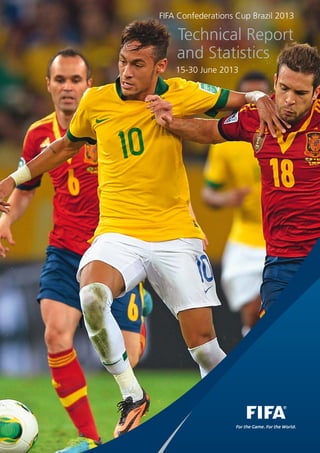
FIFA Confederations Cup Brazil 2013
Technical Report
and Statistics
15-30 June 2013
FIFA Confederations Cup
Brazil 2013
Technical Report
and Statistics
Rapport technique et statistiques
Informe técnico y estadísticas
Technischer Bericht und Statistik
3FIFA Confederations Cup Brazil 2013
Table of
contents
Foreword 4
Story of the tournament 8
Technical and tactical analysis 22
Trends and remarks 32
Goal-line technology 42
Refereeing report 52
Medical report 62
Statistics and team data 68
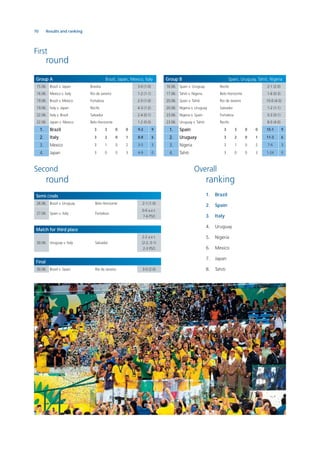
Results and ranking 70
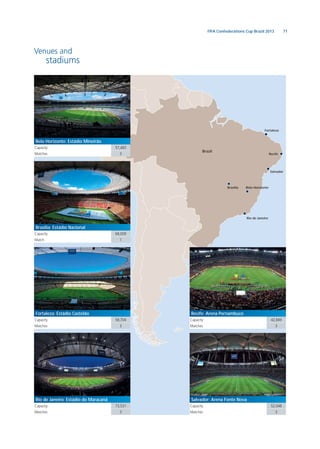
Venues and stadiums 71
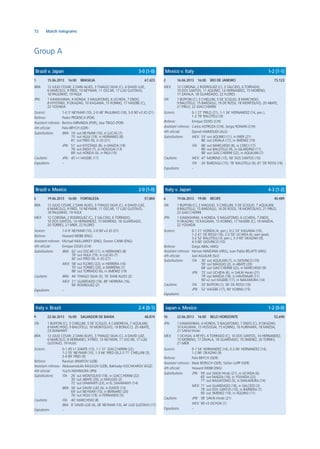
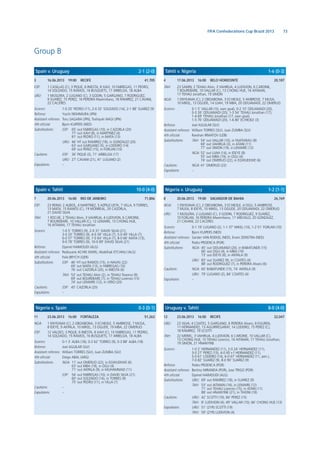
Match telegrams 72
Official FIFA awards 76
General statistics 78
Referees and assistant referees 87
Team data 88
FIFA delegation 104
FIFA Technical Study Group/Editorial 108
4 Foreword
Prezados amigos do Futebol,
Dear friends of football,
There is no stronger evidence of the success of a
tournament than to have the current world champions
and the most successful FIFA World Cup™ team playing
in the final. To make it an even more special occasion,
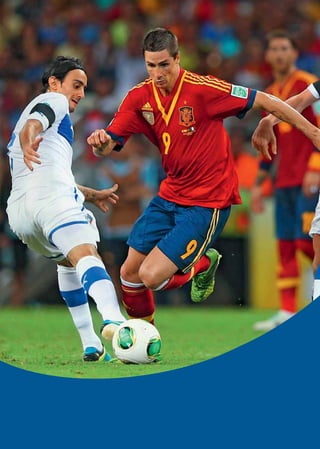
the setting was the iconic Maracanã Stadium. It was the
perfect ending for the FIFA Confederations Cup 2013,
rightly called the “Festival of Champions”.
In the end, hosts Brazil secured a record third
successive title by handing Spain their biggest defeat in a
competitive match for 18 years with a 3-0 victory.
Altogether, the four teams in the semi-finals – Brazil,
Italy, Spain and Uruguay – have shared 12 of the 19 FIFA
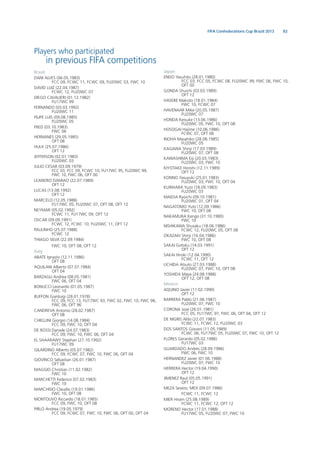
World Cup titles to date. They produced 53 of the 68
goals scored and rewarded football fans with brilliant
scenes such as the nerve-wracking semi-final between
Spain and Italy. Without a doubt, the star of the show was
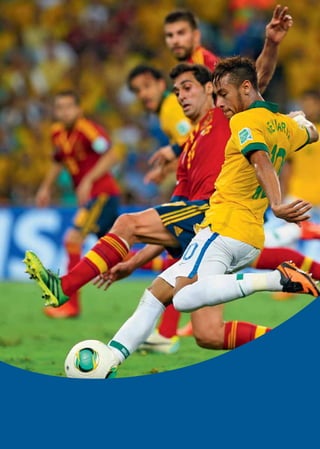
Neymar, who produced a moment of magic in each of
the Seleção’s five matches to help inspire his side to glory,
such as his free kick against Italy or his wonderful goal in
the final, using his weaker left foot to fire home from a
tight angle.
The other four participating teams, Japan, Mexico,
Nigeria and Tahiti, were also responsible for great football
that the fans will remember for a long time. All in the
spirit of fair play.
Vitaly Mutko
Chairman of the Organising Committee
for the FIFA Confederations Cup
Vitaly Mutko
Chairman of the
Organising Committee
Jérôme Valcke
FIFA Secretary
General
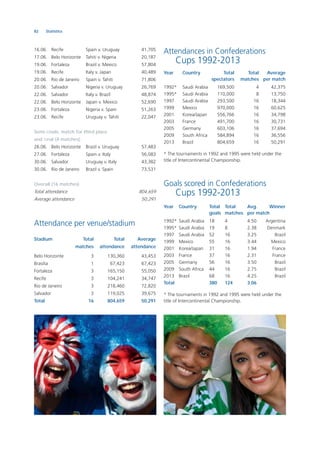
The crowd added a special atmosphere with an
average of 50,291 spectators per game and a total of
804,659 at the 16 matches. The 2013 event attracted the
biggest television audiences ever, which underlines the fact
that the FIFA Confederations Cup has now established itself
as a major global tournament.
On the pitch, goal-line technology was successfully
used at a FIFA competition for the second time.
Overall, the FIFA Confederations Cup 2013 definitely
offered the fans a taste of what to expect in Brazil in 2014,
both on and off the pitch.
5FIFA Confederations Cup Brazil 2013
Jérôme Valcke
FIFA Secretary General
Prezados amigos do futebol, Chers amis,
Quoi de meilleure preuve du succès d’une compétition
que d’avoir en finale le champion du monde en titre et
l’équipe la plus titrée de l’histoire ? Et quoi de plus beau
pour une telle finale de la voir disputée dans un stade
aussi mythique que le Maracanã ? Cette Coupe des
Confédérations de la FIFA 2013 s’est donc conclue en
apothéose et c’est véritablement à juste titre qu’elle est
surnommée le « Festival des Champions ».
Au coup de sifflet final, le Brésil, pays hôte, a pu
savourer un troisième titre consécutif, infligeant au passage
à l’Espagne sa plus large défaite en compétition depuis
dix-huit ans (3-0).
Il est à noter que les demi-finalistes – Brésil, Espagne,
Italie et Uruguay – se partagent à eux quatre douze des
dix-neuf Coupes du Monde de la FIFA™ disputées à ce jour.
Ils ont également inscrit cinquante-trois des soixante-huit
buts inscrits dans la compétition, et ont régalé le public dans
des matches dantesques comme la demi-finale opposant
l’Espagne à l’Italie. La star de la compétition aura sans aucun
doute été Neymar, auteur d’éclairs de génie dans chacun des
matches de la Seleção, comme ce coup franc face à l’Italie ou
ce superbe but inscrit en finale où c’est de son « mauvais »
pied qu’il décocha une frappe imparable dans un angle
fermé.
Les quatre autres équipes (Japon, Mexique, Nigeria
et Tahiti) ont également contribué au spectacle et resteront
Jérôme Valcke
Secrétaire Général
de la FIFA
dans les mémoires de tous les supporters. Et toutes ont
honoré l’esprit du fair-play.
Le nombreux public – 804 659 spectateurs au total soit
50 291 de moyenne – a également contribué à l’atmosphère
de la compétition. Les audiences télévisuelles ont quant
à elles été les plus élevées de l’histoire de la compétition,
soulignant là encore le fait que la Coupe des Confédérations
de la FIFA s’est imposée comme un des tournois majeurs du
calendrier.
Cette édition a également été l’occasion pour la
technologie sur la ligne de but d’être utilisée pour la
deuxième fois dans une compétition de la FIFA.
Dans l’ensemble, la Coupe des Confédérations de la
FIFA 2013 restera comme une délicieuse mise en bouche de
ce qui nous attend l’an prochain pour Brésil 2014.
Vitaly Mutko
Président de la Commission
d‘Organisation
6 Foreword
Prezados amigos do futebol, queridos amigos
del fútbol:
No hay mayor demostración del éxito de un torneo
que su final la disputen el actual campeón mundial y la
selección con más títulos de la Copa Mundial de la FIFA™.
Pero para que la ocasión sea aún más especial, el escenario
fue el histórico estadio de Maracaná. Fue el colofón perfecto
para la Copa FIFA Confederaciones de 2013, torneo al que
se le denomina no sin razón el “festival de los campeones”.
Los anfitriones brasileños terminaron haciéndose
con el título, con lo que establecieron un nuevo récord
de tres cetros consecutivos de la Copa Confederaciones.
El 3-0 que infligieron a España supone la mayor derrota
en partido oficial de los últimos 18 años para los vigentes
campeones.
Las cuatro escuadras semifinalistas –Brasil, España,
Italia y Uruguay– cuentan en su haber con un total de 12
de los 19 títulos mundialistas disputados hasta la fecha.
Entre las cuatro, marcaron 53 de los 68 goles registrados
y recompensaron a los aficionados al buen fútbol con
momentos inolvidables, como la electrizante semifinal entre
España e Italia. Sin ningún género de dudas, la estrella del
torneo fue Neymar, que dejó un momento de magia en cada
uno de los cinco encuentros que disputó con la Seleção,
como el libre directo que ejecutó en el partido contra
Italia o su gran gol en la final, en el que colocó el balón
por la misma escuadra tras un gran disparo con la zurda,
supuestamente su pierna mala.
Las otras cuatro selecciones participantes, Japón,
México, Nigeria y Tahití, desplegaron igualmente un fútbol
de muchos quilates que perdurará largo tiempo en la
memoria de los aficionados. Y todo ello siempre con el juego
limpio y la deportividad por bandera.
Con 50 291 espectadores de media por partido y un
total de 804 659 a los 16 encuentros disputados, el público
contribuyó a conformar un ambiente excepcional. Además,
se ha establecido un récord de audiencia televisiva, lo que
confirma que la Copa FIFA Confederaciones ha entrado a
formar parte del selecto grupo de grandes torneos de fútbol.
Jérôme Valcke
Secretario General
de la FIFA
Vitaly Mutko
Presidente de la Comisión
Organizadora
7FIFA Confederations Cup Brazil 2013
Vitaly Mutko
Vorsitzender der
Organisationskommission
Jérôme Valcke
FIFA-Generalsekretär
Prezados amigos do Futebol,
liebe Fussballfreunde,
ein Finale zwischen dem amtierenden Weltmeister
und dem WM-Rekordsieger lässt jedes Fussballerherz höher
schlagen, vor allem wenn es vor so einer grandiosen Kulisse
stattfindet. Das Endspiel im weltbekannten Maracanã-
Stadion war die Krönung des FIFA Konföderationen-Pokals,
der seinem Namen als Festival der Meister 2013 alle Ehre
gemacht hat.
In grossartiger Manier holte sich Gastgeber Brasilien
seinen dritten Titel und fügte Spanien mit dem 3:0-Triumph
die höchste Pflichtspielniederlage seit 18 Jahren zu.
Die vier Halbfinalisten – Brasilien, Italien, Spanien
und Uruguay – haben zusammen nicht weniger als 12 der
bislang 19 FIFA Fussball-Weltmeisterschaften™ gewonnen.
Gemeinsam erzielten sie 53 der 68 Turniertreffer und
begeisterten mit brillanten Aktionen wie im mitreissenden
Halbfinale zwischen Spanien und Italien. Überragender
Akteur war zweifellos Neymar, der in allen fünf Spielen der
Seleção für magische Momente sorgte und sein Team mit
seinen Geniestreichen – wie bei seinem Freistoss gegen
Italien oder seinem herrlichen Treffer im Finale mit dem
schwächeren linken Fuss aus spitzem Winkel – zum Titel
führte.
Die restlichen vier Teams (Japan, Mexiko, Nigeria
und Tahiti) zeigten ebenfalls grossartigen Fussball und
beispielhafte Fairness.
Für eine tolle Stimmung sorgten auch die Zuschauer.
804 659 Besucher kamen zu den 16 Spielen, d. h. im
Schnitt 50 291 pro Spiel. Auch im Fernsehen war das
Turnier ein Riesenerfolg. Nie zuvor sassen bei einem
FIFA Konföderationen-Pokal so viele Zuschauer vor dem
Fernseher, was den Stellenwert dieses Turniers eindrucksvoll
belegt.
Der FIFA Konföderationen-Pokal, bei dem die Torlinien-
technologie zum zweiten Mal bei einem FIFA-Wettbewerb
zum Einsatz kam, hat den Fans definitiv gezeigt, was sie im
nächsten Jahr bei der Weltmeisterschaft auf und neben Platz
alles erwarten wird.
Story of the
tournament
10 Story of the tournament
Story of the
tournament
Author: Ka Ming Kwok
Group stage
Group A
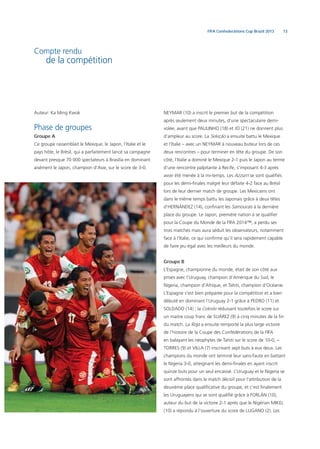
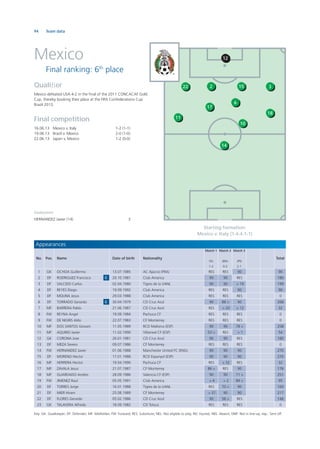
This group brought together Mexico, Japan, Italy and hosts
Brazil, who started off extremely well in front of a capacity
crowd of almost 70,000 in the capital city of Brasilia with a
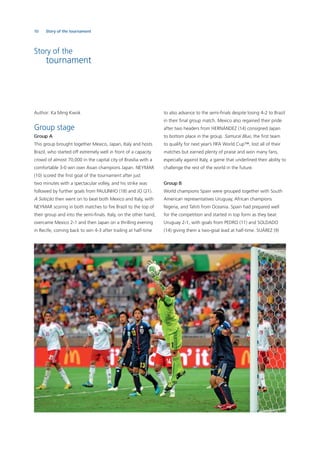
comfortable 3-0 win over Asian champions Japan. NEYMAR
(10) scored the first goal of the tournament after just
two minutes with a spectacular volley, and his strike was
followed by further goals from PAULINHO (18) and JO (21).
A Seleção then went on to beat both Mexico and Italy, with
NEYMAR scoring in both matches to fire Brazil to the top of
their group and into the semi-finals. Italy, on the other hand,
overcame Mexico 2-1 and then Japan on a thrilling evening
in Recife, coming back to win 4-3 after trailing at half-time
to also advance to the semi-finals despite losing 4-2 to Brazil
in their final group match. Mexico also regained their pride
after two headers from HERNÁNDEZ (14) consigned Japan
to bottom place in the group. Samurai Blue, the first team
to qualify for next year’s FIFA World Cup™, lost all of their
matches but earned plenty of praise and won many fans,
especially against Italy, a game that underlined their ability to
challenge the rest of the world in the future.
Group B
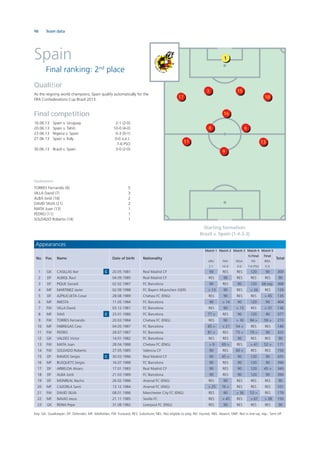
World champions Spain were grouped together with South
American representatives Uruguay, African champions
Nigeria, and Tahiti from Oceania. Spain had prepared well
for the competition and started in top form as they beat
Uruguay 2-1, with goals from PEDRO (11) and SOLDADO
(14) giving them a two-goal lead at half-time. SUÁREZ (9)
11FIFA Confederations Cup Brazil 2013
replied with an excellent direct free kick five minutes
from time, but it proved to be too little, too late. Spain
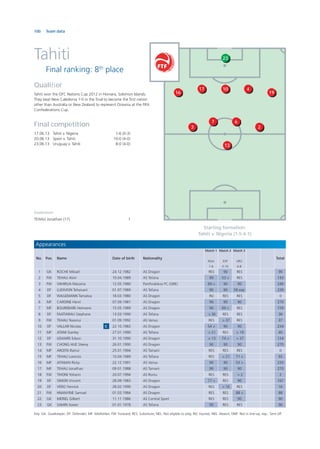
then went on to record the most comfortable victory in
FIFA Confederations Cup history with a 10-0 win against
newcomers Tahiti, with TORRES (9) and VILLA (7) sharing
seven goals between them. The world champions finished
top of the group after seeing off Nigeria’s Super Eagles 3-0
to reach the semi-finals, scoring 15 goals and only conceding
one along the way. Uruguay’s match against Nigeria proved
to be crucial, and in the end FORLÁN (10) scored the
winning goal after LUGANO (2) and MIKEL (10) had traded
strikes. Uruguay’s 2-1 victory was enough for them to join
Spain in the semi-finals. Tahiti, meanwhile, fought bravely
throughout their matches and scored a historic goal against
Nigeria, but they also conceded 24 goals.
Semi-finals
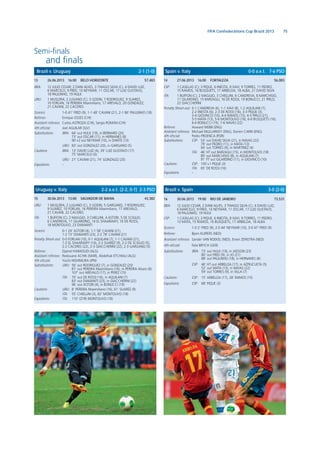
Brazil v. Uruguay 2-1 (1-0)
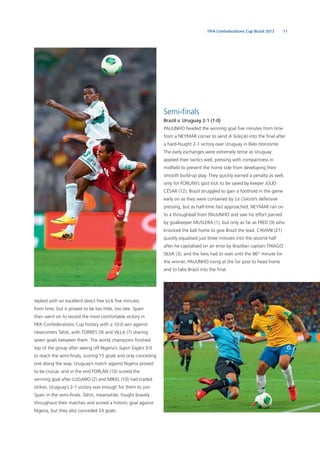
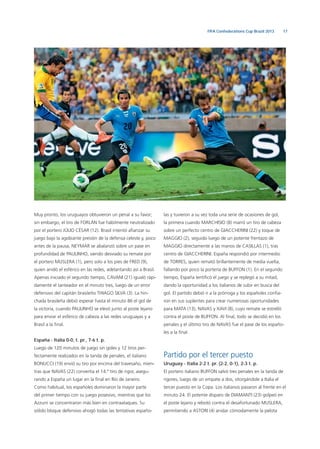
PAULINHO headed the winning goal five minutes from time
from a NEYMAR corner to send A Seleção into the final after
a hard-fought 2-1 victory over Uruguay in Belo Horizonte.
The early exchanges were extremely tense as Uruguay
applied their tactics well, pressing with compactness in
midfield to prevent the home side from developing their
smooth build-up play. They quickly earned a penalty as well,
only for FORLÁN’s spot kick to be saved by keeper JÚLIO
CÉSAR (12). Brazil struggled to gain a foothold in the game
early on as they were contained by La Celeste’s defensive
pressing, but as half-time fast approached, NEYMAR ran on
to a throughball from PAULINHO and saw his effort parried
by goalkeeper MUSLERA (1), but only as far as FRED (9) who
knocked the ball home to give Brazil the lead. CAVANI (21)
quickly equalised just three minutes into the second half
after he capitalised on an error by Brazilian captain THIAGO
SILVA (3), and the fans had to wait until the 86th
minute for
the winner, PAULINHO rising at the far post to head home
and to take Brazil into the final.
12 Story of the tournament
Spain v. Italy 0-0 a.e.t., 7-6 PSO
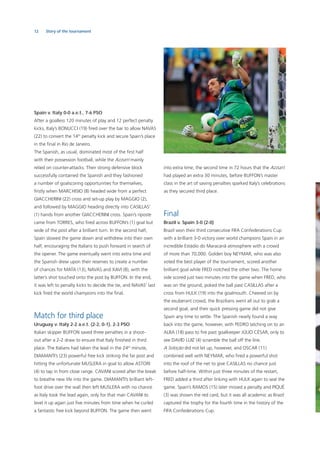
After a goalless 120 minutes of play and 12 perfect penalty
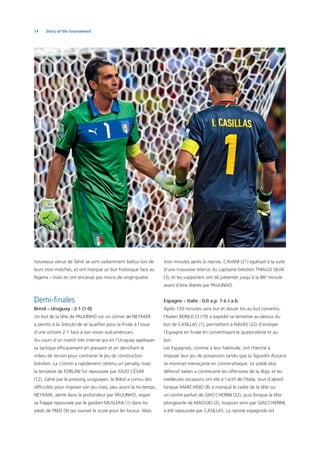
kicks, Italy’s BONUCCI (19) fired over the bar to allow NAVAS
(22) to convert the 14th
penalty kick and secure Spain’s place
in the final in Rio de Janeiro.
The Spanish, as usual, dominated most of the first half
with their possession football, while the Azzurri mainly
relied on counter-attacks. Their strong defensive block
successfully contained the Spanish and they fashioned
a number of goalscoring opportunities for themselves,
firstly when MARCHISIO (8) headed wide from a perfect
GIACCHERINI (22) cross and set-up play by MAGGIO (2),
and followed by MAGGIO heading directly into CASILLAS’
(1) hands from another GIACCHERINI cross. Spain’s riposte
came from TORRES, who fired across BUFFON’s (1) goal but
wide of the post after a brilliant turn. In the second half,
Spain slowed the game down and withdrew into their own
half, encouraging the Italians to push forward in search of
the opener. The game eventually went into extra time and
the Spanish drew upon their reserves to create a number
of chances for MATA (13), NAVAS and XAVI (8), with the
latter’s shot touched onto the post by BUFFON. In the end,
it was left to penalty kicks to decide the tie, and NAVAS’ last
kick fired the world champions into the final.
Match for third place
Uruguay v. Italy 2-2 a.e.t. (2-2, 0-1), 2-3 PSO
Italian skipper BUFFON saved three penalties in a shoot-
out after a 2-2 draw to ensure that Italy finished in third
place. The Italians had taken the lead in the 24th
minute,
DIAMANTI’s (23) powerful free kick striking the far post and
hitting the unfortunate MUSLERA in goal to allow ASTORI
(4) to tap in from close range. CAVANI scored after the break
to breathe new life into the game. DIAMANTI’s brilliant left-
foot drive over the wall then left MUSLERA with no chance
as Italy took the lead again, only for that man CAVANI to
level it up again just five minutes from time when he curled
a fantastic free kick beyond BUFFON. The game then went
into extra time, the second time in 72 hours that the Azzurri
had played an extra 30 minutes, before BUFFON’s master
class in the art of saving penalties sparked Italy’s celebrations
as they secured third place.
Final
Brazil v. Spain 3-0 (2-0)
Brazil won their third consecutive FIFA Confederations Cup
with a brilliant 3-0 victory over world champions Spain in an
incredible Estádio do Maracanã atmosphere with a crowd
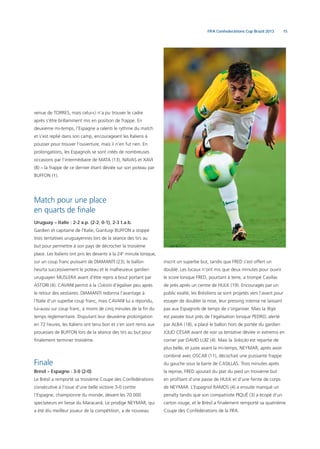
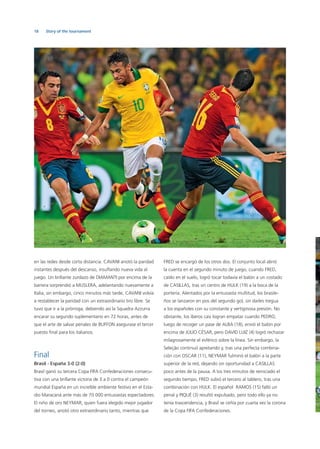
of more than 70,000. Golden boy NEYMAR, who was also
voted the best player of the tournament, scored another
brilliant goal while FRED notched the other two. The home
side scored just two minutes into the game when FRED, who
was on the ground, poked the ball past CASILLAS after a
cross from HULK (19) into the goalmouth. Cheered on by
the exuberant crowd, the Brazilians went all out to grab a
second goal, and their quick pressing game did not give
Spain any time to settle. The Spanish nearly found a way
back into the game, however, with PEDRO latching on to an
ALBA (18) pass to fire past goalkeeper JÚLIO CÉSAR, only to
see DAVID LUIZ (4) scramble the ball off the line.
A Seleção did not let up, however, and OSCAR (11)
combined well with NEYMAR, who fired a powerful shot
into the roof of the net to give CASILLAS no chance just
before half-time. Within just three minutes of the restart,
FRED added a third after linking with HULK again to seal the
game. Spain’s RAMOS (15) later missed a penalty and PIQUÉ
(3) was shown the red card, but it was all academic as Brazil
captured the trophy for the fourth time in the history of the
FIFA Confederations Cup.
13FIFA Confederations Cup Brazil 2013
Compte rendu
de la compétition
Auteur: Ka Ming Kwok
Phase de groupes
Groupe A
Ce groupe rassemblait le Mexique, le Japon, l’Italie et le
pays hôte, le Brésil, qui a parfaitement lancé sa campagne
devant presque 70 000 spectateurs à Brasília en dominant
aisément le Japon, champion d’Asie, sur le score de 3-0.
NEYMAR (10) a inscrit le premier but de la compétition
après seulement deux minutes, d’une spectaculaire demi-
volée, avant que PAULINHO (18) et JO (21) ne donnent plus
d’ampleur au score. La Seleção a ensuite battu le Mexique
et l’Italie – avec un NEYMAR à nouveau buteur lors de ces
deux rencontres – pour terminer en tête du groupe. De son
côté, l’Italie a dominé le Mexique 2-1 puis le Japon au terme
d’une rencontre palpitante à Recife, s’imposant 4-3 après
avoir été menée à la mi-temps. Les Azzurri se sont qualifiés
pour les demi-finales malgré leur défaite 4-2 face au Brésil
lors de leur dernier match de groupe. Les Mexicains ont
dans le même temps battu les Japonais grâce à deux têtes
d’HERNÁNDEZ (14), confinant les Samouraïs à la dernière
place du groupe. Le Japon, première nation à se qualifier
pour la Coupe du Monde de la FIFA 2014™, a perdu ses
trois matches mais aura séduit les observateurs, notamment
face à l’Italie, ce qui confirme qu’il sera rapidement capable
de faire jeu égal avec les meilleurs du monde.
Groupe B
L’Espagne, championne du monde, était de son côté aux
prises avec l’Uruguay, champion d’Amérique du Sud, le
Nigeria, champion d’Afrique, et Tahiti, champion d’Océanie.
L’Espagne s’est bien préparée pour la compétition et a bien
débuté en dominant l’Uruguay 2-1 grâce à PEDRO (11) et
SOLDADO (14) ; la Celeste réduisant toutefois le score sur
un maitre coup franc de SUÁREZ (9) à cinq minutes de la fin
du match. La Roja a ensuite remporté la plus large victoire
de l’histoire de la Coupe des Confédérations de la FIFA
en balayant les néophytes de Tahiti sur le score de 10-0, –
TORRES (9) et VILLA (7) inscrivant sept buts à eux deux. Les
champions du monde ont terminé leur sans-faute en battant
le Nigeria 3-0, atteignant les demi-finales en ayant inscrit
quinze buts pour un seul encaissé. L’Uruguay et le Nigeria se
sont affrontés dans le match décisif pour l’attribution de la
deuxième place qualificative du groupe, et c’est finalement
les Uruguayens qui se sont qualifié grâce à FORLÁN (10),
auteur du but de la victoire 2-1 après que le Nigérian MIKEL
(10) a répondu à l’ouverture du score de LUGANO (2). Les
14 Story of the tournament
nouveaux venus de Tahiti se sont vaillamment battus lors de
leurs trois matches, et ont marqué un but historique face au
Nigeria – mais en ont encaissé pas moins de vingt-quatre.
Demi-finales
Brésil – Uruguay : 2-1 (1-0)
Un but de la tête de PAULINHO sur un corner de NEYMAR
a permis à la Seleção de se qualifier pour la finale à l’issue
d’une victoire 2-1 face à son voisin sud-américain.
Au cours d’un match très intense qui vit l’Uruguay appliquer
sa tactique efficacement en pressant et en densifiant le
milieu de terrain pour contrarier le jeu de construction
brésilien. La Celeste a rapidement obtenu un penalty, mais
la tentative de FORLÁN fut repoussée par JÚLIO CÉSAR
(12). Gêné par le pressing uruguayen, le Brésil a connu des
difficultés pour imposer son jeu mais, peu avant la mi-temps,
NEYMAR, alerté dans la profondeur par PAULINHO, voyait
sa frappe repoussée par le gardien MUSLERA (1) dans les
pieds de FRED (9) qui ouvrait le score pour les locaux. Mais
trois minutes après la reprise, CAVANI (21) égalisait à la suite
d’une mauvaise relance du capitaine brésilien THIAGO SILVA
(3), et les supporters ont dû patienter jusqu’à la 86e
minute
avant d’être libérés par PAULINHO.
Espagne – Italie : 0-0 a.p. 7-6 t.a.b.
Après 120 minutes sans but et douze tirs au but convertis,
l’Italien BONUCCI (19) a expédié sa tentative au-dessus du
but de CASILLAS (1), permettant à NAVAS (22) d’envoyer
l’Espagne en finale en convertissant le quatorzième tir au
but.
Les Espagnols, comme à leur habitude, ont cherché à
imposer leur jeu de possession tandis que la Squadra Azzurra
se montrait menaçante en contre-attaque. Le solide bloc
défensif italien a contrecarré les offensives de la Roja, et les
meilleures occasions ont été à l’actif de l’Italie, tout d’abord
lorsque MARCHISIO (8) a manqué le cadre de la tête sur
un centre parfait de GIACCHERINI (22), puis lorsque la tête
plongeante de MAGGIO (2), toujours servi par GIACCHERINI,
a été repoussée par CASILLAS. La riposte espagnole est
15FIFA Confederations Cup Brazil 2013
venue de TORRES, mais celui-ci n’a pu trouver le cadre
après s’être brillamment mis en position de frappe. En
deuxième mi-temps, l’Espagne a ralenti le rythme du match
et s’est replié dans son camp, encourageant les Italiens à
pousser pour trouver l’ouverture, mais il n’en fut rien. En
prolongations, les Espagnols se sont créés de nombreuses
occasions par l’intermédiaire de MATA (13), NAVAS et XAVI
(8) – la frappe de ce dernier étant déviée sur son poteau par
BUFFON (1).
Match pour une place
en quarts de finale
Uruguay – Italie : 2-2 a.p. (2-2, 0-1), 2-3 t.a.b.
Gardien et capitaine de l’Italie, Gianluigi BUFFON a stoppé
trois tentatives uruguayennes lors de la séance des tirs au
but pour permettre à son pays de décrocher la troisième
place. Les Italiens ont pris les devants à la 24e
minute lorsque,
sur un coup franc puissant de DIAMANTI (23), le ballon
heurta successivement le poteau et le malheureux gardien
uruguayen MUSLERA avant d’être repris à bout portant par
ASTORI (4). CAVANI permit à la Celeste d’égaliser peu après
le retour des vestiaires. DIAMANTI redonna l’avantage à
l’Italie d’un superbe coup franc, mais CAVANI lui a répondu,
lui-aussi sur coup franc, à moins de cinq minutes de la fin du
temps règlementaire. Disputant leur deuxième prolongation
en 72 heures, les Italiens ont tenu bon et s’en sont remis aux
prouesses de BUFFON lors de la séance des tirs au but pour
finalement terminer troisième.
Finale
Brésil – Espagne : 3-0 (2-0)
Le Brésil a remporté sa troisième Coupe des Confédérations
consécutive à l’issue d’une belle victoire 3-0 contre
l’Espagne, championne du monde, devant les 70 000
spectateurs en liesse du Maracanã. Le prodige NEYMAR, qui
a été élu meilleur joueur de la compétition, a de nouveau
inscrit un superbe but, tandis que FRED s’est offert un
doublé. Les locaux n’ont mis que deux minutes pour ouvrir
le score lorsque FRED, pourtant à terre, a trompé Casillas
de près après un centre de HULK (19). Encouragés par un
public exalté, les Brésiliens se sont projetés vers l’avant pour
essayer de doubler la mise, leur pressing intense ne laissant
pas aux Espagnols de temps de s’organiser. Mais la Roja
est passée tout près de l’égalisation lorsque PEDRO, alerté
par ALBA (18), a placé le ballon hors de portée du gardien
JÚLIO CÉSAR avant de voir sa tentative déviée in extremis en
corner par DAVID LUIZ (4). Mais la Seleção est repartie de
plus belle, et juste avant la mi-temps, NEYMAR, après avoir
combiné avec OSCAR (11), décochait une puissante frappe
du gauche sous la barre de CASILLAS. Trois minutes après
la reprise, FRED ajoutait du plat du pied un troisième but
en profitant d’une passe de HULK et d’une feinte de corps
de NEYMAR. L’Espagnol RAMOS (4) a ensuite manqué un
penalty tandis que son compatriote PIQUÉ (3) a écopé d’un
carton rouge, et le Brésil a finalement remporté sa quatrième
Coupe des Confédérations de la FIFA.
16 Story of the tournament
Crónica del
torneo
Autor: Ka Ming Kwok
Fase de grupos
Grupo A
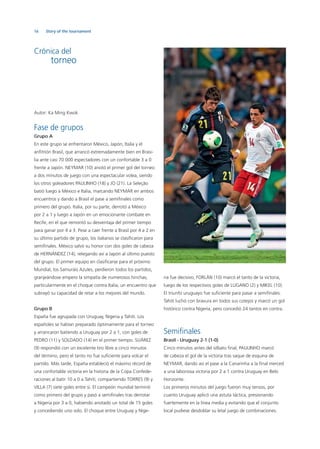
En este grupo se enfrentaron México, Japón, Italia y el
anfitrión Brasil, que arrancó extremadamente bien en Brasi-
lia ante casi 70 000 espectadores con un confortable 3 a 0
frente a Japón. NEYMAR (10) anotó el primer gol del torneo
a dos minutos de juego con una espectacular volea, siendo
los otros goleadores PAULINHO (18) y JO (21). La Seleção
batió luego a México e Italia, marcando NEYMAR en ambos
encuentros y dando a Brasil el pase a semifinales como
primero del grupo. Italia, por su parte, derrotó a México
por 2 a 1 y luego a Japón en un emocionante combate en
Recife, en el que remontó su desventaja del primer tiempo
para ganar por 4 a 3. Pese a caer frente a Brasil por 4 a 2 en
su último partido de grupo, los italianos se clasificaron para
semifinales. México salvó su honor con dos goles de cabeza
de HERNÁNDEZ (14), relegando así a Japón al último puesto
del grupo. El primer equipo en clasificarse para el próximo
Mundial, los Samuráis Azules, perdieron todos los partidos,
granjeándose empero la simpatía de numerosos hinchas,
particularmente en el choque contra Italia, un encuentro que
subrayó su capacidad de retar a los mejores del mundo.
Grupo B
España fue agrupada con Uruguay, Nigeria y Tahití. Los
españoles se habían preparado óptimamente para el torneo
y arrancaron batiendo a Uruguay por 2 a 1, con goles de
PEDRO (11) y SOLDADO (14) en el primer tiempo. SUÁREZ
(9) respondió con un excelente tiro libre a cinco minutos
del término, pero el tanto no fue suficiente para volcar el
partido. Más tarde, España estableció el máximo récord de
una confortable victoria en la historia de la Copa Confede-
raciones al batir 10 a 0 a Tahití, compartiendo TORRES (9) y
VILLA (7) siete goles entre sí. El campeón mundial terminó
como primero del grupo y pasó a semifinales tras derrotar
a Nigeria por 3 a 0, habiendo anotado un total de 15 goles
y concediendo uno solo. El choque entre Uruguay y Nige-
ria fue decisivo; FORLÁN (10) marcó el tanto de la victoria,
luego de los respectivos goles de LUGANO (2) y MIKEL (10).
El triunfo uruguayo fue suficiente para pasar a semifinales.
Tahití luchó con bravura en todos sus cotejos y marcó un gol
histórico contra Nigeria, pero concedió 24 tantos en contra.
Semifinales
Brasil - Uruguay 2-1 (1-0)
Cinco minutos antes del silbato final, PAULINHO marcó
de cabeza el gol de la victoria tras saque de esquina de
NEYMAR, dando así el pase a la Canarinha a la final merced
a una laboriosa victoria por 2 a 1 contra Uruguay en Belo
Horizonte.
Los primeros minutos del juego fueron muy tensos, por
cuanto Uruguay aplicó una astuta táctica, presionando
fuertemente en la línea media y evitando que el conjunto
local pudiese desdoblar su letal juego de combinaciones.
17FIFA Confederations Cup Brazil 2013
Muy pronto, los uruguayos obtuvieron un penal a su favor;
sin embargo, el tiro de FORLÁN fue hábilmente neutralizado
por el portero JÚLIO CÉSAR (12). Brasil intentó afianzar su
juego bajo la agobiante presión de la defensa celeste y, poco
antes de la pausa, NEYMAR se abalanzó sobre un pase en
profundidad de PAULINHO, siendo desviado su remate por
el portero MUSLERA (1), pero solo a los pies de FRED (9),
quien anidó el esférico en las redes, adelantando así a Brasil.
Apenas iniciado el segundo tiempo, CAVANI (21) igualó rápi-
damente el tanteador en el minuto tres, luego de un error
defensivo del capitán brasileño THIAGO SILVA (3). La hin-
chada brasileña debió esperar hasta el minuto 86 el gol de
la victoria, cuando PAULINHO se elevó junto al poste lejano
para enviar el esférico de cabeza a las redes uruguayas y a
Brasil a la final.
España - Italia 0-0, t. pr., 7-6 t. p.
Luego de 120 minutos de juego sin goles y 12 tiros per-
fectamente realizados en la tanda de penales, el italiano
BONUCCI (19) envió su tiro por encima del travesaño, mien-
tras que NAVAS (22) convertía el 14.º tiro de rigor, asegu-
rando a España un lugar en la final en Río de Janeiro.
Como habitual, los españoles dominaron la mayor parte
del primer tiempo con su juego posesivo, mientras que los
Azzurri se concentraron más bien en contraataques. Su
sólido bloque defensivo ahogó todas las tentativas españo-
las y tuvieron a su vez toda una serie de ocasiones de gol,
la primera cuando MARCHISIO (8) marró un tiro de cabeza
sobre un perfecto centro de GIACCHERINI (22) y toque de
MAGGIO (2), seguido luego de un potente frentazo de
MAGGIO directamente a las manos de CASILLAS (1), tras
centro de GIACCHERINI. España respondió por intermedio
de TORRES, quien remató brillantemente de media vuelta,
fallando por poco la portería de BUFFON (1). En el segundo
tiempo, España lentificó el juego y se replegó a su mitad,
dando la oportunidad a los italianos de subir en busca del
gol. El partido debió ir a la prórroga y los españoles confia-
ron en sus suplentes para crear numerosas oportunidades
para MATA (13), NAVAS y XAVI (8), cuyo remate se estrelló
contra el poste de BUFFON. Al final, todo se decidió en los
penales y el último tiro de NAVAS fue el pase de los españo-
les a la final.
Partido por el tercer puesto
Uruguay - Italia 2-2 t. pr. (2-2, 0-1), 2-3 t. p.
El portero italiano BUFFON salvó tres penales en la tanda de
rigores, luego de un empate a dos, otorgándole a Italia el
tercer puesto en la Copa. Los italianos pasaron al frente en el
minuto 24. El potente disparo de DIAMANTI (23) golpeó en
el poste lejano y rebotó contra el desafortunado MUSLERA,
permitiendo a ASTORI (4) anidar cómodamente la pelota
18 Story of the tournament
en las redes desde corta distancia. CAVANI anotó la paridad
instantes después del descanso, insuflando nueva vida al
juego. Un brillante zurdazo de DIAMANTI por encima de la
barrera sorprendió a MUSLERA, adelantando nuevamente a
Italia, sin embargo, cinco minutos más tarde, CAVANI volvía
a restablecer la paridad con un extraordinario tiro libre. Se
tuvo que ir a la prórroga, debiendo así la Squadra Azzurra
encarar su segundo suplementario en 72 horas, antes de
que el arte de salvar penales de BUFFON asegurase el tercer
puesto final para los italianos.
Final
Brasil - España 3-0 (2-0)
Brasil ganó su tercera Copa FIFA Confederaciones consecu-
tiva con una brillante victoria de 3 a 0 contra el campeón
mundial España en un increíble ambiente festivo en el Esta-
dio Maracaná ante más de 70 000 entusiastas espectadores.
El niño de oro NEYMAR, quien fuera elegido mejor jugador
del torneo, anotó otro extraordinario tanto, mientras que
FRED se encargó de los otros dos. El conjunto local abrió
la cuenta en el segundo minuto de juego, cuando FRED,
caído en el suelo, logró tocar todavía el balón a un costado
de CASILLAS, tras un centro de HULK (19) a la boca de la
portería. Alentados por la entusiasta multitud, los brasile-
ños se lanzaron en pos del segundo gol, sin darles tregua
a los españoles con su constante y vertiginosa presión. No
obstante, los íberos casi logran empatar cuando PEDRO,
luego de recoger un pase de ALBA (18), envió el balón por
encima de JÚLIO CÉSAR, pero DAVID LUIZ (4) logró rechazar
milagrosamente el esférico sobre la línea. Sin embargo, la
Seleção continuó apretando y, tras una perfecta combina-
ción con OSCAR (11), NEYMAR fulminó el balón a la parte
superior de la red, dejando sin oportunidad a CASILLAS
poco antes de la pausa. A los tres minutos de reiniciado el
segundo tiempo, FRED subió el tercero al tablero, tras una
combinación con HULK. El español RAMOS (15) falló un
penal y PIQUÉ (3) resultó expulsado, pero todo ello ya no
tenía trascendencia, y Brasil se ceñía por cuarta vez la corona
de la Copa FIFA Confederaciones.
19FIFA Confederations Cup Brazil 2013
Turnier-
verlauf
Autor: Ka Ming Kwok
Gruppenspiele
Gruppe A
In der Gruppe mit Mexiko, Japan, Italien und Brasilien
erwischte der Gastgeber einen Start nach Mass und setzte
sich vor beinahe 70 000 Zuschauern im ausverkauften
Estádio Nacional von Brasília gegen Asienmeister Japan klar
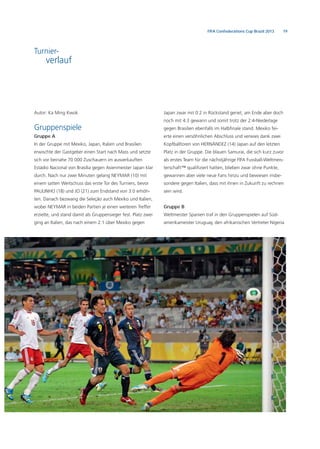
durch. Nach nur zwei Minuten gelang NEYMAR (10) mit
einem satten Weitschuss das erste Tor des Turniers, bevor
PAULINHO (18) und JO (21) zum Endstand von 3:0 erhöh-
ten. Danach bezwang die Seleção auch Mexiko und Italien,
wobei NEYMAR in beiden Partien je einen weiteren Treffer
erzielte, und stand damit als Gruppensieger fest. Platz zwei
ging an Italien, das nach einem 2:1 über Mexiko gegen
Japan zwar mit 0:2 in Rückstand geriet, am Ende aber doch
noch mit 4:3 gewann und somit trotz der 2:4-Niederlage
gegen Brasilien ebenfalls im Halbfinale stand. Mexiko fei-
erte einen versöhnlichen Abschluss und verwies dank zwei
Kopfballtoren von HERNÁNDEZ (14) Japan auf den letzten
Platz in der Gruppe. Die blauen Samurai, die sich kurz zuvor
als erstes Team für die nächstjährige FIFA Fussball-Weltmeis-
terschaft™ qualifiziert hatten, blieben zwar ohne Punkte,
gewannen aber viele neue Fans hinzu und bewiesen insbe-
sondere gegen Italien, dass mit ihnen in Zukunft zu rechnen
sein wird.
Gruppe B
Weltmeister Spanien traf in den Gruppenspielen auf Süd-
amerikameister Uruguay, den afrikanischen Vertreter Nigeria
20 Story of the tournament
sowie Tahiti aus Ozeanien. Die Iberer zeigten sich bestens
vorbereitet und schlugen zum Auftakt Uruguay mit 2:1.
Obwohl SUAREZ (9) die Urus mit einem herrlichen Freistoss
kurz vor Schluss noch einmal heranbrachte, reichten die
beiden Tore von PEDRO (11) und SOLDADO (14) aus der
ersten Halbzeit am Ende zum Sieg. Nach dem höchsten
Triumph in der Geschichte des FIFA Konföderationen-Pokals
– einem 10:0 über Debütant Tahiti, zu dem TORRES (9) und
VILLA (7) insgesamt sieben Tore beisteuerten – sicherte sich
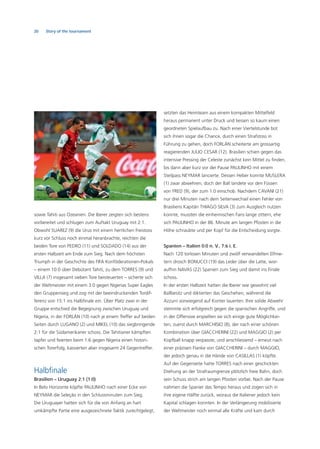
der Weltmeister mit einem 3:0 gegen Nigerias Super Eagles
den Gruppensieg und zog mit der beeindruckenden Tordif-
ferenz von 15:1 ins Halbfinale ein. Über Platz zwei in der
Gruppe entschied die Begegnung zwischen Uruguay und
Nigeria, in der FORLÁN (10) nach je einem Treffer auf beiden
Seiten durch LUGANO (2) und MIKEL (10) das siegbringende
2:1 für die Südamerikaner schoss. Die Tahitianer kämpften
tapfer und feierten beim 1:6 gegen Nigeria einen histori-
schen Torerfolg, kassierten aber insgesamt 24 Gegentreffer.
Halbfinale
Brasilien – Uruguay 2:1 (1:0)
In Belo Horizonte köpfte PAULINHO nach einer Ecke von
NEYMAR die Seleção in den Schlussminuten zum Sieg.
Die Uruguayer hatten sich für die von Anfang an hart
umkämpfte Partie eine ausgezeichnete Taktik zurechtgelegt,
setzten das Heimteam aus einem kompakten Mittelfeld
heraus permanent unter Druck und liessen so kaum einen
geordneten Spielaufbau zu. Nach einer Viertelstunde bot
sich ihnen sogar die Chance, durch einen Strafstoss in
Führung zu gehen, doch FORLÁN scheiterte am grossartig
reagierenden JULIO CESAR (12). Brasilien schien gegen das
intensive Pressing der Celeste zunächst kein Mittel zu finden,
bis dann aber kurz vor der Pause PAULINHO mit einem
Steilpass NEYMAR lancierte. Dessen Heber konnte MUSLERA
(1) zwar abwehren, doch der Ball landete vor den Füssen
von FRED (9), der zum 1:0 einschob. Nachdem CAVANI (21)
nur drei Minuten nach dem Seitenwechsel einen Fehler von
Brasiliens Kapitän THIAGO SILVA (3) zum Ausgleich nutzen
konnte, mussten die einheimischen Fans lange zittern, ehe
sich PAULINHO in der 86. Minute am langen Pfosten in die
Höhe schraubte und per Kopf für die Entscheidung sorgte.
Spanien – Italien 0:0 n. V., 7:6 i. E.
Nach 120 torlosen Minuten und zwölf verwandelten Elfme-
tern drosch BONUCCI (19) das Leder über die Latte, wor-
aufhin NAVAS (22) Spanien zum Sieg und damit ins Finale
schoss.
In der ersten Halbzeit hatten die Iberer wie gewohnt viel
Ballbesitz und diktierten das Geschehen, während die
Azzurri vorwiegend auf Konter lauerten. Ihre solide Abwehr
stemmte sich erfolgreich gegen die spanischen Angriffe, und
in der Offensive erspielten sie sich einige gute Möglichkei-
ten, zuerst durch MARCHISIO (8), der nach einer schönen
Kombination über GIACCHERINI (22) und MAGGIO (2) per
Kopfball knapp verpasste, und anschliessend – erneut nach
einer präzisen Flanke von GIACCHERINI – durch MAGGIO,
der jedoch genau in die Hände von CASILLAS (1) köpfte.
Auf der Gegenseite hatte TORRES nach einer geschickten
Drehung an der Strafraumgrenze plötzlich freie Bahn, doch
sein Schuss strich am langen Pfosten vorbei. Nach der Pause
nahmen die Spanier das Tempo heraus und zogen sich in
ihre eigene Hälfte zurück, woraus die Italiener jedoch kein
Kapital schlagen konnten. In der Verlängerung mobilisierte
der Weltmeister noch einmal alle Kräfte und kam durch
21FIFA Confederations Cup Brazil 2013
MATA (13), NAVAS und XAVI (8), dessen Schuss BUFFON
(1) gerade noch an den Pfosten lenken konnte, zu einigen
guten Chancen, konnte sich aber letztlich erst im Elfmeter-
schiessen durchsetzen.
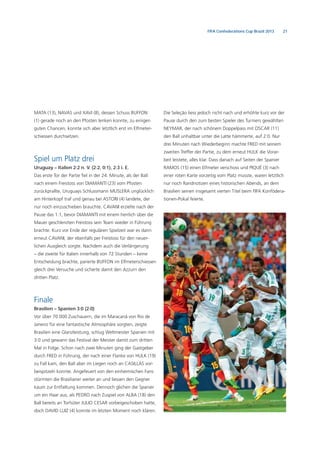
Spiel um Platz drei
Uruguay – Italien 2:2 n. V. (2:2, 0:1), 2:3 i. E.
Das erste Tor der Partie fiel in der 24. Minute, als der Ball
nach einem Freistoss von DIAMANTI (23) vom Pfosten
zurückprallte, Uruguays Schlussmann MUSLERA unglücklich
am Hinterkopf traf und genau bei ASTORI (4) landete, der
nur noch einzuschieben brauchte. CAVANI erzielte nach der
Pause das 1:1, bevor DIAMANTI mit einem herrlich über die
Mauer geschlenzten Freistoss sein Team wieder in Führung
brachte. Kurz vor Ende der regulären Spielzeit war es dann
erneut CAVANI, der ebenfalls per Freistoss für den neuer-
lichen Ausgleich sorgte. Nachdem auch die Verlängerung
– die zweite für Italien innerhalb von 72 Stunden – keine
Entscheidung brachte, parierte BUFFON im Elfmeterschiessen
gleich drei Versuche und sicherte damit den Azzurri den
dritten Platz.
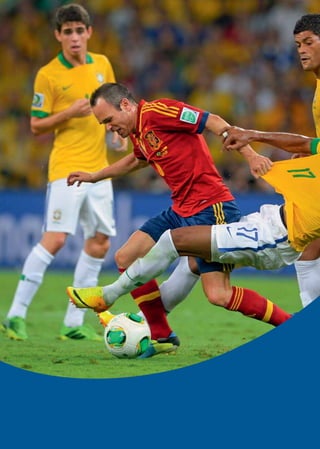
Finale
Brasilien – Spanien 3:0 (2:0)
Vor über 70 000 Zuschauern, die im Maracanã von Rio de
Janeiro für eine fantastische Atmosphäre sorgten, zeigte
Brasilien eine Glanzleistung, schlug Weltmeister Spanien mit
3:0 und gewann das Festival der Meister damit zum dritten
Mal in Folge. Schon nach zwei Minuten ging der Gastgeber
durch FRED in Führung, der nach einer Flanke von HULK (19)
zu Fall kam, den Ball aber im Liegen noch an CASILLAS vor-
beispitzeln konnte. Angefeuert von den einheimischen Fans
stürmten die Brasilianer weiter an und liessen den Gegner
kaum zur Entfaltung kommen. Dennoch glichen die Spanier
um ein Haar aus, als PEDRO nach Zuspiel von ALBA (18) den
Ball bereits an Torhüter JULIO CESAR vorbeigeschoben hatte,
doch DAVID LUIZ (4) konnte im letzten Moment noch klären.
Die Seleção liess jedoch nicht nach und erhöhte kurz vor der
Pause durch den zum besten Spieler des Turniers gewählten
NEYMAR, der nach schönem Doppelpass mit OSCAR (11)
den Ball unhaltbar unter die Latte hämmerte, auf 2:0. Nur
drei Minuten nach Wiederbeginn machte FRED mit seinem
zweiten Treffer der Partie, zu dem erneut HULK die Vorar-
beit leistete, alles klar. Dass danach auf Seiten der Spanier
RAMOS (15) einen Elfmeter verschoss und PIQUÉ (3) nach
einer roten Karte vorzeitig vom Platz musste, waren letztlich
nur noch Randnotizen eines historischen Abends, an dem
Brasilien seinen insgesamt vierten Titel beim FIFA Konfödera-
tionen-Pokal feierte.
Technical and
tactical analysis
24 Technical and tactical analysis
Technical and
tactical analysis
Authors: Jean-Paul Brigger, Gérard Houllier
and Christofer Clemens
The FIFA Confederations Cup Brazil 2013 was a tourna-
ment of attacking football. Every team tried to score goals,
which led to an average goals per game figure of 4.25,
and endeavoured to win their matches instead of trying
not to lose them. The only goalless draw was the semi-final
between Italy and Spain, but even that match was one of
the most entertaining encounters of the tournament, with
a lot of chances for both sides – even in extra time. Certain
technical and tactical aspects were very decisive for the most
successful teams throughout the tournament.
Systems and shape
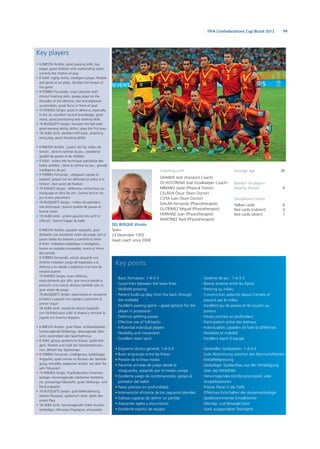
Most teams played with a four-man zonal defensive line,
apart from Italy in their semi-final against Spain, when they
deployed a three-man defence with two supporting wide
midfielders to counter Spain’s playing style.
In midfield, the most successful teams deployed a three-man
formation. Although the shape varied, the teams generally
had one holding position in front of the defence and two
box-to-box players linking the attack.
The organisation between defence and midfield consisted
of either a square formation (two central defenders and two
central midfielders) or a triangle formation with one holding
position and two slightly more advanced midfield players.
In attack, the most successful teams deployed three
attacking players, i.e. two wide players and one lone striker,
which provided a link to the midfield players.
Organisation and discipline
Organisation and discipline were the key to success.
“Organisation” here means a flowing system rather than
a static formation, whereby players assumed different
positions and stuck to their role when the match situation
demanded it but still kept the general shape of the team.
This system enabled the players to make the best use of
their talent.
Pressing in various situations
Because of the heat, teams were not able to press as they
were used to doing in Europe or similar climatic conditions.
Teams pressed only in certain periods of the match (e.g. the
first ten to 15 minutes).
If they did not succeed at first, they would then drop back a
little and retain their shape in order to win the ball.
Pressing after losing possession – especially in the last third
– was still used by all the teams, but the aim had changed
a little. Instead of the main idea being to win back the ball
immediately, teams dropped back a little to gain more time
and prevent their opponents from counter-attacking.
As these tactics require players to have a lot of energy, a
high level of fitness was essential for the most successful
teams and an even higher level will be needed at next year’s
2014 FIFA World Cup Brazil™.
Fast transitions from defence to attack
Fast transitions from defence to attack were still a key
tactical tool for all teams. Even Spain, a team renowned
for its high ball possession and controlled build-up play,
frequently deployed fast counter-attacks and even scored
from them.
25FIFA Confederations Cup Brazil 2013
Ball possession and ball progression
The most successful teams had good and “safe” ball
progression as well as ball possession. Instead of just
keeping the ball, creative progression of the ball towards
the goal was essential to success at the tournament. Every
loss of possession led to increased effort in terms of either
pressing to regain the ball or tracking back to regain the
team’s shape. Good and safe progression of the ball will be
crucial at next year´s FIFA World Cup™ in Brazil.
Set pieces
Surprisingly, a full one-third of the goals were scored
through or following set pieces.
Both the semi-finals and the match for third place were
more or less decided by set pieces, with the winning goals
coming either from a corner kick (Paulinho’s goal in the 2-1
win over Uruguay) or a penalty shoot-out. The importance
of set pieces has increased and every team used this tactic
as a valuable tool in their game.
Goals at the end of the game
Up to and including the semi-finals, some 25% of the
goals were scored in the last 15 minutes of the game. With
reference to the level of fitness, this high percentage could
be a sign of attacking football as well as fatigue at the end
of the match.
Moments of individual brilliance
The most successful teams had players in their squad that
could make a difference in a moment of individual brilliance.
One decisive and creative moment can change or decide a
match. Each team had such players.
26 Technical and tactical analysis
Analyse
technique et tactique
Auteurs : Jean-Paul Brigger, Gérard Houllier et Christofer Clemens
La Coupe des Confédérations de la FIFA, Brésil 2013 a été
un tournoi de football offensif. Chaque équipe a essayé de
marquer des buts, ce qui a mené à une moyenne de 4,25
buts par match, et s’est efforcée de gagner ses matches
plutôt que de ne pas les perdre. Le seul match nul et vierge
de la compétition a été la demi-finale opposant l’Espagne
à l’Italie, mais ce match n’en a pas moins été l’un des plus
spectaculaires du tournoi, les équipes se créant chacune
beaucoup d’occasions – même en prolongations.
Certains aspects techniques et tactiques ont été décisifs.
Systèmes et formation
La plupart des équipes ont joué avec une ligne défensive à
quatre en zone, excepté l’Italie en demi-finale contre l’Espagne,
qui a utilisé une défense à trois avec deux milieux excentrés se
repliant afin de contrer le style de jeu de l’Espagne.
Au milieu de terrain, les meilleures équipes ont utilisé une
formation à trois joueurs. Même si la disposition des joueurs
variait, les équipes avaient généralement un milieu de terrain
devant la défense et deux relayeurs assurant la liaison avec
l’attaque.
L’organisation entre la défense et le milieu de terrain formait
soit un carré (formé par les deux défenseurs centraux et les
deux milieux axiaux) ou un triangle avec une « sentinelle » et
deux milieux de terrain légèrement plus avancés.
En attaque, les meilleures équipes ont utilisé trois joueurs
offensifs, deux attaquants excentrés et une pointe axiale, qui
assuraient une liaison avec les milieux de terrain.
Organisation et discipline
L’organisation et la discipline ont été la clé du succès. Par
« organisation », on entend ici un système en mouvement
plutôt qu’une formation statique, qui voit les joueurs jouer à
différents postes ou se contenter d’assumer leur rôle lorsque
27FIFA Confederations Cup Brazil 2013
la situation du match l’exigeait, mais tout en conservant le
dispositif général de l’équipe.
Ce système a permis aux joueurs d’exploiter aux mieux leurs
qualités.
Pressing dans différentes situations
En raison de la chaleur, les équipes n’ont pas pu exercer un
pressing similaire à ce qu’elles font en Europe ou dans des
conditions climatiques équivalentes. Les équipes pressaient
durant certaines périodes du match (par ex. : les dix à quinze
premières minutes).
Si elles ne parvenaient pas à récupérer le ballon rapidement,
elles reculaient légèrement et conservaient leur dispositif
tactique.
Toutes les équipes ont une fois encore pressé l’adversaire
au moment où elles perdaient la possession du ballon, mais
l’objectif de cette manœuvre était légèrement différent. Au
lieu de chercher à regagner le ballon immédiatement, les
équipes ont légèrement reculé pour gagner du temps et
empêcher leurs adversaires de contre-attaquer.
Étant donné que cette tactique requiert beaucoup d’énergie
de la part des joueurs, il était essentiel que les équipes aient
un excellent niveau de condition physique, et il faudra un
niveau encore supérieur l’année prochaine lors de la Coupe
du Monde de la FIFA, Brésil 2014™.
Transition rapide de la défense à l’attaque
Les transitions rapides de la défense à l’attaque restent un
outil tactique clé pour toutes les équipes. Même l’Espagne,
une équipe renommée pour sa possession de balle et son jeu
de construction contrôlé, a fréquemment initié des contre-
attaques rapides et même marqué sur plusieurs d’entre elles.
Possession et progression
Les meilleures équipes étaient efficaces et sûres au niveau
de la progression et de la possession du ballon. Au lieu de
se contenter de conserver le ballon, assurer une progression
créative vers le but adverse était essentiel pour réussir dans
la compétition. Chaque perte de la possession demandait
des efforts supplémentaires en termes de pressing et de
repli défensif afin de restaurer l’équilibre de l’équipe.
Assurer une progression et une possession efficaces et sûres
sera essentiel lors de la Coupe du Monde de la FIFA, Brésil
2014™.
Balles arrêtées
Un tiers des buts ont été inscrits sur ou à la suite de balles
arrêtées.
Les deux demi-finales et le match pour la troisième place se
sont plus ou moins joués sur des balles arrêtées : la décision
s’étant faite sur corner (but victorieux de Paulinho contre
l’Uruguay) ou lors de la séance des tirs au but. L’importance
des balles arrêtées a augmenté et chaque équipe les utilise
en tant que composante importante de son jeu.
Buts en fin de match
Jusqu’aux demi-finales incluses, près d’un quart des buts
avaient été inscrits dans le dernier quart d’heure des
rencontres. En termes de condition physique, ce haut
pourcentage peut être un indicateur du football offensif
pratiqué ou de la fatigue de fin de match.
Exploits individuels
Les meilleures équipes avaient dans leurs rangs des joueurs
capables de faire la différence sur un exploit individuel.
Ils étaient capables de faire basculer une rencontre sur une
seule action créative et décisive.
28 Technical and tactical analysis
Autores: Jean-Paul Brigger, Gérard Houllier y Christofer Clemens
La Copa FIFA Confederaciones Brasil 2013 ha sido un torneo
de fútbol de ataque. Todos los equipos buscaron el gol,
lo cual condujo a un promedio de 4.25 goles, e intentaron
todos ellos ganar sus partidos en lugar de solo evitar la
derrota. Únicamente la semifinal entre Italia y España
finalizó con empate a cero; sin embargo, el encuentro
resultó ser uno de los más entretenidos de la Copa, con
numerosas ocasiones por ambas partes, incluso en el tiempo
suplementario.
De modo que, básicamente, algunos aspectos técnicos y
tácticos fueron decisivos para los equipos más exitosos.
Sistemas y configuración
La mayoría de los equipos aplicó una marcación zonal de
cuatro hombres, a excepción de Italia, que utilizó una táctica
especial contra España en la semifinal. Planteó una línea
defensiva de tres hombres, con dos volantes de apoyo para
contrarrestar el juego español.
Los mejores equipos dispusieron una línea media con tres
integrantes. Aunque variara tal configuración, la mayoría de
las escuadras utilizó un volante central delante de la defensa
y dos carrileros que se sumaban al ataque.
Por lo general, la organización básica entre la defensa y
la línea media consistió de una formación cuadrada (dos
defensores centrales y dos volantes centrales) o triangular,
con un centrocampista retrasado y dos apostados
ligeramente más adelante.
En el ataque, los conjuntos de mayor éxito operaban
con tres delanteros, p.ej., dos en la punta y un ariete
solitario en el medio, permitiendo ello el engranaje con los
centrocampistas.
Organización y disciplina
La organización y la disciplina fueron la clave del éxito.
Bajo “organización” se entiende un sistema fluido y menos
una formación estática, en el cual los jugadores cambian
de posición, desempeñando la función requerida según la
situación del partido, pero manteniendo la organización
general. Gracias a esta configuración, los jugadores pudieron
expresar al máximo su talento.
Presión en diferentes situaciones
Debido al calor, los equipos no pudieron presionar tal como
suelen hacer en Europa o en otras condiciones climáticas.
Análisis técnico
y táctico
29FIFA Confederations Cup Brazil 2013
Por lo general, las selecciones presionaron solo en ciertos
periodos del encuentro (p.ej. en los primeros 10 a 15
minutos del choque). Si ello no llevaba directamente al
fin deseado, se rezagaban ligeramente y mantenían su
estructura para hacerse con el balón.
El acoso luego de perder la pelota –especialmente en
el último tercio de la cancha– sigue siendo un principio
básico utilizado por todos los equipos, aunque su finalidad
haya cambiado ligeramente. En lugar de intentar la
inmediata recuperación del balón, las escuadras se rezagan
ligeramente para ganar más tiempo y evitar que los rivales
contraataquen.
Como esta táctica requiere mucha energía de los
jugadores, los mejores equipos debieron disponer de un
excelente estado físico, aspecto que deberá tenerse en
cuenta en el Mundial del próximo año.
Rápida transición de la defensa al ataque
La rápida transición de la defensa al ataque sigue siendo
un importante instrumento táctico de todos los equipos.
Incluso España, conocida por su alta posesión de balón y
controlado armado de juego, lanzó veloces contragolpes,
que incluso condujeron a goles.
Posesión y progresión del balón
Los mejores equipos dispusieron de una buena y firme
progresión del balón, así como de posesión del balón. En
lugar de únicamente mantener la pelota, la progresión
creativa y enfocada del balón hacia la meta rival fue
esencial para el éxito. Cada pérdida del esférico condujo
a un aumento de los esfuerzos, ya sea en las maniobras
de quite del balón o en el retroceso para reorganizarse.
En la próxima Copa Mundial, la buena y “segura”
progresión del balón será decisiva.
Jugadas estudiadas
Sorpresivamente, un tercio de los goles fue producto
de situaciones a balón parado. Ambas semifinales y el
partido por el 3.er
puesto se decidieron por jugadas a
balón parado, proviniendo los goles decisivos ya sea de
saques de esquina (2-1, Paulinho, contra Uruguay) o
de tandas de penales. La importancia de las maniobras
a balón parado ha aumentado, siendo una táctica
empleada por cada equipo como importante herramienta
en sus encuentros.
Goles hacia el final de los partidos
Hasta las semifinales inclusive, el 25 % de los goles fue
anotado en los últimos 15 minutos de juego. Este alto
promedio de goles podría ser una señal de un fútbol más
ofensivo o de fatiga hacia el final del partido.
Momentos de resplandor individual
Los mejores equipos alinearon a jugadores capaces de
marcar la diferencia en un alarde de genialidad individual.
Un momento decisivo y creativo de los protagonistas
puede cambiar el partido o incluso resolverlo. Todos los
equipos dispusieron de tales protagonistas.
30 Technical and tactical analysis
Autoren: Jean-Paul Brigger, Gérard Houllier und Christofer
Clemens
Der FIFA Konföderationen-Pokal Brasilien 2013 begeisterte
mit äusserst offensivem Fussball. Alle Teams spielten beherzt
nach vorne, was sich in durchschnittlich 4,25 Treffern pro
Partie niederschlug, und strebten in jedem Spiel den Sieg an.
Selbst das einzige torlose Unentschieden des Turniers – das
Halbfinale zwischen Italien und Spanien – bot sowohl in
der regulären Spielzeit als auch in der Verlängerung beste
Unterhaltung mit vielen Chancen auf beiden Seiten.
Auf das Abschneiden der einzelnen Mannschaften hatten
bestimmte technische und taktische Aspekte einen
massgeblichen Einfluss.
Systeme und Formationen
In der Abwehr wurde meist eine Raumdeckung mit vier
Verteidigern auf einer Linie praktiziert. Einzig Italien
Technisch-taktische
Analyse
stellte im Turnierverlauf um und verteidigte im Halbfinale
gegen Spanien mit drei Abwehr- sowie zwei defensiven
Mittelfeldspielern.
Im Aufbau setzten die erfolgreichsten Nationen auf drei
Mittelfeldspieler, von denen meist einer vor der Abwehr
absicherte, während die beiden anderen offensiver agierten.
In der Zone zwischen Abwehr und Mittelfeld bildeten die
Spieler entweder ein Viereck (zwei Innenverteidiger und zwei
zentrale Aufbauer) oder ein Dreieck mit einem defensiven
und zwei etwas offensiveren Mittelfeldspielern.
Im Sturm operierten die Topteams mit drei Angreifern – zwei
auf den Seiten und einem im Zentrum –, die sowohl für
Torgefahr als auch für die Verbindung zum Mittelfeld sorgten.
Organisation und Disziplin
Als Schlüssel zum Erfolg erwiesen sich Organisation und
Disziplin – wobei mit Ersterem keine statische Formation
gemeint ist, sondern ein flexibles System, in dem die Spieler
31FIFA Confederations Cup Brazil 2013
zwar grundsätzlich ihre Positionen hielten, diese aber auch
laufend der Spielsituation anpassten. Auf diese Weise
konnten die Spieler ihre Fähigkeiten optimal zur Geltung
bringen.
Pressing in verschiedenen Situationen
Aufgrund der grossen Hitze konnten die Teams kein
so intensives Pressing betreiben, wie dies bei tieferen
Temperaturen wohl der Fall gewesen wäre. Tatsächlich
beschränkte sich das Pressing auf bestimmte Phasen der
Spiele, wie zum Beispiel auf die ersten 10 bis 15 Minuten.
Wenn der erste Versuch zur Balleroberung scheiterte, zogen
sich die Mannschaften in der Regel etwas zurück, um sich
neu zu formieren.
Nach Ballverlusten – insbesondere im Angriffsdrittel –
setzten zwar alle Teams nach, drängten dabei aber nicht
mit aller Macht auf die sofortige Rückeroberung des Balles,
sondern liessen sich leicht zurückfallen, um nicht von einem
Konterangriff überrascht zu werden.
Die hohen konditionellen Anforderungen, die diese
Spielweise stellt, dürften bei der FIFA Fussball-Weltmeister-
schaft Brasilien 2014™ sogar von noch grösserer Bedeutung
sein.
Umschalten von Abwehr auf Angriff
Das schnelle Umschalten auf die Offensive bewährte sich
einmal mehr als wirkungsvolle Taktik. Sogar Spanien, das
bekanntlich grossen Wert auf viel Ballbesitz und einen
kontrollierten Spielaufbau legt, trug häufig schnelle Konter
vor, die zu einigen Toren führten.
Ballbesitz und Spiel nach vorne
Die erfolgreichsten Teams zeichneten sich durch Sicherheit
im Ballbesitz und Kreativität im Spiel nach vorne aus. Nach
einem Ballverlust setzten die Spieler entweder sofort nach
oder nahmen ebenso rasch ihre Defensivpositionen ein. Die
sichere Ballbehandlung und ein präzises Passspiel werden
auch bei der nächstjährigen WM-Endrunde in Brasilien
mitentscheidende Faktoren sein.
Standardsituationen
Nicht weniger als ein Drittel aller Tore fielen unmittelbar
durch oder direkt im Anschluss an Standardsituationen.
Sowohl beide Halbfinalspiele als auch das Spiel um den
dritten Platz wurden durch ruhende Bälle entschieden –
entweder durch einen Eckball (wie er am Ursprung von
Paulinhos 2:1-Siegtreffer gegen Uruguay stand) oder im
Elfmeterschiessen. Standardsituationen haben weiter an
Bedeutung gewonnen und wurden von allen Teams immer
wieder mit Erfolg eingesetzt.
Torreiche Schlussphasen
Bis einschliesslich der Halbfinalspiele wurden knapp 25 %
aller Treffer in den letzten 15 Spielminuten erzielt. Erklären
lässt sich dieser hohe Prozentsatz zum Teil wohl durch die
sehr offensiv geführten Partien sowie die damit einherge-
hende Ermüdung der Verteidiger gegen Ende der Spiele.
Individuelle Glanzpunkte
Eine gelungene Einzelaktion kann den Verlauf einer Partie
entscheidend beeinflussen. Alle Teams hatten Spieler in ihren
Reihen, die jederzeit für solche individuellen Glanzpunkte
gut waren.
32 Technical and tactical analysis
Trends
and remarks
34 Trends and remarks
Trends and
remarks
Authors: Jean-Paul Brigger and Gérard Houllier
The FIFA Confederations Cup Brazil 2013 confirmed some
of the trends of modern football and also raised a question
regarding fairness for the future.
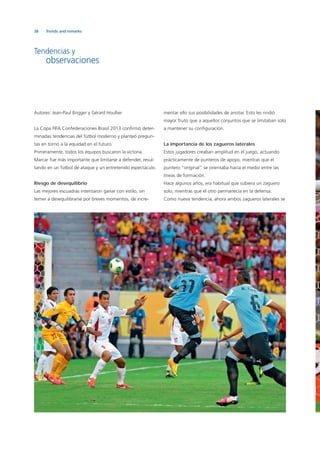
First of all, every team tried to win its matches. Scoring was
more important than focusing on defence, and the result
was attacking and entertaining football.
Risk of temporarily losing shape
The most successful teams tried to win in style and had no
fear of losing their shape for a brief moment if this increased
their chances of scoring. These teams were rewarded more
than teams who just tried to keep their shape.
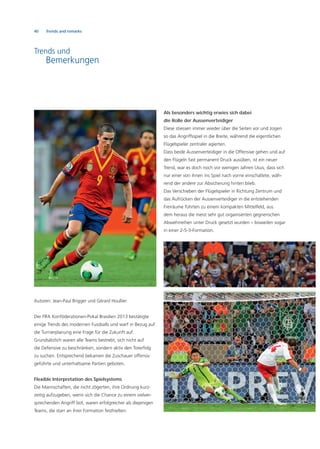
Importance of the full-backs
These players created the width in the game, almost acting
as back-up wingers while the “actual” winger tracked into
the middle in-between the lines. A few years ago, it was
common to see only one full-back going up while the other
tracked back to support the defence.
As a new trend, both full-backs stayed up and acted more or
less as wingers to present a constant threat on the wings for
the defence.
To maintain the numerical advantage in midfield and also
to break down the organisation of the defence – as almost
every team has learned to defend well – the actual wingers
moved inside to allow space for the full-backs.
This occasionally led to a 2-5-3 formation in attack.
35FIFA Confederations Cup Brazil 2013
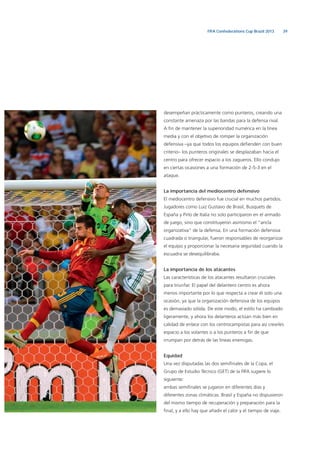
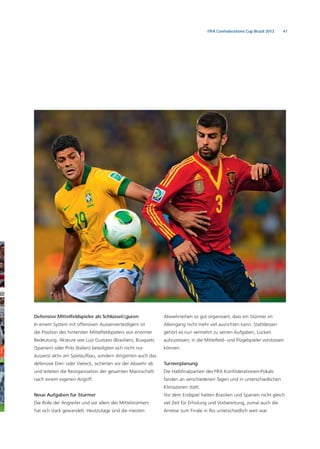
Importance of the holding position in front of the
defence
In this context, the holding position in front of defence had
an important role to play. Players like Luiz Gustavo of Brazil,
Busquets of Spain and Pirlo of Italy were not only strongly
involved in the build-up, they were also the “organisational
anchor” for the defence. In a defensive square or a defensive
triangle, they were responsible for reorganising the team and
providing the necessary security when it lost its shape.
Importance of the attacking roles
The characteristics of the attackers were crucial to success. The
role of the main central attacker has become less important in
terms of creating something on his own as teams’ defensive
organisation is so good nowadays. The profile has changed a
little in that respect, with attackers now acting more as a link
to the midfield players as well to create the space for them or
the wingers to get behind the defensive line.
Fairness
Following the two semi-finals of the FIFA Confederations
Cup Brazil 2013, the FIFA Technical Study Group made the
following observations:
Both semi-finals were played on different days and in
different climate zones.
Brazil and Spain did not have the same amount of time to
recuperate and prepare for the final bearing in mind the
heat and travel involved.
36 Trends and remarks
Tendances
et remarques
Auteurs : Jean-Paul Brigger et Gérard Houllier
La Coupe des Confédérations de la FIFA, Brésil 2013 a
confirmé certaines tendances du football moderne et a
également soulevé une question d’équité pour l’avenir.
Toutes les équipes ont joué pour gagner leurs matches.
Marquer était plus important que de se contenter de
défendre. En cela, toutes les équipes ont pratiqué un
football offensif, mais aussi spectaculaire.
Les meilleures équipes prennent le risque
de se déséquilibrer
Ces équipes ont essayé de gagner avec panache et pour
cela elles n’hésitaient pas à rompre l’équilibre de leur
équipe (défensif-offensif) pour augmenter leurs chances
de marquer.
Ces équipes ont été, dans l’ensemble, davantage
récompensées que celles qui s’efforçaient de conserver
une organisation parfois trop rigide.
Meilleur indicateur : l’importance des latéraux
Les arrières latéraux apportaient de la largeur au jeu,
en jouant un rôle d’ailier et en laissant le véritable ailier
s’intercaler entre les lignes au milieu de terrain.
Il y a quelques années, on ne voyait souvent qu’un seul
latéral monter tandis que l’autre latéral restait en retrait
pour soutenir la défense.
Cette nouvelle tendance voit les deux latéraux rester aux
avant-postes et jouer plus ou moins comme un ailier afin
de créer une menace constante sur les côtés.
Les véritables ailiers se mêlaient au milieu de terrain afin
de conserver la supériorité numérique dans l’entrejeu
et pour perturber l’organisation de la défense – étant
donné que chaque équipe était capable de bien
défendre.
Cela menait parfois à une formation offensive en 2-5-3 !
L’importance de la position de « sentinelle »
devant la défense
Dans ce contexte, la position de « sentinelle » devant
la défense joue un rôle capital. Des joueurs comme Luiz
Gustavo, Sergio Busquets ou Andrea Pirlo sont non
seulement très impliqués dans la construction, mais
ils sont également un point d’ancrage organisationnel
pour la défense. Que le milieu soit en losange à quatre
ou en forme de triangle, ils sont chargés de réorganiser
l’équipe lorsque celle-ci est déséquilibrée. Ces joueurs
donnent une certaine « sécurité » leur permettant de se
déséquilibrer.
37FIFA Confederations Cup Brazil 2013
Rôles offensifs
Les caractéristiques des attaquants sont cruciales en vue
de réussir. Le rôle d’attaquant central est devenu moins
important pour ce qui est de créer des occasions de
lui-même étant donné que l’organisation défensive des
équipes est trop solide pour cela aujourd’hui. Le profil de ce
poste a changé en ce sens : les attaquants agissent plutôt
comme un lien avec les milieux de terrain et essayent de
trouver des espaces – ou d’en créer pour les ailiers – derrière
la ligne défensive adverse.
Équité
Eu égard aux deux demi-finales de la Coupe des
Confédérations de la FIFA, Brésil 2013, le Groupe d’étude
technique de la FIFA aimerait formuler la proposition
suivante : Les deux demi-finales ont été disputées à des
dates différentes, et qui plus est dans des zones climatiques
différentes. Les deux finalistes, le Brésil et l’Espagne, n’ont
pas bénéficié de la même période de temps pour récupérer
et se préparer pour la finale. Les conditions de chaleur et de
voyage étaient également différentes.
38 Trends and remarks
Autores: Jean-Paul Brigger y Gérard Houllier
La Copa FIFA Confederaciones Brasil 2013 confirmó deter-
minadas tendencias del fútbol moderno y planteó pregun-
tas en torno a la equidad en el futuro.
Primeramente, todos los equipos buscaron la victoria.
Marcar fue más importante que limitarse a defender, resul-
tando en un fútbol de ataque y un entretenido espectáculo.
Riesgo de desequilibrio
Las mejores escuadras intentaron ganar con estilo, sin
temer a desequilibrarse por breves momentos, de incre-
mentar ello sus posibilidades de anotar. Esto les rindió
mayor fruto que a aquellos conjuntos que se limitaban solo
a mantener su configuración.
La importancia de los zagueros laterales
Estos jugadores creaban amplitud en el juego, actuando
prácticamente de punteros de apoyo, mientras que el
puntero “original” se orientaba hacia el medio entre las
líneas de formación.
Hace algunos años, era habitual que subiera un zaguero
solo, mientras que el otro permanecía en la defensa.
Como nueva tendencia, ahora ambos zagueros laterales se
Tendencias y
observaciones
39FIFA Confederations Cup Brazil 2013
desempeñan prácticamente como punteros, creando una
constante amenaza por las bandas para la defensa rival.
A fin de mantener la superioridad numérica en la línea
media y con el objetivo de romper la organización
defensiva –ya que todos los equipos defienden con buen
criterio– los punteros originales se desplazaban hacia el
centro para ofrecer espacio a los zagueros. Ello condujo
en ciertas ocasiones a una formación de 2-5-3 en el
ataque.
La importancia del mediocentro defensivo
El mediocentro defensivo fue crucial en muchos partidos.
Jugadores como Luiz Gustavo de Brasil, Busquets de
España y Pirlo de Italia no solo participaron en el armado
de juego, sino que constituyeron asimismo el “ancla
organizativa” de la defensa. En una formación defensiva
cuadrada o triangular, fueron responsables de reorganizar
el equipo y proporcionar la necesaria seguridad cuando la
escuadra se desequilibraba.
La importancia de los atacantes
Las características de los atacantes resultaron cruciales
para triunfar. El papel del delantero centro es ahora
menos importante por lo que respecta a crear él solo una
ocasión, ya que la organización defensiva de los equipos
es demasiado sólida. De este modo, el estilo ha cambiado
ligeramente, y ahora los delanteros actúan más bien en
calidad de enlace con los centrocampistas para así crearles
espacio a los volantes o a los punteros a fin de que
irrumpan por detrás de las líneas enemigas.
Equidad
Una vez disputadas las dos semifinales de la Copa, el
Grupo de Estudio Técnico (GET) de la FIFA sugiere lo
siguiente:
ambas semifinales se jugaron en diferentes días y
diferentes zonas climáticas. Brasil y España no dispusieron
del mismo tiempo de recuperación y preparación para la
final, y a ello hay que añadir el calor y el tiempo de viaje.
40 Trends and remarks
Trends und
Bemerkungen
Autoren: Jean-Paul Brigger und Gérard Houllier
Der FIFA Konföderationen-Pokal Brasilien 2013 bestätigte
einige Trends des modernen Fussballs und warf in Bezug auf
die Turnierplanung eine Frage für die Zukunft auf.
Grundsätzlich waren alle Teams bestrebt, sich nicht auf
die Defensive zu beschränken, sondern aktiv den Torerfolg
zu suchen. Entsprechend bekamen die Zuschauer offensiv
geführte und unterhaltsame Partien geboten.
Flexible Interpretation des Spielsystems
Die Mannschaften, die nicht zögerten, ihre Ordnung kurz-
zeitig aufzugeben, wenn sich die Chance zu einem vielver-
sprechenden Angriff bot, waren erfolgreicher als diejenigen
Teams, die starr an ihrer Formation festhielten.
Als besonders wichtig erwies sich dabei
die Rolle der Aussenverteidiger
Diese stiessen immer wieder über die Seiten vor und zogen
so das Angriffsspiel in die Breite, während die eigentlichen
Flügelspieler zentraler agierten.
Dass beide Aussenverteidiger in die Offensive gehen und auf
den Flügeln fast permanent Druck ausüben, ist ein neuer
Trend, war es doch noch vor wenigen Jahren Usus, dass sich
nur einer von ihnen ins Spiel nach vorne einschaltete, wäh-
rend der andere zur Absicherung hinten blieb.
Das Verschieben der Flügelspieler in Richtung Zentrum und
das Aufrücken der Aussenverteidiger in die entstehenden
Freiräume führten zu einem kompakten Mittelfeld, aus
dem heraus die meist sehr gut organisierten gegnerischen
Abwehrreihen unter Druck gesetzt wurden – bisweilen sogar
in einer 2-5-3-Formation.
41FIFA Confederations Cup Brazil 2013
Defensive Mittelfeldspieler als Schlüsselfiguren
In einem System mit offensiven Aussenverteidigern ist
die Position des hintersten Mittelfeldspielers von enormer
Bedeutung. Akteure wie Luiz Gustavo (Brasilien), Busquets
(Spanien) oder Pirlo (Italien) beteiligten sich nicht nur
äusserst aktiv am Spielaufbau, sondern dirigierten auch das
defensive Drei- oder Viereck, sicherten vor der Abwehr ab
und leiteten die Reorganisation der gesamten Mannschaft
nach einem eigenen Angriff.
Neue Aufgaben für Stürmer
Die Rolle der Angreifer und vor allem des Mittelstürmers
hat sich stark gewandelt. Heutzutage sind die meisten
Abwehrreihen so gut organisiert, dass ein Stürmer im
Alleingang nicht mehr viel ausrichten kann. Stattdessen
gehört es nun vermehrt zu seinen Aufgaben, Lücken
aufzureissen, in die Mittelfeld- und Flügelspieler vorstossen
können.
Turnierplanung
Die Halbfinalpartien des FIFA Konföderationen-Pokals
fanden an verschiedenen Tagen und in unterschiedlichen
Klimazonen statt.
Vor dem Endspiel hatten Brasilien und Spanien nicht gleich
viel Zeit für Erholung und Vorbereitung, zumal auch die
Anreise zum Finale in Rio unterschiedlich weit war.
Goal-line
technology
44 Goal-line technology
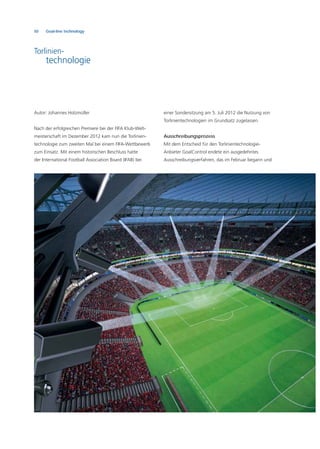
Goal-line
technology
Author: Johannes Holzmüller
After the International Football Association Board made a
historic decision to approve the use of goal-line technology
at a special meeting on 5 July 2012, and following on from
the successful trial at the FIFA Club World Cup 2012, goal-
line technology was used for the second time in a FIFA
competition in Brazil.
Tender process
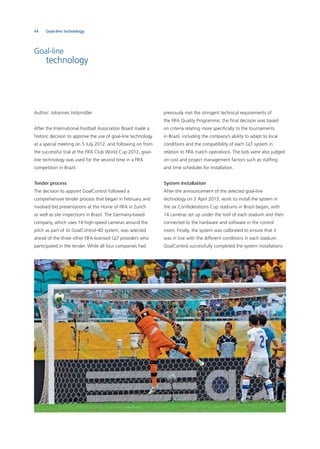
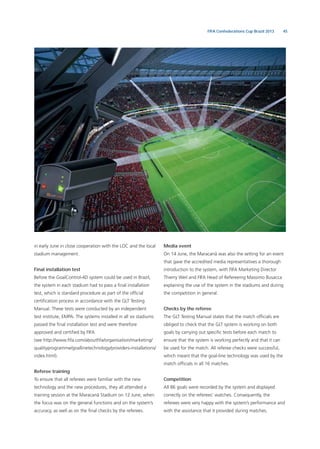
The decision to appoint GoalControl followed a
comprehensive tender process that began in February and
involved bid presentations at the Home of FIFA in Zurich
as well as site inspections in Brazil. The Germany-based
company, which uses 14 high-speed cameras around the
pitch as part of its GoalControl-4D system, was selected
ahead of the three other FIFA-licensed GLT providers who
participated in the tender. While all four companies had
previously met the stringent technical requirements of
the FIFA Quality Programme, the final decision was based
on criteria relating more specifically to the tournaments
in Brazil, including the company’s ability to adapt to local
conditions and the compatibility of each GLT system in
relation to FIFA match operations. The bids were also judged
on cost and project management factors such as staffing
and time schedules for installation.
System installation
After the announcement of the selected goal-line
technology on 2 April 2013, work to install the system in
the six Confederations Cup stadiums in Brazil began, with
14 cameras set up under the roof of each stadium and then
connected to the hardware and software in the control
room. Finally, the system was calibrated to ensure that it
was in line with the different conditions in each stadium.
GoalControl successfully completed the system installations
45FIFA Confederations Cup Brazil 2013
in early June in close cooperation with the LOC and the local
stadium management.
Final installation test
Before the GoalControl-4D system could be used in Brazil,
the system in each stadium had to pass a final installation
test, which is standard procedure as part of the official
certification process in accordance with the GLT Testing
Manual. These tests were conducted by an independent
test institute, EMPA. The systems installed in all six stadiums
passed the final installation test and were therefore
approved and certified by FIFA
(see http://www.fifa.com/aboutfifa/organisation/marketing/
qualityprogramme/goallinetechnology/providers-installations/
index.html).
Referee training
To ensure that all referees were familiar with the new
technology and the new procedures, they all attended a
training session at the Maracanã Stadium on 12 June, when
the focus was on the general functions and on the system’s
accuracy, as well as on the final checks by the referees.
Media event
On 14 June, the Maracanã was also the setting for an event
that gave the accredited media representatives a thorough
introduction to the system, with FIFA Marketing Director
Thierry Weil and FIFA Head of Refereeing Massimo Busacca
explaining the use of the system in the stadiums and during
the competition in general.
Checks by the referee
The GLT Testing Manual states that the match officials are
obliged to check that the GLT system is working on both
goals by carrying out specific tests before each match to
ensure that the system is working perfectly and that it can
be used for the match. All referee checks were successful,
which meant that the goal-line technology was used by the
match officials in all 16 matches.
Competition
All 86 goals were recorded by the system and displayed
correctly on the referees’ watches. Consequently, the
referees were very happy with the system’s performance and
with the assistance that it provided during matches.
46 Goal-line technology
conditions locales et la compatibilité de son système avec
les aspects opérationnels des compétitions FIFA. Les offres
ont également été analysées au vu de leurs coûts respectifs
et de facteurs de gestion de projet comme par exemple le
personnel requis et les délais d’installation.
Installation du système
Dès que le fabricant de technologie sur la ligne de but
a été choisi, le 2 avril 2013, l’installation du système
a pu commencer dans les six stades de la Coupe des
Confédérations de la FIFA, Brésil 2013. Quatorze caméras
ont ainsi été installées sous le toit de chaque stade puis
reliées au matériel et au logiciel de la salle de contrôle. Le
système a enfin été calibré en fonction des diverses données
de chaque stade. En étroite collaboration avec le COL et
les gérants du stade, GoalControl a finalisé l’installation au
début du mois de juin.
Dernier test d’installation
Un dernier test d’installation a été effectué avant de donner
le feu vert à l’utilisation de GoalControl-4D au Brésil. Cette
étape standard de la procédure officielle d’autorisation
selon le Manuel de tests pour la technologie sur la ligne de
but a été effectuée par l’institut indépendant EMPA. Les
installations dans les six stades ont bien passé ce dernier
test d’installation et ont été agréées et certifiées par la FIFA
La technologie sur
la ligne de but
Auteur : Johannes Holzmüller
Après une première utilisation réussie lors de la Coupe
du Monde des Clubs de la FIFA en décembre 2012,
la Coupe des Confédérations de la FIFA, Brésil 2013 a
été la deuxième compétition de la FIFA à avoir recours
à la technologie sur la ligne de but, après la décision
historique prise le 5 juillet 2012 par l’International Football
Association Board (IFAB) d’approuver le principe de son
utilisation officielle.
Procédure d’appel d’offres
Le choix de l’entreprise allemande GoalControl comme
fabricant de technologie sur la de but a mis fin à la
procédure d’appel d’offres qui a débuté en février avec
des présentations au siège de la FIFA à Zurich ainsi que des
visites d’inspection au Brésil. Le système GoalControl-4D,
avec ses quatorze caméras grande-vitesse disposées autour
du terrain, a été préféré à ceux des trois autres détenteurs
de la licence FIFA de technologie sur la ligne de but qui
ont répondu à l’appel d’offres. Si les quatre entreprises
répondaient aux stricts critères qualitatifs du programme
Qualité de la FIFA, la décision finale s’est fondée sur des
critères se rapportant davantage aux deux tournois au
Brésil, comme la capacité de l’entreprise à s’adapter aux
47FIFA Confederations Cup Brazil 2013
(cf. http://fr.fifa.com/aboutfifa/organisation/marketing/
qualityprogramme/goallinetechnology/providers-installations/
index.html).
Formation des arbitres
Afin de se familiariser avec la nouvelle technologie et sa
procédure, tous les arbitres ont bénéficié d’une formation
sur la technologie sur la ligne de but organisée le 12 juin
au stade Maracanã. Les fonctionnalités et la précision du
système leur ont ainsi été présentées tout comme le contrôle
qu’ils sont tenus d’effectuer avant chaque match.
Présentation aux médias
Le 14 juin, le Maracanã a également été ouvert aux
représentants des médias pour une présentation du système.
Le directeur de division Marketing de la FIFA, Thierry Weil, et
le chef du département de l’arbitrage, Massimo Bussaca, ont
fait une présentation sur l’utilisation de la technologie dans
les stades et son emploi en général lors du tournoi.
Contrôle par les arbitres
En vertu du Manuel de tests pour la technologie sur
la ligne de but, les arbitres sont tenus de contrôler le
fonctionnement du système sur les deux buts avant le
match. Ceci permet de vérifier que tout fonctionne bien
et que le système peut être utilisé pour le match. Tous
les contrôles des arbitres ont été menés avec succès et la
technologie a été utilisée pour l’ensemble des seize matches.
Compétition
Chacun des 86 buts inscrits ont été correctement reconnus
et signalés sur la montre de l’arbitre. Les arbitres se sont dits
très satisfaits de l’efficacité de la technologie et de l’aide
qu’elle leur a offert durant les matches.
48 Goal-line technology
Sistema de
detección de goles
Autor : Johannes Holzmüller
Luego de su exitoso debut en la Copa Mundial de Clubes
de la FIFA en diciembre de 2012, la detección automática
de goles se utilizó por segunda vez en una competición de
la FIFA. Merced a una resolución histórica, el International
Football Association Board (IFAB) aceptó en principio la
utilización de estos sistemas en una sesión extraordinaria el 5
de julio de 2012.
Proceso de licitación
Con la decisión a favor del proveedor de sistemas de detec-
ción automática de goles GoalControl, finalizó un largo pro-
ceso de licitación que se había iniciado en febrero y abarcó
tanto presentaciones de los candidatos en la sede de la FIFA
en Zúrich, como inspecciones in situ en Brasil. La compañía,
con sede en Alemania, que, en su sistema GoalControl-4-D,
utiliza 14 cámaras de alta velocidad distribuidas por todo el
terreno de juego, se impuso en la licitación a los otros tres
proveedores aprobados por la FIFA. Luego de que las cuatro
compañías cumplieran los estrictos requisitos técnicos del
programa de calidad de la FIFA, resultaron decisivos, ante
todo, los requisitos específicos para los dos torneos en Brasil,
particularmente la capacidad de la empresa de adaptarse
a las condiciones locales, así como la compatibilidad del
sistema de detección con el calendario de juego de la FIFA.
Las diferentes postulaciones se evaluaron igualmente desde
el punto de vista de costos y de factores de gestión del
proyecto, como por ejemplo el personal y el plazo para la
instalación.
49FIFA Confederations Cup Brazil 2013
Instalación del sistema
Tras anunciar el 2 de abril de 2013 el sistema elegido,
comenzó la fase de implantación de este en las seis sedes de
la Copa Confederaciones en Brasil. Para ello, las 14 cámaras
se montaron debajo del techo de los estadios, y seguida-
mente se conectaron con cables al equipo físico y el soporte
lógico en la sala de control. Por último, el sistema fue cali-
brado y ajustado así a las diferentes particularidades de los
estadios. La empresa GoalControl finalizó exitosamente sus
instalaciones a comienzos de junio en estrecha colaboración
con el COL y la administración local de los estadios.
Pruebas finales de instalación
Antes de la utilización de GoalControl-4-D en Brasil, se
sometió el sistema a una prueba final de instalación en
cada estadio. Se trata de un procedimiento estándar en el
marco del proceso oficial de aprobación de acuerdo con el
manual de pruebas para los sistemas de detección automá-
tica de goles. Estas pruebas las llevó a cabo el laboratorio
independiente EMPA. Las instalaciones en los seis estadios
pasaron las exhaustivas pruebas finales de instalación, y
recibieron la aprobación y certificación de la FIFA (v. http://
es.fifa.com/aboutfifa/organisation/marketing/qualitypro-
gramme/goallinetechnology/providers-installations/index.
html).
Capacitación de árbitros
A fin de garantizar que todos los árbitros se familiaricen al
detalle con el nuevo sistema y el nuevo procedimiento, todos
los árbitros participaron en un curso de capacitación sobre
detección automática de goles el 12 de junio en el Estadio
Maracaná. Como temas principales figuraron el funciona-
miento general y la precisión del sistema, así como la verifi-
cación obligatoria por parte de los árbitros.
Reunión de prensa
El 14 de junio se realizó una sesión informativa para los
medios acreditados en el Estadio Maracaná. El director de
Mercadotecnia de la FIFA, Thierry Weil, y el jefe del Depar-
tamento de Arbitraje de la FIFA, Massimo Bussaca, propor-
cionaron información actualizada relativa a la utilización de
estos sistemas en los estadios de la Copa FIFA Confederacio-
nes y sobre su empleo general durante el torneo.
Verificación por parte de los árbitros
Según el manual de pruebas para los sistemas de detección
automática de goles, los árbitros están obligados a realizar
antes de cada partido un control de funcionamiento del
sistema en ambas porterías. Con ello se ha de garantizar que
el sistema funcione correctamente y que pueda utilizarse
durante el partido. Todos los controles se llevaron a cabo
exitosamente, y los colegiados utilizaron los sistemas en los
16 partidos.
Competición
El sistema reconoció los 86 goles anotados y los indicó
correctamente en los relojes de los colegiados, los cuales
manifestaron su plena satisfacción con el funcionamiento del
sistema y con la correspondiente asistencia obtenida durante
los encuentros.
50 Goal-line technology
Autor: Johannes Holzmüller
Nach der erfolgreichen Premiere bei der FIFA Klub-Welt-
meisterschaft im Dezember 2012 kam nun die Torlinien-
technologie zum zweiten Mal bei einem FIFA-Wettbewerb
zum Einsatz. Mit einem historischen Beschluss hatte
der International Football Association Board (IFAB) bei
einer Sondersitzung am 5. Juli 2012 die Nutzung von
Torlinientechnologien im Grundsatz zugelassen.
Ausschreibungsprozess
Mit dem Entscheid für den Torlinientechnologie-
Anbieter GoalControl endete ein ausgedehntes
Ausschreibungsverfahren, das im Februar begann und
Torlinien-
technologie
51FIFA Confederations Cup Brazil 2013
sowohl Präsentationen der Bewerber am FIFA-Sitz in Zürich
als auch Inspektionen vor Ort in Brasilien umfasste. Das
Unternehmen mit Sitz in Deutschland, das bei seinem
GoalControl-4-D-System 14 Hochgeschwindigkeitskameras
um das Spielfeld herum einsetzt, wurde den drei anderen
von der FIFA zugelassenen Anbietern vorgezogen, die an der
Ausschreibung teilnahmen. Nachdem alle vier Anbieter die
strengen technischen Auflagen des FIFA-Qualitätsprogramms
erfüllt hatten, gaben letztlich vor allem die spezifischen
Vorgaben für die beiden Turniere in Brasilien den Ausschlag,
insbesondere die Fähigkeit des Unternehmens, sich den
lokalen Gegebenheiten anzupassen, und die Kompatibilität
des Torlinientechnologie-Systems mit dem FIFA-Spielbetrieb.
Die einzelnen Bewerbungen wurden auch nach Kosten und
Projektmanagementfaktoren wie Personal und Zeitplan für
die Installation beurteilt.
Installation des Systems
Nach der Bekanntgabe der ausgewählten Torlinien-
technologie am 2. April 2013 begann die Installation
des Systems in den sechs Spielstätten des FIFA
Konföderationen-Pokals 2013 in Brasilien. Hierbei wurden
jeweils 14 Kameras unterhalb des Stadiondachs montiert.
Im Anschluss folgte eine Verkabelung der Kameras mit
der Hard- und Software im Kontrollraum. Abschliessend
wurde das System kalibriert und so entsprechend auf die
verschiedenen Gegebenheiten in den Stadien eingestellt.
In enger Zusammenarbeit mit dem LOC und dem lokalen
Stadionmanagement schloss GoalControl die Installation
Anfang Juni erfolgreich ab.
Finaler Installationstest
Vor der Anwendung von GoalControl-4-D in Brasilien
wurde das System in jedem Stadion einem abschliessenden
Installationstest unterzogen. Dies ist ein Standardverfahren
im Rahmen des offiziellen Zulassungsverfahrens gemäss
dem Testhandbuch für Torlinientechnologie. Diese Tests
wurden vom unabhängigen Testinstitut EMPA durchgeführt.
Die Installationen in allen sechs Stadien bestanden den
umfassenden finalen Installationstest und wurden von
der FIFA genehmigt und entsprechend zertifiziert (siehe
http://www.fifa.com/aboutfifa/organisation/marketing/
qualityprogramme/goallinetechnology/providers-
installations/index.html).
Schiedsrichterschulung
Um mit der neuen Technologie und dem neuen Verfahren
im Detail vertraut zu sein, absolvierten am 12. Juni im
Maracanã-Stadion alle Schiedsrichter eine Schulung zum
Thema Torlinientechnologie. Hierbei waren die
allgemeine Funktionsfähigkeit und die Genauigkeit des
Systems sowie der zwingende Schiedsrichter-Check wichtige
Themen.
Medienveranstaltung
Am 14. Juni wurden ebenfalls im Maracanã-Stadion die
akkreditierten Medienvertreter ausführlich über das System
informiert. FIFA-Direktor Marketing Thierry Weil und
Massimo Bussaca, Leiter der FIFA-Schiedsrichterabteilung,
äusserten sich zur Anwendung der Technologie in den
Stadien und zur generellen Nutzung während des Turniers.
Schiedsrichter-Check
Gemäss dem Testhandbuch für Torlinientechnologie sind
die Schiedsrichter verpflichtet, vor dem Spiel an beiden
Toren einen Funktionstest des Torlinientechnologie-Systems
durchzuführen. Hiermit wird sichergestellt, dass das System
fehlerfrei funktioniert und für das Spiel genutzt werden
kann. Alle Schiedsrichter-Checks wurden erfolgreich
durchgeführt, worauf die Torlinientechnologie bei allen 16
Spielen von den Offiziellen angewandt wurden.
Wettbewerb
Alle 86 erzielten Tore wurden vom System erkannt
und korrekt auf den Schiedsrichteruhren angezeigt.
Dementsprechend waren die Schiedsrichter mit der Leistung
der Technologie und der erhaltenen Hilfe während des Spiels
sehr zufrieden.
Refereeing
report
54 Refereeing report
Refereeing
report
Author: Massimo Busacca
The FIFA Referees Committee appointed ten refereeing
trios for this competition: four from UEFA, two each from
CONMBEBOL and the AFC, and one each from CONCACAF
and CAF.
The criteria for their appointment was that they:
• had to be elite referees in their confederation; and
• had to be on the open list of prospective referees and
assistant referees for the 2014 FIFA World Cup Brazil™.
All the referees passed the FIFA fitness test held at the FIFA
seminar for prospective referees in Rio de Janeiro in May
2013.
After arriving in Rio, all of the referees and assistant referees
participated in a variety of daily theoretical and practical
activities prepared by the technical and fitness instructors.
The main focus was on a technical/tactical approach to the
participating teams’ way of playing that would ensure the
best possible understanding and reading of the games.
The match officials were instructed to maintain their own
personality and uniformly interpret the Laws of the Game
considering their actual situation in action on the field.
The daily training sessions took place with the assistance
of a youth football team, which helped to set up match
situations. During the practical training sessions on the
field of play, some of the exercises (e.g. positioning and
offside situations) performed by the referees and assistant
referees were recorded and their decisions instantly analysed
on a screen adjacent to the pitch. The exercises were
subsequently repeated at different speeds and degrees of
difficulty.
Prior to the competition, a referee instructor met each of
the participating teams. The sessions were attended by
all of the players and the technical staff, and they were
reminded of various aspects of the Laws of the Game and
informed about the instructions that had been given to the
referees. At the end of the meeting, they were provided with
the multimedia material that had been presented for their
own further study and later use. These meetings were well
received by all of the participating teams because, besides
providing a uniform interpretation of the Laws of the Game,
it also brought players, coaches and referees closer together.
During the competition, all 16 matches were recorded
and the instructors selected important incidents that were
to be analysed with the referees. Consequently, general
debriefings were held to analyse the major incidents
and prepare the referees for upcoming matches in the
competition.
55FIFA Confederations Cup Brazil 2013
The refereeing delegation stayed at the Windsor Barra Hotel
in Rio de Janeiro, where they received excellent hospitality and
enjoyed good facilities, suitable meeting rooms, a gym that
met the needs of the referees, etc. In addition, special mention
should be made of the high level of attention and professional
support received from the Local Organising Committee and
its partners, particularly with regard to transport, logistics and
the various sports facilities for the referees’ practical training
sessions with well-prepared footballers.
Members of the Referees Committee participated in the
important role of assessing and assisting the match officials
in the venues. Accordingly, they were responsible for FIFA
refereeing matters and for supporting the referees’ needs for
the entire duration of their stay in the venues. A technical
instructor assisted as a match analyst.
The members of the Referees Committee and the instructors
carefully monitored all of the match officials’ performances
and their evaluations were very positive. In summary, the
refereeing of this competition was very successful.
We also would like to mention the fair play on the pitch
during this tournament, because compared to other
tournaments, there were only a few fouls, and not very
many yellow or red cards.
56 Refereeing report
Rapport sur
l’arbitrage
Auteur : Massimo Busacca
La Commission des Arbitres de la FIFA a désigné dix trios
arbitraux pour cette compétition : quatre de l’UEFA, deux de
la CONMEBOL, deux de l’AFC, un de la CONCACAF et un de
la CAF.
Pour être désignés, les arbitres devaient respecter les critères
suivants :
• ils devaient être des arbitres d’élite au sein de leur
confédération ; et
• ils devaient figurer sur la liste ouverte des arbitres et
arbitres assistants candidats à la Coupe du Monde de la
FIFA, Brésil 2014™.
Tous les arbitres ont passé avec succès le test de condition
physique réalisé dans le cadre du séminaire de la FIFA pour
les arbitres candidats tenu à Rio de Janeiro en mai 2013.
À leur arrivée à Rio, tous les arbitres et arbitres assistants
ont participé à diverses activités théoriques et pratiques
préparées par les instructeurs techniques et préparateurs
physiques. Ils ont également insisté sur l’approche technico-
tactique du jeu des équipes participantes pour offrir aux
arbitres une meilleure compréhension et une meilleure
lecture des matches. Ils ont conseillé aux officiels de match
de rester fidèles à leur propre personnalité et d’interpréter
uniformément les Lois du Jeu en fonction de leur
positionnement sur le terrain par rapport à l’action.
Les séances quotidiennes ont été organisées avec l’assistance
d’une équipe de jeunes footballeurs afin de réaliser sur le
terrain des exercices portant sur diverses situations de jeu.
Pendant les sessions pratiques, certains exercices réalisés par
les arbitres et arbitres assistantes (tels que ceux portant sur
le positionnement et les situations de hors-jeu) ont été filmés
afin d’analyser a posteriori leurs décisions en vidéo sur un
écran installé aux abords du terrain. Les exercices ont ensuite
été répétés à différentes vitesses et niveaux de difficulté.
Avant la compétition, un instructeur d’arbitres a rencontré
chacune des équipes participantes. Tous les joueurs et
l’encadrement technique ont assisté aux sessions qui
illustraient divers aspects des Lois du Jeu et présentaient les
instructions données aux arbitres. À la fin de la réunion, les
équipes se sont vu remettre du matériel multimédia pour
étude et utilisation ultérieure. Ces réunions ont été très bien
accueillies par les équipes participantes puisque, outre une
interprétation uniforme des Lois du Jeu, elles ont permis des
rapprochements entre joueurs, entraîneurs et officiels.
Chacun des seize matches de la compétition a été
enregistré et les instructeurs ont sélectionné des actions à
soumettre à l’analyse des arbitres. Des réunions ont ensuite
été organisées afin d’analyser les principaux incidents et
d’améliorer les performances du corps arbitral lors des
rencontres à venir.
La délégation des arbitres était logée à l’hôtel Windsor
Barra de Rio de Janeiro, où elle a été très bien traitée et a
profité des excellentes installations mises à sa disposition,
57FIFA Confederations Cup Brazil 2013
dont des salles de réunion ou encore un gymnase équipé
des infrastructures nécessaires. Il convient également de
souligner la grande attention et le soutien professionnel
apportés par le Comité Organisateur Local, notamment
au niveau du transport, de la logistique et des diverses
installations sportives utilisées pour l’entraînement des
arbitres avec à leur disposition des joueurs bien préparés
pour les assister.
Le rôle des membres de la Commission des Arbitres a été
déterminant en matière d’inspection et de soutien apporté
aux arbitres sur les sites. Chaque membre a été décentralisé
sur un site où il était responsable des questions d’arbitrage
et du soutien des arbitres du jour de leur arrivée à celui de
leur départ. Un instructeur technique a travaillé comme
analyste de match.
Les membres de la Commission des Arbitres et les instructeurs
ont supervisé minutieusement les performances des arbitres
et leurs évaluations ont été généralement très positives.
L’arbitrage a donc été très bon dans cette compétition.
Nous tenons également à souligner le fair-play sur le terrain
durant la compétition, peu de fautes et très peu de cartons
jaunes et rouges ayant été enregistrés par rapport aux autres
tournois.
58 Refereeing report
Informe
de arbitraje
Autor: Massimo Busacca
La Comisión de Árbitros de la FIFA asignó diez tríos arbitrales
a este torneo: cuatro de la UEFA, dos de la CONMBEBOL,
dos de la AFC, uno de la CONCACAF y otro de la CAF.
Los árbitros debían:
• ser colegiados de élite en su confederación;
• figurar en la lista abierta de posibles árbitros y árbitros
asistentes de la Copa Mundial de la FIFA Brasil 2014™.
Todos los árbitros superaron la prueba de condición física
realizada en mayo de 2013 durante el seminario FIFA para
árbitros candidatos en Río de Janeiro.
Una vez en Río, todos los árbitros y sus asistentes participa-
ron a diario en diversas actividades teóricas y prácticas que
habían dispuesto instructores técnicos y preparadores físicos.
Con objeto de que pudieran entender y saber leer de la
mejor manera los encuentros venideros, se dio prioridad a las
explicaciones técnicas y tácticas sobre el estilo de juego de los
59FIFA Confederations Cup Brazil 2013
equipos participantes. Los oficiales de partido recibieron ins-
trucciones para que su autoridad no se viera afectada durante
los encuentros y conseguir la interpretación uniforme de las
Reglas de Juego al juzgar los lances del partido.
Las sesiones de entrenamiento diarias se llevaron a cabo con
la ayuda de un equipo juvenil que permitió escenificar las
diferentes acciones. Durante las sesiones prácticas, se gra-
baron algunos de los ejercicios realizados por los árbitros y
los asistentes (p. ej. posicionamientos y fueras de juego), lo
que permitió analizar las decisiones de forma inmediata en
una pantalla dispuesta junto al campo a tal efecto (análisis
instantáneo). Luego, los ejercicios se repitieron a diferentes
velocidades y distintos niveles de complejidad.
Antes del inicio de la competición, un instructor de árbitros
se reunió con cada uno de los equipos participantes. A estas
sesiones acudió la plantilla y el cuadro técnico y en ellas se
les remitió a determinados aspectos de las Reglas de Juego y
se les informó sobre las instrucciones impartidas a los cole-
giados. Al final de la sesión, se les facilitó el material multi-
media usado durante las sesiones para que posteriormente
lo analizaran de manera individual. Estas sesiones tuvieron
muy buena acogida entre los equipos, ya que presenta-
ban una interpretación uniforme de las Reglas de Juego y,
además, sirvieron para acercar a jugadores, técnicos y colec-
tivo arbitral.
Se grabaron los dieciséis encuentros disputados a fin de que
los instructores seleccionaran las acciones más determinan-
tes; estas se analizaron luego junto con los árbitros. Luego,
en reuniones diarias se examinaron los principales inciden-
tes ocurridos a fin de preparar mejor a los árbitros para los
siguientes partidos del torneo.
La delegación de árbitros se alojó en el Hotel Windsor Barra
de Río de Janeiro, donde se les atendió de forma excelente;
allí dispusieron de buenas instalaciones, con salas de juntas
muy adecuadas, un gimnasio que satisfizo las necesidades
de los colegiados, etc. Mención especial merece la atención
y asesoramiento profesional brindado por el Comité Organi-
zador Local y sus socios, concretamente en lo que respecta
al transporte, la logística y las diversas instalaciones depor-
tivas utilizadas por los árbitros en sus sesiones prácticas,
además de los jugadores muy bien preparados que ayudaron
a simular los lances de juego.
Algunos miembros de la Comisión de Árbitros de la FIFA
actuaron como asesores y asistieron a los oficiales de partido
en los estadios, de ahí que fueran los responsables de todo
lo referente al arbitraje de la FIFA e igualmente de satisfacer
todas aquellas necesidades que pudieran tener los árbitros
durante la celebración del torneo. Un instructor técnico cola-
boró en esta labor en calidad de analista de partidos.
Tanto los miembros de la Comisión de Árbitros de la FIFA
como los instructores examinaron la labor de los oficiales de
partido y, en líneas generales, la valoración fue muy positiva.
En suma, la labor arbitral en este torneo ha sido en general
satisfactoria.
Asimismo, quisiéramos mencionar el juego limpio en este
torneo, en el que, comparado con otros, se cometieron muy
pocas faltas y no se mostraron muchas tarjetas.
60 Refereeing report
Schiedsrichter-
bericht
Autor: Massimo Busacca
Die FIFA-Schiedsrichterkommission hat für das Turnier zehn
Schiedsrichtertrios aufgeboten: vier aus der UEFA, je zwei
aus der CONMEBOL und der AFC und je ein Trio aus der
CONCACAF und der CAF.
Alle aufgebotenen Unparteiischen mussten:
• Spitzenschiedsrichter der jeweiligen Konföderation sein
und
• auf der offenen Liste der möglichen Schiedsrichter
und Schiedsrichterassistenten für die FIFA Fussball-
Weltmeisterschaft Brasilien 2014™ stehen.
Alle Unparteiischen bestanden den FIFA-Fitnesstest, der im
Mai 2013 beim FIFA-Seminar für die Schiedsrichteranwärter
in Rio de Janeiro durchgeführt wurde.
Nach Ankunft in Rio standen für alle Schiedsrichter und
Schiedsrichterassistenten täglich verschiedene theoretische
und praktische Übungen auf dem Programm, die von den
Technik- und Fitnessinstrukteuren vorbereitet wurden. Im
Zentrum stand dabei die technisch-taktische Konzeption
der Spielweise der Teams. Die Unparteiischen sollten
letztlich in der Lage sein, das Spiel besser zu verstehen
und zu lesen. Die Spieloffiziellen sollten sich treu bleiben,
die Spielregeln in den einzelnen Spielsituationen aber
einheitlich auslegen.
Bei den täglichen Trainings simulierte ein Jugendteam
bestimmte Spielsituationen. Einige Übungen (z. B.
Stellungsspiel und Abseitssituationen) der Schiedsrichter
und Schiedsrichterassistenten wurden aufgezeichnet. Die
Entscheidungen der Unparteiischen wurden am Bildschirm
neben dem Spielfeld sofort analysiert und die Übungen
61FIFA Confederations Cup Brazil 2013
danach mit unterschiedlichem Tempo und verschiedenen
Schwierigkeitsstufen wiederholt.
Vor Turnierbeginn traf sich ein Schiedsrichterinstrukteur
mit jedem Team. Dabei informierte er die Spieler und
technischen Betreuer über verschiedene Punkte der
Spielregeln sowie die Weisungen an die Schiedsrichter.
Nach der Sitzung erhielten sie das präsentierte multimediale
Lehrmaterial zum weiteren Studium und zur späteren
Nutzung. Die Sitzungen stiessen bei allen Mannschaften
auf ein sehr positives Echo, weil sie nicht nur aktuelle
Informationen zu den Spielregeln lieferten, sondern
auch eine Annäherung zwischen Spielern, Trainern und
Schiedsrichtern ermöglichten.
Alle 16 Spiele des Turniers wurden aufgezeichnet. Die
Instrukteure wählten einzelne Szenen aus, um sie mit den
Schiedsrichtern zu besprechen. Nach dem Spiel wurden die
wichtigsten Vorfälle mit den Unparteiischen ausgewertet
und für die kommenden Partien Lehren gezogen.
Die Schiedsrichterdelegation war im Hotel Windsor Barra
in Rio de Janeiro untergebracht. Sie genoss dort eine
ausgezeichnete Betreuung und eine gute Infrastruktur samt
Sitzungszimmern, Fitnessraum mit geeigneten Geräten
etc. Erfreulich waren auch die grosse Hilfsbereitschaft
und die professionelle Unterstützung seitens des lokalen
Organisationskomitees und seiner Partner, vor allem
beim Transport, bei der Logistik sowie den verschiedenen
Sportanlagen und den gut vorbereiteten Trainingspartnern
für die praktischen Übungen der Schiedsrichter.
Mitglieder der Schiedsrichterkommission leisteten als Experten
und Betreuer der Spieloffiziellen an den Spielorten ebenfalls
wertvolle Unterstützung. Sie waren an den Spielorten für
sämtliche FIFA-Schiedsrichterbelange verantwortlich und
standen den Schiedsrichtern ab Ankunft bis Abreise zur Seite.
Ein technischer Instrukteur waltete als Spielanalyst.
Das Mitglied der Schiedsrichterkommission und die
Instrukteure nahmen die Leistungen der Unparteiischen genau
unter die Lupe. Ihr Fazit war im Allgemeinen sehr positiv. Das
Turnier war aus Schiedsrichtersicht insgesamt ein Erfolg.
Bemerkenswert war auch die Fairness bei den Spielen. Im
Vergleich zu anderen Turnieren gab es nur sehr wenige Fouls
und fast keine Verwarnungen und Feldverweise.
Medical
report
64 Medical report
Medical
report
Author: Prof. Jiří Dvořák
At the FIFA Confederations Cup Brazil 2013, FIFA Chief
Medical Officer Prof. Jiří Dvořák and FIFA Medical Officer
Prof. Efraim Kramer supervised the medical services for
the event at the headquarters in Rio de Janeiro. The LOC’s
medical team had prepared the delivery of medical services.
Injury-recording study
Since 1998, team doctors have been asked to report on all
injuries incurred by their players during each match. The
standardised injury-recording forms developed by the FIFA
Medical Assessment and Research Centre (F-MARC) were
completed and returned to the FIFA Medical Officer. Dr
Astrid Junge, Head of Research at F-MARC, analysed the
data.
The overall injury rate was 1.69 injuries per match, but
there were no time-loss injuries (defined as injuries that lead
to absence from training or a match). About 36% of the
injuries occurred without contact with another player, and
there were no injuries caused by foul play.
ANTI-DOPING
In-competition doping control
Following the routine in-competition procedure as described
in the FIFA Anti-Doping Regulations 2013, two players per
team were randomly selected for doping control after each
of the 16 matches to provide urine and blood samples.
Altogether, 128 samples were collected and analysed at the
WADA-accredited laboratory in Rio de Janeiro, Brazil with
the support of the WADA-accredited laboratory in Lausanne,
Switzerland. One test presented an adverse analytical
finding. This case is currently under investigation.
Out-of-competition doping control
For the FIFA Confederations Cup Brazil 2013 and the
2014 FIFA World Cup Brazil™, FIFA has implemented the
biological profile system, considered to be one of the best
methods to detect the use of performance-enhancing
drugs. At the FIFA Confederations Cup Brazil 2013, all
players of all teams were tested (blood and urine) prior
to the competition for the purpose of the biological
profile in addition to the routine anti-doping tests during
the competition. The profile has two components: the
haematological parameters (in blood) and the steroid profile
(in urine). The combination of the two gives a biological
profile for each player. In the weeks leading up to the
Confederations Cup showpiece in Brazil, FIFA doping control
officers paid an unannounced visit to each of the eight
participating teams to conduct out-of-competition doping
tests on the players.
All pre-competition doping analyses conducted with all
participating teams yielded negative results.
Legacy for Brazil
A pilot “FIFA 11 for Health” programme will start in Belo
Horizonte and Curitiba in August 2013. The objective is to
implement the programme in the 12 host cities before the
2014 FIFA World Cup Brazil™ in cooperation between FIFA,
F-MARC, the CBF and the Brazilian government.
65FIFA Confederations Cup Brazil 2013
Rapport
médical
Auteur : Prof. Jiří Dvořák
Lors de la Coupe des Confédérations de la FIFA, Brésil 2013, le
médecin en chef de la FIFA, le Prof. Jiří Dvořák, et le responsable
médical de la FIFA, le Prof. Efraim Kramer, ont supervisé les
services médicaux de l’événement depuis le quartier général
de Rio de Janeiro. L’équipe médicale du COL a assuré une
excellente préparation des prestations de services médicaux.
Étude sur le recensement des blessures
Depuis 1998, il est demandé aux médecins d’équipe de
faire un rapport de toutes les blessures contractées par leurs
joueurs lors de chaque match. Les formulaires standard de
recensement des blessures conçus par le Centre d’évaluation
et de recherche médicale de la FIFA (F-MARC) ont été remplis
et remis au responsable médical de la FIFA. Astrid Junge,
responsable de la recherche au F-MARC, a analysé les
données collectées.
Le taux de blessures s’est élevé à 1,69 par match. Aucune
blessure contractée durant la compétition n’a entraîné
d’indisponibilité à l’entraînement ou en match. Environ 36%
des blessures sont survenues sans qu’il y ait contact avec un
autre joueur, et aucune blessure n’a été consécutive à une
faute.
LUTTE CONTRE LE DOPAGE
Contrôles de dopage durant la compétition
Dans le cadre de la procédure de routine effectuée pendant la
compétition, telle que définie dans le Règlement antidopage
2013 de la FIFA, à l’issue de chacun des seize matches, deux
joueurs par équipe ont été tirés au sort pour fournir des
échantillons d’urine et de sang et être soumis à un contrôle
de dopage. Un total de 128 échantillons ont été prélevés et
analysés par le laboratoire accrédité par l’Agence mondiale
antidopage à Rio de Janeiro (Brésil), avec le soutien du
laboratoire accrédité par l’AMA à Lausanne (Suisse). Un
échantillon a présenté un résultat d’analyse anormal et une
enquête est en cours.
Contrôle de dopage hors compétition
Pour la Coupe des Confédérations de la FIFA, Brésil 2013
et la Coupe du Monde de la FIFA, Brésil 2014™, la FIFA
a mis en œuvre le système de profilage biologique, qui
est considéré comme l’une des meilleures méthodes pour
détecter l’utilisation de substances permettant d’améliorer
les performances. Lors de la Coupe des Confédérations de
la FIFA, Brésil 2013, tous les joueurs ont été testés (sang et
urine) avant la compétition à des fins de profilage biologique
en plus des tests de dopage habituels effectués durant
la compétition. Le profil biologique de chaque joueur est
composé de paramètres hématologiques (dans le sang) et
d’un profil stéroïdien (dans l’urine). Au cours des semaines
qui ont précédé la compétition, les responsables du contrôle
de dopage de la FIFA se sont rendus auprès de chacune des
huit équipes participantes sans les prévenir afin de réaliser
des contrôles de dopage hors compétition.
Toutes ces analyses de dopage pré-compétition ont présenté
des résultats négatifs.
Héritage pour le Brésil
Un programme pilote « FIFA 11 pour la Santé » débutera à
Belo Horizonte et à Curitiba en août 2013, l’objectif étant
de le mettre en œuvre dans les douze villes hôtes avant la
Coupe du Monde de la FIFA, Brésil 2014™ dans le cadre
d’une coopération entre la FIFA, le F-MARC, la CBF et le
gouvernement brésilien.
66 Medical report
Informe
médico
Autor: Dr. Jiří Dvořák
En la Copa FIFA Confederaciones Brasil 2013, el médico en
jefe de la FIFA Dr. Jiří Dvořák y el oficial médico de la FIFA
Dr. Efraim Kramer supervisaron los servicios médicos del
torneo en las oficinas principales de Río de Janeiro. El equipo
médico del COL brindó los servicios médicos necesarios.
Estudio sobre las lesiones
Desde 1998 se solicita a los médicos de equipo un informe
sobre las lesiones que padecieron sus jugadores durante los
encuentros. Los médicos rellenaron y entregaron al oficial
médico de la FIFA los formularios estándar de registro de
lesiones, concebidos por el Centro Médico de Evaluación e
Investigación de la FIFA (F-MARC). La Dra. Astrid Junge, jefa
de investigación del F-MARC, analizó los datos.
La media general registrada fue de 1.69 lesiones por partido,
pero no hubo lesiones con baja (por las cuales el lesionado
no asiste a los entrenamientos o partidos). Aproximada-
mente el 36 % de las lesiones ocurrió sin contacto con otro
jugador y no hubo lesiones a causa de faltas.
ANTIDOPAJE
Control de dopaje en competición
De acuerdo con la rutina del procedimiento en competición,
descrita en el Reglamento Antidopaje de la FIFA 2013, se
seleccionó aleatoriamente a dos jugadores por equipo para
el control de dopaje después de cada uno de los 16 partidos,
quienes entregaron muestras de sangre y orina. En total, se
tomaron y analizaron 128 muestras en el laboratorio de Río
de Janeiro (Brasil) con el apoyo del laboratorio de Lausana
(Suiza), ambos reconocidos por la AMA. Solo se constató un
resultado analítico adverso. El caso está siendo investigado.
Control de dopaje fuera de competición
Para la Copa FIFA Confederaciones Brasil 2013 y la Copa
Mundial de la FIFA Brasil 2014™, la FIFA ha previsto la
puesta en práctica del sistema del perfil biológico, conside-
rado uno de los mejores métodos para detectar el uso de
sustancias que incrementan el rendimiento. Aparte de los
controles de dopaje rutinarios durante la competición, en la
Copa FIFA Confederaciones Brasil 2013 se tomaron muestras
de sangre y orina de todos los jugadores antes del torneo
con el fin de crear un perfil biológico. El perfil tiene dos
componentes: los parámetros hematológicos en la sangre
y el perfil esteroideo en la orina. La combinación de los dos
arroja el perfil biológico. En las semanas previas a la Copa
Confederaciones en Brasil, los oficiales del control de dopaje
de la FIFA visitaron sin previo aviso a las ochos selecciones
participantes a fin de llevar a cabo controles fuera de com-
petición.
Los análisis de las muestras arrojaron solamente resultados
negativos.
Legado para Brasil
El programa piloto de FIFA 11 para la Salud comenzará en
agosto de 2013 en las ciudades de Belo Horizonte y Curi-
tiba. En colaboración con el F-MARC, la CBF y el Gobierno
brasileño, la FIFA pretende poner en marcha el programa
en las doce ciudades anfitrionas antes del inicio de la Copa
Mundial de la FIFA Brasil 2014™.
67FIFA Confederations Cup Brazil 2013
Medizinischer
Bericht
Autor: Prof. Jiří Dvořák
FIFA-Chefarzt Prof. Jiří Dvořák und Prof. Efraim Kramer
als medizinischer FIFA-Koordinator beaufsichtigten vom
Hauptquartier in Rio de Janeiro aus die vom medizinischen
LOC-Team vorbereitete medizinische Versorgung beim FIFA
Konföderationen-Pokal Brasilien 2013.
Verletzungserhebung
Seit 1998 werden die Teamärzte bei allen FIFA-Wettbewer-
ben gebeten, alle Verletzungen ihrer Spieler bei den Spielen
zu melden. Die betreffenden Angaben waren auf dem
standardisierten F-MARC-Formular zu vermerken, das dem
medizinischen FIFA-Koordinator auszuhändigen war. Dr.
Astrid Junge, F-MARC-Forschungsleiterin, wertete die Daten
aus.
Durchschnittlich wurden 1,69 Verletzungen pro Spiel
verzeichnet, wobei keine Verletzung zu einem Trainings-
oder Spielausfall führte. 36 % der Verletzungen erfolgten
ohne Kontakt mit einem anderen Spieler. Keine Verletzung
ging auf ein Foul zurück.
DOPINGBEKÄMPFUNG
Dopingkontrollen bei Wettbewerben
Gemäss Standardverfahren des FIFA-Anti-Doping-Reglements
2013 wurden bei jedem der 16 Spiele zwei Spieler je Team
für Urin- und Bluttests ausgelost. Insgesamt wurden 128
Proben entnommen und mit der Unterstützung des WADA-
akkreditierten Labors in Lausanne (Schweiz) im WADA-
akkreditierten Labor in Rio de Janeiro (Brasilien) analysiert.
Eine Analyse ergab ein auffälliges Analyseergebnis. Der Fall
wird derzeit untersucht.
Dopingkontrollen ausserhalb von Wettbewerben
Für den FIFA Konföderationen-Pokal Brasilien 2013 und
die FIFA Fussball-Weltmeisterschaft Brasilien 2014™ hat
die FIFA biologische Profile eingeführt, da diese eine der
besten Methoden zum Nachweis von leistungsfördernden
Wirkstoffen sind. Vor dem FIFA Konföderationen-Pokal
Brasilien 2013 führte die FIFA bei den Spielern aller
Teams neben den üblichen Dopingtests ausserhalb von
Wettbewerben Blut- und Urintests durch, um deren
biologisches Profil zu erstellen. Das Profil besteht aus den
hämatologischen Parametern (im Blut) und dem Steroidprofil
(im Urin). Zusammen ergeben sie das biologische Profil
des jeweiligen Spielers. In den Wochen vor dem Turnier
in Brasilien führten die FIFA-Dopingkontrolleure bei den
Spielern der acht beteiligten Teams unangemeldete
Dopingkontrollen ausserhalb von Wettbewerben durch.
Diese ergaben allesamt einen negativen Befund.
Vermächtnis für Brasilien
Im August 2013 beginnt in Belo Horizonte und Curitiba ein
Pilotprojekt des Programms „FIFA 11 für die Gesundheit“.
Noch vor der FIFA Fussball-Weltmeisterschaft 2014™ soll
das Programm unter Mitwirkung der FIFA, von F-MARC,
des brasilianischen Fussballverbands und der brasilianischen
Regierung auf alle zwölf Spielorte ausgedehnt werden.
Statistics and
team data
70 Results and ranking
Second
round
First
round
Overall
ranking
Group A Brazil, Japan, Mexico, Italy
15.06. Brazil v. Japan Brasilia 3-0 (1-0)
16.06. Mexico v. Italy Rio de Janeiro 1-2 (1-1)
19.06. Brazil v. Mexico Fortaleza 2-0 (1-0)
19.06. Italy v. Japan Recife 4-3 (1-2)
22.06. Italy v. Brazil Salvador 2-4 (0-1)
22.06. Japan v. Mexico Belo Horizonte 1-2 (0-0)
1. Brazil 3 3 0 0 9-2 9
2. Italy 3 2 0 1 8-8 6
3. Mexico 3 1 0 2 3-5 3
4. Japan 3 0 0 3 4-9 0
Semi-finals
26.06. Brazil v. Uruguay Belo Horizonte 2-1 (1-0)
27.06. Spain v. Italy Fortaleza
0-0 a.e.t.
7-6 PSO
Match for third place
30.06. Uruguay v. Italy Salvador
2-2 a.e.t.
(2-2, 0-1)
2-3 PSO
Final
30.06. Brazil v. Spain Rio de Janeiro 3-0 (2-0)
Group B Spain, Uruguay, Tahiti, Nigeria
16.06. Spain v. Uruguay Recife 2-1 (2-0)
17.06. Tahiti v. Nigeria Belo Horizonte 1-6 (0-3)
20.06. Spain v. Tahiti Rio de Janeiro 10-0 (4-0)
20.06. Nigeria v. Uruguay Salvador 1-2 (1-1)
23.06. Nigeria v. Spain Fortaleza 0-3 (0-1)
23.06. Uruguay v. Tahiti Recife 8-0 (4-0)
1. Spain 3 3 0 0 15-1 9
2. Uruguay 3 2 0 1 11-3 6
3. Nigeria 3 1 0 2 7-6 3
4. Tahiti 3 0 0 3 1-24 0
1. Brazil
2. Spain
3. Italy
4. Uruguay
5. Nigeria
6. Mexico
7. Japan
8. Tahiti
71FIFA Confederations Cup Brazil 2013
Fortaleza
Recife
Salvador
Belo Horizonte
Rio de Janeiro
Brasilia
Brazil
Venues and
stadiums
Belo Horizonte: Estádio Mineirão
Capacity 57,483
Matches 3
Brasilia: Estádio Nacional
Capacity 68,009
Match 1
Fortaleza: Estádio Castelão
Capacity 58,704
Matches 3
Recife: Arena Pernambuco
Capacity 42,849
Matches 3
Rio de Janeiro: Estádio do Maracanã
Capacity 73,531
Matches 3
Salvador: Arena Fonte Nova
Capacity 52,048
Matches 3
72 Match telegrams
Group A
2 16.06.2013 16:00 RIO DE JANEIRO 73,123
MEX: 12 CORONA; 2 RODRIGUEZ (C), 3 SALCIDO, 6 TORRADO,
10 DOS SANTOS, 11 AQUINO, 14 HERNANDEZ, 15 MORENO,
17 ZAVALA, 18 GUARDADO, 22 FLORES
ITA: 1 BUFFON (C); 3 CHIELLINI, 5 DE SCIGLIO, 8 MARCHISIO,
9 BALOTELLI, 15 BARZAGLI, 16 DE ROSSI, 18 MONTOLIVO, 20 ABATE,
21 PIRLO, 22 GIACCHERINI
Scorers: 0-1 27’ PIRLO (21), 1-1 34’ HERNANDEZ (14, pen.),
1-2 78’ BALOTELLI (9)
Referee: Enrique OSSES (CHI)
Assistant referees: Carlos ASTROZA (CHI), Sergio ROMAN (CHI)
4th official: Djamel HAIMOUDI (ALG)
Substitutions: MEX: 53’ out AQUINO (11), in MIER (21)
86’ out ZAVALA (17), in JIMENEZ (19)
ITA: 68’ out MARCHISIO (8), in CERCI (17)
86’ out BALOTELLI (9), in GILARDINO (11)
88’ out GIACCHERINI (22), in AQUILANI (7)
Cautions: MEX: 47’ MORENO (15), 58’ DOS SANTOS (10)
ITA: 34’ BARZAGLI (15), 78’ BALOTELLI (9), 81’ DE ROSSI (16)
Expulsions: –
Mexico v. Italy 1-2 (1-1)
1 15.06.2013 16:00 BRASILIA 67,423
BRA: 12 JULIO CESAR; 2 DANI ALVES, 3 THIAGO SILVA (C), 4 DAVID LUIZ,
6 MARCELO, 9 FRED, 10 NEYMAR, 11 OSCAR, 17 LUIZ GUSTAVO,
18 PAULINHO, 19 HULK
JPN: 1 KAWASHIMA; 4 HONDA, 5 NAGATOMO, 6 UCHIDA, 7 ENDO,
8 KIYOTAKE, 9 OKAZAKI, 10 KAGAWA, 15 KONNO, 17 HASEBE (C),
22 YOSHIDA
Scorers: 1-0 3’ NEYMAR (10), 2-0 48’ PAULINHO (18), 3-0 90’+3 JO (21)
Referee: Pedro PROENCA (POR)
Assistant referees: Bertino MIRANDA (POR), Jose TRIGO (POR)
4th official: Felix BRYCH (GER)
Substitutions: BRA: 74’ out NEYMAR (10), in LUCAS (7)
75’ out HULK (19), in HERNANES (8)
81’ out FRED (9), in JO (21)
JPN: 51’ out KIYOTAKE (8), in MAEDA (18)
78’ out ENDO (7), in HOSOGAI (13)
89’ out HONDA (4), in INUI (19)
Cautions: JPN: 45’+1 HASEBE (17)
Expulsions: –
Brazil v. Japan 3-0 (1-0)
6 19.06.2013 19:00 RECIFE 40,489
ITA: 1 BUFFON (C); 2 MAGGIO, 3 CHIELLINI, 5 DE SCIGLIO, 7 AQUILANI,
9 BALOTELLI, 15 BARZAGLI, 16 DE ROSSI, 18 MONTOLIVO, 21 PIRLO,
22 GIACCHERINI
JPN: 1 KAWASHIMA; 4 HONDA, 5 NAGATOMO, 6 UCHIDA, 7 ENDO,
9 OKAZAKI, 10 KAGAWA, 15 KONNO, 17 HASEBE (C), 18 MAEDA,
22 YOSHIDA
Scorers: 0-1 21’ HONDA (4, pen.), 0-2 33’ KAGAWA (10),
1-2 41’ DE ROSSI (16), 2-2 50’ UCHIDA (6, own goal),
3-2 52’ BALOTELLI (9, pen.), 3-3 69’ OKAZAKI (9),
4-3 86’ GIOVINCO (10)
Referee: Diego ABAL (ARG)
Assistant referees: Hernan MAIDANA (ARG), Juan Pablo BELATTI (ARG)
4th official: Joel AGUILAR (SLV)
Substitutions: ITA: 30’ out AQUILANI (7), in GIOVINCO (10)
59’ out MAGGIO (2), in ABATE (20)
68’ out GIACCHERINI (22), in MARCHISIO (8)
JPN: 73’ out UCHIDA (6), in SAKAI Hiroki (21)
79’ out MAEDA (18), in HAVENAAR (11)
90’+2 out HASEBE (17), in NAKAMURA (14)
Cautions: ITA: 20’ BUFFON (1), 36’ DE ROSSI (16)
JPN: 52’ HASEBE (17), 90’ KONNO (15)
Expulsions: –
Italy v. Japan 4-3 (1-2)
5 19.06.2013 16:00 FORTALEZA 57,804
BRA: 12 JULIO CESAR; 2 DANI ALVES, 3 THIAGO SILVA (C), 4 DAVID LUIZ,
6 MARCELO, 9 FRED, 10 NEYMAR, 11 OSCAR, 17 LUIZ GUSTAVO,
18 PAULINHO, 19 HULK
MEX: 12 CORONA; 2 RODRIGUEZ (C), 3 SALCIDO, 6 TORRADO,
10 DOS SANTOS, 14 HERNANDEZ, 15 MORENO, 18 GUARDADO,
20 TORRES, 21 MIER, 22 FLORES
Scorers: 1-0 9’ NEYMAR (10), 2-0 90’+3 JO (21)
Referee: Howard WEBB (ENG)
Assistant referees: Michael MULLARKEY (ENG), Darren CANN (ENG)
4th official: Enrique OSSES (CHI)
Substitutions: BRA: 62’ out OSCAR (11), in HERNANES (8)
78’ out HULK (19), in LUCAS (7)
82’ out FRED (9), in JO (21)
MEX: 58’ out FLORES (22), in HERRERA (16)
70’ out TORRES (20), in BARRERA (7)
88’ out TORRADO (6), in JIMENEZ (19)
Cautions: BRA: 44’ THIAGO SILVA (3), 76’ DANI ALVES (2)
MEX: 21’ GUARDADO (18), 89’ HERRERA (16),
90’ RODRIGUEZ (2)
Expulsions: –
Brazil v. Mexico 2-0 (1-0)
9 22.06.2013 16:00 SALVADOR DE BAHIA 48,874
ITA: 1 BUFFON (C); 3 CHIELLINI, 5 DE SCIGLIO, 6 CANDREVA, 7 AQUILANI,
8 MARCHISIO, 9 BALOTELLI, 18 MONTOLIVO, 19 BONUCCI, 20 ABATE,
23 DIAMANTI
BRA: 12 JULIO CESAR; 2 DANI ALVES, 3 THIAGO SILVA (C), 4 DAVID LUIZ,
6 MARCELO, 8 HERNANES, 9 FRED, 10 NEYMAR, 11 OSCAR, 17 LUIZ
GUSTAVO, 19 HULK
Scorers: 0-1 45’+1 DANTE (13), 1-1 51’ GIACCHERINI (22),
1-2 55’ NEYMAR (10), 1-3 66’ FRED (9),2-3 71’ CHIELLINI (3),
2-4 89’ FRED (9)
Referee: Ravshan IRMATOV (UZB)
Assistant referees: Abduxamidullo RASULOV (UZB), Bakhadyr KOCHKAROV (KGZ)
4th official: Yuichi NISHIMURA (JPN)
Substitutions: ITA: 26’ out MONTOLIVO (18), in GIACCHERINI (22)
30’ out ABATE (20), in MAGGIO (2)
72’ out DIAMANTI (23), in EL SHAARAWY (14)
BRA: 34’ out DAVID LUIZ (4), in DANTE (13)
69’ out NEYMAR (10), in BERNARD (20)
76’ out HULK (19), in FERNANDO (5)
Cautions: ITA: 40’ MARCHISIO (8)
BRA: 8’ DAVID LUIZ (4), 28’ NEYMAR (10), 44’ LUIZ GUSTAVO (17)
Expulsions: –
Italy v. Brazil 2-4 (0-1)
10 22.06.2013 16:00 BELO HORIZONTE 52,690
JPN: 1 KAWASHIMA; 4 HONDA, 5 NAGATOMO, 7 ENDO (C), 9 OKAZAKI,
10 KAGAWA, 13 HOSOGAI, 15 KONNO, 16 KURIHARA, 18 MAEDA,
21 SAKAI Hiroki
MEX: 1 OCHOA; 4 REYES, 6 TORRADO (C), 10 DOS SANTOS, 14 HERNANDEZ,
15 MORENO, 17 ZAVALA, 18 GUARDADO, 19 JIMENEZ, 20 TORRES,
21 MIER
Scorers: 0-1 54’ HERNANDEZ (14), 0-2 66’ HERNANDEZ (14),
1-2 86’ OKAZAKI (9)
Referee: Felix BRYCH (GER)
Assistant referees: Mark BORSCH (GER), Stefan LUPP (GER)
4th official: Howard WEBB (ENG)
Substitutions: JPN: 59’ out SAKAI Hiroki (21), in UCHIDA (6)
65’ out MAEDA (18), in YOSHIDA (22)
77’ out NAGATOMO (5), in NAKAMURA (14)
MEX: 71’ out GUARDADO (18), in SALCIDO (3)
78’ out DOS SANTOS (10), in BARRERA (7)
90’ out JIMENEZ (19), in AQUINO (11)
Cautions: JPN: 38’ SAKAI Hiroki (21)
MEX: 90’+5 OCHOA (1)
Expulsions: –
Japan v. Mexico 1-2 (0-0)
73FIFA Confederations Cup Brazil 2013
Group B
4 17.06.2013 16:00 BELO HORIZONTE 20,187
TAH: 23 SAMIN; 2 TEHAU Alvin, 3 VAHIRUA, 4 LUDIVION, 6 CAROINE,
7 BOUREBARE, 10 VALLAR (C), 13 CHONG HUE, 16 AITAMAI,
17 TEHAU Jonathan, 19 SIMON
NGA: 1 ENYEAMA (C); 2 OBOABONA, 3 ECHIEJILE, 5 AMBROSE, 7 MUSA,
10 MIKEL, 13 OGUDE, 14 UJAH, 19 MBA, 20 ODUAMADI, 22 OMERUO
Scorers: 0-1 5’ VALLAR (10, own goal), 0-2 10’ ODUAMADI (20),
0-3 26’ ODUAMADI (20), 1-3 54’ TEHAU Jonathan (17),
1-4 69’ TEHAU Jonathan (17, own goal),
1-5 76’ ODUAMADI (20), 1-6 80’ ECHIEJILE (3)
Referee: Joel AGUILAR (SLV)
Assistant referees: William TORRES (SLV), Juan ZUMBA (SLV)
4th official: Ravshan IRMATOV (UZB)
Substitutions: TAH: 54’ out VALLAR (10), in FAATIARAU (8)
69’ out VAHIRUA (3), in ATANI (11)
77’ out SIMON (19), in LEMAIRE (12)
NGA: 52’ out UJAH (14), in IDEYE (8)
55’ out MBA (19), in OGU (4)
74’ out OMERUO (22), in EGWUEKWE (6)
Cautions: NGA: 41’ OMERUO (22)
Expulsions: –
Tahiti v. Nigeria 1-6 (0-3)
3 16.06.2013 19:00 RECIFE 41,705
ESP: 1 CASILLAS (C); 3 PIQUE, 6 INIESTA, 8 XAVI, 10 FABREGAS, 11 PEDRO,
14 SOLDADO, 15 RAMOS, 16 BUSQUETS, 17 ARBELOA, 18 ALBA
URU: 1 MUSLERA; 2 LUGANO (C), 3 GODIN, 5 GARGANO, 7 RODRIGUEZ,
9 SUAREZ, 15 PEREZ, 16 PEREIRA Maximiliano, 18 RAMIREZ, 21 CAVANI,
22 CACERES
Scorers: 1-0 20’ PEDRO (11), 2-0 32’ SOLDADO (14), 2-1 88’ SUAREZ (9)
Referee: Yuichi NISHIMURA (JPN)
Assistant referees: Toru SAGARA (JPN), Toshiyuki NAGI (JPN)
4th official: Bjorn KUIPERS (NED)
Substitutions: ESP: 65’ out FABREGAS (10), in CAZORLA (20)
77’ out XAVI (8), in MARTINEZ (4)
81’ out PEDRO (11), in MATA (13)
URU: 46’ HT out RAMIREZ (18), in GONZALEZ (20)
63’ out GARGANO (5), in LODEIRO (14)
69’ out PEREZ (15), in FORLAN (10)
Cautions: ESP: 36’ PIQUE (3), 71’ ARBELOA (17)
URU: 27’ CAVANI (21), 41’ LUGANO (2)
Expulsions: –
Spain v. Uruguay 2-1 (2-0)
8 20.06.2013 19:00 SALVADOR DE BAHIA 26,769
NGA: 1 ENYEAMA (C); 2 OBOABONA, 3 ECHIEJILE, 4 OGU, 5 AMBROSE,
7 MUSA, 8 IDEYE, 10 MIKEL, 13 OGUDE, 20 ODUAMADI, 22 OMERUO
URU: 1 MUSLERA; 2 LUGANO (C), 3 GODIN, 7 RODRIGUEZ, 9 SUAREZ,
10 FORLAN, 16 PEREIRA Maximiliano, 17 AREVALO, 20 GONZALEZ,
21 CAVANI, 22 CACERES
Scorers: 0-1 19’ LUGANO (2), 1-1 37’ MIKEL (10), 1-2 51’ FORLAN (10)
Referee: Bjorn KUIPERS (NED)
Assistant referees: Sander VAN ROEKEL (NED), Erwin ZEINSTRA (NED)
4th official: Pedro PROENCA (POR)
Substitutions: NGA: 45’ out ODUAMADI (20), in BABATUNDE (15)
66’ out OGU (4), in MBA (19)
73’ out IDEYE (8), in AKPALA (9)
URU: 83’ out SUAREZ (9), in COATES (4)
88’ out RODRIGUEZ (7), in PEREIRA Alvaro (6)
Cautions: NGA: 60’ BABATUNDE (15), 74’ AKPALA (9)
URU: 79’ LUGANO (2), 84’ COATES (4)
Expulsions: –
Nigeria v. Uruguay 1-2 (1-1)
7 20.06.2013 16:00 RIO DE JANEIRO 71,806
ESP: 23 REINA; 2 ALBIOL, 4 MARTINEZ, 5 AZPILICUETA, 7 VILLA, 9 TORRES,
13 MATA, 15 RAMOS (C), 19 MONREAL, 20 CAZORLA,
21 DAVID SILVA
TAH: 1 ROCHE; 2 TEHAU Alvin, 3 VAHIRUA, 4 LUDIVION, 6 CAROINE,
7 BOUREBARE, 10 VALLAR (C), 12 LEMAIRE, 13 CHONG HUE,
16 AITAMAI, 17 TEHAU Jonathan
Scorers: 1-0 5’ TORRES (9), 2-0 31’ DAVID SILVA (21),
3-0 33’ TORRES (9), 4-0 39’ VILLA (7), 5-0 49’ VILLA (7),
6-0 57’ TORRES (9), 7-0 64’ VILLA (7), 8-0 66’ MATA (13),
9-0 78’ TORRES (9), 10-0 89’ DAVID SILVA (21)
Referee: Djamel HAIMOUDI (ALG)
Assistant referees: Redouane ACHIK (MAR), Abdelhak ETCHIALI (ALG)
4th official: Felix BRYCH (GER)
Substitutions: ESP: 46’ HT out RAMOS (15), in NAVAS (22)
69’ out MATA (13), in FABREGAS (10)
76’ out CAZORLA (20), in INIESTA (6)
TAH: 53’ out TEHAU Alvin (2), in TEHAU Teaonui (9)
69’ out BOUREBARE (7), in TEHAU Lorenzo (15)
74’ out LEMAIRE (12), in VERO (20)
Cautions: ESP: 45’ CAZORLA (20)
Expulsions: –
Spain v. Tahiti 10-0 (4-0)
12 23.06.2013 16:00 RECIFE 22,047
URU: 23 SILVA; 4 COATES, 5 GARGANO, 6 PEREIRA Alvaro, 8 EGUREN,
11 HERNANDEZ, 13 AGUIRREGARAY, 14 LODEIRO, 15 PEREZ (C),
18 RAMIREZ, 19 SCOTTI
TAH: 22 MERIEL; 3 VAHIRUA, 4 LUDIVION, 6 CAROINE, 10 VALLAR (C),
13 CHONG HUE, 15 TEHAU Lorenzo, 16 AITAMAI, 17 TEHAU Jonathan,
19 SIMON, 21 HNANYINE
Scorers: 1-0 2’ HERNANDEZ (11), 2-0 24’ HERNANDEZ (11),
3-0 27’ PEREZ (15), 4-0 45’+1 HERNANDEZ (11),
5-0 61’ LODEIRO (14), 6-0 67’ HERNANDEZ (11, pen.),
7-0 82’ SUAREZ (9), 8-0 90’ SUAREZ (9)
Referee: Pedro PROENCA (POR)
Assistant referees: Bertino MIRANDA (POR), Jose TRIGO (POR)
4th official: Djamel HAIMOUDI (ALG)
Substitutions: URU: 69’ out RAMIREZ (18), in SUAREZ (9)
TAH: 53’ out AITAMAI (16), in LEMAIRE (12)
71’ out TEHAU Lorenzo (15), in ATANI (11)
88’ out HNANYINE (21), in TIHONI (18)
Cautions: URU: 42’ SCOTTI (19), 84’ PEREZ (15)
TAH: 8’ LUDIVION (4), 49’ VALLAR (10), 66’ CHONG HUE (13)
Expulsions: URU: 51’ (2YR) SCOTTI (19)
TAH: 59’ (2YR) LUDIVION (4)
Uruguay v. Tahiti 8-0 (4-0)
11 23.06.2013 16:00 FORTALEZA 51,263
NGA: 1 ENYEAMA (C); 2 OBOABONA, 3 ECHIEJILE, 5 AMBROSE, 7 MUSA,
8 IDEYE, 9 AKPALA, 10 MIKEL, 13 OGUDE, 19 MBA, 22 OMERUO
ESP: 12 VALDES; 3 PIQUE, 6 INIESTA, 8 XAVI (C), 10 FABREGAS, 11 PEDRO,
14 SOLDADO, 15 RAMOS, 16 BUSQUETS, 17 ARBELOA, 18 ALBA
Scorers: 0-1 3’ ALBA (18), 0-2 62’ TORRES (9), 0-3 88’ ALBA (18)
Referee: Joel AGUILAR (SLV)
Assistant referees: William TORRES (SLV), Juan ZUMBA (SLV)
4th official: Diego ABAL (ARG)
Substitutions: NGA: 11’ out OMERUO (22), in EGWUEKWE (6)
63’ out MBA (19), in OGU (4)
71’ out AKPALA (9), in MUHAMMAD (11)
ESP: 54’ out FABREGAS (10), in DAVID SILVA (21)
60’ out SOLDADO (14), in TORRES (9)
75’ out PEDRO (11), in VILLA (7)
Cautions: –
Expulsions: –
Nigeria v. Spain 0-3 (0-1)
74 Match telegrams
Group A Brazil, Japan, Mexico, Italy
1. Brazil 3 3 0 0 9-2 9
2. Italy 3 2 0 1 8-8 6
3. Mexico 3 1 0 2 3-5 3
4. Japan 3 0 0 3 4-9 0
Goals scored 24
Cautions 21
Red cards (indirect) 0
Red cards (direct) 0
Group B Spain, Uruguay, Tahiti, Nigeria
1. Spain 3 3 0 0 15-1 9
2. Uruguay 3 2 0 1 11-3 6
3. Nigeria 3 1 0 2 7-6 3
4. Tahiti 3 0 0 3 1-24 0
Goals scored 34
Cautions 15
Red cards (indirect) 2
Red cards (direct) 0
Standings after
group matches
75FIFA Confederations Cup Brazil 2013
Semi-finals
and finals
14 27.06.2013 16:00 FORTALEZA 56,083
ESP: 1 CASILLAS (C); 3 PIQUE, 6 INIESTA, 8 XAVI, 9 TORRES, 11 PEDRO,
15 RAMOS, 16 BUSQUETS, 17 ARBELOA, 18 ALBA, 21 DAVID SILVA
ITA: 1 BUFFON (C); 2 MAGGIO, 3 CHIELLINI, 6 CANDREVA, 8 MARCHISIO,
11 GILARDINO, 15 BARZAGLI, 16 DE ROSSI, 19 BONUCCI, 21 PIRLO,
22 GIACCHERINI
Penalty Shoot-out: 0-1 CANDREVA (6), 1-1 XAVI (8), 1-2 AQUILANI (7),
2-2 INIESTA (6), 2-3 DE ROSSI (16), 3-3 PIQUE (3),
3-4 GIOVINCO (10), 4-4 RAMOS (15), 4-5 PIRLO (21),
5-5 MATA (13), 5-6 MONTOLIVO (18), 6-6 BUSQUETS (16),
6-6 BONUCCI (19), 7-6 NAVAS (22)
Referee: Howard WEBB (ENG)
Assistant referees: Michael MULLARKEY (ENG), Darren CANN (ENG)
4th official: Pedro PROENCA (POR)
Substitutions: ESP: 53’ out DAVID SILVA (21), in NAVAS (22)
79’ out PEDRO (11), in MATA (13)
94’ out TORRES (9), in MARTINEZ (4)
ITA: 46’ HT out BARZAGLI (15), in MONTOLIVO (18)
80’ out MARCHISIO (8), in AQUILANI (7)
91’ FT out GILARDINO (11), in GIOVINCO (10)
Cautions: ESP: 105’+1 PIQUE (3)
ITA: 65’ DE ROSSI (16)
Expulsions: –
Spain v. Italy 0-0 a.e.t. 7-6 PSO
13 26.06.2013 16:00 BELO HORIZONTE 57,483
BRA: 12 JULIO CESAR; 2 DANI ALVES, 3 THIAGO SILVA (C), 4 DAVID LUIZ,
6 MARCELO, 9 FRED, 10 NEYMAR, 11 OSCAR, 17 LUIZ GUSTAVO,
18 PAULINHO, 19 HULK
URU: 1 MUSLERA; 2 LUGANO (C), 3 GODIN, 7 RODRIGUEZ, 9 SUAREZ,
10 FORLAN, 16 PEREIRA Maximiliano, 17 AREVALO, 20 GONZALEZ,
21 CAVANI, 22 CACERES
Scorers: 1-0 41’ FRED (9), 1-1 48’ CAVANI (21), 2-1 86’ PAULINHO (18)
Referee: Enrique OSSES (CHI)
Assistant referees: Carlos ASTROZA (CHI), Sergio ROMAN (CHI)
4th official: Joel AGUILAR (SLV)
Substitutions: BRA: 64’ out HULK (19), in BERNARD (20)
73’ out OSCAR (11), in HERNANES (8)
90’+2 out NEYMAR (10), in DANTE (13)
URU: 83’ out GONZALEZ (20), in GARGANO (5)
Cautions: BRA: 13’ DAVID LUIZ (4), 39’ LUIZ GUSTAVO (17)
75’ MARCELO (6)
URU: 21’ CAVANI (21), 74’ GONZALEZ (20)
Expulsions: –
Brazil v. Uruguay 2-1 (1-0)
16 30.06.2013 19:00 RIO DE JANEIRO 73,531
BRA: 12 JULIO CESAR; 2 DANI ALVES, 3 THIAGO SILVA (C), 4 DAVID LUIZ,
6 MARCELO, 9 FRED, 10 NEYMAR, 11 OSCAR, 17 LUIZ GUSTAVO,
18 PAULINHO, 19 HULK
ESP: 1 CASILLAS (C); 3 PIQUE, 6 INIESTA, 8 XAVI, 9 TORRES, 11 PEDRO,
13 MATA, 15 RAMOS, 16 BUSQUETS, 17 ARBELOA, 18 ALBA
Scorers: 1-0 2’ FRED (9), 2-0 44’ NEYMAR (10), 3-0 47’ FRED (9)
Referee: Bjorn KUIPERS (NED)
Assistant referees: Sander VAN ROEKEL (NED), Erwin ZEINSTRA (NED)
4th official: Felix BRYCH (GER)
Substitutions: BRA: 73’ out HULK (19), in JADSON (23)
80’ out FRED (9), in JO (21)
88’ out PAULINHO (18), in HERNANES (8)
ESP: 46’ HT out ARBELOA (17), in AZPILICUETA (5)
52’ out MATA (13), in NAVAS (22)
59’ out TORRES (9), in VILLA (7)
Cautions: ESP: 15’ ARBELOA (17), 28’ RAMOS (15)
Expulsions: ESP: 68’ PIQUE (3)
Brazil v. Spain 3-0 (2-0)
15 30.06.2013 13:00 SALVADOR DE BAHIA 43,382
URU: 1 MUSLERA; 2 LUGANO (C), 3 GODIN, 5 GARGANO, 7 RODRIGUEZ,
9 SUAREZ, 10 FORLAN, 16 PEREIRA Maximiliano, 17 AREVALO,
21 CAVANI, 22 CACERES
ITA: 1 BUFFON (C); 2 MAGGIO, 3 CHIELLINI, 4 ASTORI, 5 DE SCIGLIO,
6 CANDREVA, 11 GILARDINO, 14 EL SHAARAWY, 16 DE ROSSI,
18 MONTOLIVO, 23 DIAMANTI
Scorers: 0-1 24’ ASTORI (4), 1-1 58’ CAVANI (21),
1-2 73’ DIAMANTI (23), 2-2 78’ CAVANI (21)
Penalty Shoot-out: 0-0 FORLAN (10), 0-1 AQUILANI (7), 1-1 CAVANI (21),
1-2 EL SHAARAWY (14), 2-2 SUAREZ (9), 2-2 DE SCIGLIO (5),
2-2 CACERES (22), 2-3 GIACCHERINI (22), 2-3 GARGANO (5)
Referee: Djamel HAIMOUDI (ALG)
Assistant referees: Redouane ACHIK (MAR), Abdelhak ETCHIALI (ALG)
4th official: Yuichi NISHIMURA (JPN)
Substitutions: URU: 56’ out RODRIGUEZ (7), in GONZALEZ (20)
81’ out PEREIRA Maximiliano (16), in PEREIRA Alvaro (6)
107’ out AREVALO (17), in PEREZ (15)
ITA: 70’ out DE ROSSI (16), in AQUILANI (7)
83’ out DIAMANTI (23), in GIACCHERINI (22)
96’ out ASTORI (4), in BONUCCI (19)
Cautions: URU: 8’ PEREIRA Maximiliano (16), 61’ SUAREZ (9)
ITA: 55’ CHIELLINI (3), 82’ MONTOLIVO (18)
Expulsions: ITA: 110’ (2YR) MONTOLIVO (18)
Uruguay v. Italy 2-2 a.e.t. (2-2, 0-1) 2-3 PSO
76 Official FIFA awards
adidas Golden Ball
1. NEYMAR (10, BRA)
2. INIESTA Andrés (6, ESP)
3. PAULINHO (18, BRA)
This award goes to the outstanding player of the competition, as voted for by the media at the FIFA Confederations Cup
Brazil 2013.
The FIFA Fair Play Trophy
is given by the FIFA Technical Study
Group to the team with the best fair
play record, according to a points
system and criteria specified by the
competition regulations.
FIFA Fair Play Trophy
1. Spain
2. Brazil
3. Italy
77FIFA Confederations Cup Brazil 2013
adidas Golden Glove
1. JÚLIO CÉSAR (12, BRA)
Golden Glove:
The top goalkeeper award at the
FIFA Confederations Cup Brazil 2013
is given by the FIFA Technical Study Group
based on the performances
throughout the final competition.
adidas Golden Boot
1. TORRES Fernando (9, ESP)
2. FRED (9, BRA)
3. NEYMAR (10, BRA)
This award goes to the top goalscorer of the
FIFA Confederations Cup Brazil 2013. Assists are
included if two or more players are equal on goals
scored. The FIFA Technical Study Group, which
was represented at each match, decides whether
an assist is to be counted. If two or more players
remain equal, the player who played fewer minutes
in the final competition is ranked first.
78 Statistics
Comparison South Africa 2009
and Brazil 2013
BRA 2013 RSA 2009
Number of goals scored: 68 44
Average per match: 4.25 2.75
Number of wins: 14 14
Number of draws: 0 2
Number of wins in extra-time: 0 1
Number of penalty shoot-outs (PSO): 2 0
Number of penalties awarded: 9 3
Number of matches ending 1-0: 0 3
Number of matches ending 0-0: 1 2
Highest score: 10-0 4-3
ESP v. TAH BRA v. EGY
Number of goals scored by substitutes: 8 8
Number of matches won by numerically
inferior teams: 1 1
Number of wins after conceding 1st goal: 1 3
List of goalscorers and assists*
Player Goals Assists
1 TORRES Fernando (ESP, 9) (Min. played 273) 5 1
2 FRED (BRA, 9) (Min. played 423) 5 1
3 NEYMAR (BRA, 10) 4 2
4 HERNANDEZ Abel (URU, 11) 4 1
5 VILLA David (ESP, 7) 3 2
6 CAVANI Edinson (URU, 21) 3 1
7 ODUAMADI Nnamdi (NGA, 20) 3 0
8 HERNANDEZ Javier (MEX, 14) 3 0
9 SUAREZ Luis (URU, 9) 3 0
10 DAVID SILVA (ESP, 21) 2 1
11 BALOTELLI Mario (ITA, 9) 2 1
12 JO (BRA, 21) 2 0
13 OKAZAKI Shinji (JPN, 9) 2 0
14 PAULINHO (BRA, 18) 2 0
15 ALBA Jordi (ESP, 18) 2 0
16 LODEIRO Nicolas (URU, 14) 1 2
17 MATA Juan (ESP, 13) 1 1
18 PIRLO Andrea (ITA, 21) 1 1
19 FORLAN Diego (URU, 10) 1 1
20 PEDRO (ESP, 11) 1 1
21 GIACCHERINI Emanuele (ITA, 22) 1 1
22 DANTE (BRA, 13) 1 0
23 GIOVINCO Sebastian (ITA, 10) 1 0
24 ASTORI Davide (ITA, 4) 1 0
25 SOLDADO Roberto (ESP, 14) 1 0
26 DIAMANTI Alessandro (ITA, 23) 1 0
27 PEREZ Diego (URU, 15) 1 0
28 HONDA Keisuke (JPN, 4) 1 0
29 ECHIEJILE Uwa (NGA, 3) 1 0
KAGAWA Shinji (JPN, 10) 1 0
MIKEL John Obi (NGA, 10) 1 0
TEHAU Jonathan (TAH, 17) 1 0
33 DE ROSSI Daniele (ITA, 16) 1 0
34 LUGANO Diego (URU, 2) 1 0
35 CHIELLINI Giorgio (ITA, 3) 1 0
36 GARGANO Walter (URU, 5) 0 3
37 CAZORLA Santi (ESP, 20) 0 2
38 IDEYE Brown (NGA, 8) 0 2
39 ENDO Yasuhito (JPN, 7) 0 2
40 MUSA Ahmed (NGA, 7) 0 2
41 OSCAR (BRA, 11) 0 2
42 SCOTTI Andres (URU, 19) 0 1
43 ALBIOL Raul (ESP, 2) 0 1
MONREAL Nacho (ESP, 19) 0 1
45 FABREGAS Cesc (ESP, 10) 0 1
46 NAVAS Jesus (ESP, 22) 0 1
47 AQUILANI Alberto (ITA, 7) 0 1
48 MIER Hiram (MEX, 21) 0 1
49 VAHIRUA Marama (TAH, 3) 0 1
50 GUARDADO Andres (MEX, 18) 0 1
51 MARCHISIO Claudio (ITA, 8) 0 1
52 HULK (BRA, 19) 0 1
53 INIESTA (ESP, 6) 0 1
54 DANI ALVES (BRA, 2) 0 1
MARCELO (BRA, 6) 0 1
Own goals: 3
Total goals scored: 68
- average per match: 4.25
* If two or more players have equal amounts of goals and
assists, the player who had played fewer minutes in the final
competition is ranked first.
79FIFA Confederations Cup Brazil 2013
How the goals were scored
Group matches (12 matches) 58
From open play 43
Combination play 11
Wing play 8
– on left side (5)
– on right side (3)
Defence-splitting pass 11
Diagonal ball into penalty area 0
Long-range shot 1
Solo effort 1
Exceptional finish 2
Defensive error 3
Rebound 3
Own goal 3
From set pieces 15
After a corner kick 6
– left side (2)
– right side (4)
Direct from a free kick 3
Following a free kick 2
Penalty 4
Throw-in 0
Shots 44
Headers 7
Penalties 4
Own goals 3
Semi-finals, match for third place
and final (4 matches) 10
From open play 7
Combination play 3
Wing play 0
– on left side (0)
– on right side (0)
Defence-splitting pass 0
Diagonal ball into penalty area 0
Long-range shot 0
Solo effort 0
Exceptional finish 0
Defensive error 1
Rebound 3
Own goal 0
From set pieces 3
After a corner kick 1
– left side (1)
– right side (0)
Direct from a free kick 2
Following a free kick 0
Penalty 0
Throw-in 0
Shots 9
Headers 1
Penalties 0
Own goals 0
Overall (16 matches) 68
From open play 50
Combination play 14
Wing play 8
– on left side (5)
– on right side (3)
Defence-splitting pass 11
Diagonal ball into penalty area 0
Long-range shot 1
Solo effort 1
Exceptional finish 2
Defensive error 4
Rebound 6
Own goal 3
From set pieces 18
After a corner kick 7
– left side (3)
– right side (4)
Direct from a free kick 5
Following a free kick 2
Penalty 4
Throw-in 0
Shots 53
Headers 8
Penalties 4
Own goals 3
80 Statistics
Who scored the goals
Group matches (12 matches) 58
– Strikers 34
– Midfielders 14
– Defenders 7
– Own goals 3
Semi-finals, match for third place
and final (4 matches) 10
– Strikers 7
– Midfielders 2
– Defenders 1
– Own goals 0
Overall (16 matches) 68
– Strikers 41
– Midfielders 16
– Defenders 8
– Own goals 3
When the goals were scored
Group matches (12 matches) 58
– 1st
to 15th
minute: 7
– 16th
to 30th
minute: 7
– 31st
to 45th
minute: 10
– 46th
to 60th
minute: 10
– 61st
to 75th
minute: 10
– 76th
to 90th
minute: 14
Number of goals scored in additional time:
– 1st
half (after 45 minutes): 2
– 2nd
half (after 90 minutes): 2
Semi-finals, match for third place
and final (4 matches) 10
– 1st
to 15th
minute: 1
– 16th
to 30th
minute: 1
– 31st
to 45th
minute: 2
– 46th
to 60th
minute: 3
– 61st
to 75th
minute: 1
– 76th
to 90th
minute: 2
– 91st
to 105th
minute: 0
– 106th
to 120th
minute: 0
Number of goals scored in additional time:
– 1st
half (after 45 minutes): 0
– 2nd
half (after 90 minutes): 0
– 1st
half extra time: (after 105 minutes): 0
– 2nd
half extra time: (after 120 minutes): 0
Overall (16 matches) 68
– 1st
to 15th
minute: 8
– 16th
to 30th
minute: 8
– 31st
to 45th
minute: 12
– 46th
to 60th
minute: 13
– 61st
to 75th
minute: 11
– 76th
to 90th
minute: 16
– 91st
to 105th
minute: 0
– 106th
to 120th
minute: 0
Number of goals scored in additional time:
– 1st
half (after 45 minutes): 2
– 2nd
half (after 90 minutes): 2
– 1st
half extra time: (after 105 minutes): 0
– 2nd
half extra time: (after 120 minutes): 0
Penalties
Date Match No. Name
16.06. MEX v. ITA 2 HERNANDEZ Javier (MEX, 14) scored
19.06. ITA v. JPN 6 HONDA Keisuke (JPN, 4) scored
BALOTELLI Mario (ITA, 9) scored
20.06. ESP v. TAH 7 TORRES Fernando (ESP, 9) missed
22.06 JPN v. MEX 10 HERNANDEZ Javier (MEX, 14) saved
23.06 URU v. TAH 12 HERNANDEZ Abel (URU, 11) scored
SCOTTI Andres (URU, 19) saved
26.06 BRA v. URU 13 FORLAN Diego (URU, 10) saved
30.06 BRA v. ESP 16 RAMOS Sergio (ESP, 15) missed
Number of penalties awarded 9
– converted 4
– missed 2
– saved by goalkeeper 3
From what distance
the goals were scored
Group matches (12 matches) 58
– Inside the goal area 16
– Inside the penalty area 31
– Outside the penalty area 7
– Penalties 4
Semi-finals, match for third place
and final (4 matches) 10
– Inside the goal area 3
– Inside the penalty area 5
– Outside the penalty area 2
– Penalties 0
81FIFA Confederations Cup Brazil 2013
Overall (16 matches) 68
– Inside the goal area 19
– Inside the penalty area 36
– Outside the penalty area 9
– Penalties 4
Goals scored by substitutes
Match Player Came on Scored Score
min. min.
BRA v. JPN JO (BRA, 21) 81‘ 90+3‘ 3-0
BRA v. MEX JO (BRA, 21) 82‘ 90+3‘ 2-0
ITA v. JPN GIOVINCO Sebastian (ITA, 10) 30‘ 86‘ 4-3
ITA v. BRA GIACCHERINI Emanuele (ITA, 22)26‘ 51‘ 1-1
DANTE (BRA, 13) 34‘ 45‘+1‘ 0-1
NGA v. ESP TORRES Fernando (ESP, 9) 60‘ 62‘ 0-2
URU v. TAH SUAREZ Luis (URU, 9) 69‘ 82‘ 7-0
SUAREZ Luis (URU, 9) 69‘ 90‘ 8-0
Teams and players
Average age
Team (years/months)
Brazil 26/09
Italy 28/01
Japan 27/02
Mexico 27/00
Nigeria 23/11
Spain 28/00
Tahiti 26/00
Uruguay 28/08
Average of all the teams 26/11
Youngest player: TIHONI Yohann (TAH,18) 20.07.1994
Oldest player: SCOTTI Andres (URU,19) 14.12.1975
Yellow and red cards
Yellow cards Group stage 34
Knockout stage 12
Red cards (indirect) Group stage 2
Knockout stage 1
Red cards (direct) Group stage 0
Knockout stage 1
Overall Yellow cards 46
Red cards (indirect) 3
Red cards (direct) 1
Highest-scoring matches
Total Score Match Date Competition
10 8-2 BRA v. KSA 01.08.1999 Mexico 1999
10 10-0 ESP v. TAH 20.06.2013 Brazil 2013
8 8-0 URU v. TAH 23.06.2013 Brazil 2013
7 5-2 USA v. CIV 19.10.1992 Saudi Arabia 1992
7 1-6 UAE v. CZE 17.12.1997 Saudi Arabia 1997
7 4-3 URU v. RSA 17.12.1997 Saudi Arabia 1997
7 4-3 MEX v. BRA 04.08.1999 Mexico 1999
7 4-3 GER v. AUS 15.06.2005 Germany 2005
7 4-3 GER v. MEX 29.06.2005 Germany 2005
7 4-3 BRA v. EGY 15.06.2009 South Africa 2009
7 1-6 TAH v. NGA 17.06.2013 Brazil 2013
7 4-3 ITA v. JPN 19.06.2013 Brazil 2013
Actual playing time
Date Match Actual playing time
Group matches (12 matches)
15.06. Brazil v. Japan 59:43
16.06. Mexico v. Italy 58:06
16.06. Spain v. Uruguay 60:25
17.06. Tahiti v. Nigeria 58:35
19.06. Brazil v. Mexico 50:25
19.06. Italy v. Japan 55:34
20.06. Spain v. Tahiti 59:39
20.06. Nigeria v. Uruguay 51:24
22.06. Italy v. Brazil 47:56
22.06. Japan v. Mexico 60:31
23.06. Nigeria v. Spain 66:27
23.06. Uruguay v. Tahiti 63:55
Semi-finals, match for third place and final (4 matches)
26.06. Brazil v. Uruguay 47:24
27.06. Spain v. Italy (extra time 26:22) 62:51
30.06. Uruguay v. Italy (extra time 19:56) 53:29
30.06. Brazil v. Spain 53:02
Overall (16 matches)
Total 909:26
Average 56:50
Attendances
Date Venue Match Attendance
Group matches (12 matches)
15.06. Brasilia Brazil v. Japan 67,423
16.06. Rio de Janeiro Mexico v. Italy 73,123
82 Statistics
16.06. Recife Spain v. Uruguay 41,705
17.06. Belo Horizonte Tahiti v. Nigeria 20,187
19.06. Fortaleza Brazil v. Mexico 57,804
19.06. Recife Italy v. Japan 40,489
20.06. Rio de Janeiro Spain v. Tahiti 71,806
20.06. Salvador Nigeria v. Uruguay 26,769
22.06. Salvador Italy v. Brazil 48,874
22.06. Belo Horizonte Japan v. Mexico 52,690
23.06. Fortaleza Nigeria v. Spain 51,263
23.06. Recife Uruguay v. Tahiti 22,047
Semi-finals, match for third place
and final (4 matches)
26.06. Belo Horizonte Brazil v. Uruguay 57,483
27.06. Fortaleza Spain v. Italy 56,083
30.06. Salvador Uruguay v. Italy 43,382
30.06. Rio de Janeiro Brazil v. Spain 73,531
Overall (16 matches)
Total attendance 804,659
Average attendance 50,291
Attendance per venue/stadium
Stadium Total Total Average
matches attendance attendance
Belo Horizonte 3 130,360 43,453
Brasilia 1 67,423 67,423
Fortaleza 3 165,150 55,050
Recife 3 104,241 34,747
Rio de Janeiro 3 218,460 72,820
Salvador 3 119,025 39,675
Total 16 804,659 50,291
Attendances in Confederations
Cups 1992-2013
Year Country Total Total Average
spectators matches per match
1992* Saudi Arabia 169,500 4 42,375
1995* Saudi Arabia 110,000 8 13,750
1997 Saudi Arabia 293,500 16 18,344
1999 Mexico 970,000 16 60,625
2001 Korea/Japan 556,766 16 34,798
2003 France 491,700 16 30,731
2005 Germany 603,106 16 37,694
2009 South Africa 584,894 16 36,556
2013 Brazil 804,659 16 50,291
* The tournaments in 1992 and 1995 were held under the
title of Intercontinental Championship.
Goals scored in Confederations
Cups 1992-2013
Year Country Total Total Avg. Winner
goals matches per match
1992* Saudi Arabia 18 4 4.50 Argentina
1995* Saudi Arabia 19 8 2.38 Denmark
1997 Saudi Arabia 52 16 3.25 Brazil
1999 Mexico 55 16 3.44 Mexico
2001 Korea/Japan 31 16 1.94 France
2003 France 37 16 2.31 France
2005 Germany 56 16 3.50 Brazil
2009 South Africa 44 16 2.75 Brazil
2013 Brazil 68 16 4.25 Brazil
Total 380 124 3.06
* The tournaments in 1992 and 1995 were held under the
title of Intercontinental Championship.
83FIFA Confederations Cup Brazil 2013
Players who participated
in previous FIFA competitions
Brazil
DANI ALVES (06.05.1983)
FCC 09, FCWC 11, FCWC 09, FU20WC 03, FWC 10
DAVID LUIZ (22.04.1987)
FCWC 12, FU20WC 07
DIEGO CAVALIERI (01.12.1982)
FU17WC 99
FERNANDO (03.03.1992)
FU20WC 11
FILIPE LUIS (09.08.1985)
FU20WC 05
FRED (03.10.1983)
FWC 06
HERNANES (29.05.1985)
OFT 08
HULK (25.07.1986)
OFT 12
JEFFERSON (02.01.1983)
FU20WC 03
JULIO CESAR (03.09.1979)
FCC 03, FCC 09, FCWC 10, FU17WC 95, FU20WC 99,
FWC 10, FWC 06, OFT 00
LEANDRO DAMIAO (22.07.1989)
OFT 12
LUCAS (13.08.1992)
OFT 12
MARCELO (12.05.1988)
FU17WC 05, FU20WC 07, OFT 08, OFT 12
NEYMAR (05.02.1992)
FCWC 11, FU17WC 09, OFT 12
OSCAR (09.09.1991)
FCWC 12, FCWC 10, FU20WC 11, OFT 12
PAULINHO (25.07.1988)
FCWC 12
THIAGO SILVA (22.09.1984)
FWC 10, OFT 08, OFT 12
Italy
ABATE Ignazio (12.11.1986)
OFT 08
AQUILANI Alberto (07.07.1984)
OFT 04
BARZAGLI Andrea (08.05.1981)
FWC 06, OFT 04
BONUCCI Leonardo (01.05.1987)
FWC 10
BUFFON Gianluigi (28.01.1978)
FCC 09, FCC 13, FU17WC 93, FWC 02, FWC 10, FWC 98,
FWC 06, OFT 96
CANDREVA Antonio (28.02.1987)
OFT 08
CHIELLINI Giorgio (14.08.1984)
FCC 09, FWC 10, OFT 04
DE ROSSI Daniele (24.07.1983)
FCC 09, FWC 10, FWC 06, OFT 04
EL SHAARAWY Stephan (27.10.1992)
FU17WC 09
GILARDINO Alberto (05.07.1982)
FCC 09, FCWC 07, FWC 10, FWC 06, OFT 04
GIOVINCO Sebastian (26.01.1987)
OFT 08
MAGGIO Christian (11.02.1982)
FWC 10
MARCHETTI Federico (07.02.1983)
FWC 10
MARCHISIO Claudio (19.01.1986)
FWC 10, OFT 08
MONTOLIVO Riccardo (18.01.1985)
FCC 09, FWC 10, OFT 08
PIRLO Andrea (19.05.1979)
FCC 09, FCWC 07, FWC 10, FWC 06, OFT 00, OFT 04
Japan
ENDO Yasuhito (28.01.1980)
FCC 03, FCC 05, FCWC 08, FU20WC 99, FWC 06, FWC 10,
OFT 00
GONDA Shuichi (03.03.1989)
OFT 12
HASEBE Makoto (18.01.1984)
FWC 10, FCWC 07
HAVENAAR Mike (20.05.1987)
FU20WC 07
HONDA Keisuke (13.06.1986)
FU20WC 05, FWC 10, OFT 08
HOSOGAI Hajime (10.06.1986)
FCWC 07, OFT 08
INOHA Masahiko (28.08.1985)
FU20WC 05
KAGAWA Shinji (17.03.1989)
FU20WC 07, OFT 08
KAWASHIMA Eiji (20.03.1983)
FU20WC 03, FWC 10
KIYOTAKE Hiroshi (12.11.1989)
OFT 12
KONNO Yasuyuki (25.01.1983)
FU20WC 03, FWC 10, OFT 04
KURIHARA Yuzo (18.09.1983)
FU20WC 03
MAEDA Ryoichi (09.10.1981)
FU20WC 01, OFT 04
NAGATOMO Yuto (12.09.1986)
FWC 10, OFT 08
NAKAMURA Kengo (31.10.1980)
FWC 10
NISHIKAWA Shusaku (18.06.1986)
FCWC 12, FU20WC 05, OFT 08
OKAZAKI Shinji (16.04.1986)
FWC 10, OFT 08
SAKAI Gotoku (14.03.1991)
OFT 12
SAKAI Hiroki (12.04.1990)
FCWC 11, OFT 12
UCHIDA Atsuto (27.03.1988)
FU20WC 07, FWC 10, OFT 08
YOSHIDA Maya (24.08.1988)
OFT 12, OFT 08
Mexico
AQUINO Javier (11.02.1990)
OFT 12
BARRERA Pablo (21.06.1987)
FU20WC 07, FWC 10
CORONA Jose (26.01.1981)
FCC 05, FU17WC 97, FWC 06, OFT 04, OFT 12
DE NIGRIS Aldo (22.07.1983)
FCWC 11, FCWC 12, FU20WC 03
DOS SANTOS Giovani (11.05.1989)
FCWC 06, FU17WC 05, FU20WC 07, FWC 10, OFT 12
FLORES Gerardo (05.02.1986)
FU17WC 03
GUARDADO Andres (28.09.1986)
FWC 06, FWC 10
HERNANDEZ Javier (01.06.1988)
FU20WC 07, FWC 10
HERRERA Hector (19.04.1990)
OFT 12
JIMENEZ Raul (05.05.1991)
OFT 12
MEZA Severo, MEX (09.07.1986)
FCWC 11, FCWC 12
MIER Hiram (25.08.1989)
FCWC 11, FCWC 12, OFT 12
MORENO Hector (17.01.1988)
FU17WC 05, FU20WC 07, FWC 10
84
OCHOA Guillermo (13.07.1985)
FWC 10, FWC 06, FCWC 06, OFT 04
REYES Diego (19.09.1992)
FU17WC 09, FU20WC 11, OFT 12
RODRIGUEZ Francisco (20.10.1981)
FWC 06, FWC 10, OFT 04
SALCIDO Carlos (02.04.1980)
FCC 05, FWC 10, FWC 06, OFT 12
TORRADO Gerardo (30.04.1979)
FCC 99, FCC 05, FU20WC 99, FWC 10, FWC 02, FWC 06
TORRES Jorge (16.01.1988)
FWC 10
ZAVALA Jesus (21.07.1987)
FCWC 11
Nigeria
AMBROSE Efe (18.10.1988)
FU20WC 07, OFT 08
ECHIEJILE Uwa (20.01.1988)
FU20WC 07, FWC 10
EJIDE Austine (08.04.1984)
FWC 02, FWC 10
ENYEAMA Vincent (29.08.1982)
FWC 10, FWC 02
IDEYE Brown (10.10.1988)
FU20WC 07, FWC 10
MIKEL John Obi (22.04.1987)
FCWC 12, FU17WC 03, FU20WC 05
MUSA Ahmed (14.10.1992)
FU20WC 11
OMERUO Kenneth (17.10.1993)
FU17WC 09, FU20WC 11
ONAZI Ogenyi (25.12.1992)
FU17WC 09
Spain
ALBA Jordi (21.03.1989)
FU20WC 09, OFT 12
ALBIOL Raul (04.09.1985)
FCC 09, FU20WC 05, FWC 10
ARBELOA Alvaro (17.01.1983)
FCC 09, FWC 10
AZPILICUETA Cesar (28.08.1989)
FCWC 12, FU20WC 09, OFT 12
BUSQUETS Sergio (16.07.1988)
FCC 09, FWC 10, FCWC 11, FCWC 09
CASILLAS Iker (20.05.1981)
FCC 09, FCWC 00, FU17WC 97, FU20WC 99, FWC 10,
FWC 06, FWC 02
CAZORLA Santi (13.12.1984)
FCC 09
DAVID SILVA (08.01.1986)
FCC 09, FU17WC 03, FU20WC 05, FWC 10
FABREGAS Cesc (04.05.1987)
FCC 09, FCWC 11, FU17WC 03, FU20WC 05, FWC 06,
FWC 10
INIESTA (11.05.1984)
FCWC 06, FCWC 11, FCWC 09, FU17WC 01, FU20WC 03,
FWC 06, FWC 10
MARTINEZ Javier (02.09.1988)
FWC 10, OFT 12
MATA Juan (28.04.1988)
FCC 09, FCWC 12, FU20WC 07, FWC 10, OFT 12
NAVAS Jesus (21.11.1985)
FWC 10
PEDRO (28.07.1987)
FWC 10, FCWC 09, FCWC 11
PIQUE Gerard (02.02.1987)
FCC 09, FCWC 11, FCWC 09, FU20WC 07, FWC 10
REINA Pepe (31.08.1982)
FCC 09, FCWC 05, FU17WC 99, FWC 10, FWC 06
RAMOS Sergio (30.03.1986)
FCC 09, FWC 10, FWC 06
TORRES Fernando (20.03.1984)
FCC 09, FCWC 12, FU17WC01, FWC 06, FWC 10
VALDES Victor (14.01.1982)
FWC 10
VILLA David (03.12.1981)
FCC 09, FWC 06, FWC 10, FCWC 11, FCWC 06, FCWC 09
XAVI (25.01.1980)
FCC 09, FCWC 09, FCWC 11, FCWC 06, FU17WC 97,
FU20WC 99, FWC 02, FWC 06, FWC 10, OFT 00
Tahiti
ATANI Stanley (27.01.1990)
FU20WC 09
BOUREBARE Heimano (15.05.1989)
FU20WC 09
CHONG HUE Steevy (26.01.1990)
FU20WC 09
FAATIARAU Stephane (13.03.1990)
FU20WC 09
LUDIVION Teheivarii (01.07.1989)
FU20WC 09
TEHAU Alvin (10.04.1989)
FU20WC 09
TEHAU Lorenzo (10.04.1989)
FU20WC 09
TEHAU Teaonui (01.09.1992)
FU20WC 09
Uruguay
AGUIRREGARAY Matias (01.04.1989)
FU20WC 09, OFT 12
AREVALO Egidio (01.01.1982)
FWC 10, OFT 12
CACERES Martin (07.04.1987)
FU20WC 07, FWC 10
CASTILLO Juan (17.04.1978)
FWC 10
CAVANI Edinson (14.02.1987)
FU20WC 07, FWC 10, OFT 12
COATES Sebastian (07.10.1990)
FU20WC 09, OFT 12
EGUREN Sebastian (08.01.1981)
FWC 10
FORLAN Diego (19.05.1979)
FU20WC 99, FWC 10, FWC 02
GARGANO Walter (23.07.1984)
FWC 10
GODIN Diego (16.02.1986)
FWC 10
GONZALEZ Alvaro (29.10.1984)
FCWC 07
HERNANDEZ Abel (08.08.1990)
FU20WC 09, OFT 12
LODEIRO Nicolas (21.03.1989)
FU20WC 09, FWC 10, OFT 12
LUGANO Diego (02.11.1980)
FWC 10, FCWC 05
MUSLERA Fernando (16.06.1986)
FWC 10
PEREIRA Alvaro (28.11.1985)
FWC 10
PEREIRA Maximiliano (08.06.1984)
FWC 10
PEREZ Diego (18.05.1980)
FU20WC 99, FWC 10
RAMIREZ Gaston (02.12.1990)
FU20WC 09, OFT 12
SCOTTI Andres (14.12.1975)
FWC 10, FCWC 00
SILVA Martin (25.03.1983)
FU17WC 99, FWC 10
SUAREZ Luis (24.01.1987)
FU20WC 07, FWC 10, OFT 12
FWC FIFA World Cup
FCC FIFA Confederations Cup
FCWC FIFA Club World Cup
FU20WC FIFA U-20 World Cup
FU17WC FIFA U-17 World Cup
OFT Olympic Football Tournament
Statistics
85FIFA Confederations Cup Brazil 2013
All-time
ranking
Brazil2013
SouthAfrica2009
Germany2005
France2003
Korea/Japan2001
Mexico1999
SaudiArabia1997
SaudiArabia1995
SaudiArabia1992
Overall matches played 124 Key:
Overall goals scored 380 MP Matches played
Avg. goals per match 3.06 W Wins
D Draws
L Losses
GF Goals for
GA Goals against
Pts. Points
Avg. Pts. Average points per match
Part. Participation in competition
Rank Team MP W D L GF GA Pts Avg. Pts. Part.
1 Brazil 33 23 5 5 78 28 74 2.24 7 1 2 4 5 1 1 1
2 Mexico 22 9 5 8 36 33 32 1.45 6 3 5 1 8 4 6
3 France 10 9 0 1 24 5 27 2.7 2 1 1
4 Spain 10 7 1 2 26 8 22 2.2 2 3 2
5 USA 15 6 1 8 20 20 19 1.27 4 3 3 7 2
6 Argentina 10 5 3 2 22 14 18 1.8 3 1 2 2
7 Japan 16 5 2 9 19 25 17 1.06 5 6 2 6 5 7
8 Uruguay 10 5 1 4 22 13 16 1.6 2 4 4
9 Australia 13 5 1 7 13 20 16 1.23 3 2 3 8
10 Germany 8 4 1 3 17 17 13 1.62 2 5 3
11 Cameroon 8 4 1 3 5 5 13 1.62 2 6 2
12 Italy 8 3 2 3 13 15 11 1.38 2 5 3
13 Saudi Arabia 12 3 1 8 13 31 10 0.83 4 2 5 7 4
14 Nigeria 6 2 2 2 11 7 8 1.33 2 4 5
15 Denmark 3 2 1 0 5 1 7 2.33 1 1
16 Czech Republic 5 2 1 2 10 7 7 1.4 1 3
17 Turkey 5 2 1 2 8 8 7 1.4 1 3
18 Korea Republic 3 2 0 1 3 6 6 2 1 5
19 Colombia 5 2 0 3 5 5 6 1.2 1 4
20 Egypt 6 1 2 3 9 16 5 0.83 2 7 6
21 South Africa 8 1 2 5 9 13 5 0.62 2 8 4
22 Tunisia 3 1 0 2 3 5 3 1 1 6
23 United Arab Emirates 3 1 0 2 2 8 3 1 1 6
24 Bolivia 3 0 2 1 2 3 2 0.67 1 6
25 Iraq 3 0 2 1 0 1 2 0.67 1 7
26 Greece 3 0 1 2 0 4 1 0.33 1 7
27 Canada 3 0 1 2 0 5 1 0.33 1 7
28 New Zealand 9 0 1 8 2 24 1 0.11 3 8 8 8
29 Côte d’Ivoire 2 0 0 2 2 9 0 0 1 4
30 Tahiti 3 0 0 3 1 24 0 0 1 8
86 Statistics
Finals 1992-2013
Championship Teams Final Result Referee
1992 Saudi Arabia 4 Saudi Arabia v. Argentina 1-3 (0-2) An-Yan LIM KEE CHONG (MRI)
1995 Saudi Arabia 6 Argentina v. Denmark 0-2 (0-1) Ali Mohamed BUJSAIM (UAE)
1997 Saudi Arabia 8 Brazil v. Australia 6-0 (3-0) Pirom UN PRASERT (THA)
1999 Mexico 8 Mexico v. Brazil 4-3 (2-1) Anders FRISK (SWE)
2001 Korea/Japan 8 Japan v. France 0-1 (0-1) Ali Mohamed BUJSAIM (UAE)
2003 France 8 Cameroon v. France 0-1, Golden Goal Valentin IVANOV (RUS)
2005 Germany 8 Brazil v. Argentina 4-1 (2-0) Lubos MICHEL (SVK)
2009 South Africa 8 USA v. Brazil 2-3 (2-0) Martin HANSSON (SWE)
2013 Brazil 8 Brazil v. Spain 3-0 (2-0) Björn KUIPERS (NED)
Milestone goals scored in FIFA Confederations Cup
Goalscorer Match Goal Result Venue
1st
Goal Fahad AL-BISHI (KSA) Saudi Arabia v. USA 1-0 3-0 Riyadh, 15.10.1992
50th
Goal Helman MKHALELE (RSA) South Africa v. Czech Rep. 2-2 2-2 Riyadh, 13.12.1997
100th
Goal Yasser RADWAN (EGY) Bolivia v. Egypt 2-2 2-2 Mexico City, 25.07.1999
150th
Goal Shaun MURPHY (AUS) Mexico v. Australia 0-1 0-2 Suwon, 30.05.2001
200th
Goal Gokdeniz KARADENIZ (TUR) Brazil v. Turkey 1-1 2-2 St. Etienne, 23.06.2003
250th
Goal ADRIANO (BRA) Germany v. Brazil 1-0 3-2 Nuremberg, 25.06.2005
300th
Goal Jozy ALTIDORE (USA) Spain v. USA 0-1 0-2 Mangaung/Bloemfontein, 24.06.2009
350th
Goal Diego FORLAN (URU) Nigeria v. Uruguay 1-2 1-2 Salvador, 20.06.2013
380th
Goal FRED (BRA) Brazil v. Spain 3-0 3-0 Rio de Janeiro, 30.06.2013
Ranking of teams by confederation
AFC CAF CONCACAF CONMEBOL OFC UEFA
1992 2 4 3 1
1995
5
6
4
6
3 2 1
1997
6
7
8 5
1
4
2 3
1999 4 7
1
3
2
6
8 5
2001
2
5
6
7
8
4 3 1
2003 6 2 7
4
5
8
1
3
2005 5 6 4
1
2
8
3
7
2009 7
4
6 2 1 8
3
5
2013 7 5 6
1
4
8
2
3
87FIFA Confederations Cup Brazil 2013
Referees
Confed. Name, Association Date of birth
AFC IRMATOV Ravshan, UZB 09.08.1977
NISHIMURA Yuichi, JPN 17.04.1972
CAF HAIMOUDI Djamel, ALG 10.12.1970
CONCACAF AGUILAR CHICAS Joel
Antonio, SLV 02.07.1975
CONMEBOL ABAL Diego Hernan, ARG 28.12.1971
OSSES ZENCOVICH Enrique
Roberto, CHI 26.05.1974
UEFA BRYCH Felix, GER 03.08.1975
KUIPERS Bjorn, NED 28.03.1973
OLIVEIRA ALVES GARCIA Pedro
Proença, POR 03.11.1970
WEBB Howard Melton, ENG 14.07.1971
Assistant referees
Confed. Name, Association Date of birth
AFC RASULOV Abdukhamidullo, UZB 10.01.1976
KOCHKAROV Bakhadyr, KGZ 13.05.1970
SAGARA Toru, JPN 25.06.1976
NAGI Toshiyuki, JPN 29.11.1971
CAF ACHIK Redouane, MAR 21.04.1972
ETCHIALI Abdelhak, ALG 27.06.1981
CONCACAF TORRES MEJIA William, SLV 22.02.1975
ZUMBA GALAN Juan Francisco, SLV 19.09.1982
CONMEBOL MAIDANA Hernan, ARG 14.02.1972
BELATTI Juan Pablo, ARG 15.04.1979
ASTROZA CARDENAS Carlos, CHI 23.11.1976
ROMAN RETAMAL Sergio
Mauricio, CHI 11.02.1969
UEFA BORSCH Mark, GER 16.03.1977
LUPP Stefan, GER 09.09.1978
VAN ROEKEL Sander, NED 28.03.1974
ZEINSTRA Erwin, NED 31.01.1977
CUNHA MIRANDA Bertino, POR 18.05.1972
GARCIAS BOLINHAS TRIGO Jose
Tiago, POR 02.07.1972
MULLARKEY Michael, ENG 03.05.1970
CANN Darren, ENG 22.01.1969
Referees and assistant referees
88 Team data
Key: GK: Goalkeeper; DF: Defender; MF: Midfielder; FW: Forward; RES: Substitute; NEL: Not eligible to play; INJ: Injured; ABS: Absent; DNP: Not in line-up; exp.: Sent off
Brazil
Final ranking: 1st
place
Goalscorers
FRED (9) 5
NEYMAR (10) 4
JO (21) 2
PAULINHO (18) 2
DANTE (13) 1
Qualifier
Brazil, as the host country, qualified automatically.
Final competition
15.06.13 Brazil v. Japan 3-0 (1-0)
19.06.13 Brazil v. Mexico 2-0 (1-0)
22.06.13 Italy v. Brazil 2-4 (0-1)
26.06.13 Brazil v. Uruguay 2-1 (1-0)
30.06.13 Brazil v. Spain 3-0 (2-0)
12
3
18
2
19
6
11
4
17
10
9
Starting formation:
Brazil v. Spain (1-4-3-3)
Appearances
No. Pos. Name Date of birth Nationality
Match 1
JPN
3-0
Match 2
MEX
2-0
Match 3
ITA
4-2
Match 4
½-Final
URU
2-1
Match 5
Final
ESP
3-0
Total
1 GK JEFFERSON 02.01.1983 Botafogo RES RES RES RES RES 0
2 DF DANI ALVES 06.05.1983 FC Barcelona (ESP) 90 90 90 90 90 450
3 DF THIAGO SILVA C 22.09.1984 Paris Saint-Germain FC (FRA) 90 90 90 90 90 450
4 DF DAVID LUIZ 22.04.1987 Chelsea FC (ENG) 90 90 34 > 90 90 394
5 MF FERNANDO 03.03.1992 Gremio RES RES > 14 RES RES 14
6 DF MARCELO 12.05.1988 Real Madrid CF (ESP) 90 90 90 90 90 450
7 FW LUCAS 13.08.1992 Paris Saint-Germain FC (FRA) > 16 > 12 RES RES RES 28
8 MF HERNANES 29.05.1985 SS Lazio (ITA) > 15 > 28 90 > 17 > 2 152
9 MF FRED 03.10.1983 Fluminense 81 > 82 > 90 90 80 > 423
10 MF NEYMAR 05.02.1992 Santos FC 74 > 90 69 > 89 > 90 412
11 MF OSCAR 09.09.1991 Chelsea FC (ENG) 90 62 > 90 73 > 90 405
12 GK JULIO CESAR 03.09.1979 Queens Park Rangers FC (ENG) 90 90 90 90 90 450
13 DF DANTE 18.10.1983 FC Bayern Muenchen (GER) RES RES > 56 > 1 RES 57
14 DF FILIPE LUIS 09.08.1985 Atletico Madrid (ESP) RES RES RES RES RES 0
15 DF JEAN 24.06.1986 Fluminense RES RES RES RES RES 0
16 DF REVER 04.01.1985 Atletico Mineiro RES RES RES RES RES 0
17 MF LUIZ GUSTAVO 23.07.1987 FC Bayern Muenchen (GER) 90 90 90 90 90 450
18 MF PAULINHO 25.07.1988 Corinthians 90 90 INJ 90 88 > 358
19 FW HULK 25.07.1986 Zenit St Petersburg (RUS) 75 > 78 > 76 > 64 > 73 > 366
20 FW BERNARD 08.09.1992 Atletico Mineiro RES RES > 21 > 26 RES 47
21 FW JO 20.03.1987 Atletico Mineiro > 9 > 8 RES RES > 10 27
22 GK DIEGO CAVALIERI 01.12.1982 Fluminense RES RES RES RES RES 0
23 FW JADSON 05.10.1983 Sao Paulo FC RES RES RES RES > 17 17
89FIFA Confederations Cup Brazil 2013
Key players
• 3 THIAGO SILVA: central defender who
organises the whole defence, good
vision and athleticism
• 9 FRED: target striker, good technique,
dangerous goalscorer, excellent runs
• 10 NEYMAR: dangerous striker, agile,
fast and with great technique
• 11 OSCAR: creative player who carves
out plenty of scoring opportunities,
good technique and passing skills
• 18 PAULINHO: central midfielder, hard-
working player, great heading ability
• 19 HULK: great shooting ability, athletic
player
• 3 THIAGO SILVA : défenseur central
athlétique, doté d’une excellente vision
du jeu et de qualités de leader
• 9 FRED : véritable avant-centre doté
d’une bonne technique ; excellents
appels et grande efficacité devant le but
• 10 NEYMAR : attaquant dangereux,
agile, très rapide et très technique
• 11 OSCAR : milieu de terrain créatif ;
bonne technique et bonne qualité de
passes
• 18 PAULINHO : milieu défensif
travailleur ; bon jeu de tête
• 19 HULK : attaquant puissant doté
d’une grosse frappe de balle
• 3 THIAGO SILVA: defensa central sobre
el que gira toda la zaga; destaca por su
visión de juego y su figura atlética
• 9 FRED: peligroso delantero de buena
técnica y grandes desmarques en carrera
• 10 NEYMAR: letal delantero, ágil, rápido
y de depurada técnica
• 11 OSCAR: futbolista muy creativo
capaz de generar numerosas ocasiones
de gol; destaca por su técnica y sus
pases medidos
• 18 PAULINHO: abnegado futbolista que
ocupa el centro del campo; muy bueno
por alto
• 19 HULK: jugador de gran disparo y
fortaleza física
•
• 3 THIAGO SILVA: Innenverteidiger und
Abwehrorganisator, gute Übersicht und
Athletik
• 9 FRED: Mittelstürmer, gute Technik,
Torjäger, hervorragende Vorstösse
• 10 NEYMAR: gefährlicher, wendiger
und schneller Stürmer mit grossartiger
Technik
• 11 OSCAR: kreativer Spieler, der viele
Torchancen herausarbeitet, gute Technik
und Pässe
• 18 PAULINHO: kopfballstarker zentraler
Mittelfeldspieler, grosser Einsatz
• 19 HULK: athletischer und überaus
schussstarker Spieler
Average age 26/09
Number of players
playing abroad 12
Disciplinary record
Yellow cards 8
Red cards (indirect) 0
Red cards (direct) 0
Key points
• Esquema táctico general: 1-4-3-3
• Defensa compacta
• Presión de la línea media
• Rápida transición defensa-ataque
• Buena combinación de pases entre el punta y el
mediapunta
• Juego que aprovecha todo el campo: extremos que
incursionan en el centro, buenos en el uno contra uno
• Intervención eficiente de los zagueros laterales
• Peligrosas jugadas ensayadas (tiros libres, saques
de esquina y de banda)
• Solistas capaces de definir un partido
• Excelente técnica individual
• Basic formation: 1-4-3-3
• Compact defence
• Midfield pressing
• Rapid transition from defence to attack
• Effective combination play between target
striker and deep-lying striker
• Width of the pitch used well – wingers attack
the goal, are able to cut in, good in one-on-one
situations
• Effective use of full-backs
• Dangerous at set pieces (attacking corner kicks,
free kicks, special throw-in routines)
• Influential individual players
• Good individual technique
• Generelles Spielsystem: 1-4-3-3
• Kompaktes Defensivverhalten
• Mittelfeldpressing
• Schnelles Umschalten von Abwehr auf Angriff
• Gutes Zusammenspiel zwischen Sturmspitze
und hängender Spitze
• Spiel über die ganze Spielfeldbreite,
zweikampfstarke und bei Bedarf nach innen
ziehende Flügelspieler
• Effektives Einschalten der Aussenverteidiger
• Gefährlich bei eigenen Standardsituationen
(Eckbälle, Freistösse, Einwürfe)
• Spielbestimmende Einzelkönner
• Gute individuelle Technik
• Système de jeu : 1-4-3-3
• Défense compacte
• Pressing au milieu
• Passage rapide des phases défensives à offensives
• Bonne entente entre l’avant-centre et le second
attaquant
• Jeu bien déployé sur la largeur – les ailiers, bons
en un contre un, repiquent dans l’axe
• Participation active des latéraux
• Dangereux sur balles arrêtées (coups de pied de
coin, coups francs, touches)
• Individualités capables de faire la différence
• Bonne technique individuelle
Coaching staff
PARREIRA Carlos Alberto (Team Official)
TEIXEIRA Flavio (Assistant Coach)
PRACIDELLI Antonio (Goalkeeper Coach)
PAIXAO Paulo (Physical Trainer)
PEREIRA Anselmo (Physical Trainer)
BORGES Serafim (Team Doctor)
CAMPOS Rodrigo (Team Doctor)
RUNCO Jose Luiz (Team Doctor)
DE SOUZA Odir (Physiotherapist)
ROSAN Luiz Alberto (Physiotherapist)
SILVA Adenir (Masseur)
SCOLARI Luiz Felipe
Brazil
9 November 1948
Head coach since 2012
90 Team data
Italy
Final ranking: 3rd
place
Goalscorers
BALOTELLI Mario (9) 2
ASTORI Davide (4) 1
CHIELLINI Giorgio (3) 1
DE ROSSI Daniele (16) 1
DIAMANTI Alessandro (23) 1
GIACCHERINI Emanuele (22) 1
GIOVINCO Sebastian (10) 1
PIRLO Andrea (21) 1
own goal (JPN) 1
Qualifier
With Spain already guaranteed a place as world champions, Italy
qualified as the European representative after reaching the final of
UEFA EURO 2012 in Poland and Ukraine.
Final competition
16.06.13 Mexico v. Italy 1-2 (1-1)
19.06.13 Italy v. Japan 4-3 (1-2)
22.06.13 Italy v. Brazil 2-4 (0-1)
27.06.13 Spain v. Italy 0-0 a.e.t.
7-6 PSO
30.06.13 Uruguay v. Italy 2-2 a.e.t. (2-2, 0-1)
2-3 PSO
1
4
16
2
18
5
14
3
6
23
11
Starting formation:
Uruguay v. Italy (1-4-3-3 / 1-3-4-2-1)
Key: GK: Goalkeeper; DF: Defender; MF: Midfielder; FW: Forward; RES: Substitute; NEL: Not eligible to play; INJ: Injured; ABS: Absent; DNP: Not in line-up; exp.: Sent off
Appearances
No. Pos. Name Date of birth Nationality
Match 1
MEX
2-1
Match 2
JPN
4-3
Match 3
BRA
2-4
Match 4
½-Final
ESP
6-7 PSO
Match 5
¾-Final
URU
3-2 PSO
Total
1 GK BUFFON Gianluigi C 28.01.1978 Juventus FC 90 90 90 120 120 510
2 DF MAGGIO Christian 11.02.1982 SSC Napoli RES 59 > > 60 120 120 359
3 DF CHIELLINI Giorgio 14.08.1984 Juventus FC 90 90 90 120 120 510
4 DF ASTORI Davide 07.01.1987 Cagliari Calcio RES RES RES RES 96 > 96
5 DF DE SCIGLIO Mattia 20.10.1992 AC Milan 90 90 90 RES 120 390
6 MF CANDREVA Antonio 28.02.1987 SS Lazio RES RES 90 120 120 330
7 MF AQUILANI Alberto 07.07.1984 AC Fiorentina > 2 30 > 90 > 40 > 50 212
8 MF MARCHISIO Claudio 19.01.1986 Juventus FC 68 > > 22 90 80 > RES 260
9 FW BALOTELLI Mario 12.08.1990 AC Milan 86 > 90 90 ABS ABS 266
10 FW GIOVINCO Sebastian 26.01.1987 Juventus FC RES > 60 RES > 30 RES 90
11 FW GILARDINO Alberto 05.07.1982 Bologna FC > 4 RES RES 90 > 120 214
12 GK SIRIGU Salvatore 12.01.1987 Paris Saint-Germain FC (FRA) RES RES RES RES RES 0
13 GK MARCHETTI Federico 07.02.1983 SS Lazio RES RES RES RES RES 0
14 FW EL SHAARAWY Stephan 27.10.1992 AC Milan RES RES > 18 RES 120 138
15 DF BARZAGLI Andrea 08.05.1981 Juventus FC 90 90 RES 45 > RES 225
16 MF DE ROSSI Daniele 24.07.1983 AS Roma 90 90 NEL 120 70 > 370
17 FW CERCI Alessio 23.07.1987 Torino FC > 22 RES RES RES RES 22
18 MW MONTOLIVO Riccardo 18.01.1985 AC Milan 90 90 26 > > 75 110 exp. 391
19 DF BONUCCI Leonardo 01.05.1987 Juventus FC RES RES 90 120 > 24 234
20 DF ABATE Ignazio 12.11.1986 AC Milan 90 > 31 30 > ABS ABS 151
21 MF PIRLO Andrea 19.05.1979 Juventus FC 90 90 INJ 120 RES 300
22 MF GIACCHERINI Emanuele 05.05.1985 Juventus FC 88 > 68 > > 64 120 > 37 377
23 MF DIAMANTI Alessandro 02.05.1983 Bologna FC RES RES 72 > RES 83 > 155
91FIFA Confederations Cup Brazil 2013
Key players
• 3 CHIELLINI Giorgio: central defender,
good vision and athleticism, excellent in
one-on-one situations
• 9 BALOTELLI Mario: great technique,
excellent in one-on-one situations,
superb athleticism
• 16 DE ROSSI Daniele: good control,
supports attack well, good passer, great
shooting ability
• 21 PIRLO Andrea: specialist at set pieces,
highly experienced and good leader,
playmaker
• 22 GIACCHERINI Emanuele: mobile
and fast attacker, good dribbling skills,
attacked from both wings
• 3 CHIELLINI Giorgio : solide défenseur
central, excellent en un-contre-un ;
bonne vision du jeu
• 9 BALOTELLI Mario : avant-centre très
puissant et très technique ; excellent en
un-contre-un
• 16 DE ROSSI Daniele : joueur calme et
polyvalent ; bonne qualité de passes,
bonne frappe de balle, bonne projection
vers l’avant
• 21 PIRLO Andrea : meneur de jeu très
expérimenté et spécialiste des balles
arrêtées ; leader de l’équipe
• 22 GIACCHERINI Emanuele : ailier
rapide, mobile et bon dribbleur ;
capacité à jouer sur les deux côtés
• 3 CHIELLINI Giorgio: vigoroso defensa
de gran visión de juego e insuperable en
el uno contra uno
• 9 BALOTELLI Mario: atlético delantero
de gran técnica y regates impredecibles
• 16 DE ROSSI Daniele: con gran control
del balón, sirve de apoyo a la línea de
ataque con sus buenos pases y sus
disparos
• 21 PIRLO Andrea: especialista a balón
parado, es un líder muy experimentado
cuya labor es armar el juego
• 22 GIACCHERINI Emanuele: delantero
de veloces movimientos y excelente
regate; puede ocupar ambas bandas
• 3 CHIELLINI Giorgio: athletischer, über-
aus zweikampfstarker Innenverteidiger
mit guter Übersicht
• 9 BALOTELLI Mario: grossartige Technik,
überaus zweikampfstark, überragende
Athletik
• 16 DE ROSSI Daniele: gute Kontrolle und
Angriffsunterstützung, gute Pässe, her-
vorragende Schüsse
• 21 PIRLO Andrea: Spezialist für Stan-
dardsituationen, überaus erfahrener
Führungsspieler, Spielmacher
• 22 GIACCHERINI Emanuele: dribbelstar-
ker, beweglicher und schneller Angrei-
fer; kommt über beide Seiten
Coaching staff
CASELLATO Renzo (Assistant Coach)
PIN Gabriele (Assistant Coach)
DI PALMA Vincenzo (Goalkeeper Coach)
VENTURATI Guambattista (Physical Trainer)
CASTELLACCI Enrico (Team Doctor)
GATTESCHI Luca (Team Doctor)
ESPOSITO Aldo (Physiotherapist)
SCOLARO Gianluca (Physiotherapist)
Average age 28/01
Number of players
playing abroad 1
Disciplinary record
Yellow cards 8
Red cards (indirect) 1
Red cards (direct) 0
PRANDELLI Cesare
Italy
19 August 1957
Head coach since 2010
Key points
• Esquema táctico general: 1-4-3-3 / 1-3-4-2-1
• Defensa compacta
• Línea defensiva rezagada
• Rápida transición defensa-ataque
• Ataques por las bandas
• Intervención eficiente de los zagueros laterales
• Rápida transición ataque-defensa
• Buena combinación de pases entre el punta y
el mediapunta
• Peligrosas jugadas ensayadas (tiros libres
saques de esquina y de banda)
• Flexibilidad táctica (adaptación a la situación)
• Basic formation: 1-4-3-3 / 1-3-4-2-1
• Compact defence
• Deep defensive block
• Rapid transition from defence to attack
• Attacks using the width
• Effective use of full-backs
• Rapid transition from attack to defence
• Effective combination play between target
striker and deep-lying striker
• Dangerous at set pieces (attacking corner
kicks, free kicks, special throw-in routines)
• Tactical flexibility (adapting to the state of play)
• Generelles Spielsystem: 1-4-3-3 / 1-3-4-2-1
• Kompaktes Defensivverhalten
• Tief stehende Abwehr
• Schnelles Umschalten von Abwehr auf Angriff
• Angriffsspiel über die Flügel
• Effektives Einschalten der Aussenverteidiger
• Schnelles Umschalten von Angriff auf Abwehr
• Gutes Zusammenspiel zwischen Sturmspitze
und hängender Spitze
• Gefährlich bei eigenen Standardsituationen
(Eckbälle, Freistösse, Einwürfe)
• Taktische Flexibilität (situative Anpassung)
• Système de jeu : 1-4-3-3 / 1-3-4-2-1
• Défense compacte
• Bloc défensif bas
• Passage rapide des phases défensives à offensives
• Offensives utilisant la largeur
• Participation active des latéraux
• Bon repli défensif
• Bonne entente entre l’avant-centre et le second
attaquant
• Dangereux sur balles arrêtées (coups de pied de
coin, coups francs, touches)
• Flexibilité tactique (adaptation à la situation)
92 Team data
Japan
Final ranking: 7th
place
Goalscorers
OKAZAKI Shinji (9) 2
HONDA Keisuke (4) 1
KAGAWA Shinji (10) 1
Qualifier
The AFC Asian Cup 2011 took place in January 2011 in Qatar. Japan
beat Australia 1-0 in the final and became the first team to qualify
through a continental competition for the FIFA Confederations Cup
Brazil 2013.
Final competition
15.06.13 Brazil v. Japan 3-0 (1-0)
19.06.13 Italy v. Japan 4-3 (1-2)
22.06.13 Japan v. Mexico 1-2 (0-0)
1
Starting formation:
Brazil v. Japan (1-4-4-2)
Appearances
No. Pos. Name Date of birth Nationality
Match 1
BRA
0-3
Match 2
ITA
3-4
Match 3
MEX
1-2
Total
1 GK KAWASHIMA Eiji 20.03.1983 Standard Liege (BEL) 90 90 90 270
2 DF INOHA Masahiko 28.08.1985 Jubilo Iwata RES RES RES 0
3 DF SAKAI Gotoku 14.03.1991 VfB Stuttgart (GER) RES RES RES 0
4 MF HONDA Keisuke 13.06.1986 CSKA Moscow (RUS) 89 > 90 90 269
5 DF NAGATOMO Yuto 12.09.1986 FC Internazionale (ITA) 90 90 77 > 257
6 DF UCHIDA Atsuto 27.03.1988 FC Schalke 04 (GER) 90 73 > > 31 194
7 MF ENDO Yasuhito C 28.01.1980 Gamba Osaka 78 > 90 90 258
8 MF KIYOTAKE Hiroshi 12.11.1989 1. FC Nuernberg (GER) 51 > RES RES 51
9 FW OKAZAKI Shinji 16.04.1986 VfB Stuttgart (GER) 90 90 90 270
10 MF KAGAWA Shinji 17.03.1989 Manchester United FC (ENG) 90 90 90 270
11 FW HAVENAAR Mike 20.05.1987 Vitesse Arnhem (NED) RES > 11 RES 11
12 GK NISHIKAWA Shusaku 18.06.1986 Sanfrecce Hiroshima RES RES RES 0
13 MF HOSOGAI Hajime 10.06.1986 Bayer 04 Leverkusen (GER) > 12 RES 90 102
14 MF NAKAMURA Kengo 31.10.1980 Kawasaki Frontale RES > 1 > 13 14
15 DF KONNO Yasuyuki 25.01.1983 Gamba Osaka 90 90 90 270
16 DF KURIHARA Yuzo 18.09.1983 Yokohama F-Marinos RES RES 90 90
17 MF HASEBE Makoto C 18.01.1984 VfL Wolfsburg (GER) 90 89 > NEL 179
18 FW MAEDA Ryoichi 09.10.1981 Jubilo Iwata > 39 79 > 65 > 183
19 MF INUI Takashi 02.06.1988 Eintracht Frankfurt (GER) > 1 RES RES 1
20 MF TAKAHASHI Hideto 17.10.1987 FC Tokyo RES RES RES 0
21 DF SAKAI Hiroki 12.04.1990 Hannover 96 (GER) RES > 17 59 > 76
22 DF YOSHIDA Maya 24.08.1988 Southampton FC (ENG) 90 90 > 25 205
23 GK GONDA Shuichi 03.03.1989 FC Tokyo RES RES RES 0
22 15
17
5
10
7
49
6
8
Key: GK: Goalkeeper; DF: Defender; MF: Midfielder; FW: Forward; RES: Substitute; NEL: Not eligible to play; INJ: Injured; ABS: Absent; DNP: Not in line-up; exp.: Sent off
93FIFA Confederations Cup Brazil 2013
Key players
• 4 HONDA Keisuke: free-kick specialist
and outstanding shooting ability
• 9 OKAZAKI Shinji: goalscorer, agile
and dangerous striker
• 10 KAGAWA Shinji: attacking midfielder
with excellent technique who makes
good runs, excels in one-on-one
situations
• 4 HONDA Keisuke : spécialiste des coups
francs ; excellente frappe de balle
• 9 OKAZAKI Shinji : avant-centre agile
et dangereux dans la surface
• 10 KAGAWA Shinji : milieu offensif doté
d’une très bonne technique et excellent
en un-contre-un ; bons déplacements
• 4 HONDA Keisuke: especialista en libres
directos, con un disparo demoledor
• 9 OKAZAKI Shinji: ágil y peligroso
delantero con gran olfato goleador
• 10 KAGAWA Shinji: centrocampista
ofensivo de depurada técnica, buenos
desmarques en carrera e imparable en el
uno contra uno
• 4 HONDA Keisuke: Freistossspezialist,
herausragende Schusstechnik
• 9 OKAZAKI Shinji: wendiger und
gefährlicher Torjäger
• 10 KAGAWA Shinji: technisch versierter,
lauf- und zweikampfstarker offensiver
Mittelfeldspieler
Average age 27/02
Number of players
playing abroad 14
Disciplinary record
Yellow cards 4
Red cards (indirect) 0
Red cards (direct) 0
Key points
• Esquema táctico general: 1-4-4-2 / 1-4-2-3-1
• Defensa compacta
• Acoso directo tras la pérdida del balón
• Paciente armado de juego desde la
retaguardia, pasando por el medio campo
• Rápida transición defensa-ataque
• Marcado despliegue por las bandas
• Rápida transición ataque-defensa
• Impresionante resistencia de algunos jugadores
• Basic formation: 1-4-4-2 / 1-4-2-3-1
• Compact defence
• Immediate pressure after losing possession
• Patient build-up play from the back through
the midfield
• Rapid transition from defence to attack
• Good wing play
• Rapid transition from attack to defence
• Strong, hard-working players
• Generelles Spielsystem: 1-4-4-2 / 1-4-2-3-1
• Kompaktes Defensivverhalten
• Direktes Stören bei Ballverlust
• Geduldiger Spielaufbau aus der Verteidigung
über das Mittelfeld
• Schnelles Umschalten von Abwehr auf Angriff
• Ausgeprägtes Flügelspiel
• Schnelles Umschalten von Angriff auf Abwehr
• Grosse Lauf- und Einsatzbereitschaft der
Spieler
• Système de jeu : 1-4-4-2 / 1-4-2-3-1
• Défense compacte
• Pressing immédiat dès la perte du ballon
• Construction patiente depuis l’arrière et
passant par le milieu
• Passage rapide des phases défensives à
offensives
• Bonne utilisation des couloirs
• Bon repli défensif
• Joueurs endurants et volontaires
Coaching staff
AGRESTI Stefano (Assistant Coach)
WADA Ichiro (Assistant Coach)
GUIDO Maurizio (Goalkeeper Coach)
ALBARELLA Eugenio (Physical Trainer)
HAYAKAWA Naoki (Physical Trainer)
MAEDA Hiroshi (Physical Trainer)
IKEDA Hiroshi (Team Doctor)
SHIMADA Kazunori (Team Doctor)
IKEUCHI Makoto (Masseur)
KIKUSHIMA Ryosuke (Masseur)
TASHIMA Kozo (Head of Delegation)
ZACCHERONI Alberto
Italy
1 April 1953
Head coach since 2010
94 Team data
Mexico
Final ranking: 6th
place
Goalscorers
HERNANDEZ Javier (14) 3
Qualifier
Mexico defeated USA 4-2 in the final of the 2011 CONCACAF Gold
Cup, thereby booking their place at the FIFA Confederations Cup
Brazil 2013.
Final competition
16.06.13 Mexico v. Italy 1-2 (1-1)
19.06.13 Brazil v. Mexico 2-0 (1-0)
22.06.13 Japan v. Mexico 1-2 (0-0)
12
2
17
22
11
3
18
15
6
10
14
Starting formation:
Mexico v. Italy (1-4-4-1-1)
Appearances
No. Pos. Name Date of birth Nationality
Match 1
ITA
1-2
Match 2
BRA
0-2
Match 3
JPN
2-1
Total
1 GK OCHOA Guillermo 13.07.1985 AC Ajaccio (FRA) RES RES 90 90
2 DF RODRIGUEZ Francisco C 20.10.1981 Club America 90 90 RES 180
3 DF SALCIDO Carlos 02.04.1980 Tigres de la UANL 90 90 > 19 199
4 DF REYES Diego 19.09.1992 Club America RES RES 90 90
5 DF MOLINA Jesus 29.03.1988 Club America RES RES RES 0
6 DF TORRADO Gerardo C 30.04.1979 CD Cruz Azul 90 88 > 90 268
7 MF BARRERA Pablo 21.06.1987 CD Cruz Azul RES > 20 > 12 32
8 FW REYNA Angel 19.09.1984 Pachuca CF RES RES RES 0
9 FW DE NIGRIS Aldo 22.07.1983 CF Monterrey RES RES RES 0
10 MF DOS SANTOS Giovani 11.05.1989 RCD Mallorca (ESP) 90 90 78 > 258
11 MF AQUINO Javier 11.02.1990 Villarreal CF (ESP) 53 > RES > 1 54
12 GK CORONA Jose 26.01.1981 CD Cruz Azul 90 90 RES 180
13 DF MEZA Severo 09.07.1986 CF Monterrey RES RES RES 0
14 FW HERNANDEZ Javier 01.06.1988 Manchester United FC (ENG) 90 90 90 270
15 DF MORENO Hector 17.01.1988 RCD Espanyol (ESP) 90 90 90 270
16 MF HERRERA Hector 19.04.1990 Pachuca CF RES > 32 RES 32
17 MF ZAVALA Jesus 21.07.1987 CF Monterrey 86 > RES 90 176
18 MF GUARDADO Andres 28.09.1986 Valencia CF (ESP) 90 90 71 > 251
19 FW JIMENEZ Raul 05.05.1991 Club America > 4 > 2 89 > 95
20 DF TORRES Jorge 16.01.1988 Tigres de la UANL RES 70 > 90 160
21 DF MIER Hiram 25.08.1989 CF Monterrey > 37 90 90 217
22 DF FLORES Gerardo 05.02.1986 CD Cruz Azul 90 58 > RES 148
23 GK TALAVERA Alfredo 18.09.1982 CD Toluca RES RES RES 0
Key: GK: Goalkeeper; DF: Defender; MF: Midfielder; FW: Forward; RES: Substitute; NEL: Not eligible to play; INJ: Injured; ABS: Absent; DNP: Not in line-up; exp.: Sent off
95FIFA Confederations Cup Brazil 2013
Key players
• 12 CORONA José: excellent reflexes
on the goal line
• 14 HERNÁNDEZ Javier: outstanding
goalscorer, makes good runs and has
good anticipation
• 18 GUARDADO Andrés: hard-working
midfielder with good range of passes;
skilful and very energetic
• 12 CORONA José : gardien doté
d’excellents réflexes sur sa ligne
• 14 HERNANDEZ Javier : excellent
buteur ; bons appels et bon sens de
l’anticipation
• 18 GUARDADO Andres : milieu
technique, dynamique et travailleur ;
bonne qualité et variété de passes
• 12 CORONA José: arquero dotado de
grandes reflejos
• 14 HERNÁNDEZ Javier: excelente
goleador de gran velocidad en el
desmarque y buen sentido de la
anticipación
• 18 GUARDADO Andrés: centrocampista
aguerrido, incombustible y habilidoso
capaz de desplegar una gran variedad
de pases
• 12 CORONA José: hervorragende
Reflexe auf der Torlinie
• 14 HERNÁNDEZ Javier: herausragender,
laufstarker Torjäger, gute Antizipation
• 18 GUARDADO Andrés: einsatzfreudiger
Mittelfeldspieler, gutes Passspiel,
spielstark und sehr dynamisch
Average age 27
Number of players
playing abroad 6
Disciplinary record
Yellow cards 6
Red cards (indirect) 0
Red cards (direct) 0
Key points
• Esquema táctico general: 1-4-4-1-1
• Defensa disciplinada y bien organizada
• Paciente armado de juego desde la
retaguardia, pasando por el medio campo
• Armado equilibrado
• Hábil juego de combinaciones
• Ataques por las bandas
• Intervenciones decisivas del guardameta
• Excelente técnica individual
• Atacantes ágiles y escurridizos
• Flexibilidad táctica (adaptación a la situación)
• Basic formation: 1-4-4-1-1
• Disciplined, well-organised defence
• Patient build-up play from the back through
the midfield
• Constructive build-up play
• Assured combination play
• Attacks using the width
• Influential goalkeeper
• Good individual technique
• Flexibility and movement
• Tactical flexibility (adapting to the state of play)
• Generelles Spielsystem: 1-4-4-1-1
• Disziplinierte, gut organisierte Abwehr
• Geduldiger Spielaufbau aus der Verteidigung
über das Mittelfeld
• Überlegter Spielaufbau
• Sicheres Kombinationsspiel
• Angriffsspiel über die Flügel
• Einflussreicher Torhüter
• Gute individuelle Technik
• Wendig- und Beweglichkeit
• Taktische Flexibilität (situative Anpassung)
• Système de jeu : 1-4-4-1-1
• Défense disciplinée
• Construction patiente depuis l’arrière
et passant par le milieu
• Jeu posé et construit
• Bonne construction
• Offensives utilisant la largeur
• Gardien de but décisif
• Bonne technique individuelle
• Flexibilité et mobilité
• Flexibilité tactique (adaptation à la situation)
Coaching staff
DE LA TORRE Eduardo (Assistant Coach)
TENA Luis Fernando (Assistant Coach)
NAVARRO Nicolás (Goalkeeper Coach)
GARCÍA Carlos (Physical Trainer)
SERRANO José (Team Doctor)
ARAUJO Carlos (Physiotherapist)
CABRERA Luis (Masseur)
MÁRQUEZ Alejandro (Masseur)
DE LA TORRE José Manuel
Mexico
13 November 1965
Head coach since 2010
96 Team data
Nigeria
Final ranking: 5th
place
Goalscorers
ODUAMADI Nnamdi (20) 3
ECHIEJILE Uwa (3) 1
MIKEL John Obi (10) 1
own goals (TAH) 2
Qualifier
Nigeria defeated Burkina Faso 1-0 in the 2013 CAF Africa Cup
of Nations to earn the right to represent Africa at the FIFA
Confederations Cup Brazil 2013. The Africa Cup of Nations was
played in South Africa in January and February 2013.
Final competition
17.06.13 Tahiti v. Nigeria 1-6 (0-3)
20.06.13 Nigeria v. Uruguay 1-2 (1-1)
23.06.13 Nigeria v. Spain 0-3 (0-1)
1
22
13
5
7
3
20
2
10
19
14
Starting formation:
Tahiti v. Nigeria (1-4-2-3-1)
Appearances
No. Pos. Name Date of birth Nationality
Match 1
TAH
6-1
Match 2
URU
1-2
Match 3
ESP
0-3
Total
1 GK ENYEAMA Vincent C 29.08.1982 Maccabi Tel-Aviv FC (ISR) 90 90 90 270
2 DF OBOABONA Godfrey 16.09.1990 Sunshine Stars FC 90 90 90 270
3 DF ECHIEJILE Uwa 20.01.1988 Sporting Braga (POR) 90 90 90 270
4 MF OGU John 20.04.1988 Academica de Coimbra (POR) > 35 66 > > 27 128
5 DF AMBROSE Efe 18.10.1988 Celtic FC (SCO) 90 90 90 270
6 DF EGWUEKWE Azubuike 16.07.1989 Warri Wolves FC > 16 RES > 79 95
7 FW MUSA Ahmed 14.10.1992 CSKA Moscow (RUS) 90 90 90 270
8 FW IDEYE Brown 10.10.1988 FC Dynamo Kyiv (UKR) > 38 73 > 90 201
9 FW AKPALA Joseph 24.08.1986 SV Werder Bremen (GER) RES > 17 71 > 88
10 MF MIKEL John Obi 22.04.1987 Chelsea FC (ENG) 90 90 90 270
11 FW GAMBO Muhammad 03.10.1988 Kano Pillars FC RES RES > 19 19
12 DF KWAMBE Solomon 30.09.1993 Sunshine Stars FC RES RES RES 0
13 MF OGUDE Fegor 29.07.1987 Valerenga IF Oslo (NOR) 90 90 90 270
14 FW UJAH Anthony 14.10.1990 1. FC Koeln (GER) 52 > RES RES 52
15 FW BABATUNDE Michael 24.12.1992 FC Kryvbas Kryvyj Rih (UKR) RES > 46 RES 46
16 GK EJIDE Austine 08.04.1984 Hapoel Petah Tikva FC (ISR) RES RES RES 0
17 MF ONAZI Ogenyi 25.12.1992 SS Lazio (ITA) ABS ABS ABS 0
18 MF EZE Emeka 22.12.1992 Enugu Rangers FC RES RES RES 0
19 MF MBA Sunday 28.11.1988 Enugu Rangers FC 55 > > 24 63 > 142
20 MF ODUAMADI Nnamdi 17.10.1990 AS Varese 1910 (ITA) 90 44 > RES 134
21 DF BENJAMIN Francis 20.06.1993 Heartland FC RES RES RES 0
22 DF OMERUO Kenneth 17.10.1993 ADO Den Haag (NED) 74 > 90 11 > 175
23 GK AGBIM Chigozie 28.11.1984 Enugu Rangers FC RES RES RES 0
Key: GK: Goalkeeper; DF: Defender; MF: Midfielder; FW: Forward; RES: Substitute; NEL: Not eligible to play; INJ: Injured; ABS: Absent; DNP: Not in line-up; exp.: Sent off
97FIFA Confederations Cup Brazil 2013
Key players
• 7 MUSA Ahmed: fast striker, quick off
the mark, makes good runs, excels in
one-on-one situations
• 10 MIKEL John Obi: excellent first touch
and running with the ball into space,
good final pass
• 20 ODUAMADI Nnamdi: fast and agile
winger with good dribbling skills and
movement in final third
• 7 MUSA Ahmed : attaquant vif, rapide
et excellent en un-contre-un ; bons
appels
• 10 MIKEL John Obi : milieu orientant
bien le jeu ; précis dans la dernière passe
• 20 ODUAMADI Nnamdi : ailier
agile, rapide et bon dribbleur ; bons
déplacements dans les 30 mètres
adverses
• 7 MUSA Ahmed: delantero veloz, con
facilidad para desmarcarse y superar al
adversario
• 10 MIKEL John Obi: excelente al primer
toque y en la conducción rápida del
balón, también destaca por su último
pase
• 20 ODUAMADI Nnamdi: extremo
veloz y ágil de habilidosos regates y
movimientos cerca del área contraria
• 7 MUSA Ahmed: flinker, antrittsschneller
Stürmer, lauf- und zweikampfstark
• 10 MIKEL John Obi: hervorragende
Ballannahme und Bewegung im Raum,
gute Vorlagen
• 20 ODUAMADI Nnamdi: schneller und
wendiger Flügel mit guten Dribblings
und starken Vorstössen im vordersten
Drittel
Average age 23/11
Number of players
playing abroad 15
Disciplinary record
Yellow cards 3
Red cards (indirect) 0
Red cards (direct) 0
Key points
• Esquema táctico general: 1-4-5-1/ 1-4-2-3-1
• Paciente armado de juego desde la
retaguardia, pasando por el medio campo
• Rápida transición defensa-ataque
• Excelente juego de combinaciones, apoyo al
portador del balón
• Juego que aprovecha todo el campo: extremos
que incursionan en el centro, buenos en el
uno contra uno
• Solistas capaces de definir un partido
• Hábil en el uno contra uno (ofensivo)
• Excelente técnica individual
• Basic formation: 1-4-5-1/ 1-4-2-3-1
• Patient build-up play from the back through
the midfield
• Rapid transition from defence to attack
• Excellent passing game – good options for the
player in possession
• Width of the pitch used well – wingers attack
the goal, are able to cut in, good in one-on-
one situations
• Influential individual players
• Attacking power in one-on-one situations
• Good individual technique
• Generelles Spielsystem: 1-4-5-1/ 1-4-2-3-1
• Geduldiger Spielaufbau aus der Verteidigung
über das Mittelfeld
• Schnelles Umschalten von Abwehr auf Angriff
• Hervorragendes Kombinationsspiel, viele
Anspielstationen
• Spiel über die ganze Spielfeldbreite,
zweikampfstarke und bei Bedarf nach innen
ziehende Flügelspieler
• Spielbestimmende Einzelkönner
• Zweikampfstärke (offensiv)
• Gute individuelle Technik
• Système de jeu : 1-4-5-1/ 1-4-2-3-1
• Construction patiente depuis l’arrière et
passant par le milieu
• Passage rapide des phases défensives à
offensives
• Excellent jeu de passes et de soutien au
porteur
• Jeu bien déployé sur la largeur – les ailiers,
bons en un contre un, repiquent dans l’axe
• Individualités capables de faire la différence
• Présence dans les duels offensifs
• Bonne technique individuelle
Coaching staff
AMOKACHI Daniel (Assistant Coach)
HOUANDINOU Valere (Assistant Coach)
SHORUNMU Ibrahim (Assistant Coach)
GYARAN Ibrahim (Team Doctor)
OLADEJO Olawale (Physiotherapist)
KESHI Stephen
Nigeria
23 January 1962
Head coach since 2011
98 Team data
Spain
Final ranking: 2nd
place
Goalscorers
TORRES Fernando (9) 5
VILLA David (7) 3
ALBA Jordi (18) 2
DAVID SILVA (21) 2
MATA Juan (13) 1
PEDRO (11) 1
SOLDADO Roberto (14) 1
Qualifier
As the reigning world champions, Spain qualify automatically for the
FIFA Confederations Cup Brazil 2013.
Final competition
16.06.13 Spain v. Uruguay 2-1 (2-0)
20.06.13 Spain v. Tahiti 10-0 (4-0)
23.06.13 Nigeria v. Spain 0-3 (0-1)
27.06.13 Spain v. Italy 0-0 a.e.t.
7-6 PSO
30.06.13 Brazil v. Spain 3-0 (2-0)
1
3
16
17
8
18
13
15
6
9
11
Starting formation:
Brazil v. Spain (1-4-3-3)
Appearances
No. Pos. Name Date of birth Nationality
Match 1
URU
2-1
Match 2
TAH
10-0
Match 3
NGA
3-0
Match 4
½-Final
ITA
7-6 PSO
Match 5
Final
BRA
0-3
Total
1 GK CASILLAS Iker C 20.05.1981 Real Madrid CF 90 RES RES 120 90 300
2 DF ALBIOL Raul 04.09.1985 Real Madrid CF RES 90 RES RES RES 90
3 DF PIQUE Gerard 02.02.1987 FC Barcelona 90 RES 90 120 68 exp. 368
4 MF MARTINEZ Javier 02.09.1988 FC Bayern Muenchen (GER) > 13 90 RES > 26 RES 129
5 DF AZPILICUETA Cesar 28.08.1989 Chelsea FC (ENG) RES 90 RES RES > 45 135
6 MF INIESTA 11.05.1984 FC Barcelona 90 > 14 90 120 90 404
7 FW VILLA David 03.12.1981 FC Barcelona RES 90 > 15 RES > 31 136
8 MF XAVI C 25.01.1980 FC Barcelona 77 > RES 90 120 90 377
9 FW TORRES Fernando 20.03.1984 Chelsea FC (ENG) RES 90 > 30 94 > 59 > 273
10 MF FABREGAS Cesc 04.05.1987 FC Barcelona 65 > > 21 54 > RES RES 140
11 FW PEDRO 28.07.1987 FC Barcelona 81 > RES 75 > 79 > 90 325
12 GK VALDES Victor 14.01.1982 FC Barcelona RES RES 90 RES RES 90
13 FW MATA Juan 28.04.1988 Chelsea FC (ENG) > 9 69 > RES > 41 52 > 171
14 FW SOLDADO Roberto 27.05.1985 Valencia CF 90 RES 60 > RES RES 150
15 DF RAMOS Sergio C 30.03.1986 Real Madrid CF 90 45 > 90 120 90 435
16 MF BUSQUETS Sergio 16.07.1988 FC Barcelona 90 RES 90 120 90 390
17 DF ARBELOA Alvaro 17.01.1983 Real Madrid CF 90 RES 90 120 45 > 345
18 DF ALBA Jordi 21.03.1989 FC Barcelona 90 RES 90 120 90 390
19 DF MONREAL Nacho 26.02.1986 Arsenal FC (ENG) RES 90 RES RES RES 90
20 MF CAZORLA Santi 13.12.1984 Arsenal FC (ENG) > 25 76 > RES RES RES 101
21 FW DAVID SILVA 08.01.1986 Manchester City FC (ENG) RES 90 > 36 53 > RES 179
22 MF NAVAS Jesus 21.11.1985 Sevilla FC RES > 45 RES > 67 > 38 150
23 GK REINA Pepe 31.08.1982 Liverpool FC (ENG) RES 90 RES RES RES 90
Key: GK: Goalkeeper; DF: Defender; MF: Midfielder; FW: Forward; RES: Substitute; NEL: Not eligible to play; INJ: Injured; ABS: Absent; DNP: Not in line-up; exp.: Sent off
99FIFA Confederations Cup Brazil 2013
Key players
• 6 INIESTA Andrés: good passing skills, key
player, good dribbler with outstanding vision,
controls the rhythm of play
• 8 XAVI: highly skilful, intelligent player, flexible
and good at set plays, dictates the tempo of
the game
• 9 TORRES Fernando: smart attacker with
clinical finishing skills, always plays on the
shoulder of the defence, fast and explosive
acceleration, great focus in front of goal
• 15 RAMOS Sergio: good in defence, especially
in the air, excellent tactical knowledge, great
vision, good positioning and marking skills
• 16 BUSQUETS Sergio: recovers the ball well,
good passing ability, skilful, plays the first pass
• 18 ALBA Jordi: excellent left-back, attacking
wing play, good shooting ability
• 6 INIESTA Andrés : joueur clef du milieu de
terrain ; dicte le rythme du jeu ; excellente
qualité de passes et de dribbles
• 8 XAVI : milieu très technique spécialiste des
balles arrêtées ; dicte le rythme du jeu ; grande
intelligence de jeu
• 9 TORRES Fernando : attaquant rapide et
explosif, pesant sur les défenses et précis à la
finition ; bon point de fixation
• 15 RAMOS Sergio : défenseur central bon au
marquage et dans les airs ; bonne lecture du
jeu et bon placement
• 16 BUSQUETS Sergio : milieu récupérateur
très technique ; bonne qualité de passes et
bonne vision
• 18 ALBA Jordi : arrière gauche très actif et
offensif ; bonne frappe de balle
• 6 INIESTA Andrés: pasador exquisito, gran
driblador con excelente visión de juego: por el
pasan todos los balones y controla el ritmo
• 8 XAVI: futbolista habilidoso e inteligente,
bueno en jugadas ensayadas; marca el ritmo
del partido
• 9 TORRES Fernando: astuto atacante con
instinto matador; juega de espaladas a la
defensa y es rápido y explosivo a la hora de
encarar puerta
• 15 RAMOS Sergio: buen defensa,
especialmente por alto, que nunca pierde la
posición ni la marca; destaca también por su
gran visión de juego
• 16 BUSQUETS Sergio: especialista en recuperar
el balón y pasarlo con rapidez y precisión al
primer toque
• 18 ALBA Jordi: excelente lateral izquierdo
con facilidad para subir al ataque y rematar la
jugada con buenos disparos
• 6 INIESTA Andrés: gute Pässe, Schlüsselspieler,
hervorragende Dribblings, überragende Über-
sicht, kontrolliert den Spielrhythmus
• 8 XAVI: grosse spielerische Klasse, spielintelli-
gent, flexibel und stark bei Standardsituatio-
nen, diktiert das Spieltempo
• 9 TORRES Fernando: intelligenter, kaltblütiger
Angreifer, spielt immer im Rücken der Verteidi-
gung, schneller, explosiver Antritt, vor dem Tor
sehr fokussiert
• 15 RAMOS Sergio: Kopfballstarker Innenver-
teidiger, hervorragendes taktisches Verständ-
nis, grossartige Übersicht, gutes Stellungs- und
Deckungsspiel
• 16 BUSQUETS Sergio: gute Balleroberung,
starkes Passspiel, spielerisch stark, spielt den
ersten Pass
• 18 ALBA Jordi: hervorragender linker Aussen-
verteidiger, offensives Flügelspiel, schussstark
Average age 28
Number of players
playing abroad 8
Disciplinary record
Yellow cards 6
Red cards (indirect) 0
Red cards (direct) 1
Key points
• Esquema táctico general: 1-4-3-3
• Buen engranaje entre las líneas
• Presión de la línea media
• Paciente armado de juego desde la
retaguardia, pasando por el medio campo
• Excelente juego de combinaciones, apoyo al
portador del balón
• Pases precisos en profundidad
• Intervención eficiente de los zagueros laterales
• Solistas capaces de definir un partido
• Atacantes ágiles y escurridizos
• Excelente espíritu de equipo
• Basic formation: 1-4-3-3
• Good links between the team lines
• Midfield pressing
• Patient build-up play from the back through
the midfield
• Excellent passing game – good options for the
player in possession
• Defence-splitting passes
• Effective use of full-backs
• Influential individual players
• Flexibility and movement
• Excellent team spirit
• Generelles Spielsystem: 1-4-3-3
• Gute Abstimmung zwischen den Mannschaftsteilen
• Mittelfeldpressing
• Geduldiger Spielaufbau aus der Verteidigung
über das Mittelfeld
• Hervorragendes Kombinationsspiel, viele
Anspielstationen
• Präzise Pässe in die Tiefe
• Effektives Einschalten der Aussenverteidiger
• Spielbestimmende Einzelkönner
• Wendig- und Beweglichkeit
• Stark ausgeprägter Teamgeist
• Système de jeu : 1-4-3-3
• Bonne entente entre les lignes
• Pressing au milieu
• Construction patiente depuis l’arrière et
passant par le milieu
• Excellent jeu de passes et de soutien au
porteur
• Passes précises en profondeur
• Participation active des latéraux
• Individualités capables de faire la différence
• Flexibilité et mobilité
• Excellent esprit d’équipe
Coaching staff
GRANDE José (Assistant Coach)
OCHOTORENA José (Goalkeeper Coach)
MINANO Javier (Physical Trainer)
CELADA Óscar (Team Doctor)
COTA Juan (Team Doctor)
GALÁN Fernando (Physiotherapist)
GUTIÉRREZ Miguel (Physiotherapist)
HERRANZ Juan (Physiotherapist)
MARTÍNEZ Raúl (Physiotherapist)
DEL BOSQUE Vicente
Spain
23 December 1950
Head coach since 2008
100 Team data
Tahiti
Final ranking: 8th
place
Goalscorers
TEHAU Jonathan (17) 1
Qualifier
Tahiti won the OFC Nations Cup 2012 in Honiara, Solomon Islands.
They beat New Caledonia 1-0 in the final to become the first nation
other than Australia or New Zealand to represent Oceania at the FIFA
Confederations Cup.
Final competition
17.06.13 Tahiti v. Nigeria 1-6 (0-3)
20.06.13 Spain v. Tahiti 10-0 (4-0)
23.06.13 Uruguay v. Tahiti 8-0 (4-0)
23
Starting formation:
Tahiti v. Nigeria (1-5-4-1)
Appearances
No. Pos. Name Date of birth Nationality
Match 1
NGA
1-6
Match 2
ESP
0-10
Match 3
URU
0-8
Total
1 GK ROCHE Mikael 24.12.1982 AS Dragon RES 90 RES 90
2 FW TEHAU Alvin 10.04.1989 AS Tefana 90 53 > RES 143
3 FW VAHIRUA Marama 12.05.1980 Panthrakikos FC (GRE) 69 > 90 90 249
4 DF LUDIVION Teheivarii 01.07.1989 AS Tefana 90 90 59 exp. 239
5 DF WAGEMANN Tamatoa 18.03.1980 AS Dragon INJ RES RES 0
6 MF CAROINE Henri 07.09.1981 AS Dragon 90 90 90 270
7 MF BOUREBARE Heimano 15.05.1989 AS Dragon 90 69 > RES 159
8 DF FAATIARAU Stephane 13.03.1990 AS Tefana > 36 RES RES 36
9 FW TEHAU Teaonui 01.09.1992 AS Venus RES > 37 RES 37
10 DF VALLAR Nicolas C 22.10.1983 AS Dragon 54 > 90 90 234
11 MF ATANI Stanley 27.01.1990 AS Tefana > 21 RES > 19 40
12 DF LEMAIRE Edson 31.10.1990 AS Dragon > 13 74 > > 37 124
13 FW CHONG HUE Steevy 26.01.1990 AS Dragon 90 90 90 270
14 MF AROITA Rainui 25.01.1994 AS Tamarii RES RES RES 0
15 MF TEHAU Lorenzo 10.04.1989 AS Tefana RES > 21 71 > 92
16 MF AITAMAI Ricky 22.12.1991 AS Venus 90 90 53 > 233
17 MF TEHAU Jonathan 09.01.1988 AS Tamarii 90 90 90 270
18 FW TIHONI Yohann 20.07.1994 AS Roniu RES RES > 2 2
19 DF SIMON Vincent 28.09.1983 AS Dragon 77 > RES 90 167
20 DF VERO Yannick 28.02.1990 AS Dragon RES > 16 RES 16
21 FW HNANYINE Samuel 01.03.1984 AS Dragon RES RES 88 > 88
22 GK MERIEL Gilbert 11.11.1986 AS Central Sport RES RES 90 90
23 GK SAMIN Xavier 01.01.1978 AS Tefana 90 RES RES 90
17 10
16
7
19
2
4
6
3
13
Key: GK: Goalkeeper; DF: Defender; MF: Midfielder; FW: Forward; RES: Substitute; NEL: Not eligible to play; INJ: Injured; ABS: Absent; DNP: Not in line-up; exp.: Sent off
101FIFA Confederations Cup Brazil 2013
Key players
• 3 VAHIRUA Marama: good technique
and range of passes
• 3 VAHIRUA Marama : bonne technique
et bon jeu de passes
• 3 VAHIRUA Marama: de buena técnica y
pases medidos de todo tipo
• 3 VAHIRUA Marama:
überdurchschnittliche Technik und gutes
Passspiel
Average age 26
Number of players
playing abroad 1
Disciplinary record
Yellow cards 2
Red cards (indirect) 1
Red cards (direct) 0
Key points
• Esquema táctico general: 1-5-4-1
• Línea defensiva rezagada
• Impresionante resistencia de algunos jugadores
• Gran determinación
• Excelente espíritu de equipo
• Basic formation: 1-5-4-1
• Deep defensive block
• Strong, hard-working players
• Determination
• Excellent team spirit
• Generelles Spielsystem: 1-5-4-1
• Tief stehende Abwehr
• Grosse Lauf- und Einsatzbereitschaft
der Spieler
• Grosses Engagement
• Stark ausgeprägter Teamgeist
• Système de jeu : 1-5-4-1
• Bloc défensif bas
• Joueurs endurants et volontaires
• Grande détermination
• Excellent esprit d’équipe
Coaching staff
GRAUGNARD Ludovic (Assistant Coach)
HENNECHART Alexandre (Goalkeeper
Coach)
FLACCADORI Patrice (Physical Trainer)
DEBRUYNE Jean-Marie (Team Doctor)
FONTENEAU Fred (Kinesiologist)
LINTZ Jean-Claude (Masseur)
ETAETA Eddy
Tahiti
16 December 1970
Head coach since 2010
102 Team data
Uruguay
Final ranking: 4th
place
Goalscorers
HERNANDEZ Abel (11) 4
CAVANI Edinson (21) 3
SUAREZ Luis (9) 3
FORLAN Diego (10) 1
LODEIRO Nicolas (14) 1
LUGANO Diego (2) 1
PEREZ Diego (15) 1
Qualifier
Uruguay won the Copa America 2011, which took place in Argentina.
They qualify as the second representatives from South America,
alongside hosts Brazil.
Final competition
16.06.13 Spain v. Uruguay 2-1 (2-0)
20.06.13 Nigeria v. Uruguay 1-2 (1-1)
23.06.13 Uruguay v. Tahiti 8-0 (4-0)
26.06.13 Brazil v. Uruguay 2-1 (1-0)
30.06.13 Uruguay v. Italy 2-2 a.e.t. (2-2, 0-1)
2-3 PSO
1
2
17
16
5
22
10
3
7
9
21
Starting formation:
Uruguay v. Italy (1-4-3-3)
Appearances
No. Pos. Name Date of birth Nationality
Match 1
ESP
1-2
Match 2
NGA
2-1
Match 3
TAH
8-0
Match 4
½-Final
BRA
1-2
Match 5
¾-Final
ITA
2-3 PSO
Total
1 GK MUSLERA Fernando 16.06.1986 Galatasaray SK (TUR) 90 90 RES 90 120 390
2 DF LUGANO Diego C 02.11.1980 Malaga CF (ESP) 90 90 RES 90 120 390
3 DF GODIN Diego 16.02.1986 Atletico Madrid (ESP) 90 90 RES 90 120 390
4 DF COATES Sebastian 07.10.1990 Liverpool FC (ENG) RES > 7 90 RES RES 97
5 MF GARGANO Walter 23.07.1984 FC Internazionale (ITA) 63 > RES 90 > 7 120 280
6 MF PEREIRA Alvaro 28.11.1985 FC Internazionale (ITA) RES > 2 90 RES > 39 131
7 MF RODRIGUEZ Cristian 30.09.1985 Atletico Madrid (ESP) 90 88 > RES 90 56 > 324
8 MF EGUREN Sebastian 08.01.1981 Club Libertad (PAR) RES RES 90 RES RES 90
9 FW SUAREZ Luis 24.01.1987 Liverpool FC (ENG) 90 83 > > 21 90 120 404
10 FW FORLAN Diego 19.05.1979 SC Internacional (BRA) > 21 90 RES 90 120 321
11 FW HERNANDEZ Abel 08.08.1990 US Citta di Palermo (ITA) RES RES 90 RES RES 90
12 GK CASTILLO Juan 17.04.1978 Danubio FC RES RES RES RES RES 0
13 DF AGUIRREGARAY Matias 01.04.1989 CA Penarol RES RES 90 RES RES 90
14 MF LODEIRO Nicolas 21.03.1989 Botafogo (BRA) > 27 RES 90 RES RES 117
15 MF PEREZ Diego C 18.05.1980 Bologna FC (ITA) 69 > RES 90 RES > 13 172
16 DF PEREIRA Maximiliano 08.06.1984 SL Benfica (POR) 90 90 RES 90 81 > 351
17 MF AREVALO Egidio 01.01.1982 US Citta di Palermo (ITA) RES 90 RES 90 107 > 287
18 MF RAMIREZ Gaston 02.12.1990 Southampton FC (ENG) 45 > RES 69 > RES RES 114
19 DF SCOTTI Andres 14.12.1975 Club Nacional de Football RES RES 51 exp. NEL RES 51
20 MF GONZALEZ Alvaro 29.10.1984 SS Lazio (ITA) > 45 90 RES 83 > > 64 282
21 FW CAVANI Edinson 14.02.1987 SSC Napoli (ITA) 90 90 RES 90 120 390
22 DF CACERES Martin 07.04.1987 Juventus FC (ITA) 90 90 RES 90 120 390
23 GK SILVA Martin 25.03.1983 Defensor SC RES RES 90 RES RES 90
Key: GK: Goalkeeper; DF: Defender; MF: Midfielder; FW: Forward; RES: Substitute; NEL: Not eligible to play; INJ: Injured; ABS: Absent; DNP: Not in line-up; exp.: Sent off
103FIFA Confederations Cup Brazil 2013
Key players
• 3 GODIN Diego: good, well-organised
defensive player, good vision, strong and
solid at the heart of defence
• 9 SUÁREZ Luis: good at free kicks,
strong striker, always dangerous in
front of goal, experienced player
• 10 FORLÁN Diego: excellent striker,
outstanding shooting ability, always
dangerous, key player in attack with
plenty of movement on and off the ball
• 21 CAVANI Edinson: dynamic and pacy
striker, dangerous in front of goal, with
a tireless work-rate and excellent vision
• 3 GODIN Diego : solide défenseur
central, très sûr et disponible ; bonne
vision du jeu
• 9 SUÁREZ Luis : redoutable attaquant,
toujours dangereux notamment sur
coups francs ; grosse expérience
• 10 FORLÁN Diego : attaquant très
influent et très mobile, toujours
dangereux ; excellente frappe de balle
• 21 CAVANI Edinson : attaquant
dynamique et dangereux face au
but ; démarrages rapides, grande
détermination et bonne vision du jeu
• 3 GODÍN Diego: aguerrido defensa
central con buena visión de juego; es un
elemento primordial en la zaga
• 9 SUÁREZ Luis: exquisito en los libres
directos, este poderoso y experimentado
delantero lleva siempre peligro al marco
contrario
• 10 FORLÁN Diego: gran atacante
que destaca por sus disparos siempre
colocados y su peligrosidad constante;
es una pieza clave con o sin balón
• 21 CAVANI Edinson: atacante de gran
dinamismo y fuerte entrada, cazagoles
consumado con gran entrega y visión
de juego
• 3 GODIN Diego: gut organisierter Vertei-
diger, gute Übersicht, stark und solid im
Abwehrzentrum
• 9 SUÁREZ Luis: gute Freistösse, starker
Stürmer, vor dem Tor immer gefährlich,
erfahrener Spieler
• 10 FORLÁN Diego: hervorragender Stür-
mer, überaus schussstark, immer gefähr-
lich, Schlüsselspieler in der Offensive,
der sich mit und ohne Ball viel bewegt
• 21 CAVANI Edinson: dynamischer,
antrittsstarker und torgefährlicher
Angreifer mit unermüdlichem Einsatz
und guter Spielübersicht
Average age 28/08
Number of players
playing abroad 19
Disciplinary record
Yellow cards 9
Red cards (indirect) 1
Red cards (direct) 0
Key points
• Esquema táctico general: 1-4-3-3
• Buen engranaje entre las líneas
• Defensa compacta
• Acoso directo tras la pérdida del balón
• Contraataque
• Peligrosas jugadas ensayadas (tiros libres saques
de esquina y de banda)
• Excelente defensa (emplazamiento, uno contra uno)
• Hábil en el uno contra uno (ofensivo)
• Impresionante resistencia de algunos jugadores
• Mentalidad ganadora
• Basic formation: 1-4-3-3
• Good links between the team lines
• Compact defence
• Immediate pressure after losing possession
• Counter-attacks
• Dangerous at set pieces (attacking corner
kicks, free kicks, special throw-in routines)
• Excellent defensive play (positional play, one-
on-one situations)
• Attacking power in one-on-one situations
• Strong, hard-working players
• Winning mentality
• Generelles Spielsystem: 1-4-3-3
• Gute Abstimmung zwischen den Mannschafts-
teilen
• Kompaktes Defensivverhalten
• Direktes Stören bei Ballverlust
• Konterspiel
• Gefährlich bei eigenen Standardsituationen
(Eckbälle, Freistösse, Einwürfe)
• Ausgezeichnetes Abwehrverhalten
(Stellungsspiel, Zweikämpfe)
• Zweikampfstärke (offensiv)
• Grosse Lauf- und Einsatzbereitschaft der Spieler
• Siegermentalität
• Système de jeu : 1-4-3-3
• Bonne entente entre les lignes
• Défense compacte
• Pressing immédiat dès la perte du ballon
• Bon jeu en contre
• Dangereux sur balles arrêtées (coups de pied
de coin, coups francs, touches)
• Excellente défense (placement, un contre un)
• Présence dans les duels offensifs
• Joueurs endurants et volontaires
• Volonté de gagner
Coaching staff
OTERO Celso (Assistant Coach)
REBOLLO Mario (Assistant Coach)
HERRERA José (Physical Trainer)
URRUTIA Sebastián (Physical Trainer)
BARBOSA Edgardo (Team Doctor)
PAN Alberto (Team Doctor)
MONTES Alfredo (Physiotherapist)
FERREIRA Walter (Masseur)
TABÁREZ Oscar
Uruguay
03.03.1947
Head coach since 2006
104
The FIFA
delegation
FIFA President
President BLATTER Joseph S., Switzerland
FIFA Secretary General
Secretary General VALCKE Jérôme, FIFA
Executive Committee
Senior Vice-President GRONDONA Julio H., Argentina
Vice-Presidents HAYATOU Issa, Cameroon
VILLAR LLONA Ángel María, Spain
CHUNG David, Papua New Guinea
HRH Prince Ali BIN AL HUSSEIN,
Jordan
WEBB Jeffrey, Cayman Islands
Members D’HOOGHE Michel, Belgium
MAKUDI Worawi, Thailand
ANOUMA Jacques, Côte d’Ivoire
SALGUERO Rafael, Guatemala
RAOURAOUA Mohamed, Algeria
DEL NERO Marco Polo, Brazil
GULATI Sunil, USA
FIGUEREDO Eugenio, Uruguay
AL KHALIFA Salman Bin
Ebrahim Shk., Bahrain
ZHANG Jilong, China
NSEKERA Lydia, Burundi
Confederation General Secretaries
CONCACAF SANZ Enrique, Colombia
CONMEBOL MEISZNER José Luis, Argentina
OFC NICHOLAS Tai, New Zealand
UEFA INFANTINO Gianni, Italy
Organising Committee
Members AL MEDLEJ Hafez, Saudi Arabia
BAUZA Sebastián, Uruguay
DUBE Cuthbert, Zimbabwe
ENGANDZAS Placide, Gabon
JEAN BART Yves, Haiti
LABRADOR Eric, Puerto Rico
MORAN Bill, New Zealand
ŠUKER Davor, Croatia
Special adviser MARIN Jose Maria, Brazil
Referees’ Committee
FIFA Committee Members MIKKELSEN Peter, Denmark
LACARNE Belaid, Algeria
ROMO Jorge, Argentina
BATRES Carlos, Guatemala
TRENTALANGE Alfredo, Italy
Disciplinary Committee
Committee Members OMARI Constant, Democratic
Republic of Congo
SULSER Claudio, Switzerland
LIM Kia Tong, Singapore
Appeal Committee
Appeal Committee MITJANS Fernando, Argentina
General Coordinators
FIFA General Coordinators BAFFOE Anthony, Ghana
BOYS Michael, Chile
JOHN Windsor, Malaysia
PUCCI Stefano, Italy
WANGEL Lennart, Finland
Assistant General Coordinators
FIFA General Coordinator ENGELBRECHT Gregory, FIFA
Assistants NASSAR Khaled, Egypt
STIEGLER Christian, FIFA
STRELTSOV Edgar, FIFA
YARZA Jaime, FIFA
VOGT Oliver, FIFA
Technical Study Group
TSG Members HOULLIER Gérard, France
HUSSEIN Abdel Moneim, Sudan
CAFU, Brazil
KWOK Ka Ming, Hong Kong
HIERRO Fernando, Spain
RODRÍGUEZ Jaime, El Salvador
Medical Officers
FIFA Chief Medical Officer DVOŘÁK Jiří, FIFA
FIFA Medical Officers MADERO Raúl, Argentina
SINGH Gurcharan, Malaysia
MANDELBAUM Bert, USA
PALAVICINI Carlos, Costa Rica
KRAMER Efraim, South Africa
Media Officers
DICKENS Les, Ecuador
CHAOUACHI Mondher, Tunisia
KUKAWKA Christophe, France
FRANCIOLI André, Switzerland
PEARCE Jayne, England
WERZ Andreas, Switzerland
CHENAULT Bryan, USA
BAPTISTA Jorge, Portugal
Security Officers
FIFA Security Officers SABIR David, Bermuda
BECKLES Patrick, Barbados
LARDI Pierino, Switzerland
KUCHENBECKER Michael, Germany
ARIAS Claudio, Chile
FIFA delegation
105FIFA Confederations Cup Brazil 2013
Directors
Deputy Secretary General KATTNER Markus, FIFA
Director of Competitions FAHMY Mustapha, FIFA
Director of FIFA Brazil DELMONT Ron, FIFA
Director of Communications & DE GREGORIO Walter, FIFA
Public Affairs
Director of Legal Affairs VILLIGER Marco, FIFA
Director of Marketing WEIL Thierry, FIFA
Director of Member
Associations and Development REGENASS Thierry, FIFA
Director of Security MUTSCHKE Ralf, FIFA
Director of TV ERICSON Niclas, FIFA
Executive Office of the President
Assistants to the President GAGG Walter, FIFA
MULERO Marta, FIFA
STADELMANN Nicole, FIFA
Secretary General’s Office
Department Head SCHMIDT Christoph, FIFA
Assistants to Secretary General BLANCO Noelia, FIFA
NUÑÉZ Eliana, FIFA
BRUD Lukas, FIFA
Project Management and
Knowledge Transfer PIRON Olivier, FIFA
SGO Consultant LOVEY Eric, FIFA
Competitions Event Management
Head of Department UNGER Chris, FIFA
Head of Adminisitration
Brazil Office DANILAS Fulvio, FIFA
Senior Competitions Manager WHYBRA Esther, FIFA
Competitions Coordinator FRANCA João, FIFA
FIFA World Cup Office
Managers FUX Sabine, FIFA
AVELLAR Julio, FIFA
FIFA World Cup Office
Coordinator GRIFFIOEN Sjoerd, FIFA
Accreditation Manager SIMONIN Rodrigo, FIFA
Event Manager MARIANO Brenda, FIFA
Welcome Desk ALBUQUERQUE Luciana, FIFA
PINHO Adriene, FIFA
NEVES Wanessa, FIFA
Refereeing
Head of Department BUSACCA Massimo, FIFA
Referee Administration PILOT Claudio, FIFA
BAUMANN Christoph, FIFA
Technical Study Group Management
TSG Director BRIGGER Jean-Paul, FIFA
TSG Coordinator STEINEGGER Prisca, FIFA
Production of TSG Report SIEBOTH Rolf, FIFA
Match analyst CLEMENS Christofer, Germany
Corporate Social Responsibility
Head of Corporate Social
Responsibility ADDIECHI Federico, FIFA
CSR Advocacy Manager STAMM Christian, FIFA
CSR Programme Manager NOREISCH Madleen, FIFA
CSR Programme Manager GENONI Cornelia, FIFA
CSR Team Leader Brazil FREITAS Paula, FIFA
Social Responsibility Manager
Brazil BASTOS Bruna, FIFA
Security
Liaison Officers for Security
Matters DUMORTIER Serge, FIFA
PRUIS Andrè, South Africa
HOBERG Franziska, FIFA
Special Events and Guest Management
Department Head MARFURT Sandra, FIFA
FIFA Protocol Officers
Belo Horizonte WIEGANDT Alexandra, FIFA
Brasilia/Salvador FACCHETTI Barbara, Italy
Fortaleza GSELL Vanessa, FIFA
Recife SILVA KAEGI Livia, FIFA
Rio de Janeiro/HQ ZAHND Marianne, FIFA
VIP Coordinators PETERMANN Laurette, FIFA
GARCIA Laura, FIFA
Corporate Communications
Deputy Director MAINGOT Nicolas, FIFA
Moderator FFH KOCH Alexander, FIFA
Media
Department Head ODRIOZOLA Pekka, FIFA
Deputy Head of Media FISCHER Delia, FIFA
Head of Media Operations LEIBLANG Alain, France
Media PEREIRA Renata, FIFA
ALMIRON Carolina, FIFA
HULTMAN Hans, FIFA
NEVES Livia, FIFA
Documentation
Data Management KUNZ Matthias, FIFA
LAROCHE Chris, FIFA
Digital
Head of Digital STONE Matt, FIFA
Lead Editor MUELLER Ruediger, FIFA
Digital FISHER Luke, FIFA
MCDOUALL Loraine, FIFA
BUCOLO Salvatore, FIFA
NOAK Mark, FIFA
PEÑARROYA Nicolás, FIFA
Editors LANGER Martin, Mexico
O’BOYLE Martin, England
106 FIFA delegation
FEEKINS Steve, England
TAWFIK Samah, Egypt
HUSSEIN Mohammad, Jordan
SASSI Bruno, Brazil
GIAMPETRO Giancarlo, Brazil
ZANDRINO Diego, Argentina
ALCOCER Giovanni, Mexico
DUBOSC Baptiste, France
MASSART Simon, Belgium
NGUYEN Thanh, Germany
VOLLMER Tim, Germany
Video Editor SCHANZE Thomas, FIFA
Extranet ALVELLOS João, FIFA
Photo Coordinator PFEIFER Tim, FIFA
Programme Manager CUMAR Michele, FIFA
Senior Editor VARSKY Alejandro, FIFA
Social Media Manager STONE Alexander, FIFA
Disciplinary and Governance
Head of Department CAVALIERO Marc, FIFA
Brand Protection
Head of Commercial Legal/ VOLLMUELLER Joerg, FIFA
RPP Department PIKET Emma, FIFA
CUCH Xavier, FIFA
PULLICINO John, FIFA
BOSSENBROEK Auke Jan, FIFA
ARORA Sanjiv, FIFA
ROSENFELD Vicente, FIFA
DE HAMEL Edwin, FIFA
TOLEDO Anna, FIFA
PEAKE Paul, FIFA
COFFEY Kate, FIFA
Medicine and Science
Anti-Doping Manager VOGEL Tanja, FIFA
Medical Coordinator KOENIG Anja, FIFA
Marketing Event Operations
Head of Marketing
Operations Brazil NEUHAUS Jay, FIFA
Head of Strategy and
Brand Management STRAUS Ralph, FIFA
Head of Marketing Alliances PATHY Jean-François, FIFA
Group Leader of Marketing
Operations BOYER Dominique, FIFA
Accreditation Manager YEW Kim, FIFA
Accreditation Support GRAINGER Andrea, FIFA
Administration Manager MUELLER Daniela, FIFA
Assistant to Director/Client SupportNUSSBAUMER Karin, FIFA
Brand Management Brazil IGLESIAS Luiza, FIFA
HASHIMOTO Pedro, FIFA
Event Support MUDEGE Solomon, FIFA
FONTANA Carlo, FIFA
Food & Beverages Brazil TOSTES Mauro, FIFA
Goal-Line Technology HOLZMUELLER Johannes, FIFA
EVANS Nicolas, FIFA
Marketing Research O’CONNOR David, FIFA
On-site Merchandise BAUMGARTNER Paula, FIFA
VLIEG Eric, FIFA
Project Management VOLK Christian, FIFA
Venue Team ADRIANCE Laura Brooke, FIFA
STUCKI Sandra, FIFA
ROELLI Adrian, FIFA
NTLOKO Luntokazi, FIFA
SCHETTERS Jan, FIFA
DE REDELIJKHEID Frank, FIFA
REZENDE Mariana, FIFA
SANCHES Estevao, FIFA
MASSURA Alexandre, FIFA
VONTOBEL Jana, FIFA
ALMEIDA Alexandre, FIFA
Ticketing and Hospitality
Head of Ticketing & Hospitality KOELTGEN Jean-Pierre, FIFA
Hospitality Manager COURCIER Jean-Edouard, FIFA
Ticketing & Hospitality Venue Team PARK Myoung, FIFA
LOPES SANT ANNA Flavia, FIFA
DE ROSE Thiago, FIFA
ISERE Laurence, FIFA
SBRIGHI Cesar, FIFA
D’ARIENZO Paula, FIFA
WILLEMSEN Meike, FIFA
ELLER Falk, FIFA
ENGETSCHWILER Diana, FIFA
PORTO Laise, Brazil
REIS Jéssica, Brazil
REGIS Rochana, Brazil
HOLANDA Sofia, Brazil
NEVES Victor, Brazil
DOURADO Gabriel, Brazil
Venue Manager SIQUEIRA Monize, FIFA
FIFA Ticketing Access Control
Manager EHLEN Christof, Germany
TV
TV SCHAEFFNER Sven, FIFA
TV Coordination KLAMETH Daniela, FIFA
ARNHOLD Mirella, FIFA
Head of Broadcaster Servicing LE MINTIER Arnaud, FIFA
Host Broadcasting Production KNOKE Alexandra, FIFA
Broadcaster Servicing FORCOLIN Vanessa, FIFA
CROTHERS Adam, FIFA
FIFA Films LIDDELL Matthew, FIFA
ROY Christophe, FIFA
PUELS Carolina, FIFA
REDMAN Paul, FIFA
107FIFA Confederations Cup Brazil 2013
Finance and Administration
Head of Consolidation & Finance HUEGIN Jin, FIFA
Finance BRUDER Lukas, FIFA
KUTSCHKE Evelyn, FIFA
MEIER Andres, FIFA
ZEHNDER Brigitte, FIFA
IT
Head of Department MEYER Peter, FIFA
Event IT Manager JOBIN Philipp, FIFA
FIFA IT Liaison Officer VAN SOMEREN Marcel, FIFA
Travel
Department Head PODOLAK Severin, FIFA
Travel and Transportation GREGORI Renato, FIFA
CAMPOS Mariana, FIFA
PUGLIESE Jolanda, FIFA
Logistics
Logistics JARKOVICH Markus, FIFA
MADUAGWU Innocent, FIFA
Observer Programme
Department Head MUELLER Juergen, FIFA
Project Lead LAU Nick, FIFA
Event Support SQUIRES David, FIFA
MATCH Directors
MATCH Hospitality/
Ticketing Director BYROM Jaime, Mexico
MATCH Hospitality/
Ticketing Executive Director KELLY Michael, USA
MATCH Hospitality Chief
Operating Officer PORTES Pascal, France
MATCH Hospitality Directors PARKER John, England
BELOTTI Alberto, Brazil
MATCH IT Director WILES Dick, USA
FAO Directors BYROM Enrique, Mexico
BYROM Ivy, Mexico
WHELAN Ray, United Kingdom
FAO Event Director BYROM Robyn, Australia
Financial Director HILDRED Richard, England
108
Editorial
Editors
Jean-Paul Brigger (TSG Director),
FIFA Technical Study Group
Translations
Gabriela Straube (Head),
FIFA Translations
Data management
Matthias Kunz (Head),
Chris Laroche
Production and layout
Hans-Peter Frei (Head),
Rolf Sieboth
Pictures
Getty Images
Printing
Rüegg Media AG, Aesch/ZH, Switzerland
The Technical
Study Group
1st
row (f.l.t.r.)
Jean-Paul Brigger (FIFA)
Ka Ming Kwok (Hong Kong)
Prisca Steinegger (FIFA)
Abdel Moneim Hussein (Egypt)
Christofer Clemens (Germany)
2nd
row (f.l.t.r.)
Rolf Sieboth (FIFA)
Jaime Rodríguez (El Salvador)
Cafu (Brazil)
Fernando Hierro (Spain)
Gérard Houllier (France)
FIFA Technical Study Group/Editorial

FIFA Confederations Cup 2013 - Brazil

  • 1.
    FIFA Confederations CupBrazil 2013 Technical Report and Statistics 15-30 June 2013
  • 3.
    FIFA Confederations Cup Brazil2013 Technical Report and Statistics Rapport technique et statistiques Informe técnico y estadísticas Technischer Bericht und Statistik
  • 5.
    3FIFA Confederations CupBrazil 2013 Table of contents Foreword 4 Story of the tournament 8 Technical and tactical analysis 22 Trends and remarks 32 Goal-line technology 42 Refereeing report 52 Medical report 62 Statistics and team data 68 Results and ranking 70 Venues and stadiums 71 Match telegrams 72 Official FIFA awards 76 General statistics 78 Referees and assistant referees 87 Team data 88 FIFA delegation 104 FIFA Technical Study Group/Editorial 108
  • 6.
    4 Foreword Prezados amigosdo Futebol, Dear friends of football, There is no stronger evidence of the success of a tournament than to have the current world champions and the most successful FIFA World Cup™ team playing in the final. To make it an even more special occasion, the setting was the iconic Maracanã Stadium. It was the perfect ending for the FIFA Confederations Cup 2013, rightly called the “Festival of Champions”. In the end, hosts Brazil secured a record third successive title by handing Spain their biggest defeat in a competitive match for 18 years with a 3-0 victory. Altogether, the four teams in the semi-finals – Brazil, Italy, Spain and Uruguay – have shared 12 of the 19 FIFA World Cup titles to date. They produced 53 of the 68 goals scored and rewarded football fans with brilliant scenes such as the nerve-wracking semi-final between Spain and Italy. Without a doubt, the star of the show was Neymar, who produced a moment of magic in each of the Seleção’s five matches to help inspire his side to glory, such as his free kick against Italy or his wonderful goal in the final, using his weaker left foot to fire home from a tight angle. The other four participating teams, Japan, Mexico, Nigeria and Tahiti, were also responsible for great football that the fans will remember for a long time. All in the spirit of fair play. Vitaly Mutko Chairman of the Organising Committee for the FIFA Confederations Cup Vitaly Mutko Chairman of the Organising Committee Jérôme Valcke FIFA Secretary General The crowd added a special atmosphere with an average of 50,291 spectators per game and a total of 804,659 at the 16 matches. The 2013 event attracted the biggest television audiences ever, which underlines the fact that the FIFA Confederations Cup has now established itself as a major global tournament. On the pitch, goal-line technology was successfully used at a FIFA competition for the second time. Overall, the FIFA Confederations Cup 2013 definitely offered the fans a taste of what to expect in Brazil in 2014, both on and off the pitch.
  • 7.
    5FIFA Confederations CupBrazil 2013 Jérôme Valcke FIFA Secretary General Prezados amigos do futebol, Chers amis, Quoi de meilleure preuve du succès d’une compétition que d’avoir en finale le champion du monde en titre et l’équipe la plus titrée de l’histoire ? Et quoi de plus beau pour une telle finale de la voir disputée dans un stade aussi mythique que le Maracanã ? Cette Coupe des Confédérations de la FIFA 2013 s’est donc conclue en apothéose et c’est véritablement à juste titre qu’elle est surnommée le « Festival des Champions ». Au coup de sifflet final, le Brésil, pays hôte, a pu savourer un troisième titre consécutif, infligeant au passage à l’Espagne sa plus large défaite en compétition depuis dix-huit ans (3-0). Il est à noter que les demi-finalistes – Brésil, Espagne, Italie et Uruguay – se partagent à eux quatre douze des dix-neuf Coupes du Monde de la FIFA™ disputées à ce jour. Ils ont également inscrit cinquante-trois des soixante-huit buts inscrits dans la compétition, et ont régalé le public dans des matches dantesques comme la demi-finale opposant l’Espagne à l’Italie. La star de la compétition aura sans aucun doute été Neymar, auteur d’éclairs de génie dans chacun des matches de la Seleção, comme ce coup franc face à l’Italie ou ce superbe but inscrit en finale où c’est de son « mauvais » pied qu’il décocha une frappe imparable dans un angle fermé. Les quatre autres équipes (Japon, Mexique, Nigeria et Tahiti) ont également contribué au spectacle et resteront Jérôme Valcke Secrétaire Général de la FIFA dans les mémoires de tous les supporters. Et toutes ont honoré l’esprit du fair-play. Le nombreux public – 804 659 spectateurs au total soit 50 291 de moyenne – a également contribué à l’atmosphère de la compétition. Les audiences télévisuelles ont quant à elles été les plus élevées de l’histoire de la compétition, soulignant là encore le fait que la Coupe des Confédérations de la FIFA s’est imposée comme un des tournois majeurs du calendrier. Cette édition a également été l’occasion pour la technologie sur la ligne de but d’être utilisée pour la deuxième fois dans une compétition de la FIFA. Dans l’ensemble, la Coupe des Confédérations de la FIFA 2013 restera comme une délicieuse mise en bouche de ce qui nous attend l’an prochain pour Brésil 2014. Vitaly Mutko Président de la Commission d‘Organisation
  • 8.
    6 Foreword Prezados amigosdo futebol, queridos amigos del fútbol: No hay mayor demostración del éxito de un torneo que su final la disputen el actual campeón mundial y la selección con más títulos de la Copa Mundial de la FIFA™. Pero para que la ocasión sea aún más especial, el escenario fue el histórico estadio de Maracaná. Fue el colofón perfecto para la Copa FIFA Confederaciones de 2013, torneo al que se le denomina no sin razón el “festival de los campeones”. Los anfitriones brasileños terminaron haciéndose con el título, con lo que establecieron un nuevo récord de tres cetros consecutivos de la Copa Confederaciones. El 3-0 que infligieron a España supone la mayor derrota en partido oficial de los últimos 18 años para los vigentes campeones. Las cuatro escuadras semifinalistas –Brasil, España, Italia y Uruguay– cuentan en su haber con un total de 12 de los 19 títulos mundialistas disputados hasta la fecha. Entre las cuatro, marcaron 53 de los 68 goles registrados y recompensaron a los aficionados al buen fútbol con momentos inolvidables, como la electrizante semifinal entre España e Italia. Sin ningún género de dudas, la estrella del torneo fue Neymar, que dejó un momento de magia en cada uno de los cinco encuentros que disputó con la Seleção, como el libre directo que ejecutó en el partido contra Italia o su gran gol en la final, en el que colocó el balón por la misma escuadra tras un gran disparo con la zurda, supuestamente su pierna mala. Las otras cuatro selecciones participantes, Japón, México, Nigeria y Tahití, desplegaron igualmente un fútbol de muchos quilates que perdurará largo tiempo en la memoria de los aficionados. Y todo ello siempre con el juego limpio y la deportividad por bandera. Con 50 291 espectadores de media por partido y un total de 804 659 a los 16 encuentros disputados, el público contribuyó a conformar un ambiente excepcional. Además, se ha establecido un récord de audiencia televisiva, lo que confirma que la Copa FIFA Confederaciones ha entrado a formar parte del selecto grupo de grandes torneos de fútbol. Jérôme Valcke Secretario General de la FIFA Vitaly Mutko Presidente de la Comisión Organizadora
  • 9.
    7FIFA Confederations CupBrazil 2013 Vitaly Mutko Vorsitzender der Organisationskommission Jérôme Valcke FIFA-Generalsekretär Prezados amigos do Futebol, liebe Fussballfreunde, ein Finale zwischen dem amtierenden Weltmeister und dem WM-Rekordsieger lässt jedes Fussballerherz höher schlagen, vor allem wenn es vor so einer grandiosen Kulisse stattfindet. Das Endspiel im weltbekannten Maracanã- Stadion war die Krönung des FIFA Konföderationen-Pokals, der seinem Namen als Festival der Meister 2013 alle Ehre gemacht hat. In grossartiger Manier holte sich Gastgeber Brasilien seinen dritten Titel und fügte Spanien mit dem 3:0-Triumph die höchste Pflichtspielniederlage seit 18 Jahren zu. Die vier Halbfinalisten – Brasilien, Italien, Spanien und Uruguay – haben zusammen nicht weniger als 12 der bislang 19 FIFA Fussball-Weltmeisterschaften™ gewonnen. Gemeinsam erzielten sie 53 der 68 Turniertreffer und begeisterten mit brillanten Aktionen wie im mitreissenden Halbfinale zwischen Spanien und Italien. Überragender Akteur war zweifellos Neymar, der in allen fünf Spielen der Seleção für magische Momente sorgte und sein Team mit seinen Geniestreichen – wie bei seinem Freistoss gegen Italien oder seinem herrlichen Treffer im Finale mit dem schwächeren linken Fuss aus spitzem Winkel – zum Titel führte. Die restlichen vier Teams (Japan, Mexiko, Nigeria und Tahiti) zeigten ebenfalls grossartigen Fussball und beispielhafte Fairness. Für eine tolle Stimmung sorgten auch die Zuschauer. 804 659 Besucher kamen zu den 16 Spielen, d. h. im Schnitt 50 291 pro Spiel. Auch im Fernsehen war das Turnier ein Riesenerfolg. Nie zuvor sassen bei einem FIFA Konföderationen-Pokal so viele Zuschauer vor dem Fernseher, was den Stellenwert dieses Turniers eindrucksvoll belegt. Der FIFA Konföderationen-Pokal, bei dem die Torlinien- technologie zum zweiten Mal bei einem FIFA-Wettbewerb zum Einsatz kam, hat den Fans definitiv gezeigt, was sie im nächsten Jahr bei der Weltmeisterschaft auf und neben Platz alles erwarten wird.
  • 11.
  • 12.
    10 Story ofthe tournament Story of the tournament Author: Ka Ming Kwok Group stage Group A This group brought together Mexico, Japan, Italy and hosts Brazil, who started off extremely well in front of a capacity crowd of almost 70,000 in the capital city of Brasilia with a comfortable 3-0 win over Asian champions Japan. NEYMAR (10) scored the first goal of the tournament after just two minutes with a spectacular volley, and his strike was followed by further goals from PAULINHO (18) and JO (21). A Seleção then went on to beat both Mexico and Italy, with NEYMAR scoring in both matches to fire Brazil to the top of their group and into the semi-finals. Italy, on the other hand, overcame Mexico 2-1 and then Japan on a thrilling evening in Recife, coming back to win 4-3 after trailing at half-time to also advance to the semi-finals despite losing 4-2 to Brazil in their final group match. Mexico also regained their pride after two headers from HERNÁNDEZ (14) consigned Japan to bottom place in the group. Samurai Blue, the first team to qualify for next year’s FIFA World Cup™, lost all of their matches but earned plenty of praise and won many fans, especially against Italy, a game that underlined their ability to challenge the rest of the world in the future. Group B World champions Spain were grouped together with South American representatives Uruguay, African champions Nigeria, and Tahiti from Oceania. Spain had prepared well for the competition and started in top form as they beat Uruguay 2-1, with goals from PEDRO (11) and SOLDADO (14) giving them a two-goal lead at half-time. SUÁREZ (9)
  • 13.
    11FIFA Confederations CupBrazil 2013 replied with an excellent direct free kick five minutes from time, but it proved to be too little, too late. Spain then went on to record the most comfortable victory in FIFA Confederations Cup history with a 10-0 win against newcomers Tahiti, with TORRES (9) and VILLA (7) sharing seven goals between them. The world champions finished top of the group after seeing off Nigeria’s Super Eagles 3-0 to reach the semi-finals, scoring 15 goals and only conceding one along the way. Uruguay’s match against Nigeria proved to be crucial, and in the end FORLÁN (10) scored the winning goal after LUGANO (2) and MIKEL (10) had traded strikes. Uruguay’s 2-1 victory was enough for them to join Spain in the semi-finals. Tahiti, meanwhile, fought bravely throughout their matches and scored a historic goal against Nigeria, but they also conceded 24 goals. Semi-finals Brazil v. Uruguay 2-1 (1-0) PAULINHO headed the winning goal five minutes from time from a NEYMAR corner to send A Seleção into the final after a hard-fought 2-1 victory over Uruguay in Belo Horizonte. The early exchanges were extremely tense as Uruguay applied their tactics well, pressing with compactness in midfield to prevent the home side from developing their smooth build-up play. They quickly earned a penalty as well, only for FORLÁN’s spot kick to be saved by keeper JÚLIO CÉSAR (12). Brazil struggled to gain a foothold in the game early on as they were contained by La Celeste’s defensive pressing, but as half-time fast approached, NEYMAR ran on to a throughball from PAULINHO and saw his effort parried by goalkeeper MUSLERA (1), but only as far as FRED (9) who knocked the ball home to give Brazil the lead. CAVANI (21) quickly equalised just three minutes into the second half after he capitalised on an error by Brazilian captain THIAGO SILVA (3), and the fans had to wait until the 86th minute for the winner, PAULINHO rising at the far post to head home and to take Brazil into the final.
  • 14.
    12 Story ofthe tournament Spain v. Italy 0-0 a.e.t., 7-6 PSO After a goalless 120 minutes of play and 12 perfect penalty kicks, Italy’s BONUCCI (19) fired over the bar to allow NAVAS (22) to convert the 14th penalty kick and secure Spain’s place in the final in Rio de Janeiro. The Spanish, as usual, dominated most of the first half with their possession football, while the Azzurri mainly relied on counter-attacks. Their strong defensive block successfully contained the Spanish and they fashioned a number of goalscoring opportunities for themselves, firstly when MARCHISIO (8) headed wide from a perfect GIACCHERINI (22) cross and set-up play by MAGGIO (2), and followed by MAGGIO heading directly into CASILLAS’ (1) hands from another GIACCHERINI cross. Spain’s riposte came from TORRES, who fired across BUFFON’s (1) goal but wide of the post after a brilliant turn. In the second half, Spain slowed the game down and withdrew into their own half, encouraging the Italians to push forward in search of the opener. The game eventually went into extra time and the Spanish drew upon their reserves to create a number of chances for MATA (13), NAVAS and XAVI (8), with the latter’s shot touched onto the post by BUFFON. In the end, it was left to penalty kicks to decide the tie, and NAVAS’ last kick fired the world champions into the final. Match for third place Uruguay v. Italy 2-2 a.e.t. (2-2, 0-1), 2-3 PSO Italian skipper BUFFON saved three penalties in a shoot- out after a 2-2 draw to ensure that Italy finished in third place. The Italians had taken the lead in the 24th minute, DIAMANTI’s (23) powerful free kick striking the far post and hitting the unfortunate MUSLERA in goal to allow ASTORI (4) to tap in from close range. CAVANI scored after the break to breathe new life into the game. DIAMANTI’s brilliant left- foot drive over the wall then left MUSLERA with no chance as Italy took the lead again, only for that man CAVANI to level it up again just five minutes from time when he curled a fantastic free kick beyond BUFFON. The game then went into extra time, the second time in 72 hours that the Azzurri had played an extra 30 minutes, before BUFFON’s master class in the art of saving penalties sparked Italy’s celebrations as they secured third place. Final Brazil v. Spain 3-0 (2-0) Brazil won their third consecutive FIFA Confederations Cup with a brilliant 3-0 victory over world champions Spain in an incredible Estádio do Maracanã atmosphere with a crowd of more than 70,000. Golden boy NEYMAR, who was also voted the best player of the tournament, scored another brilliant goal while FRED notched the other two. The home side scored just two minutes into the game when FRED, who was on the ground, poked the ball past CASILLAS after a cross from HULK (19) into the goalmouth. Cheered on by the exuberant crowd, the Brazilians went all out to grab a second goal, and their quick pressing game did not give Spain any time to settle. The Spanish nearly found a way back into the game, however, with PEDRO latching on to an ALBA (18) pass to fire past goalkeeper JÚLIO CÉSAR, only to see DAVID LUIZ (4) scramble the ball off the line. A Seleção did not let up, however, and OSCAR (11) combined well with NEYMAR, who fired a powerful shot into the roof of the net to give CASILLAS no chance just before half-time. Within just three minutes of the restart, FRED added a third after linking with HULK again to seal the game. Spain’s RAMOS (15) later missed a penalty and PIQUÉ (3) was shown the red card, but it was all academic as Brazil captured the trophy for the fourth time in the history of the FIFA Confederations Cup.
  • 15.
    13FIFA Confederations CupBrazil 2013 Compte rendu de la compétition Auteur: Ka Ming Kwok Phase de groupes Groupe A Ce groupe rassemblait le Mexique, le Japon, l’Italie et le pays hôte, le Brésil, qui a parfaitement lancé sa campagne devant presque 70 000 spectateurs à Brasília en dominant aisément le Japon, champion d’Asie, sur le score de 3-0. NEYMAR (10) a inscrit le premier but de la compétition après seulement deux minutes, d’une spectaculaire demi- volée, avant que PAULINHO (18) et JO (21) ne donnent plus d’ampleur au score. La Seleção a ensuite battu le Mexique et l’Italie – avec un NEYMAR à nouveau buteur lors de ces deux rencontres – pour terminer en tête du groupe. De son côté, l’Italie a dominé le Mexique 2-1 puis le Japon au terme d’une rencontre palpitante à Recife, s’imposant 4-3 après avoir été menée à la mi-temps. Les Azzurri se sont qualifiés pour les demi-finales malgré leur défaite 4-2 face au Brésil lors de leur dernier match de groupe. Les Mexicains ont dans le même temps battu les Japonais grâce à deux têtes d’HERNÁNDEZ (14), confinant les Samouraïs à la dernière place du groupe. Le Japon, première nation à se qualifier pour la Coupe du Monde de la FIFA 2014™, a perdu ses trois matches mais aura séduit les observateurs, notamment face à l’Italie, ce qui confirme qu’il sera rapidement capable de faire jeu égal avec les meilleurs du monde. Groupe B L’Espagne, championne du monde, était de son côté aux prises avec l’Uruguay, champion d’Amérique du Sud, le Nigeria, champion d’Afrique, et Tahiti, champion d’Océanie. L’Espagne s’est bien préparée pour la compétition et a bien débuté en dominant l’Uruguay 2-1 grâce à PEDRO (11) et SOLDADO (14) ; la Celeste réduisant toutefois le score sur un maitre coup franc de SUÁREZ (9) à cinq minutes de la fin du match. La Roja a ensuite remporté la plus large victoire de l’histoire de la Coupe des Confédérations de la FIFA en balayant les néophytes de Tahiti sur le score de 10-0, – TORRES (9) et VILLA (7) inscrivant sept buts à eux deux. Les champions du monde ont terminé leur sans-faute en battant le Nigeria 3-0, atteignant les demi-finales en ayant inscrit quinze buts pour un seul encaissé. L’Uruguay et le Nigeria se sont affrontés dans le match décisif pour l’attribution de la deuxième place qualificative du groupe, et c’est finalement les Uruguayens qui se sont qualifié grâce à FORLÁN (10), auteur du but de la victoire 2-1 après que le Nigérian MIKEL (10) a répondu à l’ouverture du score de LUGANO (2). Les
  • 16.
    14 Story ofthe tournament nouveaux venus de Tahiti se sont vaillamment battus lors de leurs trois matches, et ont marqué un but historique face au Nigeria – mais en ont encaissé pas moins de vingt-quatre. Demi-finales Brésil – Uruguay : 2-1 (1-0) Un but de la tête de PAULINHO sur un corner de NEYMAR a permis à la Seleção de se qualifier pour la finale à l’issue d’une victoire 2-1 face à son voisin sud-américain. Au cours d’un match très intense qui vit l’Uruguay appliquer sa tactique efficacement en pressant et en densifiant le milieu de terrain pour contrarier le jeu de construction brésilien. La Celeste a rapidement obtenu un penalty, mais la tentative de FORLÁN fut repoussée par JÚLIO CÉSAR (12). Gêné par le pressing uruguayen, le Brésil a connu des difficultés pour imposer son jeu mais, peu avant la mi-temps, NEYMAR, alerté dans la profondeur par PAULINHO, voyait sa frappe repoussée par le gardien MUSLERA (1) dans les pieds de FRED (9) qui ouvrait le score pour les locaux. Mais trois minutes après la reprise, CAVANI (21) égalisait à la suite d’une mauvaise relance du capitaine brésilien THIAGO SILVA (3), et les supporters ont dû patienter jusqu’à la 86e minute avant d’être libérés par PAULINHO. Espagne – Italie : 0-0 a.p. 7-6 t.a.b. Après 120 minutes sans but et douze tirs au but convertis, l’Italien BONUCCI (19) a expédié sa tentative au-dessus du but de CASILLAS (1), permettant à NAVAS (22) d’envoyer l’Espagne en finale en convertissant le quatorzième tir au but. Les Espagnols, comme à leur habitude, ont cherché à imposer leur jeu de possession tandis que la Squadra Azzurra se montrait menaçante en contre-attaque. Le solide bloc défensif italien a contrecarré les offensives de la Roja, et les meilleures occasions ont été à l’actif de l’Italie, tout d’abord lorsque MARCHISIO (8) a manqué le cadre de la tête sur un centre parfait de GIACCHERINI (22), puis lorsque la tête plongeante de MAGGIO (2), toujours servi par GIACCHERINI, a été repoussée par CASILLAS. La riposte espagnole est
  • 17.
    15FIFA Confederations CupBrazil 2013 venue de TORRES, mais celui-ci n’a pu trouver le cadre après s’être brillamment mis en position de frappe. En deuxième mi-temps, l’Espagne a ralenti le rythme du match et s’est replié dans son camp, encourageant les Italiens à pousser pour trouver l’ouverture, mais il n’en fut rien. En prolongations, les Espagnols se sont créés de nombreuses occasions par l’intermédiaire de MATA (13), NAVAS et XAVI (8) – la frappe de ce dernier étant déviée sur son poteau par BUFFON (1). Match pour une place en quarts de finale Uruguay – Italie : 2-2 a.p. (2-2, 0-1), 2-3 t.a.b. Gardien et capitaine de l’Italie, Gianluigi BUFFON a stoppé trois tentatives uruguayennes lors de la séance des tirs au but pour permettre à son pays de décrocher la troisième place. Les Italiens ont pris les devants à la 24e minute lorsque, sur un coup franc puissant de DIAMANTI (23), le ballon heurta successivement le poteau et le malheureux gardien uruguayen MUSLERA avant d’être repris à bout portant par ASTORI (4). CAVANI permit à la Celeste d’égaliser peu après le retour des vestiaires. DIAMANTI redonna l’avantage à l’Italie d’un superbe coup franc, mais CAVANI lui a répondu, lui-aussi sur coup franc, à moins de cinq minutes de la fin du temps règlementaire. Disputant leur deuxième prolongation en 72 heures, les Italiens ont tenu bon et s’en sont remis aux prouesses de BUFFON lors de la séance des tirs au but pour finalement terminer troisième. Finale Brésil – Espagne : 3-0 (2-0) Le Brésil a remporté sa troisième Coupe des Confédérations consécutive à l’issue d’une belle victoire 3-0 contre l’Espagne, championne du monde, devant les 70 000 spectateurs en liesse du Maracanã. Le prodige NEYMAR, qui a été élu meilleur joueur de la compétition, a de nouveau inscrit un superbe but, tandis que FRED s’est offert un doublé. Les locaux n’ont mis que deux minutes pour ouvrir le score lorsque FRED, pourtant à terre, a trompé Casillas de près après un centre de HULK (19). Encouragés par un public exalté, les Brésiliens se sont projetés vers l’avant pour essayer de doubler la mise, leur pressing intense ne laissant pas aux Espagnols de temps de s’organiser. Mais la Roja est passée tout près de l’égalisation lorsque PEDRO, alerté par ALBA (18), a placé le ballon hors de portée du gardien JÚLIO CÉSAR avant de voir sa tentative déviée in extremis en corner par DAVID LUIZ (4). Mais la Seleção est repartie de plus belle, et juste avant la mi-temps, NEYMAR, après avoir combiné avec OSCAR (11), décochait une puissante frappe du gauche sous la barre de CASILLAS. Trois minutes après la reprise, FRED ajoutait du plat du pied un troisième but en profitant d’une passe de HULK et d’une feinte de corps de NEYMAR. L’Espagnol RAMOS (4) a ensuite manqué un penalty tandis que son compatriote PIQUÉ (3) a écopé d’un carton rouge, et le Brésil a finalement remporté sa quatrième Coupe des Confédérations de la FIFA.
  • 18.
    16 Story ofthe tournament Crónica del torneo Autor: Ka Ming Kwok Fase de grupos Grupo A En este grupo se enfrentaron México, Japón, Italia y el anfitrión Brasil, que arrancó extremadamente bien en Brasi- lia ante casi 70 000 espectadores con un confortable 3 a 0 frente a Japón. NEYMAR (10) anotó el primer gol del torneo a dos minutos de juego con una espectacular volea, siendo los otros goleadores PAULINHO (18) y JO (21). La Seleção batió luego a México e Italia, marcando NEYMAR en ambos encuentros y dando a Brasil el pase a semifinales como primero del grupo. Italia, por su parte, derrotó a México por 2 a 1 y luego a Japón en un emocionante combate en Recife, en el que remontó su desventaja del primer tiempo para ganar por 4 a 3. Pese a caer frente a Brasil por 4 a 2 en su último partido de grupo, los italianos se clasificaron para semifinales. México salvó su honor con dos goles de cabeza de HERNÁNDEZ (14), relegando así a Japón al último puesto del grupo. El primer equipo en clasificarse para el próximo Mundial, los Samuráis Azules, perdieron todos los partidos, granjeándose empero la simpatía de numerosos hinchas, particularmente en el choque contra Italia, un encuentro que subrayó su capacidad de retar a los mejores del mundo. Grupo B España fue agrupada con Uruguay, Nigeria y Tahití. Los españoles se habían preparado óptimamente para el torneo y arrancaron batiendo a Uruguay por 2 a 1, con goles de PEDRO (11) y SOLDADO (14) en el primer tiempo. SUÁREZ (9) respondió con un excelente tiro libre a cinco minutos del término, pero el tanto no fue suficiente para volcar el partido. Más tarde, España estableció el máximo récord de una confortable victoria en la historia de la Copa Confede- raciones al batir 10 a 0 a Tahití, compartiendo TORRES (9) y VILLA (7) siete goles entre sí. El campeón mundial terminó como primero del grupo y pasó a semifinales tras derrotar a Nigeria por 3 a 0, habiendo anotado un total de 15 goles y concediendo uno solo. El choque entre Uruguay y Nige- ria fue decisivo; FORLÁN (10) marcó el tanto de la victoria, luego de los respectivos goles de LUGANO (2) y MIKEL (10). El triunfo uruguayo fue suficiente para pasar a semifinales. Tahití luchó con bravura en todos sus cotejos y marcó un gol histórico contra Nigeria, pero concedió 24 tantos en contra. Semifinales Brasil - Uruguay 2-1 (1-0) Cinco minutos antes del silbato final, PAULINHO marcó de cabeza el gol de la victoria tras saque de esquina de NEYMAR, dando así el pase a la Canarinha a la final merced a una laboriosa victoria por 2 a 1 contra Uruguay en Belo Horizonte. Los primeros minutos del juego fueron muy tensos, por cuanto Uruguay aplicó una astuta táctica, presionando fuertemente en la línea media y evitando que el conjunto local pudiese desdoblar su letal juego de combinaciones.
  • 19.
    17FIFA Confederations CupBrazil 2013 Muy pronto, los uruguayos obtuvieron un penal a su favor; sin embargo, el tiro de FORLÁN fue hábilmente neutralizado por el portero JÚLIO CÉSAR (12). Brasil intentó afianzar su juego bajo la agobiante presión de la defensa celeste y, poco antes de la pausa, NEYMAR se abalanzó sobre un pase en profundidad de PAULINHO, siendo desviado su remate por el portero MUSLERA (1), pero solo a los pies de FRED (9), quien anidó el esférico en las redes, adelantando así a Brasil. Apenas iniciado el segundo tiempo, CAVANI (21) igualó rápi- damente el tanteador en el minuto tres, luego de un error defensivo del capitán brasileño THIAGO SILVA (3). La hin- chada brasileña debió esperar hasta el minuto 86 el gol de la victoria, cuando PAULINHO se elevó junto al poste lejano para enviar el esférico de cabeza a las redes uruguayas y a Brasil a la final. España - Italia 0-0, t. pr., 7-6 t. p. Luego de 120 minutos de juego sin goles y 12 tiros per- fectamente realizados en la tanda de penales, el italiano BONUCCI (19) envió su tiro por encima del travesaño, mien- tras que NAVAS (22) convertía el 14.º tiro de rigor, asegu- rando a España un lugar en la final en Río de Janeiro. Como habitual, los españoles dominaron la mayor parte del primer tiempo con su juego posesivo, mientras que los Azzurri se concentraron más bien en contraataques. Su sólido bloque defensivo ahogó todas las tentativas españo- las y tuvieron a su vez toda una serie de ocasiones de gol, la primera cuando MARCHISIO (8) marró un tiro de cabeza sobre un perfecto centro de GIACCHERINI (22) y toque de MAGGIO (2), seguido luego de un potente frentazo de MAGGIO directamente a las manos de CASILLAS (1), tras centro de GIACCHERINI. España respondió por intermedio de TORRES, quien remató brillantemente de media vuelta, fallando por poco la portería de BUFFON (1). En el segundo tiempo, España lentificó el juego y se replegó a su mitad, dando la oportunidad a los italianos de subir en busca del gol. El partido debió ir a la prórroga y los españoles confia- ron en sus suplentes para crear numerosas oportunidades para MATA (13), NAVAS y XAVI (8), cuyo remate se estrelló contra el poste de BUFFON. Al final, todo se decidió en los penales y el último tiro de NAVAS fue el pase de los españo- les a la final. Partido por el tercer puesto Uruguay - Italia 2-2 t. pr. (2-2, 0-1), 2-3 t. p. El portero italiano BUFFON salvó tres penales en la tanda de rigores, luego de un empate a dos, otorgándole a Italia el tercer puesto en la Copa. Los italianos pasaron al frente en el minuto 24. El potente disparo de DIAMANTI (23) golpeó en el poste lejano y rebotó contra el desafortunado MUSLERA, permitiendo a ASTORI (4) anidar cómodamente la pelota
  • 20.
    18 Story ofthe tournament en las redes desde corta distancia. CAVANI anotó la paridad instantes después del descanso, insuflando nueva vida al juego. Un brillante zurdazo de DIAMANTI por encima de la barrera sorprendió a MUSLERA, adelantando nuevamente a Italia, sin embargo, cinco minutos más tarde, CAVANI volvía a restablecer la paridad con un extraordinario tiro libre. Se tuvo que ir a la prórroga, debiendo así la Squadra Azzurra encarar su segundo suplementario en 72 horas, antes de que el arte de salvar penales de BUFFON asegurase el tercer puesto final para los italianos. Final Brasil - España 3-0 (2-0) Brasil ganó su tercera Copa FIFA Confederaciones consecu- tiva con una brillante victoria de 3 a 0 contra el campeón mundial España en un increíble ambiente festivo en el Esta- dio Maracaná ante más de 70 000 entusiastas espectadores. El niño de oro NEYMAR, quien fuera elegido mejor jugador del torneo, anotó otro extraordinario tanto, mientras que FRED se encargó de los otros dos. El conjunto local abrió la cuenta en el segundo minuto de juego, cuando FRED, caído en el suelo, logró tocar todavía el balón a un costado de CASILLAS, tras un centro de HULK (19) a la boca de la portería. Alentados por la entusiasta multitud, los brasile- ños se lanzaron en pos del segundo gol, sin darles tregua a los españoles con su constante y vertiginosa presión. No obstante, los íberos casi logran empatar cuando PEDRO, luego de recoger un pase de ALBA (18), envió el balón por encima de JÚLIO CÉSAR, pero DAVID LUIZ (4) logró rechazar milagrosamente el esférico sobre la línea. Sin embargo, la Seleção continuó apretando y, tras una perfecta combina- ción con OSCAR (11), NEYMAR fulminó el balón a la parte superior de la red, dejando sin oportunidad a CASILLAS poco antes de la pausa. A los tres minutos de reiniciado el segundo tiempo, FRED subió el tercero al tablero, tras una combinación con HULK. El español RAMOS (15) falló un penal y PIQUÉ (3) resultó expulsado, pero todo ello ya no tenía trascendencia, y Brasil se ceñía por cuarta vez la corona de la Copa FIFA Confederaciones.
  • 21.
    19FIFA Confederations CupBrazil 2013 Turnier- verlauf Autor: Ka Ming Kwok Gruppenspiele Gruppe A In der Gruppe mit Mexiko, Japan, Italien und Brasilien erwischte der Gastgeber einen Start nach Mass und setzte sich vor beinahe 70 000 Zuschauern im ausverkauften Estádio Nacional von Brasília gegen Asienmeister Japan klar durch. Nach nur zwei Minuten gelang NEYMAR (10) mit einem satten Weitschuss das erste Tor des Turniers, bevor PAULINHO (18) und JO (21) zum Endstand von 3:0 erhöh- ten. Danach bezwang die Seleção auch Mexiko und Italien, wobei NEYMAR in beiden Partien je einen weiteren Treffer erzielte, und stand damit als Gruppensieger fest. Platz zwei ging an Italien, das nach einem 2:1 über Mexiko gegen Japan zwar mit 0:2 in Rückstand geriet, am Ende aber doch noch mit 4:3 gewann und somit trotz der 2:4-Niederlage gegen Brasilien ebenfalls im Halbfinale stand. Mexiko fei- erte einen versöhnlichen Abschluss und verwies dank zwei Kopfballtoren von HERNÁNDEZ (14) Japan auf den letzten Platz in der Gruppe. Die blauen Samurai, die sich kurz zuvor als erstes Team für die nächstjährige FIFA Fussball-Weltmeis- terschaft™ qualifiziert hatten, blieben zwar ohne Punkte, gewannen aber viele neue Fans hinzu und bewiesen insbe- sondere gegen Italien, dass mit ihnen in Zukunft zu rechnen sein wird. Gruppe B Weltmeister Spanien traf in den Gruppenspielen auf Süd- amerikameister Uruguay, den afrikanischen Vertreter Nigeria
  • 22.
    20 Story ofthe tournament sowie Tahiti aus Ozeanien. Die Iberer zeigten sich bestens vorbereitet und schlugen zum Auftakt Uruguay mit 2:1. Obwohl SUAREZ (9) die Urus mit einem herrlichen Freistoss kurz vor Schluss noch einmal heranbrachte, reichten die beiden Tore von PEDRO (11) und SOLDADO (14) aus der ersten Halbzeit am Ende zum Sieg. Nach dem höchsten Triumph in der Geschichte des FIFA Konföderationen-Pokals – einem 10:0 über Debütant Tahiti, zu dem TORRES (9) und VILLA (7) insgesamt sieben Tore beisteuerten – sicherte sich der Weltmeister mit einem 3:0 gegen Nigerias Super Eagles den Gruppensieg und zog mit der beeindruckenden Tordif- ferenz von 15:1 ins Halbfinale ein. Über Platz zwei in der Gruppe entschied die Begegnung zwischen Uruguay und Nigeria, in der FORLÁN (10) nach je einem Treffer auf beiden Seiten durch LUGANO (2) und MIKEL (10) das siegbringende 2:1 für die Südamerikaner schoss. Die Tahitianer kämpften tapfer und feierten beim 1:6 gegen Nigeria einen histori- schen Torerfolg, kassierten aber insgesamt 24 Gegentreffer. Halbfinale Brasilien – Uruguay 2:1 (1:0) In Belo Horizonte köpfte PAULINHO nach einer Ecke von NEYMAR die Seleção in den Schlussminuten zum Sieg. Die Uruguayer hatten sich für die von Anfang an hart umkämpfte Partie eine ausgezeichnete Taktik zurechtgelegt, setzten das Heimteam aus einem kompakten Mittelfeld heraus permanent unter Druck und liessen so kaum einen geordneten Spielaufbau zu. Nach einer Viertelstunde bot sich ihnen sogar die Chance, durch einen Strafstoss in Führung zu gehen, doch FORLÁN scheiterte am grossartig reagierenden JULIO CESAR (12). Brasilien schien gegen das intensive Pressing der Celeste zunächst kein Mittel zu finden, bis dann aber kurz vor der Pause PAULINHO mit einem Steilpass NEYMAR lancierte. Dessen Heber konnte MUSLERA (1) zwar abwehren, doch der Ball landete vor den Füssen von FRED (9), der zum 1:0 einschob. Nachdem CAVANI (21) nur drei Minuten nach dem Seitenwechsel einen Fehler von Brasiliens Kapitän THIAGO SILVA (3) zum Ausgleich nutzen konnte, mussten die einheimischen Fans lange zittern, ehe sich PAULINHO in der 86. Minute am langen Pfosten in die Höhe schraubte und per Kopf für die Entscheidung sorgte. Spanien – Italien 0:0 n. V., 7:6 i. E. Nach 120 torlosen Minuten und zwölf verwandelten Elfme- tern drosch BONUCCI (19) das Leder über die Latte, wor- aufhin NAVAS (22) Spanien zum Sieg und damit ins Finale schoss. In der ersten Halbzeit hatten die Iberer wie gewohnt viel Ballbesitz und diktierten das Geschehen, während die Azzurri vorwiegend auf Konter lauerten. Ihre solide Abwehr stemmte sich erfolgreich gegen die spanischen Angriffe, und in der Offensive erspielten sie sich einige gute Möglichkei- ten, zuerst durch MARCHISIO (8), der nach einer schönen Kombination über GIACCHERINI (22) und MAGGIO (2) per Kopfball knapp verpasste, und anschliessend – erneut nach einer präzisen Flanke von GIACCHERINI – durch MAGGIO, der jedoch genau in die Hände von CASILLAS (1) köpfte. Auf der Gegenseite hatte TORRES nach einer geschickten Drehung an der Strafraumgrenze plötzlich freie Bahn, doch sein Schuss strich am langen Pfosten vorbei. Nach der Pause nahmen die Spanier das Tempo heraus und zogen sich in ihre eigene Hälfte zurück, woraus die Italiener jedoch kein Kapital schlagen konnten. In der Verlängerung mobilisierte der Weltmeister noch einmal alle Kräfte und kam durch
  • 23.
    21FIFA Confederations CupBrazil 2013 MATA (13), NAVAS und XAVI (8), dessen Schuss BUFFON (1) gerade noch an den Pfosten lenken konnte, zu einigen guten Chancen, konnte sich aber letztlich erst im Elfmeter- schiessen durchsetzen. Spiel um Platz drei Uruguay – Italien 2:2 n. V. (2:2, 0:1), 2:3 i. E. Das erste Tor der Partie fiel in der 24. Minute, als der Ball nach einem Freistoss von DIAMANTI (23) vom Pfosten zurückprallte, Uruguays Schlussmann MUSLERA unglücklich am Hinterkopf traf und genau bei ASTORI (4) landete, der nur noch einzuschieben brauchte. CAVANI erzielte nach der Pause das 1:1, bevor DIAMANTI mit einem herrlich über die Mauer geschlenzten Freistoss sein Team wieder in Führung brachte. Kurz vor Ende der regulären Spielzeit war es dann erneut CAVANI, der ebenfalls per Freistoss für den neuer- lichen Ausgleich sorgte. Nachdem auch die Verlängerung – die zweite für Italien innerhalb von 72 Stunden – keine Entscheidung brachte, parierte BUFFON im Elfmeterschiessen gleich drei Versuche und sicherte damit den Azzurri den dritten Platz. Finale Brasilien – Spanien 3:0 (2:0) Vor über 70 000 Zuschauern, die im Maracanã von Rio de Janeiro für eine fantastische Atmosphäre sorgten, zeigte Brasilien eine Glanzleistung, schlug Weltmeister Spanien mit 3:0 und gewann das Festival der Meister damit zum dritten Mal in Folge. Schon nach zwei Minuten ging der Gastgeber durch FRED in Führung, der nach einer Flanke von HULK (19) zu Fall kam, den Ball aber im Liegen noch an CASILLAS vor- beispitzeln konnte. Angefeuert von den einheimischen Fans stürmten die Brasilianer weiter an und liessen den Gegner kaum zur Entfaltung kommen. Dennoch glichen die Spanier um ein Haar aus, als PEDRO nach Zuspiel von ALBA (18) den Ball bereits an Torhüter JULIO CESAR vorbeigeschoben hatte, doch DAVID LUIZ (4) konnte im letzten Moment noch klären. Die Seleção liess jedoch nicht nach und erhöhte kurz vor der Pause durch den zum besten Spieler des Turniers gewählten NEYMAR, der nach schönem Doppelpass mit OSCAR (11) den Ball unhaltbar unter die Latte hämmerte, auf 2:0. Nur drei Minuten nach Wiederbeginn machte FRED mit seinem zweiten Treffer der Partie, zu dem erneut HULK die Vorar- beit leistete, alles klar. Dass danach auf Seiten der Spanier RAMOS (15) einen Elfmeter verschoss und PIQUÉ (3) nach einer roten Karte vorzeitig vom Platz musste, waren letztlich nur noch Randnotizen eines historischen Abends, an dem Brasilien seinen insgesamt vierten Titel beim FIFA Konfödera- tionen-Pokal feierte.
  • 25.
  • 26.
    24 Technical andtactical analysis Technical and tactical analysis Authors: Jean-Paul Brigger, Gérard Houllier and Christofer Clemens The FIFA Confederations Cup Brazil 2013 was a tourna- ment of attacking football. Every team tried to score goals, which led to an average goals per game figure of 4.25, and endeavoured to win their matches instead of trying not to lose them. The only goalless draw was the semi-final between Italy and Spain, but even that match was one of the most entertaining encounters of the tournament, with a lot of chances for both sides – even in extra time. Certain technical and tactical aspects were very decisive for the most successful teams throughout the tournament. Systems and shape Most teams played with a four-man zonal defensive line, apart from Italy in their semi-final against Spain, when they deployed a three-man defence with two supporting wide midfielders to counter Spain’s playing style. In midfield, the most successful teams deployed a three-man formation. Although the shape varied, the teams generally had one holding position in front of the defence and two box-to-box players linking the attack. The organisation between defence and midfield consisted of either a square formation (two central defenders and two central midfielders) or a triangle formation with one holding position and two slightly more advanced midfield players. In attack, the most successful teams deployed three attacking players, i.e. two wide players and one lone striker, which provided a link to the midfield players. Organisation and discipline Organisation and discipline were the key to success. “Organisation” here means a flowing system rather than a static formation, whereby players assumed different positions and stuck to their role when the match situation demanded it but still kept the general shape of the team. This system enabled the players to make the best use of their talent. Pressing in various situations Because of the heat, teams were not able to press as they were used to doing in Europe or similar climatic conditions. Teams pressed only in certain periods of the match (e.g. the first ten to 15 minutes). If they did not succeed at first, they would then drop back a little and retain their shape in order to win the ball. Pressing after losing possession – especially in the last third – was still used by all the teams, but the aim had changed a little. Instead of the main idea being to win back the ball immediately, teams dropped back a little to gain more time and prevent their opponents from counter-attacking. As these tactics require players to have a lot of energy, a high level of fitness was essential for the most successful teams and an even higher level will be needed at next year’s 2014 FIFA World Cup Brazil™. Fast transitions from defence to attack Fast transitions from defence to attack were still a key tactical tool for all teams. Even Spain, a team renowned for its high ball possession and controlled build-up play, frequently deployed fast counter-attacks and even scored from them.
  • 27.
    25FIFA Confederations CupBrazil 2013 Ball possession and ball progression The most successful teams had good and “safe” ball progression as well as ball possession. Instead of just keeping the ball, creative progression of the ball towards the goal was essential to success at the tournament. Every loss of possession led to increased effort in terms of either pressing to regain the ball or tracking back to regain the team’s shape. Good and safe progression of the ball will be crucial at next year´s FIFA World Cup™ in Brazil. Set pieces Surprisingly, a full one-third of the goals were scored through or following set pieces. Both the semi-finals and the match for third place were more or less decided by set pieces, with the winning goals coming either from a corner kick (Paulinho’s goal in the 2-1 win over Uruguay) or a penalty shoot-out. The importance of set pieces has increased and every team used this tactic as a valuable tool in their game. Goals at the end of the game Up to and including the semi-finals, some 25% of the goals were scored in the last 15 minutes of the game. With reference to the level of fitness, this high percentage could be a sign of attacking football as well as fatigue at the end of the match. Moments of individual brilliance The most successful teams had players in their squad that could make a difference in a moment of individual brilliance. One decisive and creative moment can change or decide a match. Each team had such players.
  • 28.
    26 Technical andtactical analysis Analyse technique et tactique Auteurs : Jean-Paul Brigger, Gérard Houllier et Christofer Clemens La Coupe des Confédérations de la FIFA, Brésil 2013 a été un tournoi de football offensif. Chaque équipe a essayé de marquer des buts, ce qui a mené à une moyenne de 4,25 buts par match, et s’est efforcée de gagner ses matches plutôt que de ne pas les perdre. Le seul match nul et vierge de la compétition a été la demi-finale opposant l’Espagne à l’Italie, mais ce match n’en a pas moins été l’un des plus spectaculaires du tournoi, les équipes se créant chacune beaucoup d’occasions – même en prolongations. Certains aspects techniques et tactiques ont été décisifs. Systèmes et formation La plupart des équipes ont joué avec une ligne défensive à quatre en zone, excepté l’Italie en demi-finale contre l’Espagne, qui a utilisé une défense à trois avec deux milieux excentrés se repliant afin de contrer le style de jeu de l’Espagne. Au milieu de terrain, les meilleures équipes ont utilisé une formation à trois joueurs. Même si la disposition des joueurs variait, les équipes avaient généralement un milieu de terrain devant la défense et deux relayeurs assurant la liaison avec l’attaque. L’organisation entre la défense et le milieu de terrain formait soit un carré (formé par les deux défenseurs centraux et les deux milieux axiaux) ou un triangle avec une « sentinelle » et deux milieux de terrain légèrement plus avancés. En attaque, les meilleures équipes ont utilisé trois joueurs offensifs, deux attaquants excentrés et une pointe axiale, qui assuraient une liaison avec les milieux de terrain. Organisation et discipline L’organisation et la discipline ont été la clé du succès. Par « organisation », on entend ici un système en mouvement plutôt qu’une formation statique, qui voit les joueurs jouer à différents postes ou se contenter d’assumer leur rôle lorsque
  • 29.
    27FIFA Confederations CupBrazil 2013 la situation du match l’exigeait, mais tout en conservant le dispositif général de l’équipe. Ce système a permis aux joueurs d’exploiter aux mieux leurs qualités. Pressing dans différentes situations En raison de la chaleur, les équipes n’ont pas pu exercer un pressing similaire à ce qu’elles font en Europe ou dans des conditions climatiques équivalentes. Les équipes pressaient durant certaines périodes du match (par ex. : les dix à quinze premières minutes). Si elles ne parvenaient pas à récupérer le ballon rapidement, elles reculaient légèrement et conservaient leur dispositif tactique. Toutes les équipes ont une fois encore pressé l’adversaire au moment où elles perdaient la possession du ballon, mais l’objectif de cette manœuvre était légèrement différent. Au lieu de chercher à regagner le ballon immédiatement, les équipes ont légèrement reculé pour gagner du temps et empêcher leurs adversaires de contre-attaquer. Étant donné que cette tactique requiert beaucoup d’énergie de la part des joueurs, il était essentiel que les équipes aient un excellent niveau de condition physique, et il faudra un niveau encore supérieur l’année prochaine lors de la Coupe du Monde de la FIFA, Brésil 2014™. Transition rapide de la défense à l’attaque Les transitions rapides de la défense à l’attaque restent un outil tactique clé pour toutes les équipes. Même l’Espagne, une équipe renommée pour sa possession de balle et son jeu de construction contrôlé, a fréquemment initié des contre- attaques rapides et même marqué sur plusieurs d’entre elles. Possession et progression Les meilleures équipes étaient efficaces et sûres au niveau de la progression et de la possession du ballon. Au lieu de se contenter de conserver le ballon, assurer une progression créative vers le but adverse était essentiel pour réussir dans la compétition. Chaque perte de la possession demandait des efforts supplémentaires en termes de pressing et de repli défensif afin de restaurer l’équilibre de l’équipe. Assurer une progression et une possession efficaces et sûres sera essentiel lors de la Coupe du Monde de la FIFA, Brésil 2014™. Balles arrêtées Un tiers des buts ont été inscrits sur ou à la suite de balles arrêtées. Les deux demi-finales et le match pour la troisième place se sont plus ou moins joués sur des balles arrêtées : la décision s’étant faite sur corner (but victorieux de Paulinho contre l’Uruguay) ou lors de la séance des tirs au but. L’importance des balles arrêtées a augmenté et chaque équipe les utilise en tant que composante importante de son jeu. Buts en fin de match Jusqu’aux demi-finales incluses, près d’un quart des buts avaient été inscrits dans le dernier quart d’heure des rencontres. En termes de condition physique, ce haut pourcentage peut être un indicateur du football offensif pratiqué ou de la fatigue de fin de match. Exploits individuels Les meilleures équipes avaient dans leurs rangs des joueurs capables de faire la différence sur un exploit individuel. Ils étaient capables de faire basculer une rencontre sur une seule action créative et décisive.
  • 30.
    28 Technical andtactical analysis Autores: Jean-Paul Brigger, Gérard Houllier y Christofer Clemens La Copa FIFA Confederaciones Brasil 2013 ha sido un torneo de fútbol de ataque. Todos los equipos buscaron el gol, lo cual condujo a un promedio de 4.25 goles, e intentaron todos ellos ganar sus partidos en lugar de solo evitar la derrota. Únicamente la semifinal entre Italia y España finalizó con empate a cero; sin embargo, el encuentro resultó ser uno de los más entretenidos de la Copa, con numerosas ocasiones por ambas partes, incluso en el tiempo suplementario. De modo que, básicamente, algunos aspectos técnicos y tácticos fueron decisivos para los equipos más exitosos. Sistemas y configuración La mayoría de los equipos aplicó una marcación zonal de cuatro hombres, a excepción de Italia, que utilizó una táctica especial contra España en la semifinal. Planteó una línea defensiva de tres hombres, con dos volantes de apoyo para contrarrestar el juego español. Los mejores equipos dispusieron una línea media con tres integrantes. Aunque variara tal configuración, la mayoría de las escuadras utilizó un volante central delante de la defensa y dos carrileros que se sumaban al ataque. Por lo general, la organización básica entre la defensa y la línea media consistió de una formación cuadrada (dos defensores centrales y dos volantes centrales) o triangular, con un centrocampista retrasado y dos apostados ligeramente más adelante. En el ataque, los conjuntos de mayor éxito operaban con tres delanteros, p.ej., dos en la punta y un ariete solitario en el medio, permitiendo ello el engranaje con los centrocampistas. Organización y disciplina La organización y la disciplina fueron la clave del éxito. Bajo “organización” se entiende un sistema fluido y menos una formación estática, en el cual los jugadores cambian de posición, desempeñando la función requerida según la situación del partido, pero manteniendo la organización general. Gracias a esta configuración, los jugadores pudieron expresar al máximo su talento. Presión en diferentes situaciones Debido al calor, los equipos no pudieron presionar tal como suelen hacer en Europa o en otras condiciones climáticas. Análisis técnico y táctico
  • 31.
    29FIFA Confederations CupBrazil 2013 Por lo general, las selecciones presionaron solo en ciertos periodos del encuentro (p.ej. en los primeros 10 a 15 minutos del choque). Si ello no llevaba directamente al fin deseado, se rezagaban ligeramente y mantenían su estructura para hacerse con el balón. El acoso luego de perder la pelota –especialmente en el último tercio de la cancha– sigue siendo un principio básico utilizado por todos los equipos, aunque su finalidad haya cambiado ligeramente. En lugar de intentar la inmediata recuperación del balón, las escuadras se rezagan ligeramente para ganar más tiempo y evitar que los rivales contraataquen. Como esta táctica requiere mucha energía de los jugadores, los mejores equipos debieron disponer de un excelente estado físico, aspecto que deberá tenerse en cuenta en el Mundial del próximo año. Rápida transición de la defensa al ataque La rápida transición de la defensa al ataque sigue siendo un importante instrumento táctico de todos los equipos. Incluso España, conocida por su alta posesión de balón y controlado armado de juego, lanzó veloces contragolpes, que incluso condujeron a goles. Posesión y progresión del balón Los mejores equipos dispusieron de una buena y firme progresión del balón, así como de posesión del balón. En lugar de únicamente mantener la pelota, la progresión creativa y enfocada del balón hacia la meta rival fue esencial para el éxito. Cada pérdida del esférico condujo a un aumento de los esfuerzos, ya sea en las maniobras de quite del balón o en el retroceso para reorganizarse. En la próxima Copa Mundial, la buena y “segura” progresión del balón será decisiva. Jugadas estudiadas Sorpresivamente, un tercio de los goles fue producto de situaciones a balón parado. Ambas semifinales y el partido por el 3.er puesto se decidieron por jugadas a balón parado, proviniendo los goles decisivos ya sea de saques de esquina (2-1, Paulinho, contra Uruguay) o de tandas de penales. La importancia de las maniobras a balón parado ha aumentado, siendo una táctica empleada por cada equipo como importante herramienta en sus encuentros. Goles hacia el final de los partidos Hasta las semifinales inclusive, el 25 % de los goles fue anotado en los últimos 15 minutos de juego. Este alto promedio de goles podría ser una señal de un fútbol más ofensivo o de fatiga hacia el final del partido. Momentos de resplandor individual Los mejores equipos alinearon a jugadores capaces de marcar la diferencia en un alarde de genialidad individual. Un momento decisivo y creativo de los protagonistas puede cambiar el partido o incluso resolverlo. Todos los equipos dispusieron de tales protagonistas.
  • 32.
    30 Technical andtactical analysis Autoren: Jean-Paul Brigger, Gérard Houllier und Christofer Clemens Der FIFA Konföderationen-Pokal Brasilien 2013 begeisterte mit äusserst offensivem Fussball. Alle Teams spielten beherzt nach vorne, was sich in durchschnittlich 4,25 Treffern pro Partie niederschlug, und strebten in jedem Spiel den Sieg an. Selbst das einzige torlose Unentschieden des Turniers – das Halbfinale zwischen Italien und Spanien – bot sowohl in der regulären Spielzeit als auch in der Verlängerung beste Unterhaltung mit vielen Chancen auf beiden Seiten. Auf das Abschneiden der einzelnen Mannschaften hatten bestimmte technische und taktische Aspekte einen massgeblichen Einfluss. Systeme und Formationen In der Abwehr wurde meist eine Raumdeckung mit vier Verteidigern auf einer Linie praktiziert. Einzig Italien Technisch-taktische Analyse stellte im Turnierverlauf um und verteidigte im Halbfinale gegen Spanien mit drei Abwehr- sowie zwei defensiven Mittelfeldspielern. Im Aufbau setzten die erfolgreichsten Nationen auf drei Mittelfeldspieler, von denen meist einer vor der Abwehr absicherte, während die beiden anderen offensiver agierten. In der Zone zwischen Abwehr und Mittelfeld bildeten die Spieler entweder ein Viereck (zwei Innenverteidiger und zwei zentrale Aufbauer) oder ein Dreieck mit einem defensiven und zwei etwas offensiveren Mittelfeldspielern. Im Sturm operierten die Topteams mit drei Angreifern – zwei auf den Seiten und einem im Zentrum –, die sowohl für Torgefahr als auch für die Verbindung zum Mittelfeld sorgten. Organisation und Disziplin Als Schlüssel zum Erfolg erwiesen sich Organisation und Disziplin – wobei mit Ersterem keine statische Formation gemeint ist, sondern ein flexibles System, in dem die Spieler
  • 33.
    31FIFA Confederations CupBrazil 2013 zwar grundsätzlich ihre Positionen hielten, diese aber auch laufend der Spielsituation anpassten. Auf diese Weise konnten die Spieler ihre Fähigkeiten optimal zur Geltung bringen. Pressing in verschiedenen Situationen Aufgrund der grossen Hitze konnten die Teams kein so intensives Pressing betreiben, wie dies bei tieferen Temperaturen wohl der Fall gewesen wäre. Tatsächlich beschränkte sich das Pressing auf bestimmte Phasen der Spiele, wie zum Beispiel auf die ersten 10 bis 15 Minuten. Wenn der erste Versuch zur Balleroberung scheiterte, zogen sich die Mannschaften in der Regel etwas zurück, um sich neu zu formieren. Nach Ballverlusten – insbesondere im Angriffsdrittel – setzten zwar alle Teams nach, drängten dabei aber nicht mit aller Macht auf die sofortige Rückeroberung des Balles, sondern liessen sich leicht zurückfallen, um nicht von einem Konterangriff überrascht zu werden. Die hohen konditionellen Anforderungen, die diese Spielweise stellt, dürften bei der FIFA Fussball-Weltmeister- schaft Brasilien 2014™ sogar von noch grösserer Bedeutung sein. Umschalten von Abwehr auf Angriff Das schnelle Umschalten auf die Offensive bewährte sich einmal mehr als wirkungsvolle Taktik. Sogar Spanien, das bekanntlich grossen Wert auf viel Ballbesitz und einen kontrollierten Spielaufbau legt, trug häufig schnelle Konter vor, die zu einigen Toren führten. Ballbesitz und Spiel nach vorne Die erfolgreichsten Teams zeichneten sich durch Sicherheit im Ballbesitz und Kreativität im Spiel nach vorne aus. Nach einem Ballverlust setzten die Spieler entweder sofort nach oder nahmen ebenso rasch ihre Defensivpositionen ein. Die sichere Ballbehandlung und ein präzises Passspiel werden auch bei der nächstjährigen WM-Endrunde in Brasilien mitentscheidende Faktoren sein. Standardsituationen Nicht weniger als ein Drittel aller Tore fielen unmittelbar durch oder direkt im Anschluss an Standardsituationen. Sowohl beide Halbfinalspiele als auch das Spiel um den dritten Platz wurden durch ruhende Bälle entschieden – entweder durch einen Eckball (wie er am Ursprung von Paulinhos 2:1-Siegtreffer gegen Uruguay stand) oder im Elfmeterschiessen. Standardsituationen haben weiter an Bedeutung gewonnen und wurden von allen Teams immer wieder mit Erfolg eingesetzt. Torreiche Schlussphasen Bis einschliesslich der Halbfinalspiele wurden knapp 25 % aller Treffer in den letzten 15 Spielminuten erzielt. Erklären lässt sich dieser hohe Prozentsatz zum Teil wohl durch die sehr offensiv geführten Partien sowie die damit einherge- hende Ermüdung der Verteidiger gegen Ende der Spiele. Individuelle Glanzpunkte Eine gelungene Einzelaktion kann den Verlauf einer Partie entscheidend beeinflussen. Alle Teams hatten Spieler in ihren Reihen, die jederzeit für solche individuellen Glanzpunkte gut waren.
  • 34.
    32 Technical andtactical analysis
  • 35.
  • 36.
    34 Trends andremarks Trends and remarks Authors: Jean-Paul Brigger and Gérard Houllier The FIFA Confederations Cup Brazil 2013 confirmed some of the trends of modern football and also raised a question regarding fairness for the future. First of all, every team tried to win its matches. Scoring was more important than focusing on defence, and the result was attacking and entertaining football. Risk of temporarily losing shape The most successful teams tried to win in style and had no fear of losing their shape for a brief moment if this increased their chances of scoring. These teams were rewarded more than teams who just tried to keep their shape. Importance of the full-backs These players created the width in the game, almost acting as back-up wingers while the “actual” winger tracked into the middle in-between the lines. A few years ago, it was common to see only one full-back going up while the other tracked back to support the defence. As a new trend, both full-backs stayed up and acted more or less as wingers to present a constant threat on the wings for the defence. To maintain the numerical advantage in midfield and also to break down the organisation of the defence – as almost every team has learned to defend well – the actual wingers moved inside to allow space for the full-backs. This occasionally led to a 2-5-3 formation in attack.
  • 37.
    35FIFA Confederations CupBrazil 2013 Importance of the holding position in front of the defence In this context, the holding position in front of defence had an important role to play. Players like Luiz Gustavo of Brazil, Busquets of Spain and Pirlo of Italy were not only strongly involved in the build-up, they were also the “organisational anchor” for the defence. In a defensive square or a defensive triangle, they were responsible for reorganising the team and providing the necessary security when it lost its shape. Importance of the attacking roles The characteristics of the attackers were crucial to success. The role of the main central attacker has become less important in terms of creating something on his own as teams’ defensive organisation is so good nowadays. The profile has changed a little in that respect, with attackers now acting more as a link to the midfield players as well to create the space for them or the wingers to get behind the defensive line. Fairness Following the two semi-finals of the FIFA Confederations Cup Brazil 2013, the FIFA Technical Study Group made the following observations: Both semi-finals were played on different days and in different climate zones. Brazil and Spain did not have the same amount of time to recuperate and prepare for the final bearing in mind the heat and travel involved.
  • 38.
    36 Trends andremarks Tendances et remarques Auteurs : Jean-Paul Brigger et Gérard Houllier La Coupe des Confédérations de la FIFA, Brésil 2013 a confirmé certaines tendances du football moderne et a également soulevé une question d’équité pour l’avenir. Toutes les équipes ont joué pour gagner leurs matches. Marquer était plus important que de se contenter de défendre. En cela, toutes les équipes ont pratiqué un football offensif, mais aussi spectaculaire. Les meilleures équipes prennent le risque de se déséquilibrer Ces équipes ont essayé de gagner avec panache et pour cela elles n’hésitaient pas à rompre l’équilibre de leur équipe (défensif-offensif) pour augmenter leurs chances de marquer. Ces équipes ont été, dans l’ensemble, davantage récompensées que celles qui s’efforçaient de conserver une organisation parfois trop rigide. Meilleur indicateur : l’importance des latéraux Les arrières latéraux apportaient de la largeur au jeu, en jouant un rôle d’ailier et en laissant le véritable ailier s’intercaler entre les lignes au milieu de terrain. Il y a quelques années, on ne voyait souvent qu’un seul latéral monter tandis que l’autre latéral restait en retrait pour soutenir la défense. Cette nouvelle tendance voit les deux latéraux rester aux avant-postes et jouer plus ou moins comme un ailier afin de créer une menace constante sur les côtés. Les véritables ailiers se mêlaient au milieu de terrain afin de conserver la supériorité numérique dans l’entrejeu et pour perturber l’organisation de la défense – étant donné que chaque équipe était capable de bien défendre. Cela menait parfois à une formation offensive en 2-5-3 ! L’importance de la position de « sentinelle » devant la défense Dans ce contexte, la position de « sentinelle » devant la défense joue un rôle capital. Des joueurs comme Luiz Gustavo, Sergio Busquets ou Andrea Pirlo sont non seulement très impliqués dans la construction, mais ils sont également un point d’ancrage organisationnel pour la défense. Que le milieu soit en losange à quatre ou en forme de triangle, ils sont chargés de réorganiser l’équipe lorsque celle-ci est déséquilibrée. Ces joueurs donnent une certaine « sécurité » leur permettant de se déséquilibrer.
  • 39.
    37FIFA Confederations CupBrazil 2013 Rôles offensifs Les caractéristiques des attaquants sont cruciales en vue de réussir. Le rôle d’attaquant central est devenu moins important pour ce qui est de créer des occasions de lui-même étant donné que l’organisation défensive des équipes est trop solide pour cela aujourd’hui. Le profil de ce poste a changé en ce sens : les attaquants agissent plutôt comme un lien avec les milieux de terrain et essayent de trouver des espaces – ou d’en créer pour les ailiers – derrière la ligne défensive adverse. Équité Eu égard aux deux demi-finales de la Coupe des Confédérations de la FIFA, Brésil 2013, le Groupe d’étude technique de la FIFA aimerait formuler la proposition suivante : Les deux demi-finales ont été disputées à des dates différentes, et qui plus est dans des zones climatiques différentes. Les deux finalistes, le Brésil et l’Espagne, n’ont pas bénéficié de la même période de temps pour récupérer et se préparer pour la finale. Les conditions de chaleur et de voyage étaient également différentes.
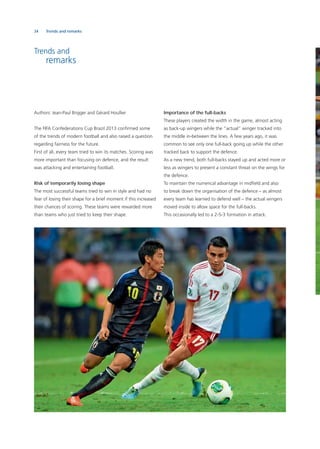
  • 40.
    38 Trends andremarks Autores: Jean-Paul Brigger y Gérard Houllier La Copa FIFA Confederaciones Brasil 2013 confirmó deter- minadas tendencias del fútbol moderno y planteó pregun- tas en torno a la equidad en el futuro. Primeramente, todos los equipos buscaron la victoria. Marcar fue más importante que limitarse a defender, resul- tando en un fútbol de ataque y un entretenido espectáculo. Riesgo de desequilibrio Las mejores escuadras intentaron ganar con estilo, sin temer a desequilibrarse por breves momentos, de incre- mentar ello sus posibilidades de anotar. Esto les rindió mayor fruto que a aquellos conjuntos que se limitaban solo a mantener su configuración. La importancia de los zagueros laterales Estos jugadores creaban amplitud en el juego, actuando prácticamente de punteros de apoyo, mientras que el puntero “original” se orientaba hacia el medio entre las líneas de formación. Hace algunos años, era habitual que subiera un zaguero solo, mientras que el otro permanecía en la defensa. Como nueva tendencia, ahora ambos zagueros laterales se Tendencias y observaciones
  • 41.
    39FIFA Confederations CupBrazil 2013 desempeñan prácticamente como punteros, creando una constante amenaza por las bandas para la defensa rival. A fin de mantener la superioridad numérica en la línea media y con el objetivo de romper la organización defensiva –ya que todos los equipos defienden con buen criterio– los punteros originales se desplazaban hacia el centro para ofrecer espacio a los zagueros. Ello condujo en ciertas ocasiones a una formación de 2-5-3 en el ataque. La importancia del mediocentro defensivo El mediocentro defensivo fue crucial en muchos partidos. Jugadores como Luiz Gustavo de Brasil, Busquets de España y Pirlo de Italia no solo participaron en el armado de juego, sino que constituyeron asimismo el “ancla organizativa” de la defensa. En una formación defensiva cuadrada o triangular, fueron responsables de reorganizar el equipo y proporcionar la necesaria seguridad cuando la escuadra se desequilibraba. La importancia de los atacantes Las características de los atacantes resultaron cruciales para triunfar. El papel del delantero centro es ahora menos importante por lo que respecta a crear él solo una ocasión, ya que la organización defensiva de los equipos es demasiado sólida. De este modo, el estilo ha cambiado ligeramente, y ahora los delanteros actúan más bien en calidad de enlace con los centrocampistas para así crearles espacio a los volantes o a los punteros a fin de que irrumpan por detrás de las líneas enemigas. Equidad Una vez disputadas las dos semifinales de la Copa, el Grupo de Estudio Técnico (GET) de la FIFA sugiere lo siguiente: ambas semifinales se jugaron en diferentes días y diferentes zonas climáticas. Brasil y España no dispusieron del mismo tiempo de recuperación y preparación para la final, y a ello hay que añadir el calor y el tiempo de viaje.
  • 42.
    40 Trends andremarks Trends und Bemerkungen Autoren: Jean-Paul Brigger und Gérard Houllier Der FIFA Konföderationen-Pokal Brasilien 2013 bestätigte einige Trends des modernen Fussballs und warf in Bezug auf die Turnierplanung eine Frage für die Zukunft auf. Grundsätzlich waren alle Teams bestrebt, sich nicht auf die Defensive zu beschränken, sondern aktiv den Torerfolg zu suchen. Entsprechend bekamen die Zuschauer offensiv geführte und unterhaltsame Partien geboten. Flexible Interpretation des Spielsystems Die Mannschaften, die nicht zögerten, ihre Ordnung kurz- zeitig aufzugeben, wenn sich die Chance zu einem vielver- sprechenden Angriff bot, waren erfolgreicher als diejenigen Teams, die starr an ihrer Formation festhielten. Als besonders wichtig erwies sich dabei die Rolle der Aussenverteidiger Diese stiessen immer wieder über die Seiten vor und zogen so das Angriffsspiel in die Breite, während die eigentlichen Flügelspieler zentraler agierten. Dass beide Aussenverteidiger in die Offensive gehen und auf den Flügeln fast permanent Druck ausüben, ist ein neuer Trend, war es doch noch vor wenigen Jahren Usus, dass sich nur einer von ihnen ins Spiel nach vorne einschaltete, wäh- rend der andere zur Absicherung hinten blieb. Das Verschieben der Flügelspieler in Richtung Zentrum und das Aufrücken der Aussenverteidiger in die entstehenden Freiräume führten zu einem kompakten Mittelfeld, aus dem heraus die meist sehr gut organisierten gegnerischen Abwehrreihen unter Druck gesetzt wurden – bisweilen sogar in einer 2-5-3-Formation.
  • 43.
    41FIFA Confederations CupBrazil 2013 Defensive Mittelfeldspieler als Schlüsselfiguren In einem System mit offensiven Aussenverteidigern ist die Position des hintersten Mittelfeldspielers von enormer Bedeutung. Akteure wie Luiz Gustavo (Brasilien), Busquets (Spanien) oder Pirlo (Italien) beteiligten sich nicht nur äusserst aktiv am Spielaufbau, sondern dirigierten auch das defensive Drei- oder Viereck, sicherten vor der Abwehr ab und leiteten die Reorganisation der gesamten Mannschaft nach einem eigenen Angriff. Neue Aufgaben für Stürmer Die Rolle der Angreifer und vor allem des Mittelstürmers hat sich stark gewandelt. Heutzutage sind die meisten Abwehrreihen so gut organisiert, dass ein Stürmer im Alleingang nicht mehr viel ausrichten kann. Stattdessen gehört es nun vermehrt zu seinen Aufgaben, Lücken aufzureissen, in die Mittelfeld- und Flügelspieler vorstossen können. Turnierplanung Die Halbfinalpartien des FIFA Konföderationen-Pokals fanden an verschiedenen Tagen und in unterschiedlichen Klimazonen statt. Vor dem Endspiel hatten Brasilien und Spanien nicht gleich viel Zeit für Erholung und Vorbereitung, zumal auch die Anreise zum Finale in Rio unterschiedlich weit war.
  • 45.
  • 46.
    44 Goal-line technology Goal-line technology Author:Johannes Holzmüller After the International Football Association Board made a historic decision to approve the use of goal-line technology at a special meeting on 5 July 2012, and following on from the successful trial at the FIFA Club World Cup 2012, goal- line technology was used for the second time in a FIFA competition in Brazil. Tender process The decision to appoint GoalControl followed a comprehensive tender process that began in February and involved bid presentations at the Home of FIFA in Zurich as well as site inspections in Brazil. The Germany-based company, which uses 14 high-speed cameras around the pitch as part of its GoalControl-4D system, was selected ahead of the three other FIFA-licensed GLT providers who participated in the tender. While all four companies had previously met the stringent technical requirements of the FIFA Quality Programme, the final decision was based on criteria relating more specifically to the tournaments in Brazil, including the company’s ability to adapt to local conditions and the compatibility of each GLT system in relation to FIFA match operations. The bids were also judged on cost and project management factors such as staffing and time schedules for installation. System installation After the announcement of the selected goal-line technology on 2 April 2013, work to install the system in the six Confederations Cup stadiums in Brazil began, with 14 cameras set up under the roof of each stadium and then connected to the hardware and software in the control room. Finally, the system was calibrated to ensure that it was in line with the different conditions in each stadium. GoalControl successfully completed the system installations
  • 47.
    45FIFA Confederations CupBrazil 2013 in early June in close cooperation with the LOC and the local stadium management. Final installation test Before the GoalControl-4D system could be used in Brazil, the system in each stadium had to pass a final installation test, which is standard procedure as part of the official certification process in accordance with the GLT Testing Manual. These tests were conducted by an independent test institute, EMPA. The systems installed in all six stadiums passed the final installation test and were therefore approved and certified by FIFA (see http://www.fifa.com/aboutfifa/organisation/marketing/ qualityprogramme/goallinetechnology/providers-installations/ index.html). Referee training To ensure that all referees were familiar with the new technology and the new procedures, they all attended a training session at the Maracanã Stadium on 12 June, when the focus was on the general functions and on the system’s accuracy, as well as on the final checks by the referees. Media event On 14 June, the Maracanã was also the setting for an event that gave the accredited media representatives a thorough introduction to the system, with FIFA Marketing Director Thierry Weil and FIFA Head of Refereeing Massimo Busacca explaining the use of the system in the stadiums and during the competition in general. Checks by the referee The GLT Testing Manual states that the match officials are obliged to check that the GLT system is working on both goals by carrying out specific tests before each match to ensure that the system is working perfectly and that it can be used for the match. All referee checks were successful, which meant that the goal-line technology was used by the match officials in all 16 matches. Competition All 86 goals were recorded by the system and displayed correctly on the referees’ watches. Consequently, the referees were very happy with the system’s performance and with the assistance that it provided during matches.
  • 48.
    46 Goal-line technology conditionslocales et la compatibilité de son système avec les aspects opérationnels des compétitions FIFA. Les offres ont également été analysées au vu de leurs coûts respectifs et de facteurs de gestion de projet comme par exemple le personnel requis et les délais d’installation. Installation du système Dès que le fabricant de technologie sur la ligne de but a été choisi, le 2 avril 2013, l’installation du système a pu commencer dans les six stades de la Coupe des Confédérations de la FIFA, Brésil 2013. Quatorze caméras ont ainsi été installées sous le toit de chaque stade puis reliées au matériel et au logiciel de la salle de contrôle. Le système a enfin été calibré en fonction des diverses données de chaque stade. En étroite collaboration avec le COL et les gérants du stade, GoalControl a finalisé l’installation au début du mois de juin. Dernier test d’installation Un dernier test d’installation a été effectué avant de donner le feu vert à l’utilisation de GoalControl-4D au Brésil. Cette étape standard de la procédure officielle d’autorisation selon le Manuel de tests pour la technologie sur la ligne de but a été effectuée par l’institut indépendant EMPA. Les installations dans les six stades ont bien passé ce dernier test d’installation et ont été agréées et certifiées par la FIFA La technologie sur la ligne de but Auteur : Johannes Holzmüller Après une première utilisation réussie lors de la Coupe du Monde des Clubs de la FIFA en décembre 2012, la Coupe des Confédérations de la FIFA, Brésil 2013 a été la deuxième compétition de la FIFA à avoir recours à la technologie sur la ligne de but, après la décision historique prise le 5 juillet 2012 par l’International Football Association Board (IFAB) d’approuver le principe de son utilisation officielle. Procédure d’appel d’offres Le choix de l’entreprise allemande GoalControl comme fabricant de technologie sur la de but a mis fin à la procédure d’appel d’offres qui a débuté en février avec des présentations au siège de la FIFA à Zurich ainsi que des visites d’inspection au Brésil. Le système GoalControl-4D, avec ses quatorze caméras grande-vitesse disposées autour du terrain, a été préféré à ceux des trois autres détenteurs de la licence FIFA de technologie sur la ligne de but qui ont répondu à l’appel d’offres. Si les quatre entreprises répondaient aux stricts critères qualitatifs du programme Qualité de la FIFA, la décision finale s’est fondée sur des critères se rapportant davantage aux deux tournois au Brésil, comme la capacité de l’entreprise à s’adapter aux
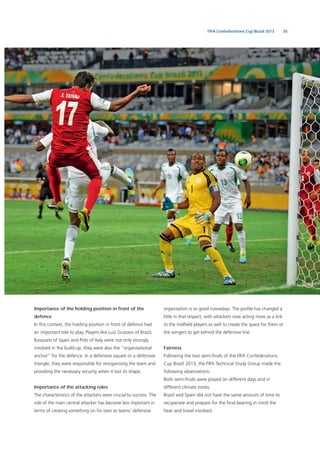
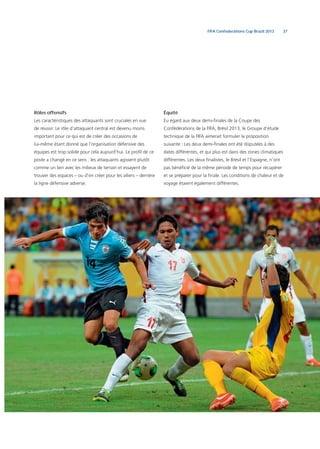
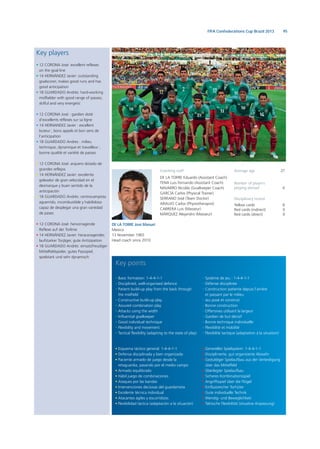
  • 49.
    47FIFA Confederations CupBrazil 2013 (cf. http://fr.fifa.com/aboutfifa/organisation/marketing/ qualityprogramme/goallinetechnology/providers-installations/ index.html). Formation des arbitres Afin de se familiariser avec la nouvelle technologie et sa procédure, tous les arbitres ont bénéficié d’une formation sur la technologie sur la ligne de but organisée le 12 juin au stade Maracanã. Les fonctionnalités et la précision du système leur ont ainsi été présentées tout comme le contrôle qu’ils sont tenus d’effectuer avant chaque match. Présentation aux médias Le 14 juin, le Maracanã a également été ouvert aux représentants des médias pour une présentation du système. Le directeur de division Marketing de la FIFA, Thierry Weil, et le chef du département de l’arbitrage, Massimo Bussaca, ont fait une présentation sur l’utilisation de la technologie dans les stades et son emploi en général lors du tournoi. Contrôle par les arbitres En vertu du Manuel de tests pour la technologie sur la ligne de but, les arbitres sont tenus de contrôler le fonctionnement du système sur les deux buts avant le match. Ceci permet de vérifier que tout fonctionne bien et que le système peut être utilisé pour le match. Tous les contrôles des arbitres ont été menés avec succès et la technologie a été utilisée pour l’ensemble des seize matches. Compétition Chacun des 86 buts inscrits ont été correctement reconnus et signalés sur la montre de l’arbitre. Les arbitres se sont dits très satisfaits de l’efficacité de la technologie et de l’aide qu’elle leur a offert durant les matches.
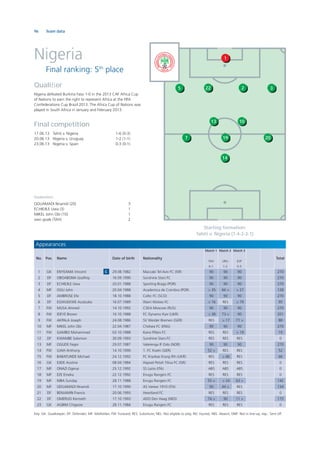
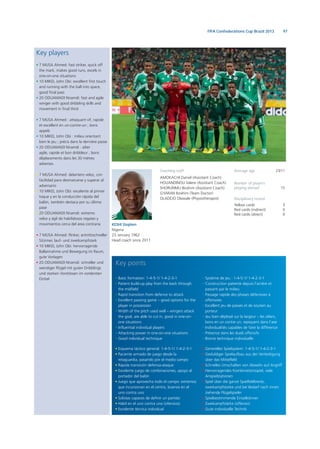
  • 50.
    48 Goal-line technology Sistemade detección de goles Autor : Johannes Holzmüller Luego de su exitoso debut en la Copa Mundial de Clubes de la FIFA en diciembre de 2012, la detección automática de goles se utilizó por segunda vez en una competición de la FIFA. Merced a una resolución histórica, el International Football Association Board (IFAB) aceptó en principio la utilización de estos sistemas en una sesión extraordinaria el 5 de julio de 2012. Proceso de licitación Con la decisión a favor del proveedor de sistemas de detec- ción automática de goles GoalControl, finalizó un largo pro- ceso de licitación que se había iniciado en febrero y abarcó tanto presentaciones de los candidatos en la sede de la FIFA en Zúrich, como inspecciones in situ en Brasil. La compañía, con sede en Alemania, que, en su sistema GoalControl-4-D, utiliza 14 cámaras de alta velocidad distribuidas por todo el terreno de juego, se impuso en la licitación a los otros tres proveedores aprobados por la FIFA. Luego de que las cuatro compañías cumplieran los estrictos requisitos técnicos del programa de calidad de la FIFA, resultaron decisivos, ante todo, los requisitos específicos para los dos torneos en Brasil, particularmente la capacidad de la empresa de adaptarse a las condiciones locales, así como la compatibilidad del sistema de detección con el calendario de juego de la FIFA. Las diferentes postulaciones se evaluaron igualmente desde el punto de vista de costos y de factores de gestión del proyecto, como por ejemplo el personal y el plazo para la instalación.
  • 51.
    49FIFA Confederations CupBrazil 2013 Instalación del sistema Tras anunciar el 2 de abril de 2013 el sistema elegido, comenzó la fase de implantación de este en las seis sedes de la Copa Confederaciones en Brasil. Para ello, las 14 cámaras se montaron debajo del techo de los estadios, y seguida- mente se conectaron con cables al equipo físico y el soporte lógico en la sala de control. Por último, el sistema fue cali- brado y ajustado así a las diferentes particularidades de los estadios. La empresa GoalControl finalizó exitosamente sus instalaciones a comienzos de junio en estrecha colaboración con el COL y la administración local de los estadios. Pruebas finales de instalación Antes de la utilización de GoalControl-4-D en Brasil, se sometió el sistema a una prueba final de instalación en cada estadio. Se trata de un procedimiento estándar en el marco del proceso oficial de aprobación de acuerdo con el manual de pruebas para los sistemas de detección automá- tica de goles. Estas pruebas las llevó a cabo el laboratorio independiente EMPA. Las instalaciones en los seis estadios pasaron las exhaustivas pruebas finales de instalación, y recibieron la aprobación y certificación de la FIFA (v. http:// es.fifa.com/aboutfifa/organisation/marketing/qualitypro- gramme/goallinetechnology/providers-installations/index. html). Capacitación de árbitros A fin de garantizar que todos los árbitros se familiaricen al detalle con el nuevo sistema y el nuevo procedimiento, todos los árbitros participaron en un curso de capacitación sobre detección automática de goles el 12 de junio en el Estadio Maracaná. Como temas principales figuraron el funciona- miento general y la precisión del sistema, así como la verifi- cación obligatoria por parte de los árbitros. Reunión de prensa El 14 de junio se realizó una sesión informativa para los medios acreditados en el Estadio Maracaná. El director de Mercadotecnia de la FIFA, Thierry Weil, y el jefe del Depar- tamento de Arbitraje de la FIFA, Massimo Bussaca, propor- cionaron información actualizada relativa a la utilización de estos sistemas en los estadios de la Copa FIFA Confederacio- nes y sobre su empleo general durante el torneo. Verificación por parte de los árbitros Según el manual de pruebas para los sistemas de detección automática de goles, los árbitros están obligados a realizar antes de cada partido un control de funcionamiento del sistema en ambas porterías. Con ello se ha de garantizar que el sistema funcione correctamente y que pueda utilizarse durante el partido. Todos los controles se llevaron a cabo exitosamente, y los colegiados utilizaron los sistemas en los 16 partidos. Competición El sistema reconoció los 86 goles anotados y los indicó correctamente en los relojes de los colegiados, los cuales manifestaron su plena satisfacción con el funcionamiento del sistema y con la correspondiente asistencia obtenida durante los encuentros.
  • 52.
    50 Goal-line technology Autor:Johannes Holzmüller Nach der erfolgreichen Premiere bei der FIFA Klub-Welt- meisterschaft im Dezember 2012 kam nun die Torlinien- technologie zum zweiten Mal bei einem FIFA-Wettbewerb zum Einsatz. Mit einem historischen Beschluss hatte der International Football Association Board (IFAB) bei einer Sondersitzung am 5. Juli 2012 die Nutzung von Torlinientechnologien im Grundsatz zugelassen. Ausschreibungsprozess Mit dem Entscheid für den Torlinientechnologie- Anbieter GoalControl endete ein ausgedehntes Ausschreibungsverfahren, das im Februar begann und Torlinien- technologie
  • 53.
    51FIFA Confederations CupBrazil 2013 sowohl Präsentationen der Bewerber am FIFA-Sitz in Zürich als auch Inspektionen vor Ort in Brasilien umfasste. Das Unternehmen mit Sitz in Deutschland, das bei seinem GoalControl-4-D-System 14 Hochgeschwindigkeitskameras um das Spielfeld herum einsetzt, wurde den drei anderen von der FIFA zugelassenen Anbietern vorgezogen, die an der Ausschreibung teilnahmen. Nachdem alle vier Anbieter die strengen technischen Auflagen des FIFA-Qualitätsprogramms erfüllt hatten, gaben letztlich vor allem die spezifischen Vorgaben für die beiden Turniere in Brasilien den Ausschlag, insbesondere die Fähigkeit des Unternehmens, sich den lokalen Gegebenheiten anzupassen, und die Kompatibilität des Torlinientechnologie-Systems mit dem FIFA-Spielbetrieb. Die einzelnen Bewerbungen wurden auch nach Kosten und Projektmanagementfaktoren wie Personal und Zeitplan für die Installation beurteilt. Installation des Systems Nach der Bekanntgabe der ausgewählten Torlinien- technologie am 2. April 2013 begann die Installation des Systems in den sechs Spielstätten des FIFA Konföderationen-Pokals 2013 in Brasilien. Hierbei wurden jeweils 14 Kameras unterhalb des Stadiondachs montiert. Im Anschluss folgte eine Verkabelung der Kameras mit der Hard- und Software im Kontrollraum. Abschliessend wurde das System kalibriert und so entsprechend auf die verschiedenen Gegebenheiten in den Stadien eingestellt. In enger Zusammenarbeit mit dem LOC und dem lokalen Stadionmanagement schloss GoalControl die Installation Anfang Juni erfolgreich ab. Finaler Installationstest Vor der Anwendung von GoalControl-4-D in Brasilien wurde das System in jedem Stadion einem abschliessenden Installationstest unterzogen. Dies ist ein Standardverfahren im Rahmen des offiziellen Zulassungsverfahrens gemäss dem Testhandbuch für Torlinientechnologie. Diese Tests wurden vom unabhängigen Testinstitut EMPA durchgeführt. Die Installationen in allen sechs Stadien bestanden den umfassenden finalen Installationstest und wurden von der FIFA genehmigt und entsprechend zertifiziert (siehe http://www.fifa.com/aboutfifa/organisation/marketing/ qualityprogramme/goallinetechnology/providers- installations/index.html). Schiedsrichterschulung Um mit der neuen Technologie und dem neuen Verfahren im Detail vertraut zu sein, absolvierten am 12. Juni im Maracanã-Stadion alle Schiedsrichter eine Schulung zum Thema Torlinientechnologie. Hierbei waren die allgemeine Funktionsfähigkeit und die Genauigkeit des Systems sowie der zwingende Schiedsrichter-Check wichtige Themen. Medienveranstaltung Am 14. Juni wurden ebenfalls im Maracanã-Stadion die akkreditierten Medienvertreter ausführlich über das System informiert. FIFA-Direktor Marketing Thierry Weil und Massimo Bussaca, Leiter der FIFA-Schiedsrichterabteilung, äusserten sich zur Anwendung der Technologie in den Stadien und zur generellen Nutzung während des Turniers. Schiedsrichter-Check Gemäss dem Testhandbuch für Torlinientechnologie sind die Schiedsrichter verpflichtet, vor dem Spiel an beiden Toren einen Funktionstest des Torlinientechnologie-Systems durchzuführen. Hiermit wird sichergestellt, dass das System fehlerfrei funktioniert und für das Spiel genutzt werden kann. Alle Schiedsrichter-Checks wurden erfolgreich durchgeführt, worauf die Torlinientechnologie bei allen 16 Spielen von den Offiziellen angewandt wurden. Wettbewerb Alle 86 erzielten Tore wurden vom System erkannt und korrekt auf den Schiedsrichteruhren angezeigt. Dementsprechend waren die Schiedsrichter mit der Leistung der Technologie und der erhaltenen Hilfe während des Spiels sehr zufrieden.
  • 55.
  • 56.
    54 Refereeing report Refereeing report Author:Massimo Busacca The FIFA Referees Committee appointed ten refereeing trios for this competition: four from UEFA, two each from CONMBEBOL and the AFC, and one each from CONCACAF and CAF. The criteria for their appointment was that they: • had to be elite referees in their confederation; and • had to be on the open list of prospective referees and assistant referees for the 2014 FIFA World Cup Brazil™. All the referees passed the FIFA fitness test held at the FIFA seminar for prospective referees in Rio de Janeiro in May 2013. After arriving in Rio, all of the referees and assistant referees participated in a variety of daily theoretical and practical activities prepared by the technical and fitness instructors. The main focus was on a technical/tactical approach to the participating teams’ way of playing that would ensure the best possible understanding and reading of the games. The match officials were instructed to maintain their own personality and uniformly interpret the Laws of the Game considering their actual situation in action on the field. The daily training sessions took place with the assistance of a youth football team, which helped to set up match situations. During the practical training sessions on the field of play, some of the exercises (e.g. positioning and offside situations) performed by the referees and assistant referees were recorded and their decisions instantly analysed on a screen adjacent to the pitch. The exercises were subsequently repeated at different speeds and degrees of difficulty. Prior to the competition, a referee instructor met each of the participating teams. The sessions were attended by all of the players and the technical staff, and they were reminded of various aspects of the Laws of the Game and informed about the instructions that had been given to the referees. At the end of the meeting, they were provided with the multimedia material that had been presented for their own further study and later use. These meetings were well received by all of the participating teams because, besides providing a uniform interpretation of the Laws of the Game, it also brought players, coaches and referees closer together. During the competition, all 16 matches were recorded and the instructors selected important incidents that were to be analysed with the referees. Consequently, general debriefings were held to analyse the major incidents and prepare the referees for upcoming matches in the competition.
  • 57.
    55FIFA Confederations CupBrazil 2013 The refereeing delegation stayed at the Windsor Barra Hotel in Rio de Janeiro, where they received excellent hospitality and enjoyed good facilities, suitable meeting rooms, a gym that met the needs of the referees, etc. In addition, special mention should be made of the high level of attention and professional support received from the Local Organising Committee and its partners, particularly with regard to transport, logistics and the various sports facilities for the referees’ practical training sessions with well-prepared footballers. Members of the Referees Committee participated in the important role of assessing and assisting the match officials in the venues. Accordingly, they were responsible for FIFA refereeing matters and for supporting the referees’ needs for the entire duration of their stay in the venues. A technical instructor assisted as a match analyst. The members of the Referees Committee and the instructors carefully monitored all of the match officials’ performances and their evaluations were very positive. In summary, the refereeing of this competition was very successful. We also would like to mention the fair play on the pitch during this tournament, because compared to other tournaments, there were only a few fouls, and not very many yellow or red cards.
  • 58.
    56 Refereeing report Rapportsur l’arbitrage Auteur : Massimo Busacca La Commission des Arbitres de la FIFA a désigné dix trios arbitraux pour cette compétition : quatre de l’UEFA, deux de la CONMEBOL, deux de l’AFC, un de la CONCACAF et un de la CAF. Pour être désignés, les arbitres devaient respecter les critères suivants : • ils devaient être des arbitres d’élite au sein de leur confédération ; et • ils devaient figurer sur la liste ouverte des arbitres et arbitres assistants candidats à la Coupe du Monde de la FIFA, Brésil 2014™. Tous les arbitres ont passé avec succès le test de condition physique réalisé dans le cadre du séminaire de la FIFA pour les arbitres candidats tenu à Rio de Janeiro en mai 2013. À leur arrivée à Rio, tous les arbitres et arbitres assistants ont participé à diverses activités théoriques et pratiques préparées par les instructeurs techniques et préparateurs physiques. Ils ont également insisté sur l’approche technico- tactique du jeu des équipes participantes pour offrir aux arbitres une meilleure compréhension et une meilleure lecture des matches. Ils ont conseillé aux officiels de match de rester fidèles à leur propre personnalité et d’interpréter uniformément les Lois du Jeu en fonction de leur positionnement sur le terrain par rapport à l’action. Les séances quotidiennes ont été organisées avec l’assistance d’une équipe de jeunes footballeurs afin de réaliser sur le terrain des exercices portant sur diverses situations de jeu. Pendant les sessions pratiques, certains exercices réalisés par les arbitres et arbitres assistantes (tels que ceux portant sur le positionnement et les situations de hors-jeu) ont été filmés afin d’analyser a posteriori leurs décisions en vidéo sur un écran installé aux abords du terrain. Les exercices ont ensuite été répétés à différentes vitesses et niveaux de difficulté. Avant la compétition, un instructeur d’arbitres a rencontré chacune des équipes participantes. Tous les joueurs et l’encadrement technique ont assisté aux sessions qui illustraient divers aspects des Lois du Jeu et présentaient les instructions données aux arbitres. À la fin de la réunion, les équipes se sont vu remettre du matériel multimédia pour étude et utilisation ultérieure. Ces réunions ont été très bien accueillies par les équipes participantes puisque, outre une interprétation uniforme des Lois du Jeu, elles ont permis des rapprochements entre joueurs, entraîneurs et officiels. Chacun des seize matches de la compétition a été enregistré et les instructeurs ont sélectionné des actions à soumettre à l’analyse des arbitres. Des réunions ont ensuite été organisées afin d’analyser les principaux incidents et d’améliorer les performances du corps arbitral lors des rencontres à venir. La délégation des arbitres était logée à l’hôtel Windsor Barra de Rio de Janeiro, où elle a été très bien traitée et a profité des excellentes installations mises à sa disposition,
  • 59.
    57FIFA Confederations CupBrazil 2013 dont des salles de réunion ou encore un gymnase équipé des infrastructures nécessaires. Il convient également de souligner la grande attention et le soutien professionnel apportés par le Comité Organisateur Local, notamment au niveau du transport, de la logistique et des diverses installations sportives utilisées pour l’entraînement des arbitres avec à leur disposition des joueurs bien préparés pour les assister. Le rôle des membres de la Commission des Arbitres a été déterminant en matière d’inspection et de soutien apporté aux arbitres sur les sites. Chaque membre a été décentralisé sur un site où il était responsable des questions d’arbitrage et du soutien des arbitres du jour de leur arrivée à celui de leur départ. Un instructeur technique a travaillé comme analyste de match. Les membres de la Commission des Arbitres et les instructeurs ont supervisé minutieusement les performances des arbitres et leurs évaluations ont été généralement très positives. L’arbitrage a donc été très bon dans cette compétition. Nous tenons également à souligner le fair-play sur le terrain durant la compétition, peu de fautes et très peu de cartons jaunes et rouges ayant été enregistrés par rapport aux autres tournois.
  • 60.
    58 Refereeing report Informe dearbitraje Autor: Massimo Busacca La Comisión de Árbitros de la FIFA asignó diez tríos arbitrales a este torneo: cuatro de la UEFA, dos de la CONMBEBOL, dos de la AFC, uno de la CONCACAF y otro de la CAF. Los árbitros debían: • ser colegiados de élite en su confederación; • figurar en la lista abierta de posibles árbitros y árbitros asistentes de la Copa Mundial de la FIFA Brasil 2014™. Todos los árbitros superaron la prueba de condición física realizada en mayo de 2013 durante el seminario FIFA para árbitros candidatos en Río de Janeiro. Una vez en Río, todos los árbitros y sus asistentes participa- ron a diario en diversas actividades teóricas y prácticas que habían dispuesto instructores técnicos y preparadores físicos. Con objeto de que pudieran entender y saber leer de la mejor manera los encuentros venideros, se dio prioridad a las explicaciones técnicas y tácticas sobre el estilo de juego de los
  • 61.
    59FIFA Confederations CupBrazil 2013 equipos participantes. Los oficiales de partido recibieron ins- trucciones para que su autoridad no se viera afectada durante los encuentros y conseguir la interpretación uniforme de las Reglas de Juego al juzgar los lances del partido. Las sesiones de entrenamiento diarias se llevaron a cabo con la ayuda de un equipo juvenil que permitió escenificar las diferentes acciones. Durante las sesiones prácticas, se gra- baron algunos de los ejercicios realizados por los árbitros y los asistentes (p. ej. posicionamientos y fueras de juego), lo que permitió analizar las decisiones de forma inmediata en una pantalla dispuesta junto al campo a tal efecto (análisis instantáneo). Luego, los ejercicios se repitieron a diferentes velocidades y distintos niveles de complejidad. Antes del inicio de la competición, un instructor de árbitros se reunió con cada uno de los equipos participantes. A estas sesiones acudió la plantilla y el cuadro técnico y en ellas se les remitió a determinados aspectos de las Reglas de Juego y se les informó sobre las instrucciones impartidas a los cole- giados. Al final de la sesión, se les facilitó el material multi- media usado durante las sesiones para que posteriormente lo analizaran de manera individual. Estas sesiones tuvieron muy buena acogida entre los equipos, ya que presenta- ban una interpretación uniforme de las Reglas de Juego y, además, sirvieron para acercar a jugadores, técnicos y colec- tivo arbitral. Se grabaron los dieciséis encuentros disputados a fin de que los instructores seleccionaran las acciones más determinan- tes; estas se analizaron luego junto con los árbitros. Luego, en reuniones diarias se examinaron los principales inciden- tes ocurridos a fin de preparar mejor a los árbitros para los siguientes partidos del torneo. La delegación de árbitros se alojó en el Hotel Windsor Barra de Río de Janeiro, donde se les atendió de forma excelente; allí dispusieron de buenas instalaciones, con salas de juntas muy adecuadas, un gimnasio que satisfizo las necesidades de los colegiados, etc. Mención especial merece la atención y asesoramiento profesional brindado por el Comité Organi- zador Local y sus socios, concretamente en lo que respecta al transporte, la logística y las diversas instalaciones depor- tivas utilizadas por los árbitros en sus sesiones prácticas, además de los jugadores muy bien preparados que ayudaron a simular los lances de juego. Algunos miembros de la Comisión de Árbitros de la FIFA actuaron como asesores y asistieron a los oficiales de partido en los estadios, de ahí que fueran los responsables de todo lo referente al arbitraje de la FIFA e igualmente de satisfacer todas aquellas necesidades que pudieran tener los árbitros durante la celebración del torneo. Un instructor técnico cola- boró en esta labor en calidad de analista de partidos. Tanto los miembros de la Comisión de Árbitros de la FIFA como los instructores examinaron la labor de los oficiales de partido y, en líneas generales, la valoración fue muy positiva. En suma, la labor arbitral en este torneo ha sido en general satisfactoria. Asimismo, quisiéramos mencionar el juego limpio en este torneo, en el que, comparado con otros, se cometieron muy pocas faltas y no se mostraron muchas tarjetas.
  • 62.
    60 Refereeing report Schiedsrichter- bericht Autor:Massimo Busacca Die FIFA-Schiedsrichterkommission hat für das Turnier zehn Schiedsrichtertrios aufgeboten: vier aus der UEFA, je zwei aus der CONMEBOL und der AFC und je ein Trio aus der CONCACAF und der CAF. Alle aufgebotenen Unparteiischen mussten: • Spitzenschiedsrichter der jeweiligen Konföderation sein und • auf der offenen Liste der möglichen Schiedsrichter und Schiedsrichterassistenten für die FIFA Fussball- Weltmeisterschaft Brasilien 2014™ stehen. Alle Unparteiischen bestanden den FIFA-Fitnesstest, der im Mai 2013 beim FIFA-Seminar für die Schiedsrichteranwärter in Rio de Janeiro durchgeführt wurde. Nach Ankunft in Rio standen für alle Schiedsrichter und Schiedsrichterassistenten täglich verschiedene theoretische und praktische Übungen auf dem Programm, die von den Technik- und Fitnessinstrukteuren vorbereitet wurden. Im Zentrum stand dabei die technisch-taktische Konzeption der Spielweise der Teams. Die Unparteiischen sollten letztlich in der Lage sein, das Spiel besser zu verstehen und zu lesen. Die Spieloffiziellen sollten sich treu bleiben, die Spielregeln in den einzelnen Spielsituationen aber einheitlich auslegen. Bei den täglichen Trainings simulierte ein Jugendteam bestimmte Spielsituationen. Einige Übungen (z. B. Stellungsspiel und Abseitssituationen) der Schiedsrichter und Schiedsrichterassistenten wurden aufgezeichnet. Die Entscheidungen der Unparteiischen wurden am Bildschirm neben dem Spielfeld sofort analysiert und die Übungen
  • 63.
    61FIFA Confederations CupBrazil 2013 danach mit unterschiedlichem Tempo und verschiedenen Schwierigkeitsstufen wiederholt. Vor Turnierbeginn traf sich ein Schiedsrichterinstrukteur mit jedem Team. Dabei informierte er die Spieler und technischen Betreuer über verschiedene Punkte der Spielregeln sowie die Weisungen an die Schiedsrichter. Nach der Sitzung erhielten sie das präsentierte multimediale Lehrmaterial zum weiteren Studium und zur späteren Nutzung. Die Sitzungen stiessen bei allen Mannschaften auf ein sehr positives Echo, weil sie nicht nur aktuelle Informationen zu den Spielregeln lieferten, sondern auch eine Annäherung zwischen Spielern, Trainern und Schiedsrichtern ermöglichten. Alle 16 Spiele des Turniers wurden aufgezeichnet. Die Instrukteure wählten einzelne Szenen aus, um sie mit den Schiedsrichtern zu besprechen. Nach dem Spiel wurden die wichtigsten Vorfälle mit den Unparteiischen ausgewertet und für die kommenden Partien Lehren gezogen. Die Schiedsrichterdelegation war im Hotel Windsor Barra in Rio de Janeiro untergebracht. Sie genoss dort eine ausgezeichnete Betreuung und eine gute Infrastruktur samt Sitzungszimmern, Fitnessraum mit geeigneten Geräten etc. Erfreulich waren auch die grosse Hilfsbereitschaft und die professionelle Unterstützung seitens des lokalen Organisationskomitees und seiner Partner, vor allem beim Transport, bei der Logistik sowie den verschiedenen Sportanlagen und den gut vorbereiteten Trainingspartnern für die praktischen Übungen der Schiedsrichter. Mitglieder der Schiedsrichterkommission leisteten als Experten und Betreuer der Spieloffiziellen an den Spielorten ebenfalls wertvolle Unterstützung. Sie waren an den Spielorten für sämtliche FIFA-Schiedsrichterbelange verantwortlich und standen den Schiedsrichtern ab Ankunft bis Abreise zur Seite. Ein technischer Instrukteur waltete als Spielanalyst. Das Mitglied der Schiedsrichterkommission und die Instrukteure nahmen die Leistungen der Unparteiischen genau unter die Lupe. Ihr Fazit war im Allgemeinen sehr positiv. Das Turnier war aus Schiedsrichtersicht insgesamt ein Erfolg. Bemerkenswert war auch die Fairness bei den Spielen. Im Vergleich zu anderen Turnieren gab es nur sehr wenige Fouls und fast keine Verwarnungen und Feldverweise.
  • 65.
  • 66.
    64 Medical report Medical report Author:Prof. Jiří Dvořák At the FIFA Confederations Cup Brazil 2013, FIFA Chief Medical Officer Prof. Jiří Dvořák and FIFA Medical Officer Prof. Efraim Kramer supervised the medical services for the event at the headquarters in Rio de Janeiro. The LOC’s medical team had prepared the delivery of medical services. Injury-recording study Since 1998, team doctors have been asked to report on all injuries incurred by their players during each match. The standardised injury-recording forms developed by the FIFA Medical Assessment and Research Centre (F-MARC) were completed and returned to the FIFA Medical Officer. Dr Astrid Junge, Head of Research at F-MARC, analysed the data. The overall injury rate was 1.69 injuries per match, but there were no time-loss injuries (defined as injuries that lead to absence from training or a match). About 36% of the injuries occurred without contact with another player, and there were no injuries caused by foul play. ANTI-DOPING In-competition doping control Following the routine in-competition procedure as described in the FIFA Anti-Doping Regulations 2013, two players per team were randomly selected for doping control after each of the 16 matches to provide urine and blood samples. Altogether, 128 samples were collected and analysed at the WADA-accredited laboratory in Rio de Janeiro, Brazil with the support of the WADA-accredited laboratory in Lausanne, Switzerland. One test presented an adverse analytical finding. This case is currently under investigation. Out-of-competition doping control For the FIFA Confederations Cup Brazil 2013 and the 2014 FIFA World Cup Brazil™, FIFA has implemented the biological profile system, considered to be one of the best methods to detect the use of performance-enhancing drugs. At the FIFA Confederations Cup Brazil 2013, all players of all teams were tested (blood and urine) prior to the competition for the purpose of the biological profile in addition to the routine anti-doping tests during the competition. The profile has two components: the haematological parameters (in blood) and the steroid profile (in urine). The combination of the two gives a biological profile for each player. In the weeks leading up to the Confederations Cup showpiece in Brazil, FIFA doping control officers paid an unannounced visit to each of the eight participating teams to conduct out-of-competition doping tests on the players. All pre-competition doping analyses conducted with all participating teams yielded negative results. Legacy for Brazil A pilot “FIFA 11 for Health” programme will start in Belo Horizonte and Curitiba in August 2013. The objective is to implement the programme in the 12 host cities before the 2014 FIFA World Cup Brazil™ in cooperation between FIFA, F-MARC, the CBF and the Brazilian government.
  • 67.
    65FIFA Confederations CupBrazil 2013 Rapport médical Auteur : Prof. Jiří Dvořák Lors de la Coupe des Confédérations de la FIFA, Brésil 2013, le médecin en chef de la FIFA, le Prof. Jiří Dvořák, et le responsable médical de la FIFA, le Prof. Efraim Kramer, ont supervisé les services médicaux de l’événement depuis le quartier général de Rio de Janeiro. L’équipe médicale du COL a assuré une excellente préparation des prestations de services médicaux. Étude sur le recensement des blessures Depuis 1998, il est demandé aux médecins d’équipe de faire un rapport de toutes les blessures contractées par leurs joueurs lors de chaque match. Les formulaires standard de recensement des blessures conçus par le Centre d’évaluation et de recherche médicale de la FIFA (F-MARC) ont été remplis et remis au responsable médical de la FIFA. Astrid Junge, responsable de la recherche au F-MARC, a analysé les données collectées. Le taux de blessures s’est élevé à 1,69 par match. Aucune blessure contractée durant la compétition n’a entraîné d’indisponibilité à l’entraînement ou en match. Environ 36% des blessures sont survenues sans qu’il y ait contact avec un autre joueur, et aucune blessure n’a été consécutive à une faute. LUTTE CONTRE LE DOPAGE Contrôles de dopage durant la compétition Dans le cadre de la procédure de routine effectuée pendant la compétition, telle que définie dans le Règlement antidopage 2013 de la FIFA, à l’issue de chacun des seize matches, deux joueurs par équipe ont été tirés au sort pour fournir des échantillons d’urine et de sang et être soumis à un contrôle de dopage. Un total de 128 échantillons ont été prélevés et analysés par le laboratoire accrédité par l’Agence mondiale antidopage à Rio de Janeiro (Brésil), avec le soutien du laboratoire accrédité par l’AMA à Lausanne (Suisse). Un échantillon a présenté un résultat d’analyse anormal et une enquête est en cours. Contrôle de dopage hors compétition Pour la Coupe des Confédérations de la FIFA, Brésil 2013 et la Coupe du Monde de la FIFA, Brésil 2014™, la FIFA a mis en œuvre le système de profilage biologique, qui est considéré comme l’une des meilleures méthodes pour détecter l’utilisation de substances permettant d’améliorer les performances. Lors de la Coupe des Confédérations de la FIFA, Brésil 2013, tous les joueurs ont été testés (sang et urine) avant la compétition à des fins de profilage biologique en plus des tests de dopage habituels effectués durant la compétition. Le profil biologique de chaque joueur est composé de paramètres hématologiques (dans le sang) et d’un profil stéroïdien (dans l’urine). Au cours des semaines qui ont précédé la compétition, les responsables du contrôle de dopage de la FIFA se sont rendus auprès de chacune des huit équipes participantes sans les prévenir afin de réaliser des contrôles de dopage hors compétition. Toutes ces analyses de dopage pré-compétition ont présenté des résultats négatifs. Héritage pour le Brésil Un programme pilote « FIFA 11 pour la Santé » débutera à Belo Horizonte et à Curitiba en août 2013, l’objectif étant de le mettre en œuvre dans les douze villes hôtes avant la Coupe du Monde de la FIFA, Brésil 2014™ dans le cadre d’une coopération entre la FIFA, le F-MARC, la CBF et le gouvernement brésilien.
  • 68.
    66 Medical report Informe médico Autor:Dr. Jiří Dvořák En la Copa FIFA Confederaciones Brasil 2013, el médico en jefe de la FIFA Dr. Jiří Dvořák y el oficial médico de la FIFA Dr. Efraim Kramer supervisaron los servicios médicos del torneo en las oficinas principales de Río de Janeiro. El equipo médico del COL brindó los servicios médicos necesarios. Estudio sobre las lesiones Desde 1998 se solicita a los médicos de equipo un informe sobre las lesiones que padecieron sus jugadores durante los encuentros. Los médicos rellenaron y entregaron al oficial médico de la FIFA los formularios estándar de registro de lesiones, concebidos por el Centro Médico de Evaluación e Investigación de la FIFA (F-MARC). La Dra. Astrid Junge, jefa de investigación del F-MARC, analizó los datos. La media general registrada fue de 1.69 lesiones por partido, pero no hubo lesiones con baja (por las cuales el lesionado no asiste a los entrenamientos o partidos). Aproximada- mente el 36 % de las lesiones ocurrió sin contacto con otro jugador y no hubo lesiones a causa de faltas. ANTIDOPAJE Control de dopaje en competición De acuerdo con la rutina del procedimiento en competición, descrita en el Reglamento Antidopaje de la FIFA 2013, se seleccionó aleatoriamente a dos jugadores por equipo para el control de dopaje después de cada uno de los 16 partidos, quienes entregaron muestras de sangre y orina. En total, se tomaron y analizaron 128 muestras en el laboratorio de Río de Janeiro (Brasil) con el apoyo del laboratorio de Lausana (Suiza), ambos reconocidos por la AMA. Solo se constató un resultado analítico adverso. El caso está siendo investigado. Control de dopaje fuera de competición Para la Copa FIFA Confederaciones Brasil 2013 y la Copa Mundial de la FIFA Brasil 2014™, la FIFA ha previsto la puesta en práctica del sistema del perfil biológico, conside- rado uno de los mejores métodos para detectar el uso de sustancias que incrementan el rendimiento. Aparte de los controles de dopaje rutinarios durante la competición, en la Copa FIFA Confederaciones Brasil 2013 se tomaron muestras de sangre y orina de todos los jugadores antes del torneo con el fin de crear un perfil biológico. El perfil tiene dos componentes: los parámetros hematológicos en la sangre y el perfil esteroideo en la orina. La combinación de los dos arroja el perfil biológico. En las semanas previas a la Copa Confederaciones en Brasil, los oficiales del control de dopaje de la FIFA visitaron sin previo aviso a las ochos selecciones participantes a fin de llevar a cabo controles fuera de com- petición. Los análisis de las muestras arrojaron solamente resultados negativos. Legado para Brasil El programa piloto de FIFA 11 para la Salud comenzará en agosto de 2013 en las ciudades de Belo Horizonte y Curi- tiba. En colaboración con el F-MARC, la CBF y el Gobierno brasileño, la FIFA pretende poner en marcha el programa en las doce ciudades anfitrionas antes del inicio de la Copa Mundial de la FIFA Brasil 2014™.
  • 69.
    67FIFA Confederations CupBrazil 2013 Medizinischer Bericht Autor: Prof. Jiří Dvořák FIFA-Chefarzt Prof. Jiří Dvořák und Prof. Efraim Kramer als medizinischer FIFA-Koordinator beaufsichtigten vom Hauptquartier in Rio de Janeiro aus die vom medizinischen LOC-Team vorbereitete medizinische Versorgung beim FIFA Konföderationen-Pokal Brasilien 2013. Verletzungserhebung Seit 1998 werden die Teamärzte bei allen FIFA-Wettbewer- ben gebeten, alle Verletzungen ihrer Spieler bei den Spielen zu melden. Die betreffenden Angaben waren auf dem standardisierten F-MARC-Formular zu vermerken, das dem medizinischen FIFA-Koordinator auszuhändigen war. Dr. Astrid Junge, F-MARC-Forschungsleiterin, wertete die Daten aus. Durchschnittlich wurden 1,69 Verletzungen pro Spiel verzeichnet, wobei keine Verletzung zu einem Trainings- oder Spielausfall führte. 36 % der Verletzungen erfolgten ohne Kontakt mit einem anderen Spieler. Keine Verletzung ging auf ein Foul zurück. DOPINGBEKÄMPFUNG Dopingkontrollen bei Wettbewerben Gemäss Standardverfahren des FIFA-Anti-Doping-Reglements 2013 wurden bei jedem der 16 Spiele zwei Spieler je Team für Urin- und Bluttests ausgelost. Insgesamt wurden 128 Proben entnommen und mit der Unterstützung des WADA- akkreditierten Labors in Lausanne (Schweiz) im WADA- akkreditierten Labor in Rio de Janeiro (Brasilien) analysiert. Eine Analyse ergab ein auffälliges Analyseergebnis. Der Fall wird derzeit untersucht. Dopingkontrollen ausserhalb von Wettbewerben Für den FIFA Konföderationen-Pokal Brasilien 2013 und die FIFA Fussball-Weltmeisterschaft Brasilien 2014™ hat die FIFA biologische Profile eingeführt, da diese eine der besten Methoden zum Nachweis von leistungsfördernden Wirkstoffen sind. Vor dem FIFA Konföderationen-Pokal Brasilien 2013 führte die FIFA bei den Spielern aller Teams neben den üblichen Dopingtests ausserhalb von Wettbewerben Blut- und Urintests durch, um deren biologisches Profil zu erstellen. Das Profil besteht aus den hämatologischen Parametern (im Blut) und dem Steroidprofil (im Urin). Zusammen ergeben sie das biologische Profil des jeweiligen Spielers. In den Wochen vor dem Turnier in Brasilien führten die FIFA-Dopingkontrolleure bei den Spielern der acht beteiligten Teams unangemeldete Dopingkontrollen ausserhalb von Wettbewerben durch. Diese ergaben allesamt einen negativen Befund. Vermächtnis für Brasilien Im August 2013 beginnt in Belo Horizonte und Curitiba ein Pilotprojekt des Programms „FIFA 11 für die Gesundheit“. Noch vor der FIFA Fussball-Weltmeisterschaft 2014™ soll das Programm unter Mitwirkung der FIFA, von F-MARC, des brasilianischen Fussballverbands und der brasilianischen Regierung auf alle zwölf Spielorte ausgedehnt werden.
  • 71.
  • 72.
    70 Results andranking Second round First round Overall ranking Group A Brazil, Japan, Mexico, Italy 15.06. Brazil v. Japan Brasilia 3-0 (1-0) 16.06. Mexico v. Italy Rio de Janeiro 1-2 (1-1) 19.06. Brazil v. Mexico Fortaleza 2-0 (1-0) 19.06. Italy v. Japan Recife 4-3 (1-2) 22.06. Italy v. Brazil Salvador 2-4 (0-1) 22.06. Japan v. Mexico Belo Horizonte 1-2 (0-0) 1. Brazil 3 3 0 0 9-2 9 2. Italy 3 2 0 1 8-8 6 3. Mexico 3 1 0 2 3-5 3 4. Japan 3 0 0 3 4-9 0 Semi-finals 26.06. Brazil v. Uruguay Belo Horizonte 2-1 (1-0) 27.06. Spain v. Italy Fortaleza 0-0 a.e.t. 7-6 PSO Match for third place 30.06. Uruguay v. Italy Salvador 2-2 a.e.t. (2-2, 0-1) 2-3 PSO Final 30.06. Brazil v. Spain Rio de Janeiro 3-0 (2-0) Group B Spain, Uruguay, Tahiti, Nigeria 16.06. Spain v. Uruguay Recife 2-1 (2-0) 17.06. Tahiti v. Nigeria Belo Horizonte 1-6 (0-3) 20.06. Spain v. Tahiti Rio de Janeiro 10-0 (4-0) 20.06. Nigeria v. Uruguay Salvador 1-2 (1-1) 23.06. Nigeria v. Spain Fortaleza 0-3 (0-1) 23.06. Uruguay v. Tahiti Recife 8-0 (4-0) 1. Spain 3 3 0 0 15-1 9 2. Uruguay 3 2 0 1 11-3 6 3. Nigeria 3 1 0 2 7-6 3 4. Tahiti 3 0 0 3 1-24 0 1. Brazil 2. Spain 3. Italy 4. Uruguay 5. Nigeria 6. Mexico 7. Japan 8. Tahiti
  • 73.
    71FIFA Confederations CupBrazil 2013 Fortaleza Recife Salvador Belo Horizonte Rio de Janeiro Brasilia Brazil Venues and stadiums Belo Horizonte: Estádio Mineirão Capacity 57,483 Matches 3 Brasilia: Estádio Nacional Capacity 68,009 Match 1 Fortaleza: Estádio Castelão Capacity 58,704 Matches 3 Recife: Arena Pernambuco Capacity 42,849 Matches 3 Rio de Janeiro: Estádio do Maracanã Capacity 73,531 Matches 3 Salvador: Arena Fonte Nova Capacity 52,048 Matches 3
  • 74.
    72 Match telegrams GroupA 2 16.06.2013 16:00 RIO DE JANEIRO 73,123 MEX: 12 CORONA; 2 RODRIGUEZ (C), 3 SALCIDO, 6 TORRADO, 10 DOS SANTOS, 11 AQUINO, 14 HERNANDEZ, 15 MORENO, 17 ZAVALA, 18 GUARDADO, 22 FLORES ITA: 1 BUFFON (C); 3 CHIELLINI, 5 DE SCIGLIO, 8 MARCHISIO, 9 BALOTELLI, 15 BARZAGLI, 16 DE ROSSI, 18 MONTOLIVO, 20 ABATE, 21 PIRLO, 22 GIACCHERINI Scorers: 0-1 27’ PIRLO (21), 1-1 34’ HERNANDEZ (14, pen.), 1-2 78’ BALOTELLI (9) Referee: Enrique OSSES (CHI) Assistant referees: Carlos ASTROZA (CHI), Sergio ROMAN (CHI) 4th official: Djamel HAIMOUDI (ALG) Substitutions: MEX: 53’ out AQUINO (11), in MIER (21) 86’ out ZAVALA (17), in JIMENEZ (19) ITA: 68’ out MARCHISIO (8), in CERCI (17) 86’ out BALOTELLI (9), in GILARDINO (11) 88’ out GIACCHERINI (22), in AQUILANI (7) Cautions: MEX: 47’ MORENO (15), 58’ DOS SANTOS (10) ITA: 34’ BARZAGLI (15), 78’ BALOTELLI (9), 81’ DE ROSSI (16) Expulsions: – Mexico v. Italy 1-2 (1-1) 1 15.06.2013 16:00 BRASILIA 67,423 BRA: 12 JULIO CESAR; 2 DANI ALVES, 3 THIAGO SILVA (C), 4 DAVID LUIZ, 6 MARCELO, 9 FRED, 10 NEYMAR, 11 OSCAR, 17 LUIZ GUSTAVO, 18 PAULINHO, 19 HULK JPN: 1 KAWASHIMA; 4 HONDA, 5 NAGATOMO, 6 UCHIDA, 7 ENDO, 8 KIYOTAKE, 9 OKAZAKI, 10 KAGAWA, 15 KONNO, 17 HASEBE (C), 22 YOSHIDA Scorers: 1-0 3’ NEYMAR (10), 2-0 48’ PAULINHO (18), 3-0 90’+3 JO (21) Referee: Pedro PROENCA (POR) Assistant referees: Bertino MIRANDA (POR), Jose TRIGO (POR) 4th official: Felix BRYCH (GER) Substitutions: BRA: 74’ out NEYMAR (10), in LUCAS (7) 75’ out HULK (19), in HERNANES (8) 81’ out FRED (9), in JO (21) JPN: 51’ out KIYOTAKE (8), in MAEDA (18) 78’ out ENDO (7), in HOSOGAI (13) 89’ out HONDA (4), in INUI (19) Cautions: JPN: 45’+1 HASEBE (17) Expulsions: – Brazil v. Japan 3-0 (1-0) 6 19.06.2013 19:00 RECIFE 40,489 ITA: 1 BUFFON (C); 2 MAGGIO, 3 CHIELLINI, 5 DE SCIGLIO, 7 AQUILANI, 9 BALOTELLI, 15 BARZAGLI, 16 DE ROSSI, 18 MONTOLIVO, 21 PIRLO, 22 GIACCHERINI JPN: 1 KAWASHIMA; 4 HONDA, 5 NAGATOMO, 6 UCHIDA, 7 ENDO, 9 OKAZAKI, 10 KAGAWA, 15 KONNO, 17 HASEBE (C), 18 MAEDA, 22 YOSHIDA Scorers: 0-1 21’ HONDA (4, pen.), 0-2 33’ KAGAWA (10), 1-2 41’ DE ROSSI (16), 2-2 50’ UCHIDA (6, own goal), 3-2 52’ BALOTELLI (9, pen.), 3-3 69’ OKAZAKI (9), 4-3 86’ GIOVINCO (10) Referee: Diego ABAL (ARG) Assistant referees: Hernan MAIDANA (ARG), Juan Pablo BELATTI (ARG) 4th official: Joel AGUILAR (SLV) Substitutions: ITA: 30’ out AQUILANI (7), in GIOVINCO (10) 59’ out MAGGIO (2), in ABATE (20) 68’ out GIACCHERINI (22), in MARCHISIO (8) JPN: 73’ out UCHIDA (6), in SAKAI Hiroki (21) 79’ out MAEDA (18), in HAVENAAR (11) 90’+2 out HASEBE (17), in NAKAMURA (14) Cautions: ITA: 20’ BUFFON (1), 36’ DE ROSSI (16) JPN: 52’ HASEBE (17), 90’ KONNO (15) Expulsions: – Italy v. Japan 4-3 (1-2) 5 19.06.2013 16:00 FORTALEZA 57,804 BRA: 12 JULIO CESAR; 2 DANI ALVES, 3 THIAGO SILVA (C), 4 DAVID LUIZ, 6 MARCELO, 9 FRED, 10 NEYMAR, 11 OSCAR, 17 LUIZ GUSTAVO, 18 PAULINHO, 19 HULK MEX: 12 CORONA; 2 RODRIGUEZ (C), 3 SALCIDO, 6 TORRADO, 10 DOS SANTOS, 14 HERNANDEZ, 15 MORENO, 18 GUARDADO, 20 TORRES, 21 MIER, 22 FLORES Scorers: 1-0 9’ NEYMAR (10), 2-0 90’+3 JO (21) Referee: Howard WEBB (ENG) Assistant referees: Michael MULLARKEY (ENG), Darren CANN (ENG) 4th official: Enrique OSSES (CHI) Substitutions: BRA: 62’ out OSCAR (11), in HERNANES (8) 78’ out HULK (19), in LUCAS (7) 82’ out FRED (9), in JO (21) MEX: 58’ out FLORES (22), in HERRERA (16) 70’ out TORRES (20), in BARRERA (7) 88’ out TORRADO (6), in JIMENEZ (19) Cautions: BRA: 44’ THIAGO SILVA (3), 76’ DANI ALVES (2) MEX: 21’ GUARDADO (18), 89’ HERRERA (16), 90’ RODRIGUEZ (2) Expulsions: – Brazil v. Mexico 2-0 (1-0) 9 22.06.2013 16:00 SALVADOR DE BAHIA 48,874 ITA: 1 BUFFON (C); 3 CHIELLINI, 5 DE SCIGLIO, 6 CANDREVA, 7 AQUILANI, 8 MARCHISIO, 9 BALOTELLI, 18 MONTOLIVO, 19 BONUCCI, 20 ABATE, 23 DIAMANTI BRA: 12 JULIO CESAR; 2 DANI ALVES, 3 THIAGO SILVA (C), 4 DAVID LUIZ, 6 MARCELO, 8 HERNANES, 9 FRED, 10 NEYMAR, 11 OSCAR, 17 LUIZ GUSTAVO, 19 HULK Scorers: 0-1 45’+1 DANTE (13), 1-1 51’ GIACCHERINI (22), 1-2 55’ NEYMAR (10), 1-3 66’ FRED (9),2-3 71’ CHIELLINI (3), 2-4 89’ FRED (9) Referee: Ravshan IRMATOV (UZB) Assistant referees: Abduxamidullo RASULOV (UZB), Bakhadyr KOCHKAROV (KGZ) 4th official: Yuichi NISHIMURA (JPN) Substitutions: ITA: 26’ out MONTOLIVO (18), in GIACCHERINI (22) 30’ out ABATE (20), in MAGGIO (2) 72’ out DIAMANTI (23), in EL SHAARAWY (14) BRA: 34’ out DAVID LUIZ (4), in DANTE (13) 69’ out NEYMAR (10), in BERNARD (20) 76’ out HULK (19), in FERNANDO (5) Cautions: ITA: 40’ MARCHISIO (8) BRA: 8’ DAVID LUIZ (4), 28’ NEYMAR (10), 44’ LUIZ GUSTAVO (17) Expulsions: – Italy v. Brazil 2-4 (0-1) 10 22.06.2013 16:00 BELO HORIZONTE 52,690 JPN: 1 KAWASHIMA; 4 HONDA, 5 NAGATOMO, 7 ENDO (C), 9 OKAZAKI, 10 KAGAWA, 13 HOSOGAI, 15 KONNO, 16 KURIHARA, 18 MAEDA, 21 SAKAI Hiroki MEX: 1 OCHOA; 4 REYES, 6 TORRADO (C), 10 DOS SANTOS, 14 HERNANDEZ, 15 MORENO, 17 ZAVALA, 18 GUARDADO, 19 JIMENEZ, 20 TORRES, 21 MIER Scorers: 0-1 54’ HERNANDEZ (14), 0-2 66’ HERNANDEZ (14), 1-2 86’ OKAZAKI (9) Referee: Felix BRYCH (GER) Assistant referees: Mark BORSCH (GER), Stefan LUPP (GER) 4th official: Howard WEBB (ENG) Substitutions: JPN: 59’ out SAKAI Hiroki (21), in UCHIDA (6) 65’ out MAEDA (18), in YOSHIDA (22) 77’ out NAGATOMO (5), in NAKAMURA (14) MEX: 71’ out GUARDADO (18), in SALCIDO (3) 78’ out DOS SANTOS (10), in BARRERA (7) 90’ out JIMENEZ (19), in AQUINO (11) Cautions: JPN: 38’ SAKAI Hiroki (21) MEX: 90’+5 OCHOA (1) Expulsions: – Japan v. Mexico 1-2 (0-0)
  • 75.
    73FIFA Confederations CupBrazil 2013 Group B 4 17.06.2013 16:00 BELO HORIZONTE 20,187 TAH: 23 SAMIN; 2 TEHAU Alvin, 3 VAHIRUA, 4 LUDIVION, 6 CAROINE, 7 BOUREBARE, 10 VALLAR (C), 13 CHONG HUE, 16 AITAMAI, 17 TEHAU Jonathan, 19 SIMON NGA: 1 ENYEAMA (C); 2 OBOABONA, 3 ECHIEJILE, 5 AMBROSE, 7 MUSA, 10 MIKEL, 13 OGUDE, 14 UJAH, 19 MBA, 20 ODUAMADI, 22 OMERUO Scorers: 0-1 5’ VALLAR (10, own goal), 0-2 10’ ODUAMADI (20), 0-3 26’ ODUAMADI (20), 1-3 54’ TEHAU Jonathan (17), 1-4 69’ TEHAU Jonathan (17, own goal), 1-5 76’ ODUAMADI (20), 1-6 80’ ECHIEJILE (3) Referee: Joel AGUILAR (SLV) Assistant referees: William TORRES (SLV), Juan ZUMBA (SLV) 4th official: Ravshan IRMATOV (UZB) Substitutions: TAH: 54’ out VALLAR (10), in FAATIARAU (8) 69’ out VAHIRUA (3), in ATANI (11) 77’ out SIMON (19), in LEMAIRE (12) NGA: 52’ out UJAH (14), in IDEYE (8) 55’ out MBA (19), in OGU (4) 74’ out OMERUO (22), in EGWUEKWE (6) Cautions: NGA: 41’ OMERUO (22) Expulsions: – Tahiti v. Nigeria 1-6 (0-3) 3 16.06.2013 19:00 RECIFE 41,705 ESP: 1 CASILLAS (C); 3 PIQUE, 6 INIESTA, 8 XAVI, 10 FABREGAS, 11 PEDRO, 14 SOLDADO, 15 RAMOS, 16 BUSQUETS, 17 ARBELOA, 18 ALBA URU: 1 MUSLERA; 2 LUGANO (C), 3 GODIN, 5 GARGANO, 7 RODRIGUEZ, 9 SUAREZ, 15 PEREZ, 16 PEREIRA Maximiliano, 18 RAMIREZ, 21 CAVANI, 22 CACERES Scorers: 1-0 20’ PEDRO (11), 2-0 32’ SOLDADO (14), 2-1 88’ SUAREZ (9) Referee: Yuichi NISHIMURA (JPN) Assistant referees: Toru SAGARA (JPN), Toshiyuki NAGI (JPN) 4th official: Bjorn KUIPERS (NED) Substitutions: ESP: 65’ out FABREGAS (10), in CAZORLA (20) 77’ out XAVI (8), in MARTINEZ (4) 81’ out PEDRO (11), in MATA (13) URU: 46’ HT out RAMIREZ (18), in GONZALEZ (20) 63’ out GARGANO (5), in LODEIRO (14) 69’ out PEREZ (15), in FORLAN (10) Cautions: ESP: 36’ PIQUE (3), 71’ ARBELOA (17) URU: 27’ CAVANI (21), 41’ LUGANO (2) Expulsions: – Spain v. Uruguay 2-1 (2-0) 8 20.06.2013 19:00 SALVADOR DE BAHIA 26,769 NGA: 1 ENYEAMA (C); 2 OBOABONA, 3 ECHIEJILE, 4 OGU, 5 AMBROSE, 7 MUSA, 8 IDEYE, 10 MIKEL, 13 OGUDE, 20 ODUAMADI, 22 OMERUO URU: 1 MUSLERA; 2 LUGANO (C), 3 GODIN, 7 RODRIGUEZ, 9 SUAREZ, 10 FORLAN, 16 PEREIRA Maximiliano, 17 AREVALO, 20 GONZALEZ, 21 CAVANI, 22 CACERES Scorers: 0-1 19’ LUGANO (2), 1-1 37’ MIKEL (10), 1-2 51’ FORLAN (10) Referee: Bjorn KUIPERS (NED) Assistant referees: Sander VAN ROEKEL (NED), Erwin ZEINSTRA (NED) 4th official: Pedro PROENCA (POR) Substitutions: NGA: 45’ out ODUAMADI (20), in BABATUNDE (15) 66’ out OGU (4), in MBA (19) 73’ out IDEYE (8), in AKPALA (9) URU: 83’ out SUAREZ (9), in COATES (4) 88’ out RODRIGUEZ (7), in PEREIRA Alvaro (6) Cautions: NGA: 60’ BABATUNDE (15), 74’ AKPALA (9) URU: 79’ LUGANO (2), 84’ COATES (4) Expulsions: – Nigeria v. Uruguay 1-2 (1-1) 7 20.06.2013 16:00 RIO DE JANEIRO 71,806 ESP: 23 REINA; 2 ALBIOL, 4 MARTINEZ, 5 AZPILICUETA, 7 VILLA, 9 TORRES, 13 MATA, 15 RAMOS (C), 19 MONREAL, 20 CAZORLA, 21 DAVID SILVA TAH: 1 ROCHE; 2 TEHAU Alvin, 3 VAHIRUA, 4 LUDIVION, 6 CAROINE, 7 BOUREBARE, 10 VALLAR (C), 12 LEMAIRE, 13 CHONG HUE, 16 AITAMAI, 17 TEHAU Jonathan Scorers: 1-0 5’ TORRES (9), 2-0 31’ DAVID SILVA (21), 3-0 33’ TORRES (9), 4-0 39’ VILLA (7), 5-0 49’ VILLA (7), 6-0 57’ TORRES (9), 7-0 64’ VILLA (7), 8-0 66’ MATA (13), 9-0 78’ TORRES (9), 10-0 89’ DAVID SILVA (21) Referee: Djamel HAIMOUDI (ALG) Assistant referees: Redouane ACHIK (MAR), Abdelhak ETCHIALI (ALG) 4th official: Felix BRYCH (GER) Substitutions: ESP: 46’ HT out RAMOS (15), in NAVAS (22) 69’ out MATA (13), in FABREGAS (10) 76’ out CAZORLA (20), in INIESTA (6) TAH: 53’ out TEHAU Alvin (2), in TEHAU Teaonui (9) 69’ out BOUREBARE (7), in TEHAU Lorenzo (15) 74’ out LEMAIRE (12), in VERO (20) Cautions: ESP: 45’ CAZORLA (20) Expulsions: – Spain v. Tahiti 10-0 (4-0) 12 23.06.2013 16:00 RECIFE 22,047 URU: 23 SILVA; 4 COATES, 5 GARGANO, 6 PEREIRA Alvaro, 8 EGUREN, 11 HERNANDEZ, 13 AGUIRREGARAY, 14 LODEIRO, 15 PEREZ (C), 18 RAMIREZ, 19 SCOTTI TAH: 22 MERIEL; 3 VAHIRUA, 4 LUDIVION, 6 CAROINE, 10 VALLAR (C), 13 CHONG HUE, 15 TEHAU Lorenzo, 16 AITAMAI, 17 TEHAU Jonathan, 19 SIMON, 21 HNANYINE Scorers: 1-0 2’ HERNANDEZ (11), 2-0 24’ HERNANDEZ (11), 3-0 27’ PEREZ (15), 4-0 45’+1 HERNANDEZ (11), 5-0 61’ LODEIRO (14), 6-0 67’ HERNANDEZ (11, pen.), 7-0 82’ SUAREZ (9), 8-0 90’ SUAREZ (9) Referee: Pedro PROENCA (POR) Assistant referees: Bertino MIRANDA (POR), Jose TRIGO (POR) 4th official: Djamel HAIMOUDI (ALG) Substitutions: URU: 69’ out RAMIREZ (18), in SUAREZ (9) TAH: 53’ out AITAMAI (16), in LEMAIRE (12) 71’ out TEHAU Lorenzo (15), in ATANI (11) 88’ out HNANYINE (21), in TIHONI (18) Cautions: URU: 42’ SCOTTI (19), 84’ PEREZ (15) TAH: 8’ LUDIVION (4), 49’ VALLAR (10), 66’ CHONG HUE (13) Expulsions: URU: 51’ (2YR) SCOTTI (19) TAH: 59’ (2YR) LUDIVION (4) Uruguay v. Tahiti 8-0 (4-0) 11 23.06.2013 16:00 FORTALEZA 51,263 NGA: 1 ENYEAMA (C); 2 OBOABONA, 3 ECHIEJILE, 5 AMBROSE, 7 MUSA, 8 IDEYE, 9 AKPALA, 10 MIKEL, 13 OGUDE, 19 MBA, 22 OMERUO ESP: 12 VALDES; 3 PIQUE, 6 INIESTA, 8 XAVI (C), 10 FABREGAS, 11 PEDRO, 14 SOLDADO, 15 RAMOS, 16 BUSQUETS, 17 ARBELOA, 18 ALBA Scorers: 0-1 3’ ALBA (18), 0-2 62’ TORRES (9), 0-3 88’ ALBA (18) Referee: Joel AGUILAR (SLV) Assistant referees: William TORRES (SLV), Juan ZUMBA (SLV) 4th official: Diego ABAL (ARG) Substitutions: NGA: 11’ out OMERUO (22), in EGWUEKWE (6) 63’ out MBA (19), in OGU (4) 71’ out AKPALA (9), in MUHAMMAD (11) ESP: 54’ out FABREGAS (10), in DAVID SILVA (21) 60’ out SOLDADO (14), in TORRES (9) 75’ out PEDRO (11), in VILLA (7) Cautions: – Expulsions: – Nigeria v. Spain 0-3 (0-1)
  • 76.
    74 Match telegrams GroupA Brazil, Japan, Mexico, Italy 1. Brazil 3 3 0 0 9-2 9 2. Italy 3 2 0 1 8-8 6 3. Mexico 3 1 0 2 3-5 3 4. Japan 3 0 0 3 4-9 0 Goals scored 24 Cautions 21 Red cards (indirect) 0 Red cards (direct) 0 Group B Spain, Uruguay, Tahiti, Nigeria 1. Spain 3 3 0 0 15-1 9 2. Uruguay 3 2 0 1 11-3 6 3. Nigeria 3 1 0 2 7-6 3 4. Tahiti 3 0 0 3 1-24 0 Goals scored 34 Cautions 15 Red cards (indirect) 2 Red cards (direct) 0 Standings after group matches
  • 77.
    75FIFA Confederations CupBrazil 2013 Semi-finals and finals 14 27.06.2013 16:00 FORTALEZA 56,083 ESP: 1 CASILLAS (C); 3 PIQUE, 6 INIESTA, 8 XAVI, 9 TORRES, 11 PEDRO, 15 RAMOS, 16 BUSQUETS, 17 ARBELOA, 18 ALBA, 21 DAVID SILVA ITA: 1 BUFFON (C); 2 MAGGIO, 3 CHIELLINI, 6 CANDREVA, 8 MARCHISIO, 11 GILARDINO, 15 BARZAGLI, 16 DE ROSSI, 19 BONUCCI, 21 PIRLO, 22 GIACCHERINI Penalty Shoot-out: 0-1 CANDREVA (6), 1-1 XAVI (8), 1-2 AQUILANI (7), 2-2 INIESTA (6), 2-3 DE ROSSI (16), 3-3 PIQUE (3), 3-4 GIOVINCO (10), 4-4 RAMOS (15), 4-5 PIRLO (21), 5-5 MATA (13), 5-6 MONTOLIVO (18), 6-6 BUSQUETS (16), 6-6 BONUCCI (19), 7-6 NAVAS (22) Referee: Howard WEBB (ENG) Assistant referees: Michael MULLARKEY (ENG), Darren CANN (ENG) 4th official: Pedro PROENCA (POR) Substitutions: ESP: 53’ out DAVID SILVA (21), in NAVAS (22) 79’ out PEDRO (11), in MATA (13) 94’ out TORRES (9), in MARTINEZ (4) ITA: 46’ HT out BARZAGLI (15), in MONTOLIVO (18) 80’ out MARCHISIO (8), in AQUILANI (7) 91’ FT out GILARDINO (11), in GIOVINCO (10) Cautions: ESP: 105’+1 PIQUE (3) ITA: 65’ DE ROSSI (16) Expulsions: – Spain v. Italy 0-0 a.e.t. 7-6 PSO 13 26.06.2013 16:00 BELO HORIZONTE 57,483 BRA: 12 JULIO CESAR; 2 DANI ALVES, 3 THIAGO SILVA (C), 4 DAVID LUIZ, 6 MARCELO, 9 FRED, 10 NEYMAR, 11 OSCAR, 17 LUIZ GUSTAVO, 18 PAULINHO, 19 HULK URU: 1 MUSLERA; 2 LUGANO (C), 3 GODIN, 7 RODRIGUEZ, 9 SUAREZ, 10 FORLAN, 16 PEREIRA Maximiliano, 17 AREVALO, 20 GONZALEZ, 21 CAVANI, 22 CACERES Scorers: 1-0 41’ FRED (9), 1-1 48’ CAVANI (21), 2-1 86’ PAULINHO (18) Referee: Enrique OSSES (CHI) Assistant referees: Carlos ASTROZA (CHI), Sergio ROMAN (CHI) 4th official: Joel AGUILAR (SLV) Substitutions: BRA: 64’ out HULK (19), in BERNARD (20) 73’ out OSCAR (11), in HERNANES (8) 90’+2 out NEYMAR (10), in DANTE (13) URU: 83’ out GONZALEZ (20), in GARGANO (5) Cautions: BRA: 13’ DAVID LUIZ (4), 39’ LUIZ GUSTAVO (17) 75’ MARCELO (6) URU: 21’ CAVANI (21), 74’ GONZALEZ (20) Expulsions: – Brazil v. Uruguay 2-1 (1-0) 16 30.06.2013 19:00 RIO DE JANEIRO 73,531 BRA: 12 JULIO CESAR; 2 DANI ALVES, 3 THIAGO SILVA (C), 4 DAVID LUIZ, 6 MARCELO, 9 FRED, 10 NEYMAR, 11 OSCAR, 17 LUIZ GUSTAVO, 18 PAULINHO, 19 HULK ESP: 1 CASILLAS (C); 3 PIQUE, 6 INIESTA, 8 XAVI, 9 TORRES, 11 PEDRO, 13 MATA, 15 RAMOS, 16 BUSQUETS, 17 ARBELOA, 18 ALBA Scorers: 1-0 2’ FRED (9), 2-0 44’ NEYMAR (10), 3-0 47’ FRED (9) Referee: Bjorn KUIPERS (NED) Assistant referees: Sander VAN ROEKEL (NED), Erwin ZEINSTRA (NED) 4th official: Felix BRYCH (GER) Substitutions: BRA: 73’ out HULK (19), in JADSON (23) 80’ out FRED (9), in JO (21) 88’ out PAULINHO (18), in HERNANES (8) ESP: 46’ HT out ARBELOA (17), in AZPILICUETA (5) 52’ out MATA (13), in NAVAS (22) 59’ out TORRES (9), in VILLA (7) Cautions: ESP: 15’ ARBELOA (17), 28’ RAMOS (15) Expulsions: ESP: 68’ PIQUE (3) Brazil v. Spain 3-0 (2-0) 15 30.06.2013 13:00 SALVADOR DE BAHIA 43,382 URU: 1 MUSLERA; 2 LUGANO (C), 3 GODIN, 5 GARGANO, 7 RODRIGUEZ, 9 SUAREZ, 10 FORLAN, 16 PEREIRA Maximiliano, 17 AREVALO, 21 CAVANI, 22 CACERES ITA: 1 BUFFON (C); 2 MAGGIO, 3 CHIELLINI, 4 ASTORI, 5 DE SCIGLIO, 6 CANDREVA, 11 GILARDINO, 14 EL SHAARAWY, 16 DE ROSSI, 18 MONTOLIVO, 23 DIAMANTI Scorers: 0-1 24’ ASTORI (4), 1-1 58’ CAVANI (21), 1-2 73’ DIAMANTI (23), 2-2 78’ CAVANI (21) Penalty Shoot-out: 0-0 FORLAN (10), 0-1 AQUILANI (7), 1-1 CAVANI (21), 1-2 EL SHAARAWY (14), 2-2 SUAREZ (9), 2-2 DE SCIGLIO (5), 2-2 CACERES (22), 2-3 GIACCHERINI (22), 2-3 GARGANO (5) Referee: Djamel HAIMOUDI (ALG) Assistant referees: Redouane ACHIK (MAR), Abdelhak ETCHIALI (ALG) 4th official: Yuichi NISHIMURA (JPN) Substitutions: URU: 56’ out RODRIGUEZ (7), in GONZALEZ (20) 81’ out PEREIRA Maximiliano (16), in PEREIRA Alvaro (6) 107’ out AREVALO (17), in PEREZ (15) ITA: 70’ out DE ROSSI (16), in AQUILANI (7) 83’ out DIAMANTI (23), in GIACCHERINI (22) 96’ out ASTORI (4), in BONUCCI (19) Cautions: URU: 8’ PEREIRA Maximiliano (16), 61’ SUAREZ (9) ITA: 55’ CHIELLINI (3), 82’ MONTOLIVO (18) Expulsions: ITA: 110’ (2YR) MONTOLIVO (18) Uruguay v. Italy 2-2 a.e.t. (2-2, 0-1) 2-3 PSO
  • 78.
    76 Official FIFAawards adidas Golden Ball 1. NEYMAR (10, BRA) 2. INIESTA Andrés (6, ESP) 3. PAULINHO (18, BRA) This award goes to the outstanding player of the competition, as voted for by the media at the FIFA Confederations Cup Brazil 2013. The FIFA Fair Play Trophy is given by the FIFA Technical Study Group to the team with the best fair play record, according to a points system and criteria specified by the competition regulations. FIFA Fair Play Trophy 1. Spain 2. Brazil 3. Italy
  • 79.
    77FIFA Confederations CupBrazil 2013 adidas Golden Glove 1. JÚLIO CÉSAR (12, BRA) Golden Glove: The top goalkeeper award at the FIFA Confederations Cup Brazil 2013 is given by the FIFA Technical Study Group based on the performances throughout the final competition. adidas Golden Boot 1. TORRES Fernando (9, ESP) 2. FRED (9, BRA) 3. NEYMAR (10, BRA) This award goes to the top goalscorer of the FIFA Confederations Cup Brazil 2013. Assists are included if two or more players are equal on goals scored. The FIFA Technical Study Group, which was represented at each match, decides whether an assist is to be counted. If two or more players remain equal, the player who played fewer minutes in the final competition is ranked first.
  • 80.
    78 Statistics Comparison SouthAfrica 2009 and Brazil 2013 BRA 2013 RSA 2009 Number of goals scored: 68 44 Average per match: 4.25 2.75 Number of wins: 14 14 Number of draws: 0 2 Number of wins in extra-time: 0 1 Number of penalty shoot-outs (PSO): 2 0 Number of penalties awarded: 9 3 Number of matches ending 1-0: 0 3 Number of matches ending 0-0: 1 2 Highest score: 10-0 4-3 ESP v. TAH BRA v. EGY Number of goals scored by substitutes: 8 8 Number of matches won by numerically inferior teams: 1 1 Number of wins after conceding 1st goal: 1 3 List of goalscorers and assists* Player Goals Assists 1 TORRES Fernando (ESP, 9) (Min. played 273) 5 1 2 FRED (BRA, 9) (Min. played 423) 5 1 3 NEYMAR (BRA, 10) 4 2 4 HERNANDEZ Abel (URU, 11) 4 1 5 VILLA David (ESP, 7) 3 2 6 CAVANI Edinson (URU, 21) 3 1 7 ODUAMADI Nnamdi (NGA, 20) 3 0 8 HERNANDEZ Javier (MEX, 14) 3 0 9 SUAREZ Luis (URU, 9) 3 0 10 DAVID SILVA (ESP, 21) 2 1 11 BALOTELLI Mario (ITA, 9) 2 1 12 JO (BRA, 21) 2 0 13 OKAZAKI Shinji (JPN, 9) 2 0 14 PAULINHO (BRA, 18) 2 0 15 ALBA Jordi (ESP, 18) 2 0 16 LODEIRO Nicolas (URU, 14) 1 2 17 MATA Juan (ESP, 13) 1 1 18 PIRLO Andrea (ITA, 21) 1 1 19 FORLAN Diego (URU, 10) 1 1 20 PEDRO (ESP, 11) 1 1 21 GIACCHERINI Emanuele (ITA, 22) 1 1 22 DANTE (BRA, 13) 1 0 23 GIOVINCO Sebastian (ITA, 10) 1 0 24 ASTORI Davide (ITA, 4) 1 0 25 SOLDADO Roberto (ESP, 14) 1 0 26 DIAMANTI Alessandro (ITA, 23) 1 0 27 PEREZ Diego (URU, 15) 1 0 28 HONDA Keisuke (JPN, 4) 1 0 29 ECHIEJILE Uwa (NGA, 3) 1 0 KAGAWA Shinji (JPN, 10) 1 0 MIKEL John Obi (NGA, 10) 1 0 TEHAU Jonathan (TAH, 17) 1 0 33 DE ROSSI Daniele (ITA, 16) 1 0 34 LUGANO Diego (URU, 2) 1 0 35 CHIELLINI Giorgio (ITA, 3) 1 0 36 GARGANO Walter (URU, 5) 0 3 37 CAZORLA Santi (ESP, 20) 0 2 38 IDEYE Brown (NGA, 8) 0 2 39 ENDO Yasuhito (JPN, 7) 0 2 40 MUSA Ahmed (NGA, 7) 0 2 41 OSCAR (BRA, 11) 0 2 42 SCOTTI Andres (URU, 19) 0 1 43 ALBIOL Raul (ESP, 2) 0 1 MONREAL Nacho (ESP, 19) 0 1 45 FABREGAS Cesc (ESP, 10) 0 1 46 NAVAS Jesus (ESP, 22) 0 1 47 AQUILANI Alberto (ITA, 7) 0 1 48 MIER Hiram (MEX, 21) 0 1 49 VAHIRUA Marama (TAH, 3) 0 1 50 GUARDADO Andres (MEX, 18) 0 1 51 MARCHISIO Claudio (ITA, 8) 0 1 52 HULK (BRA, 19) 0 1 53 INIESTA (ESP, 6) 0 1 54 DANI ALVES (BRA, 2) 0 1 MARCELO (BRA, 6) 0 1 Own goals: 3 Total goals scored: 68 - average per match: 4.25 * If two or more players have equal amounts of goals and assists, the player who had played fewer minutes in the final competition is ranked first.
  • 81.
    79FIFA Confederations CupBrazil 2013 How the goals were scored Group matches (12 matches) 58 From open play 43 Combination play 11 Wing play 8 – on left side (5) – on right side (3) Defence-splitting pass 11 Diagonal ball into penalty area 0 Long-range shot 1 Solo effort 1 Exceptional finish 2 Defensive error 3 Rebound 3 Own goal 3 From set pieces 15 After a corner kick 6 – left side (2) – right side (4) Direct from a free kick 3 Following a free kick 2 Penalty 4 Throw-in 0 Shots 44 Headers 7 Penalties 4 Own goals 3 Semi-finals, match for third place and final (4 matches) 10 From open play 7 Combination play 3 Wing play 0 – on left side (0) – on right side (0) Defence-splitting pass 0 Diagonal ball into penalty area 0 Long-range shot 0 Solo effort 0 Exceptional finish 0 Defensive error 1 Rebound 3 Own goal 0 From set pieces 3 After a corner kick 1 – left side (1) – right side (0) Direct from a free kick 2 Following a free kick 0 Penalty 0 Throw-in 0 Shots 9 Headers 1 Penalties 0 Own goals 0 Overall (16 matches) 68 From open play 50 Combination play 14 Wing play 8 – on left side (5) – on right side (3) Defence-splitting pass 11 Diagonal ball into penalty area 0 Long-range shot 1 Solo effort 1 Exceptional finish 2 Defensive error 4 Rebound 6 Own goal 3 From set pieces 18 After a corner kick 7 – left side (3) – right side (4) Direct from a free kick 5 Following a free kick 2 Penalty 4 Throw-in 0 Shots 53 Headers 8 Penalties 4 Own goals 3
  • 82.
    80 Statistics Who scoredthe goals Group matches (12 matches) 58 – Strikers 34 – Midfielders 14 – Defenders 7 – Own goals 3 Semi-finals, match for third place and final (4 matches) 10 – Strikers 7 – Midfielders 2 – Defenders 1 – Own goals 0 Overall (16 matches) 68 – Strikers 41 – Midfielders 16 – Defenders 8 – Own goals 3 When the goals were scored Group matches (12 matches) 58 – 1st to 15th minute: 7 – 16th to 30th minute: 7 – 31st to 45th minute: 10 – 46th to 60th minute: 10 – 61st to 75th minute: 10 – 76th to 90th minute: 14 Number of goals scored in additional time: – 1st half (after 45 minutes): 2 – 2nd half (after 90 minutes): 2 Semi-finals, match for third place and final (4 matches) 10 – 1st to 15th minute: 1 – 16th to 30th minute: 1 – 31st to 45th minute: 2 – 46th to 60th minute: 3 – 61st to 75th minute: 1 – 76th to 90th minute: 2 – 91st to 105th minute: 0 – 106th to 120th minute: 0 Number of goals scored in additional time: – 1st half (after 45 minutes): 0 – 2nd half (after 90 minutes): 0 – 1st half extra time: (after 105 minutes): 0 – 2nd half extra time: (after 120 minutes): 0 Overall (16 matches) 68 – 1st to 15th minute: 8 – 16th to 30th minute: 8 – 31st to 45th minute: 12 – 46th to 60th minute: 13 – 61st to 75th minute: 11 – 76th to 90th minute: 16 – 91st to 105th minute: 0 – 106th to 120th minute: 0 Number of goals scored in additional time: – 1st half (after 45 minutes): 2 – 2nd half (after 90 minutes): 2 – 1st half extra time: (after 105 minutes): 0 – 2nd half extra time: (after 120 minutes): 0 Penalties Date Match No. Name 16.06. MEX v. ITA 2 HERNANDEZ Javier (MEX, 14) scored 19.06. ITA v. JPN 6 HONDA Keisuke (JPN, 4) scored BALOTELLI Mario (ITA, 9) scored 20.06. ESP v. TAH 7 TORRES Fernando (ESP, 9) missed 22.06 JPN v. MEX 10 HERNANDEZ Javier (MEX, 14) saved 23.06 URU v. TAH 12 HERNANDEZ Abel (URU, 11) scored SCOTTI Andres (URU, 19) saved 26.06 BRA v. URU 13 FORLAN Diego (URU, 10) saved 30.06 BRA v. ESP 16 RAMOS Sergio (ESP, 15) missed Number of penalties awarded 9 – converted 4 – missed 2 – saved by goalkeeper 3 From what distance the goals were scored Group matches (12 matches) 58 – Inside the goal area 16 – Inside the penalty area 31 – Outside the penalty area 7 – Penalties 4 Semi-finals, match for third place and final (4 matches) 10 – Inside the goal area 3 – Inside the penalty area 5 – Outside the penalty area 2 – Penalties 0
  • 83.
    81FIFA Confederations CupBrazil 2013 Overall (16 matches) 68 – Inside the goal area 19 – Inside the penalty area 36 – Outside the penalty area 9 – Penalties 4 Goals scored by substitutes Match Player Came on Scored Score min. min. BRA v. JPN JO (BRA, 21) 81‘ 90+3‘ 3-0 BRA v. MEX JO (BRA, 21) 82‘ 90+3‘ 2-0 ITA v. JPN GIOVINCO Sebastian (ITA, 10) 30‘ 86‘ 4-3 ITA v. BRA GIACCHERINI Emanuele (ITA, 22)26‘ 51‘ 1-1 DANTE (BRA, 13) 34‘ 45‘+1‘ 0-1 NGA v. ESP TORRES Fernando (ESP, 9) 60‘ 62‘ 0-2 URU v. TAH SUAREZ Luis (URU, 9) 69‘ 82‘ 7-0 SUAREZ Luis (URU, 9) 69‘ 90‘ 8-0 Teams and players Average age Team (years/months) Brazil 26/09 Italy 28/01 Japan 27/02 Mexico 27/00 Nigeria 23/11 Spain 28/00 Tahiti 26/00 Uruguay 28/08 Average of all the teams 26/11 Youngest player: TIHONI Yohann (TAH,18) 20.07.1994 Oldest player: SCOTTI Andres (URU,19) 14.12.1975 Yellow and red cards Yellow cards Group stage 34 Knockout stage 12 Red cards (indirect) Group stage 2 Knockout stage 1 Red cards (direct) Group stage 0 Knockout stage 1 Overall Yellow cards 46 Red cards (indirect) 3 Red cards (direct) 1 Highest-scoring matches Total Score Match Date Competition 10 8-2 BRA v. KSA 01.08.1999 Mexico 1999 10 10-0 ESP v. TAH 20.06.2013 Brazil 2013 8 8-0 URU v. TAH 23.06.2013 Brazil 2013 7 5-2 USA v. CIV 19.10.1992 Saudi Arabia 1992 7 1-6 UAE v. CZE 17.12.1997 Saudi Arabia 1997 7 4-3 URU v. RSA 17.12.1997 Saudi Arabia 1997 7 4-3 MEX v. BRA 04.08.1999 Mexico 1999 7 4-3 GER v. AUS 15.06.2005 Germany 2005 7 4-3 GER v. MEX 29.06.2005 Germany 2005 7 4-3 BRA v. EGY 15.06.2009 South Africa 2009 7 1-6 TAH v. NGA 17.06.2013 Brazil 2013 7 4-3 ITA v. JPN 19.06.2013 Brazil 2013 Actual playing time Date Match Actual playing time Group matches (12 matches) 15.06. Brazil v. Japan 59:43 16.06. Mexico v. Italy 58:06 16.06. Spain v. Uruguay 60:25 17.06. Tahiti v. Nigeria 58:35 19.06. Brazil v. Mexico 50:25 19.06. Italy v. Japan 55:34 20.06. Spain v. Tahiti 59:39 20.06. Nigeria v. Uruguay 51:24 22.06. Italy v. Brazil 47:56 22.06. Japan v. Mexico 60:31 23.06. Nigeria v. Spain 66:27 23.06. Uruguay v. Tahiti 63:55 Semi-finals, match for third place and final (4 matches) 26.06. Brazil v. Uruguay 47:24 27.06. Spain v. Italy (extra time 26:22) 62:51 30.06. Uruguay v. Italy (extra time 19:56) 53:29 30.06. Brazil v. Spain 53:02 Overall (16 matches) Total 909:26 Average 56:50 Attendances Date Venue Match Attendance Group matches (12 matches) 15.06. Brasilia Brazil v. Japan 67,423 16.06. Rio de Janeiro Mexico v. Italy 73,123
  • 84.
    82 Statistics 16.06. RecifeSpain v. Uruguay 41,705 17.06. Belo Horizonte Tahiti v. Nigeria 20,187 19.06. Fortaleza Brazil v. Mexico 57,804 19.06. Recife Italy v. Japan 40,489 20.06. Rio de Janeiro Spain v. Tahiti 71,806 20.06. Salvador Nigeria v. Uruguay 26,769 22.06. Salvador Italy v. Brazil 48,874 22.06. Belo Horizonte Japan v. Mexico 52,690 23.06. Fortaleza Nigeria v. Spain 51,263 23.06. Recife Uruguay v. Tahiti 22,047 Semi-finals, match for third place and final (4 matches) 26.06. Belo Horizonte Brazil v. Uruguay 57,483 27.06. Fortaleza Spain v. Italy 56,083 30.06. Salvador Uruguay v. Italy 43,382 30.06. Rio de Janeiro Brazil v. Spain 73,531 Overall (16 matches) Total attendance 804,659 Average attendance 50,291 Attendance per venue/stadium Stadium Total Total Average matches attendance attendance Belo Horizonte 3 130,360 43,453 Brasilia 1 67,423 67,423 Fortaleza 3 165,150 55,050 Recife 3 104,241 34,747 Rio de Janeiro 3 218,460 72,820 Salvador 3 119,025 39,675 Total 16 804,659 50,291 Attendances in Confederations Cups 1992-2013 Year Country Total Total Average spectators matches per match 1992* Saudi Arabia 169,500 4 42,375 1995* Saudi Arabia 110,000 8 13,750 1997 Saudi Arabia 293,500 16 18,344 1999 Mexico 970,000 16 60,625 2001 Korea/Japan 556,766 16 34,798 2003 France 491,700 16 30,731 2005 Germany 603,106 16 37,694 2009 South Africa 584,894 16 36,556 2013 Brazil 804,659 16 50,291 * The tournaments in 1992 and 1995 were held under the title of Intercontinental Championship. Goals scored in Confederations Cups 1992-2013 Year Country Total Total Avg. Winner goals matches per match 1992* Saudi Arabia 18 4 4.50 Argentina 1995* Saudi Arabia 19 8 2.38 Denmark 1997 Saudi Arabia 52 16 3.25 Brazil 1999 Mexico 55 16 3.44 Mexico 2001 Korea/Japan 31 16 1.94 France 2003 France 37 16 2.31 France 2005 Germany 56 16 3.50 Brazil 2009 South Africa 44 16 2.75 Brazil 2013 Brazil 68 16 4.25 Brazil Total 380 124 3.06 * The tournaments in 1992 and 1995 were held under the title of Intercontinental Championship.
  • 85.
    83FIFA Confederations CupBrazil 2013 Players who participated in previous FIFA competitions Brazil DANI ALVES (06.05.1983) FCC 09, FCWC 11, FCWC 09, FU20WC 03, FWC 10 DAVID LUIZ (22.04.1987) FCWC 12, FU20WC 07 DIEGO CAVALIERI (01.12.1982) FU17WC 99 FERNANDO (03.03.1992) FU20WC 11 FILIPE LUIS (09.08.1985) FU20WC 05 FRED (03.10.1983) FWC 06 HERNANES (29.05.1985) OFT 08 HULK (25.07.1986) OFT 12 JEFFERSON (02.01.1983) FU20WC 03 JULIO CESAR (03.09.1979) FCC 03, FCC 09, FCWC 10, FU17WC 95, FU20WC 99, FWC 10, FWC 06, OFT 00 LEANDRO DAMIAO (22.07.1989) OFT 12 LUCAS (13.08.1992) OFT 12 MARCELO (12.05.1988) FU17WC 05, FU20WC 07, OFT 08, OFT 12 NEYMAR (05.02.1992) FCWC 11, FU17WC 09, OFT 12 OSCAR (09.09.1991) FCWC 12, FCWC 10, FU20WC 11, OFT 12 PAULINHO (25.07.1988) FCWC 12 THIAGO SILVA (22.09.1984) FWC 10, OFT 08, OFT 12 Italy ABATE Ignazio (12.11.1986) OFT 08 AQUILANI Alberto (07.07.1984) OFT 04 BARZAGLI Andrea (08.05.1981) FWC 06, OFT 04 BONUCCI Leonardo (01.05.1987) FWC 10 BUFFON Gianluigi (28.01.1978) FCC 09, FCC 13, FU17WC 93, FWC 02, FWC 10, FWC 98, FWC 06, OFT 96 CANDREVA Antonio (28.02.1987) OFT 08 CHIELLINI Giorgio (14.08.1984) FCC 09, FWC 10, OFT 04 DE ROSSI Daniele (24.07.1983) FCC 09, FWC 10, FWC 06, OFT 04 EL SHAARAWY Stephan (27.10.1992) FU17WC 09 GILARDINO Alberto (05.07.1982) FCC 09, FCWC 07, FWC 10, FWC 06, OFT 04 GIOVINCO Sebastian (26.01.1987) OFT 08 MAGGIO Christian (11.02.1982) FWC 10 MARCHETTI Federico (07.02.1983) FWC 10 MARCHISIO Claudio (19.01.1986) FWC 10, OFT 08 MONTOLIVO Riccardo (18.01.1985) FCC 09, FWC 10, OFT 08 PIRLO Andrea (19.05.1979) FCC 09, FCWC 07, FWC 10, FWC 06, OFT 00, OFT 04 Japan ENDO Yasuhito (28.01.1980) FCC 03, FCC 05, FCWC 08, FU20WC 99, FWC 06, FWC 10, OFT 00 GONDA Shuichi (03.03.1989) OFT 12 HASEBE Makoto (18.01.1984) FWC 10, FCWC 07 HAVENAAR Mike (20.05.1987) FU20WC 07 HONDA Keisuke (13.06.1986) FU20WC 05, FWC 10, OFT 08 HOSOGAI Hajime (10.06.1986) FCWC 07, OFT 08 INOHA Masahiko (28.08.1985) FU20WC 05 KAGAWA Shinji (17.03.1989) FU20WC 07, OFT 08 KAWASHIMA Eiji (20.03.1983) FU20WC 03, FWC 10 KIYOTAKE Hiroshi (12.11.1989) OFT 12 KONNO Yasuyuki (25.01.1983) FU20WC 03, FWC 10, OFT 04 KURIHARA Yuzo (18.09.1983) FU20WC 03 MAEDA Ryoichi (09.10.1981) FU20WC 01, OFT 04 NAGATOMO Yuto (12.09.1986) FWC 10, OFT 08 NAKAMURA Kengo (31.10.1980) FWC 10 NISHIKAWA Shusaku (18.06.1986) FCWC 12, FU20WC 05, OFT 08 OKAZAKI Shinji (16.04.1986) FWC 10, OFT 08 SAKAI Gotoku (14.03.1991) OFT 12 SAKAI Hiroki (12.04.1990) FCWC 11, OFT 12 UCHIDA Atsuto (27.03.1988) FU20WC 07, FWC 10, OFT 08 YOSHIDA Maya (24.08.1988) OFT 12, OFT 08 Mexico AQUINO Javier (11.02.1990) OFT 12 BARRERA Pablo (21.06.1987) FU20WC 07, FWC 10 CORONA Jose (26.01.1981) FCC 05, FU17WC 97, FWC 06, OFT 04, OFT 12 DE NIGRIS Aldo (22.07.1983) FCWC 11, FCWC 12, FU20WC 03 DOS SANTOS Giovani (11.05.1989) FCWC 06, FU17WC 05, FU20WC 07, FWC 10, OFT 12 FLORES Gerardo (05.02.1986) FU17WC 03 GUARDADO Andres (28.09.1986) FWC 06, FWC 10 HERNANDEZ Javier (01.06.1988) FU20WC 07, FWC 10 HERRERA Hector (19.04.1990) OFT 12 JIMENEZ Raul (05.05.1991) OFT 12 MEZA Severo, MEX (09.07.1986) FCWC 11, FCWC 12 MIER Hiram (25.08.1989) FCWC 11, FCWC 12, OFT 12 MORENO Hector (17.01.1988) FU17WC 05, FU20WC 07, FWC 10
  • 86.
    84 OCHOA Guillermo (13.07.1985) FWC10, FWC 06, FCWC 06, OFT 04 REYES Diego (19.09.1992) FU17WC 09, FU20WC 11, OFT 12 RODRIGUEZ Francisco (20.10.1981) FWC 06, FWC 10, OFT 04 SALCIDO Carlos (02.04.1980) FCC 05, FWC 10, FWC 06, OFT 12 TORRADO Gerardo (30.04.1979) FCC 99, FCC 05, FU20WC 99, FWC 10, FWC 02, FWC 06 TORRES Jorge (16.01.1988) FWC 10 ZAVALA Jesus (21.07.1987) FCWC 11 Nigeria AMBROSE Efe (18.10.1988) FU20WC 07, OFT 08 ECHIEJILE Uwa (20.01.1988) FU20WC 07, FWC 10 EJIDE Austine (08.04.1984) FWC 02, FWC 10 ENYEAMA Vincent (29.08.1982) FWC 10, FWC 02 IDEYE Brown (10.10.1988) FU20WC 07, FWC 10 MIKEL John Obi (22.04.1987) FCWC 12, FU17WC 03, FU20WC 05 MUSA Ahmed (14.10.1992) FU20WC 11 OMERUO Kenneth (17.10.1993) FU17WC 09, FU20WC 11 ONAZI Ogenyi (25.12.1992) FU17WC 09 Spain ALBA Jordi (21.03.1989) FU20WC 09, OFT 12 ALBIOL Raul (04.09.1985) FCC 09, FU20WC 05, FWC 10 ARBELOA Alvaro (17.01.1983) FCC 09, FWC 10 AZPILICUETA Cesar (28.08.1989) FCWC 12, FU20WC 09, OFT 12 BUSQUETS Sergio (16.07.1988) FCC 09, FWC 10, FCWC 11, FCWC 09 CASILLAS Iker (20.05.1981) FCC 09, FCWC 00, FU17WC 97, FU20WC 99, FWC 10, FWC 06, FWC 02 CAZORLA Santi (13.12.1984) FCC 09 DAVID SILVA (08.01.1986) FCC 09, FU17WC 03, FU20WC 05, FWC 10 FABREGAS Cesc (04.05.1987) FCC 09, FCWC 11, FU17WC 03, FU20WC 05, FWC 06, FWC 10 INIESTA (11.05.1984) FCWC 06, FCWC 11, FCWC 09, FU17WC 01, FU20WC 03, FWC 06, FWC 10 MARTINEZ Javier (02.09.1988) FWC 10, OFT 12 MATA Juan (28.04.1988) FCC 09, FCWC 12, FU20WC 07, FWC 10, OFT 12 NAVAS Jesus (21.11.1985) FWC 10 PEDRO (28.07.1987) FWC 10, FCWC 09, FCWC 11 PIQUE Gerard (02.02.1987) FCC 09, FCWC 11, FCWC 09, FU20WC 07, FWC 10 REINA Pepe (31.08.1982) FCC 09, FCWC 05, FU17WC 99, FWC 10, FWC 06 RAMOS Sergio (30.03.1986) FCC 09, FWC 10, FWC 06 TORRES Fernando (20.03.1984) FCC 09, FCWC 12, FU17WC01, FWC 06, FWC 10 VALDES Victor (14.01.1982) FWC 10 VILLA David (03.12.1981) FCC 09, FWC 06, FWC 10, FCWC 11, FCWC 06, FCWC 09 XAVI (25.01.1980) FCC 09, FCWC 09, FCWC 11, FCWC 06, FU17WC 97, FU20WC 99, FWC 02, FWC 06, FWC 10, OFT 00 Tahiti ATANI Stanley (27.01.1990) FU20WC 09 BOUREBARE Heimano (15.05.1989) FU20WC 09 CHONG HUE Steevy (26.01.1990) FU20WC 09 FAATIARAU Stephane (13.03.1990) FU20WC 09 LUDIVION Teheivarii (01.07.1989) FU20WC 09 TEHAU Alvin (10.04.1989) FU20WC 09 TEHAU Lorenzo (10.04.1989) FU20WC 09 TEHAU Teaonui (01.09.1992) FU20WC 09 Uruguay AGUIRREGARAY Matias (01.04.1989) FU20WC 09, OFT 12 AREVALO Egidio (01.01.1982) FWC 10, OFT 12 CACERES Martin (07.04.1987) FU20WC 07, FWC 10 CASTILLO Juan (17.04.1978) FWC 10 CAVANI Edinson (14.02.1987) FU20WC 07, FWC 10, OFT 12 COATES Sebastian (07.10.1990) FU20WC 09, OFT 12 EGUREN Sebastian (08.01.1981) FWC 10 FORLAN Diego (19.05.1979) FU20WC 99, FWC 10, FWC 02 GARGANO Walter (23.07.1984) FWC 10 GODIN Diego (16.02.1986) FWC 10 GONZALEZ Alvaro (29.10.1984) FCWC 07 HERNANDEZ Abel (08.08.1990) FU20WC 09, OFT 12 LODEIRO Nicolas (21.03.1989) FU20WC 09, FWC 10, OFT 12 LUGANO Diego (02.11.1980) FWC 10, FCWC 05 MUSLERA Fernando (16.06.1986) FWC 10 PEREIRA Alvaro (28.11.1985) FWC 10 PEREIRA Maximiliano (08.06.1984) FWC 10 PEREZ Diego (18.05.1980) FU20WC 99, FWC 10 RAMIREZ Gaston (02.12.1990) FU20WC 09, OFT 12 SCOTTI Andres (14.12.1975) FWC 10, FCWC 00 SILVA Martin (25.03.1983) FU17WC 99, FWC 10 SUAREZ Luis (24.01.1987) FU20WC 07, FWC 10, OFT 12 FWC FIFA World Cup FCC FIFA Confederations Cup FCWC FIFA Club World Cup FU20WC FIFA U-20 World Cup FU17WC FIFA U-17 World Cup OFT Olympic Football Tournament Statistics
  • 87.
    85FIFA Confederations CupBrazil 2013 All-time ranking Brazil2013 SouthAfrica2009 Germany2005 France2003 Korea/Japan2001 Mexico1999 SaudiArabia1997 SaudiArabia1995 SaudiArabia1992 Overall matches played 124 Key: Overall goals scored 380 MP Matches played Avg. goals per match 3.06 W Wins D Draws L Losses GF Goals for GA Goals against Pts. Points Avg. Pts. Average points per match Part. Participation in competition Rank Team MP W D L GF GA Pts Avg. Pts. Part. 1 Brazil 33 23 5 5 78 28 74 2.24 7 1 2 4 5 1 1 1 2 Mexico 22 9 5 8 36 33 32 1.45 6 3 5 1 8 4 6 3 France 10 9 0 1 24 5 27 2.7 2 1 1 4 Spain 10 7 1 2 26 8 22 2.2 2 3 2 5 USA 15 6 1 8 20 20 19 1.27 4 3 3 7 2 6 Argentina 10 5 3 2 22 14 18 1.8 3 1 2 2 7 Japan 16 5 2 9 19 25 17 1.06 5 6 2 6 5 7 8 Uruguay 10 5 1 4 22 13 16 1.6 2 4 4 9 Australia 13 5 1 7 13 20 16 1.23 3 2 3 8 10 Germany 8 4 1 3 17 17 13 1.62 2 5 3 11 Cameroon 8 4 1 3 5 5 13 1.62 2 6 2 12 Italy 8 3 2 3 13 15 11 1.38 2 5 3 13 Saudi Arabia 12 3 1 8 13 31 10 0.83 4 2 5 7 4 14 Nigeria 6 2 2 2 11 7 8 1.33 2 4 5 15 Denmark 3 2 1 0 5 1 7 2.33 1 1 16 Czech Republic 5 2 1 2 10 7 7 1.4 1 3 17 Turkey 5 2 1 2 8 8 7 1.4 1 3 18 Korea Republic 3 2 0 1 3 6 6 2 1 5 19 Colombia 5 2 0 3 5 5 6 1.2 1 4 20 Egypt 6 1 2 3 9 16 5 0.83 2 7 6 21 South Africa 8 1 2 5 9 13 5 0.62 2 8 4 22 Tunisia 3 1 0 2 3 5 3 1 1 6 23 United Arab Emirates 3 1 0 2 2 8 3 1 1 6 24 Bolivia 3 0 2 1 2 3 2 0.67 1 6 25 Iraq 3 0 2 1 0 1 2 0.67 1 7 26 Greece 3 0 1 2 0 4 1 0.33 1 7 27 Canada 3 0 1 2 0 5 1 0.33 1 7 28 New Zealand 9 0 1 8 2 24 1 0.11 3 8 8 8 29 Côte d’Ivoire 2 0 0 2 2 9 0 0 1 4 30 Tahiti 3 0 0 3 1 24 0 0 1 8
  • 88.
    86 Statistics Finals 1992-2013 ChampionshipTeams Final Result Referee 1992 Saudi Arabia 4 Saudi Arabia v. Argentina 1-3 (0-2) An-Yan LIM KEE CHONG (MRI) 1995 Saudi Arabia 6 Argentina v. Denmark 0-2 (0-1) Ali Mohamed BUJSAIM (UAE) 1997 Saudi Arabia 8 Brazil v. Australia 6-0 (3-0) Pirom UN PRASERT (THA) 1999 Mexico 8 Mexico v. Brazil 4-3 (2-1) Anders FRISK (SWE) 2001 Korea/Japan 8 Japan v. France 0-1 (0-1) Ali Mohamed BUJSAIM (UAE) 2003 France 8 Cameroon v. France 0-1, Golden Goal Valentin IVANOV (RUS) 2005 Germany 8 Brazil v. Argentina 4-1 (2-0) Lubos MICHEL (SVK) 2009 South Africa 8 USA v. Brazil 2-3 (2-0) Martin HANSSON (SWE) 2013 Brazil 8 Brazil v. Spain 3-0 (2-0) Björn KUIPERS (NED) Milestone goals scored in FIFA Confederations Cup Goalscorer Match Goal Result Venue 1st Goal Fahad AL-BISHI (KSA) Saudi Arabia v. USA 1-0 3-0 Riyadh, 15.10.1992 50th Goal Helman MKHALELE (RSA) South Africa v. Czech Rep. 2-2 2-2 Riyadh, 13.12.1997 100th Goal Yasser RADWAN (EGY) Bolivia v. Egypt 2-2 2-2 Mexico City, 25.07.1999 150th Goal Shaun MURPHY (AUS) Mexico v. Australia 0-1 0-2 Suwon, 30.05.2001 200th Goal Gokdeniz KARADENIZ (TUR) Brazil v. Turkey 1-1 2-2 St. Etienne, 23.06.2003 250th Goal ADRIANO (BRA) Germany v. Brazil 1-0 3-2 Nuremberg, 25.06.2005 300th Goal Jozy ALTIDORE (USA) Spain v. USA 0-1 0-2 Mangaung/Bloemfontein, 24.06.2009 350th Goal Diego FORLAN (URU) Nigeria v. Uruguay 1-2 1-2 Salvador, 20.06.2013 380th Goal FRED (BRA) Brazil v. Spain 3-0 3-0 Rio de Janeiro, 30.06.2013 Ranking of teams by confederation AFC CAF CONCACAF CONMEBOL OFC UEFA 1992 2 4 3 1 1995 5 6 4 6 3 2 1 1997 6 7 8 5 1 4 2 3 1999 4 7 1 3 2 6 8 5 2001 2 5 6 7 8 4 3 1 2003 6 2 7 4 5 8 1 3 2005 5 6 4 1 2 8 3 7 2009 7 4 6 2 1 8 3 5 2013 7 5 6 1 4 8 2 3
  • 89.
    87FIFA Confederations CupBrazil 2013 Referees Confed. Name, Association Date of birth AFC IRMATOV Ravshan, UZB 09.08.1977 NISHIMURA Yuichi, JPN 17.04.1972 CAF HAIMOUDI Djamel, ALG 10.12.1970 CONCACAF AGUILAR CHICAS Joel Antonio, SLV 02.07.1975 CONMEBOL ABAL Diego Hernan, ARG 28.12.1971 OSSES ZENCOVICH Enrique Roberto, CHI 26.05.1974 UEFA BRYCH Felix, GER 03.08.1975 KUIPERS Bjorn, NED 28.03.1973 OLIVEIRA ALVES GARCIA Pedro Proença, POR 03.11.1970 WEBB Howard Melton, ENG 14.07.1971 Assistant referees Confed. Name, Association Date of birth AFC RASULOV Abdukhamidullo, UZB 10.01.1976 KOCHKAROV Bakhadyr, KGZ 13.05.1970 SAGARA Toru, JPN 25.06.1976 NAGI Toshiyuki, JPN 29.11.1971 CAF ACHIK Redouane, MAR 21.04.1972 ETCHIALI Abdelhak, ALG 27.06.1981 CONCACAF TORRES MEJIA William, SLV 22.02.1975 ZUMBA GALAN Juan Francisco, SLV 19.09.1982 CONMEBOL MAIDANA Hernan, ARG 14.02.1972 BELATTI Juan Pablo, ARG 15.04.1979 ASTROZA CARDENAS Carlos, CHI 23.11.1976 ROMAN RETAMAL Sergio Mauricio, CHI 11.02.1969 UEFA BORSCH Mark, GER 16.03.1977 LUPP Stefan, GER 09.09.1978 VAN ROEKEL Sander, NED 28.03.1974 ZEINSTRA Erwin, NED 31.01.1977 CUNHA MIRANDA Bertino, POR 18.05.1972 GARCIAS BOLINHAS TRIGO Jose Tiago, POR 02.07.1972 MULLARKEY Michael, ENG 03.05.1970 CANN Darren, ENG 22.01.1969 Referees and assistant referees
  • 90.
    88 Team data Key:GK: Goalkeeper; DF: Defender; MF: Midfielder; FW: Forward; RES: Substitute; NEL: Not eligible to play; INJ: Injured; ABS: Absent; DNP: Not in line-up; exp.: Sent off Brazil Final ranking: 1st place Goalscorers FRED (9) 5 NEYMAR (10) 4 JO (21) 2 PAULINHO (18) 2 DANTE (13) 1 Qualifier Brazil, as the host country, qualified automatically. Final competition 15.06.13 Brazil v. Japan 3-0 (1-0) 19.06.13 Brazil v. Mexico 2-0 (1-0) 22.06.13 Italy v. Brazil 2-4 (0-1) 26.06.13 Brazil v. Uruguay 2-1 (1-0) 30.06.13 Brazil v. Spain 3-0 (2-0) 12 3 18 2 19 6 11 4 17 10 9 Starting formation: Brazil v. Spain (1-4-3-3) Appearances No. Pos. Name Date of birth Nationality Match 1 JPN 3-0 Match 2 MEX 2-0 Match 3 ITA 4-2 Match 4 ½-Final URU 2-1 Match 5 Final ESP 3-0 Total 1 GK JEFFERSON 02.01.1983 Botafogo RES RES RES RES RES 0 2 DF DANI ALVES 06.05.1983 FC Barcelona (ESP) 90 90 90 90 90 450 3 DF THIAGO SILVA C 22.09.1984 Paris Saint-Germain FC (FRA) 90 90 90 90 90 450 4 DF DAVID LUIZ 22.04.1987 Chelsea FC (ENG) 90 90 34 > 90 90 394 5 MF FERNANDO 03.03.1992 Gremio RES RES > 14 RES RES 14 6 DF MARCELO 12.05.1988 Real Madrid CF (ESP) 90 90 90 90 90 450 7 FW LUCAS 13.08.1992 Paris Saint-Germain FC (FRA) > 16 > 12 RES RES RES 28 8 MF HERNANES 29.05.1985 SS Lazio (ITA) > 15 > 28 90 > 17 > 2 152 9 MF FRED 03.10.1983 Fluminense 81 > 82 > 90 90 80 > 423 10 MF NEYMAR 05.02.1992 Santos FC 74 > 90 69 > 89 > 90 412 11 MF OSCAR 09.09.1991 Chelsea FC (ENG) 90 62 > 90 73 > 90 405 12 GK JULIO CESAR 03.09.1979 Queens Park Rangers FC (ENG) 90 90 90 90 90 450 13 DF DANTE 18.10.1983 FC Bayern Muenchen (GER) RES RES > 56 > 1 RES 57 14 DF FILIPE LUIS 09.08.1985 Atletico Madrid (ESP) RES RES RES RES RES 0 15 DF JEAN 24.06.1986 Fluminense RES RES RES RES RES 0 16 DF REVER 04.01.1985 Atletico Mineiro RES RES RES RES RES 0 17 MF LUIZ GUSTAVO 23.07.1987 FC Bayern Muenchen (GER) 90 90 90 90 90 450 18 MF PAULINHO 25.07.1988 Corinthians 90 90 INJ 90 88 > 358 19 FW HULK 25.07.1986 Zenit St Petersburg (RUS) 75 > 78 > 76 > 64 > 73 > 366 20 FW BERNARD 08.09.1992 Atletico Mineiro RES RES > 21 > 26 RES 47 21 FW JO 20.03.1987 Atletico Mineiro > 9 > 8 RES RES > 10 27 22 GK DIEGO CAVALIERI 01.12.1982 Fluminense RES RES RES RES RES 0 23 FW JADSON 05.10.1983 Sao Paulo FC RES RES RES RES > 17 17
  • 91.
    89FIFA Confederations CupBrazil 2013 Key players • 3 THIAGO SILVA: central defender who organises the whole defence, good vision and athleticism • 9 FRED: target striker, good technique, dangerous goalscorer, excellent runs • 10 NEYMAR: dangerous striker, agile, fast and with great technique • 11 OSCAR: creative player who carves out plenty of scoring opportunities, good technique and passing skills • 18 PAULINHO: central midfielder, hard- working player, great heading ability • 19 HULK: great shooting ability, athletic player • 3 THIAGO SILVA : défenseur central athlétique, doté d’une excellente vision du jeu et de qualités de leader • 9 FRED : véritable avant-centre doté d’une bonne technique ; excellents appels et grande efficacité devant le but • 10 NEYMAR : attaquant dangereux, agile, très rapide et très technique • 11 OSCAR : milieu de terrain créatif ; bonne technique et bonne qualité de passes • 18 PAULINHO : milieu défensif travailleur ; bon jeu de tête • 19 HULK : attaquant puissant doté d’une grosse frappe de balle • 3 THIAGO SILVA: defensa central sobre el que gira toda la zaga; destaca por su visión de juego y su figura atlética • 9 FRED: peligroso delantero de buena técnica y grandes desmarques en carrera • 10 NEYMAR: letal delantero, ágil, rápido y de depurada técnica • 11 OSCAR: futbolista muy creativo capaz de generar numerosas ocasiones de gol; destaca por su técnica y sus pases medidos • 18 PAULINHO: abnegado futbolista que ocupa el centro del campo; muy bueno por alto • 19 HULK: jugador de gran disparo y fortaleza física • • 3 THIAGO SILVA: Innenverteidiger und Abwehrorganisator, gute Übersicht und Athletik • 9 FRED: Mittelstürmer, gute Technik, Torjäger, hervorragende Vorstösse • 10 NEYMAR: gefährlicher, wendiger und schneller Stürmer mit grossartiger Technik • 11 OSCAR: kreativer Spieler, der viele Torchancen herausarbeitet, gute Technik und Pässe • 18 PAULINHO: kopfballstarker zentraler Mittelfeldspieler, grosser Einsatz • 19 HULK: athletischer und überaus schussstarker Spieler Average age 26/09 Number of players playing abroad 12 Disciplinary record Yellow cards 8 Red cards (indirect) 0 Red cards (direct) 0 Key points • Esquema táctico general: 1-4-3-3 • Defensa compacta • Presión de la línea media • Rápida transición defensa-ataque • Buena combinación de pases entre el punta y el mediapunta • Juego que aprovecha todo el campo: extremos que incursionan en el centro, buenos en el uno contra uno • Intervención eficiente de los zagueros laterales • Peligrosas jugadas ensayadas (tiros libres, saques de esquina y de banda) • Solistas capaces de definir un partido • Excelente técnica individual • Basic formation: 1-4-3-3 • Compact defence • Midfield pressing • Rapid transition from defence to attack • Effective combination play between target striker and deep-lying striker • Width of the pitch used well – wingers attack the goal, are able to cut in, good in one-on-one situations • Effective use of full-backs • Dangerous at set pieces (attacking corner kicks, free kicks, special throw-in routines) • Influential individual players • Good individual technique • Generelles Spielsystem: 1-4-3-3 • Kompaktes Defensivverhalten • Mittelfeldpressing • Schnelles Umschalten von Abwehr auf Angriff • Gutes Zusammenspiel zwischen Sturmspitze und hängender Spitze • Spiel über die ganze Spielfeldbreite, zweikampfstarke und bei Bedarf nach innen ziehende Flügelspieler • Effektives Einschalten der Aussenverteidiger • Gefährlich bei eigenen Standardsituationen (Eckbälle, Freistösse, Einwürfe) • Spielbestimmende Einzelkönner • Gute individuelle Technik • Système de jeu : 1-4-3-3 • Défense compacte • Pressing au milieu • Passage rapide des phases défensives à offensives • Bonne entente entre l’avant-centre et le second attaquant • Jeu bien déployé sur la largeur – les ailiers, bons en un contre un, repiquent dans l’axe • Participation active des latéraux • Dangereux sur balles arrêtées (coups de pied de coin, coups francs, touches) • Individualités capables de faire la différence • Bonne technique individuelle Coaching staff PARREIRA Carlos Alberto (Team Official) TEIXEIRA Flavio (Assistant Coach) PRACIDELLI Antonio (Goalkeeper Coach) PAIXAO Paulo (Physical Trainer) PEREIRA Anselmo (Physical Trainer) BORGES Serafim (Team Doctor) CAMPOS Rodrigo (Team Doctor) RUNCO Jose Luiz (Team Doctor) DE SOUZA Odir (Physiotherapist) ROSAN Luiz Alberto (Physiotherapist) SILVA Adenir (Masseur) SCOLARI Luiz Felipe Brazil 9 November 1948 Head coach since 2012
  • 92.
    90 Team data Italy Finalranking: 3rd place Goalscorers BALOTELLI Mario (9) 2 ASTORI Davide (4) 1 CHIELLINI Giorgio (3) 1 DE ROSSI Daniele (16) 1 DIAMANTI Alessandro (23) 1 GIACCHERINI Emanuele (22) 1 GIOVINCO Sebastian (10) 1 PIRLO Andrea (21) 1 own goal (JPN) 1 Qualifier With Spain already guaranteed a place as world champions, Italy qualified as the European representative after reaching the final of UEFA EURO 2012 in Poland and Ukraine. Final competition 16.06.13 Mexico v. Italy 1-2 (1-1) 19.06.13 Italy v. Japan 4-3 (1-2) 22.06.13 Italy v. Brazil 2-4 (0-1) 27.06.13 Spain v. Italy 0-0 a.e.t. 7-6 PSO 30.06.13 Uruguay v. Italy 2-2 a.e.t. (2-2, 0-1) 2-3 PSO 1 4 16 2 18 5 14 3 6 23 11 Starting formation: Uruguay v. Italy (1-4-3-3 / 1-3-4-2-1) Key: GK: Goalkeeper; DF: Defender; MF: Midfielder; FW: Forward; RES: Substitute; NEL: Not eligible to play; INJ: Injured; ABS: Absent; DNP: Not in line-up; exp.: Sent off Appearances No. Pos. Name Date of birth Nationality Match 1 MEX 2-1 Match 2 JPN 4-3 Match 3 BRA 2-4 Match 4 ½-Final ESP 6-7 PSO Match 5 ¾-Final URU 3-2 PSO Total 1 GK BUFFON Gianluigi C 28.01.1978 Juventus FC 90 90 90 120 120 510 2 DF MAGGIO Christian 11.02.1982 SSC Napoli RES 59 > > 60 120 120 359 3 DF CHIELLINI Giorgio 14.08.1984 Juventus FC 90 90 90 120 120 510 4 DF ASTORI Davide 07.01.1987 Cagliari Calcio RES RES RES RES 96 > 96 5 DF DE SCIGLIO Mattia 20.10.1992 AC Milan 90 90 90 RES 120 390 6 MF CANDREVA Antonio 28.02.1987 SS Lazio RES RES 90 120 120 330 7 MF AQUILANI Alberto 07.07.1984 AC Fiorentina > 2 30 > 90 > 40 > 50 212 8 MF MARCHISIO Claudio 19.01.1986 Juventus FC 68 > > 22 90 80 > RES 260 9 FW BALOTELLI Mario 12.08.1990 AC Milan 86 > 90 90 ABS ABS 266 10 FW GIOVINCO Sebastian 26.01.1987 Juventus FC RES > 60 RES > 30 RES 90 11 FW GILARDINO Alberto 05.07.1982 Bologna FC > 4 RES RES 90 > 120 214 12 GK SIRIGU Salvatore 12.01.1987 Paris Saint-Germain FC (FRA) RES RES RES RES RES 0 13 GK MARCHETTI Federico 07.02.1983 SS Lazio RES RES RES RES RES 0 14 FW EL SHAARAWY Stephan 27.10.1992 AC Milan RES RES > 18 RES 120 138 15 DF BARZAGLI Andrea 08.05.1981 Juventus FC 90 90 RES 45 > RES 225 16 MF DE ROSSI Daniele 24.07.1983 AS Roma 90 90 NEL 120 70 > 370 17 FW CERCI Alessio 23.07.1987 Torino FC > 22 RES RES RES RES 22 18 MW MONTOLIVO Riccardo 18.01.1985 AC Milan 90 90 26 > > 75 110 exp. 391 19 DF BONUCCI Leonardo 01.05.1987 Juventus FC RES RES 90 120 > 24 234 20 DF ABATE Ignazio 12.11.1986 AC Milan 90 > 31 30 > ABS ABS 151 21 MF PIRLO Andrea 19.05.1979 Juventus FC 90 90 INJ 120 RES 300 22 MF GIACCHERINI Emanuele 05.05.1985 Juventus FC 88 > 68 > > 64 120 > 37 377 23 MF DIAMANTI Alessandro 02.05.1983 Bologna FC RES RES 72 > RES 83 > 155
  • 93.
    91FIFA Confederations CupBrazil 2013 Key players • 3 CHIELLINI Giorgio: central defender, good vision and athleticism, excellent in one-on-one situations • 9 BALOTELLI Mario: great technique, excellent in one-on-one situations, superb athleticism • 16 DE ROSSI Daniele: good control, supports attack well, good passer, great shooting ability • 21 PIRLO Andrea: specialist at set pieces, highly experienced and good leader, playmaker • 22 GIACCHERINI Emanuele: mobile and fast attacker, good dribbling skills, attacked from both wings • 3 CHIELLINI Giorgio : solide défenseur central, excellent en un-contre-un ; bonne vision du jeu • 9 BALOTELLI Mario : avant-centre très puissant et très technique ; excellent en un-contre-un • 16 DE ROSSI Daniele : joueur calme et polyvalent ; bonne qualité de passes, bonne frappe de balle, bonne projection vers l’avant • 21 PIRLO Andrea : meneur de jeu très expérimenté et spécialiste des balles arrêtées ; leader de l’équipe • 22 GIACCHERINI Emanuele : ailier rapide, mobile et bon dribbleur ; capacité à jouer sur les deux côtés • 3 CHIELLINI Giorgio: vigoroso defensa de gran visión de juego e insuperable en el uno contra uno • 9 BALOTELLI Mario: atlético delantero de gran técnica y regates impredecibles • 16 DE ROSSI Daniele: con gran control del balón, sirve de apoyo a la línea de ataque con sus buenos pases y sus disparos • 21 PIRLO Andrea: especialista a balón parado, es un líder muy experimentado cuya labor es armar el juego • 22 GIACCHERINI Emanuele: delantero de veloces movimientos y excelente regate; puede ocupar ambas bandas • 3 CHIELLINI Giorgio: athletischer, über- aus zweikampfstarker Innenverteidiger mit guter Übersicht • 9 BALOTELLI Mario: grossartige Technik, überaus zweikampfstark, überragende Athletik • 16 DE ROSSI Daniele: gute Kontrolle und Angriffsunterstützung, gute Pässe, her- vorragende Schüsse • 21 PIRLO Andrea: Spezialist für Stan- dardsituationen, überaus erfahrener Führungsspieler, Spielmacher • 22 GIACCHERINI Emanuele: dribbelstar- ker, beweglicher und schneller Angrei- fer; kommt über beide Seiten Coaching staff CASELLATO Renzo (Assistant Coach) PIN Gabriele (Assistant Coach) DI PALMA Vincenzo (Goalkeeper Coach) VENTURATI Guambattista (Physical Trainer) CASTELLACCI Enrico (Team Doctor) GATTESCHI Luca (Team Doctor) ESPOSITO Aldo (Physiotherapist) SCOLARO Gianluca (Physiotherapist) Average age 28/01 Number of players playing abroad 1 Disciplinary record Yellow cards 8 Red cards (indirect) 1 Red cards (direct) 0 PRANDELLI Cesare Italy 19 August 1957 Head coach since 2010 Key points • Esquema táctico general: 1-4-3-3 / 1-3-4-2-1 • Defensa compacta • Línea defensiva rezagada • Rápida transición defensa-ataque • Ataques por las bandas • Intervención eficiente de los zagueros laterales • Rápida transición ataque-defensa • Buena combinación de pases entre el punta y el mediapunta • Peligrosas jugadas ensayadas (tiros libres saques de esquina y de banda) • Flexibilidad táctica (adaptación a la situación) • Basic formation: 1-4-3-3 / 1-3-4-2-1 • Compact defence • Deep defensive block • Rapid transition from defence to attack • Attacks using the width • Effective use of full-backs • Rapid transition from attack to defence • Effective combination play between target striker and deep-lying striker • Dangerous at set pieces (attacking corner kicks, free kicks, special throw-in routines) • Tactical flexibility (adapting to the state of play) • Generelles Spielsystem: 1-4-3-3 / 1-3-4-2-1 • Kompaktes Defensivverhalten • Tief stehende Abwehr • Schnelles Umschalten von Abwehr auf Angriff • Angriffsspiel über die Flügel • Effektives Einschalten der Aussenverteidiger • Schnelles Umschalten von Angriff auf Abwehr • Gutes Zusammenspiel zwischen Sturmspitze und hängender Spitze • Gefährlich bei eigenen Standardsituationen (Eckbälle, Freistösse, Einwürfe) • Taktische Flexibilität (situative Anpassung) • Système de jeu : 1-4-3-3 / 1-3-4-2-1 • Défense compacte • Bloc défensif bas • Passage rapide des phases défensives à offensives • Offensives utilisant la largeur • Participation active des latéraux • Bon repli défensif • Bonne entente entre l’avant-centre et le second attaquant • Dangereux sur balles arrêtées (coups de pied de coin, coups francs, touches) • Flexibilité tactique (adaptation à la situation)
  • 94.
    92 Team data Japan Finalranking: 7th place Goalscorers OKAZAKI Shinji (9) 2 HONDA Keisuke (4) 1 KAGAWA Shinji (10) 1 Qualifier The AFC Asian Cup 2011 took place in January 2011 in Qatar. Japan beat Australia 1-0 in the final and became the first team to qualify through a continental competition for the FIFA Confederations Cup Brazil 2013. Final competition 15.06.13 Brazil v. Japan 3-0 (1-0) 19.06.13 Italy v. Japan 4-3 (1-2) 22.06.13 Japan v. Mexico 1-2 (0-0) 1 Starting formation: Brazil v. Japan (1-4-4-2) Appearances No. Pos. Name Date of birth Nationality Match 1 BRA 0-3 Match 2 ITA 3-4 Match 3 MEX 1-2 Total 1 GK KAWASHIMA Eiji 20.03.1983 Standard Liege (BEL) 90 90 90 270 2 DF INOHA Masahiko 28.08.1985 Jubilo Iwata RES RES RES 0 3 DF SAKAI Gotoku 14.03.1991 VfB Stuttgart (GER) RES RES RES 0 4 MF HONDA Keisuke 13.06.1986 CSKA Moscow (RUS) 89 > 90 90 269 5 DF NAGATOMO Yuto 12.09.1986 FC Internazionale (ITA) 90 90 77 > 257 6 DF UCHIDA Atsuto 27.03.1988 FC Schalke 04 (GER) 90 73 > > 31 194 7 MF ENDO Yasuhito C 28.01.1980 Gamba Osaka 78 > 90 90 258 8 MF KIYOTAKE Hiroshi 12.11.1989 1. FC Nuernberg (GER) 51 > RES RES 51 9 FW OKAZAKI Shinji 16.04.1986 VfB Stuttgart (GER) 90 90 90 270 10 MF KAGAWA Shinji 17.03.1989 Manchester United FC (ENG) 90 90 90 270 11 FW HAVENAAR Mike 20.05.1987 Vitesse Arnhem (NED) RES > 11 RES 11 12 GK NISHIKAWA Shusaku 18.06.1986 Sanfrecce Hiroshima RES RES RES 0 13 MF HOSOGAI Hajime 10.06.1986 Bayer 04 Leverkusen (GER) > 12 RES 90 102 14 MF NAKAMURA Kengo 31.10.1980 Kawasaki Frontale RES > 1 > 13 14 15 DF KONNO Yasuyuki 25.01.1983 Gamba Osaka 90 90 90 270 16 DF KURIHARA Yuzo 18.09.1983 Yokohama F-Marinos RES RES 90 90 17 MF HASEBE Makoto C 18.01.1984 VfL Wolfsburg (GER) 90 89 > NEL 179 18 FW MAEDA Ryoichi 09.10.1981 Jubilo Iwata > 39 79 > 65 > 183 19 MF INUI Takashi 02.06.1988 Eintracht Frankfurt (GER) > 1 RES RES 1 20 MF TAKAHASHI Hideto 17.10.1987 FC Tokyo RES RES RES 0 21 DF SAKAI Hiroki 12.04.1990 Hannover 96 (GER) RES > 17 59 > 76 22 DF YOSHIDA Maya 24.08.1988 Southampton FC (ENG) 90 90 > 25 205 23 GK GONDA Shuichi 03.03.1989 FC Tokyo RES RES RES 0 22 15 17 5 10 7 49 6 8 Key: GK: Goalkeeper; DF: Defender; MF: Midfielder; FW: Forward; RES: Substitute; NEL: Not eligible to play; INJ: Injured; ABS: Absent; DNP: Not in line-up; exp.: Sent off
  • 95.
    93FIFA Confederations CupBrazil 2013 Key players • 4 HONDA Keisuke: free-kick specialist and outstanding shooting ability • 9 OKAZAKI Shinji: goalscorer, agile and dangerous striker • 10 KAGAWA Shinji: attacking midfielder with excellent technique who makes good runs, excels in one-on-one situations • 4 HONDA Keisuke : spécialiste des coups francs ; excellente frappe de balle • 9 OKAZAKI Shinji : avant-centre agile et dangereux dans la surface • 10 KAGAWA Shinji : milieu offensif doté d’une très bonne technique et excellent en un-contre-un ; bons déplacements • 4 HONDA Keisuke: especialista en libres directos, con un disparo demoledor • 9 OKAZAKI Shinji: ágil y peligroso delantero con gran olfato goleador • 10 KAGAWA Shinji: centrocampista ofensivo de depurada técnica, buenos desmarques en carrera e imparable en el uno contra uno • 4 HONDA Keisuke: Freistossspezialist, herausragende Schusstechnik • 9 OKAZAKI Shinji: wendiger und gefährlicher Torjäger • 10 KAGAWA Shinji: technisch versierter, lauf- und zweikampfstarker offensiver Mittelfeldspieler Average age 27/02 Number of players playing abroad 14 Disciplinary record Yellow cards 4 Red cards (indirect) 0 Red cards (direct) 0 Key points • Esquema táctico general: 1-4-4-2 / 1-4-2-3-1 • Defensa compacta • Acoso directo tras la pérdida del balón • Paciente armado de juego desde la retaguardia, pasando por el medio campo • Rápida transición defensa-ataque • Marcado despliegue por las bandas • Rápida transición ataque-defensa • Impresionante resistencia de algunos jugadores • Basic formation: 1-4-4-2 / 1-4-2-3-1 • Compact defence • Immediate pressure after losing possession • Patient build-up play from the back through the midfield • Rapid transition from defence to attack • Good wing play • Rapid transition from attack to defence • Strong, hard-working players • Generelles Spielsystem: 1-4-4-2 / 1-4-2-3-1 • Kompaktes Defensivverhalten • Direktes Stören bei Ballverlust • Geduldiger Spielaufbau aus der Verteidigung über das Mittelfeld • Schnelles Umschalten von Abwehr auf Angriff • Ausgeprägtes Flügelspiel • Schnelles Umschalten von Angriff auf Abwehr • Grosse Lauf- und Einsatzbereitschaft der Spieler • Système de jeu : 1-4-4-2 / 1-4-2-3-1 • Défense compacte • Pressing immédiat dès la perte du ballon • Construction patiente depuis l’arrière et passant par le milieu • Passage rapide des phases défensives à offensives • Bonne utilisation des couloirs • Bon repli défensif • Joueurs endurants et volontaires Coaching staff AGRESTI Stefano (Assistant Coach) WADA Ichiro (Assistant Coach) GUIDO Maurizio (Goalkeeper Coach) ALBARELLA Eugenio (Physical Trainer) HAYAKAWA Naoki (Physical Trainer) MAEDA Hiroshi (Physical Trainer) IKEDA Hiroshi (Team Doctor) SHIMADA Kazunori (Team Doctor) IKEUCHI Makoto (Masseur) KIKUSHIMA Ryosuke (Masseur) TASHIMA Kozo (Head of Delegation) ZACCHERONI Alberto Italy 1 April 1953 Head coach since 2010
  • 96.
    94 Team data Mexico Finalranking: 6th place Goalscorers HERNANDEZ Javier (14) 3 Qualifier Mexico defeated USA 4-2 in the final of the 2011 CONCACAF Gold Cup, thereby booking their place at the FIFA Confederations Cup Brazil 2013. Final competition 16.06.13 Mexico v. Italy 1-2 (1-1) 19.06.13 Brazil v. Mexico 2-0 (1-0) 22.06.13 Japan v. Mexico 1-2 (0-0) 12 2 17 22 11 3 18 15 6 10 14 Starting formation: Mexico v. Italy (1-4-4-1-1) Appearances No. Pos. Name Date of birth Nationality Match 1 ITA 1-2 Match 2 BRA 0-2 Match 3 JPN 2-1 Total 1 GK OCHOA Guillermo 13.07.1985 AC Ajaccio (FRA) RES RES 90 90 2 DF RODRIGUEZ Francisco C 20.10.1981 Club America 90 90 RES 180 3 DF SALCIDO Carlos 02.04.1980 Tigres de la UANL 90 90 > 19 199 4 DF REYES Diego 19.09.1992 Club America RES RES 90 90 5 DF MOLINA Jesus 29.03.1988 Club America RES RES RES 0 6 DF TORRADO Gerardo C 30.04.1979 CD Cruz Azul 90 88 > 90 268 7 MF BARRERA Pablo 21.06.1987 CD Cruz Azul RES > 20 > 12 32 8 FW REYNA Angel 19.09.1984 Pachuca CF RES RES RES 0 9 FW DE NIGRIS Aldo 22.07.1983 CF Monterrey RES RES RES 0 10 MF DOS SANTOS Giovani 11.05.1989 RCD Mallorca (ESP) 90 90 78 > 258 11 MF AQUINO Javier 11.02.1990 Villarreal CF (ESP) 53 > RES > 1 54 12 GK CORONA Jose 26.01.1981 CD Cruz Azul 90 90 RES 180 13 DF MEZA Severo 09.07.1986 CF Monterrey RES RES RES 0 14 FW HERNANDEZ Javier 01.06.1988 Manchester United FC (ENG) 90 90 90 270 15 DF MORENO Hector 17.01.1988 RCD Espanyol (ESP) 90 90 90 270 16 MF HERRERA Hector 19.04.1990 Pachuca CF RES > 32 RES 32 17 MF ZAVALA Jesus 21.07.1987 CF Monterrey 86 > RES 90 176 18 MF GUARDADO Andres 28.09.1986 Valencia CF (ESP) 90 90 71 > 251 19 FW JIMENEZ Raul 05.05.1991 Club America > 4 > 2 89 > 95 20 DF TORRES Jorge 16.01.1988 Tigres de la UANL RES 70 > 90 160 21 DF MIER Hiram 25.08.1989 CF Monterrey > 37 90 90 217 22 DF FLORES Gerardo 05.02.1986 CD Cruz Azul 90 58 > RES 148 23 GK TALAVERA Alfredo 18.09.1982 CD Toluca RES RES RES 0 Key: GK: Goalkeeper; DF: Defender; MF: Midfielder; FW: Forward; RES: Substitute; NEL: Not eligible to play; INJ: Injured; ABS: Absent; DNP: Not in line-up; exp.: Sent off
  • 97.
    95FIFA Confederations CupBrazil 2013 Key players • 12 CORONA José: excellent reflexes on the goal line • 14 HERNÁNDEZ Javier: outstanding goalscorer, makes good runs and has good anticipation • 18 GUARDADO Andrés: hard-working midfielder with good range of passes; skilful and very energetic • 12 CORONA José : gardien doté d’excellents réflexes sur sa ligne • 14 HERNANDEZ Javier : excellent buteur ; bons appels et bon sens de l’anticipation • 18 GUARDADO Andres : milieu technique, dynamique et travailleur ; bonne qualité et variété de passes • 12 CORONA José: arquero dotado de grandes reflejos • 14 HERNÁNDEZ Javier: excelente goleador de gran velocidad en el desmarque y buen sentido de la anticipación • 18 GUARDADO Andrés: centrocampista aguerrido, incombustible y habilidoso capaz de desplegar una gran variedad de pases • 12 CORONA José: hervorragende Reflexe auf der Torlinie • 14 HERNÁNDEZ Javier: herausragender, laufstarker Torjäger, gute Antizipation • 18 GUARDADO Andrés: einsatzfreudiger Mittelfeldspieler, gutes Passspiel, spielstark und sehr dynamisch Average age 27 Number of players playing abroad 6 Disciplinary record Yellow cards 6 Red cards (indirect) 0 Red cards (direct) 0 Key points • Esquema táctico general: 1-4-4-1-1 • Defensa disciplinada y bien organizada • Paciente armado de juego desde la retaguardia, pasando por el medio campo • Armado equilibrado • Hábil juego de combinaciones • Ataques por las bandas • Intervenciones decisivas del guardameta • Excelente técnica individual • Atacantes ágiles y escurridizos • Flexibilidad táctica (adaptación a la situación) • Basic formation: 1-4-4-1-1 • Disciplined, well-organised defence • Patient build-up play from the back through the midfield • Constructive build-up play • Assured combination play • Attacks using the width • Influential goalkeeper • Good individual technique • Flexibility and movement • Tactical flexibility (adapting to the state of play) • Generelles Spielsystem: 1-4-4-1-1 • Disziplinierte, gut organisierte Abwehr • Geduldiger Spielaufbau aus der Verteidigung über das Mittelfeld • Überlegter Spielaufbau • Sicheres Kombinationsspiel • Angriffsspiel über die Flügel • Einflussreicher Torhüter • Gute individuelle Technik • Wendig- und Beweglichkeit • Taktische Flexibilität (situative Anpassung) • Système de jeu : 1-4-4-1-1 • Défense disciplinée • Construction patiente depuis l’arrière et passant par le milieu • Jeu posé et construit • Bonne construction • Offensives utilisant la largeur • Gardien de but décisif • Bonne technique individuelle • Flexibilité et mobilité • Flexibilité tactique (adaptation à la situation) Coaching staff DE LA TORRE Eduardo (Assistant Coach) TENA Luis Fernando (Assistant Coach) NAVARRO Nicolás (Goalkeeper Coach) GARCÍA Carlos (Physical Trainer) SERRANO José (Team Doctor) ARAUJO Carlos (Physiotherapist) CABRERA Luis (Masseur) MÁRQUEZ Alejandro (Masseur) DE LA TORRE José Manuel Mexico 13 November 1965 Head coach since 2010
  • 98.
    96 Team data Nigeria Finalranking: 5th place Goalscorers ODUAMADI Nnamdi (20) 3 ECHIEJILE Uwa (3) 1 MIKEL John Obi (10) 1 own goals (TAH) 2 Qualifier Nigeria defeated Burkina Faso 1-0 in the 2013 CAF Africa Cup of Nations to earn the right to represent Africa at the FIFA Confederations Cup Brazil 2013. The Africa Cup of Nations was played in South Africa in January and February 2013. Final competition 17.06.13 Tahiti v. Nigeria 1-6 (0-3) 20.06.13 Nigeria v. Uruguay 1-2 (1-1) 23.06.13 Nigeria v. Spain 0-3 (0-1) 1 22 13 5 7 3 20 2 10 19 14 Starting formation: Tahiti v. Nigeria (1-4-2-3-1) Appearances No. Pos. Name Date of birth Nationality Match 1 TAH 6-1 Match 2 URU 1-2 Match 3 ESP 0-3 Total 1 GK ENYEAMA Vincent C 29.08.1982 Maccabi Tel-Aviv FC (ISR) 90 90 90 270 2 DF OBOABONA Godfrey 16.09.1990 Sunshine Stars FC 90 90 90 270 3 DF ECHIEJILE Uwa 20.01.1988 Sporting Braga (POR) 90 90 90 270 4 MF OGU John 20.04.1988 Academica de Coimbra (POR) > 35 66 > > 27 128 5 DF AMBROSE Efe 18.10.1988 Celtic FC (SCO) 90 90 90 270 6 DF EGWUEKWE Azubuike 16.07.1989 Warri Wolves FC > 16 RES > 79 95 7 FW MUSA Ahmed 14.10.1992 CSKA Moscow (RUS) 90 90 90 270 8 FW IDEYE Brown 10.10.1988 FC Dynamo Kyiv (UKR) > 38 73 > 90 201 9 FW AKPALA Joseph 24.08.1986 SV Werder Bremen (GER) RES > 17 71 > 88 10 MF MIKEL John Obi 22.04.1987 Chelsea FC (ENG) 90 90 90 270 11 FW GAMBO Muhammad 03.10.1988 Kano Pillars FC RES RES > 19 19 12 DF KWAMBE Solomon 30.09.1993 Sunshine Stars FC RES RES RES 0 13 MF OGUDE Fegor 29.07.1987 Valerenga IF Oslo (NOR) 90 90 90 270 14 FW UJAH Anthony 14.10.1990 1. FC Koeln (GER) 52 > RES RES 52 15 FW BABATUNDE Michael 24.12.1992 FC Kryvbas Kryvyj Rih (UKR) RES > 46 RES 46 16 GK EJIDE Austine 08.04.1984 Hapoel Petah Tikva FC (ISR) RES RES RES 0 17 MF ONAZI Ogenyi 25.12.1992 SS Lazio (ITA) ABS ABS ABS 0 18 MF EZE Emeka 22.12.1992 Enugu Rangers FC RES RES RES 0 19 MF MBA Sunday 28.11.1988 Enugu Rangers FC 55 > > 24 63 > 142 20 MF ODUAMADI Nnamdi 17.10.1990 AS Varese 1910 (ITA) 90 44 > RES 134 21 DF BENJAMIN Francis 20.06.1993 Heartland FC RES RES RES 0 22 DF OMERUO Kenneth 17.10.1993 ADO Den Haag (NED) 74 > 90 11 > 175 23 GK AGBIM Chigozie 28.11.1984 Enugu Rangers FC RES RES RES 0 Key: GK: Goalkeeper; DF: Defender; MF: Midfielder; FW: Forward; RES: Substitute; NEL: Not eligible to play; INJ: Injured; ABS: Absent; DNP: Not in line-up; exp.: Sent off
  • 99.
    97FIFA Confederations CupBrazil 2013 Key players • 7 MUSA Ahmed: fast striker, quick off the mark, makes good runs, excels in one-on-one situations • 10 MIKEL John Obi: excellent first touch and running with the ball into space, good final pass • 20 ODUAMADI Nnamdi: fast and agile winger with good dribbling skills and movement in final third • 7 MUSA Ahmed : attaquant vif, rapide et excellent en un-contre-un ; bons appels • 10 MIKEL John Obi : milieu orientant bien le jeu ; précis dans la dernière passe • 20 ODUAMADI Nnamdi : ailier agile, rapide et bon dribbleur ; bons déplacements dans les 30 mètres adverses • 7 MUSA Ahmed: delantero veloz, con facilidad para desmarcarse y superar al adversario • 10 MIKEL John Obi: excelente al primer toque y en la conducción rápida del balón, también destaca por su último pase • 20 ODUAMADI Nnamdi: extremo veloz y ágil de habilidosos regates y movimientos cerca del área contraria • 7 MUSA Ahmed: flinker, antrittsschneller Stürmer, lauf- und zweikampfstark • 10 MIKEL John Obi: hervorragende Ballannahme und Bewegung im Raum, gute Vorlagen • 20 ODUAMADI Nnamdi: schneller und wendiger Flügel mit guten Dribblings und starken Vorstössen im vordersten Drittel Average age 23/11 Number of players playing abroad 15 Disciplinary record Yellow cards 3 Red cards (indirect) 0 Red cards (direct) 0 Key points • Esquema táctico general: 1-4-5-1/ 1-4-2-3-1 • Paciente armado de juego desde la retaguardia, pasando por el medio campo • Rápida transición defensa-ataque • Excelente juego de combinaciones, apoyo al portador del balón • Juego que aprovecha todo el campo: extremos que incursionan en el centro, buenos en el uno contra uno • Solistas capaces de definir un partido • Hábil en el uno contra uno (ofensivo) • Excelente técnica individual • Basic formation: 1-4-5-1/ 1-4-2-3-1 • Patient build-up play from the back through the midfield • Rapid transition from defence to attack • Excellent passing game – good options for the player in possession • Width of the pitch used well – wingers attack the goal, are able to cut in, good in one-on- one situations • Influential individual players • Attacking power in one-on-one situations • Good individual technique • Generelles Spielsystem: 1-4-5-1/ 1-4-2-3-1 • Geduldiger Spielaufbau aus der Verteidigung über das Mittelfeld • Schnelles Umschalten von Abwehr auf Angriff • Hervorragendes Kombinationsspiel, viele Anspielstationen • Spiel über die ganze Spielfeldbreite, zweikampfstarke und bei Bedarf nach innen ziehende Flügelspieler • Spielbestimmende Einzelkönner • Zweikampfstärke (offensiv) • Gute individuelle Technik • Système de jeu : 1-4-5-1/ 1-4-2-3-1 • Construction patiente depuis l’arrière et passant par le milieu • Passage rapide des phases défensives à offensives • Excellent jeu de passes et de soutien au porteur • Jeu bien déployé sur la largeur – les ailiers, bons en un contre un, repiquent dans l’axe • Individualités capables de faire la différence • Présence dans les duels offensifs • Bonne technique individuelle Coaching staff AMOKACHI Daniel (Assistant Coach) HOUANDINOU Valere (Assistant Coach) SHORUNMU Ibrahim (Assistant Coach) GYARAN Ibrahim (Team Doctor) OLADEJO Olawale (Physiotherapist) KESHI Stephen Nigeria 23 January 1962 Head coach since 2011
  • 100.
    98 Team data Spain Finalranking: 2nd place Goalscorers TORRES Fernando (9) 5 VILLA David (7) 3 ALBA Jordi (18) 2 DAVID SILVA (21) 2 MATA Juan (13) 1 PEDRO (11) 1 SOLDADO Roberto (14) 1 Qualifier As the reigning world champions, Spain qualify automatically for the FIFA Confederations Cup Brazil 2013. Final competition 16.06.13 Spain v. Uruguay 2-1 (2-0) 20.06.13 Spain v. Tahiti 10-0 (4-0) 23.06.13 Nigeria v. Spain 0-3 (0-1) 27.06.13 Spain v. Italy 0-0 a.e.t. 7-6 PSO 30.06.13 Brazil v. Spain 3-0 (2-0) 1 3 16 17 8 18 13 15 6 9 11 Starting formation: Brazil v. Spain (1-4-3-3) Appearances No. Pos. Name Date of birth Nationality Match 1 URU 2-1 Match 2 TAH 10-0 Match 3 NGA 3-0 Match 4 ½-Final ITA 7-6 PSO Match 5 Final BRA 0-3 Total 1 GK CASILLAS Iker C 20.05.1981 Real Madrid CF 90 RES RES 120 90 300 2 DF ALBIOL Raul 04.09.1985 Real Madrid CF RES 90 RES RES RES 90 3 DF PIQUE Gerard 02.02.1987 FC Barcelona 90 RES 90 120 68 exp. 368 4 MF MARTINEZ Javier 02.09.1988 FC Bayern Muenchen (GER) > 13 90 RES > 26 RES 129 5 DF AZPILICUETA Cesar 28.08.1989 Chelsea FC (ENG) RES 90 RES RES > 45 135 6 MF INIESTA 11.05.1984 FC Barcelona 90 > 14 90 120 90 404 7 FW VILLA David 03.12.1981 FC Barcelona RES 90 > 15 RES > 31 136 8 MF XAVI C 25.01.1980 FC Barcelona 77 > RES 90 120 90 377 9 FW TORRES Fernando 20.03.1984 Chelsea FC (ENG) RES 90 > 30 94 > 59 > 273 10 MF FABREGAS Cesc 04.05.1987 FC Barcelona 65 > > 21 54 > RES RES 140 11 FW PEDRO 28.07.1987 FC Barcelona 81 > RES 75 > 79 > 90 325 12 GK VALDES Victor 14.01.1982 FC Barcelona RES RES 90 RES RES 90 13 FW MATA Juan 28.04.1988 Chelsea FC (ENG) > 9 69 > RES > 41 52 > 171 14 FW SOLDADO Roberto 27.05.1985 Valencia CF 90 RES 60 > RES RES 150 15 DF RAMOS Sergio C 30.03.1986 Real Madrid CF 90 45 > 90 120 90 435 16 MF BUSQUETS Sergio 16.07.1988 FC Barcelona 90 RES 90 120 90 390 17 DF ARBELOA Alvaro 17.01.1983 Real Madrid CF 90 RES 90 120 45 > 345 18 DF ALBA Jordi 21.03.1989 FC Barcelona 90 RES 90 120 90 390 19 DF MONREAL Nacho 26.02.1986 Arsenal FC (ENG) RES 90 RES RES RES 90 20 MF CAZORLA Santi 13.12.1984 Arsenal FC (ENG) > 25 76 > RES RES RES 101 21 FW DAVID SILVA 08.01.1986 Manchester City FC (ENG) RES 90 > 36 53 > RES 179 22 MF NAVAS Jesus 21.11.1985 Sevilla FC RES > 45 RES > 67 > 38 150 23 GK REINA Pepe 31.08.1982 Liverpool FC (ENG) RES 90 RES RES RES 90 Key: GK: Goalkeeper; DF: Defender; MF: Midfielder; FW: Forward; RES: Substitute; NEL: Not eligible to play; INJ: Injured; ABS: Absent; DNP: Not in line-up; exp.: Sent off
  • 101.
    99FIFA Confederations CupBrazil 2013 Key players • 6 INIESTA Andrés: good passing skills, key player, good dribbler with outstanding vision, controls the rhythm of play • 8 XAVI: highly skilful, intelligent player, flexible and good at set plays, dictates the tempo of the game • 9 TORRES Fernando: smart attacker with clinical finishing skills, always plays on the shoulder of the defence, fast and explosive acceleration, great focus in front of goal • 15 RAMOS Sergio: good in defence, especially in the air, excellent tactical knowledge, great vision, good positioning and marking skills • 16 BUSQUETS Sergio: recovers the ball well, good passing ability, skilful, plays the first pass • 18 ALBA Jordi: excellent left-back, attacking wing play, good shooting ability • 6 INIESTA Andrés : joueur clef du milieu de terrain ; dicte le rythme du jeu ; excellente qualité de passes et de dribbles • 8 XAVI : milieu très technique spécialiste des balles arrêtées ; dicte le rythme du jeu ; grande intelligence de jeu • 9 TORRES Fernando : attaquant rapide et explosif, pesant sur les défenses et précis à la finition ; bon point de fixation • 15 RAMOS Sergio : défenseur central bon au marquage et dans les airs ; bonne lecture du jeu et bon placement • 16 BUSQUETS Sergio : milieu récupérateur très technique ; bonne qualité de passes et bonne vision • 18 ALBA Jordi : arrière gauche très actif et offensif ; bonne frappe de balle • 6 INIESTA Andrés: pasador exquisito, gran driblador con excelente visión de juego: por el pasan todos los balones y controla el ritmo • 8 XAVI: futbolista habilidoso e inteligente, bueno en jugadas ensayadas; marca el ritmo del partido • 9 TORRES Fernando: astuto atacante con instinto matador; juega de espaladas a la defensa y es rápido y explosivo a la hora de encarar puerta • 15 RAMOS Sergio: buen defensa, especialmente por alto, que nunca pierde la posición ni la marca; destaca también por su gran visión de juego • 16 BUSQUETS Sergio: especialista en recuperar el balón y pasarlo con rapidez y precisión al primer toque • 18 ALBA Jordi: excelente lateral izquierdo con facilidad para subir al ataque y rematar la jugada con buenos disparos • 6 INIESTA Andrés: gute Pässe, Schlüsselspieler, hervorragende Dribblings, überragende Über- sicht, kontrolliert den Spielrhythmus • 8 XAVI: grosse spielerische Klasse, spielintelli- gent, flexibel und stark bei Standardsituatio- nen, diktiert das Spieltempo • 9 TORRES Fernando: intelligenter, kaltblütiger Angreifer, spielt immer im Rücken der Verteidi- gung, schneller, explosiver Antritt, vor dem Tor sehr fokussiert • 15 RAMOS Sergio: Kopfballstarker Innenver- teidiger, hervorragendes taktisches Verständ- nis, grossartige Übersicht, gutes Stellungs- und Deckungsspiel • 16 BUSQUETS Sergio: gute Balleroberung, starkes Passspiel, spielerisch stark, spielt den ersten Pass • 18 ALBA Jordi: hervorragender linker Aussen- verteidiger, offensives Flügelspiel, schussstark Average age 28 Number of players playing abroad 8 Disciplinary record Yellow cards 6 Red cards (indirect) 0 Red cards (direct) 1 Key points • Esquema táctico general: 1-4-3-3 • Buen engranaje entre las líneas • Presión de la línea media • Paciente armado de juego desde la retaguardia, pasando por el medio campo • Excelente juego de combinaciones, apoyo al portador del balón • Pases precisos en profundidad • Intervención eficiente de los zagueros laterales • Solistas capaces de definir un partido • Atacantes ágiles y escurridizos • Excelente espíritu de equipo • Basic formation: 1-4-3-3 • Good links between the team lines • Midfield pressing • Patient build-up play from the back through the midfield • Excellent passing game – good options for the player in possession • Defence-splitting passes • Effective use of full-backs • Influential individual players • Flexibility and movement • Excellent team spirit • Generelles Spielsystem: 1-4-3-3 • Gute Abstimmung zwischen den Mannschaftsteilen • Mittelfeldpressing • Geduldiger Spielaufbau aus der Verteidigung über das Mittelfeld • Hervorragendes Kombinationsspiel, viele Anspielstationen • Präzise Pässe in die Tiefe • Effektives Einschalten der Aussenverteidiger • Spielbestimmende Einzelkönner • Wendig- und Beweglichkeit • Stark ausgeprägter Teamgeist • Système de jeu : 1-4-3-3 • Bonne entente entre les lignes • Pressing au milieu • Construction patiente depuis l’arrière et passant par le milieu • Excellent jeu de passes et de soutien au porteur • Passes précises en profondeur • Participation active des latéraux • Individualités capables de faire la différence • Flexibilité et mobilité • Excellent esprit d’équipe Coaching staff GRANDE José (Assistant Coach) OCHOTORENA José (Goalkeeper Coach) MINANO Javier (Physical Trainer) CELADA Óscar (Team Doctor) COTA Juan (Team Doctor) GALÁN Fernando (Physiotherapist) GUTIÉRREZ Miguel (Physiotherapist) HERRANZ Juan (Physiotherapist) MARTÍNEZ Raúl (Physiotherapist) DEL BOSQUE Vicente Spain 23 December 1950 Head coach since 2008
  • 102.
    100 Team data Tahiti Finalranking: 8th place Goalscorers TEHAU Jonathan (17) 1 Qualifier Tahiti won the OFC Nations Cup 2012 in Honiara, Solomon Islands. They beat New Caledonia 1-0 in the final to become the first nation other than Australia or New Zealand to represent Oceania at the FIFA Confederations Cup. Final competition 17.06.13 Tahiti v. Nigeria 1-6 (0-3) 20.06.13 Spain v. Tahiti 10-0 (4-0) 23.06.13 Uruguay v. Tahiti 8-0 (4-0) 23 Starting formation: Tahiti v. Nigeria (1-5-4-1) Appearances No. Pos. Name Date of birth Nationality Match 1 NGA 1-6 Match 2 ESP 0-10 Match 3 URU 0-8 Total 1 GK ROCHE Mikael 24.12.1982 AS Dragon RES 90 RES 90 2 FW TEHAU Alvin 10.04.1989 AS Tefana 90 53 > RES 143 3 FW VAHIRUA Marama 12.05.1980 Panthrakikos FC (GRE) 69 > 90 90 249 4 DF LUDIVION Teheivarii 01.07.1989 AS Tefana 90 90 59 exp. 239 5 DF WAGEMANN Tamatoa 18.03.1980 AS Dragon INJ RES RES 0 6 MF CAROINE Henri 07.09.1981 AS Dragon 90 90 90 270 7 MF BOUREBARE Heimano 15.05.1989 AS Dragon 90 69 > RES 159 8 DF FAATIARAU Stephane 13.03.1990 AS Tefana > 36 RES RES 36 9 FW TEHAU Teaonui 01.09.1992 AS Venus RES > 37 RES 37 10 DF VALLAR Nicolas C 22.10.1983 AS Dragon 54 > 90 90 234 11 MF ATANI Stanley 27.01.1990 AS Tefana > 21 RES > 19 40 12 DF LEMAIRE Edson 31.10.1990 AS Dragon > 13 74 > > 37 124 13 FW CHONG HUE Steevy 26.01.1990 AS Dragon 90 90 90 270 14 MF AROITA Rainui 25.01.1994 AS Tamarii RES RES RES 0 15 MF TEHAU Lorenzo 10.04.1989 AS Tefana RES > 21 71 > 92 16 MF AITAMAI Ricky 22.12.1991 AS Venus 90 90 53 > 233 17 MF TEHAU Jonathan 09.01.1988 AS Tamarii 90 90 90 270 18 FW TIHONI Yohann 20.07.1994 AS Roniu RES RES > 2 2 19 DF SIMON Vincent 28.09.1983 AS Dragon 77 > RES 90 167 20 DF VERO Yannick 28.02.1990 AS Dragon RES > 16 RES 16 21 FW HNANYINE Samuel 01.03.1984 AS Dragon RES RES 88 > 88 22 GK MERIEL Gilbert 11.11.1986 AS Central Sport RES RES 90 90 23 GK SAMIN Xavier 01.01.1978 AS Tefana 90 RES RES 90 17 10 16 7 19 2 4 6 3 13 Key: GK: Goalkeeper; DF: Defender; MF: Midfielder; FW: Forward; RES: Substitute; NEL: Not eligible to play; INJ: Injured; ABS: Absent; DNP: Not in line-up; exp.: Sent off
  • 103.
    101FIFA Confederations CupBrazil 2013 Key players • 3 VAHIRUA Marama: good technique and range of passes • 3 VAHIRUA Marama : bonne technique et bon jeu de passes • 3 VAHIRUA Marama: de buena técnica y pases medidos de todo tipo • 3 VAHIRUA Marama: überdurchschnittliche Technik und gutes Passspiel Average age 26 Number of players playing abroad 1 Disciplinary record Yellow cards 2 Red cards (indirect) 1 Red cards (direct) 0 Key points • Esquema táctico general: 1-5-4-1 • Línea defensiva rezagada • Impresionante resistencia de algunos jugadores • Gran determinación • Excelente espíritu de equipo • Basic formation: 1-5-4-1 • Deep defensive block • Strong, hard-working players • Determination • Excellent team spirit • Generelles Spielsystem: 1-5-4-1 • Tief stehende Abwehr • Grosse Lauf- und Einsatzbereitschaft der Spieler • Grosses Engagement • Stark ausgeprägter Teamgeist • Système de jeu : 1-5-4-1 • Bloc défensif bas • Joueurs endurants et volontaires • Grande détermination • Excellent esprit d’équipe Coaching staff GRAUGNARD Ludovic (Assistant Coach) HENNECHART Alexandre (Goalkeeper Coach) FLACCADORI Patrice (Physical Trainer) DEBRUYNE Jean-Marie (Team Doctor) FONTENEAU Fred (Kinesiologist) LINTZ Jean-Claude (Masseur) ETAETA Eddy Tahiti 16 December 1970 Head coach since 2010
  • 104.
    102 Team data Uruguay Finalranking: 4th place Goalscorers HERNANDEZ Abel (11) 4 CAVANI Edinson (21) 3 SUAREZ Luis (9) 3 FORLAN Diego (10) 1 LODEIRO Nicolas (14) 1 LUGANO Diego (2) 1 PEREZ Diego (15) 1 Qualifier Uruguay won the Copa America 2011, which took place in Argentina. They qualify as the second representatives from South America, alongside hosts Brazil. Final competition 16.06.13 Spain v. Uruguay 2-1 (2-0) 20.06.13 Nigeria v. Uruguay 1-2 (1-1) 23.06.13 Uruguay v. Tahiti 8-0 (4-0) 26.06.13 Brazil v. Uruguay 2-1 (1-0) 30.06.13 Uruguay v. Italy 2-2 a.e.t. (2-2, 0-1) 2-3 PSO 1 2 17 16 5 22 10 3 7 9 21 Starting formation: Uruguay v. Italy (1-4-3-3) Appearances No. Pos. Name Date of birth Nationality Match 1 ESP 1-2 Match 2 NGA 2-1 Match 3 TAH 8-0 Match 4 ½-Final BRA 1-2 Match 5 ¾-Final ITA 2-3 PSO Total 1 GK MUSLERA Fernando 16.06.1986 Galatasaray SK (TUR) 90 90 RES 90 120 390 2 DF LUGANO Diego C 02.11.1980 Malaga CF (ESP) 90 90 RES 90 120 390 3 DF GODIN Diego 16.02.1986 Atletico Madrid (ESP) 90 90 RES 90 120 390 4 DF COATES Sebastian 07.10.1990 Liverpool FC (ENG) RES > 7 90 RES RES 97 5 MF GARGANO Walter 23.07.1984 FC Internazionale (ITA) 63 > RES 90 > 7 120 280 6 MF PEREIRA Alvaro 28.11.1985 FC Internazionale (ITA) RES > 2 90 RES > 39 131 7 MF RODRIGUEZ Cristian 30.09.1985 Atletico Madrid (ESP) 90 88 > RES 90 56 > 324 8 MF EGUREN Sebastian 08.01.1981 Club Libertad (PAR) RES RES 90 RES RES 90 9 FW SUAREZ Luis 24.01.1987 Liverpool FC (ENG) 90 83 > > 21 90 120 404 10 FW FORLAN Diego 19.05.1979 SC Internacional (BRA) > 21 90 RES 90 120 321 11 FW HERNANDEZ Abel 08.08.1990 US Citta di Palermo (ITA) RES RES 90 RES RES 90 12 GK CASTILLO Juan 17.04.1978 Danubio FC RES RES RES RES RES 0 13 DF AGUIRREGARAY Matias 01.04.1989 CA Penarol RES RES 90 RES RES 90 14 MF LODEIRO Nicolas 21.03.1989 Botafogo (BRA) > 27 RES 90 RES RES 117 15 MF PEREZ Diego C 18.05.1980 Bologna FC (ITA) 69 > RES 90 RES > 13 172 16 DF PEREIRA Maximiliano 08.06.1984 SL Benfica (POR) 90 90 RES 90 81 > 351 17 MF AREVALO Egidio 01.01.1982 US Citta di Palermo (ITA) RES 90 RES 90 107 > 287 18 MF RAMIREZ Gaston 02.12.1990 Southampton FC (ENG) 45 > RES 69 > RES RES 114 19 DF SCOTTI Andres 14.12.1975 Club Nacional de Football RES RES 51 exp. NEL RES 51 20 MF GONZALEZ Alvaro 29.10.1984 SS Lazio (ITA) > 45 90 RES 83 > > 64 282 21 FW CAVANI Edinson 14.02.1987 SSC Napoli (ITA) 90 90 RES 90 120 390 22 DF CACERES Martin 07.04.1987 Juventus FC (ITA) 90 90 RES 90 120 390 23 GK SILVA Martin 25.03.1983 Defensor SC RES RES 90 RES RES 90 Key: GK: Goalkeeper; DF: Defender; MF: Midfielder; FW: Forward; RES: Substitute; NEL: Not eligible to play; INJ: Injured; ABS: Absent; DNP: Not in line-up; exp.: Sent off
  • 105.
    103FIFA Confederations CupBrazil 2013 Key players • 3 GODIN Diego: good, well-organised defensive player, good vision, strong and solid at the heart of defence • 9 SUÁREZ Luis: good at free kicks, strong striker, always dangerous in front of goal, experienced player • 10 FORLÁN Diego: excellent striker, outstanding shooting ability, always dangerous, key player in attack with plenty of movement on and off the ball • 21 CAVANI Edinson: dynamic and pacy striker, dangerous in front of goal, with a tireless work-rate and excellent vision • 3 GODIN Diego : solide défenseur central, très sûr et disponible ; bonne vision du jeu • 9 SUÁREZ Luis : redoutable attaquant, toujours dangereux notamment sur coups francs ; grosse expérience • 10 FORLÁN Diego : attaquant très influent et très mobile, toujours dangereux ; excellente frappe de balle • 21 CAVANI Edinson : attaquant dynamique et dangereux face au but ; démarrages rapides, grande détermination et bonne vision du jeu • 3 GODÍN Diego: aguerrido defensa central con buena visión de juego; es un elemento primordial en la zaga • 9 SUÁREZ Luis: exquisito en los libres directos, este poderoso y experimentado delantero lleva siempre peligro al marco contrario • 10 FORLÁN Diego: gran atacante que destaca por sus disparos siempre colocados y su peligrosidad constante; es una pieza clave con o sin balón • 21 CAVANI Edinson: atacante de gran dinamismo y fuerte entrada, cazagoles consumado con gran entrega y visión de juego • 3 GODIN Diego: gut organisierter Vertei- diger, gute Übersicht, stark und solid im Abwehrzentrum • 9 SUÁREZ Luis: gute Freistösse, starker Stürmer, vor dem Tor immer gefährlich, erfahrener Spieler • 10 FORLÁN Diego: hervorragender Stür- mer, überaus schussstark, immer gefähr- lich, Schlüsselspieler in der Offensive, der sich mit und ohne Ball viel bewegt • 21 CAVANI Edinson: dynamischer, antrittsstarker und torgefährlicher Angreifer mit unermüdlichem Einsatz und guter Spielübersicht Average age 28/08 Number of players playing abroad 19 Disciplinary record Yellow cards 9 Red cards (indirect) 1 Red cards (direct) 0 Key points • Esquema táctico general: 1-4-3-3 • Buen engranaje entre las líneas • Defensa compacta • Acoso directo tras la pérdida del balón • Contraataque • Peligrosas jugadas ensayadas (tiros libres saques de esquina y de banda) • Excelente defensa (emplazamiento, uno contra uno) • Hábil en el uno contra uno (ofensivo) • Impresionante resistencia de algunos jugadores • Mentalidad ganadora • Basic formation: 1-4-3-3 • Good links between the team lines • Compact defence • Immediate pressure after losing possession • Counter-attacks • Dangerous at set pieces (attacking corner kicks, free kicks, special throw-in routines) • Excellent defensive play (positional play, one- on-one situations) • Attacking power in one-on-one situations • Strong, hard-working players • Winning mentality • Generelles Spielsystem: 1-4-3-3 • Gute Abstimmung zwischen den Mannschafts- teilen • Kompaktes Defensivverhalten • Direktes Stören bei Ballverlust • Konterspiel • Gefährlich bei eigenen Standardsituationen (Eckbälle, Freistösse, Einwürfe) • Ausgezeichnetes Abwehrverhalten (Stellungsspiel, Zweikämpfe) • Zweikampfstärke (offensiv) • Grosse Lauf- und Einsatzbereitschaft der Spieler • Siegermentalität • Système de jeu : 1-4-3-3 • Bonne entente entre les lignes • Défense compacte • Pressing immédiat dès la perte du ballon • Bon jeu en contre • Dangereux sur balles arrêtées (coups de pied de coin, coups francs, touches) • Excellente défense (placement, un contre un) • Présence dans les duels offensifs • Joueurs endurants et volontaires • Volonté de gagner Coaching staff OTERO Celso (Assistant Coach) REBOLLO Mario (Assistant Coach) HERRERA José (Physical Trainer) URRUTIA Sebastián (Physical Trainer) BARBOSA Edgardo (Team Doctor) PAN Alberto (Team Doctor) MONTES Alfredo (Physiotherapist) FERREIRA Walter (Masseur) TABÁREZ Oscar Uruguay 03.03.1947 Head coach since 2006
  • 106.
    104 The FIFA delegation FIFA President PresidentBLATTER Joseph S., Switzerland FIFA Secretary General Secretary General VALCKE Jérôme, FIFA Executive Committee Senior Vice-President GRONDONA Julio H., Argentina Vice-Presidents HAYATOU Issa, Cameroon VILLAR LLONA Ángel María, Spain CHUNG David, Papua New Guinea HRH Prince Ali BIN AL HUSSEIN, Jordan WEBB Jeffrey, Cayman Islands Members D’HOOGHE Michel, Belgium MAKUDI Worawi, Thailand ANOUMA Jacques, Côte d’Ivoire SALGUERO Rafael, Guatemala RAOURAOUA Mohamed, Algeria DEL NERO Marco Polo, Brazil GULATI Sunil, USA FIGUEREDO Eugenio, Uruguay AL KHALIFA Salman Bin Ebrahim Shk., Bahrain ZHANG Jilong, China NSEKERA Lydia, Burundi Confederation General Secretaries CONCACAF SANZ Enrique, Colombia CONMEBOL MEISZNER José Luis, Argentina OFC NICHOLAS Tai, New Zealand UEFA INFANTINO Gianni, Italy Organising Committee Members AL MEDLEJ Hafez, Saudi Arabia BAUZA Sebastián, Uruguay DUBE Cuthbert, Zimbabwe ENGANDZAS Placide, Gabon JEAN BART Yves, Haiti LABRADOR Eric, Puerto Rico MORAN Bill, New Zealand ŠUKER Davor, Croatia Special adviser MARIN Jose Maria, Brazil Referees’ Committee FIFA Committee Members MIKKELSEN Peter, Denmark LACARNE Belaid, Algeria ROMO Jorge, Argentina BATRES Carlos, Guatemala TRENTALANGE Alfredo, Italy Disciplinary Committee Committee Members OMARI Constant, Democratic Republic of Congo SULSER Claudio, Switzerland LIM Kia Tong, Singapore Appeal Committee Appeal Committee MITJANS Fernando, Argentina General Coordinators FIFA General Coordinators BAFFOE Anthony, Ghana BOYS Michael, Chile JOHN Windsor, Malaysia PUCCI Stefano, Italy WANGEL Lennart, Finland Assistant General Coordinators FIFA General Coordinator ENGELBRECHT Gregory, FIFA Assistants NASSAR Khaled, Egypt STIEGLER Christian, FIFA STRELTSOV Edgar, FIFA YARZA Jaime, FIFA VOGT Oliver, FIFA Technical Study Group TSG Members HOULLIER Gérard, France HUSSEIN Abdel Moneim, Sudan CAFU, Brazil KWOK Ka Ming, Hong Kong HIERRO Fernando, Spain RODRÍGUEZ Jaime, El Salvador Medical Officers FIFA Chief Medical Officer DVOŘÁK Jiří, FIFA FIFA Medical Officers MADERO Raúl, Argentina SINGH Gurcharan, Malaysia MANDELBAUM Bert, USA PALAVICINI Carlos, Costa Rica KRAMER Efraim, South Africa Media Officers DICKENS Les, Ecuador CHAOUACHI Mondher, Tunisia KUKAWKA Christophe, France FRANCIOLI André, Switzerland PEARCE Jayne, England WERZ Andreas, Switzerland CHENAULT Bryan, USA BAPTISTA Jorge, Portugal Security Officers FIFA Security Officers SABIR David, Bermuda BECKLES Patrick, Barbados LARDI Pierino, Switzerland KUCHENBECKER Michael, Germany ARIAS Claudio, Chile FIFA delegation
  • 107.
    105FIFA Confederations CupBrazil 2013 Directors Deputy Secretary General KATTNER Markus, FIFA Director of Competitions FAHMY Mustapha, FIFA Director of FIFA Brazil DELMONT Ron, FIFA Director of Communications & DE GREGORIO Walter, FIFA Public Affairs Director of Legal Affairs VILLIGER Marco, FIFA Director of Marketing WEIL Thierry, FIFA Director of Member Associations and Development REGENASS Thierry, FIFA Director of Security MUTSCHKE Ralf, FIFA Director of TV ERICSON Niclas, FIFA Executive Office of the President Assistants to the President GAGG Walter, FIFA MULERO Marta, FIFA STADELMANN Nicole, FIFA Secretary General’s Office Department Head SCHMIDT Christoph, FIFA Assistants to Secretary General BLANCO Noelia, FIFA NUÑÉZ Eliana, FIFA BRUD Lukas, FIFA Project Management and Knowledge Transfer PIRON Olivier, FIFA SGO Consultant LOVEY Eric, FIFA Competitions Event Management Head of Department UNGER Chris, FIFA Head of Adminisitration Brazil Office DANILAS Fulvio, FIFA Senior Competitions Manager WHYBRA Esther, FIFA Competitions Coordinator FRANCA João, FIFA FIFA World Cup Office Managers FUX Sabine, FIFA AVELLAR Julio, FIFA FIFA World Cup Office Coordinator GRIFFIOEN Sjoerd, FIFA Accreditation Manager SIMONIN Rodrigo, FIFA Event Manager MARIANO Brenda, FIFA Welcome Desk ALBUQUERQUE Luciana, FIFA PINHO Adriene, FIFA NEVES Wanessa, FIFA Refereeing Head of Department BUSACCA Massimo, FIFA Referee Administration PILOT Claudio, FIFA BAUMANN Christoph, FIFA Technical Study Group Management TSG Director BRIGGER Jean-Paul, FIFA TSG Coordinator STEINEGGER Prisca, FIFA Production of TSG Report SIEBOTH Rolf, FIFA Match analyst CLEMENS Christofer, Germany Corporate Social Responsibility Head of Corporate Social Responsibility ADDIECHI Federico, FIFA CSR Advocacy Manager STAMM Christian, FIFA CSR Programme Manager NOREISCH Madleen, FIFA CSR Programme Manager GENONI Cornelia, FIFA CSR Team Leader Brazil FREITAS Paula, FIFA Social Responsibility Manager Brazil BASTOS Bruna, FIFA Security Liaison Officers for Security Matters DUMORTIER Serge, FIFA PRUIS Andrè, South Africa HOBERG Franziska, FIFA Special Events and Guest Management Department Head MARFURT Sandra, FIFA FIFA Protocol Officers Belo Horizonte WIEGANDT Alexandra, FIFA Brasilia/Salvador FACCHETTI Barbara, Italy Fortaleza GSELL Vanessa, FIFA Recife SILVA KAEGI Livia, FIFA Rio de Janeiro/HQ ZAHND Marianne, FIFA VIP Coordinators PETERMANN Laurette, FIFA GARCIA Laura, FIFA Corporate Communications Deputy Director MAINGOT Nicolas, FIFA Moderator FFH KOCH Alexander, FIFA Media Department Head ODRIOZOLA Pekka, FIFA Deputy Head of Media FISCHER Delia, FIFA Head of Media Operations LEIBLANG Alain, France Media PEREIRA Renata, FIFA ALMIRON Carolina, FIFA HULTMAN Hans, FIFA NEVES Livia, FIFA Documentation Data Management KUNZ Matthias, FIFA LAROCHE Chris, FIFA Digital Head of Digital STONE Matt, FIFA Lead Editor MUELLER Ruediger, FIFA Digital FISHER Luke, FIFA MCDOUALL Loraine, FIFA BUCOLO Salvatore, FIFA NOAK Mark, FIFA PEÑARROYA Nicolás, FIFA Editors LANGER Martin, Mexico O’BOYLE Martin, England
  • 108.
    106 FIFA delegation FEEKINSSteve, England TAWFIK Samah, Egypt HUSSEIN Mohammad, Jordan SASSI Bruno, Brazil GIAMPETRO Giancarlo, Brazil ZANDRINO Diego, Argentina ALCOCER Giovanni, Mexico DUBOSC Baptiste, France MASSART Simon, Belgium NGUYEN Thanh, Germany VOLLMER Tim, Germany Video Editor SCHANZE Thomas, FIFA Extranet ALVELLOS João, FIFA Photo Coordinator PFEIFER Tim, FIFA Programme Manager CUMAR Michele, FIFA Senior Editor VARSKY Alejandro, FIFA Social Media Manager STONE Alexander, FIFA Disciplinary and Governance Head of Department CAVALIERO Marc, FIFA Brand Protection Head of Commercial Legal/ VOLLMUELLER Joerg, FIFA RPP Department PIKET Emma, FIFA CUCH Xavier, FIFA PULLICINO John, FIFA BOSSENBROEK Auke Jan, FIFA ARORA Sanjiv, FIFA ROSENFELD Vicente, FIFA DE HAMEL Edwin, FIFA TOLEDO Anna, FIFA PEAKE Paul, FIFA COFFEY Kate, FIFA Medicine and Science Anti-Doping Manager VOGEL Tanja, FIFA Medical Coordinator KOENIG Anja, FIFA Marketing Event Operations Head of Marketing Operations Brazil NEUHAUS Jay, FIFA Head of Strategy and Brand Management STRAUS Ralph, FIFA Head of Marketing Alliances PATHY Jean-François, FIFA Group Leader of Marketing Operations BOYER Dominique, FIFA Accreditation Manager YEW Kim, FIFA Accreditation Support GRAINGER Andrea, FIFA Administration Manager MUELLER Daniela, FIFA Assistant to Director/Client SupportNUSSBAUMER Karin, FIFA Brand Management Brazil IGLESIAS Luiza, FIFA HASHIMOTO Pedro, FIFA Event Support MUDEGE Solomon, FIFA FONTANA Carlo, FIFA Food & Beverages Brazil TOSTES Mauro, FIFA Goal-Line Technology HOLZMUELLER Johannes, FIFA EVANS Nicolas, FIFA Marketing Research O’CONNOR David, FIFA On-site Merchandise BAUMGARTNER Paula, FIFA VLIEG Eric, FIFA Project Management VOLK Christian, FIFA Venue Team ADRIANCE Laura Brooke, FIFA STUCKI Sandra, FIFA ROELLI Adrian, FIFA NTLOKO Luntokazi, FIFA SCHETTERS Jan, FIFA DE REDELIJKHEID Frank, FIFA REZENDE Mariana, FIFA SANCHES Estevao, FIFA MASSURA Alexandre, FIFA VONTOBEL Jana, FIFA ALMEIDA Alexandre, FIFA Ticketing and Hospitality Head of Ticketing & Hospitality KOELTGEN Jean-Pierre, FIFA Hospitality Manager COURCIER Jean-Edouard, FIFA Ticketing & Hospitality Venue Team PARK Myoung, FIFA LOPES SANT ANNA Flavia, FIFA DE ROSE Thiago, FIFA ISERE Laurence, FIFA SBRIGHI Cesar, FIFA D’ARIENZO Paula, FIFA WILLEMSEN Meike, FIFA ELLER Falk, FIFA ENGETSCHWILER Diana, FIFA PORTO Laise, Brazil REIS Jéssica, Brazil REGIS Rochana, Brazil HOLANDA Sofia, Brazil NEVES Victor, Brazil DOURADO Gabriel, Brazil Venue Manager SIQUEIRA Monize, FIFA FIFA Ticketing Access Control Manager EHLEN Christof, Germany TV TV SCHAEFFNER Sven, FIFA TV Coordination KLAMETH Daniela, FIFA ARNHOLD Mirella, FIFA Head of Broadcaster Servicing LE MINTIER Arnaud, FIFA Host Broadcasting Production KNOKE Alexandra, FIFA Broadcaster Servicing FORCOLIN Vanessa, FIFA CROTHERS Adam, FIFA FIFA Films LIDDELL Matthew, FIFA ROY Christophe, FIFA PUELS Carolina, FIFA REDMAN Paul, FIFA
  • 109.
    107FIFA Confederations CupBrazil 2013 Finance and Administration Head of Consolidation & Finance HUEGIN Jin, FIFA Finance BRUDER Lukas, FIFA KUTSCHKE Evelyn, FIFA MEIER Andres, FIFA ZEHNDER Brigitte, FIFA IT Head of Department MEYER Peter, FIFA Event IT Manager JOBIN Philipp, FIFA FIFA IT Liaison Officer VAN SOMEREN Marcel, FIFA Travel Department Head PODOLAK Severin, FIFA Travel and Transportation GREGORI Renato, FIFA CAMPOS Mariana, FIFA PUGLIESE Jolanda, FIFA Logistics Logistics JARKOVICH Markus, FIFA MADUAGWU Innocent, FIFA Observer Programme Department Head MUELLER Juergen, FIFA Project Lead LAU Nick, FIFA Event Support SQUIRES David, FIFA MATCH Directors MATCH Hospitality/ Ticketing Director BYROM Jaime, Mexico MATCH Hospitality/ Ticketing Executive Director KELLY Michael, USA MATCH Hospitality Chief Operating Officer PORTES Pascal, France MATCH Hospitality Directors PARKER John, England BELOTTI Alberto, Brazil MATCH IT Director WILES Dick, USA FAO Directors BYROM Enrique, Mexico BYROM Ivy, Mexico WHELAN Ray, United Kingdom FAO Event Director BYROM Robyn, Australia Financial Director HILDRED Richard, England
  • 110.
    108 Editorial Editors Jean-Paul Brigger (TSGDirector), FIFA Technical Study Group Translations Gabriela Straube (Head), FIFA Translations Data management Matthias Kunz (Head), Chris Laroche Production and layout Hans-Peter Frei (Head), Rolf Sieboth Pictures Getty Images Printing Rüegg Media AG, Aesch/ZH, Switzerland The Technical Study Group 1st row (f.l.t.r.) Jean-Paul Brigger (FIFA) Ka Ming Kwok (Hong Kong) Prisca Steinegger (FIFA) Abdel Moneim Hussein (Egypt) Christofer Clemens (Germany) 2nd row (f.l.t.r.) Rolf Sieboth (FIFA) Jaime Rodríguez (El Salvador) Cafu (Brazil) Fernando Hierro (Spain) Gérard Houllier (France) FIFA Technical Study Group/Editorial