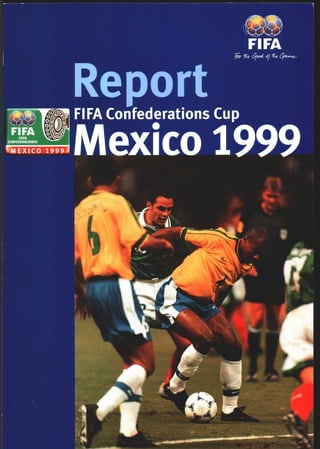
Report
FI FA
FIFA Confederations Cup
FIFACOPA
CONFEDERACIONES
M-1C 99.
MEXICO 99
Technical Report
FIFA Confederations Cup 1999
25 July- 4 August 1999
Rapport Technique
Coupe FIFA/Confédérations 1999
25 juillet - 4 août 1999
Informe Técn*ico
Copa FIFA/Confederaciones 1999
25 de julio - 4 de agosto de 1999
Technischer Bericht
FIFA/Konföderationen-Pokal 1999
25. Juli - 4.. August 1999
Fédération Internationale de Football Association
President Joseph S. Blatter (Switzerland)
General Secretary Michel Zen-Ruffinen (Switzerland)
Address FIFA House
Hitzigweg 11
P.O. Box 85
8030 Zurich
Switzerland
Telephone number 41-1/384 9595
Telefax Number 41-1/384 9696
Internet www.fifa.com
FIFA
Organizing Committee for the FIFA/Confederations Cup
and the Club World Championship
Chairman Al Dabal Abdullah K. (Saudi Arabia)
Deputy Chairman Omdal Per Ravn (Norway)
Members Teixeira Ricardo Terra (Brazil)
Dempsey Charles J. CBE (New Zealand)
Blazer Chuck (USA)
Bhamjee Ismail (Botswana)
Mariz Julio (Brazil 2000)
Mexico 99
Contents
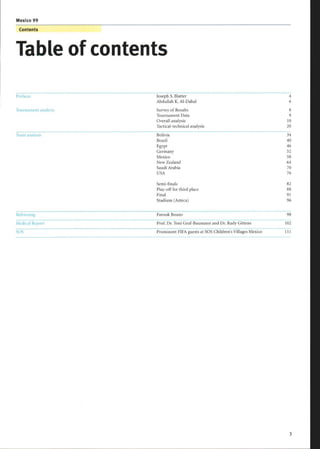
Table of contents
rreiace Joseph S. Blatter 4
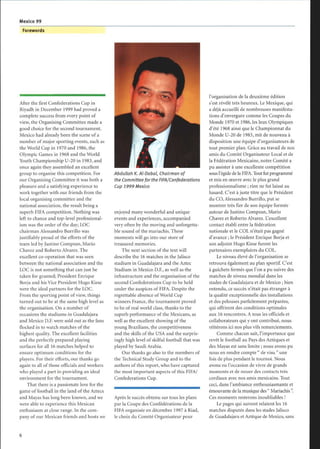
Abdullah K. Al-Dabal 6
Tournament analysis Survey of Results 8
Tournament Data 9
Overall analysis 10
Tactical-technical analysis 20
-
'yearn analysis
_
Bolivia 34
Brazil 40
Egypt 46
Germany 52
Mexico 58
New Zealand 64
Saudi Arabia 70
USA 76
Semi-finals 82
Play-off for third place 88
Final 91
Stadium (Azteca) 96
Refereeing Farouk Bouzo 98
Medical Report Prof. Dr. Toni Graf-Baumann and Dr. Rudy Gittens 102
SOS Prominent FIFA guests at SOS Children's Villages Mexico 111
Mexico 99
Preface
Although it is still a relatively young
inclusion in FIFAs range of international
competitions, the FIFA Confederations
Cup has already had at least its share of
media attention and controversy. That,
however, is not surprising when one
considers that this tournament involves
the best of each of the six continental
confederations of FIFA, ensuring not
only crowds and television audiences but
also excitement and football of the
highest quality.
While Germany, the European
Champions from 1996, had declined to
play in Saudi Arabia in December 1997,
they reversed this decision and were able
to represent Europe in Mexico, even
though without some of their first-choice
players. This time, the eight teams
unfortunately did not include France,
and the unforeseen absence of the new
World Champions sparked off a further
debate about the validity of the event and
its timing in the international calendar of
major events.
There is nobody more aware than I of
the need to find a solution to internatio-
nal fixture congestion, the consequences
of which were again seen in Mexico. But
in solving this congestion, we need to
remain aware too of the justification of
integrating this event into such a
calendar.
The matches in Mexico ended up
providing a wealth of entertaining
matches, with the Brazilians repeatedly
finding sparkling form but finally being
outwitted by the resilient and highly
motivated Mexicans, and even the less
glamorous teams like New Zealand, Saudi
Arabia and South Africa making their
vital contributions. Such a direct contrast
of footballing cultures made not only for
an interesting comparison of styles but
also for a fascinating and sometimes
unexpected reappraisal of the internatio-
nal football hierarchy.
Mexico took the Confederations Cup
to its heart with no less thoroughness
than it had done for two World Cups,
Joseph S. Blotter, FIFA President
revealing itself once again as a true
football country. That the Mexican team
then proceeded to win the Cup, and in
such fine style, was in itself a reward not
only for the efforts of the team under
inspirational coach Manuel Lapuente but
also for the entire country, for the
enthusiastic manner in which they
committed themselves to the success of
the event.
In introducing this report, I extend
my thanks to the Mexican hosts, but also
to the eight teams that followed FIFAs
call and took part in this important inter-
continental showdown. They have all
played their part in helping establish the
Confederations Cup as an important
integral element in the worldwide
football programme that we are trying so
hard to establish.
Bien qu'elle soit une innovation encore
relativement récente dans le programme
des compétitions internationales de la
FIFA, la Coupe des Confédérations de la
FIFA a déjà au moins attiré une bonne
partie de l'attention et des controverses
des médias. Ce n'est cependant guère
surprenant quand on considère que ce
tournoi réunit l'élite de chacune des six
confédérations continentales de la FIFA
et garantit de ce fait non seulement une
foule de spectateurs et de téléspectateurs,
mais suscite aussi à la fois la fascination
et un football du plus haut niveau.
Alors que l'Allemagne, championne
d'Europe 1996, avait refusé de jouer en
Arabie Saoudite en décembre 1997, elle se
ravisa cette fois et fut en mesure de
représenter l'Europe au Mexique, certes
sans quelques-uns de ses joueurs de tout
premier plan. Cette fois, ce fut la France
qui ne fut pas au nombre des huit
équipes, et l'absence imprévue des
nouveaux champions du monde
provoqua un nouveau débat sur le bien-
fondé de l'événement et son insertion
dans le calendrier international des
grandes manifestations .
Personne n'est plus conscient que moi
de la nécessité de trouver une solution à
la surabondance de manifestations
internationales, dont on a de nouveau pu
voir les conséquences au Mexique. Mais
pour résoudre ce problème, il convient
d'avoir aussi présent à l'esprit les bonnes
raisons d'intégrer cette manifestation
dans un tel calendrier.
Le tournoi disputé au Mexique a
finalement produit une foule de matchs
intéressants, où l'on vit les Brésiliens
afficher à plusieurs reprises une forme
éblouissante, mais qui furent finalement
pris en défaut par des Mexicains
accrocheurs et fortement motivés, et où
des équipes moins prestigieuses comme
la Nouvelle-Zélande, l'Arabie Saoudite et
l'Afrique du Sud ont su réaliser de
remarquables prestations. Un contraste
aussi direct des cultures footballistiques
ne rend pas seulement intéressante la
comparaison des styles, mais conduit
aussi a une réévaluation fascinante et
parfois inattendue de la hiérarchie
internationale du football.
Le Mexique, qui prit à cœur la Coupe
des Confédérations et l'organisa avec au
moins autant de sérieux qu'il l'avait fait
pour les deux Coupes du monde, se
révéla une fois de plus une véritable
grande nation footballistique. Qu'à partir
de là, la sélection mexicaine soit arrivée à
remporter la Coupe et ce avec autant de
panache constitue en soi une belle
récompense non seulement pour les
efforts de l'équipe entraînée par le très
Mexico 99
The President
inspiré Manuel Lapuente, mais aussi pour
la population toute entière, dont
l'enthousiasme contribua largement au
succès de la manifestation.
A l'occasion de ce rapport, j'adresse
mes remerciements non seulement à nos
hôtes mexicains, mais aussi aux huit
équipes qui ont répondu à l'appel de la
FIFA et participé à cette importante
compétition intercontinentale. Ils ont
tous joué leur rôle et contribué à établir
la Coupe des Confédérations comme
partie intégrante du programme du
football international que nous nous
efforçons d'installer.
Apesar de ser relativamente joven entre
las competiciones internacionales de la
FIFA, la Copa FIFA/Confederaciones ha
despertado ya el interés y desatado la
polémica en la prensa mundial. Esto no
es sorprendente si se considera que en el
torneo participan las mejores selecciones
de las seis confederaciones continentales
de la FIFA, lo cual es garantía no sólo de
una enorme multitud de espectadores y
una amplia audiencia televisiva, sino
también de un fútbol de la máxima
categoría. Alemania, campeón europeo de
1996, había rechazado participar en
Arabia Saudita en diciembre de 1997,
pero esta vez decidió representar a
Europa en México, aunque sin algunos de
sus mejores jugadores. Lamentablemente,
Francia no figuró entre los ocho equipos,
y esta ausencia imprevisible del nuevo
campeón mundial volvió a encender el
debate sobre la validez de este torneo y su
fecha en el calendario internacional de
grandes acontecimientos.
No creo que nadie esté tan convenci-
do como yo de la necesidad de hallar una
solución a esta congestión de fechas
internacionales, cuyas consecuencias se
pudieron observar nuevamente en
México. Pero en el momento de resolver
esta congestión, debemos considerar
asimismo la justificación de integrar este
acontecimiento en dicho calendario .
El torneo en México proporcionó una
gran abundancia de partidos rutilantes y
espectaculares, con un Brasil que volvió a
encontrar su brillante forma pese a ser
superado en la final por una fuerte y
potente escuadra mexicana altamente
motivada. Incluso equipos menos
atractivos como Nueva Zelanda, Arabia
Saudita o Bolivia contribuyeron enorme-
mente al éxito de esta competición. Tal
contraste de estilos y culturas futbolísti-
cas no sólo significó una comparación
interesante de esquemas, sino también
una fascinante y, a veces, inesperada
revaloración de la jerarquía futbolística
internacional.
México asumió con todo corazón la
organización de la Copa de Confedera-
ciones, aplicando la misma minuciosidad
demostrada en las dos Copas Mundiales
de la FIFA y corroboró una vez más ser
una verdadera nación futbolística . Que
México se alzara luego con el título, y de
manera tan convincente, fue una recom-
pensa tanto para el equipo dirigido por el
ingenioso técnico Lapuente, como para
todo el país por la manera entusiasta en
que se entregaron para conseguir que el
evento se convirtiera en un éxito rotundo.
Con estas líneas deseo agradecer
también a los anfitriones mexicanos y a
los ocho equipos que siguieron el
llamado de la FIFA y participaron en este
duelo intercontinental tan importante.
Todos ellos contribuyeron a establecer la
Copa Confederaciones como un impor-
tante elemento integrante del programa
mundial del fútbol que tratamos de
instituir con gran esfuerzo.
Obwohl der FIFA Konföderationen-
Pokal erst seit relativ kurzer Zeit zu den
offiziellen FIFA-Wettbewerben gehört,
hat er doch schon einige Beachtung in
den Medien erlangt und zu einigen
Kontroversen geführt. Das ist jedoch
nicht weiter verwunderlich, wenn man
bedenkt, dass an diesem Turnier die
besten Mannschaften der sechs FIFA-
Kontinentalmeisterschaften teilnehmen,
was Fussball auf höchster Ebene ver-
spricht und die Zuschauer in Massen in
die Stadien und vor den Fernseher lockt.
Während Deutschland, Europameister
1996, im Dezember 1997 noch darauf
verzichtet hatte, in Saudiarabien anzutre-
ten, war die deutsche Mannschaft nun
dieses Jahr bereit, Europa in Mexiko zu
vertreten, obwohl etliche seiner besten
Spieler nicht teilnahmen. Leider gehörte
Frankreich dieses Jahr nicht zu den acht
Teams; die unvorhergesehene Abwesen-
heit des neuen Weltmeisters hat der
Debatte um die Berechtigung des
Wettbewerbs und dessen Platz im
internationalen Spielkalender wieder
neue Nahrung gegeben.
Es gibt wohl kaum jemanden, dem
die Notwendigkeit einer Harmonisierung
des Spielkalenders bewusster ist als mir -
die Auswirkungen der eng gesteckten
Termine waren ja auch in Mexiko wieder
sichtbar -, aber wir dürfen trotz der
Häufung der Spiele nicht vergessen, dass
dieser Wettbewerb ein Anrecht auf einen
Platz im Kalender hat.
Die Spiele in Mexiko boten eine Fülle
an unterhaltsamen Matchs: Die Brasilia-
ner waren in glänzender Form, wurden
aber letztlich doch noch von den unver-
wüstlichen und hochmotivierten Mexika-
nern ausgetrickst, und sogar die weniger
glanzvollen Teams wie Neuseeland,
Saudiarabien und Südafrika leisteten
einen wichtigen Beitrag. Die direkte
Konfrontation der verschiedenen
Fussballkulturen führte nicht nur zu
interessanten Stilvergleichen, sondern
auch zu einer faszinierenden und
manchmal unerwarteten Neubewertung
der internationalen Fussballhierarchie .
Mexiko hinterlässt mit der sorgfälti-
gen Organisation des Konföderationen-
Pokals - die den zwei Weltpokalen in
nichts nachstand - einen exzellenten
Eindruck und hat einmal mehr bewiesen,
dass es eine echte Fussballnation ist. Dass
die mexikanische Mannschaft dann auch
noch den Pokal gewann, und das mit
unvergleichlichem Stil, war eine verdiente
Belohnung für die Anstrengungen des
Teams unter der inspirierenden Führung
des Trainers Manuel Lapuente einerseits
und andererseits für das ganze Land, das
sich mit viel Enthusiasmus für das
erfolgreiche Gelingen des Anlasses
eingesetzt hatte.
Ich möchte mich an dieser Stelle bei
den mexikanischen Gastgebern sowie den
acht Mannschaften, die dem Ruf der
FIFA gefolgt waren und an diesem
wichtigen interkontinentalen Showdown
teilnahmen, bedanken. Sie alle haben
dazu beigetragen, den Konföderationen-
Pokal zu einem wichtigen integralen
Bestandteil des weltweiten Fussball-
programms zu machen, um dessen
Etablierung wir uns so sehr bemühen.
i
-
UL,
Mexico 99
Forewords
After the first Confederations Cup in
Riyadh in December 1999 had proved a
complete success from every point of
view, the Organising Committee made a
good choice for the second tournament.
Mexico had already been the scene of a
number of major sporting events, such as
the World Cup in 1970 and 1986, the
Olympic Games in 1968 and the World
Youth Championship U-20 in 1983, and
once again they assembled an excellent
group to organise this competition. For
our Organising Committee it was both a
pleasure and a satisfying experience to
work together with our friends from the
local organising committee and the
national association, the result being a
superb FIFA competition. Nothing was
left to chance and top-level professional-
ism was the order of the day; LOC
chairman Alessandro Burrillo was
justifiably proud of the efforts of the
team led by Justino Compean, Mario
Chavez and Roberto Alvarez. The
excellent co-operation that was seen
between the national association and the
LOC is not something that can just be
taken for granted; President Enrique
Borja and his Vice President Hugo Kiese
were the ideal partners for the LOC.
From the sporting point of view, things
turned out to be at the same high level as
the organisation. On a number of
occasions the stadiums in Guadalajara
and Mexico D.F. were sold out as the fans
flocked in to watch matches of the
highest quality. The excellent facilities
and the perfectly prepared playing
surfaces for all 16 matches helped to
ensure optimum conditions for the
players. For their efforts, our thanks go
again to all of those officials and workers
who played a part in providing an ideal
environment for the tournament.
That there is a passionate love for the
game of football in the land of the Aztecs
and Mayas has long been known, and we
were able to experience this Mexican
enthusiasm at close range. In the com-
pany ofour Mexican friends and hosts we
Abdullah K. AI-Dabol, Chairman of
the Committee forthe FIFA/Confederations
Cup 1999 Mexico
enjoyed many wonderful and unique
events and experiences, accompanied
very often by the moving and unforgetta-
ble sound of the mariachis. These
moments will go into our store of
treasured memories.
The next section of the text will
describe the 16 matches in the Jalisco
stadium in Guadalajara and the Aztec
Stadium in Mexico D.F., as well as the
infrastructure and the organisation of the
second Confederations Cup to be held
under the auspices of FIFA. Despite the
regrettable absence of World Cup
winners France, the tournament proved
to be of real world class, thanks to the
superb performance of the Mexicans, as
well as the excellent showing of the
young Brazilians, the competitiveness
and the skills of the USA and the surpris-
ingly high level of skilful football that was
played by Saudi Arabia.
Our thanks go also to the members of
the Technical Study Group and to the
authors of this report, who have captured
the most important aspects of this FIFA/
Confederations Cup.
Après le succès obtenu sur tous les plans
par la Coupe des Confédérations de la
FIFA organisée en décembre 1997 à Riad,
le choix du Comité Organisateur pour
l'organisation de la deuxième édition
s'est révélé très heureux. Le Mexique, qui
a déjà accueilli de nombreuses manifesta-
tions d'envergure comme les Coupes du
Monde 1970 et 1986, les Jeux Olympiques
d'été 1968 ainsi que le Championnat du
Monde U-20 de 1983, mit de nouveau à
disposition une équipe d'organisateurs de
tout premier plan. Grâce au travail de nos
amis du Comité Organisateur Local et de
la Fédération Mexicaine, notre Comité a
pu assister à une excellente compétition
sous l'égide de la FIFA. Tout fut programmé
et mis en oeuvre avec le plus grand
professionnalisme ; rien ne fut laissé au
hasard. C'est à juste titre que le Président
du CO, Alessandro Burrillo, put se
montrer très fier de son équipe formée
autour de Justino Compean, Mario
Chavez et Roberto Alvarez. L'excellent
contact établi entre la fédération
nationale et le COL n'était pas gagné
d'avance ; le Président Enrique Borja et
son adjoint Hugo Kiese furent les
partenaires exemplaires du COL.
Le niveau élevé de l'organisation se
retrouva également au plan sportif. C'est
à guichets fermés que l'on a pu suivre des
matches de niveau mondial dans les
stades de Guadalajara et de Mexico ; bien
entendu, ce succès n'était pas étranger à
la qualité exceptionnelle des installations
et des pelouses parfaitement préparées,
qui offrirent des conditions optimales
aux 16 rencontres . A tous les officiels et
collaborateurs qui y ont contribué, nous
réitérons ici nos plus vifs remerciements.
Comme chacun sait, l'importance que
revêt le football au Pays des Aztèques et
des Mayas est sans limite ; nous avons pu
nous en rendre compte "de visu " une
fois de plus pendant le tournoi. Nous
avons eu l'occasion de vivre de grands
moments et de nouer des contacts très
cordiaux avec nos amis mexicains. Tout
ceci, dans l'ambiance enthousiasmante et
émouvante de la musique des " Mariachis ".
Ces moments resterons inoubliables !
Le pages qui suivent relatent les 16
matches disputés dans les stades Jalisco
de Guadalajara et Aztèque de Mexico, sans
Mexico 99
The Chairman
oublier l'infrastructure et l'organisation de
cette deuxième édition de la Coupe des
Confédérations qui se déroule sous l'égide
de la FIFA. Malgré l'absence regrettable du
champion du monde, la France, ce tournoi
atteignit un niveau comparable au Mondial
grâce à l'excellente sélection du Mexique, à
la jeune équipe brésilienne, à la combativité
et à la technicité des Américains ainsi qu'au
niveau de jeu élevé des étonnants Saoudiens.
Nos remerciements s'adressent
également à nos collègues du Groupe
d'Etude Technique ainsi qu'aux auteurs
de ce rapport qui ont su appréhender
avec une grande conscience
professionnelle les aspects essentiels de
cette Coupe des Confédérations.
Tras una competición muy exitosa en
diciembre de 1997 en Riad, la Comisión
Organizadora volvió a celebrar un
triunfo rotundo en el segundo torneo
oficial de la Copa FIFA/Confederaciones .
México, escenario de varios grandes
acontecimientos de la FIFA, como los dos
Mundiales de 1970 y 1986, los JJOO de
1968 y el Campeonato Mundial Juvenil
Sub-20 de 1983, ofreció nuevamente una
organización de la máxima categoría.
Para la Comisión Organizadora de la
FIFA fue un enorme placer y alegría
volver a trabajar junto a amigos nuevos y
conocidos del Comité Organizador Local
(COL) y de la Federación Mexicana de
Fútbol, siendo el resultado nuevamente
un magnífico torneo. Nada se libró al
azar, reinó un profesionalismo total y el
Presidente del COL, Alejandro Burrillo,
pudo estar totalmente orgulloso de su
equipo formado por Justino Compeán,
Mario Chávez y Roberto Álvarez. Igual-
mente, el contacto entre la Federación
Mexicana y el COL fue excelente; el
presidente Enrique Borja y el vicepresidente
Hugo Kiese fueron los colaboradores
ideales del COL.
La excelencia en el sector deportivo
fue similar a la del organizativo. En los
estadios de Guadalajara y México D.F.,
generalmente con un lleno completo, se
vieron partidos del mayor nivel inter-
nacional. A ello contribuyeron, sin duda
alguna, también las perfectas instalaciones
y la extraordinaria calidad de los terrenos
de juego, que ofrecieron óptimas condi-
ciones en los 16 encuentros. Extendemos
nuestro profundo agradecimiento a todos
aquellos funcionarios y trabajadores que
han contribuido a este gran éxito del
torneo.
Como se sabe, la pasión por el fútbol
no conoce límites en el país de los aztecas
y mayas, hecho que hemos podido
comprobar de nuevo directamente
durante el torneo. Hemos experimentado
hermosas vivencias y momentos sin igual
en el círculo de nuestros amigos
mexicanos y, como siempre, al son de las
inolvidables melodías de los mariachis.
¡No olvidaremos jamás esos momentos
tan especiales!
En las próximas páginas analizaremos
los 16 partidos en los estadios de jalisco
en Guadalajara y el Azteca en México
D.F., así como la infraestructura y
organización de este segundo torneo
oficial celebrado bajo los auspicios de la
FIFA. Pese a la lamentable ausencia del
campeón mundial Francia, la
competición ofreció presentaciones de
formato mundialista, gracias a la
magnífica actuación de la selección
mexicana, a la gran exhibición
futbolística de la joven escuadra
brasileña, a la garra de los briosos
norteamericanos y al buen fútbol de los
hábiles y sorprendentes saudís.
Asimismo hago extensivo mi
agradecimiento a los miembros del
Grupo de Estudio Técnico, así como a los
autores del presente Informe, por haber
sabido recopilar los aspectos más
importantes de esta competición con
todo profesionalismo y esmero.
Nachdem der erste Konföderationen-
Pokal im Dezember 1997 in Riad so
durchschlagenden Erfolg hatte, traf die
FIFA mit Mexiko als Ausrichter für das
zweite Turnier eine gute Wahl. Mexiko
war schon oft Austragungsstätte
verschiedener Sportanlässe, allen voran
der FIFA-Weltpokale 1970 und 1986,
der Olympischen Spiele 1968 und der
FIFA-Junioren-Weltmeisterschaft 1983.
Die Erfahrungen, die es bei diesen
Anlässen gesammelt hatte, kamen ihm
bei der Organisation des
Konföderationen-Pokals zugute. Die für
die FIFA-Organisationskommission
angenehme und fruchtbare
Zusammenarbeit mit alten und neuen
Freunden vom lokalen Organisations-
komitee und dem Nationalverband
brachte einen ausgezeichneten
Wettbewerb hervor.
Nichts wurde dem Zufall überlassen
und Professionalität auf höchster Ebene
prägte den Tagesablauf; LOK-Präsident
Alejandro Burrillo war zurecht stolz auf
sein Team, das von Justino Compean,
Mario Chavez und Roberto Alvarez
geleitet wurde. Die exzellente Zusammen-
arbeit zwischen dem mexikanischen
Fussballverband und dem LOK war nicht
selbstverständlich ; doch Präsident
Enrique Borja und sein Stellvertreter
Hugo Kiese waren die idealen Partner für
das LOK.
Auch in sportlicher Hinsicht erreichte
der Wettbewerb ein hohes Niveau. Die
Spieler traten in Guadalajara und Mexiko
City einige Male vor ausverkauften
Rängen auf, als die Fans in die Stadien
strömten, um Spiele der Luxusklasse zu
sehen. Die erstklassigen Einrichtungen
und die für alle Begegnungen einwandfrei
präparierten Spielfelder boten den
Spielern optimale Voraussetzungen.
Unser Dank gilt all den Offiziellen und
Helfern, die dem Turnier mit ihrem
unermüdlichen Einsatz ein ideales
Umfeld schufen.
Dass das Land der Azteken und
Mayas ein Land passionierter Fussball-
liebhaber ist, war schon lange bekannt,
und wir durften diesen mexikanischen
Enthusiasmus aus nächster Nähe
miterleben. In der Gesellschaft unserer
mexikanischen Freunde und Gastgeber
erlebten wir viele wunderbare und
einzigartige Momente - sehr oft begleitet
von der ergreifenden und unvergesslichen
Musik der Mariachis -, die uns immer in
Erinnerung bleiben werden.
Dieser Bericht analysiert die 16 Spiele
im Jalisco-Stadion in Guadalajara und im
Azteken-Stadion in Mexiko City sowie die
Infrastruktur und die Organisation des
zweiten Konföderationen-Pokals unter der
Ägide der FIFA. Trotz der bedauerlichen
Abwesenheit des Welt-meisters Frankreich
war das Turnier ein Anlass derWeltklasse,
nicht zuletzt dank der beeindruckenden
Vorstellung der Mexikaner, der
hervorragenden Leistung der jungen
Brasilianer, des Wettbewerbsgeists und der
Fähigkeiten der USA und des überraschend
hohen Spielniveaus von Saudiarabien.
Unser Dank geht auch an die
Mitglieder der Technischen Studiengruppe
und an die Verfasser dieses Berichts, die
die wichtigsten und interessantesten
Aspekte des Wettbewerbs auf Papier
festgehalten haben .
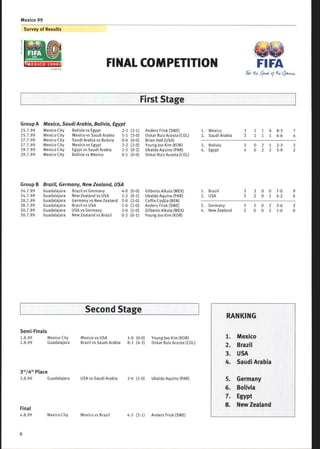
Survey of Results
FIfA
CONFEDE IONES
'M EXICO 1999
Fi rst Stage
Group A
25 .7.99 Mexico City
27.7.99 Mexico City
27.7.99 Mexico City
29.7.99 Mexico City
29.7.99 Mexico City
Group B
24 .7.99 Guadalajara
28.7.99 Guadalajara
28.7.99 Guadalajara
30.7.99 Guadalajara
30.7.99 Guadalajara
Semi-Finals
1.8.99
1.8.99
3rd/4th Place
Final
4.8.99
00
0
0
0
FI FI
Mexico, SaudiArabia, Bolivia, Egypt
Mexico City
Guadalajara
3.8.99 Guadalajara
Mexico City
Brazil, Germany, NewZealand, USA
Brazil vs Germany
New Zealand vs USA
Germany vs New Zealand
Brazil vs USA
USA vs Germany
New Zealand vs Brazil
USA vs Saudi Arabia
Mexico vs Brazil
FINAL COMPETITION
(2-1)
(3-0)(0-0)(2-0)(0-2)(0-0)
4-0 (0-0)
1-2 (0-1)
2-0 (2-0)
1-0 (1-0)
2-0 (1-0)
0-2 (0-1)
Anders Frisk (SWE)
Oskar Ruiz Acosta (COL)
Brian Hall (USA)
YoungJoo Kim (KOR)
UbaldoAquino(PAR)
Oskar Ruiz Acosta (COL)
Gilberto Alkala (MEX)
Ubaldo Aquino (PAR)
Coffie Codjia (BEN)
Anders Frisk (SWE)
Gilberto Alkala (MEX)
YoungJoo Kim (KOR)
Second Stage
Mexico vs USA 1-0 (0-0) YoungJoo Kim (KOR)
Brazil vs Saudi Arabia 8-2 (4-2) Oskar Ruiz Acosta (COL)
2-0 (1-0) Ubaldo Aquino (PAR)
4-3 (2-1) Anders Frisk (SWE)
1 . Brazil
2 . USA
FI FA
1 . Mexico 3 2 1 0 8-3 7
2 . Saudi Arabia 3 1 1 1 6-6 4
3 . Bolivia
4. Egypt
3 0 2 1 2-3 2
4 0 2 2 5-9 2
3 3 0 0 7-0 9
3 2 0 1 4-2 6
3. Germany 3 1 0 2 2-6 3
4. New Zealand 2 0 0 2 1-6 0
RANKING
1. Mexico
2. Brazil
3. USA
4. Saudi Arabia
5. Germany
6. Bolivia
7. Egypt
8. New Zealand
Bolivia vs Egypt 2-2
Mexico vs Saudi Arabia 5-1
Saudi Arabia vs Bolivia 0-0
Mexico vs Egypt 2-2
Egypt vs Saudi Arabia 1-5
Bolivia vs Mexico 0-1
Mexico 99
Tournament Analysis
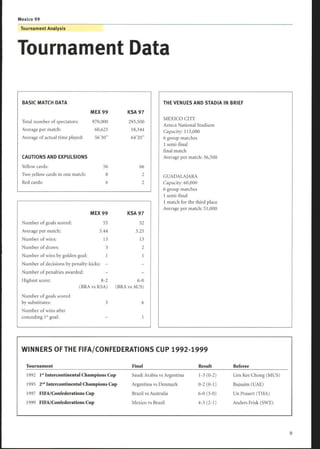
Tournament Data
MEX 99
Number of goals scored: 55
Average per match: 3 .44
Number of wins: 13
Number of draws: 3
Number of wins by golden goal: 1
Number of decisions by penalty-kicks:
Number of penalties awarded:
Number of goals scored
by substitutes: 3
Number of wins after
conceding 1st goal:
KSA 97
52
3.25
13
2
1
Highest score: 8-2 6-0
(BRA vs KSA) (BRA vs AUS)
6
WINNERS OF THE FIFA/CONFEDERATIONS CUP 1992-1999
BASIC MATCH DATA THE VENUES AND STADIA IN BRIEF
MEX 99 KSA 97
Total number of spectators: 970,000 293,500
MEXICO CITY
Azteca National Stadium
Average per match: 60,625 18,344 Capacity: 115,000
Average of actual time played: 56'30" 64'20" 6 group matches
1 semi-final
final match
CAUTIONS AND EXPULSIONS Average per match: 56,500
Yellow cards: 56 66
Two yellow cards in one match: 8 2 GUADALAJARA
Red cards: 6 2 Capacity: 60,000
6 group matches
1 semi-final
1 match for thr third place
Average per match: 51,000
Tournament Final Result Referee
1992 1st Intercontinental Champions Cup Saudi Arabia vs Argentina 1-3 (0-2) Lim Kee Chong (MUS)
1995 2a Intercontinental Champions Cup Argentina vs Denmark 0-2(0-1) Bujsaim (UAE)
1997 FIFA/Confederations Cup Brazil vs Australia 6-0(3-0) Un Prasert (THA)
1999 FIFA/Confederations Cup Mexico vs Brazil 4-3(2-1) Anders Frisk (SWE)
Mexico 99
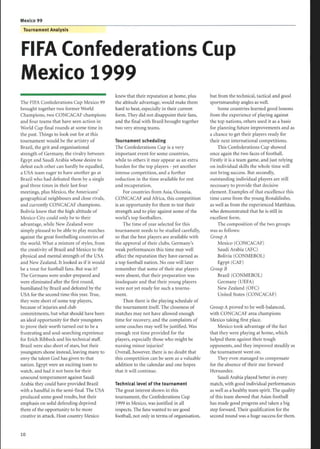
The FIFA Confederations Cup Mexico 99
brought together two former World
Champions, two CONCACAF champions
and four teams that have seen action in
World Cup final rounds at some time in
the past. Things to look out for at this
tournament would be the artistry of
Brazil, the grit and organisational
strength of Germany, the rivalry between
Egypt and Saudi Arabia whose desire to
defeat each other can hardly be equalled,
a USA team eager to have another go at
Brazil who had defeated them by a single
goal three times in their last four
meetings, plus Mexico, the Americans'
geographical neighbours and close rivals,
and currently CONCACAF champions .
Bolivia knew that the high altitude of
Mexico City could only be to their
advantage, while New Zealand were
simply pleased to be able to play matches
against the great footballing countries of
the world. What a mixture of styles, from
the creativity of Brazil and Mexico to the
physical and mental strength of the USA
and New Zealand. It looked as if it would
be a treat for football fans. But was it?
The Germans were under-prepared and
were eliminated after the first round,
humiliated by Brazil and defeated by the
USA for the second time this year. True,
they were short of some top players,
because ofinjuries and club
commitments, but what should have been
an ideal opportunity for their youngsters
to prove their worth turned out to be a
frustrating and soul-searching experience
for Erich Ribbeck and his technical staff.
Brazil were also short of stars, but their
youngsters shone instead, leaving many to
envy the talent God has given to that
nation. Egypt were an exciting team to
watch, and had it not been for their
unsound temperament against Saudi
Arabia they could have provided Brazil
with a handful in the semi-final. The USA
produced some good results, but their
emphasis on solid defending deprived
them of the opportunity to be more
creative in attack. Host country Mexico
FIFA Confederations Cup
Mexico 1999
10
Tournament Analysis
knew that their reputation at home, plus
the altitude advantage, would make them
hard to beat, especially in their current
form. They did not disappoint their fans,
and the final with Brazil brought together
two very strong teams.
Tournament scheduling
The Confederations Cup is a very
important event for some countries,
while to others it may appear as an extra
burden for the top players - yet another
intense competition, and a further
reduction in the time available for rest
and recuperation.
For countries from Asia, Oceania,
CONCACAF and Africa, this competition
is an opportunity for them to test their
strength and to play against some of the
world's top footballers .
The time ofyear selected for this
tournament needs to be studied carefully,
so that the best players are available with
the approval of their clubs. Germany's
weak performances this time may well
affect the reputation they have earned as
a top football nation. No one will later
remember that some of their star players
were absent, that their preparation was
inadequate and that their young players
were not yet ready for such a tourna-
ment.
Then there is the playing schedule of
the tournament itself. The closeness of
matches may not have allowed enough
time for recovery, and the complaints of
some coaches may well be justified. Was
enough rest time provided for the
players, especially those who might be
nursing minor injuries?
Overall, however, there is no doubt that
this competition can be seen as a valuable
addition to the calendar and one hopes
that it will continue.
Technical level of the tournament
The great interest shown in this
tournament, the Confederations Cup
1999 in Mexico, was justified in all
respects . The fans wanted to see good
football, not only in terms oforganisation,
but from the technical, tactical and good
sportsmanship angles as well.
Some countries learned good lessons
from the experience of playing against
the top nations, others used it as a basis
for planning future improvements and as
a chance to get their players ready for
their next international competitions.
This Confederations Cup showed
once again the two faces of football.
Firstly it is a team game, and just relying
on individual skills the whole time will
not bring success. But secondly,
outstanding individual players are still
necessary to provide that decisive
element. Examples of that excellence this
time came from the young Ronaldinho,
as well as from the experienced Matthäus,
who demonstrated that he is still in
excellent form.
The composition of the two groups
was as follows:
Group A
Mexico (CONCACAF)
Saudi Arabia (AFC)
Bolivia (CONMEBOL)
Egypt (CAF)
Group B
Brazil (CONMEBOL)
Germany (UEFA)
New Zealand (OFC)
United States (CONCACAF)
Group A proved to be well-balanced,
with CONCACAF area champions
Mexico taking first place.
Mexico took advantage of the fact
that they were playing at home, which
helped them against their tough
opponents, and they improved steadily as
the tournament went on.
They even managed to compensate
for the absence of their star forward
Hernandez .
Saudi Arabia played better in every
match, with good individual performances
as well as a healthy team spirit. The quality
of this team showed that Asian football
has made good progress and taken a big
step forward. Their qualification for the
second round was a huge success for them.
Egypt played with style, yet failed to
qualify for the next round; in the decisive
third group game they were clearly
outplayed by Saudi Arabia.
Bolivia brought along a powerful
squad and gave a balanced performance
in all three group games; with a little
more luck they would have been able to
qualify for the second round.
In Group B, Brazil, the world's
number one team in the FIFA rankings,
came with a partly new squad - young
talent lining up alongside experienced
players to provide the usual skilful blend.
They included a number of their
European players, and they showed
clearly that they knew all about the
limelight of big tournaments.
The USA demonstrated very good
teamwork and playing style, looking
promising for the future. Their
qualification for the second round was
thoroughly well deserved.
Germany did not bring along their
best squad, with players like Bierhoff,
Effenberg, Jeremies, Kirsten and Möller
missing. Some younger players were
given their places in the hope that they
would develop for the future, but the
plan did not always work. Developments
of this kind necessarily take time. With
the players available for selection,
Germany soon ran out of steam and early
elimination was the logical outcome.
New Zealand represented Oceania
and wanted to improve their technique
through high-level competition. The
team showed that they are keen and
determined to raise the standard of their
performances at international level.
The opportunity provided by this inter-
continental competition was appreciated
by the coaches; it gave them and the
players a chance to compare their
strengths with the best in the world and
to check their development.
FIFA
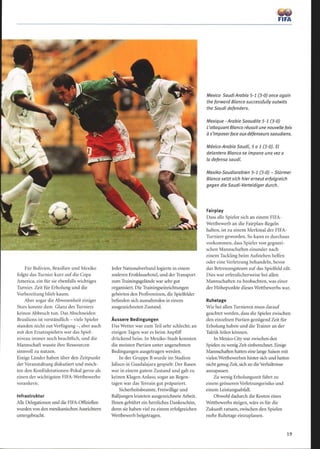
Opening match in Mexico D.F. between
Mexico and Saudi Arabia 5-1 (3-0).
Demonstrating technical perfection,
Francisco Palencia gives Al-Harbi Ibrahim
no chance to intervene.
Match d'ouverture entre le Mexique et
l'Arabie Saoudite 5-1 (3-0). La technique
parfaite de Francisco Palencia ne laisse
aucune chance d'intervention à AI-Harbi
Ibrahim.
Partido inaugural en la Ciudad de México
entre la selección mexicana y Arabia
Saudí, que finalizó con el resultado de
5-1 (3-0). Francisco Palencia, excelente
técnicamente, no deja intervenir a AI-
Harbi Ibrahim.
Eröffnungsspiel in Mexiko D.F. zwischen
Mexiko und Soudiarabien 5-1 (3-0).
Francisco Palencia, technisch perfekt,
lässtAI-Harbi Ibrahim keine Chance zur
Intervention .
Participation of players
A positive aspect of the tournament was
that all the teams, except Brazil and
Germany, came with their best players.
The competition needs to be scheduled at
a better time in the calendar so that
every team can bring a full squad and
have sufficient time to prepare.
For Bolivia, Brazil and Mexico this
tournament came close on the heels of
the Copa America, which is also an
important one for them. There was not a
lot of time for recovery and getting the
team ready again.
But even the absence of some of the
stars did not take the shine off the
competition. Brazil's position can be
justified - a lot of players were not
available - but even with replacements
their standard of play was still high and
they used their resources well.
A number of countries have entered into
the discussion about the timing ofthis
event and would like to see the
Confederations Cup established as one of
the most important FIFA competitions .
Facilities
All the arriving delegations and FIFA
officials were well accommodated by the
Mexican organisers.
Each national association was in a different
top class hotel, and transportation to the
training grounds was very well organised.
The training facilities used were those of
the professional clubs, and all the pitches
were in excellent condition.
Environmental Conditions
The weather was sometimes extremely
hot and on a number of days really
oppressive, but in Mexico City most of
the games were played under suitable
conditions.
For group B, in Guadalajara, the
Jalisco stadium was a good location for
the matches. The quality of the surface
gave no cause for complaint; it was good
and well prepared even on the rainy days.
The assistance provided by security
officials, volunteers and ball-boys was
excellent, and thanks is due to them for
contributing towards the success of the
competition.
Fair Play
It has become a hallmark of FIFA
competitions that all participants
demonstrate the spirit of fair play. It is
no longer unusual to see players from
opposing teams helping each other off
the ground after a tackle, or attending to
an injury even before the first-aid team
come on to the pitch. This positive
behaviour was seen from all teams and
was one of the highlights of the
competition.
Rest days
As in all tournaments, care has to be
taken to allow enough time between
matches for players to recover and for
coaches to make improvements in their
team tactics.
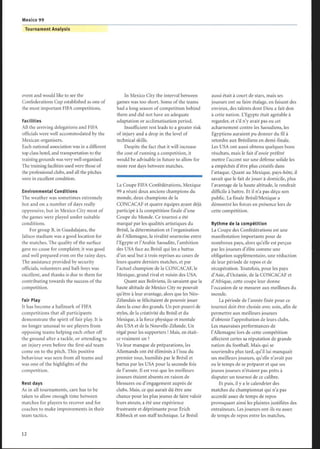
Tournament Analysis
In Mexico City the interval between
games was too short. Some of the teams
had a long season of competition behind
them and did not have an adequate
adaptation or acclimatisation period.
Insufficient rest leads to a greater risk
of injury and a drop in the level of
technical skills.
Despite the fact that it will increase
the cost of running a competition, it
would be advisable in future to allow for
more rest days between matches.
La Coupe FIFA Confédérations, Mexique
99 a réuni deux anciens champions du
monde, deux champions de la
CONCACAF et quatre équipes ayant déjà
participé à la compétition finale d'une
Coupe du Monde. Ce tournoi a été
marqué par les qualités artistiques du
Brésil, la détermination et l'organisation
de l'Allemagne, la rivalité sournoise entre
l'Egypte et l'Arabie Saoudite, l'ambition
des USA face au Brésil qui les a battus
d'un seul but à trois reprises au cours de
leurs quatre derniers matches, et par
l'actuel champion de la CONCACAF, le
Mexique, grand rival et voisin des USA.
Quant aux Boliviens, ils savaient que la
haute altitude de Mexico City ne pouvait
qu'être à leur avantage, alors que les Néo-
Zélandais se félicitaient de pouvoir jouer
dans la cour des grands. Un pot-pourri de
styles, de la créativité du Brésil et du
Mexique, à la force physique et mentale
des USA et de la Nouvelle-Zélande. Un
régal pour les supporters ! Mais, en était-
ce vraiment un ?
Vu leur manque de préparations, les
Allemands ont été éliminés à l'issu du
premier tour, humiliés par le Brésil et
battus par les USA pour la seconde fois
de l'année. Il est vrai que les meilleurs
joueurs étaient absents en raison de
blessures ou d'engagement auprès de
clubs. Mais, ce qui aurait dû être une
chance pour les plus jeunes de faire valoir
leurs atouts, a été une expérience
frustrante et déprimante pour Erich
Ribbeck et son staff technique. Le Brésil
aussi était à court de stars, mais ses
joueurs ont su faire étalage, en faisant des
envieux, des talents dont Dieu a fait don
à cette nation. L'Egypte était agréable à
regarder, et s'il n'y avait pas eu cet
acharnement contre les Saoudiens, les
Egyptiens auraient pu donner du fil à
retordre aux Brésiliens en demi-finale.
Les USA ont aussi obtenu quelques bons
résultats, mais le fait d'avoir préféré
mettre l'accent sur une défense solide les
a empêchés d'être plus créatifs dans
l'attaque. Quant au Mexique, pays-hôte, il
savait que le fait de jouer à domicile, plus
l'avantage de la haute altitude, le rendrait
difficile à battre. Et il n'a pas déçu son
public. La finale Brésil/Mexique a
démontré les forces en présence lors de
cette compétition.
Rythme de la compétition
La Coupe des Confédérations est une
manifestation importante pour de
nombreux pays, alors qu'elle est perçue
par les joueurs d'élite comme une
obligation supplémentaire, une réduction
de leur période de repos et de
récupération . Toutefois, pour les pays
d'Asie, d'Océanie, de la CONCACAF et
d'Afrique, cette coupe leur donne
l'occasion de se mesurer aux meilleurs du
monde.
La période de l'année fixée pour ce
tournoi doit être choisie avec soin, afin de
permettre aux meilleurs joueurs
d'obtenir l'approbation de leurs clubs.
Les mauvaises performances de
l'Allemagne lors de cette compétition
affectent certes sa réputation de grande
nation du football. Mais qui se
souviendra plus tard, qu'il lui manquait
ses meilleurs joueurs, qu'elle n'avait pas
eu le temps de se préparer et que ses
jeunes joueurs n'étaient pas prêts à
disputer un tournoi de ce calibre.
Et puis, il y a le calendrier des
matches du championnat qui n'a pas
accordé assez de temps de repos
provoquant ainsi les plaintes justifiées des
entraîneurs. Les joueurs ont-ils eu assez
de temps de repos entre les matches,
Mexico 99
notamment ceux souffrant de blessures ?
Cependant, dans l'ensemble, cette
compétition mérite d'être ajoutée au
calendrier international.
Niveau technique du tournoi
Le grand intérêt témoigné à la Coupe
FIFA Confédérations, Mexique 99, était
justifié à tout niveau. Les supporters ont
voulu voir un bon football et applaudir
leur sélection respective, non seulement
sur le plan de l'organisation, mais surtout
pour leurs performances techniques et
tactiques, et pour leur sportivité.
Certains pays ont fait de bonnes
expériences en se mesurant aux meilleurs,
d'autres s'en sont servi pour améliorer
leurs performances et pour préparer leurs
joueurs aux prochaines compétitions
internationales.
La Coupe FIFA Confédérations a une
fois de plus montré deux facettes du
football. D'une part, qu'il s'agit d'un
sport d'équipe, et que seul le jeu
individuel ne mène pas au succès. D'autre
part, que les talents individuels sont
nécessaires pour accéder au succès. C'est
ce qu'ont démontré le jeune Ronaldinho
et un Matthäus en pleine forme.
Composition des deux groupes:
Groupe A
Mexique (CONCACAF)
Arabie Saoudite (AFC)
Bolivie (CONMEBOL)
Egypte (CAF)
Groupe B
Brésil (CONMEBOL)
Allemagne (UEFA)
Nouvelle-Zélande (OFC)
Etats-Unis (CONCACAF)
La combativité du groupe Aétait
intéressante avec, de surcroît, la victoire
du pays-hôte, le Mexique.
Le Mexique a eu la chance, en
affrontant les meilleures équipes à
domicile, d'améliorer ses performances et
de se perfectionner tout au long du
tournoi. Il lui manquait toutefois la
présence de leur excellent attaquant Luis
Hernandez.
Quant à l'Arabie Saoudite, elle s'est
améliorée au fil des matches en dévoilant
de bons talents individuels de même
qu'un excellent travail d'équipe. Les
performances de cette équipe ont
démontré les énormes progrès du
football asiatique. La qualification au
deuxième tour a été un immense succès
pour cette sélection.
Bien qu'elle ait joué avec beaucoup de
style, l'équipe égyptienne n'a en aucun
moment eu l'occasion de se qualifier
pour le second tour.
Lors du troisième match de groupe,
elle s'est fait balayer par l'Arabie Saoudite.
La Bolivie, représentée par une
équipe puissante, a réalisé des
performances moyennes dans les trois
matches de groupe. Avec un petit plus de
chance, elle aurait pu se qualifier pour le
second tour.
Dans le groupe B, le Brésil, l'équipe
no 1 du classement mondial de la FIFA,
est apparu avec une équipe en partie
nouvelle qui comprenait aussi bien des
jeunes talents que des joueurs
expérimentés et quelques joueurs
évoluant de l'autre côté de l'océan. Ils ont
comme d'habitude brillés jusqu'à la
finale.
Les USA ont fait un excellent travail
de groupe avec beaucoup de style. Une
équipe prometteuse qui a bien mérité sa
qualification au second tour.
L'Allemagne n'avait pas emmené sa
meilleure sélection. Bierhoff, Effenberg,
Jeremies, Kirsten et Möller étaient
absents. Ils avaient été remplacés par de
plus jeunes joueurs, pour leur donner
ainsi l'occasion de se perfectionner. Mais
c'était un plan plutôt hasardeux que de
leur demander d'assumer les rôles des
absents. Pour cela, il aurait fallu plus de
temps. Cette sélection n'était pas à la
hauteur, en conséquence, elle a très vite
été éliminée.
L'Océanie était représentée par la
Nouvelle-Zélande qui entendait
améliorer sa technique grâce au niveau
élevé de la compétition. Cette équipe a
prouvé qu'elle était déterminée à élever
~W
FIFA
ses performances au niveau international.
Ce sont surtout les entraîneurs qui ont
apprécié le caractère intercontinental
de cette compétition : Cela leur a
donné, ainsi qu'aux joueurs, l'occasion
de se mesurer aux grands de ce monde
et d'évaluer leur développement.
Participation des joueurs
Uaspect positif de cette compétition était
que, à l'exception du Brésil et de
l'Allemagne, tous les participants sont
venus avec leurs meilleurs joueurs. Il ne
reste plus qu'à mieux inclure ce tournoi
dans le calendrier international, afin de
permettre aux finalistes d'y amener leurs
meilleures sélections et d'avoir le temps
de se préparer.
En ce qui concerne la Bolivie, le Brésil
et le Mexique, ce tournoi venait
directement après la Copa América qui a
beaucoup d'importance pour eux. Ils
n'ont pas eu beaucoup de temps pour
récupérer et préparer à nouveau leurs
sélections.
Toutefois, malgré l'absence de
quelques stars, la compétition n'a en
rien perdu de sa valeur. La position du
Brésil est honorable, car même sans ses
joueurs-clés, il a su maintenir un
niveau de jeu élevé et exploiter au
mieux ses ressources.
De nombreux pays se sont penchés sur
la question du rythme de la compétition,
et aimeraient voir la Coupe FIFA/
Confédérations s'établir en tant que l'une
des compétitions les plus importantes de
la FIFA.
Infrastructure
Les organisateurs mexicains ont fourni à
toutes les délégations et à tous les officiels
de la FIFA un bon standard d'héberge-
ment.
Chaque association nationale a séjourné
dans un hôtel haut de gamme, et le
transport vers les terrains d'entraînement
était très bien organisé. Les terrains
choisis pour l'entraînement étaient ceux
des clubs professionnels et ils étaient tous
en parfait état.
Mexico 99
Tournament Analysis
Conditions
Les conditions météorologiques n'étaient
pas des meilleures : Il a fait extrêmement
chaud certains jours aux heures des
coups d'envoi. Toutefois, à Mexico City, la
plupart des matches ont été disputés dans
de bonnes conditions.
A Guadalajara, le groupe B a évolué
au stade Jalisco. Les joueurs n'ont pas eu
à se plaindre de la qualité du gazon très
bien entretenu, même les jours de pluie.
L'assistance des forces de l'ordre, des
volontaires et des ramasseurs de ballon
était inestimable et a certainement
contribué au succès de la compétition.
Fair-play
Il est désormais de coutume lors des
compétitions de la FIFA que tous les
participants s'engagent à respecter la
notion de fair-play. Il n'est donc plus rare
de voir les joueurs de deux équipes en lice
s'entraider après un tacle ou venir en aide
avant même l'arrivée des premiers soins.
Ce comportement positif a été observé
chez toutes les équipes, et a été un des
moments forts de la compétition.
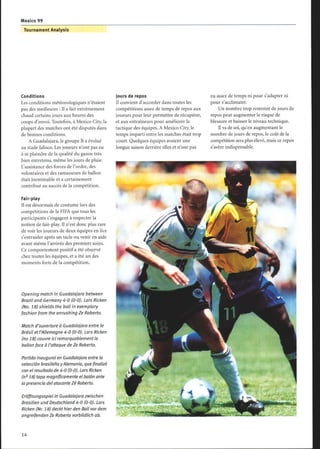
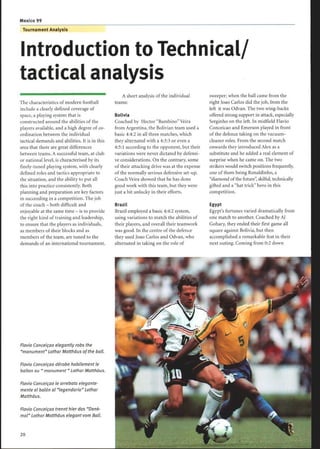
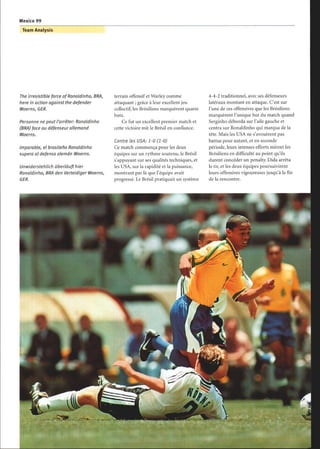
Opening match in Guadalajara between
Brazil and Germany 4-0 (0-0). Lars Ricken
(No. 18) shields the ball in exemplary
fashion from the onrushing Ze Roberto.
Match d'ouverture à Guadalajara entre le
Brésil et l'Allemagne 4-0 (0-0). Lors Ricken
(no 18) couvre ici remarquablement le
ballon face à l'attaque de Ze Roberto.
Partido inaugural en Guadalajara entre la
selección brasileña y Alemania, que finalizó
con el resultado de 4-0 (0-0). Lars Ricken
(n° 18) tapa magníficamente el balón ante
la presencia del atacante Zé Roberto.
Eröffnungsspiel in Guadalajara zwischen
Brasilien und Deutschland 4-0 (0-0). Lars
Ricken (Nr. 18) deckt hier den Ball vordem
angreifenden Ze Roberto vorbildlich ab.
Jours de repos
Il convient d'accorder dans toutes les
compétitions assez de temps de repos aux
joueurs pour leur permettre de récupérer,
et aux entraîneurs pour améliorer la
tactique des équipes. AMexico City, le
temps imparti entre les matches était trop
court. Quelques équipes avaient une
longue saison derrière elles et n'ont pas
eu assez de temps ni pour s'adapter ni
pour s'acclimater.
Un nombre trop restreint de jours de
repos peut augmenter le risque de
blessure et baisser le niveau technique.
Il va de soi, qu'en augmentant le
nombre de jours de repos, le coût de la
compétition sera plus élevé, mais ce repos
s'avère indispensable.
En la Copa FIFA/Confederaciones México
1999 se enfrentaron dos antiguos
campeones mundiales, dos campeones de
la CONCACAF y cuatro equipos que
habían participado en el pasado en las
competiciones forales de la Copa
Mundial. Los puntos de mayor interés en
vísperas de este campeonato eran las
cualidades artísticas de Brasil, la garra y
potencia organizatoria de Alemania, la
rivalidad entre Egipto y Arabia Saudita,
cuyo deseo de derrotar al otro es
inigualable, la ambición de la selección de
EEUU de batir finalmente a Brasil, el cual
la derrotó por un único gol tres veces en
los últimos cuatro choques, y la actuación
de México, vecino geográfico y eterno
rival de Norteamérica, así como actual
campeón de la CONCACAE. Bolivia sabía
que la altura de Ciudad de México
representaría una ventaja para su equipo,
mientras que Nueva Zelanda estaba
satisfecha de poder enfrentarse a países
futbolísticos de gran calibre mundial.
Una magnífica mezcla de estilos, desde la
creatividad de los brasileños y mexicanos
hasta la potencia física y mental de
norteamericanos y neozelandeses: todo
parecía ser un verdadero manjar para los
hinchas de fútbol, ¿pero lo fue realmente?
Los alemanes no estaban bien preparados
y fueron eliminados en la primera vuelta,
tras haber sido humillados por Brasil y
derrotados, por segunda vez en 1999, por
EEUU. Debemos reconocer que carecieron
de sus mejores jugadores debido a lesiones
y compromisos con sus clubes. No
obstante, lo que debía ser una oportunidad
ideal para los juveniles de exhibir su
categoría, se transformó en una experiencia
frustrante para el entrenador Erich
Ribbeck y su cuadro técnico. Brasil estuvo
igualmente corto de astros, pero sus
juveniles brillaron, haciendo que muchos
envidiaran el talento que Dios otorgó a
esta nación. Egipto fue una escuadra muy
interesante de observar y, si no hubiese
sido por su incontrolable temperamento
contra Arabia Saudita, habría quizás
causado problemas a los brasileños en la
semifinal. EEUU registró algunos buenos
resultados, pero su énfasis en una sólida
y firme defensa lo privó de la
oportunidad de mostrar más creatividad
en el ataque . El dueño de casa México
sabía que su potencia en suelo local,
además de la ventaja de la altitud, haría
que fuera una selección difícil de
derrotar, particularmente por la forma
en la que se encontraba en esos
momentos. No decepcionó a sus hinchas
y la final fue disputada por las dos
escuadras más poderosas.
Planificación del calendario del torneo
La Copa de Confederaciones es un
acontecimiento muy importante para
algunos países, mientras que para otros es
más bien una carga adicional, una
competición intensiva más y una
reducción adicional en el tiempo a
disposición para reponerse y recuperarse.
Para los países de Asia, Oceanía,
CONCACAF y Africa, este torneo es una
buena oportunidad para poner a prueba
su potencia yjugar contra los mejores
futbolistas del mundo. Sea como fuere la
fecha de la competición deberá escogerse
con mayor minuciosidad en el futuro. La
débil actuación de Alemania habrá
afectado seguramente su reputación de
gran nación futbolística . Pasado el
tiempo, nadie recordará que algunos de
sus astros estuvieron ausentes, que su
preparación fue inadecuada y que sus
juveniles no estaban aún a la altura de un
torneo de tal envergadura.
Existió asimismo el problema de la
programación de los partidos en el
torneo mismo. La proximidad de los
encuentros no permitió suficiente tiempo
de recuperación y las quejas de algunos
entrenadores resultan justificadas. ¿Hubo
suficiente tiempo de recuperación para
los jugadores, particularmente para
aquéllos con lesiones leves?
No obstante, en términos generales, la
competición puede considerarse, sin duda
alguna, como una valioso aditamento al
calendario futbolístico general y esperamos
que se siga disputando en el futuro.
FIFA
Nivel técnico del torneo
El gran interés demostrado por la Copa
de Confederaciones México 1999 fue
justificado en todo sentido. Los hinchas
querían ver buen fútbol por parte de sus
selecciones, no sólo desde el punto de
vista de organización, sino también
técnico, táctico y de deportividad .
Algunos países pudieron acumular
experiencia al enfrentarse a las naciones
renombradas, otros utilizaron los
encuentros como base de futuras mejoras
y oportunidad para preparar a sus
jugadores para su próxima competición
internacional.
Este campeonato volvió a mostrar las
dos caras del fútbol. Primero, que es un
juego de equipo y que confiar sólo en la
habilidad individual de algunos jugadores
no conduce al éxito. Segundo, los
individualistas destacados siguen siendo
necesarios para proporcionar ese algo
decisivo. Como ejemplo de este segundo
aspecto cabe señalar al joven Ronaldinho
o al veterano Mattháus, quien se halló en
una forma formidable.
Los dos grupos estuvieron
conformados de la siguiente manera:
Grupo A
México (CONCACAF)
Arabia Saudita (AFC)
Bolivia (CONMEBOL)
Egipto (CAF)
Grupo B
Brasil (CONMEBOL)
Alemania (UEFA)
Nueva Zelanda (OFC)
Estados Unidos (CONCACAF)
El grupo A fue un grupo muy reñido, en
el cual el campeón de la CONCACAF
México obtuvo la primera plaza, sacando
claro beneficio de su ventaja local. La
escuadra mexicana fue mejorando
progresivamente, aunque sintió
claramente la ausencia de Hernández, su
ariete goleador.
Arabia Saudita fue mejorando de
partido en partido, haciendo gala de
mucha calidad individual y capacidad de
juego colectivo. Su actuación fue un claro
15
Tournament Analysis
reflejo del progreso que viene viviendo el
fútbol asiático y el pase a la segunda ronda
fue un enorme éxito para el equipo.
Egipto jugó bien, pero no consiguió
pasar a la segunda fase. Fue netamente
inferior a Arabia Saudita en el tercer
partido del grupo.
Bolivia se presentó con un cuadro
muy luchador y disputó tres encuentros
muy equilibrados. Con un poco más de
fortuna hubiera conseguido pasar a la
segunda vuelta.
En el grupo B, Brasil- el equipo número
uno del mundo según la Clasificación
Mundial de la FIFA- se presentó con una
escuadra sumamente nueva, alineando
jóvenes talentos junto a jugadores
experimentados para proporcionar el
habitual fútbol espectacular yatrayente.
Destacaron todos, incluso los legionarios
radicados en Europa.
EEUU exhibió un magnífico juego
colectivo, muy prometedor para el futuro,
y mereció pasar a la segunda ronda.
Alemania no acudió con su mejor
escuadra, faltando jugadores como
Bierhoff, Effenberg, Jeremies, Kirsten y
Móller, quienes fueron sustituidos por
algunos juveniles deseosos de demostrar
su habilidad y capacidad para ser titulares.
Sin embargo, no consiguieron este
objetivo, ya que un desarrollo tal requiere
más tiempo. Con este plantel reducido,
Alemania no tuvo impacto y se despidió
del torneo tras la primera vuelta.
Nueva Zelanda, que representaba a
Oceanía, fue a México con la intención
de mejorar su técnica mediante una
competición de alta categoría y demostró
que es capaz de competir en el ámbito
internacional.
Todos los entrenadores estuvieron
satisfechos con la posibilidad que les
brindó el torneo: tanto ellos como sus
jugadores pudieron medir fuerzas con los
mejores del mundo y comparar el nivel
de sus respectivos progresos.
Participación de jugadores
Un aspecto positivo del torneo fue que
todos los equipos, excepto Brasil y
Alemania, arribaron con sus mejores
valores. En el futuro, la competición
deberá jugarse en una fecha más
favorable para que todos los países
puedan presentar sus equipos de gala y
tengan más tiempo de preparación. Para
Bolivia, Brasil y México, esta competición
vino pisándole los talones a la Copa
América, un torneo muy importante para
ellos. No hubo mucho tiempo de
recuperación a disposición, ni grandes
posibilidades de modificar los equipos.
Pero pese a la ausencia de algunos
grandes astros, la competición no perdió
brillo. Por ejemplo, Brasil, que tuvo que
prescindir de varias estrellas, exhibió una
magnífica actuación con sus suplentes y
utilizó óptimamente su cantera de talentos.
Varios países tomaron parte en las conver-
saciones relacionadas con la programación
de este evento y todos desean ver la Copa
de Confederaciones como otro torneo fijo
en el calendario de la FIFA.
Infraestructura
Los organizadores mexicanos ofrecieron
magníficas posibilidades de hospedaje a
todas las delegaciones y representantes de
la FIFA. Cada asociación nacional se alojó
- separada de los demás - en un hotel de
primera clase, y el transporte a los campos
de entrenamiento estuvo perfectamente
organizado. Las instalaciones de
entrenamiento utilizadas pertenecían a
clubes profesionales y todos los campos se
encontraban en excelentes condiciones.
Condiciones climáticas
Las condiciones meteorológicas eran a
veces desastrosas, con algunos días de
extremo calor. No obstante, la mayor parte
de los partidos en la Ciudad de México se
disputó bajo condiciones aceptables. En el
grupo B, en Guadalajara, el estadio de
jalisco ofreció buenas condiciones para los
encuentros. La calidad de la superficie de
juego no dio lugar a objeciones y fue
adecuada incluso los días de lluvia.
La asistencia ofrecida por
funcionarios de seguridad, voluntarios y
niños recogebalones fue excelente,
mereciendo un agradecimiento especial
por haber contribuido al rotundo éxito
de la competición.
Fair Play
Se ha convertido en un sello de calidad de
las competiciones de la FIFA que todos
los participantes demuestran espíritu de
deportividad en estos torneos. Ya no es
inhabitual ver a jugadores de equipos
adversarios ayudar a levantarse después
de una carga o asistirse en caso de una
lesión antes de que los médicos entren a
la cancha. Todos los equipos
evidenciaron un tal comportamiento
deportivo, siendo éste uno de los puntos
más positivos de la competición.
Días de descanso
Al igual que en todos los torneos, se trató
de conceder suficiente tiempo entre los
partidos para que los jugadores pudieran
recuperarse y los entrenadores pudiesen
efectuar mejoras tácticas en sus equipos.
En el grupo Aen Ciudad de México,
el intervalo entre los encuentros fue muy
Mexico 99
corto. Algunos equipos venían cargados
ya de una larga temporada de competiciones
y no dispusieron del período de adaptación
y aclimatización adecuado.
Un descanso insuficiente conduce a
mayores riesgos de lesión y a un bajón en
el nivel de la habilidad técnica.
Se recomienda que, en el futuro, se
concedan más días de descanso entre los
partidos, pese a que ello aumente los
costos de la competición.
Das Teilnehmerfeld am FIFA/Konfödera-
tionen-Pokal Mexiko 99 umfasste zwei
ehemalige Weltmeister, zwei
CONCACAF-Meister und vier Mann-
schaften, die bereits einmal an einer WM-
Endrunde teilgenommen haben. Beson-
deres Augenmerk wurde auf folgende
Aspekte gelegt: die Ballvirtuosität der
Brasilianer, den Mut und die gute
Organisation der Deutschen, und die
Rivalität zwischen Ägypten und Saudi-
arabien - der gegenseitige Wunsch,
einander in die Knie zu zwingen, könnte
grösser nicht sein. Dann auf die amerika-
nische Mannschaft, die allzu gerne noch
einmal gegen Brasilien antreten wollte,
gegen die sie in den letzten drei der vier
Partien jeweils mit nur einem Tor
Unterschied verloren hatte, und Mexiko,
Nachbar und Erzrivale der Amerikaner
sowie CONCACAF-Meister. Bolivien
wusste, dass die Höhenlage von Mexiko-
Stadt ein Vorteil war. Neuseeland freute
sich ganz einfach, dass es gegen die
grossen Fussballnationen der Welt
antreten durfte. Verschiedene Spielwei-
sen, die Kreativität Brasiliens und
Mexikos, die physische und mentale
Stärke der Vereinigten Staaten und
Neuseelands: Es sah ganz nach einem
Leckerbissen für Fussballanhänger aus.
Aber wurde das Turnier den Erwartungen
auch wirklich gerecht?
Die Deutschen waren ungenügend
vorbereitet und schieden nach der ersten
Runde aus. Von Brasilien wurden sie
geradezu gedemütigt, und von den USA
wurden sie 1999 bereits zum zweiten Mal
geschlagen . Klar waren einige Schlüssel-
1
f,
FIFA
spieler verletzt oder wegen Verpflichtun-
gen bei ihrem Verein nicht angereist. Was
eigentlich eine ideale Gelegenheit hätte
werden sollen für die jungen Spieler, um
sich zu profilieren, wurde am Ende zu
einem frustrierenden Unterfangen für
Erich Ribbeck und seine Funktionäre,
was nachdenklich stimmen musste. Auch
Brasilien hatte die Abwesenheit einiger
Stars zu beklagen, doch die jungen
Spieler wussten zu gefallen. Einige mögen
mit Neid auf das Talent geblickt haben,
das Gott den Brasilianern in die Wiege
gelegt hat. Ägypten schaute man gerne
zu, und wäre das Temperament gegen
Saudiarabien nicht mit der Mannschaft
durchgegangen, hätte das Team Brasilien
im Halbfinale ganz schön fordern
können. Die USA erzielten gute Resultate,
aber weil sie sich zu stark auf die Vertei-
digung konzentrierten, liessen sie die
Kreativität im Angriffvermissen. Gastge-
ber Mexiko galt als heimstark. Ausserdem
hatte das Team den Vorteil der Höhenlage
auf seiner Seite. Mexiko wusste deshalb,
dass es schwer zu schlagen war, vor allem
in der beneidenswerten Form, in der die
Mannschaft sich befand. Mexiko ent-
täuschte seine Fans nicht, und im
Endspiel gegen Brasilien sah man zwei
starke Teams.
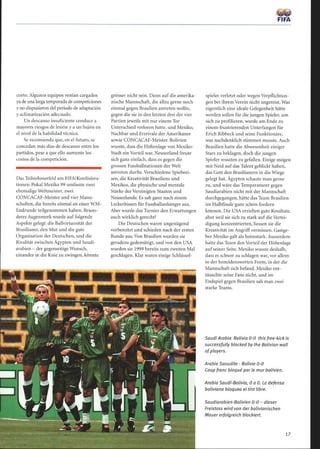
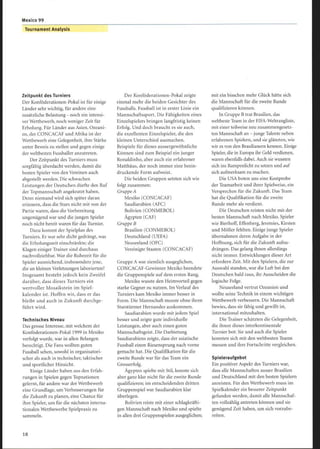
SaudiArabia Bolivia 0-0 this free-kick is
successfully blocked by the Bolivian wall
ofplayers.
Arabie Saoudite - Bolivie 0-0
Coup franc bloqué par le mur bolivien.
Arabia Saudí-Bolivia, 0 a 0. La defensa
boliviana bloquea el tiro libre.
Saudiarabien-Bolivien 0-0 - dieser
Freistoss wird von der bolivianischen
Mauer erfolgreich blockiert.
17
Tournament Analysis
Zeitpunkt des Turniers
Der Konföderationen-Pokal ist für einige
Länder sehr wichtig, für andere eine
zusätzliche Belastung - noch ein intensi-
ver Wettbewerb, noch weniger Zeit für
Erholung. Für Länder aus Asien, Ozeani-
en, der CONCACAF und Afrika ist der
Wettbewerb eine Gelegenheit, ihre Stärke
unter Beweis zu stellen und gegen einige
der weltbesten Fussballer anzutreten.
Der Zeitpunkt des Turniers muss
sorgfältig überdacht werden, damit die
besten Spieler von den Vereinen auch
abgestellt werden. Die schwachen
Leistungen der Deutschen dürfte den Ruf
der Topmannschaft angekratzt haben.
Denn niemand wird sich später daran
erinnern, dass die Stars nicht mit von der
Partie waren, dass die Vorbereitung
ungenügend war und die jungen Spieler
noch nicht bereit waren für das Turnier.
Dazu kommt der Spielplan des
Turniers. Er war sehr dicht gedrängt, was
die Erholungszeit einschränkte ; die
Klagen einiger Trainer sind durchaus
nachvollziehbar. War die Ruhezeit für die
Spieler ausreichend, insbesondere jene,
die an kleinen Verletzungen laborierten?
Insgesamt besteht jedoch kein Zweifel
darüber, dass dieses Turniers ein
wertvoller Mosaikstein im Spiel-
kalender ist. Hoffen wir, dass er das
bleibt und auch in Zukunft durchge-
führt wird.
Technisches Niveau
Das grosse Interesse, mit welchem der
Konföderationen-Pokal 1999 in Mexiko
verfolgt wurde, war in allen Belangen
berechtigt. Die Fans wollten guten
Fussball sehen, sowohl in organisatori-
scher als auch in technischer, taktischer
und sportlicher Hinsicht.
Einige Länder haben aus den Erfah-
rungen in Spielen gegen Topnationen
gelernt, für andere war der Wettbewerb
eine Grundlage, um Verbesserungen für
die Zukunft zu planen, eine Chance für
ihre Spieler, um für die nächsten interna-
tionalen Wettbewerbe Spielpraxis zu
sammeln.
Der Konföderationen-Pokal zeigte
einmal mehr die beiden Gesichter des
Fussballs. Fussball ist in erster Linie ein
Mannschaftssport. Die Fähigkeiten eines
Einzelspielers bringen langfristig keinen
Erfolg. Und doch braucht es sie auch,
die exzellenten Einzelspieler, die den
kleinen Unterschied ausmachen.
Beispiele für dieses aussergewöhnliche
Können sind zum Beispiel ein junger
Ronaldinho, aber auch ein erfahrener
Matthäus, der noch immer eine beein-
druckende Form aufweist.
Die beiden Gruppen setzten sich wie
folgt zusammen:
Gruppe A
Mexiko (CONCACAF)
Saudiarabien (AFC)
Bolivien (CONMEBOL)
Ägypten (CAF)
Gruppe B
Brasilien (CONMEBOL)
Deutschland (UEFA)
Neuseeland (OFC)
Vereinigte Staaten (CONCACAF)
Gruppe A war ziemlich ausgeglichen,
CONCACAF-Gewinner Mexiko beendete
die Gruppenspiele auf dem ersten Rang.
Mexiko wusste den Heimvorteil gegen
starke Gegner zu nutzen. Im Verlauf des
Turniers kam Mexiko immer besser in
Form. Die Mannschaft musste ohne ihren
Starstürmer Hernandez auskommen.
Saudiarabien wurde mit jedem Spiel
besser und zeigte gute individuelle
Leistungen, aber auch einen guten
Mannschaftsgeist . Die Darbietung
Saudiarabiens zeigte, dass der asiatische
Fussball einen Riesensprung nach vorne
gemacht hat. Die Qualifikation für die
zweite Runde war für das Team ein
Grosserfolg.
Ägypten spielte mit Stil, konnte sich
aber ganz klar nicht für die zweite Runde
qualifizieren; im entscheidenden dritten
Gruppenspiel war Saudiarabien klar
überlegen.
Bolivien reiste mit einer schlagkräfti-
gen Mannschaft nach Mexiko und spielte
in allen drei Gruppenspielen ausgeglichen;
mit ein bisschen mehr Glück hätte sich
die Mannschaft für die zweite Runde
qualifizieren können.
In Gruppe B trat Brasilien, das
weltbeste Team in der FIFA-Weltrangliste,
mit einer teilweise neu zusammengesetz-
ten Mannschaft an - junge Talente neben
erfahrenen Spielern, und sie glänzten, wie
wir es von den Brasilianern kennen. Einige
Spieler, die in Europa ihr Geld verdienen,
waren ebenfalls dabei. Auch sie wussten
sich ins Rampenlicht zu setzen und auf
sich aufmerksam zu machen.
Die USA boten uns eine Kostprobe
der Teamarbeit und ihrer Spielweise, ein
Versprechen für die Zukunft. Das Team
hat die Qualifikation für die zweite
Runde mehr als verdient.
Die Deutschen reisten nicht mit der
besten Mannschaft nach Mexiko. Spieler
wie Bierhoff, Effenberg, Jeremies, Kirsten
und Möller fehlten. Einige junge Spieler
übernahmen deren Aufgabe in der
Hoffnung, sich für die Zukunft aufzu-
drängen. Das gelang ihnen allerdings
nicht immer. Entwicklungen dieser Art
erfordern Zeit. Mit den Spielern, die zur
Auswahl standen, war die Luft bei den
Deutschen bald raus, ihr Ausscheiden die
logische Folge.
Neuseeland vertrat Ozeanien und
wollte seine Technik in einem wichtigen
Wettbewerb verbessern. Die Mannschaft
bewies, dass sie fähig und gewillt ist,
international mitzuhalten.
Die Trainer schätzten die Gelegenheit,
die ihnen dieses interkontinentale
Turnier bot: Sie und auch die Spieler
konnten sich mit den weltbesten Teams
messen und ihre Fortschritte vergleichen.
Spieleraufgebot
Ein positiver Aspekt des Turniers war,
dass alle Mannschaften ausser Brasilien
und Deutschland mit den besten Spielern
anreisten. Für den Wettbewerb muss im
Spielkalender ein besserer Zeitpunkt
gefunden werden, damit alle Mannschaf-
ten vollzählig antreten können und sie
genügend Zeit haben, um sich vorzube-
reiten.
Mexico 99
Für Bolivien, Brasilien und Mexiko
folgte das Turnier kurz auf die Copa
America, ein für sie ebenfalls wichtiges
Turnier. Zeit für Erholung und die
Vorbereitung blieb kaum.
Aber sogar die Abwesenheit einiger
Stars konnte dem Glanz des Turniers
keinen Abbruch tun. Das Abschneiden
Brasiliens ist verständlich - viele Spieler
standen nicht zur Verfügung -, aber auch
mit den Ersatzspielern war das Spiel-
niveau immer noch beachtlich, und die
Mannschaft wusste ihre Ressourcen
sinnvoll zu nutzen.
Einige Länder haben über den Zeitpunkt
der Veranstaltung diskutiert und möch-
ten den Konföderationen-Pokal gerne als
einen der wichtigsten FIFA-Wettbewerbe
verankern.
Infrastruktur
Alle Delegationen und die FIFA-Offiziellen
wurden von den mexikanischen Ausrichtern
untergebracht.
Jeder Nationalverband logierte in einem
anderen Erstklassehotel, und der Transport
zum Trainingsgelände war sehr gut
organisiert. Die Trainingseinrichtungen
gehörten den Profivereinen, die Spielfelder
befanden sich ausnahmslos in einem
ausgezeichneten Zustand.
Äussere Bedingungen
Das Wetter war zum Teil sehr schlecht; an
einigen Tagen war es beim Anpfiff
drückend heiss. In Mexiko-Stadt konnten
die meisten Partien unter angenehmen
Bedingungen ausgetragen werden.
In der Gruppe B wurde im Stadion
Jalisco in Guadalajara gespielt: Der Rasen
war in einem gutem Zustand und gab zu
keinen Klagen Anlass; sogar an Regen-
tagen war das Terrain gut präpariert.
Sicherheitsbeamte, Freiwillige und
Balljungen leisteten ausgezeichnete Arbeit.
Ihnen gebührt ein herzliches Dankeschön,
denn sie haben viel zu einem erfolgreichen
Wettbewerb beigetragen.
México-Arabia Saudí, 5 a 1 (3-0). El
delantero Blanco se impone una vez a
la defensa saudí.
FIFA
Mexico Saudi Arabia 5-1 (3-0) once again
the forward Blanco successfully outwits
the Saudi defenders.
Mexique -Arabie Saoudite 5-1 (3-0)
L'attaquant Blanco réussit une nouvellefois
à s'imposer face aux défenseurs saoudiens.
Mexiko-Saudiarabien 5-1 (3-0) - Stürmer
Blanco setzt sich hier erneut erfolgreich
gegen die Saudi-Verteidiger durch.
Fairplay
Dass alle Spieler sich an einem FIFA-
Wettbewerb an die Fairplay-Regeln
halten, ist zu einem Merkmal der FIFA-
Turniere geworden. So kann es durchaus
vorkommen, dass Spieler von gegneri-
schen Mannschaften einander nach
einem Tackling beim Aufstehen helfen
oder eine Verletzung behandeln, bevor
das Betreuungsteam auf das Spielfeld eilt.
Dies war erfreulicherweise bei allen
Mannschaften zu beobachten, was einer
der Höhepunkte dieses Wettbewerbs war.
Ruhetage
Wie bei allen Turnieren muss darauf
geachtet werden, dass die Spieler zwischen
den einzelnen Partien genügend Zeit für
Erholung haben und die Trainer an der
Taktik feilen können.
In Mexico City war zwischen den
Spielen zu wenig Zeit einberechnet. Einige
Mannschaften hatten eine lange Saison mit
vielen Wettbewerben hinter sich und hatten
nicht genug Zeit, sich an dieVerhältnisse
anzupassen .
Zu wenig Erholungszeit führt zu
einem grösseren Verletzungsrisiko und
einem Leistungsabfall.
Obwohl dadurch die Kosten eines
Wettbewerbs steigen, wäre es für die
Zukunft ratsam, zwischen den Spielen
mehr Ruhetage einzuplanen.
Tournament Analysis
Introduction to Technical/
tactical analysis
The characteristics of modern football
include a clearly defined coverage of
space, a playing system that is
constructed around the abilities of the
players available, and a high degree of co-
ordination between the individual
tactical demands and abilities . It is in this
area that there are great differences
between teams. A successful team, at club
or national level, is characterised by its
finely-tuned playing system, with clearly
defined roles and tactics appropriate to
the situation, and the ability to put all
this into practice consistently. Both
planning and preparation are key factors
in succeeding in a competition . The job
of the coach - both difficult and
enjoyable at the same time - is to provide
the right kind oftraining and leadership,
to ensure that the players as individuals,
as members of their blocks and as
members ofthe team, are tuned to the
demands of an international tournament.
Flavio Conceiçao elegantly robs the
monument Lothar Matthäus ofthe ball.
Flavio Conceiçao dérobe habilement le
ballon au monument  Lothar Matthäus.
Flavio Conceiçao le arrebata elegante-
mente el balón al legendario Lothar
Matthäus.
Flavio Conceiçao trennt hierdas Denk-
mal Lothar Matthäus elegant vom Ball.
20
A short analysis ofthe individual
teams:
Bolivia
Coached by Hector BambinoVeira
from Argentina, the Bolivian team used a
basic 4:4:2 in all three matches, which
they alternated with a 4:3:3 or even a
4:5:1 according to the opponent, but their
variations were never dictated by defensi-
ve considerations. On the contrary, some
of their attacking drive was at the expense
of the normally serious defensive set-up.
Coach Veira showed that he has done
good work with this team, but they were
just a bit unlucky in their efforts .
Brazil
Brazil employed a basic 4:4:2 system,
using variations to match the abilities of
their players, and overall their teamwork
was good. In the centre of the defence
they used Joao Carlos and Odvan, who
alternated in taking on the role of
sweeper; when the ball came from the
right Joao Carlos did the job, from the
left it was Odvan. The two wing-backs
offered strong support in attack, especially
Serginho on the left. In midfield Flavio
Conceicao and Emerson played in front
of the defence taking on the vacuum-
cleaner roles. From the second match
onwards they introduced Alex as a
substitute and he added a real element of
surprise when he came on. The two
strikers would switch positions frequently,
one of them being Ronaldinho, a
diamond of the future, skilful, technically
gifted and a hat trick hero in this
competition .
Egypt
Egypt's fortunes varied dramatically from
one match to another. Coached by Al
Gohary, they ended their first game all
square against Bolivia, but then
accomplished a remarkable feat in their
next outing. Coming from 0:2 down
against Mexico and reduced to ten men,
they found an extra source of energy and
in the last quarter of an hour managed to
pull back to end the game 2:2 . But some
undisciplined play in the third group
match versus Saudi Arabia from Sabry,
Imam and Ibrahim Samir cost them their
chance of a place in the semi-final.
Their basic formation was 4:4:2,
flexibly interpreted. When attacking, the
system was usually 3:5:2. Their defensive
players were athletic and strong tacklers;
in midfield Ramzy and Radwan Jasser
covered well behind the more attacking
Sabry and the forwards. In attack they
had some very talented players, and it was
a pity that those lapses in concentration
and self-control robbed them of a real
and basically well-earned opportunity to
progress further.
Germany
Germany employed three different
systems during the tournament, each one
being clearly defined and appropriate to
the current opponent. Against Brazil they
used a classic 4:5:1, with Lothar Matthäus,
the captain and midfield organiser, also
operating effectively as the watchful free
man behind the four-man defensive
block; at least until the 65th minute,
which was when the ship hit the rocks.
Against New Zealand, they started with
4:4:2 and then switched to 4:3:3, while for
the USA game it was back to a traditional
4:4:2.
Their defensive plan was very flexibly
applied, usually with two man-markers and
a libero in a staggered formation, plus the
defensive midfielders operating zone
marking. The result of this was that the two
strikers did not receive enough support and
often the ball did not reach them; it was
rare to see players pushing through into
attack. All too often long balls were played
forward but they seldom reached their
intended target, or were intercepted by an
opponent. This forced Matth5us and
Scholl, and Wosz occasionally, to use their
technical skills in an attempt to dribble the
ball forward, trying to create space and
attacking pressure. This team was hard to
recognise as coming from Germany - all
the traditional virtues seemed to be lacking,
too many basic weaknesses came to light
and at times the team was almost
humiliated. There is a definite need for
some rethinking here.
Mexico
Despite having some problems in their
group matches against Egypt and Bolivia,
Mexico, coached by Manuel Lapuente,
Showing technical perfection, Emam
(EGY) runs past the Bolivian Tufino (No. 8).
Emam (EGY) se défait avec une grande
perfection technique du Bolivien Tufino
(no 8).
Emam (EGY) supera con elegante técnica
al boliviano Tufino (n° 8).
Emam (EGY) überläuft technisch perfekt
den Bolivianer Tufino (Nr. 8).
Mexico 99
were in a class of their own in Group A.
Their qualification for the second round
was never in the slightest doubt; they
were able to dictate the play most of the
time. Using their 3:4:3 system (occasionally
3:3:4) well, they did not allow an
opponent any chance to develop their
own moves.
New Zealand
Despite having a very disciplined
approach and some good individual
players, New Zealand did not appear to
have a well defined playing system. Their
approach was built around the talents of
the players available, and mostly they
used a 3:5:2 or a 5:4:1 formation, with
very little emphasis on attack. With three
or five players in defence they used a
sweeper behind the block, and both wing-
backs lent some help to attacking moves.
They were very compact in midfield with
Wilkinson, Lines and Jackson as the
playmaker feeding the ball through to the
one or two skilful forwards (Coveny and/
or Bouckenooghe). In their final game,
against Brazil, they showed improved
tactics and they could have a promising
future if they can continue to play in high
level competitions like this one.
Saudi Arabia
Coached by Milan Macala, the Saudi
Arabian team experienced both highs and
lows in their three group matches.
Following a heavy defeat at the hands of
Mexico in their opening game, they
recovered well and had a good match
against Bolivia, but were out of luck with
their finishing and failed to score. Then
they met the African champions Egypt
and proved on the day to be far superior,
virtually outclassing their opponents.
This win earned them a place in the
semi-finals, but at that stage Brazil clearly
exposed their limitations. Operating a
system with three defenders, they often
had trouble when Brazil attacked with
three or even four players. Individual
marking of opposing forwards was not
always possible, and their defence often
Tournament Analysis
found itself under heavy pressure. It was in
midfield that they showed their skill most.
Their best player was striker Al Otaibi who
scored six superb goals. The Saudis'
variable system was not always successful,
but in every match they tried to play in a
positive way throughout the team.
USA
The USA had a clear team concept which
was based on the capabilities ofthe players
available, most ofwhom were very
experienced. Their approach to each game
was very definite - on the one hand they
wanted to be able to offer a solid defence
against any opponent and on the other
they wanted to develop positive attacking
moves. Thus it was not a surprise that they
had to employ different tactics from game
to game. At times the formation would be
4:5 :1, at other times a 3:5:2. Coach Bruce
Arena's system was based on perfect
tactical understanding, but the importance
of being able to improvise was not
neglected; what was lacking was a change
of pace now and then with which to
surprise an opponent.
Le football moderne se caractérise par
une répartition judicieuse sur le terrain,
par un système de jeu à la mesure des
joueurs disponibles ainsi que par une
coordination optimale des exigences
tactiques et des qualités individuelles.
C'est précisément sur ce point que se
manifestent les plus grandes différences
entre les équipes. Les équipes à succès,
qu'elles soient des clubs ou des
sélections nationales, se distinguent par
la précision subtile d'un système de jeu
reposant sur une stricte répartition des
tâches et une tactique adaptée aux
situations de jeu ainsi que la capacité à
mettre en oeuvre tous ces ingrédients. En
outre, autant la programmation que la
préparation sont des facteurs clés du
succès dans tout tournoi. L'entraîneur a
pour tâche - à la fois difficile et
attrayante - de préparer son équipe, ses
blocs et ses individualités aux exigences
d'un tournoi international en lui
indiquant la stratégie appropriée.
Analyse succincte des équipes:
Allemagne
Pendant le tournoi, l'Allemagne appliqua
trois systèmes de jeu différents, à chaque
fois en fonction de l'adversaire opposé.
Contre le Brésil, ce fut un 4-5-1 classique,
avec un Lothar Matthäus, capitaine et
organisateur du milieu de terrain,
évoluant simultanément comme libero
derrière la défense en ligne - ce fut le cas
au moins jusqu'à la 65e minute, mais
n'empêcha pas l'équipe de faire naufrage!
Contre la Nouvelle-Zélande, ce fut un
4-4-2, puis un 4-3-3, et contre les USA, ce
fut de nouveau un 4-4-2 traditionnel.
Le dispositif de défense était appliqué
avec une grande flexibilité. D'ordinaire, il
se composait de deux joueurs affectés au
marquage individuel, d'un libero
légèrement en retrait et des milieux de
terrain défensifs jouant la zone. Il
s'ensuivit que les deux attaquants de
pointe étaient insuffisamment soutenus
et recevaient peu de ballons ; les joueurs
ne montaient que rarement en attaque.
Trop souvent, de longues passes
étaient frappées en direction des
attaquants, mais elles n'atteignaient que
rarement le coéquipier ou étaient
interceptées par l'adversaire. C'est ainsi
que Matthâus, Scholl et, par périodes,
aussi Wosz se voyaient contraints de
tenter par des dribbles de monter en
première ligne, d'ouvrir des espaces et
d'accroître la pression. L'équipe
d'Allemagne était méconnaissable ; toutes
ses vertus traditionnelles semblaient lui
faire défaut. La sélection révéla trop de
carences élémentaires et du même par
moments subir l'humiliation. Au vu de
cette performance une qualification pour
le 1/2-finale devenait impossible.
Arabie Saoudite
La sélection dirigée par l'entraîneur
Milan Macala connut des hauts et des
bas dans ses trois matchs de groupe.
Après une lourde défaite face au pays
hôte, le Mexique, les Saoudiens
réalisèrent une bonne performance face
à la Bolivie, sans toutefois pouvoir
marquer de but. Dans leur troisième
match, contre l'Egypte, ils purent sauver
l'honneur en déclassant nettement le
champion d'Afrique.
Mais la demi-finale disputée contre le
Brésil mit en évidence leurs limites. Avec
leur système de jeu composé de trois
défenseurs, les Saoudiens révélèrent dans de
nombreuses phases de jeu leur vulnérabilité
face aux Brésiliens qui alignaient trois ou
quatre attaquants. Le marquage individuel
de l'adversaire n'était pas toujours possible
ce qui causa souvent de grosses difficulté à
la défense. C'est surtout en milieu de
terrain qu'ils pouvaient montrer leurs
qualités. Leur meilleur joueur était
l'attaquant Al Otaibi qui inscrivit six buts
magnifiques. Leur système de jeu à
géométrie variable ne put être appliqué
Coveny, NZsmoothlyglides past the
midfielder Williams, USA.
Coveny (NZ) esquive avec élégance
le milieu de terrain Williams (USA).
El neozelandés Coveny elude al
centrocampista Williams de EEUU.
Coveny, NZ geht hier elegant am
Mittelfeldspieler Williams, USA vorbei.
Tournament Analysis
avec succès contre toutes les équipes, mais
les Saoudiens s'efforcèrent dans chaque
match d'adopter une attitude positive.
Bolivie
Sous la direction de l'Argentin Hector
Veira, dit  Bambino  la Bolivie
pratiqua à travers les trois matchs de
groupe un système 4-4-2. Selon
l'adversaire, il pouvait certes évoluer
vers un 4-3-3 voire un 4-5-1, mais à
aucun moment, il ne se voulait défensif.
Au contraire, les attaques impétueuses se
faisaient aux dépens du dispositif
défensif normalement solide. Le
sélectionneur Veira signa une bonne
prestation avec son équipe qui se
montra quelque peu malchanceuse dans
ses efforts.
Egypte
L'équipe du sélectionneur Al Gohary fit
différentes expériences dans les trois
matchs de groupe. Après avoir tenu en
échec la Bolivie dans le premier match,
les Egyptiens réussirent un exploit face
au Mexique. Menés à la marque 0-2, et
ne jouant plus qu'à dix, ils parvinrent à
égaliser 2-2 dans le dernier quart
d'heure au terme d'un sursaut d'énergie.
En raison du jeu indiscipliné de Sabry,
Emam et Ibrahim Samir dans le
troisième match de groupe, ils
manquèrent de se qualifier pour les
demi-finales .
Ils pratiquaient un système 4-4-2
souple. Dans les offensives, il s'agissait
plutôt d'un 3-5-2. En défense, ils
disposaient de joueurs athlétiques et très
solides dans les duels. En milieu de terrain,
Ramzy et Radwan lasser couvraient bien le
milieu offensif Sabry et les attaquants. En
attaque, l'Egypte disposait de joueurs très
talentueux. Il est regrettable que les
joueurs du sélectionneur Al Gohary se
gâchèrent eux-mêmes la possibilité
d'accéder en demi-finales par leur manque
de concentration et de discipline.
Mexique
Sous la direction du sélectionneur
Manuel Lapuente, le Mexique fut une
classe à part dans le groupe A, même s'il
éprouva beaucoup de difficultés face à
l'Egypte et à la Bolivie. Mais personne ne
douta jamais de sa qualification pour le
deuxième tour, tant il fut toujours en
Al Shahrani, KSA successfully beats off
the challenges ofGarcia Aspe (8) and
Zepeda (19).
Al Sharhani (KSA) se fraye un chemin
entre Garcia Aspe (8) et Zepeda (19).
Al Shahrani (KSA) se escabulle entre
García Aspe (8) yZepeda (19).
Al Shahrani, KSA kämpft sich erfolgreich
gegen Garcia Aspe (8) und Zepeda (19)
durch.
mesure de dicter sa loi la plupart du
temps. Son système de jeu 3-4-3, évoluant
de temps à autre vers un 3-3-4, ne laissa
aucune chance à ses adversaires de
développer leur propre jeu.
USA
La sélection des USA se présenta avec
une stratégie claire et nette qui reposait
sur les capacités des joueurs à sa
disposition. La plupart d'entre eux
avaient une grande expérience. Leur
approche de chaque match était
clairement définie et visait d'une part à
établir une défense solide contre tout
attaquant et d'autre part à développer
des offensives efficaces. Il ne fut donc
pas étonnant de les voir mettre en oeuvre
différents systèmes selon les adversaires .
Il y eut aussi bien un 4-5-1 qu'un 3-5-2 .
Le système de Bruce Arena reposait sur
un concept tactique parfait, mais qui ne
négligeait pas non plus les improvisations
spontanées. Ce qui manquait était les
changements de rythme susceptibles de
tromper l'adversaire par surprise.
El fútbol contemporáneo se caracteriza
por una clara distribución de zonas, un
sistema de juego concebido a la medida de
los jugadores a disposición y una óptima
coordinación de las exigencias tácticas y
las habilidades individuales. Es justamente
aquí donde existen grandes diferencias de
un equipo a otro. Una selección o un club
exitoso se destaca por un sistema de juego
perfectamente coordinado, con una clara
disposición de funciones y una táctica
oportuna para poder aplicarlas
consecuentemente en el partido. La
planificación y la preparación son las
condiciones indispensables para lograr
una buena y exitosa actuación en una
competición. Una de las tareas más
difíciles, pero más hermosas del
entrenador, es tomar medidas de
entrenamiento y dirección selectivas para
poner a punto óptimamente al equipo, a
los jugadores individuales y a cada bloque
de cara a una competición internacional.
A continuación consignamos un
breve análisis de los equipos:
Bolivia
Bolivia jugó, bajo la dirección del
argentino Héctor bambino Veira, un 4-
4-2 consecuente en todos los partidos,
alternando - según el adversario - a un
4-3-3 ó incluso a un 4-5-1. No obstante,
su planteamiento nunca fue defensivo, al
contrario, a veces se ponía en peligro el
concepto defensivo con ataques
descontrolados. En general, el técnico
Veira realizó un buen trabajo con un
equipo algo desafortunado.
Brasil
Brasil planteó un sistema 4-4-2, que varió
adaptándolo a las características
individuales de sus jugadores. La defensa
fue organizada por los dos defensores
centrales Joao Carlos y Odván, quienes se
alternaban como barredores : cuando el
balón venía por la derecha, Joao Carlos
asumía esta función y Odván hacía lo
mismo viceversa. Los dos defensores
laterales apoyaron con eficacia los
despliegues ofensivos, particularmente
Serginho por la banda izquierda. En la
línea media, Flavio Conceiçao y Emerson
actuaron delante de la defensa y se
encargaron de neutralizar los ataques
contrarios; tras el segundo encuentro,
este eje fue ampliado con la participación
de Alex, quien aportó sorpresa y
peligrosidad al juego brasileño. En el
ataque operaron dos arietes que
cambiaban constantemente de
posiciones, destacando Ronaldinho, el
diamante del futuro; un jugador
talentoso y técnicamente muy versado.
Egipto
El equipo del seleccionador Al Gohary
jugó tres partidos completamente
diferentes. Tras el empate con Bolivia en
el primer encuentro, los egipcios
lograron una hazaña increíble en el
segundo choque contra México, al
remontar un 0 a 2 con sólo diez
hombres en el último cuarto de hora del
FIFA
cotejo y empatar a dos. En el tercer
partido, las acciones antideportivas de
Sabry, Emam e Ibrahim Samir le
costaron la clasificación a la escuadra
egipcia, que perdió por 5 a 1 contra
Arabia Saudita.
Egipto planteó un 4-4-2 flexible,
cambiando a un 3-5-2 cuando subía al
ataque. La defensa fue firme y sólida, con
jugadores muy robustos y atléticos. En la
línea media, Ramzy y Radwan Jasser
apoyaron óptimamente al centrocampista
ofensivo Sabry y a los delanteros. Egipto
dispuso de jugadores ofensivos muy
talentosos y es una pena que no haya
podido sacar frutos de su gran potencial
debido a su falta de concentración e
indisciplina.
Alemania
Alemania utilizó tres sistemas de juego
diferentes durante el torneo, siempre
adaptándose a los respectivos adversarios.
Contra Brasil planteó un clásico 4-5-1,
utilizando al capitán Mattháus como
organizador de la línea media, así como
líbero detrás de la línea defensiva de
cuatro hombres, sistema que funcionó
hasta el minuto 65 . Luego, la escuadra
alemana se desarboló por completo,
perdiendo por 4 a 0. Contra Nueva
Zelanda utilizó un 4-4-2, que alternó con
un 4-3-3, y frente a EEUU volvió a
aplicar su planteo tradicional de 4-4-2.
El concepto defensivo fue aplicado
con demasiada flexibilidad, utilizándose
dos marcadores directos, un líbero
rezagado y los centrocampistas defensivos
que marcaban también directamente al
hombre. La consecuencia fue que se
descuidó demasiado a los atacantes, que
deambulaban solos en la punta sin recibir
el apoyo necesario. Generalmente, las
líneas defensivas no subían para sumar
potencia y peligro y frecuentemente
bombeaban largos balones hacia adelante
que no encontraban destinatario o eran
interceptados por los adversarios. Es así
que la escuadra tuvo que acudir a las
habilidades técnicas de Mattháus, Scholl
y, a veces, Wosz, para irrumpir en las filas
25
Mexico 99
contrarias con arriesgados regates y
fintas. Alemania resultó ser un equipo
irreconocible y carente de sus virtudes
tradicionales. Es evidente que se impone
una modificación total del sistema actual.
Los alemanes manifestaron demasiadas
debilidades elementales y tuvieron que
someterse a una verdadera humillación.
México
Bajo la dirección del técnico Manuel
Lapuente, México evidenció gran
superioridad en el grupo A, pese a
manifestar considerables problemas
frente a Egipto y Bolivia. No obstante, la
clasificación para la siguiente vuelta
nunca estuvo en peligro gracias a su
dominio aplastante y su consecuente
planteamiento 3-4-3 y 3-3-4, que dejó sin
luces a sus adversarios.
Nueva Zelanda
Nueva Zelanda no tuvo un sistema
definido y jugó generalmente con un
planteo 3-5-2 y 5-4-1 . El equipo era muy
disciplinado y contó con algunas hábiles
individualidades, pero le faltó proyección
ofensiva. La defensa estuvo formada
generalmente por tres a cinco jugadores,
desempeñando uno de ellos la función de
líbero rezagado. La línea de contención
apoyó muy poco a los centrocampistas y
delanteros en los despliegues ofensivos.
En la línea media formaron un bloque
casi impenetrable con Wilkinson, Lines y
Jackson, siendo este último el hombre
que movía los hilos de la escuadra
neozelandesa y suministraba pases a los
delanteros Coveny y Bouckenooghe. En el
último choque contra Brasil, Nueva
Zelanda desarrolló un buen juego táctico
y demostró que tiene un futuro
prometedor si continúa participando en
competiciones de alto nivel.
Arabia Saudita
La selección saudí, dirigida por el técnico
Milan Macala, tuvo un rendimiento
totalmente variado en los tres partidos de
grupo. Tras una apabullante derrota
contra México en el partido inaugural,
Tournament Analysis
mejoró mucho su rendimiento contra
Bolivia, pero su esfuerzo - particularmente
en el segundo tiempo - no tuvo premio y
el choque finalizó en empate a cero. En el
tercer partido, buscaron la victoria con
un fervor y una entrega admirables, y
borraron de la cancha a un equipo
egipcio que se desdibujó del todo. La
semifinal contra un Brasil en plena forma
marcó el término de la ilusión árabe,
aunque la escuadra saudita combatió con
mucha garra, planteando, a ratos, un
partido muy equilibrado. Su concepto
táctico con tres defensas evidenció, a
veces, dificultades cuando los brasileños
operaban con tres e incluso cuatro
atacantes. El intento de marcar hombre a
hombre no funcionó desde la base misma
del planteamiento táctico, y la defensa
manifestó grandes dificultades ante las
furiosas arremetidas brasileñas. El juego
árabe destacó en la línea media y la figura
rutilante del once saudí fue el ariete Al
Otaibi, autor de seis magníficos goles. A
pesar de que los árabes no pudieran
aplicar existosamente su juego variable
frente a todos sus contrincantes, cabe
señalar y destacar que sus jugadores
hicieron gala de una constante actitud
ofensiva en todos los sectores.
EEUU
El esquema táctico de EEUU calzaba como
un guante en las individualidades que
conformaban el once norteamericano. Se
trataba de jugadores muy experimentados,
con un sistema de juego claramente
definido, tanto para neutralizar a cualquier
adversario, como para desarrollar un
despliegue ofensivo efectivo. No sorprendió,
pues, que EEUU aplicara diferentes
sistemas de juego según el contrincante. Es
así que a veces maniobraba con un 4-5-1
muy defensivo y, otras, con un 3-5-2 más
ofensivo. El sistema de Bruce Arena estaba
basado en una perfecta comprensión
táctica de los integrantes de su equipo,
pero sin descuidar los elementos de
improvisación. Faltaron únicamente los
sorpresivos cambios de ritmo para
desconcertar a los adversarios.
Zu den Kennzeichen des modernen
Fussballs gehören eine klar definierte
Raumaufteilung, ein System, das sich die
Fähigkeiten der eingesetzten Spieler
optimal zunutze macht, und ein hohes
Mass an Koordination zwischen den
taktischen Aufgaben und Möglichkeiten
der einzelnen Akteure. Die Beherrschung
dieser Elemente bestimmt die Stärke
eines Teams: Eine erfolgreiche Vereins-
oder Nationalmannschaft zeichnet sich
aus durch ein sorgfältig abgestimmtes
Spielsystem mit klarer Rollenverteilung
und die richtige Wahl der Taktik sowie
durch die Fähigkeit, all dies konstant auf
dem Feld umsetzen zu können. Zentrale
Faktoren für ein gutes Abschneiden in
einem Wettbewerb sind daher Planung
und Vorbereitung. Die ebenso interessan-
te wie schwierige Aufgabe des Trainers ist
es, seinen Kader so zu trainieren und zu
führen, dass die einzelnen Spieler, die
verschiedenen Mannschaftsteile und das
Team als Ganzes optimal auf die Anfor-
derungen eines internationalen Turniers
eingestellt sind.
Ein kurzer Oberblick über die Spiel-
systeme der einzelnen Mannschaften:
Bolivien
Unter ihrem argentinischen Trainer
Hector Bambino Veira trat die bolivia-
nische Mannschaft in all ihren drei
Spielen mit einem 4-4-2-System an. Je
nach Gegner wechselten sie manchmal
auch zu einem 4-3-3 oder auch zu einem
4-5-1, wobei für diese Umstellungen nie
defensive Oberlegungen verantwortlich
waren, im Gegenteil, gingen doch einige
der konzentrierten Angriffsversuche auf
Kosten der normalerweise straff organi-
sierten Abwehr. Veira bewies, dass er und
sein Team gut gearbeitet haben, doch am
Ende fehlte Bolivien trotz aller Anstren-
gungen das letzte Quentchen Glück.
Brasilien
Brasilien spielte mit einem 4-4-2-System,
das je nach den Stärken der eingesetzten
Spieler variiert wurde, und zeigte meist
grosse mannschaftliche Geschlossenheit. Im
Zentrum derVerteidigung standen Joáo
Carlos und Odvan, die abwechselnd die
Rolle des Liberos übernahmen: Joäo Carlos,
wenn der Gegner über die rechte, und
Odvan, wenn er über die linke Seitekam. Die
beiden Aussenverteidiger, vor allem Serginho
aufder linken Seite, schalteten sich auch
häufig in denAngriff ein, während vor der
Abwehr Flavio Conceiçao und Emerson als
Scheibenwischer im zentralen Mittelfeld
agierten. Für ein überraschendes Element
sorgte in den ersten beiden Partien die
Einwechslung vonAlex. Im Angrifftausch-
ten die beiden Stürmer ständig die Positio-
neu, und Ronaldinho, der Diamant der
Zukunft, ein Spieler mit enormen techni-
schen Fähigkeiten, wurde sogar zum
Hattrick-Helden.
Ägypten
Das Team von Trainers A1 Gohary erlebte
in den Gruppenspielen ein dramatisches
Auf und Ab. In der ersten Partie gegen
Bolivien sicherten sich die Ägypter ein
Unentschieden, bevor sie bei ihrem zwei-
ten Auftritt ein echtes Kunststück voll-
brachten: Nachdem sie gegen Mexiko
bereits mit 0:2 zurücklagen und nach
einem Platzverweis nur noch zu zehnt
The Egyptian goalkeeper El Hadary cuts
out an attacking move ofthe Bolivians.
The defender El Saka shields him against
Botero, BOL.
Le gardien de but égyptien El Hedary
coupe court à une attaque des Boliviens.
Le défenseur El Saka faitparavent contre
Bozero (BOL).
El guardameta egipcio El Hadary neutraliza
con éxito el ataque de los bolivianos.
El defensa El Saka le cubre ante la
presencia del boliviano Bozero.
Der ägyptische Torhüter El Hadary
unterbindet erfolgreich einen Angriff der
Bolivianer. Verteidiger El Saka schirmt
ihn gegen Bozero, BOL ab.
waren, machten sie überraschend neue
Kräfte frei und kamen in der letzten Vier-
telstunde der Spielzeit doch noch zum 2:2
heran. Doch schliesslich vergaben sie im
letzten Gruppenspiel gegen Saudiarabien
durch die Undiszipliniert-heiten von
Sabry, Emam und Ibrahim Samir die
Chance auf einen Platz im Halbfinale.
Deutschland
Deutschland versuchte es im Verlauf des
Turniers mit drei verschiedenen, klar
definierten Spielsystemen, die mit Blick
auf den jeweiligen Gegner ausgewählt
wurden. Gegen Brasilien war es ein klas-
sisches 4-5-1, in dem Lothar Matthäus,
Kapitän und Mittelfeldorganisator der
Deutschen, auch als aufmerksamer Libero
hinter der Viererabwehr agierte und sein
Team vor einem Rückstand bewahrte -
zumindest bis zur 65. Minute, als das
Unglück seinen Anfang nehmen sollte.
Gegen Neuseeland begann Deutschland
mit einem 4-4-2, wechselte später zu
Mexico 99
Tournament Analysis
einem 4-3-3 und kehrte gegen die USA
zu einem traditionellen 4-4-2 zurück.
In der Abwehr wurde das System
flexibel ausgelegt. Meistens spielten die
Deutschen mit einer gestaffelten Verteidi-
gung mit zwei Manndeckern und einem
Libero, während sich die defensiven
Mittelfeldspieler um die Raumdeckung
kümmerten. Die beiden Stürmer erhiel-
ten so kaum Unterstützung und nur
wenige Bälle, und Vorstösse anderer
Spieler in die Spitze waren selten. Häufig
wurden lange Bälle nach vorne geschla-
gen, die aber ihr Ziel selten erreichten
und oft sogar von einem Gegenspieler
abgefangen wurden. Matthäus, Scholl
und seltener Wosz waren dadurch
gezwungen, ihre technischen Fähigkeiten
unter Beweis zu stellen und zu versuchen,
den Ball nach vorne zu dribbeln, um so
freie Räume zu schaffen und etwas Druck
aufzubauen . Alles in allem war kaum zu
erkennen, dass hier eine Mannschaft aus
Deutschland am Werk war: Die Spieler
liessen alle typisch deutschen Tugenden
vermissen und begingen zu viele einfache
Fehler, so dass sie teilweise fast schon
vorgeführt wurden. Mit dieser Leistung
war das Halbfinale ein unerreichbares
Ziel.
Mexiko
Obwohl sie in den Gruppenspielen gegen
Ägypten und Bolivien etwas Mühe be-
kundeten, waren die Mexikaner in der
Gruppe A eine Klasse für sich. Das Team
von Trainer Manuel Lapuente diktierte
das Spielgeschehen über weite Strecken,
und die Qualifikation für die nächste
Runde war nie in Gefahr. Mexiko be-
herrschte sein 3-4-3-System (das hin und
wieder in ein 3-3-4 überging) sicher und
gab seinen Gegnern keine Möglichkeit,
ihr eigenes Spiel zu entfalten.
Neuseeland
Die Neuseeländer traten zwar sehr diszi-
pliniert auf und verfügten über einige
gute Einzelspieler, schienen aber kein
festes System zu haben. Den Fähigkeiten
der Spieler entsprechend spielte die
Mannschaft meistens 3-5-2 oder 5-4-1,
wobei das Hauptgewicht eindeutig nicht
auf der Offensive lag. In der Abwehr
standen drei oder fünf Spieler, mit ei-
nem Libero als hinterstem Mann, und
aufbeiden Seiten versuchten die Aus-
senverteidiger, die Angriffe etwas zu
unterstützen. In der Mitte spielten die
Neuseeländer sehr kompakt, mit
Wilkinson, Lines und dem Spielmacher
Jackson, die den Ball an den Ein- oder
Zweimannsturm mit den technisch
beschlagenen Angreifern Coveny und/
oder Bouckenooghe weiterleiteten. In
ihrem letzten Spiel gegen Brasilien zeig-
ten sie sich auch taktisch deutlich ver-
bessert, und wenn das Team weiterhin
an so hochklassigen Wettbewerben wie
diesem Turnier teilnehmen kann, steht
es vor einer viel versprechenden Zu-
kunft.
Saudiarabien
In den drei Gruppenspielen erlebte die
Mannschaft von Trainer Milan Macala
Höhen und Tiefen. Nach der eindeuti-
gen Niederlage in ihrer ersten Partie
gegen Mexiko erholten sich die Saudis
rasch und zeigten gegen Bolivien eine
gute Leistung. Im Abschluss waren sie
allerdings glücklos und blieben ohne
Torerfolg. Zuletzt trafen sie auf den
Afrikameister Ägypten, der ihnen an
diesem Tag klar unterlegen war und
von ihnen regelrecht deklassiert
wurde.
Dieser Sieg verschaffte ihnen einen
Platz im Halbfinale gegen Brasilien, wo
sich dann allerdings ein deutlicher
Klassenunterschied zeigte. Durch ihr
System mit drei Verteidigern gerieten sie
häufig in Schwierigkeiten, wenn die
Brasilianer mit drei oder sogar vier
Spielern angriffen. Die Manndeckung der
gegnerischen Stürmer funktionierte nicht
immer, und die Verteidigung kam oft
unter schweren Druck. Insgesamt konnte
Saudiarabien im Mittelfeld am meisten
überzeugen, wobei der beste Einzelspieler
des Teams Stürmer Al Otaibi war, der
sechs herrliche Treffer erzielte. Das
variable System der Saudis war nicht
immer erfolgreich, doch auf alle Fälle gab
die Mannschaft in jedem Spiel ihr Bestes.
USA
Das klare Konzept des US-Teams baute
auf den Fähigkeiten des Kaders auf, in
dem viele erfahrene Spieler standen.
Die Amerikaner hatten sich für jedes
Spiel ein klares Ziel gesetzt: Sie wollten
einerseits jedem Gegner eine solide
Abwehr entgegenstellen und anderer-
seits auch im Spiel nach vorne positive
Akzente setzen. Um das erreichen zu
können, musste die Mannschaft taktisch
von Spiel zu Spiel neu eingestellt
werden - manchmal fiel die Wahl auf
ein 4-5-1, manchmal auf ein 3-5-2. Im
System des US-Trainers Bruce Arena
musste jeder Spieler seine Rolle im
taktischen Gefüge genau kennen, wobei
jedoch auch die Kreativität nicht zu
kurz kam. Was vielleicht noch fehlte,
war hin und wieder eine plötzliche
Tempoverschärfung, um einen überra-
schenden Angriff auszulösen.
Sulimani, No. 13 (KSA) runs past the
Bolivian Soria yet again.
Sulimani (no 13, KSA) esquive une fois de
plus le Bolivien Soria.
Sulimani, n° 13 (KSA), supera una vez
más al boliviano Soria.
Sulimani, Nr. 13 (KSA) hat einmal mehr
den Bolivianer Soria überlaufen.
Team Analysis
Team Analysis
The 8 participating teams
Even before a ball was kicked, the 2a FIFA
Confederations Cup had an unusual and
complicated history behind it.
Originally planned for January 1999,
with World Cup winners France assigned
to Group B in Guadalajara (the draw
took place in Mexico D.F. on 4 October
1998), the competition was postponed
for organisational and calendar reasons
until July/August 1999.
With the exception of Brazil and
Germany, all the teams participating were
able to field their best players (France
withdrew because of calendar problems
and were replaced by Germany, the
reigning European champions) .
Brazil, who arrived fresh from their
recent victory in the Copa America,
were without a number of their stars,
such as Amoroso, Cafu, Roberto Carlos,
Rivaldo, Ronaldo and Zago; ex-captain
Leonardo had not taken part in the Copa
America either for personal reasons.
Germany, who had won the European
Championship the last time it was held
back in 1996, were missing some key
players too because of an agreement with
the Bundesliga clubs; Effenberg, Jeremies,
Kahn and Kirsten were all not available.
Bierhoff was another notable absentee.
Yet the Brazilians were able to
demonstrate the prodigious depth of
talent to be found in their country by
turning up with some wonderful new
players; before this competition who had
ever heard of Evanilson, Serginho,
Christian, Alex, Athirson, Roni, Warley,
Odvan or Vampeta, not to mention the
latest unpolished teenage diamond in the
shape of the 19 year-old Ronaldinho? In
this respect the Germans with Linke,
Dogan, Maul, Baumann, Gerber and
Schneider had nothing to stand
comparison with the young South
Americans. They were completely unable
to live up to their role as reigning
European Champions.
Another example of a decision in
favour ofyouth that proved to be positive
30
was provided by Mexico's coach Manuel
Lapuente, who had no hesitation in
selecting three players from the 1999
U-20 team. Rafael Marquez played in all
five games right through, and Torrado
was used in the semi-final, while Osorno
was allowed to gain experience by coming
on as a substitute.
The teams taking part were:
Bolivia, included after Uruguay had
withdrawn
Brazil, title-holders, winners in 1997 in
Saudi Arabia
Egypt, African Champions 1998
Germany, European Champions 1996
Mexico, host country and winners of the
Copa de Oro 1998
New Zealand, OFC Champions 1998
Saudi Arabia, Asian Champions 1998
USA, runner-up in the Copa de Oro
1998.
Les huit équipes participantes
La 2e Coupe des Confédérations de la
FIFA 1999 a derrière elle un passé hors
du commun et mouvementé .
Programmée tout d'abord en janvier
1999, avec la participation du champion
du monde 1998, la France, dans le groupe
B à Guadalajara (le tirage au sort se
déroula le 4 octobre 1998 à Mexico), elle
fut reportée, pour des raisons
d'organisation et de calendrier invoquées
par certaines équipes, aux mois de juillet
et août 1999.
A l'exception des sélections du Brésil
et de l'Allemagne, toutes les équipes
purent disputer le tournoi avec leur
meilleure formation du moment. Pour
des raisons de calendrier, la France resta à
l'écart et fut remplacée par l'Allemagne
qui est le champion d'Europe en titre.
Captain Emerson in a running duel with
the tricky US forward Cobi /ones.
Duel entre le capitaine Emerson et le vif
attaquant américain Cobi Jones.
El capitán Emerson en lucha con el hábil
delantero estadounidense Cobi Jones.
Captain Emerson im Laufduell mit dem
flinken US-Stürmer Cobi jones.
Le tenant du titre, le Brésil, qui venait
de remporter la  Copa America';
renonça à certaines stars comme
Amoroso, Cafu, Roberto Carlos, Rivaldo,
Ronaldo ainsi que Zago ; L'ancien
capitaine Leonardo avait déjà manqué
dans la  Copa America  pour des raisons
personnelles.
Le champion d'Europe 1996,
l'Allemagne, renonça également à plusieurs
titulaires comme Effenberg, Jeremies, Kahn
et Kirsten en raison d'accords passés avec
les clubs de Bundesliga. Bierhoff, qui joue
en Italie, manquait aussi.
Les Brésiliens prouvèrent une fois de
plus qu'ils sont capables de présenter au
pied levé, dans une proportion
étonnante, des talents encore inconnus.
Qui connaissait déjà Evanilson, Serginho,
Christian, Alex, Athirson, Roni, Warley,
Vampeta et surtout le diamant brut de
19 ans, Ronaldinho ? En face d'eux, les
Allemands, qui n'avaient avec Linke,
Dogan, Maul, Baumann, Gerber et
Schneider, aucun joueur comparable à
opposer, ne furent à aucun moment et en
aucune manière à la hauteur de leur rôle
de champion d'Europe.
Reste à mentionner la décision
judicieuse du sélectionneur mexicain
Manuel Lapuente, qui ne craignit pas de
faire appel à trois joueurs de la sélection
U-20 : Marquez Rafael disputa les cinq
matchs, Torrado fut retenu en demi-
finales et Osorno put accumuler
plusieurs expériences importantes en tant
que remplaçant.
Voici le tableau des participants
L'Allemagne, champion d'Europe 1996
L'Arabie Saoudite, vainqueur de l'AFC
1998
La Bolivie, invitée après la défection de
l'Uruguay
Le Brésil, tenant du titre 1997 en Arabie
Saoudite
L'Egypte, champion d'Afrique 1998
Le Mexique, pays hôte et vainqueur de la
 Copa de Oro  1998
La Nouvelle-Zélande, vainqueur de l'OFC
1998
Les USA, finaliste de la Copa de Oro 1998
Los ocho equipos participantes
La 2a Copa FIFA/Confederaciones tuvo
un desarrollo muy movido. Planificado
originalmente para enero de 1999, con la
participación del campeón mundial
Francia en el grupo B en Guadalajara (el
sorteo se realizó ya el 4 de octubre de
1998 en ciudad de México), el torneo
tuvo que postergarse hasta julio/agosto de
1999 por razones de organización y
fechas. Francia tuvo que prescindir de su
participación debido a este cambio de
fechas y Alemania ocupó su lugar en
calidad de campeón europeo.
Con excepción de Brasil y Alemania,
todos los demás equipos pudieron
presentar sus formaciones de gala en el
torneo. El poseedor del título Brasil, que
acababa de alzarse con la Copa América
pocos días antes, prescindió de cracks
como Amoroso, Cafu, Roberto Carlos,
Rivaldo, Ronaldo y Zago. El antiguo
capitán Leonardo no estuvo presente ni
siquiera en la Copa América por motivos
personales . El campeón europeo
Alemania prescindió igualmente de
varios titulares como Bierhoff, Effenberg,
Jeremies, Kahn y Kirsten por compromisos
en los clubes de la liga alemana. Los
brasileños volvieron a demostrar la
inagotable cantera de talentos que poseen.
¿Quién conocía a Evanilson, Seginho,
Christian, Alex, Athirson, Ron¡, Warley,
Vampeta y, sobre todo, al joven
Ronaldinho de 19 años? En este sentido,
los alemanes no tenían nada que ofrecer
con Linke, Dogan, Maul, Baumann,
Gerber y Schneider y no pudieron
confirmar, en ningún momento, su
reputación de campeones europeos.
Cabe señalar la decisión previsora del
técnico mexicano Manuel Lapuente,
quien no vaciló en incluir tres jugadores
de la selección sub-20 en el plantel: Rafael
Marquez jugó en los cinco encuentros,
Torrado actuó en la semifinal y Osorno
acumuló experiencia actuando como
suplente.
A continuación consignamos la lista
de participantes:
FIFA
Bolivia, considerada tras la retirada de
Uruguay
Brasil, campeón mundial de la Copa
Confederaciones 1997 en Arabia Saudita
Egipto, campeón africano 1998
Alemania, campeón europeo 1996
México, organizador y campeón de la
Copa de Oro 1998
Nueva Zelanda, campeón de Oceanía
1998
Arabia Saudita, campeón de Asia 1998
EEUU, subcampeón de la Copa de Oro
1998
Die acht Teilnehmer
Noch vor dem ersten Anstoss konnte der
2. FIFA/Konföderationen-Pokal bereits
aufeine ungewöhnliche und ereignisreiche
Geschichte zurückblicken.
Ursprünglich sollte das Turnier im
Januar 1999 stattfinden, wurde dann aber
aus organisatorischen Gründen und aus
Rücksicht aufden Spielkalender auf Ende
Juli / Anfang August verschoben. Die
beiden Gruppen waren bereits am 4.
Oktober 1998 in Mexiko City ausgelost
worden, und auch hier gab es eine Verände-
rung: In der Gruppe B (Guadalajara) sagte
Weltmeister Frankreich seine Teilnahme
aus terminlichen Gründen ab und wurde
durch den amtierenden Europameister
Deutschland ersetzt.
Ausser Brasilien und Deutschland
hatten alle Mannschaften ihre stärksten
Spieler zur Verfügung.
Bei den Südamerikanern, die kurz
zuvor die Copa America gewonnen
hatten, fehlten einige Stars wie Amoroso,
Cafu, Roberto Carlos, Rivaldo, Ronaldo
oder Zago; der ehemalige Kapitän
Leonardo hatte aus persönlichen Grün-
den bereits aufdie Teilnahme an der
Copa America verzichtet.
Die Deutschen mussten ihrerseits
aufgrund einer Vereinbarung mit den
Vereinen der Bundesliga ebenfalls auf
einige Schlüsselspieler wie Effenberg,
Jeremies, Kahn oder Kirsten verzichten,
und auch Bierhoff stand nicht zur
Verfügung.
31
Team Analysis
Mark Burton, No. 7 (NZ) defends
cleverly against the Brazilian.
Marc Burton (no 7, NZ) défend ici
prestement le ballon contre le Brésilien.
Mark Burton, n° 7 (NZ), protege
diestramente el balón frente a un
brasileño.
Mark Burton, Nr. 7 (NZ) verteidigt hier
geschickt den Ball gegen den Brasilianer.
Brasilien konnte allerdings das enor-
me Potential nutzen, das sein nationaler
Nachwuchs bietet, und stellte einige
grossartige neue Spieler vor. Wer hatte
denn vor diesem Wettbewerb schon ein-
mal von Evanilson, Serginho, Christian,
Alex, Athirson, Roni, Warley, Odvan oder
Vampeta gehört, ganz zu schweigen von
diesem ungeschliffenen Diamanten in der
Gestalt des 19-jährigen Ronaldinho?
Dieser Talentfülle hatten die Deutschen
mit Linke, Dogan, Maul, Baumann, Ger-
ber oder Schneider nichts entgegenzuset-
zen. Die Mannschaft wurde den Erwar-
tungen an einen amtierenden Europa-
meister in keiner Weise gerecht.
Ein Beispiel für eine erfolgreiche
Integration junger Spieler lieferte Mexi-
ko, dessen Trainer Manuel Lapuente drei
Spieler des U-20-Teams der Junioren-
WM in Nigeria 1999 in seine Auswahl
berufen hatte. Rafael Marquez spielte
gleich alle fünf Partien durch, Torrado
kam im Halbfinale zum Einsatz und
Osorno sammelte als Ersatzspieler inter-
nationale Erfahrung.
Am Konföderationen-Pokal nahmen
teil:
Bolivien, das Uruguay ersetzte Brasilien,
Titelverteidiger (Saudiarabien 1997)
Ägypten, Afrikameister 1998
Deutschland, Europameister 1996
Mexiko, Gastgeber und Gewinner des
Gold Cup 1998
Neuseeland, Ozeanienmeister 1998
Saudiarabien, Asienmeister 1998
USA, Finalist des Gold Cup 1998.
The tournament mascot, ELOTIN, in
original size, a successfully-conceived
and popular figure.
La mascotte du tournoi, ELOTIN , dans
sa taille originale, personnage fétiche
très réussi.
La mascota del torneo, ELOTIN, en
tamaño original - una figura muy
lograda y apreciada.
Das Turnier-Maskottchen ELOTIN in
Originalgrösse - eine gelungene und
gern gesehene Figur.
`P-^9A?
~
Team Analysis
Bolivia
Coach Hector Bambino Veira had only
been in charge of the Bolivian national
team for six months, but he led them
successfully to a good performance in the
Copa America 1999 (two draws, one
against the host country and the other
against Japan). With this experience
behind them they started off in this
competition full of self-confidence and
enthusiasm. Playing a classic 4:4:2
formation they had a good opening
match against Egypt, but then
disappointed in the game against Saudi
Arabia. They got things back together for
their vital match against Mexico, but
despite playing well they were defeated,
so their revival came too late.
In goal Jose Carlo Fernandez was a
solid support at the back in all three
matches, but the four-man defensive
chain was often too static, as well as
having trouble against set pieces. In
midfield, Gutierrez and the captain Soria
provided the team's driving power, while
Erwin `Platini' Sanchez complemented
them well, but on the whole failed to
come up to expectation. The forward line
was rather stranded up front with too
little support coming from behind, and
so striker Jose Menacho in the centre was
all too often an isolated figure.
The team's strategy had been planned
around their capabilities, but it did not
always have the desired effect. The team
looks to be a promising one for the
future, but they have to be given a chance
to build up their confidence and to
gather international experience.
Bolivia's three matches
Versus Egypt: 2-2 (2-1)
Bolivia opened cautiously, trying to work
the ball carefully out of defence and to
make the opponent do all the running .
But their efforts to hold on to the ball
became a bit lethargic and after just a few
minutes they paid the price and found
themselves a goal down. This caused
them to switch into a more aggressive
mode, which proved to be a good idea,
and two fine goals before half time took
them into the lead. After the break it was
the Egyptians who clearly had the upper
hand and their skilful modern style of
play had the South Americans in trouble
time and again; after getting the equaliser
they were quite unlucky not to score a
winner - it would have been well
deserved. Bolivia can consider themselves
lucky to hang on to the 2:2 until the end
- it looked as if their players were having
trouble keeping up with the pace of the
game as it drew to a close.
Versus Saudi Arabia: 0-0
Bolivia started this game they way they
had ended the Egypt match - aimlessly
kicking the ball around in midfield with
no good ideas and no creation of
surprises, just some thoughtless
individual efforts. Thus the Saudis were
able to dominate for long stretches and
only occasionally did Bolivia seem able to
keep up. The second half also saw the
Arabian team clearly on top and creating
real chances. Yet the Bolivians still did not
want to run any risks and limited their
forward moves to occasional counter
attacks, most ofwhich however died
before they got very far.
Versus Mexico: 0-1 (0-0)
After the Saudi Arabians had surprisingly
defeated Egypt, Bolivia had to win
against Mexico in order to qualify for the
semi-finals, no easy task against the
strong host country team. To make
matters worse, coach Veira was deprived
of the services of midfield motor
Gutierrez at the start of the game, as well
as having to manage without defenders
Pena and Alvarez. However, in their
moment of need, Bolivia's substitutes
showed that the country has a depth of
talent and in this game the South
Americans put on their best performance
of the whole tournament. Their
surprisingly attacking football had the
Mexicans in trouble time and time again,
and only thanks to good luck, goalkeeper
Campos and captain Suarez were they
able to keep a clean sheet.
The Mexicans were doing all they
could to score, trying to surprise Bolivia
with some tricky moves, but the South
Americans' defence held firm and
goalkeeper J.C. Fernandez looked almost
unbeatable . The only goal of the match
FIFA
came just after the break, following a
corner, when Palencia found himself
unmarked for a split second. Bolivia were
worthy of a draw, and although they were
out of luck on the day, they left behind a
good impression as they departed from
the competition.
Le sélectionneur HectorVeira, dit
 Bambino  qui était depuis six mois
responsable de l'équipe, a obtenu dans ce
laps de temps avec sa sélection un certain
succès à la  Copa America  1999
(2 matchs nuls, contre le pays hôte et le
Japon). Forts de cette expérience, les Sud-
Américains débutèrent la Coupe des
Confédérations de la FIFA avec beaucoup
d'assurance et d'enthousiasme. Pratiquant
un système 4-4-2 classique, ils réussirent
un assez bon premier match face à
l'Egypte, mais ils déçurent fortement dans
la deuxième rencontre qui les opposait à
l'Arabie Saoudite. L'équipe ne renoua avec
ses performances habituelles que dans le
dernier match - qu'elle perdit - face au
pays hôte, le Mexique.
Le gardien de but José Carlo
Fernandez se révéla dans les trois matchs
un soutien solide pour son équipe, en
revanche, les quatre défenseurs en ligne
se montrèrent trop souvent statiques et
The very quick and offensively deployed
Bolivian wing-back Ribero (No. 20) is
successfully tackled by Youssef (EGY).
Le très rapide et offensiflatéral bolivien
Ribera (no 20) se voit ici dérober le
ballon par Youssef(EGY).
El ofensivo y rapidísimo defensa lateral
boliviano Ribera (no20) pierde el balón
ante Youssef (EGY).
Dersehrschnelle und offensiv eingestellte
bolivianische Aussenverteidiger Ribera
(Nr. 20) wird hier erfolgreich von Youssef
(EGY) vom Ball getrennt.
35
Team Analysis
Hector Bambino Veira, the Bolivian
team-coach, with his technical crew,
sitting on the bench for once. ..
Hector  Bambino  Veira, le sélectionneur
bolivien, pour une fois assis sur le banc
avec son équipe technique.
Héctor Bambino Veira, el entrenador de
la selección boliviana, sentado, al menos
en una ocasión, con su equipo técnico...
Hector Bambino Veira, der bolivianische
Team-Coach, mitseiner technischen Crew
für einmal auf der Banksitzend. ..
connurent des difficultés sur les coups de
pied arrêtés. Le milieu de terrain était
animé par Gutierrez et le capitaine Soria ;
Erwin Sanchez, dit  Platini  les
complétait certes assez bien, mais il ne
put satisfaire aux attentes placées en lui.
Manquant de soutien à partir du milieu
de terrain, l'attaque resta plutôt inoffen-
sive, et l'avant-centre José Menacho se
retrouva souvent isolé.
La stratégie était certes adaptée aux
possibilités des joueurs, mais les résultats
escomptés ne furent malheureusement
pas au rendez-vous. L'équipe est vouée à
un bel avenir, pour peu qu'on continue à
lui faire confiance et qu'on la fasse
progresser en multipliant les rencontres
internationales.
Les trois matchs de la Bolivie
Contre l'Egypte : 2-2 (2-1)
La Bolivie commença le match très
prudemment, soucieuse de distribuer le
ballon à partir de la défense pour obliger
l'adversaire à courir beaucoup. Mais ce
36
comportement par trop léthargique du
début se retourna bientôt contre les Sud-
Américains, et ils furent vite menés à la
marque. Contraints maintenant de réagir,
les Boliviens adoptèrent un
comportement nettement plus offensif, ce
qui leur valut d'égaliser puis de reprendre
l'avantage grâce à deux buts
remarquables inscrits avant la mi-temps.
La deuxième période tourna nettement à
l'avantage des Africains, qui avec leur
football moderne se jouèrent le plus
souvent des Sud-Américains et, après
avoir égalisé à 2-2, manquèrent en fait de
remporter une victoire qui aurait été
méritée. La Bolivie dut finalement
s'estimer heureuse du match nul. On
avait l'impression que les joueurs
boliviens avaient du mal à tenir le rythme
élevé du jeu sur toute la distance.
Contre l'Arabie Saoudite: 0-0
La Bolivie commença le match contre le
représentant asiatique comme elle avait
terminé son premier match contre
l'Egypte : En milieu de terrain régnait un
jeu chaotique, sans stratégie et sans
éléments de surprise, avec des assauts
individuels voués à l'échec. L'Arabie
Saoudite dominait le jeu à sa guise durant
de longues périodes, et la Bolivie ne se
montra que par moments à peu près à la
hauteur. La deuxième période tourna
également à l'avantage des Saoudiens, qui
manoeuvraient très habilement et se
créèrent beaucoup d'occasions de but.
Les Boliviens ne prirent cependant pas
trop de risques et se limitèrent à des
contre-attaques, mais qui furent la
plupart du temps neutralisées d'entrée.
Contre le Mexique : 0-1 (0-0)
Après la victoire surprise des Saoudiens
sur l'Egypte, la Bolivie fut contrainte de
jouer pour la victoire afin de se qualifier
pour les demi-finales. Bien évidemment,
ce ne fut pas une tâche facile face au pays
hôte, d'autant plus que le sélectionneur
Veira dut se passer dès le début du match
de l'animateur du milieu de terrain
Bolivia
Gutierrez ainsi que des défenseurs Peña
et Alvarez. Mais la Bolivie prouva qu'elle
disposait de remplaçants de valeur ; les
Sud-Américains réalisèrent dans ce
match leur meilleure prestation du
tournoi en mettant nombre de fois les
Mexicains dans l'embarras avec leurs
attaques surprises. Ce n'est qu'avec
beaucoup de chance que les Mexicains
parvinrent, grâce à leur gardien Campos
et leur capitaine Suarez, à éviter d'être
menés à la marque.
Les attaquants mexicains tentèrent
certes de surprendre la Bolivie par la
ruse, mais la défense de ces derniers, et
notamment le gardien J.C. Fernandez,
constituaient un rempart presque
insurmontable. L'unique but du match
tomba quelques minutes seulement
après la mi-temps, à la suite d'un corner
où Palencia était resté quelques instants
sans surveillance. La Bolivie, qui aurait
mérité le match nul, pour peu que la
chance ait été de son côté, laissa
toutefois une très bonne impression au
terme du tournoi.
El entrenador Héctor bambino Veira
estaba al mando de la selección nacional
boliviana hacía solamente seis meses
cuando su equipo consiguió una
respetable actuación en la Copa América
1999 (dos empates contra el anfitrión y
uno contra Japón). Con esta experiencia
en la maleta, la escuadra boliviana viajó a
la Copa FIFA/Confederaciones con
mucha confianza y entusiasmo. Jugando
un clásico 4-4-2, los futbolistas del
altiplano mostraron mucha disposición
anímica y generaron un buen
enfrentamiento en su primer partido
contra Egipto, pero decepcionaron
enormemente en el siguiente choque
contra Arabia Saudita. Recién en el tercer
partido contra México, volvió Bolivia a
exhibir sus cualidades futbolísticas, pero
no pudo evitar la derrota ni la
eliminación. El portero José Carlos
Fernández fue un firme y seguro apoyo
en los tres encuentros, pero la línea
defensiva de cuatro hombres maniobró
con poca flexibilidad y tuvo dificultades
Das protokollarische Prozedere beim
betreten des Spielfeldes der2 Teams,
hier die bolivianische Flagge.
FIFA
en las situaciones de balón parado. En la
línea media, Gutiérrez y el capitán Soria
movían los hilos del once boliviano,
apoyados por Erwin Platini Sánchez,
quien no estuvo a la altura de actuaciones
pasadas. Por falta de apoyo de la línea
media, el delantero José Menacho era la
imagen misma de la desolación en la
vanguardia boliviana.
The official pre-match ceremony as the
two teams step onto the pitch, here the
Bolivian flag.
La procédure protocolaire au moment où
les deux équipes pénètrent sur le terrain
dejeu, avec ici le drapeau bolivien.
El procedimiento protocolario para que
los dos equipos entren en el campo; aquí
vemos la bandera boliviana.
37
Mexico 99
Team Analysis
El concepto de juego estuvo adaptado
a las cualidades de los jugadores, no
obstante, no se logró alcanzar los
resultados esperados. Pese a todo, el
conjunto boliviano puede contar con un
futuro prometedor si se sigue apoyando
su desarrollo y si tiene posibilidades de
disputar más encuentros internacionales.
los tres partidos de Bolivia
Contra Egipto: 2 a 2 (2-1)
Bolivia inició el partido con un juego
pausado, mucha retención de pelota,
queriendo obligar a sus adversarios a
abrirse y a derrochar energías en las
arremetidas. Sin embargo, esta actitud
letárgica resultó fatal para los
sudamericanos y muy pronto se
encontraron con un marcador adverso.
Los bolivianos estuvieron obligados a
reaccionar y, gracias a un juego mucho
más agresivo y mayor vocación de ataque,
lograron volcar el partido, anotando dos
hermosos goles antes de la pausa. En la
segunda mitad, los africanos volvieron a
imprimir su superioridad y dominaron a
la escuadra sudamericana con un fútbol
moderno y espectacular. Pese al claro
dominio, consiguieron sólo el empate a
dos. Bolivia pudo estar satisfecha con este
resultado. Los jugadores bolivianos
manifestaron dificultades para mantener
el mismo ritmo de juego durante todo el
partido.
Contra Arabia Saudita: 0 a 0
Bolivia salió de la misma manera contra
los árabes como había finalizado su
partido contra Egipto: sin método, sin un
concepto definido y sin momentos de
sorpresa, bombeando balones o
intentando infructuosas acciones
individuales. Arabia Saudita manejó a
voluntad el encuentro y tuvo toda una
serie de situaciones favorables de gol. En
la segunda mitad, el once árabe imprimió
aún más presión, pero le faltó acierto en
los metros finales. Bolivia se limitó a
lanzar algunos contraataques que fueron
ahogados ya en su armado.
Contra México: 0 a 1 (0-0)
Después de la sorprendente victoria de
Arabia contra Egipto, Bolivia estaba
obligada a ganar para poder pasar a las
semifinales. Sin embargo, ésta no era una
The Bolivians Gutierrez (No. 7), Justiniano
(No. 17) and the team captain Erwin
Sanchez (No. 14) celebrate a goal in the
opening game against Egypt.
Joie des Boliviens Gutierrez (no 7),
Justiniono (no 17) et du capitaine de
l'équipe Erwin Sanchez (no 14) après le
but marqué dans le match d'ouverture
contre l'Egypte.
La alegría de los bolivianos Gutiérrez, (n9 7)
Justiniano (n° 17) y el capitán Erwin
Sánchez (n° 14) por el gol conseguido en
el partido inicial contra Egipto.
Hierfreuen sich die Bolivianer Gutierrez,
(Nr. 7) Justiniano (Nr. 17) und Team-Captain
Erwin Sanchez, (Nr. 14) über einen
Torerfolg im Startspiel gegen Ägypten.
tarea simple contra el dueño de casa
México, particularmente porque el
técnico Veira tuvo que prescindir de la
presencia del orquestador de juego
Gutiérrez, así como de los defensores
Peña y Álvarez. No obstante, la escuadra
boliviana demostró que disponía de
magníficos suplentes. En este choque,
exhibió su mejor rendimiento de todo el
torneo y puso en apuros a la selección
mexicana con un fútbol ofensivo
sorprendente. Con mucha fortuna y la
habilidad del portero Campos y el
capitán Suárez, los mexicanos pudieron
evitar un resultado adverso. Los
delanteros de México intentaron
desequilibrar a los bolivianos con veloces
maniobras y hábiles regates, pero la
defensa sudamericana, particularmente el
portero J.C. Fernández, resultaron ser un
baluarte infranqueable. El único gol del
partido fue producto de un saque de
esquina, en el cual Palencia, totalmente
desmarcado, mandó el esférico a las
redes. Bolivia mereció empatar, pero no
estuvo acompañada de la fortuna. No
obstante, la actuación de Bolivia en el
torneo invoca el optimismo.
Bolivia
Obwohl Hector Bambino Veira das Amt
des Trainers der bolivianischen National-
mannschaft nur gerade sechs Monate
zuvor übernommen hatte, zeigte sein
Team bei der Copa América 1999 eine
gute Leistung (zwei Unentschieden gegen
Gastgeber Paraguay und gegen Japan) .
Beflügelt von diesen Erfolgen starteten
die Südamerikaner, die ein klassisches 4-
4-2-System spielten, mit Schwung und
Selbstvertrauen in das Turnier in Mexiko.
In ihrem ersten Gruppenspiel boten sie
gegen Ägypten eine gute Partie, ent-
täuschten dann jedoch bei ihrem zweiten
Auftritt gegen Saudiarabien . Im entschei-
denden Spiel gegen Mexiko konnten sie
sich zwar noch einmal steigern, doch
obwohl sie gut spielten, endete die
Begegnung mit einer Niederlage für die
Bolivianer, die damit ausschieden.
In der Defensive war Torhüter Jose
Carlo Fernandez in allen drei Spielen ein
sicherer Rückhalt, während die Vierer-
Abwehrkette oft zu statisch wirkte und
bei Standardsituationen Schwächen
zeigte. Im Mittelfeld dirigierten Gutierrez
und Kapitän Soria das Spiel ihrer
Mannschaft, recht gut unterstützt von
Erwin `Platini' Sanchez, der aber insge-
samt die in ihn gesetzten Erwartungen
nicht erfüllen konnte. Der Angriff hatte
einen schweren Stand, weil er von hinten
kaum Unterstützung erhielt, und so war
Mittelstürmer Jose Menacho allzu häufig
auf sich alleine gestellt.
Obwohl die Strategie des Teams auf
den Fähigkeiten der Spieler aufbaute,
hatte sie nicht immer die gewünschte
Wirkung. Dennoch darf man in Zukunft
noch einiges von Bolivien erwarten,
sofern die Mannschaft weitere Chancen
erhält, ihr Selbstvertrauen zu stärken und
internationale Erfahrung zu sammeln.
Bolivien in der Vorrunde
Bolivien - Ägypten : 2-2 (2-1)
Die Bolivianer begannen vorsichtig und
versuchten, das Spiel sorgfältig von
hinten heraus aufzubauen und den
Gegner zum Laufen zu zwingen. Doch
schon bald agierten sie bei ihren Bemü-
hungen, den Ball in den eigenen Reihen
zu halten, zu wenig konzentriert und
wurden dafür prompt nach nur wenigen
Minuten mit einem Gegentreffer bestraft.
Von diesem Moment an spielten sie
angriffiger, was sich als gute Entschei-
dung erweisen sollte, denn sie konnten
noch vor der Pause durch zwei schöne
Tore in Führung gehen. In der zweiten
Halbzeit waren die Ägypter, die mit
ihrem technisch überzeugenden, moder-
nen Stil ihre Gegner aus Südamerika
immer wieder in Bedrängnis brachten,
klar besser. Nach dem Ausgleich hätten
sie sogar noch den Siegestreffer erzielen
können, der auch durchaus verdient
gewesen wäre. Bolivien konnte mit Glück
das 2:2 halten, auch wenn die Spieler den
Eindruck machten, als hätten sie gegen
Ende der Partie zunehmend Mühe, mit
dem Tempo des Spiels mitzuhalten.
Bolivien - Soudiarabien: 0-0
Die Bolivianer begannen dieses Spiel so,
wie sie in der vorherigen Partie gegen
Ägypten aufgehört hatten: Der Ball
zirkulierte ziel- und planlos im Mittel-
feld, zündende Ideen oder Überraschungs-
momente gab es keine, und auch einige
Hector RodolfVEIRA
29.5.1946
Career as a player: San Lorenzo
de Almagro
Career as a coach: 1983-1996 San Lorenzo
1989 Riv River Plate
1990 Cadiz
1990 1997 Boca juniors
1991 1989 Velez Sarsfields
''may
FIFA
Einzelaktionen brachten keine Gefahr.
So fiel es den Saudis leicht, das Spiel über
weite Strecken zu kontrollieren, während
Bolivien nur spärliche Akzente setzen
konnte. Auch nach der Pause war
Saudiarabien eindeutig überlegen und
kam auch zu einigen guten Torchancen,
während die Südamerikaner weiterhin
jedes Risiko scheuten und ihre Angriffe
auf gelegentliche Konter beschränkten,
die aber meist schon weit vor dem
gegnerischen Strafraum endeten.
Bolivien - Mexiko: 0-1 (0-0)
Nach dem überraschenden Sieg Saudi-
arabiens über Ägypten musste Bolivien
sein letztes Spiel gewinnen, um sich noch
für das Halbfinale zu qualifizieren - keine
leichte Aufgabe gegen das starke Team
des Gastgebers. Ausserdem musste
Trainer Veira anfangs auf den Mittelfeld-
motor Gutierrez verzichten sowie die
Verteidiger Pena und Alvarez ersetzen.
Doch in diesem kritischen Moment
sprangen die Reservespieler in die
Bresche und bewiesen mit der besten
Leistung ihres Teams an diesem Turnier,
welches Potential der Nationalmann-
schaft zur Verfügung steht. Das überra-
schend offensive Spiel Boliviens brachte
Mexiko immer wieder in Verlegenheit,
und nur dank Torhüter Campos, Kapitän
Suarez und etwas Glück konnte ein
Rückstand vermieden werden.
Doch auch die Mexikaner setzten
alles daran, ein Tor zu schiessen, und
versuchten die bolivianische Abwehr mit
raffinierten Spielzügen zu überraschen,
aber die Verteidigung der Südamerikaner
hielt, und Torhüter Jose Carlo Fernandez
schien fast schon unbezwingbar. Der
einzige Treffer der Partie fiel kurz nach
der Pause, als Palencia nach einem
Eckball für einen kurzen Moment
unbewacht war und zum 1 :0 traf. Die
Bolivianer hätten eigentlich ein Unent-
schieden verdient, und obwohl ihnen an
diesem Tag das nötige Glück fehlte,
konnten sie sich immerhin mit einer
guten Vorstellung vom Wettbewerb
verabschieden.
3 9
Mexico 99
Team Analysis
Brazil
Wanderley Luxemburgo has an excellent
reputation as a coach based on his
previous work, and he took over as
Brazilian national coach after the World
Cup last year. He has tried to develop
teamwork and had the players undergo
special training in this respect, as well as
in developing their individual techniques.
With an eye on the next World Cup he
introduced some new players into his
squad and arranged a number of friendly
matches. Brazil took part in the Copa
America just before coming to Mexico
and won that competition . He brought
many of those successful players to the
Confederations Cup, but also included a
few new faces.
He made some adaptations to their
playing style, ran some sharp physical
conditioning and practised tactics and
technique with the team.
Right from the start they played well,
earning a good win over Germany. After
that they even improved in the matches
against the USA, New Zealand and Saudi
Arabia.
The playing squad and the technical
staff who coached them lived up to their
BRASIL
usual reputation. Out ofthe whole team
we would like to mention specially the
goalkeeper Dida, who distributed the ball
well and gave the team confidence ;
Serginho who played in defence but also
supported the attack very well; the
midfielders Ze Roberto and Flavio
Conceiçao, as well as the joker Alex; and
in the forward line, the diamond of the
future Ronaldinho.
This team promises well for the
future ofBrazilian football.
Brazil's three matches
Versus Germany: 4-0 (0-0)
This was a classic meeting between two
different worlds of football, with each
team playing in its traditional way. Brazil
employed two midfielders, Flavio
Conceiçao and Emerson, to act as
vacuum cleaners in front of the
defence, with the other two, Vampeta and
Ze Roberto, marking their German
opposite numbers . Up front they had
Ronaldinho in great form.
Germany played with maestro
Lothar Matthäus in front of the defence
and used their full backs to distribute the
ball to midfield and to the forwards.
In the second half both teams made
some substitutions, with Brazil bringing
on Alex as an offensive midfielder and
Warley as a striker ; thanks to some
excellent team work they succeeded in
scoring four goals.
This was an amazing first match, and
the win gave Brazil a lot of confidence.
Versus USA: 1-0 (1-0)
This match started with both teams
playing at a good pace, Brazil using their
technical skills and the USA using speed
and power, showing that they are an
improved side. Brazil used a traditional
4:4:2, with the wing defenders coming
forward in attack. From one such move
they scored the only goal of the match
when Serginho overlapped well down the
left and Ronaldinho scored with a header.
But the USA did not give up, and in the
second half their determined efforts had
the Brazilians in trouble when they were
awarded a penalty. Dida managed to save
the shot, and after that both teams kept
up their attacking efforts until the end of
the game.
Versus New Zealand : 2-0 (1-0)
Already qualified for the semi-final,
Brazil rested some of their best players
and brought in some substitutes for this
match. New Zealand on the other hand
wanted to make a good impression and
succeeded in doing so, showing
improvement in both technique and
tactics. They created some scoring
opportunities, but Dida managed to foil
them all. Towards the end of the first half,
Brazil scored with a great long range shot
from Marcos Paulo, from about 35
meters out.
In the second half, New Zealand put
together some counter-attacks with good
passing moves, but still failed to score.
Brazil made some substitutions and
Ronaldinho came on, adding strength to
the attack. It was he who scored the
second goal of the game via a well-taken
free kick. After that both teams kept
going strongly until the end.
Wanderley Luxemburgo, dont
l'excellente réputation est fondée sur son
travail accompli jusqu'ici, se vit confier
le poste de sélectionneur national du
Brésil après la Coupe du Monde de l'an
dernier. Il essaya de développer le jeu
collectif et soumit à cet égard les joueurs
à un entraînement spécial, de même
qu'il chercha à développer leurs qualités
techniques individuelles. Dans la
perspective de la prochaine Coupe du
Monde, il introduisit dans son groupe
plusieurs nouveaux joueurs et
programma un certain nombre de
matchs amicaux. Le Brésil prit part à la
Copa America juste avant d'arriver au
Mexique, et remporta ce tournoi. Le
sélectionneur retint pour la Coupe des
Confédérations beaucoup de ces joueurs
fraîchement couronnés de succès, mais il
leur associa aussi de nouveaux talents.
Il procéda à quelques adaptations de
leur style de jeu, effectua plusieurs
entraînements physiques pointus et leur
fit répéter autant les automatismes
tactiques que techniques.
The jewel known as Ronaldinho, who won
the tournament's best-player and top-
scorer awards! He is on the threshold of
a great career.
Ronaldinho, le  diamant brut , sacré
meilleur joueur et meilleur buteur du
tournoi! Une belle carrière s'ouvre à lui.
El excepcional Ronaldinho, elegido mejor
jugador y máximo goleador del torneo,
tiene ante sí un brillante futuro.
Derjuwel Ronaldinho, als bester Spieler
gekürt und bester Torschütze des
Turniers! Eine grosse Karriere steht ihm
noch bevor.
Dès le début, les Brésiliens révélèrent
un bon niveau de jeu, et remportèrent
une belle victoire sur l'Allemagne. Après
quoi, ils s'améliorèrent encore à travers
les matchs contre les USA, la Nouvelle-
Zélande et l'Arabie Saoudite.
L'équipe elle-même, tout comme
l'encadrement technique qui la dirigeait, se
montrèrent à la hauteur de leur réputation.
Outre la sélection dans son ensemble, il
convient de mentionner tout spécialement
le gardien de but Dida, qui distribuait
judicieusement les ballons et mettait son
équipe en confiance ; Serginho, qui jouait
en défense et s'impliquait aussi très bien
dans les attaques ; les milieux de terrain Ze
Roberto, Emerson et Flavio Conceiçao,
ainsi qu'Alex, le joker ; et dans la ligne
d'attaque, le  diamant brut  Ronaldinho.
Cette équipe est pleine de promesses
pour l'avenir du football brésilien.
FIFA
Les trois matchs du Brésil
Contre l'Allemagne: 4-0 (0-0)
Ce fut une rencontre classique entre deux
équipes différentes, chaque équipe jouant
dans son style traditionnel. Le Brésil
confiait aux deux milieux de terrain
Flavio Conceiçao et Emerson, la tâche
 d'essuie-glace  devant la défense, tandis
que les deux autres, Serginho et Ze
Roberto, étaient chargés du marquage de
leurs adversaires allemands respectifs.
Devant eux, Ronaldinho se montra en
grande forme.
L'Allemagne, qui jouait avec son
 maestro  Lothar Matthäus devant la
défense, utilisait ses arrières centraux
pour distribuer les ballons vers le milieu
de terrain et vers l'attaque.
En seconde mi-temps, les deux
équipes procédèrent à des changements
le Brésil fit rentrer Alex comme milieu de
The irresistible force ofRonaldinho, BRA,
here in action against the defender
Woerns, GER.
Personne ne peut l'arrêter: Ronaldinho
(BRA) face au défenseur allemand
Woerns.
Imparable, el brasileño Ronaldinho
supera al defensa alemán Woerns.
Unwiderstehlich überläuft hier
Ronaldinho, BRA den Verteidiger Woerns,
GER.
terrain offensif et Warley comme
attaquant ; grâce à leur excellent jeu
collectif, les Brésiliens marquèrent quatre
buts.
Ce fut un excellent premier match et
cette victoire mit le Brésil en confiance.
Contre les USA: 1-0 (1-0)
Ce match commença pour les deux
équipes sur un rythme soutenu, le Brésil
s'appuyant sur ses qualités techniques, et
les USA, sur la rapidité et la puissance,
montrant par là que l'équipe avait
progressé. Le Brésil pratiquait un système
4-4-2 traditionnel, avec ses défenseurs
latéraux montant en attaque. C'est sur
l'une de ces offensives que les Brésiliens
marquèrent l'unique but du match quand
Serginho déborda sur l'aile gauche et
centra sur Ronaldinho qui marqua de la
tête. Mais les USA ne s'avouèrent pas
battus pour autant, et en seconde
période, leurs intenses efforts mirent les
Brésiliens en difficulté au point qu'ils
durent concéder un penalty. Dida arrêta
le tir, et les deux équipes poursuivirent
leurs offensives vigoureuses jusqu'à la fin
de la rencontre.
Brazil
Contre la Nouvelle-Zélande : 2-0 (1-0)
D'ores et déjà qualifié pour les demi-finales,
le Brésil ménagea certains de ses joueurs et
eut recours à plusieurs remplaçants. De son
côté, la Nouvelle-Zélande, qui tenait à faire
bonne impression - et elle y parvint -, se
montra en nets progrès tant au plan tactique
que technique. Ses joueurs se créèrent
plusieurs occasions de but, mais Dida
s'employa à les déjouer. Vers la fin de la
première mi-temps, le Brésil ouvrit la
marque sur un tir à distance de Marcos
Paulo, à environ 35 mètres.
En seconde période, la Nouvelle-
Zélande combina certaines contre-
attaques avec de bons débordements, mais
elle n'arrivait toujours pas à marquer. Le
Brésil procéda à quelques remplacements
et fit rentrer Ronaldinho, qui accentua la
force de percussion de l'attaque. C'est lui
qui marqua le second but du match sur un
coup franc admirablement tiré. Par la
suite, les deux équipes continuèrent leur
haut niveau de jeu jusqu'à la fin du match.
Wanderley Luxemburgo tiene una
excelente reputación como entrenador y
asumió la dirección de la selección
nacional brasileña el año pasado después
de la Copa Mundial. Se entregó a
desarrollar el juego en equipo y sometió a
sus jugadores a un entrenamiento especial
en este sector, además de perfectioner las
técnicas individuales. Con la mira puesta
ya en el próximo Mundial, incluyó algunos
jugadores nuevos en su escuadra y
organizó varios partidos amistosos. Brasil
participó en la Copa América justo antes
de viajar a México y ganó la competición.
Luxemburgo llevó a la Copa de
Confederaciones a varios integrantes de
dicho plantel, pero incluyó también
algunas caras nuevas. Realizó algunas
adaptaciones a su estilo de juego,
perfeccionó su condición física y entrenó
maniobras tácticas y la habilidad
individual de sus jugadores.
La escuadra brasileña inició sus
partidos con una clara victoria sobre
Alemania y mantuvo su rendimiento en
los siguientes encuentros contra EEUU,
Nueva Zelanda y Arabia Saudita.
Tanto los jugadores como los
responsables técnicos de la selección
respondieron enteramente a la
expectación creada. Los integrantes más
destacados del conjunto verdiamarillo
eran el portero Dida, quien tuvo gran
visión de juego y dirigió con mucha calma
a sus compañeros de la defensa; Serginho,
firme en la defensa e iniciador de los
ataques de su escuadra; los escurridizos
centrocampistas Zé Roberto y Flavio
Conceiçao, así como el comodín Alex y, en
la delantera, Ronaldinho, el diamante del
futuro: Esta selección invoca el optimismo
para el fútbol brasileño del mañana.
Los tres partidos de Brasil
Contra Alemania: 4 a 0 (0-0)
El encuentro generó el enfrentamiento
de dos concepciones de juego
diametralmente opuestas, jugando
ambos equipos en su forma tradicional.
Brasil utilizó dos centrocampistas -
Flavio Conceiçao y Emerson -, quienes
se encargaron de neutralizar todos los
ataques contrarios delante de la
defensa, mientras que los otros dos
volantes,
Zé Roberto y Vampeta, encimaban
directamente a sus respectivos
adversarios. En la vanguardia,
Ronaldinho sembraba el pánico en el
bloque de contención alemán. Los
germanos jugaron con el maestro
Lothar Mattháus apostado delante de la
defensa, y los marcadores centrales se
encargaron de suministrar balones a los
centrocampistas y delanteros. Después
del descanso, ambos equipos hicieron
algunas sustituciones, apareciendo
Alex, un centrocampista muy ofensivo,
y Warley, delantero con gran olfato de
gol. Brasil salió a jugarse cada pelota en
cada metro del terreno y los germanos
se vieron desbordados durante todo el
segundo tiempo. Nadie asumió el
manejo de la escuadra alemana, más
allá de los chispazos de Mattháus. La
movilidad, el juego colectivo y la
agresividad ofensiva del cuadro
verdiamarillo construyeron el
aplastante triunfo en esta segunda
parte.
FIFA
Contra EEUU: 1 a 0 (1-0)
Ambos equipos salieron dispuestos a
resolver desde el inicio. Brasil con su
típica habilidad técnica, Estados Unidos
con velocidad y fuerza. El conjunto
sudamericano planteó un tradicional 4-
4-2, con los zagueros laterales que
subían para sumar potencia a los
ataques. El único gol del partido se
produjo de una situación tal, cuando
Serginho se fue por la banda izquierda
y habilitó a Ronaldinho, quien dio el
frentazo decisivo, enviando el esférico a
las redes . EEUU no bajó los brazos y,
después de la pausa, imprimió una
presión impresionante que puso en
graves apuros a la escuadra
sudamericana, conduciendo a una
infracción en el área de rigor que fue
sancionado con penal. Dida consiguió
desviar el tiro y el partido se equilibró,
pero el tanteador no se modificó más
hasta el silbato final.
Contra Nueva Zelanda : 2 a 0 (1-0)
Clasificado ya para las semifinales, Brasil
se dio el lujo de dejar en el banco a sus
mejores valores y salió a jugar con varios
suplentes. Nueva Zelanda quería
subsanar averías precedentes y dejar una
buena impresión, empresa que consiguió
tanto táctica como técnicamente. Tuvo
numerosas oportunidades de gol, pero
Dida las truncó todas. Pocos minutos
antes del descanso, Marco Paulo remató
violentamente desde 35 metros de
distancia, enviando el esférico al fondo de
las redes.
Tras el intervalo, los neozelandeses
lanzaron varios contraataques de gran
peligrosidad, pero no consiguieron dar
vuelta al marcador. Con el ingreso de
Ronaldinho, se reforzó visiblemente el
ataque brasileño, y fue él quien liquidó el
partido con un hermoso remate de tiro
libre.
43
Mexico 99
Team Analysis
Nach dem Weltpokal in Frankreich
übernahm Wanderley Luxemburgo, der
sich bis dahin mit seiner Arbeit bereits
einen Namen gemacht hatte, das Amt des
brasilianischen Nationaltrainers . Als
erstes versuchte er, mit speziellen
Trainingseinheiten die mannschaftliche
Geschlossenheit zu stärken und die
Technik der einzelnen Spieler zu verbes-
sern. Ausserdem nahm er im Hinblick auf
den nächsten Weltpokal einige neue
Spieler in seinen Kader auf, den er in
einer Reihe von Freundschaftsspielen
testete. Kurz vor dem Turnier in Mexiko
gewann er mit Brasilien an der Copa
América den Titel. Viele Spieler dieser
erfolgreichen Mannschaft waren auch
beim Konföderationen-Pokal dabei, doch
Luxemburgo präsentierte auch einige
neue Gesichter.
Vor der ersten Partie in Mexiko
brachte er leichte Veränderungen am
Spielsystem an, liess die Spieler ein
nahrhaftes Konditionstraining absolvie-
ren und übte mit ihnen taktische und
technische Feinheiten ein.
Once again, the outstanding left wing-
back Serghino is able to cross the ball
despite the despairing efforts ofLars
Ricken.
Nouveau centre de l'excellent latéral
gauche Serghino malgré la parade de
Lors Ricken.
El magnífico defensa lateral izquierdo de
corte ofensivo Serghino logra efectuar un
pase a pesar de la carga de Lars Ricken.
Derhervorragende linke offensive
AussenverteidigerSerghino kommt
einmal mehr, trotz Gegenwehr von Lors
Ricken, zum Flanken.
Die Brasilianer fanden sofort zu
ihrem Spiel, fügten Deutschland eine
klare Niederlage zu und konnten sich in
den Spielen gegen die USA, Neuseeland
und Saudiarabien sogar noch steigern.
Die Mannschaft und ihre Betreuer
konnten die in sie gesteckten Erwartun-
gen erfüllen. Herausragende Figuren in
einem starken Team waren der Torhüter
Dida, der den Ball intelligent ins Spiel
brachte und für seine Mitspieler ein
sicherer Rückhalt war; Serginho, der aus
der Abwehr heraus dem Angriff Impulse
gab; die Mittelfeldspieler Zé Roberto,
Emerson und Flavio Conceiçao und der
Joker Alex; sowie Ronaldinho, der
Diamant der Zukunft, im Sturm.
Mit diesem Team hat der brasiliani-
sche Fussball eine erfolgsversprechende
Zukunft vor sich.
Brasilien in der Vorrunde
Brasilien - Deutschland: 4-0 (0-0)
Diese Partie war ein klassisches Gipfel-
treffen des Weltfussballs, in dem zwei
Mannschaften mit traditionell unter-
schiedlicher Spielweise aufeinander
trafen. Brasilien setzte im Mittelfeld
Flavio Conceiçao und Emerson als
Scheibenwischer vor der Abwehr ein,
während sich Vampeta und Zé Roberto
um ihre direkten Gegenspieler kümmer-
ten. In der Spitze wirbelte ein Ronaldinho
in Topform.
Captain Emerson in a duel with Paul
Harkes, USA.
Le capitaine Emerson aux prises avec
Paul Harkes, USA.
El capitán Emerson en lucha con Paul
Harkes, EEUU.
Captain Emerson im Zweikampf mit dem
Amerikaner Paul Harkes.
Bei Deutschland spielte Altmeister
Lothar Matthäus vor seinen Verteidigern,
die den Ball abfangen und ihn an
Mittelfeld und Angriffweiterleiten
sollten.
In der zweiten Halbzeit nahmen
beide Trainer einige Auswechslungen
vor. Luxemburgo brachte Alex im
offensiven Mittelfeld und den Stürmer
Warley neu ins Spiel, und danach gelang
es seiner Mannschaft dank gutem
Zusammenspiel, gleich vier Treffer zu
erzielen.
Die Fans erlebten ein aufregendes
Eröffnungsspiel, und der Sieg gab den
Brasilianern viel Selbstvertrauen.
Brasilien - USA : 1-0 (1-0)
Von Anfang an schlugen beide Mann-
schaften ein hohes Tempo an. Die
Brasilianer setzten dabei vor allem auf
ihre technischen Fähigkeiten, die Ameri-
kaner, die sich stark verbessert zeigten,
auf ihre Geschwindigkeit und ihre Kraft.
Brasilien spielte mit einem traditionellen
4-4-2-System, wobei die Aussen-
verteidiger oft über die Seiten mit in den
Angriff gingen. Auf diese Weise fiel auch
das einzige Tor des Spiels, als Serginho
auf der linken Seite vorstiess und
Ronaldinho bediente, der per Kopfball
vollendete. Doch das US-Team gab nicht
auf und brachte den Gegner in der
WanderleyLUXEMBURGO DA SILVA
10.5.1952
Career as a player: 1968-1970 Botafogo
1971-1978 Flamengo
1973-1974 Brasileira
selection
1976 Rio de Janeiro
1978 E.C.International
1979-1980 Botafogo
Career as a coach: 1981-1982 America
assistent
1982 Vasco assistent
1983 Rio Branco
1984-1985 Ittihao
1985 Democrata
1986-1987 Flummense
1987 Americ
1988 Shabab club
Saudi Arabia
1989-1990 Bragantino
1991 Flamengo,
Guarani
1992-1993 Ponte Preta
1993-1994 Palmeiras
1995 Flameng,
Parana Club
1996 Palmeiras
1997 Santos
1998 Corinthians
1999- Coach Brazil
zweiten Halbzeit in arge Bedrängnis.
Dida musste sogar einen Strafstoss
abwehren, bevor nach einer spannenden
Schlussphase mit weiteren Chancen für
beide Teams der Sieg der Brasilianer
feststand.
Brasilien - Neuseeland: 2-0 (1-0)
Nachdem die Qualifikation für das
Halbfinale bereits gesichert war, gönnten
die Brasilianer einigen ihrer besten Spieler
eine Pause. Ihre Gegner wollten in ihrem
letzten Spiel einen guten Eindruck machen,
und tatsächlich bewiesen die Neuseeländer,
dass sie sich sowohl technisch als auch
taktisch stark verbessert haben. Sie kamen
auch zu einigen Torchancen, die Dida aber
allesamt zunichte machte. Gegen Ende der
ersten Halbzeit war es dann Brasilien, das
durch einen herrlichen Distanzschuss von
Marcos Paulo aus gut 35 Metern in
Führung ging.
In der zweiten Hälfte zeigte Neusee-
land zwar ein gefälliges Passspiel und
kam zu einigen gefährlichen Kontern,
schaffte es aber nicht, den Ausgleich zu
erzielen. Auf der anderen Seite verwan-
delte dafür der als Verstärkung für die
Offensive eingewechselte Ronaldinho
einen Freistoss zum zweiten Tor für die
Brasilianer in einer Partie, in der beide
Mannschaften bis zum Schlusspfiff
intensiven Fussball zeigten.
4 5
Mexico 99
Team Analysis
Egypt
Egypt proved to be an excellent team
with a number of fine players in their
ranks. Coach Al Gohary had them well
adjusted right from the start and they
played polished and attractive football.
Goalkeeper El Hadary looked very
safe himself and directed the players in
front of him well. The defenders were
strong in the tackle and very athletic.
Hassan I. tried again and again to
generate pressure down the right flank
and to support the offensive efforts of the
midfielders . This part of the team was
well above average, with Ramzy and
Medhat doing defensive screening work
to allow Radwan and Sabry to
concentrate more on going forward in
support of the strikers Emam and
Ahmed.
Unfortunately, Egypt were eliminated
after the group games.
Egypt's three matches
Versus Bolivia: 2-2 (1-2)
Bascially the African champions deserved
to win this match.
Their modern approach to the game
- despite their individual man-marking
46
- saw them outplay their opponents .
Although they took an early lead, they
somehow fell behind before half time,
but after the break they began to get on
top, drawing level after an hour and
from then on clearly dominating the
match. They made a well-balanced
impression, with some outstanding
personalities in their team; this
performance gave a glimpse of their real
potential.
Versus Mexico: 2-2 (0-2)
In front of a 50,000 crowd in the Aztec
stadium in Mexico, Egypt began this
match very cautiously. With their
defence again using man-marking
tactics they found they were in trouble
right away as the Mexican forwards
moved around freely and interchanged
positions . A superb shot from Pardo
into the top corner of the goal put the
home country ahead. Mexico's skill at
utilising set pieces was well known by
now, but even so they surprised the
Egyptians with a headed goal from
Abundis . Then, as the game went on,
the African side began to get more
control of the Mexicans, but they
suffered a serious blow when Radwan
was sent off following a second yellow
card, and with the team down to ten
men any hopes of victory seemed to be
fading away. Yet somehow they seemed
to be spurred on by that expulsion and
with their clever passing movements
they began to take control of the match.
They were really fighting now and were
deservedly rewarded thanks to a
splendid free kick which brought them
back to 1 :2.
The atmosphere in the stadium
became tense, with the African team's
new-found energy surprising both the
Mexican players and their fans. Wave
after wave of Egyptian attacks rolled
forward towards the Mexican goal, and
when Ibrahim Sahir scored in the 85th
minute, also via a powerful free kick,
Egypt had got their well-deserved
equaliser. But 2 :2 was all they could
manage - their efforts to get a winner
proved unsuccessful.
Versus Saudi Arabia: 1-5 (0-2)
The final group match for the
Egyptians was against Saudi Arabia,
with the winner securing a place in the
semi-finals . Saudi Arabia took charge
early on and went into the lead after
just seven minutes, Al Otaibi reacting
the fastest and getting that important
first goal. Egypt were still not settled
and when they found themselves a
man short after Sabry was sent off the
match became quite hectic. In the 33rd
minute Al Otaibi added his second
goal, and now sparks began to fly -
within two minutes Emam was shown
two yellow cards and the Egyptians
were down to nine. This further
reduction in numbers proved too
much of a handicap for them, both
mentally and physically, and the
Saudis took advantage of the situation,
circulating the ball and making their
opponents do the running . Al Otaibi
got two more fine goals, as the score-
line rose to end at the surprisingly
high level of 1 :5 .
L'Egypte aligna une excellente équipe,
qui comptait dans ses rangs de
nombreuses individualités de grand
talent. Le sélectionneur A1 Gohary avait
parfaitement su préparer son équipe
pour le tournoi, et ses joueurs
montrèrent un football de haut niveau
et de surcroît très attrayant.
Le gardien de but El Hadary donnait
une impression de sécurité et organisait
avec sérénité la défense. Les défenseurs se
révélèrent solides dans les duels et très
athlétiques. Hassan I. essayait
constamment de mettre la pression sur
l'aile droite et venait appuyer les milieux
offensifs. Le milieu de terrain se
composait de joueurs de grand talent. Les
deux milieux récupérateurs, Ramzy et
Medhat, protégeaient les deux milieux
offensifs Radwan et Sabry. En attaque,
Emam et Ahmed lançaient leurs assauts
tourbillonnants, avec le soutien de Sabry
et Radwan.
Malheureusement, l'Egypte fut
éliminée au terme des matchs de groupe.
Les trois matchs de l'Egypte
Contre la Bolivie : 2-2 (1-2)
A vrai dire, le champion d'Afrique aurait
bien mérité de remporter ce match.
Grâce à leur jeu moderne, malgré un
marquage individuel quelque peu
démodé, les Africains dominèrent ce
match. Après avoir très tôt ouvert le
score, ils furent menés à la marque à la
mi-temps, mais ils parvinrent à égaliser à
l'heure de jeu et dominèrent à nouveau
nettement la rencontre. Une équipe
égyptienne équilibrée, bâtie autour
d'individualités exceptionnelles qui
imprimaient leur marque au jeu, donna
un aperçu de son grand répertoire.
Contre le Mexique : 2-2 (0-2)
L'Egypte commença le match très
prudemment devant les 50 000
spectateurs du Stade Aztèque de Mexico.
La défense égyptienne qui pratiquait le
marquage individuel se montra
vulnérable au début, du fait que les
attaquants mexicains permutaient entre
eux et changeaient constamment de
position. Les Mexicains ouvrirent la
marque 0-1 sur un magnifique tir dans la
lucarne du Mexicain Pardo. Bien que la
supériorité des Mexicains sur les coups de
pied arrêtés fût notoire, les Egyptiens
furent surpris par Abundis qui marqua de
la tête le but du 0-2. A mesure que le
match avançait, ils parvinrent cependant
à mieux contrôler l'adversaire.
The Egyptian flag during the playing of
the national anthem.
Le drapeau égyptien au moment de jouer
l'hymne national.
La bandera egipcia ondea al son de su
himno nacional.
Die ägyptische National-Flagge beim
Abspielen der Nationalhymne .
48
Team Analysis
Malheureusement, Radwan fut exclu sur
un deuxième carton jaune et, à dix, la
perspective d'une victoire s'éloigna
définitivement . Aiguillonnés par cette
exclusion, les joueurs issus du pays des
Pharaons se surpassèrent alors et
contrôlèrent peu à peu le match grâce à
leur jeu de combinaisons. Leur
combativité exemplaire leur permit de
réduire le score à 1-2 sur un coup franc
admirablement transformé.
La sélection égyptienne lança alors
un assaut après l'autre contre le but du
pays hôte. L'adversaire et les spectateurs
furent surpris par cette montée en
régime, et une sensation sembla se
Emam (no 14) contre Ribera lors du match d'ouverture Bolivie-Egypte à Mexico-City.
Emom (No. 14) against Ribera in the opening match Bolivia-Egypt in Mexico City.
Emam (n° 14) contra Ribera en el partido inaugural que enfrentó a Bolivia con Egipto en la Ciudad de México.
Emam, (Nr. 14) gegen Ribera im Eröffnungsspiel Bolivien-Egypten in Mexico-City.
dessiner dans le Stade Aztèque. Sur un
coup franc puissant tiré dans le côté
gauche du but, Ibrahim Samir inscrivit à
la 85e minute le but mérité de
l'égalisation 2-2 ! Mais la victoire
espérée resta hors de portée.
Contre l'Arabie Saoudite: 1-5 (0-2)
Le troisième match de groupe, contre
l'Arabie Saoudite, fut déterminant pour
l'accession en demi-finale. L'Arabie
Saoudite prit la direction des opérations
et ouvrit la marque dès la 7e minute. Ce
but important résulta d'une réaction ra-
pide de A1 Otaibi. L'Egypte n'arriva pas à
trouver ses marques, et après l'exclusion
de Sabry, le match fut marqué par la
nervosité des acteurs. A la 33e minute, Al
Otaibi aggrava la marque à 0-2. Les
événements se précipitèrent, et à la 35e
minute, Emam, qui se vit infliger deux
cartons jaunes en l'espace de deux
minutes, fut exclu du match. Un
handicap que les Egyptiens ne pouvaient
compenser, ni physiquement ni
mentalement. Les Saoudiens
s'employèrent alors à faire circuler le
ballon pour faire courir l'adversaire ; ils
contrôlèrent astucieusement le jeu, et
grâce aux deux magnifiques buts que
signa A1 Otaibi, ils l'emportèrent
finalement par 1-5.
Egypt
Egipto se presentó con una magnífica
escuadra, formada por numerosos
jugadores con excelentes cualidades
técnicas. El entrenador Al Gohary supo
motivar óptimamente a su conjunto, qu
asombró al público con su facilidad para
producir espectáculo.
El portero El Hadary fue muy sereno y
organizó con maestría la defensa. Los
defensores eran firmes en el mano a mano
y tenían una increíble constitución atlética.
Hassan 1. subió a menudo por la derecha,
apoyando a los centrocampistas ofensivos.
La línea media contaba con las mejores
figuras egipcias. Ramzy y Medhat se
encargaron de neutralizar las acometidas
contrarias, mientras que Radwan y Sabry
robaban pelotas en la media cancha y
arrancaban con panorama hacia la meta
contraria, suministrando balones a los
delanteros Emam y Ahmed.
Pese a estas virtudes, la selección
egipcia fue eliminada después de los
partidos de grupo.
Los tres partidos de Egipto
Contra Bolivia: 2 a 2 (1-2)
El campeón africano debería haber
ganado este encuentro. Pese a aplicar una
tradicional marcación al hombre, Egipto
desarrolló un fútbol moderno y dominó
claramente la contienda. Se adelantó muy
pronto en el marcador, aunque los
bolivianos lograron dar vuelta al
resultado, pasando transitoriamente al
frente. Tras una hora de juego, el cuadro
egipcio volvió a establecer el empate y de
allí en adelante manejó el trámite del
encuentro a voluntad. Esta escuadra,
perfectamente balanceada, tenía todo
para cumplir un magnífico desempeño y
dio una pequeña prueba de su gran
capacidad.
Contra México: 2 a 2 (0-2)
50,000 espectadores congregados en el
Azteca de Ciudad de México vieron a un
equipo egipcio extremadamente
cauteloso en los primeros minutos, cuya
defensa, que marcaba estrechamente al
The Frst goal ofthe tournament, which led to 1-0 against Bolivia in Mexico City, was
scored by the Egyptian Sabry.
;.%.j6 wr
FIFA
Le premier but du tournoi marqué par l'Egyptien Sabry contre la Bolivie à Mexico-City.
El primergol del torneo en la Ciudad de México lo anotó el egipcio Sabry ante Bolivia.
Das erste Tor im Wettbewerb erzielte in Mexico City der Ägypter Sabry zum 1-0 gegen
Bolivien.
49
hombre, evidenció grandes problemas
ante los delanteros mexicanos que
rotaban y cambiaban constantemente de
posición. Pardo abrió la cuenta local con
un violento remate al ángulo superior
egipcia de la meta contraria. Pese a
conocer la peligrosidad de la escuadra
azteca en situaciones a balón parado, los
egipcios se dejaron madrugar por un gol
de cabeza de Abundis. En el transcurso
del cotejo, la selección egipcia comenzó
a encontrar su juego y a neutralizar al
adversario. Lamentablemente, Radwan
fue expulsado tras la segunda tarjeta
amarilla, lo cual restó posibilidades para
remontar el partido y obtener incluso la
victoria. No obstante, esta expulsión
inyectó nuevas fuerzas a los futbolistas
Team Analysis
del país de los faraones, quienes
comenzaron a dominar el partido con
paredes y rápidos toques de balón. El gol de
enlace - un magnífico remate de tiro libre -
motivó aún más a los infatigables egipcios
que iban una y otra vez, vigorosamente, en
busca de la meta mexicana. Los
espectadores fueron testigos de una lucha
sin cuartel y estuvieron sorprendidos ante
esa disposición anímica y física de los
jugadores africanos. El partido deparó
cinco minutos finales de gran emotividad
cuando en el minuto 85 Ibrahim Samir
envió la pelota a las redes nuevamente
de un tiro libre, empatando el choque a
dos. Pese a este vuelco inesperado, los
valerosos egipcios no lograron alzarse
con la victoria.
The Bolivian forward Galindo (No. 11) is
about to break through, but is tackled
by the Egyptian midfield playerAhmed
(No. 17) the game ended 2-2.
L'attaquant bolivien Galindo (no 11)
stoppé dans son action par le milieu de
terrain égyptien Ahmed (no 17). Score
final 2-2.
El delantero boliviano Galindo (n° 11)
pierde el balón ante el centro-campista
egipcio Ahmed (n° 17). El partido
concluyó con empate a 2.
Der durchbrechende bolivianische
Stürmer Galindo, (Nr. 11) wird vom
ägyptischen MittelfeldspielerAhmed,
(Nr. 17) vom Ball getrennt- das Spiel
endete 2-2.
Contra Arabia Saudita: 1 a 5 (0 a 2)
El tercer partido de grupo contra Arabia
Saudita era decisivo para conseguir el
pase a las semifinales. La selección saudí
sorprendió malparado al equipo egipcio
y pasó adelante ya en el minuto siete con
gol del escurridizo Al Otaibi. Egipto no
encontraba la forma de contrarrestar las
veloces arremetidas de su contrincante y,
después de la expulsión de Sabry, se
planteó un partido con mucha pierna
fuerte y mala intención. En el minuto 33,
Al Otaibi incrementó el resultado a 2 a 0
y en el minuto 35, Emam era expulsado
tras recibir dos tarjetas amarillas en
menos de dos minutos. Por momentos,
Egipto buscó más la pierna que la pelota,
dando un curso de cómo no se debe
jugar, y la expulsión de Emam desarboló
por completo a la escuadra africana que
bajó los brazos definitivamente. Los
saudís dominaron el encuentro con
incontestable superioridad y Al Otaibi
marcó todavía dos goles de película más,
concretando así la aplastante victoria
saudí por 5 a 1.
Egypt
Ägypten präsentierte sich als starke Mann-
schaft mit einer Reihe von ausgezeichneten
Einzelspielern . Der Trainer A1 Gohary hatte
sein Team vonAnfang an richtig eingestellt,
und der Afrikameister spielte einen gepfleg-
ten und attraktiven Fussball.
Der ägyptische Torhüter El Hadary
wirkte bei seinen Aktionen sehr sicher,
und er dirigierte seine Abwehr gut. Die
Verteidiger waren stark im Zweikampf
und sehr athletisch. Hassan I. versuchte
immer wieder, über die rechte Aussen-
bahn Druck zu machen und die Angriffs
bemühungen des Mittelfelds zu unter-
stützen, das überdurchschnittlich gut
besetzt war: Ramzy und Medhat schirm-
ten nach hinten ab, so dass sich Radwan
und Sabry in erster Linie auf die Offensi-
ve konzentrieren konnten, wo sie
zusammen mit den Stürmern Emam und
Ahmed den Abschluss suchten.
Leider schieden die Ägypter nach den
Gruppenspielen aus.
Ägypten in der Vorrunde
Ägypten - Bolivien: 2-2 (1-2)
Eigentlich hätten die Ägypter den Sieg in
diesem Spiel verdient.
Mit ihrem trotz Manndeckung
modernen Spiel dominierten sie den
Gegner. Obwohl sie früh in Führung
gingen, gerieten sie noch vor der Pause
in Rückstand, doch in der zweiten
Halbzeit übernahmen sie wieder die
Kontrolle. Nach einer Stunde schossen
sie den Ausgleich und waren auch
danach bis zum Schlusspfiff klar besser.
Die Mannschaft, die einen ausgewoge-
nen Eindruck machte und einige
herausragende Persönlichkeiten in
ihren Reihen hatte, zeigte mit dieser
Leistung auf, welches Potential in ihr
steckt.
Ägypten - Mexiko: 2-2 (0-2)
Vor 50'000 Zuschauern im Azteken-
Stadion von Mexiko City begannen die
Ägypter sehr vorsichtig . In der Abwehr
spielten sie weiterhin mit einer Mann-
deckung, hatten aber dadurch mit den
mexikanischen Stürmern, die häufig die
Positionen tauschten, von Anfang an
grosse Schwierigkeiten. Durch einen
herrlichen Schuss von Pardo in die
obere Torecke ging die Heim-
mannschaft dann auch in Führung.
Auch bei stehenden Bällen waren die
Mexikaner stets gefährlich, was ihre
Gegner wohl wussten, aber dennoch
gelang es ihnen, die Ägypter aus einer
solchen Situation mit einem Kopfball
von Abundis zum 2:0 zu überraschen.
Danach wurden die Afrikaner stärker,
bis sie durch den Platzverweis von
Radwan nach seiner zweiten gelben
Karte einen herben Dämpfer einstecken
mussten. Mit einem Mann weniger
Mohamoud N. EL GOHARY
20.2.1938 Cairo
Career as a player: 1955-1964 Ably club
Career as a coach: 1965-1977 Al Ahly assistant
1977-1981 Ittehad Jeddah,
Saudi Arabia
assistant
1981-1982 Ittehad Jeddah
coach
1982-1984 Al Ahly coach
1984-1985 Sharia U.A.E.
coach
1985-1986 Al Ably coach
1986-1988 Al Ahly Jeddah,
Saudi Arabia
coach
1988-1990 Egypt national
team coach
1991-1993 Egypt national
team coach
1993-1994 Zamalik coach
1995-1996 Al Wahdah,
U.A.E.
1996-1997 Oman national
team
1997-1999 Egypt national
team
FIFA
schienen sie keine Chance auf den Sieg
mehr zu haben, doch irgendwie spornte
sie der Ausschluss zusätzlich an, und
mit ihren klugen Kombinationen
gewannen sie allmählich die Kontrolle
über das Spiel wieder zurück. Alle
kämpften mit vollem Einsatz, und das
1:2 durch einen wunderschönen
Freistoss war die verdiente Belohnung
dafür.
Das energische Comeback des
Afrikameisters überraschte sowohl die
mexikanischen Spieler als auch ihre
Fans, und im Stadion stieg die Span-
nung. Eine Angriffswelle nach der
anderen rollte auf das Tor der Mexikaner
zu, bis schliesslich Ibrahim Samir in der
85. Minute - ebenfalls mit einem
präzisen Freistoss - den wohlverdienten
Ausgleich schoss. Doch zu mehr als dem
2:2 reichte es nicht mehr, obwohl die
Ägypter versuchten, sogar noch zum
Sieg zu kommen.
Ägypten - Saudiarabien: 1-5 (0-2)
Vor dem letzten Gruppenspiel der
Ägypter gegen Saudiarabien war klar,
dass der Sieger dieser Partie ins Halbfi-
nale einziehen würde. Die Saudis
übernahmen sofort die Initiative und
lagen schon nach sieben Minuten vorne,
nachdem Al Otaibi am schnellsten
reagiert und den wichtigen ersten Treffer
erzielt hatte, doch auch danach fand
Ägypten nicht ins Spiel. Als die Afrika-
ner Sabry durch einen Platzverweis
verloren, wurde die Partie hektisch. In
der 33. Minute machte Al Otaibi sein
zweites Tor, und wenig später sah Emam
in 'nur gerade zwei Minuten zwei gelbe
Karten. Für die Ägypter, die damit nur
noch zu neunt auf dem Platz standen,
waren die beiden Platzverweise zu viel.
Sie waren nun sowohl mental als auch
körperlich klar im Nachteil, und die
Saudis nutzten ihre Überzahl aus, liessen
den Ball zirkulieren und zwangen den
Gegner zum Laufen. A1 Otaibi schoss
noch zwei weitere Tore, und am Ende
verloren Ägypten überraschend deutlich
mit 1 :5 .
5 1
Mexico 99
Team Analysis
Germany
Coach Erich Ribbeck had shouldered a
heavy burden when he took over the
national team from Berti Vogts. His
team selection had to be made under
very restrictive and specific
conditions: not more than three
players could be selected from any one
Bundesliga club. In addition, several
regulars chose not to play and others
were not available because of injury.
Thus Ribbeck and his assistant Uli
Stielike were unable to choose the
team they wanted . It looked a formida-
ble task that the team, led by the 38
year-old captain Lothar Matthäus,
would have to face. The following
match reports clearly confirm that
their fears were justified .
Germany's three matches
Brazil - Germany: 4-0 (0-0)
The slippery surface may have caused
some early problems for Brazil, as the
quality oftheir passing was below the
usual standard. When they settled, their
possession game improved and a crucial
substitution (Alex replacing Flavio
Concecaio) brought good results.
DEUTSCHER
FUSSBALL-BUND
Excellent penetration, especially from the
wings, produced two goals, while
Ronaldinho's exquisite pass into an open
space for Alex to collect and dribble past
the keeper was the highlight play of the
match.
Brazil had more possession and their
mobility, plus good finishing, put the
final scoreline clearly in their favour.
The Germans started off using a
very well-organised defensive system.
With one forward though, it was hard
for them to penetrate a crowded
defence. Their passes in midfield were
too often inaccurate and they lost
possession easily. They made little
effort to create forward passing moves
and so all they managed was a few half
chances.
No team can give a top-class
performance in modern football
without its experienced key players.
This became sadly clear to the
Germans at this competition here in
Mexico.
Versus New Zealand: 2-0 (2-0)
Germany used a more attacking system
in this match. Two forwards and
sometimes a third enabled them to
develop more penetration . They also
used man-to-man marking in the zone,
which did not allow their opponents
much space, Scholl and Matth5us
controlled midfield, while Marschall
and Preetz made some superb runs for
through passes from midfield.
Matth5us' goal was well prepared and
well taken. A good pass from Preetz and a
clever dribble resulted in an open goal.
This was a much better performance than
the first, but of course the opponent this
time was not Brazil.
New Zealand made a determined
effort to operate close marking
throughout the game, and they succeed
in the early stages. But some players
forgot their duties and then the defence
looked vulnerable. In attack wing play
was used and this gave the fans a good
look at two promising players in Lines
and Bouckenooghe . The former was
always ready to receive the ball either at
his feet or in the space behind his
marking defender.
Versus USA : 0-2 (0-1)
Previously the USA had never beaten
Germany in an official international
match. This encounter proved to be
evenly balanced and both teams put
their faith in counter attacks . The
Germans had not yet found the ideal
blend within the team and found it hard
to create any promising chances.
Ribbeck's players were unable to live up
to expectation, and the Americans were
better organised and more in tune with
each other; they looked more decisive
and they were able to stamp their mark
on the game. A crowd of 50,000 saw Ben
Olsen put the Americans into the lead,
and Joe Max Moore made it 2:0 via a
superb free kick - a result that decided
who would go through to the semi-
finals.
The disappointing German side were
eliminated, and those in charge will
certainly draw consequences from this
failure as they consider the future.
Le sélectionneur Erich Ribbeck, successeur
de Berti Uogts, hérita d'une situation difficile.
La sélection des joueurs se déroula dans des
conditions très restrictives et pour le moins
bizarres : le sélectionneur ne pouvait pas
faire appel à plus de trois titulaires par club
de Bundesliga, et plusieurs titulaires
renoncèrent d'eux-mêmes à leur sélection,
sans compter ceux qui n'étaient pas disponi-
bles pour cause de blessure. Ainsi, Erich
Ribbeck et son assistant Uli Stielike durent se
contenter d'une équipe décimée. réquipe
qui était emmenée par son capitaine Lothar
Matthäus, le vétéran de 38 ans, n'avait pas la
tâche facile. Les analyses suivantes des trois
matchs disputés confirment nettement les
craintes que l'on pouvait avoir.
Les trois matches de l'Allemagne
Contre le Brésil: 4-0 (0-0)
C'est probablement le terrain glissant qui fut
à l'origine des problèmes que le Brésil connut
au début du match et qui se traduisirent par
des passes moins bien assurées que
d'habitude. Amesurequ'ils retrouvaient leurs
marques, les Brésiliens reprirentl'avantage au
niveau de la possession duballon, et le
remplacement de Flavio Conceçaio par Alex,
qui se révéla déterminant, apporta de bons
résultats. Par suite d'excellents mouvements
de pénétration et de débordement par les
ailes, ils marquèrent deux buts. Le match
atteint ensuite un sommet quand une passe
judicieuse de Ronaldinho dans un espace
libre, fut récupérée parAlex qui dribbla le
gardien adverse.
FIFA
The attacking move byAlex (No. 10) BRA
is thwarted this time as both Heinrich
(left) and Woerns (right) combine to take
the ball offhim.
L'action d'Alex (no 10, BRA) est déjouée
par Heinrich (gauche) et Woerns (droite)
qui interceptent le ballon.
El ataque deAlex (nQ 10, BRA) no tiene
éxito; Heinrich, por la izquierda, y
Woerns, por la derecha, le arrebatan
el balón.
DieserAngriffversuch von Alex,
(Nr. 10, BRA) wurde diesmal noch vereitelt,
Heinrich links und Woerns rechts nehmen
ihm gleich den Ball ab.
Zoricich, NZ is unable to stop Mehmet
Scholl, GER who is about to race down the
wing.
Zoricich (NZ) ne peutpas arrêter la
descente par l'aile de MehmetScholl
(GER).
Zoricich (NZ) no puede detener al
germano Mehmet Scholl.
Zoricich, NZ kann den zum Flügellauf
ansetzenden MehmetScholl, GER nicht
zurückhalten.
54
YI
WOW
Le Brésil, qui fut le plus souvent en
possession du ballon, témoigna d'une
plus grande mobilité et d'une excellente
finition, remporta le match sur un score
final incontestable.
Les Allemands débutèrent le match
avec un système défensif très bien
organisé. Mais avec un seul attaquant de
pointe, il leur était difficile de pénétrer la
défense compacte de l'adversaire. Du fait
que leurs passes en milieu de terrain
étaient trop souvent imprécises, ils
perdaient facilement la possession du
ballon. Leurs efforts étaient insuffisants
pour lancer des mouvements offensifs
efficaces et ils ne se créèrent pratiquement
pas d'occasions de but.
Dans le football moderne, aucune
équipe ne peut accomplir de
performances de premier plan si elle ne
dispose pas de tous ses joueurs clés. Tel
est le triste enseignement que les
Allemands tirèrent de cette compétition
disputée au Mexique.
Contre la Nouvelle-Zélande : 2-0 (2-0)
Dans ce match, l'Allemagne pratiqua un
système plus offensif. Avec deux
Germany
attaquants de pointe, complétés parfois
par un troisième, la pénétration des lignes
adverses fut nettement meilleure.
Inversement, les Allemands pratiquèrent
en défense un marquage individuel qui ne
laissait guère d'espace à leurs adversaires.
Scholl et Mattháus contrôlaient le milieu
de terrain, tandis que Marschall et Preetz
réussirent quelques superbes assauts sur
des passes frappées en profondeur à partir
du milieu de terrain.
Le but de Matthäus avait été bien
préparé et bien réalisé. Sur une bonne
passe de Preetz, il dribbla intelligemment
le gardien et envoya le ballon dans le but
déserté. Ce fut une bien meilleure
performance que lors du premier match,
mais cette fois, l'adversaire n'était pas le
Brésil.
Les Néo-Zélandais semblaient
déterminés à faire de gros efforts pour
assurer pendant tout le match un
marquage étroit de l'adversaire, et ils y
arrivèrent dans un premier temps. Mais
plusieurs joueurs oublièrent vite leurs
obligations, et la défense apparut aussitôt
vulnérable . Le jeu offensif qui privilégiait
les débordements par les ailes révéla aux
supporters, en Lines et Bouckenooghe,
deux joueurs prometteurs, dont le
premier était toujours prêt à recevoir le
ballon soit dans ses pieds, soit dans le dos
de son défenseur attitré.
Contre les USA : 0-2 (0-1)
Les USA n'étaient jamais parvenus à
battre l'Allemagne dans un match
international officiel. La rencontre fut
très équilibrée et les deux équipes
tentèrent surtout leur chance dans les
contre-attaques. Depuis le début du
tournoi, l'équipe allemande n'avait pas
trouvé la formule idéale et avait
beaucoup de mal à se créer des
occasions de but. Les joueurs d'Erich
Ribbeck ne furent pas en mesure de
satisfaire aux attentes placées en eux.
Les Américains se montrèrent mieux
organisés et mieux rodés ; ils
paraissaient plus déterminés et
cherchaient à imprimer leur marque au
jeu. Devant plus de 50 000 spectateurs,
Ben Olsen ouvrit la marque pour les
USA. Et après que Joe-Max Moore eut
marqué le but du 0-2 sur un magnifique
coup franc, tous les espoirs d'accéder en
demi-finales furent anéantis.
La décevante équipe d'Allemagne fut
ainsi éliminée, et ses responsables se
voient maintenant contraints de tirer les
conséquences qui s'imposent pour
l'avenir.
El técnico Erich Ribbeck asumió una
dificil tarea de manos de su antecesor y
entrenador nacional Berti Vogts. La
formación de la selección nacional
estuvo marcada por condiciones
restrictivas y peculiares: se podía
convocar a máximo tres jugadores
titulares por equipo de la liga alemana.
A esto se sumó que varios jugadores
titulares rehusaron personalmente
formar parte del plantel y otros no
pudieron participar por lesión. Es así
que los técnicos Erich Ribbeck y Uli
Stielike estuvieron obligados a participar
con una selección incompleta, lo cual
presagiaba grandes dificultades para el
once germano y su capitán Lothar
Mattháus de 38 años de edad. El análisis
de los tres encuentros de Alemania
confirman claramente esta suposición.
Los tres partidos de Alemania
Contra Brasil: 0 a 4 (0-0)
La superficie mojada causó ciertas
dificultades a los brasileños, deteriorando
la calidad usual de su juego de toques y
pases. No obstante, los sudamericanos se
adueñaron rápidamente de la pelota, el
terreno y las situaciones más claras para
convertir. El ingreso de Alex por Flavio
Conceçaio le dio incluso más atrevemiento
al equipo brasileño y provocó más llegadas
al arco contrario. Los desbordamientos
por los flancos produjeron dos hermosos
goles en la segunda parte y el punto
culminante del partido fue el exquisito pase
en profundidad de Ronaldinho a Alex,
quien recogió elegantemente el esférico y
FIFA
se llevó a la rastra de sus amagues y
gambetas a toda la defensa germana,
incluido el guardameta.
Brasil mereció ganar por tener más
presencia de equipo, aptitud y actitud de
primera categoría.
La escuadra germana planteó un
sistema de juego perfectamente
organizado y sumamente defensivo,
pero no tuvo fuerza de penetración en
las filas contrarias por falta de
delanteros. Los pases en la mediacancha
eran imprecisos y se los despojaba
fácilmente de la pelota. Su ataque
frontal y sin variantes facilitó mucho la
tarea de los defensores contrarios y
todo lo que consiguieron fue elaborar
algunas llegadas sin peso alguno.
En el fútbol moderno, ningún
equipo puede rendir bien sin sus
mejores figuras. Esto se constató
claramente en el rendimiento de los
alemanes en este torneo.
Contra Nueva Zelanda: 2 a 0 (2-0)
En este encuentro, Alemania salió con
mayor proyección ofensiva que en sus
choques anteriores. La nominación de
dos delanteros netos, a veces tres, y
apoyados por los centrocampistas, dieron
profundidad a los ataques alemanes. En
la defensa encimaron directamente al
hombre, de modo que los neozelandeses
acusaron la falta de espacios para
desarrollar su juego. Scholl y Mattháus
dominaron la mitad de la cancha,
mientras que Marschall y Preetz
irrumpían frecuentemente en la línea de
contención contraria con peligrosos
toques y paredes.
El gol de Mattháus dio seguridad al
conjunto alemán, que aumentó la
distancia en el marcador aún en el primer
tiempo. El cuadro de Nueva Zelanda
intentó marcar estrechamente a los
peligrosos atacantes alemanes, empresa
que dio frutos en los primeros minutos.
Sin embargo, los defensores fueron
perdiendo la concentración, evidenciando
cada vez mayor vulnerabilidad. En el
ataque maniobraron ágilmente por las
Team Analysis
puntas, destacándose Lines y
Bouckenooghe, pero en definitiva no
lograron inquietar a la firme defensa
germana. La actuación de Alemania fue
netamente superior a sus presentaciones
precedentes, pero hay que reconocer que
esta vez el rival no se llamaba Brasil.
Contra EEUU: 0 a 2 (0 a 1)
Hasta la fecha, ningún conjunto
norteamericano había logrado derrotar a
Alemania en un partido internacional
oficial. Fue un encuentro muy parejo y
ambos equipos intentaron desequilibrar a
su contrincante con veloces contraataques.
Sin embargo, a la selección alemana le costó
entrar en juego y evidenció grandes
dificultades para elaborar prometedoras
situaciones de gol. Los jugadores de
Ribbeck no supieron satisfacer la confianza
depositada en ellos. El elenco
norteamericano estaba mejor organizado y
combinaba mejor. Ante la presencia de
50,000 espectadores, Ben Olsen abrió la
cuenta para EEUU y Joe-Max Moore
redobló con un magnífico tiro libre que
definió así la clasificación para la semifinal.
La decepcionante escuadra Alemana
tuvo que resignarse a iniciar su viaje de
retorno a casa nuevamente antes de
tiempo y no cabe duda de que los
responsables harán todo lo posible para
que experiencias similares no se vuelvan
a repetir en el futuro.
Coach Erich Ribbeck was in a good mood
before the match against Brazil (0-4).
Le sélectionneur Erich Ribbeck encore de
bonne humeur avant la défaite face au
Brésil (0-4).
El entrenador Erich Ribbeck disfrutaba de
un excelente humor antes del partido
contra Brasil, que perdió por 4 goles a 0.
Coach Erich Ribbeck war vor dem Spiel
gegen Brasilien (0-4) noch guter Laune.
Germany
Als Bundestrainer Erich Ribbeck die
Nationalmannschaft von Berti Vogts
übernahm, wartete eine schwere Aufgabe
auf ihn. Bei der Zusammenstellung seines
Teams für den Konföderationen-Pokal
war er stark eingeschränkt, denn nach
einer besonderen Vereinbarung durfte er
von jedem Verein der Bundesliga höch-
stens drei Spieler aufbieten. Kam dazu,
dass mehrere Stammspieler auf die
Teilnahme verzichteten oder verletzt
ausfielen. So mussten Ribbeck und sein
Assistent Uli Stielike auf andere
Hoffnungsträger setzen. Sie wussten, dass
die deutsche Mannschaft, angeführt von
ihrem 38-jährigen Kapitän Lothar
Matthäus, vor einer sehr schwierigen
Aufgabe stand. Die folgenden Spiel-
berichte bestätigen, dass ihre Befürchtun-
gen berechtigt waren.
Deutschland in der Vorrunde
Brasilien - Deutschland: 4-0 (0-0)
Der rutschige Rasen war vermutlich der
Grund dafür, dass die Pässe der Brasilia-
ner zu Beginn nicht so genau gespielt
wurden, wie man es von ihnen gewohnt
war. Nach diesen anfänglichen Schwierig-
keiten wurde ihr Spiel jedoch konstanter :
Sie waren wieder vermehrt im Ballbesitz,
und ein entscheidender Wechsel (Alex für
Flavio Concecaio) brachte gute Resultate.
Vor allem die Aussenstürmer waren
äusserst erfolgreich im Durchbrechen der
Verteidigung, was zu zwei Toren führte.
Der Höhepunkt des Spiels war
Ronaldinhos hervorragender Pass zu
Alex, der ihn nach einem Dribbling um
den Torwart verwertete .
Die Brasilianer waren häufiger im
Ballbesitz, beweglich und gut im Abschluss,
was zu diesem klaren Endergebnis führte.
Die Deutschen starteten mit einer
sehr gut organisierten Defensive, mit
nur einem Stürmer war es jedoch
schwierig, die dicht gestaffelte gegneri-
sche Abwehr zu knacken. Ihre Pässe im
Mittelfeld waren allzu oft ungenau, und
sie verloren schnell den Ball. Sie unter-
nahmen keine grossen Anstrengungen,
den Ball nach vorne zu spielen, und
hatten folglich nur ein paar wenige
mässige Torchancen.
Im modernen Fussball kann kein
Team ohne seine erfahrensten Spieler
erstklassige Leistungen vollbringen: Dies
wurde den Deutschen hier in Mexiko
schmerzlich bewusst.
Deutschland - Neuseeland 2-0 (2-0)
Deutschland war in diesem Spiel offensi-
ver eingestellt. Zwei, manchmal drei
Stürmer versuchten, die gegnerische
Abwehr zu durchbrechen. Deutschlands
Manndeckung in der Zone liess den
Neuseeländern wenig Platz zur Entfal-
tung ihres Spiels. Scholl und Matthäus
kontrollierten das Mittelfeld, während
Marschall und Preetz einige Steilpässe aus
dem Mittelfeld grossartig annahmen.
Matthäus' Treffer war schön vorberei-
tet und gut vollendet: Ein sauberer Pass
Erich RIBBECK
13.6.1937
Career as a player: Wuppertaler SV
Viktoria Köln
Career as a coach: Eintracht Frankfurt
1. FC Kaiserslautern
DFB
Bor. Dortmund
Bayer 04 Leverkusen
Hamburger SV
Bayern München
DFB
1lß=
FIFA
von Preetz und ein kluges Dribbling
führten zu einem offenen Tor. Die
Deutschen zeigten hier eine bedeutend
bessere Leistung als im ersten Spiel, doch
dieses Mal war natürlich auch nicht
Brasilien ihr Gegner.
Die Neuseeländer bemühten sich
entschlossen, den Gegner während des
ganzen Spiels eng zu decken, was ihnen
am Anfang auch gelang. Doch ein paar
Spieler waren nachlässig, was die Vertei-
digung schwächte. Die Angriffe über die
Aussenstürmer Lines und Bouckenooghe
vermittelten den Fans einen guten
Eindruck von diesen zwei viel verspre-
chenden Spielern. Lines war immer zur
Stelle, um den Ball entweder direkt oder
im freien Raum hinter seinem
Manndecker anzunehmen .
Deutschland - USA: 0-2 (0-1)
Vor dieser Begegnung hatten die USA
noch nie in einem offiziellen Länderspiel
gegen Deutschland gewonnen. Die Partie
begann ausgeglichen, und beide Seiten
setzten in erste Linie auf Konterangriffe.
Die Deutschen hatten die richtige
Abstimmung im Team immer noch nicht
gefunden und erarbeiteten sich kaum
echte Chancen. Die Mannschaft von
Erich Ribbeck konnte die Erwartungen
nicht erfüllen, während die Amerikaner
besser organisiert und harmonischer
auftraten. Sie wirkten entschlossener und
drückten dem Spiel ihren Stempel auf.
50`000 Zuschauer erlebten, wie das US-
Team durch Ben Olsen in Führung ging
und wie loe Max Moore mit einem
herrlichen Freistoss auf 2:0 erhöhte. Die
Entscheidung über den Einzug ins
Halbfinale war damit gefallen.
Die enttäuschenden Deutschen
schieden aus, und es ist anzunehmen,
dass die Verantwortlichen im Hinblick
auf die Zukunft die entsprechenden
Konsequenzen aus diesem Scheitern
ziehen werden.

FIFA Confederations Cup 1999 - Mexico

  • 1.
    Report FI FA FIFA ConfederationsCup FIFACOPA CONFEDERACIONES M-1C 99.
  • 2.
    MEXICO 99 Technical Report FIFAConfederations Cup 1999 25 July- 4 August 1999 Rapport Technique Coupe FIFA/Confédérations 1999 25 juillet - 4 août 1999 Informe Técn*ico Copa FIFA/Confederaciones 1999 25 de julio - 4 de agosto de 1999 Technischer Bericht FIFA/Konföderationen-Pokal 1999 25. Juli - 4.. August 1999
  • 3.
    Fédération Internationale deFootball Association President Joseph S. Blatter (Switzerland) General Secretary Michel Zen-Ruffinen (Switzerland) Address FIFA House Hitzigweg 11 P.O. Box 85 8030 Zurich Switzerland Telephone number 41-1/384 9595 Telefax Number 41-1/384 9696 Internet www.fifa.com FIFA Organizing Committee for the FIFA/Confederations Cup and the Club World Championship Chairman Al Dabal Abdullah K. (Saudi Arabia) Deputy Chairman Omdal Per Ravn (Norway) Members Teixeira Ricardo Terra (Brazil) Dempsey Charles J. CBE (New Zealand) Blazer Chuck (USA) Bhamjee Ismail (Botswana) Mariz Julio (Brazil 2000)
  • 4.
    Mexico 99 Contents Table ofcontents rreiace Joseph S. Blatter 4 Abdullah K. Al-Dabal 6 Tournament analysis Survey of Results 8 Tournament Data 9 Overall analysis 10 Tactical-technical analysis 20 - 'yearn analysis _ Bolivia 34 Brazil 40 Egypt 46 Germany 52 Mexico 58 New Zealand 64 Saudi Arabia 70 USA 76 Semi-finals 82 Play-off for third place 88 Final 91 Stadium (Azteca) 96 Refereeing Farouk Bouzo 98 Medical Report Prof. Dr. Toni Graf-Baumann and Dr. Rudy Gittens 102 SOS Prominent FIFA guests at SOS Children's Villages Mexico 111
  • 5.
    Mexico 99 Preface Although itis still a relatively young inclusion in FIFAs range of international competitions, the FIFA Confederations Cup has already had at least its share of media attention and controversy. That, however, is not surprising when one considers that this tournament involves the best of each of the six continental confederations of FIFA, ensuring not only crowds and television audiences but also excitement and football of the highest quality. While Germany, the European Champions from 1996, had declined to play in Saudi Arabia in December 1997, they reversed this decision and were able to represent Europe in Mexico, even though without some of their first-choice players. This time, the eight teams unfortunately did not include France, and the unforeseen absence of the new World Champions sparked off a further debate about the validity of the event and its timing in the international calendar of major events. There is nobody more aware than I of the need to find a solution to internatio- nal fixture congestion, the consequences of which were again seen in Mexico. But in solving this congestion, we need to remain aware too of the justification of integrating this event into such a calendar. The matches in Mexico ended up providing a wealth of entertaining matches, with the Brazilians repeatedly finding sparkling form but finally being outwitted by the resilient and highly motivated Mexicans, and even the less glamorous teams like New Zealand, Saudi Arabia and South Africa making their vital contributions. Such a direct contrast of footballing cultures made not only for an interesting comparison of styles but also for a fascinating and sometimes unexpected reappraisal of the internatio- nal football hierarchy. Mexico took the Confederations Cup to its heart with no less thoroughness than it had done for two World Cups, Joseph S. Blotter, FIFA President revealing itself once again as a true football country. That the Mexican team then proceeded to win the Cup, and in such fine style, was in itself a reward not only for the efforts of the team under inspirational coach Manuel Lapuente but also for the entire country, for the enthusiastic manner in which they committed themselves to the success of the event. In introducing this report, I extend my thanks to the Mexican hosts, but also to the eight teams that followed FIFAs call and took part in this important inter- continental showdown. They have all played their part in helping establish the Confederations Cup as an important integral element in the worldwide football programme that we are trying so hard to establish. Bien qu'elle soit une innovation encore relativement récente dans le programme des compétitions internationales de la FIFA, la Coupe des Confédérations de la FIFA a déjà au moins attiré une bonne partie de l'attention et des controverses des médias. Ce n'est cependant guère surprenant quand on considère que ce tournoi réunit l'élite de chacune des six confédérations continentales de la FIFA et garantit de ce fait non seulement une foule de spectateurs et de téléspectateurs, mais suscite aussi à la fois la fascination et un football du plus haut niveau. Alors que l'Allemagne, championne d'Europe 1996, avait refusé de jouer en Arabie Saoudite en décembre 1997, elle se ravisa cette fois et fut en mesure de représenter l'Europe au Mexique, certes sans quelques-uns de ses joueurs de tout premier plan. Cette fois, ce fut la France qui ne fut pas au nombre des huit équipes, et l'absence imprévue des nouveaux champions du monde provoqua un nouveau débat sur le bien- fondé de l'événement et son insertion dans le calendrier international des grandes manifestations . Personne n'est plus conscient que moi de la nécessité de trouver une solution à la surabondance de manifestations internationales, dont on a de nouveau pu voir les conséquences au Mexique. Mais pour résoudre ce problème, il convient d'avoir aussi présent à l'esprit les bonnes raisons d'intégrer cette manifestation dans un tel calendrier. Le tournoi disputé au Mexique a finalement produit une foule de matchs intéressants, où l'on vit les Brésiliens afficher à plusieurs reprises une forme éblouissante, mais qui furent finalement pris en défaut par des Mexicains accrocheurs et fortement motivés, et où des équipes moins prestigieuses comme la Nouvelle-Zélande, l'Arabie Saoudite et l'Afrique du Sud ont su réaliser de remarquables prestations. Un contraste aussi direct des cultures footballistiques ne rend pas seulement intéressante la comparaison des styles, mais conduit aussi a une réévaluation fascinante et parfois inattendue de la hiérarchie internationale du football. Le Mexique, qui prit à cœur la Coupe des Confédérations et l'organisa avec au moins autant de sérieux qu'il l'avait fait pour les deux Coupes du monde, se révéla une fois de plus une véritable grande nation footballistique. Qu'à partir de là, la sélection mexicaine soit arrivée à remporter la Coupe et ce avec autant de panache constitue en soi une belle récompense non seulement pour les efforts de l'équipe entraînée par le très
  • 6.
    Mexico 99 The President inspiréManuel Lapuente, mais aussi pour la population toute entière, dont l'enthousiasme contribua largement au succès de la manifestation. A l'occasion de ce rapport, j'adresse mes remerciements non seulement à nos hôtes mexicains, mais aussi aux huit équipes qui ont répondu à l'appel de la FIFA et participé à cette importante compétition intercontinentale. Ils ont tous joué leur rôle et contribué à établir la Coupe des Confédérations comme partie intégrante du programme du football international que nous nous efforçons d'installer. Apesar de ser relativamente joven entre las competiciones internacionales de la FIFA, la Copa FIFA/Confederaciones ha despertado ya el interés y desatado la polémica en la prensa mundial. Esto no es sorprendente si se considera que en el torneo participan las mejores selecciones de las seis confederaciones continentales de la FIFA, lo cual es garantía no sólo de una enorme multitud de espectadores y una amplia audiencia televisiva, sino también de un fútbol de la máxima categoría. Alemania, campeón europeo de 1996, había rechazado participar en Arabia Saudita en diciembre de 1997, pero esta vez decidió representar a Europa en México, aunque sin algunos de sus mejores jugadores. Lamentablemente, Francia no figuró entre los ocho equipos, y esta ausencia imprevisible del nuevo campeón mundial volvió a encender el debate sobre la validez de este torneo y su fecha en el calendario internacional de grandes acontecimientos. No creo que nadie esté tan convenci- do como yo de la necesidad de hallar una solución a esta congestión de fechas internacionales, cuyas consecuencias se pudieron observar nuevamente en México. Pero en el momento de resolver esta congestión, debemos considerar asimismo la justificación de integrar este acontecimiento en dicho calendario . El torneo en México proporcionó una gran abundancia de partidos rutilantes y espectaculares, con un Brasil que volvió a encontrar su brillante forma pese a ser superado en la final por una fuerte y potente escuadra mexicana altamente motivada. Incluso equipos menos atractivos como Nueva Zelanda, Arabia Saudita o Bolivia contribuyeron enorme- mente al éxito de esta competición. Tal contraste de estilos y culturas futbolísti- cas no sólo significó una comparación interesante de esquemas, sino también una fascinante y, a veces, inesperada revaloración de la jerarquía futbolística internacional. México asumió con todo corazón la organización de la Copa de Confedera- ciones, aplicando la misma minuciosidad demostrada en las dos Copas Mundiales de la FIFA y corroboró una vez más ser una verdadera nación futbolística . Que México se alzara luego con el título, y de manera tan convincente, fue una recom- pensa tanto para el equipo dirigido por el ingenioso técnico Lapuente, como para todo el país por la manera entusiasta en que se entregaron para conseguir que el evento se convirtiera en un éxito rotundo. Con estas líneas deseo agradecer también a los anfitriones mexicanos y a los ocho equipos que siguieron el llamado de la FIFA y participaron en este duelo intercontinental tan importante. Todos ellos contribuyeron a establecer la Copa Confederaciones como un impor- tante elemento integrante del programa mundial del fútbol que tratamos de instituir con gran esfuerzo. Obwohl der FIFA Konföderationen- Pokal erst seit relativ kurzer Zeit zu den offiziellen FIFA-Wettbewerben gehört, hat er doch schon einige Beachtung in den Medien erlangt und zu einigen Kontroversen geführt. Das ist jedoch nicht weiter verwunderlich, wenn man bedenkt, dass an diesem Turnier die besten Mannschaften der sechs FIFA- Kontinentalmeisterschaften teilnehmen, was Fussball auf höchster Ebene ver- spricht und die Zuschauer in Massen in die Stadien und vor den Fernseher lockt. Während Deutschland, Europameister 1996, im Dezember 1997 noch darauf verzichtet hatte, in Saudiarabien anzutre- ten, war die deutsche Mannschaft nun dieses Jahr bereit, Europa in Mexiko zu vertreten, obwohl etliche seiner besten Spieler nicht teilnahmen. Leider gehörte Frankreich dieses Jahr nicht zu den acht Teams; die unvorhergesehene Abwesen- heit des neuen Weltmeisters hat der Debatte um die Berechtigung des Wettbewerbs und dessen Platz im internationalen Spielkalender wieder neue Nahrung gegeben. Es gibt wohl kaum jemanden, dem die Notwendigkeit einer Harmonisierung des Spielkalenders bewusster ist als mir - die Auswirkungen der eng gesteckten Termine waren ja auch in Mexiko wieder sichtbar -, aber wir dürfen trotz der Häufung der Spiele nicht vergessen, dass dieser Wettbewerb ein Anrecht auf einen Platz im Kalender hat. Die Spiele in Mexiko boten eine Fülle an unterhaltsamen Matchs: Die Brasilia- ner waren in glänzender Form, wurden aber letztlich doch noch von den unver- wüstlichen und hochmotivierten Mexika- nern ausgetrickst, und sogar die weniger glanzvollen Teams wie Neuseeland, Saudiarabien und Südafrika leisteten einen wichtigen Beitrag. Die direkte Konfrontation der verschiedenen Fussballkulturen führte nicht nur zu interessanten Stilvergleichen, sondern auch zu einer faszinierenden und manchmal unerwarteten Neubewertung der internationalen Fussballhierarchie . Mexiko hinterlässt mit der sorgfälti- gen Organisation des Konföderationen- Pokals - die den zwei Weltpokalen in nichts nachstand - einen exzellenten Eindruck und hat einmal mehr bewiesen, dass es eine echte Fussballnation ist. Dass die mexikanische Mannschaft dann auch noch den Pokal gewann, und das mit unvergleichlichem Stil, war eine verdiente Belohnung für die Anstrengungen des Teams unter der inspirierenden Führung des Trainers Manuel Lapuente einerseits und andererseits für das ganze Land, das sich mit viel Enthusiasmus für das erfolgreiche Gelingen des Anlasses eingesetzt hatte. Ich möchte mich an dieser Stelle bei den mexikanischen Gastgebern sowie den acht Mannschaften, die dem Ruf der FIFA gefolgt waren und an diesem wichtigen interkontinentalen Showdown teilnahmen, bedanken. Sie alle haben dazu beigetragen, den Konföderationen- Pokal zu einem wichtigen integralen Bestandteil des weltweiten Fussball- programms zu machen, um dessen Etablierung wir uns so sehr bemühen. i - UL,
  • 7.
    Mexico 99 Forewords After thefirst Confederations Cup in Riyadh in December 1999 had proved a complete success from every point of view, the Organising Committee made a good choice for the second tournament. Mexico had already been the scene of a number of major sporting events, such as the World Cup in 1970 and 1986, the Olympic Games in 1968 and the World Youth Championship U-20 in 1983, and once again they assembled an excellent group to organise this competition. For our Organising Committee it was both a pleasure and a satisfying experience to work together with our friends from the local organising committee and the national association, the result being a superb FIFA competition. Nothing was left to chance and top-level professional- ism was the order of the day; LOC chairman Alessandro Burrillo was justifiably proud of the efforts of the team led by Justino Compean, Mario Chavez and Roberto Alvarez. The excellent co-operation that was seen between the national association and the LOC is not something that can just be taken for granted; President Enrique Borja and his Vice President Hugo Kiese were the ideal partners for the LOC. From the sporting point of view, things turned out to be at the same high level as the organisation. On a number of occasions the stadiums in Guadalajara and Mexico D.F. were sold out as the fans flocked in to watch matches of the highest quality. The excellent facilities and the perfectly prepared playing surfaces for all 16 matches helped to ensure optimum conditions for the players. For their efforts, our thanks go again to all of those officials and workers who played a part in providing an ideal environment for the tournament. That there is a passionate love for the game of football in the land of the Aztecs and Mayas has long been known, and we were able to experience this Mexican enthusiasm at close range. In the com- pany ofour Mexican friends and hosts we Abdullah K. AI-Dabol, Chairman of the Committee forthe FIFA/Confederations Cup 1999 Mexico enjoyed many wonderful and unique events and experiences, accompanied very often by the moving and unforgetta- ble sound of the mariachis. These moments will go into our store of treasured memories. The next section of the text will describe the 16 matches in the Jalisco stadium in Guadalajara and the Aztec Stadium in Mexico D.F., as well as the infrastructure and the organisation of the second Confederations Cup to be held under the auspices of FIFA. Despite the regrettable absence of World Cup winners France, the tournament proved to be of real world class, thanks to the superb performance of the Mexicans, as well as the excellent showing of the young Brazilians, the competitiveness and the skills of the USA and the surpris- ingly high level of skilful football that was played by Saudi Arabia. Our thanks go also to the members of the Technical Study Group and to the authors of this report, who have captured the most important aspects of this FIFA/ Confederations Cup. Après le succès obtenu sur tous les plans par la Coupe des Confédérations de la FIFA organisée en décembre 1997 à Riad, le choix du Comité Organisateur pour l'organisation de la deuxième édition s'est révélé très heureux. Le Mexique, qui a déjà accueilli de nombreuses manifesta- tions d'envergure comme les Coupes du Monde 1970 et 1986, les Jeux Olympiques d'été 1968 ainsi que le Championnat du Monde U-20 de 1983, mit de nouveau à disposition une équipe d'organisateurs de tout premier plan. Grâce au travail de nos amis du Comité Organisateur Local et de la Fédération Mexicaine, notre Comité a pu assister à une excellente compétition sous l'égide de la FIFA. Tout fut programmé et mis en oeuvre avec le plus grand professionnalisme ; rien ne fut laissé au hasard. C'est à juste titre que le Président du CO, Alessandro Burrillo, put se montrer très fier de son équipe formée autour de Justino Compean, Mario Chavez et Roberto Alvarez. L'excellent contact établi entre la fédération nationale et le COL n'était pas gagné d'avance ; le Président Enrique Borja et son adjoint Hugo Kiese furent les partenaires exemplaires du COL. Le niveau élevé de l'organisation se retrouva également au plan sportif. C'est à guichets fermés que l'on a pu suivre des matches de niveau mondial dans les stades de Guadalajara et de Mexico ; bien entendu, ce succès n'était pas étranger à la qualité exceptionnelle des installations et des pelouses parfaitement préparées, qui offrirent des conditions optimales aux 16 rencontres . A tous les officiels et collaborateurs qui y ont contribué, nous réitérons ici nos plus vifs remerciements. Comme chacun sait, l'importance que revêt le football au Pays des Aztèques et des Mayas est sans limite ; nous avons pu nous en rendre compte "de visu " une fois de plus pendant le tournoi. Nous avons eu l'occasion de vivre de grands moments et de nouer des contacts très cordiaux avec nos amis mexicains. Tout ceci, dans l'ambiance enthousiasmante et émouvante de la musique des " Mariachis ". Ces moments resterons inoubliables ! Le pages qui suivent relatent les 16 matches disputés dans les stades Jalisco de Guadalajara et Aztèque de Mexico, sans
  • 8.
    Mexico 99 The Chairman oublierl'infrastructure et l'organisation de cette deuxième édition de la Coupe des Confédérations qui se déroule sous l'égide de la FIFA. Malgré l'absence regrettable du champion du monde, la France, ce tournoi atteignit un niveau comparable au Mondial grâce à l'excellente sélection du Mexique, à la jeune équipe brésilienne, à la combativité et à la technicité des Américains ainsi qu'au niveau de jeu élevé des étonnants Saoudiens. Nos remerciements s'adressent également à nos collègues du Groupe d'Etude Technique ainsi qu'aux auteurs de ce rapport qui ont su appréhender avec une grande conscience professionnelle les aspects essentiels de cette Coupe des Confédérations. Tras una competición muy exitosa en diciembre de 1997 en Riad, la Comisión Organizadora volvió a celebrar un triunfo rotundo en el segundo torneo oficial de la Copa FIFA/Confederaciones . México, escenario de varios grandes acontecimientos de la FIFA, como los dos Mundiales de 1970 y 1986, los JJOO de 1968 y el Campeonato Mundial Juvenil Sub-20 de 1983, ofreció nuevamente una organización de la máxima categoría. Para la Comisión Organizadora de la FIFA fue un enorme placer y alegría volver a trabajar junto a amigos nuevos y conocidos del Comité Organizador Local (COL) y de la Federación Mexicana de Fútbol, siendo el resultado nuevamente un magnífico torneo. Nada se libró al azar, reinó un profesionalismo total y el Presidente del COL, Alejandro Burrillo, pudo estar totalmente orgulloso de su equipo formado por Justino Compeán, Mario Chávez y Roberto Álvarez. Igual- mente, el contacto entre la Federación Mexicana y el COL fue excelente; el presidente Enrique Borja y el vicepresidente Hugo Kiese fueron los colaboradores ideales del COL. La excelencia en el sector deportivo fue similar a la del organizativo. En los estadios de Guadalajara y México D.F., generalmente con un lleno completo, se vieron partidos del mayor nivel inter- nacional. A ello contribuyeron, sin duda alguna, también las perfectas instalaciones y la extraordinaria calidad de los terrenos de juego, que ofrecieron óptimas condi- ciones en los 16 encuentros. Extendemos nuestro profundo agradecimiento a todos aquellos funcionarios y trabajadores que han contribuido a este gran éxito del torneo. Como se sabe, la pasión por el fútbol no conoce límites en el país de los aztecas y mayas, hecho que hemos podido comprobar de nuevo directamente durante el torneo. Hemos experimentado hermosas vivencias y momentos sin igual en el círculo de nuestros amigos mexicanos y, como siempre, al son de las inolvidables melodías de los mariachis. ¡No olvidaremos jamás esos momentos tan especiales! En las próximas páginas analizaremos los 16 partidos en los estadios de jalisco en Guadalajara y el Azteca en México D.F., así como la infraestructura y organización de este segundo torneo oficial celebrado bajo los auspicios de la FIFA. Pese a la lamentable ausencia del campeón mundial Francia, la competición ofreció presentaciones de formato mundialista, gracias a la magnífica actuación de la selección mexicana, a la gran exhibición futbolística de la joven escuadra brasileña, a la garra de los briosos norteamericanos y al buen fútbol de los hábiles y sorprendentes saudís. Asimismo hago extensivo mi agradecimiento a los miembros del Grupo de Estudio Técnico, así como a los autores del presente Informe, por haber sabido recopilar los aspectos más importantes de esta competición con todo profesionalismo y esmero. Nachdem der erste Konföderationen- Pokal im Dezember 1997 in Riad so durchschlagenden Erfolg hatte, traf die FIFA mit Mexiko als Ausrichter für das zweite Turnier eine gute Wahl. Mexiko war schon oft Austragungsstätte verschiedener Sportanlässe, allen voran der FIFA-Weltpokale 1970 und 1986, der Olympischen Spiele 1968 und der FIFA-Junioren-Weltmeisterschaft 1983. Die Erfahrungen, die es bei diesen Anlässen gesammelt hatte, kamen ihm bei der Organisation des Konföderationen-Pokals zugute. Die für die FIFA-Organisationskommission angenehme und fruchtbare Zusammenarbeit mit alten und neuen Freunden vom lokalen Organisations- komitee und dem Nationalverband brachte einen ausgezeichneten Wettbewerb hervor. Nichts wurde dem Zufall überlassen und Professionalität auf höchster Ebene prägte den Tagesablauf; LOK-Präsident Alejandro Burrillo war zurecht stolz auf sein Team, das von Justino Compean, Mario Chavez und Roberto Alvarez geleitet wurde. Die exzellente Zusammen- arbeit zwischen dem mexikanischen Fussballverband und dem LOK war nicht selbstverständlich ; doch Präsident Enrique Borja und sein Stellvertreter Hugo Kiese waren die idealen Partner für das LOK. Auch in sportlicher Hinsicht erreichte der Wettbewerb ein hohes Niveau. Die Spieler traten in Guadalajara und Mexiko City einige Male vor ausverkauften Rängen auf, als die Fans in die Stadien strömten, um Spiele der Luxusklasse zu sehen. Die erstklassigen Einrichtungen und die für alle Begegnungen einwandfrei präparierten Spielfelder boten den Spielern optimale Voraussetzungen. Unser Dank gilt all den Offiziellen und Helfern, die dem Turnier mit ihrem unermüdlichen Einsatz ein ideales Umfeld schufen. Dass das Land der Azteken und Mayas ein Land passionierter Fussball- liebhaber ist, war schon lange bekannt, und wir durften diesen mexikanischen Enthusiasmus aus nächster Nähe miterleben. In der Gesellschaft unserer mexikanischen Freunde und Gastgeber erlebten wir viele wunderbare und einzigartige Momente - sehr oft begleitet von der ergreifenden und unvergesslichen Musik der Mariachis -, die uns immer in Erinnerung bleiben werden. Dieser Bericht analysiert die 16 Spiele im Jalisco-Stadion in Guadalajara und im Azteken-Stadion in Mexiko City sowie die Infrastruktur und die Organisation des zweiten Konföderationen-Pokals unter der Ägide der FIFA. Trotz der bedauerlichen Abwesenheit des Welt-meisters Frankreich war das Turnier ein Anlass derWeltklasse, nicht zuletzt dank der beeindruckenden Vorstellung der Mexikaner, der hervorragenden Leistung der jungen Brasilianer, des Wettbewerbsgeists und der Fähigkeiten der USA und des überraschend hohen Spielniveaus von Saudiarabien. Unser Dank geht auch an die Mitglieder der Technischen Studiengruppe und an die Verfasser dieses Berichts, die die wichtigsten und interessantesten Aspekte des Wettbewerbs auf Papier festgehalten haben .
  • 9.
    Survey of Results FIfA CONFEDEIONES 'M EXICO 1999 Fi rst Stage Group A 25 .7.99 Mexico City 25 .7.99 Mexico City 27.7.99 Mexico City 27.7.99 Mexico City 29.7.99 Mexico City 29.7.99 Mexico City Group B 24 .7.99 Guadalajara 24 .7.99 Guadalajara 28.7.99 Guadalajara 28.7.99 Guadalajara 30.7.99 Guadalajara 30.7.99 Guadalajara Semi-Finals 1.8.99 1.8.99 3rd/4th Place Final 4.8.99 00 0 0 0 FI FI Mexico, SaudiArabia, Bolivia, Egypt Mexico City Guadalajara 3.8.99 Guadalajara Mexico City Brazil, Germany, NewZealand, USA Brazil vs Germany New Zealand vs USA Germany vs New Zealand Brazil vs USA USA vs Germany New Zealand vs Brazil USA vs Saudi Arabia Mexico vs Brazil FINAL COMPETITION (2-1) (3-0)(0-0)(2-0)(0-2)(0-0) 4-0 (0-0) 1-2 (0-1) 2-0 (2-0) 1-0 (1-0) 2-0 (1-0) 0-2 (0-1) Anders Frisk (SWE) Oskar Ruiz Acosta (COL) Brian Hall (USA) YoungJoo Kim (KOR) UbaldoAquino(PAR) Oskar Ruiz Acosta (COL) Gilberto Alkala (MEX) Ubaldo Aquino (PAR) Coffie Codjia (BEN) Anders Frisk (SWE) Gilberto Alkala (MEX) YoungJoo Kim (KOR) Second Stage Mexico vs USA 1-0 (0-0) YoungJoo Kim (KOR) Brazil vs Saudi Arabia 8-2 (4-2) Oskar Ruiz Acosta (COL) 2-0 (1-0) Ubaldo Aquino (PAR) 4-3 (2-1) Anders Frisk (SWE) 1 . Brazil 2 . USA FI FA 1 . Mexico 3 2 1 0 8-3 7 2 . Saudi Arabia 3 1 1 1 6-6 4 3 . Bolivia 4. Egypt 3 0 2 1 2-3 2 4 0 2 2 5-9 2 3 3 0 0 7-0 9 3 2 0 1 4-2 6 3. Germany 3 1 0 2 2-6 3 4. New Zealand 2 0 0 2 1-6 0 RANKING 1. Mexico 2. Brazil 3. USA 4. Saudi Arabia 5. Germany 6. Bolivia 7. Egypt 8. New Zealand Bolivia vs Egypt 2-2 Mexico vs Saudi Arabia 5-1 Saudi Arabia vs Bolivia 0-0 Mexico vs Egypt 2-2 Egypt vs Saudi Arabia 1-5 Bolivia vs Mexico 0-1
  • 10.
    Mexico 99 Tournament Analysis TournamentData MEX 99 Number of goals scored: 55 Average per match: 3 .44 Number of wins: 13 Number of draws: 3 Number of wins by golden goal: 1 Number of decisions by penalty-kicks: Number of penalties awarded: Number of goals scored by substitutes: 3 Number of wins after conceding 1st goal: KSA 97 52 3.25 13 2 1 Highest score: 8-2 6-0 (BRA vs KSA) (BRA vs AUS) 6 WINNERS OF THE FIFA/CONFEDERATIONS CUP 1992-1999 BASIC MATCH DATA THE VENUES AND STADIA IN BRIEF MEX 99 KSA 97 Total number of spectators: 970,000 293,500 MEXICO CITY Azteca National Stadium Average per match: 60,625 18,344 Capacity: 115,000 Average of actual time played: 56'30" 64'20" 6 group matches 1 semi-final final match CAUTIONS AND EXPULSIONS Average per match: 56,500 Yellow cards: 56 66 Two yellow cards in one match: 8 2 GUADALAJARA Red cards: 6 2 Capacity: 60,000 6 group matches 1 semi-final 1 match for thr third place Average per match: 51,000 Tournament Final Result Referee 1992 1st Intercontinental Champions Cup Saudi Arabia vs Argentina 1-3 (0-2) Lim Kee Chong (MUS) 1995 2a Intercontinental Champions Cup Argentina vs Denmark 0-2(0-1) Bujsaim (UAE) 1997 FIFA/Confederations Cup Brazil vs Australia 6-0(3-0) Un Prasert (THA) 1999 FIFA/Confederations Cup Mexico vs Brazil 4-3(2-1) Anders Frisk (SWE)
  • 11.
    Mexico 99 The FIFAConfederations Cup Mexico 99 brought together two former World Champions, two CONCACAF champions and four teams that have seen action in World Cup final rounds at some time in the past. Things to look out for at this tournament would be the artistry of Brazil, the grit and organisational strength of Germany, the rivalry between Egypt and Saudi Arabia whose desire to defeat each other can hardly be equalled, a USA team eager to have another go at Brazil who had defeated them by a single goal three times in their last four meetings, plus Mexico, the Americans' geographical neighbours and close rivals, and currently CONCACAF champions . Bolivia knew that the high altitude of Mexico City could only be to their advantage, while New Zealand were simply pleased to be able to play matches against the great footballing countries of the world. What a mixture of styles, from the creativity of Brazil and Mexico to the physical and mental strength of the USA and New Zealand. It looked as if it would be a treat for football fans. But was it? The Germans were under-prepared and were eliminated after the first round, humiliated by Brazil and defeated by the USA for the second time this year. True, they were short of some top players, because ofinjuries and club commitments, but what should have been an ideal opportunity for their youngsters to prove their worth turned out to be a frustrating and soul-searching experience for Erich Ribbeck and his technical staff. Brazil were also short of stars, but their youngsters shone instead, leaving many to envy the talent God has given to that nation. Egypt were an exciting team to watch, and had it not been for their unsound temperament against Saudi Arabia they could have provided Brazil with a handful in the semi-final. The USA produced some good results, but their emphasis on solid defending deprived them of the opportunity to be more creative in attack. Host country Mexico FIFA Confederations Cup Mexico 1999 10 Tournament Analysis knew that their reputation at home, plus the altitude advantage, would make them hard to beat, especially in their current form. They did not disappoint their fans, and the final with Brazil brought together two very strong teams. Tournament scheduling The Confederations Cup is a very important event for some countries, while to others it may appear as an extra burden for the top players - yet another intense competition, and a further reduction in the time available for rest and recuperation. For countries from Asia, Oceania, CONCACAF and Africa, this competition is an opportunity for them to test their strength and to play against some of the world's top footballers . The time ofyear selected for this tournament needs to be studied carefully, so that the best players are available with the approval of their clubs. Germany's weak performances this time may well affect the reputation they have earned as a top football nation. No one will later remember that some of their star players were absent, that their preparation was inadequate and that their young players were not yet ready for such a tourna- ment. Then there is the playing schedule of the tournament itself. The closeness of matches may not have allowed enough time for recovery, and the complaints of some coaches may well be justified. Was enough rest time provided for the players, especially those who might be nursing minor injuries? Overall, however, there is no doubt that this competition can be seen as a valuable addition to the calendar and one hopes that it will continue. Technical level of the tournament The great interest shown in this tournament, the Confederations Cup 1999 in Mexico, was justified in all respects . The fans wanted to see good football, not only in terms oforganisation, but from the technical, tactical and good sportsmanship angles as well. Some countries learned good lessons from the experience of playing against the top nations, others used it as a basis for planning future improvements and as a chance to get their players ready for their next international competitions. This Confederations Cup showed once again the two faces of football. Firstly it is a team game, and just relying on individual skills the whole time will not bring success. But secondly, outstanding individual players are still necessary to provide that decisive element. Examples of that excellence this time came from the young Ronaldinho, as well as from the experienced Matthäus, who demonstrated that he is still in excellent form. The composition of the two groups was as follows: Group A Mexico (CONCACAF) Saudi Arabia (AFC) Bolivia (CONMEBOL) Egypt (CAF) Group B Brazil (CONMEBOL) Germany (UEFA) New Zealand (OFC) United States (CONCACAF) Group A proved to be well-balanced, with CONCACAF area champions Mexico taking first place. Mexico took advantage of the fact that they were playing at home, which helped them against their tough opponents, and they improved steadily as the tournament went on. They even managed to compensate for the absence of their star forward Hernandez . Saudi Arabia played better in every match, with good individual performances as well as a healthy team spirit. The quality of this team showed that Asian football has made good progress and taken a big step forward. Their qualification for the second round was a huge success for them.
  • 12.
    Egypt played withstyle, yet failed to qualify for the next round; in the decisive third group game they were clearly outplayed by Saudi Arabia. Bolivia brought along a powerful squad and gave a balanced performance in all three group games; with a little more luck they would have been able to qualify for the second round. In Group B, Brazil, the world's number one team in the FIFA rankings, came with a partly new squad - young talent lining up alongside experienced players to provide the usual skilful blend. They included a number of their European players, and they showed clearly that they knew all about the limelight of big tournaments. The USA demonstrated very good teamwork and playing style, looking promising for the future. Their qualification for the second round was thoroughly well deserved. Germany did not bring along their best squad, with players like Bierhoff, Effenberg, Jeremies, Kirsten and Möller missing. Some younger players were given their places in the hope that they would develop for the future, but the plan did not always work. Developments of this kind necessarily take time. With the players available for selection, Germany soon ran out of steam and early elimination was the logical outcome. New Zealand represented Oceania and wanted to improve their technique through high-level competition. The team showed that they are keen and determined to raise the standard of their performances at international level. The opportunity provided by this inter- continental competition was appreciated by the coaches; it gave them and the players a chance to compare their strengths with the best in the world and to check their development. FIFA Opening match in Mexico D.F. between Mexico and Saudi Arabia 5-1 (3-0). Demonstrating technical perfection, Francisco Palencia gives Al-Harbi Ibrahim no chance to intervene. Match d'ouverture entre le Mexique et l'Arabie Saoudite 5-1 (3-0). La technique parfaite de Francisco Palencia ne laisse aucune chance d'intervention à AI-Harbi Ibrahim. Partido inaugural en la Ciudad de México entre la selección mexicana y Arabia Saudí, que finalizó con el resultado de 5-1 (3-0). Francisco Palencia, excelente técnicamente, no deja intervenir a AI- Harbi Ibrahim. Eröffnungsspiel in Mexiko D.F. zwischen Mexiko und Soudiarabien 5-1 (3-0). Francisco Palencia, technisch perfekt, lässtAI-Harbi Ibrahim keine Chance zur Intervention . Participation of players A positive aspect of the tournament was that all the teams, except Brazil and Germany, came with their best players. The competition needs to be scheduled at a better time in the calendar so that every team can bring a full squad and have sufficient time to prepare. For Bolivia, Brazil and Mexico this tournament came close on the heels of the Copa America, which is also an important one for them. There was not a lot of time for recovery and getting the team ready again. But even the absence of some of the stars did not take the shine off the competition. Brazil's position can be justified - a lot of players were not available - but even with replacements their standard of play was still high and they used their resources well. A number of countries have entered into the discussion about the timing ofthis
  • 13.
    event and wouldlike to see the Confederations Cup established as one of the most important FIFA competitions . Facilities All the arriving delegations and FIFA officials were well accommodated by the Mexican organisers. Each national association was in a different top class hotel, and transportation to the training grounds was very well organised. The training facilities used were those of the professional clubs, and all the pitches were in excellent condition. Environmental Conditions The weather was sometimes extremely hot and on a number of days really oppressive, but in Mexico City most of the games were played under suitable conditions. For group B, in Guadalajara, the Jalisco stadium was a good location for the matches. The quality of the surface gave no cause for complaint; it was good and well prepared even on the rainy days. The assistance provided by security officials, volunteers and ball-boys was excellent, and thanks is due to them for contributing towards the success of the competition. Fair Play It has become a hallmark of FIFA competitions that all participants demonstrate the spirit of fair play. It is no longer unusual to see players from opposing teams helping each other off the ground after a tackle, or attending to an injury even before the first-aid team come on to the pitch. This positive behaviour was seen from all teams and was one of the highlights of the competition. Rest days As in all tournaments, care has to be taken to allow enough time between matches for players to recover and for coaches to make improvements in their team tactics. Tournament Analysis In Mexico City the interval between games was too short. Some of the teams had a long season of competition behind them and did not have an adequate adaptation or acclimatisation period. Insufficient rest leads to a greater risk of injury and a drop in the level of technical skills. Despite the fact that it will increase the cost of running a competition, it would be advisable in future to allow for more rest days between matches. La Coupe FIFA Confédérations, Mexique 99 a réuni deux anciens champions du monde, deux champions de la CONCACAF et quatre équipes ayant déjà participé à la compétition finale d'une Coupe du Monde. Ce tournoi a été marqué par les qualités artistiques du Brésil, la détermination et l'organisation de l'Allemagne, la rivalité sournoise entre l'Egypte et l'Arabie Saoudite, l'ambition des USA face au Brésil qui les a battus d'un seul but à trois reprises au cours de leurs quatre derniers matches, et par l'actuel champion de la CONCACAF, le Mexique, grand rival et voisin des USA. Quant aux Boliviens, ils savaient que la haute altitude de Mexico City ne pouvait qu'être à leur avantage, alors que les Néo- Zélandais se félicitaient de pouvoir jouer dans la cour des grands. Un pot-pourri de styles, de la créativité du Brésil et du Mexique, à la force physique et mentale des USA et de la Nouvelle-Zélande. Un régal pour les supporters ! Mais, en était- ce vraiment un ? Vu leur manque de préparations, les Allemands ont été éliminés à l'issu du premier tour, humiliés par le Brésil et battus par les USA pour la seconde fois de l'année. Il est vrai que les meilleurs joueurs étaient absents en raison de blessures ou d'engagement auprès de clubs. Mais, ce qui aurait dû être une chance pour les plus jeunes de faire valoir leurs atouts, a été une expérience frustrante et déprimante pour Erich Ribbeck et son staff technique. Le Brésil aussi était à court de stars, mais ses joueurs ont su faire étalage, en faisant des envieux, des talents dont Dieu a fait don à cette nation. L'Egypte était agréable à regarder, et s'il n'y avait pas eu cet acharnement contre les Saoudiens, les Egyptiens auraient pu donner du fil à retordre aux Brésiliens en demi-finale. Les USA ont aussi obtenu quelques bons résultats, mais le fait d'avoir préféré mettre l'accent sur une défense solide les a empêchés d'être plus créatifs dans l'attaque. Quant au Mexique, pays-hôte, il savait que le fait de jouer à domicile, plus l'avantage de la haute altitude, le rendrait difficile à battre. Et il n'a pas déçu son public. La finale Brésil/Mexique a démontré les forces en présence lors de cette compétition. Rythme de la compétition La Coupe des Confédérations est une manifestation importante pour de nombreux pays, alors qu'elle est perçue par les joueurs d'élite comme une obligation supplémentaire, une réduction de leur période de repos et de récupération . Toutefois, pour les pays d'Asie, d'Océanie, de la CONCACAF et d'Afrique, cette coupe leur donne l'occasion de se mesurer aux meilleurs du monde. La période de l'année fixée pour ce tournoi doit être choisie avec soin, afin de permettre aux meilleurs joueurs d'obtenir l'approbation de leurs clubs. Les mauvaises performances de l'Allemagne lors de cette compétition affectent certes sa réputation de grande nation du football. Mais qui se souviendra plus tard, qu'il lui manquait ses meilleurs joueurs, qu'elle n'avait pas eu le temps de se préparer et que ses jeunes joueurs n'étaient pas prêts à disputer un tournoi de ce calibre. Et puis, il y a le calendrier des matches du championnat qui n'a pas accordé assez de temps de repos provoquant ainsi les plaintes justifiées des entraîneurs. Les joueurs ont-ils eu assez de temps de repos entre les matches, Mexico 99
  • 14.
    notamment ceux souffrantde blessures ? Cependant, dans l'ensemble, cette compétition mérite d'être ajoutée au calendrier international. Niveau technique du tournoi Le grand intérêt témoigné à la Coupe FIFA Confédérations, Mexique 99, était justifié à tout niveau. Les supporters ont voulu voir un bon football et applaudir leur sélection respective, non seulement sur le plan de l'organisation, mais surtout pour leurs performances techniques et tactiques, et pour leur sportivité. Certains pays ont fait de bonnes expériences en se mesurant aux meilleurs, d'autres s'en sont servi pour améliorer leurs performances et pour préparer leurs joueurs aux prochaines compétitions internationales. La Coupe FIFA Confédérations a une fois de plus montré deux facettes du football. D'une part, qu'il s'agit d'un sport d'équipe, et que seul le jeu individuel ne mène pas au succès. D'autre part, que les talents individuels sont nécessaires pour accéder au succès. C'est ce qu'ont démontré le jeune Ronaldinho et un Matthäus en pleine forme. Composition des deux groupes: Groupe A Mexique (CONCACAF) Arabie Saoudite (AFC) Bolivie (CONMEBOL) Egypte (CAF) Groupe B Brésil (CONMEBOL) Allemagne (UEFA) Nouvelle-Zélande (OFC) Etats-Unis (CONCACAF) La combativité du groupe Aétait intéressante avec, de surcroît, la victoire du pays-hôte, le Mexique. Le Mexique a eu la chance, en affrontant les meilleures équipes à domicile, d'améliorer ses performances et de se perfectionner tout au long du tournoi. Il lui manquait toutefois la présence de leur excellent attaquant Luis Hernandez. Quant à l'Arabie Saoudite, elle s'est améliorée au fil des matches en dévoilant de bons talents individuels de même qu'un excellent travail d'équipe. Les performances de cette équipe ont démontré les énormes progrès du football asiatique. La qualification au deuxième tour a été un immense succès pour cette sélection. Bien qu'elle ait joué avec beaucoup de style, l'équipe égyptienne n'a en aucun moment eu l'occasion de se qualifier pour le second tour. Lors du troisième match de groupe, elle s'est fait balayer par l'Arabie Saoudite. La Bolivie, représentée par une équipe puissante, a réalisé des performances moyennes dans les trois matches de groupe. Avec un petit plus de chance, elle aurait pu se qualifier pour le second tour. Dans le groupe B, le Brésil, l'équipe no 1 du classement mondial de la FIFA, est apparu avec une équipe en partie nouvelle qui comprenait aussi bien des jeunes talents que des joueurs expérimentés et quelques joueurs évoluant de l'autre côté de l'océan. Ils ont comme d'habitude brillés jusqu'à la finale. Les USA ont fait un excellent travail de groupe avec beaucoup de style. Une équipe prometteuse qui a bien mérité sa qualification au second tour. L'Allemagne n'avait pas emmené sa meilleure sélection. Bierhoff, Effenberg, Jeremies, Kirsten et Möller étaient absents. Ils avaient été remplacés par de plus jeunes joueurs, pour leur donner ainsi l'occasion de se perfectionner. Mais c'était un plan plutôt hasardeux que de leur demander d'assumer les rôles des absents. Pour cela, il aurait fallu plus de temps. Cette sélection n'était pas à la hauteur, en conséquence, elle a très vite été éliminée. L'Océanie était représentée par la Nouvelle-Zélande qui entendait améliorer sa technique grâce au niveau élevé de la compétition. Cette équipe a prouvé qu'elle était déterminée à élever ~W FIFA ses performances au niveau international. Ce sont surtout les entraîneurs qui ont apprécié le caractère intercontinental de cette compétition : Cela leur a donné, ainsi qu'aux joueurs, l'occasion de se mesurer aux grands de ce monde et d'évaluer leur développement. Participation des joueurs Uaspect positif de cette compétition était que, à l'exception du Brésil et de l'Allemagne, tous les participants sont venus avec leurs meilleurs joueurs. Il ne reste plus qu'à mieux inclure ce tournoi dans le calendrier international, afin de permettre aux finalistes d'y amener leurs meilleures sélections et d'avoir le temps de se préparer. En ce qui concerne la Bolivie, le Brésil et le Mexique, ce tournoi venait directement après la Copa América qui a beaucoup d'importance pour eux. Ils n'ont pas eu beaucoup de temps pour récupérer et préparer à nouveau leurs sélections. Toutefois, malgré l'absence de quelques stars, la compétition n'a en rien perdu de sa valeur. La position du Brésil est honorable, car même sans ses joueurs-clés, il a su maintenir un niveau de jeu élevé et exploiter au mieux ses ressources. De nombreux pays se sont penchés sur la question du rythme de la compétition, et aimeraient voir la Coupe FIFA/ Confédérations s'établir en tant que l'une des compétitions les plus importantes de la FIFA. Infrastructure Les organisateurs mexicains ont fourni à toutes les délégations et à tous les officiels de la FIFA un bon standard d'héberge- ment. Chaque association nationale a séjourné dans un hôtel haut de gamme, et le transport vers les terrains d'entraînement était très bien organisé. Les terrains choisis pour l'entraînement étaient ceux des clubs professionnels et ils étaient tous en parfait état.
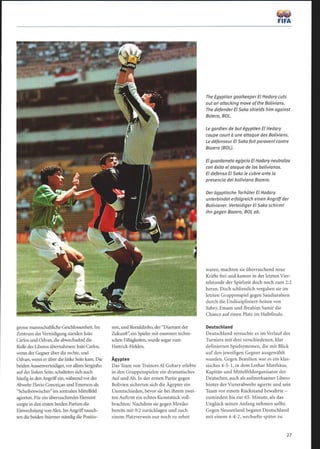
  • 15.
    Mexico 99 Tournament Analysis Conditions Lesconditions météorologiques n'étaient pas des meilleures : Il a fait extrêmement chaud certains jours aux heures des coups d'envoi. Toutefois, à Mexico City, la plupart des matches ont été disputés dans de bonnes conditions. A Guadalajara, le groupe B a évolué au stade Jalisco. Les joueurs n'ont pas eu à se plaindre de la qualité du gazon très bien entretenu, même les jours de pluie. L'assistance des forces de l'ordre, des volontaires et des ramasseurs de ballon était inestimable et a certainement contribué au succès de la compétition. Fair-play Il est désormais de coutume lors des compétitions de la FIFA que tous les participants s'engagent à respecter la notion de fair-play. Il n'est donc plus rare de voir les joueurs de deux équipes en lice s'entraider après un tacle ou venir en aide avant même l'arrivée des premiers soins. Ce comportement positif a été observé chez toutes les équipes, et a été un des moments forts de la compétition. Opening match in Guadalajara between Brazil and Germany 4-0 (0-0). Lars Ricken (No. 18) shields the ball in exemplary fashion from the onrushing Ze Roberto. Match d'ouverture à Guadalajara entre le Brésil et l'Allemagne 4-0 (0-0). Lors Ricken (no 18) couvre ici remarquablement le ballon face à l'attaque de Ze Roberto. Partido inaugural en Guadalajara entre la selección brasileña y Alemania, que finalizó con el resultado de 4-0 (0-0). Lars Ricken (n° 18) tapa magníficamente el balón ante la presencia del atacante Zé Roberto. Eröffnungsspiel in Guadalajara zwischen Brasilien und Deutschland 4-0 (0-0). Lars Ricken (Nr. 18) deckt hier den Ball vordem angreifenden Ze Roberto vorbildlich ab. Jours de repos Il convient d'accorder dans toutes les compétitions assez de temps de repos aux joueurs pour leur permettre de récupérer, et aux entraîneurs pour améliorer la tactique des équipes. AMexico City, le temps imparti entre les matches était trop court. Quelques équipes avaient une longue saison derrière elles et n'ont pas eu assez de temps ni pour s'adapter ni pour s'acclimater. Un nombre trop restreint de jours de repos peut augmenter le risque de blessure et baisser le niveau technique. Il va de soi, qu'en augmentant le nombre de jours de repos, le coût de la compétition sera plus élevé, mais ce repos s'avère indispensable.
  • 16.
    En la CopaFIFA/Confederaciones México 1999 se enfrentaron dos antiguos campeones mundiales, dos campeones de la CONCACAF y cuatro equipos que habían participado en el pasado en las competiciones forales de la Copa Mundial. Los puntos de mayor interés en vísperas de este campeonato eran las cualidades artísticas de Brasil, la garra y potencia organizatoria de Alemania, la rivalidad entre Egipto y Arabia Saudita, cuyo deseo de derrotar al otro es inigualable, la ambición de la selección de EEUU de batir finalmente a Brasil, el cual la derrotó por un único gol tres veces en los últimos cuatro choques, y la actuación de México, vecino geográfico y eterno rival de Norteamérica, así como actual campeón de la CONCACAE. Bolivia sabía que la altura de Ciudad de México representaría una ventaja para su equipo, mientras que Nueva Zelanda estaba satisfecha de poder enfrentarse a países futbolísticos de gran calibre mundial. Una magnífica mezcla de estilos, desde la creatividad de los brasileños y mexicanos hasta la potencia física y mental de norteamericanos y neozelandeses: todo parecía ser un verdadero manjar para los hinchas de fútbol, ¿pero lo fue realmente? Los alemanes no estaban bien preparados y fueron eliminados en la primera vuelta, tras haber sido humillados por Brasil y derrotados, por segunda vez en 1999, por EEUU. Debemos reconocer que carecieron de sus mejores jugadores debido a lesiones y compromisos con sus clubes. No obstante, lo que debía ser una oportunidad ideal para los juveniles de exhibir su categoría, se transformó en una experiencia frustrante para el entrenador Erich Ribbeck y su cuadro técnico. Brasil estuvo igualmente corto de astros, pero sus juveniles brillaron, haciendo que muchos envidiaran el talento que Dios otorgó a esta nación. Egipto fue una escuadra muy interesante de observar y, si no hubiese sido por su incontrolable temperamento contra Arabia Saudita, habría quizás causado problemas a los brasileños en la semifinal. EEUU registró algunos buenos resultados, pero su énfasis en una sólida y firme defensa lo privó de la oportunidad de mostrar más creatividad en el ataque . El dueño de casa México sabía que su potencia en suelo local, además de la ventaja de la altitud, haría que fuera una selección difícil de derrotar, particularmente por la forma en la que se encontraba en esos momentos. No decepcionó a sus hinchas y la final fue disputada por las dos escuadras más poderosas. Planificación del calendario del torneo La Copa de Confederaciones es un acontecimiento muy importante para algunos países, mientras que para otros es más bien una carga adicional, una competición intensiva más y una reducción adicional en el tiempo a disposición para reponerse y recuperarse. Para los países de Asia, Oceanía, CONCACAF y Africa, este torneo es una buena oportunidad para poner a prueba su potencia yjugar contra los mejores futbolistas del mundo. Sea como fuere la fecha de la competición deberá escogerse con mayor minuciosidad en el futuro. La débil actuación de Alemania habrá afectado seguramente su reputación de gran nación futbolística . Pasado el tiempo, nadie recordará que algunos de sus astros estuvieron ausentes, que su preparación fue inadecuada y que sus juveniles no estaban aún a la altura de un torneo de tal envergadura. Existió asimismo el problema de la programación de los partidos en el torneo mismo. La proximidad de los encuentros no permitió suficiente tiempo de recuperación y las quejas de algunos entrenadores resultan justificadas. ¿Hubo suficiente tiempo de recuperación para los jugadores, particularmente para aquéllos con lesiones leves? No obstante, en términos generales, la competición puede considerarse, sin duda alguna, como una valioso aditamento al calendario futbolístico general y esperamos que se siga disputando en el futuro. FIFA Nivel técnico del torneo El gran interés demostrado por la Copa de Confederaciones México 1999 fue justificado en todo sentido. Los hinchas querían ver buen fútbol por parte de sus selecciones, no sólo desde el punto de vista de organización, sino también técnico, táctico y de deportividad . Algunos países pudieron acumular experiencia al enfrentarse a las naciones renombradas, otros utilizaron los encuentros como base de futuras mejoras y oportunidad para preparar a sus jugadores para su próxima competición internacional. Este campeonato volvió a mostrar las dos caras del fútbol. Primero, que es un juego de equipo y que confiar sólo en la habilidad individual de algunos jugadores no conduce al éxito. Segundo, los individualistas destacados siguen siendo necesarios para proporcionar ese algo decisivo. Como ejemplo de este segundo aspecto cabe señalar al joven Ronaldinho o al veterano Mattháus, quien se halló en una forma formidable. Los dos grupos estuvieron conformados de la siguiente manera: Grupo A México (CONCACAF) Arabia Saudita (AFC) Bolivia (CONMEBOL) Egipto (CAF) Grupo B Brasil (CONMEBOL) Alemania (UEFA) Nueva Zelanda (OFC) Estados Unidos (CONCACAF) El grupo A fue un grupo muy reñido, en el cual el campeón de la CONCACAF México obtuvo la primera plaza, sacando claro beneficio de su ventaja local. La escuadra mexicana fue mejorando progresivamente, aunque sintió claramente la ausencia de Hernández, su ariete goleador. Arabia Saudita fue mejorando de partido en partido, haciendo gala de mucha calidad individual y capacidad de juego colectivo. Su actuación fue un claro 15
  • 17.
    Tournament Analysis reflejo delprogreso que viene viviendo el fútbol asiático y el pase a la segunda ronda fue un enorme éxito para el equipo. Egipto jugó bien, pero no consiguió pasar a la segunda fase. Fue netamente inferior a Arabia Saudita en el tercer partido del grupo. Bolivia se presentó con un cuadro muy luchador y disputó tres encuentros muy equilibrados. Con un poco más de fortuna hubiera conseguido pasar a la segunda vuelta. En el grupo B, Brasil- el equipo número uno del mundo según la Clasificación Mundial de la FIFA- se presentó con una escuadra sumamente nueva, alineando jóvenes talentos junto a jugadores experimentados para proporcionar el habitual fútbol espectacular yatrayente. Destacaron todos, incluso los legionarios radicados en Europa. EEUU exhibió un magnífico juego colectivo, muy prometedor para el futuro, y mereció pasar a la segunda ronda. Alemania no acudió con su mejor escuadra, faltando jugadores como Bierhoff, Effenberg, Jeremies, Kirsten y Móller, quienes fueron sustituidos por algunos juveniles deseosos de demostrar su habilidad y capacidad para ser titulares. Sin embargo, no consiguieron este objetivo, ya que un desarrollo tal requiere más tiempo. Con este plantel reducido, Alemania no tuvo impacto y se despidió del torneo tras la primera vuelta. Nueva Zelanda, que representaba a Oceanía, fue a México con la intención de mejorar su técnica mediante una competición de alta categoría y demostró que es capaz de competir en el ámbito internacional. Todos los entrenadores estuvieron satisfechos con la posibilidad que les brindó el torneo: tanto ellos como sus jugadores pudieron medir fuerzas con los mejores del mundo y comparar el nivel de sus respectivos progresos. Participación de jugadores Un aspecto positivo del torneo fue que todos los equipos, excepto Brasil y Alemania, arribaron con sus mejores valores. En el futuro, la competición deberá jugarse en una fecha más favorable para que todos los países puedan presentar sus equipos de gala y tengan más tiempo de preparación. Para Bolivia, Brasil y México, esta competición vino pisándole los talones a la Copa América, un torneo muy importante para ellos. No hubo mucho tiempo de recuperación a disposición, ni grandes posibilidades de modificar los equipos. Pero pese a la ausencia de algunos grandes astros, la competición no perdió brillo. Por ejemplo, Brasil, que tuvo que prescindir de varias estrellas, exhibió una magnífica actuación con sus suplentes y utilizó óptimamente su cantera de talentos. Varios países tomaron parte en las conver- saciones relacionadas con la programación de este evento y todos desean ver la Copa de Confederaciones como otro torneo fijo en el calendario de la FIFA. Infraestructura Los organizadores mexicanos ofrecieron magníficas posibilidades de hospedaje a todas las delegaciones y representantes de la FIFA. Cada asociación nacional se alojó - separada de los demás - en un hotel de primera clase, y el transporte a los campos de entrenamiento estuvo perfectamente organizado. Las instalaciones de entrenamiento utilizadas pertenecían a clubes profesionales y todos los campos se encontraban en excelentes condiciones. Condiciones climáticas Las condiciones meteorológicas eran a veces desastrosas, con algunos días de extremo calor. No obstante, la mayor parte de los partidos en la Ciudad de México se disputó bajo condiciones aceptables. En el grupo B, en Guadalajara, el estadio de jalisco ofreció buenas condiciones para los encuentros. La calidad de la superficie de juego no dio lugar a objeciones y fue adecuada incluso los días de lluvia. La asistencia ofrecida por funcionarios de seguridad, voluntarios y niños recogebalones fue excelente, mereciendo un agradecimiento especial por haber contribuido al rotundo éxito de la competición. Fair Play Se ha convertido en un sello de calidad de las competiciones de la FIFA que todos los participantes demuestran espíritu de deportividad en estos torneos. Ya no es inhabitual ver a jugadores de equipos adversarios ayudar a levantarse después de una carga o asistirse en caso de una lesión antes de que los médicos entren a la cancha. Todos los equipos evidenciaron un tal comportamiento deportivo, siendo éste uno de los puntos más positivos de la competición. Días de descanso Al igual que en todos los torneos, se trató de conceder suficiente tiempo entre los partidos para que los jugadores pudieran recuperarse y los entrenadores pudiesen efectuar mejoras tácticas en sus equipos. En el grupo Aen Ciudad de México, el intervalo entre los encuentros fue muy Mexico 99
  • 18.
    corto. Algunos equiposvenían cargados ya de una larga temporada de competiciones y no dispusieron del período de adaptación y aclimatización adecuado. Un descanso insuficiente conduce a mayores riesgos de lesión y a un bajón en el nivel de la habilidad técnica. Se recomienda que, en el futuro, se concedan más días de descanso entre los partidos, pese a que ello aumente los costos de la competición. Das Teilnehmerfeld am FIFA/Konfödera- tionen-Pokal Mexiko 99 umfasste zwei ehemalige Weltmeister, zwei CONCACAF-Meister und vier Mann- schaften, die bereits einmal an einer WM- Endrunde teilgenommen haben. Beson- deres Augenmerk wurde auf folgende Aspekte gelegt: die Ballvirtuosität der Brasilianer, den Mut und die gute Organisation der Deutschen, und die Rivalität zwischen Ägypten und Saudi- arabien - der gegenseitige Wunsch, einander in die Knie zu zwingen, könnte grösser nicht sein. Dann auf die amerika- nische Mannschaft, die allzu gerne noch einmal gegen Brasilien antreten wollte, gegen die sie in den letzten drei der vier Partien jeweils mit nur einem Tor Unterschied verloren hatte, und Mexiko, Nachbar und Erzrivale der Amerikaner sowie CONCACAF-Meister. Bolivien wusste, dass die Höhenlage von Mexiko- Stadt ein Vorteil war. Neuseeland freute sich ganz einfach, dass es gegen die grossen Fussballnationen der Welt antreten durfte. Verschiedene Spielwei- sen, die Kreativität Brasiliens und Mexikos, die physische und mentale Stärke der Vereinigten Staaten und Neuseelands: Es sah ganz nach einem Leckerbissen für Fussballanhänger aus. Aber wurde das Turnier den Erwartungen auch wirklich gerecht? Die Deutschen waren ungenügend vorbereitet und schieden nach der ersten Runde aus. Von Brasilien wurden sie geradezu gedemütigt, und von den USA wurden sie 1999 bereits zum zweiten Mal geschlagen . Klar waren einige Schlüssel- 1 f, FIFA spieler verletzt oder wegen Verpflichtun- gen bei ihrem Verein nicht angereist. Was eigentlich eine ideale Gelegenheit hätte werden sollen für die jungen Spieler, um sich zu profilieren, wurde am Ende zu einem frustrierenden Unterfangen für Erich Ribbeck und seine Funktionäre, was nachdenklich stimmen musste. Auch Brasilien hatte die Abwesenheit einiger Stars zu beklagen, doch die jungen Spieler wussten zu gefallen. Einige mögen mit Neid auf das Talent geblickt haben, das Gott den Brasilianern in die Wiege gelegt hat. Ägypten schaute man gerne zu, und wäre das Temperament gegen Saudiarabien nicht mit der Mannschaft durchgegangen, hätte das Team Brasilien im Halbfinale ganz schön fordern können. Die USA erzielten gute Resultate, aber weil sie sich zu stark auf die Vertei- digung konzentrierten, liessen sie die Kreativität im Angriffvermissen. Gastge- ber Mexiko galt als heimstark. Ausserdem hatte das Team den Vorteil der Höhenlage auf seiner Seite. Mexiko wusste deshalb, dass es schwer zu schlagen war, vor allem in der beneidenswerten Form, in der die Mannschaft sich befand. Mexiko ent- täuschte seine Fans nicht, und im Endspiel gegen Brasilien sah man zwei starke Teams. SaudiArabia Bolivia 0-0 this free-kick is successfully blocked by the Bolivian wall ofplayers. Arabie Saoudite - Bolivie 0-0 Coup franc bloqué par le mur bolivien. Arabia Saudí-Bolivia, 0 a 0. La defensa boliviana bloquea el tiro libre. Saudiarabien-Bolivien 0-0 - dieser Freistoss wird von der bolivianischen Mauer erfolgreich blockiert. 17
  • 19.
    Tournament Analysis Zeitpunkt desTurniers Der Konföderationen-Pokal ist für einige Länder sehr wichtig, für andere eine zusätzliche Belastung - noch ein intensi- ver Wettbewerb, noch weniger Zeit für Erholung. Für Länder aus Asien, Ozeani- en, der CONCACAF und Afrika ist der Wettbewerb eine Gelegenheit, ihre Stärke unter Beweis zu stellen und gegen einige der weltbesten Fussballer anzutreten. Der Zeitpunkt des Turniers muss sorgfältig überdacht werden, damit die besten Spieler von den Vereinen auch abgestellt werden. Die schwachen Leistungen der Deutschen dürfte den Ruf der Topmannschaft angekratzt haben. Denn niemand wird sich später daran erinnern, dass die Stars nicht mit von der Partie waren, dass die Vorbereitung ungenügend war und die jungen Spieler noch nicht bereit waren für das Turnier. Dazu kommt der Spielplan des Turniers. Er war sehr dicht gedrängt, was die Erholungszeit einschränkte ; die Klagen einiger Trainer sind durchaus nachvollziehbar. War die Ruhezeit für die Spieler ausreichend, insbesondere jene, die an kleinen Verletzungen laborierten? Insgesamt besteht jedoch kein Zweifel darüber, dass dieses Turniers ein wertvoller Mosaikstein im Spiel- kalender ist. Hoffen wir, dass er das bleibt und auch in Zukunft durchge- führt wird. Technisches Niveau Das grosse Interesse, mit welchem der Konföderationen-Pokal 1999 in Mexiko verfolgt wurde, war in allen Belangen berechtigt. Die Fans wollten guten Fussball sehen, sowohl in organisatori- scher als auch in technischer, taktischer und sportlicher Hinsicht. Einige Länder haben aus den Erfah- rungen in Spielen gegen Topnationen gelernt, für andere war der Wettbewerb eine Grundlage, um Verbesserungen für die Zukunft zu planen, eine Chance für ihre Spieler, um für die nächsten interna- tionalen Wettbewerbe Spielpraxis zu sammeln. Der Konföderationen-Pokal zeigte einmal mehr die beiden Gesichter des Fussballs. Fussball ist in erster Linie ein Mannschaftssport. Die Fähigkeiten eines Einzelspielers bringen langfristig keinen Erfolg. Und doch braucht es sie auch, die exzellenten Einzelspieler, die den kleinen Unterschied ausmachen. Beispiele für dieses aussergewöhnliche Können sind zum Beispiel ein junger Ronaldinho, aber auch ein erfahrener Matthäus, der noch immer eine beein- druckende Form aufweist. Die beiden Gruppen setzten sich wie folgt zusammen: Gruppe A Mexiko (CONCACAF) Saudiarabien (AFC) Bolivien (CONMEBOL) Ägypten (CAF) Gruppe B Brasilien (CONMEBOL) Deutschland (UEFA) Neuseeland (OFC) Vereinigte Staaten (CONCACAF) Gruppe A war ziemlich ausgeglichen, CONCACAF-Gewinner Mexiko beendete die Gruppenspiele auf dem ersten Rang. Mexiko wusste den Heimvorteil gegen starke Gegner zu nutzen. Im Verlauf des Turniers kam Mexiko immer besser in Form. Die Mannschaft musste ohne ihren Starstürmer Hernandez auskommen. Saudiarabien wurde mit jedem Spiel besser und zeigte gute individuelle Leistungen, aber auch einen guten Mannschaftsgeist . Die Darbietung Saudiarabiens zeigte, dass der asiatische Fussball einen Riesensprung nach vorne gemacht hat. Die Qualifikation für die zweite Runde war für das Team ein Grosserfolg. Ägypten spielte mit Stil, konnte sich aber ganz klar nicht für die zweite Runde qualifizieren; im entscheidenden dritten Gruppenspiel war Saudiarabien klar überlegen. Bolivien reiste mit einer schlagkräfti- gen Mannschaft nach Mexiko und spielte in allen drei Gruppenspielen ausgeglichen; mit ein bisschen mehr Glück hätte sich die Mannschaft für die zweite Runde qualifizieren können. In Gruppe B trat Brasilien, das weltbeste Team in der FIFA-Weltrangliste, mit einer teilweise neu zusammengesetz- ten Mannschaft an - junge Talente neben erfahrenen Spielern, und sie glänzten, wie wir es von den Brasilianern kennen. Einige Spieler, die in Europa ihr Geld verdienen, waren ebenfalls dabei. Auch sie wussten sich ins Rampenlicht zu setzen und auf sich aufmerksam zu machen. Die USA boten uns eine Kostprobe der Teamarbeit und ihrer Spielweise, ein Versprechen für die Zukunft. Das Team hat die Qualifikation für die zweite Runde mehr als verdient. Die Deutschen reisten nicht mit der besten Mannschaft nach Mexiko. Spieler wie Bierhoff, Effenberg, Jeremies, Kirsten und Möller fehlten. Einige junge Spieler übernahmen deren Aufgabe in der Hoffnung, sich für die Zukunft aufzu- drängen. Das gelang ihnen allerdings nicht immer. Entwicklungen dieser Art erfordern Zeit. Mit den Spielern, die zur Auswahl standen, war die Luft bei den Deutschen bald raus, ihr Ausscheiden die logische Folge. Neuseeland vertrat Ozeanien und wollte seine Technik in einem wichtigen Wettbewerb verbessern. Die Mannschaft bewies, dass sie fähig und gewillt ist, international mitzuhalten. Die Trainer schätzten die Gelegenheit, die ihnen dieses interkontinentale Turnier bot: Sie und auch die Spieler konnten sich mit den weltbesten Teams messen und ihre Fortschritte vergleichen. Spieleraufgebot Ein positiver Aspekt des Turniers war, dass alle Mannschaften ausser Brasilien und Deutschland mit den besten Spielern anreisten. Für den Wettbewerb muss im Spielkalender ein besserer Zeitpunkt gefunden werden, damit alle Mannschaf- ten vollzählig antreten können und sie genügend Zeit haben, um sich vorzube- reiten. Mexico 99
  • 20.
    Für Bolivien, Brasilienund Mexiko folgte das Turnier kurz auf die Copa America, ein für sie ebenfalls wichtiges Turnier. Zeit für Erholung und die Vorbereitung blieb kaum. Aber sogar die Abwesenheit einiger Stars konnte dem Glanz des Turniers keinen Abbruch tun. Das Abschneiden Brasiliens ist verständlich - viele Spieler standen nicht zur Verfügung -, aber auch mit den Ersatzspielern war das Spiel- niveau immer noch beachtlich, und die Mannschaft wusste ihre Ressourcen sinnvoll zu nutzen. Einige Länder haben über den Zeitpunkt der Veranstaltung diskutiert und möch- ten den Konföderationen-Pokal gerne als einen der wichtigsten FIFA-Wettbewerbe verankern. Infrastruktur Alle Delegationen und die FIFA-Offiziellen wurden von den mexikanischen Ausrichtern untergebracht. Jeder Nationalverband logierte in einem anderen Erstklassehotel, und der Transport zum Trainingsgelände war sehr gut organisiert. Die Trainingseinrichtungen gehörten den Profivereinen, die Spielfelder befanden sich ausnahmslos in einem ausgezeichneten Zustand. Äussere Bedingungen Das Wetter war zum Teil sehr schlecht; an einigen Tagen war es beim Anpfiff drückend heiss. In Mexiko-Stadt konnten die meisten Partien unter angenehmen Bedingungen ausgetragen werden. In der Gruppe B wurde im Stadion Jalisco in Guadalajara gespielt: Der Rasen war in einem gutem Zustand und gab zu keinen Klagen Anlass; sogar an Regen- tagen war das Terrain gut präpariert. Sicherheitsbeamte, Freiwillige und Balljungen leisteten ausgezeichnete Arbeit. Ihnen gebührt ein herzliches Dankeschön, denn sie haben viel zu einem erfolgreichen Wettbewerb beigetragen. México-Arabia Saudí, 5 a 1 (3-0). El delantero Blanco se impone una vez a la defensa saudí. FIFA Mexico Saudi Arabia 5-1 (3-0) once again the forward Blanco successfully outwits the Saudi defenders. Mexique -Arabie Saoudite 5-1 (3-0) L'attaquant Blanco réussit une nouvellefois à s'imposer face aux défenseurs saoudiens. Mexiko-Saudiarabien 5-1 (3-0) - Stürmer Blanco setzt sich hier erneut erfolgreich gegen die Saudi-Verteidiger durch. Fairplay Dass alle Spieler sich an einem FIFA- Wettbewerb an die Fairplay-Regeln halten, ist zu einem Merkmal der FIFA- Turniere geworden. So kann es durchaus vorkommen, dass Spieler von gegneri- schen Mannschaften einander nach einem Tackling beim Aufstehen helfen oder eine Verletzung behandeln, bevor das Betreuungsteam auf das Spielfeld eilt. Dies war erfreulicherweise bei allen Mannschaften zu beobachten, was einer der Höhepunkte dieses Wettbewerbs war. Ruhetage Wie bei allen Turnieren muss darauf geachtet werden, dass die Spieler zwischen den einzelnen Partien genügend Zeit für Erholung haben und die Trainer an der Taktik feilen können. In Mexico City war zwischen den Spielen zu wenig Zeit einberechnet. Einige Mannschaften hatten eine lange Saison mit vielen Wettbewerben hinter sich und hatten nicht genug Zeit, sich an dieVerhältnisse anzupassen . Zu wenig Erholungszeit führt zu einem grösseren Verletzungsrisiko und einem Leistungsabfall. Obwohl dadurch die Kosten eines Wettbewerbs steigen, wäre es für die Zukunft ratsam, zwischen den Spielen mehr Ruhetage einzuplanen.
  • 21.
    Tournament Analysis Introduction toTechnical/ tactical analysis The characteristics of modern football include a clearly defined coverage of space, a playing system that is constructed around the abilities of the players available, and a high degree of co- ordination between the individual tactical demands and abilities . It is in this area that there are great differences between teams. A successful team, at club or national level, is characterised by its finely-tuned playing system, with clearly defined roles and tactics appropriate to the situation, and the ability to put all this into practice consistently. Both planning and preparation are key factors in succeeding in a competition . The job of the coach - both difficult and enjoyable at the same time - is to provide the right kind oftraining and leadership, to ensure that the players as individuals, as members of their blocks and as members ofthe team, are tuned to the demands of an international tournament. Flavio Conceiçao elegantly robs the monument Lothar Matthäus ofthe ball. Flavio Conceiçao dérobe habilement le ballon au monument Lothar Matthäus. Flavio Conceiçao le arrebata elegante- mente el balón al legendario Lothar Matthäus. Flavio Conceiçao trennt hierdas Denk- mal Lothar Matthäus elegant vom Ball. 20 A short analysis ofthe individual teams: Bolivia Coached by Hector BambinoVeira from Argentina, the Bolivian team used a basic 4:4:2 in all three matches, which they alternated with a 4:3:3 or even a 4:5:1 according to the opponent, but their variations were never dictated by defensi- ve considerations. On the contrary, some of their attacking drive was at the expense of the normally serious defensive set-up. Coach Veira showed that he has done good work with this team, but they were just a bit unlucky in their efforts . Brazil Brazil employed a basic 4:4:2 system, using variations to match the abilities of their players, and overall their teamwork was good. In the centre of the defence they used Joao Carlos and Odvan, who alternated in taking on the role of sweeper; when the ball came from the right Joao Carlos did the job, from the left it was Odvan. The two wing-backs offered strong support in attack, especially Serginho on the left. In midfield Flavio Conceicao and Emerson played in front of the defence taking on the vacuum- cleaner roles. From the second match onwards they introduced Alex as a substitute and he added a real element of surprise when he came on. The two strikers would switch positions frequently, one of them being Ronaldinho, a diamond of the future, skilful, technically gifted and a hat trick hero in this competition . Egypt Egypt's fortunes varied dramatically from one match to another. Coached by Al Gohary, they ended their first game all square against Bolivia, but then accomplished a remarkable feat in their next outing. Coming from 0:2 down
  • 22.
    against Mexico andreduced to ten men, they found an extra source of energy and in the last quarter of an hour managed to pull back to end the game 2:2 . But some undisciplined play in the third group match versus Saudi Arabia from Sabry, Imam and Ibrahim Samir cost them their chance of a place in the semi-final. Their basic formation was 4:4:2, flexibly interpreted. When attacking, the system was usually 3:5:2. Their defensive players were athletic and strong tacklers; in midfield Ramzy and Radwan Jasser covered well behind the more attacking Sabry and the forwards. In attack they had some very talented players, and it was a pity that those lapses in concentration and self-control robbed them of a real and basically well-earned opportunity to progress further. Germany Germany employed three different systems during the tournament, each one being clearly defined and appropriate to the current opponent. Against Brazil they used a classic 4:5:1, with Lothar Matthäus, the captain and midfield organiser, also operating effectively as the watchful free man behind the four-man defensive block; at least until the 65th minute, which was when the ship hit the rocks. Against New Zealand, they started with 4:4:2 and then switched to 4:3:3, while for the USA game it was back to a traditional 4:4:2. Their defensive plan was very flexibly applied, usually with two man-markers and a libero in a staggered formation, plus the defensive midfielders operating zone marking. The result of this was that the two strikers did not receive enough support and often the ball did not reach them; it was rare to see players pushing through into attack. All too often long balls were played forward but they seldom reached their intended target, or were intercepted by an opponent. This forced Matth5us and Scholl, and Wosz occasionally, to use their technical skills in an attempt to dribble the ball forward, trying to create space and attacking pressure. This team was hard to recognise as coming from Germany - all the traditional virtues seemed to be lacking, too many basic weaknesses came to light and at times the team was almost humiliated. There is a definite need for some rethinking here. Mexico Despite having some problems in their group matches against Egypt and Bolivia, Mexico, coached by Manuel Lapuente, Showing technical perfection, Emam (EGY) runs past the Bolivian Tufino (No. 8). Emam (EGY) se défait avec une grande perfection technique du Bolivien Tufino (no 8). Emam (EGY) supera con elegante técnica al boliviano Tufino (n° 8). Emam (EGY) überläuft technisch perfekt den Bolivianer Tufino (Nr. 8).
  • 23.
    Mexico 99 were ina class of their own in Group A. Their qualification for the second round was never in the slightest doubt; they were able to dictate the play most of the time. Using their 3:4:3 system (occasionally 3:3:4) well, they did not allow an opponent any chance to develop their own moves. New Zealand Despite having a very disciplined approach and some good individual players, New Zealand did not appear to have a well defined playing system. Their approach was built around the talents of the players available, and mostly they used a 3:5:2 or a 5:4:1 formation, with very little emphasis on attack. With three or five players in defence they used a sweeper behind the block, and both wing- backs lent some help to attacking moves. They were very compact in midfield with Wilkinson, Lines and Jackson as the playmaker feeding the ball through to the one or two skilful forwards (Coveny and/ or Bouckenooghe). In their final game, against Brazil, they showed improved tactics and they could have a promising future if they can continue to play in high level competitions like this one. Saudi Arabia Coached by Milan Macala, the Saudi Arabian team experienced both highs and lows in their three group matches. Following a heavy defeat at the hands of Mexico in their opening game, they recovered well and had a good match against Bolivia, but were out of luck with their finishing and failed to score. Then they met the African champions Egypt and proved on the day to be far superior, virtually outclassing their opponents. This win earned them a place in the semi-finals, but at that stage Brazil clearly exposed their limitations. Operating a system with three defenders, they often had trouble when Brazil attacked with three or even four players. Individual marking of opposing forwards was not always possible, and their defence often Tournament Analysis found itself under heavy pressure. It was in midfield that they showed their skill most. Their best player was striker Al Otaibi who scored six superb goals. The Saudis' variable system was not always successful, but in every match they tried to play in a positive way throughout the team. USA The USA had a clear team concept which was based on the capabilities ofthe players available, most ofwhom were very experienced. Their approach to each game was very definite - on the one hand they wanted to be able to offer a solid defence against any opponent and on the other they wanted to develop positive attacking moves. Thus it was not a surprise that they had to employ different tactics from game to game. At times the formation would be 4:5 :1, at other times a 3:5:2. Coach Bruce Arena's system was based on perfect tactical understanding, but the importance of being able to improvise was not neglected; what was lacking was a change of pace now and then with which to surprise an opponent. Le football moderne se caractérise par une répartition judicieuse sur le terrain, par un système de jeu à la mesure des joueurs disponibles ainsi que par une coordination optimale des exigences tactiques et des qualités individuelles. C'est précisément sur ce point que se manifestent les plus grandes différences entre les équipes. Les équipes à succès, qu'elles soient des clubs ou des sélections nationales, se distinguent par la précision subtile d'un système de jeu reposant sur une stricte répartition des tâches et une tactique adaptée aux situations de jeu ainsi que la capacité à mettre en oeuvre tous ces ingrédients. En outre, autant la programmation que la préparation sont des facteurs clés du succès dans tout tournoi. L'entraîneur a pour tâche - à la fois difficile et attrayante - de préparer son équipe, ses blocs et ses individualités aux exigences d'un tournoi international en lui indiquant la stratégie appropriée. Analyse succincte des équipes: Allemagne Pendant le tournoi, l'Allemagne appliqua trois systèmes de jeu différents, à chaque fois en fonction de l'adversaire opposé. Contre le Brésil, ce fut un 4-5-1 classique, avec un Lothar Matthäus, capitaine et organisateur du milieu de terrain, évoluant simultanément comme libero derrière la défense en ligne - ce fut le cas au moins jusqu'à la 65e minute, mais n'empêcha pas l'équipe de faire naufrage! Contre la Nouvelle-Zélande, ce fut un 4-4-2, puis un 4-3-3, et contre les USA, ce fut de nouveau un 4-4-2 traditionnel. Le dispositif de défense était appliqué avec une grande flexibilité. D'ordinaire, il se composait de deux joueurs affectés au marquage individuel, d'un libero légèrement en retrait et des milieux de terrain défensifs jouant la zone. Il s'ensuivit que les deux attaquants de pointe étaient insuffisamment soutenus et recevaient peu de ballons ; les joueurs ne montaient que rarement en attaque. Trop souvent, de longues passes étaient frappées en direction des attaquants, mais elles n'atteignaient que rarement le coéquipier ou étaient interceptées par l'adversaire. C'est ainsi que Matthâus, Scholl et, par périodes, aussi Wosz se voyaient contraints de tenter par des dribbles de monter en première ligne, d'ouvrir des espaces et d'accroître la pression. L'équipe d'Allemagne était méconnaissable ; toutes ses vertus traditionnelles semblaient lui faire défaut. La sélection révéla trop de carences élémentaires et du même par moments subir l'humiliation. Au vu de cette performance une qualification pour le 1/2-finale devenait impossible. Arabie Saoudite La sélection dirigée par l'entraîneur Milan Macala connut des hauts et des bas dans ses trois matchs de groupe. Après une lourde défaite face au pays
  • 24.
    hôte, le Mexique,les Saoudiens réalisèrent une bonne performance face à la Bolivie, sans toutefois pouvoir marquer de but. Dans leur troisième match, contre l'Egypte, ils purent sauver l'honneur en déclassant nettement le champion d'Afrique. Mais la demi-finale disputée contre le Brésil mit en évidence leurs limites. Avec leur système de jeu composé de trois défenseurs, les Saoudiens révélèrent dans de nombreuses phases de jeu leur vulnérabilité face aux Brésiliens qui alignaient trois ou quatre attaquants. Le marquage individuel de l'adversaire n'était pas toujours possible ce qui causa souvent de grosses difficulté à la défense. C'est surtout en milieu de terrain qu'ils pouvaient montrer leurs qualités. Leur meilleur joueur était l'attaquant Al Otaibi qui inscrivit six buts magnifiques. Leur système de jeu à géométrie variable ne put être appliqué Coveny, NZsmoothlyglides past the midfielder Williams, USA. Coveny (NZ) esquive avec élégance le milieu de terrain Williams (USA). El neozelandés Coveny elude al centrocampista Williams de EEUU. Coveny, NZ geht hier elegant am Mittelfeldspieler Williams, USA vorbei.
  • 25.
    Tournament Analysis avec succèscontre toutes les équipes, mais les Saoudiens s'efforcèrent dans chaque match d'adopter une attitude positive. Bolivie Sous la direction de l'Argentin Hector Veira, dit Bambino la Bolivie pratiqua à travers les trois matchs de groupe un système 4-4-2. Selon l'adversaire, il pouvait certes évoluer vers un 4-3-3 voire un 4-5-1, mais à aucun moment, il ne se voulait défensif. Au contraire, les attaques impétueuses se faisaient aux dépens du dispositif défensif normalement solide. Le sélectionneur Veira signa une bonne prestation avec son équipe qui se montra quelque peu malchanceuse dans ses efforts. Egypte L'équipe du sélectionneur Al Gohary fit différentes expériences dans les trois matchs de groupe. Après avoir tenu en échec la Bolivie dans le premier match, les Egyptiens réussirent un exploit face au Mexique. Menés à la marque 0-2, et ne jouant plus qu'à dix, ils parvinrent à égaliser 2-2 dans le dernier quart d'heure au terme d'un sursaut d'énergie. En raison du jeu indiscipliné de Sabry, Emam et Ibrahim Samir dans le troisième match de groupe, ils manquèrent de se qualifier pour les demi-finales . Ils pratiquaient un système 4-4-2 souple. Dans les offensives, il s'agissait plutôt d'un 3-5-2. En défense, ils disposaient de joueurs athlétiques et très solides dans les duels. En milieu de terrain, Ramzy et Radwan lasser couvraient bien le milieu offensif Sabry et les attaquants. En attaque, l'Egypte disposait de joueurs très talentueux. Il est regrettable que les joueurs du sélectionneur Al Gohary se gâchèrent eux-mêmes la possibilité d'accéder en demi-finales par leur manque de concentration et de discipline. Mexique Sous la direction du sélectionneur Manuel Lapuente, le Mexique fut une classe à part dans le groupe A, même s'il éprouva beaucoup de difficultés face à l'Egypte et à la Bolivie. Mais personne ne douta jamais de sa qualification pour le deuxième tour, tant il fut toujours en Al Shahrani, KSA successfully beats off the challenges ofGarcia Aspe (8) and Zepeda (19). Al Sharhani (KSA) se fraye un chemin entre Garcia Aspe (8) et Zepeda (19). Al Shahrani (KSA) se escabulle entre García Aspe (8) yZepeda (19). Al Shahrani, KSA kämpft sich erfolgreich gegen Garcia Aspe (8) und Zepeda (19) durch.
  • 26.
    mesure de dictersa loi la plupart du temps. Son système de jeu 3-4-3, évoluant de temps à autre vers un 3-3-4, ne laissa aucune chance à ses adversaires de développer leur propre jeu. USA La sélection des USA se présenta avec une stratégie claire et nette qui reposait sur les capacités des joueurs à sa disposition. La plupart d'entre eux avaient une grande expérience. Leur approche de chaque match était clairement définie et visait d'une part à établir une défense solide contre tout attaquant et d'autre part à développer des offensives efficaces. Il ne fut donc pas étonnant de les voir mettre en oeuvre différents systèmes selon les adversaires . Il y eut aussi bien un 4-5-1 qu'un 3-5-2 . Le système de Bruce Arena reposait sur un concept tactique parfait, mais qui ne négligeait pas non plus les improvisations spontanées. Ce qui manquait était les changements de rythme susceptibles de tromper l'adversaire par surprise. El fútbol contemporáneo se caracteriza por una clara distribución de zonas, un sistema de juego concebido a la medida de los jugadores a disposición y una óptima coordinación de las exigencias tácticas y las habilidades individuales. Es justamente aquí donde existen grandes diferencias de un equipo a otro. Una selección o un club exitoso se destaca por un sistema de juego perfectamente coordinado, con una clara disposición de funciones y una táctica oportuna para poder aplicarlas consecuentemente en el partido. La planificación y la preparación son las condiciones indispensables para lograr una buena y exitosa actuación en una competición. Una de las tareas más difíciles, pero más hermosas del entrenador, es tomar medidas de entrenamiento y dirección selectivas para poner a punto óptimamente al equipo, a los jugadores individuales y a cada bloque de cara a una competición internacional. A continuación consignamos un breve análisis de los equipos: Bolivia Bolivia jugó, bajo la dirección del argentino Héctor bambino Veira, un 4- 4-2 consecuente en todos los partidos, alternando - según el adversario - a un 4-3-3 ó incluso a un 4-5-1. No obstante, su planteamiento nunca fue defensivo, al contrario, a veces se ponía en peligro el concepto defensivo con ataques descontrolados. En general, el técnico Veira realizó un buen trabajo con un equipo algo desafortunado. Brasil Brasil planteó un sistema 4-4-2, que varió adaptándolo a las características individuales de sus jugadores. La defensa fue organizada por los dos defensores centrales Joao Carlos y Odván, quienes se alternaban como barredores : cuando el balón venía por la derecha, Joao Carlos asumía esta función y Odván hacía lo mismo viceversa. Los dos defensores laterales apoyaron con eficacia los despliegues ofensivos, particularmente Serginho por la banda izquierda. En la línea media, Flavio Conceiçao y Emerson actuaron delante de la defensa y se encargaron de neutralizar los ataques contrarios; tras el segundo encuentro, este eje fue ampliado con la participación de Alex, quien aportó sorpresa y peligrosidad al juego brasileño. En el ataque operaron dos arietes que cambiaban constantemente de posiciones, destacando Ronaldinho, el diamante del futuro; un jugador talentoso y técnicamente muy versado. Egipto El equipo del seleccionador Al Gohary jugó tres partidos completamente diferentes. Tras el empate con Bolivia en el primer encuentro, los egipcios lograron una hazaña increíble en el segundo choque contra México, al remontar un 0 a 2 con sólo diez hombres en el último cuarto de hora del FIFA cotejo y empatar a dos. En el tercer partido, las acciones antideportivas de Sabry, Emam e Ibrahim Samir le costaron la clasificación a la escuadra egipcia, que perdió por 5 a 1 contra Arabia Saudita. Egipto planteó un 4-4-2 flexible, cambiando a un 3-5-2 cuando subía al ataque. La defensa fue firme y sólida, con jugadores muy robustos y atléticos. En la línea media, Ramzy y Radwan Jasser apoyaron óptimamente al centrocampista ofensivo Sabry y a los delanteros. Egipto dispuso de jugadores ofensivos muy talentosos y es una pena que no haya podido sacar frutos de su gran potencial debido a su falta de concentración e indisciplina. Alemania Alemania utilizó tres sistemas de juego diferentes durante el torneo, siempre adaptándose a los respectivos adversarios. Contra Brasil planteó un clásico 4-5-1, utilizando al capitán Mattháus como organizador de la línea media, así como líbero detrás de la línea defensiva de cuatro hombres, sistema que funcionó hasta el minuto 65 . Luego, la escuadra alemana se desarboló por completo, perdiendo por 4 a 0. Contra Nueva Zelanda utilizó un 4-4-2, que alternó con un 4-3-3, y frente a EEUU volvió a aplicar su planteo tradicional de 4-4-2. El concepto defensivo fue aplicado con demasiada flexibilidad, utilizándose dos marcadores directos, un líbero rezagado y los centrocampistas defensivos que marcaban también directamente al hombre. La consecuencia fue que se descuidó demasiado a los atacantes, que deambulaban solos en la punta sin recibir el apoyo necesario. Generalmente, las líneas defensivas no subían para sumar potencia y peligro y frecuentemente bombeaban largos balones hacia adelante que no encontraban destinatario o eran interceptados por los adversarios. Es así que la escuadra tuvo que acudir a las habilidades técnicas de Mattháus, Scholl y, a veces, Wosz, para irrumpir en las filas 25
  • 27.
    Mexico 99 contrarias conarriesgados regates y fintas. Alemania resultó ser un equipo irreconocible y carente de sus virtudes tradicionales. Es evidente que se impone una modificación total del sistema actual. Los alemanes manifestaron demasiadas debilidades elementales y tuvieron que someterse a una verdadera humillación. México Bajo la dirección del técnico Manuel Lapuente, México evidenció gran superioridad en el grupo A, pese a manifestar considerables problemas frente a Egipto y Bolivia. No obstante, la clasificación para la siguiente vuelta nunca estuvo en peligro gracias a su dominio aplastante y su consecuente planteamiento 3-4-3 y 3-3-4, que dejó sin luces a sus adversarios. Nueva Zelanda Nueva Zelanda no tuvo un sistema definido y jugó generalmente con un planteo 3-5-2 y 5-4-1 . El equipo era muy disciplinado y contó con algunas hábiles individualidades, pero le faltó proyección ofensiva. La defensa estuvo formada generalmente por tres a cinco jugadores, desempeñando uno de ellos la función de líbero rezagado. La línea de contención apoyó muy poco a los centrocampistas y delanteros en los despliegues ofensivos. En la línea media formaron un bloque casi impenetrable con Wilkinson, Lines y Jackson, siendo este último el hombre que movía los hilos de la escuadra neozelandesa y suministraba pases a los delanteros Coveny y Bouckenooghe. En el último choque contra Brasil, Nueva Zelanda desarrolló un buen juego táctico y demostró que tiene un futuro prometedor si continúa participando en competiciones de alto nivel. Arabia Saudita La selección saudí, dirigida por el técnico Milan Macala, tuvo un rendimiento totalmente variado en los tres partidos de grupo. Tras una apabullante derrota contra México en el partido inaugural, Tournament Analysis mejoró mucho su rendimiento contra Bolivia, pero su esfuerzo - particularmente en el segundo tiempo - no tuvo premio y el choque finalizó en empate a cero. En el tercer partido, buscaron la victoria con un fervor y una entrega admirables, y borraron de la cancha a un equipo egipcio que se desdibujó del todo. La semifinal contra un Brasil en plena forma marcó el término de la ilusión árabe, aunque la escuadra saudita combatió con mucha garra, planteando, a ratos, un partido muy equilibrado. Su concepto táctico con tres defensas evidenció, a veces, dificultades cuando los brasileños operaban con tres e incluso cuatro atacantes. El intento de marcar hombre a hombre no funcionó desde la base misma del planteamiento táctico, y la defensa manifestó grandes dificultades ante las furiosas arremetidas brasileñas. El juego árabe destacó en la línea media y la figura rutilante del once saudí fue el ariete Al Otaibi, autor de seis magníficos goles. A pesar de que los árabes no pudieran aplicar existosamente su juego variable frente a todos sus contrincantes, cabe señalar y destacar que sus jugadores hicieron gala de una constante actitud ofensiva en todos los sectores. EEUU El esquema táctico de EEUU calzaba como un guante en las individualidades que conformaban el once norteamericano. Se trataba de jugadores muy experimentados, con un sistema de juego claramente definido, tanto para neutralizar a cualquier adversario, como para desarrollar un despliegue ofensivo efectivo. No sorprendió, pues, que EEUU aplicara diferentes sistemas de juego según el contrincante. Es así que a veces maniobraba con un 4-5-1 muy defensivo y, otras, con un 3-5-2 más ofensivo. El sistema de Bruce Arena estaba basado en una perfecta comprensión táctica de los integrantes de su equipo, pero sin descuidar los elementos de improvisación. Faltaron únicamente los sorpresivos cambios de ritmo para desconcertar a los adversarios. Zu den Kennzeichen des modernen Fussballs gehören eine klar definierte Raumaufteilung, ein System, das sich die Fähigkeiten der eingesetzten Spieler optimal zunutze macht, und ein hohes Mass an Koordination zwischen den taktischen Aufgaben und Möglichkeiten der einzelnen Akteure. Die Beherrschung dieser Elemente bestimmt die Stärke eines Teams: Eine erfolgreiche Vereins- oder Nationalmannschaft zeichnet sich aus durch ein sorgfältig abgestimmtes Spielsystem mit klarer Rollenverteilung und die richtige Wahl der Taktik sowie durch die Fähigkeit, all dies konstant auf dem Feld umsetzen zu können. Zentrale Faktoren für ein gutes Abschneiden in einem Wettbewerb sind daher Planung und Vorbereitung. Die ebenso interessan- te wie schwierige Aufgabe des Trainers ist es, seinen Kader so zu trainieren und zu führen, dass die einzelnen Spieler, die verschiedenen Mannschaftsteile und das Team als Ganzes optimal auf die Anfor- derungen eines internationalen Turniers eingestellt sind. Ein kurzer Oberblick über die Spiel- systeme der einzelnen Mannschaften: Bolivien Unter ihrem argentinischen Trainer Hector Bambino Veira trat die bolivia- nische Mannschaft in all ihren drei Spielen mit einem 4-4-2-System an. Je nach Gegner wechselten sie manchmal auch zu einem 4-3-3 oder auch zu einem 4-5-1, wobei für diese Umstellungen nie defensive Oberlegungen verantwortlich waren, im Gegenteil, gingen doch einige der konzentrierten Angriffsversuche auf Kosten der normalerweise straff organi- sierten Abwehr. Veira bewies, dass er und sein Team gut gearbeitet haben, doch am Ende fehlte Bolivien trotz aller Anstren- gungen das letzte Quentchen Glück. Brasilien Brasilien spielte mit einem 4-4-2-System, das je nach den Stärken der eingesetzten Spieler variiert wurde, und zeigte meist
  • 28.
    grosse mannschaftliche Geschlossenheit.Im Zentrum derVerteidigung standen Joáo Carlos und Odvan, die abwechselnd die Rolle des Liberos übernahmen: Joäo Carlos, wenn der Gegner über die rechte, und Odvan, wenn er über die linke Seitekam. Die beiden Aussenverteidiger, vor allem Serginho aufder linken Seite, schalteten sich auch häufig in denAngriff ein, während vor der Abwehr Flavio Conceiçao und Emerson als Scheibenwischer im zentralen Mittelfeld agierten. Für ein überraschendes Element sorgte in den ersten beiden Partien die Einwechslung vonAlex. Im Angrifftausch- ten die beiden Stürmer ständig die Positio- neu, und Ronaldinho, der Diamant der Zukunft, ein Spieler mit enormen techni- schen Fähigkeiten, wurde sogar zum Hattrick-Helden. Ägypten Das Team von Trainers A1 Gohary erlebte in den Gruppenspielen ein dramatisches Auf und Ab. In der ersten Partie gegen Bolivien sicherten sich die Ägypter ein Unentschieden, bevor sie bei ihrem zwei- ten Auftritt ein echtes Kunststück voll- brachten: Nachdem sie gegen Mexiko bereits mit 0:2 zurücklagen und nach einem Platzverweis nur noch zu zehnt The Egyptian goalkeeper El Hadary cuts out an attacking move ofthe Bolivians. The defender El Saka shields him against Botero, BOL. Le gardien de but égyptien El Hedary coupe court à une attaque des Boliviens. Le défenseur El Saka faitparavent contre Bozero (BOL). El guardameta egipcio El Hadary neutraliza con éxito el ataque de los bolivianos. El defensa El Saka le cubre ante la presencia del boliviano Bozero. Der ägyptische Torhüter El Hadary unterbindet erfolgreich einen Angriff der Bolivianer. Verteidiger El Saka schirmt ihn gegen Bozero, BOL ab. waren, machten sie überraschend neue Kräfte frei und kamen in der letzten Vier- telstunde der Spielzeit doch noch zum 2:2 heran. Doch schliesslich vergaben sie im letzten Gruppenspiel gegen Saudiarabien durch die Undiszipliniert-heiten von Sabry, Emam und Ibrahim Samir die Chance auf einen Platz im Halbfinale. Deutschland Deutschland versuchte es im Verlauf des Turniers mit drei verschiedenen, klar definierten Spielsystemen, die mit Blick auf den jeweiligen Gegner ausgewählt wurden. Gegen Brasilien war es ein klas- sisches 4-5-1, in dem Lothar Matthäus, Kapitän und Mittelfeldorganisator der Deutschen, auch als aufmerksamer Libero hinter der Viererabwehr agierte und sein Team vor einem Rückstand bewahrte - zumindest bis zur 65. Minute, als das Unglück seinen Anfang nehmen sollte. Gegen Neuseeland begann Deutschland mit einem 4-4-2, wechselte später zu
  • 29.
    Mexico 99 Tournament Analysis einem4-3-3 und kehrte gegen die USA zu einem traditionellen 4-4-2 zurück. In der Abwehr wurde das System flexibel ausgelegt. Meistens spielten die Deutschen mit einer gestaffelten Verteidi- gung mit zwei Manndeckern und einem Libero, während sich die defensiven Mittelfeldspieler um die Raumdeckung kümmerten. Die beiden Stürmer erhiel- ten so kaum Unterstützung und nur wenige Bälle, und Vorstösse anderer Spieler in die Spitze waren selten. Häufig wurden lange Bälle nach vorne geschla- gen, die aber ihr Ziel selten erreichten und oft sogar von einem Gegenspieler abgefangen wurden. Matthäus, Scholl und seltener Wosz waren dadurch gezwungen, ihre technischen Fähigkeiten unter Beweis zu stellen und zu versuchen, den Ball nach vorne zu dribbeln, um so freie Räume zu schaffen und etwas Druck aufzubauen . Alles in allem war kaum zu erkennen, dass hier eine Mannschaft aus Deutschland am Werk war: Die Spieler liessen alle typisch deutschen Tugenden vermissen und begingen zu viele einfache Fehler, so dass sie teilweise fast schon vorgeführt wurden. Mit dieser Leistung war das Halbfinale ein unerreichbares Ziel. Mexiko Obwohl sie in den Gruppenspielen gegen Ägypten und Bolivien etwas Mühe be- kundeten, waren die Mexikaner in der Gruppe A eine Klasse für sich. Das Team von Trainer Manuel Lapuente diktierte das Spielgeschehen über weite Strecken, und die Qualifikation für die nächste Runde war nie in Gefahr. Mexiko be- herrschte sein 3-4-3-System (das hin und wieder in ein 3-3-4 überging) sicher und gab seinen Gegnern keine Möglichkeit, ihr eigenes Spiel zu entfalten. Neuseeland Die Neuseeländer traten zwar sehr diszi- pliniert auf und verfügten über einige gute Einzelspieler, schienen aber kein festes System zu haben. Den Fähigkeiten der Spieler entsprechend spielte die Mannschaft meistens 3-5-2 oder 5-4-1, wobei das Hauptgewicht eindeutig nicht auf der Offensive lag. In der Abwehr standen drei oder fünf Spieler, mit ei- nem Libero als hinterstem Mann, und aufbeiden Seiten versuchten die Aus- senverteidiger, die Angriffe etwas zu unterstützen. In der Mitte spielten die Neuseeländer sehr kompakt, mit Wilkinson, Lines und dem Spielmacher Jackson, die den Ball an den Ein- oder Zweimannsturm mit den technisch beschlagenen Angreifern Coveny und/ oder Bouckenooghe weiterleiteten. In ihrem letzten Spiel gegen Brasilien zeig- ten sie sich auch taktisch deutlich ver- bessert, und wenn das Team weiterhin an so hochklassigen Wettbewerben wie diesem Turnier teilnehmen kann, steht es vor einer viel versprechenden Zu- kunft. Saudiarabien In den drei Gruppenspielen erlebte die Mannschaft von Trainer Milan Macala Höhen und Tiefen. Nach der eindeuti- gen Niederlage in ihrer ersten Partie gegen Mexiko erholten sich die Saudis rasch und zeigten gegen Bolivien eine gute Leistung. Im Abschluss waren sie allerdings glücklos und blieben ohne Torerfolg. Zuletzt trafen sie auf den Afrikameister Ägypten, der ihnen an diesem Tag klar unterlegen war und von ihnen regelrecht deklassiert wurde. Dieser Sieg verschaffte ihnen einen Platz im Halbfinale gegen Brasilien, wo sich dann allerdings ein deutlicher Klassenunterschied zeigte. Durch ihr System mit drei Verteidigern gerieten sie häufig in Schwierigkeiten, wenn die Brasilianer mit drei oder sogar vier Spielern angriffen. Die Manndeckung der gegnerischen Stürmer funktionierte nicht immer, und die Verteidigung kam oft unter schweren Druck. Insgesamt konnte Saudiarabien im Mittelfeld am meisten überzeugen, wobei der beste Einzelspieler des Teams Stürmer Al Otaibi war, der sechs herrliche Treffer erzielte. Das variable System der Saudis war nicht immer erfolgreich, doch auf alle Fälle gab die Mannschaft in jedem Spiel ihr Bestes. USA Das klare Konzept des US-Teams baute auf den Fähigkeiten des Kaders auf, in dem viele erfahrene Spieler standen. Die Amerikaner hatten sich für jedes Spiel ein klares Ziel gesetzt: Sie wollten einerseits jedem Gegner eine solide Abwehr entgegenstellen und anderer- seits auch im Spiel nach vorne positive Akzente setzen. Um das erreichen zu können, musste die Mannschaft taktisch von Spiel zu Spiel neu eingestellt werden - manchmal fiel die Wahl auf ein 4-5-1, manchmal auf ein 3-5-2. Im System des US-Trainers Bruce Arena musste jeder Spieler seine Rolle im taktischen Gefüge genau kennen, wobei jedoch auch die Kreativität nicht zu kurz kam. Was vielleicht noch fehlte, war hin und wieder eine plötzliche Tempoverschärfung, um einen überra- schenden Angriff auszulösen. Sulimani, No. 13 (KSA) runs past the Bolivian Soria yet again. Sulimani (no 13, KSA) esquive une fois de plus le Bolivien Soria. Sulimani, n° 13 (KSA), supera una vez más al boliviano Soria. Sulimani, Nr. 13 (KSA) hat einmal mehr den Bolivianer Soria überlaufen.
  • 31.
    Team Analysis Team Analysis The8 participating teams Even before a ball was kicked, the 2a FIFA Confederations Cup had an unusual and complicated history behind it. Originally planned for January 1999, with World Cup winners France assigned to Group B in Guadalajara (the draw took place in Mexico D.F. on 4 October 1998), the competition was postponed for organisational and calendar reasons until July/August 1999. With the exception of Brazil and Germany, all the teams participating were able to field their best players (France withdrew because of calendar problems and were replaced by Germany, the reigning European champions) . Brazil, who arrived fresh from their recent victory in the Copa America, were without a number of their stars, such as Amoroso, Cafu, Roberto Carlos, Rivaldo, Ronaldo and Zago; ex-captain Leonardo had not taken part in the Copa America either for personal reasons. Germany, who had won the European Championship the last time it was held back in 1996, were missing some key players too because of an agreement with the Bundesliga clubs; Effenberg, Jeremies, Kahn and Kirsten were all not available. Bierhoff was another notable absentee. Yet the Brazilians were able to demonstrate the prodigious depth of talent to be found in their country by turning up with some wonderful new players; before this competition who had ever heard of Evanilson, Serginho, Christian, Alex, Athirson, Roni, Warley, Odvan or Vampeta, not to mention the latest unpolished teenage diamond in the shape of the 19 year-old Ronaldinho? In this respect the Germans with Linke, Dogan, Maul, Baumann, Gerber and Schneider had nothing to stand comparison with the young South Americans. They were completely unable to live up to their role as reigning European Champions. Another example of a decision in favour ofyouth that proved to be positive 30 was provided by Mexico's coach Manuel Lapuente, who had no hesitation in selecting three players from the 1999 U-20 team. Rafael Marquez played in all five games right through, and Torrado was used in the semi-final, while Osorno was allowed to gain experience by coming on as a substitute. The teams taking part were: Bolivia, included after Uruguay had withdrawn Brazil, title-holders, winners in 1997 in Saudi Arabia Egypt, African Champions 1998 Germany, European Champions 1996 Mexico, host country and winners of the Copa de Oro 1998 New Zealand, OFC Champions 1998 Saudi Arabia, Asian Champions 1998 USA, runner-up in the Copa de Oro 1998. Les huit équipes participantes La 2e Coupe des Confédérations de la FIFA 1999 a derrière elle un passé hors du commun et mouvementé . Programmée tout d'abord en janvier 1999, avec la participation du champion du monde 1998, la France, dans le groupe B à Guadalajara (le tirage au sort se déroula le 4 octobre 1998 à Mexico), elle fut reportée, pour des raisons d'organisation et de calendrier invoquées par certaines équipes, aux mois de juillet et août 1999. A l'exception des sélections du Brésil et de l'Allemagne, toutes les équipes purent disputer le tournoi avec leur meilleure formation du moment. Pour des raisons de calendrier, la France resta à l'écart et fut remplacée par l'Allemagne qui est le champion d'Europe en titre. Captain Emerson in a running duel with the tricky US forward Cobi /ones. Duel entre le capitaine Emerson et le vif attaquant américain Cobi Jones. El capitán Emerson en lucha con el hábil delantero estadounidense Cobi Jones. Captain Emerson im Laufduell mit dem flinken US-Stürmer Cobi jones.
  • 32.
    Le tenant dutitre, le Brésil, qui venait de remporter la Copa America'; renonça à certaines stars comme Amoroso, Cafu, Roberto Carlos, Rivaldo, Ronaldo ainsi que Zago ; L'ancien capitaine Leonardo avait déjà manqué dans la Copa America pour des raisons personnelles. Le champion d'Europe 1996, l'Allemagne, renonça également à plusieurs titulaires comme Effenberg, Jeremies, Kahn et Kirsten en raison d'accords passés avec les clubs de Bundesliga. Bierhoff, qui joue en Italie, manquait aussi. Les Brésiliens prouvèrent une fois de plus qu'ils sont capables de présenter au pied levé, dans une proportion étonnante, des talents encore inconnus. Qui connaissait déjà Evanilson, Serginho, Christian, Alex, Athirson, Roni, Warley, Vampeta et surtout le diamant brut de 19 ans, Ronaldinho ? En face d'eux, les Allemands, qui n'avaient avec Linke, Dogan, Maul, Baumann, Gerber et Schneider, aucun joueur comparable à opposer, ne furent à aucun moment et en aucune manière à la hauteur de leur rôle de champion d'Europe. Reste à mentionner la décision judicieuse du sélectionneur mexicain Manuel Lapuente, qui ne craignit pas de faire appel à trois joueurs de la sélection U-20 : Marquez Rafael disputa les cinq matchs, Torrado fut retenu en demi- finales et Osorno put accumuler plusieurs expériences importantes en tant que remplaçant. Voici le tableau des participants L'Allemagne, champion d'Europe 1996 L'Arabie Saoudite, vainqueur de l'AFC 1998 La Bolivie, invitée après la défection de l'Uruguay Le Brésil, tenant du titre 1997 en Arabie Saoudite L'Egypte, champion d'Afrique 1998 Le Mexique, pays hôte et vainqueur de la Copa de Oro 1998 La Nouvelle-Zélande, vainqueur de l'OFC 1998 Les USA, finaliste de la Copa de Oro 1998 Los ocho equipos participantes La 2a Copa FIFA/Confederaciones tuvo un desarrollo muy movido. Planificado originalmente para enero de 1999, con la participación del campeón mundial Francia en el grupo B en Guadalajara (el sorteo se realizó ya el 4 de octubre de 1998 en ciudad de México), el torneo tuvo que postergarse hasta julio/agosto de 1999 por razones de organización y fechas. Francia tuvo que prescindir de su participación debido a este cambio de fechas y Alemania ocupó su lugar en calidad de campeón europeo. Con excepción de Brasil y Alemania, todos los demás equipos pudieron presentar sus formaciones de gala en el torneo. El poseedor del título Brasil, que acababa de alzarse con la Copa América pocos días antes, prescindió de cracks como Amoroso, Cafu, Roberto Carlos, Rivaldo, Ronaldo y Zago. El antiguo capitán Leonardo no estuvo presente ni siquiera en la Copa América por motivos personales . El campeón europeo Alemania prescindió igualmente de varios titulares como Bierhoff, Effenberg, Jeremies, Kahn y Kirsten por compromisos en los clubes de la liga alemana. Los brasileños volvieron a demostrar la inagotable cantera de talentos que poseen. ¿Quién conocía a Evanilson, Seginho, Christian, Alex, Athirson, Ron¡, Warley, Vampeta y, sobre todo, al joven Ronaldinho de 19 años? En este sentido, los alemanes no tenían nada que ofrecer con Linke, Dogan, Maul, Baumann, Gerber y Schneider y no pudieron confirmar, en ningún momento, su reputación de campeones europeos. Cabe señalar la decisión previsora del técnico mexicano Manuel Lapuente, quien no vaciló en incluir tres jugadores de la selección sub-20 en el plantel: Rafael Marquez jugó en los cinco encuentros, Torrado actuó en la semifinal y Osorno acumuló experiencia actuando como suplente. A continuación consignamos la lista de participantes: FIFA Bolivia, considerada tras la retirada de Uruguay Brasil, campeón mundial de la Copa Confederaciones 1997 en Arabia Saudita Egipto, campeón africano 1998 Alemania, campeón europeo 1996 México, organizador y campeón de la Copa de Oro 1998 Nueva Zelanda, campeón de Oceanía 1998 Arabia Saudita, campeón de Asia 1998 EEUU, subcampeón de la Copa de Oro 1998 Die acht Teilnehmer Noch vor dem ersten Anstoss konnte der 2. FIFA/Konföderationen-Pokal bereits aufeine ungewöhnliche und ereignisreiche Geschichte zurückblicken. Ursprünglich sollte das Turnier im Januar 1999 stattfinden, wurde dann aber aus organisatorischen Gründen und aus Rücksicht aufden Spielkalender auf Ende Juli / Anfang August verschoben. Die beiden Gruppen waren bereits am 4. Oktober 1998 in Mexiko City ausgelost worden, und auch hier gab es eine Verände- rung: In der Gruppe B (Guadalajara) sagte Weltmeister Frankreich seine Teilnahme aus terminlichen Gründen ab und wurde durch den amtierenden Europameister Deutschland ersetzt. Ausser Brasilien und Deutschland hatten alle Mannschaften ihre stärksten Spieler zur Verfügung. Bei den Südamerikanern, die kurz zuvor die Copa America gewonnen hatten, fehlten einige Stars wie Amoroso, Cafu, Roberto Carlos, Rivaldo, Ronaldo oder Zago; der ehemalige Kapitän Leonardo hatte aus persönlichen Grün- den bereits aufdie Teilnahme an der Copa America verzichtet. Die Deutschen mussten ihrerseits aufgrund einer Vereinbarung mit den Vereinen der Bundesliga ebenfalls auf einige Schlüsselspieler wie Effenberg, Jeremies, Kahn oder Kirsten verzichten, und auch Bierhoff stand nicht zur Verfügung. 31
  • 33.
    Team Analysis Mark Burton,No. 7 (NZ) defends cleverly against the Brazilian. Marc Burton (no 7, NZ) défend ici prestement le ballon contre le Brésilien. Mark Burton, n° 7 (NZ), protege diestramente el balón frente a un brasileño. Mark Burton, Nr. 7 (NZ) verteidigt hier geschickt den Ball gegen den Brasilianer. Brasilien konnte allerdings das enor- me Potential nutzen, das sein nationaler Nachwuchs bietet, und stellte einige grossartige neue Spieler vor. Wer hatte denn vor diesem Wettbewerb schon ein- mal von Evanilson, Serginho, Christian, Alex, Athirson, Roni, Warley, Odvan oder Vampeta gehört, ganz zu schweigen von diesem ungeschliffenen Diamanten in der Gestalt des 19-jährigen Ronaldinho? Dieser Talentfülle hatten die Deutschen mit Linke, Dogan, Maul, Baumann, Ger- ber oder Schneider nichts entgegenzuset- zen. Die Mannschaft wurde den Erwar- tungen an einen amtierenden Europa- meister in keiner Weise gerecht. Ein Beispiel für eine erfolgreiche Integration junger Spieler lieferte Mexi- ko, dessen Trainer Manuel Lapuente drei Spieler des U-20-Teams der Junioren- WM in Nigeria 1999 in seine Auswahl berufen hatte. Rafael Marquez spielte gleich alle fünf Partien durch, Torrado kam im Halbfinale zum Einsatz und Osorno sammelte als Ersatzspieler inter- nationale Erfahrung. Am Konföderationen-Pokal nahmen teil: Bolivien, das Uruguay ersetzte Brasilien, Titelverteidiger (Saudiarabien 1997) Ägypten, Afrikameister 1998 Deutschland, Europameister 1996 Mexiko, Gastgeber und Gewinner des Gold Cup 1998 Neuseeland, Ozeanienmeister 1998 Saudiarabien, Asienmeister 1998 USA, Finalist des Gold Cup 1998. The tournament mascot, ELOTIN, in original size, a successfully-conceived and popular figure. La mascotte du tournoi, ELOTIN , dans sa taille originale, personnage fétiche très réussi. La mascota del torneo, ELOTIN, en tamaño original - una figura muy lograda y apreciada. Das Turnier-Maskottchen ELOTIN in Originalgrösse - eine gelungene und gern gesehene Figur.
  • 34.
  • 35.
    Team Analysis Bolivia Coach HectorBambino Veira had only been in charge of the Bolivian national team for six months, but he led them successfully to a good performance in the Copa America 1999 (two draws, one against the host country and the other against Japan). With this experience behind them they started off in this competition full of self-confidence and enthusiasm. Playing a classic 4:4:2 formation they had a good opening match against Egypt, but then disappointed in the game against Saudi Arabia. They got things back together for their vital match against Mexico, but despite playing well they were defeated, so their revival came too late. In goal Jose Carlo Fernandez was a solid support at the back in all three matches, but the four-man defensive chain was often too static, as well as having trouble against set pieces. In midfield, Gutierrez and the captain Soria provided the team's driving power, while Erwin `Platini' Sanchez complemented them well, but on the whole failed to come up to expectation. The forward line was rather stranded up front with too little support coming from behind, and so striker Jose Menacho in the centre was all too often an isolated figure. The team's strategy had been planned around their capabilities, but it did not always have the desired effect. The team looks to be a promising one for the future, but they have to be given a chance to build up their confidence and to gather international experience. Bolivia's three matches Versus Egypt: 2-2 (2-1) Bolivia opened cautiously, trying to work the ball carefully out of defence and to make the opponent do all the running . But their efforts to hold on to the ball became a bit lethargic and after just a few minutes they paid the price and found themselves a goal down. This caused them to switch into a more aggressive mode, which proved to be a good idea, and two fine goals before half time took them into the lead. After the break it was the Egyptians who clearly had the upper hand and their skilful modern style of play had the South Americans in trouble time and again; after getting the equaliser they were quite unlucky not to score a winner - it would have been well deserved. Bolivia can consider themselves lucky to hang on to the 2:2 until the end - it looked as if their players were having trouble keeping up with the pace of the game as it drew to a close. Versus Saudi Arabia: 0-0 Bolivia started this game they way they had ended the Egypt match - aimlessly kicking the ball around in midfield with no good ideas and no creation of surprises, just some thoughtless individual efforts. Thus the Saudis were able to dominate for long stretches and only occasionally did Bolivia seem able to keep up. The second half also saw the Arabian team clearly on top and creating real chances. Yet the Bolivians still did not want to run any risks and limited their forward moves to occasional counter attacks, most ofwhich however died before they got very far. Versus Mexico: 0-1 (0-0) After the Saudi Arabians had surprisingly defeated Egypt, Bolivia had to win against Mexico in order to qualify for the semi-finals, no easy task against the strong host country team. To make matters worse, coach Veira was deprived of the services of midfield motor Gutierrez at the start of the game, as well as having to manage without defenders Pena and Alvarez. However, in their moment of need, Bolivia's substitutes showed that the country has a depth of talent and in this game the South Americans put on their best performance of the whole tournament. Their surprisingly attacking football had the Mexicans in trouble time and time again, and only thanks to good luck, goalkeeper Campos and captain Suarez were they able to keep a clean sheet. The Mexicans were doing all they could to score, trying to surprise Bolivia with some tricky moves, but the South Americans' defence held firm and goalkeeper J.C. Fernandez looked almost unbeatable . The only goal of the match
  • 36.
    FIFA came just afterthe break, following a corner, when Palencia found himself unmarked for a split second. Bolivia were worthy of a draw, and although they were out of luck on the day, they left behind a good impression as they departed from the competition. Le sélectionneur HectorVeira, dit Bambino qui était depuis six mois responsable de l'équipe, a obtenu dans ce laps de temps avec sa sélection un certain succès à la Copa America 1999 (2 matchs nuls, contre le pays hôte et le Japon). Forts de cette expérience, les Sud- Américains débutèrent la Coupe des Confédérations de la FIFA avec beaucoup d'assurance et d'enthousiasme. Pratiquant un système 4-4-2 classique, ils réussirent un assez bon premier match face à l'Egypte, mais ils déçurent fortement dans la deuxième rencontre qui les opposait à l'Arabie Saoudite. L'équipe ne renoua avec ses performances habituelles que dans le dernier match - qu'elle perdit - face au pays hôte, le Mexique. Le gardien de but José Carlo Fernandez se révéla dans les trois matchs un soutien solide pour son équipe, en revanche, les quatre défenseurs en ligne se montrèrent trop souvent statiques et The very quick and offensively deployed Bolivian wing-back Ribero (No. 20) is successfully tackled by Youssef (EGY). Le très rapide et offensiflatéral bolivien Ribera (no 20) se voit ici dérober le ballon par Youssef(EGY). El ofensivo y rapidísimo defensa lateral boliviano Ribera (no20) pierde el balón ante Youssef (EGY). Dersehrschnelle und offensiv eingestellte bolivianische Aussenverteidiger Ribera (Nr. 20) wird hier erfolgreich von Youssef (EGY) vom Ball getrennt. 35
  • 37.
    Team Analysis Hector BambinoVeira, the Bolivian team-coach, with his technical crew, sitting on the bench for once. .. Hector Bambino Veira, le sélectionneur bolivien, pour une fois assis sur le banc avec son équipe technique. Héctor Bambino Veira, el entrenador de la selección boliviana, sentado, al menos en una ocasión, con su equipo técnico... Hector Bambino Veira, der bolivianische Team-Coach, mitseiner technischen Crew für einmal auf der Banksitzend. .. connurent des difficultés sur les coups de pied arrêtés. Le milieu de terrain était animé par Gutierrez et le capitaine Soria ; Erwin Sanchez, dit Platini les complétait certes assez bien, mais il ne put satisfaire aux attentes placées en lui. Manquant de soutien à partir du milieu de terrain, l'attaque resta plutôt inoffen- sive, et l'avant-centre José Menacho se retrouva souvent isolé. La stratégie était certes adaptée aux possibilités des joueurs, mais les résultats escomptés ne furent malheureusement pas au rendez-vous. L'équipe est vouée à un bel avenir, pour peu qu'on continue à lui faire confiance et qu'on la fasse progresser en multipliant les rencontres internationales. Les trois matchs de la Bolivie Contre l'Egypte : 2-2 (2-1) La Bolivie commença le match très prudemment, soucieuse de distribuer le ballon à partir de la défense pour obliger l'adversaire à courir beaucoup. Mais ce 36 comportement par trop léthargique du début se retourna bientôt contre les Sud- Américains, et ils furent vite menés à la marque. Contraints maintenant de réagir, les Boliviens adoptèrent un comportement nettement plus offensif, ce qui leur valut d'égaliser puis de reprendre l'avantage grâce à deux buts remarquables inscrits avant la mi-temps. La deuxième période tourna nettement à l'avantage des Africains, qui avec leur football moderne se jouèrent le plus souvent des Sud-Américains et, après avoir égalisé à 2-2, manquèrent en fait de remporter une victoire qui aurait été méritée. La Bolivie dut finalement s'estimer heureuse du match nul. On avait l'impression que les joueurs boliviens avaient du mal à tenir le rythme élevé du jeu sur toute la distance. Contre l'Arabie Saoudite: 0-0 La Bolivie commença le match contre le représentant asiatique comme elle avait terminé son premier match contre l'Egypte : En milieu de terrain régnait un jeu chaotique, sans stratégie et sans éléments de surprise, avec des assauts individuels voués à l'échec. L'Arabie Saoudite dominait le jeu à sa guise durant de longues périodes, et la Bolivie ne se montra que par moments à peu près à la hauteur. La deuxième période tourna également à l'avantage des Saoudiens, qui manoeuvraient très habilement et se créèrent beaucoup d'occasions de but. Les Boliviens ne prirent cependant pas trop de risques et se limitèrent à des contre-attaques, mais qui furent la plupart du temps neutralisées d'entrée. Contre le Mexique : 0-1 (0-0) Après la victoire surprise des Saoudiens sur l'Egypte, la Bolivie fut contrainte de jouer pour la victoire afin de se qualifier pour les demi-finales. Bien évidemment, ce ne fut pas une tâche facile face au pays hôte, d'autant plus que le sélectionneur Veira dut se passer dès le début du match de l'animateur du milieu de terrain
  • 38.
    Bolivia Gutierrez ainsi quedes défenseurs Peña et Alvarez. Mais la Bolivie prouva qu'elle disposait de remplaçants de valeur ; les Sud-Américains réalisèrent dans ce match leur meilleure prestation du tournoi en mettant nombre de fois les Mexicains dans l'embarras avec leurs attaques surprises. Ce n'est qu'avec beaucoup de chance que les Mexicains parvinrent, grâce à leur gardien Campos et leur capitaine Suarez, à éviter d'être menés à la marque. Les attaquants mexicains tentèrent certes de surprendre la Bolivie par la ruse, mais la défense de ces derniers, et notamment le gardien J.C. Fernandez, constituaient un rempart presque insurmontable. L'unique but du match tomba quelques minutes seulement après la mi-temps, à la suite d'un corner où Palencia était resté quelques instants sans surveillance. La Bolivie, qui aurait mérité le match nul, pour peu que la chance ait été de son côté, laissa toutefois une très bonne impression au terme du tournoi. El entrenador Héctor bambino Veira estaba al mando de la selección nacional boliviana hacía solamente seis meses cuando su equipo consiguió una respetable actuación en la Copa América 1999 (dos empates contra el anfitrión y uno contra Japón). Con esta experiencia en la maleta, la escuadra boliviana viajó a la Copa FIFA/Confederaciones con mucha confianza y entusiasmo. Jugando un clásico 4-4-2, los futbolistas del altiplano mostraron mucha disposición anímica y generaron un buen enfrentamiento en su primer partido contra Egipto, pero decepcionaron enormemente en el siguiente choque contra Arabia Saudita. Recién en el tercer partido contra México, volvió Bolivia a exhibir sus cualidades futbolísticas, pero no pudo evitar la derrota ni la eliminación. El portero José Carlos Fernández fue un firme y seguro apoyo en los tres encuentros, pero la línea defensiva de cuatro hombres maniobró con poca flexibilidad y tuvo dificultades Das protokollarische Prozedere beim betreten des Spielfeldes der2 Teams, hier die bolivianische Flagge. FIFA en las situaciones de balón parado. En la línea media, Gutiérrez y el capitán Soria movían los hilos del once boliviano, apoyados por Erwin Platini Sánchez, quien no estuvo a la altura de actuaciones pasadas. Por falta de apoyo de la línea media, el delantero José Menacho era la imagen misma de la desolación en la vanguardia boliviana. The official pre-match ceremony as the two teams step onto the pitch, here the Bolivian flag. La procédure protocolaire au moment où les deux équipes pénètrent sur le terrain dejeu, avec ici le drapeau bolivien. El procedimiento protocolario para que los dos equipos entren en el campo; aquí vemos la bandera boliviana. 37
  • 39.
    Mexico 99 Team Analysis Elconcepto de juego estuvo adaptado a las cualidades de los jugadores, no obstante, no se logró alcanzar los resultados esperados. Pese a todo, el conjunto boliviano puede contar con un futuro prometedor si se sigue apoyando su desarrollo y si tiene posibilidades de disputar más encuentros internacionales. los tres partidos de Bolivia Contra Egipto: 2 a 2 (2-1) Bolivia inició el partido con un juego pausado, mucha retención de pelota, queriendo obligar a sus adversarios a abrirse y a derrochar energías en las arremetidas. Sin embargo, esta actitud letárgica resultó fatal para los sudamericanos y muy pronto se encontraron con un marcador adverso. Los bolivianos estuvieron obligados a reaccionar y, gracias a un juego mucho más agresivo y mayor vocación de ataque, lograron volcar el partido, anotando dos hermosos goles antes de la pausa. En la segunda mitad, los africanos volvieron a imprimir su superioridad y dominaron a la escuadra sudamericana con un fútbol moderno y espectacular. Pese al claro dominio, consiguieron sólo el empate a dos. Bolivia pudo estar satisfecha con este resultado. Los jugadores bolivianos manifestaron dificultades para mantener el mismo ritmo de juego durante todo el partido. Contra Arabia Saudita: 0 a 0 Bolivia salió de la misma manera contra los árabes como había finalizado su partido contra Egipto: sin método, sin un concepto definido y sin momentos de sorpresa, bombeando balones o intentando infructuosas acciones individuales. Arabia Saudita manejó a voluntad el encuentro y tuvo toda una serie de situaciones favorables de gol. En la segunda mitad, el once árabe imprimió aún más presión, pero le faltó acierto en los metros finales. Bolivia se limitó a lanzar algunos contraataques que fueron ahogados ya en su armado. Contra México: 0 a 1 (0-0) Después de la sorprendente victoria de Arabia contra Egipto, Bolivia estaba obligada a ganar para poder pasar a las semifinales. Sin embargo, ésta no era una The Bolivians Gutierrez (No. 7), Justiniano (No. 17) and the team captain Erwin Sanchez (No. 14) celebrate a goal in the opening game against Egypt. Joie des Boliviens Gutierrez (no 7), Justiniono (no 17) et du capitaine de l'équipe Erwin Sanchez (no 14) après le but marqué dans le match d'ouverture contre l'Egypte. La alegría de los bolivianos Gutiérrez, (n9 7) Justiniano (n° 17) y el capitán Erwin Sánchez (n° 14) por el gol conseguido en el partido inicial contra Egipto. Hierfreuen sich die Bolivianer Gutierrez, (Nr. 7) Justiniano (Nr. 17) und Team-Captain Erwin Sanchez, (Nr. 14) über einen Torerfolg im Startspiel gegen Ägypten. tarea simple contra el dueño de casa México, particularmente porque el técnico Veira tuvo que prescindir de la presencia del orquestador de juego Gutiérrez, así como de los defensores Peña y Álvarez. No obstante, la escuadra boliviana demostró que disponía de magníficos suplentes. En este choque, exhibió su mejor rendimiento de todo el torneo y puso en apuros a la selección mexicana con un fútbol ofensivo sorprendente. Con mucha fortuna y la habilidad del portero Campos y el capitán Suárez, los mexicanos pudieron evitar un resultado adverso. Los delanteros de México intentaron desequilibrar a los bolivianos con veloces maniobras y hábiles regates, pero la defensa sudamericana, particularmente el portero J.C. Fernández, resultaron ser un baluarte infranqueable. El único gol del partido fue producto de un saque de esquina, en el cual Palencia, totalmente desmarcado, mandó el esférico a las redes. Bolivia mereció empatar, pero no estuvo acompañada de la fortuna. No obstante, la actuación de Bolivia en el torneo invoca el optimismo.
  • 40.
    Bolivia Obwohl Hector BambinoVeira das Amt des Trainers der bolivianischen National- mannschaft nur gerade sechs Monate zuvor übernommen hatte, zeigte sein Team bei der Copa América 1999 eine gute Leistung (zwei Unentschieden gegen Gastgeber Paraguay und gegen Japan) . Beflügelt von diesen Erfolgen starteten die Südamerikaner, die ein klassisches 4- 4-2-System spielten, mit Schwung und Selbstvertrauen in das Turnier in Mexiko. In ihrem ersten Gruppenspiel boten sie gegen Ägypten eine gute Partie, ent- täuschten dann jedoch bei ihrem zweiten Auftritt gegen Saudiarabien . Im entschei- denden Spiel gegen Mexiko konnten sie sich zwar noch einmal steigern, doch obwohl sie gut spielten, endete die Begegnung mit einer Niederlage für die Bolivianer, die damit ausschieden. In der Defensive war Torhüter Jose Carlo Fernandez in allen drei Spielen ein sicherer Rückhalt, während die Vierer- Abwehrkette oft zu statisch wirkte und bei Standardsituationen Schwächen zeigte. Im Mittelfeld dirigierten Gutierrez und Kapitän Soria das Spiel ihrer Mannschaft, recht gut unterstützt von Erwin `Platini' Sanchez, der aber insge- samt die in ihn gesetzten Erwartungen nicht erfüllen konnte. Der Angriff hatte einen schweren Stand, weil er von hinten kaum Unterstützung erhielt, und so war Mittelstürmer Jose Menacho allzu häufig auf sich alleine gestellt. Obwohl die Strategie des Teams auf den Fähigkeiten der Spieler aufbaute, hatte sie nicht immer die gewünschte Wirkung. Dennoch darf man in Zukunft noch einiges von Bolivien erwarten, sofern die Mannschaft weitere Chancen erhält, ihr Selbstvertrauen zu stärken und internationale Erfahrung zu sammeln. Bolivien in der Vorrunde Bolivien - Ägypten : 2-2 (2-1) Die Bolivianer begannen vorsichtig und versuchten, das Spiel sorgfältig von hinten heraus aufzubauen und den Gegner zum Laufen zu zwingen. Doch schon bald agierten sie bei ihren Bemü- hungen, den Ball in den eigenen Reihen zu halten, zu wenig konzentriert und wurden dafür prompt nach nur wenigen Minuten mit einem Gegentreffer bestraft. Von diesem Moment an spielten sie angriffiger, was sich als gute Entschei- dung erweisen sollte, denn sie konnten noch vor der Pause durch zwei schöne Tore in Führung gehen. In der zweiten Halbzeit waren die Ägypter, die mit ihrem technisch überzeugenden, moder- nen Stil ihre Gegner aus Südamerika immer wieder in Bedrängnis brachten, klar besser. Nach dem Ausgleich hätten sie sogar noch den Siegestreffer erzielen können, der auch durchaus verdient gewesen wäre. Bolivien konnte mit Glück das 2:2 halten, auch wenn die Spieler den Eindruck machten, als hätten sie gegen Ende der Partie zunehmend Mühe, mit dem Tempo des Spiels mitzuhalten. Bolivien - Soudiarabien: 0-0 Die Bolivianer begannen dieses Spiel so, wie sie in der vorherigen Partie gegen Ägypten aufgehört hatten: Der Ball zirkulierte ziel- und planlos im Mittel- feld, zündende Ideen oder Überraschungs- momente gab es keine, und auch einige Hector RodolfVEIRA 29.5.1946 Career as a player: San Lorenzo de Almagro Career as a coach: 1983-1996 San Lorenzo 1989 Riv River Plate 1990 Cadiz 1990 1997 Boca juniors 1991 1989 Velez Sarsfields ''may FIFA Einzelaktionen brachten keine Gefahr. So fiel es den Saudis leicht, das Spiel über weite Strecken zu kontrollieren, während Bolivien nur spärliche Akzente setzen konnte. Auch nach der Pause war Saudiarabien eindeutig überlegen und kam auch zu einigen guten Torchancen, während die Südamerikaner weiterhin jedes Risiko scheuten und ihre Angriffe auf gelegentliche Konter beschränkten, die aber meist schon weit vor dem gegnerischen Strafraum endeten. Bolivien - Mexiko: 0-1 (0-0) Nach dem überraschenden Sieg Saudi- arabiens über Ägypten musste Bolivien sein letztes Spiel gewinnen, um sich noch für das Halbfinale zu qualifizieren - keine leichte Aufgabe gegen das starke Team des Gastgebers. Ausserdem musste Trainer Veira anfangs auf den Mittelfeld- motor Gutierrez verzichten sowie die Verteidiger Pena und Alvarez ersetzen. Doch in diesem kritischen Moment sprangen die Reservespieler in die Bresche und bewiesen mit der besten Leistung ihres Teams an diesem Turnier, welches Potential der Nationalmann- schaft zur Verfügung steht. Das überra- schend offensive Spiel Boliviens brachte Mexiko immer wieder in Verlegenheit, und nur dank Torhüter Campos, Kapitän Suarez und etwas Glück konnte ein Rückstand vermieden werden. Doch auch die Mexikaner setzten alles daran, ein Tor zu schiessen, und versuchten die bolivianische Abwehr mit raffinierten Spielzügen zu überraschen, aber die Verteidigung der Südamerikaner hielt, und Torhüter Jose Carlo Fernandez schien fast schon unbezwingbar. Der einzige Treffer der Partie fiel kurz nach der Pause, als Palencia nach einem Eckball für einen kurzen Moment unbewacht war und zum 1 :0 traf. Die Bolivianer hätten eigentlich ein Unent- schieden verdient, und obwohl ihnen an diesem Tag das nötige Glück fehlte, konnten sie sich immerhin mit einer guten Vorstellung vom Wettbewerb verabschieden. 3 9
  • 41.
    Mexico 99 Team Analysis Brazil WanderleyLuxemburgo has an excellent reputation as a coach based on his previous work, and he took over as Brazilian national coach after the World Cup last year. He has tried to develop teamwork and had the players undergo special training in this respect, as well as in developing their individual techniques. With an eye on the next World Cup he introduced some new players into his squad and arranged a number of friendly matches. Brazil took part in the Copa America just before coming to Mexico and won that competition . He brought many of those successful players to the Confederations Cup, but also included a few new faces. He made some adaptations to their playing style, ran some sharp physical conditioning and practised tactics and technique with the team. Right from the start they played well, earning a good win over Germany. After that they even improved in the matches against the USA, New Zealand and Saudi Arabia. The playing squad and the technical staff who coached them lived up to their BRASIL usual reputation. Out ofthe whole team we would like to mention specially the goalkeeper Dida, who distributed the ball well and gave the team confidence ; Serginho who played in defence but also supported the attack very well; the midfielders Ze Roberto and Flavio Conceiçao, as well as the joker Alex; and in the forward line, the diamond of the future Ronaldinho. This team promises well for the future ofBrazilian football. Brazil's three matches Versus Germany: 4-0 (0-0) This was a classic meeting between two different worlds of football, with each team playing in its traditional way. Brazil employed two midfielders, Flavio Conceiçao and Emerson, to act as vacuum cleaners in front of the defence, with the other two, Vampeta and Ze Roberto, marking their German opposite numbers . Up front they had Ronaldinho in great form. Germany played with maestro Lothar Matthäus in front of the defence and used their full backs to distribute the ball to midfield and to the forwards. In the second half both teams made some substitutions, with Brazil bringing on Alex as an offensive midfielder and Warley as a striker ; thanks to some excellent team work they succeeded in scoring four goals. This was an amazing first match, and the win gave Brazil a lot of confidence. Versus USA: 1-0 (1-0) This match started with both teams playing at a good pace, Brazil using their technical skills and the USA using speed and power, showing that they are an improved side. Brazil used a traditional 4:4:2, with the wing defenders coming forward in attack. From one such move they scored the only goal of the match when Serginho overlapped well down the left and Ronaldinho scored with a header. But the USA did not give up, and in the second half their determined efforts had the Brazilians in trouble when they were awarded a penalty. Dida managed to save the shot, and after that both teams kept up their attacking efforts until the end of the game. Versus New Zealand : 2-0 (1-0) Already qualified for the semi-final, Brazil rested some of their best players and brought in some substitutes for this match. New Zealand on the other hand wanted to make a good impression and succeeded in doing so, showing improvement in both technique and tactics. They created some scoring opportunities, but Dida managed to foil them all. Towards the end of the first half, Brazil scored with a great long range shot from Marcos Paulo, from about 35 meters out. In the second half, New Zealand put together some counter-attacks with good passing moves, but still failed to score. Brazil made some substitutions and Ronaldinho came on, adding strength to the attack. It was he who scored the second goal of the game via a well-taken free kick. After that both teams kept going strongly until the end.
  • 42.
    Wanderley Luxemburgo, dont l'excellenteréputation est fondée sur son travail accompli jusqu'ici, se vit confier le poste de sélectionneur national du Brésil après la Coupe du Monde de l'an dernier. Il essaya de développer le jeu collectif et soumit à cet égard les joueurs à un entraînement spécial, de même qu'il chercha à développer leurs qualités techniques individuelles. Dans la perspective de la prochaine Coupe du Monde, il introduisit dans son groupe plusieurs nouveaux joueurs et programma un certain nombre de matchs amicaux. Le Brésil prit part à la Copa America juste avant d'arriver au Mexique, et remporta ce tournoi. Le sélectionneur retint pour la Coupe des Confédérations beaucoup de ces joueurs fraîchement couronnés de succès, mais il leur associa aussi de nouveaux talents. Il procéda à quelques adaptations de leur style de jeu, effectua plusieurs entraînements physiques pointus et leur fit répéter autant les automatismes tactiques que techniques. The jewel known as Ronaldinho, who won the tournament's best-player and top- scorer awards! He is on the threshold of a great career. Ronaldinho, le diamant brut , sacré meilleur joueur et meilleur buteur du tournoi! Une belle carrière s'ouvre à lui. El excepcional Ronaldinho, elegido mejor jugador y máximo goleador del torneo, tiene ante sí un brillante futuro. Derjuwel Ronaldinho, als bester Spieler gekürt und bester Torschütze des Turniers! Eine grosse Karriere steht ihm noch bevor. Dès le début, les Brésiliens révélèrent un bon niveau de jeu, et remportèrent une belle victoire sur l'Allemagne. Après quoi, ils s'améliorèrent encore à travers les matchs contre les USA, la Nouvelle- Zélande et l'Arabie Saoudite. L'équipe elle-même, tout comme l'encadrement technique qui la dirigeait, se montrèrent à la hauteur de leur réputation. Outre la sélection dans son ensemble, il convient de mentionner tout spécialement le gardien de but Dida, qui distribuait judicieusement les ballons et mettait son équipe en confiance ; Serginho, qui jouait en défense et s'impliquait aussi très bien dans les attaques ; les milieux de terrain Ze Roberto, Emerson et Flavio Conceiçao, ainsi qu'Alex, le joker ; et dans la ligne d'attaque, le diamant brut Ronaldinho. Cette équipe est pleine de promesses pour l'avenir du football brésilien. FIFA Les trois matchs du Brésil Contre l'Allemagne: 4-0 (0-0) Ce fut une rencontre classique entre deux équipes différentes, chaque équipe jouant dans son style traditionnel. Le Brésil confiait aux deux milieux de terrain Flavio Conceiçao et Emerson, la tâche d'essuie-glace devant la défense, tandis que les deux autres, Serginho et Ze Roberto, étaient chargés du marquage de leurs adversaires allemands respectifs. Devant eux, Ronaldinho se montra en grande forme. L'Allemagne, qui jouait avec son maestro Lothar Matthäus devant la défense, utilisait ses arrières centraux pour distribuer les ballons vers le milieu de terrain et vers l'attaque. En seconde mi-temps, les deux équipes procédèrent à des changements le Brésil fit rentrer Alex comme milieu de
  • 43.
    The irresistible forceofRonaldinho, BRA, here in action against the defender Woerns, GER. Personne ne peut l'arrêter: Ronaldinho (BRA) face au défenseur allemand Woerns. Imparable, el brasileño Ronaldinho supera al defensa alemán Woerns. Unwiderstehlich überläuft hier Ronaldinho, BRA den Verteidiger Woerns, GER. terrain offensif et Warley comme attaquant ; grâce à leur excellent jeu collectif, les Brésiliens marquèrent quatre buts. Ce fut un excellent premier match et cette victoire mit le Brésil en confiance. Contre les USA: 1-0 (1-0) Ce match commença pour les deux équipes sur un rythme soutenu, le Brésil s'appuyant sur ses qualités techniques, et les USA, sur la rapidité et la puissance, montrant par là que l'équipe avait progressé. Le Brésil pratiquait un système 4-4-2 traditionnel, avec ses défenseurs latéraux montant en attaque. C'est sur l'une de ces offensives que les Brésiliens marquèrent l'unique but du match quand Serginho déborda sur l'aile gauche et centra sur Ronaldinho qui marqua de la tête. Mais les USA ne s'avouèrent pas battus pour autant, et en seconde période, leurs intenses efforts mirent les Brésiliens en difficulté au point qu'ils durent concéder un penalty. Dida arrêta le tir, et les deux équipes poursuivirent leurs offensives vigoureuses jusqu'à la fin de la rencontre.
  • 44.
    Brazil Contre la Nouvelle-Zélande: 2-0 (1-0) D'ores et déjà qualifié pour les demi-finales, le Brésil ménagea certains de ses joueurs et eut recours à plusieurs remplaçants. De son côté, la Nouvelle-Zélande, qui tenait à faire bonne impression - et elle y parvint -, se montra en nets progrès tant au plan tactique que technique. Ses joueurs se créèrent plusieurs occasions de but, mais Dida s'employa à les déjouer. Vers la fin de la première mi-temps, le Brésil ouvrit la marque sur un tir à distance de Marcos Paulo, à environ 35 mètres. En seconde période, la Nouvelle- Zélande combina certaines contre- attaques avec de bons débordements, mais elle n'arrivait toujours pas à marquer. Le Brésil procéda à quelques remplacements et fit rentrer Ronaldinho, qui accentua la force de percussion de l'attaque. C'est lui qui marqua le second but du match sur un coup franc admirablement tiré. Par la suite, les deux équipes continuèrent leur haut niveau de jeu jusqu'à la fin du match. Wanderley Luxemburgo tiene una excelente reputación como entrenador y asumió la dirección de la selección nacional brasileña el año pasado después de la Copa Mundial. Se entregó a desarrollar el juego en equipo y sometió a sus jugadores a un entrenamiento especial en este sector, además de perfectioner las técnicas individuales. Con la mira puesta ya en el próximo Mundial, incluyó algunos jugadores nuevos en su escuadra y organizó varios partidos amistosos. Brasil participó en la Copa América justo antes de viajar a México y ganó la competición. Luxemburgo llevó a la Copa de Confederaciones a varios integrantes de dicho plantel, pero incluyó también algunas caras nuevas. Realizó algunas adaptaciones a su estilo de juego, perfeccionó su condición física y entrenó maniobras tácticas y la habilidad individual de sus jugadores. La escuadra brasileña inició sus partidos con una clara victoria sobre Alemania y mantuvo su rendimiento en los siguientes encuentros contra EEUU, Nueva Zelanda y Arabia Saudita. Tanto los jugadores como los responsables técnicos de la selección respondieron enteramente a la expectación creada. Los integrantes más destacados del conjunto verdiamarillo eran el portero Dida, quien tuvo gran visión de juego y dirigió con mucha calma a sus compañeros de la defensa; Serginho, firme en la defensa e iniciador de los ataques de su escuadra; los escurridizos centrocampistas Zé Roberto y Flavio Conceiçao, así como el comodín Alex y, en la delantera, Ronaldinho, el diamante del futuro: Esta selección invoca el optimismo para el fútbol brasileño del mañana. Los tres partidos de Brasil Contra Alemania: 4 a 0 (0-0) El encuentro generó el enfrentamiento de dos concepciones de juego diametralmente opuestas, jugando ambos equipos en su forma tradicional. Brasil utilizó dos centrocampistas - Flavio Conceiçao y Emerson -, quienes se encargaron de neutralizar todos los ataques contrarios delante de la defensa, mientras que los otros dos volantes, Zé Roberto y Vampeta, encimaban directamente a sus respectivos adversarios. En la vanguardia, Ronaldinho sembraba el pánico en el bloque de contención alemán. Los germanos jugaron con el maestro Lothar Mattháus apostado delante de la defensa, y los marcadores centrales se encargaron de suministrar balones a los centrocampistas y delanteros. Después del descanso, ambos equipos hicieron algunas sustituciones, apareciendo Alex, un centrocampista muy ofensivo, y Warley, delantero con gran olfato de gol. Brasil salió a jugarse cada pelota en cada metro del terreno y los germanos se vieron desbordados durante todo el segundo tiempo. Nadie asumió el manejo de la escuadra alemana, más allá de los chispazos de Mattháus. La movilidad, el juego colectivo y la agresividad ofensiva del cuadro verdiamarillo construyeron el aplastante triunfo en esta segunda parte. FIFA Contra EEUU: 1 a 0 (1-0) Ambos equipos salieron dispuestos a resolver desde el inicio. Brasil con su típica habilidad técnica, Estados Unidos con velocidad y fuerza. El conjunto sudamericano planteó un tradicional 4- 4-2, con los zagueros laterales que subían para sumar potencia a los ataques. El único gol del partido se produjo de una situación tal, cuando Serginho se fue por la banda izquierda y habilitó a Ronaldinho, quien dio el frentazo decisivo, enviando el esférico a las redes . EEUU no bajó los brazos y, después de la pausa, imprimió una presión impresionante que puso en graves apuros a la escuadra sudamericana, conduciendo a una infracción en el área de rigor que fue sancionado con penal. Dida consiguió desviar el tiro y el partido se equilibró, pero el tanteador no se modificó más hasta el silbato final. Contra Nueva Zelanda : 2 a 0 (1-0) Clasificado ya para las semifinales, Brasil se dio el lujo de dejar en el banco a sus mejores valores y salió a jugar con varios suplentes. Nueva Zelanda quería subsanar averías precedentes y dejar una buena impresión, empresa que consiguió tanto táctica como técnicamente. Tuvo numerosas oportunidades de gol, pero Dida las truncó todas. Pocos minutos antes del descanso, Marco Paulo remató violentamente desde 35 metros de distancia, enviando el esférico al fondo de las redes. Tras el intervalo, los neozelandeses lanzaron varios contraataques de gran peligrosidad, pero no consiguieron dar vuelta al marcador. Con el ingreso de Ronaldinho, se reforzó visiblemente el ataque brasileño, y fue él quien liquidó el partido con un hermoso remate de tiro libre. 43
  • 45.
    Mexico 99 Team Analysis Nachdem Weltpokal in Frankreich übernahm Wanderley Luxemburgo, der sich bis dahin mit seiner Arbeit bereits einen Namen gemacht hatte, das Amt des brasilianischen Nationaltrainers . Als erstes versuchte er, mit speziellen Trainingseinheiten die mannschaftliche Geschlossenheit zu stärken und die Technik der einzelnen Spieler zu verbes- sern. Ausserdem nahm er im Hinblick auf den nächsten Weltpokal einige neue Spieler in seinen Kader auf, den er in einer Reihe von Freundschaftsspielen testete. Kurz vor dem Turnier in Mexiko gewann er mit Brasilien an der Copa América den Titel. Viele Spieler dieser erfolgreichen Mannschaft waren auch beim Konföderationen-Pokal dabei, doch Luxemburgo präsentierte auch einige neue Gesichter. Vor der ersten Partie in Mexiko brachte er leichte Veränderungen am Spielsystem an, liess die Spieler ein nahrhaftes Konditionstraining absolvie- ren und übte mit ihnen taktische und technische Feinheiten ein. Once again, the outstanding left wing- back Serghino is able to cross the ball despite the despairing efforts ofLars Ricken. Nouveau centre de l'excellent latéral gauche Serghino malgré la parade de Lors Ricken. El magnífico defensa lateral izquierdo de corte ofensivo Serghino logra efectuar un pase a pesar de la carga de Lars Ricken. Derhervorragende linke offensive AussenverteidigerSerghino kommt einmal mehr, trotz Gegenwehr von Lors Ricken, zum Flanken. Die Brasilianer fanden sofort zu ihrem Spiel, fügten Deutschland eine klare Niederlage zu und konnten sich in den Spielen gegen die USA, Neuseeland und Saudiarabien sogar noch steigern. Die Mannschaft und ihre Betreuer konnten die in sie gesteckten Erwartun- gen erfüllen. Herausragende Figuren in einem starken Team waren der Torhüter Dida, der den Ball intelligent ins Spiel brachte und für seine Mitspieler ein sicherer Rückhalt war; Serginho, der aus der Abwehr heraus dem Angriff Impulse gab; die Mittelfeldspieler Zé Roberto, Emerson und Flavio Conceiçao und der Joker Alex; sowie Ronaldinho, der Diamant der Zukunft, im Sturm. Mit diesem Team hat der brasiliani- sche Fussball eine erfolgsversprechende Zukunft vor sich. Brasilien in der Vorrunde Brasilien - Deutschland: 4-0 (0-0) Diese Partie war ein klassisches Gipfel- treffen des Weltfussballs, in dem zwei Mannschaften mit traditionell unter- schiedlicher Spielweise aufeinander trafen. Brasilien setzte im Mittelfeld Flavio Conceiçao und Emerson als Scheibenwischer vor der Abwehr ein, während sich Vampeta und Zé Roberto um ihre direkten Gegenspieler kümmer- ten. In der Spitze wirbelte ein Ronaldinho in Topform.
  • 46.
    Captain Emerson ina duel with Paul Harkes, USA. Le capitaine Emerson aux prises avec Paul Harkes, USA. El capitán Emerson en lucha con Paul Harkes, EEUU. Captain Emerson im Zweikampf mit dem Amerikaner Paul Harkes. Bei Deutschland spielte Altmeister Lothar Matthäus vor seinen Verteidigern, die den Ball abfangen und ihn an Mittelfeld und Angriffweiterleiten sollten. In der zweiten Halbzeit nahmen beide Trainer einige Auswechslungen vor. Luxemburgo brachte Alex im offensiven Mittelfeld und den Stürmer Warley neu ins Spiel, und danach gelang es seiner Mannschaft dank gutem Zusammenspiel, gleich vier Treffer zu erzielen. Die Fans erlebten ein aufregendes Eröffnungsspiel, und der Sieg gab den Brasilianern viel Selbstvertrauen. Brasilien - USA : 1-0 (1-0) Von Anfang an schlugen beide Mann- schaften ein hohes Tempo an. Die Brasilianer setzten dabei vor allem auf ihre technischen Fähigkeiten, die Ameri- kaner, die sich stark verbessert zeigten, auf ihre Geschwindigkeit und ihre Kraft. Brasilien spielte mit einem traditionellen 4-4-2-System, wobei die Aussen- verteidiger oft über die Seiten mit in den Angriff gingen. Auf diese Weise fiel auch das einzige Tor des Spiels, als Serginho auf der linken Seite vorstiess und Ronaldinho bediente, der per Kopfball vollendete. Doch das US-Team gab nicht auf und brachte den Gegner in der WanderleyLUXEMBURGO DA SILVA 10.5.1952 Career as a player: 1968-1970 Botafogo 1971-1978 Flamengo 1973-1974 Brasileira selection 1976 Rio de Janeiro 1978 E.C.International 1979-1980 Botafogo Career as a coach: 1981-1982 America assistent 1982 Vasco assistent 1983 Rio Branco 1984-1985 Ittihao 1985 Democrata 1986-1987 Flummense 1987 Americ 1988 Shabab club Saudi Arabia 1989-1990 Bragantino 1991 Flamengo, Guarani 1992-1993 Ponte Preta 1993-1994 Palmeiras 1995 Flameng, Parana Club 1996 Palmeiras 1997 Santos 1998 Corinthians 1999- Coach Brazil zweiten Halbzeit in arge Bedrängnis. Dida musste sogar einen Strafstoss abwehren, bevor nach einer spannenden Schlussphase mit weiteren Chancen für beide Teams der Sieg der Brasilianer feststand. Brasilien - Neuseeland: 2-0 (1-0) Nachdem die Qualifikation für das Halbfinale bereits gesichert war, gönnten die Brasilianer einigen ihrer besten Spieler eine Pause. Ihre Gegner wollten in ihrem letzten Spiel einen guten Eindruck machen, und tatsächlich bewiesen die Neuseeländer, dass sie sich sowohl technisch als auch taktisch stark verbessert haben. Sie kamen auch zu einigen Torchancen, die Dida aber allesamt zunichte machte. Gegen Ende der ersten Halbzeit war es dann Brasilien, das durch einen herrlichen Distanzschuss von Marcos Paulo aus gut 35 Metern in Führung ging. In der zweiten Hälfte zeigte Neusee- land zwar ein gefälliges Passspiel und kam zu einigen gefährlichen Kontern, schaffte es aber nicht, den Ausgleich zu erzielen. Auf der anderen Seite verwan- delte dafür der als Verstärkung für die Offensive eingewechselte Ronaldinho einen Freistoss zum zweiten Tor für die Brasilianer in einer Partie, in der beide Mannschaften bis zum Schlusspfiff intensiven Fussball zeigten. 4 5
  • 47.
    Mexico 99 Team Analysis Egypt Egyptproved to be an excellent team with a number of fine players in their ranks. Coach Al Gohary had them well adjusted right from the start and they played polished and attractive football. Goalkeeper El Hadary looked very safe himself and directed the players in front of him well. The defenders were strong in the tackle and very athletic. Hassan I. tried again and again to generate pressure down the right flank and to support the offensive efforts of the midfielders . This part of the team was well above average, with Ramzy and Medhat doing defensive screening work to allow Radwan and Sabry to concentrate more on going forward in support of the strikers Emam and Ahmed. Unfortunately, Egypt were eliminated after the group games. Egypt's three matches Versus Bolivia: 2-2 (1-2) Bascially the African champions deserved to win this match. Their modern approach to the game - despite their individual man-marking 46 - saw them outplay their opponents . Although they took an early lead, they somehow fell behind before half time, but after the break they began to get on top, drawing level after an hour and from then on clearly dominating the match. They made a well-balanced impression, with some outstanding personalities in their team; this performance gave a glimpse of their real potential. Versus Mexico: 2-2 (0-2) In front of a 50,000 crowd in the Aztec stadium in Mexico, Egypt began this match very cautiously. With their defence again using man-marking tactics they found they were in trouble right away as the Mexican forwards moved around freely and interchanged positions . A superb shot from Pardo into the top corner of the goal put the home country ahead. Mexico's skill at utilising set pieces was well known by now, but even so they surprised the Egyptians with a headed goal from Abundis . Then, as the game went on, the African side began to get more control of the Mexicans, but they suffered a serious blow when Radwan was sent off following a second yellow card, and with the team down to ten men any hopes of victory seemed to be fading away. Yet somehow they seemed to be spurred on by that expulsion and with their clever passing movements they began to take control of the match. They were really fighting now and were deservedly rewarded thanks to a splendid free kick which brought them back to 1 :2. The atmosphere in the stadium became tense, with the African team's new-found energy surprising both the Mexican players and their fans. Wave after wave of Egyptian attacks rolled forward towards the Mexican goal, and when Ibrahim Sahir scored in the 85th minute, also via a powerful free kick, Egypt had got their well-deserved equaliser. But 2 :2 was all they could manage - their efforts to get a winner proved unsuccessful. Versus Saudi Arabia: 1-5 (0-2) The final group match for the Egyptians was against Saudi Arabia, with the winner securing a place in the semi-finals . Saudi Arabia took charge early on and went into the lead after just seven minutes, Al Otaibi reacting the fastest and getting that important first goal. Egypt were still not settled and when they found themselves a man short after Sabry was sent off the match became quite hectic. In the 33rd minute Al Otaibi added his second goal, and now sparks began to fly - within two minutes Emam was shown two yellow cards and the Egyptians were down to nine. This further reduction in numbers proved too much of a handicap for them, both mentally and physically, and the Saudis took advantage of the situation, circulating the ball and making their opponents do the running . Al Otaibi got two more fine goals, as the score- line rose to end at the surprisingly high level of 1 :5 .
  • 48.
    L'Egypte aligna uneexcellente équipe, qui comptait dans ses rangs de nombreuses individualités de grand talent. Le sélectionneur A1 Gohary avait parfaitement su préparer son équipe pour le tournoi, et ses joueurs montrèrent un football de haut niveau et de surcroît très attrayant. Le gardien de but El Hadary donnait une impression de sécurité et organisait avec sérénité la défense. Les défenseurs se révélèrent solides dans les duels et très athlétiques. Hassan I. essayait constamment de mettre la pression sur l'aile droite et venait appuyer les milieux offensifs. Le milieu de terrain se composait de joueurs de grand talent. Les deux milieux récupérateurs, Ramzy et Medhat, protégeaient les deux milieux offensifs Radwan et Sabry. En attaque, Emam et Ahmed lançaient leurs assauts tourbillonnants, avec le soutien de Sabry et Radwan. Malheureusement, l'Egypte fut éliminée au terme des matchs de groupe. Les trois matchs de l'Egypte Contre la Bolivie : 2-2 (1-2) A vrai dire, le champion d'Afrique aurait bien mérité de remporter ce match. Grâce à leur jeu moderne, malgré un marquage individuel quelque peu démodé, les Africains dominèrent ce match. Après avoir très tôt ouvert le score, ils furent menés à la marque à la mi-temps, mais ils parvinrent à égaliser à l'heure de jeu et dominèrent à nouveau nettement la rencontre. Une équipe égyptienne équilibrée, bâtie autour d'individualités exceptionnelles qui imprimaient leur marque au jeu, donna un aperçu de son grand répertoire. Contre le Mexique : 2-2 (0-2) L'Egypte commença le match très prudemment devant les 50 000 spectateurs du Stade Aztèque de Mexico. La défense égyptienne qui pratiquait le marquage individuel se montra vulnérable au début, du fait que les attaquants mexicains permutaient entre eux et changeaient constamment de position. Les Mexicains ouvrirent la marque 0-1 sur un magnifique tir dans la lucarne du Mexicain Pardo. Bien que la supériorité des Mexicains sur les coups de pied arrêtés fût notoire, les Egyptiens furent surpris par Abundis qui marqua de la tête le but du 0-2. A mesure que le match avançait, ils parvinrent cependant à mieux contrôler l'adversaire. The Egyptian flag during the playing of the national anthem. Le drapeau égyptien au moment de jouer l'hymne national. La bandera egipcia ondea al son de su himno nacional. Die ägyptische National-Flagge beim Abspielen der Nationalhymne .
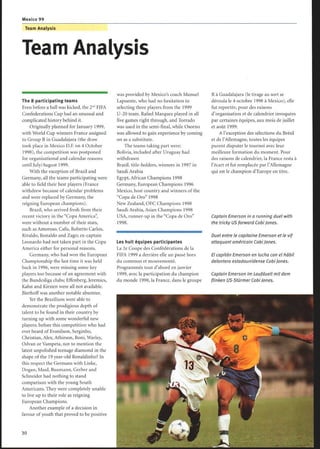
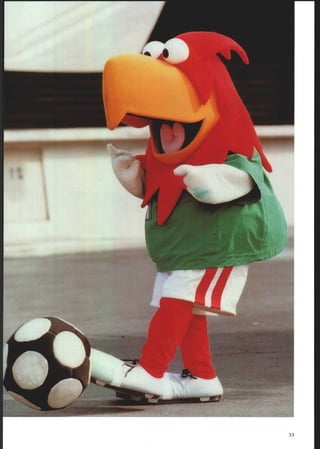
  • 49.
    48 Team Analysis Malheureusement, Radwanfut exclu sur un deuxième carton jaune et, à dix, la perspective d'une victoire s'éloigna définitivement . Aiguillonnés par cette exclusion, les joueurs issus du pays des Pharaons se surpassèrent alors et contrôlèrent peu à peu le match grâce à leur jeu de combinaisons. Leur combativité exemplaire leur permit de réduire le score à 1-2 sur un coup franc admirablement transformé. La sélection égyptienne lança alors un assaut après l'autre contre le but du pays hôte. L'adversaire et les spectateurs furent surpris par cette montée en régime, et une sensation sembla se Emam (no 14) contre Ribera lors du match d'ouverture Bolivie-Egypte à Mexico-City. Emom (No. 14) against Ribera in the opening match Bolivia-Egypt in Mexico City. Emam (n° 14) contra Ribera en el partido inaugural que enfrentó a Bolivia con Egipto en la Ciudad de México. Emam, (Nr. 14) gegen Ribera im Eröffnungsspiel Bolivien-Egypten in Mexico-City. dessiner dans le Stade Aztèque. Sur un coup franc puissant tiré dans le côté gauche du but, Ibrahim Samir inscrivit à la 85e minute le but mérité de l'égalisation 2-2 ! Mais la victoire espérée resta hors de portée. Contre l'Arabie Saoudite: 1-5 (0-2) Le troisième match de groupe, contre l'Arabie Saoudite, fut déterminant pour l'accession en demi-finale. L'Arabie Saoudite prit la direction des opérations et ouvrit la marque dès la 7e minute. Ce but important résulta d'une réaction ra- pide de A1 Otaibi. L'Egypte n'arriva pas à trouver ses marques, et après l'exclusion de Sabry, le match fut marqué par la nervosité des acteurs. A la 33e minute, Al Otaibi aggrava la marque à 0-2. Les événements se précipitèrent, et à la 35e minute, Emam, qui se vit infliger deux cartons jaunes en l'espace de deux minutes, fut exclu du match. Un handicap que les Egyptiens ne pouvaient compenser, ni physiquement ni mentalement. Les Saoudiens s'employèrent alors à faire circuler le ballon pour faire courir l'adversaire ; ils contrôlèrent astucieusement le jeu, et grâce aux deux magnifiques buts que signa A1 Otaibi, ils l'emportèrent finalement par 1-5.
  • 50.
    Egypt Egipto se presentócon una magnífica escuadra, formada por numerosos jugadores con excelentes cualidades técnicas. El entrenador Al Gohary supo motivar óptimamente a su conjunto, qu asombró al público con su facilidad para producir espectáculo. El portero El Hadary fue muy sereno y organizó con maestría la defensa. Los defensores eran firmes en el mano a mano y tenían una increíble constitución atlética. Hassan 1. subió a menudo por la derecha, apoyando a los centrocampistas ofensivos. La línea media contaba con las mejores figuras egipcias. Ramzy y Medhat se encargaron de neutralizar las acometidas contrarias, mientras que Radwan y Sabry robaban pelotas en la media cancha y arrancaban con panorama hacia la meta contraria, suministrando balones a los delanteros Emam y Ahmed. Pese a estas virtudes, la selección egipcia fue eliminada después de los partidos de grupo. Los tres partidos de Egipto Contra Bolivia: 2 a 2 (1-2) El campeón africano debería haber ganado este encuentro. Pese a aplicar una tradicional marcación al hombre, Egipto desarrolló un fútbol moderno y dominó claramente la contienda. Se adelantó muy pronto en el marcador, aunque los bolivianos lograron dar vuelta al resultado, pasando transitoriamente al frente. Tras una hora de juego, el cuadro egipcio volvió a establecer el empate y de allí en adelante manejó el trámite del encuentro a voluntad. Esta escuadra, perfectamente balanceada, tenía todo para cumplir un magnífico desempeño y dio una pequeña prueba de su gran capacidad. Contra México: 2 a 2 (0-2) 50,000 espectadores congregados en el Azteca de Ciudad de México vieron a un equipo egipcio extremadamente cauteloso en los primeros minutos, cuya defensa, que marcaba estrechamente al The Frst goal ofthe tournament, which led to 1-0 against Bolivia in Mexico City, was scored by the Egyptian Sabry. ;.%.j6 wr FIFA Le premier but du tournoi marqué par l'Egyptien Sabry contre la Bolivie à Mexico-City. El primergol del torneo en la Ciudad de México lo anotó el egipcio Sabry ante Bolivia. Das erste Tor im Wettbewerb erzielte in Mexico City der Ägypter Sabry zum 1-0 gegen Bolivien. 49
  • 51.
    hombre, evidenció grandesproblemas ante los delanteros mexicanos que rotaban y cambiaban constantemente de posición. Pardo abrió la cuenta local con un violento remate al ángulo superior egipcia de la meta contraria. Pese a conocer la peligrosidad de la escuadra azteca en situaciones a balón parado, los egipcios se dejaron madrugar por un gol de cabeza de Abundis. En el transcurso del cotejo, la selección egipcia comenzó a encontrar su juego y a neutralizar al adversario. Lamentablemente, Radwan fue expulsado tras la segunda tarjeta amarilla, lo cual restó posibilidades para remontar el partido y obtener incluso la victoria. No obstante, esta expulsión inyectó nuevas fuerzas a los futbolistas Team Analysis del país de los faraones, quienes comenzaron a dominar el partido con paredes y rápidos toques de balón. El gol de enlace - un magnífico remate de tiro libre - motivó aún más a los infatigables egipcios que iban una y otra vez, vigorosamente, en busca de la meta mexicana. Los espectadores fueron testigos de una lucha sin cuartel y estuvieron sorprendidos ante esa disposición anímica y física de los jugadores africanos. El partido deparó cinco minutos finales de gran emotividad cuando en el minuto 85 Ibrahim Samir envió la pelota a las redes nuevamente de un tiro libre, empatando el choque a dos. Pese a este vuelco inesperado, los valerosos egipcios no lograron alzarse con la victoria. The Bolivian forward Galindo (No. 11) is about to break through, but is tackled by the Egyptian midfield playerAhmed (No. 17) the game ended 2-2. L'attaquant bolivien Galindo (no 11) stoppé dans son action par le milieu de terrain égyptien Ahmed (no 17). Score final 2-2. El delantero boliviano Galindo (n° 11) pierde el balón ante el centro-campista egipcio Ahmed (n° 17). El partido concluyó con empate a 2. Der durchbrechende bolivianische Stürmer Galindo, (Nr. 11) wird vom ägyptischen MittelfeldspielerAhmed, (Nr. 17) vom Ball getrennt- das Spiel endete 2-2. Contra Arabia Saudita: 1 a 5 (0 a 2) El tercer partido de grupo contra Arabia Saudita era decisivo para conseguir el pase a las semifinales. La selección saudí sorprendió malparado al equipo egipcio y pasó adelante ya en el minuto siete con gol del escurridizo Al Otaibi. Egipto no encontraba la forma de contrarrestar las veloces arremetidas de su contrincante y, después de la expulsión de Sabry, se planteó un partido con mucha pierna fuerte y mala intención. En el minuto 33, Al Otaibi incrementó el resultado a 2 a 0 y en el minuto 35, Emam era expulsado tras recibir dos tarjetas amarillas en menos de dos minutos. Por momentos, Egipto buscó más la pierna que la pelota, dando un curso de cómo no se debe jugar, y la expulsión de Emam desarboló por completo a la escuadra africana que bajó los brazos definitivamente. Los saudís dominaron el encuentro con incontestable superioridad y Al Otaibi marcó todavía dos goles de película más, concretando así la aplastante victoria saudí por 5 a 1.
  • 52.
    Egypt Ägypten präsentierte sichals starke Mann- schaft mit einer Reihe von ausgezeichneten Einzelspielern . Der Trainer A1 Gohary hatte sein Team vonAnfang an richtig eingestellt, und der Afrikameister spielte einen gepfleg- ten und attraktiven Fussball. Der ägyptische Torhüter El Hadary wirkte bei seinen Aktionen sehr sicher, und er dirigierte seine Abwehr gut. Die Verteidiger waren stark im Zweikampf und sehr athletisch. Hassan I. versuchte immer wieder, über die rechte Aussen- bahn Druck zu machen und die Angriffs bemühungen des Mittelfelds zu unter- stützen, das überdurchschnittlich gut besetzt war: Ramzy und Medhat schirm- ten nach hinten ab, so dass sich Radwan und Sabry in erster Linie auf die Offensi- ve konzentrieren konnten, wo sie zusammen mit den Stürmern Emam und Ahmed den Abschluss suchten. Leider schieden die Ägypter nach den Gruppenspielen aus. Ägypten in der Vorrunde Ägypten - Bolivien: 2-2 (1-2) Eigentlich hätten die Ägypter den Sieg in diesem Spiel verdient. Mit ihrem trotz Manndeckung modernen Spiel dominierten sie den Gegner. Obwohl sie früh in Führung gingen, gerieten sie noch vor der Pause in Rückstand, doch in der zweiten Halbzeit übernahmen sie wieder die Kontrolle. Nach einer Stunde schossen sie den Ausgleich und waren auch danach bis zum Schlusspfiff klar besser. Die Mannschaft, die einen ausgewoge- nen Eindruck machte und einige herausragende Persönlichkeiten in ihren Reihen hatte, zeigte mit dieser Leistung auf, welches Potential in ihr steckt. Ägypten - Mexiko: 2-2 (0-2) Vor 50'000 Zuschauern im Azteken- Stadion von Mexiko City begannen die Ägypter sehr vorsichtig . In der Abwehr spielten sie weiterhin mit einer Mann- deckung, hatten aber dadurch mit den mexikanischen Stürmern, die häufig die Positionen tauschten, von Anfang an grosse Schwierigkeiten. Durch einen herrlichen Schuss von Pardo in die obere Torecke ging die Heim- mannschaft dann auch in Führung. Auch bei stehenden Bällen waren die Mexikaner stets gefährlich, was ihre Gegner wohl wussten, aber dennoch gelang es ihnen, die Ägypter aus einer solchen Situation mit einem Kopfball von Abundis zum 2:0 zu überraschen. Danach wurden die Afrikaner stärker, bis sie durch den Platzverweis von Radwan nach seiner zweiten gelben Karte einen herben Dämpfer einstecken mussten. Mit einem Mann weniger Mohamoud N. EL GOHARY 20.2.1938 Cairo Career as a player: 1955-1964 Ably club Career as a coach: 1965-1977 Al Ahly assistant 1977-1981 Ittehad Jeddah, Saudi Arabia assistant 1981-1982 Ittehad Jeddah coach 1982-1984 Al Ahly coach 1984-1985 Sharia U.A.E. coach 1985-1986 Al Ably coach 1986-1988 Al Ahly Jeddah, Saudi Arabia coach 1988-1990 Egypt national team coach 1991-1993 Egypt national team coach 1993-1994 Zamalik coach 1995-1996 Al Wahdah, U.A.E. 1996-1997 Oman national team 1997-1999 Egypt national team FIFA schienen sie keine Chance auf den Sieg mehr zu haben, doch irgendwie spornte sie der Ausschluss zusätzlich an, und mit ihren klugen Kombinationen gewannen sie allmählich die Kontrolle über das Spiel wieder zurück. Alle kämpften mit vollem Einsatz, und das 1:2 durch einen wunderschönen Freistoss war die verdiente Belohnung dafür. Das energische Comeback des Afrikameisters überraschte sowohl die mexikanischen Spieler als auch ihre Fans, und im Stadion stieg die Span- nung. Eine Angriffswelle nach der anderen rollte auf das Tor der Mexikaner zu, bis schliesslich Ibrahim Samir in der 85. Minute - ebenfalls mit einem präzisen Freistoss - den wohlverdienten Ausgleich schoss. Doch zu mehr als dem 2:2 reichte es nicht mehr, obwohl die Ägypter versuchten, sogar noch zum Sieg zu kommen. Ägypten - Saudiarabien: 1-5 (0-2) Vor dem letzten Gruppenspiel der Ägypter gegen Saudiarabien war klar, dass der Sieger dieser Partie ins Halbfi- nale einziehen würde. Die Saudis übernahmen sofort die Initiative und lagen schon nach sieben Minuten vorne, nachdem Al Otaibi am schnellsten reagiert und den wichtigen ersten Treffer erzielt hatte, doch auch danach fand Ägypten nicht ins Spiel. Als die Afrika- ner Sabry durch einen Platzverweis verloren, wurde die Partie hektisch. In der 33. Minute machte Al Otaibi sein zweites Tor, und wenig später sah Emam in 'nur gerade zwei Minuten zwei gelbe Karten. Für die Ägypter, die damit nur noch zu neunt auf dem Platz standen, waren die beiden Platzverweise zu viel. Sie waren nun sowohl mental als auch körperlich klar im Nachteil, und die Saudis nutzten ihre Überzahl aus, liessen den Ball zirkulieren und zwangen den Gegner zum Laufen. A1 Otaibi schoss noch zwei weitere Tore, und am Ende verloren Ägypten überraschend deutlich mit 1 :5 . 5 1
  • 53.
    Mexico 99 Team Analysis Germany CoachErich Ribbeck had shouldered a heavy burden when he took over the national team from Berti Vogts. His team selection had to be made under very restrictive and specific conditions: not more than three players could be selected from any one Bundesliga club. In addition, several regulars chose not to play and others were not available because of injury. Thus Ribbeck and his assistant Uli Stielike were unable to choose the team they wanted . It looked a formida- ble task that the team, led by the 38 year-old captain Lothar Matthäus, would have to face. The following match reports clearly confirm that their fears were justified . Germany's three matches Brazil - Germany: 4-0 (0-0) The slippery surface may have caused some early problems for Brazil, as the quality oftheir passing was below the usual standard. When they settled, their possession game improved and a crucial substitution (Alex replacing Flavio Concecaio) brought good results. DEUTSCHER FUSSBALL-BUND Excellent penetration, especially from the wings, produced two goals, while Ronaldinho's exquisite pass into an open space for Alex to collect and dribble past the keeper was the highlight play of the match. Brazil had more possession and their mobility, plus good finishing, put the final scoreline clearly in their favour. The Germans started off using a very well-organised defensive system. With one forward though, it was hard for them to penetrate a crowded defence. Their passes in midfield were too often inaccurate and they lost possession easily. They made little effort to create forward passing moves and so all they managed was a few half chances. No team can give a top-class performance in modern football without its experienced key players. This became sadly clear to the Germans at this competition here in Mexico. Versus New Zealand: 2-0 (2-0) Germany used a more attacking system in this match. Two forwards and sometimes a third enabled them to develop more penetration . They also used man-to-man marking in the zone, which did not allow their opponents much space, Scholl and Matth5us controlled midfield, while Marschall and Preetz made some superb runs for through passes from midfield. Matth5us' goal was well prepared and well taken. A good pass from Preetz and a clever dribble resulted in an open goal. This was a much better performance than the first, but of course the opponent this time was not Brazil. New Zealand made a determined effort to operate close marking throughout the game, and they succeed in the early stages. But some players forgot their duties and then the defence looked vulnerable. In attack wing play was used and this gave the fans a good look at two promising players in Lines and Bouckenooghe . The former was always ready to receive the ball either at his feet or in the space behind his marking defender. Versus USA : 0-2 (0-1) Previously the USA had never beaten Germany in an official international match. This encounter proved to be evenly balanced and both teams put their faith in counter attacks . The Germans had not yet found the ideal blend within the team and found it hard to create any promising chances. Ribbeck's players were unable to live up to expectation, and the Americans were better organised and more in tune with each other; they looked more decisive and they were able to stamp their mark on the game. A crowd of 50,000 saw Ben Olsen put the Americans into the lead, and Joe Max Moore made it 2:0 via a superb free kick - a result that decided who would go through to the semi- finals. The disappointing German side were eliminated, and those in charge will certainly draw consequences from this failure as they consider the future.
  • 54.
    Le sélectionneur ErichRibbeck, successeur de Berti Uogts, hérita d'une situation difficile. La sélection des joueurs se déroula dans des conditions très restrictives et pour le moins bizarres : le sélectionneur ne pouvait pas faire appel à plus de trois titulaires par club de Bundesliga, et plusieurs titulaires renoncèrent d'eux-mêmes à leur sélection, sans compter ceux qui n'étaient pas disponi- bles pour cause de blessure. Ainsi, Erich Ribbeck et son assistant Uli Stielike durent se contenter d'une équipe décimée. réquipe qui était emmenée par son capitaine Lothar Matthäus, le vétéran de 38 ans, n'avait pas la tâche facile. Les analyses suivantes des trois matchs disputés confirment nettement les craintes que l'on pouvait avoir. Les trois matches de l'Allemagne Contre le Brésil: 4-0 (0-0) C'est probablement le terrain glissant qui fut à l'origine des problèmes que le Brésil connut au début du match et qui se traduisirent par des passes moins bien assurées que d'habitude. Amesurequ'ils retrouvaient leurs marques, les Brésiliens reprirentl'avantage au niveau de la possession duballon, et le remplacement de Flavio Conceçaio par Alex, qui se révéla déterminant, apporta de bons résultats. Par suite d'excellents mouvements de pénétration et de débordement par les ailes, ils marquèrent deux buts. Le match atteint ensuite un sommet quand une passe judicieuse de Ronaldinho dans un espace libre, fut récupérée parAlex qui dribbla le gardien adverse. FIFA The attacking move byAlex (No. 10) BRA is thwarted this time as both Heinrich (left) and Woerns (right) combine to take the ball offhim. L'action d'Alex (no 10, BRA) est déjouée par Heinrich (gauche) et Woerns (droite) qui interceptent le ballon. El ataque deAlex (nQ 10, BRA) no tiene éxito; Heinrich, por la izquierda, y Woerns, por la derecha, le arrebatan el balón. DieserAngriffversuch von Alex, (Nr. 10, BRA) wurde diesmal noch vereitelt, Heinrich links und Woerns rechts nehmen ihm gleich den Ball ab.
  • 55.
    Zoricich, NZ isunable to stop Mehmet Scholl, GER who is about to race down the wing. Zoricich (NZ) ne peutpas arrêter la descente par l'aile de MehmetScholl (GER). Zoricich (NZ) no puede detener al germano Mehmet Scholl. Zoricich, NZ kann den zum Flügellauf ansetzenden MehmetScholl, GER nicht zurückhalten. 54 YI WOW Le Brésil, qui fut le plus souvent en possession du ballon, témoigna d'une plus grande mobilité et d'une excellente finition, remporta le match sur un score final incontestable. Les Allemands débutèrent le match avec un système défensif très bien organisé. Mais avec un seul attaquant de pointe, il leur était difficile de pénétrer la défense compacte de l'adversaire. Du fait que leurs passes en milieu de terrain étaient trop souvent imprécises, ils perdaient facilement la possession du ballon. Leurs efforts étaient insuffisants pour lancer des mouvements offensifs efficaces et ils ne se créèrent pratiquement pas d'occasions de but. Dans le football moderne, aucune équipe ne peut accomplir de performances de premier plan si elle ne dispose pas de tous ses joueurs clés. Tel est le triste enseignement que les Allemands tirèrent de cette compétition disputée au Mexique. Contre la Nouvelle-Zélande : 2-0 (2-0) Dans ce match, l'Allemagne pratiqua un système plus offensif. Avec deux
  • 56.
    Germany attaquants de pointe,complétés parfois par un troisième, la pénétration des lignes adverses fut nettement meilleure. Inversement, les Allemands pratiquèrent en défense un marquage individuel qui ne laissait guère d'espace à leurs adversaires. Scholl et Mattháus contrôlaient le milieu de terrain, tandis que Marschall et Preetz réussirent quelques superbes assauts sur des passes frappées en profondeur à partir du milieu de terrain. Le but de Matthäus avait été bien préparé et bien réalisé. Sur une bonne passe de Preetz, il dribbla intelligemment le gardien et envoya le ballon dans le but déserté. Ce fut une bien meilleure performance que lors du premier match, mais cette fois, l'adversaire n'était pas le Brésil. Les Néo-Zélandais semblaient déterminés à faire de gros efforts pour assurer pendant tout le match un marquage étroit de l'adversaire, et ils y arrivèrent dans un premier temps. Mais plusieurs joueurs oublièrent vite leurs obligations, et la défense apparut aussitôt vulnérable . Le jeu offensif qui privilégiait les débordements par les ailes révéla aux supporters, en Lines et Bouckenooghe, deux joueurs prometteurs, dont le premier était toujours prêt à recevoir le ballon soit dans ses pieds, soit dans le dos de son défenseur attitré. Contre les USA : 0-2 (0-1) Les USA n'étaient jamais parvenus à battre l'Allemagne dans un match international officiel. La rencontre fut très équilibrée et les deux équipes tentèrent surtout leur chance dans les contre-attaques. Depuis le début du tournoi, l'équipe allemande n'avait pas trouvé la formule idéale et avait beaucoup de mal à se créer des occasions de but. Les joueurs d'Erich Ribbeck ne furent pas en mesure de satisfaire aux attentes placées en eux. Les Américains se montrèrent mieux organisés et mieux rodés ; ils paraissaient plus déterminés et cherchaient à imprimer leur marque au jeu. Devant plus de 50 000 spectateurs, Ben Olsen ouvrit la marque pour les USA. Et après que Joe-Max Moore eut marqué le but du 0-2 sur un magnifique coup franc, tous les espoirs d'accéder en demi-finales furent anéantis. La décevante équipe d'Allemagne fut ainsi éliminée, et ses responsables se voient maintenant contraints de tirer les conséquences qui s'imposent pour l'avenir. El técnico Erich Ribbeck asumió una dificil tarea de manos de su antecesor y entrenador nacional Berti Vogts. La formación de la selección nacional estuvo marcada por condiciones restrictivas y peculiares: se podía convocar a máximo tres jugadores titulares por equipo de la liga alemana. A esto se sumó que varios jugadores titulares rehusaron personalmente formar parte del plantel y otros no pudieron participar por lesión. Es así que los técnicos Erich Ribbeck y Uli Stielike estuvieron obligados a participar con una selección incompleta, lo cual presagiaba grandes dificultades para el once germano y su capitán Lothar Mattháus de 38 años de edad. El análisis de los tres encuentros de Alemania confirman claramente esta suposición. Los tres partidos de Alemania Contra Brasil: 0 a 4 (0-0) La superficie mojada causó ciertas dificultades a los brasileños, deteriorando la calidad usual de su juego de toques y pases. No obstante, los sudamericanos se adueñaron rápidamente de la pelota, el terreno y las situaciones más claras para convertir. El ingreso de Alex por Flavio Conceçaio le dio incluso más atrevemiento al equipo brasileño y provocó más llegadas al arco contrario. Los desbordamientos por los flancos produjeron dos hermosos goles en la segunda parte y el punto culminante del partido fue el exquisito pase en profundidad de Ronaldinho a Alex, quien recogió elegantemente el esférico y FIFA se llevó a la rastra de sus amagues y gambetas a toda la defensa germana, incluido el guardameta. Brasil mereció ganar por tener más presencia de equipo, aptitud y actitud de primera categoría. La escuadra germana planteó un sistema de juego perfectamente organizado y sumamente defensivo, pero no tuvo fuerza de penetración en las filas contrarias por falta de delanteros. Los pases en la mediacancha eran imprecisos y se los despojaba fácilmente de la pelota. Su ataque frontal y sin variantes facilitó mucho la tarea de los defensores contrarios y todo lo que consiguieron fue elaborar algunas llegadas sin peso alguno. En el fútbol moderno, ningún equipo puede rendir bien sin sus mejores figuras. Esto se constató claramente en el rendimiento de los alemanes en este torneo. Contra Nueva Zelanda: 2 a 0 (2-0) En este encuentro, Alemania salió con mayor proyección ofensiva que en sus choques anteriores. La nominación de dos delanteros netos, a veces tres, y apoyados por los centrocampistas, dieron profundidad a los ataques alemanes. En la defensa encimaron directamente al hombre, de modo que los neozelandeses acusaron la falta de espacios para desarrollar su juego. Scholl y Mattháus dominaron la mitad de la cancha, mientras que Marschall y Preetz irrumpían frecuentemente en la línea de contención contraria con peligrosos toques y paredes. El gol de Mattháus dio seguridad al conjunto alemán, que aumentó la distancia en el marcador aún en el primer tiempo. El cuadro de Nueva Zelanda intentó marcar estrechamente a los peligrosos atacantes alemanes, empresa que dio frutos en los primeros minutos. Sin embargo, los defensores fueron perdiendo la concentración, evidenciando cada vez mayor vulnerabilidad. En el ataque maniobraron ágilmente por las
  • 57.
    Team Analysis puntas, destacándoseLines y Bouckenooghe, pero en definitiva no lograron inquietar a la firme defensa germana. La actuación de Alemania fue netamente superior a sus presentaciones precedentes, pero hay que reconocer que esta vez el rival no se llamaba Brasil. Contra EEUU: 0 a 2 (0 a 1) Hasta la fecha, ningún conjunto norteamericano había logrado derrotar a Alemania en un partido internacional oficial. Fue un encuentro muy parejo y ambos equipos intentaron desequilibrar a su contrincante con veloces contraataques. Sin embargo, a la selección alemana le costó entrar en juego y evidenció grandes dificultades para elaborar prometedoras situaciones de gol. Los jugadores de Ribbeck no supieron satisfacer la confianza depositada en ellos. El elenco norteamericano estaba mejor organizado y combinaba mejor. Ante la presencia de 50,000 espectadores, Ben Olsen abrió la cuenta para EEUU y Joe-Max Moore redobló con un magnífico tiro libre que definió así la clasificación para la semifinal. La decepcionante escuadra Alemana tuvo que resignarse a iniciar su viaje de retorno a casa nuevamente antes de tiempo y no cabe duda de que los responsables harán todo lo posible para que experiencias similares no se vuelvan a repetir en el futuro. Coach Erich Ribbeck was in a good mood before the match against Brazil (0-4). Le sélectionneur Erich Ribbeck encore de bonne humeur avant la défaite face au Brésil (0-4). El entrenador Erich Ribbeck disfrutaba de un excelente humor antes del partido contra Brasil, que perdió por 4 goles a 0. Coach Erich Ribbeck war vor dem Spiel gegen Brasilien (0-4) noch guter Laune.
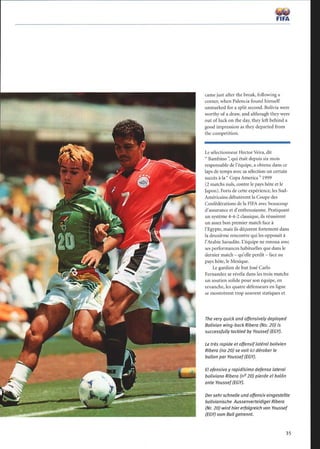
  • 58.
    Germany Als Bundestrainer ErichRibbeck die Nationalmannschaft von Berti Vogts übernahm, wartete eine schwere Aufgabe auf ihn. Bei der Zusammenstellung seines Teams für den Konföderationen-Pokal war er stark eingeschränkt, denn nach einer besonderen Vereinbarung durfte er von jedem Verein der Bundesliga höch- stens drei Spieler aufbieten. Kam dazu, dass mehrere Stammspieler auf die Teilnahme verzichteten oder verletzt ausfielen. So mussten Ribbeck und sein Assistent Uli Stielike auf andere Hoffnungsträger setzen. Sie wussten, dass die deutsche Mannschaft, angeführt von ihrem 38-jährigen Kapitän Lothar Matthäus, vor einer sehr schwierigen Aufgabe stand. Die folgenden Spiel- berichte bestätigen, dass ihre Befürchtun- gen berechtigt waren. Deutschland in der Vorrunde Brasilien - Deutschland: 4-0 (0-0) Der rutschige Rasen war vermutlich der Grund dafür, dass die Pässe der Brasilia- ner zu Beginn nicht so genau gespielt wurden, wie man es von ihnen gewohnt war. Nach diesen anfänglichen Schwierig- keiten wurde ihr Spiel jedoch konstanter : Sie waren wieder vermehrt im Ballbesitz, und ein entscheidender Wechsel (Alex für Flavio Concecaio) brachte gute Resultate. Vor allem die Aussenstürmer waren äusserst erfolgreich im Durchbrechen der Verteidigung, was zu zwei Toren führte. Der Höhepunkt des Spiels war Ronaldinhos hervorragender Pass zu Alex, der ihn nach einem Dribbling um den Torwart verwertete . Die Brasilianer waren häufiger im Ballbesitz, beweglich und gut im Abschluss, was zu diesem klaren Endergebnis führte. Die Deutschen starteten mit einer sehr gut organisierten Defensive, mit nur einem Stürmer war es jedoch schwierig, die dicht gestaffelte gegneri- sche Abwehr zu knacken. Ihre Pässe im Mittelfeld waren allzu oft ungenau, und sie verloren schnell den Ball. Sie unter- nahmen keine grossen Anstrengungen, den Ball nach vorne zu spielen, und hatten folglich nur ein paar wenige mässige Torchancen. Im modernen Fussball kann kein Team ohne seine erfahrensten Spieler erstklassige Leistungen vollbringen: Dies wurde den Deutschen hier in Mexiko schmerzlich bewusst. Deutschland - Neuseeland 2-0 (2-0) Deutschland war in diesem Spiel offensi- ver eingestellt. Zwei, manchmal drei Stürmer versuchten, die gegnerische Abwehr zu durchbrechen. Deutschlands Manndeckung in der Zone liess den Neuseeländern wenig Platz zur Entfal- tung ihres Spiels. Scholl und Matthäus kontrollierten das Mittelfeld, während Marschall und Preetz einige Steilpässe aus dem Mittelfeld grossartig annahmen. Matthäus' Treffer war schön vorberei- tet und gut vollendet: Ein sauberer Pass Erich RIBBECK 13.6.1937 Career as a player: Wuppertaler SV Viktoria Köln Career as a coach: Eintracht Frankfurt 1. FC Kaiserslautern DFB Bor. Dortmund Bayer 04 Leverkusen Hamburger SV Bayern München DFB 1lß= FIFA von Preetz und ein kluges Dribbling führten zu einem offenen Tor. Die Deutschen zeigten hier eine bedeutend bessere Leistung als im ersten Spiel, doch dieses Mal war natürlich auch nicht Brasilien ihr Gegner. Die Neuseeländer bemühten sich entschlossen, den Gegner während des ganzen Spiels eng zu decken, was ihnen am Anfang auch gelang. Doch ein paar Spieler waren nachlässig, was die Vertei- digung schwächte. Die Angriffe über die Aussenstürmer Lines und Bouckenooghe vermittelten den Fans einen guten Eindruck von diesen zwei viel verspre- chenden Spielern. Lines war immer zur Stelle, um den Ball entweder direkt oder im freien Raum hinter seinem Manndecker anzunehmen . Deutschland - USA: 0-2 (0-1) Vor dieser Begegnung hatten die USA noch nie in einem offiziellen Länderspiel gegen Deutschland gewonnen. Die Partie begann ausgeglichen, und beide Seiten setzten in erste Linie auf Konterangriffe. Die Deutschen hatten die richtige Abstimmung im Team immer noch nicht gefunden und erarbeiteten sich kaum echte Chancen. Die Mannschaft von Erich Ribbeck konnte die Erwartungen nicht erfüllen, während die Amerikaner besser organisiert und harmonischer auftraten. Sie wirkten entschlossener und drückten dem Spiel ihren Stempel auf. 50`000 Zuschauer erlebten, wie das US- Team durch Ben Olsen in Führung ging und wie loe Max Moore mit einem herrlichen Freistoss auf 2:0 erhöhte. Die Entscheidung über den Einzug ins Halbfinale war damit gefallen. Die enttäuschenden Deutschen schieden aus, und es ist anzunehmen, dass die Verantwortlichen im Hinblick auf die Zukunft die entsprechenden Konsequenzen aus diesem Scheitern ziehen werden.