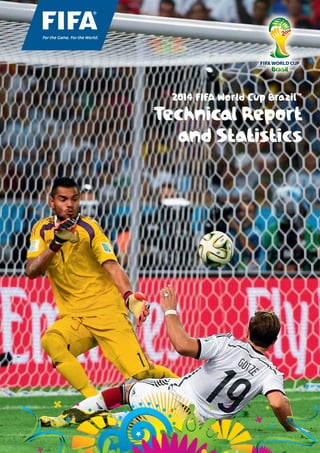
Technical Report
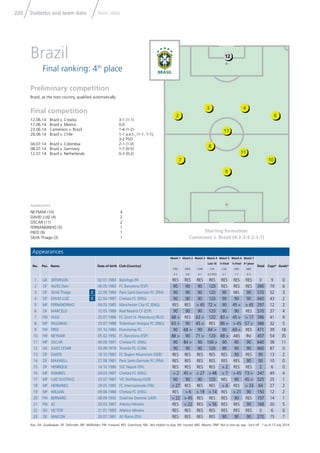
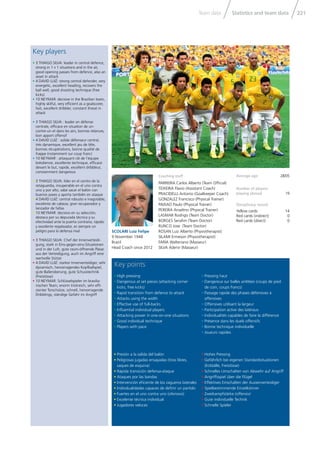
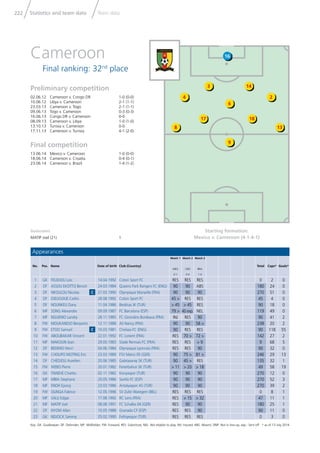
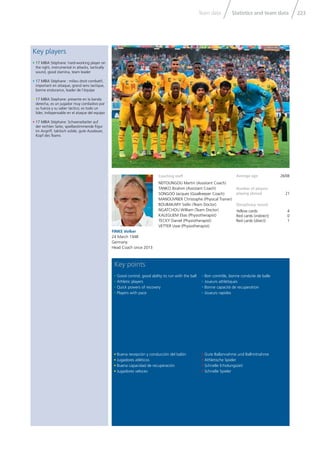
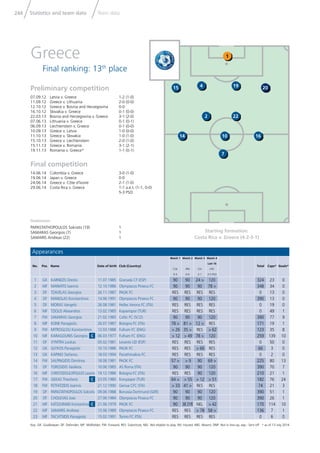
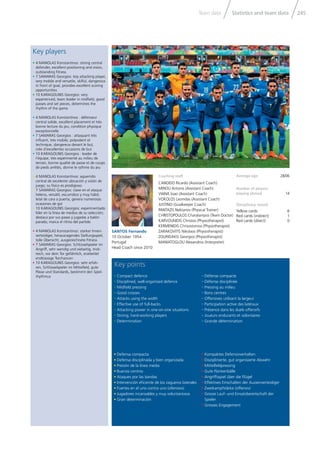
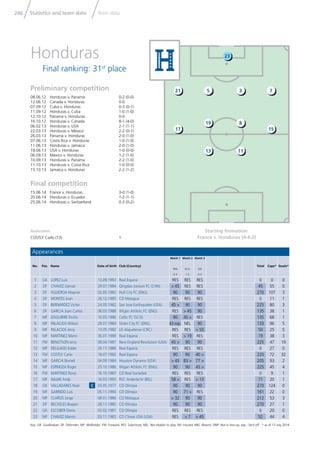
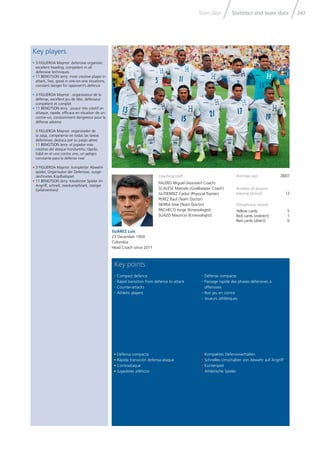
and Statistics
Rapport technique et statistiques
Informe técnico y estadísticas
Technischer Bericht und Statistik
2014 FIFA World Cup Brazil™
TECHNICAL REPORT
AND STATISTICS
12 June – 13 July 2014
2
3Contents
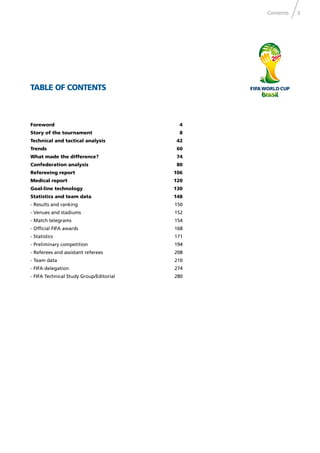
TABLE OF CONTENTS
Foreword 4
Story of the tournament 8
Technical and tactical analysis 42
Trends 60
What made the difference? 74
Confederation analysis 80
Refereeing report 106
Medical report 120
Goal-line technology 130
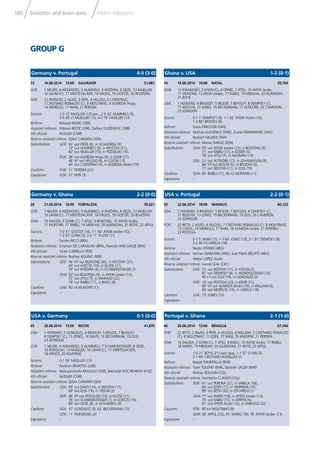
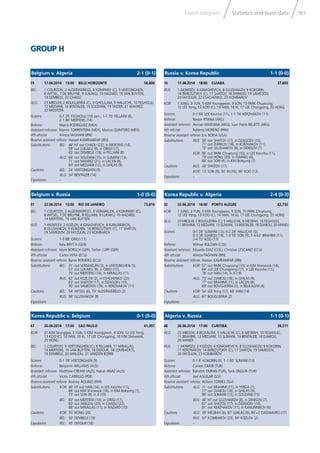
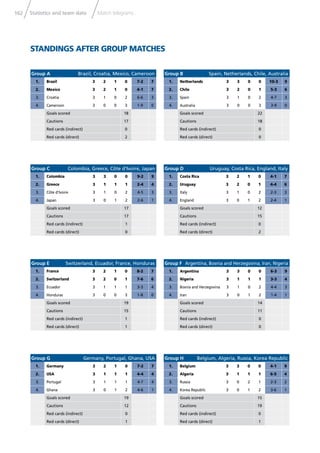
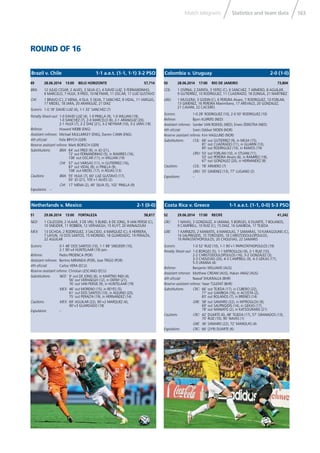
Statistics and team data 148
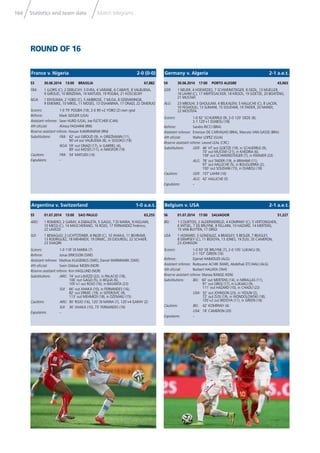
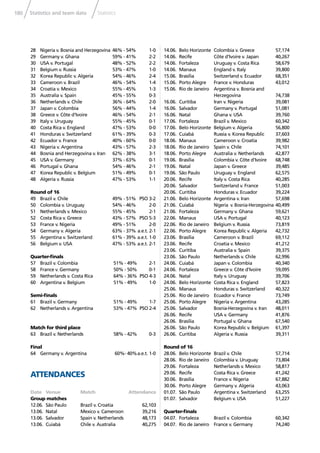
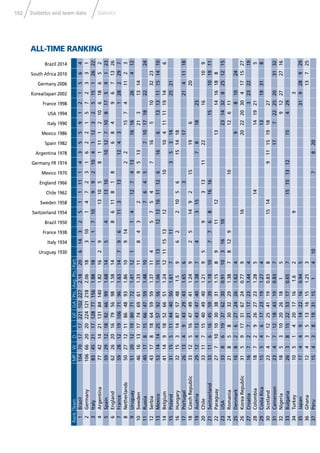
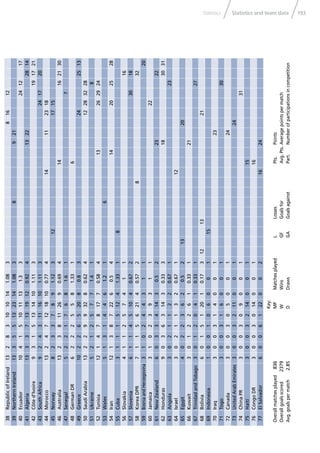
- Results and ranking 150
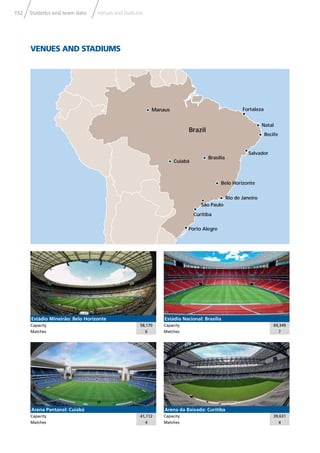
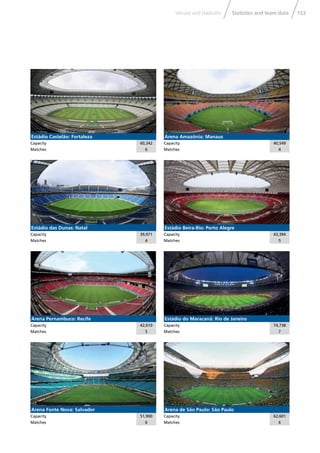
- Venues and stadiums 152
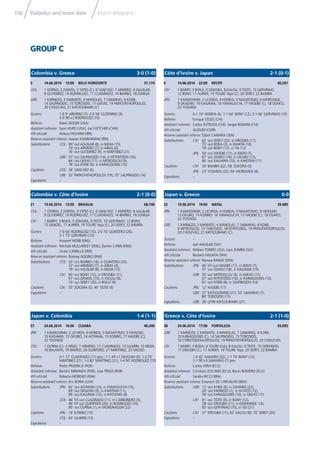
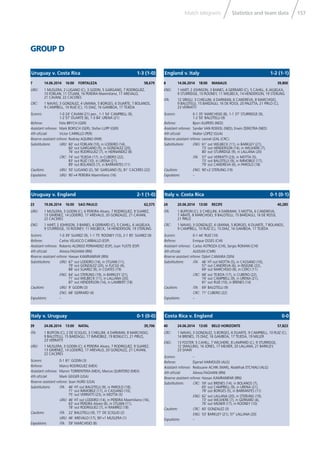
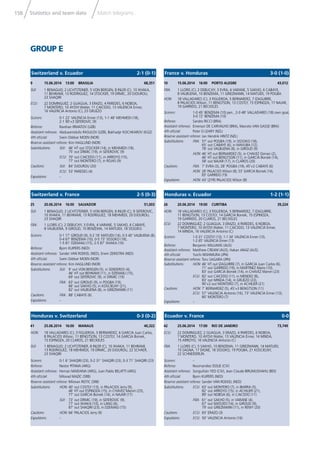
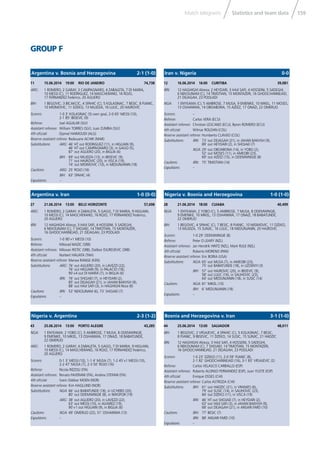
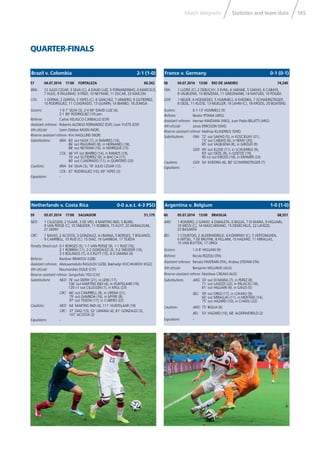
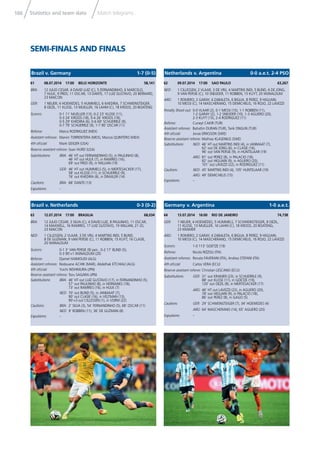
- Match telegrams 154
- Official FIFA awards 168
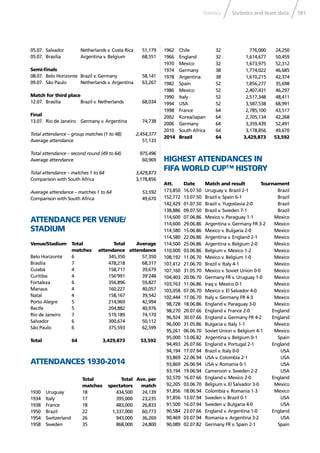
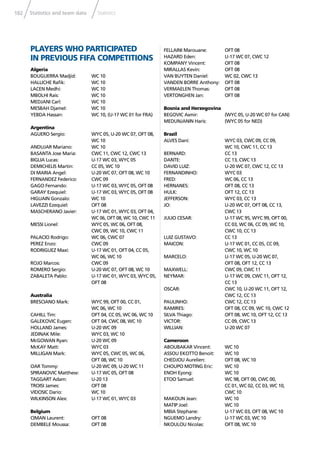
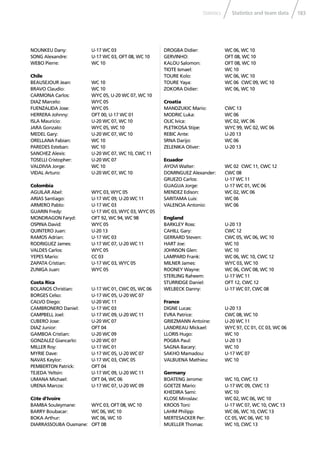
- Statistics 171
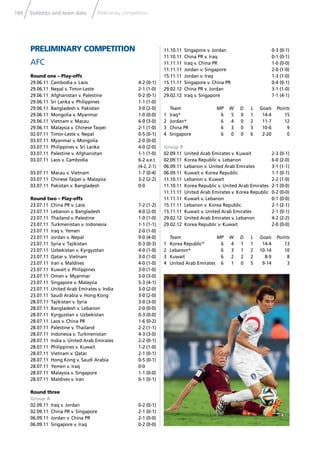
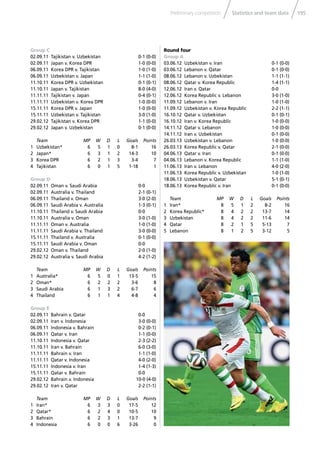
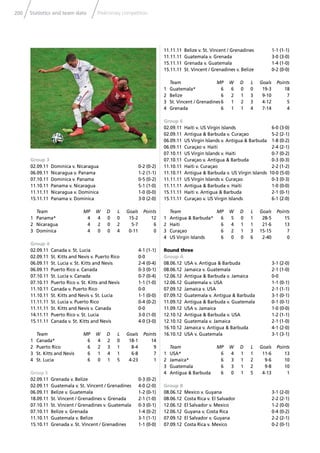
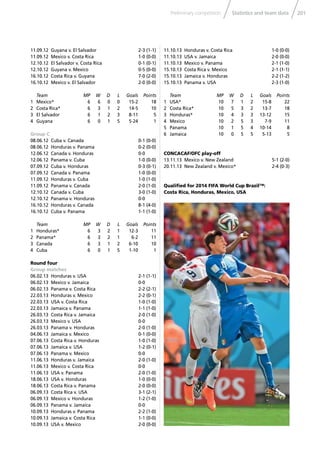
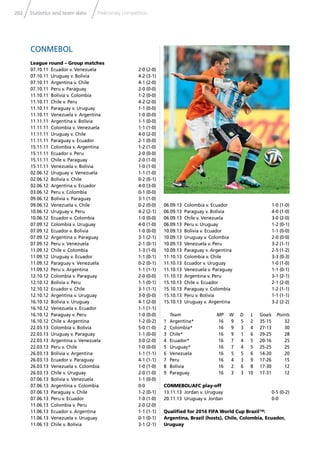
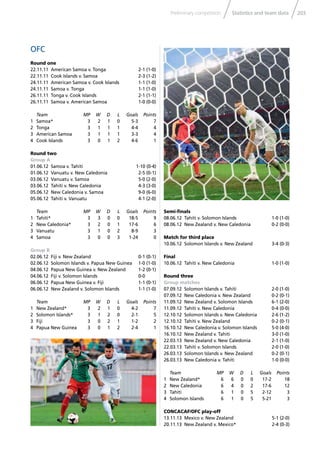
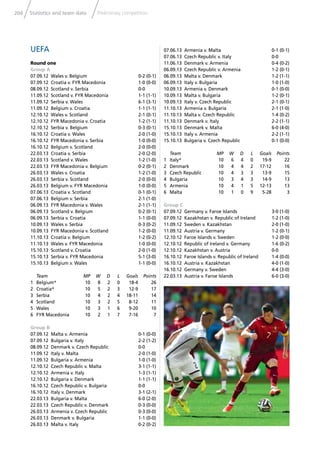
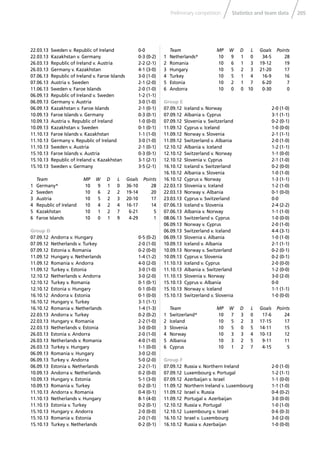
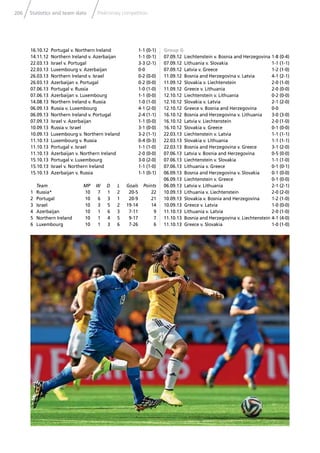
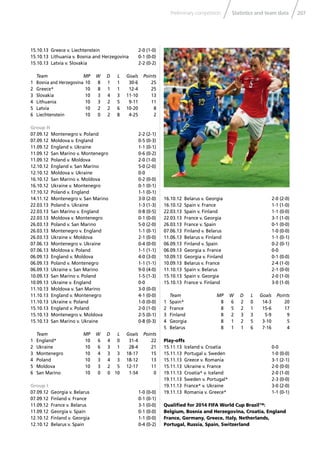
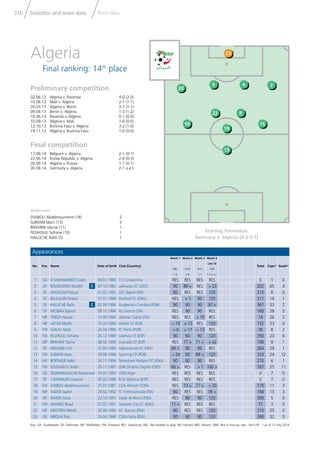
- Preliminary competition 194
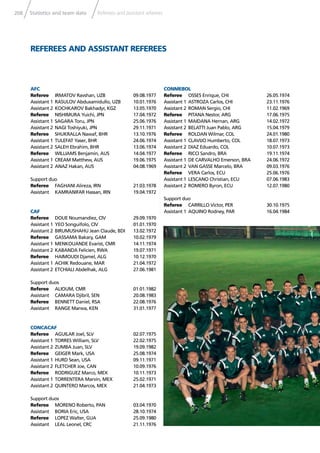
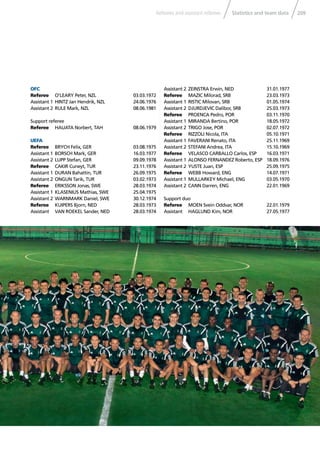
- Referees and assistant referees 208
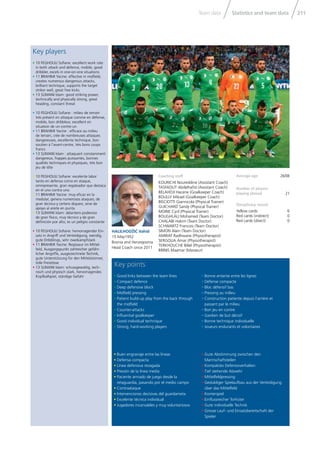
- Team data 210
- FIFA delegation 274
- FIFA Technical Study Group/Editorial 280
4 Foreword
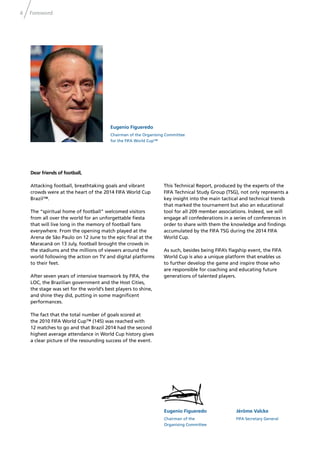
Eugenio Figueredo
Chairman of the Organising Committee
for the FIFA World Cup™
Eugenio Figueredo
Chairman of the
Organising Committee
Jérôme Valcke
FIFA Secretary General
Dear friends of football,
Attacking football, breathtaking goals and vibrant
crowds were at the heart of the 2014 FIFA World Cup
Brazil™.
The “spiritual home of football” welcomed visitors
from all over the world for an unforgettable fiesta
that will live long in the memory of football fans
everywhere. From the opening match played at the
Arena de São Paulo on 12 June to the epic final at the
Maracanã on 13 July, football brought the crowds in
the stadiums and the millions of viewers around the
world following the action on TV and digital platforms
to their feet.
After seven years of intensive teamwork by FIFA, the
LOC, the Brazilian government and the Host Cities,
the stage was set for the world’s best players to shine,
and shine they did, putting in some magnificent
performances.
The fact that the total number of goals scored at
the 2010 FIFA World Cup™ (145) was reached with
12 matches to go and that Brazil 2014 had the second
highest average attendance in World Cup history gives
a clear picture of the resounding success of the event.
This Technical Report, produced by the experts of the
FIFA Technical Study Group (TSG), not only represents a
key insight into the main tactical and technical trends
that marked the tournament but also an educational
tool for all 209 member associations. Indeed, we will
engage all confederations in a series of conferences in
order to share with them the knowledge and findings
accumulated by the FIFA TSG during the 2014 FIFA
World Cup.
As such, besides being FIFA’s flagship event, the FIFA
World Cup is also a unique platform that enables us
to further develop the game and inspire those who
are responsible for coaching and educating future
generations of talented players.
5Foreword
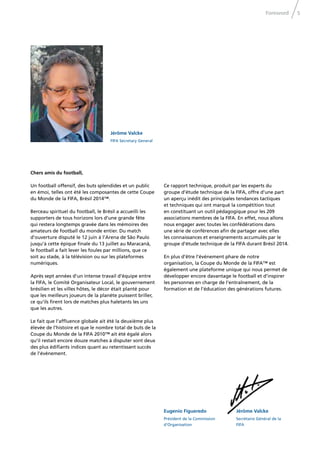
Jérôme Valcke
FIFA Secretary General
Jérôme Valcke
Secrétaire Général de la
FIFA
Eugenio Figueredo
Président de la Commission
d‘Organisation
Chers amis du football,
Un football offensif, des buts splendides et un public
en émoi, telles ont été les composantes de cette Coupe
du Monde de la FIFA, Brésil 2014™.
Berceau spirituel du football, le Brésil a accueilli les
supporters de tous horizons lors d’une grande fête
qui restera longtemps gravée dans les mémoires des
amateurs de football du monde entier. Du match
d’ouverture disputé le 12 juin à l’Arena de São Paulo
jusqu’à cette épique finale du 13 juillet au Maracanã,
le football a fait lever les foules par millions, que ce
soit au stade, à la télévision ou sur les plateformes
numériques.
Après sept années d’un intense travail d’équipe entre
la FIFA, le Comité Organisateur Local, le gouvernement
brésilien et les villes hôtes, le décor était planté pour
que les meilleurs joueurs de la planète puissent briller,
ce qu’ils firent lors de matches plus haletants les uns
que les autres.
Le fait que l’affluence globale ait été la deuxième plus
élevée de l’histoire et que le nombre total de buts de la
Coupe du Monde de la FIFA 2010™ ait été égalé alors
qu’il restait encore douze matches à disputer sont deux
des plus édifiants indices quant au retentissant succès
de l’événement.
Ce rapport technique, produit par les experts du
groupe d’étude technique de la FIFA, offre d’une part
un aperçu inédit des principales tendances tactiques
et techniques qui ont marqué la compétition tout
en constituant un outil pédagogique pour les 209
associations membres de la FIFA. En effet, nous allons
nous engager avec toutes les confédérations dans
une série de conférences afin de partager avec elles
les connaissances et enseignements accumulés par le
groupe d’étude technique de la FIFA durant Brésil 2014.
En plus d’être l’événement phare de notre
organisation, la Coupe du Monde de la FIFA™ est
également une plateforme unique qui nous permet de
développer encore davantage le football et d’inspirer
les personnes en charge de l’entraînement, de la
formation et de l’éducation des générations futures.
6 Foreword
Eugenio Figueredo
Presidente del Comité
Organizador
Jérôme Valcke
Secretario General de la
FIFA
Apreciados amigos del fútbol:
La Copa Mundial de la FIFA Brasil 2014™ estuvo
protagonizada por un fútbol ofensivo, unos goles de
infarto y una hinchada rebosante de energía.
Brasil, «el hogar espiritual del fútbol», recibió a
visitantes de todo el mundo para una fiesta que
perdurará por mucho tiempo en la memoria de los
aficionados al balompié. Desde el partido inaugural
del 12 de junio en el Arena de São Paulo hasta la
emocionante final del 13 de julio en Maracaná, el
fútbol mantuvo en vilo tanto a quienes se acercaron a
los estadios como a los millones de telespectadores que
siguieron el torneo desde sus casas.
Tras siete años de duro trabajo por parte de la FIFA, el
COL, el Gobierno brasileño y las ciudades anfitrionas,
estaba listo el escenario para que los mejores
futbolistas del mundo pudieran brillar, y brillar fue lo
que hicieron en numerosas actuaciones estelares.
El hecho de que cuando aún quedaban doce partidos
por disputar ya se hubieran marcado el mismo número
de goles que durante todo el torneo en la edición de
2010 (145) y que Brasil 2014 haya registrado el segundo
promedio de asistentes más alto en la historia de la
Copa Mundial reflejan claramente el éxito rotundo del
torneo.
Además de ser un documento clave para conocer
las tendencias técnicas y tácticas que marcaron la
competición, este informe, redactado por los expertos
del grupo de estudio técnico (GET) de la FIFA, sirve
de herramienta educativa para las 209 asociaciones
miembro. De hecho, invitaremos a las confederaciones
a participar en una serie de conferencias para
compartir los conocimientos y experiencias que el
GET ha recabado durante la Copa Mundial de la FIFA
2014™.
Además de ser el torneo estrella de la FIFA, el Mundial
ofrece una plataforma única que nos permite seguir
desarrollando este deporte y sirve de inspiración a
las personas responsables de entrenar y formar a las
siguientes generaciones de grandes futbolistas.
7Foreword
Eugenio Figueredo
Vorsitzender der
Organisationskommission
Liebe Fussballfreunde,
Die FIFA Fussball-Weltmeisterschaft Brasilien 2014™
begeisterte mit Offensivfussball, atemberaubenden
Toren und einer gewaltigen Zuschauerkulisse.
Die geistige Heimat des Fussballs bot den Besuchern
aus aller Welt ein einmaliges Fest, das niemand so
schnell vergessen wird. Vom Eröffnungsspiel am
12. Juni in der Arena de São Paulo bis zum epischen
Finale am 13. Juli im Maracanã zog die WM in den
Stadien, vor den Fernsehern und auf den digitalen
Plattformen Abermillionen in ihren Bann.
Nachdem die FIFA, das LOC, die brasilianische
Regierung und die Spielorte während sieben
Jahren hart gearbeitet hatten, war für den grossen
Auftritt der besten Spieler der Welt alles bereit.
Diese begeisterten mit hervorragenden Leistungen
und egalisierten schon zwölf Spiele vor Schluss die
Tormarke von Südafrika 2010 (145).
Auch bei den Zuschauern war Brasilien 2014 ein
voller Erfolg. Erst einmal bei einer FIFA Fussball-
Weltmeisterschaft waren noch mehr Besucher in die
Stadien geströmt.
Dieser technische Bericht von den Experten der
technischen Studiengruppe der FIFA (TSG) gibt nicht
nur Aufschluss über die taktischen und technischen
Trends bei dieser WM, sondern ist auch Lehrmittel. Bei
einer Reihe von Konferenzen werden die Erkenntnisse
darin vertieft, damit die Konföderationen und 209
FIFA-Mitgliedsverbände aus erster Hand vom Wissen
der TSG profitieren können.
Die FIFA Fussball-Weltmeisterschaft ist für die FIFA
nicht nur der wichtigste Wettbewerb, sondern
auch eine einzigartige Plattform, um den Fussball
weiterzuentwickeln und die Trainer und Ausbilder
künftiger Spielergenerationen zu inspirieren.
Jérôme Valcke
FIFA-Generalsekretär
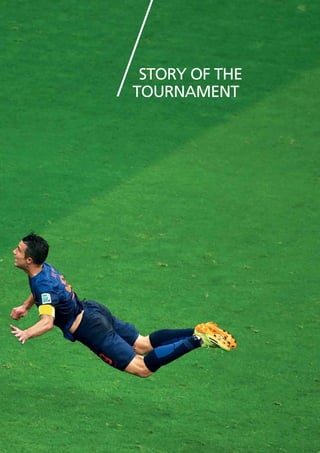
STORY OF THE
TOURNAMENT
Story of the tournament10
STORY OF THE TOURNAMENT
Group stage
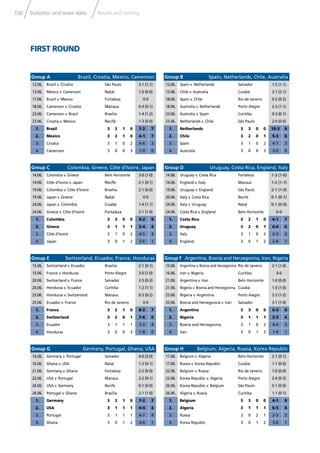
Group A: Brazil advance as expected
Hosts Brazil started strongly with a 3-1
win over Croatia while Mexico overcame
Cameroon 1-0 in the opening round. After
being held to a goalless draw against Mexico
in their second match, Brazil had to wait until
their last match to ensure their passage to
the round of 16, which they did with a 4-1
victory over Cameroon. Meanwhile, Mexico
put in a rousing second-half performance to
beat Croatia 3-1 and advance with the hosts.
Cameroon lost all their matches, including 4-0
to Croatia, who finished in third place.
Group B: an early exit for the defending
champions
The Netherlands cruised into the knockout
stage on the back of three victories in the
group stage: a 5-1 demolition of reigning
world champions Spain, followed by a 3-2
win over Australia and a hard-fought 2-0 win
in the final group clash with Chile. La Roja’s
early departure was confirmed after they lost
2-0 to Chile in the second game, though they
took away a 3-0 consolation victory against
the Socceroos in their final match. Chile joined
the Oranje in the next round by overcoming
Australia 3-1, with six points proving enough
to advance. Australia suffered three defeats
but put in a memorable performance against
the Netherlands as they went down 3-2.
Group C: teams on equal footing
South American hopefuls Colombia made
a good start by beating Greece 3-0 in the
opening match and went on to win their
other games: 2-1 against Côte d’Ivoire and
4-1 against Asian champions Japan to march
convincingly into the second round. Greece
Story of the tournament 11
came through an extremely difficult test:
having lost their opening match and suffered
the set-back of a 0-0 draw with Japan, they
faced a crucial match against the Africans in
which only a converted penalty, won in the
dying seconds, took them into the round of
16. Having been on the verge of qualifying
from the group, Côte d’Ivoire had only
themselves to blame for giving away that
penalty, while the Blue Samurai also had
reason to feel disappointed, earning only a
solitary point in the tournament.
Group D: Costa Rica surprise the world
With three former world champions in the
group, Costa Rica stunned the footballing
world by coming out on top, beating Uruguay
3-1, toppling Italy 1-0 and holding England
to a goalless draw. Uruguay faced Italy in
their final game, with striker Luis Suárez’s (9)
double having overcome England 2-1. Skipper
Diego Godín (3) was the hero this time as he
headed home late on to defeat Italy and take
his side through to join Los Ticos in the next
round. England lost their first two matches
and Italy also went home early having earned
just three points.
Group E: France show their superiority
France showed their quality by comfortably
winning their first two matches, 3-0 against
Honduras and 5-2 against Switzerland, to
confirm their early progress. Switzerland, on
the other hand, could not rely on the points
from a 2-1 win against Ecuador to be enough to
advance, and fought hard in their final group
game to defeat Honduras 3-0 and go through
to the second stage in second position. Ecuador
finished with four points from a win and a
draw while Honduras lost all their matches.
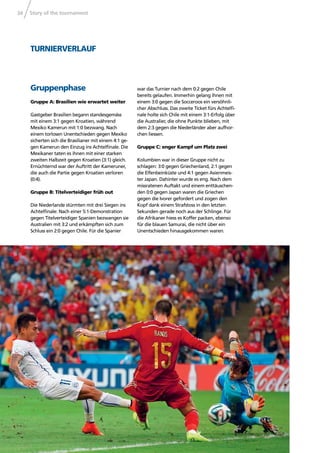
Group F: Argentina collect full points
Messi (10) was on the score sheet in all three
victories, contributing four goals. Argentina
overcame Bosnia 2-1 and Iran 1-0 before
beating Nigeria 3-2, when both teams had
already qualified ahead of the last group
match. The Super Eagles edged Bosnia and
Herzegovina 1-0 and a draw against Iran was
enough to see them advance to the knockout
stage. Iran lost their final match against
Bosnia and Herzegovina 3-1, confirming their
position at the bottom of the group.
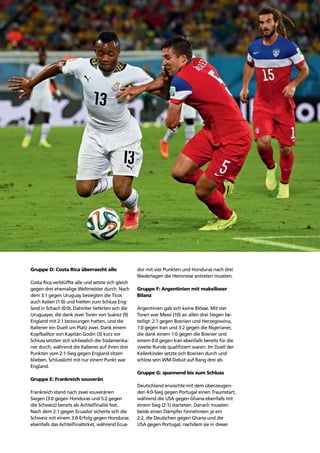
Group G: going down to the wire
Germany had the best possible start with a
convincing 4-0 win against Portugal while
the USA edged Ghana 2-1. The Americans
could have advanced early but dropped
points in the last minute of a thrilling 2-2
draw with Portugal as Die Mannschaft also
tied against Ghana with the same scoreline.
The final round of matches was crucial to all
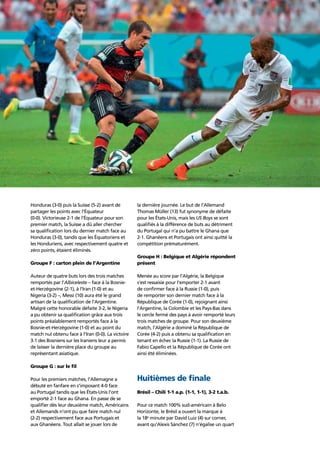
teams. Germany’s Müller (13) scored the only
goal in the game against the USA, who still
managed to pip Portugal on goal difference,
even though Portugal beat Ghana 2-1. Both
Story of the tournament12
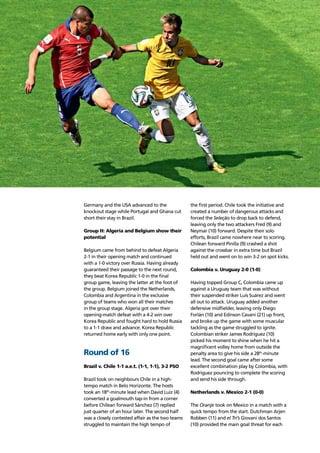
the first period. Chile took the initiative and
created a number of dangerous attacks and
forced the Seleção to drop back to defend,
leaving only the two attackers Fred (9) and
Neymar (10) forward. Despite their solo
efforts, Brazil came nowhere near to scoring.
Chilean forward Pinilla (9) crashed a shot
against the crossbar in extra time but Brazil
held out and went on to win 3-2 on spot kicks.
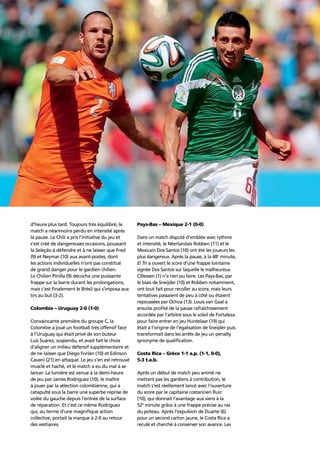
Colombia v. Uruguay 2-0 (1-0)
Having topped Group C, Colombia came up
against a Uruguay team that was without
their suspended striker Luis Suárez and went
all out to attack. Uruguay added another
defensive midfielder, leaving only Diego
Forlán (10) and Edinson Cavani (21) up front,
and broke up the game with some muscular
tackling as the game struggled to ignite.
Colombian striker James Rodríguez (10)
picked his moment to shine when he hit a
magnificent volley home from outside the
penalty area to give his side a 28th
-minute
lead. The second goal came after some
excellent combination play by Colombia, with
Rodríguez pouncing to complete the scoring
and send his side through.
Netherlands v. Mexico 2-1 (0-0)
The Oranje took on Mexico in a match with a
quick tempo from the start. Dutchman Arjen
Robben (11) and el Tri’s Giovani dos Santos
(10) provided the main goal threat for each
Germany and the USA advanced to the
knockout stage while Portugal and Ghana cut
short their stay in Brazil.
Group H: Algeria and Belgium show their
potential
Belgium came from behind to defeat Algeria
2-1 in their opening match and continued
with a 1-0 victory over Russia. Having already
guaranteed their passage to the next round,
they beat Korea Republic 1-0 in the final
group game, leaving the latter at the foot of
the group. Belgium joined the Netherlands,
Colombia and Argentina in the exclusive
group of teams who won all their matches
in the group stage. Algeria got over their
opening-match defeat with a 4-2 win over
Korea Republic and fought hard to hold Russia
to a 1-1 draw and advance. Korea Republic
returned home early with only one point.
Round of 16
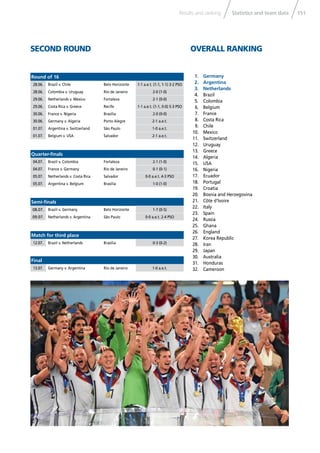
Brazil v. Chile 1-1 a.e.t. (1-1, 1-1), 3-2 PSO
Brazil took on neighbours Chile in a high-
tempo match in Belo Horizonte. The hosts
took an 18th
-minute lead when David Luiz (4)
converted a goalmouth tap-in from a corner
before Chilean forward Sánchez (7) replied
just quarter of an hour later. The second half
was a closely contested affair as the two teams
struggled to maintain the high tempo of
Story of the tournament 13
side. Having gone into the interval goalless,
the Mexicans made a flying start to the second
half when Dos Santos volleyed home beyond
the despairing dive of keeper Cillessen (1) in
the 48th
minute. The Netherlands fought back
hard, however, with the efforts of Sneijder
(10) and Robben either going only inches wide
or being denied by Ochoa (13). Coach Louis
van Gaal chose his moment to make a smart
tactical change during the cooling break in
the heat of Fortaleza by sending on Huntelaar
(19) who duly set up Sneijder’s volleyed
equaliser and then converted the injury-time
spot kick to take the Dutch through to the
quarter-finals in dramatic fashion.
Costa Rica v. Greece 1-1 a.e.t. (1-1, 0-0),
5-3 PSO
The match was cagy right from the initial
exchanges as both keepers went largely
untested. The game became more of a
contest after the break when La Sele captain
Ruiz (10) placed a precise shot low into the
corner to give the Ticos the lead in the 52nd
minute. After going down to ten men when
Duarte (6) received a second yellow card,
Costa Rica dropped further back to defend
their lead. The Greeks, meanwhile, threw
everything forward to save the match, but the
outstanding Navas (1) kept them at bay. The
Greek breakthrough came in injury time when
Papastathopoulos (19) equalised to force the
game into extra time. Greece relied too much
on deep deliveries into the box while La Sele
kept all ten men behind the ball. Penalty kicks
were inevitable and Costa Rica won a thrilling
shoot-out 5-3 to go through to their first-ever
World Cup quarter-final.
France v. Nigeria 2-0 (0-0)
This was an extremely close contest between
the two teams as Les Bleus were well resisted
by the African side, notably by the in-form
keeper Enyeama (1). However, it wasn’t all
one-way traffic as the Super Eagles also
formed some strong attacks, but defenders
Koscielny (21) and Varane (4) dealt with
these excellently. As the game entered its
latter stages, Nigeria made an unfortunate
error from a corner to allow Pogba (19) to
head home, and Les Bleus confirmed their
win when a fast-paced cross caught out the
unfortunate Yobo (2) who put the ball past his
own keeper, sending the Frenchmen marching
into the next round.
Germany v. Algeria 2-1 a.e.t.
The first half provided plenty of entertainment
as Algeria started off at a high tempo, with
striker Slimani (13) causing plenty of problems
for the Germans. Keeper Neuer (1) had to be
alert enough to rush out of his area to snuff
out the danger on several occasions. Müller
and Özil (8) had their own share of chances
but saw them all denied by keeper Mbolhi
(23). Algeria began to struggle in the second
half as Germany took the game by the scruff
of the neck, although the German efforts still
couldn’t beat Mbolhi. When the match went
to extra time, substitute Schürrle (9) and Özil
both scored, showing the Germans’ superiority,
though Algeria were able to register a late
consolation goal.
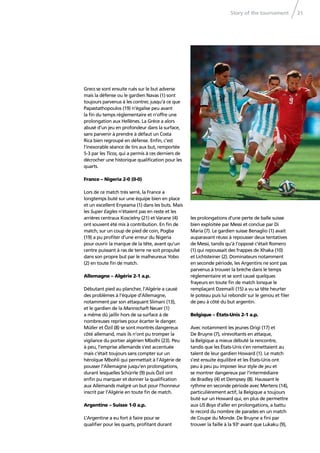
Argentina v. Switzerland 1-0 a.e.t.
Argentina squeezed into the quarter-finals
thanks to a last-gasp extra-time winner from
Di María (7). Messi had a quiet game, only
testing Benaglio (1) the Swiss keeper on two
occasions, but played a key role in setting
up Di María’s goal. The Swiss looked the
more dangerous in attack with impressive
strikes from Xhaka (10) and Lichtsteiner (2)
both denied by keeper Romero (1). The
Argentinians dominated the second half, but
couldn’t find a way past Benaglio. Late in
extra time as the Swiss sought an equaliser,
substitute Dzemaili (15) saw his header hit the
post and sent the rebound wide from just two
metres leaving the Albicelestes very relieved
and with a place in the quarter-finals.
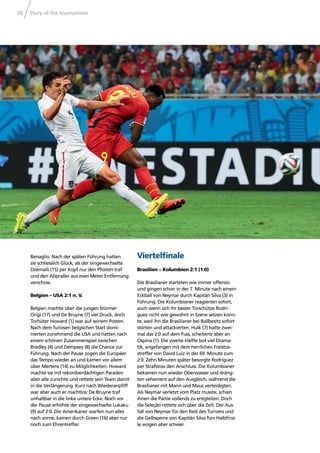
Belgium v. USA 2-1 a.e.t.
Belgium made a blazing start with young
striker Origi (17) and De Bruyne (7)
particularly active in attack, though the
US keeper Howard (1) was equal to every
attempt on goal. The match seemed to
settle after the frenetic start, with the USA
gradually managing to impose their style on
proceedings. Bradley (4) and Dempsey (8)
Story of the tournament14
combined well and tested the Belgian
defence. Belgium upped the tempo in the
second half, with Mertens (14) in particular
causing the USA problems and bringing out
an astonishing performance from Howard
who made a World Cup-record number of
saves to hold the Red Devils to 0-0 until the
end of normal time. De Bruyne scored soon
into extra time and substitute Lukaku (9)
doubled the advantage before the end of the
first period. The Americans battled hard and
Green (16) pulled one back, but they were still
unable to escape elimination.
Quarter-finals
Brazil v. Colombia 2-1 (1-0)
Brazil adopted their usual attacking style in
this contest against Colombia. They went all
out and were rewarded with an early goal
in just the 7th
minute: from Neymar’s corner,
skipper Thiago Silva (3) tapped in from close
range. The goal drew an instant response
from Colombia, although Rodríguez, the
leading scorer, struggled to impose himself
on the game as the Brazilians harassed and
restricted him every time he had the ball. Hulk
(7) had a couple of scoring chances but they
were denied by keeper Ospina (1). The second
period offered up a great deal of drama.
David Luiz scored with a powerful direct free
kick to add a second goal in the 69th
minute.
Ten minutes later Rodríguez scored from the
spot to close the gap and the momentum
swung in favour of Colombia; they pressed
forward for an equaliser, sensing an upset
could be on the cards. Brazil were forced to
defend in numbers and were dealt a blow
when Neymar was injured seriously enough
to rule him out of the rest of the tournament.
Despite the further setback of losing captain
Silva to suspension, Brazil marched on to the
semi-finals.
France v. Germany 0-1 (0-1)
As expected, the first half was a closely
contested affair, with both sides aiming to
nullify each other’s attacking threats. It was
the Germans who started the brightest and
threatened early on when Kroos (18) had a
shot blocked. France hit back with efforts
from Benzema (10) and Valbuena (8), but they
never really tested Neuer. Kroos then sent in a
curling free kick in the 13th
minute that found
Hummels (5), who headed home to give the
Germans the lead. France desperately chased
the equaliser but their attempts either missed
the target or were kept out by the keeper.
They continued to push forward but the
disciplined and organised German defence
proved difficult to break down and Neuer
was rarely called into action. The best chance
arrived in the 77th
minute, but Matuidi’s (14)
powerful shot from a tight angle was not
good enough to get past the keeper. German
substitute Schürrle twice went close to adding
his name to the score sheet but it mattered
little that he did not as Germany sealed their
place in the semi-finals.
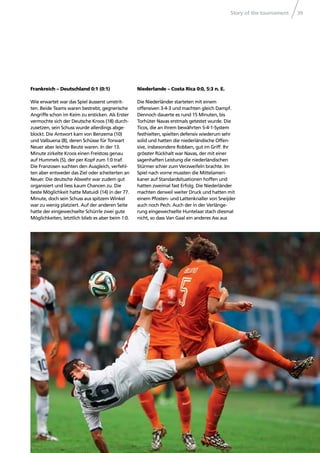
Netherlands v. Costa Rica 0-0 a.e.t.,
5-3 PSO
Dutch coach Van Gaal set out an attacking
3-4-3 formation and his side enjoyed plenty
of possession early in the game, but it was
not until after the quarter-hour mark that
the Costa Rica keeper was tested. Having had
success in the group stage and the round of
16, the Ticos kept their 5-4-1 formation and
were once more very organised in defence
and dealt well with the ever-present threat
Story of the tournament 15
of the Oranje, especially Robben. Primarily,
it was the career-defining performance and
heroic efforts of keeper Navas that kept the
Oranje strikers at bay. Set pieces looked to be
the most likely way for the Ticos to breach the
Dutch defence and they came close with an
effort in each half. The Dutch pushed hard to
break through the Ticos’ compact defence.
However, the woodwork wasn’t to help them
as two of Sneijder’s shots rebounded out.
Striker Huntelaar was brought on during extra
time but to no avail. Louis Van Gaal used his
last substitution to bring on keeper Tim Krul
(23) for the penalty shoot-out, and the move
paid off as Krul saved two spot kicks to take
the Netherlands into the semi-finals.
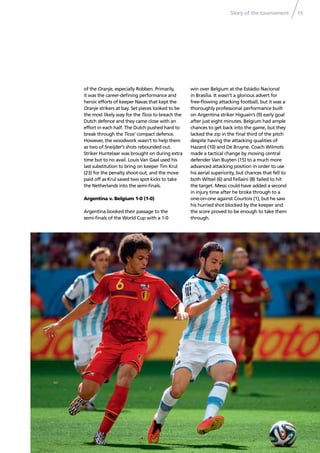
Argentina v. Belgium 1-0 (1-0)
Argentina booked their passage to the
semi-finals of the World Cup with a 1-0
win over Belgium at the Estádio Nacional
in Brasília. It wasn’t a glorious advert for
free-flowing attacking football, but it was a
thoroughly professional performance built
on Argentina striker Higuaín’s (9) early goal
after just eight minutes. Belgium had ample
chances to get back into the game, but they
lacked the zip in the final third of the pitch
despite having the attacking qualities of
Hazard (10) and De Bruyne. Coach Wilmots
made a tactical change by moving central
defender Van Buyten (15) to a much more
advanced attacking position in order to use
his aerial superiority, but chances that fell to
both Witsel (6) and Fellaini (8) failed to hit
the target. Messi could have added a second
in injury time after he broke through to a
one-on-one against Courtois (1), but he saw
his hurried shot blocked by the keeper and
the score proved to be enough to take them
through.
Story of the tournament16
Semi-finals
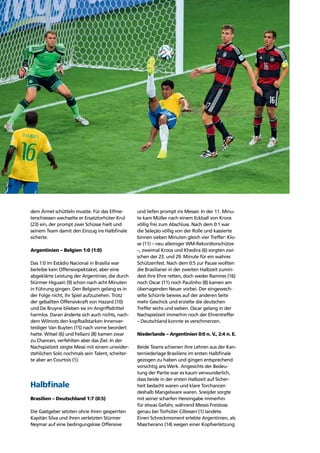
Brazil v Germany 1-7 (0-5)
Hosts Brazil went into the semi-final
encounter without their suspended skipper
Silva and injured striker Neymar. They went
all out against the Germans from the start
in search of an early lead, but it was the
Germans who took the lead in the 11th
minute as Kroos whipped in a corner to the
unmarked Müller, who duly scored. The
Seleção then capitulated for seven first-half
minutes in which Germany played without
mercy: Klose (11) scored in the 23rd
minute to
claim his place as the top scorer in World Cup
history, Kroos clinically put away the next two
goals, before Khedira (6) added a fifth just on
the half-hour mark. The Brazilians managed
to get some breathing space for the next
15 minutes and did not concede again before
half-time. Brazil appeared to be reinvigorated
in the second half as they looked to restore
their pride. German keeper Neuer was up to
the task, reacting brilliantly on a number of
occasions to deny strong efforts from Ramires
(16), Oscar (11) and Paulinho (8). However,
substitute Schürrle added two more goals to
extend the lead to seven. Oscar finally got
a consolation goal for his team in stoppage
time, but Germany marched irresistibly on to
the World Cup final.
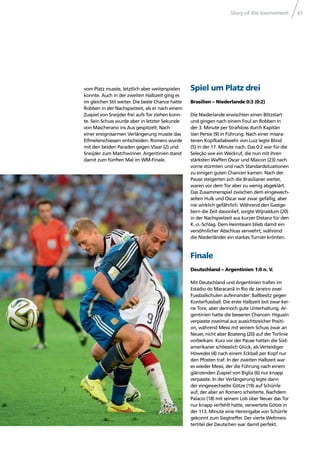
Netherlands v. Argentina 0-0 a.e.t.,
2-4 PSO
Both the Netherlands and Argentina were
extremely cautious, perhaps as a result of
the lessons learned from the other semi-
final. With so much at stake, it was hardly
surprising that both teams played cagily in
the first half and few clear-cut opportunities
developed. Early on, Sneijder blazed wide
from the edge of the box while Messi drove
a free kick straight into the arms of keeper
Cillessen. Argentina received a scare when
Mascherano (14) was forced to leave the
field briefly after suffering a head injury. The
second half was just as tight as the first, and
the best chance came in stoppage time as
Robben burst clear in the box after a layoff
from Sneijder only for his shot to be cleared
with a perfectly timed tackle by Mascherano.
There were precious few chances in extra
time and so the match had to be decided
with penalties. While all four players
converted for Argentina, Romero saved
penalties from Vlaar (2) and Sneijder to put
Argentina through to face Germany in Rio de
Janeiro in their fifth World Cup final.
Play-off for third place
Brazil v. Netherlands 0-3 (0-2)
Skipper Van Persie (9) netted a penalty in the
third minute after Robben had been brought
down. Blind (5) doubled the lead in the 17th
minute after a poor headed clearance by
David Luiz. The Seleção only started to play
with more composure after they had fallen
behind. They pushed forward through Oscar
and Maicon (23), who looked to be their
best attacking outlets, and the hosts went
on to create a number of good chances from
set pieces. Brazil gave a better account of
themselves after the half-time break but lacked
the edge in front of goal and so missed chances
to reduce the deficit. Hulk was brought on
and combined well with Oscar but their shots
never troubled the Dutch keeper. Time ran out
for the Brazilians and Wijnaldum (20) added
a third for the Dutch in injury time, firing in
from close range. While Brazil were unable
to recover from their heavy semi-final defeat,
the Netherlands played outstanding football
throughout the tournament and fully deserved
third place at the 2014 FIFA World Cup.
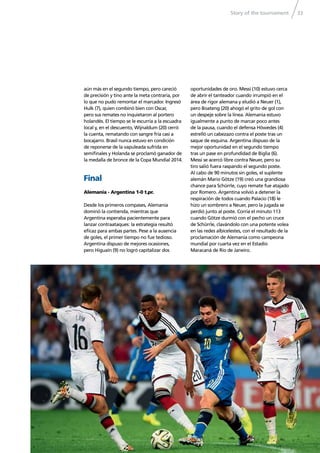
Final
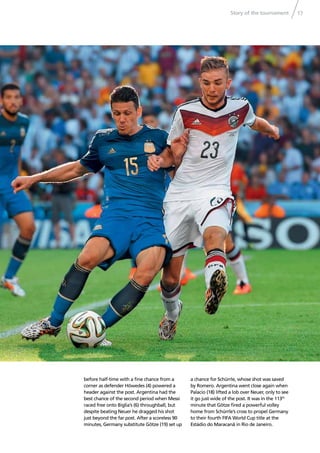
Germany v. Argentina 1-0 a.e.t.
From the opening exchanges, Germany
dominated possession while Argentina
patiently waited to attack on the counter.
The strategy proved effective for both sides.
Despite being goalless, the first half was by
no means dull. It was Argentina who had
the better opportunities, but Higuaín failed
to capitalise on two golden chances. Messi
went close when he burst into the box and
rounded Neuer, only for Boateng (20) to clear
off his own line. Germany also went close just
Story of the tournament 17
before half-time with a fine chance from a
corner as defender Höwedes (4) powered a
header against the post. Argentina had the
best chance of the second period when Messi
raced free onto Biglia’s (6) throughball, but
despite beating Neuer he dragged his shot
just beyond the far post. After a scoreless 90
minutes, Germany substitute Götze (19) set up
a chance for Schürrle, whose shot was saved
by Romero. Argentina went close again when
Palacio (18) lifted a lob over Neuer, only to see
it go just wide of the post. It was in the 113th
minute that Götze fired a powerful volley
home from Schürrle’s cross to propel Germany
to their fourth FIFA World Cup title at the
Estádio do Maracanã in Rio de Janeiro.
Story of the tournament18
COMPTE RENDU DE LA COMPÉTITION
Phase de groupes
Groupe A : le Brésil en toute logique
Pour son premier match, le Brésil a
commencé fort en l’emportant 3-1 contre
la Croatie, tandis que le Mexique battait
le Cameroun 1-0. Les deux équipes se sont
ensuite neutralisées lors d’un match nul et
vierge, laissant planer le suspense jusqu’à la
dernière journée, lors de laquelle la Seleção
a pu s’assurer de la première place grâce à
une victoire 4-1 sur le Cameroun pendant
que le Mexique dominait la Croatie 3-1 et
décrochait lui aussi sa qualification. Croates
et Camerounais – dont la confrontation
directe avait vu les Croates s’imposer 4-0 –
ont respectivement terminé troisièmes et
quatrièmes.
Groupe B : élimination prématurée des
champions en titre
Forts de trois victoires dont un tonitruant
5-1 infligé à l’Espagne, un difficile 3-2
face à l’Australie et le match au sommet
du groupe face au Chili, remporté 2-0, les
Pays-Bas ont terminé premiers. Le mauvais
départ des Espagnols face aux Oranje s’est
confirmé par une défaite 2-0 face au Chili,
avant que l’honneur ne soit sauvé grâce à
une victoire 3-0 sur l’Australie. Le Chili, qui
avait commencé son parcours en dominant
l’Australie 3-1, a totalisé six points, suffisant
pour se qualifier lui aussi. Éliminée avec trois
défaites, l’Australie aura néanmoins livré une
fort belle prestation face aux Pays-Bas, ne
s’inclinant que 3-2.
Groupe C : un groupe indécis
La Colombie, favorite du groupe, a bien
débuté face à la Grèce (3-0) avant de
l’emporter également face à la Côte d’Ivoire
(2-1) puis face au Japon (4-1), décrochant
ainsi avec maîtrise une qualification méritée.
La Grèce, mal en point après avoir perdu son
premier match et partagé les points avec
le Japon (0-0), s’est retrouvée au pied du
mur contre la Côte d’Ivoire, dans un match
serré qu’elle ne gagna qu’au bénéfice d’un
penalty obtenu dans les arrêts de jeu mais
synonyme de qualification pour les huitièmes.
Après avoir été tout près de se qualifier, les
Éléphants ne peuvent que regretter d’avoir
concédé ce penalty, tandis que les Japonais
quittaient la compétition avec un seul et
unique point, loin de leurs attentes.
Groupe D : la surprise costaricienne
Opposé à trois anciens champions du monde,
le Costa Rica a surpris les observateurs en
terminant premier du groupe, grâce à des
victoires face à l’Uruguay (3-1) puis l’Italie (1-0)
avant de tenir en échec l’Angleterre (0-0).
Après avoir battu l’Angleterre 2-1 grâce à un
doublé de Luis Suárez (9) lors de son deuxième
match, l’Uruguay a obtenu la deuxième place
en l’emportant face à l’Italie grâce à un but
tardif de Diego Godín (3). Ayant perdu 2-1
face à l’Italie puis à l’Uruguay, l’Angleterre fut
éliminée avec un point, au même titre que
l’Italie qui n’en a totalisé que trois.
Groupe E : une France dominatrice
L’équipe de France a bien maîtrisé sa phase
de groupes en dominant successivement le
Story of the tournament 19
Honduras (3-0) puis la Suisse (5-2) avant de
partager les points avec l’Équateur
(0-0). Victorieuse 2-1 de l’Équateur pour son
premier match, la Suisse a dû aller chercher
sa qualification lors du dernier match face au
Honduras (3-0), tandis que les Équatoriens et
les Honduriens, avec respectivement quatre et
zéro points, étaient éliminés.
Groupe F : carton plein de l’Argentine
Auteur de quatre buts lors des trois matches
remportés par l’Albiceleste – face à la Bosnie-
et-Herzégovine (2-1), à l’Iran (1-0) et au
Nigeria (3-2) –, Messi (10) aura été le grand
artisan de la qualification de l’Argentine.
Malgré cette honorable défaite 3-2, le Nigeria
a pu obtenir sa qualification grâce aux trois
points préalablement remportés face à la
Bosnie-et-Herzégovine (1-0) et au point du
match nul obtenu face à l’Iran (0-0). La victoire
3-1 des Bosniens sur les Iraniens leur a permis
de laisser la dernière place du groupe au
représentant asiatique.
Groupe G : sur le fil
Pour les premiers matches, l’Allemagne a
débuté en fanfare en s’imposant 4-0 face
au Portugal tandis que les États-Unis l’ont
emporté 2-1 face au Ghana. En passe de se
qualifier dès leur deuxième match, Américains
et Allemands n’ont pu que faire match nul
(2-2) respectivement face aux Portugais et
aux Ghanéens. Tout allait se jouer lors de
la dernière journée. Le but de l’Allemand
Thomas Müller (13) fut synonyme de défaite
pour les États-Unis, mais les US Boys se sont
qualifiés à la différence de buts au détriment
du Portugal qui n’a pu battre le Ghana que
2-1. Ghanéens et Portugais ont ainsi quitté la
compétition prématurément.
Groupe H : Belgique et Algérie répondent
présent
Menée au score par l’Algérie, la Belgique
s’est ressaisie pour l’emporter 2-1 avant
de confirmer face à la Russie (1-0), puis
de remporter son dernier match face à la
République de Corée (1-0), rejoignant ainsi
l’Argentine, la Colombie et les Pays-Bas dans
le cercle fermé des pays à avoir remporté leurs
trois matches de groupe. Pour son deuxième
match, l’Algérie a dominé la République de
Corée (4-2) puis a obtenu sa qualification en
tenant en échec la Russie (1-1). La Russie de
Fabio Capello et la République de Corée ont
ainsi été éliminées.
Huitièmes de finale
Brésil – Chili 1-1 a.p. (1-1, 1-1), 3-2 t.a.b.
Pour ce match 100% sud-américain à Belo
Horizonte, le Brésil a ouvert la marque à
la 18e
minute par David Luiz (4) sur corner,
avant qu’Alexis Sánchez (7) n’égalise un quart
Story of the tournament20
d’heure plus tard. Toujours très équilibré, le
match a néanmoins perdu en intensité après
la pause. Le Chili a pris l’initiative du jeu et
s’est créé de dangereuses occasions, poussant
la Seleção à défendre et à ne laisser que Fred
(9) et Neymar (10) aux avant-postes, dont
les actions individuelles n’ont pas constitué
de grand danger pour le gardien chilien.
Le Chilien Pinilla (9) décocha une puissante
frappe sur la barre durant les prolongations,
mais c’est finalement le Brésil qui s’imposa aux
tirs au but (3-2).
Colombie – Uruguay 2-0 (1-0)
Convaincante première du groupe C, la
Colombie a joué un football très offensif face
à l’Uruguay qui était privé de son buteur
Luis Suárez, suspendu, et avait fait le choix
d’aligner un milieu défensif supplémentaire et
de ne laisser que Diego Forlán (10) et Edinson
Cavani (21) en attaque. Le jeu s’en est retrouvé
musclé et haché, et le match a eu du mal à se
lancer. La lumière est venue à la demi-heure
de jeu par James Rodríguez (10), le maître
à jouer par la sélection colombienne, qui a
catapulté sous la barre une superbe reprise de
volée du gauche depuis l’entrée de la surface
de réparation. Et c’est ce même Rodríguez
qui, au terme d’une magnifique action
collective, portait la marque à 2-0 au retour
des vestiaires.
Pays-Bas – Mexique 2-1 (0-0)
Dans un match disputé d’emblée avec rythme
et intensité, le Néerlandais Robben (11) et le
Mexicain Dos Santos (10) ont été les joueurs les
plus dangereux. Après la pause, à la 48e
minute,
El Tri a ouvert le score d’une frappe lointaine
signée Dos Santos sur laquelle le malheureux
Cillessen (1) n’a rien pu faire. Les Pays-Bas, par
le biais de Sneijder (10) et Robben notamment,
ont tout fait pour recoller au score, mais leurs
tentatives passaient de peu à côté ou étaient
repoussées par Ochoa (13). Louis van Gaal a
ensuite profité de la pause rafraîchissement
accordée par l’arbitre sous le soleil de Fortaleza
pour faire entrer en jeu Huntelaar (19) qui
était à l’origine de l’égalisation de Sneijder puis
transformait dans les arrêts de jeu un penalty
synonyme de qualification.
Costa Rica – Grèce 1-1 a.p. (1-1, 0-0),
5-3 t.a.b.
Après un début de match peu animé ne
mettant pas les gardiens à contribution, le
match s’est réellement lancé avec l’ouverture
du score par le capitaine costaricien Ruiz
(10), qui donnait l’avantage aux siens à la
52e
minute grâce à une frappe précise au ras
du poteau. Après l’expulsion de Duarte (6)
pour un second carton jaune, le Costa Rica a
reculé et cherché à conserver son avance. Les
Story of the tournament 21
Grecs se sont ensuite rués sur le but adverse
mais la défense ou le gardien Navas (1) sont
toujours parvenus à les contrer, jusqu’à ce que
Papastathopoulos (19) n’égalise peu avant
la fin du temps réglementaire et n’offre une
prolongation aux Hellènes. La Grèce a alors
abusé d’un jeu en profondeur dans la surface,
sans parvenir à prendre à défaut un Costa
Rica bien regroupé en défense. Enfin, c’est
l’inexorable séance de tirs aux but, remportée
5-3 par les Ticos, qui a permis à ces derniers de
décrocher une historique qualification pour les
quarts.
France – Nigeria 2-0 (0-0)
Lors de ce match très serré, la France a
longtemps buté sur une équipe bien en place
et un excellent Enyeama (1) dans les buts. Mais
les Super Eagles n’étaient pas en reste et les
arrières centraux Koscielny (21) et Varane (4)
ont souvent été mis à contribution. En fin de
match, sur un coup de pied de coin, Pogba
(19) a pu profiter d’une erreur du Nigeria
pour ouvrir la marque de la tête, avant qu’un
centre puissant à ras de terre ne soit propulsé
dans son propre but par le malheureux Yobo
(2) en toute fin de match.
Allemagne – Algérie 2-1 a.p.
Débutant pied au plancher, l’Algérie a causé
des problèmes à l’équipe d’Allemagne,
notamment par son attaquant Slimani (13),
et le gardien de la Mannschaft Neuer (1)
a même dû jaillir hors de sa surface à de
nombreuses reprises pour écarter le danger.
Müller et Özil (8) se sont montrés dangereux
côté allemand, mais ils n’ont pu tromper la
vigilance du portier algérien Mbolhi (23). Peu
à peu, l’emprise allemande s’est accentuée
mais c’était toujours sans compter sur un
héroïque Mbohli qui permettait à l’Algérie de
pousser l’Allemagne jusqu’en prolongations,
durant lesquelles Schürrle (9) puis Özil ont
enfin pu marquer et donner la qualification
aux Allemands malgré un but pour l’honneur
inscrit par l’Algérie en toute fin de match.
Argentine – Suisse 1-0 a.p.
L’Argentine a eu fort à faire pour se
qualifier pour les quarts, profitant durant
les prolongations d’une perte de balle suisse
bien exploitée par Messi et conclue par Di
María (7). Le gardien suisse Benaglio (1) avait
auparavant réussi à repousser deux tentatives
de Messi, tandis qu’à l’opposé c’était Romero
(1) qui repoussait des frappes de Xhaka (10)
et Lichtsteiner (2). Dominateurs notamment
en seconde période, les Argentins ne sont pas
parvenus à trouver la brèche dans le temps
réglementaire et se sont causé quelques
frayeurs en toute fin de match lorsque le
remplaçant Dzemaili (15) a vu sa tête heurter
le poteau puis lui rebondir sur le genou et filer
de peu à côté du but argentin.
Belgique – États-Unis 2-1 a.p.
Avec notamment les jeunes Origi (17) et
De Bruyne (7), virevoltants en attaque,
la Belgique a mieux débuté la rencontre,
tandis que les États-Unis s’en remettaient au
talent de leur gardien Howard (1). Le match
s’est ensuite équilibré et les États-Unis ont
peu à peu pu imposer leur style de jeu et
se montrer dangereux par l’intermédiaire
de Bradley (4) et Dempsey (8). Haussant le
rythme en seconde période avec Mertens (14),
particulièrement actif, la Belgique a toujours
buté sur un Howard qui, en plus de permettre
aux US Boys d’aller en prolongations, a battu
le record du nombre de parades en un match
de Coupe du Monde. De Bruyne a fini par
trouver la faille à la 93e
avant que Lukaku (9),
Story of the tournament22
entré en cours de jeu, ne double la mise à la
105e
. Ne s’avouant pas vaincus, les États-Unis
ont réduit le score par Green (16) mais sans
pour autant pouvoir égaliser.
Quarts de finale
Brésil – Colombie 2-1 (1-0)
Comme toujours, le Brésil a pris le jeu à
son compte en allant de l’avant et a été
récompensé par un but dès la 7e
minute,
Thiago Silva (3) reprenant de près un corner
de Neymar. La Colombie a alors répliqué mais
Rodríguez, meilleur buteur de la compétition,
était surveillé de près par les Brésiliens. Hulk
(7) s’est créé quelques occasions, à chaque
fois repoussées par le gardien Ospina (1). En
deuxième période, le match a encore gagné
en intensité. David Luiz a doublé la mise
d’un puissant coup franc à la 69e
minute. Dix
minutes plus tard, Rodríguez, sur penalty, a
relancé les Cafeteros qui se sont mis à presser
et faire douter des Brésiliens contraints de
défendre leur but jusqu’au coup de sifflet
final. Qualifiée dans la douleur, la Seleção a
lors de ce match perdu sur blessure son joueur
clé, Neymar, et son capitaine, Thiago Silva,
suspendu au prochain match.
France – Allemagne 0-1 (0-1)
Dans un début de match disputé où les
défenses ont pris le pas sur les attaques, ce
sont néanmoins les Allemands qui ont tiré les
premiers par l’intermédiaire de Kroos (18),
avant que Benzema puis Valbuena ne voient
leurs tentatives repoussées par Neuer. Et c’est
à la 13e
minute, sur un coup franc enroulé
de Kroos, que Hummels (5) s’imposait dans
les airs pour marquer de la tête. La France a
ensuite poussé pour égaliser, mais en vain, ses
attaquants ne trouvant pas le cadre ou butant
sur le gardien allemand. Les Bleus n’auront
au final que rarement mis en difficulté le bloc
allemand, lequel était à l’occasion brillamment
suppléé par un impeccable Neuer, comme sur
une frappe de Matuidi (14) à la 77e
minute
depuis la gauche de la surface de but, puis
de Benzema en toute fin de match. Côté
allemand, Schürrle, entré en cours de jeu,
aurait lui aussi pu marquer, mais l’Allemagne
Story of the tournament 23
n’en a pas eu besoin pour obtenir sa place en
demies.
Pays-Bas – Costa Rica 0-0 a.p., 5-3 t.a.b.
Pour ce match, Van Gaal a disposé son équipe
en 3-4-3, un dispositif offensif qui a permis
aux Néerlandais de s’assurer la possession
de balle dès l’entame, même s’il leur a fallu
attendre un bon quart d’heure avant de
solliciter le gardien adverse. Fort de sa réussite
lors des précédents matches, le Costa Rica a
quant à lui conservé son 5-4-1 et sa rigoureuse
organisation défensive, tentant de ne laisser
que peu d’espaces à la menace qu’a en
permanence constitué Robben. Héroïque sur
sa ligne, Navas a repoussé toutes les tentatives
néerlandaises, quand ce n’étaient pas ses
poteaux, comme par deux fois face à Sneijder.
À l’opposé, ce n’est que sur balles arrêtées
que les Ticos se sont montrés menaçants. La
défense costaricienne tenait bon malgré la
pression croissante des Pays-Bas, et l’entrée
en jeu de Huntelaar durant les prolongations
n’a cette fois rien changé. Peu avant la fin
des prolongations, Louis Van Gaal utilisait
son dernier changement pour faire entrer le
gardien Tim Krul (23), pour la séance de tirs
au but, un changement payant puisque Krul
a repoussé deux tirs et offert la qualification à
son équipe.
Argentine – Belgique 1-0 (1-0)
L’Argentine s’est imposée 1-0 contre les
Diables Rouges à l’Estádio Nacional de
Brasília, au terme d’un match qui n’a pas
brillé par son aspect offensif mais plutôt
par la maîtrise collective des Argentins qui
ont parfaitement su gérer le score après
que Higuaín (9) a ouvert la marque après
seulement 8 minutes de jeu. Si la Belgique a
eu des occasions de but, ni Hazard (10) ni De
Bruyne ne sont parvenus à être décisifs dans
les trente derniers mètres. Le sélectionneur
Marc Wilmots a ensuite opéré un changement
tactique en plaçant le défenseur central Van
Buyten (15) un cran plus haut pour utiliser sa
taille au milieu du terrain, mais les occasions
qui ont été créées pour Witsel (6) et Fellaini
(8) n’ont pas été concrétisées. Messi aurait pu
doubler la mise mais manqua son face-à-face
avec le gardien Courtois (1), sans conséquence
toutefois puisque l’Argentine est parvenue à
conserver son but d’avance.
Demi-finales
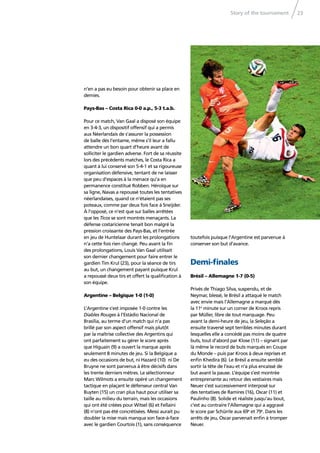
Brésil – Allemagne 1-7 (0-5)
Privés de Thiago Silva, suspendu, et de
Neymar, blessé, le Brésil a attaqué le match
avec envie mais l’Allemagne a marqué dès
la 11e
minute sur un corner de Kroos repris
par Müller, libre de tout marquage. Peu
avant la demi-heure de jeu, la Seleção a
ensuite traversé sept terribles minutes durant
lesquelles elle a concédé pas moins de quatre
buts, tout d’abord par Klose (11) – signant par
là même le record de buts marqués en Coupe
du Monde – puis par Kroos à deux reprises et
enfin Khedira (6). Le Brésil a ensuite semblé
sortir la tête de l’eau et n’a plus encaissé de
but avant la pause. L’équipe s’est montrée
entreprenante au retour des vestiaires mais
Neuer s’est successivement interposé sur
des tentatives de Ramires (16), Oscar (11) et
Paulinho (8). Solide et réaliste jusqu’au bout,
c’est au contraire l’Allemagne qui a aggravé
le score par Schürrle aux 69e
et 79e
. Dans les
arrêts de jeu, Oscar parvenait enfin à tromper
Neuer.
Story of the tournament24
Pays-Bas – Argentine 0-0 a.p., 2-4 t.a.b.
Peut-être désireuses d’éviter une
déconvenue similaire à celle du Brésil et
conscientes de l’enjeu, les deux équipes
ont commencé ce match avec une grande
prudence et la première période a été
pauvre en occasions franches. Sneijder
s’essayait de l’extérieur de la surface, tandis
que Messi frappait un coup franc dans
les bras de Cillessen. Seul fait réellement
marquant du premier acte : la frayeur des
Argentins due au choc à la tête subi par
Mascherano (14), qui l’a contraint à sortir
du terrain le temps de recevoir des soins et
reprendre ses esprits. La seconde période
s’est avérée tout aussi serrée et tactique
que la première. Bien servi par Sneijder
dans le temps additionnel, Robben avait
une occasion de marquer, mais un tacle
désespéré de Mascherano annihilait les
espoirs néerlandais d’éviter la prolongation.
Les trente minutes supplémentaires n’ont
pas été plus riches en actions décisives et
c’est aux tirs au but que cette demi-finale
s’est jouée. Sans trembler, les quatre
premiers tireurs Argentins ont transformé
leur tentative, tandis que Romero repoussait
celles de Vlaar (2) et Sneijder, offrant à
l’Albiceleste son billet pour la finale.
Match pour la troisième
place
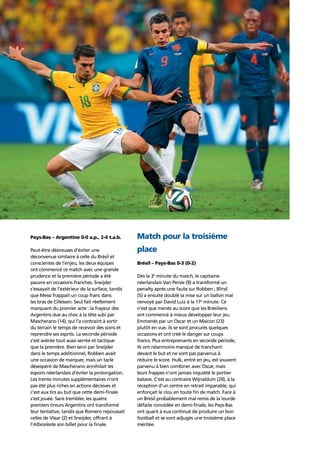
Brésil – Pays-Bas 0-3 (0-2)
Dès la 3e
minute du match, le capitaine
néerlandais Van Persie (9) a transformé un
penalty après une faute sur Robben ; Blind
(5) a ensuite doublé la mise sur un ballon mal
renvoyé par David Luiz à la 17e
minute. Ce
n’est que menés au score que les Brésiliens
ont commencé à mieux développer leur jeu.
Emmenés par un Oscar et un Maicon (23)
plutôt en vue, ils se sont procurés quelques
occasions et ont créé le danger sur coups
francs. Plus entreprenants en seconde période,
ils ont néanmoins manqué de tranchant
devant le but et ne sont pas parvenus à
réduire le score. Hulk, entré en jeu, est souvent
parvenu à bien combiner avec Oscar, mais
leurs frappes n’ont jamais inquiété le portier
batave. C’est au contraire Wijnaldum (20), à la
réception d’un centre en retrait imparable, qui
enfonçait le clou en toute fin de match. Face à
un Brésil probablement mal remis de la lourde
défaite concédée en demi-finale, les Pays-Bas
ont quant à eux continué de produire un bon
football et se sont adjugés une troisième place
méritée.
Story of the tournament 25
Finale
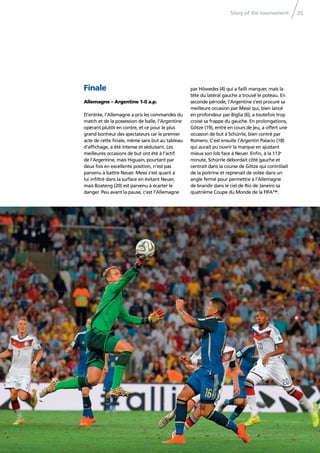
Allemagne – Argentine 1-0 a.p.
D’entrée, l’Allemagne a pris les commandes du
match et de la possession de balle, l’Argentine
opérant plutôt en contre, et ce pour le plus
grand bonheur des spectateurs car le premier
acte de cette finale, même sans but au tableau
d’affichage, a été intense et séduisant. Les
meilleures occasions de but ont été à l’actif
de l’Argentine, mais Higuaín, pourtant par
deux fois en excellente position, n’est pas
parvenu à battre Neuer. Messi s’est quant à
lui infiltré dans la surface en évitant Neuer,
mais Boateng (20) est parvenu à écarter le
danger. Peu avant la pause, c’est l’Allemagne
par Höwedes (4) qui a failli marquer, mais la
tête du latéral gauche a trouvé le poteau. En
seconde période, l’Argentine s’est procuré sa
meilleure occasion par Messi qui, bien lancé
en profondeur par Biglia (6), a toutefois trop
croisé sa frappe du gauche. En prolongations,
Götze (19), entré en cours de jeu, a offert une
occasion de but à Schürrle, bien contré par
Romero. C’est ensuite l’Argentin Palacio (18)
qui aurait pu ouvrir la marque en ajustant
mieux son lob face à Neuer. Enfin, à la 113e
minute, Schürrle débordait côté gauche et
centrait dans la course de Götze qui contrôlait
de la poitrine et reprenait de volée dans un
angle fermé pour permettre à l’Allemagne
de brandir dans le ciel de Rio de Janeiro sa
quatrième Coupe du Monde de la FIFA™.
Story of the tournament26
CRÓNICA DEL TORNEO
Fase de grupos
Grupo A: Brasil avanza como era de
esperar
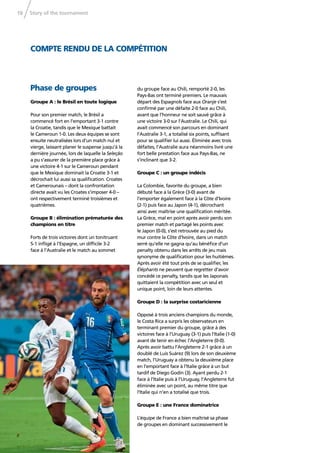
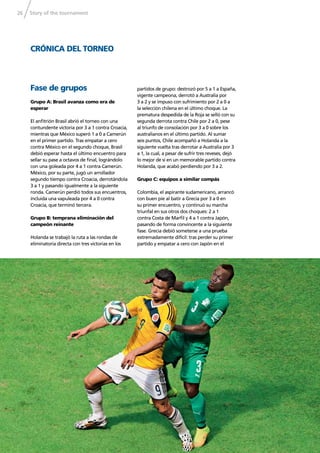
El anfitrión Brasil abrió el torneo con una
contundente victoria por 3 a 1 contra Croacia,
mientras que México superó 1 a 0 a Camerún
en el primer partido. Tras empatar a cero
contra México en el segundo choque, Brasil
debió esperar hasta el último encuentro para
sellar su pase a octavos de final, lográndolo
con una goleada por 4 a 1 contra Camerún.
México, por su parte, jugó un arrollador
segundo tiempo contra Croacia, derrotándola
3 a 1 y pasando igualmente a la siguiente
ronda. Camerún perdió todos sus encuentros,
incluida una vapuleada por 4 a 0 contra
Croacia, que terminó tercera.
Grupo B: temprana eliminación del
campeón reinante
Holanda se trabajó la ruta a las rondas de
eliminatoria directa con tres victorias en los
partidos de grupo: destrozó por 5 a 1 a España,
vigente campeona, derrotó a Australia por
3 a 2 y se impuso con sufrimiento por 2 a 0 a
la selección chilena en el último choque. La
prematura despedida de la Roja se selló con su
segunda derrota contra Chile por 2 a 0, pese
al triunfo de consolación por 3 a 0 sobre los
australianos en el último partido. Al sumar
seis puntos, Chile acompañó a Holanda a la
siguiente vuelta tras derrotar a Australia por 3
a 1, la cual, a pesar de sufrir tres reveses, dejó
lo mejor de sí en un memorable partido contra
Holanda, que acabó perdiendo por 3 a 2.
Grupo C: equipos a similar compás
Colombia, el aspirante sudamericano, arrancó
con buen pie al batir a Grecia por 3 a 0 en
su primer encuentro, y continuó su marcha
triunfal en sus otros dos choques: 2 a 1
contra Costa de Marfil y 4 a 1 contra Japón,
pasando de forma convincente a la siguiente
fase. Grecia debió someterse a una prueba
extremadamente difícil: tras perder su primer
partido y empatar a cero con Japón en el
Story of the tournament 27
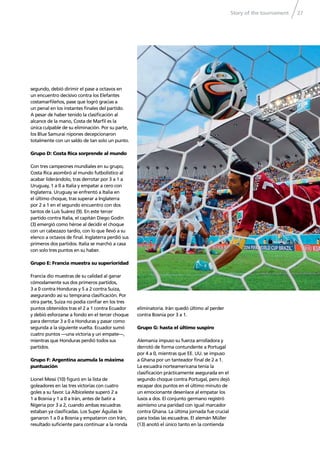
segundo, debió dirimir el pase a octavos en
un encuentro decisivo contra los Elefantes
costamarfileños, pase que logró gracias a
un penal en los instantes finales del partido.
A pesar de haber tenido la clasificación al
alcance de la mano, Costa de Marfil es la
única culpable de su eliminación. Por su parte,
los Blue Samurai nipones decepcionaron
totalmente con un saldo de tan solo un punto.
Grupo D: Costa Rica sorprende al mundo
Con tres campeones mundiales en su grupo,
Costa Rica asombró al mundo futbolístico al
acabar liderándolo, tras derrotar por 3 a 1 a
Uruguay, 1 a 0 a Italia y empatar a cero con
Inglaterra. Uruguay se enfrentó a Italia en
el último choque, tras superar a Inglaterra
por 2 a 1 en el segundo encuentro con dos
tantos de Luis Suárez (9). En este tercer
partido contra Italia, el capitán Diego Godín
(3) emergió como héroe al decidir el choque
con un cabezazo tardío, con lo que llevó a su
elenco a octavos de final. Inglaterra perdió sus
primeros dos partidos. Italia se marchó a casa
con solo tres puntos en su haber.
Grupo E: Francia muestra su superioridad
Francia dio muestras de su calidad al ganar
cómodamente sus dos primeros partidos,
3 a 0 contra Honduras y 5 a 2 contra Suiza,
asegurando así su temprana clasificación. Por
otra parte, Suiza no podía confiar en los tres
puntos obtenidos tras el 2 a 1 contra Ecuador
y debió esforzarse a fondo en el tercer choque
para derrotar 3 a 0 a Honduras y pasar como
segunda a la siguiente vuelta. Ecuador sumó
cuatro puntos —una victoria y un empate—,
mientras que Honduras perdió todos sus
partidos.
Grupo F: Argentina acumula la máxima
puntuación
Lionel Messi (10) figuró en la lista de
goleadores en las tres victorias con cuatro
goles a su favor. La Albiceleste superó 2 a
1 a Bosnia y 1 a 0 a Irán, antes de batir a
Nigeria por 3 a 2, cuando ambas escuadras
estaban ya clasificadas. Los Super Águilas le
ganaron 1 a 0 a Bosnia y empataron con Irán,
resultado suficiente para continuar a la ronda
eliminatoria. Irán quedó último al perder
contra Bosnia por 3 a 1.
Grupo G: hasta el último suspiro
Alemania impuso su fuerza arrolladora y
derrotó de forma contundente a Portugal
por 4 a 0, mientras que EE. UU. se impuso
a Ghana por un tanteador final de 2 a 1.
La escuadra norteamericana tenía la
clasificación prácticamente asegurada en el
segundo choque contra Portugal, pero dejó
escapar dos puntos en el último minuto de
un emocionante desenlace al empatar los
lusos a dos. El conjunto germano registró
asimismo una paridad con igual marcador
contra Ghana. La última jornada fue crucial
para todas las escuadras. El alemán Müller
(13) anotó el único tanto en la contienda
Story of the tournament28
contra EE. UU., que no obstante logró eliminar
a Portugal por diferencia de goles, si bien
los lusitanos derrotaran por 2 a 1 a Ghana.
Alemania y EE. UU. pasaron a la siguiente
ronda, relegando a Portugal y Ghana.
Group H: Argelia y Bélgica convencen
En el partido inaugural, Bélgica derrotó
a Argelia por 2 a 1 tras remontar una
desventaja, y batió luego a Rusia por 1 a 0.
Asegurada la clasificación, triunfó igualmente
sobre Corea por 1 a 0 en el último partido,
convirtiendo a los asiáticos en el furgón de
cola del grupo. Bélgica formó así parte del
exclusivo grupo con Holanda, Colombia y
Argentina que ganaron todos sus partidos de
la primera fase. Tras su fracaso inicial, Argelia
cambió el tercio al batir por 4 a 2 a Corea
y continuó en el torneo gracias a la garra
mostrada en el empate a uno con Rusia. Corea
retornó a casa con un único punto.
Octavos de final
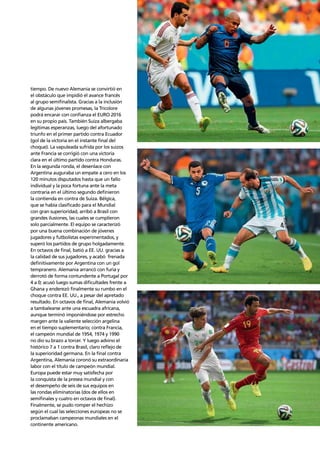
Brazil - Chile 1-1 t.pr. (1-1, 1-1), 3-2 t.p.
Brasil se enfrentó a Chile en un partido muy
reñido en Belo Horizonte. El anfitrión abrió
la cuenta en el minuto 18 con un tanto a
boca de gol de David Luiz (4), tras saque de
esquina. El delantero chileno Alexis Sánchez
(7) equilibró el marcador apenas un cuarto de
hora más tarde. El segundo tiempo deparó
un fútbol vibrante y atrayente, con ambas
escuadras intentando mantener el alto ritmo
de juego del primer tiempo. Chile tomó la
iniciativa y creó toda una serie de peligrosos
ataques que forzaron a la Seleção a rezagarse,
delante únicamente con Fred (9) y Neymar
(10). A pesar de sus incursiones individuales,
Brasil no tuvo llegada limpia a la meta
contraria. Mauricio Pinilla (9) estrelló un tiro
contra el travesaño brasileño en el minuto
120, y en la lotería de los penales, el dueño de
casa se impuso por 5 a 3.
Colombia - Uruguay 2-0 (1-0)
Tras encabezar el grupo C, Colombia debió
enfrentarse a Uruguay (sin su artillero Luis
Suárez, suspendido) y salió muy lanzada
en pos de la victoria. Uruguay añadió un
centrocampista a la defensa, con únicamente
Diego Forlán (10) y Edinson Cavani (21) en la
vanguardia, y procuró avivar un monótono
juego con algunas entradas bastante físicas.
El artillero colombiano James Rodríguez (10)
abrió la cuenta en el minuto 28 al aprovechar
un descuido defensivo, luciéndose con una
extraordinaria volea desde el borde del área.
El segundo tanto cafetero fue propiciado por
una excelente combinación coronada por
remate de Rodríguez a las redes rioplatenses,
asegurando así el pase de su escuadra a
cuartos de final.
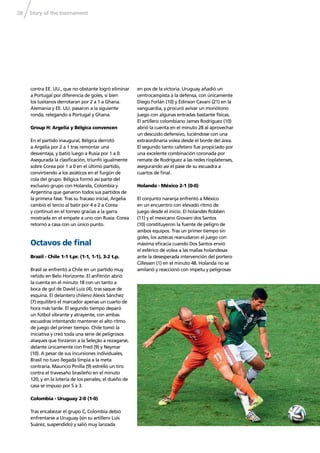
Holanda - México 2-1 (0-0)
El conjunto naranja enfrentó a México
en un encuentro con elevado ritmo de
juego desde el inicio. El holandés Robben
(11) y el mexicano Giovani dos Santos
(10) constituyeron la fuente de peligro de
ambos equipos. Tras un primer tiempo sin
goles, los aztecas reanudaron el juego con
máxima eficacia cuando Dos Santos envió
el esférico de volea a las mallas holandesas
ante la desesperada intervención del portero
Cillessen (1) en el minuto 48. Holanda no se
amilanó y reaccionó con ímpetu y peligrosas
Story of the tournament 29
incursiones, acariciando los remates de
Sneijder (10) y Robben la meta azteca o siendo
neutralizados por Ochoa (13). El técnico
Louis van Gaal eligió el momento idóneo
para un astuto cambio táctico durante la
pausa de hidratación bajo el sofocante calor
de Fortaleza, al enviar a Huntelaar (19) a
la cancha, quien instantes después habilitó
a Sneijder para subir la paridad; luego,
sentenció personalmente el partido con
tiro penal en el descuento, lo que clasificó a
Holanda a cuartos de final no sin dramatismo.
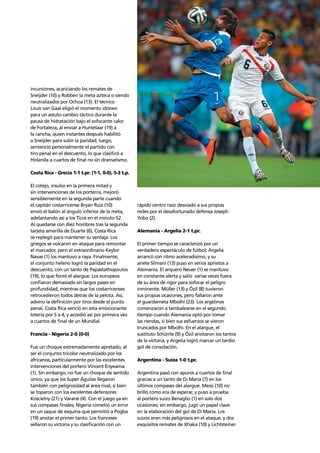
Costa Rica - Grecia 1-1 t.pr. (1-1, 0-0), 5-3 t.p.
El cotejo, insulso en la primera mitad y
sin intervenciones de los porteros, mejoró
sensiblemente en la segunda parte cuando
el capitán costarricense Bryan Ruíz (10)
envió el balón al ángulo inferior de la meta,
adelantando así a los Ticos en el minuto 52.
Al quedarse con diez hombres tras la segunda
tarjeta amarilla de Duarte (6), Costa Rica
se replegó para mantener su ventaja. Los
griegos se volcaron en ataque para remontar
el marcador, pero el extraordinario Keylor
Navas (1) los mantuvo a raya. Finalmente,
el conjunto heleno logró la paridad en el
descuento, con un tanto de Papastathopoulos
(19), lo que forzó el alargue. Los europeos
confiaron demasiado en largos pases en
profundidad, mientras que los costarricenses
retrocedieron todos detrás de la pelota. Así,
advino la definición por tiros desde el punto
penal. Costa Rica venció en esta emocionante
lotería por 5 a 4, y accedió así por primera vez
a cuartos de final de un Mundial.
Francia - Nigeria 2-0 (0-0)
Fue un choque extremadamente apretado, al
ser el conjunto tricolor neutralizado por los
africanos, particularmente por las excelentes
intervenciones del portero Vincent Enyeama
(1). Sin embargo, no fue un choque de sentido
único, ya que los Super Águilas llegaron
también con peligrosidad al área rival, si bien
se toparon con los excelentes defensores
Koscielny (21) y Varane (4). Con el juego ya en
sus compases finales, Nigeria cometió un error
en un saque de esquina que permitió a Pogba
(19) anotar el primer tanto. Los franceses
sellaron su victoria y su clasificación con un
rápido centro raso desviado a sus propias
redes por el desafortunado defensa Joseph
Yobo (2).
Alemania - Argelia 2-1 t.pr.
El primer tiempo se caracterizó por un
verdadero espectáculo de fútbol; Argelia
arrancó con ritmo aceleradísimo, y su
ariete Slimani (13) puso en serios aprietos a
Alemania. El arquero Neuer (1) se mantuvo
en constante alerta y salió varias veces fuera
de su área de rigor para sofocar el peligro
inminente. Müller (13) y Özil (8) tuvieron
sus propias ocasiones, pero fallaron ante
el guardameta Mbolhi (23). Los argelinos
comenzaron a tambalearse en el segundo
tiempo cuando Alemania optó por tomar
las riendas, si bien sus esfuerzos se vieron
truncados por Mbolhi. En el alargue, el
sustituto Schürrle (9) y Özil anotaron los tantos
de la victoria, y Argelia logró marcar un tardío
gol de consolación.
Argentina - Suiza 1-0 t.pr.
Argentina pasó con apuros a cuartos de final
gracias a un tanto de Di María (7) en los
últimos compases del alargue. Messi (10) no
brilló como era de esperar, y puso a prueba
al portero suizo Benaglio (1) en solo dos
ocasiones; sin embargo, jugó un papel clave
en la elaboración del gol de Di María. Los
suizos eran más peligrosos en el ataque, y dos
exquisitos remates de Xhaka (10) y Lichtsteiner
Story of the tournament30
(2) fueron neutralizados por el arquero
Romero (1). Argentina dominó el segundo
tiempo, pero sin hallar la fórmula para
superar a Benaglio. En los segundos finales
del período suplementario, el sustituto suizo
Dzemaili (15) estrelló un frentazo hacia abajo
contra el palo derecho y envió fuera el rebote
a escasos dos metros del arco, lo que causó
en la Albiceleste suma sensación de alivio y,
posteriormente, la alegría del pase.
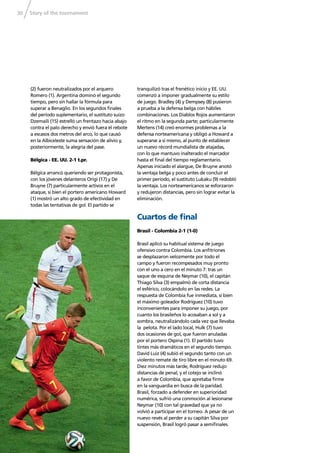
Bélgica - EE. UU. 2-1 t.pr.
Bélgica arrancó queriendo ser protagonista,
con los jóvenes delanteros Origi (17) y De
Bruyne (7) particularmente activos en el
ataque, si bien el portero americano Howard
(1) mostró un alto grado de efectividad en
todas las tentativas de gol. El partido se
tranquilizó tras el frenético inicio y EE. UU.
comenzó a imponer gradualmente su estilo
de juego. Bradley (4) y Dempsey (8) pusieron
a prueba a la defensa belga con hábiles
combinaciones. Los Diablos Rojos aumentaron
el ritmo en la segunda parte; particularmente
Mertens (14) creó enormes problemas a la
defensa norteamericana y obligó a Howard a
superarse a sí mismo, al punto de establecer
un nuevo récord mundialista de atajadas,
con lo que mantuvo inalterado el marcador
hasta el final del tiempo reglamentario.
Apenas iniciado el alargue, De Bruyne anotó
la ventaja belga y poco antes de concluir el
primer período, el sustituto Lukaku (9) redobló
la ventaja. Los norteamericanos se esforzaron
y redujeron distancias, pero sin lograr evitar la
eliminación.
Cuartos de final
Brasil - Colombia 2-1 (1-0)
Brasil aplicó su habitual sistema de juego
ofensivo contra Colombia. Los anfitriones
se desplazaron velozmente por todo el
campo y fueron recompesados muy pronto
con el uno a cero en el minuto 7: tras un
saque de esquina de Neymar (10), el capitán
Thiago Silva (3) empalmó de corta distancia
el esférico, colocándolo en las redes. La
respuesta de Colombia fue inmediata, si bien
el máximo goleador Rodríguez (10) tuvo
inconvenientes para imponer su juego, por
cuanto los brasileños lo acosaban a sol y a
sombra, neutralizándolo cada vez que llevaba
la pelota. Por el lado local, Hulk (7) tuvo
dos ocasiones de gol, que fueron anuladas
por el portero Ospina (1). El partido tuvo
tintes más dramáticos en el segundo tiempo.
David Luiz (4) subió el segundo tanto con un
violento remate de tiro libre en el minuto 69.
Diez minutos más tarde, Rodríguez redujo
distancias de penal, y el cotejo se inclinó
a favor de Colombia, que apretaba firme
en la vanguardia en busca de la paridad.
Brasil, forzado a defender en superioridad
numérica, sufrió una conmoción al lesionarse
Neymar (10) con tal gravedad que ya no
volvió a participar en el torneo. A pesar de un
nuevo revés al perder a su capitán Silva por
suspensión, Brasil logró pasar a semifinales.
Story of the tournament 31
Francia - Alemania 0-1 (0-1)
Tal como se esperaba, el primer tiempo
fue una lucha muy equilibrada, con ambos
equipos intentando neutralizar los respectivos
despliegues ofensivos. Los alemanes
comenzaron a imponerse gradualmente; el
primer intento de remate de Kroos (18) fue
bloqueado sin inconvenientes. Los franceses
dieron la réplica y respondieron con tentativas
de Benzema (10) y Valbuena (8) que, sin
embargo, no inquietaron realmente a Manuel
Neuer (1). En el minuto 13, Kroos lanzó una
falta con efecto que Hummels (5) remató
de cabeza para abrir la cuenta a favor de
Alemania. Francia buscó desesperadamente el
empate, pero sus tiros no daban en el blanco
o fueron atajados por el portero germano. La
Tricolore continuó presionando, pero la sólida
defensa alemana se convirtió en un verdadero
baluarte, prácticamente sin intervención
alguna de Neuer. La mejor oportunidad
gala vino en el minuto 77, pero el potente
remate de Matuidi (14) desde un ángulo muy
cerrado no fue lo suficientemente preciso
para superar al portero alemán. El sustituto
Schürrle (9) estuvo muy cerca de figurar
en la lista de goleadores en dos ocasiones,
aunque no fue decisivo que no lo lograra, ya
que los alemanes ya habían sellado su pase a
semifinales.
Holanda - Costa Rica 0-0 t.pr, 5-3 t.p.
El técnico holandés Van Gaal planteó un
sistema 3-4-3 que condujo a una clara
posesión de balón, pero fue solo después
de 15 minutos que se puso a prueba por
primera vez al portero costarricense. Tras
su inconmensurable labor en la fase de
grupos y en octavos de final, los Ticos se
atuvieron a su formación de 5-4-1, una vez
más con una defensa muy organizada que
supo contrarrestar el constante acoso letal
de la «naranja mecánica», especialmente de
Robben (11). Ante todo, fue la grandiosa
actuación y las heroicas intervenciones del
arquero Navas (1) lo que mantuvo a raya a los
atacantes holandeses. Las jugadas ensayadas
parecían ser la forma más adecuada de los
Ticos para superar la línea de contención
holandesa y estuvieron muy cerca de
lograrlo una vez en cada tiempo. Holanda
continuaba presionando a la sólida defensa
centroamericana, pero el travesaño no
parecía aliarse a su favor en ocasión de los dos
remates que Sneijder’s (10) estrelló contra la
barra transversal. El artillero Huntelaar (18)
ingresó como suplente en el suplemento,
aunque en vano. Louis Van Gaal introdujo al
portero suplente Tim Krul (23) en la tanda de
penales, treta que obtuvo sus frutos, ya que
Krul atajó dos tiros, lo que permitió a Holanda
pasar a semifinales.
Argentina - Bélgica 1-0 (1-0)
Argentina reservó su pasaje a semifinales con
un ajustado 1 a 0 frente a Bélgica en Brasilia.
El cotejo no fue necesariamente la mejor
publicidad del fluido fútbol ofensivo, sino más
bien un gran ejemplo de profesionalidad a
Story of the tournament32
partir del gol tempranero de Higuaín (9) en
el minuto 8. Bélgica dispuso de innumerables
oportunidades para dar vuelta al marcador,
pero careció de la efectividad necesaria
en el último tercio de cancha, a pesar de
contar con piezas ofensivas cotizadas como
Hazard (10) y De Bruyne (7). El seleccionador
belga Wilmots efectuó un cambio táctico,
moviendo al zaguero central Van Buyten (15)
a una posición ofensiva más avanzada con la
finalidad de utilizar su potencia aérea, pero las
dos ocasiones creadas para Witsel (6) y Fellaini
(8) no dieron en el blanco. Messi pudo haber
aumentado su saldo de goles en el descuento
luego de enfrentarse directamente a Courtois
(1), pero su tiro apresurado fue atajado por
el portero belga. El 1 a 0 fue suficiente para
alcanzar las semifinales.
Semifinales
Brasil - Alemania 1-7 (0-5)
Brasil debió disputar las semifinales sin su
capitán Silva, suspendido, y sin el lesionado
Neymar. El conjunto local salió con la
intención de anotar un gol tempranero;
sin embargo, fueron los alemanes quienes
abrieron la cuenta en el minuto 11 cuando
Kroos (18) envió un centro a Müller (13),
quien —completamente solo— anidó el
esférico en la meta contraria. Durante
siete minutos, la Seleção prácticamente
desapareció de la cancha, moviéndose el
conjunto alemán a voluntad, golpeando sin
tregua: Klose (11) anotó en el minuto 23 el
gol que lo convertía en el máximo goleador
de la historia de la Copa Mundial; Kroos
agregó dos más en 180 segundos, antes
de que Khedira (6) subiera el quinto justo
a la media hora de juego. Los brasileños
consiguieron un poco de espacio para respirar
y no concedieron más goles en el siguiente
cuarto de hora. En la reanudación, la
Canarinha salió con algo más de ímpetu para
restituir su orgullo. Sin embargo, el arquero
alemán Neuer (1) estaba a la altura de los
acontecimientos, reaccionó brillantemente en
una serie de ocasiones y frustró las tentativas
de Ramires (16), Oscar (11) y Paulinho (8).
Finalmente, el sustituto Schürrle (9) asestó el
golpe de gracia con dos tantos más a favor
de Alemania. En el descuento, Oscar logró
anotar el gol del honor para Brasil. Alemania
había accedido a lo grande y con paso firme a
la final de la Copa Mundial.
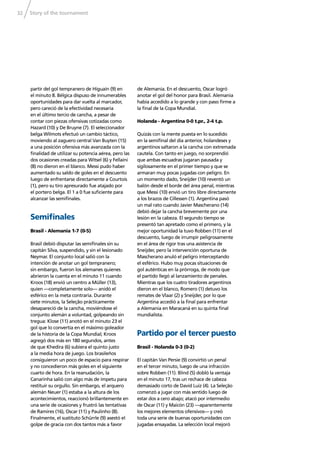
Holanda - Argentina 0-0 t.pr., 2-4 t.p.
Quizás con la mente puesta en lo sucedido
en la semifinal del día anterior, holandeses y
argentinos saltaron a la cancha con extremada
cautela. Con tanto en juego, no sorprendió
que ambas escuadras jugaran pausada y
sigilosamente en el primer tiempo y que se
armaran muy pocas jugadas con peligro. En
un momento dado, Sneijder (10) reventó un
balón desde el borde del área penal, mientras
que Messi (10) envió un tiro libre directamente
a los brazos de Cillessen (1). Argentina pasó
un mal rato cuando Javier Mascherano (14)
debió dejar la cancha brevemente por una
lesión en la cabeza. El segundo tiempo se
presentó tan apretado como el primero, y la
mejor oportunidad la tuvo Robben (11) en el
descuento, luego de irrumpir peligrosamente
en el área de rigor tras una asistencia de
Sneijder, pero la intervención oportuna de
Mascherano anuló el peligro interceptando
el esférico. Hubo muy pocas situaciones de
gol auténticas en la prórroga, de modo que
el partido llegó al lanzamiento de penales.
Mientras que los cuatro tiradores argentinos
dieron en el blanco, Romero (1) detuvo los
remates de Vlaar (2) y Sneijder, por lo que
Argentina accedió a la final para enfrentar
a Alemania en Maracaná en su quinta final
mundialista.
Partido por el tercer puesto
Brasil - Holanda 0-3 (0-2)
El capitán Van Persie (9) convirtió un penal
en el tercer minuto, luego de una infracción
sobre Robben (11). Blind (5) dobló la ventaja
en el minuto 17, tras un rechace de cabeza
demasiado corto de David Luiz (4). La Seleção
comenzó a jugar con más sentido luego de
estar dos a cero abajo; atacó por intermedio
de Oscar (11) y Maicón (23) —aparentemente
los mejores elementos ofensivos— y creó
toda una serie de buenas oportunidades con
jugadas ensayadas. La selección local mejoró
Story of the tournament 33
aún más en el segundo tiempo, pero careció
de precisión y tino ante la meta contraria, por
lo que no pudo remontar el marcador. Ingresó
Hulk (7), quien combinó bien con Oscar,
pero sus remates no inquietaron al portero
holandés. El tiempo se le escurría a la escuadra
local y, en el descuento, Wijnaldum (20) cerró
la cuenta, rematando con sangre fría casi a
bocajarro. Brasil nunca estuvo en condición
de reponerse de la vapuleada sufrida en
semifinales y Holanda se proclamó ganador de
la medalla de bronce de la Copa Mundial 2014.
Final
Alemania - Argentina 1-0 t.pr.
Desde los primeros compases, Alemania
dominó la contienda, mientras que
Argentina esperaba pacientemente para
lanzar contraataques: la estrategia resultó
eficaz para ambas partes. Pese a la ausencia
de goles, el primer tiempo no fue tedioso.
Argentina dispuso de mejores ocasiones,
pero Higuaín (9) no logró capitalizar dos
oportunidades de oro. Messi (10) estuvo cerca
de abrir el tanteador cuando irrumpió en el
área de rigor alemana y eludió a Neuer (1),
pero Boateng (20) ahogó el grito de gol con
un despeje sobre la línea. Alemania estuvo
igualmente a punto de marcar poco antes
de la pausa, cuando el defensa Höwedes (4)
estrelló un cabezazo contra el poste tras un
saque de esquina. Argentina dispuso de la
mejor oportunidad en el segundo tiempo
tras un pase en profundidad de Biglia (6).
Messi se acercó libre contra Neuer, pero su
tiro salió fuera raspando el segundo poste.
Al cabo de 90 minutos sin goles, el suplente
alemán Mario Götze (19) creó una grandiosa
chance para Schürrle, cuyo remate fue atajado
por Romero. Argentina volvió a detener la
respiración de todos cuando Palacio (18) le
hizo un sombrero a Neuer, pero la jugada se
perdió junto al poste. Corría el minuto 113
cuando Götze durmió con el pecho un cruce
de Schürrle, clavándolo con una potente volea
en las redes albicelestes, con el resultado de la
proclamación de Alemania como campeona
mundial por cuarta vez en el Estadio
Maracaná de Río de Janeiro.
Story of the tournament34
TURNIERVERLAUF
Gruppenphase
Gruppe A: Brasilien wie erwartet weiter
Gastgeber Brasilien begann standesgemäss
mit einem 3:1 gegen Kroatien, während
Mexiko Kamerun mit 1:0 bezwang. Nach
einem torlosen Unentschieden gegen Mexiko
sicherten sich die Brasilianer mit einem 4:1 ge-
gen Kamerun den Einzug ins Achtelfinale. Die
Mexikaner taten es ihnen mit einer starken
zweiten Halbzeit gegen Kroatien (3:1) gleich.
Ernüchternd war der Auftritt der Kameruner,
die auch die Partie gegen Kroatien verloren
(0:4).
Gruppe B: Titelverteidiger früh out
Die Niederlande stürmten mit drei Siegen ins
Achtelfinale: Nach einer 5:1-Demonstration
gegen Titelverteidiger Spanien bezwangen sie
Australien mit 3:2 und erkämpften sich zum
Schluss ein 2:0 gegen Chile. Für die Spanier
war das Turnier nach dem 0:2 gegen Chile
bereits gelaufen. Immerhin gelang ihnen mit
einem 3:0 gegen die Socceroos ein versöhnli-
cher Abschluss. Das zweite Ticket fürs Achtelfi-
nale holte sich Chile mit einem 3:1-Erfolg über
die Australier, die ohne Punkte blieben, mit
dem 2:3 gegen die Niederländer aber aufhor-
chen liessen.
Gruppe C: enger Kampf um Platz zwei
Kolumbien war in dieser Gruppe nicht zu
schlagen: 3:0 gegen Griechenland, 2:1 gegen
die Elfenbeinküste und 4:1 gegen Asienmeis-
ter Japan. Dahinter wurde es eng. Nach dem
missratenen Auftakt und einem enttäuschen-
den 0:0 gegen Japan waren die Griechen
gegen die Ivorer gefordert und zogen den
Kopf dank einem Strafstoss in den letzten
Sekunden gerade noch aus der Schlinge. Für
die Afrikaner hiess es Koffer packen, ebenso
für die blauen Samurai, die nicht über ein
Unentschieden hinausgekommen waren.
Story of the tournament 35
Gruppe D: Costa Rica überrascht alle
Costa Rica verblüffte alle und setzte sich gleich
gegen drei ehemalige Weltmeister durch. Nach
dem 3:1 gegen Uruguay besiegten die Ticos
auch Italien (1:0) und hielten zum Schluss Eng-
land in Schach (0:0). Dahinter lieferten sich die
Uruguayer, die dank zwei Toren von Suárez (9)
England mit 2:1 bezwungen hatten, und die
Italiener ein Duell um Platz zwei. Dank einem
Kopfballtor von Kapitän Godín (3) kurz vor
Schluss setzten sich schliesslich die Südamerika-
ner durch, während die Italiener auf ihren drei
Punkten vom 2:1-Sieg gegen England sitzen
blieben. Schlusslicht mit nur einem Punkt war
England.
Gruppe E: Frankreich souverän
Frankreich stand nach zwei souveränen
Siegen (3:0 gegen Honduras und 5:2 gegen
die Schweiz) bereits als Achtelfinalist fest.
Nach dem 2:1 gegen Ecuador sicherte sich die
Schweiz mit einem 3:0-Erfolg gegen Honduras
ebenfalls das Achtelfinalticket, während Ecua-
dor mit vier Punkten und Honduras nach drei
Niederlagen die Heimreise antreten mussten.
Gruppe F: Argentinien mit makelloser
Bilanz
Argentinien gab sich keine Blösse. Mit vier
Toren war Messi (10) an allen drei Siegen be-
teiligt: 2:1 gegen Bosnien und Herzegowina,
1:0 gegen Iran und 3:2 gegen die Nigerianer,
die dank einem 1:0 gegen die Bosnier und
einem 0:0 gegen Iran ebenfalls bereits für die
zweite Runde qualifiziert waren. Im Duell der
Kellerkinder setzte sich Bosnien durch und
schloss sein WM-Debüt auf Rang drei ab.
Gruppe G: spannend bis zum Schluss
Deutschland erwischte mit dem überzeugen-
den 4:0-Sieg gegen Portugal einen Traumstart,
während die USA gegen Ghana ebenfalls mit
einem Sieg (2:1) starteten. Danach mussten
beide einen Dämpfer hinnehmen: je ein
2:2, die Deutschen gegen Ghana und die
USA gegen Portugal, nachdem sie in dieser
Story of the tournament36
mitreissenden Partie bis zur letzten Minute
2:1 geführt hatten. Somit mussten die beiden
letzten Spiele entscheiden. Der Treffer von
Müller (13) reichte Deutschland gegen die
USA, die dank der besseren Tordifferenz aber
ebenfalls weiterkamen. Das Nachsehen hatten
die Portugiesen, die gegen Ghana „nur“ 2:1
gewonnen hatten.
Gruppe H: Algerien und Belgien
überzeugen
Nach anfänglichem Rückstand setzten sich die
Belgier gegen Algerien durch und hatten die
Qualifikation nach dem 1:0 gegen Russland
bereits auf sicher. Dank dem 1:0 gegen die
Republik Korea schlossen sie die Gruppen-
phase wie die Niederlande, Kolumbien und
Argentinien mit dem Punktemaximum ab. Die
Algerier meldeten sich nach dem Rückschlag
im Auftaktspiel mit einem 4:2-Sieg über die
Koreaner eindrucksvoll zurück und erkämpf-
ten sich mit einem 1:1 gegen Russland die
Fahrkarte für die nächste Runde. Russland und
Korea mussten die Heimreise antreten.
Achtelfinale
Brasilien – Chile 1:1 n. V. (1:1, 1:1), 3:2 n. E.
Die Zuschauer in Belo Horizonte sahen einen
hitzigen Schlagabtausch. Die Gastgeber gingen
nach einem Eckstoss dank einem Abstauber von
David Luiz (4) in Führung, ehe Stürmer Sánchez
(7) eine Viertelstunde später den Ausgleich er-
zielte. Hart zur Sache ging es auch in der zwei-
ten Hälfte, in der beide Teams versuchten, das
hohe Tempo beizubehalten. Chile übernahm
resolut das Zepter und drängte die Seleção zu-
nehmend in die Verteidigung, so dass nur noch
die beiden Angreifer Fred (9) und Neymar (10)
vorne blieben, die aber kaum für Gefahr sorg-
ten. Chile schien dem Siegtreffer näher, auch in
der fälligen Verlängerung, in der Pinilla (9) aber
nur die Latte traf. Im Elfmeterschiessen hatte
die Seleção schliesslich die besseren Nerven und
hielt sich dank dem 3:2 im Turnier.
Kolumbien – Uruguay 2:0 (1:0)
Nach den drei Gruppensiegen ging Kolumbien
gegen Uruguay ohne den gesperrten Suá-
rez wieder sehr offensiv ans Werk. Uruguay
reagierte mit einem zusätzlichen defensiven
Mittelfeldspieler und liess nur Forlán (10)
und Cavani (21) vorne. Mit hartnäckigen
Zweikämpfen unterband die Celeste das geg-
nerische Spiel, so dass kaum Spielfluss aufkam.
Schliesslich war es eine grandiose Einzelaktion
des kolumbianischen Stürmers Rodríguez (10),
der in der 28. Minute mit einer Direktabnah-
me ausserhalb des Strafraums das 1:0 erzielte.
Nach einer tollen Kombination war er auch
für den zweiten Treffer besorgt und schoss
Kolumbien somit ins Viertelfinale.
Niederlande – Mexiko 2:1 (0:0)
Beide Teams legten los wie die Feuerwehr
und kamen vor allem durch Robben (11) und
Dos Santos (10) zu guten Chancen. Dennoch
stand es zur Pause 0:0. In der zweiten Halbzeit
erwischten die Mexikaner den besseren Start
und gingen in der 48. Minute dank einem
Volleyschuss von Dos Santos in Führung. Die
Niederländer machten daraufhin mächtig
Druck. Sneijder (10) und Robben verfehl-
ten nur um Haaresbreite oder scheiterten
an Ochoa (13). Für die Entscheidung sorgte
Story of the tournament 37
schliesslich eine taktische Meisterleistung von
Trainer Van Gaal, der während der Trinkpau-
se in der Hitze von Fortaleza Huntelaar (19)
einwechselte, der zuerst mustergültig auf
Sneijder vorlegte und in der Nachspielzeit
einen Strafstoss kaltblütig zum 2:1 verwertete.
Costa Rica – Griechenland 1:1 n. V.
(1:1, 0:0), 5:3 n. E.
Das Spiel begann zähflüssig. Nur selten
wurden die Torhüter geprüft. Erst in der 52.
Minute kam Schwung ins Spiel, als Costa Ricas
Kapitän Ruiz (10) mit einem präzisen Flach-
schuss in die Ecke das 1:0 erzielte. Nach der
gelb-roten Karte gegen Duarte (6) versuchten
die Costa-Ricaner, den Vorsprung über die Zeit
zu retten, doch die Griechen warfen nun alles
nach vorne, scheiterten aber immer wieder am
herausragenden Navas (1). Erst in der Nach-
spielzeit knackte Papastathopoulos (19) das
costa-ricanische Bollwerk. In der Verlängerung
setzten die Mittelamerikaner weiter auf eine
kompakte Abwehr, an der die Europäer mit
ihren langen Bällen immer wieder hängen-
blieben. So kam es zum Elfmeterschiessen, das
die Ticos mit 5:4 hauchdünn zum erstmaligen
Viertelfinaleinzug für sich entschieden.
Frankreich – Nigeria 2:0 (0:0)
Die beiden lieferten sich ein Duell auf Augen-
höhe. Während sich die Bleus am erstklassigen
Torhüter Enyeama (1) lange Zeit die Zähne
ausbissen, kamen die Super Eagles zu gefähr-
lichen Kontern, die aber von den beiden star-
ken Verteidigern Koscielny (21) und Varane (4)
entschärft wurden. In der Schlussphase nutzte
Pogba (19) einen Defensivfehler zur Entschei-
dung. Nach einem Eigentor von Yobo (2), der
eine schnelle Hereingabe unglücklich abfälsch-
te, war das Aus der Afrikaner besiegelt.
Deutschland – Algerien 2:1 n. V.
Die Algerier, allen voran Stürmer Islam Slimani
(13), starteten furios und sorgten in der deut-
schen Abwehr einige Male für höchste Alarm-
stufe. Torhüter Neuer (1) musste mehrmals
ausserhalb des Strafraums in extremis klären.
Müller und Özil (8) hatten auf der anderen
Seite ebenfalls gute Chancen, scheiterten
aber an Torhüter Mbolhi (23). In der zweiten
Halbzeit gewannen die Deutschen langsam
die Oberhand, allerdings ohne zählbaren
Erfolg. In der Verlängerung brachen schliess-
lich der eingewechselte Schürrle (9) und Özil
den Bann. Algerien schaffte zwar noch den
Anschluss, vermochte das Blatt aber nicht
mehr zu wenden.
Argentinien – Schweiz 1:0 n. V.
Ein spätes Tor von Di María (7) in der Verlän-
gerung brachte Argentinien den Sieg. Messi
blieb für einmal im Hintergrund und konnte
Benaglio (1) im Tor der Schweizer nur zwei-
mal ernsthaft prüfen. Dafür lieferte er die
Vorlage für Di Marías Siegestor. Die Schweizer
waren über weite Strecken die gefährlichere
Mannschaft mit beeindruckenden Vorstös-
sen von Xhaka (10) und Lichtsteiner (2), die
aber von Romero (1) entschärft wurden. Die
Argentinier hatten in der zweiten Hälfte mehr
vom Spiel, fanden aber kein Rezept gegen
Story of the tournament38
Benaglio. Nach der späten Führung hatten
sie schliesslich Glück, als der eingewechselte
Dzemaili (15) per Kopf nur den Pfosten traf
und den Abpraller aus zwei Meter Entfernung
verschoss.
Belgien – USA 2:1 n. V.
Belgien machte über die jungen Stürmer
Origi (17) und De Bruyne (7) viel Druck, doch
Torhüter Howard (1) war auf seinem Posten.
Nach dem furiosen belgischen Start domi-
nierten zunehmend die USA und hatten nach
einem schönen Zusammenspiel zwischen
Bradley (4) und Dempsey (8) die Chance zur
Führung. Nach der Pause zogen die Europäer
das Tempo wieder an und kamen vor allem
über Mertens (14) zu Möglichkeiten. Howard
machte sie mit rekordverdächtigen Paraden
aber alle zunichte und rettete sein Team damit
in die Verlängerung. Kurz nach Wiederanpfiff
war aber auch er machtlos: De Bruyne traf
unhaltbar in die linke untere Ecke. Noch vor
der Pause erhöhte der eingewechselte Lukaku
(9) auf 2:0. Die Amerikaner warfen nun alles
nach vorne, kamen durch Green (16) aber nur
noch zum Ehrentreffer.
Viertelfinale
Brasilien – Kolumbien 2:1 (1:0)
Die Brasilianer starteten wie immer offensiv
und gingen schon in der 7. Minute nach einem
Eckball von Neymar durch Kapitän Silva (3) in
Führung. Die Kolumbianer reagierten sofort,
auch wenn sich ihr bester Torschütze Rodrí-
guez nicht wie gewohnt in Szene setzen konn-
te, weil ihn die Brasilianer bei Ballbesitz sofort
störten und attackierten. Hulk (7) hatte zwei-
mal das 2:0 auf dem Fuss, scheiterte aber an
Ospina (1). Die zweite Hälfte bot viel Drama-
tik, angefangen mit dem herrlichen Freistos-
streffer von David Luiz in der 69. Minute zum
2:0. Zehn Minuten später besorgte Rodríguez
per Strafstoss den Anschluss. Die Kolumbianer
bekamen nun wieder Oberwasser und dräng-
ten vehement auf den Ausgleich, während die
Brasilianer mit Mann und Maus verteidigten.
Als Neymar verletzt vom Platz musste, schien
ihnen die Partie vollends zu entgleiten. Doch
die Seleção rettete sich über die Zeit. Der Aus-
fall von Neymar für den Rest des Turniers und
die Gelbsperre von Kapitän Silva fürs Halbfina-
le wogen aber schwer.
Story of the tournament 39
Frankreich – Deutschland 0:1 (0:1)
Wie erwartet war das Spiel äusserst umstrit-
ten. Beide Teams waren bestrebt, gegnerische
Angriffe schon im Keim zu ersticken. Als Erster
vermochte sich der Deutsche Kroos (18) durch-
zusetzen, sein Schuss wurde allerdings abge-
blockt. Die Antwort kam von Benzema (10)
und Valbuena (8), deren Schüsse für Torwart
Neuer aber leichte Beute waren. In der 13.
Minute zirkelte Kroos einen Freistoss genau
auf Hummels (5), der per Kopf zum 1:0 traf.
Die Franzosen suchten den Ausgleich, verfehl-
ten aber entweder das Ziel oder scheiterten an
Neuer. Die deutsche Abwehr war zudem gut
organisiert und liess kaum Chancen zu. Die
beste Möglichkeit hatte Matuidi (14) in der 77.
Minute, doch sein Schuss aus spitzem Winkel
war zu wenig platziert. Auf der anderen Seite
hatte der eingewechselte Schürrle zwei gute
Möglichkeiten, letztlich blieb es aber beim 1:0.
Niederlande – Costa Rica 0:0, 5:3 n. E.
Die Niederländer starteten mit einem
offensiven 3-4-3 und machten gleich Dampf.
Dennoch dauerte es rund 15 Minuten, bis
Torhüter Navas erstmals getestet wurde. Die
Ticos, die an ihrem bewährten 5-4-1-System
festhielten, spielten defensiv wiederum sehr
solid und hatten die niederländische Offen-
sive, insbesondere Robben, gut im Griff. Ihr
grösster Rückhalt war Navas, der mit einer
sagenhaften Leistung die niederländischen
Stürmer schier zum Verzweifeln brachte. Im
Spiel nach vorne mussten die Mittelameri-
kaner auf Standardsituationen hoffen und
hatten zweimal fast Erfolg. Die Niederländer
machten derweil weiter Druck und hatten mit
einem Pfosten- und Lattenknaller von Sneijder
auch noch Pech. Auch der in der Verlänge-
rung eingewechselte Huntelaar stach diesmal
nicht, so dass Van Gaal ein anderes Ass aus
Story of the tournament40
dem Ärmel schütteln musste. Für das Elfme-
terschiessen wechselte er Ersatztorhüter Krul
(23) ein, der prompt zwei Schüsse hielt und
seinem Team damit den Einzug ins Halbfinale
sicherte.
Argentinien – Belgien 1:0 (1:0)
Das 1:0 im Estádio Nacional in Brasília war
beileibe kein Offensivspektakel, aber eine
abgeklärte Leistung der Argentinier, die durch
Stürmer Higuaín (9) schon nach acht Minuten
in Führung gingen. Den Belgiern gelang es in
der Folge nicht, ihr Spiel aufzuziehen. Trotz
der geballten Offensivkraft von Hazard (10)
und De Bruyne blieben sie im Angriffsdrittel
harmlos. Daran änderte sich auch nichts, nach-
dem Wilmots den kopfballstarken Innenver-
teidiger Van Buyten (15) nach vorne beordert
hatte. Witsel (6) und Fellaini (8) kamen zwar
zu Chancen, verfehlten aber das Ziel. In der
Nachspielzeit zeigte Messi mit einem unwider-
stehlichen Solo nochmals sein Talent, scheiter-
te aber an Courtois (1).
Halbfinale
Brasilien – Deutschland 1:7 (0:5)
Die Gastgeber setzten ohne ihren gesperrten
Kapitän Silva und ihren verletzten Stürmer
Neymar auf eine bedingungslose Offensive
und liefen prompt ins Messer. In der 11. Minu-
te kam Müller nach einem Eckball von Kroos
völlig frei zum Abschluss. Nach dem 0:1 war
die Seleção völlig von der Rolle und kassierte
binnen sieben Minuten gleich vier Treffer: Klo-
se (11) – neu alleiniger WM-Rekordtorschütze
–, zweimal Kroos und Khedira (6) sorgten zwi-
schen der 23. und 29. Minute für ein wahres
Schützenfest. Nach dem 0:5 zur Pause wollten
die Brasilianer in der zweiten Halbzeit zumin-
dest ihre Ehre retten, doch weder Ramires (16)
noch Oscar (11) noch Paulinho (8) kamen am
überragenden Neuer vorbei. Der eingewech-
selte Schürrle bewies auf der anderen Seite
mehr Geschick und erzielte die deutschen
Treffer sechs und sieben. Oscar gelang in der
Nachspielzeit immerhin noch der Ehrentreffer
– Deutschland konnte es verschmerzen.
Niederlande – Argentinien 0:0 n. V., 2:4 n. E.
Beide Teams schienen ihre Lehren aus der Kan-
terniederlage Brasiliens im ersten Halbfinale
gezogen zu haben und gingen entsprechend
vorsichtig ans Werk. Angesichts der Bedeu-
tung der Partie war es kaum verwunderlich,
dass beide in der ersten Halbzeit auf Sicher-
heit bedacht waren und klare Torchancen
deshalb Mangelware waren. Sneijder sorgte
mit seiner scharfen Hereingabe immerhin
für etwas Gefahr, während Messis Freistoss
genau bei Torhüter Cillessen (1) landete.
Einen Schreckmoment erlebte Argentinien, als
Mascherano (14) wegen einer Kopfverletzung
Story of the tournament 41
vom Platz musste, letztlich aber weiterspielen
konnte. Auch in der zweiten Halbzeit ging es
im gleichen Stil weiter. Die beste Chance hatte
Robben in der Nachspielzeit, als er nach einem
Zuspiel von Sneijder frei aufs Tor ziehen konn-
te. Sein Schuss wurde aber in letzter Sekunde
von Mascherano ins Aus gespitzelt. Nach
einer ereignisarmen Verlängerung musste das
Elfmeterschiessen entscheiden. Romero wurde
mit den beiden Paraden gegen Vlaar (2) und
Sneijder zum Matchwinner. Argentinien stand
damit zum fünften Mal im WM-Finale.
Spiel um Platz drei
Brasilien – Niederlande 0:3 (0:2)
Die Niederlande erwischten einen Blitzstart
und gingen nach einem Foul an Robben in
der 3. Minute per Strafstoss durch Kapitän
Van Persie (9) in Führung. Nach einer missra-
tenen Kopfballabwehr von Luiz legte Blind
(5) in der 17. Minute nach. Das 0:2 war für die
Seleção wie ein Weckruf, die nun mit ihren
stärksten Waffen Oscar und Maicon (23) nach
vorne stürmten und nach Standardsituationen
zu einigen guten Chancen kamen. Nach der
Pause steigerten sich die Brasilianer weiter,
waren vor dem Tor aber zu wenig abgeklärt.
Das Zusammenspiel zwischen dem eingewech-
selten Hulk und Oscar war zwar gefällig, aber
nie wirklich gefährlich. Während den Gastge-
bern die Zeit davonlief, sorgte Wijnaldum (20)
in der Nachspielzeit aus kurzer Distanz für den
K.-o.-Schlag. Dem Heimteam blieb damit ein
versöhnlicher Abschluss verwehrt, während
die Niederländer ein starkes Turnier krönten.
Finale
Deutschland – Argentinien 1:0 n. V.
Mit Deutschland und Argentinien trafen im
Estádio do Maracanã in Rio de Janeiro zwei
Fussballschulen aufeinander: Ballbesitz gegen
Konterfussball. Die erste Halbzeit bot zwar kei-
ne Tore, aber dennoch gute Unterhaltung. Ar-
gentinien hatte die besseren Chancen: Higuaín
verpasste zweimal aus aussichtsreicher Positi-
on, während Messi mit seinem Schuss zwar an
Neuer, nicht aber Boateng (20) auf der Torlinie
vorbeikam. Kurz vor der Pause hatten die Süd-
amerikaner schliesslich Glück, als Verteidiger
Höwedes (4) nach einem Eckball per Kopf nur
den Pfosten traf. In der zweiten Halbzeit war
es wieder Messi, der die Führung nach einem
glänzenden Zuspiel von Biglia (6) nur knapp
verpasste. In der Verlängerung legte dann
der eingewechselte Götze (19) auf Schürrle
auf, der aber an Romero scheiterte. Nachdem
Palacio (18) mit seinem Lob über Neuer das Tor
nur knapp verfehlt hatte, verwertete Götze in
der 113. Minute eine Hereingabe von Schürrle
gekonnt zum Siegtreffer. Der vierte Weltmeis-
tertitel der Deutschen war damit perfekt.
TECHNICAL AND
TACTICAL ANALYSIS
Technical and tactical analysis44
TECHNICAL AND TACTICAL ANALYSIS
The 2014 FIFA World Cup Brazil™ was
marked by top quality and attacking football,
excellent players and a positive general
football philosophy. The teams’ objectives
were to score and win matches instead of
trying not to lose or concede. This led to a glut
of goals, 171 in total at an impressive average
of 2.67 goals per match, which matched the
record set in France in 1998.
Praise has to be given to the coaches and
players who contributed first and foremost to
this outstanding competition.
The World Cup also witnessed the rise and
development of countries such as Costa Rica
and Algeria, who successfully and efficiently
challenged the more established teams.
Speed, tempo and power football has never
been so high. Many matches were end-to-end
affairs, and a lot of games were not decided
until the very end. Often little details made all
the difference between winning and losing.
The most successful teams had key players in
all areas who had a major influence with their
play, work rate, personality and outstanding
performances.
Moreover, this World Cup was an extremely
balanced affair. Eight of the 16 matches in
the second stage went to extra time, and
four all the way to a penalty shoot-out. This
underlines how close the teams are together
as well as the good development work being
done by the member associations.
Shapes
The overriding tactic was to use the players
in the position in which they could give their
best for the team. Organisation was one of
the keys to success. However, teams tended
to use flexible systems rather than static
formations, with players assuming different
positions but also sticking to their role when
the match situation required it. The players
were thereby able to make the best use of
their talent.
The most successful teams were well
organised and had effective shapes, usually
with four at the back. However, systems with
three central defenders are on the rise again
(e.g. Chile, Netherlands, Uruguay, Mexico and
Costa Rica). Defenders showed that they were
comfortable on the ball and in one-versus-one
situations.
The best teams also played with one holding
player in front of the defence (instead of two
as seen at South Africa 2010) and forming a
defensive triangle with the central defenders.
Two wide midfielders assisted in both attack
and defence. Full-backs regularly pushed
forward, providing width in attack and
creating a number of crossing options.
Most teams played with two strikers (if not
three), and the few teams that played with
one lone attacker left the competition early.
Play was built up consistently from defence
through midfield to attack. Long balls to the
strikers were rarely used (and mostly only
when a team was tired or trailing with only
minutes to go).
Successful teams were not limited to just
one creative player, and instead they gave
responsibility to a number of players with a
view towards working as a unit but still with
creativity. Teamwork was essential, as were
key players who worked hard for the team,
such as Neymar (Brazil, 10), Messi (Argentina,
10), Robben (Netherlands, 11), Kroos
(Germany, 18) and Rodríguez (Colombia, 10)
who all made a difference and were able to
decide a game on their own.
Overall, it was vital that the team’s shape was
in line with an effective system of play.
System of play
Most teams’ build-up play was on the floor,
and long balls were often not successful.
Teams started games by pressing their
opponents aggressively in the first 15 minutes
before adopting a semi-high pressing concept
in midfield to create space for swift counter-
attacks once back in possession to get behind
the opponent’s defence.
Screening midfielders often stayed back
to give the full-backs the opportunity to
push forward. In general, one of the strikers
dropped back into central midfield after
losing possession, and the backline of the
defending team did not drop less than
40 metres in front of their own goal. Teams
defended in a compact block in a high line
and overloaded the area where the ball was.
The central areas were mostly crowded as
the wingers dropped into the centre to close
down space after possession had been lost.
In terms of attacking play, the quality of
Technical and tactical analysis 45
crosses was remarkable and resulted in 37
goals, with slightly more from the left (20)
than from the right side.
Tempo/physical fitness
The players’ physical fitness and high level
of commitment was vital given the high
intensity of play right up until the closing
stages of matches. Teams who prepared well
in this aspect were successful, and tactics
such as pressing and efficient possession play
were closely related. There was a lot of fair,
physical play (speed, challenges, duels) with
good determination from players (example:
Switzerland’s winning goal versus Ecuador).
Transitions
The quality and pace of transitions made this
World Cup a special event. At times transitions
can be the key to success in football as their
execution can be the difference between
victory and defeat. There were three types
of transitions once a team had regained
possession:
- A player running/dribbling with the ball into
the opponent’s defensive area.
- Two to three quick passes forward.
- Long balls to players up front behind the
opponent’s defence.
Teams were extremely keen to get forward
quickly after the ball had been recovered.
Every successful team had at least one player
who could run outstandingly well with the
ball (e.g. Messi, Robben, Neymar, Müller
(Germany, 13), Rodríguez, Sánchez (Chile, 7).
All teams used rapid counter-attacks as part of
their game. Thirty-four of the 171 goals scored
at the World Cup came from quick transition
play or counter-attacks. Counter-attacking
tactics were once a tool in a team’s armoury,
but now some teams base their entire play
around such tactics.
Strikers
A successful team is characterised by the
quality of its strikers with their work rate,
personality and outstanding performances.
We are currently being spoiled by a
generation of good attackers (Neymar,
Messi, Rodríguez, Müller, Sánchez, Benzema
(France, 10), Musa (Nigeria, 7) to name but a
few). Such strikers are priceless assets, as they
reward team play and finish off build-up play
in a moment of individual brilliance.
There are generally two types of strikers:
- Lone forwards who stay deep in the
opponent’s half and drop back into defence
after losing the ball (e.g. Fred (Brazil, 9),
Giroud (France, 9), Klose (Germany, 11) to
link attack with midfield in such situations.
- Mobile and versatile strikers who are
difficult to mark (Neymar, Benzema, Messi,
Rodríguez, Sánchez). They also act as a link
to the midfielders and create the space for
them or the wingers/full backs to get behind
the defensive line.
Over 50% of all goals were scored by strikers,
a number and percentage that was not
reached in the last few World Cups.
Possession and progression
The 2010 FIFA World Cup South Africa™ was
a demonstration that ball possession was vital
for success. In 2014, there were 21 matches in
which teams who had a smaller percentage
of ball possession emerged victorious. This
was the result of outstanding fast transitions
and counter-attacking tactics. Possession play
must be efficient and not sterile. All successful
teams played a possession game but also
used counter-attacks as an important tactical
manoeuvre.
Every loss of possession means an increased
physical effort to regain the ball or to track
back and re-organise the team’s defensive
shape.
The better teams also demonstrated good
progression (e.g. Germany, Colombia,
Technical and tactical analysis46
Netherlands, Argentina), as instead of just
keeping the ball, creative progression up
the field towards the opponent’s goal was
essential to be successful at the tournament.
Flexibility
The 2014 FIFA World Cup Brazil™ saw a great
deal of flexibility in the interpretation of the
teams’ playing systems. The better teams tried
to win in style and had no fear of losing their
shape for a brief moment if this increased
their chance of success. They showed great
flexibility without losing the focus on their
initial organisation.
The same team shape can also be used with
different players, and teams often started in
a certain line-up before changing completely
with the introduction of new players while still
applying the same system.
Interpretation of the system is also important.
For instance, when defenders go forward,
they need to be covered by midfielders or
wingers who take up their positions.
Mental aspects
Scoring the first goal was not always an
advantage, especially at the beginning of the
competition because in five of the first ten
group matches, the team that opened the
scoring ultimately lost. This trend was reversed
in the latter stages of the World Cup.
However, teams rarely gave up hope of
finding a way back into the game. Most
matches were very close and in the balance
until the final whistle of the game, which
underlines:
- the teams’ mental strength and
determination
- the players’ outstanding physical fitness
- the coaches’ good decisions to substitute
players and/or change tactics
On the other hand, teams that scored the first
goal were at times too confident and too sure
of themselves, or maybe wanted to save their
energy for the next game.
Set pieces
Set pieces were crucial in deciding the
outcome of games, with various matches
decided or shaped by a free kick or corner
kick, especially in the round of 16, quarter-
finals and semi-finals (examples: Germany v.
France (1-0), Brazil v. Chile (first goal), France v.
Switzerland (first goal), Germany v. Brazil (first
goal), etc.). Hosts Brazil even scored three of
their four goals in the second stage from set
pieces.
Technical and tactical analysis 47
11% of all goals came from corner kicks, an
unusually high number compared with other
top competitions (e.g. the UEFA Champions
League in which only 2-3% of goals are scored
from such situations). A total of 32 headed
goals were scored in Brazil 2014, six more than
in South Africa 2010. Eighteen of these goals
in 2014 were from set pieces.
The importance of set pieces has increased
tremendously and every team used this tactic
as a valuable attacking tool in their game.
Defending teams tried to avoid any kind of
free-kick situations close to their penalty box,
fully aware that they created danger.
The vanishing spray also helped to ensure
that there were no discussions, disruptions or
encroachments at free kicks.
Goalkeeping
Although the 2014 FIFA World Cup Brazil™
was characterised by the many goals that were
scored, the goalkeeping was outstanding
at this competition too. Nowadays, there
are new characters and personalities of
goalkeepers who have gone through a new
way of training and development. They not
only perform excellently when preventing
goalscoring opportunities but especially when
contributing to the build-up of attacks by
being available to help a defender when he is
under pressure.
The modern goalkeeper acts like an additional
outfield player and is the starting point of
many attacking movements with precise
short or long passes out of defence. He
reads the game well and must be ready for
an intervention outside the penalty area to
intercept an opponent’s attack.
Good examples of this new generation of
goalkeepers were Neuer (Germany, 1), Navas
(Costa Rica, 1), Ospina (Colombia, 1), Bravo
(Chile, 1), Benaglio (Switzerland, 1), Ochoa
(Mexico, 13) and Mbolhi (Algeria, 23).
Importance of the last 15/30 minutes
One-hundred-and-six goals (out of 171) or
almost two-thirds were scored in the second
half of matches or in extra time. Eighty-two
of these goals fell either in the last 30 minutes
(33 goals between the 61st
and 75th
minutes,
and 41 between the 76th
and 90th
) or in extra
time (eight goals) when physical fitness
became an issue for many teams. More risks
were taken, the lines were more stretched and
the teams’ all-out attacking play came to the
fore and underlined two things:
- The physical demands placed on the players
- The attacking attitude of all teams until the
very end of the game
This was yet more proof that physical fitness
was a key element at this tournament and
only those who prepared well lived up to
expectations.
Coaching and substitutions
Rarely have substitutions been as successful
as they were at the 2014 FIFA World Cup
Brazil™. Thirty-two goals (19%) – compared
to 15 at South Africa 2010 – were scored
by players who came on during the match,
some immediately after entering the fray
(e.g. Klose after only two minutes versus
Ghana). Belgium and the Netherlands were
particularly successful with four goals apiece
by substitutes. Depay (Netherlands, 21) even
scored in two different matches after coming
on as a substitute.
The previous record in this respect was held by
Germany 2006 with 23 goals. The new record
speaks volumes for the quality of the coaches,
who knew exactly what was needed to win a
game, but also the quality of the players on
the bench. It also required a system of play
that enabled substitute players to find their
feet immediately.
Other reasons for the success of this tactic
were the players’ attitude in accepting their
role as a substitute and being ready to come
on at any moment, and the ability of the
coaches to keep a good spirit in the team
camp.
Technical and tactical analysis48
La Coupe du Monde de la FIFA, Brésil 2014™
a été marquée par un football offensif de
grande qualité, d’excellents joueurs et une
philosophie footballistique positive. Les
équipes avaient pour objectif de marquer
et de gagner leurs matches au lieu de se
contenter de ne pas perdre ou de ne pas
concéder de buts. Cela a généré une pléiade
de buts, 171 au total, ainsi qu’une moyenne
impressionnante de 2,67 buts par match,
égalant le record établi lors de France 1998.
Il convient de rendre hommage aux
sélectionneurs et aux joueurs, les principaux
acteurs ayant contribué à faire de cette
compétition une édition exceptionnelle.
La Coupe du Monde a également permis
d’assister à l’essor et au développement de
pays tels que le Costa Rica et l’Algérie, qui ont
mené la vie dure à des nations plus établies.
Jamais la vitesse, le rythme et la puissance
n’avait été si élevés auparavant. L’action est
très souvent allée d’un but à l’autre, et le sort
de beaucoup de rencontres s’est joué dans
les derniers instants. Ce sont des petits détails
qui ont fait la différence entre la victoire et
la défaite. Les meilleures équipes avaient
des joueurs clés à différents postes, et ceux-
ci ont eu une influence majeure de par leur
jeu, leur activité, leur personnalité et leurs
performances exceptionnelles.
En outre, cette Coupe du Monde était
extrêmement équilibrée. Huit des seize
matches de la phase à élimination directe
sont allés en prolongation, et quatre ont
été décidés aux tirs au but. Cela souligne
à quel point les équipes sont proches les
unes des autres ainsi que le bon travail de
développement effectué par les associations
membres.
Formations
La tactique principale consistait utiliser les
joueurs dans la position leur permettant
d’apporter leur maximum pour l’équipe.
L’organisation était l’une des clés de la
réussite. Cependant, les équipes ont eu
tendance à utiliser des systèmes flexibles
plutôt que statiques, avec des joueurs
occupant différents postes, mais qui pouvaient
également s’en tenir à leur rôle quand la
situation l’exigeait. Les joueurs ont ainsi pu
utiliser leurs capacités de manière optimale.
Les meilleures équipes étaient très bien
organisées et avaient une disposition efficace,
utilisant généralement quatre défenseurs.
Cependant, les systèmes avec trois défenseurs
centraux sont de plus en plus utilisés (ex. :
Chili, Pays-Bas, Uruguay). Les défenseurs ont
montré qu’ils étaient à l’aise balle au pied et
en situation de un-contre-un.
Généralement, les équipes les plus en vue
n’alignaient qu’un seul milieu défensif axial
devant la défense (au lieu de deux lors
d’Afrique du Sud 2010) qui formait un triangle
avec les défenseurs centraux. À ses côtés se
trouvaient deux milieux relayeurs, légèrement
excentrés, qui s’impliquaient en attaque
comme en défense. Les arrières latéraux
montaient souvent aux avant-postes, offrant
de la largeur aux offensives ainsi que de
nombreuses possibilités de centres.
La plupart des équipes ont joué avec deux
attaquants (si ce n’est trois), et les rares
équipes qui n’ont aligné qu’une seule pointe
ont été éliminées prématurément.
Le jeu était construit depuis l’arrière, et passait
systématiquement par le milieu de terrain :
les longs ballons vers les attaquants n’ont été
utilisés que rarement (généralement quand
une équipe était fatiguée ou menée au score
à quelques minutes de la fin du match).
Les meilleures équipes n’étaient pas limitées
à un seul joueur créatif. Au contraire, elles
confiaient des responsabilités à plusieurs
joueurs qui travaillaient ensemble et
apportaient leur créativité. Le travail d’équipe
est essentiel, comme l’étaient les principaux
acteurs qui ont travaillé dur pour leur équipe,
tels que Neymar (Brésil, 10), Messi (Argentine,
10), Robben (Pays-Bas, 11), Kroos (Allemagne,
18) et Rodríguez (Colombie, 10), qui pouvaient
à eux seuls faire la différence et changer le
cours d’un match.
Dans l’ensemble, il était essentiel que la
formation d’une équipe soit adaptée à un
système de jeu efficace.
Système de jeu
La plupart des équipes ont construit leur
jeu au sol, les longs ballons et transversales
n’ayant pas été véritablement efficaces.
Les équipes ont commencé leurs matches
en exerçant un pressing agressif sur leurs
adversaires durant les quinze premières
ANALYSE TECHNICO-TACTIQUE
Technical and tactical analysis 49
minutes avant d’adopter un concept de
pressing semi-haut au milieu de terrain pour
créer des espaces en vue de lancer des contre-
attaques rapides une fois le ballon récupéré.
Les milieux défensifs restaient souvent en
retrait pour permettre aux arrières latéraux
de monter. En général, l’un des attaquants
reculait au milieu de terrain lorsque le ballon
était perdu, et la ligne défensive ne se repliait
pas à moins de 40 mètres de son propre but.
Les équipes ont défendu haut, formant un
bloc compact afin d’être en surnombre dans la
zone où se trouvait le ballon.
Les zones axiales étaient souvent très peuplées
étant donné que les ailiers se replaçaient dans
l’axe pour fermer les espaces lorsque le ballon
était perdu.
La qualité de centres était remarquable,
générant 37 buts, majoritairement depuis le
côté gauche (20).
Rythme/condition physique
La condition physique des joueurs et un
engagement de tous les instants étaient
essentiels compte tenu de la forte intensité
des rencontres jusque dans les dernières
minutes. Les équipes qui se sont bien
préparées ont été récompensées, et les
tactiques utilisées – telles qu’un pressing
intense et un jeu de possession efficace –
étaient étroitement liées. Il y avait une grande
dimension physique (vitesse, interventions,
duels) ainsi qu’une grande détermination.
Jeu de transition
La qualité et le rythme du jeu de transition ont
fait de cette Coupe du Monde un événement
spécial. Les transitions sont la clé du succès
dans le football, et leur exécution peut faire la
différence et décider d’une victoire ou d’une
défaite. Il y avait trois types de transitions une
fois qu’une équipe avait repris possession du
ballon :
- un joueur s’engageant dans une course balle
au pied dans la zone défensive adverse ;
- deux ou trois passes rapides vers l’avant ;
- de longs ballons vers les attaquants dans le
dos de la défense adverse.
Les équipes ont systématiquement cherché à
aller rapidement vers l’avant une fois qu’elles
avaient récupéré le ballon.
Les meilleures équipes avait au moins un
joueur extrêmement habile pour ce qui est
de courir balle au pied (ex. : Messi, Robben,
Neymar, Müller (Allemagne, 13), Rodríguez,
Sánchez (Chili, 7).
Toutes les équipes ont eu recours à des
contre-attaques rapides. Trente-quatre des 171
buts marqués lors de cette Coupe du Monde
provenaient d’un jeu de transition rapide ou
d’une contre-attaque. La contre-attaque était
autrefois un outil de l’arsenal d’une équipe,
mais aujourd’hui, certaines équipes fondent
tout leur jeu autour de cette tactique.
Attaquants
Toute bonne équipe est caractérisée par la
qualité de ses attaquants – que ce soit au
niveau de leur activité, de leur personnalité ou
de leurs performances.
Nous avons la chance de voir évoluer une
génération d’excellents attaquants – Neymar,
Messi, Rodríguez, Müller, Sánchez, Benzema
(France, 10), Musa (Nigeria, 7) pour n’en
nommer que quelques-uns. De tels joueurs
sont des atouts inestimables étant donné
qu’ils récompensent l’équipe et concluent ses
actions construites grâce à leur grande classe
individuelle.
Il y a généralement deux types d’attaquants :
- Les attaquants esseulés qui se positionnent
loin dans le camp adverse et se replient en
défense lorsque le ballon est perdu afin de
faire le lien avec le milieu de terrain, par
exemple Fred (Brésil, 9), Giroud (France, 9),
Klose (Allemagne, 11).
Technical and tactical analysis50
- Les attaquants mobiles et polyvalents qui
sont difficiles à marquer (Neymar, Benzema,
Messi, Rodríguez, Sánchez). Ils agissent
aussi comme un lien avec les milieux de
terrain, créant des espaces derrière la ligne
défensive adverse pour ces derniers ou pour
les ailiers/latéraux.
Plus de la moitié des buts ont été marqués par
des attaquants, des statistiques qui n’ont pas
été atteintes lors des dernières éditions.
Possession et progression
La Coupe du Monde de la FIFA, Afrique du
Sud 2010™ avait démontré que la possession
de balle était essentielle au succès. En 2014,
vingt-et-une rencontres ont vu l’équipe ayant
le plus faible pourcentage de possession
de balle s’imposer au final. Cela est dû aux
transitions extrêmement rapides ainsi qu’aux
contre-attaques. Le jeu de possession doit
être efficace et non stérile. Les meilleures
équipes ont joué un jeu de possession, mais les
contre-attaques avaient également une place
importante dans leur tactique.
Chaque perte de balle est synonyme d’effort
physique important pour la récupérer ou
pour se replier et réorganiser la formation
défensive de l’équipe.
Les meilleures équipes ont été capables
de progresser efficacement dans le camp
adverse (ex. : Allemagne, Colombie, Pays-
Bas, Argentine), au lieu de se contenter de
conserver le ballon. Une progression créative
vers le but adverse a été essentielle pour
réussir dans le tournoi.
Flexibilité
Cette Coupe du Monde 2014 a mis en
évidence une grande flexibilité au niveau de
l’application des systèmes de jeu. Les meilleures
équipes n’avaient pas peur de déséquilibrer
leur formation pendant un bref instant si cela
augmentait leurs chances de marquer.
Certaines équipes ont également montré une
grande maîtrise collective en se montrant
capables de conserver le même dispositif
même après avoir changé des joueurs.
L’interprétation du système est également
importante. Par exemple, lorsque les
défenseurs montent, ils doivent être couverts
par les ailiers qui prennent alors leur position.
Mental
Ouvrir le score n’était pas toujours un
avantage au début de la compétition, puisque
dans cinq des dix premiers matches de
groupes, l’équipe ayant inscrit le premier but
s’est finalement inclinée. Cette tendance s’est
ensuite inversée plus tard dans le tournoi.
Cependant, les équipes ont rarement renoncé,
et la plupart des matches étaient très serrés
jusqu’au coup de sifflet final, ce qui souligne :
- la force mentale et la détermination des joueurs
- l’excellente condition physique des joueurs
- le bon coaching des sélectionneurs en
matière de remplacements et/ou de
changement de tactiques
D’autre part, les équipes qui ont ouvert
le score ont souvent péché par excès de
confiance ou ne donnaient pas leur maximum
en prévision des prochains matches.
Phases arrêtées
Les phases arrêtées ont été cruciales pour
influencer ou décider de l’issue des rencontres,
en particulier en huitièmes, en quarts et en
demi-finales : Allemagne – France, Brésil –
Chili (premier but), France – Suisse (premier
but), Allemagne – Brésil (premier but). Les
hôtes brésiliens ont même marqué trois de
leurs quatre buts inscrits lors de la phase à
élimination directe sur coup de pied arrêtés.
Au total, 11% de l’ensemble des buts inscrits
proviennent de coups de pied de coin, un
nombre particulièrement élevé par rapport à
d’autres grandes compétitions (par exemple, la
Ligue des Champions de l’UEFA dans laquelle
seulement 2-3% des buts sont marqués dans
de telles situations). En outre, sur les 32 buts
qui ont été inscrits de la tête lors de Brésil 2014
(soit 19%) – contre 26 lors d’Afrique du Sud
2010 –, 18 l’ont été sur phase arrêtée.
L’importance des balles arrêtées a nettement
augmenté et chaque équipe les utilise en tant
que composante importante de son jeu.
Les équipes qui défendaient ont essayé
d’éviter de concéder tout type de coups francs
aux abords de leur surface de réparation,
conscientes du danger qu’ils représentaient.
Le spray temporaire a également permis
de s’assurer qu’il n’y ait pas de discussions,
perturbations et empiètements lors des coups
francs.
Technical and tactical analysis 51
Gardiens de but
Bien que la Coupe du Monde de la FIFA, Brésil
2014™ ait été caractérisée par le nombre de
buts marqués, les gardiens de but ont été eux
aussi exceptionnels dans cette compétition.
Aujourd’hui, les gardiens de but ont de
nouvelles caractéristiques en raison de la
nouvelle façon de les former et de développer
leurs capacités. En plus d’être excellents
lorsqu’il s’agit d’empêcher l’adversaire de
marquer, ils sont à l’aise lorsqu’il s’agit de
contribuer à la construction des offensives
et de se rendre disponible pour aider un
défenseur sous pression.
Le gardien de but moderne agit tel un joueur
de champ supplémentaire et est le point de
départ de nombreux mouvements offensifs à
travers des passes courtes ou longues. Il lit bien
le jeu et doit être prêt à intervenir en dehors
de sa surface de réparation pour annihiler une
offensive adverse.
Cette nouvelle génération de gardiens est
notamment incarnée par Neuer (Allemagne),
Navas (Costa Rica), Ospina (Colombie), Bravo
(Chili), Benaglio (Suisse), Ochoa (Mexico) et
Mbolhi (Algérie).
Importance des 15/30 dernières
minutes
Sur les 171 buts inscrits lors du tournoi,
près des deux tiers ont été marqués en
deuxième mi-temps des matches ou en
prolongations – et notamment 33 buts
entre la 61e
et la 75e
minute, 41 entre la 75e
et la 90e
, 8 en prolongations – lorsque les
équipes commençaient à éprouver de la
fatigue. Elles prenaient alors tous les risques
et les lignes étaient donc plus étirées. Cet
allant offensif souligne :
- les exigences physiques imposées aux
joueurs ;
- la mentalité offensive de l’ensemble des
équipes jusqu’à la fin du match.
Cela prouve encore davantage que la
condition physique était un élément clé de
ce tournoi et que toutes les nations bien
préparées ont répondu aux attentes.
Coaching
Les remplacements n’auront jamais eu une
aussi grande influence que lors de Brésil
2014. En effet, 32 buts (19%) – contre 15
en 2010 – ont été marqués par des joueurs
entrés en jeu. Certains joueurs ont même
trouvé le chemin des filets immédiatement
après leur entrée, à l’image de Klose contre
le Ghana. La Belgique et les Pays-Bas ont
été les plus remarquables dans ce domaine,
puisque quatre de leurs buts ont été inscrits
par des remplaçants. Depay (Pays-Bas, 21)
a même marqué lors de deux matches
différents après être entré en jeu.
Le record établi lors d’Allemagne 2006
(23 buts) a été largement battu.
Cela montre la grande qualité des
sélectionneurs, qui savaient exactement
ce dont ils avaient besoin pour remporter
un match, mais aussi celle des joueurs sur
le banc. Cela nécessitait également un
système de jeu permettant aux remplaçants
de se sentir à l’aise immédiatement.
Les autres raisons expliquant ce coaching
étaient l’attitude des joueurs, qui
acceptaient leur rôle de remplaçant
et étaient prêts à entrer en jeu à tout
moment, et la capacité des sélectionneurs
à préserver un bon esprit au sein de leur
équipe.
Technical and tactical analysis52
La Copa Mundial de la FIFA Brasil 2014™ se
caracterizó por un fútbol ofensivo de alta
calidad, excelentes jugadores y, en general,
por una filosofía futbolística constructiva.
El objetivo de los equipos era marcar para
ganar los partidos, en lugar de evitar perder
los encuentros y conceder goles. Ello condujo
a que el Mundial fuera un torneo pródigo en
anotaciones, 171 en total, equivalente a un
impresionante promedio de 2.67 goles por
partido, lo que iguala el récord establecido en
Francia en 1998.
Cabe elogiar, ante todo, a entrenadores y
jugadores, quienes contribuyeron a esta
excepcional competición.
La Copa Mundial fue igualmente testigo del
surgimiento y desarrollo de naciones como
Costa Rica y Argelia, que plantaron cara de
manera más que eficaz a las selecciones más
establecidas.
Nunca antes se había desplegado un fútbol
tan rápido y con tanto ritmo y fuerza.
Numerosos partidos se caracterizaron por ser
auténticos toma y daca, y varios de ellos se
decidieron únicamente en los instantes finales.
A menudo, fueron los pequeños detalles los
que marcaron la diferencia entre la victoria
y la derrota. Los equipos que llegaron más
lejos dispusieron de futbolistas muy valiosos
en todas las zonas, que tenían gran incidencia
en el juego por su labor, gran protagonismo,
personalidad y destacadas acciones.
Además, el presente Mundial fue un torneo
extremadamente equilibrado. Ocho de los
16 partidos de la segunda ronda pasaron
al alargue, y cuatro incluso a la tanda de
penales. Ello subraya cuán parejos eran
los cuadros, así como el buen trabajo de
desarrollo que se viene realizando en las
asociaciones miembro.
Esquemas
La táctica principal era utilizar a los jugadores
en la posición en que pudiesen rendir lo mejor
para el equipo, por lo que la organización fue
una de las llaves del triunfo. Las selecciones
tendían a desdoblarse a partir de sistemas
flexibles en lugar de formaciones estáticas,
si bien se atenían a sus funciones cuando
la situación de juego así lo requería. De tal
suerte, los jugadores pudieron explotar de la
mejor manera posible sus habilidades.
Las escuadras más exitosas estuvieron
óptimamente organizadas y plantearon
esquemas muy efectivos, generalmente con
cuatro hombres de contención. No obstante,
en la actualidad están resurgiendo de nuevo
los sistemas con tres centrales (p.ej. Chile,
Holanda, Uruguay). Los defensores dieron
prueba de gran dominio de balón y de los
mano a mano.
Las mejores escuadras maniobraron con un
jugador adelantado en la zona defensiva (en
lugar de dos como fuera el caso en Sudáfrica
2010), con lo que se conformaba un triángulo
defensivo junto con los centrales, mientras
que dos volantes apoyaban el ataque y la
defensa. Los laterales subían frecuentemente
para crear amplitud en el ataque y numerosas
opciones para centrar.
Gran parte de las selecciones atacó con
dos delanteros (a veces incluso tres), y las
pocas escuadras que operaron con un único
atacante debieron abandonar el torneo
prematuramente.
El juego se armaba de forma sólida de
la defensa al ataque, pasando por el
mediocampo, y prácticamente no se
lanzaron balones largos hacia los delanteros
(generalmente solo cuando el equipo estaba
fatigado o iba por detrás en el marcador y
quedaban pocos minutos para el pitido final).
Las selecciones triunfadoras no se limitaron
ANÁLISIS TÉCNICO-TÁCTICO
Technical and tactical analysis 53
únicamente a una sola figura creativa, sino
que repartieron la responsabilidad entre un
cierto número de integrantes, con la intención
de funcionar como unidad, pero sin renunciar
a la creatividad. El juego creativo fue
fundamental, al igual que las figuras estelares
que se entregaron por sus equipos, tales como
Neymar (Brasil, 10), Messi (Argentina, 10),
Robben (Holanda, 11), Kroos (Alemania, 18) y
Rodríguez (Colombia, 10), quienes marcaron
la diferencia y pudieron hasta decidir un
partido por sí solos.
Por lo general, fue vital que el esquema del
equipo se correspondiera con un sistema
efectivo de juego.
Sistemas de juego
El despliegue de juego de la mayoría de las
selecciones se armó a ras del suelo, mientras
que los balones largos no aportaron el éxito
deseado.
Los equipos iniciaban sus encuentros
presionando agresivamente a sus adversarios
en los primeros 15 minutos de juego, antes
de pasar a un acoso constante en la media
cancha, a fin de crear corredores para lanzar
veloces contraataques tras recuperar el balón.
Los centrocampistas de cobertura
permanecían a veces retrasados para dar
oportunidad a los zagueros de subir campo
arriba. Por lo general, uno de los delanteros
se replegaba al mediocampo cuando se
perdía el balón, y la línea de contención del
equipo defensor no retrocedía a más de
40 metros de su propia meta. Se defendía
en bloque y en posición adelantada, y se
operaba con superioridad numérica alrededor
del esférico. Las zonas centrales se hallaban
generalmente muy pobladas cuando los aleros
retrocedían al medio para achicar espacios
tras perder la pelota. La calidad de los centros
fue impresionante, conduciendo a 37 goles,
con una ligera ventaja (20 goles) desde la
izquierda sobre la derecha.
Ritmo/condición física
En ataque, la condición física y la gran
entrega de los jugadores resultó vital, dada
la alta intensidad de los encuentros hasta los
compases finales. Aquellas selecciones que se
habían preparado adecuadamente tuvieron
mayor éxito, y las tácticas de juego –como
el acoso y la eficiente posesión de la pelota–
estaban estrechamente interrelacionadas.
Hubo gran derroche físico, siempre de forma
limpia (velocidad, entradas y duelos directos)
con gran determinación por parte de todos
los protagonistas (p. ej. el gol de la victoria de
Suiza contra Ecuador).
Transiciones
La calidad y el ritmo de las transiciones
convirtió el presente Mundial en un torneo
especial. En ocasiones, las transiciones pueden
convertirse en la clave del éxito en el fútbol, ya
que su ejecución puede significar la diferencia
entre el triunfo y el fracaso. Hubo tres tipos de
transiciones tras recuperar la pelota:
- Un jugador que entraba al área defensiva
rival por velocidad o driblando con el balón
- Dos a tres pases rápidos hacia adelante
- Balones largos en profundidad, a la espalda
de la defensa contraria.
Los equipos tendieron a avanzar rápidamente
tras recuperar la pelota.
Las selecciones de más éxito dispusieron
de al menos un jugador capaz de correr
vertiginosamente con el balón, como p. ej.
Messi, Robben, Neymar, Müller (Alemania, 13),
Rodríguez o Sánchez (Chile, 7).
Todos los equipos apelaron al contraataque
como parte de su sistema. 34 de los 171 goles
anotados en el presente Mundial provinieron
de veloces transiciones o contragolpes. Otrora,
la táctica del contraataque era solo una parte
de las armas de un equipo, mientras que hoy
día algunas selecciones basan enteramente su
juego en dicha táctica.
Delanteros
Una escuadra triunfadora se caracteriza por la
calidad de sus delanteros con su protagonismo
en el juego, su personalidad y sus actuaciones
destacadas.
Actualmente, nos podemos deleitar con una
generación de habilidosos atacantes (Neymar,
Messi, Rodríguez, Müller, Sánchez, Benzema
(Francia, 10), Musa (Nigeria, 7), por nombrar
solo a unos pocos). Este tipo de delantero es
un patrimonio de incalculable valor, por lo que
aporta al juego colectivo y definir jugadas con
un destello de genialidad.
Technical and tactical analysis54
Existen generalmente dos tipos de arietes:
- Delanteros solitarios en punta situados
a mitad del campo contrario y que se
repliegan cuando su equipo pierde el balón
—p. ej. Fred (Brasil, 9), Giroud (Francia,
9), Klose (Alemania, 11)— para servir de
enganche entre el ataque y el mediocampo
en tales situaciones.
- Atacantes móviles y versátiles, difíciles
de marcar (Neymar, Benzema, Messi,
Rodríguez, Sánchez). Actúan igualmente de
enlace con los centrocampistas, creándoles
espacios o a los volantes/laterales para que
se infiltren a espaldas de los defensores
contrarios.
Los delanteros anotaron más del 50 % de
todos los goles, cifra y porcentaje que no se
logró alcanzar en los últimos Mundiales.
Posesión y maniobras de avance
El Mundial de Sudáfrica 2010 fue una
demostración en cuanto a que la posesión
del balón resulta vital para el triunfo.
En 2014, hubo 21 partidos en los cuales
los cuadros con una posesión inferior
terminaron triunfando, resultado de
transiciones vertiginosas y del contraataque.
Todos los equipos victoriosos desplegaron
un buen juego de posesión, pero utilizaron
igualmente los contraataques como
sorpresiva maniobra táctica.
Cada pérdida de balón supone incrementar el
esfuerzo físico para recuperar la pelota o para
retrasarse y reorganizar el esquema defensivo
del equipo.
Los mejores combinados hicieron gala de
habilidosas maniobras de avance (p. ej.
Alemania, Argentina, Colombia y Holanda),
en lugar de únicamente limitarse a manejar
la pelota. Las creativas maniobras de avance
hacia la meta contraria fueron cruciales para
triunfar en el torneo.
Flexibilidad
En el Mundial 2014, la interpretación de los
sistemas de juego estuvo marcada por un alto
grado de flexibilidad. Las mejores selecciones
querían ganar con estilo y no tenían temor
a abandonar su esquema de juego por unos
instantes si ello incrementaba sus posibilidades
de éxito. Aunque manifestaron gran
flexibilidad, nunca descuidaron del todo su
organización inicial.
Un mismo esquema de juego puede utilizarse
con diversos jugadores; los equipos arracaban
a menudo con una determinada alineación,
para luego cambiar el dibujo tras el ingreso de
nuevos jugadores conservando, sin embargo,
el mismo sistema.
La interpretación del sistema de juego fue
otro aspecto importante. Por ejemplo, cuando
los defensas subían, los centrocampistas o los
extremos ocupaban sus posiciones.
Aspecto mental
Marcar el primer gol no fue necesariamente
una ventaja, particularmente al inicio del
torneo, ya que en cinco de diez partidos de
grupo, la escuadra que abrió el marcador
terminó perdiendo. Dicha tendencia se
revirtió en las siguientes rondas. No obstante,
los equipos perdían raramente la esperanza
de remontar un tanteador adverso. Los
encuentros, en su mayoría, fueron parejos
y equilibrados hasta el pitido final, lo que
subraya:
- La fuerza mental y determinación de los
equipos
- La excelente condición física de los jugadores
- Las decisiones apropiadas de los
entrenadores en las sustituciones o en los
cambios de táctica.
Por otra parte, los equipos que anotaron
el primer gol se mostraron en ocasiones
demasiados confiados y seguros de sí mismos,
o tal vez querrían ahorrar energías para el
próximo partido.
Situaciones a balón parado
Este tipo de jugadas resultaron cruciales
para determinar el resultado de los partidos,
decidiéndose varios encuentros mediante
una falta o a continuación de un saque de
esquina, particularmente en octavos, cuartos y
semifinales (ejemplos: Alemania–Francia (1-0),
Brasil–Chile (primer gol), Francia–Suiza (primer
gol), Alemania–Brasil (primer gol), etc.). El
anfitrión Brasil anotó incluso tres de sus cuatro
goles en la segunda ronda de situaciones a
balón parado.
El 11 % de todos los goles fue producto de
saques de esquina, un número inusualmente
Technical and tactical analysis 55
elevado comparado con otras competiciones
(p. ej. la Liga de Campeones de la UEFA, en
la cual se suele anotar solo un 2-3 % de goles
de tales situaciones). Además, en Brasil 2014
se registraron 32 goles de cabeza (19 %),
comparados con 26 en Sudáfrica 2010, 18 de
los 32 a balón parado, lo cual demuestra
igualmente las grandes dotes cabeceadoras de
los jugadores.
La importancia de situaciones a balón parado
ha aumentado enormemente y todas las
selecciones utilizaron esta estrategia como
una valiosa arma ofensiva en su juego.
Los equipos que defendían intentaban evitar
todo tipo de tiro libre cercano a su área de
rigor, ya que eran plenamente conscientes de
su peligrosidad.
El aerosol evanescente ayudó igualmente a
evitar posibles discusiones, interrupciones
o incorrecciones durante la ejecución de las
faltas.
Los guardametas
Si bien Brasil 2014 se caracterizó por el
gran promedio de goles anotados, la
labor de los porteros fue extraordinaria.
En la actualidad, existen nuevos patrones
y tipologías de porteros resultado de una
nueva forma de entrenamiento y desarrollo.
No solo su actuación fue excelente al evitar
oportunidades de gol, sino especialmente al
contribuir en el armado de su escuadra, ya que
ayudaron a sus defensores a crear líneas de
pase cuando se hallaban bajo presión.
El guardameta moderno actúa como un
jugador de campo más y es el punto de
partida de numerosas jugadas de ataque con
precisos pases cortos y largos desde la defensa.
Sabe interpretar el juego con claridad y está
preparado para intervenir fuera del área con la
finalidad de interceptar un ataque adversario.
Los ejemplos destacados de esta nueva
generación de porteros fueron Neuer
(Alemania, 1), Navas (Costa Rica, 1), Ospina
(Colombia, 1), Bravo (Chile, 1), Benaglio (Suiza,
1), Ochoa (México, 13) y Mbolhi (Argelia, 23).
La importancia de los últimos 15/30
minutos
Se anotaron 106 goles (de 171) o, lo que es lo
mismo, casi dos tercios en el segundo tiempo
de los encuentros o en las prórrogas.
Ochenta y dos de ellos cayeron en los
últimos 30 minutos (33 goles entre el
minuto 61 y 75, y 41 entre el minuto 76
y 90) o en el alargue (8 goles), cuando la
condición física comenzaba a mermar a
muchos equipos. Se asumían más riesgos,
las líneas estaban más separadas y se iba al
ataque con todo, con lo que se subrayaban
dos elementos:
- Las exigencias físicas impuestas a los
jugadores
- La actitud ofensiva de todos los equipos
hasta el pitido final
Fue una clarísima prueba de que la
condición física representó un elemento
clave en el presente torneo y solo aquéllos
que se prepararon adecuadamente
respondieron a las expectativas.
Dirección técnica y sustituciones
Rara vez resultaron tan importantes las
sustituciones como en el presente Mundial.
Los suplentes anotaron 32 tantos (19 %)
—comparados con 15 en Sudáfrica 2010—,
a veces incluso instantes después de su
incorporación al terreno de juego (p. ej.
Klose, 2 minutos después de pisar la cancha
contra Ghana). Bélgica y Holanda destacan
especialmente en este aspecto, con
cuatro goles por equipo tras realizar las
sustituciones. Depay (Holanda, 21) marcó
incluso en dos encuentros diferentes tras
ingresar al campo en calidad de suplente.
El antiguo récord fue establecido en
Alemania 2006 con 23 goles. La nueva
plusmarca dice mucho de la calidad de los
entrenadores, quienes sabían exactamente
lo que era necesario hacer para decidir un
encuentro; pero es igualmente elocuente en
lo tocante a la calidad de los jugadores en el
banquillo. Asimismo, se requería un sistema
de juego que permitiera a los sustitutos
entrar en el partido inmediatamente.
Otros motivos que explican el éxito de
dicha táctica fueron la actitud de los
jugadores al aceptar su papel de reserva y
estar dispuestos a participar en cualquier
momento, así como la habilidad de los
entrenadores a la hora de mantener
un buen estado anímico durante la
concentración del equipo.
Technical and tactical analysis56
Die FIFA Fussball-Weltmeisterschaft Brasilien
2014™ war von hochklassigem, offensivem
Fussball geprägt, ebenso von einer positiven
Grundeinstellung von Trainern und Spielern,
die nicht in erster Linie Gegentore und Nieder-
lage verhindern, sondern selbst Tore erzielen
und gewinnen wollten. Als Folge davon fielen
insgesamt stattliche 171 Tore (im Schnitt 2,67
pro Spiel), womit die Bestmarke von Frank-
reich 1998 egalisiert wurde.
Für frischen Wind sorgten aufstrebende Teams
wie Costa Rica oder Algerien, die sich den eta-
blierten Nationen hartnäckig und erfolgreich
widersetzten.
Die Partien waren schneller und dynamischer
als jemals zuvor. Oft ging es fast pausenlos hin
und her, und viele Begegnungen standen bis
zuletzt auf Messers Schneide, so dass es immer
wieder Nuancen waren, die über Sieg oder
Niederlage entschieden. Die erfolgreichsten
Teams hatten herausragende Schlüsselspieler
in allen Mannschaftsteilen, die durch ihre spie-
lerischen Qualitäten, ihr Engagement und ihre
Ausstrahlung wichtige Akzente setzten.
Von den 16 Spielen der K.-o.-Phase gingen
acht in die Verlängerung, und vier davon wur-
den sogar erst im Elfmeterschiessen entschie-
den. Dies unterstreicht, wie eng die Weltspitze
zusammengerückt ist, und belegt die ausge-
zeichnete Entwicklungsarbeit, die von den
Mitgliedsverbänden geleistet wird.
Formationen
Grundsätzlich versuchten die Trainer, jeden
Spieler auf der Position aufzustellen, auf der
er für die Mannschaft am wertvollsten war.
Statt einer statischen Formation wählten die
Teams mit Vorliebe ein flexibles System, in
dem die Spieler je nach Situation unterschied-
liche Positionen einnahmen und so ihre Fähig-
keiten stets optimal einsetzen konnten.
Die erfolgreichsten Mannschaften waren gut
und effektiv organisiert. Die Abwehr bestand
meist aus einer Viererkette, aber auch Systeme
mit drei zentralen Verteidigern waren wieder
vermehrt zu beobachten (z. B. bei Chile, den
Niederlanden, Uruguay, Mexiko und Costa
Rica). Viele Abwehrspieler zeichneten sich
durch grosse Ballsicherheit und Zweikampf-
stärke aus.
Vor der Abwehr postierten die besten Teams
nur noch einen defensiven Mittelfeldspieler
(nicht mehr zwei wie noch 2010 in Südafrika),
der mit den Innenverteidigern ein defensives
Dreieck bildete. Die beiden äusseren Mittel-
feldspieler unterstützten sowohl den Angriff
als auch die Abwehr. Die Aussenverteidiger
gingen immer wieder mit nach vorne, zogen
so das Spiel in die Breite und schlugen viele
gefährliche Flanken.
Den Angriff bildeten in der Regel zwei (oder
sogar drei) Spieler; die wenigen Teams, die auf
einen Einmannsturm setzten, schieden alle
früh aus.
Im Spielaufbau wurde der Ball vorwiegend
kontrolliert und über mehrere Stationen nach
vorne getragen. Lange Pässe in die Spitze wa-
ren fast nur dann zu sehen, wenn eine Mann-
schaft müde wurde oder kurz vor Schluss im
Rückstand lag.
Die Topteams dieser Endrunde waren nicht
auf einen einzelnen Spielgestalter ausgerich-
tet, sondern verteilten diese Verantwortung
auf mehrere Schultern. Herausragende Kre-
ativspieler wie Neymar (Brasilien, 10), Messi
(Argentinien, 10), Robben (Niederlande, 11),
Kroos (Deutschland, 18) oder Rodríguez (Ko-
lumbien, 10) konnten jederzeit eine spielent-
scheidende Aktion auslösen, waren sich aber
auch für die Defensivarbeit nicht zu schade.
Taktisches Verhalten
Die meisten Mannschaften waren bestrebt,
den Ball flach zu halten. Weite Zuspiele waren
selten und erwiesen sich kaum je als probates
Mittel.
Oft setzten die Teams ihre Gegner in der Start-
viertelstunde sehr aggressiv unter Druck und
gingen danach zu einem halbhohen Pressing
im Mittelfeld über, um nach einem Ballgewinn
Raum für schnelle Konter zu haben.
Die defensiven Mittelfeldspieler gingen häufig
nicht mit nach vorne, sondern sicherten für
die über die Seiten vorstossenden Aussen-
verteidiger ab. Bei gegnerischem Ballbesitz
verstärkte in der Regel einer der Stürmer das
zentrale Mittelfeld, während sich die Abwehr-
reihe mindestens 40 Meter vor dem eigenen
Tor formierte. Auf diese Weise entstand ein
kompakter, hoch stehender Defensivblock mit
vielen Spielern in Ballnähe.
Besonders eng wurde es oft im Zentrum, da
sich die Flügelspieler nach einem Ballverlust
meist sofort zur Mitte hin verschoben.
TECHNISCH-TAKTISCHE ANALYSE
Technical and tactical analysis 57
Die Flanken waren von bemerkenswerter
Qualität und führten zu 37 Toren – 20 von der
linken und 17 von der rechten Seite.
Fitness und Intensität
Angesichts der hohen Intensität, mit der bis
zum Schlusspfiff um jeden Ball gekämpft
wurde, spielten Fitness, Kondition und En-
gagement eine besonders wichtige Rolle. Die
diesbezüglich gut vorbereiteten Teams, die
zudem ein wirkungsvolles Pressing betrieben
und im Spielaufbau überzeugten, hatten
einen bedeutenden Vorteil. Die Zweikämpfe
wurden fair, aber entschlossen geführt und
waren oft Ausgangspunkt schneller Gegen-
angriffe (wie zum Beispiel beim Siegtreffer der
Schweiz gegen Ecuador).
Umschaltspiel
Das Umschalten von Abwehr auf Angriff nach
einem Ballgewinn – ein zentraler, oftmals über
Sieg oder Niederlage entscheidender Faktor –
erfolgte bei diesem Turnier mit aussergewöhn-
lich hoher Qualität und Geschwindigkeit. Zum
Einsatz kamen dabei drei Methoden:
- Vorstösse einzelner Spieler mit dem Ball am
Fuss
- zwei bis drei schnelle Pässe
- lange Bälle in den Rücken der gegnerischen
Abwehr
Jedes der Topteams verfügte über mindestens
einen Spieler, der den Ball in solchen Situatio-
nen besonders schnell und sicher nach vorne
trieb; dazu zählten u. a. Messi, Robben, Ney-
mar, Müller (Deutschland, 13), Rodríguez und
Sánchez (Chile, 7). Zügig vorgetragene Konter
oder schnelles Umschalten gehörten zum
Repertoire sämtlicher Mannschaften und stan-
den am Ursprung von 34 der insgesamt 171
erzielten Tore. Das Konterspiel war früher Teil
des Spielkonzepts. Heute richten einige Teams
ihr ganzes Spielkonzept auf diese Taktik aus.
Stürmer
Für Siege braucht man Tore und folglich lauf-
freudige Stürmer mit grosser Persönlichkeit
und Durchsetzungskraft.
Aktuell erleben wir eine Generation grossarti-
ger Angreifer, wie Neymar, Messi, Rodríguez,
Müller, Sánchez, Benzema (Frankreich, 10) oder
Musa (Nigeria, 7), um nur einige zu nennen.
Stürmer dieser Klasse sind für ihre Teams von
unschätzbarem Wert, damit sie ihre Offensivbe-
mühungen in Zählbares ummünzen können.
Generell waren in Brasilien zwei Stürmertypen
zu beobachten:
- Weit vorgeschobene Spitzen, die bei geg-
nerischem Ballbesitz zurückwichen, um die
Verbindung zum Mittelfeld zu wahren; dazu
gehörten z. B. Fred (Brasilien, 9), Giroud
(Frankreich, 9) und Klose (Deutschland, 11).
Technical and tactical analysis58
- Wirblige, vielseitige und schwer zu kontrol-
lierende Angreifer (wie Neymar, Benzema,
Messi, Rodríguez oder Sánchez), die nicht
nur selbst in den Abschluss gingen, sondern
häufig auch Räume für Vorstösse der Mit-
telfeldspieler, Flügel oder Aussenverteidiger
öffneten.
Über die Hälfte aller Treffer wurden von Stür-
mern erzielt, die damit im Vergleich zu den
letzten WM-Endrunden ihren Anteil an der
Torausbeute noch einmal steigern konnten.
Ballbesitz und Spiel nach vorne
Während vor vier Jahren in Südafrika ein
grösserer Anteil am Spielgeschehen fast unver-
zichtbar war, um erfolgreich zu sein, endeten
diesmal 21 Partien mit dem Sieg derjenigen
Mannschaft, die weniger Ballbesitz hatte.
Hauptgründe dafür waren das blitzschnelle
Umschaltspiel und die hohe Qualität der
Konter. Die Topteams legten zwar durchaus
Wert auf viel Ballbesitz und einen geduldigen,
geordneten Aufbau – zumal jeder Verlust des
Balles eine zusätzliche körperliche Anstren-
gung bedeutete, um ihn zurückzuerobern
oder sich in der Defensive neu zu formieren
–, variierten ihr Spiel aber auch immer wieder
mit gefährlichen Kontern.
Als einer der Schlüssel zum Erfolg bei diesem
Turnier erwies sich ein mutiges und kreatives
Spiel nach vorne, wie es u. a. Deutschland,
Kolumbien, die Niederlande und Argentinien
praktizierten.
Flexibilität
Ein weiteres Merkmal der FIFA Fussball-Welt-
meisterschaft Brasilien 2014™ war die sehr
flexible Anpassung der Spielsysteme. Die
Topteams spielten stets beherzt nach vorne,
waren bereit, ihre Ordnung kurzzeitig
aufzugeben, wenn sich die Chance zu einem
vielversprechenden Angriff bot, und nahmen
danach umgehend wieder ihre Grundforma-
tion ein.
Die taktische Qualität einer Mannschaft zeigte
sich nicht zuletzt darin, dass eingewechselte
Spieler oftmals neue Impulse setzen konnten,
ohne dass dafür das Spielsystem grundlegend
umgestellt werden musste.
Im modernen Fussball muss jeder Spieler fähig
sein, seine Position flexibel zu interpretieren.
So wird etwa von Mittelfeld- und Flügel-
spielern erwartet, dass sie bei Vorstössen der
Verteidiger deren Rolle übernehmen und für
die defensive Absicherung sorgen.
Mentale Aspekte
Der erste Treffer einer Partie erwies sich vor
allem zu Beginn dieser WM-Endrunde nicht
immer als vorentscheidend, verliess doch in
den ersten zehn Gruppenspielen fünfmal die
Mannschaft, die das 1:0 erzielte, den Platz
am Ende doch noch als Verlierer. Im späteren
Verlauf des Turniers wurden dann allerdings
deutlich weniger Spiele gedreht.
Grundsätzlich gaben die Teams auch bei ei-
nem Rückstand nie die Hoffnung auf. Dass die
meisten Begegnungen bis zuletzt umkämpft
und spannend blieben, war Beleg für:
- die mentale Stärke und den Kampfgeist der
Teams;
- die hervorragende Kondition und Fitness
der Spieler;
- gute Entscheidungen der Trainer in Bezug
auf Einwechslungen und/oder taktische
Änderungen.
Andererseits waren sich die Teams, die das ers-
te Tor schossen, ihrer Sache danach bisweilen
schon zu sicher und versuchten in einigen Fäl-
len wohl auch, bereits Kräfte für das nächste
Spiel zu sparen.
Technical and tactical analysis 59
Standardsituationen
Insbesondere in den Achtel-, Viertel- und
Halbfinalspielen hatten Freistösse und Eckbälle
mehrmals entscheidende oder zumindest weg-
weisende Tore zur Folge, so zum Beispiel beim
1:0-Sieg Deutschlands gegen Frankreich sowie
bei den jeweils ersten Treffern Brasiliens gegen
Chile, Frankreichs gegen die Schweiz und
Deutschlands gegen Brasilien. Beim Gastgeber
gingen zudem drei seiner vier Tore in der K.-o.-
Phase auf das Konto von Standardsituationen.
11 % aller Treffer fielen nach Eckbällen – deut-
lich mehr als in anderen Topwettbewerben
wie der UEFA Champions League mit einer
Quote von lediglich 2–3 %. Insgesamt wurden
32 Tore per Kopf erzielt, sechs mehr als 2010 in
Südafrika, 18 davon bei Standardsituationen.
Standardsituationen haben enorm an Be-
deutung gewonnen und wurden von allen
Mannschaften als Angriffswaffe genutzt. Ent-
sprechend achteten die verteidigenden Teams
stets darauf, dem Gegner möglichst keine
Freistösse in Strafraumnähe zuzugestehen.
Erstmals bei einer WM-Endrunde kam der Freis-
tossspray zum Einsatz, mit dem die Schieds-
richter den von der Mauer einzuhaltenden
Abstand markieren konnten. Dies verhinderte
Diskussionen und längere Spielunterbrüche.
Torhüter
Trotz der zahlreichen Tore, die bei diesem
Turnier fielen, zeigten auch die Torhüter aus-
gezeichnete Leistungen. Die neue Generation
ist vielseitiger ausgebildet als ihre Vorgänger
und begnügt sich nicht mit dem Vereiteln
gegnerischer Torchancen, sondern bietet sich
als Anspielstation an, wenn der ballführende
Verteidiger unter Druck gerät, und beteiligt
sich aktiv am Spielaufbau.
Ein moderner Torwart agiert bei eigenem
Ballbesitz wie ein zusätzlicher Feldspieler und
leitet häufig mit präzisen, kurzen oder langen
Pässen von hinten heraus die Angriffe seines
Teams ein. Zudem kann er das Spiel gut lesen
und schreitet bei Bedarf auch ausserhalb
seines Strafraums ein.
Gute Beispiele für diese neue Torhütergene-
ration waren Neuer (Deutschland, 1), Navas
(Costa Rica, 1), Ospina (Kolumbien, 1), Bravo
(Chile, 1), Benaglio (Schweiz, 1), Ochoa (Mexi-
ko, 13) und M‘Bolhi (Algerien, 23).
Wichtigkeit der letzten 15/30 Minuten
Von den 171 Toren des Turniers wurden 106
– also fast zwei Drittel – erst in der zweiten
Halbzeit oder in der Verlängerung erzielt.
Davon fielen 82 entweder in den letzten 30
Minuten der regulären Spielzeit (33 Treffer
zwischen der 61. und 75. Minute, 41 in der
Schlussviertelstunde) oder in der Verlänge-
rung (acht Tore), wenn bei vielen Spielern
die Kräfte allmählich nachliessen und die
im Rückstand liegenden Teams noch einmal
alles nach vorne warfen, was dem Gegner
wiederum auch mehr Räume für Konter gab.
Die vielen späten Tore waren ein klares Indiz
für:
- die hohe physische Belastung der Spieler
und
- den nie nachlassenden Offensivdrang aller
Mannschaften.
Ausschlaggebend dafür, wie erfolgreich ein
Team die Schlussphasen seiner Spiele gestal-
ten konnte, war nicht zuletzt die körperliche
Fitness der Spieler.
Wirkungsvolle Wechsel
Die FIFA Fussball-Weltmeisterschaft Brasilien
2014™ war auch das Turnier der Jokertore.
Nicht weniger als 32 Treffer (19 %) wurden
von eingewechselten Spielern erzielt – mehr
als doppelt so viele wie vor vier Jahren in Süd-
afrika –, die manchmal gleich mit einem ihrer
ersten Ballkontakte erfolgreich waren (z. B.
Klose nach nur zwei Minuten gegen Ghana).
Den Spitzenplatz in dieser Wertung teilten
sich mit je vier Toren Belgien und die Nieder-
lande, für die Depay (21) sogar in zwei Partien
von der Bank kam und traf.
Dass der bisherige WM-Rekord von 23 Joker-
toren (Deutschland 2006) so deutlich über-
troffen wurde, lag sowohl am guten Gespür
der Trainer, die genau wussten, wie sie dem
Spiel ihrer Mannschaft neue Impulse verleihen
konnten, als auch an der hohen Qualität der
Ergänzungsspieler, die meist sofort und mühe-
los ins Spiel fanden.
Die starken Leistungen von der Bank hingen
auch damit zusammen, dass die betreffen-
den Spieler nicht mit ihrer Reservistenrolle
haderten, sondern immer bereit waren und
die Trainer stets auf eine gute Stimmung im
Mannschaftslager achteten.
TRENDS
Trends62
TRENDS
Attacking football
The 2014 FIFA World Cup Brazil™ confirmed
some, if not most, of the trends that had
already been observed a year before at the
FIFA Confederations Cup Brazil 2013. The
competition was characterised by the top-class
attacking football on display from practically
all 32 participating teams. With a total of
171 goals, Brazil 2014 equalled the record
goal tally of France ‘98, while the few games
which ended goalless were mostly of excellent
quality, entertaining and attractive to watch.
The trend is for teams to play positively and
do everything to win a game rather than
merely “not lose”. Pushing up the field to
score was considered more important than
playing for safety. The result was attacking
and enjoyable football throughout the whole
tournament. This is a tendency and philosophy
that is very positive and promising for the
future development of football worldwide.
Power, pace, skill and composure were key
features of play at the 2014 FIFA World Cup
Brazil™. Speed, technical skill and mobility, as
well as short passing and a strong team ethic
to play as an ambitious collective unit were key
factors for success. The tempo of the game was
impressive – Brazil 2014 was one of, if not the
fastest World Cups ever played. The standard
of physical fitness and the commitment of the
players were very high. In addition to being
skilful, mobile and fast, players have to be
strong all-round athletes to meet the demands
of competitions at this level.
Counter-attacking was crucial in the
tournament although the physical and high-
intensity brand of combination football of
recent years is still prominent.
The magic moment
Transition is the “magic moment” in a
game and a key factor in modern football.
Its execution can often decide whether a
team wins or loses a game. There are various
methods for doing this efficiently – however,
the method chosen always depends on the
players that a coach has at his disposal and the
tactical route of the team. The most common
approaches were to have a fast player running
with the ball into the opponent’s defensive
area, to play two or three passes forward
quickly or, to a lesser extent, to send long
balls towards the front players behind the
opposition defence.
Particularly in the early stages of the
competition, there were numerous goals
scored through fast counter-attacks following
Trends 63
a transition. This approach was successful
25 times in the group matches (out of a total
of 136 goals during that stage). Teams from
South America (especially Chile and Colombia)
and Africa (Nigeria, Ghana, Algeria) employed
fast-paced counter-attacking play particularly
often.
Flexible interpretation of playing systems
Flexibility in the interpretation of a playing
system was another key factor that set
successful teams apart. Players had to
assume different positions depending on the
game situation. The shape of a team with
a certain line-up could change completely
with the introduction of new players while
still applying the same system of play. To do
so successfully, the new or substitute players
had to be able to integrate immediately into
the tactical shape of the team, which was
frequently the case at this tournament (see
also the number of goals scored by substitute
players). Successful teams tended to have a
number of excellent substitutes on the bench
that the coach could call on depending on the
situation in the game.
Taking risks
Teams were willing to take risks to win
matches. Their attempts and desire to score
were more important than focusing on
defensive safety.
It was also observed that the best teams
were not afraid of losing their shape for brief
moments. Such teams were rewarded more
than those who tried to keep their shape at all
times. Since most, if not all teams adopted this
“risk-taking” attitude, the result was attacking
and entertaining football throughout the
whole competition.
The importance of full-backs and holding
midfielders
As observed at the FIFA Confederations Cup,
full-backs had an important role to play. They
practically acted as wingers and provided
fundamental support in the attacking area
while the genuine wingers moved into more
central positions to support the attacking
pressure in this area.
Trends64
In the past, it was rare for both full-backs to
push forward at the same time. Previously,
one would move forward while the other
tracked back to stay in defence. At this
tournament, they were often deployed in
advanced areas at the same time, allowing
for width in attack and creating a number of
crossing options (see also the number of goals
scored after passes from the flanks).
As a result of the general preference for
attacking football and in contrast to previous
competitions, there was often only one player
positioned in defensive midfield instead
of two. This player formed a triangle with
the central defenders and was also chiefly
responsible for the recovery of the ball and
playing the initial pass in counter-attacking
moves. Additionally, he was also in charge of
reorganising the team when it temporarily
lost shape.
Decisive strikers
The strikers at the 2014 World Cup scored
more goals than in previous editions of the
tournament.
They were decisive and extremely hard
working, recording astonishing figures in
terms of distance run on the pitch. This World
Cup was a tournament full of exceptional
individual performances by attacking players
such as Messi, Robben, Müller, Neymar,
Rodríguez and Benzema, but all of these
players also work hard in their own half of the
pitch and put the needs of their team first.
These are the key tendencies of a complete
modern-day player.
New era of goalkeeping
As mentioned in the technical and tactical
analysis, there is a new era of goalkeeping in
modern football. Denying opponents scoring
opportunities is no longer enough. The keeper
has to have some of the skills of an outfield
player in order to contribute to the build-up of
the game, to control passes from his defenders
when they are under pressure from opposing
players or to intercept long balls outside of his
penalty box. Goalkeeper training has changed
drastically in recent years and now has to be
completely integrated into the training of
the team. In this respect, special consideration
has to be given to the education and training
of specialised goalkeeping coaches in the
member associations.
Brazil 2014 and its implications for the
development of young players
This competition should have a positive
influence on the further development of
young players. The matches showed that
their training and development should
focus on technical skill from an early age,
combined soon after with speed, strength and
psychological training. This training should
be complemented by coordination exercises,
which are also a key element and must
be included from an early age. Talent and
technical skill alone are no longer sufficient.
Youngsters have to work hard to become
professional athletes, and even harder still
to make the leap from “potential talent” to
actually becoming a “top player”. Training
exercises that develop quick reactions in
winning and losing the ball are essential for
the development of players.
Individual skill can only be effective if it is fully
in sync with the efforts and philosophy of the
team.
Mental attitude is also an important aspect for
the development of the young player, as is the
willingness to sacrifice personal glory for the
success of the team.
Trends 65
Football offensif
La Coupe du Monde de la FIFA, Brésil 2014™
a confirmé certaines – voire la plupart – des
tendances déjà observées lors de la Coupe
des Confédérations de la FIFA 2013. La
compétition a été marquée par un football
offensif de très haut niveau pratiqué par
la quasi-totalité des équipes participantes.
Avec 171 buts inscrits, le record de France 98
a été égalé, et même les quelques matches
sans but ont été pour la plupart d’excellente
facture, attrayants et spectaculaires. La
tendance a clairement consisté à tout faire
pour gagner un match et non pour ne pas le
perdre. Il a été plus important de marquer
que de jouer la sécurité, et cela a généré un
football offensif et agréable durant tout le
tournoi. Cette tendance – et cette philosophie
– est très positive et réjouissante pour le
développement futur du football mondial.
Rapidité, puissance, vitesse et lucidité : telles
furent les caractéristiques de la Coupe du
Monde de la FIFA, Brésil 2014™. La vitesse, la
technique, la mobilité, le jeu de passes courtes
et une grande cohésion collective ont été
les principaux facteurs de succès en vue de
TENDANCES
développer un football ambitieux. Le rythme
des matches était impressionnant : Brésil
2014 a sans doute été la Coupe du Monde
au rythme le plus soutenu. La condition
physique des joueurs et leur engagement ont
été remarquables. Les joueurs, en plus d’être
talentueux, mobiles et rapides, doivent être de
véritables athlètes afin de pouvoir répondre
aux exigences des compétitions d’un tel
niveau.
Les contre-attaques ont joué un rôle
majeur durant le tournoi même si le jeu de
combinaisons reste prépondérant lorsqu’il
est conjugué à la puissance physique et à une
grande intensité.
Moment décisif
La transition est le moment décisif et l’un
des facteurs clés du football moderne. Son
exécution peut souvent sceller le sort d’un
match. Il existe différentes méthodes pour
ce faire – cependant, la méthode choisie
dépend systématiquement des joueurs que le
sélectionneur a à sa disposition et du schéma
tactique de l’équipe. Le plus souvent, cela
consistait à s’appuyer sur un joueur rapide
pour courir avec le ballon dans la zone
Trends66
défensive adverse, à faire deux ou trois passes
rapidement vers l’avant ou à – plus rarement
– envoyer de longs ballons vers les attaquants
dans le dos des défenses adverses.
De nombreux buts ont été marqués sur des
contre-attaques rapides, particulièrement
au début de la compétition (25 sur les 136
buts inscrits lors de la phase de groupes). Les
équipes sud-américaines (Chili et Colombie
notamment), et africaines (Nigeria, Ghana et
Algérie) ont fréquemment utilisé des contres
rapides.
Interprétation flexible des systèmes de jeu
La flexibilité au niveau de l’interprétation
d’un système de jeu est un autre facteur de
réussite pour les équipes. Les joueurs ont dû
occuper des postes différents en fonction de
la situation du match. La disposition tactique
d’une équipe pouvait changer radicalement
avec l’arrivée de nouveaux joueurs, et ce
même en conservant le même système de
jeu. Pour y parvenir avec succès, les nouveaux
joueurs ou les remplaçants devaient pouvoir
s’intégrer immédiatement dans le schéma
tactique de l’équipe, ce qui était souvent le
cas lors du tournoi (voir également le nombre
de buts marqués par des remplaçants). Les
meilleures équipes ont pu s’appuyer sur un
certain nombre d’excellents remplaçants que
le sélectionneur a pu utiliser en fonction de la
situation du match.
Prise de risques
Les équipes étaient prêtes à prendre des
risques pour remporter des matches. Leurs
tentatives et leur volonté de marquer étaient
plus importantes que de se concentrer sur la
sécurité défensive.
Il a également été observé que les meilleures
équipes n’avaient pas peur de se déséquilibrer
pendant de brefs instants. Ces équipes ont
été davantage récompensées que celles qui
s’efforçaient de conserver en permanence
leur organisation. Étant donné que la plupart,
voire la quasi-totalité des équipes ont été
adeptes de ces prises de risques, cela a généré
un football offensif et spectaculaire tout au
long de la compétition.
L’importance des latéraux et des milieux
de terrain défensifs
Comme observé lors de la Coupe des
Confédérations de la FIFA, les arrières latéraux
ont eu un rôle important à jouer. Ils jouaient
pratiquement le rôle d’ailiers et fournissaient
un soutien fondamental en attaque tandis
que les véritables ailiers se plaçaient dans
une position plus axiale afin d’apporter le
surnombre dans cette zone.
Par le passé, il était rare de voir les deux
arrières latéraux monter en même temps.
Le plus souvent, l’un montait tandis que
l’autre se repliait en défense. Désormais, ils se
Trends 67
retrouvent régulièrement aux avant-postes
en même temps, ce qui donne plus d’options
dans la largeur au niveau des offensives et
génère plus de possibilités de centres (voir
également le nombre de buts marqués initiés
sur les côtés).
Conséquence directe de cette philosophie
consistant à jouer un football offensif : il n’y
avait souvent qu’un seul milieu de terrain
défensif au lieu de deux. Ce joueur formait un
triangle avec les défenseurs centraux et était
également responsable de contribuer à la
récupération du ballon et d’initier les contre-
attaques. En outre, il était également chargé
de réorganiser l’équipe lorsque celle-ci était
temporairement déséquilibrée.
Attaquants décisifs
Lors de Brésil 2014, les attaquants ont marqué
plus de buts que lors des éditions précédentes.
Ils ont été décisifs et très généreux dans
leurs efforts, comme le témoignent les très
importantes distances qu’ils ont parfois
parcourues. Cette Coupe du Monde a
aussi été celle des grandes individualités :
Messi, Robben, Müller, Neymar, Rodríguez
et Benzema… Mais ces solistes travaillent
également beaucoup pour l’équipe. Ils
mettent toujours le collectif au premier plan.
C’est ce qui caractérise le football complet à
notre époque.
Gardiens de but : une nouvelle ère débute
Comme mentionné dans l’analyse technico-
tactique, une nouvelle ère débute en ce qui
concerne les gardiens de but. Annihiler les
occasions de but adverses ne suffit plus. Le
gardien doit avoir les mêmes capacités que
les joueurs de champ afin de contribuer à
construire le jeu, à contrôler les passes de ses
défenseurs soumis au pressing adverse ou à
intercepter de longs ballons loin de sa surface
de réparation. La formation des gardiens
radicalement changé ces dernières années et
celui-ci doit être complètement intégré aux
entraînements de l’équipe. À cet égard, une
attention particulière doit être accordée à
l’éducation et à la formation des entraîneurs
de gardiens de but au sein des associations
membres.
Brésil 2014 et ses implications pour le
développement des jeunes joueurs
Cette compétition devrait avoir une influence
positive pour le développement des jeunes
joueurs. Les matches ont montré qu’au niveau
de la formation et de l’évolution des joueurs,
l’accent doit être mis sur la technique dès leur
plus jeune âge, puis rapidement sur la vitesse,
la puissance, la force et la lucidité. Cela sera
complété par des exercices de coordination,
qui est également un élément clé et doit
être inclus dans les entraînements des plus
jeunes. Le talent et les qualités techniques
ne suffisent plus. Les jeunes doivent
travailler dur afin de devenir des athlètes qui
pourront répondre aux exigences qui font la
différence entre un joueur de haut niveau
et un joueur éternellement prometteur.
Les types d’exercices qui développent la
capacité à réagir rapidement à la perte ou à
la récupération du ballon sont essentiels pour
l’évolution des joueurs.
Le talent individuel n’est efficace que s’il est
pleinement orienté vers le travail d’équipe et
la cohésion.
Le mental est également un aspect important
pour le développement des jeunes joueurs
et pour que ceux-ci deviennent prêts à se
sacrifier les uns pour les autres.
Trends68
TENDENCIAS
Fútbol de ataque
La Copa Mundial de la FIFA Brasil 2014™
ha confirmado muchas de las tendencias
observadas un año antes en la Copa FIFA
Confederaciones Brasil 2013. El torneo se ca-
racterizó por un fútbol de ataque de muchos
quilates desplegado por casi la totalidad de
las 32 selecciones presentes. Con un total de
171 goles, en el Mundial de Brasil 2014 se
igualó el récord establecido en Francia 98;
además, solo unas pocas contiendas acaba-
ron sin goles, pero aún así fueron de gran
calidad y muy atractivas para el espectador.
La tendencia es jugar al ataque y hacer todo
lo posible para ganar y no saltar al campo
simplemente a «no perder». Adelantar las
líneas para conseguir marcar tuvo más peso
que jugar a defender la portería. El resultado
de este planteamiento fue un fútbol de ata-
que muy vistoso durante todo el campeona-
to. Esta filosofía es considerada muy positiva
y aventura que la evolución del fútbol en los
próximos años irá en esta dirección.
La fuerza, el ritmo, la técnica y la solidez
fueron los elementos definitorios del fútbol
contemplado en el Mundial de Brasil 2014.
Velocidad, habilidad y movilidad, al igual que
el juego en corto y un gran espíritu de sacri-
ficio por el colectivo también fueron factores
determinantes para el éxito. El tempo de los
partidos fue impresionante: Brasil 2014 ha sido
posiblemente el Mundial más rápido de la his-
toria. El nivel físico y la entrega de los futbo-
listas siempre rayaron a gran altura. Además
de la velocidad, la habilidad y la movilidad, los
jugadores tuvieron que demostrar su magnífi-
ca condición física para estar a la altura de las
exigencias de un torneo de este nivel.
Los contraataques fueron un arma crucial a
lo largo de todo el Mundial, si bien el fútbol
de toque propio de los últimos años, con gran
carga física e intensidad, sigue siendo predo-
minante.
El momento mágico
La transición es el «momento mágico» en cual-
quier partido de fútbol, y es un elemento crucial
del fútbol moderno, ya que puede depender de
su ejecución el éxito o el fracaso de una escua-
dra. Existen varias formas de ponerla en prác-
tica, pero el método elegido depende siempre
Trends 69
de los futbolistas que el entrenador tiene a su
disposición y del despliegue táctico del equipo.
El tipo de transición más habitual consiste en
colocar a un jugador rápido que, con el balón
controlado, llegue hasta la línea defensiva ad-
versaria y que, una vez en sus inmediaciones, dé
dos o tres pases rápidos o introduzca un balón
en largo a la espalda de la zaga.
En los primeros partidos del torneo, fueron
muchos los goles anotados de contraataque
tras una rápida transición. Del total de 136
goles marcados en la fase de grupos, se consi-
guieron de este modo 25 tantos. Selecciones
sudamericanas (en especial, Chile y Colombia)
y africanas (Argelia, Ghana o Nigeria) desple-
garon con asiduidad rápidas contras.
Interpretación flexible de los esquemas
tácticos
Otro de los factores determinantes, caracte-
rístico de los equipos que llegaron más lejos,
fue la interpretación flexible de la disposición
táctica del equipo, según la cual los jugado-
res debían ocupar diferentes demarcaciones
dependiendo de la situación del partido. El
dibujo configurado a partir de un determi-
nado once podía cambiar por completo al
entrar al campo otros jugadores, aunque el
sistema de juego desplegado seguía siendo
el mismo. Para hacerlo efectivo, el jugador
recién incorporado debe integrarse rápida-
mente en el esquema del equipo, algo que se
repitió con frecuencia a lo largo del torneo (v.
el número de goles anotados por suplentes).
Las selecciones que llegaron más lejos conta-
ban con excelentes jugadores en el banquillo
de diferentes características, y el entrenador
incorporaba a unos o a otros según la situa-
ción del partido.
Asumir riesgos
Las selecciones participantes decidieron arries-
garse para conseguir la victoria. Sus esfuerzos
por marcar fueron más importantes que la
protección de su retaguardia.
También se pudo constatar que los equipos
que llegaron más lejos no tuvieron inconve-
niente es descomponer un tanto sus líneas por
breves momentos, lo cual les sirvió para salir
más recompensados que aquellos preocupa-
dos férreamente por no perder la compostura.
La mayoría de las selecciones, por no decir
Trends70
todas ellas, jugaron asumiendo muchos ries-
gos, lo que tuvo por resultado un fútbol muy
vistoso a lo largo del torneo.
La importancia de los defensas y los
centrocampistas de contención
Tal y como se observó en la Copa FIFA Confe-
deraciones, los zagueros cumplen con un papel
muy importante. Actúan prácticamente como
laterales para subir la banda y apoyar en ata-
que para que los volantes auténticos ocupen
posiciones en el centro del ataque y ejerzan
aún más presión sobre la defensa contraria.
En el pasado, era poco habitual que los de-
fensas natos subieran al ataque, y lo habitual
era que solo subiera uno de ellos para que el
otro cerrara la zaga. En este campeonato, se
colocaban a menudo en zonas más avanzadas,
lo que permitía ampliar la línea de ataque
y crear más opciones a la hora de centrar
(v. también el número de goles fruto de los
centros al área).
El resultado de esta preferencia por el fútbol
de ataque es que, a diferencia de edicio-
nes anteriores, cerraba la defensa un único
zaguero en lugar de dos, el cual formaba un
triángulo con los dos centrales y se convertía
en el responsable de la recuperación del balón
y de lanzar el primer pase a la hora de montar
el contraataque. Además, también debía
reorganizar el equipo cuando este terminaba
un tanto desdibujado.
Nuevas tareas para el portero
Ya se ha mencionado en el análisis técnico-
táctico que en el fútbol moderno se ha abierto
una nueva era para los arqueros, ya que no
basta únicamente con desbaratar las ocasiones
de gol del adversario. El portero ha de ser
capaz de manejar la pelota como un jugador
de campo para contribuir a la creación de
juego, controlar los pases atrás de su zaga
y aliviar así la presión contraria o cortar los
balones largos del adversario dirigidos a su
área. Por esta razón, el entrenamiento de los
porteros ha cambiado de forma drástica en
los últimos años y ahora se integra en el del
resto del equipo. En este sentido, cabe hacer
mención especial a la educación y la formación
de los entrenadores de porteros en todas las
asociaciones miembro.
Brasil 2014 y sus implicaciones en
desarrollo de los futbolistas más jóvenes
Este campeonato tendrá una gran
repercusión en el desarrollo futuro de las
promesas del fútbol, ya que los partidos
demostraron que la formación debe hacer
hincapié en el desarrollo de la técnica desde
las edades más tempranas, combinado
cuanto antes con la velocidad, la fuerza y
el entrenamiento psicológico. La formación
deberá complementarse con ejercicios de
coordinación, un elemento fundamental,
que deberán incorporarse a la rutina de
entrenamiento a edades tempranas. El
talento y la técnica individual han dejado de
ser suficientes. Los jóvenes deberán trabajar
muy duro para convertirse en verdaderos
atletas, y dar aún más para pasar de «grandes
jugadores» a «futbolistas de talla mundial».
Los ejercicios que entrenan la reacción rápida
a la hora de recuperar el balón son también
esenciales en la formación de los jóvenes
futbolistas.
La técnica individual solo es eficaz cuando se
despliega en sintonía con el esfuerzo colectivo
y la filosofía de juego del equipo.
La actitud mental es un aspecto igualmente
determinante en el desarrollo del joven futbo-
lista, ya que ha de estar dispuesto a sacrificar
el éxito individual por el del conjunto.
Trends 71
TRENDS
Angriffslustige Teams
Die FIFA Fussball-Weltmeisterschaft Brasilien
2014™ bestätigte viele der Trends, die schon
ein Jahr zuvor beim FIFA Konföderationen-Po-
kal Brasilien 2013 zu beobachten waren. Die
32 Mannschaften zeigten fast durchweg erst-
klassigen, offensiv ausgerichteten Fussball. Mit
insgesamt 171 Treffern wurde die bisherige
Bestmarke von 1998 in Frankreich egalisiert,
und auch die wenigen Begegnungen, die
torlos endeten, waren grösstenteils von hoher
Qualität, unterhaltsam und attraktiv. Die
Teams gingen mit einer positiven Grundein-
stellung zu Werke und liessen sich nicht von
der Angst vor einem Gegentreffer lähmen,
sondern strebten aktiv den Sieg an. Dank
der Risikobereitschaft im Spiel nach vorne
bekamen die Zuschauer über das gesamte
Turnier hinweg sehenswerten, von grosser
Angriffslust geprägten Fussball geboten. Diese
Tendenz ist natürlich erfreulich und für die
weitere Entwicklung des Fussballs rund um die
Welt sehr vielversprechend.
Durchsetzungskraft, Schnelligkeit, technische
Versiertheit und Übersicht charakterisierten die
Spielweise insbesondere der Topteams, die sich
zudem durch hohe Laufbereitschaft, sicheres
Kurzpassspiel und grosse mannschaftliche
Geschlossenheit auszeichneten. Das Tempo der
Partien war beeindruckend und möglicherwei-
se höher als bei jeder anderen WM-Endrunde
zuvor. Ebenso bemerkenswert waren das
Engagement und die Fitness der Spieler, die
neben Technik, Beweglichkeit und Schnellig-
keit auch eine solide Athletik benötigen, um
auf diesem Niveau bestehen zu können.
Im Aufbau spielte der lauf- und passintensive
Kombinationsfussball der letzten Jahre erneut
eine wichtige Rolle, doch auch schnelle Konter
waren ein beliebtes taktisches Mittel.
Der magische Moment
Das Umschalten von Abwehr auf Angriff
ist ein zentraler Erfolgsfaktor im modernen
Fussball und oftmals ein „magischer Mo-
ment“ im Spiel, der über Sieg oder Niederlage
entscheiden kann. Wie dieses Umschalten
vorzugsweise erfolgt, ist hauptsächlich von
den Qualitäten der Spieler und der taktischen
Ausrichtung des Teams abhängig. Beliebtestes
Trends72
Mittel waren Tempovorstösse einzelner Spie-
ler, das Überbrücken des Mittelfelds mit zwei
oder drei schnellen Pässen und etwas weniger
lange Bälle in die Spitze.
Vor allem in den Gruppenspielen erwies
sich das rasche und effektive Umschalten als
Erfolgsrezept. 25 der insgesamt 136 Tore in
dieser Phase resultierten aus zügig vorgetra-
genen Kontern, wobei Teams aus Südamerika
(namentlich Chile und Kolumbien) und Afrika
(Nigeria, Ghana, Algerien) besonders oft zu
diesem Mittel griffen.
Flexibilität der Spielsysteme
Ein weiterer Faktor, der die Topteams kenn-
zeichnete, war die flexible Anpassung ihrer
taktischen Systeme, indem die einzelnen
Spieler je nach Situation unterschiedliche Po-
sitionen einnahmen. Insbesondere durch Ein-
wechslungen konnte sich die Formation eines
Teams stark verändern, ohne dass deswegen
das Spielsystem grundlegend umgestellt wer-
den musste. Damit dies funktionierte, mussten
die eingewechselten Spieler in der Lage sein,
sich nahtlos in das taktische Gefüge ihrer
Mannschaft zu integrieren; wie gut ihnen das
meist gelang, belegten nicht zuletzt die zahl-
reichen Jokertore. Alle Topteams verfügten
über hervorragende Ergänzungsspieler, die
den Trainern je nach Spielverlauf zusätzliche
Optionen eröffneten.
Mut zum Risiko
Die Teams agierten nicht abwartend und nur
auf defensive Stabilität bedacht, sondern woll-
ten ihre Spiele gewinnen und waren bereit,
entsprechende Risiken einzugehen.
Die Mannschaften, die nicht zögerten, ihre
Ordnung zugunsten eines vielversprechenden
Angriffs kurzzeitig aufzugeben, waren denn
auch erfolgreicher als diejenigen Teams, die
starr an ihrer Formation festhielten. Die hohe
Risikobereitschaft der meisten, wenn nicht
sogar aller Mannschaften sorgte für offensiv
geführte und unterhaltsame Partien.
Aussenverteidiger und defensive
Mittelfeldspieler
Eine Schlüsselrolle spielten wie schon beim
FIFA Konföderationen-Pokal 2013 die Aus-
Trends 73
senverteidiger, die häufig über die Seiten
vorstiessen und sich aktiv an den Angriffen
ihrer Teams beteiligten, während die nominel-
len Flügelspieler nach innen rückten und das
zentrale Mittelfeld verstärkten.
Früher war es üblich, dass jeweils nur einer der
beiden Aussenverteidiger mit in die Offensive
ging und der andere zur Absicherung hinten
blieb. Diesmal tauchten sie jedoch oft gleich-
zeitig an vorderster Front auf, zogen so das
Angriffsspiel in die Breite und konnten sich
immer wieder als Flankengeber und Torvorbe-
reiter auszeichnen.
Als Folge der allgemein offensiven Ausrich-
tung der Teams und im Gegensatz zu früheren
Turnieren war das defensive Mittelfeld häufig
nicht mehr mit zwei, sondern nur noch mit
einem Spieler besetzt. Dieser bildete gemein-
sam mit den Innenverteidigern ein Dreieck,
betätigte sich als Balleroberer und löste
Konter aus. Zudem leitete er die defensive
Reorganisation der Mannschaft nach einem
eigenen Angriff.
Entscheidende Stürmer
2014 erzielten die Stürmer mehr Tore als bei
früheren Weltmeisterschaften. Sie waren
entscheidend und gaben alles, wie die zurück-
gelegten Laufdistanzen eindrucksvoll zeigen.
Diese WM ist auch das Turnier der überragen-
den Individualisten – Messi, Robben, Müller,
Neymar, Rodríguez, Benzema. Aber jeder die-
ser Spieler arbeitet auch viel nach hinten und
stellt das Team in den Vordergrund. Das macht
den kompletten Fussballer der Gegenwart aus.
Neue Ära bei den Torhütern
Wie bereits in der technisch-taktischen
Analyse erwähnt, ist bei den Torhütern ein
neues Zeitalter angebrochen. Ein moderner
Schlussmann beschränkt sich nicht mehr
darauf, Schüsse abzuwehren. Stattdessen
verfügt er auch über Feldspielerqualitäten,
damit er Rückpässe sicher kontrollieren, sich
am Spielaufbau beteiligen und bei langen
Angriffsbällen des Gegners auch ausserhalb
seines Strafraums – also mit dem Fuss oder per
Kopf – klären kann. Entsprechend hat sich das
Torhütertraining in den letzten Jahren dras-
tisch verändert und sollte in Zukunft vollstän-
dig in das Training der gesamten Mannschaft
integriert werden. Von besonderer Bedeutung
ist in diesem Zusammenhang die Aus- und
Weiterbildung von spezialisierten Torwarttrai-
nern auf Ebene der Mitgliedsverbände.
Erkenntnisse für die Nachwuchsarbeit
Brasilien 2014 dürfte die Ausbildung der Stars
von morgen massgeblich beeinflussen. Die
Spiele zeigten auf, dass die Nachwuchstalente
schon in jungen Jahren intensiv an ihren tech-
nischen Fähigkeiten und bald danach auch an
Schnelligkeit, Kraft sowie den psychologischen
Aspekten des Spiels arbeiten sollten. Auch
Koordinationsübungen sollten bereits früh Teil
des Trainings sein. Talent und Technik alleine
reichen heute nicht mehr aus. Junge Spieler
müssen hart arbeiten, um vielseitige Athleten
zu werden und den Sprung vom „ewigen Ta-
lent“ zum Weltklassespieler zu schaffen. Eine
wertvolle Hilfe auf diesem Weg sind Übungen,
die das schnelle Reagieren nach einem Ballge-
winn oder -verlust fördern.
Individuelle Fähigkeiten können sich nur in
guten Ergebnissen niederschlagen, wenn sie
sich voll und ganz in den Dienst der Spielweise
und der Philosophie des Teams stellen.
Weitere zentrale Aspekte der Entwicklung
junger Spieler sind die mentale Stärke sowie
die Bereitschaft, persönliche Ziele dem Erfolg
der Mannschaft unterzuordnen.
WHAT MADE
THE DIFFERENCE?
What made the difference?76
WHAT MADE THE DIFFERENCE?
Matches were often decided by little details.
Reasons for success or failure included:
- Preparation, as teams have to prepare well
for a competition, considering all important
details from a technical/tactical/physical
point of view.
- The coach, who needed a gameplan, good
tactical shape, knowledge of the opponents,
meticulous preparations for each and every
match, and good decision-making in terms
of making substitutions.
- The squad, who also needed top-class
substitutes who accepted their situation and
were able to slot seamlessly into the team
shape after coming on to make a difference
in the game.
- Physical fitness, which was essential at this
World Cup as most matches were decided in
the last 30 minutes.
- An efficient style of play, which was
important and decisive in dealing with the
climatic situation and conditions in Brazil.
- A winning mentality, with the team and the
whole squad believing in success regardless
of the circumstances of the match.
- Few mistakes: without mistakes there can
be no goals, and while they can never be
avoided teams tried to keep them to a
minimum.
- Influential players such as Messi, Robben,
Müller, Rodríguez, Neymar, Sanchez in
attack, Mascherano, Hummels or Sneijder
in midfield and defence, and Neuer, Bravo,
Romero and Navas in goal stood out and
were essential and influential to the success
of their teams.
- The quality and rehearsal of set pieces,
which are becoming more and more
important in top competitions.
- Solo efforts, because although team play is
prominent in elite football, they are often
decisive for success. Good examples of this
were Messi, Neymar, Robben and Rodríguez
to name but a few.
As always in sport and in football particular,
there are always small details that decide
whether you win or lose a game.
What made the difference? 77
QU’EST-CE QUI A FAIT LA DIFFÉRENCE ?
Les matches se sont souvent joués sur des
détails. Les raisons du succès et des échecs
comprennent notamment :
- La préparation, les équipes étant tenues de
bien se préparer pour une compétition et
de prendre en considération tous les détails
importants d’un point de vue technique,
tactique et physique.
- Le sélectionneur, qui avait besoin d’un plan
de jeu, d’une bonne formation tactique,
d’une bonne connaissance des adversaires,
de préparatifs méticuleux avant chaque
match, et de prendre les bonnes décisions
en matière de remplacements.
- L’équipe, qui avait besoin de remplaçants de
grande classe qui acceptaient leur situation
et pouvaient s’intégrer sans effort dans
l’équipe après être entrés en jeu et étaient
capables de faire la différence.
- La condition physique, qui était essentielle
lors de cette Coupe du Monde, étant donné
que le sort de la plupart des matches s’est
joué dans les trente dernières minutes.
- Un style de jeu efficace, ce qui était
important et décisif au vu des conditions
climatiques au Brésil.
- Un mental de vainqueur, toute l’équipe
devant croire au succès des siens, et ce peu
importe les circonstances du match.
- Faire peu d’erreurs : sans erreurs, il n’y a pas
de buts, et s’il est impossible de toutes les
éviter, les équipes ont essayé d’en faire le
moins possible.
- Des joueurs influents tels que Messi,
Robben, Müller, Rodríguez, Neymar,
Sanchez en attaque, Mascherano, Hummels
ou Sneijder au milieu et en défense, et
Neuer, Bravo, Romero et Navas dans les buts
sont sortis du lot et ont été essentiels au
succès de leur équipe.
- La qualité des coups de pieds arrêtés, qui
deviennent sans cesse plus importants dans
les compétitions de haut niveau.
- Des actions individuelles qui, même si le
collectif prime avant tout dans le football de
haut niveau, sont souvent décisives pour le
succès. Messi, Neymar, Robben et Rodríguez
ont notamment brillé dans cet exercice.
Comme toujours dans le sport et dans le football
en particulier, ce sont des petits détails qui font
qu’une équipe remporte ou perd un match.
What made the difference?78
¿QUÉ MARCÓ LA DIFERENCIA?
Los encuentros se definían frecuentemente
por pequeños detalles. Los motivos que
llevaron al triunfo o al fracaso fueron los
siguientes:
- La preparación. Las selecciones tienen
que prepararse muy bien para el torneo,
y se deben considerar todos los detalles
importantes desde el punto de vista técnico/
táctico/físico.
- El entrenador requería un plan de juego,
la estructura táctica adecuada, conocer al
adversario, preparar meticulosamente cada
encuentro y tomar la decisión adecuada en
cada sustitución.
- La escuadra necesitaba suplentes de primera
fila que aceptaran su situación como reservas
y que pudieran integrarse perfectamente
en el esquema de juego del equipo una vez
que saltaran a la cancha, con la finalidad de
marcar la diferencia en el partido.
- La condición física. Fue esencial en este
Mundial, por cuanto la mayoría de
los choques se decidió en los últimos
30 minutos.
- Un estilo de juego eficaz, importante y
decisivo para hacer frente a las condiciones
climáticas de Brasil.
- Mentalidad ganadora. Todo el equipo
y el cuerpo técnico creían en el triunfo,
independientemente de la situación del
partido.
- Pocos errores. Sin errores no se anotan
goles, y si bien no se pueden evitar en
su totalidad, se intentó reducirlos al
mínimo.
- Jugadores influyentes, tales como Messi,
Robben, Müller, Rodríguez, Neymar,
Sánchez en el ataque, Mascherano,
Hummels o Sneijder en la línea
media y la defensa, así como Neuer,
Bravo, Romero y Navas en la portería.
Todos ellos destacaron y resultaron
fundamentales en las victorias de sus
respectivas escuadras.
- La calidad y la práctica de situaciones a
balón parado, que tienen cada vez mayor
peso en competiciones de élite.
- Jugadas individuales, frecuentemente
decisivas para el triunfo, a pesar de que
el juego colectivo sea primordial en el
fútbol de élite. A título de ejemplo cabe
mencionar, entre tantos otros, a Messi,
Neymar, Robben y Rodríguez.
Como es habitual en el deporte en general,
y en el fútbol en particular, son siempre los
pequeños detalles los que determinan que
un partido se gane o se pierda.
What made the difference? 79
WAS MACHTE DEN UNTERSCHIED AUS?
Wie weit es ein Team bei diesem Turnier
brachte, hing u. a. von folgenden Faktoren ab:
- optimale Vorbereitung der Mannschaft
(technisch, taktisch und körperlich)
- Trainer (Festlegen von Strategie und Taktik,
Identifizieren von Stärken und Schwächen
der Gegner, akribische Vorbereitung jedes
einzelnen Spiels, kluge Einwechslungen)
- Kader, nicht zuletzt auch mit erstklassigen
Ersatzspielern, die ihre Rolle akzeptierten,
sich nach ihrer Einwechslung nahtlos in die
Mannschaft einfügten und oft für spielent-
scheidende Aktionen sorgten
- körperliche Fitness, zumal die meisten Parti-
en erst in den letzten 30 Minuten entschie-
den wurden
- effiziente Spielweise, um mit den klimati-
schen Bedingungen in Brasilien möglichst
gut zurechtzukommen
- ausgeprägte Siegermentalität von Spielern
und Betreuern und die Fähigkeit, auch nach
Rückschlägen weiter an den Erfolg zu glau-
ben
- niedrige Fehlerquote, um sich nicht durch
unnötige Ballverluste in Schwierigkeiten
zu bringen
- herausragende Schlüsselspieler wie Messi,
Robben, Müller, Rodríguez, Neymar
und Sánchez im Angriff, Mascherano,
Hummels und Sneijder in Mittelfeld und
Abwehr oder Neuer, Bravo, Romero und
Navas im Tor, die massgeblichen Einfluss
auf das Abschneiden ihrer Teams hatten
- Standardsituationen, die bei Turnieren auf
diesem Niveau immer wichtiger werden
- Einzelaktionen von Spielern wie Messi,
Neymar, Robben, Rodríguez und anderen,
denen es – trotz des hohen Stellenwerts
des Kollektivs im Spitzenfussball – immer
wieder gelang, wichtige Akzente zu set-
zen
Wie überall im Sport und insbesondere im
Fussball waren es auch in Brasilien oftmals
Nuancen, die über Sieg oder Niederlage
entschieden.
CONFEDERATION
ANALYSIS
Confederation analysis82
CONFEDERATION ANALYSIS
Asia
After Asia’s success at the 2010 FIFA World
Cup™ in South Africa, when two AFC teams
– Japan and Korea Republic – qualified for
the knockout stages, there were high hopes
that history would repeat itself four years
later in Brazil. The disappointment was
understandably all the greater, therefore,
when all Asian teams were eliminated at the
end of the group stage.
Australia were always going to be up
against it in a strong Group B with Spain,
Chile and the Netherlands, and although
they lost all three games, the Aussies were
never outplayed in any of their matches.
Japan, however, might have felt confident
of progressing from a group containing
Colombia, Greece and Côte d’Ivoire. Despite
opening the scoring early on against the
Africans, the Japanese lost control of the
match, and despite playing against a ten-man
Greece for more than 50 minutes, they were
still unable to make their advantage count.
Colombia then dashed all remaining Japanese
hopes with three second-half goals. Iran
started with a goalless draw against Nigeria
before putting in an excellent performance
against Argentina that deserved at least a
point. Of their three opponents, only Bosnia
and Herzegovina left the Iranians trailing
in their wake. Korea Republic took the lead
in their first match against Russia but were
unable to see the victory out, losing two
priceless points in the process. They were then
overrun by Algeria, who scored three first-half
goals, and finally beaten by Belgium, who
played the second half with only ten men.
The Asian teams’ disappointing performance
can certainly not be attributed to a lack of
fighting spirit, as all four teams competed
right up until the final whistle of every game.
Ultimately, however, they lacked creativity,
ideas, penetration and players who could turn
a match in their favour.
Africa
There were scenes of celebration in Africa as
CAF had two representatives in the second
stage for the first-ever time. Nigeria got off
to a disappointing start by drawing with
Iran but they picked up the pace by edging
past Bosnia and Herzegovina in their second
game. The 2013 African champions also
gave a good account of themselves against
Argentina by pushing the eventual finalists
all the way. Their journey came to an end
against France in the round of 16, however,
with two goals from set pieces in the final
15 minutes sealing their fate. Algeria were
one of the surprise packages of the World
Cup. After relinquishing an early lead in a
defeat to Belgium, they bounced back against
Korea Republic by firing three goals past their
opponents in the space of just 12 first-half
minutes. They then sealed their place in the
round of 16 by deservedly holding Russia to a
draw. In the next round, their rapid counter-
attacking game also caused Germany a
number of problems in a goalless draw after
90 minutes before they fell to a narrow defeat
in extra time. After securing a victory over
Japan and losing to Colombia, Côte d’Ivoire
went into their final game with Greece
knowing that everything was at stake. A draw
would have been enough for a place in the
knockout phase, but a last-gasp Greek penalty
shattered the Ivorians’ dreams. Following
Confederation analysis 83
their excellent performance in South Africa
four years ago, many African hopes rested on
Ghana’s shoulders. In their opening match,
some lapses in concentration at key moments
saw them slip to a disappointing defeat at
the hands of the USA before they put in their
best performance of the tournament to hold
Germany to a 2-2 draw, a game in which all
of the Ghanaians’ positive attributes came
to the fore, namely their joyful style of play,
their technique, their commitment and their
athleticism. Their chances of progressing were
slim, however, and defeat by Portugal saw
them eliminated. Cameroon were drawn into
a very strong group with Brazil, Mexico and
Croatia, and although they only lost 1-0 to the
Mexicans in their opening match, the Africans
were seldom in the game. Subsequent 4-0 and
4-1 defeats to Croatia and Brazil respectively
ended the Cameroonians’ disappointing
World Cup campaign.
In stark contrast to South Africa 2010, all of
the African teams kept faith with the coaches
who had guided them through the qualifiers,
decisions for which they were rewarded.
The qualification for the round of 16 of
both Nigeria and Algeria, coupled with the
good performances of Côte d’Ivoire and at
least some glimpses of promise from Ghana,
will have given the continent hope of an
even better future. Consistent development
work and the introduction of a continental
coaching licence are certainly steps in the right
direction.
North, Central America and the
Caribbean
Three CONCACAF teams qualified for the
second stage for the first time in World
Cup history. In their opening match against
Uruguay, Costa Rica fell behind to an early
penalty but they bounced back impressively
with two goals in three minutes to set
themselves up for victory. They followed that
up with an excellent tactical performance in
a 1-0 win over Italy to seal their place in the
next round before their goalless draw with
England in their last group match. Los Ticos
lost a man to a red card after an hour of their
round-of-16 clash with Greece, but the two
teams were still locked together at 1-1 after
120 minutes. The resulting penalty shoot-
out saw the Central Americans hold their
nerve, with goalkeeper Navas particularly
impressive. A similar scenario played itself
out in their goalless quarter-final meeting
with the Dutch, only this time there was to
be no happy ending for the Costa Ricans as
the eventual bronze medallists came out
on top in the battle from the spot. After
limping through the qualifiers, Mexico
cruised through the group stage on the back
of victories over Cameroon and Croatia,
and a draw with Brazil. Everything looked
rosy in their round-of-16 game against the
Netherlands too thanks to a goal shortly
after half-time, only for the Dutch to equalise
in the dying stages before claiming victory
with a penalty in injury time. The USA found
themselves in a group with Germany, Portugal
and Ghana, and they got off to a dream start
by seeing off the Africans with a late goal.
There was a sting in the tail in their match
with Portugal, however, as the Europeans
levelled in the fifth minute of injury time.
Although they lost their last group match to
Germany, the Americans still qualified for the
Confederation analysis84
next round ahead of Portugal thanks to their
superior goal difference. They were unable to
overcome Belgium in the round of 16 though,
as a hard-fought battle over 120 minutes
ultimately ended in a narrow victory for the
Red Devils. Honduras proved themselves to
be committed and stubborn opponents, but
in their first match against France, their hopes
took a blow shortly before half-time when
Palacios saw red and Les Bleus took the lead
from the penalty spot. Los Catrachos held
their own against Ecuador, only to be hit on
the counter-attack in the second half and
again left empty-handed, and an early Swiss
goal in their third match set them on the road
to another defeat.
Overall, CONCACAF teams have made
impressive progress. Good development
work has seen the gap between the teams
narrow, which automatically means that
there is healthy competition and an improved
standard of football.
South America
As the host confederation, South America had
set its sights on bringing the World Cup back
to the region, especially as for the first time
since 1930 CONMEBOL had six representatives
in the mix.
Hosts Brazil were not entirely convincing
with their attacking game not quite clicking
into gear and some coordination problems
obvious in defence. Nevertheless, they
survived the group stage without too many
problems. The round of 16 saw them pitted
against Chile, and the hosts needed some
steely nerves, as well as an outstanding
performance from goalkeeper Júlio César,
before they prevailed on penalties. They
then upped their game to see off Colombia
in the quarter-final. The hosts’ win came
at a heavy cost, however, as they went into
the semi-final without two key players –
Neymar and Thiago Silva – who were lost
to injury and suspension respectively, with
Neymar eventually sitting out the rest of
the tournament. An incomprehensibly poor
performance against Germany meant that
Brazil did not have the chance to play for
the title on home soil, and they were also
unable to bounce back in the match for third
place. Chile were another of the surprises
Confederation analysis 85
of the tournament. With a game based on
high pressing, quick transitions and rapid
counter-attacks, the Chileans saw off Australia
and Spain to secure their place in the last 16,
where they once again impressed against
Brazil before bowing out on penalties after
coming so close to claiming a last-gasp win
by hitting the bar shortly before the end of
extra time. Colombia also breezed through
the group stage with a flawless record of
nine points from a possible nine. Uruguay
were also unable to stop the Colombians in
the round of 16, but their run came to an
end in their quarter-final clash with Brazil,
although the Colombians certainly held
their own. Drawn into a group with Italy,
England and Costa Rica, Uruguay found
themselves under some early pressure after
losing their opener to the CONCACAF side,
but they recovered to secure back-to-back
victories over the two European teams.
Suárez’s suspension left them up against
it in the round of 16, however, and they
were outplayed by Colombia after failing
to find their group-stage form. A goal at
the death from Switzerland saw Ecuador
fall to an opening 2-1 defeat, and although
they defeated Honduras in their second
game, a goalless draw with France saw the
Ecuadorians eliminated. Argentina got off to
a rather slow start, but three victories on the
back of some outstanding performances from
the tournament’s Golden Ball winner, Lionel
Messi, saw them claim maximum points. The
Confederation analysis86
Argentinians also found it hard to break
down Switzerland in the round of 16 despite
dominating possession, but they scored deep
into extra time to take their place in the last
eight. An early Higuaín goal was enough to
see off Belgium in the quarter-final, and in
the semi-final two penalty shoot-out saves
from Romero secured their place in the final.
Argentina went toe-to-toe with Germany
for the whole 120 minutes of the showpiece
game, but the two-time world champions’
hearts were broken shortly before the final
whistle.
Five of the six South American teams reached
the round of 16, where there were two all-
CONMEBOL clashes. All in all, the 2014 World
Cup was the confederation’s best return
for many a year, with a beaten finalist and
another semi-finalist. Although the South
Americans were ultimately unable to claim
the trophy, teams such as Chile and Colombia
showed the world just how far they have
progressed, which gives South American
football hope for an even brighter future.
Europe
As at South Africa 2010, seven European
teams bowed out at the end of the group
stage. A victory over Cameroon was not
enough for Croatia to reach the knockout
stages. Spain suffered the same fate as Italy
four years earlier, with the defending world
champions also knocked out in the group
stage. There were shocks in store for Italy
and England too, with both failing to get
past Uruguay and Costa Rica. World Cup
debutants Bosnia and Herzegovina defeated
Iran but failed to make it out of their group,
and Portugal came up short in their race with
the USA due to their inferior goal difference.
Finally, Russia failed to live up to expectations
and were eliminated with two points.
The Netherlands, however, stunned Spain
in their opening match and marched all the
way to the semi-finals on the back of victories
over Australia, Chile, Mexico and Costa Rica
before Argentina brought their run to an end
in a penalty shoot-out. The Oranje performed
excellently as a unit throughout, with Robben
and Van Persie coming to the fore, and they
crowned their impressive tournament with
victory over Brazil in the match for third place.
Greece surprised many observers with a brand
of football that was more attacking than in
previous years, and they were rewarded with
a place in the round of 16 after a late penalty
saw off Côte d’Ivoire. Their round-of-16 clash
with Costa Rica was a tight encounter over
120 minutes that ended in a penalty shoot-
out, with the Greeks ultimately missing out.
Honduras, Switzerland and Ecuador posed
few problems in the group stage for France,
who also overcame Nigeria in the round of
16 with two second-half goals from set pieces
before Germany again ended their dreams
of a place in the last four. Having successfully
blooded a number of promising young players,
Les Bleus can now look forward to EURO
2016 on home soil with renewed confidence.
Switzerland also went into the tournament
with justified hopes of doing well, and they
got off to a dream start with a fortunate last-
gasp win over Ecuador. A devastating defeat
Confederation analysis 87
at the hands of France was followed up by
a convincing victory over Honduras in their
final group match. Just as it appeared that
their round-of-16 match against Argentina
would be decided in a penalty shoot-out
following 120 minutes of goalless action, an
individual mistake and some misfortune in
front of the Argentinian goal saw the Swiss
dream collapse late on. Belgium went into
the tournament on the back of an excellent
qualifying campaign, as a result of which
many people were looking for good things
from them, and they certainly went some way
towards meeting those expectations. The Red
Devils, who were a good blend of youth and
experience, cruised through the group stage,
saw off the USA in the round of 16 thanks to
better individual performances, but finally lost
to an early Argentinian goal in the quarter-
finals. Germany got off to a flying start with
a 4-0 win over Portugal, but they surprisingly
struggled against Ghana before going on to
dominate the USA despite only claiming a one-
goal win. In the round of 16, another African
team – Algeria – posed considerable problems
before the eventual world champions
prevailed in extra time. The champions of 1954,
1974 and 1990 did not have any such problems
against France, however, and they followed
that up with an historic 7-1 victory over Brazil
in the semi-finals in a match that was a fair
reflection of the strengths of the two teams.
The final saw them crown their impressive
performances with victory over Argentina.
Having seen Germany claim the World Cup
title and with a total of six European teams
reaching the knockout stages, Europe can be
more than happy with their performance at
Brazil 2014. They have finally also broken the
hoodoo that said that a European team was
unable to claim World Cup glory on South
American soil.
Confederation analysis88
ANALYSE DES CONFÉDÉRATIONS
Asie
Après la Coupe du Monde de la FIFA 2010™
en Afrique du Sud, lors de laquelle deux
équipes asiatiques – le Japon et la République
de Corée – s’étaient qualifiées pour le second
tour, les espoirs de rééditer cette performance
lors de Brésil 2014 étaient logiquement
justifiés. La déception a été d’autant plus
grande qu’aucun des représentants asiatiques
n’est parvenu à franchir le premier tour.
L’Australie avait peu de chance de franchir
l’obstacle représenté par le redoutable groupe
B, qui la mettait aux prises avec l’Espagne, le
Chili et les Pays-Bas. Mais si elle a perdu ses
trois matches, elle s’est à chaque fois procurée
de nombreuses occasions. Le Japon nourrissait
des espoirs de qualification dans un groupe
comptant également la Colombie, la Grèce
et la Côte-d’Ivoire. Ils ont rapidement ouvert
le score contre les Ivoiriens mais ont ensuite
déjoué. Face à la Grèce, qui a joué pendant
plus de 50 minutes en infériorité numérique,
les Japonais ne sont pas parvenus à faire
la différence. Enfin, la Colombie a anéanti
les derniers espoirs nippons en inscrivant
trois buts en deuxième mi-temps. L’Iran a
commencé par un match nul en vierge contre
le Nigeria, avant de tenir tête à l’Argentine
jusque dans les arrêts de jeu de son deuxième
match. Les Iraniens n’ont en revanche rien
pu faire face à la Bosnie-et-Herzégovine. La
République de Corée a pris les devants lors
de son premier match face à la Russie, mais
elle s’est rapidement fait rejoindre, concédant
par la même deux précieux points. Contre
l’Algérie, les Coréens ont été complètement
dépassés, encaissant trois buts en première
mi-temps. Enfin, ils ont subi un autre revers
contre la Belgique, qui a pourtant dû jouer à
dix pendant 45 minutes.
Ces performances décevantes ne sont en
aucun cas dues à un manque de motivation.
Les équipes asiatiques ont tout donné jusque
dans les dernières minutes. Cependant, il leur
manquait une certaine créativité, des idées et
des individualités capables de faire basculer les
rencontres en leur faveur.
Afrique
L’Afrique peut se réjouir d’avoir vu deux de
ses représentants se qualifier pour le second
tour. Le Nigeria a commencé sa campagne
par un match nul décevant contre l’Iran,
puis a haussé son niveau de jeu pour battre
Confederation analysis 89
la Bosnie-et-Herzégovine. Les champions
d’Afrique 2013 ont ensuite livré une bonne
prestation contre l’Argentine, menaçant les
futurs vice-champions du monde jusqu’au
bout. Leur parcours s’est arrêté en huitièmes
de finale contre la France, deux buts concédés
dans le dernier quart d’heure ayant scellé
leur sort. L’Algérie a été l’une des bonnes
surprises de cette Coupe du Monde. Battue
d’entrée par la Belgique bien qu’ayant réussi
à ouvrir le score, les Fennecs ont brillamment
entamé leur rencontre contre la République
de Corée en inscrivant trois buts en l’espace
de 12 minutes. Un match nul mérité avec la
Russie leur a ensuite permis de se qualifier
pour le second tour. Les Nord-Africains ont
mis l’Allemagne en grande difficulté grâce à
leurs contre-attaques rapides, obligeant les
futurs champions du monde à disputer une
prolongation, pour finalement s’incliner de
justesse 2-1. Après une victoire sur le Japon
et une défaite face à la Colombie, la Côte
d’Ivoire avait toutes les raisons d’espérer se
qualifier avant son dernier match contre
la Grèce. Un nul aurait suffi aux Éléphants
pour se qualifier, cependant, un penalty
inscrit par la Grèce dans les derniers instants
de la rencontre a eu raison des espoirs des
Ivoiriens. Après avoir été très convaincant en
Afrique du Sud il y a quatre ans, le Ghana
nourrissait logiquement de grands espoirs. Des
manques de concentration à des moments
cruciaux du match contre les États-Unis ont
empêché les Black Stars de prendre un bon
départ. Les Ghanéens ont livré leur meilleure
performance contre l’Allemagne, obtenant
un nul 2-2. Toutes les qualités des Ghanéens
que sont la joie de jouer, la technique, la
puissance physique et la percussion ont porté
leurs fruits. Néanmoins, leurs chances de se
qualifier étaient minimes et la défaite contre
le Portugal a été synonyme d’élimination.
Le Cameroun, qui se trouvait dans le groupe
A avec le Brésil, le Mexique et la Croatie,
n’avait dès le départ que peu de chances de
se qualifier. Si, lors de leur premier match,
les Lions indomptables se sont inclinés sur le
plus petit des écarts face au Mexique, ils ont
ensuite été nettement dominés par les Croates
(0-4) puis par le Brésil (1-4), ce qui a mis fin à
une campagne des plus décevantes.
Par rapport à Afrique du Sud 2010, toutes les
équipes africaines étaient cette fois dirigées
Confederation analysis90
par les sélectionneurs qui les avaient menées
à la qualification. Cela a eu des conséquences
positives. La qualification du Nigeria et de
l’Algérie pour les huitièmes de finale, les
bonnes prestations de la Côte d’Ivoire, et
par moment du Ghana, laissent présager des
performances encore meilleures à l’avenir.
Le travail de développement continu associé
à l’introduction en Afrique d’un système
d’octroi de licences d’entraîneurs devraient
contribuer à atteindre cet objectif.
Amérique du Nord, centrale et Caraïbes
Pour la première fois dans l’histoire de
la Coupe du Monde de la FIFA™, trois
formations de la CONCACAF se sont qualifiées
pour le second tour. Le Costa Rica a concédé
l’ouverture du score contre l’Uruguay, mais a
renversé la situation en marquant deux buts
en trois minutes pour finalement l’emporter
3-1. Les Costaricains sont ensuite venus à
bout de l’Italie 1-0 après une magnifique
performance d’un point de vue tactique,
décrochant leur qualification avant même leur
dernier match de groupe contre l’Angleterre
(0-0). Contre la Grèce en huitièmes de finales,
les Ticos se sont retrouvés en infériorité
numérique à l’heure de jeu. Les équipes ne
sont pas parvenues à se départager à l’issue
du temps réglementaire ni des prolongations.
Lors des tirs au but, le Costa Rica s’est toutefois
imposé grâce au sang-froid de ses tireurs et
à son excellent gardien, Navas. Le quart de
finale a proposé un scénario similaire, mais
avec un épilogue négatif pour les Ticos :
après 120 minutes sans but, les tirs au but
ont cette fois-ci souri aux Pays-Bas, futurs
troisièmes de cette édition. Le Mexique,
qui connut beaucoup de difficultés pour se
qualifier pour la compétition, est facilement
sorti de son groupe avec deux victoires contre
le Cameroun et la Croatie et un match nul
contre le Brésil. Les Mexicains sont passés tout
près de la qualification contre les Pays-Bas
en huitièmes de finale, menant au score à
quelques minutes de la fin de la rencontre.
Mais les Néerlandais sont finalement revenus
au score avant de décrocher la victoire dans
le temps additionnel, sur penalty. Les États-
Unis avaient rendez-vous avec l’Allemagne,
le Portugal et le Ghana. Les Américains ont
réussi à dominer le Ghana pour leur entrée
en lice avant d’être plus malheureux contre
le Portugal en étant rejoints au score à la
95e
minute. La défaite contre l’Allemagne a
été sans conséquence pour la qualification
grâce à une meilleure différence de buts que
le Portugal. Cependant, après un intense
combat de 120 minutes contre la Belgique en
huitièmes de finale, les Américains ont été
battus de justesse. Le Honduras s’est avéré être
un adversaire combatif et tenace. Contre la
France, les espoirs d’obtenir un résultat se sont
envolés juste avant la pause, lorsque Palacios
a concédé un penalty et hérité par la même
Confederation analysis 91
d’un second carton jaune. Les Catrachos ont
ensuite fait jeu égal avec l’Équateur, mais ont
au final cédé sur un coup de pied arrêté en
deuxième mi-temps. Rapidement menés au
score par la Suisse lors de leur dernier match,
les Honduriens ont concédé une troisième
défaite en autant de matches.
Le niveau des équipes de la CONCACAF a
nettement progressé, celles-ci ayant comblé
une partie de leur retard grâce à un bon
travail de développement et une plus grande
compétitivité au sein de la confédération.
Amérique du Sud
La CONMEBOL, confédération hôte, voulait
ramener le titre mondial dans sa région. Pour
la première fois depuis 1930, l’Amérique du
Sud comptait six représentants.
Le Brésil, pays hôte, n’a pas complètement
convaincu dès ses premiers matches. Son jeu
offensif manquait de fluidité et la défense
laissait entrevoir quelques problèmes de
coordination. Néanmoins, les Auriverde sont
facilement sortis de leur groupe. Contre le
Chili, les hôtes ont été poussés dans leurs
retranchements et se sont finalement qualifiés
aux tirs au but grâce à une performance
exceptionnelle de leur gardien Julio Cesar.
Une bien meilleure performance contre la
Colombie leur a ensuite permis d’atteindre
les demi-finales. Cependant, les hôtes
avaient perdu deux de leurs joueurs clés :
Neymar, blessé, et leur capitaine Thiago
Silva, suspendu. Une pâle prestation assez
incompréhensible face à l’Allemagne a mis
fin aux espoirs de finale des locaux. Lors
du match pour la troisième place, les hôtes
n’ont pas su se remobiliser. Le Chili a été une
des bonnes surprises du tournoi. S’appuyant
sur un pressing constant, une construction
rapide et des contre-attaques redoutables,
les Chiliens ont successivement dominé
l’Australie et l’Espagne et se sont rapidement
qualifiés pour le deuxième tour. Auteurs d’une
prestation remarquable face au Brésil, ils ont
été tout près de l’emporter en prolongations,
mais ils ont finalement été éliminés aux
tirs au but. La Colombie n’a également
connu aucune difficulté pour s’extraire de
son groupe, réalisant même un sans-faute
avec neuf points. En huitièmes, l’Uruguay
n’a lui non plus pas pu contenir les assauts
colombiens. En quarts, le Brésil a cependant
mis fin aux espoirs des Cafeteros, qui se
seront montrés à la hauteur de l’événement.
L’Uruguay était opposé à l’Italie, à l’Angleterre
et au Costa Rica. Défaits d’entrée de jeu
par les représentants de la CONCACAF, les
Uruguayens étaient sous pression, mais ils
ont répondu présent avec deux victoires sur
les nations européennes. La suspension de
Suárez a ensuite réduit les chances de voir
la Celeste progresser dans la compétition, et
cette dernière a été logiquement battue par
la Colombie dès les huitièmes. L’Équateur a
été battu in extremis par la Suisse 2-1 lors
de son entrée en lice. Bien qu’ayant ensuite
battu le Honduras et tenu la France en
échec, les Équatoriens ne sont pas parvenus
à se qualifier pour les huitièmes de finale.
L’Argentine a démarré plutôt timidement,
mais a au final remporté ses trois matches de
groupe notamment grâce à des performances
remarquables de Messi. Bien que dominateurs,
les Argentins ont eu beaucoup de mal à se
défaire de la Suisse en huitièmes de finale, la
décision n’intervenant que dans les dernières
minutes des prolongations. Un but précoce
d’Higuaín a ensuite suffit à l’Albiceleste pour
dominer la Belgique, avant que son portier
Romero ne l’envoie en finale en stoppant
deux tirs au but néerlandais en demi-finales.
En finale, les Argentins ont donné du fil à
Confederation analysis92
retordre aux futurs champions du monde
allemands, qui ont fait la décision peu avant la
fin des prolongations.
Les six équipes d’Amérique du Sud se sont
qualifiées pour les huitièmes de finale,
générant même deux affiches 100% sud-
américaines. Deux de ses représentants ont
atteint les demi-finales. Le titre mondial a
beau avoir échappé à la CONMEBOL, des
équipes comme le Chili et la Colombie ont
réalisé de superbes campagnes et ont prouvé
que le football sud-américain pourrait être
encore plus fort à l’avenir.
Europe
Comme lors d’Afrique du Sud 2010, sept
sélections européennes ont quitté la
compétition à l’issue de la phase de groupes.
La victoire de la Croatie contre le Cameroun
ne lui a permis de se qualifier. Comme l’Italie
il y a quatre ans, l’Espagne, tenante du titre, a
été éliminée à l’issue de la phase de groupes.
L’Italie et l’Angleterre ont de leur côté été
surprises par l’Uruguay et le Costa Rica. Pour
sa première apparition en Coupe du Monde
de la FIFA™, la Bosnie-et-Herzégovine a
échoué bien qu’ayant battu l’Iran, tandis
que le Portugal a été devancé à la différence
de but par les États-Unis. Enfin, la Russie n’a
clairement pas répondu aux attentes et a
été éliminée avec seulement deux points au
compteur.
Les Pays-Bas ont surpris l’Espagne lors de leur
premier match de groupe avant d’enchainer
avec des victoires sur l’Australie et le Chili,
puis le Mexique et le Costa Rica. Les Oranje
ont buté sur l’Argentine en demi-finales,
s’inclinant aux tirs au but. Les Néerlandais ont
fait montre d’un grand esprit d’équipe tout au
long du tournoi, et ont pu s’appuyer sur des
joueurs comme Robben et Van Persie. Ils ont
terminé sur une excellente note en dominant
le Brésil lors du match pour la troisième
place. La Grèce a surpris les observateurs en
proposant un football résolument plus offensif
qu’à l’accoutumée. Les Grecs ont décroché
leur qualification pour les huitièmes de finale
grâce à un penalty marqué dans les dernières
secondes du match face à la Côte d’Ivoire.
Tenus en échec durant 120 minutes par le
Costa Rica en huitièmes de finales, les Grecs se
sont finalement inclinés aux tirs au but.
La France a franchi sans encombre la phase de
groupes, durant laquelle elle était opposée
au Honduras, à la Suisse et à l’Équateur. Elle
a ensuite vaincu le Nigeria en huitièmes
grâce à deux buts inscrits en deuxième
période avant que l’Allemagne ne l’empêche
d’accéder au dernier carré. Avec l’intégration
de jeunes joueurs prometteurs, les Bleus
peuvent envisager avec confiance l’EURO
2016 qu’ils disputeront à domicile. La Suisse
a également répondu aux attentes placées
en elle en se qualifiant pour les huitièmes.
Les Suisses ont bien débuté leur campagne
en dominant l’Équateur avec un maximum
de réussite. La nette défaite concédée
contre la France a été corrigée par une
victoire convaincante lors du dernier match
contre le Honduras. En huitièmes, la Suisse a
longtemps tenu l’Argentine en échec et ne
Confederation analysis 93
s’est inclinée que dans les ultimes secondes
de la prolongation suite à une perte de balle
lourde de conséquence. La Belgique a traversé
la phase de poules sans aucun problème,
justifiant les éloges dont elle avait fait l’objet
avant même le début de la compétition. Cette
équipe était caractérisée par un judicieux
mélange de jeunesse et d’expérience. Après
avoir battu les États-Unis en huitièmes grâce
à leurs individualités, les Diables Rouges
n’ont en revanche pas été en mesure de
remonter le but encaissé prématurément
face à l’Argentine. L’Allemagne a commencé
sa campagne sur les chapeaux de roues avec
une victoire 4-0 sur le Portugal, puis a connu
énormément de difficultés face au Ghana
avant de dominer assez nettement les États-
Unis malgré le score étriqué. Au second tour,
les Allemands ont à nouveau été malmenés
par une équipe africaine, à savoir l’Algérie.
Ce n’est qu’en prolongations que le futur
champion du monde a fait la différence. La
Mannschaft a ensuite surmonté l’obstacle
français sans trop de frayeurs. Puis vint le
match historique contre le Brésil, remporté par
les Allemands sur le score invraisemblable de
7-1. Et enfin, la performance impressionnante
de l’équipe allemande a été couronnée par le
titre mondial aux dépens de l’Argentine. C’est
première fois qu’un pays européen s’impose
en dehors du Vieux Continent.
Avec le champion du monde, six équipes
en huitièmes de finales, quatre en quarts
et deux en demi-finales, l’Europe peut
être très satisfaite des performances de ses
représentants. La malédiction qui semblait
empêcher les Européens de triompher en
Amérique est désormais brisée.
Confederation analysis94
ANÁLISIS DE LAS CONFEDERACIONES
Asia
Después de la Copa Mundial de Sudáfrica en
2010, en la cual se clasificaron para la segunda
ronda dos equipos asiáticos (Japón y la
República de Corea), las expectativas estaban
justificadas respecto a que cuatro años más
tarde acaeciera lo mismo en Brasil 2014. Por
esta razón, tanto mayor fue la decepción al no
figurar ningún representante asiático tras los
partidos de grupo.
Nadie otorgaba demasiado crédito a
Australia, que hubo de enfentarse a España,
Chile y Holanda en el grupo B. De hecho,
los australianos perdieron sus tres choques,
aunque en ninguno de sus partidos carecieron
de oportunidades. En el caso de Japón, se
calculaba que podría imponerse en su grupo
formado por Colombia, Grecia y Costa de
Marfil. Contra los africanos lograron anotar un
gol prematuro, pero luego permitieron que el
partido se les escabullera de las manos. Si bien
en el partido contra Grecia los helenos jugaron
más de 50 minutos en inferioridad numérica,
el conjunto nipón no halló la fórmula para
ganar. En el tercer encuentro, con tres goles
en el segundo tiempo, Colombia truncó
definitivamente las esperanzas japonesas de
proseguir en el torneo. Irán arrancó con un
empate a cero contra Nigeria y puso a prueba
a Argentina en el segundo encuentro, gracias
a una magnífica actuación, que hubiese
merecido al menos un punto. La escuadra iraní
fue claramente inferior solo en la contienda
contra Bosnia y Herzegovina. La República de
Corea no fue capaz de mantener su ventaja
en el primer partido con Rusia, perdiendo así
dos importantes puntos. Frente a Argelia, los
coreanos fueron totalmente arrollados con tres
tantos en el primer tiempo y contra Bélgica,
que jugó el segundo tiempo con 10 jugadores,
tampoco consiguió un resultado positivo.
El motivo de la decepcionante actuación de
las selecciones asiáticas no fue, de ninguna
manera, la falta de entrega, por cuanto las
cuatro escuadras lucharon hasta el último
minuto de cada partido. Sin embargo,
carecieron de creatividad, ideas, ímpetu y
de jugadores capaces de dar a su equipo el
impulso decisivo para triunfar.
África
En África cundía la alegría gracias a la
clasificación –por primera vez– de dos
escuadras para la segunda ronda. Nigeria
comenzó con un decepcionante empate ante
Irán, pero se superó luego en el segundo
choque, derrotando por estrecho magen a
Bosnia y Herzegovina. El campeón africano
de 2013 hizo gala de una sólida actuación
contra Argentina, exigiéndole todo al
futuro vicecampeón mundial. La derrota
contra Francia en octavos de final selló la
despedida del conjunto nigeriano con dos
goles en el último cuarto de hora, producto
de situaciones a balón parado. Argelia se
perfiló como una las grandes sorpresas
del presente Mundial. Si bien en el primer
encuentro se le escapó una temprana ventaja
ante Bélgica, el conjunto argelino sorprendió
luego a la República de Corea con tres goles
madrugadores nada menos que en doce
minutos. Gracias a un merecido empate con
Rusia, se aseguró un puesto en octavos de
final. Mediante sus veloces contraataques,
los argelinos pusieron en apuros también a
Alemania y, luego de 90 minutos sin goles,
obligaron a los alemanes a ir incluso al
alargue, donde perdieron por un resultado
muy apretado. Tras una victoria y una derrota
contra Japón y Colombia respectivamente,
Costa de Marfil tenía todas las opciones
abiertas contra Grecia para pasar a la siguiente
Confederation analysis 95
ronda, alcanzándole incluso una paridad. Sin
embargo, un penal a favor de los griegos en el
último minuto de juego destruyó las ilusiones
marfileñas. Tras la convincente actuación de
Ghana en el pasado Mundial, África abrigaba
grandes esperanzas respecto a esta escuadra.
Momentos de falta de concentración en las
fases decisivas del encuentro contra EE. UU.
truncaron un comienzo prometedor. Su
actuación más convincente se dio en el
encuentro con Alemania, que finalizó en
empate a dos, durante el cual los ghaneses
sacaron a relucir todas sus virtudes, tales como
un juego vistoso, habilidad técnica, estilo
de juego aguerrido y condición física. No
obstante, las posibilidades de seguir adelante
eran mínimas, y la derrota contra Portugal
derrumbó el sueño ghanés de la clasificación.
Desde el inicio, se vio que Camerún no tendría
posibilidades de pasar a la siguiente ronda
en el grupo de Brasil, México y Croacia. Si
bien perdieron el primer encuentro contra
México únicamente por 1 a 0, los africanos
no estuvieron a la altura de su rival, siendo
netamente dominados por el conjunto
azteca. Una derrota contundente de 4 a 0
contra Croacia y otra por 4 a 1 contra Brasil
concluyeron la decepcionante actuación
camerunesa.
En comparación con Sudáfrica 2010, todas
las selecciones africanas se presentaron en
esta ocasión con los respectivos entrenadores
responsables de haber superado las
eliminatorias mundialistas, generando ello
un efecto positivo. La clasificación de Nigeria
y Argelia para octavos de final, además del
buen desempeño de Costa de Marfil y, en
parte, de Ghana auguran incluso un mejor
rendimiento en el futuro, al cual contribuirá
un continuado trabajo de desarrollo,
junto con la implantación de la licencia de
entrenadores en el ámbito continental.
Norteamérica, Centroamérica y el Caribe
Por primera vez en la historia del Mundial se
clasificaron tres selecciones de la CONCACAF
para octavos de final. Si bien Costa Rica se
Confederation analysis96
encontró pronto con un marcador adverso
contra Uruguay debido a un penal, corrigió
el resultado con dos goles en tres minutos y
ganó finalmente la contienda por 3 a 1. Los
Ticos batieron igualmente a Italia con una
grandiosa actuación táctica por 1 a 0, de
manera que el pase para la siguiente ronda
estaba ya asegurado antes del último choque
de grupo contra Inglaterra (0 a 0). En octavos
de final, los costarricenses perdieron a un
jugador por expulsión tras una hora de juego.
Sin embargo, ni el tiempo efectivo de juego ni
la prolongación aportaron la jugada decisiva.
En la tanda de penales, la balanza se inclinó
a favor de los Ticos gracias a los nervios de
acero y la grandiosa actuación del portero
Navas. En cuartos de final, se repitió la misma
trama contra Holanda, aunque esta vez con
un resultado adverso. Tras 120 minutos de
empate a cero, el ganador de la medalla
de bronce se impuso en el lanzamiento de
penales. México, que había acusado grandes
problemas en las eliminatorias mundialistas,
superó sin inconvenientes la fase de grupos
con victorias sobre Camerún y Croacia, y un
empate ante Brasil. Asimismo en octavos
de final contra Holanda, el panorama
se presentaba prometedor tras el gol de
ventaja instantes después de la pausa. Sin
embargo, la «naranja mecánica» empató a
pocos minutos del término del desenlace y
resolvió el cotejo en el descuento mediante
un tiro de rigor. EE. UU. debió enfrentarse
a Alemania, Portugal y Ghana. Merced
a un gol tardío contra los africanos, los
norteamericanos registraron un inicio a la
medida con tres puntos. Tuvieron mala suerte
en el desenlace con Portugal cuando en el
minuto cinco del descuento los lusitanos
empataron el encuentro. La derrota contra
Alemania no tuvo repercusiones negativas
para el pase a la siguiente vuelta debido a la
mejor diferencia de goles frente a Portugal.
Finalmente, el choque contra Bélgica significó
la despedida del torneo, a pesar del combate
sin tregua durante 120 minutos. Honduras
se presentó como una escuadra con garra
y de empedernido espíritu. En el choque
contra Francia, la ilusión de un resultado
positivo comenzó a desvanecerse poco antes
del intervalo, tras la expulsión de Palacios, y
cuando los europeos se adelantaron por 1 a
0 de penal. Los Catrachos jugaron de igual
Confederation analysis 97
a igual contra Ecuador, fueron sin embargo
sorprendidos por un contraataque que volvió
a dejarlos sin punto alguno. Un tempranero
gol en el tercer encuentro contra Suiza dio
inicio a la tercera derrota de los hondureños.
Las selecciones de la CONCACAF han
progresado enormemente y se hallan todas
prácticamente al mismo nivel, gracias a
un buen trabajo de desarrollo, hecho que
incrementa la rivalidad y –automáticamente–
el nivel de juego.
Sudamérica
En calidad de confederación organizadora,
Sudamérica deseaba traer de nuevo el título
mundial a casa. Por primera vez desde 1930,
la CONMEBOL estuvo representada por seis
selecciones.
Desde el principio, la anfitriona Brasil no
convenció del todo. Su juego de ataque no
funcionó como se esperaba y en la defensa
surgieron ciertos problemas de coordinación.
No obstante, la Canarinha logró superar los
partidos de grupo sin mayores inconvenientes.
Contra Chile, el anfitrión requirió nervios de
acero y una grandiosa actuación del portero
Julio Cesar para imponerse en la serie de
penales. Gracias a un mejor rendimiento
contra Colombia, la Verdiamarilla logró el
pase a semifinales. Cabe señalar, sin embargo,
que en la semifinal Brasil debió prescindir
de dos de sus piezas más cotizadas: Neymar
(lesionado, que ya no participó más en el
torneo) y Thiago Silva (suspendido). Una
actuación deplorable contra Alemania hizo
añicos las esperanzas brasileñas de dirimir
el título en su propio país, y el anfitrión
tampoco logró rehabilitarse en el partido por
el tercer puesto. Chile fue una de las sorpresas
agradables del torneo. Con su obstinado acoso
adelantado, rápidas jugadas de transición y
veloces contraataques, el conjunto chileno
derrotó a Australia y a España, clasificándose
temprano para los octavos de final. Sin
embargo, en esta fase debió rendir las armas
en la tanda de penales contra Brasil, a pesar
del impresionante desempeño durante
todo el choque y cierta mala suerte (remate
contra el travesaño poco antes del fin de la
prórroga). Colombia no acusó dificultad en los
partidos de grupo, siendo cómodo ganador
con un total de nueve puntos. En octavos
de final, tampoco Uruguay pudo detener el
vendaval colombiano, que amainó una ronda
más tarde ante Brasil, pese a haber plantado
cara al conjunto local. En el grupo de Italia,
Inglaterra y Costa Rica, Uruguay comenzó con
un inesperado traspié y se halló bajo presión
tras la derrota inicial contra el representante
de la CONCACAF, pero enderezó su rumbo con
dos victorias sobre las escuadras europeas. La
suspensión de Suárez redujo las posibilidades
de Uruguay de continuar en el torneo. La
Celeste fue netamente inferior a Colombia
y no logró repetir su buen nivel de la fase
de grupos. Ecuador concedió la victoria a
Suiza (2 a 1) en el último minuto del choque;
tras derrotar a Honduras, el empate a cero
contra Francia no fue suficiente para pasar
a la siguiente vuelta. Argentina arrancó
pausada y sigilosamente, logrando imponerse
magistralmente con tres victorias en la fase
de grupos, gracias al grandioso desempeño
de Messi en dichos encuentros (ganador del
Balón de Oro del Mundial). En octavos de
final, pese a su mayor posesión de balón, la
Albiceleste acusó dificultades contra Suiza,
pero logró inclinar la balanza a su favor en
los compases finales del alargue. Un gol
tempranero de Higuaín selló la victoria contra
Bélgica y, en semifinales contra Holanda,
Romero se erigió en la figura decisiva al
detener dos penales en los lanzamientos de
rigor, asegurando así la tan anhelada final.
Argentina resultó un rival parejo de Alemania
Confederation analysis98
en la final durante los 120 minutos de juego,
en la cual el bicampeón mundial sucumbió
ante los alemanes en los últimos minutos del
período suplementario.
Cinco de las seis selecciones sudamericanas
pasaron a octavos de final, si bien dos de ellas
debieron claudicar por los enfrentamientos
directos. No obstante, con dos clasificaciones
para semifinales, la CONMEBOL registró uno
de los mejores resultados de los últimos años.
Si bien al final no logró adjudicarse el título
ninguno de sus afiliados, equipos como Chile
y Colombia hicieron gala de un gran progreso,
lo cual augura al fútbol sudamericano ser aún
más competitivo en el futuro.
Europa
Al igual que en Sudáfrica 2010, siete
selecciones europeas debieron despedirse
después de la fase de grupos. La victoria de
Croacia contra Camerún no alcanzó para
superar la primera ronda. España sufrió la
misma suerte que Italia cuatro años atrás,
siendo eliminada como campeón mundial ya
en los partidos de grupo. Sorprendentemente,
Italia e Inglaterra no lograron imponerse ni
a Uruguay ni a Costa Rica en su grupo. La
victoria del debutante Bosnia y Herzegovina
contra Irán tampoco fue suficiente para seguir
adelante, y Portugal tuvo la mala suerte de
ser eliminado debido a una peor diferencia de
goles respecto a EE. UU. Rusia no respondió a
las expectativas creadas y terminó eliminada
con únicamente dos puntos.
Holanda sorprendió a España en el primer
partido de grupo y luego inició una marcha
triunfal contra Chile, México y Costa Rica hasta
semifinales, donde acabó por doblegarse
ante Argentina en los lanzamientos de rigor.
La «naranja mecánica» dio muestras de
un sólido juego colectivo durante todo el
torneo, destacando jugadores como Robben
o Van Persie, y coronó su buena actuación
mundialista con una victoria sobre Brasil por el
tercer puesto. Grecia sorprendió con un fútbol
mucho más ofensivo que en pasadas épocas y
la clasificación para la segunda vuelta se logró
gracias a un penal contra Costa de Marfil al
filo del término del encuentro. El choque en
octavos de final contra Costa Rica fue una
lucha sin tregua durante 120 minutos de
juego, que finalizó con la eliminación griega
en la tanda de penales.
Francia no tuvo dificultades en su grupo
contra Honduras, Suiza y Ecuador. Tampoco
Nigeria pudo truncar la marcha gala, luego de
dos goles franceses de tiro libre en el segundo
Confederation analysis 99
tiempo. De nuevo Alemania se convirtió en
el obstáculo que impidió el avance francés
al grupo semifinalista. Gracias a la inclusión
de algunas jóvenes promesas, la Tricolore
podrá encarar con confianza el EURO 2016
en su propio país. También Suiza albergaba
legítimas esperanzas, luego del afortunado
triunfo en el primer partido contra Ecuador
(gol de la victoria en el instante final del
choque). La vapuleada sufrida por los suizos
ante Francia se corrigió con una victoria
clara en el último partido contra Honduras.
En la segunda ronda, el desenlace con
Argentina auguraba un empate a cero en los
120 minutos disputados hasta que un fallo
individual y la poca fortuna ante la meta
contraria en el último segundo definieron
la contienda en contra de Suiza. Bélgica,
que se había clasificado para el Mundial
con gran superioridad, arribó a Brasil con
grandes ilusiones, las cuales se cumplieron
solo parcialmente. El equipo se caracterizó
por una buena combinación de jóvenes
jugadores y futbolistas experimentados, y
superó los partidos de grupo holgadamente.
En octavos de final, batió a EE. UU. gracias a
la calidad de sus jugadores, y acabó frenada
definitivamente por Argentina con un gol
tempranero. Alemania arrancó con furia y
derrotó de forma contundente a Portugal por
4 a 0; acusó luego sumas dificultades frente a
Ghana y enderezó finalmente su rumbo en el
choque contra EE. UU., a pesar del apretado
resultado. En octavos de final, Alemania volvió
a tambalearse ante una escuadra africana,
aunque terminó imponiéndose por estrecho
margen ante la valiente selección argelina
en el tiempo suplementario; contra Francia,
el campeón mundial de 1954, 1974 y 1990
no dio su brazo a torcer. Y luego advino el
histórico 7 a 1 contra Brasil, claro reflejo de
la superioridad germana. En la final contra
Argentina, Alemania coronó su extraordinaria
labor con el título de campeón mundial.
Europa puede estar muy satisfecha por
la conquista de la presea mundial y con
el desempeño de seis de sus equipos en
las rondas eliminatorias (dos de ellos en
semifinales y cuatro en octavos de final).
Finalmente, se pudo romper el hechizo
según el cual las selecciones europeas no se
proclamaban campeonas mundiales en el
continente americano.
Confederation analysis100
KONFÖDERATIONENANALYSE
Asien
Nach der FIFA Fussball-Weltmeisterschaft
2010™ in Südafrika, bei der sich mit Japan
und der Republik Korea zwei asiatische Mann-
schaften für die zweite Runde qualifizieren
konnten, waren die Hoffnungen berechtigt,
dass dies auch vier Jahre später in Brasilien der
Fall sein würde. Umso grösser war die Enttäu-
schung, als bereits nach den Gruppenspielen
kein asiatischer Vertreter mehr im Wettbe-
werb war.
Australien wurden in der starken Gruppe B
mit Spanien, Chile und den Niederlanden
keine grossen Chancen eingeräumt. Es gingen
dann auch alle drei Spiele verloren, in keinem
war die Mannschaft aber chancenlos. Japan
hätte man gegen Kolumbien, Griechenland
und die Elfenbeinküste ein Weiterkommen zu-
getraut. Gegen die Afrikaner gelang ein frü-
hes Tor, danach gaben die Asiaten jedoch das
Spiel aus der Hand. Griechenland spielte wäh-
rend mehr als 50 Minuten mit einem Spieler
weniger, trotzdem gelang den Japanern keine
Entscheidung zu ihren Gunsten. Kolumbien
knickte mit drei Toren in der zweiten Halbzeit
die Hoffnungen vollends. Iran startete mit
einem torlosen Unentschieden gegen Nigeria
und forderte Argentinien im zweiten Spiel mit
einer starken Leistung, die zumindest einen
Punkt verdient hätte. Nur gegen Bosnien
und Herzegowina war das Team chancenlos.
Die Republik Korea konnte eine Führung im
ersten Spiel gegen Russland nicht über die Zeit
bringen und verlor zwei wichtige Punkte. Ge-
gen Algerien wurde die Mannschaft mit drei
Toren in der ersten Halbzeit völlig überrannt
und gegen Belgien, das nach 45 Minuten nur
noch mit zehn Mann spielte, gelang auch kein
positives Resultat.
Fehlende Leistungsbereitschaft war für das
enttäuschende Abschneiden sicherlich nicht
der Grund. Alle vier Teams kämpften jeweils
bis zur letzten Spielminute. Es fehlte aber an
Kreativität, Ideen, Durchschlagskraft und Spie-
lern, die einer Mannschaft spielentscheidende
Impulse geben können.
Afrika
Freude herrschte in Afrika dank der erstma-
ligen Qualifikation zweier Mannschaften für
die zweite Runde. Nigeria startete mit einem
enttäuschenden Unentschieden gegen Iran,
steigerte sich dann und schlug Bosnien und
Herzegowina knapp. Auch gegen Argenti-
nien zeigte der Afrikameister 2013 eine gute
Leistung und forderte den späteren Finalis-
ten bis zum Schluss. Das Achtelfinale gegen
Frankreich war dann jedoch Endstation. Zwei
Gegentore nach Standardsituationen in der
letzten Viertelstunde besiegelten das Aus.
Algerien war eine der positiven Überraschun-
gen bei dieser WM. Nachdem gegen Belgien
eine frühe Führung noch aus den Händen
gegeben wurde, gelang gegen die Republik
Korea ein Blitzstart mit drei Toren innerhalb
von zwölf Minuten. Dank einem verdienten
Unentschieden gegen Russland war das Ach-
telfinale Tatsache. Algerien brachte mit sei-
nem schnellen Konterspiel auch Deutschland
in Bedrängnis und erzwang nach torlosen 90
Minuten eine Verlängerung, die dann knapp
verloren ging. Nach je einem Sieg und einer
Niederlage gegen Japan und Kolumbien war
für die Elfenbeinküste in der letzten Begeg-
nung gegen Griechenland noch alles möglich.
Ein Unentschieden hätte für eine Qualifikati-
on für die zweite Phase genügt, ein Elfmeter
für die Griechen in der letzten Spielminute
zerstörte jedoch alle Hoffnungen. Nach dem
überzeugenden Abschneiden in Südafrika
vor vier Jahren setzte Afrika wiederum grosse
Hoffnungen auf Ghana. Konzentrations-
schwächen in entscheidenden Phasen des
Spiels gegen die USA verhinderten einen
zufriedenstellenden Auftakt. Die stärkste
Confederation analysis 101
Leistung gelang beim 2:2 gegen Deutschland.
Alle positiven Tugenden der Ghanaer wie
Spielfreude, Technik, Durchschlagskraft und
Athletik kamen zum Tragen. Trotzdem waren
die Chancen auf ein Weiterkommen minim,
und die Niederlage gegen Portugal besie-
gelte schliesslich das Ausscheiden. Kamerun
hatte in der Gruppe mit Brasilien, Mexiko und
Kroatien von Beginn an keine Chance auf
ein Weiterkommen. Obwohl das erste Spiel
gegen Mexiko nur 0:1 verloren ging, waren
die Afrikaner chancenlos und wurden von
den Mexikanern klar dominiert. Ein 0:4 gegen
Kroatien und ein 1:4 gegen Brasilien beende-
ten das enttäuschende Auftreten.
Gegenüber Südafrika 2010 traten alle afrikani-
schen Teams diesmal mit denjenigen Trainern
an, die sie durch die Qualifikation geführt
hatten. Dies hat sich positiv ausbezahlt. Die
Qualifikation von Nigeria und Algerien für das
Achtelfinale, dazu die guten Leistungen der
Elfenbeinküste und zumindest teilweise auch
von Ghana lassen für die Zukunft ein noch
besseres Abschneiden erhoffen. Kontinuier-
liche Entwicklungsarbeit, verbunden mit der
Einführung einer kontinentalen Trainerlizenz,
wird dazu beitragen.
Nord-, Mittelamerika und Karibik
Erstmals in der WM-Geschichte qualifizier-
ten sich drei CONCACAF-Mannschaften für
die zweite Runde. Costa Rica musste gegen
Uruguay durch Elfmeter zwar einen frühen
Rückstand hinnehmen, korrigierte dies aber
mit zwei Toren innerhalb von drei Minuten
und konnte das Spiel so noch gewinnen. Auch
Italien wurde nach einer hervorragenden
taktischen Leistung mit 1:0 geschlagen, so dass
das Weiterkommen bereits vor dem letzten
Gruppenspiel gegen England (0:0) feststand.
Im Achtelfinale gegen Griechenland verlo-
ren die Ticos nach einer Stunde einen Spieler
infolge eines Platzverweises. Normale Spielzeit
und Verlängerung brachten dennoch keine
Entscheidung. Im Elfmeterschiessen entschie-
den Nervenstärke und ein starker Torhüter
Navas zu Gunsten Costa Ricas. Ein ähnliches
Szenario, aber mit negativem Ausgang für die
Mittelamerikaner brachte das Viertelfinale
Confederation analysis102
gegen die Niederlande. Nach torlosen 120
Minuten behielten die späteren WM-Dritten
im Elfmeterschiessen die Oberhand. Mexiko,
das in der Qualifikationsphase viel Mühe
bekundet hatte, erledigte die Gruppenphase
mit Siegen gegen Kamerun und Kroatien und
einem Unentschieden gegen Brasilien ohne
Probleme. Auch im Achtelfinale gegen die
Niederlande sah es dank einem Treffer kurz
nach der Pause lange Zeit gut aus, bevor der
Gegner kurz vor Schluss den Ausgleich erzielte
und in der Nachspielzeit mittels Elfmeter das
Spiel noch drehte. Die USA bekamen es mit
Deutschland, Portugal und Ghana zu tun.
Dank einem späten Tor gegen die Afrikaner
gelang der Start mit drei Punkten nach Mass.
Pech hatten die Amerikaner in der Partie ge-
gen Portugal, als sie in der fünften Nachspiel-
minute den Ausgleich hinnehmen mussten.
Die Niederlage gegen Deutschland hatte dank
der gegenüber Portugal besseren Tordifferenz
keinen Einfluss mehr auf die Achtelfinalqua-
lifikation. Das Spiel gegen Belgien bedeutete
dann jedoch das Aus. Nach grossem Kampf
über 120 Minuten mussten sich die Amerika-
ner knapp geschlagen geben. Honduras zeigte
sich als kampfstarker und hartnäckiger Geg-
ner. Im Spiel gegen Frankreich schwanden die
Aussichten auf ein positives Ergebnis kurz vor
der Pause, als Palacios vom Platz gestellt wur-
de und die Europäer durch einen Elfmeter in
Führung gingen. Die Catrachos waren gegen
Ecuador ebenbürtig, wurden aber in der zwei-
ten Halbzeit ausgekontert und blieben erneut
ohne zählbares Ergebnis. Ein frühes Gegentor
im dritten Spiel gegen die Schweiz leitete die
dritte Niederlage der Mittelamerikaner ein.
Die Mannschaften der CONCACAF haben
grosse Fortschritte gemacht. Die Teams sind
dank guter Entwicklungsarbeit näher zusam-
mengerückt, wodurch der Konkurrenzkampf
und damit auch das Niveau automatisch
steigen.
Südamerika
Südamerika als veranstaltende Konföderati-
on wollte den Weltmeistertitel zurück in die
Region bringen. Erstmals nach 1930 war die
CONMEBOL wieder mit sechs Mannschaften
vertreten.
Gastgeber Brasilien vermochte von Anfang
an nicht restlos zu überzeugen. Das auf
Angriff ausgerichtete Spiel wollte nicht richtig
funktionieren, und im Abwehrbereich gab
es einige Abstimmungsprobleme. Trotz-
dem wurden die Gruppenspiele problemlos
überstanden. Gegen Chile benötigten die
Gastgeber Nervenstärke und eine herausra-
gende Leistung von Torhüter Julio Cesar, um
im Elfmeterschiessen zu bestehen. Dank einer
Leistungssteigerung gegen Kolumbien gelang
der Einzug ins Halbfinale. Allerdings verloren
die Gastgeber mit Neymar (Verletzung) und
Thiago Silva (Sperre) zwei Schlüsselspieler für
das Halbfinale (Neymar fiel gar für den Rest
des Turniers aus). Eine unverständlich schwa-
che Leistung gegen Deutschland verhinderte,
dass Brasilien im eigenen Land im Finale um
den Titel kämpfen konnte. Und auch im Spiel
um Platz drei konnte sich der Gastgeber nicht
rehabilitieren. Chile war eine der erfreulichen
Überraschungen des Turniers. Mit konsequen-
tem Forechecking, schnellem Umschalten und
schnellen Gegenstössen schlug die Mann-
schaft Australien und Spanien und qualifi-
Confederation analysis 103
zierte sich vorzeitig für das Achtelfinale, in
dem es nach einer beeindruckenden Leistung
durch Pech (Lattentreffer kurz vor Schluss
der Verlängerung) im Elfmeterschiessen
ausschied. Kolumbien hatte ebenfalls keine
Mühe, die Gruppenphase zu überstehen. Mit
neun Punkten gelang dies makellos. Im Ach-
telfinale konnte auch Uruguay den Sturmlauf
der Kolumbianer nicht stoppen. Erst Brasilien
bedeutete Endstation, obwohl Kolumbien
durchaus ebenbürtig war. Uruguay war in der
Gruppe mit Italien, England und Costa Rica
nach der Startniederlage gegen den CON-
CACAF-Vertreter unter Druck, hielt diesem
aber mit zwei Siegen über die europäischen
Teams stand. Die Sperre von Suárez minderte
dann die Chancen auf ein weiteres Verbleiben
im Wettbewerb. Gegen Kolumbien waren
die Uruguayer weitgehend unterlegen und
erreichten nicht das Niveau der Vorrunde.
Ecuador kassierte im ersten Spiel gegen die
Schweiz in der letzten Minute das 1:2. Nach
einem Sieg gegen Honduras reichte ein tor-
loses Unentschieden gegen Frankreich nicht
für den Einzug ins Achtelfinale. Argentinien
startete verhalten, setzte sich aber mit drei
Siegen und dank herausragenden Leistun-
gen von Messi (Gewinner des Goldenen Balls
des Turniers) souverän in der Gruppenphase
durch. Im Achtelfinale gegen die Schweiz
bekundete das Team, obwohl mehrheitlich
im Ballbesitz, grosse Mühe; die Entscheidung
gelang erst in den letzten Minuten der Ver-
längerung. Gegen Belgien reichte ein frühes
Tor von Higuaín zum Sieg, und im Halbfinale
sicherte Romero mit zwei Paraden im Elfme-
terschiessen die Finalqualifikation. Im Finale
war Argentinien dem Weltmeister Deutsch-
land über die gesamten 120 Minuten ein
ebenbürtiger Gegner, bevor kurz vor Schluss
die Entscheidung gegen den zweimaligen
Weltmeister fiel.
Fünf der sechs südamerikanischen Mannschaf-
ten qualifizierten sich für das Achtelfinale, in
dem zwei wegen Direktbegegnungen auf der
Strecke bleiben mussten. Mit zwei Halbfinal-
qualifikationen schnitt die CONMEBOL aber
so gut wie seit Langem nicht mehr ab. Der
Weltmeistertitel wurde zwar verpasst, dafür
bewiesen Teams wie Chile und Kolumbien
grosse Leistungssprünge, womit sich der süd-
amerikanische Fussball in Zukunft noch stärker
präsentieren wird.
Confederation analysis104
Europa
Wie in Südafrika 2010 schieden sieben europä-
ische Mannschaften nach der Gruppenphase
aus. Kroatien reichte der Sieg gegen Kamerun
nicht, um die erste Runde zu überstehen.
Spanien ereilte das gleiche Schicksal wie Italien
vor vier Jahren und schied als amtierender
Weltmeister bereits nach den Gruppenspielen
aus. Italien und England konnten sich über-
raschenderweise weder gegen Uruguay noch
gegen Costa Rica durchsetzen. WM-Debütant
Bosnien und Herzegowina reichte ein Sieg
gegen Iran ebenfalls nicht für das Weiterkom-
men, und Portugal hatte Pech, dass es infolge
des schlechteren Torverhältnisses gegenüber
den USA auf der Strecke blieb. Schliesslich
blieb Russland hinter den Erwartungen zurück
und schied mit nur zwei Punkten ebenfalls aus.
Die Niederlande überraschten Spanien im
ersten Gruppenspiel und starteten mit Siegen
über Australien, Chile, Mexiko und Costa
Rica einen Sturmlauf bis ins Halbfinale, wo
Argentinien im Elfmeterschiessen glücklicher
war. Die Oranjes zeigten durchs ganze Turnier
eine geschlossene Mannschaftsleistung,
aus der Spieler wie Robben oder Van Persie
herausragten, und krönten den gelungenen
Auftritt mit einem Sieg im Spiel um Platz drei
gegen Brasilien. Griechenland überraschte
mit einem gegenüber früher viel offensiver
ausgerichteten Fussball. Die Qualifikation für
das Achtelfinale gelang dank einem Elfmeter-
tor gegen die Elfenbeinküste Sekunden vor
Schluss. Das Achtelfinale gegen Costa Rica war
ein Abnützungskampf über 120 Minuten mit
unglücklichem Ende im Elfmeterschiessen für
die Griechen.
Frankreich überstand die Gruppenphase
gegen Honduras, die Schweiz und Ecuador
problemlos. Auch Nigeria im Achtelfinale war
dank zwei Toren nach Standardsituationen
in der zweiten Halbzeit kein Stolperstein,
ehe Deutschland ein weiteres Mal einem
Vordringen unter die letzten vier im Wege
stand. Mit dem Einbau einiger vielverspre-
chender junger Spieler kann die Tricolore aber
zuversichtlich auf die EURO 2016 im eigenen
Land blicken. Auch die Schweiz machte sich
berechtigte Hoffnungen. Mit einem glück-
lichen Sieg gegen Ecuador (Siegtor in der
letzten Minute) gelang der Auftakt optimal.
Die klare Niederlage gegen Frankreich wurde
Confederation analysis 105
durch einen überlegenen Sieg im letzten Spiel
gegen Honduras korrigiert. Im Achtelfinale
gegen Argentinien sah lange alles nach einem
torlosen Unentschieden nach 120 Minuten
aus, bis ein individueller Fehler und Pech im
Abschluss kurz vor Schluss die Entscheidung
gegen die Schweizer brachten. Belgien kam
dank der souveränen Qualifikation mit
gewissen Vorschusslorbeeren nach Brasilien,
die es zumindest teilweise rechtfertigte. Eine
gute Mischung aus Jugend und Erfahrung
charakterisierte die Mannschaft, die problem-
los die Gruppenphase überstand, die USA im
Achtelfinale dank den besseren Einzelspielern
besiegte, dann aber gegen Argentinien durch
ein frühes Gegentor ausschied. Deutschland
startete mit einem 4:0 gegen Portugal furios,
hatte dann aber überraschend viel Mühe
gegen Ghana, ehe die USA trotz des knappen
Resultates wieder klar dominiert wurden. Im
Achtelfinale bereitete mit Algerien erneut
eine afrikanische Mannschaft grosse Proble-
me. Erst in der Verlängerung setzte sich der
spätere Weltmeister knapp durch. Gegen
Frankreich gaben sich die Weltmeister von
1954, 1974 und 1990 hingegen keine Blösse.
Dann kam das historische 7:1 gegen Brasilien,
das die Kräfteverhältnisse ziemlich genau
widerspiegelte. Im Finale gegen Argentinien
krönten die Deutschen ihre beeindruckende
Leistung mit dem Weltmeistertitel.
Mit dem Weltmeistertitel und sechs Mann-
schaften in der zweiten Runde (zwei davon
im Halbfinale und vier im Achtelfinale) kann
Europa mit dem Abschneiden sehr zufrieden
sein. Nun ist auch der Bann gebrochen, dass
europäische Teams auf dem amerikanischen
Kontinent nicht Weltmeister werden können.
REFEREEING
REPORT
Refereeing report108
The FIFA Referees Committee appointed
25 referee trios and eight support duos
representing 43 different countries for the
2014 FIFA World Cup Brazil™.
The instruction and monitoring of these
officials began in 2012 with the FIFA
preparation project “Road to Brazil” for
referees and assistant referees for the 2014
FIFA World Cup Brazil, which included a team
of FIFA instructors with expertise in a range of
areas.
All of these referees and assistant referees had
previously taken part in regular preparation
and monitoring workshops, as well as FIFA
competitions. Furthermore, a virtual platform
was launched to enable close communication
with the referees, as well as continuous
control and monitoring.
In addition to the technical and physical
activities, thorough medical examinations
were carried out during the project.
The referees were also reminded of the
importance of having the support and
cooperation of players and coaches, and
ensuring fair play was a common goal.
There was an opportunity to communicate
and exchange views with the coaches
and officials of the 32 participating
teams about FIFA’s philosophy and the
key points of the preparation during
the team workshop in Florianópolis in
mid-February. Massimo Busacca, FIFA’s
Head of Refereeing: “It was another
milestone in the preparation. To have
the opportunity to speak to these great
coaches was a very important moment
in our preparation work. We talked, for
instance, about tackles and the different
circumstances in which a player should be
cautioned for unsporting behaviour. We
also discussed with them other topics such
as the use and the advantages of goal-line
technology and the vanishing spray, which
are both a big help to the match officials.
Discussion about fair play between the
players, coaches and referees is hugely
Author: Massimo Busacca
REFEREEING REPORT
Refereeing report 109
important. The goal is not to have discussions
on the pitch, but to have at the end the same
knowledge.”
After arriving in Rio, all of the referees and
assistant referees participated in a variety
of daily theoretical and practical activities
prepared by the fitness and technical
instructors. The main focus was on a technical/
tactical approach to the participating teams’
way of playing that would ensure the best
possible understanding and reading of the
games. The match officials were instructed
to maintain their own personality and apply
their interpretation of the Laws of the Game
uniformly while always considering the
current situation on the field.
The daily training sessions took place with
the assistance of a youth football team who
helped to set up real in-game situations.
During the practical training sessions on
the field of play, some of the exercises (e.g.
positioning and offside situations) carried out
by the referees and assistant referees were
recorded and their decisions were instantly
analysed on a screen adjacent to the pitch.
The exercises were subsequently repeated at
different speeds and levels of complexity.
Prior to the competition, a refereeing
instructor met each of the participating
teams. The sessions were attended by all
of the players and technical staff, and they
were reminded of various aspects of the
Laws of the Game and informed about the
instructions that had been given to the
referees. At the end of the meeting, they
were provided with copies of the presentation
material for their own further study and later
use. These meetings were well received by all
of the participating teams because, besides
providing a uniform interpretation of the
Laws of the Game, it also brought players,
coaches and referees closer together.
During the competition, all 64 matches
were recorded and the instructors selected
significant incidents for analysis. General
debriefings were then held to analyse these
incidents with the referees and to further
prepare them for the upcoming matches in
the competition. In addition to the general
debriefings, there were also individual and
smaller group debriefing sessions. These
were conducted with each trio regarding the
lessons learned from their specific games,
Refereeing report110
points for improvement and the importance
of employing good practices for future
matches.
The refereeing delegation stayed at the
Windsor Barra Hotel in Rio de Janeiro, where
they received excellent hospitality and enjoyed
good facilities, suitable meeting rooms, and
a gym that met the needs of the referees. In
addition, special mention should be made
of the attention and professional support
received from the Local Organising Committee
and its partners, particularly for matters such
as transport, logistics and different sporting
facilities for the referees’ practical training
sessions with well-prepared football players.
Members of the Referees Committee took on
the important role of assessor and assisted the
match officials in the venues. Accordingly, they
were responsible for FIFA refereeing matters
and supported the referees’ needs for the
entire duration of their stay in the respective
venues. A technical instructor assisted in
carrying out the functions of a match analyst.
The members of the Referees Committee
and the instructors carefully monitored all of
the match officials’ performances, and their
evaluations were very positive. In summary,
the refereeing of this competition was very
successful.
The high level of fair play on the
playing field during this tournament
was noteworthy as, compared to other
tournaments, there were relatively few
fouls, and fewer yellow and red cards were
issued.
The preventive measures of meeting and
talking with the teams beforehand, both in
the coach and team administrator workshop
and in the Team Arrival Meetings (TAM),
were effective. Having a strong working
relationship with players and coaches on
and off the field of play was instrumental in
fostering mutual respect.
Goal-line technology (GLT) was employed
at this World Cup with great success as the
system helped referees in situations where
it would have been nearly impossible for
the referees to detect a goal having been
scored. For the very first time in World Cup
history, the GLT system was used in the
match between France and Honduras to
help the referee to correctly award France’s
second goal, which would have been
virtually impossible to detect without the
help of this innovative system. The referees
also used the vanishing spray with great
success to ensure the 9.15-metre distance
was observed at the taking of free kicks.
Refereeing report 111
La Commission des Arbitres de la FIFA a
désigné vingt-cinq trios arbitraux et huit duos
de soutien, représentant quarante-trois pays.
La supervision et la préparation de ces
officiels ont débuté en 2012 avec un vaste
projet incluant les arbitres pressentis pour
la Coupe du Monde de la FIFA 2014™, un
projet qui a été mené avec l’aide d’une
équipe d’instructeurs expérimentés dans de
nombreux domaines.
Tous ces arbitres et arbitres assistants avaient
déjà pris part à des ateliers de préparation
ainsi qu’à des compétitions de la FIFA. Pour
l’occasion, une plateforme Internet avait
toutefois été lancée pour permettre une
meilleure communication avec et entre
les arbitres, mais aussi un contrôle et une
supervision continue.
En plus des activités techniques et physiques,
des examens médicaux poussés ont été
effectués durant cette préparation.
Les arbitres se sont aussi vu rappeler
l’importance de pouvoir compter sur la
coopération des joueurs et des sélectionneurs
pour faire du fair-play un objectif commun.
Le séminaire des équipes à Florianópolis a
également été l’occasion d’échanger avec
les sélectionneurs et officiels des trente-
deux associations membres participantes
et de partager la philosophie arbitrale de
la FIFA. « C’est une grande étape dans la
préparation des arbitres », avait alors déclaré
Massimo Busacca, chef du département de
l’Arbitrage. « Parler à ces grands techniciens
était un moment important. Nous avons
notamment évoqué les tacles et les différentes
circonstances dans lesquelles un joueur
peut se faire avertir pour comportement
antisportif. Nous avons aussi abordé avec eux
les avantages de la technologie sur la ligne de
but et du spray temporaire, deux précieuses
aides au service de l’arbitrage. Les discussions
préalables entre les joueurs, les entraîneurs
et les arbitres sont aussi très importantes en
matière de fair-play. Car l’objectif est d’être sur
la même longueur d’ondes pour justement ne
pas avoir de discussions sur le terrain. »
À leur arrivée à Rio, tous les arbitres et arbitres
assistants ont participé à diverses activités
théoriques et pratiques préparées par les
instructeurs techniques et préparateurs
physiques. Ils ont également insisté sur
l’approche technico-tactique du jeu des
équipes participantes pour offrir aux
arbitres une meilleure compréhension
et une meilleure lecture des matches. Ils
ont conseillé aux officiels de match de
rester fidèles à leur propre personnalité et
d’appliquer une interprétation uniforme
des Lois du Jeu en fonction de l’action sur
le terrain.
Les entraînements quotidiens ont été
organisés avec l’assistance d’une équipe
de jeunes afin de réaliser sur le terrain
Auteur : Massimo Busacca
RAPPORT SUR L’ARBITRAGE
Refereeing report112
des exercices portant sur diverses situations
de jeu. Pendant les sessions pratiques,
certains exercices réalisés par les arbitres et
arbitres assistants (tels que ceux portant sur
le positionnement et les situations de hors-
jeu) ont été filmés afin d’analyser a posteriori
leurs décisions en vidéo sur un écran installé
au bord du terrain. Les exercices ont ensuite
été répétés à différentes vitesses et niveaux de
difficulté.
Avant la compétition, un instructeur
d’arbitres a rencontré chacune des
équipes participantes. Tous les joueurs et
l’encadrement technique ont pris part à une
session illustrant divers aspects des Lois du
Jeu et présentant les instructions données aux
arbitres. À la fin de la réunion, les équipes se
sont vu remettre un DVD de la présentation
pour étude et utilisation ultérieure. Ces
réunions ont été très bien accueillies par les
équipes participantes puisque, outre une
interprétation uniforme des Lois du Jeu, elles
ont permis des rapprochements entre joueurs,
sélectionneurs et arbitres.
Durant la compétition, les soixante-quatre
matches ont été enregistrés et les instructeurs
ont sélectionné diverses séquences pour
analyse. Des réunions ont ensuite été
quotidiennement organisées afin d’analyser
les principaux incidents et d’améliorer
les performances du corps arbitral lors
des rencontres à venir. D’autres réunions
individuelles ou en plus petits groupes ont
également été organisées, afin de permettre
aux trios de tirer des enseignements de leurs
performances et de s’améliorer en vue de leur
prochain match.
La délégation des arbitres était basée à
l’hôtel Windsor Barra de Rio de Janeiro, où
l’accueil était excellent et les infrastructures
de qualité, avec des salles de réunion et de
sport répondant parfaitement aux besoins
des arbitres. Il convient également de
mentionner le précieux soutien et le grand
professionnalisme du Comité Organisateur
Local et de ses partenaires, notamment en
matière de transports et de logistique, et
pour tout ce qui a concerné l’organisation
des séances pratiques, avec des joueurs bien
préparés, dans des installations fonctionnelles.
Sur chaque site, un membre de la Commission
des Arbitres a joué un rôle prépondérant
en matière d’inspection et de soutien
Refereeing report 113
apporté aux arbitres. Chaque membre y était
responsable des questions d’arbitrage entre
le jour de l’arrivée des arbitres et celui de leur
départ. Un instructeur technique a travaillé
comme analyste de match.
Les membres de la Commission des Arbitres et
les instructeurs ont supervisé minutieusement
les performances des arbitres et leurs
évaluations ont été généralement très
positives. L’arbitrage a donc été très bon dans
cette compétition.
Le haut niveau de sportivité et de fair-play
était notable sur le terrain car un nombre
relativement bas de fautes a été sifflé en
comparaison avec d’autres compétitions, et il
en a été de même pour les cartons jaunes et
les cartons rouges.
C’est là une conséquence réjouissante de
l’approche préventive et du dialogue en
amont qui ont été menés à la fois lors du
séminaire des équipes et lors des réunions
à l’arrivée des équipes. Avoir une relation
de travail forte entre les joueurs et les
sélectionneurs sur le terrain comme en dehors
est essentiel pour créer un respect mutuel.
La technologie sur la ligne de but a été
mise en œuvre avec succès lors de cette
compétition puisqu’elle a permis aux arbitres
de valider des buts sur des situations qu’il
aurait été difficile de juger correctement sans
cette aide. C’est ainsi que, pour la première
fois de l’histoire de la Coupe du Monde de
la FIFA™, lors du match entre la France et le
Honduras, un arbitre a pu accorder un but
– le second de la France – qu’il lui aurait été
impossible de valider à l’œil nu. Les arbitres
ont aussi pu bénéficier du spray temporaire,
outil des plus précieux pour faire respecter
la distance réglementaire de 9m15 lors de
l’exécution de coups francs.
Refereeing report114
La Comisión de Árbitros de la FIFA designó
para la Copa Mundial de la FIFA Brasil 2014™
25 tríos arbitrales y ocho dúos de apoyo de un
total de 43 países.
La formación y el seguimiento de estos
colegiados comenzó en 2012 con el proyecto
de preparación para árbitros y asistentes
llamado «Camino a Brasil», que contó con
un equipo de instructores de la FIFA con
experiencia en muchas áreas de interés.
Todos los árbitros y sus asistentes habían
tomado parte previamente en diferentes
seminarios de preparación y seguimiento, y
también en varios campeonatos de la FIFA.
Además, se puso en marcha una plataforma
virtual que potenció la comunicación entre
los propios árbitros, además del control y el
seguimiento continuados.
De forma paralela a las actividades técnicas y
físicas, durante todo el proyecto se realizaron
meticulosas exploraciones médicas.
Del mismo modo, se recordó a los
árbitros la importancia de contar con el
apoyo y la colaboración de futbolistas y
entrenadores y de que la deportividad
fuera el máximo objetivo común. Las
reuniones informativas con las selecciones
que tuvieron lugar en Florianópolis
a mediados de febrero sirvieron para
intercambiar opiniones y experiencias
con entrenadores y representantes de las
32 selecciones sobre la postura arbitral
de la FIFA y los elementos principales de
la preparación. En palabras de Massimo
Busacca, responsable de Arbitraje de la
FIFA: «Fue uno de los momentos más
importantes de la preparación. Tener la
oportunidad de hablar con todos esos
grandes entrenadores fue crucial en los
preparativos. Por ejemplo, hablamos sobre
las entradas y los diferentes casos en los
que un futbolista debía ser amonestado
Autor: Massimo Busacca
INFORME DE ARBITRAJE
Refereeing report 115
por conducta antideportiva. También
hablamos de otros temas como los dispositivos
de detección automática de goles o el aerosol
evanescente, ambos de gran ayuda para los
colegiados. Que jugadores, entrenadores y
árbitros hablen de deportividad es también
muy importante. Lo que se persigue es
no discutir en el campo, y para ello todos
debemos contar con la misma información».
Una vez en Río, todos los árbitros y sus
asistentes participaron a diario en diversas
actividades teóricas y prácticas preparadas por
instructores técnicos y preparadores físicos.
Con objeto de que pudieran leer de la mejor
manera los partidos, se dio prioridad a las
explicaciones técnicas y tácticas sobre el estilo
de juego de las selecciones participantes.
Los árbitros recibieron instrucciones de
hacer prevalecer su personalidad en todo
momento y de aplicar las Reglas del Juego de
manera coherente y siempre acordes con las
circunstancias del momento.
Las sesiones de entrenamiento diarias se
llevaron a cabo con la ayuda de un equipo
juvenil que permitió escenificar las diferentes
situaciones. Durante las sesiones prácticas,
se grabaron algunos de los ejercicios
realizados por los árbitros y asistentes (p. ej.
posicionamientos y fueras de juego), lo que
permitió analizar las decisiones de forma
inmediata en una pantalla dispuesta junto
al campo a tal efecto. Luego, los ejercicios se
repitieron a diferentes velocidades y distintos
niveles de complejidad.
Antes del inicio de la competición, un
instructor de árbitros se reunió con cada
uno de los equipos participantes. A estas
sesiones acudió la plantilla y el cuadro
técnico al completo, y en ellas se les remitió
a determinados aspectos de las Reglas de
Juego y se les informó sobre las instrucciones
impartidas a los colegiados. Al final de la
reunión, se les facilitó copias del material
presentado para que lo estudiaran y aplicaran.
Estas sesiones tuvieron muy buena acogida
entre las selecciones, ya que presentaban
una interpretación uniforme de las Reglas
de Juego y, además, sirvieron para acercar a
jugadores, técnicos y colectivo arbitral.
Se grabaron los 64 encuentros del Mundial y
los instructores seleccionaron los incidentes
más relevantes para su posterior análisis. Se
celebraron reuniones tras los partidos para
analizar junto con los árbitros estos incidentes
y que estuvieran así mejor preparados para
los próximos partidos. Además de estas
reuniones generales, también tuvieron lugar
reuniones individuales y en pequeños grupos;
en este último caso, se celebraban con los tríos
arbitrales para debatir sobre los progresos
realizados de un partido a otro, los aspectos
susceptibles de mejora y la importancia
de poner en práctica la metodología más
adecuada en los siguientes encuentros.
La delegación arbitral se alojó en el Hotel
Refereeing report116
Windsor Barra de Río de Janeiro, donde
fueron tratados de la forma más hospitalaria
posible y contaron con instalaciones de gran
calidad, salas de reuniones perfectas y hasta
un gimnasio que cubrió ampliamente las
necesidades de los árbitros. Mención especial
merece la atención y la profesionalidad
dispensadas por el Comité Organizador Local
y sus asociados, en especial en materia de
transporte, logística y uso de instalaciones
deportivas para que los árbitros realizaran sus
sesiones prácticas con futbolistas muy bien
preparados.
Algunos miembros de la Comisión de Árbitros
de la FIFA actuaron como asesores y asistieron
a los colegiados en los estadios. Fueron los
responsables de todo lo referente al arbitraje
de la FIFA así como de satisfacer todas aquellas
necesidades que pudieran tener los árbitros
durante el torneo en las diferentes sedes. Un
instructor técnico colaboró en la realización de
esta labor en calidad de analista de partidos.
Tanto los miembros de la Comisión de Árbitros
de la FIFA como los instructores examinaron la
labor de los colegiados y, en líneas generales,
la valoración fue muy positiva. En suma,
la labor arbitral en este torneo ha sido
satisfactoria.
La deportividad vista en los campos de juego
durante todo el torneo es, comparada con
ediciones anteriores, digna de mención: se
cometieron pocas faltas y se mostraron pocas
tarjetas.
Las medidas preventivas, como la de reunirse
previamente con los equipos, tanto en la
reunión con seleccionadores y delegados
como en las reuniones de bienvenida,
mostraron ser muy eficaces. Disfrutar de una
buena relación con jugadores y entrenadores
dentro y fuera del terreno de juego fue
fundamental para desarrollar una relación de
respeto mutuo.
El uso de la Detección Automática de Goles
(DAG) en este Mundial fue todo un éxito, ya
que sirvió para que los colegiados decidieron
con acierto si el balón había traspasado
íntegramente la línea de gol en situaciones
donde, sin la DAG, hubiera sido casi imposible
constatarlo. La DAG intervino con éxito por
primera vez en la historia de los Mundiales
en el encuentro que disputaron Francia y
Honduras, donde el árbitro acertó al conceder
el segundo gol a Francia, algo que, sin la
ayuda de esta innovadora tecnología, hubiera
sido virtualmente imposible. Los colegiados
hicieron uso igualmente del aerosol
evanescente con el fin de marcar la distancia
de 9.15 m que la barrera de defensores debe
respetar ante el lanzamiento de un golpe
franco.
Refereeing report 117
Die FIFA-Schiedsrichterkommission hat für
die FIFA Fussball-Weltmeisterschaft Brasilien
2014™ 25 Schiedsrichtertrios und 8 Unter-
stützungsduos aus 43 verschiedenen Ländern
aufgeboten.
Die Schulung und Beobachtung der WM-An-
wärter begannen bereits 2012 mit einem
Vorbereitungsprogamm, zu dem auch ein
Team von fachkundigen FIFA-Instrukteuren
aus verschiedenen Bereichen gehörte.
Alle Schiedsrichter und Schiedsrichterassisten-
ten hatten zuvor bereits regelmässig an Vor-
bereitungs- und Standortseminaren sowie an
FIFA-Wettbewerben teilgenommen. Ebenfalls
lanciert wurde eine virtuelle Plattform, die
eine enge Kommunikation mit den Schieds-
richtern sowie eine fortwährende Kontrolle
und Beobachtung ermöglichte.
Das Programm beinhaltete ebenfalls techni-
sche und physische Trainingseinheiten sowie
medizinische Untersuchungen.
Im Fokus standen auch die Zusammenarbeit
mit den Spielern und Trainern sowie Fairness
als oberstes gemeinsames Ziel. Beim Team-
workshop Mitte Februar in Florianópolis hat-
ten die Schiedsrichter schliesslich Gelegenheit,
sich mit den Trainern und Funktionären der 32
teilnehmenden Mannschaften auszutauschen
und über die FIFA-Philosophie und andere
wichtige Punkte in der Vorbereitung zu spre-
chen. „Das war ein weiterer Meilenstein in der
Vorbereitung“, so Massimo Busacca, Leiter der
FIFA-Schiedsrichterabteilung. „Die Gespräche
mit diesen grossartigen Trainern waren für
unsere Arbeit vor dem Turnier sehr wichtig.
Wir haben zum Beispiel über Tacklings und
die verschiedenen Fälle gesprochen, in denen
ein Spieler wegen unsportlichen Betragens
verwarnt werden muss. Wir haben mit ihnen
auch andere Themen wie die Nutzung und
die Vorteile der Torlinientechnologie und
des Freistosssprays diskutiert, die beide für
die Spieloffiziellen eine grosse Hilfe sind. Die
Diskussion über Fairness zwischen Spielern,
Trainern und Schiedsrichtern war ebenfalls
sehr wichtig. Wir wollen Diskussionen auf
dem Platz vermeiden. Das gelingt uns aber
nur, wenn alle auf dem gleichen Wissensstand
sind.“
Nach Ankunft in Rio standen für alle Schieds-
richter und Schiedsrichterassistenten täglich
verschiedene theoretische und praktische
Übungen auf dem Programm, die von den
Fitness- und Technikinstrukteuren vorbe-
reitet wurden. Im Zentrum stand dabei
die technisch-taktische Konzeption der
Spielweise der Teams. Die Unparteiischen
sollten letztlich in der Lage sein, das Spiel
besser zu verstehen und zu lesen. Sie soll-
ten sich treu bleiben, die Spielregeln unter
Berücksichtigung der jeweiligen Spielsitua-
tionen aber einheitlich anwenden.
Bei den täglichen Trainings simulierte ein
Jugendteam reale Spielsituationen. Einige
Übungen (z. B. Stellungsspiel und Abseitssi-
tuationen) der Schiedsrichter und Schieds-
richterassistenten wurden aufgezeichnet.
Die Entscheidungen der Unparteiischen
Autor: Massimo Busacca
SCHIEDSRICHTERBERICHT
Refereeing report118
wurden am Bildschirm neben dem Spielfeld
sofort analysiert und die Übungen danach mit
unterschiedlichem Tempo und verschiedenen
Schwierigkeitsstufen wiederholt.
Vor Turnierbeginn traf sich ein Schiedsrichter-
instrukteur mit jedem Team. Dabei informier-
te er die Spieler und technischen Betreuer
über verschiedene Punkte der Spielregeln
sowie die Weisungen an die Schiedsrichter.
Nach der Sitzung erhielten sie Kopien der
gezeigten Unterlagen zum weiteren Studium
und zur späteren Nutzung. Die Sitzungen
stiessen bei allen Mannschaften auf ein sehr
positives Echo, weil sie nicht nur aktuelle
Informationen zu den Spielregeln lieferten,
sondern auch eine Annäherung zwischen
Spielern, Trainern und Schiedsrichtern ermög-
lichten.
Alle 64 Spiele des Turniers wurden aufge-
zeichnet. Die Instrukteure wählten einzelne
Szenen aus, um sie mit den Schiedsrichtern
in der Gruppe zu besprechen, damit für die
kommenden Partien die nötigen Lehren
gezogen werden konnten. Daneben fanden
zur individuellen Spielauswertung mit jedem
Trio Einzelbesprechungen statt, die für die
nächsten Einsätze zusätzliche Rückschlüsse
und Vorgaben liefern sollten.
Die Schiedsrichterdelegation war im Hotel
Windsor Barra in Rio de Janeiro unterge-
bracht. Sie genoss dort eine ausgezeichne-
te Betreuung und eine gute Infrastruktur
samt Sitzungszimmern und Fitnessraum mit
geeigneten Geräten. Erfreulich waren auch
die Hilfsbereitschaft und die professionelle Un-
terstützung seitens des lokalen Organisations-
komitees und seiner Partner, vor allem beim
Transport, bei der Logistik sowie den verschie-
denen Sportanlagen und den gut vorberei-
teten Trainingspartnern für die praktischen
Übungen der Schiedsrichter.
Mitglieder der Schiedsrichterkommission leis-
teten als Experten und Betreuer der Spieloffi-
ziellen an den Spielorten ebenfalls wertvolle
Unterstützung. Sie waren an den Spielorten
für sämtliche FIFA-Schiedsrichterbelange
verantwortlich und standen den Schiedsrich-
tern ab Ankunft bis Abreise zur Seite. Bei den
Spielanalysen wurden sie von einem techni-
schen Instrukteur unterstützt.
Das Mitglied der Schiedsrichterkommission
und die Instrukteure nahmen die Leistungen
der Unparteiischen genau unter die Lupe. Ihr
Fazit war im Allgemeinen sehr positiv. Das
Turnier war aus Schiedsrichtersicht insgesamt
ein grosser Erfolg.
Bemerkenswert war ferner die grosse Fairness
auf dem Platz mit relativ wenigen Fouls, so
dass es im Vergleich zu anderen Turnieren
weniger gelbe und rote Karten gab.
Die Gespräche mit den Teams beim Trainer-
und Teammanager-Workshop und bei den
Refereeing report 119
Auftaktsitzungen haben sich bezahlt gemacht.
Entscheidend war auch das gute Einverneh-
men mit den Spielern und Trainern auf und
neben dem Platz, das viel zum gegenseitigen
Respekt beigetragen hat.
Der Einsatz der Torlinientechnologie (GLT)
war ein grosser Erfolg und hat den Schieds-
richtern in Situationen geholfen, in denen es
für sie praktisch unmöglich war, auf Tor oder
Nicht-Tor zu entscheiden. Ihre WM-Feuertaufe
erlebte die GLT im Spiel zwischen Frankreich
und Honduras, als sie dem Schiedsrichter
korrekt das zweite Tor Frankreichs anzeigte,
das ohne dieses innovative System kaum zu
erkennen war. Ebenfalls bewährt hat sich der
Freistossspray, mit dem die Schiedsrichter den
vorgeschriebenen Abstand der Mauer von
9,15 Metern markieren konnten.
MEDICAL
REPORT
Medical report122
MEDICAL REPORT
At the 2014 FIFA World Cup Brazil™, the
FIFA Chief Medical Officer Prof. Jiří Dvořák,
together with FIFA Medical Officers Dr Alfred
Müller and Prof. Efraim Kramer, supervised
the medical services for the event at the
headquarters in Rio de Janeiro. The LOC’s
medical team had prepared the delivery of
medical services.
Medical encounters during matches
Throughout the 64 matches, 6,230 medical
encounters were recorded, with an average
of 97 encounters per match. This relates to a
total of 3.5 million spectators. The number of
medical encounters was within the expected
limits.
Injury-recording study
Since 1998, team doctors have been asked
to report all injuries incurred by their players
during each match. The standardised injury
recording forms developed by the FIFA
Medical Assessment and Research Centre
(F-MARC) were completed and returned to
the FIFA Medical Officer. Dr Astrid Junge,
Head of Research at F-MARC, analysed the
data.
The overall injury rate was 1.7 injuries per
match. Eight per cent of injuries caused an
absence from training or matches for more
than four weeks, and 35% of contact-related
injuries were caused by foul play. Comparing
the injury statistics from 2002 (2.7 injuries/
match) to this year’s edition (1.7 injuries/
Author: Prof. Jiří Dvořák
match), injuries have been reduced by
approximately 40% at the FIFA World Cup.
Cooling/drinks break procedure
For the first time in the history of the FIFA
World Cup, FIFA allowed cooling breaks
during matches where threshold limit
values for heat stress were exceeded. The
FIFA Venue Medical Officers at each venue
took Wet Bulb Globe Temperature (WBGT)
measurements prior to kick-off and then
monitored their development. When the
temperature exceeded 32 degrees, a cooling
break was recommended to the FIFA General
Coordinator. The implementation of the
break was at the discretion of the referee.
Only one cooling break was taken, during
the Netherlands v. Mexico match in Fortaleza
(WBGT 32°).
Anti-doping
Out-of-competition doping control
At the FIFA Confederations Cup Brazil 2013
and the 2014 FIFA World Cup Brazil, FIFA used
biological profiling as a possible new strategy
in the fight against doping. At the 2014 FIFA
World Cup, all players of all teams were tested
(blood and urine) prior to the competition
for the purpose of biological profiling, and
routine anti-doping tests were carried out
during the competition. The biological profile
has two components: the haematological
parameters (blood) and the steroid profile
1998
France
2002
Korea/Japan
2006
Germany
2010
South Africa
2014
Brazil
2.4
2.7
1.7
1.3
1.7
1.0
2.0
1.5
2.3
0.0
0.5
1.0
1.5
2.0
2.5
3.0
Fig. 1:
Average number of
injuries per match
blue = all injuries
grey = time-loss injuries
Medical report 123
(urine). The combination of the two gives a
biological profile that is unique to each player.
In the weeks leading up to the World Cup, FIFA
doping control officers paid an unannounced
visit to each of the 32 participating teams
to conduct out-of-competition doping tests
(blood and urine) on the players. All 736
players participating in the competition were
tested. All pre-competition doping analyses
conducted yielded negative results.
In-competition doping control
Following the routine in-competition
procedure as described in the FIFA Anti-
Doping Regulations, two players per team
were randomly selected for doping control
after each of the 64 matches to provide
urine and blood samples. Altogether, 512
samples were collected and analysed at the
WADA-accredited laboratory in Lausanne,
Switzerland. All samples returned negative
results.
Legacy for Brazil
Prior to both competitions – the FIFA
Confederations Cup 2013 and the 2014
FIFA World Cup Brazil – Football Emergency
Medicine Workshops were conducted with
the LOC Venue Medical Officers as well as the
team doctors of the participating member
associations. Furthermore, the field-of-play
medical teams at each venue were extensively
trained by Prof. Efraim Kramer. A new
benchmark for standard medical care on and
around the pitch has now been set.
The FIFA 11 for Health programme was
implemented in all 12 venues with 3,300
children. In collaboration with the CBF and
the Brazilian government, the programme will
later be implemented nationwide.
Medical report124
RAPPORT MÉDICAL
Lors de la Coupe du Monde de la FIFA, Brésil
2014™, le médecin en chef de la FIFA, le Prof.
Jiří Dvořák, et les responsables médicaux de
la FIFA, le Dr Alfred Müller et le Prof. Efraim
Kramer, ont supervisé les services médicaux de
l’événement depuis le quartier général de Rio
de Janeiro. L’équipe médicale du COL a assuré
une excellente préparation des prestations de
services médicaux.
Consultations médicales durant les
matches
Sur l’ensemble des 64 matches, quelque
6 230 consultations ont été enregistrées, soit
une moyenne d’environ 97 par match ; ce
chiffre est à rapporter au total de 3,5 millions
de spectateurs et correspond à l’ordre de
grandeur qui avait été anticipé.
Étude sur le recensement des blessures
Depuis 1998, il est demandé aux médecins
d’équipe de faire un rapport de toutes les
blessures contractées par leurs joueurs lors
de chaque match. Les formulaires standards
de recensement des blessures conçus par
le Centre d’évaluation et de recherche
médicale de la FIFA (F-MARC) ont été remplis
et remis au responsable médical de la FIFA.
Astrid Junge, responsable de la recherche au
F-MARC, a analysé les données collectées.
Le taux de blessures s’est élevé à 1,7 par
match. Un total de 8% des blessures ont
entraîné une indisponibilité à l’entraînement
ou en match de plus quatre semaines, et
Auteur : Prof. Jiří Dvořák
35% des blessures liées à des contacts ont été
causées par des fautes. Par rapport à 2002
(2,7 blessures par match) l’édition de cette
année (1,7 blessure par match) a connu une
diminution de 40% du nombre de blessures.
Pauses de rafraîchissement
Pour la première fois dans l’histoire de la
Coupe du Monde de la FIFA™, la FIFA a
autorisé qu’une pause rafraîchissement soit
accordée en cas de forte chaleur. L’officiel
médical de la FIFA mesurait la température
au thermomètre-globe mouillé (WBGT)
avant chaque match et en suivait l’évolution.
Si cette température venait à dépasser les
32°, alors une pause rafraîchissement était
recommandée au coordinateur général de la
FIFA. Sa mise en œuvre demeurait néanmoins
à la discrétion de l’arbitre. C’est lors du
huitième de finale disputé à Fortaleza entre
les Pays-Bas et le Mexique que la seule pause
rafraîchissement a été accordée (WBGT 32°).
Lutte contre le dopage
Contrôle de dopage hors compétition
Comme lors de la Coupe des Confédérations
de la FIFA 2013, la Coupe du Monde de la
FIFA, Brésil 2014™ a été l’occasion de débuter
le profilage biologique des joueurs comme
stratégie de lutte contre le dopage. Tous les
joueurs ont ainsi été testés (sang et urine)
de façon inopinée avant ou pendant la
compétition à des fins de profilage biologique
en plus des tests de dopage habituels
0,0
0,5
1,0
1,5
2,0
2,5
3,0
1998
France
2002
Corée/Japon
2006
Allemagne
2010
Afrique du Sud
2014
Brésil
2,4
2,7
1,7
1,3
1,7
1,0
2,0
1,5
2,3
Fig. 1 :
Nombre moyen de
blessures par match
bleu = toutes blessures
confondues
gris = blessures entraînant
une indisponibilité
Medical report 125
effectués durant la compétition. Le profil est
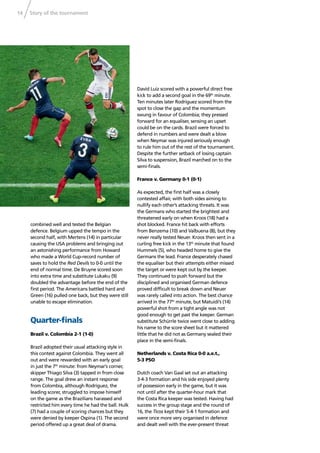
composé de paramètres hématologiques (dans
le sang) et d’un profil stéroïdien (dans l’urine),
qui sont propres à chaque joueur. Au cours
des semaines qui ont précédé la compétition,
les responsables du contrôle de dopage de la
FIFA se sont rendus à l’improviste auprès de
chacune des trente-deux équipes participantes
afin de réaliser des contrôles de dopage hors
compétition. Chacun des 736 joueurs a ainsi
été testé. Toutes ces analyses de dopage
pré-compétition ont présenté des résultats
négatifs.
Contrôles de dopage durant la
compétition
Dans le cadre de la procédure de routine
effectuée pendant la compétition, telle que
définie dans le Règlement antidopage de
la FIFA, à l’issue de chacun de chacun des
soixante-quatre matches, deux joueurs par
équipe ont été tirés au sort pour fournir
des échantillons d’urine et de sang et être
soumis à un contrôle de dopage. Un total
de 512 échantillons ont été analysés par le
laboratoire accrédité par l’AMA de Lausanne
(Suisse). Aucun ne s’est avéré positif.
Héritage pour le Brésil
Avant la Coupe du Monde de la FIFA,
Brésil 2014™ comme avant la Coupe
des Confédérations de la FIFA 2013, des
séminaires de médecine d’urgence du
football ont été organisés avec chacun des
responsables médicaux du COL sur site, ainsi
qu’avec les médecins des équipes. Les équipes
médicales présentes sur le bord des terrains
ont en outre été tout spécialement formées
par le Prof. Efraim Kramer. Cette compétition
a fixé de nouvelles normes en matière de
soins médicaux, sur le terrain comme en
dehors.
Par ailleurs, le programme « FIFA 11 pour la
Santé » a été mis en œuvre dans les douze
villes hôtes auprès de 3 300 enfants. En
collaboration avec la CBF et le gouvernement
brésilien, le programme sera par la suite
étendu au pays tout entier.
Medical report126
INFORME MÉDICO
En la Copa Mundial de la FIFA Brasil 2014™,
el médico en jefe de la FIFA, el Dr. Jiří Dvořák,
junto con los oficiales médicos de la FIFA,
el Dr. Alfred Müller y el Dr. Efraim Kramer,
supervisó los servicios sanitarios de la
competición en Río de Janeiro, que habían
sido organizados por el COL.
Consultas médicas durante los partidos
Durante los 64 partidos disputados, se
registraron casi 6 230 consultas médicas, un
promedio de 97 por partido para un total de
3.5 millones de espectadores. Esta cifra se sitúa
dentro de los límites esperados.
Estudio sobre las lesiones
Desde 1998, se solicita a los médicos de equipo
un informe sobre las lesiones que padecieron
sus jugadores durante los encuentros. Se
rellenaron y entregaron al oficial médico de
la FIFA los formularios estándar de registro
de lesiones, concebidos por el Centro Médico
de Evaluación e Investigación de la FIFA
(F-MARC). La Dra. Astrid Junge, jefa de
investigación del F-MARC, analizó los datos.
La media general fue de 1.7 lesiones por
partido. El 8 % de las lesiones tuvieron como
consecuencia que los futbolistas afectados no
pudieran entrenar o jugar durante más de
cuatro semanas, y el 35 % de las lesiones de
contacto fueron consecuencia de una falta. Al
comparar las estadísticas de 2002 (2.7 lesiones/
partido) con las de este año (1.7 lesiones/
partido), se constata que la indecencia se ha
Autor: Dr. Jiří Dvořák
reducido en un 40 % en la Copa Mundial de
la FIFA™.
Descansos de refresco
Por primera vez en la historia del Mundial,
la FIFA permitió que se realizaran pausas de
refresco durante los partidos en los que las
temperaturas superaron los valores límite
de estrés térmico. Los oficiales médicos de
la FIFA de las sedes midieron la temperatura
de globo y bulbo húmedo (TGBH) antes del
inicio y controlaron su evolución durante el
mismo. Cuando se sobrepasaron los 32 grados
centígrados, se recomendó al coordinador
general de la FIFA que se realizara un
descanso de refresco. El árbitro del encuentro
decidió a su discreción sobre la interrupción
del encuentro con este fin. El único descanso
de refresco tuvo lugar en el encuentro entre
los Países Bajos y México en Fortaleza (TGBH
32ºC).
Medidas antidopaje
Control de dopaje fuera de competición
En la Copa FIFA Confederaciones 2013 y en
la Copa Mundial FIFA Brasil 2014™, la FIFA
comenzó a implantar el perfil biológico como
nueva estrategia para luchar contra el dopaje.
Además de los controles de dopaje rutinarios
durante la competición, en la Copa Mundial
de la FIFA Brasil 2014 se tomaron muestras de
sangre y orina de todos los jugadores antes del
torneo con el fin de crear un perfil biológico.
0.0
0.5
1.0
1.5
2.0
2.5
3.0
2.4
2.7
1.7
1.3
1.7
1.0
2.0
1.5
2.3
1998
Francia
2002
Corea/Japón
2006
Alemania
2010
Sudáfrica
2014
Brasil
Fig. 1:
Promedio de lesiones por
partido
azul = total de lesiones
gris = lesiones que causan
baja
Medical report 127
El perfil tiene dos componentes: los
parámetros hematológicos (en sangre) y el
perfil esteroideo (en orina). La combinación
de los dos arroja el perfil biológico personal
de cada jugador. En las semanas previas a
la Copa Mundial de la FIFA Brasil 2014™ y
durante el torneo, los oficiales del control
de dopaje de la FIFA visitaron sin previo
aviso a las 32 selecciones participantes
a fin de llevar a cabo controles fuera de
competición. Se realizaron análisis a los
736 jugadores de la competición. Todos los
análisis de dopaje realizados antes de la
competición arrojaron resultados negativos.
Control de dopaje durante el torneo
De acuerdo con la rutina del procedimiento
en competición, descrita en el Reglamento
Antidopaje de la FIFA, se seleccionó
aleatoriamente a dos jugadores por
equipo para el control de dopaje después
de cada uno de los 64 partidos, a los que
se tomaron muestras de sangre y orina.
En total, se recogieron y analizaron 512
muestras en el laboratorio reconocido por
la AMA en Lausana (Suiza), todas ellas con
resultados negativos.
Legado para Brasil
Antes de la Copa FIFA Confederaciones 2013
y de la Copa Mundial de la FIFA Brasil 2014™,
se han impartido seminarios sobre urgencias
médicas en el fútbol para los oficiales
médicos del COL en las sedes y los médicos
de equipo de las asociaciones participantes.
Además, los equipos médicos de los
estadios de todas las ciudades anfitrionas
recibieron una extensa formación de manos
del Dr. Efraim Kramer. De este modo, se
han establecido los nuevos estándares de
atención médica dentro y fuera del campo.
El programa FIFA 11 para la Salud se ha
llevado a cabo en las 12 ciudades anfitrionas
con 3 300 niños. En colaboración con la CBF
y el Gobierno brasileño, se prevé implantar
el programa en el ámbito nacional.
Medical report128
MEDIZINISCHER BERICHT
FIFA-Chefarzt Prof. Jiří Dvořák sowie Dr. Alfred
Müller und Prof. Efraim Kramer als medizini-
sche FIFA-Koordinatoren beaufsichtigten vom
Hauptquartier in Rio de Janeiro die medizini-
sche Versorgung bei der FIFA Fussball-Welt-
meisterschaft Brasilien 2014™, nachdem das
medizinische LOC-Team alle diesbezüglichen
Vorkehrungen getroffen hatte.
Medizinische Zwischenfälle bei Spielen
In den 64 Spielen wurden fast 6230 medi-
zinische Zwischenfälle – dies bei insgesamt
3,5 Millionen Zuschauern – verzeichnet, das
sind rund 97 Fälle pro Spiel. Die Zahl ent-
spricht in etwa den Erwartungen.
Verletzungserhebung
Seit 1998 werden die Teamärzte bei allen
FIFA-Wettbewerben gebeten, alle Verletzungen
ihrer Spieler bei den Spielen zu melden. Die
betreffenden Angaben waren auf dem stan-
dardisierten F-MARC-Formular zu vermerken,
das dem medizinischen FIFA-Koordinator aus-
zuhändigen war. Dr. Astrid Junge, F-MARC-For-
schungsleiterin, wertete die Daten aus.
Durchschnittlich wurden pro Spiel 1,7 Verlet-
zungen verzeichnet. 8 % aller Verletzungen
führten zu einer Trainings- oder Spielpau-
se von mehr als vier Wochen. 35 % waren
auf Fouls zurückzuführen. Verglichen mit
1998/2002 (2,4/2,7 Verletzungen pro Spiel) war
der Wert bei dieser Weltmeisterschaft 40 %
tiefer (1,7 Verletzungen pro Spiel).
Autor: Prof. Jiří Dvořák
Verfahren für Kühl-/Trinkpausen
Erstmals bei einer FIFA Fussball-Weltmeister-
schaft™ waren bei Spielen, bei denen ein
Grenzwert für Hitzestress überschritten wur-
de, Kühlpausen möglich. Die medizinischen
FIFA-Koordinatoren an den einzelnen Spielor-
ten massen vor Spielbeginn die Feuchttempe-
ratur und überwachten anschliessend deren
Entwicklung. Bei über 32 °C empfahlen sie
dem FIFA-Koordinator eine Kühlpause. Wie
diese durchgeführt wurde, lag im Ermessen
der Schiedsrichter. Insgesamt gab es nur beim
Spiel zwischen den Niederlanden und Mexiko
in Fortaleza (32 Grad Feuchttemperatur) eine
Kühlpause .
Dopingbekämpfung
Dopingkontrollen ausserhalb von
Wettbewerben
Beim FIFA Konföderationen-Pokal 2013
und bei der FIFA Fussball-Weltmeisterschaft
2014™ setzte die FIFA als mögliche neue Stra-
tegie in der Dopingbekämpfung biologische
Profile ein. Zu diesem Zweck führte sie bei
den Spielern aller Teams neben den üblichen
Dopingtests ausserhalb von Wettbewerben
Blut- und Urintests durch, um deren biologi-
sches Profil zu erstellen. Das biologische Profil
besteht aus den hämatologischen Parame-
tern (im Blut) und dem Steroidprofil (im
Urin). Zusammen ergeben sie ein für jeden
Spieler unverkennbares Profil. In den Wochen
0,0
0,5
1,0
1,5
2,0
2,5
3,0
2,4
2,7
1,7
1,3
1,7
1,0
2,0
1,5
2,3
1998
Frankreich
2002
Korea/Japan
2006
Deutschland
2010
Südafrika
2014
Brasilien
Abbildung 1:
Verletzungsschnitt pro
Spiel
blau = alle Verletzungen
grau = Verletzungen mit
Trainings- oder Spielausfall
Medical report 129
vor der WM-Endrunde führten die
FIFA-Dopingkontrolleure bei den Spielern
der 32 beteiligten Teams unangemeldete
Dopingkontrollen (Urin- und Bluttests)
ausserhalb von Wettbewerben durch. Alle
736 Spieler, die am Turnier teilnahmen,
wurden getestet. Die Kontrollen vor dem
Turnier ergaben allesamt einen negativen
Befund.
Dopingkontrollen bei Wettbewerben
Gemäss Standardverfahren des FIFA-Anti-
Doping-Reglements wurden bei jedem der
64 Spiele zwei Spieler je Team für Urin- und
Bluttests ausgelost. Insgesamt wurden 512
Proben entnommen und im von der WADA
akkreditierten Labor in Lausanne (Schweiz)
analysiert. Alle Befunde waren negativ.
Vermächtnis für Brasilien
Vor dem FIFA Konföderationen-Pokal 2013
und der FIFA Fussball-Weltmeisterschaft
2014™ fanden für die medizinischen LOC-
Koordinatoren der Spielorte und die Teamärzte
der teilnehmenden Mitgliedsverbände Fuss-
ball-Notfallmedizin-Seminare statt, während
die medizinischen Teams für die Erstversorgung
auf dem Spielfeld von Prof. Efraim Kramer ein-
gehend geschult wurden. Der Standard für die
medizinische Versorgung auf und neben dem
Spielfeld wurde damit neu definiert.
An allen zwölf Spielorten wurde für 3300
Kinder zudem das Programm „FIFA 11 für die
Gesundheit“ durchgeführt. In Zusammen-
arbeit mit dem brasilianischen Fussballverband
und der brasilianischen Regierung wird das
Programm nun landesweit ausgedehnt.
GOAL-LINE
TECHNOLOGY
Goal-line technology132
GOAL-LINE TECHNOLOGY
Brazil 2014 was the first FIFA World Cup™
in which officials were able to use goal-line
technology, although it had already been used
at the FIFA Club World Cup in both 2012 and
2013 as well as at the FIFA Confederations Cup
in Brazil in 2013 following a historic decision
to approve the use of goal-line technology by
The International Football Association Board
(IFAB) at a special meeting on 5 July 2012.
Tender process
The decision to confirm GoalControl as the
GLT provider in October 2013 followed a
comprehensive tender process that began in
February 2013 and involved bid presentations
at the Home of FIFA in Zurich as well as site
inspections in Brazil. The Germany-based
company was selected ahead of the three
other FIFA-licensed GLT providers who
participated in the tender. While all four
companies had previously met the stringent
technical requirements of the FIFA Quality
Programme, the final decision was based
on criteria relating more specifically to
Author: Johannes Holzmüller
the tournaments in Brazil, including the
company’s ability to adapt to local conditions
and the compatibility of each GLT system
in relation to FIFA match operations. The
bids were also judged on cost and project
management factors such as staffing and
time schedules for installation. GoalControl
was confirmed as the World Cup GLT
provider following the company’s successful
implementation of the technology at the FIFA
Confederations Cup in Brazil.
The selected technology
The GoalControl-4D system uses 14 high-
speed cameras around the pitch, with seven
cameras focused on each goal. Using special
detection software, the ball is filtered out
from the image sequences and its real-time
position is automatically calculated as X, Y and
Z coordinates as well as speed, making it 4D.
If the ball has fully crossed the goal line, the
central processing unit automatically sends an
encrypted radio signal to the referee’s watch
in less than one second, indicating a goal
Goal-line technology 133
by means of vibration and a visual “GOAL”
signal.
System installation
After the final confirmation of the GLT
provider in October 2013, work began on
installing the system in the 12 FIFA World
Cup™ stadiums in Brazil, with cameras set
up under the roof of each stadium and then
connected to the hardware and software
in the control room. Finally, the system was
calibrated to ensure that it was in line with
the different conditions in each stadium.
GoalControl successfully completed the
installation in the last two stadiums in mid-
May, working in close cooperation with the
LOC and the local stadium management.
Final installation tests
The 12 installed systems then passed The
IFAB’s installation test, as part of which
more than 2,400 GLT incidents had to be
correctly indicated in various situations and
conditions. These tests were conducted by an
independent test institute, Labosport UK. FIFA
certified all 12 stadiums for 12 months on
the back of the positive test results.
Referee training
On 7 June, FIFA held a referee training
session at the Maracanã to ensure that all
match officials were comfortable with the
technology and to explain the pre-match
procedure in more detail. The general
functionality and accuracy of the system, and
the mandatory referee check in particular,
were important parts of this training session.
Media event
On 9 June, members of the media from all
around the world had an opportunity to see
the GoalControl-4D technology in action at
the Maracanã.
Following a short presentation on the
reasons behind the use of goal-line
technology and its functionality, the media
representatives were able to wear the
referees’ watch, which receives an indication
of “GOAL” within one second of the ball
crossing the line.
Goal-line technology134
Camera angle 1: goal? (GLT camera)
Camera angle 2: goal? (GLT camera)
Camera angle 3: goal? (TV camera)
GLT confirms: goal
The tournament phase
GLT was a resounding success at the
tournament as it greatly assisted the match
officials, particularly in three decisive
situations. In the first incident, during
the group-stage match between France
and Honduras, even TV images were not
conclusive in showing whether it was a goal
or not. In the second incident, which occurred
during the Italy v. Costa Rica match, the match
officials’ view of where the ball had bounced
was blocked by the Italian goalkeeper, who
was lying on the ground, and they were
therefore reliant upon the new technology.
The third incident was in the Netherlands
v. Argentina semi-final, and once again the
system indicated to the Turkish referee that no
goal had been scored after the ball span back
towards the goal after a penalty had been
saved. In seven further incidents, the system
confirmed the referees’ decisions by means of
special GLT replays on TV (see table below).
GLT replays on TV
Match Team 1 Team 2
4 CHI AUS
10 FRA HON
17 BRA MEX
23 URU ENG
24 ITA CRC
44 BIH IRN
47 KOR BEL
51 NED MEX
53 FRA NGA
All 171 goals (including penalties) were
recorded by the system and displayed correctly
on the referees’ watches. Consequently, the
referees were very happy with the system’s
performance and with the assistance it
provided during matches.
Match 10: France v. Honduras
Goal-line technology 135
Match 24: Italy v. Costa Rica
GLT confirms: goal
Match 62: Netherlands v. Argentina
Ball has not fully crossed the line: no goal signal (GLT camera)
Vital GLT support
Goal-line technology136
Brésil 2014 a été la première Coupe du Monde
de la FIFA™ où les arbitres ont bénéficié de
l’aide de la technologie sur la ligne de but.
Après la décision historique prise le 5 juillet
2012 par l’International Football Association
Board (IFAB) d’approuver le principe de son
utilisation officielle, la technologie sur la ligne
de but avait déjà été utilisée lors des Coupes
du Monde des Clubs de la FIFA 2012 et 2013,
ainsi que lors de la Coupe des Confédérations
de la FIFA organisée l’an dernier au Brésil.
Procédure d’appel d’offres
La confirmation en octobre 2013 de
l’entreprise allemande GoalControl comme
fabricant de technologie sur la ligne de but
a mis fin à la procédure d’appel d’offres qui
avait débuté en février avec des présentations
au siège de la FIFA à Zurich ainsi que des
visites d’inspection au Brésil. GoalControl avait
alors été préférée à trois autres entreprises. Si
les quatre candidats répondaient aux stricts
critères qualitatifs du programme Qualité
de la FIFA, la décision finale s’est fondée
sur des critères se rapportant davantage
aux deux tournois au Brésil, comme la
capacité de l’entreprise à s’adapter aux
conditions locales et la compatibilité de son
système avec les aspects opérationnels des
compétitions FIFA. Les offres ont également
été analysées au vu de leurs coûts respectifs
et des facteurs de gestion de projet comme
par exemple le personnel requis et les délais
d’installation. Après le succès de la Coupe
des Confédérations, GoalControl a donc été
confirmée pour Brésil 2014.
Une technologie de pointe
Le système GoalControl-4D fonctionne avec
quatorze caméras grande vitesse installées
tout autour du terrain (sept par but). À l’aide
d’un logiciel de reconnaissance spécial, le
ballon est isolé des séquences d’images et
sa position tridimensionnelle est calculée
en temps réel, la vitesse du ballon étant en
outre prise en compte par l’algorithme, ce
qui permet ainsi une reconstitution virtuelle
fidèle, en « quatre dimensions ». Si le ballon
LA TECHNOLOGIE SUR LA LIGNE DE BUT
Auteur : Johannes Holzmüller
Goal-line technology 137
franchit entièrement la ligne de but entre
les poteaux et sous la barre transversale,
l’ordinateur de contrôle envoie alors en
moins d’une seconde un signal crypté vers
la montre de l’arbitre qui vibre et affiche
« GOAL » pour montrer qu’un but a été
marqué.
Installation du système
Dès la confirmation de GoalControl en
octobre 2013, l’installation des dispositifs a
débuté dans les douze stades qui allaient
accueillir la compétition. Tout d’abord les
caméras ont été mises en place sur le toit
de chacun des stades, puis le câblage a été
installé et enfin les ordinateurs et les logiciels.
Le système a ensuite été calibré en fonction
des diverses données de chaque stade. En
étroite collaboration avec le COL et les gérants
du stade, GoalControl a finalisé l’installation
mi-juin dans les deux derniers stades.
Tests d’installation
Les douze systèmes ont passé avec succès le
test d’installation prévu par l’IFAB et mené par
l’institut indépendant Labosport UK, test qui
implique que le système analyse correctement
plus de 2 400 situations dans différentes
conditions. À la lumière de ces tests positifs, la
FIFA a pu certifier les douze stades le 1er
juin
pour une durée d’un an.
Formation des arbitres
Le 7 juin, la FIFA a proposé aux arbitres une
formation au stade Maracanã de Rio afin de
les familiariser encore davantage avec cette
nouvelle technologie, sa fonctionnalité, sa
précision, mais aussi avec l’ultime vérification
qu’ils ont à effectuer avant chaque match.
Présentation aux médias
Le 9 juin, toujours au Maracanã, une
présentation a cette fois été faite aux
journalistes du monde entier, afin de
les informer en détail de la technologie
GoalControl 4D. Après une brève présentation
sur les raisons de l’introduction de la
technologie sur la ligne de but et sur le
fonctionnement du système, les représentants
des médias ont pu essayer la montre de
l’arbitre et constater la rapidité avec laquelle
elle confirmait qu’un but avait été marqué.
Goal-line technology138
Angle 1 : but ? (Caméra GLT)
Angle 2 : but ? (Caméra GLT)
Angle 3 : but ? (Caméra GLT)
Confirmation de la technologie sur la ligne de but : but !
Les matches
Cette technologie sur la ligne de but s’est
avérée être un outil précieux pour les arbitres,
et a donc été un grand succès. Par trois fois
elle les a aidés à valider un but sur une action
litigieuse, la première fois lors du match entre
la France et le Honduras, où même les ralentis
montrés à la télévision ne permettaient pas
de déterminer si le ballon avait ou non franchi
la ligne. Lors du deuxième cas, entre l’Italie
et le Costa Rica, les arbitres ont confié que la
technologie les avait indubitablement aidés
étant donné qu’ils ne disposaient pas d’un
bon angle de vue sur cette action, masqués
qu’ils étaient par le gardien de but italien.
Le troisième cas est survenu lors de la demi-
finale entre les Pays-Bas et l’Argentine. Les
arbitres ont là encore été aidés par le système
car le ballon roulait encore après un tir au
but stoppé par le gardien argentin et est
venu mourir sur la ligne. En sept occasions,
le système a permis de confirmer à l’écran
la décision de l’arbitre grâce aux ralentis
spéciaux (cf. encadrés).
Ralentis à la télévision
Match Équipe A Équipe B
4 CHI AUS
10 FRA HON
17 BRA MEX
23 URU ENG
24 ITA CRC
44 BIH IRN
47 KOR BEL
51 NED MEX
53 FRA NGA
Chacun des 171 buts inscrits (penalties y
compris) a correctement reconnu et signalé sur
la montre des arbitres. Les arbitres se sont dits
très satisfaits de l’efficacité de la technologie
et de l’aide qu’elle leur a offert durant les
matches.
Match 10 : France – Honduras
Goal-line technology 139
Match 24 : Italie – Costa Rica
Confirmation de la technologie sur la ligne de
but : but !
Match 62 : Pays-Bas – Argentine
Le ballon n’a pas entièrement franchi la ligne (caméra GLT)
Aide décisive de la technologie sur la ligne de but
Goal-line technology140
Brasil 2014 ha sido la primera edición de
la Copa Mundial de la FIFA™ en la que los
árbitros han contado con el apoyo de sistemas
de detección automática de goles (DAG). Hasta
la fecha, estos sistemas se habían utilizado en la
Copa Mundial de Clubes de la FIFA 2012 y 2013,
así como en la Copa FIFA Confederaciones
disputada en Brasil el año pasado. En la
sesión extraordinaria del 5 de julio de 2012, el
Internacional Football Association Board (IFAB)
adoptó la decisión histórica de permitir el uso
de sistemas de DAG.
Licitación
Con la confirmación del proveedor de DAG
GoalControl en octubre de 2013 finalizó la
licitación abierta en febrero de 2013, que
incluyó presentaciones de los candidatos en
la sede de la FIFA en Zúrich e inspecciones en
Brasil. La empresa alemana GoalControl fue
la elegida de entre los cuatro proveedores
aprobados por la FIFA que participaron en la
licitación. Los cuatro candidatos cumplían los
estrictos criterios técnicos del Programa de
Calidad de la FIFA, y la decisión final se basó,
sobre todo, en los requerimientos específicos
para los torneos que se disputarían en Brasil,
así como la capacidad de las empresas de
adaptarse a las condiciones locales y la
compatibilidad de los sistemas de DAG con el
modo en que la FIFA gestiona los partidos. Se
valoraron, asimismo, factores como los costes, la
gestión de proyectos y el personal y los plazos
necesarios para la instalación. Tras el éxito
en la Copa FIFA Confederaciones de Brasil, se
confirmó a GoalControl como proveedor para
la Copa Mundial de la FIFA Brasil 2014™.
El sistema escogido
El sistema 4D de GoalControl cuenta con 14
cámaras de alta velocidad instaladas por todo
el campo. Hay siete cámaras enfocadas a cada
una de las porterías. Con ayuda de un software
de reconocimiento especial, se detecta el balón
en las imágenes y su posición real se calcula
de forma automática mediante coordenadas
SISTEMA DE DETECCIÓN GOLES
Autor: Johannes Holzmüller
Goal-line technology 141
X, Y y Z. A estas se añade la velocidad, con la
que se obtiene la imagen 4D. Si el balón cruza
por completo la línea de meta, el procesador
central envía una señal cifrada en menos de
un segundo al reloj del árbitro que indica que
se ha marcado gol mediante una vibración y la
señal visual de «GOL».
Instalación del sistema
Tras la confirmación final de los proveedores
de DAG en octubre de 2013, comenzó la
instalación en las doce ciudades brasileñas
que acogerían el Mundial del 2014. En primer
lugar, se instalaron las cámaras en el techo de
los estadios. A continuación, se conectaron
las cámaras al hardware y software de la sala
de control. Por último, se calibró el sistema
para adaptarlo a las condiciones del estadio.
Colaborando estrechamente con el COL
y los responsables locales de los estadios,
GoalControl finalizó a mediados de mayo la
instalación en los últimos dos campos.
Pruebas de instalación finales
Los doce sistemas instalados pasaron con éxito
las pruebas finales prescritas por el IFAB. Para
ello, tuvieron que evaluar correctamente en
2 400 casos y bajo condiciones diferentes si
el balón había traspasado en su totalidad la
línea de gol. Las pruebas las llevó a cabo el
instituto independiente Labosport UK. Puesto
que los resultados de estas fueron positivos,
el 1 de junio los doce estadios obtuvieron la
certificación de la FIFA válida por un año.
Formación de los árbitros
El 7 de junio, la FIFA ofreció a los árbitros en
el estadio Maracaná una sesión de formación
para presentarles los nuevos dispositivos y
explicar de forma detallada el control del
sistema que se debe realizar antes del partido.
En la sesión se trataron el funcionamiento y
la precisión de los dispositivos, así como las
pruebas que deben llevar a cabo los árbitros.
Acto para la prensa
El 9 de junio, los periodistas tuvieron
la oportunidad de ver el sistema 4D de
GoalControl en acción en el estadio Maracaná.
Tras una breve presentación sobre los
motivos por los que se decidió emplear estos
dispositivos y sobre su funcionamiento, los
periodistas pudieron probar el reloj del árbitro
que indicó «gol» en menos de un segundo
después de que el balón cruzara la línea de
meta.
Goal-line technology142
Ángulo 1: ¿Gol? (cámara de DAG)
Ángulo 2: ¿Gol? (cámara de DAG)
Ángulo 3: ¿Gol? (cámara de TV)
Confirmación del sistema de DAG: ¡Gol!
Durante el torneo
Los dispositivos de DAG fueron una ayuda
importante para los colegiados, por lo que su
utilización resultó un éxito. En tres ocasiones,
el apoyo de estos sistemas fue decisivo para
los árbitros. De hecho, en el partido entre
Francia y Honduras de la fase de grupos,
habría sido imposible decidir si el balón
había entrado por completo en la portería
utilizando únicamente las imágenes de TV. En
el segundo caso, en el encuentro entre Italia
y Costa Rica, el trío arbitral tuvo que confiar
en los nuevos dispositivos, ya que el portero
italiano en el suelo impedía ver claramente la
posición del balón. El tercer caso se dio en la
semifinal entre los Países Bajos y Argentina.
Una vez más, el colegiado turco se basó en
la DAG para no pitar gol cuando la pelota
rodó hasta la línea tras un penalti parado. En
otros siete casos, los dispositivos confirmaron
las decisiones de los árbitros en televisión
mediante repeticiones especiales de la DAG (v.
el cuadro informativo).
Repeticiones televisivas de la DAG
Partido Selección 1 Selección 2
4 CHI AUS
10 FRA HON
17 BRA MEX
23 URU ENG
24 ITA CRC
44 BIH IRN
47 KOR BEL
51 NED MEX
53 FRA NGA
Los dispositivos dieron por buenos los 171
goles anotados (penaltis incluidos) y los
transmitieron sin errores al reloj portado
por los árbitros. Los colegiados se mostraron
muy satisfechos con el funcionamiento de
los sistemas de DAG y con el apoyo que les
ofrecieron durante los partidos.
Partido 10: Francia – Honduras
Goal-line technology 143
Partido 24: Italia – Costa Rica
Confirmación del sistema de DAG: ¡Gol!
Partido 62: Países Bajos – Argentina
El balón no cruza la línea completamente: no hay señal de gol (cámara de DAG)
La ayuda de la DAG resulta decisiva
Goal-line technology144
Brasilien 2014 ist die erste FIFA Fussball-Welt-
meisterschaft™, bei der die Offiziellen von
Torlinientechnologie unterstützt werden. Bis-
lang kam sie bei den FIFA Klub-Weltmeister-
schaften 2012 und 2013 sowie beim letztjäh-
rigen FIFA Konföderationen-Pokal in Brasilien
zum Einsatz. Mit einem historischen Beschluss
hatte der International Football Association
Board (IFAB) bei einer Sondersitzung am 5. Juli
2012 die Nutzung von Torlinientechnologien
im Grundsatz zugelassen.
Ausschreibungsprozess
Mit der Bestätigung für den Torlinientechno-
logie-Anbieter GoalControl im Oktober 2013
endete ein ausgedehntes Ausschreibungs-
verfahren, das im Februar 2013 begann und
sowohl Präsentationen der Bewerber am
FIFA-Sitz in Zürich als auch Inspektionen vor
Ort in Brasilien umfasste. Das Unternehmen
mit Sitz in Deutschland wurde den drei ande-
ren von der FIFA zugelassenen Anbietern vor-
gezogen, die ebenfalls an der Ausschreibung
teilnahmen. Nachdem alle vier Anbieter die
strengen technischen Auflagen des FIFA-Qua-
litätsprogramms erfüllt hatten, gaben letztlich
vor allem die spezifischen Vorgaben für die
beiden Turniere in Brasilien, insbesondere die
Fähigkeit des Unternehmens, sich den lokalen
Gegebenheiten anzupassen, und die Kom-
patibilität des Torlinientechnologie-Systems
mit dem FIFA-Spielbetrieb den Ausschlag. Die
einzelnen Bewerbungen wurden auch nach
Kosten und Projektmanagementfaktoren wie
Personal und Zeitplan für die Installation be-
urteilt. Nach der erfolgreichen Durchführung
des FIFA Konföderationen-Pokals in Brasilien
wurde GoalControl als Lieferant für die FIFA
Fussball-Weltmeisterschaft 2014™ bestätigt.
Die ausgewählte Technologie
Das GoalControl-4-D-System ist mit 14 Hoch-
geschwindigkeitskameras ausgestattet, die
rund um das Spielfeld installiert sind. Dabei
sind jeweils sieben Kameras auf eines der
Tore gerichtet. Mit Hilfe einer speziellen
Erkennungssoftware wird der Ball aus den
Bildsequenzen herausgefiltert, und seine Echt-
zeit-Position wird automatisch als X-, Y- und
Z-Koordinaten berechnet. Hinzu kommt die
TORLINIENTECHNOLOGIE
Autor: Johannes Holzmüller
Goal-line technology 145
Geschwindigkeit, so dass eine 4-D-Erfassung
möglich ist. Falls der Ball die Torlinie in vollem
Umfang überquert hat, sendet eine zentrale
Recheneinheit per Funk innerhalb von weni-
ger als einer Sekunde ein verschlüsseltes Signal
zur Uhr des Schiedsrichters und zeigt anhand
eines Vibrationsalarms und einer visuellen
Mitteilung ein Tor an.
Die Installation des Systems
Nach der definitiven Bestätigung des GLT-Lie-
feranten im Oktober 2013 begann die Instal-
lation des Systems in den zwölf Spielstätten
der FIFA Fussball-Weltmeisterschaft 2014™
in Brasilien. Hierbei wurden zunächst die
Kameras unterhalb des Stadiondachs mon-
tiert. Im Anschluss folgte eine Verkabelung
der Kameras mit der Hard- und Software
im Kontrollraum. Abschliessend wurde das
System kalibriert und so auf die verschiedenen
Gegebenheiten in den Stadien eingestellt. In
enger Zusammenarbeit mit dem LOC und dem
lokalen Stadionmanagement schloss GoalCon-
trol die Installation Mitte Mai in den letzten
beiden Stadien erfolgreich ab.
Finale Installationstests
Die zwölf installierten Systeme bestanden im
Anschluss den vom IFAB vorgeschriebenen
Installationstest. Dabei mussten die Systeme
über 2400 mögliche Torlinienereignisse in
verschiedenen Situationen und bei unter-
schiedlichen Bedingungen richtig bewerten.
Die Tests wurden vom unabhängigen Test-
institut Labosport UK durchgeführt. Aufgrund
der positiven Testergebnisse zertifizierte die
FIFA am 1. Juni alle zwölf Stadien für zwölf
Monate.
Schiedsrichterschulung
Am 7. Juni schulte die FIFA im Maracanã-Sta-
dion die Schiedsrichter, um sie mit der neuen
Technologie vertraut zu machen und detail-
liert die Kontrolle des Systems vor einem Spiel
zu erläutern. Wichtige Teile der Schulung
waren die allgemeine Funktionsweise und
Genauigkeit des Systems sowie insbesonde-
re die vorgeschriebene Prüfung durch die
Schiedsrichter.
Medienveranstaltung
Pressevertreter aus aller Welt hatten am
9. Juni im Maracanã-Stadion die Gelegenheit,
die GoalControl-4-D-Technologie in Aktion zu
sehen. Nach einer kurzen Präsentation über
die Gründe für den Einsatz der Torlinientech-
nologie und ihre Funktionsweise konnten
die Medienvertreter die Schiedsrichteruhr
Goal-line technology146
Blickwinkel 1: Tor? (GLT-Kamera)
Blickwinkel 2: Tor? (GLT-Kamera)
Blickwinkel 3: Tor? (TV-Kamera)
Torlinientechnologie bestätigt: Tor!
ausprobieren, die innerhalb einer Sekunde,
nachdem der Ball die Linie überquert hat,
„Goal“ anzeigt.
Die Turnierphase
Die Torlinientechnologie war für die Schieds-
richter ein wichtiges Hilfsmittel und somit ein
grosser Erfolg. Dreimal konnte die Technolo-
gie die Schiedsrichter entscheidend unterstüt-
zen. Besonders die erste Situation im Grup-
penspiel zwischen Frankreich und Honduras
konnte ohne technische Hilfeleistung selbst im
TV nicht aufgelöst werden. Beim zweiten Vor-
fall im Spiel Italien gegen Costa Rica konnten
die Schiedsrichter aufgrund des am Boden lie-
genden italienischen Torhüters nicht zweifels-
frei erkennen, wo der Ball am Boden aufkam,
und waren somit auf die neue Technologie
angewiesen. Der dritte Vorfall ereignete sich
im Halbfinale zwischen den Niederlanden
und Argentinien. Hier vertraute der türkische
Schiedsrichter ebenso auf das System und gab
kein Tor, als der Ball nach einem gehaltenen
Elfmeter zurück auf die Linie rollte. In sieben
weiteren Situationen bestätigte das System
zudem die Schiedsrichterentscheidung im TV
anhand spezieller GLT-Wiederholungen (siehe
Informationskasten).
GLT-Wiederholungen im TV
Spiel Team 1 Team 2
4 CHI AUS
10 FRA HON
17 BRA MEX
23 URU ENG
24 ITA CRC
44 BIH IRN
47 KOR BEL
51 NED MEX
53 FRA NGA
Zusätzlich wurden alle 171 erzielten Tore
(mit Elfmetertoren) vom System erkannt und
korrekt auf den Schiedsrichteruhren ange-
zeigt. Dementsprechend waren die Schieds-
richter mit der Leistung der Technologie und
der erhaltenen Hilfe während des Spiels sehr
zufrieden.
Spiel 10: Frankreich – Honduras
Goal-line technology 147
Spiel 24: Italien – Costa Rica
Torlinientechnologie bestätigt: Tor!
Spiel 62: Niederlande – Argentinien
Ball hat die Linie nicht überquert: kein Torsignal (GLT-Kamera)
Entscheidende Hilfe durch die Torlinientechnologie
STATISTICS AND
TEAM DATA
150 Statistics and team data
Group B Spain, Netherlands, Chile, Australia
13.06. Spain v. Netherlands Salvador 1-5 (1-1)
13.06. Chile v. Australia Cuiabá 3-1 (2-1)
18.06. Spain v. Chile Rio de Janeiro 0-2 (0-2)
18.06. Australia v. Netherlands Porto Alegre 2-3 (1-1)
23.06. Australia v. Spain Curitiba 0-3 (0-1)
23.06. Netherlands v. Chile São Paulo 2-0 (0-0)
1. Netherlands 3 3 0 0 10-3 9
2. Chile 3 2 0 1 5-3 6
3. Spain 3 1 0 2 4-7 3
4. Australia 3 0 0 3 3-9 0
Group A Brazil, Croatia, Mexico, Cameroon
12.06. Brazil v. Croatia São Paulo 3-1 (1-1)
13.06. Mexico v. Cameroon Natal 1-0 (0-0)
17.06. Brazil v. Mexico Fortaleza 0-0
18.06. Cameroon v. Croatia Manaus 0-4 (0-1)
23.06. Cameroon v. Brazil Brasília 1-4 (1-2)
23.06. Croatia v. Mexico Recife 1-3 (0-0)
1. Brazil 3 2 1 0 7-2 7
2. Mexico 3 2 1 0 4-1 7
3. Croatia 3 1 0 2 6-6 3
4. Cameroon 3 0 0 3 1-9 0
Group D Uruguay, Costa Rica, England, Italy
14.06. Uruguay v. Costa Rica Fortaleza 1-3 (1-0)
14.06. England v. Italy Manaus 1-2 (1-1)
19.06. Uruguay v. England São Paulo 2-1 (1-0)
20.06. Italy v. Costa Rica Recife 0-1 (0-1)
24.06. Italy v. Uruguay Natal 0-1 (0-0)
24.06. Costa Rica v. England Belo Horizonte 0-0
1. Costa Rica 3 2 1 0 4-1 7
2. Uruguay 3 2 0 1 4-4 6
3. Italy 3 1 0 2 2-3 3
4. England 3 0 1 2 2-4 1
Group C Colombia, Greece, Côte d’Ivoire, Japan
14.06. Colombia v. Greece Belo Horizonte 3-0 (1-0)
14.06. Côte d‘Ivoire v. Japan Recife 2-1 (0-1)
19.06. Colombia v. Côte d‘Ivoire Brasília 2-1 (0-0)
19.06. Japan v. Greece Natal 0-0
24.06. Japan v. Colombia Cuiabá 1-4 (1-1)
24.06. Greece v. Côte d‘Ivoire Fortaleza 2-1 (1-0)
1. Colombia 3 3 0 0 9-2 9
2. Greece 3 1 1 1 2-4 4
3. Côte d’Ivoire 3 1 0 2 4-5 3
4. Japan 3 0 1 2 2-6 1
Group F Argentina, Bosnia and Herzegovina, Iran, Nigeria
15.06. Argentina v. Bosnia and Herzegovina Rio de Janeiro 2-1 (1-0)
16.06. Iran v. Nigeria Curitiba 0-0
21.06. Argentina v. Iran Belo Horizonte 1-0 (0-0)
21.06. Nigeria v. Bosnia and Herzegovina Cuiabá 1-0 (1-0)
25.06. Nigeria v. Argentina Porto Alegre 2-3 (1-2)
25.06. Bosnia and Herzegovina v. Iran Salvador 3-1 (1-0)
1. Argentina 3 3 0 0 6-3 9
2. Nigeria 3 1 1 1 3-3 4
3. Bosnia and Herzegovina 3 1 0 2 4-4 3
4. Iran 3 0 1 2 1-4 1
Group E Switzerland, Ecuador, France, Honduras
15.06. Switzerland v. Ecuador Brasília 2-1 (0-1)
15.06. France v. Honduras Porto Alegre 3-0 (1-0)
20.06. Switzerland v. France Salvador 2-5 (0-3)
20.06. Honduras v. Ecuador Curitiba 1-2 (1-1)
25.06. Honduras v. Switzerland Manaus 0-3 (0-2)
25.06. Ecuador v. France Rio de Janeiro 0-0
1. France 3 2 1 0 8-2 7
2. Switzerland 3 2 0 1 7-6 6
3. Ecuador 3 1 1 1 3-3 4
4. Honduras 3 0 0 3 1-8 0
Group H Belgium, Algeria, Russia, Korea Republic
17.06. Belgium v. Algeria Belo Horizonte 2-1 (0-1)
17.06. Russia v. Korea Republic Cuiabá 1-1 (0-0)
22.06. Belgium v. Russia Rio de Janeiro 1-0 (0-0)
22.06. Korea Republic v. Algeria Porto Alegre 2-4 (0-3)
26.06. Korea Republic v. Belgium São Paulo 0-1 (0-0)
26.06. Algeria v. Russia Curitiba 1-1 (0-1)
1. Belgium 3 3 0 0 4-1 9
2. Algeria 3 1 1 1 6-5 4
3. Russia 3 0 2 1 2-3 2
4. Korea Republic 3 0 1 2 3-6 1
Group G Germany, Portugal, Ghana, USA
16.06. Germany v. Portugal Salvador 4-0 (3-0)
16.06. Ghana v. USA Natal 1-2 (0-1)
21.06. Germany v. Ghana Fortaleza 2-2 (0-0)
22.06. USA v. Portugal Manaus 2-2 (0-1)
26.06. USA v. Germany Recife 0-1 (0-0)
26.06. Portugal v. Ghana Brasília 2-1 (1-0)
1. Germany 3 2 1 0 7-2 7
2. USA 3 1 1 1 4-4 4
3. Portugal 3 1 1 1 4-7 4
4. Ghana 3 0 1 2 4-6 1
FIRST ROUND
Results and ranking
151Statistics and team data
SECOND ROUND OVERALL RANKING
Round of 16
28.06. Brazil v. Chile Belo Horizonte 1-1 a.e.t. (1-1, 1-1) 3-2 PSO
28.06. Colombia v. Uruguay Rio de Janeiro 2-0 (1-0)
29.06. Netherlands v. Mexico Fortaleza 2-1 (0-0)
29.06. Costa Rica v. Greece Recife 1-1 a.e.t. (1-1, 0-0) 5-3 PSO
30.06. France v. Nigeria Brasília 2-0 (0-0)
30.06. Germany v. Algeria Porto Alegre 2-1 a.e.t.
01.07. Argentina v. Switzerland São Paulo 1-0 a.e.t.
01.07. Belgium v. USA Salvador 2-1 a.e.t.
Quarter-finals
04.07. Brazil v. Colombia Fortaleza 2-1 (1-0)
04.07. France v. Germany Rio de Janeiro 0-1 (0-1)
05.07. Netherlands v. Costa Rica Salvador 0-0 a.e.t. 4-3 PSO
05.07. Argentina v. Belgium Brasília 1-0 (1-0)
Semi-finals
08.07. Brazil v. Germany Belo Horizonte 1-7 (0-5)
09.07. Netherlands v. Argentina São Paulo 0-0 a.e.t. 2-4 PSO
Match for third place
12.07. Brazil v. Netherlands Brasília 0-3 (0-2)
Final
13.07. Germany v. Argentina Rio de Janeiro 1-0 a.e.t.
1. Germany
2. Argentina
3. Netherlands
4. Brazil
5. Colombia
6. Belgium
7. France
8. Costa Rica
9. Chile
10. Mexico
11. Switzerland
12. Uruguay
13. Greece
14. Algeria
15. USA
16. Nigeria
17. Ecuador
18. Portugal
19. Croatia
20. Bosnia and Herzegovina
21. Côte d’Ivoire
22. Italy
23. Spain
24. Russia
25. Ghana
26. England
27. Korea Republic
28. Iran
29. Japan
30. Australia
31. Honduras
32. Cameroon
Results and ranking
152 Statistics and team data
Estádio Mineirão: Belo Horizonte
Capacity 58,170
Matches 6
Estádio Nacional: Brasília
Capacity 69,349
Matches 7
Arena Pantanal: Cuiabá
Capacity 41,112
Matches 4
Arena da Baixada: Curitiba
Capacity 39,631
Matches 4
Manaus
Cuiabá
São Paulo
Porto Alegre
Fortaleza
Natal
Recife
Salvador
Belo Horizonte
Rio de Janeiro
Curitiba
Brasília
Brazil
VENUES AND STADIUMS
Venues and stadiums
153Statistics and team data
Arena Amazônia: Manaus
Capacity 40,549
Matches 4
Estádio Castelão: Fortaleza
Capacity 60,342
Matches 6
Estádio das Dunas: Natal
Capacity 39,971
Matches 4
Estádio Beira-Rio: Porto Alegre
Capacity 43,394
Matches 5
Arena Pernambuco: Recife
Capacity 42,610
Matches 5
Estádio do Maracanã: Rio de Janeiro
Capacity 74,738
Matches 7
Arena Fonte Nova: Salvador
Capacity 51,900
Matches 6
Arena de São Paulo: São Paulo
Capacity 62,601
Matches 6
Venues and stadiums
154 Statistics and team data Match telegrams
GROUP A
2 13.06.2014 13:00 NATAL 39,216
MEX: 13 OCHOA; 2 RODRIGUEZ, 4 MARQUEZ (C), 6 HERRERA, 7 LAYUN,
10 DOS SANTOS, 15 MORENO, 18 GUARDADO, 19 PERALTA,
22 AGUILAR, 23 VAZQUEZ
CMR: 16 ITANDJE; 2 ASSOU EKOTTO, 3 NKOULOU, 4 DJEUGOUE, 6 SONG,
8 MOUKANDJO, 9 ETOO (C), 13 CHOUPO MOTING, 14 CHEDJOU,
17 MBIA, 18 ENOH
Scorers: 1-0 61’ PERALTA (19)
Referee: Wilmar ROLDAN (COL)
Assistant referees: Humberto CLAVIJO (COL), Eduardo DIAZ (COL)
4th official: Norbert HAUATA (TAH)
Reserve assistant referee: Marwa RANGE (KEN)
Substitutions: MEX: 69’ out GUARDADO (18), in FABIAN (8),
74’ out PERALTA (19), in HERNANDEZ (14),
90’+1 out HERRERA (6), in SALCIDO (3)
CMR: 46’ HT out DJEUGOUE (4), in NOUNKEU (5),
79’ out SONG (6), in WEBO (15)
Cautions: MEX: 57’ MORENO (15)
CMR: 77’ NOUNKEU (5)
Expulsions: –
Mexico v. Cameroon 1-0 (0-0)
1 12.06.2014 17:00 SAO PAULO 62,103
BRA: 12 JULIO CESAR; 2 ALVES, 3 SILVA (C), 4 DAVID LUIZ, 6 MARCELO,
7 HULK, 8 PAULINHO, 9 FRED, 10 NEYMAR, 11 OSCAR, 17 LUIZ GUSTAVO
CRO: 1 PLETIKOSA; 2 VRSALJKO, 4 PERISIC, 5 CORLUKA, 6 LOVREN, 7 RAKITIC,
9 JELAVIC, 10 MODRIC, 11 SRNA (C), 18 OLIC, 20 KOVACIC
Scorers: 0-1 11’ MARCELO (6) own goal, 1-1 29’ NEYMAR (10),
2-1 71’ NEYMAR (10) pen., 3-1 90’+1 OSCAR (11)
Referee: Yuichi NISHIMURA (JPN)
Assistant referees: Toru SAGARA (JPN), Toshiyuki NAGI (JPN)
4th official: Alireza FAGHANI (IRN)
Reserve assistant referee: Hassan KAMRANIFAR (IRN)
Substitutions: BRA: 63’ out PAULINHO (8), in HERNANES (18),
68’ out HULK (7), in BERNARD (20),
88’ out NEYMAR (10), in RAMIRES (16)
CRO: 61’ out KOVACIC (20), in BROZOVIC (14),
78’ out JELAVIC (9), in REBIC (16)
Cautions: BRA: 27’ NEYMAR (10), 88’ LUIZ GUSTAVO (17)
CRO: 66’ CORLUKA (5), 69’ LOVREN (6)
Expulsions: –
Brazil v. Croatia 3-1 (1-1)
18 18.06.2014 18:00 MANAUS 39,982
CMR: 16 ITANDJE; 2 ASSOU EKOTTO, 3 NKOULOU (C), 6 SONG,
8 MOUKANDJO, 10 ABOUBAKAR, 13 CHOUPO MOTING, 14 CHEDJOU,
17 MBIA, 18 ENOH, 21 MATIP
CRO: 1 PLETIKOSA; 3 PRANJIC, 4 PERISIC, 5 CORLUKA, 6 LOVREN, 7 RAKITIC,
10 MODRIC, 11 SRNA (C), 17 MANDZUKIC, 18 OLIC, 19 SAMMIR
Scorers: 0-1 11’ OLIC (18), 0-2 48’ PERISIC (4),
0-3 61’ MANDZUKIC (17), 0-4 73’ MANDZUKIC (17)
Referee: Pedro PROENCA (POR)
Assistant referees: Bertino MIRANDA (POR), Jose TRIGO (POR)
4th official: Walter LOPEZ (GUA)
Reserve assistant referee: Leonel LEAL (CRC)
Substitutions: CMR: 46’ HT out CHEDJOU (14), in NOUNKEU (5),
70’ out ABOUBAKAR (10), in WEBO (15),
75’ out CHOUPO MOTING (13), in SALLI (20)
CRO: 69’ out OLIC (18), in EDUARDO (22),
72’ out SAMMIR (19), in KOVACIC (20),
78’ out PERISIC (4), in REBIC (16)
Cautions: CRO: 89’ EDUARDO (22)
Expulsions: CMR: 40’ SONG (6)
Cameroon v. Croatia 0-4 (0-1)
17 17.06.2014 16:00 FORTALEZA 60,342
BRA: 12 JULIO CESAR; 2 ALVES, 3 SILVA (C), 4 DAVID LUIZ, 6 MARCELO,
8 PAULINHO, 9 FRED, 10 NEYMAR, 11 OSCAR, 16 RAMIRES,
17 LUIZ GUSTAVO
MEX: 13 OCHOA; 2 RODRIGUEZ, 4 MARQUEZ (C), 6 HERRERA, 7 LAYUN,
10 DOS SANTOS, 15 MORENO, 18 GUARDADO, 19 PERALTA,
22 AGUILAR, 23 VAZQUEZ
Scorers: –
Referee: Cuneyt CAKIR (TUR)
Assistant referees: Bahattin DURAN (TUR), Tarik ONGUN (TUR)
4th official: Svein Oddvar MOEN (NOR)
Reserve assistant referee: Kim HAGLUND (NOR)
Substitutions: BRA: 46’ HT out RAMIRES (16), in BERNARD (20),
68’ out FRED (9), in JO (21),
84’ out OSCAR (11), in WILLIAN (19)
MEX: 74’ out PERALTA (19), in HERNANDEZ (14),
76’ out HERRERA (6), in FABIAN (8),
84’ out DOS SANTOS (10), in JIMENEZ (9)
Cautions: BRA: 45’ RAMIRES (16), 79’ SILVA (3)
MEX: 59’ AGUILAR (22), 62’ VAZQUEZ (23)
Expulsions: –
Brazil v. Mexico 0-0
34 23.06.2014 17:00 RECIFE 41,212
CRO: 1 PLETIKOSA; 2 VRSALJKO, 3 PRANJIC, 4 PERISIC, 5 CORLUKA, 6 LOVREN,
7 RAKITIC, 10 MODRIC, 11 SRNA (C), 17 MANDZUKIC, 18 OLIC
MEX: 13 OCHOA; 2 RODRIGUEZ, 4 MARQUEZ (C), 6 HERRERA, 7 LAYUN,
10 DOS SANTOS, 15 MORENO, 18 GUARDADO, 19 PERALTA,
22 AGUILAR, 23 VAZQUEZ
Scorers: 0-1 72’ MARQUEZ (4), 0-2 75’ GUARDADO (18),
0-3 82’ HERNANDEZ (14), 1-3 87’ PERISIC (4)
Referee: Ravshan IRMATOV (UZB)
Assistant referees: Abduxamidullo RASULOV (UZB), Bakhadyr KOCHKAROV (KGZ)
4th official: ALIOUM (CMR)
Reserve assistant referee: Djibril CAMARA (SEN)
Substitutions: CRO: 58’ out VRSALJKO (2), in KOVACIC (20),
69’ out OLIC (18), in REBIC (16),
74’ out PRANJIC (3), in JELAVIC (9)
MEX: 62’ out DOS SANTOS (10), in HERNANDEZ (14),
79’ out PERALTA (19), in PENA (21),
84’ out GUARDADO (18), in FABIAN (8)
Cautions: CRO: 9’ RAKITIC (7)
MEX: 39’ MARQUEZ (4), 66’ VAZQUEZ (23)
Expulsions: CRO: 89’ REBIC (16)
Croatia v. Mexico 1-3 (0-0)
33 23.06.2014 17:00 BRASILIA 69,112
CMR: 16 ITANDJE; 3 NKOULOU (C), 7 NGUEMO, 8 MOUKANDJO,
10 ABOUBAKAR, 12 BEDIMO, 13 CHOUPO MOTING, 17 MBIA,
18 ENOH, 21 MATIP, 22 NYOM
BRA: 12 JULIO CESAR; 2 ALVES, 3 SILVA (C), 4 DAVID LUIZ, 6 MARCELO,
7 HULK, 8 PAULINHO, 9 FRED, 10 NEYMAR, 11 OSCAR, 17 LUIZ GUSTAVO
Scorers: 0-1 17’ NEYMAR (10), 1-1 26’ MATIP (21), 1-2 35’ NEYMAR (10),
1-3 49’ FRED (9), 1-4 84’ FERNANDINHO (5)
Referee: Jonas ERIKSSON (SWE)
Assistant referees: Mathias KLASENIUS (SWE), Daniel WARNMARK (SWE)
4th official: Svein Oddvar MOEN (NOR)
Reserve assistant referee: Kim HAGLUND (NOR)
Substitutions: CMR: 58’ out MOUKANDJO (8), in SALLI (20),
72’ out ABOUBAKAR (10), in WEBO (15),
81’ out CHOUPO MOTING (13), in MAKOUN (11)
BRA: 46’ HT out PAULINHO (8), in FERNANDINHO (5),
63’ out HULK (7), in RAMIRES (16),
71’ out NEYMAR (10), in WILLIAN (19)
Cautions: CMR: 11’ ENOH (18), 75’ SALLI (20), 80’ MBIA (17)
Expulsions: –
Cameroon v. Brazil 1-4 (1-2)
155Statistics and team dataMatch telegrams
GROUP B
4 13.06.2014 18:00 CUIABA 40,275
CHI: 1 BRAVO (C); 2 MENA, 4 ISLA, 7 SANCHEZ, 8 VIDAL, 10 VALDIVIA,
11 VARGAS, 17 MEDEL, 18 JARA, 20 ARANGUIZ, 21 DIAZ
AUS: 1 RYAN; 2 FRANJIC, 3 DAVIDSON, 4 CAHILL, 5 MILLIGAN, 6 SPIRANOVIC,
7 LECKIE, 11 OAR, 15 JEDINAK (C), 22 WILKINSON, 23 BRESCIANO
Scorers: 1-0 12’ SANCHEZ (7), 2-0 14’ VALDIVIA (10),
2-1 35’ CAHILL (4), 3-1 90’+2 BEAUSEJOUR (15)
Referee: Noumandiez DOUE (CIV)
Assistant referees: Songuifolo YEO (CIV), Jean Claude BIRUMUSHAHU (BDI)
4th official: Roberto MORENO (PAN)
Reserve assistant referee: Eric BORIA (USA)
Substitutions: CHI: 60’ out VIDAL (8), in GUTIERREZ (16),
68’ out VALDIVIA (10), in BEAUSEJOUR (15),
88’ out VARGAS (11), in PINILLA (9)
AUS: 49’ out FRANJIC (2), in McGOWAN (19),
68’ out OAR (11), in HALLORAN (10),
78’ out BRESCIANO (23), in TROISI (14)
Cautions: CHI: 86’ ARANGUIZ (20)
AUS: 44’ CAHILL (4), 58’ JEDINAK (15), 67’ MILLIGAN (5)
Expulsions: –
Chile v. Australia 3-1 (2-1)
3 13.06.2014 16:00 SALVADOR 48,173
ESP: 1 CASILLAS (C); 3 PIQUE, 6 INIESTA, 8 HERNANDEZ, 14 ALONSO,
15 RAMOS, 16 BUSQUETS, 18 ALBA, 19 COSTA, 21 SILVA, 22 AZPILICUETA
NED: 1 CILLESSEN; 2 VLAAR, 3 DE VRIJ, 4 MARTINS INDI, 5 BLIND, 6 DE JONG,
7 JANMAAT, 8 DE GUZMAN, 9 VAN PERSIE (C), 10 SNEIJDER, 11 ROBBEN
Scorers: 1-0 27’ ALONSO (14) pen., 1-1 44’ VAN PERSIE (9),
1-2 53’ ROBBEN (11), 1-3 65’ DE VRIJ (3),
1-4 72’ VAN PERSIE (9), 1-5 80’ ROBBEN (11)
Referee: Nicola RIZZOLI (ITA)
Assistant referees: Renato FAVERANI (ITA), Andrea STEFANI (ITA)
4th official: Svein Oddvar MOEN (NOR)
Reserve assistant referee: Kim HAGLUND (NOR)
Substitutions: ESP: 62’ out ALONSO (14), in RODRIGUEZ (11),
62’ out COSTA (19), in TORRES (9),
78’ out SILVA (21), in FABREGAS (10)
NED: 62’ out DE GUZMAN (8), in WIJNALDUM (20),
77’ out DE VRIJ (3), in VELTMAN (13),
79’ out VAN PERSIE (9), in LENS (17)
Cautions: ESP: 65’ CASILLAS (1)
NED: 25’ DE GUZMAN (8), 41’ DE VRIJ (3), 66’ VAN PERSIE (9)
Expulsions: –
Spain v. Netherlands 1-5 (1-1)
20 18.06.2014 13:00 PORTO ALEGRE 42,877
AUS: 1 RYAN; 3 DAVIDSON, 4 CAHILL, 6 SPIRANOVIC, 7 LECKIE, 11 OAR,
15 JEDINAK (C), 17 McKAY, 19 McGOWAN, 22 WILKINSON, 23 BRESCIANO
NED: 1 CILLESSEN; 2 VLAAR, 3 DE VRIJ, 4 MARTINS INDI, 5 BLIND, 6 DE JONG,
7 JANMAAT, 8 DE GUZMAN, 9 VAN PERSIE (C), 10 SNEIJDER, 11 ROBBEN
Scorers: 0-1 20’ ROBBEN (11), 1-1 21’ CAHILL (4), 2-1 54’ JEDINAK (15)
pen., 2-2 58’ VAN PERSIE (9), 2-3 68’ DEPAY (21)
Referee: Djamel HAIMOUDI (ALG)
Assistant referees: Redouane ACHIK (MAR), Abdelhak ETCHIALI (ALG)
4th official: Bakary GASSAMA (GAM)
Reserve assistant referee: Evarist MENKOUANDE (CMR)
Substitutions: AUS: 51’ out BRESCIANO (23), in BOZANIC (13),
69’ out CAHILL (4), in HALLORAN (10),
77’ out OAR (11), in TAGGART (9)
NED: 45’+3 out MARTINS INDI (4), in DEPAY (21),
78’ out DE GUZMAN (8), in WIJNALDUM (20),
87’ out VAN PERSIE (9), in LENS (17)
Cautions: AUS: 43’ CAHILL (4)
NED: 47’ VAN PERSIE (9)
Expulsions: –
Australia v. Netherlands 2-3 (1-1)
19 18.06.2014 16:00 RIO DE JANEIRO 74,101
ESP: 1 CASILLAS (C); 4 MARTINEZ, 6 INIESTA, 11 RODRIGUEZ, 14 ALONSO,
15 RAMOS, 16 BUSQUETS, 18 ALBA, 19 COSTA, 21 SILVA, 22 AZPILICUETA
CHI: 1 BRAVO (C); 2 MENA, 4 ISLA, 5 SILVA, 7 SANCHEZ, 8 VIDAL, 11 VARGAS,
17 MEDEL, 18 JARA, 20 ARANGUIZ, 21 DIAZ
Scorers: 0-1 20’ VARGAS (11), 0-2 43’ ARANGUIZ (20)
Referee: Mark GEIGER (USA)
Assistant referees: Sean HURD (USA), Joe FLETCHER (CAN)
4th official: Nawaf SHUKRALLA (BHR)
Reserve assistant referee: Yaser TULEFAT (BHR)
Substitutions: ESP: 46’ HT out ALONSO (14), in KOKE (17),
64’ out COSTA (19), in TORRES (9),
76’ out RODRIGUEZ (11), in CAZORLA (20)
CHI: 64’ out ARANGUIZ (20), in GUTIERREZ (16),
85’ out VARGAS (11), in VALDIVIA (10),
88’ out VIDAL (8), in CARMONA (6)
Cautions: ESP: 41’ ALONSO (14)
CHI: 26’ VIDAL (8), 61’ MENA (2)
Expulsions: –
Spain v. Chile 0-2 (0-2)
36 23.06.2014 13:00 SAO PAULO 62,996
NED: 1 CILLESSEN; 2 VLAAR, 3 DE VRIJ, 5 BLIND, 6 DE JONG, 7 JANMAAT,
10 SNEIJDER, 11 ROBBEN (C), 15 KUYT, 17 LENS, 20 WIJNALDUM
CHI: 1 BRAVO (C); 2 MENA, 4 ISLA, 5 SILVA, 7 SANCHEZ, 11 VARGAS,
16 GUTIERREZ, 17 MEDEL, 18 JARA, 20 ARANGUIZ, 21 DIAZ
Scorers: 1-0 77’ FER (18), 2-0 90’+2 DEPAY (21)
Referee: Bakary GASSAMA (GAM)
Assistant referees: Evarist MENKOUANDE (CMR), Felicien KABANDA (RWA)
4th official: Joel AGUILAR (SLV)
Reserve assistant referee: William TORRES (SLV)
Substitutions: NED: 69’ out LENS (17), in DEPAY (21),
75’ out SNEIJDER (10), in FER (18),
89’ out KUYT (15), in KONGOLO (14)
CHI: 46’ HT out GUTIERREZ (16), in BEAUSEJOUR (15),
70’ out SILVA (5), in VALDIVIA (10),
81’ out VARGAS (11), in PINILLA (9)
Cautions: NED: 64’ BLIND (5)
CHI: 25’ SILVA (5)
Expulsions: –
Netherlands v. Chile 2-0 (0-0)
35 23.06.2014 13:00 CURITIBA 39,375
AUS: 1 RYAN; 3 DAVIDSON, 6 SPIRANOVIC, 7 LECKIE, 9 TAGGART, 11 OAR,
13 BOZANIC, 15 JEDINAK (C), 17 McKAY, 19 McGOWAN, 22 WILKINSON
ESP: 23 REINA; 2 ALBIOL, 5 JUANFRAN, 6 INIESTA, 7 VILLA, 9 TORRES,
14 ALONSO, 15 RAMOS (C), 17 KOKE, 18 ALBA, 20 CAZORLA
Scorers: 0-1 36’ VILLA (7), 0-2 69’ TORRES (9), 0-3 82’ MATA (13)
Referee: Nawaf SHUKRALLA (BHR)
Assistant referees: Yaser TULEFAT (BHR), Ebrahim SALEH (BHR)
4th official: Norbert HAUATA (TAH)
Reserve assistant referee: Marwa RANGE (KEN)
Substitutions: AUS: 46’ HT out TAGGART (9), in HALLORAN (10),
61’ out OAR (11), in TROISI (14),
72’ out BOZANIC (13), in BRESCIANO (23)
ESP: 56’ out VILLA (7), in MATA (13),
68’ out CAZORLA (20), in FABREGAS (10),
83’ out ALONSO (14), in SILVA (21)
Cautions: AUS: 88’ SPIRANOVIC (6), 90’+2 JEDINAK (15)
ESP: 62’ RAMOS (15)
Expulsions: –
Australia v. Spain 0-3 (0-1)
156 Statistics and team data Match telegrams
GROUP C
6 14.06.2014 22:00 RECIFE 40,267
CIV: 1 BARRY; 3 BOKA, 5 ZOKORA, 8 KALOU, 9 TIOTE, 10 GERVINHO,
12 BONY, 17 AURIER, 19 TOURE Yaya (C), 20 SEREY, 22 BAMBA
JPN: 1 KAWASHIMA; 2 UCHIDA, 4 HONDA, 5 NAGATOMO, 6 MORISHIGE,
9 OKAZAKI, 10 KAGAWA, 16 YAMAGUCHI, 17 HASEBE (C), 18 OSAKO,
22 YOSHIDA
Scorers: 0-1 16’ HONDA (4), 1-1 64’ BONY (12), 2-1 66’ GERVINHO (10)
Referee: Enrique OSSES (CHI)
Assistant referees: Carlos ASTROZA (CHI), Sergio ROMAN (CHI)
4th official: ALIOUM (CMR)
Reserve assistant referee: Djibril CAMARA (SEN)
Substitutions: CIV: 62’ out SEREY (20), in DROGBA (11),
75’ out BOKA (3), in DJAKPA (18),
78’ out BONY (12), in YA (13)
JPN: 54’ out HASEBE (17), in ENDO (7),
67’ out OSAKO (18), in OKUBO (13),
86’ out KAGAWA (10), in KAKITANI (11)
Cautions: CIV: 54’ BAMBA (22), 58’ ZOKORA (5)
JPN: 23’ YOSHIDA (22), 64’ MORISHIGE (6)
Expulsions: –
Côte d’Ivoire v. Japan 2-1 (0-1)
5 14.06.2014 13:00 BELO HORIZONTE 57,174
COL: 1 OSPINA; 2 ZAPATA, 3 YEPES (C), 6 SANCHEZ, 7 ARMERO, 8 AGUILAR,
9 GUTIERREZ, 10 RODRIGUEZ, 11 CUADRADO, 14 IBARBO, 18 ZUNIGA
GRE: 1 KARNEZIS; 2 MANIATIS, 4 MANOLAS, 7 SAMARAS, 8 KONE,
14 SALPINGIDIS, 15 TOROSIDIS, 17 GEKAS, 19 PAPASTATHOPOULOS,
20 CHOLEVAS, 21 KATSOURANIS (C)
Scorers: 1-0 5’ ARMERO (7), 2-0 58’ GUTIERREZ (9),
3-0 90’+3 RODRIGUEZ (10)
Referee: Mark GEIGER (USA)
Assistant referees: Sean HURD (USA), Joe FLETCHER (CAN)
4th official: Alireza FAGHANI (IRN)
Reserve assistant referee: Hassan KAMRANIFAR (IRN)
Substitutions: COL: 69’ out AGUILAR (8), in MEJIA (15),
74’ out ARMERO (7), in ARIAS (4),
76’ out GUTIERREZ (9), in MARTINEZ (21)
GRE: 57’ out SALPINGIDIS (14), in FETFATZIDIS (18),
64’ out GEKAS (17), in MITROGLOU (9),
78’ out KONE (8), in KARAGOUNIS (10)
Cautions: COL: 26’ SANCHEZ (6)
GRE: 52’ PAPASTATHOPOULOS (19), 55’ SALPINGIDIS (14)
Expulsions: –
Colombia v. Greece 3-0 (1-0)
22 19.06.2014 19:00 NATAL 39,485
JPN: 1 KAWASHIMA; 2 UCHIDA, 4 HONDA, 5 NAGATOMO, 9 OKAZAKI,
13 OKUBO, 15 KONNO, 16 YAMAGUCHI, 17 HASEBE (C), 18 OSAKO,
22 YOSHIDA
GRE: 1 KARNEZIS; 2 MANIATIS, 4 MANOLAS, 7 SAMARAS, 8 KONE,
9 MITROGLOU, 15 TOROSIDIS, 18 FETFATZIDIS, 19 PAPASTATHOPOULOS,
20 CHOLEVAS, 21 KATSOURANIS (C)
Scorers: –
Referee: Joel AGUILAR (SLV)
Assistant referees: William TORRES (SLV), Juan ZUMBA (SLV)
4th official: Norbert HAUATA (TAH)
Reserve assistant referee: Marwa RANGE (KEN)
Substitutions: JPN: 46’ HT out HASEBE (17), in ENDO (7),
57’ out OSAKO (18), in KAGAWA (10)
GRE: 35’ out MITROGLOU (9), in GEKAS (17),
41’ out FETFATZIDIS (18), in KARAGOUNIS (10),
81’ out KONE (8), in SALPINGIDIS (14)
Cautions: JPN: 12’ HASEBE (17)
GRE: 27’ KATSOURANIS (21), 55’ SAMARAS (7),
89’ TOROSIDIS (15)
Expulsions: GRE: 38’ (2YR) KATSOURANIS (21)
Japan v. Greece 0-0
21 19.06.2014 13:00 BRASILIA 68,748
COL: 1 OSPINA; 2 ZAPATA, 3 YEPES (C), 6 SANCHEZ, 7 ARMERO, 8 AGUILAR,
9 GUTIERREZ, 10 RODRIGUEZ, 11 CUADRADO, 14 IBARBO, 18 ZUNIGA
CIV: 1 BARRY; 3 BOKA, 5 ZOKORA, 9 TIOTE, 10 GERVINHO, 12 BONY,
15 GRADEL, 17 AURIER, 19 TOURE Yaya (C), 20 SEREY, 22 BAMBA
Scorers: 1-0 64’ RODRIGUEZ (10), 2-0 70’ QUINTERO (20),
2-1 73’ GERVINHO (10)
Referee: Howard WEBB (ENG)
Assistant referees: Michael MULLARKEY (ENG), Darren CANN (ENG)
4th official: Victor CARRILLO (PER)
Reserve assistant referee: Rodney AQUINO (PAR)
Substitutions: COL: 53’ out IBARBO (14), in QUINTERO (20),
72’ out ARMERO (7), in ARIAS (4),
79’ out AGUILAR (8), in MEJIA (15)
CIV: 60’ out BONY (12), in DROGBA (11),
67’ out GRADEL (15), in KALOU (8),
73’ out SEREY (20), in BOLLY (6)
Cautions: CIV: 55’ ZOKORA (5), 90’ TIOTE (9)
Expulsions: –
Colombia v. Côte d’Ivoire 2-1 (0-0)
38 24.06.2014 17:00 FORTALEZA 59,095
GRE: 1 KARNEZIS; 2 MANIATIS, 4 MANOLAS, 7 SAMARAS, 8 KONE,
10 KARAGOUNIS (C), 14 SALPINGIDIS, 15 TOROSIDIS,
16 CHRISTODOULOPOULOS, 19 PAPASTATHOPOULOS, 20 CHOLEVAS
CIV: 1 BARRY; 3 BOKA, 4 TOURE Kolo, 8 KALOU, 9 TIOTE, 10 GERVINHO,
11 DROGBA (C), 17 AURIER, 19 TOURE Yaya, 20 SEREY, 22 BAMBA
Scorers: 1-0 42’ SAMARIS (22), 1-1 74’ BONY (12),
2-1 90’+3 SAMARAS (7) pen.
Referee: Carlos VERA (ECU)
Assistant referees: Christian LESCANO (ECU), Byron ROMERO (ECU)
4th official: Sandro RICCI (BRA)
Reserve assistant referee: Emerson DE CARVALHO (BRA)
Substitutions: GRE: 12’ out KONE (8), in SAMARIS (22),
24’ out KARNEZIS (1), in GLYKOS (12),
78’ out KARAGOUNIS (10), in GEKAS (17)
CIV: 61’ out TIOTE (9), in BONY (12),
78’ out DROGBA (11), in DIOMANDE (14),
83’ out GERVINHO (10), in SIO (21)
Cautions: CIV: 37’ DROGBA (11), 62’ KALOU (8), 70’ SEREY (20)
Expulsions: –
Greece v. Côte d’Ivoire 2-1 (1-0)
37 24.06.2014 16:00 CUIABA 40,340
JPN: 1 KAWASHIMA; 2 UCHIDA, 4 HONDA, 5 NAGATOMO, 9 OKAZAKI,
10 KAGAWA, 13 OKUBO, 14 AOYAMA, 15 KONNO, 17 HASEBE (C),
22 YOSHIDA
COL: 1 OSPINA (C); 4 ARIAS, 7 ARMERO, 11 CUADRADO, 13 GUARIN, 15 MEJIA,
16 BALANTA, 19 RAMOS, 20 QUINTERO, 21 MARTINEZ, 23 VALDES
Scorers: 0-1 17’ CUADRADO (11) pen., 1-1 45’+1 OKAZAKI (9), 1-2 55’
MARTINEZ (21), 1-3 82’ MARTINEZ (21), 1-4 90’ RODRIGUEZ (10)
Referee: Pedro PROENCA (POR)
Assistant referees: Bertino MIRANDA (POR), Jose TRIGO (POR)
4th official: Roberto MORENO (PAN)
Reserve assistant referee: Eric BORIA (USA)
Substitutions: JPN: 62’ out AOYAMA (14), in YAMAGUCHI (16),
69’ out OKAZAKI (9), in KAKITANI (11),
85’ out KAGAWA (10), in KIYOTAKE (8)
COL: 46’ HT out CUADRADO (11), in CARBONERO (5),
46’ HT out QUINTERO (20), in RODRIGUEZ (10),
85’ out OSPINA (1), in MONDRAGON (22)
Cautions: JPN: 16’ KONNO (15)
COL: 63’ GUARIN (13)
Expulsions: –
Japan v. Colombia 1-4 (1-1)
157Statistics and team dataMatch telegrams
GROUP D
8 14.06.2014 18:00 MANAUS 39,800
ENG: 1 HART; 2 JOHNSON, 3 BAINES, 4 GERRARD (C), 5 CAHILL, 6 JAGIELKA,
9 STURRIDGE, 10 ROONEY, 11 WELBECK, 14 HENDERSON, 19 STERLING
ITA: 12 SIRIGU; 3 CHIELLINI, 4 DARMIAN, 6 CANDREVA, 8 MARCHISIO,
9 BALOTELLI, 15 BARZAGLI, 16 DE ROSSI, 20 PALETTA, 21 PIRLO (C),
23 VERRATTI
Scorers: 0-1 35’ MARCHISIO (8), 1-1 37’ STURRIDGE (9),
1-2 50’ BALOTELLI (9)
Referee: Bjorn KUIPERS (NED)
Assistant referees: Sander VAN ROEKEL (NED), Erwin ZEINSTRA (NED)
4th official: Walter LOPEZ (GUA)
Reserve assistant referee: Leonel LEAL (CRC)
Substitutions: ENG: 61’ out WELBECK (11), in BARKLEY (21),
73’ out HENDERSON (14), in WILSHERE (7),
80’ out STURRIDGE (9), in LALLANA (20)
ITA: 57’ out VERRATTI (23), in MOTTA (5),
73’ out BALOTELLI (9), in IMMOBILE (17),
79’ out CANDREVA (6), in PAROLO (18)
Cautions: ENG: 90’+2 STERLING (19)
Expulsions: –
England v. Italy 1-2 (1-1)
7 14.06.2014 16:00 FORTALEZA 58,679
URU: 1 MUSLERA; 2 LUGANO (C), 3 GODIN, 5 GARGANO, 7 RODRIGUEZ,
10 FORLAN, 11 STUANI, 16 PEREIRA Maximiliano, 17 AREVALO,
21 CAVANI, 22 CACERES
CRC: 1 NAVAS; 3 GONZALEZ, 4 UMANA, 5 BORGES, 6 DUARTE, 7 BOLANOS,
9 CAMPBELL, 10 RUIZ (C), 15 DIAZ, 16 GAMBOA, 17 TEJEDA
Scorers: 1-0 24’ CAVANI (21) pen., 1-1 54’ CAMPBELL (9),
1-2 57’ DUARTE (6), 1-3 84’ URENA (21)
Referee: Felix BRYCH (GER)
Assistant referees: Mark BORSCH (GER), Stefan LUPP (GER)
4th official: Victor CARRILLO (PER)
Reserve assistant referee: Rodney AQUINO (PAR)
Substitutions: URU: 60’ out FORLAN (10), in LODEIRO (14),
60’ out GARGANO (5), in GONZALEZ (20),
76’ out RODRIGUEZ (7), in HERNANDEZ (8)
CRC: 74’ out TEJEDA (17), in CUBERO (22),
83’ out RUIZ (10), in URENA (21),
89’ out BOLANOS (7), in BARRANTES (11)
Cautions: URU: 50’ LUGANO (2), 56’ GARGANO (5), 81’ CACERES (22)
Expulsions: URU: 90’+4 PEREIRA Maximiliano (16)
Uruguay v. Costa Rica 1-3 (1-0)
24 20.06.2014 13:00 RECIFE 40,285
ITA: 1 BUFFON (C); 3 CHIELLINI, 4 DARMIAN, 5 MOTTA, 6 CANDREVA,
7 ABATE, 8 MARCHISIO, 9 BALOTELLI, 15 BARZAGLI, 16 DE ROSSI,
21 PIRLO
CRC: 1 NAVAS; 3 GONZALEZ, 4 UMANA, 5 BORGES, 6 DUARTE, 7 BOLANOS,
9 CAMPBELL, 10 RUIZ (C), 15 DIAZ, 16 GAMBOA, 17 TEJEDA
Scorers: 0-1 44’ RUIZ (10)
Referee: Enrique OSSES (CHI)
Assistant referees: Carlos ASTROZA (CHI), Sergio ROMAN (CHI)
4th official: ALIOUM (CMR)
Reserve assistant referee: Djibril CAMARA (SEN)
Substitutions: ITA: 46’ HT out MOTTA (5), in CASSANO (10),
57’ out CANDREVA (6), in INSIGNE (22),
69’ out MARCHISIO (8), in CERCI (11)
CRC: 68’ out TEJEDA (17), in CUBERO (22),
74’ out CAMPBELL (9), in URENA (21),
81’ out RUIZ (10), in BRENES (14)
Cautions: ITA: 69’ BALOTELLI (9)
CRC: 71’ CUBERO (22)
Expulsions: –
Italy v. Costa Rica 0-1 (0-1)
23 19.06.2014 16:00 SAO PAULO 62,575
URU: 1 MUSLERA; 3 GODIN (C), 6 PEREIRA Alvaro, 7 RODRIGUEZ, 9 SUAREZ,
13 GIMENEZ, 14 LODEIRO, 17 AREVALO, 20 GONZALEZ, 21 CAVANI,
22 CACERES
ENG: 1 HART; 2 JOHNSON, 3 BAINES, 4 GERRARD (C), 5 CAHILL, 6 JAGIELKA,
9 STURRIDGE, 10 ROONEY, 11 WELBECK, 14 HENDERSON, 19 STERLING
Scorers: 1-0 39’ SUAREZ (9), 1-1 75’ ROONEY (10), 2-1 85’ SUAREZ (9)
Referee: Carlos VELASCO CARBALLO (ESP)
Assistant referees: Roberto ALONSO FERNANDEZ (ESP), Juan YUSTE (ESP)
4th official: Alireza FAGHANI (IRN)
Reserve assistant referee: Hassan KAMRANIFAR (IRN)
Substitutions: URU: 67’ out LODEIRO (14), in STUANI (11),
79’ out GONZALEZ (20), in FUCILE (4),
88’ out SUAREZ (9), in COATES (19)
ENG: 64’ out STERLING (19), in BARKLEY (21),
71’ out WELBECK (11), in LALLANA (20),
87’ out HENDERSON (14), in LAMBERT (18)
Cautions: URU: 9’ GODIN (3)
ENG: 68’ GERRARD (4)
Expulsions: –
Uruguay v. England 2-1 (1-0)
40 24.06.2014 13:00 BELO HORIZONTE 57,823
CRC: 1 NAVAS; 3 GONZALEZ, 5 BORGES, 6 DUARTE, 9 CAMPBELL, 10 RUIZ (C),
14 BRENES, 15 DIAZ, 16 GAMBOA, 17 TEJEDA, 19 MILLER
ENG: 13 FOSTER; 5 CAHILL, 7 WILSHERE, 8 LAMPARD (C), 9 STURRIDGE,
12 SMALLING, 16 JONES, 17 MILNER, 20 LALLANA, 21 BARKLEY,
23 SHAW
Scorers: –
Referee: Djamel HAIMOUDI (ALG)
Assistant referees: Redouane ACHIK (MAR), Abdelhak ETCHIALI (ALG)
4th official: Alireza FAGHANI (IRN)
Reserve assistant referee: Hassan KAMRANIFAR (IRN)
Substitutions: CRC: 59’ out BRENES (14), in BOLANOS (7),
65’ out CAMPBELL (9), in URENA (21),
78’ out BORGES (5), in BARRANTES (11)
ENG: 62’ out LALLANA (20), in STERLING (19),
73’ out WILSHERE (7), in GERRARD (4),
76’ out MILNER (17), in ROONEY (10)
Cautions: CRC: 60’ GONZALEZ (3)
ENG: 53’ BARKLEY (21), 57’ LALLANA (20)
Expulsions: –
Costa Rica v. England 0-0
39 24.06.2014 13:00 NATAL 39,706
ITA: 1 BUFFON (C); 2 DE SCIGLIO, 3 CHIELLINI, 4 DARMIAN, 8 MARCHISIO,
9 BALOTELLI, 15 BARZAGLI, 17 IMMOBILE, 19 BONUCCI, 21 PIRLO,
23 VERRATTI
URU: 1 MUSLERA; 3 GODIN (C), 6 PEREIRA Alvaro, 7 RODRIGUEZ, 9 SUAREZ,
13 GIMENEZ, 14 LODEIRO, 17 AREVALO, 20 GONZALEZ, 21 CAVANI,
22 CACERES
Scorers: 0-1 81’ GODIN (3)
Referee: Marco RODRIGUEZ (MEX)
Assistant referees: Marvin TORRENTERA (MEX), Marcos QUINTERO (MEX)
4th official: Mark GEIGER (USA)
Reserve assistant referee: Sean HURD (USA)
Substitutions: ITA: 46’ HT out BALOTELLI (9), in PAROLO (18),
71’ out IMMOBILE (17), in CASSANO (10),
75’ out VERRATTI (23), in MOTTA (5)
URU: 46’ HT out LODEIRO (14), in PEREIRA Maximiliano (16),
63’ out PEREIRA Alvaro (6), in STUANI (11),
78’ out RODRIGUEZ (7), in RAMIREZ (18)
Cautions: ITA: 22’ BALOTELLI (9), 77’ DE SCIGLIO (2)
URU: 46’ AREVALO (17), 90’+1 MUSLERA (1)
Expulsions: ITA: 59’ MARCHISIO (8)
Italy v. Uruguay 0-1 (0-0)
158 Statistics and team data Match telegrams
GROUP E
10 15.06.2014 16:00 PORTO ALEGRE 43,012
FRA: 1 LLORIS (C); 2 DEBUCHY, 3 EVRA, 4 VARANE, 5 SAKHO, 6 CABAYE,
8 VALBUENA, 10 BENZEMA, 11 GRIEZMANN, 14 MATUIDI, 19 POGBA
HON: 18 VALLADARES (C); 3 FIGUEROA, 5 BERNARDEZ, 7 IZAGUIRRE,
8 PALACIOS Wilson, 11 BENGTSON, 13 COSTLY, 15 ESPINOZA, 17 NAJAR,
19 GARRIDO, 21 BECKELES
Scorers: 1-0 45’ BENZEMA (10) pen., 2-0 48’ VALLADARES (18) own goal,
3-0 72’ BENZEMA (10)
Referee: Sandro RICCI (BRA)
Assistant referees: Emerson DE CARVALHO (BRA), Marcelo VAN GASSE (BRA)
4th official: Peter O LEARY (NZL)
Reserve assistant referee: Jan Hendrik HINTZ (NZL)
Substitutions: FRA: 57’ out POGBA (19), in SISSOKO (18),
65’ out CABAYE (6), in MAVUBA (12),
78’ out VALBUENA (8), in GIROUD (9)
HON: 46’ HT out BERNARDEZ (5), in CHAVEZ Osman (2),
46’ HT out BENGTSON (11), in GARCIA Boniek (14),
58’ out NAJAR (17), in CLAROS (20)
Cautions: FRA: 7’ EVRA (3), 28’ POGBA (19), 45’+2 CABAYE (6)
HON: 28’ PALACIOS Wilson (8), 53’ GARCIA Boniek (14),
83’ GARRIDO (19)
Expulsions: HON: 43’ (2YR) PALACIOS Wilson (8)
France v. Honduras 3-0 (1-0)
9 15.06.2014 13:00 BRASILIA 68,351
SUI: 1 BENAGLIO; 2 LICHTSTEINER, 5 VON BERGEN, 8 INLER (C), 10 XHAKA,
11 BEHRAMI, 13 RODRIGUEZ, 14 STOCKER, 19 DRMIC, 20 DJOUROU,
23 SHAQIRI
ECU: 22 DOMINGUEZ; 2 GUAGUA, 3 ERAZO, 4 PAREDES, 6 NOBOA,
7 MONTERO, 10 AYOVI Walter, 11 CAICEDO, 13 VALENCIA Enner,
16 VALENCIA Antonio (C), 23 GRUEZO
Scorers: 0-1 22’ VALENCIA Enner (13), 1-1 48’ MEHMEDI (18),
2-1 90’+3 SEFEROVIC (9)
Referee: Ravshan IRMATOV (UZB)
Assistant referees: Abduxamidullo RASULOV (UZB), Bakhadyr KOCHKAROV (KGZ)
4th official: Svein Oddvar MOEN (NOR)
Reserve assistant referee: Kim HAGLUND (NOR)
Substitutions: SUI: 46’ HT out STOCKER (14), in MEHMEDI (18),
75’ out DRMIC (19), in SEFEROVIC (9)
ECU: 70’ out CAICEDO (11), in ARROYO (15),
77’ out MONTERO (7), in ROJAS (9)
Cautions: SUI: 84’ DJOUROU (20)
ECU: 53’ PAREDES (4)
Expulsions: –
Switzerland v. Ecuador 2-1 (0-1)
26 20.06.2014 19:00 CURITIBA 39,224
HON: 18 VALLADARES (C); 3 FIGUEROA, 5 BERNARDEZ, 7 IZAGUIRRE,
11 BENGTSON, 13 COSTLY, 14 GARCIA Boniek, 15 ESPINOZA,
19 GARRIDO, 20 CLAROS, 21 BECKELES
ECU: 22 DOMINGUEZ; 2 GUAGUA, 3 ERAZO, 4 PAREDES, 6 NOBOA,
7 MONTERO, 10 AYOVI Walter, 11 CAICEDO, 13 VALENCIA Enner,
14 MINDA, 16 VALENCIA Antonio (C)
Scorers: 1-0 31’ COSTLY (13), 1-1 34’ VALENCIA Enner (13),
1-2 65’ VALENCIA Enner (13)
Referee: Benjamin WILLIAMS (AUS)
Assistant referees: Matthew CREAM (AUS), Hakan ANAZ (AUS)
4th official: Yuichi NISHIMURA (JPN)
Reserve assistant referee: Toru SAGARA (JPN)
Substitutions: HON: 46’ HT out IZAGUIRRE (7), in GARCIA Juan Carlos (6),
71’ out GARRIDO (19), in MARTINEZ Mario (10),
83’ out GARCIA Boniek (14), in CHAVEZ Marvin (23)
ECU: 82’ out CAICEDO (11), in MENDEZ (8),
83’ out MINDA (14), in GRUEZO (23),
90’+2 out MONTERO (7), in ACHILIER (21)
Cautions: HON: 7’ BERNARDEZ (5), 45’+3 BENGTSON (11)
ECU: 57’ VALENCIA Antonio (16), 73’ VALENCIA Enner (13),
80’ MONTERO (7)
Expulsions: –
Honduras v. Ecuador 1-2 (1-1)
25 20.06.2014 16:00 SALVADOR 51,003
SUI: 1 BENAGLIO; 2 LICHTSTEINER, 5 VON BERGEN, 8 INLER (C), 9 SEFEROVIC,
10 XHAKA, 11 BEHRAMI, 13 RODRIGUEZ, 18 MEHMEDI, 20 DJOUROU,
23 SHAQIRI
FRA: 1 LLORIS (C); 2 DEBUCHY, 3 EVRA, 4 VARANE, 5 SAKHO, 6 CABAYE,
8 VALBUENA, 9 GIROUD, 10 BENZEMA, 14 MATUIDI, 18 SISSOKO
Scorers: 0-1 17’ GIROUD (9), 0-2 18’ MATUIDI (14), 0-3 40’ VALBUENA (8),
0-4 67’ BENZEMA (10), 0-5 73’ SISSOKO (18),
1-5 81’ DZEMAILI (15), 2-5 87’ XHAKA (10)
Referee: Bjorn KUIPERS (NED)
Assistant referees: Sander VAN ROEKEL (NED), Erwin ZEINSTRA (NED)
4th official: Svein Oddvar MOEN (NOR)
Reserve assistant referee: Kim HAGLUND (NOR)
Substitutions: SUI: 9’ out VON BERGEN (5), in SENDEROS (4),
46’ HT out BEHRAMI (11), in DZEMAILI (15),
69’ out SEFEROVIC (9), in DRMIC (19)
FRA: 63’ out GIROUD (9), in POGBA (19),
66’ out SAKHO (5), in KOSCIELNY (21),
82’ out VALBUENA (8), in GRIEZMANN (11)
Cautions: FRA: 88’ CABAYE (6)
Expulsions: –
Switzerland v. France 2-5 (0-3)
42 25.06.2014 17:00 RIO DE JANEIRO 73,749
ECU: 22 DOMINGUEZ; 2 GUAGUA, 3 ERAZO, 4 PAREDES, 6 NOBOA,
7 MONTERO, 10 AYOVI Walter, 13 VALENCIA Enner, 14 MINDA,
15 ARROYO, 16 VALENCIA Antonio (C)
FRA: 1 LLORIS (C); 5 SAKHO, 10 BENZEMA, 11 GRIEZMANN, 14 MATUIDI,
15 SAGNA, 17 DIGNE, 18 SISSOKO, 19 POGBA, 21 KOSCIELNY,
22 SCHNEIDERLIN
Scorers: –
Referee: Noumandiez DOUE (CIV)
Assistant referees: Songuifolo YEO (CIV), Jean Claude BIRUMUSHAHU (BDI)
4th official: Bjorn KUIPERS (NED)
Reserve assistant referee: Sander VAN ROEKEL (NED)
Substitutions: ECU: 63’ out MONTERO (7), in IBARRA (5),
82’ out ARROYO (15), in ACHILIER (21),
89’ out NOBOA (6), in CAICEDO (11)
FRA: 61’ out SAKHO (5), in VARANE (4),
67’ out MATUIDI (14), in GIROUD (9),
79’ out GRIEZMANN (11), in REMY (20)
Cautions: ECU: 83’ ERAZO (3)
Expulsions: ECU: 50’ VALENCIA Antonio (16)
Ecuador v. France 0-0
41 25.06.2014 16:00 MANAUS 40,322
HON: 18 VALLADARES (C); 3 FIGUEROA, 5 BERNARDEZ, 6 GARCIA Juan Carlos,
8 PALACIOS Wilson, 11 BENGTSON, 13 COSTLY, 14 GARCIA Boniek,
15 ESPINOZA, 20 CLAROS, 21 BECKELES
SUI: 1 BENAGLIO; 2 LICHTSTEINER, 8 INLER (C), 10 XHAKA, 11 BEHRAMI,
13 RODRIGUEZ, 18 MEHMEDI, 19 DRMIC, 20 DJOUROU, 22 SCHAER,
23 SHAQIRI
Scorers: 0-1 6’ SHAQIRI (23), 0-2 31’ SHAQIRI (23), 0-3 71’ SHAQIRI (23)
Referee: Nestor PITANA (ARG)
Assistant referees: Hernan MAIDANA (ARG), Juan Pablo BELATTI (ARG)
4th official: Milorad MAZIC (SRB)
Reserve assistant referee: Milovan RISTIC (SRB)
Substitutions: HON: 40’ out COSTLY (13), in PALACIOS Jerry (9),
46’ HT out ESPINOZA (15), in CHAVEZ Marvin (23),
77’ out GARCIA Boniek (14), in NAJAR (17)
SUI: 73’ out DRMIC (19), in SEFEROVIC (9),
77’ out XHAKA (10), in LANG (6),
87’ out SHAQIRI (23), in DZEMAILI (15)
Cautions: HON: 66’ PALACIOS Jerry (9)
Expulsions: –
Honduras v. Switzerland 0-3 (0-2)
159Statistics and team dataMatch telegrams
GROUP F
12 16.06.2014 16:00 CURITIBA 39,081
IRN: 12 HAGHIGHI Alireza; 2 HEYDARI, 3 HAJI SAFI, 4 HOSSEINI, 5 SADEGHI,
6 NEKOUNAM (C), 14 TIMOTIAN, 15 MONTAZERI, 16 GHOOCHANNEJAD,
21 DEJAGAH, 23 POOLADI
NGA: 1 ENYEAMA (C); 5 AMBROSE, 7 MUSA, 9 EMENIKE, 10 MIKEL, 11 MOSES,
13 OSHANIWA, 14 OBOABONA, 15 AZEEZ, 17 ONAZI, 22 OMERUO
Scorers: –
Referee: Carlos VERA (ECU)
Assistant referees: Christian LESCANO (ECU), Byron ROMERO (ECU)
4th official: Wilmar ROLDAN (COL)
Reserve assistant referee: Humberto CLAVIJO (COL)
Substitutions: IRN: 73’ out DEJAGAH (21), in JAHAN BAKHSH (9),
89’ out HEYDARI (2), in SHOJAEI (7)
NGA: 29’ out OBOABONA (14), in YOBO (2),
52’ out MOSES (11), in AMEOBI (23),
69’ out AZEEZ (15), in ODEMWINGIE (8)
Cautions: IRN: 75’ TIMOTIAN (14)
Expulsions: –
Iran v. Nigeria 0-0
11 15.06.2014 19:00 RIO DE JANEIRO 74,738
ARG: 1 ROMERO; 2 GARAY, 3 CAMPAGNARO, 4 ZABALETA, 7 DI MARIA,
10 MESSI (C), 11 RODRIGUEZ, 14 MASCHERANO, 16 ROJO,
17 FERNANDEZ Federico, 20 AGUERO
BIH: 1 BEGOVIC; 3 BICAKCIC, 4 SPAHIC (C), 5 KOLASINAC, 7 BESIC, 8 PJANIC,
10 MISIMOVIC, 11 DZEKO, 13 MUJDZA, 16 LULIC, 20 HAJROVIC
Scorers: 1-0 3’ KOLASINAC (5) own goal, 2-0 65’ MESSI (10),
2-1 85’ IBISEVIC (9)
Referee: Joel AGUILAR (SLV)
Assistant referees: William TORRES (SLV), Juan ZUMBA (SLV)
4th official: Djamel HAIMOUDI (ALG)
Reserve assistant referee: Redouane ACHIK (MAR)
Substitutions: ARG: 46’ HT out RODRIGUEZ (11), in HIGUAIN (9),
46’ HT out CAMPAGNARO (3), in GAGO (5),
87’ out AGUERO (20), in BIGLIA (6)
BIH: 69’ out MUJDZA (13), in IBISEVIC (9),
71’ out HAJROVIC (20), in VISCA (19),
74’ out MISIMOVIC (10), in MEDUNJANIN (18)
Cautions: ARG: 25’ ROJO (16)
BIH: 63’ SPAHIC (4)
Expulsions: –
Argentina v. Bosnia and Herzegovina 2-1 (1-0)
28 21.06.2014 18:00 CUIABA 40,499
NGA: 1 ENYEAMA; 2 YOBO (C), 5 AMBROSE, 7 MUSA, 8 ODEMWINGIE,
9 EMENIKE, 10 MIKEL, 13 OSHANIWA, 17 ONAZI, 18 BABATUNDE,
22 OMERUO
BIH: 1 BEGOVIC; 4 SPAHIC (C), 7 BESIC, 8 PJANIC, 10 MISIMOVIC, 11 DZEKO,
13 MUJDZA, 15 SUNJIC, 16 LULIC, 18 MEDUNJANIN, 20 HAJROVIC
Scorers: 1-0 29’ ODEMWINGIE (8)
Referee: Peter O LEARY (NZL)
Assistant referees: Jan Hendrik HINTZ (NZL), Mark RULE (NZL)
4th official: Roberto MORENO (PAN)
Reserve assistant referee: Eric BORIA (USA)
Substitutions: NGA: 65’ out MUSA (7), in AMEOBI (23),
75’ out BABATUNDE (18), in UZOENYI (3)
BIH: 57’ out HAJROVIC (20), in IBISEVIC (9),
58’ out LULIC (16), in SALIHOVIC (23),
64’ out MEDUNJANIN (18), in SUSIC (14)
Cautions: NGA: 81’ MIKEL (10)
BIH: 6’ MEDUNJANIN (18)
Expulsions: –
Nigeria v. Bosnia and Herzegovina 1-0 (1-0)
27 21.06.2014 13:00 BELO HORIZONTE 57,698
ARG: 1 ROMERO; 2 GARAY, 4 ZABALETA, 5 GAGO, 7 DI MARIA, 9 HIGUAIN,
10 MESSI (C), 14 MASCHERANO, 16 ROJO, 17 FERNANDEZ Federico,
20 AGUERO
IRN: 12 HAGHIGHI Alireza; 3 HAJI SAFI, 4 HOSSEINI, 5 SADEGHI,
6 NEKOUNAM (C), 7 SHOJAEI, 14 TIMOTIAN, 15 MONTAZERI,
16 GHOOCHANNEJAD, 21 DEJAGAH, 23 POOLADI
Scorers: 1-0 90’+1 MESSI (10)
Referee: Milorad MAZIC (SRB)
Assistant referees: Milovan RISTIC (SRB), Dalibor DJURDJEVIC (SRB)
4th official: Norbert HAUATA (TAH)
Reserve assistant referee: Marwa RANGE (KEN)
Substitutions: ARG: 76’ out AGUERO (20), in LAVEZZI (22),
76’ out HIGUAIN (9), in PALACIO (18),
90’+4 out DI MARIA (7), in BIGLIA (6)
IRN: 76’ out SHOJAEI (7), in HEYDARI (2),
85’ out DEJAGAH (21), in JAHAN BAKHSH (9),
88’ out HAJI SAFI (3), in HAGHIGHI Reza (8)
Cautions: IRN: 53’ NEKOUNAM (6), 73’ SHOJAEI (7)
Expulsions: –
Argentina v. Iran 1-0 (0-0)
44 25.06.2014 13:00 SALVADOR 48,011
BIH: 1 BEGOVIC; 2 VRSAJEVIC, 4 SPAHIC (C), 5 KOLASINAC, 7 BESIC,
8 PJANIC, 9 IBISEVIC, 11 DZEKO, 14 SUSIC, 15 SUNJIC, 21 HADZIC
IRN: 12 HAGHIGHI Alireza; 3 HAJI SAFI, 4 HOSSEINI, 5 SADEGHI,
6 NEKOUNAM (C), 7 SHOJAEI, 14 TIMOTIAN, 15 MONTAZERI,
16 GHOOCHANNEJAD, 21 DEJAGAH, 23 POOLADI
Scorers: 1-0 23’ DZEKO (11), 2-0 59’ PJANIC (8),
2-1 82’ GHOOCHANNEJAD (16), 3-1 83’ VRSAJEVIC (2)
Referee: Carlos VELASCO CARBALLO (ESP)
Assistant referees: Roberto ALONSO FERNANDEZ (ESP), Juan YUSTE (ESP)
4th official: Enrique OSSES (CHI)
Reserve assistant referee: Carlos ASTROZA (CHI)
Substitutions: BIH: 61’ out HADZIC (21), in VRANJES (6),
79’ out SUSIC (14), in SALIHOVIC (23),
84’ out DZEKO (11), in VISCA (19)
IRN: 46’ HT out SHOJAEI (7), in HEYDARI (2),
63’ out HAJI SAFI (3), in JAHAN BAKHSH (9),
68’ out DEJAGAH (21), in ANSARI FARD (10)
Cautions: BIH: 77’ BESIC (7)
IRN: 88’ ANSARI FARD (10)
Expulsions: –
Bosnia and Herzegovina v. Iran 3-1 (1-0)
43 25.06.2014 13:00 PORTO ALEGRE 43,285
NGA: 1 ENYEAMA; 2 YOBO (C), 5 AMBROSE, 7 MUSA, 8 ODEMWINGIE,
9 EMENIKE, 10 MIKEL, 13 OSHANIWA, 17 ONAZI, 18 BABATUNDE,
22 OMERUO
ARG: 1 ROMERO; 2 GARAY, 4 ZABALETA, 5 GAGO, 7 DI MARIA, 9 HIGUAIN,
10 MESSI (C), 14 MASCHERANO, 16 ROJO, 17 FERNANDEZ Federico,
20 AGUERO
Scorers: 0-1 3’ MESSI (10), 1-1 4’ MUSA (7), 1-2 45’+1 MESSI (10),
2-2 47’ MUSA (7), 2-3 50’ ROJO (16)
Referee: Nicola RIZZOLI (ITA)
Assistant referees: Renato FAVERANI (ITA), Andrea STEFANI (ITA)
4th official: Svein Oddvar MOEN (NOR)
Reserve assistant referee: Kim HAGLUND (NOR)
Substitutions: NGA: 66’ out BABATUNDE (18), in UCHEBO (20),
80’ out ODEMWINGIE (8), in NWOFOR (19)
ARG: 38’ out AGUERO (20), in LAVEZZI (22),
63’ out MESSI (10), in ALVAREZ (19),
90’+1 out HIGUAIN (9), in BIGLIA (6)
Cautions: NGA: 49’ OMERUO (22), 51’ OSHANIWA (13)
Expulsions: –
Nigeria v. Argentina 2-3 (1-2)
160 Statistics and team data Match telegrams
GROUP G
14 16.06.2014 19:00 NATAL 39,760
GHA: 12 KWARASEY; 3 GYAN (C), 4 OPARE, 7 ATSU, 10 AYEW Andre,
11 MUNTARI, 13 AYEW Jordan, 17 RABIU, 19 MENSAH, 20 ASAMOAH,
21 BOYE
USA: 1 HOWARD; 4 BRADLEY, 5 BESLER, 7 BEASLEY, 8 DEMPSEY (C),
11 BEDOYA, 13 JONES, 15 BECKERMAN, 17 ALTIDORE, 20 CAMERON,
23 JOHNSON
Scorers: 0-1 1’ DEMPSEY (8), 1-1 82’ AYEW Andre (10),
1-2 86’ BROOKS (6)
Referee: Jonas ERIKSSON (SWE)
Assistant referees: Mathias KLASENIUS (SWE), Daniel WARNMARK (SWE)
4th official: Norbert HAUATA (TAH)
Reserve assistant referee: Marwa RANGE (KEN)
Substitutions: GHA: 59’ out AYEW Jordan (13), in BOATENG (9),
71’ out RABIU (17), in ESSIEN (5),
78’ out ATSU (7), in ADOMAH (14)
USA: 23’ out ALTIDORE (17), in JOHANNSSON (9),
46’ HT out BESLER (5), in BROOKS (6),
77’ out BEDOYA (11), in ZUSI (19)
Cautions: GHA: 30’ RABIU (17), 90’+2 MUNTARI (11)
Expulsions: –
Ghana v. USA 1-2 (0-1)
13 16.06.2014 13:00 SALVADOR 51,081
GER: 1 NEUER; 4 HOEWEDES, 5 HUMMELS, 6 KHEDIRA, 8 OEZIL, 13 MUELLER,
16 LAHM (C), 17 MERTESACKER, 18 KROOS, 19 GOETZE, 20 BOATENG
POR: 12 PATRICIO; 2 ALVES, 3 PEPE, 4 VELOSO, 5 COENTRAO,
7 CRISTIANO RONALDO (C), 8 MOUTINHO, 9 ALMEIDA Hugo,
16 MEIRELES, 17 NANI, 21 PEREIRA
Scorers: 1-0 12’ MUELLER (13) pen., 2-0 32’ HUMMELS (5),
3-0 45’+1 MUELLER (13), 4-0 78’ MUELLER (13)
Referee: Milorad MAZIC (SRB)
Assistant referees: Milovan RISTIC (SRB), Dalibor DJURDJEVIC (SRB)
4th official: ALIOUM (CMR)
Reserve assistant referee: Djibril CAMARA (SEN)
Substitutions: GER: 63’ out OEZIL (8), in SCHUERRLE (9),
73’ out HUMMELS (5), in MUSTAFI (21),
82’ out MUELLER (13), in PODOLSKI (10)
POR: 28’ out ALMEIDA Hugo (9), in EDER (11),
46’ HT out VELOSO (4), in COSTA (13),
65’ out COENTRAO (5), in ALMEIDA Andre (19)
Cautions: POR: 11’ PEREIRA (21)
Expulsions: POR: 37’ PEPE (3)
Germany v. Portugal 4-0 (3-0)
30 22.06.2014 18:00 MANAUS 40,123
USA: 1 HOWARD; 4 BRADLEY, 5 BESLER, 7 BEASLEY, 8 DEMPSEY (C),
11 BEDOYA, 13 JONES, 15 BECKERMAN, 19 ZUSI, 20 CAMERON,
23 JOHNSON
POR: 22 BETO; 2 ALVES, 4 VELOSO, 7 CRISTIANO RONALDO (C), 8 MOUTINHO,
13 COSTA, 16 MEIRELES, 17 NANI, 19 ALMEIDA Andre, 21 PEREIRA,
23 POSTIGA
Scorers: 0-1 5’ NANI (17), 1-1 64’ JONES (13), 2-1 81’ DEMPSEY (8),
2-2 90’+5 VARELA (18)
Referee: Nestor PITANA (ARG)
Assistant referees: Hernan MAIDANA (ARG), Juan Pablo BELATTI (ARG)
4th official: Walter LOPEZ (GUA)
Reserve assistant referee: Leonel LEAL (CRC)
Substitutions: USA: 72’ out BEDOYA (11), in YEDLIN (2),
87’ out DEMPSEY (8), in WONDOLOWSKI (18),
90’+1 out ZUSI (19), in GONZALEZ (3)
POR: 16’ out POSTIGA (23), in EDER (11),
46’ HT out ALMEIDA Andre (19), in WILLIAM (6),
69’ out MEIRELES (16), in VARELA (18)
Cautions: USA: 75’ JONES (13)
Expulsions: –
USA v. Portugal 2-2 (0-1)
29 21.06.2014 16:00 FORTALEZA 59,621
GER: 1 NEUER; 4 HOEWEDES, 5 HUMMELS, 6 KHEDIRA, 8 OEZIL, 13 MUELLER,
16 LAHM (C), 17 MERTESACKER, 18 KROOS, 19 GOETZE, 20 BOATENG
GHA: 16 DAUDA; 3 GYAN (C), 7 ATSU, 9 BOATENG, 10 AYEW Andre,
11 MUNTARI, 17 RABIU, 19 MENSAH, 20 ASAMOAH, 21 BOYE, 23 AFFUL
Scorers: 1-0 51’ GOETZE (19), 1-1 54’ AYEW Andre (10),
1-2 63’ GYAN (3), 2-2 71’ KLOSE (11)
Referee: Sandro RICCI (BRA)
Assistant referees: Emerson DE CARVALHO (BRA), Marcelo VAN GASSE (BRA)
4th official: Victor CARRILLO (PER)
Reserve assistant referee: Rodney AQUINO (PAR)
Substitutions: GER: 46’ HT out BOATENG (20), in MUSTAFI (21),
69’ out GOETZE (19), in KLOSE (11),
70’ out KHEDIRA (6), in SCHWEINSTEIGER (7)
GHA: 52’ out BOATENG (9), in AYEW Jordan (13),
72’ out ATSU (7), in WAKASO (22),
78’ out RABIU (17), in BADU (8)
Cautions: GHA: 90’+4 MUNTARI (11)
Expulsions: –
Germany v. Ghana 2-2 (0-0)
46 26.06.2014 13:00 BRASILIA 67,540
POR: 22 BETO; 2 ALVES, 3 PEPE, 4 VELOSO, 6 WILLIAM, 7 CRISTIANO RONALDO
(C), 8 MOUTINHO, 11 EDER, 17 NANI, 20 AMORIM, 21 PEREIRA
GHA: 16 DAUDA; 3 GYAN (C), 7 ATSU, 8 BADU, 10 AYEW Andre, 17 RABIU,
18 WARIS, 19 MENSAH, 20 ASAMOAH, 21 BOYE, 23 AFFUL
Scorers: 1-0 31’ BOYE (21) own goal, 1-1 57’ GYAN (3),
2-1 80’ CRISTIANO RONALDO (7)
Referee: Nawaf SHUKRALLA (BHR)
Assistant referees: Yaser TULEFAT (BHR), Ebrahim SALEH (BHR)
4th official: Wilmar ROLDAN (COL)
Reserve assistant referee: Humberto CLAVIJO (COL)
Substitutions: POR: 61’ out PEREIRA (21), in VARELA (18),
69’ out EDER (11), in VIEIRINHA (10),
89’ out BETO (22), in EDUARDO (1)
GHA: 71’ out WARIS (18), in AYEW Jordan (13),
76’ out RABIU (17), in AFRIYIE (6),
81’ out AYEW Andre (10), in WAKASO (22)
Cautions: POR: 90’+4 MOUTINHO (8)
GHA: 39’ AFFUL (23), 55’ WARIS (18), 78’ AYEW Jordan (13)
Expulsions: –
Portugal v. Ghana 2-1 (1-0)
45 26.06.2014 13:00 RECIFE 41,876
USA: 1 HOWARD; 3 GONZALEZ, 4 BRADLEY, 5 BESLER, 7 BEASLEY,
8 DEMPSEY (C), 13 JONES, 14 DAVIS, 15 BECKERMAN, 19 ZUSI,
23 JOHNSON
GER: 1 NEUER; 4 HOEWEDES, 5 HUMMELS, 7 SCHWEINSTEIGER, 8 OEZIL,
10 PODOLSKI, 13 MUELLER, 16 LAHM (C), 17 MERTESACKER,
18 KROOS, 20 BOATENG
Scorers: 0-1 55’ MUELLER (13)
Referee: Ravshan IRMATOV (UZB)
Assistant referees: Abduxamidullo RASULOV (UZB), Bakhadyr KOCHKAROV (KGZ)
4th official: ALIOUM (CMR)
Reserve assistant referee: Djibril CAMARA (SEN)
Substitutions: USA: 59’ out DAVIS (14), in BEDOYA (11),
84’ out ZUSI (19), in YEDLIN (2)
GER: 46’ HT out PODOLSKI (10), in KLOSE (11),
76’ out SCHWEINSTEIGER (7), in GOETZE (19),
89’ out OEZIL (8), in SCHUERRLE (9)
Cautions: USA: 37’ GONZALEZ (3), 62’ BECKERMAN (15)
GER: 11’ HOEWEDES (4)
Expulsions: –
USA v. Germany 0-1 (0-0)
161Statistics and team dataMatch telegrams
GROUP H
16 17.06.2014 18:00 CUIABA 37,603
RUS: 1 AKINFEEV; 4 IGNASHEVICH, 8 GLUSHAKOV, 9 KOKORIN,
14 BEREZUTSKIY (C), 17 SHATOV, 18 ZHIRKOV, 19 SAMEDOV,
20 FAYZULIN, 22 ESHCHENKO, 23 KOMBAROV
KOR: 1 JUNG; 3 YUN, 5 KIM Younggwon, 9 SON, 10 PARK Chuyoung,
12 LEE Yong, 13 KOO (C), 14 HAN, 16 KI, 17 LEE Chungyong, 20 HONG
Scorers: 0-1 68’ LEE Keunho (11), 1-1 74’ KERZHAKOV (11)
Referee: Nestor PITANA (ARG)
Assistant referees: Hernan MAIDANA (ARG), Juan Pablo BELATTI (ARG)
4th official: Roberto MORENO (PAN)
Reserve assistant referee: Eric BORIA (USA)
Substitutions: RUS: 59’ out SHATOV (17), in DZAGOEV (10),
71’ out ZHIRKOV (18), in KERZHAKOV (11),
72’ out GLUSHAKOV (8), in DENISOV (7)
KOR: 56’ out PARK Chuyoung (10), in LEE Keunho (11),
73’ out HONG (20), in HWANG (6),
84’ out SON (9), in KIM Bokyung (7)
Cautions: RUS: 49’ SHATOV (17)
KOR: 13’ SON (9), 30’ KI (16), 90’ KOO (13)
Expulsions: –
Russia v. Korea Republic 1-1 (0-0)
15 17.06.2014 13:00 BELO HORIZONTE 56,800
BEL: 1 COURTOIS; 2 ALDERWEIRELD, 4 KOMPANY (C), 5 VERTONGHEN,
6 WITSEL, 7 DE BRUYNE, 9 LUKAKU, 10 HAZARD, 15 VAN BUYTEN,
19 DEMBELE, 22 CHADLI
ALG: 23 MBOLHI; 2 BOUGUERRA (C), 3 GHOULAM, 5 HALLICHE, 10 FEGHOULI,
12 MEDJANI, 14 BENTALEB, 15 SOUDANI, 19 TAIDER, 21 MAHREZ,
22 MOSTEFA
Scorers: 0-1 25’ FEGHOULI (10) pen., 1-1 70’ FELLAINI (8),
2-1 80’ MERTENS (14)
Referee: Marco RODRIGUEZ (MEX)
Assistant referees: Marvin TORRENTERA (MEX), Marcos QUINTERO (MEX)
4th official: Alireza FAGHANI (IRN)
Reserve assistant referee: Hassan KAMRANIFAR (IRN)
Substitutions: BEL: 46’ HT out CHADLI (22), in MERTENS (14),
58’ out LUKAKU (9), in ORIGI (17),
65’ out DEMBELE (19), in FELLAINI (8)
ALG: 66’ out SOUDANI (15), in SLIMANI (13),
71’ out MAHREZ (21), in LACEN (8),
84’ out MEDJANI (12), in GHILAS (9)
Cautions: BEL: 24’ VERTONGHEN (5)
ALG: 34’ BENTALEB (14)
Expulsions: –
Belgium v. Algeria 2-1 (0-1)
32 22.06.2014 16:00 PORTO ALEGRE 42,732
KOR: 1 JUNG; 3 YUN, 5 KIM Younggwon, 9 SON, 10 PARK Chuyoung,
12 LEE Yong, 13 KOO (C), 14 HAN, 16 KI, 17 LEE Chungyong, 20 HONG
ALG: 23 MBOLHI; 2 BOUGUERRA (C), 5 HALLICHE, 6 MESBAH, 10 FEGHOULI,
11 BRAHIMI, 12 MEDJANI, 13 SLIMANI, 14 BENTALEB, 18 DJABOU, 20 MANDI
Scorers: 0-1 26’ SLIMANI (13), 0-2 28’ HALLICHE (5),
0-3 38’ DJABOU (18), 1-3 50’ SON (9), 1-4 62’ BRAHIMI (11),
2-4 72’ KOO (13)
Referee: Wilmar ROLDAN (COL)
Assistant referees: Eduardo DIAZ (COL), Christian LESCANO (ECU)
4th official: Alireza FAGHANI (IRN)
Reserve assistant referee: Hassan KAMRANIFAR (IRN)
Substitutions: KOR: 57’ out PARK Chuyoung (10), in KIM Shinwook (18),
64’ out LEE Chungyong (17), in LEE Keunho (11),
78’ out HAN (14), in JI (19)
ALG: 73’ out DJABOU (18), in GHILAS (9),
77’ out BRAHIMI (11), in LACEN (8),
89’ out BOUGUERRA (2), in BELKALEM (4)
Cautions: KOR: 54’ LEE Yong (12), 69’ HAN (14)
ALG: 67’ BOUGUERRA (2)
Expulsions: –
Korea Republic v. Algeria 2-4 (0-3)
31 22.06.2014 13:00 RIO DE JANEIRO 73,819
BEL: 1 COURTOIS; 2 ALDERWEIRELD, 3 VERMAELEN, 4 KOMPANY (C),
6 WITSEL, 7 DE BRUYNE, 8 FELLAINI, 9 LUKAKU, 10 HAZARD,
14 MERTENS, 15 VAN BUYTEN
RUS: 1 AKINFEEV; 2 KOZLOV, 4 IGNASHEVICH, 6 KANUNNIKOV,
8 GLUSHAKOV, 9 KOKORIN, 14 BEREZUTSKIY (C), 17 SHATOV,
19 SAMEDOV, 20 FAYZULIN, 23 KOMBAROV
Scorers: 1-0 88’ ORIGI (17)
Referee: Felix BRYCH (GER)
Assistant referees: Mark BORSCH (GER), Stefan LUPP (GER)
4th official: Carlos VERA (ECU)
Reserve assistant referee: Byron ROMERO (ECU)
Substitutions: BEL: 31’ out VERMAELEN (3), in VERTONGHEN (5),
57’ out LUKAKU (9), in ORIGI (17),
75’ out MERTENS (14), in MIRALLAS (11)
RUS: 62’ out KOZLOV (2), in ESHCHENKO (22),
83’ out SHATOV (17), in DZAGOEV (10),
90’ out SAMEDOV (19), in KERZHAKOV (11)
Cautions: BEL: 54’ WITSEL (6), 73’ ALDERWEIRELD (2)
RUS: 38’ GLUSHAKOV (8)
Expulsions: –
Belgium v. Russia 1-0 (0-0)
48 26.06.2014 17:00 CURITIBA 39,311
ALG: 23 MBOLHI; 4 BELKALEM, 5 HALLICHE (C), 6 MESBAH, 10 FEGHOULI,
11 BRAHIMI, 12 MEDJANI, 13 SLIMANI, 14 BENTALEB, 18 DJABOU,
20 MANDI
RUS: 1 AKINFEEV; 2 KOZLOV, 4 IGNASHEVICH, 8 GLUSHAKOV, 9 KOKORIN,
11 KERZHAKOV, 14 BEREZUTSKIY (C), 17 SHATOV, 19 SAMEDOV,
20 FAYZULIN, 23 KOMBAROV
Scorers: 0-1 6’ KOKORIN (9), 1-1 60’ SLIMANI (13)
Referee: Cuneyt CAKIR (TUR)
Assistant referees: Bahattin DURAN (TUR), Tarik ONGUN (TUR)
4th official: Joel AGUILAR (SLV)
Reserve assistant referee: William TORRES (SLV)
Substitutions: ALG: 71’ out BRAHIMI (11), in YEBDA (7),
77’ out DJABOU (18), in GHILAS (9),
90’ out SLIMANI (13), in SOUDANI (15)
RUS: 46’ HT out GLUSHAKOV (8), in DENISOV (7),
67’ out SHATOV (17), in DZAGOEV (10),
81’ out KERZHAKOV (11), in KANUNNIKOV (6)
Cautions: ALG: 39’ MESBAH (6), 87’ GHILAS (9), 90’+2 CADAMURO (17)
RUS: 57’ KOMBAROV (23), 59’ KOZLOV (2)
Expulsions: –
Algeria v. Russia 1-1 (0-1)
47 26.06.2014 17:00 SAO PAULO 61,397
KOR: 21 KIM Seunggyu; 3 YUN, 5 KIM Younggwon, 9 SON, 12 LEE Yong,
13 KOO (C), 14 HAN, 16 KI, 17 LEE Chungyong, 18 KIM Shinwook,
20 HONG
BEL: 1 COURTOIS; 5 VERTONGHEN (C), 8 FELLAINI, 11 MIRALLAS,
14 MERTENS, 15 VAN BUYTEN, 16 DEFOUR, 18 LOMBAERTS,
19 DEMBELE, 20 JANUZAJ, 21 VANDEN BORRE
Scorers: 0-1 78’ VERTONGHEN (5)
Referee: Benjamin WILLIAMS (AUS)
Assistant referees: Matthew CREAM (AUS), Hakan ANAZ (AUS)
4th official: Victor CARRILLO (PER)
Reserve assistant referee: Rodney AQUINO (PAR)
Substitutions: KOR: 46’ HT out HAN (14), in LEE Keunho (11),
66’ out KIM Shinwook (18), in KIM Bokyung (7),
73’ out SON (9), in JI (19)
BEL: 60’ out MERTENS (14), in ORIGI (17),
60’ out JANUZAJ (20), in CHADLI (22),
88’ out MIRALLAS (11), in HAZARD (10)
Cautions: KOR: 35’ HONG (20)
BEL: 50’ DEMBELE (19)
Expulsions: BEL: 45’ DEFOUR (16)
Korea Republic v. Belgium 0-1 (0-0)
162 Statistics and team data Match telegrams
STANDINGS AFTER GROUP MATCHES
Group A Brazil, Croatia, Mexico, Cameroon
1. Brazil 3 2 1 0 7-2 7
2. Mexico 3 2 1 0 4-1 7
3. Croatia 3 1 0 2 6-6 3
4. Cameroon 3 0 0 3 1-9 0
Goals scored 18
Cautions 17
Red cards (indirect) 0
Red cards (direct) 2
Group B Spain, Netherlands, Chile, Australia
1. Netherlands 3 3 0 0 10-3 9
2. Chile 3 2 0 1 5-3 6
3. Spain 3 1 0 2 4-7 3
4. Australia 3 0 0 3 3-9 0
Goals scored 22
Cautions 18
Red cards (indirect) 0
Red cards (direct) 0
Group E Switzerland, Ecuador, France, Honduras
1. France 3 2 1 0 8-2 7
2. Switzerland 3 2 0 1 7-6 6
3. Ecuador 3 1 1 1 3-3 4
4. Honduras 3 0 0 3 1-8 0
Goals scored 19
Cautions 15
Red cards (indirect) 1
Red cards (direct) 1
Group F Argentina, Bosnia and Herzegovina, Iran, Nigeria
1. Argentina 3 3 0 0 6-3 9
2. Nigeria 3 1 1 1 3-3 4
3. Bosnia and Herzegovina 3 1 0 2 4-4 3
4. Iran 3 0 1 2 1-4 1
Goals scored 14
Cautions 11
Red cards (indirect) 0
Red cards (direct) 0
Group C Colombia, Greece, Côte d’Ivoire, Japan
1. Colombia 3 3 0 0 9-2 9
2. Greece 3 1 1 1 2-4 4
3. Côte d’Ivoire 3 1 0 2 4-5 3
4. Japan 3 0 1 2 2-6 1
Goals scored 17
Cautions 17
Red cards (indirect) 1
Red cards (direct) 0
Group D Uruguay, Costa Rica, England, Italy
1. Costa Rica 3 2 1 0 4-1 7
2. Uruguay 3 2 0 1 4-4 6
3. Italy 3 1 0 2 2-3 3
4. England 3 0 1 2 2-4 1
Goals scored 12
Cautions 15
Red cards (indirect) 0
Red cards (direct) 2
Group G Germany, Portugal, Ghana, USA
1. Germany 3 2 1 0 7-2 7
2. USA 3 1 1 1 4-4 4
3. Portugal 3 1 1 1 4-7 4
4. Ghana 3 0 1 2 4-6 1
Goals scored 19
Cautions 12
Red cards (indirect) 0
Red cards (direct) 1
Group H Belgium, Algeria, Russia, Korea Republic
1. Belgium 3 3 0 0 4-1 9
2. Algeria 3 1 1 1 6-5 4
3. Russia 3 0 2 1 2-3 2
4. Korea Republic 3 0 1 2 3-6 1
Goals scored 15
Cautions 19
Red cards (indirect) 0
Red cards (direct) 1
163Statistics and team dataMatch telegrams
50 28.06.2014 17:00 RIO DE JANEIRO 73,804
COL: 1 OSPINA; 2 ZAPATA, 3 YEPES (C), 6 SANCHEZ, 7 ARMERO, 8 AGUILAR,
9 GUTIERREZ, 10 RODRIGUEZ, 11 CUADRADO, 18 ZUNIGA, 21 MARTINEZ
URU: 1 MUSLERA; 3 GODIN (C), 6 PEREIRA Alvaro, 7 RODRIGUEZ, 10 FORLAN,
13 GIMENEZ, 16 PEREIRA Maximiliano, 17 AREVALO, 20 GONZALEZ,
21 CAVANI, 22 CACERES
Scorers: 1-0 28’ RODRIGUEZ (10), 2-0 50’ RODRIGUEZ (10)
Referee: Bjorn KUIPERS (NED)
Assistant referees: Sander VAN ROEKEL (NED), Erwin ZEINSTRA (NED)
4th official: Svein Oddvar MOEN (NOR)
Reserve assistant referee: Kim HAGLUND (NOR)
Substitutions: COL: 68’ out GUTIERREZ (9), in MEJIA (15),
81’ out CUADRADO (11), in GUARIN (13),
85’ out RODRIGUEZ (10), in RAMOS (19)
URU: 53’ out FORLAN (10), in STUANI (11),
53’ out PEREIRA Alvaro (6), in RAMIREZ (18),
67’ out GONZALEZ (20), in HERNANDEZ (8)
Cautions: COL: 78’ ARMERO (7)
URU: 55’ GIMENEZ (13), 77’ LUGANO (2)
Expulsions: –
Colombia v. Uruguay 2-0 (1-0)
49 28.06.2014 13:00 BELO HORIZONTE 57,714
BRA: 12 JULIO CESAR; 2 ALVES, 3 SILVA (C), 4 DAVID LUIZ, 5 FERNANDINHO,
6 MARCELO, 7 HULK, 9 FRED, 10 NEYMAR, 11 OSCAR, 17 LUIZ GUSTAVO
CHI: 1 BRAVO (C); 2 MENA, 4 ISLA, 5 SILVA, 7 SANCHEZ, 8 VIDAL, 11 VARGAS,
17 MEDEL, 18 JARA, 20 ARANGUIZ, 21 DIAZ
Scorers: 1-0 18’ DAVID LUIZ (4), 1-1 32’ SANCHEZ (7)
Penalty Shoot-out: 1-0 DAVID LUIZ (4), 1-0 PINILLA (9), 1-0 WILLIAN (19),
1-0 SANCHEZ (7), 2-0 MARCELO (6), 2-1 ARANGUIZ (20),
2-1 HULK (7), 2-2 DIAZ (21), 3-2 NEYMAR (10), 3-2 JARA (18)
Referee: Howard WEBB (ENG)
Assistant referees: Michael MULLARKEY (ENG), Darren CANN (ENG)
4th official: Felix BRYCH (GER)
Reserve assistant referee: Mark BORSCH (GER)
Substitutions: BRA: 64’ out FRED (9), in JO (21),
72’ out FERNANDINHO (5), in RAMIRES (16),
106’ out OSCAR (11), in WILLIAN (19)
CHI: 57’ out VARGAS (11), in GUTIERREZ (16),
87’ out VIDAL (8), in PINILLA (9),
108’ out MEDEL (17), in ROJAS (13)
Cautions: BRA: 55’ HULK (7), 60’ LUIZ GUSTAVO (17),
93’ JO (21), 105’+1 ALVES (2)
CHI: 17’ MENA (2), 40’ SILVA (5), 102’ PINILLA (9)
Expulsions: –
Brazil v. Chile 1-1 a.e.t. (1-1, 1-1) 3-2 PSO
52 29.06.2014 17:00 RECIFE 41,242
CRC: 1 NAVAS; 3 GONZALEZ, 4 UMANA, 5 BORGES, 6 DUARTE, 7 BOLANOS,
9 CAMPBELL, 10 RUIZ (C), 15 DIAZ, 16 GAMBOA, 17 TEJEDA
GRE: 1 KARNEZIS; 2 MANIATIS, 4 MANOLAS, 7 SAMARAS, 10 KARAGOUNIS (C),
14 SALPINGIDIS, 15 TOROSIDIS, 16 CHRISTODOULOPOULOS,
19 PAPASTATHOPOULOS, 20 CHOLEVAS, 22 SAMARIS
Scorers: 1-0 52’ RUIZ (10), 1-1 90’+1 PAPASTATHOPOULOS (19)
Penalty Shoot-out: 1-0 BORGES (5), 1-1 MITROGLOU (9), 2-1 RUIZ (10),
2-2 CHRISTODOULOPOULOS (16), 3-2 GONZALEZ (3),
3-3 CHOLEVAS (20), 4-3 CAMPBELL (9), 4-3 GEKAS (17),
5-3 UMANA (4)
Referee: Benjamin WILLIAMS (AUS)
Assistant referees: Matthew CREAM (AUS), Hakan ANAZ (AUS)
4th official: Nawaf SHUKRALLA (BHR)
Reserve assistant referee: Yaser TULEFAT (BHR)
Substitutions: CRC: 66’ out TEJEDA (17), in CUBERO (22),
77’ out GAMBOA (16), in ACOSTA (2),
83’ out BOLANOS (7), in BRENES (14)
GRE: 58’ out SAMARIS (22), in MITROGLOU (9),
69’ out SALPINGIDIS (14), in GEKAS (17),
78’ out MANIATIS (2), in KATSOURANIS (21)
Cautions: CRC: 42’ DUARTE (6), 48’ TEJEDA (17), 57’ GRANADOS (13),
70’ RUIZ (10), 90’ NAVAS (1)
GRE: 36’ SAMARIS (22), 72’ MANOLAS (4)
Expulsions: CRC: 66’ (2YR) DUARTE (6)
Costa Rica v. Greece 1-1 a.e.t. (1-1, 0-0) 5-3 PSO
51 29.06.2014 13:00 FORTALEZA 58,817
NED: 1 CILLESSEN; 2 VLAAR, 3 DE VRIJ, 5 BLIND, 6 DE JONG, 9 VAN PERSIE (C),
10 SNEIJDER, 11 ROBBEN, 12 VERHAEGH, 15 KUYT, 20 WIJNALDUM
MEX: 13 OCHOA; 2 RODRIGUEZ, 3 SALCIDO, 4 MARQUEZ (C), 6 HERRERA,
7 LAYUN, 10 DOS SANTOS, 15 MORENO, 18 GUARDADO, 19 PERALTA,
22 AGUILAR
Scorers: 0-1 48’ DOS SANTOS (10), 1-1 88’ SNEIJDER (10),
2-1 90’+4 HUNTELAAR (19) pen.
Referee: Pedro PROENCA (POR)
Assistant referees: Bertino MIRANDA (POR), Jose TRIGO (POR)
4th official: Carlos VERA (ECU)
Reserve assistant referee: Christian LESCANO (ECU)
Substitutions: NED: 9’ out DE JONG (6), in MARTINS INDI (4),
56’ out VERHAEGH (12), in DEPAY (21),
76’ out VAN PERSIE (9), in HUNTELAAR (19)
MEX: 46’ out MORENO (15), in REYES (5),
61’ out DOS SANTOS (10), in AQUINO (20),
75’ out PERALTA (19), in HERNANDEZ (14)
Cautions: MEX: 69’ AGUILAR (22), 90’+2 MARQUEZ (4),
90’+3 GUARDADO (18)
Expulsions: –
Netherlands v. Mexico 2-1 (0-0)
ROUND OF 16
164 Statistics and team data Match telegrams
ROUND OF 16
54 30.06.2014 17:00 PORTO ALEGRE 43,063
GER: 1 NEUER; 4 HOEWEDES, 7 SCHWEINSTEIGER, 8 OEZIL, 13 MUELLER,
16 LAHM (C), 17 MERTESACKER, 18 KROOS, 19 GOETZE, 20 BOATENG,
21 MUSTAFI
ALG: 23 MBOLHI; 3 GHOULAM, 4 BELKALEM, 5 HALLICHE (C), 8 LACEN,
10 FEGHOULI, 13 SLIMANI, 15 SOUDANI, 19 TAIDER, 20 MANDI,
22 MOSTEFA
Scorers: 1-0 92’ SCHUERRLE (9), 2-0 120’ OEZIL (8),
2-1 120’+1 DJABOU (18)
Referee: Sandro RICCI (BRA)
Assistant referees: Emerson DE CARVALHO (BRA), Marcelo VAN GASSE (BRA)
4th official: Walter LOPEZ (GUA)
Reserve assistant referee: Leonel LEAL (CRC)
Substitutions: GER: 46’ HT out GOETZE (19), in SCHUERRLE (9),
70’ out MUSTAFI (21), in KHEDIRA (6),
109’ out SCHWEINSTEIGER (7), in KRAMER (23)
ALG: 78’ out TAIDER (19), in BRAHIMI (11),
97’ out HALLICHE (5), in BOUGUERRA (2),
100’ out SOUDANI (15), in DJABOU (18)
Cautions: GER: 107’ LAHM (16)
ALG: 42’ HALLICHE (5)
Expulsions: –
Germany v. Algeria 2-1 a.e.t.
53 30.06.2014 13:00 BRASILIA 67,882
FRA: 1 LLORIS (C); 2 DEBUCHY, 3 EVRA, 4 VARANE, 6 CABAYE, 8 VALBUENA,
9 GIROUD, 10 BENZEMA, 14 MATUIDI, 19 POGBA, 21 KOSCIELNY
NGA: 1 ENYEAMA; 2 YOBO (C), 5 AMBROSE, 7 MUSA, 8 ODEMWINGIE,
9 EMENIKE, 10 MIKEL, 11 MOSES, 13 OSHANIWA, 17 ONAZI, 22 OMERUO
Scorers: 1-0 79’ POGBA (19), 2-0 90’+2 YOBO (2) own goal
Referee: Mark GEIGER (USA)
Assistant referees: Sean HURD (USA), Joe FLETCHER (CAN)
4th official: Alireza FAGHANI (IRN)
Reserve assistant referee: Hassan KAMRANIFAR (IRN)
Substitutions: FRA: 62’ out GIROUD (9), in GRIEZMANN (11),
90’+4 out VALBUENA (8), in SISSOKO (18)
NGA: 59’ out ONAZI (17), in GABRIEL (4),
89’ out MOSES (11), in NWOFOR (19)
Cautions: FRA: 54’ MATUIDI (14)
Expulsions: –
France v. Nigeria 2-0 (0-0)
56 01.07.2014 17:00 SALVADOR 51,227
BEL: 1 COURTOIS; 2 ALDERWEIRELD, 4 KOMPANY (C), 5 VERTONGHEN,
6 WITSEL, 7 DE BRUYNE, 8 FELLAINI, 10 HAZARD, 14 MERTENS,
15 VAN BUYTEN, 17 ORIGI
USA: 1 HOWARD; 3 GONZALEZ, 4 BRADLEY, 5 BESLER, 7 BEASLEY,
8 DEMPSEY (C), 11 BEDOYA, 13 JONES, 19 ZUSI, 20 CAMERON,
23 JOHNSON
Scorers: 1-0 93’ DE BRUYNE (7), 2-0 105’ LUKAKU (9),
2-1 107’ GREEN (16)
Referee: Djamel HAIMOUDI (ALG)
Assistant referees: Redouane ACHIK (MAR), Abdelhak ETCHIALI (ALG)
4th official: Norbert HAUATA (TAH)
Reserve assistant referee: Marwa RANGE (KEN)
Substitutions: BEL: 60’ out MERTENS (14), in MIRALLAS (11),
91’ out ORIGI (17), in LUKAKU (9),
111’ out HAZARD (10), in CHADLI (22)
USA: 32’ out JOHNSON (23), in YEDLIN (2),
72’ out ZUSI (19), in WONDOLOWSKI (18),
105’+2 out BEDOYA (11), in GREEN (16)
Cautions: BEL: 42’ KOMPANY (4)
USA: 18’ CAMERON (20)
Expulsions: –
Belgium v. USA 2-1 a.e.t.
55 01.07.2014 13:00 SAO PAULO 63,255
ARG: 1 ROMERO; 2 GARAY, 4 ZABALETA, 5 GAGO, 7 DI MARIA, 9 HIGUAIN,
10 MESSI (C), 14 MASCHERANO, 16 ROJO, 17 FERNANDEZ Federico,
22 LAVEZZI
SUI: 1 BENAGLIO; 2 LICHTSTEINER, 8 INLER (C), 10 XHAKA, 11 BEHRAMI,
13 RODRIGUEZ, 18 MEHMEDI, 19 DRMIC, 20 DJOUROU, 22 SCHAER,
23 SHAQIRI
Scorers: 1-0 118’ DI MARIA (7)
Referee: Jonas ERIKSSON (SWE)
Assistant referees: Mathias KLASENIUS (SWE), Daniel WARNMARK (SWE)
4th official: Svein Oddvar MOEN (NOR)
Reserve assistant referee: Kim HAGLUND (NOR)
Substitutions: ARG: 74’ out LAVEZZI (22), in PALACIO (18),
106’ out GAGO (5), in BIGLIA (6),
105’+1 out ROJO (16), in BASANTA (23)
SUI: 66’ out XHAKA (10), in FERNANDES (16),
82’ out DRMIC (19), in SEFEROVIC (9),
113’ out MEHMEDI (18), in DZEMAILI (15)
Cautions: ARG: 90’ ROJO (16), 120’ DI MARIA (7), 120’+4 GARAY (2)
SUI: 36’ XHAKA (10), 73’ FERNANDES (16)
Expulsions: –
Argentina v. Switzerland 1-0 a.e.t.
165Statistics and team dataMatch telegrams
QUARTER-FINALS
58 04.07.2014 13:00 RIO DE JANEIRO 74,240
FRA: 1 LLORIS (C); 2 DEBUCHY, 3 EVRA, 4 VARANE, 5 SAKHO, 6 CABAYE,
8 VALBUENA, 10 BENZEMA, 11 GRIEZMANN, 14 MATUIDI, 19 POGBA
GER: 1 NEUER; 4 HOEWEDES, 5 HUMMELS, 6 KHEDIRA, 7 SCHWEINSTEIGER,
8 OEZIL, 11 KLOSE, 13 MUELLER, 16 LAHM (C), 18 KROOS, 20 BOATENG
Scorers: 0-1 13’ HUMMELS (5)
Referee: Nestor PITANA (ARG)
Assistant referees: Hernan MAIDANA (ARG), Juan Pablo BELATTI (ARG)
4th official: Jonas ERIKSSON (SWE)
Reserve assistant referee: Mathias KLASENIUS (SWE)
Substitutions: FRA: 72’ out SAKHO (5), in KOSCIELNY (21),
73’ out CABAYE (6), in REMY (20),
85’ out VALBUENA (8), in GIROUD (9)
GER: 69’ out KLOSE (11), in SCHUERRLE (9),
83’ out OEZIL (8), in GOETZE (19),
90’+2 out KROOS (18), in KRAMER (23)
Cautions: GER: 54’ KHEDIRA (6), 80’ SCHWEINSTEIGER (7)
Expulsions: –
France v. Germany 0-1 (0-1)
57 04.07.2014 17:00 FORTALEZA 60,342
BRA: 12 JULIO CESAR; 3 SILVA (C), 4 DAVID LUIZ, 5 FERNANDINHO, 6 MARCELO,
7 HULK, 8 PAULINHO, 9 FRED, 10 NEYMAR, 11 OSCAR, 23 MAICON
COL: 1 OSPINA; 2 ZAPATA, 3 YEPES (C), 6 SANCHEZ, 7 ARMERO, 9 GUTIERREZ,
10 RODRIGUEZ, 11 CUADRADO, 13 GUARIN, 14 IBARBO, 18 ZUNIGA
Scorers: 1-0 7’ SILVA (3), 2-0 69’ DAVID LUIZ (4),
2-1 80’ RODRIGUEZ (10) pen.
Referee: Carlos VELASCO CARBALLO (ESP)
Assistant referees: Roberto ALONSO FERNANDEZ (ESP), Juan YUSTE (ESP)
4th official: Svein Oddvar MOEN (NOR)
Reserve assistant referee: Kim HAGLUND (NOR)
Substitutions: BRA: 83’ out HULK (7), in RAMIRES (16),
86’ out PAULINHO (8), in HERNANES (18),
88’ out NEYMAR (10), in HENRIQUE (15)
COL: 46’ HT out IBARBO (14), in RAMOS (19),
70’ out GUTIERREZ (9), in BACCA (17),
80’ out CUADRADO (11), in QUINTERO (20)
Cautions: BRA: 64’ SILVA (3), 78’ JULIO CESAR (12)
COL: 67’ RODRIGUEZ (10), 69’ YEPES (3)
Expulsions: –
Brazil v. Colombia 2-1 (1-0)
60 05.07.2014 13:00 BRASILIA 68,551
ARG: 1 ROMERO; 2 GARAY, 4 ZABALETA, 6 BIGLIA, 7 DI MARIA, 9 HIGUAIN,
10 MESSI (C), 14 MASCHERANO, 15 DEMICHELIS, 22 LAVEZZI,
23 BASANTA
BEL: 1 COURTOIS; 2 ALDERWEIRELD, 4 KOMPANY (C), 5 VERTONGHEN,
6 WITSEL, 7 DE BRUYNE, 8 FELLAINI, 10 HAZARD, 11 MIRALLAS,
15 VAN BUYTEN, 17 ORIGI
Scorers: 1-0 8’ HIGUAIN (9)
Referee: Nicola RIZZOLI (ITA)
Assistant referees: Renato FAVERANI (ITA), Andrea STEFANI (ITA)
4th official: Benjamin WILLIAMS (AUS)
Reserve assistant referee: Matthew CREAM (AUS)
Substitutions: ARG: 33’ out DI MARIA (7), in PEREZ (8),
71’ out LAVEZZI (22), in PALACIO (18),
81’ out HIGUAIN (9), in GAGO (5)
BEL: 59’ out ORIGI (17), in LUKAKU (9),
60’ out MIRALLAS (11), in MERTENS (14),
75’ out HAZARD (10), in CHADLI (22)
Cautions: ARG: 75’ BIGLIA (6)
BEL: 53’ HAZARD (10), 68’ ALDERWEIRELD (2)
Expulsions: –
Argentina v. Belgium 1-0 (1-0)
59 05.07.2014 17:00 SALVADOR 51,179
NED: 1 CILLESSEN; 2 VLAAR, 3 DE VRIJ, 4 MARTINS INDI, 5 BLIND,
9 VAN PERSIE (C), 10 SNEIJDER, 11 ROBBEN, 15 KUYT, 20 WIJNALDUM,
21 DEPAY
CRC: 1 NAVAS; 2 ACOSTA, 3 GONZALEZ, 4 UMANA, 5 BORGES, 7 BOLANOS,
9 CAMPBELL, 10 RUIZ (C), 15 DIAZ, 16 GAMBOA, 17 TEJEDA
Penalty Shoot-out: 0-1 BORGES (5), 1-1 VAN PERSIE (9), 1-1 RUIZ (10),
2-1 ROBBEN (11), 2-2 GONZALEZ (3), 3-2 SNEIJDER (10),
3-3 BOLANOS (7), 4-3 KUYT (15), 4-3 UMANA (4)
Referee: Ravshan IRMATOV (UZB)
Assistant referees: Abduxamidullo RASULOV (UZB), Bakhadyr KOCHKAROV (KGZ)
4th official: Noumandiez DOUE (CIV)
Reserve assistant referee: Songuifolo YEO (CIV)
Substitutions: NED: 76’ out DEPAY (21), in LENS (17),
106’ out MARTINS INDI (4), in HUNTELAAR (19),
120’+1 out CILLESSEN (1), in KRUL (23)
CRC: 66’ out CAMPBELL (9), in URENA (21),
79’ out GAMBOA (16), in MYRIE (8),
97’ out TEJEDA (17), in CUBERO (22)
Cautions: NED: 64’ MARTINS INDI (4), 111’ HUNTELAAR (19)
CRC: 37’ DIAZ (15), 52’ UMANA (4), 81’ GONZALEZ (3),
107’ ACOSTA (2)
Expulsions: –
Netherlands v. Costa Rica 0-0 a.e.t. 4-3 PSO
166 Statistics and team data Match telegrams
SEMI-FINALS AND FINALS
62 09.07.2014 17:00 SAO PAULO 63,267
NED: 1 CILLESSEN; 2 VLAAR, 3 DE VRIJ, 4 MARTINS INDI, 5 BLIND, 6 DE JONG,
9 VAN PERSIE (C), 10 SNEIJDER, 11 ROBBEN, 15 KUYT, 20 WIJNALDUM
ARG: 1 ROMERO; 2 GARAY, 4 ZABALETA, 6 BIGLIA, 8 PEREZ, 9 HIGUAIN,
10 MESSI (C), 14 MASCHERANO, 15 DEMICHELIS, 16 ROJO, 22 LAVEZZI
Penalty Shoot-out: 0-0 VLAAR (2), 0-1 MESSI (10), 1-1 ROBBEN (11),
1-2 GARAY (2), 1-2 SNEIJDER (10), 1-3 AGUERO (20),
2-3 KUYT (15), 2-4 RODRIGUEZ (11)
Referee: Cuneyt CAKIR (TUR)
Assistant referees: Bahattin DURAN (TUR), Tarik ONGUN (TUR)
4th official: Jonas ERIKSSON (SWE)
Reserve assistant referee: Mathias KLASENIUS (SWE)
Substitutions: NED: 46’ HT out MARTINS INDI (4), in JANMAAT (7),
62’ out DE JONG (6), in CLASIE (16),
96’ out VAN PERSIE (9), in HUNTELAAR (19)
ARG: 81’ out PEREZ (8), in PALACIO (18),
82’ out HIGUAIN (9), in AGUERO (20),
101’ out LAVEZZI (22), in RODRIGUEZ (11)
Cautions: NED: 45’ MARTINS INDI (4), 105’ HUNTELAAR (19)
ARG: 49’ DEMICHELIS (15)
Expulsions: –
Netherlands v. Argentina 0-0 a.e.t. 2-4 PSO
61 08.07.2014 17:00 BELO HORIZONTE 58,141
BRA: 12 JULIO CESAR; 4 DAVID LUIZ (C), 5 FERNANDINHO, 6 MARCELO,
7 HULK, 9 FRED, 11 OSCAR, 13 DANTE, 17 LUIZ GUSTAVO, 20 BERNARD,
23 MAICON
GER: 1 NEUER; 4 HOEWEDES, 5 HUMMELS, 6 KHEDIRA, 7 SCHWEINSTEIGER,
8 OEZIL, 11 KLOSE, 13 MUELLER, 16 LAHM (C), 18 KROOS, 20 BOATENG
Scorers: 0-1 11’ MUELLER (13), 0-2 23’ KLOSE (11),
0-3 24’ KROOS (18), 0-4 26’ KROOS (18),
0-5 29’ KHEDIRA (6), 0-6 69’ SCHUERRLE (9),
0-7 79’ SCHUERRLE (9), 1-7 90’ OSCAR (11)
Referee: Marco RODRIGUEZ (MEX)
Assistant referees: Marvin TORRENTERA (MEX), Marcos QUINTERO (MEX)
4th official: Mark GEIGER (USA)
Reserve assistant referee: Sean HURD (USA)
Substitutions: BRA: 46’ HT out FERNANDINHO (5), in PAULINHO (8),
46’ HT out HULK (7), in RAMIRES (16),
69’ out FRED (9), in WILLIAN (19)
GER: 46’ HT out HUMMELS (5), in MERTESACKER (17),
58’ out KLOSE (11), in SCHUERRLE (9),
76’ out KHEDIRA (6), in DRAXLER (14)
Cautions: BRA: 68’ DANTE (13)
Expulsions: –
Brazil v. Germany 1-7 (0-5)
64 13.07.2014 16:00 RIO DE JANEIRO 74,738
GER: 1 NEUER; 4 HOEWEDES, 5 HUMMELS, 7 SCHWEINSTEIGER, 8 OEZIL,
11 KLOSE, 13 MUELLER, 16 LAHM (C), 18 KROOS, 20 BOATENG,
23 KRAMER
ARG: 1 ROMERO; 2 GARAY, 4 ZABALETA, 6 BIGLIA, 8 PEREZ, 9 HIGUAIN,
10 MESSI (C), 14 MASCHERANO, 15 DEMICHELIS, 16 ROJO, 22 LAVEZZI
Scorers: 1-0 113’ GOETZE (19)
Referee: Nicola RIZZOLI (ITA)
Assistant referees: Renato FAVERANI (ITA), Andrea STEFANI (ITA)
4th official: Carlos VERA (ECU)
Reserve assistant referee: Christian LESCANO (ECU)
Substitutions: GER: 31’ out KRAMER (23), in SCHUERRLE (9),
88’ out KLOSE (11), in GOETZE (19),
120’ out OEZIL (8), in MERTESACKER (17)
ARG: 46’ HT out LAVEZZI (22), in AGUERO (20),
78’ out HIGUAIN (9), in PALACIO (18),
86’ out PEREZ (8), in GAGO (5)
Cautions: GER: 29’ SCHWEINSTEIGER (7), 34’ HOEWEDES (4)
ARG: 64’ MASCHERANO (14), 65’ AGUERO (20)
Expulsions: –
Germany v. Argentina 1-0 a.e.t.
63 12.07.2014 17:00 BRASILIA 68,034
BRA: 12 JULIO CESAR; 3 SILVA (C), 4 DAVID LUIZ, 8 PAULINHO, 11 OSCAR,
14 MAXWELL, 16 RAMIRES, 17 LUIZ GUSTAVO, 19 WILLIAN, 21 JO,
23 MAICON
NED: 1 CILLESSEN; 2 VLAAR, 3 DE VRIJ, 4 MARTINS INDI, 5 BLIND,
8 DE GUZMAN, 9 VAN PERSIE (C), 11 ROBBEN, 15 KUYT, 16 CLASIE,
20 WIJNALDUM
Scorers: 0-1 3’ VAN PERSIE (9) pen., 0-2 17’ BLIND (5),
0-3 90’+1 WIJNALDUM (20)
Referee: Djamel HAIMOUDI (ALG)
Assistant referees: Redouane ACHIK (MAR), Abdelhak ETCHIALI (ALG)
4th official: Yuichi NISHIMURA (JPN)
Reserve assistant referee: Toru SAGARA (JPN)
Substitutions: BRA: 46’ HT out LUIZ GUSTAVO (17), in FERNANDINHO (5),
57’ out PAULINHO (8), in HERNANES (18),
73’ out RAMIRES (16), in HULK (7)
NED: 70’ out BLIND (5), in JANMAAT (7),
90’ out CLASIE (16), in VELTMAN (13),
90’+3 out CILLESSEN (1), in VORM (22)
Cautions: BRA: 2’ SILVA (3), 54’ FERNANDINHO (5), 68’ OSCAR (11)
NED: 9’ ROBBEN (11), 36’ DE GUZMAN (8)
Expulsions: –
Brazil v. Netherlands 0-3 (0-2)
167Statistics and team dataMatch telegrams
168 Statistics and team data Official FIFA awards
The top goalkeeper award
at the 2014 FIFA World Cup
Brazil™ is given by the
FIFA Technical Study Group
based on the performances
throughout the final competition.
adidas Golden Ball
1. Lionel Messi (ARG, 10)
2. Thomas Müller (GER, 13)
3. Arjen Robben (NED, 11)
This award goes to the outstanding player of the competition, as voted for by the FIFA Technical Study Group at the 2014
FIFA World Cup Brazil™.
adidas Golden Glove
1. Manuel Neuer (GER, 1)
169Statistics and team dataOfficial FIFA awards
The FIFA Fair Play Trophy is given to the team with the best
fair play record, according to a points system and criteria
specified by the competition regulations.
The Hyundai Young Player Award is given by the
FIFA Technical Study Group. The player must be
born on or after 1 January 1993.
adidas Golden Boot
1. James Rodríguez (COL, 10)
2. Thomas Müller (GER, 13)
3. Neymar (BRA, 10)
This award goes to the top goalscorer
of the 2014 FIFA World Cup Brazil™.
Assists are included if two or more
players are equal on goals scored.
The FIFA Technical Study Group, which
was represented at each match, decides
whether an assist is to be counted. If two
or more players remain equal, the player
who had played fewer minutes in the
final competition is ranked first.
FIFA Fair Play Trophy
1. Colombia
Hyundai Young Player Award
1. Paul Pogba (FRA, 19)
170 Statistics and team data Official FIFA awards
MAN OF THE MATCH
Group matches
12.06. BRA v. CRO NEYMAR (BRA, 10)
13.06. MEX v. CMR DOS SANTOS Giovani (MEX, 10)
13.06. ESP v. NED VAN PERSIE Robin (NED, 9)
13.06. CHI v. AUS SANCHEZ Alexis (CHI, 7)
14.06. COL v. GRE RODRIGUEZ James (COL, 10)
14.06. CIV v. JPN TOURE Yaya (CIV, 19)
14.06. URU v. CRC CAMPBELL Joel (CRC, 9)
14.06. ENG v. ITA BALOTELLI Mario (ITA, 9)
15.06. SUI v. ECU SHAQIRI Xherdan (SUI, 23)
15.06. FRA v. HON BENZEMA Karim (FRA, 10)
15.06. ARG v. BIH MESSI Lionel (ARG, 10)
16.06. IRN v. NGA MIKEL John Obi (NGA, 10)
16.06. GER v. POR MUELLER Thomas (GER, 13)
16.06. GHA v. USA DEMPSEY Client (USA, 8)
17.06. BEL v. ALG DE BRUYNE Kevin (BEL, 7)
17.06. RUS v. KOR SON Heungmin (KOR, 9)
17.06. BRA v. MEX OCHOA Guillermo (MEX, 13)
18.06. CMR v. CRO MANDZUKIC Mario (CRO, 17)
18.06. ESP v. CHI VARGAS Eduardo (CHI, 11)
18.06. AUS v. NED ROBBEN Arjen (NED, 11)
19.06. COL v. CIV RODRIGUEZ James (COL, 10)
19.06. JPN v. GRE HONDA Keisuke (JPN, 4)
19.06. URU v. ENG SUAREZ Luis (URU, 9)
20.06. ITA v. CRC RUIZ Bryan (CRC, 10)
20.06. SUI v. FRA BENZEMA Karim (FRA, 10)
20.06. HON v. ECU VALENCIA Enner (ECU, 13)
21.06. ARG v. IRN MESSI Lionel (ARG, 10)
21.06. NGA v. BIH ODEMWINGIE Peter (NGA, 8)
21.06. GER v. GHA GOETZE Mario (GER, 19)
22.06. USA v. POR HOWARD Tim (USA, 1)
22.06. BEL v. RUS HAZARD Eden (BEL, 10)
22.06. KOR v. ALG SLIMANI Islam (ALG, 13)
23.06. CMR v. BRA NEYMAR (BRA, 10)
23.06. CRO v. MEX MARQUEZ Rafael (MEX, 4)
23.06. AUS v. ESP VILLA David (ESP, 7)
23.06. NED v. CHI ROBBEN Arjen (NED, 11)
24.06. JPN v. COL MARTINEZ Jackson (COL, 21)
24.06. GRE v. CIV SAMARAS Georgios (GRE, 7)
24.06. ITA v. URU BUFFON Gianluigi (ITA, 1)
24.06. CRC v. ENG NAVAS Keylor (CRC, 1)
25.06. HON v. SUI SHAQIRI Xherdan (SUI, 23)
25.06. ECU v. FRA DOMINGUEZ Alexander (ECU, 11)
25.06. NGA v. ARG MESSI Lionel (ARG, 10)
25.06. BIH v. IRN DZEKO Edin (BIH, 11)
26.06. USA v. GER MUELLER Thomas (GER, 13)
26.06. POR v. GHA CRISTIANO RONALDO (POR, 7)
26.06. KOR v. BEL VERTONGHEN Jan (BEL, 5)
26.06. ALG v. RUS SLIMANI Islam (ALG, 13)
Round of 16
28.06. BRA v. CHI NEYMAR (BRA, 10)
28.06. COL v. URU RODRIGUEZ James (COL, 10)
29.06. NED v. MEX OCHOA Guillermo (MEX, 13)
29.06. CRC v. GRE NAVAS Keylor (CRC, 1)
30.06. FRA v. NGA POGBA Paul (FRA, 19)
30.06. GER v. ALG MBOHLI Rais (ALG 23)
01.07. ARG v. SUI MESSI Lionel (ARG, 10)
01.07. BEL v. USA HOWARD Tim (USA, 1)
Quarter-finals
04.07. BRA v. COL DAVID LUIZ (BRA, 4)
04.07. FRA v. GER HUMMELS Mats (GER, 5)
05.07. NED v. CRC NAVAS Keylor (CRC, 1)
05.07. ARG v. BEL HIGUAIN Gonzalo (ARG, 9)
Semi-finals
08.07. BRA v. GER KROOS Toni (GER, 18)
09.07. NED v. ARG ROMERO Sergio (ARG, 1)
Match for third place
12.07. BRA v. NED ROBBEN Arjen (NED, 11)
Final
13.07. GER v. ARG GOETZE Mario (GER, 19)
Lionel Messi (ARG, 10) was named “man of the match” four
times.
171Statistics and team dataStatistics
COMPARISON
SOUTH AFRICA 2010
AND BRAZIL 2014
BRA 2014 RSA 2010
Number of goals scored: 171 145
Average per match: 2.67 2.27
Number of wins: 47 47
Number of draws: 9 14
Number of wins in extra-time: 4 1
Number of penalty shoot-outs (PSO): 4 2
Number of penalties awarded: 13 15
Number of penalties converted: 12 9
Number of matches ending 1-0: 10 17
Number of matches ending 0-0: 5 7
Highest score: 1-7 7-0
(BRA v. GER) (POR v. PRK)
Number of goals scored by substitutes: 32 15
Number of matches won by
numerically inferior teams: 1 1
Number of wins after conceding 1st
goal: 8 4
LIST OF GOALSCORERS
AND ASSISTS*
Player Goals Assists
1 RODRIGUEZ James (COL, 10) 6 2
2 MUELLER Thomas (GER, 13) 5 3
3 NEYMAR (BRA, 10; mins played: 457) 4 1
4 MESSI Lionel (ARG, 10; mins played: 693) 4 1
5 VAN PERSIE Robin (NED, 9) 4 0
6 BENZEMA Karim (FRA, 10) 3 2
7 SCHUERRLE Andre (GER, 9) 3 1
8 ROBBEN Arjen (NED, 11) 3 1
9 VALENCIA Enner (ECU, 13) 3 0
10 SHAQIRI Xherdan (SUI, 23) 3 0
11 KROOS Toni (GER, 18) 2 4
12 DJABOU Abdelmoumene (ALG, 18) 2 1
13 DEPAY Memphis (NED, 21) 2 1
14 PERISIC Ivan (CRO, 4) 2 1
15 GERVINHO (CIV, 10) 2 1
16 GYAN Asamoah (GHA, 3) 2 1
17 SLIMANI Islam (ALG, 13) 2 1
18 SANCHEZ Alexis (CHI, 7) 2 1
19 OSCAR (BRA, 11) 2 1
20 DAVID LUIZ (BRA, 4) 2 1
21 CAHILL Tim (AUS, 4) 2 0
22 BONY Wilfried (CIV, 12) 2 0
23 SUAREZ Luis (URU, 9) 2 0
24 MANDZUKIC Mario (CRO, 17) 2 0
25 MARTINEZ Jackson (COL, 21) 2 0
26 GOETZE Mario (GER, 19) 2 0
27 AYEW Andre (GHA, 10) 2 0
28 KLOSE Miroslav (GER, 11) 2 0
29 MUSA Ahmed (NGA, 7) 2 0
30 DEMPSEY Clint (USA, 8) 2 0
31 RUIZ Bryan (CRC, 10) 2 0
32 HUMMELS Mats (GER, 5) 2 0
33 CUADRADO Juan (COL, 11) 1 4
34 VARGAS Eduardo (CHI, 11) 1 2
35 VALBUENA Mathieu (FRA, 8) 1 2
36 DE BRUYNE Kevin (BEL, 7) 1 2
FEGHOULI Sofiane (ALG, 10) 1 2
38 BLIND Daley (NED, 5) 1 2
39 HUNTELAAR Klaas Jan (NED, 19) 1 1
40 LEE Keunho (KOR, 11) 1 1
41 GIROUD Olivier (FRA, 9) 1 1
42 BRAHIMI Yacine (ALG, 11) 1 1
43 ROONEY Wayne (ENG, 10) 1 1
44 CRISTIANO RONALDO (POR, 7) 1 1
HONDA Keisuke (JPN, 4) 1 1
PJANIC Miralem (BIH, 8) 1 1
47 PERALTA Oribe (MEX, 19) 1 1
48 GUTIERREZ Teofilo (COL, 9) 1 1
49 POGBA Paul (FRA, 19) 1 1
50 CAVANI Edinson (URU, 21) 1 1
MARQUEZ Rafael (MEX, 4) 1 1
52 ARANGUIZ Charles (CHI, 20) 1 1
53 KHEDIRA Sami (GER, 6) 1 1
54 SAMARAS Georgios (GRE, 7) 1 1
55 CAMPBELL Joel (CRC, 9) 1 1
56 HIGUAIN Gonzalo (ARG, 9) 1 1
57 SNEIJDER Wesley (NED, 10) 1 1
58 OEZIL Mesut (GER, 8) 1 1
59 FER Leroy (NED, 18) 1 0
60 GREEN Julian (USA, 16) 1 0
61 MATA Juan (ESP, 13) 1 0
62 BROOKS John (USA, 6) 1 0
63 VARELA (POR, 18) 1 0
64 DZEMAILI Blerim (SUI, 15) 1 0
65 VILLA David (ESP, 7) 1 0
66 BEAUSEJOUR Jean (CHI, 15) 1 0
67 HERNANDEZ Javier (MEX, 14) 1 0
68 VRSAJEVIC Avdija (BIH, 2) 1 0
69 QUINTERO Juan (COL, 20) 1 0
70 VALDIVIA Jorge (CHI, 10) 1 0
71 KERZHAKOV Aleksandr (RUS, 11) 1 0
72 URENA Marcos (CRC, 21) 1 0
73 SAMARIS Andreas (GRE, 22) 1 0
74 SEFEROVIC Haris (SUI, 9) 1 0
75 IBISEVIC Vedad (BIH, 9) 1 0
TORRES Fernando (ESP, 9) 1 0
77 LUKAKU Romelu (BEL, 9) 1 0
78 MATIP Joel (CMR, 21) 1 0
79 ALONSO Xabi (ESP, 14) 1 0
80 BALOTELLI Mario (ITA, 9) 1 0
81 SISSOKO Moussa (FRA, 18) 1 0
82 MARCHISIO Claudio (ITA, 8) 1 0
83 COSTLY Carlo (HON, 13) 1 0
84 OLIC Ivica (CRO, 18) 1 0
85 ORIGI Divock (BEL, 17) 1 0
86 SON Heungmin (KOR, 9) 1 0
87 OKAZAKI Shinji (JPN, 9) 1 0
88 STURRIDGE Daniel (ENG, 9) 1 0
89 DZEKO Edin (BIH, 11) 1 0
172 Statistics and team data Statistics
90 GHOOCHANNEJAD Reza (IRN, 16) 1 0
JEDINAK Mile (AUS, 15) 1 0
KOKORIN Alexander (RUS, 9) 1 0
KOO Jacheol (KOR, 13) 1 0
NANI (POR, 17) 1 0
95 MERTENS Dries (BEL, 14) 1 0
96 ODEMWINGIE Peter (NGA, 8) 1 0
97 DOS SANTOS Giovani (MEX, 10) 1 0
98 FERNANDINHO (BRA, 5) 1 0
99 XHAKA Granit (SUI, 10) 1 0
100 GUARDADO Andres (MEX, 18) 1 0
101 DUARTE Oscar (CRC, 6) 1 0
102 MEHMEDI Admir (SUI, 18) 1 0
103 GODIN Diego (URU, 3) 1 0
104 HALLICHE Rafik (ALG, 5) 1 0
105 JONES Jermaine (USA, 13) 1 0
PAPASTATHOPOULOS Sokratis (GRE, 19) 1 0
107 FELLAINI Marouane (BEL, 8) 1 0
108 ARMERO Pablo (COL, 7) 1 0
109 DI MARIA Angel (ARG, 7) 1 0
110 MATUIDI Blaise (FRA, 14) 1 0
111 VERTONGHEN Jan (BEL, 5) 1 0
112 FRED (BRA, 9) 1 0
113 WIJNALDUM Georginio (NED, 20) 1 0
114 SILVA Thiago (BRA, 3) 1 0
115 ROJO Marcos (ARG, 16) 1 0
116 DE VRIJ Stefan (NED, 3) 1 0
117 AGUILAR Abel (COL, 8) 0 2
118 DRMIC Josip (SUI, 19) 0 2
119 ZUSI Graham (USA, 19) 0 2
120 AURIER Serge (CIV, 17) 0 2
AYOVI Walter (ECU, 10) 0 2
122 JANMAAT Daryl (NED, 7) 0 2
123 HAZARD Eden (BEL, 10) 0 2
124 RODRIGUEZ Ricardo (SUI, 13) 0 2
125 BOLANOS Christian (CRC, 7) 0 2
126 LAHM Philipp (GER, 16) 0 2
127 FABREGAS Cesc (ESP, 10) 0 1
128 SALIHOVIC Sejad (BIH, 23) 0 1
129 FRANJIC Ivan (AUS, 2) 0 1
130 RAMIREZ Gaston (URU, 18) 0 1
131 JUANFRAN (ESP, 5) 0 1
NYOM Allan (CMR, 22) 0 1
133 SUSIC Tino Sven (BIH, 14) 0 1
134 VERRATTI Marco (ITA, 23) 0 1
135 CANDREVA Antonio (ITA, 6) 0 1
136 RAMOS Adrian (COL, 19) 0 1
137 BABATUNDE Michael (NGA, 18) 0 1
138 LULIC Senad (BIH, 16) 0 1
139 PRANJIC Danijel (CRO, 3) 0 1
140 AFFUL Harrison (GHA, 23) 0 1
JOHNSON Glen (ENG, 2) 0 1
MUNTARI Sulley (GHA, 11) 0 1
143 McGOWAN Ryan (AUS, 19) 0 1
144 DE GUZMAN Jonathan (NED, 8) 0 1
145 MEDJANI Carl (ALG, 12) 0 1
146 ASAMOAH Kwadwo (GHA, 20) 0 1
BECKELES Brayan (HON, 21) 0 1
INIESTA Andres (ESP, 6) 0 1
KI Sungyueng (KOR, 16) 0 1
KOMBAROV Dmitry (RUS, 23) 0 1
NAGATOMO Yuto (JPN, 5) 0 1
NEKOUNAM Javad (IRN, 6) 0 1
PAREDES Juan (ECU, 4) 0 1
RAKITIC Ivan (CRO, 7) 0 1
155 HERRERA Hector (MEX, 6) 0 1
156 LAVEZZI Ezequiel (ARG, 22) 0 1
157 EMENIKE Emmanuel (NGA, 9) 0 1
158 BRADLEY Michael (USA, 4) 0 1
INLER Gokhan (SUI, 8) 0 1
160 GAMBOA Cristian (CRC, 16) 0 1
161 DIAZ Junior (CRC, 15) 0 1
162 LUIZ GUSTAVO (BRA, 17) 0 1
163 MARCELO (BRA, 6) 0 1
164 HOEWEDES Benedikt (GER, 4) 0 1
Own goals: 5
Total goals scored: 171
Average per match: 2.67
* If two or more players have equal amounts of goals
and assists, the player who had played fewer minutes
in the final competition is ranked first.
HOW THE GOALS WERE SCORED
Group matches (48 matches) 136
From open play 107
Combination play 22
Wing play 27
– on left side (16)
– on right side (11)
Defence-splitting pass 14
Diagonal ball into penalty area 6
Long-range shot 10
Solo effort 7
Exceptional finish 2
Defensive error 5
Rebound 10
Own goal 4
From set pieces 29
After a corner kick 14
– left side (8)
– right side (6)
Direct from a free kick 2
Following a free kick 4
Penalty 9
Throw-in 0
Shots 93
Headers 30
Penalties 9
Own goals 4
173Statistics and team dataStatistics
Round of 16 (8 matches) 18
From open play 15
Combination play 2
Wing play 5
– on left side (2)
– on right side (3)
Defence-splitting pass 2
Diagonal ball into penalty area 0
Long-range shot 1
Solo effort 1
Exceptional finish 1
Defensive error 0
Rebound 2
Own goal 1
From set pieces 3
After a corner kick 2
– left side (2)
– right side (0)
Direct from a free kick 0
Following a free kick 0
Penalty 1
Throw-in 0
Shots 15
Headers 1
Penalties 1
Own goals 1
Quarter-finals (4 matches) 5
From open play 1
Combination play 0
Wing play 0
– on left side (0)
– on right side (0)
Defence-splitting pass 0
Diagonal ball into penalty area 0
Long-range shot 0
Solo effort 0
Exceptional finish 0
Defensive error 0
Rebound 1
Own goal 0
From set pieces 4
After a corner kick 1
– left side (1)
– right side (0)
Direct from a free kick 1
Following a free kick 1
Penalty 1
Throw-in 0
Shots 3
Headers 1
Penalties 1
Own goals 0
Semi-finals, match for third place
and final (4 matches) 12
From open play 10
Combination play 2
Wing play 5
– on left side (2)
– on right side (3)
Defence-splitting pass 1
Diagonal ball into penalty area 0
Long-range shot 0
Solo effort 0
Exceptional finish 0
Defensive error 1
Rebound 1
Own goal 0
From set pieces 2
After a corner kick 1
– left side (0)
– right side (1)
Direct from a free kick 0
Following a free kick 0
Penalty 1
Throw-in 0
Shots 11
Headers 0
Penalties 1
Own goals 0
Overall (64 matches) 171
From open play 133
Combination play 26
Wing play 37
– on left side (20)
– on right side (17)
Defence-splitting pass 17
Diagonal ball into penalty area 6
Long-range shot 11
Solo effort 8
Exceptional finish 3
Defensive error 6
Rebound 14
Own goal 5
From set pieces 38
After a corner kick 18
– left side (11)
– right side (7)
Direct from a free kick 3
Following a free kick 5
Penalty 12
Throw-in 0
Shots 122
Headers 32
Penalties 12
Own goals 5
174 Statistics and team data Statistics
WHO SCORED THE GOALS
Group matches (48 matches) 136
– Strikers 78
– Midfielders 43
– Defenders 11
– Own goals 4
Round of 16 (8 matches) 18
– Strikers 8
– Midfielders 7
– Defenders 2
– Own goals 1
Quarter-finals (4 matches) 5
– Strikers 2
– Midfielders 0
– Defenders 3
– Own goals 0
Semi-finals, match for third place
and final (4 matches) 12
– Strikers 6
– Midfielders 6
– Defenders 0
– Own goals 0
Overall (64 matches) 171
– Strikers 94
– Midfielders 56
– Defenders 16
– Own goals 5
WHEN THE GOALS WERE SCORED
Group matches (48 matches) 136
– 1st
to 15th
minute: 13
– 16th
to 30th
minute: 18
– 31st
to 45th
minute: 21
– 46th
to 60th
minute: 21
– 61st
to 75th
minute: 31
– 76th
to 90th
minute: 32
Number of goals scored in additional time:
– 1st
half (after 45 minutes): 3
– 2nd
half (after 90 minutes): 8
Round of 16 (8 matches) 18
– 1st
to 15th
minute: 0
– 16th
to 30th
minute: 2
– 31st
to 45th
minute: 1
– 46th
to 60th
minute: 3
– 61st
to 75th
minute: 0
– 76th
to 90th
minute: 5
– 91st
to 105th
minute: 3
– 106th
to 120th
minute: 4
Number of goals scored in additional time:
– 1st
half (after 45 minutes): 3
– 2nd
half (after 90 minutes): 8
– 1st
half extra time: 3
– 2nd
half extra time: 4
Quarter-finals (4 matches) 5
– 1st
to 15th
minute: 3
– 16th
to 30th
minute: 0
– 31st
to 45th
minute: 0
– 46th
to 60th
minute: 0
– 61st
to 75th
minute: 1
– 76th
to 90th
minute: 1
– 91st
to 105th
minute: 0
– 106th
to 120th
minute: 0
Number of goals scored in additional time:
– 1st
half (after 45 minutes): 3
– 2nd
half (after 90 minutes): 2
– 1st
half extra time: 0
– 2nd
half extra time: 0
Semi-finals, match for third place
and final (4 matches) 12
– 1st
to 15th
minute: 2
– 16th
to 30th
minute: 5
– 31st
to 45th
minute: 0
– 46th
to 60th
minute: 0
– 61st
to 75th
minute: 1
– 76th
to 90th
minute: 3
– 91st
to 105th
minute: 0
– 106th
to 120th
minute: 1
Number of goals scored in additional time:
– 1st
half (after 45 minutes): 0
– 2nd
half (after 90 minutes): 1
– 1st
half extra time: 0
– 2nd
half extra time: 0
Overall (64 matches) 171
– 1st
to 15th
minute: 18
– 16th
to 30th
minute: 25
– 31st
to 45th
minute: 22
– 46th
to 60th
minute: 24
– 61st
to 75th
minute: 33
– 76th
to 90th
minute: 41
– 91st
to 105th
minute: 3
– 106th
to 120th
minute: 5
Number of goals scored in additional time:
– 1st
half (after 45 minutes): 3
– 2nd
half (after 90 minutes): 12
– 1st
half extra time: 0
– 2nd
half extra time: 1
175Statistics and team dataStatistics
Overall (64 matches) 171
– 1st
to 15th
minute: 18 (10%)
– 16th
to 30th
minute: 25 (15%)
– 31st
to 45th
minute: 22 (13%)
– 46th
to 60th
minute: 24 (14%)
– 61st
to 75th
minute: 33 (19%)
– 76th
to 90th
minute: 41 (24%)
– 91st
to 105th
minute: 3 (2%)
– 106th
to 120th
minute: 5 (3%)
Number of goals scored in additional time:
– 1st
half (after 45 minutes): 3
– 2nd
half (after 90 minutes): 12
– 1st
half extra time: 0
– 2nd
half extra time: 1
WHO SCORED THE GOALS WHEN THE GOALS WERE SCORED
Strikers 94
Midfielders 56
Defenders 16
Own goals 5
55%
33%
9%
3%
THE MOST SUCCESSFUL GOALSCORERS
PENALTIES YELLOW AND RED CARDS
Number of penalties
awarded 13
– converted 12
– missed 0
– saved by goalkeeper 1
181 3 7
Yellow cards Red cards Red cards
(indirect) (direct)
16goals
Miroslav Klose (GER)
2002: 5
2006: 5
2010: 4
2014: 2
15goals
Ronaldo
(BRA)
1998: 4
2002: 8
2006: 3
14goals
Gerd Müller
(GER)
1970: 10
1974: 4
13goals
Just Fontaine
(FRA)
1958: 13
12
1
176 Statistics and team data Statistics
WHERE THE GOALS
WERE SCORED FROM
Group matches (48 matches) 136
– Inside the goal area 36
– Inside the penalty area 76
– Outside the penalty area 15
– Penalties 9
Round of 16 (8 matches) 18
– Inside the goal area 5
– Inside the penalty area 9
– Outside the penalty area 3
– Penalties 1
Quarter-finals (4 matches) 5
– Inside the goal area 1
– Inside the penalty area 2
– Outside the penalty area 1
– Penalties 1
Semi-finals, match for third place
and final (4 matches) 12
– Inside the goal area 1
– Inside the penalty area 10
– Outside the penalty area 0
– Penalties 1
Overall (64 matches) 171
– Inside the goal area 43
– Inside the penalty area 97
– Outside the penalty area 19
– Penalties 12
GOALS SCORED BY SUBSTITUTES
Match Player Came Scored Score
on min. min.
CHI v. AUS BEAUSEJOUR (CHI, 15) 68’ 90’ 3-1
URU v. CRC URENA (CRC, 21) 83’ 84’ 1-3
SUI v. ECU MEHMEDI (SUI, 18) 46’ 48’ 1-1
SEFEROVIC (SUI, 9) 75’ 90’ 2-1
ARG v. BIH IBISEVIC (BIH, 9) 69’ 85’ 2-1
GHA v. USA BROOKS (USA, 6) 46’ 86’ 1-2
BEL v. ALG FELLAINI (BEL, 8) 65’ 70’ 1-1
MERTENS (BEL, 14) 46’ 80’ 2-1
RUS v. KOR LEE Keunho (KOR, 11) 56’ 68’ 0-1
KERZHAKOV (RUS, 11) 71’ 74’ 1-1
AUS v. NED DEPAY (NED, 21) 45’+3 68’ 2-3
COL v. CIV QUINTERO (COL, 20) 53’ 70’ 2-0
SUI v. FRA DZEMAILI (SUI, 15) 46’ 81’ 1-5
GER v. GHA KLOSE (GER, 11) 69’ 71’ 2-2
USA v. POR VARELA (POR, 18) 69’ 90’+5 2-2
BEL v. RUS ORIGI (BEL, 17) 57’ 88’ 1-0
CMR v. BRA FERNANDINHO (BRA, 5) 46’ 84’ 1-4
CRO v. MEX HERNANDEZ (MEX, 14) 62’ 82’ 0-3
AUS v. ESP MATA (ESP, 13) 56’ 82’ 0-3
NED v. CHI FER (NED, 18) 75’ 77’ 1-0
DEPAY (NED, 21) 69’ 90’ 2-0
JPN v. COL RODRIGUEZ (COL, 10) 46’ 90’ 1-4
GRE v. CIV SAMARIS (GRE, 22) 12’ 42’ 1-0
BONY (CIV, 12) 61’ 74’ 1-1
NED v. MEX HUNTELAAR (NED, 19) 76’ 90’+4 2-1
GER v. ALG SCHUERRLE (GER, 9) 46’ 92’ 1-0
DJABOU (ALG, 9) 100’ 120’+1 2-1
BEL v. USA LUKAKU (BEL, 9) 91’ 105’ 2-0
GREEN (USA, 16) 105’+2 107’ 2-1
BRA v. GER SCHUERRLE (GER, 9) 58’ 69’ 6-0
SCHUERRLE (GER, 9) 58’ 79’ 7-0
GER v. ARG GOETZE Mario (GER, 19) 88’ 113’ 1-0
PENALTIES
Date Match No. Name
12.06. BRA v. CRO 1 NEYMAR (BRA, 10) scored
13.06. ESP v. NED 3 ALONSO (ESP, 14) scored
14.06. URU v. CRC 7 CAVANI (URU, 21) scored
15.06. FRA v. HON 10 BENZEMA (FRA, 10) scored
16.06. GER v. POR 13 MUELLER (GER, 10) scored
17.06. BEL v. ALG 15 FEGHOULI (ALG, 10) scored
18.06. AUS v. NED 20 JEDINAK (AUS, 15) scored
20.06. SUI v. FRA 25 BENZEMA (FRA, 10) saved
24.06. JPN v. COL 37 CUADRADO (COL, 11) scored
24.06. GRE v. CIV 38 SAMARAS (GRE, 7) scored
29.06. NED v. MEX 51 HUNTELAAR (NED,19) scored
04.07. BRA v. COL 57 RODRIGUEZ (COL, 10) scored
12.07. BRA v. NED 63 VAN PERSIE (NED, 9) scored
Number of penalties awarded 13
– converted 12
– missed 0
– saved by goalkeeper 1
GOALS SCORED IN FIFA WORLD
CUPS™ 1930-2014
Total Total Av. per Winners
goals matches match
1930 Uruguay 70 18 3.89 Uruguay
1934 Italy 70 17 4.12 Italy
1938 France 84 18 4.67 Italy
1950 Brazil 88 22 4.00 Uruguay
1954 Switzerland 140 26 5.38 Germany FR
1958 Sweden 126 35 3.60 Brazil
1962 Chile 89 32 2.78 Brazil
1966 England 89 32 2.78 England
1970 Mexico 95 32 2.97 Brazil
1974 Germany FR 97 38 2.55 Germany FR
1978 Argentina 102 38 2.68 Argentina
1982 Spain 146 52 2.81 Italy
1986 Mexico 132 52 2.54 Argentina
1990 Italy 115 52 2.21 Germany FR
1994 USA 141 52 2.71 Brazil
1998 France 171 64 2.67 France
177Statistics and team dataStatistics
2002 Korea/Japan 161 64 2.52 Brazil
2006 Germany 147 64 2.30 Italy
2010 South Africa 145 64 2.27 Spain
2014 Brazil 171 64 2.67 Germany
TOP GOALSCORERS 1930-2014
1930 Uruguay
1 STABILE Guillermo (ARG) 8
2 CEA Pedro (URU) 5
3 PATENAUDE Bert (USA) 4
1934 Italy
1 NEJEDLY Oldrich (TCH) 5
2 CONEN Edmund (GER) 4
SCHIAVIO Angelo (ITA) 4
1938 France
1 LEONIDAS (BRA) 7
2 PIOLA Silvio (ITA) 5
SAROSI Gyorgy (HUN) 5
ZSENGELLER Gyula (HUN) 5
1950 Brazil
1 ADEMIR (BRA) 8
2 MIGUEZ Oscar (URU) 5
3 BASORA Estanislao (ESP) 4
CHICO (BRA) 4
GHIGGIA Alcides (URU) 4
ZARRA (ESP) 4
1954 Switzerland
1 KOCSIS Sandor (HUN, 8) 11
2 HUEGI Seppe (SUI, 18) 6
MORLOCK Max (GER, 13) 6
PROBST Erich (AUT, 10) 6
1958 Sweden
1 FONTAINE Just (FRA, 17) 13
2 PELE (BRA, 10) 6
RAHN Helmut (GER, 8) 6
1962 Chile
1 ALBERT Florian (HUN, 9) 4
GARRINCHA (BRA, 7) 4
IVANOV Valentin (URS, 14) 4
JERKOVIC Drazen (YUG, 9) 4
SANCHEZ Leonel (CHI, 11) 4
VAVA (BRA, 19) 4
1966 England
1 EUSEBIO (POR, 13) 9
2 HALLER Helmut (GER, 8) 6
3 BECKENBAUER Franz (GER, 4) 4
BENE Ferenc (HUN, 7) 4
HURST Geoff (ENG, 10) 4
PORKUJAN Valeriy (URS, 17) 4
1970 Mexico
1 MUELLER Gerd (GER, 13) 10
2 JAIRZINHO (BRA, 7) 7
3 CUBILLAS Teofilo (PER, 10) 5
1974 Germany FR
1 LATO Grzegorz (POL, 16) 7
2 NEESKENS Johan (NED, 13) 5
SZARMACH Andrzej (POL, 17) 5
1978 Argentina
1 KEMPES Mario (ARG, 10) 6
2 CUBILLAS Teofilo (PER, 10) 5
RENSENBRINK Rob (NED, 12) 5
1982 Spain
1 ROSSI Paolo (ITA, 20) 6
2 RUMMENIGGE Karl-H. (GER, 11) 5
3 BONIEK Zbigniew (POL, 20) 4
ZICO (BRA, 10) 4
1986 Mexico
1 LINEKER Gary (ENG, 10) 6
2 BUTRAGUENO Emilio (ESP, 9) 5
CARECA (BRA, 9) 5
MARADONA Diego (ARG, 10) 5
1990 Italy
1 SCHILLACI Salvatore (ITA, 19) 6
2 SKUHRAVY Tomas (CZE, 10) 5
3 LINEKER Gary (ENG, 10) 4
MATTHAEUS Lothar (GER, 10) 4
MICHEL (ESP, 21) 4
MILLA Roger (CMR, 9) 4
1994 USA
1 SALENKO Oleg (RUS, 9) 6
STOICHKOV Hristo (BUL, 8) 6
3 ANDERSSON Kennet (SWE, 19) 5
BAGGIO Roberto (ITA, 10) 5
KLINSMANN Juergen (GER, 18) 5
ROMARIO (BRA, 11) 5
1998 France
1 SUKER Davor (CRO, 9) 6
2 BATISTUTA Gabriel (ARG, 9) 5
VIERI Christian (ITA, 21) 5
2002 Korea/Japan
1 RONALDO (BRA, 9) 8
2 KLOSE Miroslav (GER, 11) 5
RIVALDO (BRA, 10) 5
2006 Germany
1 KLOSE Miroslav (GER, 11) 5
2 CRESPO Hernan (ARG, 9) 3
HENRY Thierry (FRA, 12) 3
PODOLSKI Lukas (GER, 20) 3
RODRIGUEZ Maxi (ARG, 18) 3
178 Statistics and team data Statistics
RONALDO (BRA, 9) 3
TORRES Fernando (ESP, 9) 3
VILLA David (ESP, 21) 3
ZIDANE Zinedine (FRA, 10) 3
2010 South Africa
1 MUELLER Thomas (GER, 13) 5
VILLA David (ESP, 7) 5
SNEIJDER Wesley (NED, 10) 5
2014 Brazil
1 RODRIGUEZ James (COL, 10) 6
2 MUELLER Thomas (GER, 13) 5
3 NEYMAR (BRA, 10) 4
MESSI Lionel (ARG, 10) 4
VAN PERSIE Robin (NED, 9) 4
TEAMS AND PLAYERS
Team Average age
(years/months)
Algeria 26/08
Argentina 29/00
Australia 26/05
Belgium 26/00
Bosnia and Herzegovina 27/01
Brazil 28/05
Cameroon 26/08
Chile 28/00
Colombia 27/06
Costa Rica 27/06
Côte d’Ivoire 27/10
Croatia 27/05
Ecuador 27/09
England 26/07
France 26/11
Germany 26/03
Ghana 25/06
Greece 28/06
Honduras 28/07
Iran 28/07
Italy 27/11
Japan 27/03
Korea Republic 26/03
Mexico 27/04
Netherlands 26/06
Nigeria 25/08
Portugal 28/07
Russia 27/06
Spain 28/04
Switzerland 26/01
Uruguay 28/07
USA 27/10
Average of all the teams 27/04
Youngest player: OLINGA Fabrice (CMR) 12.05.1996
Oldest player: MONDRAGON Faryd (COL) 21.06.1971
OVERVIEW OF U-23 PLAYERS
(born on or after 1 January 1991)
Total did not
Association U-23 players played play
Algeria 5 5 –
Argentina – – –
Australia 8 6 2
Belgium 6 6 0
Bosnia and Herzegovina 4 4 0
Brazil 3 3 0
Cameroon 6 4 2
Chile – – –
Colombia 4 4 0
Costa Rica 3 2 1
Côte d’Ivoire 4 2 2
Croatia 5 4 1
Ecuador 2 2 0
England 6 5 1
France 5 4 1
Germany 6 5 1
Ghana 5 4 1
Greece 3 1 2
Honduras 2 1 1
Iran 2 1 1
Italy 4 3 1
Japan 1 0 1
Korea Republic 2 2 0
Mexico 3 2 1
Netherlands 6 6 0
Nigeria 8 7 1
Portugal 2 1 1
Russia 4 2 2
Spain 1 1 0
Switzerland 8 8 0
Uruguay 1 1 0
USA 3 3 0
Total 122 99 23
YELLOW AND RED CARDS
Yellow cards Group stage 124
Knockout stage 57
Red cards (indirect) Group stage 2
Knockout stage 1
Red cards (direct) Group stage 7
Knockout stage 0
Overall Yellow cards 181
Red cards (indirect) 3
Red cards (direct) 7
179Statistics and team dataStatistics
ACTUAL PLAYING TIME
Date Venue Match APT
Group matches
12.06. São Paulo Brazil v. Croatia 53:40
13.06. Natal Mexico v. Cameroon 54:16
13.06. Salvador Spain v. Netherlands 58:02
13.06. Cuiabá Chile v. Australia 61:52
14.06. Belo Horizonte Colombia v. Greece 56:36
14.06. Recife Côte d’Ivoire v. Japan 54:57
14.06. Fortaleza Uruguay v. Costa Rica 48:32
14.06. Manaus England v. Italy 64:49
15.06. Brasília Switzerland v. Ecuador 56:36
15.06. Porto Alegre France v. Honduras 54:36
15.06. Rio de Janeiro Argentina v. Bosnia-Herzegovina 61:21
16.06. Curitiba Iran v. Nigeria 54:01
16.06. Salvador Germany v. Portugal 58:26
16.06. Natal Ghana v. USA 54:08
17.06. Fortaleza Brazil v. Mexico 56:28
17.06. Belo Horizonte Belgium v. Algeria 56:18
17.06. Cuiabá Russia v. Korea Republic 52:30
18.06. Manaus Cameroon v. Croatia 49:41
18.06. Rio de Janeiro Spain v. Chile 57:06
18.06. Porto Alegre Australia v. Netherlands 57:07
19.06. Brasília Colombia v. Côte d’Ivoire 50:19
19.06. Natal Japan v. Greece 51:40
19.06. São Paulo Uruguay v. England 47:41
20.06. Recife Italy v. Costa Rica 58:04
20.06. Salvador Switzerland v. France 53:06
20.06. Curitiba Honduras v. Ecuador 47:36
21.06. Belo Horizonte Argentina v. Iran 50:34
21.06. Cuiabá Nigeria v. Bosnia-Herzegovina 62:05
21.06. Fortaleza Germany v. Ghana 61:52
22.06. Manaus USA v. Portugal 59:02
22.06. Rio de Janeiro Belgium v. Russia 54:21
22.06. Porto Alegre Korea Republic v. Algeria 52:59
23.06. Brasília Cameroon v. Brazil 48:44
23.06. Recife Croatia v. Mexico 51:02
23.06. Curitiba Australia v. Spain 62:05
23.06. São Paulo Netherlands v. Chile 51:58
24.06. Cuiabá Japan v. Colombia 54:56
24.06. Fortaleza Greece v. Côte d’Ivoire 49:42
24.06. Natal Italy v. Uruguay 56:11
24.06. Belo Horizonte Costa Rica v. England 55:03
25.06. Manaus Honduras v. Switzerland 57:05
25.06. Rio de Janeiro Ecuador v. France 57:35
25.06. Porto Alegre Nigeria v. Argentina 55:26
25.06. Salvador Bosnia-Herzegovina v. Iran 56:40
26.06. Recife USA v. Germany 63:15
26.06. Brasília Portugal v. Ghana 57:22
26.06. São Paulo Korea Republic v. Belgium 53:47
26.06. Curitiba Algeria v. Russia 58:10
Round of 16
28.06. Belo Horizonte Brazil v. Chile 55:40*
28.06. Rio de Janeiro Colombia v. Uruguay 50:01
29.06. Fortaleza Netherlands v. Mexico 57:00
29.06. Recife Costa Rica v. Greece 49:53*
30.06. Brasília France v. Nigeria 51:18
30.06. Porto Alegre Germany v. Algeria 58:03*
01.07. São Paulo Argentina v. Switzerland 52:55*
01.07. Salvador Belgium v. USA 57:50*
Quarter-finals
04.07. Fortaleza Brazil v. Colombia 39:18
04.07. Rio de Janeiro France v. Germany 55:20
05.07. Salvador Netherlands v. Costa Rica 57:28*
05.07. Brasília Argentina v. Belgium 54:03
Semi-finals
08.07. Belo Horizonte Brazil v. Germany 62:17
09.07. São Paulo Netherlands v. Argentina 61:18*
Match for third place
12.07. Brasília Brazil v. Netherlands 57:04
Final
13.07. Rio de Janeiro Germany v. Argentina 56:21*
* = excluding extra time
Average actual playing time – first round 55:24
Average actual playing time – second round 54:44
Average actual playing time – matches 1 to 64 55:14
Comparison with South Africa 2010 54:04
BALL POSSESSION
No. and match Percentage Result
Group matches
1 Brazil v. Croatia 58% - 42% 3-1
2 Mexico v. Cameroon 58% - 42% 1-0
3 Spain v. Netherlands 57% - 43% 1-5
4 Chile v. Australia 62% - 38% 3-1
5 Colombia v. Greece 46% - 54% 3-0
6 Côte d’Ivoire v. Japan 57% - 43% 2-1
7 Uruguay v. Costa Rica 54% - 46% 1-3
8 England v. Italy 48% - 52% 1-2
9 Switzerland v. Ecuador 56% - 44% 2-1
10 France v. Honduras 63% - 37% 3-0
11 Argentina v. Bosnia and Herzegovina 55% - 45% 2-1
12 Iran v. Nigeria 37% - 63% 0-0
13 Germany v. Portugal 54% - 46% 4-0
14 Ghana v. USA 59% - 41% 1-2
15 Belgium v. Algeria 65% - 35% 2-1
16 Russia v. Korea 48% - 52% 1-1
17 Brazil v. Mexico 53% - 47% 0-0
18 Cameroon v. Croatia 49% - 51% 0-4
19 Spain v. Chile 56% - 44% 0-2
20 Australia v. Netherlands 48% - 52% 2-3
21 Colombia v. Côte d’Ivoire 45% - 55% 2-1
22 Japan v. Greece 68% - 32% 0-0
23 Uruguay v. England 38% - 62% 2-1
24 Italy v. Costa Rica 58% - 42% 0-1
25 Switzerland v. France 57% - 43% 2-5
26 Honduras v. Ecuador 49% - 51% 1-2
27 Argentina v. Iran 70% - 30% 1-0
180 Statistics and team data Statistics
28 Nigeria v. Bosnia and Herzegovina 46% - 54% 1-0
29 Germany v. Ghana 59% - 41% 2-2
30 USA v. Portugal 48% - 52% 2-2
31 Belgium v. Russia 53% - 47% 1-0
32 Korea Republic v. Algeria 54% - 46% 2-4
33 Cameroon v. Brazil 46% - 54% 1-4
34 Croatia v. Mexico 55% - 45% 1-3
35 Australia v. Spain 45% - 55% 0-3
36 Netherlands v. Chile 36% - 64% 2-0
37 Japan v. Colombia 56% - 44% 1-4
38 Greece v. Côte d’Ivoire 46% - 54% 2-1
39 Italy v. Uruguay 55% - 45% 0-1
40 Costa Rica v. England 47% - 53% 0-0
41 Honduras v. Switzerland 61% - 39% 0-3
42 Ecuador v. France 40% - 60% 0-0
43 Nigeria v. Argentina 43% - 57% 2-3
44 Bosnia and Herzegovina v. Iran 62% - 38% 3-1
45 USA v. Germany 37% - 63% 0-1
46 Portugal v. Ghana 54% - 46% 2-1
47 Korea Republic v. Belgium 51% - 49% 0-1
48 Algeria v. Russia 47% - 53% 1-1
Round of 16
49 Brazil v. Chile 49% - 51% PSO 3-2
50 Colombia v. Uruguay 54% - 46% 2-0
51 Netherlands v. Mexico 55% - 45% 2-1
52 Costa Rica v. Greece 43% - 57% PSO 5-3
53 France v. Nigeria 49% - 51% 2-0
54 Germany v. Algeria 63% - 37% a.e.t. 2-1
55 Argentina v. Switzerland 61% - 39% a.e.t. 1-0
56 Belgium v. USA 47% - 53% a.e.t. 2-1
Quarter-finals
57 Brazil v. Colombia 51% - 49% 2-1
58 France v. Germany 50% - 50% 0-1
59 Netherlands v. Costa Rica 64% - 36% PSO 4-3
60 Argentina v. Belgium 51% - 49% 1-0
Semi-finals
61 Brazil v. Germany 51% - 49% 1-7
62 Netherlands v. Argentina 53% - 47% PSO 2-4
Match for third place
63 Brazil v. Netherlands 58% - 42% 0-3
Final
64 Germany v. Argentina 60%- 40%a.e.t. 1-0
ATTENDANCES
Date Venue Match Attendance
Group matches
12.06. São Paulo Brazil v. Croatia 62,103
13.06. Natal Mexico v. Cameroon 39,216
13.06. Salvador Spain v. Netherlands 48,173
13.06. Cuiabá Chile v. Australia 40,275
14.06. Belo Horizonte Colombia v. Greece 57,174
14.06. Recife Côte d’Ivoire v. Japan 40,267
14.06. Fortaleza Uruguay v. Costa Rica 58,679
14.06. Manaus England v. Italy 39,800
15.06. Brasília Switzerland v. Ecuador 68,351
15.06. Porto Alegre France v. Honduras 43,012
15.06. Rio de Janeiro Argentina v. Bosnia and
Herzegovina 74,738
16.06. Curitiba Iran v. Nigeria 39,081
16.06. Salvador Germany v. Portugal 51,081
16.06. Natal Ghana v. USA 39,760
17.06. Fortaleza Brazil v. Mexico 60,342
17.06. Belo Horizonte Belgium v. Algeria 56,800
17.06. Cuiabá Russia v. Korea Republic 37,603
18.06. Manaus Cameroon v. Croatia 39,982
18.06. Rio de Janeiro Spain v. Chile 74,101
18.06. Porto Alegre Australia v. Netherlands 42,877
19.06. Brasília Colombia v. Côte d’Ivoire 68,748
19.06. Natal Japan v. Greece 39,485
19.06. São Paulo Uruguay v. England 62,575
20.06. Recife Italy v. Costa Rica 40,285
20.06. Salvador Switzerland v. France 51,003
20.06. Curitiba Honduras v. Ecuador 39,224
21.06. Belo Horizonte Argentina v. Iran 57,698
21.06. Cuiabá Nigeria v. Bosnia-Herzegovina 40,499
21.06. Fortaleza Germany v. Ghana 59,621
22.06. Manaus USA v. Portugal 40,123
22.06. Rio de Janeiro Belgium v. Russia 73,819
22.06. Porto Alegre Korea Republic v. Algeria 42,732
23.06. Brasília Cameroon v. Brazil 69,112
23.06. Recife Croatia v. Mexico 41,212
23.06. Curitiba Australia v. Spain 39,375
23.06. São Paulo Netherlands v. Chile 62,996
24.06. Cuiabá Japan v. Colombia 40,340
24.06. Fortaleza Greece v. Côte d’Ivoire 59,095
24.06. Natal Italy v. Uruguay 39,706
24.06. Belo Horizonte Costa Rica v. England 57,823
25.06. Manaus Honduras v. Switzerland 40,322
25.06. Rio de Janeiro Ecuador v. France 73,749
25.06. Porto Alegre Nigeria v. Argentina 43,285
25.06. Salvador Bosnia-Herzegovina v. Iran 48,011
26.06. Recife USA v. Germany 41,876
26.06. Brasília Portugal v. Ghana 67,540
26.06. São Paulo Korea Republic v. Belgium 61,397
26.06. Curitiba Algeria v. Russia 39,311
Round of 16
28.06. Belo Horizonte Brazil v. Chile 57,714
28.06. Rio de Janeiro Colombia v. Uruguay 73,804
29.06. Fortaleza Netherlands v. Mexico 58,817
29.06. Recife Costa Rica v. Greece 41,242
30.06. Brasília France v. Nigeria 67,882
30.06. Porto Alegre Germany v. Algeria 43,063
01.07. São Paulo Argentina v. Switzerland 63,255
01.07. Salvador Belgium v. USA 51,227
Quarter-finals
04.07. Fortaleza Brazil v. Colombia 60,342
04.07. Rio de Janeiro France v. Germany 74,240
181Statistics and team dataStatistics
05.07. Salvador Netherlands v. Costa Rica 51,179
05.07. Brasília Argentina v. Belgium 68,551
Semi-finals
08.07. Belo Horizonte Brazil v. Germany 58,141
09.07. São Paulo Netherlands v. Argentina 63,267
Match for third place
12.07. Brasília Brazil v. Netherlands 68,034
Final
13.07. Rio de Janeiro Germany v. Argentina 74,738
Total attendance – group matches (1 to 48) 2,454,377
Average attendance 51,133
Total attendance – second round (49 to 64) 975,496
Average attendance 60,969
Total attendance – matches 1 to 64 3,429,873
Comparison with South Africa 3,178,856
Average attendance – matches 1 to 64 53,592
Comparison with South Africa 49,670
ATTENDANCE PER VENUE/
STADIUM
Venue/Stadium Total Total Average
matches attendance attendance
Belo Horizonte 6 345,350 57,350
Brasília 7 478,218 68,317
Cuiabá 4 158,717 39,679
Curitiba 4 156’991 39’248
Fortaleza 6 356,896 59,827
Manaus 4 160,227 40,057
Natal 4 158,167 39,542
Porto Alegre 5 214,969 42,994
Recife 5 204,882 40,976
Rio de Janeiro 7 519,189 74,170
Salvador 6 300,674 50,112
São Paulo 6 375,593 62,599
Total 64 3,429,873 53,592
ATTENDANCES 1930-2014
Total Total Ave. per
matches spectators match
1930 Uruguay 18 434,500 24,139
1934 Italy 17 395,000 23,235
1938 France 18 483,000 26,833
1950 Brazil 22 1,337,000 60,773
1954 Switzerland 26 943,000 36,269
1958 Sweden 35 868,000 24,800
1962 Chile 32 776,000 24,250
1966 England 32 1,614,677 50,459
1970 Mexico 32 1,673,975 52,312
1974 Germany 38 1,774,022 46,685
1978 Argentina 38 1,610,215 42,374
1982 Spain 52 1,856,277 35,698
1986 Mexico 52 2,407,431 46,297
1990 Italy 52 2,517,348 48,411
1994 USA 52 3,587,538 68,991
1998 France 64 2,785,100 43,517
2002 Korea/Japan 64 2,705,134 42,268
2006 Germany 64 3,359,439 52,491
2010 South Africa 64 3,178,856 49,670
2014 Brazil 64 3,429,873 53,592
HIGHEST ATTENDANCES IN
FIFA WORLD CUP™ HISTORY
Att. Date Match and result Tournament
173,850 16.07.50 Uruguay v. Brazil 2-1 Brazil
152,772 13.07.50 Brazil v. Spain 6-1 Brazil
142,429 01.07.50 Brazil v. Yugoslavia 2-0 Brazil
138,886 09.07.50 Brazil v. Sweden 7-1 Brazil
114,600 07.06.86 Mexico v. Paraguay 1-1 Mexico
114,600 29.06.86 Argentina v. Germany FR 3-2 Mexico
114,580 15.06.86 Mexico v. Bulgaria 2-0 Mexico
114,580 22.06.86 Argentina v. England 2-1 Mexico
114,500 25.06.86 Argentina v. Belgium 2-0 Mexico
110,000 03.06.86 Belgium v. Mexico 1-2 Mexico
108,192 11.06.70 Mexico v. Belgium 1-0 Mexico
107,412 21.06.70 Brazil v. Italy 4-1 Mexico
107,160 31.05.70 Mexico v. Soviet Union 0-0 Mexico
104,403 20.06.70 Germany FR v. Uruguay 1-0 Mexico
103,763 11.06.86 Iraq v. Mexico 0-1 Mexico
103,058 07.06.70 Mexico v. El Salvador 4-0 Mexico
102,444 17.06.70 Italy v. Germany FR 4-3 Mexico
98,728 18.06.86 England v. Paraguay 3-0 Mexico
98,270 20.07.66 England v. France 2-0 England
96,924 30.07.66 England v. Germany FR 4-2 England
96,000 31.05.86 Bulgaria v. Italy 1-1 Mexico
95,261 06.06.70 Soviet Union v. Belgium 4-1 Mexico
95,000 13.06.82 Argentina v. Belgium 0-1 Spain
94,493 26.07.66 England v. Portugal 2-1 England
94,194 17.07.94 Brazil v. Italy 0-0 USA
93,869 22.06.94 USA v. Colombia 2-1 USA
93,869 26.06.94 USA v. Romania 0-1 USA
93,194 19.06.94 Cameroon v. Sweden 2-2 USA
92,570 16.07.66 England v. Mexico 2-0 England
92,205 03.06.70 Belgium v. El Salvador 3-0 Mexico
91,856 18.06.94 Colombia v. Romania 1-3 Mexico
91,856 13.07.94 Sweden v. Brazil 0-1 USA
91,500 16.07.94 Sweden v. Bulgaria 4-0 USA
90,584 23.07.66 England v. Argentina 1-0 England
90,469 03.07.94 Romania v. Argentina 3-2 USA
90,089 02.07.82 Germany FR v. Spain 2-1 Spain
182 Statistics and team data Statistics
PLAYERS WHO PARTICIPATED
IN PREVIOUS FIFA COMPETITIONS
Algeria
BOUGUERRA Madjid: WC 10
HALLICHE Rafik: WC 10
LACEN Medhi: WC 10
MBOLHI Rais: WC 10
MEDJANI Carl: WC 10
MESBAH Djamel: WC 10
YEBDA Hassan: WC 10, (U-17 WC 01 for FRA)
Argentina
AGUERO Sergio: WYC 05, U-20 WC 07, OFT 08,
WC 10
ANDUJAR Mariano: WC 10
BASANTA Jose Maria: CWC 11, CWC 12, CWC 13
BIGLIA Lucas: U-17 WC 03, WYC 05
DEMICHELIS Martin: CC 05, WC 10
DI MARIA Angel: U-20 WC 07, OFT 08, WC 10
FERNANDEZ Federico: CWC 09
GAGO Fernando: U-17 WC 03, WYC 05, OFT 08
GARAY Ezequiel: U-17 WC 03, WYC 05, OFT 08
HIGUAIN Gonzalo: WC 10
LAVEZZI Ezequiel: OFT 08
MASCHERANO Javier: U-17 WC 01, WYC 03, OFT 04,
WC 06, OFT 08, WC 10, CWC 11
MESSI Lionel: WYC 05, WC 06, OFT 08,
CWC 09, WC 10, CWC 11
PALACIO Rodrigo: WC 06, CWC 07
PEREZ Enzo: CWC 09
RODRIGUEZ Maxi: U-17 WC 01, OFT 04, CC 05,
WC 06, WC 10
ROJO Marcos: CWC 09
ROMERO Sergio: U-20 WC 07, OFT 08, WC 10
ZABALETA Pablo: U-17 WC 01, WYC 03, WYC 05,
OFT 08
Australia
BRESCIANO Mark: WYC 99, OFT 00, CC 01,
WC 06, WC 10
CAHILL Tim: OFT 04, CC 05, WC 06, WC 10
GALEKOVIC Eugen: OFT 04, CWC 08, WC 10
HOLLAND James: U-20 WC 09
JEDINAK Mile: WYC 03, WC 10
McGOWAN Ryan: U-20 WC 09
McKAY Matt: WYC 03
MILLIGAN Mark: WYC 05, CWC 05, WC 06,
OFT 08, WC 10
OAR Tommy: U-20 WC 09, U-20 WC 11
SPIRANOVIC Matthew: U-17 WC 05, OFT 08
TAGGART Adam: U-20 13
TROISI James: OFT 08
VIDOSIC Dario: WC 10
WILKINSON Alex: U-17 WC 01, WYC 03
Belgium
CIMAN Laurent: OFT 08
DEMBELE Moussa: OFT 08
FELLAINI Marouane: OFT 08
HAZARD Eden: U-17 WC 07, CWC 12
KOMPANY Vincent: OFT 08
MIRALLAS Kevin: OFT 08
VAN BUYTEN Daniel: WC 02, CWC 13
VANDEN BORRE Anthony: OFT 08
VERMAELEN Thomas: OFT 08
VERTONGHEN Jan: OFT 08
Bosnia and Herzegovina
BEGOVIC Asmir: (WYC 05, U-20 WC 07 for CAN)
MEDUNJANIN Haris: (WYC 05 for NED)
Brazil
ALVES Dani: WYC 03, CWC 09, CC 09,
WC 10, CWC 11, CC 13
BERNARD: CC 13
DANTE: CC 13, CWC 13
DAVID LUIZ: U-20 WC 07, CWC 12, CC 13
FERNANDINHO: WYC 03
FRED: WC 06, CC 13
HERNANES: OFT 08, CC 13
HULK: OFT 12, CC 13
JEFFERSON: WYC 03, CC 13
JO: U-20 WC 07, OFT 08, CC 13,
CWC 13
JULIO CESAR: U-17 WC 95, WYC 99, OFT 00,
CC 03, WC 06, CC 09, WC 10,
CWC 10, CC 13
LUIZ GUSTAVO: CC 13
MAICON: U-17 WC 01, CC 05, CC 09,
CWC 10, WC 10
MARCELO: U-17 WC 05, U-20 WC 07,
OFT 08, OFT 12, CC 13
MAXWELL: CWC 09, CWC 11
NEYMAR: U-17 WC 09, CWC 11, OFT 12,
CC 13
OSCAR: CWC 10, U-20 WC 11, OFT 12,
CWC 12, CC 13
PAULINHO: CWC 12, CC 13
RAMIRES: OFT 08, CC 09, WC 10, CWC 12
SILVA Thiago: OFT 08, WC 10, OFT 12, CC 13
VICTOR: CC 09, CWC 13
WILLIAN: U-20 WC 07
Cameroon
ABOUBAKAR Vincent: WC 10
ASSOU EKOTTO Benoit: WC 10
CHEDJOU Aurelien: OFT 08, WC 10
CHOUPO MOTING Eric: WC 10
ENOH Eyong: WC 10
ETOO Samuel: WC 98, OFT 00, CWC 00,
CC 01, WC 02, CC 03, WC 10,
CWC 10
MAKOUN Jean: WC 10
MATIP Joel: WC 10
MBIA Stephane: U-17 WC 03, OFT 08, WC 10
NGUEMO Landry: U-17 WC 03, WC 10
NKOULOU Nicolas: OFT 08, WC 10
183Statistics and team dataStatistics
NOUNKEU Dany: U-17 WC 03
SONG Alexandre: U-17 WC 03, OFT 08, WC 10
WEBO Pierre: WC 10
Chile
BEAUSEJOUR Jean: WC 10
BRAVO Claudio: WC 10
CARMONA Carlos: WYC 05, U-20 WC 07, WC 10
DIAZ Marcelo: WYC 05
FUENZALIDA Jose: WYC 05
HERRERA Johnny: OFT 00, U-17 WC 01
ISLA Mauricio: U-20 WC 07, WC 10
JARA Gonzalo: WYC 05, WC 10
MEDEL Gary: U-20 WC 07, WC 10
ORELLANA Fabian: WC 10
PAREDES Esteban: WC 10
SANCHEZ Alexis: U-20 WC 07, WC 10, CWC 11
TOSELLI Cristopher: U-20 WC 07
VALDIVIA Jorge: WC 10
VIDAL Arturo: U-20 WC 07, WC 10
Colombia
AGUILAR Abel: WYC 03, WYC 05
ARIAS Santiago: U-17 WC 09, U-20 WC 11
ARMERO Pablo: U-17 WC 03
GUARIN Fredy: U-17 WC 03, WYC 03, WYC 05
MONDRAGON Faryd: OFT 92, WC 94, WC 98
OSPINA David: WYC 05
QUINTERO Juan: U-20 13
RAMOS Adrian: U-17 WC 03
RODRIGUEZ James: U-17 WC 07, U-20 WC 11
VALDES Carlos: WYC 05
YEPES Mario: CC 03
ZAPATA Cristian: U-17 WC 03, WYC 05
ZUNIGA Juan: WYC 05
Costa Rica
BOLANOS Christian: U-17 WC 01, CWC 05, WC 06
BORGES Celso: U-17 WC 05, U-20 WC 07
CALVO Diego: U-20 WC 11
CAMBRONERO Daniel: U-17 WC 03
CAMPBELL Joel: U-17 WC 09, U-20 WC 11
CUBERO Jose: U-20 WC 07
DIAZ Junior: OFT 04
GAMBOA Cristian: U-20 WC 09
GONZALEZ Giancarlo: U-20 WC 07
MILLER Roy: U-17 WC 01
MYRIE Dave: U-17 WC 05, U-20 WC 07
NAVAS Keylor: U-17 WC 03, CWC 05
PEMBERTON Patrick: OFT 04
TEJEDA Yeltsin: U-17 WC 09, U-20 WC 11
UMANA Michael: OFT 04, WC 06
URENA Marcos: U-17 WC 07, U-20 WC 09
Côte d’Ivoire
BAMBA Souleymane: WYC 03, OFT 08, WC 10
BARRY Boubacar: WC 06, WC 10
BOKA Arthur: WC 06, WC 10
DIARRASSOUBA Ousmane: OFT 08
DROGBA Didier: WC 06, WC 10
GERVINHO: OFT 08, WC 10
KALOU Salomon: OFT 08, WC 10
TIOTE Ismael: WC 10
TOURE Kolo: WC 06, WC 10
TOURE Yaya: WC 06 CWC 09, WC 10
ZOKORA Didier: WC 06, WC 10
Croatia
MANDZUKIC Mario: CWC 13
MODRIC Luka: WC 06
OLIC Ivica: WC 02, WC 06
PLETIKOSA Stipe: WYC 99, WC 02, WC 06
REBIC Ante: U-20 13
SRNA Darijo: WC 06
ZELENIKA Oliver: U-20 13
Ecuador
AYOVI Walter: WC 02 CWC 11, CWC 12
DOMINGUEZ Alexander: CWC 08
GRUEZO Carlos: U-17 WC 11
GUAGUA Jorge: U-17 WC 01, WC 06
MENDEZ Edison: WC 02, WC 06
SARITAMA Luis: WC 06
VALENCIA Antonio: WC 06
England
BARKLEY Ross: U-20 13
CAHILL Gary: CWC 12
GERRARD Steven: CWC 05, WC 06, WC 10
HART Joe: WC 10
JOHNSON Glen: WC 10
LAMPARD Frank: WC 06, WC 10, CWC 12
MILNER James: WYC 03, WC 10
ROONEY Wayne: WC 06, CWC 08, WC 10
STERLING Raheem: U-17 WC 11
STURRIDGE Daniel: OFT 12, CWC 12
WELBECK Danny: U-17 WC 07, CWC 08
France
DIGNE Lucas: U-20 13
EVRA Patrice: CWC 08, WC 10
GRIEZMANN Antoine: U-20 WC 11
LANDREAU Mickael: WYC 97, CC 01, CC 03, WC 06
LLORIS Hugo: WC 10
POGBA Paul: U-20 13
SAGNA Bacary: WC 10
SAKHO Mamadou: U-17 WC 07
VALBUENA Mathieu: WC 10
Germany
BOATENG Jerome: WC 10, CWC 13
GOETZE Mario: U-17 WC 09, CWC 13
KHEDIRA Sami: WC 10
KLOSE Miroslav: WC 02, WC 06, WC 10
KROOS Toni: U-17 WC 07, WC 10, CWC 13
LAHM Philipp: WC 06, WC 10, CWC 13
MERTESACKER Per: CC 05, WC 06, WC 10
MUELLER Thomas: WC 10, CWC 13
184 Statistics and team data Statistics
MUSTAFI Shkodran: U-17 WC 09
NEUER Manuel: WC 10, CWC 13
OEZIL Mesut: WC 10
PODOLSKI Lukas: CC 05, WC 06, WC 10
SCHWEINSTEIGER Bastian: CC 05, WC 06, WC 10
WEIDENFELLER Roman: U-17 WC 97
ZIELER Ron-Robert: U-20 WC 09
Ghana
AFFUL Harrison: CWC 11
ASAMOAH Kwadwo: WC 10
AYEW Andre: U-20 WC 09, WC 10
BADU Emmanuel: U-20 WC 09
BOATENG Kevin Prince: WC 10
ESSIEN Michael: U-17 WC 99, U-17 WC 01, WC
06
GYAN Asamoah: OFT 04, WC 06, WC 10
INKOOM Samuel: U-20 WC 09, WC 10
MENSAH Jonathan: U-20 WC 09, WC 10
MUNTARI Sulley: U-17 WC 01, WC 06, WC 10,
CWC 10
OPARE Daniel: U-17 WC 07, U-20 WC 09
RABIU Mohammed: U-20 WC 09
WAKASO Mubarak: U-17 WC 05
Greece
GEKAS Theofanis: CC 05, WC 10
KAPINO Stefanos: U-20 13
KARAGOUNIS Georgios: CC 05, WC 10
KATSOURANIS Konstantinos: CC 05, WC 10
MORAS Vangelis: OFT 04, WC 10
PAPASTATHOPOULOS Sokratis: WC 10
SALPINGIDIS Dimitrios: OFT 04, WC 10
SAMARAS Georgios: WC 10
TOROSIDIS Vasileios: WC 10
TZIOLIS Alexandros: WC 10
VYNTRA Loukas: OFT 04, CC 05, WC 10
Honduras
BENGTSON Jerry: OFT 12
BERNARDEZ Victor: WC 10
CHAVEZ Osman: WC 10
CLAROS Jorge: WYC 05, OFT 08
DELGADO Edder: OFT 08
ESCOBER Donis: WC 10
ESPINOZA Roger: WC 10, OFT 12
FIGUEROA Maynor: WC 10, OFT 12
GARCIA Boniek: WC 10
GARRIDO Luis: U-17 WC 07, OFT 12
IZAGUIRRE Emilio: WYC 05, WC 10
MARTINEZ Mario: U-20 WC 09, OFT 12
NAJAR Andy: OFT 12
PALACIOS Jerry: WC 10
PALACIOS Wilson: WC 10
VALLADARES Noel: OFT 00, WC 10
Iran
HAJI SAFI Ehsan: CWC 07
NEKOUNAM Javad: WC 06
SADEGHI Amirhossein: WC 06
SHOJAEI Masoud: WC 06
TIMOTIAN Andranik: WC 06
185Statistics and team dataStatistics
Italy
ABATE Ignazio: OFT 08, CC 13
AQUILANI Alberto: OFT 04, CC 13
BALOTELLI Mario: CC 13
BARZAGLI Andrea: OFT 04, WC 06, CC 13
BONUCCI Leonardo: WC 10, CC 13
BUFFON Gianluigi: U-17 93, OFT 96, WC 98,
WC 02, WC 06, CC 09, WC 10,
CC 13
CANDREVA Antonio: OFT 08, CC 13
CERCI Alessio: CC 13
CHIELLINI Giorgio: OFT 04, CC 09, WC 10, CC 13
DE ROSSI Daniele: OFT 04, WC 06, CC 09, WC 10,
CC 13
DE SCIGLIO Mattia: CC 13
MARCHISIO Claudio: OFT 08, WC 10, CC 13
MOTTA Thiago: CWC 06, CWC 10
PALETTA Gabriel: CWC 07, (WYC 05 for ARG)
PERIN Mattia: U-17 WC 09
PIRLO Andrea: OFT 00, OFT 04, WC 06,
CWC 07, CC 09, WC 10, CC 13
SIRIGU Salvatore: CC 13
Japan
AOYAMA Toshihiro: CWC 12
ENDO Yasuhito: WYC 99, OFT 00, CC 03, CC 05,
WC 06, CWC 08, WC 10, CC 13
GONDA Shuichi: OFT 12, CC 13
HASEBE Makoto: CWC 07, WC 10, CC 13
HONDA Keisuke: WYC 05, OFT 08, WC 10, CC 13
INOHA Masahiko: WYC 05, CC 13
KAGAWA Shinji: U-20 WC 07, OFT 08, CC 13
KAKITANI Yoichiro: U-17 WC 07
KAWASHIMA Eiji: WYC 03, WC 10, CC 13
KIYOTAKE Hiroshi: OFT 12, CC 13
KONNO Yasuyuki: WYC 03, OFT 04, WC 10, CC 13
MORISHIGE Masato: U-20 WC 07, OFT 08
NAGATOMO Yuto: OFT 08, WC 10, CC 13
NISHIKAWA Shusaku: WYC 05, OFT 08, CWC 12,
CC 13
OKAZAKI Shinji: OFT 08, WC 10, CC 13
OKUBO Yoshito: CC 03, OFT 04, WC 10
SAITO Manabu: U-17 WC 07, OFT 12
SAKAI Gotoku: CWC 11, OFT 12, CC 13
SAKAI Hiroki: OFT 12, CC 13
UCHIDA Atsuto: U-20 WC 07, OFT 08, WC 10,
CC 13
YAMAGUCHI Hotaru: OFT 12
YOSHIDA Maya: OFT 08, OFT 12, CC 13
Korea Republic
HAN Kookyoung: U-17 WC 07
HONG Jeongho: U-20 WC 09
HWANG Seokho: OFT 12, CWC 12
JI Dongwon: OFT 12
JUNG Sungryong: WYC 05, OFT 08, WC 10,
CWC 10, OFT 12
KI Sungyueng: U-20 WC 07, OFT 08, WC 10,
OFT 12
KIM Bokyung: U-20 WC 09, WC 10, OFT 12
KIM Changsoo: OFT 08, OFT 12
KIM Seunggyu: U-17 WC 07, U-20 WC 09,
CWC 12
KIM Shinwook: CWC 12
KIM Younggwon: U-20 WC 09, OFT 12, CWC 13
KOO Jacheol: U-20 WC 09, OFT 12
KWAK Taehwi: CWC 12
LEE Bumyoung: U-20 WC 09, OFT 12
LEE Chungyong: U-20 WC 07, OFT 08, WC 10
LEE Keunho: OFT 08, CWC 12
LEE Yong: CWC 12
PARK Chuyoung: WYC 03, WYC 05, WC 06
OFT 08, WC 10, OFT 12
PARK Jongwoo: OFT 12
PARK Jooho: U-20 WC 07
SON Heungmin: U-17 WC 09
YUN Sukyoung: U-17 WC 07, U-20 WC 09,
OFT 12
Mexico
AGUILAR Paul: CWC 07, CWC 08, WC 10,
CWC 10
AQUINO Javier: OFT 12, CC 13
CORONA Jose: U-17 WC 97, OFT 04, CC 05,
WC 06, OFT 12, CC 13
DOS SANTOS Giovani: U-17 WC 05, CWC 06, U-20
WC 07, WC 10, OFT 12, CC 13
FABIAN Marco: OFT 12
GUARDADO Andres: WC 06, WC 10, CC 13
HERNANDEZ Javier: U-20 WC 07, WC 10, CC 13
HERRERA Hector: OFT 12, CC 13
JIMENEZ Raul: OFT 12, CC 13
MARQUEZ Rafael: WYC 99, CC 99, WC 02, CC 05,
WC 06, CWC 06, CWC 09,
WC 10
MORENO Hector: U-17 WC 05, U-20 WC 07,
WC 10, CC 13
OCHOA Guillermo: OFT 04, WC 06, CWC 06,
WC 10, CC 13
PENA Carlos: CWC 10
PERALTA Oribe: OFT 12
PONCE Miguel: OFT 12
PULIDO Alan: U-20 WC 11
REYES Diego: U-17 WC 09, U-20 WC 11,
OFT 12, CC 13
RODRIGUEZ Francisco: OFT 04, WC 06, WC 10, CC 13
SALCIDO Carlos: CC 05, WC 06, WC 10, OFT 12,
CC 13
TALAVERA Alfredo: CC 13
Netherlands
DE GUZMAN Jonathan: OFT 08
DE JONG Nigel: WC 10
DE VRIJ Stefan: U-17 WC 09
DEPAY Memphis: U-17 WC 11
HUNTELAAR Klaas Jan: U-17 WC 01, WC 10
KONGOLO Terence: U-17 WC 11
KRUL Tim: U-17 WC 05
186 Statistics and team data Statistics
KUYT Dirk: WC 06, WC 10
ROBBEN Arjen: U-17 WC 01, WC 06, WC 10
SNEIJDER Wesley: WC 06, WC 10, CWC 10
VAN PERSIE Robin: WC 06, WC 10
VELTMAN Joel: U-17 WC 09
VLAAR Ron: WYC 05
VORM Michel: WC 10
Nigeria
AGBIM Chigozie: CC 13
AMBROSE Efe: U-20 WC 07, OFT 08, CC 13
AZEEZ Ramon: U-17 WC 09, U-20 WC 11
BABATUNDE Michael: CC 13
EGWUEKWE Azubuike: CC 13
EJIDE Austine: WC 02, WC 10, CC 13
ENYEAMA Vincent: WC 02, WC 10, CC 13
MIKEL John Obi: U-17 WC 03, WYC 05, CWC 12,
CC 13
MOSES Victor: CWC 12, (U-17 WC 07 for ENG)
MUSA Ahmed: U-20 WC 11, CC 13
NWOFOR Uche: U-20 WC 11
OBOABONA Godfrey: CC 13
ODEMWINGIE Peter: OFT 08, WC 10
OMERUO Kenneth: U-17 WC 09, U-20 WC 11, CC 13
ONAZI Ogenyi: U-17 WC 09, CC 13
YOBO Joseph: WYC 99, WC 02, WC 10
Portugal
ALMEIDA Hugo: OFT 04, WC 10
ALVES Bruno: OFT 04, WC 10
AMORIM Ruben: WC 10
BETO: OFT 04, WC 10
COENTRAO Fabio: U-20 WC 07, WC 10
COSTA Ricardo: OFT 04, WC 06, WC 10
CRISTIANO RONALDO: OFT 04, WC 06, CWC 08, WC 10
EDUARDO: WC 10
MEIRELES Raul: OFT 04, WC 10
MOUTINHO Joao: U-17 WC 03
NANI: CWC 08
PATRICIO Rui: U-20 WC 07
PEPE: WC 10
POSTIGA Helder: WC 06
VELOSO Miguel: U-17 WC 03, WC 10
VIEIRINHA: U-17 WC 03
Russia
KERZHAKOV Aleksandr: WC 02
Spain
ALBA Jordi: U-20 WC 09, OFT 12, CC 13
ALBIOL Raul: WYC 05, CC 09, WC 10, CC 13
ALONSO Xabi: CWC 05, WC 06, CC 09, WC 10
AZPILICUETA Cesar: U-20 WC 09, OFT 12, CWC 12,
CC 13
BUSQUETS Sergio: CC 09, CWC 09, WC 10,
CWC 11, CC 13
CASILLAS Iker: U-17 WC 97, WYC 99, CWC 00,
WC 02, WC 06, CC 09, WC 10,
CC 13
CAZORLA Santi: CC 09, CC 13
DE GEA David: U-17 WC 07, OFT 12
FABREGAS Cesc: U-17 WC 03, WYC 05, WC 06,
CC 09, WC 10, CWC 11, CC 13
HERNANDEZ Xavi: U-17 WC 97, WYC 99, OFT 00,
WC 02, WC 06, CWC 06, CC 09,
CWC 09, WC 10, CWC 11,
CC 13
INIESTA Andres: U-17 WC 01, WYC 03, WC
06, CWC 06, CWC 09, WC 10,
CWC 11, CC 13
JUANFRAN: WYC 03, WYC 05
KOKE: U-17 WC 09, U-20 WC 11,
OFT 12
MARTINEZ Javi: WC 10, OFT 12, CC 13, CWC 13
MATA Juan: U-20 WC 07, CC 09, WC 10,
OFT 12, CWC 12, CC 13
PIQUE Gerard: U-20 WC 07, CC 09, CWC 09,
WC 10, CWC 11, CC 13
RAMOS Sergio: WC 06, CC 09, WC 10, CC 13
REINA Pepe: U-17 WC 99, CWC 05, WC 06,
CC 09, WC 10, CC 13
RODRIGUEZ Pedro: CWC 09, WC 10, CWC 11,
CC 13
SILVA David: U-17 WC 03, WYC 05, CC 09,
WC 10, CC 13
TORRES Fernando: U-17 WC 01, WC 06, CC 09,
WC 10, CWC 12, CC 13
VILLA David: WC 06, CC 09, WC 10, CWC 11,
CC 13
Switzerland
BARNETTA Tranquillo: WYC 05, WC 06, WC 10
BEHRAMI Valon: WC 06, WC 10
BENAGLIO Diego: WC 06, WC 10, OFT 12
DJOUROU Johan: WYC 05, WC 06
DRMIC Josip: OFT 12
DZEMAILI Blerim: WYC 05, WC 06
FERNANDES Gelson: WC 10
INLER Gokhan: WC 10
LICHTSTEINER Stephan: WC 10
MEHMEDI Admir: OFT 12
RODRIGUEZ Ricardo: U-17 WC 09, OFT 12
SCHAER Fabian: OFT 12
SEFEROVIC Haris: U-17 WC 09
SENDEROS Philippe: WYC 05, WC 06, WC 10
SHAQIRI Xherdan: WC 10, CWC 13
VON BERGEN Steve: WC 10
XHAKA Granit: U-17 WC 09
ZIEGLER Reto: WYC 05, WC 10
Uruguay
AREVALO Egidio: WC 10, OFT 12, CC 13
CACERES Martin: U-20 WC 07, WC 10, CC 13
CAVANI Edinson: U-20 WC 07, WC 10, OFT 12,
CC 13
COATES Sebastian: U-20 WC 09, OFT 12, CC 13
FORLAN Diego: WYC 99, WC 02 WC 10, CC 13
FUCILE Jorge: WC 10
187Statistics and team dataStatistics
GARGANO Walter: WC 10, CC 13
GIMENEZ Jose: U-20 13
GODIN Diego: WC 10, CC 13
GONZALEZ Alvaro: CWC 07, CC 13
HERNANDEZ Abel: U-20 WC 09, OFT 12, CC 13
LODEIRO Nicolas: U-20 WC 09, WC 10, OFT 12,
CC 13
LUGANO Diego: CWC 05, WC 10, CC 13
MUSLERA Fernando: WC 10, CC 13
PEREIRA Alvaro: WC 10, CC 13
PEREIRA Maximiliano: WC 10, CC 13
PEREZ Diego: WYC 99, WC 10, CC 13
RAMIREZ Gaston: U-20 WC 09, OFT 12, CC 13
RODRIGUEZ Cristian: CC 13
SILVA Martin: U-17 WC 99, WC 10, CC 13
SUAREZ Luis: U-20 WC 07, WC 10, OFT 12,
CC 13
USA
ALTIDORE Jozy: U-17 WC 05, U-20 WC 07,
OFT 08, CC 09, WC 10
BEASLEY DaMarcus: U-17 WC 99, OFT 00, U-17
WC 01, WC 02, CC 03, WC 06,
CC 09, WC 10
BECKERMAN Kyle: U-17 WC 99
BRADLEY Michael: U-20 WC 07, OFT 08, CC 09,
WC 10
DAVIS Brad: U-17 WC 01
DEMPSEY Clint: WYC 03, WC 06, CC 09, WC 10
DISKERUD Mix: U-20 WC 09
GONZALEZ Omar: U-17 WC 05
GREEN Julian: CWC 13
GUZAN Brad: OFT 08, CC 09, WC 10
HOWARD Tim: U-17 95, WYC 99, OFT 00,
CC 03, WC 06, CC 09, WC 10
JONES Jermaine: (WYC 01 for GER)
RIMANDO Nick: U-17 95, WYC 99
YEDLIN DeAndre: U-20 13
Key:
CC FIFA Confederations Cup
CWC FIFA Club World Cup
U-16 WC FIFA U-16 World Cup
U-17 WC FIFA U-17 World Cup
U-20 WC FIFA U-20 World Cup
OFT Olympic Football Tournament
WC FIFA World Cup™
WYC World Youth Championship (U-20)
188 Statistics and team data Statistics
THE MOST SUCCESSFUL GOALSCORERS
16 goals Miroslav Klose Germany 2002: 5 2006: 5 2010: 4 2014: 2
15 goals Ronaldo Brazil 1998: 4 2002: 8 2006: 3
14 goals Gerd Mueller Germany 1970: 10 1974: 4
13 goals Just Fontaine France 1958: 13
12 goals Pele Brazil 1958: 6 1962: 1 1966: 1 1970: 4
11 goals Juergen Klinsmann Germany 1990: 3 1994: 5 1998: 3
Sandor Kocsis Hungary 1954: 11
10 goals Gabriel Batistuta Argentina 1994: 4 1998: 5 2002: 1
Teofilo Cubillas Peru 1970: 5 1978: 5
Grzegorz Lato Poland 1974: 4 1978: 2 1982: 1
Gary Lineker England 1986: 6 1990: 4
Thomas Mueller Germany 2010: 5 2014: 5
Helmut Rahn Germany 1954: 4 1958: 6
9 goals Roberto Baggio Italy 1990: 2 1994: 5 1998: 2
Eusebio Portugal 1966: 9
Jairzinho Brazil 1970: 7 1974: 2
Paolo Rossi Italy 1978: 3 1982: 6
Karl-Heinz Rummenigge Germany 1978: 3 1982: 5 1986: 1
Uwe Seeler Germany 1958: 2 1962: 2 1966: 2 1970: 3
Vava Brazil 1958: 5 1962: 4
Christian Vieri Italy 1998: 5 2002: 4
David Villa Spain 2006: 3 2010: 5 2014: 1
8 goals Ademir Brazil 1950: 8
Leonidas Brazil 1934: 1 1938: 7
Diego Maradona Argentina 1982: 2 1986: 5 1994: 1
Oscar Miguez Uruguay 1950: 5 1954: 3
Rivaldo Brazil 1998: 3 2002: 5
Guillermo Stabile Argentina 1930: 8
Rudi Voeller Germany 1986: 3 1990: 3 1994: 2
7 goals Careca Brazil 1986: 5 1990: 2
Oldrich Nejedly Czechoslovakia 1934: 5 1938: 2
Johnny Rep Netherlands 1974: 4 1978: 3
Hans Schaefer Germany 1954: 4 1958: 3
Andrzej Szarmach Poland 1974: 5 1978: 1 1982: 1
Lajos Tichy Hungary 1958: 4 1962: 3
6 goals Bebeto Brazil 1994: 3 1998: 3
Dennis Bergkamp Netherlands 1994: 3 1998: 3
Zbigniev Boniek Poland 1978: 2 1982: 4
Diego Forlan Uruguay 2002: 1 2010: 5
Asamoah Gyan Ghana 2006: 1 2010: 3 2014: 2
Helmut Haller Germany 1966: 6
Thierry Henry France 1998: 3 2006: 3
Seppe Huegi II Switzerland 1954: 6
Mario Kempes Argentina 1978: 6
Lothar Matthaeus Germany 1986: 1 1990: 4 1994: 1
Max Morlock Germany 1954: 6
Erich Probst Austria 1954: 6
Rob Rensenbrink Netherlands 1974: 1 1978: 5
Rivelino Brazil 1970: 3 1974: 3
Arjen Robben Netherlands 2006: 1 2010: 2 2014: 3
James Rodriguez Colombia 2014: 6
Oleg Salenko Russia 1994: 6
Gyorgy Sarosi Hungary 1934: 1 1938: 5
Salvatore Schillaci Italy 1990: 6
Wesley Sneijder Netherlands 2010: 5 2014: 1
Hristo Stoichkov Bulgaria 1994: 6
Davor Suker Croatia 1998: 6
Robin van Persie Netherlands 2006: 1 2010: 1 2014: 4
189Statistics and team dataStatistics
THREE OR MORE GOALS IN A GAME*
# Date Match Player Goals
1 17.07.1930 USA v. PAR Bert PATENAUDE, USA 3
2 19.07.1930 ARG v. MEX Guillermo STABILE, ARG 3
3 27.07.1930 URU v. YUG Pedro CEA, URU 3
4 27.05.1934 GER v. BEL Edmund CONEN, GER 3
5 27.05.1934 ITA v. USA Angelo SCHIAVIO, ITA 3
6 03.06.1934 TCH v. GER Oldrich NEJEDLY, TCH 3
7 05.06.1938 BRA v. POL Ernest WILIMOWSKI, POL 4
8 05.06.1938 BRA v. POL LEONIDAS, BRA 3
9 12.06.1938 SWE v. CUB Harry ANDERSSON, SWE 3
10 12.06.1938 SWE v. CUB Gustav WETTERSTROEM, SWE 3
11 02.07.1950 URU v. BOL Oscar MIGUEZ, URU 3
12 09.07.1950 BRA v. SWE ADEMIR, BRA 4
13 17.06.1954 HUN v. KOR Sandor KOCSIS, HUN 3
14 19.06.1954 URU v. SCO Carlos BORGES, URU 3
15 19.06.1954 AUT v. TCH Erich PROBST, AUT 3
16 20.06.1954 TUR v. KOR Burhan SARGUN, TUR 3
17 20.06.1954 HUN v. FRG Sandor KOCSIS, HUN 4
18 23.06.1954 FRG v. TUR Max MORLOCK, FRG 3
19 26.06.1954 AUT v. SUI Theodor WAGNER, AUT 3
20 26.06.1954 AUT v. SUI Seppe HUEGI, SUI 3
21 08.06.1958 FRA v. PAR Just FONTAINE, FRA 3
22 24.06.1958 BRA v. FRA PELE, BRA 3
23 28.06.1958 FRA v. FRG Just FONTAINE, FRA 4
24 03.06.1962 HUN v. BUL Florian ALBERT, HUN 3
25 23.07.1966 POR v. PRK EUSEBIO, POR 4
26 30.07.1966 ENG v. FRG Geoff HURST, ENG 3
27 07.06.1970 FRG v. BUL Gerd MUELLER, FRG 3
28 10.06.1970 FRG v. PER Gerd MUELLER, FRG 3
29 18.06.1974 YUG v. ZAI Dusan BAJEVIC, YUG 3
30 19.06.1974 HAI v. POL Andrzej SZARMACH, POL 3
31 03.06.1978 NED v. IRN Rob RENSENBRINK, NED 3
32 11.06.1978 PER v. IRN Teofilo CUBILLAS, PER 3
33 15.06.1982 HUN v. SLV Laszlo KISS, HUN 3
34 20.06.1982 FRG v. CHI Karl-Heinz RUMMENIGGE, FRG 3
35 28.06.1982 POL v. BEL Zbigniew BONIEK, POL 3
36 05.07.1982 ITA v. BRA Paolo ROSSI, ITA 3
37 08.06.1986 DEN v. URU Preben ELKJAER-LARSEN, DEN 3
38 11.06.1986 ENG v. POL Gary LINEKER, ENG 3
39 15.06.1986 URS v. BEL Igor BELANOV, URS 3
40 18.06.1986 DEN v. ESP Emilio BUTRAGUENO, ESP 4
41 17.06.1990 KOR v. ESP MICHEL, ESP 3
42 23.06.1990 TCH v. CRC Tomas SKUHRAVY, TCH 3
43 21.06.1994 ARG v. GRE Gabriel BATISTUTA, ARG 3
44 28.06.1994 RUS v. CMR Oleg SALENKO, RUS 5
45 21.06.1998 ARG v. JAM Gabriel BATISTUTA, ARG 3
46 01.06.2002 GER v. KSA Miroslav KLOSE, GER 3
47 10.06.2002 POR v. POL PAULETA, POR 3
48 17.06.2010 ARG v. KOR Gonzalo HIGUAIN, ARG 3
49 16.06.2014 GER v. POR Thomas MUELLER, GER 3
50 25.06.2014 HON v. SUI Xherdan SHAQIRI, SUI 3
* List of players who have scored three or more goals in a single
FIFA World Cup™ match
190 Statistics and team data Statistics
FINALS 1930-2014
FIFA World Cup Teams Final Result Referee
1930 Uruguay 13 Uruguay v. Argentina 4-2 (1-2) John Langenus, Belgium
1934 Italy 16 Italy v. Czechoslovakia 2-1 a.e.t. (1-1, 0-0) Ivan Eklind, Sweden
1938 France 15 Italy v. Hungary 4-2 (3-1) Georges Capdeville, France
1950 Brazil 13 Brazil v. Uruguay 1-2 ( 0-0) George Reader, England
1954 Switzerland 16 Germany FR v. Hungary 3-2 (2-2) Willy H.E. Ling, England
1958 Sweden 16 Brazil v. Sweden 5-2 (2-1) Maurice Gigue, France
1962 Chile 16 Brazil v. Czechoslovakia 3-1 (1-1) Nikolaj Latychev, USSR
1966 England 16 England v. Germany FR 4-2 a.e.t. (2-2, 1-1) Gottfried Dienst, Switzerland
1970 Mexico 16 Brazil v. Italy 4-1 (1-1) Rudi Gloeckner, GDR
1974 Germany FR 16 Germany FR v. Netherlands 2-1 (2-1) John Taylor, England
1978 Argentina 16 Argentina v. Netherlands 3-1 a.e.t. (1-1, 1-1) Sergio Gonella, Italy
1982 Spain 24 Italy v. Germany FR 3-1 (0-0) Arnaldo Coelho, Brazil
1986 Mexico 24 Argentina v. Germany FR 3-2 (1-0) Romualdo Arppi Filho, Brazil
1990 Italy 24 Argentina v. Germany FR 0-1 (0-0) E.E. Codesal Mendez, Mexico
1994 USA 24 Brazil v. Italy 0-0, 3-2 PSO Sandor Puhl, Hungary
1998 France 32 Brazil v. France 0-3 (0-2) Said Belqola, Morocco
2002 Korea/Japan 32 Germany v. Brazil 0-2 (0-0) Pierluigi Collina, Italy
2006 Germany 32 Italy v. France 1-1 a.e.t. (1-1, 1-1), 5-3 PSO Horacio Elizondo, Argentina
2010 South Africa 32 Netherlands v. Spain 0-1 a.e.t. Howard Webb, England
2014 Brazil 32 Germany v. Argentina 1-0 a.e.t. Nicola Rizzoli, Italy
MILESTONE GOALS IN WORLD CUP FINAL COMPETITIONS
Goal no. Goalscorer Match Goal Result Venue
1 Laurent (FRA) France v. Mexico 1-0 4-1 Montevideo, 13.07.1930
100 Schiavio (ITA) Italy v. USA 5-1 7-1 Rome, 27.05.1934
200 Keller (SWE) Sweden v. Cuba 8-0 8-0 Antibes, 12.06.1938
300 Chico (BRA) Brazil v. Spain 3-0 6-1 Rio de Janeiro, 13.07.1950
400 Morlock (GER) Germany FR v. Turkey 5-1 7-2 Zurich, 23.06.1954
500 Collins (SCO) Paraguay v. Scotland 3-2 3-2 Norrköping, 11.06.1958
600 Jerkovic (YUG) Yugoslavia v. Uruguay 3-1 3-1 Arica, 02.06.1962
700 Pak Seung Zin (PKR) Chile v. Korea DPR 1-1 1-1 Middlesborough, 15.07.1966
800 Mueller (GER) Germany FR v. Bulgaria 5-2 5-2 Leon, 07.06.1970
900 Yazalde (ARG) Argentina v. Haiti 1-0 4-1 Munich, 23.06.1974
1,000 Rensenbrink (NED) Scotland v. Netherlands 0-1 3-2 Mendoza, 11.06.1978
1,100 Baltacha (URS) USSR v. New Zealand 3-0 3-0 Malaga, 19.06.1982
1,200 Papin (FRA) Canada v. France 0-1 0-1 Leon, 01.06.1986
1,300 Lineker (ENG) England v. Paraguay 3-0 3-0 Mexico City, 18.06.1986
1,400 Ekstroem (SWE) Sweden v. Costa Rica 1-0 1-2 Genoa, 20.06.1990
1,500 Caniggia (ARG) Argentina v. Nigeria 1-1 2-1 Boston, 25.06.1994
1,600 Issa (RSA) France v. South Africa own goal 2-0 3-0 Marseille, 12.06.1998
1,700 Komljenovic (YUG) USA v. Yugoslavia 0-1 0-1 Saint Denis, 12.07.1998
1,800 Beto (POR) USA v. Portugal 3-1 3-2 Suwon, 05.06.2002
1,900 Vieri (ITA) Korea Republic v. Italy 0-1 2-1 a.e.t. Daejeon, 18.06.2002
2,000 Allback (SWE) Sweden v. England 1-1 2-2 Nuremberg, 20.06.2006
2,100 Hernandez (MEX) France v. Mexico 0-1 0-2 Polokwane, 17.06.2010
2,200 Robben (NED) Uruguay v. Netherlands 1-3 2-3 Cape Town, 06.07.2010
2,300 Jones (USA) USA v. Portugal 1-1 2-2 Manaus, 22.06.2014
2,379 Goetze (GER) Germany v. Argentina 1-0 1-0 a.e.t. Río de Janeiro, 13.07.2014
191Statistics and team dataStatistics
1930 1934 1938 1950 1954 1958 1962 1966 1970 1974 1978 1982 1986 1990 1994 1998 2002 2006 2010 2014
AFC
15 16 8 14 21 20 22 12 20 4 17 9 27
23 24 20 28 9 25 15 28
30 31 28 21 29
31 32 28 32 30
CAF
13 14 16 13 17 11 7 9 12 7 13 7 14
13 22 20 22 18 17 19 17 16
23 24 20 23 20 21
25 27 24 27 25
26 29 30 28 32
31
CONCACAF
3 16 8 10 13 16 11 12 6 15 16 18 6 13 13 13 8 15 12 8
13 12 16 24 24 23 14 22 11 25 14 10
32 19 27 30 15
31 31
CONMEBOL
1 9 3 1 4 1 1 5 1 4 1 5 1 2 1 2 1 5 4 2
2 14 2 5 12 3 7 4 8 3 11 5 9 10 6 16 6 5 4
5 9 13 10 11 7 11 8 20 13 14 19 14 18 12 6 5
6 11 12 13 13 22 16 16 21 16 24 18 8 9
9 13 14 21 26 10 12
10 17
OFC
14 23 16 22
UEFA
4 1 1 3 1 2 2 1 2 1 2 1 2 1 2 1 2 1 1 1
7 2 2 4 2 3 4 2 3 2 4 2 3 3 3 3 3 2 2 3
8 3 4 5 3 4 5 3 5 3 5 3 4 4 4 4 5 3 3 6
11 4 5 6 6 5 6 4 8 5 6 4 7 5 5 5 6 4 11 7
5 6 7 7 6 7 6 9 6 7 6 8 6 6 7 10 7 13 11
6 7 8 8 7 8 9 10 7 10 7 9 8 7 8 12 8 16 13
7 9 9 8 9 10 10 9 11 8 10 10 8 9 13 9 18 18
8 10 10 9 13 13 12 10 12 9 12 11 11 10 14 10 19 19
9 11 11 10 15 15 13 12 13 10 14 12 15 11 15 11 23 20
9 12 12 11 16 16 15 15 12 15 15 16 15 21 14 24 22
12 13 14 14 14 17 17 17 17 22 20 25 23
15 14 15 15 15 18 18 18 19 23 21 26 24
16 19 18 24 23 25 22 29 26
19 21 21 27 28 32
29 30
RANKING OF TEAMS BY CONFEDERATION
192 Statistics and team data Statistics
ALL-TIME RANKING
Brazil 2014
South Africa 2010
Germany 2006
Korea/Japan 2002
France 1998
USA 1994
Italy 1990
Mexico 1986
Spain 1982
Argentina 1978
Germany FR 1974
Mexico 1970
England 1966
Chile 1962
Sweden 1958
Switzerland 1954
Brazil 1950
France 1938
Italy 1934
Uruguay 1930
RankTeamMPWDLGFGAPts.Avg.Pts.Part.
1Brazil1047017172211022272.18206143251111143559121564
2Germany1066620202241212182.06183101472316221572331
3Italy83452117128771561.8818117109921041123251512622
4Argentina77421421131841401.8216291310581111210618652
5Spain592912189266991.6814541310101271081759123
6England622620167956981.581486118186849671326
7France5928121910671961.63147961131312431282297
8Netherlands502712118648931.86109142215741123
9Uruguay512012198071721.4112114127413161626412
10Sweden461613177469611.3311843295132131314
11Russia40178156647591.4810764571017182224
12Serbia43178186459591.3711457547165103223
13Mexico531414255792561.06151312131611126166131311151410
14Belgium41149185266511.24121115131210104111119146
15Poland31155114440501.61711353142521
16Hungary32153148757481.596221056151418
17Portugal2613494329431.6563172141118
18CzechRepublic33125164749411.2492514921519620
19Austria29124134347401.3874315781823
20Chile33117154049401.21959313112216109
21Switzerland33116164559391.18107768161615101911
22Paraguay27710103038311.15891112131416188
23USA3386193762300.9110316102314328251215
24Romania218583032291.38781291012611
25Denmark168262724261.624981024
26KoreaRepublic3159173167240.77916202220304171527
27Croatia167272117231.4443232219
28Colombia187292627231.285141419215
29CostaRica155461723191.2741319318
30Scotland2347122541190.838151491115191827
31Cameroon2347121843190.8371772225203132
32Nigeria18531020261815912272716
33Bulgaria2638152253170.6571515131215429
34Turkey105142017161.6293
35Japan174491422160.94531928929
36Ghana124351316151.25313725
37Peru1543819311514107820
193Statistics and team dataStatistics
Overallmatchesplayed836
Overallgoalsscored2379
Avg.goalspermatch2.85
Key:
MPMatchesplayed
WWins
DDraws
LLosses
GFGoalsfor
GAGoalsagainst
Pts.Points
Avg.Pts.Averagepointspermatch
Part.Numberofparticipationsincompetition
38RepublicofIreland132831010141.08381612
39NorthernIreland133551323141.0838921
40Ecuador104151011131.33241217
41Algeria133371319120.92413222814
42Côted’Ivoire93151314101.113191721
43SouthAfrica92431116101.113241720
44Morocco132471218100.77414112318
45Norway82337891.123121715
46Australia13238112690.69414162130
47Senegal52217681.617
48GermanDR62225581.3316
49Greece1022652080.83242513
50SaudiArabia1322993280.62412283228
51Ukraine52125771.418
52Tunisia1214781770.58413262924
53Wales51314461.216
54Iran1213872260.5414202528
55Cuba311151241.3318
56Slovakia41125741116
57Slovenia611451040.6723018
58KoreaDPR711562140.572832
59BosniaandHerzegovina31024431120
60Jamaica31023931122
61NewZealand603341430.522322
62Honduras903631430.333183031
63Angola30211220.67123
64Israel30211320.67112
65Egypt40223620.521320
66Kuwait30122610.33121
67TrinidadandTobago30120410.33127
68Bolivia601512010.173121321
69Indonesia10010600115
70Iraq30031400123
71Togo30031600130
72Canada30030500124
73UnitedArabEmirates300321100124
74ChinaPR30030900131
75Haiti300321400115
76CongoDR300301400116
77ElSalvador60061220021624
194 Statistics and team data Preliminary competition
PRELIMINARY COMPETITION
AFC
Round one – Play-offs
29.06.11 Cambodia v. Laos 4-2 (0-1)
29.06.11 Nepal v. Timor-Leste 2-1 (1-0)
29.06.11 Afghanistan v. Palestine 0-2 (0-1)
29.06.11 Sri Lanka v. Philippines 1-1 (1-0)
29.06.11 Bangladesh v. Pakistan 3-0 (2-0)
29.06.11 Mongolia v. Myanmar 1-0 (0-0)
29.06.11 Vietnam v. Macau 6-0 (3-0)
29.06.11 Malaysia v. Chinese Taipei 2-1 (1-0)
02.07.11 Timor-Leste v. Nepal 0-5 (0-1)
03.07.11 Myanmar v. Mongolia 2-0 (0-0)
03.07.11 Philippines v. Sri Lanka 4-0 (2-0)
03.07.11 Palestine v. Afghanistan 1-1 (1-0)
03.07.11 Laos v. Cambodia 6-2 a.e.t.
(4-2, 2-1)
03.07.11 Macau v. Vietnam 1-7 (0-4)
03.07.11 Chinese Taipei v. Malaysia 3-2 (2-2)
03.07.11 Pakistan v. Bangladesh 0-0
Round two – Play-offs
23.07.11 China PR v. Laos 7-2 (1-2)
23.07.11 Lebanon v. Bangladesh 4-0 (2-0)
23.07.11 Thailand v. Palestine 1-0 (1-0)
23.07.11 Turkmenistan v. Indonesia 1-1 (1-1)
23.07.11 Iraq v. Yemen 2-0 (1-0)
23.07.11 Jordan v. Nepal 9-0 (4-0)
23.07.11 Syria v. Tajikistan 0-3 (0-3)
23.07.11 Uzbekistan v. Kyrgyzstan 4-0 (1-0)
23.07.11 Qatar v. Vietnam 3-0 (1-0)
23.07.11 Iran v. Maldives 4-0 (1-0)
23.07.11 Kuwait v. Philippines 3-0 (1-0)
23.07.11 Oman v. Myanmar 3-0 (3-0)
23.07.11 Singapore v. Malaysia 5-3 (4-1)
23.07.11 United Arab Emirates v. India 3-0 (2-0)
23.07.11 Saudi Arabia v. Hong Kong 3-0 (2-0)
28.07.11 Tajikistan v. Syria 3-0 (3-0)
28.07.11 Bangladesh v. Lebanon 2-0 (0-0)
28.07.11 Kyrgyzstan v. Uzbekistan 0-3 (0-0)
28.07.11 Laos v. China PR 1-6 (0-2)
28.07.11 Palestine v. Thailand 2-2 (1-1)
28.07.11 Indonesia v. Turkmenistan 4-3 (3-0)
28.07.11 India v. United Arab Emirates 2-2 (0-1)
28.07.11 Philippines v. Kuwait 1-2 (1-0)
28.07.11 Vietnam v. Qatar 2-1 (0-1)
28.07.11 Hong Kong v. Saudi Arabia 0-5 (0-1)
28.07.11 Yemen v. Iraq 0-0
28.07.11 Malaysia v. Singapore 1-1 (0-0)
28.07.11 Maldives v. Iran 0-1 (0-1)
Round three
Group A
02.09.11 Iraq v. Jordan 0-2 (0-1)
02.09.11 China PR v. Singapore 2-1 (0-1)
06.09.11 Jordan v. China PR 2-1 (0-0)
06.09.11 Singapore v. Iraq 0-2 (0-0)
11.10.11 Singapore v. Jordan 0-3 (0-1)
11.10.11 China PR v. Iraq 0-1 (0-1)
11.11.11 Iraq v. China PR 1-0 (0-0)
11.11.11 Jordan v. Singapore 2-0 (1-0)
15.11.11 Jordan v. Iraq 1-3 (1-0)
15.11.11 Singapore v. China PR 0-4 (0-1)
29.02.12 China PR v. Jordan 3-1 (1-0)
29.02.12 Iraq v. Singapore 7-1 (4-1)
Team MP W D L Goals Points
1 Iraq* 6 5 0 1 14-4 15
2 Jordan* 6 4 0 2 11-7 12
3 China PR 6 3 0 3 10-6 9
4 Singapore 6 0 0 6 2-20 0
Group B
02.09.11 United Arab Emirates v. Kuwait 2-3 (0-1)
02.09.11 Korea Republic v. Lebanon 6-0 (2-0)
06.09.11 Lebanon v. United Arab Emirates 3-1 (1-1)
06.09.11 Kuwait v. Korea Republic 1-1 (0-1)
11.10.11 Lebanon v. Kuwait 2-2 (1-0)
11.10.11 Korea Republic v. United Arab Emirates 2-1 (0-0)
11.11.11 United Arab Emirates v. Korea Republic 0-2 (0-0)
11.11.11 Kuwait v. Lebanon 0-1 (0-0)
15.11.11 Lebanon v. Korea Republic 2-1 (2-1)
15.11.11 Kuwait v. United Arab Emirates 2-1 (0-1)
29.02.12 United Arab Emirates v. Lebanon 4-2 (2-2)
29.02.12 Korea Republic v. Kuwait 2-0 (0-0)
Team MP W D L Goals Points
1 Korea Republic* 6 4 1 1 14-4 13
2 Lebanon* 6 3 1 2 10-14 10
3 Kuwait 6 2 2 2 8-9 8
4 United Arab Emirates 6 1 0 5 9-14 3
195Statistics and team dataPreliminary competition
Group C
02.09.11 Tajikistan v. Uzbekistan 0-1 (0-0)
02.09.11 Japan v. Korea DPR 1-0 (0-0)
06.09.11 Korea DPR v. Tajikistan 1-0 (1-0)
06.09.11 Uzbekistan v. Japan 1-1 (1-0)
11.10.11 Korea DPR v. Uzbekistan 0-1 (0-1)
11.10.11 Japan v. Tajikistan 8-0 (4-0)
11.11.11 Tajikistan v. Japan 0-4 (0-1)
11.11.11 Uzbekistan v. Korea DPR 1-0 (0-0)
15.11.11 Korea DPR v. Japan 1-0 (0-0)
15.11.11 Uzbekistan v. Tajikistan 3-0 (1-0)
29.02.12 Tajikistan v. Korea DPR 1-1 (0-0)
29.02.12 Japan v. Uzbekistan 0-1 (0-0)
Team MP W D L Goals Points
1 Uzbekistan* 6 5 1 0 8-1 16
2 Japan* 6 3 1 2 14-3 10
3 Korea DPR 6 2 1 3 3-4 7
4 Tajikistan 6 0 1 5 1-18 1
Group D
02.09.11 Oman v. Saudi Arabia 0-0
02.09.11 Australia v. Thailand 2-1 (0-1)
06.09.11 Thailand v. Oman 3-0 (2-0)
06.09.11 Saudi Arabia v. Australia 1-3 (0-1)
11.10.11 Thailand v. Saudi Arabia 0-0
11.10.11 Australia v. Oman 3-0 (1-0)
11.11.11 Oman v. Australia 1-0 (1-0)
11.11.11 Saudi Arabia v. Thailand 3-0 (0-0)
15.11.11 Thailand v. Australia 0-1 (0-0)
15.11.11 Saudi Arabia v. Oman 0-0
29.02.12 Oman v. Thailand 2-0 (1-0)
29.02.12 Australia v. Saudi Arabia 4-2 (1-2)
Team MP W D L Goals Points
1 Australia* 6 5 0 1 13-5 15
2 Oman* 6 2 2 2 3-6 8
3 Saudi Arabia 6 1 3 2 6-7 6
4 Thailand 6 1 1 4 4-8 4
Group E
02.09.11 Bahrain v. Qatar 0-0
02.09.11 Iran v. Indonesia 3-0 (0-0)
06.09.11 Indonesia v. Bahrain 0-2 (0-1)
06.09.11 Qatar v. Iran 1-1 (0-0)
11.10.11 Indonesia v. Qatar 2-3 (2-2)
11.10.11 Iran v. Bahrain 6-0 (3-0)
11.11.11 Bahrain v. Iran 1-1 (1-0)
11.11.11 Qatar v. Indonesia 4-0 (2-0)
15.11.11 Indonesia v. Iran 1-4 (1-3)
15.11.11 Qatar v. Bahrain 0-0
29.02.12 Bahrain v. Indonesia 10-0 (4-0)
29.02.12 Iran v. Qatar 2-2 (1-1)
Team MP W D L Goals Points
1 Iran* 6 3 3 0 17-5 12
2 Qatar* 6 2 4 0 10-5 10
3 Bahrain 6 2 3 1 13-7 9
4 Indonesia 6 0 0 6 3-26 0
Round four
Group A
03.06.12 Uzbekistan v. Iran 0-1 (0-0)
03.06.12 Lebanon v. Qatar 0-1 (0-0)
08.06.12 Lebanon v. Uzbekistan 1-1 (1-1)
08.06.12 Qatar v. Korea Republic 1-4 (1-1)
12.06.12 Iran v. Qatar 0-0
12.06.12 Korea Republic v. Lebanon 3-0 (1-0)
11.09.12 Lebanon v. Iran 1-0 (1-0)
11.09.12 Uzbekistan v. Korea Republic 2-2 (1-1)
16.10.12 Qatar v. Uzbekistan 0-1 (0-1)
16.10.12 Iran v. Korea Republic 1-0 (0-0)
14.11.12 Qatar v. Lebanon 1-0 (0-0)
14.11.12 Iran v. Uzbekistan 0-1 (0-0)
26.03.13 Uzbekistan v. Lebanon 1-0 (0-0)
26.03.13 Korea Republic v. Qatar 2-1 (0-0)
04.06.13 Qatar v. Iran 0-1 (0-0)
04.06.13 Lebanon v. Korea Republic 1-1 (1-0)
11.06.13 Iran v. Lebanon 4-0 (2-0)
11.06.13 Korea Republic v. Uzbekistan 1-0 (1-0)
18.06.13 Uzbekistan v. Qatar 5-1 (0-1)
18.06.13 Korea Republic v. Iran 0-1 (0-0)
Team MP W D L Goals Points
1 Iran* 8 5 1 2 8-2 16
2 Korea Republic* 8 4 2 2 13-7 14
3 Uzbekistan 8 4 2 2 11-6 14
4 Qatar 8 2 1 5 5-13 7
5 Lebanon 8 1 2 5 3-12 5
196 Statistics and team data Preliminary competition
Group B
03.06.12 Jordan v. Iraq 1-1 (1-1)
03.06.12 Japan v. Oman 3-0 (1-0)
08.06.12 Oman v. Australia 0-0
08.06.12 Japan v. Jordan 6-0 (4-0)
12.06.12 Iraq v. Oman 1-1 (1-1)
12.06.12 Australia v. Japan 1-1 (0-0)
11.09.12 Jordan v. Australia 2-1 (0-0)
11.09.12 Japan v. Iraq 1-0 (1-0)
16.10.12 Oman v. Jordan 2-1 (0-0)
16.10.12 Iraq v. Australia 1-2 (0-0)
14.11.12 Oman v. Japan 1-2 (0-1)
14.11.12 Iraq v. Jordan 1-0 (0-0)
26.03.13 Jordan v. Japan 2-1 (1-0)
26.03.13 Australia v. Oman 2-2 (0-1)
04.06.13 Oman v. Iraq 1-0 (1-0)
04.06.13 Japan v. Australia 1-1 (0-0)
11.06.13 Iraq v. Japan 0-1 (0-0)
11.06.13 Australia v. Jordan 4-0 (1-0)
18.06.13 Jordan v. Oman 1-0 (0-0)
18.06.13 Australia v. Iraq 1-0 (0-0)
Team MP W D L Goals Points
1 Japan* 8 5 2 1 16-5 17
2 Australia* 8 3 4 1 12-7 13
3 Jordan 8 3 1 4 7-16 10
4 Oman 8 2 3 3 7-10 9
5 Iraq 8 1 2 5 4-8 5
Round five – Play-offs
06.09.13 Jordan v. Uzbekistan 1-1 (1-1)
10.09.13 Uzbekistan v. Jordan* 1-1 a.e.t.
(1-1, 1-1)
PSO 8-9
CONMEBOL/AFC play-off
13.11.13 Jordan v. Uruguay 0-5 (0-2)
20.11.13 Uruguay* v. Jordan 0-0
Qualified for 2014 FIFA World Cup Brazil™:
Australia, Iran, Japan, Korea Republic
197Statistics and team dataPreliminary competition
CAF
Round one – Play-offs
11.11.11 Comoros v. Mozambique 0-1 (0-0)
11.11.11 Djibouti v. Namibia 0-4 (0-1)
11.11.11 São Tomé e Príncipe v. Congo 0-5 (0-3)
11.11.11 Eritrea v. Rwanda 1-1 (1-0)
11.11.11 Chad v. Tanzania 1-2 (1-1)
11.11.11 Equatorial Guinea v. Madagascar 2-0 (1-0)
11.11.11 Guinea-Bissau v. Togo 1-1 (1-1)
11.11.11 Swaziland v. Congo DR 1-3 (0-2)
11.11.11 Seychelles v. Kenya 0-3 (0-1)
11.11.11 Lesotho v. Burundi 1-0 (0-0)
12.11.11 Somalia v. Ethiopia 0-0
15.11.11 Burundi v. Lesotho 2-2 (1-2)
15.11.11 Congo v. São Tomé e Príncipe 1-1 (0-0)
15.11.11 Congo DR v. Swaziland 5-1 (1-0)
15.11.11 Rwanda v. Eritrea 3-1 (1-0)
15.11.11 Togo v. Guinea-Bissau 1-0 (1-0)
15.11.11 Madagascar v. Equatorial Guinea 2-1 (0-1)
15.11.11 Kenya v. Seychelles 4-0 (3-0)
15.11.11 Tanzania v. Chad 0-1 (0-0)
15.11.11 Mozambique v. Comoros 4-1 (2-0)
15.11.11 Namibia v. Djibouti 4-0 (2-0)
16.11.11 Ethiopia v. Somalia 5-0 (1-0)
Round two
Group A
02.06.12 Central African Republic v. Botswana 2-0 (1-0)
03.06.12 South Africa v. Ethiopia 1-1 (0-1)
09.06.12 Botswana v. South Africa 1-1 (1-1)
10.06.12 Ethiopia v. Central African Republic 2-0 (1-0)
23.03.13 South Africa v. Central African Republic 2-0 (1-0)
24.03.13 Ethiopia v. Botswana 1-0 (0-0)
08.06.13 Botswana v. Ethiopia 3-0 (3-0)
08.06.13 Central African Republic v. South Africa 0-3 (0-2)
15.06.13 Botswana v. Central African Republic 3-2 (1-1)
16.06.13 Ethiopia v. South Africa 2-1 (1-1)
07.09.13 Central African Republic v. Ethiopia 1-2 (1-0)
07.09.13 South Africa v. Botswana 4-1 (2-0)
Team MP W D L Goals Points
1 Ethiopia* 6 4 1 1 8-6 13
2 South Africa 6 3 2 1 12-5 11
3 Botswana 6 2 1 3 8-10 7
4 Central African Rep. 6 1 0 5 5-12 3
Group B
02.06.12 Sierra Leone v. Cape Verde Islands 2-1 (2-0)
02.06.12 Tunisia v. Equatorial Guinea 3-1 (0-1)
09.06.12 Cape Verde Islands v. Tunisia 1-2 (1-1)
09.06.12 Equatorial Guinea v. Sierra Leone 2-2 (2-2)
23.03.13 Tunisia v. Sierra Leone 2-1 (0-0)
24.03.13 Equatorial Guinea v. Cape Verde Islands 0-3 (0-3)
08.06.13 Cape Verde Islands v. Equatorial Guinea 3-0 (3-0)
08.06.13 Sierra Leone v. Tunisia 2-2 (1-0)
15.06.13 Cape Verde Islands v. Sierra Leone 1-0 (1-0)
16.06.13 Equatorial Guinea v. Tunisia 1-1 (1-0)
07.09.13 Sierra Leone v. Equatorial Guinea 3-2 (2-0)
07.09.13 Tunisia v. Cape Verde Islands 3-0 (3-0)
Team MP W D L Goals Points
1 Tunisia* 6 4 2 0 13-6 14
2 Cape Verde Islands 6 3 0 3 9-7 9
3 Sierra Leone 6 2 2 2 10-10 8
4 Equatorial Guinea 6 0 2 4 6-15 2
Group C
02.06.12 Gambia v. Morocco 1-1 (1-0)
02.06.12 Côte d’Ivoire v. Tanzania 2-0 (1-0)
09.06.12 Morocco v. Côte d’Ivoire 2-2 (1-1)
10.06.12 Tanzania v. Gambia 2-1 (0-1)
23.03.13 Côte d’Ivoire v. Gambia 3-0 (0-0)
24.03.13 Tanzania v. Morocco 3-1 (0-0)
08.06.13 Gambia v. Côte d’Ivoire 0-3 (0-1)
08.06.13 Morocco v. Tanzania 2-1 (1-0)
15.06.13 Morocco v. Gambia 2-0 (1-0)
16.06.13 Tanzania v. Côte d’Ivoire 2-4 (2-3)
07.09.13 Gambia v. Tanzania 2-0 (1-0)
07.09.13 Côte d’Ivoire v. Morocco 1-1 (0-0)
Team MP W D L Goals Points
1 Côte d’Ivoire* 6 4 2 0 15-5 14
2 Morocco 6 2 3 1 9-8 9
3 Tanzania 6 2 0 4 8-12 6
4 Gambia 6 1 1 4 4-11 4
Group D
01.06.12 Ghana v. Lesotho 7-0 (3-0)
02.06.12 Sudan v. Zambia 0-3 (0-3)
09.06.12 Zambia v. Ghana 1-0 (1-0)
10.06.12 Lesotho v. Sudan 0-0
24.03.13 Lesotho v. Zambia 1-1 (0-0)
24.03.13 Ghana v. Sudan 4-0 (2-0)
07.06.13 Sudan v. Ghana 1-3 (1-1)
08.06.13 Zambia v. Lesotho 4-0 (1-0)
15.06.13 Zambia v. Sudan 1-1 (0-0)
16.06.13 Lesotho v. Ghana 0-2 (0-1)
06.09.13 Ghana v. Zambia 2-1 (1-0)
08.09.13 Sudan v. Lesotho 1-3 (1-1)
198 Statistics and team data Preliminary competition
Team MP W D L Goals Points
1 Ghana* 6 5 0 1 18-3 15
2 Zambia 6 3 2 1 11-4 11
3 Lesotho 6 1 2 3 4-15 5
4 Sudan 6 0 2 4 3-14 2
Group E
02.06.12 Burkina Faso v. Congo 0-3 (0-3)
03.06.12 Niger v. Gabon 3-0 (3-0)
09.06.12 Congo v. Niger 1-0 (0-0)
09.06.12 Gabon v. Burkina Faso 1-0 (0-0)
23.03.13 Congo v. Gabon 1-0 (0-0)
23.03.13 Burkina Faso v. Niger 4-0 (2-0)
08.06.13 Gabon v. Congo 0-0
09.06.13 Niger v. Burkina Faso 0-1 (0-0)
15.06.13 Congo v. Burkina Faso 0-1 (0-1)
15.06.13 Gabon v. Niger 4-1 (1-1)
07.09.13 Burkina Faso v. Gabon 1-0 (0-0)
07.09.13 Niger v. Congo 2-2 (1-0)
Team MP W D L Goals Points
1 Burkina Faso* 6 4 0 2 7-4 12
2 Congo 6 3 2 1 7-3 11
3 Gabon 6 2 1 3 5-6 7
4 Niger 6 1 1 4 6-12 4
Group F
02.06.12 Kenya v. Malawi 0-0
03.06.12 Nigeria v. Namibia 1-0 (0-0)
09.06.12 Malawi v. Nigeria 1-1 (0-0)
09.06.12 Namibia v. Kenya 1-0 (0-0)
23.03.13 Nigeria v. Kenya 1-1 (0-1)
23.03.13 Namibia v. Malawi 0-1 (0-0)
05.06.13 Malawi v. Namibia 0-0
05.06.13 Kenya v. Nigeria 0-1 (0-0)
12.06.13 Malawi v. Kenya 2-2 (0-0)
12.06.13 Namibia v. Nigeria 1-1 (0-0)
07.09.13 Nigeria v. Malawi 2-0 (1-0)
08.09.13 Kenya v. Namibia 1-0 (1-0)
Team MP W D L Goals Points
1 Nigeria* 6 3 3 0 7-3 12
2 Malawi 6 1 4 1 4-5 7
3 Kenya 6 1 3 2 4-5 6
4 Namibia 6 1 2 3 2-4 5
Group G
01.06.12 Egypt v. Mozambique 2-0 (0-0)
03.06.12 Zimbabwe v. Guinea 0-1 (0-1)
10.06.12 Mozambique v. Zimbabwe 0-0
10.06.12 Guinea v. Egypt 2-3 (1-0)
24.03.13 Mozambique v. Guinea 0-0
26.03.13 Egypt v. Zimbabwe 2-1 (0-0)
09.06.13 Zimbabwe v. Egypt 2-4 (1-2)
09.06.13 Guinea v. Mozambique 6-1 (3-1)
16.06.13 Mozambique v. Egypt 0-1 (0-1)
16.06.13 Guinea v. Zimbabwe 1-0 (1-0)
08.09.13 Zimbabwe v. Mozambique 1-1 (1-0)
10.09.13 Egypt v. Guinea 4-2 (1-1)
Team MP W D L Goals Points
1 Egypt* 6 6 0 0 16-7 18
2 Guinea 6 3 1 2 12-8 10
3 Mozambique 6 0 3 3 2-10 3
4 Zimbabwe 6 0 2 4 4-9 2
Group H
02.06.12 Algeria v. Rwanda 4-0 (2-0)
03.06.12 Benin v. Mali 1-0 (1-0)
10.06.12 Rwanda v. Benin 1-1 (0-0)
10.06.12 Mali v. Algeria 2-1 (1-1)
24.03.13 Rwanda v. Mali 1-2 (1-0)
26.03.13 Algeria v. Benin 3-1 (1-1)
09.06.13 Benin v. Algeria 1-3 (1-2)
09.06.13 Mali v. Rwanda 1-1 (0-1)
16.06.13 Rwanda v. Algeria 0-1 (0-0)
16.06.13 Mali v. Benin 2-2 (1-2)
08.09.13 Benin v. Rwanda 2-0 (1-0)
10.09.13 Algeria v. Mali 1-0 (0-0)
Team MP W D L Goals Points
1 Algeria* 6 5 0 1 13-4 15
2 Mali 6 2 2 2 7-7 8
3 Benin 6 2 2 2 8-9 8
4 Rwanda 6 0 2 4 3-11 2
Group I
02.06.12 Cameroon v. Congo DR 1-0 (0-0)
03.06.12 Togo v. Libya 1-1 (1-1)
10.06.12 Congo DR v. Togo 2-0 (1-0)
10.06.12 Libya v. Cameroon 2-1 (1-1)
23.03.13 Cameroon v. Togo 2-1 (1-1)
24.03.13 Congo DR v. Libya 0-0
07.06.13 Libya v. Congo DR 0-0
09.06.13 Togo v. Cameroon 0-3 (0-3)
14.06.13 Libya v. Togo 2-0 (2-0)
16.06.13 Congo DR v. Cameroon 0-0
08.09.13 Cameroon v. Libya 1-0 (1-0)
08.09.13 Togo v. Congo DR 2-1 (1-0)
199Statistics and team dataPreliminary competition
Team MP W D L Goals Points
1 Cameroon* 6 4 1 1 8-3 13
2 Libya 6 2 3 1 5-3 9
3 Congo DR 6 1 3 2 3-3 6
4 Togo 6 1 1 4 4-11 4
Group J
02.06.12 Senegal v. Liberia 3-1 (1-1)
03.06.12 Angola v. Uganda 1-1 (1-0)
09.06.12 Uganda v. Senegal 1-1 (0-1)
10.06.12 Liberia v. Angola 0-0
23.03.13 Senegal v. Angola 1-1 (1-0)
24.03.13 Liberia v. Uganda 2-0 (1-0)
08.06.13 Angola v. Senegal 1-1 (0-1)
08.06.13 Uganda v. Liberia 1-0 (1-0)
15.06.13 Uganda v. Angola 2-1 (0-0)
16.06.13 Liberia v. Senegal 0-2 (0-1)
07.09.13 Angola v. Liberia 3-0 (3-0)
07.09.13 Senegal v. Uganda 1-0 (0-0)
Team MP W D L Goals Points
1 Senegal* 6 3 3 0 9-4 12
2 Uganda 6 2 2 2 5-6 8
3 Angola 6 1 4 1 7-5 7
4 Liberia 6 1 1 4 3-9 4
Round three – Play-offs
12.10.13 Burkina Faso v. Algeria 3-2 (1-0)
12.10.13 Côte d’Ivoire v. Senegal 3-1 (2-0)
13.10.13 Ethiopia v. Nigeria 1-2 (0-0)
13.10.13 Tunisia v. Cameroon 0-0
15.10.13 Ghana v. Egypt 6-1 (3-1)
16.11.13 Nigeria* v. Ethiopia 2-0 (1-0)
16.11.13 Senegal v. Côte d’Ivoire* 1-1 (0-0)
17.11.13 Cameroon* v. Tunisia 4-1 (2-0)
19.11.13 Egypt v. Ghana* 2-1 (1-0)
19.11.13 Algeria* v. Burkina Faso 1-0 (0-0)
Qualified for 2014 FIFA World Cup Brazil™:
Algeria, Cameroon, Côte d’Ivoire, Ghana, Nigeria
CONCACAF
Round one
First leg
15.06.11 Montserrat v. Belize* 2-5 (1-1)
02.07.11 Turks and Caicos Islands v. Bahamas* 0-4 (0-2)
03.07.11 US Virgin Islands* v. British Virgin Islands2-0 (1-0)
08.07.11 Anguilla v. Dominican Republic* 0-2 (0-2)
08.07.11 Aruba* v. St. Lucia 4-2 (1-1)
Second leg
09.07.11 Bahamas* v. Turks and Caicos Islands 6-0 (2-0)
10.07.11 British Virgin Islands v. US Virgin Islands*1-2 (1-1)
10.07.11 Dominican Republic* v. Anguilla 4-0 (3-0)
12.07.11 St. Lucia* v. Aruba 4-2 a.e.t.
(4-2, 2-1)
PSO 5-4
17.07.11 Belize* v. Montserrat 3-1 (1-0)
Round two
Group 1
02.09.11 Suriname v. Cayman Islands 1-0 (1-0)
02.09.11 El Salvador v. Dominican Republic 3-2 (0-0)
06.09.11 Dominican Republic v. Suriname 1-1 (0-1)
06.09.11 Cayman Islands v. El Salvador 1-4 (0-0)
07.10.11 Dominican Republic v. El Salvador 1-2 (0-1)
07.10.11 Cayman Islands v. Suriname 0-1 (0-0)
11.10.11 Suriname v. Dominican Republic 1-3 (0-1)
11.10.11 El Salvador v. Cayman Islands 4-0 (3-0)
11.11.11 Dominican Republic v. Cayman Islands 4-0 (2-0)
11.11.11 Suriname v. El Salvador 1-3 (0-1)
14.11.11 Cayman Islands v. Dominican Republic 1-1 (0-1)
15.11.11 El Salvador v. Suriname 4-0 (1-0)
Team MP W D L Goals Points
1 El Salvador* 6 6 0 0 20-5 18
2 Dominican Republic 6 2 2 2 12-8 8
3 Suriname 6 2 1 3 5-11 7
4 Cayman Islands 6 0 1 5 2-15 1
Group 2
02.09.11 Trinidad and Tobago v. Bermuda 1-0 (1-0)
02.09.11 Guyana v. Barbados 2-0 (1-0)
06.09.11 Barbados v. Trinidad and Tobago 0-2 (0-1)
06.09.11 Guyana v. Bermuda 2-1 (0-0)
07.10.11 Barbados v. Guyana 0-2 (0-0)
07.10.11 Bermuda v. Trinidad and Tobago 2-1 (0-0)
11.10.11 Trinidad and Tobago v. Barbados 4-0 (1-0)
11.10.11 Bermuda v. Guyana 1-1 (0-0)
11.11.11 Bermuda v. Barbados 2-1 (1-1)
11.11.11 Guyana v. Trinidad and Tobago 2-1 (1-0)
14.11.11 Barbados v. Bermuda 1-2 (0-0)
15.11.11 Trinidad and Tobago v. Guyana 3-0 (3-0)
Team MP W D L Goals Points
1 Guyana* 6 4 1 1 9-6 13
2 Trinidad and Tobago 6 4 0 2 12-4 12
3 Bermuda 6 3 1 2 8-7 10
4 Barbados 6 0 0 6 2-14 0
200 Statistics and team data Preliminary competition
Group 3
02.09.11 Dominica v. Nicaragua 0-2 (0-2)
06.09.11 Nicaragua v. Panama 1-2 (1-1)
07.10.11 Dominica v. Panama 0-5 (0-2)
11.10.11 Panama v. Nicaragua 5-1 (1-0)
11.11.11 Nicaragua v. Dominica 1-0 (0-0)
15.11.11 Panama v. Dominica 3-0 (2-0)
Team MP W D L Goals Points
1 Panama* 4 4 0 0 15-2 12
2 Nicaragua 4 2 0 2 5-7 6
3 Dominica 4 0 0 4 0-11 0
Group 4
02.09.11 Canada v. St. Lucia 4-1 (1-1)
02.09.11 St. Kitts and Nevis v. Puerto Rico 0-0
06.09.11 St. Lucia v. St. Kitts and Nevis 2-4 (0-4)
06.09.11 Puerto Rico v. Canada 0-3 (0-1)
07.10.11 St. Lucia v. Canada 0-7 (0-4)
07.10.11 Puerto Rico v. St. Kitts and Nevis 1-1 (1-0)
11.10.11 Canada v. Puerto Rico 0-0
11.10.11 St. Kitts and Nevis v. St. Lucia 1-1 (0-0)
11.11.11 St. Lucia v. Puerto Rico 0-4 (0-2)
11.11.11 St. Kitts and Nevis v. Canada 0-0
14.11.11 Puerto Rico v. St. Lucia 3-0 (1-0)
15.11.11 Canada v. St. Kitts and Nevis 4-0 (3-0)
Team MP W D L Goals Points
1 Canada* 6 4 2 0 18-1 14
2 Puerto Rico 6 2 3 1 8-4 9
3 St. Kitts and Nevis 6 1 4 1 6-8 7
4 St. Lucia 6 0 1 5 4-23 1
Group 5
02.09.11 Grenada v. Belize 0-3 (0-2)
02.09.11 Guatemala v. St. Vincent / Grenadines 4-0 (2-0)
06.09.11 Belize v. Guatemala 1-2 (0-1)
18.09.11 St. Vincent / Grenadines v. Grenada 2-1 (1-0)
07.10.11 St. Vincent / Grenadines v. Guatemala 0-3 (0-1)
07.10.11 Belize v. Grenada 1-4 (0-2)
11.10.11 Guatemala v. Belize 3-1 (1-1)
15.10.11 Grenada v. St. Vincent / Grenadines 1-1 (0-0)
11.11.11 Belize v. St. Vincent / Grenadines 1-1 (1-1)
11.11.11 Guatemala v. Grenada 3-0 (3-0)
15.11.11 Grenada v. Guatemala 1-4 (1-0)
15.11.11 St. Vincent / Grenadines v. Belize 0-2 (0-0)
Team MP W D L Goals Points
1 Guatemala* 6 6 0 0 19-3 18
2 Belize 6 2 1 3 9-10 7
3 St. Vincent / Grenadines 6 1 2 3 4-12 5
4 Grenada 6 1 1 4 7-14 4
Group 6
02.09.11 Haiti v. US Virgin Islands 6-0 (3-0)
02.09.11 Antigua & Barbuda v. Curaçao 5-2 (2-1)
06.09.11 US Virgin Islands v. Antigua & Barbuda 1-8 (0-2)
06.09.11 Curaçao v. Haiti 2-4 (2-1)
07.10.11 US Virgin Islands v. Haiti 0-7 (0-2)
07.10.11 Curaçao v. Antigua & Barbuda 0-3 (0-3)
11.10.11 Haiti v. Curaçao 2-2 (1-2)
11.10.11 Antigua & Barbuda v. US Virgin Islands 10-0 (5-0)
11.11.11 US Virgin Islands v. Curaçao 0-3 (0-3)
11.11.11 Antigua & Barbuda v. Haiti 1-0 (0-0)
15.11.11 Haiti v. Antigua & Barbuda 2-1 (0-1)
15.11.11 Curaçao v. US Virgin Islands 6-1 (2-0)
Team MP W D L Goals Points
1 Antigua & Barbuda* 6 5 0 1 28-5 15
2 Haiti 6 4 1 1 21-6 13
3 Curaçao 6 2 1 3 15-15 7
4 US Virgin Islands 6 0 0 6 2-40 0
Round three
Group A
08.06.12 USA v. Antigua & Barbuda 3-1 (2-0)
08.06.12 Jamaica v. Guatemala 2-1 (1-0)
12.06.12 Antigua & Barbuda v. Jamaica 0-0
12.06.12 Guatemala v. USA 1-1 (0-1)
07.09.12 Jamaica v. USA 2-1 (1-1)
07.09.12 Guatemala v. Antigua & Barbuda 3-1 (0-1)
11.09.12 Antigua & Barbuda v. Guatemala 0-1 (0-1)
11.09.12 USA v. Jamaica 1-0 (0-0)
12.10.12 Antigua & Barbuda v. USA 1-2 (1-1)
12.10.12 Guatemala v. Jamaica 2-1 (1-0)
16.10.12 Jamaica v. Antigua & Barbuda 4-1 (2-0)
16.10.12 USA v. Guatemala 3-1 (3-1)
Team MP W D L Goals Points
1 USA* 6 4 1 1 11-6 13
2 Jamaica* 6 3 1 2 9-6 10
3 Guatemala 6 3 1 2 9-8 10
4 Antigua & Barbuda 6 0 1 5 4-13 1
Group B
08.06.12 Mexico v. Guyana 3-1 (2-0)
08.06.12 Costa Rica v. El Salvador 2-2 (2-1)
12.06.12 El Salvador v. Mexico 1-2 (0-0)
12.06.12 Guyana v. Costa Rica 0-4 (0-2)
07.09.12 El Salvador v. Guyana 2-2 (2-1)
07.09.12 Costa Rica v. Mexico 0-2 (0-1)
201Statistics and team dataPreliminary competition
11.09.12 Guyana v. El Salvador 2-3 (1-1)
11.09.12 Mexico v. Costa Rica 1-0 (0-0)
12.10.12 El Salvador v. Costa Rica 0-1 (0-1)
12.10.12 Guyana v. Mexico 0-5 (0-0)
16.10.12 Costa Rica v. Guyana 7-0 (2-0)
16.10.12 Mexico v. El Salvador 2-0 (0-0)
Team MP W D L Goals Points
1 Mexico* 6 6 0 0 15-2 18
2 Costa Rica* 6 3 1 2 14-5 10
3 El Salvador 6 1 2 3 8-11 5
4 Guyana 6 0 1 5 5-24 1
Group C
08.06.12 Cuba v. Canada 0-1 (0-0)
08.06.12 Honduras v. Panama 0-2 (0-0)
12.06.12 Canada v. Honduras 0-0
12.06.12 Panama v. Cuba 1-0 (0-0)
07.09.12 Cuba v. Honduras 0-3 (0-1)
07.09.12 Canada v. Panama 1-0 (0-0)
11.09.12 Honduras v. Cuba 1-0 (1-0)
11.09.12 Panama v. Canada 2-0 (1-0)
12.10.12 Canada v. Cuba 3-0 (1-0)
12.10.12 Panama v. Honduras 0-0
16.10.12 Honduras v. Canada 8-1 (4-0)
16.10.12 Cuba v. Panama 1-1 (1-0)
Team MP W D L Goals Points
1 Honduras* 6 3 2 1 12-3 11
2 Panama* 6 3 2 1 6-2 11
3 Canada 6 3 1 2 6-10 10
4 Cuba 6 0 1 5 1-10 1
Round four
Group matches
06.02.13 Honduras v. USA 2-1 (1-1)
06.02.13 Mexico v. Jamaica 0-0
06.02.13 Panama v. Costa Rica 2-2 (2-1)
22.03.13 Honduras v. Mexico 2-2 (0-1)
22.03.13 USA v. Costa Rica 1-0 (1-0)
22.03.13 Jamaica v. Panama 1-1 (1-0)
26.03.13 Costa Rica v. Jamaica 2-0 (1-0)
26.03.13 Mexico v. USA 0-0
26.03.13 Panama v. Honduras 2-0 (1-0)
04.06.13 Jamaica v. Mexico 0-1 (0-0)
07.06.13 Costa Rica v. Honduras 1-0 (1-0)
07.06.13 Jamaica v. USA 1-2 (0-1)
07.06.13 Panama v. Mexico 0-0
11.06.13 Honduras v. Jamaica 2-0 (1-0)
11.06.13 Mexico v. Costa Rica 0-0
11.06.13 USA v. Panama 2-0 (1-0)
18.06.13 USA v. Honduras 1-0 (0-0)
18.06.13 Costa Rica v. Panama 2-0 (0-0)
06.09.13 Costa Rica v. USA 3-1 (2-1)
06.09.13 Mexico v. Honduras 1-2 (1-0)
06.09.13 Panama v. Jamaica 0-0
10.09.13 Honduras v. Panama 2-2 (1-0)
10.09.13 Jamaica v. Costa Rica 1-1 (0-0)
10.09.13 USA v. Mexico 2-0 (0-0)
11.10.13 Honduras v. Costa Rica 1-0 (0-0)
11.10.13 USA v. Jamaica 2-0 (0-0)
11.10.13 Mexico v. Panama 2-1 (1-0)
15.10.13 Costa Rica v. Mexico 2-1 (1-1)
15.10.13 Jamaica v. Honduras 2-2 (1-2)
15.10.13 Panama v. USA 2-3 (1-0)
Team MP W D L Goals Points
1 USA* 10 7 1 2 15-8 22
2 Costa Rica* 10 5 3 2 13-7 18
3 Honduras* 10 4 3 3 13-12 15
4 Mexico 10 2 5 3 7-9 11
5 Panama 10 1 5 4 10-14 8
6 Jamaica 10 0 5 5 5-13 5
CONCACAF/OFC play-off
13.11.13 Mexico v. New Zealand 5-1 (2-0)
20.11.13 New Zealand v. Mexico* 2-4 (0-3)
Qualified for 2014 FIFA World Cup Brazil™:
Costa Rica, Honduras, Mexico, USA
202 Statistics and team data Preliminary competition
CONMEBOL
League round – Group matches
07.10.11 Ecuador v. Venezuela 2-0 (2-0)
07.10.11 Uruguay v. Bolivia 4-2 (3-1)
07.10.11 Argentina v. Chile 4-1 (2-0)
07.10.11 Peru v. Paraguay 2-0 (0-0)
11.10.11 Bolivia v. Colombia 1-2 (0-0)
11.10.11 Chile v. Peru 4-2 (2-0)
11.10.11 Paraguay v. Uruguay 1-1 (0-0)
11.10.11 Venezuela v. Argentina 1-0 (0-0)
11.11.11 Argentina v. Bolivia 1-1 (0-0)
11.11.11 Colombia v. Venezuela 1-1 (1-0)
11.11.11 Uruguay v. Chile 4-0 (2-0)
11.11.11 Paraguay v. Ecuador 2-1 (0-0)
15.11.11 Colombia v. Argentina 1-2 (1-0)
15.11.11 Ecuador v. Peru 2-0 (0-0)
15.11.11 Chile v. Paraguay 2-0 (1-0)
15.11.11 Venezuela v. Bolivia 1-0 (1-0)
02.06.12 Uruguay v. Venezuela 1-1 (1-0)
02.06.12 Bolivia v. Chile 0-2 (0-1)
02.06.12 Argentina v. Ecuador 4-0 (3-0)
03.06.12 Peru v. Colombia 0-1 (0-0)
09.06.12 Bolivia v. Paraguay 3-1 (1-0)
09.06.12 Venezuela v. Chile 0-2 (0-0)
10.06.12 Uruguay v. Peru 4-2 (2-1)
10.06.12 Ecuador v. Colombia 1-0 (0-0)
07.09.12 Colombia v. Uruguay 4-0 (1-0)
07.09.12 Ecuador v. Bolivia 1-0 (0-0)
07.09.12 Argentina v. Paraguay 3-1 (2-1)
07.09.12 Peru v. Venezuela 2-1 (0-1)
11.09.12 Chile v. Colombia 1-3 (1-0)
11.09.12 Uruguay v. Ecuador 1-1 (0-1)
11.09.12 Paraguay v. Venezuela 0-2 (0-1)
11.09.12 Peru v. Argentina 1-1 (1-1)
12.10.12 Colombia v. Paraguay 2-0 (0-0)
12.10.12 Bolivia v. Peru 1-1 (0-1)
12.10.12 Ecuador v. Chile 3-1 (1-1)
12.10.12 Argentina v. Uruguay 3-0 (0-0)
16.10.12 Bolivia v. Uruguay 4-1 (2-0)
16.10.12 Venezuela v. Ecuador 1-1 (1-1)
16.10.12 Paraguay v. Peru 1-0 (0-0)
16.10.12 Chile v. Argentina 1-2 (0-2)
22.03.13 Colombia v. Bolivia 5-0 (1-0)
22.03.13 Uruguay v. Paraguay 1-1 (0-0)
22.03.13 Argentina v. Venezuela 3-0 (2-0)
22.03.13 Peru v. Chile 1-0 (0-0)
26.03.13 Bolivia v. Argentina 1-1 (1-1)
26.03.13 Ecuador v. Paraguay 4-1 (1-1)
26.03.13 Venezuela v. Colombia 1-0 (1-0)
26.03.13 Chile v. Uruguay 2-0 (1-0)
07.06.13 Bolivia v. Venezuela 1-1 (0-0)
07.06.13 Argentina v. Colombia 0-0
07.06.13 Paraguay v. Chile 1-2 (0-1)
07.06.13 Peru v. Ecuador 1-0 (1-0)
11.06.13 Colombia v. Peru 2-0 (2-0)
11.06.13 Ecuador v. Argentina 1-1 (1-1)
11.06.13 Venezuela v. Uruguay 0-1 (0-1)
11.06.13 Chile v. Bolivia 3-1 (2-1)
06.09.13 Colombia v. Ecuador 1-0 (1-0)
06.09.13 Paraguay v. Bolivia 4-0 (1-0)
06.09.13 Chile v. Venezuela 3-0 (2-0)
06.09.13 Peru v. Uruguay 1-2 (0-1)
10.09.13 Bolivia v. Ecuador 1-1 (0-0)
10.09.13 Uruguay v. Colombia 2-0 (0-0)
10.09.13 Venezuela v. Peru 3-2 (1-1)
10.09.13 Paraguay v. Argentina 2-5 (1-2)
11.10.13 Colombia v. Chile 3-3 (0-3)
11.10.13 Ecuador v. Uruguay 1-0 (1-0)
11.10.13 Venezuela v. Paraguay 1-1 (0-1)
11.10.13 Argentina v. Peru 3-1 (2-1)
15.10.13 Chile v. Ecuador 2-1 (2-0)
15.10.13 Paraguay v. Colombia 1-2 (1-1)
15.10.13 Peru v. Bolivia 1-1 (1-1)
15.10.13 Uruguay v. Argentina 3-2 (2-2)
Team MP W D L Goals Points
1 Argentina* 16 9 5 2 35-15 32
2 Colombia* 16 9 3 4 27-13 30
3 Chile* 16 9 1 6 29-25 28
4 Ecuador* 16 7 4 5 20-16 25
5 Uruguay* 16 7 4 5 25-25 25
6 Venezuela 16 5 5 6 14-20 20
7 Peru 16 4 3 9 17-26 15
8 Bolivia 16 2 6 8 17-30 12
9 Paraguay 16 3 3 10 17-31 12
CONMEBOL/AFC play-off
13.11.13 Jordan v. Uruguay 0-5 (0-2)
20.11.13 Uruguay v. Jordan 0-0
Qualified for 2014 FIFA World Cup Brazil™:
Argentina, Brazil (hosts), Chile, Colombia, Ecuador,
Uruguay
203Statistics and team dataPreliminary competition
OFC
Round one
22.11.11 American Samoa v. Tonga 2-1 (1-0)
22.11.11 Cook Islands v. Samoa 2-3 (1-2)
24.11.11 American Samoa v. Cook Islands 1-1 (1-0)
24.11.11 Samoa v. Tonga 1-1 (1-0)
26.11.11 Tonga v. Cook Islands 2-1 (1-1)
26.11.11 Samoa v. American Samoa 1-0 (0-0)
Team MP W D L Goals Points
1 Samoa* 3 2 1 0 5-3 7
2 Tonga 3 1 1 1 4-4 4
3 American Samoa 3 1 1 1 3-3 4
4 Cook Islands 3 0 1 2 4-6 1
Round two
Group A
01.06.12 Samoa v. Tahiti 1-10 (0-4)
01.06.12 Vanuatu v. New Caledonia 2-5 (0-1)
03.06.12 Vanuatu v. Samoa 5-0 (2-0)
03.06.12 Tahiti v. New Caledonia 4-3 (3-0)
05.06.12 New Caledonia v. Samoa 9-0 (6-0)
05.06.12 Tahiti v. Vanuatu 4-1 (2-0)
Team MP W D L Goals Points
1 Tahiti* 3 3 0 0 18-5 9
2 New Caledonia* 3 2 0 1 17-6 6
3 Vanuatu 3 1 0 2 8-9 3
4 Samoa 3 0 0 3 1-24 0
Group B
02.06.12 Fiji v. New Zealand 0-1 (0-1)
02.06.12 Solomon Islands v. Papua New Guinea 1-0 (1-0)
04.06.12 Papua New Guinea v. New Zealand 1-2 (0-1)
04.06.12 Fiji v. Solomon Islands 0-0
06.06.12 Papua New Guinea v. Fiji 1-1 (0-1)
06.06.12 New Zealand v. Solomon Islands 1-1 (1-0)
Team MP W D L Goals Points
1 New Zealand* 3 2 1 0 4-2 7
2 Solomon Islands* 3 1 2 0 2-1 5
3 Fiji 3 0 2 1 1-2 2
4 Papua New Guinea 3 0 1 2 2-4 1
Semi-finals
08.06.12 Tahiti v. Solomon Islands 1-0 (1-0)
08.06.12 New Zealand v. New Caledonia 0-2 (0-0)
Match for third place
10.06.12 Solomon Islands v. New Zealand 3-4 (0-3)
Final
10.06.12 Tahiti v. New Caledonia 1-0 (1-0)
Round three
Group matches
07.09.12 Solomon Islands v. Tahiti 2-0 (1-0)
07.09.12 New Caledonia v. New Zealand 0-2 (0-1)
11.09.12 New Zealand v. Solomon Islands 6-1 (2-0)
11.09.12 Tahiti v. New Caledonia 0-4 (0-0)
12.10.12 Solomon Islands v. New Caledonia 2-6 (1-2)
12.10.12 Tahiti v. New Zealand 0-2 (0-1)
16.10.12 New Caledonia v. Solomon Islands 5-0 (4-0)
16.10.12 New Zealand v. Tahiti 3-0 (1-0)
22.03.13 New Zealand v. New Caledonia 2-1 (1-0)
22.03.13 Tahiti v. Solomon Islands 2-0 (1-0)
26.03.13 Solomon Islands v. New Zealand 0-2 (0-1)
26.03.13 New Caledonia v. Tahiti 1-0 (0-0)
Team MP W D L Goals Points
1 New Zealand* 6 6 0 0 17-2 18
2 New Caledonia 6 4 0 2 17-6 12
3 Tahiti 6 1 0 5 2-12 3
4 Solomon Islands 6 1 0 5 5-21 3
CONCACAF/OFC play-off
13.11.13 Mexico v. New Zealand 5-1 (2-0)
20.11.13 New Zealand v. Mexico* 2-4 (0-3)
204 Statistics and team data Preliminary competition
UEFA
Round one
Group A
07.09.12 Wales v. Belgium 0-2 (0-1)
07.09.12 Croatia v. FYR Macedonia 1-0 (0-0)
08.09.12 Scotland v. Serbia 0-0
11.09.12 Scotland v. FYR Macedonia 1-1 (1-1)
11.09.12 Serbia v. Wales 6-1 (3-1)
11.09.12 Belgium v. Croatia 1-1 (1-1)
12.10.12 Wales v. Scotland 2-1 (0-1)
12.10.12 FYR Macedonia v. Croatia 1-2 (1-1)
12.10.12 Serbia v. Belgium 0-3 (0-1)
16.10.12 Croatia v. Wales 2-0 (1-0)
16.10.12 FYR Macedonia v. Serbia 1-0 (0-0)
16.10.12 Belgium v. Scotland 2-0 (0-0)
22.03.13 Croatia v. Serbia 2-0 (2-0)
22.03.13 Scotland v. Wales 1-2 (1-0)
22.03.13 FYR Macedonia v. Belgium 0-2 (0-1)
26.03.13 Wales v. Croatia 1-2 (1-0)
26.03.13 Serbia v. Scotland 2-0 (0-0)
26.03.13 Belgium v. FYR Macedonia 1-0 (0-0)
07.06.13 Croatia v. Scotland 0-1 (0-1)
07.06.13 Belgium v. Serbia 2-1 (1-0)
06.09.13 FYR Macedonia v. Wales 2-1 (1-1)
06.09.13 Scotland v. Belgium 0-2 (0-1)
06.09.13 Serbia v. Croatia 1-1 (0-0)
10.09.13 Wales v. Serbia 0-3 (0-2)
10.09.13 FYR Macedonia v. Scotland 1-2 (0-0)
11.10.13 Croatia v. Belgium 1-2 (0-2)
11.10.13 Wales v. FYR Macedonia 1-0 (0-0)
15.10.13 Scotland v. Croatia 2-0 (1-0)
15.10.13 Serbia v. FYR Macedonia 5-1 (3-0)
15.10.13 Belgium v. Wales 1-1 (0-0)
Team MP W D L Goals Points
1 Belgium* 10 8 2 0 18-4 26
2 Croatia* 10 5 2 3 12-9 17
3 Serbia 10 4 2 4 18-11 14
4 Scotland 10 3 2 5 8-12 11
5 Wales 10 3 1 6 9-20 10
6 FYR Macedonia 10 2 1 7 7-16 7
Group B
07.09.12 Malta v. Armenia 0-1 (0-0)
07.09.12 Bulgaria v. Italy 2-2 (1-2)
08.09.12 Denmark v. Czech Republic 0-0
11.09.12 Italy v. Malta 2-0 (1-0)
11.09.12 Bulgaria v. Armenia 1-0 (1-0)
12.10.12 Czech Republic v. Malta 3-1 (1-1)
12.10.12 Armenia v. Italy 1-3 (1-1)
12.10.12 Bulgaria v. Denmark 1-1 (1-1)
16.10.12 Czech Republic v. Bulgaria 0-0
16.10.12 Italy v. Denmark 3-1 (2-1)
22.03.13 Bulgaria v. Malta 6-0 (2-0)
22.03.13 Czech Republic v. Denmark 0-3 (0-0)
26.03.13 Armenia v. Czech Republic 0-3 (0-0)
26.03.13 Denmark v. Bulgaria 1-1 (0-0)
26.03.13 Malta v. Italy 0-2 (0-2)
07.06.13 Armenia v. Malta 0-1 (0-1)
07.06.13 Czech Republic v. Italy 0-0
11.06.13 Denmark v. Armenia 0-4 (0-2)
06.09.13 Czech Republic v. Armenia 1-2 (0-1)
06.09.13 Malta v. Denmark 1-2 (1-1)
06.09.13 Italy v. Bulgaria 1-0 (1-0)
10.09.13 Armenia v. Denmark 0-1 (0-0)
10.09.13 Malta v. Bulgaria 1-2 (0-1)
10.09.13 Italy v. Czech Republic 2-1 (0-1)
11.10.13 Armenia v. Bulgaria 2-1 (1-0)
11.10.13 Malta v. Czech Republic 1-4 (0-2)
11.10.13 Denmark v. Italy 2-2 (1-1)
15.10.13 Denmark v. Malta 6-0 (4-0)
15.10.13 Italy v. Armenia 2-2 (1-1)
15.10.13 Bulgaria v. Czech Republic 0-1 (0-0)
Team MP W D L Goals Points
1 Italy* 10 6 4 0 19-9 22
2 Denmark 10 4 4 2 17-12 16
3 Czech Republic 10 4 3 3 13-9 15
4 Bulgaria 10 3 4 3 14-9 13
5 Armenia 10 4 1 5 12-13 13
6 Malta 10 1 0 9 5-28 3
Group C
07.09.12 Germany v. Faroe Islands 3-0 (1-0)
07.09.12 Kazakhstan v. Republic of Ireland 1-2 (1-0)
11.09.12 Sweden v. Kazakhstan 2-0 (1-0)
11.09.12 Austria v. Germany 1-2 (0-1)
12.10.12 Faroe Islands v. Sweden 1-2 (0-0)
12.10.12 Republic of Ireland v. Germany 1-6 (0-2)
12.10.12 Kazakhstan v. Austria 0-0
16.10.12 Faroe Islands v. Republic of Ireland 1-4 (0-0)
16.10.12 Austria v. Kazakhstan 4-0 (1-0)
16.10.12 Germany v. Sweden 4-4 (3-0)
22.03.13 Austria v. Faroe Islands 6-0 (3-0)
205Statistics and team dataPreliminary competition
22.03.13 Sweden v. Republic of Ireland 0-0
22.03.13 Kazakhstan v. Germany 0-3 (0-2)
26.03.13 Republic of Ireland v. Austria 2-2 (2-1)
26.03.13 Germany v. Kazakhstan 4-1 (3-0)
07.06.13 Republic of Ireland v. Faroe Islands 3-0 (1-0)
07.06.13 Austria v. Sweden 2-1 (2-0)
11.06.13 Sweden v. Faroe Islands 2-0 (1-0)
06.09.13 Republic of Ireland v. Sweden 1-2 (1-1)
06.09.13 Germany v. Austria 3-0 (1-0)
06.09.13 Kazakhstan v. Faroe Islands 2-1 (0-1)
10.09.13 Faroe Islands v. Germany 0-3 (0-1)
10.09.13 Austria v. Republic of Ireland 1-0 (0-0)
10.09.13 Kazakhstan v. Sweden 0-1 (0-1)
11.10.13 Faroe Islands v. Kazakhstan 1-1 (1-0)
11.10.13 Germany v. Republic of Ireland 3-0 (1-0)
11.10.13 Sweden v. Austria 2-1 (0-1)
15.10.13 Faroe Islands v. Austria 0-3 (0-1)
15.10.13 Republic of Ireland v. Kazakhstan 3-1 (2-1)
15.10.13 Sweden v. Germany 3-5 (2-1)
Team MP W D L Goals Points
1 Germany* 10 9 1 0 36-10 28
2 Sweden 10 6 2 2 19-14 20
3 Austria 10 5 2 3 20-10 17
4 Republic of Ireland 10 4 2 4 16-17 14
5 Kazakhstan 10 1 2 7 6-21 5
6 Faroe Islands 10 0 1 9 4-29 1
Group D
07.09.12 Andorra v. Hungary 0-5 (0-2)
07.09.12 Netherlands v. Turkey 2-0 (1-0)
07.09.12 Estonia v. Romania 0-2 (0-0)
11.09.12 Hungary v. Netherlands 1-4 (1-2)
11.09.12 Romania v. Andorra 4-0 (2-0)
11.09.12 Turkey v. Estonia 3-0 (1-0)
12.10.12 Netherlands v. Andorra 3-0 (2-0)
12.10.12 Turkey v. Romania 0-1 (0-1)
12.10.12 Estonia v. Hungary 0-1 (0-0)
16.10.12 Andorra v. Estonia 0-1 (0-0)
16.10.12 Hungary v. Turkey 3-1 (1-1)
16.10.12 Romania v. Netherlands 1-4 (1-3)
22.03.13 Andorra v. Turkey 0-2 (0-2)
22.03.13 Hungary v. Romania 2-2 (1-0)
22.03.13 Netherlands v. Estonia 3-0 (0-0)
26.03.13 Estonia v. Andorra 2-0 (1-0)
26.03.13 Netherlands v. Romania 4-0 (1-0)
26.03.13 Turkey v. Hungary 1-1 (0-0)
06.09.13 Romania v. Hungary 3-0 (2-0)
06.09.13 Turkey v. Andorra 5-0 (2-0)
06.09.13 Estonia v. Netherlands 2-2 (1-1)
10.09.13 Andorra v. Netherlands 0-2 (0-0)
10.09.13 Hungary v. Estonia 5-1 (3-0)
10.09.13 Romania v. Turkey 0-2 (0-1)
11.10.13 Andorra v. Romania 0-4 (0-1)
11.10.13 Netherlands v. Hungary 8-1 (4-0)
11.10.13 Estonia v. Turkey 0-2 (0-1)
15.10.13 Hungary v. Andorra 2-0 (0-0)
15.10.13 Romania v. Estonia 2-0 (1-0)
15.10.13 Turkey v. Netherlands 0-2 (0-1)
Team MP W D L Goals Points
1 Netherlands* 10 9 1 0 34-5 28
2 Romania 10 6 1 3 19-12 19
3 Hungary 10 5 2 3 21-20 17
4 Turkey 10 5 1 4 16-9 16
5 Estonia 10 2 1 7 6-20 7
6 Andorra 10 0 0 10 0-30 0
Group E
07.09.12 Iceland v. Norway 2-0 (1-0)
07.09.12 Albania v. Cyprus 3-1 (1-1)
07.09.12 Slovenia v. Switzerland 0-2 (0-1)
11.09.12 Cyprus v. Iceland 1-0 (0-0)
11.09.12 Norway v. Slovenia 2-1 (1-1)
11.09.12 Switzerland v. Albania 2-0 (1-0)
12.10.12 Albania v. Iceland 1-2 (1-1)
12.10.12 Switzerland v. Norway 1-1 (0-0)
12.10.12 Slovenia v. Cyprus 2-1 (1-0)
16.10.12 Iceland v. Switzerland 0-2 (0-0)
16.10.12 Albania v. Slovenia 1-0 (1-0)
16.10.12 Cyprus v. Norway 1-3 (1-1)
22.03.13 Slovenia v. Iceland 1-2 (1-0)
22.03.13 Norway v. Albania 0-1 (0-0)
23.03.13 Cyprus v. Switzerland 0-0
07.06.13 Iceland v. Slovenia 2-4 (2-2)
07.06.13 Albania v. Norway 1-1 (1-0)
08.06.13 Switzerland v. Cyprus 1-0 (0-0)
06.09.13 Norway v. Cyprus 2-0 (1-0)
06.09.13 Switzerland v. Iceland 4-4 (3-1)
06.09.13 Slovenia v. Albania 1-0 (1-0)
10.09.13 Iceland v. Albania 2-1 (1-1)
10.09.13 Norway v. Switzerland 0-2 (0-1)
10.09.13 Cyprus v. Slovenia 0-2 (0-1)
11.10.13 Iceland v. Cyprus 2-0 (0-0)
11.10.13 Albania v. Switzerland 1-2 (0-0)
11.10.13 Slovenia v. Norway 3-0 (2-0)
15.10.13 Cyprus v. Albania 0-0
15.10.13 Norway v. Iceland 1-1 (1-1)
15.10.13 Switzerland v. Slovenia 1-0 (0-0)
Team MP W D L Goals Points
1 Switzerland* 10 7 3 0 17-6 24
2 Iceland 10 5 2 3 17-15 17
3 Slovenia 10 5 0 5 14-11 15
4 Norway 10 3 3 4 10-13 12
5 Albania 10 3 2 5 9-11 11
6 Cyprus 10 1 2 7 4-15 5
Group F
07.09.12 Russia v. Northern Ireland 2-0 (1-0)
07.09.12 Luxembourg v. Portugal 1-2 (1-1)
07.09.12 Azerbaijan v. Israel 1-1 (0-0)
11.09.12 Northern Ireland v. Luxembourg 1-1 (1-0)
11.09.12 Israel v. Russia 0-4 (0-2)
11.09.12 Portugal v. Azerbaijan 3-0 (0-0)
12.10.12 Russia v. Portugal 1-0 (1-0)
12.10.12 Luxembourg v. Israel 0-6 (0-3)
16.10.12 Israel v. Luxembourg 3-0 (2-0)
16.10.12 Russia v. Azerbaijan 1-0 (0-0)
206 Statistics and team data Preliminary competition
16.10.12 Portugal v. Northern Ireland 1-1 (0-1)
14.11.12 Northern Ireland v. Azerbaijan 1-1 (0-1)
22.03.13 Israel v. Portugal 3-3 (2-1)
22.03.13 Luxembourg v. Azerbaijan 0-0
26.03.13 Northern Ireland v. Israel 0-2 (0-0)
26.03.13 Azerbaijan v. Portugal 0-2 (0-0)
07.06.13 Portugal v. Russia 1-0 (1-0)
07.06.13 Azerbaijan v. Luxembourg 1-1 (0-0)
14.08.13 Northern Ireland v. Russia 1-0 (1-0)
06.09.13 Russia v. Luxembourg 4-1 (2-0)
06.09.13 Northern Ireland v. Portugal 2-4 (1-1)
07.09.13 Israel v. Azerbaijan 1-1 (0-0)
10.09.13 Russia v. Israel 3-1 (0-0)
10.09.13 Luxembourg v. Northern Ireland 3-2 (1-1)
11.10.13 Luxembourg v. Russia 0-4 (0-3)
11.10.13 Portugal v. Israel 1-1 (1-0)
11.10.13 Azerbaijan v. Northern Ireland 2-0 (0-0)
15.10.13 Portugal v. Luxembourg 3-0 (2-0)
15.10.13 Israel v. Northern Ireland 1-1 (1-0)
15.10.13 Azerbaijan v. Russia 1-1 (0-1)
Team MP W D L Goals Points
1 Russia* 10 7 1 2 20-5 22
2 Portugal 10 6 3 1 20-9 21
3 Israel 10 3 5 2 19-14 14
4 Azerbaijan 10 1 6 3 7-11 9
5 Northern Ireland 10 1 4 5 9-17 7
6 Luxembourg 10 1 3 6 7-26 6
Group G
07.09.12 Liechtenstein v. Bosnia and Herzegovina 1-8 (0-4)
07.09.12 Lithuania v. Slovakia 1-1 (1-1)
07.09.12 Latvia v. Greece 1-2 (1-0)
11.09.12 Bosnia and Herzegovina v. Latvia 4-1 (2-1)
11.09.12 Slovakia v. Liechtenstein 2-0 (1-0)
11.09.12 Greece v. Lithuania 2-0 (0-0)
12.10.12 Liechtenstein v. Lithuania 0-2 (0-0)
12.10.12 Slovakia v. Latvia 2-1 (2-0)
12.10.12 Greece v. Bosnia and Herzegovina 0-0
16.10.12 Bosnia and Herzegovina v. Lithuania 3-0 (3-0)
16.10.12 Latvia v. Liechtenstein 2-0 (1-0)
16.10.12 Slovakia v. Greece 0-1 (0-0)
22.03.13 Liechtenstein v. Latvia 1-1 (1-1)
22.03.13 Slovakia v. Lithuania 1-1 (1-1)
22.03.13 Bosnia and Herzegovina v. Greece 3-1 (2-0)
07.06.13 Latvia v. Bosnia and Herzegovina 0-5 (0-0)
07.06.13 Liechtenstein v. Slovakia 1-1 (1-0)
07.06.13 Lithuania v. Greece 0-1 (0-1)
06.09.13 Bosnia and Herzegovina v. Slovakia 0-1 (0-0)
06.09.13 Liechtenstein v. Greece 0-1 (0-0)
06.09.13 Latvia v. Lithuania 2-1 (2-1)
10.09.13 Lithuania v. Liechtenstein 2-0 (2-0)
10.09.13 Slovakia v. Bosnia and Herzegovina 1-2 (1-0)
10.09.13 Greece v. Latvia 1-0 (0-0)
11.10.13 Lithuania v. Latvia 2-0 (1-0)
11.10.13 Bosnia and Herzegovina v. Liechtenstein 4-1 (4-0)
11.10.13 Greece v. Slovakia 1-0 (1-0)
207Statistics and team dataPreliminary competition
15.10.13 Greece v. Liechtenstein 2-0 (1-0)
15.10.13 Lithuania v. Bosnia and Herzegovina 0-1 (0-0)
15.10.13 Latvia v. Slovakia 2-2 (0-2)
Team MP W D L Goals Points
1 Bosnia and Herzegovina 10 8 1 1 30-6 25
2 Greece* 10 8 1 1 12-4 25
3 Slovakia 10 3 4 3 11-10 13
4 Lithuania 10 3 2 5 9-11 11
5 Latvia 10 2 2 6 10-20 8
6 Liechtenstein 10 0 2 8 4-25 2
Group H
07.09.12 Montenegro v. Poland 2-2 (2-1)
07.09.12 Moldova v. England 0-5 (0-3)
11.09.12 England v. Ukraine 1-1 (0-1)
11.09.12 San Marino v. Montenegro 0-6 (0-2)
11.09.12 Poland v. Moldova 2-0 (1-0)
12.10.12 England v. San Marino 5-0 (2-0)
12.10.12 Moldova v. Ukraine 0-0
16.10.12 San Marino v. Moldova 0-2 (0-0)
16.10.12 Ukraine v. Montenegro 0-1 (0-1)
17.10.12 Poland v. England 1-1 (0-1)
14.11.12 Montenegro v. San Marino 3-0 (2-0)
22.03.13 Poland v. Ukraine 1-3 (1-3)
22.03.13 San Marino v. England 0-8 (0-5)
22.03.13 Moldova v. Montenegro 0-1 (0-0)
26.03.13 Poland v. San Marino 5-0 (2-0)
26.03.13 Montenegro v. England 1-1 (0-1)
26.03.13 Ukraine v. Moldova 2-1 (0-0)
07.06.13 Montenegro v. Ukraine 0-4 (0-0)
07.06.13 Moldova v. Poland 1-1 (1-1)
06.09.13 England v. Moldova 4-0 (3-0)
06.09.13 Poland v. Montenegro 1-1 (1-1)
06.09.13 Ukraine v. San Marino 9-0 (4-0)
10.09.13 San Marino v. Poland 1-5 (1-3)
10.09.13 Ukraine v. England 0-0
11.10.13 Moldova v. San Marino 3-0 (0-0)
11.10.13 England v. Montenegro 4-1 (0-0)
11.10.13 Ukraine v. Poland 1-0 (0-0)
15.10.13 England v. Poland 2-0 (1-0)
15.10.13 Montenegro v. Moldova 2-5 (0-1)
15.10.13 San Marino v. Ukraine 0-8 (0-3)
Team MP W D L Goals Points
1 England* 10 6 4 0 31-4 22
2 Ukraine 10 6 3 1 28-4 21
3 Montenegro 10 4 3 3 18-17 15
4 Poland 10 3 4 3 18-12 13
5 Moldova 10 3 2 5 12-17 11
6 San Marino 10 0 0 10 1-54 0
Group I
07.09.12 Georgia v. Belarus 1-0 (0-0)
07.09.12 Finland v. France 0-1 (0-1)
11.09.12 France v. Belarus 3-1 (0-0)
11.09.12 Georgia v. Spain 0-1 (0-0)
12.10.12 Finland v. Georgia 1-1 (0-0)
12.10.12 Belarus v. Spain 0-4 (0-2)
16.10.12 Belarus v. Georgia 2-0 (2-0)
16.10.12 Spain v. France 1-1 (1-0)
22.03.13 Spain v. Finland 1-1 (0-0)
22.03.13 France v. Georgia 3-1 (1-0)
26.03.13 France v. Spain 0-1 (0-0)
07.06.13 Finland v. Belarus 1-0 (0-0)
11.06.13 Belarus v. Finland 1-1 (0-1)
06.09.13 Finland v. Spain 0-2 (0-1)
06.09.13 Georgia v. France 0-0
10.09.13 Georgia v. Finland 0-1 (0-0)
10.09.13 Belarus v. France 2-4 (1-0)
11.10.13 Spain v. Belarus 2-1 (0-0)
15.10.13 Spain v. Georgia 2-0 (1-0)
15.10.13 France v. Finland 3-0 (1-0)
Team MP W D L Goals Points
1 Spain* 8 6 2 0 14-3 20
2 France 8 5 2 1 15-6 17
3 Finland 8 2 3 3 5-9 9
4 Georgia 8 1 2 5 3-10 5
5 Belarus 8 1 1 6 7-16 4
Play-offs
15.11.13 Iceland v. Croatia 0-0
15.11.13 Portugal v. Sweden 1-0 (0-0)
15.11.13 Greece v. Romania 3-1 (2-1)
15.11.13 Ukraine v. France 2-0 (0-0)
19.11.13 Croatia* v. Iceland 2-0 (1-0)
19.11.13 Sweden v. Portugal* 2-3 (0-0)
19.11.13 France* v. Ukraine 3-0 (2-0)
19.11.13 Romania v. Greece* 1-1 (0-1)
Qualified for 2014 FIFA World Cup Brazil™:
Belgium, Bosnia and Herzegovina, Croatia, England
France, Germany, Greece, Italy, Netherlands,
Portugal, Russia, Spain, Switzerland
208 Statistics and team data Referees and assistant referees
REFEREES AND ASSISTANT REFEREES
AFC
Referee IRMATOV Ravshan, UZB 09.08.1977
Assistant 1 RASULOV Abduxamidullo, UZB 10.01.1976
Assistant 2 KOCHKAROV Bakhadyr, KGZ 13.05.1970
Referee NISHIMURA Yuichi, JPN 17.04.1972
Assistant 1 SAGARA Toru, JPN 25.06.1976
Assistant 2 NAGI Toshiyuki, JPN 29.11.1971
Referee SHUKRALLA Nawaf, BHR 13.10.1976
Assistant 1 TULEFAT Yaser, BHR 24.06.1974
Assistant 2 SALEH Ebrahim, BHR 13.06.1974
Referee WILLIAMS Benjamin, AUS 14.04.1977
Assistant 1 CREAM Matthew, AUS 19.06.1975
Assistant 2 ANAZ Hakan, AUS 04.08.1969
Support duo
Referee FAGHANI Alireza, IRN 21.03.1978
Assistant KAMRANIFAR Hassan, IRN 19.04.1972
CAF
Referee DOUE Noumandiez, CIV 29.09.1970
Assistant 1 YEO Songuifolo, CIV 01.01.1970
Assistant 2 BIRUMUSHAHU Jean Claude, BDI 13.02.1972
Referee GASSAMA Bakary, GAM 10.02.1979
Assistant 1 MENKOUANDE Evarist, CMR 14.11.1974
Assistant 2 KABANDA Felicien, RWA 19.07.1971
Referee HAIMOUDI Djamel, ALG 10.12.1970
Assistant 1 ACHIK Redouane, MAR 21.04.1972
Assistant 2 ETCHIALI Abdelhak, ALG 27.06.1981
Support duos
Referee ALIOUM, CMR 01.01.1982
Assistant CAMARA Djibril, SEN 20.08.1983
Referee BENNETT Daniel, RSA 22.08.1976
Assistant RANGE Marwa, KEN 31.01.1977
CONCACAF
Referee AGUILAR Joel, SLV 02.07.1975
Assistant 1 TORRES William, SLV 22.02.1975
Assistant 2 ZUMBA Juan, SLV 19.09.1982
Referee GEIGER Mark, USA 25.08.1974
Assistant 1 HURD Sean, USA 09.11.1971
Assistant 2 FLETCHER Joe, CAN 10.09.1976
Referee RODRIGUEZ Marco, MEX 10.11.1973
Assistant 1 TORRENTERA Marvin, MEX 25.02.1971
Assistant 2 QUINTERO Marcos, MEX 21.04.1973
Support duos
Referee MORENO Roberto, PAN 03.04.1970
Assistant BORIA Eric, USA 28.10.1974
Referee LOPEZ Walter, GUA 25.09.1980
Assistant LEAL Leonel, CRC 21.11.1976
CONMEBOL
Referee OSSES Enrique, CHI 26.05.1974
Assistant 1 ASTROZA Carlos, CHI 23.11.1976
Assistant 2 ROMAN Sergio, CHI 11.02.1969
Referee PITANA Nestor, ARG 17.06.1975
Assistant 1 MAIDANA Hernan, ARG 14.02.1972
Assistant 2 BELATTI Juan Pablo, ARG 15.04.1979
Referee ROLDAN Wilmar, COL 24.01.1980
Assistant 1 CLAVIJO Humberto, COL 18.07.1973
Assistant 2 DIAZ Eduardo, COL 10.07.1973
Referee RICCI Sandro, BRA 19.11.1974
Assistant 1 DE CARVALHO Emerson, BRA 24.06.1972
Assistant 2 VAN GASSE Marcelo, BRA 09.03.1976
Referee VERA Carlos, ECU 25.06.1976
Assistant 1 LESCANO Christian, ECU 07.06.1983
Assistant 2 ROMERO Byron, ECU 12.07.1980
Support duo
Referee CARRILLO Victor, PER 30.10.1975
Assistant 1 AQUINO Rodney, PAR 16.04.1984
209Statistics and team dataReferees and assistant referees
OFC
Referee O’LEARY Peter, NZL 03.03.1972
Assistant 1 HINTZ Jan Hendrik, NZL 24.06.1976
Assistant 2 RULE Mark, NZL 08.06.1981
Support referee
Referee HAUATA Norbert, TAH 08.06.1979
UEFA
Referee BRYCH Felix, GER 03.08.1975
Assistant 1 BORSCH Mark, GER 16.03.1977
Assistant 2 LUPP Stefan, GER 09.09.1978
Referee CAKIR Cuneyt, TUR 23.11.1976
Assistant 1 DURAN Bahattin, TUR 26.09.1975
Assistant 2 ONGUN Tarik, TUR 03.02.1973
Referee ERIKSSON Jonas, SWE 28.03.1974
Assistant 1 KLASENIUS Mathias, SWE 25.04.1975
Assistant 2 WARNMARK Daniel, SWE 30.12.1974
Referee KUIPERS Bjorn, NED 28.03.1973
Assistant VAN ROEKEL Sander, NED 28.03.1974
Assistant 2 ZEINSTRA Erwin, NED 31.01.1977
Referee MAZIC Milorad, SRB 23.03.1973
Assistant 1 RISTIC Milovan, SRB 01.05.1974
Assistant 2 DJURDJEVIC Dalibor, SRB 25.03.1973
Referee PROENCA Pedro, POR 03.11.1970
Assistant 1 MIRANDA Bertino, POR 18.05.1972
Assistant 2 TRIGO Jose, POR 02.07.1972
Referee RIZZOLI Nicola, ITA 05.10.1971
Assistant 1 FAVERANI Renato, ITA 25.11.1969
Assistant 2 STEFANI Andrea, ITA 15.10.1969
Referee VELASCO CARBALLO Carlos, ESP 16.03.1971
Assistant 1 ALONSO FERNANDEZ Roberto, ESP 18.09.1976
Assistant 2 YUSTE Juan, ESP 25.09.1975
Referee WEBB Howard, ENG 14.07.1971
Assistant 1 MULLARKEY Michael, ENG 03.05.1970
Assistant 2 CANN Darren, ENG 22.01.1969
Support duo
Referee MOEN Svein Oddvar, NOR 22.01.1979
Assistant HAGLUND Kim, NOR 27.05.1977
Statistics and team data Team data210
Key: GK: Goalkeeper; DF: Defender; MF: Midfielder; FW: Forward; RES: Substitute; NEL: Not eligible to play; INJ: Injured; ABS: Absent; DNP: Not in line-up; exp.: Sent off * as of 13 July 2014
Appearances
No. Pos. Name Date of birth Club (Country)
Match 1
BEL
1-2
Match 2
KOR
2-4
Match 3
RUS
1-1
Match 4
Last 16
GER
1-2 a.e.t.
Total Caps* Goals*
1 GK SI MOHAMMED Cedric 09.01.1985 CS Constantine RES RES RES RES 0 1 0
2 DF BOUGUERRA Madjid C 07.10.1982 Lekhwiya SC (QAT) 90 89 > RES > 23 202 65 4
3 DF GHOULAM Faouzi 01.02.1991 SSC Napoli (ITA) 90 RES RES 120 210 8 0
4 DF BELKALEM Esseid 01.01.1989 Watford FC (ENG) RES > 1 90 120 211 16 1
5 DF HALLICHE Rafik C 02.09.1986 Academica Coimbra (POR) 90 90 90 97 > 367 33 2
6 DF MESBAH Djamel 09.10.1984 AS Livorno (ITA) RES 90 90 RES 180 28 0
7 MF YEBDA Hassan 14.05.1984 Udinese Calcio (ITA) RES RES > 19 RES 19 26 2
8 MF LACEN Medhi 15.03.1984 Getafe CF (ESP) > 19 > 13 RES 120 152 33 0
9 FW GHILAS Nabil 20.04.1990 FC Porto (POR) > 6 > 17 > 13 RES 36 8 2
10 FW FEGHOULI Sofiane 26.12.1989 Valencia CF (ESP) 90 90 90 120 390 23 6
11 MF BRAHIMI Yacine 08.02.1990 Granada CF (ESP) RES 77 > 71 > > 42 190 9 1
12 DF MEDJANI Carl 15.05.1985 Valenciennes FC (FRA) 84 > 90 90 RES 264 29 1
13 FW SLIMANI Islam 18.06.1988 Sporting CP (POR) > 24 90 89 > 120 323 24 12
14 MF BENTALEB Nabil 24.11.1994 Tottenham Hotspur FC (ENG) 90 90 90 RES 270 6 1
15 FW SOUDANI El Arabi 25.11.1987 GNK Dinamo Zagreb (CRO) 66 > RES > 1 100 > 167 25 11
16 GK ZEMMAMOUCHE Mohamed 19.03.1985 USM Alger RES RES RES RES 0 7 0
17 DF CADAMURO Liassine 05.03.1988 RCD Mallorca (ESP) RES RES RES RES 0 7 0
18 FW DJABOU Abdelmoumene 31.01.1987 Club Africain (TUN) RES 73 > 77 > > 20 170 11 3
19 MF TAIDER Saphir 29.02.1992 FC Internazionale (ITA) 90 RES RES 78 > 168 13 3
20 DF MANDI Aissa 22.10.1991 Stade de Reims (FRA) RES 90 90 120 300 5 0
21 FW MAHREZ Riyad 21.02.1991 Leicester City FC (ENG) 71 > RES RES RES 71 3 0
22 MF MOSTEFA Mehdi 30.08.1983 AC Ajaccio (FRA) 90 RES RES 120 210 25 0
23 GK MBOLHI Rais 25.04.1986 CSKA Sofia (BUL) 90 90 90 120 390 32 0
Starting formation:
Germany v. Algeria (4-2-3-1)
Goalscorers
DJABOU Abdelmoumene (18) 2
SLIMANI Islam (13) 2
BRAHIMI Yacine (11) 1
FEGHOULI Sofiane (10) 1
HALLICHE Rafik (5) 1
Preliminary competition
02.06.12 Algeria v. Rwanda 4-0 (2-0)
10.06.12 Mali v. Algeria 2-1 (1-1)
26.03.13 Algeria v. Benin 3-1 (1-1)
09.06.13 Benin v. Algeria 1-3 (1-2)
16.06.13 Rwanda v. Algeria 0-1 (0-0)
10.09.13 Algeria v. Mali 1-0 (0-0)
12.10.13 Burkina Faso v. Algeria 3-2 (1-0)
19.11.13 Algeria v. Burkina Faso 1-0 (0-0)
Final competition
17.06.14 Belgium v. Algeria 2-1 (0-1)
22.06.14 Korea Republic v. Algeria 2-4 (0-3)
26.06.14 Algeria v. Russia 1-1 (0-1)
30.06.14 Germany v. Algeria 2-1 a.e.t.
Algeria
Final ranking: 14th
place
4
8
19
13
3
15
20
10
5
22
23
Statistics and team dataTeam data 211
Key points
HALILHODŽIĆ Vahid
15 May1952
Bosnia and Herzegovina
Head Coach since 2011
Average age 26/08
Number of players
playing abroad 21
Disciplinary record
Yellow cards 6
Red cards (indirect) 0
Red cards (direct) 0
Coaching staff
KOURICHI Noureddine (Assistant Coach)
TASFAOUT Abdelhafid (Assistant Coach)
BELAHDJI Hacene (Goalkeeper Coach)
BOULLY Mikael (Goalkeeper Coach)
BISCIOTTI Giannicola (Physical Trainer)
GUICHARD Sandy (Physical Trainer)
MOINE Cyril (Physical Trainer)
BOUGHLALI Mohamed (Team Doctor)
CHALABI Hakim (Team Doctor)
SCHWARTZ Francois (Team Doctor)
SIMON Alain (Team Doctor)
AMIRAT Radhwane (Physiotherapist)
SERGOUA Amar (Physiotherapist)
TERKHOUCHE Billel (Physiotherapist)
BRINIS Maamar (Masseur)
• Good links between the team lines
• Compact defence
• Deep defensive block
• Midfield pressing
• Patient build-up play from the back through
the midfield
• Counter-attacks
• Influential goalkeeper
• Good individual technique
• Strong, hard-working players
• Gute Abstimmung zwischen den
Mannschaftsteilen
• Kompaktes Defensivverhalten
• Tief stehende Abwehr
• Mittelfeldpressing
• Geduldiger Spielaufbau aus der Verteidigung
über das Mittelfeld
• Konterspiel
• Einflussreicher Torhüter
• Gute individuelle Technik
• Grosse Lauf- und Einsatzbereitschaft der
Spieler
• Bonne entente entre les lignes
• Défense compacte
• Bloc défensif bas
• Pressing au milieu
• Construction patiente depuis l‘arrière et
passant par le milieu
• Bon jeu en contre
• Gardien de but décisif
• Bonne technique individuelle
• Joueurs endurants et volontaires
• Buen engranaje entre las líneas
• Defensa compacta
• Línea defensiva rezagada
• Presión de la línea media
• Paciente armado de juego desde la
retaguardia, pasando por el medio campo
• Contraataque
• Intervenciones decisivas del guardameta
• Excelente técnica individual
• Jugadores incansables y muy voluntariosos
Key players
• 10 FEGHOULI Sofiane: excellent work rate
in both attack and defence, mobile, good
dribbler, excels in one-on-one situations
• 11 BRAHIMI Yacine: effective in midfield,
creates numerous dangerous attacks,
brilliant technique, supports the target
striker well, great free kicks
• 13 SLIMANI Islam: good striking power,
technically and physically strong, great
heading, constant threat
• 10 FEGHOULI Sofiane : milieu de terrain
très présent en attaque comme en défense,
mobile, bon dribbleur, excellent en
situation de un-contre-un
• 11 BRAHIMI Yacine : efficace au milieu
de terrain, crée de nombreuses attaques
dangereuses, excellente technique, bon
soutien à l’avant-centre, très bons coups
francs
• 13 SLIMANI Islam : attaquant constamment
dangereux, frappes puissantes, bonnes
qualités techniques et physiques, très bon
jeu de tête
• 10 FEGHOULI Sofiane: excelente labor
tanto en defensa como en ataque,
omnipresente, gran regateador que destaca
en el uno contra uno
• 11 BRAHIMI Yacine: muy eficaz en la
medular, genera numerosos ataques; de
gran técnica y certero disparo, sirve de
apoyo al ariete en punta
• 13 SLIMANI Islam: delantero poderoso
de gran físico, muy técnico y de gran
definición por alto; es un peligro constante
• 10 FEGHOULI Sofiane: hervorragender Ein-
satz in Angriff und Verteidigung, wendig,
gute Dribblings, sehr zweikampfstark
• 11 BRAHIMI Yacine: Regisseur im Mittel-
feld, Ausgangspunkt zahlreicher gefähr-
licher Angriffe, ausgezeichnete Technik,
gute Unterstützung für den Mittelstürmer,
tolle Freistösse
• 13 SLIMANI Islam: schussgewaltig, tech-
nisch und physisch stark, hervorragendes
Kopfballspiel, ständige Gefahr
Statistics and team data Team data212
Key: GK: Goalkeeper; DF: Defender; MF: Midfielder; FW: Forward; RES: Substitute; NEL: Not eligible to play; INJ: Injured; ABS: Absent; DNP: Not in line-up; exp.: Sent off * as of 13 July 2014
Appearances
No. Pos. Name Date of birth Club (Country)
Match 1
BIH
2-1
Match 2
IRN
1-0
Match 3
NGA
3-2
Match 4
Last 16
SUI
1-0 a.e.t.
Match 5
¼-Final
BEL
1-0
Match 6
½-Final
NED
4-2 PSO
Match 7
Final
GER
0-1 a.e.t.
Total Caps* Goals*
1 GK ROMERO Sergio 22.02.1987 AS Monaco (FRA) 90 90 90 120 90 120 120 720 54 0
2 DF GARAY Ezequiel 10.10.1986 SL Benfica (POR) 90 90 90 120 90 120 120 720 25 0
3 DF CAMPAGNARO Hugo 27.06.1980 FC Internazionale (ITA) 45 > RES RES RES RES RES RES 45 16 0
4 DF ZABALETA Pablo 16.01.1985 Manchester City FC (ENG) 90 90 90 120 90 120 120 720 43 0
5 MF GAGO Fernando 10.04.1986 CA Boca Juniors > 45 90 90 106 > > 9 RES > 34 374 55 0
6 MF BIGLIA Lucas 30.01.1986 SS Lazio (ITA) > 3 > 1 > 1 > 14 90 120 120 349 26 0
7 MF DI MARIA Angel 14.02.1988 Real Madrid CF (ESP) 90 89 > 90 120 33 > INJ RES 422 52 10
8 MF PEREZ Enzo 22.02.1986 SL Benfica (POR) RES RES RES RES > 57 81 > 86 > 224 11 1
9 FW HIGUAIN Gonzalo 10.12.1987 SSC Napoli (ITA) > 45 76 > 89 > 120 81 > 82 > 78 > 571 43 21
10 FW MESSI Lionel C 24.06.1987 FC Barcelona (ESP) 90 90 63 > 120 90 120 120 693 93 42
11 MF RODRIGUEZ Maxi 02.01.1981 CA Newells Old Boys 45 > RES RES RES RES > 19 RES 64 57 16
12 GK ORION Agustin 26.06.1981 CA Boca Juniors RES RES RES RES RES RES RES 0 3 0
13 MF FERNANDEZ Augusto 10.04.1986 Celta Vigo (ESP) RES RES RES RES RES RES RES 0 9 1
14 MF MASCHERANO Javier 08.06.1984 FC Barcelona (ESP) 90 90 90 120 90 120 120 720 105 3
15 DF DEMICHELIS Martin 20.12.1980 Manchester City FC (ENG) RES RES RES RES 90 120 120 330 41 2
16 DF ROJO Marcos 20.03.1990 Sporting CP (POR) 90 90 90 104 > NEL 120 120 614 28 1
17 DF FERNANDEZ Federico 21.02.1989 SSC Napoli (ITA) 90 90 90 120 RES RES RES 390 30 2
18 FW PALACIO Rodrigo 05.02.1982 FC Internazionale (ITA) RES > 14 RES > 46 > 19 > 39 > 42 160 27 3
19 MF ALVAREZ Ricardo 12.04.1988 FC Internazionale (ITA) RES RES > 27 RES RES RES RES 27 8 1
20 FW AGUERO Sergio 02.06.1988 Manchester City FC (ENG) 87 > 76 > 38 > RES RES > 38 > 75 314 56 21
21 GK ANDUJAR Mariano 30.07.1983 Calcio Catania (ITA) RES RES RES RES RES RES RES 0 10 0
22 FW LAVEZZI Ezequiel 03.05.1985 Paris Saint-Germain FC (FRA) RES > 14 > 52 74 > 71 > 101 > 45 > 357 37 4
23 DF BASANTA Jose Maria 03.04.1984 CF Monterrey (MEX) RES RES RES > 16 90 RES RES 106 12 0
Starting formation:
Germany v. Argentina (4-4-1-1)
Goalscorers
MESSI Lionel (10) 4
DI MARIA Angel (7) 1
HIGUAIN Gonzalo (9) 1
ROJO Marcos (16) 1
own goal (BIH) 1
Preliminary competition
07.10.11 Argentina v. Chile 4-1 (2-0)
11.10.11 Venezuela v. Argentina 1-0 (0-0)
11.11.11 Argentina v. Bolivia 1-1 (0-0)
15.11.11 Colombia v. Argentina 1-2 (1-0)
02.06.12 Argentina v. Ecuador 4-0 (3-0)
07.09.12 Argentina v. Paraguay 3-1 (2-1)
11.09.12 Peru v. Argentina 1-1 (1-1)
12.10.12 Argentina v. Uruguay 3-0 (0-0)
16.10.12 Chile v. Argentina 1-2 (0-2)
22.03.13 Argentina v. Venezuela 3-0 (2-0)
26.03.13 Bolivia v. Argentina 1-1 (1-1)
07.06.13 Argentina v. Colombia 0-0
11.06.13 Ecuador v. Argentina 1-1 (1-1)
10.09.13 Paraguay v. Argentina 2-5 (1-2)
11.10.13 Argentina v. Peru 3-1 (2-1)
15.10.13 Uruguay v. Argentina 3-2 (2-2)
Final competition
15.06.14 Argentina v. Bosnia and Herzegovina 2-1 (1-0)
21.06.14 Argentina v. Iran 1-0 (0-0)
25.06.14 Nigeria v. Argentina 2-3 (1-2)
01.07.14 Argentina v. Switzerland 1-0 a.e.t.
05.07.14 Argentina v. Belgium 1-0 (1-0)
09.07.14 Netherlands v. Argentina 0-0 a.e.t. 2-4 PSO
13.07.14 Germany v. Argentina 1-0 a.e.t.
Argentina
Final ranking: 2nd
place
2
9
146
22
16
15
10
8
4
1
Statistics and team dataTeam data 213
Key points
Average age 29/00
Number of players playing
abroad 20
Disciplinary record
Yellow cards 8
Red cards (indirect) 0
Red cards (direct) 0
Coaching staff
CAMINO Julian (Assistant Coach)
GRONDONA Humberto (Assistant Coach)
GUGNALI Claudio (Assistant Coach)
ROMERO Juan (Goalkeeper Coach)
BLANCO Pablo (Physical Trainer)
MARTINEZ Armando (Team Doctor)
ARAGUAS Ruben (Kinesiologist)
GARCIA Luis (Kinesiologist)
D‘ANDREA Marcelo (Masseur)
SABELLA Alejandro
5 November 1954
Argentina
Head Coach since 2011
• Compact defence
• Patient build-up play from the back through
the midfield
• Attacks through the middle
• Aerial strength used effectively at set pieces
in defence
• Free-kick specialists
• Influential individual players
• Attacking power in one-on-one situations
• Good individual technique
• Strong dribbling skills
• Rapid transition from defence to attack
• Kompaktes Defensivverhalten
• Geduldiger Spielaufbau aus der Verteidigung
über das Mittelfeld
• Angriffsspiel durch die Mitte
• Kopfballstärke bei gegnerischen
Standardsituationen
• Freistossspezialisten
• Spielbestimmende Einzelkönner
• Zweikampfstärke (offensiv)
• Gute individuelle Technik
• Dribbelstärke
• Schnelles Umschalten von Abwehr auf Angriff
• Défense compacte
• Construction patiente depuis l‘arrière et
passant par le milieu
• Bonnes attaques axiales
• Qualité du jeu de tête mise à profit sur balles
arrêtées adverses
• Spécialistes du coup franc
• Individualités capables de faire la différence
• Présence dans les duels offensifs
• Bonne technique individuelle
• Dribbles efficaces
• Passage rapide des phases défensives à
offensives
• Defensa compacta
• Paciente armado de juego desde la
retaguardia, pasando por el medio campo
• Ataques por el centro
• Eficaz juego aéreo defensivo ante jugadas
ensayadas
• Especialistas en tiros libres
• Individualidades capaces de definir un partido
• Fuertes en el uno contra uno (ofensivo)
• Excelente técnica individual
• Habilidad en el regate
• Rápida transición defensa-ataque
Key players
• 1 ROMERO Sergio: decisive in important
situations, excellent reactions and reflexes,
strong in 1 v 1 situations
• 7 DI MARÍA Ángel: mobile, excellent runs
into space, fast, skilful and dangerous in
front of goal
• 9 HIGUAÍN Gonzalo: tactically sound, good
ball control and distribution in attacking
area, influential in creating and finishing
goalscoring opportunities
• 10 MESSI Lionel: key player in attacking
area, excellent dribbler, great shots and free
kicks, always dangerous and unpredictable
with goalscoring abilities
• 14 MASCHERANO Javier: leader in central
midfield, link between defence and attack,
good distribution, great passer
• 1 ROMERO Sergio : décisif dans les
situations importantes, excellentes réactions
et excellents réflexes, efficace en face-à-face
• 7 DI MARÍA Ángel : milieu de terrain
dynamique, rapide, technique, excellents
appels de balle, dangereux devant le but
• 9 HIGUAÍN Gonzalo : attaquant influent
au grand sens tactique, bons contrôles
et bonne distribution en attaque, grande
aptitude à générer des occasions de but et
bonne finition
• 10 MESSI Lionel : joueur clé de l’attaque,
excellent dribbleur, grande qualité de frappe
notamment sur coup franc, constamment
dangereux et imprévisible devant le but
• 14 MASCHERANO Javier : leader dans
l’axe du milieu de terrain, bon travail de
relais entre la défense et l’attaque, bonne
distribution du jeu, très bonne qualité de
passe
• 1 ROMERO Sergio: decisivo en acciones
determinantes, lo avalan sus reflejos y su
seguridad en el mano a mano
• 7 DI MARÍA Ángel: muy dinámico,
aprovecha sus rápidos desmarques al
espacio con habilidad y peligrosidad de cara
a puerta
• 9 HIGUAÍN Gonzalo: muy disciplinado
tácticamente, controla y distribuye el balón
en el área contraria; decisivo en la creación
de ocasiones y en su materialización
• 10 MESSI Lionel: imprescindible en ataque
con sus regates imposibles, sus disparos
colocados y sus faltas certeras; peligro
constante ante el arquero adversario, es
impredecible
• 14 MASCHERANO Javier: líder de la zaga,
sirve de eslabón entre defensa y ataque
al repartir juego con buenos pases; es el
jugador al que todos los compañeros buscan
• 1 ROMERO Sergio: entscheidend in wichti-
gen Situationen, hervorragende Reaktionen
und Reflexe, stark in Eins-gegen-eins-Situ-
ationen
• 7 DI MARÍA Ángel: wendig, ausgezeichnete
Vorstösse in den freien Raum, schnell, trick-
reich und torgefährlich
• 9 HIGUAÍN Gonzalo: taktisch versiert, gute
Annahme, Kontrolle und Weitergabe des
Balls in der Angriffszone, wichtiges Glied
beim Herausspielen und Abschliessen von
Torchancen
• 10 MESSI Lionel: Schlüsselspieler im Angriff,
hervorragende Dribblings, tolle Schüsse und
Freistösse, stets gefährlich, unberechenbar
und torgefährlich
• 14 MASCHERANO Javier: Regisseur im zen-
tralen Mittelfeld, Schaltstelle zwischen Ab-
wehr und Angriff, gute Spielgestaltung,
hervorragende Pässe
Statistics and team data Team data214
Key: GK: Goalkeeper; DF: Defender; MF: Midfielder; FW: Forward; RES: Substitute; NEL: Not eligible to play; INJ: Injured; ABS: Absent; DNP: Not in line-up; exp.: Sent off * as of 13 July 2014
1
6
17
23
4
7 11
15
32219
Appearances
No. Pos. Name Date of birth Club (Country)
Match 1
CHI
1-3
Match 2
NED
2-3
Match 3
ESP
0-3
Total Caps* Goals*
1 GK RYAN Maty 08.04.1992 Club Brugge KV (BEL) 90 90 90 270 10 0
2 DF FRANJIC Ivan 10.09.1987 Brisbane Roar FC 49 > ABS ABS 49 10 0
3 DF DAVIDSON Jason 29.06.1991 SC Heracles Almelo (NED) 90 90 90 270 10 0
4 FW CAHILL Tim 06.12.1979 New York Red Bulls (USA) 90 69 > NEL 159 71 34
5 MF MILLIGAN Mark 04.08.1985 Melbourne Victory FC 90 INJ RES 90 30 2
6 DF SPIRANOVIC Matthew 27.06.1988 Western Sydney Wanderers FC 90 90 90 270 21 0
7 FW LECKIE Mathew 04.02.1991 FSV Frankfurt (GER) 90 90 90 270 11 1
8 DF WRIGHT Bailey 28.07.1992 Preston North End FC (ENG) RES RES RES 0 0 0
9 FW TAGGART Adam 02.06.1993 Newcastle United Jets FC RES > 13 45 > 58 7 3
10 FW HALLORAN Ben 14.06.1992 Fortuna Duesseldorf (GER) > 22 > 21 > 45 88 5 0
11 MF OAR Tommy 10.12.1991 FC Utrecht (NED) 68 > 77 > 61 > 206 18 1
12 GK LANGERAK Mitch 22.08.1988 Borussia Dortmund (GER) RES RES RES 0 3 0
13 MF BOZANIC Oliver 08.01.1989 FC Luzern (SUI) RES > 39 72 > 111 5 0
14 MF TROISI James 03.07.1988 Melbourne Victory FC > 12 RES > 29 41 13 1
15 MF JEDINAK Mile C 03.08.1984 Crystal Palace FC (ENG) 90 90 90 270 47 5
16 MF HOLLAND James 15.05.1989 FK Austria Wien (AUT) RES RES RES 0 14 0
17 MF McKAY Matt 11.01.1983 Brisbane Roar FC RES 90 90 180 49 1
18 GK GALEKOVIC Eugen 12.06.1981 Adelaide United FC RES RES RES 0 8 0
19 DF McGOWAN Ryan 15.08.1989 Shandong Luneng Taishan FC (CHN) > 41 90 90 221 12 0
20 MF VIDOSIC Dario 08.04.1987 FC Sion (SUI) RES RES RES 0 23 2
21 MF LUONGO Massimo 25.09.1992 Swindon Town FC (ENG) RES RES RES 0 1 0
22 DF WILKINSON Alex 13.08.1984 Jeonbuk Hyundai Motors FC (KOR) 90 90 90 270 6 0
23 MF BRESCIANO Mark 11.02.1980 Al Gharafa SC (QAT) 78 > 51 > > 18 147 77 13
Starting formation:
Australia v. Netherlands (4-2-3-1)
Goalscorers
CAHILL Tim (4) 2
JEDINAK Mile (15) 1
Preliminary competition
02.09.11 Australia v. Thailand 2-1 (0-1)
06.09.11 Saudi Arabia v. Australia 1-3 (0-1)
11.11.11 Oman v. Australia 1-0 (1-0)
15.11.11 Thailand v. Australia 0-1 (0-0)
29.02.12 Australia v. Saudi Arabia 4-2 (1-2)
08.06.12 Oman v. Australia 0-0
12.06.12 Australia v. Japan 1-1 (0-0)
11.09.12 Jordan v. Australia 2-1 (0-0)
16.10.12 Iraq v. Australia 1-2 (0-0)
26.03.13 Australia v. Oman 2-2 (0-1)
04.06.13 Japan v. Australia 1-1 (0-0)
11.06.13 Australia v. Jordan 4-0 (1-0)
18.06.13 Australia v. Iraq 1-0 (0-0)
Final competition
13.06.14 Chile v. Australia 3-1 (2-1)
18.06.14 Australia v. Netherlands 2-3 (1-1)
23.06.14 Australia v. Spain 0-3 (0-1)
Australia
Final ranking: 30th
place
Statistics and team dataTeam data 215
Key points
POSTECOGLOU Ange
27 August 1965
Australia
Head Coach since 2013
Average age 26/05
Number of players
playing abroad 16
Disciplinary record
Yellow cards 6
Red cards (indirect) 0
Red cards (direct) 0
Coaching staff
MILICIC Ante (Assistant Coach)
VIDMAR Aurelio (Assistant Coach)
FRANKEN Tony (Goalkeeper Coach)
McCALL Alan (Physical Trainer)
JONES Mark (Team Doctor)
DUNKERLEY Cameron (Physiotherapist)
GELIS Les (Physiotherapist)
LISLE Kurt (Physiotherapist)
ATTWELL Luke (Masseur)
• Counter-attacks
• Attacks using the width
• Strong, hard-working players
• Determination
• Mental strength/attitude
• Excellent team spirit
• Konterspiel
• Angriffsspiel über die Flügel
• Grosse Lauf- und Einsatzbereitschaft der
Spieler
• Grosses Engagement
• Mentale Stärke
• Stark ausgeprägter Teamgeist
• Bon jeu en contre
• Offensives utilisant la largeur
• Joueurs endurants et volontaires
• Grande détermination
• Grande force mentale
• Excellent esprit d’équipe
• Contraataque
• Ataques por las bandas
• Jugadores incansables y muy voluntariosos
• Gran determinación
• Gran fuerza mental
• Excelente espíritu de equipo
Key players
• 4 CAHILL Tim: attacking leader, very active
in attack, excellent heading, good ball
control when under pressure
• 7 LECKIE Mathew: influential in attack,
causes problems in wide areas with his
pace and power, good crosses
• 4 CAHILL Tim : meneur offensif, très actif
en attaque, excellent jeu de tête, bon
contrôle du ballon sous la pression
• 7 LECKIE Mathew : influent en attaque,
très efficace sur les ailes grâce à sa vitesse
et sa puissance, bons centres
• 4 CAHILL Tim: referencia en el ataque,
siempre muy activo; gran cabeceador, es
difícil arrebatarle el balón al presionarlo
• 7 LECKIE Mathew: decisivo en la delantera,
genera problemas al contrario en espacios
abiertos gracias a su ritmo y su fuerza;
destaca por sus centro precisos
• 4 CAHILL Tim: Dreh- und Angelpunkt in
der Offensive, ausgezeichnetes Kopfball-
spiel, auch unter Druck gute Ballkontrolle
• 7 LECKIE Mathew: an vielen Angriffen be-
teiligt, schnell und durchsetzungsstark,
gute Flügelläufe und Flanken
Statistics and team data Team data216
Key: GK: Goalkeeper; DF: Defender; MF: Midfielder; FW: Forward; RES: Substitute; NEL: Not eligible to play; INJ: Injured; ABS: Absent; DNP: Not in line-up; exp.: Sent off * as of 13 July 2014
Goalscorers
DE BRUYNE Kevin (7) 1
FELLAINI Marouane (8) 1
LUKAKU Romelu (9) 1
MERTENS Dries (14) 1
ORIGI Divock (17) 1
VERTONGHEN Jan (5) 1
Appearances
No. Pos. Name Date of birth Club (Country)
Match 1
ALG
2-1
Match 2
RUS
1-0
Match 3
KOR
1-0
Match 4
Last 16
USA
2-1 a.e.t.
Match 5
¼-Final
ARG
0-1
Total Caps* Goals*
1 GK COURTOIS Thibaut 11.05.1992 Atletico Madrid (ESP) 90 90 90 120 90 480 22 0
2 DF ALDERWEIRELD Toby 02.03.1989 Atletico Madrid (ESP) 90 90 RES 120 90 390 38 1
3 DF VERMAELEN Thomas 14.11.1985 Arsenal FC (ENG) RES 31 > ABS RES RES 31 48 1
4 DF KOMPANY Vincent C 10.04.1986 Manchester City FC (ENG) 90 90 ABS 120 90 390 63 4
5 DF VERTONGHEN Jan C 24.04.1987 Tottenham Hotspur FC (ENG) 90 > 59 90 120 90 449 61 5
6 MF WITSEL Axel 12.01.1989 FC Zenit St. Petersburg (RUS) 90 90 RES 120 90 390 52 5
7 MF DE BRUYNE Kevin 28.06.1991 VfL Wolfsburg (GER) 90 90 RES 120 90 390 25 5
8 MF FELLAINI Marouane 22.11.1987 Manchester United FC (ENG) > 25 90 90 120 90 415 55 9
9 FW LUKAKU Romelu 13.05.1993 Everton FC (ENG) 58 > 57 > RES > 29 > 31 175 33 7
10 MF HAZARD Eden 07.01.1991 Chelsea FC (ENG) 90 90 > 2 111 > 75 > 368 50 6
11 FW MIRALLAS Kevin 05.10.1987 Everton FC (ENG) RES > 15 88 > > 60 60 > 223 48 9
12 GK MIGNOLET Simon 06.03.1988 Liverpool FC (ENG) RES RES RES RES RES 0 14 0
13 GK BOSSUT Sammy 11.08.1985 SV Zulte Waregem RES RES RES RES RES 0 0 0
14 MF MERTENS Dries 06.05.1987 SSC Napoli (ITA) > 45 75 > 60 > 60 > > 30 270 30 4
15 DF VAN BUYTEN Daniel 07.02.1978 FC Bayern Muenchen (GER) 90 90 90 120 90 480 84 10
16 MF DEFOUR Steven 15.04.1988 FC Porto (POR) RES RES 44exp. NEL RES 44 44 2
17 FW ORIGI Divock 18.04.1995 Lille OSC (FRA) > 32 > 33 > 30 91 > 59 > 245 7 1
18 DF LOMBAERTS Nicolas 20.03.1985 FC Zenit St. Petersburg (RUS) RES RES 90 RES RES 90 26 2
19 MF DEMBELE Moussa 16.07.1987 Tottenham Hotspur FC (ENG) 65 > RES 90 RES RES 155 59 5
20 MF JANUZAJ Adnan 05.02.1995 Manchester United FC (ENG) RES RES 60 > RES RES 60 2 0
21 DF VANDEN BORRE Anthony 24.10.1987 RSC Anderlecht RES RES 90 INJ INJ 90 26 1
22 MF CHADLI Nacer 02.08.1989 Tottenham Hotspur FC (ENG) 45 > RES > 30 > 9 > 15 99 24 2
23 DF CIMAN Laurent 05.08.1985 Standard Liege RES RES RES RES RES 0 8 0
Starting formation:
Argentina v. Belgium (4-2-3-1)
Preliminary competition
07.09.12 Wales v. Belgium 0-2 (0-1)
11.09.12 Belgium v. Croatia 1-1 (1-1)
12.10.12 Serbia v. Belgium 0-3 (0-1)
16.10.12 Belgium v. Scotland 2-0 (0-0)
22.03.13 FYR Macedonia v. Belgium 0-2 (0-1)
26.03.13 Belgium v. FYR Macedonia 1-0 (0-0)
07.06.13 Belgium v. Serbia 2-1 (1-0)
06.09.13 Scotland v. Belgium 0-2 (0-1)
11.10.13 Croatia v. Belgium 1-2 (0-2)
15.10.13 Belgium v. Wales 1-1 (0-0)
Final competition
17.06.14 Belgium v. Algeria 2-1 (0-1)
22.06.14 Belgium v. Russia 1-0 (0-0)
26.06.14 Korea Republic v. Belgium 0-1 (0-0)
01.07.14 Belgium v. USA 2-1 a.e.t.
05.07.14 Argentina v. Belgium 1-0 (1-0)
Belgium
Final ranking: 6th
place
4
8
17
15
6
7
2
11
5
10
1
Statistics and team dataTeam data 217
Key points
Coaching staff
BORKELMANS Vital (Assistant Coach)
DE LANDTSHEER Herman (Assistant Coach)
LEMMENS Erwin (Goalkeeper Coach)
INNAURATO Mario (Physical Trainer)
DE CLERCQ Geert (Team Doctor)
VAN CROMBRUGGE Kris (Team Doctor)
LOWETTE Dimitri (Physiotherapist)
MAESSCHALCK Lieven (Physiotherapist)
NEIRYNCK Geert (Kinesiologist)
VANDEVELDE Bernard (Kinesiologist)
DEMECHELEER Johan (Masseur)
DHOE Milan (Masseur)
NACHTERGAELE Dirk (Masseur)
Average age 26/00
Number of players
playing abroad 20
Disciplinary record
Yellow cards 7
Red cards (indirect) 0
Red cards (direct) 1
WILMOTS Marc
22 February 1969
Belgium
Head Coach since 2012
• Disciplined, well-organised defence
• Rapid transition from defence to attack
• Excellent passing game – good options for the
player in possession
• Attacks using the width
• Width of the pitch used well – wingers attack
the goal, are able to cut in, good in one-on-
one situations
• Influential goalkeeper
• Influential individual players
• Attacking power in one-on-one situations
• Players with pace
• Good substitutions by the coach
• Disziplinierte, gut organisierte Abwehr
• Schnelles Umschalten von Abwehr auf Angriff
• Hervorragendes Kombinationsspiel, viele
Anspielstationen
• Angriffsspiel über die Flügel
• Spiel über die ganze Spielfeldbreite,
zweikampfstarke und bei Bedarf nach innen
ziehende Flügelspieler
• Einflussreicher Torhüter
• Spielbestimmende Einzelkönner
• Zweikampfstärke (offensiv)
• Schnelle Spieler
• Entscheidende Einwechslungen des Trainers
• Défense disciplinée
• Passage rapide des phases défensives à
offensives
• Excellent jeu de passes et de soutien au
porteur
• Offensives utilisant la largeur
• Jeu bien déployé sur la largeur – les ailiers,
bons en un contre un, repiquent dans l‘axe
• Gardien de but décisif
• Individualités capables de faire la différence
• Présence dans les duels offensifs
• Joueurs rapides
• Remplacements judicieux
• Defensa disciplinada y bien organizada
• Rápida transición defensa-ataque
• Excelente juego de combinaciones, apoyo al
portador del balón
• Ataques por las bandas
• Juego que aprovecha todo el campo: extremos
que incursionan en el centro, buenos en el
uno contra uno
• Intervenciones decisivas del guardameta
• Individualidades capaces de definir un partido
• Fuertes en el uno contra uno (ofensivo)
• Jugadores veloces
• Decisivas sustituciones del entrenador
Key players
• 1 COURTOIS Thibaut: very secure in his
actions, always focused, excellent on high
balls, great reflexes, communicates well
with his defenders
• 4 KOMPANY Vincent: leader in central
defence, excellent in 1 v 1 situations and
on high balls, aggressive, strong mentality
• 7 DE BRUYNE Kevin: midfielder with
excellent technique, good vision and
passing
• 8 FELLAINI Marouane: key player in
midfield, determines the rhythm of the
game, tactically sound, influential in both
defensive and attacking actions
• 10 HAZARD Eden: fast, skilful, good
shots and passes, excellent dribbler, very
influential in attack
• 1 COURTOIS Thibaut : très sûr dans
ses interventions, grande capacité de
concentration, excellent sur les ballons
aériens, très bons réflexes, bonne
communication avec ses défenseurs
• 4 KOMPANY Vincent : leader en défense
centrale, excellent en situation de un-
contre-un et sur les ballons aériens,
combatif, mental fort
• 7 DE BRUYNE Kevin: milieu technique doté
d’un bon jeu de passes et d’une bonne
vision du jeu
• 8 FELLAINI Marouane : joueur clé au milieu
de terrain, donne le rythme du jeu, grand
sens tactique, influent en défense comme
en attaque
• 10 HAZARD Eden : milieu offensif rapide,
technique, bonne qualité de frappe et de
passe, excellent dribbleur, très influent en
attaque
• 1 COURTOIS Thibaut: muy seguro en todas
las acciones, nunca pierde la concentración;
excelente por alto, dotado de grandes
reflejos y muy coordinado con su defensa
• 4 KOMPANY Vincent: líder en el centro de
la zaga, destaca por el uno contra uno y
por los balones por alto; agresivo y de gran
mentalidad ganadora
• 7 DE BRUYNE Kevin: mediocentro de
excelente técnica y buenos pases, sabe leer
el partido
• 8 FELLAINI Marouane: jugador primordial
en la medular, marca el ritmo del partido;
gracias a su gran sentido táctico, es
protagonista de las acciones en defensa y
ataque
• 10 HAZARD Eden: excelente regateador,
veloz, hábil y de gran disparo y pases
milimétricos; imprescindible en ataque
• 1 COURTOIS Thibaut: bei allen Aktionen
sehr sicher, stets konzentriert, hervorragend
bei hohen Bällen, grossartige Reflexe, gute
Kommunikation mit den Verteidigern
• 4 KOMPANY Vincent: Chef in der Innen-
verteidigung, hervorragend in Eins-gegen-
eins-Situationen und bei hohen Bällen,
aggressiv, mentale Stärke
• 7 DE BRUYNE Kevin: technisch versierter
Mittelfeldspieler mit guter Spielübersicht
und gutem Passspiel
• 8 FELLAINI Marouane: Schlüsselspieler im
Mittelfeld, bestimmt den Spielrhythmus,
taktisch versiert, grosser Einfluss defensiv
wie offensiv
• 10 HAZARD Eden: schnell, trickreich,
gute Schüsse und Pässe, hervorragende
Dribblings, Schlüsselspieler im Angriff
Statistics and team data Team data218
Key: GK: Goalkeeper; DF: Defender; MF: Midfielder; FW: Forward; RES: Substitute; NEL: Not eligible to play; INJ: Injured; ABS: Absent; DNP: Not in line-up; exp.: Sent off * as of 13 July 2014
4
11
18 7
10
16
15
8
20
13
1
Goalscorers
DZEKO Edin (11) 1
IBISEVIC Vedad (9) 1
PJANIC Miralem (8) 1
VRSAJEVIC Avdija (2) 1
Appearances
No. Pos. Name Date of birth Club (Country)
Match 1
ARG
1-2
Match 2
NGA
0-1
Match 3
IRN
3-1
Total Caps* Goals*
1 GK BEGOVIC Asmir 20.06.1987 Stoke City FC (ENG) 90 90 90 270 33 0
2 MF VRSAJEVIC Avdija 06.03.1986 HNK Hajduk Split (CRO) RES RES 90 90 14 1
3 DF BICAKCIC Ermin 24.01.1990 Eintracht Braunschweig (GER) 90 RES RES 90 8 1
4 DF SPAHIC Emir C 18.08.1980 Bayer 04 Leverkusen (GER) 90 90 90 270 77 3
5 DF KOLASINAC Sead 20.06.1993 FC Schalke 04 (GER) 90 RES 90 180 6 0
6 DF VRANJES Ognjen 24.10.1989 Elazigspor (TUR) RES RES > 29 29 14 0
7 MF BESIC Muhamed 10.09.1992 Ferencvarosi TC (HUN) 90 90 90 270 12 0
8 MF PJANIC Miralem 02.04.1990 AS Roma (ITA) 90 90 90 270 51 9
9 FW IBISEVIC Vedad 06.08.1984 VfB Stuttgart (GER) > 21 > 33 90 144 58 21
10 MF MISIMOVIC Zvjezdan 05.06.1982 Guizhou Renhe FC (CHN) 74 > 90 RES 164 83 25
11 FW DZEKO Edin 17.03.1986 Manchester City FC (ENG) 90 90 84 > 264 65 36
12 GK FEJZIC Jasmin 15.05.1986 VfR Aalen (GER) RES RES RES 0 0 0
13 MF MUJDZA Mensur 28.03.1984 SC Freiburg (GER) 69 > 90 RES 159 26 0
14 MF SUSIC Tino Sven 13.02.1992 HNK Hajduk Split (CRO) RES > 26 79 > 105 4 0
15 DF SUNJIC Toni 15.12.1988 FC Zorya Lugansk (UKR) RES 90 90 180 9 0
16 MF LULIC Senad 18.01.1986 SS Lazio (ITA) 90 58 > RES 148 35 1
17 MF IBRICIC Senijad 26.09.1985 Kayseri Erciyesspor (TUR) RES RES RES 0 44 4
18 MF MEDUNJANIN Haris 08.03.1985 Gaziantepspor (TUR) > 16 64 > RES 80 37 5
19 FW VISCA Edin 17.02.1990 Istanbul BBSK (TUR) > 19 RES > 6 25 12 0
20 MF HAJROVIC Izet 04.08.1991 Galatasaray SK (TUR) 71 > 57 > RES 128 10 2
21 MF HADZIC Anel 16.08.1989 SK Sturm Graz (AUT) RES RES 61 > 61 3 0
22 GK AVDUKIC Asmir 13.05.1981 FK Borac Banja Luka RES RES RES 0 3 0
23 MF SALIHOVIC Sejad 08.10.1984 TSG 1899 Hoffenheim (GER) INJ > 32 > 11 43 44 4
Starting formation:
Nigeria v. Bosnia and Herzegovina (4-5-1)
Preliminary competition
07.09.12 Liechtenstein v. Bosnia and Herzegovina 1-8 (0-4)
11.09.12 Bosnia and Herzegovina v. Latvia 4-1 (2-1)
12.10.12 Greece v. Bosnia and Herzegovina 0-0
16.10.12 Bosnia and Herzegovina v. Lithuania 3-0 (3-0)
22.03.13 Bosnia and Herzegovina v. Greece 3-1 (2-0)
07.06.13 Latvia v. Bosnia and Herzegovina 0-5 (0-0)
06.09.13 Bosnia and Herzegovina v. Slovakia 0-1 (0-0)
10.09.13 Slovakia v. Bosnia and Herzegovina 1-2 (1-0)
11.10.13 Bosnia and Herzegovina v. Liechtenstein 4-1 (4-0)
15.10.13 Lithuania v. Bosnia and Herzegovina 0-1 (0-0)
Final competition
15.06.14 Argentina v. Bosnia and Herzegovina 2-1 (1-0)
21.06.14 Nigeria v. Bosnia and Herzegovina 1-0 (1-0)
25.06.14 Bosnia and Herzegovina v. Iran 3-1 (1-0)
Bosnia and
Herzegovina
Final ranking: 20th
place
Statistics and team dataTeam data 219
Key points
Average age 27/01
Number of players
playing abroad 22
Disciplinary record
Yellow cards 3
Red cards (indirect) 0
Red cards (direct) 0
Coaching staff
BALJIC Elvir (Assistant Coach)
RAHIMIC Elvir (Assistant Coach)
SREDOJEVIC Borce (Assistant Coach)
PIPLICA Tomislav (Goalkeeper Coach)
KARABEG Reuf (Team Doctor)
CEBIC Sinisa (Physiotherapist)
COSOVIC Radomir (Physiotherapist)
HADZIBAJRIC Ismar (Physiotherapist)
SUŠIĆ Safet
13 April 1955
Bosnia and Herzegovina
Head Coach since 2009
• Compact defence
• Constructive build-up play
• Assured combination play
• Attacks through the middle
• Good individual technique
• Athletic players
• Kompaktes Defensivverhalten
• Überlegter Spielaufbau
• Sicheres Kombinationsspiel
• Angriffsspiel durch die Mitte
• Gute individuelle Technik
• Athletische Spieler
• Défense compacte
• Jeu posé et construit
• Bonne construction
• Bonnes attaques axiales
• Bonne technique individuelle
• Joueurs athlétiques
• Defensa compacta
• Armado equilibrado
• Hábil juego de combinaciones
• Ataques por el centro
• Excelente técnica individual
• Jugadores atléticos
Key players
• 7 BEŠIĆ Muhamed: mobile and skilful,
good build-up of attacks from midfield,
excellent passing
• 8 PJANIĆ Miralem: very mobile in midfield
and attack, excellent technique, good
passing abilities
• 20 HAJROVIĆ Izet: fast and dynamic player
on the right wing, good diagonal passes,
great workload
• 7 BEŠIĆ Muhamed : grande mobilité,
bonne technique, bonne construction
des attaques depuis le milieu de terrain,
excellente qualité de passe
• 8 PJANIĆ Miralem : grande mobilité au
milieu de terrain et en attaque, excellente
technique, bonne qualité de passe
• 20 HAJROVIĆ Izet : milieu droit rapide et
dynamique, bonnes transversales, gros
volume de jeu
• 7 BESIC Muhamed: escurridizo y habilidoso,
sus precisos pases son fundamentales en la
elaboración del ataque
• 8 PJANIC Miralem: siempre presente
tanto en la medular como en la delantera,
destaca por su depurada técnica y sus
pases medidos
• 20 HAJROVIC Izet: veloz y dinámico volante
derecho que lleva gran parte del peso
del partido; sus diagonales pueden ser
mortíferas
• 7 BESIC Muhamed: beweglich, technisch
versiert, guter Angriffsaufbau aus dem
Mittelfeld, ausgezeichnetes Passspiel
• 8 PJANIC Miralem: sehr beweglich in
Mittelfeld und Angriff, ausgezeichnete
Technik, gute Pässe
• 20 HAJROVIC Izet: rechter Flügel, schnell
und dynamisch, gute Diagonalpässe, hohes
Laufpensum
Statistics and team data Team data220
Key: GK: Goalkeeper; DF: Defender; MF: Midfielder; FW: Forward; RES: Substitute; NEL: Not eligible to play; INJ: Injured; ABS: Absent; DNP: Not in line-up; exp.: Sent off * as of 13 July 2014
Goalscorers
NEYMAR (10) 4
DAVID LUIZ (4) 2
OSCAR (11) 2
FERNANDINHO (5) 1
FRED (9) 1
SILVA Thiago (3) 1
Appearances
No. Pos. Name Date of birth Club (Country)
Match 1
CRO
3-1
Match 2
MEX
0-0
Match 3
CMR
4-1
Match 4
Last 16
CHI
3-2 PSO
Match 5
¼-Final
COL
2-1
Match 6
½-Final
GER
1-7
Match 7
3rd
place
NED
0-3
Total Caps* Goals*
1 GK JEFFERSON 02.01.1983 Botafogo FR RES RES RES RES RES RES RES 0 9 0
2 DF ALVES Dani 06.05.1983 FC Barcelona (ESP) 90 90 90 120 RES RES RES 390 79 6
3 DF SILVA Thiago C 22.09.1984 Paris Saint-Germain FC (FRA) 90 90 90 120 90 NEL 90 570 52 3
4 DF DAVID LUIZ C 22.04.1987 Chelsea FC (ENG) 90 90 90 120 90 90 90 660 43 2
5 MF FERNANDINHO 04.05.1985 Manchester City FC (ENG) RES RES > 45 72 > 90 45 > > 45 297 12 2
6 DF MARCELO 12.05.1988 Real Madrid CF (ESP) 90 90 90 120 90 90 RES 570 37 4
7 FW HULK 25.07.1986 FC Zenit St. Petersburg (RUS) 68 > RES 63 > 120 83 > 45 > > 17 396 41 9
8 MF PAULINHO 25.07.1988 Tottenham Hotspur FC (ENG) 63 > 90 45 > RES 86 > > 45 57 > 386 32 5
9 FW FRED 03.10.1983 Fluminense FC 90 68 > 90 64 > 90 69 > RES 471 39 18
10 FW NEYMAR 05.02.1992 FC Barcelona (ESP) 88 > 90 71 > 120 88 > ABS INJ 457 54 35
11 MF OSCAR 09.09.1991 Chelsea FC (ENG) 90 84 > 90 106 > 90 90 90 640 38 11
12 GK JULIO CESAR 03.09.1979 Toronto FC (CAN) 90 90 90 120 90 90 90 660 87 0
13 DF DANTE 18.10.1983 FC Bayern Muenchen (GER) RES RES RES RES RES 90 RES 90 13 2
14 DF MAXWELL 27.08.1981 Paris Saint-Germain FC (FRA) RES RES RES RES RES RES 90 90 10 0
15 DF HENRIQUE 14.10.1986 SSC Napoli (ITA) RES RES RES RES > 2 RES RES 2 6 0
16 MF RAMIRES 24.03.1987 Chelsea FC (ENG) > 2 45 > > 27 > 48 > 7 > 45 73 > 247 49 4
17 MF LUIZ GUSTAVO 23.07.1987 VfL Wolfsburg (GER) 90 90 90 120 NEL 90 45 > 525 25 1
18 MF HERNANES 29.05.1985 FC Internazionale (ITA) > 27 RES RES RES > 4 RES > 33 64 27 2
19 MF WILLIAN 09.08.1988 Chelsea FC (ENG) RES > 6 > 19 > 14 RES > 21 90 150 12 2
20 FW BERNARD 08.09.1992 Shakhtar Donetsk (UKR) > 22 > 45 RES RES RES 90 RES 157 14 1
21 FW JO 20.03.1987 Atletico Mineiro RES > 22 RES > 56 RES RES 90 168 20 5
22 GK VICTOR 21.01.1983 Atletico Mineiro RES RES RES RES RES RES RES 0 6 0
23 DF MAICON 26.07.1981 AS Roma (ITA) RES RES RES RES 90 90 90 270 75 7
Starting formation:
Cameroon v. Brazil (4-3-3/4-2-3-1)
Preliminary competition
Brazil, as the host country, qualified automatically.
Final competition
12.06.14 Brazil v. Croatia 3-1 (1-1)
17.06.14 Brazil v. Mexico 0-0
23.06.14 Cameroon v. Brazil 1-4 (1-2)
28.06.14 Brazil v. Chile 1-1 a.e.t., (1-1, 1-1),
3-2 PSO
04.07.14 Brazil v. Colombia 2-1 (1-0)
08.07.14 Brazil v. Germany 1-7 (0-5)
12.07.14 Brazil v. Netherlands 0-3 (0-2)
Brazil
Final ranking: 4th
place
4
12
11
17
2
7
6
10
3
8
9
Statistics and team dataTeam data 221
Key points
Coaching staff
PARREIRA Carlos Alberto (Team Official)
TEIXEIRA Flavio (Assistant Coach)
PRACIDELLI Antonio (Goalkeeper Coach)
GONZALEZ Francisco (Physical Trainer)
PAIXAO Paulo (Physical Trainer)
PEREIRA Anselmo (Physical Trainer)
LASMAR Rodrigo (Team Doctor)
BORGES Serafim (Team Doctor)
RUNCO Jose (Team Doctor)
ROSAN Luiz Alberto (Physiotherapist)
SILAMI Ermeson (Physiotherapist)
FARIA Walteriano (Masseur)
SILVA Adenir (Masseur)
Average age 28/05
Number of players
playing abroad 19
Disciplinary record
Yellow cards 14
Red cards (indirect) 0
Red cards (direct) 0
SCOLARI Luiz Felipe
9 November 1948
Brazil
Head Coach since 2012
• High pressing
• Dangerous at set pieces (attacking corner
kicks, free kicks)
• Rapid transition from defence to attack
• Attacks using the width
• Effective use of full-backs
• Influential individual players
• Attacking power in one-on-one situations
• Good individual technique
• Players with pace
• Hohes Pressing
• Gefährlich bei eigenen Standardsituationen
(Eckbälle, Freistösse)
• Schnelles Umschalten von Abwehr auf Angriff
• Angriffsspiel über die Flügel
• Effektives Einschalten der Aussenverteidiger
• Spielbestimmende Einzelkönner
• Zweikampfstärke (offensiv)
• Gute individuelle Technik
• Schnelle Spieler
• Pressing haut
• Dangereux sur balles arrêtées (coups de pied
de coin, coups francs)
• Passage rapide des phases défensives à
offensives
• Offensives utilisant la largeur
• Participation active des latéraux
• Individualités capables de faire la différence
• Présence dans les duels offensifs
• Bonne technique individuelle
• Joueurs rapides
• Presión a la salida del balón
• Peligrosas jugadas ensayadas (tiros libres,
saques de esquina)
• Rápida transición defensa-ataque
• Ataques por las bandas
• Intervención eficiente de los zagueros laterales
• Individualidades capaces de definir un partido
• Fuertes en el uno contra uno (ofensivo)
• Excelente técnica individual
• Jugadores veloces
Key players
• 3 THIAGO SILVA: leader in central defence,
strong in 1 v 1 situations and in the air,
good opening passes from defence, also an
asset in attack
• 4 DAVID LUIZ: strong central defender, very
energetic, excellent heading, recovers the
ball well, good shooting technique (free
kicks)
• 10 NEYMAR: decisive in the Brazilian team,
highly skilful, very efficient as a goalscorer,
fast, excellent dribbler, constant threat in
attack
• 3 THIAGO SILVA : leader en défense
centrale, efficace en situation de un-
contre-un et dans les airs, bonnes relances,
bon apport offensif
• 4 DAVID LUIZ : solide défenseur central,
très dynamique, excellent jeu de tête,
bonnes récupérations, bonne qualité de
frappe (notamment sur coup franc)
• 10 NEYMAR : attaquant clé de l’équipe
brésilienne, excellente technique, efficace
devant le but, rapide, excellent dribbleur,
constamment dangereux
• 3 THIAGO SILVA: líder en el centro de la
retaguardia, insuperable en el uno contra
uno y por alto; sabe sacar el balón con
buenos pases y aporta también en ataque
• 4 DAVID LUIZ: central robusto e inagotable,
excelente de cabeza; gran recuperador y
lanzador de faltas
• 10 NEYMAR: decisivo en su selección,
destaca por su depurada técnica y su
efectividad ante la puerta contraria; rápido
y excelente regateador, es siempre un
peligro para la defensa rival
• 3 THIAGO SILVA: Chef der Innenverteidi-
gung, stark in Eins-gegen-eins-Situationen
und in der Luft, gute raum-öffnende Pässe
aus der Verteidigung, auch im Angriff eine
wertvolle Stütze
• 4 DAVID LUIZ: starker Innenverteidiger, sehr
dynamisch, hervorragendes Kopfballspiel,
gute Balleroberung, gute Schusstechnik
(Freistösse)
• 10 NEYMAR: Schlüsselspieler im brasilia-
nischen Team, enorm trickreich, sehr effi-
zienter Torschütze, schnell, hervorragende
Dribblings, ständige Gefahr im Angriff
Statistics and team data Team data222
Key: GK: Goalkeeper; DF: Defender; MF: Midfielder; FW: Forward; RES: Substitute; NEL: Not eligible to play; INJ: Injured; ABS: Absent; DNP: Not in line-up; exp.: Sent off * as of 13 July 2014
3
17
8
6
9
14
18
13
24
16
Goalscorers
MATIP Joel (21) 1
Appearances
No. Pos. Name Date of birth Club (Country)
Match 1
MEX
0-1
Match 2
CRO
0-4
Match 3
BRA
1-4
Total Caps* Goals*
1 GK FEUDJOU Loic 14.04.1992 Coton Sport FC RES RES RES 0 2 0
2 DF ASSOU EKOTTO Benoit 24.03.1984 Queens Park Rangers FC (ENG) 90 90 ABS 180 24 0
3 DF NKOULOU Nicolas C 27.03.1990 Olympique Marseille (FRA) 90 90 90 270 51 0
4 DF DJEUGOUE Cedric 28.08.1992 Coton Sport FC 45 > RES RES 45 4 0
5 DF NOUNKEU Dany 11.04.1986 Besiktas JK (TUR) > 45 > 45 RES 90 18 0
6 MF SONG Alexandre 09.09.1987 FC Barcelona (ESP) 79 > 40 exp. NEL 119 49 0
7 MF NGUEMO Landry 28.11.1985 FC Girondins Bordeaux (FRA) INJ RES 90 90 41 2
8 FW MOUKANDJO Benjamin 12.11.1988 AS Nancy (FRA) 90 90 58 > 238 20 2
9 FW ETOO Samuel C 10.03.1981 Chelsea FC (ENG) 90 RES RES 90 118 55
10 FW ABOUBAKAR Vincent 22.01.1992 FC Lorient (FRA) RES 70 > 72 > 142 27 2
11 MF MAKOUN Jean 29.05.1983 Stade Rennais FC (FRA) RES RES > 9 9 68 5
12 DF BEDIMO Henri 04.06.1984 Olympique Lyonnais (FRA) RES RES 90 90 32 0
13 FW CHOUPO MOTING Eric 23.03.1989 FSV Mainz 05 (GER) 90 75 > 81 > 246 29 13
14 DF CHEDJOU Aurelien 20.06.1985 Galatasaray SK (TUR) 90 45 > RES 135 32 1
15 FW WEBO Pierre 20.01.1982 Fenerbahce SK (TUR) > 11 > 20 > 18 49 58 19
16 GK ITANDJE Charles 02.11.1982 Konyaspor (TUR) 90 90 90 270 12 0
17 MF MBIA Stephane 20.05.1986 Sevilla FC (ESP) 90 90 90 270 52 3
18 MF ENOH Eyong 23.03.1986 Antalyaspor AS (TUR) 90 90 90 270 39 2
19 FW OLINGA Fabrice 12.05.1996 SV Zulte Waregem (BEL) RES RES RES 0 8 1
20 MF SALLI Edgar 17.08.1992 RC Lens (FRA) RES > 15 > 32 47 11 1
21 MF MATIP Joel 08.08.1991 FC Schalke 04 (GER) RES 90 90 180 25 1
22 DF NYOM Allan 10.05.1988 Granada CF (ESP) RES RES 90 90 11 0
23 GK NDJOCK Sammy 25.02.1990 Fethiyespor (TUR) RES RES RES 0 3 0
Starting formation:
Mexico v. Cameroon (4-1-4-1)
Preliminary competition
02.06.12 Cameroon v. Congo DR 1-0 (0-0)
10.06.12 Libya v. Cameroon 2-1 (1-1)
23.03.13 Cameroon v. Togo 2-1 (1-1)
09.06.13 Togo v. Cameroon 0-3 (0-3)
16.06.13 Congo DR v. Cameroon 0-0
08.09.13 Cameroon v. Libya 1-0 (1-0)
13.10.13 Tunisia v. Cameroon 0-0
17.11.13 Cameroon v. Tunisia 4-1 (2-0)
Final competition
13.06.14 Mexico v. Cameroon 1-0 (0-0)
18.06.14 Cameroon v. Croatia 0-4 (0-1)
23.06.14 Cameroon v. Brazil 1-4 (1-2)
Cameroon
Final ranking: 32nd
place
Statistics and team dataTeam data 223
Key points
Coaching staff
NDTOUNGOU Martin (Assistant Coach)
TANKO Ibrahim (Assistant Coach)
SONGOO Jacques (Goalkeeper Coach)
MANOUVRIER Christophe (Physical Trainer)
BOUBAKARY Sidiki (Team Doctor)
NGATCHOU William (Team Doctor)
KALEGUEM Elias (Physiotherapist)
TECKY Daniel (Physiotherapist)
VETTER Uwe (Physiotherapist)
Average age 26/08
Number of players
playing abroad 21
Disciplinary record
Yellow cards 4
Red cards (indirect) 0
Red cards (direct) 1
FINKE Volker
24 March 1948
Germany
Head Coach since 2013
• Good control, good ability to run with the ball
• Athletic players
• Quick powers of recovery
• Players with pace
• Gute Ballannahme und Ballmitnahme
• Athletische Spieler
• Schnelle Erholungszeit
• Schnelle Spieler
• Bon contrôle, bonne conduite de balle
• Joueurs athlétiques
• Bonne capacité de recuperation
• Joueurs rapides
• Buena recepción y conducción del balón
• Jugadores atléticos
• Buena capacidad de recuperación
• Jugadores veloces
Key players
• 17 MBIA Stéphane: hard-working player on
the right, instrumental in attacks, tactically
sound, good stamina, team leader
• 17 MBIA Stéphane : milieu droit combatif,
important en attaque, grand sens tactique,
bonne endurance, leader de l’équipe
• 17 MBIA Stephane: presente en la banda
derecha, es un jugador muy combativo por
su fuerza y su saber táctico; es todo un
líder, indispensable en el ataque del equipo
• 17 MBIA Stéphane: Schwerarbeiter auf
der rechten Seite, spielbestimmende Figur
im Angriff, taktisch solide, gute Ausdauer,
Kopf des Teams
Statistics and team data Team data224
Key: GK: Goalkeeper; DF: Defender; MF: Midfielder; FW: Forward; RES: Substitute; NEL: Not eligible to play; INJ: Injured; ABS: Absent; DNP: Not in line-up; exp.: Sent off * as of 13 July 2014
Goalscorers
SANCHEZ Alexis (7) 2
ARANGUIZ Charles (20) 1
BEAUSEJOUR Jean (15) 1
VALDIVIA Jorge (10) 1
VARGAS Eduardo (11) 1
Appearances
No. Pos. Name Date of birth Club (Country)
Match 1
AUS
3-1
Match 2
ESP
2-0
Match 3
NED
0-2
Match 4
Last 16
BRA
2-3 PSO
Total Caps* Goals*
1 GK BRAVO Claudio C 13.04.1983 Real Sociedad (ESP) 90 90 90 120 390 83 0
2 DF MENA Eugenio 18.07.1988 Santos FC (BRA) 90 90 90 120 390 29 0
3 DF ALBORNOZ Miiko 30.11.1990 Malmo FF (SWE) RES RES RES RES 0 2 0
4 DF ISLA Mauricio 12.06.1988 Juventus FC (ITA) 90 90 90 120 390 51 0
5 MF SILVA Francisco 11.02.1986 CA Osasuna (ESP) RES 90 70 > 120 280 15 0
6 MF CARMONA Carlos 21.02.1987 Atalanta Bergamo (ITA) RES > 2 RES RES 2 46 0
7 FW SANCHEZ Alexis 19.12.1988 FC Barcelona (ESP) 90 90 90 120 390 71 2
8 MF VIDAL Arturo 22.05.1987 Juventus FC (ITA) 60 > 88 > RES 87 > 235 57 0
9 FW PINILLA Mauricio 04.02.1984 Cagliari Calcio (ITA) > 2 RES > 9 > 33 44 29 0
10 MF VALDIVIA Jorge 19.10.1983 Palmeiras (BRA) 68 > > 5 > 20 RES 93 60 1
11 FW VARGAS Eduardo 20.11.1989 Valencia CF (ESP) 88 > 85 > 81 > 57 > 311 34 1
12 GK TOSELLI Cristopher 15.06.1988 CD Universidad Catolica RES RES RES RES 0 4 0
13 DF ROJAS Jose 23.06.1983 Club Universidad de Chile RES RES RES > 12 12 20 0
14 FW ORELLANA Fabian 27.01.1986 Celta Vigo (ESP) RES RES RES RES 0 26 0
15 MF BEAUSEJOUR Jean 01.06.1984 Wigan Athletic FC (ENG) > 22 RES > 45 RES 67 62 1
16 MF GUTIERREZ Felipe 08.10.1990 FC Twente (NED) > 30 > 26 45 > > 63 164 22 0
17 DF MEDEL Gary 03.08.1987 Cardiff City FC (WAL) 90 90 90 108 > 378 65 0
18 DF JARA Gonzalo 29.08.1985 Nottingham Forest FC (ENG) 90 90 90 120 390 69 0
19 MF FUENZALIDA Jose 22.02.1985 CSD Colo-Colo RES RES RES RES 0 23 0
20 MF ARANGUIZ Charles 17.04.1989 SC Internacional (BRA) 90 64 > 90 120 364 25 1
21 MF DIAZ Marcelo 30.12.1986 FC Basel (SUI) 90 90 90 120 390 25 0
22 FW PAREDES Esteban 01.08.1980 CSD Colo-Colo RES RES RES RES 0 35 0
23 GK HERRERA Johnny 09.05.1981 Club Universidad de Chile RES RES RES RES 0 8 0
Starting formation:
Brazil v. Chile (3-4-1-2)
Preliminary competition
07.10.11 Argentina v. Chile 4-1 (2-0)
11.10.11 Chile v. Peru 4-2 (2-0)
11.11.11 Uruguay v. Chile 4-0 (2-0)
15.11.11 Chile v. Paraguay 2-0 (1-0)
02.06.12 Bolivia v. Chile 0-2 (0-1)
09.06.12 Venezuela v. Chile 0-2 (0-0)
11.09.12 Chile v. Colombia 1-3 (1-0)
12.10.12 Ecuador v. Chile 3-1 (1-1)
16.10.12 Chile v. Argentina 1-2 (0-2)
22.03.13 Peru v. Chile 1-0 (0-0)
26.03.13 Chile v. Uruguay 2-0 (1-0)
07.06.13 Paraguay v. Chile 1-2 (0-1)
11.06.13 Chile v. Bolivia 3-1 (2-1)
06.09.13 Chile v. Venezuela 3-0 (2-0)
11.10.13 Colombia v. Chile 3-3 (0-3)
15.10.13 Chile v. Ecuador 2-1 (2-0)
Final competition
13.06.14 Chile v. Australia 3-1 (2-1)
18.06.14 Spain v. Chile 0-2 (0-2)
23.06.14 Netherlands v. Chile 2-0 (0-0)
28.06.14 Brazil v. Chile 1-1 a.e.t. (1-1, 1-1)
3-2 PSO
Chile
Final ranking: 9th
place
18
2
11
17
21
7
5
20
4
8
1
Statistics and team dataTeam data 225
Key points
Coaching staff
BECCACECE Sebastian (Assistant Coach)
DIEZ Nicolas (Assistant Coach)
TOCALLI Martin (Goalkeeper Coach)
DESIO Jorge (Physical Trainer)
BACCI Fernando (Team Doctor)
CARCURO Giovanni (Team Doctor)
AMADOR Jose (Physiotherapist)
DARRAS Daniel (Kinesiologist)
VALENCIA Marcelo (Kinesiologist)
AGUAYO Sergio (Masseur)
LARA Rene (Masseur)
Average age 28/00
Number of players
playing abroad 18
Disciplinary record
Yellow cards 7
Red cards (indirect) 0
Red cards (direct) 0
SAMPAOLI Jorge
13 March 1960
Argentina
Head Coach since 2012
• Excellent link-up play between strikers when
in possession
• High pressing
• Immediate pressure after losing possession
• Excellent passing game – good options for the
player in possession
• Influential goalkeeper
• Comfortable in possession when under pressure
• Attacking power in one-on-one situations
• Good individual technique
• Strong, hard-working players
• Determination
• Hervorragendes Zusammenspiel der Angriffs-
spieler in Ballbesitz
• Hohes Pressing
• Direktes Stören bei Ballverlust
• Hervorragendes Kombinationsspiel, viele
Anspielstationen
• Einflussreicher Torhüter
• Ballsicherheit unter Druck
• Zweikampfstärke (offensiv)
• Gute individuelle Technik
• Grosse Lauf- und Einsatzbereitschaft der Spieler
• Grosses Engagement
• Bons enchaînements entre les attaquants
• Pressing haut
• Pressing immédiat dès la perte du ballon
• Excellent jeu de passes et de soutien au
porteur
• Gardien de but décisif
• Bonne gestion du pressing adverse
• Présence dans les duels offensifs
• Bonne technique individuelle
• Joueurs endurants et volontaires
• Grande détermination
• Excelentes combinaciones entre delanteros
• Presión a la salida del balón
• Acoso directo tras la pérdida del balón
• Excelente juego de combinaciones, apoyo al
portador del balón
• Intervenciones decisivas del guardameta
• Notable dominio del balón bajo presión
• Fuertes en el uno contra uno (ofensivo)
• Excelente técnica individual
• Jugadores incansables y muy voluntariosos
• Gran determinación
Key players
• 1 BRAVO Claudio: very safe and confident,
great personality, excellent reflexes, controls
his box well
• 7 SÁNCHEZ Alexis: fast dribbler, skilful,
excellent ball control under pressure,
powerful, always a threat
• 8 VIDAL Arturo: team leader, very
determined, energetic with a lot of
runs from deep positions to the wings,
influential in attacking and defensive areas
• 20 ARÁNGUIZ Charles: influential in central
midfield, physically strong, good control
and dribbling, mobile and accurate in his
passing
• 21 DÍAZ Marcelo: recovers the ball well in
midfield, tactically sound, good passing
and ability to switch play
• 1 BRAVO Claudio : très sûr, très bonne
personnalité, excellents réflexes, maître de
sa surface
• 7 SÁNCHEZ Alexis : attaquant
constamment dangereux, dribbleur rapide
et puissant, bonne technique, excellent
contrôle du ballon sous pression
• 8 VIDAL Arturo : leader de l’équipe au
milieu de terrain, très déterminé, énergique
et très mobile, bons appels de balle,
influent en attaque comme en défense
• 20 ARÁNGUIZ Charles : influent au poste
de milieu de terrain, puissant, bon contrôle
du ballon et bons dribbles, grande mobilité,
passes précises
• 21 DÍAZ Marcelo : bonnes récupérations
au milieu de terrain, grand sens tactique,
bonne qualité de passe et grande aptitude
à renverser le jeu
• 1 BRAVO Claudio: muy seguro, destaca por
su marcada personalidad, sus excelentes
reflejos y el dominio de su área
• 7 SÁNCHEZ Alexis: rápido y buen regates;
destaca por su fuerza su buen control del
balón y por suponer un peligro constante
• 8 VIDAL Arturo: líder del equipo, es un
jugador con mucha entrega y energía
que no deja de subir por las bandas; su
presencia es fundamental tanto en defensa
como en ataque
• 20 ARANGUIZ Charles: imprescindible en la
medular; robusto e incansable, destaca por
su buen control y regate y por sus pases
medidos
• 21 DÍAZ Marcelo: recuperador en el centro
del campo; de gran sentido táctico, buenos
pases y capacidad de cambiar el sentido
del juego
• 1 BRAVO Claudio: sehr sicher und selbstbe-
wusst, grosse Persönlichkeit, hervorragende
Reflexe, gute Torraumkontrolle
• 7 SÁNCHEZ Alexis: schnelle Dribblings,
trickreich, hervorragende Ballkontrolle
wenn unter Druck, Durchsetzungsvermö-
gen, ständige Gefahr
• 8 VIDAL Arturo: Kopf des Teams, sehr ent-
schlossen, viele dynamische Vorstösse von
hinten auf die Flügel, offensiv wie defensiv
spielbestimmend
• 20 ARANGUIZ Charles: spielbestimmend im
zentralen Mittelfeld, physisch stark, gute
Ballkontrolle und Dribblings, wendig und
genau im Passspiel
• 21 DÍAZ Marcelo: gute Balleroberung im
Mittelfeld, taktisch versiert, gute Pässe und
Spielverlagerungen
Statistics and team data Team data226
Key: GK: Goalkeeper; DF: Defender; MF: Midfielder; FW: Forward; RES: Substitute; NEL: Not eligible to play; INJ: Injured; ABS: Absent; DNP: Not in line-up; exp.: Sent off * as of 13 July 2014
Goalscorers
RODRIGUEZ James (10) 6
MARTINEZ Jackson (21) 2
ARMERO Pablo (7) 1
CUADRADO Juan (11) 1
GUTIERREZ Teofilo (9) 1
QUINTERO Juan (20) 1
Appearances
No. Pos. Name Date of birth Club (Country)
Match 1
GRE
3-0
Match 2
CIV
2-1
Match 3
JPN
4-1
Match 4
Last 16
URU
2-0
Match 5
¼-Final
BRA
1-2
Total Caps* Goals*
1 GK OSPINA David C 31.08.1988 OGC Nice (FRA) 90 90 85 > 90 90 445 49 0
2 DF ZAPATA Cristian 30.09.1986 AC Milan (ITA) 90 90 RES 90 90 360 28 0
3 DF YEPES Mario C 13.01.1976 Atalanta Bergamo (ITA) 90 90 RES 90 90 360 102 6
4 DF ARIAS Santiago 13.01.1992 PSV Eindhoven (NED) > 16 > 18 90 RES RES 124 9 0
5 MF CARBONERO Carlos 25.07.1990 CA River Plate (ARG) RES RES > 45 RES RES 45 2 0
6 MF SANCHEZ Carlos 06.02.1986 Elche CF (ESP) 90 90 RES 90 90 360 48 0
7 DF ARMERO Pablo 02.11.1986 West Ham United FC (ENG) 74 > 72 > 90 90 90 416 58 2
8 MF AGUILAR Abel 06.01.1985 Toulouse FC (FRA) 69 > 79 > RES 90 RES 238 52 5
9 FW GUTIERREZ Teofilo 17.05.1985 CA River Plate (ARG) 76 > 90 RES 68 > 70 > 304 34 13
10 MF RODRIGUEZ James 12.07.1991 AS Monaco (FRA) 90 90 > 45 85 > 90 400 27 11
11 MF CUADRADO Juan 26.05.1988 ACF Fiorentina (ITA) 90 90 45 > 81 > 80 > 386 33 5
12 GK VARGAS Camilo 09.03.1989 Independiente Santa Fe RES RES RES RES RES 0 0 0
13 MF GUARIN Fredy 30.06.1986 FC Internazionale (ITA) NEL RES 90 > 9 90 189 52 4
14 FW IBARBO Victor 19.05.1990 Cagliari Calcio (ITA) 90 53 > RES RES 45 > 188 12 1
15 MF MEJIA Alexander 11.07.1988 Atletico Nacional > 21 > 11 90 > 22 RES 144 12 0
16 DF BALANTA Eder 28.02.1993 CA River Plate (ARG) RES RES 90 RES RES 90 4 0
17 FW BACCA Carlos 08.09.1986 Sevilla FC (ESP) RES INJ INJ RES > 20 20 12 3
18 DF ZUNIGA Juan 14.12.1985 SSC Napoli (ITA) 90 90 RES 90 90 360 56 1
19 FW RAMOS Adrian 22.01.1986 Hertha BSC (GER) RES RES 90 > 5 > 45 140 29 2
20 MF QUINTERO Juan 18.01.1993 FC Porto (POR) RES > 37 45 > RES > 10 92 7 1
21 FW MARTINEZ Jackson 03.10.1986 FC Porto (POR) > 14 RES 90 90 RES 194 30 10
22 GK MONDRAGON Faryd 21.06.1971 Deportivo Cali RES RES > 5 RES RES 5 51 0
23 DF VALDES Carlos 22.05.1985 CA San Lorenzo de Almagro (ARG) RES RES 90 RES RES 90 15 2
Starting formation:
Brazil v. Colombia (4-4-1-1)
Preliminary competition
11.10.11 Bolivia v. Colombia 1-2 (0-0)
11.11.11 Colombia v. Venezuela 1-1 (1-0)
15.11.11 Colombia v. Argentina 1-2 (1-0)
03.06.12 Peru v. Colombia 0-1 (0-0)
10.06.12 Ecuador v. Colombia 1-0 (0-0)
07.09.12 Colombia v. Uruguay 4-0 (1-0)
11.09.12 Chile v. Colombia 1-3 (1-0)
12.10.12 Colombia v. Paraguay 2-0 (0-0)
22.03.13 Colombia v. Bolivia 5-0 (1-0)
26.03.13 Venezuela v. Colombia 1-0 (1-0)
07.06.13 Argentina v. Colombia 0-0
11.06.13 Colombia v. Peru 2-0 (2-0)
06.09.13 Colombia v. Ecuador 1-0 (1-0)
10.09.13 Uruguay v. Colombia 2-0 (0-0)
11.10.13 Colombia v. Chile 3-3 (0-3)
15.10.13 Paraguay v. Colombia 1-2 (1-1)
Final competition
14.06.14 Colombia v. Greece 3-0 (1-0)
19.06.14 Colombia v. Côte d’Ivoire 2-1 (0-0)
24.06.14 Japan v. Colombia 1-4 (1-1)
28.06.14 Colombia v. Uruguay 2-0 (1-0)
04.07.14 Brazil v. Colombia 2-1 (1-0)
Colombia
Final ranking: 5th
place
2
13
9
3
6
10
7
11
18
14
1
Statistics and team dataTeam data 227
Key points
Key players
• 1 OSPINA David: constantly strong in his
performance, secure, excellent reflexes
• 3 YEPES Mario: leader in central defence,
reads the game well, good positioning, very
composed and secure in his interventions
• 10 RODRÍGUEZ James: key player in attack,
creative, skilful, individually strong but also
influential for the team, excellent in front
of goal
• 11 CUADRADO Juan: creative, great vision,
good shooting, excellent dribbler
• 1 OSPINA David : grande efficacité et
régularité, sûr, excellents réflexes
• 3 YEPES Mario : leader en défense centrale,
bonne lecture du jeu, bon placement, très
posé et sûr dans ses interventions
• 10 RODRÍGUEZ James : joueur clé en
attaque, créatif, technique, grand talent
individuel mais également très influent
pour l’équipe, excellente finition
• 11 CUADRADO Juan : ailier créatif, très
bonne vision du jeu, bonne qualité de
frappe, excellent dribbleur
• 1 OSPINA David: actuaciones siempre de
gran nivel, muy seguro y de excelentes
reflejos
• 3 YEPES Mario: líder en el centro de la
defensa, sabe leer el partido; destaca por
no perder nunca la posición ni la calma,
por lo que es una garantía en cada acción
• 10 RODRÍGUEZ James: jugador clave en el
ataque; muy fuerte, creativo y habilidoso,
tiene un peso enorme en el equipo y es
muy peligroso de cara a gol
• 11 CUADRADO Juan: excelente regateador
muy creativo y con gran visión de juego;
sus disparos pueden ser letales
• 1 OSPINA David: durchwegs starke Leis-
tung, sicher, ausgezeichnete Reflexe
• 3 YEPES Mario: Chef in der Innenvertei-
digung, gutes Spielverständnis und Stel-
lungsspiel, sehr ruhig und sicher bei allen
Aktionen
• 10 RODRÍGUEZ James: Schlüsselspieler
im Angriff, kreativ, trickreich, individuelle
Stärke, wichtige Rolle im Team, ausgezeich-
net vor dem Tor
• 11 CUADRADO Juan: kreativ, gute Über-
sicht, schussstark, hervorragende Dribblings
• Defensa disciplinada y bien organizada
• Presión de la línea media
• Paciente armado de juego desde la
retaguardia, pasando por el medio campo
• Rápida transición defensa-ataque
• Contraataque
• Juego que aprovecha todo el campo: extremos
que incursionan en el centro, buenos en el
uno contra uno
• Individualidades capaces de definir un partido
• Excelente técnica individual
• Excelente espíritu de equipo
• Mentalidad ganadora
• Disciplined, well-organised defence
• Midfield pressing
• Patient build-up play from the back through
the midfield
• Rapid transition from defence to attack
• Counter-attacks
• Width of the pitch used well – wingers attack
the goal, are able to cut in, good in one-on-
one situations
• Influential individual players
• Good individual technique
• Excellent team spirit
• Winning mentality
• Disziplinierte, gut organisierte Abwehr
• Mittelfeldpressing
• Geduldiger Spielaufbau aus der Verteidigung
über das Mittelfeld
• Schnelles Umschalten von Abwehr auf Angriff
• Konterspiel
• Spiel über die ganze Spielfeldbreite, zweikampf-
starke und bei Bedarf nach innen ziehende
Flügelspieler
• Spielbestimmende Einzelkönner
• Gute individuelle Technik
• Stark ausgeprägter Teamgeist
• Siegermentalität
• Défense disciplinée
• Pressing au milieu
• Construction patiente depuis l‘arrière et passant
par le milieu
• Passage rapide des phases défensives à offensives
• Bon jeu en contre
• Jeu bien déployé sur la largeur – les ailiers, bons
en un contre un, repiquent dans l‘axe
• Individualités capables de faire la différence
• Bonne technique individuelle
• Excellent esprit d‘équipe
• Volonté de gagner
Coaching staff
CAMPS Patricio (Assistant Coach)
GARABELLO Pablo (Assistant Coach)
LORENZO Nestor (Assistant Coach)
NINO Eduardo (Goalkeeper Coach)
METRAL Gustavo (Physical Trainer)
URTASUN Eduardo (Physical Trainer)
PINEDA Gustavo (Team Doctor)
ULLOA Carlos (Team Doctor)
RENDON Jose (Physiotherapist)
ENTRENA Carlos (Kinesiologist)
PETRELLI Fernando (Kinesiologist)
Average age 27/06
Number of players
playing abroad 20
Disciplinary record
Yellow cards 5
Red cards (indirect) 0
Red cards (direct) 0
PEKERMAN José
3 September 1949
Argentina
Head Coach since 2012
Statistics and team data Team data228
Key: GK: Goalkeeper; DF: Defender; MF: Midfielder; FW: Forward; RES: Substitute; NEL: Not eligible to play; INJ: Injured; ABS: Absent; DNP: Not in line-up; exp.: Sent off * as of 13 July 2014
Goalscorers
RUIZ Bryan (10) 2
CAMPBELL Joel (9) 1
DUARTE Oscar (6) 1
URENA Marcos (21) 1
Appearances
No. Pos. Name Date of birth Club (Country)
Match 1
URU
3-1
Match 2
ITA
1-0
Match 3
ENG
0-0
Match 4
Last 16
GRE
5-3 PSO
Match 5
¼-Final
NED
3-4 PSO
Total Caps* Goals*
1 GK NAVAS Keylor 15.12.1986 Levante UD (ESP) 90 90 90 120 120 510 58 0
2 DF ACOSTA Johnny 21.07.1983 LD Alajuelense RES RES RES > 43 120 163 28 1
3 DF GONZALEZ Giancarlo 08.02.1988 Columbus Crew (USA) 90 90 90 120 120 510 40 2
4 DF UMANA Michael 16.07.1982 Deportivo Saprissa 90 90 RES 120 120 420 86 1
5 MF BORGES Celso 27.05.1988 AIK Solna (SWE) 90 90 78 > 120 120 498 67 14
6 DF DUARTE Oscar 03.06.1989 Club Brugge KV (BEL) 90 90 90 66 2YR NEL 336 15 1
7 MF BOLANOS Christian 17.05.1984 FC Kobenhavn (DEN) 89 > 90 > 31 83 > 120 413 60 2
8 DF MYRIE Dave 01.06.1988 CS Herediano RES RES RES RES > 41 41 13 0
9 FW CAMPBELL Joel 26.06.1992 Olympiacos Piraeus FC (GRE) 90 74 > 65 > 120 66 > 415 38 10
10 FW RUIZ Bryan C 18.08.1985 PSV Eindhoven (NED) 83 > 81 > 90 120 120 494 68 15
11 MF BARRANTES Michael 04.10.1983 Aalesunds FK (NOR) > 1 RES > 12 RES RES 13 52 4
12 DF FRANCIS Waylon 20.09.1990 Columbus Crew (USA) RES RES RES RES RES 0 1 0
13 MF GRANADOS Oscar 25.10.1985 CS Herediano RES RES RES RES RES 0 11 0
14 FW BRENES Randall 13.08.1983 CSD Cartagines RES > 9 59 > > 37 RES 105 43 8
15 DF DIAZ Junior 12.09.1983 FSV Mainz 05 (GER) 90 90 90 120 120 510 67 1
16 DF GAMBOA Cristian 24.10.1989 Rosenborg BK (NOR) 90 90 90 77 > 79 > 426 30 1
17 MF TEJEDA Yeltsin 17.03.1992 Deportivo Saprissa 74 > 68 > 90 66 > 97 > 395 27 0
18 GK PEMBERTON Patrick 24.04.1982 LD Alajuelense RES RES RES RES RES 0 21 0
19 DF MILLER Roy 24.11.1984 New York Red Bulls (USA) RES RES 90 RES ABS 90 48 1
20 MF CALVO Diego 25.03.1991 Valerenga IF (NOR) RES RES RES RES RES 0 10 1
21 FW URENA Marcos 05.03.1990 Kuban Krasnodar (RUS) > 7 > 16 > 25 RES > 54 102 28 8
22 MF CUBERO Jose 14.02.1987 CS Herediano > 16 > 22 RES > 54 > 23 115 40 2
23 GK CAMBRONERO Daniel 08.01.1986 CS Herediano RES RES RES RES RES 0 2 0
Starting formation:
Netherlands v. Costa Rica (3-4-3)
Preliminary competition
08.06.12 Costa Rica v. El Salvador 2-2 (2-1)
12.06.12 Guyana v. Costa Rica 0-4 (0-2)
07.09.12 Costa Rica v. Mexico 0-2 (0-1)
11.09.12 Mexico v. Costa Rica 1-0 (0-0)
12.10.12 El Salvador v. Costa Rica 0-1 (0-1)
16.10.12 Costa Rica v. Guyana 7-0 (2-0)
06.02.13 Panama v. Costa Rica 2-2 (2-1)
22.03.13 USA v. Costa Rica 1-0 (1-0)
26.03.13 Costa Rica v. Jamaica 2-0 (1-0)
07.06.13 Costa Rica v. Honduras 1-0 (1-0)
11.06.13 Mexico v. Costa Rica 0-0
18.06.13 Costa Rica v. Panama 2-0 (0-0)
06.09.13 Costa Rica v. USA 3-1 (2-1)
10.09.13 Jamaica v. Costa Rica 1-1 (0-0)
11.10.13 Honduras v. Costa Rica 1-0 (0-0)
15.10.13 Costa Rica v. Mexico 2-1 (1-1)
Final competition
14.06.14 Uruguay v. Costa Rica 1-3 (1-0)
20.06.14 Italy v. Costa Rica 0-1 (0-1)
24.06.14 Costa Rica v. England 0-0
29.06.14 Costa Rica v. Greece 1-1 a.e.t. (1-1, 0-0)
5-3 PSO
05.07.14 Netherlands v. Costa Rica 0-0 a.e.t.
4-3 PSO
Costa Rica
Final ranking: 8th
place
3
16
42
15
17
7
5
109
1
Statistics and team dataTeam data 229
Key points
Coaching staff
MARIN Luis (Assistant Coach)
WANCHOPE Paulo (Assistant Coach)
CONEJO Gabelo (Goalkeeper Coach)
SANCHEZ Erick (Physical Trainer)
BADILLA Vladimir (Team Doctor)
RAMIREZ Alejandro (Team Doctor)
PRIETO Luis (Physiotherapist)
NARANJO Luis (Kinesiologist)
PORRAS Rodrigo (Masseur)
Average age 27/06
Number of players
playing abroad 14
Disciplinary record
Yellow cards 10
Red cards (indirect) 1
Red cards (direct) 0
PINTO Jorge Luis
2 January 1952
Colombia
Head Coach since 2011
• Good links between the team lines
• Disciplined, well-organised defence
• Deep defensive block
• Good wing play
• Rapid transition from defence to attack
• Counter-attacks
• Dangerous at set pieces (attacking corner
kicks, free kicks, special throw-in routines)
• Influential goalkeeper
• Strong, hard-working players
• Excellent team spirit
• Gute Abstimmung zwischen den Mannschafts-
teilen
• Disziplinierte, gut organisierte Abwehr
• Tief stehende Abwehr
• Ausgeprägtes Flügelspiel
• Schnelles Umschalten von Abwehr auf Angriff
• Konterspiel
• Gefährlich bei eigenen Standardsituationen
(Eckbälle, Freistösse, Einwürfe)
• Einflussreicher Torhüter
• Grosse Lauf- und Einsatzbereitschaft der Spieler
• Stark ausgeprägter Teamgeist
• Bonne entente entre les lignes
• Défense disciplinée
• Bloc défensif bas
• Bonne utilisation des couloirs
• Passage rapide des phases défensives à
offensives
• Bon jeu en contre
• Dangereux sur balles arrêtées (coups de pied
de coin, coups francs, touches)
• Gardien de but décisif
• Joueurs endurants et volontaires
• Excellent esprit d‘équipe
• Buen engranaje entre las líneas
• Defensa disciplinada y bien organizada
• Línea defensiva rezagada
• Marcado despliegue por las bandas
• Rápida transición defensa-ataque
• Contraataque
• Peligrosas jugadas ensayadas (tiros libres,
saques de esquina y de banda)
• Intervenciones decisivas del guardameta
• Jugadores incansables y muy voluntariosos
• Excelente espíritu de equipo
Key players
• 1 NAVAS Keylor: exceptional in one-on-
one situations, very good command of his
area, outstanding reflexes and play on the
line, able to keep his team in the match on
various occasions
• 5 BORGES Celso: link between defence
and attack in central midfield, influential
in both areas, good passing, excellent
positioning
• 9 CAMPBELL Joel: strong and skilful,
excellent in 1 v 1 and 1 v 2 situations, great
workload, very influential in all attacking
play
• 10 RUIZ Bryan: good skill, key player in
attack with great vision, creative movement
and passing, excellent fitness
• 1 NAVAS Keylor : exceptionnel en face-à-
face, très présent dans sa surface, réflexes
exceptionnels, excellent sur sa ligne, a
sauvé son équipe à plusieurs reprises
• 5 BORGES Celso : milieu de terrain influent
en attaque comme dans l’entrejeu,
bon travail de relais entre la défense et
l’attaque, bonne qualité de passe, excellent
placement
• 9 CAMPBELL Joel : attaquant puissant et
technique, excellent en situation de un-
contre-un et face à deux joueurs, gros
volume de jeu, très influent en attaque
• 10 RUIZ Brian : attaquant technique et
créatif, joueur clé en attaque de par sa
bonne vision du jeu, bons déplacements,
bonne qualité de passe, excellente
condition physique
• 1 NAVAS Keylor: excepcional en el mano
a mano y sobre la misma línea de meta;
domina su área y sus intervenciones dan
vida a su equipo
• 5 BORGES Celso: nexo entre defensa
y ataque situado en la medular; muy
importante en ambas áreas, destaca por
sus buenos pases y por no perder nunca la
posición
• 9 CAMPBELL Joel: fornido y habilidoso, es
imparable en el uno contra uno o incluso
ante dos contrarios; asume el peso del
partido, principalmente en la vanguardia
• 10 RUIZ Bryan: hábil y atlético jugador
indispensable en ataque; gran visión de
juego y muy creativo en sus movimientos
y sus pases
• 1 NAVAS Keylor: herausragend bei Eins-ge-
gen-eins-Situationen, sehr gute Tor-
raumbeherrschung, einzigartige Reflexe,
grossartiges Spiel auf der Linie, konnte sein
Team mehrfach im Spiel halten
• 5 BORGES Celso: Schnittstelle zwischen
Abwehr und Angriff im zentralen Mittel-
feld, grosser Einfluss in beiden Zonen, gute
Pässe, herausragendes Stellungsspiel
• 9 CAMPBELL Joel: stark, trickreich, her-
vorragend in Eins-gegen-eins- und
Eins-gegen-zwei-Situationen, enormes
Arbeitspensum, Dreh- und Angelpunkt bei
allen Angriffen
• 10 RUIZ Bryan: grosses Talent, Schlüs-
selspieler im Angriff, enorme Übersicht,
kreatives Stellungs- und Passspiel, ausge-
zeichnete Fitness
Statistics and team data Team data230
Key: GK: Goalkeeper; DF: Defender; MF: Midfielder; FW: Forward; RES: Substitute; NEL: Not eligible to play; INJ: Injured; ABS: Absent; DNP: Not in line-up; exp.: Sent off * as of 13 July 2014
22
20
19
11
3
10
17
8
4
9
1
Goalscorers
BONY Wilfried (12) 2
GERVINHO (10) 2
Appearances
No. Pos. Name Date of birth Club (Country)
Match 1
JPN
2-1
Match 2
COL
1-2
Match 3
GRE
1-2
Total Caps* Goals*
1 GK BARRY Boubacar 30.12.1979 KSC Lokeren (BEL) 90 90 90 270 80 0
2 DF DIARRASSOUBA Ousmane 21.12.1986 Caykur Rizespor (TUR) RES RES RES 0 1 0
3 DF BOKA Arthur 02.04.1983 VfB Stuttgart (GER) 75 > 90 90 255 81 1
4 DF TOURE Kolo 19.03.1981 Liverpool FC (ENG) RES RES 90 90 108 6
5 DF ZOKORA Didier 14.12.1980 Trabzonspor (TUR) 90 90 NEL 180 121 1
6 MF BOLLY Mathis 14.11.1990 Fortuna Duesseldorf (GER) RES > 17 RES 17 5 0
7 DF AKPA Jean Daniel 11.10.1992 Toulouse FC (FRA) RES RES RES 0 1 0
8 FW KALOU Salomon 05.08.1985 Lille OSC (FRA) 90 > 23 90 203 70 22
9 MF TIOTE Ismael 21.06.1986 Newcastle United FC (ENG) 90 90 61 > 241 46 1
10 FW GERVINHO 27.05.1987 AS Roma (ITA) 90 90 83 > 263 56 16
11 FW DROGBA Didier C 11.03.1978 Galatasaray SK (TUR) > 28 > 30 78 > 136 104 63
12 FW BONY Wilfried 10.12.1988 Swansea City AFC (WAL) 78 > 60 > > 29 167 27 10
13 MF YA Konan 22.05.1984 Hannover 96 (GER) > 12 RES RES 12 26 7
14 MF DIOMANDE Ismael 28.08.1992 AS Saint-Etienne (FRA) RES RES > 12 12 3 0
15 MF GRADEL Max 30.11.1987 AS Saint-Etienne (FRA) RES 67 > RES 67 27 3
16 GK GBOHOUO Sylvain 29.10.1988 Sewe Sport RES RES RES 0 2 0
17 DF AURIER Serge 24.12.1992 Toulouse FC (FRA) 90 90 90 270 11 0
18 DF DJAKPA Constant 17.10.1986 Eintracht Frankfurt (GER) > 15 RES RES 15 6 0
19 MF TOURE Yaya C 13.05.1983 Manchester City FC (ENG) 90 90 90 270 85 16
20 MF SEREY Die 07.11.1984 FC Basel (SUI) 62 > 73 > 90 225 10 0
21 FW SIO Giovanni 31.03.1989 FC Basel (SUI) RES RES > 7 7 8 0
22 DF BAMBA Souleymane 13.01.1985 Trabzonspor (TUR) 90 90 90 270 46 2
23 GK MANDE Sayouba 15.06.1993 Stabaek IF (NOR) RES RES RES 0 1 0
Starting formation:
Greece v. Côte d’Ivoire (4-3-3)
Preliminary competition
02.06.12 Côte d’Ivoire v. Tanzania 2-0 (1-0)
09.06.12 Morocco v. Côte d’Ivoire 2-2 (1-1)
23.03.13 Côte d’Ivoire v. Gambia 3-0 (0-0)
08.06.13 Gambia v. Côte d’Ivoire 0-3 (0-1)
16.06.13 Tanzania v. Côte d’Ivoire 2-4 (2-3)
07.09.13 Côte d’Ivoire v. Morocco 1-1 (0-0)
Final competition
14.06.14 Côte d’Ivoire v. Japan 2-1 (0-1)
19.06.14 Colombia v. Côte d’Ivoire 2-1 (0-0)
24.06.14 Greece v. Côte d’Ivoire 2-1 (1-0)
Côte d’Ivoire
Final ranking: 21st
place
Statistics and team dataTeam data 231
Key points
Coaching staff
KUENTZ Jean Marc (Assistant Coach)
PEDEMAS Olivier (Goalkeeper Coach)
ANCIAN Jean Paul (Physical Trainer)
DAH Cyrille (Team Doctor)
EIRALE Cristiano (Team Doctor)
KOUAME Amani (Team Doctor)
DANTE Frederic (Kinesiologist)
KOUASSI Koffi (Kinesiologist)
ROCHE Pascal (Kinesiologist)
TOSCH Bernard (Kinesiologist)
Average age 27/10
Number of players
playing abroad 22
Disciplinary record
Yellow cards 7
Red cards (indirect) 0
Red cards (direct) 0
LAMOUCHI Sabri
9 November 1971
France
Head Coach since 2012
• Compact defence
• Midfield pressing
• Effective use of full-backs
• Influential individual players
• Attacking power in one-on-one situations
• Good individual technique
• Strong dribbling skills
• Athletic players
• Kompaktes Defensivverhalten
• Mittelfeldpressing
• Effektives Einschalten der Aussenverteidiger
• Spielbestimmende Einzelkönner
• Zweikampfstärke (offensiv)
• Gute individuelle Technik
• Dribbelstärke
• Athletische Spieler
• Défense compacte
• Pressing au milieu
• Participation active des latéraux
• Individualités capables de faire la différence
• Présence dans les duels offensifs
• Bonne technique individuelle
• Dribbles efficaces
• Joueurs athlétiques
• Defensa compacta
• Presión de la línea media
• Intervención eficiente de los zagueros laterales
• Individualidades capaces de definir un partido
• Fuertes en el uno contra uno (ofensivo)
• Excelente técnica individual
• Habilidad en el regate
• Jugadores atléticos
Key players
• 10 GERVINHO: good dribbles and forward
runs, skilful, moves positions all the time,
good shooting abilities, great workload
• 11 DROGBA Didier: very influential for the
team although not always in the team from
the beginning, constant threat on and off
the ball, creates space for others to run free
• 19 TOURÉ Yaya: great influence on the
team, good vision, precise passer and
excellent ball control, plays central but
moves often to the left, leader of the team
• 10 GERVINHO : bons dribbles et appels
de balle, bonne technique, déplacements
constants, bonne qualité de frappe, gros
volume de jeu
• 11 DROGBA Didier : très influent sur
l’équipe bien qu’il ne soit pas toujours
titularisé, constamment dangereux avec et
sans ballon, bonne création d’espaces pour
libérer ses coéquipiers
• 19 TOURÉ Yaya : très influent sur l’équipe,
bonne vision du jeu, passes précises et
excellent contrôle du ballon, évolue au
centre mais se déplace souvent côté
gauche, leader de l’équipe
• 10 GERVINHO: jugador habilidoso con
gran regate y desmarque en carrera
que permuta posiciones sin cesar; es
protagonista del juego y destaca por su
disparo
• 11 DROGBA Didier: líder del equipo,
aunque no figure siempre en el once
inicial; es un peligro constante, tanto con
balón como sin él, ya que genera muchos
espacios a los compañeros
• 19 TOURE Yaya: con gran peso en su
selección, destaca por su visión de juego,
sus pases medidos y el control de la pelota;
juega en la medular, pero suele bascular a
la banda izquierda
• 10 GERVINHO: gute Dribblings und Vor-
stösse, technisch versiert, ständig in Be-
wegung, gute Schusstechnik, hohes
Laufpensum
• 11 DROGBA Didier: auch als Einwechsel-
spieler zentrale Figur des Teams, stetiger
Gefahrenherd mit und ohne Ball, schafft
Freiräume für Mitspieler
• 19 TOURÉ Yaya: spielbestimmender Akteur,
gute Übersicht, präzise Pässe und ausge-
zeichnete Ballkontrolle, weicht von seiner
Position im Zentrum immer wieder auf die
linke Seite aus, Kopf des Teams
Statistics and team data Team data232
Key: GK: Goalkeeper; DF: Defender; MF: Midfielder; FW: Forward; RES: Substitute; NEL: Not eligible to play; INJ: Injured; ABS: Absent; DNP: Not in line-up; exp.: Sent off * as of 13 July 2014
6
7
19
17
5
10
11
4
3
18
1
Goalscorers
MANDZUKIC Mario (17) 2
PERISIC Ivan (4) 2
OLIC Ivica (18) 1
own goal (BRA) 1
Appearances
No. Pos. Name Date of birth Club (Country)
Match 1
BRA
1-3
Match 2
CMR
4-0
Match 3
MEX
1-3
Total Caps* Goals*
1 GK PLETIKOSA Stipe 08.01.1979 FC Rostov (RUS) 90 90 90 270 114 0
2 DF VRSALJKO Sime 10.01.1992 Genoa CFC (ITA) 90 RES 58 > 148 9 0
3 DF PRANJIC Danijel 02.12.1981 Panathinaikos FC (GRE) RES 90 74 > 164 52 0
4 MF PERISIC Ivan 02.02.1989 VfL Wolfsburg (GER) 90 78 > 90 258 32 5
5 DF CORLUKA Vedran 05.02.1986 FC Lokomotiv Moscow (RUS) 90 90 90 270 75 4
6 DF LOVREN Dejan 05.07.1989 Southampton FC (ENG) 90 90 90 270 28 2
7 MF RAKITIC Ivan 10.03.1988 Sevilla FC (ESP) 90 90 90 270 65 9
8 MF VUKOJEVIC Ognjen 20.12.1983 FC Dynamo Kyiv (UKR) RES RES RES 0 55 4
9 FW JELAVIC Nikica 27.08.1985 Hull City FC (ENG) 78 > RES > 16 94 35 6
10 MF MODRIC Luka 09.09.1985 Real Madrid CF (ESP) 90 90 90 270 78 8
11 DF SRNA Darijo C 01.05.1982 Shakhtar Donetsk (UKR) 90 90 90 270 115 21
12 GK ZELENIKA Oliver 14.05.1993 NK Lokomotiva Zagreb RES RES RES 0 0 0
13 DF SCHILDENFELD Gordon 18.03.1985 Panathinaikos FC (GRE) RES RES RES 0 21 0
14 MF BROZOVIC Marcelo 16.11.1992 GNK Dinamo Zagreb > 29 RES RES 29 2 0
15 MF BADELJ Milan 25.02.1989 Hamburger SV (GER) ABS RES RES 0 9 1
16 FW REBIC Ante 21.09.1993 ACF Fiorentina (ITA) > 12 > 12 20 exp. 44 8 1
17 FW MANDZUKIC Mario 21.05.1986 FC Bayern Muenchen (GER) NEL 90 90 180 52 15
18 FW OLIC Ivica 14.09.1979 VfL Wolfsburg (GER) 90 69 > 69 > 228 95 19
19 MF SAMMIR 23.04.1987 Getafe CF (ESP) RES 72 > RES 72 7 0
20 MF KOVACIC Mateo 06.05.1994 FC Internazionale (ITA) 61 > > 18 > 32 111 13 0
21 DF VIDA Domagoj 29.04.1989 FC Dynamo Kyiv (UKR) RES RES RES 0 23 1
22 FW EDUARDO 25.02.1983 Shakhtar Donetsk (UKR) RES > 21 RES 21 64 29
23 GK SUBASIC Danijel 27.10.1984 AS Monaco (FRA) RES RES RES 0 6 0
Preliminary competition
07.09.12 Croatia v. FYR Macedonia 1-0 (0-0)
11.09.12 Belgium v. Croatia 1-1 (1-1)
12.10.12 FYR Macedonia v. Croatia 1-2 (1-1)
16.10.12 Croatia v. Wales 2-0 (1-0)
22.03.13 Croatia v. Serbia 2-0 (2-0)
26.03.13 Wales v. Croatia 1-2 (1-0)
07.06.13 Croatia v. Scotland 0-1 (0-1)
06.09.13 Serbia v. Croatia 1-1 (0-0)
11.10.13 Croatia v. Belgium 1-2 (0-2)
15.10.13 Scotland v. Croatia 2-0 (1-0)
15.11.13 Iceland v. Croatia 0-0
19.11.13 Croatia* v. Iceland 2-0 (1-0)
Final competition
12.06.14 Brazil v. Croatia 3-1 (1-1)
18.06.14 Cameroon v. Croatia 0-4 (0-1)
23.06.14 Croatia v. Mexico 1-3 (0-0)
Croatia
Final ranking: 19th
place
Starting formation:
Cameroon v. Croatia (4-2-3-1)
Statistics and team dataTeam data 233
Key points
Coaching staff
KOVAC Robert (Assistant Coach)
LACKOVIC Goran (Assistant Coach)
UJEVIC Branimir (Assistant Coach)
MIHACIC Vatroslav (Goalkeeper Coach)
JUKIC Igor (Physical Trainer)
BAHTIJAREVIC Zoran (Team Doctor)
NEMEC Boris (Team Doctor)
VLAHOVIC Tomislav (Team Doctor)
PETROVIC Mario (Physiotherapist)
RADANOVIC Bojan (Physiotherapist)
REDZAJ Nderim (Physiotherapist)
SENNEWALD Thomas (Physiotherapist)
STERNECKER Karl (Physiotherapist)
Average age 27/05
Number of players
playing abroad 21
Disciplinary record
Yellow cards 4
Red cards (indirect) 0
Red cards (direct) 1
KOVAČ Niko
15 October 1971
Croatia
Head Coach since 2013
• Good links between the team lines
• Disciplined, well-organised defence
• Midfield pressing
• Constructive build-up play
• Counter-attacks
• Attacks using the width
• Good wing play
• Effective use of full-backs
• Gute Abstimmung zwischen den
Mannschaftsteilen
• Disziplinierte, gut organisierte Abwehr
• Mittelfeldpressing
• Überlegter Spielaufbau
• Konterspiel
• Angriffsspiel über die Flügel
• Ausgeprägtes Flügelspiel
• Effektives Einschalten der Aussenverteidiger
• Bonne entente entre les lignes
• Défense disciplinée
• Pressing au milieu
• Jeu posé et construit
• Bon jeu en contre
• Offensives utilisant la largeur
• Bonne utilisation des couloirs
• Participation active des latéraux
• Buen engranaje entre las líneas
• Defensa disciplinada y bien organizada
• Presión de la línea media
• Armado equilibrado
• Contraataque
• Ataques por las bandas
• Marcado despliegue por las bandas
• Intervención eficiente de los zagueros laterales
Key players
• 4 PERIŠIĆ Ivan: ability to assert himself,
strong determination, good runs and
excellent crosses, defensively influential
• 7 RAKITIĆ Ivan: mobile, good technique
and positioning, determines the rhythm of
the game, provider of excellent goalscoring
opportunities
• 10 MODRIĆ Luka: well-timed forward runs
to cause problems for opponent’s defence,
excellent ball control and passing
• 4 PERIŠIĆ Ivan : sait s’imposer, grande
détermination, bons appels et excellents
centres, influent en défense
• 7 RAKITIĆ Ivan : grande mobilité, bonne
technique et bon positionnement, donne
le rythme du match, aptitude à créer
d’excellentes occasions de but
• 10 MODRIĆ Luka : bons appels de balle
causant des problèmes à la défense
adverse, excellent contrôle du ballon et
grande qualité de passe
• 4 PERISIC Ivan: lateral que destaca por
su ímpetu y por su determinación: sube
la banda con decisión para centrar con
precisión
• 7 RAKITIC Ivan: de gran movilidad,
depurada técnica y buen posicionamiento,
marca el ritmo del partido y sirve en
bandeja numerosas ocasiones de gol
• 10 MODRIC Luka: difícil de parar por la
zaga contraria, destaca por sus medidas
incursiones en velocidad, por su excelente
toque y sus pases milimétricos
• 4 PERISIC Ivan: durchsetzungsstark, sehr
engagiert, gute Vorstösse und ausgezeich-
nete Flanken, defensiv sehr solide
• 7 RAKITIC Ivan: beweglich, technisch stark,
gutes Stellungsspiel, bestimmt den Spiel-
rhythmus, Vorbereiter von ausgezeichneten
Torchancen
• 10 MODRIC Luka: gut getimte, gefährliche
Vorstösse, ausgezeichnete Pässe und Ball-
kontrolle
Statistics and team data Team data234
Key: GK: Goalkeeper; DF: Defender; MF: Midfielder; FW: Forward; RES: Substitute; NEL: Not eligible to play; INJ: Injured; ABS: Absent; DNP: Not in line-up; exp.: Sent off * as of 13 July 2014
3
6
11
4
16
10
7
2
22
14
13
Goalscorers
VALENCIA Enner (13) 3
Appearances
No. Pos. Name Date of birth Club (Country)
Match 1
SUI
1-2
Match 2
HON
2-1
Match 3
FRA
0-0
Total Caps* Goals*
1 GK BANGUERA Maximo 16.12.1985 Barcelona SC RES RES RES 0 25 0
2 DF GUAGUA Jorge 28.09.1981 CS Emelec 90 90 90 270 62 2
3 DF ERAZO Frickson 05.05.1988 CR Flamengo (BRA) 90 90 90 270 40 1
4 DF PAREDES Juan 08.07.1987 Barcelona SC 90 90 90 270 41 0
5 MF IBARRA Alex 20.01.1991 Vitesse Arnheim (NED) RES RES > 27 27 20 0
6 MF NOBOA Cristhian 09.04.1985 FC Dynamo Moscow (RUS) 90 90 89 > 269 45 2
7 MF MONTERO Jefferson 01.09.1989 CA Monarcas Morelia (MEX) 77 > 89 > 63 > 229 43 8
8 MF MENDEZ Edison 16.03.1979 Independiente Santa Fe (COL) RES > 8 RES 8 112 18
9 FW ROJAS Joao 14.06.1989 Cruz Azul FC (MEX) > 13 RES RES 13 31 2
10 MF AYOVI Walter 11.08.1979 CF Pachuca (MEX) 90 90 90 270 93 8
11 FW CAICEDO Felipe 05.09.1988 Al Jazira SCC (UAE) 70 > 82 > > 1 153 53 15
12 GK BONE Adrian 08.09.1988 CD El Nacional RES RES RES 0 3 0
13 FW VALENCIA Enner 04.11.1989 CF Pachuca (MEX) 90 90 90 270 13 7
14 MF MINDA Oswaldo 26.07.1983 CD Chivas USA (USA) RES 83 > 90 173 18 0
15 MF ARROYO Michael 23.04.1987 Atlante FC (MEX) > 20 RES 82 > 102 22 3
16 MF VALENCIA Antonio C 04.08.1985 Manchester United FC (ENG) 90 90 50 exp. 230 74 8
17 FW AYOVI Jaimen 21.02.1988 Club Tijuana (MEX) RES RES RES 0 30 9
18 DF BAGUI Oscar 10.12.1982 CS Emelec RES RES RES 0 21 0
19 MF SARITAMA Luis 20.10.1983 Barcelona SC RES RES RES 0 49 0
20 MF MARTINEZ Fidel 15.02.1990 Club Tijuana (MEX) RES RES RES 0 8 2
21 DF ACHILIER Gabriel 24.03.1985 CS Emelec RES > 1 > 8 9 25 0
22 GK DOMINGUEZ Alexander 05.06.1987 LDU Quito 90 90 90 270 21 0
23 MF GRUEZO Carlos 19.04.1995 VfB Stuttgart (GER) 90 > 7 RES 97 5 0
Starting formation:
Honduras v. Ecuador (4-4-2)
Preliminary competition
07.10.11 Ecuador v. Venezuela 2-0 (2-0)
11.11.11 Paraguay v. Ecuador 2-1 (0-0)
15.11.11 Ecuador v. Peru 2-0 (0-0)
02.06.12 Argentina v. Ecuador 4-0 (3-0)
10.06.12 Ecuador v. Colombia 1-0 (0-0)
07.09.12 Ecuador v. Bolivia 1-0 (0-0)
11.09.12 Uruguay v. Ecuador 1-1 (0-1)
12.10.12 Ecuador v. Chile 3-1 (1-1)
16.10.12 Venezuela v. Ecuador 1-1 (1-1)
26.03.13 Ecuador v. Paraguay 4-1 (1-1)
07.06.13 Peru v. Ecuador 1-0 (1-0)
11.06.13 Ecuador v. Argentina 1-1 (1-1)
06.09.13 Colombia v. Ecuador 1-0 (1-0)
10.09.13 Bolivia v. Ecuador 1-1 (0-0)
11.10.13 Ecuador v. Uruguay 1-0 (1-0)
15.10.13 Chile v. Ecuador 2-1 (2-0)
Final competition
15.06.14 Switzerland v. Ecuador 2-1 (0-1)
20.06.14 Honduras v. Ecuador 1-2 (1-1)
25.06.14 Ecuador v. France 0-0
Ecuador
Final ranking: 17th
place
Statistics and team dataTeam data 235
Key points
Coaching staff
MENDOZA Alexis (Assistant Coach)
ZAPE Pedro (Goalkeeper Coach)
VELASCO Carlos (Physical Trainer)
BOHORQUEZ Hector (Team Doctor)
CAICEDO Orlando (Team Doctor)
MALDONADO Ivan (Team Doctor)
CURIPOMA Sixto (Physiotherapist)
GARCIA Xavier (Physiotherapist)
TERAN Hugo (Physiotherapist)
Average age 27/09
Number of players
playing abroad 15
Disciplinary record
Yellow cards 5
Red cards (indirect) 0
Red cards (direct) 1
RUEDA Reinaldo
16 April 1957
Colombia
Head Coach since 2010
• Disciplined, well-organised defence
• Deep defensive block
• Midfield pressing
• Rapid transition from defence to attack
• Counter-attacks
• Ability to change direction/pace suddenly
• Attacks using the width
• Dangerous at set pieces (attacking corner
kicks, free kicks, special throw-in routines)
• Influential individual players
• Players with pace
• Mental strength/attitude
• Disziplinierte, gut organisierte Abwehr
• Tief stehende Abwehr
• Mittelfeldpressing
• Schnelles Umschalten von Abwehr auf Angriff
• Konterspiel
• Plötzlicher Rhythmus- und Richtungswechsel
• Angriffsspiel über die Flügel
• Gefährlich bei eigenen Standardsituationen
(Eckbälle, Freistösse, Einwürfe)
• Spielbestimmende Einzelkönner
• Schnelle Spieler
• Mentale Stärke
• Défense disciplinée
• Bloc défensif bas
• Pressing au milieu
• Passage rapide des phases défensives à
offensives
• Bon jeu en contre
• Capacité à changer de rythme/d’orientation
• Offensives utilisant la largeur
• Dangereux sur balles arrêtées (coups de pied
de coin, coups francs, touches)
• Individualités capables de faire la différence
• Joueurs rapides
• Grande force mentale
• Defensa disciplinada y bien organizada
• Línea defensiva rezagada
• Presión de la línea media
• Rápida transición defensa-ataque
• Contraataque
• Súbito cambio de dirección o de ritmo
• Ataques por las bandas
• Peligrosas jugadas ensayadas (tiros libres,
saques de esquina y de banda)
• Individualidades capaces de definir un partido
• Jugadores veloces
• Gran fuerza mental
Key players
• 7 MONTERO Jefferson: fast player,
influential in counter-attacks, great skill
• 10 AYOVI Walter: left back, influential in
attacks down the left flank, excellent left
foot, accurate passing and free-kicks from
the left
• 13 VALENCIA Enner: fast, skilful and
dangerous, excellent spring and heading,
fast in transition from defence to attack
• 7 MONTERO Jefferson : joueur rapide,
influent sur les contre-attaques, grande
technique
• 10 AYOVI Walter : latéral gauche influent
en attaque sur le flanc gauche, excellent
pied gauche, jeu de passe précis et bons
coups francs depuis la gauche
• 13 VALENCIA Enner : rapide, technique et
dangereux, bonne détente et excellent jeu
de tête, rapide dans les transitions de la
défense à l’attaque
• 7 MONTERO Jefferson: jugador rápido
y hábil, primordial en los ataques de su
selección
• 10 AYOVI Walter: lateral izquierdo que se
incorpora con regularidad al ataque; su
precisión con la zurda le permite dar pases
medidos y lanzar las faltas con puntería
• 13 VALENCIA Enner: rápido en las
transiciones, habilidoso y letal, destaca por
sus peligrosos testarazos
• 7 MONTERO Jefferson: schnell, konterstark,
technisch sehr versiert
• 10 AYOVI Walter: Linksverteidiger, auf sei-
ner Seite immer wieder an Angriffen be-
teiligt, ausgezeichneter linker Fuss, präzise
Pässe und Freistösse von links
• 13 VALENCIA Enner: schnell, technisch ver-
siert und torgefährlich, sehr sprung- und
kopfballstark, schnelles Umschalten von
Abwehr auf Angriff
Statistics and team data Team data236
Key: GK: Goalkeeper; DF: Defender; MF: Midfielder; FW: Forward; RES: Substitute; NEL: Not eligible to play; INJ: Injured; ABS: Absent; DNP: Not in line-up; exp.: Sent off * as of 13 July 2014
6
4
19
9
3
10
2
11
5
14
1
Goalscorers
ROONEY Wayne (10) 1
STURRIDGE Daniel (9) 1
Appearances
No. Pos. Name Date of birth Club (Country)
Match 1
ITA
1-2
Match 2
URU
1-2
Match 3
CRC
0-0
Total Caps* Goals*
1 GK HART Joe 19.04.1987 Manchester City FC 90 90 RES 180 43 0
2 DF JOHNSON Glen 23.08.1984 Liverpool FC 90 90 RES 180 54 1
3 DF BAINES Leighton 11.12.1984 Everton FC 90 90 INJ 180 26 1
4 MF GERRARD Steven C 30.05.1980 Liverpool FC 90 90 > 17 197 114 21
5 DF CAHILL Gary 19.12.1985 Chelsea FC 90 90 90 270 27 3
6 DF JAGIELKA Phil 17.08.1982 Everton FC 90 90 RES 180 28 2
7 MF WILSHERE Jack 01.01.1992 Arsenal FC > 17 RES 73 > 90 20 0
8 MF LAMPARD Frank C 20.06.1978 Chelsea FC RES RES 90 90 106 29
9 FW STURRIDGE Daniel 01.09.1989 Liverpool FC 80 > 90 90 260 15 5
10 FW ROONEY Wayne 24.10.1985 Manchester United FC 90 90 > 14 194 95 40
11 FW WELBECK Danny 26.11.1990 Manchester United FC 61 > 71 > RES 132 26 8
12 DF SMALLING Chris 22.11.1989 Manchester United FC RES RES 90 90 13 0
13 GK FOSTER Ben 03.04.1983 West Bromwich Albion FC RES RES 90 90 8 0
14 MF HENDERSON Jordan 17.06.1990 Liverpool FC 73 > 87 > RES 160 13 0
15 MF OXLADE CHAMBERLAIN Alex 15.08.1993 Arsenal FC INJ INJ INJ 0 15 3
16 DF JONES Phil 21.02.1992 Manchester United FC RES RES 90 90 11 0
17 MF MILNER James 04.01.1986 Manchester City FC RES RES 76 > 76 48 1
18 FW LAMBERT Rickie 16.02.1982 Southampton FC RES > 3 RES 3 7 3
19 MF STERLING Raheem 08.12.1994 Liverpool FC 90 64 > > 28 182 7 0
20 MF LALLANA Adam 10.05.1988 Southampton FC > 10 > 19 62 > 91 9 0
21 MF BARKLEY Ross 05.12.1993 Everton FC > 29 > 26 90 145 9 0
22 GK FORSTER Fraser 17.03.1988 Celtic FC (SCO) RES RES RES 0 2 0
23 DF SHAW Luke 12.07.1995 Southampton FC RES RES 90 90 3 0
Starting formation:
England v. Italy (4-2-3-1)
Preliminary competition
07.09.12 Moldova v. England 0-5 (0-3)
11.09.12 England v. Ukraine 1-1 (0-1)
12.10.12 England v. San Marino 5-0 (2-0)
17.10.12 Poland v. England 1-1 (0-1)
22.03.13 San Marino v. England 0-8 (0-5)
26.03.13 Montenegro v. England 1-1 (0-1)
06.09.13 England v. Moldova 4-0 (3-0)
10.09.13 Ukraine v. England 0-0
11.10.13 England v. Montenegro 4-1 (0-0)
15.10.13 England v. Poland 2-0 (1-0)
Final competition
14.06.14 England v. Italy 1-2 (1-1)
19.06.14 Uruguay v. England 2-1 (1-0)
24.06.14 Costa Rica v. England 0-0
England
Final ranking: 26th
place
Statistics and team dataTeam data 237
Key points
Coaching staff
LEWINGTON Raymond (Assistant Coach)
NEVILLE Gary (Assistant Coach)
WATSON David (Goalkeeper Coach)
NEVILLE Chris (Physical Trainer)
STRUDWICK Tony (Physical Trainer)
BEASLEY Ian (Team Doctor)
WEXLER David (Team Doctor)
KEMP Steve (Physiotherapist)
LEWIN Gary (Physiotherapist)
SERTORI Mark (Masseur)
SMALL Paul (Masseur)
THORNLEY Rod (Masseur)
Average age 26/07
Number of players
playing abroad 1
Disciplinary record
Yellow cards 4
Red cards (indirect) 0
Red cards (direct) 0
HODGSON Roy
9 August 1947
England
Head Coach since 2012
• Compact defence
• Rapid transition from defence to attack
• Attacks using the width
• Good variety of game-opening passes
• Athletic players
• Players with pace
• Good substitutions by the coach
• Kompaktes Defensivverhalten
• Schnelles Umschalten von Abwehr auf Angriff
• Angriffsspiel über die Flügel
• Spielöffnende Pässe
• Athletische Spieler
• Schnelle Spieler
• Entscheidende Einwechslungen des Trainers
• Défense compacte
• Passage rapide des phases défensives à
offensives
• Offensives utilisant la largeur
• Qualité des passes ouvrant le jeu
• Joueurs athlétiques
• Joueurs rapides
• Remplacements judicieux
• Defensa compacta
• Rápida transición defensa-ataque
• Ataques por las bandas
• Variedad de pases para abrir el juego
• Jugadores atléticos
• Jugadores veloces
• Decisivas sustituciones del entrenador
Key players
• 9 STURRIDGE Daniel: quick and skilful,
excellent dribbler, switches positions very
often, threat for every defence
• 10 ROONEY Wayne: very active and agile,
good runs with the ball looking for one-on-
one situations, often switches from left to
right and back
• 19 STERLING Raheem: fast attacker, also
influential in defensive area, constant
threat for opponent’s defence, good
dribbler
• 9 STURRIDGE Daniel : excellent dribbleur,
rapide et technique, change très souvent
de poste, toujours dangereux
• 10 ROONEY Wayne : très actif et agile,
bonnes courses balle au pied pour créer
des situations de un-contre-un, permute
souvent entre l’aile gauche et l’aile droite
• 19 STERLING Raheem : attaquant rapide,
également influent en défense, toujours
dangereux, bon dribbleur
• 9 STURRIDGE Daniel: gran regateador,
hábil y veloz, que no deja de permutar
posiciones; peligro constante para la zaga
adversaria
• 10 ROONEY Wayne: ágil y siempre activo,
busca con velocidad el uno contra uno;
cambia de banda con regularidad
• 19 STERLING Raheem: rápido delantero con
gran peso en labores defensivas; por sus
regates, no da tregua a la defensa contraria
• 9 STURRIDGE Daniel: schnell und technisch
versiert, ausgezeichneter Dribbler, stän-
dig in Bewegung und eine Gefahr für jede
Abwehr
• 10 ROONEY Wayne: sehr aktiv und agil,
gute Vorstösse mit Ball, provoziert Eins-
gegen-eins-Situationen, wechselt häufig
die Seiten
• 19 STERLING Raheem: schneller, auch
defensiv starker Angreifer, stetiger Gefah-
renherd, guter Dribbler
Statistics and team data Team data238
Key: GK: Goalkeeper; DF: Defender; MF: Midfielder; FW: Forward; RES: Substitute; NEL: Not eligible to play; INJ: Injured; ABS: Absent; DNP: Not in line-up; exp.: Sent off * as of 13 July 2014
Goalscorers
BENZEMA Karim (10) 3
GIROUD Olivier (9) 1
MATUIDI Blaise (14) 1
POGBA Paul (19) 1
SISSOKO Moussa (18) 1
VALBUENA Mathieu (8) 1
own goal (HON, NGA) 2
Appearances
No. Pos. Name Date of birth Club (Country)
Match 1
HON
3-0
Match 2
SUI
5-2
Match 3
ECU
0-0
Match 4
Last 16
NGA
2-0
Match 5
¼-Final
GER
0-1
Total Caps* Goals*
1 GK LLORIS Hugo C 26.12.1986 Tottenham Hotspur FC (ENG) 90 90 90 90 90 450 62 0
2 DF DEBUCHY Mathieu 28.07.1985 Newcastle United FC (ENG) 90 90 RES 90 90 360 25 2
3 DF EVRA Patrice 15.05.1981 Manchester United FC (ENG) 90 90 RES 90 90 360 62 0
4 DF VARANE Raphael 25.04.1993 Real Madrid CF (ESP) 90 90 > 29 90 90 389 11 0
5 DF SAKHO Mamadou 13.02.1990 Liverpool FC (ENG) 90 66 > 61 > RES 72 > 289 23 2
6 MF CABAYE Yohan 14.01.1986 Paris Saint-Germain FC 65 > 90 NEL 90 73 > 318 34 3
7 FW CABELLA Remy 08.03.1990 Montpellier HSC RES RES RES RES RES 0 1 0
8 MF VALBUENA Mathieu 28.09.1984 Olympique Marseille 78 > 82 > RES 89 > 85 > 334 38 6
9 FW GIROUD Olivier 30.09.1986 Arsenal FC (ENG) > 12 63 > > 23 62 > > 5 165 35 9
10 FW BENZEMA Karim 19.12.1987 Real Madrid CF (ESP) 90 90 90 90 90 450 71 24
11 FW GRIEZMANN Antoine 21.03.1991 Real Sociedad (ESP) 90 > 8 79 > > 28 90 295 9 3
12 MF MAVUBA Antonio 08.03.1984 Lille OSC > 25 RES RES RES RES 25 13 0
13 DF MANGALA Eliaquim 13.02.1991 FC Porto (POR) RES RES RES RES RES 0 3 0
14 MF MATUIDI Blaise 09.04.1987 Paris Saint-Germain FC 90 90 67 > 90 90 427 28 4
15 DF SAGNA Bacary 14.02.1983 Arsenal FC (ENG) RES RES 90 RES RES 90 42 0
16 GK RUFFIER Stephane 27.09.1986 AS Saint-Etienne RES RES RES RES RES 0 2 0
17 DF DIGNE Lucas 20.07.1993 Paris Saint-Germain FC RES RES 90 RES RES 90 3 0
18 MF SISSOKO Moussa 16.08.1989 Newcastle United FC (ENG) > 33 90 90 > 1 RES 214 21 1
19 MF POGBA Paul 15.03.1993 Juventus FC (ITA) 57 > > 27 90 90 90 354 16 3
20 FW REMY Loic 02.01.1987 Newcastle United FC (ENG) RES RES > 11 RES > 17 28 27 5
21 DF KOSCIELNY Laurent 10.09.1985 Arsenal FC (ENG) RES > 24 90 90 > 18 222 21 0
22 MF SCHNEIDERLIN Morgan 08.11.1989 Southampton FC (ENG) RES RES 90 RES RES 90 2 0
23 GK LANDREAU Mickael 14.05.1979 SC Bastia RES RES RES RES RES 0 11 0
Starting formation:
France v. Germany (4-3-3)
Preliminary competition
07.09.12 Finland v. France 0-1 (0-1)
11.09.12 France v. Belarus 3-1 (0-0)
16.10.12 Spain v. France 1-1 (1-0)
22.03.13 France v. Georgia 3-1 (1-0)
26.03.13 France v. Spain 0-1 (0-0)
06.09.13 Georgia v. France 0-0
10.09.13 Belarus v. France 2-4 (1-0)
15.10.13 France v. Finland 3-0 (1-0)
15.11.13 Ukraine v. France 2-0 (0-0)
19.11.13 France* v. Ukraine 3-0 (2-0)
Final competition
15.06.14 France v. Honduras 3-0 (1-0)
20.06.14 Switzerland v. France 2-5 (0-3)
25.06.14 Ecuador v. France 0-0
30.06.14 France v. Nigeria 2-0 (0-0)
04.07.14 France v. Germany 0-1 (0-1)
France
Final ranking: 7th
place
1
54
2
19
8
14
6
10
11
3
Statistics and team dataTeam data 239
Key points
Coaching staff
STEPHAN Guy (Assistant Coach)
RAVIOT Franck (Goalkeeper Coach)
BEDOUET Eric (Physical Trainer)
LE GALL Franck (Team Doctor)
GEOFFROY Christophe (Physiotherapist)
LAURENT Thierry (Physiotherapist)
PRAUD Cyril (Physiotherapist)
VANDEWALLE Jean Yves (Physiotherapist)
Average age 26/11
Number of players
playing abroad 15
Disciplinary record
Yellow cards 5
Red cards (indirect) 0
Red cards (direct) 0
DESCHAMPS Didier
15 October 1968
France
Head Coach since 2012
• Good links between the team lines
• Disciplined, well-organised defence
• Patient build-up play from the back through
the midfield
• Rapid transition from defence to attack
• Good crosses
• Width of the pitch used well – wingers attack
the goal, are able to cut in, good in one-on-
one situations
• Influential individual players
• Good individual technique
• Athletic players
• Flexibility and movement
• Gute Abstimmung zwischen den Mannschaftsteilen
• Disziplinierte, gut organisierte Abwehr
• Geduldiger Spielaufbau aus der Verteidigung
über das Mittelfeld
• Schnelles Umschalten von Abwehr auf Angriff
• Gute Flankenbälle
• Spiel über die ganze Spielfeldbreite,
zweikampfstarke und bei Bedarf nach innen
ziehende Flügelspieler
• Spielbestimmende Einzelkönner
• Gute individuelle Technik
• Athletische Spieler
• Wendig- und Beweglichkeit
• Bonne entente entre les lignes
• Défense disciplinée
• Construction patiente depuis l‘arrière et
passant par le milieu
• Passage rapide des phases défensives à
offensives
• Bons centres
• Jeu bien déployé sur la largeur – les ailiers,
bons en un contre un, repiquent dans l‘axe
• Individualités capables de faire la différence
• Bonne technique individuelle
• Joueurs athlétiques
• Flexibilité et mobilité
• Buen engranaje entre las líneas
• Defensa disciplinada y bien organizada
• Paciente armado de juego desde la
retaguardia, pasando por el medio campo
• Rápida transición defensa-ataque
• Buenos centros
• Juego que aprovecha todo el campo: extremos
que incursionan en el centro, buenos en el
uno contra uno
• Individualidades capaces de definir un partido
• Excelente técnica individual
• Jugadores atléticos
• Atacantes ágiles y escurridizos
Key players
• 6 CABAYE Yohan: covers a lot of space in
defensive midfield, dictates the tempo of
the game, penetrating runs into final third
on counter-attacks
• 8 VALBUENA Mathieu: creative, mobile,
skilful, influential in most attacking actions
• 10 BENZEMA Karim: technically strong,
very composed, good dribbler and passer in
attacking third, a constant threat
• 14 MATUIDI Blaise: mobile, balanced and
reliable in both defence and attack strong,
powerful and hard-working
• 19 POGBA Paul: great personality despite
tender age, technically and physically
strong, good leadership qualities
• 6 CABAYE Yohan : grande couverture
défensive au milieu de terrain, donne le
rythme du jeu, bon apport offensif en
contre-attaque
• 8 VALBUENA Mathieu : milieu offensif
créatif, dynamique, technique et influent
sur la plupart des actions offensives
• 10 BENZEMA Karim : attaquant
technique, puissant, très posé, bonne
qualité de dribble et de passe en attaque,
constamment dangereux
• 14 MATUIDI Blaise : milieu de terrain
mobile et régulier en défense comme en
attaque, bon équilibre défensif et offensif,
puissant, grande abnégation
• 19 POGBA Paul : milieu de terrain
technique et puissant, grande personnalité
en dépit de son jeune âge, talents de
meneur
• 6 CABAYE Yohan: cubre grandes espacios
ante su propia zaga, dicta el ritmo del
encuentro y, en los contraataques, atraviesa
hasta la línea de fondo las defensas
adversarias
• 8 VALBUENA Mathieu: jugador creativo,
dinámico y muy hábil; siempre presente
en ataque
• 10 BENZEMA Karim: ariete de grandes
dotes técnicas, es un gran regateador y
pasador en el balcón del área contraria;
nunca pierde la calma y representa un
peligro constante
• 14 MATUIDI Blaise: escurridizo y efectivo
futbolista presente en defensa y ataque;
aguerrido y potente
• 19 POGBA Paul: a pesar de su juventud,
tiene una fuerte personalidad en el campo;
de gran físico y mejor técnica, destaca por
su madera de líder
• 6 CABAYE Yohan: grosse Raumabdeckung
im defensiven Mittelfeld, diktiert das
Spieltempo, Vorstösse in das letzte Drittel
bei Gegenstössen
• 8 VALBUENA Mathieu: kreativ, wendig,
trickreich, an den meisten Angriffen
entscheidend beteiligt
• 10 BENZEMA Karim: grossartige Technik,
sehr ruhig, gute Dribblings und Pässe im
Angriffsdrittel, ständige Gefahr
• 14 MATUIDI Blaise: wendig, ausgeglichen,
defensiv und offensiv eine Bank, stark,
durchschlagskräftig, grosser Einsatz
• 19 POGBA Paul: grosse Persönlichkeit
trotz seines jungen Alters, technisch und
physisch stark, gute Führungsqualitäten
Statistics and team data Team data240
Key: GK: Goalkeeper; DF: Defender; MF: Midfielder; FW: Forward; RES: Substitute; NEL: Not eligible to play; INJ: Injured; ABS: Absent; DNP: Not in line-up; exp.: Sent off * as of 13 July 2014
Goalscorers
MUELLER Thomas (13) 5
SCHUERRLE Andre (9) 3
GOETZE Mario (19) 2
HUMMELS Mats (5) 2
KLOSE Miroslav (11) 2
KROOS Toni (18) 2
KHEDIRA Sami (6) 1
OEZIL Mesut (8) 1
Appearances
No. Pos. Name Date of birth Club (Country)
Match 1
POR
4-0
Match 2
GHA
2-2
Match 3
USA
1-0
Match 4
Last 16
ALG
2-1 a.e.t.
Match 5
¼-Final
FRA
1-0
Match 6
½-Final
BRA
7-1
Match 7
Final
ARG
1-0 a.e.t.
Total Caps* Goals*
1 GK NEUER Manuel 27.03.1986 FC Bayern Muenchen 90 90 90 120 90 90 120 690 52 0
2 DF GROSSKREUTZ Kevin 19.07.1988 Borussia Dortmund RES RES RES RES RES RES RES 0 5 0
3 DF GINTER Matthias 19.01.1994 SC Freiburg RES RES RES RES RES RES RES 0 2 0
4 DF HOEWEDES Benedikt 29.02.1988 FC Schalke 04 90 90 90 120 90 90 120 690 28 2
5 DF HUMMELS Mats 16.12.1988 Borussia Dortmund 73 > 90 90 ABS 90 45 > 120 508 36 4
6 MF KHEDIRA Sami 04.04.1987 Real Madrid CF (ESP) 90 70 > RES > 50 90 76 > INJ 376 51 5
7 MF SCHWEINSTEIGER Bastian 01.08.1984 FC Bayern Muenchen RES > 20 76 > 109 > 90 90 120 505 108 23
8 MF OEZIL Mesut 15.10.1988 Arsenal FC (ENG) 63 > 90 89 > 120 83 > 90 119 > 654 62 18
9 FW SCHUERRLE Andre 06.11.1990 Chelsea FC (ENG) > 27 RES > 1 > 75 > 21 > 32 > 89 245 39 16
10 FW PODOLSKI Lukas 04.06.1985 Arsenal FC (ENG) > 8 RES 45 > RES RES RES RES 53 116 47
11 FW KLOSE Miroslav 09.06.1978 SS Lazio (ITA) RES > 21 > 45 RES 69 > 58 > 88 > 281 137 71
12 GK ZIELER Ron-Robert 12.02.1989 Hannover 96 RES RES RES RES RES RES RES 0 3 0
13 FW MUELLER Thomas 13.09.1989 FC Bayern Muenchen 82 > 90 90 120 90 90 120 682 56 22
14 MF DRAXLER Julian 20.09.1993 FC Schalke 04 RES RES RES RES RES > 14 RES 14 12 1
15 DF DURM Erik 12.05.1992 Borussia Dortmund RES RES RES RES RES RES RES 0 1 0
16 MF LAHM Philipp C 11.11.1983 FC Bayern Muenchen 90 90 90 120 90 90 120 690 113 5
17 DF MERTESACKER Per 29.09.1984 Arsenal FC (ENG) 90 90 90 120 RES > 45 > 1 436 104 4
18 MF KROOS Toni 04.01.1990 FC Bayern Muenchen 90 90 90 120 89 > 90 120 689 51 7
19 FW GOETZE Mario 03.06.1992 FC Bayern Muenchen 90 69 > > 14 45 > > 7 RES > 32 257 35 11
20 DF BOATENG Jerome 03.09.1988 FC Bayern Muenchen 90 45 > 90 120 90 90 120 645 46 0
21 DF MUSTAFI Shkodran 17.04.1992 UC Sampdoria (ITA) > 17 > 45 RES 70 > INJ INJ INJ 132 4 0
22 GK WEIDENFELLER Roman 06.08.1980 Borussia Dortmund RES RES RES RES RES RES RES 0 3 0
23 MF KRAMER Christoph 19.02.1991 Borussia Moenchengladbach RES RES RES > 11 > 1 RES 31 > 43 5 0
Starting formation:
Germany v. Argentina (4-3-3)
Preliminary competition
07.09.12 Germany v. Faroe Islands 3-0 (1-0)
11.09.12 Austria v. Germany 1-2 (0-1)
12.10.12 Republic of Ireland v. Germany 1-6 (0-2)
16.10.12 Germany v. Sweden 4-4 (3-0)
22.03.13 Kazakhstan v. Germany 0-3 (0-2)
26.03.13 Germany v. Kazakhstan 4-1 (3-0)
06.09.13 Germany v. Austria 3-0 (1-0)
10.09.13 Faroe Islands v. Germany 0-3 (0-1)
11.10.13 Germany v. Republic of Ireland 3-0 (1-0)
15.10.13 Sweden v. Germany 3-5 (2-1)
Final competition
16.06.14 Germany v. Portugal 4-0 (3-0)
21.06.14 Germany v. Ghana 2-2 (0-0)
26.06.14 USA v. Germany 0-1 (0-0)
30.06.14 Germany v. Algeria 2-1 a.e.t.
04.07.14 France v. Germany 0-1 (0-1)
08.07.14 Brazil v. Germany 1-7 (0-5)
13.07.14 Germany v. Argentina 1-0 a.e.t.
Germany
Final ranking: 1st
place
5
7
18
20
23
11
16
13
4
8
1
Statistics and team dataTeam data 241
Key points
• Disciplined, well-organised defence
• High defensive line, goalkeeper covered the
space behind the defence well
• Patient build-up play from the back through
the midfield
• Excellent passing game – good options for
the player in possession
• Defence-splitting passes
• Influential goalkeeper
• Comfortable in possession when under pressure
• Mental strength/attitude
• Tactical flexibility (adapting to the state of play)
• Good substitutions by the coach
• Disziplinierte, gut organisierte Abwehr
• Aufrückende Verteidigung, Absicherung durch
den Torhüter
• Geduldiger Spielaufbau aus der Verteidigung
über das Mittelfeld
• Hervorragendes Kombinationsspiel, viele
Anspielstationen
• Präzise Pässe in die Tiefe
• Einflussreicher Torhüter
• Ballsicherheit unter Druck
• Mentale Stärke
• Taktische Flexibilität (situative Anpassung)
• Entscheidende Einwechslungen des Trainers
• Défense disciplinée
• Défense jouant haut, avec bonne couverture
du gardien
• Construction patiente depuis l‘arrière et
passant par le milieu
• Excellent jeu de passes et de soutien au
porteur
• Passes précises en profondeur
• Gardien de but décisif
• Bonne gestion du pressing adverse
• Grande force mentale
• Flexibilité tactique (adaptation à la situation)
• Remplacements judicieux
Coaching staff
FLICK Hansi (Assistant Coach)
KÖPKE Andreas (Goalkeeper Coach)
FORSYTHE Shad (Physical Trainer)
KUGEL Yann (Physical Trainer)
NORMAN Darcy (Physical Trainer)
VERSTEGEN Mark (Physical Trainer)
MEYER Tim (Team Doctor)
MÜLLER WOHLFAHRT Hans (Team Doctor)
SCHMITT Josef (Team Doctor)
BUNZ Wolfgang (Physiotherapist)
EDER Klaus (Physiotherapist)
HUHN Christian (Physiotherapist)
MÜLLER Christian (Physiotherapist)
Average age 26/03
Number of players
playing abroad 7
Disciplinary record
Yellow cards 6
Red cards (indirect) 0
Red cards (direct) 0
LÖW Joachim
3 February 1960
Germany
Head Coach since 2006
• Defensa disciplinada y bien organizada
• Defensa adelantada, el guardameta cubre bien
los espacios en su zona
• Paciente armado de juego desde la
retaguardia, pasando por el medio campo
• Excelente juego de combinaciones, apoyo al
portador del balón
• Pases precisos en profundidad
• Intervenciones decisivas del guardameta
• Notable dominio del balón bajo presión
• Gran fuerza mental
• Flexibilidad táctica (adaptación a la situacion)
• Decisivas sustituciones del entrenador
Key players
• 1 NEUER Manuel: decisive saves, great
personality, controls his box well, plays like
a sweeper
• 7 SCHWEINSTEIGER Bastian: influential
in central midfield, driving force, good
positioning and vision
• 11 KLOSE Miroslav: always important and
influential in attack, immediately dangerous
and successful in his actions, excellent
heading qualities
• 13 MÜLLER Thomas: strong in 1 v 1
situations, always dangerous
• 16 LAHM Philipp: all-round player, good
vision and passing
• 18 KROOS Toni: determines the rhythm of
the game, excellent passing and free kicks
• 1 NEUER Manuel : arrêts décisifs, grande
personnalité, maître de sa surface, joue le
rôle de libéro pour construire le jeu
• 7 SCHWEINSTEIGER Bastian : milieu de terrain
influent dans l’axe, moteur de l’équipe
• 11 KLOSE Miroslav : attaquant constamment
dangereux et influent, important en attaque,
efficace, excellent jeu de tête
• 13 MÜLLER Thomas : attaquant
constamment dangereux, efficace en
situation de un-contre-un, très bonne finition
• 16 LAHM Philipp : joueur complet, doté
d’un bon jeu de passes et d’une bonne
vision du jeu
• 18 KROOS Toni : milieu de terrain doté
d’une très bonne vision du jeu, donne le
rythme du jeu, excellente qualité de passe
et excellents coups francs
• 1 NEUER Manuel: determinante con sus
paradas; portero de gran personalidad,
excelente en todos los aspectos del juego:
domina su área, llega a actuar de líbero
• 7 SCHWEINSTEIGER Bastian: decisivo en la
medular, aporta fuerza, buena ubicación y
gran visión de juego
• 11 KLOSE Miroslav: es muy peligroso en todas
sus acciones; gran rematador de cabeza
• 13 MÜLLER Thomas: muy efectivo en el uno
contra uno, siempre encuentra en carrera la
espalda del defensa; lleva siempre peligro
• 16 LAHM Philipp: jugador completo, sabe
leer el partido y da muy buenos pases
• 18 KROOS Toni: marca el ritmo del partido
gracias a sus pases, sus golpes francos y su
visión de juego
• 1 NEUER Manuel: wichtige Paraden, grosse
Persönlichkeit, stark auf der Linie, gute Tor-
raumbeherrschung, spielt wie ein Libero
• 7 SCHWEINSTEIGER Bastian: Schaltstelle im
zentralen Mittelfeld, treibende Kraft, gutes
Stellungsspiel
• 11 KLOSE Miroslav: sofort gefährliche und
erfolgreiche Aktionen, hervorragendes
Kopfballspiel
• 13 MÜLLER Thomas: stark in Eins-gegen-
eins-Situationen, stets torgefährlich
• 16 LAHM Philipp: Allround-Spieler mit aus-
gezeichneter Spielübersicht, gutes Passspiel
• 18 KROOS Toni: bestimmt den Spielrhyth-
mus, hervorragende Pässe und Freistösse,
tolle Übersicht
Statistics and team data Team data242
Key: GK: Goalkeeper; DF: Defender; MF: Midfielder; FW: Forward; RES: Substitute; NEL: Not eligible to play; INJ: Injured; ABS: Absent; DNP: Not in line-up; exp.: Sent off * as of 13 July 2014
19
11
9
21
17
3
23
7
20
10
16
Goalscorers
AYEW Andre (10) 2
GYAN Asamoah (3) 2
Appearances
No. Pos. Name Date of birth Club (Country)
Match 1
USA
1-2
Match 2
GER
2-2
Match 3
POR
1-2
Total Caps* Goals*
1 GK ADAMS Stephen 28.09.1989 Aduana Stars RES RES RES 0 6 0
2 DF INKOOM Samuel 01.06.1989 FC Platanias (GRE) RES RES RES 0 46 1
3 FW GYAN Asamoah C 22.11.1985 Al Ain FC (UAE) 90 90 90 270 81 41
4 DF OPARE Daniel 18.10.1990 Standard Liege (BEL) 90 RES RES 90 17 0
5 MF ESSIEN Michael 03.12.1982 AC Milan (ITA) > 19 RES RES 19 58 9
6 MF AFRIYIE Acquah 05.01.1992 Parma FC (ITA) RES RES > 14 14 6 1
7 MF ATSU Christian 10.01.1992 Vitesse Arnheim (NED) 78 > 72 > 90 240 26 4
8 MF BADU Emmanuel 02.12.1990 Udinese Calcio (ITA) RES > 12 90 102 50 7
9 FW BOATENG Kevin Prince 06.03.1987 FC Schalke 04 (GER) > 31 52 > ABS 83 15 2
10 MF AYEW Andre 17.12.1989 Olympique Marseille (FRA) 90 90 81 > 261 51 6
11 MF MUNTARI Sulley 27.08.1984 AC Milan (ITA) 90 90 NEL 180 83 21
12 GK KWARASEY Adam 12.12.1987 Stromsgodset IF (NOR) 90 RES RES 90 22 0
13 FW AYEW Jordan 11.09.1991 FC Sochaux-Montbéliard (FRA) 59 > > 38 > 19 116 16 5
14 MF ADOMAH Albert 13.12.1987 Middlesbrough FC (ENG) > 12 RES RES 12 16 1
15 DF SUMAILA Rashid 18.12.1992 Mamelodi Sundowns FC (RSA) RES RES RES 0 8 0
16 GK DAUDA Fatawu 06.04.1985 Orlando Pirates (RSA) RES 90 90 180 20 0
17 MF RABIU Mohammed 31.12.1989 Kuban Krasnodar (RUS) 71 > 78 > 76 > 225 20 0
18 FW WARIS Majeed 19.09.1991 Valenciennes FC (FRA) RES RES 71 > 71 14 3
19 DF MENSAH Jonathan 13.07.1990 Evian TG FC (FRA) 90 90 90 270 29 1
20 MF ASAMOAH Kwadwo 09.12.1988 Juventus FC (ITA) 90 90 90 270 65 4
21 DF BOYE John 23.04.1987 Stade Rennais FC (FRA) 90 90 90 270 33 3
22 MF WAKASO Mubarak 25.07.1990 FC Rubin Kazan (RUS) RES > 18 > 9 27 19 7
23 DF AFFUL Harrison 24.07.1986 Esperance Sportive de Tunis (TUN) RES 90 90 180 43 0
Starting formation:
Germany v. Ghana (4-4-2)
Preliminary competition
01.06.12 Ghana v. Lesotho 7-0 (3-0)
02.06.12 Sudan v. Zambia 0-3 (0-3)
09.06.12 Zambia v. Ghana 1-0 (1-0)
10.06.12 Lesotho v. Sudan 0-0
24.03.13 Lesotho v. Zambia 1-1 (0-0)
24.03.13 Ghana v. Sudan 4-0 (2-0)
07.06.13 Sudan v. Ghana 1-3 (1-1)
08.06.13 Zambia v. Lesotho 4-0 (1-0)
15.06.13 Zambia v. Sudan 1-1 (0-0)
16.06.13 Lesotho v. Ghana 0-2 (0-1)
06.09.13 Ghana v. Zambia 2-1 (1-0)
15.10.13 Ghana v. Egypt 6-1 (3-1)
19.11.13 Egypt v. Ghana 2-1 (1-0)
Final competition
16.06.14 Ghana v. USA 1-2 (0-1)
21.06.14 Germany v. Ghana 2-2 (0-0)
26.06.14 Portugal v. Ghana 2-1 (1-0)
Ghana
Final ranking: 25th
place
Statistics and team dataTeam data 243
Key points
Coaching staff
KONADU Maxwell (Assistant Coach)
NASSAM Yakubu (Goalkeeper Coach)
MINTAH Joseph (Mental Coach)
ADAM Baba (Team Doctor)
Average age 25/06
Number of players
playing abroad 22
Disciplinary record
Yellow cards 6
Red cards (indirect) 0
Red cards (direct) 0
APPIAH Akwasi
9 August 1959
Ghana
Head Coach since 2012
• Good links between the team lines
• Midfield pressing
• Patient build-up play from the back through
the midfield
• Attacks using the width
• Effective use of full-backs
• Good individual technique
• Athletic players
• Gute Abstimmung zwischen den
Mannschaftsteilen
• Mittelfeldpressing
• Geduldiger Spielaufbau aus der Verteidigung
über das Mittelfeld
• Angriffsspiel über die Flügel
• Effektives Einschalten der Aussenverteidiger
• Gute individuelle Technik
• Athletische Spieler
• Bonne entente entre les lignes
• Pressing au milieu
• Construction patiente depuis l‘arrière et
passant par le milieu
• Offensives utilisant la largeur
• Participation active des latéraux
• Bonne technique individuelle
• Joueurs athlétiques
• Buen engranaje entre las líneas
• Presión de la línea media
• Paciente armado de juego desde la
retaguardia, pasando por el medio campo
• Ataques por las bandas
• Intervención eficiente de los zagueros laterales
• Excelente técnica individual
• Jugadores atléticos
Key players
• 3 GYAN Asamoah: team leader, mobile,
creates opportunities for team-mates by
running wide or dropping deep to draw
defence out, skilful and powerful
• 10 AYEW Andre: mobile and energetic,
leaves opponents unbalanced by creating
room with his movement, excellent headed
goal versus Germany
• 23 AFFUL Harrison: efficient in both
defence and attack, excellent crosses from
the right, strong in one-on-one situations
in attack and defence, skilful and fast
• 3 GYAN Asamoah : leader de l’équipe,
grande mobilité, technique et puissant,
crée des occasions de but pour ses
coéquipiers grâce à ses débordements qui
étirent la défense adverse
• 10 AYEW André : mobile et dynamique,
crée des espaces dans la défense adverse
par ses mouvements, magnifique but de la
tête contre l’Allemagne
• 23 AFFUL Harrison : efficace en défense
comme en attaque, excellents centres
depuis l’aile droite, efficace en situation
de un-contre-un en défense comme en
attaque, technique et rapide
• 3 GYAN Asamoah: líder del equipo,
hábil y fuerte, gracias a su movilidad, sus
desmarques o sus pases en profundidad
genera ocasiones para sus compañeros
• 10 AYEW Andre: dinámico e incombustible,
desequilibra al adversario creando espacios
con sus movimientos; marcó contra
Alemania con un cabezazo memorable
• 23 AFFUL Harrison: eficaz en defensa y en
ataque, destaca por sus centros medidos
desde la derecha, su facilidad para irse en
el uno contra uno, su habilidad y velocidad
• 3 GYAN Asamoah: Kopf des Teams, be-
weglich, öffnet seinen Mitspielern Räume,
indem er auf die Flügel ausweicht oder sich
zurückfallen lässt, technisch versiert und
kampfstark
• 10 AYEW André: beweglich und dyna-
misch, Lücken reissende Laufwege, schönes
Kopfballtor gegen Deutschland
• 23 AFFUL Harrison: effizient in Abwehr
und Angriff, ausgezeichnete Flanken von
rechts, defensiv und offensiv stark in Eins-
gegen-eins-Situationen, technisch versiert
und schnell
Statistics and team data Team data244
Key: GK: Goalkeeper; DF: Defender; MF: Midfielder; FW: Forward; RES: Substitute; NEL: Not eligible to play; INJ: Injured; ABS: Absent; DNP: Not in line-up; exp.: Sent off * as of 13 July 2014
20
Goalscorers
PAPASTATHOPOULOS Sokratis (19) 1
SAMARAS Georgios (7) 1
SAMARIS Andreas (22) 1
Appearances
No. Pos. Name Date of birth Club (Country)
Match 1
COL
0-3
Match 2
JPN
0-0
Match 3
CIV
2-1
Match 4
Last 16
CRC
3-5 PSO
Total Caps* Goals*
1 GK KARNEZIS Orestis 11.07.1985 Granada CF (ESP) 90 90 24 > 120 324 23 0
2 MF MANIATIS Ioannis 12.10.1986 Olympiacos Piraeus FC 90 90 90 78 > 348 34 0
3 DF TZAVELAS Georgios 26.11.1987 PAOK FC RES RES RES RES 0 13 0
4 DF MANOLAS Konstantinos 14.06.1991 Olympiacos Piraeus FC 90 90 90 120 390 13 0
5 DF MORAS Vangelis 26.08.1981 Hellas Verona FC (ITA) RES RES RES RES 0 19 0
6 MF TZIOLIS Alexandros 13.02.1985 Kayserispor (TUR) RES RES RES RES 0 49 1
7 FW SAMARAS Georgios 21.02.1985 Celtic FC (SCO) 90 90 90 120 390 77 9
8 MF KONE Panagiotis 26.07.1987 Bologna FC (ITA) 78 > 81 > 12 > RES 171 19 1
9 FW MITROGLOU Konstantinos 12.03.1988 Fulham FC (ENG) > 26 35 > RES > 62 123 35 8
10 MF KARAGOUNIS Georgios C 06.03.1977 Fulham FC (ENG) > 12 > 49 78 > 120 259 139 10
11 DF VYNTRA Loukas 05.02.1981 Levante UD (ESP) RES RES RES RES 0 50 0
12 GK GLYKOS Panagiotis 10.10.1986 PAOK FC RES RES > 66 RES 66 3 0
13 GK KAPINO Stefanos 18.03.1994 Panathinaikos FC RES RES RES RES 0 2 0
14 FW SALPINGIDIS Dimitrios 18.08.1981 PAOK FC 57 > > 9 90 69 > 225 80 13
15 DF TOROSIDIS Vasileios 10.06.1985 AS Roma (ITA) 90 90 90 120 390 70 7
16 MF CHRISTODOULOPOULOS Lazaros 19.12.1986 Bologna FC (ITA) RES RES 90 120 210 21 1
17 FW GEKAS Theofanis C 23.05.1980 Konyaspor (TUR) 64 > > 55 > 12 > 51 182 76 24
18 FW FETFATZIDIS Ioannis 21.12.1990 Genoa CFC (ITA) > 33 41 > RES RES 74 21 3
19 DF PAPASTATHOPOULOS Sokratis 09.06.1988 Borussia Dortmund (GER) 90 90 90 120 390 51 1
20 DF CHOLEVAS Jose 27.06.1984 Olympiacos Piraeus FC 90 90 90 120 390 26 1
21 MF KATSOURANIS Konstantinos C 21.06.1979 PAOK FC 90 38 2YR NEL > 42 170 114 10
22 MF SAMARIS Andreas 13.06.1989 Olympiacos Piraeus FC RES RES > 78 58 > 136 7 1
23 MF TACHTSIDIS Panagiotis 15.02.1991 Torino FC (ITA) RES RES RES RES 0 6 0
Starting formation:
Costa Rica v. Greece (4-2-3-1)
Preliminary competition
07.09.12 Latvia v. Greece 1-2 (1-0)
11.09.12 Greece v. Lithuania 2-0 (0-0)
12.10.12 Greece v. Bosnia and Herzegovina 0-0
16.10.12 Slovakia v. Greece 0-1 (0-0)
22.03.13 Bosnia and Herzegovina v. Greece 3-1 (2-0)
07.06.13 Lithuania v. Greece 0-1 (0-1)
06.09.13 Liechtenstein v. Greece 0-1 (0-0)
10.09.13 Greece v. Latvia 1-0 (0-0)
11.10.13 Greece v. Slovakia 1-0 (1-0)
15.10.13 Greece v. Liechtenstein 2-0 (1-0)
15.11.13 Greece v. Romania 3-1 (2-1)
19.11.13 Romania v. Greece* 1-1 (0-1)
Final competition
14.06.14 Colombia v. Greece 3-0 (1-0)
19.06.14 Japan v. Greece 0-0
24.06.14 Greece v. Côte d’Ivoire 2-1 (1-0)
29.06.14 Costa Rica v. Greece 1-1 a.e.t. (1-1, 0-0)
5-3 PSO
Greece
Final ranking: 13th
place
415 19
222
7
14 10 16
1
Statistics and team dataTeam data 245
Key points
Coaching staff
CANDIDO Ricardo (Assistant Coach)
MINOU Antonis (Assistant Coach)
VIANA Joao (Assistant Coach)
VOKOLOS Leonidas (Assistant Coach)
JUSTINO (Goalkeeper Coach)
PANTAZIS Nektarios (Physical Trainer)
CHRISTOPOULOS Charalampos (Team Doctor)
KARVOUNIDIS Christos (Physiotherapist)
KERMENIDIS Chrisostomos (Physiotherapist)
ZARAKOVITIS Nikolaos (Physiotherapist)
ZOURIDAKIS Georgios (Physiotherapist)
MANIATOGLOU Alexandros (Interpreter)
Average age 28/06
Number of players
playing abroad 14
Disciplinary record
Yellow cards 6
Red cards (indirect) 1
Red cards (direct) 0
SANTOS Fernando
10 October 1954
Portugal
Head Coach since 2010
• Compact defence
• Disciplined, well-organised defence
• Midfield pressing
• Good crosses
• Attacks using the width
• Effective use of full-backs
• Attacking power in one-on-one situations
• Strong, hard-working players
• Determination
• Kompaktes Defensivverhalten
• Disziplinierte, gut organisierte Abwehr
• Mittelfeldpressing
• Gute Flankenbälle
• Angriffsspiel über die Flügel
• Effektives Einschalten der Aussenverteidiger
• Zweikampfstärke (offensiv)
• Grosse Lauf- und Einsatzbereitschaft der
Spieler
• Grosses Engagement
• Défense compacte
• Défense disciplinée
• Pressing au milieu
• Bons centres
• Offensives utilisant la largeur
• Participation active des latéraux
• Présence dans les duels offensifs
• Joueurs endurants et volontaires
• Grande détermination
• Defensa compacta
• Defensa disciplinada y bien organizada
• Presión de la línea media
• Buenos centros
• Ataques por las bandas
• Intervención eficiente de los zagueros laterales
• Fuertes en el uno contra uno (ofensivo)
• Jugadores incansables y muy voluntariosos
• Gran determinación
Key players
• 4 MANOLAS Konstantinos: strong central
defender, excellent positioning and vision,
outstanding fitness
• 7 SAMARAS Georgios: key attacking player,
very mobile and versatile, skilful, dangerous
in front of goal, provides excellent scoring
opportunities
• 10 KARAGOUNIS Georgios: very
experienced, team leader in midfield, good
passes and set pieces, determines the
rhythm of the game
• 4 MANOLAS Konstantinos : défenseur
central solide, excellent placement et très
bonne lecture du jeu, condition physique
exceptionnelle
• 7 SAMARAS Georgios : attaquant très
influent, très mobile, polyvalent et
technique, dangereux devant le but,
crée d’excellentes occasions de but
• 10 KARAGOUNIS Georgios : leader de
l’équipe, très expérimenté au milieu de
terrain, bonne qualité de passe et de coups
de pieds arrêtés, donne le rythme du jeu
• 4 MANOLAS Konstantinos: aguerrido
central de excelente ubicación y visión de
juego; su físico es prodigioso
• 7 SAMARAS Georgios: clave en el ataque
heleno, versátil, escurridizo y muy hábil;
letal de cara a puerta, genera numerosas
ocasiones de gol
• 10 KARAGOUNIS Georgios: experimentado
líder en la línea de medios de su selección;
destaca por sus pases y jugadas a balón
parado; marca el ritmo del partido
• 4 MANOLAS Konstantinos: starker Innen-
verteidiger, herausragendes Stellungsspiel,
tolle Übersicht, ausgezeichnete Fitness
• 7 SAMARAS Georgios: Schlüsselspieler im
Angriff, sehr wendig und vielseitig, trick-
reich, vor dem Tor gefährlich, erarbeitet
erstklassige Torchancen
• 10 KARAGOUNIS Georgios: sehr erfah-
ren, Schlüsselspieler im Mittelfeld, gute
Pässe und Standards, bestimmt den Spiel-
rhythmus
Statistics and team data Team data246
Key: GK: Goalkeeper; DF: Defender; MF: Midfielder; FW: Forward; RES: Substitute; NEL: Not eligible to play; INJ: Injured; ABS: Absent; DNP: Not in line-up; exp.: Sent off * as of 13 July 2014
3
8
11
5
19
13
21
17
7
15
23
Goalscorers
COSTLY Carlo (13) 1
Appearances
No. Pos. Name Date of birth Club (Country)
Match 1
FRA
0-3
Match 2
ECU
1-2
Match 3
SUI
0-3
Total Caps* Goals*
1 GK LOPEZ Luis 13.09.1993 Real Espana RES RES RES 0 0 0
2 DF CHAVEZ Osman 29.07.1984 Qingdao Jonoon FC (CHN) > 45 RES RES 45 55 0
3 DF FIGUEROA Maynor 02.05.1983 Hull City FC (ENG) 90 90 90 270 107 3
4 DF MONTES Juan 26.12.1985 CD Motagua RES RES RES 0 11 1
5 DF BERNARDEZ Victor 24.05.1982 San Jose Earthquakes (USA) 45 > 90 90 225 80 3
6 DF GARCIA Juan Carlos 08.03.1988 Wigan Athletic FC (ENG) RES > 45 90 135 38 1
7 MF IZAGUIRRE Emilio 10.05.1986 Celtic FC (SCO) 90 45 > RES 135 68 1
8 MF PALACIOS Wilson 29.07.1984 Stoke City FC (ENG) 43 exp. NEL 90 133 96 5
9 MF PALACIOS Jerry 13.05.1982 LD Alajuelense (CRC) RES RES > 50 50 25 5
10 MF MARTINEZ Mario 30.07.1989 Real Espana RES > 19 RES 19 38 3
11 FW BENGTSON Jerry 08.04.1987 New England Revolution (USA) 45 > 90 90 225 47 19
12 MF DELGADO Edder 20.11.1986 Real Espana RES RES RES 0 27 0
13 FW COSTLY Carlo 18.07.1982 Real Espana 90 90 40 > 220 72 32
14 MF GARCIA Boniek 04.09.1984 Houston Dynamo (USA) > 45 83 > 77 > 205 93 2
15 MF ESPINOZA Roger 25.10.1986 Wigan Athletic FC (ENG) 90 90 45 > 225 45 4
16 FW MARTINEZ Rony 16.10.1987 CD Real Sociedad RES RES RES 0 9 1
17 MF NAJAR Andy 16.03.1993 RSC Anderlecht (BEL) 58 > RES > 13 71 20 1
18 GK VALLADARES Noel C 03.05.1977 CD Olimpia 90 90 90 270 124 0
19 MF GARRIDO Luis 05.11.1990 CD Olimpia 90 71 > RES 161 22 0
20 MF CLAROS Jorge 08.01.1986 CD Motagua > 32 90 90 212 53 3
21 DF BECKELES Brayan 28.11.1985 CD Olimpia 90 90 90 270 27 1
22 GK ESCOBER Donis 03.02.1981 CD Olimpia RES RES RES 0 20 0
23 MF CHAVEZ Marvin 03.11.1983 CD Chivas USA (USA) RES > 7 > 45 52 44 4
Starting formation:
France v. Honduras (4-4-2)
Preliminary competition
08.06.12 Honduras v. Panama 0-2 (0-0)
12.06.12 Canada v. Honduras 0-0
07.09.12 Cuba v. Honduras 0-3 (0-1)
11.09.12 Honduras v. Cuba 1-0 (1-0)
12.10.12 Panama v. Honduras 0-0
16.10.12 Honduras v. Canada 8-1 (4-0)
06.02.13 Honduras v. USA 2-1 (1-1)
22.03.13 Honduras v. Mexico 2-2 (0-1)
26.03.13 Panama v. Honduras 2-0 (1-0)
07.06.13 Costa Rica v. Honduras 1-0 (1-0)
11.06.13 Honduras v. Jamaica 2-0 (1-0)
18.06.13 USA v. Honduras 1-0 (0-0)
06.09.13 Mexico v. Honduras 1-2 (1-0)
10.09.13 Honduras v. Panama 2-2 (1-0)
11.10.13 Honduras v. Costa Rica 1-0 (0-0)
15.10.13 Jamaica v. Honduras 2-2 (1-2)
Final competition
15.06.14 France v. Honduras 3-0 (1-0)
20.06.14 Honduras v. Ecuador 1-2 (1-1)
25.06.14 Honduras v. Switzerland 0-3 (0-2)
Honduras
Final ranking: 31st
place
Statistics and team dataTeam data 247
Key points
Coaching staff
FALERO Miguel (Assistant Coach)
SCALESE Marcelo (Goalkeeper Coach)
GUTIERREZ Carlos (Physical Trainer)
PEREZ Raul (Team Doctor)
SIERRA Jose (Team Doctor)
PACHECO Jorge (Kinesiologist)
SUAZO Mauricio (Kinesiologist)
Average age 28/07
Number of players
playing abroad 12
Disciplinary record
Yellow cards 5
Red cards (indirect) 1
Red cards (direct) 0
SUÁREZ Luis
23 December 1959
Colombia
Head Coach since 2011
• Compact defence
• Rapid transition from defence to attack
• Counter-attacks
• Athletic players
• Kompaktes Defensivverhalten
• Schnelles Umschalten von Abwehr auf Angriff
• Konterspiel
• Athletische Spieler
• Défense compacte
• Passage rapide des phases défensives à
offensives
• Bon jeu en contre
• Joueurs athlétiques
• Defensa compacta
• Rápida transición defensa-ataque
• Contraataque
• Jugadores atléticos
Key players
• 3 FIGUEROA Maynor: defensive organiser,
excellent heading, competent in all
defensive techniques
• 11 BENGTSON Jerry: most creative player in
attack, fast, good in one-on-one situations,
constant danger for opponent’s defence
• 3 FIGUEROA Maynor : organisateur de la
défense, excellent jeu de tête, défenseur
compétent et complet
• 11 BENGTSON Jerry : joueur très créatif en
attaque, rapide, efficace en situation de un-
contre-un, constamment dangereux pour la
défense adverse
• 3 FIGUEROA Maynor: organizador de
la zaga, competente en todas las tareas
defensivas; destaca por su juego aéreo
• 11 BENGTSON Jerry: el jugador más
creativo del ataque hondureño; rápido,
hábil en el uno contra uno, un peligro
constante para la defensa rival
• 3 FIGUEROA Maynor: kompletter Abwehr-
spieler, Organisator der Defensive, ausge-
zeichnetes Kopfballspiel
• 11 BENGTSON Jerry: kreativster Spieler im
Angriff, schnell, zweikampfstark, stetiger
Gefahrenherd
Statistics and team data Team data248
Key: GK: Goalkeeper; DF: Defender; MF: Midfielder; FW: Forward; RES: Substitute; NEL: Not eligible to play; INJ: Injured; ABS: Absent; DNP: Not in line-up; exp.: Sent off * as of 13 July 2014
5
3
16
4
14
6
15
2
23
21
12
Goalscorers
GHOOCHANNEJAD Reza (16) 1
Appearances
No. Pos. Name Date of birth Club (Country)
Match 1
NGA
0-0
Match 2
ARG
0-1
Match 3
BIH
1-3
Total Caps* Goals*
1 GK AHMADI Rahman 30.07.1980 Sepahan FC RES RES RES 0 11 0
2 FW HEYDARI Khosro 14.09.1983 Esteghlal Tehran FC 89 > > 14 > 45 148 51 0
3 MF HAJI SAFI Ehsan 25.02.1990 Sepahan FC 90 88 > 63 > 241 62 3
4 DF HOSSEINI Jalal 03.02.1982 Perspolis FC 90 90 90 270 87 6
5 DF SADEGHI Amirhossein 06.09.1981 Esteghlal Tehran FC 90 90 90 270 18 1
6 MF NEKOUNAM Javad C 07.09.1980 Kuwait SC (KUW) 90 90 90 270 141 37
7 FW SHOJAEI Masoud 09.06.1984 UD Las Palmas (ESP) > 1 76 > 45 > 122 53 5
8 MF HAGHIGHI Reza 01.02.1989 Perspolis FC RES > 2 RES 2 8 0
9 FW JAHAN BAKHSH Alireza 11.08.1993 NEC Nijmegen (NED) > 12 > 5 > 27 44 9 1
10 FW ANSARI FARD Karim 03.04.1990 Tractor Sazi Tabriz FC RES RES > 22 22 42 9
11 MF HADADIFAR Ghasem 12.07.1983 Zob Ahan Isfahan FC RES RES RES 0 17 0
12 GK HAGHIGHI Alireza 02.05.1988 Sporting Covilha (POR) 90 90 90 270 8 0
13 DF MAHINI Hossein 16.09.1986 Perspolis FC RES RES RES 0 22 0
14 MF TIMOTIAN Andranik 06.03.1983 Esteghlal Tehran FC 90 90 90 270 81 8
15 DF MONTAZERI Pejman 06.09.1983 Umm Salal SC (QAT) 90 90 90 270 24 1
16 FW GHOOCHANNEJAD Reza 20.09.1987 Charlton Athletic FC (ENG) 90 90 90 270 17 11
17 DF ALNAMEH Ahmad 20.10.1982 Naft Tehran FC RES RES RES 0 9 1
18 MF RAHMANI Bakhtiar 23.09.1991 Foolad Khuzestan FC RES RES RES 0 3 0
19 MF BEIKZADEH Hashem 22.01.1984 Esteghlal Tehran FC RES RES RES 0 17 1
20 DF BEITASHOUR Steven 01.02.1987 Vancouver Whitecaps FC (CAN) RES RES RES 0 6 0
21 FW DEJAGAH Ashkan 05.07.1986 Fulham FC (ENG) 78 > 85 > 68 > 231 17 4
22 GK DAVARI Daniel 06.01.1988 Eintracht Braunschweig (GER) RES RES RES 0 4 0
23 DF POOLADI Mehrdad 26.02.1987 Perspolis FC 90 90 90 270 23 0
Starting formation:
Iran v. Nigeria (4-5-1)
Preliminary competition
23.07.11 Iran v. Maldives 4-0 (1-0)
28.07.11 Maldives v. Iran 0-1 (0-1)
03.06.12 Uzbekistan v. Iran 0-1 (0-0)
12.06.12 Iran v. Qatar 0-0
11.09.12 Lebanon v. Iran 1-0 (1-0)
16.10.12 Iran v. Korea Republic 1-0 (0-0)
14.11.12 Iran v. Uzbekistan 0-1 (0-0)
04.06.13 Qatar v. Iran 0-1 (0-0)
11.06.13 Iran v. Lebanon 4-0 (2-0)
18.06.13 Korea Republic v. Iran 0-1 (0-0)
Final competition
16.06.14 Iran v. Nigeria 0-0
21.06.14 Argentina v. Iran 1-0 (0-0)
25.06.14 Bosnia and Herzegovina v. Iran 3-1 (1-0)
Iran
Final ranking: 28th
place
Statistics and team dataTeam data 249
Key points
Coaching staff
AGHAJANIAN Markar (Assistant Coach)
CRUZ Oceano (Assistant Coach)
GASPAR Daniel (Assistant Coach)
KUJALA Mikko (Physical Trainer)
MAZZIOTTI Bruno (Physical Trainer)
MOREIRA Luciano (Physical Trainer)
KHANLARI Parhan (Team Doctor)
GIACCHINO Diego (Physiotherapist)
SHAHAB Alireza (Physiotherapist)
SABER Mohammad (Masseur)
SADATHOSSEINI Ehsan (Masseur)
GHASEMI Aryan (Interpreter)
Average age 28/07
Number of players
playing abroad 9
Disciplinary record
Yellow cards 4
Red cards (indirect) 0
Red cards (direct) 0
QUEIROZ Carlos
1 March 1953
Portugal
Head Coach since 2011
• Good links between the team lines
• Compact defence
• Counter-attacks
• Attacks using the width
• Strong, hard-working players
• Gute Abstimmung zwischen den
Mannschaftsteilen
• Kompaktes Defensivverhalten
• Konterspiel
• Angriffsspiel über die Flügel
• Grosse Lauf- und Einsatzbereitschaft der
Spieler
• Bonne entente entre les lignes
• Défense compacte
• Bon jeu en contre
• Offensives utilisant la largeur
• Joueurs endurants et volontaires
• Buen engranaje entre las líneas
• Defensa compacta
• Contraataque
• Ataques por las bandas
• Jugadores incansables y muy voluntariosos
Key players
• 3 HAJI SAFI Ehsan: mobile, skilful, versatile,
good in counter-attacks in left midfield
• 6 NEKOUNAM Javad: experienced, great
leadership, good organiser in defensive
midfield, composed, good vision
• 12 HAGHIGHI Alireza: reliable goalkeeper,
good in the air, controls the penalty box
well, excellent reflexes, good personality
• 3 HAJI SAFI Ehsan : mobile, technique,
polyvalent, bon dans les contre-attaques
sur le flanc gauche
• 6 NEKOUNAM Javad : joueur très
expérimenté et posé, fait preuve d’un
grand leadership, bonne organisation du
milieu de terrain défensif, bonne vision
du jeu
• 12 HAGHIGHI Alireza : gardien de but
fiable, efficace dans les airs, maître de sa
surface de réparation, excellents réflexes,
bonne personnalité
• 3 HAJI SAFI Ehsan: versátil y hábil
volante izquierdo, imprescindible en los
contraataques gracias a su movilidad
• 6 NEKOUNAM Javad: líder experimentado
en labores defensivas desde la medular,
desde donde lanza las jugadas gracias a su
gran visión de juego
• 12 HAGHIGHI Alireza: cancerbero seguro
por arriba, de grandes reflejos y marcada
personalidad, que domina el área chica
• 3 HAJI SAFI Ehsan: beweglich, technisch
versiert, vielseitig, gute Konterauslösung im
linken Mittelfeld
• 6 NEKOUNAM Javad: erfahrener Füh-
rungsspieler, Organisator im defensiven
Mittelfeld, ruhig und gelassen, gute Spiel-
übersicht
• 12 HAGHIGHI Alireza: zuverlässiger Torhü-
ter, sicher bei hohen Bällen, gute Beherr-
schung des Strafraums, ausgezeichnete
Reflexe, starke Persönlichkeit
Statistics and team data Team data250
Key: GK: Goalkeeper; DF: Defender; MF: Midfielder; FW: Forward; RES: Substitute; NEL: Not eligible to play; INJ: Injured; ABS: Absent; DNP: Not in line-up; exp.: Sent off * as of 13 July 2014
2015
4 3
8
16
9
23
6
21
12
Goalscorers
BALOTELLI Mario (9) 1
MARCHISIO Claudio (8) 1
Appearances
No. Pos. Name Date of birth Club (Country)
Match 1
ENG
2-1
Match 2
CRC
0-1
Match 3
URU
0-1
Total Caps* Goals*
1 GK BUFFON Gianluigi C 28.01.1978 Juventus FC INJ 90 90 180 142 0
2 DF DE SCIGLIO Mattia 20.10.1992 AC Milan INJ RES 90 90 12 0
3 DF CHIELLINI Giorgio 14.08.1984 Juventus FC 90 90 90 270 71 4
4 DF DARMIAN Matteo 02.12.1989 Torino FC 90 90 90 270 4 0
5 MF MOTTA Thiago 28.08.1982 Paris Saint-Germain FC (FRA) > 33 45 > > 15 93 25 1
6 MF CANDREVA Antonio 28.02.1987 SS Lazio 79 > 57 > RES 136 22 0
7 DF ABATE Ignazio 12.11.1986 AC Milan RES 90 RES 90 21 1
8 MF MARCHISIO Claudio 19.01.1986 Juventus FC 90 69 > 59 exp. 218 47 4
9 FW BALOTELLI Mario 12.08.1990 AC Milan 73 > 90 45 > 208 33 13
10 FW CASSANO Antonio 12.07.1982 Parma FC RES > 45 > 19 64 39 10
11 FW CERCI Alessio 23.07.1987 Torino FC RES > 21 RES 21 13 0
12 GK SIRIGU Salvatore 12.01.1987 Paris Saint-Germain FC (FRA) 90 RES RES 90 9 0
13 GK PERIN Mattia 10.11.1992 Genoa CFC RES RES RES 0 0 0
14 MF AQUILANI Alberto 07.07.1984 ACF Fiorentina RES RES RES 0 35 5
15 DF BARZAGLI Andrea 08.05.1981 Juventus FC 90 90 90 270 50 0
16 MF DE ROSSI Daniele 24.07.1983 AS Roma 90 90 INJ 180 97 15
17 FW IMMOBILE Ciro 20.02.1990 Torino FC > 17 RES 71 > 88 4 0
18 MF PAROLO Marco 25.01.1985 Parma FC > 11 RES > 45 56 6 0
19 DF BONUCCI Leonardo 01.05.1987 Juventus FC RES RES 90 90 38 2
20 DF PALETTA Gabriel 15.02.1986 Parma FC 90 RES RES 90 3 0
21 MF PIRLO Andrea C 19.05.1979 Juventus FC 90 90 90 270 112 13
22 FW INSIGNE Lorenzo 04.06.1991 SSC Napoli RES > 33 RES 33 6 1
23 MF VERRATTI Marco 05.11.1992 Paris Saint-Germain FC (FRA) 57 > RES 75 > 132 8 1
Starting formation:
England v. Italy (4-1-4-1)
Preliminary competition
07.09.12 Bulgaria v. Italy 2-2 (1-2)
11.09.12 Italy v. Malta 2-0 (1-0)
12.10.12 Armenia v. Italy 1-3 (1-1)
16.10.12 Italy v. Denmark 3-1 (2-1)
26.03.13 Malta v. Italy 0-2 (0-2)
07.06.13 Czech Republic v. Italy 0-0
06.09.13 Italy v. Bulgaria 1-0 (1-0)
10.09.13 Italy v. Czech Republic 2-1 (0-1)
11.10.13 Denmark v. Italy 2-2 (1-1)
15.10.13 Italy v. Armenia 2-2 (1-1)
Final competition
14.06.14 England v. Italy 1-2 (1-1)
20.06.14 Italy v. Costa Rica 0-1 (0-1)
24.06.14 Italy v. Uruguay 0-1 (0-0)
Italy
Final ranking: 22nd
place
Statistics and team dataTeam data 251
Key points
Coaching staff
CASELLATO Renzo (Assistant Coach)
PIN Gabriele (Assistant Coach)
DI PALMA Vincenzo (Goalkeeper Coach)
PRANDELLI Nicolo (Physical Trainer)
VENTURATI Giambattista (Physical Trainer)
CASTELLACCI Enrico (Team Doctor)
GATTESCHI Luca (Team Doctor)
BALOTTA Giorgio (Physiotherapist)
ESPOSITO Aldo (Physiotherapist)
PAGNI Antonio (Physiotherapist)
PIETILA John (Physiotherapist)
Average age 27/11
Number of players
playing abroad 3
Disciplinary record
Yellow cards 3
Red cards (indirect) 0
Red cards (direct) 1
PRANDELLI Cesare
19 August 1957
Italy
Head Coach since 2010
• Disciplined, well-organised defence
• Patient build-up play from the back through
the midfield
• Attacks through the middle
• Dangerous at set pieces (attacking corner
kicks, free kicks, special throw-in routines)
• Free-kick specialists
• Influential goalkeeper
• Comfortable in possession when under
pressure
• Experience and composure
• Disziplinierte, gut organisierte Abwehr
• Geduldiger Spielaufbau aus der Verteidigung
über das Mittelfeld
• Angriffsspiel durch die Mitte
• Gefährlich bei eigenen Standardsituationen
(Eckbälle, Freistösse, Einwürfe)
• Freistossspezialisten
• Einflussreicher Torhüter
• Ballsicherheit unter Druck
• Erfahrung und Abgeklärtheit
• Défense disciplinée
• Construction patiente depuis l’arrière et
passant par le milieu
• Bonnes attaques axiales
• Dangereux sur balles arrêtées (coups de pied
de coin, coups francs, touches)
• Spécialistes du coup franc
• Gardien de but décisif
• Bonne gestion du pressing adverse
• Expérience et sérénité
• Defensa disciplinada y bien organizada
• Paciente armado de juego desde la
retaguardia, pasando por el medio campo
• Ataques por el centro
• Peligrosas jugadas ensayadas (tiros libres,
saques de esquina y de banda)
• Especialistas en tiros libres
• Intervenciones decisivas del guardameta
• Notable dominio del balón bajo presión
• Experiencia e ingenio
Key players
• 1 BUFFON Gianluigi: outstanding
personality, experienced, good defensive
organisation, great reflexes
• 3 CHIELLINI Giorgio: excellent heading
and marking skills, strong in one-on-one
situations in defensive area
• 21 PIRLO Andrea: good vision, determines
the rhythm of the game, great decisive
passes, dangerous shots, free kicks and
crosses
• 1 BUFFON Gianluigi : personnalité
exceptionnelle, grande expérience, bonne
organisation défensive, superbes réflexes
• 3 CHIELLINI Giorgio : excellent jeu de tête
et marquage, efficace dans les duels en
défense
• 21 PIRLO Andrea : bonne vision du jeu,
donne le rythme du match, passes très
précises, dangereux sur ses frappes, coups
francs et centres
• 1 BUFFON Gianluigi: arquero de
personalidad contrastada, gran experiencia
y reflejos felinos; insuperable a la hora de
organizar la zaga
• 3 CHIELLINI Giorgio: muy bueno por alto y
en el marcaje al hombre, es insuperable en
el uno contra uno en la zona defensiva
• 21 PIRLO Andrea: de gran visión de juego,
marca el compás de los encuentros;
destaca por sus pases decisivos, los tiros
entre los tres palos, también de falta
directa, y por los centros medidos
• 1 BUFFON Gianluigi: herausragende Per-
sönlichkeit, erfahren, Organisator der Ab-
wehr, grossartige Reflexe
• 3 CHIELLINI Giorgio: aufsässiger Verteidiger,
sehr kopfball- und zweikampfstark
• 21 PIRLO Andrea: gute Übersicht, bestimmt
den Spielrhythmus, grossartige letzte Pässe,
gefährliche Schüsse, Freistösse und Flanken
Statistics and team data Team data252
Key: GK: Goalkeeper; DF: Defender; MF: Midfielder; FW: Forward; RES: Substitute; NEL: Not eligible to play; INJ: Injured; ABS: Absent; DNP: Not in line-up; exp.: Sent off * as of 13 July 2014
15
5
139
22
16
17
4
18
2
1
Goalscorers
HONDA Keisuke (4) 1
OKAZAKI Shinji (9) 1
Appearances
No. Pos. Name Date of birth Club (Country)
Match 1
CIV
1-2
Match 2
GRE
0-0
Match 3
COL
1-4
Total Caps* Goals*
1 GK KAWASHIMA Eiji 20.03.1983 Standard Liege (BEL) 90 90 90 270 59 0
2 DF UCHIDA Atsuto 27.03.1988 FC Schalke 04 (GER) 90 90 90 270 71 2
3 DF SAKAI Gotoku 14.03.1991 VfB Stuttgart (GER) RES RES RES 0 12 0
4 FW HONDA Keisuke 13.06.1986 AC Milan (ITA) 90 90 90 270 59 23
5 DF NAGATOMO Yuto 12.09.1986 FC Internazionale (ITA) 90 90 90 270 73 3
6 DF MORISHIGE Masato 21.05.1987 FC Tokyo 90 RES RES 90 11 1
7 MF ENDO Yasuhito 28.01.1980 Gamba Osaka > 36 > 45 RES 81 146 12
8 FW KIYOTAKE Hiroshi 12.11.1989 1. FC Nuernberg (GER) RES RES > 5 5 26 1
9 FW OKAZAKI Shinji 16.04.1986 FSV Mainz 05 (GER) 90 90 69 > 249 79 39
10 FW KAGAWA Shinji 17.03.1989 Manchester United FC (ENG) 86 > > 33 85 > 204 60 19
11 FW KAKITANI Yoichiro 03.01.1990 Cerezo Osaka > 4 RES > 21 25 14 5
12 GK NISHIKAWA Shusaku 18.06.1986 Urawa Red Diamonds RES RES RES 0 13 0
13 FW OKUBO Yoshito 09.06.1982 Kawasaki Frontale > 23 90 90 203 60 6
14 MF AOYAMA Toshihiro 22.02.1986 Sanfrecce Hiroshima RES RES 62 > 62 7 0
15 DF KONNO Yasuyuki 25.01.1983 Gamba Osaka RES 90 90 180 83 1
16 MF YAMAGUCHI Hotaru 06.10.1990 Cerezo Osaka 90 90 > 28 208 15 0
17 MF HASEBE Makoto C 18.01.1984 1. FC Nuernberg (GER) 54 > 45 > 90 189 81 2
18 FW OSAKO Yuya 18.05.1990 TSV 1860 Muenchen (GER) 67 > 57 > RES 124 11 3
19 DF INOHA Masahiko 28.08.1985 Jubilo Iwata RES RES RES 0 21 1
20 FW SAITO Manabu 04.04.1990 Yokohama F-Marinos RES RES RES 0 5 1
21 DF SAKAI Hiroki 12.04.1990 Hannover 96 (GER) RES RES RES 0 18 0
22 DF YOSHIDA Maya 24.08.1988 Southampton FC (ENG) 90 90 90 270 44 2
23 GK GONDA Shuichi 03.03.1989 FC Tokyo RES RES RES 0 2 0
Starting formation:
Japan v. Greece (4-2-3-1)
Preliminary competition
02.09.11 Japan v. Korea DPR 1-0 (0-0)
06.09.11 Uzbekistan v. Japan 1-1 (1-0)
11.10.11 Japan v. Tajikistan 8-0 (4-0)
11.11.11 Tajikistan v. Japan 0-4 (0-1)
15.11.11 Korea DPR v. Japan 1-0 (0-0)
29.02.12 Japan v. Uzbekistan 0-1 (0-0)
03.06.12 Japan v. Oman 3-0 (1-0)
08.06.12 Japan v. Jordan 6-0 (4-0)
12.06.12 Australia v. Japan 1-1 (0-0)
11.09.12 Japan v. Iraq 1-0 (1-0)
14.11.12 Oman v. Japan 1-2 (0-1)
26.03.13 Jordan v. Japan 2-1 (1-0)
04.06.13 Japan v. Australia 1-1 (0-0)
11.06.13 Iraq v. Japan 0-1 (0-0)
Final competition
14.06.14 Côte d’Ivoire v. Japan 2-1 (0-1)
19.06.14 Japan v. Greece 0-0
24.06.14 Japan v. Colombia 1-4 (1-1)
Japan
Final ranking: 29th
place
Statistics and team dataTeam data 253
Key points
Coaching staff
AGRESTI Stefano (Assistant Coach)
WADA Ichiro (Assistant Coach)
GUIDO Maurizio (Goalkeeper Coach)
ALBARELLA Eugenio (Physical Trainer)
HAYAKAWA Naoki (Physical Trainer)
IKEDA Hiroshi (Team Doctor)
SHIMADA Kazunori (Team Doctor)
IKEUCHI Makoto (Masseur)
KIKUSHIMA Ryosuke (Masseur)
MAEDA Hiroshi (Masseur)
YANO Daisuke (Interpreter)
Average age 27/03
Number of players
playing abroad 12
Disciplinary record
Yellow cards 4
Red cards (indirect) 0
Red cards (direct) 0
ZACCHERONI Alberto
1 April 1953
Italy
Head Coach since 2010
• Disciplined, well-organised defence
• Midfield pressing
• Rapid transition from attack to defence
• Influential individual players
• Disziplinierte, gut organisierte Abwehr
• Mittelfeldpressing
• Schnelles Umschalten von Angriff auf Abwehr
• Spielbestimmende Einzelkönner
• Défense disciplinée
• Pressing au milieu
• Bon repli défensif
• Individualités capables de faire la différence
• Defensa disciplinada y bien organizada
• Presión de la línea media
• Rápida transición ataque-defensa
• Individualidades capaces de definir un partido
Key players
• 4 HONDA Keisuke: very influential, key
player, very mobile, excellent fitness and
reading of the game, good attacking
free kicks
• 17 HASEBE Makoto: excellent ball control,
influential in defensive midfield, good ball
recovery, tactically sound, good positioning,
great passing abilities
• 4 HONDA Keisuke : joueur clé très influent,
grande mobilité, excellente condition
physique, excellente lecture du jeu, bons
coups francs
• 17 HASEBE Makoto : excellent contrôle du
ballon, milieu de terrain défensif influent,
bonne récupération du ballon, grand sens
tactique, bon positionnement, grande
qualité de passe
• 4 HONDA Keisuke: jugador decisivo y de
gran peso en su selección, destaca por su
dinamismo, su energía y por leer el partido
como nadie; sus lanzamientos de falta son
temibles
• 17 HASEBE Makoto: centrocampista
de corte defensivo, indispensable en el
esquema de su equipo; su gran control del
balón y sus pases precisos están a la altura
de su disciplina técnica y posicional
• 4 HONDA Keisuke: spielbestimmender
Akteur, sehr beweglich, ausgezeichnete
Fitness und Spielübersicht, gute Freistösse
• 17 HASEBE Makoto: ausgezeichnete Ball-
kontrolle, Schaltzentrale im defensiven
Mittelfeld, viele Balleroberungen, taktisch
solide, gutes Stellungsspiel, hervorragende
Pässe
Statistics and team data Team data254
Key: GK: Goalkeeper; DF: Defender; MF: Midfielder; FW: Forward; RES: Substitute; NEL: Not eligible to play; INJ: Injured; ABS: Absent; DNP: Not in line-up; exp.: Sent off * as of 13 July 2014
5
16
10
12
17
3
9
20
14
13
1
Goalscorers
KOO Jacheol (13) 1
LEE Keunho (11) 1
SON Heungmin (9) 1
Appearances
No. Pos. Name Date of birth Club (Country)
Match 1
RUS
1-1
Match 2
ALG
2-4
Match 3
BEL
0-1
Total Caps* Goals*
1 GK JUNG Sungryong 04.01.1985 Suwon Bluewings FC 90 90 RES 180 63 0
2 DF KIM Changsoo 12.09.1985 Kashiwa Reysol (JPN) RES RES RES 0 9 0
3 DF YUN Sukyoung 13.02.1990 Queens Park Rangers FC (ENG) 90 90 90 270 7 0
4 DF KWAK Taehwi 08.07.1981 Al Hilal FC (KSA) RES RES RES 0 35 5
5 DF KIM Younggwon 27.02.1990 Guangzhou Evergrande FC (CHN) 90 90 90 270 24 1
6 DF HWANG Seokho 27.06.1989 Sanfrecce Hiroshima (JPN) > 17 RES RES 17 4 0
7 MF KIM Bokyung 06.10.1989 Cardiff City FC (WAL) > 6 RES > 24 30 30 3
8 MF HA Daesung 02.03.1985 Beijing Guoan (CHN) RES RES RES 0 13 0
9 MF SON Heungmin 08.07.1992 Bayer 04 Leverkusen (GER) 84 > 90 73 > 247 28 7
10 FW PARK Chuyoung 10.07.1985 Watford FC (ENG) 56 > 57 > RES 113 65 24
11 FW LEE Keunho 11.04.1985 Sangju Sangmu FC > 34 > 26 > 45 105 66 19
12 DF LEE Yong 24.12.1986 Ulsan Hyundai FC 90 90 90 270 15 0
13 FW KOO Jacheol C 27.02.1989 FSV Mainz 05 (GER) 90 90 90 270 40 13
14 MF HAN Kookyoung 19.04.1990 Kashiwa Reysol (JPN) 90 78 > 45 > 213 13 0
15 MF PARK Jongwoo 10.03.1989 Guangzhou R&F FC (CHN) RES RES RES 0 10 0
16 MF KI Sungyueng 24.01.1989 Sunderland AFC (ENG) 90 90 90 270 62 5
17 MF LEE Chungyong 02.07.1988 Bolton Wanderers FC (ENG) 90 64 > 90 244 58 6
18 FW KIM Shinwook 14.04.1988 Ulsan Hyundai FC RES > 33 66 > 99 29 3
19 MF JI Dongwon 28.05.1991 FC Augsburg (GER) RES > 12 > 17 29 30 8
20 DF HONG Jeongho 12.08.1989 FC Augsburg (GER) 73 > 90 90 253 28 1
21 GK KIM Seunggyu 30.09.1990 Ulsan Hyundai FC RES RES 90 90 6 0
22 DF PARK Jooho 16.01.1987 FSV Mainz 05 (GER) RES RES RES 0 14 0
23 GK LEE Bumyoung 02.04.1989 Busan IPark FC RES RES RES 0 0 0
Starting formation:
Russia v. Korea Republic (4-4-2)
Preliminary competition
02.09.11 Korea Republic v. Lebanon 6-0 (2-0)
06.09.11 Kuwait v. Korea Republic 1-1 (0-1)
11.10.11 Korea Republic v. United Arab Emirates 2-1 (0-0)
11.11.11 United Arab Emirates v. Korea Republic 0-2 (0-0)
15.11.11 Lebanon v. Korea Republic 2-1 (2-1)
29.02.12 Korea Republic v. Kuwait 2-0 (0-0)
08.06.12 Qatar v. Korea Republic 1-4 (1-1)
12.06.12 Korea Republic v. Lebanon 3-0 (1-0)
11.09.12 Uzbekistan v. Korea Republic 2-2 (1-1)
16.10.12 Iran v. Korea Republic 1-0 (0-0)
26.03.13 Korea Republic v. Qatar 2-1 (0-0)
04.06.13 Lebanon v. Korea Republic 1-1 (1-0)
11.06.13 Korea Republic v. Uzbekistan 1-0 (1-0)
18.06.13 Korea Republic v. Iran 0-1 (0-0)
Final competition
17.06.14 Russia v. Korea Republic 1-1 (0-0)
22.06.14 Korea Republic v. Algeria 2-4 (0-3)
26.06.14 Korea Republic v. Belgium 0-1 (0-0)
Korea Republic
Final ranking: 27th
place
Statistics and team dataTeam data 255
Key points
Coaching staff
DU CHATINIER Antoon (Assistant Coach)
IKEDA Seigo (Assistant Coach)
KIM Taeyoung (Assistant Coach)
PARK Kunha (Assistant Coach)
KIM Bongsoo (Goalkeeper Coach)
SONG Junseob (Team Doctor)
CHO Inhyuk (Physiotherapist)
CHOI Jooyoung (Physiotherapist)
HWANG Inwoo (Physiotherapist)
KONG Youndeok (Physiotherapist)
JO Gwangsu (Translator)
SHON Woonyong (Translator)
Average age 26/03
Number of players
playing abroad 17
Disciplinary record
Yellow cards 6
Red cards (indirect) 0
Red cards (direct) 0
HONG Myungbo
12 February 1969
Korea Republic
Head Coach since 2013
• Compact defence
• Patient build-up play from the back through
the midfield
• Counter-attacks
• Attacks using the width
• Strong, hard-working players
• Kompaktes Defensivverhalten
• Geduldiger Spielaufbau aus der Verteidigung
über das Mittelfeld
• Konterspiel
• Angriffsspiel über die Flügel
• Grosse Lauf- und Einsatzbereitschaft der
Spieler
• Défense compacte
• Construction patiente depuis l‘arrière et
passant par le milieu
• Bon jeu en contre
• Offensives utilisant la largeur
• Joueurs endurants et volontaires
• Defensa compacta
• Paciente armado de juego desde la
retaguardia, pasando por el medio campo
• Contraataque
• Ataques por las bandas
• Jugadores incansables y muy voluntariosos
Key players
• 9 SON Heungmin: physically imposing,
influential in left midfield, mobile, creates
good goalscoring opportunities
• 13 KOO Jacheol: skilful, hardworking
striker, good shooting ability, creates space
for advancing midfielders
• 16 KI Sungyueng: mobile, good distributor,
very influential in central midfield, skilful
and tactically sound, screens area in front
of his defence
• 9 SON Heungmin : physiquement
imposant, influent sur la gauche du
milieu de terrain, mobile, crée de bonnes
occasions de but
• 13 KOO Jacheol : attaquant technique
et combatif, bonne qualité de frappe,
aptitude à créer espaces pour les milieux de
terrain offensifs
• 16 KI Sungyueng : grande mobilité, bonne
distribution du jeu, très influent au milieu
de terrain, technique, grand sens tactique,
grande aptitude à faire écran devant sa
ligne défensive
• 9 SON Heungmin: volante izquierdo de
físico imponente, es un peso pesado del
equipo por su movilidad y por no dejar de
crear ocasiones de gol
• 13 KOO Jacheol: delantero infatigable y
habilidoso de gran disparo, crea espacios
para la llegada de los centrocampistas
• 16 KI Sungyueng: dinámico distribuidor de
juego, decisivo en la medular; de grandes
dotes técnicas y tácticas, su presencia es
crucial por delante de la zaga
• 9 SON Heungmin: sehr athletisch, Schalt-
zentrale im linken Mittelfeld, beweglich,
kreiert gute Torchancen
• 13 KOO Jacheol: technisch versierter und
laufstarker Stürmer, gute Schusstechnik,
öffnet Räume für nachrückende Mitspieler
aus dem Mittelfeld
• 16 KI Sungyueng: beweglich, sicherer Ball-
verteiler und Regisseur im zentralen Mittel-
feld, technisch und taktisch versiert, gute
Unterstützung der Abwehr
Statistics and team data Team data256
Key: GK: Goalkeeper; DF: Defender; MF: Midfielder; FW: Forward; RES: Substitute; NEL: Not eligible to play; INJ: Injured; ABS: Absent; DNP: Not in line-up; exp.: Sent off * as of 13 July 2014
Appearances
No. Pos. Name Date of birth Club (Country)
Match 1
CMR
1-0
Match 2
BRA
0-0
Match 3
CRO
3-1
Match 4
Last 16
NED
1-2
Total Caps* Goals*
1 GK CORONA Jose 26.01.1981 Cruz Azul FC RES RES RES RES 0 33 0
2 DF RODRIGUEZ Francisco 20.10.1981 Club America 90 90 90 90 360 97 1
3 DF SALCIDO Carlos 02.04.1980 Tigres UANL > 1 RES RES 90 91 122 10
4 DF MARQUEZ Rafael C 13.02.1979 Club Leon 90 90 90 90 360 124 16
5 DF REYES Diego 19.09.1992 FC Porto (POR) RES RES RES > 45 45 15 0
6 MF HERRERA Hector 19.04.1990 FC Porto (POR) 89 > 76 > 90 90 345 17 0
7 DF LAYUN Miguel 25.06.1988 Club America 90 90 90 90 360 17 2
8 MF FABIAN Marco 21.07.1989 Cruz Azul FC > 21 > 14 > 6 RES 41 18 5
9 FW JIMENEZ Raul 05.05.1991 Club America RES > 6 RES RES 6 24 4
10 FW DOS SANTOS Giovani 11.05.1989 Villarreal CF (ESP) 90 84 > 62 > 61 > 297 78 16
11 FW PULIDO Alan 08.03.1991 Tigres UANL RES RES RES RES 0 6 4
12 GK TALAVERA Alfredo 18.09.1982 Deportivo Toluca FC RES RES RES RES 0 14 0
13 GK OCHOA Guillermo 13.07.1985 AC Ajaccio (FRA) 90 90 90 90 360 61 0
14 FW HERNANDEZ Javier 01.06.1988 Manchester United FC (ENG) > 16 > 16 > 28 > 15 75 66 36
15 DF MORENO Hector 17.01.1988 RCD Espanyol (ESP) 90 90 90 45 > 315 57 1
16 DF PONCE Miguel 12.04.1989 Deportivo Toluca FC RES RES RES RES 0 7 0
17 MF BRIZUELA Isaac 28.08.1990 Deportivo Toluca FC RES RES RES RES 0 7 0
18 DF GUARDADO Andres 28.09.1986 Bayer 04 Leverkusen (GER) 69 > 90 84 > 90 333 106 15
19 FW PERALTA Oribe 12.01.1984 Club Santos Laguna 74 > 74 > 79 > 75 > 302 32 16
20 MF AQUINO Javier 11.02.1990 Villarreal CF (ESP) RES RES RES > 29 29 23 0
21 MF PENA Carlos 29.03.1990 Club Leon RES RES > 11 RES 11 15 1
22 DF AGUILAR Paul 06.03.1986 Club America 90 90 90 90 360 32 3
23 MF VAZQUEZ Jose 14.03.1988 Club Leon 90 90 90 NEL 270 8 0
Starting formation:
Netherlands v. Mexico (3-5-2)
Preliminary competition
08.06.12 Mexico v. Guyana 3-1 (2-0)
12.06.12 El Salvador v. Mexico 1-2 (0-0)
07.09.12 Costa Rica v. Mexico 0-2 (0-1)
11.09.12 Mexico v. Costa Rica 1-0 (0-0)
12.10.12 Guyana v. Mexico 0-5 (0-0)
16.10.12 Mexico v. El Salvador 2-0 (0-0)
06.02.13 Mexico v. Jamaica 0-0
22.03.13 Honduras v. Mexico 2-2 (0-1)
26.03.13 Mexico v. USA 0-0
04.06.13 Jamaica v. Mexico 0-1 (0-0)
07.06.13 Panama v. Mexico 0-0
11.06.13 Mexico v. Costa Rica 0-0
06.09.13 Mexico v. Honduras 1-2 (1-0)
10.09.13 USA v. Mexico 2-0 (0-0)
11.10.13 Mexico v. Panama 2-1 (1-0)
15.10.13 Costa Rica v. Mexico 2-1 (1-1)
13.11.13 Mexico v. New Zealand 5-1 (2-0)
20.11.13 New Zealand v. Mexico 2-4 (0-3)
Final competition
13.06.14 Mexico v. Cameroon 1-0 (0-0)
17.06.14 Brazil v. Mexico 0-0
23.06.14 Croatia v. Mexico 1-3 (0-0)
29.06.14 Netherlands v. Mexico 2-1 (0-0)
Mexico
Final ranking: 10th
place
Goalscorers
DOS SANTOS Giovani (10) 1
GUARDADO Andres (18) 1
HERNANDEZ Javier (14) 1
MARQUEZ Rafael (4) 1
PERALTA Oribe (19) 1
15
3
10
19
7
18
2
22
4
6
13
Statistics and team dataTeam data 257
Key points
Coaching staff
BANOS Santiago (Assistant Coach)
RAMIREZ Diego (Assistant Coach)
BECERRA Giber (Physical Trainer)
RANGEL Jose (Physical Trainer)
TORRUCO Jose (Physical Trainer)
VAZQUEZ Jose (Team Doctor)
ARAUJO Carlos (Physiotherapist)
LARA Alejandro (Physiotherapist)
CABRERA Luis (Masseur)
MARQUEZ Alejandro (Masseur)
Average age 27/04
Number of players
playing abroad 8
Disciplinary record
Yellow cards 8
Red cards (indirect) 0
Red cards (direct) 0
HERRERA Miguel
18 March 1968
Mexico
Head Coach since 2013
• Good links between the team lines
• Disciplined, well-organised defence
• Patient build-up play from the back through
the midfield
• Rapid transition from defence to attack
• Attacks using the width
• Effective use of full-backs
• Influential goalkeeper
• Strong, hard-working players
• Excellent team spirit
• Good substitutions by the coach
• Gute Abstimmung zwischen den
Mannschaftsteilen
• Disziplinierte, gut organisierte Abwehr
• Geduldiger Spielaufbau aus der Verteidigung
über das Mittelfeld
• Schnelles Umschalten von Abwehr auf Angriff
• Angriffsspiel über die Flügel
• Effektives Einschalten der Aussenverteidiger
• Einflussreicher Torhüter
• Grosse Lauf- und Einsatzbereitschaft der Spieler
• Stark ausgeprägter Teamgeist
• Entscheidende Einwechslungen des Trainers
• Bonne entente entre les lignes
• Défense disciplinée
• Construction patiente depuis l‘arrière et
passant par le milieu
• Passage rapide des phases défensives à
offensives
• Offensives utilisant la largeur
• Participation active des latéraux
• Gardien de but décisif
• Joueurs endurants et volontaires
• Excellent esprit d‘équipe
• Remplacements judicieux
• Buen engranaje entre las líneas
• Defensa disciplinada y bien organizada
• Paciente armado de juego desde la
retaguardia, pasando por el medio campo
• Rápida transición defensa-ataque
• Ataques por las bandas
• Intervención eficiente de los zagueros laterales
• Intervenciones decisivas del guardameta
• Jugadores incansables y muy voluntariosos
• Excelente espíritu de equipo
• Decisivas sustituciones del entrenador
Key players
• 4 MÁRQUEZ Rafael: great defensive
leader, moves into midfield when team is
in possession, key asset at defensive and
attacking set pieces, excellent passing
• 13 OCHOA Guillermo: incredible reflexes,
many outstanding saves, gives team
confidence and composure
• 15 MORENO Héctor: good positioning,
excellent in one-on-one situations, covers
defensive area well
• 18 GUARDADO Andrés: inspirational,
technically gifted, excellent passing, provides
good scoring opportunities, good vision,
determines the rhythm of the game
• 4 MÁRQUEZ Rafael : leader défensif de
l’équipe, monte régulièrement au milieu de
terrain lorsque son équipe est en possession
du ballon, élément clé lors des coups de
pieds arrêtés en défense comme en attaque,
excellente qualité de passe
• 13 OCHOA Guillermo : excellents réflexes,
nombreux arrêts exceptionnels, rassure et
calme l’équipe
• 15 MORENO Héctor : défenseur redoutable
en situation de un-contre-un, bon
placement et bonne couverture défensive
• 18 GUARDADO Andrés : milieu de terrain
influent et technique, excellente qualité
de passe, crée de bonnes occasions de
but, bonne vision du jeu, donne le rythme
du jeu
• 4 MÁRQUEZ Rafael: líder de la zaga,
avanza hasta la medular cuando su equipo
tiene la pelota con pases medidos; crucial
en la defensa y en jugadas ensayadas
• 13 OCHOA Guillermo: con unos reflejos
increíbles, ha realizado paradas imposibles;
da al equipo confianza y compostura
• 15 MORENO Héctor: siempre bien
posicionado, sabe cubrir la zona defensiva;
destaca en los uno contra uno
• 18 GUARDADO Andrés: de grandes dotes
técnicas y pases perfectos, es el alma del
equipo por las muchas oportunidades que
genera, por su visión de juego y por marcar
el ritmo del partido
• 4 MÁRQUEZ Rafael: toller Abwehrchef,
Vorstoss ins Mittelfeld bei eigenem
Ballbesitz, Schlüsselspieler bei defensiven
und offensiven Standardsituationen,
hervorragende Pässe
• 13 OCHOA Guillermo: unglaubliche Reflexe,
viele herausragende Paraden, vermittelt dem
Team Selbstvertrauen und Ruhe
• 15 MORENO Héctor: gutes Stellungsspiel,
sehr zweikampfstark, gute defensive
Abdeckung
• 18 GUARDADO Andrés: einfallsreich,
hervorragende Technik, ausgezeichnete
Pässe, erarbeitet gute Torchancen, gute
Übersicht, bestimmt den Spielrhythmus
Statistics and team data Team data258
Key: GK: Goalkeeper; DF: Defender; MF: Midfielder; FW: Forward; RES: Substitute; NEL: Not eligible to play; INJ: Injured; ABS: Absent; DNP: Not in line-up; exp.: Sent off * as of 13 July 2014
Goalscorers
VAN PERSIE Robin (9) 4
ROBBEN Arjen (11) 3
DEPAY Memphis (21) 2
BLIND Daley (5) 1
DE VRIJ Stefan (3) 1
FER Leroy (18) 1
HUNTELAAR Klaas Jan (19) 1
SNEIJDER Wesley (10) 1
WIJNALDUM Georgino (20) 1
Appearances
No. Pos. Name Date of birth Club (Country)
Match 1
ESP
5-1
Match 2
AUS
3-2
Match 3
CHI
2-0
Match 4
Last 16
MEX
2-1
Match 5
¼-Final
CRC
4-3 PSO
Match 6
½-Final
ARG
2-4 PSO
Match 7
3rd
place
BRA
3-0
Total Caps* Goals*
1 GK CILLESSEN Jasper 22.04.1989 AFC Ajax 90 90 90 90 119 > 120 89 > 688 15 0
2 DF VLAAR Ron 16.02.1985 Aston Villa FC (ENG) 90 90 90 90 120 120 90 690 31 1
3 DF DE VRIJ Stefan 05.02.1992 Feyenoord Rotterdam 77 > 90 90 90 120 120 90 677 19 1
4 DF MARTINS INDI Bruno 08.02.1992 Feyenoord Rotterdam 90 44 > RES > 81 106 > 45 > 90 456 22 2
5 DF BLIND Daley 09.03.1990 AFC Ajax 90 90 90 90 120 120 70 > 670 19 1
6 MF DE JONG Nigel 30.11.1984 AC Milan (ITA) 90 90 90 9 > INJ 62 > INJ 341 76 1
7 DF JANMAAT Daryl 22.07.1989 Feyenoord Rotterdam 90 90 90 RES RES > 75 > 20 365 21 0
8 MF DE GUZMAN Jonathan 13.09.1987 Swansea City AFC (WAL) 62 > 78 > RES RES RES RES 90 230 13 0
9 FW VAN PERSIE Robin C 06.08.1983 Manchester United FC (ENG) 79 > 87 > NEL 76 > 120 96 > 90 548 91 47
10 MF SNEIJDER Wesley 09.06.1984 Galatasaray SK (TUR) 90 90 75 > 90 120 120 INJ 585 105 27
11 FW ROBBEN Arjen C 23.01.1984 FC Bayern Muenchen (GER) 90 90 90 90 120 120 90 690 82 26
12 DF VERHAEGH Paul 01.09.1983 FC Augsburg (GER) RES RES RES 56 > RES RES RES 56 3 0
13 DF VELTMAN Joel 15.01.1992 AFC Ajax > 13 RES RES RES RES RES > 1 14 4 0
14 DF KONGOLO Terence 14.02.1994 Feyenoord Rotterdam RES RES > 1 RES RES RES RES 1 2 0
15 FW KUYT Dirk 22.07.1980 Fenerbahce SK (TUR) RES RES 89 > 90 120 120 90 509 103 24
16 MF CLASIE Jordy 27.06.1991 Feyenoord Rotterdam RES RES RES RES RES > 58 89 > 147 10 0
17 FW LENS Jeremain 24.11.1987 FC Dynamo Kyiv (UKR) > 11 > 3 69 > RES > 44 RES RES 127 26 8
18 MF FER Leroy 05.01.1990 Norwich City FC (ENG) RES RES > 15 RES INJ INJ INJ 15 7 1
19 FW HUNTELAAR Klaas Jan 12.08.1983 FC Schalke 04 (GER) RES RES RES > 14 > 14 > 24 RES 52 65 35
20 MF WIJNALDUM Georginio 11.11.1990 PSV Eindhoven > 28 > 12 90 90 120 120 90 550 12 2
21 FW DEPAY Memphis 13.02.1994 PSV Eindhoven RES > 46 > 21 > 34 76 > RES RES 177 10 2
22 GK VORM Michel 20.10.1983 Swansea City AFC (WAL) RES RES RES RES RES RES > 1 1 15 0
23 GK KRUL Tim 03.04.1988 Newcastle United FC (ENG) RES RES RES RES > 1 RES RES 1 6 0
Starting formation:
Spain v. Netherlands (3-4-1-2)
Preliminary competition
07.09.12 Netherlands v. Turkey 2-0 (1-0)
11.09.12 Hungary v. Netherlands 1-4 (1-2)
12.10.12 Netherlands v. Andorra 3-0 (2-0)
16.10.12 Romania v. Netherlands 1-4 (1-3)
22.03.13 Netherlands v. Estonia 3-0 (0-0)
26.03.13 Netherlands v. Romania 4-0 (1-0)
06.09.13 Estonia v. Netherlands 2-2 (1-1)
10.09.13 Andorra v. Netherlands 0-2 (0-0)
11.10.13 Netherlands v. Hungary 8-1 (4-0)
15.10.13 Turkey v. Netherlands 0-2 (0-1)
Final competition
13.06.14 Spain v. Netherlands 1-5 (1-1)
18.06.14 Australia v. Netherlands 2-3 (1-1)
23.06.14 Netherlands v. Chile 2-0 (0-0)
29.06.14 Netherlands v. Mexico 2-1 (0-0)
05.07.14 Netherlands v. Costa Rica 0-0 a.e.t. 4-3 PSO
09.07.14 Netherlands v. Argentina 0-0 a.e.t. 2-4 PSO
12.07.14 Brazil v. Netherlands 0-3 (0-2)
Netherlands
Final ranking: 3rd
place
4
8 6
10
2
7
3
9
11
5
1
Statistics and team dataTeam data 259
Key points
Coaching staff
BLIND Danny (Assistant Coach)
KLUIVERT Patrick (Assistant Coach)
HOEK Frans (Goalkeeper Coach)
GOEDHART Edwin (Team Doctor)
DE SANDERS Ricardo (Physiotherapist)
MEIJER Raymond (Physiotherapist)
PHILIPS Arno (Physiotherapist)
KOSTER Rob (Masseur)
VAN DEN BURG Petrus (Masseur)
Average age 26/06
Number of players
playing abroad 13
Disciplinary record
Yellow cards 11
Red cards (indirect) 0
Red cards (direct) 0
VAN GAAL Louis
8 August 1951
Netherlands
Head Coach since 2012
• Compact defence
• Midfield pressing
• Patient build-up play from the back
through the midfield
• Rapid transition from defence to attack
• Attacks using the width
• Influential individual players
• Strong dribbling skills
• Strong, hard-working players
• Winning mentality
• Good substitutions by the coach
• Kompaktes Defensivverhalten
• Mittelfeldpressing
• Geduldiger Spielaufbau aus der Verteidigung
über das Mittelfeld
• Schnelles Umschalten von Abwehr auf Angriff
• Angriffsspiel über die Flügel
• Spielbestimmende Einzelkönner
• Dribbelstärke
• Grosse Lauf- und Einsatzbereitschaft der
Spieler
• Siegermentalität
• Entscheidende Einwechslungen des Trainers
• Défense compacte
• Pressing au milieu
• Construction patiente depuis l‘arrière et
passant par le milieu
• Passage rapide des phases défensives à
offensives
• Offensives utilisant la largeur
• Individualités capables de faire la différence
• Dribbles efficaces
• Joueurs endurants et volontaires
• Volonté de gagner
• Remplacements judicieux
• Defensa compacta
• Presión de la línea media
• Paciente armado de juego desde la
retaguardia, pasando por el medio campo
• Rápida transición defensa-ataque
• Ataques por las bandas
• Individualidades capaces de definir un partido
• Habilidad en el regate
• Jugadores incansables y muy voluntariosos
• Mentalidad ganadora
• Decisivas sustituciones del entrenador
Key players
• 2 VLAAR Ron: strong central defender,
good positioning, excellent in 1 v 1
situations
• 9 VAN PERSIE Robin: excellent skill,
outstanding goal versus Spain, good
heading and ball control
• 10 SNEIJDER Wesley: mobile and skilful,
very tactical, excellent passing and taker of
free kicks.
• 11 ROBBEN Arjen: fast, strong and skilful,
effective attacker, always dangerous with
his runs and shots
• 2 VLAAR Ron : solide défenseur central,
bon placement, excellent en situation
de un-contre-un
• 9 VAN PERSIE Robin : attaquant à la
technique excellente, auteur d’un but
exceptionnel contre l’Espagne, bon jeu de
tête et bon contrôle du ballon
• 10 SNEIJDER Wesley : milieu de terrain
dynamique et technique, grand sens
tactique, excellente qualité de passe et
excellents coups francs
• 11 ROBBEN Arjen : attaquant efficace,
puissant et technique, constamment
dangereux de par ses courses et sa finition
• 2 VLAAR Ron: corpulento central que
nunca pierde la posición; excelente en
el uno contra uno
• 9 VAN PERSIE Robin: de técnica
depuradísima, tanto de cabeza como
al controlar el cuero, su testarazo contra
España fue uno de los mejores goles del
Mundial
• 10 SNEIJDER Wesley: presente por todo el
campo, es un jugador muy habilidoso, de
pases y disparos certeros y con gran sentido
táctico
• 11 ROBBEN Arjen: ariete muy eficaz,
veloz, incombustible y habilidoso; siempre
peligroso gracias a sus carreras y sus tiros
• 2 VLAAR Ron: starker Innenverteidiger,
gutes Stellungsspiel, überaus
zweikampfstark
• 9 VAN PERSIE Robin: enormes Potenzial,
fantastisches Tor gegen Spanien, starkes
Kopfballspiel, gute Ballkontrolle
• 10 SNEIJDER Wesley: wendig, trickreich,
sehr taktisch, hervorragende Pässe und
Freistösse
• 11 ROBBEN Arjen: schnell, kräftig und
trickreich, effizienter Vollstrecker, mit
seinen Vorstössen und Schüssen stets
gefährlich
Statistics and team data Team data260
Key: GK: Goalkeeper; DF: Defender; MF: Midfielder; FW: Forward; RES: Substitute; NEL: Not eligible to play; INJ: Injured; ABS: Absent; DNP: Not in line-up; exp.: Sent off * as of 13 July 2014
Goalscorers
MUSA Ahmed (7) 2
ODEMWINGIE Peter (8) 1
Appearances
No. Pos. Name Date of birth Club (Country)
Match 1
IRN
0-0
Match 2
BIH
1-0
Match 3
ARG
2-3
Match 4
Last 16
FRA
0-2
Total Caps* Goals*
1 GK ENYEAMA Vincent C 29.08.1982 Lille OSC (FRA) 90 90 90 90 360 95 0
2 DF YOBO Joseph C 06.09.1980 Norwich City FC (ENG) > 61 90 90 90 331 100 7
3 MF UZOENYI Ejike 23.03.1992 Enugu Rangers FC RES > 15 RES RES 15 21 3
4 MF GABRIEL Ruben 25.09.1990 KV Waasland-Beveren (BEL) RES RES RES > 31 31 12 0
5 DF AMBROSE Efe 18.10.1988 Celtic FC (SCO) 90 90 90 90 360 41 1
6 DF EGWUEKWE Azubuike 16.07.1989 Warri Wolves FC RES RES RES RES 0 31 1
7 FW MUSA Ahmed 14.10.1992 CSKA Moscow (RUS) 90 65 > 90 90 335 41 7
8 FW ODEMWINGIE Peter 15.07.1981 Stoke City FC (ENG) > 21 90 80 > 90 281 65 11
9 FW EMENIKE Emmanuel 10.05.1987 Fenerbahce SK (TUR) 90 90 90 90 360 27 9
10 MF MIKEL John Obi 22.04.1987 Chelsea FC (ENG) 90 90 90 90 360 63 4
11 FW MOSES Victor 12.12.1990 Liverpool FC (ENG) 52 > RES ABS 89 > 141 24 7
12 DF ODUNLAMI Ebenezer 30.04.1991 Sunshine Stars FC RES RES RES RES 0 11 0
13 DF OSHANIWA Juwon 14.09.1990 FC Ashdod (ISR) 90 90 90 90 360 14 0
14 DF OBOABONA Godfrey 16.09.1990 Caykur Rizespor (TUR) 29 > ABS RES RES 29 36 1
15 MF AZEEZ Ramon 12.12.1992 UD Almeria (ESP) 69 > RES RES RES 69 3 0
16 GK EJIDE Austine 08.04.1984 Hapoel Be’er Sheva FC (ISR) RES RES RES RES 0 31 0
17 MF ONAZI Ogenyi 25.12.1992 SS Lazio (ITA) 90 90 90 59 > 329 25 1
18 FW BABATUNDE Michael 24.12.1992 FC Volyn Lutsk (UKR) RES 75 > 66 > ABS 141 7 0
19 FW NWOFOR Uche 17.09.1991 SC Heerenveen (NED) RES RES > 10 > 1 11 8 3
20 FW UCHEBO Okechukwu 03.02.1990 Cercle Brugge (BEL) RES RES > 24 RES 24 5 1
21 GK AGBIM Chigozie 28.11.1984 Enugu Rangers FC RES RES RES RES 0 14 0
22 DF OMERUO Kenneth 17.10.1993 Middlesbrough FC (ENG) 90 90 90 90 360 21 0
23 FW AMEOBI Shola 12.10.1981 Newcastle United FC (ENG) > 38 > 25 RES RES 63 9 2
Starting formation:
France v. Nigeria (4-4-1-1)
Preliminary competition
03.06.12 Nigeria v. Namibia 1-0 (0-0)
09.06.12 Malawi v. Nigeria 1-1 (0-0)
23.03.13 Nigeria v. Kenya 1-1 (0-1)
05.06.13 Kenya v. Nigeria 0-1 (0-0)
12.06.13 Namibia v. Nigeria 1-1 (0-0)
07.09.13 Nigeria v. Malawi 2-0 (1-0)
13.10.13 Ethiopia v. Nigeria 1-2 (0-0)
16.11.13 Nigeria* v. Ethiopia 2-0 (1-0)
Final competition
16.06.14 Iran v. Nigeria 0-0
21.06.14 Nigeria v. Bosnia and Herzegovina 1-0 (1-0)
25.06.14 Nigeria v. Argentina 2-3 (1-2)
30.06.14 France v. Nigeria 2-0 (0-0)
Nigeria
Final ranking: 16th
place
22
10
11
9
13
7
5
8
2
17
1
Statistics and team dataTeam data 261
Key points
Coaching staff
AMOKACHI Daniel (Assistant Coach)
HOUANDINOU Valere (Assistant Coach)
SHORUNMU Ibrahim (Assistant Coach)
GYARAN Ibrahim (Team Doctor)
OLADEJO Olawale (Physiotherapist)
Average age 25/08
Number of players
playing abroad 19
Disciplinary record
Yellow cards 3
Red cards (indirect) 0
Red cards (direct) 0
KESHI Stephen
23 January 1962
Nigeria
Head Coach since 2011
• Compact defence
• Deep defensive block
• Counter-attacks
• Attacks using the width
• Influential goalkeeper
• Influential individual players
• Good individual technique
• Athletic players
• Players with pace
• Kompaktes Defensivverhalten
• Tief stehende Abwehr
• Konterspiel
• Angriffsspiel über die Flügel
• Einflussreicher Torhüter
• Spielbestimmende Einzelkönner
• Gute individuelle Technik
• Athletische Spieler
• Schnelle Spieler
• Défense compacte
• Bloc défensif bas
• Bon jeu en contre
• Offensives utilisant la largeur
• Gardien de but décisif
• Individualités capables de faire la différence
• Bonne technique individuelle
• Joueurs athlétiques
• Joueurs rapides
• Defensa compacta
• Línea defensiva rezagada
• Contraataque
• Ataques por las bandas
• Intervenciones decisivas del guardameta
• Individualidades capaces de definir un partido
• Excelente técnica individual
• Jugadores atléticos
• Jugadores veloces
Key players
• 1 ENYEAMA Vincent: good reflexes,
outstanding agility, impressive in the air
and with low shots, good positioning
• 7 MUSA Ahmed: left winger, creates good
scoring opportunities, excellent finishing
(two goals) and always a threat to the
opponent’s defence
• 9 EMENIKE Emmanuel: fast and physically
strong lone striker, great work rate, always
available to receive and challenge for the
ball, links well with wide players, good
movement into space
• 17 ONAZI Ogenyi: very mobile and
influential in central midfield, hard-
working, good ball control and vision
• 1 ENYEAMA Vincent : bons réflexes,
grande agilité, impressionnant dans
les airs comme au sol, bon placement
• 7 MUSA Ahmed : ailier gauche
constamment dangereux pour la
défense adverse, crée de bonnes occasions
de but, excellente finition
• 9 EMENIKE Emmanuel : attaquant de
pointe rapide et puissant, gros volume de
jeu, toujours disponible, exerce un pressing
constant, bon travail avec les ailiers et bons
déplacements
• 17 ONAZI Ogenyi : milieu axial très mobile
et influent, grande abnégation, bon
contrôle du ballon et bonne vision du jeu
• 1 ENYEAMA Vincent: destaca por sus
grandes reflejos, su agilidad, su perfecta
ubicación y su saber hacer por alto y en los
disparos rasos
• 7 MUSA Ahmed: extremo izquierdo del que
salen grandes ocasiones de gol; de excelente
definición (dos tantos), es siempre una
amenaza para la zaga adversaria
• 9 EMENIKE Emmanuel: único artillero en
punta, rápido y corpulento, lo da todo en
los partidos, siempre se ofrece para recibir y
proteger el cuero; conecta con los jugadores
en la banda y sabe buscar los huecos
• 17 ONAZI Ogenyi: centrocampista
incansable y de mucho peso en la
medular; aguerrido, destaca por su
control de la pelota y su visión de juego
• 1 ENYEAMA Vincent: gute Reflexe, überaus
wendig, beeindruckend in der Luft und bei
flachen Schüssen, gutes Stellungsspiel
• 7 MUSA Ahmed: linker Flügel, erarbeitet
gute Torchancen, sehr abschlussstark (zwei
Tore), für die gegnerische Verteidigung
stets eine Gefahr
• 9 EMENIKE Emmanuel: einzige Sturmspitze,
schnell und physisch stark, grossartiger Ein-
satz, stets anspielbar, kämpft um jeden Ball,
gute Bindung zu den Flügeln, gute Vor-
stösse in den freien Raum
• 17 ONAZI Ogenyi: wendig, Schlüsselspie-
ler im zentralen Mittelfeld, grossartiger Ein-
satz, gute Ballkontrolle und Übersicht
Statistics and team data Team data262
Key: GK: Goalkeeper; DF: Defender; MF: Midfielder; FW: Forward; RES: Substitute; NEL: Not eligible to play; INJ: Injured; ABS: Absent; DNP: Not in line-up; exp.: Sent off * as of 13 July 2014
2
4
7
23
17
16
13
8
21 19
22
Goalscorers
CRISTIANO RONALDO (7) 1
NANI (17) 1
VARELA (18) 1
own goal (GHA) 1
Appearances
No. Pos. Name Date of birth Club (Country)
Match 1
GER
0-4
Match 2
USA
2-2
Match 3
GHA
2-1
Total Caps* Goals*
1 GK EDUARDO 19.09.1982 Sporting Braga RES RES > 1 1 35 0
2 DF ALVES Bruno 27.11.1981 Fenerbahce SK (TUR) 90 90 90 270 75 10
3 DF PEPE 26.02.1983 Real Madrid CF (ESP) 37 exp. NEL 90 127 60 3
4 MF VELOSO Miguel 11.05.1986 FC Dynamo Kyiv (UKR) 45 > 90 90 225 52 2
5 DF COENTRAO Fabio 11.03.1988 Real Madrid CF (ESP) 65 > ABS ABS 65 46 4
6 MF WILLIAM 07.04.1992 Sporting CP RES > 45 90 135 6 0
7 FW CRISTIANO RONALDO C 05.02.1985 Real Madrid CF (ESP) 90 90 90 270 114 50
8 MF MOUTINHO Joao 08.09.1986 AS Monaco (FRA) 90 90 90 270 71 2
9 FW ALMEIDA Hugo 23.05.1984 Besiktas JK (TUR) 28 > INJ INJ 28 56 19
10 FW VIEIRINHA 24.01.1986 VfL Wolfsburg (GER) RES RES > 21 21 10 1
11 FW EDER 22.12.1987 Sporting Braga > 62 > 74 69 > 205 11 0
12 GK PATRICIO Rui 15.02.1988 Sporting CP 90 INJ INJ 90 31 0
13 DF COSTA Ricardo 16.05.1981 Valencia CF (ESP) > 45 90 RES 135 21 1
14 DF NETO Luis 26.05.1988 FC Zenit St. Petersburg (RUS) RES RES RES 0 9 0
15 FW RAFA 17.05.1993 Sporting Braga RES RES RES 0 3 0
16 MF MEIRELES Raul 17.03.1983 Fenerbahce SK (TUR) 90 69 > RES 159 76 10
17 FW NANI 17.11.1986 Manchester United FC (ENG) 90 90 90 270 78 15
18 FW VARELA 02.02.1985 FC Porto RES > 21 > 29 50 26 5
19 DF ALMEIDA Andre 10.09.1990 SL Benfica > 25 45 > INJ 70 7 0
20 MF AMORIM Ruben 27.01.1985 SL Benfica RES RES 90 90 14 0
21 DF PEREIRA Joao 25.02.1984 Valencia CF (ESP) 90 90 61 > 241 39 0
22 GK BETO 01.05.1982 Sevilla FC (ESP) RES 90 89 > 179 9 0
23 FW POSTIGA Helder 02.08.1982 SS Lazio (ITA) RES 16 > INJ 16 70 27
Starting formation:
USA v. Portugal (4-3-3)
Preliminary competition
07.09.12 Luxembourg v. Portugal 1-2 (1-1)
11.09.12 Portugal v. Azerbaijan 3-0 (0-0)
12.10.12 Russia v. Portugal 1-0 (1-0)
16.10.12 Portugal v. Northern Ireland 1-1 (0-1)
22.03.13 Israel v. Portugal 3-3 (2-1)
26.03.13 Azerbaijan v. Portugal 0-2 (0-0)
07.06.13 Portugal v. Russia 1-0 (1-0)
06.09.13 Northern Ireland v. Portugal 2-4 (1-1)
11.10.13 Portugal v. Israel 1-1 (1-0)
15.10.13 Portugal v. Luxembourg 3-0 (2-0)
15.11.13 Portugal v. Sweden 1-0 (0-0)
19.11.13 Sweden v. Portugal 2-3 (0-0)
Final competition
16.06.14 Germany v. Portugal 4-0 (3-0)
22.06.14 USA v. Portugal 2-2 (0-1)
26.06.14 Portugal v. Ghana 2-1 (1-0)
Portugal
Final ranking: 18th
place
Statistics and team dataTeam data 263
Key points
Coaching staff
AROSO Joao (Assistant Coach)
ENCARNACAO Leonel (Assistant Coach)
PERES Ricardo (Goalkeeper Coach)
SANTAMARIA Javier (Physical Trainer)
JONES Henrique (Team Doctor)
CAMPOS Nuno (Team Doctor)
RIBEIRO Luis (Physiotherapist)
GASPAR Antonio (Physiotherapist)
FERREIRA Simao (Physiotherapist)
MARTINHO Carlos (Masseur)
Average age 28/07
Number of players
playing abroad 15
Disciplinary record
Yellow cards 2
Red cards (indirect) 0
Red cards (direct) 1
PAULO BENTO
20 June 1969
Portugal
Head Coach since 2010
• Constructive build-up play
• Ability to change direction/pace suddenly
• Game-opening diagonal balls
• Free-kick specialists
• Influential individual players
• Good individual technique
• Überlegter Spielaufbau
• Plötzlicher Rhythmus- und Richtungswechsel
• Spielöffnende diagonale Pässe
• Freistossspezialisten
• Spielbestimmende Einzelkönner
• Gute individuelle Technik
• Jeu posé et construit
• Capacité à changer de rythme/d‘orientation
• Transversales efficaces pour ouvrir le jeu
• Spécialistes du coup franc
• Individualités capables de faire la différence
• Bonne technique individuelle
• Armado equilibrado
• Súbito cambio de dirección o de ritmo
• Acertados pases diagonales para abrir el juego
• Especialistas en tiros libres
• Individualidades capaces de definir un partido
• Excelente técnica individual
Key players
• 7 CRISTIANO RONALDO: always
dangerous, fast, excellent dribbler, good
passing, great shooting and free kicks,
good crosses
• 8 JOAO MOUTINHO: skilful midfielder with
great energy, creative, physically strong,
clear and focused in his play
• 7 CRISTIANO RONALDO : toujours
dangereux, rapide, excellent dribbleur,
bonne qualité de passe et de frappe, bons
coups francs, bons centres
• 8 JOAO MOUTINHO : milieu de terrain
technique, dynamique et créatif,
physiquement imposant, bonne vision du
jeu, bonne concentration
• 7 CRISTIANO RONALDO: siempre peligroso,
destaca por su velocidad, sus regates, sus
pases y su gran disparo, también de libres
directos; sus centros son letales
• 8 JOAO MOUTINHO: centrocampista
habilidoso, muy creativo y de gran
presencia física; juega el balón sin
complicarse y siempre cumple
• 7 CRISTIANO RONALDO: immer gefährlich,
schnell, ausgezeichnete Dribblings, gute
Pässe, gefährliche Schüsse und Freistösse,
gute Flankenbälle
• 8 JOAO MOUTINHO: technisch versierter
und sehr dynamischer Mittelfeldspieler,
kreativ, athletisch, schnörkellos und
fokussiert
Statistics and team data Team data264
Key: GK: Goalkeeper; DF: Defender; MF: Midfielder; FW: Forward; RES: Substitute; NEL: Not eligible to play; INJ: Injured; ABS: Absent; DNP: Not in line-up; exp.: Sent off * as of 13 July 2014
14
20
4
8
9
11
23
17
2
19
1
Goalscorers
KERZHAKOV Aleksandr (11) 1
KOKORIN Alexander (9) 1
Appearances
No. Pos. Name Date of birth Club (Country)
Match 1
KOR
1-1
Match 2
BEL
0-1
Match 3
ALG
1-1
Total Caps* Goals*
1 GK AKINFEEV Igor 08.04.1986 CSKA Moscow 90 90 90 270 72 0
2 DF KOZLOV Aleksei 25.12.1986 FC Dynamo Moscow RES 62 > 90 152 13 0
3 DF SHCHENNIKOV Georgy 27.04.1991 CSKA Moscow RES RES RES 0 4 0
4 DF IGNASHEVICH Sergey 14.07.1979 CSKA Moscow 90 90 90 270 99 5
5 DF SEMENOV Andrey 24.03.1989 FC Terek Grozny RES RES RES 0 1 0
6 FW KANUNNIKOV Maksim 14.07.1991 FK Amkar Perm RES 90 > 9 99 4 0
7 MF DENISOV Igor 17.05.1984 FC Dynamo Moscow > 18 RES > 45 63 46 0
8 MF GLUSHAKOV Denis 27.01.1987 FC Spartak Moscow 72 > 90 45 > 207 29 3
9 FW KOKORIN Alexander 19.03.1991 FC Dynamo Moscow 90 90 90 270 25 6
10 MF DZAGOEV Alan 17.06.1990 CSKA Moscow > 31 > 7 > 23 61 36 8
11 FW KERZHAKOV Aleksandr 27.11.1982 FC Zenit St. Petersburg > 19 > 1 81 > 101 84 26
12 GK LODYGIN Yury 26.05.1990 FC Zenit St. Petersburg RES RES RES 0 3 0
13 DF GRANAT Vladimir 22.05.1987 FC Dynamo Moscow RES RES RES 0 5 0
14 DF BEREZUTSKIY Vasily C 20.06.1982 CSKA Moscow 90 90 90 270 81 4
15 MF MOGILEVETC Pavel 25.01.1993 FC Rubin Kazan RES RES RES 0 1 0
16 GK RYZHIKOV Sergey 19.09.1980 FC Rubin Kazan RES RES RES 0 1 0
17 MF SHATOV Oleg 29.07.1990 FC Zenit St. Petersburg 59 > 83 > 67 > 209 10 2
18 FW ZHIRKOV Yury 20.08.1983 FC Dynamo Moscow 71 > RES RES 71 62 1
19 FW SAMEDOV Alexander 19.07.1984 FC Lokomotiv Moscow 90 89 > 90 269 20 3
20 MF FAYZULIN Victor 22.04.1986 FC Zenit St. Petersburg 90 90 90 270 22 4
21 FW IONOV Alexey 18.02.1989 FC Dynamo Moscow RES RES RES 0 5 0
22 DF ESHCHENKO Andrey 09.02.1984 FC Anzhi Makhachkala 90 > 28 RES 118 14 0
23 DF KOMBAROV Dmitry 22.01.1987 FC Spartak Moscow 90 90 90 270 26 1
Starting formation:
Algeria v. Russia (4-2-3-1)
Preliminary competition
07.09.12 Russia v. Northern Ireland 2-0 (1-0)
11.09.12 Israel v. Russia 0-4 (0-2)
12.10.12 Russia v. Portugal 1-0 (1-0)
16.10.12 Russia v. Azerbaijan 1-0 (0-0)
07.06.13 Portugal v. Russia 1-0 (1-0)
14.08.13 Northern Ireland v. Russia 1-0 (1-0)
06.09.13 Russia v. Luxembourg 4-1 (2-0)
10.09.13 Russia v. Israel 3-1 (0-0)
11.10.13 Luxembourg v. Russia 0-4 (0-3)
15.10.13 Azerbaijan v. Russia 1-1 (0-1)
Final competition
17.06.14 Russia v. Korea Republic 1-1 (0-0)
22.06.14 Belgium v. Russia 1-0 (0-0)
26.06.14 Algeria v. Russia 1-1 (0-1)
Russia
Final ranking: 24th
place
Statistics and team dataTeam data 265
Key points
Coaching staff
CINQUNI Oreste (Assistant Coach)
GALBIATI Italo (Assistant Coach)
NERI Massimo (Assistant Coach)
NIZELIK Alexandre (Assistant Coach)
PANUCCI Christian (Assistant Coach)
OVCHINNIKOV Sergey (Goalkeeper Coach)
PINTUS Antonio (Physical Trainer)
BEZUGLOV Eduard (Team Doctor)
BUTOVSKIY Mikhail (Team Doctor)
RUGGIU Mario (Physiotherapist)
KOLESNIKOV Sergey (Masseur)
NASIBOV Mikhail (Masseur)
PRONCHEV Andrey (Masseur)
Average age 27/06
Number of players
playing abroad 0
Disciplinary record
Yellow cards 4
Red cards (indirect) 0
Red cards (direct) 0
CAPELLO Fabio
18 June 1946
Italy
Head Coach since 2012
• Good links between the team lines
• Disciplined, well-organised defence
• Midfield pressing
• Rapid transition from defence to attack
• Good control, good ability to run with the ball
• Good variety of game-opening passes
• Good substitutions by the coach
• Gute Abstimmung zwischen den Mannschafts-
teilen
• Disziplinierte, gut organisierte Abwehr
Mittelfeldpressing
• Schnelles Umschalten von Abwehr auf Angriff
• Gute Ballannahme und Ballmitnahme
• Spielöffnende Pässe
• Entscheidende Einwechslungen des Trainers
• Bonne entente entre les lignes
• Défense disciplinée
• Pressing au milieu
• Passage rapide des phases défensives à
offensives
• Bon contrôle, bonne conduite de balle
• Qualité des passes ouvrant le jeu
• Remplacements judicieux
• Buen engranaje entre las líneas
• Defensa disciplinada y bien organizada
• Presión de la línea media
• Rápida transición defensa-ataque
• Buena recepción y conducción del balón
• Variedad de pases para abrir el juego
• Decisivas sustituciones del entrenador
Key players
• 8 GLUSHAKOV Denis: excellent midfield
player, efficient passing, determines the
rhythm of the game, good crosses from
wide positions
• 11 KERZHAKOV Aleksandr: efficient striker,
needs little time to adapt to the game as
a substitute, great workload, excellent in
one-on-one situations
• 8 GLUSHAKOV Denis : excellent milieu de
terrain, passes efficaces, donne le rythme
du jeu, bons centres depuis les ailes
• 11 KERZHAKOV Aleksandr : attaquant
efficace, bonne capacité d’adaptation
dès l’entrée en jeu, gros volume de jeu,
excellent en situation de un-contre-un
• 8 GLUSHAKOV Denis: gran centrocampista
que nunca falla un pase ni un centro
desde larga distancia; marca el ritmo de los
partidos
• 11 KERZHAKOV Aleksandr: ariete infalible,
suele entrar comenzado el partido, al que
se adapta con rapidez; destaca por su
entrega y su calidad en el uno contra uno
• 8 GLUSHAKOV Denis: ausgezeichneter
Mittelfeldspieler, sichere Pässe, bestimmt
den Spielrhythmus, gute Flanken
• 11 KERZHAKOV Aleksandr: effizienter
Stürmer, fügt sich als Einwechselspieler
rasch ins Team ein, hohes Laufpensum,
ausgezeichnet in Eins-gegen-eins-Situati-
onen
Statistics and team data Team data266
Key: GK: Goalkeeper; DF: Defender; MF: Midfielder; FW: Forward; RES: Substitute; NEL: Not eligible to play; INJ: Injured; ABS: Absent; DNP: Not in line-up; exp.: Sent off * as of 13 July 2014
15
22 18
3
16
14
6
8
19
21
1
Goalscorers
ALONSO Xabi (14) 1
MATA Juan (13) 1
TORRES Fernando (9) 1
VILLA David (7) 1
Appearances
No. Pos. Name Date of birth Club (Country)
Match 1
NED
1-5
Match 2
CHI
0-2
Match 3
AUS
3-0
Total Caps* Goals*
1 GK CASILLAS Iker C 20.05.1981 Real Madrid CF 90 90 RES 180 156 0
2 DF ALBIOL Raul 04.09.1985 SSC Napoli (ITA) RES RES 90 90 47 0
3 DF PIQUE Gerard 02.02.1987 FC Barcelona 90 RES RES 90 61 4
4 MF MARTINEZ Javi 02.09.1988 FC Bayern Muenchen (GER) RES 90 RES 90 18 0
5 DF JUANFRAN 09.01.1985 Atletico Madrid RES RES 90 90 9 1
6 MF INIESTA Andres 11.05.1984 FC Barcelona 90 90 90 270 99 12
7 FW VILLA David 03.12.1981 Atletico Madrid RES RES 56 > 56 97 59
8 MF HERNANDEZ Xavi 25.01.1980 FC Barcelona 90 RES RES 90 133 12
9 FW TORRES Fernando 20.03.1984 Chelsea FC (ENG) > 28 > 26 90 144 110 37
10 MF FABREGAS Cesc 04.05.1987 FC Barcelona > 12 RES > 22 34 91 13
11 FW RODRIGUEZ Pedro 28.07.1987 FC Barcelona > 28 76 > RES 104 42 14
12 GK DE GEA David 07.11.1990 Manchester United FC (ENG) RES INJ RES 0 1 0
13 FW MATA Juan 28.04.1988 Manchester United FC (ENG) RES RES > 34 34 34 10
14 MF ALONSO Xabi 25.11.1981 Real Madrid CF 62 > 45 > 83 > 190 113 16
15 DF RAMOS Sergio C 30.03.1986 Real Madrid CF 90 90 90 270 119 9
16 MF BUSQUETS Sergio 16.07.1988 FC Barcelona 90 90 RES 180 68 0
17 MF KOKE 08.01.1992 Atletico Madrid RES > 45 90 135 10 0
18 DF ALBA Jordi 21.03.1989 FC Barcelona 90 90 90 270 29 5
19 FW COSTA Diego 07.10.1988 Atletico Madrid 62 > 64 > RES 126 6 0
20 MF CAZORLA Santi 13.12.1984 Arsenal FC (ENG) RES > 14 68 > 82 66 11
21 MF SILVA David 08.01.1986 Manchester City FC (ENG) 78 > 90 > 7 175 83 20
22 MF AZPILICUETA Cesar 28.08.1989 Chelsea FC (ENG) 90 90 RES 180 8 0
23 GK REINA Pepe 31.08.1982 SSC Napoli (ITA) RES RES 90 90 33 0
Starting formation:
Spain v. Netherlands (4-2-3-1/4-3-3)
Preliminary competition
11.09.12 Georgia v. Spain 0-1 (0-0)
12.10.12 Belarus v. Spain 0-4 (0-2)
16.10.12 Spain v. France 1-1 (1-0)
22.03.13 Spain v. Finland 1-1 (0-0)
26.03.13 France v. Spain 0-1 (0-0)
06.09.13 Finland v. Spain 0-2 (0-1)
11.10.13 Spain v. Belarus 2-1 (0-0)
15.10.13 Spain v. Georgia 2-0 (1-0)
Final competition
13.06.14 Spain v. Netherlands 1-5 (1-1)
18.06.14 Spain v. Chile 0-2 (0-2)
23.06.14 Australia v. Spain 0-3 (0-1)
Spain
Final ranking: 23rd
place
Statistics and team dataTeam data 267
Key points
Coaching staff
GRANDE Jose (Assistant Coach)
OCHOTORENA Jose (Goalkeeper Coach)
MINANO Javier (Physical Trainer)
COTA Juan (Team Doctor)
CELADA Oscar (Team Doctor)
GALAN Fernando (Physiotherapist)
GUTIERREZ Miguel (Physiotherapist)
MARTINEZ Raul (Physiotherapist)
Average age 28/04
Number of players
playing abroad 9
Disciplinary record
Yellow cards 3
Red cards (indirect) 0
Red cards (direct) 0
DEL BOSQUE Vicente
23 December 1950
Spain
Head Coach since 2008
• Midfield pressing
• Patient build-up play from the back through
the midfield
• Constructive build-up play
• Excellent passing game – good options for the
player in possession
• Assured combination play
• Attacks through the middle
• Influential individual players
• Good individual technique
• Mittelfeldpressing
• Geduldiger Spielaufbau aus der Verteidigung
über das Mittelfeld
• Überlegter Spielaufbau
• Hervorragendes Kombinationsspiel, viele
Anspielstationen
• Sicheres Kombinationsspiel
• Angriffsspiel durch die Mitte
• Spielbestimmende Einzelkönner
• Gute individuelle Technik
• Pressing au milieu
• Construction patiente depuis l’arrière et
passant par le milieu
• Jeu posé et construit
• Excellent jeu de passes et de soutien au
porteur
• Bonne construction
• Bonnes attaques axiales
• Individualités capables de faire la différence
• Bonne technique individuelle
• Presión de la línea media
• Paciente armado de juego desde la
retaguardia, pasando por el medio campo
• Armado equilibrado
• Excelente juego de combinaciones, apoyo al
portador del balón
• Hábil juego de combinaciones
• Ataques por el centro
• Individualidades capaces de definir un partido
• Excelente técnica individual
Key players
• 6 INIESTA Andrés: effective dribbler,
creative, excellent passing and provider of
goalscoring opportunities
• 18 ALBA Jordi: left back, influential in
attack and defence, good runs down the
wing
• 6 INIESTA Andrés : dribbleur efficace,
créatif, excellente qualité de passe, aptitude
à créer des occasions de but
• 18 ALBA Jordi : latéral gauche influent
en attaque comme en défense, bons
débordements
• 6 INIESTA Andrés: creativo y eficaz en el
regate, destaca por sus pases medidos y
por generar innumerables ocasiones de gol
• 18 ALBA Jordi: lateral izquierdo de gran
protagonismo tanto en defensa como en
ataque por las subidas por su carril
• 6 INIESTA Andrés: dribbelstark, kreativ, aus-
gezeichneter Passgeber und Vorbereiter
von Torchancen
• 18 ALBA Jordi: Linksverteidiger, defensiv
und offensiv sehr präsent, gute Flügelläufe
Statistics and team data Team data268
Key: GK: Goalkeeper; DF: Defender; MF: Midfielder; FW: Forward; RES: Substitute; NEL: Not eligible to play; INJ: Injured; ABS: Absent; DNP: Not in line-up; exp.: Sent off * as of 13 July 2014
Goalscorers
SHAQIRI Xherdan (23) 3
DZEMAILI Blerim (15) 1
MEHMEDI Admir (18) 1
SEFEROVIC Haris (9) 1
XHAKA Granit (10) 1
Appearances
No. Pos. Name Date of birth Club (Country)
Match 1
ECU
2-1
Match 2
FRA
2-5
Match 3
HON
3-0
Match 4
Last 16
ARG
0-1 a.e.t.
Total Caps* Goals*
1 GK BENAGLIO Diego 08.09.1983 VfL Wolfsburg (GER) 90 90 90 120 390 61 0
2 DF LICHTSTEINER Stephan 16.01.1984 Juventus FC (ITA) 90 90 90 120 390 67 5
3 DF ZIEGLER Reto 16.01.1986 US Sassuolo (ITA) RES RES RES RES 0 35 1
4 DF SENDEROS Philippe 14.02.1985 Valencia CF (ESP) RES > 81 RES RES 81 54 5
5 DF VON BERGEN Steve 10.06.1983 BSC Young Boys 90 9 > INJ INJ 99 43 0
6 DF LANG Michael 08.02.1991 Grasshopper Club RES RES > 13 RES 13 7 1
7 MF BARNETTA Tranquillo 22.05.1985 Eintracht Frankfurt (GER) RES RES RES RES 0 74 10
8 MF INLER Gokhan C 27.06.1984 SSC Napoli (ITA) 90 90 90 120 390 77 6
9 FW SEFEROVIC Haris 22.02.1992 Real Sociedad (ESP) > 15 69 > > 17 > 38 139 15 2
10 MF XHAKA Granit 27.09.1992 Bor. Moenchengladbach (GER) 90 90 77 > 66 > 323 30 5
11 MF BEHRAMI Valon 19.04.1985 SSC Napoli (ITA) 90 45 > 90 120 345 52 2
12 GK SOMMER Yann 17.12.1988 FC Basel RES RES RES RES 0 6 0
13 DF RODRIGUEZ Ricardo 25.08.1992 VfL Wolfsburg (GER) 90 90 90 120 390 25 0
14 MF STOCKER Valentin 12.04.1989 FC Basel 45 > RES RES RES 45 25 3
15 MF DZEMAILI Blerim 12.04.1986 SSC Napoli (ITA) RES > 45 > 3 > 7 55 37 2
16 MF FERNANDES Gelson 02.09.1986 SC Freiburg (GER) RES RES RES > 54 54 48 2
17 FW GAVRANOVIC Mario 24.11.1989 FC Zuerich RES RES RES INJ 0 11 4
18 FW MEHMEDI Admir 16.03.1991 SC Freiburg (GER) > 45 90 90 113 > 338 25 2
19 FW DRMIC Josip 08.08.1992 1. FC Nuernberg (GER) 75 > > 21 73 > 82 > 251 11 3
20 DF DJOUROU Johan 18.01.1987 Hamburger SV (GER) 90 90 90 120 390 48 1
21 GK BUERKI Roman 14.11.1990 Grasshopper Club RES RES RES RES 0 0 0
22 DF SCHAER Fabian 20.12.1991 FC Basel RES RES 90 120 210 8 3
23 MF SHAQIRI Xherdan 10.10.1991 FC Bayern Muenchen (GER) 90 90 87 > 120 387 37 12
Starting formation:
Argentina v. Switzerland (4-2-3-1)
Preliminary competition
07.09.12 Slovenia v. Switzerland 0-2 (0-1)
11.09.12 Switzerland v. Albania 2-0 (1-0)
12.10.12 Switzerland v. Norway 1-1 (0-0)
16.10.12 Iceland v. Switzerland 0-2 (0-0)
23.03.13 Cyprus v. Switzerland 0-0
08.06.13 Switzerland v. Cyprus 1-0 (0-0)
06.09.13 Switzerland v. Iceland 4-4 (3-1)
10.09.13 Norway v. Switzerland 0-2 (0-1)
11.10.13 Albania v. Switzerland 1-2 (0-0)
15.10.13 Switzerland v. Slovenia 1-0 (0-0)
Final competition
15.06.14 Switzerland v. Ecuador 2-1 (0-1)
20.06.14 Switzerland v. France 2-5 (0-3)
25.06.14 Honduras v. Switzerland 0-3 (0-2)
01.07.14 Argentina v. Switzerland 1-0 a.e.t.
Switzerland
Final ranking: 11th
place
20
18
19
22
8
23
2 13
11
10
1
Statistics and team dataTeam data 269
Key points
Coaching staff
PONT Michel (Assistant Coach)
FOLETTI Patrick (Goalkeeper Coach)
BAUMGARTNER Dominik (Physical Trainer)
TSCHOPP Markus (Physical Trainer)
GROSSEN Roland (Team Doctor)
WETZEL Cuno (Team Doctor)
GRIESSER Daniel (Physiotherapist)
MEISSGEIER Christian (Physiotherapist)
MEYER Stephan (Physiotherapist)
Average age 26/01
Number of players
playing abroad 16
Disciplinary record
Yellow cards 3
Red cards (indirect) 0
Red cards (direct) 0
HITZFELD Ottmar
12 January 1949
Germany
Head Coach since 2008
• Compact defence
• Disciplined, well-organised defence
• Patient build-up play from the back through
the midfield
• Rapid transition from defence to attack
• Counter-attacks
• Rapid transition from attack to defence
• Good variety of game-opening passes
• Strong, hard-working players
• Good substitutions by the coach
• Kompaktes Defensivverhalten
• Disziplinierte, gut organisierte Abwehr
• Geduldiger Spielaufbau aus der Verteidigung
über das Mittelfeld
• Schnelles Umschalten von Abwehr auf Angriff
• Konterspiel
• Schnelles Umschalten von Angriff auf Abwehr
• Spielöffnende Pässe
• Grosse Lauf- und Einsatzbereitschaft der
Spieler
• Entscheidende Einwechslungen des Trainers
• Défense compacte
• Défense disciplinée
• Construction patiente depuis l‘arrière et
passant par le milieu
• Passage rapide des phases défensives à
offensives
• Bon jeu en contre
• Bon repli défensif
• Qualité des passes ouvrant le jeu
• Joueurs endurants et volontaires
• Remplacements judicieux
• Defensa compacta
• Defensa disciplinada y bien organizada
• Paciente armado de juego desde la
retaguardia, pasando por el medio campo
• Rápida transición defensa-ataque
• Contraataque
• Rápida transición ataque-defensa
• Variedad de pases para abrir el juego
• Jugadores incansables y muy voluntariosos
• Decisivas sustituciones del entrenador
Key players
• 1 BENAGLIO Diego: safe and confident,
good personality, excellent reflexes,
outstanding in one-on-one situations
• 13 RODRÍGUEZ Ricardo: left-back with
good runs down the flank, dangerous
crosses, tireless in duels
• 18 MEHMEDI Admir: tireless, skilful,
good dribbler, mobile and versatile, good
movement, creates space well, good
passing and shooting abilities
• 23 SHAQIRI Xherdan: involved in almost all
attacking activities, mobile, hard to control,
fast, good dribbler, physically strong,
excellent free-kicks
• 1 BENAGLIO Diego : excellents réflexes,
bonne personnalité, redoutable en face-
à-face
• 13 RODRÍGUEZ Ricardo : latéral gauche
infatigable et intraitable dans les duels,
bons débordements, centres dangereux
• 18 MEHMEDI Admir : attaquant mobile
et polyvalent, bonne endurance, bon
dribbleur, bons déplacements, aptitude
à créer des espaces, bonne qualité de passe
et de frappe
• 23 SHAQIRI Xherdan : milieu offensif
impliqué sur la quasi-totalité des attaques,
très rapide et mobile, difficile à maîtriser,
bon dribbleur, puissant, excellents coups
francs
• 1 BENAGLIO Diego: siempre seguro,
especialmente en los mano a mano, de
grandes reflejos y fuerte personalidad
• 13 RODRÍGUEZ Ricardo: incombustible
lateral izquierdo; sus centros son muy
peligrosos y no ceja en su lucha
• 18 MEHMEDI Admir: hábil regateador
de certero disparo, incansable, versátil y
escurridizo, crea siempre espacios y da
pases medidos;
• 23 SHAQIRI Xherdan: protagonista de la
mayoría de ocasiones de gol, es difícil de
marcar por su velocidad y sus excelentes
regates; de gran presencia física, destaca
también por sus disparos de falta
• 1 BENAGLIO Diego: sicher und selbst-
bewusst, grosse Persönlichkeit, her-
ausragende Reflexe, überragend in
Eins-gegen-eins-Situationen
• 13 RODRÍGUEZ Ricardo: linker Aussenver-
teidiger, gute Vorstösse, gefährliche Flan-
ken, unermüdlich in Zweikämpfen
• 18 MEHMEDI Admir: unermüdlich, trick-
reich, gute Dribblings, wendig und vielsei-
tig, reisst Lücken, gute Pässe und Schüsse
• 23 SHAQIRI Xherdan: fast an allen Offen-
sivaktionen beteiligt, wendig, schwierig zu
kontrollieren, schnell, gute Dribblings, phy-
sisch stark, hervorragende Freistösse
Statistics and team data Team data270
Key: GK: Goalkeeper; DF: Defender; MF: Midfielder; FW: Forward; RES: Substitute; NEL: Not eligible to play; INJ: Injured; ABS: Absent; DNP: Not in line-up; exp.: Sent off * as of 13 July 2014
Goalscorers
SUAREZ Luis (9) 2
CAVANI Edinson (21) 1
GODIN Diego (3) 1
Appearances
No. Pos. Name Date of birth Club (Country)
Match 1
CRC
1-3
Match 2
ENG
2-1
Match 3
ITA
1-0
Match 4
Last 16
COL
0-2
Total Caps* Goals*
1 GK MUSLERA Fernando 16.06.1986 Galatasaray SK (TUR) 90 90 90 90 360 62 0
2 DF LUGANO Diego C 02.11.1980 West Bromwich Albion FC (ENG) 90 INJ INJ INJ 90 95 0
3 DF GODIN Diego C 16.02.1986 Atletico Madrid (ESP) 90 90 90 90 360 81 1
4 DF FUCILE Jorge 19.11.1984 FC Porto (POR) RES > 11 RES RES 11 43 0
5 MF GARGANO Walter 23.07.1984 Parma FC (ITA) 60 > RES RES RES 60 64 0
6 MF PEREIRA Alvaro 28.11.1985 São Paulo FC (BRA) RES 90 63 > 53 > 206 60 0
7 MF RODRIGUEZ Cristian 30.09.1985 Atletico Madrid (ESP) 76 > 90 78 > 90 334 77 0
8 FW HERNANDEZ Abel 08.08.1990 US Citta di Palermo (ITA) > 14 RES RES > 23 37 14 0
9 FW SUAREZ Luis 24.01.1987 Liverpool FC (ENG) RES 88 > 90 NEL 178 79 2
10 FW FORLAN Diego 19.05.1979 Cerezo Osaka (JPN) 60 > RES RES 53 > 113 112 0
11 FW STUANI Cristhian 12.10.1986 RCD Espanyol (ESP) 90 > 23 > 27 > 37 177 14 0
12 GK MUNOZ Rodrigo 22.01.1982 Club Libertad (PAR) RES RES RES RES 0 0 0
13 DF GIMENEZ Jose 20.01.1995 Atletico Madrid (ESP) RES 90 90 90 270 9 0
14 MF LODEIRO Nicolas 21.03.1989 Botafogo FR (BRA) > 30 67 > 45 > RES 142 29 0
15 MF PEREZ Diego 18.05.1980 Bologna FC (ITA) RES RES RES RES 0 89 0
16 DF PEREIRA Maximiliano 08.06.1984 SL Benfica (POR) 89 exp. NEL > 45 90 224 93 0
17 MF AREVALO Egidio 01.01.1982 CA Monarcas Morelia (MEX) 90 90 90 90 360 59 0
18 MF RAMIREZ Gaston 02.12.1990 Southampton FC (ENG) RES RES > 12 > 37 49 31 0
19 DF COATES Sebastian 07.10.1990 Club Nacional de Football RES > 2 RES RES 2 16 0
20 MF GONZALEZ Alvaro 29.10.1984 SS Lazio (ITA) > 30 79 > 90 67 > 266 47 0
21 FW CAVANI Edinson 14.02.1987 Paris Saint-Germain FC (FRA) 90 90 90 90 360 66 1
22 DF CACERES Martin 07.04.1987 Juventus FC (ITA) 90 90 90 90 360 61 0
23 GK SILVA Martin 25.03.1983 CR Vasco da Gama (BRA) RES RES RES RES 0 4 0
Starting formation:
Colombia v. Uruguay (3-5-2)
Preliminary competition
07.10.11 Uruguay v. Bolivia 4-2 (3-1)
11.10.11 Paraguay v. Uruguay 1-1 (0-0)
11.11.11 Uruguay v. Chile 4-0 (2-0)
02.06.12 Uruguay v. Venezuela 1-1 (1-0)
10.06.12 Uruguay v. Peru 4-2 (2-1)
07.09.12 Colombia v. Uruguay 4-0 (1-0)
11.09.12 Uruguay v. Ecuador 1-1 (0-1)
12.10.12 Argentina v. Uruguay 3-0 (0-0)
16.10.12 Bolivia v. Uruguay 4-1 (2-0)
22.03.13 Uruguay v. Paraguay 1-1 (0-0)
26.03.13 Chile v. Uruguay 2-0 (1-0)
11.06.13 Venezuela v. Uruguay 0-1 (0-1)
06.09.13 Peru v. Uruguay 1-2 (0-1)
10.09.13 Uruguay v. Colombia 2-0 (0-0)
11.10.13 Ecuador v. Uruguay 1-0 (1-0)
15.10.13 Uruguay v. Argentina 3-2 (2-2)
13.11.13 Jordan v. Uruguay 0-5 (0-2)
20.11.13 Uruguay v. Jordan 0-0
Final competition
14.06.14 Uruguay v. Costa Rica 1-3 (1-0)
19.06.14 Uruguay v. England 2-1 (1-0)
24.06.14 Italy v. Uruguay 0-1 (0-0)
28.06.14 Colombia v. Uruguay 2-0 (1-0)
Uruguay
Final ranking: 12th
place
3 22
6
20
13
17
7
21
10
16
1
Statistics and team dataTeam data 271
Key points
Coaching staff
OTERO Celso (Assistant Coach)
REBOLLO Mario (Assistant Coach)
HERRERA Jose (Physical Trainer)
URRUTIA Sebastian (Physical Trainer)
BARBOSA Edgardo (Team Doctor)
PAN Alberto (Team Doctor)
LOPEZ Richard (Physiotherapist)
MONTES Alfredo (Physiotherapist)
Average age 28/07
Number of players
playing abroad 22
Disciplinary record
Yellow cards 8
Red cards (indirect) 0
Red cards (direct) 1
TABÁREZ Óscar
3 March 1947
Uruguay
Head Coach since 2006
• Compact defence
• Disciplined, well-organised defence
• Immediate pressure after losing possession
• Rapid transition from defence to attack
• Attacks using the width
• Excellent defensive play (positional play,
one-on-one situations)
• Strong, hard-working players
• Determination
• Kompaktes Defensivverhalten
• Disziplinierte, gut organisierte Abwehr
• Direktes Stören bei Ballverlust
• Schnelles Umschalten von Abwehr auf Angriff
• Angriffsspiel über die Flügel
• Ausgezeichnetes Abwehrverhalten
(Stellungsspiel, Zweikämpfe)
• Grosse Lauf- und Einsatzbereitschaft der
Spieler
• Grosses Engagement
• Défense compacte
• Défense disciplinée
• Pressing immédiat dès la perte du ballon
• Passage rapide des phases défensives à
offensives
• Offensives utilisant la largeur
• Excellente défense (placement, un contre un)
• Joueurs endurants et volontaires
• Grande détermination
• Defensa compacta
• Defensa disciplinada y bien organizada
• Acoso directo tras la pérdida del balón
• Rápida transición defensa-ataque
• Ataques por las bandas
• Excelente defensa (posicionamiento,
uno contra uno)
• Jugadores incansables y muy voluntariosos
• Gran determinación
Key players
• 3 GODÍN Diego: strong central defender,
outstanding in the air, good fitness,
mentally strong and influential for good
team spirit
• 17 ARÉVALO Egidio: efficient defensive
midfielder who supports central defence
well, good timing of tackles, excellent
stamina
• 21 CAVANI Edinson: skilful, good
movement with and without the ball,
physically strong, tactically sound, always
a threat
• 3 GODÍN Diego : défenseur central
puissant, excellent dans les airs, bonne
condition physique, grande force mentale,
influent sur l’esprit de l’équipe
• 17 ARÉVALO Egidio : milieu de terrain
défensif efficace, bon soutien de la défense
centrale, excellentes interventions, bonne
endurance
• 21 CAVANI Edinson : attaquant technique
et puissant, bons déplacements avec et
sans ballon, grand sens tactique, toujours
dangereux
• 3 GODÍN Diego: aguerrido central que va
muy bien por alto; de excelente condición
física, destaca por su fuerza mental y por
ser el alma del equipo
• 17 ARÉVALO Egidio: centrocampista muy
eficaz en labores defensivas; incombustible,
entra con fuerza para arrebatar
limpiamente el balón
• 21 CAVANI Edinson: vigoroso y habilidoso
delantero de buenos movimiento con o sin
pelota; de gran sentido táctico, es siempre
un peligro para la zaga contraria
• 3 GODÍN Diego: starker Innenverteidiger,
herausragendes Kopfballspiel, gute Fitness,
mental stark, sorgt für guten Teamgeist
• 17 ARÉVALO Egidio: wirkungsvoller defen-
siver Mittelfeldspieler, der die Innenvertei-
digung gut unterstützt, gutes Timing bei
Tacklings, ausgezeichnete Kondition
• 21 CAVANI Edinson: trickreich, gute Be-
wegung mit und ohne Ball, physisch stark,
taktisch versiert, ständige Gefahr
Statistics and team data Team data272
Key: GK: Goalkeeper; DF: Defender; MF: Midfielder; FW: Forward; RES: Substitute; NEL: Not eligible to play; INJ: Injured; ABS: Absent; DNP: Not in line-up; exp.: Sent off * as of 13 July 2014
Goalscorers
DEMPSEY Clint (8) 2
BROOKS John (6) 1
GREEN Julian (16) 1
JONES Jermaine (13) 1
Starting formation:
Belgium v. USA (4-2-3-1)
Preliminary competition
08.06.12 USA v. Antigua & Barbuda 3-1 (2-0)
12.06.12 Guatemala v. USA 1-1 (0-1)
07.09.12 Jamaica v. USA 2-1 (1-1)
11.09.12 USA v. Jamaica 1-0 (0-0)
12.10.12 Antigua & Barbuda v. USA 1-2 (1-1)
16.10.12 USA v. Guatemala 3-1 (3-1)
06.02.13 Honduras v. USA 2-1 (1-1)
22.03.13 USA v. Costa Rica 1-0 (1-0)
26.03.13 Mexico v. USA 0-0
07.06.13 Jamaica v. USA 1-2 (0-1)
11.06.13 USA v. Panama 2-0 (1-0)
18.06.13 USA v. Honduras 1-0 (0-0)
06.09.13 Costa Rica v. USA 3-1 (2-1)
10.09.13 USA v. Mexico 2-0 (0-0)
11.10.13 USA v. Jamaica 2-0 (0-0)
15.10.13 Panama v. USA 2-3 (1-0)
Final competition
16.06.14 Ghana v. USA 1-2 (0-1)
22.06.14 USA v. Portugal 2-2 (0-1)
26.06.14 USA v. Germany 0-1 (0-0)
30.06.14 Belgium v. USA 2-1 a.e.t.
USA
Final ranking: 15th
place
Appearances
No. Pos. Name Date of birth Club (Country)
Match 1
GHA
2-1
Match 2
POR
2-2
Match 3
GER
0-1
Match 4
Last 16
BEL
1-2 a.e.t.
Total Caps* Goals*
1 GK HOWARD Tim 06.03.1979 Everton FC (ENG) 90 90 90 120 390 103 0
2 DF YEDLIN DeAndre 09.07.1993 Seattle Sounders FC RES > 18 > 6 > 88 112 7 0
3 DF GONZALEZ Omar 11.10.1988 Los Angeles Galaxy RES > 1 90 120 211 23 0
4 MF BRADLEY Michael 31.07.1987 Toronto FC (CAN) 90 90 90 120 390 89 12
5 DF BESLER Matt 11.02.1987 Sporting Kansas City 45 > 90 90 120 345 21 0
6 DF BROOKS John 28.01.1993 Hertha BSC (GER) > 45 RES RES RES 45 5 1
7 DF BEASLEY DaMarcus 24.05.1982 Puebla FC (MEX) 90 90 90 120 390 120 17
8 FW DEMPSEY Clint C 09.03.1983 Seattle Sounders FC 90 87 > 90 120 387 108 38
9 FW JOHANNSSON Aron 10.11.1990 AZ Alkmaar (NED) > 67 RES RES RES 67 9 2
10 MF DISKERUD Mix 02.10.1990 Rosenborg BK (NOR) RES RES RES RES 0 20 3
11 MF BEDOYA Alejandro 29.04.1987 FC Nantes (FRA) 77 > 72 > > 31 104 > 284 31 1
12 GK GUZAN Brad 09.09.1984 Aston Villa FC (ENG) RES RES RES RES 0 25 0
13 MF JONES Jermaine 03.11.1981 Besiktas JK (TUR) 90 90 90 120 390 48 3
14 MF DAVIS Brad 08.11.1981 Houston Dynamo RES RES 59 > RES 59 17 0
15 MF BECKERMAN Kyle 23.04.1982 Real Salt Lake 90 90 90 RES 270 40 1
16 MF GREEN Julian 06.06.1995 FC Bayern Muenchen (GER) RES RES RES > 16 16 3 1
17 FW ALTIDORE Jozy 06.11.1989 Sunderland AFC (ENG) 23 > INJ INJ RES 23 70 22
18 FW WONDOLOWSKI Chris 28.01.1983 San Jose Earthquakes RES > 3 RES > 48 51 22 9
19 MF ZUSI Graham 18.08.1986 Sporting Kansas City > 13 89 > 84 > 72 > 258 27 3
20 DF CAMERON Geoff 11.07.1985 Stoke City FC (ENG) 90 90 RES 120 300 30 1
21 DF CHANDLER Timmy 29.03.1990 1. FC Nuernberg (GER) RES RES RES RES 0 13 0
22 GK RIMANDO Nick 17.06.1979 Real Salt Lake RES RES RES RES 0 14 0
23 DF JOHNSON Fabian 11.12.1987 TSG 1899 Hoffenheim (GER) 90 90 90 32 > 302 26 1
5
23 7
3
13
20
11
4
8
19
1
Statistics and team dataTeam data 273
Key points
Coaching staff
HERZOG Andreas (Assistant Coach)
RAMOS Tab (Assistant Coach)
WOODS Chris (Goalkeeper Coach)
MARTINS Marcelo (Physical Trainer)
SAKIHANA Masaya (Physical Trainer)
CHIAMPAS George (Team Doctor)
MOSETTER Kurt (Team Doctor)
ALBERS Niklas (Physiotherapist)
GUTIERREZ Cecelia (Physiotherapist)
PIERRA Ivan (Physiotherapist)
HASSLER Jeremy (Masseur)
VOGTS Berti (Member of Delegation)
Average age 27/10
Number of players
playing abroad 0
Disciplinary record
Yellow cards 4
Red cards (indirect) 0
Red cards (direct) 0
KLINSMANN Jürgen
30 July 1964
Germany
Head Coach since 2011
• Disciplined, well-organised defence
• Midfield pressing
• Counter-attacks
• Game-opening diagonal balls
• Attacks using the width
• Effective use of full-backs
• Influential goalkeeper
• Athletic players
• Strong, hard-working players
• Determination
• Disziplinierte, gut organisierte Abwehr
• Mittelfeldpressing
• Konterspiel
• Spielöffnende diagonale Pässe
• Angriffsspiel über die Flügel
• Effektives Einschalten der Aussenverteidiger
• Einflussreicher Torhüter
• Athletische Spieler
• Grosse Lauf- und Einsatzbereitschaft der
Spieler
• Grosses Engagement
• Défense disciplinée
• Pressing au milieu
• Bon jeu en contre
• Transversales efficaces pour ouvrir le jeu
• Offensives utilisant la largeur
• Participation active des latéraux
• Gardien de but décisif
• Joueurs athlétiques
• Joueurs endurants et volontaires
• Grande détermination
• Defensa disciplinada y bien organizada
• Presión de la línea media
• Contraataque
• Acertados pases diagonales para abrir el juego
• Ataques por las bandas
• Intervención eficiente de los zagueros laterales
• Intervenciones decisivas del guardameta
• Jugadores atléticos
• Jugadores incansables y muy voluntariosos
• Gran determinación
Key players
• 1 HOWARD Tim: decisive interventions in
all matches, strong reactions and reflexes,
great personality and a real leader at the
back
• 4 BRADLEY Michael: very influential in
attack, determines the rhythm of the
game, good passing and shooting, reads
the game well
• 8 DEMPSEY Clint: great workload, good
determination, excellent spirit, fights for
every ball in attack
• 13 JONES Jermaine: aggressive without
being reckless, pressures opposition
midfield, keeps shape when needed, good
tackling
• 1 HOWARD Tim : interventions décisives
dans tous les matches, bonnes réactions
et bons réflexes, grande personnalité,
véritable leader de la défense
• 4 BRADLEY Michael : milieu axial très
influent en attaque, donne le rythme du
jeu, bonne qualité de passe et de frappe,
bonne lecture du jeu
• 8 DEMPSEY Clint : milieu axial très présent
offensivement, gros volume de jeu, grande
détermination, excellent esprit
• 13 JONES Jermaine : agressif mais réfléchi,
bonne pression au milieu de terrain, bon
positionnement et repli défensif, bonnes
récupérations
• 1 HOWARD Tim: con intervenciones
decisivas en todos los encuentros, dejó
patentes sus reflejos, su rápida capacidad
de reacción y su personalidad, que lo
convierte en el líder de la defensa
• 4 BRADLEY Michael: decisivo en ataque,
marca el ritmo del encuentro; sabe leer
el partido y destaca por sus pases y sus
disparos
• 8 DEMPSEY Clint: lucha por todos los
balones en ataque; inagotable y decidido,
es el alma del equipo
• 13 JONES Jermaine: agresivo sin llegar a ser
violento, presiona sin descanso la medular
adversaria sin descomponer el equipo; sabe
arrebatar el cuero limpiamente
• 1 HOWARD Tim: entscheidende Aktionen
in allen Spielen, starke Reaktionen und Re-
flexe, grosse Persönlichkeit, Chef in der
Abwehr
• 4 BRADLEY Michael: sehr wichtiger Spieler
im Angriff, bestimmt den Spielrhythmus,
gute Pässe und Schüsse, gutes Spielver-
ständnis
• 8 DEMPSEY Clint: grosses Arbeitspensum,
sehr entschlossen, steckt nie auf, kämpft
im Angriff um jeden Ball
• 13 JONES Jermaine: aggressiv, ohne rück-
sichtslos zu sein, übt grossen Druck auf
gegnerisches Mittelfeld aus, bewahrt wenn
nötig Ruhe, gute Tacklings
274 FIFA delegation
FIFA DELEGATION
FIFA President
President BLATTER Joseph S., Switzerland
Executive Committee
Senior Vice-President GRONDONA Julio H., Argentina
Vice-Presidents HAYATOU Issa, Cameroon
VILLAR LLONA Angel Maria, Spain
PLATINI Michel, France
CHUNG David, Papua New Guinea
H.R.H Prince Ali BIN AL HUSSEIN,
Jordan
BOYCE Jim, Northern Ireland
WEBB Jeffrey, Cayman Islands
Members D‘HOOGHE Michel, Belgium
ERZIK Senes, Turkey
MAKUDI Worawi, Thailand
LEFKARITIS Marios, Cyprus
ANOUMA Jacques, Côte d’Ivoire
SALGUERO Rafael, Guatemala
ABO RIDA Hany, Egypt
MUTKO Vitaly, Russia
RAOURAOUA Mohamed, Algeria
DEL NERO Marco Polo, Brazil
GULATI Sunil, USA
FIGUEREDO Eugenio, Uruguay
AL KHALIFA Shk. Salman Bin
Ebrahim, Bahrain
ZHANG Jilong, China
NSEKERA Lydia, Burundi
Co-opted members DODD Moya, Australia
BIEN AIME Sonia, Turks and Caicos
Islands
FIFA Secretary General
Secretary General VALCKE Jérôme, FIFA
Honorary members
Members CHUNG Mong Joon, Korea Republic
KOLOSKOV Viacheslav, Russia
MAYER-VORFELDER Gerhard,
Germany
HIDALGO Ferdinand, Ecuador
ALOULOU Slim, Tunisia
Confederation General Secretaries
AFC SOOSAY Alex, Malaysia
CAF EL AMRANI Hicham, Morocco
CONCACAF SANZ Enrique, Colombia
CONMEBOL MEISZNER Jose Luis, Argentina
OFC NICHOLAS Tai, New Zealand
UEFA INFANTINO Gianni, Italy
Organising Committee
Members CHIRIBOGA Luis, Ecuador
LOWY Frank, Australia
CSANYI Sandor, Hungary
COMPEAN Justino, Mexico
CARRARO Franco, Italy
JORDAAN Danny, South Africa
Special advisers (Brazil 2014) TRADE Ricardo, Brazil
MARIN Jose Maria, Brazil
Special adviser (Qatar 2022) AL THAWADI Hassan, Qatar
Special adviser (Russia 2018) SOROKIN Alexey, Russia
Others
Match Commissioners ABEGA Prosper, France
SALCEDO Hugo, USA
NGANGUE Appolinaire, Cameroon
AHMED Essam El-Din, Egypt
BURRELL Horace, Jamaica
MAGNUSSON Eggert, Iceland
JEAN BART Yves, Haiti
ALVAREZ Inaki, Spain
SIEBER Walter, Canada
ADOUM Djibrine, Chad
CERRILLA Fernando, Mexico
Referees Committee
Referee Assessors ALARCON Carlos, Paraguay
ROMO Jorge, Argentina
KAMIKAWA Toru, Japan
BATRES Carlos, Guatemala
HARMON Lee, Cook Islands
NTAGUNGIRA Celestin, Rwanda
TRENTALANGE Alfredo, Italy
AL DELAWAR Abdulrahman, Bahrain
SHAMS ELDIN Magdi, Sudan
LACARNE Belaid, Algeria
LISTKIEWICZ Michal, Poland
RILEY Mike, England
Disciplinary Committee
Chairman SULSER Claudio, Switzerland
Members LIM Kia Tong, Singapore
NAPOUT Juan Angel, Paraguay
OMARI Constant, DR Congo
EDWARDS Mike, USA
HACK Raymond, South Africa
HADDADJ Hamid, Algeria
SHAW Jim, Northern Ireland
Lord VEEHALA, Tonga
ACOSTA Francisco, Ecuador
ALVARADO Ariel, Panama
CAMPBELL Peter, Cayman Islands
GEORGE Norman, Cook Islands
HAIDER Nayyar, Pakistan
HONG Martin, Hong Kong
MALMSTEN Krister, Sweden
SETRIGHT Jo, Australia
SUNIA Fiti, American Samoa
Appeal Committee
Chairman MUSSENDEN Larry, Bermuda
Deputy chairman MITJANS Fernando, Argentina
Members AHMAD, Madagascar
PENA GUTIERREZ Edgar, Bolivia
CUNLIFFE F Randall, Guam
LOOTAH Abdul Rahman, UAE
ANDREASEN Christian, Faroe Islands
GONZALEZ Laureano, Venezuela
KAKARAYA Dan,
Papua New Guinea
275FIFA delegation
SALIM Tourqui, Comoros
GARZA Victor, Mexico
RAM Samuel, Fiji
SMITH Oliver, Turks and
Caicos Islands
Ethics Committee
Member TORRES Robert, Guam
General Coordinators
Belo Horizonte DE LUISA Yon, Mexico
Brasília SMORENBURG Henny, Netherlands
Cuiabá PAUL Russell, South Africa
Curitiba SHIN Man Gil, Korea Republic
Fortaleza WANGEL Lennart, Finland
Manaus KLOSTERKEMPER Alexander,
Germany
Natal HANSEN Jim Stjerne, Denmark
Porto Alegre PUCCI Stefano, Italy
Recife BOYS Michael, Chile
Rio de Janeiro BAFFOE Anthony, Ghana
Salvador JOHN Windsor, Malaysia
São Paulo TINOCO Rafael, Guatemala
Assistant General Coordinators
Belo Horizonte WIELAND Constantin, FIFA
Brasília DIAZ CIDONCHA GARCIA Jorge, FIFA
Cuiabá GOKOH Suminori, Japan
Curitiba STIEGLER Christian, FIFA
POLYAKOV Denis, Russia
Fortaleza MEIER Reto, Switzerland
Manaus DAWSON Stephen, England
Recife KAROLYI Alexandre, FIFA
Natal NASSAR Khaled, Egypt
Porto Alegre RESTREPO Felipe, FIFA
Rio de Janeiro GRIFFIOEN Sjoerd, FIFA
VALCKE Sebastien, France
Salvador VOGT Oliver, FIFA
HEIMGARTNER Gina, FIFA
São Paulo SQUIRES David, FIFA
Technical Study Group
Head of TSG HOULLIER Gerard, France
TSG members MELENDEZ Gines, Spain
HERBERT Ricki, New Zealand
CALDERON Gabriel, Argentina
HUSSEIN Abdel Moneim, Sudan
KWOK Ka Ming, Hong Kong
LUPESCU Ioan, Romania
WHITMORE Theodore, Jamaica
PAATELAINEN Mixu, Finland
RODRIGUEZ Jaime, El Salvador
MIYAMOTO Tsuneyasu, Japan
OLISEH Sunday, Nigeria
ARIAS Raul, Mexico
Medical Officers
FIFA Chief Medical Officer DVORAK Jiri, FIFA
Belo Horizonte PALAVICINI Carlos, Costa Rica
Brasília ZERGUINI Yacine, Algeria
Cuiabá BABWAH Terence, Trinidad & Tobago
Curitiba AHMED Hosny Abdelrahman, Egypt
Fortaleza MANDELBAUM Bert, USA
Manaus CHOMIAK Jiri, Czech Republic
Natal HERMANN Ecki, Liechtenstein
Porto Alegre PETERSON Lars, Sweden
Recife EDWARDS Tony, New Zealand
Rio de Janeiro KRAMER Efraim, South Africa
MUELLER Fredi, Switzerland
Salvador MADERO Raul, Argentina
São Paulo SINGH Gurcharan, Malaysia
Media Officers
Belo Horizonte SOTO Mariana, Costa Rica
STEINHOFF Jochen, Switzerland
Brasília DAI Jessie, China
ODRIOZOLA Pekka, Spain
Cuiabá IWAMOTO Rina, Japan
WERZ Andreas, Switzerland
Curitiba FRANCIOLI Andre, Switzerland
VENTER Rowelna, South Africa
Fortaleza DE LA TORRE Stephana, USA
TERAVA Sami, Finland
Manaus HARTMANIS Martins, Latvia
McMENAMIN PEARCE Jayne,
England
Natal AHLSTROM Frits, Denmark
VALENTIN Segolene, FIFA
Porto Alegre HONAUER Urs, Switzerland
MEHIRI Ramla, Tunisia
Recife LIU Lingling, China
KUKAWKA Christophe, France
Rio de Janeiro BAPTISTA Jorge, Portugal
DE BACKER Thierry, Belgium
Salvador DICKENS Les, Ecuador
KUNICK Anja, Germany
São Paulo HAVIK Goran, Sweden
HUSER Monika, FIFA
HAMEL Hedi, France
ABATE Amanuel, Ethiopia
Belo Horizonte, Brasília, Salvador BINYAM Junior, Cameroon
CARLIN Jose, Spain
CHAOUACHI Mondher, Tunisia
MUSCAT Mark, Malta
Curitiba, Manaus, Cuiabá LEE Seunghun, Korea Republic
HUC Olivier, Tahiti
MANTAMBO Luxolo, South Africa
THABET Mohamed, Egypt
Rio de Janeiro, Recife, Natal CHENAULT Bryan, USA
KULKARNI Chetan, India
LATHAM Brent, USA
BERENDT Lars, Denmark
São Paulo, Porto Alegre, Fortaleza DE LEEDE Rob, Netherlands
MANARDO Francois, France
MEJIA Juan Felipe, Colombia
WATSON Gordon, New Zealand
Media Channel HOLT Alexander, England
SINI Milo, Italy
BARRAZA Eduardo, Argentina
TAVARES Flavia, Brazil
SOKOLS Olegs, FIFA
276 FIFA delegation
Security Officers
Headquarters PRUIS Andre, South Africa
DOE Deborah, England
Belo Horizonte BECKLES Patrick, Barbados
Brasília VAN RHEE Will, Netherlands
Cuiabá MONTERROSA Mario, Guatemala
Curitiba MEESE Fernand, Belgium
Fortaleza SABIR David, Bermuda
Manaus KHAN Dell Akbar, Malaysia
Natal PFISTER Ulrich, Switzerland
Porto Alegre BORNO Trygve, Norway
Recife ARIAS Claudio, Chile
Rio de Janeiro KUCHENBECKER Michael, Germany
Salvador HOWARD Ted, USA
São Paulo LARDI Pierino, Switzerland
Directors
Deputy Secretary General KATTNER Markus, FIFA
Director of Competitions FAHMY Mustapha, FIFA
Director FIFA Brazil Office DELMONT Ron, FIFA
Director of Communications &
Public Affairs DE GREGORIO Walter, FIFA
Director of Executive Office of
the President BOTTA Christine Maria, FIFA
Director of Legal Affairs VILLIGER Marco, FIFA
Director of Marketing Division WEIL Thierry, FIFA
Director of Member Associations &
Development REGENASS Thierry, FIFA
Director of Security MUTSCHKE Ralf, FIFA
Director of TV ERICSON Niclas, FIFA
Director of HR & Services SCHWENTER Fred, FIFA
Executive Office of the President
Director GAGG Walter, FIFA
Personal Assistants to the President MATHIEU Guy Philippe, FIFA
MULERO Marta, FIFA
Assistants to the President BROWN Edward, FIFA
STADELMANN Nicole, FIFA
Secretary General’s Office
Head of Department SCHMIDT Christoph, FIFA
Manager BRUD Lukas, FIFA
Coordinator BAUMANN Christoph, FIFA
Personal Assistants BLANCO Noelia, FIFA
VINOGRADOVA Lilia, FIFA
Project and Knowledge Transfer
Manager PIRON Olivier, FIFA
FIFA Ticketing/Protocol Support LOISEL Cyril, FIFA
Competitions Event Management
Head of Department UNGER Chris, FIFA
Competitions DANILAS Fulvio, FIFA
Competitions Senior Manager WHYBRA Esther, FIFA
Competitions Manager STRELTSOV Edgar, FIFA
Managers FUX Sabine, FIFA
AVELLAR Julio, FIFA
Competitions Coordinator FRANCA Joao, FIFA
Delegation Coordinator SMITH Maryann, FIFA
Assistant to Director/
Delegation Coordinator PAONE Giulia, FIFA
Event Manager MARIANO Brenda, FIFA
Accreditation Manager SIMONIN Rodrigo, FIFA
Consultant BROWN Jim, USA
Administrator PINHO Adriene, FIFA
FWC Manager LOVEY Eric, FIFA
Logistic Services DA SILVA Jose Carlos, FIFA
Transport Services LATORRACA Antonio, FIFA
Welcome Desk ALBUQUERQUE Luciana, FIFA
NEVES Wanessa, FIFA
Refereeing
Head of Department BUSACCA Massimo, FIFA
Referee Administration Manager PILOT Claudio, FIFA
Referee Administration/AR Instructor NAVARRO Manuel, FIFA
Referee Administration OTERO Javier, FIFA
FIFA Refereeing Media Officer RESCH Wolfgang, FIFA
Knowledge Management Programme
Head of Department MÜLLER Juergen, FIFA
Project Lead LAU Nick, FIFA
Project Manager WIESER Andreja, FIFA
Project Coordinator REHANE Sara, FIFA
Technical Study Group Management
TSG Director BRIGGER Jean-Paul, FIFA
TSG coordinators BRANTSCHEN Roberto T., FIFA
NEPFER Jürg, FIFA
STEINEGGER Prisca, FIFA
CONZ Jean-Marie, FIFA
Production of TSG Report MAHRER Philipp, FIFA
SIEBOTH Rolf, FIFA
Corporate Social Responsibility
Head of CSR ADDIECHI Federico, FIFA
FWC/FFH Festival NOREISCH Madleen, FIFA
STAMM Christian, FIFA
BASTOS Bruna, FIFA
FREITAS Paula, FIFA
VERKHUNOVA Milana, Russia
FFH Festival DHOWTALUT Irina, FIFA
TIGER Hubert, South Africa
Security
Security Coordinators DUMORTIER Serge, FIFA
RAUDENSKI Nicholas, FIFA
HOBERG Franziska, FIFA
Special Events and Guest Management
Head of Department MARFURT Sandra, FIFA
Headquarters ZAHND Marianne, FIFA
WIEGANDT Alexandra, FIFA
Belo Horizonte HORYNA Valerie, FIFA
Brasília SILVA KAEGI Livia, FIFA
Cuiabá FALCONER Isabel, FIFA
Curitiba LINDAU Nils, Germany
São Paulo AKAMP Christian, FIFA
Fortaleza SCHUEEPP Marco, FIFA
Manaus FACCHETTI Barbara, Italy
Natal ZAHNER Sandra, FIFA
Porto Alegre STREIFF Andrea, FIFA
Recife PERNA Roberto, FIFA
Rio de Janeiro GSELL Vanessa, FIFA
277FIFA delegation
Salvador MILICCIA Andrea, Italy
VIP Coordinators PETERMANN Laurette, FIFA
GARCIA Laura, FIFA
FISCH Nicole, FIFA
Public Affairs
Department Head MISAILIDI Fani, FIFA
Country House Events &
Communications Issue Mgnt RACHOW Lucas, FIFA
Corporate Communications
Head of Department FERGUSON Julia, FIFA
Public Relations KOCH Alexander, FIFA
CSR Communications COROYANNAKIS Lefteris, FIFA
TV Communications FALLOON Matt, FIFA
FIFA Ambassador Programme/
Fan Fest Stand FREI Jasmin, FIFA
FIFA Weekly RENGGLI Thomas, FIFA
MONIOUDIS Perikles, FIFA
SCHWEINGRUBER Alan, FIFA
Media
Head of Department FISCHER Delia, FIFA
Media Operations LEIBLANG Alain, France
HULTMAN Hans, FIFA
Media Relations PEREIRA Renata, FIFA
NOEMI David, FIFA
ALMIRON Carolina, FIFA
NEVES Livia, FIFA
Media Relations & Social Media DUNCAN Priscilla, FIFA
FFH Forum HUG Alois, FIFA
Documentation
Head of Department KUNZ Matthias, FIFA
Data Management LAROCHE Chris, FIFA
MOTTL WERNLI Katherine, FIFA
SCHULER Daniel, FIFA
FARINA Giorgio, Italy
Digital
Head of Department STONE Matt, FIFA
Corporate, Social and Interactive
Group Leader DESCHAMPS Fabrice, FIFA
Social Media Manager STONE Alexander, FIFA
App Manager VARSKY Alejandro, FIFA
Digital/Intranet Coordinator MCDOUALL Loraine, FIFA
Social Media Editors SEGUY Bastien, France
HIERRO Carlos, Spain
VOLLMER Tim, Germany
FWC and Multimedia
Group Leader MUELLER Rüdiger, FIFA
Lead Editor EN O‘BOYLE Martin, England
Lead Editor DE ALF Andreas, Germany
Lead Editor PT SASSI Bruno, Brazil
Lead Editor AR HALLAL Mohamad, Lebanon
Editor FR DUBOSC Baptiste, France
Editor ES REVUELTA Elisa, Spain
Team Editor EN/PT LOWDON Mark, England
Team Editor ES ALCOCER Giovanni, Mexico
Team Editor EN/ES CLARK Kevin, USA
Team Editor FR/IT DE MIRAMON Pascal, France
Team Editors DE/EN NGUYEN Thanh, Germany
ACHATZ Marius, Germany
Team Editor AR/EN HUSSEIN Mohammad, Jordan
Venue Editor Belo Horizonte SULLIVAN Stephen, Scotland
Venue Editor Brasília PATACO Miguel, Portugal
EN Editor/Voiceover/Speaker FEEKINS Steve, England
Venue Editor Curitiba GODOY Esteban, Argentina
Venue Editor Fortaleza LANGER Martin, Mexico
Venue Editor Manaus SILVEIRA Eloi, Brazil
Venue Editor Natal CASTRO Tamara, Spain
Venue Editor Porto Alegre SEBBAH Julien, France
Venue Editor Recife FONTELA Jonah, USA
Venue Editor Rio de Janeiro ZANDRINO Diego, Argentina
Venue Editor Salvador RAETZMANN Nicole, Switzerland
Venue Editor São Paulo GIAMPIETRO Giancarlo, Brazil
Venue Editor Cuiabá MASTERS Daniel, England
VIP Editor/Coordinator MASSART Simon, Belgium
Destination Editor FURTADO Bianca, Chile
LOC Coordinator COSSENZA Alexandre, Brazil
Lead Video Producer SCHANZE Thomas, FIFA
Video Journalists HAECHLER Pascal, FIFA
GIARDINA Francesca, FIFA
JOSE Cassius, Brazil
Imagery PFEIFER Tim, FIFA
Production and Technology
Group Leader FISHER Luke, FIFA
Data Manager BUCOLO Salvatore, FIFA
Senior Producer CUMAR Michele, FIFA
Producers NOAK Mark, FIFA
PENARROYA Nicolas, FIFA
Extranet ALVELLOS Joao, FIFA
Commercial
Commercial Lead SCHERER Frank, FIFA
Communications and Public Affairs
Deputy Director MAINGOT Nicolas, FIFA
Assistant to Director/Client Support UNGER Denise, FIFA
Media Relations MARADAS Emmanuel, Chad
Public Relations THALJIEH Honey, FIFA
Medicine and Science
Medical Managers KOENIG Anja, FIFA
TOBLER Philipp, FIFA
Anti-Doping Manager VASO Martin, FIFA
Legal Affairs
Head of Department JABERG Oliver, FIFA
Commercial Legal
Head of Department VOLLMUELLER Joerg, FIFA
Deputy Head of Commercial Legal CUCH Xavier, FIFA
Senior Legal Counsel ARORA Sanjiv, FIFA
Legal Counsel QUAST Oliver, FIFA
Assistant PAOLOZZI Lucia, FIFA
Disciplinary and Governance
Administration Manager CAVALIERO Marc, FIFA
Administrators FARINA Christine, FIFA
RODRIGUEZ Jose, FIFA
278 FIFA delegation
Brand Protection
RPP Headquarters BOSSENBROEK Auke Jan, FIFA
COFFEY Kate, FIFA
DEMMERLE Kathleen, FIFA
RPP Belo Horizonte DE HAMEL Edwin, FIFA
RPP Brasília PEAKE Paul, FIFA
RPP Cuiabá BROENNIMANN Ruedi, FIFA
RPP Curitiba GUT Mirjam, FIFA
RPP Fortaleza KARNATH Gunnar, FIFA
RPP Manaus DOMINGUEZ RUBIO Maria, FIFA
RPP Natal ONGARO Omar, FIFA
RPP Porto Alegre MICHEL Anna Maria, FIFA
RPP Recife HILLIER Laureen, FIFA
RPP Rio de Janeiro ROSENFELD Vicente, FIFA
RPP Salvador PULLICINO John, FIFA
RPP São Paulo PIKET Emma, FIFA
RPP Floating DELECHAT Ludovic, FIFA
LENG Adriano, FIFA
TOLEDO Anna, FIFA
VERMEER Roy, FIFA
HAMAMA Samy, FIFA
Marketing Event Operations
Head of Department Marketing BRA NEUHAUS Jay, FIFA
Group Leader Operations BRA BOYER Dominique, FIFA
Head Marketing Alliances HQ PATHY Jean Francois, FIFA
Alliances Manager
FIFA Partners HQ MUDEGE Solomon, FIFA
Alliances Manager
FWC Sponsors HQ FONTANA Carlo, FIFA
Alliances Manager
National Supporters HQ MANAEVA Anna, FIFA
Marketing Alliances/Sales HQ AXER Christopher, FIFA
Marketing Operations HQ ALMEIDA Alexandre, FIFA
Venue Manager Belo Horizonte MASSURA Alexandre, FIFA
Venue Coordinator Belo Horizonte FLUECKIGER Petra, FIFA
Venue Manager Brasília NTLOKO Luntokazi, FIFA
Venue Coordinator Brasília ISDALE Kylie, FIFA
Venue Manager Cuiabá HASHIMOTO Taku, Japan
Venue Coordinator Cuiabá WISTEL Katharina, FIFA
Venue Manager Curitiba ROELLI Adrian, FIFA
Venue Coordinator Curitiba LYALL Fiona, FIFA
Venue Manager Fortaleza STUCKI Sandra, FIFA
Venue Coordinator Fortaleza MILLER Albert, FIFA
Venue Manager Manaus WEBER Raphael, FIFA
Venue Coordinator Manaus ZEYNALOV Arif, Russia
Venue Manager Natal ZIMMERMANN Jana, FIFA
Venue Coordinator Natal FISENKO Alexandra, FIFA
Venue Manager Porto Alegre HOELLERL Christina, FIFA
Venue Coordinator Porto Alegre LOZOVIK Marina, Russia
Venue Manager Rio de Janeiro SCHETTERS Jan, FIFA
Venue Coordinator Rio de Janeiro WELLS Ken, USA
Venue Manager Recife NUSSBAUMER Martin, FIFA
Venue Coordinator Recife KUPER Yulia, FIFA
Venue Manager Salvador DE REDELIJKHEID Frank, FIFA
Venue Coordinator Salvador MANOLIO Tamara, FIFA
Venue Manager São Paulo ADRIANCE Laura Brooke, FIFA
Venue Coordinator São Paulo REZENDE Mariana, FIFA
Manager Accreditations HQ YEW Kim, FIFA
Accreditations Support HQ GRAINGER Andrea, FIFA
Food & Beverage Manager HQ TOSTES Mauro, FIFA
Assistant to Director/
Team Travel NUSSBAUMER Karin, FIFA
Fan Fest
Group Leader FOWLER David, FIFA
Managers THOMAS William, FIFA
SANCHES Estevao, FIFA
Technical Adviser FEITH Klaus, Germany
Venue Manager Belo Horizonte SOARES Diego, Brazil
Venue Manager Brasília ALVES Cadu, Brazil
Venue Manager Cuiabá CHIAPPA Tom, Brazil
Venue Manager Curitiba ROCHA Miguel, Brazil
Venue Manager Fortaleza OLDHAM David, England
Venue Manager Manaus MARIA Luiz, Brazil
Venue Manager Natal FALCAO Marcelo, Brazil
Venue Manager Porto Alegre ZITO Decio, Brazil
Venue Manager Recife FARIAS Arthur, Brazil
Venue Manager Rio de Janeiro NOGUEIRA Charlles, Brazil
Venue Manager Salvador SANTANA Roberio, Brazil
Venue Manager São Paulo FACARO Cesar, Brazil
Strategy and Brand Management
Head of Department STRAUS Ralph, FIFA
Manager Special Projects Director VOLK Christian, FIFA
Manager FIWC Event HQ HOLLENSTEIN Claude, FIFA
Manager Retail and
Merchandising HQ BAUMGARTNER Paula, FIFA
Merchandise Management HQ PLETL Andreas, FIFA
Group Leader Marketing
Communications O‘CONNOR David, FIFA
Brand and Communications
Support HQ RIOS GRISI Clara, FIFA
Signage and Decor Manager HQ HASHIMOTO Pedro, FIFA
Signage and Advertising
Board Coordinator HQ MURAKAMI Roberto, FIFA
Signage Designer HQ IGLESIAS Luiza, FIFA
Goal-Line Technology
GLT Managers MEYER Wolfram, FIFA
HOLZMÜLLER Johannes, FIFA
EVANS Nicolas, FIFA
RUNGE Sebastian, FIFA
Ticketing and Hospitality
Head of Department ELLER Falk, FIFA
Head of Hospitality São Paulo KOELTGEN Jean Pierre, FIFA
Group Leader Hospitality Team HQ COURCIER Jean Edouard, FIFA
Hospitality Brazil HQ D‘ARIENZO Paula, FIFA
Hospitality Coordinator
Rio de Janeiro LOPEZ-GOMEZ Eloisa, Brazil
Ticketing Support HQ GEORGE Felicity, FIFA
Ticketing Access Control Manager EHLEN Christof, Germany
Hospitality Infrastructure Manager
VIEIRA DE MELO Bernardo, Brazil
Fortaleza TOSATO Juliana, Brazil
Natal CARVALHO Renato, Brazil
Rio de Janeiro SIMS Felipe, Brazil
São Paulo NETO Antonio, Brazil
Ticketing Manager
Belo Horizonte PARK Myoung, FIFA
279FIFA delegation
Brasília CORREIA Pedro, Qatar
Cuiabá POOLE Louise, FIFA
Curitiba CASTELLI Andres, Argentina
Fortaleza ENGETSCHWILER Diana, FIFA
Manaus MONTEMOR FERREIRA Erika, FIFA
Natal SCHMITZ Tristan, FIFA
Porto Alegre KRUEGER Florian, FIFA
Recife MARQUES Vanessa, FIFA
Rio de Janeiro DE ROSE Thiago, FIFA
Salvador SIFTER Zeljka, FIFA
São Paulo SBRIGHI Cesar, FIFA
Hospitality Managers
Belo Horizonte MORGULIS Raphael, FIFA
Brasília LOPES SANT ANNA Flavia, FIFA
Cuiabá MAZZER Daniele, Brazil
Curitiba COULON Maelle, FIFA
Fortaleza ISERE Laurence, FIFA
Manaus BLAZQUEZ Montserrat, FIFA
Natal WILLEMSEN Meike, FIFA
Porto Alegre VARGAS Fernanda, Brazil
Recife SOUZA Mariana, Brazil
Rio de Janeiro SIQUEIRA Monize, FIFA
Salvador GANDOIN Sarah, FIFA
Chairman, Ticketing Sub-CommitteeSCHMIDT Horst R., Germany
TV
FIFA TV Brazil SCHAEFFNER Sven, FIFA
ARNHOLD Mirella, FIFA
Head of Broadcast Servicing LE MINTIER Arnaud, FIFA
Broadcast Servicing FORCOLIN Vanessa, FIFA
CROTHERS Adam, FIFA
Broadcast Servicing Support TARYAM Safa, FIFA
FIFA Films LIDDELL Matthew, FIFA
PUELS Carolina, FIFA
REDMAN Paul, FIFA
ROY Christophe, FIFA
TV EN Crew PMA Support CORVARO Primo, FIFA
Host Broadcasting Production KNOKE Alexandra, FIFA
CANET Armelle, FIFA
Sales & Distribution CALDER Paul, FIFA
ARAI Hidenori, FIFA
WILDEMANN Stefan, FIFA
TV Coordination KLAMETH Daniela, FIFA
TV Assistant GORMANNS Dana, FIFA
Finance and Administration
Finance HUEGIN Jin, FIFA
BRUDER Lukas, FIFA
KUTSCHKE Evelyn, FIFA
ZENELI Anita, FIFA
Tax Expert MARES Celeni, FIFA
IT
Head of Department MEYER Peter, FIFA
Event IT Manager VAN SOMEREN Marcel, FIFA
JOBIN Philipp, FIFA
FIFA IT Applications RUEEDI Christian, FIFA
BREUEL Christian, FIFA
FIFA IT Liaison Officers EMMENEGGER Philipp, FIFA
KADERLI Rolf, FIFA
STUTZ Beat, FIFA
IFES RAPP Daniel, Germany
FLUECKIGER Markus, Switzerland
Travel
Head of Department PODOLAK Severin, FIFA
Travel and Transportation BUEHLER Jasmine, FIFA
CAMPOS Mariana, FIFA
CASTELLANO Paola, FIFA
GARAVELLI Guillermo, FIFA
SCHAICH Fabienne, FIFA
SHARIFABADI Sanam, FIFA
Logistics
Head of Department VIRLIS Nicolas, FIFA
Project Lead JARKOVICH Markus, FIFA
Logistics HILDENBRAND Adrian, FIFA
MADUAGWU Innocent, FIFA
FIFA World Football Museum
FIFA Museum Managing Director SCHLATTER Martin, FIFA
FIFA Museum Creative Director AUSSEIL David, FIFA
MATCH Directors
FAO Director BYROM Enrique, Mexico
FAO Director Brazil Office BYROM Ivy, Mexico
FAO Event Director BYROM Robyn, Australia
MATCH Board Members KELLY Michael, USA
HILDRED Richard, England
MATCH Hospitality PARKER John, England
BELOTTI Alberto, Brazil
MATCH Hospitality COO PORTES Pascal, France
MATCH IT Director WILES Dick, USA
MATCH Services WHELAN Ray, England
MATCH Ticketing Director BYROM Jaime, Mexico
280 Technical Study Group/Editorial
THE TECHNICAL STUDY GROUP EDITORIAL
Editors
Technical Study Group
Translations
Gabriela Straube (Head)
FIFA Language Services
Data management
Matthias Kunz (Head), Chris Laroche, Dani Schuler
Production and layout
Hans-Peter Frei (Head), Rolf Sieboth, Philipp Mahrer
Pictures
Getty Images, foto-net, FIFA
Lithography
Repro Studio B, Zurich, Switzerland
Printing
galledia ag, Berneck, Switzerland
3rd
row (f.l.t.r.): Rolf Sieboth, Theodore Whitmore,
Jaime Rodríguez, Ioan Lupescu, Sunday Oliseh,
Tsuneyasu Miyamoto, Jannis Scheibe, Philipp Mahrer
2nd
row: Gabriel Calderón, Jean-Marie Conz, Ricki Herbert,
Mixu Paatelainen, Abdel Moneim Hussein, Jürg Nepfer,
Roberto T. Brantschen
1st
row: Ginés Meléndez, Raul Arias, Jean-Paul Brigger,
Gérard Houllier, Ka Ming Kwok, Prisca Steinegger
Fédération Internationale de Football Association
FIFA-Strasse 20 P.O. Box 8044 Zurich Switzerland
T: +41 (0)43 222 7777 F: +41 (0)43 222 7878 FIFA.com

Copa do Mundo 2014

  • 1.
  • 3.
    Rapport technique etstatistiques Informe técnico y estadísticas Technischer Bericht und Statistik 2014 FIFA World Cup Brazil™ TECHNICAL REPORT AND STATISTICS 12 June – 13 July 2014
  • 4.
  • 5.
    3Contents TABLE OF CONTENTS Foreword4 Story of the tournament 8 Technical and tactical analysis 42 Trends 60 What made the difference? 74 Confederation analysis 80 Refereeing report 106 Medical report 120 Goal-line technology 130 Statistics and team data 148 - Results and ranking 150 - Venues and stadiums 152 - Match telegrams 154 - Official FIFA awards 168 - Statistics 171 - Preliminary competition 194 - Referees and assistant referees 208 - Team data 210 - FIFA delegation 274 - FIFA Technical Study Group/Editorial 280
  • 6.
    4 Foreword Eugenio Figueredo Chairmanof the Organising Committee for the FIFA World Cup™ Eugenio Figueredo Chairman of the Organising Committee Jérôme Valcke FIFA Secretary General Dear friends of football, Attacking football, breathtaking goals and vibrant crowds were at the heart of the 2014 FIFA World Cup Brazil™. The “spiritual home of football” welcomed visitors from all over the world for an unforgettable fiesta that will live long in the memory of football fans everywhere. From the opening match played at the Arena de São Paulo on 12 June to the epic final at the Maracanã on 13 July, football brought the crowds in the stadiums and the millions of viewers around the world following the action on TV and digital platforms to their feet. After seven years of intensive teamwork by FIFA, the LOC, the Brazilian government and the Host Cities, the stage was set for the world’s best players to shine, and shine they did, putting in some magnificent performances. The fact that the total number of goals scored at the 2010 FIFA World Cup™ (145) was reached with 12 matches to go and that Brazil 2014 had the second highest average attendance in World Cup history gives a clear picture of the resounding success of the event. This Technical Report, produced by the experts of the FIFA Technical Study Group (TSG), not only represents a key insight into the main tactical and technical trends that marked the tournament but also an educational tool for all 209 member associations. Indeed, we will engage all confederations in a series of conferences in order to share with them the knowledge and findings accumulated by the FIFA TSG during the 2014 FIFA World Cup. As such, besides being FIFA’s flagship event, the FIFA World Cup is also a unique platform that enables us to further develop the game and inspire those who are responsible for coaching and educating future generations of talented players.
  • 7.
    5Foreword Jérôme Valcke FIFA SecretaryGeneral Jérôme Valcke Secrétaire Général de la FIFA Eugenio Figueredo Président de la Commission d‘Organisation Chers amis du football, Un football offensif, des buts splendides et un public en émoi, telles ont été les composantes de cette Coupe du Monde de la FIFA, Brésil 2014™. Berceau spirituel du football, le Brésil a accueilli les supporters de tous horizons lors d’une grande fête qui restera longtemps gravée dans les mémoires des amateurs de football du monde entier. Du match d’ouverture disputé le 12 juin à l’Arena de São Paulo jusqu’à cette épique finale du 13 juillet au Maracanã, le football a fait lever les foules par millions, que ce soit au stade, à la télévision ou sur les plateformes numériques. Après sept années d’un intense travail d’équipe entre la FIFA, le Comité Organisateur Local, le gouvernement brésilien et les villes hôtes, le décor était planté pour que les meilleurs joueurs de la planète puissent briller, ce qu’ils firent lors de matches plus haletants les uns que les autres. Le fait que l’affluence globale ait été la deuxième plus élevée de l’histoire et que le nombre total de buts de la Coupe du Monde de la FIFA 2010™ ait été égalé alors qu’il restait encore douze matches à disputer sont deux des plus édifiants indices quant au retentissant succès de l’événement. Ce rapport technique, produit par les experts du groupe d’étude technique de la FIFA, offre d’une part un aperçu inédit des principales tendances tactiques et techniques qui ont marqué la compétition tout en constituant un outil pédagogique pour les 209 associations membres de la FIFA. En effet, nous allons nous engager avec toutes les confédérations dans une série de conférences afin de partager avec elles les connaissances et enseignements accumulés par le groupe d’étude technique de la FIFA durant Brésil 2014. En plus d’être l’événement phare de notre organisation, la Coupe du Monde de la FIFA™ est également une plateforme unique qui nous permet de développer encore davantage le football et d’inspirer les personnes en charge de l’entraînement, de la formation et de l’éducation des générations futures.
  • 8.
    6 Foreword Eugenio Figueredo Presidentedel Comité Organizador Jérôme Valcke Secretario General de la FIFA Apreciados amigos del fútbol: La Copa Mundial de la FIFA Brasil 2014™ estuvo protagonizada por un fútbol ofensivo, unos goles de infarto y una hinchada rebosante de energía. Brasil, «el hogar espiritual del fútbol», recibió a visitantes de todo el mundo para una fiesta que perdurará por mucho tiempo en la memoria de los aficionados al balompié. Desde el partido inaugural del 12 de junio en el Arena de São Paulo hasta la emocionante final del 13 de julio en Maracaná, el fútbol mantuvo en vilo tanto a quienes se acercaron a los estadios como a los millones de telespectadores que siguieron el torneo desde sus casas. Tras siete años de duro trabajo por parte de la FIFA, el COL, el Gobierno brasileño y las ciudades anfitrionas, estaba listo el escenario para que los mejores futbolistas del mundo pudieran brillar, y brillar fue lo que hicieron en numerosas actuaciones estelares. El hecho de que cuando aún quedaban doce partidos por disputar ya se hubieran marcado el mismo número de goles que durante todo el torneo en la edición de 2010 (145) y que Brasil 2014 haya registrado el segundo promedio de asistentes más alto en la historia de la Copa Mundial reflejan claramente el éxito rotundo del torneo. Además de ser un documento clave para conocer las tendencias técnicas y tácticas que marcaron la competición, este informe, redactado por los expertos del grupo de estudio técnico (GET) de la FIFA, sirve de herramienta educativa para las 209 asociaciones miembro. De hecho, invitaremos a las confederaciones a participar en una serie de conferencias para compartir los conocimientos y experiencias que el GET ha recabado durante la Copa Mundial de la FIFA 2014™. Además de ser el torneo estrella de la FIFA, el Mundial ofrece una plataforma única que nos permite seguir desarrollando este deporte y sirve de inspiración a las personas responsables de entrenar y formar a las siguientes generaciones de grandes futbolistas.
  • 9.
    7Foreword Eugenio Figueredo Vorsitzender der Organisationskommission LiebeFussballfreunde, Die FIFA Fussball-Weltmeisterschaft Brasilien 2014™ begeisterte mit Offensivfussball, atemberaubenden Toren und einer gewaltigen Zuschauerkulisse. Die geistige Heimat des Fussballs bot den Besuchern aus aller Welt ein einmaliges Fest, das niemand so schnell vergessen wird. Vom Eröffnungsspiel am 12. Juni in der Arena de São Paulo bis zum epischen Finale am 13. Juli im Maracanã zog die WM in den Stadien, vor den Fernsehern und auf den digitalen Plattformen Abermillionen in ihren Bann. Nachdem die FIFA, das LOC, die brasilianische Regierung und die Spielorte während sieben Jahren hart gearbeitet hatten, war für den grossen Auftritt der besten Spieler der Welt alles bereit. Diese begeisterten mit hervorragenden Leistungen und egalisierten schon zwölf Spiele vor Schluss die Tormarke von Südafrika 2010 (145). Auch bei den Zuschauern war Brasilien 2014 ein voller Erfolg. Erst einmal bei einer FIFA Fussball- Weltmeisterschaft waren noch mehr Besucher in die Stadien geströmt. Dieser technische Bericht von den Experten der technischen Studiengruppe der FIFA (TSG) gibt nicht nur Aufschluss über die taktischen und technischen Trends bei dieser WM, sondern ist auch Lehrmittel. Bei einer Reihe von Konferenzen werden die Erkenntnisse darin vertieft, damit die Konföderationen und 209 FIFA-Mitgliedsverbände aus erster Hand vom Wissen der TSG profitieren können. Die FIFA Fussball-Weltmeisterschaft ist für die FIFA nicht nur der wichtigste Wettbewerb, sondern auch eine einzigartige Plattform, um den Fussball weiterzuentwickeln und die Trainer und Ausbilder künftiger Spielergenerationen zu inspirieren. Jérôme Valcke FIFA-Generalsekretär
  • 11.
  • 12.
    Story of thetournament10 STORY OF THE TOURNAMENT Group stage Group A: Brazil advance as expected Hosts Brazil started strongly with a 3-1 win over Croatia while Mexico overcame Cameroon 1-0 in the opening round. After being held to a goalless draw against Mexico in their second match, Brazil had to wait until their last match to ensure their passage to the round of 16, which they did with a 4-1 victory over Cameroon. Meanwhile, Mexico put in a rousing second-half performance to beat Croatia 3-1 and advance with the hosts. Cameroon lost all their matches, including 4-0 to Croatia, who finished in third place. Group B: an early exit for the defending champions The Netherlands cruised into the knockout stage on the back of three victories in the group stage: a 5-1 demolition of reigning world champions Spain, followed by a 3-2 win over Australia and a hard-fought 2-0 win in the final group clash with Chile. La Roja’s early departure was confirmed after they lost 2-0 to Chile in the second game, though they took away a 3-0 consolation victory against the Socceroos in their final match. Chile joined the Oranje in the next round by overcoming Australia 3-1, with six points proving enough to advance. Australia suffered three defeats but put in a memorable performance against the Netherlands as they went down 3-2. Group C: teams on equal footing South American hopefuls Colombia made a good start by beating Greece 3-0 in the opening match and went on to win their other games: 2-1 against Côte d’Ivoire and 4-1 against Asian champions Japan to march convincingly into the second round. Greece
  • 13.
    Story of thetournament 11 came through an extremely difficult test: having lost their opening match and suffered the set-back of a 0-0 draw with Japan, they faced a crucial match against the Africans in which only a converted penalty, won in the dying seconds, took them into the round of 16. Having been on the verge of qualifying from the group, Côte d’Ivoire had only themselves to blame for giving away that penalty, while the Blue Samurai also had reason to feel disappointed, earning only a solitary point in the tournament. Group D: Costa Rica surprise the world With three former world champions in the group, Costa Rica stunned the footballing world by coming out on top, beating Uruguay 3-1, toppling Italy 1-0 and holding England to a goalless draw. Uruguay faced Italy in their final game, with striker Luis Suárez’s (9) double having overcome England 2-1. Skipper Diego Godín (3) was the hero this time as he headed home late on to defeat Italy and take his side through to join Los Ticos in the next round. England lost their first two matches and Italy also went home early having earned just three points. Group E: France show their superiority France showed their quality by comfortably winning their first two matches, 3-0 against Honduras and 5-2 against Switzerland, to confirm their early progress. Switzerland, on the other hand, could not rely on the points from a 2-1 win against Ecuador to be enough to advance, and fought hard in their final group game to defeat Honduras 3-0 and go through to the second stage in second position. Ecuador finished with four points from a win and a draw while Honduras lost all their matches. Group F: Argentina collect full points Messi (10) was on the score sheet in all three victories, contributing four goals. Argentina overcame Bosnia 2-1 and Iran 1-0 before beating Nigeria 3-2, when both teams had already qualified ahead of the last group match. The Super Eagles edged Bosnia and Herzegovina 1-0 and a draw against Iran was enough to see them advance to the knockout stage. Iran lost their final match against Bosnia and Herzegovina 3-1, confirming their position at the bottom of the group. Group G: going down to the wire Germany had the best possible start with a convincing 4-0 win against Portugal while the USA edged Ghana 2-1. The Americans could have advanced early but dropped points in the last minute of a thrilling 2-2 draw with Portugal as Die Mannschaft also tied against Ghana with the same scoreline. The final round of matches was crucial to all teams. Germany’s Müller (13) scored the only goal in the game against the USA, who still managed to pip Portugal on goal difference, even though Portugal beat Ghana 2-1. Both
  • 14.
    Story of thetournament12 the first period. Chile took the initiative and created a number of dangerous attacks and forced the Seleção to drop back to defend, leaving only the two attackers Fred (9) and Neymar (10) forward. Despite their solo efforts, Brazil came nowhere near to scoring. Chilean forward Pinilla (9) crashed a shot against the crossbar in extra time but Brazil held out and went on to win 3-2 on spot kicks. Colombia v. Uruguay 2-0 (1-0) Having topped Group C, Colombia came up against a Uruguay team that was without their suspended striker Luis Suárez and went all out to attack. Uruguay added another defensive midfielder, leaving only Diego Forlán (10) and Edinson Cavani (21) up front, and broke up the game with some muscular tackling as the game struggled to ignite. Colombian striker James Rodríguez (10) picked his moment to shine when he hit a magnificent volley home from outside the penalty area to give his side a 28th -minute lead. The second goal came after some excellent combination play by Colombia, with Rodríguez pouncing to complete the scoring and send his side through. Netherlands v. Mexico 2-1 (0-0) The Oranje took on Mexico in a match with a quick tempo from the start. Dutchman Arjen Robben (11) and el Tri’s Giovani dos Santos (10) provided the main goal threat for each Germany and the USA advanced to the knockout stage while Portugal and Ghana cut short their stay in Brazil. Group H: Algeria and Belgium show their potential Belgium came from behind to defeat Algeria 2-1 in their opening match and continued with a 1-0 victory over Russia. Having already guaranteed their passage to the next round, they beat Korea Republic 1-0 in the final group game, leaving the latter at the foot of the group. Belgium joined the Netherlands, Colombia and Argentina in the exclusive group of teams who won all their matches in the group stage. Algeria got over their opening-match defeat with a 4-2 win over Korea Republic and fought hard to hold Russia to a 1-1 draw and advance. Korea Republic returned home early with only one point. Round of 16 Brazil v. Chile 1-1 a.e.t. (1-1, 1-1), 3-2 PSO Brazil took on neighbours Chile in a high- tempo match in Belo Horizonte. The hosts took an 18th -minute lead when David Luiz (4) converted a goalmouth tap-in from a corner before Chilean forward Sánchez (7) replied just quarter of an hour later. The second half was a closely contested affair as the two teams struggled to maintain the high tempo of
  • 15.
    Story of thetournament 13 side. Having gone into the interval goalless, the Mexicans made a flying start to the second half when Dos Santos volleyed home beyond the despairing dive of keeper Cillessen (1) in the 48th minute. The Netherlands fought back hard, however, with the efforts of Sneijder (10) and Robben either going only inches wide or being denied by Ochoa (13). Coach Louis van Gaal chose his moment to make a smart tactical change during the cooling break in the heat of Fortaleza by sending on Huntelaar (19) who duly set up Sneijder’s volleyed equaliser and then converted the injury-time spot kick to take the Dutch through to the quarter-finals in dramatic fashion. Costa Rica v. Greece 1-1 a.e.t. (1-1, 0-0), 5-3 PSO The match was cagy right from the initial exchanges as both keepers went largely untested. The game became more of a contest after the break when La Sele captain Ruiz (10) placed a precise shot low into the corner to give the Ticos the lead in the 52nd minute. After going down to ten men when Duarte (6) received a second yellow card, Costa Rica dropped further back to defend their lead. The Greeks, meanwhile, threw everything forward to save the match, but the outstanding Navas (1) kept them at bay. The Greek breakthrough came in injury time when Papastathopoulos (19) equalised to force the game into extra time. Greece relied too much on deep deliveries into the box while La Sele kept all ten men behind the ball. Penalty kicks were inevitable and Costa Rica won a thrilling shoot-out 5-3 to go through to their first-ever World Cup quarter-final. France v. Nigeria 2-0 (0-0) This was an extremely close contest between the two teams as Les Bleus were well resisted by the African side, notably by the in-form keeper Enyeama (1). However, it wasn’t all one-way traffic as the Super Eagles also formed some strong attacks, but defenders Koscielny (21) and Varane (4) dealt with these excellently. As the game entered its latter stages, Nigeria made an unfortunate error from a corner to allow Pogba (19) to head home, and Les Bleus confirmed their win when a fast-paced cross caught out the unfortunate Yobo (2) who put the ball past his own keeper, sending the Frenchmen marching into the next round. Germany v. Algeria 2-1 a.e.t. The first half provided plenty of entertainment as Algeria started off at a high tempo, with striker Slimani (13) causing plenty of problems for the Germans. Keeper Neuer (1) had to be alert enough to rush out of his area to snuff out the danger on several occasions. Müller and Özil (8) had their own share of chances but saw them all denied by keeper Mbolhi (23). Algeria began to struggle in the second half as Germany took the game by the scruff of the neck, although the German efforts still couldn’t beat Mbolhi. When the match went to extra time, substitute Schürrle (9) and Özil both scored, showing the Germans’ superiority, though Algeria were able to register a late consolation goal. Argentina v. Switzerland 1-0 a.e.t. Argentina squeezed into the quarter-finals thanks to a last-gasp extra-time winner from Di María (7). Messi had a quiet game, only testing Benaglio (1) the Swiss keeper on two occasions, but played a key role in setting up Di María’s goal. The Swiss looked the more dangerous in attack with impressive strikes from Xhaka (10) and Lichtsteiner (2) both denied by keeper Romero (1). The Argentinians dominated the second half, but couldn’t find a way past Benaglio. Late in extra time as the Swiss sought an equaliser, substitute Dzemaili (15) saw his header hit the post and sent the rebound wide from just two metres leaving the Albicelestes very relieved and with a place in the quarter-finals. Belgium v. USA 2-1 a.e.t. Belgium made a blazing start with young striker Origi (17) and De Bruyne (7) particularly active in attack, though the US keeper Howard (1) was equal to every attempt on goal. The match seemed to settle after the frenetic start, with the USA gradually managing to impose their style on proceedings. Bradley (4) and Dempsey (8)
  • 16.
    Story of thetournament14 combined well and tested the Belgian defence. Belgium upped the tempo in the second half, with Mertens (14) in particular causing the USA problems and bringing out an astonishing performance from Howard who made a World Cup-record number of saves to hold the Red Devils to 0-0 until the end of normal time. De Bruyne scored soon into extra time and substitute Lukaku (9) doubled the advantage before the end of the first period. The Americans battled hard and Green (16) pulled one back, but they were still unable to escape elimination. Quarter-finals Brazil v. Colombia 2-1 (1-0) Brazil adopted their usual attacking style in this contest against Colombia. They went all out and were rewarded with an early goal in just the 7th minute: from Neymar’s corner, skipper Thiago Silva (3) tapped in from close range. The goal drew an instant response from Colombia, although Rodríguez, the leading scorer, struggled to impose himself on the game as the Brazilians harassed and restricted him every time he had the ball. Hulk (7) had a couple of scoring chances but they were denied by keeper Ospina (1). The second period offered up a great deal of drama. David Luiz scored with a powerful direct free kick to add a second goal in the 69th minute. Ten minutes later Rodríguez scored from the spot to close the gap and the momentum swung in favour of Colombia; they pressed forward for an equaliser, sensing an upset could be on the cards. Brazil were forced to defend in numbers and were dealt a blow when Neymar was injured seriously enough to rule him out of the rest of the tournament. Despite the further setback of losing captain Silva to suspension, Brazil marched on to the semi-finals. France v. Germany 0-1 (0-1) As expected, the first half was a closely contested affair, with both sides aiming to nullify each other’s attacking threats. It was the Germans who started the brightest and threatened early on when Kroos (18) had a shot blocked. France hit back with efforts from Benzema (10) and Valbuena (8), but they never really tested Neuer. Kroos then sent in a curling free kick in the 13th minute that found Hummels (5), who headed home to give the Germans the lead. France desperately chased the equaliser but their attempts either missed the target or were kept out by the keeper. They continued to push forward but the disciplined and organised German defence proved difficult to break down and Neuer was rarely called into action. The best chance arrived in the 77th minute, but Matuidi’s (14) powerful shot from a tight angle was not good enough to get past the keeper. German substitute Schürrle twice went close to adding his name to the score sheet but it mattered little that he did not as Germany sealed their place in the semi-finals. Netherlands v. Costa Rica 0-0 a.e.t., 5-3 PSO Dutch coach Van Gaal set out an attacking 3-4-3 formation and his side enjoyed plenty of possession early in the game, but it was not until after the quarter-hour mark that the Costa Rica keeper was tested. Having had success in the group stage and the round of 16, the Ticos kept their 5-4-1 formation and were once more very organised in defence and dealt well with the ever-present threat
  • 17.
    Story of thetournament 15 of the Oranje, especially Robben. Primarily, it was the career-defining performance and heroic efforts of keeper Navas that kept the Oranje strikers at bay. Set pieces looked to be the most likely way for the Ticos to breach the Dutch defence and they came close with an effort in each half. The Dutch pushed hard to break through the Ticos’ compact defence. However, the woodwork wasn’t to help them as two of Sneijder’s shots rebounded out. Striker Huntelaar was brought on during extra time but to no avail. Louis Van Gaal used his last substitution to bring on keeper Tim Krul (23) for the penalty shoot-out, and the move paid off as Krul saved two spot kicks to take the Netherlands into the semi-finals. Argentina v. Belgium 1-0 (1-0) Argentina booked their passage to the semi-finals of the World Cup with a 1-0 win over Belgium at the Estádio Nacional in Brasília. It wasn’t a glorious advert for free-flowing attacking football, but it was a thoroughly professional performance built on Argentina striker Higuaín’s (9) early goal after just eight minutes. Belgium had ample chances to get back into the game, but they lacked the zip in the final third of the pitch despite having the attacking qualities of Hazard (10) and De Bruyne. Coach Wilmots made a tactical change by moving central defender Van Buyten (15) to a much more advanced attacking position in order to use his aerial superiority, but chances that fell to both Witsel (6) and Fellaini (8) failed to hit the target. Messi could have added a second in injury time after he broke through to a one-on-one against Courtois (1), but he saw his hurried shot blocked by the keeper and the score proved to be enough to take them through.
  • 18.
    Story of thetournament16 Semi-finals Brazil v Germany 1-7 (0-5) Hosts Brazil went into the semi-final encounter without their suspended skipper Silva and injured striker Neymar. They went all out against the Germans from the start in search of an early lead, but it was the Germans who took the lead in the 11th minute as Kroos whipped in a corner to the unmarked Müller, who duly scored. The Seleção then capitulated for seven first-half minutes in which Germany played without mercy: Klose (11) scored in the 23rd minute to claim his place as the top scorer in World Cup history, Kroos clinically put away the next two goals, before Khedira (6) added a fifth just on the half-hour mark. The Brazilians managed to get some breathing space for the next 15 minutes and did not concede again before half-time. Brazil appeared to be reinvigorated in the second half as they looked to restore their pride. German keeper Neuer was up to the task, reacting brilliantly on a number of occasions to deny strong efforts from Ramires (16), Oscar (11) and Paulinho (8). However, substitute Schürrle added two more goals to extend the lead to seven. Oscar finally got a consolation goal for his team in stoppage time, but Germany marched irresistibly on to the World Cup final. Netherlands v. Argentina 0-0 a.e.t., 2-4 PSO Both the Netherlands and Argentina were extremely cautious, perhaps as a result of the lessons learned from the other semi- final. With so much at stake, it was hardly surprising that both teams played cagily in the first half and few clear-cut opportunities developed. Early on, Sneijder blazed wide from the edge of the box while Messi drove a free kick straight into the arms of keeper Cillessen. Argentina received a scare when Mascherano (14) was forced to leave the field briefly after suffering a head injury. The second half was just as tight as the first, and the best chance came in stoppage time as Robben burst clear in the box after a layoff from Sneijder only for his shot to be cleared with a perfectly timed tackle by Mascherano. There were precious few chances in extra time and so the match had to be decided with penalties. While all four players converted for Argentina, Romero saved penalties from Vlaar (2) and Sneijder to put Argentina through to face Germany in Rio de Janeiro in their fifth World Cup final. Play-off for third place Brazil v. Netherlands 0-3 (0-2) Skipper Van Persie (9) netted a penalty in the third minute after Robben had been brought down. Blind (5) doubled the lead in the 17th minute after a poor headed clearance by David Luiz. The Seleção only started to play with more composure after they had fallen behind. They pushed forward through Oscar and Maicon (23), who looked to be their best attacking outlets, and the hosts went on to create a number of good chances from set pieces. Brazil gave a better account of themselves after the half-time break but lacked the edge in front of goal and so missed chances to reduce the deficit. Hulk was brought on and combined well with Oscar but their shots never troubled the Dutch keeper. Time ran out for the Brazilians and Wijnaldum (20) added a third for the Dutch in injury time, firing in from close range. While Brazil were unable to recover from their heavy semi-final defeat, the Netherlands played outstanding football throughout the tournament and fully deserved third place at the 2014 FIFA World Cup. Final Germany v. Argentina 1-0 a.e.t. From the opening exchanges, Germany dominated possession while Argentina patiently waited to attack on the counter. The strategy proved effective for both sides. Despite being goalless, the first half was by no means dull. It was Argentina who had the better opportunities, but Higuaín failed to capitalise on two golden chances. Messi went close when he burst into the box and rounded Neuer, only for Boateng (20) to clear off his own line. Germany also went close just
  • 19.
    Story of thetournament 17 before half-time with a fine chance from a corner as defender Höwedes (4) powered a header against the post. Argentina had the best chance of the second period when Messi raced free onto Biglia’s (6) throughball, but despite beating Neuer he dragged his shot just beyond the far post. After a scoreless 90 minutes, Germany substitute Götze (19) set up a chance for Schürrle, whose shot was saved by Romero. Argentina went close again when Palacio (18) lifted a lob over Neuer, only to see it go just wide of the post. It was in the 113th minute that Götze fired a powerful volley home from Schürrle’s cross to propel Germany to their fourth FIFA World Cup title at the Estádio do Maracanã in Rio de Janeiro.
  • 20.
    Story of thetournament18 COMPTE RENDU DE LA COMPÉTITION Phase de groupes Groupe A : le Brésil en toute logique Pour son premier match, le Brésil a commencé fort en l’emportant 3-1 contre la Croatie, tandis que le Mexique battait le Cameroun 1-0. Les deux équipes se sont ensuite neutralisées lors d’un match nul et vierge, laissant planer le suspense jusqu’à la dernière journée, lors de laquelle la Seleção a pu s’assurer de la première place grâce à une victoire 4-1 sur le Cameroun pendant que le Mexique dominait la Croatie 3-1 et décrochait lui aussi sa qualification. Croates et Camerounais – dont la confrontation directe avait vu les Croates s’imposer 4-0 – ont respectivement terminé troisièmes et quatrièmes. Groupe B : élimination prématurée des champions en titre Forts de trois victoires dont un tonitruant 5-1 infligé à l’Espagne, un difficile 3-2 face à l’Australie et le match au sommet du groupe face au Chili, remporté 2-0, les Pays-Bas ont terminé premiers. Le mauvais départ des Espagnols face aux Oranje s’est confirmé par une défaite 2-0 face au Chili, avant que l’honneur ne soit sauvé grâce à une victoire 3-0 sur l’Australie. Le Chili, qui avait commencé son parcours en dominant l’Australie 3-1, a totalisé six points, suffisant pour se qualifier lui aussi. Éliminée avec trois défaites, l’Australie aura néanmoins livré une fort belle prestation face aux Pays-Bas, ne s’inclinant que 3-2. Groupe C : un groupe indécis La Colombie, favorite du groupe, a bien débuté face à la Grèce (3-0) avant de l’emporter également face à la Côte d’Ivoire (2-1) puis face au Japon (4-1), décrochant ainsi avec maîtrise une qualification méritée. La Grèce, mal en point après avoir perdu son premier match et partagé les points avec le Japon (0-0), s’est retrouvée au pied du mur contre la Côte d’Ivoire, dans un match serré qu’elle ne gagna qu’au bénéfice d’un penalty obtenu dans les arrêts de jeu mais synonyme de qualification pour les huitièmes. Après avoir été tout près de se qualifier, les Éléphants ne peuvent que regretter d’avoir concédé ce penalty, tandis que les Japonais quittaient la compétition avec un seul et unique point, loin de leurs attentes. Groupe D : la surprise costaricienne Opposé à trois anciens champions du monde, le Costa Rica a surpris les observateurs en terminant premier du groupe, grâce à des victoires face à l’Uruguay (3-1) puis l’Italie (1-0) avant de tenir en échec l’Angleterre (0-0). Après avoir battu l’Angleterre 2-1 grâce à un doublé de Luis Suárez (9) lors de son deuxième match, l’Uruguay a obtenu la deuxième place en l’emportant face à l’Italie grâce à un but tardif de Diego Godín (3). Ayant perdu 2-1 face à l’Italie puis à l’Uruguay, l’Angleterre fut éliminée avec un point, au même titre que l’Italie qui n’en a totalisé que trois. Groupe E : une France dominatrice L’équipe de France a bien maîtrisé sa phase de groupes en dominant successivement le
  • 21.
    Story of thetournament 19 Honduras (3-0) puis la Suisse (5-2) avant de partager les points avec l’Équateur (0-0). Victorieuse 2-1 de l’Équateur pour son premier match, la Suisse a dû aller chercher sa qualification lors du dernier match face au Honduras (3-0), tandis que les Équatoriens et les Honduriens, avec respectivement quatre et zéro points, étaient éliminés. Groupe F : carton plein de l’Argentine Auteur de quatre buts lors des trois matches remportés par l’Albiceleste – face à la Bosnie- et-Herzégovine (2-1), à l’Iran (1-0) et au Nigeria (3-2) –, Messi (10) aura été le grand artisan de la qualification de l’Argentine. Malgré cette honorable défaite 3-2, le Nigeria a pu obtenir sa qualification grâce aux trois points préalablement remportés face à la Bosnie-et-Herzégovine (1-0) et au point du match nul obtenu face à l’Iran (0-0). La victoire 3-1 des Bosniens sur les Iraniens leur a permis de laisser la dernière place du groupe au représentant asiatique. Groupe G : sur le fil Pour les premiers matches, l’Allemagne a débuté en fanfare en s’imposant 4-0 face au Portugal tandis que les États-Unis l’ont emporté 2-1 face au Ghana. En passe de se qualifier dès leur deuxième match, Américains et Allemands n’ont pu que faire match nul (2-2) respectivement face aux Portugais et aux Ghanéens. Tout allait se jouer lors de la dernière journée. Le but de l’Allemand Thomas Müller (13) fut synonyme de défaite pour les États-Unis, mais les US Boys se sont qualifiés à la différence de buts au détriment du Portugal qui n’a pu battre le Ghana que 2-1. Ghanéens et Portugais ont ainsi quitté la compétition prématurément. Groupe H : Belgique et Algérie répondent présent Menée au score par l’Algérie, la Belgique s’est ressaisie pour l’emporter 2-1 avant de confirmer face à la Russie (1-0), puis de remporter son dernier match face à la République de Corée (1-0), rejoignant ainsi l’Argentine, la Colombie et les Pays-Bas dans le cercle fermé des pays à avoir remporté leurs trois matches de groupe. Pour son deuxième match, l’Algérie a dominé la République de Corée (4-2) puis a obtenu sa qualification en tenant en échec la Russie (1-1). La Russie de Fabio Capello et la République de Corée ont ainsi été éliminées. Huitièmes de finale Brésil – Chili 1-1 a.p. (1-1, 1-1), 3-2 t.a.b. Pour ce match 100% sud-américain à Belo Horizonte, le Brésil a ouvert la marque à la 18e minute par David Luiz (4) sur corner, avant qu’Alexis Sánchez (7) n’égalise un quart
  • 22.
    Story of thetournament20 d’heure plus tard. Toujours très équilibré, le match a néanmoins perdu en intensité après la pause. Le Chili a pris l’initiative du jeu et s’est créé de dangereuses occasions, poussant la Seleção à défendre et à ne laisser que Fred (9) et Neymar (10) aux avant-postes, dont les actions individuelles n’ont pas constitué de grand danger pour le gardien chilien. Le Chilien Pinilla (9) décocha une puissante frappe sur la barre durant les prolongations, mais c’est finalement le Brésil qui s’imposa aux tirs au but (3-2). Colombie – Uruguay 2-0 (1-0) Convaincante première du groupe C, la Colombie a joué un football très offensif face à l’Uruguay qui était privé de son buteur Luis Suárez, suspendu, et avait fait le choix d’aligner un milieu défensif supplémentaire et de ne laisser que Diego Forlán (10) et Edinson Cavani (21) en attaque. Le jeu s’en est retrouvé musclé et haché, et le match a eu du mal à se lancer. La lumière est venue à la demi-heure de jeu par James Rodríguez (10), le maître à jouer par la sélection colombienne, qui a catapulté sous la barre une superbe reprise de volée du gauche depuis l’entrée de la surface de réparation. Et c’est ce même Rodríguez qui, au terme d’une magnifique action collective, portait la marque à 2-0 au retour des vestiaires. Pays-Bas – Mexique 2-1 (0-0) Dans un match disputé d’emblée avec rythme et intensité, le Néerlandais Robben (11) et le Mexicain Dos Santos (10) ont été les joueurs les plus dangereux. Après la pause, à la 48e minute, El Tri a ouvert le score d’une frappe lointaine signée Dos Santos sur laquelle le malheureux Cillessen (1) n’a rien pu faire. Les Pays-Bas, par le biais de Sneijder (10) et Robben notamment, ont tout fait pour recoller au score, mais leurs tentatives passaient de peu à côté ou étaient repoussées par Ochoa (13). Louis van Gaal a ensuite profité de la pause rafraîchissement accordée par l’arbitre sous le soleil de Fortaleza pour faire entrer en jeu Huntelaar (19) qui était à l’origine de l’égalisation de Sneijder puis transformait dans les arrêts de jeu un penalty synonyme de qualification. Costa Rica – Grèce 1-1 a.p. (1-1, 0-0), 5-3 t.a.b. Après un début de match peu animé ne mettant pas les gardiens à contribution, le match s’est réellement lancé avec l’ouverture du score par le capitaine costaricien Ruiz (10), qui donnait l’avantage aux siens à la 52e minute grâce à une frappe précise au ras du poteau. Après l’expulsion de Duarte (6) pour un second carton jaune, le Costa Rica a reculé et cherché à conserver son avance. Les
  • 23.
    Story of thetournament 21 Grecs se sont ensuite rués sur le but adverse mais la défense ou le gardien Navas (1) sont toujours parvenus à les contrer, jusqu’à ce que Papastathopoulos (19) n’égalise peu avant la fin du temps réglementaire et n’offre une prolongation aux Hellènes. La Grèce a alors abusé d’un jeu en profondeur dans la surface, sans parvenir à prendre à défaut un Costa Rica bien regroupé en défense. Enfin, c’est l’inexorable séance de tirs aux but, remportée 5-3 par les Ticos, qui a permis à ces derniers de décrocher une historique qualification pour les quarts. France – Nigeria 2-0 (0-0) Lors de ce match très serré, la France a longtemps buté sur une équipe bien en place et un excellent Enyeama (1) dans les buts. Mais les Super Eagles n’étaient pas en reste et les arrières centraux Koscielny (21) et Varane (4) ont souvent été mis à contribution. En fin de match, sur un coup de pied de coin, Pogba (19) a pu profiter d’une erreur du Nigeria pour ouvrir la marque de la tête, avant qu’un centre puissant à ras de terre ne soit propulsé dans son propre but par le malheureux Yobo (2) en toute fin de match. Allemagne – Algérie 2-1 a.p. Débutant pied au plancher, l’Algérie a causé des problèmes à l’équipe d’Allemagne, notamment par son attaquant Slimani (13), et le gardien de la Mannschaft Neuer (1) a même dû jaillir hors de sa surface à de nombreuses reprises pour écarter le danger. Müller et Özil (8) se sont montrés dangereux côté allemand, mais ils n’ont pu tromper la vigilance du portier algérien Mbolhi (23). Peu à peu, l’emprise allemande s’est accentuée mais c’était toujours sans compter sur un héroïque Mbohli qui permettait à l’Algérie de pousser l’Allemagne jusqu’en prolongations, durant lesquelles Schürrle (9) puis Özil ont enfin pu marquer et donner la qualification aux Allemands malgré un but pour l’honneur inscrit par l’Algérie en toute fin de match. Argentine – Suisse 1-0 a.p. L’Argentine a eu fort à faire pour se qualifier pour les quarts, profitant durant les prolongations d’une perte de balle suisse bien exploitée par Messi et conclue par Di María (7). Le gardien suisse Benaglio (1) avait auparavant réussi à repousser deux tentatives de Messi, tandis qu’à l’opposé c’était Romero (1) qui repoussait des frappes de Xhaka (10) et Lichtsteiner (2). Dominateurs notamment en seconde période, les Argentins ne sont pas parvenus à trouver la brèche dans le temps réglementaire et se sont causé quelques frayeurs en toute fin de match lorsque le remplaçant Dzemaili (15) a vu sa tête heurter le poteau puis lui rebondir sur le genou et filer de peu à côté du but argentin. Belgique – États-Unis 2-1 a.p. Avec notamment les jeunes Origi (17) et De Bruyne (7), virevoltants en attaque, la Belgique a mieux débuté la rencontre, tandis que les États-Unis s’en remettaient au talent de leur gardien Howard (1). Le match s’est ensuite équilibré et les États-Unis ont peu à peu pu imposer leur style de jeu et se montrer dangereux par l’intermédiaire de Bradley (4) et Dempsey (8). Haussant le rythme en seconde période avec Mertens (14), particulièrement actif, la Belgique a toujours buté sur un Howard qui, en plus de permettre aux US Boys d’aller en prolongations, a battu le record du nombre de parades en un match de Coupe du Monde. De Bruyne a fini par trouver la faille à la 93e avant que Lukaku (9),
  • 24.
    Story of thetournament22 entré en cours de jeu, ne double la mise à la 105e . Ne s’avouant pas vaincus, les États-Unis ont réduit le score par Green (16) mais sans pour autant pouvoir égaliser. Quarts de finale Brésil – Colombie 2-1 (1-0) Comme toujours, le Brésil a pris le jeu à son compte en allant de l’avant et a été récompensé par un but dès la 7e minute, Thiago Silva (3) reprenant de près un corner de Neymar. La Colombie a alors répliqué mais Rodríguez, meilleur buteur de la compétition, était surveillé de près par les Brésiliens. Hulk (7) s’est créé quelques occasions, à chaque fois repoussées par le gardien Ospina (1). En deuxième période, le match a encore gagné en intensité. David Luiz a doublé la mise d’un puissant coup franc à la 69e minute. Dix minutes plus tard, Rodríguez, sur penalty, a relancé les Cafeteros qui se sont mis à presser et faire douter des Brésiliens contraints de défendre leur but jusqu’au coup de sifflet final. Qualifiée dans la douleur, la Seleção a lors de ce match perdu sur blessure son joueur clé, Neymar, et son capitaine, Thiago Silva, suspendu au prochain match. France – Allemagne 0-1 (0-1) Dans un début de match disputé où les défenses ont pris le pas sur les attaques, ce sont néanmoins les Allemands qui ont tiré les premiers par l’intermédiaire de Kroos (18), avant que Benzema puis Valbuena ne voient leurs tentatives repoussées par Neuer. Et c’est à la 13e minute, sur un coup franc enroulé de Kroos, que Hummels (5) s’imposait dans les airs pour marquer de la tête. La France a ensuite poussé pour égaliser, mais en vain, ses attaquants ne trouvant pas le cadre ou butant sur le gardien allemand. Les Bleus n’auront au final que rarement mis en difficulté le bloc allemand, lequel était à l’occasion brillamment suppléé par un impeccable Neuer, comme sur une frappe de Matuidi (14) à la 77e minute depuis la gauche de la surface de but, puis de Benzema en toute fin de match. Côté allemand, Schürrle, entré en cours de jeu, aurait lui aussi pu marquer, mais l’Allemagne
  • 25.
    Story of thetournament 23 n’en a pas eu besoin pour obtenir sa place en demies. Pays-Bas – Costa Rica 0-0 a.p., 5-3 t.a.b. Pour ce match, Van Gaal a disposé son équipe en 3-4-3, un dispositif offensif qui a permis aux Néerlandais de s’assurer la possession de balle dès l’entame, même s’il leur a fallu attendre un bon quart d’heure avant de solliciter le gardien adverse. Fort de sa réussite lors des précédents matches, le Costa Rica a quant à lui conservé son 5-4-1 et sa rigoureuse organisation défensive, tentant de ne laisser que peu d’espaces à la menace qu’a en permanence constitué Robben. Héroïque sur sa ligne, Navas a repoussé toutes les tentatives néerlandaises, quand ce n’étaient pas ses poteaux, comme par deux fois face à Sneijder. À l’opposé, ce n’est que sur balles arrêtées que les Ticos se sont montrés menaçants. La défense costaricienne tenait bon malgré la pression croissante des Pays-Bas, et l’entrée en jeu de Huntelaar durant les prolongations n’a cette fois rien changé. Peu avant la fin des prolongations, Louis Van Gaal utilisait son dernier changement pour faire entrer le gardien Tim Krul (23), pour la séance de tirs au but, un changement payant puisque Krul a repoussé deux tirs et offert la qualification à son équipe. Argentine – Belgique 1-0 (1-0) L’Argentine s’est imposée 1-0 contre les Diables Rouges à l’Estádio Nacional de Brasília, au terme d’un match qui n’a pas brillé par son aspect offensif mais plutôt par la maîtrise collective des Argentins qui ont parfaitement su gérer le score après que Higuaín (9) a ouvert la marque après seulement 8 minutes de jeu. Si la Belgique a eu des occasions de but, ni Hazard (10) ni De Bruyne ne sont parvenus à être décisifs dans les trente derniers mètres. Le sélectionneur Marc Wilmots a ensuite opéré un changement tactique en plaçant le défenseur central Van Buyten (15) un cran plus haut pour utiliser sa taille au milieu du terrain, mais les occasions qui ont été créées pour Witsel (6) et Fellaini (8) n’ont pas été concrétisées. Messi aurait pu doubler la mise mais manqua son face-à-face avec le gardien Courtois (1), sans conséquence toutefois puisque l’Argentine est parvenue à conserver son but d’avance. Demi-finales Brésil – Allemagne 1-7 (0-5) Privés de Thiago Silva, suspendu, et de Neymar, blessé, le Brésil a attaqué le match avec envie mais l’Allemagne a marqué dès la 11e minute sur un corner de Kroos repris par Müller, libre de tout marquage. Peu avant la demi-heure de jeu, la Seleção a ensuite traversé sept terribles minutes durant lesquelles elle a concédé pas moins de quatre buts, tout d’abord par Klose (11) – signant par là même le record de buts marqués en Coupe du Monde – puis par Kroos à deux reprises et enfin Khedira (6). Le Brésil a ensuite semblé sortir la tête de l’eau et n’a plus encaissé de but avant la pause. L’équipe s’est montrée entreprenante au retour des vestiaires mais Neuer s’est successivement interposé sur des tentatives de Ramires (16), Oscar (11) et Paulinho (8). Solide et réaliste jusqu’au bout, c’est au contraire l’Allemagne qui a aggravé le score par Schürrle aux 69e et 79e . Dans les arrêts de jeu, Oscar parvenait enfin à tromper Neuer.
  • 26.
    Story of thetournament24 Pays-Bas – Argentine 0-0 a.p., 2-4 t.a.b. Peut-être désireuses d’éviter une déconvenue similaire à celle du Brésil et conscientes de l’enjeu, les deux équipes ont commencé ce match avec une grande prudence et la première période a été pauvre en occasions franches. Sneijder s’essayait de l’extérieur de la surface, tandis que Messi frappait un coup franc dans les bras de Cillessen. Seul fait réellement marquant du premier acte : la frayeur des Argentins due au choc à la tête subi par Mascherano (14), qui l’a contraint à sortir du terrain le temps de recevoir des soins et reprendre ses esprits. La seconde période s’est avérée tout aussi serrée et tactique que la première. Bien servi par Sneijder dans le temps additionnel, Robben avait une occasion de marquer, mais un tacle désespéré de Mascherano annihilait les espoirs néerlandais d’éviter la prolongation. Les trente minutes supplémentaires n’ont pas été plus riches en actions décisives et c’est aux tirs au but que cette demi-finale s’est jouée. Sans trembler, les quatre premiers tireurs Argentins ont transformé leur tentative, tandis que Romero repoussait celles de Vlaar (2) et Sneijder, offrant à l’Albiceleste son billet pour la finale. Match pour la troisième place Brésil – Pays-Bas 0-3 (0-2) Dès la 3e minute du match, le capitaine néerlandais Van Persie (9) a transformé un penalty après une faute sur Robben ; Blind (5) a ensuite doublé la mise sur un ballon mal renvoyé par David Luiz à la 17e minute. Ce n’est que menés au score que les Brésiliens ont commencé à mieux développer leur jeu. Emmenés par un Oscar et un Maicon (23) plutôt en vue, ils se sont procurés quelques occasions et ont créé le danger sur coups francs. Plus entreprenants en seconde période, ils ont néanmoins manqué de tranchant devant le but et ne sont pas parvenus à réduire le score. Hulk, entré en jeu, est souvent parvenu à bien combiner avec Oscar, mais leurs frappes n’ont jamais inquiété le portier batave. C’est au contraire Wijnaldum (20), à la réception d’un centre en retrait imparable, qui enfonçait le clou en toute fin de match. Face à un Brésil probablement mal remis de la lourde défaite concédée en demi-finale, les Pays-Bas ont quant à eux continué de produire un bon football et se sont adjugés une troisième place méritée.
  • 27.
    Story of thetournament 25 Finale Allemagne – Argentine 1-0 a.p. D’entrée, l’Allemagne a pris les commandes du match et de la possession de balle, l’Argentine opérant plutôt en contre, et ce pour le plus grand bonheur des spectateurs car le premier acte de cette finale, même sans but au tableau d’affichage, a été intense et séduisant. Les meilleures occasions de but ont été à l’actif de l’Argentine, mais Higuaín, pourtant par deux fois en excellente position, n’est pas parvenu à battre Neuer. Messi s’est quant à lui infiltré dans la surface en évitant Neuer, mais Boateng (20) est parvenu à écarter le danger. Peu avant la pause, c’est l’Allemagne par Höwedes (4) qui a failli marquer, mais la tête du latéral gauche a trouvé le poteau. En seconde période, l’Argentine s’est procuré sa meilleure occasion par Messi qui, bien lancé en profondeur par Biglia (6), a toutefois trop croisé sa frappe du gauche. En prolongations, Götze (19), entré en cours de jeu, a offert une occasion de but à Schürrle, bien contré par Romero. C’est ensuite l’Argentin Palacio (18) qui aurait pu ouvrir la marque en ajustant mieux son lob face à Neuer. Enfin, à la 113e minute, Schürrle débordait côté gauche et centrait dans la course de Götze qui contrôlait de la poitrine et reprenait de volée dans un angle fermé pour permettre à l’Allemagne de brandir dans le ciel de Rio de Janeiro sa quatrième Coupe du Monde de la FIFA™.
  • 28.
    Story of thetournament26 CRÓNICA DEL TORNEO Fase de grupos Grupo A: Brasil avanza como era de esperar El anfitrión Brasil abrió el torneo con una contundente victoria por 3 a 1 contra Croacia, mientras que México superó 1 a 0 a Camerún en el primer partido. Tras empatar a cero contra México en el segundo choque, Brasil debió esperar hasta el último encuentro para sellar su pase a octavos de final, lográndolo con una goleada por 4 a 1 contra Camerún. México, por su parte, jugó un arrollador segundo tiempo contra Croacia, derrotándola 3 a 1 y pasando igualmente a la siguiente ronda. Camerún perdió todos sus encuentros, incluida una vapuleada por 4 a 0 contra Croacia, que terminó tercera. Grupo B: temprana eliminación del campeón reinante Holanda se trabajó la ruta a las rondas de eliminatoria directa con tres victorias en los partidos de grupo: destrozó por 5 a 1 a España, vigente campeona, derrotó a Australia por 3 a 2 y se impuso con sufrimiento por 2 a 0 a la selección chilena en el último choque. La prematura despedida de la Roja se selló con su segunda derrota contra Chile por 2 a 0, pese al triunfo de consolación por 3 a 0 sobre los australianos en el último partido. Al sumar seis puntos, Chile acompañó a Holanda a la siguiente vuelta tras derrotar a Australia por 3 a 1, la cual, a pesar de sufrir tres reveses, dejó lo mejor de sí en un memorable partido contra Holanda, que acabó perdiendo por 3 a 2. Grupo C: equipos a similar compás Colombia, el aspirante sudamericano, arrancó con buen pie al batir a Grecia por 3 a 0 en su primer encuentro, y continuó su marcha triunfal en sus otros dos choques: 2 a 1 contra Costa de Marfil y 4 a 1 contra Japón, pasando de forma convincente a la siguiente fase. Grecia debió someterse a una prueba extremadamente difícil: tras perder su primer partido y empatar a cero con Japón en el
  • 29.
    Story of thetournament 27 segundo, debió dirimir el pase a octavos en un encuentro decisivo contra los Elefantes costamarfileños, pase que logró gracias a un penal en los instantes finales del partido. A pesar de haber tenido la clasificación al alcance de la mano, Costa de Marfil es la única culpable de su eliminación. Por su parte, los Blue Samurai nipones decepcionaron totalmente con un saldo de tan solo un punto. Grupo D: Costa Rica sorprende al mundo Con tres campeones mundiales en su grupo, Costa Rica asombró al mundo futbolístico al acabar liderándolo, tras derrotar por 3 a 1 a Uruguay, 1 a 0 a Italia y empatar a cero con Inglaterra. Uruguay se enfrentó a Italia en el último choque, tras superar a Inglaterra por 2 a 1 en el segundo encuentro con dos tantos de Luis Suárez (9). En este tercer partido contra Italia, el capitán Diego Godín (3) emergió como héroe al decidir el choque con un cabezazo tardío, con lo que llevó a su elenco a octavos de final. Inglaterra perdió sus primeros dos partidos. Italia se marchó a casa con solo tres puntos en su haber. Grupo E: Francia muestra su superioridad Francia dio muestras de su calidad al ganar cómodamente sus dos primeros partidos, 3 a 0 contra Honduras y 5 a 2 contra Suiza, asegurando así su temprana clasificación. Por otra parte, Suiza no podía confiar en los tres puntos obtenidos tras el 2 a 1 contra Ecuador y debió esforzarse a fondo en el tercer choque para derrotar 3 a 0 a Honduras y pasar como segunda a la siguiente vuelta. Ecuador sumó cuatro puntos —una victoria y un empate—, mientras que Honduras perdió todos sus partidos. Grupo F: Argentina acumula la máxima puntuación Lionel Messi (10) figuró en la lista de goleadores en las tres victorias con cuatro goles a su favor. La Albiceleste superó 2 a 1 a Bosnia y 1 a 0 a Irán, antes de batir a Nigeria por 3 a 2, cuando ambas escuadras estaban ya clasificadas. Los Super Águilas le ganaron 1 a 0 a Bosnia y empataron con Irán, resultado suficiente para continuar a la ronda eliminatoria. Irán quedó último al perder contra Bosnia por 3 a 1. Grupo G: hasta el último suspiro Alemania impuso su fuerza arrolladora y derrotó de forma contundente a Portugal por 4 a 0, mientras que EE. UU. se impuso a Ghana por un tanteador final de 2 a 1. La escuadra norteamericana tenía la clasificación prácticamente asegurada en el segundo choque contra Portugal, pero dejó escapar dos puntos en el último minuto de un emocionante desenlace al empatar los lusos a dos. El conjunto germano registró asimismo una paridad con igual marcador contra Ghana. La última jornada fue crucial para todas las escuadras. El alemán Müller (13) anotó el único tanto en la contienda
  • 30.
    Story of thetournament28 contra EE. UU., que no obstante logró eliminar a Portugal por diferencia de goles, si bien los lusitanos derrotaran por 2 a 1 a Ghana. Alemania y EE. UU. pasaron a la siguiente ronda, relegando a Portugal y Ghana. Group H: Argelia y Bélgica convencen En el partido inaugural, Bélgica derrotó a Argelia por 2 a 1 tras remontar una desventaja, y batió luego a Rusia por 1 a 0. Asegurada la clasificación, triunfó igualmente sobre Corea por 1 a 0 en el último partido, convirtiendo a los asiáticos en el furgón de cola del grupo. Bélgica formó así parte del exclusivo grupo con Holanda, Colombia y Argentina que ganaron todos sus partidos de la primera fase. Tras su fracaso inicial, Argelia cambió el tercio al batir por 4 a 2 a Corea y continuó en el torneo gracias a la garra mostrada en el empate a uno con Rusia. Corea retornó a casa con un único punto. Octavos de final Brazil - Chile 1-1 t.pr. (1-1, 1-1), 3-2 t.p. Brasil se enfrentó a Chile en un partido muy reñido en Belo Horizonte. El anfitrión abrió la cuenta en el minuto 18 con un tanto a boca de gol de David Luiz (4), tras saque de esquina. El delantero chileno Alexis Sánchez (7) equilibró el marcador apenas un cuarto de hora más tarde. El segundo tiempo deparó un fútbol vibrante y atrayente, con ambas escuadras intentando mantener el alto ritmo de juego del primer tiempo. Chile tomó la iniciativa y creó toda una serie de peligrosos ataques que forzaron a la Seleção a rezagarse, delante únicamente con Fred (9) y Neymar (10). A pesar de sus incursiones individuales, Brasil no tuvo llegada limpia a la meta contraria. Mauricio Pinilla (9) estrelló un tiro contra el travesaño brasileño en el minuto 120, y en la lotería de los penales, el dueño de casa se impuso por 5 a 3. Colombia - Uruguay 2-0 (1-0) Tras encabezar el grupo C, Colombia debió enfrentarse a Uruguay (sin su artillero Luis Suárez, suspendido) y salió muy lanzada en pos de la victoria. Uruguay añadió un centrocampista a la defensa, con únicamente Diego Forlán (10) y Edinson Cavani (21) en la vanguardia, y procuró avivar un monótono juego con algunas entradas bastante físicas. El artillero colombiano James Rodríguez (10) abrió la cuenta en el minuto 28 al aprovechar un descuido defensivo, luciéndose con una extraordinaria volea desde el borde del área. El segundo tanto cafetero fue propiciado por una excelente combinación coronada por remate de Rodríguez a las redes rioplatenses, asegurando así el pase de su escuadra a cuartos de final. Holanda - México 2-1 (0-0) El conjunto naranja enfrentó a México en un encuentro con elevado ritmo de juego desde el inicio. El holandés Robben (11) y el mexicano Giovani dos Santos (10) constituyeron la fuente de peligro de ambos equipos. Tras un primer tiempo sin goles, los aztecas reanudaron el juego con máxima eficacia cuando Dos Santos envió el esférico de volea a las mallas holandesas ante la desesperada intervención del portero Cillessen (1) en el minuto 48. Holanda no se amilanó y reaccionó con ímpetu y peligrosas
  • 31.
    Story of thetournament 29 incursiones, acariciando los remates de Sneijder (10) y Robben la meta azteca o siendo neutralizados por Ochoa (13). El técnico Louis van Gaal eligió el momento idóneo para un astuto cambio táctico durante la pausa de hidratación bajo el sofocante calor de Fortaleza, al enviar a Huntelaar (19) a la cancha, quien instantes después habilitó a Sneijder para subir la paridad; luego, sentenció personalmente el partido con tiro penal en el descuento, lo que clasificó a Holanda a cuartos de final no sin dramatismo. Costa Rica - Grecia 1-1 t.pr. (1-1, 0-0), 5-3 t.p. El cotejo, insulso en la primera mitad y sin intervenciones de los porteros, mejoró sensiblemente en la segunda parte cuando el capitán costarricense Bryan Ruíz (10) envió el balón al ángulo inferior de la meta, adelantando así a los Ticos en el minuto 52. Al quedarse con diez hombres tras la segunda tarjeta amarilla de Duarte (6), Costa Rica se replegó para mantener su ventaja. Los griegos se volcaron en ataque para remontar el marcador, pero el extraordinario Keylor Navas (1) los mantuvo a raya. Finalmente, el conjunto heleno logró la paridad en el descuento, con un tanto de Papastathopoulos (19), lo que forzó el alargue. Los europeos confiaron demasiado en largos pases en profundidad, mientras que los costarricenses retrocedieron todos detrás de la pelota. Así, advino la definición por tiros desde el punto penal. Costa Rica venció en esta emocionante lotería por 5 a 4, y accedió así por primera vez a cuartos de final de un Mundial. Francia - Nigeria 2-0 (0-0) Fue un choque extremadamente apretado, al ser el conjunto tricolor neutralizado por los africanos, particularmente por las excelentes intervenciones del portero Vincent Enyeama (1). Sin embargo, no fue un choque de sentido único, ya que los Super Águilas llegaron también con peligrosidad al área rival, si bien se toparon con los excelentes defensores Koscielny (21) y Varane (4). Con el juego ya en sus compases finales, Nigeria cometió un error en un saque de esquina que permitió a Pogba (19) anotar el primer tanto. Los franceses sellaron su victoria y su clasificación con un rápido centro raso desviado a sus propias redes por el desafortunado defensa Joseph Yobo (2). Alemania - Argelia 2-1 t.pr. El primer tiempo se caracterizó por un verdadero espectáculo de fútbol; Argelia arrancó con ritmo aceleradísimo, y su ariete Slimani (13) puso en serios aprietos a Alemania. El arquero Neuer (1) se mantuvo en constante alerta y salió varias veces fuera de su área de rigor para sofocar el peligro inminente. Müller (13) y Özil (8) tuvieron sus propias ocasiones, pero fallaron ante el guardameta Mbolhi (23). Los argelinos comenzaron a tambalearse en el segundo tiempo cuando Alemania optó por tomar las riendas, si bien sus esfuerzos se vieron truncados por Mbolhi. En el alargue, el sustituto Schürrle (9) y Özil anotaron los tantos de la victoria, y Argelia logró marcar un tardío gol de consolación. Argentina - Suiza 1-0 t.pr. Argentina pasó con apuros a cuartos de final gracias a un tanto de Di María (7) en los últimos compases del alargue. Messi (10) no brilló como era de esperar, y puso a prueba al portero suizo Benaglio (1) en solo dos ocasiones; sin embargo, jugó un papel clave en la elaboración del gol de Di María. Los suizos eran más peligrosos en el ataque, y dos exquisitos remates de Xhaka (10) y Lichtsteiner
  • 32.
    Story of thetournament30 (2) fueron neutralizados por el arquero Romero (1). Argentina dominó el segundo tiempo, pero sin hallar la fórmula para superar a Benaglio. En los segundos finales del período suplementario, el sustituto suizo Dzemaili (15) estrelló un frentazo hacia abajo contra el palo derecho y envió fuera el rebote a escasos dos metros del arco, lo que causó en la Albiceleste suma sensación de alivio y, posteriormente, la alegría del pase. Bélgica - EE. UU. 2-1 t.pr. Bélgica arrancó queriendo ser protagonista, con los jóvenes delanteros Origi (17) y De Bruyne (7) particularmente activos en el ataque, si bien el portero americano Howard (1) mostró un alto grado de efectividad en todas las tentativas de gol. El partido se tranquilizó tras el frenético inicio y EE. UU. comenzó a imponer gradualmente su estilo de juego. Bradley (4) y Dempsey (8) pusieron a prueba a la defensa belga con hábiles combinaciones. Los Diablos Rojos aumentaron el ritmo en la segunda parte; particularmente Mertens (14) creó enormes problemas a la defensa norteamericana y obligó a Howard a superarse a sí mismo, al punto de establecer un nuevo récord mundialista de atajadas, con lo que mantuvo inalterado el marcador hasta el final del tiempo reglamentario. Apenas iniciado el alargue, De Bruyne anotó la ventaja belga y poco antes de concluir el primer período, el sustituto Lukaku (9) redobló la ventaja. Los norteamericanos se esforzaron y redujeron distancias, pero sin lograr evitar la eliminación. Cuartos de final Brasil - Colombia 2-1 (1-0) Brasil aplicó su habitual sistema de juego ofensivo contra Colombia. Los anfitriones se desplazaron velozmente por todo el campo y fueron recompesados muy pronto con el uno a cero en el minuto 7: tras un saque de esquina de Neymar (10), el capitán Thiago Silva (3) empalmó de corta distancia el esférico, colocándolo en las redes. La respuesta de Colombia fue inmediata, si bien el máximo goleador Rodríguez (10) tuvo inconvenientes para imponer su juego, por cuanto los brasileños lo acosaban a sol y a sombra, neutralizándolo cada vez que llevaba la pelota. Por el lado local, Hulk (7) tuvo dos ocasiones de gol, que fueron anuladas por el portero Ospina (1). El partido tuvo tintes más dramáticos en el segundo tiempo. David Luiz (4) subió el segundo tanto con un violento remate de tiro libre en el minuto 69. Diez minutos más tarde, Rodríguez redujo distancias de penal, y el cotejo se inclinó a favor de Colombia, que apretaba firme en la vanguardia en busca de la paridad. Brasil, forzado a defender en superioridad numérica, sufrió una conmoción al lesionarse Neymar (10) con tal gravedad que ya no volvió a participar en el torneo. A pesar de un nuevo revés al perder a su capitán Silva por suspensión, Brasil logró pasar a semifinales.
  • 33.
    Story of thetournament 31 Francia - Alemania 0-1 (0-1) Tal como se esperaba, el primer tiempo fue una lucha muy equilibrada, con ambos equipos intentando neutralizar los respectivos despliegues ofensivos. Los alemanes comenzaron a imponerse gradualmente; el primer intento de remate de Kroos (18) fue bloqueado sin inconvenientes. Los franceses dieron la réplica y respondieron con tentativas de Benzema (10) y Valbuena (8) que, sin embargo, no inquietaron realmente a Manuel Neuer (1). En el minuto 13, Kroos lanzó una falta con efecto que Hummels (5) remató de cabeza para abrir la cuenta a favor de Alemania. Francia buscó desesperadamente el empate, pero sus tiros no daban en el blanco o fueron atajados por el portero germano. La Tricolore continuó presionando, pero la sólida defensa alemana se convirtió en un verdadero baluarte, prácticamente sin intervención alguna de Neuer. La mejor oportunidad gala vino en el minuto 77, pero el potente remate de Matuidi (14) desde un ángulo muy cerrado no fue lo suficientemente preciso para superar al portero alemán. El sustituto Schürrle (9) estuvo muy cerca de figurar en la lista de goleadores en dos ocasiones, aunque no fue decisivo que no lo lograra, ya que los alemanes ya habían sellado su pase a semifinales. Holanda - Costa Rica 0-0 t.pr, 5-3 t.p. El técnico holandés Van Gaal planteó un sistema 3-4-3 que condujo a una clara posesión de balón, pero fue solo después de 15 minutos que se puso a prueba por primera vez al portero costarricense. Tras su inconmensurable labor en la fase de grupos y en octavos de final, los Ticos se atuvieron a su formación de 5-4-1, una vez más con una defensa muy organizada que supo contrarrestar el constante acoso letal de la «naranja mecánica», especialmente de Robben (11). Ante todo, fue la grandiosa actuación y las heroicas intervenciones del arquero Navas (1) lo que mantuvo a raya a los atacantes holandeses. Las jugadas ensayadas parecían ser la forma más adecuada de los Ticos para superar la línea de contención holandesa y estuvieron muy cerca de lograrlo una vez en cada tiempo. Holanda continuaba presionando a la sólida defensa centroamericana, pero el travesaño no parecía aliarse a su favor en ocasión de los dos remates que Sneijder’s (10) estrelló contra la barra transversal. El artillero Huntelaar (18) ingresó como suplente en el suplemento, aunque en vano. Louis Van Gaal introdujo al portero suplente Tim Krul (23) en la tanda de penales, treta que obtuvo sus frutos, ya que Krul atajó dos tiros, lo que permitió a Holanda pasar a semifinales. Argentina - Bélgica 1-0 (1-0) Argentina reservó su pasaje a semifinales con un ajustado 1 a 0 frente a Bélgica en Brasilia. El cotejo no fue necesariamente la mejor publicidad del fluido fútbol ofensivo, sino más bien un gran ejemplo de profesionalidad a
  • 34.
    Story of thetournament32 partir del gol tempranero de Higuaín (9) en el minuto 8. Bélgica dispuso de innumerables oportunidades para dar vuelta al marcador, pero careció de la efectividad necesaria en el último tercio de cancha, a pesar de contar con piezas ofensivas cotizadas como Hazard (10) y De Bruyne (7). El seleccionador belga Wilmots efectuó un cambio táctico, moviendo al zaguero central Van Buyten (15) a una posición ofensiva más avanzada con la finalidad de utilizar su potencia aérea, pero las dos ocasiones creadas para Witsel (6) y Fellaini (8) no dieron en el blanco. Messi pudo haber aumentado su saldo de goles en el descuento luego de enfrentarse directamente a Courtois (1), pero su tiro apresurado fue atajado por el portero belga. El 1 a 0 fue suficiente para alcanzar las semifinales. Semifinales Brasil - Alemania 1-7 (0-5) Brasil debió disputar las semifinales sin su capitán Silva, suspendido, y sin el lesionado Neymar. El conjunto local salió con la intención de anotar un gol tempranero; sin embargo, fueron los alemanes quienes abrieron la cuenta en el minuto 11 cuando Kroos (18) envió un centro a Müller (13), quien —completamente solo— anidó el esférico en la meta contraria. Durante siete minutos, la Seleção prácticamente desapareció de la cancha, moviéndose el conjunto alemán a voluntad, golpeando sin tregua: Klose (11) anotó en el minuto 23 el gol que lo convertía en el máximo goleador de la historia de la Copa Mundial; Kroos agregó dos más en 180 segundos, antes de que Khedira (6) subiera el quinto justo a la media hora de juego. Los brasileños consiguieron un poco de espacio para respirar y no concedieron más goles en el siguiente cuarto de hora. En la reanudación, la Canarinha salió con algo más de ímpetu para restituir su orgullo. Sin embargo, el arquero alemán Neuer (1) estaba a la altura de los acontecimientos, reaccionó brillantemente en una serie de ocasiones y frustró las tentativas de Ramires (16), Oscar (11) y Paulinho (8). Finalmente, el sustituto Schürrle (9) asestó el golpe de gracia con dos tantos más a favor de Alemania. En el descuento, Oscar logró anotar el gol del honor para Brasil. Alemania había accedido a lo grande y con paso firme a la final de la Copa Mundial. Holanda - Argentina 0-0 t.pr., 2-4 t.p. Quizás con la mente puesta en lo sucedido en la semifinal del día anterior, holandeses y argentinos saltaron a la cancha con extremada cautela. Con tanto en juego, no sorprendió que ambas escuadras jugaran pausada y sigilosamente en el primer tiempo y que se armaran muy pocas jugadas con peligro. En un momento dado, Sneijder (10) reventó un balón desde el borde del área penal, mientras que Messi (10) envió un tiro libre directamente a los brazos de Cillessen (1). Argentina pasó un mal rato cuando Javier Mascherano (14) debió dejar la cancha brevemente por una lesión en la cabeza. El segundo tiempo se presentó tan apretado como el primero, y la mejor oportunidad la tuvo Robben (11) en el descuento, luego de irrumpir peligrosamente en el área de rigor tras una asistencia de Sneijder, pero la intervención oportuna de Mascherano anuló el peligro interceptando el esférico. Hubo muy pocas situaciones de gol auténticas en la prórroga, de modo que el partido llegó al lanzamiento de penales. Mientras que los cuatro tiradores argentinos dieron en el blanco, Romero (1) detuvo los remates de Vlaar (2) y Sneijder, por lo que Argentina accedió a la final para enfrentar a Alemania en Maracaná en su quinta final mundialista. Partido por el tercer puesto Brasil - Holanda 0-3 (0-2) El capitán Van Persie (9) convirtió un penal en el tercer minuto, luego de una infracción sobre Robben (11). Blind (5) dobló la ventaja en el minuto 17, tras un rechace de cabeza demasiado corto de David Luiz (4). La Seleção comenzó a jugar con más sentido luego de estar dos a cero abajo; atacó por intermedio de Oscar (11) y Maicón (23) —aparentemente los mejores elementos ofensivos— y creó toda una serie de buenas oportunidades con jugadas ensayadas. La selección local mejoró
  • 35.
    Story of thetournament 33 aún más en el segundo tiempo, pero careció de precisión y tino ante la meta contraria, por lo que no pudo remontar el marcador. Ingresó Hulk (7), quien combinó bien con Oscar, pero sus remates no inquietaron al portero holandés. El tiempo se le escurría a la escuadra local y, en el descuento, Wijnaldum (20) cerró la cuenta, rematando con sangre fría casi a bocajarro. Brasil nunca estuvo en condición de reponerse de la vapuleada sufrida en semifinales y Holanda se proclamó ganador de la medalla de bronce de la Copa Mundial 2014. Final Alemania - Argentina 1-0 t.pr. Desde los primeros compases, Alemania dominó la contienda, mientras que Argentina esperaba pacientemente para lanzar contraataques: la estrategia resultó eficaz para ambas partes. Pese a la ausencia de goles, el primer tiempo no fue tedioso. Argentina dispuso de mejores ocasiones, pero Higuaín (9) no logró capitalizar dos oportunidades de oro. Messi (10) estuvo cerca de abrir el tanteador cuando irrumpió en el área de rigor alemana y eludió a Neuer (1), pero Boateng (20) ahogó el grito de gol con un despeje sobre la línea. Alemania estuvo igualmente a punto de marcar poco antes de la pausa, cuando el defensa Höwedes (4) estrelló un cabezazo contra el poste tras un saque de esquina. Argentina dispuso de la mejor oportunidad en el segundo tiempo tras un pase en profundidad de Biglia (6). Messi se acercó libre contra Neuer, pero su tiro salió fuera raspando el segundo poste. Al cabo de 90 minutos sin goles, el suplente alemán Mario Götze (19) creó una grandiosa chance para Schürrle, cuyo remate fue atajado por Romero. Argentina volvió a detener la respiración de todos cuando Palacio (18) le hizo un sombrero a Neuer, pero la jugada se perdió junto al poste. Corría el minuto 113 cuando Götze durmió con el pecho un cruce de Schürrle, clavándolo con una potente volea en las redes albicelestes, con el resultado de la proclamación de Alemania como campeona mundial por cuarta vez en el Estadio Maracaná de Río de Janeiro.
  • 36.
    Story of thetournament34 TURNIERVERLAUF Gruppenphase Gruppe A: Brasilien wie erwartet weiter Gastgeber Brasilien begann standesgemäss mit einem 3:1 gegen Kroatien, während Mexiko Kamerun mit 1:0 bezwang. Nach einem torlosen Unentschieden gegen Mexiko sicherten sich die Brasilianer mit einem 4:1 ge- gen Kamerun den Einzug ins Achtelfinale. Die Mexikaner taten es ihnen mit einer starken zweiten Halbzeit gegen Kroatien (3:1) gleich. Ernüchternd war der Auftritt der Kameruner, die auch die Partie gegen Kroatien verloren (0:4). Gruppe B: Titelverteidiger früh out Die Niederlande stürmten mit drei Siegen ins Achtelfinale: Nach einer 5:1-Demonstration gegen Titelverteidiger Spanien bezwangen sie Australien mit 3:2 und erkämpften sich zum Schluss ein 2:0 gegen Chile. Für die Spanier war das Turnier nach dem 0:2 gegen Chile bereits gelaufen. Immerhin gelang ihnen mit einem 3:0 gegen die Socceroos ein versöhnli- cher Abschluss. Das zweite Ticket fürs Achtelfi- nale holte sich Chile mit einem 3:1-Erfolg über die Australier, die ohne Punkte blieben, mit dem 2:3 gegen die Niederländer aber aufhor- chen liessen. Gruppe C: enger Kampf um Platz zwei Kolumbien war in dieser Gruppe nicht zu schlagen: 3:0 gegen Griechenland, 2:1 gegen die Elfenbeinküste und 4:1 gegen Asienmeis- ter Japan. Dahinter wurde es eng. Nach dem missratenen Auftakt und einem enttäuschen- den 0:0 gegen Japan waren die Griechen gegen die Ivorer gefordert und zogen den Kopf dank einem Strafstoss in den letzten Sekunden gerade noch aus der Schlinge. Für die Afrikaner hiess es Koffer packen, ebenso für die blauen Samurai, die nicht über ein Unentschieden hinausgekommen waren.
  • 37.
    Story of thetournament 35 Gruppe D: Costa Rica überrascht alle Costa Rica verblüffte alle und setzte sich gleich gegen drei ehemalige Weltmeister durch. Nach dem 3:1 gegen Uruguay besiegten die Ticos auch Italien (1:0) und hielten zum Schluss Eng- land in Schach (0:0). Dahinter lieferten sich die Uruguayer, die dank zwei Toren von Suárez (9) England mit 2:1 bezwungen hatten, und die Italiener ein Duell um Platz zwei. Dank einem Kopfballtor von Kapitän Godín (3) kurz vor Schluss setzten sich schliesslich die Südamerika- ner durch, während die Italiener auf ihren drei Punkten vom 2:1-Sieg gegen England sitzen blieben. Schlusslicht mit nur einem Punkt war England. Gruppe E: Frankreich souverän Frankreich stand nach zwei souveränen Siegen (3:0 gegen Honduras und 5:2 gegen die Schweiz) bereits als Achtelfinalist fest. Nach dem 2:1 gegen Ecuador sicherte sich die Schweiz mit einem 3:0-Erfolg gegen Honduras ebenfalls das Achtelfinalticket, während Ecua- dor mit vier Punkten und Honduras nach drei Niederlagen die Heimreise antreten mussten. Gruppe F: Argentinien mit makelloser Bilanz Argentinien gab sich keine Blösse. Mit vier Toren war Messi (10) an allen drei Siegen be- teiligt: 2:1 gegen Bosnien und Herzegowina, 1:0 gegen Iran und 3:2 gegen die Nigerianer, die dank einem 1:0 gegen die Bosnier und einem 0:0 gegen Iran ebenfalls bereits für die zweite Runde qualifiziert waren. Im Duell der Kellerkinder setzte sich Bosnien durch und schloss sein WM-Debüt auf Rang drei ab. Gruppe G: spannend bis zum Schluss Deutschland erwischte mit dem überzeugen- den 4:0-Sieg gegen Portugal einen Traumstart, während die USA gegen Ghana ebenfalls mit einem Sieg (2:1) starteten. Danach mussten beide einen Dämpfer hinnehmen: je ein 2:2, die Deutschen gegen Ghana und die USA gegen Portugal, nachdem sie in dieser
  • 38.
    Story of thetournament36 mitreissenden Partie bis zur letzten Minute 2:1 geführt hatten. Somit mussten die beiden letzten Spiele entscheiden. Der Treffer von Müller (13) reichte Deutschland gegen die USA, die dank der besseren Tordifferenz aber ebenfalls weiterkamen. Das Nachsehen hatten die Portugiesen, die gegen Ghana „nur“ 2:1 gewonnen hatten. Gruppe H: Algerien und Belgien überzeugen Nach anfänglichem Rückstand setzten sich die Belgier gegen Algerien durch und hatten die Qualifikation nach dem 1:0 gegen Russland bereits auf sicher. Dank dem 1:0 gegen die Republik Korea schlossen sie die Gruppen- phase wie die Niederlande, Kolumbien und Argentinien mit dem Punktemaximum ab. Die Algerier meldeten sich nach dem Rückschlag im Auftaktspiel mit einem 4:2-Sieg über die Koreaner eindrucksvoll zurück und erkämpf- ten sich mit einem 1:1 gegen Russland die Fahrkarte für die nächste Runde. Russland und Korea mussten die Heimreise antreten. Achtelfinale Brasilien – Chile 1:1 n. V. (1:1, 1:1), 3:2 n. E. Die Zuschauer in Belo Horizonte sahen einen hitzigen Schlagabtausch. Die Gastgeber gingen nach einem Eckstoss dank einem Abstauber von David Luiz (4) in Führung, ehe Stürmer Sánchez (7) eine Viertelstunde später den Ausgleich er- zielte. Hart zur Sache ging es auch in der zwei- ten Hälfte, in der beide Teams versuchten, das hohe Tempo beizubehalten. Chile übernahm resolut das Zepter und drängte die Seleção zu- nehmend in die Verteidigung, so dass nur noch die beiden Angreifer Fred (9) und Neymar (10) vorne blieben, die aber kaum für Gefahr sorg- ten. Chile schien dem Siegtreffer näher, auch in der fälligen Verlängerung, in der Pinilla (9) aber nur die Latte traf. Im Elfmeterschiessen hatte die Seleção schliesslich die besseren Nerven und hielt sich dank dem 3:2 im Turnier. Kolumbien – Uruguay 2:0 (1:0) Nach den drei Gruppensiegen ging Kolumbien gegen Uruguay ohne den gesperrten Suá- rez wieder sehr offensiv ans Werk. Uruguay reagierte mit einem zusätzlichen defensiven Mittelfeldspieler und liess nur Forlán (10) und Cavani (21) vorne. Mit hartnäckigen Zweikämpfen unterband die Celeste das geg- nerische Spiel, so dass kaum Spielfluss aufkam. Schliesslich war es eine grandiose Einzelaktion des kolumbianischen Stürmers Rodríguez (10), der in der 28. Minute mit einer Direktabnah- me ausserhalb des Strafraums das 1:0 erzielte. Nach einer tollen Kombination war er auch für den zweiten Treffer besorgt und schoss Kolumbien somit ins Viertelfinale. Niederlande – Mexiko 2:1 (0:0) Beide Teams legten los wie die Feuerwehr und kamen vor allem durch Robben (11) und Dos Santos (10) zu guten Chancen. Dennoch stand es zur Pause 0:0. In der zweiten Halbzeit erwischten die Mexikaner den besseren Start und gingen in der 48. Minute dank einem Volleyschuss von Dos Santos in Führung. Die Niederländer machten daraufhin mächtig Druck. Sneijder (10) und Robben verfehl- ten nur um Haaresbreite oder scheiterten an Ochoa (13). Für die Entscheidung sorgte
  • 39.
    Story of thetournament 37 schliesslich eine taktische Meisterleistung von Trainer Van Gaal, der während der Trinkpau- se in der Hitze von Fortaleza Huntelaar (19) einwechselte, der zuerst mustergültig auf Sneijder vorlegte und in der Nachspielzeit einen Strafstoss kaltblütig zum 2:1 verwertete. Costa Rica – Griechenland 1:1 n. V. (1:1, 0:0), 5:3 n. E. Das Spiel begann zähflüssig. Nur selten wurden die Torhüter geprüft. Erst in der 52. Minute kam Schwung ins Spiel, als Costa Ricas Kapitän Ruiz (10) mit einem präzisen Flach- schuss in die Ecke das 1:0 erzielte. Nach der gelb-roten Karte gegen Duarte (6) versuchten die Costa-Ricaner, den Vorsprung über die Zeit zu retten, doch die Griechen warfen nun alles nach vorne, scheiterten aber immer wieder am herausragenden Navas (1). Erst in der Nach- spielzeit knackte Papastathopoulos (19) das costa-ricanische Bollwerk. In der Verlängerung setzten die Mittelamerikaner weiter auf eine kompakte Abwehr, an der die Europäer mit ihren langen Bällen immer wieder hängen- blieben. So kam es zum Elfmeterschiessen, das die Ticos mit 5:4 hauchdünn zum erstmaligen Viertelfinaleinzug für sich entschieden. Frankreich – Nigeria 2:0 (0:0) Die beiden lieferten sich ein Duell auf Augen- höhe. Während sich die Bleus am erstklassigen Torhüter Enyeama (1) lange Zeit die Zähne ausbissen, kamen die Super Eagles zu gefähr- lichen Kontern, die aber von den beiden star- ken Verteidigern Koscielny (21) und Varane (4) entschärft wurden. In der Schlussphase nutzte Pogba (19) einen Defensivfehler zur Entschei- dung. Nach einem Eigentor von Yobo (2), der eine schnelle Hereingabe unglücklich abfälsch- te, war das Aus der Afrikaner besiegelt. Deutschland – Algerien 2:1 n. V. Die Algerier, allen voran Stürmer Islam Slimani (13), starteten furios und sorgten in der deut- schen Abwehr einige Male für höchste Alarm- stufe. Torhüter Neuer (1) musste mehrmals ausserhalb des Strafraums in extremis klären. Müller und Özil (8) hatten auf der anderen Seite ebenfalls gute Chancen, scheiterten aber an Torhüter Mbolhi (23). In der zweiten Halbzeit gewannen die Deutschen langsam die Oberhand, allerdings ohne zählbaren Erfolg. In der Verlängerung brachen schliess- lich der eingewechselte Schürrle (9) und Özil den Bann. Algerien schaffte zwar noch den Anschluss, vermochte das Blatt aber nicht mehr zu wenden. Argentinien – Schweiz 1:0 n. V. Ein spätes Tor von Di María (7) in der Verlän- gerung brachte Argentinien den Sieg. Messi blieb für einmal im Hintergrund und konnte Benaglio (1) im Tor der Schweizer nur zwei- mal ernsthaft prüfen. Dafür lieferte er die Vorlage für Di Marías Siegestor. Die Schweizer waren über weite Strecken die gefährlichere Mannschaft mit beeindruckenden Vorstös- sen von Xhaka (10) und Lichtsteiner (2), die aber von Romero (1) entschärft wurden. Die Argentinier hatten in der zweiten Hälfte mehr vom Spiel, fanden aber kein Rezept gegen
  • 40.
    Story of thetournament38 Benaglio. Nach der späten Führung hatten sie schliesslich Glück, als der eingewechselte Dzemaili (15) per Kopf nur den Pfosten traf und den Abpraller aus zwei Meter Entfernung verschoss. Belgien – USA 2:1 n. V. Belgien machte über die jungen Stürmer Origi (17) und De Bruyne (7) viel Druck, doch Torhüter Howard (1) war auf seinem Posten. Nach dem furiosen belgischen Start domi- nierten zunehmend die USA und hatten nach einem schönen Zusammenspiel zwischen Bradley (4) und Dempsey (8) die Chance zur Führung. Nach der Pause zogen die Europäer das Tempo wieder an und kamen vor allem über Mertens (14) zu Möglichkeiten. Howard machte sie mit rekordverdächtigen Paraden aber alle zunichte und rettete sein Team damit in die Verlängerung. Kurz nach Wiederanpfiff war aber auch er machtlos: De Bruyne traf unhaltbar in die linke untere Ecke. Noch vor der Pause erhöhte der eingewechselte Lukaku (9) auf 2:0. Die Amerikaner warfen nun alles nach vorne, kamen durch Green (16) aber nur noch zum Ehrentreffer. Viertelfinale Brasilien – Kolumbien 2:1 (1:0) Die Brasilianer starteten wie immer offensiv und gingen schon in der 7. Minute nach einem Eckball von Neymar durch Kapitän Silva (3) in Führung. Die Kolumbianer reagierten sofort, auch wenn sich ihr bester Torschütze Rodrí- guez nicht wie gewohnt in Szene setzen konn- te, weil ihn die Brasilianer bei Ballbesitz sofort störten und attackierten. Hulk (7) hatte zwei- mal das 2:0 auf dem Fuss, scheiterte aber an Ospina (1). Die zweite Hälfte bot viel Drama- tik, angefangen mit dem herrlichen Freistos- streffer von David Luiz in der 69. Minute zum 2:0. Zehn Minuten später besorgte Rodríguez per Strafstoss den Anschluss. Die Kolumbianer bekamen nun wieder Oberwasser und dräng- ten vehement auf den Ausgleich, während die Brasilianer mit Mann und Maus verteidigten. Als Neymar verletzt vom Platz musste, schien ihnen die Partie vollends zu entgleiten. Doch die Seleção rettete sich über die Zeit. Der Aus- fall von Neymar für den Rest des Turniers und die Gelbsperre von Kapitän Silva fürs Halbfina- le wogen aber schwer.
  • 41.
    Story of thetournament 39 Frankreich – Deutschland 0:1 (0:1) Wie erwartet war das Spiel äusserst umstrit- ten. Beide Teams waren bestrebt, gegnerische Angriffe schon im Keim zu ersticken. Als Erster vermochte sich der Deutsche Kroos (18) durch- zusetzen, sein Schuss wurde allerdings abge- blockt. Die Antwort kam von Benzema (10) und Valbuena (8), deren Schüsse für Torwart Neuer aber leichte Beute waren. In der 13. Minute zirkelte Kroos einen Freistoss genau auf Hummels (5), der per Kopf zum 1:0 traf. Die Franzosen suchten den Ausgleich, verfehl- ten aber entweder das Ziel oder scheiterten an Neuer. Die deutsche Abwehr war zudem gut organisiert und liess kaum Chancen zu. Die beste Möglichkeit hatte Matuidi (14) in der 77. Minute, doch sein Schuss aus spitzem Winkel war zu wenig platziert. Auf der anderen Seite hatte der eingewechselte Schürrle zwei gute Möglichkeiten, letztlich blieb es aber beim 1:0. Niederlande – Costa Rica 0:0, 5:3 n. E. Die Niederländer starteten mit einem offensiven 3-4-3 und machten gleich Dampf. Dennoch dauerte es rund 15 Minuten, bis Torhüter Navas erstmals getestet wurde. Die Ticos, die an ihrem bewährten 5-4-1-System festhielten, spielten defensiv wiederum sehr solid und hatten die niederländische Offen- sive, insbesondere Robben, gut im Griff. Ihr grösster Rückhalt war Navas, der mit einer sagenhaften Leistung die niederländischen Stürmer schier zum Verzweifeln brachte. Im Spiel nach vorne mussten die Mittelameri- kaner auf Standardsituationen hoffen und hatten zweimal fast Erfolg. Die Niederländer machten derweil weiter Druck und hatten mit einem Pfosten- und Lattenknaller von Sneijder auch noch Pech. Auch der in der Verlänge- rung eingewechselte Huntelaar stach diesmal nicht, so dass Van Gaal ein anderes Ass aus
  • 42.
    Story of thetournament40 dem Ärmel schütteln musste. Für das Elfme- terschiessen wechselte er Ersatztorhüter Krul (23) ein, der prompt zwei Schüsse hielt und seinem Team damit den Einzug ins Halbfinale sicherte. Argentinien – Belgien 1:0 (1:0) Das 1:0 im Estádio Nacional in Brasília war beileibe kein Offensivspektakel, aber eine abgeklärte Leistung der Argentinier, die durch Stürmer Higuaín (9) schon nach acht Minuten in Führung gingen. Den Belgiern gelang es in der Folge nicht, ihr Spiel aufzuziehen. Trotz der geballten Offensivkraft von Hazard (10) und De Bruyne blieben sie im Angriffsdrittel harmlos. Daran änderte sich auch nichts, nach- dem Wilmots den kopfballstarken Innenver- teidiger Van Buyten (15) nach vorne beordert hatte. Witsel (6) und Fellaini (8) kamen zwar zu Chancen, verfehlten aber das Ziel. In der Nachspielzeit zeigte Messi mit einem unwider- stehlichen Solo nochmals sein Talent, scheiter- te aber an Courtois (1). Halbfinale Brasilien – Deutschland 1:7 (0:5) Die Gastgeber setzten ohne ihren gesperrten Kapitän Silva und ihren verletzten Stürmer Neymar auf eine bedingungslose Offensive und liefen prompt ins Messer. In der 11. Minu- te kam Müller nach einem Eckball von Kroos völlig frei zum Abschluss. Nach dem 0:1 war die Seleção völlig von der Rolle und kassierte binnen sieben Minuten gleich vier Treffer: Klo- se (11) – neu alleiniger WM-Rekordtorschütze –, zweimal Kroos und Khedira (6) sorgten zwi- schen der 23. und 29. Minute für ein wahres Schützenfest. Nach dem 0:5 zur Pause wollten die Brasilianer in der zweiten Halbzeit zumin- dest ihre Ehre retten, doch weder Ramires (16) noch Oscar (11) noch Paulinho (8) kamen am überragenden Neuer vorbei. Der eingewech- selte Schürrle bewies auf der anderen Seite mehr Geschick und erzielte die deutschen Treffer sechs und sieben. Oscar gelang in der Nachspielzeit immerhin noch der Ehrentreffer – Deutschland konnte es verschmerzen. Niederlande – Argentinien 0:0 n. V., 2:4 n. E. Beide Teams schienen ihre Lehren aus der Kan- terniederlage Brasiliens im ersten Halbfinale gezogen zu haben und gingen entsprechend vorsichtig ans Werk. Angesichts der Bedeu- tung der Partie war es kaum verwunderlich, dass beide in der ersten Halbzeit auf Sicher- heit bedacht waren und klare Torchancen deshalb Mangelware waren. Sneijder sorgte mit seiner scharfen Hereingabe immerhin für etwas Gefahr, während Messis Freistoss genau bei Torhüter Cillessen (1) landete. Einen Schreckmoment erlebte Argentinien, als Mascherano (14) wegen einer Kopfverletzung
  • 43.
    Story of thetournament 41 vom Platz musste, letztlich aber weiterspielen konnte. Auch in der zweiten Halbzeit ging es im gleichen Stil weiter. Die beste Chance hatte Robben in der Nachspielzeit, als er nach einem Zuspiel von Sneijder frei aufs Tor ziehen konn- te. Sein Schuss wurde aber in letzter Sekunde von Mascherano ins Aus gespitzelt. Nach einer ereignisarmen Verlängerung musste das Elfmeterschiessen entscheiden. Romero wurde mit den beiden Paraden gegen Vlaar (2) und Sneijder zum Matchwinner. Argentinien stand damit zum fünften Mal im WM-Finale. Spiel um Platz drei Brasilien – Niederlande 0:3 (0:2) Die Niederlande erwischten einen Blitzstart und gingen nach einem Foul an Robben in der 3. Minute per Strafstoss durch Kapitän Van Persie (9) in Führung. Nach einer missra- tenen Kopfballabwehr von Luiz legte Blind (5) in der 17. Minute nach. Das 0:2 war für die Seleção wie ein Weckruf, die nun mit ihren stärksten Waffen Oscar und Maicon (23) nach vorne stürmten und nach Standardsituationen zu einigen guten Chancen kamen. Nach der Pause steigerten sich die Brasilianer weiter, waren vor dem Tor aber zu wenig abgeklärt. Das Zusammenspiel zwischen dem eingewech- selten Hulk und Oscar war zwar gefällig, aber nie wirklich gefährlich. Während den Gastge- bern die Zeit davonlief, sorgte Wijnaldum (20) in der Nachspielzeit aus kurzer Distanz für den K.-o.-Schlag. Dem Heimteam blieb damit ein versöhnlicher Abschluss verwehrt, während die Niederländer ein starkes Turnier krönten. Finale Deutschland – Argentinien 1:0 n. V. Mit Deutschland und Argentinien trafen im Estádio do Maracanã in Rio de Janeiro zwei Fussballschulen aufeinander: Ballbesitz gegen Konterfussball. Die erste Halbzeit bot zwar kei- ne Tore, aber dennoch gute Unterhaltung. Ar- gentinien hatte die besseren Chancen: Higuaín verpasste zweimal aus aussichtsreicher Positi- on, während Messi mit seinem Schuss zwar an Neuer, nicht aber Boateng (20) auf der Torlinie vorbeikam. Kurz vor der Pause hatten die Süd- amerikaner schliesslich Glück, als Verteidiger Höwedes (4) nach einem Eckball per Kopf nur den Pfosten traf. In der zweiten Halbzeit war es wieder Messi, der die Führung nach einem glänzenden Zuspiel von Biglia (6) nur knapp verpasste. In der Verlängerung legte dann der eingewechselte Götze (19) auf Schürrle auf, der aber an Romero scheiterte. Nachdem Palacio (18) mit seinem Lob über Neuer das Tor nur knapp verfehlt hatte, verwertete Götze in der 113. Minute eine Hereingabe von Schürrle gekonnt zum Siegtreffer. Der vierte Weltmeis- tertitel der Deutschen war damit perfekt.
  • 44.
  • 46.
    Technical and tacticalanalysis44 TECHNICAL AND TACTICAL ANALYSIS The 2014 FIFA World Cup Brazil™ was marked by top quality and attacking football, excellent players and a positive general football philosophy. The teams’ objectives were to score and win matches instead of trying not to lose or concede. This led to a glut of goals, 171 in total at an impressive average of 2.67 goals per match, which matched the record set in France in 1998. Praise has to be given to the coaches and players who contributed first and foremost to this outstanding competition. The World Cup also witnessed the rise and development of countries such as Costa Rica and Algeria, who successfully and efficiently challenged the more established teams. Speed, tempo and power football has never been so high. Many matches were end-to-end affairs, and a lot of games were not decided until the very end. Often little details made all the difference between winning and losing. The most successful teams had key players in all areas who had a major influence with their play, work rate, personality and outstanding performances. Moreover, this World Cup was an extremely balanced affair. Eight of the 16 matches in the second stage went to extra time, and four all the way to a penalty shoot-out. This underlines how close the teams are together as well as the good development work being done by the member associations. Shapes The overriding tactic was to use the players in the position in which they could give their best for the team. Organisation was one of the keys to success. However, teams tended to use flexible systems rather than static formations, with players assuming different positions but also sticking to their role when the match situation required it. The players were thereby able to make the best use of their talent. The most successful teams were well organised and had effective shapes, usually with four at the back. However, systems with three central defenders are on the rise again (e.g. Chile, Netherlands, Uruguay, Mexico and Costa Rica). Defenders showed that they were comfortable on the ball and in one-versus-one situations. The best teams also played with one holding player in front of the defence (instead of two as seen at South Africa 2010) and forming a defensive triangle with the central defenders. Two wide midfielders assisted in both attack and defence. Full-backs regularly pushed forward, providing width in attack and creating a number of crossing options. Most teams played with two strikers (if not three), and the few teams that played with one lone attacker left the competition early. Play was built up consistently from defence through midfield to attack. Long balls to the strikers were rarely used (and mostly only when a team was tired or trailing with only minutes to go). Successful teams were not limited to just one creative player, and instead they gave responsibility to a number of players with a view towards working as a unit but still with creativity. Teamwork was essential, as were key players who worked hard for the team, such as Neymar (Brazil, 10), Messi (Argentina, 10), Robben (Netherlands, 11), Kroos (Germany, 18) and Rodríguez (Colombia, 10) who all made a difference and were able to decide a game on their own. Overall, it was vital that the team’s shape was in line with an effective system of play. System of play Most teams’ build-up play was on the floor, and long balls were often not successful. Teams started games by pressing their opponents aggressively in the first 15 minutes before adopting a semi-high pressing concept in midfield to create space for swift counter- attacks once back in possession to get behind the opponent’s defence. Screening midfielders often stayed back to give the full-backs the opportunity to push forward. In general, one of the strikers dropped back into central midfield after losing possession, and the backline of the defending team did not drop less than 40 metres in front of their own goal. Teams defended in a compact block in a high line and overloaded the area where the ball was. The central areas were mostly crowded as the wingers dropped into the centre to close down space after possession had been lost. In terms of attacking play, the quality of
  • 47.
    Technical and tacticalanalysis 45 crosses was remarkable and resulted in 37 goals, with slightly more from the left (20) than from the right side. Tempo/physical fitness The players’ physical fitness and high level of commitment was vital given the high intensity of play right up until the closing stages of matches. Teams who prepared well in this aspect were successful, and tactics such as pressing and efficient possession play were closely related. There was a lot of fair, physical play (speed, challenges, duels) with good determination from players (example: Switzerland’s winning goal versus Ecuador). Transitions The quality and pace of transitions made this World Cup a special event. At times transitions can be the key to success in football as their execution can be the difference between victory and defeat. There were three types of transitions once a team had regained possession: - A player running/dribbling with the ball into the opponent’s defensive area. - Two to three quick passes forward. - Long balls to players up front behind the opponent’s defence. Teams were extremely keen to get forward quickly after the ball had been recovered. Every successful team had at least one player who could run outstandingly well with the ball (e.g. Messi, Robben, Neymar, Müller (Germany, 13), Rodríguez, Sánchez (Chile, 7). All teams used rapid counter-attacks as part of their game. Thirty-four of the 171 goals scored at the World Cup came from quick transition play or counter-attacks. Counter-attacking tactics were once a tool in a team’s armoury, but now some teams base their entire play around such tactics. Strikers A successful team is characterised by the quality of its strikers with their work rate, personality and outstanding performances. We are currently being spoiled by a generation of good attackers (Neymar, Messi, Rodríguez, Müller, Sánchez, Benzema (France, 10), Musa (Nigeria, 7) to name but a few). Such strikers are priceless assets, as they reward team play and finish off build-up play in a moment of individual brilliance. There are generally two types of strikers: - Lone forwards who stay deep in the opponent’s half and drop back into defence after losing the ball (e.g. Fred (Brazil, 9), Giroud (France, 9), Klose (Germany, 11) to link attack with midfield in such situations. - Mobile and versatile strikers who are difficult to mark (Neymar, Benzema, Messi, Rodríguez, Sánchez). They also act as a link to the midfielders and create the space for them or the wingers/full backs to get behind the defensive line. Over 50% of all goals were scored by strikers, a number and percentage that was not reached in the last few World Cups. Possession and progression The 2010 FIFA World Cup South Africa™ was a demonstration that ball possession was vital for success. In 2014, there were 21 matches in which teams who had a smaller percentage of ball possession emerged victorious. This was the result of outstanding fast transitions and counter-attacking tactics. Possession play must be efficient and not sterile. All successful teams played a possession game but also used counter-attacks as an important tactical manoeuvre. Every loss of possession means an increased physical effort to regain the ball or to track back and re-organise the team’s defensive shape. The better teams also demonstrated good progression (e.g. Germany, Colombia,
  • 48.
    Technical and tacticalanalysis46 Netherlands, Argentina), as instead of just keeping the ball, creative progression up the field towards the opponent’s goal was essential to be successful at the tournament. Flexibility The 2014 FIFA World Cup Brazil™ saw a great deal of flexibility in the interpretation of the teams’ playing systems. The better teams tried to win in style and had no fear of losing their shape for a brief moment if this increased their chance of success. They showed great flexibility without losing the focus on their initial organisation. The same team shape can also be used with different players, and teams often started in a certain line-up before changing completely with the introduction of new players while still applying the same system. Interpretation of the system is also important. For instance, when defenders go forward, they need to be covered by midfielders or wingers who take up their positions. Mental aspects Scoring the first goal was not always an advantage, especially at the beginning of the competition because in five of the first ten group matches, the team that opened the scoring ultimately lost. This trend was reversed in the latter stages of the World Cup. However, teams rarely gave up hope of finding a way back into the game. Most matches were very close and in the balance until the final whistle of the game, which underlines: - the teams’ mental strength and determination - the players’ outstanding physical fitness - the coaches’ good decisions to substitute players and/or change tactics On the other hand, teams that scored the first goal were at times too confident and too sure of themselves, or maybe wanted to save their energy for the next game. Set pieces Set pieces were crucial in deciding the outcome of games, with various matches decided or shaped by a free kick or corner kick, especially in the round of 16, quarter- finals and semi-finals (examples: Germany v. France (1-0), Brazil v. Chile (first goal), France v. Switzerland (first goal), Germany v. Brazil (first goal), etc.). Hosts Brazil even scored three of their four goals in the second stage from set pieces.
  • 49.
    Technical and tacticalanalysis 47 11% of all goals came from corner kicks, an unusually high number compared with other top competitions (e.g. the UEFA Champions League in which only 2-3% of goals are scored from such situations). A total of 32 headed goals were scored in Brazil 2014, six more than in South Africa 2010. Eighteen of these goals in 2014 were from set pieces. The importance of set pieces has increased tremendously and every team used this tactic as a valuable attacking tool in their game. Defending teams tried to avoid any kind of free-kick situations close to their penalty box, fully aware that they created danger. The vanishing spray also helped to ensure that there were no discussions, disruptions or encroachments at free kicks. Goalkeeping Although the 2014 FIFA World Cup Brazil™ was characterised by the many goals that were scored, the goalkeeping was outstanding at this competition too. Nowadays, there are new characters and personalities of goalkeepers who have gone through a new way of training and development. They not only perform excellently when preventing goalscoring opportunities but especially when contributing to the build-up of attacks by being available to help a defender when he is under pressure. The modern goalkeeper acts like an additional outfield player and is the starting point of many attacking movements with precise short or long passes out of defence. He reads the game well and must be ready for an intervention outside the penalty area to intercept an opponent’s attack. Good examples of this new generation of goalkeepers were Neuer (Germany, 1), Navas (Costa Rica, 1), Ospina (Colombia, 1), Bravo (Chile, 1), Benaglio (Switzerland, 1), Ochoa (Mexico, 13) and Mbolhi (Algeria, 23). Importance of the last 15/30 minutes One-hundred-and-six goals (out of 171) or almost two-thirds were scored in the second half of matches or in extra time. Eighty-two of these goals fell either in the last 30 minutes (33 goals between the 61st and 75th minutes, and 41 between the 76th and 90th ) or in extra time (eight goals) when physical fitness became an issue for many teams. More risks were taken, the lines were more stretched and the teams’ all-out attacking play came to the fore and underlined two things: - The physical demands placed on the players - The attacking attitude of all teams until the very end of the game This was yet more proof that physical fitness was a key element at this tournament and only those who prepared well lived up to expectations. Coaching and substitutions Rarely have substitutions been as successful as they were at the 2014 FIFA World Cup Brazil™. Thirty-two goals (19%) – compared to 15 at South Africa 2010 – were scored by players who came on during the match, some immediately after entering the fray (e.g. Klose after only two minutes versus Ghana). Belgium and the Netherlands were particularly successful with four goals apiece by substitutes. Depay (Netherlands, 21) even scored in two different matches after coming on as a substitute. The previous record in this respect was held by Germany 2006 with 23 goals. The new record speaks volumes for the quality of the coaches, who knew exactly what was needed to win a game, but also the quality of the players on the bench. It also required a system of play that enabled substitute players to find their feet immediately. Other reasons for the success of this tactic were the players’ attitude in accepting their role as a substitute and being ready to come on at any moment, and the ability of the coaches to keep a good spirit in the team camp.
  • 50.
    Technical and tacticalanalysis48 La Coupe du Monde de la FIFA, Brésil 2014™ a été marquée par un football offensif de grande qualité, d’excellents joueurs et une philosophie footballistique positive. Les équipes avaient pour objectif de marquer et de gagner leurs matches au lieu de se contenter de ne pas perdre ou de ne pas concéder de buts. Cela a généré une pléiade de buts, 171 au total, ainsi qu’une moyenne impressionnante de 2,67 buts par match, égalant le record établi lors de France 1998. Il convient de rendre hommage aux sélectionneurs et aux joueurs, les principaux acteurs ayant contribué à faire de cette compétition une édition exceptionnelle. La Coupe du Monde a également permis d’assister à l’essor et au développement de pays tels que le Costa Rica et l’Algérie, qui ont mené la vie dure à des nations plus établies. Jamais la vitesse, le rythme et la puissance n’avait été si élevés auparavant. L’action est très souvent allée d’un but à l’autre, et le sort de beaucoup de rencontres s’est joué dans les derniers instants. Ce sont des petits détails qui ont fait la différence entre la victoire et la défaite. Les meilleures équipes avaient des joueurs clés à différents postes, et ceux- ci ont eu une influence majeure de par leur jeu, leur activité, leur personnalité et leurs performances exceptionnelles. En outre, cette Coupe du Monde était extrêmement équilibrée. Huit des seize matches de la phase à élimination directe sont allés en prolongation, et quatre ont été décidés aux tirs au but. Cela souligne à quel point les équipes sont proches les unes des autres ainsi que le bon travail de développement effectué par les associations membres. Formations La tactique principale consistait utiliser les joueurs dans la position leur permettant d’apporter leur maximum pour l’équipe. L’organisation était l’une des clés de la réussite. Cependant, les équipes ont eu tendance à utiliser des systèmes flexibles plutôt que statiques, avec des joueurs occupant différents postes, mais qui pouvaient également s’en tenir à leur rôle quand la situation l’exigeait. Les joueurs ont ainsi pu utiliser leurs capacités de manière optimale. Les meilleures équipes étaient très bien organisées et avaient une disposition efficace, utilisant généralement quatre défenseurs. Cependant, les systèmes avec trois défenseurs centraux sont de plus en plus utilisés (ex. : Chili, Pays-Bas, Uruguay). Les défenseurs ont montré qu’ils étaient à l’aise balle au pied et en situation de un-contre-un. Généralement, les équipes les plus en vue n’alignaient qu’un seul milieu défensif axial devant la défense (au lieu de deux lors d’Afrique du Sud 2010) qui formait un triangle avec les défenseurs centraux. À ses côtés se trouvaient deux milieux relayeurs, légèrement excentrés, qui s’impliquaient en attaque comme en défense. Les arrières latéraux montaient souvent aux avant-postes, offrant de la largeur aux offensives ainsi que de nombreuses possibilités de centres. La plupart des équipes ont joué avec deux attaquants (si ce n’est trois), et les rares équipes qui n’ont aligné qu’une seule pointe ont été éliminées prématurément. Le jeu était construit depuis l’arrière, et passait systématiquement par le milieu de terrain : les longs ballons vers les attaquants n’ont été utilisés que rarement (généralement quand une équipe était fatiguée ou menée au score à quelques minutes de la fin du match). Les meilleures équipes n’étaient pas limitées à un seul joueur créatif. Au contraire, elles confiaient des responsabilités à plusieurs joueurs qui travaillaient ensemble et apportaient leur créativité. Le travail d’équipe est essentiel, comme l’étaient les principaux acteurs qui ont travaillé dur pour leur équipe, tels que Neymar (Brésil, 10), Messi (Argentine, 10), Robben (Pays-Bas, 11), Kroos (Allemagne, 18) et Rodríguez (Colombie, 10), qui pouvaient à eux seuls faire la différence et changer le cours d’un match. Dans l’ensemble, il était essentiel que la formation d’une équipe soit adaptée à un système de jeu efficace. Système de jeu La plupart des équipes ont construit leur jeu au sol, les longs ballons et transversales n’ayant pas été véritablement efficaces. Les équipes ont commencé leurs matches en exerçant un pressing agressif sur leurs adversaires durant les quinze premières ANALYSE TECHNICO-TACTIQUE
  • 51.
    Technical and tacticalanalysis 49 minutes avant d’adopter un concept de pressing semi-haut au milieu de terrain pour créer des espaces en vue de lancer des contre- attaques rapides une fois le ballon récupéré. Les milieux défensifs restaient souvent en retrait pour permettre aux arrières latéraux de monter. En général, l’un des attaquants reculait au milieu de terrain lorsque le ballon était perdu, et la ligne défensive ne se repliait pas à moins de 40 mètres de son propre but. Les équipes ont défendu haut, formant un bloc compact afin d’être en surnombre dans la zone où se trouvait le ballon. Les zones axiales étaient souvent très peuplées étant donné que les ailiers se replaçaient dans l’axe pour fermer les espaces lorsque le ballon était perdu. La qualité de centres était remarquable, générant 37 buts, majoritairement depuis le côté gauche (20). Rythme/condition physique La condition physique des joueurs et un engagement de tous les instants étaient essentiels compte tenu de la forte intensité des rencontres jusque dans les dernières minutes. Les équipes qui se sont bien préparées ont été récompensées, et les tactiques utilisées – telles qu’un pressing intense et un jeu de possession efficace – étaient étroitement liées. Il y avait une grande dimension physique (vitesse, interventions, duels) ainsi qu’une grande détermination. Jeu de transition La qualité et le rythme du jeu de transition ont fait de cette Coupe du Monde un événement spécial. Les transitions sont la clé du succès dans le football, et leur exécution peut faire la différence et décider d’une victoire ou d’une défaite. Il y avait trois types de transitions une fois qu’une équipe avait repris possession du ballon : - un joueur s’engageant dans une course balle au pied dans la zone défensive adverse ; - deux ou trois passes rapides vers l’avant ; - de longs ballons vers les attaquants dans le dos de la défense adverse. Les équipes ont systématiquement cherché à aller rapidement vers l’avant une fois qu’elles avaient récupéré le ballon. Les meilleures équipes avait au moins un joueur extrêmement habile pour ce qui est de courir balle au pied (ex. : Messi, Robben, Neymar, Müller (Allemagne, 13), Rodríguez, Sánchez (Chili, 7). Toutes les équipes ont eu recours à des contre-attaques rapides. Trente-quatre des 171 buts marqués lors de cette Coupe du Monde provenaient d’un jeu de transition rapide ou d’une contre-attaque. La contre-attaque était autrefois un outil de l’arsenal d’une équipe, mais aujourd’hui, certaines équipes fondent tout leur jeu autour de cette tactique. Attaquants Toute bonne équipe est caractérisée par la qualité de ses attaquants – que ce soit au niveau de leur activité, de leur personnalité ou de leurs performances. Nous avons la chance de voir évoluer une génération d’excellents attaquants – Neymar, Messi, Rodríguez, Müller, Sánchez, Benzema (France, 10), Musa (Nigeria, 7) pour n’en nommer que quelques-uns. De tels joueurs sont des atouts inestimables étant donné qu’ils récompensent l’équipe et concluent ses actions construites grâce à leur grande classe individuelle. Il y a généralement deux types d’attaquants : - Les attaquants esseulés qui se positionnent loin dans le camp adverse et se replient en défense lorsque le ballon est perdu afin de faire le lien avec le milieu de terrain, par exemple Fred (Brésil, 9), Giroud (France, 9), Klose (Allemagne, 11).
  • 52.
    Technical and tacticalanalysis50 - Les attaquants mobiles et polyvalents qui sont difficiles à marquer (Neymar, Benzema, Messi, Rodríguez, Sánchez). Ils agissent aussi comme un lien avec les milieux de terrain, créant des espaces derrière la ligne défensive adverse pour ces derniers ou pour les ailiers/latéraux. Plus de la moitié des buts ont été marqués par des attaquants, des statistiques qui n’ont pas été atteintes lors des dernières éditions. Possession et progression La Coupe du Monde de la FIFA, Afrique du Sud 2010™ avait démontré que la possession de balle était essentielle au succès. En 2014, vingt-et-une rencontres ont vu l’équipe ayant le plus faible pourcentage de possession de balle s’imposer au final. Cela est dû aux transitions extrêmement rapides ainsi qu’aux contre-attaques. Le jeu de possession doit être efficace et non stérile. Les meilleures équipes ont joué un jeu de possession, mais les contre-attaques avaient également une place importante dans leur tactique. Chaque perte de balle est synonyme d’effort physique important pour la récupérer ou pour se replier et réorganiser la formation défensive de l’équipe. Les meilleures équipes ont été capables de progresser efficacement dans le camp adverse (ex. : Allemagne, Colombie, Pays- Bas, Argentine), au lieu de se contenter de conserver le ballon. Une progression créative vers le but adverse a été essentielle pour réussir dans le tournoi. Flexibilité Cette Coupe du Monde 2014 a mis en évidence une grande flexibilité au niveau de l’application des systèmes de jeu. Les meilleures équipes n’avaient pas peur de déséquilibrer leur formation pendant un bref instant si cela augmentait leurs chances de marquer. Certaines équipes ont également montré une grande maîtrise collective en se montrant capables de conserver le même dispositif même après avoir changé des joueurs. L’interprétation du système est également importante. Par exemple, lorsque les défenseurs montent, ils doivent être couverts par les ailiers qui prennent alors leur position. Mental Ouvrir le score n’était pas toujours un avantage au début de la compétition, puisque dans cinq des dix premiers matches de groupes, l’équipe ayant inscrit le premier but s’est finalement inclinée. Cette tendance s’est ensuite inversée plus tard dans le tournoi. Cependant, les équipes ont rarement renoncé, et la plupart des matches étaient très serrés jusqu’au coup de sifflet final, ce qui souligne : - la force mentale et la détermination des joueurs - l’excellente condition physique des joueurs - le bon coaching des sélectionneurs en matière de remplacements et/ou de changement de tactiques D’autre part, les équipes qui ont ouvert le score ont souvent péché par excès de confiance ou ne donnaient pas leur maximum en prévision des prochains matches. Phases arrêtées Les phases arrêtées ont été cruciales pour influencer ou décider de l’issue des rencontres, en particulier en huitièmes, en quarts et en demi-finales : Allemagne – France, Brésil – Chili (premier but), France – Suisse (premier but), Allemagne – Brésil (premier but). Les hôtes brésiliens ont même marqué trois de leurs quatre buts inscrits lors de la phase à élimination directe sur coup de pied arrêtés. Au total, 11% de l’ensemble des buts inscrits proviennent de coups de pied de coin, un nombre particulièrement élevé par rapport à d’autres grandes compétitions (par exemple, la Ligue des Champions de l’UEFA dans laquelle seulement 2-3% des buts sont marqués dans de telles situations). En outre, sur les 32 buts qui ont été inscrits de la tête lors de Brésil 2014 (soit 19%) – contre 26 lors d’Afrique du Sud 2010 –, 18 l’ont été sur phase arrêtée. L’importance des balles arrêtées a nettement augmenté et chaque équipe les utilise en tant que composante importante de son jeu. Les équipes qui défendaient ont essayé d’éviter de concéder tout type de coups francs aux abords de leur surface de réparation, conscientes du danger qu’ils représentaient. Le spray temporaire a également permis de s’assurer qu’il n’y ait pas de discussions, perturbations et empiètements lors des coups francs.
  • 53.
    Technical and tacticalanalysis 51 Gardiens de but Bien que la Coupe du Monde de la FIFA, Brésil 2014™ ait été caractérisée par le nombre de buts marqués, les gardiens de but ont été eux aussi exceptionnels dans cette compétition. Aujourd’hui, les gardiens de but ont de nouvelles caractéristiques en raison de la nouvelle façon de les former et de développer leurs capacités. En plus d’être excellents lorsqu’il s’agit d’empêcher l’adversaire de marquer, ils sont à l’aise lorsqu’il s’agit de contribuer à la construction des offensives et de se rendre disponible pour aider un défenseur sous pression. Le gardien de but moderne agit tel un joueur de champ supplémentaire et est le point de départ de nombreux mouvements offensifs à travers des passes courtes ou longues. Il lit bien le jeu et doit être prêt à intervenir en dehors de sa surface de réparation pour annihiler une offensive adverse. Cette nouvelle génération de gardiens est notamment incarnée par Neuer (Allemagne), Navas (Costa Rica), Ospina (Colombie), Bravo (Chili), Benaglio (Suisse), Ochoa (Mexico) et Mbolhi (Algérie). Importance des 15/30 dernières minutes Sur les 171 buts inscrits lors du tournoi, près des deux tiers ont été marqués en deuxième mi-temps des matches ou en prolongations – et notamment 33 buts entre la 61e et la 75e minute, 41 entre la 75e et la 90e , 8 en prolongations – lorsque les équipes commençaient à éprouver de la fatigue. Elles prenaient alors tous les risques et les lignes étaient donc plus étirées. Cet allant offensif souligne : - les exigences physiques imposées aux joueurs ; - la mentalité offensive de l’ensemble des équipes jusqu’à la fin du match. Cela prouve encore davantage que la condition physique était un élément clé de ce tournoi et que toutes les nations bien préparées ont répondu aux attentes. Coaching Les remplacements n’auront jamais eu une aussi grande influence que lors de Brésil 2014. En effet, 32 buts (19%) – contre 15 en 2010 – ont été marqués par des joueurs entrés en jeu. Certains joueurs ont même trouvé le chemin des filets immédiatement après leur entrée, à l’image de Klose contre le Ghana. La Belgique et les Pays-Bas ont été les plus remarquables dans ce domaine, puisque quatre de leurs buts ont été inscrits par des remplaçants. Depay (Pays-Bas, 21) a même marqué lors de deux matches différents après être entré en jeu. Le record établi lors d’Allemagne 2006 (23 buts) a été largement battu. Cela montre la grande qualité des sélectionneurs, qui savaient exactement ce dont ils avaient besoin pour remporter un match, mais aussi celle des joueurs sur le banc. Cela nécessitait également un système de jeu permettant aux remplaçants de se sentir à l’aise immédiatement. Les autres raisons expliquant ce coaching étaient l’attitude des joueurs, qui acceptaient leur rôle de remplaçant et étaient prêts à entrer en jeu à tout moment, et la capacité des sélectionneurs à préserver un bon esprit au sein de leur équipe.
  • 54.
    Technical and tacticalanalysis52 La Copa Mundial de la FIFA Brasil 2014™ se caracterizó por un fútbol ofensivo de alta calidad, excelentes jugadores y, en general, por una filosofía futbolística constructiva. El objetivo de los equipos era marcar para ganar los partidos, en lugar de evitar perder los encuentros y conceder goles. Ello condujo a que el Mundial fuera un torneo pródigo en anotaciones, 171 en total, equivalente a un impresionante promedio de 2.67 goles por partido, lo que iguala el récord establecido en Francia en 1998. Cabe elogiar, ante todo, a entrenadores y jugadores, quienes contribuyeron a esta excepcional competición. La Copa Mundial fue igualmente testigo del surgimiento y desarrollo de naciones como Costa Rica y Argelia, que plantaron cara de manera más que eficaz a las selecciones más establecidas. Nunca antes se había desplegado un fútbol tan rápido y con tanto ritmo y fuerza. Numerosos partidos se caracterizaron por ser auténticos toma y daca, y varios de ellos se decidieron únicamente en los instantes finales. A menudo, fueron los pequeños detalles los que marcaron la diferencia entre la victoria y la derrota. Los equipos que llegaron más lejos dispusieron de futbolistas muy valiosos en todas las zonas, que tenían gran incidencia en el juego por su labor, gran protagonismo, personalidad y destacadas acciones. Además, el presente Mundial fue un torneo extremadamente equilibrado. Ocho de los 16 partidos de la segunda ronda pasaron al alargue, y cuatro incluso a la tanda de penales. Ello subraya cuán parejos eran los cuadros, así como el buen trabajo de desarrollo que se viene realizando en las asociaciones miembro. Esquemas La táctica principal era utilizar a los jugadores en la posición en que pudiesen rendir lo mejor para el equipo, por lo que la organización fue una de las llaves del triunfo. Las selecciones tendían a desdoblarse a partir de sistemas flexibles en lugar de formaciones estáticas, si bien se atenían a sus funciones cuando la situación de juego así lo requería. De tal suerte, los jugadores pudieron explotar de la mejor manera posible sus habilidades. Las escuadras más exitosas estuvieron óptimamente organizadas y plantearon esquemas muy efectivos, generalmente con cuatro hombres de contención. No obstante, en la actualidad están resurgiendo de nuevo los sistemas con tres centrales (p.ej. Chile, Holanda, Uruguay). Los defensores dieron prueba de gran dominio de balón y de los mano a mano. Las mejores escuadras maniobraron con un jugador adelantado en la zona defensiva (en lugar de dos como fuera el caso en Sudáfrica 2010), con lo que se conformaba un triángulo defensivo junto con los centrales, mientras que dos volantes apoyaban el ataque y la defensa. Los laterales subían frecuentemente para crear amplitud en el ataque y numerosas opciones para centrar. Gran parte de las selecciones atacó con dos delanteros (a veces incluso tres), y las pocas escuadras que operaron con un único atacante debieron abandonar el torneo prematuramente. El juego se armaba de forma sólida de la defensa al ataque, pasando por el mediocampo, y prácticamente no se lanzaron balones largos hacia los delanteros (generalmente solo cuando el equipo estaba fatigado o iba por detrás en el marcador y quedaban pocos minutos para el pitido final). Las selecciones triunfadoras no se limitaron ANÁLISIS TÉCNICO-TÁCTICO
  • 55.
    Technical and tacticalanalysis 53 únicamente a una sola figura creativa, sino que repartieron la responsabilidad entre un cierto número de integrantes, con la intención de funcionar como unidad, pero sin renunciar a la creatividad. El juego creativo fue fundamental, al igual que las figuras estelares que se entregaron por sus equipos, tales como Neymar (Brasil, 10), Messi (Argentina, 10), Robben (Holanda, 11), Kroos (Alemania, 18) y Rodríguez (Colombia, 10), quienes marcaron la diferencia y pudieron hasta decidir un partido por sí solos. Por lo general, fue vital que el esquema del equipo se correspondiera con un sistema efectivo de juego. Sistemas de juego El despliegue de juego de la mayoría de las selecciones se armó a ras del suelo, mientras que los balones largos no aportaron el éxito deseado. Los equipos iniciaban sus encuentros presionando agresivamente a sus adversarios en los primeros 15 minutos de juego, antes de pasar a un acoso constante en la media cancha, a fin de crear corredores para lanzar veloces contraataques tras recuperar el balón. Los centrocampistas de cobertura permanecían a veces retrasados para dar oportunidad a los zagueros de subir campo arriba. Por lo general, uno de los delanteros se replegaba al mediocampo cuando se perdía el balón, y la línea de contención del equipo defensor no retrocedía a más de 40 metros de su propia meta. Se defendía en bloque y en posición adelantada, y se operaba con superioridad numérica alrededor del esférico. Las zonas centrales se hallaban generalmente muy pobladas cuando los aleros retrocedían al medio para achicar espacios tras perder la pelota. La calidad de los centros fue impresionante, conduciendo a 37 goles, con una ligera ventaja (20 goles) desde la izquierda sobre la derecha. Ritmo/condición física En ataque, la condición física y la gran entrega de los jugadores resultó vital, dada la alta intensidad de los encuentros hasta los compases finales. Aquellas selecciones que se habían preparado adecuadamente tuvieron mayor éxito, y las tácticas de juego –como el acoso y la eficiente posesión de la pelota– estaban estrechamente interrelacionadas. Hubo gran derroche físico, siempre de forma limpia (velocidad, entradas y duelos directos) con gran determinación por parte de todos los protagonistas (p. ej. el gol de la victoria de Suiza contra Ecuador). Transiciones La calidad y el ritmo de las transiciones convirtió el presente Mundial en un torneo especial. En ocasiones, las transiciones pueden convertirse en la clave del éxito en el fútbol, ya que su ejecución puede significar la diferencia entre el triunfo y el fracaso. Hubo tres tipos de transiciones tras recuperar la pelota: - Un jugador que entraba al área defensiva rival por velocidad o driblando con el balón - Dos a tres pases rápidos hacia adelante - Balones largos en profundidad, a la espalda de la defensa contraria. Los equipos tendieron a avanzar rápidamente tras recuperar la pelota. Las selecciones de más éxito dispusieron de al menos un jugador capaz de correr vertiginosamente con el balón, como p. ej. Messi, Robben, Neymar, Müller (Alemania, 13), Rodríguez o Sánchez (Chile, 7). Todos los equipos apelaron al contraataque como parte de su sistema. 34 de los 171 goles anotados en el presente Mundial provinieron de veloces transiciones o contragolpes. Otrora, la táctica del contraataque era solo una parte de las armas de un equipo, mientras que hoy día algunas selecciones basan enteramente su juego en dicha táctica. Delanteros Una escuadra triunfadora se caracteriza por la calidad de sus delanteros con su protagonismo en el juego, su personalidad y sus actuaciones destacadas. Actualmente, nos podemos deleitar con una generación de habilidosos atacantes (Neymar, Messi, Rodríguez, Müller, Sánchez, Benzema (Francia, 10), Musa (Nigeria, 7), por nombrar solo a unos pocos). Este tipo de delantero es un patrimonio de incalculable valor, por lo que aporta al juego colectivo y definir jugadas con un destello de genialidad.
  • 56.
    Technical and tacticalanalysis54 Existen generalmente dos tipos de arietes: - Delanteros solitarios en punta situados a mitad del campo contrario y que se repliegan cuando su equipo pierde el balón —p. ej. Fred (Brasil, 9), Giroud (Francia, 9), Klose (Alemania, 11)— para servir de enganche entre el ataque y el mediocampo en tales situaciones. - Atacantes móviles y versátiles, difíciles de marcar (Neymar, Benzema, Messi, Rodríguez, Sánchez). Actúan igualmente de enlace con los centrocampistas, creándoles espacios o a los volantes/laterales para que se infiltren a espaldas de los defensores contrarios. Los delanteros anotaron más del 50 % de todos los goles, cifra y porcentaje que no se logró alcanzar en los últimos Mundiales. Posesión y maniobras de avance El Mundial de Sudáfrica 2010 fue una demostración en cuanto a que la posesión del balón resulta vital para el triunfo. En 2014, hubo 21 partidos en los cuales los cuadros con una posesión inferior terminaron triunfando, resultado de transiciones vertiginosas y del contraataque. Todos los equipos victoriosos desplegaron un buen juego de posesión, pero utilizaron igualmente los contraataques como sorpresiva maniobra táctica. Cada pérdida de balón supone incrementar el esfuerzo físico para recuperar la pelota o para retrasarse y reorganizar el esquema defensivo del equipo. Los mejores combinados hicieron gala de habilidosas maniobras de avance (p. ej. Alemania, Argentina, Colombia y Holanda), en lugar de únicamente limitarse a manejar la pelota. Las creativas maniobras de avance hacia la meta contraria fueron cruciales para triunfar en el torneo. Flexibilidad En el Mundial 2014, la interpretación de los sistemas de juego estuvo marcada por un alto grado de flexibilidad. Las mejores selecciones querían ganar con estilo y no tenían temor a abandonar su esquema de juego por unos instantes si ello incrementaba sus posibilidades de éxito. Aunque manifestaron gran flexibilidad, nunca descuidaron del todo su organización inicial. Un mismo esquema de juego puede utilizarse con diversos jugadores; los equipos arracaban a menudo con una determinada alineación, para luego cambiar el dibujo tras el ingreso de nuevos jugadores conservando, sin embargo, el mismo sistema. La interpretación del sistema de juego fue otro aspecto importante. Por ejemplo, cuando los defensas subían, los centrocampistas o los extremos ocupaban sus posiciones. Aspecto mental Marcar el primer gol no fue necesariamente una ventaja, particularmente al inicio del torneo, ya que en cinco de diez partidos de grupo, la escuadra que abrió el marcador terminó perdiendo. Dicha tendencia se revirtió en las siguientes rondas. No obstante, los equipos perdían raramente la esperanza de remontar un tanteador adverso. Los encuentros, en su mayoría, fueron parejos y equilibrados hasta el pitido final, lo que subraya: - La fuerza mental y determinación de los equipos - La excelente condición física de los jugadores - Las decisiones apropiadas de los entrenadores en las sustituciones o en los cambios de táctica. Por otra parte, los equipos que anotaron el primer gol se mostraron en ocasiones demasiados confiados y seguros de sí mismos, o tal vez querrían ahorrar energías para el próximo partido. Situaciones a balón parado Este tipo de jugadas resultaron cruciales para determinar el resultado de los partidos, decidiéndose varios encuentros mediante una falta o a continuación de un saque de esquina, particularmente en octavos, cuartos y semifinales (ejemplos: Alemania–Francia (1-0), Brasil–Chile (primer gol), Francia–Suiza (primer gol), Alemania–Brasil (primer gol), etc.). El anfitrión Brasil anotó incluso tres de sus cuatro goles en la segunda ronda de situaciones a balón parado. El 11 % de todos los goles fue producto de saques de esquina, un número inusualmente
  • 57.
    Technical and tacticalanalysis 55 elevado comparado con otras competiciones (p. ej. la Liga de Campeones de la UEFA, en la cual se suele anotar solo un 2-3 % de goles de tales situaciones). Además, en Brasil 2014 se registraron 32 goles de cabeza (19 %), comparados con 26 en Sudáfrica 2010, 18 de los 32 a balón parado, lo cual demuestra igualmente las grandes dotes cabeceadoras de los jugadores. La importancia de situaciones a balón parado ha aumentado enormemente y todas las selecciones utilizaron esta estrategia como una valiosa arma ofensiva en su juego. Los equipos que defendían intentaban evitar todo tipo de tiro libre cercano a su área de rigor, ya que eran plenamente conscientes de su peligrosidad. El aerosol evanescente ayudó igualmente a evitar posibles discusiones, interrupciones o incorrecciones durante la ejecución de las faltas. Los guardametas Si bien Brasil 2014 se caracterizó por el gran promedio de goles anotados, la labor de los porteros fue extraordinaria. En la actualidad, existen nuevos patrones y tipologías de porteros resultado de una nueva forma de entrenamiento y desarrollo. No solo su actuación fue excelente al evitar oportunidades de gol, sino especialmente al contribuir en el armado de su escuadra, ya que ayudaron a sus defensores a crear líneas de pase cuando se hallaban bajo presión. El guardameta moderno actúa como un jugador de campo más y es el punto de partida de numerosas jugadas de ataque con precisos pases cortos y largos desde la defensa. Sabe interpretar el juego con claridad y está preparado para intervenir fuera del área con la finalidad de interceptar un ataque adversario. Los ejemplos destacados de esta nueva generación de porteros fueron Neuer (Alemania, 1), Navas (Costa Rica, 1), Ospina (Colombia, 1), Bravo (Chile, 1), Benaglio (Suiza, 1), Ochoa (México, 13) y Mbolhi (Argelia, 23). La importancia de los últimos 15/30 minutos Se anotaron 106 goles (de 171) o, lo que es lo mismo, casi dos tercios en el segundo tiempo de los encuentros o en las prórrogas. Ochenta y dos de ellos cayeron en los últimos 30 minutos (33 goles entre el minuto 61 y 75, y 41 entre el minuto 76 y 90) o en el alargue (8 goles), cuando la condición física comenzaba a mermar a muchos equipos. Se asumían más riesgos, las líneas estaban más separadas y se iba al ataque con todo, con lo que se subrayaban dos elementos: - Las exigencias físicas impuestas a los jugadores - La actitud ofensiva de todos los equipos hasta el pitido final Fue una clarísima prueba de que la condición física representó un elemento clave en el presente torneo y solo aquéllos que se prepararon adecuadamente respondieron a las expectativas. Dirección técnica y sustituciones Rara vez resultaron tan importantes las sustituciones como en el presente Mundial. Los suplentes anotaron 32 tantos (19 %) —comparados con 15 en Sudáfrica 2010—, a veces incluso instantes después de su incorporación al terreno de juego (p. ej. Klose, 2 minutos después de pisar la cancha contra Ghana). Bélgica y Holanda destacan especialmente en este aspecto, con cuatro goles por equipo tras realizar las sustituciones. Depay (Holanda, 21) marcó incluso en dos encuentros diferentes tras ingresar al campo en calidad de suplente. El antiguo récord fue establecido en Alemania 2006 con 23 goles. La nueva plusmarca dice mucho de la calidad de los entrenadores, quienes sabían exactamente lo que era necesario hacer para decidir un encuentro; pero es igualmente elocuente en lo tocante a la calidad de los jugadores en el banquillo. Asimismo, se requería un sistema de juego que permitiera a los sustitutos entrar en el partido inmediatamente. Otros motivos que explican el éxito de dicha táctica fueron la actitud de los jugadores al aceptar su papel de reserva y estar dispuestos a participar en cualquier momento, así como la habilidad de los entrenadores a la hora de mantener un buen estado anímico durante la concentración del equipo.
  • 58.
    Technical and tacticalanalysis56 Die FIFA Fussball-Weltmeisterschaft Brasilien 2014™ war von hochklassigem, offensivem Fussball geprägt, ebenso von einer positiven Grundeinstellung von Trainern und Spielern, die nicht in erster Linie Gegentore und Nieder- lage verhindern, sondern selbst Tore erzielen und gewinnen wollten. Als Folge davon fielen insgesamt stattliche 171 Tore (im Schnitt 2,67 pro Spiel), womit die Bestmarke von Frank- reich 1998 egalisiert wurde. Für frischen Wind sorgten aufstrebende Teams wie Costa Rica oder Algerien, die sich den eta- blierten Nationen hartnäckig und erfolgreich widersetzten. Die Partien waren schneller und dynamischer als jemals zuvor. Oft ging es fast pausenlos hin und her, und viele Begegnungen standen bis zuletzt auf Messers Schneide, so dass es immer wieder Nuancen waren, die über Sieg oder Niederlage entschieden. Die erfolgreichsten Teams hatten herausragende Schlüsselspieler in allen Mannschaftsteilen, die durch ihre spie- lerischen Qualitäten, ihr Engagement und ihre Ausstrahlung wichtige Akzente setzten. Von den 16 Spielen der K.-o.-Phase gingen acht in die Verlängerung, und vier davon wur- den sogar erst im Elfmeterschiessen entschie- den. Dies unterstreicht, wie eng die Weltspitze zusammengerückt ist, und belegt die ausge- zeichnete Entwicklungsarbeit, die von den Mitgliedsverbänden geleistet wird. Formationen Grundsätzlich versuchten die Trainer, jeden Spieler auf der Position aufzustellen, auf der er für die Mannschaft am wertvollsten war. Statt einer statischen Formation wählten die Teams mit Vorliebe ein flexibles System, in dem die Spieler je nach Situation unterschied- liche Positionen einnahmen und so ihre Fähig- keiten stets optimal einsetzen konnten. Die erfolgreichsten Mannschaften waren gut und effektiv organisiert. Die Abwehr bestand meist aus einer Viererkette, aber auch Systeme mit drei zentralen Verteidigern waren wieder vermehrt zu beobachten (z. B. bei Chile, den Niederlanden, Uruguay, Mexiko und Costa Rica). Viele Abwehrspieler zeichneten sich durch grosse Ballsicherheit und Zweikampf- stärke aus. Vor der Abwehr postierten die besten Teams nur noch einen defensiven Mittelfeldspieler (nicht mehr zwei wie noch 2010 in Südafrika), der mit den Innenverteidigern ein defensives Dreieck bildete. Die beiden äusseren Mittel- feldspieler unterstützten sowohl den Angriff als auch die Abwehr. Die Aussenverteidiger gingen immer wieder mit nach vorne, zogen so das Spiel in die Breite und schlugen viele gefährliche Flanken. Den Angriff bildeten in der Regel zwei (oder sogar drei) Spieler; die wenigen Teams, die auf einen Einmannsturm setzten, schieden alle früh aus. Im Spielaufbau wurde der Ball vorwiegend kontrolliert und über mehrere Stationen nach vorne getragen. Lange Pässe in die Spitze wa- ren fast nur dann zu sehen, wenn eine Mann- schaft müde wurde oder kurz vor Schluss im Rückstand lag. Die Topteams dieser Endrunde waren nicht auf einen einzelnen Spielgestalter ausgerich- tet, sondern verteilten diese Verantwortung auf mehrere Schultern. Herausragende Kre- ativspieler wie Neymar (Brasilien, 10), Messi (Argentinien, 10), Robben (Niederlande, 11), Kroos (Deutschland, 18) oder Rodríguez (Ko- lumbien, 10) konnten jederzeit eine spielent- scheidende Aktion auslösen, waren sich aber auch für die Defensivarbeit nicht zu schade. Taktisches Verhalten Die meisten Mannschaften waren bestrebt, den Ball flach zu halten. Weite Zuspiele waren selten und erwiesen sich kaum je als probates Mittel. Oft setzten die Teams ihre Gegner in der Start- viertelstunde sehr aggressiv unter Druck und gingen danach zu einem halbhohen Pressing im Mittelfeld über, um nach einem Ballgewinn Raum für schnelle Konter zu haben. Die defensiven Mittelfeldspieler gingen häufig nicht mit nach vorne, sondern sicherten für die über die Seiten vorstossenden Aussen- verteidiger ab. Bei gegnerischem Ballbesitz verstärkte in der Regel einer der Stürmer das zentrale Mittelfeld, während sich die Abwehr- reihe mindestens 40 Meter vor dem eigenen Tor formierte. Auf diese Weise entstand ein kompakter, hoch stehender Defensivblock mit vielen Spielern in Ballnähe. Besonders eng wurde es oft im Zentrum, da sich die Flügelspieler nach einem Ballverlust meist sofort zur Mitte hin verschoben. TECHNISCH-TAKTISCHE ANALYSE
  • 59.
    Technical and tacticalanalysis 57 Die Flanken waren von bemerkenswerter Qualität und führten zu 37 Toren – 20 von der linken und 17 von der rechten Seite. Fitness und Intensität Angesichts der hohen Intensität, mit der bis zum Schlusspfiff um jeden Ball gekämpft wurde, spielten Fitness, Kondition und En- gagement eine besonders wichtige Rolle. Die diesbezüglich gut vorbereiteten Teams, die zudem ein wirkungsvolles Pressing betrieben und im Spielaufbau überzeugten, hatten einen bedeutenden Vorteil. Die Zweikämpfe wurden fair, aber entschlossen geführt und waren oft Ausgangspunkt schneller Gegen- angriffe (wie zum Beispiel beim Siegtreffer der Schweiz gegen Ecuador). Umschaltspiel Das Umschalten von Abwehr auf Angriff nach einem Ballgewinn – ein zentraler, oftmals über Sieg oder Niederlage entscheidender Faktor – erfolgte bei diesem Turnier mit aussergewöhn- lich hoher Qualität und Geschwindigkeit. Zum Einsatz kamen dabei drei Methoden: - Vorstösse einzelner Spieler mit dem Ball am Fuss - zwei bis drei schnelle Pässe - lange Bälle in den Rücken der gegnerischen Abwehr Jedes der Topteams verfügte über mindestens einen Spieler, der den Ball in solchen Situatio- nen besonders schnell und sicher nach vorne trieb; dazu zählten u. a. Messi, Robben, Ney- mar, Müller (Deutschland, 13), Rodríguez und Sánchez (Chile, 7). Zügig vorgetragene Konter oder schnelles Umschalten gehörten zum Repertoire sämtlicher Mannschaften und stan- den am Ursprung von 34 der insgesamt 171 erzielten Tore. Das Konterspiel war früher Teil des Spielkonzepts. Heute richten einige Teams ihr ganzes Spielkonzept auf diese Taktik aus. Stürmer Für Siege braucht man Tore und folglich lauf- freudige Stürmer mit grosser Persönlichkeit und Durchsetzungskraft. Aktuell erleben wir eine Generation grossarti- ger Angreifer, wie Neymar, Messi, Rodríguez, Müller, Sánchez, Benzema (Frankreich, 10) oder Musa (Nigeria, 7), um nur einige zu nennen. Stürmer dieser Klasse sind für ihre Teams von unschätzbarem Wert, damit sie ihre Offensivbe- mühungen in Zählbares ummünzen können. Generell waren in Brasilien zwei Stürmertypen zu beobachten: - Weit vorgeschobene Spitzen, die bei geg- nerischem Ballbesitz zurückwichen, um die Verbindung zum Mittelfeld zu wahren; dazu gehörten z. B. Fred (Brasilien, 9), Giroud (Frankreich, 9) und Klose (Deutschland, 11).
  • 60.
    Technical and tacticalanalysis58 - Wirblige, vielseitige und schwer zu kontrol- lierende Angreifer (wie Neymar, Benzema, Messi, Rodríguez oder Sánchez), die nicht nur selbst in den Abschluss gingen, sondern häufig auch Räume für Vorstösse der Mit- telfeldspieler, Flügel oder Aussenverteidiger öffneten. Über die Hälfte aller Treffer wurden von Stür- mern erzielt, die damit im Vergleich zu den letzten WM-Endrunden ihren Anteil an der Torausbeute noch einmal steigern konnten. Ballbesitz und Spiel nach vorne Während vor vier Jahren in Südafrika ein grösserer Anteil am Spielgeschehen fast unver- zichtbar war, um erfolgreich zu sein, endeten diesmal 21 Partien mit dem Sieg derjenigen Mannschaft, die weniger Ballbesitz hatte. Hauptgründe dafür waren das blitzschnelle Umschaltspiel und die hohe Qualität der Konter. Die Topteams legten zwar durchaus Wert auf viel Ballbesitz und einen geduldigen, geordneten Aufbau – zumal jeder Verlust des Balles eine zusätzliche körperliche Anstren- gung bedeutete, um ihn zurückzuerobern oder sich in der Defensive neu zu formieren –, variierten ihr Spiel aber auch immer wieder mit gefährlichen Kontern. Als einer der Schlüssel zum Erfolg bei diesem Turnier erwies sich ein mutiges und kreatives Spiel nach vorne, wie es u. a. Deutschland, Kolumbien, die Niederlande und Argentinien praktizierten. Flexibilität Ein weiteres Merkmal der FIFA Fussball-Welt- meisterschaft Brasilien 2014™ war die sehr flexible Anpassung der Spielsysteme. Die Topteams spielten stets beherzt nach vorne, waren bereit, ihre Ordnung kurzzeitig aufzugeben, wenn sich die Chance zu einem vielversprechenden Angriff bot, und nahmen danach umgehend wieder ihre Grundforma- tion ein. Die taktische Qualität einer Mannschaft zeigte sich nicht zuletzt darin, dass eingewechselte Spieler oftmals neue Impulse setzen konnten, ohne dass dafür das Spielsystem grundlegend umgestellt werden musste. Im modernen Fussball muss jeder Spieler fähig sein, seine Position flexibel zu interpretieren. So wird etwa von Mittelfeld- und Flügel- spielern erwartet, dass sie bei Vorstössen der Verteidiger deren Rolle übernehmen und für die defensive Absicherung sorgen. Mentale Aspekte Der erste Treffer einer Partie erwies sich vor allem zu Beginn dieser WM-Endrunde nicht immer als vorentscheidend, verliess doch in den ersten zehn Gruppenspielen fünfmal die Mannschaft, die das 1:0 erzielte, den Platz am Ende doch noch als Verlierer. Im späteren Verlauf des Turniers wurden dann allerdings deutlich weniger Spiele gedreht. Grundsätzlich gaben die Teams auch bei ei- nem Rückstand nie die Hoffnung auf. Dass die meisten Begegnungen bis zuletzt umkämpft und spannend blieben, war Beleg für: - die mentale Stärke und den Kampfgeist der Teams; - die hervorragende Kondition und Fitness der Spieler; - gute Entscheidungen der Trainer in Bezug auf Einwechslungen und/oder taktische Änderungen. Andererseits waren sich die Teams, die das ers- te Tor schossen, ihrer Sache danach bisweilen schon zu sicher und versuchten in einigen Fäl- len wohl auch, bereits Kräfte für das nächste Spiel zu sparen.
  • 61.
    Technical and tacticalanalysis 59 Standardsituationen Insbesondere in den Achtel-, Viertel- und Halbfinalspielen hatten Freistösse und Eckbälle mehrmals entscheidende oder zumindest weg- weisende Tore zur Folge, so zum Beispiel beim 1:0-Sieg Deutschlands gegen Frankreich sowie bei den jeweils ersten Treffern Brasiliens gegen Chile, Frankreichs gegen die Schweiz und Deutschlands gegen Brasilien. Beim Gastgeber gingen zudem drei seiner vier Tore in der K.-o.- Phase auf das Konto von Standardsituationen. 11 % aller Treffer fielen nach Eckbällen – deut- lich mehr als in anderen Topwettbewerben wie der UEFA Champions League mit einer Quote von lediglich 2–3 %. Insgesamt wurden 32 Tore per Kopf erzielt, sechs mehr als 2010 in Südafrika, 18 davon bei Standardsituationen. Standardsituationen haben enorm an Be- deutung gewonnen und wurden von allen Mannschaften als Angriffswaffe genutzt. Ent- sprechend achteten die verteidigenden Teams stets darauf, dem Gegner möglichst keine Freistösse in Strafraumnähe zuzugestehen. Erstmals bei einer WM-Endrunde kam der Freis- tossspray zum Einsatz, mit dem die Schieds- richter den von der Mauer einzuhaltenden Abstand markieren konnten. Dies verhinderte Diskussionen und längere Spielunterbrüche. Torhüter Trotz der zahlreichen Tore, die bei diesem Turnier fielen, zeigten auch die Torhüter aus- gezeichnete Leistungen. Die neue Generation ist vielseitiger ausgebildet als ihre Vorgänger und begnügt sich nicht mit dem Vereiteln gegnerischer Torchancen, sondern bietet sich als Anspielstation an, wenn der ballführende Verteidiger unter Druck gerät, und beteiligt sich aktiv am Spielaufbau. Ein moderner Torwart agiert bei eigenem Ballbesitz wie ein zusätzlicher Feldspieler und leitet häufig mit präzisen, kurzen oder langen Pässen von hinten heraus die Angriffe seines Teams ein. Zudem kann er das Spiel gut lesen und schreitet bei Bedarf auch ausserhalb seines Strafraums ein. Gute Beispiele für diese neue Torhütergene- ration waren Neuer (Deutschland, 1), Navas (Costa Rica, 1), Ospina (Kolumbien, 1), Bravo (Chile, 1), Benaglio (Schweiz, 1), Ochoa (Mexi- ko, 13) und M‘Bolhi (Algerien, 23). Wichtigkeit der letzten 15/30 Minuten Von den 171 Toren des Turniers wurden 106 – also fast zwei Drittel – erst in der zweiten Halbzeit oder in der Verlängerung erzielt. Davon fielen 82 entweder in den letzten 30 Minuten der regulären Spielzeit (33 Treffer zwischen der 61. und 75. Minute, 41 in der Schlussviertelstunde) oder in der Verlänge- rung (acht Tore), wenn bei vielen Spielern die Kräfte allmählich nachliessen und die im Rückstand liegenden Teams noch einmal alles nach vorne warfen, was dem Gegner wiederum auch mehr Räume für Konter gab. Die vielen späten Tore waren ein klares Indiz für: - die hohe physische Belastung der Spieler und - den nie nachlassenden Offensivdrang aller Mannschaften. Ausschlaggebend dafür, wie erfolgreich ein Team die Schlussphasen seiner Spiele gestal- ten konnte, war nicht zuletzt die körperliche Fitness der Spieler. Wirkungsvolle Wechsel Die FIFA Fussball-Weltmeisterschaft Brasilien 2014™ war auch das Turnier der Jokertore. Nicht weniger als 32 Treffer (19 %) wurden von eingewechselten Spielern erzielt – mehr als doppelt so viele wie vor vier Jahren in Süd- afrika –, die manchmal gleich mit einem ihrer ersten Ballkontakte erfolgreich waren (z. B. Klose nach nur zwei Minuten gegen Ghana). Den Spitzenplatz in dieser Wertung teilten sich mit je vier Toren Belgien und die Nieder- lande, für die Depay (21) sogar in zwei Partien von der Bank kam und traf. Dass der bisherige WM-Rekord von 23 Joker- toren (Deutschland 2006) so deutlich über- troffen wurde, lag sowohl am guten Gespür der Trainer, die genau wussten, wie sie dem Spiel ihrer Mannschaft neue Impulse verleihen konnten, als auch an der hohen Qualität der Ergänzungsspieler, die meist sofort und mühe- los ins Spiel fanden. Die starken Leistungen von der Bank hingen auch damit zusammen, dass die betreffen- den Spieler nicht mit ihrer Reservistenrolle haderten, sondern immer bereit waren und die Trainer stets auf eine gute Stimmung im Mannschaftslager achteten.
  • 63.
  • 64.
    Trends62 TRENDS Attacking football The 2014FIFA World Cup Brazil™ confirmed some, if not most, of the trends that had already been observed a year before at the FIFA Confederations Cup Brazil 2013. The competition was characterised by the top-class attacking football on display from practically all 32 participating teams. With a total of 171 goals, Brazil 2014 equalled the record goal tally of France ‘98, while the few games which ended goalless were mostly of excellent quality, entertaining and attractive to watch. The trend is for teams to play positively and do everything to win a game rather than merely “not lose”. Pushing up the field to score was considered more important than playing for safety. The result was attacking and enjoyable football throughout the whole tournament. This is a tendency and philosophy that is very positive and promising for the future development of football worldwide. Power, pace, skill and composure were key features of play at the 2014 FIFA World Cup Brazil™. Speed, technical skill and mobility, as well as short passing and a strong team ethic to play as an ambitious collective unit were key factors for success. The tempo of the game was impressive – Brazil 2014 was one of, if not the fastest World Cups ever played. The standard of physical fitness and the commitment of the players were very high. In addition to being skilful, mobile and fast, players have to be strong all-round athletes to meet the demands of competitions at this level. Counter-attacking was crucial in the tournament although the physical and high- intensity brand of combination football of recent years is still prominent. The magic moment Transition is the “magic moment” in a game and a key factor in modern football. Its execution can often decide whether a team wins or loses a game. There are various methods for doing this efficiently – however, the method chosen always depends on the players that a coach has at his disposal and the tactical route of the team. The most common approaches were to have a fast player running with the ball into the opponent’s defensive area, to play two or three passes forward quickly or, to a lesser extent, to send long balls towards the front players behind the opposition defence. Particularly in the early stages of the competition, there were numerous goals scored through fast counter-attacks following
  • 65.
    Trends 63 a transition.This approach was successful 25 times in the group matches (out of a total of 136 goals during that stage). Teams from South America (especially Chile and Colombia) and Africa (Nigeria, Ghana, Algeria) employed fast-paced counter-attacking play particularly often. Flexible interpretation of playing systems Flexibility in the interpretation of a playing system was another key factor that set successful teams apart. Players had to assume different positions depending on the game situation. The shape of a team with a certain line-up could change completely with the introduction of new players while still applying the same system of play. To do so successfully, the new or substitute players had to be able to integrate immediately into the tactical shape of the team, which was frequently the case at this tournament (see also the number of goals scored by substitute players). Successful teams tended to have a number of excellent substitutes on the bench that the coach could call on depending on the situation in the game. Taking risks Teams were willing to take risks to win matches. Their attempts and desire to score were more important than focusing on defensive safety. It was also observed that the best teams were not afraid of losing their shape for brief moments. Such teams were rewarded more than those who tried to keep their shape at all times. Since most, if not all teams adopted this “risk-taking” attitude, the result was attacking and entertaining football throughout the whole competition. The importance of full-backs and holding midfielders As observed at the FIFA Confederations Cup, full-backs had an important role to play. They practically acted as wingers and provided fundamental support in the attacking area while the genuine wingers moved into more central positions to support the attacking pressure in this area.
  • 66.
    Trends64 In the past,it was rare for both full-backs to push forward at the same time. Previously, one would move forward while the other tracked back to stay in defence. At this tournament, they were often deployed in advanced areas at the same time, allowing for width in attack and creating a number of crossing options (see also the number of goals scored after passes from the flanks). As a result of the general preference for attacking football and in contrast to previous competitions, there was often only one player positioned in defensive midfield instead of two. This player formed a triangle with the central defenders and was also chiefly responsible for the recovery of the ball and playing the initial pass in counter-attacking moves. Additionally, he was also in charge of reorganising the team when it temporarily lost shape. Decisive strikers The strikers at the 2014 World Cup scored more goals than in previous editions of the tournament. They were decisive and extremely hard working, recording astonishing figures in terms of distance run on the pitch. This World Cup was a tournament full of exceptional individual performances by attacking players such as Messi, Robben, Müller, Neymar, Rodríguez and Benzema, but all of these players also work hard in their own half of the pitch and put the needs of their team first. These are the key tendencies of a complete modern-day player. New era of goalkeeping As mentioned in the technical and tactical analysis, there is a new era of goalkeeping in modern football. Denying opponents scoring opportunities is no longer enough. The keeper has to have some of the skills of an outfield player in order to contribute to the build-up of the game, to control passes from his defenders when they are under pressure from opposing players or to intercept long balls outside of his penalty box. Goalkeeper training has changed drastically in recent years and now has to be completely integrated into the training of the team. In this respect, special consideration has to be given to the education and training of specialised goalkeeping coaches in the member associations. Brazil 2014 and its implications for the development of young players This competition should have a positive influence on the further development of young players. The matches showed that their training and development should focus on technical skill from an early age, combined soon after with speed, strength and psychological training. This training should be complemented by coordination exercises, which are also a key element and must be included from an early age. Talent and technical skill alone are no longer sufficient. Youngsters have to work hard to become professional athletes, and even harder still to make the leap from “potential talent” to actually becoming a “top player”. Training exercises that develop quick reactions in winning and losing the ball are essential for the development of players. Individual skill can only be effective if it is fully in sync with the efforts and philosophy of the team. Mental attitude is also an important aspect for the development of the young player, as is the willingness to sacrifice personal glory for the success of the team.
  • 67.
    Trends 65 Football offensif LaCoupe du Monde de la FIFA, Brésil 2014™ a confirmé certaines – voire la plupart – des tendances déjà observées lors de la Coupe des Confédérations de la FIFA 2013. La compétition a été marquée par un football offensif de très haut niveau pratiqué par la quasi-totalité des équipes participantes. Avec 171 buts inscrits, le record de France 98 a été égalé, et même les quelques matches sans but ont été pour la plupart d’excellente facture, attrayants et spectaculaires. La tendance a clairement consisté à tout faire pour gagner un match et non pour ne pas le perdre. Il a été plus important de marquer que de jouer la sécurité, et cela a généré un football offensif et agréable durant tout le tournoi. Cette tendance – et cette philosophie – est très positive et réjouissante pour le développement futur du football mondial. Rapidité, puissance, vitesse et lucidité : telles furent les caractéristiques de la Coupe du Monde de la FIFA, Brésil 2014™. La vitesse, la technique, la mobilité, le jeu de passes courtes et une grande cohésion collective ont été les principaux facteurs de succès en vue de TENDANCES développer un football ambitieux. Le rythme des matches était impressionnant : Brésil 2014 a sans doute été la Coupe du Monde au rythme le plus soutenu. La condition physique des joueurs et leur engagement ont été remarquables. Les joueurs, en plus d’être talentueux, mobiles et rapides, doivent être de véritables athlètes afin de pouvoir répondre aux exigences des compétitions d’un tel niveau. Les contre-attaques ont joué un rôle majeur durant le tournoi même si le jeu de combinaisons reste prépondérant lorsqu’il est conjugué à la puissance physique et à une grande intensité. Moment décisif La transition est le moment décisif et l’un des facteurs clés du football moderne. Son exécution peut souvent sceller le sort d’un match. Il existe différentes méthodes pour ce faire – cependant, la méthode choisie dépend systématiquement des joueurs que le sélectionneur a à sa disposition et du schéma tactique de l’équipe. Le plus souvent, cela consistait à s’appuyer sur un joueur rapide pour courir avec le ballon dans la zone
  • 68.
    Trends66 défensive adverse, àfaire deux ou trois passes rapidement vers l’avant ou à – plus rarement – envoyer de longs ballons vers les attaquants dans le dos des défenses adverses. De nombreux buts ont été marqués sur des contre-attaques rapides, particulièrement au début de la compétition (25 sur les 136 buts inscrits lors de la phase de groupes). Les équipes sud-américaines (Chili et Colombie notamment), et africaines (Nigeria, Ghana et Algérie) ont fréquemment utilisé des contres rapides. Interprétation flexible des systèmes de jeu La flexibilité au niveau de l’interprétation d’un système de jeu est un autre facteur de réussite pour les équipes. Les joueurs ont dû occuper des postes différents en fonction de la situation du match. La disposition tactique d’une équipe pouvait changer radicalement avec l’arrivée de nouveaux joueurs, et ce même en conservant le même système de jeu. Pour y parvenir avec succès, les nouveaux joueurs ou les remplaçants devaient pouvoir s’intégrer immédiatement dans le schéma tactique de l’équipe, ce qui était souvent le cas lors du tournoi (voir également le nombre de buts marqués par des remplaçants). Les meilleures équipes ont pu s’appuyer sur un certain nombre d’excellents remplaçants que le sélectionneur a pu utiliser en fonction de la situation du match. Prise de risques Les équipes étaient prêtes à prendre des risques pour remporter des matches. Leurs tentatives et leur volonté de marquer étaient plus importantes que de se concentrer sur la sécurité défensive. Il a également été observé que les meilleures équipes n’avaient pas peur de se déséquilibrer pendant de brefs instants. Ces équipes ont été davantage récompensées que celles qui s’efforçaient de conserver en permanence leur organisation. Étant donné que la plupart, voire la quasi-totalité des équipes ont été adeptes de ces prises de risques, cela a généré un football offensif et spectaculaire tout au long de la compétition. L’importance des latéraux et des milieux de terrain défensifs Comme observé lors de la Coupe des Confédérations de la FIFA, les arrières latéraux ont eu un rôle important à jouer. Ils jouaient pratiquement le rôle d’ailiers et fournissaient un soutien fondamental en attaque tandis que les véritables ailiers se plaçaient dans une position plus axiale afin d’apporter le surnombre dans cette zone. Par le passé, il était rare de voir les deux arrières latéraux monter en même temps. Le plus souvent, l’un montait tandis que l’autre se repliait en défense. Désormais, ils se
  • 69.
    Trends 67 retrouvent régulièrementaux avant-postes en même temps, ce qui donne plus d’options dans la largeur au niveau des offensives et génère plus de possibilités de centres (voir également le nombre de buts marqués initiés sur les côtés). Conséquence directe de cette philosophie consistant à jouer un football offensif : il n’y avait souvent qu’un seul milieu de terrain défensif au lieu de deux. Ce joueur formait un triangle avec les défenseurs centraux et était également responsable de contribuer à la récupération du ballon et d’initier les contre- attaques. En outre, il était également chargé de réorganiser l’équipe lorsque celle-ci était temporairement déséquilibrée. Attaquants décisifs Lors de Brésil 2014, les attaquants ont marqué plus de buts que lors des éditions précédentes. Ils ont été décisifs et très généreux dans leurs efforts, comme le témoignent les très importantes distances qu’ils ont parfois parcourues. Cette Coupe du Monde a aussi été celle des grandes individualités : Messi, Robben, Müller, Neymar, Rodríguez et Benzema… Mais ces solistes travaillent également beaucoup pour l’équipe. Ils mettent toujours le collectif au premier plan. C’est ce qui caractérise le football complet à notre époque. Gardiens de but : une nouvelle ère débute Comme mentionné dans l’analyse technico- tactique, une nouvelle ère débute en ce qui concerne les gardiens de but. Annihiler les occasions de but adverses ne suffit plus. Le gardien doit avoir les mêmes capacités que les joueurs de champ afin de contribuer à construire le jeu, à contrôler les passes de ses défenseurs soumis au pressing adverse ou à intercepter de longs ballons loin de sa surface de réparation. La formation des gardiens radicalement changé ces dernières années et celui-ci doit être complètement intégré aux entraînements de l’équipe. À cet égard, une attention particulière doit être accordée à l’éducation et à la formation des entraîneurs de gardiens de but au sein des associations membres. Brésil 2014 et ses implications pour le développement des jeunes joueurs Cette compétition devrait avoir une influence positive pour le développement des jeunes joueurs. Les matches ont montré qu’au niveau de la formation et de l’évolution des joueurs, l’accent doit être mis sur la technique dès leur plus jeune âge, puis rapidement sur la vitesse, la puissance, la force et la lucidité. Cela sera complété par des exercices de coordination, qui est également un élément clé et doit être inclus dans les entraînements des plus jeunes. Le talent et les qualités techniques ne suffisent plus. Les jeunes doivent travailler dur afin de devenir des athlètes qui pourront répondre aux exigences qui font la différence entre un joueur de haut niveau et un joueur éternellement prometteur. Les types d’exercices qui développent la capacité à réagir rapidement à la perte ou à la récupération du ballon sont essentiels pour l’évolution des joueurs. Le talent individuel n’est efficace que s’il est pleinement orienté vers le travail d’équipe et la cohésion. Le mental est également un aspect important pour le développement des jeunes joueurs et pour que ceux-ci deviennent prêts à se sacrifier les uns pour les autres.
  • 70.
    Trends68 TENDENCIAS Fútbol de ataque LaCopa Mundial de la FIFA Brasil 2014™ ha confirmado muchas de las tendencias observadas un año antes en la Copa FIFA Confederaciones Brasil 2013. El torneo se ca- racterizó por un fútbol de ataque de muchos quilates desplegado por casi la totalidad de las 32 selecciones presentes. Con un total de 171 goles, en el Mundial de Brasil 2014 se igualó el récord establecido en Francia 98; además, solo unas pocas contiendas acaba- ron sin goles, pero aún así fueron de gran calidad y muy atractivas para el espectador. La tendencia es jugar al ataque y hacer todo lo posible para ganar y no saltar al campo simplemente a «no perder». Adelantar las líneas para conseguir marcar tuvo más peso que jugar a defender la portería. El resultado de este planteamiento fue un fútbol de ata- que muy vistoso durante todo el campeona- to. Esta filosofía es considerada muy positiva y aventura que la evolución del fútbol en los próximos años irá en esta dirección. La fuerza, el ritmo, la técnica y la solidez fueron los elementos definitorios del fútbol contemplado en el Mundial de Brasil 2014. Velocidad, habilidad y movilidad, al igual que el juego en corto y un gran espíritu de sacri- ficio por el colectivo también fueron factores determinantes para el éxito. El tempo de los partidos fue impresionante: Brasil 2014 ha sido posiblemente el Mundial más rápido de la his- toria. El nivel físico y la entrega de los futbo- listas siempre rayaron a gran altura. Además de la velocidad, la habilidad y la movilidad, los jugadores tuvieron que demostrar su magnífi- ca condición física para estar a la altura de las exigencias de un torneo de este nivel. Los contraataques fueron un arma crucial a lo largo de todo el Mundial, si bien el fútbol de toque propio de los últimos años, con gran carga física e intensidad, sigue siendo predo- minante. El momento mágico La transición es el «momento mágico» en cual- quier partido de fútbol, y es un elemento crucial del fútbol moderno, ya que puede depender de su ejecución el éxito o el fracaso de una escua- dra. Existen varias formas de ponerla en prác- tica, pero el método elegido depende siempre
  • 71.
    Trends 69 de losfutbolistas que el entrenador tiene a su disposición y del despliegue táctico del equipo. El tipo de transición más habitual consiste en colocar a un jugador rápido que, con el balón controlado, llegue hasta la línea defensiva ad- versaria y que, una vez en sus inmediaciones, dé dos o tres pases rápidos o introduzca un balón en largo a la espalda de la zaga. En los primeros partidos del torneo, fueron muchos los goles anotados de contraataque tras una rápida transición. Del total de 136 goles marcados en la fase de grupos, se consi- guieron de este modo 25 tantos. Selecciones sudamericanas (en especial, Chile y Colombia) y africanas (Argelia, Ghana o Nigeria) desple- garon con asiduidad rápidas contras. Interpretación flexible de los esquemas tácticos Otro de los factores determinantes, caracte- rístico de los equipos que llegaron más lejos, fue la interpretación flexible de la disposición táctica del equipo, según la cual los jugado- res debían ocupar diferentes demarcaciones dependiendo de la situación del partido. El dibujo configurado a partir de un determi- nado once podía cambiar por completo al entrar al campo otros jugadores, aunque el sistema de juego desplegado seguía siendo el mismo. Para hacerlo efectivo, el jugador recién incorporado debe integrarse rápida- mente en el esquema del equipo, algo que se repitió con frecuencia a lo largo del torneo (v. el número de goles anotados por suplentes). Las selecciones que llegaron más lejos conta- ban con excelentes jugadores en el banquillo de diferentes características, y el entrenador incorporaba a unos o a otros según la situa- ción del partido. Asumir riesgos Las selecciones participantes decidieron arries- garse para conseguir la victoria. Sus esfuerzos por marcar fueron más importantes que la protección de su retaguardia. También se pudo constatar que los equipos que llegaron más lejos no tuvieron inconve- niente es descomponer un tanto sus líneas por breves momentos, lo cual les sirvió para salir más recompensados que aquellos preocupa- dos férreamente por no perder la compostura. La mayoría de las selecciones, por no decir
  • 72.
    Trends70 todas ellas, jugaronasumiendo muchos ries- gos, lo que tuvo por resultado un fútbol muy vistoso a lo largo del torneo. La importancia de los defensas y los centrocampistas de contención Tal y como se observó en la Copa FIFA Confe- deraciones, los zagueros cumplen con un papel muy importante. Actúan prácticamente como laterales para subir la banda y apoyar en ata- que para que los volantes auténticos ocupen posiciones en el centro del ataque y ejerzan aún más presión sobre la defensa contraria. En el pasado, era poco habitual que los de- fensas natos subieran al ataque, y lo habitual era que solo subiera uno de ellos para que el otro cerrara la zaga. En este campeonato, se colocaban a menudo en zonas más avanzadas, lo que permitía ampliar la línea de ataque y crear más opciones a la hora de centrar (v. también el número de goles fruto de los centros al área). El resultado de esta preferencia por el fútbol de ataque es que, a diferencia de edicio- nes anteriores, cerraba la defensa un único zaguero en lugar de dos, el cual formaba un triángulo con los dos centrales y se convertía en el responsable de la recuperación del balón y de lanzar el primer pase a la hora de montar el contraataque. Además, también debía reorganizar el equipo cuando este terminaba un tanto desdibujado. Nuevas tareas para el portero Ya se ha mencionado en el análisis técnico- táctico que en el fútbol moderno se ha abierto una nueva era para los arqueros, ya que no basta únicamente con desbaratar las ocasiones de gol del adversario. El portero ha de ser capaz de manejar la pelota como un jugador de campo para contribuir a la creación de juego, controlar los pases atrás de su zaga y aliviar así la presión contraria o cortar los balones largos del adversario dirigidos a su área. Por esta razón, el entrenamiento de los porteros ha cambiado de forma drástica en los últimos años y ahora se integra en el del resto del equipo. En este sentido, cabe hacer mención especial a la educación y la formación de los entrenadores de porteros en todas las asociaciones miembro. Brasil 2014 y sus implicaciones en desarrollo de los futbolistas más jóvenes Este campeonato tendrá una gran repercusión en el desarrollo futuro de las promesas del fútbol, ya que los partidos demostraron que la formación debe hacer hincapié en el desarrollo de la técnica desde las edades más tempranas, combinado cuanto antes con la velocidad, la fuerza y el entrenamiento psicológico. La formación deberá complementarse con ejercicios de coordinación, un elemento fundamental, que deberán incorporarse a la rutina de entrenamiento a edades tempranas. El talento y la técnica individual han dejado de ser suficientes. Los jóvenes deberán trabajar muy duro para convertirse en verdaderos atletas, y dar aún más para pasar de «grandes jugadores» a «futbolistas de talla mundial». Los ejercicios que entrenan la reacción rápida a la hora de recuperar el balón son también esenciales en la formación de los jóvenes futbolistas. La técnica individual solo es eficaz cuando se despliega en sintonía con el esfuerzo colectivo y la filosofía de juego del equipo. La actitud mental es un aspecto igualmente determinante en el desarrollo del joven futbo- lista, ya que ha de estar dispuesto a sacrificar el éxito individual por el del conjunto.
  • 73.
    Trends 71 TRENDS Angriffslustige Teams DieFIFA Fussball-Weltmeisterschaft Brasilien 2014™ bestätigte viele der Trends, die schon ein Jahr zuvor beim FIFA Konföderationen-Po- kal Brasilien 2013 zu beobachten waren. Die 32 Mannschaften zeigten fast durchweg erst- klassigen, offensiv ausgerichteten Fussball. Mit insgesamt 171 Treffern wurde die bisherige Bestmarke von 1998 in Frankreich egalisiert, und auch die wenigen Begegnungen, die torlos endeten, waren grösstenteils von hoher Qualität, unterhaltsam und attraktiv. Die Teams gingen mit einer positiven Grundein- stellung zu Werke und liessen sich nicht von der Angst vor einem Gegentreffer lähmen, sondern strebten aktiv den Sieg an. Dank der Risikobereitschaft im Spiel nach vorne bekamen die Zuschauer über das gesamte Turnier hinweg sehenswerten, von grosser Angriffslust geprägten Fussball geboten. Diese Tendenz ist natürlich erfreulich und für die weitere Entwicklung des Fussballs rund um die Welt sehr vielversprechend. Durchsetzungskraft, Schnelligkeit, technische Versiertheit und Übersicht charakterisierten die Spielweise insbesondere der Topteams, die sich zudem durch hohe Laufbereitschaft, sicheres Kurzpassspiel und grosse mannschaftliche Geschlossenheit auszeichneten. Das Tempo der Partien war beeindruckend und möglicherwei- se höher als bei jeder anderen WM-Endrunde zuvor. Ebenso bemerkenswert waren das Engagement und die Fitness der Spieler, die neben Technik, Beweglichkeit und Schnellig- keit auch eine solide Athletik benötigen, um auf diesem Niveau bestehen zu können. Im Aufbau spielte der lauf- und passintensive Kombinationsfussball der letzten Jahre erneut eine wichtige Rolle, doch auch schnelle Konter waren ein beliebtes taktisches Mittel. Der magische Moment Das Umschalten von Abwehr auf Angriff ist ein zentraler Erfolgsfaktor im modernen Fussball und oftmals ein „magischer Mo- ment“ im Spiel, der über Sieg oder Niederlage entscheiden kann. Wie dieses Umschalten vorzugsweise erfolgt, ist hauptsächlich von den Qualitäten der Spieler und der taktischen Ausrichtung des Teams abhängig. Beliebtestes
  • 74.
    Trends72 Mittel waren Tempovorstösseeinzelner Spie- ler, das Überbrücken des Mittelfelds mit zwei oder drei schnellen Pässen und etwas weniger lange Bälle in die Spitze. Vor allem in den Gruppenspielen erwies sich das rasche und effektive Umschalten als Erfolgsrezept. 25 der insgesamt 136 Tore in dieser Phase resultierten aus zügig vorgetra- genen Kontern, wobei Teams aus Südamerika (namentlich Chile und Kolumbien) und Afrika (Nigeria, Ghana, Algerien) besonders oft zu diesem Mittel griffen. Flexibilität der Spielsysteme Ein weiterer Faktor, der die Topteams kenn- zeichnete, war die flexible Anpassung ihrer taktischen Systeme, indem die einzelnen Spieler je nach Situation unterschiedliche Po- sitionen einnahmen. Insbesondere durch Ein- wechslungen konnte sich die Formation eines Teams stark verändern, ohne dass deswegen das Spielsystem grundlegend umgestellt wer- den musste. Damit dies funktionierte, mussten die eingewechselten Spieler in der Lage sein, sich nahtlos in das taktische Gefüge ihrer Mannschaft zu integrieren; wie gut ihnen das meist gelang, belegten nicht zuletzt die zahl- reichen Jokertore. Alle Topteams verfügten über hervorragende Ergänzungsspieler, die den Trainern je nach Spielverlauf zusätzliche Optionen eröffneten. Mut zum Risiko Die Teams agierten nicht abwartend und nur auf defensive Stabilität bedacht, sondern woll- ten ihre Spiele gewinnen und waren bereit, entsprechende Risiken einzugehen. Die Mannschaften, die nicht zögerten, ihre Ordnung zugunsten eines vielversprechenden Angriffs kurzzeitig aufzugeben, waren denn auch erfolgreicher als diejenigen Teams, die starr an ihrer Formation festhielten. Die hohe Risikobereitschaft der meisten, wenn nicht sogar aller Mannschaften sorgte für offensiv geführte und unterhaltsame Partien. Aussenverteidiger und defensive Mittelfeldspieler Eine Schlüsselrolle spielten wie schon beim FIFA Konföderationen-Pokal 2013 die Aus-
  • 75.
    Trends 73 senverteidiger, diehäufig über die Seiten vorstiessen und sich aktiv an den Angriffen ihrer Teams beteiligten, während die nominel- len Flügelspieler nach innen rückten und das zentrale Mittelfeld verstärkten. Früher war es üblich, dass jeweils nur einer der beiden Aussenverteidiger mit in die Offensive ging und der andere zur Absicherung hinten blieb. Diesmal tauchten sie jedoch oft gleich- zeitig an vorderster Front auf, zogen so das Angriffsspiel in die Breite und konnten sich immer wieder als Flankengeber und Torvorbe- reiter auszeichnen. Als Folge der allgemein offensiven Ausrich- tung der Teams und im Gegensatz zu früheren Turnieren war das defensive Mittelfeld häufig nicht mehr mit zwei, sondern nur noch mit einem Spieler besetzt. Dieser bildete gemein- sam mit den Innenverteidigern ein Dreieck, betätigte sich als Balleroberer und löste Konter aus. Zudem leitete er die defensive Reorganisation der Mannschaft nach einem eigenen Angriff. Entscheidende Stürmer 2014 erzielten die Stürmer mehr Tore als bei früheren Weltmeisterschaften. Sie waren entscheidend und gaben alles, wie die zurück- gelegten Laufdistanzen eindrucksvoll zeigen. Diese WM ist auch das Turnier der überragen- den Individualisten – Messi, Robben, Müller, Neymar, Rodríguez, Benzema. Aber jeder die- ser Spieler arbeitet auch viel nach hinten und stellt das Team in den Vordergrund. Das macht den kompletten Fussballer der Gegenwart aus. Neue Ära bei den Torhütern Wie bereits in der technisch-taktischen Analyse erwähnt, ist bei den Torhütern ein neues Zeitalter angebrochen. Ein moderner Schlussmann beschränkt sich nicht mehr darauf, Schüsse abzuwehren. Stattdessen verfügt er auch über Feldspielerqualitäten, damit er Rückpässe sicher kontrollieren, sich am Spielaufbau beteiligen und bei langen Angriffsbällen des Gegners auch ausserhalb seines Strafraums – also mit dem Fuss oder per Kopf – klären kann. Entsprechend hat sich das Torhütertraining in den letzten Jahren dras- tisch verändert und sollte in Zukunft vollstän- dig in das Training der gesamten Mannschaft integriert werden. Von besonderer Bedeutung ist in diesem Zusammenhang die Aus- und Weiterbildung von spezialisierten Torwarttrai- nern auf Ebene der Mitgliedsverbände. Erkenntnisse für die Nachwuchsarbeit Brasilien 2014 dürfte die Ausbildung der Stars von morgen massgeblich beeinflussen. Die Spiele zeigten auf, dass die Nachwuchstalente schon in jungen Jahren intensiv an ihren tech- nischen Fähigkeiten und bald danach auch an Schnelligkeit, Kraft sowie den psychologischen Aspekten des Spiels arbeiten sollten. Auch Koordinationsübungen sollten bereits früh Teil des Trainings sein. Talent und Technik alleine reichen heute nicht mehr aus. Junge Spieler müssen hart arbeiten, um vielseitige Athleten zu werden und den Sprung vom „ewigen Ta- lent“ zum Weltklassespieler zu schaffen. Eine wertvolle Hilfe auf diesem Weg sind Übungen, die das schnelle Reagieren nach einem Ballge- winn oder -verlust fördern. Individuelle Fähigkeiten können sich nur in guten Ergebnissen niederschlagen, wenn sie sich voll und ganz in den Dienst der Spielweise und der Philosophie des Teams stellen. Weitere zentrale Aspekte der Entwicklung junger Spieler sind die mentale Stärke sowie die Bereitschaft, persönliche Ziele dem Erfolg der Mannschaft unterzuordnen.
  • 76.
  • 78.
    What made thedifference?76 WHAT MADE THE DIFFERENCE? Matches were often decided by little details. Reasons for success or failure included: - Preparation, as teams have to prepare well for a competition, considering all important details from a technical/tactical/physical point of view. - The coach, who needed a gameplan, good tactical shape, knowledge of the opponents, meticulous preparations for each and every match, and good decision-making in terms of making substitutions. - The squad, who also needed top-class substitutes who accepted their situation and were able to slot seamlessly into the team shape after coming on to make a difference in the game. - Physical fitness, which was essential at this World Cup as most matches were decided in the last 30 minutes. - An efficient style of play, which was important and decisive in dealing with the climatic situation and conditions in Brazil. - A winning mentality, with the team and the whole squad believing in success regardless of the circumstances of the match. - Few mistakes: without mistakes there can be no goals, and while they can never be avoided teams tried to keep them to a minimum. - Influential players such as Messi, Robben, Müller, Rodríguez, Neymar, Sanchez in attack, Mascherano, Hummels or Sneijder in midfield and defence, and Neuer, Bravo, Romero and Navas in goal stood out and were essential and influential to the success of their teams. - The quality and rehearsal of set pieces, which are becoming more and more important in top competitions. - Solo efforts, because although team play is prominent in elite football, they are often decisive for success. Good examples of this were Messi, Neymar, Robben and Rodríguez to name but a few. As always in sport and in football particular, there are always small details that decide whether you win or lose a game.
  • 79.
    What made thedifference? 77 QU’EST-CE QUI A FAIT LA DIFFÉRENCE ? Les matches se sont souvent joués sur des détails. Les raisons du succès et des échecs comprennent notamment : - La préparation, les équipes étant tenues de bien se préparer pour une compétition et de prendre en considération tous les détails importants d’un point de vue technique, tactique et physique. - Le sélectionneur, qui avait besoin d’un plan de jeu, d’une bonne formation tactique, d’une bonne connaissance des adversaires, de préparatifs méticuleux avant chaque match, et de prendre les bonnes décisions en matière de remplacements. - L’équipe, qui avait besoin de remplaçants de grande classe qui acceptaient leur situation et pouvaient s’intégrer sans effort dans l’équipe après être entrés en jeu et étaient capables de faire la différence. - La condition physique, qui était essentielle lors de cette Coupe du Monde, étant donné que le sort de la plupart des matches s’est joué dans les trente dernières minutes. - Un style de jeu efficace, ce qui était important et décisif au vu des conditions climatiques au Brésil. - Un mental de vainqueur, toute l’équipe devant croire au succès des siens, et ce peu importe les circonstances du match. - Faire peu d’erreurs : sans erreurs, il n’y a pas de buts, et s’il est impossible de toutes les éviter, les équipes ont essayé d’en faire le moins possible. - Des joueurs influents tels que Messi, Robben, Müller, Rodríguez, Neymar, Sanchez en attaque, Mascherano, Hummels ou Sneijder au milieu et en défense, et Neuer, Bravo, Romero et Navas dans les buts sont sortis du lot et ont été essentiels au succès de leur équipe. - La qualité des coups de pieds arrêtés, qui deviennent sans cesse plus importants dans les compétitions de haut niveau. - Des actions individuelles qui, même si le collectif prime avant tout dans le football de haut niveau, sont souvent décisives pour le succès. Messi, Neymar, Robben et Rodríguez ont notamment brillé dans cet exercice. Comme toujours dans le sport et dans le football en particulier, ce sont des petits détails qui font qu’une équipe remporte ou perd un match.
  • 80.
    What made thedifference?78 ¿QUÉ MARCÓ LA DIFERENCIA? Los encuentros se definían frecuentemente por pequeños detalles. Los motivos que llevaron al triunfo o al fracaso fueron los siguientes: - La preparación. Las selecciones tienen que prepararse muy bien para el torneo, y se deben considerar todos los detalles importantes desde el punto de vista técnico/ táctico/físico. - El entrenador requería un plan de juego, la estructura táctica adecuada, conocer al adversario, preparar meticulosamente cada encuentro y tomar la decisión adecuada en cada sustitución. - La escuadra necesitaba suplentes de primera fila que aceptaran su situación como reservas y que pudieran integrarse perfectamente en el esquema de juego del equipo una vez que saltaran a la cancha, con la finalidad de marcar la diferencia en el partido. - La condición física. Fue esencial en este Mundial, por cuanto la mayoría de los choques se decidió en los últimos 30 minutos. - Un estilo de juego eficaz, importante y decisivo para hacer frente a las condiciones climáticas de Brasil. - Mentalidad ganadora. Todo el equipo y el cuerpo técnico creían en el triunfo, independientemente de la situación del partido. - Pocos errores. Sin errores no se anotan goles, y si bien no se pueden evitar en su totalidad, se intentó reducirlos al mínimo. - Jugadores influyentes, tales como Messi, Robben, Müller, Rodríguez, Neymar, Sánchez en el ataque, Mascherano, Hummels o Sneijder en la línea media y la defensa, así como Neuer, Bravo, Romero y Navas en la portería. Todos ellos destacaron y resultaron fundamentales en las victorias de sus respectivas escuadras. - La calidad y la práctica de situaciones a balón parado, que tienen cada vez mayor peso en competiciones de élite. - Jugadas individuales, frecuentemente decisivas para el triunfo, a pesar de que el juego colectivo sea primordial en el fútbol de élite. A título de ejemplo cabe mencionar, entre tantos otros, a Messi, Neymar, Robben y Rodríguez. Como es habitual en el deporte en general, y en el fútbol en particular, son siempre los pequeños detalles los que determinan que un partido se gane o se pierda.
  • 81.
    What made thedifference? 79 WAS MACHTE DEN UNTERSCHIED AUS? Wie weit es ein Team bei diesem Turnier brachte, hing u. a. von folgenden Faktoren ab: - optimale Vorbereitung der Mannschaft (technisch, taktisch und körperlich) - Trainer (Festlegen von Strategie und Taktik, Identifizieren von Stärken und Schwächen der Gegner, akribische Vorbereitung jedes einzelnen Spiels, kluge Einwechslungen) - Kader, nicht zuletzt auch mit erstklassigen Ersatzspielern, die ihre Rolle akzeptierten, sich nach ihrer Einwechslung nahtlos in die Mannschaft einfügten und oft für spielent- scheidende Aktionen sorgten - körperliche Fitness, zumal die meisten Parti- en erst in den letzten 30 Minuten entschie- den wurden - effiziente Spielweise, um mit den klimati- schen Bedingungen in Brasilien möglichst gut zurechtzukommen - ausgeprägte Siegermentalität von Spielern und Betreuern und die Fähigkeit, auch nach Rückschlägen weiter an den Erfolg zu glau- ben - niedrige Fehlerquote, um sich nicht durch unnötige Ballverluste in Schwierigkeiten zu bringen - herausragende Schlüsselspieler wie Messi, Robben, Müller, Rodríguez, Neymar und Sánchez im Angriff, Mascherano, Hummels und Sneijder in Mittelfeld und Abwehr oder Neuer, Bravo, Romero und Navas im Tor, die massgeblichen Einfluss auf das Abschneiden ihrer Teams hatten - Standardsituationen, die bei Turnieren auf diesem Niveau immer wichtiger werden - Einzelaktionen von Spielern wie Messi, Neymar, Robben, Rodríguez und anderen, denen es – trotz des hohen Stellenwerts des Kollektivs im Spitzenfussball – immer wieder gelang, wichtige Akzente zu set- zen Wie überall im Sport und insbesondere im Fussball waren es auch in Brasilien oftmals Nuancen, die über Sieg oder Niederlage entschieden.
  • 83.
  • 84.
    Confederation analysis82 CONFEDERATION ANALYSIS Asia AfterAsia’s success at the 2010 FIFA World Cup™ in South Africa, when two AFC teams – Japan and Korea Republic – qualified for the knockout stages, there were high hopes that history would repeat itself four years later in Brazil. The disappointment was understandably all the greater, therefore, when all Asian teams were eliminated at the end of the group stage. Australia were always going to be up against it in a strong Group B with Spain, Chile and the Netherlands, and although they lost all three games, the Aussies were never outplayed in any of their matches. Japan, however, might have felt confident of progressing from a group containing Colombia, Greece and Côte d’Ivoire. Despite opening the scoring early on against the Africans, the Japanese lost control of the match, and despite playing against a ten-man Greece for more than 50 minutes, they were still unable to make their advantage count. Colombia then dashed all remaining Japanese hopes with three second-half goals. Iran started with a goalless draw against Nigeria before putting in an excellent performance against Argentina that deserved at least a point. Of their three opponents, only Bosnia and Herzegovina left the Iranians trailing in their wake. Korea Republic took the lead in their first match against Russia but were unable to see the victory out, losing two priceless points in the process. They were then overrun by Algeria, who scored three first-half goals, and finally beaten by Belgium, who played the second half with only ten men. The Asian teams’ disappointing performance can certainly not be attributed to a lack of fighting spirit, as all four teams competed right up until the final whistle of every game. Ultimately, however, they lacked creativity, ideas, penetration and players who could turn a match in their favour. Africa There were scenes of celebration in Africa as CAF had two representatives in the second stage for the first-ever time. Nigeria got off to a disappointing start by drawing with Iran but they picked up the pace by edging past Bosnia and Herzegovina in their second game. The 2013 African champions also gave a good account of themselves against Argentina by pushing the eventual finalists all the way. Their journey came to an end against France in the round of 16, however, with two goals from set pieces in the final 15 minutes sealing their fate. Algeria were one of the surprise packages of the World Cup. After relinquishing an early lead in a defeat to Belgium, they bounced back against Korea Republic by firing three goals past their opponents in the space of just 12 first-half minutes. They then sealed their place in the round of 16 by deservedly holding Russia to a draw. In the next round, their rapid counter- attacking game also caused Germany a number of problems in a goalless draw after 90 minutes before they fell to a narrow defeat in extra time. After securing a victory over Japan and losing to Colombia, Côte d’Ivoire went into their final game with Greece knowing that everything was at stake. A draw would have been enough for a place in the knockout phase, but a last-gasp Greek penalty shattered the Ivorians’ dreams. Following
  • 85.
    Confederation analysis 83 theirexcellent performance in South Africa four years ago, many African hopes rested on Ghana’s shoulders. In their opening match, some lapses in concentration at key moments saw them slip to a disappointing defeat at the hands of the USA before they put in their best performance of the tournament to hold Germany to a 2-2 draw, a game in which all of the Ghanaians’ positive attributes came to the fore, namely their joyful style of play, their technique, their commitment and their athleticism. Their chances of progressing were slim, however, and defeat by Portugal saw them eliminated. Cameroon were drawn into a very strong group with Brazil, Mexico and Croatia, and although they only lost 1-0 to the Mexicans in their opening match, the Africans were seldom in the game. Subsequent 4-0 and 4-1 defeats to Croatia and Brazil respectively ended the Cameroonians’ disappointing World Cup campaign. In stark contrast to South Africa 2010, all of the African teams kept faith with the coaches who had guided them through the qualifiers, decisions for which they were rewarded. The qualification for the round of 16 of both Nigeria and Algeria, coupled with the good performances of Côte d’Ivoire and at least some glimpses of promise from Ghana, will have given the continent hope of an even better future. Consistent development work and the introduction of a continental coaching licence are certainly steps in the right direction. North, Central America and the Caribbean Three CONCACAF teams qualified for the second stage for the first time in World Cup history. In their opening match against Uruguay, Costa Rica fell behind to an early penalty but they bounced back impressively with two goals in three minutes to set themselves up for victory. They followed that up with an excellent tactical performance in a 1-0 win over Italy to seal their place in the next round before their goalless draw with England in their last group match. Los Ticos lost a man to a red card after an hour of their round-of-16 clash with Greece, but the two teams were still locked together at 1-1 after 120 minutes. The resulting penalty shoot- out saw the Central Americans hold their nerve, with goalkeeper Navas particularly impressive. A similar scenario played itself out in their goalless quarter-final meeting with the Dutch, only this time there was to be no happy ending for the Costa Ricans as the eventual bronze medallists came out on top in the battle from the spot. After limping through the qualifiers, Mexico cruised through the group stage on the back of victories over Cameroon and Croatia, and a draw with Brazil. Everything looked rosy in their round-of-16 game against the Netherlands too thanks to a goal shortly after half-time, only for the Dutch to equalise in the dying stages before claiming victory with a penalty in injury time. The USA found themselves in a group with Germany, Portugal and Ghana, and they got off to a dream start by seeing off the Africans with a late goal. There was a sting in the tail in their match with Portugal, however, as the Europeans levelled in the fifth minute of injury time. Although they lost their last group match to Germany, the Americans still qualified for the
  • 86.
    Confederation analysis84 next roundahead of Portugal thanks to their superior goal difference. They were unable to overcome Belgium in the round of 16 though, as a hard-fought battle over 120 minutes ultimately ended in a narrow victory for the Red Devils. Honduras proved themselves to be committed and stubborn opponents, but in their first match against France, their hopes took a blow shortly before half-time when Palacios saw red and Les Bleus took the lead from the penalty spot. Los Catrachos held their own against Ecuador, only to be hit on the counter-attack in the second half and again left empty-handed, and an early Swiss goal in their third match set them on the road to another defeat. Overall, CONCACAF teams have made impressive progress. Good development work has seen the gap between the teams narrow, which automatically means that there is healthy competition and an improved standard of football. South America As the host confederation, South America had set its sights on bringing the World Cup back to the region, especially as for the first time since 1930 CONMEBOL had six representatives in the mix. Hosts Brazil were not entirely convincing with their attacking game not quite clicking into gear and some coordination problems obvious in defence. Nevertheless, they survived the group stage without too many problems. The round of 16 saw them pitted against Chile, and the hosts needed some steely nerves, as well as an outstanding performance from goalkeeper Júlio César, before they prevailed on penalties. They then upped their game to see off Colombia in the quarter-final. The hosts’ win came at a heavy cost, however, as they went into the semi-final without two key players – Neymar and Thiago Silva – who were lost to injury and suspension respectively, with Neymar eventually sitting out the rest of the tournament. An incomprehensibly poor performance against Germany meant that Brazil did not have the chance to play for the title on home soil, and they were also unable to bounce back in the match for third place. Chile were another of the surprises
  • 87.
    Confederation analysis 85 ofthe tournament. With a game based on high pressing, quick transitions and rapid counter-attacks, the Chileans saw off Australia and Spain to secure their place in the last 16, where they once again impressed against Brazil before bowing out on penalties after coming so close to claiming a last-gasp win by hitting the bar shortly before the end of extra time. Colombia also breezed through the group stage with a flawless record of nine points from a possible nine. Uruguay were also unable to stop the Colombians in the round of 16, but their run came to an end in their quarter-final clash with Brazil, although the Colombians certainly held their own. Drawn into a group with Italy, England and Costa Rica, Uruguay found themselves under some early pressure after losing their opener to the CONCACAF side, but they recovered to secure back-to-back victories over the two European teams. Suárez’s suspension left them up against it in the round of 16, however, and they were outplayed by Colombia after failing to find their group-stage form. A goal at the death from Switzerland saw Ecuador fall to an opening 2-1 defeat, and although they defeated Honduras in their second game, a goalless draw with France saw the Ecuadorians eliminated. Argentina got off to a rather slow start, but three victories on the back of some outstanding performances from the tournament’s Golden Ball winner, Lionel Messi, saw them claim maximum points. The
  • 88.
    Confederation analysis86 Argentinians alsofound it hard to break down Switzerland in the round of 16 despite dominating possession, but they scored deep into extra time to take their place in the last eight. An early Higuaín goal was enough to see off Belgium in the quarter-final, and in the semi-final two penalty shoot-out saves from Romero secured their place in the final. Argentina went toe-to-toe with Germany for the whole 120 minutes of the showpiece game, but the two-time world champions’ hearts were broken shortly before the final whistle. Five of the six South American teams reached the round of 16, where there were two all- CONMEBOL clashes. All in all, the 2014 World Cup was the confederation’s best return for many a year, with a beaten finalist and another semi-finalist. Although the South Americans were ultimately unable to claim the trophy, teams such as Chile and Colombia showed the world just how far they have progressed, which gives South American football hope for an even brighter future. Europe As at South Africa 2010, seven European teams bowed out at the end of the group stage. A victory over Cameroon was not enough for Croatia to reach the knockout stages. Spain suffered the same fate as Italy four years earlier, with the defending world champions also knocked out in the group stage. There were shocks in store for Italy and England too, with both failing to get past Uruguay and Costa Rica. World Cup debutants Bosnia and Herzegovina defeated Iran but failed to make it out of their group, and Portugal came up short in their race with the USA due to their inferior goal difference. Finally, Russia failed to live up to expectations and were eliminated with two points. The Netherlands, however, stunned Spain in their opening match and marched all the way to the semi-finals on the back of victories over Australia, Chile, Mexico and Costa Rica before Argentina brought their run to an end in a penalty shoot-out. The Oranje performed excellently as a unit throughout, with Robben and Van Persie coming to the fore, and they crowned their impressive tournament with victory over Brazil in the match for third place. Greece surprised many observers with a brand of football that was more attacking than in previous years, and they were rewarded with a place in the round of 16 after a late penalty saw off Côte d’Ivoire. Their round-of-16 clash with Costa Rica was a tight encounter over 120 minutes that ended in a penalty shoot- out, with the Greeks ultimately missing out. Honduras, Switzerland and Ecuador posed few problems in the group stage for France, who also overcame Nigeria in the round of 16 with two second-half goals from set pieces before Germany again ended their dreams of a place in the last four. Having successfully blooded a number of promising young players, Les Bleus can now look forward to EURO 2016 on home soil with renewed confidence. Switzerland also went into the tournament with justified hopes of doing well, and they got off to a dream start with a fortunate last- gasp win over Ecuador. A devastating defeat
  • 89.
    Confederation analysis 87 atthe hands of France was followed up by a convincing victory over Honduras in their final group match. Just as it appeared that their round-of-16 match against Argentina would be decided in a penalty shoot-out following 120 minutes of goalless action, an individual mistake and some misfortune in front of the Argentinian goal saw the Swiss dream collapse late on. Belgium went into the tournament on the back of an excellent qualifying campaign, as a result of which many people were looking for good things from them, and they certainly went some way towards meeting those expectations. The Red Devils, who were a good blend of youth and experience, cruised through the group stage, saw off the USA in the round of 16 thanks to better individual performances, but finally lost to an early Argentinian goal in the quarter- finals. Germany got off to a flying start with a 4-0 win over Portugal, but they surprisingly struggled against Ghana before going on to dominate the USA despite only claiming a one- goal win. In the round of 16, another African team – Algeria – posed considerable problems before the eventual world champions prevailed in extra time. The champions of 1954, 1974 and 1990 did not have any such problems against France, however, and they followed that up with an historic 7-1 victory over Brazil in the semi-finals in a match that was a fair reflection of the strengths of the two teams. The final saw them crown their impressive performances with victory over Argentina. Having seen Germany claim the World Cup title and with a total of six European teams reaching the knockout stages, Europe can be more than happy with their performance at Brazil 2014. They have finally also broken the hoodoo that said that a European team was unable to claim World Cup glory on South American soil.
  • 90.
    Confederation analysis88 ANALYSE DESCONFÉDÉRATIONS Asie Après la Coupe du Monde de la FIFA 2010™ en Afrique du Sud, lors de laquelle deux équipes asiatiques – le Japon et la République de Corée – s’étaient qualifiées pour le second tour, les espoirs de rééditer cette performance lors de Brésil 2014 étaient logiquement justifiés. La déception a été d’autant plus grande qu’aucun des représentants asiatiques n’est parvenu à franchir le premier tour. L’Australie avait peu de chance de franchir l’obstacle représenté par le redoutable groupe B, qui la mettait aux prises avec l’Espagne, le Chili et les Pays-Bas. Mais si elle a perdu ses trois matches, elle s’est à chaque fois procurée de nombreuses occasions. Le Japon nourrissait des espoirs de qualification dans un groupe comptant également la Colombie, la Grèce et la Côte-d’Ivoire. Ils ont rapidement ouvert le score contre les Ivoiriens mais ont ensuite déjoué. Face à la Grèce, qui a joué pendant plus de 50 minutes en infériorité numérique, les Japonais ne sont pas parvenus à faire la différence. Enfin, la Colombie a anéanti les derniers espoirs nippons en inscrivant trois buts en deuxième mi-temps. L’Iran a commencé par un match nul en vierge contre le Nigeria, avant de tenir tête à l’Argentine jusque dans les arrêts de jeu de son deuxième match. Les Iraniens n’ont en revanche rien pu faire face à la Bosnie-et-Herzégovine. La République de Corée a pris les devants lors de son premier match face à la Russie, mais elle s’est rapidement fait rejoindre, concédant par la même deux précieux points. Contre l’Algérie, les Coréens ont été complètement dépassés, encaissant trois buts en première mi-temps. Enfin, ils ont subi un autre revers contre la Belgique, qui a pourtant dû jouer à dix pendant 45 minutes. Ces performances décevantes ne sont en aucun cas dues à un manque de motivation. Les équipes asiatiques ont tout donné jusque dans les dernières minutes. Cependant, il leur manquait une certaine créativité, des idées et des individualités capables de faire basculer les rencontres en leur faveur. Afrique L’Afrique peut se réjouir d’avoir vu deux de ses représentants se qualifier pour le second tour. Le Nigeria a commencé sa campagne par un match nul décevant contre l’Iran, puis a haussé son niveau de jeu pour battre
  • 91.
    Confederation analysis 89 laBosnie-et-Herzégovine. Les champions d’Afrique 2013 ont ensuite livré une bonne prestation contre l’Argentine, menaçant les futurs vice-champions du monde jusqu’au bout. Leur parcours s’est arrêté en huitièmes de finale contre la France, deux buts concédés dans le dernier quart d’heure ayant scellé leur sort. L’Algérie a été l’une des bonnes surprises de cette Coupe du Monde. Battue d’entrée par la Belgique bien qu’ayant réussi à ouvrir le score, les Fennecs ont brillamment entamé leur rencontre contre la République de Corée en inscrivant trois buts en l’espace de 12 minutes. Un match nul mérité avec la Russie leur a ensuite permis de se qualifier pour le second tour. Les Nord-Africains ont mis l’Allemagne en grande difficulté grâce à leurs contre-attaques rapides, obligeant les futurs champions du monde à disputer une prolongation, pour finalement s’incliner de justesse 2-1. Après une victoire sur le Japon et une défaite face à la Colombie, la Côte d’Ivoire avait toutes les raisons d’espérer se qualifier avant son dernier match contre la Grèce. Un nul aurait suffi aux Éléphants pour se qualifier, cependant, un penalty inscrit par la Grèce dans les derniers instants de la rencontre a eu raison des espoirs des Ivoiriens. Après avoir été très convaincant en Afrique du Sud il y a quatre ans, le Ghana nourrissait logiquement de grands espoirs. Des manques de concentration à des moments cruciaux du match contre les États-Unis ont empêché les Black Stars de prendre un bon départ. Les Ghanéens ont livré leur meilleure performance contre l’Allemagne, obtenant un nul 2-2. Toutes les qualités des Ghanéens que sont la joie de jouer, la technique, la puissance physique et la percussion ont porté leurs fruits. Néanmoins, leurs chances de se qualifier étaient minimes et la défaite contre le Portugal a été synonyme d’élimination. Le Cameroun, qui se trouvait dans le groupe A avec le Brésil, le Mexique et la Croatie, n’avait dès le départ que peu de chances de se qualifier. Si, lors de leur premier match, les Lions indomptables se sont inclinés sur le plus petit des écarts face au Mexique, ils ont ensuite été nettement dominés par les Croates (0-4) puis par le Brésil (1-4), ce qui a mis fin à une campagne des plus décevantes. Par rapport à Afrique du Sud 2010, toutes les équipes africaines étaient cette fois dirigées
  • 92.
    Confederation analysis90 par lessélectionneurs qui les avaient menées à la qualification. Cela a eu des conséquences positives. La qualification du Nigeria et de l’Algérie pour les huitièmes de finale, les bonnes prestations de la Côte d’Ivoire, et par moment du Ghana, laissent présager des performances encore meilleures à l’avenir. Le travail de développement continu associé à l’introduction en Afrique d’un système d’octroi de licences d’entraîneurs devraient contribuer à atteindre cet objectif. Amérique du Nord, centrale et Caraïbes Pour la première fois dans l’histoire de la Coupe du Monde de la FIFA™, trois formations de la CONCACAF se sont qualifiées pour le second tour. Le Costa Rica a concédé l’ouverture du score contre l’Uruguay, mais a renversé la situation en marquant deux buts en trois minutes pour finalement l’emporter 3-1. Les Costaricains sont ensuite venus à bout de l’Italie 1-0 après une magnifique performance d’un point de vue tactique, décrochant leur qualification avant même leur dernier match de groupe contre l’Angleterre (0-0). Contre la Grèce en huitièmes de finales, les Ticos se sont retrouvés en infériorité numérique à l’heure de jeu. Les équipes ne sont pas parvenues à se départager à l’issue du temps réglementaire ni des prolongations. Lors des tirs au but, le Costa Rica s’est toutefois imposé grâce au sang-froid de ses tireurs et à son excellent gardien, Navas. Le quart de finale a proposé un scénario similaire, mais avec un épilogue négatif pour les Ticos : après 120 minutes sans but, les tirs au but ont cette fois-ci souri aux Pays-Bas, futurs troisièmes de cette édition. Le Mexique, qui connut beaucoup de difficultés pour se qualifier pour la compétition, est facilement sorti de son groupe avec deux victoires contre le Cameroun et la Croatie et un match nul contre le Brésil. Les Mexicains sont passés tout près de la qualification contre les Pays-Bas en huitièmes de finale, menant au score à quelques minutes de la fin de la rencontre. Mais les Néerlandais sont finalement revenus au score avant de décrocher la victoire dans le temps additionnel, sur penalty. Les États- Unis avaient rendez-vous avec l’Allemagne, le Portugal et le Ghana. Les Américains ont réussi à dominer le Ghana pour leur entrée en lice avant d’être plus malheureux contre le Portugal en étant rejoints au score à la 95e minute. La défaite contre l’Allemagne a été sans conséquence pour la qualification grâce à une meilleure différence de buts que le Portugal. Cependant, après un intense combat de 120 minutes contre la Belgique en huitièmes de finale, les Américains ont été battus de justesse. Le Honduras s’est avéré être un adversaire combatif et tenace. Contre la France, les espoirs d’obtenir un résultat se sont envolés juste avant la pause, lorsque Palacios a concédé un penalty et hérité par la même
  • 93.
    Confederation analysis 91 d’unsecond carton jaune. Les Catrachos ont ensuite fait jeu égal avec l’Équateur, mais ont au final cédé sur un coup de pied arrêté en deuxième mi-temps. Rapidement menés au score par la Suisse lors de leur dernier match, les Honduriens ont concédé une troisième défaite en autant de matches. Le niveau des équipes de la CONCACAF a nettement progressé, celles-ci ayant comblé une partie de leur retard grâce à un bon travail de développement et une plus grande compétitivité au sein de la confédération. Amérique du Sud La CONMEBOL, confédération hôte, voulait ramener le titre mondial dans sa région. Pour la première fois depuis 1930, l’Amérique du Sud comptait six représentants. Le Brésil, pays hôte, n’a pas complètement convaincu dès ses premiers matches. Son jeu offensif manquait de fluidité et la défense laissait entrevoir quelques problèmes de coordination. Néanmoins, les Auriverde sont facilement sortis de leur groupe. Contre le Chili, les hôtes ont été poussés dans leurs retranchements et se sont finalement qualifiés aux tirs au but grâce à une performance exceptionnelle de leur gardien Julio Cesar. Une bien meilleure performance contre la Colombie leur a ensuite permis d’atteindre les demi-finales. Cependant, les hôtes avaient perdu deux de leurs joueurs clés : Neymar, blessé, et leur capitaine Thiago Silva, suspendu. Une pâle prestation assez incompréhensible face à l’Allemagne a mis fin aux espoirs de finale des locaux. Lors du match pour la troisième place, les hôtes n’ont pas su se remobiliser. Le Chili a été une des bonnes surprises du tournoi. S’appuyant sur un pressing constant, une construction rapide et des contre-attaques redoutables, les Chiliens ont successivement dominé l’Australie et l’Espagne et se sont rapidement qualifiés pour le deuxième tour. Auteurs d’une prestation remarquable face au Brésil, ils ont été tout près de l’emporter en prolongations, mais ils ont finalement été éliminés aux tirs au but. La Colombie n’a également connu aucune difficulté pour s’extraire de son groupe, réalisant même un sans-faute avec neuf points. En huitièmes, l’Uruguay n’a lui non plus pas pu contenir les assauts colombiens. En quarts, le Brésil a cependant mis fin aux espoirs des Cafeteros, qui se seront montrés à la hauteur de l’événement. L’Uruguay était opposé à l’Italie, à l’Angleterre et au Costa Rica. Défaits d’entrée de jeu par les représentants de la CONCACAF, les Uruguayens étaient sous pression, mais ils ont répondu présent avec deux victoires sur les nations européennes. La suspension de Suárez a ensuite réduit les chances de voir la Celeste progresser dans la compétition, et cette dernière a été logiquement battue par la Colombie dès les huitièmes. L’Équateur a été battu in extremis par la Suisse 2-1 lors de son entrée en lice. Bien qu’ayant ensuite battu le Honduras et tenu la France en échec, les Équatoriens ne sont pas parvenus à se qualifier pour les huitièmes de finale. L’Argentine a démarré plutôt timidement, mais a au final remporté ses trois matches de groupe notamment grâce à des performances remarquables de Messi. Bien que dominateurs, les Argentins ont eu beaucoup de mal à se défaire de la Suisse en huitièmes de finale, la décision n’intervenant que dans les dernières minutes des prolongations. Un but précoce d’Higuaín a ensuite suffit à l’Albiceleste pour dominer la Belgique, avant que son portier Romero ne l’envoie en finale en stoppant deux tirs au but néerlandais en demi-finales. En finale, les Argentins ont donné du fil à
  • 94.
    Confederation analysis92 retordre auxfuturs champions du monde allemands, qui ont fait la décision peu avant la fin des prolongations. Les six équipes d’Amérique du Sud se sont qualifiées pour les huitièmes de finale, générant même deux affiches 100% sud- américaines. Deux de ses représentants ont atteint les demi-finales. Le titre mondial a beau avoir échappé à la CONMEBOL, des équipes comme le Chili et la Colombie ont réalisé de superbes campagnes et ont prouvé que le football sud-américain pourrait être encore plus fort à l’avenir. Europe Comme lors d’Afrique du Sud 2010, sept sélections européennes ont quitté la compétition à l’issue de la phase de groupes. La victoire de la Croatie contre le Cameroun ne lui a permis de se qualifier. Comme l’Italie il y a quatre ans, l’Espagne, tenante du titre, a été éliminée à l’issue de la phase de groupes. L’Italie et l’Angleterre ont de leur côté été surprises par l’Uruguay et le Costa Rica. Pour sa première apparition en Coupe du Monde de la FIFA™, la Bosnie-et-Herzégovine a échoué bien qu’ayant battu l’Iran, tandis que le Portugal a été devancé à la différence de but par les États-Unis. Enfin, la Russie n’a clairement pas répondu aux attentes et a été éliminée avec seulement deux points au compteur. Les Pays-Bas ont surpris l’Espagne lors de leur premier match de groupe avant d’enchainer avec des victoires sur l’Australie et le Chili, puis le Mexique et le Costa Rica. Les Oranje ont buté sur l’Argentine en demi-finales, s’inclinant aux tirs au but. Les Néerlandais ont fait montre d’un grand esprit d’équipe tout au long du tournoi, et ont pu s’appuyer sur des joueurs comme Robben et Van Persie. Ils ont terminé sur une excellente note en dominant le Brésil lors du match pour la troisième place. La Grèce a surpris les observateurs en proposant un football résolument plus offensif qu’à l’accoutumée. Les Grecs ont décroché leur qualification pour les huitièmes de finale grâce à un penalty marqué dans les dernières secondes du match face à la Côte d’Ivoire. Tenus en échec durant 120 minutes par le Costa Rica en huitièmes de finales, les Grecs se sont finalement inclinés aux tirs au but. La France a franchi sans encombre la phase de groupes, durant laquelle elle était opposée au Honduras, à la Suisse et à l’Équateur. Elle a ensuite vaincu le Nigeria en huitièmes grâce à deux buts inscrits en deuxième période avant que l’Allemagne ne l’empêche d’accéder au dernier carré. Avec l’intégration de jeunes joueurs prometteurs, les Bleus peuvent envisager avec confiance l’EURO 2016 qu’ils disputeront à domicile. La Suisse a également répondu aux attentes placées en elle en se qualifiant pour les huitièmes. Les Suisses ont bien débuté leur campagne en dominant l’Équateur avec un maximum de réussite. La nette défaite concédée contre la France a été corrigée par une victoire convaincante lors du dernier match contre le Honduras. En huitièmes, la Suisse a longtemps tenu l’Argentine en échec et ne
  • 95.
    Confederation analysis 93 s’estinclinée que dans les ultimes secondes de la prolongation suite à une perte de balle lourde de conséquence. La Belgique a traversé la phase de poules sans aucun problème, justifiant les éloges dont elle avait fait l’objet avant même le début de la compétition. Cette équipe était caractérisée par un judicieux mélange de jeunesse et d’expérience. Après avoir battu les États-Unis en huitièmes grâce à leurs individualités, les Diables Rouges n’ont en revanche pas été en mesure de remonter le but encaissé prématurément face à l’Argentine. L’Allemagne a commencé sa campagne sur les chapeaux de roues avec une victoire 4-0 sur le Portugal, puis a connu énormément de difficultés face au Ghana avant de dominer assez nettement les États- Unis malgré le score étriqué. Au second tour, les Allemands ont à nouveau été malmenés par une équipe africaine, à savoir l’Algérie. Ce n’est qu’en prolongations que le futur champion du monde a fait la différence. La Mannschaft a ensuite surmonté l’obstacle français sans trop de frayeurs. Puis vint le match historique contre le Brésil, remporté par les Allemands sur le score invraisemblable de 7-1. Et enfin, la performance impressionnante de l’équipe allemande a été couronnée par le titre mondial aux dépens de l’Argentine. C’est première fois qu’un pays européen s’impose en dehors du Vieux Continent. Avec le champion du monde, six équipes en huitièmes de finales, quatre en quarts et deux en demi-finales, l’Europe peut être très satisfaite des performances de ses représentants. La malédiction qui semblait empêcher les Européens de triompher en Amérique est désormais brisée.
  • 96.
    Confederation analysis94 ANÁLISIS DELAS CONFEDERACIONES Asia Después de la Copa Mundial de Sudáfrica en 2010, en la cual se clasificaron para la segunda ronda dos equipos asiáticos (Japón y la República de Corea), las expectativas estaban justificadas respecto a que cuatro años más tarde acaeciera lo mismo en Brasil 2014. Por esta razón, tanto mayor fue la decepción al no figurar ningún representante asiático tras los partidos de grupo. Nadie otorgaba demasiado crédito a Australia, que hubo de enfentarse a España, Chile y Holanda en el grupo B. De hecho, los australianos perdieron sus tres choques, aunque en ninguno de sus partidos carecieron de oportunidades. En el caso de Japón, se calculaba que podría imponerse en su grupo formado por Colombia, Grecia y Costa de Marfil. Contra los africanos lograron anotar un gol prematuro, pero luego permitieron que el partido se les escabullera de las manos. Si bien en el partido contra Grecia los helenos jugaron más de 50 minutos en inferioridad numérica, el conjunto nipón no halló la fórmula para ganar. En el tercer encuentro, con tres goles en el segundo tiempo, Colombia truncó definitivamente las esperanzas japonesas de proseguir en el torneo. Irán arrancó con un empate a cero contra Nigeria y puso a prueba a Argentina en el segundo encuentro, gracias a una magnífica actuación, que hubiese merecido al menos un punto. La escuadra iraní fue claramente inferior solo en la contienda contra Bosnia y Herzegovina. La República de Corea no fue capaz de mantener su ventaja en el primer partido con Rusia, perdiendo así dos importantes puntos. Frente a Argelia, los coreanos fueron totalmente arrollados con tres tantos en el primer tiempo y contra Bélgica, que jugó el segundo tiempo con 10 jugadores, tampoco consiguió un resultado positivo. El motivo de la decepcionante actuación de las selecciones asiáticas no fue, de ninguna manera, la falta de entrega, por cuanto las cuatro escuadras lucharon hasta el último minuto de cada partido. Sin embargo, carecieron de creatividad, ideas, ímpetu y de jugadores capaces de dar a su equipo el impulso decisivo para triunfar. África En África cundía la alegría gracias a la clasificación –por primera vez– de dos escuadras para la segunda ronda. Nigeria comenzó con un decepcionante empate ante Irán, pero se superó luego en el segundo choque, derrotando por estrecho magen a Bosnia y Herzegovina. El campeón africano de 2013 hizo gala de una sólida actuación contra Argentina, exigiéndole todo al futuro vicecampeón mundial. La derrota contra Francia en octavos de final selló la despedida del conjunto nigeriano con dos goles en el último cuarto de hora, producto de situaciones a balón parado. Argelia se perfiló como una las grandes sorpresas del presente Mundial. Si bien en el primer encuentro se le escapó una temprana ventaja ante Bélgica, el conjunto argelino sorprendió luego a la República de Corea con tres goles madrugadores nada menos que en doce minutos. Gracias a un merecido empate con Rusia, se aseguró un puesto en octavos de final. Mediante sus veloces contraataques, los argelinos pusieron en apuros también a Alemania y, luego de 90 minutos sin goles, obligaron a los alemanes a ir incluso al alargue, donde perdieron por un resultado muy apretado. Tras una victoria y una derrota contra Japón y Colombia respectivamente, Costa de Marfil tenía todas las opciones abiertas contra Grecia para pasar a la siguiente
  • 97.
    Confederation analysis 95 ronda,alcanzándole incluso una paridad. Sin embargo, un penal a favor de los griegos en el último minuto de juego destruyó las ilusiones marfileñas. Tras la convincente actuación de Ghana en el pasado Mundial, África abrigaba grandes esperanzas respecto a esta escuadra. Momentos de falta de concentración en las fases decisivas del encuentro contra EE. UU. truncaron un comienzo prometedor. Su actuación más convincente se dio en el encuentro con Alemania, que finalizó en empate a dos, durante el cual los ghaneses sacaron a relucir todas sus virtudes, tales como un juego vistoso, habilidad técnica, estilo de juego aguerrido y condición física. No obstante, las posibilidades de seguir adelante eran mínimas, y la derrota contra Portugal derrumbó el sueño ghanés de la clasificación. Desde el inicio, se vio que Camerún no tendría posibilidades de pasar a la siguiente ronda en el grupo de Brasil, México y Croacia. Si bien perdieron el primer encuentro contra México únicamente por 1 a 0, los africanos no estuvieron a la altura de su rival, siendo netamente dominados por el conjunto azteca. Una derrota contundente de 4 a 0 contra Croacia y otra por 4 a 1 contra Brasil concluyeron la decepcionante actuación camerunesa. En comparación con Sudáfrica 2010, todas las selecciones africanas se presentaron en esta ocasión con los respectivos entrenadores responsables de haber superado las eliminatorias mundialistas, generando ello un efecto positivo. La clasificación de Nigeria y Argelia para octavos de final, además del buen desempeño de Costa de Marfil y, en parte, de Ghana auguran incluso un mejor rendimiento en el futuro, al cual contribuirá un continuado trabajo de desarrollo, junto con la implantación de la licencia de entrenadores en el ámbito continental. Norteamérica, Centroamérica y el Caribe Por primera vez en la historia del Mundial se clasificaron tres selecciones de la CONCACAF para octavos de final. Si bien Costa Rica se
  • 98.
    Confederation analysis96 encontró prontocon un marcador adverso contra Uruguay debido a un penal, corrigió el resultado con dos goles en tres minutos y ganó finalmente la contienda por 3 a 1. Los Ticos batieron igualmente a Italia con una grandiosa actuación táctica por 1 a 0, de manera que el pase para la siguiente ronda estaba ya asegurado antes del último choque de grupo contra Inglaterra (0 a 0). En octavos de final, los costarricenses perdieron a un jugador por expulsión tras una hora de juego. Sin embargo, ni el tiempo efectivo de juego ni la prolongación aportaron la jugada decisiva. En la tanda de penales, la balanza se inclinó a favor de los Ticos gracias a los nervios de acero y la grandiosa actuación del portero Navas. En cuartos de final, se repitió la misma trama contra Holanda, aunque esta vez con un resultado adverso. Tras 120 minutos de empate a cero, el ganador de la medalla de bronce se impuso en el lanzamiento de penales. México, que había acusado grandes problemas en las eliminatorias mundialistas, superó sin inconvenientes la fase de grupos con victorias sobre Camerún y Croacia, y un empate ante Brasil. Asimismo en octavos de final contra Holanda, el panorama se presentaba prometedor tras el gol de ventaja instantes después de la pausa. Sin embargo, la «naranja mecánica» empató a pocos minutos del término del desenlace y resolvió el cotejo en el descuento mediante un tiro de rigor. EE. UU. debió enfrentarse a Alemania, Portugal y Ghana. Merced a un gol tardío contra los africanos, los norteamericanos registraron un inicio a la medida con tres puntos. Tuvieron mala suerte en el desenlace con Portugal cuando en el minuto cinco del descuento los lusitanos empataron el encuentro. La derrota contra Alemania no tuvo repercusiones negativas para el pase a la siguiente vuelta debido a la mejor diferencia de goles frente a Portugal. Finalmente, el choque contra Bélgica significó la despedida del torneo, a pesar del combate sin tregua durante 120 minutos. Honduras se presentó como una escuadra con garra y de empedernido espíritu. En el choque contra Francia, la ilusión de un resultado positivo comenzó a desvanecerse poco antes del intervalo, tras la expulsión de Palacios, y cuando los europeos se adelantaron por 1 a 0 de penal. Los Catrachos jugaron de igual
  • 99.
    Confederation analysis 97 aigual contra Ecuador, fueron sin embargo sorprendidos por un contraataque que volvió a dejarlos sin punto alguno. Un tempranero gol en el tercer encuentro contra Suiza dio inicio a la tercera derrota de los hondureños. Las selecciones de la CONCACAF han progresado enormemente y se hallan todas prácticamente al mismo nivel, gracias a un buen trabajo de desarrollo, hecho que incrementa la rivalidad y –automáticamente– el nivel de juego. Sudamérica En calidad de confederación organizadora, Sudamérica deseaba traer de nuevo el título mundial a casa. Por primera vez desde 1930, la CONMEBOL estuvo representada por seis selecciones. Desde el principio, la anfitriona Brasil no convenció del todo. Su juego de ataque no funcionó como se esperaba y en la defensa surgieron ciertos problemas de coordinación. No obstante, la Canarinha logró superar los partidos de grupo sin mayores inconvenientes. Contra Chile, el anfitrión requirió nervios de acero y una grandiosa actuación del portero Julio Cesar para imponerse en la serie de penales. Gracias a un mejor rendimiento contra Colombia, la Verdiamarilla logró el pase a semifinales. Cabe señalar, sin embargo, que en la semifinal Brasil debió prescindir de dos de sus piezas más cotizadas: Neymar (lesionado, que ya no participó más en el torneo) y Thiago Silva (suspendido). Una actuación deplorable contra Alemania hizo añicos las esperanzas brasileñas de dirimir el título en su propio país, y el anfitrión tampoco logró rehabilitarse en el partido por el tercer puesto. Chile fue una de las sorpresas agradables del torneo. Con su obstinado acoso adelantado, rápidas jugadas de transición y veloces contraataques, el conjunto chileno derrotó a Australia y a España, clasificándose temprano para los octavos de final. Sin embargo, en esta fase debió rendir las armas en la tanda de penales contra Brasil, a pesar del impresionante desempeño durante todo el choque y cierta mala suerte (remate contra el travesaño poco antes del fin de la prórroga). Colombia no acusó dificultad en los partidos de grupo, siendo cómodo ganador con un total de nueve puntos. En octavos de final, tampoco Uruguay pudo detener el vendaval colombiano, que amainó una ronda más tarde ante Brasil, pese a haber plantado cara al conjunto local. En el grupo de Italia, Inglaterra y Costa Rica, Uruguay comenzó con un inesperado traspié y se halló bajo presión tras la derrota inicial contra el representante de la CONCACAF, pero enderezó su rumbo con dos victorias sobre las escuadras europeas. La suspensión de Suárez redujo las posibilidades de Uruguay de continuar en el torneo. La Celeste fue netamente inferior a Colombia y no logró repetir su buen nivel de la fase de grupos. Ecuador concedió la victoria a Suiza (2 a 1) en el último minuto del choque; tras derrotar a Honduras, el empate a cero contra Francia no fue suficiente para pasar a la siguiente vuelta. Argentina arrancó pausada y sigilosamente, logrando imponerse magistralmente con tres victorias en la fase de grupos, gracias al grandioso desempeño de Messi en dichos encuentros (ganador del Balón de Oro del Mundial). En octavos de final, pese a su mayor posesión de balón, la Albiceleste acusó dificultades contra Suiza, pero logró inclinar la balanza a su favor en los compases finales del alargue. Un gol tempranero de Higuaín selló la victoria contra Bélgica y, en semifinales contra Holanda, Romero se erigió en la figura decisiva al detener dos penales en los lanzamientos de rigor, asegurando así la tan anhelada final. Argentina resultó un rival parejo de Alemania
  • 100.
    Confederation analysis98 en lafinal durante los 120 minutos de juego, en la cual el bicampeón mundial sucumbió ante los alemanes en los últimos minutos del período suplementario. Cinco de las seis selecciones sudamericanas pasaron a octavos de final, si bien dos de ellas debieron claudicar por los enfrentamientos directos. No obstante, con dos clasificaciones para semifinales, la CONMEBOL registró uno de los mejores resultados de los últimos años. Si bien al final no logró adjudicarse el título ninguno de sus afiliados, equipos como Chile y Colombia hicieron gala de un gran progreso, lo cual augura al fútbol sudamericano ser aún más competitivo en el futuro. Europa Al igual que en Sudáfrica 2010, siete selecciones europeas debieron despedirse después de la fase de grupos. La victoria de Croacia contra Camerún no alcanzó para superar la primera ronda. España sufrió la misma suerte que Italia cuatro años atrás, siendo eliminada como campeón mundial ya en los partidos de grupo. Sorprendentemente, Italia e Inglaterra no lograron imponerse ni a Uruguay ni a Costa Rica en su grupo. La victoria del debutante Bosnia y Herzegovina contra Irán tampoco fue suficiente para seguir adelante, y Portugal tuvo la mala suerte de ser eliminado debido a una peor diferencia de goles respecto a EE. UU. Rusia no respondió a las expectativas creadas y terminó eliminada con únicamente dos puntos. Holanda sorprendió a España en el primer partido de grupo y luego inició una marcha triunfal contra Chile, México y Costa Rica hasta semifinales, donde acabó por doblegarse ante Argentina en los lanzamientos de rigor. La «naranja mecánica» dio muestras de un sólido juego colectivo durante todo el torneo, destacando jugadores como Robben o Van Persie, y coronó su buena actuación mundialista con una victoria sobre Brasil por el tercer puesto. Grecia sorprendió con un fútbol mucho más ofensivo que en pasadas épocas y la clasificación para la segunda vuelta se logró gracias a un penal contra Costa de Marfil al filo del término del encuentro. El choque en octavos de final contra Costa Rica fue una lucha sin tregua durante 120 minutos de juego, que finalizó con la eliminación griega en la tanda de penales. Francia no tuvo dificultades en su grupo contra Honduras, Suiza y Ecuador. Tampoco Nigeria pudo truncar la marcha gala, luego de dos goles franceses de tiro libre en el segundo
  • 101.
    Confederation analysis 99 tiempo.De nuevo Alemania se convirtió en el obstáculo que impidió el avance francés al grupo semifinalista. Gracias a la inclusión de algunas jóvenes promesas, la Tricolore podrá encarar con confianza el EURO 2016 en su propio país. También Suiza albergaba legítimas esperanzas, luego del afortunado triunfo en el primer partido contra Ecuador (gol de la victoria en el instante final del choque). La vapuleada sufrida por los suizos ante Francia se corrigió con una victoria clara en el último partido contra Honduras. En la segunda ronda, el desenlace con Argentina auguraba un empate a cero en los 120 minutos disputados hasta que un fallo individual y la poca fortuna ante la meta contraria en el último segundo definieron la contienda en contra de Suiza. Bélgica, que se había clasificado para el Mundial con gran superioridad, arribó a Brasil con grandes ilusiones, las cuales se cumplieron solo parcialmente. El equipo se caracterizó por una buena combinación de jóvenes jugadores y futbolistas experimentados, y superó los partidos de grupo holgadamente. En octavos de final, batió a EE. UU. gracias a la calidad de sus jugadores, y acabó frenada definitivamente por Argentina con un gol tempranero. Alemania arrancó con furia y derrotó de forma contundente a Portugal por 4 a 0; acusó luego sumas dificultades frente a Ghana y enderezó finalmente su rumbo en el choque contra EE. UU., a pesar del apretado resultado. En octavos de final, Alemania volvió a tambalearse ante una escuadra africana, aunque terminó imponiéndose por estrecho margen ante la valiente selección argelina en el tiempo suplementario; contra Francia, el campeón mundial de 1954, 1974 y 1990 no dio su brazo a torcer. Y luego advino el histórico 7 a 1 contra Brasil, claro reflejo de la superioridad germana. En la final contra Argentina, Alemania coronó su extraordinaria labor con el título de campeón mundial. Europa puede estar muy satisfecha por la conquista de la presea mundial y con el desempeño de seis de sus equipos en las rondas eliminatorias (dos de ellos en semifinales y cuatro en octavos de final). Finalmente, se pudo romper el hechizo según el cual las selecciones europeas no se proclamaban campeonas mundiales en el continente americano.
  • 102.
    Confederation analysis100 KONFÖDERATIONENANALYSE Asien Nach derFIFA Fussball-Weltmeisterschaft 2010™ in Südafrika, bei der sich mit Japan und der Republik Korea zwei asiatische Mann- schaften für die zweite Runde qualifizieren konnten, waren die Hoffnungen berechtigt, dass dies auch vier Jahre später in Brasilien der Fall sein würde. Umso grösser war die Enttäu- schung, als bereits nach den Gruppenspielen kein asiatischer Vertreter mehr im Wettbe- werb war. Australien wurden in der starken Gruppe B mit Spanien, Chile und den Niederlanden keine grossen Chancen eingeräumt. Es gingen dann auch alle drei Spiele verloren, in keinem war die Mannschaft aber chancenlos. Japan hätte man gegen Kolumbien, Griechenland und die Elfenbeinküste ein Weiterkommen zu- getraut. Gegen die Afrikaner gelang ein frü- hes Tor, danach gaben die Asiaten jedoch das Spiel aus der Hand. Griechenland spielte wäh- rend mehr als 50 Minuten mit einem Spieler weniger, trotzdem gelang den Japanern keine Entscheidung zu ihren Gunsten. Kolumbien knickte mit drei Toren in der zweiten Halbzeit die Hoffnungen vollends. Iran startete mit einem torlosen Unentschieden gegen Nigeria und forderte Argentinien im zweiten Spiel mit einer starken Leistung, die zumindest einen Punkt verdient hätte. Nur gegen Bosnien und Herzegowina war das Team chancenlos. Die Republik Korea konnte eine Führung im ersten Spiel gegen Russland nicht über die Zeit bringen und verlor zwei wichtige Punkte. Ge- gen Algerien wurde die Mannschaft mit drei Toren in der ersten Halbzeit völlig überrannt und gegen Belgien, das nach 45 Minuten nur noch mit zehn Mann spielte, gelang auch kein positives Resultat. Fehlende Leistungsbereitschaft war für das enttäuschende Abschneiden sicherlich nicht der Grund. Alle vier Teams kämpften jeweils bis zur letzten Spielminute. Es fehlte aber an Kreativität, Ideen, Durchschlagskraft und Spie- lern, die einer Mannschaft spielentscheidende Impulse geben können. Afrika Freude herrschte in Afrika dank der erstma- ligen Qualifikation zweier Mannschaften für die zweite Runde. Nigeria startete mit einem enttäuschenden Unentschieden gegen Iran, steigerte sich dann und schlug Bosnien und Herzegowina knapp. Auch gegen Argenti- nien zeigte der Afrikameister 2013 eine gute Leistung und forderte den späteren Finalis- ten bis zum Schluss. Das Achtelfinale gegen Frankreich war dann jedoch Endstation. Zwei Gegentore nach Standardsituationen in der letzten Viertelstunde besiegelten das Aus. Algerien war eine der positiven Überraschun- gen bei dieser WM. Nachdem gegen Belgien eine frühe Führung noch aus den Händen gegeben wurde, gelang gegen die Republik Korea ein Blitzstart mit drei Toren innerhalb von zwölf Minuten. Dank einem verdienten Unentschieden gegen Russland war das Ach- telfinale Tatsache. Algerien brachte mit sei- nem schnellen Konterspiel auch Deutschland in Bedrängnis und erzwang nach torlosen 90 Minuten eine Verlängerung, die dann knapp verloren ging. Nach je einem Sieg und einer Niederlage gegen Japan und Kolumbien war für die Elfenbeinküste in der letzten Begeg- nung gegen Griechenland noch alles möglich. Ein Unentschieden hätte für eine Qualifikati- on für die zweite Phase genügt, ein Elfmeter für die Griechen in der letzten Spielminute zerstörte jedoch alle Hoffnungen. Nach dem überzeugenden Abschneiden in Südafrika vor vier Jahren setzte Afrika wiederum grosse Hoffnungen auf Ghana. Konzentrations- schwächen in entscheidenden Phasen des Spiels gegen die USA verhinderten einen zufriedenstellenden Auftakt. Die stärkste
  • 103.
    Confederation analysis 101 Leistunggelang beim 2:2 gegen Deutschland. Alle positiven Tugenden der Ghanaer wie Spielfreude, Technik, Durchschlagskraft und Athletik kamen zum Tragen. Trotzdem waren die Chancen auf ein Weiterkommen minim, und die Niederlage gegen Portugal besie- gelte schliesslich das Ausscheiden. Kamerun hatte in der Gruppe mit Brasilien, Mexiko und Kroatien von Beginn an keine Chance auf ein Weiterkommen. Obwohl das erste Spiel gegen Mexiko nur 0:1 verloren ging, waren die Afrikaner chancenlos und wurden von den Mexikanern klar dominiert. Ein 0:4 gegen Kroatien und ein 1:4 gegen Brasilien beende- ten das enttäuschende Auftreten. Gegenüber Südafrika 2010 traten alle afrikani- schen Teams diesmal mit denjenigen Trainern an, die sie durch die Qualifikation geführt hatten. Dies hat sich positiv ausbezahlt. Die Qualifikation von Nigeria und Algerien für das Achtelfinale, dazu die guten Leistungen der Elfenbeinküste und zumindest teilweise auch von Ghana lassen für die Zukunft ein noch besseres Abschneiden erhoffen. Kontinuier- liche Entwicklungsarbeit, verbunden mit der Einführung einer kontinentalen Trainerlizenz, wird dazu beitragen. Nord-, Mittelamerika und Karibik Erstmals in der WM-Geschichte qualifizier- ten sich drei CONCACAF-Mannschaften für die zweite Runde. Costa Rica musste gegen Uruguay durch Elfmeter zwar einen frühen Rückstand hinnehmen, korrigierte dies aber mit zwei Toren innerhalb von drei Minuten und konnte das Spiel so noch gewinnen. Auch Italien wurde nach einer hervorragenden taktischen Leistung mit 1:0 geschlagen, so dass das Weiterkommen bereits vor dem letzten Gruppenspiel gegen England (0:0) feststand. Im Achtelfinale gegen Griechenland verlo- ren die Ticos nach einer Stunde einen Spieler infolge eines Platzverweises. Normale Spielzeit und Verlängerung brachten dennoch keine Entscheidung. Im Elfmeterschiessen entschie- den Nervenstärke und ein starker Torhüter Navas zu Gunsten Costa Ricas. Ein ähnliches Szenario, aber mit negativem Ausgang für die Mittelamerikaner brachte das Viertelfinale
  • 104.
    Confederation analysis102 gegen dieNiederlande. Nach torlosen 120 Minuten behielten die späteren WM-Dritten im Elfmeterschiessen die Oberhand. Mexiko, das in der Qualifikationsphase viel Mühe bekundet hatte, erledigte die Gruppenphase mit Siegen gegen Kamerun und Kroatien und einem Unentschieden gegen Brasilien ohne Probleme. Auch im Achtelfinale gegen die Niederlande sah es dank einem Treffer kurz nach der Pause lange Zeit gut aus, bevor der Gegner kurz vor Schluss den Ausgleich erzielte und in der Nachspielzeit mittels Elfmeter das Spiel noch drehte. Die USA bekamen es mit Deutschland, Portugal und Ghana zu tun. Dank einem späten Tor gegen die Afrikaner gelang der Start mit drei Punkten nach Mass. Pech hatten die Amerikaner in der Partie ge- gen Portugal, als sie in der fünften Nachspiel- minute den Ausgleich hinnehmen mussten. Die Niederlage gegen Deutschland hatte dank der gegenüber Portugal besseren Tordifferenz keinen Einfluss mehr auf die Achtelfinalqua- lifikation. Das Spiel gegen Belgien bedeutete dann jedoch das Aus. Nach grossem Kampf über 120 Minuten mussten sich die Amerika- ner knapp geschlagen geben. Honduras zeigte sich als kampfstarker und hartnäckiger Geg- ner. Im Spiel gegen Frankreich schwanden die Aussichten auf ein positives Ergebnis kurz vor der Pause, als Palacios vom Platz gestellt wur- de und die Europäer durch einen Elfmeter in Führung gingen. Die Catrachos waren gegen Ecuador ebenbürtig, wurden aber in der zwei- ten Halbzeit ausgekontert und blieben erneut ohne zählbares Ergebnis. Ein frühes Gegentor im dritten Spiel gegen die Schweiz leitete die dritte Niederlage der Mittelamerikaner ein. Die Mannschaften der CONCACAF haben grosse Fortschritte gemacht. Die Teams sind dank guter Entwicklungsarbeit näher zusam- mengerückt, wodurch der Konkurrenzkampf und damit auch das Niveau automatisch steigen. Südamerika Südamerika als veranstaltende Konföderati- on wollte den Weltmeistertitel zurück in die Region bringen. Erstmals nach 1930 war die CONMEBOL wieder mit sechs Mannschaften vertreten. Gastgeber Brasilien vermochte von Anfang an nicht restlos zu überzeugen. Das auf Angriff ausgerichtete Spiel wollte nicht richtig funktionieren, und im Abwehrbereich gab es einige Abstimmungsprobleme. Trotz- dem wurden die Gruppenspiele problemlos überstanden. Gegen Chile benötigten die Gastgeber Nervenstärke und eine herausra- gende Leistung von Torhüter Julio Cesar, um im Elfmeterschiessen zu bestehen. Dank einer Leistungssteigerung gegen Kolumbien gelang der Einzug ins Halbfinale. Allerdings verloren die Gastgeber mit Neymar (Verletzung) und Thiago Silva (Sperre) zwei Schlüsselspieler für das Halbfinale (Neymar fiel gar für den Rest des Turniers aus). Eine unverständlich schwa- che Leistung gegen Deutschland verhinderte, dass Brasilien im eigenen Land im Finale um den Titel kämpfen konnte. Und auch im Spiel um Platz drei konnte sich der Gastgeber nicht rehabilitieren. Chile war eine der erfreulichen Überraschungen des Turniers. Mit konsequen- tem Forechecking, schnellem Umschalten und schnellen Gegenstössen schlug die Mann- schaft Australien und Spanien und qualifi-
  • 105.
    Confederation analysis 103 ziertesich vorzeitig für das Achtelfinale, in dem es nach einer beeindruckenden Leistung durch Pech (Lattentreffer kurz vor Schluss der Verlängerung) im Elfmeterschiessen ausschied. Kolumbien hatte ebenfalls keine Mühe, die Gruppenphase zu überstehen. Mit neun Punkten gelang dies makellos. Im Ach- telfinale konnte auch Uruguay den Sturmlauf der Kolumbianer nicht stoppen. Erst Brasilien bedeutete Endstation, obwohl Kolumbien durchaus ebenbürtig war. Uruguay war in der Gruppe mit Italien, England und Costa Rica nach der Startniederlage gegen den CON- CACAF-Vertreter unter Druck, hielt diesem aber mit zwei Siegen über die europäischen Teams stand. Die Sperre von Suárez minderte dann die Chancen auf ein weiteres Verbleiben im Wettbewerb. Gegen Kolumbien waren die Uruguayer weitgehend unterlegen und erreichten nicht das Niveau der Vorrunde. Ecuador kassierte im ersten Spiel gegen die Schweiz in der letzten Minute das 1:2. Nach einem Sieg gegen Honduras reichte ein tor- loses Unentschieden gegen Frankreich nicht für den Einzug ins Achtelfinale. Argentinien startete verhalten, setzte sich aber mit drei Siegen und dank herausragenden Leistun- gen von Messi (Gewinner des Goldenen Balls des Turniers) souverän in der Gruppenphase durch. Im Achtelfinale gegen die Schweiz bekundete das Team, obwohl mehrheitlich im Ballbesitz, grosse Mühe; die Entscheidung gelang erst in den letzten Minuten der Ver- längerung. Gegen Belgien reichte ein frühes Tor von Higuaín zum Sieg, und im Halbfinale sicherte Romero mit zwei Paraden im Elfme- terschiessen die Finalqualifikation. Im Finale war Argentinien dem Weltmeister Deutsch- land über die gesamten 120 Minuten ein ebenbürtiger Gegner, bevor kurz vor Schluss die Entscheidung gegen den zweimaligen Weltmeister fiel. Fünf der sechs südamerikanischen Mannschaf- ten qualifizierten sich für das Achtelfinale, in dem zwei wegen Direktbegegnungen auf der Strecke bleiben mussten. Mit zwei Halbfinal- qualifikationen schnitt die CONMEBOL aber so gut wie seit Langem nicht mehr ab. Der Weltmeistertitel wurde zwar verpasst, dafür bewiesen Teams wie Chile und Kolumbien grosse Leistungssprünge, womit sich der süd- amerikanische Fussball in Zukunft noch stärker präsentieren wird.
  • 106.
    Confederation analysis104 Europa Wie inSüdafrika 2010 schieden sieben europä- ische Mannschaften nach der Gruppenphase aus. Kroatien reichte der Sieg gegen Kamerun nicht, um die erste Runde zu überstehen. Spanien ereilte das gleiche Schicksal wie Italien vor vier Jahren und schied als amtierender Weltmeister bereits nach den Gruppenspielen aus. Italien und England konnten sich über- raschenderweise weder gegen Uruguay noch gegen Costa Rica durchsetzen. WM-Debütant Bosnien und Herzegowina reichte ein Sieg gegen Iran ebenfalls nicht für das Weiterkom- men, und Portugal hatte Pech, dass es infolge des schlechteren Torverhältnisses gegenüber den USA auf der Strecke blieb. Schliesslich blieb Russland hinter den Erwartungen zurück und schied mit nur zwei Punkten ebenfalls aus. Die Niederlande überraschten Spanien im ersten Gruppenspiel und starteten mit Siegen über Australien, Chile, Mexiko und Costa Rica einen Sturmlauf bis ins Halbfinale, wo Argentinien im Elfmeterschiessen glücklicher war. Die Oranjes zeigten durchs ganze Turnier eine geschlossene Mannschaftsleistung, aus der Spieler wie Robben oder Van Persie herausragten, und krönten den gelungenen Auftritt mit einem Sieg im Spiel um Platz drei gegen Brasilien. Griechenland überraschte mit einem gegenüber früher viel offensiver ausgerichteten Fussball. Die Qualifikation für das Achtelfinale gelang dank einem Elfmeter- tor gegen die Elfenbeinküste Sekunden vor Schluss. Das Achtelfinale gegen Costa Rica war ein Abnützungskampf über 120 Minuten mit unglücklichem Ende im Elfmeterschiessen für die Griechen. Frankreich überstand die Gruppenphase gegen Honduras, die Schweiz und Ecuador problemlos. Auch Nigeria im Achtelfinale war dank zwei Toren nach Standardsituationen in der zweiten Halbzeit kein Stolperstein, ehe Deutschland ein weiteres Mal einem Vordringen unter die letzten vier im Wege stand. Mit dem Einbau einiger vielverspre- chender junger Spieler kann die Tricolore aber zuversichtlich auf die EURO 2016 im eigenen Land blicken. Auch die Schweiz machte sich berechtigte Hoffnungen. Mit einem glück- lichen Sieg gegen Ecuador (Siegtor in der letzten Minute) gelang der Auftakt optimal. Die klare Niederlage gegen Frankreich wurde
  • 107.
    Confederation analysis 105 durcheinen überlegenen Sieg im letzten Spiel gegen Honduras korrigiert. Im Achtelfinale gegen Argentinien sah lange alles nach einem torlosen Unentschieden nach 120 Minuten aus, bis ein individueller Fehler und Pech im Abschluss kurz vor Schluss die Entscheidung gegen die Schweizer brachten. Belgien kam dank der souveränen Qualifikation mit gewissen Vorschusslorbeeren nach Brasilien, die es zumindest teilweise rechtfertigte. Eine gute Mischung aus Jugend und Erfahrung charakterisierte die Mannschaft, die problem- los die Gruppenphase überstand, die USA im Achtelfinale dank den besseren Einzelspielern besiegte, dann aber gegen Argentinien durch ein frühes Gegentor ausschied. Deutschland startete mit einem 4:0 gegen Portugal furios, hatte dann aber überraschend viel Mühe gegen Ghana, ehe die USA trotz des knappen Resultates wieder klar dominiert wurden. Im Achtelfinale bereitete mit Algerien erneut eine afrikanische Mannschaft grosse Proble- me. Erst in der Verlängerung setzte sich der spätere Weltmeister knapp durch. Gegen Frankreich gaben sich die Weltmeister von 1954, 1974 und 1990 hingegen keine Blösse. Dann kam das historische 7:1 gegen Brasilien, das die Kräfteverhältnisse ziemlich genau widerspiegelte. Im Finale gegen Argentinien krönten die Deutschen ihre beeindruckende Leistung mit dem Weltmeistertitel. Mit dem Weltmeistertitel und sechs Mann- schaften in der zweiten Runde (zwei davon im Halbfinale und vier im Achtelfinale) kann Europa mit dem Abschneiden sehr zufrieden sein. Nun ist auch der Bann gebrochen, dass europäische Teams auf dem amerikanischen Kontinent nicht Weltmeister werden können.
  • 109.
  • 110.
    Refereeing report108 The FIFAReferees Committee appointed 25 referee trios and eight support duos representing 43 different countries for the 2014 FIFA World Cup Brazil™. The instruction and monitoring of these officials began in 2012 with the FIFA preparation project “Road to Brazil” for referees and assistant referees for the 2014 FIFA World Cup Brazil, which included a team of FIFA instructors with expertise in a range of areas. All of these referees and assistant referees had previously taken part in regular preparation and monitoring workshops, as well as FIFA competitions. Furthermore, a virtual platform was launched to enable close communication with the referees, as well as continuous control and monitoring. In addition to the technical and physical activities, thorough medical examinations were carried out during the project. The referees were also reminded of the importance of having the support and cooperation of players and coaches, and ensuring fair play was a common goal. There was an opportunity to communicate and exchange views with the coaches and officials of the 32 participating teams about FIFA’s philosophy and the key points of the preparation during the team workshop in Florianópolis in mid-February. Massimo Busacca, FIFA’s Head of Refereeing: “It was another milestone in the preparation. To have the opportunity to speak to these great coaches was a very important moment in our preparation work. We talked, for instance, about tackles and the different circumstances in which a player should be cautioned for unsporting behaviour. We also discussed with them other topics such as the use and the advantages of goal-line technology and the vanishing spray, which are both a big help to the match officials. Discussion about fair play between the players, coaches and referees is hugely Author: Massimo Busacca REFEREEING REPORT
  • 111.
    Refereeing report 109 important.The goal is not to have discussions on the pitch, but to have at the end the same knowledge.” After arriving in Rio, all of the referees and assistant referees participated in a variety of daily theoretical and practical activities prepared by the fitness and technical instructors. The main focus was on a technical/ tactical approach to the participating teams’ way of playing that would ensure the best possible understanding and reading of the games. The match officials were instructed to maintain their own personality and apply their interpretation of the Laws of the Game uniformly while always considering the current situation on the field. The daily training sessions took place with the assistance of a youth football team who helped to set up real in-game situations. During the practical training sessions on the field of play, some of the exercises (e.g. positioning and offside situations) carried out by the referees and assistant referees were recorded and their decisions were instantly analysed on a screen adjacent to the pitch. The exercises were subsequently repeated at different speeds and levels of complexity. Prior to the competition, a refereeing instructor met each of the participating teams. The sessions were attended by all of the players and technical staff, and they were reminded of various aspects of the Laws of the Game and informed about the instructions that had been given to the referees. At the end of the meeting, they were provided with copies of the presentation material for their own further study and later use. These meetings were well received by all of the participating teams because, besides providing a uniform interpretation of the Laws of the Game, it also brought players, coaches and referees closer together. During the competition, all 64 matches were recorded and the instructors selected significant incidents for analysis. General debriefings were then held to analyse these incidents with the referees and to further prepare them for the upcoming matches in the competition. In addition to the general debriefings, there were also individual and smaller group debriefing sessions. These were conducted with each trio regarding the lessons learned from their specific games,
  • 112.
    Refereeing report110 points forimprovement and the importance of employing good practices for future matches. The refereeing delegation stayed at the Windsor Barra Hotel in Rio de Janeiro, where they received excellent hospitality and enjoyed good facilities, suitable meeting rooms, and a gym that met the needs of the referees. In addition, special mention should be made of the attention and professional support received from the Local Organising Committee and its partners, particularly for matters such as transport, logistics and different sporting facilities for the referees’ practical training sessions with well-prepared football players. Members of the Referees Committee took on the important role of assessor and assisted the match officials in the venues. Accordingly, they were responsible for FIFA refereeing matters and supported the referees’ needs for the entire duration of their stay in the respective venues. A technical instructor assisted in carrying out the functions of a match analyst. The members of the Referees Committee and the instructors carefully monitored all of the match officials’ performances, and their evaluations were very positive. In summary, the refereeing of this competition was very successful. The high level of fair play on the playing field during this tournament was noteworthy as, compared to other tournaments, there were relatively few fouls, and fewer yellow and red cards were issued. The preventive measures of meeting and talking with the teams beforehand, both in the coach and team administrator workshop and in the Team Arrival Meetings (TAM), were effective. Having a strong working relationship with players and coaches on and off the field of play was instrumental in fostering mutual respect. Goal-line technology (GLT) was employed at this World Cup with great success as the system helped referees in situations where it would have been nearly impossible for the referees to detect a goal having been scored. For the very first time in World Cup history, the GLT system was used in the match between France and Honduras to help the referee to correctly award France’s second goal, which would have been virtually impossible to detect without the help of this innovative system. The referees also used the vanishing spray with great success to ensure the 9.15-metre distance was observed at the taking of free kicks.
  • 113.
    Refereeing report 111 LaCommission des Arbitres de la FIFA a désigné vingt-cinq trios arbitraux et huit duos de soutien, représentant quarante-trois pays. La supervision et la préparation de ces officiels ont débuté en 2012 avec un vaste projet incluant les arbitres pressentis pour la Coupe du Monde de la FIFA 2014™, un projet qui a été mené avec l’aide d’une équipe d’instructeurs expérimentés dans de nombreux domaines. Tous ces arbitres et arbitres assistants avaient déjà pris part à des ateliers de préparation ainsi qu’à des compétitions de la FIFA. Pour l’occasion, une plateforme Internet avait toutefois été lancée pour permettre une meilleure communication avec et entre les arbitres, mais aussi un contrôle et une supervision continue. En plus des activités techniques et physiques, des examens médicaux poussés ont été effectués durant cette préparation. Les arbitres se sont aussi vu rappeler l’importance de pouvoir compter sur la coopération des joueurs et des sélectionneurs pour faire du fair-play un objectif commun. Le séminaire des équipes à Florianópolis a également été l’occasion d’échanger avec les sélectionneurs et officiels des trente- deux associations membres participantes et de partager la philosophie arbitrale de la FIFA. « C’est une grande étape dans la préparation des arbitres », avait alors déclaré Massimo Busacca, chef du département de l’Arbitrage. « Parler à ces grands techniciens était un moment important. Nous avons notamment évoqué les tacles et les différentes circonstances dans lesquelles un joueur peut se faire avertir pour comportement antisportif. Nous avons aussi abordé avec eux les avantages de la technologie sur la ligne de but et du spray temporaire, deux précieuses aides au service de l’arbitrage. Les discussions préalables entre les joueurs, les entraîneurs et les arbitres sont aussi très importantes en matière de fair-play. Car l’objectif est d’être sur la même longueur d’ondes pour justement ne pas avoir de discussions sur le terrain. » À leur arrivée à Rio, tous les arbitres et arbitres assistants ont participé à diverses activités théoriques et pratiques préparées par les instructeurs techniques et préparateurs physiques. Ils ont également insisté sur l’approche technico-tactique du jeu des équipes participantes pour offrir aux arbitres une meilleure compréhension et une meilleure lecture des matches. Ils ont conseillé aux officiels de match de rester fidèles à leur propre personnalité et d’appliquer une interprétation uniforme des Lois du Jeu en fonction de l’action sur le terrain. Les entraînements quotidiens ont été organisés avec l’assistance d’une équipe de jeunes afin de réaliser sur le terrain Auteur : Massimo Busacca RAPPORT SUR L’ARBITRAGE
  • 114.
    Refereeing report112 des exercicesportant sur diverses situations de jeu. Pendant les sessions pratiques, certains exercices réalisés par les arbitres et arbitres assistants (tels que ceux portant sur le positionnement et les situations de hors- jeu) ont été filmés afin d’analyser a posteriori leurs décisions en vidéo sur un écran installé au bord du terrain. Les exercices ont ensuite été répétés à différentes vitesses et niveaux de difficulté. Avant la compétition, un instructeur d’arbitres a rencontré chacune des équipes participantes. Tous les joueurs et l’encadrement technique ont pris part à une session illustrant divers aspects des Lois du Jeu et présentant les instructions données aux arbitres. À la fin de la réunion, les équipes se sont vu remettre un DVD de la présentation pour étude et utilisation ultérieure. Ces réunions ont été très bien accueillies par les équipes participantes puisque, outre une interprétation uniforme des Lois du Jeu, elles ont permis des rapprochements entre joueurs, sélectionneurs et arbitres. Durant la compétition, les soixante-quatre matches ont été enregistrés et les instructeurs ont sélectionné diverses séquences pour analyse. Des réunions ont ensuite été quotidiennement organisées afin d’analyser les principaux incidents et d’améliorer les performances du corps arbitral lors des rencontres à venir. D’autres réunions individuelles ou en plus petits groupes ont également été organisées, afin de permettre aux trios de tirer des enseignements de leurs performances et de s’améliorer en vue de leur prochain match. La délégation des arbitres était basée à l’hôtel Windsor Barra de Rio de Janeiro, où l’accueil était excellent et les infrastructures de qualité, avec des salles de réunion et de sport répondant parfaitement aux besoins des arbitres. Il convient également de mentionner le précieux soutien et le grand professionnalisme du Comité Organisateur Local et de ses partenaires, notamment en matière de transports et de logistique, et pour tout ce qui a concerné l’organisation des séances pratiques, avec des joueurs bien préparés, dans des installations fonctionnelles. Sur chaque site, un membre de la Commission des Arbitres a joué un rôle prépondérant en matière d’inspection et de soutien
  • 115.
    Refereeing report 113 apportéaux arbitres. Chaque membre y était responsable des questions d’arbitrage entre le jour de l’arrivée des arbitres et celui de leur départ. Un instructeur technique a travaillé comme analyste de match. Les membres de la Commission des Arbitres et les instructeurs ont supervisé minutieusement les performances des arbitres et leurs évaluations ont été généralement très positives. L’arbitrage a donc été très bon dans cette compétition. Le haut niveau de sportivité et de fair-play était notable sur le terrain car un nombre relativement bas de fautes a été sifflé en comparaison avec d’autres compétitions, et il en a été de même pour les cartons jaunes et les cartons rouges. C’est là une conséquence réjouissante de l’approche préventive et du dialogue en amont qui ont été menés à la fois lors du séminaire des équipes et lors des réunions à l’arrivée des équipes. Avoir une relation de travail forte entre les joueurs et les sélectionneurs sur le terrain comme en dehors est essentiel pour créer un respect mutuel. La technologie sur la ligne de but a été mise en œuvre avec succès lors de cette compétition puisqu’elle a permis aux arbitres de valider des buts sur des situations qu’il aurait été difficile de juger correctement sans cette aide. C’est ainsi que, pour la première fois de l’histoire de la Coupe du Monde de la FIFA™, lors du match entre la France et le Honduras, un arbitre a pu accorder un but – le second de la France – qu’il lui aurait été impossible de valider à l’œil nu. Les arbitres ont aussi pu bénéficier du spray temporaire, outil des plus précieux pour faire respecter la distance réglementaire de 9m15 lors de l’exécution de coups francs.
  • 116.
    Refereeing report114 La Comisiónde Árbitros de la FIFA designó para la Copa Mundial de la FIFA Brasil 2014™ 25 tríos arbitrales y ocho dúos de apoyo de un total de 43 países. La formación y el seguimiento de estos colegiados comenzó en 2012 con el proyecto de preparación para árbitros y asistentes llamado «Camino a Brasil», que contó con un equipo de instructores de la FIFA con experiencia en muchas áreas de interés. Todos los árbitros y sus asistentes habían tomado parte previamente en diferentes seminarios de preparación y seguimiento, y también en varios campeonatos de la FIFA. Además, se puso en marcha una plataforma virtual que potenció la comunicación entre los propios árbitros, además del control y el seguimiento continuados. De forma paralela a las actividades técnicas y físicas, durante todo el proyecto se realizaron meticulosas exploraciones médicas. Del mismo modo, se recordó a los árbitros la importancia de contar con el apoyo y la colaboración de futbolistas y entrenadores y de que la deportividad fuera el máximo objetivo común. Las reuniones informativas con las selecciones que tuvieron lugar en Florianópolis a mediados de febrero sirvieron para intercambiar opiniones y experiencias con entrenadores y representantes de las 32 selecciones sobre la postura arbitral de la FIFA y los elementos principales de la preparación. En palabras de Massimo Busacca, responsable de Arbitraje de la FIFA: «Fue uno de los momentos más importantes de la preparación. Tener la oportunidad de hablar con todos esos grandes entrenadores fue crucial en los preparativos. Por ejemplo, hablamos sobre las entradas y los diferentes casos en los que un futbolista debía ser amonestado Autor: Massimo Busacca INFORME DE ARBITRAJE
  • 117.
    Refereeing report 115 porconducta antideportiva. También hablamos de otros temas como los dispositivos de detección automática de goles o el aerosol evanescente, ambos de gran ayuda para los colegiados. Que jugadores, entrenadores y árbitros hablen de deportividad es también muy importante. Lo que se persigue es no discutir en el campo, y para ello todos debemos contar con la misma información». Una vez en Río, todos los árbitros y sus asistentes participaron a diario en diversas actividades teóricas y prácticas preparadas por instructores técnicos y preparadores físicos. Con objeto de que pudieran leer de la mejor manera los partidos, se dio prioridad a las explicaciones técnicas y tácticas sobre el estilo de juego de las selecciones participantes. Los árbitros recibieron instrucciones de hacer prevalecer su personalidad en todo momento y de aplicar las Reglas del Juego de manera coherente y siempre acordes con las circunstancias del momento. Las sesiones de entrenamiento diarias se llevaron a cabo con la ayuda de un equipo juvenil que permitió escenificar las diferentes situaciones. Durante las sesiones prácticas, se grabaron algunos de los ejercicios realizados por los árbitros y asistentes (p. ej. posicionamientos y fueras de juego), lo que permitió analizar las decisiones de forma inmediata en una pantalla dispuesta junto al campo a tal efecto. Luego, los ejercicios se repitieron a diferentes velocidades y distintos niveles de complejidad. Antes del inicio de la competición, un instructor de árbitros se reunió con cada uno de los equipos participantes. A estas sesiones acudió la plantilla y el cuadro técnico al completo, y en ellas se les remitió a determinados aspectos de las Reglas de Juego y se les informó sobre las instrucciones impartidas a los colegiados. Al final de la reunión, se les facilitó copias del material presentado para que lo estudiaran y aplicaran. Estas sesiones tuvieron muy buena acogida entre las selecciones, ya que presentaban una interpretación uniforme de las Reglas de Juego y, además, sirvieron para acercar a jugadores, técnicos y colectivo arbitral. Se grabaron los 64 encuentros del Mundial y los instructores seleccionaron los incidentes más relevantes para su posterior análisis. Se celebraron reuniones tras los partidos para analizar junto con los árbitros estos incidentes y que estuvieran así mejor preparados para los próximos partidos. Además de estas reuniones generales, también tuvieron lugar reuniones individuales y en pequeños grupos; en este último caso, se celebraban con los tríos arbitrales para debatir sobre los progresos realizados de un partido a otro, los aspectos susceptibles de mejora y la importancia de poner en práctica la metodología más adecuada en los siguientes encuentros. La delegación arbitral se alojó en el Hotel
  • 118.
    Refereeing report116 Windsor Barrade Río de Janeiro, donde fueron tratados de la forma más hospitalaria posible y contaron con instalaciones de gran calidad, salas de reuniones perfectas y hasta un gimnasio que cubrió ampliamente las necesidades de los árbitros. Mención especial merece la atención y la profesionalidad dispensadas por el Comité Organizador Local y sus asociados, en especial en materia de transporte, logística y uso de instalaciones deportivas para que los árbitros realizaran sus sesiones prácticas con futbolistas muy bien preparados. Algunos miembros de la Comisión de Árbitros de la FIFA actuaron como asesores y asistieron a los colegiados en los estadios. Fueron los responsables de todo lo referente al arbitraje de la FIFA así como de satisfacer todas aquellas necesidades que pudieran tener los árbitros durante el torneo en las diferentes sedes. Un instructor técnico colaboró en la realización de esta labor en calidad de analista de partidos. Tanto los miembros de la Comisión de Árbitros de la FIFA como los instructores examinaron la labor de los colegiados y, en líneas generales, la valoración fue muy positiva. En suma, la labor arbitral en este torneo ha sido satisfactoria. La deportividad vista en los campos de juego durante todo el torneo es, comparada con ediciones anteriores, digna de mención: se cometieron pocas faltas y se mostraron pocas tarjetas. Las medidas preventivas, como la de reunirse previamente con los equipos, tanto en la reunión con seleccionadores y delegados como en las reuniones de bienvenida, mostraron ser muy eficaces. Disfrutar de una buena relación con jugadores y entrenadores dentro y fuera del terreno de juego fue fundamental para desarrollar una relación de respeto mutuo. El uso de la Detección Automática de Goles (DAG) en este Mundial fue todo un éxito, ya que sirvió para que los colegiados decidieron con acierto si el balón había traspasado íntegramente la línea de gol en situaciones donde, sin la DAG, hubiera sido casi imposible constatarlo. La DAG intervino con éxito por primera vez en la historia de los Mundiales en el encuentro que disputaron Francia y Honduras, donde el árbitro acertó al conceder el segundo gol a Francia, algo que, sin la ayuda de esta innovadora tecnología, hubiera sido virtualmente imposible. Los colegiados hicieron uso igualmente del aerosol evanescente con el fin de marcar la distancia de 9.15 m que la barrera de defensores debe respetar ante el lanzamiento de un golpe franco.
  • 119.
    Refereeing report 117 DieFIFA-Schiedsrichterkommission hat für die FIFA Fussball-Weltmeisterschaft Brasilien 2014™ 25 Schiedsrichtertrios und 8 Unter- stützungsduos aus 43 verschiedenen Ländern aufgeboten. Die Schulung und Beobachtung der WM-An- wärter begannen bereits 2012 mit einem Vorbereitungsprogamm, zu dem auch ein Team von fachkundigen FIFA-Instrukteuren aus verschiedenen Bereichen gehörte. Alle Schiedsrichter und Schiedsrichterassisten- ten hatten zuvor bereits regelmässig an Vor- bereitungs- und Standortseminaren sowie an FIFA-Wettbewerben teilgenommen. Ebenfalls lanciert wurde eine virtuelle Plattform, die eine enge Kommunikation mit den Schieds- richtern sowie eine fortwährende Kontrolle und Beobachtung ermöglichte. Das Programm beinhaltete ebenfalls techni- sche und physische Trainingseinheiten sowie medizinische Untersuchungen. Im Fokus standen auch die Zusammenarbeit mit den Spielern und Trainern sowie Fairness als oberstes gemeinsames Ziel. Beim Team- workshop Mitte Februar in Florianópolis hat- ten die Schiedsrichter schliesslich Gelegenheit, sich mit den Trainern und Funktionären der 32 teilnehmenden Mannschaften auszutauschen und über die FIFA-Philosophie und andere wichtige Punkte in der Vorbereitung zu spre- chen. „Das war ein weiterer Meilenstein in der Vorbereitung“, so Massimo Busacca, Leiter der FIFA-Schiedsrichterabteilung. „Die Gespräche mit diesen grossartigen Trainern waren für unsere Arbeit vor dem Turnier sehr wichtig. Wir haben zum Beispiel über Tacklings und die verschiedenen Fälle gesprochen, in denen ein Spieler wegen unsportlichen Betragens verwarnt werden muss. Wir haben mit ihnen auch andere Themen wie die Nutzung und die Vorteile der Torlinientechnologie und des Freistosssprays diskutiert, die beide für die Spieloffiziellen eine grosse Hilfe sind. Die Diskussion über Fairness zwischen Spielern, Trainern und Schiedsrichtern war ebenfalls sehr wichtig. Wir wollen Diskussionen auf dem Platz vermeiden. Das gelingt uns aber nur, wenn alle auf dem gleichen Wissensstand sind.“ Nach Ankunft in Rio standen für alle Schieds- richter und Schiedsrichterassistenten täglich verschiedene theoretische und praktische Übungen auf dem Programm, die von den Fitness- und Technikinstrukteuren vorbe- reitet wurden. Im Zentrum stand dabei die technisch-taktische Konzeption der Spielweise der Teams. Die Unparteiischen sollten letztlich in der Lage sein, das Spiel besser zu verstehen und zu lesen. Sie soll- ten sich treu bleiben, die Spielregeln unter Berücksichtigung der jeweiligen Spielsitua- tionen aber einheitlich anwenden. Bei den täglichen Trainings simulierte ein Jugendteam reale Spielsituationen. Einige Übungen (z. B. Stellungsspiel und Abseitssi- tuationen) der Schiedsrichter und Schieds- richterassistenten wurden aufgezeichnet. Die Entscheidungen der Unparteiischen Autor: Massimo Busacca SCHIEDSRICHTERBERICHT
  • 120.
    Refereeing report118 wurden amBildschirm neben dem Spielfeld sofort analysiert und die Übungen danach mit unterschiedlichem Tempo und verschiedenen Schwierigkeitsstufen wiederholt. Vor Turnierbeginn traf sich ein Schiedsrichter- instrukteur mit jedem Team. Dabei informier- te er die Spieler und technischen Betreuer über verschiedene Punkte der Spielregeln sowie die Weisungen an die Schiedsrichter. Nach der Sitzung erhielten sie Kopien der gezeigten Unterlagen zum weiteren Studium und zur späteren Nutzung. Die Sitzungen stiessen bei allen Mannschaften auf ein sehr positives Echo, weil sie nicht nur aktuelle Informationen zu den Spielregeln lieferten, sondern auch eine Annäherung zwischen Spielern, Trainern und Schiedsrichtern ermög- lichten. Alle 64 Spiele des Turniers wurden aufge- zeichnet. Die Instrukteure wählten einzelne Szenen aus, um sie mit den Schiedsrichtern in der Gruppe zu besprechen, damit für die kommenden Partien die nötigen Lehren gezogen werden konnten. Daneben fanden zur individuellen Spielauswertung mit jedem Trio Einzelbesprechungen statt, die für die nächsten Einsätze zusätzliche Rückschlüsse und Vorgaben liefern sollten. Die Schiedsrichterdelegation war im Hotel Windsor Barra in Rio de Janeiro unterge- bracht. Sie genoss dort eine ausgezeichne- te Betreuung und eine gute Infrastruktur samt Sitzungszimmern und Fitnessraum mit geeigneten Geräten. Erfreulich waren auch die Hilfsbereitschaft und die professionelle Un- terstützung seitens des lokalen Organisations- komitees und seiner Partner, vor allem beim Transport, bei der Logistik sowie den verschie- denen Sportanlagen und den gut vorberei- teten Trainingspartnern für die praktischen Übungen der Schiedsrichter. Mitglieder der Schiedsrichterkommission leis- teten als Experten und Betreuer der Spieloffi- ziellen an den Spielorten ebenfalls wertvolle Unterstützung. Sie waren an den Spielorten für sämtliche FIFA-Schiedsrichterbelange verantwortlich und standen den Schiedsrich- tern ab Ankunft bis Abreise zur Seite. Bei den Spielanalysen wurden sie von einem techni- schen Instrukteur unterstützt. Das Mitglied der Schiedsrichterkommission und die Instrukteure nahmen die Leistungen der Unparteiischen genau unter die Lupe. Ihr Fazit war im Allgemeinen sehr positiv. Das Turnier war aus Schiedsrichtersicht insgesamt ein grosser Erfolg. Bemerkenswert war ferner die grosse Fairness auf dem Platz mit relativ wenigen Fouls, so dass es im Vergleich zu anderen Turnieren weniger gelbe und rote Karten gab. Die Gespräche mit den Teams beim Trainer- und Teammanager-Workshop und bei den
  • 121.
    Refereeing report 119 Auftaktsitzungenhaben sich bezahlt gemacht. Entscheidend war auch das gute Einverneh- men mit den Spielern und Trainern auf und neben dem Platz, das viel zum gegenseitigen Respekt beigetragen hat. Der Einsatz der Torlinientechnologie (GLT) war ein grosser Erfolg und hat den Schieds- richtern in Situationen geholfen, in denen es für sie praktisch unmöglich war, auf Tor oder Nicht-Tor zu entscheiden. Ihre WM-Feuertaufe erlebte die GLT im Spiel zwischen Frankreich und Honduras, als sie dem Schiedsrichter korrekt das zweite Tor Frankreichs anzeigte, das ohne dieses innovative System kaum zu erkennen war. Ebenfalls bewährt hat sich der Freistossspray, mit dem die Schiedsrichter den vorgeschriebenen Abstand der Mauer von 9,15 Metern markieren konnten.
  • 123.
  • 124.
    Medical report122 MEDICAL REPORT Atthe 2014 FIFA World Cup Brazil™, the FIFA Chief Medical Officer Prof. Jiří Dvořák, together with FIFA Medical Officers Dr Alfred Müller and Prof. Efraim Kramer, supervised the medical services for the event at the headquarters in Rio de Janeiro. The LOC’s medical team had prepared the delivery of medical services. Medical encounters during matches Throughout the 64 matches, 6,230 medical encounters were recorded, with an average of 97 encounters per match. This relates to a total of 3.5 million spectators. The number of medical encounters was within the expected limits. Injury-recording study Since 1998, team doctors have been asked to report all injuries incurred by their players during each match. The standardised injury recording forms developed by the FIFA Medical Assessment and Research Centre (F-MARC) were completed and returned to the FIFA Medical Officer. Dr Astrid Junge, Head of Research at F-MARC, analysed the data. The overall injury rate was 1.7 injuries per match. Eight per cent of injuries caused an absence from training or matches for more than four weeks, and 35% of contact-related injuries were caused by foul play. Comparing the injury statistics from 2002 (2.7 injuries/ match) to this year’s edition (1.7 injuries/ Author: Prof. Jiří Dvořák match), injuries have been reduced by approximately 40% at the FIFA World Cup. Cooling/drinks break procedure For the first time in the history of the FIFA World Cup, FIFA allowed cooling breaks during matches where threshold limit values for heat stress were exceeded. The FIFA Venue Medical Officers at each venue took Wet Bulb Globe Temperature (WBGT) measurements prior to kick-off and then monitored their development. When the temperature exceeded 32 degrees, a cooling break was recommended to the FIFA General Coordinator. The implementation of the break was at the discretion of the referee. Only one cooling break was taken, during the Netherlands v. Mexico match in Fortaleza (WBGT 32°). Anti-doping Out-of-competition doping control At the FIFA Confederations Cup Brazil 2013 and the 2014 FIFA World Cup Brazil, FIFA used biological profiling as a possible new strategy in the fight against doping. At the 2014 FIFA World Cup, all players of all teams were tested (blood and urine) prior to the competition for the purpose of biological profiling, and routine anti-doping tests were carried out during the competition. The biological profile has two components: the haematological parameters (blood) and the steroid profile 1998 France 2002 Korea/Japan 2006 Germany 2010 South Africa 2014 Brazil 2.4 2.7 1.7 1.3 1.7 1.0 2.0 1.5 2.3 0.0 0.5 1.0 1.5 2.0 2.5 3.0 Fig. 1: Average number of injuries per match blue = all injuries grey = time-loss injuries
  • 125.
    Medical report 123 (urine).The combination of the two gives a biological profile that is unique to each player. In the weeks leading up to the World Cup, FIFA doping control officers paid an unannounced visit to each of the 32 participating teams to conduct out-of-competition doping tests (blood and urine) on the players. All 736 players participating in the competition were tested. All pre-competition doping analyses conducted yielded negative results. In-competition doping control Following the routine in-competition procedure as described in the FIFA Anti- Doping Regulations, two players per team were randomly selected for doping control after each of the 64 matches to provide urine and blood samples. Altogether, 512 samples were collected and analysed at the WADA-accredited laboratory in Lausanne, Switzerland. All samples returned negative results. Legacy for Brazil Prior to both competitions – the FIFA Confederations Cup 2013 and the 2014 FIFA World Cup Brazil – Football Emergency Medicine Workshops were conducted with the LOC Venue Medical Officers as well as the team doctors of the participating member associations. Furthermore, the field-of-play medical teams at each venue were extensively trained by Prof. Efraim Kramer. A new benchmark for standard medical care on and around the pitch has now been set. The FIFA 11 for Health programme was implemented in all 12 venues with 3,300 children. In collaboration with the CBF and the Brazilian government, the programme will later be implemented nationwide.
  • 126.
    Medical report124 RAPPORT MÉDICAL Lorsde la Coupe du Monde de la FIFA, Brésil 2014™, le médecin en chef de la FIFA, le Prof. Jiří Dvořák, et les responsables médicaux de la FIFA, le Dr Alfred Müller et le Prof. Efraim Kramer, ont supervisé les services médicaux de l’événement depuis le quartier général de Rio de Janeiro. L’équipe médicale du COL a assuré une excellente préparation des prestations de services médicaux. Consultations médicales durant les matches Sur l’ensemble des 64 matches, quelque 6 230 consultations ont été enregistrées, soit une moyenne d’environ 97 par match ; ce chiffre est à rapporter au total de 3,5 millions de spectateurs et correspond à l’ordre de grandeur qui avait été anticipé. Étude sur le recensement des blessures Depuis 1998, il est demandé aux médecins d’équipe de faire un rapport de toutes les blessures contractées par leurs joueurs lors de chaque match. Les formulaires standards de recensement des blessures conçus par le Centre d’évaluation et de recherche médicale de la FIFA (F-MARC) ont été remplis et remis au responsable médical de la FIFA. Astrid Junge, responsable de la recherche au F-MARC, a analysé les données collectées. Le taux de blessures s’est élevé à 1,7 par match. Un total de 8% des blessures ont entraîné une indisponibilité à l’entraînement ou en match de plus quatre semaines, et Auteur : Prof. Jiří Dvořák 35% des blessures liées à des contacts ont été causées par des fautes. Par rapport à 2002 (2,7 blessures par match) l’édition de cette année (1,7 blessure par match) a connu une diminution de 40% du nombre de blessures. Pauses de rafraîchissement Pour la première fois dans l’histoire de la Coupe du Monde de la FIFA™, la FIFA a autorisé qu’une pause rafraîchissement soit accordée en cas de forte chaleur. L’officiel médical de la FIFA mesurait la température au thermomètre-globe mouillé (WBGT) avant chaque match et en suivait l’évolution. Si cette température venait à dépasser les 32°, alors une pause rafraîchissement était recommandée au coordinateur général de la FIFA. Sa mise en œuvre demeurait néanmoins à la discrétion de l’arbitre. C’est lors du huitième de finale disputé à Fortaleza entre les Pays-Bas et le Mexique que la seule pause rafraîchissement a été accordée (WBGT 32°). Lutte contre le dopage Contrôle de dopage hors compétition Comme lors de la Coupe des Confédérations de la FIFA 2013, la Coupe du Monde de la FIFA, Brésil 2014™ a été l’occasion de débuter le profilage biologique des joueurs comme stratégie de lutte contre le dopage. Tous les joueurs ont ainsi été testés (sang et urine) de façon inopinée avant ou pendant la compétition à des fins de profilage biologique en plus des tests de dopage habituels 0,0 0,5 1,0 1,5 2,0 2,5 3,0 1998 France 2002 Corée/Japon 2006 Allemagne 2010 Afrique du Sud 2014 Brésil 2,4 2,7 1,7 1,3 1,7 1,0 2,0 1,5 2,3 Fig. 1 : Nombre moyen de blessures par match bleu = toutes blessures confondues gris = blessures entraînant une indisponibilité
  • 127.
    Medical report 125 effectuésdurant la compétition. Le profil est composé de paramètres hématologiques (dans le sang) et d’un profil stéroïdien (dans l’urine), qui sont propres à chaque joueur. Au cours des semaines qui ont précédé la compétition, les responsables du contrôle de dopage de la FIFA se sont rendus à l’improviste auprès de chacune des trente-deux équipes participantes afin de réaliser des contrôles de dopage hors compétition. Chacun des 736 joueurs a ainsi été testé. Toutes ces analyses de dopage pré-compétition ont présenté des résultats négatifs. Contrôles de dopage durant la compétition Dans le cadre de la procédure de routine effectuée pendant la compétition, telle que définie dans le Règlement antidopage de la FIFA, à l’issue de chacun de chacun des soixante-quatre matches, deux joueurs par équipe ont été tirés au sort pour fournir des échantillons d’urine et de sang et être soumis à un contrôle de dopage. Un total de 512 échantillons ont été analysés par le laboratoire accrédité par l’AMA de Lausanne (Suisse). Aucun ne s’est avéré positif. Héritage pour le Brésil Avant la Coupe du Monde de la FIFA, Brésil 2014™ comme avant la Coupe des Confédérations de la FIFA 2013, des séminaires de médecine d’urgence du football ont été organisés avec chacun des responsables médicaux du COL sur site, ainsi qu’avec les médecins des équipes. Les équipes médicales présentes sur le bord des terrains ont en outre été tout spécialement formées par le Prof. Efraim Kramer. Cette compétition a fixé de nouvelles normes en matière de soins médicaux, sur le terrain comme en dehors. Par ailleurs, le programme « FIFA 11 pour la Santé » a été mis en œuvre dans les douze villes hôtes auprès de 3 300 enfants. En collaboration avec la CBF et le gouvernement brésilien, le programme sera par la suite étendu au pays tout entier.
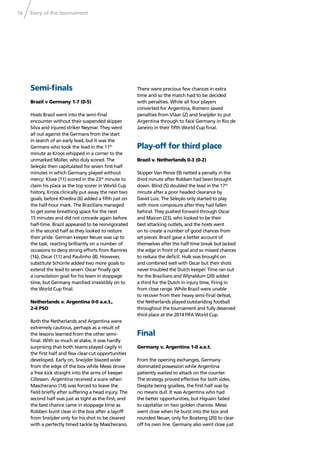
  • 128.
    Medical report126 INFORME MÉDICO Enla Copa Mundial de la FIFA Brasil 2014™, el médico en jefe de la FIFA, el Dr. Jiří Dvořák, junto con los oficiales médicos de la FIFA, el Dr. Alfred Müller y el Dr. Efraim Kramer, supervisó los servicios sanitarios de la competición en Río de Janeiro, que habían sido organizados por el COL. Consultas médicas durante los partidos Durante los 64 partidos disputados, se registraron casi 6 230 consultas médicas, un promedio de 97 por partido para un total de 3.5 millones de espectadores. Esta cifra se sitúa dentro de los límites esperados. Estudio sobre las lesiones Desde 1998, se solicita a los médicos de equipo un informe sobre las lesiones que padecieron sus jugadores durante los encuentros. Se rellenaron y entregaron al oficial médico de la FIFA los formularios estándar de registro de lesiones, concebidos por el Centro Médico de Evaluación e Investigación de la FIFA (F-MARC). La Dra. Astrid Junge, jefa de investigación del F-MARC, analizó los datos. La media general fue de 1.7 lesiones por partido. El 8 % de las lesiones tuvieron como consecuencia que los futbolistas afectados no pudieran entrenar o jugar durante más de cuatro semanas, y el 35 % de las lesiones de contacto fueron consecuencia de una falta. Al comparar las estadísticas de 2002 (2.7 lesiones/ partido) con las de este año (1.7 lesiones/ partido), se constata que la indecencia se ha Autor: Dr. Jiří Dvořák reducido en un 40 % en la Copa Mundial de la FIFA™. Descansos de refresco Por primera vez en la historia del Mundial, la FIFA permitió que se realizaran pausas de refresco durante los partidos en los que las temperaturas superaron los valores límite de estrés térmico. Los oficiales médicos de la FIFA de las sedes midieron la temperatura de globo y bulbo húmedo (TGBH) antes del inicio y controlaron su evolución durante el mismo. Cuando se sobrepasaron los 32 grados centígrados, se recomendó al coordinador general de la FIFA que se realizara un descanso de refresco. El árbitro del encuentro decidió a su discreción sobre la interrupción del encuentro con este fin. El único descanso de refresco tuvo lugar en el encuentro entre los Países Bajos y México en Fortaleza (TGBH 32ºC). Medidas antidopaje Control de dopaje fuera de competición En la Copa FIFA Confederaciones 2013 y en la Copa Mundial FIFA Brasil 2014™, la FIFA comenzó a implantar el perfil biológico como nueva estrategia para luchar contra el dopaje. Además de los controles de dopaje rutinarios durante la competición, en la Copa Mundial de la FIFA Brasil 2014 se tomaron muestras de sangre y orina de todos los jugadores antes del torneo con el fin de crear un perfil biológico. 0.0 0.5 1.0 1.5 2.0 2.5 3.0 2.4 2.7 1.7 1.3 1.7 1.0 2.0 1.5 2.3 1998 Francia 2002 Corea/Japón 2006 Alemania 2010 Sudáfrica 2014 Brasil Fig. 1: Promedio de lesiones por partido azul = total de lesiones gris = lesiones que causan baja
  • 129.
    Medical report 127 Elperfil tiene dos componentes: los parámetros hematológicos (en sangre) y el perfil esteroideo (en orina). La combinación de los dos arroja el perfil biológico personal de cada jugador. En las semanas previas a la Copa Mundial de la FIFA Brasil 2014™ y durante el torneo, los oficiales del control de dopaje de la FIFA visitaron sin previo aviso a las 32 selecciones participantes a fin de llevar a cabo controles fuera de competición. Se realizaron análisis a los 736 jugadores de la competición. Todos los análisis de dopaje realizados antes de la competición arrojaron resultados negativos. Control de dopaje durante el torneo De acuerdo con la rutina del procedimiento en competición, descrita en el Reglamento Antidopaje de la FIFA, se seleccionó aleatoriamente a dos jugadores por equipo para el control de dopaje después de cada uno de los 64 partidos, a los que se tomaron muestras de sangre y orina. En total, se recogieron y analizaron 512 muestras en el laboratorio reconocido por la AMA en Lausana (Suiza), todas ellas con resultados negativos. Legado para Brasil Antes de la Copa FIFA Confederaciones 2013 y de la Copa Mundial de la FIFA Brasil 2014™, se han impartido seminarios sobre urgencias médicas en el fútbol para los oficiales médicos del COL en las sedes y los médicos de equipo de las asociaciones participantes. Además, los equipos médicos de los estadios de todas las ciudades anfitrionas recibieron una extensa formación de manos del Dr. Efraim Kramer. De este modo, se han establecido los nuevos estándares de atención médica dentro y fuera del campo. El programa FIFA 11 para la Salud se ha llevado a cabo en las 12 ciudades anfitrionas con 3 300 niños. En colaboración con la CBF y el Gobierno brasileño, se prevé implantar el programa en el ámbito nacional.
  • 130.
    Medical report128 MEDIZINISCHER BERICHT FIFA-ChefarztProf. Jiří Dvořák sowie Dr. Alfred Müller und Prof. Efraim Kramer als medizini- sche FIFA-Koordinatoren beaufsichtigten vom Hauptquartier in Rio de Janeiro die medizini- sche Versorgung bei der FIFA Fussball-Welt- meisterschaft Brasilien 2014™, nachdem das medizinische LOC-Team alle diesbezüglichen Vorkehrungen getroffen hatte. Medizinische Zwischenfälle bei Spielen In den 64 Spielen wurden fast 6230 medi- zinische Zwischenfälle – dies bei insgesamt 3,5 Millionen Zuschauern – verzeichnet, das sind rund 97 Fälle pro Spiel. Die Zahl ent- spricht in etwa den Erwartungen. Verletzungserhebung Seit 1998 werden die Teamärzte bei allen FIFA-Wettbewerben gebeten, alle Verletzungen ihrer Spieler bei den Spielen zu melden. Die betreffenden Angaben waren auf dem stan- dardisierten F-MARC-Formular zu vermerken, das dem medizinischen FIFA-Koordinator aus- zuhändigen war. Dr. Astrid Junge, F-MARC-For- schungsleiterin, wertete die Daten aus. Durchschnittlich wurden pro Spiel 1,7 Verlet- zungen verzeichnet. 8 % aller Verletzungen führten zu einer Trainings- oder Spielpau- se von mehr als vier Wochen. 35 % waren auf Fouls zurückzuführen. Verglichen mit 1998/2002 (2,4/2,7 Verletzungen pro Spiel) war der Wert bei dieser Weltmeisterschaft 40 % tiefer (1,7 Verletzungen pro Spiel). Autor: Prof. Jiří Dvořák Verfahren für Kühl-/Trinkpausen Erstmals bei einer FIFA Fussball-Weltmeister- schaft™ waren bei Spielen, bei denen ein Grenzwert für Hitzestress überschritten wur- de, Kühlpausen möglich. Die medizinischen FIFA-Koordinatoren an den einzelnen Spielor- ten massen vor Spielbeginn die Feuchttempe- ratur und überwachten anschliessend deren Entwicklung. Bei über 32 °C empfahlen sie dem FIFA-Koordinator eine Kühlpause. Wie diese durchgeführt wurde, lag im Ermessen der Schiedsrichter. Insgesamt gab es nur beim Spiel zwischen den Niederlanden und Mexiko in Fortaleza (32 Grad Feuchttemperatur) eine Kühlpause . Dopingbekämpfung Dopingkontrollen ausserhalb von Wettbewerben Beim FIFA Konföderationen-Pokal 2013 und bei der FIFA Fussball-Weltmeisterschaft 2014™ setzte die FIFA als mögliche neue Stra- tegie in der Dopingbekämpfung biologische Profile ein. Zu diesem Zweck führte sie bei den Spielern aller Teams neben den üblichen Dopingtests ausserhalb von Wettbewerben Blut- und Urintests durch, um deren biologi- sches Profil zu erstellen. Das biologische Profil besteht aus den hämatologischen Parame- tern (im Blut) und dem Steroidprofil (im Urin). Zusammen ergeben sie ein für jeden Spieler unverkennbares Profil. In den Wochen 0,0 0,5 1,0 1,5 2,0 2,5 3,0 2,4 2,7 1,7 1,3 1,7 1,0 2,0 1,5 2,3 1998 Frankreich 2002 Korea/Japan 2006 Deutschland 2010 Südafrika 2014 Brasilien Abbildung 1: Verletzungsschnitt pro Spiel blau = alle Verletzungen grau = Verletzungen mit Trainings- oder Spielausfall
  • 131.
    Medical report 129 vorder WM-Endrunde führten die FIFA-Dopingkontrolleure bei den Spielern der 32 beteiligten Teams unangemeldete Dopingkontrollen (Urin- und Bluttests) ausserhalb von Wettbewerben durch. Alle 736 Spieler, die am Turnier teilnahmen, wurden getestet. Die Kontrollen vor dem Turnier ergaben allesamt einen negativen Befund. Dopingkontrollen bei Wettbewerben Gemäss Standardverfahren des FIFA-Anti- Doping-Reglements wurden bei jedem der 64 Spiele zwei Spieler je Team für Urin- und Bluttests ausgelost. Insgesamt wurden 512 Proben entnommen und im von der WADA akkreditierten Labor in Lausanne (Schweiz) analysiert. Alle Befunde waren negativ. Vermächtnis für Brasilien Vor dem FIFA Konföderationen-Pokal 2013 und der FIFA Fussball-Weltmeisterschaft 2014™ fanden für die medizinischen LOC- Koordinatoren der Spielorte und die Teamärzte der teilnehmenden Mitgliedsverbände Fuss- ball-Notfallmedizin-Seminare statt, während die medizinischen Teams für die Erstversorgung auf dem Spielfeld von Prof. Efraim Kramer ein- gehend geschult wurden. Der Standard für die medizinische Versorgung auf und neben dem Spielfeld wurde damit neu definiert. An allen zwölf Spielorten wurde für 3300 Kinder zudem das Programm „FIFA 11 für die Gesundheit“ durchgeführt. In Zusammen- arbeit mit dem brasilianischen Fussballverband und der brasilianischen Regierung wird das Programm nun landesweit ausgedehnt.
  • 132.
  • 134.
    Goal-line technology132 GOAL-LINE TECHNOLOGY Brazil2014 was the first FIFA World Cup™ in which officials were able to use goal-line technology, although it had already been used at the FIFA Club World Cup in both 2012 and 2013 as well as at the FIFA Confederations Cup in Brazil in 2013 following a historic decision to approve the use of goal-line technology by The International Football Association Board (IFAB) at a special meeting on 5 July 2012. Tender process The decision to confirm GoalControl as the GLT provider in October 2013 followed a comprehensive tender process that began in February 2013 and involved bid presentations at the Home of FIFA in Zurich as well as site inspections in Brazil. The Germany-based company was selected ahead of the three other FIFA-licensed GLT providers who participated in the tender. While all four companies had previously met the stringent technical requirements of the FIFA Quality Programme, the final decision was based on criteria relating more specifically to Author: Johannes Holzmüller the tournaments in Brazil, including the company’s ability to adapt to local conditions and the compatibility of each GLT system in relation to FIFA match operations. The bids were also judged on cost and project management factors such as staffing and time schedules for installation. GoalControl was confirmed as the World Cup GLT provider following the company’s successful implementation of the technology at the FIFA Confederations Cup in Brazil. The selected technology The GoalControl-4D system uses 14 high- speed cameras around the pitch, with seven cameras focused on each goal. Using special detection software, the ball is filtered out from the image sequences and its real-time position is automatically calculated as X, Y and Z coordinates as well as speed, making it 4D. If the ball has fully crossed the goal line, the central processing unit automatically sends an encrypted radio signal to the referee’s watch in less than one second, indicating a goal
  • 135.
    Goal-line technology 133 bymeans of vibration and a visual “GOAL” signal. System installation After the final confirmation of the GLT provider in October 2013, work began on installing the system in the 12 FIFA World Cup™ stadiums in Brazil, with cameras set up under the roof of each stadium and then connected to the hardware and software in the control room. Finally, the system was calibrated to ensure that it was in line with the different conditions in each stadium. GoalControl successfully completed the installation in the last two stadiums in mid- May, working in close cooperation with the LOC and the local stadium management. Final installation tests The 12 installed systems then passed The IFAB’s installation test, as part of which more than 2,400 GLT incidents had to be correctly indicated in various situations and conditions. These tests were conducted by an independent test institute, Labosport UK. FIFA certified all 12 stadiums for 12 months on the back of the positive test results. Referee training On 7 June, FIFA held a referee training session at the Maracanã to ensure that all match officials were comfortable with the technology and to explain the pre-match procedure in more detail. The general functionality and accuracy of the system, and the mandatory referee check in particular, were important parts of this training session. Media event On 9 June, members of the media from all around the world had an opportunity to see the GoalControl-4D technology in action at the Maracanã. Following a short presentation on the reasons behind the use of goal-line technology and its functionality, the media representatives were able to wear the referees’ watch, which receives an indication of “GOAL” within one second of the ball crossing the line.
  • 136.
    Goal-line technology134 Camera angle1: goal? (GLT camera) Camera angle 2: goal? (GLT camera) Camera angle 3: goal? (TV camera) GLT confirms: goal The tournament phase GLT was a resounding success at the tournament as it greatly assisted the match officials, particularly in three decisive situations. In the first incident, during the group-stage match between France and Honduras, even TV images were not conclusive in showing whether it was a goal or not. In the second incident, which occurred during the Italy v. Costa Rica match, the match officials’ view of where the ball had bounced was blocked by the Italian goalkeeper, who was lying on the ground, and they were therefore reliant upon the new technology. The third incident was in the Netherlands v. Argentina semi-final, and once again the system indicated to the Turkish referee that no goal had been scored after the ball span back towards the goal after a penalty had been saved. In seven further incidents, the system confirmed the referees’ decisions by means of special GLT replays on TV (see table below). GLT replays on TV Match Team 1 Team 2 4 CHI AUS 10 FRA HON 17 BRA MEX 23 URU ENG 24 ITA CRC 44 BIH IRN 47 KOR BEL 51 NED MEX 53 FRA NGA All 171 goals (including penalties) were recorded by the system and displayed correctly on the referees’ watches. Consequently, the referees were very happy with the system’s performance and with the assistance it provided during matches. Match 10: France v. Honduras
  • 137.
    Goal-line technology 135 Match24: Italy v. Costa Rica GLT confirms: goal Match 62: Netherlands v. Argentina Ball has not fully crossed the line: no goal signal (GLT camera) Vital GLT support
  • 138.
    Goal-line technology136 Brésil 2014a été la première Coupe du Monde de la FIFA™ où les arbitres ont bénéficié de l’aide de la technologie sur la ligne de but. Après la décision historique prise le 5 juillet 2012 par l’International Football Association Board (IFAB) d’approuver le principe de son utilisation officielle, la technologie sur la ligne de but avait déjà été utilisée lors des Coupes du Monde des Clubs de la FIFA 2012 et 2013, ainsi que lors de la Coupe des Confédérations de la FIFA organisée l’an dernier au Brésil. Procédure d’appel d’offres La confirmation en octobre 2013 de l’entreprise allemande GoalControl comme fabricant de technologie sur la ligne de but a mis fin à la procédure d’appel d’offres qui avait débuté en février avec des présentations au siège de la FIFA à Zurich ainsi que des visites d’inspection au Brésil. GoalControl avait alors été préférée à trois autres entreprises. Si les quatre candidats répondaient aux stricts critères qualitatifs du programme Qualité de la FIFA, la décision finale s’est fondée sur des critères se rapportant davantage aux deux tournois au Brésil, comme la capacité de l’entreprise à s’adapter aux conditions locales et la compatibilité de son système avec les aspects opérationnels des compétitions FIFA. Les offres ont également été analysées au vu de leurs coûts respectifs et des facteurs de gestion de projet comme par exemple le personnel requis et les délais d’installation. Après le succès de la Coupe des Confédérations, GoalControl a donc été confirmée pour Brésil 2014. Une technologie de pointe Le système GoalControl-4D fonctionne avec quatorze caméras grande vitesse installées tout autour du terrain (sept par but). À l’aide d’un logiciel de reconnaissance spécial, le ballon est isolé des séquences d’images et sa position tridimensionnelle est calculée en temps réel, la vitesse du ballon étant en outre prise en compte par l’algorithme, ce qui permet ainsi une reconstitution virtuelle fidèle, en « quatre dimensions ». Si le ballon LA TECHNOLOGIE SUR LA LIGNE DE BUT Auteur : Johannes Holzmüller
  • 139.
    Goal-line technology 137 franchitentièrement la ligne de but entre les poteaux et sous la barre transversale, l’ordinateur de contrôle envoie alors en moins d’une seconde un signal crypté vers la montre de l’arbitre qui vibre et affiche « GOAL » pour montrer qu’un but a été marqué. Installation du système Dès la confirmation de GoalControl en octobre 2013, l’installation des dispositifs a débuté dans les douze stades qui allaient accueillir la compétition. Tout d’abord les caméras ont été mises en place sur le toit de chacun des stades, puis le câblage a été installé et enfin les ordinateurs et les logiciels. Le système a ensuite été calibré en fonction des diverses données de chaque stade. En étroite collaboration avec le COL et les gérants du stade, GoalControl a finalisé l’installation mi-juin dans les deux derniers stades. Tests d’installation Les douze systèmes ont passé avec succès le test d’installation prévu par l’IFAB et mené par l’institut indépendant Labosport UK, test qui implique que le système analyse correctement plus de 2 400 situations dans différentes conditions. À la lumière de ces tests positifs, la FIFA a pu certifier les douze stades le 1er juin pour une durée d’un an. Formation des arbitres Le 7 juin, la FIFA a proposé aux arbitres une formation au stade Maracanã de Rio afin de les familiariser encore davantage avec cette nouvelle technologie, sa fonctionnalité, sa précision, mais aussi avec l’ultime vérification qu’ils ont à effectuer avant chaque match. Présentation aux médias Le 9 juin, toujours au Maracanã, une présentation a cette fois été faite aux journalistes du monde entier, afin de les informer en détail de la technologie GoalControl 4D. Après une brève présentation sur les raisons de l’introduction de la technologie sur la ligne de but et sur le fonctionnement du système, les représentants des médias ont pu essayer la montre de l’arbitre et constater la rapidité avec laquelle elle confirmait qu’un but avait été marqué.
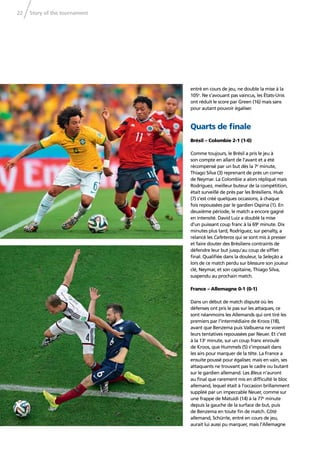
  • 140.
    Goal-line technology138 Angle 1 :but ? (Caméra GLT) Angle 2 : but ? (Caméra GLT) Angle 3 : but ? (Caméra GLT) Confirmation de la technologie sur la ligne de but : but ! Les matches Cette technologie sur la ligne de but s’est avérée être un outil précieux pour les arbitres, et a donc été un grand succès. Par trois fois elle les a aidés à valider un but sur une action litigieuse, la première fois lors du match entre la France et le Honduras, où même les ralentis montrés à la télévision ne permettaient pas de déterminer si le ballon avait ou non franchi la ligne. Lors du deuxième cas, entre l’Italie et le Costa Rica, les arbitres ont confié que la technologie les avait indubitablement aidés étant donné qu’ils ne disposaient pas d’un bon angle de vue sur cette action, masqués qu’ils étaient par le gardien de but italien. Le troisième cas est survenu lors de la demi- finale entre les Pays-Bas et l’Argentine. Les arbitres ont là encore été aidés par le système car le ballon roulait encore après un tir au but stoppé par le gardien argentin et est venu mourir sur la ligne. En sept occasions, le système a permis de confirmer à l’écran la décision de l’arbitre grâce aux ralentis spéciaux (cf. encadrés). Ralentis à la télévision Match Équipe A Équipe B 4 CHI AUS 10 FRA HON 17 BRA MEX 23 URU ENG 24 ITA CRC 44 BIH IRN 47 KOR BEL 51 NED MEX 53 FRA NGA Chacun des 171 buts inscrits (penalties y compris) a correctement reconnu et signalé sur la montre des arbitres. Les arbitres se sont dits très satisfaits de l’efficacité de la technologie et de l’aide qu’elle leur a offert durant les matches. Match 10 : France – Honduras
  • 141.
    Goal-line technology 139 Match24 : Italie – Costa Rica Confirmation de la technologie sur la ligne de but : but ! Match 62 : Pays-Bas – Argentine Le ballon n’a pas entièrement franchi la ligne (caméra GLT) Aide décisive de la technologie sur la ligne de but
  • 142.
    Goal-line technology140 Brasil 2014ha sido la primera edición de la Copa Mundial de la FIFA™ en la que los árbitros han contado con el apoyo de sistemas de detección automática de goles (DAG). Hasta la fecha, estos sistemas se habían utilizado en la Copa Mundial de Clubes de la FIFA 2012 y 2013, así como en la Copa FIFA Confederaciones disputada en Brasil el año pasado. En la sesión extraordinaria del 5 de julio de 2012, el Internacional Football Association Board (IFAB) adoptó la decisión histórica de permitir el uso de sistemas de DAG. Licitación Con la confirmación del proveedor de DAG GoalControl en octubre de 2013 finalizó la licitación abierta en febrero de 2013, que incluyó presentaciones de los candidatos en la sede de la FIFA en Zúrich e inspecciones en Brasil. La empresa alemana GoalControl fue la elegida de entre los cuatro proveedores aprobados por la FIFA que participaron en la licitación. Los cuatro candidatos cumplían los estrictos criterios técnicos del Programa de Calidad de la FIFA, y la decisión final se basó, sobre todo, en los requerimientos específicos para los torneos que se disputarían en Brasil, así como la capacidad de las empresas de adaptarse a las condiciones locales y la compatibilidad de los sistemas de DAG con el modo en que la FIFA gestiona los partidos. Se valoraron, asimismo, factores como los costes, la gestión de proyectos y el personal y los plazos necesarios para la instalación. Tras el éxito en la Copa FIFA Confederaciones de Brasil, se confirmó a GoalControl como proveedor para la Copa Mundial de la FIFA Brasil 2014™. El sistema escogido El sistema 4D de GoalControl cuenta con 14 cámaras de alta velocidad instaladas por todo el campo. Hay siete cámaras enfocadas a cada una de las porterías. Con ayuda de un software de reconocimiento especial, se detecta el balón en las imágenes y su posición real se calcula de forma automática mediante coordenadas SISTEMA DE DETECCIÓN GOLES Autor: Johannes Holzmüller
  • 143.
    Goal-line technology 141 X,Y y Z. A estas se añade la velocidad, con la que se obtiene la imagen 4D. Si el balón cruza por completo la línea de meta, el procesador central envía una señal cifrada en menos de un segundo al reloj del árbitro que indica que se ha marcado gol mediante una vibración y la señal visual de «GOL». Instalación del sistema Tras la confirmación final de los proveedores de DAG en octubre de 2013, comenzó la instalación en las doce ciudades brasileñas que acogerían el Mundial del 2014. En primer lugar, se instalaron las cámaras en el techo de los estadios. A continuación, se conectaron las cámaras al hardware y software de la sala de control. Por último, se calibró el sistema para adaptarlo a las condiciones del estadio. Colaborando estrechamente con el COL y los responsables locales de los estadios, GoalControl finalizó a mediados de mayo la instalación en los últimos dos campos. Pruebas de instalación finales Los doce sistemas instalados pasaron con éxito las pruebas finales prescritas por el IFAB. Para ello, tuvieron que evaluar correctamente en 2 400 casos y bajo condiciones diferentes si el balón había traspasado en su totalidad la línea de gol. Las pruebas las llevó a cabo el instituto independiente Labosport UK. Puesto que los resultados de estas fueron positivos, el 1 de junio los doce estadios obtuvieron la certificación de la FIFA válida por un año. Formación de los árbitros El 7 de junio, la FIFA ofreció a los árbitros en el estadio Maracaná una sesión de formación para presentarles los nuevos dispositivos y explicar de forma detallada el control del sistema que se debe realizar antes del partido. En la sesión se trataron el funcionamiento y la precisión de los dispositivos, así como las pruebas que deben llevar a cabo los árbitros. Acto para la prensa El 9 de junio, los periodistas tuvieron la oportunidad de ver el sistema 4D de GoalControl en acción en el estadio Maracaná. Tras una breve presentación sobre los motivos por los que se decidió emplear estos dispositivos y sobre su funcionamiento, los periodistas pudieron probar el reloj del árbitro que indicó «gol» en menos de un segundo después de que el balón cruzara la línea de meta.
  • 144.
    Goal-line technology142 Ángulo 1:¿Gol? (cámara de DAG) Ángulo 2: ¿Gol? (cámara de DAG) Ángulo 3: ¿Gol? (cámara de TV) Confirmación del sistema de DAG: ¡Gol! Durante el torneo Los dispositivos de DAG fueron una ayuda importante para los colegiados, por lo que su utilización resultó un éxito. En tres ocasiones, el apoyo de estos sistemas fue decisivo para los árbitros. De hecho, en el partido entre Francia y Honduras de la fase de grupos, habría sido imposible decidir si el balón había entrado por completo en la portería utilizando únicamente las imágenes de TV. En el segundo caso, en el encuentro entre Italia y Costa Rica, el trío arbitral tuvo que confiar en los nuevos dispositivos, ya que el portero italiano en el suelo impedía ver claramente la posición del balón. El tercer caso se dio en la semifinal entre los Países Bajos y Argentina. Una vez más, el colegiado turco se basó en la DAG para no pitar gol cuando la pelota rodó hasta la línea tras un penalti parado. En otros siete casos, los dispositivos confirmaron las decisiones de los árbitros en televisión mediante repeticiones especiales de la DAG (v. el cuadro informativo). Repeticiones televisivas de la DAG Partido Selección 1 Selección 2 4 CHI AUS 10 FRA HON 17 BRA MEX 23 URU ENG 24 ITA CRC 44 BIH IRN 47 KOR BEL 51 NED MEX 53 FRA NGA Los dispositivos dieron por buenos los 171 goles anotados (penaltis incluidos) y los transmitieron sin errores al reloj portado por los árbitros. Los colegiados se mostraron muy satisfechos con el funcionamiento de los sistemas de DAG y con el apoyo que les ofrecieron durante los partidos. Partido 10: Francia – Honduras
  • 145.
    Goal-line technology 143 Partido24: Italia – Costa Rica Confirmación del sistema de DAG: ¡Gol! Partido 62: Países Bajos – Argentina El balón no cruza la línea completamente: no hay señal de gol (cámara de DAG) La ayuda de la DAG resulta decisiva
  • 146.
    Goal-line technology144 Brasilien 2014ist die erste FIFA Fussball-Welt- meisterschaft™, bei der die Offiziellen von Torlinientechnologie unterstützt werden. Bis- lang kam sie bei den FIFA Klub-Weltmeister- schaften 2012 und 2013 sowie beim letztjäh- rigen FIFA Konföderationen-Pokal in Brasilien zum Einsatz. Mit einem historischen Beschluss hatte der International Football Association Board (IFAB) bei einer Sondersitzung am 5. Juli 2012 die Nutzung von Torlinientechnologien im Grundsatz zugelassen. Ausschreibungsprozess Mit der Bestätigung für den Torlinientechno- logie-Anbieter GoalControl im Oktober 2013 endete ein ausgedehntes Ausschreibungs- verfahren, das im Februar 2013 begann und sowohl Präsentationen der Bewerber am FIFA-Sitz in Zürich als auch Inspektionen vor Ort in Brasilien umfasste. Das Unternehmen mit Sitz in Deutschland wurde den drei ande- ren von der FIFA zugelassenen Anbietern vor- gezogen, die ebenfalls an der Ausschreibung teilnahmen. Nachdem alle vier Anbieter die strengen technischen Auflagen des FIFA-Qua- litätsprogramms erfüllt hatten, gaben letztlich vor allem die spezifischen Vorgaben für die beiden Turniere in Brasilien, insbesondere die Fähigkeit des Unternehmens, sich den lokalen Gegebenheiten anzupassen, und die Kom- patibilität des Torlinientechnologie-Systems mit dem FIFA-Spielbetrieb den Ausschlag. Die einzelnen Bewerbungen wurden auch nach Kosten und Projektmanagementfaktoren wie Personal und Zeitplan für die Installation be- urteilt. Nach der erfolgreichen Durchführung des FIFA Konföderationen-Pokals in Brasilien wurde GoalControl als Lieferant für die FIFA Fussball-Weltmeisterschaft 2014™ bestätigt. Die ausgewählte Technologie Das GoalControl-4-D-System ist mit 14 Hoch- geschwindigkeitskameras ausgestattet, die rund um das Spielfeld installiert sind. Dabei sind jeweils sieben Kameras auf eines der Tore gerichtet. Mit Hilfe einer speziellen Erkennungssoftware wird der Ball aus den Bildsequenzen herausgefiltert, und seine Echt- zeit-Position wird automatisch als X-, Y- und Z-Koordinaten berechnet. Hinzu kommt die TORLINIENTECHNOLOGIE Autor: Johannes Holzmüller
  • 147.
    Goal-line technology 145 Geschwindigkeit,so dass eine 4-D-Erfassung möglich ist. Falls der Ball die Torlinie in vollem Umfang überquert hat, sendet eine zentrale Recheneinheit per Funk innerhalb von weni- ger als einer Sekunde ein verschlüsseltes Signal zur Uhr des Schiedsrichters und zeigt anhand eines Vibrationsalarms und einer visuellen Mitteilung ein Tor an. Die Installation des Systems Nach der definitiven Bestätigung des GLT-Lie- feranten im Oktober 2013 begann die Instal- lation des Systems in den zwölf Spielstätten der FIFA Fussball-Weltmeisterschaft 2014™ in Brasilien. Hierbei wurden zunächst die Kameras unterhalb des Stadiondachs mon- tiert. Im Anschluss folgte eine Verkabelung der Kameras mit der Hard- und Software im Kontrollraum. Abschliessend wurde das System kalibriert und so auf die verschiedenen Gegebenheiten in den Stadien eingestellt. In enger Zusammenarbeit mit dem LOC und dem lokalen Stadionmanagement schloss GoalCon- trol die Installation Mitte Mai in den letzten beiden Stadien erfolgreich ab. Finale Installationstests Die zwölf installierten Systeme bestanden im Anschluss den vom IFAB vorgeschriebenen Installationstest. Dabei mussten die Systeme über 2400 mögliche Torlinienereignisse in verschiedenen Situationen und bei unter- schiedlichen Bedingungen richtig bewerten. Die Tests wurden vom unabhängigen Test- institut Labosport UK durchgeführt. Aufgrund der positiven Testergebnisse zertifizierte die FIFA am 1. Juni alle zwölf Stadien für zwölf Monate. Schiedsrichterschulung Am 7. Juni schulte die FIFA im Maracanã-Sta- dion die Schiedsrichter, um sie mit der neuen Technologie vertraut zu machen und detail- liert die Kontrolle des Systems vor einem Spiel zu erläutern. Wichtige Teile der Schulung waren die allgemeine Funktionsweise und Genauigkeit des Systems sowie insbesonde- re die vorgeschriebene Prüfung durch die Schiedsrichter. Medienveranstaltung Pressevertreter aus aller Welt hatten am 9. Juni im Maracanã-Stadion die Gelegenheit, die GoalControl-4-D-Technologie in Aktion zu sehen. Nach einer kurzen Präsentation über die Gründe für den Einsatz der Torlinientech- nologie und ihre Funktionsweise konnten die Medienvertreter die Schiedsrichteruhr
  • 148.
    Goal-line technology146 Blickwinkel 1:Tor? (GLT-Kamera) Blickwinkel 2: Tor? (GLT-Kamera) Blickwinkel 3: Tor? (TV-Kamera) Torlinientechnologie bestätigt: Tor! ausprobieren, die innerhalb einer Sekunde, nachdem der Ball die Linie überquert hat, „Goal“ anzeigt. Die Turnierphase Die Torlinientechnologie war für die Schieds- richter ein wichtiges Hilfsmittel und somit ein grosser Erfolg. Dreimal konnte die Technolo- gie die Schiedsrichter entscheidend unterstüt- zen. Besonders die erste Situation im Grup- penspiel zwischen Frankreich und Honduras konnte ohne technische Hilfeleistung selbst im TV nicht aufgelöst werden. Beim zweiten Vor- fall im Spiel Italien gegen Costa Rica konnten die Schiedsrichter aufgrund des am Boden lie- genden italienischen Torhüters nicht zweifels- frei erkennen, wo der Ball am Boden aufkam, und waren somit auf die neue Technologie angewiesen. Der dritte Vorfall ereignete sich im Halbfinale zwischen den Niederlanden und Argentinien. Hier vertraute der türkische Schiedsrichter ebenso auf das System und gab kein Tor, als der Ball nach einem gehaltenen Elfmeter zurück auf die Linie rollte. In sieben weiteren Situationen bestätigte das System zudem die Schiedsrichterentscheidung im TV anhand spezieller GLT-Wiederholungen (siehe Informationskasten). GLT-Wiederholungen im TV Spiel Team 1 Team 2 4 CHI AUS 10 FRA HON 17 BRA MEX 23 URU ENG 24 ITA CRC 44 BIH IRN 47 KOR BEL 51 NED MEX 53 FRA NGA Zusätzlich wurden alle 171 erzielten Tore (mit Elfmetertoren) vom System erkannt und korrekt auf den Schiedsrichteruhren ange- zeigt. Dementsprechend waren die Schieds- richter mit der Leistung der Technologie und der erhaltenen Hilfe während des Spiels sehr zufrieden. Spiel 10: Frankreich – Honduras
  • 149.
    Goal-line technology 147 Spiel24: Italien – Costa Rica Torlinientechnologie bestätigt: Tor! Spiel 62: Niederlande – Argentinien Ball hat die Linie nicht überquert: kein Torsignal (GLT-Kamera) Entscheidende Hilfe durch die Torlinientechnologie
  • 151.
  • 152.
    150 Statistics andteam data Group B Spain, Netherlands, Chile, Australia 13.06. Spain v. Netherlands Salvador 1-5 (1-1) 13.06. Chile v. Australia Cuiabá 3-1 (2-1) 18.06. Spain v. Chile Rio de Janeiro 0-2 (0-2) 18.06. Australia v. Netherlands Porto Alegre 2-3 (1-1) 23.06. Australia v. Spain Curitiba 0-3 (0-1) 23.06. Netherlands v. Chile São Paulo 2-0 (0-0) 1. Netherlands 3 3 0 0 10-3 9 2. Chile 3 2 0 1 5-3 6 3. Spain 3 1 0 2 4-7 3 4. Australia 3 0 0 3 3-9 0 Group A Brazil, Croatia, Mexico, Cameroon 12.06. Brazil v. Croatia São Paulo 3-1 (1-1) 13.06. Mexico v. Cameroon Natal 1-0 (0-0) 17.06. Brazil v. Mexico Fortaleza 0-0 18.06. Cameroon v. Croatia Manaus 0-4 (0-1) 23.06. Cameroon v. Brazil Brasília 1-4 (1-2) 23.06. Croatia v. Mexico Recife 1-3 (0-0) 1. Brazil 3 2 1 0 7-2 7 2. Mexico 3 2 1 0 4-1 7 3. Croatia 3 1 0 2 6-6 3 4. Cameroon 3 0 0 3 1-9 0 Group D Uruguay, Costa Rica, England, Italy 14.06. Uruguay v. Costa Rica Fortaleza 1-3 (1-0) 14.06. England v. Italy Manaus 1-2 (1-1) 19.06. Uruguay v. England São Paulo 2-1 (1-0) 20.06. Italy v. Costa Rica Recife 0-1 (0-1) 24.06. Italy v. Uruguay Natal 0-1 (0-0) 24.06. Costa Rica v. England Belo Horizonte 0-0 1. Costa Rica 3 2 1 0 4-1 7 2. Uruguay 3 2 0 1 4-4 6 3. Italy 3 1 0 2 2-3 3 4. England 3 0 1 2 2-4 1 Group C Colombia, Greece, Côte d’Ivoire, Japan 14.06. Colombia v. Greece Belo Horizonte 3-0 (1-0) 14.06. Côte d‘Ivoire v. Japan Recife 2-1 (0-1) 19.06. Colombia v. Côte d‘Ivoire Brasília 2-1 (0-0) 19.06. Japan v. Greece Natal 0-0 24.06. Japan v. Colombia Cuiabá 1-4 (1-1) 24.06. Greece v. Côte d‘Ivoire Fortaleza 2-1 (1-0) 1. Colombia 3 3 0 0 9-2 9 2. Greece 3 1 1 1 2-4 4 3. Côte d’Ivoire 3 1 0 2 4-5 3 4. Japan 3 0 1 2 2-6 1 Group F Argentina, Bosnia and Herzegovina, Iran, Nigeria 15.06. Argentina v. Bosnia and Herzegovina Rio de Janeiro 2-1 (1-0) 16.06. Iran v. Nigeria Curitiba 0-0 21.06. Argentina v. Iran Belo Horizonte 1-0 (0-0) 21.06. Nigeria v. Bosnia and Herzegovina Cuiabá 1-0 (1-0) 25.06. Nigeria v. Argentina Porto Alegre 2-3 (1-2) 25.06. Bosnia and Herzegovina v. Iran Salvador 3-1 (1-0) 1. Argentina 3 3 0 0 6-3 9 2. Nigeria 3 1 1 1 3-3 4 3. Bosnia and Herzegovina 3 1 0 2 4-4 3 4. Iran 3 0 1 2 1-4 1 Group E Switzerland, Ecuador, France, Honduras 15.06. Switzerland v. Ecuador Brasília 2-1 (0-1) 15.06. France v. Honduras Porto Alegre 3-0 (1-0) 20.06. Switzerland v. France Salvador 2-5 (0-3) 20.06. Honduras v. Ecuador Curitiba 1-2 (1-1) 25.06. Honduras v. Switzerland Manaus 0-3 (0-2) 25.06. Ecuador v. France Rio de Janeiro 0-0 1. France 3 2 1 0 8-2 7 2. Switzerland 3 2 0 1 7-6 6 3. Ecuador 3 1 1 1 3-3 4 4. Honduras 3 0 0 3 1-8 0 Group H Belgium, Algeria, Russia, Korea Republic 17.06. Belgium v. Algeria Belo Horizonte 2-1 (0-1) 17.06. Russia v. Korea Republic Cuiabá 1-1 (0-0) 22.06. Belgium v. Russia Rio de Janeiro 1-0 (0-0) 22.06. Korea Republic v. Algeria Porto Alegre 2-4 (0-3) 26.06. Korea Republic v. Belgium São Paulo 0-1 (0-0) 26.06. Algeria v. Russia Curitiba 1-1 (0-1) 1. Belgium 3 3 0 0 4-1 9 2. Algeria 3 1 1 1 6-5 4 3. Russia 3 0 2 1 2-3 2 4. Korea Republic 3 0 1 2 3-6 1 Group G Germany, Portugal, Ghana, USA 16.06. Germany v. Portugal Salvador 4-0 (3-0) 16.06. Ghana v. USA Natal 1-2 (0-1) 21.06. Germany v. Ghana Fortaleza 2-2 (0-0) 22.06. USA v. Portugal Manaus 2-2 (0-1) 26.06. USA v. Germany Recife 0-1 (0-0) 26.06. Portugal v. Ghana Brasília 2-1 (1-0) 1. Germany 3 2 1 0 7-2 7 2. USA 3 1 1 1 4-4 4 3. Portugal 3 1 1 1 4-7 4 4. Ghana 3 0 1 2 4-6 1 FIRST ROUND Results and ranking
  • 153.
    151Statistics and teamdata SECOND ROUND OVERALL RANKING Round of 16 28.06. Brazil v. Chile Belo Horizonte 1-1 a.e.t. (1-1, 1-1) 3-2 PSO 28.06. Colombia v. Uruguay Rio de Janeiro 2-0 (1-0) 29.06. Netherlands v. Mexico Fortaleza 2-1 (0-0) 29.06. Costa Rica v. Greece Recife 1-1 a.e.t. (1-1, 0-0) 5-3 PSO 30.06. France v. Nigeria Brasília 2-0 (0-0) 30.06. Germany v. Algeria Porto Alegre 2-1 a.e.t. 01.07. Argentina v. Switzerland São Paulo 1-0 a.e.t. 01.07. Belgium v. USA Salvador 2-1 a.e.t. Quarter-finals 04.07. Brazil v. Colombia Fortaleza 2-1 (1-0) 04.07. France v. Germany Rio de Janeiro 0-1 (0-1) 05.07. Netherlands v. Costa Rica Salvador 0-0 a.e.t. 4-3 PSO 05.07. Argentina v. Belgium Brasília 1-0 (1-0) Semi-finals 08.07. Brazil v. Germany Belo Horizonte 1-7 (0-5) 09.07. Netherlands v. Argentina São Paulo 0-0 a.e.t. 2-4 PSO Match for third place 12.07. Brazil v. Netherlands Brasília 0-3 (0-2) Final 13.07. Germany v. Argentina Rio de Janeiro 1-0 a.e.t. 1. Germany 2. Argentina 3. Netherlands 4. Brazil 5. Colombia 6. Belgium 7. France 8. Costa Rica 9. Chile 10. Mexico 11. Switzerland 12. Uruguay 13. Greece 14. Algeria 15. USA 16. Nigeria 17. Ecuador 18. Portugal 19. Croatia 20. Bosnia and Herzegovina 21. Côte d’Ivoire 22. Italy 23. Spain 24. Russia 25. Ghana 26. England 27. Korea Republic 28. Iran 29. Japan 30. Australia 31. Honduras 32. Cameroon Results and ranking
  • 154.
    152 Statistics andteam data Estádio Mineirão: Belo Horizonte Capacity 58,170 Matches 6 Estádio Nacional: Brasília Capacity 69,349 Matches 7 Arena Pantanal: Cuiabá Capacity 41,112 Matches 4 Arena da Baixada: Curitiba Capacity 39,631 Matches 4 Manaus Cuiabá São Paulo Porto Alegre Fortaleza Natal Recife Salvador Belo Horizonte Rio de Janeiro Curitiba Brasília Brazil VENUES AND STADIUMS Venues and stadiums
  • 155.
    153Statistics and teamdata Arena Amazônia: Manaus Capacity 40,549 Matches 4 Estádio Castelão: Fortaleza Capacity 60,342 Matches 6 Estádio das Dunas: Natal Capacity 39,971 Matches 4 Estádio Beira-Rio: Porto Alegre Capacity 43,394 Matches 5 Arena Pernambuco: Recife Capacity 42,610 Matches 5 Estádio do Maracanã: Rio de Janeiro Capacity 74,738 Matches 7 Arena Fonte Nova: Salvador Capacity 51,900 Matches 6 Arena de São Paulo: São Paulo Capacity 62,601 Matches 6 Venues and stadiums
  • 156.
    154 Statistics andteam data Match telegrams GROUP A 2 13.06.2014 13:00 NATAL 39,216 MEX: 13 OCHOA; 2 RODRIGUEZ, 4 MARQUEZ (C), 6 HERRERA, 7 LAYUN, 10 DOS SANTOS, 15 MORENO, 18 GUARDADO, 19 PERALTA, 22 AGUILAR, 23 VAZQUEZ CMR: 16 ITANDJE; 2 ASSOU EKOTTO, 3 NKOULOU, 4 DJEUGOUE, 6 SONG, 8 MOUKANDJO, 9 ETOO (C), 13 CHOUPO MOTING, 14 CHEDJOU, 17 MBIA, 18 ENOH Scorers: 1-0 61’ PERALTA (19) Referee: Wilmar ROLDAN (COL) Assistant referees: Humberto CLAVIJO (COL), Eduardo DIAZ (COL) 4th official: Norbert HAUATA (TAH) Reserve assistant referee: Marwa RANGE (KEN) Substitutions: MEX: 69’ out GUARDADO (18), in FABIAN (8), 74’ out PERALTA (19), in HERNANDEZ (14), 90’+1 out HERRERA (6), in SALCIDO (3) CMR: 46’ HT out DJEUGOUE (4), in NOUNKEU (5), 79’ out SONG (6), in WEBO (15) Cautions: MEX: 57’ MORENO (15) CMR: 77’ NOUNKEU (5) Expulsions: – Mexico v. Cameroon 1-0 (0-0) 1 12.06.2014 17:00 SAO PAULO 62,103 BRA: 12 JULIO CESAR; 2 ALVES, 3 SILVA (C), 4 DAVID LUIZ, 6 MARCELO, 7 HULK, 8 PAULINHO, 9 FRED, 10 NEYMAR, 11 OSCAR, 17 LUIZ GUSTAVO CRO: 1 PLETIKOSA; 2 VRSALJKO, 4 PERISIC, 5 CORLUKA, 6 LOVREN, 7 RAKITIC, 9 JELAVIC, 10 MODRIC, 11 SRNA (C), 18 OLIC, 20 KOVACIC Scorers: 0-1 11’ MARCELO (6) own goal, 1-1 29’ NEYMAR (10), 2-1 71’ NEYMAR (10) pen., 3-1 90’+1 OSCAR (11) Referee: Yuichi NISHIMURA (JPN) Assistant referees: Toru SAGARA (JPN), Toshiyuki NAGI (JPN) 4th official: Alireza FAGHANI (IRN) Reserve assistant referee: Hassan KAMRANIFAR (IRN) Substitutions: BRA: 63’ out PAULINHO (8), in HERNANES (18), 68’ out HULK (7), in BERNARD (20), 88’ out NEYMAR (10), in RAMIRES (16) CRO: 61’ out KOVACIC (20), in BROZOVIC (14), 78’ out JELAVIC (9), in REBIC (16) Cautions: BRA: 27’ NEYMAR (10), 88’ LUIZ GUSTAVO (17) CRO: 66’ CORLUKA (5), 69’ LOVREN (6) Expulsions: – Brazil v. Croatia 3-1 (1-1) 18 18.06.2014 18:00 MANAUS 39,982 CMR: 16 ITANDJE; 2 ASSOU EKOTTO, 3 NKOULOU (C), 6 SONG, 8 MOUKANDJO, 10 ABOUBAKAR, 13 CHOUPO MOTING, 14 CHEDJOU, 17 MBIA, 18 ENOH, 21 MATIP CRO: 1 PLETIKOSA; 3 PRANJIC, 4 PERISIC, 5 CORLUKA, 6 LOVREN, 7 RAKITIC, 10 MODRIC, 11 SRNA (C), 17 MANDZUKIC, 18 OLIC, 19 SAMMIR Scorers: 0-1 11’ OLIC (18), 0-2 48’ PERISIC (4), 0-3 61’ MANDZUKIC (17), 0-4 73’ MANDZUKIC (17) Referee: Pedro PROENCA (POR) Assistant referees: Bertino MIRANDA (POR), Jose TRIGO (POR) 4th official: Walter LOPEZ (GUA) Reserve assistant referee: Leonel LEAL (CRC) Substitutions: CMR: 46’ HT out CHEDJOU (14), in NOUNKEU (5), 70’ out ABOUBAKAR (10), in WEBO (15), 75’ out CHOUPO MOTING (13), in SALLI (20) CRO: 69’ out OLIC (18), in EDUARDO (22), 72’ out SAMMIR (19), in KOVACIC (20), 78’ out PERISIC (4), in REBIC (16) Cautions: CRO: 89’ EDUARDO (22) Expulsions: CMR: 40’ SONG (6) Cameroon v. Croatia 0-4 (0-1) 17 17.06.2014 16:00 FORTALEZA 60,342 BRA: 12 JULIO CESAR; 2 ALVES, 3 SILVA (C), 4 DAVID LUIZ, 6 MARCELO, 8 PAULINHO, 9 FRED, 10 NEYMAR, 11 OSCAR, 16 RAMIRES, 17 LUIZ GUSTAVO MEX: 13 OCHOA; 2 RODRIGUEZ, 4 MARQUEZ (C), 6 HERRERA, 7 LAYUN, 10 DOS SANTOS, 15 MORENO, 18 GUARDADO, 19 PERALTA, 22 AGUILAR, 23 VAZQUEZ Scorers: – Referee: Cuneyt CAKIR (TUR) Assistant referees: Bahattin DURAN (TUR), Tarik ONGUN (TUR) 4th official: Svein Oddvar MOEN (NOR) Reserve assistant referee: Kim HAGLUND (NOR) Substitutions: BRA: 46’ HT out RAMIRES (16), in BERNARD (20), 68’ out FRED (9), in JO (21), 84’ out OSCAR (11), in WILLIAN (19) MEX: 74’ out PERALTA (19), in HERNANDEZ (14), 76’ out HERRERA (6), in FABIAN (8), 84’ out DOS SANTOS (10), in JIMENEZ (9) Cautions: BRA: 45’ RAMIRES (16), 79’ SILVA (3) MEX: 59’ AGUILAR (22), 62’ VAZQUEZ (23) Expulsions: – Brazil v. Mexico 0-0 34 23.06.2014 17:00 RECIFE 41,212 CRO: 1 PLETIKOSA; 2 VRSALJKO, 3 PRANJIC, 4 PERISIC, 5 CORLUKA, 6 LOVREN, 7 RAKITIC, 10 MODRIC, 11 SRNA (C), 17 MANDZUKIC, 18 OLIC MEX: 13 OCHOA; 2 RODRIGUEZ, 4 MARQUEZ (C), 6 HERRERA, 7 LAYUN, 10 DOS SANTOS, 15 MORENO, 18 GUARDADO, 19 PERALTA, 22 AGUILAR, 23 VAZQUEZ Scorers: 0-1 72’ MARQUEZ (4), 0-2 75’ GUARDADO (18), 0-3 82’ HERNANDEZ (14), 1-3 87’ PERISIC (4) Referee: Ravshan IRMATOV (UZB) Assistant referees: Abduxamidullo RASULOV (UZB), Bakhadyr KOCHKAROV (KGZ) 4th official: ALIOUM (CMR) Reserve assistant referee: Djibril CAMARA (SEN) Substitutions: CRO: 58’ out VRSALJKO (2), in KOVACIC (20), 69’ out OLIC (18), in REBIC (16), 74’ out PRANJIC (3), in JELAVIC (9) MEX: 62’ out DOS SANTOS (10), in HERNANDEZ (14), 79’ out PERALTA (19), in PENA (21), 84’ out GUARDADO (18), in FABIAN (8) Cautions: CRO: 9’ RAKITIC (7) MEX: 39’ MARQUEZ (4), 66’ VAZQUEZ (23) Expulsions: CRO: 89’ REBIC (16) Croatia v. Mexico 1-3 (0-0) 33 23.06.2014 17:00 BRASILIA 69,112 CMR: 16 ITANDJE; 3 NKOULOU (C), 7 NGUEMO, 8 MOUKANDJO, 10 ABOUBAKAR, 12 BEDIMO, 13 CHOUPO MOTING, 17 MBIA, 18 ENOH, 21 MATIP, 22 NYOM BRA: 12 JULIO CESAR; 2 ALVES, 3 SILVA (C), 4 DAVID LUIZ, 6 MARCELO, 7 HULK, 8 PAULINHO, 9 FRED, 10 NEYMAR, 11 OSCAR, 17 LUIZ GUSTAVO Scorers: 0-1 17’ NEYMAR (10), 1-1 26’ MATIP (21), 1-2 35’ NEYMAR (10), 1-3 49’ FRED (9), 1-4 84’ FERNANDINHO (5) Referee: Jonas ERIKSSON (SWE) Assistant referees: Mathias KLASENIUS (SWE), Daniel WARNMARK (SWE) 4th official: Svein Oddvar MOEN (NOR) Reserve assistant referee: Kim HAGLUND (NOR) Substitutions: CMR: 58’ out MOUKANDJO (8), in SALLI (20), 72’ out ABOUBAKAR (10), in WEBO (15), 81’ out CHOUPO MOTING (13), in MAKOUN (11) BRA: 46’ HT out PAULINHO (8), in FERNANDINHO (5), 63’ out HULK (7), in RAMIRES (16), 71’ out NEYMAR (10), in WILLIAN (19) Cautions: CMR: 11’ ENOH (18), 75’ SALLI (20), 80’ MBIA (17) Expulsions: – Cameroon v. Brazil 1-4 (1-2)
  • 157.
    155Statistics and teamdataMatch telegrams GROUP B 4 13.06.2014 18:00 CUIABA 40,275 CHI: 1 BRAVO (C); 2 MENA, 4 ISLA, 7 SANCHEZ, 8 VIDAL, 10 VALDIVIA, 11 VARGAS, 17 MEDEL, 18 JARA, 20 ARANGUIZ, 21 DIAZ AUS: 1 RYAN; 2 FRANJIC, 3 DAVIDSON, 4 CAHILL, 5 MILLIGAN, 6 SPIRANOVIC, 7 LECKIE, 11 OAR, 15 JEDINAK (C), 22 WILKINSON, 23 BRESCIANO Scorers: 1-0 12’ SANCHEZ (7), 2-0 14’ VALDIVIA (10), 2-1 35’ CAHILL (4), 3-1 90’+2 BEAUSEJOUR (15) Referee: Noumandiez DOUE (CIV) Assistant referees: Songuifolo YEO (CIV), Jean Claude BIRUMUSHAHU (BDI) 4th official: Roberto MORENO (PAN) Reserve assistant referee: Eric BORIA (USA) Substitutions: CHI: 60’ out VIDAL (8), in GUTIERREZ (16), 68’ out VALDIVIA (10), in BEAUSEJOUR (15), 88’ out VARGAS (11), in PINILLA (9) AUS: 49’ out FRANJIC (2), in McGOWAN (19), 68’ out OAR (11), in HALLORAN (10), 78’ out BRESCIANO (23), in TROISI (14) Cautions: CHI: 86’ ARANGUIZ (20) AUS: 44’ CAHILL (4), 58’ JEDINAK (15), 67’ MILLIGAN (5) Expulsions: – Chile v. Australia 3-1 (2-1) 3 13.06.2014 16:00 SALVADOR 48,173 ESP: 1 CASILLAS (C); 3 PIQUE, 6 INIESTA, 8 HERNANDEZ, 14 ALONSO, 15 RAMOS, 16 BUSQUETS, 18 ALBA, 19 COSTA, 21 SILVA, 22 AZPILICUETA NED: 1 CILLESSEN; 2 VLAAR, 3 DE VRIJ, 4 MARTINS INDI, 5 BLIND, 6 DE JONG, 7 JANMAAT, 8 DE GUZMAN, 9 VAN PERSIE (C), 10 SNEIJDER, 11 ROBBEN Scorers: 1-0 27’ ALONSO (14) pen., 1-1 44’ VAN PERSIE (9), 1-2 53’ ROBBEN (11), 1-3 65’ DE VRIJ (3), 1-4 72’ VAN PERSIE (9), 1-5 80’ ROBBEN (11) Referee: Nicola RIZZOLI (ITA) Assistant referees: Renato FAVERANI (ITA), Andrea STEFANI (ITA) 4th official: Svein Oddvar MOEN (NOR) Reserve assistant referee: Kim HAGLUND (NOR) Substitutions: ESP: 62’ out ALONSO (14), in RODRIGUEZ (11), 62’ out COSTA (19), in TORRES (9), 78’ out SILVA (21), in FABREGAS (10) NED: 62’ out DE GUZMAN (8), in WIJNALDUM (20), 77’ out DE VRIJ (3), in VELTMAN (13), 79’ out VAN PERSIE (9), in LENS (17) Cautions: ESP: 65’ CASILLAS (1) NED: 25’ DE GUZMAN (8), 41’ DE VRIJ (3), 66’ VAN PERSIE (9) Expulsions: – Spain v. Netherlands 1-5 (1-1) 20 18.06.2014 13:00 PORTO ALEGRE 42,877 AUS: 1 RYAN; 3 DAVIDSON, 4 CAHILL, 6 SPIRANOVIC, 7 LECKIE, 11 OAR, 15 JEDINAK (C), 17 McKAY, 19 McGOWAN, 22 WILKINSON, 23 BRESCIANO NED: 1 CILLESSEN; 2 VLAAR, 3 DE VRIJ, 4 MARTINS INDI, 5 BLIND, 6 DE JONG, 7 JANMAAT, 8 DE GUZMAN, 9 VAN PERSIE (C), 10 SNEIJDER, 11 ROBBEN Scorers: 0-1 20’ ROBBEN (11), 1-1 21’ CAHILL (4), 2-1 54’ JEDINAK (15) pen., 2-2 58’ VAN PERSIE (9), 2-3 68’ DEPAY (21) Referee: Djamel HAIMOUDI (ALG) Assistant referees: Redouane ACHIK (MAR), Abdelhak ETCHIALI (ALG) 4th official: Bakary GASSAMA (GAM) Reserve assistant referee: Evarist MENKOUANDE (CMR) Substitutions: AUS: 51’ out BRESCIANO (23), in BOZANIC (13), 69’ out CAHILL (4), in HALLORAN (10), 77’ out OAR (11), in TAGGART (9) NED: 45’+3 out MARTINS INDI (4), in DEPAY (21), 78’ out DE GUZMAN (8), in WIJNALDUM (20), 87’ out VAN PERSIE (9), in LENS (17) Cautions: AUS: 43’ CAHILL (4) NED: 47’ VAN PERSIE (9) Expulsions: – Australia v. Netherlands 2-3 (1-1) 19 18.06.2014 16:00 RIO DE JANEIRO 74,101 ESP: 1 CASILLAS (C); 4 MARTINEZ, 6 INIESTA, 11 RODRIGUEZ, 14 ALONSO, 15 RAMOS, 16 BUSQUETS, 18 ALBA, 19 COSTA, 21 SILVA, 22 AZPILICUETA CHI: 1 BRAVO (C); 2 MENA, 4 ISLA, 5 SILVA, 7 SANCHEZ, 8 VIDAL, 11 VARGAS, 17 MEDEL, 18 JARA, 20 ARANGUIZ, 21 DIAZ Scorers: 0-1 20’ VARGAS (11), 0-2 43’ ARANGUIZ (20) Referee: Mark GEIGER (USA) Assistant referees: Sean HURD (USA), Joe FLETCHER (CAN) 4th official: Nawaf SHUKRALLA (BHR) Reserve assistant referee: Yaser TULEFAT (BHR) Substitutions: ESP: 46’ HT out ALONSO (14), in KOKE (17), 64’ out COSTA (19), in TORRES (9), 76’ out RODRIGUEZ (11), in CAZORLA (20) CHI: 64’ out ARANGUIZ (20), in GUTIERREZ (16), 85’ out VARGAS (11), in VALDIVIA (10), 88’ out VIDAL (8), in CARMONA (6) Cautions: ESP: 41’ ALONSO (14) CHI: 26’ VIDAL (8), 61’ MENA (2) Expulsions: – Spain v. Chile 0-2 (0-2) 36 23.06.2014 13:00 SAO PAULO 62,996 NED: 1 CILLESSEN; 2 VLAAR, 3 DE VRIJ, 5 BLIND, 6 DE JONG, 7 JANMAAT, 10 SNEIJDER, 11 ROBBEN (C), 15 KUYT, 17 LENS, 20 WIJNALDUM CHI: 1 BRAVO (C); 2 MENA, 4 ISLA, 5 SILVA, 7 SANCHEZ, 11 VARGAS, 16 GUTIERREZ, 17 MEDEL, 18 JARA, 20 ARANGUIZ, 21 DIAZ Scorers: 1-0 77’ FER (18), 2-0 90’+2 DEPAY (21) Referee: Bakary GASSAMA (GAM) Assistant referees: Evarist MENKOUANDE (CMR), Felicien KABANDA (RWA) 4th official: Joel AGUILAR (SLV) Reserve assistant referee: William TORRES (SLV) Substitutions: NED: 69’ out LENS (17), in DEPAY (21), 75’ out SNEIJDER (10), in FER (18), 89’ out KUYT (15), in KONGOLO (14) CHI: 46’ HT out GUTIERREZ (16), in BEAUSEJOUR (15), 70’ out SILVA (5), in VALDIVIA (10), 81’ out VARGAS (11), in PINILLA (9) Cautions: NED: 64’ BLIND (5) CHI: 25’ SILVA (5) Expulsions: – Netherlands v. Chile 2-0 (0-0) 35 23.06.2014 13:00 CURITIBA 39,375 AUS: 1 RYAN; 3 DAVIDSON, 6 SPIRANOVIC, 7 LECKIE, 9 TAGGART, 11 OAR, 13 BOZANIC, 15 JEDINAK (C), 17 McKAY, 19 McGOWAN, 22 WILKINSON ESP: 23 REINA; 2 ALBIOL, 5 JUANFRAN, 6 INIESTA, 7 VILLA, 9 TORRES, 14 ALONSO, 15 RAMOS (C), 17 KOKE, 18 ALBA, 20 CAZORLA Scorers: 0-1 36’ VILLA (7), 0-2 69’ TORRES (9), 0-3 82’ MATA (13) Referee: Nawaf SHUKRALLA (BHR) Assistant referees: Yaser TULEFAT (BHR), Ebrahim SALEH (BHR) 4th official: Norbert HAUATA (TAH) Reserve assistant referee: Marwa RANGE (KEN) Substitutions: AUS: 46’ HT out TAGGART (9), in HALLORAN (10), 61’ out OAR (11), in TROISI (14), 72’ out BOZANIC (13), in BRESCIANO (23) ESP: 56’ out VILLA (7), in MATA (13), 68’ out CAZORLA (20), in FABREGAS (10), 83’ out ALONSO (14), in SILVA (21) Cautions: AUS: 88’ SPIRANOVIC (6), 90’+2 JEDINAK (15) ESP: 62’ RAMOS (15) Expulsions: – Australia v. Spain 0-3 (0-1)
  • 158.
    156 Statistics andteam data Match telegrams GROUP C 6 14.06.2014 22:00 RECIFE 40,267 CIV: 1 BARRY; 3 BOKA, 5 ZOKORA, 8 KALOU, 9 TIOTE, 10 GERVINHO, 12 BONY, 17 AURIER, 19 TOURE Yaya (C), 20 SEREY, 22 BAMBA JPN: 1 KAWASHIMA; 2 UCHIDA, 4 HONDA, 5 NAGATOMO, 6 MORISHIGE, 9 OKAZAKI, 10 KAGAWA, 16 YAMAGUCHI, 17 HASEBE (C), 18 OSAKO, 22 YOSHIDA Scorers: 0-1 16’ HONDA (4), 1-1 64’ BONY (12), 2-1 66’ GERVINHO (10) Referee: Enrique OSSES (CHI) Assistant referees: Carlos ASTROZA (CHI), Sergio ROMAN (CHI) 4th official: ALIOUM (CMR) Reserve assistant referee: Djibril CAMARA (SEN) Substitutions: CIV: 62’ out SEREY (20), in DROGBA (11), 75’ out BOKA (3), in DJAKPA (18), 78’ out BONY (12), in YA (13) JPN: 54’ out HASEBE (17), in ENDO (7), 67’ out OSAKO (18), in OKUBO (13), 86’ out KAGAWA (10), in KAKITANI (11) Cautions: CIV: 54’ BAMBA (22), 58’ ZOKORA (5) JPN: 23’ YOSHIDA (22), 64’ MORISHIGE (6) Expulsions: – Côte d’Ivoire v. Japan 2-1 (0-1) 5 14.06.2014 13:00 BELO HORIZONTE 57,174 COL: 1 OSPINA; 2 ZAPATA, 3 YEPES (C), 6 SANCHEZ, 7 ARMERO, 8 AGUILAR, 9 GUTIERREZ, 10 RODRIGUEZ, 11 CUADRADO, 14 IBARBO, 18 ZUNIGA GRE: 1 KARNEZIS; 2 MANIATIS, 4 MANOLAS, 7 SAMARAS, 8 KONE, 14 SALPINGIDIS, 15 TOROSIDIS, 17 GEKAS, 19 PAPASTATHOPOULOS, 20 CHOLEVAS, 21 KATSOURANIS (C) Scorers: 1-0 5’ ARMERO (7), 2-0 58’ GUTIERREZ (9), 3-0 90’+3 RODRIGUEZ (10) Referee: Mark GEIGER (USA) Assistant referees: Sean HURD (USA), Joe FLETCHER (CAN) 4th official: Alireza FAGHANI (IRN) Reserve assistant referee: Hassan KAMRANIFAR (IRN) Substitutions: COL: 69’ out AGUILAR (8), in MEJIA (15), 74’ out ARMERO (7), in ARIAS (4), 76’ out GUTIERREZ (9), in MARTINEZ (21) GRE: 57’ out SALPINGIDIS (14), in FETFATZIDIS (18), 64’ out GEKAS (17), in MITROGLOU (9), 78’ out KONE (8), in KARAGOUNIS (10) Cautions: COL: 26’ SANCHEZ (6) GRE: 52’ PAPASTATHOPOULOS (19), 55’ SALPINGIDIS (14) Expulsions: – Colombia v. Greece 3-0 (1-0) 22 19.06.2014 19:00 NATAL 39,485 JPN: 1 KAWASHIMA; 2 UCHIDA, 4 HONDA, 5 NAGATOMO, 9 OKAZAKI, 13 OKUBO, 15 KONNO, 16 YAMAGUCHI, 17 HASEBE (C), 18 OSAKO, 22 YOSHIDA GRE: 1 KARNEZIS; 2 MANIATIS, 4 MANOLAS, 7 SAMARAS, 8 KONE, 9 MITROGLOU, 15 TOROSIDIS, 18 FETFATZIDIS, 19 PAPASTATHOPOULOS, 20 CHOLEVAS, 21 KATSOURANIS (C) Scorers: – Referee: Joel AGUILAR (SLV) Assistant referees: William TORRES (SLV), Juan ZUMBA (SLV) 4th official: Norbert HAUATA (TAH) Reserve assistant referee: Marwa RANGE (KEN) Substitutions: JPN: 46’ HT out HASEBE (17), in ENDO (7), 57’ out OSAKO (18), in KAGAWA (10) GRE: 35’ out MITROGLOU (9), in GEKAS (17), 41’ out FETFATZIDIS (18), in KARAGOUNIS (10), 81’ out KONE (8), in SALPINGIDIS (14) Cautions: JPN: 12’ HASEBE (17) GRE: 27’ KATSOURANIS (21), 55’ SAMARAS (7), 89’ TOROSIDIS (15) Expulsions: GRE: 38’ (2YR) KATSOURANIS (21) Japan v. Greece 0-0 21 19.06.2014 13:00 BRASILIA 68,748 COL: 1 OSPINA; 2 ZAPATA, 3 YEPES (C), 6 SANCHEZ, 7 ARMERO, 8 AGUILAR, 9 GUTIERREZ, 10 RODRIGUEZ, 11 CUADRADO, 14 IBARBO, 18 ZUNIGA CIV: 1 BARRY; 3 BOKA, 5 ZOKORA, 9 TIOTE, 10 GERVINHO, 12 BONY, 15 GRADEL, 17 AURIER, 19 TOURE Yaya (C), 20 SEREY, 22 BAMBA Scorers: 1-0 64’ RODRIGUEZ (10), 2-0 70’ QUINTERO (20), 2-1 73’ GERVINHO (10) Referee: Howard WEBB (ENG) Assistant referees: Michael MULLARKEY (ENG), Darren CANN (ENG) 4th official: Victor CARRILLO (PER) Reserve assistant referee: Rodney AQUINO (PAR) Substitutions: COL: 53’ out IBARBO (14), in QUINTERO (20), 72’ out ARMERO (7), in ARIAS (4), 79’ out AGUILAR (8), in MEJIA (15) CIV: 60’ out BONY (12), in DROGBA (11), 67’ out GRADEL (15), in KALOU (8), 73’ out SEREY (20), in BOLLY (6) Cautions: CIV: 55’ ZOKORA (5), 90’ TIOTE (9) Expulsions: – Colombia v. Côte d’Ivoire 2-1 (0-0) 38 24.06.2014 17:00 FORTALEZA 59,095 GRE: 1 KARNEZIS; 2 MANIATIS, 4 MANOLAS, 7 SAMARAS, 8 KONE, 10 KARAGOUNIS (C), 14 SALPINGIDIS, 15 TOROSIDIS, 16 CHRISTODOULOPOULOS, 19 PAPASTATHOPOULOS, 20 CHOLEVAS CIV: 1 BARRY; 3 BOKA, 4 TOURE Kolo, 8 KALOU, 9 TIOTE, 10 GERVINHO, 11 DROGBA (C), 17 AURIER, 19 TOURE Yaya, 20 SEREY, 22 BAMBA Scorers: 1-0 42’ SAMARIS (22), 1-1 74’ BONY (12), 2-1 90’+3 SAMARAS (7) pen. Referee: Carlos VERA (ECU) Assistant referees: Christian LESCANO (ECU), Byron ROMERO (ECU) 4th official: Sandro RICCI (BRA) Reserve assistant referee: Emerson DE CARVALHO (BRA) Substitutions: GRE: 12’ out KONE (8), in SAMARIS (22), 24’ out KARNEZIS (1), in GLYKOS (12), 78’ out KARAGOUNIS (10), in GEKAS (17) CIV: 61’ out TIOTE (9), in BONY (12), 78’ out DROGBA (11), in DIOMANDE (14), 83’ out GERVINHO (10), in SIO (21) Cautions: CIV: 37’ DROGBA (11), 62’ KALOU (8), 70’ SEREY (20) Expulsions: – Greece v. Côte d’Ivoire 2-1 (1-0) 37 24.06.2014 16:00 CUIABA 40,340 JPN: 1 KAWASHIMA; 2 UCHIDA, 4 HONDA, 5 NAGATOMO, 9 OKAZAKI, 10 KAGAWA, 13 OKUBO, 14 AOYAMA, 15 KONNO, 17 HASEBE (C), 22 YOSHIDA COL: 1 OSPINA (C); 4 ARIAS, 7 ARMERO, 11 CUADRADO, 13 GUARIN, 15 MEJIA, 16 BALANTA, 19 RAMOS, 20 QUINTERO, 21 MARTINEZ, 23 VALDES Scorers: 0-1 17’ CUADRADO (11) pen., 1-1 45’+1 OKAZAKI (9), 1-2 55’ MARTINEZ (21), 1-3 82’ MARTINEZ (21), 1-4 90’ RODRIGUEZ (10) Referee: Pedro PROENCA (POR) Assistant referees: Bertino MIRANDA (POR), Jose TRIGO (POR) 4th official: Roberto MORENO (PAN) Reserve assistant referee: Eric BORIA (USA) Substitutions: JPN: 62’ out AOYAMA (14), in YAMAGUCHI (16), 69’ out OKAZAKI (9), in KAKITANI (11), 85’ out KAGAWA (10), in KIYOTAKE (8) COL: 46’ HT out CUADRADO (11), in CARBONERO (5), 46’ HT out QUINTERO (20), in RODRIGUEZ (10), 85’ out OSPINA (1), in MONDRAGON (22) Cautions: JPN: 16’ KONNO (15) COL: 63’ GUARIN (13) Expulsions: – Japan v. Colombia 1-4 (1-1)
  • 159.
    157Statistics and teamdataMatch telegrams GROUP D 8 14.06.2014 18:00 MANAUS 39,800 ENG: 1 HART; 2 JOHNSON, 3 BAINES, 4 GERRARD (C), 5 CAHILL, 6 JAGIELKA, 9 STURRIDGE, 10 ROONEY, 11 WELBECK, 14 HENDERSON, 19 STERLING ITA: 12 SIRIGU; 3 CHIELLINI, 4 DARMIAN, 6 CANDREVA, 8 MARCHISIO, 9 BALOTELLI, 15 BARZAGLI, 16 DE ROSSI, 20 PALETTA, 21 PIRLO (C), 23 VERRATTI Scorers: 0-1 35’ MARCHISIO (8), 1-1 37’ STURRIDGE (9), 1-2 50’ BALOTELLI (9) Referee: Bjorn KUIPERS (NED) Assistant referees: Sander VAN ROEKEL (NED), Erwin ZEINSTRA (NED) 4th official: Walter LOPEZ (GUA) Reserve assistant referee: Leonel LEAL (CRC) Substitutions: ENG: 61’ out WELBECK (11), in BARKLEY (21), 73’ out HENDERSON (14), in WILSHERE (7), 80’ out STURRIDGE (9), in LALLANA (20) ITA: 57’ out VERRATTI (23), in MOTTA (5), 73’ out BALOTELLI (9), in IMMOBILE (17), 79’ out CANDREVA (6), in PAROLO (18) Cautions: ENG: 90’+2 STERLING (19) Expulsions: – England v. Italy 1-2 (1-1) 7 14.06.2014 16:00 FORTALEZA 58,679 URU: 1 MUSLERA; 2 LUGANO (C), 3 GODIN, 5 GARGANO, 7 RODRIGUEZ, 10 FORLAN, 11 STUANI, 16 PEREIRA Maximiliano, 17 AREVALO, 21 CAVANI, 22 CACERES CRC: 1 NAVAS; 3 GONZALEZ, 4 UMANA, 5 BORGES, 6 DUARTE, 7 BOLANOS, 9 CAMPBELL, 10 RUIZ (C), 15 DIAZ, 16 GAMBOA, 17 TEJEDA Scorers: 1-0 24’ CAVANI (21) pen., 1-1 54’ CAMPBELL (9), 1-2 57’ DUARTE (6), 1-3 84’ URENA (21) Referee: Felix BRYCH (GER) Assistant referees: Mark BORSCH (GER), Stefan LUPP (GER) 4th official: Victor CARRILLO (PER) Reserve assistant referee: Rodney AQUINO (PAR) Substitutions: URU: 60’ out FORLAN (10), in LODEIRO (14), 60’ out GARGANO (5), in GONZALEZ (20), 76’ out RODRIGUEZ (7), in HERNANDEZ (8) CRC: 74’ out TEJEDA (17), in CUBERO (22), 83’ out RUIZ (10), in URENA (21), 89’ out BOLANOS (7), in BARRANTES (11) Cautions: URU: 50’ LUGANO (2), 56’ GARGANO (5), 81’ CACERES (22) Expulsions: URU: 90’+4 PEREIRA Maximiliano (16) Uruguay v. Costa Rica 1-3 (1-0) 24 20.06.2014 13:00 RECIFE 40,285 ITA: 1 BUFFON (C); 3 CHIELLINI, 4 DARMIAN, 5 MOTTA, 6 CANDREVA, 7 ABATE, 8 MARCHISIO, 9 BALOTELLI, 15 BARZAGLI, 16 DE ROSSI, 21 PIRLO CRC: 1 NAVAS; 3 GONZALEZ, 4 UMANA, 5 BORGES, 6 DUARTE, 7 BOLANOS, 9 CAMPBELL, 10 RUIZ (C), 15 DIAZ, 16 GAMBOA, 17 TEJEDA Scorers: 0-1 44’ RUIZ (10) Referee: Enrique OSSES (CHI) Assistant referees: Carlos ASTROZA (CHI), Sergio ROMAN (CHI) 4th official: ALIOUM (CMR) Reserve assistant referee: Djibril CAMARA (SEN) Substitutions: ITA: 46’ HT out MOTTA (5), in CASSANO (10), 57’ out CANDREVA (6), in INSIGNE (22), 69’ out MARCHISIO (8), in CERCI (11) CRC: 68’ out TEJEDA (17), in CUBERO (22), 74’ out CAMPBELL (9), in URENA (21), 81’ out RUIZ (10), in BRENES (14) Cautions: ITA: 69’ BALOTELLI (9) CRC: 71’ CUBERO (22) Expulsions: – Italy v. Costa Rica 0-1 (0-1) 23 19.06.2014 16:00 SAO PAULO 62,575 URU: 1 MUSLERA; 3 GODIN (C), 6 PEREIRA Alvaro, 7 RODRIGUEZ, 9 SUAREZ, 13 GIMENEZ, 14 LODEIRO, 17 AREVALO, 20 GONZALEZ, 21 CAVANI, 22 CACERES ENG: 1 HART; 2 JOHNSON, 3 BAINES, 4 GERRARD (C), 5 CAHILL, 6 JAGIELKA, 9 STURRIDGE, 10 ROONEY, 11 WELBECK, 14 HENDERSON, 19 STERLING Scorers: 1-0 39’ SUAREZ (9), 1-1 75’ ROONEY (10), 2-1 85’ SUAREZ (9) Referee: Carlos VELASCO CARBALLO (ESP) Assistant referees: Roberto ALONSO FERNANDEZ (ESP), Juan YUSTE (ESP) 4th official: Alireza FAGHANI (IRN) Reserve assistant referee: Hassan KAMRANIFAR (IRN) Substitutions: URU: 67’ out LODEIRO (14), in STUANI (11), 79’ out GONZALEZ (20), in FUCILE (4), 88’ out SUAREZ (9), in COATES (19) ENG: 64’ out STERLING (19), in BARKLEY (21), 71’ out WELBECK (11), in LALLANA (20), 87’ out HENDERSON (14), in LAMBERT (18) Cautions: URU: 9’ GODIN (3) ENG: 68’ GERRARD (4) Expulsions: – Uruguay v. England 2-1 (1-0) 40 24.06.2014 13:00 BELO HORIZONTE 57,823 CRC: 1 NAVAS; 3 GONZALEZ, 5 BORGES, 6 DUARTE, 9 CAMPBELL, 10 RUIZ (C), 14 BRENES, 15 DIAZ, 16 GAMBOA, 17 TEJEDA, 19 MILLER ENG: 13 FOSTER; 5 CAHILL, 7 WILSHERE, 8 LAMPARD (C), 9 STURRIDGE, 12 SMALLING, 16 JONES, 17 MILNER, 20 LALLANA, 21 BARKLEY, 23 SHAW Scorers: – Referee: Djamel HAIMOUDI (ALG) Assistant referees: Redouane ACHIK (MAR), Abdelhak ETCHIALI (ALG) 4th official: Alireza FAGHANI (IRN) Reserve assistant referee: Hassan KAMRANIFAR (IRN) Substitutions: CRC: 59’ out BRENES (14), in BOLANOS (7), 65’ out CAMPBELL (9), in URENA (21), 78’ out BORGES (5), in BARRANTES (11) ENG: 62’ out LALLANA (20), in STERLING (19), 73’ out WILSHERE (7), in GERRARD (4), 76’ out MILNER (17), in ROONEY (10) Cautions: CRC: 60’ GONZALEZ (3) ENG: 53’ BARKLEY (21), 57’ LALLANA (20) Expulsions: – Costa Rica v. England 0-0 39 24.06.2014 13:00 NATAL 39,706 ITA: 1 BUFFON (C); 2 DE SCIGLIO, 3 CHIELLINI, 4 DARMIAN, 8 MARCHISIO, 9 BALOTELLI, 15 BARZAGLI, 17 IMMOBILE, 19 BONUCCI, 21 PIRLO, 23 VERRATTI URU: 1 MUSLERA; 3 GODIN (C), 6 PEREIRA Alvaro, 7 RODRIGUEZ, 9 SUAREZ, 13 GIMENEZ, 14 LODEIRO, 17 AREVALO, 20 GONZALEZ, 21 CAVANI, 22 CACERES Scorers: 0-1 81’ GODIN (3) Referee: Marco RODRIGUEZ (MEX) Assistant referees: Marvin TORRENTERA (MEX), Marcos QUINTERO (MEX) 4th official: Mark GEIGER (USA) Reserve assistant referee: Sean HURD (USA) Substitutions: ITA: 46’ HT out BALOTELLI (9), in PAROLO (18), 71’ out IMMOBILE (17), in CASSANO (10), 75’ out VERRATTI (23), in MOTTA (5) URU: 46’ HT out LODEIRO (14), in PEREIRA Maximiliano (16), 63’ out PEREIRA Alvaro (6), in STUANI (11), 78’ out RODRIGUEZ (7), in RAMIREZ (18) Cautions: ITA: 22’ BALOTELLI (9), 77’ DE SCIGLIO (2) URU: 46’ AREVALO (17), 90’+1 MUSLERA (1) Expulsions: ITA: 59’ MARCHISIO (8) Italy v. Uruguay 0-1 (0-0)
  • 160.
    158 Statistics andteam data Match telegrams GROUP E 10 15.06.2014 16:00 PORTO ALEGRE 43,012 FRA: 1 LLORIS (C); 2 DEBUCHY, 3 EVRA, 4 VARANE, 5 SAKHO, 6 CABAYE, 8 VALBUENA, 10 BENZEMA, 11 GRIEZMANN, 14 MATUIDI, 19 POGBA HON: 18 VALLADARES (C); 3 FIGUEROA, 5 BERNARDEZ, 7 IZAGUIRRE, 8 PALACIOS Wilson, 11 BENGTSON, 13 COSTLY, 15 ESPINOZA, 17 NAJAR, 19 GARRIDO, 21 BECKELES Scorers: 1-0 45’ BENZEMA (10) pen., 2-0 48’ VALLADARES (18) own goal, 3-0 72’ BENZEMA (10) Referee: Sandro RICCI (BRA) Assistant referees: Emerson DE CARVALHO (BRA), Marcelo VAN GASSE (BRA) 4th official: Peter O LEARY (NZL) Reserve assistant referee: Jan Hendrik HINTZ (NZL) Substitutions: FRA: 57’ out POGBA (19), in SISSOKO (18), 65’ out CABAYE (6), in MAVUBA (12), 78’ out VALBUENA (8), in GIROUD (9) HON: 46’ HT out BERNARDEZ (5), in CHAVEZ Osman (2), 46’ HT out BENGTSON (11), in GARCIA Boniek (14), 58’ out NAJAR (17), in CLAROS (20) Cautions: FRA: 7’ EVRA (3), 28’ POGBA (19), 45’+2 CABAYE (6) HON: 28’ PALACIOS Wilson (8), 53’ GARCIA Boniek (14), 83’ GARRIDO (19) Expulsions: HON: 43’ (2YR) PALACIOS Wilson (8) France v. Honduras 3-0 (1-0) 9 15.06.2014 13:00 BRASILIA 68,351 SUI: 1 BENAGLIO; 2 LICHTSTEINER, 5 VON BERGEN, 8 INLER (C), 10 XHAKA, 11 BEHRAMI, 13 RODRIGUEZ, 14 STOCKER, 19 DRMIC, 20 DJOUROU, 23 SHAQIRI ECU: 22 DOMINGUEZ; 2 GUAGUA, 3 ERAZO, 4 PAREDES, 6 NOBOA, 7 MONTERO, 10 AYOVI Walter, 11 CAICEDO, 13 VALENCIA Enner, 16 VALENCIA Antonio (C), 23 GRUEZO Scorers: 0-1 22’ VALENCIA Enner (13), 1-1 48’ MEHMEDI (18), 2-1 90’+3 SEFEROVIC (9) Referee: Ravshan IRMATOV (UZB) Assistant referees: Abduxamidullo RASULOV (UZB), Bakhadyr KOCHKAROV (KGZ) 4th official: Svein Oddvar MOEN (NOR) Reserve assistant referee: Kim HAGLUND (NOR) Substitutions: SUI: 46’ HT out STOCKER (14), in MEHMEDI (18), 75’ out DRMIC (19), in SEFEROVIC (9) ECU: 70’ out CAICEDO (11), in ARROYO (15), 77’ out MONTERO (7), in ROJAS (9) Cautions: SUI: 84’ DJOUROU (20) ECU: 53’ PAREDES (4) Expulsions: – Switzerland v. Ecuador 2-1 (0-1) 26 20.06.2014 19:00 CURITIBA 39,224 HON: 18 VALLADARES (C); 3 FIGUEROA, 5 BERNARDEZ, 7 IZAGUIRRE, 11 BENGTSON, 13 COSTLY, 14 GARCIA Boniek, 15 ESPINOZA, 19 GARRIDO, 20 CLAROS, 21 BECKELES ECU: 22 DOMINGUEZ; 2 GUAGUA, 3 ERAZO, 4 PAREDES, 6 NOBOA, 7 MONTERO, 10 AYOVI Walter, 11 CAICEDO, 13 VALENCIA Enner, 14 MINDA, 16 VALENCIA Antonio (C) Scorers: 1-0 31’ COSTLY (13), 1-1 34’ VALENCIA Enner (13), 1-2 65’ VALENCIA Enner (13) Referee: Benjamin WILLIAMS (AUS) Assistant referees: Matthew CREAM (AUS), Hakan ANAZ (AUS) 4th official: Yuichi NISHIMURA (JPN) Reserve assistant referee: Toru SAGARA (JPN) Substitutions: HON: 46’ HT out IZAGUIRRE (7), in GARCIA Juan Carlos (6), 71’ out GARRIDO (19), in MARTINEZ Mario (10), 83’ out GARCIA Boniek (14), in CHAVEZ Marvin (23) ECU: 82’ out CAICEDO (11), in MENDEZ (8), 83’ out MINDA (14), in GRUEZO (23), 90’+2 out MONTERO (7), in ACHILIER (21) Cautions: HON: 7’ BERNARDEZ (5), 45’+3 BENGTSON (11) ECU: 57’ VALENCIA Antonio (16), 73’ VALENCIA Enner (13), 80’ MONTERO (7) Expulsions: – Honduras v. Ecuador 1-2 (1-1) 25 20.06.2014 16:00 SALVADOR 51,003 SUI: 1 BENAGLIO; 2 LICHTSTEINER, 5 VON BERGEN, 8 INLER (C), 9 SEFEROVIC, 10 XHAKA, 11 BEHRAMI, 13 RODRIGUEZ, 18 MEHMEDI, 20 DJOUROU, 23 SHAQIRI FRA: 1 LLORIS (C); 2 DEBUCHY, 3 EVRA, 4 VARANE, 5 SAKHO, 6 CABAYE, 8 VALBUENA, 9 GIROUD, 10 BENZEMA, 14 MATUIDI, 18 SISSOKO Scorers: 0-1 17’ GIROUD (9), 0-2 18’ MATUIDI (14), 0-3 40’ VALBUENA (8), 0-4 67’ BENZEMA (10), 0-5 73’ SISSOKO (18), 1-5 81’ DZEMAILI (15), 2-5 87’ XHAKA (10) Referee: Bjorn KUIPERS (NED) Assistant referees: Sander VAN ROEKEL (NED), Erwin ZEINSTRA (NED) 4th official: Svein Oddvar MOEN (NOR) Reserve assistant referee: Kim HAGLUND (NOR) Substitutions: SUI: 9’ out VON BERGEN (5), in SENDEROS (4), 46’ HT out BEHRAMI (11), in DZEMAILI (15), 69’ out SEFEROVIC (9), in DRMIC (19) FRA: 63’ out GIROUD (9), in POGBA (19), 66’ out SAKHO (5), in KOSCIELNY (21), 82’ out VALBUENA (8), in GRIEZMANN (11) Cautions: FRA: 88’ CABAYE (6) Expulsions: – Switzerland v. France 2-5 (0-3) 42 25.06.2014 17:00 RIO DE JANEIRO 73,749 ECU: 22 DOMINGUEZ; 2 GUAGUA, 3 ERAZO, 4 PAREDES, 6 NOBOA, 7 MONTERO, 10 AYOVI Walter, 13 VALENCIA Enner, 14 MINDA, 15 ARROYO, 16 VALENCIA Antonio (C) FRA: 1 LLORIS (C); 5 SAKHO, 10 BENZEMA, 11 GRIEZMANN, 14 MATUIDI, 15 SAGNA, 17 DIGNE, 18 SISSOKO, 19 POGBA, 21 KOSCIELNY, 22 SCHNEIDERLIN Scorers: – Referee: Noumandiez DOUE (CIV) Assistant referees: Songuifolo YEO (CIV), Jean Claude BIRUMUSHAHU (BDI) 4th official: Bjorn KUIPERS (NED) Reserve assistant referee: Sander VAN ROEKEL (NED) Substitutions: ECU: 63’ out MONTERO (7), in IBARRA (5), 82’ out ARROYO (15), in ACHILIER (21), 89’ out NOBOA (6), in CAICEDO (11) FRA: 61’ out SAKHO (5), in VARANE (4), 67’ out MATUIDI (14), in GIROUD (9), 79’ out GRIEZMANN (11), in REMY (20) Cautions: ECU: 83’ ERAZO (3) Expulsions: ECU: 50’ VALENCIA Antonio (16) Ecuador v. France 0-0 41 25.06.2014 16:00 MANAUS 40,322 HON: 18 VALLADARES (C); 3 FIGUEROA, 5 BERNARDEZ, 6 GARCIA Juan Carlos, 8 PALACIOS Wilson, 11 BENGTSON, 13 COSTLY, 14 GARCIA Boniek, 15 ESPINOZA, 20 CLAROS, 21 BECKELES SUI: 1 BENAGLIO; 2 LICHTSTEINER, 8 INLER (C), 10 XHAKA, 11 BEHRAMI, 13 RODRIGUEZ, 18 MEHMEDI, 19 DRMIC, 20 DJOUROU, 22 SCHAER, 23 SHAQIRI Scorers: 0-1 6’ SHAQIRI (23), 0-2 31’ SHAQIRI (23), 0-3 71’ SHAQIRI (23) Referee: Nestor PITANA (ARG) Assistant referees: Hernan MAIDANA (ARG), Juan Pablo BELATTI (ARG) 4th official: Milorad MAZIC (SRB) Reserve assistant referee: Milovan RISTIC (SRB) Substitutions: HON: 40’ out COSTLY (13), in PALACIOS Jerry (9), 46’ HT out ESPINOZA (15), in CHAVEZ Marvin (23), 77’ out GARCIA Boniek (14), in NAJAR (17) SUI: 73’ out DRMIC (19), in SEFEROVIC (9), 77’ out XHAKA (10), in LANG (6), 87’ out SHAQIRI (23), in DZEMAILI (15) Cautions: HON: 66’ PALACIOS Jerry (9) Expulsions: – Honduras v. Switzerland 0-3 (0-2)
  • 161.
    159Statistics and teamdataMatch telegrams GROUP F 12 16.06.2014 16:00 CURITIBA 39,081 IRN: 12 HAGHIGHI Alireza; 2 HEYDARI, 3 HAJI SAFI, 4 HOSSEINI, 5 SADEGHI, 6 NEKOUNAM (C), 14 TIMOTIAN, 15 MONTAZERI, 16 GHOOCHANNEJAD, 21 DEJAGAH, 23 POOLADI NGA: 1 ENYEAMA (C); 5 AMBROSE, 7 MUSA, 9 EMENIKE, 10 MIKEL, 11 MOSES, 13 OSHANIWA, 14 OBOABONA, 15 AZEEZ, 17 ONAZI, 22 OMERUO Scorers: – Referee: Carlos VERA (ECU) Assistant referees: Christian LESCANO (ECU), Byron ROMERO (ECU) 4th official: Wilmar ROLDAN (COL) Reserve assistant referee: Humberto CLAVIJO (COL) Substitutions: IRN: 73’ out DEJAGAH (21), in JAHAN BAKHSH (9), 89’ out HEYDARI (2), in SHOJAEI (7) NGA: 29’ out OBOABONA (14), in YOBO (2), 52’ out MOSES (11), in AMEOBI (23), 69’ out AZEEZ (15), in ODEMWINGIE (8) Cautions: IRN: 75’ TIMOTIAN (14) Expulsions: – Iran v. Nigeria 0-0 11 15.06.2014 19:00 RIO DE JANEIRO 74,738 ARG: 1 ROMERO; 2 GARAY, 3 CAMPAGNARO, 4 ZABALETA, 7 DI MARIA, 10 MESSI (C), 11 RODRIGUEZ, 14 MASCHERANO, 16 ROJO, 17 FERNANDEZ Federico, 20 AGUERO BIH: 1 BEGOVIC; 3 BICAKCIC, 4 SPAHIC (C), 5 KOLASINAC, 7 BESIC, 8 PJANIC, 10 MISIMOVIC, 11 DZEKO, 13 MUJDZA, 16 LULIC, 20 HAJROVIC Scorers: 1-0 3’ KOLASINAC (5) own goal, 2-0 65’ MESSI (10), 2-1 85’ IBISEVIC (9) Referee: Joel AGUILAR (SLV) Assistant referees: William TORRES (SLV), Juan ZUMBA (SLV) 4th official: Djamel HAIMOUDI (ALG) Reserve assistant referee: Redouane ACHIK (MAR) Substitutions: ARG: 46’ HT out RODRIGUEZ (11), in HIGUAIN (9), 46’ HT out CAMPAGNARO (3), in GAGO (5), 87’ out AGUERO (20), in BIGLIA (6) BIH: 69’ out MUJDZA (13), in IBISEVIC (9), 71’ out HAJROVIC (20), in VISCA (19), 74’ out MISIMOVIC (10), in MEDUNJANIN (18) Cautions: ARG: 25’ ROJO (16) BIH: 63’ SPAHIC (4) Expulsions: – Argentina v. Bosnia and Herzegovina 2-1 (1-0) 28 21.06.2014 18:00 CUIABA 40,499 NGA: 1 ENYEAMA; 2 YOBO (C), 5 AMBROSE, 7 MUSA, 8 ODEMWINGIE, 9 EMENIKE, 10 MIKEL, 13 OSHANIWA, 17 ONAZI, 18 BABATUNDE, 22 OMERUO BIH: 1 BEGOVIC; 4 SPAHIC (C), 7 BESIC, 8 PJANIC, 10 MISIMOVIC, 11 DZEKO, 13 MUJDZA, 15 SUNJIC, 16 LULIC, 18 MEDUNJANIN, 20 HAJROVIC Scorers: 1-0 29’ ODEMWINGIE (8) Referee: Peter O LEARY (NZL) Assistant referees: Jan Hendrik HINTZ (NZL), Mark RULE (NZL) 4th official: Roberto MORENO (PAN) Reserve assistant referee: Eric BORIA (USA) Substitutions: NGA: 65’ out MUSA (7), in AMEOBI (23), 75’ out BABATUNDE (18), in UZOENYI (3) BIH: 57’ out HAJROVIC (20), in IBISEVIC (9), 58’ out LULIC (16), in SALIHOVIC (23), 64’ out MEDUNJANIN (18), in SUSIC (14) Cautions: NGA: 81’ MIKEL (10) BIH: 6’ MEDUNJANIN (18) Expulsions: – Nigeria v. Bosnia and Herzegovina 1-0 (1-0) 27 21.06.2014 13:00 BELO HORIZONTE 57,698 ARG: 1 ROMERO; 2 GARAY, 4 ZABALETA, 5 GAGO, 7 DI MARIA, 9 HIGUAIN, 10 MESSI (C), 14 MASCHERANO, 16 ROJO, 17 FERNANDEZ Federico, 20 AGUERO IRN: 12 HAGHIGHI Alireza; 3 HAJI SAFI, 4 HOSSEINI, 5 SADEGHI, 6 NEKOUNAM (C), 7 SHOJAEI, 14 TIMOTIAN, 15 MONTAZERI, 16 GHOOCHANNEJAD, 21 DEJAGAH, 23 POOLADI Scorers: 1-0 90’+1 MESSI (10) Referee: Milorad MAZIC (SRB) Assistant referees: Milovan RISTIC (SRB), Dalibor DJURDJEVIC (SRB) 4th official: Norbert HAUATA (TAH) Reserve assistant referee: Marwa RANGE (KEN) Substitutions: ARG: 76’ out AGUERO (20), in LAVEZZI (22), 76’ out HIGUAIN (9), in PALACIO (18), 90’+4 out DI MARIA (7), in BIGLIA (6) IRN: 76’ out SHOJAEI (7), in HEYDARI (2), 85’ out DEJAGAH (21), in JAHAN BAKHSH (9), 88’ out HAJI SAFI (3), in HAGHIGHI Reza (8) Cautions: IRN: 53’ NEKOUNAM (6), 73’ SHOJAEI (7) Expulsions: – Argentina v. Iran 1-0 (0-0) 44 25.06.2014 13:00 SALVADOR 48,011 BIH: 1 BEGOVIC; 2 VRSAJEVIC, 4 SPAHIC (C), 5 KOLASINAC, 7 BESIC, 8 PJANIC, 9 IBISEVIC, 11 DZEKO, 14 SUSIC, 15 SUNJIC, 21 HADZIC IRN: 12 HAGHIGHI Alireza; 3 HAJI SAFI, 4 HOSSEINI, 5 SADEGHI, 6 NEKOUNAM (C), 7 SHOJAEI, 14 TIMOTIAN, 15 MONTAZERI, 16 GHOOCHANNEJAD, 21 DEJAGAH, 23 POOLADI Scorers: 1-0 23’ DZEKO (11), 2-0 59’ PJANIC (8), 2-1 82’ GHOOCHANNEJAD (16), 3-1 83’ VRSAJEVIC (2) Referee: Carlos VELASCO CARBALLO (ESP) Assistant referees: Roberto ALONSO FERNANDEZ (ESP), Juan YUSTE (ESP) 4th official: Enrique OSSES (CHI) Reserve assistant referee: Carlos ASTROZA (CHI) Substitutions: BIH: 61’ out HADZIC (21), in VRANJES (6), 79’ out SUSIC (14), in SALIHOVIC (23), 84’ out DZEKO (11), in VISCA (19) IRN: 46’ HT out SHOJAEI (7), in HEYDARI (2), 63’ out HAJI SAFI (3), in JAHAN BAKHSH (9), 68’ out DEJAGAH (21), in ANSARI FARD (10) Cautions: BIH: 77’ BESIC (7) IRN: 88’ ANSARI FARD (10) Expulsions: – Bosnia and Herzegovina v. Iran 3-1 (1-0) 43 25.06.2014 13:00 PORTO ALEGRE 43,285 NGA: 1 ENYEAMA; 2 YOBO (C), 5 AMBROSE, 7 MUSA, 8 ODEMWINGIE, 9 EMENIKE, 10 MIKEL, 13 OSHANIWA, 17 ONAZI, 18 BABATUNDE, 22 OMERUO ARG: 1 ROMERO; 2 GARAY, 4 ZABALETA, 5 GAGO, 7 DI MARIA, 9 HIGUAIN, 10 MESSI (C), 14 MASCHERANO, 16 ROJO, 17 FERNANDEZ Federico, 20 AGUERO Scorers: 0-1 3’ MESSI (10), 1-1 4’ MUSA (7), 1-2 45’+1 MESSI (10), 2-2 47’ MUSA (7), 2-3 50’ ROJO (16) Referee: Nicola RIZZOLI (ITA) Assistant referees: Renato FAVERANI (ITA), Andrea STEFANI (ITA) 4th official: Svein Oddvar MOEN (NOR) Reserve assistant referee: Kim HAGLUND (NOR) Substitutions: NGA: 66’ out BABATUNDE (18), in UCHEBO (20), 80’ out ODEMWINGIE (8), in NWOFOR (19) ARG: 38’ out AGUERO (20), in LAVEZZI (22), 63’ out MESSI (10), in ALVAREZ (19), 90’+1 out HIGUAIN (9), in BIGLIA (6) Cautions: NGA: 49’ OMERUO (22), 51’ OSHANIWA (13) Expulsions: – Nigeria v. Argentina 2-3 (1-2)
  • 162.
    160 Statistics andteam data Match telegrams GROUP G 14 16.06.2014 19:00 NATAL 39,760 GHA: 12 KWARASEY; 3 GYAN (C), 4 OPARE, 7 ATSU, 10 AYEW Andre, 11 MUNTARI, 13 AYEW Jordan, 17 RABIU, 19 MENSAH, 20 ASAMOAH, 21 BOYE USA: 1 HOWARD; 4 BRADLEY, 5 BESLER, 7 BEASLEY, 8 DEMPSEY (C), 11 BEDOYA, 13 JONES, 15 BECKERMAN, 17 ALTIDORE, 20 CAMERON, 23 JOHNSON Scorers: 0-1 1’ DEMPSEY (8), 1-1 82’ AYEW Andre (10), 1-2 86’ BROOKS (6) Referee: Jonas ERIKSSON (SWE) Assistant referees: Mathias KLASENIUS (SWE), Daniel WARNMARK (SWE) 4th official: Norbert HAUATA (TAH) Reserve assistant referee: Marwa RANGE (KEN) Substitutions: GHA: 59’ out AYEW Jordan (13), in BOATENG (9), 71’ out RABIU (17), in ESSIEN (5), 78’ out ATSU (7), in ADOMAH (14) USA: 23’ out ALTIDORE (17), in JOHANNSSON (9), 46’ HT out BESLER (5), in BROOKS (6), 77’ out BEDOYA (11), in ZUSI (19) Cautions: GHA: 30’ RABIU (17), 90’+2 MUNTARI (11) Expulsions: – Ghana v. USA 1-2 (0-1) 13 16.06.2014 13:00 SALVADOR 51,081 GER: 1 NEUER; 4 HOEWEDES, 5 HUMMELS, 6 KHEDIRA, 8 OEZIL, 13 MUELLER, 16 LAHM (C), 17 MERTESACKER, 18 KROOS, 19 GOETZE, 20 BOATENG POR: 12 PATRICIO; 2 ALVES, 3 PEPE, 4 VELOSO, 5 COENTRAO, 7 CRISTIANO RONALDO (C), 8 MOUTINHO, 9 ALMEIDA Hugo, 16 MEIRELES, 17 NANI, 21 PEREIRA Scorers: 1-0 12’ MUELLER (13) pen., 2-0 32’ HUMMELS (5), 3-0 45’+1 MUELLER (13), 4-0 78’ MUELLER (13) Referee: Milorad MAZIC (SRB) Assistant referees: Milovan RISTIC (SRB), Dalibor DJURDJEVIC (SRB) 4th official: ALIOUM (CMR) Reserve assistant referee: Djibril CAMARA (SEN) Substitutions: GER: 63’ out OEZIL (8), in SCHUERRLE (9), 73’ out HUMMELS (5), in MUSTAFI (21), 82’ out MUELLER (13), in PODOLSKI (10) POR: 28’ out ALMEIDA Hugo (9), in EDER (11), 46’ HT out VELOSO (4), in COSTA (13), 65’ out COENTRAO (5), in ALMEIDA Andre (19) Cautions: POR: 11’ PEREIRA (21) Expulsions: POR: 37’ PEPE (3) Germany v. Portugal 4-0 (3-0) 30 22.06.2014 18:00 MANAUS 40,123 USA: 1 HOWARD; 4 BRADLEY, 5 BESLER, 7 BEASLEY, 8 DEMPSEY (C), 11 BEDOYA, 13 JONES, 15 BECKERMAN, 19 ZUSI, 20 CAMERON, 23 JOHNSON POR: 22 BETO; 2 ALVES, 4 VELOSO, 7 CRISTIANO RONALDO (C), 8 MOUTINHO, 13 COSTA, 16 MEIRELES, 17 NANI, 19 ALMEIDA Andre, 21 PEREIRA, 23 POSTIGA Scorers: 0-1 5’ NANI (17), 1-1 64’ JONES (13), 2-1 81’ DEMPSEY (8), 2-2 90’+5 VARELA (18) Referee: Nestor PITANA (ARG) Assistant referees: Hernan MAIDANA (ARG), Juan Pablo BELATTI (ARG) 4th official: Walter LOPEZ (GUA) Reserve assistant referee: Leonel LEAL (CRC) Substitutions: USA: 72’ out BEDOYA (11), in YEDLIN (2), 87’ out DEMPSEY (8), in WONDOLOWSKI (18), 90’+1 out ZUSI (19), in GONZALEZ (3) POR: 16’ out POSTIGA (23), in EDER (11), 46’ HT out ALMEIDA Andre (19), in WILLIAM (6), 69’ out MEIRELES (16), in VARELA (18) Cautions: USA: 75’ JONES (13) Expulsions: – USA v. Portugal 2-2 (0-1) 29 21.06.2014 16:00 FORTALEZA 59,621 GER: 1 NEUER; 4 HOEWEDES, 5 HUMMELS, 6 KHEDIRA, 8 OEZIL, 13 MUELLER, 16 LAHM (C), 17 MERTESACKER, 18 KROOS, 19 GOETZE, 20 BOATENG GHA: 16 DAUDA; 3 GYAN (C), 7 ATSU, 9 BOATENG, 10 AYEW Andre, 11 MUNTARI, 17 RABIU, 19 MENSAH, 20 ASAMOAH, 21 BOYE, 23 AFFUL Scorers: 1-0 51’ GOETZE (19), 1-1 54’ AYEW Andre (10), 1-2 63’ GYAN (3), 2-2 71’ KLOSE (11) Referee: Sandro RICCI (BRA) Assistant referees: Emerson DE CARVALHO (BRA), Marcelo VAN GASSE (BRA) 4th official: Victor CARRILLO (PER) Reserve assistant referee: Rodney AQUINO (PAR) Substitutions: GER: 46’ HT out BOATENG (20), in MUSTAFI (21), 69’ out GOETZE (19), in KLOSE (11), 70’ out KHEDIRA (6), in SCHWEINSTEIGER (7) GHA: 52’ out BOATENG (9), in AYEW Jordan (13), 72’ out ATSU (7), in WAKASO (22), 78’ out RABIU (17), in BADU (8) Cautions: GHA: 90’+4 MUNTARI (11) Expulsions: – Germany v. Ghana 2-2 (0-0) 46 26.06.2014 13:00 BRASILIA 67,540 POR: 22 BETO; 2 ALVES, 3 PEPE, 4 VELOSO, 6 WILLIAM, 7 CRISTIANO RONALDO (C), 8 MOUTINHO, 11 EDER, 17 NANI, 20 AMORIM, 21 PEREIRA GHA: 16 DAUDA; 3 GYAN (C), 7 ATSU, 8 BADU, 10 AYEW Andre, 17 RABIU, 18 WARIS, 19 MENSAH, 20 ASAMOAH, 21 BOYE, 23 AFFUL Scorers: 1-0 31’ BOYE (21) own goal, 1-1 57’ GYAN (3), 2-1 80’ CRISTIANO RONALDO (7) Referee: Nawaf SHUKRALLA (BHR) Assistant referees: Yaser TULEFAT (BHR), Ebrahim SALEH (BHR) 4th official: Wilmar ROLDAN (COL) Reserve assistant referee: Humberto CLAVIJO (COL) Substitutions: POR: 61’ out PEREIRA (21), in VARELA (18), 69’ out EDER (11), in VIEIRINHA (10), 89’ out BETO (22), in EDUARDO (1) GHA: 71’ out WARIS (18), in AYEW Jordan (13), 76’ out RABIU (17), in AFRIYIE (6), 81’ out AYEW Andre (10), in WAKASO (22) Cautions: POR: 90’+4 MOUTINHO (8) GHA: 39’ AFFUL (23), 55’ WARIS (18), 78’ AYEW Jordan (13) Expulsions: – Portugal v. Ghana 2-1 (1-0) 45 26.06.2014 13:00 RECIFE 41,876 USA: 1 HOWARD; 3 GONZALEZ, 4 BRADLEY, 5 BESLER, 7 BEASLEY, 8 DEMPSEY (C), 13 JONES, 14 DAVIS, 15 BECKERMAN, 19 ZUSI, 23 JOHNSON GER: 1 NEUER; 4 HOEWEDES, 5 HUMMELS, 7 SCHWEINSTEIGER, 8 OEZIL, 10 PODOLSKI, 13 MUELLER, 16 LAHM (C), 17 MERTESACKER, 18 KROOS, 20 BOATENG Scorers: 0-1 55’ MUELLER (13) Referee: Ravshan IRMATOV (UZB) Assistant referees: Abduxamidullo RASULOV (UZB), Bakhadyr KOCHKAROV (KGZ) 4th official: ALIOUM (CMR) Reserve assistant referee: Djibril CAMARA (SEN) Substitutions: USA: 59’ out DAVIS (14), in BEDOYA (11), 84’ out ZUSI (19), in YEDLIN (2) GER: 46’ HT out PODOLSKI (10), in KLOSE (11), 76’ out SCHWEINSTEIGER (7), in GOETZE (19), 89’ out OEZIL (8), in SCHUERRLE (9) Cautions: USA: 37’ GONZALEZ (3), 62’ BECKERMAN (15) GER: 11’ HOEWEDES (4) Expulsions: – USA v. Germany 0-1 (0-0)
  • 163.
    161Statistics and teamdataMatch telegrams GROUP H 16 17.06.2014 18:00 CUIABA 37,603 RUS: 1 AKINFEEV; 4 IGNASHEVICH, 8 GLUSHAKOV, 9 KOKORIN, 14 BEREZUTSKIY (C), 17 SHATOV, 18 ZHIRKOV, 19 SAMEDOV, 20 FAYZULIN, 22 ESHCHENKO, 23 KOMBAROV KOR: 1 JUNG; 3 YUN, 5 KIM Younggwon, 9 SON, 10 PARK Chuyoung, 12 LEE Yong, 13 KOO (C), 14 HAN, 16 KI, 17 LEE Chungyong, 20 HONG Scorers: 0-1 68’ LEE Keunho (11), 1-1 74’ KERZHAKOV (11) Referee: Nestor PITANA (ARG) Assistant referees: Hernan MAIDANA (ARG), Juan Pablo BELATTI (ARG) 4th official: Roberto MORENO (PAN) Reserve assistant referee: Eric BORIA (USA) Substitutions: RUS: 59’ out SHATOV (17), in DZAGOEV (10), 71’ out ZHIRKOV (18), in KERZHAKOV (11), 72’ out GLUSHAKOV (8), in DENISOV (7) KOR: 56’ out PARK Chuyoung (10), in LEE Keunho (11), 73’ out HONG (20), in HWANG (6), 84’ out SON (9), in KIM Bokyung (7) Cautions: RUS: 49’ SHATOV (17) KOR: 13’ SON (9), 30’ KI (16), 90’ KOO (13) Expulsions: – Russia v. Korea Republic 1-1 (0-0) 15 17.06.2014 13:00 BELO HORIZONTE 56,800 BEL: 1 COURTOIS; 2 ALDERWEIRELD, 4 KOMPANY (C), 5 VERTONGHEN, 6 WITSEL, 7 DE BRUYNE, 9 LUKAKU, 10 HAZARD, 15 VAN BUYTEN, 19 DEMBELE, 22 CHADLI ALG: 23 MBOLHI; 2 BOUGUERRA (C), 3 GHOULAM, 5 HALLICHE, 10 FEGHOULI, 12 MEDJANI, 14 BENTALEB, 15 SOUDANI, 19 TAIDER, 21 MAHREZ, 22 MOSTEFA Scorers: 0-1 25’ FEGHOULI (10) pen., 1-1 70’ FELLAINI (8), 2-1 80’ MERTENS (14) Referee: Marco RODRIGUEZ (MEX) Assistant referees: Marvin TORRENTERA (MEX), Marcos QUINTERO (MEX) 4th official: Alireza FAGHANI (IRN) Reserve assistant referee: Hassan KAMRANIFAR (IRN) Substitutions: BEL: 46’ HT out CHADLI (22), in MERTENS (14), 58’ out LUKAKU (9), in ORIGI (17), 65’ out DEMBELE (19), in FELLAINI (8) ALG: 66’ out SOUDANI (15), in SLIMANI (13), 71’ out MAHREZ (21), in LACEN (8), 84’ out MEDJANI (12), in GHILAS (9) Cautions: BEL: 24’ VERTONGHEN (5) ALG: 34’ BENTALEB (14) Expulsions: – Belgium v. Algeria 2-1 (0-1) 32 22.06.2014 16:00 PORTO ALEGRE 42,732 KOR: 1 JUNG; 3 YUN, 5 KIM Younggwon, 9 SON, 10 PARK Chuyoung, 12 LEE Yong, 13 KOO (C), 14 HAN, 16 KI, 17 LEE Chungyong, 20 HONG ALG: 23 MBOLHI; 2 BOUGUERRA (C), 5 HALLICHE, 6 MESBAH, 10 FEGHOULI, 11 BRAHIMI, 12 MEDJANI, 13 SLIMANI, 14 BENTALEB, 18 DJABOU, 20 MANDI Scorers: 0-1 26’ SLIMANI (13), 0-2 28’ HALLICHE (5), 0-3 38’ DJABOU (18), 1-3 50’ SON (9), 1-4 62’ BRAHIMI (11), 2-4 72’ KOO (13) Referee: Wilmar ROLDAN (COL) Assistant referees: Eduardo DIAZ (COL), Christian LESCANO (ECU) 4th official: Alireza FAGHANI (IRN) Reserve assistant referee: Hassan KAMRANIFAR (IRN) Substitutions: KOR: 57’ out PARK Chuyoung (10), in KIM Shinwook (18), 64’ out LEE Chungyong (17), in LEE Keunho (11), 78’ out HAN (14), in JI (19) ALG: 73’ out DJABOU (18), in GHILAS (9), 77’ out BRAHIMI (11), in LACEN (8), 89’ out BOUGUERRA (2), in BELKALEM (4) Cautions: KOR: 54’ LEE Yong (12), 69’ HAN (14) ALG: 67’ BOUGUERRA (2) Expulsions: – Korea Republic v. Algeria 2-4 (0-3) 31 22.06.2014 13:00 RIO DE JANEIRO 73,819 BEL: 1 COURTOIS; 2 ALDERWEIRELD, 3 VERMAELEN, 4 KOMPANY (C), 6 WITSEL, 7 DE BRUYNE, 8 FELLAINI, 9 LUKAKU, 10 HAZARD, 14 MERTENS, 15 VAN BUYTEN RUS: 1 AKINFEEV; 2 KOZLOV, 4 IGNASHEVICH, 6 KANUNNIKOV, 8 GLUSHAKOV, 9 KOKORIN, 14 BEREZUTSKIY (C), 17 SHATOV, 19 SAMEDOV, 20 FAYZULIN, 23 KOMBAROV Scorers: 1-0 88’ ORIGI (17) Referee: Felix BRYCH (GER) Assistant referees: Mark BORSCH (GER), Stefan LUPP (GER) 4th official: Carlos VERA (ECU) Reserve assistant referee: Byron ROMERO (ECU) Substitutions: BEL: 31’ out VERMAELEN (3), in VERTONGHEN (5), 57’ out LUKAKU (9), in ORIGI (17), 75’ out MERTENS (14), in MIRALLAS (11) RUS: 62’ out KOZLOV (2), in ESHCHENKO (22), 83’ out SHATOV (17), in DZAGOEV (10), 90’ out SAMEDOV (19), in KERZHAKOV (11) Cautions: BEL: 54’ WITSEL (6), 73’ ALDERWEIRELD (2) RUS: 38’ GLUSHAKOV (8) Expulsions: – Belgium v. Russia 1-0 (0-0) 48 26.06.2014 17:00 CURITIBA 39,311 ALG: 23 MBOLHI; 4 BELKALEM, 5 HALLICHE (C), 6 MESBAH, 10 FEGHOULI, 11 BRAHIMI, 12 MEDJANI, 13 SLIMANI, 14 BENTALEB, 18 DJABOU, 20 MANDI RUS: 1 AKINFEEV; 2 KOZLOV, 4 IGNASHEVICH, 8 GLUSHAKOV, 9 KOKORIN, 11 KERZHAKOV, 14 BEREZUTSKIY (C), 17 SHATOV, 19 SAMEDOV, 20 FAYZULIN, 23 KOMBAROV Scorers: 0-1 6’ KOKORIN (9), 1-1 60’ SLIMANI (13) Referee: Cuneyt CAKIR (TUR) Assistant referees: Bahattin DURAN (TUR), Tarik ONGUN (TUR) 4th official: Joel AGUILAR (SLV) Reserve assistant referee: William TORRES (SLV) Substitutions: ALG: 71’ out BRAHIMI (11), in YEBDA (7), 77’ out DJABOU (18), in GHILAS (9), 90’ out SLIMANI (13), in SOUDANI (15) RUS: 46’ HT out GLUSHAKOV (8), in DENISOV (7), 67’ out SHATOV (17), in DZAGOEV (10), 81’ out KERZHAKOV (11), in KANUNNIKOV (6) Cautions: ALG: 39’ MESBAH (6), 87’ GHILAS (9), 90’+2 CADAMURO (17) RUS: 57’ KOMBAROV (23), 59’ KOZLOV (2) Expulsions: – Algeria v. Russia 1-1 (0-1) 47 26.06.2014 17:00 SAO PAULO 61,397 KOR: 21 KIM Seunggyu; 3 YUN, 5 KIM Younggwon, 9 SON, 12 LEE Yong, 13 KOO (C), 14 HAN, 16 KI, 17 LEE Chungyong, 18 KIM Shinwook, 20 HONG BEL: 1 COURTOIS; 5 VERTONGHEN (C), 8 FELLAINI, 11 MIRALLAS, 14 MERTENS, 15 VAN BUYTEN, 16 DEFOUR, 18 LOMBAERTS, 19 DEMBELE, 20 JANUZAJ, 21 VANDEN BORRE Scorers: 0-1 78’ VERTONGHEN (5) Referee: Benjamin WILLIAMS (AUS) Assistant referees: Matthew CREAM (AUS), Hakan ANAZ (AUS) 4th official: Victor CARRILLO (PER) Reserve assistant referee: Rodney AQUINO (PAR) Substitutions: KOR: 46’ HT out HAN (14), in LEE Keunho (11), 66’ out KIM Shinwook (18), in KIM Bokyung (7), 73’ out SON (9), in JI (19) BEL: 60’ out MERTENS (14), in ORIGI (17), 60’ out JANUZAJ (20), in CHADLI (22), 88’ out MIRALLAS (11), in HAZARD (10) Cautions: KOR: 35’ HONG (20) BEL: 50’ DEMBELE (19) Expulsions: BEL: 45’ DEFOUR (16) Korea Republic v. Belgium 0-1 (0-0)
  • 164.
    162 Statistics andteam data Match telegrams STANDINGS AFTER GROUP MATCHES Group A Brazil, Croatia, Mexico, Cameroon 1. Brazil 3 2 1 0 7-2 7 2. Mexico 3 2 1 0 4-1 7 3. Croatia 3 1 0 2 6-6 3 4. Cameroon 3 0 0 3 1-9 0 Goals scored 18 Cautions 17 Red cards (indirect) 0 Red cards (direct) 2 Group B Spain, Netherlands, Chile, Australia 1. Netherlands 3 3 0 0 10-3 9 2. Chile 3 2 0 1 5-3 6 3. Spain 3 1 0 2 4-7 3 4. Australia 3 0 0 3 3-9 0 Goals scored 22 Cautions 18 Red cards (indirect) 0 Red cards (direct) 0 Group E Switzerland, Ecuador, France, Honduras 1. France 3 2 1 0 8-2 7 2. Switzerland 3 2 0 1 7-6 6 3. Ecuador 3 1 1 1 3-3 4 4. Honduras 3 0 0 3 1-8 0 Goals scored 19 Cautions 15 Red cards (indirect) 1 Red cards (direct) 1 Group F Argentina, Bosnia and Herzegovina, Iran, Nigeria 1. Argentina 3 3 0 0 6-3 9 2. Nigeria 3 1 1 1 3-3 4 3. Bosnia and Herzegovina 3 1 0 2 4-4 3 4. Iran 3 0 1 2 1-4 1 Goals scored 14 Cautions 11 Red cards (indirect) 0 Red cards (direct) 0 Group C Colombia, Greece, Côte d’Ivoire, Japan 1. Colombia 3 3 0 0 9-2 9 2. Greece 3 1 1 1 2-4 4 3. Côte d’Ivoire 3 1 0 2 4-5 3 4. Japan 3 0 1 2 2-6 1 Goals scored 17 Cautions 17 Red cards (indirect) 1 Red cards (direct) 0 Group D Uruguay, Costa Rica, England, Italy 1. Costa Rica 3 2 1 0 4-1 7 2. Uruguay 3 2 0 1 4-4 6 3. Italy 3 1 0 2 2-3 3 4. England 3 0 1 2 2-4 1 Goals scored 12 Cautions 15 Red cards (indirect) 0 Red cards (direct) 2 Group G Germany, Portugal, Ghana, USA 1. Germany 3 2 1 0 7-2 7 2. USA 3 1 1 1 4-4 4 3. Portugal 3 1 1 1 4-7 4 4. Ghana 3 0 1 2 4-6 1 Goals scored 19 Cautions 12 Red cards (indirect) 0 Red cards (direct) 1 Group H Belgium, Algeria, Russia, Korea Republic 1. Belgium 3 3 0 0 4-1 9 2. Algeria 3 1 1 1 6-5 4 3. Russia 3 0 2 1 2-3 2 4. Korea Republic 3 0 1 2 3-6 1 Goals scored 15 Cautions 19 Red cards (indirect) 0 Red cards (direct) 1
  • 165.
    163Statistics and teamdataMatch telegrams 50 28.06.2014 17:00 RIO DE JANEIRO 73,804 COL: 1 OSPINA; 2 ZAPATA, 3 YEPES (C), 6 SANCHEZ, 7 ARMERO, 8 AGUILAR, 9 GUTIERREZ, 10 RODRIGUEZ, 11 CUADRADO, 18 ZUNIGA, 21 MARTINEZ URU: 1 MUSLERA; 3 GODIN (C), 6 PEREIRA Alvaro, 7 RODRIGUEZ, 10 FORLAN, 13 GIMENEZ, 16 PEREIRA Maximiliano, 17 AREVALO, 20 GONZALEZ, 21 CAVANI, 22 CACERES Scorers: 1-0 28’ RODRIGUEZ (10), 2-0 50’ RODRIGUEZ (10) Referee: Bjorn KUIPERS (NED) Assistant referees: Sander VAN ROEKEL (NED), Erwin ZEINSTRA (NED) 4th official: Svein Oddvar MOEN (NOR) Reserve assistant referee: Kim HAGLUND (NOR) Substitutions: COL: 68’ out GUTIERREZ (9), in MEJIA (15), 81’ out CUADRADO (11), in GUARIN (13), 85’ out RODRIGUEZ (10), in RAMOS (19) URU: 53’ out FORLAN (10), in STUANI (11), 53’ out PEREIRA Alvaro (6), in RAMIREZ (18), 67’ out GONZALEZ (20), in HERNANDEZ (8) Cautions: COL: 78’ ARMERO (7) URU: 55’ GIMENEZ (13), 77’ LUGANO (2) Expulsions: – Colombia v. Uruguay 2-0 (1-0) 49 28.06.2014 13:00 BELO HORIZONTE 57,714 BRA: 12 JULIO CESAR; 2 ALVES, 3 SILVA (C), 4 DAVID LUIZ, 5 FERNANDINHO, 6 MARCELO, 7 HULK, 9 FRED, 10 NEYMAR, 11 OSCAR, 17 LUIZ GUSTAVO CHI: 1 BRAVO (C); 2 MENA, 4 ISLA, 5 SILVA, 7 SANCHEZ, 8 VIDAL, 11 VARGAS, 17 MEDEL, 18 JARA, 20 ARANGUIZ, 21 DIAZ Scorers: 1-0 18’ DAVID LUIZ (4), 1-1 32’ SANCHEZ (7) Penalty Shoot-out: 1-0 DAVID LUIZ (4), 1-0 PINILLA (9), 1-0 WILLIAN (19), 1-0 SANCHEZ (7), 2-0 MARCELO (6), 2-1 ARANGUIZ (20), 2-1 HULK (7), 2-2 DIAZ (21), 3-2 NEYMAR (10), 3-2 JARA (18) Referee: Howard WEBB (ENG) Assistant referees: Michael MULLARKEY (ENG), Darren CANN (ENG) 4th official: Felix BRYCH (GER) Reserve assistant referee: Mark BORSCH (GER) Substitutions: BRA: 64’ out FRED (9), in JO (21), 72’ out FERNANDINHO (5), in RAMIRES (16), 106’ out OSCAR (11), in WILLIAN (19) CHI: 57’ out VARGAS (11), in GUTIERREZ (16), 87’ out VIDAL (8), in PINILLA (9), 108’ out MEDEL (17), in ROJAS (13) Cautions: BRA: 55’ HULK (7), 60’ LUIZ GUSTAVO (17), 93’ JO (21), 105’+1 ALVES (2) CHI: 17’ MENA (2), 40’ SILVA (5), 102’ PINILLA (9) Expulsions: – Brazil v. Chile 1-1 a.e.t. (1-1, 1-1) 3-2 PSO 52 29.06.2014 17:00 RECIFE 41,242 CRC: 1 NAVAS; 3 GONZALEZ, 4 UMANA, 5 BORGES, 6 DUARTE, 7 BOLANOS, 9 CAMPBELL, 10 RUIZ (C), 15 DIAZ, 16 GAMBOA, 17 TEJEDA GRE: 1 KARNEZIS; 2 MANIATIS, 4 MANOLAS, 7 SAMARAS, 10 KARAGOUNIS (C), 14 SALPINGIDIS, 15 TOROSIDIS, 16 CHRISTODOULOPOULOS, 19 PAPASTATHOPOULOS, 20 CHOLEVAS, 22 SAMARIS Scorers: 1-0 52’ RUIZ (10), 1-1 90’+1 PAPASTATHOPOULOS (19) Penalty Shoot-out: 1-0 BORGES (5), 1-1 MITROGLOU (9), 2-1 RUIZ (10), 2-2 CHRISTODOULOPOULOS (16), 3-2 GONZALEZ (3), 3-3 CHOLEVAS (20), 4-3 CAMPBELL (9), 4-3 GEKAS (17), 5-3 UMANA (4) Referee: Benjamin WILLIAMS (AUS) Assistant referees: Matthew CREAM (AUS), Hakan ANAZ (AUS) 4th official: Nawaf SHUKRALLA (BHR) Reserve assistant referee: Yaser TULEFAT (BHR) Substitutions: CRC: 66’ out TEJEDA (17), in CUBERO (22), 77’ out GAMBOA (16), in ACOSTA (2), 83’ out BOLANOS (7), in BRENES (14) GRE: 58’ out SAMARIS (22), in MITROGLOU (9), 69’ out SALPINGIDIS (14), in GEKAS (17), 78’ out MANIATIS (2), in KATSOURANIS (21) Cautions: CRC: 42’ DUARTE (6), 48’ TEJEDA (17), 57’ GRANADOS (13), 70’ RUIZ (10), 90’ NAVAS (1) GRE: 36’ SAMARIS (22), 72’ MANOLAS (4) Expulsions: CRC: 66’ (2YR) DUARTE (6) Costa Rica v. Greece 1-1 a.e.t. (1-1, 0-0) 5-3 PSO 51 29.06.2014 13:00 FORTALEZA 58,817 NED: 1 CILLESSEN; 2 VLAAR, 3 DE VRIJ, 5 BLIND, 6 DE JONG, 9 VAN PERSIE (C), 10 SNEIJDER, 11 ROBBEN, 12 VERHAEGH, 15 KUYT, 20 WIJNALDUM MEX: 13 OCHOA; 2 RODRIGUEZ, 3 SALCIDO, 4 MARQUEZ (C), 6 HERRERA, 7 LAYUN, 10 DOS SANTOS, 15 MORENO, 18 GUARDADO, 19 PERALTA, 22 AGUILAR Scorers: 0-1 48’ DOS SANTOS (10), 1-1 88’ SNEIJDER (10), 2-1 90’+4 HUNTELAAR (19) pen. Referee: Pedro PROENCA (POR) Assistant referees: Bertino MIRANDA (POR), Jose TRIGO (POR) 4th official: Carlos VERA (ECU) Reserve assistant referee: Christian LESCANO (ECU) Substitutions: NED: 9’ out DE JONG (6), in MARTINS INDI (4), 56’ out VERHAEGH (12), in DEPAY (21), 76’ out VAN PERSIE (9), in HUNTELAAR (19) MEX: 46’ out MORENO (15), in REYES (5), 61’ out DOS SANTOS (10), in AQUINO (20), 75’ out PERALTA (19), in HERNANDEZ (14) Cautions: MEX: 69’ AGUILAR (22), 90’+2 MARQUEZ (4), 90’+3 GUARDADO (18) Expulsions: – Netherlands v. Mexico 2-1 (0-0) ROUND OF 16
  • 166.
    164 Statistics andteam data Match telegrams ROUND OF 16 54 30.06.2014 17:00 PORTO ALEGRE 43,063 GER: 1 NEUER; 4 HOEWEDES, 7 SCHWEINSTEIGER, 8 OEZIL, 13 MUELLER, 16 LAHM (C), 17 MERTESACKER, 18 KROOS, 19 GOETZE, 20 BOATENG, 21 MUSTAFI ALG: 23 MBOLHI; 3 GHOULAM, 4 BELKALEM, 5 HALLICHE (C), 8 LACEN, 10 FEGHOULI, 13 SLIMANI, 15 SOUDANI, 19 TAIDER, 20 MANDI, 22 MOSTEFA Scorers: 1-0 92’ SCHUERRLE (9), 2-0 120’ OEZIL (8), 2-1 120’+1 DJABOU (18) Referee: Sandro RICCI (BRA) Assistant referees: Emerson DE CARVALHO (BRA), Marcelo VAN GASSE (BRA) 4th official: Walter LOPEZ (GUA) Reserve assistant referee: Leonel LEAL (CRC) Substitutions: GER: 46’ HT out GOETZE (19), in SCHUERRLE (9), 70’ out MUSTAFI (21), in KHEDIRA (6), 109’ out SCHWEINSTEIGER (7), in KRAMER (23) ALG: 78’ out TAIDER (19), in BRAHIMI (11), 97’ out HALLICHE (5), in BOUGUERRA (2), 100’ out SOUDANI (15), in DJABOU (18) Cautions: GER: 107’ LAHM (16) ALG: 42’ HALLICHE (5) Expulsions: – Germany v. Algeria 2-1 a.e.t. 53 30.06.2014 13:00 BRASILIA 67,882 FRA: 1 LLORIS (C); 2 DEBUCHY, 3 EVRA, 4 VARANE, 6 CABAYE, 8 VALBUENA, 9 GIROUD, 10 BENZEMA, 14 MATUIDI, 19 POGBA, 21 KOSCIELNY NGA: 1 ENYEAMA; 2 YOBO (C), 5 AMBROSE, 7 MUSA, 8 ODEMWINGIE, 9 EMENIKE, 10 MIKEL, 11 MOSES, 13 OSHANIWA, 17 ONAZI, 22 OMERUO Scorers: 1-0 79’ POGBA (19), 2-0 90’+2 YOBO (2) own goal Referee: Mark GEIGER (USA) Assistant referees: Sean HURD (USA), Joe FLETCHER (CAN) 4th official: Alireza FAGHANI (IRN) Reserve assistant referee: Hassan KAMRANIFAR (IRN) Substitutions: FRA: 62’ out GIROUD (9), in GRIEZMANN (11), 90’+4 out VALBUENA (8), in SISSOKO (18) NGA: 59’ out ONAZI (17), in GABRIEL (4), 89’ out MOSES (11), in NWOFOR (19) Cautions: FRA: 54’ MATUIDI (14) Expulsions: – France v. Nigeria 2-0 (0-0) 56 01.07.2014 17:00 SALVADOR 51,227 BEL: 1 COURTOIS; 2 ALDERWEIRELD, 4 KOMPANY (C), 5 VERTONGHEN, 6 WITSEL, 7 DE BRUYNE, 8 FELLAINI, 10 HAZARD, 14 MERTENS, 15 VAN BUYTEN, 17 ORIGI USA: 1 HOWARD; 3 GONZALEZ, 4 BRADLEY, 5 BESLER, 7 BEASLEY, 8 DEMPSEY (C), 11 BEDOYA, 13 JONES, 19 ZUSI, 20 CAMERON, 23 JOHNSON Scorers: 1-0 93’ DE BRUYNE (7), 2-0 105’ LUKAKU (9), 2-1 107’ GREEN (16) Referee: Djamel HAIMOUDI (ALG) Assistant referees: Redouane ACHIK (MAR), Abdelhak ETCHIALI (ALG) 4th official: Norbert HAUATA (TAH) Reserve assistant referee: Marwa RANGE (KEN) Substitutions: BEL: 60’ out MERTENS (14), in MIRALLAS (11), 91’ out ORIGI (17), in LUKAKU (9), 111’ out HAZARD (10), in CHADLI (22) USA: 32’ out JOHNSON (23), in YEDLIN (2), 72’ out ZUSI (19), in WONDOLOWSKI (18), 105’+2 out BEDOYA (11), in GREEN (16) Cautions: BEL: 42’ KOMPANY (4) USA: 18’ CAMERON (20) Expulsions: – Belgium v. USA 2-1 a.e.t. 55 01.07.2014 13:00 SAO PAULO 63,255 ARG: 1 ROMERO; 2 GARAY, 4 ZABALETA, 5 GAGO, 7 DI MARIA, 9 HIGUAIN, 10 MESSI (C), 14 MASCHERANO, 16 ROJO, 17 FERNANDEZ Federico, 22 LAVEZZI SUI: 1 BENAGLIO; 2 LICHTSTEINER, 8 INLER (C), 10 XHAKA, 11 BEHRAMI, 13 RODRIGUEZ, 18 MEHMEDI, 19 DRMIC, 20 DJOUROU, 22 SCHAER, 23 SHAQIRI Scorers: 1-0 118’ DI MARIA (7) Referee: Jonas ERIKSSON (SWE) Assistant referees: Mathias KLASENIUS (SWE), Daniel WARNMARK (SWE) 4th official: Svein Oddvar MOEN (NOR) Reserve assistant referee: Kim HAGLUND (NOR) Substitutions: ARG: 74’ out LAVEZZI (22), in PALACIO (18), 106’ out GAGO (5), in BIGLIA (6), 105’+1 out ROJO (16), in BASANTA (23) SUI: 66’ out XHAKA (10), in FERNANDES (16), 82’ out DRMIC (19), in SEFEROVIC (9), 113’ out MEHMEDI (18), in DZEMAILI (15) Cautions: ARG: 90’ ROJO (16), 120’ DI MARIA (7), 120’+4 GARAY (2) SUI: 36’ XHAKA (10), 73’ FERNANDES (16) Expulsions: – Argentina v. Switzerland 1-0 a.e.t.
  • 167.
    165Statistics and teamdataMatch telegrams QUARTER-FINALS 58 04.07.2014 13:00 RIO DE JANEIRO 74,240 FRA: 1 LLORIS (C); 2 DEBUCHY, 3 EVRA, 4 VARANE, 5 SAKHO, 6 CABAYE, 8 VALBUENA, 10 BENZEMA, 11 GRIEZMANN, 14 MATUIDI, 19 POGBA GER: 1 NEUER; 4 HOEWEDES, 5 HUMMELS, 6 KHEDIRA, 7 SCHWEINSTEIGER, 8 OEZIL, 11 KLOSE, 13 MUELLER, 16 LAHM (C), 18 KROOS, 20 BOATENG Scorers: 0-1 13’ HUMMELS (5) Referee: Nestor PITANA (ARG) Assistant referees: Hernan MAIDANA (ARG), Juan Pablo BELATTI (ARG) 4th official: Jonas ERIKSSON (SWE) Reserve assistant referee: Mathias KLASENIUS (SWE) Substitutions: FRA: 72’ out SAKHO (5), in KOSCIELNY (21), 73’ out CABAYE (6), in REMY (20), 85’ out VALBUENA (8), in GIROUD (9) GER: 69’ out KLOSE (11), in SCHUERRLE (9), 83’ out OEZIL (8), in GOETZE (19), 90’+2 out KROOS (18), in KRAMER (23) Cautions: GER: 54’ KHEDIRA (6), 80’ SCHWEINSTEIGER (7) Expulsions: – France v. Germany 0-1 (0-1) 57 04.07.2014 17:00 FORTALEZA 60,342 BRA: 12 JULIO CESAR; 3 SILVA (C), 4 DAVID LUIZ, 5 FERNANDINHO, 6 MARCELO, 7 HULK, 8 PAULINHO, 9 FRED, 10 NEYMAR, 11 OSCAR, 23 MAICON COL: 1 OSPINA; 2 ZAPATA, 3 YEPES (C), 6 SANCHEZ, 7 ARMERO, 9 GUTIERREZ, 10 RODRIGUEZ, 11 CUADRADO, 13 GUARIN, 14 IBARBO, 18 ZUNIGA Scorers: 1-0 7’ SILVA (3), 2-0 69’ DAVID LUIZ (4), 2-1 80’ RODRIGUEZ (10) pen. Referee: Carlos VELASCO CARBALLO (ESP) Assistant referees: Roberto ALONSO FERNANDEZ (ESP), Juan YUSTE (ESP) 4th official: Svein Oddvar MOEN (NOR) Reserve assistant referee: Kim HAGLUND (NOR) Substitutions: BRA: 83’ out HULK (7), in RAMIRES (16), 86’ out PAULINHO (8), in HERNANES (18), 88’ out NEYMAR (10), in HENRIQUE (15) COL: 46’ HT out IBARBO (14), in RAMOS (19), 70’ out GUTIERREZ (9), in BACCA (17), 80’ out CUADRADO (11), in QUINTERO (20) Cautions: BRA: 64’ SILVA (3), 78’ JULIO CESAR (12) COL: 67’ RODRIGUEZ (10), 69’ YEPES (3) Expulsions: – Brazil v. Colombia 2-1 (1-0) 60 05.07.2014 13:00 BRASILIA 68,551 ARG: 1 ROMERO; 2 GARAY, 4 ZABALETA, 6 BIGLIA, 7 DI MARIA, 9 HIGUAIN, 10 MESSI (C), 14 MASCHERANO, 15 DEMICHELIS, 22 LAVEZZI, 23 BASANTA BEL: 1 COURTOIS; 2 ALDERWEIRELD, 4 KOMPANY (C), 5 VERTONGHEN, 6 WITSEL, 7 DE BRUYNE, 8 FELLAINI, 10 HAZARD, 11 MIRALLAS, 15 VAN BUYTEN, 17 ORIGI Scorers: 1-0 8’ HIGUAIN (9) Referee: Nicola RIZZOLI (ITA) Assistant referees: Renato FAVERANI (ITA), Andrea STEFANI (ITA) 4th official: Benjamin WILLIAMS (AUS) Reserve assistant referee: Matthew CREAM (AUS) Substitutions: ARG: 33’ out DI MARIA (7), in PEREZ (8), 71’ out LAVEZZI (22), in PALACIO (18), 81’ out HIGUAIN (9), in GAGO (5) BEL: 59’ out ORIGI (17), in LUKAKU (9), 60’ out MIRALLAS (11), in MERTENS (14), 75’ out HAZARD (10), in CHADLI (22) Cautions: ARG: 75’ BIGLIA (6) BEL: 53’ HAZARD (10), 68’ ALDERWEIRELD (2) Expulsions: – Argentina v. Belgium 1-0 (1-0) 59 05.07.2014 17:00 SALVADOR 51,179 NED: 1 CILLESSEN; 2 VLAAR, 3 DE VRIJ, 4 MARTINS INDI, 5 BLIND, 9 VAN PERSIE (C), 10 SNEIJDER, 11 ROBBEN, 15 KUYT, 20 WIJNALDUM, 21 DEPAY CRC: 1 NAVAS; 2 ACOSTA, 3 GONZALEZ, 4 UMANA, 5 BORGES, 7 BOLANOS, 9 CAMPBELL, 10 RUIZ (C), 15 DIAZ, 16 GAMBOA, 17 TEJEDA Penalty Shoot-out: 0-1 BORGES (5), 1-1 VAN PERSIE (9), 1-1 RUIZ (10), 2-1 ROBBEN (11), 2-2 GONZALEZ (3), 3-2 SNEIJDER (10), 3-3 BOLANOS (7), 4-3 KUYT (15), 4-3 UMANA (4) Referee: Ravshan IRMATOV (UZB) Assistant referees: Abduxamidullo RASULOV (UZB), Bakhadyr KOCHKAROV (KGZ) 4th official: Noumandiez DOUE (CIV) Reserve assistant referee: Songuifolo YEO (CIV) Substitutions: NED: 76’ out DEPAY (21), in LENS (17), 106’ out MARTINS INDI (4), in HUNTELAAR (19), 120’+1 out CILLESSEN (1), in KRUL (23) CRC: 66’ out CAMPBELL (9), in URENA (21), 79’ out GAMBOA (16), in MYRIE (8), 97’ out TEJEDA (17), in CUBERO (22) Cautions: NED: 64’ MARTINS INDI (4), 111’ HUNTELAAR (19) CRC: 37’ DIAZ (15), 52’ UMANA (4), 81’ GONZALEZ (3), 107’ ACOSTA (2) Expulsions: – Netherlands v. Costa Rica 0-0 a.e.t. 4-3 PSO
  • 168.
    166 Statistics andteam data Match telegrams SEMI-FINALS AND FINALS 62 09.07.2014 17:00 SAO PAULO 63,267 NED: 1 CILLESSEN; 2 VLAAR, 3 DE VRIJ, 4 MARTINS INDI, 5 BLIND, 6 DE JONG, 9 VAN PERSIE (C), 10 SNEIJDER, 11 ROBBEN, 15 KUYT, 20 WIJNALDUM ARG: 1 ROMERO; 2 GARAY, 4 ZABALETA, 6 BIGLIA, 8 PEREZ, 9 HIGUAIN, 10 MESSI (C), 14 MASCHERANO, 15 DEMICHELIS, 16 ROJO, 22 LAVEZZI Penalty Shoot-out: 0-0 VLAAR (2), 0-1 MESSI (10), 1-1 ROBBEN (11), 1-2 GARAY (2), 1-2 SNEIJDER (10), 1-3 AGUERO (20), 2-3 KUYT (15), 2-4 RODRIGUEZ (11) Referee: Cuneyt CAKIR (TUR) Assistant referees: Bahattin DURAN (TUR), Tarik ONGUN (TUR) 4th official: Jonas ERIKSSON (SWE) Reserve assistant referee: Mathias KLASENIUS (SWE) Substitutions: NED: 46’ HT out MARTINS INDI (4), in JANMAAT (7), 62’ out DE JONG (6), in CLASIE (16), 96’ out VAN PERSIE (9), in HUNTELAAR (19) ARG: 81’ out PEREZ (8), in PALACIO (18), 82’ out HIGUAIN (9), in AGUERO (20), 101’ out LAVEZZI (22), in RODRIGUEZ (11) Cautions: NED: 45’ MARTINS INDI (4), 105’ HUNTELAAR (19) ARG: 49’ DEMICHELIS (15) Expulsions: – Netherlands v. Argentina 0-0 a.e.t. 2-4 PSO 61 08.07.2014 17:00 BELO HORIZONTE 58,141 BRA: 12 JULIO CESAR; 4 DAVID LUIZ (C), 5 FERNANDINHO, 6 MARCELO, 7 HULK, 9 FRED, 11 OSCAR, 13 DANTE, 17 LUIZ GUSTAVO, 20 BERNARD, 23 MAICON GER: 1 NEUER; 4 HOEWEDES, 5 HUMMELS, 6 KHEDIRA, 7 SCHWEINSTEIGER, 8 OEZIL, 11 KLOSE, 13 MUELLER, 16 LAHM (C), 18 KROOS, 20 BOATENG Scorers: 0-1 11’ MUELLER (13), 0-2 23’ KLOSE (11), 0-3 24’ KROOS (18), 0-4 26’ KROOS (18), 0-5 29’ KHEDIRA (6), 0-6 69’ SCHUERRLE (9), 0-7 79’ SCHUERRLE (9), 1-7 90’ OSCAR (11) Referee: Marco RODRIGUEZ (MEX) Assistant referees: Marvin TORRENTERA (MEX), Marcos QUINTERO (MEX) 4th official: Mark GEIGER (USA) Reserve assistant referee: Sean HURD (USA) Substitutions: BRA: 46’ HT out FERNANDINHO (5), in PAULINHO (8), 46’ HT out HULK (7), in RAMIRES (16), 69’ out FRED (9), in WILLIAN (19) GER: 46’ HT out HUMMELS (5), in MERTESACKER (17), 58’ out KLOSE (11), in SCHUERRLE (9), 76’ out KHEDIRA (6), in DRAXLER (14) Cautions: BRA: 68’ DANTE (13) Expulsions: – Brazil v. Germany 1-7 (0-5) 64 13.07.2014 16:00 RIO DE JANEIRO 74,738 GER: 1 NEUER; 4 HOEWEDES, 5 HUMMELS, 7 SCHWEINSTEIGER, 8 OEZIL, 11 KLOSE, 13 MUELLER, 16 LAHM (C), 18 KROOS, 20 BOATENG, 23 KRAMER ARG: 1 ROMERO; 2 GARAY, 4 ZABALETA, 6 BIGLIA, 8 PEREZ, 9 HIGUAIN, 10 MESSI (C), 14 MASCHERANO, 15 DEMICHELIS, 16 ROJO, 22 LAVEZZI Scorers: 1-0 113’ GOETZE (19) Referee: Nicola RIZZOLI (ITA) Assistant referees: Renato FAVERANI (ITA), Andrea STEFANI (ITA) 4th official: Carlos VERA (ECU) Reserve assistant referee: Christian LESCANO (ECU) Substitutions: GER: 31’ out KRAMER (23), in SCHUERRLE (9), 88’ out KLOSE (11), in GOETZE (19), 120’ out OEZIL (8), in MERTESACKER (17) ARG: 46’ HT out LAVEZZI (22), in AGUERO (20), 78’ out HIGUAIN (9), in PALACIO (18), 86’ out PEREZ (8), in GAGO (5) Cautions: GER: 29’ SCHWEINSTEIGER (7), 34’ HOEWEDES (4) ARG: 64’ MASCHERANO (14), 65’ AGUERO (20) Expulsions: – Germany v. Argentina 1-0 a.e.t. 63 12.07.2014 17:00 BRASILIA 68,034 BRA: 12 JULIO CESAR; 3 SILVA (C), 4 DAVID LUIZ, 8 PAULINHO, 11 OSCAR, 14 MAXWELL, 16 RAMIRES, 17 LUIZ GUSTAVO, 19 WILLIAN, 21 JO, 23 MAICON NED: 1 CILLESSEN; 2 VLAAR, 3 DE VRIJ, 4 MARTINS INDI, 5 BLIND, 8 DE GUZMAN, 9 VAN PERSIE (C), 11 ROBBEN, 15 KUYT, 16 CLASIE, 20 WIJNALDUM Scorers: 0-1 3’ VAN PERSIE (9) pen., 0-2 17’ BLIND (5), 0-3 90’+1 WIJNALDUM (20) Referee: Djamel HAIMOUDI (ALG) Assistant referees: Redouane ACHIK (MAR), Abdelhak ETCHIALI (ALG) 4th official: Yuichi NISHIMURA (JPN) Reserve assistant referee: Toru SAGARA (JPN) Substitutions: BRA: 46’ HT out LUIZ GUSTAVO (17), in FERNANDINHO (5), 57’ out PAULINHO (8), in HERNANES (18), 73’ out RAMIRES (16), in HULK (7) NED: 70’ out BLIND (5), in JANMAAT (7), 90’ out CLASIE (16), in VELTMAN (13), 90’+3 out CILLESSEN (1), in VORM (22) Cautions: BRA: 2’ SILVA (3), 54’ FERNANDINHO (5), 68’ OSCAR (11) NED: 9’ ROBBEN (11), 36’ DE GUZMAN (8) Expulsions: – Brazil v. Netherlands 0-3 (0-2)
  • 169.
    167Statistics and teamdataMatch telegrams
  • 170.
    168 Statistics andteam data Official FIFA awards The top goalkeeper award at the 2014 FIFA World Cup Brazil™ is given by the FIFA Technical Study Group based on the performances throughout the final competition. adidas Golden Ball 1. Lionel Messi (ARG, 10) 2. Thomas Müller (GER, 13) 3. Arjen Robben (NED, 11) This award goes to the outstanding player of the competition, as voted for by the FIFA Technical Study Group at the 2014 FIFA World Cup Brazil™. adidas Golden Glove 1. Manuel Neuer (GER, 1)
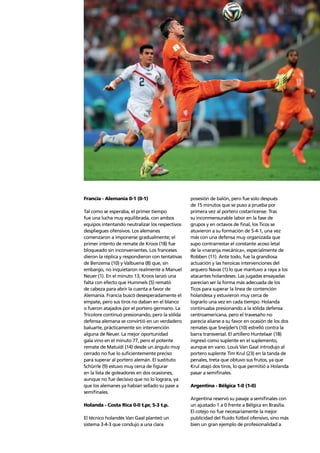
  • 171.
    169Statistics and teamdataOfficial FIFA awards The FIFA Fair Play Trophy is given to the team with the best fair play record, according to a points system and criteria specified by the competition regulations. The Hyundai Young Player Award is given by the FIFA Technical Study Group. The player must be born on or after 1 January 1993. adidas Golden Boot 1. James Rodríguez (COL, 10) 2. Thomas Müller (GER, 13) 3. Neymar (BRA, 10) This award goes to the top goalscorer of the 2014 FIFA World Cup Brazil™. Assists are included if two or more players are equal on goals scored. The FIFA Technical Study Group, which was represented at each match, decides whether an assist is to be counted. If two or more players remain equal, the player who had played fewer minutes in the final competition is ranked first. FIFA Fair Play Trophy 1. Colombia Hyundai Young Player Award 1. Paul Pogba (FRA, 19)
  • 172.
    170 Statistics andteam data Official FIFA awards MAN OF THE MATCH Group matches 12.06. BRA v. CRO NEYMAR (BRA, 10) 13.06. MEX v. CMR DOS SANTOS Giovani (MEX, 10) 13.06. ESP v. NED VAN PERSIE Robin (NED, 9) 13.06. CHI v. AUS SANCHEZ Alexis (CHI, 7) 14.06. COL v. GRE RODRIGUEZ James (COL, 10) 14.06. CIV v. JPN TOURE Yaya (CIV, 19) 14.06. URU v. CRC CAMPBELL Joel (CRC, 9) 14.06. ENG v. ITA BALOTELLI Mario (ITA, 9) 15.06. SUI v. ECU SHAQIRI Xherdan (SUI, 23) 15.06. FRA v. HON BENZEMA Karim (FRA, 10) 15.06. ARG v. BIH MESSI Lionel (ARG, 10) 16.06. IRN v. NGA MIKEL John Obi (NGA, 10) 16.06. GER v. POR MUELLER Thomas (GER, 13) 16.06. GHA v. USA DEMPSEY Client (USA, 8) 17.06. BEL v. ALG DE BRUYNE Kevin (BEL, 7) 17.06. RUS v. KOR SON Heungmin (KOR, 9) 17.06. BRA v. MEX OCHOA Guillermo (MEX, 13) 18.06. CMR v. CRO MANDZUKIC Mario (CRO, 17) 18.06. ESP v. CHI VARGAS Eduardo (CHI, 11) 18.06. AUS v. NED ROBBEN Arjen (NED, 11) 19.06. COL v. CIV RODRIGUEZ James (COL, 10) 19.06. JPN v. GRE HONDA Keisuke (JPN, 4) 19.06. URU v. ENG SUAREZ Luis (URU, 9) 20.06. ITA v. CRC RUIZ Bryan (CRC, 10) 20.06. SUI v. FRA BENZEMA Karim (FRA, 10) 20.06. HON v. ECU VALENCIA Enner (ECU, 13) 21.06. ARG v. IRN MESSI Lionel (ARG, 10) 21.06. NGA v. BIH ODEMWINGIE Peter (NGA, 8) 21.06. GER v. GHA GOETZE Mario (GER, 19) 22.06. USA v. POR HOWARD Tim (USA, 1) 22.06. BEL v. RUS HAZARD Eden (BEL, 10) 22.06. KOR v. ALG SLIMANI Islam (ALG, 13) 23.06. CMR v. BRA NEYMAR (BRA, 10) 23.06. CRO v. MEX MARQUEZ Rafael (MEX, 4) 23.06. AUS v. ESP VILLA David (ESP, 7) 23.06. NED v. CHI ROBBEN Arjen (NED, 11) 24.06. JPN v. COL MARTINEZ Jackson (COL, 21) 24.06. GRE v. CIV SAMARAS Georgios (GRE, 7) 24.06. ITA v. URU BUFFON Gianluigi (ITA, 1) 24.06. CRC v. ENG NAVAS Keylor (CRC, 1) 25.06. HON v. SUI SHAQIRI Xherdan (SUI, 23) 25.06. ECU v. FRA DOMINGUEZ Alexander (ECU, 11) 25.06. NGA v. ARG MESSI Lionel (ARG, 10) 25.06. BIH v. IRN DZEKO Edin (BIH, 11) 26.06. USA v. GER MUELLER Thomas (GER, 13) 26.06. POR v. GHA CRISTIANO RONALDO (POR, 7) 26.06. KOR v. BEL VERTONGHEN Jan (BEL, 5) 26.06. ALG v. RUS SLIMANI Islam (ALG, 13) Round of 16 28.06. BRA v. CHI NEYMAR (BRA, 10) 28.06. COL v. URU RODRIGUEZ James (COL, 10) 29.06. NED v. MEX OCHOA Guillermo (MEX, 13) 29.06. CRC v. GRE NAVAS Keylor (CRC, 1) 30.06. FRA v. NGA POGBA Paul (FRA, 19) 30.06. GER v. ALG MBOHLI Rais (ALG 23) 01.07. ARG v. SUI MESSI Lionel (ARG, 10) 01.07. BEL v. USA HOWARD Tim (USA, 1) Quarter-finals 04.07. BRA v. COL DAVID LUIZ (BRA, 4) 04.07. FRA v. GER HUMMELS Mats (GER, 5) 05.07. NED v. CRC NAVAS Keylor (CRC, 1) 05.07. ARG v. BEL HIGUAIN Gonzalo (ARG, 9) Semi-finals 08.07. BRA v. GER KROOS Toni (GER, 18) 09.07. NED v. ARG ROMERO Sergio (ARG, 1) Match for third place 12.07. BRA v. NED ROBBEN Arjen (NED, 11) Final 13.07. GER v. ARG GOETZE Mario (GER, 19) Lionel Messi (ARG, 10) was named “man of the match” four times.
  • 173.
    171Statistics and teamdataStatistics COMPARISON SOUTH AFRICA 2010 AND BRAZIL 2014 BRA 2014 RSA 2010 Number of goals scored: 171 145 Average per match: 2.67 2.27 Number of wins: 47 47 Number of draws: 9 14 Number of wins in extra-time: 4 1 Number of penalty shoot-outs (PSO): 4 2 Number of penalties awarded: 13 15 Number of penalties converted: 12 9 Number of matches ending 1-0: 10 17 Number of matches ending 0-0: 5 7 Highest score: 1-7 7-0 (BRA v. GER) (POR v. PRK) Number of goals scored by substitutes: 32 15 Number of matches won by numerically inferior teams: 1 1 Number of wins after conceding 1st goal: 8 4 LIST OF GOALSCORERS AND ASSISTS* Player Goals Assists 1 RODRIGUEZ James (COL, 10) 6 2 2 MUELLER Thomas (GER, 13) 5 3 3 NEYMAR (BRA, 10; mins played: 457) 4 1 4 MESSI Lionel (ARG, 10; mins played: 693) 4 1 5 VAN PERSIE Robin (NED, 9) 4 0 6 BENZEMA Karim (FRA, 10) 3 2 7 SCHUERRLE Andre (GER, 9) 3 1 8 ROBBEN Arjen (NED, 11) 3 1 9 VALENCIA Enner (ECU, 13) 3 0 10 SHAQIRI Xherdan (SUI, 23) 3 0 11 KROOS Toni (GER, 18) 2 4 12 DJABOU Abdelmoumene (ALG, 18) 2 1 13 DEPAY Memphis (NED, 21) 2 1 14 PERISIC Ivan (CRO, 4) 2 1 15 GERVINHO (CIV, 10) 2 1 16 GYAN Asamoah (GHA, 3) 2 1 17 SLIMANI Islam (ALG, 13) 2 1 18 SANCHEZ Alexis (CHI, 7) 2 1 19 OSCAR (BRA, 11) 2 1 20 DAVID LUIZ (BRA, 4) 2 1 21 CAHILL Tim (AUS, 4) 2 0 22 BONY Wilfried (CIV, 12) 2 0 23 SUAREZ Luis (URU, 9) 2 0 24 MANDZUKIC Mario (CRO, 17) 2 0 25 MARTINEZ Jackson (COL, 21) 2 0 26 GOETZE Mario (GER, 19) 2 0 27 AYEW Andre (GHA, 10) 2 0 28 KLOSE Miroslav (GER, 11) 2 0 29 MUSA Ahmed (NGA, 7) 2 0 30 DEMPSEY Clint (USA, 8) 2 0 31 RUIZ Bryan (CRC, 10) 2 0 32 HUMMELS Mats (GER, 5) 2 0 33 CUADRADO Juan (COL, 11) 1 4 34 VARGAS Eduardo (CHI, 11) 1 2 35 VALBUENA Mathieu (FRA, 8) 1 2 36 DE BRUYNE Kevin (BEL, 7) 1 2 FEGHOULI Sofiane (ALG, 10) 1 2 38 BLIND Daley (NED, 5) 1 2 39 HUNTELAAR Klaas Jan (NED, 19) 1 1 40 LEE Keunho (KOR, 11) 1 1 41 GIROUD Olivier (FRA, 9) 1 1 42 BRAHIMI Yacine (ALG, 11) 1 1 43 ROONEY Wayne (ENG, 10) 1 1 44 CRISTIANO RONALDO (POR, 7) 1 1 HONDA Keisuke (JPN, 4) 1 1 PJANIC Miralem (BIH, 8) 1 1 47 PERALTA Oribe (MEX, 19) 1 1 48 GUTIERREZ Teofilo (COL, 9) 1 1 49 POGBA Paul (FRA, 19) 1 1 50 CAVANI Edinson (URU, 21) 1 1 MARQUEZ Rafael (MEX, 4) 1 1 52 ARANGUIZ Charles (CHI, 20) 1 1 53 KHEDIRA Sami (GER, 6) 1 1 54 SAMARAS Georgios (GRE, 7) 1 1 55 CAMPBELL Joel (CRC, 9) 1 1 56 HIGUAIN Gonzalo (ARG, 9) 1 1 57 SNEIJDER Wesley (NED, 10) 1 1 58 OEZIL Mesut (GER, 8) 1 1 59 FER Leroy (NED, 18) 1 0 60 GREEN Julian (USA, 16) 1 0 61 MATA Juan (ESP, 13) 1 0 62 BROOKS John (USA, 6) 1 0 63 VARELA (POR, 18) 1 0 64 DZEMAILI Blerim (SUI, 15) 1 0 65 VILLA David (ESP, 7) 1 0 66 BEAUSEJOUR Jean (CHI, 15) 1 0 67 HERNANDEZ Javier (MEX, 14) 1 0 68 VRSAJEVIC Avdija (BIH, 2) 1 0 69 QUINTERO Juan (COL, 20) 1 0 70 VALDIVIA Jorge (CHI, 10) 1 0 71 KERZHAKOV Aleksandr (RUS, 11) 1 0 72 URENA Marcos (CRC, 21) 1 0 73 SAMARIS Andreas (GRE, 22) 1 0 74 SEFEROVIC Haris (SUI, 9) 1 0 75 IBISEVIC Vedad (BIH, 9) 1 0 TORRES Fernando (ESP, 9) 1 0 77 LUKAKU Romelu (BEL, 9) 1 0 78 MATIP Joel (CMR, 21) 1 0 79 ALONSO Xabi (ESP, 14) 1 0 80 BALOTELLI Mario (ITA, 9) 1 0 81 SISSOKO Moussa (FRA, 18) 1 0 82 MARCHISIO Claudio (ITA, 8) 1 0 83 COSTLY Carlo (HON, 13) 1 0 84 OLIC Ivica (CRO, 18) 1 0 85 ORIGI Divock (BEL, 17) 1 0 86 SON Heungmin (KOR, 9) 1 0 87 OKAZAKI Shinji (JPN, 9) 1 0 88 STURRIDGE Daniel (ENG, 9) 1 0 89 DZEKO Edin (BIH, 11) 1 0
  • 174.
    172 Statistics andteam data Statistics 90 GHOOCHANNEJAD Reza (IRN, 16) 1 0 JEDINAK Mile (AUS, 15) 1 0 KOKORIN Alexander (RUS, 9) 1 0 KOO Jacheol (KOR, 13) 1 0 NANI (POR, 17) 1 0 95 MERTENS Dries (BEL, 14) 1 0 96 ODEMWINGIE Peter (NGA, 8) 1 0 97 DOS SANTOS Giovani (MEX, 10) 1 0 98 FERNANDINHO (BRA, 5) 1 0 99 XHAKA Granit (SUI, 10) 1 0 100 GUARDADO Andres (MEX, 18) 1 0 101 DUARTE Oscar (CRC, 6) 1 0 102 MEHMEDI Admir (SUI, 18) 1 0 103 GODIN Diego (URU, 3) 1 0 104 HALLICHE Rafik (ALG, 5) 1 0 105 JONES Jermaine (USA, 13) 1 0 PAPASTATHOPOULOS Sokratis (GRE, 19) 1 0 107 FELLAINI Marouane (BEL, 8) 1 0 108 ARMERO Pablo (COL, 7) 1 0 109 DI MARIA Angel (ARG, 7) 1 0 110 MATUIDI Blaise (FRA, 14) 1 0 111 VERTONGHEN Jan (BEL, 5) 1 0 112 FRED (BRA, 9) 1 0 113 WIJNALDUM Georginio (NED, 20) 1 0 114 SILVA Thiago (BRA, 3) 1 0 115 ROJO Marcos (ARG, 16) 1 0 116 DE VRIJ Stefan (NED, 3) 1 0 117 AGUILAR Abel (COL, 8) 0 2 118 DRMIC Josip (SUI, 19) 0 2 119 ZUSI Graham (USA, 19) 0 2 120 AURIER Serge (CIV, 17) 0 2 AYOVI Walter (ECU, 10) 0 2 122 JANMAAT Daryl (NED, 7) 0 2 123 HAZARD Eden (BEL, 10) 0 2 124 RODRIGUEZ Ricardo (SUI, 13) 0 2 125 BOLANOS Christian (CRC, 7) 0 2 126 LAHM Philipp (GER, 16) 0 2 127 FABREGAS Cesc (ESP, 10) 0 1 128 SALIHOVIC Sejad (BIH, 23) 0 1 129 FRANJIC Ivan (AUS, 2) 0 1 130 RAMIREZ Gaston (URU, 18) 0 1 131 JUANFRAN (ESP, 5) 0 1 NYOM Allan (CMR, 22) 0 1 133 SUSIC Tino Sven (BIH, 14) 0 1 134 VERRATTI Marco (ITA, 23) 0 1 135 CANDREVA Antonio (ITA, 6) 0 1 136 RAMOS Adrian (COL, 19) 0 1 137 BABATUNDE Michael (NGA, 18) 0 1 138 LULIC Senad (BIH, 16) 0 1 139 PRANJIC Danijel (CRO, 3) 0 1 140 AFFUL Harrison (GHA, 23) 0 1 JOHNSON Glen (ENG, 2) 0 1 MUNTARI Sulley (GHA, 11) 0 1 143 McGOWAN Ryan (AUS, 19) 0 1 144 DE GUZMAN Jonathan (NED, 8) 0 1 145 MEDJANI Carl (ALG, 12) 0 1 146 ASAMOAH Kwadwo (GHA, 20) 0 1 BECKELES Brayan (HON, 21) 0 1 INIESTA Andres (ESP, 6) 0 1 KI Sungyueng (KOR, 16) 0 1 KOMBAROV Dmitry (RUS, 23) 0 1 NAGATOMO Yuto (JPN, 5) 0 1 NEKOUNAM Javad (IRN, 6) 0 1 PAREDES Juan (ECU, 4) 0 1 RAKITIC Ivan (CRO, 7) 0 1 155 HERRERA Hector (MEX, 6) 0 1 156 LAVEZZI Ezequiel (ARG, 22) 0 1 157 EMENIKE Emmanuel (NGA, 9) 0 1 158 BRADLEY Michael (USA, 4) 0 1 INLER Gokhan (SUI, 8) 0 1 160 GAMBOA Cristian (CRC, 16) 0 1 161 DIAZ Junior (CRC, 15) 0 1 162 LUIZ GUSTAVO (BRA, 17) 0 1 163 MARCELO (BRA, 6) 0 1 164 HOEWEDES Benedikt (GER, 4) 0 1 Own goals: 5 Total goals scored: 171 Average per match: 2.67 * If two or more players have equal amounts of goals and assists, the player who had played fewer minutes in the final competition is ranked first. HOW THE GOALS WERE SCORED Group matches (48 matches) 136 From open play 107 Combination play 22 Wing play 27 – on left side (16) – on right side (11) Defence-splitting pass 14 Diagonal ball into penalty area 6 Long-range shot 10 Solo effort 7 Exceptional finish 2 Defensive error 5 Rebound 10 Own goal 4 From set pieces 29 After a corner kick 14 – left side (8) – right side (6) Direct from a free kick 2 Following a free kick 4 Penalty 9 Throw-in 0 Shots 93 Headers 30 Penalties 9 Own goals 4
  • 175.
    173Statistics and teamdataStatistics Round of 16 (8 matches) 18 From open play 15 Combination play 2 Wing play 5 – on left side (2) – on right side (3) Defence-splitting pass 2 Diagonal ball into penalty area 0 Long-range shot 1 Solo effort 1 Exceptional finish 1 Defensive error 0 Rebound 2 Own goal 1 From set pieces 3 After a corner kick 2 – left side (2) – right side (0) Direct from a free kick 0 Following a free kick 0 Penalty 1 Throw-in 0 Shots 15 Headers 1 Penalties 1 Own goals 1 Quarter-finals (4 matches) 5 From open play 1 Combination play 0 Wing play 0 – on left side (0) – on right side (0) Defence-splitting pass 0 Diagonal ball into penalty area 0 Long-range shot 0 Solo effort 0 Exceptional finish 0 Defensive error 0 Rebound 1 Own goal 0 From set pieces 4 After a corner kick 1 – left side (1) – right side (0) Direct from a free kick 1 Following a free kick 1 Penalty 1 Throw-in 0 Shots 3 Headers 1 Penalties 1 Own goals 0 Semi-finals, match for third place and final (4 matches) 12 From open play 10 Combination play 2 Wing play 5 – on left side (2) – on right side (3) Defence-splitting pass 1 Diagonal ball into penalty area 0 Long-range shot 0 Solo effort 0 Exceptional finish 0 Defensive error 1 Rebound 1 Own goal 0 From set pieces 2 After a corner kick 1 – left side (0) – right side (1) Direct from a free kick 0 Following a free kick 0 Penalty 1 Throw-in 0 Shots 11 Headers 0 Penalties 1 Own goals 0 Overall (64 matches) 171 From open play 133 Combination play 26 Wing play 37 – on left side (20) – on right side (17) Defence-splitting pass 17 Diagonal ball into penalty area 6 Long-range shot 11 Solo effort 8 Exceptional finish 3 Defensive error 6 Rebound 14 Own goal 5 From set pieces 38 After a corner kick 18 – left side (11) – right side (7) Direct from a free kick 3 Following a free kick 5 Penalty 12 Throw-in 0 Shots 122 Headers 32 Penalties 12 Own goals 5
  • 176.
    174 Statistics andteam data Statistics WHO SCORED THE GOALS Group matches (48 matches) 136 – Strikers 78 – Midfielders 43 – Defenders 11 – Own goals 4 Round of 16 (8 matches) 18 – Strikers 8 – Midfielders 7 – Defenders 2 – Own goals 1 Quarter-finals (4 matches) 5 – Strikers 2 – Midfielders 0 – Defenders 3 – Own goals 0 Semi-finals, match for third place and final (4 matches) 12 – Strikers 6 – Midfielders 6 – Defenders 0 – Own goals 0 Overall (64 matches) 171 – Strikers 94 – Midfielders 56 – Defenders 16 – Own goals 5 WHEN THE GOALS WERE SCORED Group matches (48 matches) 136 – 1st to 15th minute: 13 – 16th to 30th minute: 18 – 31st to 45th minute: 21 – 46th to 60th minute: 21 – 61st to 75th minute: 31 – 76th to 90th minute: 32 Number of goals scored in additional time: – 1st half (after 45 minutes): 3 – 2nd half (after 90 minutes): 8 Round of 16 (8 matches) 18 – 1st to 15th minute: 0 – 16th to 30th minute: 2 – 31st to 45th minute: 1 – 46th to 60th minute: 3 – 61st to 75th minute: 0 – 76th to 90th minute: 5 – 91st to 105th minute: 3 – 106th to 120th minute: 4 Number of goals scored in additional time: – 1st half (after 45 minutes): 3 – 2nd half (after 90 minutes): 8 – 1st half extra time: 3 – 2nd half extra time: 4 Quarter-finals (4 matches) 5 – 1st to 15th minute: 3 – 16th to 30th minute: 0 – 31st to 45th minute: 0 – 46th to 60th minute: 0 – 61st to 75th minute: 1 – 76th to 90th minute: 1 – 91st to 105th minute: 0 – 106th to 120th minute: 0 Number of goals scored in additional time: – 1st half (after 45 minutes): 3 – 2nd half (after 90 minutes): 2 – 1st half extra time: 0 – 2nd half extra time: 0 Semi-finals, match for third place and final (4 matches) 12 – 1st to 15th minute: 2 – 16th to 30th minute: 5 – 31st to 45th minute: 0 – 46th to 60th minute: 0 – 61st to 75th minute: 1 – 76th to 90th minute: 3 – 91st to 105th minute: 0 – 106th to 120th minute: 1 Number of goals scored in additional time: – 1st half (after 45 minutes): 0 – 2nd half (after 90 minutes): 1 – 1st half extra time: 0 – 2nd half extra time: 0 Overall (64 matches) 171 – 1st to 15th minute: 18 – 16th to 30th minute: 25 – 31st to 45th minute: 22 – 46th to 60th minute: 24 – 61st to 75th minute: 33 – 76th to 90th minute: 41 – 91st to 105th minute: 3 – 106th to 120th minute: 5 Number of goals scored in additional time: – 1st half (after 45 minutes): 3 – 2nd half (after 90 minutes): 12 – 1st half extra time: 0 – 2nd half extra time: 1
  • 177.
    175Statistics and teamdataStatistics Overall (64 matches) 171 – 1st to 15th minute: 18 (10%) – 16th to 30th minute: 25 (15%) – 31st to 45th minute: 22 (13%) – 46th to 60th minute: 24 (14%) – 61st to 75th minute: 33 (19%) – 76th to 90th minute: 41 (24%) – 91st to 105th minute: 3 (2%) – 106th to 120th minute: 5 (3%) Number of goals scored in additional time: – 1st half (after 45 minutes): 3 – 2nd half (after 90 minutes): 12 – 1st half extra time: 0 – 2nd half extra time: 1 WHO SCORED THE GOALS WHEN THE GOALS WERE SCORED Strikers 94 Midfielders 56 Defenders 16 Own goals 5 55% 33% 9% 3% THE MOST SUCCESSFUL GOALSCORERS PENALTIES YELLOW AND RED CARDS Number of penalties awarded 13 – converted 12 – missed 0 – saved by goalkeeper 1 181 3 7 Yellow cards Red cards Red cards (indirect) (direct) 16goals Miroslav Klose (GER) 2002: 5 2006: 5 2010: 4 2014: 2 15goals Ronaldo (BRA) 1998: 4 2002: 8 2006: 3 14goals Gerd Müller (GER) 1970: 10 1974: 4 13goals Just Fontaine (FRA) 1958: 13 12 1
  • 178.
    176 Statistics andteam data Statistics WHERE THE GOALS WERE SCORED FROM Group matches (48 matches) 136 – Inside the goal area 36 – Inside the penalty area 76 – Outside the penalty area 15 – Penalties 9 Round of 16 (8 matches) 18 – Inside the goal area 5 – Inside the penalty area 9 – Outside the penalty area 3 – Penalties 1 Quarter-finals (4 matches) 5 – Inside the goal area 1 – Inside the penalty area 2 – Outside the penalty area 1 – Penalties 1 Semi-finals, match for third place and final (4 matches) 12 – Inside the goal area 1 – Inside the penalty area 10 – Outside the penalty area 0 – Penalties 1 Overall (64 matches) 171 – Inside the goal area 43 – Inside the penalty area 97 – Outside the penalty area 19 – Penalties 12 GOALS SCORED BY SUBSTITUTES Match Player Came Scored Score on min. min. CHI v. AUS BEAUSEJOUR (CHI, 15) 68’ 90’ 3-1 URU v. CRC URENA (CRC, 21) 83’ 84’ 1-3 SUI v. ECU MEHMEDI (SUI, 18) 46’ 48’ 1-1 SEFEROVIC (SUI, 9) 75’ 90’ 2-1 ARG v. BIH IBISEVIC (BIH, 9) 69’ 85’ 2-1 GHA v. USA BROOKS (USA, 6) 46’ 86’ 1-2 BEL v. ALG FELLAINI (BEL, 8) 65’ 70’ 1-1 MERTENS (BEL, 14) 46’ 80’ 2-1 RUS v. KOR LEE Keunho (KOR, 11) 56’ 68’ 0-1 KERZHAKOV (RUS, 11) 71’ 74’ 1-1 AUS v. NED DEPAY (NED, 21) 45’+3 68’ 2-3 COL v. CIV QUINTERO (COL, 20) 53’ 70’ 2-0 SUI v. FRA DZEMAILI (SUI, 15) 46’ 81’ 1-5 GER v. GHA KLOSE (GER, 11) 69’ 71’ 2-2 USA v. POR VARELA (POR, 18) 69’ 90’+5 2-2 BEL v. RUS ORIGI (BEL, 17) 57’ 88’ 1-0 CMR v. BRA FERNANDINHO (BRA, 5) 46’ 84’ 1-4 CRO v. MEX HERNANDEZ (MEX, 14) 62’ 82’ 0-3 AUS v. ESP MATA (ESP, 13) 56’ 82’ 0-3 NED v. CHI FER (NED, 18) 75’ 77’ 1-0 DEPAY (NED, 21) 69’ 90’ 2-0 JPN v. COL RODRIGUEZ (COL, 10) 46’ 90’ 1-4 GRE v. CIV SAMARIS (GRE, 22) 12’ 42’ 1-0 BONY (CIV, 12) 61’ 74’ 1-1 NED v. MEX HUNTELAAR (NED, 19) 76’ 90’+4 2-1 GER v. ALG SCHUERRLE (GER, 9) 46’ 92’ 1-0 DJABOU (ALG, 9) 100’ 120’+1 2-1 BEL v. USA LUKAKU (BEL, 9) 91’ 105’ 2-0 GREEN (USA, 16) 105’+2 107’ 2-1 BRA v. GER SCHUERRLE (GER, 9) 58’ 69’ 6-0 SCHUERRLE (GER, 9) 58’ 79’ 7-0 GER v. ARG GOETZE Mario (GER, 19) 88’ 113’ 1-0 PENALTIES Date Match No. Name 12.06. BRA v. CRO 1 NEYMAR (BRA, 10) scored 13.06. ESP v. NED 3 ALONSO (ESP, 14) scored 14.06. URU v. CRC 7 CAVANI (URU, 21) scored 15.06. FRA v. HON 10 BENZEMA (FRA, 10) scored 16.06. GER v. POR 13 MUELLER (GER, 10) scored 17.06. BEL v. ALG 15 FEGHOULI (ALG, 10) scored 18.06. AUS v. NED 20 JEDINAK (AUS, 15) scored 20.06. SUI v. FRA 25 BENZEMA (FRA, 10) saved 24.06. JPN v. COL 37 CUADRADO (COL, 11) scored 24.06. GRE v. CIV 38 SAMARAS (GRE, 7) scored 29.06. NED v. MEX 51 HUNTELAAR (NED,19) scored 04.07. BRA v. COL 57 RODRIGUEZ (COL, 10) scored 12.07. BRA v. NED 63 VAN PERSIE (NED, 9) scored Number of penalties awarded 13 – converted 12 – missed 0 – saved by goalkeeper 1 GOALS SCORED IN FIFA WORLD CUPS™ 1930-2014 Total Total Av. per Winners goals matches match 1930 Uruguay 70 18 3.89 Uruguay 1934 Italy 70 17 4.12 Italy 1938 France 84 18 4.67 Italy 1950 Brazil 88 22 4.00 Uruguay 1954 Switzerland 140 26 5.38 Germany FR 1958 Sweden 126 35 3.60 Brazil 1962 Chile 89 32 2.78 Brazil 1966 England 89 32 2.78 England 1970 Mexico 95 32 2.97 Brazil 1974 Germany FR 97 38 2.55 Germany FR 1978 Argentina 102 38 2.68 Argentina 1982 Spain 146 52 2.81 Italy 1986 Mexico 132 52 2.54 Argentina 1990 Italy 115 52 2.21 Germany FR 1994 USA 141 52 2.71 Brazil 1998 France 171 64 2.67 France
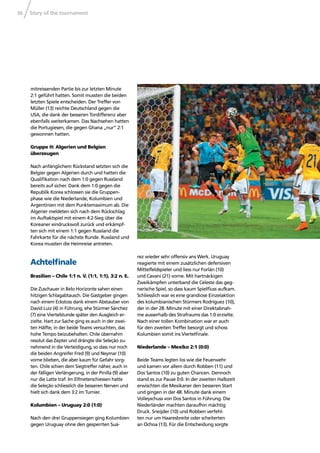
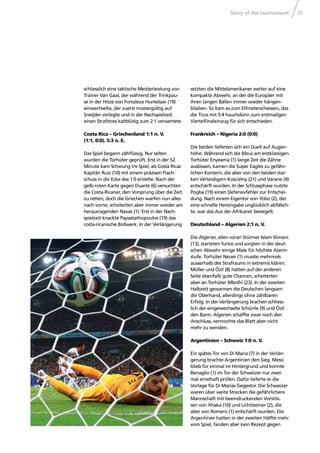
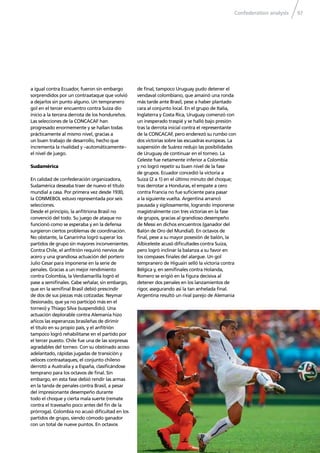
  • 179.
    177Statistics and teamdataStatistics 2002 Korea/Japan 161 64 2.52 Brazil 2006 Germany 147 64 2.30 Italy 2010 South Africa 145 64 2.27 Spain 2014 Brazil 171 64 2.67 Germany TOP GOALSCORERS 1930-2014 1930 Uruguay 1 STABILE Guillermo (ARG) 8 2 CEA Pedro (URU) 5 3 PATENAUDE Bert (USA) 4 1934 Italy 1 NEJEDLY Oldrich (TCH) 5 2 CONEN Edmund (GER) 4 SCHIAVIO Angelo (ITA) 4 1938 France 1 LEONIDAS (BRA) 7 2 PIOLA Silvio (ITA) 5 SAROSI Gyorgy (HUN) 5 ZSENGELLER Gyula (HUN) 5 1950 Brazil 1 ADEMIR (BRA) 8 2 MIGUEZ Oscar (URU) 5 3 BASORA Estanislao (ESP) 4 CHICO (BRA) 4 GHIGGIA Alcides (URU) 4 ZARRA (ESP) 4 1954 Switzerland 1 KOCSIS Sandor (HUN, 8) 11 2 HUEGI Seppe (SUI, 18) 6 MORLOCK Max (GER, 13) 6 PROBST Erich (AUT, 10) 6 1958 Sweden 1 FONTAINE Just (FRA, 17) 13 2 PELE (BRA, 10) 6 RAHN Helmut (GER, 8) 6 1962 Chile 1 ALBERT Florian (HUN, 9) 4 GARRINCHA (BRA, 7) 4 IVANOV Valentin (URS, 14) 4 JERKOVIC Drazen (YUG, 9) 4 SANCHEZ Leonel (CHI, 11) 4 VAVA (BRA, 19) 4 1966 England 1 EUSEBIO (POR, 13) 9 2 HALLER Helmut (GER, 8) 6 3 BECKENBAUER Franz (GER, 4) 4 BENE Ferenc (HUN, 7) 4 HURST Geoff (ENG, 10) 4 PORKUJAN Valeriy (URS, 17) 4 1970 Mexico 1 MUELLER Gerd (GER, 13) 10 2 JAIRZINHO (BRA, 7) 7 3 CUBILLAS Teofilo (PER, 10) 5 1974 Germany FR 1 LATO Grzegorz (POL, 16) 7 2 NEESKENS Johan (NED, 13) 5 SZARMACH Andrzej (POL, 17) 5 1978 Argentina 1 KEMPES Mario (ARG, 10) 6 2 CUBILLAS Teofilo (PER, 10) 5 RENSENBRINK Rob (NED, 12) 5 1982 Spain 1 ROSSI Paolo (ITA, 20) 6 2 RUMMENIGGE Karl-H. (GER, 11) 5 3 BONIEK Zbigniew (POL, 20) 4 ZICO (BRA, 10) 4 1986 Mexico 1 LINEKER Gary (ENG, 10) 6 2 BUTRAGUENO Emilio (ESP, 9) 5 CARECA (BRA, 9) 5 MARADONA Diego (ARG, 10) 5 1990 Italy 1 SCHILLACI Salvatore (ITA, 19) 6 2 SKUHRAVY Tomas (CZE, 10) 5 3 LINEKER Gary (ENG, 10) 4 MATTHAEUS Lothar (GER, 10) 4 MICHEL (ESP, 21) 4 MILLA Roger (CMR, 9) 4 1994 USA 1 SALENKO Oleg (RUS, 9) 6 STOICHKOV Hristo (BUL, 8) 6 3 ANDERSSON Kennet (SWE, 19) 5 BAGGIO Roberto (ITA, 10) 5 KLINSMANN Juergen (GER, 18) 5 ROMARIO (BRA, 11) 5 1998 France 1 SUKER Davor (CRO, 9) 6 2 BATISTUTA Gabriel (ARG, 9) 5 VIERI Christian (ITA, 21) 5 2002 Korea/Japan 1 RONALDO (BRA, 9) 8 2 KLOSE Miroslav (GER, 11) 5 RIVALDO (BRA, 10) 5 2006 Germany 1 KLOSE Miroslav (GER, 11) 5 2 CRESPO Hernan (ARG, 9) 3 HENRY Thierry (FRA, 12) 3 PODOLSKI Lukas (GER, 20) 3 RODRIGUEZ Maxi (ARG, 18) 3
  • 180.
    178 Statistics andteam data Statistics RONALDO (BRA, 9) 3 TORRES Fernando (ESP, 9) 3 VILLA David (ESP, 21) 3 ZIDANE Zinedine (FRA, 10) 3 2010 South Africa 1 MUELLER Thomas (GER, 13) 5 VILLA David (ESP, 7) 5 SNEIJDER Wesley (NED, 10) 5 2014 Brazil 1 RODRIGUEZ James (COL, 10) 6 2 MUELLER Thomas (GER, 13) 5 3 NEYMAR (BRA, 10) 4 MESSI Lionel (ARG, 10) 4 VAN PERSIE Robin (NED, 9) 4 TEAMS AND PLAYERS Team Average age (years/months) Algeria 26/08 Argentina 29/00 Australia 26/05 Belgium 26/00 Bosnia and Herzegovina 27/01 Brazil 28/05 Cameroon 26/08 Chile 28/00 Colombia 27/06 Costa Rica 27/06 Côte d’Ivoire 27/10 Croatia 27/05 Ecuador 27/09 England 26/07 France 26/11 Germany 26/03 Ghana 25/06 Greece 28/06 Honduras 28/07 Iran 28/07 Italy 27/11 Japan 27/03 Korea Republic 26/03 Mexico 27/04 Netherlands 26/06 Nigeria 25/08 Portugal 28/07 Russia 27/06 Spain 28/04 Switzerland 26/01 Uruguay 28/07 USA 27/10 Average of all the teams 27/04 Youngest player: OLINGA Fabrice (CMR) 12.05.1996 Oldest player: MONDRAGON Faryd (COL) 21.06.1971 OVERVIEW OF U-23 PLAYERS (born on or after 1 January 1991) Total did not Association U-23 players played play Algeria 5 5 – Argentina – – – Australia 8 6 2 Belgium 6 6 0 Bosnia and Herzegovina 4 4 0 Brazil 3 3 0 Cameroon 6 4 2 Chile – – – Colombia 4 4 0 Costa Rica 3 2 1 Côte d’Ivoire 4 2 2 Croatia 5 4 1 Ecuador 2 2 0 England 6 5 1 France 5 4 1 Germany 6 5 1 Ghana 5 4 1 Greece 3 1 2 Honduras 2 1 1 Iran 2 1 1 Italy 4 3 1 Japan 1 0 1 Korea Republic 2 2 0 Mexico 3 2 1 Netherlands 6 6 0 Nigeria 8 7 1 Portugal 2 1 1 Russia 4 2 2 Spain 1 1 0 Switzerland 8 8 0 Uruguay 1 1 0 USA 3 3 0 Total 122 99 23 YELLOW AND RED CARDS Yellow cards Group stage 124 Knockout stage 57 Red cards (indirect) Group stage 2 Knockout stage 1 Red cards (direct) Group stage 7 Knockout stage 0 Overall Yellow cards 181 Red cards (indirect) 3 Red cards (direct) 7
  • 181.
    179Statistics and teamdataStatistics ACTUAL PLAYING TIME Date Venue Match APT Group matches 12.06. São Paulo Brazil v. Croatia 53:40 13.06. Natal Mexico v. Cameroon 54:16 13.06. Salvador Spain v. Netherlands 58:02 13.06. Cuiabá Chile v. Australia 61:52 14.06. Belo Horizonte Colombia v. Greece 56:36 14.06. Recife Côte d’Ivoire v. Japan 54:57 14.06. Fortaleza Uruguay v. Costa Rica 48:32 14.06. Manaus England v. Italy 64:49 15.06. Brasília Switzerland v. Ecuador 56:36 15.06. Porto Alegre France v. Honduras 54:36 15.06. Rio de Janeiro Argentina v. Bosnia-Herzegovina 61:21 16.06. Curitiba Iran v. Nigeria 54:01 16.06. Salvador Germany v. Portugal 58:26 16.06. Natal Ghana v. USA 54:08 17.06. Fortaleza Brazil v. Mexico 56:28 17.06. Belo Horizonte Belgium v. Algeria 56:18 17.06. Cuiabá Russia v. Korea Republic 52:30 18.06. Manaus Cameroon v. Croatia 49:41 18.06. Rio de Janeiro Spain v. Chile 57:06 18.06. Porto Alegre Australia v. Netherlands 57:07 19.06. Brasília Colombia v. Côte d’Ivoire 50:19 19.06. Natal Japan v. Greece 51:40 19.06. São Paulo Uruguay v. England 47:41 20.06. Recife Italy v. Costa Rica 58:04 20.06. Salvador Switzerland v. France 53:06 20.06. Curitiba Honduras v. Ecuador 47:36 21.06. Belo Horizonte Argentina v. Iran 50:34 21.06. Cuiabá Nigeria v. Bosnia-Herzegovina 62:05 21.06. Fortaleza Germany v. Ghana 61:52 22.06. Manaus USA v. Portugal 59:02 22.06. Rio de Janeiro Belgium v. Russia 54:21 22.06. Porto Alegre Korea Republic v. Algeria 52:59 23.06. Brasília Cameroon v. Brazil 48:44 23.06. Recife Croatia v. Mexico 51:02 23.06. Curitiba Australia v. Spain 62:05 23.06. São Paulo Netherlands v. Chile 51:58 24.06. Cuiabá Japan v. Colombia 54:56 24.06. Fortaleza Greece v. Côte d’Ivoire 49:42 24.06. Natal Italy v. Uruguay 56:11 24.06. Belo Horizonte Costa Rica v. England 55:03 25.06. Manaus Honduras v. Switzerland 57:05 25.06. Rio de Janeiro Ecuador v. France 57:35 25.06. Porto Alegre Nigeria v. Argentina 55:26 25.06. Salvador Bosnia-Herzegovina v. Iran 56:40 26.06. Recife USA v. Germany 63:15 26.06. Brasília Portugal v. Ghana 57:22 26.06. São Paulo Korea Republic v. Belgium 53:47 26.06. Curitiba Algeria v. Russia 58:10 Round of 16 28.06. Belo Horizonte Brazil v. Chile 55:40* 28.06. Rio de Janeiro Colombia v. Uruguay 50:01 29.06. Fortaleza Netherlands v. Mexico 57:00 29.06. Recife Costa Rica v. Greece 49:53* 30.06. Brasília France v. Nigeria 51:18 30.06. Porto Alegre Germany v. Algeria 58:03* 01.07. São Paulo Argentina v. Switzerland 52:55* 01.07. Salvador Belgium v. USA 57:50* Quarter-finals 04.07. Fortaleza Brazil v. Colombia 39:18 04.07. Rio de Janeiro France v. Germany 55:20 05.07. Salvador Netherlands v. Costa Rica 57:28* 05.07. Brasília Argentina v. Belgium 54:03 Semi-finals 08.07. Belo Horizonte Brazil v. Germany 62:17 09.07. São Paulo Netherlands v. Argentina 61:18* Match for third place 12.07. Brasília Brazil v. Netherlands 57:04 Final 13.07. Rio de Janeiro Germany v. Argentina 56:21* * = excluding extra time Average actual playing time – first round 55:24 Average actual playing time – second round 54:44 Average actual playing time – matches 1 to 64 55:14 Comparison with South Africa 2010 54:04 BALL POSSESSION No. and match Percentage Result Group matches 1 Brazil v. Croatia 58% - 42% 3-1 2 Mexico v. Cameroon 58% - 42% 1-0 3 Spain v. Netherlands 57% - 43% 1-5 4 Chile v. Australia 62% - 38% 3-1 5 Colombia v. Greece 46% - 54% 3-0 6 Côte d’Ivoire v. Japan 57% - 43% 2-1 7 Uruguay v. Costa Rica 54% - 46% 1-3 8 England v. Italy 48% - 52% 1-2 9 Switzerland v. Ecuador 56% - 44% 2-1 10 France v. Honduras 63% - 37% 3-0 11 Argentina v. Bosnia and Herzegovina 55% - 45% 2-1 12 Iran v. Nigeria 37% - 63% 0-0 13 Germany v. Portugal 54% - 46% 4-0 14 Ghana v. USA 59% - 41% 1-2 15 Belgium v. Algeria 65% - 35% 2-1 16 Russia v. Korea 48% - 52% 1-1 17 Brazil v. Mexico 53% - 47% 0-0 18 Cameroon v. Croatia 49% - 51% 0-4 19 Spain v. Chile 56% - 44% 0-2 20 Australia v. Netherlands 48% - 52% 2-3 21 Colombia v. Côte d’Ivoire 45% - 55% 2-1 22 Japan v. Greece 68% - 32% 0-0 23 Uruguay v. England 38% - 62% 2-1 24 Italy v. Costa Rica 58% - 42% 0-1 25 Switzerland v. France 57% - 43% 2-5 26 Honduras v. Ecuador 49% - 51% 1-2 27 Argentina v. Iran 70% - 30% 1-0
  • 182.
    180 Statistics andteam data Statistics 28 Nigeria v. Bosnia and Herzegovina 46% - 54% 1-0 29 Germany v. Ghana 59% - 41% 2-2 30 USA v. Portugal 48% - 52% 2-2 31 Belgium v. Russia 53% - 47% 1-0 32 Korea Republic v. Algeria 54% - 46% 2-4 33 Cameroon v. Brazil 46% - 54% 1-4 34 Croatia v. Mexico 55% - 45% 1-3 35 Australia v. Spain 45% - 55% 0-3 36 Netherlands v. Chile 36% - 64% 2-0 37 Japan v. Colombia 56% - 44% 1-4 38 Greece v. Côte d’Ivoire 46% - 54% 2-1 39 Italy v. Uruguay 55% - 45% 0-1 40 Costa Rica v. England 47% - 53% 0-0 41 Honduras v. Switzerland 61% - 39% 0-3 42 Ecuador v. France 40% - 60% 0-0 43 Nigeria v. Argentina 43% - 57% 2-3 44 Bosnia and Herzegovina v. Iran 62% - 38% 3-1 45 USA v. Germany 37% - 63% 0-1 46 Portugal v. Ghana 54% - 46% 2-1 47 Korea Republic v. Belgium 51% - 49% 0-1 48 Algeria v. Russia 47% - 53% 1-1 Round of 16 49 Brazil v. Chile 49% - 51% PSO 3-2 50 Colombia v. Uruguay 54% - 46% 2-0 51 Netherlands v. Mexico 55% - 45% 2-1 52 Costa Rica v. Greece 43% - 57% PSO 5-3 53 France v. Nigeria 49% - 51% 2-0 54 Germany v. Algeria 63% - 37% a.e.t. 2-1 55 Argentina v. Switzerland 61% - 39% a.e.t. 1-0 56 Belgium v. USA 47% - 53% a.e.t. 2-1 Quarter-finals 57 Brazil v. Colombia 51% - 49% 2-1 58 France v. Germany 50% - 50% 0-1 59 Netherlands v. Costa Rica 64% - 36% PSO 4-3 60 Argentina v. Belgium 51% - 49% 1-0 Semi-finals 61 Brazil v. Germany 51% - 49% 1-7 62 Netherlands v. Argentina 53% - 47% PSO 2-4 Match for third place 63 Brazil v. Netherlands 58% - 42% 0-3 Final 64 Germany v. Argentina 60%- 40%a.e.t. 1-0 ATTENDANCES Date Venue Match Attendance Group matches 12.06. São Paulo Brazil v. Croatia 62,103 13.06. Natal Mexico v. Cameroon 39,216 13.06. Salvador Spain v. Netherlands 48,173 13.06. Cuiabá Chile v. Australia 40,275 14.06. Belo Horizonte Colombia v. Greece 57,174 14.06. Recife Côte d’Ivoire v. Japan 40,267 14.06. Fortaleza Uruguay v. Costa Rica 58,679 14.06. Manaus England v. Italy 39,800 15.06. Brasília Switzerland v. Ecuador 68,351 15.06. Porto Alegre France v. Honduras 43,012 15.06. Rio de Janeiro Argentina v. Bosnia and Herzegovina 74,738 16.06. Curitiba Iran v. Nigeria 39,081 16.06. Salvador Germany v. Portugal 51,081 16.06. Natal Ghana v. USA 39,760 17.06. Fortaleza Brazil v. Mexico 60,342 17.06. Belo Horizonte Belgium v. Algeria 56,800 17.06. Cuiabá Russia v. Korea Republic 37,603 18.06. Manaus Cameroon v. Croatia 39,982 18.06. Rio de Janeiro Spain v. Chile 74,101 18.06. Porto Alegre Australia v. Netherlands 42,877 19.06. Brasília Colombia v. Côte d’Ivoire 68,748 19.06. Natal Japan v. Greece 39,485 19.06. São Paulo Uruguay v. England 62,575 20.06. Recife Italy v. Costa Rica 40,285 20.06. Salvador Switzerland v. France 51,003 20.06. Curitiba Honduras v. Ecuador 39,224 21.06. Belo Horizonte Argentina v. Iran 57,698 21.06. Cuiabá Nigeria v. Bosnia-Herzegovina 40,499 21.06. Fortaleza Germany v. Ghana 59,621 22.06. Manaus USA v. Portugal 40,123 22.06. Rio de Janeiro Belgium v. Russia 73,819 22.06. Porto Alegre Korea Republic v. Algeria 42,732 23.06. Brasília Cameroon v. Brazil 69,112 23.06. Recife Croatia v. Mexico 41,212 23.06. Curitiba Australia v. Spain 39,375 23.06. São Paulo Netherlands v. Chile 62,996 24.06. Cuiabá Japan v. Colombia 40,340 24.06. Fortaleza Greece v. Côte d’Ivoire 59,095 24.06. Natal Italy v. Uruguay 39,706 24.06. Belo Horizonte Costa Rica v. England 57,823 25.06. Manaus Honduras v. Switzerland 40,322 25.06. Rio de Janeiro Ecuador v. France 73,749 25.06. Porto Alegre Nigeria v. Argentina 43,285 25.06. Salvador Bosnia-Herzegovina v. Iran 48,011 26.06. Recife USA v. Germany 41,876 26.06. Brasília Portugal v. Ghana 67,540 26.06. São Paulo Korea Republic v. Belgium 61,397 26.06. Curitiba Algeria v. Russia 39,311 Round of 16 28.06. Belo Horizonte Brazil v. Chile 57,714 28.06. Rio de Janeiro Colombia v. Uruguay 73,804 29.06. Fortaleza Netherlands v. Mexico 58,817 29.06. Recife Costa Rica v. Greece 41,242 30.06. Brasília France v. Nigeria 67,882 30.06. Porto Alegre Germany v. Algeria 43,063 01.07. São Paulo Argentina v. Switzerland 63,255 01.07. Salvador Belgium v. USA 51,227 Quarter-finals 04.07. Fortaleza Brazil v. Colombia 60,342 04.07. Rio de Janeiro France v. Germany 74,240
  • 183.
    181Statistics and teamdataStatistics 05.07. Salvador Netherlands v. Costa Rica 51,179 05.07. Brasília Argentina v. Belgium 68,551 Semi-finals 08.07. Belo Horizonte Brazil v. Germany 58,141 09.07. São Paulo Netherlands v. Argentina 63,267 Match for third place 12.07. Brasília Brazil v. Netherlands 68,034 Final 13.07. Rio de Janeiro Germany v. Argentina 74,738 Total attendance – group matches (1 to 48) 2,454,377 Average attendance 51,133 Total attendance – second round (49 to 64) 975,496 Average attendance 60,969 Total attendance – matches 1 to 64 3,429,873 Comparison with South Africa 3,178,856 Average attendance – matches 1 to 64 53,592 Comparison with South Africa 49,670 ATTENDANCE PER VENUE/ STADIUM Venue/Stadium Total Total Average matches attendance attendance Belo Horizonte 6 345,350 57,350 Brasília 7 478,218 68,317 Cuiabá 4 158,717 39,679 Curitiba 4 156’991 39’248 Fortaleza 6 356,896 59,827 Manaus 4 160,227 40,057 Natal 4 158,167 39,542 Porto Alegre 5 214,969 42,994 Recife 5 204,882 40,976 Rio de Janeiro 7 519,189 74,170 Salvador 6 300,674 50,112 São Paulo 6 375,593 62,599 Total 64 3,429,873 53,592 ATTENDANCES 1930-2014 Total Total Ave. per matches spectators match 1930 Uruguay 18 434,500 24,139 1934 Italy 17 395,000 23,235 1938 France 18 483,000 26,833 1950 Brazil 22 1,337,000 60,773 1954 Switzerland 26 943,000 36,269 1958 Sweden 35 868,000 24,800 1962 Chile 32 776,000 24,250 1966 England 32 1,614,677 50,459 1970 Mexico 32 1,673,975 52,312 1974 Germany 38 1,774,022 46,685 1978 Argentina 38 1,610,215 42,374 1982 Spain 52 1,856,277 35,698 1986 Mexico 52 2,407,431 46,297 1990 Italy 52 2,517,348 48,411 1994 USA 52 3,587,538 68,991 1998 France 64 2,785,100 43,517 2002 Korea/Japan 64 2,705,134 42,268 2006 Germany 64 3,359,439 52,491 2010 South Africa 64 3,178,856 49,670 2014 Brazil 64 3,429,873 53,592 HIGHEST ATTENDANCES IN FIFA WORLD CUP™ HISTORY Att. Date Match and result Tournament 173,850 16.07.50 Uruguay v. Brazil 2-1 Brazil 152,772 13.07.50 Brazil v. Spain 6-1 Brazil 142,429 01.07.50 Brazil v. Yugoslavia 2-0 Brazil 138,886 09.07.50 Brazil v. Sweden 7-1 Brazil 114,600 07.06.86 Mexico v. Paraguay 1-1 Mexico 114,600 29.06.86 Argentina v. Germany FR 3-2 Mexico 114,580 15.06.86 Mexico v. Bulgaria 2-0 Mexico 114,580 22.06.86 Argentina v. England 2-1 Mexico 114,500 25.06.86 Argentina v. Belgium 2-0 Mexico 110,000 03.06.86 Belgium v. Mexico 1-2 Mexico 108,192 11.06.70 Mexico v. Belgium 1-0 Mexico 107,412 21.06.70 Brazil v. Italy 4-1 Mexico 107,160 31.05.70 Mexico v. Soviet Union 0-0 Mexico 104,403 20.06.70 Germany FR v. Uruguay 1-0 Mexico 103,763 11.06.86 Iraq v. Mexico 0-1 Mexico 103,058 07.06.70 Mexico v. El Salvador 4-0 Mexico 102,444 17.06.70 Italy v. Germany FR 4-3 Mexico 98,728 18.06.86 England v. Paraguay 3-0 Mexico 98,270 20.07.66 England v. France 2-0 England 96,924 30.07.66 England v. Germany FR 4-2 England 96,000 31.05.86 Bulgaria v. Italy 1-1 Mexico 95,261 06.06.70 Soviet Union v. Belgium 4-1 Mexico 95,000 13.06.82 Argentina v. Belgium 0-1 Spain 94,493 26.07.66 England v. Portugal 2-1 England 94,194 17.07.94 Brazil v. Italy 0-0 USA 93,869 22.06.94 USA v. Colombia 2-1 USA 93,869 26.06.94 USA v. Romania 0-1 USA 93,194 19.06.94 Cameroon v. Sweden 2-2 USA 92,570 16.07.66 England v. Mexico 2-0 England 92,205 03.06.70 Belgium v. El Salvador 3-0 Mexico 91,856 18.06.94 Colombia v. Romania 1-3 Mexico 91,856 13.07.94 Sweden v. Brazil 0-1 USA 91,500 16.07.94 Sweden v. Bulgaria 4-0 USA 90,584 23.07.66 England v. Argentina 1-0 England 90,469 03.07.94 Romania v. Argentina 3-2 USA 90,089 02.07.82 Germany FR v. Spain 2-1 Spain
  • 184.
    182 Statistics andteam data Statistics PLAYERS WHO PARTICIPATED IN PREVIOUS FIFA COMPETITIONS Algeria BOUGUERRA Madjid: WC 10 HALLICHE Rafik: WC 10 LACEN Medhi: WC 10 MBOLHI Rais: WC 10 MEDJANI Carl: WC 10 MESBAH Djamel: WC 10 YEBDA Hassan: WC 10, (U-17 WC 01 for FRA) Argentina AGUERO Sergio: WYC 05, U-20 WC 07, OFT 08, WC 10 ANDUJAR Mariano: WC 10 BASANTA Jose Maria: CWC 11, CWC 12, CWC 13 BIGLIA Lucas: U-17 WC 03, WYC 05 DEMICHELIS Martin: CC 05, WC 10 DI MARIA Angel: U-20 WC 07, OFT 08, WC 10 FERNANDEZ Federico: CWC 09 GAGO Fernando: U-17 WC 03, WYC 05, OFT 08 GARAY Ezequiel: U-17 WC 03, WYC 05, OFT 08 HIGUAIN Gonzalo: WC 10 LAVEZZI Ezequiel: OFT 08 MASCHERANO Javier: U-17 WC 01, WYC 03, OFT 04, WC 06, OFT 08, WC 10, CWC 11 MESSI Lionel: WYC 05, WC 06, OFT 08, CWC 09, WC 10, CWC 11 PALACIO Rodrigo: WC 06, CWC 07 PEREZ Enzo: CWC 09 RODRIGUEZ Maxi: U-17 WC 01, OFT 04, CC 05, WC 06, WC 10 ROJO Marcos: CWC 09 ROMERO Sergio: U-20 WC 07, OFT 08, WC 10 ZABALETA Pablo: U-17 WC 01, WYC 03, WYC 05, OFT 08 Australia BRESCIANO Mark: WYC 99, OFT 00, CC 01, WC 06, WC 10 CAHILL Tim: OFT 04, CC 05, WC 06, WC 10 GALEKOVIC Eugen: OFT 04, CWC 08, WC 10 HOLLAND James: U-20 WC 09 JEDINAK Mile: WYC 03, WC 10 McGOWAN Ryan: U-20 WC 09 McKAY Matt: WYC 03 MILLIGAN Mark: WYC 05, CWC 05, WC 06, OFT 08, WC 10 OAR Tommy: U-20 WC 09, U-20 WC 11 SPIRANOVIC Matthew: U-17 WC 05, OFT 08 TAGGART Adam: U-20 13 TROISI James: OFT 08 VIDOSIC Dario: WC 10 WILKINSON Alex: U-17 WC 01, WYC 03 Belgium CIMAN Laurent: OFT 08 DEMBELE Moussa: OFT 08 FELLAINI Marouane: OFT 08 HAZARD Eden: U-17 WC 07, CWC 12 KOMPANY Vincent: OFT 08 MIRALLAS Kevin: OFT 08 VAN BUYTEN Daniel: WC 02, CWC 13 VANDEN BORRE Anthony: OFT 08 VERMAELEN Thomas: OFT 08 VERTONGHEN Jan: OFT 08 Bosnia and Herzegovina BEGOVIC Asmir: (WYC 05, U-20 WC 07 for CAN) MEDUNJANIN Haris: (WYC 05 for NED) Brazil ALVES Dani: WYC 03, CWC 09, CC 09, WC 10, CWC 11, CC 13 BERNARD: CC 13 DANTE: CC 13, CWC 13 DAVID LUIZ: U-20 WC 07, CWC 12, CC 13 FERNANDINHO: WYC 03 FRED: WC 06, CC 13 HERNANES: OFT 08, CC 13 HULK: OFT 12, CC 13 JEFFERSON: WYC 03, CC 13 JO: U-20 WC 07, OFT 08, CC 13, CWC 13 JULIO CESAR: U-17 WC 95, WYC 99, OFT 00, CC 03, WC 06, CC 09, WC 10, CWC 10, CC 13 LUIZ GUSTAVO: CC 13 MAICON: U-17 WC 01, CC 05, CC 09, CWC 10, WC 10 MARCELO: U-17 WC 05, U-20 WC 07, OFT 08, OFT 12, CC 13 MAXWELL: CWC 09, CWC 11 NEYMAR: U-17 WC 09, CWC 11, OFT 12, CC 13 OSCAR: CWC 10, U-20 WC 11, OFT 12, CWC 12, CC 13 PAULINHO: CWC 12, CC 13 RAMIRES: OFT 08, CC 09, WC 10, CWC 12 SILVA Thiago: OFT 08, WC 10, OFT 12, CC 13 VICTOR: CC 09, CWC 13 WILLIAN: U-20 WC 07 Cameroon ABOUBAKAR Vincent: WC 10 ASSOU EKOTTO Benoit: WC 10 CHEDJOU Aurelien: OFT 08, WC 10 CHOUPO MOTING Eric: WC 10 ENOH Eyong: WC 10 ETOO Samuel: WC 98, OFT 00, CWC 00, CC 01, WC 02, CC 03, WC 10, CWC 10 MAKOUN Jean: WC 10 MATIP Joel: WC 10 MBIA Stephane: U-17 WC 03, OFT 08, WC 10 NGUEMO Landry: U-17 WC 03, WC 10 NKOULOU Nicolas: OFT 08, WC 10
  • 185.
    183Statistics and teamdataStatistics NOUNKEU Dany: U-17 WC 03 SONG Alexandre: U-17 WC 03, OFT 08, WC 10 WEBO Pierre: WC 10 Chile BEAUSEJOUR Jean: WC 10 BRAVO Claudio: WC 10 CARMONA Carlos: WYC 05, U-20 WC 07, WC 10 DIAZ Marcelo: WYC 05 FUENZALIDA Jose: WYC 05 HERRERA Johnny: OFT 00, U-17 WC 01 ISLA Mauricio: U-20 WC 07, WC 10 JARA Gonzalo: WYC 05, WC 10 MEDEL Gary: U-20 WC 07, WC 10 ORELLANA Fabian: WC 10 PAREDES Esteban: WC 10 SANCHEZ Alexis: U-20 WC 07, WC 10, CWC 11 TOSELLI Cristopher: U-20 WC 07 VALDIVIA Jorge: WC 10 VIDAL Arturo: U-20 WC 07, WC 10 Colombia AGUILAR Abel: WYC 03, WYC 05 ARIAS Santiago: U-17 WC 09, U-20 WC 11 ARMERO Pablo: U-17 WC 03 GUARIN Fredy: U-17 WC 03, WYC 03, WYC 05 MONDRAGON Faryd: OFT 92, WC 94, WC 98 OSPINA David: WYC 05 QUINTERO Juan: U-20 13 RAMOS Adrian: U-17 WC 03 RODRIGUEZ James: U-17 WC 07, U-20 WC 11 VALDES Carlos: WYC 05 YEPES Mario: CC 03 ZAPATA Cristian: U-17 WC 03, WYC 05 ZUNIGA Juan: WYC 05 Costa Rica BOLANOS Christian: U-17 WC 01, CWC 05, WC 06 BORGES Celso: U-17 WC 05, U-20 WC 07 CALVO Diego: U-20 WC 11 CAMBRONERO Daniel: U-17 WC 03 CAMPBELL Joel: U-17 WC 09, U-20 WC 11 CUBERO Jose: U-20 WC 07 DIAZ Junior: OFT 04 GAMBOA Cristian: U-20 WC 09 GONZALEZ Giancarlo: U-20 WC 07 MILLER Roy: U-17 WC 01 MYRIE Dave: U-17 WC 05, U-20 WC 07 NAVAS Keylor: U-17 WC 03, CWC 05 PEMBERTON Patrick: OFT 04 TEJEDA Yeltsin: U-17 WC 09, U-20 WC 11 UMANA Michael: OFT 04, WC 06 URENA Marcos: U-17 WC 07, U-20 WC 09 Côte d’Ivoire BAMBA Souleymane: WYC 03, OFT 08, WC 10 BARRY Boubacar: WC 06, WC 10 BOKA Arthur: WC 06, WC 10 DIARRASSOUBA Ousmane: OFT 08 DROGBA Didier: WC 06, WC 10 GERVINHO: OFT 08, WC 10 KALOU Salomon: OFT 08, WC 10 TIOTE Ismael: WC 10 TOURE Kolo: WC 06, WC 10 TOURE Yaya: WC 06 CWC 09, WC 10 ZOKORA Didier: WC 06, WC 10 Croatia MANDZUKIC Mario: CWC 13 MODRIC Luka: WC 06 OLIC Ivica: WC 02, WC 06 PLETIKOSA Stipe: WYC 99, WC 02, WC 06 REBIC Ante: U-20 13 SRNA Darijo: WC 06 ZELENIKA Oliver: U-20 13 Ecuador AYOVI Walter: WC 02 CWC 11, CWC 12 DOMINGUEZ Alexander: CWC 08 GRUEZO Carlos: U-17 WC 11 GUAGUA Jorge: U-17 WC 01, WC 06 MENDEZ Edison: WC 02, WC 06 SARITAMA Luis: WC 06 VALENCIA Antonio: WC 06 England BARKLEY Ross: U-20 13 CAHILL Gary: CWC 12 GERRARD Steven: CWC 05, WC 06, WC 10 HART Joe: WC 10 JOHNSON Glen: WC 10 LAMPARD Frank: WC 06, WC 10, CWC 12 MILNER James: WYC 03, WC 10 ROONEY Wayne: WC 06, CWC 08, WC 10 STERLING Raheem: U-17 WC 11 STURRIDGE Daniel: OFT 12, CWC 12 WELBECK Danny: U-17 WC 07, CWC 08 France DIGNE Lucas: U-20 13 EVRA Patrice: CWC 08, WC 10 GRIEZMANN Antoine: U-20 WC 11 LANDREAU Mickael: WYC 97, CC 01, CC 03, WC 06 LLORIS Hugo: WC 10 POGBA Paul: U-20 13 SAGNA Bacary: WC 10 SAKHO Mamadou: U-17 WC 07 VALBUENA Mathieu: WC 10 Germany BOATENG Jerome: WC 10, CWC 13 GOETZE Mario: U-17 WC 09, CWC 13 KHEDIRA Sami: WC 10 KLOSE Miroslav: WC 02, WC 06, WC 10 KROOS Toni: U-17 WC 07, WC 10, CWC 13 LAHM Philipp: WC 06, WC 10, CWC 13 MERTESACKER Per: CC 05, WC 06, WC 10 MUELLER Thomas: WC 10, CWC 13
  • 186.
    184 Statistics andteam data Statistics MUSTAFI Shkodran: U-17 WC 09 NEUER Manuel: WC 10, CWC 13 OEZIL Mesut: WC 10 PODOLSKI Lukas: CC 05, WC 06, WC 10 SCHWEINSTEIGER Bastian: CC 05, WC 06, WC 10 WEIDENFELLER Roman: U-17 WC 97 ZIELER Ron-Robert: U-20 WC 09 Ghana AFFUL Harrison: CWC 11 ASAMOAH Kwadwo: WC 10 AYEW Andre: U-20 WC 09, WC 10 BADU Emmanuel: U-20 WC 09 BOATENG Kevin Prince: WC 10 ESSIEN Michael: U-17 WC 99, U-17 WC 01, WC 06 GYAN Asamoah: OFT 04, WC 06, WC 10 INKOOM Samuel: U-20 WC 09, WC 10 MENSAH Jonathan: U-20 WC 09, WC 10 MUNTARI Sulley: U-17 WC 01, WC 06, WC 10, CWC 10 OPARE Daniel: U-17 WC 07, U-20 WC 09 RABIU Mohammed: U-20 WC 09 WAKASO Mubarak: U-17 WC 05 Greece GEKAS Theofanis: CC 05, WC 10 KAPINO Stefanos: U-20 13 KARAGOUNIS Georgios: CC 05, WC 10 KATSOURANIS Konstantinos: CC 05, WC 10 MORAS Vangelis: OFT 04, WC 10 PAPASTATHOPOULOS Sokratis: WC 10 SALPINGIDIS Dimitrios: OFT 04, WC 10 SAMARAS Georgios: WC 10 TOROSIDIS Vasileios: WC 10 TZIOLIS Alexandros: WC 10 VYNTRA Loukas: OFT 04, CC 05, WC 10 Honduras BENGTSON Jerry: OFT 12 BERNARDEZ Victor: WC 10 CHAVEZ Osman: WC 10 CLAROS Jorge: WYC 05, OFT 08 DELGADO Edder: OFT 08 ESCOBER Donis: WC 10 ESPINOZA Roger: WC 10, OFT 12 FIGUEROA Maynor: WC 10, OFT 12 GARCIA Boniek: WC 10 GARRIDO Luis: U-17 WC 07, OFT 12 IZAGUIRRE Emilio: WYC 05, WC 10 MARTINEZ Mario: U-20 WC 09, OFT 12 NAJAR Andy: OFT 12 PALACIOS Jerry: WC 10 PALACIOS Wilson: WC 10 VALLADARES Noel: OFT 00, WC 10 Iran HAJI SAFI Ehsan: CWC 07 NEKOUNAM Javad: WC 06 SADEGHI Amirhossein: WC 06 SHOJAEI Masoud: WC 06 TIMOTIAN Andranik: WC 06
  • 187.
    185Statistics and teamdataStatistics Italy ABATE Ignazio: OFT 08, CC 13 AQUILANI Alberto: OFT 04, CC 13 BALOTELLI Mario: CC 13 BARZAGLI Andrea: OFT 04, WC 06, CC 13 BONUCCI Leonardo: WC 10, CC 13 BUFFON Gianluigi: U-17 93, OFT 96, WC 98, WC 02, WC 06, CC 09, WC 10, CC 13 CANDREVA Antonio: OFT 08, CC 13 CERCI Alessio: CC 13 CHIELLINI Giorgio: OFT 04, CC 09, WC 10, CC 13 DE ROSSI Daniele: OFT 04, WC 06, CC 09, WC 10, CC 13 DE SCIGLIO Mattia: CC 13 MARCHISIO Claudio: OFT 08, WC 10, CC 13 MOTTA Thiago: CWC 06, CWC 10 PALETTA Gabriel: CWC 07, (WYC 05 for ARG) PERIN Mattia: U-17 WC 09 PIRLO Andrea: OFT 00, OFT 04, WC 06, CWC 07, CC 09, WC 10, CC 13 SIRIGU Salvatore: CC 13 Japan AOYAMA Toshihiro: CWC 12 ENDO Yasuhito: WYC 99, OFT 00, CC 03, CC 05, WC 06, CWC 08, WC 10, CC 13 GONDA Shuichi: OFT 12, CC 13 HASEBE Makoto: CWC 07, WC 10, CC 13 HONDA Keisuke: WYC 05, OFT 08, WC 10, CC 13 INOHA Masahiko: WYC 05, CC 13 KAGAWA Shinji: U-20 WC 07, OFT 08, CC 13 KAKITANI Yoichiro: U-17 WC 07 KAWASHIMA Eiji: WYC 03, WC 10, CC 13 KIYOTAKE Hiroshi: OFT 12, CC 13 KONNO Yasuyuki: WYC 03, OFT 04, WC 10, CC 13 MORISHIGE Masato: U-20 WC 07, OFT 08 NAGATOMO Yuto: OFT 08, WC 10, CC 13 NISHIKAWA Shusaku: WYC 05, OFT 08, CWC 12, CC 13 OKAZAKI Shinji: OFT 08, WC 10, CC 13 OKUBO Yoshito: CC 03, OFT 04, WC 10 SAITO Manabu: U-17 WC 07, OFT 12 SAKAI Gotoku: CWC 11, OFT 12, CC 13 SAKAI Hiroki: OFT 12, CC 13 UCHIDA Atsuto: U-20 WC 07, OFT 08, WC 10, CC 13 YAMAGUCHI Hotaru: OFT 12 YOSHIDA Maya: OFT 08, OFT 12, CC 13 Korea Republic HAN Kookyoung: U-17 WC 07 HONG Jeongho: U-20 WC 09 HWANG Seokho: OFT 12, CWC 12 JI Dongwon: OFT 12 JUNG Sungryong: WYC 05, OFT 08, WC 10, CWC 10, OFT 12 KI Sungyueng: U-20 WC 07, OFT 08, WC 10, OFT 12 KIM Bokyung: U-20 WC 09, WC 10, OFT 12 KIM Changsoo: OFT 08, OFT 12 KIM Seunggyu: U-17 WC 07, U-20 WC 09, CWC 12 KIM Shinwook: CWC 12 KIM Younggwon: U-20 WC 09, OFT 12, CWC 13 KOO Jacheol: U-20 WC 09, OFT 12 KWAK Taehwi: CWC 12 LEE Bumyoung: U-20 WC 09, OFT 12 LEE Chungyong: U-20 WC 07, OFT 08, WC 10 LEE Keunho: OFT 08, CWC 12 LEE Yong: CWC 12 PARK Chuyoung: WYC 03, WYC 05, WC 06 OFT 08, WC 10, OFT 12 PARK Jongwoo: OFT 12 PARK Jooho: U-20 WC 07 SON Heungmin: U-17 WC 09 YUN Sukyoung: U-17 WC 07, U-20 WC 09, OFT 12 Mexico AGUILAR Paul: CWC 07, CWC 08, WC 10, CWC 10 AQUINO Javier: OFT 12, CC 13 CORONA Jose: U-17 WC 97, OFT 04, CC 05, WC 06, OFT 12, CC 13 DOS SANTOS Giovani: U-17 WC 05, CWC 06, U-20 WC 07, WC 10, OFT 12, CC 13 FABIAN Marco: OFT 12 GUARDADO Andres: WC 06, WC 10, CC 13 HERNANDEZ Javier: U-20 WC 07, WC 10, CC 13 HERRERA Hector: OFT 12, CC 13 JIMENEZ Raul: OFT 12, CC 13 MARQUEZ Rafael: WYC 99, CC 99, WC 02, CC 05, WC 06, CWC 06, CWC 09, WC 10 MORENO Hector: U-17 WC 05, U-20 WC 07, WC 10, CC 13 OCHOA Guillermo: OFT 04, WC 06, CWC 06, WC 10, CC 13 PENA Carlos: CWC 10 PERALTA Oribe: OFT 12 PONCE Miguel: OFT 12 PULIDO Alan: U-20 WC 11 REYES Diego: U-17 WC 09, U-20 WC 11, OFT 12, CC 13 RODRIGUEZ Francisco: OFT 04, WC 06, WC 10, CC 13 SALCIDO Carlos: CC 05, WC 06, WC 10, OFT 12, CC 13 TALAVERA Alfredo: CC 13 Netherlands DE GUZMAN Jonathan: OFT 08 DE JONG Nigel: WC 10 DE VRIJ Stefan: U-17 WC 09 DEPAY Memphis: U-17 WC 11 HUNTELAAR Klaas Jan: U-17 WC 01, WC 10 KONGOLO Terence: U-17 WC 11 KRUL Tim: U-17 WC 05
  • 188.
    186 Statistics andteam data Statistics KUYT Dirk: WC 06, WC 10 ROBBEN Arjen: U-17 WC 01, WC 06, WC 10 SNEIJDER Wesley: WC 06, WC 10, CWC 10 VAN PERSIE Robin: WC 06, WC 10 VELTMAN Joel: U-17 WC 09 VLAAR Ron: WYC 05 VORM Michel: WC 10 Nigeria AGBIM Chigozie: CC 13 AMBROSE Efe: U-20 WC 07, OFT 08, CC 13 AZEEZ Ramon: U-17 WC 09, U-20 WC 11 BABATUNDE Michael: CC 13 EGWUEKWE Azubuike: CC 13 EJIDE Austine: WC 02, WC 10, CC 13 ENYEAMA Vincent: WC 02, WC 10, CC 13 MIKEL John Obi: U-17 WC 03, WYC 05, CWC 12, CC 13 MOSES Victor: CWC 12, (U-17 WC 07 for ENG) MUSA Ahmed: U-20 WC 11, CC 13 NWOFOR Uche: U-20 WC 11 OBOABONA Godfrey: CC 13 ODEMWINGIE Peter: OFT 08, WC 10 OMERUO Kenneth: U-17 WC 09, U-20 WC 11, CC 13 ONAZI Ogenyi: U-17 WC 09, CC 13 YOBO Joseph: WYC 99, WC 02, WC 10 Portugal ALMEIDA Hugo: OFT 04, WC 10 ALVES Bruno: OFT 04, WC 10 AMORIM Ruben: WC 10 BETO: OFT 04, WC 10 COENTRAO Fabio: U-20 WC 07, WC 10 COSTA Ricardo: OFT 04, WC 06, WC 10 CRISTIANO RONALDO: OFT 04, WC 06, CWC 08, WC 10 EDUARDO: WC 10 MEIRELES Raul: OFT 04, WC 10 MOUTINHO Joao: U-17 WC 03 NANI: CWC 08 PATRICIO Rui: U-20 WC 07 PEPE: WC 10 POSTIGA Helder: WC 06 VELOSO Miguel: U-17 WC 03, WC 10 VIEIRINHA: U-17 WC 03 Russia KERZHAKOV Aleksandr: WC 02 Spain ALBA Jordi: U-20 WC 09, OFT 12, CC 13 ALBIOL Raul: WYC 05, CC 09, WC 10, CC 13 ALONSO Xabi: CWC 05, WC 06, CC 09, WC 10 AZPILICUETA Cesar: U-20 WC 09, OFT 12, CWC 12, CC 13 BUSQUETS Sergio: CC 09, CWC 09, WC 10, CWC 11, CC 13 CASILLAS Iker: U-17 WC 97, WYC 99, CWC 00, WC 02, WC 06, CC 09, WC 10, CC 13 CAZORLA Santi: CC 09, CC 13 DE GEA David: U-17 WC 07, OFT 12 FABREGAS Cesc: U-17 WC 03, WYC 05, WC 06, CC 09, WC 10, CWC 11, CC 13 HERNANDEZ Xavi: U-17 WC 97, WYC 99, OFT 00, WC 02, WC 06, CWC 06, CC 09, CWC 09, WC 10, CWC 11, CC 13 INIESTA Andres: U-17 WC 01, WYC 03, WC 06, CWC 06, CWC 09, WC 10, CWC 11, CC 13 JUANFRAN: WYC 03, WYC 05 KOKE: U-17 WC 09, U-20 WC 11, OFT 12 MARTINEZ Javi: WC 10, OFT 12, CC 13, CWC 13 MATA Juan: U-20 WC 07, CC 09, WC 10, OFT 12, CWC 12, CC 13 PIQUE Gerard: U-20 WC 07, CC 09, CWC 09, WC 10, CWC 11, CC 13 RAMOS Sergio: WC 06, CC 09, WC 10, CC 13 REINA Pepe: U-17 WC 99, CWC 05, WC 06, CC 09, WC 10, CC 13 RODRIGUEZ Pedro: CWC 09, WC 10, CWC 11, CC 13 SILVA David: U-17 WC 03, WYC 05, CC 09, WC 10, CC 13 TORRES Fernando: U-17 WC 01, WC 06, CC 09, WC 10, CWC 12, CC 13 VILLA David: WC 06, CC 09, WC 10, CWC 11, CC 13 Switzerland BARNETTA Tranquillo: WYC 05, WC 06, WC 10 BEHRAMI Valon: WC 06, WC 10 BENAGLIO Diego: WC 06, WC 10, OFT 12 DJOUROU Johan: WYC 05, WC 06 DRMIC Josip: OFT 12 DZEMAILI Blerim: WYC 05, WC 06 FERNANDES Gelson: WC 10 INLER Gokhan: WC 10 LICHTSTEINER Stephan: WC 10 MEHMEDI Admir: OFT 12 RODRIGUEZ Ricardo: U-17 WC 09, OFT 12 SCHAER Fabian: OFT 12 SEFEROVIC Haris: U-17 WC 09 SENDEROS Philippe: WYC 05, WC 06, WC 10 SHAQIRI Xherdan: WC 10, CWC 13 VON BERGEN Steve: WC 10 XHAKA Granit: U-17 WC 09 ZIEGLER Reto: WYC 05, WC 10 Uruguay AREVALO Egidio: WC 10, OFT 12, CC 13 CACERES Martin: U-20 WC 07, WC 10, CC 13 CAVANI Edinson: U-20 WC 07, WC 10, OFT 12, CC 13 COATES Sebastian: U-20 WC 09, OFT 12, CC 13 FORLAN Diego: WYC 99, WC 02 WC 10, CC 13 FUCILE Jorge: WC 10
  • 189.
    187Statistics and teamdataStatistics GARGANO Walter: WC 10, CC 13 GIMENEZ Jose: U-20 13 GODIN Diego: WC 10, CC 13 GONZALEZ Alvaro: CWC 07, CC 13 HERNANDEZ Abel: U-20 WC 09, OFT 12, CC 13 LODEIRO Nicolas: U-20 WC 09, WC 10, OFT 12, CC 13 LUGANO Diego: CWC 05, WC 10, CC 13 MUSLERA Fernando: WC 10, CC 13 PEREIRA Alvaro: WC 10, CC 13 PEREIRA Maximiliano: WC 10, CC 13 PEREZ Diego: WYC 99, WC 10, CC 13 RAMIREZ Gaston: U-20 WC 09, OFT 12, CC 13 RODRIGUEZ Cristian: CC 13 SILVA Martin: U-17 WC 99, WC 10, CC 13 SUAREZ Luis: U-20 WC 07, WC 10, OFT 12, CC 13 USA ALTIDORE Jozy: U-17 WC 05, U-20 WC 07, OFT 08, CC 09, WC 10 BEASLEY DaMarcus: U-17 WC 99, OFT 00, U-17 WC 01, WC 02, CC 03, WC 06, CC 09, WC 10 BECKERMAN Kyle: U-17 WC 99 BRADLEY Michael: U-20 WC 07, OFT 08, CC 09, WC 10 DAVIS Brad: U-17 WC 01 DEMPSEY Clint: WYC 03, WC 06, CC 09, WC 10 DISKERUD Mix: U-20 WC 09 GONZALEZ Omar: U-17 WC 05 GREEN Julian: CWC 13 GUZAN Brad: OFT 08, CC 09, WC 10 HOWARD Tim: U-17 95, WYC 99, OFT 00, CC 03, WC 06, CC 09, WC 10 JONES Jermaine: (WYC 01 for GER) RIMANDO Nick: U-17 95, WYC 99 YEDLIN DeAndre: U-20 13 Key: CC FIFA Confederations Cup CWC FIFA Club World Cup U-16 WC FIFA U-16 World Cup U-17 WC FIFA U-17 World Cup U-20 WC FIFA U-20 World Cup OFT Olympic Football Tournament WC FIFA World Cup™ WYC World Youth Championship (U-20)
  • 190.
    188 Statistics andteam data Statistics THE MOST SUCCESSFUL GOALSCORERS 16 goals Miroslav Klose Germany 2002: 5 2006: 5 2010: 4 2014: 2 15 goals Ronaldo Brazil 1998: 4 2002: 8 2006: 3 14 goals Gerd Mueller Germany 1970: 10 1974: 4 13 goals Just Fontaine France 1958: 13 12 goals Pele Brazil 1958: 6 1962: 1 1966: 1 1970: 4 11 goals Juergen Klinsmann Germany 1990: 3 1994: 5 1998: 3 Sandor Kocsis Hungary 1954: 11 10 goals Gabriel Batistuta Argentina 1994: 4 1998: 5 2002: 1 Teofilo Cubillas Peru 1970: 5 1978: 5 Grzegorz Lato Poland 1974: 4 1978: 2 1982: 1 Gary Lineker England 1986: 6 1990: 4 Thomas Mueller Germany 2010: 5 2014: 5 Helmut Rahn Germany 1954: 4 1958: 6 9 goals Roberto Baggio Italy 1990: 2 1994: 5 1998: 2 Eusebio Portugal 1966: 9 Jairzinho Brazil 1970: 7 1974: 2 Paolo Rossi Italy 1978: 3 1982: 6 Karl-Heinz Rummenigge Germany 1978: 3 1982: 5 1986: 1 Uwe Seeler Germany 1958: 2 1962: 2 1966: 2 1970: 3 Vava Brazil 1958: 5 1962: 4 Christian Vieri Italy 1998: 5 2002: 4 David Villa Spain 2006: 3 2010: 5 2014: 1 8 goals Ademir Brazil 1950: 8 Leonidas Brazil 1934: 1 1938: 7 Diego Maradona Argentina 1982: 2 1986: 5 1994: 1 Oscar Miguez Uruguay 1950: 5 1954: 3 Rivaldo Brazil 1998: 3 2002: 5 Guillermo Stabile Argentina 1930: 8 Rudi Voeller Germany 1986: 3 1990: 3 1994: 2 7 goals Careca Brazil 1986: 5 1990: 2 Oldrich Nejedly Czechoslovakia 1934: 5 1938: 2 Johnny Rep Netherlands 1974: 4 1978: 3 Hans Schaefer Germany 1954: 4 1958: 3 Andrzej Szarmach Poland 1974: 5 1978: 1 1982: 1 Lajos Tichy Hungary 1958: 4 1962: 3 6 goals Bebeto Brazil 1994: 3 1998: 3 Dennis Bergkamp Netherlands 1994: 3 1998: 3 Zbigniev Boniek Poland 1978: 2 1982: 4 Diego Forlan Uruguay 2002: 1 2010: 5 Asamoah Gyan Ghana 2006: 1 2010: 3 2014: 2 Helmut Haller Germany 1966: 6 Thierry Henry France 1998: 3 2006: 3 Seppe Huegi II Switzerland 1954: 6 Mario Kempes Argentina 1978: 6 Lothar Matthaeus Germany 1986: 1 1990: 4 1994: 1 Max Morlock Germany 1954: 6 Erich Probst Austria 1954: 6 Rob Rensenbrink Netherlands 1974: 1 1978: 5 Rivelino Brazil 1970: 3 1974: 3 Arjen Robben Netherlands 2006: 1 2010: 2 2014: 3 James Rodriguez Colombia 2014: 6 Oleg Salenko Russia 1994: 6 Gyorgy Sarosi Hungary 1934: 1 1938: 5 Salvatore Schillaci Italy 1990: 6 Wesley Sneijder Netherlands 2010: 5 2014: 1 Hristo Stoichkov Bulgaria 1994: 6 Davor Suker Croatia 1998: 6 Robin van Persie Netherlands 2006: 1 2010: 1 2014: 4
  • 191.
    189Statistics and teamdataStatistics THREE OR MORE GOALS IN A GAME* # Date Match Player Goals 1 17.07.1930 USA v. PAR Bert PATENAUDE, USA 3 2 19.07.1930 ARG v. MEX Guillermo STABILE, ARG 3 3 27.07.1930 URU v. YUG Pedro CEA, URU 3 4 27.05.1934 GER v. BEL Edmund CONEN, GER 3 5 27.05.1934 ITA v. USA Angelo SCHIAVIO, ITA 3 6 03.06.1934 TCH v. GER Oldrich NEJEDLY, TCH 3 7 05.06.1938 BRA v. POL Ernest WILIMOWSKI, POL 4 8 05.06.1938 BRA v. POL LEONIDAS, BRA 3 9 12.06.1938 SWE v. CUB Harry ANDERSSON, SWE 3 10 12.06.1938 SWE v. CUB Gustav WETTERSTROEM, SWE 3 11 02.07.1950 URU v. BOL Oscar MIGUEZ, URU 3 12 09.07.1950 BRA v. SWE ADEMIR, BRA 4 13 17.06.1954 HUN v. KOR Sandor KOCSIS, HUN 3 14 19.06.1954 URU v. SCO Carlos BORGES, URU 3 15 19.06.1954 AUT v. TCH Erich PROBST, AUT 3 16 20.06.1954 TUR v. KOR Burhan SARGUN, TUR 3 17 20.06.1954 HUN v. FRG Sandor KOCSIS, HUN 4 18 23.06.1954 FRG v. TUR Max MORLOCK, FRG 3 19 26.06.1954 AUT v. SUI Theodor WAGNER, AUT 3 20 26.06.1954 AUT v. SUI Seppe HUEGI, SUI 3 21 08.06.1958 FRA v. PAR Just FONTAINE, FRA 3 22 24.06.1958 BRA v. FRA PELE, BRA 3 23 28.06.1958 FRA v. FRG Just FONTAINE, FRA 4 24 03.06.1962 HUN v. BUL Florian ALBERT, HUN 3 25 23.07.1966 POR v. PRK EUSEBIO, POR 4 26 30.07.1966 ENG v. FRG Geoff HURST, ENG 3 27 07.06.1970 FRG v. BUL Gerd MUELLER, FRG 3 28 10.06.1970 FRG v. PER Gerd MUELLER, FRG 3 29 18.06.1974 YUG v. ZAI Dusan BAJEVIC, YUG 3 30 19.06.1974 HAI v. POL Andrzej SZARMACH, POL 3 31 03.06.1978 NED v. IRN Rob RENSENBRINK, NED 3 32 11.06.1978 PER v. IRN Teofilo CUBILLAS, PER 3 33 15.06.1982 HUN v. SLV Laszlo KISS, HUN 3 34 20.06.1982 FRG v. CHI Karl-Heinz RUMMENIGGE, FRG 3 35 28.06.1982 POL v. BEL Zbigniew BONIEK, POL 3 36 05.07.1982 ITA v. BRA Paolo ROSSI, ITA 3 37 08.06.1986 DEN v. URU Preben ELKJAER-LARSEN, DEN 3 38 11.06.1986 ENG v. POL Gary LINEKER, ENG 3 39 15.06.1986 URS v. BEL Igor BELANOV, URS 3 40 18.06.1986 DEN v. ESP Emilio BUTRAGUENO, ESP 4 41 17.06.1990 KOR v. ESP MICHEL, ESP 3 42 23.06.1990 TCH v. CRC Tomas SKUHRAVY, TCH 3 43 21.06.1994 ARG v. GRE Gabriel BATISTUTA, ARG 3 44 28.06.1994 RUS v. CMR Oleg SALENKO, RUS 5 45 21.06.1998 ARG v. JAM Gabriel BATISTUTA, ARG 3 46 01.06.2002 GER v. KSA Miroslav KLOSE, GER 3 47 10.06.2002 POR v. POL PAULETA, POR 3 48 17.06.2010 ARG v. KOR Gonzalo HIGUAIN, ARG 3 49 16.06.2014 GER v. POR Thomas MUELLER, GER 3 50 25.06.2014 HON v. SUI Xherdan SHAQIRI, SUI 3 * List of players who have scored three or more goals in a single FIFA World Cup™ match
  • 192.
    190 Statistics andteam data Statistics FINALS 1930-2014 FIFA World Cup Teams Final Result Referee 1930 Uruguay 13 Uruguay v. Argentina 4-2 (1-2) John Langenus, Belgium 1934 Italy 16 Italy v. Czechoslovakia 2-1 a.e.t. (1-1, 0-0) Ivan Eklind, Sweden 1938 France 15 Italy v. Hungary 4-2 (3-1) Georges Capdeville, France 1950 Brazil 13 Brazil v. Uruguay 1-2 ( 0-0) George Reader, England 1954 Switzerland 16 Germany FR v. Hungary 3-2 (2-2) Willy H.E. Ling, England 1958 Sweden 16 Brazil v. Sweden 5-2 (2-1) Maurice Gigue, France 1962 Chile 16 Brazil v. Czechoslovakia 3-1 (1-1) Nikolaj Latychev, USSR 1966 England 16 England v. Germany FR 4-2 a.e.t. (2-2, 1-1) Gottfried Dienst, Switzerland 1970 Mexico 16 Brazil v. Italy 4-1 (1-1) Rudi Gloeckner, GDR 1974 Germany FR 16 Germany FR v. Netherlands 2-1 (2-1) John Taylor, England 1978 Argentina 16 Argentina v. Netherlands 3-1 a.e.t. (1-1, 1-1) Sergio Gonella, Italy 1982 Spain 24 Italy v. Germany FR 3-1 (0-0) Arnaldo Coelho, Brazil 1986 Mexico 24 Argentina v. Germany FR 3-2 (1-0) Romualdo Arppi Filho, Brazil 1990 Italy 24 Argentina v. Germany FR 0-1 (0-0) E.E. Codesal Mendez, Mexico 1994 USA 24 Brazil v. Italy 0-0, 3-2 PSO Sandor Puhl, Hungary 1998 France 32 Brazil v. France 0-3 (0-2) Said Belqola, Morocco 2002 Korea/Japan 32 Germany v. Brazil 0-2 (0-0) Pierluigi Collina, Italy 2006 Germany 32 Italy v. France 1-1 a.e.t. (1-1, 1-1), 5-3 PSO Horacio Elizondo, Argentina 2010 South Africa 32 Netherlands v. Spain 0-1 a.e.t. Howard Webb, England 2014 Brazil 32 Germany v. Argentina 1-0 a.e.t. Nicola Rizzoli, Italy MILESTONE GOALS IN WORLD CUP FINAL COMPETITIONS Goal no. Goalscorer Match Goal Result Venue 1 Laurent (FRA) France v. Mexico 1-0 4-1 Montevideo, 13.07.1930 100 Schiavio (ITA) Italy v. USA 5-1 7-1 Rome, 27.05.1934 200 Keller (SWE) Sweden v. Cuba 8-0 8-0 Antibes, 12.06.1938 300 Chico (BRA) Brazil v. Spain 3-0 6-1 Rio de Janeiro, 13.07.1950 400 Morlock (GER) Germany FR v. Turkey 5-1 7-2 Zurich, 23.06.1954 500 Collins (SCO) Paraguay v. Scotland 3-2 3-2 Norrköping, 11.06.1958 600 Jerkovic (YUG) Yugoslavia v. Uruguay 3-1 3-1 Arica, 02.06.1962 700 Pak Seung Zin (PKR) Chile v. Korea DPR 1-1 1-1 Middlesborough, 15.07.1966 800 Mueller (GER) Germany FR v. Bulgaria 5-2 5-2 Leon, 07.06.1970 900 Yazalde (ARG) Argentina v. Haiti 1-0 4-1 Munich, 23.06.1974 1,000 Rensenbrink (NED) Scotland v. Netherlands 0-1 3-2 Mendoza, 11.06.1978 1,100 Baltacha (URS) USSR v. New Zealand 3-0 3-0 Malaga, 19.06.1982 1,200 Papin (FRA) Canada v. France 0-1 0-1 Leon, 01.06.1986 1,300 Lineker (ENG) England v. Paraguay 3-0 3-0 Mexico City, 18.06.1986 1,400 Ekstroem (SWE) Sweden v. Costa Rica 1-0 1-2 Genoa, 20.06.1990 1,500 Caniggia (ARG) Argentina v. Nigeria 1-1 2-1 Boston, 25.06.1994 1,600 Issa (RSA) France v. South Africa own goal 2-0 3-0 Marseille, 12.06.1998 1,700 Komljenovic (YUG) USA v. Yugoslavia 0-1 0-1 Saint Denis, 12.07.1998 1,800 Beto (POR) USA v. Portugal 3-1 3-2 Suwon, 05.06.2002 1,900 Vieri (ITA) Korea Republic v. Italy 0-1 2-1 a.e.t. Daejeon, 18.06.2002 2,000 Allback (SWE) Sweden v. England 1-1 2-2 Nuremberg, 20.06.2006 2,100 Hernandez (MEX) France v. Mexico 0-1 0-2 Polokwane, 17.06.2010 2,200 Robben (NED) Uruguay v. Netherlands 1-3 2-3 Cape Town, 06.07.2010 2,300 Jones (USA) USA v. Portugal 1-1 2-2 Manaus, 22.06.2014 2,379 Goetze (GER) Germany v. Argentina 1-0 1-0 a.e.t. Río de Janeiro, 13.07.2014
  • 193.
    191Statistics and teamdataStatistics 1930 1934 1938 1950 1954 1958 1962 1966 1970 1974 1978 1982 1986 1990 1994 1998 2002 2006 2010 2014 AFC 15 16 8 14 21 20 22 12 20 4 17 9 27 23 24 20 28 9 25 15 28 30 31 28 21 29 31 32 28 32 30 CAF 13 14 16 13 17 11 7 9 12 7 13 7 14 13 22 20 22 18 17 19 17 16 23 24 20 23 20 21 25 27 24 27 25 26 29 30 28 32 31 CONCACAF 3 16 8 10 13 16 11 12 6 15 16 18 6 13 13 13 8 15 12 8 13 12 16 24 24 23 14 22 11 25 14 10 32 19 27 30 15 31 31 CONMEBOL 1 9 3 1 4 1 1 5 1 4 1 5 1 2 1 2 1 5 4 2 2 14 2 5 12 3 7 4 8 3 11 5 9 10 6 16 6 5 4 5 9 13 10 11 7 11 8 20 13 14 19 14 18 12 6 5 6 11 12 13 13 22 16 16 21 16 24 18 8 9 9 13 14 21 26 10 12 10 17 OFC 14 23 16 22 UEFA 4 1 1 3 1 2 2 1 2 1 2 1 2 1 2 1 2 1 1 1 7 2 2 4 2 3 4 2 3 2 4 2 3 3 3 3 3 2 2 3 8 3 4 5 3 4 5 3 5 3 5 3 4 4 4 4 5 3 3 6 11 4 5 6 6 5 6 4 8 5 6 4 7 5 5 5 6 4 11 7 5 6 7 7 6 7 6 9 6 7 6 8 6 6 7 10 7 13 11 6 7 8 8 7 8 9 10 7 10 7 9 8 7 8 12 8 16 13 7 9 9 8 9 10 10 9 11 8 10 10 8 9 13 9 18 18 8 10 10 9 13 13 12 10 12 9 12 11 11 10 14 10 19 19 9 11 11 10 15 15 13 12 13 10 14 12 15 11 15 11 23 20 9 12 12 11 16 16 15 15 12 15 15 16 15 21 14 24 22 12 13 14 14 14 17 17 17 17 22 20 25 23 15 14 15 15 15 18 18 18 19 23 21 26 24 16 19 18 24 23 25 22 29 26 19 21 21 27 28 32 29 30 RANKING OF TEAMS BY CONFEDERATION
  • 194.
    192 Statistics andteam data Statistics ALL-TIME RANKING Brazil 2014 South Africa 2010 Germany 2006 Korea/Japan 2002 France 1998 USA 1994 Italy 1990 Mexico 1986 Spain 1982 Argentina 1978 Germany FR 1974 Mexico 1970 England 1966 Chile 1962 Sweden 1958 Switzerland 1954 Brazil 1950 France 1938 Italy 1934 Uruguay 1930 RankTeamMPWDLGFGAPts.Avg.Pts.Part. 1Brazil1047017172211022272.18206143251111143559121564 2Germany1066620202241212182.06183101472316221572331 3Italy83452117128771561.8818117109921041123251512622 4Argentina77421421131841401.8216291310581111210618652 5Spain592912189266991.6814541310101271081759123 6England622620167956981.581486118186849671326 7France5928121910671961.63147961131312431282297 8Netherlands502712118648931.86109142215741123 9Uruguay512012198071721.4112114127413161626412 10Sweden461613177469611.3311843295132131314 11Russia40178156647591.4810764571017182224 12Serbia43178186459591.3711457547165103223 13Mexico531414255792561.06151312131611126166131311151410 14Belgium41149185266511.24121115131210104111119146 15Poland31155114440501.61711353142521 16Hungary32153148757481.596221056151418 17Portugal2613494329431.6563172141118 18CzechRepublic33125164749411.2492514921519620 19Austria29124134347401.3874315781823 20Chile33117154049401.21959313112216109 21Switzerland33116164559391.18107768161615101911 22Paraguay27710103038311.15891112131416188 23USA3386193762300.9110316102314328251215 24Romania218583032291.38781291012611 25Denmark168262724261.624981024 26KoreaRepublic3159173167240.77916202220304171527 27Croatia167272117231.4443232219 28Colombia187292627231.285141419215 29CostaRica155461723191.2741319318 30Scotland2347122541190.838151491115191827 31Cameroon2347121843190.8371772225203132 32Nigeria18531020261815912272716 33Bulgaria2638152253170.6571515131215429 34Turkey105142017161.6293 35Japan174491422160.94531928929 36Ghana124351316151.25313725 37Peru1543819311514107820
  • 195.
    193Statistics and teamdataStatistics Overallmatchesplayed836 Overallgoalsscored2379 Avg.goalspermatch2.85 Key: MPMatchesplayed WWins DDraws LLosses GFGoalsfor GAGoalsagainst Pts.Points Avg.Pts.Averagepointspermatch Part.Numberofparticipationsincompetition 38RepublicofIreland132831010141.08381612 39NorthernIreland133551323141.0838921 40Ecuador104151011131.33241217 41Algeria133371319120.92413222814 42Côted’Ivoire93151314101.113191721 43SouthAfrica92431116101.113241720 44Morocco132471218100.77414112318 45Norway82337891.123121715 46Australia13238112690.69414162130 47Senegal52217681.617 48GermanDR62225581.3316 49Greece1022652080.83242513 50SaudiArabia1322993280.62412283228 51Ukraine52125771.418 52Tunisia1214781770.58413262924 53Wales51314461.216 54Iran1213872260.5414202528 55Cuba311151241.3318 56Slovakia41125741116 57Slovenia611451040.6723018 58KoreaDPR711562140.572832 59BosniaandHerzegovina31024431120 60Jamaica31023931122 61NewZealand603341430.522322 62Honduras903631430.333183031 63Angola30211220.67123 64Israel30211320.67112 65Egypt40223620.521320 66Kuwait30122610.33121 67TrinidadandTobago30120410.33127 68Bolivia601512010.173121321 69Indonesia10010600115 70Iraq30031400123 71Togo30031600130 72Canada30030500124 73UnitedArabEmirates300321100124 74ChinaPR30030900131 75Haiti300321400115 76CongoDR300301400116 77ElSalvador60061220021624
  • 196.
    194 Statistics andteam data Preliminary competition PRELIMINARY COMPETITION AFC Round one – Play-offs 29.06.11 Cambodia v. Laos 4-2 (0-1) 29.06.11 Nepal v. Timor-Leste 2-1 (1-0) 29.06.11 Afghanistan v. Palestine 0-2 (0-1) 29.06.11 Sri Lanka v. Philippines 1-1 (1-0) 29.06.11 Bangladesh v. Pakistan 3-0 (2-0) 29.06.11 Mongolia v. Myanmar 1-0 (0-0) 29.06.11 Vietnam v. Macau 6-0 (3-0) 29.06.11 Malaysia v. Chinese Taipei 2-1 (1-0) 02.07.11 Timor-Leste v. Nepal 0-5 (0-1) 03.07.11 Myanmar v. Mongolia 2-0 (0-0) 03.07.11 Philippines v. Sri Lanka 4-0 (2-0) 03.07.11 Palestine v. Afghanistan 1-1 (1-0) 03.07.11 Laos v. Cambodia 6-2 a.e.t. (4-2, 2-1) 03.07.11 Macau v. Vietnam 1-7 (0-4) 03.07.11 Chinese Taipei v. Malaysia 3-2 (2-2) 03.07.11 Pakistan v. Bangladesh 0-0 Round two – Play-offs 23.07.11 China PR v. Laos 7-2 (1-2) 23.07.11 Lebanon v. Bangladesh 4-0 (2-0) 23.07.11 Thailand v. Palestine 1-0 (1-0) 23.07.11 Turkmenistan v. Indonesia 1-1 (1-1) 23.07.11 Iraq v. Yemen 2-0 (1-0) 23.07.11 Jordan v. Nepal 9-0 (4-0) 23.07.11 Syria v. Tajikistan 0-3 (0-3) 23.07.11 Uzbekistan v. Kyrgyzstan 4-0 (1-0) 23.07.11 Qatar v. Vietnam 3-0 (1-0) 23.07.11 Iran v. Maldives 4-0 (1-0) 23.07.11 Kuwait v. Philippines 3-0 (1-0) 23.07.11 Oman v. Myanmar 3-0 (3-0) 23.07.11 Singapore v. Malaysia 5-3 (4-1) 23.07.11 United Arab Emirates v. India 3-0 (2-0) 23.07.11 Saudi Arabia v. Hong Kong 3-0 (2-0) 28.07.11 Tajikistan v. Syria 3-0 (3-0) 28.07.11 Bangladesh v. Lebanon 2-0 (0-0) 28.07.11 Kyrgyzstan v. Uzbekistan 0-3 (0-0) 28.07.11 Laos v. China PR 1-6 (0-2) 28.07.11 Palestine v. Thailand 2-2 (1-1) 28.07.11 Indonesia v. Turkmenistan 4-3 (3-0) 28.07.11 India v. United Arab Emirates 2-2 (0-1) 28.07.11 Philippines v. Kuwait 1-2 (1-0) 28.07.11 Vietnam v. Qatar 2-1 (0-1) 28.07.11 Hong Kong v. Saudi Arabia 0-5 (0-1) 28.07.11 Yemen v. Iraq 0-0 28.07.11 Malaysia v. Singapore 1-1 (0-0) 28.07.11 Maldives v. Iran 0-1 (0-1) Round three Group A 02.09.11 Iraq v. Jordan 0-2 (0-1) 02.09.11 China PR v. Singapore 2-1 (0-1) 06.09.11 Jordan v. China PR 2-1 (0-0) 06.09.11 Singapore v. Iraq 0-2 (0-0) 11.10.11 Singapore v. Jordan 0-3 (0-1) 11.10.11 China PR v. Iraq 0-1 (0-1) 11.11.11 Iraq v. China PR 1-0 (0-0) 11.11.11 Jordan v. Singapore 2-0 (1-0) 15.11.11 Jordan v. Iraq 1-3 (1-0) 15.11.11 Singapore v. China PR 0-4 (0-1) 29.02.12 China PR v. Jordan 3-1 (1-0) 29.02.12 Iraq v. Singapore 7-1 (4-1) Team MP W D L Goals Points 1 Iraq* 6 5 0 1 14-4 15 2 Jordan* 6 4 0 2 11-7 12 3 China PR 6 3 0 3 10-6 9 4 Singapore 6 0 0 6 2-20 0 Group B 02.09.11 United Arab Emirates v. Kuwait 2-3 (0-1) 02.09.11 Korea Republic v. Lebanon 6-0 (2-0) 06.09.11 Lebanon v. United Arab Emirates 3-1 (1-1) 06.09.11 Kuwait v. Korea Republic 1-1 (0-1) 11.10.11 Lebanon v. Kuwait 2-2 (1-0) 11.10.11 Korea Republic v. United Arab Emirates 2-1 (0-0) 11.11.11 United Arab Emirates v. Korea Republic 0-2 (0-0) 11.11.11 Kuwait v. Lebanon 0-1 (0-0) 15.11.11 Lebanon v. Korea Republic 2-1 (2-1) 15.11.11 Kuwait v. United Arab Emirates 2-1 (0-1) 29.02.12 United Arab Emirates v. Lebanon 4-2 (2-2) 29.02.12 Korea Republic v. Kuwait 2-0 (0-0) Team MP W D L Goals Points 1 Korea Republic* 6 4 1 1 14-4 13 2 Lebanon* 6 3 1 2 10-14 10 3 Kuwait 6 2 2 2 8-9 8 4 United Arab Emirates 6 1 0 5 9-14 3
  • 197.
    195Statistics and teamdataPreliminary competition Group C 02.09.11 Tajikistan v. Uzbekistan 0-1 (0-0) 02.09.11 Japan v. Korea DPR 1-0 (0-0) 06.09.11 Korea DPR v. Tajikistan 1-0 (1-0) 06.09.11 Uzbekistan v. Japan 1-1 (1-0) 11.10.11 Korea DPR v. Uzbekistan 0-1 (0-1) 11.10.11 Japan v. Tajikistan 8-0 (4-0) 11.11.11 Tajikistan v. Japan 0-4 (0-1) 11.11.11 Uzbekistan v. Korea DPR 1-0 (0-0) 15.11.11 Korea DPR v. Japan 1-0 (0-0) 15.11.11 Uzbekistan v. Tajikistan 3-0 (1-0) 29.02.12 Tajikistan v. Korea DPR 1-1 (0-0) 29.02.12 Japan v. Uzbekistan 0-1 (0-0) Team MP W D L Goals Points 1 Uzbekistan* 6 5 1 0 8-1 16 2 Japan* 6 3 1 2 14-3 10 3 Korea DPR 6 2 1 3 3-4 7 4 Tajikistan 6 0 1 5 1-18 1 Group D 02.09.11 Oman v. Saudi Arabia 0-0 02.09.11 Australia v. Thailand 2-1 (0-1) 06.09.11 Thailand v. Oman 3-0 (2-0) 06.09.11 Saudi Arabia v. Australia 1-3 (0-1) 11.10.11 Thailand v. Saudi Arabia 0-0 11.10.11 Australia v. Oman 3-0 (1-0) 11.11.11 Oman v. Australia 1-0 (1-0) 11.11.11 Saudi Arabia v. Thailand 3-0 (0-0) 15.11.11 Thailand v. Australia 0-1 (0-0) 15.11.11 Saudi Arabia v. Oman 0-0 29.02.12 Oman v. Thailand 2-0 (1-0) 29.02.12 Australia v. Saudi Arabia 4-2 (1-2) Team MP W D L Goals Points 1 Australia* 6 5 0 1 13-5 15 2 Oman* 6 2 2 2 3-6 8 3 Saudi Arabia 6 1 3 2 6-7 6 4 Thailand 6 1 1 4 4-8 4 Group E 02.09.11 Bahrain v. Qatar 0-0 02.09.11 Iran v. Indonesia 3-0 (0-0) 06.09.11 Indonesia v. Bahrain 0-2 (0-1) 06.09.11 Qatar v. Iran 1-1 (0-0) 11.10.11 Indonesia v. Qatar 2-3 (2-2) 11.10.11 Iran v. Bahrain 6-0 (3-0) 11.11.11 Bahrain v. Iran 1-1 (1-0) 11.11.11 Qatar v. Indonesia 4-0 (2-0) 15.11.11 Indonesia v. Iran 1-4 (1-3) 15.11.11 Qatar v. Bahrain 0-0 29.02.12 Bahrain v. Indonesia 10-0 (4-0) 29.02.12 Iran v. Qatar 2-2 (1-1) Team MP W D L Goals Points 1 Iran* 6 3 3 0 17-5 12 2 Qatar* 6 2 4 0 10-5 10 3 Bahrain 6 2 3 1 13-7 9 4 Indonesia 6 0 0 6 3-26 0 Round four Group A 03.06.12 Uzbekistan v. Iran 0-1 (0-0) 03.06.12 Lebanon v. Qatar 0-1 (0-0) 08.06.12 Lebanon v. Uzbekistan 1-1 (1-1) 08.06.12 Qatar v. Korea Republic 1-4 (1-1) 12.06.12 Iran v. Qatar 0-0 12.06.12 Korea Republic v. Lebanon 3-0 (1-0) 11.09.12 Lebanon v. Iran 1-0 (1-0) 11.09.12 Uzbekistan v. Korea Republic 2-2 (1-1) 16.10.12 Qatar v. Uzbekistan 0-1 (0-1) 16.10.12 Iran v. Korea Republic 1-0 (0-0) 14.11.12 Qatar v. Lebanon 1-0 (0-0) 14.11.12 Iran v. Uzbekistan 0-1 (0-0) 26.03.13 Uzbekistan v. Lebanon 1-0 (0-0) 26.03.13 Korea Republic v. Qatar 2-1 (0-0) 04.06.13 Qatar v. Iran 0-1 (0-0) 04.06.13 Lebanon v. Korea Republic 1-1 (1-0) 11.06.13 Iran v. Lebanon 4-0 (2-0) 11.06.13 Korea Republic v. Uzbekistan 1-0 (1-0) 18.06.13 Uzbekistan v. Qatar 5-1 (0-1) 18.06.13 Korea Republic v. Iran 0-1 (0-0) Team MP W D L Goals Points 1 Iran* 8 5 1 2 8-2 16 2 Korea Republic* 8 4 2 2 13-7 14 3 Uzbekistan 8 4 2 2 11-6 14 4 Qatar 8 2 1 5 5-13 7 5 Lebanon 8 1 2 5 3-12 5
  • 198.
    196 Statistics andteam data Preliminary competition Group B 03.06.12 Jordan v. Iraq 1-1 (1-1) 03.06.12 Japan v. Oman 3-0 (1-0) 08.06.12 Oman v. Australia 0-0 08.06.12 Japan v. Jordan 6-0 (4-0) 12.06.12 Iraq v. Oman 1-1 (1-1) 12.06.12 Australia v. Japan 1-1 (0-0) 11.09.12 Jordan v. Australia 2-1 (0-0) 11.09.12 Japan v. Iraq 1-0 (1-0) 16.10.12 Oman v. Jordan 2-1 (0-0) 16.10.12 Iraq v. Australia 1-2 (0-0) 14.11.12 Oman v. Japan 1-2 (0-1) 14.11.12 Iraq v. Jordan 1-0 (0-0) 26.03.13 Jordan v. Japan 2-1 (1-0) 26.03.13 Australia v. Oman 2-2 (0-1) 04.06.13 Oman v. Iraq 1-0 (1-0) 04.06.13 Japan v. Australia 1-1 (0-0) 11.06.13 Iraq v. Japan 0-1 (0-0) 11.06.13 Australia v. Jordan 4-0 (1-0) 18.06.13 Jordan v. Oman 1-0 (0-0) 18.06.13 Australia v. Iraq 1-0 (0-0) Team MP W D L Goals Points 1 Japan* 8 5 2 1 16-5 17 2 Australia* 8 3 4 1 12-7 13 3 Jordan 8 3 1 4 7-16 10 4 Oman 8 2 3 3 7-10 9 5 Iraq 8 1 2 5 4-8 5 Round five – Play-offs 06.09.13 Jordan v. Uzbekistan 1-1 (1-1) 10.09.13 Uzbekistan v. Jordan* 1-1 a.e.t. (1-1, 1-1) PSO 8-9 CONMEBOL/AFC play-off 13.11.13 Jordan v. Uruguay 0-5 (0-2) 20.11.13 Uruguay* v. Jordan 0-0 Qualified for 2014 FIFA World Cup Brazil™: Australia, Iran, Japan, Korea Republic
  • 199.
    197Statistics and teamdataPreliminary competition CAF Round one – Play-offs 11.11.11 Comoros v. Mozambique 0-1 (0-0) 11.11.11 Djibouti v. Namibia 0-4 (0-1) 11.11.11 São Tomé e Príncipe v. Congo 0-5 (0-3) 11.11.11 Eritrea v. Rwanda 1-1 (1-0) 11.11.11 Chad v. Tanzania 1-2 (1-1) 11.11.11 Equatorial Guinea v. Madagascar 2-0 (1-0) 11.11.11 Guinea-Bissau v. Togo 1-1 (1-1) 11.11.11 Swaziland v. Congo DR 1-3 (0-2) 11.11.11 Seychelles v. Kenya 0-3 (0-1) 11.11.11 Lesotho v. Burundi 1-0 (0-0) 12.11.11 Somalia v. Ethiopia 0-0 15.11.11 Burundi v. Lesotho 2-2 (1-2) 15.11.11 Congo v. São Tomé e Príncipe 1-1 (0-0) 15.11.11 Congo DR v. Swaziland 5-1 (1-0) 15.11.11 Rwanda v. Eritrea 3-1 (1-0) 15.11.11 Togo v. Guinea-Bissau 1-0 (1-0) 15.11.11 Madagascar v. Equatorial Guinea 2-1 (0-1) 15.11.11 Kenya v. Seychelles 4-0 (3-0) 15.11.11 Tanzania v. Chad 0-1 (0-0) 15.11.11 Mozambique v. Comoros 4-1 (2-0) 15.11.11 Namibia v. Djibouti 4-0 (2-0) 16.11.11 Ethiopia v. Somalia 5-0 (1-0) Round two Group A 02.06.12 Central African Republic v. Botswana 2-0 (1-0) 03.06.12 South Africa v. Ethiopia 1-1 (0-1) 09.06.12 Botswana v. South Africa 1-1 (1-1) 10.06.12 Ethiopia v. Central African Republic 2-0 (1-0) 23.03.13 South Africa v. Central African Republic 2-0 (1-0) 24.03.13 Ethiopia v. Botswana 1-0 (0-0) 08.06.13 Botswana v. Ethiopia 3-0 (3-0) 08.06.13 Central African Republic v. South Africa 0-3 (0-2) 15.06.13 Botswana v. Central African Republic 3-2 (1-1) 16.06.13 Ethiopia v. South Africa 2-1 (1-1) 07.09.13 Central African Republic v. Ethiopia 1-2 (1-0) 07.09.13 South Africa v. Botswana 4-1 (2-0) Team MP W D L Goals Points 1 Ethiopia* 6 4 1 1 8-6 13 2 South Africa 6 3 2 1 12-5 11 3 Botswana 6 2 1 3 8-10 7 4 Central African Rep. 6 1 0 5 5-12 3 Group B 02.06.12 Sierra Leone v. Cape Verde Islands 2-1 (2-0) 02.06.12 Tunisia v. Equatorial Guinea 3-1 (0-1) 09.06.12 Cape Verde Islands v. Tunisia 1-2 (1-1) 09.06.12 Equatorial Guinea v. Sierra Leone 2-2 (2-2) 23.03.13 Tunisia v. Sierra Leone 2-1 (0-0) 24.03.13 Equatorial Guinea v. Cape Verde Islands 0-3 (0-3) 08.06.13 Cape Verde Islands v. Equatorial Guinea 3-0 (3-0) 08.06.13 Sierra Leone v. Tunisia 2-2 (1-0) 15.06.13 Cape Verde Islands v. Sierra Leone 1-0 (1-0) 16.06.13 Equatorial Guinea v. Tunisia 1-1 (1-0) 07.09.13 Sierra Leone v. Equatorial Guinea 3-2 (2-0) 07.09.13 Tunisia v. Cape Verde Islands 3-0 (3-0) Team MP W D L Goals Points 1 Tunisia* 6 4 2 0 13-6 14 2 Cape Verde Islands 6 3 0 3 9-7 9 3 Sierra Leone 6 2 2 2 10-10 8 4 Equatorial Guinea 6 0 2 4 6-15 2 Group C 02.06.12 Gambia v. Morocco 1-1 (1-0) 02.06.12 Côte d’Ivoire v. Tanzania 2-0 (1-0) 09.06.12 Morocco v. Côte d’Ivoire 2-2 (1-1) 10.06.12 Tanzania v. Gambia 2-1 (0-1) 23.03.13 Côte d’Ivoire v. Gambia 3-0 (0-0) 24.03.13 Tanzania v. Morocco 3-1 (0-0) 08.06.13 Gambia v. Côte d’Ivoire 0-3 (0-1) 08.06.13 Morocco v. Tanzania 2-1 (1-0) 15.06.13 Morocco v. Gambia 2-0 (1-0) 16.06.13 Tanzania v. Côte d’Ivoire 2-4 (2-3) 07.09.13 Gambia v. Tanzania 2-0 (1-0) 07.09.13 Côte d’Ivoire v. Morocco 1-1 (0-0) Team MP W D L Goals Points 1 Côte d’Ivoire* 6 4 2 0 15-5 14 2 Morocco 6 2 3 1 9-8 9 3 Tanzania 6 2 0 4 8-12 6 4 Gambia 6 1 1 4 4-11 4 Group D 01.06.12 Ghana v. Lesotho 7-0 (3-0) 02.06.12 Sudan v. Zambia 0-3 (0-3) 09.06.12 Zambia v. Ghana 1-0 (1-0) 10.06.12 Lesotho v. Sudan 0-0 24.03.13 Lesotho v. Zambia 1-1 (0-0) 24.03.13 Ghana v. Sudan 4-0 (2-0) 07.06.13 Sudan v. Ghana 1-3 (1-1) 08.06.13 Zambia v. Lesotho 4-0 (1-0) 15.06.13 Zambia v. Sudan 1-1 (0-0) 16.06.13 Lesotho v. Ghana 0-2 (0-1) 06.09.13 Ghana v. Zambia 2-1 (1-0) 08.09.13 Sudan v. Lesotho 1-3 (1-1)
  • 200.
    198 Statistics andteam data Preliminary competition Team MP W D L Goals Points 1 Ghana* 6 5 0 1 18-3 15 2 Zambia 6 3 2 1 11-4 11 3 Lesotho 6 1 2 3 4-15 5 4 Sudan 6 0 2 4 3-14 2 Group E 02.06.12 Burkina Faso v. Congo 0-3 (0-3) 03.06.12 Niger v. Gabon 3-0 (3-0) 09.06.12 Congo v. Niger 1-0 (0-0) 09.06.12 Gabon v. Burkina Faso 1-0 (0-0) 23.03.13 Congo v. Gabon 1-0 (0-0) 23.03.13 Burkina Faso v. Niger 4-0 (2-0) 08.06.13 Gabon v. Congo 0-0 09.06.13 Niger v. Burkina Faso 0-1 (0-0) 15.06.13 Congo v. Burkina Faso 0-1 (0-1) 15.06.13 Gabon v. Niger 4-1 (1-1) 07.09.13 Burkina Faso v. Gabon 1-0 (0-0) 07.09.13 Niger v. Congo 2-2 (1-0) Team MP W D L Goals Points 1 Burkina Faso* 6 4 0 2 7-4 12 2 Congo 6 3 2 1 7-3 11 3 Gabon 6 2 1 3 5-6 7 4 Niger 6 1 1 4 6-12 4 Group F 02.06.12 Kenya v. Malawi 0-0 03.06.12 Nigeria v. Namibia 1-0 (0-0) 09.06.12 Malawi v. Nigeria 1-1 (0-0) 09.06.12 Namibia v. Kenya 1-0 (0-0) 23.03.13 Nigeria v. Kenya 1-1 (0-1) 23.03.13 Namibia v. Malawi 0-1 (0-0) 05.06.13 Malawi v. Namibia 0-0 05.06.13 Kenya v. Nigeria 0-1 (0-0) 12.06.13 Malawi v. Kenya 2-2 (0-0) 12.06.13 Namibia v. Nigeria 1-1 (0-0) 07.09.13 Nigeria v. Malawi 2-0 (1-0) 08.09.13 Kenya v. Namibia 1-0 (1-0) Team MP W D L Goals Points 1 Nigeria* 6 3 3 0 7-3 12 2 Malawi 6 1 4 1 4-5 7 3 Kenya 6 1 3 2 4-5 6 4 Namibia 6 1 2 3 2-4 5 Group G 01.06.12 Egypt v. Mozambique 2-0 (0-0) 03.06.12 Zimbabwe v. Guinea 0-1 (0-1) 10.06.12 Mozambique v. Zimbabwe 0-0 10.06.12 Guinea v. Egypt 2-3 (1-0) 24.03.13 Mozambique v. Guinea 0-0 26.03.13 Egypt v. Zimbabwe 2-1 (0-0) 09.06.13 Zimbabwe v. Egypt 2-4 (1-2) 09.06.13 Guinea v. Mozambique 6-1 (3-1) 16.06.13 Mozambique v. Egypt 0-1 (0-1) 16.06.13 Guinea v. Zimbabwe 1-0 (1-0) 08.09.13 Zimbabwe v. Mozambique 1-1 (1-0) 10.09.13 Egypt v. Guinea 4-2 (1-1) Team MP W D L Goals Points 1 Egypt* 6 6 0 0 16-7 18 2 Guinea 6 3 1 2 12-8 10 3 Mozambique 6 0 3 3 2-10 3 4 Zimbabwe 6 0 2 4 4-9 2 Group H 02.06.12 Algeria v. Rwanda 4-0 (2-0) 03.06.12 Benin v. Mali 1-0 (1-0) 10.06.12 Rwanda v. Benin 1-1 (0-0) 10.06.12 Mali v. Algeria 2-1 (1-1) 24.03.13 Rwanda v. Mali 1-2 (1-0) 26.03.13 Algeria v. Benin 3-1 (1-1) 09.06.13 Benin v. Algeria 1-3 (1-2) 09.06.13 Mali v. Rwanda 1-1 (0-1) 16.06.13 Rwanda v. Algeria 0-1 (0-0) 16.06.13 Mali v. Benin 2-2 (1-2) 08.09.13 Benin v. Rwanda 2-0 (1-0) 10.09.13 Algeria v. Mali 1-0 (0-0) Team MP W D L Goals Points 1 Algeria* 6 5 0 1 13-4 15 2 Mali 6 2 2 2 7-7 8 3 Benin 6 2 2 2 8-9 8 4 Rwanda 6 0 2 4 3-11 2 Group I 02.06.12 Cameroon v. Congo DR 1-0 (0-0) 03.06.12 Togo v. Libya 1-1 (1-1) 10.06.12 Congo DR v. Togo 2-0 (1-0) 10.06.12 Libya v. Cameroon 2-1 (1-1) 23.03.13 Cameroon v. Togo 2-1 (1-1) 24.03.13 Congo DR v. Libya 0-0 07.06.13 Libya v. Congo DR 0-0 09.06.13 Togo v. Cameroon 0-3 (0-3) 14.06.13 Libya v. Togo 2-0 (2-0) 16.06.13 Congo DR v. Cameroon 0-0 08.09.13 Cameroon v. Libya 1-0 (1-0) 08.09.13 Togo v. Congo DR 2-1 (1-0)
  • 201.
    199Statistics and teamdataPreliminary competition Team MP W D L Goals Points 1 Cameroon* 6 4 1 1 8-3 13 2 Libya 6 2 3 1 5-3 9 3 Congo DR 6 1 3 2 3-3 6 4 Togo 6 1 1 4 4-11 4 Group J 02.06.12 Senegal v. Liberia 3-1 (1-1) 03.06.12 Angola v. Uganda 1-1 (1-0) 09.06.12 Uganda v. Senegal 1-1 (0-1) 10.06.12 Liberia v. Angola 0-0 23.03.13 Senegal v. Angola 1-1 (1-0) 24.03.13 Liberia v. Uganda 2-0 (1-0) 08.06.13 Angola v. Senegal 1-1 (0-1) 08.06.13 Uganda v. Liberia 1-0 (1-0) 15.06.13 Uganda v. Angola 2-1 (0-0) 16.06.13 Liberia v. Senegal 0-2 (0-1) 07.09.13 Angola v. Liberia 3-0 (3-0) 07.09.13 Senegal v. Uganda 1-0 (0-0) Team MP W D L Goals Points 1 Senegal* 6 3 3 0 9-4 12 2 Uganda 6 2 2 2 5-6 8 3 Angola 6 1 4 1 7-5 7 4 Liberia 6 1 1 4 3-9 4 Round three – Play-offs 12.10.13 Burkina Faso v. Algeria 3-2 (1-0) 12.10.13 Côte d’Ivoire v. Senegal 3-1 (2-0) 13.10.13 Ethiopia v. Nigeria 1-2 (0-0) 13.10.13 Tunisia v. Cameroon 0-0 15.10.13 Ghana v. Egypt 6-1 (3-1) 16.11.13 Nigeria* v. Ethiopia 2-0 (1-0) 16.11.13 Senegal v. Côte d’Ivoire* 1-1 (0-0) 17.11.13 Cameroon* v. Tunisia 4-1 (2-0) 19.11.13 Egypt v. Ghana* 2-1 (1-0) 19.11.13 Algeria* v. Burkina Faso 1-0 (0-0) Qualified for 2014 FIFA World Cup Brazil™: Algeria, Cameroon, Côte d’Ivoire, Ghana, Nigeria CONCACAF Round one First leg 15.06.11 Montserrat v. Belize* 2-5 (1-1) 02.07.11 Turks and Caicos Islands v. Bahamas* 0-4 (0-2) 03.07.11 US Virgin Islands* v. British Virgin Islands2-0 (1-0) 08.07.11 Anguilla v. Dominican Republic* 0-2 (0-2) 08.07.11 Aruba* v. St. Lucia 4-2 (1-1) Second leg 09.07.11 Bahamas* v. Turks and Caicos Islands 6-0 (2-0) 10.07.11 British Virgin Islands v. US Virgin Islands*1-2 (1-1) 10.07.11 Dominican Republic* v. Anguilla 4-0 (3-0) 12.07.11 St. Lucia* v. Aruba 4-2 a.e.t. (4-2, 2-1) PSO 5-4 17.07.11 Belize* v. Montserrat 3-1 (1-0) Round two Group 1 02.09.11 Suriname v. Cayman Islands 1-0 (1-0) 02.09.11 El Salvador v. Dominican Republic 3-2 (0-0) 06.09.11 Dominican Republic v. Suriname 1-1 (0-1) 06.09.11 Cayman Islands v. El Salvador 1-4 (0-0) 07.10.11 Dominican Republic v. El Salvador 1-2 (0-1) 07.10.11 Cayman Islands v. Suriname 0-1 (0-0) 11.10.11 Suriname v. Dominican Republic 1-3 (0-1) 11.10.11 El Salvador v. Cayman Islands 4-0 (3-0) 11.11.11 Dominican Republic v. Cayman Islands 4-0 (2-0) 11.11.11 Suriname v. El Salvador 1-3 (0-1) 14.11.11 Cayman Islands v. Dominican Republic 1-1 (0-1) 15.11.11 El Salvador v. Suriname 4-0 (1-0) Team MP W D L Goals Points 1 El Salvador* 6 6 0 0 20-5 18 2 Dominican Republic 6 2 2 2 12-8 8 3 Suriname 6 2 1 3 5-11 7 4 Cayman Islands 6 0 1 5 2-15 1 Group 2 02.09.11 Trinidad and Tobago v. Bermuda 1-0 (1-0) 02.09.11 Guyana v. Barbados 2-0 (1-0) 06.09.11 Barbados v. Trinidad and Tobago 0-2 (0-1) 06.09.11 Guyana v. Bermuda 2-1 (0-0) 07.10.11 Barbados v. Guyana 0-2 (0-0) 07.10.11 Bermuda v. Trinidad and Tobago 2-1 (0-0) 11.10.11 Trinidad and Tobago v. Barbados 4-0 (1-0) 11.10.11 Bermuda v. Guyana 1-1 (0-0) 11.11.11 Bermuda v. Barbados 2-1 (1-1) 11.11.11 Guyana v. Trinidad and Tobago 2-1 (1-0) 14.11.11 Barbados v. Bermuda 1-2 (0-0) 15.11.11 Trinidad and Tobago v. Guyana 3-0 (3-0) Team MP W D L Goals Points 1 Guyana* 6 4 1 1 9-6 13 2 Trinidad and Tobago 6 4 0 2 12-4 12 3 Bermuda 6 3 1 2 8-7 10 4 Barbados 6 0 0 6 2-14 0
  • 202.
    200 Statistics andteam data Preliminary competition Group 3 02.09.11 Dominica v. Nicaragua 0-2 (0-2) 06.09.11 Nicaragua v. Panama 1-2 (1-1) 07.10.11 Dominica v. Panama 0-5 (0-2) 11.10.11 Panama v. Nicaragua 5-1 (1-0) 11.11.11 Nicaragua v. Dominica 1-0 (0-0) 15.11.11 Panama v. Dominica 3-0 (2-0) Team MP W D L Goals Points 1 Panama* 4 4 0 0 15-2 12 2 Nicaragua 4 2 0 2 5-7 6 3 Dominica 4 0 0 4 0-11 0 Group 4 02.09.11 Canada v. St. Lucia 4-1 (1-1) 02.09.11 St. Kitts and Nevis v. Puerto Rico 0-0 06.09.11 St. Lucia v. St. Kitts and Nevis 2-4 (0-4) 06.09.11 Puerto Rico v. Canada 0-3 (0-1) 07.10.11 St. Lucia v. Canada 0-7 (0-4) 07.10.11 Puerto Rico v. St. Kitts and Nevis 1-1 (1-0) 11.10.11 Canada v. Puerto Rico 0-0 11.10.11 St. Kitts and Nevis v. St. Lucia 1-1 (0-0) 11.11.11 St. Lucia v. Puerto Rico 0-4 (0-2) 11.11.11 St. Kitts and Nevis v. Canada 0-0 14.11.11 Puerto Rico v. St. Lucia 3-0 (1-0) 15.11.11 Canada v. St. Kitts and Nevis 4-0 (3-0) Team MP W D L Goals Points 1 Canada* 6 4 2 0 18-1 14 2 Puerto Rico 6 2 3 1 8-4 9 3 St. Kitts and Nevis 6 1 4 1 6-8 7 4 St. Lucia 6 0 1 5 4-23 1 Group 5 02.09.11 Grenada v. Belize 0-3 (0-2) 02.09.11 Guatemala v. St. Vincent / Grenadines 4-0 (2-0) 06.09.11 Belize v. Guatemala 1-2 (0-1) 18.09.11 St. Vincent / Grenadines v. Grenada 2-1 (1-0) 07.10.11 St. Vincent / Grenadines v. Guatemala 0-3 (0-1) 07.10.11 Belize v. Grenada 1-4 (0-2) 11.10.11 Guatemala v. Belize 3-1 (1-1) 15.10.11 Grenada v. St. Vincent / Grenadines 1-1 (0-0) 11.11.11 Belize v. St. Vincent / Grenadines 1-1 (1-1) 11.11.11 Guatemala v. Grenada 3-0 (3-0) 15.11.11 Grenada v. Guatemala 1-4 (1-0) 15.11.11 St. Vincent / Grenadines v. Belize 0-2 (0-0) Team MP W D L Goals Points 1 Guatemala* 6 6 0 0 19-3 18 2 Belize 6 2 1 3 9-10 7 3 St. Vincent / Grenadines 6 1 2 3 4-12 5 4 Grenada 6 1 1 4 7-14 4 Group 6 02.09.11 Haiti v. US Virgin Islands 6-0 (3-0) 02.09.11 Antigua & Barbuda v. Curaçao 5-2 (2-1) 06.09.11 US Virgin Islands v. Antigua & Barbuda 1-8 (0-2) 06.09.11 Curaçao v. Haiti 2-4 (2-1) 07.10.11 US Virgin Islands v. Haiti 0-7 (0-2) 07.10.11 Curaçao v. Antigua & Barbuda 0-3 (0-3) 11.10.11 Haiti v. Curaçao 2-2 (1-2) 11.10.11 Antigua & Barbuda v. US Virgin Islands 10-0 (5-0) 11.11.11 US Virgin Islands v. Curaçao 0-3 (0-3) 11.11.11 Antigua & Barbuda v. Haiti 1-0 (0-0) 15.11.11 Haiti v. Antigua & Barbuda 2-1 (0-1) 15.11.11 Curaçao v. US Virgin Islands 6-1 (2-0) Team MP W D L Goals Points 1 Antigua & Barbuda* 6 5 0 1 28-5 15 2 Haiti 6 4 1 1 21-6 13 3 Curaçao 6 2 1 3 15-15 7 4 US Virgin Islands 6 0 0 6 2-40 0 Round three Group A 08.06.12 USA v. Antigua & Barbuda 3-1 (2-0) 08.06.12 Jamaica v. Guatemala 2-1 (1-0) 12.06.12 Antigua & Barbuda v. Jamaica 0-0 12.06.12 Guatemala v. USA 1-1 (0-1) 07.09.12 Jamaica v. USA 2-1 (1-1) 07.09.12 Guatemala v. Antigua & Barbuda 3-1 (0-1) 11.09.12 Antigua & Barbuda v. Guatemala 0-1 (0-1) 11.09.12 USA v. Jamaica 1-0 (0-0) 12.10.12 Antigua & Barbuda v. USA 1-2 (1-1) 12.10.12 Guatemala v. Jamaica 2-1 (1-0) 16.10.12 Jamaica v. Antigua & Barbuda 4-1 (2-0) 16.10.12 USA v. Guatemala 3-1 (3-1) Team MP W D L Goals Points 1 USA* 6 4 1 1 11-6 13 2 Jamaica* 6 3 1 2 9-6 10 3 Guatemala 6 3 1 2 9-8 10 4 Antigua & Barbuda 6 0 1 5 4-13 1 Group B 08.06.12 Mexico v. Guyana 3-1 (2-0) 08.06.12 Costa Rica v. El Salvador 2-2 (2-1) 12.06.12 El Salvador v. Mexico 1-2 (0-0) 12.06.12 Guyana v. Costa Rica 0-4 (0-2) 07.09.12 El Salvador v. Guyana 2-2 (2-1) 07.09.12 Costa Rica v. Mexico 0-2 (0-1)
  • 203.
    201Statistics and teamdataPreliminary competition 11.09.12 Guyana v. El Salvador 2-3 (1-1) 11.09.12 Mexico v. Costa Rica 1-0 (0-0) 12.10.12 El Salvador v. Costa Rica 0-1 (0-1) 12.10.12 Guyana v. Mexico 0-5 (0-0) 16.10.12 Costa Rica v. Guyana 7-0 (2-0) 16.10.12 Mexico v. El Salvador 2-0 (0-0) Team MP W D L Goals Points 1 Mexico* 6 6 0 0 15-2 18 2 Costa Rica* 6 3 1 2 14-5 10 3 El Salvador 6 1 2 3 8-11 5 4 Guyana 6 0 1 5 5-24 1 Group C 08.06.12 Cuba v. Canada 0-1 (0-0) 08.06.12 Honduras v. Panama 0-2 (0-0) 12.06.12 Canada v. Honduras 0-0 12.06.12 Panama v. Cuba 1-0 (0-0) 07.09.12 Cuba v. Honduras 0-3 (0-1) 07.09.12 Canada v. Panama 1-0 (0-0) 11.09.12 Honduras v. Cuba 1-0 (1-0) 11.09.12 Panama v. Canada 2-0 (1-0) 12.10.12 Canada v. Cuba 3-0 (1-0) 12.10.12 Panama v. Honduras 0-0 16.10.12 Honduras v. Canada 8-1 (4-0) 16.10.12 Cuba v. Panama 1-1 (1-0) Team MP W D L Goals Points 1 Honduras* 6 3 2 1 12-3 11 2 Panama* 6 3 2 1 6-2 11 3 Canada 6 3 1 2 6-10 10 4 Cuba 6 0 1 5 1-10 1 Round four Group matches 06.02.13 Honduras v. USA 2-1 (1-1) 06.02.13 Mexico v. Jamaica 0-0 06.02.13 Panama v. Costa Rica 2-2 (2-1) 22.03.13 Honduras v. Mexico 2-2 (0-1) 22.03.13 USA v. Costa Rica 1-0 (1-0) 22.03.13 Jamaica v. Panama 1-1 (1-0) 26.03.13 Costa Rica v. Jamaica 2-0 (1-0) 26.03.13 Mexico v. USA 0-0 26.03.13 Panama v. Honduras 2-0 (1-0) 04.06.13 Jamaica v. Mexico 0-1 (0-0) 07.06.13 Costa Rica v. Honduras 1-0 (1-0) 07.06.13 Jamaica v. USA 1-2 (0-1) 07.06.13 Panama v. Mexico 0-0 11.06.13 Honduras v. Jamaica 2-0 (1-0) 11.06.13 Mexico v. Costa Rica 0-0 11.06.13 USA v. Panama 2-0 (1-0) 18.06.13 USA v. Honduras 1-0 (0-0) 18.06.13 Costa Rica v. Panama 2-0 (0-0) 06.09.13 Costa Rica v. USA 3-1 (2-1) 06.09.13 Mexico v. Honduras 1-2 (1-0) 06.09.13 Panama v. Jamaica 0-0 10.09.13 Honduras v. Panama 2-2 (1-0) 10.09.13 Jamaica v. Costa Rica 1-1 (0-0) 10.09.13 USA v. Mexico 2-0 (0-0) 11.10.13 Honduras v. Costa Rica 1-0 (0-0) 11.10.13 USA v. Jamaica 2-0 (0-0) 11.10.13 Mexico v. Panama 2-1 (1-0) 15.10.13 Costa Rica v. Mexico 2-1 (1-1) 15.10.13 Jamaica v. Honduras 2-2 (1-2) 15.10.13 Panama v. USA 2-3 (1-0) Team MP W D L Goals Points 1 USA* 10 7 1 2 15-8 22 2 Costa Rica* 10 5 3 2 13-7 18 3 Honduras* 10 4 3 3 13-12 15 4 Mexico 10 2 5 3 7-9 11 5 Panama 10 1 5 4 10-14 8 6 Jamaica 10 0 5 5 5-13 5 CONCACAF/OFC play-off 13.11.13 Mexico v. New Zealand 5-1 (2-0) 20.11.13 New Zealand v. Mexico* 2-4 (0-3) Qualified for 2014 FIFA World Cup Brazil™: Costa Rica, Honduras, Mexico, USA
  • 204.
    202 Statistics andteam data Preliminary competition CONMEBOL League round – Group matches 07.10.11 Ecuador v. Venezuela 2-0 (2-0) 07.10.11 Uruguay v. Bolivia 4-2 (3-1) 07.10.11 Argentina v. Chile 4-1 (2-0) 07.10.11 Peru v. Paraguay 2-0 (0-0) 11.10.11 Bolivia v. Colombia 1-2 (0-0) 11.10.11 Chile v. Peru 4-2 (2-0) 11.10.11 Paraguay v. Uruguay 1-1 (0-0) 11.10.11 Venezuela v. Argentina 1-0 (0-0) 11.11.11 Argentina v. Bolivia 1-1 (0-0) 11.11.11 Colombia v. Venezuela 1-1 (1-0) 11.11.11 Uruguay v. Chile 4-0 (2-0) 11.11.11 Paraguay v. Ecuador 2-1 (0-0) 15.11.11 Colombia v. Argentina 1-2 (1-0) 15.11.11 Ecuador v. Peru 2-0 (0-0) 15.11.11 Chile v. Paraguay 2-0 (1-0) 15.11.11 Venezuela v. Bolivia 1-0 (1-0) 02.06.12 Uruguay v. Venezuela 1-1 (1-0) 02.06.12 Bolivia v. Chile 0-2 (0-1) 02.06.12 Argentina v. Ecuador 4-0 (3-0) 03.06.12 Peru v. Colombia 0-1 (0-0) 09.06.12 Bolivia v. Paraguay 3-1 (1-0) 09.06.12 Venezuela v. Chile 0-2 (0-0) 10.06.12 Uruguay v. Peru 4-2 (2-1) 10.06.12 Ecuador v. Colombia 1-0 (0-0) 07.09.12 Colombia v. Uruguay 4-0 (1-0) 07.09.12 Ecuador v. Bolivia 1-0 (0-0) 07.09.12 Argentina v. Paraguay 3-1 (2-1) 07.09.12 Peru v. Venezuela 2-1 (0-1) 11.09.12 Chile v. Colombia 1-3 (1-0) 11.09.12 Uruguay v. Ecuador 1-1 (0-1) 11.09.12 Paraguay v. Venezuela 0-2 (0-1) 11.09.12 Peru v. Argentina 1-1 (1-1) 12.10.12 Colombia v. Paraguay 2-0 (0-0) 12.10.12 Bolivia v. Peru 1-1 (0-1) 12.10.12 Ecuador v. Chile 3-1 (1-1) 12.10.12 Argentina v. Uruguay 3-0 (0-0) 16.10.12 Bolivia v. Uruguay 4-1 (2-0) 16.10.12 Venezuela v. Ecuador 1-1 (1-1) 16.10.12 Paraguay v. Peru 1-0 (0-0) 16.10.12 Chile v. Argentina 1-2 (0-2) 22.03.13 Colombia v. Bolivia 5-0 (1-0) 22.03.13 Uruguay v. Paraguay 1-1 (0-0) 22.03.13 Argentina v. Venezuela 3-0 (2-0) 22.03.13 Peru v. Chile 1-0 (0-0) 26.03.13 Bolivia v. Argentina 1-1 (1-1) 26.03.13 Ecuador v. Paraguay 4-1 (1-1) 26.03.13 Venezuela v. Colombia 1-0 (1-0) 26.03.13 Chile v. Uruguay 2-0 (1-0) 07.06.13 Bolivia v. Venezuela 1-1 (0-0) 07.06.13 Argentina v. Colombia 0-0 07.06.13 Paraguay v. Chile 1-2 (0-1) 07.06.13 Peru v. Ecuador 1-0 (1-0) 11.06.13 Colombia v. Peru 2-0 (2-0) 11.06.13 Ecuador v. Argentina 1-1 (1-1) 11.06.13 Venezuela v. Uruguay 0-1 (0-1) 11.06.13 Chile v. Bolivia 3-1 (2-1) 06.09.13 Colombia v. Ecuador 1-0 (1-0) 06.09.13 Paraguay v. Bolivia 4-0 (1-0) 06.09.13 Chile v. Venezuela 3-0 (2-0) 06.09.13 Peru v. Uruguay 1-2 (0-1) 10.09.13 Bolivia v. Ecuador 1-1 (0-0) 10.09.13 Uruguay v. Colombia 2-0 (0-0) 10.09.13 Venezuela v. Peru 3-2 (1-1) 10.09.13 Paraguay v. Argentina 2-5 (1-2) 11.10.13 Colombia v. Chile 3-3 (0-3) 11.10.13 Ecuador v. Uruguay 1-0 (1-0) 11.10.13 Venezuela v. Paraguay 1-1 (0-1) 11.10.13 Argentina v. Peru 3-1 (2-1) 15.10.13 Chile v. Ecuador 2-1 (2-0) 15.10.13 Paraguay v. Colombia 1-2 (1-1) 15.10.13 Peru v. Bolivia 1-1 (1-1) 15.10.13 Uruguay v. Argentina 3-2 (2-2) Team MP W D L Goals Points 1 Argentina* 16 9 5 2 35-15 32 2 Colombia* 16 9 3 4 27-13 30 3 Chile* 16 9 1 6 29-25 28 4 Ecuador* 16 7 4 5 20-16 25 5 Uruguay* 16 7 4 5 25-25 25 6 Venezuela 16 5 5 6 14-20 20 7 Peru 16 4 3 9 17-26 15 8 Bolivia 16 2 6 8 17-30 12 9 Paraguay 16 3 3 10 17-31 12 CONMEBOL/AFC play-off 13.11.13 Jordan v. Uruguay 0-5 (0-2) 20.11.13 Uruguay v. Jordan 0-0 Qualified for 2014 FIFA World Cup Brazil™: Argentina, Brazil (hosts), Chile, Colombia, Ecuador, Uruguay
  • 205.
    203Statistics and teamdataPreliminary competition OFC Round one 22.11.11 American Samoa v. Tonga 2-1 (1-0) 22.11.11 Cook Islands v. Samoa 2-3 (1-2) 24.11.11 American Samoa v. Cook Islands 1-1 (1-0) 24.11.11 Samoa v. Tonga 1-1 (1-0) 26.11.11 Tonga v. Cook Islands 2-1 (1-1) 26.11.11 Samoa v. American Samoa 1-0 (0-0) Team MP W D L Goals Points 1 Samoa* 3 2 1 0 5-3 7 2 Tonga 3 1 1 1 4-4 4 3 American Samoa 3 1 1 1 3-3 4 4 Cook Islands 3 0 1 2 4-6 1 Round two Group A 01.06.12 Samoa v. Tahiti 1-10 (0-4) 01.06.12 Vanuatu v. New Caledonia 2-5 (0-1) 03.06.12 Vanuatu v. Samoa 5-0 (2-0) 03.06.12 Tahiti v. New Caledonia 4-3 (3-0) 05.06.12 New Caledonia v. Samoa 9-0 (6-0) 05.06.12 Tahiti v. Vanuatu 4-1 (2-0) Team MP W D L Goals Points 1 Tahiti* 3 3 0 0 18-5 9 2 New Caledonia* 3 2 0 1 17-6 6 3 Vanuatu 3 1 0 2 8-9 3 4 Samoa 3 0 0 3 1-24 0 Group B 02.06.12 Fiji v. New Zealand 0-1 (0-1) 02.06.12 Solomon Islands v. Papua New Guinea 1-0 (1-0) 04.06.12 Papua New Guinea v. New Zealand 1-2 (0-1) 04.06.12 Fiji v. Solomon Islands 0-0 06.06.12 Papua New Guinea v. Fiji 1-1 (0-1) 06.06.12 New Zealand v. Solomon Islands 1-1 (1-0) Team MP W D L Goals Points 1 New Zealand* 3 2 1 0 4-2 7 2 Solomon Islands* 3 1 2 0 2-1 5 3 Fiji 3 0 2 1 1-2 2 4 Papua New Guinea 3 0 1 2 2-4 1 Semi-finals 08.06.12 Tahiti v. Solomon Islands 1-0 (1-0) 08.06.12 New Zealand v. New Caledonia 0-2 (0-0) Match for third place 10.06.12 Solomon Islands v. New Zealand 3-4 (0-3) Final 10.06.12 Tahiti v. New Caledonia 1-0 (1-0) Round three Group matches 07.09.12 Solomon Islands v. Tahiti 2-0 (1-0) 07.09.12 New Caledonia v. New Zealand 0-2 (0-1) 11.09.12 New Zealand v. Solomon Islands 6-1 (2-0) 11.09.12 Tahiti v. New Caledonia 0-4 (0-0) 12.10.12 Solomon Islands v. New Caledonia 2-6 (1-2) 12.10.12 Tahiti v. New Zealand 0-2 (0-1) 16.10.12 New Caledonia v. Solomon Islands 5-0 (4-0) 16.10.12 New Zealand v. Tahiti 3-0 (1-0) 22.03.13 New Zealand v. New Caledonia 2-1 (1-0) 22.03.13 Tahiti v. Solomon Islands 2-0 (1-0) 26.03.13 Solomon Islands v. New Zealand 0-2 (0-1) 26.03.13 New Caledonia v. Tahiti 1-0 (0-0) Team MP W D L Goals Points 1 New Zealand* 6 6 0 0 17-2 18 2 New Caledonia 6 4 0 2 17-6 12 3 Tahiti 6 1 0 5 2-12 3 4 Solomon Islands 6 1 0 5 5-21 3 CONCACAF/OFC play-off 13.11.13 Mexico v. New Zealand 5-1 (2-0) 20.11.13 New Zealand v. Mexico* 2-4 (0-3)
  • 206.
    204 Statistics andteam data Preliminary competition UEFA Round one Group A 07.09.12 Wales v. Belgium 0-2 (0-1) 07.09.12 Croatia v. FYR Macedonia 1-0 (0-0) 08.09.12 Scotland v. Serbia 0-0 11.09.12 Scotland v. FYR Macedonia 1-1 (1-1) 11.09.12 Serbia v. Wales 6-1 (3-1) 11.09.12 Belgium v. Croatia 1-1 (1-1) 12.10.12 Wales v. Scotland 2-1 (0-1) 12.10.12 FYR Macedonia v. Croatia 1-2 (1-1) 12.10.12 Serbia v. Belgium 0-3 (0-1) 16.10.12 Croatia v. Wales 2-0 (1-0) 16.10.12 FYR Macedonia v. Serbia 1-0 (0-0) 16.10.12 Belgium v. Scotland 2-0 (0-0) 22.03.13 Croatia v. Serbia 2-0 (2-0) 22.03.13 Scotland v. Wales 1-2 (1-0) 22.03.13 FYR Macedonia v. Belgium 0-2 (0-1) 26.03.13 Wales v. Croatia 1-2 (1-0) 26.03.13 Serbia v. Scotland 2-0 (0-0) 26.03.13 Belgium v. FYR Macedonia 1-0 (0-0) 07.06.13 Croatia v. Scotland 0-1 (0-1) 07.06.13 Belgium v. Serbia 2-1 (1-0) 06.09.13 FYR Macedonia v. Wales 2-1 (1-1) 06.09.13 Scotland v. Belgium 0-2 (0-1) 06.09.13 Serbia v. Croatia 1-1 (0-0) 10.09.13 Wales v. Serbia 0-3 (0-2) 10.09.13 FYR Macedonia v. Scotland 1-2 (0-0) 11.10.13 Croatia v. Belgium 1-2 (0-2) 11.10.13 Wales v. FYR Macedonia 1-0 (0-0) 15.10.13 Scotland v. Croatia 2-0 (1-0) 15.10.13 Serbia v. FYR Macedonia 5-1 (3-0) 15.10.13 Belgium v. Wales 1-1 (0-0) Team MP W D L Goals Points 1 Belgium* 10 8 2 0 18-4 26 2 Croatia* 10 5 2 3 12-9 17 3 Serbia 10 4 2 4 18-11 14 4 Scotland 10 3 2 5 8-12 11 5 Wales 10 3 1 6 9-20 10 6 FYR Macedonia 10 2 1 7 7-16 7 Group B 07.09.12 Malta v. Armenia 0-1 (0-0) 07.09.12 Bulgaria v. Italy 2-2 (1-2) 08.09.12 Denmark v. Czech Republic 0-0 11.09.12 Italy v. Malta 2-0 (1-0) 11.09.12 Bulgaria v. Armenia 1-0 (1-0) 12.10.12 Czech Republic v. Malta 3-1 (1-1) 12.10.12 Armenia v. Italy 1-3 (1-1) 12.10.12 Bulgaria v. Denmark 1-1 (1-1) 16.10.12 Czech Republic v. Bulgaria 0-0 16.10.12 Italy v. Denmark 3-1 (2-1) 22.03.13 Bulgaria v. Malta 6-0 (2-0) 22.03.13 Czech Republic v. Denmark 0-3 (0-0) 26.03.13 Armenia v. Czech Republic 0-3 (0-0) 26.03.13 Denmark v. Bulgaria 1-1 (0-0) 26.03.13 Malta v. Italy 0-2 (0-2) 07.06.13 Armenia v. Malta 0-1 (0-1) 07.06.13 Czech Republic v. Italy 0-0 11.06.13 Denmark v. Armenia 0-4 (0-2) 06.09.13 Czech Republic v. Armenia 1-2 (0-1) 06.09.13 Malta v. Denmark 1-2 (1-1) 06.09.13 Italy v. Bulgaria 1-0 (1-0) 10.09.13 Armenia v. Denmark 0-1 (0-0) 10.09.13 Malta v. Bulgaria 1-2 (0-1) 10.09.13 Italy v. Czech Republic 2-1 (0-1) 11.10.13 Armenia v. Bulgaria 2-1 (1-0) 11.10.13 Malta v. Czech Republic 1-4 (0-2) 11.10.13 Denmark v. Italy 2-2 (1-1) 15.10.13 Denmark v. Malta 6-0 (4-0) 15.10.13 Italy v. Armenia 2-2 (1-1) 15.10.13 Bulgaria v. Czech Republic 0-1 (0-0) Team MP W D L Goals Points 1 Italy* 10 6 4 0 19-9 22 2 Denmark 10 4 4 2 17-12 16 3 Czech Republic 10 4 3 3 13-9 15 4 Bulgaria 10 3 4 3 14-9 13 5 Armenia 10 4 1 5 12-13 13 6 Malta 10 1 0 9 5-28 3 Group C 07.09.12 Germany v. Faroe Islands 3-0 (1-0) 07.09.12 Kazakhstan v. Republic of Ireland 1-2 (1-0) 11.09.12 Sweden v. Kazakhstan 2-0 (1-0) 11.09.12 Austria v. Germany 1-2 (0-1) 12.10.12 Faroe Islands v. Sweden 1-2 (0-0) 12.10.12 Republic of Ireland v. Germany 1-6 (0-2) 12.10.12 Kazakhstan v. Austria 0-0 16.10.12 Faroe Islands v. Republic of Ireland 1-4 (0-0) 16.10.12 Austria v. Kazakhstan 4-0 (1-0) 16.10.12 Germany v. Sweden 4-4 (3-0) 22.03.13 Austria v. Faroe Islands 6-0 (3-0)
  • 207.
    205Statistics and teamdataPreliminary competition 22.03.13 Sweden v. Republic of Ireland 0-0 22.03.13 Kazakhstan v. Germany 0-3 (0-2) 26.03.13 Republic of Ireland v. Austria 2-2 (2-1) 26.03.13 Germany v. Kazakhstan 4-1 (3-0) 07.06.13 Republic of Ireland v. Faroe Islands 3-0 (1-0) 07.06.13 Austria v. Sweden 2-1 (2-0) 11.06.13 Sweden v. Faroe Islands 2-0 (1-0) 06.09.13 Republic of Ireland v. Sweden 1-2 (1-1) 06.09.13 Germany v. Austria 3-0 (1-0) 06.09.13 Kazakhstan v. Faroe Islands 2-1 (0-1) 10.09.13 Faroe Islands v. Germany 0-3 (0-1) 10.09.13 Austria v. Republic of Ireland 1-0 (0-0) 10.09.13 Kazakhstan v. Sweden 0-1 (0-1) 11.10.13 Faroe Islands v. Kazakhstan 1-1 (1-0) 11.10.13 Germany v. Republic of Ireland 3-0 (1-0) 11.10.13 Sweden v. Austria 2-1 (0-1) 15.10.13 Faroe Islands v. Austria 0-3 (0-1) 15.10.13 Republic of Ireland v. Kazakhstan 3-1 (2-1) 15.10.13 Sweden v. Germany 3-5 (2-1) Team MP W D L Goals Points 1 Germany* 10 9 1 0 36-10 28 2 Sweden 10 6 2 2 19-14 20 3 Austria 10 5 2 3 20-10 17 4 Republic of Ireland 10 4 2 4 16-17 14 5 Kazakhstan 10 1 2 7 6-21 5 6 Faroe Islands 10 0 1 9 4-29 1 Group D 07.09.12 Andorra v. Hungary 0-5 (0-2) 07.09.12 Netherlands v. Turkey 2-0 (1-0) 07.09.12 Estonia v. Romania 0-2 (0-0) 11.09.12 Hungary v. Netherlands 1-4 (1-2) 11.09.12 Romania v. Andorra 4-0 (2-0) 11.09.12 Turkey v. Estonia 3-0 (1-0) 12.10.12 Netherlands v. Andorra 3-0 (2-0) 12.10.12 Turkey v. Romania 0-1 (0-1) 12.10.12 Estonia v. Hungary 0-1 (0-0) 16.10.12 Andorra v. Estonia 0-1 (0-0) 16.10.12 Hungary v. Turkey 3-1 (1-1) 16.10.12 Romania v. Netherlands 1-4 (1-3) 22.03.13 Andorra v. Turkey 0-2 (0-2) 22.03.13 Hungary v. Romania 2-2 (1-0) 22.03.13 Netherlands v. Estonia 3-0 (0-0) 26.03.13 Estonia v. Andorra 2-0 (1-0) 26.03.13 Netherlands v. Romania 4-0 (1-0) 26.03.13 Turkey v. Hungary 1-1 (0-0) 06.09.13 Romania v. Hungary 3-0 (2-0) 06.09.13 Turkey v. Andorra 5-0 (2-0) 06.09.13 Estonia v. Netherlands 2-2 (1-1) 10.09.13 Andorra v. Netherlands 0-2 (0-0) 10.09.13 Hungary v. Estonia 5-1 (3-0) 10.09.13 Romania v. Turkey 0-2 (0-1) 11.10.13 Andorra v. Romania 0-4 (0-1) 11.10.13 Netherlands v. Hungary 8-1 (4-0) 11.10.13 Estonia v. Turkey 0-2 (0-1) 15.10.13 Hungary v. Andorra 2-0 (0-0) 15.10.13 Romania v. Estonia 2-0 (1-0) 15.10.13 Turkey v. Netherlands 0-2 (0-1) Team MP W D L Goals Points 1 Netherlands* 10 9 1 0 34-5 28 2 Romania 10 6 1 3 19-12 19 3 Hungary 10 5 2 3 21-20 17 4 Turkey 10 5 1 4 16-9 16 5 Estonia 10 2 1 7 6-20 7 6 Andorra 10 0 0 10 0-30 0 Group E 07.09.12 Iceland v. Norway 2-0 (1-0) 07.09.12 Albania v. Cyprus 3-1 (1-1) 07.09.12 Slovenia v. Switzerland 0-2 (0-1) 11.09.12 Cyprus v. Iceland 1-0 (0-0) 11.09.12 Norway v. Slovenia 2-1 (1-1) 11.09.12 Switzerland v. Albania 2-0 (1-0) 12.10.12 Albania v. Iceland 1-2 (1-1) 12.10.12 Switzerland v. Norway 1-1 (0-0) 12.10.12 Slovenia v. Cyprus 2-1 (1-0) 16.10.12 Iceland v. Switzerland 0-2 (0-0) 16.10.12 Albania v. Slovenia 1-0 (1-0) 16.10.12 Cyprus v. Norway 1-3 (1-1) 22.03.13 Slovenia v. Iceland 1-2 (1-0) 22.03.13 Norway v. Albania 0-1 (0-0) 23.03.13 Cyprus v. Switzerland 0-0 07.06.13 Iceland v. Slovenia 2-4 (2-2) 07.06.13 Albania v. Norway 1-1 (1-0) 08.06.13 Switzerland v. Cyprus 1-0 (0-0) 06.09.13 Norway v. Cyprus 2-0 (1-0) 06.09.13 Switzerland v. Iceland 4-4 (3-1) 06.09.13 Slovenia v. Albania 1-0 (1-0) 10.09.13 Iceland v. Albania 2-1 (1-1) 10.09.13 Norway v. Switzerland 0-2 (0-1) 10.09.13 Cyprus v. Slovenia 0-2 (0-1) 11.10.13 Iceland v. Cyprus 2-0 (0-0) 11.10.13 Albania v. Switzerland 1-2 (0-0) 11.10.13 Slovenia v. Norway 3-0 (2-0) 15.10.13 Cyprus v. Albania 0-0 15.10.13 Norway v. Iceland 1-1 (1-1) 15.10.13 Switzerland v. Slovenia 1-0 (0-0) Team MP W D L Goals Points 1 Switzerland* 10 7 3 0 17-6 24 2 Iceland 10 5 2 3 17-15 17 3 Slovenia 10 5 0 5 14-11 15 4 Norway 10 3 3 4 10-13 12 5 Albania 10 3 2 5 9-11 11 6 Cyprus 10 1 2 7 4-15 5 Group F 07.09.12 Russia v. Northern Ireland 2-0 (1-0) 07.09.12 Luxembourg v. Portugal 1-2 (1-1) 07.09.12 Azerbaijan v. Israel 1-1 (0-0) 11.09.12 Northern Ireland v. Luxembourg 1-1 (1-0) 11.09.12 Israel v. Russia 0-4 (0-2) 11.09.12 Portugal v. Azerbaijan 3-0 (0-0) 12.10.12 Russia v. Portugal 1-0 (1-0) 12.10.12 Luxembourg v. Israel 0-6 (0-3) 16.10.12 Israel v. Luxembourg 3-0 (2-0) 16.10.12 Russia v. Azerbaijan 1-0 (0-0)
  • 208.
    206 Statistics andteam data Preliminary competition 16.10.12 Portugal v. Northern Ireland 1-1 (0-1) 14.11.12 Northern Ireland v. Azerbaijan 1-1 (0-1) 22.03.13 Israel v. Portugal 3-3 (2-1) 22.03.13 Luxembourg v. Azerbaijan 0-0 26.03.13 Northern Ireland v. Israel 0-2 (0-0) 26.03.13 Azerbaijan v. Portugal 0-2 (0-0) 07.06.13 Portugal v. Russia 1-0 (1-0) 07.06.13 Azerbaijan v. Luxembourg 1-1 (0-0) 14.08.13 Northern Ireland v. Russia 1-0 (1-0) 06.09.13 Russia v. Luxembourg 4-1 (2-0) 06.09.13 Northern Ireland v. Portugal 2-4 (1-1) 07.09.13 Israel v. Azerbaijan 1-1 (0-0) 10.09.13 Russia v. Israel 3-1 (0-0) 10.09.13 Luxembourg v. Northern Ireland 3-2 (1-1) 11.10.13 Luxembourg v. Russia 0-4 (0-3) 11.10.13 Portugal v. Israel 1-1 (1-0) 11.10.13 Azerbaijan v. Northern Ireland 2-0 (0-0) 15.10.13 Portugal v. Luxembourg 3-0 (2-0) 15.10.13 Israel v. Northern Ireland 1-1 (1-0) 15.10.13 Azerbaijan v. Russia 1-1 (0-1) Team MP W D L Goals Points 1 Russia* 10 7 1 2 20-5 22 2 Portugal 10 6 3 1 20-9 21 3 Israel 10 3 5 2 19-14 14 4 Azerbaijan 10 1 6 3 7-11 9 5 Northern Ireland 10 1 4 5 9-17 7 6 Luxembourg 10 1 3 6 7-26 6 Group G 07.09.12 Liechtenstein v. Bosnia and Herzegovina 1-8 (0-4) 07.09.12 Lithuania v. Slovakia 1-1 (1-1) 07.09.12 Latvia v. Greece 1-2 (1-0) 11.09.12 Bosnia and Herzegovina v. Latvia 4-1 (2-1) 11.09.12 Slovakia v. Liechtenstein 2-0 (1-0) 11.09.12 Greece v. Lithuania 2-0 (0-0) 12.10.12 Liechtenstein v. Lithuania 0-2 (0-0) 12.10.12 Slovakia v. Latvia 2-1 (2-0) 12.10.12 Greece v. Bosnia and Herzegovina 0-0 16.10.12 Bosnia and Herzegovina v. Lithuania 3-0 (3-0) 16.10.12 Latvia v. Liechtenstein 2-0 (1-0) 16.10.12 Slovakia v. Greece 0-1 (0-0) 22.03.13 Liechtenstein v. Latvia 1-1 (1-1) 22.03.13 Slovakia v. Lithuania 1-1 (1-1) 22.03.13 Bosnia and Herzegovina v. Greece 3-1 (2-0) 07.06.13 Latvia v. Bosnia and Herzegovina 0-5 (0-0) 07.06.13 Liechtenstein v. Slovakia 1-1 (1-0) 07.06.13 Lithuania v. Greece 0-1 (0-1) 06.09.13 Bosnia and Herzegovina v. Slovakia 0-1 (0-0) 06.09.13 Liechtenstein v. Greece 0-1 (0-0) 06.09.13 Latvia v. Lithuania 2-1 (2-1) 10.09.13 Lithuania v. Liechtenstein 2-0 (2-0) 10.09.13 Slovakia v. Bosnia and Herzegovina 1-2 (1-0) 10.09.13 Greece v. Latvia 1-0 (0-0) 11.10.13 Lithuania v. Latvia 2-0 (1-0) 11.10.13 Bosnia and Herzegovina v. Liechtenstein 4-1 (4-0) 11.10.13 Greece v. Slovakia 1-0 (1-0)
  • 209.
    207Statistics and teamdataPreliminary competition 15.10.13 Greece v. Liechtenstein 2-0 (1-0) 15.10.13 Lithuania v. Bosnia and Herzegovina 0-1 (0-0) 15.10.13 Latvia v. Slovakia 2-2 (0-2) Team MP W D L Goals Points 1 Bosnia and Herzegovina 10 8 1 1 30-6 25 2 Greece* 10 8 1 1 12-4 25 3 Slovakia 10 3 4 3 11-10 13 4 Lithuania 10 3 2 5 9-11 11 5 Latvia 10 2 2 6 10-20 8 6 Liechtenstein 10 0 2 8 4-25 2 Group H 07.09.12 Montenegro v. Poland 2-2 (2-1) 07.09.12 Moldova v. England 0-5 (0-3) 11.09.12 England v. Ukraine 1-1 (0-1) 11.09.12 San Marino v. Montenegro 0-6 (0-2) 11.09.12 Poland v. Moldova 2-0 (1-0) 12.10.12 England v. San Marino 5-0 (2-0) 12.10.12 Moldova v. Ukraine 0-0 16.10.12 San Marino v. Moldova 0-2 (0-0) 16.10.12 Ukraine v. Montenegro 0-1 (0-1) 17.10.12 Poland v. England 1-1 (0-1) 14.11.12 Montenegro v. San Marino 3-0 (2-0) 22.03.13 Poland v. Ukraine 1-3 (1-3) 22.03.13 San Marino v. England 0-8 (0-5) 22.03.13 Moldova v. Montenegro 0-1 (0-0) 26.03.13 Poland v. San Marino 5-0 (2-0) 26.03.13 Montenegro v. England 1-1 (0-1) 26.03.13 Ukraine v. Moldova 2-1 (0-0) 07.06.13 Montenegro v. Ukraine 0-4 (0-0) 07.06.13 Moldova v. Poland 1-1 (1-1) 06.09.13 England v. Moldova 4-0 (3-0) 06.09.13 Poland v. Montenegro 1-1 (1-1) 06.09.13 Ukraine v. San Marino 9-0 (4-0) 10.09.13 San Marino v. Poland 1-5 (1-3) 10.09.13 Ukraine v. England 0-0 11.10.13 Moldova v. San Marino 3-0 (0-0) 11.10.13 England v. Montenegro 4-1 (0-0) 11.10.13 Ukraine v. Poland 1-0 (0-0) 15.10.13 England v. Poland 2-0 (1-0) 15.10.13 Montenegro v. Moldova 2-5 (0-1) 15.10.13 San Marino v. Ukraine 0-8 (0-3) Team MP W D L Goals Points 1 England* 10 6 4 0 31-4 22 2 Ukraine 10 6 3 1 28-4 21 3 Montenegro 10 4 3 3 18-17 15 4 Poland 10 3 4 3 18-12 13 5 Moldova 10 3 2 5 12-17 11 6 San Marino 10 0 0 10 1-54 0 Group I 07.09.12 Georgia v. Belarus 1-0 (0-0) 07.09.12 Finland v. France 0-1 (0-1) 11.09.12 France v. Belarus 3-1 (0-0) 11.09.12 Georgia v. Spain 0-1 (0-0) 12.10.12 Finland v. Georgia 1-1 (0-0) 12.10.12 Belarus v. Spain 0-4 (0-2) 16.10.12 Belarus v. Georgia 2-0 (2-0) 16.10.12 Spain v. France 1-1 (1-0) 22.03.13 Spain v. Finland 1-1 (0-0) 22.03.13 France v. Georgia 3-1 (1-0) 26.03.13 France v. Spain 0-1 (0-0) 07.06.13 Finland v. Belarus 1-0 (0-0) 11.06.13 Belarus v. Finland 1-1 (0-1) 06.09.13 Finland v. Spain 0-2 (0-1) 06.09.13 Georgia v. France 0-0 10.09.13 Georgia v. Finland 0-1 (0-0) 10.09.13 Belarus v. France 2-4 (1-0) 11.10.13 Spain v. Belarus 2-1 (0-0) 15.10.13 Spain v. Georgia 2-0 (1-0) 15.10.13 France v. Finland 3-0 (1-0) Team MP W D L Goals Points 1 Spain* 8 6 2 0 14-3 20 2 France 8 5 2 1 15-6 17 3 Finland 8 2 3 3 5-9 9 4 Georgia 8 1 2 5 3-10 5 5 Belarus 8 1 1 6 7-16 4 Play-offs 15.11.13 Iceland v. Croatia 0-0 15.11.13 Portugal v. Sweden 1-0 (0-0) 15.11.13 Greece v. Romania 3-1 (2-1) 15.11.13 Ukraine v. France 2-0 (0-0) 19.11.13 Croatia* v. Iceland 2-0 (1-0) 19.11.13 Sweden v. Portugal* 2-3 (0-0) 19.11.13 France* v. Ukraine 3-0 (2-0) 19.11.13 Romania v. Greece* 1-1 (0-1) Qualified for 2014 FIFA World Cup Brazil™: Belgium, Bosnia and Herzegovina, Croatia, England France, Germany, Greece, Italy, Netherlands, Portugal, Russia, Spain, Switzerland
  • 210.
    208 Statistics andteam data Referees and assistant referees REFEREES AND ASSISTANT REFEREES AFC Referee IRMATOV Ravshan, UZB 09.08.1977 Assistant 1 RASULOV Abduxamidullo, UZB 10.01.1976 Assistant 2 KOCHKAROV Bakhadyr, KGZ 13.05.1970 Referee NISHIMURA Yuichi, JPN 17.04.1972 Assistant 1 SAGARA Toru, JPN 25.06.1976 Assistant 2 NAGI Toshiyuki, JPN 29.11.1971 Referee SHUKRALLA Nawaf, BHR 13.10.1976 Assistant 1 TULEFAT Yaser, BHR 24.06.1974 Assistant 2 SALEH Ebrahim, BHR 13.06.1974 Referee WILLIAMS Benjamin, AUS 14.04.1977 Assistant 1 CREAM Matthew, AUS 19.06.1975 Assistant 2 ANAZ Hakan, AUS 04.08.1969 Support duo Referee FAGHANI Alireza, IRN 21.03.1978 Assistant KAMRANIFAR Hassan, IRN 19.04.1972 CAF Referee DOUE Noumandiez, CIV 29.09.1970 Assistant 1 YEO Songuifolo, CIV 01.01.1970 Assistant 2 BIRUMUSHAHU Jean Claude, BDI 13.02.1972 Referee GASSAMA Bakary, GAM 10.02.1979 Assistant 1 MENKOUANDE Evarist, CMR 14.11.1974 Assistant 2 KABANDA Felicien, RWA 19.07.1971 Referee HAIMOUDI Djamel, ALG 10.12.1970 Assistant 1 ACHIK Redouane, MAR 21.04.1972 Assistant 2 ETCHIALI Abdelhak, ALG 27.06.1981 Support duos Referee ALIOUM, CMR 01.01.1982 Assistant CAMARA Djibril, SEN 20.08.1983 Referee BENNETT Daniel, RSA 22.08.1976 Assistant RANGE Marwa, KEN 31.01.1977 CONCACAF Referee AGUILAR Joel, SLV 02.07.1975 Assistant 1 TORRES William, SLV 22.02.1975 Assistant 2 ZUMBA Juan, SLV 19.09.1982 Referee GEIGER Mark, USA 25.08.1974 Assistant 1 HURD Sean, USA 09.11.1971 Assistant 2 FLETCHER Joe, CAN 10.09.1976 Referee RODRIGUEZ Marco, MEX 10.11.1973 Assistant 1 TORRENTERA Marvin, MEX 25.02.1971 Assistant 2 QUINTERO Marcos, MEX 21.04.1973 Support duos Referee MORENO Roberto, PAN 03.04.1970 Assistant BORIA Eric, USA 28.10.1974 Referee LOPEZ Walter, GUA 25.09.1980 Assistant LEAL Leonel, CRC 21.11.1976 CONMEBOL Referee OSSES Enrique, CHI 26.05.1974 Assistant 1 ASTROZA Carlos, CHI 23.11.1976 Assistant 2 ROMAN Sergio, CHI 11.02.1969 Referee PITANA Nestor, ARG 17.06.1975 Assistant 1 MAIDANA Hernan, ARG 14.02.1972 Assistant 2 BELATTI Juan Pablo, ARG 15.04.1979 Referee ROLDAN Wilmar, COL 24.01.1980 Assistant 1 CLAVIJO Humberto, COL 18.07.1973 Assistant 2 DIAZ Eduardo, COL 10.07.1973 Referee RICCI Sandro, BRA 19.11.1974 Assistant 1 DE CARVALHO Emerson, BRA 24.06.1972 Assistant 2 VAN GASSE Marcelo, BRA 09.03.1976 Referee VERA Carlos, ECU 25.06.1976 Assistant 1 LESCANO Christian, ECU 07.06.1983 Assistant 2 ROMERO Byron, ECU 12.07.1980 Support duo Referee CARRILLO Victor, PER 30.10.1975 Assistant 1 AQUINO Rodney, PAR 16.04.1984
  • 211.
    209Statistics and teamdataReferees and assistant referees OFC Referee O’LEARY Peter, NZL 03.03.1972 Assistant 1 HINTZ Jan Hendrik, NZL 24.06.1976 Assistant 2 RULE Mark, NZL 08.06.1981 Support referee Referee HAUATA Norbert, TAH 08.06.1979 UEFA Referee BRYCH Felix, GER 03.08.1975 Assistant 1 BORSCH Mark, GER 16.03.1977 Assistant 2 LUPP Stefan, GER 09.09.1978 Referee CAKIR Cuneyt, TUR 23.11.1976 Assistant 1 DURAN Bahattin, TUR 26.09.1975 Assistant 2 ONGUN Tarik, TUR 03.02.1973 Referee ERIKSSON Jonas, SWE 28.03.1974 Assistant 1 KLASENIUS Mathias, SWE 25.04.1975 Assistant 2 WARNMARK Daniel, SWE 30.12.1974 Referee KUIPERS Bjorn, NED 28.03.1973 Assistant VAN ROEKEL Sander, NED 28.03.1974 Assistant 2 ZEINSTRA Erwin, NED 31.01.1977 Referee MAZIC Milorad, SRB 23.03.1973 Assistant 1 RISTIC Milovan, SRB 01.05.1974 Assistant 2 DJURDJEVIC Dalibor, SRB 25.03.1973 Referee PROENCA Pedro, POR 03.11.1970 Assistant 1 MIRANDA Bertino, POR 18.05.1972 Assistant 2 TRIGO Jose, POR 02.07.1972 Referee RIZZOLI Nicola, ITA 05.10.1971 Assistant 1 FAVERANI Renato, ITA 25.11.1969 Assistant 2 STEFANI Andrea, ITA 15.10.1969 Referee VELASCO CARBALLO Carlos, ESP 16.03.1971 Assistant 1 ALONSO FERNANDEZ Roberto, ESP 18.09.1976 Assistant 2 YUSTE Juan, ESP 25.09.1975 Referee WEBB Howard, ENG 14.07.1971 Assistant 1 MULLARKEY Michael, ENG 03.05.1970 Assistant 2 CANN Darren, ENG 22.01.1969 Support duo Referee MOEN Svein Oddvar, NOR 22.01.1979 Assistant HAGLUND Kim, NOR 27.05.1977
  • 212.
    Statistics and teamdata Team data210 Key: GK: Goalkeeper; DF: Defender; MF: Midfielder; FW: Forward; RES: Substitute; NEL: Not eligible to play; INJ: Injured; ABS: Absent; DNP: Not in line-up; exp.: Sent off * as of 13 July 2014 Appearances No. Pos. Name Date of birth Club (Country) Match 1 BEL 1-2 Match 2 KOR 2-4 Match 3 RUS 1-1 Match 4 Last 16 GER 1-2 a.e.t. Total Caps* Goals* 1 GK SI MOHAMMED Cedric 09.01.1985 CS Constantine RES RES RES RES 0 1 0 2 DF BOUGUERRA Madjid C 07.10.1982 Lekhwiya SC (QAT) 90 89 > RES > 23 202 65 4 3 DF GHOULAM Faouzi 01.02.1991 SSC Napoli (ITA) 90 RES RES 120 210 8 0 4 DF BELKALEM Esseid 01.01.1989 Watford FC (ENG) RES > 1 90 120 211 16 1 5 DF HALLICHE Rafik C 02.09.1986 Academica Coimbra (POR) 90 90 90 97 > 367 33 2 6 DF MESBAH Djamel 09.10.1984 AS Livorno (ITA) RES 90 90 RES 180 28 0 7 MF YEBDA Hassan 14.05.1984 Udinese Calcio (ITA) RES RES > 19 RES 19 26 2 8 MF LACEN Medhi 15.03.1984 Getafe CF (ESP) > 19 > 13 RES 120 152 33 0 9 FW GHILAS Nabil 20.04.1990 FC Porto (POR) > 6 > 17 > 13 RES 36 8 2 10 FW FEGHOULI Sofiane 26.12.1989 Valencia CF (ESP) 90 90 90 120 390 23 6 11 MF BRAHIMI Yacine 08.02.1990 Granada CF (ESP) RES 77 > 71 > > 42 190 9 1 12 DF MEDJANI Carl 15.05.1985 Valenciennes FC (FRA) 84 > 90 90 RES 264 29 1 13 FW SLIMANI Islam 18.06.1988 Sporting CP (POR) > 24 90 89 > 120 323 24 12 14 MF BENTALEB Nabil 24.11.1994 Tottenham Hotspur FC (ENG) 90 90 90 RES 270 6 1 15 FW SOUDANI El Arabi 25.11.1987 GNK Dinamo Zagreb (CRO) 66 > RES > 1 100 > 167 25 11 16 GK ZEMMAMOUCHE Mohamed 19.03.1985 USM Alger RES RES RES RES 0 7 0 17 DF CADAMURO Liassine 05.03.1988 RCD Mallorca (ESP) RES RES RES RES 0 7 0 18 FW DJABOU Abdelmoumene 31.01.1987 Club Africain (TUN) RES 73 > 77 > > 20 170 11 3 19 MF TAIDER Saphir 29.02.1992 FC Internazionale (ITA) 90 RES RES 78 > 168 13 3 20 DF MANDI Aissa 22.10.1991 Stade de Reims (FRA) RES 90 90 120 300 5 0 21 FW MAHREZ Riyad 21.02.1991 Leicester City FC (ENG) 71 > RES RES RES 71 3 0 22 MF MOSTEFA Mehdi 30.08.1983 AC Ajaccio (FRA) 90 RES RES 120 210 25 0 23 GK MBOLHI Rais 25.04.1986 CSKA Sofia (BUL) 90 90 90 120 390 32 0 Starting formation: Germany v. Algeria (4-2-3-1) Goalscorers DJABOU Abdelmoumene (18) 2 SLIMANI Islam (13) 2 BRAHIMI Yacine (11) 1 FEGHOULI Sofiane (10) 1 HALLICHE Rafik (5) 1 Preliminary competition 02.06.12 Algeria v. Rwanda 4-0 (2-0) 10.06.12 Mali v. Algeria 2-1 (1-1) 26.03.13 Algeria v. Benin 3-1 (1-1) 09.06.13 Benin v. Algeria 1-3 (1-2) 16.06.13 Rwanda v. Algeria 0-1 (0-0) 10.09.13 Algeria v. Mali 1-0 (0-0) 12.10.13 Burkina Faso v. Algeria 3-2 (1-0) 19.11.13 Algeria v. Burkina Faso 1-0 (0-0) Final competition 17.06.14 Belgium v. Algeria 2-1 (0-1) 22.06.14 Korea Republic v. Algeria 2-4 (0-3) 26.06.14 Algeria v. Russia 1-1 (0-1) 30.06.14 Germany v. Algeria 2-1 a.e.t. Algeria Final ranking: 14th place 4 8 19 13 3 15 20 10 5 22 23
  • 213.
    Statistics and teamdataTeam data 211 Key points HALILHODŽIĆ Vahid 15 May1952 Bosnia and Herzegovina Head Coach since 2011 Average age 26/08 Number of players playing abroad 21 Disciplinary record Yellow cards 6 Red cards (indirect) 0 Red cards (direct) 0 Coaching staff KOURICHI Noureddine (Assistant Coach) TASFAOUT Abdelhafid (Assistant Coach) BELAHDJI Hacene (Goalkeeper Coach) BOULLY Mikael (Goalkeeper Coach) BISCIOTTI Giannicola (Physical Trainer) GUICHARD Sandy (Physical Trainer) MOINE Cyril (Physical Trainer) BOUGHLALI Mohamed (Team Doctor) CHALABI Hakim (Team Doctor) SCHWARTZ Francois (Team Doctor) SIMON Alain (Team Doctor) AMIRAT Radhwane (Physiotherapist) SERGOUA Amar (Physiotherapist) TERKHOUCHE Billel (Physiotherapist) BRINIS Maamar (Masseur) • Good links between the team lines • Compact defence • Deep defensive block • Midfield pressing • Patient build-up play from the back through the midfield • Counter-attacks • Influential goalkeeper • Good individual technique • Strong, hard-working players • Gute Abstimmung zwischen den Mannschaftsteilen • Kompaktes Defensivverhalten • Tief stehende Abwehr • Mittelfeldpressing • Geduldiger Spielaufbau aus der Verteidigung über das Mittelfeld • Konterspiel • Einflussreicher Torhüter • Gute individuelle Technik • Grosse Lauf- und Einsatzbereitschaft der Spieler • Bonne entente entre les lignes • Défense compacte • Bloc défensif bas • Pressing au milieu • Construction patiente depuis l‘arrière et passant par le milieu • Bon jeu en contre • Gardien de but décisif • Bonne technique individuelle • Joueurs endurants et volontaires • Buen engranaje entre las líneas • Defensa compacta • Línea defensiva rezagada • Presión de la línea media • Paciente armado de juego desde la retaguardia, pasando por el medio campo • Contraataque • Intervenciones decisivas del guardameta • Excelente técnica individual • Jugadores incansables y muy voluntariosos Key players • 10 FEGHOULI Sofiane: excellent work rate in both attack and defence, mobile, good dribbler, excels in one-on-one situations • 11 BRAHIMI Yacine: effective in midfield, creates numerous dangerous attacks, brilliant technique, supports the target striker well, great free kicks • 13 SLIMANI Islam: good striking power, technically and physically strong, great heading, constant threat • 10 FEGHOULI Sofiane : milieu de terrain très présent en attaque comme en défense, mobile, bon dribbleur, excellent en situation de un-contre-un • 11 BRAHIMI Yacine : efficace au milieu de terrain, crée de nombreuses attaques dangereuses, excellente technique, bon soutien à l’avant-centre, très bons coups francs • 13 SLIMANI Islam : attaquant constamment dangereux, frappes puissantes, bonnes qualités techniques et physiques, très bon jeu de tête • 10 FEGHOULI Sofiane: excelente labor tanto en defensa como en ataque, omnipresente, gran regateador que destaca en el uno contra uno • 11 BRAHIMI Yacine: muy eficaz en la medular, genera numerosos ataques; de gran técnica y certero disparo, sirve de apoyo al ariete en punta • 13 SLIMANI Islam: delantero poderoso de gran físico, muy técnico y de gran definición por alto; es un peligro constante • 10 FEGHOULI Sofiane: hervorragender Ein- satz in Angriff und Verteidigung, wendig, gute Dribblings, sehr zweikampfstark • 11 BRAHIMI Yacine: Regisseur im Mittel- feld, Ausgangspunkt zahlreicher gefähr- licher Angriffe, ausgezeichnete Technik, gute Unterstützung für den Mittelstürmer, tolle Freistösse • 13 SLIMANI Islam: schussgewaltig, tech- nisch und physisch stark, hervorragendes Kopfballspiel, ständige Gefahr
  • 214.
    Statistics and teamdata Team data212 Key: GK: Goalkeeper; DF: Defender; MF: Midfielder; FW: Forward; RES: Substitute; NEL: Not eligible to play; INJ: Injured; ABS: Absent; DNP: Not in line-up; exp.: Sent off * as of 13 July 2014 Appearances No. Pos. Name Date of birth Club (Country) Match 1 BIH 2-1 Match 2 IRN 1-0 Match 3 NGA 3-2 Match 4 Last 16 SUI 1-0 a.e.t. Match 5 ¼-Final BEL 1-0 Match 6 ½-Final NED 4-2 PSO Match 7 Final GER 0-1 a.e.t. Total Caps* Goals* 1 GK ROMERO Sergio 22.02.1987 AS Monaco (FRA) 90 90 90 120 90 120 120 720 54 0 2 DF GARAY Ezequiel 10.10.1986 SL Benfica (POR) 90 90 90 120 90 120 120 720 25 0 3 DF CAMPAGNARO Hugo 27.06.1980 FC Internazionale (ITA) 45 > RES RES RES RES RES RES 45 16 0 4 DF ZABALETA Pablo 16.01.1985 Manchester City FC (ENG) 90 90 90 120 90 120 120 720 43 0 5 MF GAGO Fernando 10.04.1986 CA Boca Juniors > 45 90 90 106 > > 9 RES > 34 374 55 0 6 MF BIGLIA Lucas 30.01.1986 SS Lazio (ITA) > 3 > 1 > 1 > 14 90 120 120 349 26 0 7 MF DI MARIA Angel 14.02.1988 Real Madrid CF (ESP) 90 89 > 90 120 33 > INJ RES 422 52 10 8 MF PEREZ Enzo 22.02.1986 SL Benfica (POR) RES RES RES RES > 57 81 > 86 > 224 11 1 9 FW HIGUAIN Gonzalo 10.12.1987 SSC Napoli (ITA) > 45 76 > 89 > 120 81 > 82 > 78 > 571 43 21 10 FW MESSI Lionel C 24.06.1987 FC Barcelona (ESP) 90 90 63 > 120 90 120 120 693 93 42 11 MF RODRIGUEZ Maxi 02.01.1981 CA Newells Old Boys 45 > RES RES RES RES > 19 RES 64 57 16 12 GK ORION Agustin 26.06.1981 CA Boca Juniors RES RES RES RES RES RES RES 0 3 0 13 MF FERNANDEZ Augusto 10.04.1986 Celta Vigo (ESP) RES RES RES RES RES RES RES 0 9 1 14 MF MASCHERANO Javier 08.06.1984 FC Barcelona (ESP) 90 90 90 120 90 120 120 720 105 3 15 DF DEMICHELIS Martin 20.12.1980 Manchester City FC (ENG) RES RES RES RES 90 120 120 330 41 2 16 DF ROJO Marcos 20.03.1990 Sporting CP (POR) 90 90 90 104 > NEL 120 120 614 28 1 17 DF FERNANDEZ Federico 21.02.1989 SSC Napoli (ITA) 90 90 90 120 RES RES RES 390 30 2 18 FW PALACIO Rodrigo 05.02.1982 FC Internazionale (ITA) RES > 14 RES > 46 > 19 > 39 > 42 160 27 3 19 MF ALVAREZ Ricardo 12.04.1988 FC Internazionale (ITA) RES RES > 27 RES RES RES RES 27 8 1 20 FW AGUERO Sergio 02.06.1988 Manchester City FC (ENG) 87 > 76 > 38 > RES RES > 38 > 75 314 56 21 21 GK ANDUJAR Mariano 30.07.1983 Calcio Catania (ITA) RES RES RES RES RES RES RES 0 10 0 22 FW LAVEZZI Ezequiel 03.05.1985 Paris Saint-Germain FC (FRA) RES > 14 > 52 74 > 71 > 101 > 45 > 357 37 4 23 DF BASANTA Jose Maria 03.04.1984 CF Monterrey (MEX) RES RES RES > 16 90 RES RES 106 12 0 Starting formation: Germany v. Argentina (4-4-1-1) Goalscorers MESSI Lionel (10) 4 DI MARIA Angel (7) 1 HIGUAIN Gonzalo (9) 1 ROJO Marcos (16) 1 own goal (BIH) 1 Preliminary competition 07.10.11 Argentina v. Chile 4-1 (2-0) 11.10.11 Venezuela v. Argentina 1-0 (0-0) 11.11.11 Argentina v. Bolivia 1-1 (0-0) 15.11.11 Colombia v. Argentina 1-2 (1-0) 02.06.12 Argentina v. Ecuador 4-0 (3-0) 07.09.12 Argentina v. Paraguay 3-1 (2-1) 11.09.12 Peru v. Argentina 1-1 (1-1) 12.10.12 Argentina v. Uruguay 3-0 (0-0) 16.10.12 Chile v. Argentina 1-2 (0-2) 22.03.13 Argentina v. Venezuela 3-0 (2-0) 26.03.13 Bolivia v. Argentina 1-1 (1-1) 07.06.13 Argentina v. Colombia 0-0 11.06.13 Ecuador v. Argentina 1-1 (1-1) 10.09.13 Paraguay v. Argentina 2-5 (1-2) 11.10.13 Argentina v. Peru 3-1 (2-1) 15.10.13 Uruguay v. Argentina 3-2 (2-2) Final competition 15.06.14 Argentina v. Bosnia and Herzegovina 2-1 (1-0) 21.06.14 Argentina v. Iran 1-0 (0-0) 25.06.14 Nigeria v. Argentina 2-3 (1-2) 01.07.14 Argentina v. Switzerland 1-0 a.e.t. 05.07.14 Argentina v. Belgium 1-0 (1-0) 09.07.14 Netherlands v. Argentina 0-0 a.e.t. 2-4 PSO 13.07.14 Germany v. Argentina 1-0 a.e.t. Argentina Final ranking: 2nd place 2 9 146 22 16 15 10 8 4 1
  • 215.
    Statistics and teamdataTeam data 213 Key points Average age 29/00 Number of players playing abroad 20 Disciplinary record Yellow cards 8 Red cards (indirect) 0 Red cards (direct) 0 Coaching staff CAMINO Julian (Assistant Coach) GRONDONA Humberto (Assistant Coach) GUGNALI Claudio (Assistant Coach) ROMERO Juan (Goalkeeper Coach) BLANCO Pablo (Physical Trainer) MARTINEZ Armando (Team Doctor) ARAGUAS Ruben (Kinesiologist) GARCIA Luis (Kinesiologist) D‘ANDREA Marcelo (Masseur) SABELLA Alejandro 5 November 1954 Argentina Head Coach since 2011 • Compact defence • Patient build-up play from the back through the midfield • Attacks through the middle • Aerial strength used effectively at set pieces in defence • Free-kick specialists • Influential individual players • Attacking power in one-on-one situations • Good individual technique • Strong dribbling skills • Rapid transition from defence to attack • Kompaktes Defensivverhalten • Geduldiger Spielaufbau aus der Verteidigung über das Mittelfeld • Angriffsspiel durch die Mitte • Kopfballstärke bei gegnerischen Standardsituationen • Freistossspezialisten • Spielbestimmende Einzelkönner • Zweikampfstärke (offensiv) • Gute individuelle Technik • Dribbelstärke • Schnelles Umschalten von Abwehr auf Angriff • Défense compacte • Construction patiente depuis l‘arrière et passant par le milieu • Bonnes attaques axiales • Qualité du jeu de tête mise à profit sur balles arrêtées adverses • Spécialistes du coup franc • Individualités capables de faire la différence • Présence dans les duels offensifs • Bonne technique individuelle • Dribbles efficaces • Passage rapide des phases défensives à offensives • Defensa compacta • Paciente armado de juego desde la retaguardia, pasando por el medio campo • Ataques por el centro • Eficaz juego aéreo defensivo ante jugadas ensayadas • Especialistas en tiros libres • Individualidades capaces de definir un partido • Fuertes en el uno contra uno (ofensivo) • Excelente técnica individual • Habilidad en el regate • Rápida transición defensa-ataque Key players • 1 ROMERO Sergio: decisive in important situations, excellent reactions and reflexes, strong in 1 v 1 situations • 7 DI MARÍA Ángel: mobile, excellent runs into space, fast, skilful and dangerous in front of goal • 9 HIGUAÍN Gonzalo: tactically sound, good ball control and distribution in attacking area, influential in creating and finishing goalscoring opportunities • 10 MESSI Lionel: key player in attacking area, excellent dribbler, great shots and free kicks, always dangerous and unpredictable with goalscoring abilities • 14 MASCHERANO Javier: leader in central midfield, link between defence and attack, good distribution, great passer • 1 ROMERO Sergio : décisif dans les situations importantes, excellentes réactions et excellents réflexes, efficace en face-à-face • 7 DI MARÍA Ángel : milieu de terrain dynamique, rapide, technique, excellents appels de balle, dangereux devant le but • 9 HIGUAÍN Gonzalo : attaquant influent au grand sens tactique, bons contrôles et bonne distribution en attaque, grande aptitude à générer des occasions de but et bonne finition • 10 MESSI Lionel : joueur clé de l’attaque, excellent dribbleur, grande qualité de frappe notamment sur coup franc, constamment dangereux et imprévisible devant le but • 14 MASCHERANO Javier : leader dans l’axe du milieu de terrain, bon travail de relais entre la défense et l’attaque, bonne distribution du jeu, très bonne qualité de passe • 1 ROMERO Sergio: decisivo en acciones determinantes, lo avalan sus reflejos y su seguridad en el mano a mano • 7 DI MARÍA Ángel: muy dinámico, aprovecha sus rápidos desmarques al espacio con habilidad y peligrosidad de cara a puerta • 9 HIGUAÍN Gonzalo: muy disciplinado tácticamente, controla y distribuye el balón en el área contraria; decisivo en la creación de ocasiones y en su materialización • 10 MESSI Lionel: imprescindible en ataque con sus regates imposibles, sus disparos colocados y sus faltas certeras; peligro constante ante el arquero adversario, es impredecible • 14 MASCHERANO Javier: líder de la zaga, sirve de eslabón entre defensa y ataque al repartir juego con buenos pases; es el jugador al que todos los compañeros buscan • 1 ROMERO Sergio: entscheidend in wichti- gen Situationen, hervorragende Reaktionen und Reflexe, stark in Eins-gegen-eins-Situ- ationen • 7 DI MARÍA Ángel: wendig, ausgezeichnete Vorstösse in den freien Raum, schnell, trick- reich und torgefährlich • 9 HIGUAÍN Gonzalo: taktisch versiert, gute Annahme, Kontrolle und Weitergabe des Balls in der Angriffszone, wichtiges Glied beim Herausspielen und Abschliessen von Torchancen • 10 MESSI Lionel: Schlüsselspieler im Angriff, hervorragende Dribblings, tolle Schüsse und Freistösse, stets gefährlich, unberechenbar und torgefährlich • 14 MASCHERANO Javier: Regisseur im zen- tralen Mittelfeld, Schaltstelle zwischen Ab- wehr und Angriff, gute Spielgestaltung, hervorragende Pässe
  • 216.
    Statistics and teamdata Team data214 Key: GK: Goalkeeper; DF: Defender; MF: Midfielder; FW: Forward; RES: Substitute; NEL: Not eligible to play; INJ: Injured; ABS: Absent; DNP: Not in line-up; exp.: Sent off * as of 13 July 2014 1 6 17 23 4 7 11 15 32219 Appearances No. Pos. Name Date of birth Club (Country) Match 1 CHI 1-3 Match 2 NED 2-3 Match 3 ESP 0-3 Total Caps* Goals* 1 GK RYAN Maty 08.04.1992 Club Brugge KV (BEL) 90 90 90 270 10 0 2 DF FRANJIC Ivan 10.09.1987 Brisbane Roar FC 49 > ABS ABS 49 10 0 3 DF DAVIDSON Jason 29.06.1991 SC Heracles Almelo (NED) 90 90 90 270 10 0 4 FW CAHILL Tim 06.12.1979 New York Red Bulls (USA) 90 69 > NEL 159 71 34 5 MF MILLIGAN Mark 04.08.1985 Melbourne Victory FC 90 INJ RES 90 30 2 6 DF SPIRANOVIC Matthew 27.06.1988 Western Sydney Wanderers FC 90 90 90 270 21 0 7 FW LECKIE Mathew 04.02.1991 FSV Frankfurt (GER) 90 90 90 270 11 1 8 DF WRIGHT Bailey 28.07.1992 Preston North End FC (ENG) RES RES RES 0 0 0 9 FW TAGGART Adam 02.06.1993 Newcastle United Jets FC RES > 13 45 > 58 7 3 10 FW HALLORAN Ben 14.06.1992 Fortuna Duesseldorf (GER) > 22 > 21 > 45 88 5 0 11 MF OAR Tommy 10.12.1991 FC Utrecht (NED) 68 > 77 > 61 > 206 18 1 12 GK LANGERAK Mitch 22.08.1988 Borussia Dortmund (GER) RES RES RES 0 3 0 13 MF BOZANIC Oliver 08.01.1989 FC Luzern (SUI) RES > 39 72 > 111 5 0 14 MF TROISI James 03.07.1988 Melbourne Victory FC > 12 RES > 29 41 13 1 15 MF JEDINAK Mile C 03.08.1984 Crystal Palace FC (ENG) 90 90 90 270 47 5 16 MF HOLLAND James 15.05.1989 FK Austria Wien (AUT) RES RES RES 0 14 0 17 MF McKAY Matt 11.01.1983 Brisbane Roar FC RES 90 90 180 49 1 18 GK GALEKOVIC Eugen 12.06.1981 Adelaide United FC RES RES RES 0 8 0 19 DF McGOWAN Ryan 15.08.1989 Shandong Luneng Taishan FC (CHN) > 41 90 90 221 12 0 20 MF VIDOSIC Dario 08.04.1987 FC Sion (SUI) RES RES RES 0 23 2 21 MF LUONGO Massimo 25.09.1992 Swindon Town FC (ENG) RES RES RES 0 1 0 22 DF WILKINSON Alex 13.08.1984 Jeonbuk Hyundai Motors FC (KOR) 90 90 90 270 6 0 23 MF BRESCIANO Mark 11.02.1980 Al Gharafa SC (QAT) 78 > 51 > > 18 147 77 13 Starting formation: Australia v. Netherlands (4-2-3-1) Goalscorers CAHILL Tim (4) 2 JEDINAK Mile (15) 1 Preliminary competition 02.09.11 Australia v. Thailand 2-1 (0-1) 06.09.11 Saudi Arabia v. Australia 1-3 (0-1) 11.11.11 Oman v. Australia 1-0 (1-0) 15.11.11 Thailand v. Australia 0-1 (0-0) 29.02.12 Australia v. Saudi Arabia 4-2 (1-2) 08.06.12 Oman v. Australia 0-0 12.06.12 Australia v. Japan 1-1 (0-0) 11.09.12 Jordan v. Australia 2-1 (0-0) 16.10.12 Iraq v. Australia 1-2 (0-0) 26.03.13 Australia v. Oman 2-2 (0-1) 04.06.13 Japan v. Australia 1-1 (0-0) 11.06.13 Australia v. Jordan 4-0 (1-0) 18.06.13 Australia v. Iraq 1-0 (0-0) Final competition 13.06.14 Chile v. Australia 3-1 (2-1) 18.06.14 Australia v. Netherlands 2-3 (1-1) 23.06.14 Australia v. Spain 0-3 (0-1) Australia Final ranking: 30th place
  • 217.
    Statistics and teamdataTeam data 215 Key points POSTECOGLOU Ange 27 August 1965 Australia Head Coach since 2013 Average age 26/05 Number of players playing abroad 16 Disciplinary record Yellow cards 6 Red cards (indirect) 0 Red cards (direct) 0 Coaching staff MILICIC Ante (Assistant Coach) VIDMAR Aurelio (Assistant Coach) FRANKEN Tony (Goalkeeper Coach) McCALL Alan (Physical Trainer) JONES Mark (Team Doctor) DUNKERLEY Cameron (Physiotherapist) GELIS Les (Physiotherapist) LISLE Kurt (Physiotherapist) ATTWELL Luke (Masseur) • Counter-attacks • Attacks using the width • Strong, hard-working players • Determination • Mental strength/attitude • Excellent team spirit • Konterspiel • Angriffsspiel über die Flügel • Grosse Lauf- und Einsatzbereitschaft der Spieler • Grosses Engagement • Mentale Stärke • Stark ausgeprägter Teamgeist • Bon jeu en contre • Offensives utilisant la largeur • Joueurs endurants et volontaires • Grande détermination • Grande force mentale • Excellent esprit d’équipe • Contraataque • Ataques por las bandas • Jugadores incansables y muy voluntariosos • Gran determinación • Gran fuerza mental • Excelente espíritu de equipo Key players • 4 CAHILL Tim: attacking leader, very active in attack, excellent heading, good ball control when under pressure • 7 LECKIE Mathew: influential in attack, causes problems in wide areas with his pace and power, good crosses • 4 CAHILL Tim : meneur offensif, très actif en attaque, excellent jeu de tête, bon contrôle du ballon sous la pression • 7 LECKIE Mathew : influent en attaque, très efficace sur les ailes grâce à sa vitesse et sa puissance, bons centres • 4 CAHILL Tim: referencia en el ataque, siempre muy activo; gran cabeceador, es difícil arrebatarle el balón al presionarlo • 7 LECKIE Mathew: decisivo en la delantera, genera problemas al contrario en espacios abiertos gracias a su ritmo y su fuerza; destaca por sus centro precisos • 4 CAHILL Tim: Dreh- und Angelpunkt in der Offensive, ausgezeichnetes Kopfball- spiel, auch unter Druck gute Ballkontrolle • 7 LECKIE Mathew: an vielen Angriffen be- teiligt, schnell und durchsetzungsstark, gute Flügelläufe und Flanken
  • 218.
    Statistics and teamdata Team data216 Key: GK: Goalkeeper; DF: Defender; MF: Midfielder; FW: Forward; RES: Substitute; NEL: Not eligible to play; INJ: Injured; ABS: Absent; DNP: Not in line-up; exp.: Sent off * as of 13 July 2014 Goalscorers DE BRUYNE Kevin (7) 1 FELLAINI Marouane (8) 1 LUKAKU Romelu (9) 1 MERTENS Dries (14) 1 ORIGI Divock (17) 1 VERTONGHEN Jan (5) 1 Appearances No. Pos. Name Date of birth Club (Country) Match 1 ALG 2-1 Match 2 RUS 1-0 Match 3 KOR 1-0 Match 4 Last 16 USA 2-1 a.e.t. Match 5 ¼-Final ARG 0-1 Total Caps* Goals* 1 GK COURTOIS Thibaut 11.05.1992 Atletico Madrid (ESP) 90 90 90 120 90 480 22 0 2 DF ALDERWEIRELD Toby 02.03.1989 Atletico Madrid (ESP) 90 90 RES 120 90 390 38 1 3 DF VERMAELEN Thomas 14.11.1985 Arsenal FC (ENG) RES 31 > ABS RES RES 31 48 1 4 DF KOMPANY Vincent C 10.04.1986 Manchester City FC (ENG) 90 90 ABS 120 90 390 63 4 5 DF VERTONGHEN Jan C 24.04.1987 Tottenham Hotspur FC (ENG) 90 > 59 90 120 90 449 61 5 6 MF WITSEL Axel 12.01.1989 FC Zenit St. Petersburg (RUS) 90 90 RES 120 90 390 52 5 7 MF DE BRUYNE Kevin 28.06.1991 VfL Wolfsburg (GER) 90 90 RES 120 90 390 25 5 8 MF FELLAINI Marouane 22.11.1987 Manchester United FC (ENG) > 25 90 90 120 90 415 55 9 9 FW LUKAKU Romelu 13.05.1993 Everton FC (ENG) 58 > 57 > RES > 29 > 31 175 33 7 10 MF HAZARD Eden 07.01.1991 Chelsea FC (ENG) 90 90 > 2 111 > 75 > 368 50 6 11 FW MIRALLAS Kevin 05.10.1987 Everton FC (ENG) RES > 15 88 > > 60 60 > 223 48 9 12 GK MIGNOLET Simon 06.03.1988 Liverpool FC (ENG) RES RES RES RES RES 0 14 0 13 GK BOSSUT Sammy 11.08.1985 SV Zulte Waregem RES RES RES RES RES 0 0 0 14 MF MERTENS Dries 06.05.1987 SSC Napoli (ITA) > 45 75 > 60 > 60 > > 30 270 30 4 15 DF VAN BUYTEN Daniel 07.02.1978 FC Bayern Muenchen (GER) 90 90 90 120 90 480 84 10 16 MF DEFOUR Steven 15.04.1988 FC Porto (POR) RES RES 44exp. NEL RES 44 44 2 17 FW ORIGI Divock 18.04.1995 Lille OSC (FRA) > 32 > 33 > 30 91 > 59 > 245 7 1 18 DF LOMBAERTS Nicolas 20.03.1985 FC Zenit St. Petersburg (RUS) RES RES 90 RES RES 90 26 2 19 MF DEMBELE Moussa 16.07.1987 Tottenham Hotspur FC (ENG) 65 > RES 90 RES RES 155 59 5 20 MF JANUZAJ Adnan 05.02.1995 Manchester United FC (ENG) RES RES 60 > RES RES 60 2 0 21 DF VANDEN BORRE Anthony 24.10.1987 RSC Anderlecht RES RES 90 INJ INJ 90 26 1 22 MF CHADLI Nacer 02.08.1989 Tottenham Hotspur FC (ENG) 45 > RES > 30 > 9 > 15 99 24 2 23 DF CIMAN Laurent 05.08.1985 Standard Liege RES RES RES RES RES 0 8 0 Starting formation: Argentina v. Belgium (4-2-3-1) Preliminary competition 07.09.12 Wales v. Belgium 0-2 (0-1) 11.09.12 Belgium v. Croatia 1-1 (1-1) 12.10.12 Serbia v. Belgium 0-3 (0-1) 16.10.12 Belgium v. Scotland 2-0 (0-0) 22.03.13 FYR Macedonia v. Belgium 0-2 (0-1) 26.03.13 Belgium v. FYR Macedonia 1-0 (0-0) 07.06.13 Belgium v. Serbia 2-1 (1-0) 06.09.13 Scotland v. Belgium 0-2 (0-1) 11.10.13 Croatia v. Belgium 1-2 (0-2) 15.10.13 Belgium v. Wales 1-1 (0-0) Final competition 17.06.14 Belgium v. Algeria 2-1 (0-1) 22.06.14 Belgium v. Russia 1-0 (0-0) 26.06.14 Korea Republic v. Belgium 0-1 (0-0) 01.07.14 Belgium v. USA 2-1 a.e.t. 05.07.14 Argentina v. Belgium 1-0 (1-0) Belgium Final ranking: 6th place 4 8 17 15 6 7 2 11 5 10 1
  • 219.
    Statistics and teamdataTeam data 217 Key points Coaching staff BORKELMANS Vital (Assistant Coach) DE LANDTSHEER Herman (Assistant Coach) LEMMENS Erwin (Goalkeeper Coach) INNAURATO Mario (Physical Trainer) DE CLERCQ Geert (Team Doctor) VAN CROMBRUGGE Kris (Team Doctor) LOWETTE Dimitri (Physiotherapist) MAESSCHALCK Lieven (Physiotherapist) NEIRYNCK Geert (Kinesiologist) VANDEVELDE Bernard (Kinesiologist) DEMECHELEER Johan (Masseur) DHOE Milan (Masseur) NACHTERGAELE Dirk (Masseur) Average age 26/00 Number of players playing abroad 20 Disciplinary record Yellow cards 7 Red cards (indirect) 0 Red cards (direct) 1 WILMOTS Marc 22 February 1969 Belgium Head Coach since 2012 • Disciplined, well-organised defence • Rapid transition from defence to attack • Excellent passing game – good options for the player in possession • Attacks using the width • Width of the pitch used well – wingers attack the goal, are able to cut in, good in one-on- one situations • Influential goalkeeper • Influential individual players • Attacking power in one-on-one situations • Players with pace • Good substitutions by the coach • Disziplinierte, gut organisierte Abwehr • Schnelles Umschalten von Abwehr auf Angriff • Hervorragendes Kombinationsspiel, viele Anspielstationen • Angriffsspiel über die Flügel • Spiel über die ganze Spielfeldbreite, zweikampfstarke und bei Bedarf nach innen ziehende Flügelspieler • Einflussreicher Torhüter • Spielbestimmende Einzelkönner • Zweikampfstärke (offensiv) • Schnelle Spieler • Entscheidende Einwechslungen des Trainers • Défense disciplinée • Passage rapide des phases défensives à offensives • Excellent jeu de passes et de soutien au porteur • Offensives utilisant la largeur • Jeu bien déployé sur la largeur – les ailiers, bons en un contre un, repiquent dans l‘axe • Gardien de but décisif • Individualités capables de faire la différence • Présence dans les duels offensifs • Joueurs rapides • Remplacements judicieux • Defensa disciplinada y bien organizada • Rápida transición defensa-ataque • Excelente juego de combinaciones, apoyo al portador del balón • Ataques por las bandas • Juego que aprovecha todo el campo: extremos que incursionan en el centro, buenos en el uno contra uno • Intervenciones decisivas del guardameta • Individualidades capaces de definir un partido • Fuertes en el uno contra uno (ofensivo) • Jugadores veloces • Decisivas sustituciones del entrenador Key players • 1 COURTOIS Thibaut: very secure in his actions, always focused, excellent on high balls, great reflexes, communicates well with his defenders • 4 KOMPANY Vincent: leader in central defence, excellent in 1 v 1 situations and on high balls, aggressive, strong mentality • 7 DE BRUYNE Kevin: midfielder with excellent technique, good vision and passing • 8 FELLAINI Marouane: key player in midfield, determines the rhythm of the game, tactically sound, influential in both defensive and attacking actions • 10 HAZARD Eden: fast, skilful, good shots and passes, excellent dribbler, very influential in attack • 1 COURTOIS Thibaut : très sûr dans ses interventions, grande capacité de concentration, excellent sur les ballons aériens, très bons réflexes, bonne communication avec ses défenseurs • 4 KOMPANY Vincent : leader en défense centrale, excellent en situation de un- contre-un et sur les ballons aériens, combatif, mental fort • 7 DE BRUYNE Kevin: milieu technique doté d’un bon jeu de passes et d’une bonne vision du jeu • 8 FELLAINI Marouane : joueur clé au milieu de terrain, donne le rythme du jeu, grand sens tactique, influent en défense comme en attaque • 10 HAZARD Eden : milieu offensif rapide, technique, bonne qualité de frappe et de passe, excellent dribbleur, très influent en attaque • 1 COURTOIS Thibaut: muy seguro en todas las acciones, nunca pierde la concentración; excelente por alto, dotado de grandes reflejos y muy coordinado con su defensa • 4 KOMPANY Vincent: líder en el centro de la zaga, destaca por el uno contra uno y por los balones por alto; agresivo y de gran mentalidad ganadora • 7 DE BRUYNE Kevin: mediocentro de excelente técnica y buenos pases, sabe leer el partido • 8 FELLAINI Marouane: jugador primordial en la medular, marca el ritmo del partido; gracias a su gran sentido táctico, es protagonista de las acciones en defensa y ataque • 10 HAZARD Eden: excelente regateador, veloz, hábil y de gran disparo y pases milimétricos; imprescindible en ataque • 1 COURTOIS Thibaut: bei allen Aktionen sehr sicher, stets konzentriert, hervorragend bei hohen Bällen, grossartige Reflexe, gute Kommunikation mit den Verteidigern • 4 KOMPANY Vincent: Chef in der Innen- verteidigung, hervorragend in Eins-gegen- eins-Situationen und bei hohen Bällen, aggressiv, mentale Stärke • 7 DE BRUYNE Kevin: technisch versierter Mittelfeldspieler mit guter Spielübersicht und gutem Passspiel • 8 FELLAINI Marouane: Schlüsselspieler im Mittelfeld, bestimmt den Spielrhythmus, taktisch versiert, grosser Einfluss defensiv wie offensiv • 10 HAZARD Eden: schnell, trickreich, gute Schüsse und Pässe, hervorragende Dribblings, Schlüsselspieler im Angriff
  • 220.
    Statistics and teamdata Team data218 Key: GK: Goalkeeper; DF: Defender; MF: Midfielder; FW: Forward; RES: Substitute; NEL: Not eligible to play; INJ: Injured; ABS: Absent; DNP: Not in line-up; exp.: Sent off * as of 13 July 2014 4 11 18 7 10 16 15 8 20 13 1 Goalscorers DZEKO Edin (11) 1 IBISEVIC Vedad (9) 1 PJANIC Miralem (8) 1 VRSAJEVIC Avdija (2) 1 Appearances No. Pos. Name Date of birth Club (Country) Match 1 ARG 1-2 Match 2 NGA 0-1 Match 3 IRN 3-1 Total Caps* Goals* 1 GK BEGOVIC Asmir 20.06.1987 Stoke City FC (ENG) 90 90 90 270 33 0 2 MF VRSAJEVIC Avdija 06.03.1986 HNK Hajduk Split (CRO) RES RES 90 90 14 1 3 DF BICAKCIC Ermin 24.01.1990 Eintracht Braunschweig (GER) 90 RES RES 90 8 1 4 DF SPAHIC Emir C 18.08.1980 Bayer 04 Leverkusen (GER) 90 90 90 270 77 3 5 DF KOLASINAC Sead 20.06.1993 FC Schalke 04 (GER) 90 RES 90 180 6 0 6 DF VRANJES Ognjen 24.10.1989 Elazigspor (TUR) RES RES > 29 29 14 0 7 MF BESIC Muhamed 10.09.1992 Ferencvarosi TC (HUN) 90 90 90 270 12 0 8 MF PJANIC Miralem 02.04.1990 AS Roma (ITA) 90 90 90 270 51 9 9 FW IBISEVIC Vedad 06.08.1984 VfB Stuttgart (GER) > 21 > 33 90 144 58 21 10 MF MISIMOVIC Zvjezdan 05.06.1982 Guizhou Renhe FC (CHN) 74 > 90 RES 164 83 25 11 FW DZEKO Edin 17.03.1986 Manchester City FC (ENG) 90 90 84 > 264 65 36 12 GK FEJZIC Jasmin 15.05.1986 VfR Aalen (GER) RES RES RES 0 0 0 13 MF MUJDZA Mensur 28.03.1984 SC Freiburg (GER) 69 > 90 RES 159 26 0 14 MF SUSIC Tino Sven 13.02.1992 HNK Hajduk Split (CRO) RES > 26 79 > 105 4 0 15 DF SUNJIC Toni 15.12.1988 FC Zorya Lugansk (UKR) RES 90 90 180 9 0 16 MF LULIC Senad 18.01.1986 SS Lazio (ITA) 90 58 > RES 148 35 1 17 MF IBRICIC Senijad 26.09.1985 Kayseri Erciyesspor (TUR) RES RES RES 0 44 4 18 MF MEDUNJANIN Haris 08.03.1985 Gaziantepspor (TUR) > 16 64 > RES 80 37 5 19 FW VISCA Edin 17.02.1990 Istanbul BBSK (TUR) > 19 RES > 6 25 12 0 20 MF HAJROVIC Izet 04.08.1991 Galatasaray SK (TUR) 71 > 57 > RES 128 10 2 21 MF HADZIC Anel 16.08.1989 SK Sturm Graz (AUT) RES RES 61 > 61 3 0 22 GK AVDUKIC Asmir 13.05.1981 FK Borac Banja Luka RES RES RES 0 3 0 23 MF SALIHOVIC Sejad 08.10.1984 TSG 1899 Hoffenheim (GER) INJ > 32 > 11 43 44 4 Starting formation: Nigeria v. Bosnia and Herzegovina (4-5-1) Preliminary competition 07.09.12 Liechtenstein v. Bosnia and Herzegovina 1-8 (0-4) 11.09.12 Bosnia and Herzegovina v. Latvia 4-1 (2-1) 12.10.12 Greece v. Bosnia and Herzegovina 0-0 16.10.12 Bosnia and Herzegovina v. Lithuania 3-0 (3-0) 22.03.13 Bosnia and Herzegovina v. Greece 3-1 (2-0) 07.06.13 Latvia v. Bosnia and Herzegovina 0-5 (0-0) 06.09.13 Bosnia and Herzegovina v. Slovakia 0-1 (0-0) 10.09.13 Slovakia v. Bosnia and Herzegovina 1-2 (1-0) 11.10.13 Bosnia and Herzegovina v. Liechtenstein 4-1 (4-0) 15.10.13 Lithuania v. Bosnia and Herzegovina 0-1 (0-0) Final competition 15.06.14 Argentina v. Bosnia and Herzegovina 2-1 (1-0) 21.06.14 Nigeria v. Bosnia and Herzegovina 1-0 (1-0) 25.06.14 Bosnia and Herzegovina v. Iran 3-1 (1-0) Bosnia and Herzegovina Final ranking: 20th place
  • 221.
    Statistics and teamdataTeam data 219 Key points Average age 27/01 Number of players playing abroad 22 Disciplinary record Yellow cards 3 Red cards (indirect) 0 Red cards (direct) 0 Coaching staff BALJIC Elvir (Assistant Coach) RAHIMIC Elvir (Assistant Coach) SREDOJEVIC Borce (Assistant Coach) PIPLICA Tomislav (Goalkeeper Coach) KARABEG Reuf (Team Doctor) CEBIC Sinisa (Physiotherapist) COSOVIC Radomir (Physiotherapist) HADZIBAJRIC Ismar (Physiotherapist) SUŠIĆ Safet 13 April 1955 Bosnia and Herzegovina Head Coach since 2009 • Compact defence • Constructive build-up play • Assured combination play • Attacks through the middle • Good individual technique • Athletic players • Kompaktes Defensivverhalten • Überlegter Spielaufbau • Sicheres Kombinationsspiel • Angriffsspiel durch die Mitte • Gute individuelle Technik • Athletische Spieler • Défense compacte • Jeu posé et construit • Bonne construction • Bonnes attaques axiales • Bonne technique individuelle • Joueurs athlétiques • Defensa compacta • Armado equilibrado • Hábil juego de combinaciones • Ataques por el centro • Excelente técnica individual • Jugadores atléticos Key players • 7 BEŠIĆ Muhamed: mobile and skilful, good build-up of attacks from midfield, excellent passing • 8 PJANIĆ Miralem: very mobile in midfield and attack, excellent technique, good passing abilities • 20 HAJROVIĆ Izet: fast and dynamic player on the right wing, good diagonal passes, great workload • 7 BEŠIĆ Muhamed : grande mobilité, bonne technique, bonne construction des attaques depuis le milieu de terrain, excellente qualité de passe • 8 PJANIĆ Miralem : grande mobilité au milieu de terrain et en attaque, excellente technique, bonne qualité de passe • 20 HAJROVIĆ Izet : milieu droit rapide et dynamique, bonnes transversales, gros volume de jeu • 7 BESIC Muhamed: escurridizo y habilidoso, sus precisos pases son fundamentales en la elaboración del ataque • 8 PJANIC Miralem: siempre presente tanto en la medular como en la delantera, destaca por su depurada técnica y sus pases medidos • 20 HAJROVIC Izet: veloz y dinámico volante derecho que lleva gran parte del peso del partido; sus diagonales pueden ser mortíferas • 7 BESIC Muhamed: beweglich, technisch versiert, guter Angriffsaufbau aus dem Mittelfeld, ausgezeichnetes Passspiel • 8 PJANIC Miralem: sehr beweglich in Mittelfeld und Angriff, ausgezeichnete Technik, gute Pässe • 20 HAJROVIC Izet: rechter Flügel, schnell und dynamisch, gute Diagonalpässe, hohes Laufpensum
  • 222.
    Statistics and teamdata Team data220 Key: GK: Goalkeeper; DF: Defender; MF: Midfielder; FW: Forward; RES: Substitute; NEL: Not eligible to play; INJ: Injured; ABS: Absent; DNP: Not in line-up; exp.: Sent off * as of 13 July 2014 Goalscorers NEYMAR (10) 4 DAVID LUIZ (4) 2 OSCAR (11) 2 FERNANDINHO (5) 1 FRED (9) 1 SILVA Thiago (3) 1 Appearances No. Pos. Name Date of birth Club (Country) Match 1 CRO 3-1 Match 2 MEX 0-0 Match 3 CMR 4-1 Match 4 Last 16 CHI 3-2 PSO Match 5 ¼-Final COL 2-1 Match 6 ½-Final GER 1-7 Match 7 3rd place NED 0-3 Total Caps* Goals* 1 GK JEFFERSON 02.01.1983 Botafogo FR RES RES RES RES RES RES RES 0 9 0 2 DF ALVES Dani 06.05.1983 FC Barcelona (ESP) 90 90 90 120 RES RES RES 390 79 6 3 DF SILVA Thiago C 22.09.1984 Paris Saint-Germain FC (FRA) 90 90 90 120 90 NEL 90 570 52 3 4 DF DAVID LUIZ C 22.04.1987 Chelsea FC (ENG) 90 90 90 120 90 90 90 660 43 2 5 MF FERNANDINHO 04.05.1985 Manchester City FC (ENG) RES RES > 45 72 > 90 45 > > 45 297 12 2 6 DF MARCELO 12.05.1988 Real Madrid CF (ESP) 90 90 90 120 90 90 RES 570 37 4 7 FW HULK 25.07.1986 FC Zenit St. Petersburg (RUS) 68 > RES 63 > 120 83 > 45 > > 17 396 41 9 8 MF PAULINHO 25.07.1988 Tottenham Hotspur FC (ENG) 63 > 90 45 > RES 86 > > 45 57 > 386 32 5 9 FW FRED 03.10.1983 Fluminense FC 90 68 > 90 64 > 90 69 > RES 471 39 18 10 FW NEYMAR 05.02.1992 FC Barcelona (ESP) 88 > 90 71 > 120 88 > ABS INJ 457 54 35 11 MF OSCAR 09.09.1991 Chelsea FC (ENG) 90 84 > 90 106 > 90 90 90 640 38 11 12 GK JULIO CESAR 03.09.1979 Toronto FC (CAN) 90 90 90 120 90 90 90 660 87 0 13 DF DANTE 18.10.1983 FC Bayern Muenchen (GER) RES RES RES RES RES 90 RES 90 13 2 14 DF MAXWELL 27.08.1981 Paris Saint-Germain FC (FRA) RES RES RES RES RES RES 90 90 10 0 15 DF HENRIQUE 14.10.1986 SSC Napoli (ITA) RES RES RES RES > 2 RES RES 2 6 0 16 MF RAMIRES 24.03.1987 Chelsea FC (ENG) > 2 45 > > 27 > 48 > 7 > 45 73 > 247 49 4 17 MF LUIZ GUSTAVO 23.07.1987 VfL Wolfsburg (GER) 90 90 90 120 NEL 90 45 > 525 25 1 18 MF HERNANES 29.05.1985 FC Internazionale (ITA) > 27 RES RES RES > 4 RES > 33 64 27 2 19 MF WILLIAN 09.08.1988 Chelsea FC (ENG) RES > 6 > 19 > 14 RES > 21 90 150 12 2 20 FW BERNARD 08.09.1992 Shakhtar Donetsk (UKR) > 22 > 45 RES RES RES 90 RES 157 14 1 21 FW JO 20.03.1987 Atletico Mineiro RES > 22 RES > 56 RES RES 90 168 20 5 22 GK VICTOR 21.01.1983 Atletico Mineiro RES RES RES RES RES RES RES 0 6 0 23 DF MAICON 26.07.1981 AS Roma (ITA) RES RES RES RES 90 90 90 270 75 7 Starting formation: Cameroon v. Brazil (4-3-3/4-2-3-1) Preliminary competition Brazil, as the host country, qualified automatically. Final competition 12.06.14 Brazil v. Croatia 3-1 (1-1) 17.06.14 Brazil v. Mexico 0-0 23.06.14 Cameroon v. Brazil 1-4 (1-2) 28.06.14 Brazil v. Chile 1-1 a.e.t., (1-1, 1-1), 3-2 PSO 04.07.14 Brazil v. Colombia 2-1 (1-0) 08.07.14 Brazil v. Germany 1-7 (0-5) 12.07.14 Brazil v. Netherlands 0-3 (0-2) Brazil Final ranking: 4th place 4 12 11 17 2 7 6 10 3 8 9
  • 223.
    Statistics and teamdataTeam data 221 Key points Coaching staff PARREIRA Carlos Alberto (Team Official) TEIXEIRA Flavio (Assistant Coach) PRACIDELLI Antonio (Goalkeeper Coach) GONZALEZ Francisco (Physical Trainer) PAIXAO Paulo (Physical Trainer) PEREIRA Anselmo (Physical Trainer) LASMAR Rodrigo (Team Doctor) BORGES Serafim (Team Doctor) RUNCO Jose (Team Doctor) ROSAN Luiz Alberto (Physiotherapist) SILAMI Ermeson (Physiotherapist) FARIA Walteriano (Masseur) SILVA Adenir (Masseur) Average age 28/05 Number of players playing abroad 19 Disciplinary record Yellow cards 14 Red cards (indirect) 0 Red cards (direct) 0 SCOLARI Luiz Felipe 9 November 1948 Brazil Head Coach since 2012 • High pressing • Dangerous at set pieces (attacking corner kicks, free kicks) • Rapid transition from defence to attack • Attacks using the width • Effective use of full-backs • Influential individual players • Attacking power in one-on-one situations • Good individual technique • Players with pace • Hohes Pressing • Gefährlich bei eigenen Standardsituationen (Eckbälle, Freistösse) • Schnelles Umschalten von Abwehr auf Angriff • Angriffsspiel über die Flügel • Effektives Einschalten der Aussenverteidiger • Spielbestimmende Einzelkönner • Zweikampfstärke (offensiv) • Gute individuelle Technik • Schnelle Spieler • Pressing haut • Dangereux sur balles arrêtées (coups de pied de coin, coups francs) • Passage rapide des phases défensives à offensives • Offensives utilisant la largeur • Participation active des latéraux • Individualités capables de faire la différence • Présence dans les duels offensifs • Bonne technique individuelle • Joueurs rapides • Presión a la salida del balón • Peligrosas jugadas ensayadas (tiros libres, saques de esquina) • Rápida transición defensa-ataque • Ataques por las bandas • Intervención eficiente de los zagueros laterales • Individualidades capaces de definir un partido • Fuertes en el uno contra uno (ofensivo) • Excelente técnica individual • Jugadores veloces Key players • 3 THIAGO SILVA: leader in central defence, strong in 1 v 1 situations and in the air, good opening passes from defence, also an asset in attack • 4 DAVID LUIZ: strong central defender, very energetic, excellent heading, recovers the ball well, good shooting technique (free kicks) • 10 NEYMAR: decisive in the Brazilian team, highly skilful, very efficient as a goalscorer, fast, excellent dribbler, constant threat in attack • 3 THIAGO SILVA : leader en défense centrale, efficace en situation de un- contre-un et dans les airs, bonnes relances, bon apport offensif • 4 DAVID LUIZ : solide défenseur central, très dynamique, excellent jeu de tête, bonnes récupérations, bonne qualité de frappe (notamment sur coup franc) • 10 NEYMAR : attaquant clé de l’équipe brésilienne, excellente technique, efficace devant le but, rapide, excellent dribbleur, constamment dangereux • 3 THIAGO SILVA: líder en el centro de la retaguardia, insuperable en el uno contra uno y por alto; sabe sacar el balón con buenos pases y aporta también en ataque • 4 DAVID LUIZ: central robusto e inagotable, excelente de cabeza; gran recuperador y lanzador de faltas • 10 NEYMAR: decisivo en su selección, destaca por su depurada técnica y su efectividad ante la puerta contraria; rápido y excelente regateador, es siempre un peligro para la defensa rival • 3 THIAGO SILVA: Chef der Innenverteidi- gung, stark in Eins-gegen-eins-Situationen und in der Luft, gute raum-öffnende Pässe aus der Verteidigung, auch im Angriff eine wertvolle Stütze • 4 DAVID LUIZ: starker Innenverteidiger, sehr dynamisch, hervorragendes Kopfballspiel, gute Balleroberung, gute Schusstechnik (Freistösse) • 10 NEYMAR: Schlüsselspieler im brasilia- nischen Team, enorm trickreich, sehr effi- zienter Torschütze, schnell, hervorragende Dribblings, ständige Gefahr im Angriff
  • 224.
    Statistics and teamdata Team data222 Key: GK: Goalkeeper; DF: Defender; MF: Midfielder; FW: Forward; RES: Substitute; NEL: Not eligible to play; INJ: Injured; ABS: Absent; DNP: Not in line-up; exp.: Sent off * as of 13 July 2014 3 17 8 6 9 14 18 13 24 16 Goalscorers MATIP Joel (21) 1 Appearances No. Pos. Name Date of birth Club (Country) Match 1 MEX 0-1 Match 2 CRO 0-4 Match 3 BRA 1-4 Total Caps* Goals* 1 GK FEUDJOU Loic 14.04.1992 Coton Sport FC RES RES RES 0 2 0 2 DF ASSOU EKOTTO Benoit 24.03.1984 Queens Park Rangers FC (ENG) 90 90 ABS 180 24 0 3 DF NKOULOU Nicolas C 27.03.1990 Olympique Marseille (FRA) 90 90 90 270 51 0 4 DF DJEUGOUE Cedric 28.08.1992 Coton Sport FC 45 > RES RES 45 4 0 5 DF NOUNKEU Dany 11.04.1986 Besiktas JK (TUR) > 45 > 45 RES 90 18 0 6 MF SONG Alexandre 09.09.1987 FC Barcelona (ESP) 79 > 40 exp. NEL 119 49 0 7 MF NGUEMO Landry 28.11.1985 FC Girondins Bordeaux (FRA) INJ RES 90 90 41 2 8 FW MOUKANDJO Benjamin 12.11.1988 AS Nancy (FRA) 90 90 58 > 238 20 2 9 FW ETOO Samuel C 10.03.1981 Chelsea FC (ENG) 90 RES RES 90 118 55 10 FW ABOUBAKAR Vincent 22.01.1992 FC Lorient (FRA) RES 70 > 72 > 142 27 2 11 MF MAKOUN Jean 29.05.1983 Stade Rennais FC (FRA) RES RES > 9 9 68 5 12 DF BEDIMO Henri 04.06.1984 Olympique Lyonnais (FRA) RES RES 90 90 32 0 13 FW CHOUPO MOTING Eric 23.03.1989 FSV Mainz 05 (GER) 90 75 > 81 > 246 29 13 14 DF CHEDJOU Aurelien 20.06.1985 Galatasaray SK (TUR) 90 45 > RES 135 32 1 15 FW WEBO Pierre 20.01.1982 Fenerbahce SK (TUR) > 11 > 20 > 18 49 58 19 16 GK ITANDJE Charles 02.11.1982 Konyaspor (TUR) 90 90 90 270 12 0 17 MF MBIA Stephane 20.05.1986 Sevilla FC (ESP) 90 90 90 270 52 3 18 MF ENOH Eyong 23.03.1986 Antalyaspor AS (TUR) 90 90 90 270 39 2 19 FW OLINGA Fabrice 12.05.1996 SV Zulte Waregem (BEL) RES RES RES 0 8 1 20 MF SALLI Edgar 17.08.1992 RC Lens (FRA) RES > 15 > 32 47 11 1 21 MF MATIP Joel 08.08.1991 FC Schalke 04 (GER) RES 90 90 180 25 1 22 DF NYOM Allan 10.05.1988 Granada CF (ESP) RES RES 90 90 11 0 23 GK NDJOCK Sammy 25.02.1990 Fethiyespor (TUR) RES RES RES 0 3 0 Starting formation: Mexico v. Cameroon (4-1-4-1) Preliminary competition 02.06.12 Cameroon v. Congo DR 1-0 (0-0) 10.06.12 Libya v. Cameroon 2-1 (1-1) 23.03.13 Cameroon v. Togo 2-1 (1-1) 09.06.13 Togo v. Cameroon 0-3 (0-3) 16.06.13 Congo DR v. Cameroon 0-0 08.09.13 Cameroon v. Libya 1-0 (1-0) 13.10.13 Tunisia v. Cameroon 0-0 17.11.13 Cameroon v. Tunisia 4-1 (2-0) Final competition 13.06.14 Mexico v. Cameroon 1-0 (0-0) 18.06.14 Cameroon v. Croatia 0-4 (0-1) 23.06.14 Cameroon v. Brazil 1-4 (1-2) Cameroon Final ranking: 32nd place
  • 225.
    Statistics and teamdataTeam data 223 Key points Coaching staff NDTOUNGOU Martin (Assistant Coach) TANKO Ibrahim (Assistant Coach) SONGOO Jacques (Goalkeeper Coach) MANOUVRIER Christophe (Physical Trainer) BOUBAKARY Sidiki (Team Doctor) NGATCHOU William (Team Doctor) KALEGUEM Elias (Physiotherapist) TECKY Daniel (Physiotherapist) VETTER Uwe (Physiotherapist) Average age 26/08 Number of players playing abroad 21 Disciplinary record Yellow cards 4 Red cards (indirect) 0 Red cards (direct) 1 FINKE Volker 24 March 1948 Germany Head Coach since 2013 • Good control, good ability to run with the ball • Athletic players • Quick powers of recovery • Players with pace • Gute Ballannahme und Ballmitnahme • Athletische Spieler • Schnelle Erholungszeit • Schnelle Spieler • Bon contrôle, bonne conduite de balle • Joueurs athlétiques • Bonne capacité de recuperation • Joueurs rapides • Buena recepción y conducción del balón • Jugadores atléticos • Buena capacidad de recuperación • Jugadores veloces Key players • 17 MBIA Stéphane: hard-working player on the right, instrumental in attacks, tactically sound, good stamina, team leader • 17 MBIA Stéphane : milieu droit combatif, important en attaque, grand sens tactique, bonne endurance, leader de l’équipe • 17 MBIA Stephane: presente en la banda derecha, es un jugador muy combativo por su fuerza y su saber táctico; es todo un líder, indispensable en el ataque del equipo • 17 MBIA Stéphane: Schwerarbeiter auf der rechten Seite, spielbestimmende Figur im Angriff, taktisch solide, gute Ausdauer, Kopf des Teams
  • 226.
    Statistics and teamdata Team data224 Key: GK: Goalkeeper; DF: Defender; MF: Midfielder; FW: Forward; RES: Substitute; NEL: Not eligible to play; INJ: Injured; ABS: Absent; DNP: Not in line-up; exp.: Sent off * as of 13 July 2014 Goalscorers SANCHEZ Alexis (7) 2 ARANGUIZ Charles (20) 1 BEAUSEJOUR Jean (15) 1 VALDIVIA Jorge (10) 1 VARGAS Eduardo (11) 1 Appearances No. Pos. Name Date of birth Club (Country) Match 1 AUS 3-1 Match 2 ESP 2-0 Match 3 NED 0-2 Match 4 Last 16 BRA 2-3 PSO Total Caps* Goals* 1 GK BRAVO Claudio C 13.04.1983 Real Sociedad (ESP) 90 90 90 120 390 83 0 2 DF MENA Eugenio 18.07.1988 Santos FC (BRA) 90 90 90 120 390 29 0 3 DF ALBORNOZ Miiko 30.11.1990 Malmo FF (SWE) RES RES RES RES 0 2 0 4 DF ISLA Mauricio 12.06.1988 Juventus FC (ITA) 90 90 90 120 390 51 0 5 MF SILVA Francisco 11.02.1986 CA Osasuna (ESP) RES 90 70 > 120 280 15 0 6 MF CARMONA Carlos 21.02.1987 Atalanta Bergamo (ITA) RES > 2 RES RES 2 46 0 7 FW SANCHEZ Alexis 19.12.1988 FC Barcelona (ESP) 90 90 90 120 390 71 2 8 MF VIDAL Arturo 22.05.1987 Juventus FC (ITA) 60 > 88 > RES 87 > 235 57 0 9 FW PINILLA Mauricio 04.02.1984 Cagliari Calcio (ITA) > 2 RES > 9 > 33 44 29 0 10 MF VALDIVIA Jorge 19.10.1983 Palmeiras (BRA) 68 > > 5 > 20 RES 93 60 1 11 FW VARGAS Eduardo 20.11.1989 Valencia CF (ESP) 88 > 85 > 81 > 57 > 311 34 1 12 GK TOSELLI Cristopher 15.06.1988 CD Universidad Catolica RES RES RES RES 0 4 0 13 DF ROJAS Jose 23.06.1983 Club Universidad de Chile RES RES RES > 12 12 20 0 14 FW ORELLANA Fabian 27.01.1986 Celta Vigo (ESP) RES RES RES RES 0 26 0 15 MF BEAUSEJOUR Jean 01.06.1984 Wigan Athletic FC (ENG) > 22 RES > 45 RES 67 62 1 16 MF GUTIERREZ Felipe 08.10.1990 FC Twente (NED) > 30 > 26 45 > > 63 164 22 0 17 DF MEDEL Gary 03.08.1987 Cardiff City FC (WAL) 90 90 90 108 > 378 65 0 18 DF JARA Gonzalo 29.08.1985 Nottingham Forest FC (ENG) 90 90 90 120 390 69 0 19 MF FUENZALIDA Jose 22.02.1985 CSD Colo-Colo RES RES RES RES 0 23 0 20 MF ARANGUIZ Charles 17.04.1989 SC Internacional (BRA) 90 64 > 90 120 364 25 1 21 MF DIAZ Marcelo 30.12.1986 FC Basel (SUI) 90 90 90 120 390 25 0 22 FW PAREDES Esteban 01.08.1980 CSD Colo-Colo RES RES RES RES 0 35 0 23 GK HERRERA Johnny 09.05.1981 Club Universidad de Chile RES RES RES RES 0 8 0 Starting formation: Brazil v. Chile (3-4-1-2) Preliminary competition 07.10.11 Argentina v. Chile 4-1 (2-0) 11.10.11 Chile v. Peru 4-2 (2-0) 11.11.11 Uruguay v. Chile 4-0 (2-0) 15.11.11 Chile v. Paraguay 2-0 (1-0) 02.06.12 Bolivia v. Chile 0-2 (0-1) 09.06.12 Venezuela v. Chile 0-2 (0-0) 11.09.12 Chile v. Colombia 1-3 (1-0) 12.10.12 Ecuador v. Chile 3-1 (1-1) 16.10.12 Chile v. Argentina 1-2 (0-2) 22.03.13 Peru v. Chile 1-0 (0-0) 26.03.13 Chile v. Uruguay 2-0 (1-0) 07.06.13 Paraguay v. Chile 1-2 (0-1) 11.06.13 Chile v. Bolivia 3-1 (2-1) 06.09.13 Chile v. Venezuela 3-0 (2-0) 11.10.13 Colombia v. Chile 3-3 (0-3) 15.10.13 Chile v. Ecuador 2-1 (2-0) Final competition 13.06.14 Chile v. Australia 3-1 (2-1) 18.06.14 Spain v. Chile 0-2 (0-2) 23.06.14 Netherlands v. Chile 2-0 (0-0) 28.06.14 Brazil v. Chile 1-1 a.e.t. (1-1, 1-1) 3-2 PSO Chile Final ranking: 9th place 18 2 11 17 21 7 5 20 4 8 1
  • 227.
    Statistics and teamdataTeam data 225 Key points Coaching staff BECCACECE Sebastian (Assistant Coach) DIEZ Nicolas (Assistant Coach) TOCALLI Martin (Goalkeeper Coach) DESIO Jorge (Physical Trainer) BACCI Fernando (Team Doctor) CARCURO Giovanni (Team Doctor) AMADOR Jose (Physiotherapist) DARRAS Daniel (Kinesiologist) VALENCIA Marcelo (Kinesiologist) AGUAYO Sergio (Masseur) LARA Rene (Masseur) Average age 28/00 Number of players playing abroad 18 Disciplinary record Yellow cards 7 Red cards (indirect) 0 Red cards (direct) 0 SAMPAOLI Jorge 13 March 1960 Argentina Head Coach since 2012 • Excellent link-up play between strikers when in possession • High pressing • Immediate pressure after losing possession • Excellent passing game – good options for the player in possession • Influential goalkeeper • Comfortable in possession when under pressure • Attacking power in one-on-one situations • Good individual technique • Strong, hard-working players • Determination • Hervorragendes Zusammenspiel der Angriffs- spieler in Ballbesitz • Hohes Pressing • Direktes Stören bei Ballverlust • Hervorragendes Kombinationsspiel, viele Anspielstationen • Einflussreicher Torhüter • Ballsicherheit unter Druck • Zweikampfstärke (offensiv) • Gute individuelle Technik • Grosse Lauf- und Einsatzbereitschaft der Spieler • Grosses Engagement • Bons enchaînements entre les attaquants • Pressing haut • Pressing immédiat dès la perte du ballon • Excellent jeu de passes et de soutien au porteur • Gardien de but décisif • Bonne gestion du pressing adverse • Présence dans les duels offensifs • Bonne technique individuelle • Joueurs endurants et volontaires • Grande détermination • Excelentes combinaciones entre delanteros • Presión a la salida del balón • Acoso directo tras la pérdida del balón • Excelente juego de combinaciones, apoyo al portador del balón • Intervenciones decisivas del guardameta • Notable dominio del balón bajo presión • Fuertes en el uno contra uno (ofensivo) • Excelente técnica individual • Jugadores incansables y muy voluntariosos • Gran determinación Key players • 1 BRAVO Claudio: very safe and confident, great personality, excellent reflexes, controls his box well • 7 SÁNCHEZ Alexis: fast dribbler, skilful, excellent ball control under pressure, powerful, always a threat • 8 VIDAL Arturo: team leader, very determined, energetic with a lot of runs from deep positions to the wings, influential in attacking and defensive areas • 20 ARÁNGUIZ Charles: influential in central midfield, physically strong, good control and dribbling, mobile and accurate in his passing • 21 DÍAZ Marcelo: recovers the ball well in midfield, tactically sound, good passing and ability to switch play • 1 BRAVO Claudio : très sûr, très bonne personnalité, excellents réflexes, maître de sa surface • 7 SÁNCHEZ Alexis : attaquant constamment dangereux, dribbleur rapide et puissant, bonne technique, excellent contrôle du ballon sous pression • 8 VIDAL Arturo : leader de l’équipe au milieu de terrain, très déterminé, énergique et très mobile, bons appels de balle, influent en attaque comme en défense • 20 ARÁNGUIZ Charles : influent au poste de milieu de terrain, puissant, bon contrôle du ballon et bons dribbles, grande mobilité, passes précises • 21 DÍAZ Marcelo : bonnes récupérations au milieu de terrain, grand sens tactique, bonne qualité de passe et grande aptitude à renverser le jeu • 1 BRAVO Claudio: muy seguro, destaca por su marcada personalidad, sus excelentes reflejos y el dominio de su área • 7 SÁNCHEZ Alexis: rápido y buen regates; destaca por su fuerza su buen control del balón y por suponer un peligro constante • 8 VIDAL Arturo: líder del equipo, es un jugador con mucha entrega y energía que no deja de subir por las bandas; su presencia es fundamental tanto en defensa como en ataque • 20 ARANGUIZ Charles: imprescindible en la medular; robusto e incansable, destaca por su buen control y regate y por sus pases medidos • 21 DÍAZ Marcelo: recuperador en el centro del campo; de gran sentido táctico, buenos pases y capacidad de cambiar el sentido del juego • 1 BRAVO Claudio: sehr sicher und selbstbe- wusst, grosse Persönlichkeit, hervorragende Reflexe, gute Torraumkontrolle • 7 SÁNCHEZ Alexis: schnelle Dribblings, trickreich, hervorragende Ballkontrolle wenn unter Druck, Durchsetzungsvermö- gen, ständige Gefahr • 8 VIDAL Arturo: Kopf des Teams, sehr ent- schlossen, viele dynamische Vorstösse von hinten auf die Flügel, offensiv wie defensiv spielbestimmend • 20 ARANGUIZ Charles: spielbestimmend im zentralen Mittelfeld, physisch stark, gute Ballkontrolle und Dribblings, wendig und genau im Passspiel • 21 DÍAZ Marcelo: gute Balleroberung im Mittelfeld, taktisch versiert, gute Pässe und Spielverlagerungen
  • 228.
    Statistics and teamdata Team data226 Key: GK: Goalkeeper; DF: Defender; MF: Midfielder; FW: Forward; RES: Substitute; NEL: Not eligible to play; INJ: Injured; ABS: Absent; DNP: Not in line-up; exp.: Sent off * as of 13 July 2014 Goalscorers RODRIGUEZ James (10) 6 MARTINEZ Jackson (21) 2 ARMERO Pablo (7) 1 CUADRADO Juan (11) 1 GUTIERREZ Teofilo (9) 1 QUINTERO Juan (20) 1 Appearances No. Pos. Name Date of birth Club (Country) Match 1 GRE 3-0 Match 2 CIV 2-1 Match 3 JPN 4-1 Match 4 Last 16 URU 2-0 Match 5 ¼-Final BRA 1-2 Total Caps* Goals* 1 GK OSPINA David C 31.08.1988 OGC Nice (FRA) 90 90 85 > 90 90 445 49 0 2 DF ZAPATA Cristian 30.09.1986 AC Milan (ITA) 90 90 RES 90 90 360 28 0 3 DF YEPES Mario C 13.01.1976 Atalanta Bergamo (ITA) 90 90 RES 90 90 360 102 6 4 DF ARIAS Santiago 13.01.1992 PSV Eindhoven (NED) > 16 > 18 90 RES RES 124 9 0 5 MF CARBONERO Carlos 25.07.1990 CA River Plate (ARG) RES RES > 45 RES RES 45 2 0 6 MF SANCHEZ Carlos 06.02.1986 Elche CF (ESP) 90 90 RES 90 90 360 48 0 7 DF ARMERO Pablo 02.11.1986 West Ham United FC (ENG) 74 > 72 > 90 90 90 416 58 2 8 MF AGUILAR Abel 06.01.1985 Toulouse FC (FRA) 69 > 79 > RES 90 RES 238 52 5 9 FW GUTIERREZ Teofilo 17.05.1985 CA River Plate (ARG) 76 > 90 RES 68 > 70 > 304 34 13 10 MF RODRIGUEZ James 12.07.1991 AS Monaco (FRA) 90 90 > 45 85 > 90 400 27 11 11 MF CUADRADO Juan 26.05.1988 ACF Fiorentina (ITA) 90 90 45 > 81 > 80 > 386 33 5 12 GK VARGAS Camilo 09.03.1989 Independiente Santa Fe RES RES RES RES RES 0 0 0 13 MF GUARIN Fredy 30.06.1986 FC Internazionale (ITA) NEL RES 90 > 9 90 189 52 4 14 FW IBARBO Victor 19.05.1990 Cagliari Calcio (ITA) 90 53 > RES RES 45 > 188 12 1 15 MF MEJIA Alexander 11.07.1988 Atletico Nacional > 21 > 11 90 > 22 RES 144 12 0 16 DF BALANTA Eder 28.02.1993 CA River Plate (ARG) RES RES 90 RES RES 90 4 0 17 FW BACCA Carlos 08.09.1986 Sevilla FC (ESP) RES INJ INJ RES > 20 20 12 3 18 DF ZUNIGA Juan 14.12.1985 SSC Napoli (ITA) 90 90 RES 90 90 360 56 1 19 FW RAMOS Adrian 22.01.1986 Hertha BSC (GER) RES RES 90 > 5 > 45 140 29 2 20 MF QUINTERO Juan 18.01.1993 FC Porto (POR) RES > 37 45 > RES > 10 92 7 1 21 FW MARTINEZ Jackson 03.10.1986 FC Porto (POR) > 14 RES 90 90 RES 194 30 10 22 GK MONDRAGON Faryd 21.06.1971 Deportivo Cali RES RES > 5 RES RES 5 51 0 23 DF VALDES Carlos 22.05.1985 CA San Lorenzo de Almagro (ARG) RES RES 90 RES RES 90 15 2 Starting formation: Brazil v. Colombia (4-4-1-1) Preliminary competition 11.10.11 Bolivia v. Colombia 1-2 (0-0) 11.11.11 Colombia v. Venezuela 1-1 (1-0) 15.11.11 Colombia v. Argentina 1-2 (1-0) 03.06.12 Peru v. Colombia 0-1 (0-0) 10.06.12 Ecuador v. Colombia 1-0 (0-0) 07.09.12 Colombia v. Uruguay 4-0 (1-0) 11.09.12 Chile v. Colombia 1-3 (1-0) 12.10.12 Colombia v. Paraguay 2-0 (0-0) 22.03.13 Colombia v. Bolivia 5-0 (1-0) 26.03.13 Venezuela v. Colombia 1-0 (1-0) 07.06.13 Argentina v. Colombia 0-0 11.06.13 Colombia v. Peru 2-0 (2-0) 06.09.13 Colombia v. Ecuador 1-0 (1-0) 10.09.13 Uruguay v. Colombia 2-0 (0-0) 11.10.13 Colombia v. Chile 3-3 (0-3) 15.10.13 Paraguay v. Colombia 1-2 (1-1) Final competition 14.06.14 Colombia v. Greece 3-0 (1-0) 19.06.14 Colombia v. Côte d’Ivoire 2-1 (0-0) 24.06.14 Japan v. Colombia 1-4 (1-1) 28.06.14 Colombia v. Uruguay 2-0 (1-0) 04.07.14 Brazil v. Colombia 2-1 (1-0) Colombia Final ranking: 5th place 2 13 9 3 6 10 7 11 18 14 1
  • 229.
    Statistics and teamdataTeam data 227 Key points Key players • 1 OSPINA David: constantly strong in his performance, secure, excellent reflexes • 3 YEPES Mario: leader in central defence, reads the game well, good positioning, very composed and secure in his interventions • 10 RODRÍGUEZ James: key player in attack, creative, skilful, individually strong but also influential for the team, excellent in front of goal • 11 CUADRADO Juan: creative, great vision, good shooting, excellent dribbler • 1 OSPINA David : grande efficacité et régularité, sûr, excellents réflexes • 3 YEPES Mario : leader en défense centrale, bonne lecture du jeu, bon placement, très posé et sûr dans ses interventions • 10 RODRÍGUEZ James : joueur clé en attaque, créatif, technique, grand talent individuel mais également très influent pour l’équipe, excellente finition • 11 CUADRADO Juan : ailier créatif, très bonne vision du jeu, bonne qualité de frappe, excellent dribbleur • 1 OSPINA David: actuaciones siempre de gran nivel, muy seguro y de excelentes reflejos • 3 YEPES Mario: líder en el centro de la defensa, sabe leer el partido; destaca por no perder nunca la posición ni la calma, por lo que es una garantía en cada acción • 10 RODRÍGUEZ James: jugador clave en el ataque; muy fuerte, creativo y habilidoso, tiene un peso enorme en el equipo y es muy peligroso de cara a gol • 11 CUADRADO Juan: excelente regateador muy creativo y con gran visión de juego; sus disparos pueden ser letales • 1 OSPINA David: durchwegs starke Leis- tung, sicher, ausgezeichnete Reflexe • 3 YEPES Mario: Chef in der Innenvertei- digung, gutes Spielverständnis und Stel- lungsspiel, sehr ruhig und sicher bei allen Aktionen • 10 RODRÍGUEZ James: Schlüsselspieler im Angriff, kreativ, trickreich, individuelle Stärke, wichtige Rolle im Team, ausgezeich- net vor dem Tor • 11 CUADRADO Juan: kreativ, gute Über- sicht, schussstark, hervorragende Dribblings • Defensa disciplinada y bien organizada • Presión de la línea media • Paciente armado de juego desde la retaguardia, pasando por el medio campo • Rápida transición defensa-ataque • Contraataque • Juego que aprovecha todo el campo: extremos que incursionan en el centro, buenos en el uno contra uno • Individualidades capaces de definir un partido • Excelente técnica individual • Excelente espíritu de equipo • Mentalidad ganadora • Disciplined, well-organised defence • Midfield pressing • Patient build-up play from the back through the midfield • Rapid transition from defence to attack • Counter-attacks • Width of the pitch used well – wingers attack the goal, are able to cut in, good in one-on- one situations • Influential individual players • Good individual technique • Excellent team spirit • Winning mentality • Disziplinierte, gut organisierte Abwehr • Mittelfeldpressing • Geduldiger Spielaufbau aus der Verteidigung über das Mittelfeld • Schnelles Umschalten von Abwehr auf Angriff • Konterspiel • Spiel über die ganze Spielfeldbreite, zweikampf- starke und bei Bedarf nach innen ziehende Flügelspieler • Spielbestimmende Einzelkönner • Gute individuelle Technik • Stark ausgeprägter Teamgeist • Siegermentalität • Défense disciplinée • Pressing au milieu • Construction patiente depuis l‘arrière et passant par le milieu • Passage rapide des phases défensives à offensives • Bon jeu en contre • Jeu bien déployé sur la largeur – les ailiers, bons en un contre un, repiquent dans l‘axe • Individualités capables de faire la différence • Bonne technique individuelle • Excellent esprit d‘équipe • Volonté de gagner Coaching staff CAMPS Patricio (Assistant Coach) GARABELLO Pablo (Assistant Coach) LORENZO Nestor (Assistant Coach) NINO Eduardo (Goalkeeper Coach) METRAL Gustavo (Physical Trainer) URTASUN Eduardo (Physical Trainer) PINEDA Gustavo (Team Doctor) ULLOA Carlos (Team Doctor) RENDON Jose (Physiotherapist) ENTRENA Carlos (Kinesiologist) PETRELLI Fernando (Kinesiologist) Average age 27/06 Number of players playing abroad 20 Disciplinary record Yellow cards 5 Red cards (indirect) 0 Red cards (direct) 0 PEKERMAN José 3 September 1949 Argentina Head Coach since 2012
  • 230.
    Statistics and teamdata Team data228 Key: GK: Goalkeeper; DF: Defender; MF: Midfielder; FW: Forward; RES: Substitute; NEL: Not eligible to play; INJ: Injured; ABS: Absent; DNP: Not in line-up; exp.: Sent off * as of 13 July 2014 Goalscorers RUIZ Bryan (10) 2 CAMPBELL Joel (9) 1 DUARTE Oscar (6) 1 URENA Marcos (21) 1 Appearances No. Pos. Name Date of birth Club (Country) Match 1 URU 3-1 Match 2 ITA 1-0 Match 3 ENG 0-0 Match 4 Last 16 GRE 5-3 PSO Match 5 ¼-Final NED 3-4 PSO Total Caps* Goals* 1 GK NAVAS Keylor 15.12.1986 Levante UD (ESP) 90 90 90 120 120 510 58 0 2 DF ACOSTA Johnny 21.07.1983 LD Alajuelense RES RES RES > 43 120 163 28 1 3 DF GONZALEZ Giancarlo 08.02.1988 Columbus Crew (USA) 90 90 90 120 120 510 40 2 4 DF UMANA Michael 16.07.1982 Deportivo Saprissa 90 90 RES 120 120 420 86 1 5 MF BORGES Celso 27.05.1988 AIK Solna (SWE) 90 90 78 > 120 120 498 67 14 6 DF DUARTE Oscar 03.06.1989 Club Brugge KV (BEL) 90 90 90 66 2YR NEL 336 15 1 7 MF BOLANOS Christian 17.05.1984 FC Kobenhavn (DEN) 89 > 90 > 31 83 > 120 413 60 2 8 DF MYRIE Dave 01.06.1988 CS Herediano RES RES RES RES > 41 41 13 0 9 FW CAMPBELL Joel 26.06.1992 Olympiacos Piraeus FC (GRE) 90 74 > 65 > 120 66 > 415 38 10 10 FW RUIZ Bryan C 18.08.1985 PSV Eindhoven (NED) 83 > 81 > 90 120 120 494 68 15 11 MF BARRANTES Michael 04.10.1983 Aalesunds FK (NOR) > 1 RES > 12 RES RES 13 52 4 12 DF FRANCIS Waylon 20.09.1990 Columbus Crew (USA) RES RES RES RES RES 0 1 0 13 MF GRANADOS Oscar 25.10.1985 CS Herediano RES RES RES RES RES 0 11 0 14 FW BRENES Randall 13.08.1983 CSD Cartagines RES > 9 59 > > 37 RES 105 43 8 15 DF DIAZ Junior 12.09.1983 FSV Mainz 05 (GER) 90 90 90 120 120 510 67 1 16 DF GAMBOA Cristian 24.10.1989 Rosenborg BK (NOR) 90 90 90 77 > 79 > 426 30 1 17 MF TEJEDA Yeltsin 17.03.1992 Deportivo Saprissa 74 > 68 > 90 66 > 97 > 395 27 0 18 GK PEMBERTON Patrick 24.04.1982 LD Alajuelense RES RES RES RES RES 0 21 0 19 DF MILLER Roy 24.11.1984 New York Red Bulls (USA) RES RES 90 RES ABS 90 48 1 20 MF CALVO Diego 25.03.1991 Valerenga IF (NOR) RES RES RES RES RES 0 10 1 21 FW URENA Marcos 05.03.1990 Kuban Krasnodar (RUS) > 7 > 16 > 25 RES > 54 102 28 8 22 MF CUBERO Jose 14.02.1987 CS Herediano > 16 > 22 RES > 54 > 23 115 40 2 23 GK CAMBRONERO Daniel 08.01.1986 CS Herediano RES RES RES RES RES 0 2 0 Starting formation: Netherlands v. Costa Rica (3-4-3) Preliminary competition 08.06.12 Costa Rica v. El Salvador 2-2 (2-1) 12.06.12 Guyana v. Costa Rica 0-4 (0-2) 07.09.12 Costa Rica v. Mexico 0-2 (0-1) 11.09.12 Mexico v. Costa Rica 1-0 (0-0) 12.10.12 El Salvador v. Costa Rica 0-1 (0-1) 16.10.12 Costa Rica v. Guyana 7-0 (2-0) 06.02.13 Panama v. Costa Rica 2-2 (2-1) 22.03.13 USA v. Costa Rica 1-0 (1-0) 26.03.13 Costa Rica v. Jamaica 2-0 (1-0) 07.06.13 Costa Rica v. Honduras 1-0 (1-0) 11.06.13 Mexico v. Costa Rica 0-0 18.06.13 Costa Rica v. Panama 2-0 (0-0) 06.09.13 Costa Rica v. USA 3-1 (2-1) 10.09.13 Jamaica v. Costa Rica 1-1 (0-0) 11.10.13 Honduras v. Costa Rica 1-0 (0-0) 15.10.13 Costa Rica v. Mexico 2-1 (1-1) Final competition 14.06.14 Uruguay v. Costa Rica 1-3 (1-0) 20.06.14 Italy v. Costa Rica 0-1 (0-1) 24.06.14 Costa Rica v. England 0-0 29.06.14 Costa Rica v. Greece 1-1 a.e.t. (1-1, 0-0) 5-3 PSO 05.07.14 Netherlands v. Costa Rica 0-0 a.e.t. 4-3 PSO Costa Rica Final ranking: 8th place 3 16 42 15 17 7 5 109 1
  • 231.
    Statistics and teamdataTeam data 229 Key points Coaching staff MARIN Luis (Assistant Coach) WANCHOPE Paulo (Assistant Coach) CONEJO Gabelo (Goalkeeper Coach) SANCHEZ Erick (Physical Trainer) BADILLA Vladimir (Team Doctor) RAMIREZ Alejandro (Team Doctor) PRIETO Luis (Physiotherapist) NARANJO Luis (Kinesiologist) PORRAS Rodrigo (Masseur) Average age 27/06 Number of players playing abroad 14 Disciplinary record Yellow cards 10 Red cards (indirect) 1 Red cards (direct) 0 PINTO Jorge Luis 2 January 1952 Colombia Head Coach since 2011 • Good links between the team lines • Disciplined, well-organised defence • Deep defensive block • Good wing play • Rapid transition from defence to attack • Counter-attacks • Dangerous at set pieces (attacking corner kicks, free kicks, special throw-in routines) • Influential goalkeeper • Strong, hard-working players • Excellent team spirit • Gute Abstimmung zwischen den Mannschafts- teilen • Disziplinierte, gut organisierte Abwehr • Tief stehende Abwehr • Ausgeprägtes Flügelspiel • Schnelles Umschalten von Abwehr auf Angriff • Konterspiel • Gefährlich bei eigenen Standardsituationen (Eckbälle, Freistösse, Einwürfe) • Einflussreicher Torhüter • Grosse Lauf- und Einsatzbereitschaft der Spieler • Stark ausgeprägter Teamgeist • Bonne entente entre les lignes • Défense disciplinée • Bloc défensif bas • Bonne utilisation des couloirs • Passage rapide des phases défensives à offensives • Bon jeu en contre • Dangereux sur balles arrêtées (coups de pied de coin, coups francs, touches) • Gardien de but décisif • Joueurs endurants et volontaires • Excellent esprit d‘équipe • Buen engranaje entre las líneas • Defensa disciplinada y bien organizada • Línea defensiva rezagada • Marcado despliegue por las bandas • Rápida transición defensa-ataque • Contraataque • Peligrosas jugadas ensayadas (tiros libres, saques de esquina y de banda) • Intervenciones decisivas del guardameta • Jugadores incansables y muy voluntariosos • Excelente espíritu de equipo Key players • 1 NAVAS Keylor: exceptional in one-on- one situations, very good command of his area, outstanding reflexes and play on the line, able to keep his team in the match on various occasions • 5 BORGES Celso: link between defence and attack in central midfield, influential in both areas, good passing, excellent positioning • 9 CAMPBELL Joel: strong and skilful, excellent in 1 v 1 and 1 v 2 situations, great workload, very influential in all attacking play • 10 RUIZ Bryan: good skill, key player in attack with great vision, creative movement and passing, excellent fitness • 1 NAVAS Keylor : exceptionnel en face-à- face, très présent dans sa surface, réflexes exceptionnels, excellent sur sa ligne, a sauvé son équipe à plusieurs reprises • 5 BORGES Celso : milieu de terrain influent en attaque comme dans l’entrejeu, bon travail de relais entre la défense et l’attaque, bonne qualité de passe, excellent placement • 9 CAMPBELL Joel : attaquant puissant et technique, excellent en situation de un- contre-un et face à deux joueurs, gros volume de jeu, très influent en attaque • 10 RUIZ Brian : attaquant technique et créatif, joueur clé en attaque de par sa bonne vision du jeu, bons déplacements, bonne qualité de passe, excellente condition physique • 1 NAVAS Keylor: excepcional en el mano a mano y sobre la misma línea de meta; domina su área y sus intervenciones dan vida a su equipo • 5 BORGES Celso: nexo entre defensa y ataque situado en la medular; muy importante en ambas áreas, destaca por sus buenos pases y por no perder nunca la posición • 9 CAMPBELL Joel: fornido y habilidoso, es imparable en el uno contra uno o incluso ante dos contrarios; asume el peso del partido, principalmente en la vanguardia • 10 RUIZ Bryan: hábil y atlético jugador indispensable en ataque; gran visión de juego y muy creativo en sus movimientos y sus pases • 1 NAVAS Keylor: herausragend bei Eins-ge- gen-eins-Situationen, sehr gute Tor- raumbeherrschung, einzigartige Reflexe, grossartiges Spiel auf der Linie, konnte sein Team mehrfach im Spiel halten • 5 BORGES Celso: Schnittstelle zwischen Abwehr und Angriff im zentralen Mittel- feld, grosser Einfluss in beiden Zonen, gute Pässe, herausragendes Stellungsspiel • 9 CAMPBELL Joel: stark, trickreich, her- vorragend in Eins-gegen-eins- und Eins-gegen-zwei-Situationen, enormes Arbeitspensum, Dreh- und Angelpunkt bei allen Angriffen • 10 RUIZ Bryan: grosses Talent, Schlüs- selspieler im Angriff, enorme Übersicht, kreatives Stellungs- und Passspiel, ausge- zeichnete Fitness
  • 232.
    Statistics and teamdata Team data230 Key: GK: Goalkeeper; DF: Defender; MF: Midfielder; FW: Forward; RES: Substitute; NEL: Not eligible to play; INJ: Injured; ABS: Absent; DNP: Not in line-up; exp.: Sent off * as of 13 July 2014 22 20 19 11 3 10 17 8 4 9 1 Goalscorers BONY Wilfried (12) 2 GERVINHO (10) 2 Appearances No. Pos. Name Date of birth Club (Country) Match 1 JPN 2-1 Match 2 COL 1-2 Match 3 GRE 1-2 Total Caps* Goals* 1 GK BARRY Boubacar 30.12.1979 KSC Lokeren (BEL) 90 90 90 270 80 0 2 DF DIARRASSOUBA Ousmane 21.12.1986 Caykur Rizespor (TUR) RES RES RES 0 1 0 3 DF BOKA Arthur 02.04.1983 VfB Stuttgart (GER) 75 > 90 90 255 81 1 4 DF TOURE Kolo 19.03.1981 Liverpool FC (ENG) RES RES 90 90 108 6 5 DF ZOKORA Didier 14.12.1980 Trabzonspor (TUR) 90 90 NEL 180 121 1 6 MF BOLLY Mathis 14.11.1990 Fortuna Duesseldorf (GER) RES > 17 RES 17 5 0 7 DF AKPA Jean Daniel 11.10.1992 Toulouse FC (FRA) RES RES RES 0 1 0 8 FW KALOU Salomon 05.08.1985 Lille OSC (FRA) 90 > 23 90 203 70 22 9 MF TIOTE Ismael 21.06.1986 Newcastle United FC (ENG) 90 90 61 > 241 46 1 10 FW GERVINHO 27.05.1987 AS Roma (ITA) 90 90 83 > 263 56 16 11 FW DROGBA Didier C 11.03.1978 Galatasaray SK (TUR) > 28 > 30 78 > 136 104 63 12 FW BONY Wilfried 10.12.1988 Swansea City AFC (WAL) 78 > 60 > > 29 167 27 10 13 MF YA Konan 22.05.1984 Hannover 96 (GER) > 12 RES RES 12 26 7 14 MF DIOMANDE Ismael 28.08.1992 AS Saint-Etienne (FRA) RES RES > 12 12 3 0 15 MF GRADEL Max 30.11.1987 AS Saint-Etienne (FRA) RES 67 > RES 67 27 3 16 GK GBOHOUO Sylvain 29.10.1988 Sewe Sport RES RES RES 0 2 0 17 DF AURIER Serge 24.12.1992 Toulouse FC (FRA) 90 90 90 270 11 0 18 DF DJAKPA Constant 17.10.1986 Eintracht Frankfurt (GER) > 15 RES RES 15 6 0 19 MF TOURE Yaya C 13.05.1983 Manchester City FC (ENG) 90 90 90 270 85 16 20 MF SEREY Die 07.11.1984 FC Basel (SUI) 62 > 73 > 90 225 10 0 21 FW SIO Giovanni 31.03.1989 FC Basel (SUI) RES RES > 7 7 8 0 22 DF BAMBA Souleymane 13.01.1985 Trabzonspor (TUR) 90 90 90 270 46 2 23 GK MANDE Sayouba 15.06.1993 Stabaek IF (NOR) RES RES RES 0 1 0 Starting formation: Greece v. Côte d’Ivoire (4-3-3) Preliminary competition 02.06.12 Côte d’Ivoire v. Tanzania 2-0 (1-0) 09.06.12 Morocco v. Côte d’Ivoire 2-2 (1-1) 23.03.13 Côte d’Ivoire v. Gambia 3-0 (0-0) 08.06.13 Gambia v. Côte d’Ivoire 0-3 (0-1) 16.06.13 Tanzania v. Côte d’Ivoire 2-4 (2-3) 07.09.13 Côte d’Ivoire v. Morocco 1-1 (0-0) Final competition 14.06.14 Côte d’Ivoire v. Japan 2-1 (0-1) 19.06.14 Colombia v. Côte d’Ivoire 2-1 (0-0) 24.06.14 Greece v. Côte d’Ivoire 2-1 (1-0) Côte d’Ivoire Final ranking: 21st place
  • 233.
    Statistics and teamdataTeam data 231 Key points Coaching staff KUENTZ Jean Marc (Assistant Coach) PEDEMAS Olivier (Goalkeeper Coach) ANCIAN Jean Paul (Physical Trainer) DAH Cyrille (Team Doctor) EIRALE Cristiano (Team Doctor) KOUAME Amani (Team Doctor) DANTE Frederic (Kinesiologist) KOUASSI Koffi (Kinesiologist) ROCHE Pascal (Kinesiologist) TOSCH Bernard (Kinesiologist) Average age 27/10 Number of players playing abroad 22 Disciplinary record Yellow cards 7 Red cards (indirect) 0 Red cards (direct) 0 LAMOUCHI Sabri 9 November 1971 France Head Coach since 2012 • Compact defence • Midfield pressing • Effective use of full-backs • Influential individual players • Attacking power in one-on-one situations • Good individual technique • Strong dribbling skills • Athletic players • Kompaktes Defensivverhalten • Mittelfeldpressing • Effektives Einschalten der Aussenverteidiger • Spielbestimmende Einzelkönner • Zweikampfstärke (offensiv) • Gute individuelle Technik • Dribbelstärke • Athletische Spieler • Défense compacte • Pressing au milieu • Participation active des latéraux • Individualités capables de faire la différence • Présence dans les duels offensifs • Bonne technique individuelle • Dribbles efficaces • Joueurs athlétiques • Defensa compacta • Presión de la línea media • Intervención eficiente de los zagueros laterales • Individualidades capaces de definir un partido • Fuertes en el uno contra uno (ofensivo) • Excelente técnica individual • Habilidad en el regate • Jugadores atléticos Key players • 10 GERVINHO: good dribbles and forward runs, skilful, moves positions all the time, good shooting abilities, great workload • 11 DROGBA Didier: very influential for the team although not always in the team from the beginning, constant threat on and off the ball, creates space for others to run free • 19 TOURÉ Yaya: great influence on the team, good vision, precise passer and excellent ball control, plays central but moves often to the left, leader of the team • 10 GERVINHO : bons dribbles et appels de balle, bonne technique, déplacements constants, bonne qualité de frappe, gros volume de jeu • 11 DROGBA Didier : très influent sur l’équipe bien qu’il ne soit pas toujours titularisé, constamment dangereux avec et sans ballon, bonne création d’espaces pour libérer ses coéquipiers • 19 TOURÉ Yaya : très influent sur l’équipe, bonne vision du jeu, passes précises et excellent contrôle du ballon, évolue au centre mais se déplace souvent côté gauche, leader de l’équipe • 10 GERVINHO: jugador habilidoso con gran regate y desmarque en carrera que permuta posiciones sin cesar; es protagonista del juego y destaca por su disparo • 11 DROGBA Didier: líder del equipo, aunque no figure siempre en el once inicial; es un peligro constante, tanto con balón como sin él, ya que genera muchos espacios a los compañeros • 19 TOURE Yaya: con gran peso en su selección, destaca por su visión de juego, sus pases medidos y el control de la pelota; juega en la medular, pero suele bascular a la banda izquierda • 10 GERVINHO: gute Dribblings und Vor- stösse, technisch versiert, ständig in Be- wegung, gute Schusstechnik, hohes Laufpensum • 11 DROGBA Didier: auch als Einwechsel- spieler zentrale Figur des Teams, stetiger Gefahrenherd mit und ohne Ball, schafft Freiräume für Mitspieler • 19 TOURÉ Yaya: spielbestimmender Akteur, gute Übersicht, präzise Pässe und ausge- zeichnete Ballkontrolle, weicht von seiner Position im Zentrum immer wieder auf die linke Seite aus, Kopf des Teams
  • 234.
    Statistics and teamdata Team data232 Key: GK: Goalkeeper; DF: Defender; MF: Midfielder; FW: Forward; RES: Substitute; NEL: Not eligible to play; INJ: Injured; ABS: Absent; DNP: Not in line-up; exp.: Sent off * as of 13 July 2014 6 7 19 17 5 10 11 4 3 18 1 Goalscorers MANDZUKIC Mario (17) 2 PERISIC Ivan (4) 2 OLIC Ivica (18) 1 own goal (BRA) 1 Appearances No. Pos. Name Date of birth Club (Country) Match 1 BRA 1-3 Match 2 CMR 4-0 Match 3 MEX 1-3 Total Caps* Goals* 1 GK PLETIKOSA Stipe 08.01.1979 FC Rostov (RUS) 90 90 90 270 114 0 2 DF VRSALJKO Sime 10.01.1992 Genoa CFC (ITA) 90 RES 58 > 148 9 0 3 DF PRANJIC Danijel 02.12.1981 Panathinaikos FC (GRE) RES 90 74 > 164 52 0 4 MF PERISIC Ivan 02.02.1989 VfL Wolfsburg (GER) 90 78 > 90 258 32 5 5 DF CORLUKA Vedran 05.02.1986 FC Lokomotiv Moscow (RUS) 90 90 90 270 75 4 6 DF LOVREN Dejan 05.07.1989 Southampton FC (ENG) 90 90 90 270 28 2 7 MF RAKITIC Ivan 10.03.1988 Sevilla FC (ESP) 90 90 90 270 65 9 8 MF VUKOJEVIC Ognjen 20.12.1983 FC Dynamo Kyiv (UKR) RES RES RES 0 55 4 9 FW JELAVIC Nikica 27.08.1985 Hull City FC (ENG) 78 > RES > 16 94 35 6 10 MF MODRIC Luka 09.09.1985 Real Madrid CF (ESP) 90 90 90 270 78 8 11 DF SRNA Darijo C 01.05.1982 Shakhtar Donetsk (UKR) 90 90 90 270 115 21 12 GK ZELENIKA Oliver 14.05.1993 NK Lokomotiva Zagreb RES RES RES 0 0 0 13 DF SCHILDENFELD Gordon 18.03.1985 Panathinaikos FC (GRE) RES RES RES 0 21 0 14 MF BROZOVIC Marcelo 16.11.1992 GNK Dinamo Zagreb > 29 RES RES 29 2 0 15 MF BADELJ Milan 25.02.1989 Hamburger SV (GER) ABS RES RES 0 9 1 16 FW REBIC Ante 21.09.1993 ACF Fiorentina (ITA) > 12 > 12 20 exp. 44 8 1 17 FW MANDZUKIC Mario 21.05.1986 FC Bayern Muenchen (GER) NEL 90 90 180 52 15 18 FW OLIC Ivica 14.09.1979 VfL Wolfsburg (GER) 90 69 > 69 > 228 95 19 19 MF SAMMIR 23.04.1987 Getafe CF (ESP) RES 72 > RES 72 7 0 20 MF KOVACIC Mateo 06.05.1994 FC Internazionale (ITA) 61 > > 18 > 32 111 13 0 21 DF VIDA Domagoj 29.04.1989 FC Dynamo Kyiv (UKR) RES RES RES 0 23 1 22 FW EDUARDO 25.02.1983 Shakhtar Donetsk (UKR) RES > 21 RES 21 64 29 23 GK SUBASIC Danijel 27.10.1984 AS Monaco (FRA) RES RES RES 0 6 0 Preliminary competition 07.09.12 Croatia v. FYR Macedonia 1-0 (0-0) 11.09.12 Belgium v. Croatia 1-1 (1-1) 12.10.12 FYR Macedonia v. Croatia 1-2 (1-1) 16.10.12 Croatia v. Wales 2-0 (1-0) 22.03.13 Croatia v. Serbia 2-0 (2-0) 26.03.13 Wales v. Croatia 1-2 (1-0) 07.06.13 Croatia v. Scotland 0-1 (0-1) 06.09.13 Serbia v. Croatia 1-1 (0-0) 11.10.13 Croatia v. Belgium 1-2 (0-2) 15.10.13 Scotland v. Croatia 2-0 (1-0) 15.11.13 Iceland v. Croatia 0-0 19.11.13 Croatia* v. Iceland 2-0 (1-0) Final competition 12.06.14 Brazil v. Croatia 3-1 (1-1) 18.06.14 Cameroon v. Croatia 0-4 (0-1) 23.06.14 Croatia v. Mexico 1-3 (0-0) Croatia Final ranking: 19th place Starting formation: Cameroon v. Croatia (4-2-3-1)
  • 235.
    Statistics and teamdataTeam data 233 Key points Coaching staff KOVAC Robert (Assistant Coach) LACKOVIC Goran (Assistant Coach) UJEVIC Branimir (Assistant Coach) MIHACIC Vatroslav (Goalkeeper Coach) JUKIC Igor (Physical Trainer) BAHTIJAREVIC Zoran (Team Doctor) NEMEC Boris (Team Doctor) VLAHOVIC Tomislav (Team Doctor) PETROVIC Mario (Physiotherapist) RADANOVIC Bojan (Physiotherapist) REDZAJ Nderim (Physiotherapist) SENNEWALD Thomas (Physiotherapist) STERNECKER Karl (Physiotherapist) Average age 27/05 Number of players playing abroad 21 Disciplinary record Yellow cards 4 Red cards (indirect) 0 Red cards (direct) 1 KOVAČ Niko 15 October 1971 Croatia Head Coach since 2013 • Good links between the team lines • Disciplined, well-organised defence • Midfield pressing • Constructive build-up play • Counter-attacks • Attacks using the width • Good wing play • Effective use of full-backs • Gute Abstimmung zwischen den Mannschaftsteilen • Disziplinierte, gut organisierte Abwehr • Mittelfeldpressing • Überlegter Spielaufbau • Konterspiel • Angriffsspiel über die Flügel • Ausgeprägtes Flügelspiel • Effektives Einschalten der Aussenverteidiger • Bonne entente entre les lignes • Défense disciplinée • Pressing au milieu • Jeu posé et construit • Bon jeu en contre • Offensives utilisant la largeur • Bonne utilisation des couloirs • Participation active des latéraux • Buen engranaje entre las líneas • Defensa disciplinada y bien organizada • Presión de la línea media • Armado equilibrado • Contraataque • Ataques por las bandas • Marcado despliegue por las bandas • Intervención eficiente de los zagueros laterales Key players • 4 PERIŠIĆ Ivan: ability to assert himself, strong determination, good runs and excellent crosses, defensively influential • 7 RAKITIĆ Ivan: mobile, good technique and positioning, determines the rhythm of the game, provider of excellent goalscoring opportunities • 10 MODRIĆ Luka: well-timed forward runs to cause problems for opponent’s defence, excellent ball control and passing • 4 PERIŠIĆ Ivan : sait s’imposer, grande détermination, bons appels et excellents centres, influent en défense • 7 RAKITIĆ Ivan : grande mobilité, bonne technique et bon positionnement, donne le rythme du match, aptitude à créer d’excellentes occasions de but • 10 MODRIĆ Luka : bons appels de balle causant des problèmes à la défense adverse, excellent contrôle du ballon et grande qualité de passe • 4 PERISIC Ivan: lateral que destaca por su ímpetu y por su determinación: sube la banda con decisión para centrar con precisión • 7 RAKITIC Ivan: de gran movilidad, depurada técnica y buen posicionamiento, marca el ritmo del partido y sirve en bandeja numerosas ocasiones de gol • 10 MODRIC Luka: difícil de parar por la zaga contraria, destaca por sus medidas incursiones en velocidad, por su excelente toque y sus pases milimétricos • 4 PERISIC Ivan: durchsetzungsstark, sehr engagiert, gute Vorstösse und ausgezeich- nete Flanken, defensiv sehr solide • 7 RAKITIC Ivan: beweglich, technisch stark, gutes Stellungsspiel, bestimmt den Spiel- rhythmus, Vorbereiter von ausgezeichneten Torchancen • 10 MODRIC Luka: gut getimte, gefährliche Vorstösse, ausgezeichnete Pässe und Ball- kontrolle
  • 236.
    Statistics and teamdata Team data234 Key: GK: Goalkeeper; DF: Defender; MF: Midfielder; FW: Forward; RES: Substitute; NEL: Not eligible to play; INJ: Injured; ABS: Absent; DNP: Not in line-up; exp.: Sent off * as of 13 July 2014 3 6 11 4 16 10 7 2 22 14 13 Goalscorers VALENCIA Enner (13) 3 Appearances No. Pos. Name Date of birth Club (Country) Match 1 SUI 1-2 Match 2 HON 2-1 Match 3 FRA 0-0 Total Caps* Goals* 1 GK BANGUERA Maximo 16.12.1985 Barcelona SC RES RES RES 0 25 0 2 DF GUAGUA Jorge 28.09.1981 CS Emelec 90 90 90 270 62 2 3 DF ERAZO Frickson 05.05.1988 CR Flamengo (BRA) 90 90 90 270 40 1 4 DF PAREDES Juan 08.07.1987 Barcelona SC 90 90 90 270 41 0 5 MF IBARRA Alex 20.01.1991 Vitesse Arnheim (NED) RES RES > 27 27 20 0 6 MF NOBOA Cristhian 09.04.1985 FC Dynamo Moscow (RUS) 90 90 89 > 269 45 2 7 MF MONTERO Jefferson 01.09.1989 CA Monarcas Morelia (MEX) 77 > 89 > 63 > 229 43 8 8 MF MENDEZ Edison 16.03.1979 Independiente Santa Fe (COL) RES > 8 RES 8 112 18 9 FW ROJAS Joao 14.06.1989 Cruz Azul FC (MEX) > 13 RES RES 13 31 2 10 MF AYOVI Walter 11.08.1979 CF Pachuca (MEX) 90 90 90 270 93 8 11 FW CAICEDO Felipe 05.09.1988 Al Jazira SCC (UAE) 70 > 82 > > 1 153 53 15 12 GK BONE Adrian 08.09.1988 CD El Nacional RES RES RES 0 3 0 13 FW VALENCIA Enner 04.11.1989 CF Pachuca (MEX) 90 90 90 270 13 7 14 MF MINDA Oswaldo 26.07.1983 CD Chivas USA (USA) RES 83 > 90 173 18 0 15 MF ARROYO Michael 23.04.1987 Atlante FC (MEX) > 20 RES 82 > 102 22 3 16 MF VALENCIA Antonio C 04.08.1985 Manchester United FC (ENG) 90 90 50 exp. 230 74 8 17 FW AYOVI Jaimen 21.02.1988 Club Tijuana (MEX) RES RES RES 0 30 9 18 DF BAGUI Oscar 10.12.1982 CS Emelec RES RES RES 0 21 0 19 MF SARITAMA Luis 20.10.1983 Barcelona SC RES RES RES 0 49 0 20 MF MARTINEZ Fidel 15.02.1990 Club Tijuana (MEX) RES RES RES 0 8 2 21 DF ACHILIER Gabriel 24.03.1985 CS Emelec RES > 1 > 8 9 25 0 22 GK DOMINGUEZ Alexander 05.06.1987 LDU Quito 90 90 90 270 21 0 23 MF GRUEZO Carlos 19.04.1995 VfB Stuttgart (GER) 90 > 7 RES 97 5 0 Starting formation: Honduras v. Ecuador (4-4-2) Preliminary competition 07.10.11 Ecuador v. Venezuela 2-0 (2-0) 11.11.11 Paraguay v. Ecuador 2-1 (0-0) 15.11.11 Ecuador v. Peru 2-0 (0-0) 02.06.12 Argentina v. Ecuador 4-0 (3-0) 10.06.12 Ecuador v. Colombia 1-0 (0-0) 07.09.12 Ecuador v. Bolivia 1-0 (0-0) 11.09.12 Uruguay v. Ecuador 1-1 (0-1) 12.10.12 Ecuador v. Chile 3-1 (1-1) 16.10.12 Venezuela v. Ecuador 1-1 (1-1) 26.03.13 Ecuador v. Paraguay 4-1 (1-1) 07.06.13 Peru v. Ecuador 1-0 (1-0) 11.06.13 Ecuador v. Argentina 1-1 (1-1) 06.09.13 Colombia v. Ecuador 1-0 (1-0) 10.09.13 Bolivia v. Ecuador 1-1 (0-0) 11.10.13 Ecuador v. Uruguay 1-0 (1-0) 15.10.13 Chile v. Ecuador 2-1 (2-0) Final competition 15.06.14 Switzerland v. Ecuador 2-1 (0-1) 20.06.14 Honduras v. Ecuador 1-2 (1-1) 25.06.14 Ecuador v. France 0-0 Ecuador Final ranking: 17th place
  • 237.
    Statistics and teamdataTeam data 235 Key points Coaching staff MENDOZA Alexis (Assistant Coach) ZAPE Pedro (Goalkeeper Coach) VELASCO Carlos (Physical Trainer) BOHORQUEZ Hector (Team Doctor) CAICEDO Orlando (Team Doctor) MALDONADO Ivan (Team Doctor) CURIPOMA Sixto (Physiotherapist) GARCIA Xavier (Physiotherapist) TERAN Hugo (Physiotherapist) Average age 27/09 Number of players playing abroad 15 Disciplinary record Yellow cards 5 Red cards (indirect) 0 Red cards (direct) 1 RUEDA Reinaldo 16 April 1957 Colombia Head Coach since 2010 • Disciplined, well-organised defence • Deep defensive block • Midfield pressing • Rapid transition from defence to attack • Counter-attacks • Ability to change direction/pace suddenly • Attacks using the width • Dangerous at set pieces (attacking corner kicks, free kicks, special throw-in routines) • Influential individual players • Players with pace • Mental strength/attitude • Disziplinierte, gut organisierte Abwehr • Tief stehende Abwehr • Mittelfeldpressing • Schnelles Umschalten von Abwehr auf Angriff • Konterspiel • Plötzlicher Rhythmus- und Richtungswechsel • Angriffsspiel über die Flügel • Gefährlich bei eigenen Standardsituationen (Eckbälle, Freistösse, Einwürfe) • Spielbestimmende Einzelkönner • Schnelle Spieler • Mentale Stärke • Défense disciplinée • Bloc défensif bas • Pressing au milieu • Passage rapide des phases défensives à offensives • Bon jeu en contre • Capacité à changer de rythme/d’orientation • Offensives utilisant la largeur • Dangereux sur balles arrêtées (coups de pied de coin, coups francs, touches) • Individualités capables de faire la différence • Joueurs rapides • Grande force mentale • Defensa disciplinada y bien organizada • Línea defensiva rezagada • Presión de la línea media • Rápida transición defensa-ataque • Contraataque • Súbito cambio de dirección o de ritmo • Ataques por las bandas • Peligrosas jugadas ensayadas (tiros libres, saques de esquina y de banda) • Individualidades capaces de definir un partido • Jugadores veloces • Gran fuerza mental Key players • 7 MONTERO Jefferson: fast player, influential in counter-attacks, great skill • 10 AYOVI Walter: left back, influential in attacks down the left flank, excellent left foot, accurate passing and free-kicks from the left • 13 VALENCIA Enner: fast, skilful and dangerous, excellent spring and heading, fast in transition from defence to attack • 7 MONTERO Jefferson : joueur rapide, influent sur les contre-attaques, grande technique • 10 AYOVI Walter : latéral gauche influent en attaque sur le flanc gauche, excellent pied gauche, jeu de passe précis et bons coups francs depuis la gauche • 13 VALENCIA Enner : rapide, technique et dangereux, bonne détente et excellent jeu de tête, rapide dans les transitions de la défense à l’attaque • 7 MONTERO Jefferson: jugador rápido y hábil, primordial en los ataques de su selección • 10 AYOVI Walter: lateral izquierdo que se incorpora con regularidad al ataque; su precisión con la zurda le permite dar pases medidos y lanzar las faltas con puntería • 13 VALENCIA Enner: rápido en las transiciones, habilidoso y letal, destaca por sus peligrosos testarazos • 7 MONTERO Jefferson: schnell, konterstark, technisch sehr versiert • 10 AYOVI Walter: Linksverteidiger, auf sei- ner Seite immer wieder an Angriffen be- teiligt, ausgezeichneter linker Fuss, präzise Pässe und Freistösse von links • 13 VALENCIA Enner: schnell, technisch ver- siert und torgefährlich, sehr sprung- und kopfballstark, schnelles Umschalten von Abwehr auf Angriff
  • 238.
    Statistics and teamdata Team data236 Key: GK: Goalkeeper; DF: Defender; MF: Midfielder; FW: Forward; RES: Substitute; NEL: Not eligible to play; INJ: Injured; ABS: Absent; DNP: Not in line-up; exp.: Sent off * as of 13 July 2014 6 4 19 9 3 10 2 11 5 14 1 Goalscorers ROONEY Wayne (10) 1 STURRIDGE Daniel (9) 1 Appearances No. Pos. Name Date of birth Club (Country) Match 1 ITA 1-2 Match 2 URU 1-2 Match 3 CRC 0-0 Total Caps* Goals* 1 GK HART Joe 19.04.1987 Manchester City FC 90 90 RES 180 43 0 2 DF JOHNSON Glen 23.08.1984 Liverpool FC 90 90 RES 180 54 1 3 DF BAINES Leighton 11.12.1984 Everton FC 90 90 INJ 180 26 1 4 MF GERRARD Steven C 30.05.1980 Liverpool FC 90 90 > 17 197 114 21 5 DF CAHILL Gary 19.12.1985 Chelsea FC 90 90 90 270 27 3 6 DF JAGIELKA Phil 17.08.1982 Everton FC 90 90 RES 180 28 2 7 MF WILSHERE Jack 01.01.1992 Arsenal FC > 17 RES 73 > 90 20 0 8 MF LAMPARD Frank C 20.06.1978 Chelsea FC RES RES 90 90 106 29 9 FW STURRIDGE Daniel 01.09.1989 Liverpool FC 80 > 90 90 260 15 5 10 FW ROONEY Wayne 24.10.1985 Manchester United FC 90 90 > 14 194 95 40 11 FW WELBECK Danny 26.11.1990 Manchester United FC 61 > 71 > RES 132 26 8 12 DF SMALLING Chris 22.11.1989 Manchester United FC RES RES 90 90 13 0 13 GK FOSTER Ben 03.04.1983 West Bromwich Albion FC RES RES 90 90 8 0 14 MF HENDERSON Jordan 17.06.1990 Liverpool FC 73 > 87 > RES 160 13 0 15 MF OXLADE CHAMBERLAIN Alex 15.08.1993 Arsenal FC INJ INJ INJ 0 15 3 16 DF JONES Phil 21.02.1992 Manchester United FC RES RES 90 90 11 0 17 MF MILNER James 04.01.1986 Manchester City FC RES RES 76 > 76 48 1 18 FW LAMBERT Rickie 16.02.1982 Southampton FC RES > 3 RES 3 7 3 19 MF STERLING Raheem 08.12.1994 Liverpool FC 90 64 > > 28 182 7 0 20 MF LALLANA Adam 10.05.1988 Southampton FC > 10 > 19 62 > 91 9 0 21 MF BARKLEY Ross 05.12.1993 Everton FC > 29 > 26 90 145 9 0 22 GK FORSTER Fraser 17.03.1988 Celtic FC (SCO) RES RES RES 0 2 0 23 DF SHAW Luke 12.07.1995 Southampton FC RES RES 90 90 3 0 Starting formation: England v. Italy (4-2-3-1) Preliminary competition 07.09.12 Moldova v. England 0-5 (0-3) 11.09.12 England v. Ukraine 1-1 (0-1) 12.10.12 England v. San Marino 5-0 (2-0) 17.10.12 Poland v. England 1-1 (0-1) 22.03.13 San Marino v. England 0-8 (0-5) 26.03.13 Montenegro v. England 1-1 (0-1) 06.09.13 England v. Moldova 4-0 (3-0) 10.09.13 Ukraine v. England 0-0 11.10.13 England v. Montenegro 4-1 (0-0) 15.10.13 England v. Poland 2-0 (1-0) Final competition 14.06.14 England v. Italy 1-2 (1-1) 19.06.14 Uruguay v. England 2-1 (1-0) 24.06.14 Costa Rica v. England 0-0 England Final ranking: 26th place
  • 239.
    Statistics and teamdataTeam data 237 Key points Coaching staff LEWINGTON Raymond (Assistant Coach) NEVILLE Gary (Assistant Coach) WATSON David (Goalkeeper Coach) NEVILLE Chris (Physical Trainer) STRUDWICK Tony (Physical Trainer) BEASLEY Ian (Team Doctor) WEXLER David (Team Doctor) KEMP Steve (Physiotherapist) LEWIN Gary (Physiotherapist) SERTORI Mark (Masseur) SMALL Paul (Masseur) THORNLEY Rod (Masseur) Average age 26/07 Number of players playing abroad 1 Disciplinary record Yellow cards 4 Red cards (indirect) 0 Red cards (direct) 0 HODGSON Roy 9 August 1947 England Head Coach since 2012 • Compact defence • Rapid transition from defence to attack • Attacks using the width • Good variety of game-opening passes • Athletic players • Players with pace • Good substitutions by the coach • Kompaktes Defensivverhalten • Schnelles Umschalten von Abwehr auf Angriff • Angriffsspiel über die Flügel • Spielöffnende Pässe • Athletische Spieler • Schnelle Spieler • Entscheidende Einwechslungen des Trainers • Défense compacte • Passage rapide des phases défensives à offensives • Offensives utilisant la largeur • Qualité des passes ouvrant le jeu • Joueurs athlétiques • Joueurs rapides • Remplacements judicieux • Defensa compacta • Rápida transición defensa-ataque • Ataques por las bandas • Variedad de pases para abrir el juego • Jugadores atléticos • Jugadores veloces • Decisivas sustituciones del entrenador Key players • 9 STURRIDGE Daniel: quick and skilful, excellent dribbler, switches positions very often, threat for every defence • 10 ROONEY Wayne: very active and agile, good runs with the ball looking for one-on- one situations, often switches from left to right and back • 19 STERLING Raheem: fast attacker, also influential in defensive area, constant threat for opponent’s defence, good dribbler • 9 STURRIDGE Daniel : excellent dribbleur, rapide et technique, change très souvent de poste, toujours dangereux • 10 ROONEY Wayne : très actif et agile, bonnes courses balle au pied pour créer des situations de un-contre-un, permute souvent entre l’aile gauche et l’aile droite • 19 STERLING Raheem : attaquant rapide, également influent en défense, toujours dangereux, bon dribbleur • 9 STURRIDGE Daniel: gran regateador, hábil y veloz, que no deja de permutar posiciones; peligro constante para la zaga adversaria • 10 ROONEY Wayne: ágil y siempre activo, busca con velocidad el uno contra uno; cambia de banda con regularidad • 19 STERLING Raheem: rápido delantero con gran peso en labores defensivas; por sus regates, no da tregua a la defensa contraria • 9 STURRIDGE Daniel: schnell und technisch versiert, ausgezeichneter Dribbler, stän- dig in Bewegung und eine Gefahr für jede Abwehr • 10 ROONEY Wayne: sehr aktiv und agil, gute Vorstösse mit Ball, provoziert Eins- gegen-eins-Situationen, wechselt häufig die Seiten • 19 STERLING Raheem: schneller, auch defensiv starker Angreifer, stetiger Gefah- renherd, guter Dribbler
  • 240.
    Statistics and teamdata Team data238 Key: GK: Goalkeeper; DF: Defender; MF: Midfielder; FW: Forward; RES: Substitute; NEL: Not eligible to play; INJ: Injured; ABS: Absent; DNP: Not in line-up; exp.: Sent off * as of 13 July 2014 Goalscorers BENZEMA Karim (10) 3 GIROUD Olivier (9) 1 MATUIDI Blaise (14) 1 POGBA Paul (19) 1 SISSOKO Moussa (18) 1 VALBUENA Mathieu (8) 1 own goal (HON, NGA) 2 Appearances No. Pos. Name Date of birth Club (Country) Match 1 HON 3-0 Match 2 SUI 5-2 Match 3 ECU 0-0 Match 4 Last 16 NGA 2-0 Match 5 ¼-Final GER 0-1 Total Caps* Goals* 1 GK LLORIS Hugo C 26.12.1986 Tottenham Hotspur FC (ENG) 90 90 90 90 90 450 62 0 2 DF DEBUCHY Mathieu 28.07.1985 Newcastle United FC (ENG) 90 90 RES 90 90 360 25 2 3 DF EVRA Patrice 15.05.1981 Manchester United FC (ENG) 90 90 RES 90 90 360 62 0 4 DF VARANE Raphael 25.04.1993 Real Madrid CF (ESP) 90 90 > 29 90 90 389 11 0 5 DF SAKHO Mamadou 13.02.1990 Liverpool FC (ENG) 90 66 > 61 > RES 72 > 289 23 2 6 MF CABAYE Yohan 14.01.1986 Paris Saint-Germain FC 65 > 90 NEL 90 73 > 318 34 3 7 FW CABELLA Remy 08.03.1990 Montpellier HSC RES RES RES RES RES 0 1 0 8 MF VALBUENA Mathieu 28.09.1984 Olympique Marseille 78 > 82 > RES 89 > 85 > 334 38 6 9 FW GIROUD Olivier 30.09.1986 Arsenal FC (ENG) > 12 63 > > 23 62 > > 5 165 35 9 10 FW BENZEMA Karim 19.12.1987 Real Madrid CF (ESP) 90 90 90 90 90 450 71 24 11 FW GRIEZMANN Antoine 21.03.1991 Real Sociedad (ESP) 90 > 8 79 > > 28 90 295 9 3 12 MF MAVUBA Antonio 08.03.1984 Lille OSC > 25 RES RES RES RES 25 13 0 13 DF MANGALA Eliaquim 13.02.1991 FC Porto (POR) RES RES RES RES RES 0 3 0 14 MF MATUIDI Blaise 09.04.1987 Paris Saint-Germain FC 90 90 67 > 90 90 427 28 4 15 DF SAGNA Bacary 14.02.1983 Arsenal FC (ENG) RES RES 90 RES RES 90 42 0 16 GK RUFFIER Stephane 27.09.1986 AS Saint-Etienne RES RES RES RES RES 0 2 0 17 DF DIGNE Lucas 20.07.1993 Paris Saint-Germain FC RES RES 90 RES RES 90 3 0 18 MF SISSOKO Moussa 16.08.1989 Newcastle United FC (ENG) > 33 90 90 > 1 RES 214 21 1 19 MF POGBA Paul 15.03.1993 Juventus FC (ITA) 57 > > 27 90 90 90 354 16 3 20 FW REMY Loic 02.01.1987 Newcastle United FC (ENG) RES RES > 11 RES > 17 28 27 5 21 DF KOSCIELNY Laurent 10.09.1985 Arsenal FC (ENG) RES > 24 90 90 > 18 222 21 0 22 MF SCHNEIDERLIN Morgan 08.11.1989 Southampton FC (ENG) RES RES 90 RES RES 90 2 0 23 GK LANDREAU Mickael 14.05.1979 SC Bastia RES RES RES RES RES 0 11 0 Starting formation: France v. Germany (4-3-3) Preliminary competition 07.09.12 Finland v. France 0-1 (0-1) 11.09.12 France v. Belarus 3-1 (0-0) 16.10.12 Spain v. France 1-1 (1-0) 22.03.13 France v. Georgia 3-1 (1-0) 26.03.13 France v. Spain 0-1 (0-0) 06.09.13 Georgia v. France 0-0 10.09.13 Belarus v. France 2-4 (1-0) 15.10.13 France v. Finland 3-0 (1-0) 15.11.13 Ukraine v. France 2-0 (0-0) 19.11.13 France* v. Ukraine 3-0 (2-0) Final competition 15.06.14 France v. Honduras 3-0 (1-0) 20.06.14 Switzerland v. France 2-5 (0-3) 25.06.14 Ecuador v. France 0-0 30.06.14 France v. Nigeria 2-0 (0-0) 04.07.14 France v. Germany 0-1 (0-1) France Final ranking: 7th place 1 54 2 19 8 14 6 10 11 3
  • 241.
    Statistics and teamdataTeam data 239 Key points Coaching staff STEPHAN Guy (Assistant Coach) RAVIOT Franck (Goalkeeper Coach) BEDOUET Eric (Physical Trainer) LE GALL Franck (Team Doctor) GEOFFROY Christophe (Physiotherapist) LAURENT Thierry (Physiotherapist) PRAUD Cyril (Physiotherapist) VANDEWALLE Jean Yves (Physiotherapist) Average age 26/11 Number of players playing abroad 15 Disciplinary record Yellow cards 5 Red cards (indirect) 0 Red cards (direct) 0 DESCHAMPS Didier 15 October 1968 France Head Coach since 2012 • Good links between the team lines • Disciplined, well-organised defence • Patient build-up play from the back through the midfield • Rapid transition from defence to attack • Good crosses • Width of the pitch used well – wingers attack the goal, are able to cut in, good in one-on- one situations • Influential individual players • Good individual technique • Athletic players • Flexibility and movement • Gute Abstimmung zwischen den Mannschaftsteilen • Disziplinierte, gut organisierte Abwehr • Geduldiger Spielaufbau aus der Verteidigung über das Mittelfeld • Schnelles Umschalten von Abwehr auf Angriff • Gute Flankenbälle • Spiel über die ganze Spielfeldbreite, zweikampfstarke und bei Bedarf nach innen ziehende Flügelspieler • Spielbestimmende Einzelkönner • Gute individuelle Technik • Athletische Spieler • Wendig- und Beweglichkeit • Bonne entente entre les lignes • Défense disciplinée • Construction patiente depuis l‘arrière et passant par le milieu • Passage rapide des phases défensives à offensives • Bons centres • Jeu bien déployé sur la largeur – les ailiers, bons en un contre un, repiquent dans l‘axe • Individualités capables de faire la différence • Bonne technique individuelle • Joueurs athlétiques • Flexibilité et mobilité • Buen engranaje entre las líneas • Defensa disciplinada y bien organizada • Paciente armado de juego desde la retaguardia, pasando por el medio campo • Rápida transición defensa-ataque • Buenos centros • Juego que aprovecha todo el campo: extremos que incursionan en el centro, buenos en el uno contra uno • Individualidades capaces de definir un partido • Excelente técnica individual • Jugadores atléticos • Atacantes ágiles y escurridizos Key players • 6 CABAYE Yohan: covers a lot of space in defensive midfield, dictates the tempo of the game, penetrating runs into final third on counter-attacks • 8 VALBUENA Mathieu: creative, mobile, skilful, influential in most attacking actions • 10 BENZEMA Karim: technically strong, very composed, good dribbler and passer in attacking third, a constant threat • 14 MATUIDI Blaise: mobile, balanced and reliable in both defence and attack strong, powerful and hard-working • 19 POGBA Paul: great personality despite tender age, technically and physically strong, good leadership qualities • 6 CABAYE Yohan : grande couverture défensive au milieu de terrain, donne le rythme du jeu, bon apport offensif en contre-attaque • 8 VALBUENA Mathieu : milieu offensif créatif, dynamique, technique et influent sur la plupart des actions offensives • 10 BENZEMA Karim : attaquant technique, puissant, très posé, bonne qualité de dribble et de passe en attaque, constamment dangereux • 14 MATUIDI Blaise : milieu de terrain mobile et régulier en défense comme en attaque, bon équilibre défensif et offensif, puissant, grande abnégation • 19 POGBA Paul : milieu de terrain technique et puissant, grande personnalité en dépit de son jeune âge, talents de meneur • 6 CABAYE Yohan: cubre grandes espacios ante su propia zaga, dicta el ritmo del encuentro y, en los contraataques, atraviesa hasta la línea de fondo las defensas adversarias • 8 VALBUENA Mathieu: jugador creativo, dinámico y muy hábil; siempre presente en ataque • 10 BENZEMA Karim: ariete de grandes dotes técnicas, es un gran regateador y pasador en el balcón del área contraria; nunca pierde la calma y representa un peligro constante • 14 MATUIDI Blaise: escurridizo y efectivo futbolista presente en defensa y ataque; aguerrido y potente • 19 POGBA Paul: a pesar de su juventud, tiene una fuerte personalidad en el campo; de gran físico y mejor técnica, destaca por su madera de líder • 6 CABAYE Yohan: grosse Raumabdeckung im defensiven Mittelfeld, diktiert das Spieltempo, Vorstösse in das letzte Drittel bei Gegenstössen • 8 VALBUENA Mathieu: kreativ, wendig, trickreich, an den meisten Angriffen entscheidend beteiligt • 10 BENZEMA Karim: grossartige Technik, sehr ruhig, gute Dribblings und Pässe im Angriffsdrittel, ständige Gefahr • 14 MATUIDI Blaise: wendig, ausgeglichen, defensiv und offensiv eine Bank, stark, durchschlagskräftig, grosser Einsatz • 19 POGBA Paul: grosse Persönlichkeit trotz seines jungen Alters, technisch und physisch stark, gute Führungsqualitäten
  • 242.
    Statistics and teamdata Team data240 Key: GK: Goalkeeper; DF: Defender; MF: Midfielder; FW: Forward; RES: Substitute; NEL: Not eligible to play; INJ: Injured; ABS: Absent; DNP: Not in line-up; exp.: Sent off * as of 13 July 2014 Goalscorers MUELLER Thomas (13) 5 SCHUERRLE Andre (9) 3 GOETZE Mario (19) 2 HUMMELS Mats (5) 2 KLOSE Miroslav (11) 2 KROOS Toni (18) 2 KHEDIRA Sami (6) 1 OEZIL Mesut (8) 1 Appearances No. Pos. Name Date of birth Club (Country) Match 1 POR 4-0 Match 2 GHA 2-2 Match 3 USA 1-0 Match 4 Last 16 ALG 2-1 a.e.t. Match 5 ¼-Final FRA 1-0 Match 6 ½-Final BRA 7-1 Match 7 Final ARG 1-0 a.e.t. Total Caps* Goals* 1 GK NEUER Manuel 27.03.1986 FC Bayern Muenchen 90 90 90 120 90 90 120 690 52 0 2 DF GROSSKREUTZ Kevin 19.07.1988 Borussia Dortmund RES RES RES RES RES RES RES 0 5 0 3 DF GINTER Matthias 19.01.1994 SC Freiburg RES RES RES RES RES RES RES 0 2 0 4 DF HOEWEDES Benedikt 29.02.1988 FC Schalke 04 90 90 90 120 90 90 120 690 28 2 5 DF HUMMELS Mats 16.12.1988 Borussia Dortmund 73 > 90 90 ABS 90 45 > 120 508 36 4 6 MF KHEDIRA Sami 04.04.1987 Real Madrid CF (ESP) 90 70 > RES > 50 90 76 > INJ 376 51 5 7 MF SCHWEINSTEIGER Bastian 01.08.1984 FC Bayern Muenchen RES > 20 76 > 109 > 90 90 120 505 108 23 8 MF OEZIL Mesut 15.10.1988 Arsenal FC (ENG) 63 > 90 89 > 120 83 > 90 119 > 654 62 18 9 FW SCHUERRLE Andre 06.11.1990 Chelsea FC (ENG) > 27 RES > 1 > 75 > 21 > 32 > 89 245 39 16 10 FW PODOLSKI Lukas 04.06.1985 Arsenal FC (ENG) > 8 RES 45 > RES RES RES RES 53 116 47 11 FW KLOSE Miroslav 09.06.1978 SS Lazio (ITA) RES > 21 > 45 RES 69 > 58 > 88 > 281 137 71 12 GK ZIELER Ron-Robert 12.02.1989 Hannover 96 RES RES RES RES RES RES RES 0 3 0 13 FW MUELLER Thomas 13.09.1989 FC Bayern Muenchen 82 > 90 90 120 90 90 120 682 56 22 14 MF DRAXLER Julian 20.09.1993 FC Schalke 04 RES RES RES RES RES > 14 RES 14 12 1 15 DF DURM Erik 12.05.1992 Borussia Dortmund RES RES RES RES RES RES RES 0 1 0 16 MF LAHM Philipp C 11.11.1983 FC Bayern Muenchen 90 90 90 120 90 90 120 690 113 5 17 DF MERTESACKER Per 29.09.1984 Arsenal FC (ENG) 90 90 90 120 RES > 45 > 1 436 104 4 18 MF KROOS Toni 04.01.1990 FC Bayern Muenchen 90 90 90 120 89 > 90 120 689 51 7 19 FW GOETZE Mario 03.06.1992 FC Bayern Muenchen 90 69 > > 14 45 > > 7 RES > 32 257 35 11 20 DF BOATENG Jerome 03.09.1988 FC Bayern Muenchen 90 45 > 90 120 90 90 120 645 46 0 21 DF MUSTAFI Shkodran 17.04.1992 UC Sampdoria (ITA) > 17 > 45 RES 70 > INJ INJ INJ 132 4 0 22 GK WEIDENFELLER Roman 06.08.1980 Borussia Dortmund RES RES RES RES RES RES RES 0 3 0 23 MF KRAMER Christoph 19.02.1991 Borussia Moenchengladbach RES RES RES > 11 > 1 RES 31 > 43 5 0 Starting formation: Germany v. Argentina (4-3-3) Preliminary competition 07.09.12 Germany v. Faroe Islands 3-0 (1-0) 11.09.12 Austria v. Germany 1-2 (0-1) 12.10.12 Republic of Ireland v. Germany 1-6 (0-2) 16.10.12 Germany v. Sweden 4-4 (3-0) 22.03.13 Kazakhstan v. Germany 0-3 (0-2) 26.03.13 Germany v. Kazakhstan 4-1 (3-0) 06.09.13 Germany v. Austria 3-0 (1-0) 10.09.13 Faroe Islands v. Germany 0-3 (0-1) 11.10.13 Germany v. Republic of Ireland 3-0 (1-0) 15.10.13 Sweden v. Germany 3-5 (2-1) Final competition 16.06.14 Germany v. Portugal 4-0 (3-0) 21.06.14 Germany v. Ghana 2-2 (0-0) 26.06.14 USA v. Germany 0-1 (0-0) 30.06.14 Germany v. Algeria 2-1 a.e.t. 04.07.14 France v. Germany 0-1 (0-1) 08.07.14 Brazil v. Germany 1-7 (0-5) 13.07.14 Germany v. Argentina 1-0 a.e.t. Germany Final ranking: 1st place 5 7 18 20 23 11 16 13 4 8 1
  • 243.
    Statistics and teamdataTeam data 241 Key points • Disciplined, well-organised defence • High defensive line, goalkeeper covered the space behind the defence well • Patient build-up play from the back through the midfield • Excellent passing game – good options for the player in possession • Defence-splitting passes • Influential goalkeeper • Comfortable in possession when under pressure • Mental strength/attitude • Tactical flexibility (adapting to the state of play) • Good substitutions by the coach • Disziplinierte, gut organisierte Abwehr • Aufrückende Verteidigung, Absicherung durch den Torhüter • Geduldiger Spielaufbau aus der Verteidigung über das Mittelfeld • Hervorragendes Kombinationsspiel, viele Anspielstationen • Präzise Pässe in die Tiefe • Einflussreicher Torhüter • Ballsicherheit unter Druck • Mentale Stärke • Taktische Flexibilität (situative Anpassung) • Entscheidende Einwechslungen des Trainers • Défense disciplinée • Défense jouant haut, avec bonne couverture du gardien • Construction patiente depuis l‘arrière et passant par le milieu • Excellent jeu de passes et de soutien au porteur • Passes précises en profondeur • Gardien de but décisif • Bonne gestion du pressing adverse • Grande force mentale • Flexibilité tactique (adaptation à la situation) • Remplacements judicieux Coaching staff FLICK Hansi (Assistant Coach) KÖPKE Andreas (Goalkeeper Coach) FORSYTHE Shad (Physical Trainer) KUGEL Yann (Physical Trainer) NORMAN Darcy (Physical Trainer) VERSTEGEN Mark (Physical Trainer) MEYER Tim (Team Doctor) MÜLLER WOHLFAHRT Hans (Team Doctor) SCHMITT Josef (Team Doctor) BUNZ Wolfgang (Physiotherapist) EDER Klaus (Physiotherapist) HUHN Christian (Physiotherapist) MÜLLER Christian (Physiotherapist) Average age 26/03 Number of players playing abroad 7 Disciplinary record Yellow cards 6 Red cards (indirect) 0 Red cards (direct) 0 LÖW Joachim 3 February 1960 Germany Head Coach since 2006 • Defensa disciplinada y bien organizada • Defensa adelantada, el guardameta cubre bien los espacios en su zona • Paciente armado de juego desde la retaguardia, pasando por el medio campo • Excelente juego de combinaciones, apoyo al portador del balón • Pases precisos en profundidad • Intervenciones decisivas del guardameta • Notable dominio del balón bajo presión • Gran fuerza mental • Flexibilidad táctica (adaptación a la situacion) • Decisivas sustituciones del entrenador Key players • 1 NEUER Manuel: decisive saves, great personality, controls his box well, plays like a sweeper • 7 SCHWEINSTEIGER Bastian: influential in central midfield, driving force, good positioning and vision • 11 KLOSE Miroslav: always important and influential in attack, immediately dangerous and successful in his actions, excellent heading qualities • 13 MÜLLER Thomas: strong in 1 v 1 situations, always dangerous • 16 LAHM Philipp: all-round player, good vision and passing • 18 KROOS Toni: determines the rhythm of the game, excellent passing and free kicks • 1 NEUER Manuel : arrêts décisifs, grande personnalité, maître de sa surface, joue le rôle de libéro pour construire le jeu • 7 SCHWEINSTEIGER Bastian : milieu de terrain influent dans l’axe, moteur de l’équipe • 11 KLOSE Miroslav : attaquant constamment dangereux et influent, important en attaque, efficace, excellent jeu de tête • 13 MÜLLER Thomas : attaquant constamment dangereux, efficace en situation de un-contre-un, très bonne finition • 16 LAHM Philipp : joueur complet, doté d’un bon jeu de passes et d’une bonne vision du jeu • 18 KROOS Toni : milieu de terrain doté d’une très bonne vision du jeu, donne le rythme du jeu, excellente qualité de passe et excellents coups francs • 1 NEUER Manuel: determinante con sus paradas; portero de gran personalidad, excelente en todos los aspectos del juego: domina su área, llega a actuar de líbero • 7 SCHWEINSTEIGER Bastian: decisivo en la medular, aporta fuerza, buena ubicación y gran visión de juego • 11 KLOSE Miroslav: es muy peligroso en todas sus acciones; gran rematador de cabeza • 13 MÜLLER Thomas: muy efectivo en el uno contra uno, siempre encuentra en carrera la espalda del defensa; lleva siempre peligro • 16 LAHM Philipp: jugador completo, sabe leer el partido y da muy buenos pases • 18 KROOS Toni: marca el ritmo del partido gracias a sus pases, sus golpes francos y su visión de juego • 1 NEUER Manuel: wichtige Paraden, grosse Persönlichkeit, stark auf der Linie, gute Tor- raumbeherrschung, spielt wie ein Libero • 7 SCHWEINSTEIGER Bastian: Schaltstelle im zentralen Mittelfeld, treibende Kraft, gutes Stellungsspiel • 11 KLOSE Miroslav: sofort gefährliche und erfolgreiche Aktionen, hervorragendes Kopfballspiel • 13 MÜLLER Thomas: stark in Eins-gegen- eins-Situationen, stets torgefährlich • 16 LAHM Philipp: Allround-Spieler mit aus- gezeichneter Spielübersicht, gutes Passspiel • 18 KROOS Toni: bestimmt den Spielrhyth- mus, hervorragende Pässe und Freistösse, tolle Übersicht
  • 244.
    Statistics and teamdata Team data242 Key: GK: Goalkeeper; DF: Defender; MF: Midfielder; FW: Forward; RES: Substitute; NEL: Not eligible to play; INJ: Injured; ABS: Absent; DNP: Not in line-up; exp.: Sent off * as of 13 July 2014 19 11 9 21 17 3 23 7 20 10 16 Goalscorers AYEW Andre (10) 2 GYAN Asamoah (3) 2 Appearances No. Pos. Name Date of birth Club (Country) Match 1 USA 1-2 Match 2 GER 2-2 Match 3 POR 1-2 Total Caps* Goals* 1 GK ADAMS Stephen 28.09.1989 Aduana Stars RES RES RES 0 6 0 2 DF INKOOM Samuel 01.06.1989 FC Platanias (GRE) RES RES RES 0 46 1 3 FW GYAN Asamoah C 22.11.1985 Al Ain FC (UAE) 90 90 90 270 81 41 4 DF OPARE Daniel 18.10.1990 Standard Liege (BEL) 90 RES RES 90 17 0 5 MF ESSIEN Michael 03.12.1982 AC Milan (ITA) > 19 RES RES 19 58 9 6 MF AFRIYIE Acquah 05.01.1992 Parma FC (ITA) RES RES > 14 14 6 1 7 MF ATSU Christian 10.01.1992 Vitesse Arnheim (NED) 78 > 72 > 90 240 26 4 8 MF BADU Emmanuel 02.12.1990 Udinese Calcio (ITA) RES > 12 90 102 50 7 9 FW BOATENG Kevin Prince 06.03.1987 FC Schalke 04 (GER) > 31 52 > ABS 83 15 2 10 MF AYEW Andre 17.12.1989 Olympique Marseille (FRA) 90 90 81 > 261 51 6 11 MF MUNTARI Sulley 27.08.1984 AC Milan (ITA) 90 90 NEL 180 83 21 12 GK KWARASEY Adam 12.12.1987 Stromsgodset IF (NOR) 90 RES RES 90 22 0 13 FW AYEW Jordan 11.09.1991 FC Sochaux-Montbéliard (FRA) 59 > > 38 > 19 116 16 5 14 MF ADOMAH Albert 13.12.1987 Middlesbrough FC (ENG) > 12 RES RES 12 16 1 15 DF SUMAILA Rashid 18.12.1992 Mamelodi Sundowns FC (RSA) RES RES RES 0 8 0 16 GK DAUDA Fatawu 06.04.1985 Orlando Pirates (RSA) RES 90 90 180 20 0 17 MF RABIU Mohammed 31.12.1989 Kuban Krasnodar (RUS) 71 > 78 > 76 > 225 20 0 18 FW WARIS Majeed 19.09.1991 Valenciennes FC (FRA) RES RES 71 > 71 14 3 19 DF MENSAH Jonathan 13.07.1990 Evian TG FC (FRA) 90 90 90 270 29 1 20 MF ASAMOAH Kwadwo 09.12.1988 Juventus FC (ITA) 90 90 90 270 65 4 21 DF BOYE John 23.04.1987 Stade Rennais FC (FRA) 90 90 90 270 33 3 22 MF WAKASO Mubarak 25.07.1990 FC Rubin Kazan (RUS) RES > 18 > 9 27 19 7 23 DF AFFUL Harrison 24.07.1986 Esperance Sportive de Tunis (TUN) RES 90 90 180 43 0 Starting formation: Germany v. Ghana (4-4-2) Preliminary competition 01.06.12 Ghana v. Lesotho 7-0 (3-0) 02.06.12 Sudan v. Zambia 0-3 (0-3) 09.06.12 Zambia v. Ghana 1-0 (1-0) 10.06.12 Lesotho v. Sudan 0-0 24.03.13 Lesotho v. Zambia 1-1 (0-0) 24.03.13 Ghana v. Sudan 4-0 (2-0) 07.06.13 Sudan v. Ghana 1-3 (1-1) 08.06.13 Zambia v. Lesotho 4-0 (1-0) 15.06.13 Zambia v. Sudan 1-1 (0-0) 16.06.13 Lesotho v. Ghana 0-2 (0-1) 06.09.13 Ghana v. Zambia 2-1 (1-0) 15.10.13 Ghana v. Egypt 6-1 (3-1) 19.11.13 Egypt v. Ghana 2-1 (1-0) Final competition 16.06.14 Ghana v. USA 1-2 (0-1) 21.06.14 Germany v. Ghana 2-2 (0-0) 26.06.14 Portugal v. Ghana 2-1 (1-0) Ghana Final ranking: 25th place
  • 245.
    Statistics and teamdataTeam data 243 Key points Coaching staff KONADU Maxwell (Assistant Coach) NASSAM Yakubu (Goalkeeper Coach) MINTAH Joseph (Mental Coach) ADAM Baba (Team Doctor) Average age 25/06 Number of players playing abroad 22 Disciplinary record Yellow cards 6 Red cards (indirect) 0 Red cards (direct) 0 APPIAH Akwasi 9 August 1959 Ghana Head Coach since 2012 • Good links between the team lines • Midfield pressing • Patient build-up play from the back through the midfield • Attacks using the width • Effective use of full-backs • Good individual technique • Athletic players • Gute Abstimmung zwischen den Mannschaftsteilen • Mittelfeldpressing • Geduldiger Spielaufbau aus der Verteidigung über das Mittelfeld • Angriffsspiel über die Flügel • Effektives Einschalten der Aussenverteidiger • Gute individuelle Technik • Athletische Spieler • Bonne entente entre les lignes • Pressing au milieu • Construction patiente depuis l‘arrière et passant par le milieu • Offensives utilisant la largeur • Participation active des latéraux • Bonne technique individuelle • Joueurs athlétiques • Buen engranaje entre las líneas • Presión de la línea media • Paciente armado de juego desde la retaguardia, pasando por el medio campo • Ataques por las bandas • Intervención eficiente de los zagueros laterales • Excelente técnica individual • Jugadores atléticos Key players • 3 GYAN Asamoah: team leader, mobile, creates opportunities for team-mates by running wide or dropping deep to draw defence out, skilful and powerful • 10 AYEW Andre: mobile and energetic, leaves opponents unbalanced by creating room with his movement, excellent headed goal versus Germany • 23 AFFUL Harrison: efficient in both defence and attack, excellent crosses from the right, strong in one-on-one situations in attack and defence, skilful and fast • 3 GYAN Asamoah : leader de l’équipe, grande mobilité, technique et puissant, crée des occasions de but pour ses coéquipiers grâce à ses débordements qui étirent la défense adverse • 10 AYEW André : mobile et dynamique, crée des espaces dans la défense adverse par ses mouvements, magnifique but de la tête contre l’Allemagne • 23 AFFUL Harrison : efficace en défense comme en attaque, excellents centres depuis l’aile droite, efficace en situation de un-contre-un en défense comme en attaque, technique et rapide • 3 GYAN Asamoah: líder del equipo, hábil y fuerte, gracias a su movilidad, sus desmarques o sus pases en profundidad genera ocasiones para sus compañeros • 10 AYEW Andre: dinámico e incombustible, desequilibra al adversario creando espacios con sus movimientos; marcó contra Alemania con un cabezazo memorable • 23 AFFUL Harrison: eficaz en defensa y en ataque, destaca por sus centros medidos desde la derecha, su facilidad para irse en el uno contra uno, su habilidad y velocidad • 3 GYAN Asamoah: Kopf des Teams, be- weglich, öffnet seinen Mitspielern Räume, indem er auf die Flügel ausweicht oder sich zurückfallen lässt, technisch versiert und kampfstark • 10 AYEW André: beweglich und dyna- misch, Lücken reissende Laufwege, schönes Kopfballtor gegen Deutschland • 23 AFFUL Harrison: effizient in Abwehr und Angriff, ausgezeichnete Flanken von rechts, defensiv und offensiv stark in Eins- gegen-eins-Situationen, technisch versiert und schnell
  • 246.
    Statistics and teamdata Team data244 Key: GK: Goalkeeper; DF: Defender; MF: Midfielder; FW: Forward; RES: Substitute; NEL: Not eligible to play; INJ: Injured; ABS: Absent; DNP: Not in line-up; exp.: Sent off * as of 13 July 2014 20 Goalscorers PAPASTATHOPOULOS Sokratis (19) 1 SAMARAS Georgios (7) 1 SAMARIS Andreas (22) 1 Appearances No. Pos. Name Date of birth Club (Country) Match 1 COL 0-3 Match 2 JPN 0-0 Match 3 CIV 2-1 Match 4 Last 16 CRC 3-5 PSO Total Caps* Goals* 1 GK KARNEZIS Orestis 11.07.1985 Granada CF (ESP) 90 90 24 > 120 324 23 0 2 MF MANIATIS Ioannis 12.10.1986 Olympiacos Piraeus FC 90 90 90 78 > 348 34 0 3 DF TZAVELAS Georgios 26.11.1987 PAOK FC RES RES RES RES 0 13 0 4 DF MANOLAS Konstantinos 14.06.1991 Olympiacos Piraeus FC 90 90 90 120 390 13 0 5 DF MORAS Vangelis 26.08.1981 Hellas Verona FC (ITA) RES RES RES RES 0 19 0 6 MF TZIOLIS Alexandros 13.02.1985 Kayserispor (TUR) RES RES RES RES 0 49 1 7 FW SAMARAS Georgios 21.02.1985 Celtic FC (SCO) 90 90 90 120 390 77 9 8 MF KONE Panagiotis 26.07.1987 Bologna FC (ITA) 78 > 81 > 12 > RES 171 19 1 9 FW MITROGLOU Konstantinos 12.03.1988 Fulham FC (ENG) > 26 35 > RES > 62 123 35 8 10 MF KARAGOUNIS Georgios C 06.03.1977 Fulham FC (ENG) > 12 > 49 78 > 120 259 139 10 11 DF VYNTRA Loukas 05.02.1981 Levante UD (ESP) RES RES RES RES 0 50 0 12 GK GLYKOS Panagiotis 10.10.1986 PAOK FC RES RES > 66 RES 66 3 0 13 GK KAPINO Stefanos 18.03.1994 Panathinaikos FC RES RES RES RES 0 2 0 14 FW SALPINGIDIS Dimitrios 18.08.1981 PAOK FC 57 > > 9 90 69 > 225 80 13 15 DF TOROSIDIS Vasileios 10.06.1985 AS Roma (ITA) 90 90 90 120 390 70 7 16 MF CHRISTODOULOPOULOS Lazaros 19.12.1986 Bologna FC (ITA) RES RES 90 120 210 21 1 17 FW GEKAS Theofanis C 23.05.1980 Konyaspor (TUR) 64 > > 55 > 12 > 51 182 76 24 18 FW FETFATZIDIS Ioannis 21.12.1990 Genoa CFC (ITA) > 33 41 > RES RES 74 21 3 19 DF PAPASTATHOPOULOS Sokratis 09.06.1988 Borussia Dortmund (GER) 90 90 90 120 390 51 1 20 DF CHOLEVAS Jose 27.06.1984 Olympiacos Piraeus FC 90 90 90 120 390 26 1 21 MF KATSOURANIS Konstantinos C 21.06.1979 PAOK FC 90 38 2YR NEL > 42 170 114 10 22 MF SAMARIS Andreas 13.06.1989 Olympiacos Piraeus FC RES RES > 78 58 > 136 7 1 23 MF TACHTSIDIS Panagiotis 15.02.1991 Torino FC (ITA) RES RES RES RES 0 6 0 Starting formation: Costa Rica v. Greece (4-2-3-1) Preliminary competition 07.09.12 Latvia v. Greece 1-2 (1-0) 11.09.12 Greece v. Lithuania 2-0 (0-0) 12.10.12 Greece v. Bosnia and Herzegovina 0-0 16.10.12 Slovakia v. Greece 0-1 (0-0) 22.03.13 Bosnia and Herzegovina v. Greece 3-1 (2-0) 07.06.13 Lithuania v. Greece 0-1 (0-1) 06.09.13 Liechtenstein v. Greece 0-1 (0-0) 10.09.13 Greece v. Latvia 1-0 (0-0) 11.10.13 Greece v. Slovakia 1-0 (1-0) 15.10.13 Greece v. Liechtenstein 2-0 (1-0) 15.11.13 Greece v. Romania 3-1 (2-1) 19.11.13 Romania v. Greece* 1-1 (0-1) Final competition 14.06.14 Colombia v. Greece 3-0 (1-0) 19.06.14 Japan v. Greece 0-0 24.06.14 Greece v. Côte d’Ivoire 2-1 (1-0) 29.06.14 Costa Rica v. Greece 1-1 a.e.t. (1-1, 0-0) 5-3 PSO Greece Final ranking: 13th place 415 19 222 7 14 10 16 1
  • 247.
    Statistics and teamdataTeam data 245 Key points Coaching staff CANDIDO Ricardo (Assistant Coach) MINOU Antonis (Assistant Coach) VIANA Joao (Assistant Coach) VOKOLOS Leonidas (Assistant Coach) JUSTINO (Goalkeeper Coach) PANTAZIS Nektarios (Physical Trainer) CHRISTOPOULOS Charalampos (Team Doctor) KARVOUNIDIS Christos (Physiotherapist) KERMENIDIS Chrisostomos (Physiotherapist) ZARAKOVITIS Nikolaos (Physiotherapist) ZOURIDAKIS Georgios (Physiotherapist) MANIATOGLOU Alexandros (Interpreter) Average age 28/06 Number of players playing abroad 14 Disciplinary record Yellow cards 6 Red cards (indirect) 1 Red cards (direct) 0 SANTOS Fernando 10 October 1954 Portugal Head Coach since 2010 • Compact defence • Disciplined, well-organised defence • Midfield pressing • Good crosses • Attacks using the width • Effective use of full-backs • Attacking power in one-on-one situations • Strong, hard-working players • Determination • Kompaktes Defensivverhalten • Disziplinierte, gut organisierte Abwehr • Mittelfeldpressing • Gute Flankenbälle • Angriffsspiel über die Flügel • Effektives Einschalten der Aussenverteidiger • Zweikampfstärke (offensiv) • Grosse Lauf- und Einsatzbereitschaft der Spieler • Grosses Engagement • Défense compacte • Défense disciplinée • Pressing au milieu • Bons centres • Offensives utilisant la largeur • Participation active des latéraux • Présence dans les duels offensifs • Joueurs endurants et volontaires • Grande détermination • Defensa compacta • Defensa disciplinada y bien organizada • Presión de la línea media • Buenos centros • Ataques por las bandas • Intervención eficiente de los zagueros laterales • Fuertes en el uno contra uno (ofensivo) • Jugadores incansables y muy voluntariosos • Gran determinación Key players • 4 MANOLAS Konstantinos: strong central defender, excellent positioning and vision, outstanding fitness • 7 SAMARAS Georgios: key attacking player, very mobile and versatile, skilful, dangerous in front of goal, provides excellent scoring opportunities • 10 KARAGOUNIS Georgios: very experienced, team leader in midfield, good passes and set pieces, determines the rhythm of the game • 4 MANOLAS Konstantinos : défenseur central solide, excellent placement et très bonne lecture du jeu, condition physique exceptionnelle • 7 SAMARAS Georgios : attaquant très influent, très mobile, polyvalent et technique, dangereux devant le but, crée d’excellentes occasions de but • 10 KARAGOUNIS Georgios : leader de l’équipe, très expérimenté au milieu de terrain, bonne qualité de passe et de coups de pieds arrêtés, donne le rythme du jeu • 4 MANOLAS Konstantinos: aguerrido central de excelente ubicación y visión de juego; su físico es prodigioso • 7 SAMARAS Georgios: clave en el ataque heleno, versátil, escurridizo y muy hábil; letal de cara a puerta, genera numerosas ocasiones de gol • 10 KARAGOUNIS Georgios: experimentado líder en la línea de medios de su selección; destaca por sus pases y jugadas a balón parado; marca el ritmo del partido • 4 MANOLAS Konstantinos: starker Innen- verteidiger, herausragendes Stellungsspiel, tolle Übersicht, ausgezeichnete Fitness • 7 SAMARAS Georgios: Schlüsselspieler im Angriff, sehr wendig und vielseitig, trick- reich, vor dem Tor gefährlich, erarbeitet erstklassige Torchancen • 10 KARAGOUNIS Georgios: sehr erfah- ren, Schlüsselspieler im Mittelfeld, gute Pässe und Standards, bestimmt den Spiel- rhythmus
  • 248.
    Statistics and teamdata Team data246 Key: GK: Goalkeeper; DF: Defender; MF: Midfielder; FW: Forward; RES: Substitute; NEL: Not eligible to play; INJ: Injured; ABS: Absent; DNP: Not in line-up; exp.: Sent off * as of 13 July 2014 3 8 11 5 19 13 21 17 7 15 23 Goalscorers COSTLY Carlo (13) 1 Appearances No. Pos. Name Date of birth Club (Country) Match 1 FRA 0-3 Match 2 ECU 1-2 Match 3 SUI 0-3 Total Caps* Goals* 1 GK LOPEZ Luis 13.09.1993 Real Espana RES RES RES 0 0 0 2 DF CHAVEZ Osman 29.07.1984 Qingdao Jonoon FC (CHN) > 45 RES RES 45 55 0 3 DF FIGUEROA Maynor 02.05.1983 Hull City FC (ENG) 90 90 90 270 107 3 4 DF MONTES Juan 26.12.1985 CD Motagua RES RES RES 0 11 1 5 DF BERNARDEZ Victor 24.05.1982 San Jose Earthquakes (USA) 45 > 90 90 225 80 3 6 DF GARCIA Juan Carlos 08.03.1988 Wigan Athletic FC (ENG) RES > 45 90 135 38 1 7 MF IZAGUIRRE Emilio 10.05.1986 Celtic FC (SCO) 90 45 > RES 135 68 1 8 MF PALACIOS Wilson 29.07.1984 Stoke City FC (ENG) 43 exp. NEL 90 133 96 5 9 MF PALACIOS Jerry 13.05.1982 LD Alajuelense (CRC) RES RES > 50 50 25 5 10 MF MARTINEZ Mario 30.07.1989 Real Espana RES > 19 RES 19 38 3 11 FW BENGTSON Jerry 08.04.1987 New England Revolution (USA) 45 > 90 90 225 47 19 12 MF DELGADO Edder 20.11.1986 Real Espana RES RES RES 0 27 0 13 FW COSTLY Carlo 18.07.1982 Real Espana 90 90 40 > 220 72 32 14 MF GARCIA Boniek 04.09.1984 Houston Dynamo (USA) > 45 83 > 77 > 205 93 2 15 MF ESPINOZA Roger 25.10.1986 Wigan Athletic FC (ENG) 90 90 45 > 225 45 4 16 FW MARTINEZ Rony 16.10.1987 CD Real Sociedad RES RES RES 0 9 1 17 MF NAJAR Andy 16.03.1993 RSC Anderlecht (BEL) 58 > RES > 13 71 20 1 18 GK VALLADARES Noel C 03.05.1977 CD Olimpia 90 90 90 270 124 0 19 MF GARRIDO Luis 05.11.1990 CD Olimpia 90 71 > RES 161 22 0 20 MF CLAROS Jorge 08.01.1986 CD Motagua > 32 90 90 212 53 3 21 DF BECKELES Brayan 28.11.1985 CD Olimpia 90 90 90 270 27 1 22 GK ESCOBER Donis 03.02.1981 CD Olimpia RES RES RES 0 20 0 23 MF CHAVEZ Marvin 03.11.1983 CD Chivas USA (USA) RES > 7 > 45 52 44 4 Starting formation: France v. Honduras (4-4-2) Preliminary competition 08.06.12 Honduras v. Panama 0-2 (0-0) 12.06.12 Canada v. Honduras 0-0 07.09.12 Cuba v. Honduras 0-3 (0-1) 11.09.12 Honduras v. Cuba 1-0 (1-0) 12.10.12 Panama v. Honduras 0-0 16.10.12 Honduras v. Canada 8-1 (4-0) 06.02.13 Honduras v. USA 2-1 (1-1) 22.03.13 Honduras v. Mexico 2-2 (0-1) 26.03.13 Panama v. Honduras 2-0 (1-0) 07.06.13 Costa Rica v. Honduras 1-0 (1-0) 11.06.13 Honduras v. Jamaica 2-0 (1-0) 18.06.13 USA v. Honduras 1-0 (0-0) 06.09.13 Mexico v. Honduras 1-2 (1-0) 10.09.13 Honduras v. Panama 2-2 (1-0) 11.10.13 Honduras v. Costa Rica 1-0 (0-0) 15.10.13 Jamaica v. Honduras 2-2 (1-2) Final competition 15.06.14 France v. Honduras 3-0 (1-0) 20.06.14 Honduras v. Ecuador 1-2 (1-1) 25.06.14 Honduras v. Switzerland 0-3 (0-2) Honduras Final ranking: 31st place
  • 249.
    Statistics and teamdataTeam data 247 Key points Coaching staff FALERO Miguel (Assistant Coach) SCALESE Marcelo (Goalkeeper Coach) GUTIERREZ Carlos (Physical Trainer) PEREZ Raul (Team Doctor) SIERRA Jose (Team Doctor) PACHECO Jorge (Kinesiologist) SUAZO Mauricio (Kinesiologist) Average age 28/07 Number of players playing abroad 12 Disciplinary record Yellow cards 5 Red cards (indirect) 1 Red cards (direct) 0 SUÁREZ Luis 23 December 1959 Colombia Head Coach since 2011 • Compact defence • Rapid transition from defence to attack • Counter-attacks • Athletic players • Kompaktes Defensivverhalten • Schnelles Umschalten von Abwehr auf Angriff • Konterspiel • Athletische Spieler • Défense compacte • Passage rapide des phases défensives à offensives • Bon jeu en contre • Joueurs athlétiques • Defensa compacta • Rápida transición defensa-ataque • Contraataque • Jugadores atléticos Key players • 3 FIGUEROA Maynor: defensive organiser, excellent heading, competent in all defensive techniques • 11 BENGTSON Jerry: most creative player in attack, fast, good in one-on-one situations, constant danger for opponent’s defence • 3 FIGUEROA Maynor : organisateur de la défense, excellent jeu de tête, défenseur compétent et complet • 11 BENGTSON Jerry : joueur très créatif en attaque, rapide, efficace en situation de un- contre-un, constamment dangereux pour la défense adverse • 3 FIGUEROA Maynor: organizador de la zaga, competente en todas las tareas defensivas; destaca por su juego aéreo • 11 BENGTSON Jerry: el jugador más creativo del ataque hondureño; rápido, hábil en el uno contra uno, un peligro constante para la defensa rival • 3 FIGUEROA Maynor: kompletter Abwehr- spieler, Organisator der Defensive, ausge- zeichnetes Kopfballspiel • 11 BENGTSON Jerry: kreativster Spieler im Angriff, schnell, zweikampfstark, stetiger Gefahrenherd
  • 250.
    Statistics and teamdata Team data248 Key: GK: Goalkeeper; DF: Defender; MF: Midfielder; FW: Forward; RES: Substitute; NEL: Not eligible to play; INJ: Injured; ABS: Absent; DNP: Not in line-up; exp.: Sent off * as of 13 July 2014 5 3 16 4 14 6 15 2 23 21 12 Goalscorers GHOOCHANNEJAD Reza (16) 1 Appearances No. Pos. Name Date of birth Club (Country) Match 1 NGA 0-0 Match 2 ARG 0-1 Match 3 BIH 1-3 Total Caps* Goals* 1 GK AHMADI Rahman 30.07.1980 Sepahan FC RES RES RES 0 11 0 2 FW HEYDARI Khosro 14.09.1983 Esteghlal Tehran FC 89 > > 14 > 45 148 51 0 3 MF HAJI SAFI Ehsan 25.02.1990 Sepahan FC 90 88 > 63 > 241 62 3 4 DF HOSSEINI Jalal 03.02.1982 Perspolis FC 90 90 90 270 87 6 5 DF SADEGHI Amirhossein 06.09.1981 Esteghlal Tehran FC 90 90 90 270 18 1 6 MF NEKOUNAM Javad C 07.09.1980 Kuwait SC (KUW) 90 90 90 270 141 37 7 FW SHOJAEI Masoud 09.06.1984 UD Las Palmas (ESP) > 1 76 > 45 > 122 53 5 8 MF HAGHIGHI Reza 01.02.1989 Perspolis FC RES > 2 RES 2 8 0 9 FW JAHAN BAKHSH Alireza 11.08.1993 NEC Nijmegen (NED) > 12 > 5 > 27 44 9 1 10 FW ANSARI FARD Karim 03.04.1990 Tractor Sazi Tabriz FC RES RES > 22 22 42 9 11 MF HADADIFAR Ghasem 12.07.1983 Zob Ahan Isfahan FC RES RES RES 0 17 0 12 GK HAGHIGHI Alireza 02.05.1988 Sporting Covilha (POR) 90 90 90 270 8 0 13 DF MAHINI Hossein 16.09.1986 Perspolis FC RES RES RES 0 22 0 14 MF TIMOTIAN Andranik 06.03.1983 Esteghlal Tehran FC 90 90 90 270 81 8 15 DF MONTAZERI Pejman 06.09.1983 Umm Salal SC (QAT) 90 90 90 270 24 1 16 FW GHOOCHANNEJAD Reza 20.09.1987 Charlton Athletic FC (ENG) 90 90 90 270 17 11 17 DF ALNAMEH Ahmad 20.10.1982 Naft Tehran FC RES RES RES 0 9 1 18 MF RAHMANI Bakhtiar 23.09.1991 Foolad Khuzestan FC RES RES RES 0 3 0 19 MF BEIKZADEH Hashem 22.01.1984 Esteghlal Tehran FC RES RES RES 0 17 1 20 DF BEITASHOUR Steven 01.02.1987 Vancouver Whitecaps FC (CAN) RES RES RES 0 6 0 21 FW DEJAGAH Ashkan 05.07.1986 Fulham FC (ENG) 78 > 85 > 68 > 231 17 4 22 GK DAVARI Daniel 06.01.1988 Eintracht Braunschweig (GER) RES RES RES 0 4 0 23 DF POOLADI Mehrdad 26.02.1987 Perspolis FC 90 90 90 270 23 0 Starting formation: Iran v. Nigeria (4-5-1) Preliminary competition 23.07.11 Iran v. Maldives 4-0 (1-0) 28.07.11 Maldives v. Iran 0-1 (0-1) 03.06.12 Uzbekistan v. Iran 0-1 (0-0) 12.06.12 Iran v. Qatar 0-0 11.09.12 Lebanon v. Iran 1-0 (1-0) 16.10.12 Iran v. Korea Republic 1-0 (0-0) 14.11.12 Iran v. Uzbekistan 0-1 (0-0) 04.06.13 Qatar v. Iran 0-1 (0-0) 11.06.13 Iran v. Lebanon 4-0 (2-0) 18.06.13 Korea Republic v. Iran 0-1 (0-0) Final competition 16.06.14 Iran v. Nigeria 0-0 21.06.14 Argentina v. Iran 1-0 (0-0) 25.06.14 Bosnia and Herzegovina v. Iran 3-1 (1-0) Iran Final ranking: 28th place
  • 251.
    Statistics and teamdataTeam data 249 Key points Coaching staff AGHAJANIAN Markar (Assistant Coach) CRUZ Oceano (Assistant Coach) GASPAR Daniel (Assistant Coach) KUJALA Mikko (Physical Trainer) MAZZIOTTI Bruno (Physical Trainer) MOREIRA Luciano (Physical Trainer) KHANLARI Parhan (Team Doctor) GIACCHINO Diego (Physiotherapist) SHAHAB Alireza (Physiotherapist) SABER Mohammad (Masseur) SADATHOSSEINI Ehsan (Masseur) GHASEMI Aryan (Interpreter) Average age 28/07 Number of players playing abroad 9 Disciplinary record Yellow cards 4 Red cards (indirect) 0 Red cards (direct) 0 QUEIROZ Carlos 1 March 1953 Portugal Head Coach since 2011 • Good links between the team lines • Compact defence • Counter-attacks • Attacks using the width • Strong, hard-working players • Gute Abstimmung zwischen den Mannschaftsteilen • Kompaktes Defensivverhalten • Konterspiel • Angriffsspiel über die Flügel • Grosse Lauf- und Einsatzbereitschaft der Spieler • Bonne entente entre les lignes • Défense compacte • Bon jeu en contre • Offensives utilisant la largeur • Joueurs endurants et volontaires • Buen engranaje entre las líneas • Defensa compacta • Contraataque • Ataques por las bandas • Jugadores incansables y muy voluntariosos Key players • 3 HAJI SAFI Ehsan: mobile, skilful, versatile, good in counter-attacks in left midfield • 6 NEKOUNAM Javad: experienced, great leadership, good organiser in defensive midfield, composed, good vision • 12 HAGHIGHI Alireza: reliable goalkeeper, good in the air, controls the penalty box well, excellent reflexes, good personality • 3 HAJI SAFI Ehsan : mobile, technique, polyvalent, bon dans les contre-attaques sur le flanc gauche • 6 NEKOUNAM Javad : joueur très expérimenté et posé, fait preuve d’un grand leadership, bonne organisation du milieu de terrain défensif, bonne vision du jeu • 12 HAGHIGHI Alireza : gardien de but fiable, efficace dans les airs, maître de sa surface de réparation, excellents réflexes, bonne personnalité • 3 HAJI SAFI Ehsan: versátil y hábil volante izquierdo, imprescindible en los contraataques gracias a su movilidad • 6 NEKOUNAM Javad: líder experimentado en labores defensivas desde la medular, desde donde lanza las jugadas gracias a su gran visión de juego • 12 HAGHIGHI Alireza: cancerbero seguro por arriba, de grandes reflejos y marcada personalidad, que domina el área chica • 3 HAJI SAFI Ehsan: beweglich, technisch versiert, vielseitig, gute Konterauslösung im linken Mittelfeld • 6 NEKOUNAM Javad: erfahrener Füh- rungsspieler, Organisator im defensiven Mittelfeld, ruhig und gelassen, gute Spiel- übersicht • 12 HAGHIGHI Alireza: zuverlässiger Torhü- ter, sicher bei hohen Bällen, gute Beherr- schung des Strafraums, ausgezeichnete Reflexe, starke Persönlichkeit
  • 252.
    Statistics and teamdata Team data250 Key: GK: Goalkeeper; DF: Defender; MF: Midfielder; FW: Forward; RES: Substitute; NEL: Not eligible to play; INJ: Injured; ABS: Absent; DNP: Not in line-up; exp.: Sent off * as of 13 July 2014 2015 4 3 8 16 9 23 6 21 12 Goalscorers BALOTELLI Mario (9) 1 MARCHISIO Claudio (8) 1 Appearances No. Pos. Name Date of birth Club (Country) Match 1 ENG 2-1 Match 2 CRC 0-1 Match 3 URU 0-1 Total Caps* Goals* 1 GK BUFFON Gianluigi C 28.01.1978 Juventus FC INJ 90 90 180 142 0 2 DF DE SCIGLIO Mattia 20.10.1992 AC Milan INJ RES 90 90 12 0 3 DF CHIELLINI Giorgio 14.08.1984 Juventus FC 90 90 90 270 71 4 4 DF DARMIAN Matteo 02.12.1989 Torino FC 90 90 90 270 4 0 5 MF MOTTA Thiago 28.08.1982 Paris Saint-Germain FC (FRA) > 33 45 > > 15 93 25 1 6 MF CANDREVA Antonio 28.02.1987 SS Lazio 79 > 57 > RES 136 22 0 7 DF ABATE Ignazio 12.11.1986 AC Milan RES 90 RES 90 21 1 8 MF MARCHISIO Claudio 19.01.1986 Juventus FC 90 69 > 59 exp. 218 47 4 9 FW BALOTELLI Mario 12.08.1990 AC Milan 73 > 90 45 > 208 33 13 10 FW CASSANO Antonio 12.07.1982 Parma FC RES > 45 > 19 64 39 10 11 FW CERCI Alessio 23.07.1987 Torino FC RES > 21 RES 21 13 0 12 GK SIRIGU Salvatore 12.01.1987 Paris Saint-Germain FC (FRA) 90 RES RES 90 9 0 13 GK PERIN Mattia 10.11.1992 Genoa CFC RES RES RES 0 0 0 14 MF AQUILANI Alberto 07.07.1984 ACF Fiorentina RES RES RES 0 35 5 15 DF BARZAGLI Andrea 08.05.1981 Juventus FC 90 90 90 270 50 0 16 MF DE ROSSI Daniele 24.07.1983 AS Roma 90 90 INJ 180 97 15 17 FW IMMOBILE Ciro 20.02.1990 Torino FC > 17 RES 71 > 88 4 0 18 MF PAROLO Marco 25.01.1985 Parma FC > 11 RES > 45 56 6 0 19 DF BONUCCI Leonardo 01.05.1987 Juventus FC RES RES 90 90 38 2 20 DF PALETTA Gabriel 15.02.1986 Parma FC 90 RES RES 90 3 0 21 MF PIRLO Andrea C 19.05.1979 Juventus FC 90 90 90 270 112 13 22 FW INSIGNE Lorenzo 04.06.1991 SSC Napoli RES > 33 RES 33 6 1 23 MF VERRATTI Marco 05.11.1992 Paris Saint-Germain FC (FRA) 57 > RES 75 > 132 8 1 Starting formation: England v. Italy (4-1-4-1) Preliminary competition 07.09.12 Bulgaria v. Italy 2-2 (1-2) 11.09.12 Italy v. Malta 2-0 (1-0) 12.10.12 Armenia v. Italy 1-3 (1-1) 16.10.12 Italy v. Denmark 3-1 (2-1) 26.03.13 Malta v. Italy 0-2 (0-2) 07.06.13 Czech Republic v. Italy 0-0 06.09.13 Italy v. Bulgaria 1-0 (1-0) 10.09.13 Italy v. Czech Republic 2-1 (0-1) 11.10.13 Denmark v. Italy 2-2 (1-1) 15.10.13 Italy v. Armenia 2-2 (1-1) Final competition 14.06.14 England v. Italy 1-2 (1-1) 20.06.14 Italy v. Costa Rica 0-1 (0-1) 24.06.14 Italy v. Uruguay 0-1 (0-0) Italy Final ranking: 22nd place
  • 253.
    Statistics and teamdataTeam data 251 Key points Coaching staff CASELLATO Renzo (Assistant Coach) PIN Gabriele (Assistant Coach) DI PALMA Vincenzo (Goalkeeper Coach) PRANDELLI Nicolo (Physical Trainer) VENTURATI Giambattista (Physical Trainer) CASTELLACCI Enrico (Team Doctor) GATTESCHI Luca (Team Doctor) BALOTTA Giorgio (Physiotherapist) ESPOSITO Aldo (Physiotherapist) PAGNI Antonio (Physiotherapist) PIETILA John (Physiotherapist) Average age 27/11 Number of players playing abroad 3 Disciplinary record Yellow cards 3 Red cards (indirect) 0 Red cards (direct) 1 PRANDELLI Cesare 19 August 1957 Italy Head Coach since 2010 • Disciplined, well-organised defence • Patient build-up play from the back through the midfield • Attacks through the middle • Dangerous at set pieces (attacking corner kicks, free kicks, special throw-in routines) • Free-kick specialists • Influential goalkeeper • Comfortable in possession when under pressure • Experience and composure • Disziplinierte, gut organisierte Abwehr • Geduldiger Spielaufbau aus der Verteidigung über das Mittelfeld • Angriffsspiel durch die Mitte • Gefährlich bei eigenen Standardsituationen (Eckbälle, Freistösse, Einwürfe) • Freistossspezialisten • Einflussreicher Torhüter • Ballsicherheit unter Druck • Erfahrung und Abgeklärtheit • Défense disciplinée • Construction patiente depuis l’arrière et passant par le milieu • Bonnes attaques axiales • Dangereux sur balles arrêtées (coups de pied de coin, coups francs, touches) • Spécialistes du coup franc • Gardien de but décisif • Bonne gestion du pressing adverse • Expérience et sérénité • Defensa disciplinada y bien organizada • Paciente armado de juego desde la retaguardia, pasando por el medio campo • Ataques por el centro • Peligrosas jugadas ensayadas (tiros libres, saques de esquina y de banda) • Especialistas en tiros libres • Intervenciones decisivas del guardameta • Notable dominio del balón bajo presión • Experiencia e ingenio Key players • 1 BUFFON Gianluigi: outstanding personality, experienced, good defensive organisation, great reflexes • 3 CHIELLINI Giorgio: excellent heading and marking skills, strong in one-on-one situations in defensive area • 21 PIRLO Andrea: good vision, determines the rhythm of the game, great decisive passes, dangerous shots, free kicks and crosses • 1 BUFFON Gianluigi : personnalité exceptionnelle, grande expérience, bonne organisation défensive, superbes réflexes • 3 CHIELLINI Giorgio : excellent jeu de tête et marquage, efficace dans les duels en défense • 21 PIRLO Andrea : bonne vision du jeu, donne le rythme du match, passes très précises, dangereux sur ses frappes, coups francs et centres • 1 BUFFON Gianluigi: arquero de personalidad contrastada, gran experiencia y reflejos felinos; insuperable a la hora de organizar la zaga • 3 CHIELLINI Giorgio: muy bueno por alto y en el marcaje al hombre, es insuperable en el uno contra uno en la zona defensiva • 21 PIRLO Andrea: de gran visión de juego, marca el compás de los encuentros; destaca por sus pases decisivos, los tiros entre los tres palos, también de falta directa, y por los centros medidos • 1 BUFFON Gianluigi: herausragende Per- sönlichkeit, erfahren, Organisator der Ab- wehr, grossartige Reflexe • 3 CHIELLINI Giorgio: aufsässiger Verteidiger, sehr kopfball- und zweikampfstark • 21 PIRLO Andrea: gute Übersicht, bestimmt den Spielrhythmus, grossartige letzte Pässe, gefährliche Schüsse, Freistösse und Flanken
  • 254.
    Statistics and teamdata Team data252 Key: GK: Goalkeeper; DF: Defender; MF: Midfielder; FW: Forward; RES: Substitute; NEL: Not eligible to play; INJ: Injured; ABS: Absent; DNP: Not in line-up; exp.: Sent off * as of 13 July 2014 15 5 139 22 16 17 4 18 2 1 Goalscorers HONDA Keisuke (4) 1 OKAZAKI Shinji (9) 1 Appearances No. Pos. Name Date of birth Club (Country) Match 1 CIV 1-2 Match 2 GRE 0-0 Match 3 COL 1-4 Total Caps* Goals* 1 GK KAWASHIMA Eiji 20.03.1983 Standard Liege (BEL) 90 90 90 270 59 0 2 DF UCHIDA Atsuto 27.03.1988 FC Schalke 04 (GER) 90 90 90 270 71 2 3 DF SAKAI Gotoku 14.03.1991 VfB Stuttgart (GER) RES RES RES 0 12 0 4 FW HONDA Keisuke 13.06.1986 AC Milan (ITA) 90 90 90 270 59 23 5 DF NAGATOMO Yuto 12.09.1986 FC Internazionale (ITA) 90 90 90 270 73 3 6 DF MORISHIGE Masato 21.05.1987 FC Tokyo 90 RES RES 90 11 1 7 MF ENDO Yasuhito 28.01.1980 Gamba Osaka > 36 > 45 RES 81 146 12 8 FW KIYOTAKE Hiroshi 12.11.1989 1. FC Nuernberg (GER) RES RES > 5 5 26 1 9 FW OKAZAKI Shinji 16.04.1986 FSV Mainz 05 (GER) 90 90 69 > 249 79 39 10 FW KAGAWA Shinji 17.03.1989 Manchester United FC (ENG) 86 > > 33 85 > 204 60 19 11 FW KAKITANI Yoichiro 03.01.1990 Cerezo Osaka > 4 RES > 21 25 14 5 12 GK NISHIKAWA Shusaku 18.06.1986 Urawa Red Diamonds RES RES RES 0 13 0 13 FW OKUBO Yoshito 09.06.1982 Kawasaki Frontale > 23 90 90 203 60 6 14 MF AOYAMA Toshihiro 22.02.1986 Sanfrecce Hiroshima RES RES 62 > 62 7 0 15 DF KONNO Yasuyuki 25.01.1983 Gamba Osaka RES 90 90 180 83 1 16 MF YAMAGUCHI Hotaru 06.10.1990 Cerezo Osaka 90 90 > 28 208 15 0 17 MF HASEBE Makoto C 18.01.1984 1. FC Nuernberg (GER) 54 > 45 > 90 189 81 2 18 FW OSAKO Yuya 18.05.1990 TSV 1860 Muenchen (GER) 67 > 57 > RES 124 11 3 19 DF INOHA Masahiko 28.08.1985 Jubilo Iwata RES RES RES 0 21 1 20 FW SAITO Manabu 04.04.1990 Yokohama F-Marinos RES RES RES 0 5 1 21 DF SAKAI Hiroki 12.04.1990 Hannover 96 (GER) RES RES RES 0 18 0 22 DF YOSHIDA Maya 24.08.1988 Southampton FC (ENG) 90 90 90 270 44 2 23 GK GONDA Shuichi 03.03.1989 FC Tokyo RES RES RES 0 2 0 Starting formation: Japan v. Greece (4-2-3-1) Preliminary competition 02.09.11 Japan v. Korea DPR 1-0 (0-0) 06.09.11 Uzbekistan v. Japan 1-1 (1-0) 11.10.11 Japan v. Tajikistan 8-0 (4-0) 11.11.11 Tajikistan v. Japan 0-4 (0-1) 15.11.11 Korea DPR v. Japan 1-0 (0-0) 29.02.12 Japan v. Uzbekistan 0-1 (0-0) 03.06.12 Japan v. Oman 3-0 (1-0) 08.06.12 Japan v. Jordan 6-0 (4-0) 12.06.12 Australia v. Japan 1-1 (0-0) 11.09.12 Japan v. Iraq 1-0 (1-0) 14.11.12 Oman v. Japan 1-2 (0-1) 26.03.13 Jordan v. Japan 2-1 (1-0) 04.06.13 Japan v. Australia 1-1 (0-0) 11.06.13 Iraq v. Japan 0-1 (0-0) Final competition 14.06.14 Côte d’Ivoire v. Japan 2-1 (0-1) 19.06.14 Japan v. Greece 0-0 24.06.14 Japan v. Colombia 1-4 (1-1) Japan Final ranking: 29th place
  • 255.
    Statistics and teamdataTeam data 253 Key points Coaching staff AGRESTI Stefano (Assistant Coach) WADA Ichiro (Assistant Coach) GUIDO Maurizio (Goalkeeper Coach) ALBARELLA Eugenio (Physical Trainer) HAYAKAWA Naoki (Physical Trainer) IKEDA Hiroshi (Team Doctor) SHIMADA Kazunori (Team Doctor) IKEUCHI Makoto (Masseur) KIKUSHIMA Ryosuke (Masseur) MAEDA Hiroshi (Masseur) YANO Daisuke (Interpreter) Average age 27/03 Number of players playing abroad 12 Disciplinary record Yellow cards 4 Red cards (indirect) 0 Red cards (direct) 0 ZACCHERONI Alberto 1 April 1953 Italy Head Coach since 2010 • Disciplined, well-organised defence • Midfield pressing • Rapid transition from attack to defence • Influential individual players • Disziplinierte, gut organisierte Abwehr • Mittelfeldpressing • Schnelles Umschalten von Angriff auf Abwehr • Spielbestimmende Einzelkönner • Défense disciplinée • Pressing au milieu • Bon repli défensif • Individualités capables de faire la différence • Defensa disciplinada y bien organizada • Presión de la línea media • Rápida transición ataque-defensa • Individualidades capaces de definir un partido Key players • 4 HONDA Keisuke: very influential, key player, very mobile, excellent fitness and reading of the game, good attacking free kicks • 17 HASEBE Makoto: excellent ball control, influential in defensive midfield, good ball recovery, tactically sound, good positioning, great passing abilities • 4 HONDA Keisuke : joueur clé très influent, grande mobilité, excellente condition physique, excellente lecture du jeu, bons coups francs • 17 HASEBE Makoto : excellent contrôle du ballon, milieu de terrain défensif influent, bonne récupération du ballon, grand sens tactique, bon positionnement, grande qualité de passe • 4 HONDA Keisuke: jugador decisivo y de gran peso en su selección, destaca por su dinamismo, su energía y por leer el partido como nadie; sus lanzamientos de falta son temibles • 17 HASEBE Makoto: centrocampista de corte defensivo, indispensable en el esquema de su equipo; su gran control del balón y sus pases precisos están a la altura de su disciplina técnica y posicional • 4 HONDA Keisuke: spielbestimmender Akteur, sehr beweglich, ausgezeichnete Fitness und Spielübersicht, gute Freistösse • 17 HASEBE Makoto: ausgezeichnete Ball- kontrolle, Schaltzentrale im defensiven Mittelfeld, viele Balleroberungen, taktisch solide, gutes Stellungsspiel, hervorragende Pässe
  • 256.
    Statistics and teamdata Team data254 Key: GK: Goalkeeper; DF: Defender; MF: Midfielder; FW: Forward; RES: Substitute; NEL: Not eligible to play; INJ: Injured; ABS: Absent; DNP: Not in line-up; exp.: Sent off * as of 13 July 2014 5 16 10 12 17 3 9 20 14 13 1 Goalscorers KOO Jacheol (13) 1 LEE Keunho (11) 1 SON Heungmin (9) 1 Appearances No. Pos. Name Date of birth Club (Country) Match 1 RUS 1-1 Match 2 ALG 2-4 Match 3 BEL 0-1 Total Caps* Goals* 1 GK JUNG Sungryong 04.01.1985 Suwon Bluewings FC 90 90 RES 180 63 0 2 DF KIM Changsoo 12.09.1985 Kashiwa Reysol (JPN) RES RES RES 0 9 0 3 DF YUN Sukyoung 13.02.1990 Queens Park Rangers FC (ENG) 90 90 90 270 7 0 4 DF KWAK Taehwi 08.07.1981 Al Hilal FC (KSA) RES RES RES 0 35 5 5 DF KIM Younggwon 27.02.1990 Guangzhou Evergrande FC (CHN) 90 90 90 270 24 1 6 DF HWANG Seokho 27.06.1989 Sanfrecce Hiroshima (JPN) > 17 RES RES 17 4 0 7 MF KIM Bokyung 06.10.1989 Cardiff City FC (WAL) > 6 RES > 24 30 30 3 8 MF HA Daesung 02.03.1985 Beijing Guoan (CHN) RES RES RES 0 13 0 9 MF SON Heungmin 08.07.1992 Bayer 04 Leverkusen (GER) 84 > 90 73 > 247 28 7 10 FW PARK Chuyoung 10.07.1985 Watford FC (ENG) 56 > 57 > RES 113 65 24 11 FW LEE Keunho 11.04.1985 Sangju Sangmu FC > 34 > 26 > 45 105 66 19 12 DF LEE Yong 24.12.1986 Ulsan Hyundai FC 90 90 90 270 15 0 13 FW KOO Jacheol C 27.02.1989 FSV Mainz 05 (GER) 90 90 90 270 40 13 14 MF HAN Kookyoung 19.04.1990 Kashiwa Reysol (JPN) 90 78 > 45 > 213 13 0 15 MF PARK Jongwoo 10.03.1989 Guangzhou R&F FC (CHN) RES RES RES 0 10 0 16 MF KI Sungyueng 24.01.1989 Sunderland AFC (ENG) 90 90 90 270 62 5 17 MF LEE Chungyong 02.07.1988 Bolton Wanderers FC (ENG) 90 64 > 90 244 58 6 18 FW KIM Shinwook 14.04.1988 Ulsan Hyundai FC RES > 33 66 > 99 29 3 19 MF JI Dongwon 28.05.1991 FC Augsburg (GER) RES > 12 > 17 29 30 8 20 DF HONG Jeongho 12.08.1989 FC Augsburg (GER) 73 > 90 90 253 28 1 21 GK KIM Seunggyu 30.09.1990 Ulsan Hyundai FC RES RES 90 90 6 0 22 DF PARK Jooho 16.01.1987 FSV Mainz 05 (GER) RES RES RES 0 14 0 23 GK LEE Bumyoung 02.04.1989 Busan IPark FC RES RES RES 0 0 0 Starting formation: Russia v. Korea Republic (4-4-2) Preliminary competition 02.09.11 Korea Republic v. Lebanon 6-0 (2-0) 06.09.11 Kuwait v. Korea Republic 1-1 (0-1) 11.10.11 Korea Republic v. United Arab Emirates 2-1 (0-0) 11.11.11 United Arab Emirates v. Korea Republic 0-2 (0-0) 15.11.11 Lebanon v. Korea Republic 2-1 (2-1) 29.02.12 Korea Republic v. Kuwait 2-0 (0-0) 08.06.12 Qatar v. Korea Republic 1-4 (1-1) 12.06.12 Korea Republic v. Lebanon 3-0 (1-0) 11.09.12 Uzbekistan v. Korea Republic 2-2 (1-1) 16.10.12 Iran v. Korea Republic 1-0 (0-0) 26.03.13 Korea Republic v. Qatar 2-1 (0-0) 04.06.13 Lebanon v. Korea Republic 1-1 (1-0) 11.06.13 Korea Republic v. Uzbekistan 1-0 (1-0) 18.06.13 Korea Republic v. Iran 0-1 (0-0) Final competition 17.06.14 Russia v. Korea Republic 1-1 (0-0) 22.06.14 Korea Republic v. Algeria 2-4 (0-3) 26.06.14 Korea Republic v. Belgium 0-1 (0-0) Korea Republic Final ranking: 27th place
  • 257.
    Statistics and teamdataTeam data 255 Key points Coaching staff DU CHATINIER Antoon (Assistant Coach) IKEDA Seigo (Assistant Coach) KIM Taeyoung (Assistant Coach) PARK Kunha (Assistant Coach) KIM Bongsoo (Goalkeeper Coach) SONG Junseob (Team Doctor) CHO Inhyuk (Physiotherapist) CHOI Jooyoung (Physiotherapist) HWANG Inwoo (Physiotherapist) KONG Youndeok (Physiotherapist) JO Gwangsu (Translator) SHON Woonyong (Translator) Average age 26/03 Number of players playing abroad 17 Disciplinary record Yellow cards 6 Red cards (indirect) 0 Red cards (direct) 0 HONG Myungbo 12 February 1969 Korea Republic Head Coach since 2013 • Compact defence • Patient build-up play from the back through the midfield • Counter-attacks • Attacks using the width • Strong, hard-working players • Kompaktes Defensivverhalten • Geduldiger Spielaufbau aus der Verteidigung über das Mittelfeld • Konterspiel • Angriffsspiel über die Flügel • Grosse Lauf- und Einsatzbereitschaft der Spieler • Défense compacte • Construction patiente depuis l‘arrière et passant par le milieu • Bon jeu en contre • Offensives utilisant la largeur • Joueurs endurants et volontaires • Defensa compacta • Paciente armado de juego desde la retaguardia, pasando por el medio campo • Contraataque • Ataques por las bandas • Jugadores incansables y muy voluntariosos Key players • 9 SON Heungmin: physically imposing, influential in left midfield, mobile, creates good goalscoring opportunities • 13 KOO Jacheol: skilful, hardworking striker, good shooting ability, creates space for advancing midfielders • 16 KI Sungyueng: mobile, good distributor, very influential in central midfield, skilful and tactically sound, screens area in front of his defence • 9 SON Heungmin : physiquement imposant, influent sur la gauche du milieu de terrain, mobile, crée de bonnes occasions de but • 13 KOO Jacheol : attaquant technique et combatif, bonne qualité de frappe, aptitude à créer espaces pour les milieux de terrain offensifs • 16 KI Sungyueng : grande mobilité, bonne distribution du jeu, très influent au milieu de terrain, technique, grand sens tactique, grande aptitude à faire écran devant sa ligne défensive • 9 SON Heungmin: volante izquierdo de físico imponente, es un peso pesado del equipo por su movilidad y por no dejar de crear ocasiones de gol • 13 KOO Jacheol: delantero infatigable y habilidoso de gran disparo, crea espacios para la llegada de los centrocampistas • 16 KI Sungyueng: dinámico distribuidor de juego, decisivo en la medular; de grandes dotes técnicas y tácticas, su presencia es crucial por delante de la zaga • 9 SON Heungmin: sehr athletisch, Schalt- zentrale im linken Mittelfeld, beweglich, kreiert gute Torchancen • 13 KOO Jacheol: technisch versierter und laufstarker Stürmer, gute Schusstechnik, öffnet Räume für nachrückende Mitspieler aus dem Mittelfeld • 16 KI Sungyueng: beweglich, sicherer Ball- verteiler und Regisseur im zentralen Mittel- feld, technisch und taktisch versiert, gute Unterstützung der Abwehr
  • 258.
    Statistics and teamdata Team data256 Key: GK: Goalkeeper; DF: Defender; MF: Midfielder; FW: Forward; RES: Substitute; NEL: Not eligible to play; INJ: Injured; ABS: Absent; DNP: Not in line-up; exp.: Sent off * as of 13 July 2014 Appearances No. Pos. Name Date of birth Club (Country) Match 1 CMR 1-0 Match 2 BRA 0-0 Match 3 CRO 3-1 Match 4 Last 16 NED 1-2 Total Caps* Goals* 1 GK CORONA Jose 26.01.1981 Cruz Azul FC RES RES RES RES 0 33 0 2 DF RODRIGUEZ Francisco 20.10.1981 Club America 90 90 90 90 360 97 1 3 DF SALCIDO Carlos 02.04.1980 Tigres UANL > 1 RES RES 90 91 122 10 4 DF MARQUEZ Rafael C 13.02.1979 Club Leon 90 90 90 90 360 124 16 5 DF REYES Diego 19.09.1992 FC Porto (POR) RES RES RES > 45 45 15 0 6 MF HERRERA Hector 19.04.1990 FC Porto (POR) 89 > 76 > 90 90 345 17 0 7 DF LAYUN Miguel 25.06.1988 Club America 90 90 90 90 360 17 2 8 MF FABIAN Marco 21.07.1989 Cruz Azul FC > 21 > 14 > 6 RES 41 18 5 9 FW JIMENEZ Raul 05.05.1991 Club America RES > 6 RES RES 6 24 4 10 FW DOS SANTOS Giovani 11.05.1989 Villarreal CF (ESP) 90 84 > 62 > 61 > 297 78 16 11 FW PULIDO Alan 08.03.1991 Tigres UANL RES RES RES RES 0 6 4 12 GK TALAVERA Alfredo 18.09.1982 Deportivo Toluca FC RES RES RES RES 0 14 0 13 GK OCHOA Guillermo 13.07.1985 AC Ajaccio (FRA) 90 90 90 90 360 61 0 14 FW HERNANDEZ Javier 01.06.1988 Manchester United FC (ENG) > 16 > 16 > 28 > 15 75 66 36 15 DF MORENO Hector 17.01.1988 RCD Espanyol (ESP) 90 90 90 45 > 315 57 1 16 DF PONCE Miguel 12.04.1989 Deportivo Toluca FC RES RES RES RES 0 7 0 17 MF BRIZUELA Isaac 28.08.1990 Deportivo Toluca FC RES RES RES RES 0 7 0 18 DF GUARDADO Andres 28.09.1986 Bayer 04 Leverkusen (GER) 69 > 90 84 > 90 333 106 15 19 FW PERALTA Oribe 12.01.1984 Club Santos Laguna 74 > 74 > 79 > 75 > 302 32 16 20 MF AQUINO Javier 11.02.1990 Villarreal CF (ESP) RES RES RES > 29 29 23 0 21 MF PENA Carlos 29.03.1990 Club Leon RES RES > 11 RES 11 15 1 22 DF AGUILAR Paul 06.03.1986 Club America 90 90 90 90 360 32 3 23 MF VAZQUEZ Jose 14.03.1988 Club Leon 90 90 90 NEL 270 8 0 Starting formation: Netherlands v. Mexico (3-5-2) Preliminary competition 08.06.12 Mexico v. Guyana 3-1 (2-0) 12.06.12 El Salvador v. Mexico 1-2 (0-0) 07.09.12 Costa Rica v. Mexico 0-2 (0-1) 11.09.12 Mexico v. Costa Rica 1-0 (0-0) 12.10.12 Guyana v. Mexico 0-5 (0-0) 16.10.12 Mexico v. El Salvador 2-0 (0-0) 06.02.13 Mexico v. Jamaica 0-0 22.03.13 Honduras v. Mexico 2-2 (0-1) 26.03.13 Mexico v. USA 0-0 04.06.13 Jamaica v. Mexico 0-1 (0-0) 07.06.13 Panama v. Mexico 0-0 11.06.13 Mexico v. Costa Rica 0-0 06.09.13 Mexico v. Honduras 1-2 (1-0) 10.09.13 USA v. Mexico 2-0 (0-0) 11.10.13 Mexico v. Panama 2-1 (1-0) 15.10.13 Costa Rica v. Mexico 2-1 (1-1) 13.11.13 Mexico v. New Zealand 5-1 (2-0) 20.11.13 New Zealand v. Mexico 2-4 (0-3) Final competition 13.06.14 Mexico v. Cameroon 1-0 (0-0) 17.06.14 Brazil v. Mexico 0-0 23.06.14 Croatia v. Mexico 1-3 (0-0) 29.06.14 Netherlands v. Mexico 2-1 (0-0) Mexico Final ranking: 10th place Goalscorers DOS SANTOS Giovani (10) 1 GUARDADO Andres (18) 1 HERNANDEZ Javier (14) 1 MARQUEZ Rafael (4) 1 PERALTA Oribe (19) 1 15 3 10 19 7 18 2 22 4 6 13
  • 259.
    Statistics and teamdataTeam data 257 Key points Coaching staff BANOS Santiago (Assistant Coach) RAMIREZ Diego (Assistant Coach) BECERRA Giber (Physical Trainer) RANGEL Jose (Physical Trainer) TORRUCO Jose (Physical Trainer) VAZQUEZ Jose (Team Doctor) ARAUJO Carlos (Physiotherapist) LARA Alejandro (Physiotherapist) CABRERA Luis (Masseur) MARQUEZ Alejandro (Masseur) Average age 27/04 Number of players playing abroad 8 Disciplinary record Yellow cards 8 Red cards (indirect) 0 Red cards (direct) 0 HERRERA Miguel 18 March 1968 Mexico Head Coach since 2013 • Good links between the team lines • Disciplined, well-organised defence • Patient build-up play from the back through the midfield • Rapid transition from defence to attack • Attacks using the width • Effective use of full-backs • Influential goalkeeper • Strong, hard-working players • Excellent team spirit • Good substitutions by the coach • Gute Abstimmung zwischen den Mannschaftsteilen • Disziplinierte, gut organisierte Abwehr • Geduldiger Spielaufbau aus der Verteidigung über das Mittelfeld • Schnelles Umschalten von Abwehr auf Angriff • Angriffsspiel über die Flügel • Effektives Einschalten der Aussenverteidiger • Einflussreicher Torhüter • Grosse Lauf- und Einsatzbereitschaft der Spieler • Stark ausgeprägter Teamgeist • Entscheidende Einwechslungen des Trainers • Bonne entente entre les lignes • Défense disciplinée • Construction patiente depuis l‘arrière et passant par le milieu • Passage rapide des phases défensives à offensives • Offensives utilisant la largeur • Participation active des latéraux • Gardien de but décisif • Joueurs endurants et volontaires • Excellent esprit d‘équipe • Remplacements judicieux • Buen engranaje entre las líneas • Defensa disciplinada y bien organizada • Paciente armado de juego desde la retaguardia, pasando por el medio campo • Rápida transición defensa-ataque • Ataques por las bandas • Intervención eficiente de los zagueros laterales • Intervenciones decisivas del guardameta • Jugadores incansables y muy voluntariosos • Excelente espíritu de equipo • Decisivas sustituciones del entrenador Key players • 4 MÁRQUEZ Rafael: great defensive leader, moves into midfield when team is in possession, key asset at defensive and attacking set pieces, excellent passing • 13 OCHOA Guillermo: incredible reflexes, many outstanding saves, gives team confidence and composure • 15 MORENO Héctor: good positioning, excellent in one-on-one situations, covers defensive area well • 18 GUARDADO Andrés: inspirational, technically gifted, excellent passing, provides good scoring opportunities, good vision, determines the rhythm of the game • 4 MÁRQUEZ Rafael : leader défensif de l’équipe, monte régulièrement au milieu de terrain lorsque son équipe est en possession du ballon, élément clé lors des coups de pieds arrêtés en défense comme en attaque, excellente qualité de passe • 13 OCHOA Guillermo : excellents réflexes, nombreux arrêts exceptionnels, rassure et calme l’équipe • 15 MORENO Héctor : défenseur redoutable en situation de un-contre-un, bon placement et bonne couverture défensive • 18 GUARDADO Andrés : milieu de terrain influent et technique, excellente qualité de passe, crée de bonnes occasions de but, bonne vision du jeu, donne le rythme du jeu • 4 MÁRQUEZ Rafael: líder de la zaga, avanza hasta la medular cuando su equipo tiene la pelota con pases medidos; crucial en la defensa y en jugadas ensayadas • 13 OCHOA Guillermo: con unos reflejos increíbles, ha realizado paradas imposibles; da al equipo confianza y compostura • 15 MORENO Héctor: siempre bien posicionado, sabe cubrir la zona defensiva; destaca en los uno contra uno • 18 GUARDADO Andrés: de grandes dotes técnicas y pases perfectos, es el alma del equipo por las muchas oportunidades que genera, por su visión de juego y por marcar el ritmo del partido • 4 MÁRQUEZ Rafael: toller Abwehrchef, Vorstoss ins Mittelfeld bei eigenem Ballbesitz, Schlüsselspieler bei defensiven und offensiven Standardsituationen, hervorragende Pässe • 13 OCHOA Guillermo: unglaubliche Reflexe, viele herausragende Paraden, vermittelt dem Team Selbstvertrauen und Ruhe • 15 MORENO Héctor: gutes Stellungsspiel, sehr zweikampfstark, gute defensive Abdeckung • 18 GUARDADO Andrés: einfallsreich, hervorragende Technik, ausgezeichnete Pässe, erarbeitet gute Torchancen, gute Übersicht, bestimmt den Spielrhythmus
  • 260.
    Statistics and teamdata Team data258 Key: GK: Goalkeeper; DF: Defender; MF: Midfielder; FW: Forward; RES: Substitute; NEL: Not eligible to play; INJ: Injured; ABS: Absent; DNP: Not in line-up; exp.: Sent off * as of 13 July 2014 Goalscorers VAN PERSIE Robin (9) 4 ROBBEN Arjen (11) 3 DEPAY Memphis (21) 2 BLIND Daley (5) 1 DE VRIJ Stefan (3) 1 FER Leroy (18) 1 HUNTELAAR Klaas Jan (19) 1 SNEIJDER Wesley (10) 1 WIJNALDUM Georgino (20) 1 Appearances No. Pos. Name Date of birth Club (Country) Match 1 ESP 5-1 Match 2 AUS 3-2 Match 3 CHI 2-0 Match 4 Last 16 MEX 2-1 Match 5 ¼-Final CRC 4-3 PSO Match 6 ½-Final ARG 2-4 PSO Match 7 3rd place BRA 3-0 Total Caps* Goals* 1 GK CILLESSEN Jasper 22.04.1989 AFC Ajax 90 90 90 90 119 > 120 89 > 688 15 0 2 DF VLAAR Ron 16.02.1985 Aston Villa FC (ENG) 90 90 90 90 120 120 90 690 31 1 3 DF DE VRIJ Stefan 05.02.1992 Feyenoord Rotterdam 77 > 90 90 90 120 120 90 677 19 1 4 DF MARTINS INDI Bruno 08.02.1992 Feyenoord Rotterdam 90 44 > RES > 81 106 > 45 > 90 456 22 2 5 DF BLIND Daley 09.03.1990 AFC Ajax 90 90 90 90 120 120 70 > 670 19 1 6 MF DE JONG Nigel 30.11.1984 AC Milan (ITA) 90 90 90 9 > INJ 62 > INJ 341 76 1 7 DF JANMAAT Daryl 22.07.1989 Feyenoord Rotterdam 90 90 90 RES RES > 75 > 20 365 21 0 8 MF DE GUZMAN Jonathan 13.09.1987 Swansea City AFC (WAL) 62 > 78 > RES RES RES RES 90 230 13 0 9 FW VAN PERSIE Robin C 06.08.1983 Manchester United FC (ENG) 79 > 87 > NEL 76 > 120 96 > 90 548 91 47 10 MF SNEIJDER Wesley 09.06.1984 Galatasaray SK (TUR) 90 90 75 > 90 120 120 INJ 585 105 27 11 FW ROBBEN Arjen C 23.01.1984 FC Bayern Muenchen (GER) 90 90 90 90 120 120 90 690 82 26 12 DF VERHAEGH Paul 01.09.1983 FC Augsburg (GER) RES RES RES 56 > RES RES RES 56 3 0 13 DF VELTMAN Joel 15.01.1992 AFC Ajax > 13 RES RES RES RES RES > 1 14 4 0 14 DF KONGOLO Terence 14.02.1994 Feyenoord Rotterdam RES RES > 1 RES RES RES RES 1 2 0 15 FW KUYT Dirk 22.07.1980 Fenerbahce SK (TUR) RES RES 89 > 90 120 120 90 509 103 24 16 MF CLASIE Jordy 27.06.1991 Feyenoord Rotterdam RES RES RES RES RES > 58 89 > 147 10 0 17 FW LENS Jeremain 24.11.1987 FC Dynamo Kyiv (UKR) > 11 > 3 69 > RES > 44 RES RES 127 26 8 18 MF FER Leroy 05.01.1990 Norwich City FC (ENG) RES RES > 15 RES INJ INJ INJ 15 7 1 19 FW HUNTELAAR Klaas Jan 12.08.1983 FC Schalke 04 (GER) RES RES RES > 14 > 14 > 24 RES 52 65 35 20 MF WIJNALDUM Georginio 11.11.1990 PSV Eindhoven > 28 > 12 90 90 120 120 90 550 12 2 21 FW DEPAY Memphis 13.02.1994 PSV Eindhoven RES > 46 > 21 > 34 76 > RES RES 177 10 2 22 GK VORM Michel 20.10.1983 Swansea City AFC (WAL) RES RES RES RES RES RES > 1 1 15 0 23 GK KRUL Tim 03.04.1988 Newcastle United FC (ENG) RES RES RES RES > 1 RES RES 1 6 0 Starting formation: Spain v. Netherlands (3-4-1-2) Preliminary competition 07.09.12 Netherlands v. Turkey 2-0 (1-0) 11.09.12 Hungary v. Netherlands 1-4 (1-2) 12.10.12 Netherlands v. Andorra 3-0 (2-0) 16.10.12 Romania v. Netherlands 1-4 (1-3) 22.03.13 Netherlands v. Estonia 3-0 (0-0) 26.03.13 Netherlands v. Romania 4-0 (1-0) 06.09.13 Estonia v. Netherlands 2-2 (1-1) 10.09.13 Andorra v. Netherlands 0-2 (0-0) 11.10.13 Netherlands v. Hungary 8-1 (4-0) 15.10.13 Turkey v. Netherlands 0-2 (0-1) Final competition 13.06.14 Spain v. Netherlands 1-5 (1-1) 18.06.14 Australia v. Netherlands 2-3 (1-1) 23.06.14 Netherlands v. Chile 2-0 (0-0) 29.06.14 Netherlands v. Mexico 2-1 (0-0) 05.07.14 Netherlands v. Costa Rica 0-0 a.e.t. 4-3 PSO 09.07.14 Netherlands v. Argentina 0-0 a.e.t. 2-4 PSO 12.07.14 Brazil v. Netherlands 0-3 (0-2) Netherlands Final ranking: 3rd place 4 8 6 10 2 7 3 9 11 5 1
  • 261.
    Statistics and teamdataTeam data 259 Key points Coaching staff BLIND Danny (Assistant Coach) KLUIVERT Patrick (Assistant Coach) HOEK Frans (Goalkeeper Coach) GOEDHART Edwin (Team Doctor) DE SANDERS Ricardo (Physiotherapist) MEIJER Raymond (Physiotherapist) PHILIPS Arno (Physiotherapist) KOSTER Rob (Masseur) VAN DEN BURG Petrus (Masseur) Average age 26/06 Number of players playing abroad 13 Disciplinary record Yellow cards 11 Red cards (indirect) 0 Red cards (direct) 0 VAN GAAL Louis 8 August 1951 Netherlands Head Coach since 2012 • Compact defence • Midfield pressing • Patient build-up play from the back through the midfield • Rapid transition from defence to attack • Attacks using the width • Influential individual players • Strong dribbling skills • Strong, hard-working players • Winning mentality • Good substitutions by the coach • Kompaktes Defensivverhalten • Mittelfeldpressing • Geduldiger Spielaufbau aus der Verteidigung über das Mittelfeld • Schnelles Umschalten von Abwehr auf Angriff • Angriffsspiel über die Flügel • Spielbestimmende Einzelkönner • Dribbelstärke • Grosse Lauf- und Einsatzbereitschaft der Spieler • Siegermentalität • Entscheidende Einwechslungen des Trainers • Défense compacte • Pressing au milieu • Construction patiente depuis l‘arrière et passant par le milieu • Passage rapide des phases défensives à offensives • Offensives utilisant la largeur • Individualités capables de faire la différence • Dribbles efficaces • Joueurs endurants et volontaires • Volonté de gagner • Remplacements judicieux • Defensa compacta • Presión de la línea media • Paciente armado de juego desde la retaguardia, pasando por el medio campo • Rápida transición defensa-ataque • Ataques por las bandas • Individualidades capaces de definir un partido • Habilidad en el regate • Jugadores incansables y muy voluntariosos • Mentalidad ganadora • Decisivas sustituciones del entrenador Key players • 2 VLAAR Ron: strong central defender, good positioning, excellent in 1 v 1 situations • 9 VAN PERSIE Robin: excellent skill, outstanding goal versus Spain, good heading and ball control • 10 SNEIJDER Wesley: mobile and skilful, very tactical, excellent passing and taker of free kicks. • 11 ROBBEN Arjen: fast, strong and skilful, effective attacker, always dangerous with his runs and shots • 2 VLAAR Ron : solide défenseur central, bon placement, excellent en situation de un-contre-un • 9 VAN PERSIE Robin : attaquant à la technique excellente, auteur d’un but exceptionnel contre l’Espagne, bon jeu de tête et bon contrôle du ballon • 10 SNEIJDER Wesley : milieu de terrain dynamique et technique, grand sens tactique, excellente qualité de passe et excellents coups francs • 11 ROBBEN Arjen : attaquant efficace, puissant et technique, constamment dangereux de par ses courses et sa finition • 2 VLAAR Ron: corpulento central que nunca pierde la posición; excelente en el uno contra uno • 9 VAN PERSIE Robin: de técnica depuradísima, tanto de cabeza como al controlar el cuero, su testarazo contra España fue uno de los mejores goles del Mundial • 10 SNEIJDER Wesley: presente por todo el campo, es un jugador muy habilidoso, de pases y disparos certeros y con gran sentido táctico • 11 ROBBEN Arjen: ariete muy eficaz, veloz, incombustible y habilidoso; siempre peligroso gracias a sus carreras y sus tiros • 2 VLAAR Ron: starker Innenverteidiger, gutes Stellungsspiel, überaus zweikampfstark • 9 VAN PERSIE Robin: enormes Potenzial, fantastisches Tor gegen Spanien, starkes Kopfballspiel, gute Ballkontrolle • 10 SNEIJDER Wesley: wendig, trickreich, sehr taktisch, hervorragende Pässe und Freistösse • 11 ROBBEN Arjen: schnell, kräftig und trickreich, effizienter Vollstrecker, mit seinen Vorstössen und Schüssen stets gefährlich
  • 262.
    Statistics and teamdata Team data260 Key: GK: Goalkeeper; DF: Defender; MF: Midfielder; FW: Forward; RES: Substitute; NEL: Not eligible to play; INJ: Injured; ABS: Absent; DNP: Not in line-up; exp.: Sent off * as of 13 July 2014 Goalscorers MUSA Ahmed (7) 2 ODEMWINGIE Peter (8) 1 Appearances No. Pos. Name Date of birth Club (Country) Match 1 IRN 0-0 Match 2 BIH 1-0 Match 3 ARG 2-3 Match 4 Last 16 FRA 0-2 Total Caps* Goals* 1 GK ENYEAMA Vincent C 29.08.1982 Lille OSC (FRA) 90 90 90 90 360 95 0 2 DF YOBO Joseph C 06.09.1980 Norwich City FC (ENG) > 61 90 90 90 331 100 7 3 MF UZOENYI Ejike 23.03.1992 Enugu Rangers FC RES > 15 RES RES 15 21 3 4 MF GABRIEL Ruben 25.09.1990 KV Waasland-Beveren (BEL) RES RES RES > 31 31 12 0 5 DF AMBROSE Efe 18.10.1988 Celtic FC (SCO) 90 90 90 90 360 41 1 6 DF EGWUEKWE Azubuike 16.07.1989 Warri Wolves FC RES RES RES RES 0 31 1 7 FW MUSA Ahmed 14.10.1992 CSKA Moscow (RUS) 90 65 > 90 90 335 41 7 8 FW ODEMWINGIE Peter 15.07.1981 Stoke City FC (ENG) > 21 90 80 > 90 281 65 11 9 FW EMENIKE Emmanuel 10.05.1987 Fenerbahce SK (TUR) 90 90 90 90 360 27 9 10 MF MIKEL John Obi 22.04.1987 Chelsea FC (ENG) 90 90 90 90 360 63 4 11 FW MOSES Victor 12.12.1990 Liverpool FC (ENG) 52 > RES ABS 89 > 141 24 7 12 DF ODUNLAMI Ebenezer 30.04.1991 Sunshine Stars FC RES RES RES RES 0 11 0 13 DF OSHANIWA Juwon 14.09.1990 FC Ashdod (ISR) 90 90 90 90 360 14 0 14 DF OBOABONA Godfrey 16.09.1990 Caykur Rizespor (TUR) 29 > ABS RES RES 29 36 1 15 MF AZEEZ Ramon 12.12.1992 UD Almeria (ESP) 69 > RES RES RES 69 3 0 16 GK EJIDE Austine 08.04.1984 Hapoel Be’er Sheva FC (ISR) RES RES RES RES 0 31 0 17 MF ONAZI Ogenyi 25.12.1992 SS Lazio (ITA) 90 90 90 59 > 329 25 1 18 FW BABATUNDE Michael 24.12.1992 FC Volyn Lutsk (UKR) RES 75 > 66 > ABS 141 7 0 19 FW NWOFOR Uche 17.09.1991 SC Heerenveen (NED) RES RES > 10 > 1 11 8 3 20 FW UCHEBO Okechukwu 03.02.1990 Cercle Brugge (BEL) RES RES > 24 RES 24 5 1 21 GK AGBIM Chigozie 28.11.1984 Enugu Rangers FC RES RES RES RES 0 14 0 22 DF OMERUO Kenneth 17.10.1993 Middlesbrough FC (ENG) 90 90 90 90 360 21 0 23 FW AMEOBI Shola 12.10.1981 Newcastle United FC (ENG) > 38 > 25 RES RES 63 9 2 Starting formation: France v. Nigeria (4-4-1-1) Preliminary competition 03.06.12 Nigeria v. Namibia 1-0 (0-0) 09.06.12 Malawi v. Nigeria 1-1 (0-0) 23.03.13 Nigeria v. Kenya 1-1 (0-1) 05.06.13 Kenya v. Nigeria 0-1 (0-0) 12.06.13 Namibia v. Nigeria 1-1 (0-0) 07.09.13 Nigeria v. Malawi 2-0 (1-0) 13.10.13 Ethiopia v. Nigeria 1-2 (0-0) 16.11.13 Nigeria* v. Ethiopia 2-0 (1-0) Final competition 16.06.14 Iran v. Nigeria 0-0 21.06.14 Nigeria v. Bosnia and Herzegovina 1-0 (1-0) 25.06.14 Nigeria v. Argentina 2-3 (1-2) 30.06.14 France v. Nigeria 2-0 (0-0) Nigeria Final ranking: 16th place 22 10 11 9 13 7 5 8 2 17 1
  • 263.
    Statistics and teamdataTeam data 261 Key points Coaching staff AMOKACHI Daniel (Assistant Coach) HOUANDINOU Valere (Assistant Coach) SHORUNMU Ibrahim (Assistant Coach) GYARAN Ibrahim (Team Doctor) OLADEJO Olawale (Physiotherapist) Average age 25/08 Number of players playing abroad 19 Disciplinary record Yellow cards 3 Red cards (indirect) 0 Red cards (direct) 0 KESHI Stephen 23 January 1962 Nigeria Head Coach since 2011 • Compact defence • Deep defensive block • Counter-attacks • Attacks using the width • Influential goalkeeper • Influential individual players • Good individual technique • Athletic players • Players with pace • Kompaktes Defensivverhalten • Tief stehende Abwehr • Konterspiel • Angriffsspiel über die Flügel • Einflussreicher Torhüter • Spielbestimmende Einzelkönner • Gute individuelle Technik • Athletische Spieler • Schnelle Spieler • Défense compacte • Bloc défensif bas • Bon jeu en contre • Offensives utilisant la largeur • Gardien de but décisif • Individualités capables de faire la différence • Bonne technique individuelle • Joueurs athlétiques • Joueurs rapides • Defensa compacta • Línea defensiva rezagada • Contraataque • Ataques por las bandas • Intervenciones decisivas del guardameta • Individualidades capaces de definir un partido • Excelente técnica individual • Jugadores atléticos • Jugadores veloces Key players • 1 ENYEAMA Vincent: good reflexes, outstanding agility, impressive in the air and with low shots, good positioning • 7 MUSA Ahmed: left winger, creates good scoring opportunities, excellent finishing (two goals) and always a threat to the opponent’s defence • 9 EMENIKE Emmanuel: fast and physically strong lone striker, great work rate, always available to receive and challenge for the ball, links well with wide players, good movement into space • 17 ONAZI Ogenyi: very mobile and influential in central midfield, hard- working, good ball control and vision • 1 ENYEAMA Vincent : bons réflexes, grande agilité, impressionnant dans les airs comme au sol, bon placement • 7 MUSA Ahmed : ailier gauche constamment dangereux pour la défense adverse, crée de bonnes occasions de but, excellente finition • 9 EMENIKE Emmanuel : attaquant de pointe rapide et puissant, gros volume de jeu, toujours disponible, exerce un pressing constant, bon travail avec les ailiers et bons déplacements • 17 ONAZI Ogenyi : milieu axial très mobile et influent, grande abnégation, bon contrôle du ballon et bonne vision du jeu • 1 ENYEAMA Vincent: destaca por sus grandes reflejos, su agilidad, su perfecta ubicación y su saber hacer por alto y en los disparos rasos • 7 MUSA Ahmed: extremo izquierdo del que salen grandes ocasiones de gol; de excelente definición (dos tantos), es siempre una amenaza para la zaga adversaria • 9 EMENIKE Emmanuel: único artillero en punta, rápido y corpulento, lo da todo en los partidos, siempre se ofrece para recibir y proteger el cuero; conecta con los jugadores en la banda y sabe buscar los huecos • 17 ONAZI Ogenyi: centrocampista incansable y de mucho peso en la medular; aguerrido, destaca por su control de la pelota y su visión de juego • 1 ENYEAMA Vincent: gute Reflexe, überaus wendig, beeindruckend in der Luft und bei flachen Schüssen, gutes Stellungsspiel • 7 MUSA Ahmed: linker Flügel, erarbeitet gute Torchancen, sehr abschlussstark (zwei Tore), für die gegnerische Verteidigung stets eine Gefahr • 9 EMENIKE Emmanuel: einzige Sturmspitze, schnell und physisch stark, grossartiger Ein- satz, stets anspielbar, kämpft um jeden Ball, gute Bindung zu den Flügeln, gute Vor- stösse in den freien Raum • 17 ONAZI Ogenyi: wendig, Schlüsselspie- ler im zentralen Mittelfeld, grossartiger Ein- satz, gute Ballkontrolle und Übersicht
  • 264.
    Statistics and teamdata Team data262 Key: GK: Goalkeeper; DF: Defender; MF: Midfielder; FW: Forward; RES: Substitute; NEL: Not eligible to play; INJ: Injured; ABS: Absent; DNP: Not in line-up; exp.: Sent off * as of 13 July 2014 2 4 7 23 17 16 13 8 21 19 22 Goalscorers CRISTIANO RONALDO (7) 1 NANI (17) 1 VARELA (18) 1 own goal (GHA) 1 Appearances No. Pos. Name Date of birth Club (Country) Match 1 GER 0-4 Match 2 USA 2-2 Match 3 GHA 2-1 Total Caps* Goals* 1 GK EDUARDO 19.09.1982 Sporting Braga RES RES > 1 1 35 0 2 DF ALVES Bruno 27.11.1981 Fenerbahce SK (TUR) 90 90 90 270 75 10 3 DF PEPE 26.02.1983 Real Madrid CF (ESP) 37 exp. NEL 90 127 60 3 4 MF VELOSO Miguel 11.05.1986 FC Dynamo Kyiv (UKR) 45 > 90 90 225 52 2 5 DF COENTRAO Fabio 11.03.1988 Real Madrid CF (ESP) 65 > ABS ABS 65 46 4 6 MF WILLIAM 07.04.1992 Sporting CP RES > 45 90 135 6 0 7 FW CRISTIANO RONALDO C 05.02.1985 Real Madrid CF (ESP) 90 90 90 270 114 50 8 MF MOUTINHO Joao 08.09.1986 AS Monaco (FRA) 90 90 90 270 71 2 9 FW ALMEIDA Hugo 23.05.1984 Besiktas JK (TUR) 28 > INJ INJ 28 56 19 10 FW VIEIRINHA 24.01.1986 VfL Wolfsburg (GER) RES RES > 21 21 10 1 11 FW EDER 22.12.1987 Sporting Braga > 62 > 74 69 > 205 11 0 12 GK PATRICIO Rui 15.02.1988 Sporting CP 90 INJ INJ 90 31 0 13 DF COSTA Ricardo 16.05.1981 Valencia CF (ESP) > 45 90 RES 135 21 1 14 DF NETO Luis 26.05.1988 FC Zenit St. Petersburg (RUS) RES RES RES 0 9 0 15 FW RAFA 17.05.1993 Sporting Braga RES RES RES 0 3 0 16 MF MEIRELES Raul 17.03.1983 Fenerbahce SK (TUR) 90 69 > RES 159 76 10 17 FW NANI 17.11.1986 Manchester United FC (ENG) 90 90 90 270 78 15 18 FW VARELA 02.02.1985 FC Porto RES > 21 > 29 50 26 5 19 DF ALMEIDA Andre 10.09.1990 SL Benfica > 25 45 > INJ 70 7 0 20 MF AMORIM Ruben 27.01.1985 SL Benfica RES RES 90 90 14 0 21 DF PEREIRA Joao 25.02.1984 Valencia CF (ESP) 90 90 61 > 241 39 0 22 GK BETO 01.05.1982 Sevilla FC (ESP) RES 90 89 > 179 9 0 23 FW POSTIGA Helder 02.08.1982 SS Lazio (ITA) RES 16 > INJ 16 70 27 Starting formation: USA v. Portugal (4-3-3) Preliminary competition 07.09.12 Luxembourg v. Portugal 1-2 (1-1) 11.09.12 Portugal v. Azerbaijan 3-0 (0-0) 12.10.12 Russia v. Portugal 1-0 (1-0) 16.10.12 Portugal v. Northern Ireland 1-1 (0-1) 22.03.13 Israel v. Portugal 3-3 (2-1) 26.03.13 Azerbaijan v. Portugal 0-2 (0-0) 07.06.13 Portugal v. Russia 1-0 (1-0) 06.09.13 Northern Ireland v. Portugal 2-4 (1-1) 11.10.13 Portugal v. Israel 1-1 (1-0) 15.10.13 Portugal v. Luxembourg 3-0 (2-0) 15.11.13 Portugal v. Sweden 1-0 (0-0) 19.11.13 Sweden v. Portugal 2-3 (0-0) Final competition 16.06.14 Germany v. Portugal 4-0 (3-0) 22.06.14 USA v. Portugal 2-2 (0-1) 26.06.14 Portugal v. Ghana 2-1 (1-0) Portugal Final ranking: 18th place
  • 265.
    Statistics and teamdataTeam data 263 Key points Coaching staff AROSO Joao (Assistant Coach) ENCARNACAO Leonel (Assistant Coach) PERES Ricardo (Goalkeeper Coach) SANTAMARIA Javier (Physical Trainer) JONES Henrique (Team Doctor) CAMPOS Nuno (Team Doctor) RIBEIRO Luis (Physiotherapist) GASPAR Antonio (Physiotherapist) FERREIRA Simao (Physiotherapist) MARTINHO Carlos (Masseur) Average age 28/07 Number of players playing abroad 15 Disciplinary record Yellow cards 2 Red cards (indirect) 0 Red cards (direct) 1 PAULO BENTO 20 June 1969 Portugal Head Coach since 2010 • Constructive build-up play • Ability to change direction/pace suddenly • Game-opening diagonal balls • Free-kick specialists • Influential individual players • Good individual technique • Überlegter Spielaufbau • Plötzlicher Rhythmus- und Richtungswechsel • Spielöffnende diagonale Pässe • Freistossspezialisten • Spielbestimmende Einzelkönner • Gute individuelle Technik • Jeu posé et construit • Capacité à changer de rythme/d‘orientation • Transversales efficaces pour ouvrir le jeu • Spécialistes du coup franc • Individualités capables de faire la différence • Bonne technique individuelle • Armado equilibrado • Súbito cambio de dirección o de ritmo • Acertados pases diagonales para abrir el juego • Especialistas en tiros libres • Individualidades capaces de definir un partido • Excelente técnica individual Key players • 7 CRISTIANO RONALDO: always dangerous, fast, excellent dribbler, good passing, great shooting and free kicks, good crosses • 8 JOAO MOUTINHO: skilful midfielder with great energy, creative, physically strong, clear and focused in his play • 7 CRISTIANO RONALDO : toujours dangereux, rapide, excellent dribbleur, bonne qualité de passe et de frappe, bons coups francs, bons centres • 8 JOAO MOUTINHO : milieu de terrain technique, dynamique et créatif, physiquement imposant, bonne vision du jeu, bonne concentration • 7 CRISTIANO RONALDO: siempre peligroso, destaca por su velocidad, sus regates, sus pases y su gran disparo, también de libres directos; sus centros son letales • 8 JOAO MOUTINHO: centrocampista habilidoso, muy creativo y de gran presencia física; juega el balón sin complicarse y siempre cumple • 7 CRISTIANO RONALDO: immer gefährlich, schnell, ausgezeichnete Dribblings, gute Pässe, gefährliche Schüsse und Freistösse, gute Flankenbälle • 8 JOAO MOUTINHO: technisch versierter und sehr dynamischer Mittelfeldspieler, kreativ, athletisch, schnörkellos und fokussiert
  • 266.
    Statistics and teamdata Team data264 Key: GK: Goalkeeper; DF: Defender; MF: Midfielder; FW: Forward; RES: Substitute; NEL: Not eligible to play; INJ: Injured; ABS: Absent; DNP: Not in line-up; exp.: Sent off * as of 13 July 2014 14 20 4 8 9 11 23 17 2 19 1 Goalscorers KERZHAKOV Aleksandr (11) 1 KOKORIN Alexander (9) 1 Appearances No. Pos. Name Date of birth Club (Country) Match 1 KOR 1-1 Match 2 BEL 0-1 Match 3 ALG 1-1 Total Caps* Goals* 1 GK AKINFEEV Igor 08.04.1986 CSKA Moscow 90 90 90 270 72 0 2 DF KOZLOV Aleksei 25.12.1986 FC Dynamo Moscow RES 62 > 90 152 13 0 3 DF SHCHENNIKOV Georgy 27.04.1991 CSKA Moscow RES RES RES 0 4 0 4 DF IGNASHEVICH Sergey 14.07.1979 CSKA Moscow 90 90 90 270 99 5 5 DF SEMENOV Andrey 24.03.1989 FC Terek Grozny RES RES RES 0 1 0 6 FW KANUNNIKOV Maksim 14.07.1991 FK Amkar Perm RES 90 > 9 99 4 0 7 MF DENISOV Igor 17.05.1984 FC Dynamo Moscow > 18 RES > 45 63 46 0 8 MF GLUSHAKOV Denis 27.01.1987 FC Spartak Moscow 72 > 90 45 > 207 29 3 9 FW KOKORIN Alexander 19.03.1991 FC Dynamo Moscow 90 90 90 270 25 6 10 MF DZAGOEV Alan 17.06.1990 CSKA Moscow > 31 > 7 > 23 61 36 8 11 FW KERZHAKOV Aleksandr 27.11.1982 FC Zenit St. Petersburg > 19 > 1 81 > 101 84 26 12 GK LODYGIN Yury 26.05.1990 FC Zenit St. Petersburg RES RES RES 0 3 0 13 DF GRANAT Vladimir 22.05.1987 FC Dynamo Moscow RES RES RES 0 5 0 14 DF BEREZUTSKIY Vasily C 20.06.1982 CSKA Moscow 90 90 90 270 81 4 15 MF MOGILEVETC Pavel 25.01.1993 FC Rubin Kazan RES RES RES 0 1 0 16 GK RYZHIKOV Sergey 19.09.1980 FC Rubin Kazan RES RES RES 0 1 0 17 MF SHATOV Oleg 29.07.1990 FC Zenit St. Petersburg 59 > 83 > 67 > 209 10 2 18 FW ZHIRKOV Yury 20.08.1983 FC Dynamo Moscow 71 > RES RES 71 62 1 19 FW SAMEDOV Alexander 19.07.1984 FC Lokomotiv Moscow 90 89 > 90 269 20 3 20 MF FAYZULIN Victor 22.04.1986 FC Zenit St. Petersburg 90 90 90 270 22 4 21 FW IONOV Alexey 18.02.1989 FC Dynamo Moscow RES RES RES 0 5 0 22 DF ESHCHENKO Andrey 09.02.1984 FC Anzhi Makhachkala 90 > 28 RES 118 14 0 23 DF KOMBAROV Dmitry 22.01.1987 FC Spartak Moscow 90 90 90 270 26 1 Starting formation: Algeria v. Russia (4-2-3-1) Preliminary competition 07.09.12 Russia v. Northern Ireland 2-0 (1-0) 11.09.12 Israel v. Russia 0-4 (0-2) 12.10.12 Russia v. Portugal 1-0 (1-0) 16.10.12 Russia v. Azerbaijan 1-0 (0-0) 07.06.13 Portugal v. Russia 1-0 (1-0) 14.08.13 Northern Ireland v. Russia 1-0 (1-0) 06.09.13 Russia v. Luxembourg 4-1 (2-0) 10.09.13 Russia v. Israel 3-1 (0-0) 11.10.13 Luxembourg v. Russia 0-4 (0-3) 15.10.13 Azerbaijan v. Russia 1-1 (0-1) Final competition 17.06.14 Russia v. Korea Republic 1-1 (0-0) 22.06.14 Belgium v. Russia 1-0 (0-0) 26.06.14 Algeria v. Russia 1-1 (0-1) Russia Final ranking: 24th place
  • 267.
    Statistics and teamdataTeam data 265 Key points Coaching staff CINQUNI Oreste (Assistant Coach) GALBIATI Italo (Assistant Coach) NERI Massimo (Assistant Coach) NIZELIK Alexandre (Assistant Coach) PANUCCI Christian (Assistant Coach) OVCHINNIKOV Sergey (Goalkeeper Coach) PINTUS Antonio (Physical Trainer) BEZUGLOV Eduard (Team Doctor) BUTOVSKIY Mikhail (Team Doctor) RUGGIU Mario (Physiotherapist) KOLESNIKOV Sergey (Masseur) NASIBOV Mikhail (Masseur) PRONCHEV Andrey (Masseur) Average age 27/06 Number of players playing abroad 0 Disciplinary record Yellow cards 4 Red cards (indirect) 0 Red cards (direct) 0 CAPELLO Fabio 18 June 1946 Italy Head Coach since 2012 • Good links between the team lines • Disciplined, well-organised defence • Midfield pressing • Rapid transition from defence to attack • Good control, good ability to run with the ball • Good variety of game-opening passes • Good substitutions by the coach • Gute Abstimmung zwischen den Mannschafts- teilen • Disziplinierte, gut organisierte Abwehr Mittelfeldpressing • Schnelles Umschalten von Abwehr auf Angriff • Gute Ballannahme und Ballmitnahme • Spielöffnende Pässe • Entscheidende Einwechslungen des Trainers • Bonne entente entre les lignes • Défense disciplinée • Pressing au milieu • Passage rapide des phases défensives à offensives • Bon contrôle, bonne conduite de balle • Qualité des passes ouvrant le jeu • Remplacements judicieux • Buen engranaje entre las líneas • Defensa disciplinada y bien organizada • Presión de la línea media • Rápida transición defensa-ataque • Buena recepción y conducción del balón • Variedad de pases para abrir el juego • Decisivas sustituciones del entrenador Key players • 8 GLUSHAKOV Denis: excellent midfield player, efficient passing, determines the rhythm of the game, good crosses from wide positions • 11 KERZHAKOV Aleksandr: efficient striker, needs little time to adapt to the game as a substitute, great workload, excellent in one-on-one situations • 8 GLUSHAKOV Denis : excellent milieu de terrain, passes efficaces, donne le rythme du jeu, bons centres depuis les ailes • 11 KERZHAKOV Aleksandr : attaquant efficace, bonne capacité d’adaptation dès l’entrée en jeu, gros volume de jeu, excellent en situation de un-contre-un • 8 GLUSHAKOV Denis: gran centrocampista que nunca falla un pase ni un centro desde larga distancia; marca el ritmo de los partidos • 11 KERZHAKOV Aleksandr: ariete infalible, suele entrar comenzado el partido, al que se adapta con rapidez; destaca por su entrega y su calidad en el uno contra uno • 8 GLUSHAKOV Denis: ausgezeichneter Mittelfeldspieler, sichere Pässe, bestimmt den Spielrhythmus, gute Flanken • 11 KERZHAKOV Aleksandr: effizienter Stürmer, fügt sich als Einwechselspieler rasch ins Team ein, hohes Laufpensum, ausgezeichnet in Eins-gegen-eins-Situati- onen
  • 268.
    Statistics and teamdata Team data266 Key: GK: Goalkeeper; DF: Defender; MF: Midfielder; FW: Forward; RES: Substitute; NEL: Not eligible to play; INJ: Injured; ABS: Absent; DNP: Not in line-up; exp.: Sent off * as of 13 July 2014 15 22 18 3 16 14 6 8 19 21 1 Goalscorers ALONSO Xabi (14) 1 MATA Juan (13) 1 TORRES Fernando (9) 1 VILLA David (7) 1 Appearances No. Pos. Name Date of birth Club (Country) Match 1 NED 1-5 Match 2 CHI 0-2 Match 3 AUS 3-0 Total Caps* Goals* 1 GK CASILLAS Iker C 20.05.1981 Real Madrid CF 90 90 RES 180 156 0 2 DF ALBIOL Raul 04.09.1985 SSC Napoli (ITA) RES RES 90 90 47 0 3 DF PIQUE Gerard 02.02.1987 FC Barcelona 90 RES RES 90 61 4 4 MF MARTINEZ Javi 02.09.1988 FC Bayern Muenchen (GER) RES 90 RES 90 18 0 5 DF JUANFRAN 09.01.1985 Atletico Madrid RES RES 90 90 9 1 6 MF INIESTA Andres 11.05.1984 FC Barcelona 90 90 90 270 99 12 7 FW VILLA David 03.12.1981 Atletico Madrid RES RES 56 > 56 97 59 8 MF HERNANDEZ Xavi 25.01.1980 FC Barcelona 90 RES RES 90 133 12 9 FW TORRES Fernando 20.03.1984 Chelsea FC (ENG) > 28 > 26 90 144 110 37 10 MF FABREGAS Cesc 04.05.1987 FC Barcelona > 12 RES > 22 34 91 13 11 FW RODRIGUEZ Pedro 28.07.1987 FC Barcelona > 28 76 > RES 104 42 14 12 GK DE GEA David 07.11.1990 Manchester United FC (ENG) RES INJ RES 0 1 0 13 FW MATA Juan 28.04.1988 Manchester United FC (ENG) RES RES > 34 34 34 10 14 MF ALONSO Xabi 25.11.1981 Real Madrid CF 62 > 45 > 83 > 190 113 16 15 DF RAMOS Sergio C 30.03.1986 Real Madrid CF 90 90 90 270 119 9 16 MF BUSQUETS Sergio 16.07.1988 FC Barcelona 90 90 RES 180 68 0 17 MF KOKE 08.01.1992 Atletico Madrid RES > 45 90 135 10 0 18 DF ALBA Jordi 21.03.1989 FC Barcelona 90 90 90 270 29 5 19 FW COSTA Diego 07.10.1988 Atletico Madrid 62 > 64 > RES 126 6 0 20 MF CAZORLA Santi 13.12.1984 Arsenal FC (ENG) RES > 14 68 > 82 66 11 21 MF SILVA David 08.01.1986 Manchester City FC (ENG) 78 > 90 > 7 175 83 20 22 MF AZPILICUETA Cesar 28.08.1989 Chelsea FC (ENG) 90 90 RES 180 8 0 23 GK REINA Pepe 31.08.1982 SSC Napoli (ITA) RES RES 90 90 33 0 Starting formation: Spain v. Netherlands (4-2-3-1/4-3-3) Preliminary competition 11.09.12 Georgia v. Spain 0-1 (0-0) 12.10.12 Belarus v. Spain 0-4 (0-2) 16.10.12 Spain v. France 1-1 (1-0) 22.03.13 Spain v. Finland 1-1 (0-0) 26.03.13 France v. Spain 0-1 (0-0) 06.09.13 Finland v. Spain 0-2 (0-1) 11.10.13 Spain v. Belarus 2-1 (0-0) 15.10.13 Spain v. Georgia 2-0 (1-0) Final competition 13.06.14 Spain v. Netherlands 1-5 (1-1) 18.06.14 Spain v. Chile 0-2 (0-2) 23.06.14 Australia v. Spain 0-3 (0-1) Spain Final ranking: 23rd place
  • 269.
    Statistics and teamdataTeam data 267 Key points Coaching staff GRANDE Jose (Assistant Coach) OCHOTORENA Jose (Goalkeeper Coach) MINANO Javier (Physical Trainer) COTA Juan (Team Doctor) CELADA Oscar (Team Doctor) GALAN Fernando (Physiotherapist) GUTIERREZ Miguel (Physiotherapist) MARTINEZ Raul (Physiotherapist) Average age 28/04 Number of players playing abroad 9 Disciplinary record Yellow cards 3 Red cards (indirect) 0 Red cards (direct) 0 DEL BOSQUE Vicente 23 December 1950 Spain Head Coach since 2008 • Midfield pressing • Patient build-up play from the back through the midfield • Constructive build-up play • Excellent passing game – good options for the player in possession • Assured combination play • Attacks through the middle • Influential individual players • Good individual technique • Mittelfeldpressing • Geduldiger Spielaufbau aus der Verteidigung über das Mittelfeld • Überlegter Spielaufbau • Hervorragendes Kombinationsspiel, viele Anspielstationen • Sicheres Kombinationsspiel • Angriffsspiel durch die Mitte • Spielbestimmende Einzelkönner • Gute individuelle Technik • Pressing au milieu • Construction patiente depuis l’arrière et passant par le milieu • Jeu posé et construit • Excellent jeu de passes et de soutien au porteur • Bonne construction • Bonnes attaques axiales • Individualités capables de faire la différence • Bonne technique individuelle • Presión de la línea media • Paciente armado de juego desde la retaguardia, pasando por el medio campo • Armado equilibrado • Excelente juego de combinaciones, apoyo al portador del balón • Hábil juego de combinaciones • Ataques por el centro • Individualidades capaces de definir un partido • Excelente técnica individual Key players • 6 INIESTA Andrés: effective dribbler, creative, excellent passing and provider of goalscoring opportunities • 18 ALBA Jordi: left back, influential in attack and defence, good runs down the wing • 6 INIESTA Andrés : dribbleur efficace, créatif, excellente qualité de passe, aptitude à créer des occasions de but • 18 ALBA Jordi : latéral gauche influent en attaque comme en défense, bons débordements • 6 INIESTA Andrés: creativo y eficaz en el regate, destaca por sus pases medidos y por generar innumerables ocasiones de gol • 18 ALBA Jordi: lateral izquierdo de gran protagonismo tanto en defensa como en ataque por las subidas por su carril • 6 INIESTA Andrés: dribbelstark, kreativ, aus- gezeichneter Passgeber und Vorbereiter von Torchancen • 18 ALBA Jordi: Linksverteidiger, defensiv und offensiv sehr präsent, gute Flügelläufe
  • 270.
    Statistics and teamdata Team data268 Key: GK: Goalkeeper; DF: Defender; MF: Midfielder; FW: Forward; RES: Substitute; NEL: Not eligible to play; INJ: Injured; ABS: Absent; DNP: Not in line-up; exp.: Sent off * as of 13 July 2014 Goalscorers SHAQIRI Xherdan (23) 3 DZEMAILI Blerim (15) 1 MEHMEDI Admir (18) 1 SEFEROVIC Haris (9) 1 XHAKA Granit (10) 1 Appearances No. Pos. Name Date of birth Club (Country) Match 1 ECU 2-1 Match 2 FRA 2-5 Match 3 HON 3-0 Match 4 Last 16 ARG 0-1 a.e.t. Total Caps* Goals* 1 GK BENAGLIO Diego 08.09.1983 VfL Wolfsburg (GER) 90 90 90 120 390 61 0 2 DF LICHTSTEINER Stephan 16.01.1984 Juventus FC (ITA) 90 90 90 120 390 67 5 3 DF ZIEGLER Reto 16.01.1986 US Sassuolo (ITA) RES RES RES RES 0 35 1 4 DF SENDEROS Philippe 14.02.1985 Valencia CF (ESP) RES > 81 RES RES 81 54 5 5 DF VON BERGEN Steve 10.06.1983 BSC Young Boys 90 9 > INJ INJ 99 43 0 6 DF LANG Michael 08.02.1991 Grasshopper Club RES RES > 13 RES 13 7 1 7 MF BARNETTA Tranquillo 22.05.1985 Eintracht Frankfurt (GER) RES RES RES RES 0 74 10 8 MF INLER Gokhan C 27.06.1984 SSC Napoli (ITA) 90 90 90 120 390 77 6 9 FW SEFEROVIC Haris 22.02.1992 Real Sociedad (ESP) > 15 69 > > 17 > 38 139 15 2 10 MF XHAKA Granit 27.09.1992 Bor. Moenchengladbach (GER) 90 90 77 > 66 > 323 30 5 11 MF BEHRAMI Valon 19.04.1985 SSC Napoli (ITA) 90 45 > 90 120 345 52 2 12 GK SOMMER Yann 17.12.1988 FC Basel RES RES RES RES 0 6 0 13 DF RODRIGUEZ Ricardo 25.08.1992 VfL Wolfsburg (GER) 90 90 90 120 390 25 0 14 MF STOCKER Valentin 12.04.1989 FC Basel 45 > RES RES RES 45 25 3 15 MF DZEMAILI Blerim 12.04.1986 SSC Napoli (ITA) RES > 45 > 3 > 7 55 37 2 16 MF FERNANDES Gelson 02.09.1986 SC Freiburg (GER) RES RES RES > 54 54 48 2 17 FW GAVRANOVIC Mario 24.11.1989 FC Zuerich RES RES RES INJ 0 11 4 18 FW MEHMEDI Admir 16.03.1991 SC Freiburg (GER) > 45 90 90 113 > 338 25 2 19 FW DRMIC Josip 08.08.1992 1. FC Nuernberg (GER) 75 > > 21 73 > 82 > 251 11 3 20 DF DJOUROU Johan 18.01.1987 Hamburger SV (GER) 90 90 90 120 390 48 1 21 GK BUERKI Roman 14.11.1990 Grasshopper Club RES RES RES RES 0 0 0 22 DF SCHAER Fabian 20.12.1991 FC Basel RES RES 90 120 210 8 3 23 MF SHAQIRI Xherdan 10.10.1991 FC Bayern Muenchen (GER) 90 90 87 > 120 387 37 12 Starting formation: Argentina v. Switzerland (4-2-3-1) Preliminary competition 07.09.12 Slovenia v. Switzerland 0-2 (0-1) 11.09.12 Switzerland v. Albania 2-0 (1-0) 12.10.12 Switzerland v. Norway 1-1 (0-0) 16.10.12 Iceland v. Switzerland 0-2 (0-0) 23.03.13 Cyprus v. Switzerland 0-0 08.06.13 Switzerland v. Cyprus 1-0 (0-0) 06.09.13 Switzerland v. Iceland 4-4 (3-1) 10.09.13 Norway v. Switzerland 0-2 (0-1) 11.10.13 Albania v. Switzerland 1-2 (0-0) 15.10.13 Switzerland v. Slovenia 1-0 (0-0) Final competition 15.06.14 Switzerland v. Ecuador 2-1 (0-1) 20.06.14 Switzerland v. France 2-5 (0-3) 25.06.14 Honduras v. Switzerland 0-3 (0-2) 01.07.14 Argentina v. Switzerland 1-0 a.e.t. Switzerland Final ranking: 11th place 20 18 19 22 8 23 2 13 11 10 1
  • 271.
    Statistics and teamdataTeam data 269 Key points Coaching staff PONT Michel (Assistant Coach) FOLETTI Patrick (Goalkeeper Coach) BAUMGARTNER Dominik (Physical Trainer) TSCHOPP Markus (Physical Trainer) GROSSEN Roland (Team Doctor) WETZEL Cuno (Team Doctor) GRIESSER Daniel (Physiotherapist) MEISSGEIER Christian (Physiotherapist) MEYER Stephan (Physiotherapist) Average age 26/01 Number of players playing abroad 16 Disciplinary record Yellow cards 3 Red cards (indirect) 0 Red cards (direct) 0 HITZFELD Ottmar 12 January 1949 Germany Head Coach since 2008 • Compact defence • Disciplined, well-organised defence • Patient build-up play from the back through the midfield • Rapid transition from defence to attack • Counter-attacks • Rapid transition from attack to defence • Good variety of game-opening passes • Strong, hard-working players • Good substitutions by the coach • Kompaktes Defensivverhalten • Disziplinierte, gut organisierte Abwehr • Geduldiger Spielaufbau aus der Verteidigung über das Mittelfeld • Schnelles Umschalten von Abwehr auf Angriff • Konterspiel • Schnelles Umschalten von Angriff auf Abwehr • Spielöffnende Pässe • Grosse Lauf- und Einsatzbereitschaft der Spieler • Entscheidende Einwechslungen des Trainers • Défense compacte • Défense disciplinée • Construction patiente depuis l‘arrière et passant par le milieu • Passage rapide des phases défensives à offensives • Bon jeu en contre • Bon repli défensif • Qualité des passes ouvrant le jeu • Joueurs endurants et volontaires • Remplacements judicieux • Defensa compacta • Defensa disciplinada y bien organizada • Paciente armado de juego desde la retaguardia, pasando por el medio campo • Rápida transición defensa-ataque • Contraataque • Rápida transición ataque-defensa • Variedad de pases para abrir el juego • Jugadores incansables y muy voluntariosos • Decisivas sustituciones del entrenador Key players • 1 BENAGLIO Diego: safe and confident, good personality, excellent reflexes, outstanding in one-on-one situations • 13 RODRÍGUEZ Ricardo: left-back with good runs down the flank, dangerous crosses, tireless in duels • 18 MEHMEDI Admir: tireless, skilful, good dribbler, mobile and versatile, good movement, creates space well, good passing and shooting abilities • 23 SHAQIRI Xherdan: involved in almost all attacking activities, mobile, hard to control, fast, good dribbler, physically strong, excellent free-kicks • 1 BENAGLIO Diego : excellents réflexes, bonne personnalité, redoutable en face- à-face • 13 RODRÍGUEZ Ricardo : latéral gauche infatigable et intraitable dans les duels, bons débordements, centres dangereux • 18 MEHMEDI Admir : attaquant mobile et polyvalent, bonne endurance, bon dribbleur, bons déplacements, aptitude à créer des espaces, bonne qualité de passe et de frappe • 23 SHAQIRI Xherdan : milieu offensif impliqué sur la quasi-totalité des attaques, très rapide et mobile, difficile à maîtriser, bon dribbleur, puissant, excellents coups francs • 1 BENAGLIO Diego: siempre seguro, especialmente en los mano a mano, de grandes reflejos y fuerte personalidad • 13 RODRÍGUEZ Ricardo: incombustible lateral izquierdo; sus centros son muy peligrosos y no ceja en su lucha • 18 MEHMEDI Admir: hábil regateador de certero disparo, incansable, versátil y escurridizo, crea siempre espacios y da pases medidos; • 23 SHAQIRI Xherdan: protagonista de la mayoría de ocasiones de gol, es difícil de marcar por su velocidad y sus excelentes regates; de gran presencia física, destaca también por sus disparos de falta • 1 BENAGLIO Diego: sicher und selbst- bewusst, grosse Persönlichkeit, her- ausragende Reflexe, überragend in Eins-gegen-eins-Situationen • 13 RODRÍGUEZ Ricardo: linker Aussenver- teidiger, gute Vorstösse, gefährliche Flan- ken, unermüdlich in Zweikämpfen • 18 MEHMEDI Admir: unermüdlich, trick- reich, gute Dribblings, wendig und vielsei- tig, reisst Lücken, gute Pässe und Schüsse • 23 SHAQIRI Xherdan: fast an allen Offen- sivaktionen beteiligt, wendig, schwierig zu kontrollieren, schnell, gute Dribblings, phy- sisch stark, hervorragende Freistösse
  • 272.
    Statistics and teamdata Team data270 Key: GK: Goalkeeper; DF: Defender; MF: Midfielder; FW: Forward; RES: Substitute; NEL: Not eligible to play; INJ: Injured; ABS: Absent; DNP: Not in line-up; exp.: Sent off * as of 13 July 2014 Goalscorers SUAREZ Luis (9) 2 CAVANI Edinson (21) 1 GODIN Diego (3) 1 Appearances No. Pos. Name Date of birth Club (Country) Match 1 CRC 1-3 Match 2 ENG 2-1 Match 3 ITA 1-0 Match 4 Last 16 COL 0-2 Total Caps* Goals* 1 GK MUSLERA Fernando 16.06.1986 Galatasaray SK (TUR) 90 90 90 90 360 62 0 2 DF LUGANO Diego C 02.11.1980 West Bromwich Albion FC (ENG) 90 INJ INJ INJ 90 95 0 3 DF GODIN Diego C 16.02.1986 Atletico Madrid (ESP) 90 90 90 90 360 81 1 4 DF FUCILE Jorge 19.11.1984 FC Porto (POR) RES > 11 RES RES 11 43 0 5 MF GARGANO Walter 23.07.1984 Parma FC (ITA) 60 > RES RES RES 60 64 0 6 MF PEREIRA Alvaro 28.11.1985 São Paulo FC (BRA) RES 90 63 > 53 > 206 60 0 7 MF RODRIGUEZ Cristian 30.09.1985 Atletico Madrid (ESP) 76 > 90 78 > 90 334 77 0 8 FW HERNANDEZ Abel 08.08.1990 US Citta di Palermo (ITA) > 14 RES RES > 23 37 14 0 9 FW SUAREZ Luis 24.01.1987 Liverpool FC (ENG) RES 88 > 90 NEL 178 79 2 10 FW FORLAN Diego 19.05.1979 Cerezo Osaka (JPN) 60 > RES RES 53 > 113 112 0 11 FW STUANI Cristhian 12.10.1986 RCD Espanyol (ESP) 90 > 23 > 27 > 37 177 14 0 12 GK MUNOZ Rodrigo 22.01.1982 Club Libertad (PAR) RES RES RES RES 0 0 0 13 DF GIMENEZ Jose 20.01.1995 Atletico Madrid (ESP) RES 90 90 90 270 9 0 14 MF LODEIRO Nicolas 21.03.1989 Botafogo FR (BRA) > 30 67 > 45 > RES 142 29 0 15 MF PEREZ Diego 18.05.1980 Bologna FC (ITA) RES RES RES RES 0 89 0 16 DF PEREIRA Maximiliano 08.06.1984 SL Benfica (POR) 89 exp. NEL > 45 90 224 93 0 17 MF AREVALO Egidio 01.01.1982 CA Monarcas Morelia (MEX) 90 90 90 90 360 59 0 18 MF RAMIREZ Gaston 02.12.1990 Southampton FC (ENG) RES RES > 12 > 37 49 31 0 19 DF COATES Sebastian 07.10.1990 Club Nacional de Football RES > 2 RES RES 2 16 0 20 MF GONZALEZ Alvaro 29.10.1984 SS Lazio (ITA) > 30 79 > 90 67 > 266 47 0 21 FW CAVANI Edinson 14.02.1987 Paris Saint-Germain FC (FRA) 90 90 90 90 360 66 1 22 DF CACERES Martin 07.04.1987 Juventus FC (ITA) 90 90 90 90 360 61 0 23 GK SILVA Martin 25.03.1983 CR Vasco da Gama (BRA) RES RES RES RES 0 4 0 Starting formation: Colombia v. Uruguay (3-5-2) Preliminary competition 07.10.11 Uruguay v. Bolivia 4-2 (3-1) 11.10.11 Paraguay v. Uruguay 1-1 (0-0) 11.11.11 Uruguay v. Chile 4-0 (2-0) 02.06.12 Uruguay v. Venezuela 1-1 (1-0) 10.06.12 Uruguay v. Peru 4-2 (2-1) 07.09.12 Colombia v. Uruguay 4-0 (1-0) 11.09.12 Uruguay v. Ecuador 1-1 (0-1) 12.10.12 Argentina v. Uruguay 3-0 (0-0) 16.10.12 Bolivia v. Uruguay 4-1 (2-0) 22.03.13 Uruguay v. Paraguay 1-1 (0-0) 26.03.13 Chile v. Uruguay 2-0 (1-0) 11.06.13 Venezuela v. Uruguay 0-1 (0-1) 06.09.13 Peru v. Uruguay 1-2 (0-1) 10.09.13 Uruguay v. Colombia 2-0 (0-0) 11.10.13 Ecuador v. Uruguay 1-0 (1-0) 15.10.13 Uruguay v. Argentina 3-2 (2-2) 13.11.13 Jordan v. Uruguay 0-5 (0-2) 20.11.13 Uruguay v. Jordan 0-0 Final competition 14.06.14 Uruguay v. Costa Rica 1-3 (1-0) 19.06.14 Uruguay v. England 2-1 (1-0) 24.06.14 Italy v. Uruguay 0-1 (0-0) 28.06.14 Colombia v. Uruguay 2-0 (1-0) Uruguay Final ranking: 12th place 3 22 6 20 13 17 7 21 10 16 1
  • 273.
    Statistics and teamdataTeam data 271 Key points Coaching staff OTERO Celso (Assistant Coach) REBOLLO Mario (Assistant Coach) HERRERA Jose (Physical Trainer) URRUTIA Sebastian (Physical Trainer) BARBOSA Edgardo (Team Doctor) PAN Alberto (Team Doctor) LOPEZ Richard (Physiotherapist) MONTES Alfredo (Physiotherapist) Average age 28/07 Number of players playing abroad 22 Disciplinary record Yellow cards 8 Red cards (indirect) 0 Red cards (direct) 1 TABÁREZ Óscar 3 March 1947 Uruguay Head Coach since 2006 • Compact defence • Disciplined, well-organised defence • Immediate pressure after losing possession • Rapid transition from defence to attack • Attacks using the width • Excellent defensive play (positional play, one-on-one situations) • Strong, hard-working players • Determination • Kompaktes Defensivverhalten • Disziplinierte, gut organisierte Abwehr • Direktes Stören bei Ballverlust • Schnelles Umschalten von Abwehr auf Angriff • Angriffsspiel über die Flügel • Ausgezeichnetes Abwehrverhalten (Stellungsspiel, Zweikämpfe) • Grosse Lauf- und Einsatzbereitschaft der Spieler • Grosses Engagement • Défense compacte • Défense disciplinée • Pressing immédiat dès la perte du ballon • Passage rapide des phases défensives à offensives • Offensives utilisant la largeur • Excellente défense (placement, un contre un) • Joueurs endurants et volontaires • Grande détermination • Defensa compacta • Defensa disciplinada y bien organizada • Acoso directo tras la pérdida del balón • Rápida transición defensa-ataque • Ataques por las bandas • Excelente defensa (posicionamiento, uno contra uno) • Jugadores incansables y muy voluntariosos • Gran determinación Key players • 3 GODÍN Diego: strong central defender, outstanding in the air, good fitness, mentally strong and influential for good team spirit • 17 ARÉVALO Egidio: efficient defensive midfielder who supports central defence well, good timing of tackles, excellent stamina • 21 CAVANI Edinson: skilful, good movement with and without the ball, physically strong, tactically sound, always a threat • 3 GODÍN Diego : défenseur central puissant, excellent dans les airs, bonne condition physique, grande force mentale, influent sur l’esprit de l’équipe • 17 ARÉVALO Egidio : milieu de terrain défensif efficace, bon soutien de la défense centrale, excellentes interventions, bonne endurance • 21 CAVANI Edinson : attaquant technique et puissant, bons déplacements avec et sans ballon, grand sens tactique, toujours dangereux • 3 GODÍN Diego: aguerrido central que va muy bien por alto; de excelente condición física, destaca por su fuerza mental y por ser el alma del equipo • 17 ARÉVALO Egidio: centrocampista muy eficaz en labores defensivas; incombustible, entra con fuerza para arrebatar limpiamente el balón • 21 CAVANI Edinson: vigoroso y habilidoso delantero de buenos movimiento con o sin pelota; de gran sentido táctico, es siempre un peligro para la zaga contraria • 3 GODÍN Diego: starker Innenverteidiger, herausragendes Kopfballspiel, gute Fitness, mental stark, sorgt für guten Teamgeist • 17 ARÉVALO Egidio: wirkungsvoller defen- siver Mittelfeldspieler, der die Innenvertei- digung gut unterstützt, gutes Timing bei Tacklings, ausgezeichnete Kondition • 21 CAVANI Edinson: trickreich, gute Be- wegung mit und ohne Ball, physisch stark, taktisch versiert, ständige Gefahr
  • 274.
    Statistics and teamdata Team data272 Key: GK: Goalkeeper; DF: Defender; MF: Midfielder; FW: Forward; RES: Substitute; NEL: Not eligible to play; INJ: Injured; ABS: Absent; DNP: Not in line-up; exp.: Sent off * as of 13 July 2014 Goalscorers DEMPSEY Clint (8) 2 BROOKS John (6) 1 GREEN Julian (16) 1 JONES Jermaine (13) 1 Starting formation: Belgium v. USA (4-2-3-1) Preliminary competition 08.06.12 USA v. Antigua & Barbuda 3-1 (2-0) 12.06.12 Guatemala v. USA 1-1 (0-1) 07.09.12 Jamaica v. USA 2-1 (1-1) 11.09.12 USA v. Jamaica 1-0 (0-0) 12.10.12 Antigua & Barbuda v. USA 1-2 (1-1) 16.10.12 USA v. Guatemala 3-1 (3-1) 06.02.13 Honduras v. USA 2-1 (1-1) 22.03.13 USA v. Costa Rica 1-0 (1-0) 26.03.13 Mexico v. USA 0-0 07.06.13 Jamaica v. USA 1-2 (0-1) 11.06.13 USA v. Panama 2-0 (1-0) 18.06.13 USA v. Honduras 1-0 (0-0) 06.09.13 Costa Rica v. USA 3-1 (2-1) 10.09.13 USA v. Mexico 2-0 (0-0) 11.10.13 USA v. Jamaica 2-0 (0-0) 15.10.13 Panama v. USA 2-3 (1-0) Final competition 16.06.14 Ghana v. USA 1-2 (0-1) 22.06.14 USA v. Portugal 2-2 (0-1) 26.06.14 USA v. Germany 0-1 (0-0) 30.06.14 Belgium v. USA 2-1 a.e.t. USA Final ranking: 15th place Appearances No. Pos. Name Date of birth Club (Country) Match 1 GHA 2-1 Match 2 POR 2-2 Match 3 GER 0-1 Match 4 Last 16 BEL 1-2 a.e.t. Total Caps* Goals* 1 GK HOWARD Tim 06.03.1979 Everton FC (ENG) 90 90 90 120 390 103 0 2 DF YEDLIN DeAndre 09.07.1993 Seattle Sounders FC RES > 18 > 6 > 88 112 7 0 3 DF GONZALEZ Omar 11.10.1988 Los Angeles Galaxy RES > 1 90 120 211 23 0 4 MF BRADLEY Michael 31.07.1987 Toronto FC (CAN) 90 90 90 120 390 89 12 5 DF BESLER Matt 11.02.1987 Sporting Kansas City 45 > 90 90 120 345 21 0 6 DF BROOKS John 28.01.1993 Hertha BSC (GER) > 45 RES RES RES 45 5 1 7 DF BEASLEY DaMarcus 24.05.1982 Puebla FC (MEX) 90 90 90 120 390 120 17 8 FW DEMPSEY Clint C 09.03.1983 Seattle Sounders FC 90 87 > 90 120 387 108 38 9 FW JOHANNSSON Aron 10.11.1990 AZ Alkmaar (NED) > 67 RES RES RES 67 9 2 10 MF DISKERUD Mix 02.10.1990 Rosenborg BK (NOR) RES RES RES RES 0 20 3 11 MF BEDOYA Alejandro 29.04.1987 FC Nantes (FRA) 77 > 72 > > 31 104 > 284 31 1 12 GK GUZAN Brad 09.09.1984 Aston Villa FC (ENG) RES RES RES RES 0 25 0 13 MF JONES Jermaine 03.11.1981 Besiktas JK (TUR) 90 90 90 120 390 48 3 14 MF DAVIS Brad 08.11.1981 Houston Dynamo RES RES 59 > RES 59 17 0 15 MF BECKERMAN Kyle 23.04.1982 Real Salt Lake 90 90 90 RES 270 40 1 16 MF GREEN Julian 06.06.1995 FC Bayern Muenchen (GER) RES RES RES > 16 16 3 1 17 FW ALTIDORE Jozy 06.11.1989 Sunderland AFC (ENG) 23 > INJ INJ RES 23 70 22 18 FW WONDOLOWSKI Chris 28.01.1983 San Jose Earthquakes RES > 3 RES > 48 51 22 9 19 MF ZUSI Graham 18.08.1986 Sporting Kansas City > 13 89 > 84 > 72 > 258 27 3 20 DF CAMERON Geoff 11.07.1985 Stoke City FC (ENG) 90 90 RES 120 300 30 1 21 DF CHANDLER Timmy 29.03.1990 1. FC Nuernberg (GER) RES RES RES RES 0 13 0 22 GK RIMANDO Nick 17.06.1979 Real Salt Lake RES RES RES RES 0 14 0 23 DF JOHNSON Fabian 11.12.1987 TSG 1899 Hoffenheim (GER) 90 90 90 32 > 302 26 1 5 23 7 3 13 20 11 4 8 19 1
  • 275.
    Statistics and teamdataTeam data 273 Key points Coaching staff HERZOG Andreas (Assistant Coach) RAMOS Tab (Assistant Coach) WOODS Chris (Goalkeeper Coach) MARTINS Marcelo (Physical Trainer) SAKIHANA Masaya (Physical Trainer) CHIAMPAS George (Team Doctor) MOSETTER Kurt (Team Doctor) ALBERS Niklas (Physiotherapist) GUTIERREZ Cecelia (Physiotherapist) PIERRA Ivan (Physiotherapist) HASSLER Jeremy (Masseur) VOGTS Berti (Member of Delegation) Average age 27/10 Number of players playing abroad 0 Disciplinary record Yellow cards 4 Red cards (indirect) 0 Red cards (direct) 0 KLINSMANN Jürgen 30 July 1964 Germany Head Coach since 2011 • Disciplined, well-organised defence • Midfield pressing • Counter-attacks • Game-opening diagonal balls • Attacks using the width • Effective use of full-backs • Influential goalkeeper • Athletic players • Strong, hard-working players • Determination • Disziplinierte, gut organisierte Abwehr • Mittelfeldpressing • Konterspiel • Spielöffnende diagonale Pässe • Angriffsspiel über die Flügel • Effektives Einschalten der Aussenverteidiger • Einflussreicher Torhüter • Athletische Spieler • Grosse Lauf- und Einsatzbereitschaft der Spieler • Grosses Engagement • Défense disciplinée • Pressing au milieu • Bon jeu en contre • Transversales efficaces pour ouvrir le jeu • Offensives utilisant la largeur • Participation active des latéraux • Gardien de but décisif • Joueurs athlétiques • Joueurs endurants et volontaires • Grande détermination • Defensa disciplinada y bien organizada • Presión de la línea media • Contraataque • Acertados pases diagonales para abrir el juego • Ataques por las bandas • Intervención eficiente de los zagueros laterales • Intervenciones decisivas del guardameta • Jugadores atléticos • Jugadores incansables y muy voluntariosos • Gran determinación Key players • 1 HOWARD Tim: decisive interventions in all matches, strong reactions and reflexes, great personality and a real leader at the back • 4 BRADLEY Michael: very influential in attack, determines the rhythm of the game, good passing and shooting, reads the game well • 8 DEMPSEY Clint: great workload, good determination, excellent spirit, fights for every ball in attack • 13 JONES Jermaine: aggressive without being reckless, pressures opposition midfield, keeps shape when needed, good tackling • 1 HOWARD Tim : interventions décisives dans tous les matches, bonnes réactions et bons réflexes, grande personnalité, véritable leader de la défense • 4 BRADLEY Michael : milieu axial très influent en attaque, donne le rythme du jeu, bonne qualité de passe et de frappe, bonne lecture du jeu • 8 DEMPSEY Clint : milieu axial très présent offensivement, gros volume de jeu, grande détermination, excellent esprit • 13 JONES Jermaine : agressif mais réfléchi, bonne pression au milieu de terrain, bon positionnement et repli défensif, bonnes récupérations • 1 HOWARD Tim: con intervenciones decisivas en todos los encuentros, dejó patentes sus reflejos, su rápida capacidad de reacción y su personalidad, que lo convierte en el líder de la defensa • 4 BRADLEY Michael: decisivo en ataque, marca el ritmo del encuentro; sabe leer el partido y destaca por sus pases y sus disparos • 8 DEMPSEY Clint: lucha por todos los balones en ataque; inagotable y decidido, es el alma del equipo • 13 JONES Jermaine: agresivo sin llegar a ser violento, presiona sin descanso la medular adversaria sin descomponer el equipo; sabe arrebatar el cuero limpiamente • 1 HOWARD Tim: entscheidende Aktionen in allen Spielen, starke Reaktionen und Re- flexe, grosse Persönlichkeit, Chef in der Abwehr • 4 BRADLEY Michael: sehr wichtiger Spieler im Angriff, bestimmt den Spielrhythmus, gute Pässe und Schüsse, gutes Spielver- ständnis • 8 DEMPSEY Clint: grosses Arbeitspensum, sehr entschlossen, steckt nie auf, kämpft im Angriff um jeden Ball • 13 JONES Jermaine: aggressiv, ohne rück- sichtslos zu sein, übt grossen Druck auf gegnerisches Mittelfeld aus, bewahrt wenn nötig Ruhe, gute Tacklings
  • 276.
    274 FIFA delegation FIFADELEGATION FIFA President President BLATTER Joseph S., Switzerland Executive Committee Senior Vice-President GRONDONA Julio H., Argentina Vice-Presidents HAYATOU Issa, Cameroon VILLAR LLONA Angel Maria, Spain PLATINI Michel, France CHUNG David, Papua New Guinea H.R.H Prince Ali BIN AL HUSSEIN, Jordan BOYCE Jim, Northern Ireland WEBB Jeffrey, Cayman Islands Members D‘HOOGHE Michel, Belgium ERZIK Senes, Turkey MAKUDI Worawi, Thailand LEFKARITIS Marios, Cyprus ANOUMA Jacques, Côte d’Ivoire SALGUERO Rafael, Guatemala ABO RIDA Hany, Egypt MUTKO Vitaly, Russia RAOURAOUA Mohamed, Algeria DEL NERO Marco Polo, Brazil GULATI Sunil, USA FIGUEREDO Eugenio, Uruguay AL KHALIFA Shk. Salman Bin Ebrahim, Bahrain ZHANG Jilong, China NSEKERA Lydia, Burundi Co-opted members DODD Moya, Australia BIEN AIME Sonia, Turks and Caicos Islands FIFA Secretary General Secretary General VALCKE Jérôme, FIFA Honorary members Members CHUNG Mong Joon, Korea Republic KOLOSKOV Viacheslav, Russia MAYER-VORFELDER Gerhard, Germany HIDALGO Ferdinand, Ecuador ALOULOU Slim, Tunisia Confederation General Secretaries AFC SOOSAY Alex, Malaysia CAF EL AMRANI Hicham, Morocco CONCACAF SANZ Enrique, Colombia CONMEBOL MEISZNER Jose Luis, Argentina OFC NICHOLAS Tai, New Zealand UEFA INFANTINO Gianni, Italy Organising Committee Members CHIRIBOGA Luis, Ecuador LOWY Frank, Australia CSANYI Sandor, Hungary COMPEAN Justino, Mexico CARRARO Franco, Italy JORDAAN Danny, South Africa Special advisers (Brazil 2014) TRADE Ricardo, Brazil MARIN Jose Maria, Brazil Special adviser (Qatar 2022) AL THAWADI Hassan, Qatar Special adviser (Russia 2018) SOROKIN Alexey, Russia Others Match Commissioners ABEGA Prosper, France SALCEDO Hugo, USA NGANGUE Appolinaire, Cameroon AHMED Essam El-Din, Egypt BURRELL Horace, Jamaica MAGNUSSON Eggert, Iceland JEAN BART Yves, Haiti ALVAREZ Inaki, Spain SIEBER Walter, Canada ADOUM Djibrine, Chad CERRILLA Fernando, Mexico Referees Committee Referee Assessors ALARCON Carlos, Paraguay ROMO Jorge, Argentina KAMIKAWA Toru, Japan BATRES Carlos, Guatemala HARMON Lee, Cook Islands NTAGUNGIRA Celestin, Rwanda TRENTALANGE Alfredo, Italy AL DELAWAR Abdulrahman, Bahrain SHAMS ELDIN Magdi, Sudan LACARNE Belaid, Algeria LISTKIEWICZ Michal, Poland RILEY Mike, England Disciplinary Committee Chairman SULSER Claudio, Switzerland Members LIM Kia Tong, Singapore NAPOUT Juan Angel, Paraguay OMARI Constant, DR Congo EDWARDS Mike, USA HACK Raymond, South Africa HADDADJ Hamid, Algeria SHAW Jim, Northern Ireland Lord VEEHALA, Tonga ACOSTA Francisco, Ecuador ALVARADO Ariel, Panama CAMPBELL Peter, Cayman Islands GEORGE Norman, Cook Islands HAIDER Nayyar, Pakistan HONG Martin, Hong Kong MALMSTEN Krister, Sweden SETRIGHT Jo, Australia SUNIA Fiti, American Samoa Appeal Committee Chairman MUSSENDEN Larry, Bermuda Deputy chairman MITJANS Fernando, Argentina Members AHMAD, Madagascar PENA GUTIERREZ Edgar, Bolivia CUNLIFFE F Randall, Guam LOOTAH Abdul Rahman, UAE ANDREASEN Christian, Faroe Islands GONZALEZ Laureano, Venezuela KAKARAYA Dan, Papua New Guinea
  • 277.
    275FIFA delegation SALIM Tourqui,Comoros GARZA Victor, Mexico RAM Samuel, Fiji SMITH Oliver, Turks and Caicos Islands Ethics Committee Member TORRES Robert, Guam General Coordinators Belo Horizonte DE LUISA Yon, Mexico Brasília SMORENBURG Henny, Netherlands Cuiabá PAUL Russell, South Africa Curitiba SHIN Man Gil, Korea Republic Fortaleza WANGEL Lennart, Finland Manaus KLOSTERKEMPER Alexander, Germany Natal HANSEN Jim Stjerne, Denmark Porto Alegre PUCCI Stefano, Italy Recife BOYS Michael, Chile Rio de Janeiro BAFFOE Anthony, Ghana Salvador JOHN Windsor, Malaysia São Paulo TINOCO Rafael, Guatemala Assistant General Coordinators Belo Horizonte WIELAND Constantin, FIFA Brasília DIAZ CIDONCHA GARCIA Jorge, FIFA Cuiabá GOKOH Suminori, Japan Curitiba STIEGLER Christian, FIFA POLYAKOV Denis, Russia Fortaleza MEIER Reto, Switzerland Manaus DAWSON Stephen, England Recife KAROLYI Alexandre, FIFA Natal NASSAR Khaled, Egypt Porto Alegre RESTREPO Felipe, FIFA Rio de Janeiro GRIFFIOEN Sjoerd, FIFA VALCKE Sebastien, France Salvador VOGT Oliver, FIFA HEIMGARTNER Gina, FIFA São Paulo SQUIRES David, FIFA Technical Study Group Head of TSG HOULLIER Gerard, France TSG members MELENDEZ Gines, Spain HERBERT Ricki, New Zealand CALDERON Gabriel, Argentina HUSSEIN Abdel Moneim, Sudan KWOK Ka Ming, Hong Kong LUPESCU Ioan, Romania WHITMORE Theodore, Jamaica PAATELAINEN Mixu, Finland RODRIGUEZ Jaime, El Salvador MIYAMOTO Tsuneyasu, Japan OLISEH Sunday, Nigeria ARIAS Raul, Mexico Medical Officers FIFA Chief Medical Officer DVORAK Jiri, FIFA Belo Horizonte PALAVICINI Carlos, Costa Rica Brasília ZERGUINI Yacine, Algeria Cuiabá BABWAH Terence, Trinidad & Tobago Curitiba AHMED Hosny Abdelrahman, Egypt Fortaleza MANDELBAUM Bert, USA Manaus CHOMIAK Jiri, Czech Republic Natal HERMANN Ecki, Liechtenstein Porto Alegre PETERSON Lars, Sweden Recife EDWARDS Tony, New Zealand Rio de Janeiro KRAMER Efraim, South Africa MUELLER Fredi, Switzerland Salvador MADERO Raul, Argentina São Paulo SINGH Gurcharan, Malaysia Media Officers Belo Horizonte SOTO Mariana, Costa Rica STEINHOFF Jochen, Switzerland Brasília DAI Jessie, China ODRIOZOLA Pekka, Spain Cuiabá IWAMOTO Rina, Japan WERZ Andreas, Switzerland Curitiba FRANCIOLI Andre, Switzerland VENTER Rowelna, South Africa Fortaleza DE LA TORRE Stephana, USA TERAVA Sami, Finland Manaus HARTMANIS Martins, Latvia McMENAMIN PEARCE Jayne, England Natal AHLSTROM Frits, Denmark VALENTIN Segolene, FIFA Porto Alegre HONAUER Urs, Switzerland MEHIRI Ramla, Tunisia Recife LIU Lingling, China KUKAWKA Christophe, France Rio de Janeiro BAPTISTA Jorge, Portugal DE BACKER Thierry, Belgium Salvador DICKENS Les, Ecuador KUNICK Anja, Germany São Paulo HAVIK Goran, Sweden HUSER Monika, FIFA HAMEL Hedi, France ABATE Amanuel, Ethiopia Belo Horizonte, Brasília, Salvador BINYAM Junior, Cameroon CARLIN Jose, Spain CHAOUACHI Mondher, Tunisia MUSCAT Mark, Malta Curitiba, Manaus, Cuiabá LEE Seunghun, Korea Republic HUC Olivier, Tahiti MANTAMBO Luxolo, South Africa THABET Mohamed, Egypt Rio de Janeiro, Recife, Natal CHENAULT Bryan, USA KULKARNI Chetan, India LATHAM Brent, USA BERENDT Lars, Denmark São Paulo, Porto Alegre, Fortaleza DE LEEDE Rob, Netherlands MANARDO Francois, France MEJIA Juan Felipe, Colombia WATSON Gordon, New Zealand Media Channel HOLT Alexander, England SINI Milo, Italy BARRAZA Eduardo, Argentina TAVARES Flavia, Brazil SOKOLS Olegs, FIFA
  • 278.
    276 FIFA delegation SecurityOfficers Headquarters PRUIS Andre, South Africa DOE Deborah, England Belo Horizonte BECKLES Patrick, Barbados Brasília VAN RHEE Will, Netherlands Cuiabá MONTERROSA Mario, Guatemala Curitiba MEESE Fernand, Belgium Fortaleza SABIR David, Bermuda Manaus KHAN Dell Akbar, Malaysia Natal PFISTER Ulrich, Switzerland Porto Alegre BORNO Trygve, Norway Recife ARIAS Claudio, Chile Rio de Janeiro KUCHENBECKER Michael, Germany Salvador HOWARD Ted, USA São Paulo LARDI Pierino, Switzerland Directors Deputy Secretary General KATTNER Markus, FIFA Director of Competitions FAHMY Mustapha, FIFA Director FIFA Brazil Office DELMONT Ron, FIFA Director of Communications & Public Affairs DE GREGORIO Walter, FIFA Director of Executive Office of the President BOTTA Christine Maria, FIFA Director of Legal Affairs VILLIGER Marco, FIFA Director of Marketing Division WEIL Thierry, FIFA Director of Member Associations & Development REGENASS Thierry, FIFA Director of Security MUTSCHKE Ralf, FIFA Director of TV ERICSON Niclas, FIFA Director of HR & Services SCHWENTER Fred, FIFA Executive Office of the President Director GAGG Walter, FIFA Personal Assistants to the President MATHIEU Guy Philippe, FIFA MULERO Marta, FIFA Assistants to the President BROWN Edward, FIFA STADELMANN Nicole, FIFA Secretary General’s Office Head of Department SCHMIDT Christoph, FIFA Manager BRUD Lukas, FIFA Coordinator BAUMANN Christoph, FIFA Personal Assistants BLANCO Noelia, FIFA VINOGRADOVA Lilia, FIFA Project and Knowledge Transfer Manager PIRON Olivier, FIFA FIFA Ticketing/Protocol Support LOISEL Cyril, FIFA Competitions Event Management Head of Department UNGER Chris, FIFA Competitions DANILAS Fulvio, FIFA Competitions Senior Manager WHYBRA Esther, FIFA Competitions Manager STRELTSOV Edgar, FIFA Managers FUX Sabine, FIFA AVELLAR Julio, FIFA Competitions Coordinator FRANCA Joao, FIFA Delegation Coordinator SMITH Maryann, FIFA Assistant to Director/ Delegation Coordinator PAONE Giulia, FIFA Event Manager MARIANO Brenda, FIFA Accreditation Manager SIMONIN Rodrigo, FIFA Consultant BROWN Jim, USA Administrator PINHO Adriene, FIFA FWC Manager LOVEY Eric, FIFA Logistic Services DA SILVA Jose Carlos, FIFA Transport Services LATORRACA Antonio, FIFA Welcome Desk ALBUQUERQUE Luciana, FIFA NEVES Wanessa, FIFA Refereeing Head of Department BUSACCA Massimo, FIFA Referee Administration Manager PILOT Claudio, FIFA Referee Administration/AR Instructor NAVARRO Manuel, FIFA Referee Administration OTERO Javier, FIFA FIFA Refereeing Media Officer RESCH Wolfgang, FIFA Knowledge Management Programme Head of Department MÜLLER Juergen, FIFA Project Lead LAU Nick, FIFA Project Manager WIESER Andreja, FIFA Project Coordinator REHANE Sara, FIFA Technical Study Group Management TSG Director BRIGGER Jean-Paul, FIFA TSG coordinators BRANTSCHEN Roberto T., FIFA NEPFER Jürg, FIFA STEINEGGER Prisca, FIFA CONZ Jean-Marie, FIFA Production of TSG Report MAHRER Philipp, FIFA SIEBOTH Rolf, FIFA Corporate Social Responsibility Head of CSR ADDIECHI Federico, FIFA FWC/FFH Festival NOREISCH Madleen, FIFA STAMM Christian, FIFA BASTOS Bruna, FIFA FREITAS Paula, FIFA VERKHUNOVA Milana, Russia FFH Festival DHOWTALUT Irina, FIFA TIGER Hubert, South Africa Security Security Coordinators DUMORTIER Serge, FIFA RAUDENSKI Nicholas, FIFA HOBERG Franziska, FIFA Special Events and Guest Management Head of Department MARFURT Sandra, FIFA Headquarters ZAHND Marianne, FIFA WIEGANDT Alexandra, FIFA Belo Horizonte HORYNA Valerie, FIFA Brasília SILVA KAEGI Livia, FIFA Cuiabá FALCONER Isabel, FIFA Curitiba LINDAU Nils, Germany São Paulo AKAMP Christian, FIFA Fortaleza SCHUEEPP Marco, FIFA Manaus FACCHETTI Barbara, Italy Natal ZAHNER Sandra, FIFA Porto Alegre STREIFF Andrea, FIFA Recife PERNA Roberto, FIFA Rio de Janeiro GSELL Vanessa, FIFA
  • 279.
    277FIFA delegation Salvador MILICCIAAndrea, Italy VIP Coordinators PETERMANN Laurette, FIFA GARCIA Laura, FIFA FISCH Nicole, FIFA Public Affairs Department Head MISAILIDI Fani, FIFA Country House Events & Communications Issue Mgnt RACHOW Lucas, FIFA Corporate Communications Head of Department FERGUSON Julia, FIFA Public Relations KOCH Alexander, FIFA CSR Communications COROYANNAKIS Lefteris, FIFA TV Communications FALLOON Matt, FIFA FIFA Ambassador Programme/ Fan Fest Stand FREI Jasmin, FIFA FIFA Weekly RENGGLI Thomas, FIFA MONIOUDIS Perikles, FIFA SCHWEINGRUBER Alan, FIFA Media Head of Department FISCHER Delia, FIFA Media Operations LEIBLANG Alain, France HULTMAN Hans, FIFA Media Relations PEREIRA Renata, FIFA NOEMI David, FIFA ALMIRON Carolina, FIFA NEVES Livia, FIFA Media Relations & Social Media DUNCAN Priscilla, FIFA FFH Forum HUG Alois, FIFA Documentation Head of Department KUNZ Matthias, FIFA Data Management LAROCHE Chris, FIFA MOTTL WERNLI Katherine, FIFA SCHULER Daniel, FIFA FARINA Giorgio, Italy Digital Head of Department STONE Matt, FIFA Corporate, Social and Interactive Group Leader DESCHAMPS Fabrice, FIFA Social Media Manager STONE Alexander, FIFA App Manager VARSKY Alejandro, FIFA Digital/Intranet Coordinator MCDOUALL Loraine, FIFA Social Media Editors SEGUY Bastien, France HIERRO Carlos, Spain VOLLMER Tim, Germany FWC and Multimedia Group Leader MUELLER Rüdiger, FIFA Lead Editor EN O‘BOYLE Martin, England Lead Editor DE ALF Andreas, Germany Lead Editor PT SASSI Bruno, Brazil Lead Editor AR HALLAL Mohamad, Lebanon Editor FR DUBOSC Baptiste, France Editor ES REVUELTA Elisa, Spain Team Editor EN/PT LOWDON Mark, England Team Editor ES ALCOCER Giovanni, Mexico Team Editor EN/ES CLARK Kevin, USA Team Editor FR/IT DE MIRAMON Pascal, France Team Editors DE/EN NGUYEN Thanh, Germany ACHATZ Marius, Germany Team Editor AR/EN HUSSEIN Mohammad, Jordan Venue Editor Belo Horizonte SULLIVAN Stephen, Scotland Venue Editor Brasília PATACO Miguel, Portugal EN Editor/Voiceover/Speaker FEEKINS Steve, England Venue Editor Curitiba GODOY Esteban, Argentina Venue Editor Fortaleza LANGER Martin, Mexico Venue Editor Manaus SILVEIRA Eloi, Brazil Venue Editor Natal CASTRO Tamara, Spain Venue Editor Porto Alegre SEBBAH Julien, France Venue Editor Recife FONTELA Jonah, USA Venue Editor Rio de Janeiro ZANDRINO Diego, Argentina Venue Editor Salvador RAETZMANN Nicole, Switzerland Venue Editor São Paulo GIAMPIETRO Giancarlo, Brazil Venue Editor Cuiabá MASTERS Daniel, England VIP Editor/Coordinator MASSART Simon, Belgium Destination Editor FURTADO Bianca, Chile LOC Coordinator COSSENZA Alexandre, Brazil Lead Video Producer SCHANZE Thomas, FIFA Video Journalists HAECHLER Pascal, FIFA GIARDINA Francesca, FIFA JOSE Cassius, Brazil Imagery PFEIFER Tim, FIFA Production and Technology Group Leader FISHER Luke, FIFA Data Manager BUCOLO Salvatore, FIFA Senior Producer CUMAR Michele, FIFA Producers NOAK Mark, FIFA PENARROYA Nicolas, FIFA Extranet ALVELLOS Joao, FIFA Commercial Commercial Lead SCHERER Frank, FIFA Communications and Public Affairs Deputy Director MAINGOT Nicolas, FIFA Assistant to Director/Client Support UNGER Denise, FIFA Media Relations MARADAS Emmanuel, Chad Public Relations THALJIEH Honey, FIFA Medicine and Science Medical Managers KOENIG Anja, FIFA TOBLER Philipp, FIFA Anti-Doping Manager VASO Martin, FIFA Legal Affairs Head of Department JABERG Oliver, FIFA Commercial Legal Head of Department VOLLMUELLER Joerg, FIFA Deputy Head of Commercial Legal CUCH Xavier, FIFA Senior Legal Counsel ARORA Sanjiv, FIFA Legal Counsel QUAST Oliver, FIFA Assistant PAOLOZZI Lucia, FIFA Disciplinary and Governance Administration Manager CAVALIERO Marc, FIFA Administrators FARINA Christine, FIFA RODRIGUEZ Jose, FIFA
  • 280.
    278 FIFA delegation BrandProtection RPP Headquarters BOSSENBROEK Auke Jan, FIFA COFFEY Kate, FIFA DEMMERLE Kathleen, FIFA RPP Belo Horizonte DE HAMEL Edwin, FIFA RPP Brasília PEAKE Paul, FIFA RPP Cuiabá BROENNIMANN Ruedi, FIFA RPP Curitiba GUT Mirjam, FIFA RPP Fortaleza KARNATH Gunnar, FIFA RPP Manaus DOMINGUEZ RUBIO Maria, FIFA RPP Natal ONGARO Omar, FIFA RPP Porto Alegre MICHEL Anna Maria, FIFA RPP Recife HILLIER Laureen, FIFA RPP Rio de Janeiro ROSENFELD Vicente, FIFA RPP Salvador PULLICINO John, FIFA RPP São Paulo PIKET Emma, FIFA RPP Floating DELECHAT Ludovic, FIFA LENG Adriano, FIFA TOLEDO Anna, FIFA VERMEER Roy, FIFA HAMAMA Samy, FIFA Marketing Event Operations Head of Department Marketing BRA NEUHAUS Jay, FIFA Group Leader Operations BRA BOYER Dominique, FIFA Head Marketing Alliances HQ PATHY Jean Francois, FIFA Alliances Manager FIFA Partners HQ MUDEGE Solomon, FIFA Alliances Manager FWC Sponsors HQ FONTANA Carlo, FIFA Alliances Manager National Supporters HQ MANAEVA Anna, FIFA Marketing Alliances/Sales HQ AXER Christopher, FIFA Marketing Operations HQ ALMEIDA Alexandre, FIFA Venue Manager Belo Horizonte MASSURA Alexandre, FIFA Venue Coordinator Belo Horizonte FLUECKIGER Petra, FIFA Venue Manager Brasília NTLOKO Luntokazi, FIFA Venue Coordinator Brasília ISDALE Kylie, FIFA Venue Manager Cuiabá HASHIMOTO Taku, Japan Venue Coordinator Cuiabá WISTEL Katharina, FIFA Venue Manager Curitiba ROELLI Adrian, FIFA Venue Coordinator Curitiba LYALL Fiona, FIFA Venue Manager Fortaleza STUCKI Sandra, FIFA Venue Coordinator Fortaleza MILLER Albert, FIFA Venue Manager Manaus WEBER Raphael, FIFA Venue Coordinator Manaus ZEYNALOV Arif, Russia Venue Manager Natal ZIMMERMANN Jana, FIFA Venue Coordinator Natal FISENKO Alexandra, FIFA Venue Manager Porto Alegre HOELLERL Christina, FIFA Venue Coordinator Porto Alegre LOZOVIK Marina, Russia Venue Manager Rio de Janeiro SCHETTERS Jan, FIFA Venue Coordinator Rio de Janeiro WELLS Ken, USA Venue Manager Recife NUSSBAUMER Martin, FIFA Venue Coordinator Recife KUPER Yulia, FIFA Venue Manager Salvador DE REDELIJKHEID Frank, FIFA Venue Coordinator Salvador MANOLIO Tamara, FIFA Venue Manager São Paulo ADRIANCE Laura Brooke, FIFA Venue Coordinator São Paulo REZENDE Mariana, FIFA Manager Accreditations HQ YEW Kim, FIFA Accreditations Support HQ GRAINGER Andrea, FIFA Food & Beverage Manager HQ TOSTES Mauro, FIFA Assistant to Director/ Team Travel NUSSBAUMER Karin, FIFA Fan Fest Group Leader FOWLER David, FIFA Managers THOMAS William, FIFA SANCHES Estevao, FIFA Technical Adviser FEITH Klaus, Germany Venue Manager Belo Horizonte SOARES Diego, Brazil Venue Manager Brasília ALVES Cadu, Brazil Venue Manager Cuiabá CHIAPPA Tom, Brazil Venue Manager Curitiba ROCHA Miguel, Brazil Venue Manager Fortaleza OLDHAM David, England Venue Manager Manaus MARIA Luiz, Brazil Venue Manager Natal FALCAO Marcelo, Brazil Venue Manager Porto Alegre ZITO Decio, Brazil Venue Manager Recife FARIAS Arthur, Brazil Venue Manager Rio de Janeiro NOGUEIRA Charlles, Brazil Venue Manager Salvador SANTANA Roberio, Brazil Venue Manager São Paulo FACARO Cesar, Brazil Strategy and Brand Management Head of Department STRAUS Ralph, FIFA Manager Special Projects Director VOLK Christian, FIFA Manager FIWC Event HQ HOLLENSTEIN Claude, FIFA Manager Retail and Merchandising HQ BAUMGARTNER Paula, FIFA Merchandise Management HQ PLETL Andreas, FIFA Group Leader Marketing Communications O‘CONNOR David, FIFA Brand and Communications Support HQ RIOS GRISI Clara, FIFA Signage and Decor Manager HQ HASHIMOTO Pedro, FIFA Signage and Advertising Board Coordinator HQ MURAKAMI Roberto, FIFA Signage Designer HQ IGLESIAS Luiza, FIFA Goal-Line Technology GLT Managers MEYER Wolfram, FIFA HOLZMÜLLER Johannes, FIFA EVANS Nicolas, FIFA RUNGE Sebastian, FIFA Ticketing and Hospitality Head of Department ELLER Falk, FIFA Head of Hospitality São Paulo KOELTGEN Jean Pierre, FIFA Group Leader Hospitality Team HQ COURCIER Jean Edouard, FIFA Hospitality Brazil HQ D‘ARIENZO Paula, FIFA Hospitality Coordinator Rio de Janeiro LOPEZ-GOMEZ Eloisa, Brazil Ticketing Support HQ GEORGE Felicity, FIFA Ticketing Access Control Manager EHLEN Christof, Germany Hospitality Infrastructure Manager VIEIRA DE MELO Bernardo, Brazil Fortaleza TOSATO Juliana, Brazil Natal CARVALHO Renato, Brazil Rio de Janeiro SIMS Felipe, Brazil São Paulo NETO Antonio, Brazil Ticketing Manager Belo Horizonte PARK Myoung, FIFA
  • 281.
    279FIFA delegation Brasília CORREIAPedro, Qatar Cuiabá POOLE Louise, FIFA Curitiba CASTELLI Andres, Argentina Fortaleza ENGETSCHWILER Diana, FIFA Manaus MONTEMOR FERREIRA Erika, FIFA Natal SCHMITZ Tristan, FIFA Porto Alegre KRUEGER Florian, FIFA Recife MARQUES Vanessa, FIFA Rio de Janeiro DE ROSE Thiago, FIFA Salvador SIFTER Zeljka, FIFA São Paulo SBRIGHI Cesar, FIFA Hospitality Managers Belo Horizonte MORGULIS Raphael, FIFA Brasília LOPES SANT ANNA Flavia, FIFA Cuiabá MAZZER Daniele, Brazil Curitiba COULON Maelle, FIFA Fortaleza ISERE Laurence, FIFA Manaus BLAZQUEZ Montserrat, FIFA Natal WILLEMSEN Meike, FIFA Porto Alegre VARGAS Fernanda, Brazil Recife SOUZA Mariana, Brazil Rio de Janeiro SIQUEIRA Monize, FIFA Salvador GANDOIN Sarah, FIFA Chairman, Ticketing Sub-CommitteeSCHMIDT Horst R., Germany TV FIFA TV Brazil SCHAEFFNER Sven, FIFA ARNHOLD Mirella, FIFA Head of Broadcast Servicing LE MINTIER Arnaud, FIFA Broadcast Servicing FORCOLIN Vanessa, FIFA CROTHERS Adam, FIFA Broadcast Servicing Support TARYAM Safa, FIFA FIFA Films LIDDELL Matthew, FIFA PUELS Carolina, FIFA REDMAN Paul, FIFA ROY Christophe, FIFA TV EN Crew PMA Support CORVARO Primo, FIFA Host Broadcasting Production KNOKE Alexandra, FIFA CANET Armelle, FIFA Sales & Distribution CALDER Paul, FIFA ARAI Hidenori, FIFA WILDEMANN Stefan, FIFA TV Coordination KLAMETH Daniela, FIFA TV Assistant GORMANNS Dana, FIFA Finance and Administration Finance HUEGIN Jin, FIFA BRUDER Lukas, FIFA KUTSCHKE Evelyn, FIFA ZENELI Anita, FIFA Tax Expert MARES Celeni, FIFA IT Head of Department MEYER Peter, FIFA Event IT Manager VAN SOMEREN Marcel, FIFA JOBIN Philipp, FIFA FIFA IT Applications RUEEDI Christian, FIFA BREUEL Christian, FIFA FIFA IT Liaison Officers EMMENEGGER Philipp, FIFA KADERLI Rolf, FIFA STUTZ Beat, FIFA IFES RAPP Daniel, Germany FLUECKIGER Markus, Switzerland Travel Head of Department PODOLAK Severin, FIFA Travel and Transportation BUEHLER Jasmine, FIFA CAMPOS Mariana, FIFA CASTELLANO Paola, FIFA GARAVELLI Guillermo, FIFA SCHAICH Fabienne, FIFA SHARIFABADI Sanam, FIFA Logistics Head of Department VIRLIS Nicolas, FIFA Project Lead JARKOVICH Markus, FIFA Logistics HILDENBRAND Adrian, FIFA MADUAGWU Innocent, FIFA FIFA World Football Museum FIFA Museum Managing Director SCHLATTER Martin, FIFA FIFA Museum Creative Director AUSSEIL David, FIFA MATCH Directors FAO Director BYROM Enrique, Mexico FAO Director Brazil Office BYROM Ivy, Mexico FAO Event Director BYROM Robyn, Australia MATCH Board Members KELLY Michael, USA HILDRED Richard, England MATCH Hospitality PARKER John, England BELOTTI Alberto, Brazil MATCH Hospitality COO PORTES Pascal, France MATCH IT Director WILES Dick, USA MATCH Services WHELAN Ray, England MATCH Ticketing Director BYROM Jaime, Mexico
  • 282.
    280 Technical StudyGroup/Editorial THE TECHNICAL STUDY GROUP EDITORIAL Editors Technical Study Group Translations Gabriela Straube (Head) FIFA Language Services Data management Matthias Kunz (Head), Chris Laroche, Dani Schuler Production and layout Hans-Peter Frei (Head), Rolf Sieboth, Philipp Mahrer Pictures Getty Images, foto-net, FIFA Lithography Repro Studio B, Zurich, Switzerland Printing galledia ag, Berneck, Switzerland 3rd row (f.l.t.r.): Rolf Sieboth, Theodore Whitmore, Jaime Rodríguez, Ioan Lupescu, Sunday Oliseh, Tsuneyasu Miyamoto, Jannis Scheibe, Philipp Mahrer 2nd row: Gabriel Calderón, Jean-Marie Conz, Ricki Herbert, Mixu Paatelainen, Abdel Moneim Hussein, Jürg Nepfer, Roberto T. Brantschen 1st row: Ginés Meléndez, Raul Arias, Jean-Paul Brigger, Gérard Houllier, Ka Ming Kwok, Prisca Steinegger
  • 284.
    Fédération Internationale deFootball Association FIFA-Strasse 20 P.O. Box 8044 Zurich Switzerland T: +41 (0)43 222 7777 F: +41 (0)43 222 7878 FIFA.com