Fédération Internationale de Football Association
Hitzigweg 11 P.O.Box 85 8030 Zurich Switzerland Tel: +41 (1) 384 9595 Fax: +41 (1) 384 9696 www.fifa.com
ReportandStatistics2002FIFAWorldCupKorea/Japan™
1
President BLATTER Joseph S. (Switzerland)
General Secretary ZEN-RUFFINEN Michel (Switzerland)
Address FIFA House
Hitzigweg 11
P.O. Box 85
8030 Zurich
Switzerland
Telephone number 41-1/384 9595
Telefax Number 41-1/384 9696
Internet www.fifa.com
Fédération Internationale de Football Association
Organising Committee for the 2002 FIFA World Cup Korea/Japan™
Chairman JOHANSSON Lennart (Sweden)
Deputy Chairman GRONDONA Julio (Argentina)
Heads of Sub-Committees
Finance/Logistics WARNER Jack Austin (Trinidad and Tobago)
Ticketing WILL David (Scotland)
Security/Stadia MATARRESE Antonio, Dr (Italy)
Match Schedule HAYATOU Issa (Cameroon)
Members CHUNG Mong Joon, Dr (Korea Rep.)
AL-DABAL Abdullah K. (Saudi Arabia)
D’HOOGHE Michel, Dr (Belgium)
TEIXEIRA Ricardo Terra (Brazil)
BIN HAMMAM Mohamed (Qatar)
ERZIK Senes (Turkey)
MAKUDI Worawi (Thailand)
LEOZ Nicolás, Dr (Paraguay)
VILLAR LLONA Angel Maria (Spain)
KOLOSKOV Viacheslav, Dr (Russia)
ABUMOHOR Ricardo (Chile)
BORJA GARCIA Enrique (Mexico)
CARRARO Franco, Dr (Italy)
CHIBOUB Slim (Tunisia)
FAHMY Mustapha (Egypt)
MAYER-VORFELDER Gerhard (Germany)
OKANO Shun-Ichiro (Japan)
PARCA MADAIL Gilberto, Dr (Portugal)
ROTHENBERG Alan (USA)
SANDU Mircea (Romania)
SIMONET Claude (France)
SPRENGERS Mathieu (Netherlands)
THOMPSON Geoffrey (England)
SAHU KHAN Muhammad S., Dr (Fiji)
Korea/Japan 2002 LEE Yun-Taek ( Korea Republic)
NASU Shoh (Japan)
Germany 2006 BECKENBAUER Franz (Germany)
Adviser SCHMIDT Horst R. (Germany)
Co-ordinator VELAPPAN Peter, Dato’ (Malaysia)
2
Contents
Technical Report and Statistics
2002 FIFA World Cup Korea/Japan™
Rapport technique et statistiques
Informe técnico y estadísticas
Technischer Bericht und Statistik
3
Table of Contents
Forewords 4
FIFA President 4
Chairman World Cup Organising Committee 6
Chairman Organising Committee Korea 8
Chairman Organising Committee Japan 10
Overall Analysis 12
General Organisation 14
Refereeing and Officials 20
Medical 26
Stadia 32
Media 38
Marketing and Partners 44
Technical and Tactical Analysis 50
Overall Analysis 52
Statistics Overview 60
Confederations’ Analysis 64
Playing Systems 74
Goalkeeping 79
The Final 84
Key Scene of the Final 88
Interview with Luiz Felipe Scolari 90
Official FIFA Awards 102
Statistics and Team Analysis 106
The Venues and Stadia 108
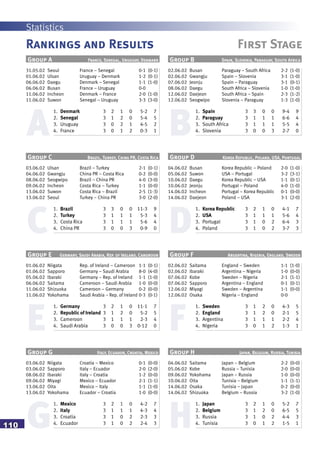
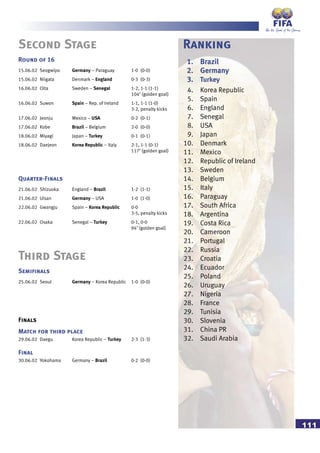
Rankings and Results 110
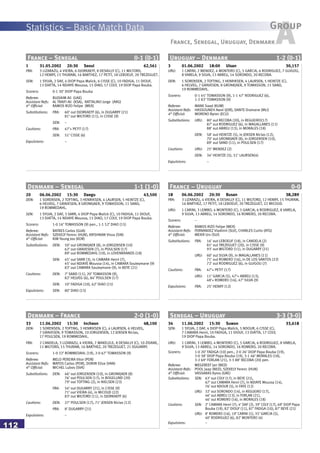
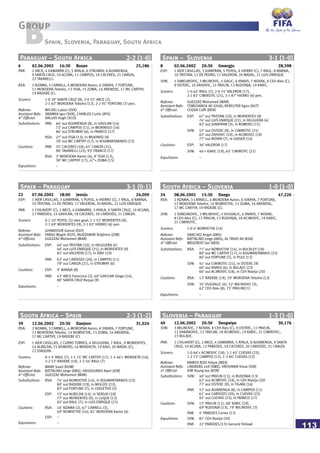
Basic Match Data 112
Goals and Scorers 128
Preliminary Competitions 134
Team Data and Analysis 146
All-Time Rankings 278
4
Forewords
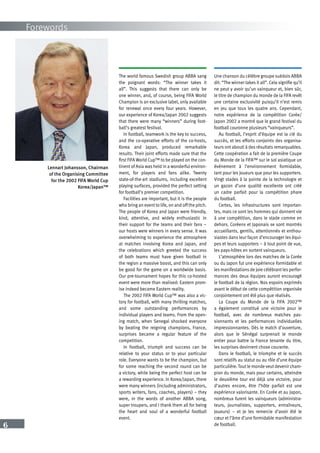
Joseph S. Blatter, FIFA President
The 2002 FIFA World Cup Korea/Japan™
did not really teach us anything new about
technique and tactics, but the world order
certainly began to wobble. The fact that the
quarter-finalists comprised four from Europe,
including Turkey, as well as a representative
from each of South America, North/Central
America, Asia and Africa is merely confirma-
tion of the trend –there are no longer any
“minnows” in international football.
This delights me, as it is irrefutable proof
of the success of over 25 years of FIFA devel-
opment work. The “new” faces on the world
stage will now have to consolidate for 2006,
while the “old order” will strive to restore
what they regard as normality to the world’s
game.
This World Cup, the first to be held in
Asia, as well as the first to be held in two
countries, underlined a number of points.
The two host associations, Korea and Japan,
more than repaid the faith placed in them;
the co-hosting arrangement did not detract
from the sporting success of the tourna-
ment; the organisation and logistics behind
the competition left no cause for complaint;
the hospitality of both host nations was a joy
to behold and experience; and last but not
least, the behaviour of the fans and players
was fairer and more peaceable than ever. To
sum up, this was a World Cup full of smiles,
surprises and Fair Play.
Of course, no World Cup is without its prob-
lems, so we will now sit down and discuss
ways of preventing the same mistakes in the
future.
I would like to offer my sincerest thanks
and respect to the two host associations,
the LOCs and the governments of Korea and
Japan, as well as the AFC and the organising
team at FIFA, who all worked so hard to ensure
everything ran according to plan. My thanks
also go to the 32 finalist teams, our com-
mercial partners, the media, and of course,
the fans from all around the globe who were
an integral part of this wonderful festival of
football that helps to foster understanding
and tolerance. I hope you enjoy reading this
detailed analysis of the 2002 FIFA World Cup
Korea/Japan™, compiled by experts from all
around the world.
Sur les plans tactique et technique, la Coupe
du Monde de la FIFA, Corée/Japon 2002™ ne
nous a pas appris grand chose de nouveau.
Mais elle a confirmé des certitudes: l’ordre
établi a tremblé. La présence en quarts
de finale de quatre équipes européennes,
dont la Turquie, ainsi que d’un représentant
d’Amérique du Sud, d’Amérique du Nord
et centrale, d’Asie et d’Afrique, ne fait que
confirmer la tendance actuelle qui veut qu’au
niveau international, il n’existe plus de “peti-
tes” équipes.
Cette évolution me plait, elle est le résultat
de 25 années de travail de longue haleine de
la FIFA pour le développement. En 2006, les
équipes-surprises devront confirmer, tandis
que les équipes bien établies tenteront de
réinstaurer l’ordre.
La première Coupe du Monde organisée
en Asie, et dans deux pays qui plus est, a
révélé quelques éléments importants: les
deux associations organisatrices, la Corée et
le Japon, se sont montrées à la hauteur de la
confiance placée en elles; l’organisation con-
jointe n’a eu aucune répercussion négative
sur le sport; au niveau de l’organisation et de
la logistique, tout fut presque parfait; l’hos-
pitalité des hôtes fut un modèle du genre; le
comportement des supporters et des joueurs
fut plus amical et paisible que jamais. En
bref, la Coupe du Monde 2002 fut une Coupe
du Monde de sourires, de surprises et de
fair-play.
Certains problèmes, comme en présente
chaque Coupe du Monde, seront analysés en
profondeur afin d’être évités à l’avenir.
J’adresse mes remerciements et mon res-
pect les plus sincères aux deux associations
organisatrices, aux COLs et aux gouverne-
ments de Corée et du Japon pour avoir mis
en place une compétition irréprochable, mais
aussi à l’AFC et à notre Organisation de la FIFA
pour la Coupe du Monde. Je tiens également
à remercier les 32 équipes participantes, nos
partenaires commerciaux, les médias et les
supporters dans le monde entier, qui ont
contribué à cette fantastique fête du football
et de la réunion des peuples.
Je vous souhaite beaucoup de plaisir à la
lecture de cette analyse détaillée de la Coupe
du Monde de la FIFA, Corée/Japon 2002™,
réalisée par des experts du monde entier.
5
La Copa Mundial de la FIFA Corea/Japón
2002™ no ha aportado grandes novedades
técnicas o tácticas. Pero una cosa ha que-
dado clara tras la conclusión del torneo: la
jerarquía futbolística actual ha empezado a
tambalearse. Cuando a cuartos de final llegan
cuatro europeos, entre ellos un equipo como
Turquía, un sudamericano, otro norteame-
ricano, un asiático y un africano, entonces
queda meridianamente claro que no se trata
tan sólo de una tendencia: ya no existen los
equipos “pequeños” en el fútbol de asocia-
ciones nacionales.
Es una evolución que me alegra sobrema-
nera, ya que se debe, en parte, a 25 años
de intenso y dedicado trabajo de la FIFA en
favor del desarrollo. En 2006, los recién lle-
gados deberán refrendar su nuevo estatuto,
mientras que los grandes clásicos tratarán de
recuperar sus posiciones de privilegio.
La primera copa mundial en Asia y el estreno
de la organización conjunta nos han enseñado
importantes lecciones: las dos asociaciones
organizadoras, Corea y Japón, han justificado
la confianza que se depositó en ellas, ya que
su colaboración no influyó negativamente en
el ámbito deportivo; la organización y la logís-
tica rozaron la perfección; la cordialidad de los
anfitriones fue ejemplar; el comportamiento
del público, al igual que el de los jugadores,
fue más pacífico que nunca. Conclusión: la
Copa 2002 ha sido el mundial de las sonrisas,
las sorpresas y la deportividad.
Por supuesto, estudiaremos los pocos pro-
blemas surgidos, como en todo mundial, con
el deseo declarado de evitarlos en el futuro.
Quiero agradecer aquí el trabajo de las
dos asociaciones organizadoras, de los COL
y de los gobiernos de Corea y de Japón, y no
olvidarme de la labor de la AFC y de nuestra
organización mundialista FIFA. Pero último,
mi más sincero agradecimiento a las 32
selecciones participantes, a nuestros socios
comerciales, a los medios de información,
a los aficionados y a todos aquellos que, de
una manera u otra, han contribuido a que se
llevase a cabo esta fiesta del fútbol y de la
comprensión de los pueblos del mundo.
Y para concluir, deseo que disfruten con la
lectura de los análisis mundialistas, elabora-
dos cuidadosamente por nuestra cohorte de
expertos de todos los continentes.
Der FIFA-Weltpokal Korea/Japan 2002™
hat uns technisch und taktisch kaum neue
Erkenntnisse gebracht. Unbestritten ist aber,
dass die bis jetzt herrschende Ordnung ins
Wanken geraten ist. Wenn im Viertelfinale
vier Teams aus Europa kommen, darunter die
Türkei, sowie je ein Vertreter aus Südamerika,
Nord- und Zentralamerika, aus Asien und
aus Afrika, dann ist das die Bestätigung des
bereits festgestellten Trends, dass es auf der
Ebene der Nationalmannschaften keine so
genannt “Kleinen” mehr gibt.
Ich freue mich über diese Entwicklung; sie
ist nicht zuletzt Beleg für über 25 Jahre uner-
müdliche Entwicklungsarbeit der FIFA. Für
2006 werden sich nun die Emporkömmlinge
bestätigen müssen, und die Etablierten
werden versuchen, das entstandene Bild zu
korrigieren.
Die erstmalige Austragung einer WM in
Asien, dazu noch in zwei Ländern, hat ein
paar wichtige Erkenntnisse gebracht: Die
beiden ausrichtenden Verbände aus Korea
und Japan haben das Vertrauen voll gerecht-
fertigt; das so genannte Co-hosting hatte kei-
nerlei negative Einflüsse auf das Sportliche;
organisatorisch und logistisch war beinahe
alles perfekt; die Freundlichkeit der Gastge-
ber war beispiellos; das Verhalten der Fans,
aber auch das der Spieler war so fair und
friedlich wie noch nie. Fazit: Die WM 2002 war
eine WM des Lächelns, der Überraschungen
und des Fairplay.
Gewisse Probleme, wie es sie an jeder WM
gibt, werden wir sorgfältig analysieren und
versuchen, sie künftig zu vermeiden.
Mein aufrichtiger Dank und Respekt gehen
an die zwei organisierenden Verbände, die
LOC sowie die Regierungen von Korea und
Japan für eine tadellose Abwicklung, aber
auch an die AFC sowie unsere FIFA-WM-
Organisation. Danken möchte ich auch allen
32 teilnehmenden Verbänden, unseren
Geschäftspartnern, den Medien und den Fans
in aller Welt, die alle zu diesem fantastischen
Fest des Fussballs und der Völkerverständi-
gung beigetragen haben .
Und nun wünsche ich Ihnen viel Vergnügen
beim Lesen unserer detaillierten, von Exper-
ten aus allen Kontinenten erstellten Analyse
des FIFA-Weltpokals Korea/Japan 2002™.
6
Forewords
Lennart Johansson, Chairman
of the Organising Committee
for the 2002 FIFA World Cup
Korea/Japan™
The world famous Swedish group ABBA sang
the poignant words: “The winner takes it
all”. This suggests that there can only be
one winner, and, of course, being FIFA World
Champion is an exclusive label, only available
for renewal once every four years. However,
our experience of Korea/Japan 2002 suggests
that there were many “winners” during foot-
ball’s greatest festival.
In football, teamwork is the key to success,
and the co-operative efforts of the co-hosts,
Korea and Japan, produced remarkable
results. Their joint efforts made sure that the
first FIFA World Cup™ to be played on the con-
tinent of Asia was held in a wonderful environ-
ment, for players and fans alike. Twenty
state-of-the-art stadiums, including excellent
playing surfaces, provided the perfect setting
for football’s premier competition.
Facilities are important, but it is the people
who bring an event to life, on and off the pitch.
The people of Korea and Japan were friendly,
kind, attentive, and widely enthusiastic in
their support for the teams and their fans –
our hosts were winners in every sense. It was
overwhelming to experience the atmosphere
at matches involving Korea and Japan, and
the celebrations which greeted the success
of both teams must have given football in
the region a massive boost, and this can only
be good for the game on a worldwide basis.
Our pre-tournament hopes for this co-hosted
event were more than realised: Eastern prom-
ise indeed became Eastern reality.
The 2002 FIFA World Cup™ was also a vic-
tory for football, with many thrilling matches,
and some outstanding performances by
individual players and teams. From the open-
ing match, when Senegal shocked everyone
by beating the reigning champions, France,
surprises became a regular feature of the
competition.
In football, triumph and success can be
relative to your status or to your particular
role. Everyone wants to be the champion, but
for some reaching the second round can be
a victory, while being the perfect host can be
a rewarding experience. In Korea/Japan, there
were many winners (including administrators,
sports writers, fans, coaches, players) – they
were, in the words of another ABBA song,
super troupers, and I thank them all for being
the heart and soul of a wonderful football
event.
Une chanson du célèbre groupe suédois ABBA
dit: “The winner takes it all”. Cela signifie qu’il
ne peut y avoir qu’un vainqueur et, bien sûr,
le titre de champion du monde de la FIFA revêt
une certaine exclusivité puisqu’il n’est remis
en jeu que tous les quatre ans. Cependant,
notre expérience de la compétition Corée/
Japon 2002 a montré que le grand festival du
football couronne plusieurs “vainqueurs”.
Au football, l’esprit d’équipe est la clé du
succès, et les efforts conjoints des organisa-
teurs ont abouti à des résultats remarquables.
Cette coopération a fait de la première Coupe
du Monde de la FIFA™ sur le sol asiatique un
événement à l’environnement formidable,
tant pour les joueurs que pour les supporters.
Vingt stades à la pointe de la technologie et
un gazon d’une qualité excellente ont créé
un cadre parfait pour la compétition phare
du football.
Certes, les infrastructures sont importan-
tes, mais ce sont les hommes qui donnent vie
à une compétition, dans le stade comme en
dehors. Coréens et Japonais se sont montrés
accueillants, gentils, attentionnés et enthou-
siastes dans leur façon d’encourager les équi-
pes et leurs supporters – à tout point de vue,
les pays-hôtes en sortent vainqueurs.
L’atmosphère lors des matches de la Corée
ou du Japon fut une expérience formidable et
les manifestations de joie célébrant les perfor-
mances des deux équipes auront encouragé
le football de la région. Nos espoirs exprimés
avant le début de cette compétition organisée
conjointement ont été plus que réalisés.
La Coupe du Monde de la FIFA 2002™
a également constitué une victoire pour le
football, avec de nombreux matches pas-
sionnants et les performances individuelles
impressionnantes. Dès le match d’ouverture,
alors que le Sénégal surprenait le monde
entier pour battre la France tenante du titre,
les surprises devinrent chose courante.
Dans le football, le triomphe et le succès
sont relatifs au statut ou au rôle d’une équipe
particulière. Tout le monde veut devenir cham-
pion du monde, mais pour certains, atteindre
le deuxième tour est déjà une victoire, pour
d’autres encore, être l’hôte parfait est une
expérience valorisante. En Corée et au Japon,
nombreux furent les vainqueurs (administra-
teurs, journalistes, supporters, entraîneurs,
joueurs) – et je les remercie d’avoir été le
cœur et l’âme d’une formidable manifestation
de football.
7
El famoso grupo sueco ABBA tenía una can-
ción cuya letra decía provocadoramente: “The
winner takes it all”. Yo creo que a pesar de
que el título de campeón mundial de la FIFA
es exclusivo y puede refrendarse únicamente
cada cuatro años, lo que hemos vivido en
Corea y Japón implica que no ha habido única-
mente uno, sino más bien varios “ganadores”
en el supremo festival de fútbol.
En el fútbol, el trabajo colectivo es la clave
del éxito, y la cooperación de los anfitriones
produjo resultados admirables. Sus esfuerzos
conjuntos crearon un entorno maravilloso
tanto para los jugadores como para los afi-
cionados que asistieron a la primera Copa
Mundial de la FIFA™ disputada en Asia.
Las instalaciones son importantes, pero
son los seres humanos quienes dan vida a
una competición, dentro y fuera del terreno.
La gente de Corea y Japón fue un portento
de amistad, cortesía, gentileza, y mostró en
todas partes un gran entusiasmo por sus
equipos y aficiones – nuestros anfitriones
han sido ganadores, en toda la extensión
de la palabra. Fue impresionante sentir el
ambiente de los partidos que jugaron Corea
y Japón. Y las celebraciones para festejar los
triunfos de ambas escuadras han dado un
fuerte impulso al fútbol de la región. Nuestras
esperanzas en este torneo se han realizado
con creces.
La Copa Mundial de la FIFA 2002™ fue tam-
bién una victoria para el fútbol, que mostró
muchos partidos emocionantes, y algunas
actuaciones destacadas de jugadores y equi-
pos. Comenzando con el fuerte aperitivo que
sacudió a todos, el triunfo de Senegal frente
al campeón mundial Francia, las sorpresas se
sucedieron una tras otra.
En el fútbol, el triunfo y el éxito pueden
ser relativos a una posición o a un papel
determinado. Todos desean convertirse en
el campeón, aunque para algunos estar ya en
la segunda ronda es un triunfo. Sin embargo,
ser el anfitrión ideal es una experiencia
gratificante. En Corea/Japón hubo muchos
ganadores (incluidos los administradores,
los periodistas deportivos, los aficionados,
los entrenadores y los jugadores) – todos
ellos fueron, como dice otra canción de ABBA,
“super-grupos”, y a todos les agradezco que
hayan sido el alma de una maravillosa fiesta
del fútbol.
Spätestens seit dem Lied der schwedischen
Popgruppe ABBA “The winner takes it all”
wissen wir, dass es keine zweiten Sieger gibt.
So kann an der FIFA Fussball-Weltmeister-
schaft, die lediglich alle vier Jahre stattfindet,
nur ein Team den Siegerpokal in Empfang
nehmen, doch der FIFA-Weltpokal Korea/
Japan 2002TM
kannte dennoch gleich mehrere
“Gewinner”.
Teamwork heisst das Zauberwort im
Fussball, das auch die beiden Ausrichter
Korea und Japan beherzigt haben. Dank per-
fekter Zusammenarbeit machten sie die erste
FIFA Fussball-WeltmeisterschaftTM
in Asien für
Spieler und Fans gleichermassen zu einem
einmaligen Erlebnis. Die 20 topmodernen
Stadien boten einen würdigen Rahmen für die
asiatische WM-Premiere.
Ohne moderne Infrastruktur kann der
Fussball nicht rollen, doch erst die Menschen
hauchen der Weltmeisterschaft Leben ein,
auf und neben dem Platz. Die Koreaner und
Japaner waren sehr nett, herzlich, hilfsbe-
reit und offenbarten sich als begeisterte
Fussballfans – die Gastgeber sind also in
jeder Hinsicht Sieger. Die Stimmung an den
Spielen der koreanischen und japanischen
Mannschaft war einzigartig. Die Euphorie
der Bevölkerung, die mit jedem Sieg grösser
wurde, hat dem Fussball in dieser Region zu
einem riesigen Boom verholfen und damit
dem internationalen Fussball einen grossen
Dienst erwiesen. Unsere Hoffnungen haben
sich mehr als erfüllt: Der asiatische Traum
wurde Wirklichkeit.
Gewonnen hat auch der Fussball, der von
Spannung und spielerischen Leckerbissen
einiger Spieler und Teams geprägt war. Mit
dem Sieg über den amtierenden Weltmeister
Frankreich im Eröffnungsspiel gab Senegal
gleich die Marschrichtung vor.
Im Fussball ist nicht nur der Erste ein
Sieger. Natürlich träumen alle insgeheim vom
Weltmeistertitel, aber für viele ist bereits der
Einzug in die zweite Runde ein Grund zum
Jubeln. Und neben dem Platz freuen sich mit
gutem Grund die Organisatoren und Gastge-
ber dieser Endrunde. In Korea/Japan 2002
gab es also viele Gewinner (Funktionäre,
Sportjournalisten, Fans, Trainer, Spieler etc.)
– eine verschworene Truppe, wie sie ABBA
in ihrem Lied “Super Troupers” besungen
hat. Ich möchte allen dafür danken, dass
sie diesem wunderbaren Fussballturnier ein
Gesicht gegeben haben.
8
Forewords
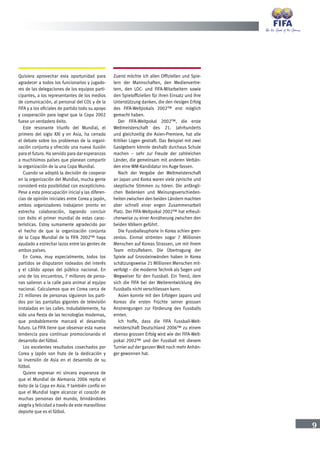
Dr Chung Mong Joon, Chairman of the
Korea Organising Committee
I would like to begin by taking this opportunity
to thank all the officials and players of the
participating team delegations, the media
representatives, LOC and FIFA staff as well as
the match officials for their support and coop-
eration in making the 2002 FIFA World Cup™
such a resounding success.
The triumph of this tournament, the first
in the 21st century and the first in Asia, put
an end to the concerns about the co-hosting
arrangement and made future co-hosting a
distinct possibility. It also gave encourage-
ment to a number of countries that may wish
to co-host the World Cup.
Many people greeted the decision to award
the World Cup to two countries with cynicism
and scepticism, but despite these concerns
and an initial conflict of opinion between
Korea and Japan, the two co-hosts soon
started to work together in close cooperation,
bringing the event to a successful conclusion.
I feel deeply gratified that the 2002 FIFA World
Cup™ has helped to bring the people of these
two countries closer together.
In Korea especially, each game attracted the
whole-hearted support of the public. For one
of the games, 7 million people came out onto
the streets to cheer for the Korean national
team, and it is estimated that during the World
Cup a total of 21 million people watched the
games on the giant screens on the streets of
Korea. This is down to modern technology and
may point to a future trend. FIFA needs to pay
attention to this, with a view towards promot-
ing the development of football.
The performances of Korea and Japan were
the fruit of the efforts that Asian countries
have invested in developing football in their
country.
It is my sincere hope that the success of
the 2002 FIFA World Cup™ will be repeated in
Germany in 2006. I also hope that the World
Cup will be able to touch the lives of more
people throughout the world, helping them
find joy and happiness through our beautiful
game of football.
Tout d’abord, je tiens à profiter de cette oppor-
tunité pour remercier tous les officiels et les
joueurs des équipes participantes, les repré-
sentants des médias, le personnel du COL et
de la FIFA, et les officiels de matches pour leur
soutien et leur coopération pour faire de cette
Coupe du Monde de la FIFA 2002 un succès
total.
La réussite de la Coupe du Monde 2002,
première du 21ème siècle, organisée sur le
sol asiatique, a mis un terme à tous les doutes
soulevés par l’organisation conjointe, et a fait
naître l’espoir d’une nouvelle co-organisation
à l’avenir. Elle aura encouragé de nombreux
pays qui rêvent d’organiser à leur tour une
Coupe du Monde aux côtés d’un autre.
La décision d’une organisation conjointe a
été accueillie par beaucoup avec cynisme et
scepticisme. Malgré ces doutes initiaux et les
conflits d’opinions entre la Corée et le Japon,
les deux hôtes se sont vite mis à coopérer,
afin d’apporter une conclusion positive à
cette association. Je suis profondément heu-
reux que l’organisation conjointe de la Coupe
du Monde de la FIFA 2002 ait contribué à rap-
procher les peuples de ces deux pays.
En Corée en particulier, chaque match a
éveillé un intérêt et un soutien entiers parmi
le public coréen. Pour l’un des matches, 7
millions de personnes se sont réunies dans
les rues pour encourager l’équipe coréenne.
On estime qu’un total de 21 millions de per-
sonnes a suivi les matches sur écran géant .
Cela constitue une victoire des technologies
modernes, qui annoncent les prochaines
tendances. La FIFA doit accorder son attention
à une telle évolution dans son travail pour le
développement du football.
Les bonnes performances de la Corée et du
Japon sont le fruit des investissements et de
l’attention que les pays asiatiques ont con-
sentis pour développer le football.
J’ai l’espoir que le succès remporté par
cette Coupe du Monde 2002 sera réitéré en
Allemagne en 2006. J’espère aussi que la
Coupe du Monde pourra influencer la vie de
beaucoup de gens à travers le monde, et les
aidera à trouver de la joie et du bonheur grâce
à notre beau sport qu’est le football.
9
Quisiera aprovechar esta oportunidad para
agradecer a todos los funcionarios y jugado-
res de las delegaciones de los equipos parti-
cipantes, a los representantes de los medios
de comunicación, al personal del COL y de la
FIFA y a los oficiales de partido todo su apoyo
y cooperación para lograr que la Copa 2002
fuese un verdadero éxito.
Este resonante triunfo del Mundial, el
primero del siglo XXI y en Asia, ha cerrado
el debate sobre los problemas de la organi-
zación conjunta y ofrecido una nueva ilusión
para el futuro. Ha servido para dar esperanzas
a muchísimos países que planean compartir
la organización de la una Copa Mundial.
Cuando se adoptó la decisión de cooperar
en la organización del Mundial, mucha gente
consideró esta posibilidad con escepticismo.
Pese a esta preocupación inicial y las diferen-
cias de opinión iniciales entre Corea y Japón,
ambos organizadores trabajaron pronto en
estrecha colaboración, logrando concluir
con éxito el primer mundial de estas carac-
terísticas. Estoy sumamente agradecido por
el hecho de que la organización conjunta
de la Copa Mundial de la FIFA 2002™ haya
ayudado a estrechar lazos entre las gentes de
ambos países.
En Corea, muy especialmente, todos los
partidos se disputaron rodeados del interés
y el cálido apoyo del público nacional. En
uno de los encuentros, 7 millones de perso-
nas salieron a la calle para animar al equipo
nacional. Calculamos que en Corea cerca de
21 millones de personas siguieron los parti-
dos por las pantallas gigantes de televisión
instaladas en las calles. Indudablemente, ha
sido una fiesta de las tecnologías modernas,
que probablemente marcará el desarrollo
futuro. La FIFA tiene que observar esta nueva
tendencia para continuar promocionando el
desarrollo del fútbol.
Los excelentes resultados cosechados por
Corea y Japón son fruto de la dedicación y
la inversión de Asia en el desarrollo de su
fútbol.
Quiero expresar mi sincera esperanza de
que el Mundial de Alemania 2006 repita el
éxito de la Copa en Asia. Y también confío en
que el Mundial logre alcanzar el corazón de
muchas personas del mundo, brindándoles
alegría y felicidad a través de este maravilloso
deporte que es el fútbol.
Zuerst möchte ich allen Offiziellen und Spie-
lern der Mannschaften, den Medienvertre-
tern, den LOC- und FIFA-Mitarbeitern sowie
den Spieloffiziellen für ihren Einsatz und ihre
Unterstützung danken, die den riesigen Erfolg
des FIFA-Weltpokals 2002™ erst möglich
gemacht haben.
Der FIFA-Weltpokal 2002™, die erste
Weltmeisterschaft des 21. Jahrhunderts
und gleichzeitig die Asien-Premiere, hat alle
Kritiker Lügen gestraft. Das Beispiel mit zwei
Gastgebern könnte deshalb durchaus Schule
machen – sehr zur Freude der zahlreichen
Länder, die gemeinsam mit anderen Verbän-
den eine WM-Kandidatur ins Auge fassen.
Nach der Vergabe der Weltmeisterschaft
an Japan und Korea waren viele zynische und
skeptische Stimmen zu hören. Die anfängli-
chen Bedenken und Meinungsverschieden-
heiten zwischen den beiden Ländern machten
aber schnell einer engen Zusammenarbeit
Platz. Der FIFA-Weltpokal 2002™ hat erfreuli-
cherweise zu einer Annäherung zwischen den
beiden Völkern geführt.
Die Fussballeuphorie in Korea schien gren-
zenlos. Einmal strömten sogar 7 Millionen
Menschen auf Koreas Strassen, um mit ihrem
Team mitzufiebern. Die Übertragung der
Spiele auf Grossleinwänden haben in Korea
schätzungsweise 21 Millionen Menschen mit-
verfolgt – die moderne Technik als Segen und
Wegweiser für den Fussball. Ein Trend, dem
sich die FIFA bei der Weiterentwicklung des
Fussballs nicht verschliessen kann.
Asien konnte mit den Erfolgen Japans und
Koreas die ersten Früchte seiner grossen
Anstrengungen zur Förderung des Fussballs
ernten.
Ich hoffe, dass die FIFA Fussball-Welt-
meisterschaft Deutschland 2006™ zu einem
ebenso grossen Erfolg wird wie der FIFA-Welt-
pokal 2002™ und der Fussball mit diesem
Turnier auf der ganzen Welt noch mehr Anhän-
ger gewonnen hat.
10
Forewords
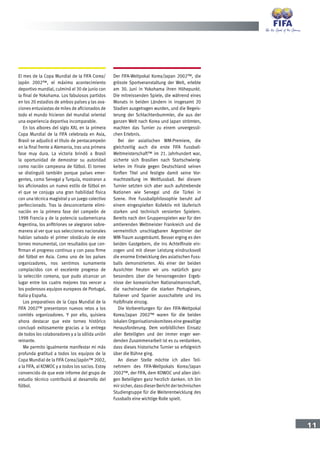
Shoh Nasu, Chairman of the
Japan Organising Committee
The compelling month of football that was
the 2002 FIFA World Cup Korea/Japan™ – the
world’s largest sporting event – drew to a
close on 30 June in Yokohama. With exciting
matches played in a total of 20 stadia spread
out across the two co-host nations and the
enthusiastic cheers of supporters echoing
around the world, Korea and Japan experi-
enced unprecedented levels of excitement.
At the start of the 21st century, in the first
FIFA World Cup™ to be held in Asia, Brazil
captured their fifth title, triumphing over Ger-
many in the final after successfully negotiating
some tough hurdles in earlier rounds. Victory
allowed Brazil to reassert their authority as
the world’s greatest footballing nation. This
tournament was especially memorable for the
exploits of rising powers such as Senegal and
Turkey, who introduced fans to a new style of
football combining high physical ability, out-
standing skill, and polished teamwork. After
the stark reality of 1998 champions France
and South American giants Argentina being
eliminated in the first round, the co-hosts
were jubilant that both Korea and Japan
cleared the first round of the competition of
this prestigious tournament, with results that
confirmed the steady rise of Asian football.
As one of the co-host countries, we were
especially delighted by the excellent progress
of the Korean national team, as they reached
the last four after defeating European heavy-
weights Portugal, Italy and Spain.
The preparations for the 2002 FIFA World
Cup Korea/Japan™ presented the organising
committees of both countries with new chal-
lenges and a series of difficulties that had to
be overcome. Nevertheless, I would like to
stress that this historic tournament was ulti-
mately a great success, thanks to the passion
of all the people involved in the event and a
solid partnership established over time.
May I take this opportunity to express
my deepest gratitude to all the teams that
participated in the 2002 FIFA World Cup
Korea/Japan™, FIFA, KOWOC and all the other
parties involved. I have no doubt that this
report by the Technical Study Group members
will make a very valuable contribution to the
further development of football.
Le 30 juin, à Yokohama, la finale de la Coupe
du Monde de la FIFA, Corée/Japon 2002™ a
mis fin au plus grand événement sportif du
monde, un mois de matches de football pal-
pitants disputés dans 20 stades répartis entre
les deux pays organisateurs, où l’euphorie qui
s’était emparée des supporters du monde
entier était à son comble.
A l’issue de cette première édition du 21e
siècle, également la première à se dérouler en
Asie, le Brésil a décroché son cinquième titre
de champion du monde en triomphant de l’Al-
lemagne après avoir surmonté les obstacles
des tours précédents. Ce faisant, il a rétabli
son autorité de première nation de football
du monde. Cette édition de la Coupe du
Monde restera notamment dans les annales
du football en raison des exploits réalisés par
les nations où ce sport est en développement
telles que le Sénégal et la Turquie, qui ont
inauguré un nouveau style de jeu alliant une
excellente condition physique, de brillantes
compétences et un travail d’équipe bien
rodé. Après l’élimination de géants tels que
la France tenante du titre et l’Argentine dès le
premier tour, les co-organisateurs exultaient
de voir leurs équipes respectives qualifiées
pour les huitièmes de finale avec des résul-
tats confirmant l’ascension continue du foot-
ball asiatique. En qualité de co-organisateur,
nous avons été particulièrement heureux des
formidables progrès de l’équipe nationale
coréenne, demi-finaliste après ses victoires
sur des sélections aussi prestigieuses que le
Portugal, l’Italie et l’Espagne.
La préparation de la compétition avait
placé les comités organisateurs des deux pays
devant de grands défis. Néanmoins, je tiens à
souligner que la passion de tous les protago-
nistes et le solide partenariat établi au fil du
temps ont largement contribué au brillant
succès de cette compétition historique.
Aussi ai-je le plaisir d’exprimer ma plus
profonde gratitude à toutes les équipes qui
ont participé à Corée/Japon 2002, à la FIFA,
au KOWOC et à tous leurs autres partenaires.
Je suis convaincu que ce rapport du Groupe
d’Etude Technique contribuera durablement
au développement du football.
11
El mes de la Copa Mundial de la FIFA Corea/
Japón 2002™, el máximo acontecimiento
deportivo mundial, culminó el 30 de junio con
la final de Yokohama. Los fabulosos partidos
en los 20 estadios de ambos países y las ova-
ciones entusiastas de miles de aficionados de
todo el mundo hicieron del mundial oriental
una experiencia deportiva incomparable.
En los albores del siglo XXI, en la primera
Copa Mundial de la FIFA celebrada en Asia,
Brasil se adjudicó el título de pentacampeón
en la final frente a Alemania, tras una primera
fase muy dura. La victoria brindó a Brasil
la oportunidad de demostrar su autoridad
como nación campeona de fútbol. El torneo
se distinguió también porque países emer-
gentes, como Senegal y Turquía, mostraron a
los aficionados un nuevo estilo de fútbol en
el que se conjuga una gran habilidad física
con una técnica magistral y un juego colectivo
perfeccionado. Tras la desconcertante elimi-
nación en la primera fase del campeón de
1998 Francia y de la potencia sudamericana
Argentina, los anfitriones se alegraron sobre-
manera al ver que sus selecciones nacionales
habían salvado el primer obstáculo de este
torneo monumental, con resultados que con-
firman el progreso continuo y con paso firme
del fútbol en Asia. Como uno de los países
organizadores, nos sentimos sumamente
complacidos con el excelente progreso de
la selección coreana, que pudo alcanzar un
lugar entre los cuatro mejores tras vencer a
los poderosos equipos europeos de Portugal,
Italia y España.
Los preparativos de la Copa Mundial de la
FIFA 2002™ presentaron nuevos retos a los
comités organizadores. Y por ello, quisiera
ahora destacar que este torneo histórico
concluyó exitosamente gracias a la entrega
de todos los colaboradores y a la sólida unión
reinante.
Me permito igualmente manifestar mi más
profunda gratitud a todos los equipos de la
Copa Mundial de la FIFA Corea/Japón™ 2002,
a la FIFA, al KOWOC y a todos los socios. Estoy
convencido de que este informe del grupo de
estudio técnico contribuirá al desarrollo del
fútbol.
Der FIFA-Weltpokal Korea/Japan 2002™, die
grösste Sportveranstaltung der Welt, erlebte
am 30. Juni in Yokohama ihren Höhepunkt.
Die mitreissenden Spiele, die während eines
Monats in beiden Ländern in insgesamt 20
Stadien ausgetragen wurden, und die Begeis-
terung der Schlachtenbummler, die aus der
ganzen Welt nach Korea und Japan strömten,
machten das Turnier zu einem unvergessli-
chen Erlebnis.
Bei der asiatischen WM-Premiere, die
gleichzeitig auch die erste FIFA Fussball-
Weltmeisterschaft™ im 21. Jahrhundert war,
sicherte sich Brasilien nach Startschwierig-
keiten im Finale gegen Deutschland seinen
fünften Titel und festigte damit seine Vor-
machtstellung im Weltfussball. Bei diesem
Turnier setzten sich aber auch aufstrebende
Nationen wie Senegal und die Türkei in
Szene. Ihre Fussballphilosophie beruht auf
einem eingespielten Kollektiv mit läuferisch
starken und technisch versierten Spielern.
Bereits nach den Gruppenspielen war für den
amtierenden Weltmeister Frankreich und die
vermeintlich unschlagbaren Argentinier der
WM-Traum ausgeträumt. Besser erging es den
beiden Gastgebern, die ins Achtelfinale ein-
zogen und mit dieser Leistung eindrucksvoll
die enorme Entwicklung des asiatischen Fuss-
balls demonstrierten. Als einer der beiden
Ausrichter freuten wir uns natürlich ganz
besonders über die hervorragenden Ergeb-
nisse der koreanischen Nationalmannschaft,
die nacheinander die starken Portugiesen,
Italiener und Spanier ausschaltete und ins
Halbfinale einzog.
Die Vorbereitungen für den FIFA-Weltpokal
Korea/Japan 2002™ waren für die beiden
lokalen Organisationskomitees eine gewaltige
Herausforderung. Dem vorbildlichen Einsatz
aller Beteiligten und der immer enger wer-
denden Zusammenarbeit ist es zu verdanken,
dass dieses historische Turnier so erfolgreich
über die Bühne ging.
An dieser Stelle möchte ich allen Teil-
nehmern des FIFA-Weltpokals Korea/Japan
2002™, der FIFA, dem KOWOC und allen übri-
gen Beteiligten ganz herzlich danken. Ich bin
mir sicher, dassdieser Berichtder technischen
Studiengruppe für die Weiterentwicklung des
Fussballs eine wichtige Rolle spielt.
Auftakt OA
4c / sw / sw hell
426 x 303
Bongarts
12
13
14 General Organisation
20 Refereeing and Officials
26 Medical
32 Stadia and Security
38 Media
44 Marketing and Partners
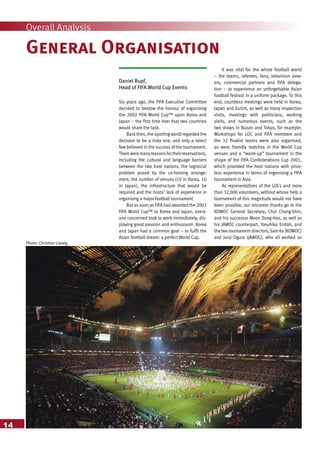
Photo: Christian Liewig
14
Overall Analysis
General Organisation
It was vital for the whole football world
– the teams, referees, fans, television view-
ers, commercial partners and FIFA delega-
tion – to experience an unforgettable Asian
football festival in a uniform package. To this
end, countless meetings were held in Korea,
Japan and Zurich, as well as many inspection
visits, meetings with politicians, working
visits, and numerous events, such as the
two draws in Busan and Tokyo, for example.
Workshops for LOC and FIFA members and
the 32 finalist teams were also organised,
as were friendly matches in the World Cup
venues and a “warm-up” tournament in the
shape of the FIFA Confederations Cup 2001,
which provided the host nations with price-
less experience in terms of organising a FIFA
tournament in Asia.
As representatives of the LOCs and more
than 32,000 volunteers, without whose help a
tournament of this magnitude would not have
been possible, our sincerest thanks go to the
KOWOC General Secretary, Choi Chang-Shin,
and his successor Moon Dong-Hoo, as well as
his JAWOC counterpart, Yasuhiko Endoh, and
the two tournament directors,Sam Ka (KOWOC)
and Junji Ogura (JAWOC), who all worked so
Daniel Rupf,
Head of FIFA World Cup Events
Six years ago, the FIFA Executive Committee
decided to bestow the honour of organising
the 2002 FIFA World Cup™ upon Korea and
Japan – the first time ever that two countries
would share the task.
Back then, the sporting world regarded the
decision to be a risky one, and only a select
few believed in the success of the tournament.
Thereweremanyreasonsfortheirreservations,
including the cultural and language barriers
between the two host nations, the logistical
problem posed by the co-hosting arrange-
ment, the number of venues (10 in Korea, 10
in Japan), the infrastructure that would be
required and the hosts’ lack of experience in
organising a major football tournament.
But as soon as FIFA had awarded the 2002
FIFA World Cup™ to Korea and Japan, every-
one concerned took to work immediately, dis-
playing great passion and enthusiasm. Korea
and Japan had a common goal – to fulfil the
Asian football dream: a perfect World Cup.
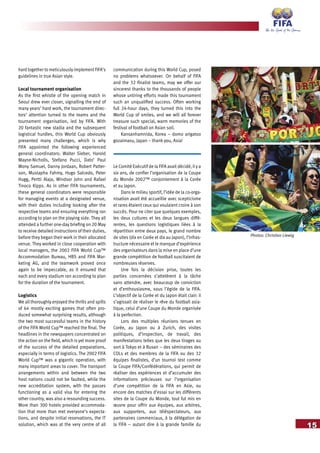
Photos: Christian Liewig
15
hard together to meticulously implement FIFA’s
guidelines in true Asian style.
Local tournament organisation
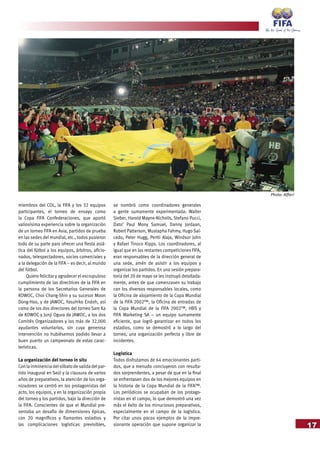
As the first whistle of the opening match in
Seoul drew ever closer, signalling the end of
many years’ hard work, the tournament direc-
tors’ attention turned to the teams and the
tournament organisation, led by FIFA. With
20 fantastic new stadia and the subsequent
logistical hurdles, this World Cup obviously
presented many challenges, which is why
FIFA appointed the following experienced
general coordinators: Walter Sieber, Harold
Mayne-Nicholls, Stefano Pucci, Dato’ Paul
Mony Samuel, Danny Jordaan, Robert Patter-
son, Mustapha Fahmy, Hugo Salcedo, Peter
Hugg, Pertti Alaja, Windsor John and Rafael
Tinoco Kipps. As in other FIFA tournaments,
these general coordinators were responsible
for managing events at a designated venue,
with their duties including looking after the
respective teams and ensuring everything ran
according to plan on the playing side. They all
attended a further one-day briefing on 20 May
to receive detailed instructions of their duties,
before they began their work in their allocated
venue. They worked in close cooperation with
local managers, the 2002 FIFA World Cup™
Accommodation Bureau, HBS and FIFA Mar-
keting AG, and the teamwork proved once
again to be impeccable, as it ensured that
each and every stadium ran according to plan
for the duration of the tournament.
Logistics
We all thoroughly enjoyed the thrills and spills
of 64 mostly exciting games that often pro-
duced somewhat surprising results, although
the two most successful teams in the history
of the FIFA World Cup™ reached the final. The
headlines in the newspapers concentrated on
the action on the field, which is yet more proof
of the success of the detailed preparations,
especially in terms of logistics. The 2002 FIFA
World Cup™ was a gigantic operation, with
many important areas to cover. The transport
arrangements within and between the two
host nations could not be faulted, while the
new accreditation system, with the passes
functioning as a valid visa for entering the
other country, was also a resounding success.
More than 300 hotels provided accommoda-
tion that more than met everyone’s expecta-
tions, and despite initial reservations, the IT
solution, which was at the very centre of all
communication during this World Cup, posed
no problems whatsoever. On behalf of FIFA
and the 32 finalist teams, may we offer our
sincerest thanks to the thousands of people
whose untiring efforts made this tournament
such an unqualified success. Often working
full 24-hour days, they turned this into the
World Cup of smiles, and we will all forever
treasure such special, warm memories of the
festival of football on Asian soil.
Kansanhamnida, Korea – domo arigatoo
gozaimasu, Japan – thank you, Asia!
Le Comité Exécutif de la FIFA avait décidé, il y a
six ans, de confier l’organisation de la Coupe
du Monde 2002™ conjointement à la Corée
et au Japon.
Dans le milieu sportif, l’idée de la co-orga-
nisation avait été accueillie avec scepticisme
et rares étaient ceux qui voulaient croire à son
succès. Pour ne citer que quelques exemples,
les deux cultures et les deux langues diffé-
rentes, les questions logistiques liées à la
répartition entre deux pays, le grand nombre
de sites (dix en Corée et dix au Japon), l’infras-
tructure nécessaire et le manque d’expérience
des organisateurs dans la mise en place d’une
grande compétition de football suscitaient de
nombreuses réserves.
Une fois la décision prise, toutes les
parties concernées s’attelèrent à la tâche
sans attendre, avec beaucoup de conviction
et d’enthousiasme, sous l’égide de la FIFA.
L’objectif de la Corée et du Japon était clair: il
s’agissait de réaliser le rêve du football asia-
tique, celui d’une Coupe du Monde organisée
à la perfection.
Lors des multiples réunions tenues en
Corée, au Japon ou à Zurich, des visites
politiques, d’inspection, de travail, des
manifestations telles que les deux tirages au
sort à Tokyo et à Busan – des séminaires des
COLs et des membres de la FIFA ou des 32
équipes finalistes, d’un tournoi test comme
la Coupe FIFA/Confédérations, qui permit de
réaliser des expériences et d’accumuler des
informations précieuses sur l’organisation
d’une compétition de la FIFA en Asie, ou
encore des matches d’essai sur les différents
sites de la Coupe du Monde, tout fut mis en
œuvre pour offrir aux équipes, aux arbitres,
aux supporters, aux téléspectateurs, aux
partenaires commerciaux, à la délégation de
la FIFA – autant dire à la grande famille du
16
Overall Analysis
football – des conditions idéales et uniformes
de nature à rendre la grande fête du football
asiatique inoubliable.
Il convient ici de remercier chaleureuse-
ment Choi Chang-Shin, le Secrétaire Général
du KOWOC et son successeur, Moon Dong-
Hoo, Yasuhiko Endoh, le Secrétaire Général
du JAWOC ainsi que Sam Ka, du KOWOC et
Junji Ogura, du JAWOC, les deux directeurs
de compétition et, à travers eux, les deux
Comités Organisateurs Locaux et les 32
000 bénévoles sans qui un événement de
cette ampleur n’aurait pu être monté, pour
l’immense travail qu’ils ont accompli afin de
transposer rigoureusement les directives de la
FIFA dans l’environnement asiatique.
Sur place
A l’approche du match d’ouverture à Séoul,
qui devait mettre un terme à de longues
années de préparation, les organisateurs ont
concentré leur attention sur les éléments clés
de la compétition, à savoir les équipes et le
déroulement du tournoi et des matches pro-
prement dit sous la direction de la FIFA. Dans
la perspective du défi logistique qu’allait repré-
senter cette Coupe du Monde articulée autour
de 20 somptueux stades neufs, Walter Sieber,
Harold Mayne-Nicholls, Stefano Pucci, Dato’
Paul Mony Samuel, Danny Jordaan, Robert
Patterson, Mustapha Fahmy, Hugo Salcedo,
Peter Hugg, Pertti Alaja, Windsor John et Rafael
Tinoco Kipps, tous très expérimentés, furent
nommés coordinateurs généraux de la FIFA.
Comme dans toute compétition de la FIFA, les
coordinateurs généraux étaient responsables
de l’organisation sur l’ensemble du site, de
l’encadrement des équipes et de la supervi-
sion des matches et des instructions détaillées
leur furent données lors de la journée d’infor-
mation du 20 mai, avant que leur mission sur
le site avec les responsables locaux, le Bureau
de l’Hébergement et le Bureau de la Billetterie
de la Coupe du Monde de la FIFA 2002TM , HBS
et FIFA Marketing AG ne commence – un travail
d’équipe très efficace à l’origine du parfait
déroulement des matches selon une procédure
uniforme dans tous les stades.
Logistique
Nous avons tous eu le bonheur de suivre 64
matches captivants à divers égards, dont
la plupart nous ont réservé des surprises,
même si les deux sélections au plus brillant
palmarès de l’histoire de la Coupe du Monde
se sont finalement affrontées en finale. Les
gros titres, exclusivement consacrés aux
protagonistes sur le terrain, ont prouvé l’effi-
cacité des préparatifs méticuleux notamment
au plan de la logistique. Pour ne citer que les
principaux éléments de cette gigantesque
opération qu’était la Coupe du Monde de
la FIFA 2002™, les transports en Corée, au
Japon, et entre les deux pays, ont fait l’objet
de vives éloges; les innovations apportées
au système d’accréditation, celle-ci tenant
lieu de visa pour passer d’un pays à l’autre,
se sont avérées efficaces; la question de
l’hébergement avec plus de 300 hôtels sous
contrat a été réglée à la satisfaction de toutes
les parties, et malgré les appréhensions ini-
tiales soulevées par la solution informatique,
cœur de la communication lors de cette com-
pétition, aucun problème ne s’est posé dans
ce domaine. Aussi les milliers de personnes
qui se sont engagées sans compter dans
cette formidable entreprise méritent-elles les
plus sincères félicitations de la FIFA et des 32
équipes finalistes. Grâce à leur dévouement
et à leur générosité, la Coupe du Monde de la
FIFA, Corée/Japon 2002™ reste celle du sou-
rire et nous laisse le souvenir d’une brillante
réussite.
Kansanhamnida, Corée – domo arigatoo
gozaimasu, Japon – merci l’Asie!
Hace seis años, el Comité Ejecutivo de la FIFA
decidió otorgar a Corea y a Japón la organiza-
ción de la Copa Mundial de la FIFA 2002™ – la
primera con dos anfitriones.
En aquel momento, la reticencia del
mundo deportivo era enorme; salvo los más
directamente implicados, casi nadie creía en
el éxito del torneo. Las principales preocu-
paciones eran las diferencias idiomáticas y
culturales, las dificultades logísticas con dos
países, el elevado número de sedes (diez en
Corea y otras tantas en Japón), la infraestruc-
tura y la falta de experiencia futbolística de los
dos anfitriones.
Algunos de los partícipes, dirigidos por
la FIFA, se pusieron inmediata e ilusionada-
mente manos a la obra. La meta de Corea y
de Japón estaba clara: cumplir con el sueño
asiático de un Mundial perfecto.
En las numerosas reuniones celebradas
en Corea, Japón o Zúrich, así como en los
viajes de inspección, visitas políticas, de
trabajo, diversos actos – como los dos sor-
teos en Tokio y Busán –, seminarios para
General Organisation
17
miembros del COL, la FIFA y los 32 equipos
participantes, el torneo de ensayo como
la Copa FIFA Confederaciones, que aportó
valiosísima experiencia sobre la organización
de un torneo FIFA en Asia, partidos de prueba
en las sedes del mundial, etc., todos pusieron
todo de su parte para ofrecer una fiesta asiá-
tica del fútbol a los equipos, árbitros, aficio-
nados, telespectadores, socios comerciales y
a la delegación de la FIFA – es decir, al mundo
del fútbol.
Quiero felicitar y agradecer el escrupuloso
cumplimiento de las directrices de la FIFA en
la persona de los Secretarios Generales de
KOWOC, Choi Chang-Shin y su sucesor Moon
Dong-Hoo, y de JAWOC, Yasuhiko Endoh, así
como de los dos directores del torneo Sam Ka
de KOWOC y Junji Ogura de JAWOC, a los dos
Comités Organizadores y los más de 32,000
ayudantes voluntarios, sin cuya generosa
intervención no hubiésemos podido llevar a
buen puerto un campeonato de estas carac-
terísticas.
La organización del torneo in situ
Con la inminencia delsilbato de salida delpar-
tido inaugural en Seúl y la clausura de varios
años de preparativos, la atención de los orga-
nizadores se centró en los protagonistas del
acto, los equipos, y en la organización propia
del torneo y los partidos, bajo la dirección de
la FIFA. Conscientes de que el Mundial pre-
sentaba un desafío de dimensiones épicas,
con 20 magníficos y flamantes estadios y
las complicaciones logísticas previsibles,
se nombró como coordinadores generales
a gente sumamente experimentada: Walter
Sieber, Harold Mayne-Nicholls, Stefano Pucci,
Dato’ Paul Mony Samuel, Danny Jordaan,
Robert Patterson, Mustapha Fahmy, Hugo Sal-
cedo, Peter Hugg, Pertti Alaja, Windsor John
y Rafael Tinoco Kipps. Los coordinadores, al
igual que en las restantes competiciones FIFA,
eran responsables de la dirección general de
una sede, amén de asistir a los equipos y
organizar los partidos. En una sesión prepara-
toria del 20 de mayo se les instruyó detallada-
mente, antes de que comenzasen su trabajo
con los diversos responsables locales, como
la Oficina de alojamiento de la Copa Mundial
de la FIFA 2002™, la Oficina de entradas de
la Copa Mundial de la FIFA 2002™, HBS y
FIFA Marketing SA – un equipo sumamente
eficiente, que logró garantizar en todos los
estadios, como se demostró a lo largo del
torneo, una organización perfecta y libre de
incidentes.
Logística
Todos disfrutamos de 64 emocionantes parti-
dos, que a menudo concluyeron con resulta-
dos sorprendentes, a pesar de que en la final
se enfrentasen dos de los mejores equipos en
la historia de la Copa Mundial de la FIFA™.
Los periódicos se ocupaban de los protago-
nistas en el campo, lo que demostró una vez
más el éxito de los minuciosos preparativos,
especialmente en el campo de la logística.
Por citar unos pocos ejemplos de la impre-
sionante operación que supone organizar la
Photo: Alfieri
18
Overall Analysis
Copa Mundial de la FIFA: el transporte nacio-
nal y entre ambos países mereció las mejores
calificaciones; el sistema de acreditación con
su innovación, que la acreditación sirviese de
visado para viajar de un país a otro, funcionó a
la perfección; el alojamiento, con más de 300
hoteles contratados, recibió los beneplácitos
de todos los partícipes; finalmente, a pesar
de algunos reparos previos sobre la solución
informática, el corazón de la comunicación del
torneo operó sin problemas de importancia.
Por estos motivos, resulta apropiado felicitar
aquí, en nombre de la FIFA y de los 32 equi-
pos participantes, a los miles de trabajadores
que, gracias a su denodado esfuerzo, hicieron
posible que esta gran empresa culminase
con éxito. Fueron ellos, con días laborales a
menudo de 24 horas y semanas de trabajo de
7 días, quienes lograron que esta fiesta del
fútbol en Asia sea hoy un recuerdo imborrable
en nuestros corazones.
Kansanhamnida, Corea – doomo arigatoo
gozaimasu, Japón – ¡Muchas gracias Asia!
Vor sechs Jahren hatte das FIFA-Exekutivko-
mitee entschieden, Korea und Japan mit der
Organisation des FIFA-Weltpokals 2002™ zu
betrauen – die erste Weltmeisterschaft mit
zwei Veranstaltern.
Zu diesem Zeitpunkt waren die Bedenken
innerhalb der Sportwelt enorm, und ausser
den Beteiligten glaubten nur wenige an
den Erfolg dieses Turniers, insbesondere in
Anbetracht der kulturellen und sprachlichen
Unterschiede, der logistischen Herausforde-
rung mit zwei Ländern, der grossen Anzahl
an Spielorten (zehn in Korea, zehn in Japan),
der benötigten Infrastruktur und der mangeln-
den Erfahrung der Ausrichter hinsichtlich der
Organisation eines grossen Fussballturniers,
um nur einige der oft gehörten Bedenken zu
erwähnen.
Sämtliche Beteiligten machten sich nach der
Vergabe der WM 2002 unter der Leitung der
FIFA unverzüglich und mit riesigem Enthu-
siasmus und Einsatz an die Arbeit. Das Ziel
Koreas und Japans war klar: Sie wollten den
asiatischen Fussballtraum erfüllen, die Welt-
meisterschaft perfekt zu organisieren.
In unzähligen Sitzungen in Korea, Japan oder
Zürich, auf Inspektionsreisen, bei politischen
Besuchen, Arbeitsbesuchen, Veranstaltungen
– beispielsweise die beiden Auslosungen
in Tokio und Busan –, Workshops für LOC-
und FIFA-Mitglieder und die 32 teilneh-
menden Mannschaften, einem Testturnier
(FIFA/Konföderationen-Pokal), das wertvolle
Erfahrungen und Erkenntnisse bezüglich der
Organisation eines FIFA-Turniers in Asien
brachte, Testspielen in den WM-Spielorten
etc. wurde alles daran gesetzt, um den Teams,
Schiedsrichtern, Fans, Fernsehzuschauern,
kommerziellen Partnern, der FIFA-Delegation
– sprich der ganzen Fussballwelt – ideale
Rahmenbedingungen für ein denkwürdiges
“asiatisches” Fussballfest in einem einheitli-
chen Kleid zu bieten.
An dieser Stelle gebührt stellvertretend für
die beiden lokalen Organisationskomitees
und die über 32 000 freiwilligen Helfer – ohne
deren grossartigen Einsatz ein Turnier dieser
Grössenordnung nicht durchzuführen wäre
– den Generalsekretären von KOWOC, Choi
Chang-Shin und seinem Nachfolger Moon
Dong-Hoo, und von JAWOC, Yasuhiko Endoh,
sowie den beiden Turnierdirektoren Sam Ka
von KOWOC und Junji Ogura von JAWOC unser
aufrichtiger Dank für die minutiöse Umset-
zung der FIFA-Richtlinien, unter Berücksichti-
gung der asiatischen Begebenheiten.
Turnierorganisation vor Ort
Mit dem Näherrücken des Anpfiffs des Eröff-
nungsspiels in Seoul und dem Abschluss
der jahrelangen Vorbereitungen richtete sich
das Hauptaugenmerk seitens der Turnier-
verantwortlichen vermehrt auf die Hauptdar-
steller der Veranstaltung, die Teams, und die
eigentliche Turnier- und Spielorganisation
unter der Leitung der FIFA. Im Wissen, dass
diese Weltmeisterschaft mit 20 fantastischen
neuen Stadien und den damit verbundenen
logistischen Anforderungen eine beson-
dere Herausforderung darstellen würde,
wurden folgende erfahrene FIFA-Koordina-
toren ernannt: Walter Sieber, Harold Mayne-
Nicholls, Stefano Pucci, Dato’ Paul Mony
Samuel, Danny Jordaan, Robert Patterson,
Mustapha Fahmy, Hugo Salcedo, Peter Hugg,
Pertti Alaja, Windsor John und Rafael Tinoco
Kipps. Die FIFA-Koordinatoren waren, wie bei
anderen FIFA-Turnieren, für die Gesamtlei-
tung eines Spielortes, inklusive Betreuung
der Mannschaften und Spielorganisation,
verantwortlich und wurden in einem eintägi-
gen Briefing am 20. Mai nochmals detailliert
instruiert, bevor die eigentliche Arbeit in den
Spielorten mit den lokalen Verantwortlichen,
dem 2002 FIFA World CupTM
Accommodation
Bureau, dem 2002 FIFA World CupTM
Ticketing
General Organisation
19
Bureau, HBS und FIFA Marketing AG begann
– ein äusserst erfolgreiches Teamwork, das,
wie sich im Laufe des Turniers herausstellen
sollte, die störungsfreie und einheitliche
Spielorganisation in allen Stadien gewährte.
Logistische Umsetzung
Wir alle kamen in den Genuss von 64 mehr-
heitlich spannenden Spielen mit oftmals
überraschenden Resultaten, auch wenn sich
im Endspiel die zwei erfolgreichsten Teams
in der Geschichte des FIFA-Weltpokals™
gegenüberstanden. Die Schlagzeilen gehörten
den Protagonisten auf dem Feld, was als wei-
terer Beweis für die perfekt funktionierende
Umsetzung der akribischen Vorbereitungen,
insbesondere bezüglich der logistischen
Umsetzung, zu werten ist: Das Transportwe-
sen zwischen und innerhalb der beiden gast-
gebenden Länder verdiente sich Bestnoten;
das Akkreditierungssystem mit der Neuerung,
die Akkreditierung als gültiges Visum für die
Reise zwischen den beiden Ländern zu benut-
zen, funktionierte einwandfrei; der Bereich
Unterkunft mit über 300 unter Vertrag ste-
henden Hotels wurde zur Zufriedenheit aller
Beteiligten betreut. Trotz Bedenken im Vorfeld
bezüglich der IT-Lösung, dem Herz der Kom-
munikation für dieses Turnier, traten in diesem
Bereich keinerlei Probleme auf, um nur einige
der wichtigsten Bereiche in dieser giganti-
schen Operation “FIFA-Weltpokal 2002™” zu
nennen. Deshalb gilt es, den Tausenden von
Mitarbeitern, dank deren aufopfernder Arbeit
diese grossartige Organisation erst möglich
wurde, im Namen der FIFA und der 32 Mann-
schaften ein spezielles Lob auszusprechen.
Sie machten den FIFA-Weltpokal Korea/Japan
2002TM
in unzähligen 24-Stunden-Tagen erst
zum Weltpokal des Lächelns und zu einem
denkwürdigen Fussballfest, das uns allen in
positiver Erinnerung bleiben wird.
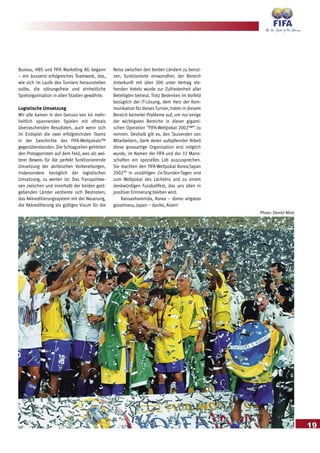
Kansanhamnida, Korea – domo arigatoo
gozaimasu, Japan – danke, Asien!
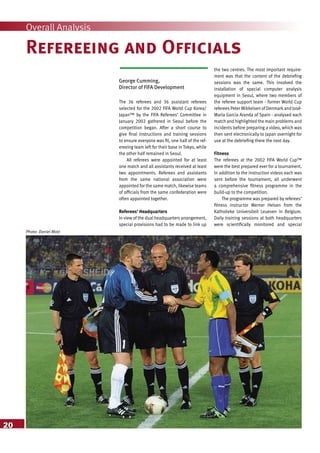
Photo: Daniel Motz
20
Overall Analysis
Refereeing and Officials
George Cumming,
Director of FIFA Development
The 36 referees and 36 assistant referees
selected for the 2002 FIFA World Cup Korea/
Japan™ by the FIFA Referees’ Committee in
January 2002 gathered in Seoul before the
competition began. After a short course to
give final instructions and training sessions
to ensure everyone was fit, one half of the ref-
ereeing team left for their base in Tokyo, while
the other half remained in Seoul.
All referees were appointed for at least
one match and all assistants received at least
two appointments. Referees and assistants
from the same national association were
appointed for the same match, likewise teams
of officials from the same confederation were
often appointed together.
Referees’ Headquarters
In view of the dual headquarters arrangement,
special provisions had to be made to link up
the two centres. The most important require-
ment was that the content of the debriefing
sessions was the same. This involved the
installation of special computer analysis
equipment in Seoul, where two members of
the referee support team - former World Cup
referees Peter Mikkelsen of Denmarkand José-
Maria Garcia Aranda of Spain - analysed each
match and highlighted the main problems and
incidents before preparing a video, which was
then sent electronically to Japan overnight for
use at the debriefing there the next day.
Fitness
The referees at the 2002 FIFA World Cup™
were the best prepared ever for a tournament.
In addition to the instruction videos each was
sent before the tournament, all underwent
a comprehensive fitness programme in the
build-up to the competition.
The programme was prepared by referees’
fitness instructor Werner Helsen from the
Katholieke Universiteit Leueven in Belgium.
Daily training sessions at both headquarters
were scientifically monitored and special
Photo: Daniel Motz
21
pre-match and post-match sessions were also
organised for the teams of officials.
Full medical, massage and physiotherapy
services were provided by both local organis-
ing committees and they are to be congratu-
lated for the excellent support they provided
in both headquarters throughout the compe-
tition.
Performance
The overall performance of the referees and
assistants was good. Mistakes will be made
in any extended competition of 64 matches
and so it was during the 2002 FIFA World Cup
Korea/Japan™.
Football is a game played by humans
and it is in all our natures to make mistakes,
whether we are players, coaches or referees.
This is not to dismiss the need for the high-
est levels of refereeing but to put the errors
committed during the tournament into some
perspective.
Mistakes by assistant referees were more
commonthanthosebyreferees.Theall-seeing
eyes of the 20 or more television cameras and
television replays in super-slow motion with
frame-by-frame analysis made life especially
difficult on the matter of offside.
Like the top players, referees also fall
victim to intense media coverage, highlight-
ing the negative, and overlooking the many
positives in refereeing performances. So it
has been and so it will always be.
Les 36 arbitres et 36 arbitres assistants
sélectionnés pour la Coupe du Monde de la
FIFA, Corée/Japon 2002™ par la Commission
des Arbitres en janvier 2002 se sont réunis à
Séoul avant le début de la compétition. Après
un rapide cours pour donner les dernières ins-
tructions et des séances d’entraînement pour
remettre en forme tout le monde, la moitié
du corps arbitral s’est envolée pour son QG
à Tokyo, tandis que l’autre moitié est restée
à Séoul.
Tous les arbitres ont été nommés pour
au moins un match, deux pour les assistants.
Les arbitres et assistants de la même asso-
ciation nationale ont été placés ensemble
sur le même match, tout comme souvent, les
équipes d’officiels de la même confédération
étaient regroupées.
Quartiers généraux des arbitres
Du fait de la présence de deux QG, des dispo-
sitions spéciales ont dû être prises pour relier
les deux centres. La première nécessité con-
cernait le contenu des séances d’information,
qui devaient être les mêmes. Cela impliquait
l’installation de matériel informatique parti-
culier à Séoul, où deux membres de l’équipe
d’assistance auxarbitres– lesanciensarbitres
de Coupe du Monde Peter Mikkelsen (Dane-
mark) et José-Maria Garcia Aranda (Espagne)
– ont analysé chaque match et soulevé les
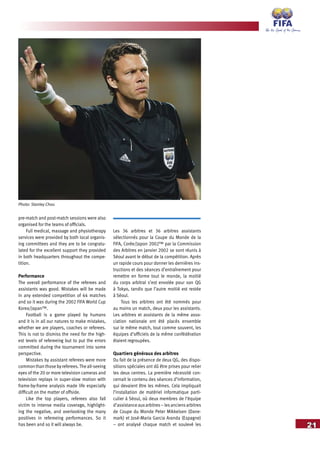
Photo: Stanley Chou
22
Overall Analysis
principaux problèmes et incidents avant de
préparer une vidéo envoyée électroniquement
au Japon la nuit pour être utilisée lors de la
réunion d’information le lendemain.
Condition physique
Les arbitres de la Coupe du Monde de la FIFA
2002™ étaient mieux préparés que jamais.
Outre les vidéos d’instruction envoyées à
chacun avant le début de la compétition,
tous ont participé à un programme de mise
en forme.
Ce programme a été élaboré par le
préparateur physique des arbitres, Werner
Helsen, de la Katholieke Universiteit Leueven,
en Belgique. Des séances d’entraînement
quotidiennes aux deux QG étaient scientifi-
quement suivies et des séances spécifiques
avant et après les matches étaient également
organisées pour les équipes d’officiels.
Des services médicaux, de relaxation et
de physiothérapie ont été proposés par les
deux COLs, qui doivent être félicités pour leur
excellent soutien dans les deux QG durant
toute la compétition.
Performance
La performance globale des arbitres et assis-
tants a été bonne. Des erreurs ont lieu dans
toute compétition comprenant 64 matches,
et la Coupe du Monde de la FIFA, Corée/Japon
2002™ n’a pas fait exception.
Le football est un sport disputé par des
humains et l’erreur est humaine, qu’elle
vienne de joueurs, d’entraîneurs ou d’ar-
bitres. Cela ne rejète pas la nécessité d’un
meilleur niveau d’arbitrage, mais il s’agit de
relativiser les erreurs commises durant la
compétition. Les erreurs des assistants ont
été plus fréquentes que celles des arbitres.
Les yeux omniprésents de la vingtaine de
caméras et les ralentis télévisés assortis
d’une analyse image par image ont rendu
délicate la question du hors-jeu.
Comme les meilleurs joueurs, les arbitres
sont victimes de la large couverture média-
tique préférant mettre l’accent sur le négatif
plutôt que d’évoquer la qualité des perfor-
mances des arbitres. Cela a toujours été ainsi
et cela le restera.
La Comisión de Árbitros de la FIFA, que selec-
cionó en enero de 2002 a los 36 árbitros y
36 asistentes de la Copa Mundial de la FIFA
Corea/Japón 2002™, se reunió en Seúl poco
antes del inicio del torneo. Tras un breve
curso, en el que se impartieron instrucciones
precisas y se celebraron sesiones de entrena-
miento para comprobar que todos estaban
en perfectas condiciones físicas, la mitad del
equipo arbitral partió hacia su base en Tokio,
mientras que los restantes permanecieron en
Seúl.
Todos los árbitros fueron elegidos para
arbitrar al menos un partido, mientras que los
asistentes para un mínimo de dos. Árbitros y
asistentes de una misma asociación nacional
trabajaron juntos frecuentemente, al igual
que los de una misma confederación.
Sedes del centro operativo arbitral
Con dos sedes como centro operativo, fue
necesario que se organizasen sistemas espe-
ciales para enlazar ambos centros. El requi-
Refereeing and Officials
Yellow cards:
Group matches 203
Second and third stage 63
Red cards (second yellow):
Group matches 5
Second and third stage 1
Red cards:
Group matches 8
Second and third stage 3
Recapitulation:
Yellow cards 266
Red cards (second yellow) 6
Red cards 11
Cautions and Expulsions
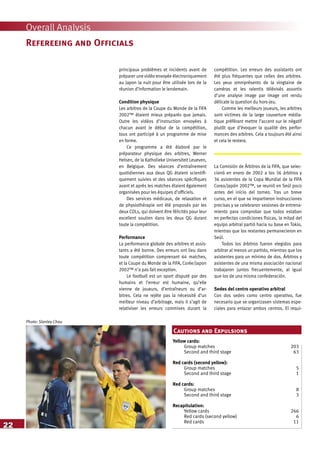
Photo: Stanley Chou
23
sito más importante era que el contenido de
las sesiones informativas debía ser igual, lo
cual implicaba la instalación en Seúl de un
equipo de análisis computarizado, mediante
el cual dos miembros del grupo de apoyo arbi-
tral – antiguos árbitros mundialistas, Peter
Mikkelsen, Dinamarca, y José María García
Aranda, España – analizaron todos los parti-
dos y destacaron los problemas principales e
incidentes, antes de elaborar un vídeo que se
enviaba electrónicamente a Japón cada noche
para que se utilizase en las sesiones informa-
tivas del día siguiente.
Condición física
Los árbitros de la Copa Mundial de la FIFA
2002™ estaban excelentemente preparados,
mejor que en cualquier competición previa
de la FIFA. Además de los vídeos instructivos
enviados antes del torneo, todos debieron
pasar un excelente programa de condición
física.
Este programa fue elaborado por el pre-
parador físico de árbitros Werner Helsen de
la Universidad Católica Leueven, Bélgica.
Las sesiones de entrenamiento diarias se
supervisaron científicamente, y se orga-
nizaron además sesiones especiales para
árbitros, tanto antes como después del entre-
namiento.
Ambos Comités Organizadores facilitaron
servicios médicos, de masaje y de fisiotera-
pia. Debe felicitarse a ambos por su apoyo
durante toda la competición.
Rendimiento
El rendimiento general de los árbitros y asis-
tentes fue bueno. Es normal cometer algún
que otro error durante una competición de
64 encuentros; en esto, la Copa Mundial de
la FIFA Corea/Japón 2002™ no fue ninguna
excepción.
El fútbol es un deporte practicado por
seres humanos, en cuya naturaleza se
encuentra el cometer errores, sean jugadores,
entrenadores o árbitros. Esto no es óbice para
que aceptemos la necesidad de luchar por
conseguir el máximo rendimiento arbitral,
pero hay que tener en cuenta los errores
cometidos con las consideraciones previas
en mente.
Los árbitros asistentes erraron más a
menudo que los árbitros. Las ubicuas y omni-
presentes 20 ó más cámaras de televisión,
las repeticiones a cámara súper-lenta y los
análisis fotograma a fotograma ponen de
manifiesto con crueldad precisión la dificultad
de acertar en el fuera de juego.
Al igual que sucede con los jugadores, los
árbitros están también en el punto de mira de
la prensa, encargada de destacar los aspectos
negativos y desestimar el buen rendimiento
arbitral. Como siempre ha sucedido y como
seguirá pasando.
Die 36 Schiedsrichter und 36 Schiedsrich-
ter-Assistenten, welche die FIFA-Schieds-
richterkommission im Januar 2002 für
den FIFA-Weltpokal Korea/Japan 2002™
selektioniert hatte, reisten für die letzte
Vorbereitungsphase kurz vor Turnierbeginn
nach Seoul. Dort wurden sie nochmals genau
instruiert und einem Fitnesstest unterzogen,
bevor die eine Hälfte der Unparteiischen in
Tokio Quartier bezog.
Alle Schiedsrichter hatten mindestens
einen, die Schiedsrichter-Assistenten zumin-
Photo: Christian Liewig
24
Overall Analysis
dest zwei Einsätze, wobei für die einzelnen
Partien falls möglich Schiedsrichter und
Schiedsrichter-Assistenten desselben Natio-
nalverbandes oder derselben Konföderation
aufgeboten wurden.
Schiedsrichter-Hauptquartier
Der Doppelstandort erforderte ein hohes
Mass an Koordination, z. B. bei den Spielbe-
sprechungen, da alle Spielleiter die gleichen
Informationen erhalten sollten. Mit Hilfe eines
speziellen Computerprogramms analysierten
die beiden ehemaligen WM-Schiedsrichter
Peter Mikkelsen ausDänemarkund José-María
García Aranda aus Spanien alle Partien im
koreanischen Hauptquartier. Anschliessend
wurden alle wichtigen oder problematischen
Szenen zusammengeschnitten und während
der Nacht nach Japan überspielt, damit sie
den Unparteiischen am nächsten Tag bei der
Spielbesprechung gezeigt werden konnten.
Fitness
In konditioneller Hinsicht waren die Schieds-
richter so gut vorbereitet wie nie zuvor. Neben
praktischen Tipps in Form einer Videokassette
ist ihre ausgezeichnete körperliche Verfas-
sung vor allem auf das intensive Trainings-
programm zurückzuführen, das sie im Vorfeld
unter der Leitung von Werner Helsen von der
belgischen Universität Löwen, der in Schieds-
richterkreisen als ausgewiesener Fachmann
für Fitnessfragen gilt, absolviert haben. In
den beiden Hauptquartieren waren unter
wissenschaftlicher Aufsicht täglich Trainings-
einheiten angesetzt, wobei für die Spielleiter
vor und nach ihren Einsätzen ein Spezialpro-
gramm vorgesehen war.
Ein grosses Lob gebührt den beiden
lokalen Organisationskomitees für die umfas-
sende medizinische Betreuung, inkl. Massage
und Physiotherapie, sowie ihren grossartigen
Einsatz.
Leistungsniveau
Die Leistungen der Schiedsrichter und Schieds-
richter-Assistenten waren insgesamt gut, denn
Fehler lassen sich bei einem Turnier mit 64
Begegnungen nie vermeiden.
Irren ist menschlich, auch im Fussball,
der bekanntlich von den Menschen lebt.
Deshalb sind weder Spieler, Trainer noch
Schiedsrichter vor Fehlern gefeit. Natürlich ist
es stets unser Ziel, die Fehlerquote so gering
als möglich zu halten, trotzdem gilt es, die
Fehlentscheide zu relativieren.
Fehler unterliefen meistens den Schieds-
richter-Assistenten, deren Abseits-Entschei-
dungen dank mindestens 20 verschiedenen
Kameraeinstellungen und Super-Zeitlupen
millimetergenau überprüft wurden.
Nach den Fussballstars haben die Medien
nun die Schiedsrichter entdeckt. Beim
geringsten Fehler geraten sie in die Schussli-
nie. “In Deckung”, kann man da nur sagen.
Refereeing and Officials
Photo: Stanley Chou
25
AQUINO Ubaldo 02.05.1958 PAR
BATRES Carlos 02.04.1968 GUA
BUJSAIM Ali 09.09.1959 UAE
CODJIA Coffi 09.12.1967 BEN
COLLINA Pierluigi 13.02.1960 ITA
DAAMI Mourad 15.08.1962 TUN
DALLAS Hugh 26.10.1957 SCO
FRISK Anders 18.02.1963 SWE
GHANDOUR Gamal 12.06.1957 EGY
GUEZZAZ Mohamed 01.10.1962 MAR
HALL Brian 05.06.1961 USA
HAUGE Terje 05.10.1965 NOR
KAMIKAWA Toru 08.06.1963 JPN
KIM Young Joo 30.12.1957 KOR
LOPEZ NIETO Antonio 25.01.1958 ESP
LU Jun 19.03.1959 CHN
MANE Saad 06.01.1963 KUW
MATTUS William 17.04.1964 CRC
MEIER Urs 22.01.1959 SUI
MELO PEREIRA Vitor 21.04.1957 POR
MERK Markus 15.03.1962 GER
MICHEL Lubos 16.05.1968 SVK
MORENO Byron 23.11.1969 ECU
NDOYE Falla 04.03.1960 SEN
NIELSEN Kim Milton 03.08.1960 DEN
ORTUBE Rene 26.12.1964 BOL
POLL Graham 29.07.1963 ENG
PRENDERGAST Peter 23.09.1963 JAM
RAMOS RIZO Felipe 10.03.1963 MEX
RUIZ Oscar 01.11.1969 COL
SANCHEZ Angel 03.03.1957 ARG
SHIELD Mark 02.09.1973 AUS
SIMON Carlos 03.09.1965 BRA
VASSARAS Kyros 01.02.1966 GRE
VEISSIERE Gilles 18.09.1959 FRA
WEGEREEF Jan 17.01.1962 NED
ADJENGUI Taoufik 27.05.1960 TUN
AL TRAIFI Ali 19.12.1960 KSA
AMLER Evzen 15.05.1958 CZE
ARNAULT Frederic 30.04.1961 FRA
AWANG HAMAT Mat Lazim 03.06.1959 MAS
BEREUTER Egon 11.05.1963 AUT
CHARLES Curtis 03.06.1966 ATG
DANTE Dramane 09.12.1961 MLI
DORIRI Elise 09.02.1972 VAN
DUPANOV Yuri 07.06.1962 BLR
FARAG Wagih 29.12.1957 EGY
FERNANDEZ Vladimir 19.04.1961 SLV
FIERRO Bomer 30.10.1958 ECU
GIACOMUZZI Miguel 07.08.1958 PAR
HASSOUNEH Awni 09.01.1964 JOR
KOLEIT Haidar 10.02.1963 LIB
KRISHNAN Visva 21.01.1959 SIN
LARSEN Jens 31.12.1961 DEN
LINDBERG Leif 10.12.1958 SWE
MATOS Carlos 14.05.1958 POR
MUDZAMIRI Brighton 16.03.1960 ZIM
MULLER Heiner 30.05.1961 GER
OLIVEIRA Jorge 23.04.1959 BRA
POOL Jaap 10.09.1961 NED
RAGOONATH Michael 23.04.1967 TRI
RATTALINO Jorge 20.06.1958 ARG
SAEED Mohamed 14.01.1962 MDV
SANKAR Komaleeswaran 10.06.1963 IND
SHARP Philip 05.04.1964 ENG
SMITH Paul 25.05.1957 NZL
SRAMKA Igor 02.11.1959 SVK
SZEKELY Ferenc 02.06.1966 HUN
TOMUSANGE Ali 12.12.1964 UGA
VAN NYLEN Roland 17.06.1960 BEL
VERGARA Hector 15.12.1966 CAN
WIERZBOWSKI Maciej 15.02.1971 POL
Referees Assistant Referees
Photo: Daniel Motz
26
Overall Analysis
Medical Report
Prof. Jiri Dvorak M.D. and Prof. Toni
Graf-Baumann M.D., Chief Medical
Officers for the 2002 FIFA World Cup
Korea/Japan™
The FIFA Medical Officers, members of the
FIFA Sports Medical Committee (Chairman Dr
Michel D’Hooghe M.D.) and the FIFA Panel for
Medical Matters had a number of duties to
perform during the tournament including:
• Monitoring and managing health care issues
for the entire FIFA delegation, as well as for all
the teams in collaboration with the team phy-
sicians and LOC doctors.
• Assessing player injuries throughout the
tournament as part of an ongoing F-MARC
Study (FIFA Medical Assessment and Research
Centre).
• Doping control and related issues.
In view of the nature of these duties and
in order to comply with the FIFA Doping Con-
trol Regulations, the medical officers were all
qualified physicians. Prof. Jiri Dvorak M.D.,
the Chairman of F-MARC, was appointed Chief
Medical Officer for the 2002 FIFA World Cup
Korea/Japan™ and was responsible for opera-
tions in Korea, while Prof. Toni Graf-Baumann
M.D., the Chairman of the FIFA Doping Control
Sub-Committee, was responsible for opera-
tions in Japan.
Health care issues
Amongst the FIFA delegation, there were only
a few minor medical complaints during the
tournament, which were addressed by the
LOC and FIFA doctors. Unfortunately a Scot-
tish spectator suffered a serious head injury
following an accident, however he was treated
at a university hospital in Korea and the case
was managed satisfactorily.
It must be emphasised that the organisa-
tion and communication within medical ser-
vices in both Korea and Japan was excellent.
Injuries during the tournament
Allinjuriesoccurring atFIFA tournamentssince
the 1998 FIFA World Cup France™ have been
monitored using a strictly confidential injury
reporting system, completed by the team phy-
sician following each match and collected by
the FIFA Medical Officer. This information has
been used for scientific purposes in order to
provide evidence concerning the cause and
origin of the injury and possible preventative
measures. There was a 100% compliance rate
at this competition thanks to the excellent
cooperation of the team physicians.
171 injuries were reported during the 64
matches of the 2002 FIFA World Cup Korea/
Japan™, at an average of 2.7 injuries per
match, a figure comparable to the 2.4 injuries
per match registered at the 1998 FIFA World
Cup™ in France.
The injuries mostly occurred to the lower
extremities, however 15% of all injuries were
head injuries (see inset). There were 25 head
injuries, all of which resulted from contact
with another player and none of which were
caused by heading the ball. These 25 head
injuries included four cases of concussion.
37% of all injuries were caused by fouls (in
the view of the team physician or player), 36%
by player-to-player contact that did not violate
the Laws of the Game, and 27% were incurred
without any contact with another player.
Comparing the figures from the 2002 FIFA
World Cup™ with those from the Olympic
Games Football Tournament Sydney 2000
using the same assessment procedure, one
positive development that must be noted
is that fewer injuries were caused by fouls,
however there was an increase in the number
of injuries attributed to overuse, which might
be a result of the physical overload of profes-
sional players during the previous season or
because insufficient time was allowed for
rehabilitation and preparation prior to the
2002 FIFA World Cup™.
In order to substantiate this assumption,
F-MARC is considering prospective studies to
gather more data and scientific evidence in
this area to ascertain the optimal and maxi-
mum physical load and games per season for
professional football players. These proposed
studies can only be carried out on the basis
of close collaboration between FIFA and the
confederations, national associations and, in
particular, professional clubs.
There is no doubt that healthy and well-
prepared football players will perform better.
It is the responsibility of the medical profes-
sion to maintain the physical health of players
– a factor that is of paramount importance to
football, because only healthy and motivated
players can raise the game and ultimately
enhance its appeal.
Doping issues
Two hundred and fifty-six blood and urine
tests were carried out during the 2002 FIFA
27
World Cup™ with two players per team under-
going doping control after each of the 64
games. The cooperation of the players, team
physicians and responsible officials from the
participating teams was excellent and under-
lined the joint commitment that exists in the
fight against doping.
All 256 blood and urine tests yielded
negative results and no prohibited sub-
stances were identified. For the first time ever
at a FIFA tournament, blood samples were
taken in order to eliminate blood doping, in
particular the use of Erythropoietin (EPO) or
Darbepoietin (DPO).
All 736 players from the 32 finalist teams
signed an informed consent form prior to the
tournament and the players’ cooperation has
to be hailed as outstanding, since they were
participating in a new procedure. The doctors
carrying out the doping controls were pleas-
antly surprised by the attitude of the players
when they had their blood taken following
matches.
At no point during the tournament were
any side effects or complications observed or
reported as a result of blood sampling.
The invaluable experience that has been
acquired by taking blood and urine samples
at the 2002 FIFA World Cup Korea/Japan™ as
well as the valuable cooperation of the partici-
patingplayershasconfirmedthatFIFAisonthe
right track with its strategy in the fight against
doping. This strategy is primarily focused on
education and prevention, working in close
collaboration with team physicians, as well as
other paramedical personnel.
Finally, sincere thanks must go to all the
players, team physicians and members of
the national team delegations, and to the
Local Organising Committees for the support
that helped to make the 2002 FIFA World Cup
Korea/Japan™ such a resounding success
from a medical perspective.
Les officiels médicaux de la FIFA, les membres
de la Commission de Médecine Sportive (Pré-
sident Dr Michel D’Hooghe M.D.) et le groupe
chargé des questions médicales avaient une
série de tâches à réaliser durant le tournoi,
notamment:
• Contrôle et traitement des questions de
santé de toute la délégation de la FIFA et de
toutes les équipes en collaboration avec les
médecins des équipes et ceux des COLs.
• Evaluation des blessures de joueurs appa-
rues lors du tournoi dans le cadre d’une étude
du F-MARC (Centre d’Evaluation et de Recher-
che Médical de la FIFA).
• Contrôles de dopage et questions y relati-
ves.
Au vu de la nature de ces tâches et afin
de se conformer au Règlement du Contrôle de
Dopage de la FIFA, les officiels médicaux de la
FIFA étaient tous des médecins qualifiés. Prof.
Jiri Dvorak M.D., président du F-MARC, a été
nommé officiel médical en chef pour la Coupe
du Monde de la FIFA, Corée/Japon 2002™, et
était responsable des opérations en Corée,
tandis que Prof. Toni Graf-Baumann M.D.,
président de la sous-commission de la FIFA
pour les contrôles de dopage, était chargé des
opérations au Japon.
Questions de santé
Parmi la délégation de la FIFA, seules quel-
ques plaintes mineures prises en charge par
les COLs et les médecins de la FIFA ont été à
noter lors du tournoi. Malheureusement, un
supporter écossais a souffert de blessures
sérieuses à la tête lors d’un accident, mais
le patient a été traité dans un hôpital uni-
versitaire coréen et le cas a été géré de façon
satisfaisante.
Il convient d’indiquer que l’organisation
et la communication au sein des services
médicaux étaient excellentes, tant en Corée
qu’au Japon.
Blessures apparues durant la compétition
Toutes les blessures contractées lors de tour-
nois de la FIFA depuis la Coupe du Monde de
la FIFA, France 1998™ ont été suivies grâce à
un système de rapports strictement confiden-
tiels sur les blessures, complétés par le méde-
cin des équipes à l’issue de chaque match et
rassemblés par l’officiel médical de la FIFA.
Ces informations ont été utilisées à des fins
scientifiques pour prouver les causes et les
origines de la blessure et découvrir d’éven-
tuelles mesures préventives. Lors de cette
compétition, tous les joueurs s’y sont pliés
grâce à l’excellente coopération des médecins
des équipes.
171 blessures ont été rapportées lors
des 64 matches de la Coupe du Monde de la
FIFA, Corée/Japon 2002™, soit une moyenne
de 2,7 par match, chiffre comparable aux
2,4 blessures par match lors de la Coupe du
Monde de la FIFA, France 98™.
28
Overall Analysis
Medical Report
La plupart des blessures enregistrées con-
cernaient les membres inférieurs, cependant
15% des blessures étaient des blessures au
niveau de la tête (voir encadré). Les 25 bles-
sures à la tête résultaient toutes d’un choc
avec un autre joueur, aucune d’entre elle n’a
été causée par le contact avec le ballon. 4 de
ces 25 blessures présentaient un cas de com-
motion cérébrale.
37% des blessures ont été causées par
des fautes (du point de vue du médecin de
l’équipe ou du joueur), 36% par des chocs
entre joueurs sans faute, et 27% ont eu lieu
sans contact avec un autre joueur.
En comparant les chiffres de la Coupe
du Monde de la FIFA 2002™ avec ceux des
Tournois de Football des Jeux Olympiques
de Sydney 2000 selon la même procédure
d’évaluation, il convient de noter un aspect
positif: moins de blessures sont causées par
des fautes, cependant l’augmentation du
nombre de blessures de fatigue peut être le
résultat d’une surcharge d’efforts physiques
des joueurs professionnels durant les saisons
précédentes, d’un manque de temps de récu-
pération après une blessure ou d’un manque
de préparation avant la Coupe du Monde de
la FIFA 2002™.
Afin de prouver le bien fondé de cette
supposition, le F-MARC envisage des études
prospectives pour réunir davantage de don-
nées et de preuves scientifiques pouvant
déterminer la charge d’efforts physiques et
le nombre optimal et maximal de matches
pour les joueurs de football professionnels.
Ces études proposées peuvent uniquement
être menées sur la base d’une collaboration
étroite entre la FIFA et les confédérations, les
associations nationales et en particulier les
clubs professionnels.
Il ne fait aucun doute que des joueurs de
football en bonne santé et mieux préparés
offriront un meilleur spectacle. Il est de la
responsabilité des professions médicales
de maintenir la bonne santé physique des
joueurs, facteur de première importance dans
le football, parce que seuls des joueurs en
forme et motivés peuvent faire progresser le
jeu et en répandre l’intérêt.
Questions de dopage
Deux cent-cinquante-six échantillons d’urine
et de sang ont été prélevés pendant la Coupe
du Monde de la FIFA 2002™ sur deux joueurs
par équipe et pour chacun des 64 matches
de la compétition finale. La coopération des
joueurs, des médecins des équipes et de tous
les officiels des équipes participantes a été
excellente, soulignant l’engagement de tous
dans la lutte contre le dopage.
Les 256 échantillons de sang et d’urine se
sont avérés négatifs. Aucune substance pro-
hibée n’a été identifiée. Pour la première fois
à une compétition de la FIFA, des échantillons
de sang ont été prélevés dans le but de déce-
ler le dopage sanguin, notamment l’usage de
l’érythropoïétine (EPO) ou de la Darbépoïétine
(DPO).
Les 736 joueurs des 32 équipes finalistes
ont signé une déclaration de consentement
avant le début de la compétition confirmant
qu’ils acceptaient ladite procédure. La co-
opération des joueurs a été exemplaire, et
cela a été d’autant plus apprécié qu’il s’agis-
sait d’une première en la matière. Du point de
vue médical, les médecins responsables de
la nouvelle procédure ont été agréablement
surpris de l’attitude positive des joueurs lors
des prises de sang post-matches.
Aucune complication et aucun effet
secondaire n’ont été observés ou rapportés
suite à une prise de sang.
L’expérience acquise en prélevant des
échantillons de sang et d’urine lors de la
Coupe du Monde de la FIFA, Corée/Japon
2002™ ainsi que la précieuse coopération
des joueurs participants ont confirmé que la
FIFA est sur la bonne voie quant à sa stratégie
dans la lutte contre le dopage. Cette stratégie
Photo: John McDermott
29
met à la base l’accent sur l’information et la
prévention, avec l’étroite collaboration des
médecins des équipes et du personnel para-
médical.
Enfin, il convient de remercier chaleureu-
sement tous les joueurs, médecins des équi-
pes et membres des délégations nationales,
ainsi que les Comités Organisateurs Locaux
pour leur soutien, qui a fait de cette Coupe
du Monde de la FIFA, Corée/Japon 2002 un tel
succès d’un point de vue médical.
Los oficiales médicos de la FIFA, miembros
de la Comisión de Medicina Deportiva de la
FIFA (Presidente Dr. Michel D´Hooghe M.D.) y
de la Lista FIFA de asuntos médicos, tuvieron
diversas tareas que realizar durante el torneo,
entre las cuales estaban:
• Vigilancia y control de asuntos médicos
de la delegación FIFA y de los equipos, en
colaboración con los médicos de éstos y los
doctores del COL
• Evaluación de las lesiones de los jugadores,
como parte de un estudio del F-MARC (Centro
de Evaluación e Investigación Médica de la
FIFA)
• Control de dopaje y asuntos relacionados
En vista de la naturaleza de estas tareas, y
para cumplir con el Reglamento del control de
dopaje de la FIFA, los oficiales médicos eran
todos doctores debidamente cualificados. El
Prof. Jiri Dvorak M.D., Presidente de F-MARC,
fue nombrado Oficial médico jefe para la
Copa Mundial de la FIFA Corea/Japón 2002™
y responsable de las operaciones en Corea,
mientras que el Prof. Toni Graf-Baumann M.D.,
Presidente de la Subcomisión del control de
dopaje de la FIFA, fue elegido como responsa-
ble de las operaciones en Japón.
Asuntos médicos
Entre la delegación de la FIFA sólo se pro-
dujeron complicaciones médicas menores
durante el torneo, de las cuales se ocuparon
los doctores del COL y de la FIFA. Lamenta-
blemente, un espectador escocés sufrió una
grave lesión de cabeza a raíz de un accidente;
no obstante, se le atendió adecuadamente en
un hospital universitario de Corea y su lesión
se trató satisfactoriamente.
Debe señalarse que la organización y la
comunicación con los servicios médicos de
Corea y de Japón fueron excelentes.
Lesiones durante el torneo
Todas las lesiones acaecidas en los torneos
de la FIFA a partir de la Copa Mundial de la
FIFA Francia 1998™ se han consignado utili-
zando un informe confidencial, que completa
el médico del equipo después de cada partido
y compila el Oficial médico de la FIFA. Esta
información se ha utilizado con fines científi-
cos para descubrir el origen y la causa de las
lesiones, y tratar de encontrar así las posibles
medidas preventivas. En esta competición se
recogió el 100% de la información, gracias a
la excepcional colaboración de los médicos
de los equipos.
Durante los 64 partidos de la Copa Mun-
dial de la FIFA Corea/Japón 2002™ se produ-
jeron 171 lesiones, lo que da como resultado
una media de 2.7 lesiones por partido. Este
resultado equivale a la media de 2.4 lesiones
por partido registrada en la Copa Mundial de
la FIFA Francia 1998™.
Las lesiones más frecuentes ocurrieron en
las extremidades inferiores, aunque el 15%
del total se produjo en la cabeza (cf. cuadro).
Hubo 25 lesiones de cabeza, todas a raíz del
contacto con otro jugador, y ninguna motivada
por cabecear el balón. Entre estas 25 lesiones
hubo varios casos de concusión.
El 37% de todas las lesiones se produjo
a raíz de faltas (en opinión del médico del
equipo o del jugador), un 36% en contactos
entre dos jugadores, aunque sin una violación
de las Reglas de Juego, mientras que un 27%
se produjo sin contacto con otro jugador.
Comparando los resultados de la Copa
Mundial de la FIFA 2002™ con los de los
Torneos Olímpicos de Fútbol Sydney 2000,
utilizando el mismo procedimiento de evalua-
ción, un aspecto positivo que debe recalcarse
Injury Rate at Men’s FIFA Tournaments 1998 – 2002
150
120
90
60
30
0
73
53 51
109
96
113
63
88
144
81
1998
World Cup
1999
Conf. Cup
1999
U-17 WC
1999
U-20 WC
2000
Club WC
2000
Olympics
2000
Conf. Cup
2001
U-20 WC
2001
U-17 WC
2002
World Cup
30
Overall Analysis
Medical Report
es que hubo menos lesiones motivadas por
faltas, aunque se produjo un aumento de
lesiones debido a la sobrecarga física de
los jugadores profesionales durante la tem-
porada previa o a raíz del escaso tiempo de
preparación o rehabilitación antes del inicio
del Mundial.
Para fundamentar esta suposición, el
F-MARC está considerando realizar estudios
prospectivos para compilar más datos y
pruebas científicas, con el fin de descubrir la
sobrecarga física y el número de partidos ade-
cuado por temporada y jugador profesional.
Estos estudios sólo podrán llevarse a cabo
con la colaboración de la FIFA, las confede-
raciones, las asociaciones nacionales y, muy
especialmente, los clubes profesionales.
No cabe duda de que los jugadores sanos
y bien preparados rinden mejor. La respon-
sabilidad de los profesionales médicos es
conservar la salud física de los jugadores – un
factor fundamental para el futuro del fútbol,
porque sólo los jugadores sanos y motivados
pueden mejorar la calidad del juego e incre-
mentar así su atractivo.
Dopaje
Se realizaron doscientos cincuenta y seis aná-
lisis de sangre y de orina durante la Copa Mun-
dial de la FIFA 2002™, con dos jugadores por
equipo pasando el control después de todos
y cada uno de los 64 partidos disputados. La
excelente cooperación entre los jugadores, los
médicos de los equipos y todos los oficiales
responsables de los equipos participantes
sirvió para subrayar el compromiso generali-
zado existente en la lucha contra el dopaje.
Los 256 análisis tuvieron un resultado
negativo y no se encontraron sustancias prohi-
bidas. Por primera vez en un torneo de la FIFA
se tomaron muestras de sangre para eliminar
el dopaje sanguíneo, particularmente el uso de
Eritropoyetina (EPO) y Darbopoyetina (DPO).
Los 736 jugadores de los 32 equipos fina-
listas firmaron una autorización para estos
análisis antes del torneo; se debe señalar que
su cooperación fue excepcional, teniendo en
cuenta que participaban en un nuevo pro-
cedimiento. Los médicos que efectuaron el
control de dopaje se sorprendieron favorable-
mente por la actitud de los jugadores cuando
tuvieron que someterse a la toma de muestras
de sangre.
En ningún momento se observaron efec-
tos secundarios o complicaciones motivadas
por la toma de muestras de sangre.
La valiosa experiencia adquirida por
la toma de sangre y orina durante la Copa
Mundial de la FIFA 2002™ y la excelente
cooperación de los jugadores han confirmado
que la FIFA ha acertado en su estrategia de
lucha contra el dopaje. Esta estrategia se
concentra fundamentalmente en la educación
y prevención, trabajando estrechamente con
los médicos de los equipos y otro personal
paramédico.
Por último, nuestro más sincero agrade-
cimiento a todos los jugadores, médicos de
los equipos y miembros de las delegaciones
nacionales por su cooperación, así como a los
Comités Organizadores Locales por su apoyo;
todos ellos contribuyeron decisivamente al
éxito médico de la Copa Mundial de la FIFA
Corea/Japón 2002™.
Die Medizinischen Koordinatoren der FIFA,
gleichzeitig Mitglieder der Sportmedizinischen
Kommission der FIFA (Vorsitzender: Dr. Michel
D’Hooghe MD) sowie Instruktoren und Referen-
ten für medizinische Angelegenheiten, hatten
u. a. folgende Aufgaben:
• Ortung und Bewältigung aller medizinischen
Probleme der gesamten FIFA-Delegation und
aller Mannschaften, in Zusammenarbeit mit
den Team- und LOC-Ärzten.
• Analyse von Spielerverletzungen im Rahmen
einer laufenden F-MARC-Studie (Zentrum für
medizinische Auswertung und Forschung der
FIFA).
• Dopingkontrollen und damit zusammenhän-
gende Aufgaben.
Angesichts der Aufgaben und in Über-
einstimmung mit dem FIFA-Reglement für
die Dopingkontrollen wurden nur ausgebil-
dete Ärzte zu Medizinischen Koordinatoren
ernannt. Prof. Jiri Dvorak MD, Vorsitzender von
F-MARC, wurde für den FIFA-Weltpokal Korea/
Japan 2002™ zum Medizinischen Chefkoor-
dinatoren und Leiter der Arbeiten in Korea
bestimmt, während Prof. Toni Graf-Baumann
MD, Vorsitzender des FIFA-Dopingkontroll-
Ausschusses, für Japan zuständig war.
Medizinische Betreuung
Bei der FIFA-Delegation gab es während des
Turniers nur vereinzelte harmlose Krankheits-
fälle oder Unfälle zu melden, die von LOC- und
FIFA-Ärzten behandelt wurden. Ein schotti-
scher Zuschauer musste nach einem Unfall
mit schweren Kopfverletzungen in eine korea-
Photos: John McDermott, Daniel Motz
31
nische Universitätsklinik eingeliefert werden,
wo er professionell betreut wurde.
Die Koordination und die Kommunikation
zwischen den medizinischen Teams in Korea
und Japan waren mustergültig.
Verletzungen
Seit dem FIFA-Weltpokal Frankreich 1998™
werden an den FIFA-Wettbewerben sämtliche
Verletzungen ausgewertet. Der Mannschafts-
arzt muss zu diesem Zweck nach jedem Spiel
auf einem Formular Angaben zu etwaigen
Verletzungen machen, die streng vertraulich
behandelt werden, und dieses dem Medizini-
schen Koordinator der FIFA aushändigen. Mit
diesen Informationen sollen neue Erkennt-
nisse über die Ursachen von Verletzungen
und für die Verletzungsprävention gewonnen
werden. Ein spezieller Dank gilt den Mann-
schaftsärzten, die ihrer Meldepflicht vollum-
fänglich nachgekommen sind.
171 Verletzungen wurden bei den 64
Endrunden-Partien registriert, ein Schnitt
von 2.7 pro Spiel gegenüber 2.4 bei der
letzten Weltmeisterschaft in Frankreich. Von
Verletzungen waren die unteren Extremitäten
am häufigsten betroffen. In 25 Fällen (15 %)
wurde eine Kopfverletzung diagnostiziert
(siehe Diagramm), wobei stets Zusammen-
stösse zwischen zwei Spielern, nie jedoch
ein unbedrängter Kopfball die Ursache waren.
Vier Spieler zogen sich bei solchen Duellen
eine Gehirnerschütterung zu. 37 % der Spieler
verletzten sich bei einem Foul (nach Ansicht
der Mannschaftsärzte oder der Spieler), 36 %
nach regelkonformen Zweikämpfen und 27 %
ohne gegnerische Einwirkung.
Im Vergleich mit den Zahlen des Olympi-
schen Fussballturniers in Sydney 2000, die
anhand derselben Kriterien ermittelt wurden,
konnte eine erfreuliche Tendenz festgestellt
werden: Weniger Verletzungen wurden durch
Fouls verursacht. Dafür gab es eine Zunahme
bei den Fällen, die auf eine Überbelastung
zurückzuführen sind, vielleicht eine Folge der
langen Saison, die bei den Profispielern an
die Substanz ging, und der zu kurz bemesse-
nen Regenerations- und Vorbereitungszeit für
den FIFA-Weltpokal 2002™.
Diesen Punkt wird F-MARC in Zukunft
genauer untersuchen, damit Rückschlüsse
auf die optimale sowie die maximale Belas-
tung eines Profispielers (Anzahl Spiele) in
einer Spielzeit möglich sind. Voraussetzung
ist jedoch eine enge Zusammenarbeit zwi-
schen der FIFA und den Konföderationen,
Nationalverbänden und insbesondere den
Profivereinen.
Es besteht kein Zweifel, dass gesunde und
gut vorbereitete Spieler ein höheres Leistungs-
vermögen haben. Ein Arzt hat bei der Ausübung
seines Berufs stets das Wohl des Patienten vor
Augen. Dies gilt in besonderem Masse für den
Fussball, denn nur gesunde und motivierte
Spieler können zur Steigerung des Niveaus und
der Attraktivität unseres Sports beitragen.
Doping
256 Blut- und Urintests wurden am FIFA-
Weltpokal 2002™ durchgeführt. Bei allen
64 Partien wurden jeweils zwei Spieler pro
Team kontrolliert. Mit der vorbehaltlosen
Zusammenarbeit legten die Spieler, Mann-
schaftsärzte und zuständigen Offiziellen der
einzelnen Teams ein klares Bekenntnis für
die Dopingbekämpfung ab. Alle 256 Blut-
tests waren negativ, es wurden also keine
verbotenen Substanzen nachgewiesen. Zum
ersten Mal bei einem FIFA-Turnier wurden
zum Nachweis von Blutdoping, insbesondere
Erythropoetin (EPO) oder Darbepoetin (DPO),
auch Blutproben entnommen.
Mit der Unterzeichnung einer Einverständ-
niserklärung vor Turnierbeginn akzeptierten
alle 736 Spieler der 32 Mannschaften das
Dopingkontrollverfahren. Die Zusammenar-
beit mit den Spielern war beispielhaft, vor
allem wenn man bedenkt, dass ein völlig
neues Verfahren zur Anwendung kam. Die
Ärzte, die mit der Durchführung der neuen
Tests betraut waren, zeigten sich vom Verhal-
ten der Spieler denn auch positiv überrascht.
Infolge der Bluttests wurden während des
Turniers weder Nebenwirkungen noch Kompli-
kationen registriert oder gemeldet.
Die wertvollen Erfahrungen, die bei der
Durchführung der Blut- und Urintests am FIFA-
Weltpokal Korea/Japan 2002™ gewonnen
wurden, sowie die ausgezeichnete Zusammen-
arbeit mit den Spielern beweist, dass die FIFA
mit ihrer Strategie zur Dopingbekämpfung auf
dem richtigen Weg ist. Im Vordergrund stehen
die Aufklärung und die Prävention, wobei eng
mit den Mannschaftsärzten und den medizini-
schen Betreuern zusammengearbeitet wird.
Grosser Dank gebührt den Spielern,
Mannschaftsärzten, Mitgliedern der Teamde-
legationen und den lokalen Organisations-
komitees, die entscheidend dazu beitrugen,
dass der FIFA-Weltpokal Korea/Japan 2002™
aus medizinischer Sicht zu einem überwälti-
genden Erfolg wurde.
32
Overall Analysis
Stadia and Security
Walter Gagg, Director of Stadia,
Security and Technical Matters
Basic Preparations
The first meeting between FIFA, KOWOC and
JAWOC security officers took place in Munich
on 2 September 2001 and the main security
concerns centred upon hooliganism and vio-
lence before, during and after the matches.
The experience of France ’98 had strength-
ened FIFA’s determination to be prepared for
all eventualities and to prevent violent con-
frontations inside and outside the stadia.
However, the horrific events of 11Septem-
ber, just nine days after that initial meeting in
Munich, completely changed the security
arrangements for the 2002 FIFA World Cup
Korea/Japan™. While the threat of terrorism
has always been on FIFA’s security agenda, all
of a sudden, it became a major concern.
Subsequent discussions at meetings in
Tokyo, Busan, Zurich, Strasbourg and Seoul
were more varied and indeed stretched our
resources as we strived to ensure that no
stone was left unturned in our efforts to guar-
antee safety at this World Cup, the first to be
held in Asia. As well as representatives from
FIFA and the governments of Korea and Japan,
security officers from the other 30 qualified
national associations were present at these
meetings.
Event Organisation
As with all other tournaments, security at this
World Cup was in the hands of the two host
nations. Working in close cooperation with the
two LOCs and FIFA, the governments of Korea
and Japan had to ensure safety and security in
the two countries for the duration of the tour-
nament, complying with FIFA’s list of require-
ments and recommendations for safety and
security. KOWOC, with approximately 55,000
employees, and JAWOC, with over 40,000,
shared the responsibility and ensured that
the 64 matches went ahead as planned and
without incident.
Upon arrival in Korea or Japan, the teams,
and even some high-profile players, were
met by a strict, professional team of security
Photo: Christian Liewig
33
Busan: 112,235; per match: 37,412
Daegu: 214,987; per match: 53,747
Daejeon: 96,094; per match: 32,031
Gwangju: 97,929; per match: 32,643
Incheon: 140,638; per match: 46,879
Jeonju: 91,380; per match: 30,460
Seogwipo: 92,102; per match: 30,701
Seoul: 171,422; per match: 57,141
Suwon: 148,374; per match: 37,094
Ulsan: 101,336 per match: 33,779
Stadia in Korea
Ibaraki: 106,376; per match: 35,459
Kobe: 107,591; per match: 35,864
Miyagi: 137,053; per match: 45,684
Niigata: 106,500; per match: 35,500
Oita: 118,738; per match: 39,579
Osaka: 134,310; per match: 44,770
Saitama: 221,363; per match: 55,341
Sapporo: 99,226; per match: 33,075
Shizuoka: 141,161; per match: 47,054
Yokohoma: 266,319; per match: 66,580
Stadia in Japan
agents. For example, the USA squad was
always accompanied by a heavily armed team
of agents, and guards were also present in
team hotels and at the side of referees, VIPs
and high-ranking officials.
Thanks to the close cooperation with the
teams’ security officers, we were able to meet
every security challenge that arose during the
tournament.
The KOWOC and JAWOC teams of security
officers were expertly led by Mr Chang Won
Kyong and Mr Takahisha Ishida respectively.
FIFA also appointed eight security officers
– Hisham Azmy, Cees de Bruin, Walter Gagg,
Indran Rasasingam, Horst R. Schmidt, Hans-
Ulrich Schneider, Hank Steinbrecher and
Bob Stiles – who all worked under the com-
petent guidance of FIFA Executive Committee
member Dr Antonio Matarrese.
From the point of view of spectators,
there were no major incidents of hooliganism,
which was a great credit to the collaboration
between the two host nations and interna-
tional organisations. Potential hooligans
were either prevented from travelling or
immediately sent home upon arrival in Korea
and Japan.
Subsequently, the stadia were full of gen-
uine football fans, who proved that problems
at football matches are caused not by fans but
trouble-makers. The tournament also showed
that there is no need for fences or metal bars
to keep fans under control. The twenty stadia
in Korea and Japan did not have any fences,
but there were no pitch invasions, and no inci-
dents of crowd trouble or violence.
Conclusion
Overall, the 2002 FIFA World Cup™ was a
tournament full of surprises, celebration, pas-
sion and joy. The first ever co-hosted World
Cup brought together not only the people of
Korea and Japan, but also people from the
participating nations and football fans from
all around the globe. People felt safe in Korea
and Japan and were able to concentrate on
the football, leading to all of those scenes of
celebration and joy that will live long in the
memory. Each match was a major security
challenge, but the two host nations and LOCs
were able to ensure that the security was felt,
rather than seen.
This will always remain our target,
ensuring that fans are able to watch football
matches without worrying about their safety
and well-being.
Préorganisation
Lors de notre première séance à Munich, le 2
septembre 2001, entre la FIFA et les agents
de sécurité du KOWOC et du JAWOC, le hooli-
ganisme et la violence avant, durant et après
les matches étaient notre principale source
de préoccupation en matière de sécurité.
Forte de son expérience de France 1998, la
FIFA entendait empêcher toute violence tant à
l’intérieur qu’à l’extérieur des stades.
Aussi, neuf jours plus tard, les disposi-
tions relatives à la Coupe du Monde de la FIFA
2002™ en matière de sécurité prirent-elles
une nouvelle dimension, ce à quoi les tragi-
ques événements du 11 septembre n’étaient
pas étrangers. La question des actes terroris-
tes fut érigée en priorité pour la FIFA.
Lors des séances ultérieures à Tokyo,
Busan, Zurich, Strasbourg et Séoul, les discus-
sions portèrent sur des aspects de la sécurité
encore plus variés et des ressources encore
plus étendues furent déployées pour assurer
la parfaite sécurité de la première Coupe du
Monde en Asie. Outre les représentants de la
FIFA et des gouvernements de la Corée et du
34
Overall Analysis
Stadia and Security
Japon, des agents de sécurité des 30 asso-
ciations nationales qualifiées participèrent à
ces séances.
Organisation de la manifestation
Comme à chaque compétition, les questions
de sécurité relatives à la Coupe du Monde
intéressaient les gouvernements des pays
organisateurs. La Corée et le Japon, avec les
2 COLs et la FIFA, étaient tenus d’assurer une
protection adéquate sur leurs territoires res-
pectifs durant toute la compétition, conformé-
ment au cahier des charges de l’Association
Organisatrice et aux recommandations de
la FIFA. Le KOWOC et le JAWOC employaient
environ 55 000 personnes en Corée et plus de
40 000 au Japon et assumaient conjointement
la responsabilité du parfait déroulement des
64 matches.
A leur arrivée, les équipes et certains
joueurs furent entourés d’un dispositif de
sécurité très strict. L’équipe des Etats-Unis
était accompagnée en permanence d’une
escorte armée. Des gardes armés surveillaient
également les hôtels des équipes et enca-
draient les arbitres, les VIPs et les officiels
haut placés.
Avec l’étroite collaboration des agents
de sécurité des équipes, tous les défis en
matière de sécurité purent être surmontés
très efficacement.
Les directeurs de la sécurité du KOWOC
et du JAWOC étaient Messieurs Chang Won
Kyong et Takahisha Ishida. A la FIFA, huit
agents de sécurité placés sous l’égide de
Antonio Matarrese, membre de l’Exco, avaient
été désignés, à savoir Hisham Azmy, Cees
de Bruin, Walter Gagg, Indran Rasaingam,
Horst R. Schmidt, Hans-Ulrich Schneider,
Hank Steinbrecher et Bob Stiles.
Dans le public, aucun incident majeur de
hooliganisme n’a été constaté et ce, en grande
partie grâce à la collaboration internationale
entre les deux Etats et les organisations inter-
nationales. Les hooligans potentiels s’étaient
vu interdire l’accès aux territoires coréen et
japonais ou refouler dès leur arrivée en Asie.
Du fait de ce contrôle strict, seuls les
véritables supporters purent accéder aux
stades et assister aux matches. Cela montre
que les problèmes qui surgissent parfois
lors des matches de football ne sont pas
le fait des supporters mais de fauteurs de
troubles. La compétition a également révélé
que les barrières et les grillages séparant le
terrain des tribunes sont superflus. Aucun
des vingt stades de la Corée et du Japon n’en
était équipé, pourtant aucune incursion sur
le terrain ni mouvement de foule ni acte de
violence n’ont été déplorés.
Conclusion
La Coupe du Monde de la FIFA 2002™ s’est
déroulée dans un climat de joie et d’euphorie.
La première édition coorganisée a rapproché
non seulement la Corée et le Japon mais aussi
les populations et les gouvernements de tous
les pays participants ainsi que les supporters
du monde entier. La fête n’a été possible que
parce que le public, se sentant en sécurité,
a pu goûter pleinement les joies du football.
Chaque match représentait un enjeu consi-
Photo: Christian Liewig
35
dérable en termes de sécurité mais les deux
pays et les COLS ont réussi le tour de force de
camoufler le dispositif de sécurité tout en le
rendant perceptible.
Permettre aux supporters de suivre les
matches sans craindre pour leur sécurité, tel
était et tel sera toujours notre but.
Preparativos básicos
Cuando celebramos la primera reunión, el
2 de septiembre de 2001 en Zúrich, entre
los oficiales de seguridad de FIFA, KOWOC y
JAWOC, nuestras principales preocupaciones
se centraban en el gamberrismo y la violencia
antes, durante y después de los partidos. Tras
la experiencia en Francia 1998, la FIFA quería
estar preparada ante las confrontaciones vio-
lentas dentro y fuera de los estadios.
No obstante, nueve días después, el enfo-
que de los dispositivos de seguridad para la
Copa Mundial de la FIFA Corea/Japón 2002™
cambió radicalmente – fundamentalmente a
raíz de los horrendos acontecimientos del 11
de septiembre. Los ataques terroristas eran
parte integral del orden del día sobre la segu-
ridad, pero a partir de esa fecha se convirtie-
ron en una de las prioridades de la FIFA.
A consecuencia de esto, nuestras subse-
cuentes reuniones en Tokio, Busán, Zúrich,
Estrasburgo y Seúl se dedicaron principal-
mente a utilizar nuestros recursos para garan-
tizar que la primera Copa Mundial celebrada
en Asia fuese completamente segura para
todos. En las reuniones participaron no sólo
la FIFA y los dos gobiernos de Corea y Japón,
sino también los oficiales de seguridad de
las otras 30 asociaciones nacionales clasifi-
cadas.
Organización de la Copa
Al igual que en las otras competiciones, la
seguridad de la Copa Mundial corre a cargo
de los dos estados. Los gobiernos de Corea
y Japón, junto con ambos comités organiza-
dores locales y la FIFA, son responsables de
organizar la protección adecuada en ambos
países durante toda la disputa de la Copa
Mundial, mediante el estricto cumplimiento
del cuaderno de obligaciones y las recomen-
daciones de seguridad de la FIFA. KOWOC
y JAWOC emplearon aproximadamente a
55,000 personas en Corea y a más de 40,000
en Japón – compartiendo solidariamente la
responsabilidad para garantizar que los 64
partidos del Mundial se desarrollasen sin
contratiempos.
Tras su llegada a uno de los dos países,
los equipos, así como algunos jugadores,
disfrutaron de un servicio de seguridad
sumamente estricto. El equipo de EE UU tuvo
siempre cerca una escuadra armada. En los
hoteles de los equipos, de los árbitros, de
los VIP y de los oficiales de alto rango hubo
también guardias armados.
Photo: John McDermott
36
Overall Analysis
Gracias a la estrecha colaboración con
los oficiales de seguridad de los equipos se
pudieron resolver eficazmente todos los pro-
blemas de seguridad.
Los directores de seguridad de KOWOC
y de JAWOC fueron el Sr. Chang Won Kyong y
el Sr. Takahisha Ishida, respectivamente. La
FIFA, por su parte, nombró a ocho oficiales
de seguridad dirigidos por el miembro del
Comité Ejecutivo de la FIFA Dr. Antonio Mata-
rrese – Hisham Azmy, Cees de Bruin, Walter
Gagg, Indran Rasasingam, Horst R. Schmidt,
Hans-Ulrich Schneider, Hank Steinbrecher y
Bob Stiles.
En lo que respecta a los aficionados, cabe
destacar que no hubo incidentes graves rela-
cionados con el gamberrismo, lo que acredita
la excelente colaboración internacional entre
ambos gobiernos y otras organizaciones inter-
nacionales. Los gamberros más conocidos no
pudieron abandonar sus países o se les repa-
trió a su llegada a Corea o a Japón.
A causa de este estricto control, tan sólo
los verdaderos aficionados al fútbol asistieron
a los encuentros del mundial, quienes demos-
traron al mundo que no son los responsables
de ciertos problemas que se relacionan habi-
tualmente con el mundo del fútbol. El torneo
sirvió también para demostrar que las vallas o
barras metálicas no son necesarias para con-
trolar a los aficionados. Ninguno de los veinte
estadios en Corea y en Japón tenía vallas de
ningún tipo. Y aun así no hubo invasiones del
campo, ni problemas con los seguidores, ni
ningún tipo de violencia.
Conclusión
En líneas generales se puede afirmar que
la Copa Mundial de la FIFA 2002™ estuvo
llena de sorpresas, celebraciones, pasión y
diversión. La primera Copa organizada con-
juntamente por dos países no sólo acercó a
las gentes de Corea y de Japón, sino también
a los integrantes de todas las selecciones
participantes y a los aficionados de todo el
mundo. La alegría y la fiesta sólo pudieron ser
posibles merced a la seguridad y tranquilidad
de la gente, que pudo dedicarse así a disfrutar
del fútbol. Aunque debía garantizarse la segu-
ridad en cada partido, los dos gobiernos y dos
COL lograron la difícil tarea de que la seguri-
dad, siendo excelente, no fuese demasiado
evidente.
Ésta será siempre nuestra finalidad:
garantizar que los aficionados puedan disfru-
tar del fútbol sin tener que preocuparse de la
seguridad.
Vorbereitung
An der ersten Sitzung der Sicherheitsver-
antwortlichen der FIFA, des KOWOC und
JAWOC am 2. September 2001 in München
waren Hooligans und drohende Ausschrei-
tungen vor, während und nach den Spielen
die zentralen Themen. Nach den Vorfällen
von Frankreich 1998 wollte die FIFA dieses
Mal unter allen Umständen gewalttätige
Ausschreitungen inner- und ausserhalb der
Stadien vermeiden.
Doch neun Tage später, mit den schreckli-
chen Ereignissen vom 11. September, erhielt
der Bereich Sicherheit für den FIFA-Weltpokal
Korea/Japan 2002™ eine ganz neue Bedeu-
tung. Die Gefahr terroristischer Anschläge
stand nun ganz zuoberst auf der Sicherheits-
agenda.
Auf der Grundlage einer eingehenden
Risikoanalyse wurden bei den nachfol-
genden Sitzungen in Tokio, Busan, Zürich,
Strassburg und Seoul umfassende Mass-
nahmen beschlossen, damit bei der ersten
FIFA Fussball-Weltmeisterschaft™ in Asien
die Sicherheit jederzeit gewährleistet sein
würde. An diesen Sitzungen nahmen nicht nur
Vertreter der FIFA und der koreanischen und
japanischen Regierung teil, sondern auch die
Stadia and Security
37
Sicherheitsverantwortlichen von allen teilneh-
menden Verbänden.
Turnierorganisation
Bei allen FIFA-Wettbewerben liegt der ganze
Sicherheitsbereich in der Zuständigkeit des
gastgebenden Staates. Deshalb mussten
die Regierungen Koreas und Japans mit der
Unterstützung der beiden LOC sowie der FIFA
durch Einhaltung der betreffenden FIFA-Richt-
linien und Empfehlungen die Sicherheit im
ganzen Land gewährleisten. In Korea standen
ca. 55’000 KOWOC-Mitarbeiter und in Japan
über 40’000 JAWOC-Helfer im Einsatz und
garantierten die planmässige Durchführung
der 64 WM-Spiele.
Für einige Mannschaften und Spieler
galten äusserst strenge Sicherheitsvorkehrun-
gen, z. B. für das Team aus den USA, das auf
SchrittundTrittvon bewaffneten Leibwächtern
begleitet wurde.StrengeSicherheitsmassnah-
men wurden auch für die Mannschaftshotels
getroffen, und für die Schiedsrichter, Ehren-
gäste und hochrangigen Offiziellen war ein
besonderer Personenschutz vorgesehen.
Dank der engen Zusammenarbeit mit
den Sicherheitsverantwortlichen der einzel-
nen Teams konnten alle Herausforderungen
bewältigt werden.
Die Sicherheitsausschüsse von KOWOC
und JAWOC wurden von Chang Won Kyong
bzw. Takahisha Ishida geleitet. Der FIFA-
Sicherheitsstab unter der fachmännischen
Führung von FIFA-Exekutivkomitee-Mitglied
Antonio Matarrese umfasste acht Sicherheits-
verantwortliche: Hisham Azmy, Cees de Bruin,
Walter Gagg, Indran Rasasingam, Horst R.
Schmidt, Hans-Ulrich Schneider, Hank Stein-
brecher und Bob Stiles.
Während des Turniers kam es zu keinen
grösseren Fanausschreitungen, was vor allem
der intensiven Zusammenarbeit zwischen
den beiden Ausrichtern, verschiedenen
staatlichen Behörden und internationalen
Organisationen zu verdanken war. So konnten
potenzielle Hooligans in ihren Heimatländern
an der Abreise nach Asien gehindert oder spä-
testens bei ihrer Ankunft in Korea oder Japan
wieder nach Hause geschickt werden.
Durch diese strikten Kontrollen gelangten
mögliche Randalierer, die klar von den echten
Fussballfans zu unterscheiden sind, gar nicht
erst in die Stadien. Das Turnier war auch beste
WerbungfürStadienohneZuschauer-Abschran-
kungen, denn trotz fehlender Zäune in den 20
WM-Stadien kam es zu keinen Ausschreitungen
auf den Rängen oder dem Spielfeld.
Fazit
Der FIFA-Weltpokal 2002™ bot Überraschun-
gen, Leidenschaft und Spektakel. Der erste
Weltpokal, der in zwei Ländern ausgetragen
wurde, führte nicht nur zu einer Annäherung
der Völker Koreas und Japans, sondern auch
der Anhänger der übrigen Teilnehmer und der
Fussballfans auf der ganzen Welt. So ausge-
lassen können nur Fans feiern, die sich sicher
fühlen und sich daher mit Leib und Seele dem
Fussball widmen können. Die Behörden der
beiden Länder und die LOC waren bei allen
Spielen stets auf der Höhe ihrer Aufgabe:
Trotz unauffälliger Massnahmen liessen sie
nie Zweifel an der Sicherheit in den Stadien
aufkommen.
Dieses Turnier wird für uns immer als
Massstab dienen, damit die Fans in den Sta-
dien auch in Zukunft nie um ihre Sicherheit
fürchten müssen.
Photo: Christian Liewig
38
Overall Analysis
Media
Keith Cooper, FIFA Director
Communications
In few areas of the organisation of the 2002
FIFA World Cup™ was the challenge as great
as in that of the media. But if the acid test of
the success of the operation lies – as it should
– in the opinions of the 11,500 media person-
nel on the receiving end, then here, too, FIFA
and the two organising committees can reflect
on their work with satisfaction.
Cooperation was the key. For almost four
years, FIFA, JAWOC and KOWOC had met regu-
larly, together with HBS (Host Broadcast Serv-
ices), to plan this complex operation and to
ensure equal treatment for all representatives
of the world’s media. But none of the planning
would have borne fruit without the genuine
spirit of mutual support demonstrated by
both organising committees. Various organi-
sational tasks were shared between them,
notably in the area of media accreditation,
where JAWOC took responsibility for the 3,000
journalists and 1,000 photographers while
KOWOC coordinated the 3,000 HBS personnel
and 4,500 broadcasters.
With 20 fully equipped stadium media
centres and state-of-the-art International
Media Centres (combining press and broad-
casters under one roof) in Seoul and Yoko-
hama, facilities were of an unprecedented
scale and level of service. It is true that while
the stadium media centres were bulging on
match-days, the International Media Centres
were generally under-occupied. The various
reasons behind this must still be analysed
in detail but no doubt the most pertinent
was the consequence of the evolution in
the technological sector, with online access
making media now less dependent upon a
centralised location for gathering information.
This issue will clearly require careful reflection
for 2006, if the technological support is to be
maximised according to the media service’s
needs.
Website shatters records
FIFA mobilised a squad of media officers to all
20 venues, with at least three present at each
match, as well as a team to operate the greatly
appreciated MIS-INFO 2002 information
service, the fifa.com house website, and the
specially created fifaworldcup.com site. The
latter proved phenomenally successful, shat-
Photo: John McDermott
39
tering all known records and finally amassing
over two billion page views during the course
of the competition.
FIFA’s daily media briefings, an exten-
sion of the concept introduced effectively
in 1998, proved very useful in maintaining
a constant flow of first-hand information to
the media based in Seoul and Yokohama and
providing immediate FIFA reaction to topics of
immediate interest. In the welcome absence
of any form of spectator violence, the media
focussed mainly on the early difficulties with
the ticketing operation as well as the perform-
ances of referees and their assistants, and
FIFA used the 11 a.m. briefings to deal in
depth with these and various other topical
issues.
As in 1998, media ticketing was ham-
pered by a disturbingly large number of
journalists failing to show up for matches for
which a ticket had been reserved for them.
This extremely unprofessional attitude will
need to be re-examined for future events.
Post-match activities
Modifications to the post-match mixed zone
operation, with the introduction of a mixed
zone studio interview, proved especially
successful in the fraught moments after the
end of each match; the combination of such
interviews together with impromptu mini-
press conferences with selected players in
the mixed zone itself as well as the opportu-
nity for one-on-one interviews as the players
passed through the mixed zone, ensured
that the media were extremely well served
with player and coach quotes. Meanwhile,
attempts to improve access for the media to
teams on non-match days (including access
to training for at least the first 15 minutes)
generally worked with the majority of teams,
although some teams or individuals still
proved disappointingly resistant to normal
cooperation with the media.
The benchmark for television production
standards was set at a new high, thanks to the
professionalism of an international team led
by the CEO of HBS, Francis Tellier. HBS’s inno-
vative production plan may not have included
a revolution in a field where there is little left
to invent, but nevertheless produced images
of stunning quality and impact. The introduc-
tion of the so-called EBIF (extended basic
international feed) gave HBS the opportunity
to offer to the broadcast partners a wider
choice of material both before, during and
after each match, thus enhancing the scope of
the broadcast beyond the pure action itself.
Overall, thanks not only to the cooperation
between FIFA and the LOCs (with the massive
assistance of two armies of willing volunteers)
but also to the collaboration between these
parties and the media themselves, the com-
petition passed not only without major dif-
ficulty but indeed to the utter satisfaction of a
notoriously demanding media clientele.
Peu de domaines de l’organisation de la
Coupe du Monde de la FIFA 2002™ cons-
tituaient un défi tel que celui des médias.
Mais si le succès de l’opération se mesure
– comme il le devrait – par l’opinion des 11
500 représentants des médias présents, alors
là aussi, la FIFA et les deux COLs peuvent être
satisfaits de leur travail.
La coopération fut la clé. Pendant presque
quatre ans, la FIFA, le JAWOC et le KOWOC se
sont réunis régulièrement, avec HBS (Host
Broadcast Services), afin de planifier cette
opération complexe et de garantir un traite-
ment équitable des médias du monde entier.
Mais le planning n’aurait pas porté ses fruits
sans l’authentique esprit de soutien mutuel
dont firent preuve les deux COLs. Les différen-
tes tâches organisationnelles étaient réparties
entre eux, notamment dans le domaine de
l’accréditation des médias, le JAWOC prenant
en charge les 3000 journalistes et 1000 pho-
tographes, tandis que le KOWOC coordonnait
Photo: Christian Liewig
40
Overall Analysis
Media
les 3000 membres du personnel d’HBS et les
4500 diffuseurs.
Avec 20 centres des médias dans les
stades et un centre international des médias
moderne (regroupant presse et diffuseurs
sous un même toit) à Séoul et Yokohama, les
infrastructures ont offert une qualité unique.
Il est vrai que tandis que les centres des
médias dans les stades étaient bondés les
jours de match, les centres internationaux
des médias étaient en général désertés. Les
diverses raisons doivent encore être analy-
sées, mais il ne fait aucun doute que la plus
plausible soit la conséquence de l’évolution
des technologies, l’accès en ligne permettant
aux médias de moins dépendre d’un centre
pour réunir l’information. Ce point devra faire
l’objet de réflexions approfondies pour 2006
afin d’optimiser le soutien technologique en
fonction des besoins des médias.
Le site web bat tous les records
La FIFA a mobilisé une équipe de responsa-
bles des médias sur chacun des 20 sites,
avec au moins trois personnes présentes à
chaque match, ainsi qu’une équipe chargée
de mettre en place le service d’information
MIS-INFO 2002, le site hôte fifa.com et le site
fifaworldcup.com, créé spécialement pour
l’occasion. Ce dernier a remporté un succès
phénoménal, battant tous les records connus
en enregistrant plus de deux milliards de visi-
tes durant le tournoi.
Les réunions quotidiennes d’information
de la FIFA pour les médias, concept introduit
avec succès en 1998, se sont révélées très
utiles pour maintenir un flot continu d’infor-
mations de première main aux médias ins-
tallés à Séoul et Yokohama, et afin de fournir
une réaction immédiate de la FIFA aux sujets
brûlants. En l’absence bienvenue de toute
forme de violence parmi les spectateurs, les
médias se sont concentrés principalement sur
les difficultés connues au début par la billet-
terie ainsi que sur les performances du corps
arbitral. La FIFA a utilisé avec grand intérêt les
séances d’information de 11 h pour traiter ces
sujets parmi d’autres.
Comme en 1998, la billetterie pour les
médias a été gênée par un nombre troublant
de journalistes ayant réservé un billet mais ne
se rendant pas dans les stades. Ce manque
total de professionnalisme devra être étudié
en vue des prochaines compétitions.
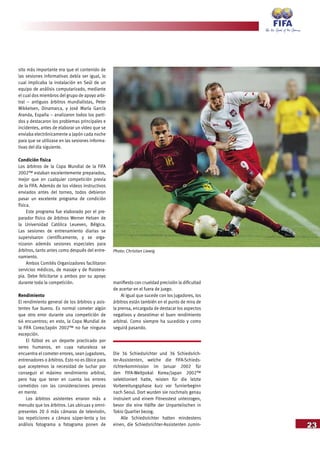
Activités d’après-match
Les modifications apportées aux opérations
d’après-match de la zone mixte, avec l’in-
troduction d’une interview en studio dans la
zone mixte, se sont avérées réussies dans
les moments tendus suivant la fin de chaque
match; la combinaison de ces interviews et
Photo: Alfieri
41
de mini conférences de presse improvisées
avec certains joueurs ainsi que l’opportunité
de face-à-face lors des passages des joueurs
dans la zone mixte ont fourni aux médias
quantité de citations. Parallèlement, les ten-
tatives d’amélioration de l’accès des médias
aux équipes lors des jours de repos (accès aux
entraînements pour les 15 premières minutes
au moins) ont bien fonctionné avec la majo-
rité des équipes, bien que certaines équipes
ou certains joueurs se soient montrés assez
opaques à une coopération normale avec les
médias.
La production télévisée a atteint de nou-
veaux standards grâce au professionnalisme
d’une équipe internationale menée par le
PDG d’HBS, Francis Tellier. Le projet inno-
vateur de production d’HBS n’avait rien de
révolutionnaire dans un domaine où il reste
peu à inventer, mais a cependant produit
des images d’une impressionnante qualité.
La mise en place de l’EBIF (extended basic
international feed) a permis à HBS de fournir
aux partenaires de diffusion un plus grand
choix de matériel avant, pendant et après la
compétition, améliorant ainsi la diffusion au-
delà de l’action pure.
De manière générale, grâce non seule-
ment à la coopération entre la FIFA et les COLs
(avec l’aide considérable des deux armées de
bénévoles déterminés), mais aussi grâce au
travail conjoint de ces parties et des médias
eux-mêmes, la compétition s’est déroulée
sans incident majeur et à la grande satisfac-
tion d’un cercle des médias réputé pour son
exigence.
Los medios de comunicación supusieron un
enorme desafío para los organizadores de la
Copa Mundial de la FIFA 2002™. Y si la prueba
de fuego para obtener el éxito radica – como
debería ser – en las opiniones de los 11,500
representantes que utilizan las instalacio-
nes, la FIFA y los dos comités organizadores
pueden estar satisfechos de su labor.
La cooperación fue la clave. Durante
casi cuatro años, la FIFA, JAWOC y KOWOC se
reunieron periódicamente, junto con los HBS
(servicios de la emisora local), para planificar
esta compleja operación, garantizando así un
tratamiento equitativo a todos los represen-
tantes de los medios mundiales. Sin embargo,
ningún plan habría dado frutos sin el genuino
espíritu de mutuo apoyo que demostraron
ambos comités organizadores, los cuales
compartieron algunas tareas organizativas,
especialmente en el área de la acreditación
de los medios: JAWOC se hizo cargo de 3,000
periodistas y 1,000 fotógrafos, y KOWOC coor-
dinó a un total de 3,000 empleados del HBS y
a 4,500 representantes de las radiodifusoras.
La infraestructura a disposición y la cali-
dad de los servicios no tenían precedentes:
20 centros de prensa en los estadios (SMC),
completamente equipados, y dos Centros
Internacionales de los Medios (IMC) para la
prensa y radiodifusores, uno en Seúl y otro en
Yokohama. Se pudo ver que los SMC estaban
a reventar en los días de partido, mientras que
los IMC generalmente no llegaban a llenarse.
Las razones de esto aún se deben analizar en
detalle, pero, sin duda, una de las principales
es la evolución en el sector tecnológico, y
que, con el acceso a la información en línea,
los medios dependen menos de un punto cen-
tralizado para obtener información. Con miras
al 2006, se deberá estudiar detenidamente
si el incremento del apoyo tecnológico debe
hacerse conforme a las necesidades de los
servicios de los medios.
Los sitios en la red despedazan récords
La FIFA movilizó a un equipo de oficiales de
los medios en las 20 sedes; hubo un mínimo
de tres oficiales en cada partido. Además,
42
Overall Analysis
estuvieron a disposición el MIS-INFO 2002,
un servicio de información que gozó de alta
estima, el familiar sitio fifa.com y el sitio espe-
cializado fifaworldcup.com. Este último tuvo
un éxito rotundo y prácticamente hizo añicos
todos los récords conocidos en la red mun-
dial, acumulando un total de dos mil millones
de consultas durante toda la competición.
Las reuniones de información que la FIFA
celebró a diario, una continuación del con-
cepto introducido eficazmente en 1998, fue
muy útil para mantener un flujo de informa-
ción de actualidad para los medios estaciona-
dos en Seúl y Yokohama, amén de ofrecer a la
FIFA datos sobre los temas de interés inme-
diato. En un agradable ambiente exento de
violencia pública, los medios se concentraron
principalmente en las dificultades causadas
por las operaciones de entradas, así como en
las actuaciones de los árbitros y sus asisten-
tes. La FIFA aprovechó sus reuniones a las 11
a.m. para tratar a fondo estos temas y otros
asuntos de interés.
Tal como en 1998, la distribución de
entradas a los medios se vio obstaculizada
debido a la reserva de entradas para un gran
número de periodistas que se ausentaban
a última hora. Para los próximos torneos se
deberá pasar revista a esta actitud que mues-
tra cierta falta de profesionalismo .
Actividades después del partido
Se modificaron las operaciones en la zona
mixta al término del partido con la intro-
ducción de un estudio para entrevistas,
que resultó muy útil, especialmente cuando
reinaba la tensión tras un encuentro. La
combinación de estas entrevistas con: confe-
rencias de prensa espontáneas y muy breves
a jugadores selectos en la misma zona mixta,
aparte de la oportunidad de las entrevistas
individuales en la misma zona, garantizaron
un servicio de primera a los medios. Por otra
parte, los intentos de brindar acceso a los
equipos en los días en que no había partido
(incluido el acceso al entrenamiento al menos
durante los primeros 15 minutos) funcionaron
generalmente con la mayoría de los equipos,
pese a que algunos equipos o individuos se
resistieron a cooperar con los medios.
El baremo para los estándares de la pro-
ducción televisiva se ha puesto en un nuevo
nivel gracias al profesionalismo de un equipo
internacional dirigido por el Director Ejecutivo
de HBS Francis Tellier. Puede ser que el inno-
vador plan de producción de HBS no haya
causado una revolución en un área en la que
casi no hay nada nuevo que inventar, pero, de
cualquier forma, produjo imágenes de una
calidad e impacto admirables. La introduc-
ción de la técnica llamada EBIF (señal básica
internacional ampliada) dio a HBS la oportu-
nidad de ofrecer a los socios de radiodifusión
un material variado antes, durante y después
de cada partido, llevando así el alcance de la
transmisión más allá de la simple acción.
En suma, gracias a la cooperación entre
la FIFA y los COL (con la enorme asistencia
de dos armadas de animosos voluntarios),
y también a la colaboración de estas partes
con los medios mismos, la competición no
sólo se desarrolló sin contratiempos, sino
que también satisfizo a la exigente clientela
de los medios.
Im Medienbereich gab es beim FIFA-Weltpokal
2002™ wohl die grössten organisatorischen
Herausforderungen zu bewältigen. Nimmt
Media
Photo: Empics
43
man das Echo der 11’500 Medienvertreter als
Massstab – und das sollte man –, können die
FIFA und die beiden Organisationskomitees
auch hier eine positive Bilanz ziehen.
Zusammenarbeit wurde grossgeschrie-
ben. Während fast vier Jahren schafften die
FIFA gemeinsam mit JAWOC, KOWOC und HBS
(Host Broadcast Services) die Vorraussetzun-
gen, damit kein Medienvertreter benachteiligt
wurde. Doch ohne die beispielhafte Koordina-
tion zwischen den beiden LOC wäre die Mühe
umsonst gewesen. Eine strikte Aufgabentei-
lung erwies sich etwa bei den Medienakkre-
ditierungen als Patentrezept: Das JAWOC war
für 3000 Journalisten und 1000 Fotografen
zuständig, während beim KOWOC die Fäden
für 3000 HBS-Angestellte und 4500 Fernseh-
mitarbeiter zusammenliefen.
Die 20 Stadien-Medienzentren (SBC) und
die beiden internationalen Medienzentren
(für Presse und Fernsehen, IBC) in Seoul und
Yokohama läuteten bezüglich Einrichtung
und Service eine neue Ära ein. Während der
Andrang in den SBC an den Spieltagen jeweils
enorm war, liess die Auslastung der IBC in der
Regel zu wünschen übrig. Für ein abschlies-
sendes Urteil ist es zwar noch zu früh, doch
die rasante technologische Entwicklung ist
bestimmt einer der Hauptgründe. Die Me-
dienvertreter können sich dank dem Internet
jederzeit und überall die Informationen
beschaffen, die sie gerade benötigen. Diesen
Punkt gilt es für 2006 bei der Abstimmung
des IT-Supports auf die Wünsche der Medien
zu beachten.
Rekord-Website
An den Spieltagen dienten an den einzelnen
Spielorten mindestens drei FIFA-Medien-
verantwortliche als Ansprechpartner. Für
das hoch geschätzte Informationssystem
MIS-INFO 2002 und die Aktualisierung der
Verbands-Website fifa.com und der äusserst
beliebten WM-Homepage fifaworldcup.com,
die mit insgesamt über zwei Milliarden Hits
während des Turniers alle Rekorde brach,
wurde ein eigenes Team eingesetzt.
Mit den täglichen Medienbriefings, die
auf der Grundlage des erfolgreichen Konzepts
von 1998 nochmals ausgeweitet wurden,
konnte die FIFA die Medienvertreter in Seoul
und Yokohama aus erster Hand informieren
und auf brennende Fragen eingehen. Durch
das Ausbleiben von Fanausschreitungen
standen vor allem die anfänglichen Probleme
beim Kartenverkauf sowie die Leistungen der
Schiedsrichter undSchiedsrichter-Assistenten
im Zentrum des Medieninteresses. In ihren
Briefings, die jeweils auf 11.00 Uhr angesetzt
waren, nahm die FIFA zu diesen und anderen
Themen ausführlich Stellung.
Wie schon 1998 wurde die Verwaltung
des Ticketkontingents für die Medienvertreter
dadurch erschwert, dass viele Journalisten
trotz vorgängiger Reservierung nicht zu den
Spielen erschienen – ein äusserst unpro-
fessionelles Verhalten, das für die nächsten
Turniere nicht ohne Folgen bleiben wird.
Nach Spielende
In der gemischten Zone bewährte sich eine
Änderung ganz besonders: In der Hektik
boten die Studiointerviews die gewünschte
Ruhe. Hinzu kamen die improvisierten
Mini-Medienkonferenzen mit ausgewählten
Spielern in der gemischten Zone selbst und
die Kurzinterviews mit den Spielern, während
diese die gemischte Zone durchquerten,
wodurch die Journalisten eine Vielzahl von
Spieler- und Trainerstimmen einfangen konn-
ten. Die meisten Teams gewährten den Medi-
envertretern vermehrt auch an spielfreien
Tagen Zutritt (öffentliches Training während
den ersten 15 Minuten), obwohl einige Mann-
schaften oder Personen weiterhin nicht zu
einer Zusammenarbeit im üblichen Rahmen
bereit waren.
Die Fernsehproduktion setzte dank der
Professionalität des internationalen Teams
unter der Leitung von Francis Tellier, CEO
von HBS, neue Massstäbe. Auch wenn im
Fernsehbereich das Rad längst erfunden
ist, setzte HBS bei seiner Planung nicht nur
auf konventionelle Produktionsmethoden,
sondern zeigte sich auch sehr innovativ,
wodurch bei der Bildqualität eine weitere, bis
anhin undenkbare Steigerung erreicht werden
konnte. Mit Hilfe eines neuen Systems, des
so genannten EBIF (Extended Basic Internati-
onal Feed), konnte HBS den Fernsehanstalten
während und nach den Spielen mehr Bildma-
terial anbieten, wodurch diese vermehrt auch
Szenen abseits des eigentlichen Spielgesche-
hens einfangen konnten.
Dank der Zusammenarbeit zwischen der
FIFA und den LOC (mit dem tollen Einsatz von
unzähligen Freiwilligen) und nicht zuletzt der
Kooperationsbereitschaft der Medien verlief
das Turnier ohne grössere Zwischenfälle –
noch viel wichtiger: Auch die anspruchsvollen
Medienvertreter waren mit der Organisation
äusserst zufrieden.
Photos: Christian Liewig, Daniel Motz
44
Overall Analysis
Marketing and Partners
Guido Tognoni, Presidential Adviser
for Marketing Matters
As the biggest and most popular worldwide
sporting event, the FIFA World Cup™ also rep-
resents a unique global marketing opportunity
for FIFA’s commercial partners. The unique
nature of this event can be explained by two
distinct factors – the worldwide popularity of
football transcends all geographical, cultural
and social barriers, and the extraordinary pas-
sion so evident at the tournament is an ideal
opportunity for the advertising strategies of
FIFA’s partners.
The first FIFA World Cup™ of the new
millennium also saw fans find a new way to
display their passion for the game, with mil-
lions following the action on giant television
screens. In Korea, countless people swarmed
onto the streets and squares to watch the
Korean national team’s matches together
and to celebrate in exuberant and colourful
street parties. In Tokyo, 45,000 people filled
the Olympic Stadium while the Japanese team
played in Osaka and Miyagi.
More than 7 million people in Korea
are estimated to have watched the public
broadcasts of their team’s semi-final show-
down with Germany, with 2.5 million people
in Seoul alone passionately following their
idols’ fortunes on the big screens. They simply
preferred to celebrate in high spirits in a huge
street party.
This potential to bring people together
was also witnessed in countless other coun-
tries, albeit to a lesser extent than in Korea.
Consequently, the FIFA World Cup™ continues
to attract more and more interest outside of
its more traditional fan base. Evaluations of
the television data, for example, showed that
more and more women tuned into match cov-
erage. The worldwide TV ratings also showed
that the popularity of football not only remains
as great as ever, but has also enjoyed a dra-
matic increase in countries that were once
classed as “fringe areas” for the game. This
is especially true for the whole of Asia, and
Japan, Korea and China in particular.
In terms of marketing, the increase in the
number of football fans around the world has
led to a rejection of traditional forms of com-
munication. Sponsors now demand outlets
via which they can reach their various target
groups in a more direct manner. The market-
ing concept for the 2002 FIFA World Cup™
therefore encompassed individual and inno-
vative ways for companies with interests and
requirements beyond football to make their
mark. A prime example of this trend was the
event logo, which was variable and allowed
companies to use it in a number of different
ways.
FIFA’s partners took advantage of the
opportunity to introduce individual market-
ing activities. Some sponsors even increased
their effective budget for special promo-
tions by 300% in comparison to France ’98.
The innovative commercial programme for
Korea/Japan 2002 was on the whole a great
success. Despite the turbulent developments
in the area of marketing, the programme still
provided for traditional marketing activities
by sponsors, such as in the technical study
group (TSG) of FIFA experts, for example. Such
partnerships included the selection of the
MasterCard Allstar Team and the nomination
of 10 candidates for the adidas Golden Ball,
the award presented to the best player of the
tournament. For the first time ever, the TSG
also bestowed the title of “Budweiser Man of
the Match” on the most outstanding player in
each game.
Premier événement sportif international par
sa taille et sa popularité, la Coupe du Monde
de la FIFA™ offre une plate-forme de marke-
ting globale unique en son genre aux parte-
naires commerciaux de la FIFA. La singularité
de cette manifestation tient principalement
à deux facteurs: d’une part, l’engouement
45
universel pour le football transcendant toutes
les barrières géographiques, culturelles et
sociales, d’autre part, l’extraordinaire con-
tenu émotionnel de ce rendez-vous offrant
un cadre idéal aux messages publicitaires des
partenaires de la FIFA.
Lors de cette première Coupe du Monde
de la FIFA™ du millénaire, l’euphorie suscitée
par le football a même trouvé un nouveau
support qui a fait fureur sur la planète entière.
Ainsi, des millions de supporters ont-ils suivi
les retransmissions publiques des matches
sur grand écran. En Corée, une foule immense
a envahi les rues et les places pour regarder
les rencontres de l’équipe nationale et parti-
ciper à la liesse populaire. A Tokyo, 45 000
spectateurs étaient réunis au stade olympi-
que lorsque la sélection japonaise a joué à
Osaka et à Miyagi.
Selon les estimations des forces de
l’ordre, plus de sept millions de personnes
auraient suivi les retransmissions publiques
de la demi-finale Corée – Allemagne. Rien
qu’à Séoul, quelque 2,5 millions de sup-
porters des Diables Rouges sont descendus
célébrer leur équipe dans la rue, soucieux de
partager en communauté la joie et l’émotion
de la foule dans toute la capitale.
Le grand potentiel d’intégration social
que recouvre un tel mouvement s’est égale-
ment fait sentir, quoique dans une moindre
mesure, dans d’autres pays qu’en Corée. C’est
en partie ce qui explique l’intérêt croissant
suscité par la Coupe du Monde de la FIFA™
au-delà du cercle traditionnel des supporters.
D’après l’indice d’écoute, cela vaut notam-
ment pour les femmes. L’audience télévisée
mondiale atteste en outre que, loin de perdre
46
Overall Analysis
Marketing and Partners
de sa popularité, le football voit même le
nombre des pays intéressés progresser
nettement. Ce phénomène est marqué dans
toute l’Asie, notamment au Japon, en Corée
et en Chine.
Dans le secteur du marketing, cette diver-
sification des supporters invite à se détourner
des formes de communication uniformes
originelles. Aujourd’hui, les plate-formes
pour des actions de sponsoring permettant
de toucher directement les différents groupes
cibles sont de plus en plus recherchées. Or,
l’une des grandes caractéristiques du concept
de marketing de la Coupe du Monde de la FIFA
2002™ a été d’offrir une plus grande marge
de manœuvre pour faire valoir de nouveaux
intérêts et besoins individuels dépassant le
sport. Une tendance qui se reflète clairement
dans le logo de l’événement, adaptable et
donc polyvalent.
Les partenaires de la FIFA ont fait abon-
damment usage du nouveau champ d’action
mis à leur disposition pour leurs initiatives
individuelles. Par rapport à France 98, cer-
tains sponsors ont triplé leur budget consa-
cré aux promotions spécifiques.
Dans l’ensemble, le programme commercial
novateur de Corée/Japon 2002 peut être con-
sidéré comme très réussi. Malgré l’évolution
turbulente qu’a connue le secteur du marke-
ting dans son ensemble, les partenaires ont
également pu mener des actions tradition-
nelles telles que celles auxquelles contri-
buent les experts du Groupe d’Etude Techni-
que de la FIFA. L’élection de l’équipe Allstar
MasterCard, la nomination de 10 candidats
pour le ballon d’or adidas, la distinction des
trois meilleurs joueurs du tournoi en sont
quelques exemples. Le GET a également attri-
bué pour la première fois le titre d’homme
du match (Budweiser) au meilleur joueur de
chaque match.
Al ser el acontecimiento deportivo más
grande y popular del mundo, la Copa Mundial
de la FIFA™ sirve también de excepcional
plataforma mercadotécnica para los socios
comerciales de la FIFA. La excelencia de este
torneo radica, fundamentalmente, en dos fac-
tores: por un lado, la enorme popularidad del
fútbol, que salva todas las barreras geográfi-
cas, culturales y sociales; por otro, la enorme
carga emotiva de la competición, que ofrece
un escenario perfecto para los mensajes
publicitarios de los socios de la FIFA.
47
En este mundial del milenio ha surgido
una novedad que ha despertado el interés del
público mundial: millones de personas con-
gregadas frente a pantallas gigantes instala-
das en zonas públicas. En Corea, por ejemplo,
millones de personas fluyeron a las plazas y
calles para seguir en comunidad los parti-
dos de su equipo, y celebrar posteriormente
multitudinarias fiestas populares. En Tokio,
45,000 personas se congregaron en el esta-
dio Olímpico para disfrutar de los partidos de
su selección en Osaka y en Miyagi.
A la transmisión pública en todo el país
de la semifinal Corea-Alemania asistieron,
según la estimación de las fuerzas del orden,
más de 7 millones de personas. En Seúl, cerca
de 2,5 millones de aficionados prefirieron dar
rienda suelta a su pasión futbolística en la
calle, y manifestar su alegría en una enorme
fiesta popular y comunal, llena de pasión,
colorido y emoción.
Esta increíble expresión integradora
del espíritu comunal se pudo ver también,
aunque en menor medida que en Corea, en
otros muchos países. Constatamos así que
la Copa Mundial de la FIFA™ ha despertado
mucho más interés público que el habitual,
reducido a los círculos futbolísticos. Como
indican los índices de telespectadores, el inte-
rés femenino ha sido la gran sorpresa de esta
Copa. Además, estos mismos índices mundia-
les indican que la popularidad del fútbol no
sólo mantiene su vigencia, sino que en algu-
nas zonas del orbe, menos tradicionales en el
mundo del fútbol, el interés por el balompié
ha crecido exponencialmente. Un ejemplo es
Asia, y especialmente Japón, Corea y China.
En el campo de la mercadotecnia, este
aumento del público futbolístico ha supuesto
el abandono de las vías de comunicaciones
más tradicionales y unidireccionales. Hoy
día se buscan plataformas publicitarias espe-
cíficas, dirigidas a un público concreto. El
concepto mercadotécnico de la Copa Mundial
de la FIFA Corea/Japón 2002™ se caracterizó
por permitir un margen de maniobra para su
utilización en campañas individualizadas,
orientadas a través del deporte hacia intere-
48
Overall Analysis
ses y necesidades más generales. El logotipo
del torneo, variable y flexible, simboliza de
forma ejemplar esta nueva tendencia.
Los socios de la FIFA explotaron al máximo
este novedoso margen de maniobra para la
presentación individualizada de sus produc-
tos. Algunos patrocinadores triplicaron, en
comparación con Francia 98, su presupuesto
para promociones específicas. En líneas
generales, podemos calificar de muy exitoso
el novedoso e innovador programa comercial
de Corea y Japón. A pesar del tempestuoso
desarrollo del ámbito mercadotécnico, los
actos tradicionales de los socios también
tuvieron cabida en el torneo. Un ejemplo es
la contribución de los expertos de la FIFA en-
globados en el Grupo de estudio técnico
(GET): la elección del equipo estelar Master-
Card, el nombramiento de 10 candidatos para
el“Balón de oro” de adidasyla elección de los
tres mejores jugadores del torneo. Además, el
GET otorgó por primera vez el galardón de
“Jugador Budweiser del partido” al futbolista
más destacado de cada encuentro.
Als grösstes und weltweit populärstes Sport-
ereignis ist der FIFA-Weltpokal™ auch eine
einzigartige globale Marketing-Plattform für
die kommerziellen Partner der FIFA. Die Ein-
zigartigkeit dieses Events beruht vor allem
auf zwei Faktoren: einerseits die weltum-
spannende Popularität des Fussballs über
alle geographischen, kulturellen und sozialen
Barrieren hinweg, andererseits stellt der aus-
serordentliche Emotionsgehalt des Events ein
ideales Umfeld für die Werbebotschaften der
FIFA-Partner dar.
Eine neuartige Ausdrucksform der Fuss-
ballbegeisterung sorgte beim ersten FIFA-
Weltpokal™ dieses Jahrtausends gar weltweit
für Aufsehen: Das Millionenpublikum bei
öffentlichen Übertragungen auf Grossleinwän-
den. In Korea strömten Millionen auf Strassen
und Plätze, um die Spiele des Heimteams
gemeinsam zu verfolgen und gleichzeitig
rauschende Volksfeste zu feiern. In Tokio füll-
ten 45 000 Zuschauer das Olympiastadion,
als die japanische Auswahl in Osaka und in
Miyagi spielte.
Den öffentlichen Übertragungen des
Halbfinals Südkorea – Deutschland wohnten
gemäss Schätzungen der Ordnungskräfte lan-
desweit über 7 Millionen Personen bei. Allein
in Seoul waren es rund 2,5 Millionen, welche
die Begeisterung über die Leistungen des ein-
heimischen Teams ins Freie trieb. Sie zogen es
vor, ihre Emotionen im Rahmen einer riesigen
öffentlichen Party phantasievoll und fröhlich
in der Gemeinschaft zu zelebrieren.
Das damit verbundene grosse gesell-
schaftliche Integrationspotenzial kam, wenn
auch in kleinerem Ausmass als in Korea, in
zahlreichen anderen Ländern zum Ausdruck.
Eine Folge davon ist, dass der FIFA-Welt-
pokal™ weit über die Kreise der traditionellen
Fussballfans hinaus auf immer mehr Interesse
stösst. Insbesondere ist dies bei den Frauen
der Fall, wie die Auswertungen der TV-Daten
augenfällig illustrieren. Zudem dokumentie-
ren die weltweiten TV-Zahlen, dass die Popu-
larität des Fussballs nicht nur ungebrochen
anhält, sondern in bisherigen “Randregionen”
des Fussballs markant gestiegen ist. Dies gilt
ausgeprägt für ganz Asien, insbesondere für
Japan, Korea und China.
Im Bereich des Marketings führt diese
Pluralisierung des Fussballpublikums zu einer
Abkehr von den herkömmlichen, eher ein-
förmigen Kommunikationsformen. Vermehrt
gefragt sind heute Plattformen für Sponsoring-
auftritte, über welche die unterschiedlichen
Zielgruppen gezielter angesprochen werden
können. Mehr Spielraum für individuelle, auf
neue, über den Sport hinausreichende Inte-
ressen und Bedürfnisse ausgerichtete Profilie-
rungsmöglichkeiten war denn auch eines der
wichtigen Merkmale des Marketingkonzepts
für den FIFA-Weltpokal 2002™. Das variabel
und damit vielseitig verwendbare Eventlogo
symbolisiert diesen Trend augenfällig.
Der gewonnene Spielraum für individu-
elle Auftritte wurde von den FIFA-Partnern
rege genutzt. Einzelne Sponsoren haben ihr
Implementierungs-Budget für spezifische Pro-
motionen gegenüber France 98 verdreifacht.
Insgesamt kann das innovative kommerzielle
Programm von Korea/Japan als sehr erfolg-
reich bezeichnet werden. Trotz der insgesamt
stürmischen Entwicklung im Marketingbereich
hatten auch traditionelle Partneraktionen
ihren Platz. So auch jene, zu welchen die
FIFA-Experten der technischen Studiengruppe
(TSG) ihre Beiträge leisteten. Es sind dies die
Wahl des MasterCard Allstar Teams sowie die
Nomination der 10 Kandidaten für den “Gol-
denen Ball” von adidas, die Auszeichnung
für die drei besten Einzelspieler des Turniers.
Erstmals vergab die TSG zudem den Titel des
“Budweiser Man of the Match” für den besten
Spieler der Partie.
Marketing and Partners
49
Man of the Match
Photo: Alfieri
01 France vs Senegal DIOUF El Hadji (SEN, 11)
02 Rep. of Ireland vs Cameroon HOLLAND Matt (IRL, 8)
03 Uruguay vs Denmark TOMASSON Jon Dahl (DEN, 9)
04 Germany vs Saudi Arabia KLOSE Miroslav (GER, 11)
05 England vs Sweden CAMPBELL Sol (ENG, 6)
06 Paraguay vs South Africa ARCE Francisco (PAR, 2)
07 Argentina vs Nigeria VERON Juan (ARG, 11)
08 Spain vs Slovenia RAUL (ESP, 7)
09 Croatia vs Mexico LUNA Braulio (MEX, 11)
10 Brazil vs Turkey RIVALDO (BRA, 10)
11 Italy vs Ecuador VIERI Christian (ITA, 21)
12 China PR vs Costa Rica GOMEZ Ronald (CRC, 11)
13 Japan vs Belgium INAMOTO Junichi (JPN, 5)
14 Korea Republic vs Poland YOO Sang Chul (KOR, 6)
15 Russia vs Tunisia NIKIFOROV Yuri (RUS, 3)
16 USA vs Portugal MCBRIDE Brian (USA, 20)
17 Germany vs Rep. of Ireland KEANE Robbie (IRL, 10)
18 France vs Uruguay BARTHEZ Fabien (FRA, 16)
19 Cameroon vs Saudi Arabia ETOO Samuel (CMR, 9)
20 Denmark vs Senegal FADIGA Khalilou (SEN, 10)
21 Sweden vs Nigeria LARSSON Henrik (SWE, 11)
22 Spain vs Paraguay MORIENTES Fernando (ESP, 9)
23 Argentina vs England SCHOLES Paul (ENG, 8)
24 South Africa vs Slovenia FORTUNE Quinton (RSA, 7)
25 Italy vs Croatia RAPAIC Milan (CRO, 5)
26 Brazil vs China PR ROBERTO CARLOS (BRA, 6)
27 Mexico vs Ecuador TORRADO Gerardo (MEX, 6)
28 Costa Rica vs Turkey WANCHOPE Paulo (CRC, 9)
29 Japan vs Russia INAMOTO Junichi (JPN, 4)
30 Korea Republic vs USA FRIEDEL Brad (USA, 1)
31 Tunisia vs Belgium BOUZAIENE Raouf (TUN, 12)
32 Portugal vs Poland PAULETA (POR, 9)
33 Denmark vs France ZIDANE Zinedine (FRA, 10
34 Senegal vs Uruguay DIOP Papa Bouba (SEN, 19)
35 Cameroon vs Germany KLOSE Miroslav (GER, 11)
36 Saudi Arabia vs Rep. of Ireland DUFF Damien (IRL, 9)
37 Sweden vs Argentina MJALLBI Johan (SWE, 4)
38 Nigeria vs England CAMPBELL Sol (ENG, 6)
39 South Africa vs Spain RAUL (ESP, 7)
40 Slovenia vs Paraguay ARCE Francisco (PAR, 2)
41 Costa Rica vs Brazil JUNIOR (BRA, 16)
42 Turkey vs China PR SAS Hasan (TUR, 11)
43 Mexico vs Italy BLANCO Cuauhtemoc (MEX, 10)
44 Ecuador vs Croatia MENDEZ Edison (ECU, 19)
45 Tunisia vs Japan NAKATA Hidetoshi (JPN, 10)
46 Belgium vs Russia WILMOTS Marc (BEL, 7)
47 Portugal vs Korea Republic PARK Ji SUNG (KOR, 21)
48 Poland vs USA KRZYNOWEK Jacek (POL, 18)
49 Germany vs Paraguay JEREMIES Jens (GER, 16)
50 Denmark vs England FERDINAND Rio (ENG, 5)
51 Sweden vs Senegal CAMARA Henri (SEN, 7)
52 Spain vs Rep. of Ireland IKER CASILLAS (ESP, 1)
53 Mexico vs USA DONOVAN Landon (USA, 21)
54 Brazil vs Belgium RIVALDO (BRA, 10)
55 Japan vs Turkey OZALAN Alpay (TUR, 5)
56 Korea Republic vs Italy AHN Jung Hwan (KOR, 19)
57 England vs Brazil RIVALDO (BRA, 10)
58 Germany vs USA REYNA Claudio (USA, 10)
59 Spain vs Korea Republic LEE Woon Jae (KOR, 1)
60 Senegal vs Turkey SAS Hasan (TUR, 11)
61 Germany vs Korea Republic BALLACK Michael (GER, 13)
62 Brazil vs Turkey RONALDO (BRA, 9)
63 Korea Republic vs Turkey SUKUR Hakan (TUR, 9)
64 Germany vs Brazil RONALDO (BRA, 9)
50
52 Overall Analysis
60 Statistics Overview
64 Confederations’ Analysis
74 Playing Systems
79 Goalkeeping
84 The Final
88 Key Scene of the Final
90 Interview with Luiz Felipe Scolari
102 Official FIFA Awards
51
52
Technical and Tactical Analysis
Overall Analysis
nent is disorganised and has allowed space
to appear between and behind their midfield
and defensive players.
Solo Play
Approximately one-fifth of the 161 goals
scored during the competition were the
product of individual actions (i.e. long-range
shots, direct free kicks, individual dribbling
and shooting). Good examples of this key
element in top-level football included Robert
Carlos’ ‘ballistic’ free kick against China,
Dario Rodriguez’s long-range volley for Uru-
guay versus Denmark, and Henrik Larsson’s
evasive run and calm finish for Sweden in
the match with Nigeria. The importance of the
soloist has increased as efficiency in defend-
ing has improved – sometimes the only way to
beat the defensive block is through powerful,
long-range shooting or individual wizardry.
Set Piece Play
Set pieces accounted for around 30% of all
the goals scored in the championship, with
the biggest return coming from corners. There
was an extensive variety of corner kicks on
show (corners played short, to the front or
back post, or even outside of the box) and the
delivery of both inswingers and outswingers
was particularly impressive. Free kicks from
wide positions were also noteworthy, with
the ball being curled both towards and away
from the goal with pace and head-high preci-
sion. Surprising moves on free kicks from the
edge of the box, à la Argentina versus England
in 1998, were non-existent. A lack of privacy
and obsessive spying has inhibited today’s
coaches, and consequently there is a reluc-
tance to spend time on ‘clever’ free kicks that
might only be used on one occasion.
Pressing
The pressing game, particularly in midfield,
was employed by many teams despite the
strength-sapping weather. Many pressed the
ball and doubled up on the ball carrier, some
were efficient at collective pressing (i.e. co-
ordinated group pressure), and a number of
sides were also able to condense the space
by playing as a compact, mobile team unit
– Ireland, Sweden, USA, Denmark, Turkey,
England, Japan and Korea were outstanding
at applying this tactic. The stamina and speed
endurance required to enforce a high-inten-
sity pressing game was particularly impres-
sive in the case of Ireland, the USA and Korea,
The Fine Line
At the top level of football, in an era when
teams are often evenly matched, the fine line
between winning and losing can be the result
of any of the following:
• a decision by a coach, e.g. Senol Gunes,
the Turkish coach, made a pivotal decision
when he replaced his captain, Hakan Sukur,
with Ilhan Mansiz, after 67 minutes, against
Senegal – Mansiz proved to be the match-
winner with his Golden Goal strike;
• an individual action, e.g. Ronaldo’s solo
effort against Turkey in the semi-final (play-
ers who can make and take chances without
assistance are vital in the modern game);
• a counter-attack, e.g. Senegal’s winner in
the opening game against France;
• a set piece, e.g. Batistuta’s winning header
from a back-post corner against Nigeria;
• a mistake, e.g. miskick by Turkish goal-
keeper Rustu that led to Brazil’s match-win-
ning penalty in Ulsan.
For the national coach, the importance of
these elements is considerable.
Counter-Attack
Approximately 20% of the goals scored from
open play in Korea/Japan 2002 came as the
result of a counter-attack. In addition, it must
not be forgotten that many set pieces, which
resulted in goals, were gained following a
counter.
Some teams operated a counter-attack-
ing policy – a style of play based on defend-
ing deeply and breaking forward when the
opportunity presents itself. Others, and this
includes most of the more successful teams,
played a balanced game, but used counter-
attacking moves as part of their repertoire. For
many teams, such as England and Germany,
the ‘traditional’ counter-attack (where the ball
is played long to one or two attackers, in a
big space, and against a few defenders) was
used effectively. There were also excellent
examples of ‘collective counters’ (where a
group of players break, and combine to form
a wave of attack, before the opponent can
fully regroup), and this was particularly well
illustrated by a number of teams, including
Brazil and Senegal. In today’s sophisticated
game, nobody gives space for free, and
therefore counter-attacking ability is vital to
exploit the fleeting moments when an oppo-
53
to name but three. In the case of Korea, their
capacity to take the initiative (i.e. attacking
with and without the ball), to operate their
‘Dutch’ 3-4-3 system, and to dominate for
the bulk of each match, was astonishing. Four
months of full-time training certainly paid
dividends for the Koreans.
Combination Play
Combination play (i.e. two, three or four play-
ers exchanging short, quick passes, usually
in the central attacking area of the field)
was highly developed and demonstrated to
great effect by many teams, including Spain,
Denmark, Argentina, Mexico and Turkey.
When analysing combination play, two types
must be considered: the predictable and the
unpredictable. In the former category, which
is based on well-developed training methods,
the Germans, Italians, and Americans were
fine exponents. In contrast, the Brazilians,
Costa Ricans, Senegalese, and other ‘flam-
boyant’ types, those with a flair for inventive-
ness and unconventional technique, often put
together combinations that mesmerised and
surprised the defending team.
Tactical Flexibility
The ability to change structure, and some-
times style, during a match, or from match
to match is an important component in a
team’s armoury. When Korea were losing to
Italy, Guus Hiddink changed his approach
and went from his adventurous 3-4-3 to an
ultra-risk-taking 3-2-5 – it worked, because he
saved the game, and then saw Ahn Jung-Hwan
score the Golden Goal to win him and Korea
the match. Brazil outclassed Costa Rica, but
their organisation lacked balance, and Scolari
introduced a two-man midfield screen in front
of the back three for the quarter-final against
England. Examples of tactical flexibility were
plentiful.
Technical Quality
In the 2002 FIFA World Cup™, teamwork,
emphasising compactness in defence and
attack and involving a minimum of 7 or 8
players, often overshadowed the individual.
However, the technical ability of most play-
ers, including many defenders, was of a high
standard. It has become a necessity for play-
ers to break from the back, to ‘give and go’,
and thus increase the numbers in the attack-
ing area. Brazil’s back three were all capable
of springing from their defensive positions
and joining in the creative build-up. The
same applied to players from Senegal, Spain,
Turkey, Argentina, Costa Rica and a number of
others. Team-oriented skills were the norm,
with functionality, accuracy, and speed the
priorities. Some, however, transcended the
conventional, and this was particularly true
of many players playing in the hole between
attack and midfield (i.e. second strikers),
such as Rivaldo, Ronaldinho, Sas, Raúl, Totti,
Photo: Christian Liewig
54
Technical and Tactical Analysis
Wilmots, Tomasson, Recoba, Verón, and
Aimar. The technical quality of those who
played in this free role was remarkable, but
with freedom comes responsibility, and these
players had to make a difference in each
match in order to justify their special role. Yes,
we were impressed with the fast, clever feet
of the top players, but equally, we recognised
the trend towards quick thinking, particularly
during the transition from defence to attack
and vice versa. Total players, those who can
rotate position without losing their effective-
ness (e.g. the Brazilians and Koreans), have
become a valuable commodity in the modern
game.
La différence
Dans les compétitions au plus haut niveau,
les éléments suivants départagent générale-
ment les équipes:
• les décisions de l’entraîneur. Celle de Senol
Gunes, l’entraîneur turc, de remplacer Hakan
Sukur par Ilhan Mansiz à la 67e minute,
contre le Sénégal, s’est avérée cruciale: la Tur-
quie a gagné grâce au but en or de Mansiz;
• les actions individuelles, telles que celle
de Ronaldo contre la Turquie en demi-finale.
Aujourd’hui, les joueurs capables de créer
et de réaliser des occasions sans assistance
sont indispensables;
• les contre-attaques, témoin la victoire du
Sénégal sur la France en match d’ouverture;
• les coups de pied arrêtés. La tête de
Batistuta, au deuxième poteau sur un corner,
contre le Nigeria en est un bon exemple;
• les fautes. Ainsi, le tir raté du gardien turc
Rustu a-t-il entraîné le penalty qui a permis au
Brésil de remporter la victoire à Ulsan.
Les entraîneurs sont très attentifs aux
éléments suivants:
Contre-attaque
Environ 20% des buts marqués en cours de
jeu – et la plupart de ceux inscrits sur des
coups de pied arrêtés – résultaient d’une
contre-attaque.
Certaines équipes ont adopté une stra-
tégie de contre-attaque, reposant sur une
défense précoce et des percées en fonction
des occasions. D’autres équipes, dont la plu-
part de celles qui ont obtenu de bons résul-
tats, ont pratiqué un football équilibré non
sans recourir aux contre-attaques. Pour de
nombreuses équipes, telles que l’Angleterre
et l’Allemagne, la “traditionnelle” contre-atta-
que (longues passes à un ou deux attaquants,
dans un vaste espace et contre des attaquants
peu nombreux) a été utilisée efficacement.
D’excellentes “contre-attaques collectives”
(un groupe de joueurs fait une percée et forme
une vague offensive avant que l’adversaire
ne puisse se regrouper pleinement), ont été
observées, notamment de la part du Brésil et
du Sénégal. Dans le football tel qu’il est pra-
tiqué aujourd’hui, aucun espace n’est jamais
libéré sans contrepartie, aussi la capacité de
contre-attaquer est-elle vitale pour exploiter
les flottements où l’adversaire, désorganisé,
laisse des espaces se former entre, et derrière
le milieu de terrain et la défense.
Jeu individuel
Sur les 161 buts inscrits durant la compéti-
tion, environ un sur cinq était le fruit d’ac-
tions individuelles (tirs de loin, coups francs
directs, dribbles et tirs individuels). Le coup
franc “balistique” de Robert Carlos contre la
Chine, la longue volée de Dario Rodriguez
pour l’Uruguay contre le Danemark ainsi que
la course folle et la réalisation en douceur de
Henrik Larsson pour la Suède contre le Nigeria
offrent de bons exemples de cet élément clé
du football de haut niveau. Les actions indi-
viduelles ont gagné en importance: du fait
que la défense est devenue plus efficace, les
tirs puissants et longs ou l’ingéniosité indivi-
duelle s’avèrent parfois la seule manière de
vaincre le bloc défensif.
Coups de pied arrêtés
Les coups de pied arrêtés représentent
quelque 30% des bus marqués durant la
compétition, principalement sur des corners.
De multiples variations de corners ont été
Overall Analysis
Brazil 64 (18/10)
Germany 54 (14/12)
Turkey 38 (10/8)
Spain 35 (10/5)
Korea Republic 27 (8/3)
Senegal 26 (7/5)
Belgium 23 (6/5)
USA 23 (6/5)
England 22 (6/4)
Rep. of Ireland 22 (6/4)
Top Ten Total Points Scorers and Assists
1.
2.
3.
4.
5.
6.
7.
8.
9.
10. Own goals: 3
55
dénombrées (passes courtes, au 1er ou au 2e
poteau ou hors de la surface de réparation)
et les corners rentrants et sortants étaient
particulièrement impressionants. Certains
coups francs décalés avec des tirs directs et
indirects précis en hauteur étaient également
remarquables. Aucune action par surprise sur
les coups francs depuis la limite de la surface,
comme lors du match Argentine-Angleterre,
en 1998, n’a eu lieu. Aujourd’hui, les entraî-
neurs sont inhibés par un manque d’intimité
et un espionnage obsessionnel, d’où leur réti-
cence à passer du temps sur les coups francs
“trop réfléchis” qui ne pourraient être utilisés
que dans de rares occasions.
Pressing
De nombreuses équipes ont pratiqué le
pressing, notamment au centre, malgré les
conditions climatiques fatigantes avec deux
joueurs marquant le porteur du ballon, ou
un pressing collectif efficace, (la pression
coordonnée du groupe). Certaines équipes
sont aussi parvenues à réduire les espaces en
jouant comme une entité compacte, mobile
– l’Irlande, la Suède, les USA, le Danemark,
la Turquie, l’Angleterre, le Japon et la Corée
excellaient à ce jeu. L’Irlande, les Etats-Unis
et la Corée pour n’en citer que trois ont brillé
par leur endurance, une qualité nécessaire
pour pratiquer un pressing très intensif.
La capacité d’initiative des Coréens (atta-
que avec et sans ballon), leur capacité
d’opérer selon leur système “hollandais”
3-4-3 et leur domination pendant la
majeure partie de chaque match étaient
étonnantes. Leurs quatre mois d’entraîne-
ment intensif ont porté leurs fruits.
Enchaînements
Les enchaînements (passes courtes
et rapides entre deux, trois ou quatre
joueurs, généralement dans la partie
offensive au centre du terrain) ont
été couramment pratiqués et se
sont avérés très efficaces
dans de nombreuses
équipes, telles que l’Espagne, le Danemark,
l’Argentine, le Mexique et la Turquie. Dans
l’analyse, il convient de distinguer deux types
d’enchaînements: les prévisibles et les impré-
visibles. LesAllemands, lesItaliensetlesAmé-
ricains ont beaucoup fait usage des premiers,
basés sur des méthodes d’entraînement bien
développées. Les Brésiliens, Costa Ricains,
Sénégalais, et autres joueurs ‘flamboyants’,
pratiquant un football non conventionnel, ont
souvent imaginé des enchaînements qui ont
surpris la défense adverse.
Flexibilité tactique
La capacité de changer de structure voire de
style, durant un match ou d’un match à l’autre
est un atout important. Alors que la Corée
était en train de perdre face à l’Italie, Guus
Hiddink est passé d’un système risqué 3-4-3
à une configuration ultra-risquée 3-2-5. Cela
a fonctionné car il a ainsi préservé le match
avant que Ahn Jung-Hwan ne marque le but
en or qui a apporté la victoire à son équipe.
Le Brésil a surpassé le
Costa Rica mais
son organisation
Photo: Christian Liewig
Overall Analysis
56
Technical and Tactical Analysis
n’était pas équilibrée et Scolari a introduit un
bouclier de deux joueurs centraux devant les
3 arrières lors du quart de finale avec l’Angle-
terre. Les exemples de flexibilité tactique ne
manquent pas.
Qualité technique
Durant la Coupe du Monde de la FIFA 2002™,
l’esprit d’équipe, renforçant la compacité du
jeu en défense et en attaque avec au moins
7 ou 8 joueurs a souvent prévalu sur les
prestations individuelles. Reste que les qua-
lités techniques de la plupart des joueurs, y
compris de nombreux défenseurs, étaient
de haut niveau. Il est devenu nécessaire de
percer depuis l’arrière, de ‘donner et d’accé-
lérer’ et d’occuper la surface offensive en plus
grand nombre. Les trois arrières brésiliens
étaient tous capables de quitter leur position
défensive pour construire le jeu de manière
créative. On peut en dire autant du Sénégal,
de l’Espagne, de la Turquie, de l’Argentine, et
du Costa Rica. Les compétences collectives
étaient la norme, avec l’accent sur la fonc-
tionnalité, la précision et la vitesse. Certains,
tels que Rivaldo, Ronaldinho, Sas, Raúl,
Totti, Wilmots, Tomasson, Recoba, Verón et
Aimar ont cependant innové, notamment en
se plaçant dans le trou entre l’attaque et le
milieu du terrain (le deuxième attaquant). Les
qualités techniques des joueurs qui ont ainsi
évolué librement étaient remarquables, mais
la liberté confère une responsabilité et ils ont
dû faire la différence à chaque match pour
justifier leur rôle particulier. La rapidité et
l’agilité des joueurs vedettes étaient impres-
sionnantes, de même que leur capacité à
réfléchir vite, notamment lors du passage de
la défense à l’attaque et inversement. Les
joueurs complets, qui peuvent changer de
position sans perdre en efficacité (comme les
Brésiliens et les Coréens) sont très précieux
aujourd’hui.
El estrecho margen
En el profesionalizado mundo del fútbol, en
una era de partidos sumamente igualados, el
estrecho margen que separa la victoria de la
derrota puede hallarse en uno de los siguien-
tes aspectos:
• la decisión de un entrenador, p. ej. Senol
Gunes, el técnico turco, quien reemplazó en
el partido contra Senegal a su capitán Hakan
Sukur con Ilhan Mansiz en el minuto 67.
Mansiz demostró ser un ganador con su gol
de oro en la prórroga;
• una acción individual, p. ej. la jugada de
Ronaldo contra Turquía en la semifinal (los
jugadores capaces de crear y aprovechar oca-
siones de gol sin ayuda son fundamentales en
el fútbol actual);
• un contraataque, p. ej. el de la victoria de
Senegal en el partido inaugural contra Fran-
cia;
• una jugada ensayada, p. ej. el cabezazo
de Batistuta en el saque de esquina contra
Nigeria;
• un error, p. ej. el mal lanzamiento del
portero turco Rustu, que provocó el penal
ganador de Brasil en Ulsán.
Para los seleccionadores nacionales,
estos factores son muy importantes.
Contraataques
Cerca de un 20% de los tantos marcados en
juego en Corea/Japón 2002 fueron resultado
de un contraataque. Y no podemos olvidar
que muchas jugadas ensayadas, que acaba-
ron en gol, se iniciaron en un contraataque.
Algunos jugadores basaron su juego en
esta técnica – que tiene como fundamento
una defensa compacta y un veloz desplie-
gue en cuanto se presenta una oportunidad.
Otros, entre los que se incluyen los equipos
con más éxito, jugaron de forma más equi-
librada, aunque utilizaron el contraataque
cuando pudieron, como parte de su reperto-
rio. Para muchos equipos, como Inglaterra y
Alemania, las contras ‘tradicionales’ (pase
largo a un delantero con espacio por delante)
fueron sumamente efectivas. También hubo
excelentes muestras de contraataques
colectivos (un grupo de jugadores combinan
rápidamente para formar una ola ofensiva, sin
conceder tiempo al adversario para reagru-
parse). Podemos destacar en este aspecto a
equipos como Brasil y Senegal. En el sofisti-
cado fútbol de hoy, nadie regala espacios por
nada, así que la habilidad para contragolpear
es vital a la hora de explotar los momentos de
debilidad que se producen cuando el adver-
sario está desorganizado y no ha cubierto
bien los espacios entre el medio campo y la
línea defensiva.
Jugadas individuales
Casi una quinta parte de los 161 tantos del
torneo fueron producto de jugadas indivi-
duales (como tiros a larga distancia, libres
Photos: L’Equipe; Alberto Sabattini
57
directos, regates y disparos). Ejemplos de
este elemento fundamental del fútbol son las
acciones de Roberto Carlos, con un cañonazo
de tiro libre contra China, de Darío Rodríguez,
con una volea contra Dinamarca, y de Henrik
Larsson, con una carrera solitaria y un gol
pausado en el partido de Suecia contra Nige-
ria. La importancia de los individualistas se
ha incrementado a la par que la mejora defen-
siva – a menudo, la única forma de derribar
una muralla infranqueable es con disparos
lejanos o con magia personal.
Jugadas ensayadas
Las jugadas preparadas están en el naci-
miento de casi un 30% de todos los goles del
torneo, la mayoría en los saques de esquina,
que fueron muy variados en su realización
(en corto, al primer o segundo palo, e incluso
fuera del área penal). El rendimiento de los
extremos fue especialmente impresionante.
También se destacaron los lanzamientos
de tiro libre desde varias posiciones, con
el balón tomando los efectos más extremos
y unos lanzamientos sumamente precisos.
No existieron los pases sorpresa en los tiros
libres, tipo los de Argentina contra Ingla-
terra en 1998. La falta de privacidad en el
entrenamiento y el control obsesivo de los
movimientos del contrario han provocado
que los entrenadores actuales se repriman y,
por tanto, sean más reluctantes a la hora de
elaborar tiros libres ‘inteligentes’, que quizás
sólo puedan utilizarse en una ocasión.
Presión
Muchos equipos utilizaron la presión, espe-
cialmente en el mediocampo y a pesar del mal
tiempo, que desgasta las fuerzas. Muchos
equipos seguían al balón y presionaban a
quien lo llevase, otros eran más efectivos con
una presión colectiva (es decir, coordinada en
grupo), y otros más pudieron achicar espa-
cios jugando como una unidad compacta y
móvil – Irlanda, Suecia, EE UU, Dinamarca,
Turquía, Inglaterra, Japón y Corea aplicaron
esta técnica con maestría. Los equipos que
más se destacaron en este aspecto, por la
resistencia y velocidad desplegadas y nece-
sarias para mantener una presión constante,
fueron Irlanda, EE UU y Corea. La habilidad de
Corea a la hora de tomar la iniciativa del juego
(atacar con y sin balón), utilizar el sistema
‘holandés’ 3-4-3 y dominar los espacios, fue
absolutamente sorprendente. Cuatro meses
de intenso entrenamiento dieron su fruto.
Juego de combinaciones
El juego de combinaciones fue magnífico
(2, 3 ó 4 jugadores intercambiando pases
rápidos en corto, habitualmente en el centro
de la zona ofensiva del terreno), y utilizado
con profusión por muchos equipos, como
España, Dinamarca, Argentina, México y Tur-
quía. Para analizar este tipo de juego, deben
tenerse en cuenta dos cosas: si los pases son
predecibles o si no lo son. Los equipos que
utilizaron los primeros, surgidos de un buen
entrenamiento, fueron Alemania, Italia y EE
UU. Por contra, Brasil, Costa Rica, Senegal
y otros equipos valientes, con gusto por la
improvisación, combinaron con efectos a
veces hipnóticos para el otro equipo.
Flexibilidad táctica
La capacidad de cambiar estructuras, y a
veces estilos, durante un mismo partido o
de un partido a otro, es un componente fun-
damental de la organización de un equipo.
Cuando Corea perdía frente a Italia, Guus
Hiddink cambió la táctica de un sistema
valiente 3-4-3 a uno sumamente arriesgado,
3-2-5 – y le funcionó, ya que logró remontar el
encuentro. Finalmente, Ahn Jung-Hwan anotó
el gol de oro y dio el triunfo a Corea. Brasil
batió a Costa Rica, pero en su organización
faltaba equilibrio, motivo por el cual Scolari
introdujo una pantalla de dos hombres en
el medio campo para el partido de segunda
ronda contra Inglaterra. Hubo muchos ejem-
plos de flexibilidad táctica.
Calidad técnica
En este mundial, el trabajo de equipo y una
defensa y ataque compactos con más de 7
u 8 jugadores eclipsaron a menudo el juego
individual. No obstante, la calidad y habilidad
técnica de muchos jugadores, y también de
muchos defensores, fueron excelentes. Hoy
día es necesario que los jugadores irrum-
pan desde atrás, que ‘pasen y corran’ para
aumentar el número de efectivos en la zona
contraria. Los tres jugadores más rezagados
de Brasil eran más que capaces de abandonar
sus posiciones defensivas para incorporarse
a la zona de creación. Lo mismo se puede
afirmar de los jugadores de Senegal, España,
Turquía, Argentina, Costa Rica y otros más. El
juego de equipo predominó, un juego práctico
y veloz, pero algunos jugadores trascendieron
las convenciones, especialmente los que
jugaban en la zona entre el mediocampo y
el ataque (los segundos delanteros), como
58
Technical and Tactical Analysis
Rivaldo, Ronaldinho, Sas, Raúl, Totti, Wil-
mots, Tomasson, Recoba, Verón, y Aimar. La
calidad técnica de estos jugadores ‘libres’ fue
destacable, pero de la mano de la libertad
viene la responsabilidad, y esos jugadores
tenían que justificar su libertad en todos los
partidos. Nos impresionó la velocidad de los
mejores, pero más la capacidad de pensar
rápido, sobre todo en la transición defensa-
ataque y viceversa. Los jugadores ‘totales’,
los más completos, los que pueden cambiar
de posición sin perder un ápice de su efecti-
vidad (p. ej. los brasileños o los coreanos), se
han convertido en el gran comodín del fútbol
moderno.
Das Zünglein an der Waage
Da die Spitze im Fussball immer breiter wird,
entscheiden zunehmend Kleinigkeiten über
Sieg oder Niederlage:
• eine Trainerentscheidung, z. B. Senol
Gunes’ Wechsel in der 67. Minute im Spiel
Türkei gegen Senegal: Ilhan Mansiz – der spä-
tere Schütze des Golden Goals – für Kapitän
Hakan Sükür;
• eine Einzelaktion, z. B. Ronaldos Tor gegen
dieTürkei im Halbfinale (der moderne Fussball
lebt von Spielern, die sich Chancen erarbeiten
und diese auch verwerten können);
• ein Konterangriff, z. B. Senegals Siegestor
im Eröffnungsspiel gegen Frankreich;
• eine Standardsituation, z. B. Batistutas
spielentscheidendes Kopfballtor gegen Nige-
ria nach einem auf den langen Pfosten geziel-
ten Eckball;
• ein Fehler, z. B. der missratene Abstoss
des türkischen Torwarts Rüstü, der im Grup-
penspiel gegen Brasilien schliesslich zum
verhängnisvollen Strafstoss führte.
Gegenangriffe
Ungefähr 20 % der Tore aus dem Spiel heraus
fielen nach Gegenstössen. Auch vielen Tref-
fern aus Standardsituationen gingen Konter-
angriffe voraus.
Einige Teams pflegten ein ausgeprägtes
Konterspiel mit einer massierten Abwehr,
die bei sich bietenden Gelegenheiten blitz-
schnell einen Gegenangriff einleitete. Bei
den besseren Teams, wie auch England und
Deutschland, waren Konterangriffe eine der
möglichen taktischen Waffen, die sich als
äusserst effizient erwies (langer Pass auf den
oder die Angreifer in den freien Raum). Brasi-
lien und Senegal lancierten auch kollektive
Gegenstösse (Angriff mit mehreren Spielern,
bevor sich die gegnerische Abwehr formie-
ren kann). Da auf diesem Niveau um jeden
Meter verbissen gekämpft wird, sind schnelle
Konterangriffe, die in der gegnerischen Hinter-
mannschaft zeitweilig für Verwirrung sorgen,
oftmals die einzige Möglichkeit für Raumge-
winne.
Einzelaktionen
Ungefähr ein Fünftel der 161 Treffer resultier-
ten aus Einzelaktionen (d. h. Distanzschüsse,
direkte Freistösse, Dribblings): z. B. Roberto
Carlos’ unglaublicher Freistoss gegen China,
Dario Rodriguez’ Distanz-Volleyschuss in der
Partie Uruguay gegen Dänemark sowie Henrik
Larssons kaltblütiger Abschluss gegen Nigeria
nach seinem Sololauf. Herausragende Einzel-
leistungen sind umso wichtiger, da sie neben
Weitschüssen bisweilen die einzige Möglich-
keit sind, die gegnerische Verteidigung zu
knacken.
Standardsituationen
30 % der Tore fielen aus Standardsituationen,
meistens nach Eckbällen, wobei verschiedene
Varianten zu sehen waren (kurz gespielt, auf
den kurzen oder langen Pfosten gezielt oder
gar eine Flanke auf einen Spieler ausserhalb
des Strafraums). Beeindruckend war ins-
besondere, wie präzise die Eckstösse nach
innen wie nach aussen gezogen wurden. Auch
die Freistösse hatten es in sich: nach innen
oder aussen gedreht, scharf geschossen oder
als Flanke gespielt. Es fehlte einzig das Über-
raschungsmoment an der Strafraumgrenze
– so wie England 1998 von Argentinien wurde
diesmal keine Mannschaft düpiert. Originelle
Freistossvarianten lassen sich sowieso kaum
mehr geheim halten.
Pressing
Ungeachtet der schwierigen klimatischen
Bedingungen störten viele Teams den Gegner
bereits im Mittelfeld am Spielaufbau. Wäh-
rend einige vor allem den ballführenden Spie-
ler attackierten, zogen andere gar ein Pressing
mit mehreren Spielern auf, das den Gegner in
seiner Entfaltung empfindlich störte – Irland,
Schweden, die USA, Dänemark, die Türkei,
England, Japan und Korea beherrschten
dieses System in Perfektion. Ein konsequen-
tes Pressing, wie es Irland, die USA und Korea
betrieben, stellte hohe Anforderungen an die
Ausdauer und die Schnelligkeit der Spieler.
Overall Analysis
Photo: Bongarts
59
Vor allem die Koreaner waren ein Phänomen:
Sie übernahmen die Initiative (ständige Stör-
arbeit) und waren mit ihrem holländischen
3-4-3-System dem Gegner zumeist überlegen.
Der verdiente Lohn für die disziplinierte vier-
monatige Vorbereitung.
Kombinationsspiel
Das gepflegte Kombinationsspiel (d. h. kurze,
schnelle Pässe zwischen zwei, drei oder vier
Spielern, normalerweise im Angriffszentrum)
war bei den meisten Teams, insbesondere
Spanien, Dänemark, Argentinien, Mexiko
und der Türkei, ein wichtiger Bestandteil des
taktischen Konzepts, wobei sich zwei Arten
unterscheiden lassen: das berechenbare
und das unberechenbare Kombinationsspiel.
Deutschland, Italien und die USA waren Meis-
ter des kalkulierbaren Spiels, das intensives
Training voraussetzt. Andere Teams, allen
voran Brasilien, Costa Rica und Senegal,
setzten auf Spielwitz und eine unorthodoxe
Technik, womit sie die gegnerische Abwehr
immer wieder in Verlegenheit brachten.
Taktische Flexibilität
Wer Erfolg haben will, darf sich in kein tak-
tisches Korsett zwängen lassen. Die Teams
müssen in einem Spiel oder zwischen zwei
Partien jederzeit reagieren können. Als Korea
gegen Italien im Rückstand lag, setzte Guus
Hiddink alles auf eine Karte: Er stellte von
einer bereits sehr gewagten 3-4-3-Formation
auf ein schon fast selbstmörderisches 3-2-5-
System um – mit Erfolg, wie das Golden Goal
von Ahn Jung-Hwan zeigen sollte. Trotz gros-
ser Überlegenheit offenbarten die Brasilianer
gegen Costa Rica organisatorische Schwä-
chen, die Scolari zum Handeln zwangen. Im
Viertelfinale gegen England trat die Seleção
mit zwei defensiven Mittelfeldspielern an,
welche die Dreierabwehr verstärkten.
Technische Qualitäten
Am FIFA-Weltpokal 2002™ wurde das Kol-
lektiv, d. h. kompakte Abwehr- und Angriffs-
reihen mit mindestens sieben oder acht
Spielern, beschworen. Ballzauberer standen
hingegen nicht gerade hoch im Kurs. Diese
Baisse wirkte sich jedoch keineswegs auf das
technische Niveau der Spieler, inkl. Vertei-
digern, aus. Der traditionelle Verteidiger hat
sowieso ausgedient. Bestes Beispiel dafür
sind die drei brasilianischen Verteidiger, die
sich immer wieder in den Angriff einschalte-
ten. Dieser neue Verteidigertyp war etwa auch
bei Senegal, Spanien, der Türkei, Argentinien
und Costa Rica zu sehen. Die Spieler dieser
Weltmeisterschaft mussten mannschaftsdien-
lich, variabel und schnell sein sowie über die
nötige Präzision verfügen. Einige Spieler, die
in der Regel hinter den Spitzen agierten, setz-
ten diesem Turnier Glanzlichter auf: Rivaldo,
Ronaldinho, Sas, Raúl, Totti, Wilmots, Tomas-
son, Recoba, Verón und Aimar. Sie genossen
grosse Freiheiten, die es aber in jedem Spiel
aufs Neue zu rechtfertigen galt. Die schnellen
Antritte und Tricks dieser Stars waren eine
Augenweide. Dieses Turnier hat eindrucksvoll
gezeigt, dass komplette Spieler, die mühelos
ihre Position wechseln können (z. B. die Brasi-
lianer und Koreaner), über Sein oder Nichtsein
im modernen Fussball entscheiden.
Photo: Empics
60
Technical and Tactical Analysis
Statistics Overview
161 goals were scored in this World Cup, at an
average of 2.51 per game, which represents a
significant drop in comparison to France ’98
(171 goals, an average of 2.67). However,
such a difference could not have been pre-
dicted after the group stages (130 goals, aver-
age of 2.71) as opposed to 126 (average of
2.63) at the same stage four years previously.
Likewise, the number of successful set pieces
also fell from 62 (36.3%) to 45 (28%). On the
other hand, of that number, goals scored from
direct free kicks rose to 11 (24.4%), compared
to the 6 (9.7%) scored in France ’98. A total
of 18 penalties were awarded, the same
number as in the previous World Cup, but
this time, the goalkeepers came out on top
on five occasions, with the USA custodian
Friedel supreme in matches versus Korea and
Poland. Four years ago, only one penalty was
missed, with one unfortunate player striking
the woodwork. Headers accounted for 37
goals, with only 31 scored in 1998.
Two games were decided by penalty shoot-
outs, with Spain involved both times,
defeating Ireland but losing to Korea.
A golden goal represented the fine
line between delight and despair
on three occasions, Senegal beat-
ing Sweden, Korea defeating Italy,
and Turkey overcoming Senegal.
In Korea/Japan, scoring the open-
ing goal was by no means a guar-
antee of success. Quite the opposite
in fact, as the team that scored first
eventually lost the match on nine
separate occasions. Brazil were
the only team to win when a man
down, defeating England in the
quarter-finals with ten men. When
up against opposition with ten men,
teams tended to have the upper
hand, scoring eight goals including
two penalties and one golden goal.
In the play-off for third place, Hakan
Sukur of Turkey scored the fastest ever
goal at a World Cup finals. Although
Korea kicked off the match, he required
just 11 seconds to fire his team into
an early lead. Likewise, we should not
ignore the feat of Morales (Uruguay).
Having entered the fray as a half-time
substitute againstSenegal, he broughthisteam
back into contention by reducing the arrears to
1-3 within a minute of joining the action.
As in France ’98, the greater proportion of goals
(60, 37.3%) were scored between the goalarea
and the penalty spot (France ’98: 64, 37.4%).
There were also virtually as many goals within
the goal area (39, 24.2%) as in France (41,
24%), whereas the number of goals scored
from long distance increased slightly, with 25
(15.5%) such attempts hitting the target.
In France ’98, the final 15 minutes represented
the period with the most goals (45, 25.7%),
whereas in this World Cup, the goals were
spread more evenly over the 90 minutes of play.
In fact, teams only experienced a lull in scoring
between the 16th and 30th minutes, when 19
goals were scored as opposed to between 25
and 31 in all other periods of the match.
Substitutes scored a total of 21 goals, with
prime examples of successful tactical changes
coming from Morientes of Spain (two goals
versus Paraguay) and Cuevas of Paraguay,
who scored twice against Slovenia having
started on the bench. However, Turkish coach
Senol Gunes made the most effective substi-
tution, as his 75th minute decision to replace
his star striker Hakan Sukur with Ilhan Mansiz
in the quarter-final against Senegal was the
turning point of the match. Mansiz repaid
Gunes’ faith by scoring the golden goal that
fired Turkey into the World Cup semi-finals for
the first time in their history.
Ronaldo scored eight goals in Korea/Japan,
and his two in the final were goals number
1915 and 1916 in the history of the FIFA World
Cup™, first held in 1930. With 12 goals in his
World Cup appearances, the Brazilian striker
now sits proudly alongside compatriot Pelé in
third place in the all-time scoring table.
Germany’s Oliver Kahn (Germany) is also the
first ever goalkeeper to win the Golden Ball,
the award for the best player that was intro-
duced in 1982. Previous winners of this acco-
lade are Rossi (Italy), Maradona (Argentina),
Schillaci (Italy), Romario (Brazil) and Ronaldo
(Brazil). Kahn also received the “Lev Yashin
Award”, bestowed upon the top goalkeeper.
Belgium pipped Sweden to the Fair Play
Award, while Korea were voted Most Entertain-
ing Team of the 2002 FIFA World Cup™.Photo: John McDermott
61
En Corée/Japon, 161 buts (soit 2,51 par
match) ont été marqués, soit moins qu’en
France 98 (171 buts, 2,67 de moyenne). A
l’issue des matches de groupes (130 buts,
soit 2,71 par match en Corée/Japon contre
126 (2,63) en France), un tel résultat n’était
pas prévisible. Le nombre de réalisations
sur des situations standard a également
clairement chuté: 45 buts (28%) contre 62
(36, 3%). Seuls les tirs sur coup franc direct
ont progressé avec 11 buts (24,4%) contre 6
(9,7%) il y a quatre ans. Le nombre de coups
de pied de réparation est resté inchangé
(18). En revanche, cette année, les gardiens
en sont sortis vainqueurs à cinq reprises (le
gardien américain, Friedel, à deux reprises,
contre la Corée et la Pologne). En France, seul
un tireur avait échoué sur le cadre des buts.
37 buts ont été marqués de la tête, contre 31
en 1998.
Lors de deux matches, il a fallu avoir recours
aux tirs au but, les deux impliquant l’Espagne,
une fois vainqueur (contre l’Irlande) avant de
s’incliner contre la Corée. Trois rencontres ont
été décidées sur un “but en or” (le Sénégal
contre la Suède, la Corée contre l’Italie et la
Turquie contre le Sénégal).
En Corée/Japon, l’avantage 1-0 au score n’a
pas revêtu une importance trop marquée. Au
contraire, l’équipe ayant inscrit le premier but
a quitté le terrain en perdante à neuf reprises.
Le Brésil (contre l’Angleterre) est la seule
équipe à s’être imposée en infériorité numé-
rique. Huit buts, dont deux coups de pied de
réparation et un “but en or” ont été marqués
à 11 contre 10.
Le but le plus rapide marqué lors d’une Coupe
du Monde de la FIFA™ est à mettre sur le
compte du Turc Hakan Sukur. Dans le match
pour la troisième place contre la Corée, il
a marqué après onze secondes de jeu sur
mise en jeu adverse. L’Uruguayen Morales
mérite également d’être mentionné ici: entré
au début de la deuxième mi-temps contre
le Sénégal, il a réduit la marque à 1-3 à la
46ème minute.
La zone des onze mètres devant les buts reste
la surface de prédilection des buteurs: 60
buts (37,3%) contre 64 (37,4%) en France,
ont été marqués de cette distance. Le nombre
de buts inscrits à l’intérieur de la surface de
réparation reste stable (39 buts, 24,2% contre
41 buts, 24% en France 98). En revanche,
plus de buts ont été inscrits de loin (25, soit
15,5%) cette année.
Tandis qu’en 1998, la plupart des buts (45
buts, 25,7%) avaient été marqués dans le
dernier quart d’heure de jeu du temps régle-
mentaire, cette année, la joie du buteur s’est
davantage répartie sur l’ensemble des 90
minutes. Entre la 16ème et la 30ème minute
de jeu, les tentatives offensives se sont avé-
rées moins efficaces (19 buts contre 25 à 31
le reste du temps).
Au total, 21 buts ont été inscrits par des
joueurs entrés en cours de match. Les
exemples les plus marquants sont ceux de
Morientes (Espagne, deux buts contre le
Paraguay) et Cuevas (Paraguay, deux buts
contre la Slovénie). Mais les changements
tactiques les plus décisifs sont l’œuvre de
l’entraîneur turc, Senol Gunes, qui a remplacé
son joueur clé Hakan Sukur par Ilhan Mansiz
à la 75ème minute du quart de finale contre le
Sénégal. Mansiz, en marquant le « but en or »
à la 94ème minute, a propulsé son équipe
en demi-finale pour la première fois de son
histoire.
Les deux buts en finale de Ronaldo (buteur à
huit reprises au total en Corée/Japon) étaient
les 1915ème et 1916ème de l’histoire de la
Coupe du Monde de la FIFA™, dont la pre-
mière édition a eu lieu en 1930. Le Brésilien
rejoint ainsi Pelé à la troisième place du pal-
marès des meilleurs buteurs avec 12 buts.
Oliver Kahn (Allemagne) est devenu le premier
gardien de but à recevoir le Ballon d’Or du
meilleur joueur. Cette distinction, introduite
en 1982, a récompensé des joueurs comme
Rossi (Italie), Maradona (Argentine), Schillaci
(Italie), Romario et Ronaldo (tous les deux
Brésil). Kahn a naturellement également
reçu le prix Lev Yashin du meilleur gardien.
La Belgique a remporté de justesse devant la
Suède la Distinction du Fair-play tandis que la
Corée a été élue l’équipe la plus attrayante du
tournoi.
Photo: Bongarts
62
Technical and Tactical Analysis
Con 161 goles, o lo que es lo mismo, 2,51
tantos por encuentro, en esta Copa se anota-
ron bastantes menos goles que en Francia 98
(171, 2,67). Una vez concluidos los partidos
de grupo en Corea y en Japón (130, 2,71 por
encuentro), frente a Francia 98 (126, 2,63),
nada hacía augurar este resultado final. El
número de tantos en jugadas ensayadas, con
45 (28%), fue, igualmente comparado con
Francia, sensiblemente inferior (62, 36,3%).
Sólo los goles de tiros libres directos (11
goles, 24,4%) fueron más que los de la Copa
anterior (6, 9,7%). Los 18 penales lanzados
fueron los mismos que cuatro años antes. No
obstante, en esta ocasión los porteros vencie-
ron a sus oponentes en cinco ocasiones (el
americano Friedel dos veces, frente a Corea
y Polonia). En Francia hubo una estadística
inferior: los 37 goles de cabeza superaron a
los 31 de 1998.
Dos partidos concluyeron con el lanzamiento
de tiros penales, y en ambos participó
España: exitosamente contra Irlanda, y con
derrota contra Corea. Por tres veces fue el gol
de oro el que estableció la diferencia entre
el cielo y el infierno (Senegal contra Suecia,
Corea ante Italia y Turquía contra Senegal).
La importancia de adelantarse en el marcador
no fue muy relevante en Corea y Japón. Al
contrario, en nueve ocasiones el equipo que
marcó primero abandonó cabizbajo el terreno
de juego. Brasil (ante Inglaterra) fue la única
escuadra que venció estando en inferioridad
numérica. Cuando se enfrentaron once contra
diez jugadores se marcaron ocho goles, dos
de ellos tiros penales y otro un gol de oro.
El gol más rápido en la historia de la Copa
Mundial de la FIFA™ lo anotó el turco Hakan
Sukur en el encuentro por la tercera plaza que
le enfrentó a Corea. Tras el saque del equipo
adversario, este jugador necesitó sólo once
segundos para adelantar a su equipo en
el marcador. También el uruguayo Morales
merece una mención especial: tras entrar en
el equipo en la segunda parte, en el mismo
minuto 46 logró anotar un primer gol (1 a 3).
La zona entre el área de meta y el punto
penal sigue siendo la franja del terreno desde
donde se anotan la mayoría de goles (60,
37,3% – Francia 98: 64, 37,4%). También
dentro del área de meta (39, 24,2%) lograron
los jugadores anotar un número de goles
similar al de Francia (41, 24%). El número de
goles conseguidos en lanzamientos lejanos
fue algo superior al de cuatro años antes, con
25 (15,5%).
En 1998 se anotaron muchísimos goles en los
últimos quince minutos de los encuentros,
exactamente 45 (25,7%), mientras que esta
vez la alegría de los goles se repartió equi-
tativamente a lo largo de los 90 minutos. Tan
sólo entre el minuto 16 y el 30 tuvieron menos
éxito los ataques de las escuadras (19 frente a
25 – 31 en los restantes períodos de tiempo).
Los jugadores substitutos anotaron un total
de 21 goles. Los ejemplos más impresionan-
tes fueron los de Morientes (España, dos
goles anotados contra Paraguay) y Cuevas
(Paraguay, dos tantos contra Eslovenia). La
jugada magistral surgió, no obstante, de la
cabeza del entrenador turco Senol Gunes,
quien sustituyó a su estrella Hakan Sukur por
Ilhan Mansiz en el minuto 75 del partido de
cuartos de final contra Senegal. Este jugador
logró, al anotar el gol de oro en el minuto 94,
que el equipo turco pasase a la historia clasi-
ficándose para semifinales.
Los dos goles de Ronaldo en la final (en total
anotó en ocho ocasiones) fueron los números
1,915 y 1,916 en la historia de la Copa Mun-
dial iniciada en 1930. El brasileño se coloca
así a la altura de los más grandes en la histo-
ria de la Copa, como Pelé (3º con 12 goles).
El guardameta Oliver Kahn (Alemania) recibió,
como primer portero en la historia, el galardón
del Balón de Oro. Los honrados con esta dis-
tinción son, desde su introducción en 1982,
Rossi (Italia), Maradona (Argentina), Schillaci
(Italia), Romario y Ronaldo (Brasil). Lógica-
mente, Kahn también recibió el “Premio Lev
Yashin” al mejor guardameta. Por un escaso
margen de diferencia, Suecia se adelantó a
Bélgica en la clasificación de la deportividad y
recibió el Premio Fair Play, mientras que Corea
fue elegida la escuadra más atractiva e intere-
sante del torneo.
Statistics Overview
Photo: Liewig
63
Mit 161 oder 2,51 Toren pro Spiel wurden
deutlich weniger Treffer erzielt als bei France
98 (271, 2,67). Nach den Gruppenspielen
(130, 2,71 pro Spiel) in Korea/Japan gegenü-
ber 126 (2,63) war ein solcher Ausgang noch
nicht abzusehen. Der Anteil an Standardsitu-
ationen ist mit 45 Toren (28 %) gegenüber 62
Treffern (36,3 %) ebenfalls deutlich gesunken.
Einzig die Schützen direkter Freistösse waren
mit 11 Toren (24,4 %) erfolgreicher als noch
vor vier Jahren (6, 9,7 %). Mit 18 Elfmetern
wurde die gleiche Anzahl Strafstösse verge-
ben wie 1998. Allerdings blieben diesmal
die Torhüter in fünf Fällen Sieger (der Ameri-
kaner Friedel gleich zweimal gegen Korea und
Polen). In Frankreich war lediglich ein Schütze
an der Torumrandung gescheitert. 37 Treffer
(1998: 31) wurden mit dem Kopf erzielt.
Zwei Spiele mussten im Elfmeterschiessen
entschieden werden. Spanien war mit je
einem Sieg (gegen Irland) und einer Nieder-
lage (gegen Korea) beide Male involviert.
Dreimal entschied das “Golden Goal” über
das Erreichen der nächsten Runde (Senegal
– Schweden, Korea – Italien und Türkei
– Senegal).
Die Bedeutung des Führungstreffers zum
1:0 war in Korea/Japan zweitrangig. Die
Mannschaft, die den ersten Treffer erzielte,
musste gar in neun Fällen als Verlierer vom
Platz. Brasilien (gegen England) siegte als
einzige Mannschaft bei numerischer Unterle-
genheit. Acht Tore, wovon zwei Elfmeter und
ein “Golden Goal”, fielen mit elf Spielern
gegen zehn.
Das schnellste je an einem FIFA-Weltpokal™
erzielte Tor gelang dem Türken Hakan Sükür
im Spiel um den dritten und vierten Platz
gegen Korea. Er benötigte – bei Anspiel des
Gegners – lediglich elf Sekunden, um seine
Mannschaft in Führung zu bringen. Auch der
Uruguayer Morales verdient spezielle Erwäh-
nung. Zu Beginn der zweiten Halbzeit gegen
Senegal eingewechselt, traf er noch in der
gleichen Minute (46.) zum Anschlusstreffer
(1:3).
Zwischen Torraum und Elfmeterpunkt werden
immer noch am meisten Treffer erzielt (60,
37,3 % – France 98: 64, 37,4 %). Auch inner-
halb des Torraumes (39, 24,2 %) waren die
Schützen in etwa gleich erfolgreich wie bei
France 98 (41, 24 %). Die Anzahl der Tore
aus grosser Distanz war mit 25 Toren (15,5 %)
leicht höher als noch vor vier Jahren.
Während 1998 mit 45 Treffern (25,7 %) die
mit Abstand meisten Treffer in der letzten
Viertelstunde der regulären Spielzeit erzielt
wurden, verteilte sich der Torjubel diesmal
gleichmässiger auf die gesamten 90 Minuten.
Einzig zwischen der 16. und 30. Minute waren
die Offensivbemühungen der Teams etwas
weniger erfolgreich (19 gegenüber 25 bis 31
Toren in den übrigen Zeitabschnitten).
Insgesamt 21 Tore wurden durch eingewech-
selte Spieler erzielt. Als beeindruckendste
Beispiele sind die Auftritte von Morientes
(Spanien, zweifacher Torschütze gegen
Paraguay) und Cuevas (Paraguay, zweifacher
Torschütze gegen Slowenien) zu nennen. Den
erfolgreichsten und schliesslich spielent-
scheidenden Schachzug machte jedoch der
türkische Trainer Senol Gunes, der seinen Star
Hakan Sükür im Viertelfinale gegen Senegal
durch Ilhan Mansiz ersetzte (75. Minute).
Dieser Mansiz brachte seine Mannschaft dann
mit dem in der 94. Minute erzielten “Golden
Goal” zum ersten Mal in der Geschichte des
türkischen Fussballs in die Halbfinals.
Die beiden Finaltreffer durch Ronaldo
(insgesamt war er in Korea/Japan achtmal
erfolgreich) bedeuten die Tore Nummer 1915
und 1916 in der seit 1930 bestehenden
Geschichte des FIFA-Weltpokals™. Der Brasi-
lianer hat sich in der ewigen Torschützenliste
auf die gleiche Stufe wie Pelé gehievt (3. Rang
mit 12 Toren).
Mit Oliver Kahn (Deutschland) wurde zum
ersten Mal seit der Vergabe des Goldenen
Balles ein Torhüter zum besten Spieler
gewählt. Die früheren Gewinner der 1982
eingeführten Ehrung sind Rossi (Italien),
Maradona (Argentinien), Schillaci (Italien),
Romario und Ronaldo (beide Brasilien).
Selbstverständlich erhielt Kahn auch den
“Lev-Jaschin-Preis” für den besten Torhüter.
Mit hauchdünnem Vorsprung vor Schweden
gewann Belgien den Fairplay-Preis, während
Korea zur attraktivsten Mannschaft des Tur-
niers gewählt wurde.
Photo: John McDermott
64
Technical and Tactical Analysis
Confederations’ Analysis
a coach on a long-term basis with patience
and perseverance, and granting him the time
to mould the many talented players into a
solid team is rarely favoured in the Kingdom,
but such a philosophy may well be worth the
investment.
Many other Asian teams such as Iran and
Iraq have the talent, but an immediate over-
haul of their structural set-ups is essential if
they want to realise their full potential.
CAF
There were high hopes for the five African
representatives at the 2002 FIFA World Cup™.
Cameroon and Nigeria above all seemed
good bets to advance to the second round.
However, it was debutants Senegal that
saved the honour of the African continent,
as only a golden goal from Turkey denied the
Senegalese a semi-final berth, which would
have marked the best ever FIFA World Cup™
performance by an African nation.
Although the African teams could not live
up to the high expectations, the progress
made since France ’98 was unmistakable.
With 90% of the African players at the tourna-
ment playing for European clubs, the interna-
tional experience that has been gained was
clear to see. While previously it was primarily
the Africans’ outstanding technical skills
that attracted attention, at this competition
they also shone in tactical terms. None of
the teams crumbled when they fell behind,
tactical roles were adhered to consistently,
and there was a strong focus on teamwork.
Fortunately, the tactics employed did not sup-
press the African players’ individual class or
their passion for the game.
Three of the five African teams were led
by coaches from their own respective nations
- firm evidence of the increased trust in local
coaching talent and the advances made in the
training of coaches within Africa.
CONCACAF
The CONCACAF representatives, Costa Rica,
Mexico and USA, were surprisingly impres-
sive, not just in terms of their results, but also
AFC
The performances of Korea and Japan at the
2002 FIFA World Cup Korea/Japan™ open a
new chapter in the history of Asian football
and show signs of greater promise in the
new millennium for the Asian continent. The
sterling efforts of these two teams serve as an
eye-opener for other Asian nations who could
emulate their achievements with dedication,
planning, sound organisation, and efficient,
effective development structures and pro-
grammes in place.
Japan and Korea had set their house in
order with well-structured national asso-
ciations, highly competitive professional and
national leagues, and substantial financial
support for coaching programmes and youth
development. The appointment of Philippe
Troussier and Guus Hiddink by the respective
national associations shows their far-sighted-
ness and wisdom in wanting to be equal or
better than their continental rivals.
During his four years of blood, sweat and
tears as Japanese national coach, Troussier
transformed his team into a cohesive unit with
great flair and creativity, while maintaining
great tactical discipline built around Nakata,
Inamoto and Shinji Ono.
The drastic transformation of Korea’s
“Taegeuk Warriors” under strong leadership
and team management, based on fortitude,
fair treatment, belief in fundamentals, self-
confidence, and faith in players with the same
vision and philosophy as Hiddink, reaped
enormous rewards.
China were first-time qualifiers at the
2002 FIFA World Cup™ and celebrated the
event with great pomp and gaiety. Reaching
the World Cup finals seemed to be enough for
the Chinese, as they did not appear to have
made much progress since then. China has
the population, talent, and resolve to succeed
and should get their priorities in order.
Saudi Arabia did not seem to have learnt
from their experience at the 1998 FIFA World
Cup France™. The importance of employing
65
their performances. The teams have made
enormous progress. There are many reasons
for this development – improved training and
competition, the creation of strong domestic
leagues, improved youth coaching systems,
more international matches – to name but a
few. Many players now also play for top clubs
in Europe and South America.
The Americans played with a lot of self-
confidence and used a number of formations.
They were also powerful, full of energy and
good on the counter-attack. However, they
were unfortunate to lose to Germany in the
quarter-finals, missing a golden opportunity
to reach the semi-finals. The new young gen-
eration, with players such as Donovan, Beas-
ley and McBride, has breathed new life into
the American team, and they can now look
forward to the future with confidence.
Mexico employed a tactical formation that
was tailored to the team’s abilities, a deci-
sion that bore fruit as it led to victories over
fancied Italy and Croatia in the group stages.
However, despite dominating neighbours USA
in their round of 16 duel, they could not take
advantage of their many chances and ulti-
mately paid the price.
Costa Rica only just failed to qualify for
the round of 16, Turkey’s better goal differ-
ence taking them through at the Costa Ricans’
expense, who would live to regret missing the
many chances carved out against eventual
world champions Brazil. The team played
attractive football and was athletic and well
organised. The three teams were fine repre-
sentatives for the CONCACAF confederation
and it will be interesting to follow their future
progress.
CONMEBOL
The performances of the five CONMEBOL
representatives fall into two distinctive cat-
egories, but Brazil’s fifth title ensured that
the trophy found its way to South American
shores for the ninth time. Coach Luiz Felipe
Scolari’s team was unrecognisable from the
one that eventually booked its ticket to Korea/
Japan in the final qualifier against Venezuela.
Their extraordinary attacking prowess, with
18 goals in just seven games, as well as the
talents of Ronaldo, Rivaldo and Ronaldinho,
more than compensated for the lack of unity
and defensive cohesion in the team. Brazil
were the bright spark in the South American
quintet, whose combined performance was
noticeably worse than in France ’98, when
four teams reached the round of 16. Rely-
ing heavily on the counter-attack, Paraguay
pipped South Africa to a round of 16 spot on
goal difference, but lost 1-0 to Germany in
a close encounter. Argentina, drawn in pos-
sibly the strongest group alongside England,
Sweden and Nigeria, strived to live up to their
fans’ high expectations. However, the team
did not seem able to cope with the pressure
and bowed out in the group stage, rueing their
missed chances and misfortune at decisive
moments. World Cup debutants Ecuador fin-
ished their tournament with a surprise 1-0 vic-
tory over Croatia despite lacking international
experience at this level, but Uruguay, who bat-
tled back impressively from 3-0 down to 3-3 in
their final group match against Senegal, must
once again take solace from past triumphs on
the world stage.
UEFA
The 15 European teams at the 2002 FIFA
World Cup™ had very mixed fortunes in the
competition. Their story was a surprising
mixture of shocks, major disappointments,
and bad luck, in addition to some excellent
performances, in a competition riddled with
the unexpected. Taking into account the pre-
tournament FIFA/Coca-Cola World Ranking
and the teams’ actual results in Korea/Japan
2002, the European teams fell, basically, into
five general categories:
1. The highly ranked / highly successful (i.e.
Germany, Spain, England)
2. The highly ranked / unsuccessful (i.e.
France, Portugal and Italy)
3. The moderately ranked / highly successful
(i.e. Turkey)
4. The moderately ranked / moderately suc-
cessful (i.e. Belgium, Ireland, Sweden and
Denmark)
5. The moderately ranked / unsuccessful (i.e.
Croatia, Russia, Poland and Slovenia).
Of the teams that made an early exit, the
demise of reigning FIFA World Champions
France was the biggest upset for European
aspirations. In the frantic search for answers,
words like fatigue, complacency and mis-
fortune have been offered. But there is no
doubt that the loss of Zinedine Zidane for
the first two games had an adverse impact on
the effectiveness of the team. One man, they
say, does not make a team; however, for the
French, the loss of their talisman was a debili-
tating blow which had serious repercussions,
particularly as influential playmaker Robert
66
Technical and Tactical Analysis
Confederations’ Analysis
Pires, who was injured while playing for Arse-
nal before the World Cup, was not available to
take over as the orchestrator–in–chief.
Europe’s two most successful sides
were Germany and Turkey. The former has
an illustrious history in the competition, and
although the team lacked some of the star
names of the past, Rudi Völler’s squad were
uncompromising, defensively solid, strong
in the air, and hard to beat, especially with
charismatic shot-stopper Oliver Kahn in
superb form. If Germany’s capacity for sur-
vival surprised nobody, then Turkey’s remark-
able achievement in reaching the semi-finals
astonished everybody, except, probably, the
Turks themselves. This was a squad of players
well-schooled in the competitive nuances of
top-level European club football and therefore
well-equipped to handle the pressure and
demands of FIFA’s elite competition.
AFC
Les performances de la Corée et du Japon lors
de la Coupe du Monde de la FIFA, Corée/Japon
2002™ ouvrent un nouveau chapitre de
l’histoire du football asiatique en promettant
un bel avenir. Les efforts solides de ces deux
équipes servent de révélateur aux autres
nations qui pourraient tenter d’égaler ces
performances avec de l’engagement, une pla-
nification conséquente, ainsi que des struc-
tures et des programmes de développement
efficaces en place.
Des associations nationales bien organi-
sées, des ligues professionnelles nationales
compétitives et un soutien financier de pro-
grammes de formation des entraîneurs et de
développement du sport auprès des jeunes
avaient permis au Japon et à la Corée de se
préparer de façon adéquate. La nomination
de Philippe Troussier et de Guus Hiddink
par les associations nationales respectives
montre leur clairvoyance et leur sagesse dans
leur volonté de se mettre à la hauteur de leurs
rivaux continentaux.
Durant ses quatre années difficiles en tant
que sélectionneur national japonais,Troussier
a fait de son équipe une unité créative, tout
en maintenant la discipline tactique autour de
Nakata, Inamoto et Shinji Ono.
La métamorphose des “Guerriers” coréens
basée sur le courage, l’équité, la confiance en
Photo: Christian Liewig
67
soi et la croyance en les joueurs, qui partagent
la vision et la philosophie de Hiddink, sélec-
tionneur ferme et collectif, a porté ses fruits.
La Chine participait à sa première phase
finale d’une Coupe du Monde, et a célébré cet
événement en grande pompe. La qualification
pour la phase finale semblait suffire aux Chi-
nois, puisqu’ils n’ont pas montré de progrès
depuis. La Chine dispose de la population,
du talent et de la volonté pour réussir, mais
devrait se fixer des priorités.
L’Arabie Saoudite a semblé ne pas avoir
appris de son expérience de la Coupe du
Monde de la FIFA France 98™. L’importance
d’employer un entraîneur à long terme, avec
patience et persévérance, et de lui laisser le
temps de former les nombreux talents en une
équipe solide est rarement privilégiée dans
le Royaume, et pourtant, cette philosophie
pourrait valoir l’investissement.
De nombreuses autres équipes asiati-
ques comme l’Iran ont le talent, mais il leur
est essentiel de restructurer les bases afin
d’atteindre leur potentiel.
CAF
Les espoirs placés dans les cinq représen-
tants africains étaient importants. D’une part,
le Cameroun et le Nigeria, qui semblaient
capables d’atteindre le deuxième tour et de
continuer au-delà. D’autre part, le Sénégal,
qui participait là à sa première phase finale
de Coupe du Monde de la FIFA. C’est finale-
ment lui qui a porté haut les couleurs du con-
tinent. La qualification pour les demi-finales
était même à sa portée – mais le but en or
de la Turquie l’aura empêché de réaliser le
meilleur résultat africain de l’histoire.
Bien que les attentes n’aient pas été
totalement remplies, la mesure des progrès
accomplis ces quatre dernières années a pu
être prise. 90% des joueurs sont sous contrat
dans des clubs européens et l’expérience
internationale dont ils disposent est indiscu-
table. Les équipes africaines se distinguaient
par leurs qualités techniques individuelles,
désormais, elles convainquent aussi par leur
tactique. Aucune équipe n’a cédé une fois
menée au score. Les instructions tactiques
ont été globalement respectées et le succès a
été visé grâce à un travail d’équipe. Heureuse-
ment, les consignes tactiques des entraîneurs
laissaient suffisamment de place à la classe
individuelle et à la joie de jouer.
Trois des cinq équipes africaines étaient
emmenées par des entraîneurs locaux. Cela
prouve la confiance croissante accordée aux
spécialistes locaux et les progrès réalisés
dans la formation des entraîneurs africains.
CONCACAF
Les performances des trois représentants de
la CONCACAF, à savoir le Costa Rica, le Mexi-
que et les Etats-Unis ont surpris. Non seule-
ment en termes de résultats, mais surtout par
la manière dont elles ont vu le jour. Le niveau
s’est considérablement élevé. L’amélioration
des conditions d’entraînement et de compé-
tition conjuguée à l’introduction de ligues
nationales professionnelles, une stimulation
accrue des juniors et des matches internatio-
naux plus nombreux expliquent ces progrès.
Enfin, de nombreux joueurs évoluent dans
des clubs européens et sud-américains.
L’équipe nationale des Etats-Unis est
apparue très sûre d’elle. Variant leur tactique,
dynamiques, mobiles et forts en contre-atta-
que, les Américains ne se sont inclinés qu’en
quarts de finale contre l’Allemagne, après un
beau match et non sans quelques occasions
de se propulser en demi-finale. La jeune
génération des Donovan, Beasley et McBride,
pour n‘en citer que quelques-uns, a redonné
à l’équipe américaine une identité, qui lui
permet d’aborder l’avenir avec confiance.
En usant d’une tactique intelligente,
parfaitement adaptée aux compétences de
l’équipe, le Mexique a fini premier de son
groupe devant l’Italie et la Croatie qui étaient
favorites. Le Mexique a certes dominé le hui-
tième de finale qui l’opposait à une équipe de
sa propre confédération, sans toutefois parve-
nir à traduire cette suprématie en buts.
Le Costa Rica a vu la qualification pour
le deuxième tour lui échapper au profit de la
Turquie sur le seul critère de la différence de
buts. Il n’a pas su concrétiser les nombreuses
occasions qui se sont présentées face au futur
champion du monde, le Brésil. L’équipe a fait
montre d’un football attractif, athlétique, et
bien organisé. Elle appartenait à une solide
fraction de la CONCACAF dont il sera intéres-
sant de suivre l’évolution.
CONMEBOL
Les résultats des cinq représentants de la
CONMEBOL sont assez mitigés, même si le
Brésil, en s’imposant pour la cinquième fois,
apporte son neuvième titre à la confédération
sud-américaine. La sélection de Luiz Felipe
Scolari n’a plus rien laissé paraître de l’équipe
qui dut s’assurer son billet pour l’Asie dans
68
Technical and Tactical Analysis
le dernier match de qualification contre le
Venezuela. Son potentiel impressionnant
en attaque (18 buts en sept matches) et
ses joueurs exceptionnels comme Ronaldo,
Rivaldo et Ronaldinho, ont permis de com-
penser le manque d’unité dans l’équipe et
les lacunes en défense. La performance du
Brésil illumine un bilan sud-américain pour-
tant considérablement moins positif qu’en
France 98 (quatre équipes au deuxième tour).
Le Paraguay est parvenu à se qualifier de jus-
tesse pour les huitièmes de finale (0-1 contre
l’Allemagne) grâce à une tactique orientée
sur le contre et à une meilleure différence de
buts que l’Afrique du Sud. L’Argentine, placée
dans le groupe certainement le plus difficile,
a tout tenté pour se montrer à la hauteur des
attentes de ses supporters. Mais la pression
sembla trop forte et le manque de réalisme
et de chance dans les situations décisives
entraînèrent son élimination prématurée à
l’issue des matches de groupes. L’Equateur,
encore inexpérimenté au niveau internatio-
nal (première participation à la phase finale
d’une Coupe du Monde) conclut sa perfor-
mance honorable sur une victoire 1-0 contre
la Croatie, tandis que l’Uruguay, malgré une
remontée impressionnante dans le dernier
match de groupes face au Sénégal (de 0-3 à
3-3), doit se contenter de vivre avec les souve-
nirs des exploits passés.
EUROPE
Les 15 équipes européennes ont connu des
fortunes diverses lors de la Coupe du Monde
de la FIFA 2002™: un mélange de surprises,
de grandes déceptions, de malchance, mais
aussi d’excellentes performances dans une
compétition marquée par les surprises.
En prenant en considération le classe-
ment FIFA/Coca-Cola avant la compétition et
les résultats des équipes lors de celle-ci, les
formations européennes peuvent être clas-
sées en cinq catégories principales:
1. équipes bien classées/très bonne perfor-
mance (Allemagne, Espagne, Angleterre)
2. équipes bien classées/mauvaise perfor-
mance (France, Portugal, Italie)
3. équipes moyennement bien classées/très
bonne performance (Turquie)
4. équipes moyennement bien classées/
performance moyenne (Belgique, Irlande,
Suède, Danemark) et
5. équipes moyennement bien placées/
mauvaise performance (Croatie, Russie, Polo-
gne et Slovénie).
Parmi les équipes éliminées prématu-
rément, l’échec de la France, championne
du monde en titre, constitua la plus grande
déception européenne. En quête de répon-
ses, on parla de fatigue, de suffisance et de
malchance. Mais il est clair que l’absence
de Zinedine Zidane dans les deux premiers
matches a pesé sur l’efficacité de l’équipe.
Le proverbe dit qu’un homme ne suffit pas à
faire une équipe. Pourtant, pour les Français,
la perte de leur perle rare fut un choc aux
répercussions considérables, d’autant que
le meneur de jeu, Robert Pirès, blessé avec
Arsenal avant la Coupe du Monde, n’était
pas disponible pour reprendre le rôle du
meneur.
Les deux meilleurs résultats européens
sont à mettre sur le compte de l’Allemagne
et de la Turquie. La première jouit d’un passé
glorieux dans la compétition et malgré l’ab-
sence de certaines des stars du passé, la
sélection de Rudi Völler s’est montrée intran-
sigeante, solide en défense, habile dans les
duels aériens et difficile à battre, notamment
grâce à son charismatique gardien, Oliver
Kahn, à son meilleur niveau. Si la capacité de
survie de l’Allemagne n’a surpris personne,
la performance de la Turquie, demi-finaliste,
a étonné tout le monde, sauf peut-être les
Turcs eux-mêmes. Cette équipe, composée de
joueurs formés dans les clubs des meilleurs
championnats européens, fut apte à gérer la
pression et les exigences de cette compéti-
tion.
AFC
El rendimiento de Corea y Japón en la Copa
Mundial de la FIFA Corea/Japón 2002™ ha
abierto un nuevo capítulo en la historia del
fútbol asiático, además de crear nuevas
esperanzas para el futuro futbolístico de este
gran continente. El excelente trabajo de estos
dos equipos ha abierto los ojos a las demás
naciones asiáticas, que tratarán de emular
su eficiencia con dedicación, planificación,
buena organización, unas estructuras eficien-
tes y prácticas y programas adecuados.
Japón y Corea se han estructurado de
forma moderna, con ligas profesionales y
competitivas, así como con una generosa
asistencia para los programas de capacitación
y entrenamiento juvenil. El nombramiento de
Philippe Troussier y Guus Hiddink por parte
de estas asociaciones nacionales demuestra
Confederations’ Analysis
69
su excelente visión de futuro y sabiduría a la
hora de tratar de equipararse a sus rivales
directos.
Durante estos cuatro años de sangre,
sudor y lágrimas como seleccionador nacio-
nal japonés, Troussier transformó a su equipo
en un conjunto disciplinado, que mantuvo
su gran disciplina táctica a pesar de mejo-
rar enormemente en el aspecto creativo. El
armazón de su esquema: Nakata, Inamoto y
Shinji Ono.
La drástica transformación de los “Tae-
geuk Warriors” de Corea, con un liderazgo
fuerte, basada en la equidad, confianza y fe
de unos jugadores que compartían la misma
filosofía que Hiddink, aportó unos beneficios
casi inesperados.
China se clasificó por primera vez en su
historia en una Copa Mundial de la FIFA™, un
hecho que se celebró en este gran país con
gran pompa. Disputar la competición final del
Mundial pareció ser suficiente recompensa
para los chinos, ya que no progresaron mucho
después de alcanzar la clasificación. China
tiene suficiente población, talento y ganas de
triunfar, por lo que debe encontrar el camino
adecuado para dirigir su progreso.
Arabia Saudí no parece haber aprendido
la lección de Francia 1998. En este Reino no
se concede importancia, aparentemente,
a emplear un entrenador a largo plazo, con
paciencia y perseverancia, otorgándole el
tiempo necesario para moldear a los numero-
sos jugadores talentosos de los que dispone
el país. Quizás sea importante cambiar esta
manera de actuar.
Otros equipos asiáticos, como Irán e Irak,
tienen el talento necesario, pero no las estruc-
turas imprescindibles.
CAF
Los cinco representantes africanos habían
depositado enormes esperanzas en la Copa
Mundial de la FIFA Corea/Japón 2002™.
Se esperaba que Camerún y Nigeria, los
dos favoritos, pasasen sin problemas a la
segunda ronda. Pero resultó ser un recién
llegado a la competición final del mundial,
Senegal, el encargado de salvar el honor del
continente negro, ya que llegó a acariciar con
los dedos la clasificación a semifinales – el
gol de oro turco impidió a los senegaleses
hacer realidad ese sueño.
Aunque los africanos no pudieron triunfar
como hubiesen deseado, sí se pudo observar
una apreciable mejora frente al Mundial de
cuatro años antes. El 90% de los jugadores
africanos tienen contrato con clubes euro-
peos, lo que mejoró su experiencia interna-
cional: anteriormente, su fútbol se basaba
en la excelente técnica individual, en tanto
que los equipos actuales demuestran una
evidente mejoría táctica. Ningún equipo se
desorganizó cuando se encontró en desven-
taja, y continuó cumpliendo con las directri-
ces tácticas y buscando el empate a través del
juego colectivo. Afortunadamente, a pesar de
la rigidez táctica recién adquirida, los jugado-
res hicieron gala de la maestría individual y
alegría futbolística que les caracteriza desde
hace muchos años.
Tres de los cinco equipos africanos esta-
ban dirigidos por entrenadores nacionales.
Una prueba más de la nueva confianza que
demuestran estos países: fe en sus propios
entrenadores y en su sistema de enseñanza
y capacitación.
Concacaf
El rendimiento de los representantes de Con-
cacaf (Costa Rica, México y EE UU) sorprendió
a propios y extraños, y no sólo por los exce-
lentes resultados, sino especialmente por la
forma en que los consiguieron. La calidad
de estas selecciones ha aumentado enor-
memente. A este desarrollo han contribuido
la mejora en el entrenamiento y las compe-
ticiones, así como la introducción de ligas
nacionales profesionales, el apoyo a la capa-
citación juvenil y el aumento de los partidos
internacionales. Además, no hay que olvidar
que numerosos jugadores de esta confedera-
ción tienen contrato con importantes clubes
europeos y sudamericanos.
El equipo estadounidense se mostró
siempre muy seguro de sí mismo. Con una
gran disciplina táctica, jugadores dinámicos
y un enorme despliegue físico, el único que
pudo frenar su ascendente carrera fue Ale-
mania, en cuartos de final. La nueva genera-
ción, con jugadores como Donovan, Baisley,
McBride, por nombrar tan sólo a unos cuan-
tos, permite a la asociación de fútbol encarar
el futuro con optimismo.
México, con una táctica inteligente y per-
fectamente adaptada a las características de
los jugadores, triunfó en su grupo por delante
de adversarios temibles como Italia y Croacia.
En el duelo fratricida entre México y EE UU, el
primero logró dominar el ritmo del encuentro,
pero no logró plasmar su superioridad en el
marcador final.
Photo: Gavin Barker
70
Technical and Tactical Analysis
Costa Rica fracasó en conseguir la clasifi-
cación para la segunda fase, pero sólo por la
diferencia de goles adversa frente a Turquía.
Las numerosas oportunidades malogradas
contra el campeón Brasil pesaron demasiado
en la clasificación final. Aun así, la selección
tica demostró ser capaz de desplegar un
fútbol atlético, atractivo y bien organizado.
Como tal, fue digna representante de la repre-
sentación de Concacaf, cuyos futuros progre-
sos seguiremos con evidente interés.
Conmebol
El rendimiento de los cinco representantes de
Conmebol no ha sido plenamente satisfacto-
rio, a pesar de que el quinto triunfo de Brasil
supuso la novena corona sudamericana. Los
pupilos de Luiz Felipe Scolari no tuvieron nada
que ver con el equipo que consiguió el pase al
mundial en el último momento, en el partido
contra Venezuela. Con su rico caudal ofensivo
(18 goles en siete partidos) y grandes talentos
como Ronaldo, Rivaldo y Ronaldinho, compen-
saron con creces las deficiencias defensivas y
en el juego colectivo. Brasil maquilló una floja
actuación sudamericana, bastante peor que
en Francia 98 (cuatro equipos clasificados
para la segunda ronda). Paraguay logró el pase
a la segunda fase, aunque de forma ajustada,
merced a una táctica pragmática, basada en el
contragolpe, y a una mejor diferencia de goles
con Sudáfrica. En octavos de final perdió 0 a 1
ante Alemania. Argentina, sorteada en el grupo
más duro con Inglaterra, Suecia y Nigeria, hizo
todo lo posible para complacer a su público.
Pero la presión que recaía sobre los hombros
de sus jugadores fue excesiva: desaprovecha-
ron demasiadas ocasiones de gol y no tuvieron
la suerte necesaria en momentos decisivos,
por lo que se apearon del torneo tras los par-
tidos de grupo. Ecuador, poco experimentado
internacionalmente (era su primera participa-
ción en la fase final de un mundial), concluyó
su participación con un gran triunfo ante
Croacia (1-0), mientras que Uruguay, a pesar
de una gran remontada en el último partido de
la primera fase ante Senegal (de 0-3 a un 3-3
definitivo), continúa viviendo en los triunfos de
un glorioso, aunque ya lejano, pasado.
UEFA
El balance de la actuación de los 15 equi-
pos europeos en la Copa Mundial de la FIFA
2002 es una mezcla de fuertes impresiones,
grandes decepciones e infortunios inauditos,
además de algunas actuaciones excelentes en
un torneo en que predominó lo inesperado. Si
comparamos la tabla mundial de la FIFA previa
al torneo con los resultados finales de Corea/
Japón 2002, podemos ordenar a los equipos
europeos en cinco categorías generales:
1. Los altamente cotizados y con gran éxito
(Alemania, España e Inglaterra)
2. Los altamente cotizados y sin éxito (Fran-
cia, Portugal e Italia)
3. Los medianamente cotizados y con gran
éxito (Turquía)
4. Los medianamente cotizados y con un
éxito moderado (Bélgica, Irlanda, Suecia y
Dinamarca)
5. Los medianamente cotizados y sin éxito
(Croacia, Rusia, Polonia y Eslovenia).
De los equipos que habían triunfado
anteriormente, la pérdida de Francia, campeón
mundial, fue el mayor revés a las aspiraciones
europeas. En la búsqueda desesperada de
explicaciones, se han escuchado palabras
como“fatiga”,“complacencia”y“malasuerte”.
Pero no hay duda de que la ausencia de Zine-
dine Zidane en los dos primeros partidos tuvo
un efecto adverso en la eficacia del equipo. Se
dice que un solo hombre no hace un equipo;
sin embargo, para los franceses, la pérdida de
su talismán fue un golpe muy duro y de serias
consecuencias, sobre todo porque el presti-
gioso creador de juego Robert Pires, lesionado
en un partido con el Arsenal antes de la Copa
Mundial, no estuvo disponible para asumir la
responsabilidad de armar el juego galo.
Los dos competidores europeos de mayor
éxito fueron Alemania y Turquía. El primero
posee un historial ilustre en la competición y,
pese a que carecía de estrellas como en otros
tiempos, el once de Rudi Völler fue inflexible,
sólido en la defensa, bueno en el juego aéreo
y difícil de subyugar, especialmente con el
popular arquero Oliver Kahn, cuyo rendi-
miento fue realmente excepcional. Si la tena-
cidad alemana no causó ninguna sorpresa, el
notable ascenso de Turquía a las semifinales
dejó boquiabierto a todo el mundo, quizá con
excepción de los turcos mismos. Este plantel,
bien adiestrado en las competiciones de los
mejores clubes europeos, supo cómo enfren-
tarse a la presión y exigencias de la máxima
competición de la FIFA.
AFC
Korea und Japan haben mit ihren Erfolgen
am FIFA-Weltpokal Korea/Japan 2002™ im
Confederations’ Analysis
71
asiatischen Fussball eine neue, verheis-
sungsvolle Ära eingeläutet. Andere asiatische
Länder können sich an den beiden Teams ein
Beispiel nehmen, die bewiesen haben, dass
mit einer intensiven Vorbereitung, sorgfältiger
und langfristiger Planung sowie einem geziel-
ten Nachwuchskonzept der Anschluss an die
Spitze zu schaffen ist.
Japan und Korea haben ihre Hausaufga-
ben gemacht: Die Nationalverbände haben
sich professionelle Strukturen gegeben,
konkurrenzfähige Profi- und Landesligen
wurden gegründet sowie viel Geld in Trai-
ningsprogramme und in die Nachwuchs-
förderung investiert. Die Verpflichtung von
Philippe Troussier bzw. Guus Hiddink als
Nationalcoach zeugt ebenfalls von Weitsicht.
Die beiden Verbände wollten alles daran
setzen, in die asiatische Spitze vorzudringen
und schliesslich zur Nummer eins auf dem
Kontinent zu werden.
In vier Jahren gelang es Troussier trotz
zahlreicher Rückschläge, seinen spielwitzigen
und kreativen Spielern taktische Disziplin ein-
zuimpfen und um Nakata, Inamoto und Shinji
Ono ein verschworenes Team zu formen.
Ein Umdenken hat auch in Korea stattge-
funden. Vater des Erfolgs der roten Teufel ist
zweifellos der strenge, aber faire Hiddink, der
mit seiner Philosophie frischen Wind in den
hiesigen Fussball brachte und den Spielern
viel Selbstvertrauen gab.
Die Chinesen feierten ihre erstmalige
Qualifikation für eine WM-Endrunde wie einen
Weltmeistertitel. Vielleicht zu viel des Guten,
denn China konnte sich in der Folge nicht mehr
steigern. Das Reich der Mitte ist mit seinem
unerschöpflichen Reservoir an Talenten aber
zweifelsfrei ein Versprechen für die Zukunft.
Saudi-Arabien scheint seine Lehren aus
der letzten Weltmeisterschaft immer noch
nicht gezogen zu haben. Geduld gilt im
Königreich weiterhin als Untugend. Doch nur
mit der nötigen Zeit kann ein Trainer aus den
vielen talentierten Spielern auch wirklich eine
schlagkräftige Truppe formen.
Andere asiatische Mannschaften, wie der
Iran und der Irak, besitzen ebenfalls Poten-
zial, das sie jedoch nur ausschöpfen können,
wenn die erforderliche Umstrukturierung an
die Hand genommen wird.
CAF
Die Erwartungen an die fünf afrikanischen
Vertreter waren hoch. Vor allem Kamerun
und Nigeria traute man ein Vorstossen bis ins
Achtel- oder gar ins Viertelfinale zu. Es war
dann allerdings Senegal, das erstmals an der
Endrunde eines FIFA-Weltpokals™ teilnahm,
das die Ehre des afrikanischen Kontinentes
rettete. Sogar die Halbfinalqualifikation lag
in Griffweite – das Golden Goal der Türkei ver-
hinderte das beste je von einer afrikanischen
Mannschaft erzielte Resultat.
Obwohl die hohen Erwartungen nicht
ganz erfüllt werden konnten, waren Fort-
schritte gegenüber den Auftritten vor vier
Jahren festzustellen. 90 % aller Spieler
stehen bei europäischen Klubs unter Ver-
trag. Die dadurch gewonnene internationale
Erfahrung war unverkennbar. Waren es
bisher fast ausschliesslich die herausragen-
den individuellen technischen Fähigkeiten,
die bei den afrikanischen Mannschaften
positiv auffielen, konnten sie nun auch tak-
tisch überzeugen. Keine Mannschaft fiel
auseinander, wenn sie in Rückstand geriet.
Die taktischen Vorgaben wurden in den
Photo: Takashi Ito Photo: Stanley Chou
72
Technical and Tactical Analysis
meisten Fällen konsequent eingehalten,
und den Erfolg strebte man als Mannschaft
an. Glücklicherweise kamen aber trotz den
von den Trainern vorgegebenen taktischen
Anweisungen die individuelle Klasse und die
Spielfreude nicht zu kurz.
Drei der fünf afrikanischen Teams wurden
von einheimischen Trainern geführt. Ein
Beweis für das gesteigerte Vertrauen in die
einheimischen Techniker und die Fortschritte,
die in der afrikanischen Trainerausbildung
erzielt worden sind.
CONCACAF
Die Leistungen der CONCACAF-Vertreter Costa
Rica, Mexiko und USA überraschten. Nicht
nur die Resultate als solches, sondern vor
allem wie sie zustande kamen. Das Niveau ist
enorm gestiegen. Verbesserte Trainings- und
Wettkampfmöglichkeiten, kombiniert mit der
Einführung von nationalen Ligen, die berufs-
sportmässig funktionieren, eine verbesserte
Nachwuchsförderung sowie mehr Spiele auf
internationaler Ebene haben zu dieser Ent-
wicklung geführt. Ebenso stehen zahlreiche
Spieler bei europäischen und südamerikani-
schen Klubmannschaften unter Vertrag.
Die Mannschaft der USA trat sehr selbst-
bewusst auf. Taktisch variabel, dynamisch,
lauf- und konterstark, scheiterte das Team erst
im Viertelfinale gegen Deutschland nach einer
starken Leistung und der Möglichkeit, gar das
Halbfinale zu erreichen. Die junge Generation
mit Spielern wie Donovan, Baisley, McBride,
um nur einige zu nennen, haben der ameri-
kanischen Mannschaft eine neue Identität
gegeben, die den Verband zuversichtlich in
die Zukunft blicken lässt.
Mit einer klugen, auf die Fähigkeiten der
Mannschaft zugeschnittenen Taktik erreichte
Mexiko den Gruppensieg vor Italien und Kro-
atien, die höher eingeschätzt worden waren.
Im innerkontinentalen Achtelfinal-Duell gegen
die USA war Mexiko zwar überlegen, konnte
diese Dominanz aber resultatmässig nicht
umsetzen.
Costa Rica verpasste die Qualifikation für
die zweite Runde nur aufgrund der schlech-
teren Tordifferenz gegenüber der Türkei. Die
vielen gegen den späteren Weltmeister Bra-
silien herausgespielten Chancen wurden zu
wenig genutzt. Die Mannschaft zeigte einen
attraktiven, athletischen und gut organisier-
ten Fussball. Sie war Teil einer starken CONCA-
CAF-Fraktion, auf deren weitere Entwicklung
man gespannt sein darf.
CONMEBOL
Das Abschneiden der fünf Vertreter der
CONMEBOL war eher zwiespältig, obwohl der
fünfte Titel Brasiliens die insgesamt neunte
Krone für die südamerikanische Konföde-
ration bedeutete. Die Schützlinge von Luiz
Felipe Scolari liessen in nichts mehr an die
Mannschaft erinnern, die sich erst im letzten
Qualifikationsspiel gegen Venezuela endgül-
tig die Fahrkarte nach Korea/Japan gesichert
hatte. Mit ihrem imponierenden offensiven
Potenzial (18 Tore in sieben Spielen) und
Ausnahmekönnern wie Ronaldo, Rivaldo und
Ronaldinho konnten sie mangelnde mann-
schaftliche Geschlossenheit und Defizite im
Abwehrverhalten kompensieren. Brasilien
überstrahlte eine südamerikanische Bilanz,
Confederations’ Analysis
Photo: Bongarts
73
die gegenüber Frankreich 98 (vier Teams
in der zweiten Runde) deutlich schlechter
ausfiel. Paraguay konnte sich dank einer
gut funktionierenden, auf Konterfussball
ausgerichteten Taktik und dem besseren
Torverhältnis gegenüber Südafrika knapp
für die Achtelfinals qualifizieren (0:1-Nie-
derlage gegen Deutschland). Argentinien,
der vielleicht stärksten Gruppe mit England,
Schweden und Nigeria zugelost, versuchte
alles, um die hohen Erwartungen seiner
Fans zu erfüllen. Der Druck schien jedoch zu
gross – mangelnde Chancenauswertung und
fehlendes Glück in spielentscheidenden Situ-
ationen führten u. a. zum frühen Scheitern in
den Gruppenspielen. Das international noch
unerfahrene Ecuador (erste Teilnahme an
der Endrunde eines Weltpokals) konnte sein
Auftreten mit einem Achtungserfolg gegen
Kroatien (1:0-Sieg) abschliessen, wogegen
Uruguay trotz einer imposanten Aufholjagd im
dritten Gruppenspiel gegen Senegal (vom 0:3
zum 3:3) weiterhin von den in der Vergangen-
heit erzielten Erfolgen leben muss.
UEFA
Der FIFA-Weltpokal 2002™ hielt auch für die
15 europäischen Teams einige unliebsame
Überraschungen bereit. Nach dem unerwartet
frühen Ausscheiden einiger Mannschaften
sass der Schock tief, die Spieler kämpften mit
den Tränen und haderten mit dem Schicksal.
Doch es gab auch glückliche Gesichter. Nimmt
man die letzte FIFA-Weltrangliste vor der WM
und die WM-Resultate zur Hand, kristalli-
sieren sich bei den Europäern fünf Gruppen
heraus:
1. Topplatzierung / Spitzenergebnis (z. B.
Deutschland, Spanien, England)
2. Topplatzierung/ enttäuschendes Abschnei-
den (z. B. Frankreich, Portugal und Italien)
3. Platz im Mittelfeld / Spitzenergebnis (z. B.
die Türkei)
4. Rangierung im Mittelfeld / mässiges
Ergebnis (z. B. Belgien, Irland, Schweden und
Dänemark) sowie
5. Platz im Mittelfeld / enttäuschendes
Abschneiden (z. B. Kroatien, Russland, Polen
und Slowenien).
Frankreich als amtierender Weltmeister
und einer der grössten europäischen Hoff-
nungsträger strauchelte ausgerechnet als
einer der Ersten in den Gruppenspielen.
Gründe wie Müdigkeit, Überheblichkeit
und Pech werden für das frühe Aus ins Feld
geführt, doch der eigentliche Knackpunkt war
der verletzungsbedingte Ausfall von Zinedine
Zidane. Ein Star allein ist zwar noch kein
Erfolgsgarant, doch im französischen Team
konnte niemand die Lücke füllen, musste
doch ausgerechnet die andere Teamstütze,
Robert Pires von Arsenal, aufgrund einer Ver-
letzung seine WM-Teilnahme absagen.
Die Deutschen und Türken schnitten von
den Europäern am besten ab. Im deutschen
Team fehlten zwar die grossen Namen, doch
Rudi Völlers Truppe besann sich auf ihre Stär-
ken und schrieb so ein weiteres Kapitel in der
glorreichen WM-Geschichte. Die Mannschaft
spielte kompromisslos, stand kompakt,
war kopfballstark, hatte in Oliver Kahn aber
vor allem einen charismatischen Torhüter
in Höchstform. Zur eigentlichen Sensation
wurden aber die Türken, die wohl niemand
– vielleicht mit Ausnahme ihrer Landsleute
– auf der Rechnung hatte. Doch die türkischen
Spieler waren dank ihrer Erfahrung bei euro-
päischen Spitzenklubs dem Erfolgsdruck am
Kronjuwel der FIFA-Wettbewerbe gewachsen
und sorgten mit ihrem unbekümmerten Spiel
für Furore.
Photo: Gavin Barker
74
Technical and Tactical Analysis
Playing systems – flexible frameworks
During Korea/Japan 2002, some teams used
their team organisation to emphasise a posi-
tive philosophy, while others concentrated on
the collective compactness of the team unit, in
order to deny the opposition time and space,
thus minimising their attacking options. Of
the 32 participating teams, the vast majority
took the former view, and this was one reason
why most matches in the competition were
free-flowing, attractive encounters.
Approximately a dozen different playing
systems were used during the 2002 FIFA World
Cup™, but all of them could be grouped into
two general categories: those based on the
conventional 4-4-2 formation, and those with
their roots in the traditional 3-5-2.
Twenty-four teams (75%) chose the first
approach, and eight of them operated with
two lines of four, plus two strikers. It must be
emphasised at this point that many teams
changed their set-up during certain matches for
tactical reasons, while others altered their for-
mation from game to game, often because of
necessity. Some using 4-4-2 defended with 5-
4-1, or changed to that arrangement when the
game demanded a less adventurous approach
(e.g. England in the second half against Argen-
tina when they fought to maintain their one-
goal advantage). Other formations employed
were variations on the basic 4-4-2 theme
including 4-4-1-1 as operated by Spain, Italy
and the USA, 4-3-1-2 (e.g. Uruguay), 4-5-1 (e.g.
Russia), 4-3-2-1 (e.g. Senegal), and also the
formation that evolved at EURO 2000 and con-
tinues to increase in popularity, consisting of a
four-man backline, two central midfielders (the
defensive screen), and an attacking “diamond”
(one striker, two wide attackers, and a creative
orchestrator between midfield and attack, à la
Zidane or Wilmots).
Argentina also favoured the attacking dia-
mond, but coach Marcelo Bielsa elected to play
with three-man defensive and midfield units,
thus producing a formation that could be inter-
preted as 3-3-3-1. Including Argentina, 40% of
the teams used three central defenders, with
most trying to hold a flat line – the days of the
detached libero seem to be numbered. While
Germany, Costa Rica and Cameroon based
their organisation on the “tried and tested” 3-
5-2 system, another eight teams devised varia-
tions on this basic theme. Brazil, for example,
employed an attack-orientated formation of
3-4-2-1, in which only four players could be
classed as defence-minded (i.e. the back three
and Silva, the anchorman in midfield). Ronaldo
led the attack, and was ably supported from the
second line by Rivaldo and Ronaldinho, and
from the middle and wide positions by Juninho,
Cafu and Roberto Carlos. The coaches of Korea,
Slovenia and Turkey opted for a similar pattern
to the Brazilians, while the Japanese and Mexi-
cans modified their approach to create a 3-4-1-
2 configuration, with traditional twin strikers.
A number of trends, relating to team
organisation, were observed during the 32-
team final tournament in Korea and Japan.
Although a slight majority of teams selected
two strikers, the use of one target player, or
pivot of the attack, was also common (e.g.
Hakan Sukur, Morientes, Batistuta, Hwang).
Those teams with a clearly defined lone
striker exploited the attacking space with mid-
field runners, using lightning-fast counters or
quick combinations; while those with a strik-
ing partnership often had one speedy, mobile
front player feeding off a powerful partner
– cross-over runs and back-to-front movement
were common in such arrangements.
Playing systems
Photos: Carlos Alberto Parreira
75
With many teams employing powerful
central midfield players as a defensive wall,
the creative schemer, once the dominating
force in the middle of the field, was seen
mainly in wide positions (e.g. Beckham,
Okocha, Ortega, Schneider and Fadiga) or
between the middle and front lines (e.g.
Zidane, Veron, Recoba, Wilmots, Nakata and
Olembe). Irrespective of their starting posi-
tion, these midfield playmakers dictate the
pace and the flow of the game, and during the
World Cup such players had a major influence
on the fortunes of their respective teams.
In Korea/Japan 2002, some teams were
loyal to their well-established system of play
(e.g. Germany, Ireland and South Africa);
some adhered to the pattern dictated and
designed by the coach (e.g. Korea, Argentina
and Senegal); some built their teams around
key players (e.g. France, Brazil and Japan);
and some adapted, depending on the tactical
situation (e.g. Croatia from game to game, or
England within a particular match). On the evi-
dence of the 2002 FIFA World Cup™, the eter-
nal question for coaches – should the players
fit the system of should the system suit the
players? – remains open for debate.
Systèmes de jeu à géométrie variable
Durant Corée/Japon 2002, certaines équipes
ont exprimé à travers leur configuration une
conception du jeu généreuse, tandis que
d’autres privilégiaient le jeu collectif compact
pour priver l’adversaire de temps et d’espace,
limitant du même coup leurs actions offensi-
ves. La majorité des 32 finalistes ont choisi
la première option et c’est l’une des raisons
expliquant le caractère attractif et débridé de
la plupart des rencontres.
Une douzaine de systèmes de jeu diffé-
rents ont été appliqués durant la Coupe du
Monde de la FIFA 2002™, mais ils peuvent
être regroupés en 2 grandes catégories, à
savoir 4-4-2 et 3-5-2.
Vingt-quatre équipes (75%) ont adopté
la première approche, dont huit avec deux
lignes de quatre et deux attaquants. Il con-
vient de souligner que de nombreuses sélec-
tions ont modifié leur configuration pour des
raisons tactiques lors de certains matches,
tandis que d’autres s’organisaient plutôt au
coup par coup. Certaines équipes évoluant en
4-4-2 passaient au système 5-4-1 en défense
ou lorsqu’une approche moins offensive
était exigée: l’Angleterre qui s’est attachée à
conserver son but d’avance face à l’Argentine
dans la seconde mi-temps en est un exemple.
D’autres sélections ont pratiqué des varia-
tions autour de la formation principale 4-4-2,
à savoir 4-4-1-1 pour l’Espagne, l’Italie et les
USA, 4-3-1-2 pour l’Uruguay, 4-5-1 pour la
Russie, 4-3-2-1 pour le Sénégal. Le système
pratiqué lors de l’EURO 2000, soit quatre
arrières, deux milieux de terrain centraux (for-
mant un bouclier défensif) et un “diamant”
offensif (un attaquant, deux ailiers offensifs,
et un meneur de jeu inspiré à la Zidane ou
Wilmots pour faire le lien) s’est avéré de plus
en plus populaire.
L’Argentine aussi a fait abondamment
usage du diamant offensif, mais son entraîneur
Marcelo Bielsa a opté pour des groupes de 3
défenseurs et 3 milieux de terrain, une configu-
ration pouvant être interprétée comme 3-3-3-1.
Argentine comprise, 40% des équipes se sont
appuyées sur 3 défenseurs centraux, la plupart
essayant de maintenir une défense en ligne
– les jours du libero semblent donc comptés.
Tandis que l’Allemagne, le Costa Rica et le
Cameroun évoluaient selon un système 3-5-2
76
Technical and Tactical Analysis
éprouvé, huit autres équipes ont pratiqué des
variations sur cette formation principale. Ainsi,
le Brésil s’est-il appuyé sur une configuration
3-4-2-1 offensive, selon laquelle seuls quatre
joueurs (les trois arrières et Silva, le pivot au
milieu du terrain) avaient une vocation défen-
sive. Ronaldo menait l’attaque, avec le soutien
efficace de Rivaldo et Ronaldinho en deuxième
ligne, et de Juninho, Cafu et Roberto Carlos au
centre et sur les côtés. La Corée, la Slovénie et
la Turquie ont opté pour un schéma analogue à
celui des Brésiliens tandis que les Japonais et
les Mexicains lui préféraient le système 3-4-1-
2 avec la traditionnelle combinaison de deux
attaquants de pointe.
Différentes tendances se sont dégagées
parmi les 32 finalistes de la compétition.
Bien qu’une courte majorité d’équipes ait
fonctionné avec deux attaquants de pointe,
nombreuses ont fait appel à un pivot claire-
ment désigné, tel que Hakan Sukur, Morien-
tes, Batistuta ou Hwang. Dans ce cas, elles
ont exploité l’espace offensif avec les milieux
de terrain mobiles, recourant à des contre-
attaques fulgurantes ou à des enchaînements
rapides. Au contraire, dans les sélections qui
fonctionnaient avec des attaquants en duo,
un joueur de pointe rapide et mobile servait
généralement un partenaire puissant. Les
permutations et les déplacements vers l’avant
étaient fréquents dans ce type de schéma.
Comme bon nombre d’équipes s’ap-
puyaient sur un mur défensif de milieux de ter-
rain centraux, le meneur de jeu créatif, une fois
en position de domination au centre du terrain,
évoluait le plus souvent sur les côtés, comme
Beckham, Okocha, Ortega,Schneider etFadiga,
ou entre les lignes avant et du milieu, à l’instar
de Zidane, Veron, Recoba, Wilmots, Nakata et
Olembe. Indépendamment de leur position ini-
tiale, ces milieux de terrain dictaient le rythme
et le déroulement du match et ont souvent
scellé le destin de leurs équipes.
Lors de Corée/Japon 2002, certaines équi-
pes sont restées fidèles à leur système de jeu
bien établi, comme l’Allemagne, l’Irlande et
l’Afrique du Sud, tandis que d’autres, comme
la Corée, l’Argentine et le Sénégal, adoptaient
un schéma concocté par leur entraîneur.
Des équipes comme la France, le Brésil et le
Japon se sont organisées autour d’un joueur
clé, d’autres ont fait preuve de pragmatisme
comme la Croatie qui s’adaptait d’un match
à l’autre ou l’Angleterre, au sein d’un même
match. Reste qu’à l’issue de la compétition,
la grande question des entraîneurs – est-ce
aux joueurs de s’adapter au système ou au
système de s’adapter aux joueurs – reste
ouverte.
Sistemas de juego – esquemas flexibles
Durante Corea/Japón 2002, algunos equipos
utilizaron su sistema organizativo para des-
tacar valores positivos, mientras que otros
se concentraron en lograr una unidad más
compacta con el fin de cerrar los espacios
a sus adversarios y minimizar sus opciones
de ataque. De los 32 equipos participantes,
la gran mayoría optó por el primer plantea-
miento, uno de los motivos por el cual la
mayoría de los encuentros del torneo fue muy
abierta y atractiva.
Se utilizó aproximadamente una docena
de sistemas de juego, aunque todos se
pueden englobar en dos categorías genera-
les: los basados en el convencional 4-4-2 y
los que entroncan con el tradicional 3-5-2.
Veinticuatro equipos (75%) eligieron la
primera táctica, con ocho operando con dos
líneas de cuatro y dos delanteros. No obs-
tante, cabe recordar que muchas escuadras
cambiaron su sistema durante algunos parti-
dos por motivos tácticos, mientras que otras
alteraron su formación de un partido a otro, a
menudo por obligación. Algunos equipos que
utilizaron un 4-4-2 defendían con un 5-4-1 ó
cambiaban a este sistema cuando el partido
necesitaba una actitud menos arriesgada
(p. ej. Inglaterra en la segunda mitad contra
Argentina, cuando trataba de conservar su
Playing systems
77
ventaja de un gol). Otras variaciones del sis-
tema básico 4-4-2 fueron un 4-4-1-1, como
el utilizado por España, Italia y EE UU; un
4-3-1-2(Uruguay);un4-5-1(Rusia);un4-3-2-1
(Senegal); la estructura utilizada en el EURO
2000 – una línea de cuatro hombres, dos
centrocampistas en el medio (zona defen-
siva), y un ataque en forma de diamante (un
delantero, dos extremos y un creador de juego
del tipo de Zidane o Wilmots). Este último sis-
tema continúa ganando adeptos.
Argentina optó también por un ataque
en diamante, aunque el entrenador Marcelo
Bielsa prefirió jugar con tres hombres de
contención, lo que se tradujo en una forma-
ción que podríamos interpretar como 3-3-3-1.
Además de Argentina, un 40% de las seleccio-
nes utilizaron tres defensas centrales, normal-
mente situados en línea – los días de un líbero
rezagado parecen estar contados. Mientras
que Alemania, Costa Rica y Camerún basaron
su organización en el famoso y reconocido sis-
tema 3-5-2, ocho equipos variaron sobre este
mismo esquema. Brasil, por ejemplo, jugó con
una estructura 3-4-2-1 orientada al ataque, en
la cual sólo cuatro jugadores podían conside-
rarse de tipo defensivo (lostresmásrezagados
y Silva, el enlace en el medio campo). Ronaldo
condujo las maniobras ofensivas, apoyado
en segunda línea por Rivaldo y Ronaldinho y
en el centro y en posiciones más abiertas por
Juninho, Cafú y Roberto Carlos. Los entrena-
dores de Corea, Eslovenia y Turquía optaron
por un esquema similar al de los brasileños,
mientras que los japoneses y los mexicanos
modificaron su estructura original para elabo-
rar una configuración 3-4-1-2, con una pareja
atacante tradicional.
En el torneo se pudieron observar nuevas
tendencias. Aunque la mayoría de equipos
utilizaron a dos delanteros, lo más común
fue recurrir a un solo jugador de referencia
en punta, un pívot en posiciones ofensivas
(como Hakan Sukur, Morientes, Batistuta,
Hwang). Las escuadras que tuvieron un solo
delantero aprovechaban los espacios vacíos
con centrocampistas de largo recorrido,
mediante vertiginosos contraataques o rápi-
das combinaciones; en cambio, aquellas con
una pareja atacante tuvieron a menudo un
jugador principal, veloz y raudo, que surtía de
balones a su compañero, más lento y fuerte
físicamente – con esta disposición, lo más
frecuente eran pases largos y movimientos
continuos de adelante a atrás.
Como muchos equipos colocaron sobre
el terreno a centrocampistas de gran forta-
leza, en funciones de muralla defensiva, fue
frecuente que los creadores de juego, los
organizadores, se desplazasen a posiciones
más abiertas (Beckham, Okocha, Ortega, Sch-
neider, Fadiga) o se colocasen entre la línea
media y el ataque (Zidane, Verón, Recoba,
Wilmots, Nakata, Olembe). No importa dónde
comiencen el encuentro, los orquestadores
dictan el ritmo y el flujo del juego. Durante la
Copa Mundial, estos jugadores fueron decisi-
vos en el juego de sus equipos.
En Corea/Japón 2002 algunos grupos se
aferraron a su tradicional sistema de juego
(Alemania, Irlanda, Sudáfrica); algunos
siguieron fielmente el esquema diseñado y
Photos: Panoramic
78
Technical and Tactical Analysis
dictado por el entrenador (Corea, Argentina,
Senegal); otros construyeron el equipo sobre
los hombros de sus jugadores clave (Francia,
Brasil, Japón); y unos pocos se adaptaron a
la situación técnica imperante (Croacia de
un partido a otro, Inglaterra en un encuentro
determinado). Finalizada la Copa Mundial
de la FIFA 2002™, sigue pendiente la eterna
duda del mundo del fútbol: ¿deben adaptarse
los jugadores al sistema, o el sistema a los
jugadores?
Spielsysteme – Flexibilität als Konstante
Am FIFA-Weltpokal Korea/Japan 2002™ trafen
zwei Fussballphilosophien aufeinander: eine
eher konstruktive Spielweise und ein ganz
aufs Kollektiv ausgerichtetes System, das
dem Gegner wenig Raum lässt und ihn am
Spielaufbau hindern soll, unter dem aber
auch die eigene Offensive leidet. Die 32 Teil-
nehmer setzten mehrheitlich auf die kreative
Karte und boten den Zuschauern flüssigen
und attraktiven Kombinationsfussball.
Ungefähr ein Dutzend Spielsysteme
waren auszumachen, die sich grob in zwei
Kategorien einteilen lassen: die konventionel-
len 4-4-2-Formationen und die traditionellen
3-5-2-Systeme.
24 Mannschaften (75 %) spielten eine
Art 4-4-2-System, wobei acht Teams auf die
klassische Variante mit zwei Viererketten
plus zwei Stürmern setzten. Auffallend war,
dass die Trainer während einer Partie oder
zwischen den Begegnungen zu taktischen
Umstellungen gezwungen waren. So bewährte
sich insbesondere der Wechsel zu einer 5-4-1-
Formation, wenn die Teams in der Defensive
waren oder das Ergebnis halten wollten (z. B.
England nach der 1:0-Führung gegen
Argentinien). Als weitere Abwandlungen des
4-4-2-Systems waren zu beobachten: 4-4-
1-1 (Spanien, Italien und die USA), 4-3-1-2
(z. B. Uruguay), 4-5-1 (z. B. Russland), 4-3-2-1
(z. B. Senegal). Eine weitere Variante, welche
die EURO 2000 mit nachhaltigem Erfolg her-
vorgebracht hatte, war die Viermannabwehr
mit zwei zentralen Mittelfeldspielern (defen-
siv ausgerichtet) und dem diamantförmigen
Angriff (eine Spitze, zwei Flügelstürmer und ein
Spielmacher à la Zidane oder Wilmots hinter
den Spitzen).
Auch Argentinien spielte das Diamant-
system, allerdings mit je einer Dreierkette in
der Verteidigung und im Mittelfeld, eine Art
3-3-3-1. 40 % der Teams spielten mit einer
Dreierkette im zentralen Mittelfeld – die Tage
des Liberos sind offenbar endgültig gezählt.
Insgesamt elf Mannschaften wählten zumin-
dest teilweise ein 3-5-2-System. Während
Deutschland, Costa Rica und Kamerun auf
die klassische Variante setzten, nahmen
andere Teams gewisse Anpassungen vor. So
etwa die Brasilianer, die eine offensive 3-4-
2-1-Formation mit lediglich vier nominellen
Verteidigern (eine Dreierkette und Silva, ein
zurückhängender Mittelfeldspieler) bevor-
zugten. Ronaldo war die einzige Sturmspitze.
Dahinter spielten Rivaldo und Ronaldinho.
Durch die Mitte und über die Flügel schalteten
sich Juninho, Cafú und Roberto Carlos in den
Angriff mit ein. Ganz ähnlich agierten Korea,
Slowenien und die Türkei, während Japan und
Mexiko mit einer 3-4-1-2-Formation mit einem
klassischen Zweimannsturm antraten, der
von den meisten Trainern favorisiert wurde.
Die beiden Angreifer, ein wendiger und ein
kräftiger Stürmer, lösten sich in der Spitze ab
und wechselten permanent die Seiten. Aber
auch die Einmannspitze (z. B. Hakan Sükür,
Morientes, Batistuta, Hwang) mit einem
eher offensiv ausgerichteten Mittelfeld war
verbreitet.
Auch im zentralen Mittelfeld liess sich ein
Trend ablesen: Bildung eines ersten Abwehr-
riegels mit eher stämmigen Spielern. Der
klassische Mittelfeld-Regisseur wich entwe-
der auf die Flügel aus (z. B. Beckham, Okocha,
Ortega, Schneider und Fadiga) oder agierte
direkt hinter den Spitzen (z. B. Zidane, Verón,
Recoba, Wilmots, Nakata und Olembe). In
einem Punkt waren sich aber alle Spielmacher
gleich: Sie bestimmten das Tempo und letzt-
endlich auch das Schicksal ihrer Mannschaft.
Für die Wahl ihrer Spielsysteme hatten
die Mannschaften ganz verschiedene Gründe:
Deutschland, Irland und Südafrika hielten am
bewährten taktischen Konzept fest, Korea,
Argentinien und Senegal machten sich die
Philosophie ihres Trainers zu Eigen, Frank-
reich, Brasilien und Japan richteten ihr System
auf ihre Schlüsselspieler aus, Kroatien legte
sich nicht grundsätzlich fest, sondern wech-
selte von Spiel zu Spiel, und England nutzte
seinen taktischen Spielraum und stellte im
Verlauf der Partie seine Formation beliebig
um. So oder so, die Trainer waren stets in der
Zwickmühle: systembedingte Spielernominie-
rungen oder doch ein massgeschneidertes
Konzept für die Spieler? Es darf weiter gerät-
selt werden.
Playing systems
Photos: Panoramic; Danielsson
79
Maybe it was the effects of the rainy season,
with humidity and heavy downpours of rain
to be dealt with, or maybe it was just plain
nervousness, with the intense pressure of
avoiding errors in front of a judgmental,
worldwide audience of football aficionados.
Whatever the reason, many of the 36 partici-
pating goalkeepers (Nigeria, Paraguay, Poland
and Slovenia all used two) became punchers
rather than catchers. For some, this had noth-
ing to do with technical ability: punching the
ball away, following a corner or a free-kick,
particularly when the goalkeeper is under
pressure in a crowded penalty box, is common
practice. But in Korea/Japan the punch was
often the preferred option, with goalkeepers
electing to minimise the risk on shots, crosses
and diagonal balls, and take a chance on any
rebounds or follow-up strikes. Oliver Kahn of
Germany illustrated this point perfectly in the
match against Paraguay when he chose to
punch away a long, diagonal free kick from
his opposite number, José Luis Chilavert,
although he was not directly challenged and
the conditions were perfect. Goalkeepers,
cautious by nature, were even more so during
Korea/Japan 2002.
Michel Platini once said that his greatest
gift was his ability to read the game. Many of
the top goalkeepers at the 2002 FIFA World
Cup™ were also blessed with this important
quality, although their perception of the game
was, of course, based on their specialist role.
Despite his moment of misfortune against
Brazil, England’s David Seaman, the oldest
goalkeeper in the competition at 38 years old,
read the game excellently and often simplified
his task by anticipating opponents’ actions,
particularly on crosses and through passes.
Other senior members of the goalkeeping
fraternity, such as Oliver Kahn, José Luis Chi-
lavert, Fabien Barthez, and Ike Shorunmu,
showed the value of experience and a well-
developed eye for the game. Although half
of the goalkeepers at the tournament were
under 30 years of age, some of them were
mature well beyond their years: Iker Casillas
of Spain (the youngest at 21) and Gianluigi
Buffon of Italy (24) proved that exceptional
young goalkeepers, who are professionally
Goalkeeping – The New Libero
Photo: Stanley Chou
80
Technical and Tactical Analysis
trained at top clubs, can blossom early, even
on a World Cup stage.
One advantage the youngsters have over
the elder statesmen of the goalkeeping union
is an education and training focused on the
problems of the back-pass rule. Many of the
new generation are able to perform both as a
player and as a shot-stopper, whereas older
players have had to adapt, to develop their
technical ability with both feet and hands.
José Luis Chilavert, with his brilliant left foot,
has had no problem becoming a footballer
(his eight goals for the national team confirm
this), but for others, it has been more prob-
lematic, particularly when they receive the
ball on their “wrong” foot.
With some World Cup keepers not being
first choice at their clubs, others not playing
at the very top level, and a few struggling with
fitness and form, it was not surprising that
a number of goalkeepers failed to produce
world-class displays. However, there were
some outstanding performances, particularly
amongst those who reached the knock-out
phases. Speed, mobility, good handling
techniques, bravery, instinctive reactions,
throwing and kicking skills (the South Ameri-
cans love a side volley), and a comprehensive
knowledge of angles and defending principles
were demonstrated by the leading performers
in Korea/Japan. While these elements will
remain the basis of goalkeeping develop-
ment, the best performers at the 2002 FIFA
World Cup™ underlined that an ability to read
the game and the skill to distribute the ball
quickly and effectively, both in a traditional
sense and as a footballer, are fundamental
attributes for the modern, top-class goal-
keeper, and therefore are skills which must
be focused on in the training and education
of future talents. With most top clubs and
national teams employing a flat-line defence,
the goalkeeper’s role as the last defender
has become as important as his ability to
make the spectacular save. Effectively, he
has become the new libero, a player receiving
passes, helping the team to keep possession,
and, when appropriate, initiating the fast
counter-attack.
Le gardien de but, nouveau libero
Etaient-ce l’humidité et les pluies torrentielles
qui ont caractérisé la saison ou la nervosité
causée par le souci du sans-faute face au
jury international des supporters? Sur les 36
gardiens de Corée/Japon 2002 (deux pour
le Nigeria, le Paraguay, la Pologne et la Slo-
vénie), la plupart ont plus dégagé le ballon
du poing qu’ils ne l’ont attrapé. Et ce, indé-
pendamment de leurs qualités techniques:
les dégagements du poing après corner ou
coup franc sont courants, notamment sous
pression, lorsque la surface de réparation est
envahie. Mais les gardiens ont souvent privi-
légié cette pratique, choisissant de minimiser
les risques liés aux tirs, aux centres et aux
transversales et d’en prendre sur tout rebond
ou reprise. Témoin la rencontre Allemagne
– Paraguay, où Oliver Kahn a repoussé du
poing un long coup franc diagonal de son
homologue, José Luis Chilavert, malgré des
conditions parfaites et l’absence de menace.
Durant la Coupe du Monde de la FIFA 2002™,
les gardiens ont redoublé de prudence.
Les meilleurs gardiens ont été nombreux
à s’illustrer par leur bonne lecture du jeu
– quoique dictée par leur fonction – à l’instar
de Michel Platini qui l’avait définie comme
sa plus grande force. Malgré sa brève infor-
tune face au Brésil, David Seaman, le doyen
anglais des gardiens de la compétition, à
38 ans, s’est souvent simplifié la tâche en
anticipant les actions de l’adversaire, en
Goalkeeping – The New Libero
Photo: John McDermott
81
particulier les centres et les passes en profon-
deur. D’autres vieux renards de la confrérie
des gardiens, tels que Oliver Kahn, José Luis
Chilavert, Fabien Barthez et Ike Shorunmu,
ont fait la différence grâce à leur expérience et
à leur regard aiguisé. Si la moitié des gardiens
avaient moins de 30 ans, certains d’entre
eux faisaient preuve d’une grande maturité.
Le benjamin, Iker Casillas (Espagne), 21
ans, et Gianluigi Buffon (Italie), 24 ans, ont
prouvé que des gardiens de but extrêmement
jeunes, formés professionnellement dans les
meilleurs clubs, peuvent s’épanouir très vite,
même en Coupe du Monde.
Ils possèdent sur leurs aînés l’avantage
d’une formation et d’un entraînement ciblés
sur les problèmes de la règle de la passe en
retrait. La nouvelle génération de gardiens est
généralement capable d’endosser la double
casquette de joueur et de gardien, tandis que
les plus âgés ont dû s’adapter et développer
leurs qualités techniques impliquant à la fois
l’usage de leurs jambes et de leurs mains.
Grâce à son exceptionnel pied gauche, José
Luis Chilavert n’a eu aucune difficulté à se
lancer sur le terrain (pour preuve les huit buts
qu’il a inscrits pour son équipe nationale),
mais tel n’est pas toujours le cas, en particu-
lier pour les joueurs recevant le ballon sur leur
“mauvais“ pied.
Certains gardiens n’étaient pas titulaires
dans leurs propres clubs, d’autres n’ont pas
joué leur meilleur football ou ont rencontré
des difficultés sur les deux plans, tous n’ont
donc pas brillé. Certaines performances
remarquables ont néanmoins été observées,
notamment au deuxième tour de la compé-
tition. Les plus grandes vedettes de Corée/
Japon 2002 pouvaient se prévaloir de qualités
telles que la rapidité, la mobilité, un bon jeu
de ballon de la main, la bravoure, l’intuition,
la maîtrise du dégagement et du coup de pied
(les Sud-Américains adorent les volées laté-
rales), ainsi que d’une parfaite gestion des
angles et des principes de défense. S’il s’agit
là de l’arsenal de base des gardiens, les stars
de la Coupe du Monde 2002™ ont montré
qu’une bonne lecture du jeu et une distribu-
tion du ballon rapide et efficace, à la fois dans
les cages et sur le terrain, seront des éléments
clés de la future élite des gardiens de but sur
lesquels il convient par conséquent d’insister
durant l’entraînement et la formation. Comme
la plupart des grands clubs et des équipes
nationales recourent à une défense en ligne,
le rôle d’ultime défenseur du gardien de but a
acquis autant d’importance que sa capacité à
réaliser des parades spectaculaires. Il est bel
et bien devenu le nouveau libero, un joueur
capable de recevoir des passes, d’aider son
équipe à garder le ballon et à lancer de rapi-
des contre-attaques lorsque cela s’impose.
Guardametas – los nuevos líberos
Quizá sean los efectos de la temporada de
lluvias, con su excesiva humedad y frecuentes
precipitaciones; o quizá sean, lisa y llana-
mente, simples nervios, con la enorme pre-
sión de no cometer errores ante un tribunal
inconmensurable, formado por la audiencia
mundial de aficionados. Sea cual sea la razón,
muchos de los 36 guardametas participantes
en la Copa (Nigeria, Paraguay, Polonia y Eslo-
venia cambiaron al portero) despejaron más
que atraparon el balón. Para algunos, esto no
tiene nada que ver con la habilidad técnica:
despejar el balón en un saque de esquina o
tiro libre, cuando el portero está presionado
por los numerosos jugadores en el área
penal, es completamente habitual. Pero en
Corea/Japón los despejes fueron la opción
preferencial de los guardianes de meta, quie-
nes optaron por minimizar los riesgos de los
disparos, pases o balones diagonales y jugár-
sela con los posibles rebotes. El alemán Oliver
Kahn ilustró esta actitud a la perfección en el
partido contra Paraguay, cuando decidió des-
pejar un tiro libre en diagonal, muy lejano, de
su homólogo paraguayo José Luis Chilavert,
aunque su portería no estaba amenazada y
la opción más sencilla era atrapar el balón.
Los guardametas, de por sí muy cautelosos,
fueron exquisitamente cuidadosos en sus
intervenciones durante la Corea/Japón 2002.
Michel Platini declaró en una ocasión
que su mayor habilidad consistía en “leer
el partido”. Muchos de los porteros de esta
copa han sido agraciados con este mismo
don, aunque impregnado, lógicamente, con
el juego típico de un especialista. Salvo con
ocasión del infortunio contra Brasil, el inglés
David Seaman, a sus 38 años el más veterano
de los guardametas, entiende el juego a la
perfección, y simplifica su labor anticipando
la acción de sus adversarios, especialmente
en los pases. Otros veteranos como Oliver
Kahn, José Luis Chilavert, Fabien Barthez e Ike
Shorunmu demostraron también que la expe-
riencia es un grado. Aunque la mitad de los
porteros eran menores de 30 años, muchos
Photo: Empics
82
Technical and Tactical Analysis
demostraron una madurez impropia de su
edad: Iker Casillas, España (21 años, el más
joven), y Gianluigi Buffon, Italia (24), demos-
traron que los grandes porteros, entrenados
profesionalmente por los mejores clubes del
mundo, florecen a edad temprana, incluso
aunque afronten la responsabilidad de un
mundial.
Una ventaja de la juventud frente a la
experiencia es la formación sobre los proble-
mas de la regla del “pase atrás”. Muchos de
la nueva generación pueden funcionar como
jugador y como guardameta, mientras que los
más veteranos tiene que adaptarse y desa-
rrollar nuevas habilidades con pies y manos.
José Luis Chilavert, con un magnífico pie
izquierdo, no tuvo problemas en la reconver-
sión (algo que confirman sus ocho goles con
la escuadra nacional), pero para otros ésta
ha sido más difícil, especialmente cuando
recibían el balón con la ‘pata de palo’.
Con muchos guardianes que no son titu-
lares en sus clubes, otros que no juegan en
las mejores ligas y algunos bajos de forma,
no resulta sorprendente que algunos porte-
ros no estuviesen siempre a la altura de las
circunstancias. No obstante, hubo magnífi-
cas actuaciones, especialmente en aquellos
equipos que accedieron a la segunda ronda.
Los mejores guardametas demostraron
velocidad, movilidad, excelentes manos,
bravura, reacciones rápidas e instintivas,
buena técnica de pateado y lanzamiento de
balón (a los sudamericanos les encantan las
voleas laterales), así como un amplio conoci-
miento de los principios defensivos. Aunque
estos elementos continuarán configurando
la formación principal de los guardametas,
los mejores de la Copa Mundial de la FIFA
2002™ demostraron que la habilidad a la
hora de entender y “leer” el juego, así como
la capacidad de distribuir rápida y efecti-
vamente el balón, tanto con los pies como
con las manos, son atributos fundamenta-
les de un buen portero moderno. Son, por
tanto, habilidades que deben fomentarse
en el entrenamiento y la capacitación de los
jóvenes talentos. Como los mejores clubes
y selecciones utilizan frecuentemente una
defensa en línea, el papel del guardameta
como último hombre se reviste de una
importancia especial, tan fundamental como
realizar grandes paradas. Los porteros se han
convertido en los nuevos líberos, jugadores
que reciben pases de sus compañeros, que
ayudan a su escuadra a mantener la posesión
de la pelota y, siempre que resulta necesario,
a lanzar fulgurantes contraataques.
Torhüter – der neue Libero
Die Faustabwehr erlebte an dieser Weltmeis-
terschaft ihr grosses Revival. Vielleicht mag es
mit der hohen Luftfeuchtigkeit, den heftigen
Regenfällen, der Nervosität der Akteure oder
deren Angst, sich auf der Weltbühne des
Fussballs zu blamieren, zusammenhängen,
dass die 36 WM-Torhüter (bei Nigeria, Para-
guay, Polen und Slowenien kamen jeweils
zwei zum Einsatz) stets auf Nummer sicher
gingen. Zumal sich diese Vorliebe kaum mit
technischen Mängeln erklären lässt. Statt nur
bei Eck- oder Freistössen, wo die Torhüter im
Goalkeeping – The New Libero
Photos: John McDermott; Panoramic;
Bongarts; Christian Liewig
83
Strafraum hart bedrängt werden, fausteten sie
auch Schüsse und Flanken weg und nahmen
stattdessen das Risiko von Abprallern und
Nachschüssen in Kauf, wie auch Oliver Kahn
in der Partie gegen Paraguay: Trotz idealen
Bedingungen und geringer unmittelbarer
Torgefahr entschied er sich bei einem langen,
diagonalen Freistoss seines Torhüterkollegen
José Luis Chilavert für eine Faustabwehr. Die
Torhüter huldigten an dieser Weltmeister-
schaft noch mehr als sonst dem Grundsatz
“Vorsicht ist die Mutter der Porzellankiste”.
Die Fähigkeit, das Spiel lesen zu können,
zeichnet einen Topspieler aus, so auch viele
Spitzentorhüter an dieser Endrunde, deren
Spielverständnis sich natürlich auf ihre
spezifische Rolle beschränkte. Ausser bei
seinem Missgeschick gegen Brasilien bewies
Englands David Seaman, mit 38 Jahren der
älteste Torwart dieses Turniers, dass er insbe-
sondere bei Flanken und Querpässen einen
ausgeprägten Spielinstinkt besitzt. Andere
erfahrene Keeper wie Oliver Kahn, José Luis
Chilavert, Fabien Barthez und Ike Shorunmu
zeigten ebenfalls, wie viel ein gutes Auge wert
ist. Doch auch die Jüngeren (die Hälfte der
Torhüter war noch unter 30 Jahren) verfüg-
ten teilweise bereits über eine erstaunliche
Reife: Iker Casillas (Spanien, mit 21 Jahren
der Jüngste) und Gianluigi Buffon (Italien,
24) bewiesen, dass sich junge Torhüter bei
Spitzenklubs durchsetzen und sogar an einer
Weltmeisterschaft teilnehmen können, wenn
sie professionell betreut werden.
Einen Vorteil gegenüber den alten Hasen
haben sie jedoch: Sie sind mit der Rückpassre-
gel bestens vertraut und können mit dem Ball
dank gezieltem Training auch mit dem Fuss
bestens umgehen. Die Routiniers mussten
sich solche fussballerische Fähigkeiten auf
ihre alten Tage hin erst noch mühsam erar-
beiten – mit unterschiedlichem Erfolg. José
Luis Chilavert ist für seine brillanten Schüsse
mit links gefürchtet (acht Tore für sein Natio-
nalteam), andere werden dagegen von ihren
Mitspielern bisweilen auf dem “falschen” Fuss
erwischt.
Einige Torhüter zeigten an dieser End-
runde eine eher mässige Leistung, da sie in
ihren Vereinen keinen Stammplatz haben
oder angeschlagen nach Asien reisten. Doch
nach den Gruppenspielen trennte sich die
Spreu vom Weizen. Nun waren ausschliess-
lich Weltklassetorhüter am Werk. Bezüglich
Schnelligkeit, Wendigkeit, Ballfertigkeit, Mut,
Reaktionsschnelligkeit, Abwurf- und Abstoss-
technik(bei den Südamerikanern erfreute sich
der Volley-Abwurf grosser Beliebtheit) sowie
Winkel- und Abwehrspiel gab es bei ihnen
nichts auszusetzen. Hinzu kam das besagte
Spielverständnis, dem in der Nachwuchsar-
beit besondere Beachtung geschenkt werden
muss. Neben den traditionellen Abstössen
und Abwürfen muss der Torwart den Ball auch
mit dem Fuss schnell und genau weiterleiten
können. Da die meisten Topvereine und Nati-
onalmannschaften in der Verteidigung inzwi-
schen auf einer Linie spielen, hat der Torwart
mehr und mehr die klassische Liberofunktion
übernommen. Einfach seinen Kasten rein
halten, reicht heute nicht mehr. Ein Torwart
muss auch Pässe spielen, den Ball halten und
einen schnellen Gegenstoss einleiten können,
wenn sich die Chance dazu bietet.
84
Technical and Tactical Analysis
Final – Class Counts
Brazil, the most successful nation in interna-
tionalfootball, won their fifth FIFAWorld Cup™
title by beating Germany 2-0 in Yokohama. The
charismatic Ronaldo was the scoring hero with
both goals, but in this, the 17th FIFA final, the
Brazilians, as a team, gave substance to the
theory that technical ability and attacking flair
normally make the difference.
If the Brazilians had the three Rs (Ron-
aldo, Rivaldo and Ronaldinho), then the Ger-
mans had three aces of their own: team spirit,
aerial power and Oliver Kahn. It was German
spirit that set the tone for the final, as Rudi
Völler’s men surprised everyone by taking
the initiative. Operating a 3-4-1-2 system with
Bernd Schneider in the floating role behind
the strikers, the Germans squeezed the space
between their back and middle lines, and
pushed up in order to keep their team unit as
compact as possible. However, this was not
just a pressing game by the Germans, there
was quality in their passing, and they con-
structed the play at pace on the wet surface.
In fact, the Europeans actually dominated
possession during the first half (56%), and
Schneider and Oliver Neuville caught the eye
with some lively, skilful attacking play.
During the opening 45 minutes, Brazil
were often pinned back, yet they still pro-
duced the best chances of the half: Ronald-
inho, an artist who smiles at his work, twice
put Ronaldo in the clear with incisive through
passes, butthe Brazilian number 9 failed to hit
the target with his first effort, and was denied
by Kahn on the second opportunity. Kleberson
then took matters into his own hands, but his
long-range shot cannoned off the crossbar.
The half ended with no goals, but with Brazil
beginning to look menacing.
One minute into the second period and
Germany could have, should have, taken
the lead: from a Neuville corner on the left,
Jeremies had a free header from close range,
but the Bayern Munich man’s effort was well
blocked by Edmilson. Two minutes later,
Neuville had the 69,000 crowd gasping as he
forced a magnificent one-handed save from
the Brazilian keeper, following a 25-metre free
kick – the ball crashed off the post and sped
away to safety. The rain poured down and the
slippery ball was passed with greater ease, as
space began to open up. Brazil’s Kleberson,
contrary to popular belief, is a free-spirited
attacking midfield player, and he, in harmony
with ‘wing wizards’ Cafu and Roberto Carlos,
began to offer greater support to the irresist-
ible Rs in the Brazilian front line.
With 23 minutes left to play, Ronaldo lost
the ball, won it back from Dietmar Hamann,
slipped it to Rivaldo, and sprinted towards
goal in anticipation of a rebound. Rivaldo’s
long-range shot inexplicably ricocheted off
Oliver Kahn’s chest, and there was the exuber-
ant Ronaldo to power the ball into the net. It
was the beginning of the end. Twelve minutes
after the first goal, Brazil scored again: Kle-
berson broke down the right-hand side, and
played a firm, angled pass in the direction of
Rivaldo and Ronaldo. The former’s awareness
of the speed on the ball and the match situa-
tion encouraged him to let it run through his
legs to his waiting team-mate – Ronaldo took
the pace off the ball and then guided it into
the bottom corner of the net.
Between the goals, Rudi Völler had intro-
duced Oliver Bierhoff and Gerald Asamoah
to the fray, but neither could reverse the
inevitable, as a sea of yellow poured over the
white German wall. Ronaldo left the stage to
tumultuous applause, and for the final few
minutes, his replacement, Denilson, gave an
exhibition of trickery, as the Brazilians pro-
duced counters galore.
Referee Pierluigi Collina, a master crafts-
man in his own right, blew for full-time, and
Luiz Felipe Scolari allowed his tough image to
evaporate as he hugged his victorious team of
The Final
Photo: Bongarts
85
talents. Rudi Völler, unfolded his arms, and
offered them in consolation to his crestfallen,
battle-weary players. In the final analysis,
Brazil had the firepower, the technical ability,
and the flair which made the difference.
Finale – une question de classe
Le Brésil, qui affiche le plus prestigieux
palmarès international, a remporté son cin-
quième titre de champion du monde grâce
à sa victoire 2-0 sur l’Allemagne à Yoko-
hama. L’auteur du doublé, le charismatique
Ronaldo, fut célébré en héros mais lors de
cette 17e finale, la Seleçao illustra la théorie
selon laquelle les qualités techniques et le
sens de l’attaque font la différence.
Aux 3 R des Brésiliens (Ronaldo, Rivaldo
et Ronaldhino), les Allemands opposaient
leur esprit d’équipe, leur puissance aérienne
et leur gardien, Oliver Kahn. Les protégés de
Völler dominèrent le début de la rencontre,
créant la surprise en prenant l’initiative.
Evoluant selon un schéma 3-4-1-2 avec Bernd
Schneider comme lien derrière les attaquants
de pointe, ils réduisaient l’espace entre l’ar-
rière et le centre et remontaient pour rester
compacts. Mais leur jeu ne se limitait pas
au pressing. Effectuant d’excellentes passes,
ils dictaient le rythme sur le terrain mouillé.
Durant la première mi-temps, les Européens
furent le plus souvent en possession du
ballon (56%) et le remarquable jeu offensif de
Schneider et Oliver Neuville retint l’attention.
Souvent confiné dans sa moitié de terrain
durant les 45 premières minutes, le Brésil se
créa néanmoins les meilleures occasions de
cette mi-temps. Lancé à deux reprises par les
passes précises d’un Ronaldinho tout sourire,
Ronaldo effectua d’abord un tir mal ajusté,
puis un autre contré par Kahn. Kleberson prit
alors le relais, mais son tir puissant s’écrasa
sur la transversale. La mi-temps fut sifflée sur
un score nul, mais la montée en puissance du
Brésil était visible.
A la première minute de la seconde
mi-temps, l’Allemagne aurait pu, aurait dû
prendre la tête: sur un corner de Neuville
sur la gauche, Jens Jeremies, du Bayern de
Munich, avait tenté une tête de près, mais
elle fut contrée par Edmilson. Deux minutes
plus tard, Neuville mettait les 69 000 spec-
tateurs en émoi, en tentant un coup franc de
25 mètres, détourné du bout des doigts par
le gardien brésilien – le ballon rebondit sur le
poteau. La pluie facilitait les passes, les espa-
ces commençant à s’ouvrir. Contrairement à
une idée répandue, le Brésilien Kleberson est
un milieu de terrain offensif imaginatif et avec
Cafu et Roberto Carlos, les brillants ailiers, il
offrit un solide soutien aux irrésistibles R de la
première ligne brésilienne.
A 23 minutes de la fin, Ronaldo perdait le
ballon, le récupérait de Dietmar Hamann, le
passait à Rivaldo et se précipitait vers le but,
anticipant un rebond. Inexplicablement, le tir
puissant de Ronaldo ricochait sur la poitrine
d’Oliver Kahn et l’exubérant Ronaldo n’avait
plus qu’à le pousser dans les filets. C’était
le début de la fin. Douze minutes plus tard,
il doublait la mise. Kleberson filait le long du
couloir droit et centrait en direction de Rivaldo
et de Ronaldo. Compte tenu de la vitesse du
ballon et de la configuration, Rivaldo le lais-
sait passer entre ses jambes, au profit de son
coéquipier – Ronaldo interceptait le ballon
pour conclure.
Entre les deux buts, Rudi Völler avait fait
entrer Oliver Bierhoff et Gerald Asamoah mais
ni l’un ni l’autre ne put empêcher l’inévitable,
lorsqu’une marée jaune partit à l’assaut de la
muraille allemande. Ronaldo quitta le terrain
sous des applaudissements enfiévrés et
durant les dernières minutes, son rempla-
çant, Denilson fit une démonstration de foot-
ball balle au pied, tandis que les Brésiliens
enchaînaient les contres.
L’arbitre Pierluigi Collina, lui-même passé
maître dans sa discipline, sifflait la fin du
match. Tandis que Luiz Felipe Scolari sans
égard pour son image de dur, serrait les
vainqueurs dans ses bras, Rudi Völler ouvrait
quant à lui les bras à ses vaillants joueurs. Au
final, le Brésil avait le feu sacré, l’aptitude
technique et l’intuition qui font la différence.
Final – la clase es lo que cuenta
Brasil, la nación con más triunfos en la escena
internacional, cosechó su quinto título mun-
dialista tras derrotar 2 a 0 a Alemania en Yoko-
hama. El carismático Ronaldo fue el héroe de
la noche al anotar dos goles, aunque en esta
17ª final de la Copa Mundial de la FIFA™
fueron todos los brasileños, como equipo,
quienes demostraron al mundo la famosa
teoría de que la habilidad técnica y el juego de
ataque dan buenos resultados en el fútbol.
Si los brasileños tenían tres R (Ronaldo,
Rivaldo y Ronaldinho), los alemanes tenían
Photo: Alfieri
86
Technical and Tactical Analysis
tres ases propios: conjunción, fortaleza en el
juego aéreo y Oliver Kahn. El espíritu teutón
impregnó al equipo en la final, ya que la
escuadra entrenada por Rudi Völler sorpren-
dió a propios y extraños al tratar de llevar la
iniciativa en el partido. Con un sistema 3-4-
1-2, y con Bernd Schneider flotando detrás
de los atacantes, los alemanes cerraron los
espacios entre la defensa y la zona media y
empujaron hacia delante para mantener la
compacta unidad del equipo. No obstante, no
se limitaron a presionar, sino que demostra-
ron su calidad en los pases, en la forma que
elaboraron el juego, en el ritmo adaptado a
las superficies mojadas... De hecho, tuvieron
mayor posesión del esférico en la primera
parte (56%), y Schneider y Oliver Neuville
eclipsaron a los astros brasileiros con varias
fulgurantes y magníficas jugadas ofensivas.
Durante los primeros 45 minutos, Brasil
se vio obligado a retroceder, y aún así creó las
mejores oportunidades de gol: Ronaldinho,
un artista con una sonrisa perenne, concedió
a Ronaldo dos grandes oportunidades con
pases incisivos, pero el nueve brasileño falló
en la primera oportunidad y se topó con el
gran Kahn en la segunda. Kleberson se puso
entonces manos a la obra, pero su cañonazo
lejano golpeó el travesaño. La primera parte
terminó sin goles, pero con un Brasil ense-
ñando los dientes.
En el primer minuto de la reanudación
Alemania podría, debería, haberse puesto
por delante en un saque de esquina de Neu-
ville por la izquierda, rematado de cabeza por
Jeremies. Edmilson se encargó de bloquear la
amenaza. Dos minutos más tarde, Neuville
puso el corazón en un puño a los 69,000
espectadores obligando al guardameta
brasileño a salvar a una mano un magnífico
lanzamiento de falta de 25 metros – el balón
se estrelló luego en el poste. La lluvia, imper-
turbable, continuó cayendo, el balón resba-
laba cada vez más y los pases fluían mejor
según avanzaba el encuentro y se abrían más
espacios. Kleberson, al contrario de la opi-
nión popular, es un centrocampista de corte
ofensivo, y fue el encargado, junto con los
magos de las bandas Cafú y Roberto Carlos,
de apoyar coherentemente a las grandes R
colocadas en primera línea de ataque.
A tan sólo 23 minutos del final, Ronaldo
perdió el balón, lo recuperó de Dietmar
Hamann, lo pasó a Rivaldo y se adelantó rau-
damente hacia la meta esperando un rebote.
El disparo de Rivaldo, muy lejano, rebotó inex-
plicablemente en el pecho de Kahn, momento
que aprovechó el exuberante Ronaldo para
machacar el balón a la red. Fue el principio
del fin. Doce minutos después del primer gol,
Brasil golpeó de nuevo: Kleberson rompió por
la banda derecha y centró en dirección de
Rivaldo y de Ronaldo. La gran visión de juego
del primero, sabiendo que el balón venía
demasiado rápido, provocó que dejase pasar
el balón entre las piernas... Ronaldo calculó el
movimiento y coloco el esférico en la esquina
interior de la meta.
Entre un gol y otro, Rudi Völler metió en
la batalla a Oliver Bierhoff y Gerald Asamoah,
pero ni uno ni otro pudo evitar lo inevitable,
ya que la marea verde-amarilla resultó impa-
rable. Ronaldo abandonó el terreno para
recibir un multitudinario aplauso. En los
últimos minutos, su sustituto, Denilson, dio
un recital de habilidad y malabarismo con el
balón, con numerosas oportunidades para los
brasileños.
El árbitro Pierluigi Collina, un artista por
derecho propio, silbó el fin del encuentro y
permitió que Luiz Felipe Scolari borrase su
imagen de frío con su alegría. Rudi Völler abrió
los brazos para consolar a sus ángeles caídos,
exhaustos por la batalla final y la decepción.
Resumiendo, en la batalla final fue Brasil
quien tuvo la fortaleza, la habilidad y la magia
necesarias para llevarse el gato al agua.
Finale – Triumph der spielerischen Klasse
Mit Brasilien gewann in Yokohama dank eines
2:0-Finalsieges gegen Deutschland die erfolg-
reichste Fussballnation ihren fünften FIFA-
WeltpokalTM
. Der Held des 17. WM-Endspiels
war mit seinen zwei Toren der charismatische
Ronaldo, doch die eigentlichen Wegbereiter
des Erfolgs waren die stupende Technik und
die Offensivqualitäten der Brasilianer.
Während die Brasilianer ihre drei R
(Ronaldo, Rivaldo und Ronaldinho) hatten,
stachen bei den Deutschen ebenfalls drei
Asse: Teamgeist, Kopfballstärke und Oliver
Kahn. Rudi Völlers Truppe begann ohne jeden
Respekt und übernahm überraschenderweise
gleich die Initiative. Die Deutschen, mit
Bernd Schneider im 3-4-1-2-System hinter
den Spitzen, standen kompakt und rückten
konsequent auf, so dass den Südamerikanern
im Mittelfeld wenig Platz blieb. Die Deutschen
hatten aber noch mehr im Sinn: Sie liessen
den Ball trotz des feuchten Bodens gekonnt
The Final
Photo: John McDermott
Photo: Bongarts
87
laufen und waren in der ersten Halbzeit somit
mehrheitlich in Ballbesitz (56 %). Bernd
Schneider und Oliver Neuville sorgten zudem
immer wieder für Verwirrung in der brasiliani-
schen Hintermannschaft.
Obwohl die Brasilianer in den ersten 45
Minuten mehrheitlich in der Verteidigung
waren, hatten sie die besseren Chancen: Doch
Ronaldo konnte die beiden Zuckerpässe von
Ballkünstler Ronaldinho, der stets ein Lächeln
auf den Lippen hat, nicht verwerten; das erste
Malverzog die Nr. 9, und daszweite Mal konnte
Torhüter Kahn klären. Dann fasste sich Kleber-
son ein Herz, doch traf er mit seinem Distanz-
schuss nur die Querlatte. Trotz brasilianischem
Schlussfurioso stand es zur Halbzeit 0:0.
In der zweiten Hälfte erwischten wie-
derum die Deutschen den besseren Start.
Nach einem Eckball von Neuville in der 46.
Minute kam Jens Jeremies frei zum Kopfball,
doch Verteidiger Edmilson rettete kurz vor der
Linie. Nur gerade zwei Minuten später stockte
den 69‘000 Zuschauern erneut der Atem:
Torhüter Marcos konnte den von Neuville aus
25 Metern getretenen Traum-Freistoss mit
den Fingerspitzen gerade noch an den Aus-
senpfosten lenken. Trotz strömendem Regen
kamen die Brasilianer nun besser ins Spiel, da
ihnen die Deutschen etwas mehr Platz liessen.
Es war wiederum Kleberson, der zum Angriff
blies. Der offensive Mittelfeldspieler, dem zu
Unrecht mangelnde Inspiration nachgesagt
wird, war eine ideale Ergänzung zu den beiden
Aussenläufern Cafú und Roberto Carlos sowie
eine wertvolle Stütze der drei unwiderstehli-
chen R im brasilianischen Angriff.
23 Minuten vor Schluss hatte Ronaldo
seinen grossen Auftritt: Er erkämpfte sich von
Dietmar Hamann den Ball zurück und spielte
ihn auf Rivaldo, dessen Schuss Oliver Kahn
unerklärlicherweise abprallen liess. Ronaldo
war zur Stelle und staubte aus kurzer Distanz
ab. Das war der Anfang vom Ende. Zwölf Minu-
ten später fiel die endgültige Entscheidung:
Kleberson setzte sich auf der rechten Seite
durch und passte in die Mitte zu Rivaldo, der
Übersicht bewies und den Ball zwischen den
Beinen durchliess. Ronaldo stand wiederum
goldrichtig und liess Kahn mit einem Schuss
in die rechte untere Ecke keine Chance.
Auch die eingewechselten Oliver Bierhoff
und Gerald Asamoah konnten die Wende
nicht mehr herbeiführen. Wenige Minuten
vor Abpfiff verliess Ronaldo unter tosendem
Applaus für Denilson den Platz. Mit zwei Toren
Vorsprung spielten die Brasilianer jetzt nur
noch für die Galerie und liessen selbst beste
Konterchancen ungenutzt.
Nach dem Abpfiff durch den überra-
genden Pierluigi Collina konnte Luiz Felipe
Scolari seinen Emotionen endlich freien Lauf
lassen. Während sich Scolari und seine Spie-
ler in den Armen lagen, versuchte Rudi Völler,
seinen niedergeschlagenen und erschöpften
Schützlingen Trost zu spenden. Brasiliens
Schlagkraft, seiner Technik und seinem Flair
hatten die Deutschen diesmal zu wenig ent-
gegenzusetzen.
Photo: John McDermott
88
Technical and Tactical Analysis
Keyscene of the Final
Photo: Bongarts
89
Photo: John McDermott
90
Technical and Tactical Analysis
Interview: Luiz Felipe Scolari
Interview with Luiz Felipe Scolari,
coach of Brazil’s World Champions
What actually changed in this squad that
had left Brazil to much scepticism from the
fans and returned as world champions? What
criteria did you use to unite the team that rep-
resented Brazil in the World Cup?
Scolari: People did not realise that it was my
duty to decide who would be in the World Cup
after the qualifiers and the various friendlies
we had played. The European teams did not
allow me to have all of the players I wanted.
Nobody really believed that those players
from domestic clubs who had played in
friendlies a few months before the World Cup
would actually be selected for the final squad.
Most people thought that the players in Brazil
had virtually no chance of making it to the
World Cup. But I knew something important:
in Brazil there are great players whom I use in
two ways. First of all, I give them the chance
and let them dream that they too can feature
in the World Cup squad. Secondly, I knew that
if the footballers playing in Brazil had a good
record, this would motivate those in Europe
to work even harder to be selected for our
squad. It was a way of motivating the players
in Europe to be chosen for the final selection.
This was the way I managed to raise every-
one’s morale. Those in Brazil had to dem-
onstrate their potential to find a place in the
final group. And those in Europe had to play
at full strength and not rest on their laurels
simply because they are stars. The message
was clear: for me, it is not enough to enjoy star
status, regardless of whether you play for Real
or Milan or Manchester United. If someone is
not playing well or the way I like it, there are
other players in Brazil ready to take his place. I
believe that this motivation worked well.
When you agreed to become Brazil’s
national coach you were the object of great
envy from the fans. But as a club coach with-
out experience of national teams how did
you adapt and how did you become “Felipão
Brazil”?
Scolari:Well, firstofall, I decided that“Felipão
Brazil”wouldnotbeverydifferentfromFelipão
of the former clubs. If people wanted me in
the squad it is because I had worked well with
clubs before that. I was successful at the clubs
by following my convictions so I felt obliged to
follow the same road. I thought that because I
had applied working methods combined with
my tactics and my personality in the clubs, I
did not need to change but, rather, I had to
make sure I did nothing differently from what
had helped me win two Copas Libertadores,
various Brazilian league championship titles
and other awards. I had to be consistent and
keep up my method of working because it was
the public, the fans who cried out for me to
be appointed. I remember after one game in
the qualifying round that we struggled to get
through I was alone in the dressing-room
for a while and I thought: not only will I not
change my habits but, on the contrary, I’ll try
to transform the Brazilian squad into a great
club! I’ll work with the squad as if it were a
club. And what we discovered at the end of
the World Cup was just that. It didn’t seem
like a chosen group of players who never get
together but, on the contrary, they were all
happy and united as if they had been sports-
men belonging to the same club for the whole
year. This was my struggle - to try to create
the atmosphere prevalent in a club, with the
feeling of belonging, trust and friendship that
lasts throughout the season. I think this made
a great impression in Brazil, compared to
other squads that had drawn players from dif-
ferent clubs who formed cliques that split the
squad. And I made sure this did not happen
to us. So, whenever we trained, although each
one had his own ideas about training, we
managed to make effortless progress with a
unified tactical approach thanks to the mutual
feeling of togetherness and motivation. I
passed my ideas on to the boys with ease and
any difficulties that arose soon faded away.
This translated to the pitch during the game.
Brazil played consistently and communication
with the players was easy. And they were very
relaxed with one another. This gave the Brazil-
ian squad extra strength.
Howwouldyou describe Luiz Felipe Scolari’s
technical and personal characteristics exactly?
Who is the coach of the world champions and
how does he think?
Scolari: I don’t enjoy talking about myself
very much … First of all, I value loyalty. I am
very loyal to whoever works with me and to
whoever is at my side. And I put my whole
heart into this squad. I felt great affection
for them as well as trust. Some coaches and
many people do not attach much importance
to this factor but this is the way I view football.
91
I believe that this attitude is very useful when
it is necessary to overcome difficulties or com-
plications on the pitch or in the dressing-room.
What do I mean by that? Just remember what
happened in the match against England, when
we were one goal down. By looking each one
of the players in the eyes during the half-time
break and talking to them, we managed to
gather the strength that led us to victory. Of
course, we worked on tactics but the secret of
our success lay in the feeling of unity, mutual
trust and, above all, the sense of calm that this
feeling engendered in the hearts and heads of
the players. So it was because of this – and
nothing else – that the Brazilians released
their creativity loose and played in top form.
That was the way we won the match. That is
how you have to work with Brazilian football.
We surmounted every obstacle because of
the good atmosphere among us. I must say
that technique is important and must be
well thought out but technique alone is not
enough. What happens if a player miscontrols
the ball in a move on the pitch, watched by mil-
lions of people? His emotional reaction must
be calmed quickly with constant encourage-
ment so as to smooth away the tricky moments
in a game and to alleviate the 45 days of con-
centration and pressure without seeing his
family. Brazil always feels the need to win and
in a World Cup this pressure is multiplied by
a factor of one thousand. It is not easy for a
player from a humble background to defend
his country. This yellow and green jersey is
sacred and a heavy burden for those who wear
it. That is why I sometimes put technique and
tactics aside, even when there was not much
time to work, to concentrate on the human ele-
ment. I reached this decision after examining
the components in the squad. The intention
was to place the big stars on an equal footing
with the less well-known, for instance, treating
a Ronaldo the same as a Kleberson. In the end,
all of us ended up stronger, as true friends, like
a family. And world champions.
What criteria did you use to choose the
Brazilian players?
Scolari: Well, the main criterion was the fol-
lowing. First of all, I devised a strategy, a style
of play for my team. Then I imagined the ideal
group, the ideal players for the positions in
the team. I pondered this point for ages, tell-
ing myself: “So... I have those players... and
those..., then, if this one lets me down or that
one is injured, who will I take...?” And I began
Photo: John McDermott
92
Technical and Tactical Analysis
to set up a basic formation with different alter-
natives. Before calling up the final 23 players,
I worked out every possible configuration for
the World Cup. I used very technical methods
to make the choice, trying to give substance
to the idea that I had in mind. But at the
same time, I carefully analysed each player’s
personal traits– something that I believe is of
fundamental importance. The player can be
the best in the world but if he does not have
a good character, good personality and the
ability to gel with a group, he can’t help me.
The personal element carried a lot of weight in
my final decision. Let’s imagine the following
situation. I had to choose between two play-
ers for a certain position. First of all, I analysed
who would best fit into my tactical scheme.
Then I examined his character and ability to
work under pressure. This is how I built up my
final list of players.
But, apart from character, what is the secret
of this group of players?
Scolari: From the technical point of view, I
preferred the player capable of easing into
two or more positions in my tactical plan. It
was something I demanded of myself. What
is more, I looked for players capable of coping
with the game themselves and the least rough
and tough candidates possible – the opposite
of what most people expect. I was convinced
that this World Cup would be won through
great individual play. And Brazil have the play-
ers capable of playing this way.
Did you analyse the international game
before leaving for Asia?
Scolari: I carried out a detailed analysis. I real-
ised that football is levelling out as each day
goes by. There is more power, more speed and
endless physical training. There are more and
more well balanced games because the teams
are physically fit and tactically similar. This is
where individual and technical skills count. I
was absolutely convinced of one thing - that in
this World Cup, individual skills would decide
the matches. And so it was. Something that
everybody noticed was that some footballers
scored after solo moves and clinched victory
for the team in this way. But it must be remem-
Interview: Luiz Felipe Scolari
Photo: Bongarts
93
bered that, before this magical finishing touch
can be applied, the team must be tactically
prepared and ready to confront any opponent.
It is then that great players are free to do what
they do best – spring surprises on their oppo-
nents and delight the crowd. This is exactly
what happened at the World Cup. Don’t forget
that although European domestic champion-
ships lasted a long time, the Brazilian league
was still underway and I didn’t have much
time to prepare my team. For this reason,
more than ever, I was obliged to choose those
players with the greatest technical potential
capable of occupying two or three positions in
any tactical strategy.
How did you plan training for the team and
what were your objectives during the period
before the World Cup?
Scolari: Our aim was the following - to enable
the team to develop a distinctive identity
after the last two friendlies before the World
Cup. After I had finally assembled the squad
in May, I began to realise how important this
team identity was. We played against one
strong team, from Catalonia, and one weak
side, from Malaysia. It was imperative to win
both matches so as to boost the players’
confidence before the World Cup. We had very
little time, which made it all the more difficult.
Sometimes we ignored the technique and
tactics such as when we spent four whole
days on the players’ physical and medical
examinations. The aim of this was to obvi-
ate any physical problems during the World
Cup. We sacrificed coaching for four or five
precious days so as to ensure we had a per-
fectly fit team. I went through this willingly to
avoid problems during the competition. And
the results speak for themselves. Brazil were
fantastically fit – perhaps one of the fittest
squads of all. And there were no injuries. What
is more, this type of preparation helped me to
demand much more of the players during the
World Cup. The difference between Brazil and
the other teams became evident in the second
half of the matches. Several players from the
big clubs in Europe were not in peak condition
whereas Roberto Carlos and Cafu, who played
in the same matches as the other European
players, finished the World Cup in top form.
Emerson was the only one who couldn’t keep
going but that was an act of fate, not an injury
inflicted by an outside force. In short, before
the first game in the World Cup, everyone was
aware of the tactical, technical and physical
goals. Add all of this to what I told you before
about the personal and human aspects, in
addition to the positive atmosphere we cre-
ated, and Brazil’s performance in this World
Cup becomes clear.
Entretien avec Luiz Felipe Scolari,
sélectionneur du Brésil, Champion
du Monde
Qu’est-ce qui a changé dans l’équipe qui
avait quitté le Brésil en laissant derrière elle
des supporters sceptiques et qui rentre cham-
pionne du monde? Comment vous-y êtes-vous
pris pour cimenter la sélection brésilienne?
Scolari: Tout le monde n’avait peut-être pas
compris que c’était à moi qu’il incombait de
choisir les titulaires pour la Coupe du Monde
après les éliminatoires et nos divers matches
amicaux. Les clubs européens ne m’ont pas
permis d’obtenir tous les joueurs que je
voulais. Personne ne croyait vraiment que
ceux qui avaient disputé des matches ami-
caux à quelques mois de la Coupe du Monde
pouvaient réellement être sélectionnés dans
l’équipe nationale. Nombreux pensaient que
les joueurs évoluant au Brésil n’avaient qua-
siment aucune chance d’être retenus pour la
compétition. Mais je savais que l’on trouve
des gars excellents au Brésil, et j’ai joué
sur deux tableaux. Premièrement, je leur ai
permis de rêver sérieusement à une sélection
dans l’équipe nationale en leur donnant leur
chance. Deuxièmement, je savais que si les
joueurs du cru réalisaient de belles perfor-
mances, cela inciterait ceux qui évoluent dans
les championnats européens à redoubler d’ef-
forts pour gagner leur place. En encourageant
l’émulation, je les ai tous poussés à se dépas-
ser. Les joueurs évoluant au Brésil devaient
faire leurs preuves pour être sélectionnés.
Les autres devaient prendre garde de ne pas
se reposer sur leurs lauriers sous peine de se
voir supplanter. Le message était clair: avec
moi, il ne suffit pas d’être considérée comme
une star, même du Real, de l’Inter de Milan ou
de Manchester United. Si vous n’êtes pas à la
hauteur, il y a suffisamment de joueurs, au
Brésil, qui n’attendent que de prendre votre
place. Je crois que cela a été une source de
motivation efficace.
L’annonce de votre nomination à la tête
de la Seleçao a fait bien des envieux. Sans
94
Technical and Tactical Analysis
expérience de sélection nationale, comment
vous êtes-vous adapté et comment êtes-vous
devenu “Felipão Brazil”?
Scolari: Tout d’abord, j’ai décidé que le
“Felipão Brazil” ne devait guère être différent
de l’ancien Felipão. J’ai été choisi comme
sélectionneur de l’équipe nationale en raison
des bons résultats que j’avais obtenus dans
mes anciens clubs. Je me suis donc dit que je
devais rester fidèle à mes convictions. Comme
mes méthodes de travail combinées à ma tac-
tique et à ma personnalité avaient porté leurs
fruits dans les clubs, je devais me garder de
rien changer et plutôt veiller à reproduire ce
qui m’avait permis de remporter deux Copas
Libertadores et plusieurs championnats brési-
liens. Je devais être conséquent et conserver
la même ligne pour répondre aux attentes
du public qui avait réclamé ma nomination
à cors et à cris. Je me souviens qu’après un
match de la compétition préliminaire, qui a
été difficile, j’étais resté seul au vestiaire et
je me suis dit: non seulement je ne chan-
gerai pas mes habitudes mais je ferai tout
pour transformer l’équipe brésilienne en un
grand club! Je la traiterai comme tel. Et c’est
justement ce à quoi nous sommes arrivés à
la fin de la Coupe du Monde. Les joueurs de
la sélection n’étaient pas des individus isolés
s’ignorant les uns les autres, ils étaient aussi
heureux et unis que les membres d’un club qui
se côtoient toute l’année. C’est pour cela que
je me suis battu – pour créer l’atmosphère qui
prévaut dans les clubs, le sentiment d’appar-
tenance, de confiance et d’amitié qui soude
l’équipe pendant toute la saison. Je pense que
cela a beaucoup profité au Brésil, contraire-
ment aux équipes divisées en petits groupes
suivant les clubs d’origine des joueurs. Ainsi,
bien que chaque joueur ait eu une conception
différente de l’entraînement, notre motivation
et notre cohésion nous ont permis de progres-
ser harmonieusement, notamment au plan
tactique. Je n’ai pas eu de mal à faire passer
mes idées et les difficultés qui surgissaient se
dissipaient rapidement. Cela s’est ressenti sur
le terrain durant les matches. Le Brésil a fait
preuve de constance et la communication était
bonne. Les joueurs étaient très tranquilles les
uns avec les autres. Cela a donné à l’équipe
une force supplémentaire.
Pouvez-vous décrire précisément l’homme
et le technicien en Luiz Felipe Scolari? Qui est
l’entraîneur des champions du monde et que
se passe-t-il dans sa tête?
Scolari: Je n’aime guère parler de moi…. Pre-
mièrement, j’apprécie la loyauté. Je suis très
droit avec les gens qui travaillent avec moi et
ceux qui me soutiennent. Et je suis entière-
ment dévoué à l’équipe nationale. J’éprouve
pour elle une grande affection et une grande
confiance. Aux yeux des entraîneurs et de la
plupart des gens, cela n’est guère important,
mais c’est comme ça que je conçois le foot-
ball. Je crois que cette attitude s’avère très
utile lorsque surgissent des difficultés ou
des complications sur le terrain ou dans les
vestiaires. Ce que je veux dire par-là? Songez
à ce qui s’est passé lors du match contre l’An-
gleterre, quand nous étions menés. En regar-
dant chaque joueur dans les yeux et en leur
parlant à la mi-temps, nous les avons aidés
à puiser au fond d’eux-mêmes pour aller à la
victoire. Certes, la tactique a compté, mais le
secret de notre réussite réside dans le senti-
ment de cohésion, de confiance mutuelle et
la sérénité des joueurs. C’est – uniquement
– pour cette raison que les Brésiliens ont pu
donner libre cours à leur créativité et faire le
maximum. Et c’est comme ça que nous avons
gagné. Voilà comment il faut travailler avec
les Brésiliens. La bonne ambiance nous a
permis de surmonter tous les obstacles. La
technique est certes un élément capital mais
qu’arrive-t-il si un joueur perd le contrôle du
ballon sur le terrain, sous les yeux de millions
de spectateurs? Il doit avoir le mental pour se
maîtriser en toute circonstance, dédramatiser
les moments difficiles du match et supporter
la pression des 45 jours de concentration et
d’éloignement de sa famille. Le Brésil a tou-
jours soif de victoire, en Coupe du Monde plus
que jamais. Il n’est pas facile pour un joueur
d’origine modeste de défendre les couleurs
de son pays. Le maillot jaune et vert est sacré
et c’est un lourd fardeau pour ceux qui le por-
Interview: Luiz Felipe Scolari
95
tent. C’est la raison pour laquelle j’ai parfois
fait l’impasse sur la technique et la tactique,
même lorsque le temps était compté, afin
de mettre l’accent sur le facteur humain.
J’ai pris cette décision après avoir examiné
la composition de l’équipe. Le but était de
placer les vedettes sur un pied d’égalité avec
les joueurs moins connus, de traiter de la
même manière un Ronaldo et un Kleberson,
par exemple. Finalement, nous sommes tous
sortis renforcés, nous sommes de vrais amis,
une famille, et champions du monde.
Selon quels critères avez-vous sélectionné
les joueurs brésiliens?
Scolari: Tout d’abord, j’ai trouvé une stratégie,
un style de jeu pour mon équipe. Puis j’ai
cherché quel serait le groupe idéal, les joueurs
ayant le meilleur profil. J’y ai réfléchi pendant
des jours et des jours en me disant: “Bon... j’ai
ces joueurs… et ceux-là …. Voyons, si un tel
me laisse tomber ou si un tel est blessé, par
qui le remplacerai-je...?” Et j’ai constitué une
sélection de base avec diverses variantes pos-
sibles. Avant de désigner mes 23 joueurs, j’ai
envisagé toutes les configurations possibles
pour la Coupe du Monde. J’ai pris en compte
les compétences techniques qui me permet-
traient d’appliquer mon système de jeu. Mais
j’ai aussi pris soin d’analyser les traits de
caractère de chaque joueur – ce que je con-
sidère comme un élément capital. Le meilleur
joueur du monde, s’il n’a pas bon caractère
et s’il n’est pas capable de s’intégrer dans
une équipe, ne me servira à rien. Le critère
de la personnalité a fortement pesé dans ma
décision finale. Quand il m’a fallu choisir entre
différents joueurs pour une configuration
donnée, j’ai commencé par me demander qui
s’insérait le mieux dans mon schéma tactique.
Puis, j’ai examiné son caractère et sa capacité
de jouer sous pression. C’est ainsi que j’ai
établi la liste finale de mes joueurs.
A part le caractère, quel est le secret des
joueurs de la Seleçao?
Scolari: Du point de vue technique, j’ai une
préférence pour les joueurs polyvalents. C’est
quelque chose que j’exigeais de moi-même.
J’ai également recherché des joueurs capa-
bles de se débrouiller seuls, tout en étant le
moins rugueux possible. J’étais convaincu
que le trophée récompenserait un formida-
ble jeu individuel. Et les Brésiliens en sont
capables.
Avez-vous analysé les matches des autres
équipes avant de gagner l’Asie?
Scolari: En effectuant une analyse détaillée,
je me suis aperçu que le football est nivelé
chaque jour un peu plus. La puissance et la
vitesse ne cessent d’augmenter et l’entraîne-
ment physique est de plus en plus intensif.
Comme les équipes sont en forme et adoptent
des tactiques similaires, les matches sont de
plus en plus équilibrés. C’est là que la techni-
que et les compétences individuelles font la
différence. J’étais sûr que lors de cette Coupe
du Monde, elles détermineraient l’issue des
matches. Et j’avais raison. On a vu certains
joueurs apporter la victoire à leur équipe en
concluant des actions individuelles. Mais il ne
faut pas oublier que la réalisation finale est
toujours le fruit de la préparation tactique de
toute l’équipe et de son aptitude à affronter
l’adversaire. C’est quand ces conditions sont
réunies que les grandes stars peuvent sortir le
grand jeu – prendre l’adversaire par surprise
et enchanter le public. C’est exactement ce
qui s’est passé pendant la Coupe du Monde.
N’oubliez pas que si les championnats natio-
naux européens ont été longs, la ligue brési-
Photos: John McDermott
96
Technical and Tactical Analysis
lienne n’était toujours pas terminée et que
je n’ai guère eu de temps pour préparer mon
équipe. Cela m’a obligé à choisir les joueurs
dotés du plus fort potentiel technique, capa-
bles d’occuper deux ou trois postes suivant la
stratégie adoptée.
Comment avez-vous organisé l’entraîne-
ment de l’équipe nationale et quels étaient
vos objectifs durant la période qui a précédé
la Coupe du Monde ?
Scolari: Le but était que l’équipe se soit forgé
sa propre identité après les deux derniers
matches amicaux qui ont précédé la Coupe
du Monde. Après avoir constitué l’équipe
définitive, en mai, j’ai voulu renforcer son
assurance. Nous avons affronté la formation
de Catalogne et celle, faible, de Malaisie.
Une double victoire était primordiale pour
renforcer la confiance des joueurs avant la
compétition. Le manque de temps rendait
les choses encore plus difficiles. Nous avons
parfois dû renoncer à travailler la technique
et la tactique, notamment au profit des tests
physiques et médicaux, afin de prévenir
tout problème de santé durant la Coupe du
Monde. Nous avons sacrifié quatre ou cinq
précieuses journées d’entraînement afin de
nous assurer que l’équipe était parfaitement
en forme. Il s’agissait d’un choix délibéré de
ma part. Les résultats parlent d’eux-mêmes.
Le Brésil était en excellente forme, pour
ne pas dire l’équipe la plus en forme. Nos
joueurs n’ont subi aucune blessure. Cette pré-
paration m’a permis de leur demander beau-
coup plus durant la compétition. La différence
par rapport aux autres équipes est devenue
évidente au deuxième tour. Plusieurs joueurs
des grands clubs européens n’étaient pas
très vaillants, tandis que Roberto Carlos et
Cafu, qui avaient disputé les mêmes matches
qu’eux ont terminé la Coupe du Monde très en
forme. Emerson a été le seul à ne pas pouvoir
aller jusqu’au bout, mais il a été victime de
malchance. En bref, avant le coup d’envoi de
la Coupe du Monde, chacun connaissait les
objectifs tactiques, techniques et physiques.
Ajoutez-y les aspects personnels et humains,
en plus de l’atmosphère positive que nous
avons créée, et vous saurez comment le Brésil
a remporté cette Coupe du Monde.
Entrevista con Luiz Felipe Scolari,
entrenador del campeón mundial
Brasil
¿Qué cambió a esta selección que salió de
Brasil sin el crédito de sus aficionados y llegó
a ser campeona del mundo? ¿Qué criterios
siguió para unir al equipo que representó a
Brasil en el mundial?
Scolari: La gente no era consciente de que mi
tarea es decidir quién estaría en el mundial
después de las eliminatorias y los varios
amistosos disputados. Los equipos de Europa
no me permitían tener a todos los atletas que
deseaba. No había nadie que realmente
creyese que en esos amistosos, a pocos
meses del mundial, participaban jugadores
brasileños que jugaban en su país y podían
llegar al mundial. La opinión general era que
los jugadores que estaban en Brasil no tenían
casi ninguna posibilidad de ir al mundial. Y yo
sabía algo importante: en Brasil hay grandes
jugadores, que utilice de dos maneras. Pri-
mero, regalándoles la posibilidad y el sueño
de que ellos también podían estar en la selec-
ción que acudiría al mundial. Segundo, sabía
que, si los jugadores que estaban jugando
en Brasil tenían un buen rendimiento, eso
motivaría a los atletas en Europa a tener más
ganas de trabajar duro para poder estar en
Interview: Luiz Felipe Scolari
Photo: Bevilacqua
97
nuestra selección. Se trataba de que los juga-
dores en Europa estuviesen motivados para
poder entrar en la selección final. De este
modo, he logrado levantar la moral de todos.
Los de Brasil tenían que mostrar todo su
potencial para encontrar un lugar en el grupo
final. Y los de Europa tenían que rendir al
máximo y no quedarse tranquilos sólo porque
son estrellas. El mensaje era claro: conmigo,
ser una estrella no es suficiente, no importa
si juegas en el Real, en el Milán o en Manche-
ster. Si uno no juega bien y como yo quiero,
hay en Brasil otros jugadores preparados para
ocupar su lugar. Creo que esta motivación ha
funcionado.
Cuando aceptó ser entrenador nacional
de Brasil se convirtió en el hombre más
envidiado por los aficionados. Pero era un
entrenador de clubes, sin experiencia en
selecciones nacionales, ¿cómo se adaptó y
cómo pasó a ser “Felipão-Brasil”?
Scolari: Bueno, ante todo decidí que “Felipão-
Brasil” no debía ser muy diferente del Felipão
de los clubes anteriores. Si la gente me quería
en la selección es porque he trabajado bien
en los equipos anteriores. Tuve éxito en los
clubes trabajando a mi manera, así que
tenía la obligación de seguir por el mismo
camino. Pensé que si en los clubes impuse
una manera de trabajar, con mis tácticas y mi
personalidad, no sólo no debo cambiar, sino
que tengo que estar muy atento para no hacer
nada que difiera de lo que me ha hecho ganar
dos Copas Libertadores de América, varios
títulos de campeón de la liga brasileña y otras
cosas más. Tengo que ser constante y man-
tener mi manera de trabajar, porque fue la
gente, fueron los aficionados quienes clama-
ron para que se me incluyese en la selección.
Recuerdo que después de un partido en estas
eliminatorias tan sufridas que hemos pasado,
en un momento en el cual me quede solo en
el vestuario, pensé: no sólo no voy cambiar mi
modo de ser, sino que incluso ¡voy tratar de
convertir a la selección de Brasil en un gran
club! Voy a trabajar en la selección como si
fuera un club. Y lo que constatamos todos al
final del mundial fue exactamente eso: no se
parecía en nada a una selección, con jugado-
res que nunca están juntos, al contrario, todos
estaban felices, unidos, como si hubiesen
sido atletas de un mismo club durante todo
el año. Ésta fue mi batalla: intentar instaurar
en la selección el ambiente que reina en un
club, con la unidad, la confianza y la amistad
que impera durante toda la temporada. Creo
que esto impresionó mucho en Brasil, al
compararse con otras selecciones que traían
jugadores de varios clubes y se mantenían en
grupos, divididos internamente. Yo no permití
que esto ocurriera. Así pues, en los entrena-
mientos, a pesar de que cada uno tenía sus
propias ideas sobre el entrenamiento, gracias
a la unión y motivación de todos, pudimos
desarrollar con facilidad un trabajo táctico
unificado. Yo pasaba mis ideas a los chicos
con toda tranquilidad y las dificultades dismi-
nuyeron. Eso se trasladó a la cancha durante
los partidos. Brasil tuvo una manera uniforme
de jugar, y la comunicación con los jugadores
fue fácil. Y entre ellos era aun más relajada.
Eso ha hecho de la selección de Brasil un
equipo con una fuerza superior.
¿Cuál sería la lista de características que
podrían definir exactamente a Luiz Felipe
Scolari, técnica y personalmente? ¿Quién es
y qué piensa el entrenador del campeón del
mundo?
Scolari: No me gusta mucho hablar de mí
mismo... En primer lugar, me gusta la fideli-
dad. Soy muy fiel con quien trabaja conmigo,
con quien está a mi lado. Y en esta selección
puse todo mi corazón: cariño y confianza con
el equipo. A algunos entrenadores y a mucha
gente todo esto no les parece importante,
pero es mi manera de ver el fútbol, creo que
este tipo de sentimientos sirve muchísimo
cuando es necesario superar dificultades
o momentos complicados en la cancha o
en los vestuarios. ¿Qué quiero decir? Pues
imagínense lo que pasó en el partido contra
Inglaterra, cuando perdíamos por 1 a 0. Allí,
mirando a cada uno a los ojos durante la
pausa del medio tiempo, hablando con ellos,
encontramos todos juntos la fuerza que nos
dio la victoria. Claro que trabajamos también
el lado táctico, pero el triunfo se debía a la
unión, a la confianza que cada uno tenía en
el otro y, principalmente, a la calma que estos
sentimientos ponían en el corazón y la cabeza
de los jugadores. Así, sólo así, pueden los
brasileños desarrollar su creatividad y jugar
de la mejor manera. En ese momento gana-
mos el partido. Así hay que trabajar con el
fútbol brasileño. Superamos las dificultades
gracias al buen ambiente reinante. Es impor-
tante decirlo, la parte técnica tiene que existir
y estar bien concebida, pero la parte técnica
no es suficiente. ¿Qué pasa si un jugador, en
un movimiento en la cancha, no toca bien
98
Technical and Tactical Analysis
el balón delante de millones de personas?
Hay que trabajar la vertiente emocional el
máximo tiempo posible, buscando fortalecer
al jugador, para que solvente los momentos
difíciles en un partido o sobrelleve los 45 días
de concentración, sin ver a la familia, bajo
presión. Brasil tiene la obligación de ganar
siempre, y en un mundial esta presión se mul-
tiplica por mil. No es fácil para un jugador de
origen humilde defender a su país. Esta cami-
seta amarillo-verde es sagrada, y una carga
pesada para quienes deben vestirla. Por eso,
en muchas ocasiones, incluso cuando tuve
poco tiempo para trabajar, dejé un poco de
lado el aspecto técnico-táctico para desarro-
llar un poco más el humano. Tomé esta deci-
sión después de estudiar a los componentes
de esta selección. La idea era colocar en un
plano de igualdad a las grandes estrellas con
los menos famosos, poner a un mismo nivel a
Ronaldo y a Kleberson. Al final, todos salimos
fortalecidos, verdaderos amigos, como una
familia. Y campeones del mundo.
¿Cuáles fueron los criterios para la elección
de los jugadores brasileños?
Scolari: Bueno, el criterio principal fue el
siguiente: primero me plantee un esquema, un
estilo de juego para mi equipo. Después ima-
giné el grupo ideal, los jugadores ideales para
las posiciones del equipo. Estuve cavilando
mucho tiempo, mientras me decía a mí mismo:
“bueno... tengo estos jugadores... y éstos...,
después, si esto me falla o aquél se lesiona, ¿a
quién traigo...?” Y empecé a configurar una for-
mación básica, con varias alternativas. Antes
de llamar los 23 jugadores definitivos pensé
en todas las alternativas posibles para el mun-
dial. Utilicé criterios altamente técnicos para
la elección, buscando hacer realidad la idea
de juego que tenía en mente. Pero, al mismo
tiempo, analicé cuidadosamente las caracte-
rísticas personales de cada jugador, algo que
para mí es fundamental. El jugador puede ser
el mejor del mundo, pero si no tiene un buen
carácter, una buena personalidad y la capaci-
dad de desarrollarse positivamente dentro de
un grupo, no me sirve. El aspecto personal
tuvo mucho peso en mi decisión final. Planteé-
monos la siguiente situación: en una posición
específica tenia que elegir entre dos jugadores
para el mundial; bien, en primer lugar anali-
zaba quién se adecuaba más a mi esquema
táctico. Después, estudiaba su personalidad y
capacidad de trabajar bajo presión. Así elaboré
la lista definitiva de jugadores.
Pero, además de la personalidad, ¿cuál es
el secreto de este grupo de jugadores?
Scolari: Técnicamente, mi preferencia era el
jugador capaz de desenvolverse en dos o más
posiciones de mi esquema táctico. Fue algo
que me exigí a mí mismo. Además busqué
a aquellos jugadores capaces de solventar
por sí solos los partidos, jugadores lo menos
fuertes y brutos posible, al contrario de lo que
pensaron muchos. Estaba convencido de que
este mundial se ganaría a través de grandes
jugadas individuales. Y Brasil tiene a los juga-
dores capaces de hacer estas jugadas.
¿Analizó el fútbol mundial antes de partir
a Asia?
Scolari: Hice un análisis muy serio. Me di
cuenta de que el fútbol es, cada día que pasa,
más parecido. Hay mucha fuerza, mucha
velocidad, mucha preparación física. Cada
vez hay más partidos equilibrados porque los
equipos tienen parecidas condiciones físicas
y tácticas. Aquí es donde entra en juego el
potencial individual y técnico. Mi conven-
cimiento era absoluto: en este mundial, la
calidad individual solucionaría los partidos.
Y así fue. Algo que todos pudieron constatar
es que algunos jugadores marcaron en juga-
das individuales y consiguieron el triunfo del
equipo. Aunque no cabe olvidar que, antes de
que pueda aparecer esa pincelada de magia,
el equipo debe estar preparado tácticamente
y en condiciones de enfrentarse a cualquier
rival. En ese momento tienen libertad los
grandes jugadores para hacer lo que mejor
saben, sorprender a los rivales y deleitar al
público. En el mundial pasó exactamente
esto. Tampoco hay que olvidar que los cam-
peonatos europeos duraron mucho tiempo,
que la liga brasileña seguía en marcha y que
me faltaba tiempo para preparar a mi equipo.
Por eso, más que nunca, tuve que elegir a
jugadores de la máxima capacidad técnica,
que pudiesen ocupar dos ó tres posiciones en
cualquier esquema táctico.
¿Cómo planteó los entrenamientos, qué
objetivos se marcó en el periodo previo al
mundial?
Scolari: Nuestro objetivo era el siguiente: con-
seguir que el equipo tuviese una personalidad
propia tras los dos últimos amistosos previos
al mundial. En el mes de mayo, cuando tuve el
equipo definitivo entre mis manos, empecé a
darme cuenta de la importancia de la perso-
nalidad. Nos enfrentamos a un equipo fuerte,
Interview: Luiz Felipe Scolari
99
la selección de Cataluña, y a otro débil, la
selección de Malaisia. Se trataba de ganar
ambos partidos y que los jugadores ganasen
confianza antes del mundial. Teníamos muy
poco tiempo, lo que hacía el trabajo más
difícil. En ocasiones abandonamos el aspecto
técnico-táctico, como cuando estuvimos 4
días enteros centrados en los exámenes físi-
cos y médicos de los jugadores. El objetivo
era no tener problemas físicos durante el
mundial. Sacrificamos el trabajo de entrena-
dor durante 4 ó 5 preciosos días, con tal de
tener un equipo en perfectas condiciones
físicas. Lo hice con gusto, porque no quería
problemas durante el torneo. Y los resultados
cantan: Brasil ha estado fantástico física-
mente, quizás haya sido una de las mejores
selecciones en este aspecto. Ni siquiera hubo
lesiones. Además, esta forma de preparación
me sirvió para exigir mucho más a los jugado-
res durante el mundial. En el segundo tiempo
de los partidos se constataba la diferencia
entre Brasil y otros equipos. Muchos jugado-
res de grandes clubes europeos no estaban
en buenas condiciones físicas; en cambio,
observen a Roberto Carlos o a Cafú, que juga-
ron los mismos partidos que otros jugadores
europeos, pero terminaron el mundial en
perfectas condiciones. Emerson fue el único
que no pudo seguir, pero fue una fatalidad,
no una lesión. Resumiendo, antes del primer
partido del mundial los objetivos tácticos,
técnicos y físicos estaban claros para todos.
Únase a todo esto lo que conté antes sobre
los aspectos personales y humanos, más el
ambiente positivo que creamos, y entenderán
el rendimiento de Brasil en este mundial.
Interview mit Luiz Felipe Scolari,
Trainer von Weltmeister Brasilien
Nach der mühevollen Qualifikation zählte
Brasilien nicht zu den WM-Favoriten. An der
WM spielte das Team wie ausgewechselt. Wie
haben Sie es geschafft, in so kurzer Zeit eine
schlagkräftige Truppe zusammenzustellen?
Scolari: Ich wollte den endgültigen WM-Kader
ganz bewusst erst nach der Qualifikation und
den verschiedenen Freundschaftsspielen zu-
Photo: John McDermott
100
Technical and Tactical Analysis
sammenstellen. Aufgrund des Widerstandes
der europäischen Vereine konnte ich gar nie
mit meiner Wunschformation antreten. Nie-
mand glaubte, dass von den Spielern, die in
Brasilien spielten und bei den Freundschafts-
spielen so kurz vor der WM zum Einsatz kamen,
einer den Sprung ins WM-Team schaffen würde,
denn alle rechneten mit einer reinen “Söldner-
mannschaft” – ich nicht, und zwar aus zwei
Gründen: Zum einen gibt es in Brasilien viele
gute Spieler, die nur darauf brennen, zu einer
WM-Endrunde zu fahren. Zum andern sollten
die Legionäre in Europa begreifen, dass nur
die Leistung zählte. Ich wollte nur motivierte
Spieler in meinem Team, und so konnten sich
alle Hoffnungen machen. Während die Spieler
in Brasilien alles daran setzten, sich noch ins
Team zu spielen, mussten mir die Legionäre
beweisen, dass sie wirklich in Bestform waren.
Sie wussten, dass ein grosser Name oder ein
Stammplatz bei Real Madrid, AC Milan oder
Manchester United kein Garant für ein WM-
Aufgebot war. Den europäischen Legionären
sassen die Spieler in Brasilien im Nacken.
Bei den brasilianischen Fans gilt das
Amt des Nationaltrainers als Traumjob. Als
Vereinscoach haben Sie Trainer-Neuland
betreten. Wie fühlen und sehen Sie sich als
“Felipão-Brasil”?
Scolari: Der “Felipão-Brasil” sollte sich vom
“Vereins-Felipão” nicht gross unterscheiden.
Ich wurde ja aufgrund meines Leistungsaus-
weises verpflichtet. Ich hatte mit meiner Art
Erfolg, also gab es keinen Grund, vom bewähr-
ten Konzept abzurücken. Der Erfolg gab mir
Recht. Ich gewann zwei Copa Liber-tadores
de América und weitere Titel, u. a. in der bra-
silianischen Meisterschaft. Ich durfte weder
an mir selbst noch an meinen taktischen
Vorstellungen etwas ändern. Ich war es auch
den Fans schuldig, die sich für mich eingesetzt
hatten. Nach einem Spiel während unserer
beschwerlichen Qualifikation sass ich allein
in der Kabine und sagte zu mir: “Ich halte
an meinem Arbeitsstil fest und mache aus
der brasilianischen Auswahl eine grosse Ver-
einsmannschaft! Von nun an trainiere ich die
Seleção wie ein Klubteam.” Mit Erfolg, denn
wir waren an der Weltmeisterschaft nicht ein-
fach ein Team aus Einzelspielern, sondern eine
fröhliche Truppe, die so eingespielt war, als
hätte sie in dieser Besetzung die abgelaufene
Meisterschaft bestritten. Die Nationalspieler
sollten wie in ihren Vereinen ein Zusammenge-
hörigkeitsgefühl, Vertrauen und Freundschaft
spüren. Mit dieser Philosophie habe ich mir in
Brasilien viel Anerkennung verschafft. Meine
Mannschaft sollte ungeachtet der Vereins-
zugehörigkeit der einzelnen Spieler auf wie
neben dem Platz eine Einheit bilden. Dank des
internen Zusammenhalts und unserer Motiva-
tion konnten wir gerade im taktischen Bereich
trotz zum Teil unterschiedlicher Ansichten sehr
konzentriert arbeiten. Ich erklärte den Spie-
lern in aller Ruhe meine Vorstellungen, und
mit jedem Spiel klappte es besser. Das Team
trat geschlossen auf, weil sich die Spieler gut
verstanden, auf wie neben dem Platz. Das war
das brasilianische Erfolgsgeheimnis.
Wer ist Luiz Felipe Scolari? Wie denkt der
Weltmeistertrainer?
Scolari: Ich spreche nicht gerne über mich...
Treue ist mir wichtig, auch in meinem Beruf.
In diese Mannschaft steckte ich viel Herzblut:
Ich gab ihr viel und vertraute auf sie. Für
viele ist das nicht wichtig, doch das ist meine
Fussballphilosophie, mit der Probleme oder
Konflikte auf dem Spielfeld oder in der Kabine
leichter gelöst werden können. Nehmen wir als
Beispiel dasSpiel gegen England, als wir zuerst
in Rückstand gerieten. In der Halbzeitpause
blickte ich jedem Spieler in die Augen und
sagte dann, dass wir als Mannschaft die Partie
noch gewinnen könnten. Nicht die taktischen
Umstellungen, die ich natürlich auch vornahm,
sondern die mannschaftliche Geschlossenheit,
das gegenseitige Vertrauen und unsere Ruhe
sicherten uns schliesslich den Sieg. Die Brasili-
anermüsseneinenfreienKopfhaben,damitsie
den Ball laufen lassen, ihren besten Fussball
zeigen und schliesslich gewinnen können. Das
ist das A und O. Mit einer positiven Stimmung
werden viele Probleme überwunden. Natürlich
müssen auch die technischen und taktischen
Voraussetzungen stimmen, aber erst die posi-
tive Stimmung innerhalb des Teams bringt eine
Mannschaft auf die Siegerstrasse. Die mentale
Komponente ist enorm wichtig. Auch ein Patzer
vor einer Millionenkulisse darf einen Spieler
nicht verunsichern. Nur mit einem gesunden
Selbstvertrauen kann er schwierige Situatio-
nen auf dem Platz meistern, den 45-tägigen
WM-Einsatz fern seiner Familie durchstehen
und dem Druck standhalten. Brasilien muss
immer gewinnen, insbesondere an der Welt-
meisterschaft. Eine schwere Bürde für die
Spieler, die im heiligen gelb-grünen Leibchen
ihrem Land alle Ehre machen möchten. Trotz
Zeitdruck habe ich mich daher auf das Mensch-
liche konzentriert und die technisch-taktische
Interview: Luiz Felipe Scolari
101
Seite etwas vernachlässigt. Ich fällte diesen
Entscheid, nachdem ich mir lange überlegte,
wie das Gesicht dieser Auswahl aussehen
sollte. Ich wollte gleich lange Spiesse in meiner
Mannschaft. Die weniger bekannten Spieler,
wie Kleberson, sollten sich an den Leistungen
der grossen Stars, z. B. Ronaldo, orientieren
können und zu ihnen aufschliessen. Das hat
uns gestärkt und zusammengeschweisst: eine
Familie und erst noch Weltmeister.
Nach welchen Kriterien haben Sie den WM-
Kader nominiert?
Scolari: Ich hatte ein Spielsystem im Kopf.
Anhand der Idealbesetzung für die einzel-
nen Positionen stellte ich mein Wunschteam
zusammen. Doch meine Gedankenspiele führ-
ten schliesslich in eine Sackgasse: “Also... ich
habe diese Spieler... und jene ..., und was,
wenn mir dieser einen Korb gibt und sich jener
verletzt? Wer soll nachrücken?” Ich überlegte
mir deshalb eine Grundformation mit ver-
schiedenen Alternativen. Vor der endgültigen
Nominierung der 23 Spieler analysierte ich
die möglichen Varianten. Als erster Massstab
dienten strenge technische Kriterien, die für
mein Spielsystem erfüllt sein mussten. Die
nächste Messlatte war die Persönlichkeit der
Spieler. Ein Weltklasse-Fussballer mit Charak-
terschwächen, der zudem nicht teamfähig ist,
hat keinen Platz in meinem Team. Schliesslich
lief das Auswahlprozedere folgendermassen
ab: Ich wählte diejenigen Spieler, die am
besten in mein taktisches Konzept passten,
und schätzte anschliessend ihren Charakter
sowie ihre Belastbarkeit ein.
Was ist neben der Persönlichkeit der Spieler
das Erfolgsrezept des Teams?
Scolari: Mein taktisches Konzept erfordert
variable Spieler, die auf mindestens zwei
Positionen einsetzbar sind. Ich suchte auch
Spieler, die eine Partie im Alleingang ent-
scheiden können. Muskelpakete hatten bei
mir keine Chance, denn diese Weltmeister-
schaft, davon war ich fest überzeugt, würde
durch Einzelaktionen entschieden. Und Brasi-
lien hatte die entsprechenden Spieler.
Haben Sie vor der Weltmeisterschaft auch
den internationalen Fussball analysiert?
Scolari: Ja, sehr eingehend sogar. Mir wurde
bewusst, dass der Fussball immer ausgegli-
chener wird. Kraft, Schnelligkeit und Athletik
bilden die Basis des Fussballs, die bei allen
Mannschaften vorhanden ist. Auch taktisch
kann man seinem Gegner nichts mehr vor-
machen. Der Erfolg eines Teams hängt ins-
besondere beim Weltpokal massgeblich von
der Klasse seiner Spieler ab. Die WM war der
Beweis dafür. Oftmals wurden Spiele durch
Tore entschieden, die nach Einzelaktionen
erzielt worden waren. Solche Geniestreiche
setzten aber eine souveräne taktische und
physische Leistung der ganzen Mannschaft
voraus, die ihre Stars entlastete und ihnen
den Freiraum für Überraschungsaktionen
und Kabinettstückchen erst ermöglichte. Die
Vorbereitung war extrem kurz, weil die euro-
päischen Meisterschaften spät endeten und
der Spielbetrieb in der brasilianischen Liga
andauerte. Ich vertraute nicht zuletzt deshalb
auf technisch versierte Spieler, die auf zwei
oder drei Positionen einsetzbar sind.
Welche Akzente setzten Sie im Training?
Welche Ziele hatten sie in der Vorbereitung?
Scolari: Ich wollte, dass die Mannschaft mit
Charakter spielte. Im Mai, als der WM-Kader
feststand, standen zwei Freundschaftsspiele
auf dem Programm: gegen die starke Auswahl
aus Katalonien und die etwas schwächeren
Malaysier. Zwei Siege waren Pflicht, denn die
Spieler sollten mit viel Selbstvertrauen nach
Asien reisen. Leider blieb uns für die Vorbe-
reitung wenig Zeit. Das technisch-taktische
Training musste deshalb zeitweilig der phy-
sischen Vorbereitung weichen: Ich gab den
Ärzten vier Tage Zeit, um alle erforderlichen
medizinischen Tests vorzunehmen. Zu diesem
Opfer war ich gerne bereit, denn ich wollte
für die WM eine Mannschaft in Topform. Dies
sollte kein frommer Wunsch bleiben. Das bra-
silianische Team gehörte konditionell zu den
Besten. Zudem blieben wir von Verletzungen
verschont. Ich konnte von der Mannschaft
während des Turniers auch mehr verlangen.
Brasilien war seinen Gegnern in der zweiten
Halbzeit stets überlegen. Die meisten Spieler
der europäischen Spitzenklubs wirkten müde
und ausgebrannt; nichtso Roberto Carlosoder
Cafú, die trotz europäischem Mammutpro-
gramm während des ganzen Turniers hervor-
ragende Leistungen zeigten. Emersons Ausfall
war einfach Pech. Wir reisten mit klaren tak-
tischen, technischen und physischen Zielen
nach Asien. Die Persönlichkeit der Spieler und
der Teamgeist waren die weiteren Bausteine
des brasilianischen Erfolgs.
Interview conducted by
Ricardo Setyon (Brazil).
102
Technical and Tactical Analysis
Official FIFA Awards
adidas Golden Ball
1. KAHN Oliver Germany
2. RONALDO Brazil
3. HONG Myung Bo Korea Republic
adidas Golden Shoe
1. RONALDO Brazil 8 Goals
2. KLOSE Miroslav Germany 5 Goals
RIVALDO Brazil 5 Goals
Yashin Award
for the best Goalkeeper
KAHN Oliver Germany
Fair Play Award
1. BELGIUM
2. SWEDEN
3. JAPAN
Entertainment Award
KOREA REPUBLIC
Ronaldo
Myung Bo Hong
Rivaldo
Korea Republic
Miroslav Klose
103
MasterCard All-Star Team
Keeper KAHN Oliver Germany
RECBER Rustu Turkey
Defenders CAMPBELL Sol England
HIERRO Fernando Spain
HONG Myung Bo Korea Republic
OZALAN Alpay Turkey
ROBERTO CARLOS Brazil
Midfielders BALLACK Michael Germany
REYNA Claudio USA
RIVALDO Brazil
RONALDINHO Brazil
YOO Sang Chul Korea Republic
Attackers DIOUF El Hadji Senegal
KLOSE Miroslav Germany
RONALDO Brazil
SAS Hasan Turkey
In addition, the Technical Study Group
mentioned another seven players who
would be added to a theoretical squad
of 23 players
CAFU Brazil
DONOVAN Landon USA
HAMANN Dietmar Germany
IKER CASILLAS Spain
JOAQUIN Spain
NAKATA Hidetoshi Japan
WILMOTS Marc Belgium
Oliver Kahn
Photos: Bongarts (3), Alfieri (2), Christian Liewig (1),
Stanley Chou (1)
104
Technical and Tactical Analysis
In the Lands of Fair Play
Fair Play seemed to come easy to the 32
teams playing in two countries where smiles
and courtesy are a way of life.
The gentle respect showed by the hosts
appeared to rub off on many of the players
and coaches and the 64 matches unfolded
without serious incident – a fact belied,
perhaps, by the overall number of red and
yellow cards, but in reality borne out by the
willingness of players to reciprocate gestures
of sincere sporting behaviour.
The FIFA Fair Play Award was awarded to
Belgium, who finished a mere point ahead of
Sweden, with Japan in third place. The trophy,
medals, diploma and adidas voucher for USD
50,000 worth of equipment for youth football
development marked the first time that Bel-
gium had won this award at a FIFA competi-
tion, with the points system based upon the
customary evaluation of behaviour on and off
the field.
Symbolically, however, many other teams
shared in Belgium’s distinction. The final
four matches in particular were noteworthy
for a spirit that showed the world that even
when there is everything at stake in a football
match, the players can – and should – still
display a level of Fair Play worthy of the sport.
Turkish and Korean players sharing a joint lap
of honour after the play-off for third place is
one of many positive abiding memories of a
tournament where Fair Play once again played
its part.
Au pays du fair-play
Il a paru naturel aux 32 équipes évoluant dans
deux pays où le sourire et l’hospitalité font
partie du quotidien d’adopter d’entrée une
attitude fair-play.
Le respect des hôtes a semblé influencer
de nombreux joueurs et entraîneurs, et les
64 matches se sont déroulés sans incident
majeur – un fait en apparence démenti par
le nombre total élevé de cartons jaunes et
rouges, mais confirmé par le comportement
des joueurs, prêts à répondre à des gestes
de sportivité.
Official FIFA Awards – Fair Play
2. Sweden
3. Japan
1. Belgium
Photos: John McDermott (1), Alfieri (1), Bongarts (2)
105
La Distinction Fair-play de la FIFA a été
attribuée à la Belgique (pour un point!) devant
la Suède et le Japon. C’est la première fois que
ce pays remporte cette distinction dans une
compétition de la FIFA. Trophée, médailles,
diplômes et un bon adidas d’un montant
de USD 50 000 valable pour l’achat d’équi-
pement pour les jeunes récompensent cette
performance, jugée selon une évaluation du
comportement sur le terrain et en dehors.
Symboliquement cependant, plusieurs
équipes ont partagé la performance de
la Belgique. Les quatre derniers matches
notamment se sont déroulés dans un excel-
lent esprit, montrant au monde entier que
malgré les enjeux d’un match de football, ses
participants peuvent – et devraient – tou-
jours afficher une sportivité digne du jeu. Le
tour d’honneur conjoint des joueurs turcs et
coréens à la fin du match pour la troisième
place est l’un des nombreux souvenirs posi-
tifs d’un tournoi où le fair-play aura une fois
de plus joué son rôle.
En los países de la cortesía
La deportividad parecía algo natural en los 32
equipos participantes, originada quizás por
las costumbres de los dos países organizado-
res, en donde la sonrisa y la cortesía, más que
un hábito, parecen ser una forma de vida.
El respeto y la gentileza de los anfitriones
parecieron adherirse a la mayoría de jugadores
y entrenadores, y los 64 encuentros del torneo
se desarrollaron sin incidentes – un hecho
aparentemente desmentido por el número
total de tarjetas amarillas y rojas, pero refren-
dado, en realidad, por la abundancia de gestos
de deportividad entre los jugadores.
El Galardón FIFA Fair Play fue a parar a
Bélgica, que derrotó a Suecia por un estre-
chísimo margen (¡tan sólo un punto!). Japón
ocupó la tercera plaza. Ha sido la primera oca-
sión en que Bélgica se ha hecho acreedor, en
una competición de la FIFA, a este trofeo, las
medallas, el diploma y el cheque de adidas
por un monto de USD 50,000, que debe
emplearse en equipamiento para el fútbol
juvenil. El sistema de puntuación fue el habi-
tual, que evalúa el comportamiento dentro y
fuera del terreno de juego.
No obstante, muchos equipos pueden
compartir la distinción otorgada a Bélgica.
Los últimos cuatro partidos, especialmente,
sirvieron para mostrar al mundo que, aunque
los equipos se juegan mucho, los deportis-
tas pueden – y deben – mostrar una ética
deportiva que no desmerezca el deporte que
practican. La vuelta de honor compartida por
turcos y coreanos después del partido por el
tercer puesto ha sido una de esas hermosas
imágenes que perdurarán en la memoria. Ha
sido el mundial del fair play.
Fairplay grossgeschrieben
In den beiden Ländern des Lächelns schien
für die 32 Teams Fairplay eine Selbstver-
ständlichkeit zu sein.
Die Höflichkeit der Gastgeber färbte
offenbar auf die meisten Spieler und Trainer
ab, so dass die 64 Spiele ohne grössere
Zwischenfälle über die Bühne gingen. Auch
die grosse Zahl gelber und roter Karten
kann diese positive Bilanz nicht trüben, da
die Spieler mit vielen sportlichen Gesten
wahre Fairness bewiesen.
Die FIFA-Fairplay-Auszeichnung, d. h.
eine Trophäe, Medaillen, Diplome und ein
Scheck im Wert von USD 50’000 für adidas-
Fussballausrüstung zur Nachwuchsförde-
rung, ging zum ersten Mal an Belgien, das
Schweden (nur ein Punkt dahinter!) und
Japan auf die Ränge zwei und drei verwies.
Für die Wertung zählte das Verhalten der
Spieler auf wie neben dem Platz.
Erfreulicherweise waren Fairplay und
Fairness auch in der entscheidenden
Turnierphase, insbesondere in
den letzten vier Spielen,
keine leeren Worte. Die
besten vier Mannschaf-
ten des Turniers haben
bewiesen, dass Fairplay
auch dann nicht auf der
Strecke bleiben muss,
wenn es um alles
oder nichts geht.
Die türkischen und
koreanischen Spie-
ler begaben sich
nach dem Abpfiff
des Spiels um den
dritten Rang auf
eine gemeinsame
Ehrenrunde und
krönten damit ein Tur-
nier, bei dem Fairplay
kein frommer Wunsch
blieb.
106
107
108 The Venues and Stadia
110 Rankings and Results
112 Basic Match Data
128 Goals and Scorers
134 Preliminary Competitions
146 Team Data and Analysis
278 All-Time Rankings
Statistics
108
KOREA
Busan Asiad Main Stadium
Capacity: 54,534
3 group matches
Average per match: 37,412
Daegu World Cup Stadium
Capacity: 65,857: 54 534
3 group matches
Match for the third place
Average per match: 53,747
Daejeon World Cup StadiumCap
Capacity: 41,000y: 54 53
2 group matches
1 match in the round of 16
Average per match: 32,031
Gwangju World Cup Stadium
Capacity: 42,880
2 group matches
1 quarter final
Average per match: 32,643
Incheon Munhak Stadium
Capacity: 50,324
3 group matches
Average per match: 46,879
Jeonju World Cup Stadium
Capacity: 42,477
2 group matches
1 match in the round of 16
Average per match: 30,460
Seogwipo, Jeju World Cup Stadium
Capacity: 42,256
2 group matches
1 match in the round of 16
Average per match: 30,701
Seoul World Cup Stadium
Capacity: 64,677
2 group matches (incl. opening match)
1 semifinal
Average per match: 57,141
Suwon World Cup Stadium
Capacity: 43,188
3 group matches
1 match in the round of 16
Average per match: 37,094
Ulsan Munsu Football Stadium
Capacity: 43,512
2 group matches
1 quarter final
Average per match: 33,779
The Venues and Stadia
109
JAPAN
Ibaraki Prefectual Kashima
Soccer Stadium
Capacity: 41,800
3 group matches
Average per match: 35,459
Kobe Wing Stadium
Capacity: 42,000
2 group matches
1 match in the round of 16
Average per match: 35,864
Niigata Stadium Big Swan
Capacity: 42,300
2 group matches
1 match in the round of 16
Average per match: 35,500
Oita Stadium Big Eye
Capacity: 43,000
2 group matches
1 match in the round of 16
Average per match: 39,579
Osaka Nagai Stadium
Capacity: 50,000
2 group matches
1 quarter final
Average per match: 44,770
Miyagi Stadium
Capacity: 49,133
2 group matches
1 match in the round of 16
Average per match: 45,684
Saitama Stadium 2002
Capacity: 63,700
3 group matches
1 semifinal
Average per match: 55,341
Sapporo Dome
Capacity: 42,585
3 group matches
Average per match: 33,075
Shizuoka Stadium Ecopa
Capacity: 51,349
2 group matches
1 quarter final
Average per match: 47,054
International Stadium Yokohama
Capacity: 72,370
3 group matches
final match
Average per match: 66,580
Photos: Gavin Barker, Takaoshi Ito
Statistics
110
Rankings and Results First Stage
A
31.05.02 Seoul France – Senegal 0-1 (0-1)
01.06.02 Ulsan Uruguay – Denmark 1-2 (0-1)
06.06.02 Daegu Denmark – Senegal 1-1 (1-0)
06.06.02 Busan France – Uruguay 0-0
11.06.02 Incheon Denmark – France 2-0 (1-0)
11.06.02 Suwon Senegal – Uruguay 3-3 (3-0)
Group A France, Senegal, Uruguay, Denmark
1. Denmark 3 2 1 0 5-2 7
2. Senegal 3 1 2 0 5-4 5
3. Uruguay 3 0 2 1 4-5 2
4. France 3 0 1 2 0-3 1
B
02.06.02 Busan Paraguay – South Africa 2-2 (1-0)
02.06.02 Gwangju Spain – Slovenia 3-1 (1-0)
07.06.02 Jeonju Spain – Paraguay 3-1 (0-1)
08.06.02 Daegu South Africa – Slovenia 1-0 (1-0)
12.06.02 Daejeon South Africa – Spain 2-3 (1-2)
12.06.02 Seogwipo Slovenia – Paraguay 1-3 (1-0)
Group B Spain, Slovenia, Paraguay, South Africa
1. Spain 3 3 0 0 9-4 9
2. Paraguay 3 1 1 1 6-6 4
3. South Africa 3 1 1 1 5-5 4
4. Slovenia 3 0 0 3 2-7 0
E F
02.06.02 Saitama England – Sweden 1-1 (1-0)
02.06.02 Ibaraki Argentina – Nigeria 1-0 (0-0)
07.06.02 Kobe Sweden – Nigeria 2-1 (1-1)
07.06.02 Sapporo Argentina – England 0-1 (0-1)
12.06.02 Miyagi Sweden – Argentina 1-1 (0-0)
12.06.02 Osaka Nigeria – England 0-0
Group F Argentina, Nigeria, England, Sweden
1. Sweden 3 1 2 0 4-3 5
2. England 3 1 2 0 2-1 5
3. Argentina 3 1 1 1 2-2 4
4. Nigeria 3 0 1 2 1-3 1
01.06.02 Niigata Rep. of Ireland – Cameroon 1-1 (0-1)
01.06.02 Sapporo Germany – Saudi Arabia 8-0 (4-0)
05.06.02 Ibaraki Germany – Rep. of Ireland 1-1 (1-0)
06.06.02 Saitama Cameroon – Saudi Arabia 1-0 (0-0)
11.06.02 Shizuoka Cameroon – Germany 0-2 (0-0)
11.06.02 Yokohama Saudi Arabia – Rep. of Ireland 0-3 (0-1)
Group E Germany, Saudi Arabia, Rep. of Ireland, Cameroon
1. Germany 3 2 1 0 11-1 7
2. Republic of Ireland 3 1 2 0 5-2 5
3. Cameroon 3 1 1 1 2-3 4
4. Saudi Arabia 3 0 0 3 0-12 0
G H
04.06.02 Saitama Japan – Belgium 2-2 (0-0)
05.06.02 Kobe Russia – Tunisia 2-0 (0-0)
09.06.02 Yokohama Japan – Russia 1-0 (0-0)
10.06.02 Oita Tunisia – Belgium 1-1 (1-1)
14.06.02 Osaka Tunisia – Japan 0-2 (0-0)
14.06.02 Shizuoka Belgium – Russia 3-2 (1-0)
Group H Japan, Belgium, Russia, Tunisia
1. Japan 3 2 1 0 5-2 7
2. Belgium 3 1 2 0 6-5 5
3. Russia 3 1 0 2 4-4 3
4. Tunisia 3 0 1 2 1-5 1
03.06.02 Niigata Croatia – Mexico 0-1 (0-0)
03.06.02 Sapporo Italy – Ecuador 2-0 (2-0)
08.06.02 Ibaraki Italy – Croatia 1-2 (0-0)
09.06.02 Miyagi Mexico – Ecuador 2-1 (1-1)
13.06.02 Oita Mexico – Italy 1-1 (1-0)
13.06.02 Yokohama Ecuador – Croatia 1-0 (0-0)
Group G Italy, Ecuador, Croatia, Mexico
1. Mexico 3 2 1 0 4-2 7
2. Italy 3 1 1 1 4-3 4
3. Croatia 3 1 0 2 2-3 3
4. Ecuador 3 1 0 2 2-4 3
C D
04.06.02 Busan Korea Republic – Poland 2-0 (1-0)
05.06.02 Suwon USA – Portugal 3-2 (3-1)
10.06.02 Daegu Korea Republic – USA 1-1 (0-1)
10.06.02 Jeonju Portugal – Poland 4-0 (1-0)
14.06.02 Incheon Portugal – Korea Republic 0-1 (0-0)
14.06.02 Daejeon Poland – USA 3-1 (2-0)
Group D Korea Republic, Poland, USA, Portugal
1. Korea Republic 3 2 1 0 4-1 7
2. USA 3 1 1 1 5-6 4
3. Portugal 3 1 0 2 6-4 3
4. Poland 3 1 0 2 3-7 3
03.06.02 Ulsan Brazil – Turkey 2-1 (0-1)
04.06.02 Gwangju China PR – Costa Rica 0-2 (0-0)
08.06.02 Seogwipo Brazil – China PR 4-0 (3-0)
09.06.02 Incheon Costa Rica – Turkey 1-1 (0-0)
13.06.02 Suwon Costa Rica – Brazil 2-5 (1-3)
13.06.02 Seoul Turkey – China PR 3-0 (2-0)
Group C Brazil, Turkey, China PR, Costa Rica
1. Brazil 3 3 0 0 11-3 9
2. Turkey 3 1 1 1 5-3 4
3. Costa Rica 3 1 1 1 5-6 4
4. China PR 3 0 0 3 0-9 0
111
Second Stage
15.06.02 Seogwipo Germany – Paraguay 1-0 (0-0)
15.06.02 Niigata Denmark – England 0-3 (0-3)
16.06.02 Oita Sweden – Senegal 1-2, 1-1 (1-1)
104’ (golden goal)
16.06.02 Suwon Spain – Rep. of Ireland 1-1, 1-1 (1-0)
3-2, penalty kicks
17.06.02 Jeonju Mexico – USA 0-2 (0-1)
17.06.02 Kobe Brazil – Belgium 2-0 (0-0)
18.06.02 Miyagi Japan – Turkey 0-1 (0-1)
18.06.02 Daejeon Korea Republic – Italy 2-1, 1-1 (0-1)
117’ (golden goal)
Round of 16
21.06.02 Shizuoka England – Brazil 1-2 (1-1)
21.06.02 Ulsan Germany – USA 1-0 (1-0)
22.06.02 Gwangju Spain – Korea Republic 0-0
3-5, penalty kicks
22.06.02 Osaka Senegal – Turkey 0-1, 0-0
94’ (golden goal)
Quarter-Finals
Third Stage
25.06.02 Seoul Germany – Korea Republic 1-0 (0-0)
Semifinals
Match for third place
29.06.02 Daegu Korea Republic – Turkey 2-3 (1-3)
Final
30.06.02 Yokohama Germany – Brazil 0-2 (0-0)
Finals
Ranking
1. Brazil
2. Germany
3. Turkey
4. Korea Republic
5. Spain
6. England
7. Senegal
8. USA
9. Japan
10. Denmark
11. Mexico
12. Republic of Ireland
13. Sweden
14. Belgium
15. Italy
16. Paraguay
17. South Africa
18. Argentina
19. Costa Rica
20. Cameroon
21. Portugal
22. Russia
23. Croatia
24. Ecuador
25. Poland
26. Uruguay
27. Nigeria
28. France
29. Tunisia
30. Slovenia
31. China PR
32. Saudi Arabia
Statistics – Basic Match Data
112
France – Senegal 0-1 (0-1)
1 31.05.2002 20:30 Seoul 62,561
FRA: 3 LIZARAZU, 4 VIEIRA, 6 DJORKAEFF, 8 DESAILLY (C), 11 WILTORD,
12 HENRY, 15 THURAM, 16 BARTHEZ, 17 PETIT, 18 LEBOEUF, 20 TREZEGUET.
SEN: 1 SYLVA, 2 DAF, 4 DIOP Papa Malick, 6 CISSE (C), 10 FADIGA, 11 DIOUF,
13 DIATTA, 14 NDIAYE Moussa, 15 DIAO, 17 COLY, 19 DIOP Papa Bouba.
Scorers: 0-1 30’ DIOP Papa Bouba
Referee: BUJSAIM Ali (UAE)
Assistant Refs: AL TRAIFI Ali (KSA), RATTALINO Jorge (ARG)
4th
Official: RAMOS RIZO Felipe (MEX)
Substitutions: FRA: 60’ out DJORKAEFF (6), in DUGARRY (21)
81’ out WILTORD (11), in CISSE (9)
SEN: –
Cautions: FRA: 47’+ PETIT (17)
SEN: 51’ CISSE (6)
Expulsions: –
Uruguay – Denmark 1-2 (0-1)
3 01.06.2002 18:00 Ulsan 30,157
URU: 1 CARINI, 2 MENDEZ, 4 MONTERO (C), 5 GARCIA, 6 RODRIGUEZ, 7 GUIGOU,
8 VARELA, 9 SILVA, 13 ABREU, 14 SORONDO, 20 RECOBA.
DEN: 1 SORENSEN, 2 TOFTING, 3 HENRIKSEN, 4 LAURSEN, 5 HEINTZE (C),
6 HELVEG, 7 GRAVESEN, 8 GRONKJAER, 9 TOMASSON, 11 SAND,
19 ROMMEDAHL.
Scorers: 0-1 45’ TOMASSON (9), 1-1 47’ RODRIGUEZ (6),
1-2 83’ TOMASSON (9)
Referee: MANE Saad (KUW)
Assistant Refs: HASSOUNEH Awni (JOR), DANTE Dramane (MLI)
4th
Official: MORENO Byron (ECU)
Substitutions: URU: 80’ out RECOBA (20), in REGUEIRO(17)
87’ out RODRIGUEZ (6), in MAGALLANES (11)
88’ out ABREU (13), in MORALES (18)
DEN: 58’ out HEINTZE (5), in JENSEN Niclas (12),
70’ out GRONKJAER (8), in JORGENSEN (10),
89’ out SAND (11), in POULSEN (17)
Cautions: URU: 25’ MENDEZ (2)
DEN: 34’ HEINTZE (5), 51’ LAURSEN(4)
Expulsions: –
Denmark – Senegal 1-1 (1-0)
Senegal – Uruguay 3-3 (3-0)
34 11.06.2002 15:30 Suwon 33,618
SEN: 1 SYLVA, 2 DAF, 4 DIOP Papa Malick, 5 NDOUR, 6 CISSE (C),
7 CAMARA Henri, 10 FADIGA, 11 DIOUF, 13 DIATTA, 17 COLY,
19 DIOP Papa Bouba.
URU: 1 CARINI, 3 LEMBO, 4 MONTERO (C), 5 GARCIA, 6 RODRIGUEZ, 8 VARELA,
9 SILVA, 13 ABREU, 14 SORONDO, 16 ROMERO, 20 RECOBA.
Scorers: 1-0 20’ FADIGA (10) pen., 2-0 26’ DIOP Papa Bouba (19),
3-0 38’ DIOP Papa Bouba (19), 3-1 46’ MORALES (18),
3-2 69’ FORLAN (21), 3-3 88’ RECOBA (20) pen.
Referee: WEGEREEF Jan (NED)
Assistant Refs: POOL Jaap (NED), SZEKELY Ferenc (HUN)
4th
Official: VASSARAS Kyros (GRE)
Substitutions: SEN: 63’ out COLY (17), in BEYE (21),
67’ out CAMARA Henri (7), in NDIAYE Moussa (14),
76’ out NDOUR (5), in FAYE (12)
URU: 32’ out SORONDO (14), in REGUEIRO (17),
46’ out ABREU (13), in FORLAN (21),
46’ out ROMERO (16), in MORALES (18)
Cautions: SEN: 2’ CAMARA Henri (7), 4’ DAF (2), 39’ COLY (17), 69’ DIOP Papa
Bouba (19), 82’ DIOUF (11), 87’ FADIGA (10), 87’ BEYE (21)
URU: 8’ ROMERO (16), 19’ CARINI (1), 35’ GARCIA (5),
40’ RODRIGUEZ (6), 82’ MONTERO (4)
Expulsions: –
Denmark – France 2-0 (1-0)
33 11.06.2002 15:30 Incheon 48,100
DEN: 1 SORENSEN, 2 TOFTING, 3 HENRIKSEN (C), 4 LAURSEN, 6 HELVEG,
7 GRAVESEN, 9 TOMASSON, 10 JORGENSEN, 12 JENSEN Niclas,
17 POULSEN, 19 ROMMEDAHL.
FRA: 2 CANDELA, 3 LIZARAZU, 4 VIEIRA, 7 MAKELELE, 8 DESAILLY (C), 10 ZIDANE,
11 WILTORD, 15 THURAM, 16 BARTHEZ, 20 TREZEGUET, 21 DUGARRY.
Scorers: 1-0 22’ ROMMEDAHL (19), 2-0 67’ TOMASSON (9)
Referee: MELO PEREIRA Vitor (POR)
Assistant Refs: MATOS Carlos (POR), DORIRI Elise (VAN)
4th
Official: MICHEL Lubos (SVK)
Substitutions: DEN: 46’ out JORGENSEN (10), in GRONKJAER (8)
76’ out POULSEN (17), in BOGELUND (20)
79’ out TOFTING (2), in NIELSEN (23)
FRA: 54’ out DUGARRY (21), in CISSE (9)
71’ out VIEIRA (4), in MICOUD (22)
83’ out WILTORD (11), in DJORKAEFF (6)
Cautions: DEN: 27’ POULSEN (17), 71’ JENSEN Niclas (12)
FRA: 8’ DUGARRY (21)
Expulsions: –
20 06.06.2002 15:30 Daegu 43,500
DEN: 1 SORENSEN, 2 TOFTING, 3 HENRIKSEN, 4 LAURSEN, 5 HEINTZE (C),
6 HELVEG, 7 GRAVESEN, 8 GRONKJAER, 9 TOMASSON, 11 SAND,
19 ROMMEDAHL.
SEN: 1 SYLVA, 2 DAF, 3 SARR, 4 DIOP Papa Malick (C), 10 FADIGA, 11 DIOUF,
13 DIATTA, 14 NDIAYE Moussa, 15 DIAO, 17 COLY, 19 DIOP Papa Bouba.
Scorers: 1-0 16’ TOMASSON (9) pen., 1-1 52’ DIAO (15)
Referee: BATRES Carlos (GUA)
Assistant Refs: SZEKELY Ferenc (HUN), KRISHNAN Visva (SIN)
4th
Official: KIM Young Joo (KOR)
Substitutions: DEN: 50’ out GRONKJAER (8), in JORGENSEN (10)
62’ out GRAVESEN (7), in POULSEN (17)
89’ out ROMMEDAHL (19), in LOVENKRANDS (18)
SEN: 45’ out SARR (3), in CAMARA Henri (7),
45’ out NDIAYE Moussa (14), in CAMARA Souleymane (9)
83’ out CAMARA Souleymane (9), in BEYE (21)
Cautions: DEN: 7’ SAND (11), 20’ TOMASSON (9),
82’ HELVEG (6), 84’ POULSEN (17)
SEN: 10’ FADIGA (10), 62’ DIAO (15)
Expulsions: SEN: 80’ DIAO (15)
France – Uruguay 0-0
18 06.06.2002 20:30 Busan 38,289
FRA: 3 LIZARAZU, 4 VIEIRA, 8 DESAILLY (C), 11 WILTORD, 12 HENRY, 15 THURAM,
16 BARTHEZ, 17 PETIT, 18 LEBOEUF, 20 TREZEGUET, 22 MICOUD.
URU: 1 CARINI, 3 LEMBO, 4 MONTERO (C), 5 GARCIA, 6 RODRIGUEZ, 8 VARELA,
9 SILVA, 13 ABREU, 14 SORONDO, 16 ROMERO, 20 RECOBA.
Scorers: –
Referee: RAMOS RIZO Felipe (MEX)
Assistant Refs: FERNANDEZ Vladimir (SLV), CHARLES Curtis (ATG)
4th
Official: MEIER Urs (SUI)
Substitutions: FRA: 16’ out LEBOEUF (18), in CANDELA (2)
81’ out TREZEGUET (20), in CISSE (9)
93’ out WILTORD (11), in DUGARRY (21)
URU: 60’ out SILVA (9), in MAGALLANES (11)
71’ out ROMERO (16), in DE LOS SANTOS (22)
72’ out RODRIGUEZ (6), in GUIGOU (7)
Cautions: FRA: 47’+ PETIT (17)
URU: 11’ GARCIA (5), 47’+ ABREU (13),
48’+ ROMERO (16), 47’ SILVA (9)
Expulsions: FRA: 25’ HENRY (12)
AGroup
France, Senegal, Uruguay, Denmark
113
BGroup
Spain, Slovenia, Paraguay, South Africa
Paraguay – South Africa 2-2 (1-0)
6 02.06.2002 16:30 Busan 25,186
PAR: 2 ARCE, 4 GAMARRA (C), 5 AYALA, 6 STRUWAY, 8 ALVARENGA,
9 SANTA CRUZ, 10 ACUNA, 11 CAMPOS, 18 CACERES, 21 CANIZA,
22 TAVARELLI.
RSA: 2 NZAMA, 3 CARNELL, 4 MOKOENA Aaron, 6 SIBAYA, 7 FORTUNE,
12 MOKOENA Teboho, 13 ISSA, 15 ZUMA, 16 ARENDSE, 17 MC CARTHY,
19 RADEBE (C).
Scorers: 1-0 39’ SANTA CRUZ (9), 2-0 55’ ARCE (2),
2-1 63’ MOKOENA Teboho (12), 2-2 91’ FORTUNE (7) pen.
Referee: MICHEL Lubos (SVK)
Assistant Refs: SRAMKA Igor (SVK), CHARLES Curtis (ATG)
4th
Official: DALLAS Hugh (SCO)
Substitutions: PAR: 66’ out ALVARENGA (8), in GAVILAN (14)
72’ out CAMPOS (11), in MORINIGO (16)
86’ out STRUWAY (6), in FRANCO (17)
RSA: 27’ out ISSA (13), in MUKANSI (9)
78’ out MC CARTHY (17), in KOUMANTARAKIS (23)
Cautions: PAR: 35’ CACERES (18), 65’ CANIZA (21),
90’ TAVARELLI (22), 93’ FRANCO (17)
RSA: 3’ MOKOENA Aaron (4), 9’ ISSA (13),
38’ MC CARTHY (17), 47’+ ZUMA (15)
Expulsions: –
Spain – Slovenia 3-1 (1-0)
8 02.06.2002 20:30 Gwangju 28,598
ESP: 1 IKER CASILLAS, 3 JUANFRAN, 5 PUYOL, 6 HIERRO (C), 7 RAUL, 8 BARAJA,
10 TRISTAN, 11 DE PEDRO, 17 VALERON, 20 NADAL, 21 LUIS ENRIQUE.
SVN: 1 SIMEUNOVIC, 3 MILINOVIC, 5 GALIC, 6 KNAVS, 7 NOVAK, 8 CEH Ales (C),
9 OSTERC, 10 ZAHOVIC, 11 PAVLIN, 13 RUDONJA, 19 KARIC.
Scorers: 1-0 44’ RAUL (7), 2-0 74’ VALERON (17),
2-1 82’ CIMIROTIC (21), 3-1 87’ HIERRO (6) pen.
Referee: GUEZZAZ Mohamed (MAR)
Assistant Refs: TOMUSANGE Ali (UGA), BEREUTER Egon (AUT)
4th
Official: CODJIA Coffi (BEN)
Substitutions: ESP: 67’ out TRISTAN (10), in MORIENTES (9)
74’ out LUIS ENRIQUE (21), in HELGUERA (4)
82’ out JUANFRAN (3), in ROMERO (15)
SVN: 57’ out OSTERC (9), in CIMIROTIC (21)
63’ out ZAHOVIC (10), in ACIMOVIC (18)
77’ out NOVAK (7), in GAJSER (14)
Cautions: ESP: 36’ VALERON (17)
SVN: 46’+ KARIC (19), 65’ CIMIROTIC (21)
Expulsions: –
Spain – Paraguay 3-1 (0-1)
22 07.06.2002 18:00 Jeonju 24,000
ESP: 1 IKER CASILLAS, 3 JUANFRAN, 5 PUYOL, 6 HIERRO (C), 7 RAUL, 8 BARAJA,
10 TRISTAN, 11 DE PEDRO, 17 VALERON, 20 NADAL, 21 LUIS ENRIQUE.
PAR: 1 CHILAVERT (C), 2 ARCE, 4 GAMARRA, 5 AYALA, 9 SANTA CRUZ, 10 ACUNA,
13 PAREDES, 14 GAVILAN, 18 CACERES, 20 CARDOZO, 21 CANIZA.
Scorers: 0-1 10’ PUYOL (5) own goal, 1-1 53’ MORIENTES (9),
2-1 69’ MORIENTES (9), 3-1 83’ HIERRO (6) pen.
Referee: GHANDOUR Gamal (EGY)
Assistant Refs: FARAG Wagih (EGY), MUDZAMIRI Brighton (ZIM)
4th
Official: GUEZZAZ Mohamed (MAR)
Substitutions: ESP: 46’ out TRISTAN (10), in HELGUERA (4)
46’ out LUIS ENRIQUE (21), in MORIENTES (9)
85’ out VALERON (17), in XAVI (19)
PAR: 63’ out CARDOZO (20), in CAMPOS (11)
78’ out CANIZA (21), in STRUWAY (6)
Cautions: ESP: 9’ BARAJA (8)
PAR: 43’ ARCE Francisco (2), 60’ GAVILAN Diego (14),
80’ SANTA CRUZ Roque (9)
Expulsions: –
South Africa – Slovenia 1-0 (1-0)
24 08.06.2002 15:30 Daegu 47,226
RSA: 2 NZAMA, 3 CARNELL, 4 MOKOENA Aaron, 6 SIBAYA, 7 FORTUNE,
12 MOKOENA Teboho, 14 NOMVETHE, 15 ZUMA, 16 ARENDSE,
17 MC CARTHY, 19 RADEBE (C).
SVN: 1 SIMEUNOVIC, 3 MILINOVIC, 4 VUGDALIC, 6 KNAVS, 7 NOVAK,
8 CEH Ales (C), 11 PAVLIN, 13 RUDONJA, 18 ACIMOVIC, 19 KARIC,
21 CIMIROTIC.
Scorers: 1-0 4’ NOMVETHE (14)
Referee: SANCHEZ Angel (ARG)
Assistant Refs: RATTALINO Jorge (ARG), AL TRAIFI Ali (KSA)
4th
Official: WEGEREEF Jan (NED)
Substitutions: RSA: 71’ out NOMVETHE (14), in BUCKLEY (18)
80’ out MC CARTHY (17), in KOUMANTARAKIS (23)
84’ out FORTUNE (7), in PULE (11)
SVN: 41’ out CIMIROTIC (21), in OSTERC (9)
60’ out KNAVS (6), in BULAJIC (23)
60’ out ACIMOVIC (18), in CEH Nastja (20)
Cautions: RSA: 12’ RADEBE (19), 59’ MOKOENA Teboho (12)
SVN: 35’ VUGDALIC (4), 52’ MILINOVIC (3),
62’ CEH Ales (8), 75’ PAVLIN(11)
Expulsions: –
South Africa – Spain 2-3 (1-2)
39 12.06.2002 20:30 Daejeon 31,024
RSA: 2 NZAMA, 3 CARNELL, 4 MOKOENA Aaron, 6 SIBAYA, 7 FORTUNE,
12 MOKOENA Teboho, 14 NOMVETHE, 15 ZUMA, 16 ARENDSE,
17 MC CARTHY, 19 RADEBE (C).
ESP: 1 IKER CASILLAS, 2 CURRO TORRES, 4 HELGUERA, 7 RAUL, 9 MORIENTES,
14 ALBELDA, 15 ROMERO, 16 MENDIETA, 19 XAVI, 20 NADAL (C),
22 JOAQUIN.
Scorers: 0-1 4’ RAUL (7), 1-1 31’ MC CARTHY (17), 1-2 46’+ MENDIETA (16),
2-2 53’ RADEBE (19), 2-3 56’ RAUL (7)
Referee: MANE Saad (KUW)
Assistant Refs: RATTALINO Jorge (ARG), HASSOUNEH Awni (JOR)
4th
Official: GUEZZAZ Mohamed (MAR)
Substitutions: RSA: 74’ out NOMVETHE (14), in KOUMANTARAKIS (23)
80’ out RADEBE (19), in MOLEFE (22),
83’ out FORTUNE (7), in LEKGETHO (5)
ESP: 53’ out ALBELDA (14), in SERGIO (18)
77’ out MORIENTES (9), in LUQUE (12)
82’ out RAUL (7), in LUIS ENRIQUE (21)
Cautions: RSA: 16’ NZAMA (2), 67’ CARNELL (3),
69’ NOMVETHE (14), 81’ MOKOENA Aaron (4)
ESP: –
Expulsions: –
Slovenia – Paraguay 1-3 (1-0)
40 12.06.2002 20:30 Seogwipo 30,176
SVN: 3 MILINOVIC, 7 NOVAK, 8 CEH Ales (C), 9 OSTERC, 11 PAVLIN,
12 DABANOVIC, 15 TAVCAR, 18 ACIMOVIC, 19 KARIC, 21 CIMIROTIC,
23 BULAJIC.
PAR: 1 CHILAVERT (C), 2 ARCE, 4 GAMARRA, 5 AYALA, 8 ALVARENGA, 9 SANTA
CRUZ, 10 ACUNA, 13 PAREDES, 18 CACERES, 20 CARDOZO, 21 CANIZA.
Scorers: 1-0 46’+ ACIMOVIC (18), 1-1 65’ CUEVAS (23),
1-2 73’ CAMPOS (11), 1-3 84’ CUEVAS (23)
Referee: RAMOS RIZO Felipe (MEX)
Assistant Refs: LINDBERG Leif (SWE), KRISHNAN Visva (SIN)
4th
Official: KIM Young Joo (KOR)
Substitutions: SVN: 40’ out PAVLIN (11), in RUDONJA (13)
62’ out ACIMOVIC (18), in CEH Nastja (20)
77’ out OSTERC (9), in TIGANJ (16)
PAR: 53’ out ALVARENGA (8), in CAMPOS (11)
61’ out CARDOZO (20), in CUEVAS (23)
92’ out CUEVAS (23), in FRANCO (17)
Cautions: SVN: 15’ PAVLIN (11), 68’ KARIC (19),
69’ RUDONJA (13), 79’ MILINOVIC (3)
PAR: 4’ PAREDES Carlos (13)
Expulsions: SVN: 81’ CEH Nastja (20)
PAR: 22’ PAREDES (13) (second Yellow)
Statistics – Basic Match Data
114
CGroup
Brazil, Turkey, China PR, Costa Rica
Brazil – Turkey 2-1 (0-1)
10 03.06.2002 18:00 Ulsan 33,842
BRA: 1 MARCOS, 2 CAFU (C), 3 LUCIO, 4 ROQUE JUNIOR, 5 EDMILSON,
6 ROBERTO CARLOS, 8 GILBERTO SILVA, 9 RONALDO, 10 RIVALDO,
11 RONALDINHO, 19 JUNINHO PAULISTA.
TUR: 1 RECBER, 3 KORKMAZ, 4 AKYEL, 5 OZALAN, 8 KERIMOGLU, 9 SUKUR (C),
10 BASTURK, 11 SAS, 16 OZAT, 20 UNSAL, 21 BELOZOGLU.
Scorers: 0-1 47’+ SAS (11), 1-1 50’ RONALDO (9), 2-1 87’ RIVALDO (10) pen.
Referee: KIM Young Joo (KOR)
Assistant Refs: KRISHNAN Visva (SIN), FERNANDEZ Vladimir (SLV)
4th
Official: MELO PEREIRA Vitor (POR)
Substitutions: BRA: 67’ out RONALDINHO (11), in DENILSON (17)
72’ out JUNINHO PAULISTA (19), in VAMPETA (18)
73’ out RONALDO (9), in LUIZAO (21)
TUR: 66’ out KORKMAZ (3), in MANSIZ (17)
66’ out BASTURK (10), in DAVALA (22)
88’ out KERIMOGLU (8), in ERDEM (6)
Cautions: BRA: 73’ DENILSON (17)
TUR: 21’ AKYEL (4), 24’ UNSAL (20),
44’ OZALAN (5)
Expulsions: 86’ OZALAN (5), 94’ UNSAL (20), (second Yellow)
China PR – Costa Rica 0-2 (0-0)
12 04.06.2002 15:30 Gwangju 27,217
CHN: 4 WU, 5 FAN, 7 SUN, 8 LI Tie, 9 MA, 10 HAO, 14 LI Weifeng,
18 LI Xiaopeng, 20 YANG Chen, 21 XU, 22 JIANG (C).
CRC: 1 LONNIS (C), 3 MARIN, 4 WRIGHT, 5 MARTINEZ, 7 FONSECA, 8 SOLIS,
9 WANCHOPE, 10 CENTENO, 11 GOMEZ, 15 WALLACE, 22 CASTRO.
Scorers: 0-1 61’ GOMEZ Ronald (11), 0-2 65’ WRIGHT Mauricio (4)
Referee: VASSARAS Kyros (GRE)
Assistant Refs: MATOS Carlos (POR), POOL Jaap (NED)
4th
Official: FRISK Anders (SWE)
Substitutions: CHN: 26’ out SUN (7), in QU (16)
66’ out YANG Chen (20), in SU (12)
74’ out FAN (5), in YU (11)
CRC: 57’ out FONSECA (7), in MEDFORD (17)
70’ out WALLACE (15), in BRYCE (16)
80’ out WANCHOPE (9), in LOPEZ (6)
Cautions: CHN: 60’ LI Tie (8), 72’ XU (21), 77’ LI Xiaopeng (18)
CRC: 15’ MARIN (3), 17’ SOLIS (8),
79’ GOMEZ (11), 85’ CENTENO (10)
Expulsions: –
Brazil – China PR 4-0 (3-0)
Turkey – China PR 3-0 (2-0)
42 13.06.2002 15:30 Seoul 43,605
TUR: 1 RECBER, 2 ASIK, 3 KORKMAZ, 4 AKYEL, 8 KERIMOGLU, 9 SUKUR (C),
10 BASTURK, 11 SAS, 20 UNSAL, 21 BELOZOGLU, 22 DAVALA.
CHN: 3 YANG Pu, 4 WU, 8 LI Tie, 10 HAO, 14 LI Weifeng, 15 ZHAO, 17 DU,
18 LI Xiaopeng, 20 YANG Chen, 21 XU, 22 JIANG (C).
Scorers: 1-0 6’ SAS (11), 2-0 9’ KORKMAZ (3), 3-0 85’ DAVALA (22)
Referee: RUIZ Oscar (COL)
Assistant Refs: TOMUSANGE Ali (UGA), CHARLES Curtis (ATG)
4th
Official: MORENO Byron (ECU)
Substitutions: TUR: 35’ out RECBER (1), in CATKIC (12),
70’ out BASTURK (10), in MANSIZ (17),
84’ out KERIMOGLU (8), in HAVUTCU (14)
CHN: 46’ out WU (4), in SHAO (6)
73’ out HAO (10), in YU (11)
73’ out YANG Chen (20), in QU (16)
Cautions: TUR: 19’ ASIK (2), 30’ BELOZOGLU (21), 81’ SAS (11)
CHN: 46’+ YANG Pu (3), 62’ LI Weifeng (14)
Expulsions: CHN 58’ SHAO (6)
Costa Rica – Brazil 2-5 (1-3)
41 13.06.2002 15:30 Suwon 38,524
CRC: 1 LONNIS (C), 3 MARIN, 4 WRIGHT, 5 MARTINEZ, 6 LOPEZ, 8 SOLIS,
9 WANCHOPE, 10 CENTENO, 11 GOMEZ, 15 WALLACE, 22 CASTRO.
BRA: 1 MARCOS, 2 CAFU (C), 3 LUCIO, 5 EDMILSON, 8 GILBERTO SILVA,
9 RONALDO, 10 RIVALDO, 14 ANDERSON POLGA, 16 JUNIOR,
19 JUNINHO PAULISTA, 20 EDILSON.
Scorers: 0-1 10’ RONALDO (9), 0-2 13’ RONALDO (9),
0-3 38’ EDMILSON (5), 1-3 39’ WANCHOPE (9),
2-3 56’ GOMEZ (11), 2-4 62’ RIVALDO (10), 2-5 64’ JUNIOR (16)
Referee: GHANDOUR Gamal (EGY)
Assistant Refs: BEREUTER Egon (AUT), FARAG Wagih (EGY)
4th
Official: MICHEL Lubos (SVK)
Substitutions: CRC: 46’ out WALLACE (15), in BRYCE (16)
65’ out SOLIS (8), in FONSECA (7)
74’ out MARTINEZ (5), in PARKS (12)
BRA: 57’ out EDILSON (20), in KLEBERSON (15)
61’ out JUNINHO PAULISTA (19), in RICARDINHO (7)
72’ out RIVALDO (10), in KAKA (23)
Cautions: CRC: –
BRA: 93’ CAFU (2)
Expulsions: –
26 08.06.2002 20:30 Seogwipo 36,750
BRA: 1 MARCOS, 2 CAFU (C), 3 LUCIO, 4 ROQUE JUNIOR, 6 ROBERTO CARLOS,
8 GILBERTO SILVA, 9 RONALDO, 10 RIVALDO, 11 RONALDINHO,
14 ANDERSON POLGA, 19 JUNINHO PAULISTA.
CHN: 4 WU, 8 LI Tie, 9 MA, 10 HAO, 14 LI Weifeng, 15 ZHAO, 17 DU,
18 LI Xiaopeng, 19 QI, 21 XU, 22 JIANG (C).
Scorers: 1-0 15’ ROBERTO CARLOS (6), 2-0 32’ RIVALDO (10),
3-0 45’ RONALDINHO (11) pen., 4-0 55’ RONALDO (9)
Referee: FRISK Anders (SWE)
Assistant Refs: LINDBERG Leif (SWE), FIERRO Bomer (ECU)
4th
Official: BUJSAIM Ali (UAE)
Substitutions: BRA: 46’ out RONALDINHO (11), in DENILSON (17),
70’ out JUNINHO PAULISTA (19), in RICARDINHO (7),
72’ out RONALDO (9), in EDILSON (20)
CHN: 62’ out MA (9), in YANG Pu (3),
66’ out QI (19), in SHAO (6),
75’ out HAO (10), in QU (16)
Cautions: BRA: 25’ RONALDINHO (11), 69’ ROQUE JUNIOR (4)
CHN: –
Expulsions: –
Costa Rica – Turkey 1-1 (0-0)
28 09.06.2002 18:00 Incheon 42,299
CRC: 1 LONNIS (C), 3 MARIN, 4 WRIGHT, 5 MARTINEZ, 6 LOPEZ, 8 SOLIS,
9 WANCHOPE, 10 CENTENO, 11 GOMEZ, 15 WALLACE, 22 CASTRO.
TUR: 1 RECBER, 2 ASIK, 4 AKYEL, 8 KERIMOGLU, 9 SUKUR (C), 10 BASTURK,
11 SAS, 16 OZAT, 18 PENBE, 21 BELOZOGLU, 22 DAVALA.
Scorers: 0-1 56’ BELOZOGLU (21), 1-1 86’ PARKS (12)
Referee: CODJIA Coffi (BEN)
Assistant Refs: DANTE Dramane (MLI), MUDZAMIRI Brighton (ZIM)
4th
Official: RUIZ Oscar (COL)
Substitutions: CRC: 66’ out CENTENO (10), in MEDFORD (17)
77’ out WALLACE (15), in BRYCE (16)
77’ out LOPEZ (6), in PARKS (12)
TUR: 75’ out SUKUR (9), in MANSIZ (17)
79’ out BASTURK (10), in KAHVECI (15)
88’ out KERIMOGLU (8), in ERDEM (6)
Cautions: CRC: 24’ MARTINEZ (5) 43’ CASTRO (22)
TUR: 20’ ASIK (2), 45’ KERIMOGLU (8), 89’ BELOZOGLU (21)
Expulsions: –
115
DGroup
Korea Republic, Poland, USA, Portugal
Korea Republic – Poland 2-0 (1-0)
14 04.06.2002 20:30 Busan 48,760
KOR: 1 LEE Woon Jae, 4 CHOI Jin Cheul, 5 KIM Nam Il, 6 YOO, 7 KIM Tae Young,
9 SEOL, 13 LEE Eul Yong, 18 HWANG, 20 HONG (C), 21 PARK, 22 SONG.
POL: 1 DUDEK, 4 ZEWLAKOW Michal, 6 HAJTO, 7 SWIERCZEWSKI, 10 KALUZNY,
11 OLISADEBE, 15 WALDOCH (C), 18 KRZYNOWEK, 19 ZURAWSKI,
20 BAK Jacek, 21 KOZMINSKI.
Scorers: 1-0 26’ HWANG (18), 2-0 53’ YOO (6)
Referee: RUIZ Oscar (COL)
Assistant Refs: DORIRI Elise (VAN), LINDBERG Leif (SWE),
4th
Official: SANCHEZ Angel (ARG)
Substitutions: KOR: 50’ out HWANG (18), in AHN (19)
61’ out YOO (6), in LEE Chun Soo (14)
89’ out SEOL (9), in CHA (16)
POL: 46’ out ZURAWSKI (19), in KRYSZALOWICZ (9)
50’ out BAK Jacek (20), in KLOS (2)
64’ out KALUZNY (10), in ZEWLAKOW Marcin (14)
Cautions: KOR: 70’ PARK (21), 90’ CHA (16)
POL: 31’ KRZYNOWEK (18), 79’ HAJTO (6), 84’ SWIERCZEWSKI (7)
Expulsions: –
USA – Portugal 3-2 (3-1)
16 05.06.2002 18:00 Suwon 37,306
USA: 1 FRIEDEL, 2 HEJDUK, 4 MASTROENI, 5 O BRIEN, 8 STEWART (C), 12 AGOOS,
17 BEASLEY, 20 MC BRIDE, 21 DONOVAN, 22 SANNEH, 23 POPE.
POR: 1 VITOR BAIA, 2 JORGE COSTA, 5 FERNANDO COUTO (C), 7 LUIS FIGO, 8 JOAO
PINTO, 9 PAULETA, 10 RUI COSTA, 11 SERGIO CONCEICAO, 20 PETIT,
22 BETO, 23 RUI JORGE.
Scorers: 1-0 4’ O BRIEN (5), 2-0 29’ JORGE COSTA (2) own goal,
3-0 36’ MC BRIDE (20), 3-1 39’ BETO (22),
3-2 71’ AGOOS (12) own goal
Referee: MORENO Byron (ECU)
Assistant Refs: HASSOUNEH Awni (JOR), FIERRO Bomer (ECU)
4th
Official: MANE Saad (KUW)
Substitutions: USA: 45’ out STEWART (8), in JONES (13)
75’ out DONOVAN (21), in MOORE (9)
80’ out POPE (23), in LLAMOSA (16)
POR: 69’ out RUI JORGE (23), in PAULO BENTO (17)
73’ out JORGE COSTA (2), in JORGE ANDRADE (13)
80’ out RUI COSTA (10), in NUNO GOMES (21)
Cautions: USA: 92’ BEASLEY (17)
POR: 4’ BETO (22), 52’ PETIT (20)
Expulsions: –
Korea Republic – USA 1-1 (0-1)
30 10.06.2002 15:30 Daegu 60,778
KOR: 1 LEE Woon Jae, 4 CHOI Jin Cheul, 5 KIM Nam Il, 6 YOO, 7 KIM Tae Young,
9 SEOL, 13 LEE Eul Yong, 18 HWANG, 20 HONG (C), 21 PARK, 22 SONG.
USA: 1 FRIEDEL, 2 HEJDUK, 5 O BRIEN, 10 REYNA (C), 11 MATHIS, 12 AGOOS,
17 BEASLEY, 20 MC BRIDE, 21 DONOVAN, 22 SANNEH, 23 POPE.
Scorers: 0-1 24’ MATHIS (11), 1-1 78’ AHN (19)
Referee: MEIER Urs (SUI)
Assistant Refs: BEREUTER Egon (AUT), TOMUSANGE Ali (UGA)
4th
Official: GHANDOUR Gamal (EGY)
Substitutions: KOR: 38’ out PARK (21), in LEE Chun Soo (14)
56’ out HWANG (18), in AHN (19)
69’ out YOO (6), in CHOI Yong Soo (11)
USA: 75’ out BEASLEY (17), in LEWIS (7)
82’ out MATHIS (11), in WOLFF (15)
Cautions: KOR: 80’ HONG(20)
USA: 30’ HEJDUK (2), 39’ AGOOS (12)
Expulsions: –
Portugal – Poland 4-0 (1-0)
32 10.06.2002 20:30 Jeonju 31,000
POR: 1 VITOR BAIA, 2 JORGE COSTA, 5 FERNANDO COUTO (C), 7 LUIS FIGO,
8 JOAO PINTO, 9 PAULETA, 11 SERGIO CONCEICAO, 17 PAULO BENTO,
18 FRECHAUT, 20 PETIT, 23 RUI JORGE.
POL: 1 DUDEK, 4 ZEWLAKOW Michal, 6 HAJTO, 7 SWIERCZEWSKI,
9 KRYSZALOWICZ, 10 KALUZNY, 11 OLISADEBE, 15 WALDOCH (C),
18 KRZYNOWEK, 19 ZURAWSKI, 21 KOZMINSKI.
Scorers: 1-0 14’ PAULETA (9), 2-0 65’ PAULETA (9), 3-0 77’ PAULETA (9),
4-0 88’ RUI COSTA (10)
Referee: DALLAS Hugh (SCO)
Assistant Refs: SRAMKA Igor (SVK), FARAG Wagih (EGY)
4th
Official: BATRES Carlos (GUA)
Substitutions: POR: 60’ out JOAO PINTO (8), in RUI COSTA (10)
63’ out FRECHAUT (18), in BETO (22)
69’ out SERGIO CONCEICAO (11), in CAPUCHO (19)
POL: 16’ out KALUZNY (10), in BAK Arkadiusz (17)
56’ out ZURAWSKI (19), in ZEWLAKOW Marcin (14)
71’ out ZEWLAKOW Michal (4), in RZASA (5)
Cautions: POR: 25’ FRECHAUT (18), 27’ JORGE COSTA (2), 31’ RUI JORGE (23)
POL: 21’ SWIERCZEWSKI (7), 39’ BAK Arkadiusz (17)
Expulsions: –
Portugal – Korea Republic 0-1 (0-0)
47 14.06.2002 20:30 Incheon 50,239
POR: 1 VITOR BAIA, 2 JORGE COSTA, 5 FERNANDO COUTO (C), 7 LUIS FIGO,
8 JOAO PINTO, 9 PAULETA, 11 SERGIO CONCEICAO, 17 PAULO BENTO,
20 PETIT, 22 BETO, 23 RUI JORGE.
KOR: 1 LEE Woon Jae, 4 CHOI Jin Cheul, 5 KIM Nam Il, 6 YOO, 7 KIM Tae Young,
9 SEOL, 10 LEE Young Pyo, 19 AHN, 20 HONG (C), 21 PARK, 22 SONG.
Scorers: 0-1 70’ PARK (21)
Referee: SANCHEZ Angel (ARG)
Assistant Refs: AL TRAIFI Ali (KSA), SZEKELY Ferenc (HUN)
4th
Official: VASSARAS Kyros (GRE)
Substitutions: POR: 69’ out PAULETA (9), in JORGE ANDRADE (13)
73’ out RUI JORGE (23), in ABEL XAVIER (3)
77’ out PETIT (20), in NUNO GOMES (21)
KOR: 93’ out AHN (19), in LEE Chun Soo (14)
Cautions: POR: 22’ BETO (22), 83’ JORGE COSTA (2)
KOR: 24’ KIM Tae Young (7), 57’ SEOL (9), 74’ KIM Nam Il (5),
93’ AHN Jung Hwan (19)
Expulsions: POR: 27’ JOAO PINTO (8), 66’ BETO (22) (second Yellow)
Poland – USA 3-1 (2-0)
48 14.06.2002 20:30 Daejeon 26,482
POL: 2 KLOS, 3 ZIELINSKI (C), 8 KUCHARSKI, 9 KRYSZALOWICZ, 11 OLISADEBE,
12 MAJDAN, 13 GLOWACKI, 16 MURAWSKI, 18 KRZYNOWEK,
19 ZURAWSKI, 21 KOZMINSKI.
USA: 1 FRIEDEL, 2 HEJDUK, 5 O BRIEN, 8 STEWART, 10 REYNA (C), 11 MATHIS,
12 AGOOS, 20 MC BRIDE, 21 DONOVAN, 22 SANNEH, 23 POPE.
Scorers: 1-0 3’ OLISADEBE (11), 2-0 5’ KRYSZALOWICZ (9),
3-0 66’ ZEWLAKOW Marcin (14), 3-1 83’ DONOVAN (21)
Referee: LU Jun (CHN)
Assistant Refs: FIERRO Bomer (ECU), POOL Jaap (NED)
4th
Official: CODJIA Coffi (BEN)
Substitutions: POL: 65’ out KUCHARSKI (8), in ZEWLAKOW Marcin (14)
86’ out OLISADEBE (11), in SIBIK (23)
89’ out KLOS (2), in WALDOCH (15)
USA: 36’ out AGOOS (12), in BEASLEY (17)
58’ out MC BRIDE (20), in MOORE (9)
68’ out STEWART (8), in JONES (13)
Cautions: POL: 44’ MAJDAN (12), 46’ KOZMINSKI (21),
63’ KUCHARSKI (8), 86’ OLISADEBE (11)
USA: 72’ HEJDUK (2)
Expulsions: –
Statistics – Basic Match Data
116
EGroup
Germany, Saudi Arabia, Republic of Ireland, Cameroon
Republic of Ireland – Cameroon 1-1 (0-1)
2 01.06.2002 15:30 Niigata 33,679
IRL: 1 GIVEN, 3 HARTE, 5 STAUNTON (C), 7 MCATEER, 8 HOLLAND, 9 DUFF,
10 KEANE Robbie, 11 KILBANE, 12 KINSELLA, 14 BREEN, 18 KELLY Gary.
CMR: 1 ALIOUM, 2 TCHATO, 3 WOME, 4 SONG (C), 5 KALLA, 8 GEREMI, 9 ETOO,
10 MBOMA, 12 LAUREN, 17 FOE, 20 OLEMBE.
Scorers: 0-1 39’ MBOMA (10), 1-1 52’ HOLLAND (8)
Referee: KAMIKAWA Toru (JPN)
Assistant Refs: AWANG HAMAT Mat Lazim (MAS), VAN NYLEN Roland (BEL)
4th
Official: PRENDERGAST Peter (JAM)
Substitutions: IRL: 46’ out MCATEER (7), in FINNAN (2)
77’ out HARTE (3), in REID (21)
CMR: 69’ out MBOMA (10), in SUFFO (18)
Cautions: IRL: 30’ MCATEER (7), 51’ FINNAN (2), 82’ REID (21)
CMR: 89’ KALLA (5)
Expulsions: –
Germany – Saudi Arabia 8-0 (4-0)
4 01.06.2002 20:30 Sapporo 32,218
GER: 1 KAHN (C), 2 LINKE, 5 RAMELOW, 6 ZIEGE, 8 HAMANN, 9 JANCKER,
11 KLOSE, 13 BALLACK, 19 SCHNEIDER, 21 METZELDER, 22 FRINGS.
KSA: 1 AL DEAYEA, 3 TUKAR, 4 ZUBROMAWI, 8 NOOR, 9 AL JABER (C),
12 AL DOSARI Ahmed Dukhi, 13 SULIMANI, 16 AL DOSSARI,
17 AL SHAHRANI Abdullah Alwaked, 18 AL TEMYAT, 20 AL YAMI Al.
Scorers: 1-0 20’ KLOSE (11), 2-0 25’ KLOSE (11), 3-0 40’ BALLACK (13),
4-0 46’+ JANCKER (9), 5-0 70’ KLOSE (11), 6-0 73’ LINKE (2),
7-0 84’ BIERHOFF (20), 8-0 91’ SCHNEIDER (19)
Referee: AQUINO Ubaldo (PAR)
Assistant Refs: GIACOMUZZI Miguel (PAR), RAGOONATH Michael (TRI)
4th
Official: ORTUBE Rene (BOL)
Substitutions: GER: 46’ out RAMELOW (5), in JEREMIES (16)
67’ out JANKER (9), in BIERHOFF (20)
76’ out KLOSE (11), in NEUVILLE (7)
KSA: 46’ out AL DOSSARI (16), in AL SHAHRANI Ibrahim (7)
46’ out AL TEMYAT (18), in KHATHRAN (14)
77’ out AL YAMI (20), in AL DOSARY (15)
Cautions: GER: 43’ ZIEGE (6), 83’ HAMANN (8)
KSA: 91’ NOOR (8)
Expulsions: –
Germany – Republic of Ireland 1-1 (1-0)
Saudi Arabia – Republic of Ireland 0-3 (0-1)
36 11.06.2002 20:30 Yokohama 65,320
KSA: 1 AL DEAYEA (C), 2 AL JAHANI, 3 TUKAR, 4 ZUBROMAWI, 6 AL SHEHRI,
7 AL SHAHRANI Ibrahim, 13 SULIMANI, 14 KHATHRAN, 16 AL DOSSARI,
18 AL TEMYAT, 20 AL YAMI.
IRL: 1 GIVEN, 2 FINNAN, 3 HARTE, 5 STAUNTON (C), 8 HOLLAND, 9 DUFF,
10 KEANE Robbie, 11 KILBANE, 12 KINSELLA, 14 BREEN, 18 KELLY Gary.
Scorers: 0-1 7’ KEANE Robbie (10), 0-2 61’ BREEN (14), 0-3 87’ DUFF (9)
Referee: NDOYE Falla (SEN)
Assistant Refs: WIERZBOWSKI Maciej (POL), ARNAULT Frederic (FRA)
4th
Official: LU Jun (CHN)
Substitutions: KSA: 67’ out KHATHRAN (14), in AL SHLHOUB (10)
68’ out ZUBROMAWI (4), in AL DOSARY (15)
79’ out AL JAHANI (2), in AL DOSARI Ahmed Dukhi (12)
IRL: 46’ out HARTE (3), in QUINN (17)
80’ out KELLY Gary (18), in MCATEER (7)
89’ out KINSELLA (12), in CARSLEY (22)
Cautions: KSA: 61’ AL TEMYAT (18)
IRL: 70’ STAUNTON (5)
Expulsions: –
Cameroon – Germany 0-2 (0-0)
35 11.06.2002 20:30 Shizuoka 47,085
CMR: 1 ALIOUM, 2 TCHATO, 3 WOME, 4 SONG (C), 5 KALLA, 8 GEREMI,
9 ETOO, 10 MBOMA, 12 LAUREN, 17 FOE, 20 OLEMBE.
GER: 1 KAHN (C), 2 LINKE, 5 RAMELOW, 6 ZIEGE, 8 HAMANN, 9 JANCKER,
11 KLOSE, 13 BALLACK, 19 SCHNEIDER, 21 METZELDER, 22 FRINGS.
Scorers: 0-1 50’ BODE (17), 0-2 79’ KLOSE (11)
Referee: LOPEZ NIETO Antonio (ESP)
Assistant Refs: SAEED Mohamed (MDV), OLIVEIRA Jorge (BRA)
4th
Official: COLLINA Pierluigi (ITA)
Substitutions: CMR: 53’ out TCHATO (2), in SUFFO (18)
64’ out OLEMBE (20), in NGOM KOME (23)
80’ out MBOMA (10), in JOB (21)
GER: 46’ out JANCKER (9), in BODE (17)
80’ out SCHNEIDER (19), in JEREMIES (16)
84’ out KLOSE (11), in NEUVILLE (7)
Cautions: CMR: 8’ FOE (17), 42’ SONG (4), 44’ TCHATO (2), 56’ GEREMI (8),
58’ OLEMBE (20), 60’ SUFFO (18), 81’ LAUREN (12)
GER: 9’ JANCKER (9), 29’ HAMANN (8), 31’ BALLACK (13),
37’ RAMELOW (5), 42’ KAHN (1), 72’ ZIEGE (6), 74’ FRINGS (22)
Expulsions: CMR: 77’ SUFFO (18) (second Yellow)
GER: 40’ RAMELOW (5) (second Yellow)
17 05.06.2002 20:30 Ibaraki 35,854
GER: 1 KAHN (C), 2 LINKE, 5 RAMELOW, 6 ZIEGE, 8 HAMANN, 9 JANCKER,
11 KLOSE, 13 BALLACK, 19 SCHNEIDER, 21 METZELDER, 22 FRINGS.
IRL: 1 GIVEN, 2 FINNAN, 3 HARTE, 5 STAUNTON (C), 8 HOLLAND, 9 DUFF,
10 KEANE Robbie, 11 KILBANE, 12 KINSELLA, 14 BREEN, 18 KELLY Gary.
Scorers: 1-0 19’ KLOSE (11), 1-1 92’ KEANE Robbie (10)
Referee: NIELSEN Kim Milton (DEN)
Assistant Refs: LARSEN Jens (DEN), AMLER Evzen (CZE)
4th
Official: DAAMI Mourad (TUN)
Substitutions: GER: 75’ out JANCKER (9), in BIERHOFF (20)
85’ out KLOSE (11), in BODE (17)
89’ out SCHNEIDER (19), in JEREMIES (16)
IRL: 73’ out HARTE (3), in QUINN (17)
73’ out KELLY Gary (18), in REID (21)
87’ out STAUNTON (5), in CUNNINGHAM (4)
Cautions: –
Expulsions: –
Cameroon – Saudi Arabia 1-0 (0-0)
19 06.06.2002 18:00 Saitama 52,328
CMR: 1 ALIOUM, 2 TCHATO, 3 WOME, 4 SONG (C), 5 KALLA, 8 GEREMI, 9 ETOO,
10 MBOMA, 12 LAUREN, 17 FOE, 23 NGOM KOME.
KSA: 1 AL DEAYEA (C), 2 AL JAHANI, 3 TUKAR, 4 ZUBROMAWI, 6 AL SHEHRI,
7 AL SHAHRANI Ibrahim, 11 AL DOSARI Obaid, 13 SULIMANI,
14 KHATHRAN, 17 AL SHAHRANI Abdullah Alwaked, 18 AL TEMYAT.
Scorers: 1-0 66’ ETOO (9)
Referee: HAUGE Terje (NOR)
Assistant Refs: VAN NYLEN Roland (BEL), WIERZBOWSKI Maciej (POL)
4th
Official: SIMON Carlos (BRA)
Substitutions: CMR: 46’ out NGOM KOME (23), in OLEMBE (20)
74’ out MBOMA (10), in NDIEFI (11)
84’ out WOME (3) in NJANKA (6)
KSA: 35’ out AL DOSARI (11), in AL YAMI (20)
72’ out ZUBROMAWI (4), in AL DOSARY (15)
86’ out KHATHRAN (14), in NOOR (8)
Cautions: CMR: 10’ WOME (3)
KSA: 59’ AL YAMI Al (20)
Expulsions: –
117
FGroup
Argentina, Nigeria, England, Sweden
England – Sweden 1-1 (1-0)
5 02.06.2002 18:30 Saitama 52,721
ENG: 1 SEAMAN, 2 MILLS, 3 COLE Ashley, 5 FERDINAND, 6 CAMPBELL,
7 BECKHAM (C), 8 SCHOLES, 10 OWEN, 11 HESKEY, 18 HARGREAVES,
20 VASSELL.
SWE: 1 HEDMAN, 2 MELLBERG, 4 MJALLBY (C), 6 LINDEROTH,
7 ALEXANDERSSON, 9 LJUNGBERG, 10 ALLBACK, 11 LARSSON,
15 JAKOBSSON, 16 LUCIC, 17 SVENSSON Magnus.
Scorers: 1-0 24’ CAMPBELL (6), 1-1 59’ ALEXANDERSSON (7)
Referee: SIMON Carlos (BRA)
Assistant Refs: OLIVEIRA Jorge (BRA) DUPANOV Yuri (BLR)
4th
Official: SHIELD Mark (AUS)
Substitutions: ENG: 63’ out BECKHAM (7), in DYER (23)
74’ out VASSELL (20), in COLE Joe (19)
SWE: 56’ out SVENSSON Magnus (17), in SVENSSON Anders (8)
80’ out ALLBACK (10), in ANDERSSON Andreas (22)
Cautions: ENG: 12’ CAMPBELL (6)
SWE: 47’+ ALLBACK (10), 73’ JAKOBSSON (15)
Expulsions: –
Argentina – Nigeria 1-0 (0-0)
7 02.06.2002 14:30 Ibaraki 34,050
ARG: 3 SORIN, 4 POCHETTINO, 6 SAMUEL, 7 LOPEZ Claudio, 8 ZANETTI,
9 BATISTUTA, 10 ORTEGA, 11 VERON (C), 12 CAVALLERO, 13 PLACENTE,
14 SIMEONE.
NGA: 1 SHORUNMU, 2 YOBO, 3 BABAYARO, 4 KANU, 5 OKORONKWO, 6 WEST,
9 OGBECHE, 10 OKOCHA (C), 11 LAWAL, 16 SODJE, 17 AGHAHOWA.
Scorers: 1-0 63’ BATISTUTA (9)
Referee: VEISSIERE Gilles (FRA)
Assistant Refs: ARNAULT Frederic (FRA), MULLER Heiner (GER)
4th
Official: MERK Markus (GER)
Substitutions: ARG: 46’ out LOPEZ Claudio (7), in GONZALEZ (18)
78’ out VERON (11), in AIMAR (16)
81’ out BATISTUTA (9), in CRESPO (19)
NGA: 48’ out KANU (4), in IKEDIA (7)
73’ out SODJE (16), in CHRISTOPHER (15)
Cautions: ARG: 51’ SAMUEL (6), 90’ SIMEONE (14)
NGA: 73’ SODJE (16)
Expulsions: –
Sweden – Nigeria 2-1 (1-1)
21 07.06.2002 15:30 Kobe 36,194
SWE: 1 HEDMAN, 2 MELLBERG, 4 MJALLBY (C), 6 LINDEROTH,
7 ALEXANDERSSON, 8 SVENSSON Anders, 9 LJUNGBERG, 10 ALLBACK,
11 LARSSON, 15 JAKOBSSON, 16 LUCIC.
NGA: 1 SHORUNMU, 2 YOBO, 3 BABAYARO, 5 OKORONKWO, 6 WEST,
9 OGBECHE, 10 OKOCHA (C), 14 UDEZE, 15 CHRISTOPHER, 17 AGHAHOWA,
21 UTAKA.
Scorers: 0-1 27’ AGHAHOWA (17), 1-1 35’ LARSSON (11),
2-1 63’ LARSSON (11, pen.)
Referee: ORTUBE Rene (BOL)
Assistant Refs: GIACOMUZZI Miguel (PAR), AWANG HAMAT Mat Lazim (MAS)
4th
Official: KAMIKAWA Toru (JPN)
Substitutions: SWE: 64’ out ALLBACK (10), in ANDERSSON Andreas (22)
83’ out SVENSSON Anders (8), in SVENSSON Magnus (17)
NGA: 65’ out BABAYARO (3), in KANU (4)
70’ out OGBECHE (9), in IKEDIA (7)
Cautions: SWE: 31’ MJALLBY (4), 69’ ALEXANDERSSON (7)
NGA: 80’ WEST (6)
Expulsions: –
Argentina – England 0-1 (0-1)
23 07.06.2002 20:30 Sapporo 35,927
ARG: 3 SORIN, 4 POCHETTINO, 6 SAMUEL, 8 ZANETTI, 9 BATISTUTA, 10 ORTEGA,
11 VERON (C), 12 CAVALLERO, 13 PLACENTE, 14 SIMEONE, 18 GONZALEZ.
ENG: 1 SEAMAN, 2 MILLS, 3 COLE Ashley, 5 FERDINAND, 6 CAMPBELL,
7 BECKHAM (C), 8 SCHOLES, 10 OWEN, 11 HESKEY, 18 HARGREAVES,
21 BUTT.
Scorer: 0-1 44’ BECKHAM (7, pen.)
Referee: COLLINA Pierluigi (ITA)
Assistant Refs: VERGARA Hector (CAN), SAEED Mohamed (MDV)
4th
Official: HALL Brian (USA)
Substitutions: ARG: 46’ out VERON (11), in AIMAR (16)
60’ out BATISTUTA (9), in CRESPO (19)
64’ out GONZALEZ (18), in LOPEZ Claudio (7)
ENG: 19’ out HARGREAVES (18), in SINCLAIR (4)
54’ out HESKEY (11), in SHERINGHAM (17)
80’ out OWEN (10), in BRIDGE (14)
Cautions: ARG: 13’ BATISTUTA (9)
ENG: 29’ COLE Ashley (3), 50’ HESKEY (11)
Expulsions: –
Sweden – Argentina 1-1 (0-0)
37 12.06.2002 15:30 Miyagi 45,777
SWE: 1 HEDMAN, 2 MELLBERG, 4 MJALLBY (C), 6 LINDEROTH,
7 ALEXANDERSSON, 8 SVENSSON Anders, 10 ALLBACK, 11 LARSSON,
15 JAKOBSSON, 16 LUCIC, 17 SVENSSON Magnus.
ARG: 3 SORIN, 4 POCHETTINO, 5 ALMEYDA, 6 SAMUEL, 7 LOPEZ Claudio,
8 ZANETTI, 9 BATISTUTA (C), 10 ORTEGA, 12 CAVALLERO, 16 AIMAR,
22 CHAMOT.
Scorers: 1-0 59’ SVENSSON Anders (8), 1-1 88’ CRESPO (19)
Referee: BUJSAIM Ali (UAE)
Assistant Refs: MULLER Heiner (GER), RAGOONATH Michael (TRI)
4th
Official: PRENDERGAST Peter (JAM)
Substitutions: SWE: 46’ out ALLBACK (10), in ANDERSSON Andreas (22)
68’ out SVENSSON Anders (8), in JONSON (18)
88’ out LARSSON (11), in IBRAHIMOVIC (21)
ARG: 58’ out BATISTUTA (9), in CRESPO (19)
63’ out SORIN (3), in VERON (11)
63’ out ALMEYDA (5), in GONZALEZ (18)
Cautions: SWE: 65’ SVENSSON Magnus (17), 78’ LARSSON (11)
ARG: 55’ CHAMOT (22), 58’ ALMEYDA (5),
75’ GONZALEZ (18)
Expulsions: ARG: 47’+ CANIGGIA (R, 21)
Nigeria – England 0-0
38 12.06.2002 15:30 Osaka 44,864
NGA: 2 YOBO, 5 OKORONKWO, 10 OKOCHA (C), 14 UDEZE, 15 CHRISTOPHER,
16 SODJE, 17 AGHAHOWA, 18 AKWUEGBU, 20 OBIORAH, 22 ENYEAMA,
23 OPABUNMI.
ENG: 1 SEAMAN, 2 MILLS, 3 COLE Ashley, 4 SINCLAIR, 5 FERDINAND,
6 CAMPBELL, 7 BECKHAM (C), 8 SCHOLES, 10 OWEN, 11 HESKEY, 21 BUTT.
Scorers: –
Referee: HALL Brian (USA)
Assistant Refs: VERGARA Hector (CAN), AMLER Evzen (CZE)
4th
Official: KAMIKAWA Toru (JPN)
Substitutions: NGA: 86’ out OPABUNMI (23), in IKEDIA (7)
ENG: 69’ out HESKEY (11), in SHERINGHAM (17)
77’ out OWEN (10), in VASSELL (20)
85’ out COLE Ashley (3), in BRIDGE (14)
Cautions: –
Expulsions: –
Statistics – Basic Match Data
118
GGroup
Italy, Ecuador, Croatia, Mexico
Croatia – Mexico 0-1 (0-0)
9 03.06.2002 15:30 Niigata 32,239
CRO: 1 PLETIKOSA, 3 SIMUNIC, 4 TOMAS, 6 ZIVKOVIC, 8 PROSINECKI,
9 SUKER (C), 10 KOVAC Niko, 11 BOKSIC, 14 SOLDO, 17 JARNI,
21 KOVAC Robert.
MEX: 1 PEREZ, 4 MARQUEZ (C), 5 VIDRIO, 6 TORRADO, 7 MORALES, 9 BORGETTI,
10 BLANCO, 11 LUNA, 13 MERCADO, 16 CARMONA, 19 CABALLERO.
Scorers: 0-1 60’ BLANCO (10, pen.)
Referee: LU Jun (CHN)
Assistant Refs: SANKAR Komaleeswaran (IND), ADJENGUI Taoufik (TUN)
4th
Official: NDOYE Falla (SEN)
Substitutions: CRO: 46’ out PROSINECKI (8), in RAPAIC (5)
64’ out SUKER (9), in SARIC (15)
67’ out BOKSIC (11), in STANIC (13)
MEX: 68’ out BORGETTI (9), in HERNANDEZ (15)
79’ out BLANCO (10), in PALENCIA (17)
Cautions: CRO: –
MEX: –
Expulsions: CRO: 59’ ZIVKOVIC (6)
Italy – Ecuador 2-0 (2-0)
11 03.06.2002 20:30 Sapporo 31,081
ITA: 1 BUFFON, 2 PANUCCI, 3 MALDINI (C), 5 CANNAVARO, 10 TOTTI,
11 DONI, 13 NESTA, 14 DI BIAGIO, 17 TOMMASI, 19 ZAMBROTTA, 21 VIERI.
ECU: 1 CEVALLOS, 2 POROSO, 3 HURTADO, 4 DE LA CRUZ, 5 OBREGON,
6 GUERRON, 10 AGUINAGA (C), 11 DELGADO, 16 CHALA, 19 MENDEZ,
20 TENORIO Edwin.
Scorers: 1-0 7’ VIERI (21), 2-0 27’ VIERI (21)
Referee: HALL Brian (USA)
Assistant Refs: VERGARA Hector (CAN), SHARP Philip (ENG)
4th
Official: HAUGE Terje (NOR)
Substitutions: ITA: 64’ out DONI (11), in DI LIVIO (16)
69’ out DI BIAGIO (14), in GATTUSO (8)
74’ out TOTTI (10), in DEL PIERO (7)
ECU: 46’ out AGUINAGA (10), in TENORIO Carlos (18)
59’ out TENORIO Edwin (20), in AYOVI Marlon (15)
85’ out CHALA (16), in ASENCIO (7)
Cautions: ITA: 81’ CANNAVARO (5)
ECU: 14’ POROSO (2), 49’ DE LA CRUZ (4), 54’ CHALA (16)
Expulsions: –
Italy – Croatia 1-2 (0-0)
Ecuador – Croatia 1-0 (0-0)
44 13.06.2002 20:30 Yokohama 65,862
ECU: 1 CEVALLOS, 2 POROSO, 3 HURTADO (C), 4 DE LA CRUZ, 5 OBREGON,
6 GUERRON, 11 DELGADO, 15 AYOVI Marlon, 16 CHALA,
18 TENORIO Carlos, 19 MENDEZ.
CRO: 1 PLETIKOSA, 3 SIMUNIC, 4 TOMAS, 5 RAPAIC, 10 KOVAC Niko, 11 BOKSIC,
15 SARIC, 17 JARNI (C), 18 OLIC, 20 SIMIC, 21 KOVAC Robert.
Scorers: 1-0 48’ MENDEZ (19)
Referee: MATTUS William (CRC)
Assistant Refs: GIACOMUZZI Miguel (PAR), VAN NYLEN Roland (BEL)
4th
Official: SHIELD Mark (AUS)
Substitutions: ECU: 40’ out OBREGON (5), in AGUINAGA (10)
76’ out TENORIO Carlos (18), in KAVIEDES (9)
CRO: 52’ out SIMIC (20), in VUGRINEC (7)
59’ out KOVAC Niko (10), in VRANJES (16)
68’ out SARIC (15), in STANIC (13)
Cautions: ECU: 86’ CHALA (16)
CRO: 72’ TOMAS (4), 92’ SIMUNIC (3)
Expulsions: –
Mexico – Italy 1-1 (1-0)
43 13.06.2002 20:30 Oita 39,291
MEX: 1 PEREZ, 4 MARQUEZ (C), 5 VIDRIO, 6 TORRADO, 7 MORALES, 9 BORGETTI,
10 BLANCO, 11 LUNA, 16 CARMONA, 18 RODRIGUEZ Joahan, 21 ARELLANO.
ITA: 1 BUFFON, 2 PANUCCI, 3 MALDINI (C), 5 CANNAVARO, 6 ZANETTI,
9 INZAGHI, 10 TOTTI, 13 NESTA, 17 TOMMASI, 19 ZAMBROTTA, 21 VIERI.
Scorers: 1-0 34’ BORGETTI (9), 1-1 85’ DEL PIERO (7)
Referee: SIMON Carlos (BRA)
Assistant Refs: OLIVEIRA Jorge (BRA), AWANG HAMAT Mat Lazim (MAS)
4th
Official: HAUGE Terje (NOR)
Substitutions: MEX: 76’ out MORALES (7), in CABALLERO (19)
76’ out RODRIGUEZ Joahan (18), in GARCIA (3)
80’ out BORGETTI (9), in PALENCIA (17)
ITA: 55’ out INZAGHI (9), in MONTELLA (20)
63’ out PANUCCI (2), in COCO (4)
78’ out TOTTI (10), in DEL PIERO (7)
Cautions: MEX: 2’ ARELLANO (21), 84’ PEREZ (1)
ITA: 5’ CANNAVARO (5), 10’ PANUCCI (2), 43’ TOTTI (10),
55’ ZAMBROTTA (19), 57’ MONTELLA (20)
Expulsions: –
25 08.06.2002 18:00 Ibaraki 36,472
ITA: 1 BUFFON, 2 PANUCCI, 3 MALDINI (C), 5 CANNAVARO, 6 ZANETTI,
10 TOTTI, 11 DONI, 13 NESTA, 17 TOMMASI, 19 ZAMBROTTA, 21 VIERI.
CRO: 1 PLETIKOSA, 3 SIMUNIC, 4 TOMAS, 5 RAPAIC, 7 VUGRINEC, 10 KOVAC Niko,
11 BOKSIC, 14 SOLDO, 15 SARIC, 17 JARNI (C), 21 KOVAC Robert.
Scorers: 1-0 55’ VIERI (21), 1-1 73’ OLIC (18), 1-2 76’ RAPAIC (5)
Referee: POLL Graham (ENG)
Assistant Refs: SHARP Philip (ENG), LARSEN Jens (DEN)
4th
Official: MATTUS William (CRC)
Substitutions: ITA: 24’ out NESTA (13) in MATERAZZI (23)
79’ out DONI (11) in INZAGHI (9)
CRO: 57’ out VUGRINEC (7) in OLIC (18)
62’ out SOLDO (14) in VRANJES (16)
79’ out RAPAIC (5) in SIMIC (20)
Cautions: ITA: 51’ VIERI (21)
CRO: 39’ KOVAC Robert (21)
Expulsions: –
Mexico – Ecuador 2-1 (1-1)
27 09.06.2002 15:30 Miyagi 45,610
MEX: 1 PEREZ, 4 MARQUEZ (C), 5 VIDRIO, 6 TORRADO, 7 MORALES, 9 BORGETTI,
10 BLANCO, 11 LUNA, 16 CARMONA, 18 RODRIGUEZ Joahan, 21 ARELLANO.
ECU: 1 CEVALLOS, 2 POROSO, 3 HURTADO (C), 4 DE LA CRUZ, 5 OBREGON,
6 GUERRON, 9 KAVIEDES, 11 DELGADO, 16 CHALA, 19 MENDEZ,
20 TENORIO Edwin.
Scorers: 0-1 5’ DELGADO (11), 1-1 28’ BORGETTI (9), 2-1 57’ TORRADO (6)
Referee: DAAMI Mourad (TUN)
Assistant Refs: ADJENGUI Taoufik (TUN), KOLEIT Haidar (LIB)
4th
Official: NIELSEN Kim Milton (DEN)
Substitutions: MEX: 77’ out BORGETTI (9), in HERNANDEZ (15)
87’ out RODRIGUEZ Joahan (18), in CABALLERO (19)
93’ out BLANCO (10), in MERCADO (13)
ECU: 35’ out TENORIO Edwin (20), in AYOVI Marlon (15)
53’ out KAVIEDES (9), in TENORIO Carlos (18)
58’ out OBREGON (5), in AGUINAGA (10)
Cautions: MEX: 65’ TORRADO (6)
ECU: 15’ KAVIEDES (9), 27’ CEVALLOS (1), 49’ GUERRON (6),
61’ TENORIO Carlos (18), 87’ DELGADO (11)
Expulsions: –
119
HGroup
Japan, Belgium, Russia, Tunisia
Japan – Belgium
13 04.06.2002 18:00 Saitama 55,256
JPN: 3 MATSUDA, 4 MORIOKA (C), 5 INAMOTO, 7 NAKATA Hidetoshi, 11 SUZUKI,
12 NARAZAKI, 13 YANAGISAWA, 16 NAKATA Koji, 18 ONO, 21 TODA,
22 ICHIKAWA.
BEL: 1 DE VLIEGER, 4 VAN MEIR, 6 SIMONS, 7 WILMOTS (C), 8 GOOR, 10 WALEM,
11 VERHEYEN, 12 VAN DER HEYDEN, 15 PEETERS, 16 VAN BUYTEN,
18 VANDERHAEGHE.
Scorers: 0-1 57’ WILMOTS (7), 1-1 59’ SUZUKI (11), 2-1 67’ INAMOTO (5),
2-2 75’ VAN DER HEYDEN (12)
Referee: MATTUS William (CRC)
Assistant Refs: KOLEIT Haidar (LIB), DUPANOV Yuri (BLR)
4th
Official: POLL Graham (ENG)
Substitutions: JPN: 64’ out ONO (18), in SANTOS (14)
68’ out SUZUKI (11), in MORISHIMA (8)
71’ out MORIOKA (4), in MIYAMOTO (17)
BEL: 68’ out WALEM (10), in SONCK (9)
83’ out VERHEYEN (11), in STRUPAR (20)
Cautions: JPN: 31’ TODA (21), 54’ INAMOTO (5)
BEL: 21’ VAN DER HEYDEN (12), 62’ VERHEYEN (11),
82’ VAN MEIR (4)
Expulsions: –
Russia – Tunisia 2-0 (0-0)
15 05.06.2002 15:30 Kobe 30,957
RUS: 1 NIGMATULLIN, 2 KOVTUN, 3 NIKIFOROV, 5 SOLOMATIN, 6 SEMSHOV,
7 ONOPKO (C), 8 KARPIN, 9 TITOV, 11 BESCHASTNYKH, 19 PIMENOV,
20 IZMAILOV.
TUN: 1 BOUMNIJEL, 2 BADRA, 4 MKACHER, 5 JAZIRI, 6 TRABELSI, 8 GABSI,
11 SELLIMI (C), 12 BOUZAIENE, 13 BOUAZIZI, 15 JAIDI, 18 BEN ACHOUR.
Scorers: 1-0 59’ TITOV (9), 2-0 64’ KARPIN (8, pen.)
Referee: PRENDERGAST Peter (JAM)
Assistant Refs: RAGOONATH Michael (TRI), SMITH Paul (NZL)
4th
Official: LOPEZ NIETO Antonio (ESP)
Substitutions: RUS: 46’ out SEMSHOV (6), in KHOKHLOV (21)
55’ out BESCHASTNYKH (11), in SYCHEV (22)
78’ out IZMAILOV (20), in ALENICHEV (15)
TUN: 67’ out SELLIMI (11), in BAYA (3)
67’ out GABSI (8), in MHADHBI (7)
84’ out BADRA (2), in ZITOUNI (20)
Cautions: RUS: 27’ SEMSHOV (6), 88’ ALENICHEV (15)
TUN: 50’ GABSI (8), 75’ JAZIRI (5)
Expulsions: –
Japan – Russia 1-0 (0-0)
29 09.06.2002 20:30 Yokohama 66,108
JPN: 3 MATSUDA, 5 INAMOTO, 7 NAKATA Hidetoshi, 11 SUZUKI, 12 NARAZAKI,
13 YANAGISAWA, 16 NAKATA Koji, 17 MIYAMOTO (C), 18 ONO, 20 MYOJIN,
21 TODA.
RUS: 1 NIGMATULLIN, 2 KOVTUN, 3 NIKIFOROV, 4 SMERTIN, 5 SOLOMATIN,
6 SEMSHOV, 7 ONOPKO (C), 8 KARPIN, 9 TITOV, 19 PIMENOV, 20 IZMAILOV.
Scorer: 1-0 51’ INAMOTO (5)
Referee: MERK Markus (GER)
Assistant Refs: MULLER Heiner (GER), AMLER Evzen (CZE)
4th
Official: AQUINO Ubaldo (PAR)
Substitutions: JPN: 72’ out SUZUKI (11), in NAKAYAMA (10)
75’ out ONO (18), in HATTORI (6)
85’ out INAMOTO (5), in FUKUNISHI (15)
RUS: 46’ out PIMENOV (19), in SYCHEV (22)
52’ out IZMAILOV (20), in KHOKHLOV (21)
57’ out SMERTIN (4), in BESCHASTNYKH (11)
Cautions: JPN: 15’ MIYAMOTO (17), 42’ NAKATA Koji (16),
91’ NAKAYAMA (10)
RUS: 13’ PIMENOV (19), 38’ SOLOMATIN (5), 60’ KHOKHLOV (21)
Expulsions: –
Tunisia – Belgium 1-1 (1-1)
31 10.06.2002 18:00 Oita 39,700
TUN: 1 BOUMNIJEL, 2 BADRA (C), 5 JAZIRI, 6 TRABELSI, 8 GABSI,
10 GHODHBANE, 12 BOUZAIENE, 13 BOUAZIZI, 15 JAIDI, 18 BEN ACHOUR,
21 MELKI.
BEL: 1 DE VLIEGER, 2 DEFLANDRE, 3 DE BOECK, 6 SIMONS, 7 WILMOTS (C),
8 GOOR, 11 VERHEYEN, 12 VAN DER HEYDEN, 16 VAN BUYTEN,
18 VANDERHAEGHE, 20 STRUPAR.
Scorers: 0-1 13’ WILMOTS (7), 1-1 17 ’ BOUZAIENE (12)
Referee: SHIELD Mark (AUS)
Assistant Refs: SMITH Paul (NZL), SANKAR Komaleeswaran (IND)
4th
Official: VEISSIERE Gilles (FRA)
Substitutions: TUN: 67’ out GABSI (8), in SELLIMI (11)
77’ out JAZIRI (5), in ZITOUNI (20)
88’ out MELKI (21), in BAYA (3)
BEL: 46’ out VERHEYEN (11), in SONCK (9)
46’ out STRUPAR (20), in VERMANT (14)
74’ out SIMONS (6), in MPENZA (22)
Cautions: TUN: 22’ GABSI (8), 43’ GHODHBANE (10), 68’ TRABELSI (6),
69’ MELKI (21)
BEL: 40’ VAN BUYTEN (16)
Expulsions: –
Tunisia – Japan 0-2 (0-0)
45 14.06.2002 15:30 Osaka 45,213
TUN: 1 BOUMNIJEL, 2 BADRA (C), 5 JAZIRI, 6 TRABELSI, 10 GHODHBANE,
12 BOUZAIENE, 13 BOUAZIZI, 15 JAIDI, 18 BEN ACHOUR, 21 MELKI,
23 CLAYTON.
JPN: 3 MATSUDA, 5 INAMOTO, 7 NAKATA Hidetoshi, 11 SUZUKI, 12 NARAZAKI,
13 YANAGISAWA, 16 NAKATA Koji, 17 MIYAMOTO (C), 18 ONO, 20 MYOJIN,
21 TODA.
Scorers: 0-1 48’ MORISHIMA (8), 0-2 75’ NAKATA Hidetoshi (7)
Referee: VEISSIERE Gilles (FRA)
Assistant Refs: ARNAULT Frederic (FRA), KOLEIT Haidar (LIB)
4th
Official: ORTUBE Rene (BOL)
Substitutions: TUN: 46’ out MELKI (21), in BAYA (3)
61’ out CLAYTON (23), in MHADHBI (7)
78’ out BOUZAIENE (12), in ZITOUNI (20)
JPN: 46’ out INAMOTO (5), in MORISHIMA (8)
46’ out YANAGISAWA (13), in ICHIKAWA (22)
84’ out NAKATA Hidetoshi (7), in OGASAWARA (19)
Cautions: TUN: 21’ BOUAZIZI (13), 81’ BADRA (2)
JPN: –
Expulsions: –
Belgium – Russia 3-2 (1-0)
46 14.06.2002 15:30 Shizuoka 46,640
BEL: 1 DE VLIEGER, 3 DE BOECK, 5 VAN KERCKHOVEN, 7 WILMOTS (C),
8 GOOR, 10 WALEM, 11 VERHEYEN, 15 PEETERS, 16 VAN BUYTEN,
18 VANDERHAEGHE, 22 MPENZA.
RUS: 1 NIGMATULLIN, 2 KOVTUN, 3 NIKIFOROV, 4 SMERTIN, 5 SOLOMATIN,
7 ONOPKO (C), 8 KARPIN, 9 TITOV, 11 BESCHASTNYKH, 15 ALENICHEV,
21 KHOKHLOV.
Scorers: 1-0 7’ WALEM (10), 1-1 52’ BESCHASTNYKH (11),
2-1 78’ SONCK (9), 3-1 82’ WILMOTS (7), 3-2 88’ SYCHEV (22)
Referee: NIELSEN Kim Milton (DEN)
Assistant Refs: SHARP Philip (ENG), SANKAR Komaleeswaran (IND)
4th
Official: COLLINA Pierluigi (ITA)
Substitutions: BEL: 70’ out MPENZA (22), in SONCK (9)
78’ out VERHEYEN (11), in SIMONS (6)
92’ out DE BOECK (3), in VAN MEIR (4)
RUS: 34’ out SMERTIN (4), in SYCHEV (22)
43’ out NIKIFOROV (3), in SENNIKOV (18)
82’ out KARPIN (8), in KERZHAKOV (16)
Cautions: BEL: 39’ VANDERHAEGHE (18)
RUS: 12’ SOLOMATIN (5), 14’ SMERTIN (4), 64’ ALENICHEV (15),
84’ SENNIKOV (18)
Expulsions: –
Statistics – Basic Match Data
120
Standing after Group Matches
A
1. Denmark 3 2 1 0 5-2 7
2. Senegal 3 1 2 0 5-4 5
3. Uruguay 3 0 2 1 4-5 2
4. France 3 0 1 2 0-3 1
Goal scored 14
Cautions 31
Two yellow cards in one match –
Expulsions 2
B
1. Spain 3 3 0 0 9-4 9
2. Paraguay 3 1 1 1 6-6 4
3. South Africa 3 1 1 1 5-5 4
4. Slovenia 3 0 0 3 2-7 0
Goal scored 22
Cautions 30
Two yellow cards in one match 1
Expulsions 1
E F
1. Sweden 3 1 2 0 4-3 5
2. England 3 1 2 0 2-1 5
3. Argentina 3 1 1 1 2-2 4
4. Nigeria 3 0 1 2 1-3 1
Goal scored 9
Cautions 17
Two yellow cards in one match –
Expulsions 1
1. Germany 3 2 1 0 11-1 7
2. Republic of Ireland 3 1 2 0 5-2 5
3. Cameroon 3 1 1 1 2-3 4
4. Saudi Arabia 3 0 0 3 0-12 0
Goal scored 18
Cautions 25
Two yellow cards in one match 2
Expulsions –
G H
1. Japan 3 2 1 0 5-2 7
2. Belgium 3 1 2 0 6-5 5
3. Russia 3 1 0 2 4-4 3
4. Tunisia 3 0 1 2 1-5 1
Goal scored 16
Cautions 27
Two yellow cards in one match –
Expulsions –
1. Mexico 3 2 1 0 4-2 7
2. Italy 3 1 1 1 4-3 4
3. Croatia 3 1 0 2 2-3 3
4. Ecuador 3 1 0 2 2-4 3
Goal scored 12
Cautions 22
Two yellow cards in one match –
Expulsions 1
C D
1. Korea Republic 3 2 1 0 4-1 7
2. USA 3 1 1 1 5-6 4
3. Portugal 3 1 0 2 6-4 3
4. Poland 3 1 0 2 3-7 3
Goal scored 18
Cautions 27
Two yellow cards in one match 1
Expulsions 1
1. Brazil 3 3 0 0 11-3 9
2. Turkey 3 1 1 1 5-3 4
3. Costa Rica 3 1 1 1 5-6 4
4. China PR 3 0 0 3 0-9 0
Goal scored 21
Cautions 24
Two yellow cards in one match 1
Expulsions 2
121
Photos: Gavin Barker (1), Empics (1), Alfieri (2)
Statistics – Basic Match Data
122
Round of 16
Sweden – Senegal 1-2 Golden Goal (1-1, 1-1)
51 16.06.2002 15:30 Oita 39,747
SWE: 1 HEDMAN, 2 MELLBERG, 4 MJALLBY (C), 6 LINDEROTH,
7 ALEXANDERSSON, 8 SVENSSON Anders, 10 ALLBACK, 11 LARSSON,
15 JAKOBSSON, 16 LUCIC, 17 SVENSSON Magnus.
SEN: 1 SYLVA, 2 DAF, 4 DIOP Papa Malick, 6 CISSE (C), 7 CAMARA Henri,
11 DIOUF, 12 FAYE, 13 DIATTA, 17 COLY, 18 THIAW, 19 DIOP Papa Bouba.
Scorers: 1-0 11’ LARSSON (11), 1-1 37’ CAMARA Henri (7),
1-2 104’ CAMARA Henri (7)
Referee: AQUINO Ubaldo (PAR)
Assistant Refs: GIACOMUZZI Miguel (PAR), VERGARA Hector (CAN)
4th
Official: SIMON Carlos (BRA)
Substitutions: SWE: 65’ out ALLBACK (10), in ANDERSSON Andreas (22)
76’ out ALEXANDERSSON (7), in IBRAHIMOVIC (21)
99’ out SVENSSON Magnus (17), in JONSON (18)
SEN: 66’ out DIOP Papa Malick (4), in BEYE (21)
Cautions: SWE: –
SEN: 73’ COLY (17), 94’ THIAW (18)
Expulsions: –
Spain – Rep. of Ireland 1-1, 1-1 (1-0) PSO 3-2
52 16.06.02 20:30 Suwon 38,926
ESP: 1 IKER CASILLAS, 3 JUANFRAN, 4 HELGUERA, 5 PUYOL, 6 HIERRO (C),
7 RAUL, 8 BARAJA, 9 MORIENTES, 11 DE PEDRO, 17 VALERON,
21 LUIS ENRIQUE.
IRE: 1 GIVEN, 2 FINNAN, 3 HARTE, 5 STAUNTON (C), 8 HOLLAND, 9 DUFF,
10 KEANE Robbie, 11 KILBANE, 12 KINSELLA, 14 BREEN, 18 KELLY Gary.
Scorers: 1-0 8’ MORIENTES (9), 1-1 90’ KEANE Robbie (10) pen.
Penalty kicks: 0-1 KEANE Robbie, 1-1 HIERRO, 1-1 HOLLAND (missed),
2-1 BARAJA, 2-1 CONNOLLY (saved), 2-1 JUANFRAN (missed),
2-1 KILBANE (saved), 2-1 VALERON (missed), 2-2 FINNAN,
3-2 MENDIETA.
Referee: FRISK Anders (SWE)
Assistant Refs: LINDBERG Leif (SWE), SRAMKA Igor (SVK)
4th
Official: MEIER Urs (SUI)
Substitutions: ESP: 66’ out DE PEDRO (11), in MENDIETA (16)
72’ out MORIENTES (9), in ALBELDA (14)
80’ out RAUL (7), in LUQUE (12)
IRE: 50’ out STAUNTON (5), in CUNNINGHAM (4)
55’ out KELLY Gary (18), in QUINN (17)
82’ out HARTE (3), in CONNOLLY (13)
Cautions: ESP: 62’ JUANFRAN (3), 87’ BARAJA (8), 89’ HIERRO (6)
IRE: –
Expulsions: –
Germany – Paraguay 1-0 (0-0)
49 15.06.2002 15:30 Seogwipo 25,176
GER: 1 KAHN (C), 2 LINKE, 3 REHMER, 7 NEUVILLE, 11 KLOSE, 13 BALLACK,
16 JEREMIES, 17 BODE, 19 SCHNEIDER, 21 METZELDER, 22 FRINGS.
PAR: 1 CHILAVERT (C), 2 ARCE, 4 GAMARRA, 5 AYALA, 6 STRUWAY, 9 SANTA CRUZ,
10 ACUNA, 15 BONET, 18 CACERES, 20 CARDOZO, 21 CANIZA.
Scorers: 1-0 88’ NEUVILLE (7)
Referee: BATRES Carlos (GUA)
Assistant Refs: CHARLES Curtis (ATG), DANTE Dramane (MLI)
4th
Official: DALLAS Hugh (SCO)
Substitutions: GER: 46’ out REHMER (3), in KEHL (15)
60’ out METZELDER (21) in BAUMANN (4)
93’ out NEUVILLE (7), in ASAMOAH (14)
PAR: 29’ out SANTA CRUZ (9), in CAMPOS (11)
84’ out BONET (15), in GAVILAN (14)
91’ out STRUWAY (6), in CUEVAS (23)
Cautions: GER: 35’ SCHNEIDER (19), 71’ BAUMANN (4), 92’ BALLACK (13)
PAR: 26’ ACUNA (10), 50’ CARDOZO (20)
Expulsions: PAR: 92’ ACUNA (10)
Denmark – England 0-3 (0-3)
50 15.06.2002 20:30 Niigata 40,582
DEN: 1 SORENSEN, 2 TOFTING, 3 HENRIKSEN (C), 4 LAURSEN, 6 HELVEG,
7 GRAVESEN, 8 GRONKJAER, 9 TOMASSON, 11 SAND,
12 JENSEN Niclas, 19 ROMMEDAHL.
ENG: 1 SEAMAN, 2 MILLS, 3 COLE Ashley, 4 SINCLAIR, 5 FERDINAND,
6 CAMPBELL, 7 BECKHAM (C), 8 SCHOLES, 10 OWEN, 11 HESKEY, 21 BUTT.
Scorers: 0-1 5’ FERDINAND (5), 0-2 22’ OWEN (10), 0-3 44’ HESKEY (11)
Referee: MERK Markus (GER)
Assistant Refs: MULLER Heiner (GER), AMLER Evzen (CZE)
4th
Official: DAAMI Mourad (TUN)
Substitutions: DEN: 7’ out HELVEG (6), in BOGELUND (20),
58’ out TOFTING (2), in JENSEN Claus (14)
ENG: 46’ out OWEN (10), in FOWLER (9)
49’ out SCHOLES (8), in DYER (23)
69’ out HESKEY (11), in SHERINGHAM (17)
Cautions: DEN: 24’ TOFTING (2)
ENG: 50’ MILLS (2)
Expulsions: –
Photos: Bongarts (2), Daniel Motz (1), Bevilacqua (1)
123
Mexico – USA 0-2 (0-1)
53 17.06.02 15:30 Jeonju 36,380
MEX: 1 PEREZ, 4 MARQUEZ (C), 5 VIDRIO, 6 TORRADO, 7 MORALES, 9 BORGETTI,
10 BLANCO, 11 LUNA, 16 CARMONA, 18 RODRIGUEZ Joahan, 21 ARELLANO.
USA: 1 FRIEDEL, 3 BERHALTER, 4 MASTROENI, 5 O BRIEN, 7 LEWIS, 10 REYNA (C),
15 WOLFF, 20 MC BRIDE, 21 DONOVAN, 22 SANNEH, 23 POPE.
Scorers: 0-1 8’ MC BRIDE (20), 0-2 65’ DONOVAN (21)
Referee: MELO PEREIRA Vitor (POR)
Assistant Refs: MATOS Carlos (POR), BEREUTER Egon (AUT)
4th
Official: WEGEREEF Jan (NED)
Substitutions: MEX: 28’ out MORALES (7), in HERNANDEZ (15)
46’ out VIDRIO (5), in MERCADO (13)
78’ out TORRADO (6), in GARCIA ASPE (8)
USA: 59’ out WOLFF (15), in STEWART (8)
79’ out MC BRIDE (20), in JONES (13)
92’ out MASTROENI (4), in LLAMOSA (16)
Cautions: MEX: 37’ VIDRIO (5), 67’ HERNANDEZ (15), 70’ BLANCO (10),
81’ GARCIA ASPE (8) 84’ CARMONA (16)
USA: 26’ POPE (23), 47’ MASTROENI (4), 50’ WOLFF (15),
53’ BERHALTER (3), 83’ FRIEDEL Brad (1)
Expulsions: MEX: 88’ MARQUEZ (4)
Brazil – Belgium 2-0 (0-0)
54 17.06.02 20:30 Kobe 40,440
BRA: 1 MARCOS, 2 CAFU (C), 3 LUCIO, 4 ROQUE JUNIOR, 5 EDMILSON,
6 ROBERTO CARLOS, 8 GILBERTO SILVA, 9 RONALDO, 10 RIVALDO,
11 RONALDINHO, 19 JUNINHO PAULISTA.
BEL: 1 DE VLIEGER, 5 VAN KERCKHOVEN, 6 SIMONS, 7 WILMOTS (C), 8 GOOR,
10 WALEM, 11 VERHEYEN, 15 PEETERS, 16 VAN BUYTEN,
18 VANDERHAEGHE, 22 MPENZA.
Scorers: 1-0 67’ RIVALDO (10), 2-0 87’ RONALDO (9)
Referee: PRENDERGAST Peter (JAM)
Assistant Refs: DUPANOV Yuri (BLR), SAEED Mohamed (MDV)
4th
Official: KAMIKAWA Toru (JPN)
Substitutions: BRA: 57’ out JUNINHO PAULISTA (19), in DENILSON (17),
81’ out RONALDINHO (11), in KLEBERSON (15),
90’ out RIVALDO (10), in RICARDINHO (7)
BEL: 72’ out PEETERS (15), in SONCK (9)
Cautions: BRA: 28’ ROBERTO CARLOS (6)
BEL: 24’ VANDERHAEGHE (18)
Expulsions: –
Korea Rep. – Italy 2-1 Golden Goal (1-1, 0-1)
56 18.06.2002 20:30 Daejeon 38,588
KOR: 1 LEE Woon Jae, 4 CHOI Jin Cheul, 5 KIM Nam Il, 6 YOO, 7 KIM Tae Young,
9 SEOL, 10 LEE Young Pyo, 19 AHN, 20 HONG (C), 21 PARK, 22 SONG.
ITA: 1 BUFFON, 2 PANUCCI, 3 MALDINI (C), 4 COCO, 6 ZANETTI, 7 DEL PIERO,
10 TOTTI, 15 IULIANO, 17 TOMMASI, 19 ZAMBROTTA, 21 VIERI.
Scorers: 0-1 18’ VIERI (21), 1-1 88’ SEOL (9), 2-1 117’ AHN (19)
Referee: MORENO Byron (ECU)
Assistant Refs: RATTALINO Jorge (ARG), SZEKELY Ferenc (HUN)
4th
Official: GUEZZAZ Mohamed (MAR)
Substitutions: KOR: 63’ out KIM Tae Young (7), in HWANG (18)
68’ out KIM Nam Il (5), in LEE Chun Soo (14)
83’ out HONG (20), in CHA (16)
ITA: 61’ out DEL PIERO (7), in GATTUSO (8)
72’ out ZAMBROTTA (19), in DI LIVIO (16)
Cautions: KOR: 17’ KIM Tae Young (7), 80’ SONG (22),
99’ LEE Chun Soo (14), 115’ CHOI Jin Cheul (4)
ITA: 4’ COCO (4), 22’ TOTTI (10), 55’ TOMMASI (17),
59’ ZANETTI (6)
Expulsions: ITA 103’ TOTTI (10) (second yellow)
Japan – Turkey 0-1 (0-1)
55 18.06.02 15:30 Miyagi 45,666
JPN: 3 MATSUDA, 5 INAMOTO, 7 NAKATA Hidetoshi, 9 NISHIZAWA,
12 NARAZAKI, 14 SANTOS, 16 NAKATA Koji, 17 MIYAMOTO (C),
18 ONO, 20 MYOJIN, 21 TODA.
TUR: 1 RECBER, 3 KORKMAZ, 4 AKYEL, 5 OZALAN, 8 KERIMOGLU,
9 SUKUR (C), 10 BASTURK, 11 SAS, 18 PENBE, 20 UNSAL, 22 DAVALA.
Scorers: 0-1 12’ DAVALA (22)
Referee: COLLINA Pierluigi (ITA)
Assistant Refs: WIERZBOWSKI Maciej (POL), SMITH Paul (NZL)
4th
Official: POLL Graham (ENG)
Substitutions: JPN: 46’ out INAMOTO (5), in SUZUKI (11)
46’ out SANTOS (14), in ICHIKAWA (22)
86’ out ICHIKAWA (22), in MORISHIMA (8)
TUR: 74’ out DAVALA (22), in KAHVECI (15)
85’ out SAS (11), in HAVUTCU (14)
90’ out BASTURK (10), in MANSIZ (17)
Cautions: JPN: 45’ TODA (21)
TUR: 21’ OZALAN (5), 44’ PENBE (18), 91’ SUKUR (9)
Expulsions: –
Round of 16
Statistics – Basic Match Data
124
Quarter-Finals
England – Brazil 1-2 (1-1)
57 21.06.02 15:30 Shizuoka 47,436
ENG: 1 SEAMAN, 2 MILLS, 3 COLE Ashley, 4 SINCLAIR, 5 FERDINAND,
6 CAMPBELL, 7 BECKHAM (C), 8 SCHOLES, 10 OWEN, 11 HESKEY,
21 BUTT.
BRA: 1 MARCOS, 2 CAFU (C), 3 LUCIO, 4 ROQUE JUNIOR, 5 EDMILSON,
6 ROBERTO CARLOS, 8 GILBERTO SILVA, 9 RONALDO, 10 RIVALDO,
11 RONALDINHO, 15 KLEBERSON.
Scorers: 1-0 23’ OWEN (10), 1-1 47’+ RIVALDO (10),
1-2 50’ RONALDINHO (11)
Referee: RAMOS RIZO Felipe (MEX)
Assistant Refs: VERGARA Hector (CAN), SAEED Mohamed (MDV)
4th
Official: BUJSAIM Ali (UAE)
Substitutions: ENG: 56’ out SINCLAIR (4), in DYER (23)
79’ out OWEN (10), in VASSELL (20)
80’ out COLE Ashley (3), in SHERINGHAM (17)
BRA: 70’ out RONALDO (9), in EDILSON (20)
Cautions: ENG: 75’ SCHOLES (8), 86’ FERDINAND (5)
BRA: –
Expulsions: ENG: –
BRA: 57’ RONALDINHO (11)
Germany – USA 1-0 (1-0)
58 21.06.02 20:30 Ulsan 37,337
GER: 1 KAHN (C), 2 LINKE, 6 ZIEGE, 7 NEUVILLE, 8 HAMANN, 11 KLOSE,
13 BALLACK, 15 KEHL, 19 SCHNEIDER, 21 METZELDER, 22 FRINGS.
USA: 1 FRIEDEL, 2 HEJDUK, 3 BERHALTER, 4 MASTROENI, 5 O BRIEN, 7 LEWIS,
10 REYNA (C), 20 MC BRIDE, 21 DONOVAN, 22 SANNEH, 23 POPE.
Scorers: 1-0 39’ BALLACK (13)
Referee: DALLAS Hugh (SCO)
Assistant Refs: SHARP Philip (ENG), AL TRAIFI Ali (KSA)
4th
Official: SHIELD Mark (AUS)
Substitutions: GER: 60’ out SCHNEIDER (19), in JEREMIES (16)
80’ out NEUVILLE (7), in BODE (17),
88’ out KLOSE (11), in BIERHOFF (20)
USA: 58’ out MC BRIDE (20), in MATHIS (11)
65’ out HEJDUK (2), in JONES (13)
80’ out MASTROENI (4), in STEWART (8)
Cautions: GER: 66’ KEHL (15), 68’ JEREMIES (7)
USA: 40’ LEWIS (7), 41’ POPE (23), 68’ REYNA (10),
69’ MASTROENI (4) 70’ BERHALTER (3)
Expulsions: GER: –
USA: –
Spain – Korea Republic 0-0 A.E.T PSO 3-5
59 22.06.02 15:30 Gwangju 42,114
ESP: 1 IKER CASILLAS, 4 HELGUERA, 5 PUYOL, 6 HIERRO (C), 8 BARAJA,
9 MORIENTES, 11 DE PEDRO, 15 ROMERO, 17 VALERON, 20 NADAL,
22 JOAQUIN.
KOR: 1 LEE Woon Jae, 4 CHOI Jin Cheul, 5 KIM Nam Il, 6 YOO, 7 KIM Tae Young,
9 SEOL, 10 LEE Young Pyo, 19 AHN, 20 HONG (C), 21 PARK, 22 SONG.
Scorers: –
Penalty kicks: 0-1 HWANG, 1-1 HIERRO, 1-2 PARK, 2-2 BARAJA, 2-3 SEOL,
3-3 XAVI, 3-4 AHN, 3-4 JOAQUIN (saved), 3-5 HONG.
Referee: GHANDOUR Gamal (EGY)
Assistant Refs: TOMUSANGE Ali (UGA), RAGOONATH Michael (TRI)
4th
Official: MANE Saad (KUW)
Substitutions: ESP: 70’ out DE PEDRO (11), in MENDIETA (16)
80’ out VALERON (17), in LUIS ENRIQUE (21)
93’ out HELGUERA (4), in XAVI (19)
KOR: 32’ out KIM Nam Il (5), in LEE Eul Yong (13)
60’ out YOO (6), in LEE Chun Soo (14)
90’ out KIM Tae Young (7), in HWANG (18)
Cautions: ESP: 53’ DE PEDRO (11), 111’ MORIENTES (9)
KOR: 52’ YOO (6)
Expulsions: –
Senegal – Turkey 0-1 Golden Goal (0-0, 0-0)
60 22.06.2002 20:30 Osaka 44,233
SEN: 1 SYLVA, 2 DAF, 4 DIOP Papa Malick, 6 CISSE (C), 7 CAMARA Henri,
10 FADIGA, 11 DIOUF, 13 DIATTA, 15 DIAO, 17 COLY, 19 DIOP Papa Bouba.
TUR: 1 RECBER, 3 KORKMAZ, 4 AKYEL, 5 OZALAN, 8 KERIMOGLU, 9 SUKUR (C),
10 BASTURK, 11 SAS, 18 PENBE, 21 BELOZOGLU, 22 DAVALA.
Scorers: 0-1 94’ MANSIZ (17)
Referee: RUIZ Oscar (COL)
Assistant Refs: RATTALINO Jorge (ARG), GIACOMUZZI Miguel (PAR)
4th
Official: VEISSIERE Gilles (FRA)
Substitutions: SEN: –
TUR: 67’ out SUKUR (9), in MANSIZ (17)
91’ out BELOZOGLU (21), in ERDEM (6)
Cautions: SEN: 12’ DAF (2), 63’ CISSE (6)
TUR: 22’ BELOZOGLU, 87’ MANSIZ (17)
Expulsions: –
Photos: Bongarts (1), Daniel Motz (3), Bevilacqua (1), Stanley Chou (1)
125
Semifinals and Finals
Brazil – Turkey 1-0 (0-0)
62 26.06.02 20:30 Saitama 61,058
BRA: 1 MARCOS, 2 CAFU (C), 3 LUCIO, 4 ROQUE JUNIOR, 5 EDMILSON,
6 ROBERTO CARLOS, 8 GILBERTO SILVA, 9 RONALDO, 10 RIVALDO,
15 KLEBERSON, 20 EDILSON.
TUR: 1 RECBER, 3 KORKMAZ, 4 AKYEL, 5 OZALAN, 8 KERIMOGLU, 9 SUKUR (C),
10 BASTURK, 11 SAS, 18 PENBE, 21 BELOZOGLU, 22 DAVALA.
Scorers: 1-0 49’ RONALDO (9)
Referee: NIELSEN Kim Milton (DEN)
Assistant Refs: WIERZBOWSKI Maciej (POL), SRAMKA Igor (SVK)
4th Official: HALL Brian (USA)
Substitutions: BRA: 68’ out RONALDO (9), in LUIZAO (21)
75’ out EDILSON (20), in DENILSON (17)
85’ out KLEBERSON (15), in BELLETTI (13)
TUR: 62’ out BELOZOGLU (21), in MANSIZ (17)
74’ out DAVALA (22), in IZZET (13)
88’ out BASTURK (10), in ERDEM (6)
Cautions: BRA: 41’ GILBERTO SILVA (8)
TUR: 59’ KERIMOGLU (8), 90’ SAS (11)
Expulsions: –
Korea Republic – Turkey 2-3 (1-3)
63 29.06.02 20:00 Daegu 63,483
KOR: 1 LEE Woon Jae, 6 YOO, 9 SEOL, 10 LEE Young Pyo, 13 LEE Eul Yong,
14 LEE Chun Soo, 15 LEE Min Sung, 19 AHN, 20 HONG (C), 21 PARK,
22 SONG.
TUR: 1 RECBER, 3 KORKMAZ, 4 AKYEL, 5 OZALAN, 8 KERIMOGLU, 9 SUKUR (C),
10 BASTURK, 17 MANSIZ, 18 PENBE, 21 BELOZOGLU, 22 DAVALA.
Scorers: 0-1 1’ SUKUR (9), 1-1 9’ LEE Eul Yong (13), 1-2 13’ MANSIZ (17),
1-3 32’ MANSIZ (17), 2-3 93’ SONG (22)
Referee: MANE Saad (KUW)
Assistant Refs: AL TRAIFI Ali (KSA), VERGARA Hector (CAN)
4th Official: RAMOS RIZO Felipe (MEX)
Substitutions: KOR: 6’ out HONG (20), in KIM Tae Young (7)
65’ out LEE Eul Yong (13), in CHA (16)
79’ out SEOL (9), in CHOI (8)
TUR: 41’ out BELOZOGLU (21), in UNSAL (20)
76’ out DAVALA (22), in BURUK (7)
86’ out BASTURK (10), in HAVUTCU (14)
Cautions: KOR: 23’ LEE Eul Yong (13)
TUR: 50’ KERIMOGLU (8), 83’ RECBER (1)
Expulsions: –
Semifinal1
Semifinal2
ForthirdPlace
Germany – Brazil 0-2 (0-0)
64 30.06.02 20:00 Yokohama 69,029
GER: 1 KAHN (C), 2 LINKE, 5 RAMELOW, 7 NEUVILLE, 8 HAMANN, 11 KLOSE,
16 JEREMIES, 17 BODE, 19 SCHNEIDER, 21 METZELDER, 22 FRINGS.
BRA: 1 MARCOS, 2 CAFU (C), 3 LUCIO, 4 ROQUE JUNIOR, 5 EDMILSON,
6 ROBERTO CARLOS, 8 GILBERTO SILVA, 9 RONALDO, 10 RIVALDO,
11 RONALDINHO, 15 KLEBERSON.
Scorers: 0-1 67’ RONALDO (9), 0-2 79’ RONALDO (9)
Referee: COLLINA Pierluigi (ITA)
Assistant Refs: LINDBERG Leif (SWE), SHARP Philip (ENG)
4th Official: DALLAS Hugh (SCO)
Substitutions: GER: 74’ out KLOSE (11), in BIERHOFF (20)
77’ out JEREMIES (16), in ASAMOAH (14)
BRA: 85’ out RONALDINHO (11), in JUNINHO PAULISTA (19)
90’ out RONALDO (9), in DENILSON (17)
Cautions: GER: 9’ KLOSE (11)
BRA: 6’ ROQUE JUNIOR (4)
Expulsions: –
Final
Germany – Korea Republic 1-0 (0-0)
61 25.06.02 20:30 Seoul 65,256
GER: 1 KAHN (C), 2 LINKE, 5 RAMELOW, 7 NEUVILLE, 8 HAMANN, 11 KLOSE,
13 BALLACK, 17 BODE, 19 SCHNEIDER, 21 METZELDER, 22 FRINGS.
KOR: 1 LEE Woon Jae, 4 CHOI Jin Cheul, 6 YOO, 7 KIM Tae Young,
10 LEE Young Pyo, 14 LEE Chun Soo, 16 CHA, 18 HWANG, 20 HONG (C),
21 PARK, 22 SONG.
Scorers: 1-0 75’ BALLACK (13)
Referee: MEIER Urs (SUI)
Assistant Refs: ARNAULT Frederic (FRA), AMLER Evzen (CZE)
4th
Official: VEISSIERE Gilles (FRA)
Substitutions: GER: 70’ out KLOSE (11), in BIERHOFF (20)
85’ out SCHNEIDER (19), in JEREMIES (16)
88’ out NEUVILLE (7), in ASAMOAH (14)
KOR: 54’ out HWANG (18), in AHN (19)
56’ out CHOI Jin Cheul (4), in LEE Min Sung (15)
80’ out HONG (20), in SEOL (9)
Cautions: GER: 71’ BALLACK (13), 85’ NEUVILLE (7)
KOR: 94’ LEE Min Sung (15)
Expulsions: –
Statistics – Basic Match Data
126
Date No. Match Actual playing time
31.05. 1 FRA vs SEN 55’00’’
01.06. 2 IRL vs CMR 49’00’’
3 URU vs DEN 55’00’’
4 GER vs KSA 59’00’’
02.06. 5 ENG vs SWE 59’00’’
6 PAR vs RSA 56’00’’
7 ARG vs NGA 47’00’’
8 ESP vs SVN 44’00’’
03.06. 9 CRO vs MEX 51’00’’
10 BRA vs TUR 52’00’’
11 ITA vs ECU 53’00’’
04.06. 12 CHN vs CRC 46’00’’
13 JPN vs BEL 48’00’’
14 KOR vs POL 47’00’’
05.06. 15 RUS vs TUN 51’00’’
16 USA vs POR 49’00’’
17 GER vs IRL 52’00’’
06.06. 18 FRA vs URU 58’00’’
19 CMR vs KSA 57’00’’
20 DEN vs SEN 48’00’’
07.06. 21 SWE vs NGA 56’00’’
22 ESP vs PAR 55’00’’
23 ARG vs ENG 48’00’’
08.06. 24 RSA vs SVN 52’00’’
25 ITA vs CRO 51’00’’
26 BRA vs CHN 58’00’’
09.06. 27 MEX vs ECU 54’00’’
28 CRC vs TUR 58’00’’
29 JPN vs RUS 49’00’’
10.06. 30 KOR vs USA 49’00’’
31 TUN vs BEL 50’00’’
32 POR vs POL 47’00’’
11.06. 33 DEN vs FRA 62’00’’
34 SEN vs URU 51’00’’
35 CMR vs GER 43’00’’
36 KSA vs IRL 63’00’’
Actual Time played
12.06. 37 SWE vs ARG 47’00’’
38 NGA vs ENG 60’00’’
39 RSA vs ESP 57’00’’
40 SVN vs PAR 45’00’’
13.06. 41 CRC vs BRA 57’00’’
42 TUR vs CHN 51’00’’
43 MEX vs ITA 57’00’’
44 ECU vs CRO 60’00’’
14.06. 45 TUN vs JPN 51’00’’
46 BEL vs RUS 56’00’’
47 POR vs KOR 56’00’’
48 POL vs USA 55’00’’
Average actual time after 48 matches: 52’47’’
Comparison with FRANCE 98: 60’34’’
15.06. 49 GER vs PAR 42’00’’
50 DEN vs ENG 56’00’’
16.06. 51 SWE vs SEN 55’00’’ (incl.extra-time)
52 ESP vs IRL 80’00’’ (incl.extra-time)
17.06. 53 MEX vs USA 54’00’’
54 BRA vs BEL 54’00’’
18.06. 55 JPN vs TUR 50’00’’
56 KOR vs ITA 66’00’’ (incl.extra-time)
21.06. 57 ENG vs BRA 53’00’’
58 GER vs USA 53’00’’
22.06. 59 ESP vs KOR 60’00’’ (incl.extra-time)
60 SEN vs TUR 58’00’’ (incl.extra-time)
25.06. 61 GER vs KOR 54’00’’
26.06. 62 BRA vs TUR 54’00’’
29.06. 63 KOR vs TUR 59’00’’
30.06. 64 GER vs BRA 50’00’’
Average actual time in the 2nd and 3rd stage: 56’07’’
Comparison with FRANCE 98: 64’42’’
Average actual time matches 1 to 64: 54’28’’
Comparison with FRANCE 98: 62’38’’
Date No. Venue Match No. of specators
31.05. 1 Seoul FRA vs SEN 62,561
01.06. 2 Niigata IRL vs CMR 33,679
3 Ulsan URU vs DEN 30,157
4 Sapporo GER vs KSA 32,218
02.06. 5 Saitama ENG vs SWE 52,721
6 Busan PAR vs RSA 25,186
7 Ibaraki ARG vs NGA 34,050
8 Gwangju ESP vs SVN 28,598
03.06. 9 Niigata CRO vs MEX 32,239
10 Ulsan BRA vs TUR 33,842
11 Sapporo ITA vs ECU 31,081
04.06. 12 Gwangju CHN vs CRC 27,217
13 Saitama JPN vs BEL 55,256
14 Busan KOR vs POL 48,760
Attendances
Yellow cards:
Group matches 203
Second and third stage 63
Red cards (second yellow):
Group matches 5
Second and third stage 1
Red cards:
Group matches 8
Second and third stage 3
Recapitulation:
Yellow cards 266
Red cards (second yellow) 6
Red cards 11
Cautions and Expulsions
127
05.06. 15 Kobe RUS vs TUN 30,957
16 Suwon USA vs POR 37,306
17 Ibaraki GER vs IRL 35,854
06.06. 18 Busan FRA vs URU 38,289
19 Saitama CMR vs KSA 52,328
20 Daegu DEN vs SEN 43,500
07.06. 21 Kobe SWE vs NGA 36,194
22 Jeonju ESP vs PAR 24,000
23 Sapporo ARG vs ENG 35,927
08.06. 24 Daegu RSA vs SVN 47,226
25 Ibaraki ITA vs CRO 36,472
26 Seogwipo BRA vs CHN 36,750
09.06. 27 Miyagi MEX vs ECU 45,610
28 Incheon CRC vs TUR 42,299
29 Yokohama JPN vs RUS 66,108
10.06. 30 Daegu KOR vs USA 60,778
31 Oita TUN vs BEL 39,700
32 Jeonju POR vs POL 31,000
11.06. 33 Incheon DEN vs FRA 48,100
34 Suwon SEN vs URU 33,618
35 Shizuoka CMR vs GER 47,085
36 Yokohama KSA vs IRL 65,320
12.06. 37 Miyagi SWE vs ARG 45,777
38 Osaka NGA vs ENG 44,864
39 Daejeon RSA vs ESP 31,024
40 Seogwipo SVN vs PAR 30,176
13.06. 41 Suwon CRC vs BRA 38,524
42 Seoul TUR vs CHN 43,605
43 Oita MEX vs ITA 39,291
44 Yokohama ECU vs CRO 65,862
14.06. 45 Osaka TUN vs JPN 45,213
46 Shizuoka BEL vs RUS 46,640
47 Incheon POR vs KOR 50,239
48 Daejeon POL vs USA 26,482
Total 1,969,683
Comparison FRANCE 98: 1,988,000
Average attendance after 48 matches: 41,035
Comparison FRANCE 98: 41,477
15.06. 49 Seogwipo GER vs PAR 25,176
50 Niigata DEN vs ENG 40,582
16.06. 51 Oita SWE vs SEN 39,747
52 Suwon ESP vs IRL 38,926
17.06. 53 Jeonju MEX vs USA 36,380
54 Kobe BRA vs BEL 40,440
18.06. 55 Miyagi JPN vs TUR 45,666
56 Daejeon KOR vs ITA 38,588
21.06. 57 Shizuoka ENG vs BRA 47,436
58 Ulsan GER vs USA 37,337
22.06. 59 Gwangju ESP vs KOR 42,114
60 Osaka SEN vs TUR 44,233
25.06. 61 Seoul GER vs KOR 65,256
26.06. 62 Saitama BRA vs TUR 61,058
29.06. 63 Daegu KOR vs TUR 63,483
30.06. 64 Yokohama GER vs BRA 69,029
Total 735,451
Comparison FRANCE 98: 797,100
Total Total Average
Venue Stadium games spectators spectators
Daegu Daegu World Cup 4 214,987 53,747
Saitama Saitama 2002 4 221,363 55,341
Suwon Suwon World Cup 4 148,374 37,094
Yokohama International Yokohama 4 266,319 66,580
Busan Busan Asiad Main 3 112,235 37,412
Daejeon Daejeon World Cup 3 96,094 32,031
Gwangju Gwangju World Cup 3 97,929 32,643
Ibaraki Prefectual Kashima Soccer 3 106,376 35,459
Incheon Incheon Munhak 3 140,638 46,879
Jeonju Jeonju World Cup 3 91,380 30,460
Kobe Kobe Wing 3 107,591 35,864
Miyagi Miyagi 3 137,053 45,684
Niigata Niigata – Big Swan 3 106,500 35,500
Oita Oita – Big Eye 3 118,738 39,579
Osaka Osaka Nagai 3 134,310 44,770
Sapporo Sapporo Dome 3 99,226 33,075
Seogwipo Jeju World Cup 3 92,102 30,701
Seoul Seoul World Cup 3 171,422 57,141
Shizuoka Shizuoka – Ecopa 3 141,161 47,054
Ulsan Munsu Football 3 101,336 33,779
Attendances per Venue/Stadium
Total number Number Average
Year Country of spectators of matches per match
1930 Uruguay 434,500 18 24,139
1934 Italy 395,000 17 23,235
1938 France 483,000 18 26,833
1950 Brazil 1,337,000 22 60,773
1954 Switzerland 943,000 26 36,269
1958 Sweden 868,000 35 24,800
1962 Chile 776,000 32 24,250
1966 England 1,614,677 32 50,459
1970 Mexico 1,673,975 32 52,312
1974 Germany 1,774,022 38 46,685
1978 Argentina 1,610,215 38 42,374
1982 Spain 1,856,277 52 35,698
1986 Mexico 2,407,431 52 46,297
1990 Italy 2,517,348 52 48,411
1994 USA 3,587,538 52 68,991
1998 France 2,785,100 64 43,517
2002 Korea/Japan 2,705,134 64 42,268
Spectators in World Cups 1930-2002
Total matches 1 to 64: 2’705’134
Comparison FRANCE 98: 2’785’100
Average attendance in the 2nd and 3rd stage: 45’966
Comparison FRANCE 98: 49’819
Average attendance of matches 1-64: 42’268
Comparison FRANCE 98: 43’517
Statistics – Goals and Scorers
128
Player Goals
1. RONALDO (BRA, 9) 8
2. KLOSE Miroslav (GER, 11) 5
RIVALDO (BRA, 10) 5
4. TOMASSON Jon Dahl (DEN, 9) 4
VIERI Christian (ITA, 21) 4
6. BALLACK Michael (GER, 13) 3
DIOP Papa Bouba (SEN, 19) 3
KEANE Robbie (IRL, 10) 3
LARSSON Henrik (SWE, 11) 3
MANSIZ Ilhan (TUR, 17) 3
MORIENTES Fernando (ESP, 9) 3
PAULETA (POR, 9) 3
RAUL (ESP, 7) 3
WILMOTS Marc (BEL, 7) 3
15. AHN Jung Hwan (KOR, 19) 2
BORGETTI Jared (MEX, 9) 2
CAMARA Henri (SEN; 7) 2
CUEVAS Nelson (PAR, 23) 2
DAVALA Umit (TUR, 22) 2
DONOVAN Landon (USA, 21) 2
GOMEZ Ronald (CRC, 11) 2
HIERRO Fernando (ESP, 6) 2
INAMOTO Junichi (JPN, 5) 2
MC BRIDE Brian (USA, 20) 2
OWEN Michael (ENG, 10) 2
RONALDINHO (BRA, 11) 2
SAS Hasan (TUR, 11) 2
28. ACIMOVIC Milenko (SVN, 18) 1
AGHAHOWA Julius (NGA, 17) 1
ALEXANDERSSON Niclas (SWE, 7) 1
ARCE Francisco (PAR, 2) 1
BATISTUTA Gabriel (ARG, 9) 1
BECKHAM David (ENG, 7) 1
BELOZOGLU Emre (TUR, 21) 1
BESCHASTNYKH Vladimir (RUS, 11) 1
BETO (POR, 22) 1
BIERHOFF Oliver (GER, 20) 1
BLANCO Cuauhtemoc (MEX, 10) 1
BODE Marco (GER, 17) 1
BOUZAIENE Raouf (TUN, 12) 1
BREEN Gary (IRL, 14) 1
CAMPBELL Sol (ENG, 6) 1
CAMPOS Jorge (PAR, 11) 1
CIMIROTIC Sebastjan (SVN, 21) 1
CRESPO Hernan (ARG, 19) 1
DEL PIERO Alessandro (ITA, 7) 1
DELGADO Agustin (ECU, 11) 1
DIAO Salif (SEN, 15) 1
DUFF Damien (IRL, 9) 1
EDMILSON (BRA, 5) 1
ETOO Samuel (CMR, 9) 1
FADIGA Khalilou (SEN, 10) 1
FERDINAND Rio (ENG, 5) 1
FORLAN Diego (URU, 21) 1
FORTUNE Quinton (RSA, 7) 1
HESKEY Emile (ENG, 11) 1
HOLLAND Matt (IRL, 8) 1
HWANG Sun Hong (KOR, 18) 1
JANCKER Carsten (GER, 9) 1
JUNIOR (BRA, 16) 1
KARPIN Valery (RUS, 8) 1
KORKMAZ Bulent (TUR, 3) 1
KRYSZALOWICZ Pawel (POL, 9) 1
LEE Eul Yong (KOR, 13) 1
LINKE Thomas (GER, 2) 1
MATHIS Clint (USA, 11) 1
MBOMA Patrick (CMR, 10) 1
MC CARTHY Benedict (RSA, 17) 1
MENDEZ Edison (ECU, 19) 1
MENDIETA Gaizka (ESP, 16) 1
MOKOENA Teboho (RSA, 12) 1
MORALES Richard (URU, 18) 1
MORISHIMA Hiroaki (JPN, 8) 1
NAKATA Hidetoshi (JPN, 7) 1
NEUVILLE Oliver (GER, 7) 1
NOMVETHE Siyabonga (RSA, 14) 1
O BRIEN John (USA, 5) 1
OLIC Ivica (CRO, 18) 1
OLISADEBE Emmanuel (POL, 11) 1
PARK Ji Sung (KOR, 21) 1
PARKS Winston (CRC, 12) 1
RADEBE Lucas (RSA, 19) 1
RAPAIC Milan (CRO, 5) 1
RECOBA Alvaro (URU, 20) 1
ROBERTO CARLOS (BRA, 6) 1
RODRIGUEZ Dario (URU, 6) 1
ROMMEDAHL Dennis (DEN, 19) 1
RUI COSTA (POR, 10) 1
SANTA CRUZ Roque (PAR, 9) 1
SCHNEIDER Bernd (GER, 19) 1
SEOL Ki Hyeon (KOR, 9) 1
SONCK Wesley (BEL, 9) 1
SONG Chong Gug (KOR, 22) 1
SUKUR Hakan (TUR, 9) 1
SUZUKI Takayuki (JPN, 11) 1
SVENSSON Anders (SWE, 8) 1
SYCHEV Dmitri (RUS, 22) 1
TITOV Egor (RUS, 9) 1
TORRADO Gerardo (MEX, 6) 1
VALERON Juan Carlos (ESP, 17) 1
VAN DER HEYDEN Peter (BEL, 12) 1
WALEM Johan (BEL, 10) 1
WANCHOPE Paulo (CRC, 9) 1
WRIGHT Mauricio (CRC, 4) 1
YOO Sang Chul (KOR, 6) 1
ZEWLAKOW Marcin (POL, 14) 1
Own goals: POR 1; USA 1; ESP 1
Total (64 matches) 161
Average per match 2.52
Leading Goalscorers
129
(Goal scored: 3 points, assist: 1 point)
Player Goals Assists Total
1. RONALDO (BRA, 9) 8 0 24
2. KLOSE Miroslav (GER, 11) 5 1 16
RIVALDO (BRA, 10) 5 1 16
4. BALLACK Michael (GER, 13) 3 4 13
5. TOMASSON Jon Dahl (DEN, 9) 4 0 12
VIERI Christian (ITA, 21) 4 0 12
7. MANSIZ Ilhan (TUR, 17) 3 1 10
8. DIOP Papa Bouba (SEN, 19) 3 0 9
KEANE Robbie (IRL, 10) 3 0 9
LARSSON Henrik (SWE, 11) 3 0 9
MORIENTES Fernando (ESP, 9) 3 0 9
PAULETA (POR, 9) 3 0 9
RAUL (ESP, 7) 3 0 9
WILMOTS Marc (BEL, 7) 3 0 9
RONALDINHO (BRA, 11) 2 3 9
16 CAMARA Henri (SEN, 7) 2 2 8
SAS Hasan (TUR, 11) 2 2 8
18 DAVALA Umit (TUR, 22) 2 1 7
GOMEZ Ronald (CRC, 11) 2 1 7
20 AHN Jung Hwan (KOR, 19) 2 0 6
BORGETTI Jared (MEX, 9) 2 0 6
CUEVAS Nelson (PAR, 23) 2 0 6
DONOVAN Landon (USA, 21) 2 0 6
HIERRO Fernando (ESP, 6) 2 0 6
INAMOTO Junichi (JPN, 5) 2 0 6
MC BRIDE Brian (USA, 20) 2 0 6
OWEN Michael (ENG, 10) 2 0 6
BECKHAM David (ENG, 7) 1 3 6
JUNIOR (BRA, 16) 1 3 6
SCHNEIDER Bernd (GER, 19) 1 3 6
31 LEE Eul Yong (KOR, 13) 1 2 5
SUKUR Hakan (TUR, 9) 1 2 5
SYCHEV Dmitri (RUS, 22) 1 2 5
34 ACIMOVIC Milenko (SVN, 18) 1 1 4
ARCE Francisco (PAR, 2) 1 1 4
BLANCO Cuauhtemoc (MEX, 10) 1 1 4
DELGADO Agustin (ECU, 11) 1 1 4
ETOO Samuel (CMR, 9) 1 1 4
FADIGA Khalilou (SEN, 10) 1 1 4
FORTUNE Quinton (RSA, 7) 1 1 4
HOLLAND Matt (IRL, 8) 1 1 4
NOMVETHE Siyabonga (RSA, 14) 1 1 4
O BRIEN John (USA, 5) 1 1 4
RUI COSTA (POR, 10) 1 1 4
SVENSSON Anders (SWE, 8) 1 1 4
WALEM Johan (BEL, 10) 1 1 4
WANCHOPE Paulo (CRC, 9) 1 1 4
WRIGHT Mauricio (CRC, 4) 1 1 4
49 AGHAHOWA Julius (NGA, 17) 1 0 3
49 ALEXANDERSSON Niclas (SWE, 7) 1 0 3
BATISTUTA Gabriel (ARG, 9) 1 0 3
BELOZOGLU Emre (TUR, 21) 1 0 3
BESCHASTNYKH Vladimir (RUS, 11) 1 0 3
BETO (POR, 22) 1 0 3
BIERHOFF Oliver (GER, 20) 1 0 3
BODE Marco (GER, 17) 1 0 3
BOUZAIENE Raouf (TUN, 12) 1 0 3
BREEN Gary (IRL, 14) 1 0 3
CAMPBELL Sol (ENG, 6) 1 0 3
CAMPOS Jorge (PAR, 11) 1 0 3
CIMIROTIC Sebastjan (SVN, 21) 1 0 3
CRESPO Hernan (ARG, 19) 1 0 3
DEL PIERO Alessandro (ITA, 7) 1 0 3
DIAO Salif (SEN, 15) 1 0 3
DUFF Damien (IRL, 9) 1 0 3
EDMILSON (BRA, 5) 1 0 3
FERDINAND Rio (ENG, 5) 1 0 3
FORLAN Diego (URU, 21) 1 0 3
HESKEY Emile (ENG, 11) 1 0 3
HWANG Sun Hong (KOR, 18) 1 0 3
JANCKER Carsten (GER, 9) 1 0 3
KARPIN Valery (RUS, 8) 1 0 3
KORKMAZ Bulent (TUR, 3) 1 0 3
KRYSZALOWICZ Pawel (POL, 9) 1 0 3
LINKE Thomas (GER, 2) 1 0 3
MATHIS Clint (USA, 11) 1 0 3
MBOMA Patrick (CMR, 10) 1 0 3
MC CARTHY Benedict (RSA, 17) 1 0 3
MENDEZ Edison (ECU, 19) 1 0 3
MENDIETA Gaizka (ESP, 16) 1 0 3
MOKOENA Teboho 8RSA, 12) 1 0 3
MORALES Richard (URU, 18) 1 0 3
MORISHIMA Hiroaki (JPN, 8) 1 0 3
NAKATA Hidetoshi (JPN, 7) 1 0 3
NEUVILLE Oliver (GER, 7) 1 0 3
OLIC Ivica (CRO, 18) 1 0 3
OLISADEBE Emmanuel (POL, 11) 1 0 3
PARK Ji Sung (KOR, 21) 1 0 3
PARKS Winston (CRC, 12) 1 0 3
RADEBE Lucas (RSA, 19) 1 0 3
RAPAIC Milan (CRO, 5) 1 0 3
RECOBA Alvaro (URU, 20) 1 0 3
ROBERTO CARLOS (BRA, 6) 1 0 3
RODRIGUEZ Dario (URU, 6) 1 0 3
ROMMEDAHL Dennis (DEN, 19) 1 0 3
SANTA CRUZ Roque (PAR, 9) 1 0 3
SEOL Ki Hyeon (KOR, 9) 1 0 3
SONCK Wesley (BEL, 9) 1 0 3
SONG Chong Gug (KOR, 22) 1 0 3
SUZUKI Takayuki (JPN, 11) 1 0 3
TITOV Egor (RUS, 9) 1 0 3
TORRADO Gerardo (MEX, 6) 1 0 3
VALERON Juan Carlos (ESP, 17) 1 0 3
VAN DER HEYDEN Peter (BEL, 12) 1 0 3
List of Goalscorers and Assists
Statistics – Goals and Scorers
130
YOO Sang Chul (KOR, 6) 1 0 3
ZEWLAKOW Marcin (POL, 14) 1 0 3
DE PEDRO (ESP, 11) 0 3 3
ZIEGE Christian (GER, 6) 0 3 3
109 GRONKJAER Jesper (DEN, 8) 0 2 2
KLEBERSON (BRA, 15) 0 2 2
KRZYNOWEK Jacek (POL, 18) 0 2 2
TOTTI Francesco (ITA, 10) 0 2 2
VAN MEIR Eric (BEL, 4) 0 2 2
YANAGISAWA Atsushi (JPN, 13) 0 2 2
115 BASTURK Yildiray (TUR, 10) 0 1 1
BRYCE Steven (CRC, 16) 0 1 1
BUTT Nicky (ENG, 21) 0 1 1
CAFU (BRA, 2) 0 1 1
CANIZA Denis (PAR, 21) 0 1 1
CAPUCHO (POR, 19) 0 1 1
DE LA CRUZ Ulises (ECU, 4) 0 1 1
DI BIAGIO Luigi 8ITA, 14) 0 1 1
DIOUF El Hadji (SEN 11) 0 1 1
DONI Cristiano (ITA, 11) 0 1 1
FRINGS Torsten (GER, 22) 0 1 1
GARCIA Pablo (URU, 5) 0 1 1
GEREMI (CMR, 8) 0 1 1
GOOR Bart (BEL, 8) 0 1 1
ICHIKAWA Daisuke (JPN, 22) 0 1 1
JARNI Robert (CRO, 17) 0 1 1
JOAO PINTO (POR, 8) 0 1 1
JOAQUIN (ESP, 22) 0 1 1
JORGENSEN Martin (DEN, 10) 0 1 1
KELLY Gary (IRL, 18) 0 1 1
KERZHAKOV Alexander (RUS, 16) 0 1 1
KOVAC Niko (CRO, 10) 0 1 1
KOZMINSKI Marek (POL, 21) 0 1 1
LEE Chun Soo (KOR, 14) 0 1 1
LEWIS Eddie (USA, 7) 0 1 1
LJUNGBERG Freddie (SWE, 9) 0 1 1
LUIS FIGO (POR, 7) 0 1 1
MEDFORD Hernan (CRC, 17) 0 1 1
MONTELLA Vincenzo (ITA, 20) 0 1 1
MORALES Ramon (MEX, 7) 0 1 1
ONO Shinji (JPN, 18) 0 1 1
PENBE Ergun (TUR, 18) 0 1 1
PUYOL (ESP, 5) 0 1 1
QUINN Niall (IRL, 17) 0 1 1
SANNEH Anthony (USA, 22) 0 1 1
STAUNTON Steve (IRL, 5) 0 1 1
STEWART Earnie (USA, 8) 0 1 1
STRUPAR Branko (BEL, 20) 0 1 1
THIAW Pape (SEN 18) 0 1 1
TOFTING Stig (DEN, 2) 0 1 1
VERON Juan (ARG, 11) 0 1 1
WOLFF Josh (USA, 15) 0 1 1
YOBO Joseph (NGA, 2) 0 1 1
Date Match No. Player
2.6. PAR vs RSA 6 FORTUNE (RSA, 7) scored (2-2)
2.6. ESP vs SVN 8 HIERRO (ESP, 6) scored (3-1)
3.6. CRO vs MEX 9 BLANCO (MEX, 10) scored (1-0)
3.6. BRA vs TUR 10 RIVALDO (BRA,10) scored (2-1)
5.6. RUS vs TUN 15 KARPIN (RUS, 8) scored (2-0)
6.6. DEN vs SEN 20 TOMASSON (DEN, 9) scored (1-0)
7.6. SWE vs NGA 21 LARSSON (SWE, 11) scored (2-1)
7.6. ESP vs PAR 22 HIERRO (ESP, 6) scored (3-1)
7.6. ARG vs ENG 23 BECKHAM (ENG, 7) scored (1-0)
8.6. BRA vs CHN 26 RONALDINHO (BRA, 11) scored (3-0)
10.6. KOR vs USA 30 LEE Eul Yong (KOR, 13) saved by GK
11.6. SEN vs URU 34 FADIGA (SEN, 10) scored (1-0)
11.6. SEN vs URU 34 RECOBA (URU, 20) scored (3-3)
12.6. SWE vs ARG 37 ORTEGA (ARG, 10) saved by GK
14.6. POL vs USA 48 ZURAWSKI (POL, 19) saved by GK
16.6. ESP vs IRL 52 HARTE (IRL, 3) saved by GK
KEANE (IRL, 10) scored (1-1)
18.6. KOR vs ITA 56 AHN (KOR, 19) saved by GK
Recapitulation:
Number of penalties given: 18
– converted 13
– missed 0
– saved by Goalkeeper 5
Penalties
Match No. Res. Player Min. Min.
GER vs KSA 4 8-0 BIERHOFF (GER, 20) 67’ 84’ (7-0)
ESP vs SVN 8 3-1 CIMIROTIC (SVN, 21) 57’ 82’ (2-1)
ESP vs PAR 22 3-1 MORIENTES (ESP, 9) 46’ 53’ (1-1)
MORIENTES (ESP, 9) 69’ (2-1)
ITA vs CRO 25 1-2 OLIC (CRO, 18) 57’ 73’ (1-1)
CRC vs TUR 28 1-1 PARKS (CRC, 12) 77’ 86’ (1-1)
KOR vs USA 30 1-1 AHN (KOR, 19) 56’ 78’ (1-1)
POR vs POL 32 4-0 RUI COSTA (POR, 10) 60’ 88’ (4-0)
SEN vs URU 34 3-3 MORALES (URU, 18) 46’ 46’ (3-1)
FORLAN (URU, 21) 46’ 69’ (3-2)
CMR vs GER 35 0-2 BODE (GER, 17) 46’ 50’ (0-1)
SWE vs ARG 37 1-1 CRESPO (ARG, 19) 58’ 88’ (1-1)
SVN vs PAR 40 1-3 CUEVAS (PAR, 23) 61’ 65’ (1-1)
CUEVAS (PAR, 23) 84’ (1-3)
SVN vs PAR 40 1-3 CAMPOS (PAR, 11) 53’ 73’ (1-2)
MEX vs ITA 43 1-1 DEL PIERO (ITA, 7) 78’ 85’ (1-1)
TUN vs JAP 45 0-2 MORISHIMA (JPN, 8) 46’ 48’ (0-1)
BEL vs RUS 46 3-2 SONCK (BEL, 9) 70’ 78’ (2-1)
SYCHEV (RUS, 22) 34’ 88’ (3-2)
POL vs USA 48 3-1 ZEWLAKOW (POL, 14) 65’ 66’ (3-0)
SEN vs TUR 60 0-1 MANSIZ (TUR, 17) 67’ 94’ (0-1)
golden goal
Goals scored by Players
who came on as Substitutes
131
KOR/JPN 02 FRANCE 98
Group matches (48 matches) (48 matches)
Total goals scored: 130 100.0% 126 100.0%
– 1st and 15th minute: 17 13.1% 16 12.7%
– 16th and 30th minute: 16 12.3% 12 9.5%
– 31st and 45th minute: 20 15.4% 19 15.1%
– 46th and 60th minute: 26 20.0% 23 18.3%
– 61st and 75th minute: 26 20.0% 20 15.9%
– 76th and 90th minute: 25 19.2% 36 28.6%
Number of goals scored in additional time:
– 1st half (after 45 min.) 4 3.1% 5 4.0%
– 2nd half (after 90 min.) 2 1.5% 7 5.6%
Last 16
Total goals scored: 17 100.0% 23 100.0%
– 1st and 15th minute: 5 29.4% 5 21.7%
– 16th and 30th minute: 2 11.8% 3 13.0%
– 31st and 45th minute: 2 11.8% 4 17.4%
– 46th and 60th minute: 0 0.0% 3 13.0%
– 61st and 75th minute: 2 11.8% 3 13.0%
– 76th and 90th minute: 4 23.5% 4 17.4%
– 91st and 105th minute: 1 5.9% 0 0.0%
– 106th and 120th minute: 1 5.9% 1 4.3%
Number of goals scored in additional time:
– 1st half (after 45 min.) 0 0.0% 3 13.1%
– 2nd half (after 90 min.) 0 0.0% 1 4.3%
– 1st half extra time: 1 5.9% 0 0.0%
– 2nd half extra time: 1 5.9% 0 0.0%
Quarter-Finals
Total goals scored: 5 100.0% 11 100.0%
– 1st and 15th minute: 0 0.0% 3 27.3%
– 16th and 30th minute: 1 20.0% 2 18.2%
– 31st and 45th minute: 2 40.0% 1 9.1%
– 46th and 60th minute: 1 20.0% 2 18.2%
– 61st and 75th minute: 0 0.0% 0 0.0%
– 76th and 90th minute: 0 0.0% 3 27.3%
– 91st and 105th minute: 1 20.0% 0 0.0%
– 106th and 120th minute: 0 0.0% 0 0.0%
Number of goals scored in additional time:
– 1st half (after 45 min.) 1 20.0% 1 9.1%
– 2nd half (after 90 min.) 0 0.0% 0 0.0%
– 1st half extra time: 0 0.0% 0 0.0%
– 2nd half extra time: 0 0.0% 0 0.0%
Semifinals and Finals
Total goals scored: 9 100.0% 11 100.0%
– 1st and 15th minute: 3 33.3% 1 9.1%
– 16th and 30th minute: 0 0.0% 2 18.2%
– 31st and 45th minute: 1 11.1% 2 18.2%
– 46th and 60th minute: 1 11.1% 3 27.3%
– 61st and 75th minute: 2 22.2% 1 9.1%
– 76th and 90th minute: 2 22.2% 2 18.2%
– 91st and 105th minute: 0 0.0% 0 0.0%
– 106th and 120th minute: 0 0.0% 0 0.0%
Number of goals scored in additional time:
– 1st half (after 45 min.) 0 0.0% 1 9.1%
– 2nd half (after 90 min.) 1 11.1% 1 9.1%
– 1st half extra time: 0 0.0% 0 0.0%
– 2nd half extra time: 0 0.0% 0 0.0%
Recapitulation
Total goals scored: 161 100.0% 171 100.0%
– 1st and 15th minute: 25 15.5% 25 14.6%
– 16th and 30th minute: 19 11.8% 19 11.1%
– 31st and 45th minute: 25 15.5% 26 15.2%
– 46th and 60th minute: 28 17.4% 31 18.1%
– 61st and 75th minute: 30 18.6% 24 14.0%
– 76th and 90th minute: 31 19.3% 45 26.3%
– 91st and 105th minute: 2 1.2% 0 0.0%
– 106th and 120th minute: 1 0.6% 1 0.6%
Number of goals scored
in additional time: 10 6.2% 14 8.2%
– 1st half (after 45 min.) 5 3.1% 5 2.9%
– 2nd half (after 90 min.) 3 1.9% 8 4.7%
– 1st half extra time: 1 0.6% 0 0.0%
– 2nd half extra time: 1 0.6% 1 0.6%
When the Goals were scored
KOR/JPN 02 FRANCE 98
Group matches (48 matches) (48 matches)
Total goals scored: 130 100.0% 126 100.0%
– Inside goal area: 32 24.6% 33 26.2%
– Between goal area and
penalty spot: 50 38.5% 45 35.7%
– Between penalty spot and
edge of the penalty area: 17 13.1% 22 17.5%
– Outside the penalty area: 19 14.6% 13 10.3%
– Penalties 12 9.2% 13 10.3%
Last 16
– Total goals scored: 17 100.0% 23 100.0%
– Inside goal area: 6 35.3% 6 26.1%
– Between goal area and
penalty spot: 5 29.4% 9 39.1%
– Between penalty spot and
edge of the penalty area: 2 11.8% 3 13.0%
– Outside the penalty area: 3 17.6% 1 4.3%
– Penalties 1 5.9% 4 17.4%
From what Distance the Goals
were scored
Statistics – Goals and Scorers
132
Quarter-Finals
– Total goals scored: 5 100.0% 11 100.0%
– Inside goal area: 0 0.0% 0 0.0%
– Between goal area and
penalty spot: 2 40.0% 5 45.5%
– Between penalty spot and
edge of the penalty area: 2 40.0% 1 9.1%
– Outside the penalty area: 1 20.0% 5 45.5%
– Penalties 0 0.0% 0 0.0%
Semifinals and Finals
– Total goals scored: 9 100.0% 11 100.0%
– Inside goal area: 1 11.1% 2 18.2%
– Between goal area and
penalty spot: 3 33.3% 5 45.5%
– Between penalty spot and
edge of the penalty area: 3 33.3% 3 27.3%
– Outside the penalty area: 2 22.2% 1 9.1%
– Penalties 0 0.0% 0 0.0%
Recapitulation
– Total goals scored: 161 100.0% 171 100.0%
– Inside goal area: 39 24.2% 41 24.0%
– Between goal area and
penalty spot: 60 37.3% 64 37.4%
– Between penalty spot and
edge of the penalty area: 24 14.9% 29 17.0%
– Outside the penalty area: 25 15.5% 20 11.7%
– Penalties 13 8.1% 17 9.9%
KOR/JPN 02 FRANCE 98
Group matches (48 matches) (48 matches)
Total goals scored: 130 100.0% 126 100.0%
From the run of play: 93 71.5% 77 61.1%
– Passing run or breakthrough
in the middle: 34 36.6% 29 37.7%
– Passing run or breakthrough
on the wings: 53 57.0% 36 46.8%
– left side: 28 52.8% 18 50.0%
– right side: 25 47.2% 18 50.0%
– Solo performance: 6 6.5% 12 15.6%
From standard situations: 37 28.5% 49 38.9%
– After a corner-kick: 12 32.4% 18 36.7%
– left side: 9 75.0% 10 55.6%
– right side: 3 25.0% 8 44.4%
– After a free-kick 4 10.8% 10 20.4%
– After a throw-in: 0 0.0% 2 4.1%
– From a direct free-kick 9 24.3% 6 12.2%
– From a penalty: 12 32.4% 13 26.5%
Shots: 86 66.2% 85 67.5%
Headers: 29 22.3% 24 19.0%
Penalties: 12 9.2% 13 10.3%
Own goals: 3 2.3% 4 3.2%
Last 16
Total goals scored: 17 100.0% 23 100.0%
From the run of play: 12 70.6% 13 56.5%
How the Goals were scored
– Passing run or breakthrough
in the middle: 4 33.3% 7 53.8%
– Passing run or breakthrough
on the wings: 8 66.7% 5 38.5%
– left side: 3 37.5% 1 20.0%
– right side: 5 62.5% 4 80.0%
– Solo performance: 0 0.0% 1 7.7%
From standard situations: 5 29.4% 10 43.5%
– After a corner-kick: 4 80.0% 1 10.0%
– left side: 3 75.0% 1 100.0%
– right side: 1 25.0% 0 0.0%
– After a direct free-kick 0 0.0% 5 50.0%
– After a throw-in: 0 0.0% 0 0.0%
– From a direct free-kick 0 0.0% 0 0.0%
– From a penalty: 1 20.0% 4 40.0%
Shots: 9 52.9% 15 65.2%
Headers: 7 41.2% 4 17.4%
Penalties: 1 5.9% 4 17.4%
Own goals: 0 0.0% 0 0.0%
Quarter-Finals
Total goals scored: 5 100.0% 11 100.0%
From the run of play: 3 60.0% 10 90.9%
– Passing run or breakthrough
in the middle: 1 33.3% 6 60.0%
– Passing run or breakthrough
on the wings: 2 66.7% 1 10.0%
– left side: 0 0.0% 1 100.0%
– right side: 2 100.0% 0 0.0%
– Solo performance: 0 0.0% 3 30.0%
From standard situations: 2 40.0% 1 9.1%
– After a corner-kick: 0 0.0% 0 0.0%
– left side: 0 0.0% 0 0.0%
– right side: 0 0.0% 0 0.0%
– After a direct free-kick 1 50.0% 1 100.0%
– After a throw-in: 0 0.0% 0 0.0%
– From a direct free-kick 1 50.0% 0 0.0%
– From a penalty: 0 0.0% 0 0.0%
Shots: 4 80.0% 11 100.0%
Headers: 1 20.0% 0 0.0%
Penalties: 0 0.0% 0 0.0%
Own goals: 0 0.0% 0 0.0%
Semifinals and Finals
Total goals scored: 9 100.0% 11 100.0%
From the run of play: 8 88.9% 9 81.8%
– Passing run or breakthrough
in the middle: 5 62.5% 5 55.6%
– Passing run or breakthrough
on the wings: 3 37.5% 2 22.2%
– left side: 1 33.3% 1 50.0%
– right side: 2 66.7% 1 50.0%
– Solo performance: 0 0.0% 2 22.2%
From standard situations: 1 11.1% 2 18.2%
– After a corner-kick: 0 0.0% 2 100.0%
– left side: 0 0.0% 1 50.0%
– right side: 0 0.0% 1 50.0%
– After a direct free-kick 0 0.0% 0 0.0%
– After a throw-in: 0 0.0% 0 0.0%
133
– From a direct free-kick 1 100.0% 0 0.0%
– From a penalty: 0 0.0% 0 0.0%
Shots: 9 100.0% 8 72.7%
Headers: 0 0.0% 3 27.3%
Penalties: 0 0.0% 0 0.0%
Own goals: 0 0.0% 0 0.0%
Recapitulation
Total goals scored: 161 100.0% 171 100.0%
From the run of play: 116 72.0% 109 63.7%
– Passing run or breakthrough
in the middle: 44 37.9% 47 43.1%
– Passing run or breakthrough
on the wings: 66 56.9% 44 40.4%
– left side: 32 48.5% 21 47.7%
– right side: 34 51.5% 23 52.3%
– Solo performance: 6 5.2% 18 16.5%
From standard situations: 45 28.0% 62 36.3%
– After a corner-kick: 16 35.6% 21 33.9%
– left side: 12 75.0% 12 57.1%
– right side: 4 25.0% 9 42.9%
– After a direct free-kick 5 11.1% 16 25.8%
– After a throw-in: 0 0.0% 2 3.2%
– From a direct free-kick 11 24.4% 6 9.7%
– From a penalty: 13 28.9% 17 27.4%
Shots: 108 67.1% 119 69.6%
Headers: 37 23.0% 31 18.1%
Penalties: 13 8.1% 17 9.9%
Own goals: 3 1.9% 4 2.3%
KOR/JPN 02 FRANCE 98
Group matches (48 matches) (48 matches)
Total goals scored: 130 100.0% 126 100.0%
– Strikers: 67 51.5% 66 52.4%
– Midfielders: 44 33.8% 47 37.3%
– Defenders: 16 12.3% 9 7.1%
– Own goals: 3 2.3% 4 3.2%
Last 16
– Total goals scored: 17 100.0% 23 100.0%
– Strikers: 12 70.6% 14 60.9%
– Midfielders: 4 23.5% 5 21.7%
– Defenders: 1 5.9% 4 17.4%
– Own goals: 0 0.0% 0 0.0%
Quarter-Finals
– Total goals scored: 5 100.0% 11 100.0%
– Strikers: 3 60.0% 8 72.7%
– Midfielders: 2 40.0% 3 27.3%
– Defenders: 0 0.0% 0 0.0%
– Own goals: 0 0.0% 0 0.0%
Semifinals and Finals
– Total goals scored: 9 100.0% 11 100.0%
– Strikers: 6 66.7% 5 45.5%
– Midfielders: 3 33.3% 4 36.4%
– Defenders: 0 0.0% 2 18.2%
– Own goals: 0 0.0% 0 0.0%
Recapitulation
– Total goals scored: 161 100.0% 171 100.0%
– Strikers: 88 54.7% 93 54.4%
– Midfielders: 53 32.9% 59 34.5%
– Defenders: 17 10.6% 15 8.8%
– Own goals: 3 1.9% 4 2.3%
From whom the Goals were scored
Total number Number Average
Year Country of goals scored of matches per match
1930 Uruguay 70 18 3.89
1934 Italy 70 17 4.11
1938 France 84 18 4.66
1950 Brazil 88 22 4.00
1954 Switzerland 140 26 5.38
1958 Sweden 126 35 3.60
1962 Chile 89 32 2.78
1966 England 89 32 2.78
1970 Mexico 95 32 2.96
1974 Germany 97 38 2.55
1978 Argentina 102 38 2.68
1982 Spain 146 52 2.80
1986 Mexico 132 52 2.54
1990 Italy 115 52 2.21
1994 USA 141 52 2.71
1998 France 171 64 2.67
2002 Korea/Japan 161 64 2.52
Goals scored in World Cups 1930-2002
KOR/JPN 02 FRANCE 98
Number of goals scored: 161 171
Average par match: 2.52 2.67
Number of wins: 48 45
Number of draws: 16 19
Number of decicions
by penalty-kicks: 2 3
Number of penaltys awarded: 18 18
Number of games ending 1-0: 15 12
Number of games ending 0-0: 3 4
Highest score: 8-0 6-1
(GER vs KSA) (ESP-BGR)
Number of goals
scored by substitutes: 21 15
Number of games won by
numercally inferior teams: 1 2
Number of wins after
conceding 1st
goal: 9 6
Comparison Korea/Japan 02 and France 98
Statistics – Preliminary Competitions
134
30.04.01 Oman – Laos 12-0 (8-0) AMMAR, LIB
30.04.01 Syria – Philippines 12-0 (5-0) BAKHSHI, IRN
04.05.01 Philippines – Syria 1-5 (0-1) JANG, PRK
04.05.01 Laos – Oman 0-7 (0-5) SHRESTHA, NEP
07.05.01 Oman – Philippines 7-0 (2-0) AL DELAWAR, BHR
07.05.01 Syria – Laos 11-0 (4-0) ABU KHADIJEH, JOR
11.05.01 Laos – Syria 0-9 (0-3) MAMEDOV, TKM
11.05.01 Philippines – Oman 0-2 (0-1) TSAREGRADSKIY, KAZ
18.05.01 Syria – Oman 3-3 (1-1) LU, CHN
19.05.01 Laos – Philippines 2-0 (1-0) VO, VIE
25.05.01 Oman – Syria 2-0 (1-0) OKADA, JPN
26.05.01 Philippines – Laos 1-1 (1-0) HIDAYAT, IDN
Team P W D L Goals Points
1 Oman 6 5 1 0 33-3 16
2 Syria 6 4 1 1 40-6 13
3 Laos 6 1 1 4 3-40 4
4 Philippines 6 0 1 5 2-29 1
Group 1
Preliminary Competitions
Group Matches
24.11.00 Iran – Guam 19-0 (8-0) NAJM, LIB
26.11.00 Tajikistan – Guam 16-0 (7-0) BALLAN, QAT
28.11.00 Iran – Tajikistan 2-0 (0-0) AL RIFAEE, SYR
Team P W D L Goals Points
1 Iran 2 2 0 0 21-0 6
2 Tajikistan 2 1 0 1 16-2 3
3 Guam 2 0 0 2 0-35 0
Group 2
04.03.01 Qatar – Malaysia 5-1 (2-1) KAMIKAWA, JPN
04.03.01 Hong Kong – Palestine 1-1 (0-0) HAN, KOR
08.03.01 Palestine – Qatar 1-2 (0-1) TANADDERNKAO, THA
08.03.01 Malaysia – Hong Kong 2-0 (0-0)
11.03.01 Palestine – Malaysia 1-0 (1-0) TAJUL ISLAM, BAN
11.03.01 Qatar – Hong Kong 2-0 (1-0) KAMIKAWA, JPN
20.03.01 Palestine – Hong Kong 1-0 (0-0) AL ZAID, KSA
20.03.01 Malaysia – Qatar 0-0 (0-0) RAHIMI MOGHADAM, IRN
23.03.01 Qatar – Palestine 2-1 (2-1) FUSE, JPN
23.03.01 Hong Kong – Malaysia 2-1 (1-0) AL MUFLAH, OMA
25.03.01 Hong Kong – Qatar 0-3 (0-1) HAJ KHADER, SYR
25.03.01 Malaysia – Palestine 4-3 (1-2) AL ZAID, KSA
Team P W D L Goals Points
1 Qatar 6 5 1 0 14-3 16
2 Palestine 6 2 1 3 8-9 7
3 Malaysia 6 2 1 3 8-11 7
4 Hong Kong 6 1 1 4 3-10 4
Group 3
03.02.01 Bahrain – Kuwait 1-2 (0-0) KIM, KOR
03.02.01 Singapore – Kyrgyzstan 0-1 (0-0) AL DOKHAIL, KSA
06.02.01 Bahrain – Kyrgyzstan 1-0 (0-0) MATSUMURA, JPN
06.02.01 Kuwait – Singapore 1-1 (0-0) SRINIVASAN, IND
09.02.01 Kyrgyzstan – Kuwait 0-3 (0-0) ZHU, CHN
09.02.01 Singapore – Bahrain 1-2 (0-2) MATSUMURA, JPN
21.02.01 Kyrgyzstan – Bahrain 1-2 (1-1) PARK, KOR
21.02.01 Singapore – Kuwait 0-1 (0-0) YOSHIDA, JPN
24.02.01 Kuwait – Kyrgyzstan 2-0 (1-0) ZHANG, CHN
24.02.01 Bahrain – Singapore 2-0 (2-0) AL AQILY, KSA
27.02.01 Kyrgyzstan – Singapore 1-1 (0-0) RAKIB, BAN
27.02.01 Kuwait – Bahrain 0-1 (0-0) ZHANG, CHN
Team P W D L Goals Points
1 Bahrain 6 5 0 1 9-4 15
2 Kuwait 6 4 1 1 9-3 13
3 Kyrgyzstan 6 1 1 4 3-9 4
4 Singapore 6 0 2 4 3-8 2
Group 4
13.05.01 Lebanon – Pakistan 6-0 (2-0) ABDUL HAMID, MAS
13.05.01 Thailand – Sri Lanka 4-2 (1-1) GONG, CHN
15.05.01 Thailand – Pakistan 3-0 (1-0) KASIM KHALAF, IRQ
15.05.01 Lebanon – Sri Lanka 4-0 (1-0) ABDUL HAMID, MAS
17.05.01 Pakistan – Sri Lanka 3-3 (0-1) GONG, CHN
17.05.01 Lebanon – Thailand 1-2 (1-2) KIM, KOR
26.05.01 Pakistan – Lebanon 1-8 (1-4) KUMBALINGAM, SIN
26.05.01 Sri Lanka – Thailand 0-3 (0-1) ZHANG, CHN
28.05.01 Sri Lanka – Lebanon 0-5 (0-2) KAMIKAWA, JPN
28.05.01 Pakistan – Thailand 0-6 (0-1) AL MARZOUQI, UAE
30.05.01 Sri Lanka – Pakistan 3-1 (2-1) KOLPAKOV, KGZ
30.05.01 Thailand – Lebanon 2-2 (0-1) KAMIKAWA, JPN
Team P W D L Goals Points
1 Thailand 6 5 1 0 20-5 16
2 Lebanon 6 4 1 1 26-5 13
3 Sri Lanka 6 1 1 4 8-20 4
4 Pakistan 6 0 1 5 5-29 1
Group 5
12.04.01 Nepal – Kazakhstan 0-6 (0-3) KOUSA, SYR
12.04.01 Iraq – Macao 8-0 (4-0) HANLUMYAUNG, THA
14.04.01 Kazakhstan – Macao 3-0 (1-0) KIM, KOR
14.04.01 Nepal – Iraq 1-9 (1-5) HUANG, CHN
16.04.01 Nepal – Macao 4-1 (2-1) SENHOUB, YEM
16.04.01 Kazakhstan – Iraq 1-1 (1-1) KIM, KOR
21.04.01 Macao – Iraq 0-5 (0-1) RUNGKLAY, THA
21.04.01 Kazakhstan – Nepal 4-0 (1-0) AL BANNAI, UAE
23.04.01 Macao – Kazakhstan 0-5 (0-0) BALU, IND
23.04.01 Iraq – Nepal 4-2 (3-1) MOHD SALLEH, MAS
25.04.01 Iraq – Kazakhstan 1-1 (1-1) RUNGKLAY, THA
25.04.01 Macao – Nepal 1-6 (0-1) MORADI, IRN
Team P W D L Goals Points
1 Iraq 6 4 2 0 28-5 14
2 Kazakhstan 6 4 2 0 20-2 14
3 Nepal 6 2 0 4 13-25 6
4 Macao 6 0 0 6 2-31 0
Group 6
AFC
135
23.04.01 Turkmenistan – Jordan 2-0 (0-0) KWON, KOR
23.04.01 Uzbekistan – Chinese Taipei 7-0 (5-0) AL SAEEDI, UAE
25.04.01 Chinese Taipei – Jordan 0-2 (0-1) KATAYAMA, JPN
25.04.01 Uzbekistan – Turkmenistan 1-0 (0-0) MORADI, IRN
27.04.01 Chin. Taipei – Turkmenistan 0-5 (0-2) KWON, KOR
27.04.01 Uzbekistan – Jordan 2-2 (0-2) SUPIAN, MAS
03.05.01 Jordan – Chinese Taipei 6-0 (1-0) SUBRAMANIAM, MAS
03.05.01 Turkmenistan – Uzbekistan 2-5 (2-2) ARAMBEKADE G. C., SRI
05.05.01 Chin. Taipei – Uzbekistan 0-4 (0-1) SADEQ, KUW
05.05.01 Jordan – Turkmenistan 1-2 (1-1) NAGALINGAM N., SIN
07.05.01 Turkmenistan – Chin. Taipei 1-0 (1-0) TANABE, JPN
07.05.01 Jordan – Uzbekistan 1-1 (0-0) SADEQ, KUW
Team P W D L Goals Points
1 Uzbekistan 6 4 2 0 20-5 14
2 Turkmenistan 6 4 0 2 12-7 12
3 Jordan 6 2 2 2 12-7 8
4 Chinese Taipei 6 0 0 6 0-25 0
Group 7
07.04.01 Brunei Darussalam – Yemen 0-5 (0-1) HSU, TPE
08.04.01 India – U. Arab Emirates 1-0 (0-0) SUN, CHN
14.04.01 Brunei Darussalam – UAE 0-12 (0-5) FONG Yau Fat HKG
15.04.01 India – Yemen 1-1 (0-1) PIROMYA Chalach THA
26.04.01 U. Arab Emirates – India 1-0 (0-0) ABDUL HAMID, MAS
27.04.01 Yemen – Brunei Darussalam1-0 (0-0) AL–KHORI, QAT
04.05.01 Yemen – India 3-3 (2-2) ABO ALLO, SYR
04.05.01 UAE – Brunei Darussalam 4-0 (1-0) REDHA FALAH, IRQ
11.05.01 Yemen – U. Arab Emirates 2-1 (0-1) MANSOUR, LIB
12.05.01 Brunei Darussalam – India 0-1 (0-0) AL AJMI, OMA
18.05.01 U. Arab Emirates – Yemen 3-2 (3-1) SHABAN, KUW
20.05.01 India – Brunei Darussalam 5-0 (3-0) LUTFULLIN, UZB
Team P W D L Goals Points
1 U. Arab Emirates 6 4 0 2 21-5 12
2 Yemen 6 3 2 1 14-8 11
3 India 6 3 2 1 11-5 11
4 Brunei Darussalam 6 0 0 6 0-28 0
Group 8
01.04.01 Maldives – Cambodia 6-0 (1-0) YAPA, SRI
08.04.01 Indonesia – Maldives 5-0 (2-0) NAGALINGAM N., SIN
15.04.01 Cambodia – Maldives 1-1 (0-0) U TUN HLA, MYA
22.04.01 China PR – Maldives 10-1 (4-0) KIM, PRK
22.04.01 Indonesia – Cambodia 6-0 (2-0) ANDRES, PHI
28.04.01 Maldives – China PR 0-1 (0-1) ABU LOOM, JOR
29.04.01 Cambodia – Indonesia 0-2 (0-0) ANDREWS, IND
06.05.01 Maldives – Indonesia 0-2 (0-1) AL AALAQ, BHR
06.05.01 Cambodia – China PR 0-4 (0-2) SHAMSUZZAMAN, BAN
13.05.01 China PR – Indonesia 5-1 (0-1) KAMIKAWA, JPN
20.05.01 China PR – Cambodia 3-1 (2-1) GURUNG, NEP
27.05.01 Indonesia – China PR 0-2 (0-1) MANE, KUW
Team P W D L Goals Points
1 China PR 6 6 0 0 25-3 18
2 Indonesia 6 4 0 2 16-7 12
3 Maldives 6 1 1 4 8-19 4
4 Cambodia 6 0 1 5 2-22 1
Group 9
08.02.01 Vietnam – Bangladesh 0-0 AL–HARRASI, OMA
08.02.01 Saudi Arabia – Mongolia 6-0 (4-0) AL HAIL, QAT
10.02.01 Mongolia – Vietnam 0-1 (0-1) ABU ELAISH, PAL
10.02.01 Bangladesh – Saudi Arabia 0-3 (0-1) AL MARZOUQI, UAE
12.02.01 Mongolia – Bangladesh 0-3 (0-1) AL–KHAMESY, YEM
12.02.01 Saudi Arabia – Vietnam 5-0 (2-0) AL KHABBAZ, BHR
15.02.01 Bangladesh – Vietnam 0-4 (0-0) BATHAEI NAEENI, IRN
17.02.01 Vietnam – Mongolia 4-0 (3-0) AL MARZOUQI, UAE
17.02.01 Saudi Arabia – Bangladesh 6-0 (6-0) AL–HARRASI, OMA
15.02.01 Mongolia – Saudi Arabia 0-6 (0-4) MUJGHEF, JOR
19.02.01 Vietnam – Saudi Arabia 0-4 (0-1) MUJGHEF, JOR
19.02.01 Bangladesh – Mongolia 2-2 (0-1) BATHAEI NAEENI, IRN
Team P W D L Goals Points
1 Saudi Arabia 6 6 0 0 30-0 18
2 Vietnam 6 3 1 2 9-9 10
3 Bangladesh 6 1 2 3 5-15 5
4 Mongolia 6 0 1 5 2-22 1
Group 10
2nd
Round
17.08.01 Saudi Arabia – Bahrain 1-1 (0-1) MANE , KUW
17.08.01 Iraq – Thailand 4-0 (1-0) OKADA, JPN
23.08.01 Bahrain – Iraq 2-0 (0-0) DALU, SYR
24.08.01 Iran – Saudi Arabia 2-0 (0-0) MICALLEF, AUS
31.08.01 Saudi Arabia – Iraq 1-0 (1-0) LU, CHN
01.09.01 Thailand – Iran 0-0 BUJSAIM, UAE
06.09.01 Bahrain – Thailand 1-1 (1-0) KIM, KOR
07.09.01 Iraq – Iran 1-2 (1-1) RAMOS RIZO, MEX
14.09.01 Iran – Bahrain 0-0 (0-0) MOHD SALLEH, MAS
15.09.01 Thailand – Saudi Arabia 1-3 (1-0) FUSE, JPN
21.09.01 Bahrain – Saudi Arabia 0-4 (0-3) BUJSAIM, UAE
22.09.01 Thailand – Iraq 1-1 (1-0) SUN, CHN
28.09.01 Saudi Arabia – Iran 2-2 (1-1) SIMON, BRA
28.09.01 Iraq – Bahrain 1-0 (1-0) KIM, KOR
05.10.01 Iran – Thailand 1-0 (1-0) FARES, SYR
05.10.01 Iraq – Saudi Arabia 1-2 (1-1) RUIZ, COL
12.10.01 Iran – Iraq 2-1 (1-0) KIM, KOR
16.10.01 Thailand – Bahrain 1-1 (1-0) ABDUL HAMID, MAS
21.10.01 Saudi Arabia – Thailand 4-1 (1-0) HALL, USA
21.10.01 Bahrain – Iran 3-1 (2-0) BATRES, GUA
Team P W D L Goals Points
1 Saudi Arabia 8 5 2 1 17-8 17
2 Iran 8 4 3 1 10-7 15
3 Bahrain 8 2 4 2 8-9 10
4 Iraq 8 2 1 5 9-10 7
5 Thailand 8 0 4 4 5-15 4
Group A
16.08.01 Qatar – Oman 0-0 EBRAHIM , BHR
17.08.01 UAE – Uzbekistan 4-1 (3-1) KIM, KOR
25.08.01 China PR – U. Arab Emirates 3-0 (3-0) RUNGKLAY, THA
26.08.01 Uzbekistan – Qatar 2-1 (1-0) MAIDIN, SIN
31.08.01 U. Arab Emirates – Qatar 0-2 (0-0) AL ZAID, KSA
31.08.01 Oman – China PR 0-2 (0-0) SUPIAN, MAS
Group B
Statistics – Preliminary Competitions
136
3rd
Round
25.10.01 Iran – United Arab Emirates 1-0 (1-0) KIM, KOR
31.10.01 United Arab Emirates – Iran 0-3 (0-1) KAMIKAWA, JPN
CAF
07.04.00 Mauritania – Tunisia 1-2 (0-0) SOWE, GAM
22.04.00 Tunisia – Mauritania 3-0 (2-0) BENDADA, ALG
08.04.00 Guinea-Bissau – Togo 0-0 (0-0) MONTEIRO DUARTE, CPV
23.04.00 Togo – Guinea-Bissau 3-0 (1-0) OKOAMPAH, GHA
09.04.00 Cape Verde Isl. – Algeria 0-0 (0-0) DIOUF, SEN
21.04.00 Algeria – Cape Verde Isl. 2-0 (2-0) SILLAH, GAM
09.04.00 Benin – Senegal 1-1 (1-1) OLANIYAN, NGA
23.04.00 Senegal – Benin 1-0 (0-0) SEYDOU, MTN
09.04.00 Gambia – Morocco 0-1 (0-0) CAMARA, GUI
22.04.00 Morocco – Gambia 2-0 (2-0) AHMAD, LBY
Group A
1st
Round
08.04.00 Botswana – Zambia 0-1 (0-1) MUKUNA, ZIM
22.04.00 Zambia – Botswana 1-0 (0-0) ALFREDO, MOZ
08.04.00 Madagascar – Gabon 2-0 (1-0) WILLIAMS, RSA
22.04.00 Gabon – Madagascar 1-0 (1-0) MBONE NDINGA, CMR
09.04.00 Lesotho – South Africa 0-2 (0-1) SENAI, BOT
22.04.00 South Africa – Lesotho 1-0 (0-0) NKOLE, ZAM
09.04.00 Swaziland – Angola 0-1 (0-0) MOCHUBELA, RSA
23.04.00 Angola – Swaziland 7-1 (4-0) SENAI, BOT
09.04.00 Sudan – Mozambique 1-0 (1-0) TESHOME, ERI
23.04.00 Mozambique – Sudan 2-1 (1-0) TANGAWARIMA, ZIM
Group B
08.04.00 Sao Tome e P. – Sierra Leone 2-0 (1-0) NJIKE, CMR
22.04.00 Sierra Leone – Sao Tome e P. 4-0 (1-0) KABA, LBR
09.04.00 Equatorial Guinea – Congo 1-3 (1-2) MOUNGUENGUI, GAB
23.04.00 Congo – Equatorial Guinea 2-1 (1-0) NJIKE, CMR
09.04.00 Libya – Mali 3-0 (1-0) SAHLI, TUN
23.04.00 Mali – Libya 3-1 (0-1) SINKO Zeli CIV
09.04.00 Rwanda – Cote d’Ivoire 2-2 (0-1) ABDULKADIR, TAN
23.04.00 Cote d’Ivoire – Rwanda 2-0 (1-0) CHUKWUJEKWU, NGA
09.04.00 C. African Rep. – Zimbabwe 0-1 (0-1) HISSENE, CHA
23.04.00 Zimbabwe – C. African Rep. 3-1 (2-1) GADAGA, MWI
Group C
07.04.00 Djibouti – Congo DR 1-1 (1-0) MOHAMED MOHAMUD, SOM
23.04.00 Congo DR – Djibouti 9-1 (4-1) HISSENE, CHA
08.04.00 Seychelles – Namibia 1-1 (1-1) SOHAN, MRI
22.04.00 Namibia – Seychelles 3-0 (2-0) URBATRO, REU
09.04.00 Eritrea – Nigeria 0-0 (0-0) AUDA, EGY
22.04.00 Nigeria – Eritrea 4-0 (2-0) MONTEIRO DUARTE, CPV
19.04.00 Somalia – Cameroon 0-3 (0-3) BOKO, BEN
23.04.00 Cameroon – Somalia 3-0 (2-0) MOUNGUENGUI, GAB
20.04.00 Mauritius – Egypt 0-2 (0-1) GUIRAT, TUN
23.04.00 Egypt – Mauritius 4-2 (1-1) BOUKTHIR, TUN
Group D
Preliminary Competitions
07.09.01 Qatar – China PR 1-1 (1-0) KAMIKAWA, JPN
08.09.01 Uzbekistan – Oman 5-0 (2-0) MORADI, IRN
14.09.01 Oman – U. Arab Emirates 1-1 (0-1) MARSHOUD, JOR
15.09.01 China PR – Uzbekistan 2-0 (0-0) KWON, KOR
22.09.01 Uzbekistan – UAE 0-1 (0-1) OKADA, JPN
27.09.01 U. Arab Emirates – China PR 0-1 (0-1) PRENDERGAST, JAM
28.09.01 Qatar – Uzbekistan 2-2 (1-1) RUNGKLAY, THA
04.10.01 Qatar – U. Arab Emirates 1-2 (0-1) AL DOKHAIL, KSA
07.10.01 China PR – Oman 1-0 (1-0) MAIDIN, SIN
13.10.01 China PR – Qatar 3-0 (2-0) ARCHUNDIA, MEX
13.10.01 Oman – Uzbekistan 4-2 (0-2) OKADA, JPN
19.10.01 U. Arab Emirates – Oman 2-2 (1-2) MANDANI, KUW
19.10.01 Uzbekistan – China PR 1-0 (0-0) BADILLA SEQUEIRA, CRC
21.09.01 Oman – Qatar 0-3 (0-2) SHABAN, KUW
Team P W D L Goals Points
1 China PR 8 6 1 1 13-2 19
2 U. Arab Emirates 8 3 2 3 10-11 11
3 Uzbekistan 8 3 1 4 13-14 10
4 Qatar 8 2 3 3 10-10 9
5 Oman 8 1 3 4 7-16 6
Play–off AFC/UEFA
10.11.01 Republic of Ireland - Iran 2:0 (1:0) PEREIRA DA SILVA, BRA
15.11.01 Iran - Republic of Ireland 1:0 (0:0) MATTUS, CRC
137
08.04.00 Uganda – Guinea 4-4 (0-1) TESSEMA, ETH
23.04.00 Guinea – Uganda 3-0 (0-0) MAGASSA, MLI
08.04.00 Malawi – Kenya 2-0 (0-0) PHOMANE, LES
22.04.00 Kenya – Malawi 0-0 HICUBURUNDI, BDI
08.04.00 Tanzania – Ghana 0-1 (0-1) ALFREDO, MOZ
23.04.00 Ghana – Tanzania 3-2 (2-1) DIOUF, SEN
09.04.00 Chad – Liberia 0-1 (0-1) DJINGAREY, NIG
23.04.00 Liberia – Chad 0-0 KAMARA, SLE
09.04.00 Ethiopia – Burkina Faso 2-1 (0-0) ITUR, KEN
23.04.00 Burkina Faso – Ethiopia 3-0 (3-0) CODJIA, BEN
Group E
2nd
Round
18.06.00 Angola – Zambia 2-1 (0-1) MATHABELA, RSA
18.06.00 Libya – Cameroon 0-3 (0-1) DAAMI, TUN
08.07.00 Zambia – Togo 2-0 (1-0) TESSEMA, ETH
09.07.00 Cameroon – Angola 3-0 (1-0) GUEZZAZ, MAR
28.01.01 Angola – Libya 3-1 (0-1) TANGAWARIMA, ZIM
28.01.01 Togo – Cameroon 0-2 (0-0) NDOYE, SEN
23.02.01 Libya – Togo 3-3 (2-2) BELQOLA, MAR
25.02.01 Cameroon – Zambia 1-0 (1-0) GHANDOUR, EGY
10.03.01 Zambia – Libya 2-0 (2-0) SENAI, BOT
11.03.01 Togo – Angola 1-1 (0-0) CHUKWUJEKWU, NGA
21.04.01 Zambia – Angola 1-1 (0-1) ABDULKADIR, TAN
22.04.01 Cameroon – Libya 1-0 (0-0) MATHABELA, RSA
06.05.01 Angola – Cameroon 2-0 (0-0) WILLIAMS, RSA
06.05.01 Togo – Zambia 3-2 (0-1) EL ARJOUN, MAR
29.06.01 Libya – Angola 1-1 (1-0) BOUCHARDEAU, NIG
01.07.01 Cameroon – Togo 2-0 (1-0) CHUKWUJEKWU, NGA
14.07.01 Zambia – Cameroon 2-2 (0-0) EL-BELTAGY, EGY
15.07.01 Togo – Libya 2-0 (2-0) DIOUF Abdou, SEN
27.07.01 Libya – Zambia 2-4 (2-1) BOUKTHIR, TUN
29.07.01 Angola – Togo 1-1 (1-1) TANGAWARIMA, ZIM
Team P W D L Goals Points
1 Cameroon 8 6 1 1 14-4 19
2 Angola 8 3 4 1 11-9 13
3 Zambia 8 3 2 3 14-11 11
4 Togo 8 2 3 3 10-13 9
5 Libya 8 0 2 6 7-19 2
Group A
17.06.00 Nigeria – Sierra Leone 2-0 (2-0) SILLAH, GAM
18.06.00 Sudan – Liberia 2-0 (0-0) EL–BELTAGY, EGY
09.07.00 Ghana – Sierra Leone 5-0 (1-0) SOWE, GAM
09.07.00 Liberia – Nigeria 2-1 (1-1) GUIRAT, TUN
27.01.01 Nigeria – Sudan 3-0 (0-0) GHANDOUR, EGY
28.01.01 Ghana – Liberia 1-3 (0-1) GUEZZAZ, MAR
25.02.01 Sudan – Ghana 1-0 (0-0) TESSEMA, ETH
25.02.01 Liberia – Sierra Leone 1-0 (0-0) SILLAH, GAM
11.03.01 Ghana – Nigeria 0-0 TANGAWARIMA, ZIM
10.03.01 Sierra Leone – Sudan 0-2 (0-2) YACOUBI, TUN
21.04.01 Sierra Leone – Nigeria 1-0 (1-0) ABOUBACAR, CIV
Group B
22.04.01 Liberia – Sudan 2-0 (1-0) CODJIA, BEN
05.05.01 Sierra Leone – Ghana 1-1 (0-1) DIOUF, SEN
05.05.01 Nigeria – Liberia 2-0 (1-0) LIM KEE CHONG, MRI
01.07.01 Sudan – Nigeria 0-4 (0-1) ABDULKADIR, TAN
01.07.01 Liberia – Ghana 1-2 (1-1) BERBER, ALG
14.07.01 Sierra Leone – Liberia 0-1 (0-0) SOWE, GAM
15.07.01 Ghana – Sudan 1-0 (1-0) BOUCHARDEAU, NIG
29.07.01 Nigeria – Ghana 3-0 (3-0) GUIRAT, TUN
29.07.01 Sudan – Sierra Leone 3-0 (2-0) AWUYE, UGA
Team P W D L Goals Points
1 Nigeria 8 5 1 2 15-3 16
2 Liberia 8 5 0 3 10-8 15
3 Sudan 8 4 0 4 8-10 12
4 Ghana 8 3 2 3 10-9 11
5 Sierra Leone 8 1 1 6 2-15 4
16.06.00 Algeria – Senegal 1-1 (1-1) MAGASSA Sidi, MLI
17.06.00 Namibia – Morocco 0-0 SENAI, BOT
09.07.00 Senegal – Egypt 0-0 LIM KEE CHONG, MRI
09.07.00 Morocco – Algeria 2-1 (0-1) SAHLI, TUN
26.01.01 Algeria – Namibia 1-0 (1-0) GUIRAT, TUN
28.01.01 Egypt – Morocco 0-0 SHELMANI, LBY
24.02.01 Namibia – Egypt 1-1 (0-0) MATHABELA, RSA
24.02.01 Morocco – Senegal 0-0 TANGAWARIMA, ZIM
10.03.01 Senegal – Namibia 4-0 (2-0) TESSEMA, ETH
11.03.01 Egypt – Algeria 5-2 (3-2) LIM KEE CHONG, MRI
21.04.01 Senegal – Algeria 3-0 (1-0) SHELMANI, LBY
21.04.01 Morocco – Namibia 3-0 (0-0) COULIBALY, MLI
04.05.01 Algeria – Morocco 1-2 (1-1) GUIRAT, TUN
06.05.01 Egypt – Senegal 1-0 (0-0) BOUCHARDEAU, NIG
30.06.01 Namibia – Algeria 0-4 (0-3) WILLIAMS, RSA
30.06.01 Morocco – Egypt 1-0 (1-0) SENAI, BOT
13.07.01 Egypt – Namibia 8-2 (5-0) ABDALLA, LBY
14.07.01 Senegal – Morocco 1-0 (1-0) MATHABELA, RSA
21.07.01 Algeria – Egypt 1-1 (0-0) CODJIA, BEN
21.07.01 Namibia – Senegal 0-5 (0-3) RAVELONTSALAMA, MAD
Team P W D L Goals Points
1 Senegal 8 4 3 1 14-2 15
2 Morocco 8 4 3 1 8-3 15
3 Egypt 8 3 4 1 16-7 13
4 Algeria 8 2 2 4 11-14 8
5 Namibia 8 0 2 6 3-26 2
Group C
17.06.00 Madagascar – Congo DR 3-0 (1-0) LIM KEE CHONG, MRI
18.06.00 Côte d’Ivoire – Tunisia 2-2 (1-2) AUDA, EGY
08.07.00 Tunisia – Madagascar 1-0 (1-0) OLANIYAN, NGA
09.07.00 Congo DR – Congo 2-0 (1-0) TANGAWARIMA, ZIM
28.01.01 Madagascar – Côte d’Ivoire 1-3 (0-1) MOTAU, RSA
28.01.01 Congo – Tunisia 1-2 (1-1) BELQOLA, MAR
25.02.01 Tunisia – Congo DR 6-0 (3-0) GUEZZAZ, MAR
10.03.01 Congo DR – Côte d’Ivoire 1-2 (0-2) BOUCHARDEAU, NIG
22.04.01 Côte d’Ivoire – Congo 2-0 (1-0) QUARTEY, GHA
22.04.01 Congo DR – Madagascar 1-0 (1-0) CHUKWUJEKWU, NGA
28.04.01 Congo – Madagascar 2-0 (1-0) WILLIAMS, RSA
Group D
Statistics – Preliminary Competitions
138
05.05.01 Madagascar – Tunisia 0-2 (0-0) LABROSSE, SEY
06.05.01 Congo – Congo DR 1-1 (1-0) HISSENE, CHA
20.05.01 Tunisia – Côte d’Ivoire 1-1 (0-1) TANGAWARIMA, ZIM
01.07.01 Côte d’Ivoire – Madagascar 6-0 (2-0) LIM KEE CHONG, MRI
01.07.01 Tunisia – Congo 6-0 (3-0) BELQOLA, MAR
15.07.01 Congo – Côte d’Ivoire 1-1 (0-0) TESSEMA, ETH
15.07.01 Congo DR – Tunisia 0-3 (0-1) COULIBALY, MLI
29.07.01 Madagascar – Congo 1-0 (0-0) MAILLET, SEY
29.07.01 Côte d’Ivoire – Congo DR 1-2 (0-1) MANA, NGA
Team P W D L Goals Points
1 Tunisia 8 6 2 0 23-4 20
2 Côte d’Ivoire 8 4 3 1 18-8 15
3 Congo DR 8 3 1 4 7-16 10
4 Madagascar 8 2 0 6 5-15 6
5 Congo 8 1 2 5 5-15 5
18.06.00 Guinea – Zimbabwe 3-0 (1-0) CHUKWUJEKWU, NGA
17.06.00 Malawi – Burkina Faso 1-1 (1-1) ABDULKADIR, TAN
09.07.00 Zimbabwe – South Africa 0-2 (0-1) NDOYE, SEN
09.07.00 Burkina Faso – Guinea 2-3 (1-2) SINKO, CIV
28.01.01 Guinea – Malawi 1-1 (1-0) CHUKWUJEKWU, NGA
27.01.01 South Africa – Burkina Faso 1-0 (1-0) LIM KEE CHONG, MRI
25.02.01 Malawi – South Africa 1-2 (0-1) MASOLE, BOT
24.02.01 Burkina Faso – Zimbabwe 1-2 (1-2) CHUKWUJEKWU, NGA
11.03.01 Zimbabwe – Malawi 2-0 (1-0) AUDA, EGY
21.04.01 Burkina Faso – Malawi 4-2 (1-1) NJIKE, CMR
05.05.01 South Africa – Zimbabwe 2-1 (2-0) EL–BELTAGY, EGY
01.07.01 Burkina Faso – South Africa 1-1 (0-1) QUARTEY, GHA
14.07.01 South Africa – Malawi 2-0 (1-0) MAILLET, SEY
15.07.01 Zimbabwe – Burkina Faso 1-0 (1-0)AHMED MOHAMED SALIH, SUD
28.07.01 Malawi – Zimbabwe 0-1 (0-0) GASINGWA Michel RWA
Team P W D L Goals Points
1 South Africa 6 5 1 0 10-3 16
2 Zimbabwe 7 4 0 3 7-8 12
3 Guinea 3 2 1 0 7-3 7
4 Burkina Faso 7 1 2 4 9-11 5
5 Malawi 7 0 2 5 5-13 2
Group E
CONCACAF
05.03.00 Cuba – Cayman Islands 4-0 (1-0) THOMPSON,l JAM
19.03.00 Cayman Islands – Cuba 0-0 BROHIM, DMA
05.03.00 Barbados – Grenada 2-2 (1-0) DUPON, SKN
18.03.00 Grenada – Barbados 2-3 AET (2-3, 1-2) RAMDHAN, TRI
05.03.00 St. Lucia – Surinam 1-0 (0-0) EGAN, ATG
19.03.00 Surinam – St. Lucia 1-0 AET (1-0, 0-0) PSO 3-1
VILLAR–POLO, ARU
11.03.00 Aruba – Puerto Rico 4-2 (0-2) GURLEY, VIN
18.03.00 Puerto Rico – Aruba 2-2 (2-2) FANEYTE Urvin ANT
Caribbean 1
Carribbean, 1st
Round
05.03.00 St. Vincent/Gren. – US Virgin Isl. 9-0 (5-0) ALEXANDER, LCA
19.03.00 US Virgin Isl. – St. Vincent/Gren. 1-5 (0-3) FORDE, BRB
05.03.00 British Virgin Islands – Bermuda 1-5 (0-3) MC NAB, BAH
19.03.00 Bermuda – British Virgin Islands 9-0 (2-0) GRANT, HAI
18.03.00 St. Kitts a. Nevis – Turks a. Caicos 8-0 (2-0) BRYAN, AIA
21.03.00 Turks a. Caicos – St. Kitts a. Nevis 0-6 (0-2)
Caribbean 2
04.03.00 Trin. & Tob. – Neth. Antilles 5-0 (2-0) SABILLON SABILLON, HON
18.03.00 Neth. Antilles – Trin. & Tob. 1-1 (1-0) PRENDERGAST, JAM
05.03.00 Anguilla – Bahamas 1-3 (0-3) CROCKWELL, BER
19.03.00 Bahamas – Anguilla 2-1 (1-1) BEDEAU, GRN
05.03.00 Dominican Rep. – Montserrat 3-0 (3-0) YERO RODRIGUEZ, CUB
19.03.00 Montserrat – Dominican Rep. 1-3 (0-1) ROJAS CORBEAS, CUB
11.03.00 Haiti – Dominica 4-0 (0-0)RICHARD CONTRERAS, DOM
19.03.00 Dominica – Haiti 1-3 (1-0) HARRISON, JAM
Caribbean 3
01.04.00 Aruba – Barbados 1-3 (0-2) HAZELWOOD, VIN
16.04.00 Barbados – Aruba 4-0 (1-0) RAMDHAN, TRI
02.04.00 Cuba – Surinam 1-0 (1-0) PRENDERGAST, JAM
16.04.00 Surinam – Cuba 0-0 SAINT–CLAIR, HAI
Caribbean 1
Carribbean, 2nd
Round
16.04.00 Antigua & Barbuda – Bermuda 0-0 CHARLES, DMA
23.04.00 Bermuda – Antigua & Barbuda 1-1 (0-0) WILLIAMS, LCA
16.04.00 St. Vincent/Gren. – St. Kitts & Nevis 1-0 (0-0) EGAN, ATG
22.04.00 St. Kitts & Nevis – St. Vincent/Gren. 1-2 (0-1) BYNOE, TRI
Caribbean 2
Preliminary Competitions
139
01.04.00 Haiti – Bahamas 9-0 (6-0) ALFARO ZEPEDA, SLV
16.04.00 Bahamas – Haiti 0-4 (0-1) FORDE, BRB
02.04.00 Trin. & Tob. – Dominican Rep. 3-0 (0-0) CROCKWELL, BER
16.04.00 Dominican Rep. – Trin. & Tob. 0-1 (0-0) STOTT, USA
Caribbean 3
07.05.00 Cuba – Barbados 1-1 (1-1) RICHARD CONTRERAS, DOM
21.05.00 Barbados – Cuba 1-1 AET (1-1, 0-0) PSO 5-4 BYNOE, TRI
Caribbean 1
Carribbean, 3rd
Round
21.05.00 St. Vincent/Gren. – Antigua & Barb. 4-0 (1-0) FORDE, BRB
07.05.00 Antigua & Barb. – St. Vincent/Gren. 2-1 (1-0) RAMDHAN, TRI
Caribbean 2
07.05.00 Trinidad & Tobago – Haiti 3-1 (1-0) PRENDERGAST, JAM
19.05.00 Haiti – Trinidad & Tobago 1-1 (0-1) ALCALA PINEDA, MEX
Caribbean 3
04.06.00 Cuba – Canada 0-1 (0-1) CARRANZA SOTO, HON
11.06.00 Canada – Cuba 0-0 RODRIGUEZ PORTILLO, SLV
Group 1
Carribbean/Central American
Play-off
11.06.00 Antigua & Barb. – Guatemala 0-1 (0-1) STOTT, USA
18.06.00 Guatemala – Antigua & Barb. 8-1 (4-0) RANGEL PEREZ, MEX
Group 2
03.06.00 Honduras – Haiti 4-0 (2-0) ROBLES, MEX
17.06.00 Haiti – Honduras 1-3 (0-1) HALL, USA
Group 3
05.03.00 El Salvador – Belize 5-0 (2-0) CALIX TURCIOS, HON
19.03.00 Belize – Guatemala 1-2 (1-1) PEDROZA, PAN
02.04.00 Guatemala – El Salvador 0-1 (0-0) MARRUFO MENDOZA, MEX
16.04.00 Belize – El Salvador 1-3 (0-1) MIRANDA GUADAMUZ, NCA
07.05.00 El Salvador – Guatemala 1-1 (1-1) BADILLA SEQUEIRA, CRC
19.05.00 Guatemala – Belize 0-0 CARRANZA SOTO, HON
Team P W D L Goals Points
1 El Salvador 4 3 1 0 10-2 10
2 Guatemala 4 1 2 1 3-3 5
3 Belize 4 0 1 3 2-10 1
Group A
Central American Round
04.03.00 Honduras – Nicaragua 3-0 (2-0) ARGUETA ARIAS, SLV
19.03.00 Nicaragua – Panama 0-2 (0-1) JONES, BLZ
02.04.00 Panama – Honduras 1-0 (0-0) AMORES CALVO, CRC
16.04.00 Nicaragua – Honduras 0-1 (0-0) CASTILLO, GUA
07.05.00 Honduras – Panama 3-1 (1-0) RAMIREZ ARIAS, GUA
21.05.00 Panama – Nicaragua 4-0 (0-0) SIBRIAN, SLV
Team P W D L Goals Points
1 Panama 4 3 0 1 8-3 9
2 Honduras 4 3 0 1 7-2 9
3 Nicaragua 4 0 0 4 0-10 0
Group B
16.07.00 Canada – Trinidad & Tob. 0-2 (0-1) SIBRIAN, SLV
16.07.00 Panama – Mexico 0-1 (0-0) HALL, USA
23.07.00 Trinidad & Tob. – Mexico 1-0 (0-0) STOTT, USA
23.07.00 Panama – Canada 0-0 RICHARD CONTRERAS, DOM
15.08.00 Mexico – Canada 2-0 (0-0) MATTUS, CRC
16.08.00 Trinidad & Tob. – Panama 6-0 (3-0) PRENDERGAST, JAM
03.09.00 Mexico – Panama 7-1 (3-0) CALIX TURCIOS, HON
03.09.00 Trinidad & Tob. – Canada 4-0 (2-0) MEJIAS OVARES, CRC
08.10.00 Mexico – Trinidad & Tob. 7-0 (4-0) BATRES, GUA
09.10.00 Canada – Panama 1-0 (0-0) ALFARO ZEPEDA, SLV
15.11.00 Panama – Trinidad & Tob. 0-1 (0-1) SIBRIAN, SLV
15.11.00 Canada – Mexico 0-0 RICHARD CONTRERAS, DOM
Team P W D L Goals Points
1 Trinidad & Tobago 6 5 0 1 14-7 15
2 Mexico 6 4 1 1 17-2 13
3 Canada 6 1 2 3 1-8 5
4 Panama 6 0 1 5 1-16 1
Group C
Semifinal Round
16.07.00 El Salvador – Honduras 2-5 (1-3) BATRES, GUA
16.07.00 St. Vincent/Gren. – Jamaica 0-1 (0-1) BYNOE, TRI
23.07.00 El Salvador – St. Vincent/Gren. 7-1 (2-1) RAMOS RIZO, MEX
23.07.00 Jamaica – Honduras 3-1 (1-1) WEYLAND, USA
16.08.00 Jamaica – El Salvador 1-0 (1-0) RANGEL PEREZ, MEX
16.08.00 Honduras – St. Vincent/Gren. 6-0 (3-0) FARIAS MARTINEZ, CAN
02.09.00 Honduras – El Salvador 5-0 (2-0) BURGOS ESCOBAR, GUA
03.09.00 Jamaica – St. Vincent/Gren. 2-0 (1-0) RAMDHAN, TRI
08.10.00 St. Vincent/Gren. – El Salvador 1-2 (0-1) FANEYTE, ANT
08.10.00 Honduras – Jamaica 1-0 (0-0) VALENZUELA, USA
14.11.00 St. Vincent/Gren. – Honduras 0-7 (0-2) EGAN, ATG
15.11.00 El Salvador – Jamaica 2-0 (2-0) SAHELI, USA
Team P W D L Goals Points
1 Honduras 6 5 0 1 25-5 15
2 Jamaica 6 4 0 2 7-4 12
3 El Salvador 6 3 0 3 13-13 9
4 St. Vincent/Gren. 6 0 0 6 2-25 0
Group D
Statistics – Preliminary Competitions
140
CONCACAF
Semifinal Round
16.07.00 Barbados – Costa Rica 2-1 (0-0) NAVARRO, CAN
16.07.00 Guatemala – USA 1-1 (0-1) ARCHUNDIA, MEX
22.07.00 Guatemala – Barbados 2-0 (1-0) SEIFERT, CAN
23.07.00 Costa Rica – USA 2-1 (1-0) PRENDERGAST, JAM
15.08.00 Costa Rica – Guatemala 2-1 (1-0) SABILLON SABILLON, HON
16.08.00 USA – Barbados 7-0 (3-0) PINEDA FERNANDEZ, HON
03.09.00 Costa Rica – Barbados 3-0 (2-0) BRIZIO CARTER, MEX
03.09.00 USA – Guatemala 1-0 (0-0) RANGEL PEREZ, MEX
08.10.00 Barbados – Guatemala 1-3 (1-2) RAMOS RIZO, MEX
11.10.00 USA – Costa Rica 0-0 RAMDHAN, TRI
15.11.00 Guatemala – Costa Rica 2-1 (0-0) MARRUFO MENDOZA, MEX
15.11.00 Barbados – USA 0-4 (0-0) BYNOE, TRI
Team P W D L Goals Points
1 USA 6 3 2 1 14-3 11
2 Costa Rica 6 3 1 2 9 -6 10
3 Guatemala 6 3 1 2 9-6 10
4 Barbados 6 1 0 5 3-2 3
Play–off for Group E
06.01.01 Costa Rica – Guatemala 5-2 (2-1) SIBRIAN, SLV
Group D
Final Round
28.02.01 Jamaica – Trinidad & Tob. 1-0 (1-0) BATRES, GUA
28.02.01 Costa Rica – Honduras 2-2 (0-1) BUJSAIM, UAE
28.02.01 USA – Mexico 2-0 (0-0) SIBRIAN, SLV
25.03.01 Mexico – Jamaica 4-0 (2-0) NAVARRO, CAN
28.03.01 Honduras – USA 1-2 (0-1) BURGOS ESCOBAR, GUA
28.03.01 Costa Rica – Trinidad & Tob. 3-0 (0-0) KIM, KOR
25.04.01 Jamaica – Honduras 1-1 (0-0) SIMON Carlos BRA
25.04.01 USA – Costa Rica 1-0 (0-0) LARRIONDA PIETRAFIESA, URU
25.04.01 Trinidad & Tob. – Mexico 1-1 (1-0) MANE, KUW
16.06.01 Jamaica – USA 0-0 AQUINO, PAR
16.06.01 Mexico – Costa Rica 1-2 (1-0) BATRES, GUA
16.06.01 Trinidad & Tob. – Honduras 2-4 (0-2) NAVARRO, CAN
20.06.01 Honduras – Mexico 3-1 (1-0) ELIZONDO, ARG
20.06.01 USA – Trinidad and Tobago 2-0 (2-0) BUJSAIM, UAE
20.06.01 Costa Rica – Jamaica 2-1 (2-1) TORO RENDON, COL
30.06.01 Trinidad & Tob. – Jamaica 1-2 (1-1) MENDEZ GONZALEZ, URU
01.07.01 Mexico – USA 1-0 (1-0) KIM, KOR
01.07.01 Honduras – Costa Rica 2-3 (2-2) RUIZ, COL
01.09.01 USA – Honduras 2-3 (1-1) NAVARRO, CAN
01.09.01 Trinidad & Tob. – Costa Rica 0-2 (0-2) KOUSA, SYR
02.09.01 Jamaica – Mexico 1-2 (1-0) GHANDOUR, EGY
05.09.01 Honduras – Jamaica 1-0 (0-0) SHABAN, KUW
05.09.01 Mexico – Trinidad & Tob. 3-0 (2-0) FARIAS MARTINEZ, CAN
05.09.01 Costa Rica – USA 2-0 (1-0) BATRES, GUA
07.10.01 Honduras – Trinidad & Tob. 0-1 (0-0) SEIFERT, CAN
07.10.01 Costa Rica – Mexico 0-0 PEREIRA DA SILVA, BRA
07.10.01 USA – Jamaica 2-1 (1-1) SIBRIAN, SLV
11.11.01 Trinidad and Tobago – USA 0-0 PRENDERGAST, JAM
11.11.01 Mexico – Honduras 3-0 (0-0) BATRES, GUA
11.11.01 Jamaica – Costa Rica 0-1 (0-1) RAMDHAN, TRI
Team P W D L Goals Points
1 Costa Rica 10 7 2 1 17-7 23
2 Mexico 10 5 2 3 16-9 17
3 USA 10 5 2 3 11-8 17
4 Honduras 10 4 2 4 17-17 14
5 Jamaica 10 2 2 6 7-14 8
6 Trinidad & Tobago 10 1 2 7 5-18 5
CONMEBOL
28.03.00 Colombia – Brazil 0-0 MENDEZ GONZALEZ, URU
29.03.00 Ecuador – Venezuela 2-0 (1-0) GAMBOA MARTINEZ, CHI
29.03.00 Uruguay – Bolivia 1-0 (1-0) PEREIRA DA SILVA, BRA
29.03.00 Argentina – Chile 4-1 (2-1) MORENO RUALES, ECU
29.03.00 Peru – Paraguay 2-0 (0-0) ELIZONDO, ARG
26.04.00 Bolivia – Colombia 1-1 (1-1) ARANA VILLAMONTE, PER
26.04.00 Paraguay – Uruguay 1-0 (1-0) SANCHEZ, ARG
26.04.00 Venezuela – Argentina 0-4 (0-2) AMARILLA DEMARQUI, PAR
26.04.00 Chile – Peru 1-1 (1-1) GONZALEZ CHAVEZ, PAR
26.04.00 Brazil – Ecuador 3-2 (2-1) CERVANTES JIMENEZ, COL
03.06.00 Uruguay – Chile 2-1 (2-1) TROXLER AYALA, PAR
03.06.00 Paraguay – Ecuador 3-1 (2-0) GALLESIO GRECO, URU
04.06.00 Argentina – Bolivia 1-0 (0-0) REZENDE FREITAS, BRA
04.06.00 Peru – Brazil 0-1 (0-1) GIMENEZ, ARG
04.06.00 Colombia – Venezuela 3-0 (2-0) GODOI, BRA
28.06.00 Venezuela – Bolivia 4-2 (2-0) ZAMBRANO ALCIVAR, ECU
28.06.00 Brazil – Uruguay 1-1 (0-1) RUIZ, COL
29.06.00 Ecuador – Peru 2-1 (1-0) SIMON, BRA
29.06.00 Chile – Paraguay 3-1 (2-0) MARTIN, ARG
29.06.00 Colombia – Argentina 1-3 (1-2) LARRIONDA PIETRAFIESA, URU
18.07.00 Uruguay – Venezuela 3-1 (1-1) ORTUBE BETANCOURT, BOL
18.07.00 Paraguay – Brazil 2-1 (1-0) LARRIONDA PIETRAFIESA, URU
19.07.00 Bolivia – Chile 1-0 (0-0) TORO RENDON, COL
19.07.00 Argentina – Ecuador 2-0 (1-0) BELLO ROTUNNO, URU
19.07.00 Peru – Colombia 0-1 (0-0) SANCHEZ YANTEN, CHI
25.07.00 Ecuador – Colombia 0-0 AQUINO, PAR
25.07.00 Venezuela – Chile 0-2 (0-0) BALDASSI, ARG
26.07.00 Uruguay – Peru 0-0 GODOI, BRA
26.07.00 Brazil – Argentina 3-1 (2-1) MENDEZ GONZALEZ, URU
27.07.00 Bolivia – Paraguay 0-0 ALMEIDA, BRA
15.08.00 Colombia – Uruguay 1-0 (0-0) GIMENEZ, ARG
15.08.00 Chile – Brazil 3-0 (2-0) GONZALEZ CHAVEZ, PAR
16.08.00 Ecuador – Bolivia 2-0 (1-0) SOLORZANO TORRES, VEN
16.08.00 Peru – Venezuela 1-0 (0-0) MORENO RUALES, ECU
16.08.00 Argentina – Paraguay 1-1 (0-0) PEREIRA DA SILVA, BRA
02.09.00 Paraguay – Venezuela 3-0 (3-0) PANIAGUA ARANDIA, BOL
02.09.00 Chile – Colombia 0-1 (0-0) GALLESIO GRECO, URU
03.09.00 Uruguay – Ecuador 4-0 (2-0) CERVANTES JIMENEZ, COL
03.09.00 Brazil – Bolivia 5-0 (1-0) AROS ALVARADO, CHI
Qualifying Tournament
Preliminary Competitions
141
03.09.00 Peru – Argentina 1-2 (0-2) RUIZ, COL
07.10.00 Colombia – Paraguay 0-2 (0-1) ELIZONDO, ARG
08.10.00 Venezuela – Brazil 0-6 (0-5) AQUINO, PAR
08.10.00 Bolivia – Peru 1-0 (1-0) CARPIO GUEVARA, ECU
08.10.00 Ecuador – Chile 1-0 (0-0) TORO RENDON, COL
08.10.00 Argentina – Uruguay 2-1 (2-0) REZENDE FREITAS, BRA
15.11.00 Brazil – Colombia 1-0 (0-0) LARRIONDA PIETRAFIESA, URU
15.11.00 Bolivia – Uruguay 0-0 ELIZONDO, ARG
15.11.00 Venezuela – Ecuador 1-2 (0-2) LECCA BETANCOURT, PER
15.11.00 Paraguay – Peru 5-1 (3-0) GIMENEZ, ARG
15.11.00 Chile – Argentina 0-2 (0-1) AMARILLA DEMARQUI, PAR
27.03.01 Colombia – Bolivia 2-0 (0-0) SOUZA, BRA
27.03.01 Peru – Chile 3-1 (0-0) SANCHEZ, ARG
28.03.01 Ecuador – Brazil 1-0 (0-0) RAMOS RIZO, MEX
28.03.01 Uruguay – Paraguay 0-1 (0-0) GARCIA ARANDA, ESP
28.03.01 Argentina – Venezuela 5-0 (2-0) HIDALGO ZAMORA, PER
24.04.01 Ecuador – Paraguay 2-1 (1-1) SANCHEZ, ARG
24.04.01 Venezuela – Colombia 2-2 (1-0) AROS ALVARADO, CHI
24.04.01 Chile – Uruguay 0-1 (0-1) ELIZONDO, ARG
25.04.01 Bolivia – Argentina 3-3 (1-1) RUIZ, COL
25.04.01 Brazil – Peru 1-1 (0-0) AL ZAID, KSA
02.06.01 Peru – Ecuador 1-2 (1-1) MARRUFO MENDOZA, MEX
02.06.01 Paraguay – Chile 1-0 (0-0) BADILLA SEQUEIRA, CRC
03.06.01 Argentina – Colombia 3-0 (3-0) SANCHEZ YANTEN, CHI
03.06.01 Bolivia – Venezuela 5-0 (3-0) CARPIO GUEVARA, ECU
01.07.01 Uruguay – Brazil 1-0 (1-0) DALLAS, SCO
14.08.01 Venezuela – Uruguay 2-0 (0-0) MARRUFO MENDOZA, MEX
14.08.01 Chile – Bolivia 2-2 (1-1) GIMENEZ, ARG
15.08.01 Ecuador – Argentina 0-2 (0-2) BRASCHI, ITA
15.08.01 Brazil – Paraguay 2-0 (1-0) KRUG, GER
16.08.01 Colombia – Peru 0-1 (0-0) RAMOS RIZO, MEX
04.09.01 Chile – Venezuela 0-2 (0-0) ORTUBE, BOL
04.09.01 Peru – Uruguay 0-2 (0-2) FRISK, SWE
05.09.01 Paraguay – Bolivia 5-1 (2-1) SOLORZANO TORRES, VEN
05.09.01 Argentina – Brazil 2-1 (0-1) MEIER, SUI
05.09.01 Colombia – Ecuador 0-0 AL AQILY, KSA
06.10.01 Bolivia – Ecuador 1-5 (0-2) SANCHEZ, ARG
06.10.01 Venezuela – Peru 3-0 (0-0) SANCHEZ YANTEN, CHI
07.10.01 Brazil – Chile 2-0 (0-0) ELIZONDO, ARG
07.10.01 Uruguay – Colombia 1-1 (1-0) COLLINA, ITA
07.10.01 Paraguay – Argentina 2-2 (0-0) HIDALGO ZAMORA, PER
07.11.01 Colombia – Chile 3-1 (1-1) GIMENEZ, ARG
07.11.01 Ecuador – Uruguay 1-1 (0-1) RAMOS RIZO, MEX
07.11.01 Bolivia – Brazil 3-1 (1-1) SOLORZANO TORRES, VEN
08.11.01 Argentina – Peru 2-0 (0-0) LARRIONDA PIETRAFIESA, URU
08.11.01 Venezuela – Paraguay 3-1 (3-1) ELIZONDO, ARG
14.11.01 Peru – Bolivia 1-1 (1-0) BALDASSI, ARG
14.11.01 Chile – Ecuador 0-0 PANIAGUA ARANDIA, BOL
14.11.01 Paraguay – Colombia 0-4 (0-2) POLL, ENG
14.11.01 Uruguay – Argentina 1-1 (1-1) MERK, GER
14.11.01 Brazil – Venezuela 3-0 (3-0) GIMENEZ, ARG
Team P W D L Goals Points
1 Argentina 18 13 4 1 42-15 43
2 Ecuador 18 9 4 5 23-20 31
3 Brazil 18 9 3 6 31-17 30
4 Paraguay 18 9 3 6 29-23 30
5 Uruguay 18 7 6 5 19-13 27
6 Colombia 18 7 6 5 20-15 27
7 Bolivia 18 4 6 8 21-33 18
8 Peru 18 4 4 10 14-25 16
9 Venezuela 18 5 1 12 18-44 16
10 Chile 18 3 3 12 15-27 12
20.11.01 Australia – Uruguay 1-0 (0-0) CESARI, ITA
25.11.01 Uruguay – Australia 3-0 (1-0) BUJSAIM, UAE
Play-off CONMEBOL/OFC
OFC
07.04.01 Samoa – Tonga 0-1 (0-0) LEAUSTIC, TAH
07.04.01 Fiji – American Samoa 13-0 (8-0) RUGG, NZL
09.04.01 Tonga – Australia 0-22 (0-10) ATISSON, VAN
09.04.01 American Samoa – Samoa 0-8 (0-3) PRECIOUS, NZL
11.04.01 Samoa – Fiji 1-6 (1-3) ATISSON, VAN
11.04.01 Australia – American Samoa 31-0 (16-0) LEAUSTIC, TAH
14.04.01 Fiji – Australia 0-2 (0-1) RUGG, NZL
14.04.01 American Samoa – Tonga 0-5 (0-2) PRECIOUS, NZL
16.04.01 Australia – Samoa 11-0 (3-0) PRECIOUS, NZL
16.04.01 Tonga – Fiji 1-8 (0-4) LEAUSTIC, TAH
Team P W D L Goals Points
1 Australia 4 4 0 0 66-0 12
2 Fiji 4 3 0 1 27-4 9
3 Tonga 4 2 0 2 7-30 6
4 Samoa 4 1 0 3 9-18 3
5 American Samoa 4 0 0 4 0-57 0
1st
Round – Group 1
1st
Round – Group 2
04.06.01 Vanuatu – Tahiti 1-6 (0-3) SHAH, FIJ
04.06.01 Solomon Islands – Cook Islands 9-1 (3-1) HUGO, AUS
06.06.01 Tahiti – New Zealand 0-5 (0-1) IRVINE, NIR
06.06.01 Cook Islands – Vanuatu 1-8 (1-3) BREEZE, AUS
08.06.01 Vanuatu – Solomon Islands 2-7 (1-1) LENNIE, AUS
08.06.01 New Zealand – Cook Islands 2-0 (0-0) HUGO, AUS
11.06.01 Solomon Islands – New Zealand 1-5 (0-2) SHAH, FIJ
11.06.01 Cook Islands – Tahiti 0-6 (0-3) LENNIE, AUS
13.06.01 New Zealand – Vanuatu 7-0 (5-0) IRVINE, NIR
13.06.01 Tahiti – Solomon Islands 2-0 (1-0) BREEZE, AUS
Team P W D L Goals Points
1 New Zealand 4 4 0 0 19-1 12
2 Tahiti 4 3 0 1 14-6 9
3 Solomon Islands 4 2 0 2 17-10 6
4 Vanuatu 4 1 0 3 11-21 3
5 Cook Islands 4 0 0 4 2-25 0
2nd
Round
20.06.01 New Zealand – Australia 0-2 (0-1) OKADA, JPN
24.06.01 Australia – New Zealand 4-1 (2-1) KWON, KOR

Copa do Mundo 2002

  • 1.
    Fédération Internationale deFootball Association Hitzigweg 11 P.O.Box 85 8030 Zurich Switzerland Tel: +41 (1) 384 9595 Fax: +41 (1) 384 9696 www.fifa.com ReportandStatistics2002FIFAWorldCupKorea/Japan™
  • 2.
    1 President BLATTER JosephS. (Switzerland) General Secretary ZEN-RUFFINEN Michel (Switzerland) Address FIFA House Hitzigweg 11 P.O. Box 85 8030 Zurich Switzerland Telephone number 41-1/384 9595 Telefax Number 41-1/384 9696 Internet www.fifa.com Fédération Internationale de Football Association Organising Committee for the 2002 FIFA World Cup Korea/Japan™ Chairman JOHANSSON Lennart (Sweden) Deputy Chairman GRONDONA Julio (Argentina) Heads of Sub-Committees Finance/Logistics WARNER Jack Austin (Trinidad and Tobago) Ticketing WILL David (Scotland) Security/Stadia MATARRESE Antonio, Dr (Italy) Match Schedule HAYATOU Issa (Cameroon) Members CHUNG Mong Joon, Dr (Korea Rep.) AL-DABAL Abdullah K. (Saudi Arabia) D’HOOGHE Michel, Dr (Belgium) TEIXEIRA Ricardo Terra (Brazil) BIN HAMMAM Mohamed (Qatar) ERZIK Senes (Turkey) MAKUDI Worawi (Thailand) LEOZ Nicolás, Dr (Paraguay) VILLAR LLONA Angel Maria (Spain) KOLOSKOV Viacheslav, Dr (Russia) ABUMOHOR Ricardo (Chile) BORJA GARCIA Enrique (Mexico) CARRARO Franco, Dr (Italy) CHIBOUB Slim (Tunisia) FAHMY Mustapha (Egypt) MAYER-VORFELDER Gerhard (Germany) OKANO Shun-Ichiro (Japan) PARCA MADAIL Gilberto, Dr (Portugal) ROTHENBERG Alan (USA) SANDU Mircea (Romania) SIMONET Claude (France) SPRENGERS Mathieu (Netherlands) THOMPSON Geoffrey (England) SAHU KHAN Muhammad S., Dr (Fiji) Korea/Japan 2002 LEE Yun-Taek ( Korea Republic) NASU Shoh (Japan) Germany 2006 BECKENBAUER Franz (Germany) Adviser SCHMIDT Horst R. (Germany) Co-ordinator VELAPPAN Peter, Dato’ (Malaysia)
  • 3.
    2 Contents Technical Report andStatistics 2002 FIFA World Cup Korea/Japan™ Rapport technique et statistiques Informe técnico y estadísticas Technischer Bericht und Statistik
  • 4.
    3 Table of Contents Forewords4 FIFA President 4 Chairman World Cup Organising Committee 6 Chairman Organising Committee Korea 8 Chairman Organising Committee Japan 10 Overall Analysis 12 General Organisation 14 Refereeing and Officials 20 Medical 26 Stadia 32 Media 38 Marketing and Partners 44 Technical and Tactical Analysis 50 Overall Analysis 52 Statistics Overview 60 Confederations’ Analysis 64 Playing Systems 74 Goalkeeping 79 The Final 84 Key Scene of the Final 88 Interview with Luiz Felipe Scolari 90 Official FIFA Awards 102 Statistics and Team Analysis 106 The Venues and Stadia 108 Rankings and Results 110 Basic Match Data 112 Goals and Scorers 128 Preliminary Competitions 134 Team Data and Analysis 146 All-Time Rankings 278
  • 5.
    4 Forewords Joseph S. Blatter,FIFA President The 2002 FIFA World Cup Korea/Japan™ did not really teach us anything new about technique and tactics, but the world order certainly began to wobble. The fact that the quarter-finalists comprised four from Europe, including Turkey, as well as a representative from each of South America, North/Central America, Asia and Africa is merely confirma- tion of the trend –there are no longer any “minnows” in international football. This delights me, as it is irrefutable proof of the success of over 25 years of FIFA devel- opment work. The “new” faces on the world stage will now have to consolidate for 2006, while the “old order” will strive to restore what they regard as normality to the world’s game. This World Cup, the first to be held in Asia, as well as the first to be held in two countries, underlined a number of points. The two host associations, Korea and Japan, more than repaid the faith placed in them; the co-hosting arrangement did not detract from the sporting success of the tourna- ment; the organisation and logistics behind the competition left no cause for complaint; the hospitality of both host nations was a joy to behold and experience; and last but not least, the behaviour of the fans and players was fairer and more peaceable than ever. To sum up, this was a World Cup full of smiles, surprises and Fair Play. Of course, no World Cup is without its prob- lems, so we will now sit down and discuss ways of preventing the same mistakes in the future. I would like to offer my sincerest thanks and respect to the two host associations, the LOCs and the governments of Korea and Japan, as well as the AFC and the organising team at FIFA, who all worked so hard to ensure everything ran according to plan. My thanks also go to the 32 finalist teams, our com- mercial partners, the media, and of course, the fans from all around the globe who were an integral part of this wonderful festival of football that helps to foster understanding and tolerance. I hope you enjoy reading this detailed analysis of the 2002 FIFA World Cup Korea/Japan™, compiled by experts from all around the world. Sur les plans tactique et technique, la Coupe du Monde de la FIFA, Corée/Japon 2002™ ne nous a pas appris grand chose de nouveau. Mais elle a confirmé des certitudes: l’ordre établi a tremblé. La présence en quarts de finale de quatre équipes européennes, dont la Turquie, ainsi que d’un représentant d’Amérique du Sud, d’Amérique du Nord et centrale, d’Asie et d’Afrique, ne fait que confirmer la tendance actuelle qui veut qu’au niveau international, il n’existe plus de “peti- tes” équipes. Cette évolution me plait, elle est le résultat de 25 années de travail de longue haleine de la FIFA pour le développement. En 2006, les équipes-surprises devront confirmer, tandis que les équipes bien établies tenteront de réinstaurer l’ordre. La première Coupe du Monde organisée en Asie, et dans deux pays qui plus est, a révélé quelques éléments importants: les deux associations organisatrices, la Corée et le Japon, se sont montrées à la hauteur de la confiance placée en elles; l’organisation con- jointe n’a eu aucune répercussion négative sur le sport; au niveau de l’organisation et de la logistique, tout fut presque parfait; l’hos- pitalité des hôtes fut un modèle du genre; le comportement des supporters et des joueurs fut plus amical et paisible que jamais. En bref, la Coupe du Monde 2002 fut une Coupe du Monde de sourires, de surprises et de fair-play. Certains problèmes, comme en présente chaque Coupe du Monde, seront analysés en profondeur afin d’être évités à l’avenir. J’adresse mes remerciements et mon res- pect les plus sincères aux deux associations organisatrices, aux COLs et aux gouverne- ments de Corée et du Japon pour avoir mis en place une compétition irréprochable, mais aussi à l’AFC et à notre Organisation de la FIFA pour la Coupe du Monde. Je tiens également à remercier les 32 équipes participantes, nos partenaires commerciaux, les médias et les supporters dans le monde entier, qui ont contribué à cette fantastique fête du football et de la réunion des peuples. Je vous souhaite beaucoup de plaisir à la lecture de cette analyse détaillée de la Coupe du Monde de la FIFA, Corée/Japon 2002™, réalisée par des experts du monde entier.
  • 6.
    5 La Copa Mundialde la FIFA Corea/Japón 2002™ no ha aportado grandes novedades técnicas o tácticas. Pero una cosa ha que- dado clara tras la conclusión del torneo: la jerarquía futbolística actual ha empezado a tambalearse. Cuando a cuartos de final llegan cuatro europeos, entre ellos un equipo como Turquía, un sudamericano, otro norteame- ricano, un asiático y un africano, entonces queda meridianamente claro que no se trata tan sólo de una tendencia: ya no existen los equipos “pequeños” en el fútbol de asocia- ciones nacionales. Es una evolución que me alegra sobrema- nera, ya que se debe, en parte, a 25 años de intenso y dedicado trabajo de la FIFA en favor del desarrollo. En 2006, los recién lle- gados deberán refrendar su nuevo estatuto, mientras que los grandes clásicos tratarán de recuperar sus posiciones de privilegio. La primera copa mundial en Asia y el estreno de la organización conjunta nos han enseñado importantes lecciones: las dos asociaciones organizadoras, Corea y Japón, han justificado la confianza que se depositó en ellas, ya que su colaboración no influyó negativamente en el ámbito deportivo; la organización y la logís- tica rozaron la perfección; la cordialidad de los anfitriones fue ejemplar; el comportamiento del público, al igual que el de los jugadores, fue más pacífico que nunca. Conclusión: la Copa 2002 ha sido el mundial de las sonrisas, las sorpresas y la deportividad. Por supuesto, estudiaremos los pocos pro- blemas surgidos, como en todo mundial, con el deseo declarado de evitarlos en el futuro. Quiero agradecer aquí el trabajo de las dos asociaciones organizadoras, de los COL y de los gobiernos de Corea y de Japón, y no olvidarme de la labor de la AFC y de nuestra organización mundialista FIFA. Pero último, mi más sincero agradecimiento a las 32 selecciones participantes, a nuestros socios comerciales, a los medios de información, a los aficionados y a todos aquellos que, de una manera u otra, han contribuido a que se llevase a cabo esta fiesta del fútbol y de la comprensión de los pueblos del mundo. Y para concluir, deseo que disfruten con la lectura de los análisis mundialistas, elabora- dos cuidadosamente por nuestra cohorte de expertos de todos los continentes. Der FIFA-Weltpokal Korea/Japan 2002™ hat uns technisch und taktisch kaum neue Erkenntnisse gebracht. Unbestritten ist aber, dass die bis jetzt herrschende Ordnung ins Wanken geraten ist. Wenn im Viertelfinale vier Teams aus Europa kommen, darunter die Türkei, sowie je ein Vertreter aus Südamerika, Nord- und Zentralamerika, aus Asien und aus Afrika, dann ist das die Bestätigung des bereits festgestellten Trends, dass es auf der Ebene der Nationalmannschaften keine so genannt “Kleinen” mehr gibt. Ich freue mich über diese Entwicklung; sie ist nicht zuletzt Beleg für über 25 Jahre uner- müdliche Entwicklungsarbeit der FIFA. Für 2006 werden sich nun die Emporkömmlinge bestätigen müssen, und die Etablierten werden versuchen, das entstandene Bild zu korrigieren. Die erstmalige Austragung einer WM in Asien, dazu noch in zwei Ländern, hat ein paar wichtige Erkenntnisse gebracht: Die beiden ausrichtenden Verbände aus Korea und Japan haben das Vertrauen voll gerecht- fertigt; das so genannte Co-hosting hatte kei- nerlei negative Einflüsse auf das Sportliche; organisatorisch und logistisch war beinahe alles perfekt; die Freundlichkeit der Gastge- ber war beispiellos; das Verhalten der Fans, aber auch das der Spieler war so fair und friedlich wie noch nie. Fazit: Die WM 2002 war eine WM des Lächelns, der Überraschungen und des Fairplay. Gewisse Probleme, wie es sie an jeder WM gibt, werden wir sorgfältig analysieren und versuchen, sie künftig zu vermeiden. Mein aufrichtiger Dank und Respekt gehen an die zwei organisierenden Verbände, die LOC sowie die Regierungen von Korea und Japan für eine tadellose Abwicklung, aber auch an die AFC sowie unsere FIFA-WM- Organisation. Danken möchte ich auch allen 32 teilnehmenden Verbänden, unseren Geschäftspartnern, den Medien und den Fans in aller Welt, die alle zu diesem fantastischen Fest des Fussballs und der Völkerverständi- gung beigetragen haben . Und nun wünsche ich Ihnen viel Vergnügen beim Lesen unserer detaillierten, von Exper- ten aus allen Kontinenten erstellten Analyse des FIFA-Weltpokals Korea/Japan 2002™.
  • 7.
    6 Forewords Lennart Johansson, Chairman ofthe Organising Committee for the 2002 FIFA World Cup Korea/Japan™ The world famous Swedish group ABBA sang the poignant words: “The winner takes it all”. This suggests that there can only be one winner, and, of course, being FIFA World Champion is an exclusive label, only available for renewal once every four years. However, our experience of Korea/Japan 2002 suggests that there were many “winners” during foot- ball’s greatest festival. In football, teamwork is the key to success, and the co-operative efforts of the co-hosts, Korea and Japan, produced remarkable results. Their joint efforts made sure that the first FIFA World Cup™ to be played on the con- tinent of Asia was held in a wonderful environ- ment, for players and fans alike. Twenty state-of-the-art stadiums, including excellent playing surfaces, provided the perfect setting for football’s premier competition. Facilities are important, but it is the people who bring an event to life, on and off the pitch. The people of Korea and Japan were friendly, kind, attentive, and widely enthusiastic in their support for the teams and their fans – our hosts were winners in every sense. It was overwhelming to experience the atmosphere at matches involving Korea and Japan, and the celebrations which greeted the success of both teams must have given football in the region a massive boost, and this can only be good for the game on a worldwide basis. Our pre-tournament hopes for this co-hosted event were more than realised: Eastern prom- ise indeed became Eastern reality. The 2002 FIFA World Cup™ was also a vic- tory for football, with many thrilling matches, and some outstanding performances by individual players and teams. From the open- ing match, when Senegal shocked everyone by beating the reigning champions, France, surprises became a regular feature of the competition. In football, triumph and success can be relative to your status or to your particular role. Everyone wants to be the champion, but for some reaching the second round can be a victory, while being the perfect host can be a rewarding experience. In Korea/Japan, there were many winners (including administrators, sports writers, fans, coaches, players) – they were, in the words of another ABBA song, super troupers, and I thank them all for being the heart and soul of a wonderful football event. Une chanson du célèbre groupe suédois ABBA dit: “The winner takes it all”. Cela signifie qu’il ne peut y avoir qu’un vainqueur et, bien sûr, le titre de champion du monde de la FIFA revêt une certaine exclusivité puisqu’il n’est remis en jeu que tous les quatre ans. Cependant, notre expérience de la compétition Corée/ Japon 2002 a montré que le grand festival du football couronne plusieurs “vainqueurs”. Au football, l’esprit d’équipe est la clé du succès, et les efforts conjoints des organisa- teurs ont abouti à des résultats remarquables. Cette coopération a fait de la première Coupe du Monde de la FIFA™ sur le sol asiatique un événement à l’environnement formidable, tant pour les joueurs que pour les supporters. Vingt stades à la pointe de la technologie et un gazon d’une qualité excellente ont créé un cadre parfait pour la compétition phare du football. Certes, les infrastructures sont importan- tes, mais ce sont les hommes qui donnent vie à une compétition, dans le stade comme en dehors. Coréens et Japonais se sont montrés accueillants, gentils, attentionnés et enthou- siastes dans leur façon d’encourager les équi- pes et leurs supporters – à tout point de vue, les pays-hôtes en sortent vainqueurs. L’atmosphère lors des matches de la Corée ou du Japon fut une expérience formidable et les manifestations de joie célébrant les perfor- mances des deux équipes auront encouragé le football de la région. Nos espoirs exprimés avant le début de cette compétition organisée conjointement ont été plus que réalisés. La Coupe du Monde de la FIFA 2002™ a également constitué une victoire pour le football, avec de nombreux matches pas- sionnants et les performances individuelles impressionnantes. Dès le match d’ouverture, alors que le Sénégal surprenait le monde entier pour battre la France tenante du titre, les surprises devinrent chose courante. Dans le football, le triomphe et le succès sont relatifs au statut ou au rôle d’une équipe particulière. Tout le monde veut devenir cham- pion du monde, mais pour certains, atteindre le deuxième tour est déjà une victoire, pour d’autres encore, être l’hôte parfait est une expérience valorisante. En Corée et au Japon, nombreux furent les vainqueurs (administra- teurs, journalistes, supporters, entraîneurs, joueurs) – et je les remercie d’avoir été le cœur et l’âme d’une formidable manifestation de football.
  • 8.
    7 El famoso gruposueco ABBA tenía una can- ción cuya letra decía provocadoramente: “The winner takes it all”. Yo creo que a pesar de que el título de campeón mundial de la FIFA es exclusivo y puede refrendarse únicamente cada cuatro años, lo que hemos vivido en Corea y Japón implica que no ha habido única- mente uno, sino más bien varios “ganadores” en el supremo festival de fútbol. En el fútbol, el trabajo colectivo es la clave del éxito, y la cooperación de los anfitriones produjo resultados admirables. Sus esfuerzos conjuntos crearon un entorno maravilloso tanto para los jugadores como para los afi- cionados que asistieron a la primera Copa Mundial de la FIFA™ disputada en Asia. Las instalaciones son importantes, pero son los seres humanos quienes dan vida a una competición, dentro y fuera del terreno. La gente de Corea y Japón fue un portento de amistad, cortesía, gentileza, y mostró en todas partes un gran entusiasmo por sus equipos y aficiones – nuestros anfitriones han sido ganadores, en toda la extensión de la palabra. Fue impresionante sentir el ambiente de los partidos que jugaron Corea y Japón. Y las celebraciones para festejar los triunfos de ambas escuadras han dado un fuerte impulso al fútbol de la región. Nuestras esperanzas en este torneo se han realizado con creces. La Copa Mundial de la FIFA 2002™ fue tam- bién una victoria para el fútbol, que mostró muchos partidos emocionantes, y algunas actuaciones destacadas de jugadores y equi- pos. Comenzando con el fuerte aperitivo que sacudió a todos, el triunfo de Senegal frente al campeón mundial Francia, las sorpresas se sucedieron una tras otra. En el fútbol, el triunfo y el éxito pueden ser relativos a una posición o a un papel determinado. Todos desean convertirse en el campeón, aunque para algunos estar ya en la segunda ronda es un triunfo. Sin embargo, ser el anfitrión ideal es una experiencia gratificante. En Corea/Japón hubo muchos ganadores (incluidos los administradores, los periodistas deportivos, los aficionados, los entrenadores y los jugadores) – todos ellos fueron, como dice otra canción de ABBA, “super-grupos”, y a todos les agradezco que hayan sido el alma de una maravillosa fiesta del fútbol. Spätestens seit dem Lied der schwedischen Popgruppe ABBA “The winner takes it all” wissen wir, dass es keine zweiten Sieger gibt. So kann an der FIFA Fussball-Weltmeister- schaft, die lediglich alle vier Jahre stattfindet, nur ein Team den Siegerpokal in Empfang nehmen, doch der FIFA-Weltpokal Korea/ Japan 2002TM kannte dennoch gleich mehrere “Gewinner”. Teamwork heisst das Zauberwort im Fussball, das auch die beiden Ausrichter Korea und Japan beherzigt haben. Dank per- fekter Zusammenarbeit machten sie die erste FIFA Fussball-WeltmeisterschaftTM in Asien für Spieler und Fans gleichermassen zu einem einmaligen Erlebnis. Die 20 topmodernen Stadien boten einen würdigen Rahmen für die asiatische WM-Premiere. Ohne moderne Infrastruktur kann der Fussball nicht rollen, doch erst die Menschen hauchen der Weltmeisterschaft Leben ein, auf und neben dem Platz. Die Koreaner und Japaner waren sehr nett, herzlich, hilfsbe- reit und offenbarten sich als begeisterte Fussballfans – die Gastgeber sind also in jeder Hinsicht Sieger. Die Stimmung an den Spielen der koreanischen und japanischen Mannschaft war einzigartig. Die Euphorie der Bevölkerung, die mit jedem Sieg grösser wurde, hat dem Fussball in dieser Region zu einem riesigen Boom verholfen und damit dem internationalen Fussball einen grossen Dienst erwiesen. Unsere Hoffnungen haben sich mehr als erfüllt: Der asiatische Traum wurde Wirklichkeit. Gewonnen hat auch der Fussball, der von Spannung und spielerischen Leckerbissen einiger Spieler und Teams geprägt war. Mit dem Sieg über den amtierenden Weltmeister Frankreich im Eröffnungsspiel gab Senegal gleich die Marschrichtung vor. Im Fussball ist nicht nur der Erste ein Sieger. Natürlich träumen alle insgeheim vom Weltmeistertitel, aber für viele ist bereits der Einzug in die zweite Runde ein Grund zum Jubeln. Und neben dem Platz freuen sich mit gutem Grund die Organisatoren und Gastge- ber dieser Endrunde. In Korea/Japan 2002 gab es also viele Gewinner (Funktionäre, Sportjournalisten, Fans, Trainer, Spieler etc.) – eine verschworene Truppe, wie sie ABBA in ihrem Lied “Super Troupers” besungen hat. Ich möchte allen dafür danken, dass sie diesem wunderbaren Fussballturnier ein Gesicht gegeben haben.
  • 9.
    8 Forewords Dr Chung MongJoon, Chairman of the Korea Organising Committee I would like to begin by taking this opportunity to thank all the officials and players of the participating team delegations, the media representatives, LOC and FIFA staff as well as the match officials for their support and coop- eration in making the 2002 FIFA World Cup™ such a resounding success. The triumph of this tournament, the first in the 21st century and the first in Asia, put an end to the concerns about the co-hosting arrangement and made future co-hosting a distinct possibility. It also gave encourage- ment to a number of countries that may wish to co-host the World Cup. Many people greeted the decision to award the World Cup to two countries with cynicism and scepticism, but despite these concerns and an initial conflict of opinion between Korea and Japan, the two co-hosts soon started to work together in close cooperation, bringing the event to a successful conclusion. I feel deeply gratified that the 2002 FIFA World Cup™ has helped to bring the people of these two countries closer together. In Korea especially, each game attracted the whole-hearted support of the public. For one of the games, 7 million people came out onto the streets to cheer for the Korean national team, and it is estimated that during the World Cup a total of 21 million people watched the games on the giant screens on the streets of Korea. This is down to modern technology and may point to a future trend. FIFA needs to pay attention to this, with a view towards promot- ing the development of football. The performances of Korea and Japan were the fruit of the efforts that Asian countries have invested in developing football in their country. It is my sincere hope that the success of the 2002 FIFA World Cup™ will be repeated in Germany in 2006. I also hope that the World Cup will be able to touch the lives of more people throughout the world, helping them find joy and happiness through our beautiful game of football. Tout d’abord, je tiens à profiter de cette oppor- tunité pour remercier tous les officiels et les joueurs des équipes participantes, les repré- sentants des médias, le personnel du COL et de la FIFA, et les officiels de matches pour leur soutien et leur coopération pour faire de cette Coupe du Monde de la FIFA 2002 un succès total. La réussite de la Coupe du Monde 2002, première du 21ème siècle, organisée sur le sol asiatique, a mis un terme à tous les doutes soulevés par l’organisation conjointe, et a fait naître l’espoir d’une nouvelle co-organisation à l’avenir. Elle aura encouragé de nombreux pays qui rêvent d’organiser à leur tour une Coupe du Monde aux côtés d’un autre. La décision d’une organisation conjointe a été accueillie par beaucoup avec cynisme et scepticisme. Malgré ces doutes initiaux et les conflits d’opinions entre la Corée et le Japon, les deux hôtes se sont vite mis à coopérer, afin d’apporter une conclusion positive à cette association. Je suis profondément heu- reux que l’organisation conjointe de la Coupe du Monde de la FIFA 2002 ait contribué à rap- procher les peuples de ces deux pays. En Corée en particulier, chaque match a éveillé un intérêt et un soutien entiers parmi le public coréen. Pour l’un des matches, 7 millions de personnes se sont réunies dans les rues pour encourager l’équipe coréenne. On estime qu’un total de 21 millions de per- sonnes a suivi les matches sur écran géant . Cela constitue une victoire des technologies modernes, qui annoncent les prochaines tendances. La FIFA doit accorder son attention à une telle évolution dans son travail pour le développement du football. Les bonnes performances de la Corée et du Japon sont le fruit des investissements et de l’attention que les pays asiatiques ont con- sentis pour développer le football. J’ai l’espoir que le succès remporté par cette Coupe du Monde 2002 sera réitéré en Allemagne en 2006. J’espère aussi que la Coupe du Monde pourra influencer la vie de beaucoup de gens à travers le monde, et les aidera à trouver de la joie et du bonheur grâce à notre beau sport qu’est le football.
  • 10.
    9 Quisiera aprovechar estaoportunidad para agradecer a todos los funcionarios y jugado- res de las delegaciones de los equipos parti- cipantes, a los representantes de los medios de comunicación, al personal del COL y de la FIFA y a los oficiales de partido todo su apoyo y cooperación para lograr que la Copa 2002 fuese un verdadero éxito. Este resonante triunfo del Mundial, el primero del siglo XXI y en Asia, ha cerrado el debate sobre los problemas de la organi- zación conjunta y ofrecido una nueva ilusión para el futuro. Ha servido para dar esperanzas a muchísimos países que planean compartir la organización de la una Copa Mundial. Cuando se adoptó la decisión de cooperar en la organización del Mundial, mucha gente consideró esta posibilidad con escepticismo. Pese a esta preocupación inicial y las diferen- cias de opinión iniciales entre Corea y Japón, ambos organizadores trabajaron pronto en estrecha colaboración, logrando concluir con éxito el primer mundial de estas carac- terísticas. Estoy sumamente agradecido por el hecho de que la organización conjunta de la Copa Mundial de la FIFA 2002™ haya ayudado a estrechar lazos entre las gentes de ambos países. En Corea, muy especialmente, todos los partidos se disputaron rodeados del interés y el cálido apoyo del público nacional. En uno de los encuentros, 7 millones de perso- nas salieron a la calle para animar al equipo nacional. Calculamos que en Corea cerca de 21 millones de personas siguieron los parti- dos por las pantallas gigantes de televisión instaladas en las calles. Indudablemente, ha sido una fiesta de las tecnologías modernas, que probablemente marcará el desarrollo futuro. La FIFA tiene que observar esta nueva tendencia para continuar promocionando el desarrollo del fútbol. Los excelentes resultados cosechados por Corea y Japón son fruto de la dedicación y la inversión de Asia en el desarrollo de su fútbol. Quiero expresar mi sincera esperanza de que el Mundial de Alemania 2006 repita el éxito de la Copa en Asia. Y también confío en que el Mundial logre alcanzar el corazón de muchas personas del mundo, brindándoles alegría y felicidad a través de este maravilloso deporte que es el fútbol. Zuerst möchte ich allen Offiziellen und Spie- lern der Mannschaften, den Medienvertre- tern, den LOC- und FIFA-Mitarbeitern sowie den Spieloffiziellen für ihren Einsatz und ihre Unterstützung danken, die den riesigen Erfolg des FIFA-Weltpokals 2002™ erst möglich gemacht haben. Der FIFA-Weltpokal 2002™, die erste Weltmeisterschaft des 21. Jahrhunderts und gleichzeitig die Asien-Premiere, hat alle Kritiker Lügen gestraft. Das Beispiel mit zwei Gastgebern könnte deshalb durchaus Schule machen – sehr zur Freude der zahlreichen Länder, die gemeinsam mit anderen Verbän- den eine WM-Kandidatur ins Auge fassen. Nach der Vergabe der Weltmeisterschaft an Japan und Korea waren viele zynische und skeptische Stimmen zu hören. Die anfängli- chen Bedenken und Meinungsverschieden- heiten zwischen den beiden Ländern machten aber schnell einer engen Zusammenarbeit Platz. Der FIFA-Weltpokal 2002™ hat erfreuli- cherweise zu einer Annäherung zwischen den beiden Völkern geführt. Die Fussballeuphorie in Korea schien gren- zenlos. Einmal strömten sogar 7 Millionen Menschen auf Koreas Strassen, um mit ihrem Team mitzufiebern. Die Übertragung der Spiele auf Grossleinwänden haben in Korea schätzungsweise 21 Millionen Menschen mit- verfolgt – die moderne Technik als Segen und Wegweiser für den Fussball. Ein Trend, dem sich die FIFA bei der Weiterentwicklung des Fussballs nicht verschliessen kann. Asien konnte mit den Erfolgen Japans und Koreas die ersten Früchte seiner grossen Anstrengungen zur Förderung des Fussballs ernten. Ich hoffe, dass die FIFA Fussball-Welt- meisterschaft Deutschland 2006™ zu einem ebenso grossen Erfolg wird wie der FIFA-Welt- pokal 2002™ und der Fussball mit diesem Turnier auf der ganzen Welt noch mehr Anhän- ger gewonnen hat.
  • 11.
    10 Forewords Shoh Nasu, Chairmanof the Japan Organising Committee The compelling month of football that was the 2002 FIFA World Cup Korea/Japan™ – the world’s largest sporting event – drew to a close on 30 June in Yokohama. With exciting matches played in a total of 20 stadia spread out across the two co-host nations and the enthusiastic cheers of supporters echoing around the world, Korea and Japan experi- enced unprecedented levels of excitement. At the start of the 21st century, in the first FIFA World Cup™ to be held in Asia, Brazil captured their fifth title, triumphing over Ger- many in the final after successfully negotiating some tough hurdles in earlier rounds. Victory allowed Brazil to reassert their authority as the world’s greatest footballing nation. This tournament was especially memorable for the exploits of rising powers such as Senegal and Turkey, who introduced fans to a new style of football combining high physical ability, out- standing skill, and polished teamwork. After the stark reality of 1998 champions France and South American giants Argentina being eliminated in the first round, the co-hosts were jubilant that both Korea and Japan cleared the first round of the competition of this prestigious tournament, with results that confirmed the steady rise of Asian football. As one of the co-host countries, we were especially delighted by the excellent progress of the Korean national team, as they reached the last four after defeating European heavy- weights Portugal, Italy and Spain. The preparations for the 2002 FIFA World Cup Korea/Japan™ presented the organising committees of both countries with new chal- lenges and a series of difficulties that had to be overcome. Nevertheless, I would like to stress that this historic tournament was ulti- mately a great success, thanks to the passion of all the people involved in the event and a solid partnership established over time. May I take this opportunity to express my deepest gratitude to all the teams that participated in the 2002 FIFA World Cup Korea/Japan™, FIFA, KOWOC and all the other parties involved. I have no doubt that this report by the Technical Study Group members will make a very valuable contribution to the further development of football. Le 30 juin, à Yokohama, la finale de la Coupe du Monde de la FIFA, Corée/Japon 2002™ a mis fin au plus grand événement sportif du monde, un mois de matches de football pal- pitants disputés dans 20 stades répartis entre les deux pays organisateurs, où l’euphorie qui s’était emparée des supporters du monde entier était à son comble. A l’issue de cette première édition du 21e siècle, également la première à se dérouler en Asie, le Brésil a décroché son cinquième titre de champion du monde en triomphant de l’Al- lemagne après avoir surmonté les obstacles des tours précédents. Ce faisant, il a rétabli son autorité de première nation de football du monde. Cette édition de la Coupe du Monde restera notamment dans les annales du football en raison des exploits réalisés par les nations où ce sport est en développement telles que le Sénégal et la Turquie, qui ont inauguré un nouveau style de jeu alliant une excellente condition physique, de brillantes compétences et un travail d’équipe bien rodé. Après l’élimination de géants tels que la France tenante du titre et l’Argentine dès le premier tour, les co-organisateurs exultaient de voir leurs équipes respectives qualifiées pour les huitièmes de finale avec des résul- tats confirmant l’ascension continue du foot- ball asiatique. En qualité de co-organisateur, nous avons été particulièrement heureux des formidables progrès de l’équipe nationale coréenne, demi-finaliste après ses victoires sur des sélections aussi prestigieuses que le Portugal, l’Italie et l’Espagne. La préparation de la compétition avait placé les comités organisateurs des deux pays devant de grands défis. Néanmoins, je tiens à souligner que la passion de tous les protago- nistes et le solide partenariat établi au fil du temps ont largement contribué au brillant succès de cette compétition historique. Aussi ai-je le plaisir d’exprimer ma plus profonde gratitude à toutes les équipes qui ont participé à Corée/Japon 2002, à la FIFA, au KOWOC et à tous leurs autres partenaires. Je suis convaincu que ce rapport du Groupe d’Etude Technique contribuera durablement au développement du football.
  • 12.
    11 El mes dela Copa Mundial de la FIFA Corea/ Japón 2002™, el máximo acontecimiento deportivo mundial, culminó el 30 de junio con la final de Yokohama. Los fabulosos partidos en los 20 estadios de ambos países y las ova- ciones entusiastas de miles de aficionados de todo el mundo hicieron del mundial oriental una experiencia deportiva incomparable. En los albores del siglo XXI, en la primera Copa Mundial de la FIFA celebrada en Asia, Brasil se adjudicó el título de pentacampeón en la final frente a Alemania, tras una primera fase muy dura. La victoria brindó a Brasil la oportunidad de demostrar su autoridad como nación campeona de fútbol. El torneo se distinguió también porque países emer- gentes, como Senegal y Turquía, mostraron a los aficionados un nuevo estilo de fútbol en el que se conjuga una gran habilidad física con una técnica magistral y un juego colectivo perfeccionado. Tras la desconcertante elimi- nación en la primera fase del campeón de 1998 Francia y de la potencia sudamericana Argentina, los anfitriones se alegraron sobre- manera al ver que sus selecciones nacionales habían salvado el primer obstáculo de este torneo monumental, con resultados que con- firman el progreso continuo y con paso firme del fútbol en Asia. Como uno de los países organizadores, nos sentimos sumamente complacidos con el excelente progreso de la selección coreana, que pudo alcanzar un lugar entre los cuatro mejores tras vencer a los poderosos equipos europeos de Portugal, Italia y España. Los preparativos de la Copa Mundial de la FIFA 2002™ presentaron nuevos retos a los comités organizadores. Y por ello, quisiera ahora destacar que este torneo histórico concluyó exitosamente gracias a la entrega de todos los colaboradores y a la sólida unión reinante. Me permito igualmente manifestar mi más profunda gratitud a todos los equipos de la Copa Mundial de la FIFA Corea/Japón™ 2002, a la FIFA, al KOWOC y a todos los socios. Estoy convencido de que este informe del grupo de estudio técnico contribuirá al desarrollo del fútbol. Der FIFA-Weltpokal Korea/Japan 2002™, die grösste Sportveranstaltung der Welt, erlebte am 30. Juni in Yokohama ihren Höhepunkt. Die mitreissenden Spiele, die während eines Monats in beiden Ländern in insgesamt 20 Stadien ausgetragen wurden, und die Begeis- terung der Schlachtenbummler, die aus der ganzen Welt nach Korea und Japan strömten, machten das Turnier zu einem unvergessli- chen Erlebnis. Bei der asiatischen WM-Premiere, die gleichzeitig auch die erste FIFA Fussball- Weltmeisterschaft™ im 21. Jahrhundert war, sicherte sich Brasilien nach Startschwierig- keiten im Finale gegen Deutschland seinen fünften Titel und festigte damit seine Vor- machtstellung im Weltfussball. Bei diesem Turnier setzten sich aber auch aufstrebende Nationen wie Senegal und die Türkei in Szene. Ihre Fussballphilosophie beruht auf einem eingespielten Kollektiv mit läuferisch starken und technisch versierten Spielern. Bereits nach den Gruppenspielen war für den amtierenden Weltmeister Frankreich und die vermeintlich unschlagbaren Argentinier der WM-Traum ausgeträumt. Besser erging es den beiden Gastgebern, die ins Achtelfinale ein- zogen und mit dieser Leistung eindrucksvoll die enorme Entwicklung des asiatischen Fuss- balls demonstrierten. Als einer der beiden Ausrichter freuten wir uns natürlich ganz besonders über die hervorragenden Ergeb- nisse der koreanischen Nationalmannschaft, die nacheinander die starken Portugiesen, Italiener und Spanier ausschaltete und ins Halbfinale einzog. Die Vorbereitungen für den FIFA-Weltpokal Korea/Japan 2002™ waren für die beiden lokalen Organisationskomitees eine gewaltige Herausforderung. Dem vorbildlichen Einsatz aller Beteiligten und der immer enger wer- denden Zusammenarbeit ist es zu verdanken, dass dieses historische Turnier so erfolgreich über die Bühne ging. An dieser Stelle möchte ich allen Teil- nehmern des FIFA-Weltpokals Korea/Japan 2002™, der FIFA, dem KOWOC und allen übri- gen Beteiligten ganz herzlich danken. Ich bin mir sicher, dassdieser Berichtder technischen Studiengruppe für die Weiterentwicklung des Fussballs eine wichtige Rolle spielt.
  • 13.
    Auftakt OA 4c /sw / sw hell 426 x 303 Bongarts 12
  • 14.
    13 14 General Organisation 20Refereeing and Officials 26 Medical 32 Stadia and Security 38 Media 44 Marketing and Partners
  • 15.
    Photo: Christian Liewig 14 OverallAnalysis General Organisation It was vital for the whole football world – the teams, referees, fans, television view- ers, commercial partners and FIFA delega- tion – to experience an unforgettable Asian football festival in a uniform package. To this end, countless meetings were held in Korea, Japan and Zurich, as well as many inspection visits, meetings with politicians, working visits, and numerous events, such as the two draws in Busan and Tokyo, for example. Workshops for LOC and FIFA members and the 32 finalist teams were also organised, as were friendly matches in the World Cup venues and a “warm-up” tournament in the shape of the FIFA Confederations Cup 2001, which provided the host nations with price- less experience in terms of organising a FIFA tournament in Asia. As representatives of the LOCs and more than 32,000 volunteers, without whose help a tournament of this magnitude would not have been possible, our sincerest thanks go to the KOWOC General Secretary, Choi Chang-Shin, and his successor Moon Dong-Hoo, as well as his JAWOC counterpart, Yasuhiko Endoh, and the two tournament directors,Sam Ka (KOWOC) and Junji Ogura (JAWOC), who all worked so Daniel Rupf, Head of FIFA World Cup Events Six years ago, the FIFA Executive Committee decided to bestow the honour of organising the 2002 FIFA World Cup™ upon Korea and Japan – the first time ever that two countries would share the task. Back then, the sporting world regarded the decision to be a risky one, and only a select few believed in the success of the tournament. Thereweremanyreasonsfortheirreservations, including the cultural and language barriers between the two host nations, the logistical problem posed by the co-hosting arrange- ment, the number of venues (10 in Korea, 10 in Japan), the infrastructure that would be required and the hosts’ lack of experience in organising a major football tournament. But as soon as FIFA had awarded the 2002 FIFA World Cup™ to Korea and Japan, every- one concerned took to work immediately, dis- playing great passion and enthusiasm. Korea and Japan had a common goal – to fulfil the Asian football dream: a perfect World Cup.
  • 16.
    Photos: Christian Liewig 15 hardtogether to meticulously implement FIFA’s guidelines in true Asian style. Local tournament organisation As the first whistle of the opening match in Seoul drew ever closer, signalling the end of many years’ hard work, the tournament direc- tors’ attention turned to the teams and the tournament organisation, led by FIFA. With 20 fantastic new stadia and the subsequent logistical hurdles, this World Cup obviously presented many challenges, which is why FIFA appointed the following experienced general coordinators: Walter Sieber, Harold Mayne-Nicholls, Stefano Pucci, Dato’ Paul Mony Samuel, Danny Jordaan, Robert Patter- son, Mustapha Fahmy, Hugo Salcedo, Peter Hugg, Pertti Alaja, Windsor John and Rafael Tinoco Kipps. As in other FIFA tournaments, these general coordinators were responsible for managing events at a designated venue, with their duties including looking after the respective teams and ensuring everything ran according to plan on the playing side. They all attended a further one-day briefing on 20 May to receive detailed instructions of their duties, before they began their work in their allocated venue. They worked in close cooperation with local managers, the 2002 FIFA World Cup™ Accommodation Bureau, HBS and FIFA Mar- keting AG, and the teamwork proved once again to be impeccable, as it ensured that each and every stadium ran according to plan for the duration of the tournament. Logistics We all thoroughly enjoyed the thrills and spills of 64 mostly exciting games that often pro- duced somewhat surprising results, although the two most successful teams in the history of the FIFA World Cup™ reached the final. The headlines in the newspapers concentrated on the action on the field, which is yet more proof of the success of the detailed preparations, especially in terms of logistics. The 2002 FIFA World Cup™ was a gigantic operation, with many important areas to cover. The transport arrangements within and between the two host nations could not be faulted, while the new accreditation system, with the passes functioning as a valid visa for entering the other country, was also a resounding success. More than 300 hotels provided accommoda- tion that more than met everyone’s expecta- tions, and despite initial reservations, the IT solution, which was at the very centre of all communication during this World Cup, posed no problems whatsoever. On behalf of FIFA and the 32 finalist teams, may we offer our sincerest thanks to the thousands of people whose untiring efforts made this tournament such an unqualified success. Often working full 24-hour days, they turned this into the World Cup of smiles, and we will all forever treasure such special, warm memories of the festival of football on Asian soil. Kansanhamnida, Korea – domo arigatoo gozaimasu, Japan – thank you, Asia! Le Comité Exécutif de la FIFA avait décidé, il y a six ans, de confier l’organisation de la Coupe du Monde 2002™ conjointement à la Corée et au Japon. Dans le milieu sportif, l’idée de la co-orga- nisation avait été accueillie avec scepticisme et rares étaient ceux qui voulaient croire à son succès. Pour ne citer que quelques exemples, les deux cultures et les deux langues diffé- rentes, les questions logistiques liées à la répartition entre deux pays, le grand nombre de sites (dix en Corée et dix au Japon), l’infras- tructure nécessaire et le manque d’expérience des organisateurs dans la mise en place d’une grande compétition de football suscitaient de nombreuses réserves. Une fois la décision prise, toutes les parties concernées s’attelèrent à la tâche sans attendre, avec beaucoup de conviction et d’enthousiasme, sous l’égide de la FIFA. L’objectif de la Corée et du Japon était clair: il s’agissait de réaliser le rêve du football asia- tique, celui d’une Coupe du Monde organisée à la perfection. Lors des multiples réunions tenues en Corée, au Japon ou à Zurich, des visites politiques, d’inspection, de travail, des manifestations telles que les deux tirages au sort à Tokyo et à Busan – des séminaires des COLs et des membres de la FIFA ou des 32 équipes finalistes, d’un tournoi test comme la Coupe FIFA/Confédérations, qui permit de réaliser des expériences et d’accumuler des informations précieuses sur l’organisation d’une compétition de la FIFA en Asie, ou encore des matches d’essai sur les différents sites de la Coupe du Monde, tout fut mis en œuvre pour offrir aux équipes, aux arbitres, aux supporters, aux téléspectateurs, aux partenaires commerciaux, à la délégation de la FIFA – autant dire à la grande famille du
  • 17.
    16 Overall Analysis football –des conditions idéales et uniformes de nature à rendre la grande fête du football asiatique inoubliable. Il convient ici de remercier chaleureuse- ment Choi Chang-Shin, le Secrétaire Général du KOWOC et son successeur, Moon Dong- Hoo, Yasuhiko Endoh, le Secrétaire Général du JAWOC ainsi que Sam Ka, du KOWOC et Junji Ogura, du JAWOC, les deux directeurs de compétition et, à travers eux, les deux Comités Organisateurs Locaux et les 32 000 bénévoles sans qui un événement de cette ampleur n’aurait pu être monté, pour l’immense travail qu’ils ont accompli afin de transposer rigoureusement les directives de la FIFA dans l’environnement asiatique. Sur place A l’approche du match d’ouverture à Séoul, qui devait mettre un terme à de longues années de préparation, les organisateurs ont concentré leur attention sur les éléments clés de la compétition, à savoir les équipes et le déroulement du tournoi et des matches pro- prement dit sous la direction de la FIFA. Dans la perspective du défi logistique qu’allait repré- senter cette Coupe du Monde articulée autour de 20 somptueux stades neufs, Walter Sieber, Harold Mayne-Nicholls, Stefano Pucci, Dato’ Paul Mony Samuel, Danny Jordaan, Robert Patterson, Mustapha Fahmy, Hugo Salcedo, Peter Hugg, Pertti Alaja, Windsor John et Rafael Tinoco Kipps, tous très expérimentés, furent nommés coordinateurs généraux de la FIFA. Comme dans toute compétition de la FIFA, les coordinateurs généraux étaient responsables de l’organisation sur l’ensemble du site, de l’encadrement des équipes et de la supervi- sion des matches et des instructions détaillées leur furent données lors de la journée d’infor- mation du 20 mai, avant que leur mission sur le site avec les responsables locaux, le Bureau de l’Hébergement et le Bureau de la Billetterie de la Coupe du Monde de la FIFA 2002TM , HBS et FIFA Marketing AG ne commence – un travail d’équipe très efficace à l’origine du parfait déroulement des matches selon une procédure uniforme dans tous les stades. Logistique Nous avons tous eu le bonheur de suivre 64 matches captivants à divers égards, dont la plupart nous ont réservé des surprises, même si les deux sélections au plus brillant palmarès de l’histoire de la Coupe du Monde se sont finalement affrontées en finale. Les gros titres, exclusivement consacrés aux protagonistes sur le terrain, ont prouvé l’effi- cacité des préparatifs méticuleux notamment au plan de la logistique. Pour ne citer que les principaux éléments de cette gigantesque opération qu’était la Coupe du Monde de la FIFA 2002™, les transports en Corée, au Japon, et entre les deux pays, ont fait l’objet de vives éloges; les innovations apportées au système d’accréditation, celle-ci tenant lieu de visa pour passer d’un pays à l’autre, se sont avérées efficaces; la question de l’hébergement avec plus de 300 hôtels sous contrat a été réglée à la satisfaction de toutes les parties, et malgré les appréhensions ini- tiales soulevées par la solution informatique, cœur de la communication lors de cette com- pétition, aucun problème ne s’est posé dans ce domaine. Aussi les milliers de personnes qui se sont engagées sans compter dans cette formidable entreprise méritent-elles les plus sincères félicitations de la FIFA et des 32 équipes finalistes. Grâce à leur dévouement et à leur générosité, la Coupe du Monde de la FIFA, Corée/Japon 2002™ reste celle du sou- rire et nous laisse le souvenir d’une brillante réussite. Kansanhamnida, Corée – domo arigatoo gozaimasu, Japon – merci l’Asie! Hace seis años, el Comité Ejecutivo de la FIFA decidió otorgar a Corea y a Japón la organiza- ción de la Copa Mundial de la FIFA 2002™ – la primera con dos anfitriones. En aquel momento, la reticencia del mundo deportivo era enorme; salvo los más directamente implicados, casi nadie creía en el éxito del torneo. Las principales preocu- paciones eran las diferencias idiomáticas y culturales, las dificultades logísticas con dos países, el elevado número de sedes (diez en Corea y otras tantas en Japón), la infraestruc- tura y la falta de experiencia futbolística de los dos anfitriones. Algunos de los partícipes, dirigidos por la FIFA, se pusieron inmediata e ilusionada- mente manos a la obra. La meta de Corea y de Japón estaba clara: cumplir con el sueño asiático de un Mundial perfecto. En las numerosas reuniones celebradas en Corea, Japón o Zúrich, así como en los viajes de inspección, visitas políticas, de trabajo, diversos actos – como los dos sor- teos en Tokio y Busán –, seminarios para General Organisation
  • 18.
    17 miembros del COL,la FIFA y los 32 equipos participantes, el torneo de ensayo como la Copa FIFA Confederaciones, que aportó valiosísima experiencia sobre la organización de un torneo FIFA en Asia, partidos de prueba en las sedes del mundial, etc., todos pusieron todo de su parte para ofrecer una fiesta asiá- tica del fútbol a los equipos, árbitros, aficio- nados, telespectadores, socios comerciales y a la delegación de la FIFA – es decir, al mundo del fútbol. Quiero felicitar y agradecer el escrupuloso cumplimiento de las directrices de la FIFA en la persona de los Secretarios Generales de KOWOC, Choi Chang-Shin y su sucesor Moon Dong-Hoo, y de JAWOC, Yasuhiko Endoh, así como de los dos directores del torneo Sam Ka de KOWOC y Junji Ogura de JAWOC, a los dos Comités Organizadores y los más de 32,000 ayudantes voluntarios, sin cuya generosa intervención no hubiésemos podido llevar a buen puerto un campeonato de estas carac- terísticas. La organización del torneo in situ Con la inminencia delsilbato de salida delpar- tido inaugural en Seúl y la clausura de varios años de preparativos, la atención de los orga- nizadores se centró en los protagonistas del acto, los equipos, y en la organización propia del torneo y los partidos, bajo la dirección de la FIFA. Conscientes de que el Mundial pre- sentaba un desafío de dimensiones épicas, con 20 magníficos y flamantes estadios y las complicaciones logísticas previsibles, se nombró como coordinadores generales a gente sumamente experimentada: Walter Sieber, Harold Mayne-Nicholls, Stefano Pucci, Dato’ Paul Mony Samuel, Danny Jordaan, Robert Patterson, Mustapha Fahmy, Hugo Sal- cedo, Peter Hugg, Pertti Alaja, Windsor John y Rafael Tinoco Kipps. Los coordinadores, al igual que en las restantes competiciones FIFA, eran responsables de la dirección general de una sede, amén de asistir a los equipos y organizar los partidos. En una sesión prepara- toria del 20 de mayo se les instruyó detallada- mente, antes de que comenzasen su trabajo con los diversos responsables locales, como la Oficina de alojamiento de la Copa Mundial de la FIFA 2002™, la Oficina de entradas de la Copa Mundial de la FIFA 2002™, HBS y FIFA Marketing SA – un equipo sumamente eficiente, que logró garantizar en todos los estadios, como se demostró a lo largo del torneo, una organización perfecta y libre de incidentes. Logística Todos disfrutamos de 64 emocionantes parti- dos, que a menudo concluyeron con resulta- dos sorprendentes, a pesar de que en la final se enfrentasen dos de los mejores equipos en la historia de la Copa Mundial de la FIFA™. Los periódicos se ocupaban de los protago- nistas en el campo, lo que demostró una vez más el éxito de los minuciosos preparativos, especialmente en el campo de la logística. Por citar unos pocos ejemplos de la impre- sionante operación que supone organizar la Photo: Alfieri
  • 19.
    18 Overall Analysis Copa Mundialde la FIFA: el transporte nacio- nal y entre ambos países mereció las mejores calificaciones; el sistema de acreditación con su innovación, que la acreditación sirviese de visado para viajar de un país a otro, funcionó a la perfección; el alojamiento, con más de 300 hoteles contratados, recibió los beneplácitos de todos los partícipes; finalmente, a pesar de algunos reparos previos sobre la solución informática, el corazón de la comunicación del torneo operó sin problemas de importancia. Por estos motivos, resulta apropiado felicitar aquí, en nombre de la FIFA y de los 32 equi- pos participantes, a los miles de trabajadores que, gracias a su denodado esfuerzo, hicieron posible que esta gran empresa culminase con éxito. Fueron ellos, con días laborales a menudo de 24 horas y semanas de trabajo de 7 días, quienes lograron que esta fiesta del fútbol en Asia sea hoy un recuerdo imborrable en nuestros corazones. Kansanhamnida, Corea – doomo arigatoo gozaimasu, Japón – ¡Muchas gracias Asia! Vor sechs Jahren hatte das FIFA-Exekutivko- mitee entschieden, Korea und Japan mit der Organisation des FIFA-Weltpokals 2002™ zu betrauen – die erste Weltmeisterschaft mit zwei Veranstaltern. Zu diesem Zeitpunkt waren die Bedenken innerhalb der Sportwelt enorm, und ausser den Beteiligten glaubten nur wenige an den Erfolg dieses Turniers, insbesondere in Anbetracht der kulturellen und sprachlichen Unterschiede, der logistischen Herausforde- rung mit zwei Ländern, der grossen Anzahl an Spielorten (zehn in Korea, zehn in Japan), der benötigten Infrastruktur und der mangeln- den Erfahrung der Ausrichter hinsichtlich der Organisation eines grossen Fussballturniers, um nur einige der oft gehörten Bedenken zu erwähnen. Sämtliche Beteiligten machten sich nach der Vergabe der WM 2002 unter der Leitung der FIFA unverzüglich und mit riesigem Enthu- siasmus und Einsatz an die Arbeit. Das Ziel Koreas und Japans war klar: Sie wollten den asiatischen Fussballtraum erfüllen, die Welt- meisterschaft perfekt zu organisieren. In unzähligen Sitzungen in Korea, Japan oder Zürich, auf Inspektionsreisen, bei politischen Besuchen, Arbeitsbesuchen, Veranstaltungen – beispielsweise die beiden Auslosungen in Tokio und Busan –, Workshops für LOC- und FIFA-Mitglieder und die 32 teilneh- menden Mannschaften, einem Testturnier (FIFA/Konföderationen-Pokal), das wertvolle Erfahrungen und Erkenntnisse bezüglich der Organisation eines FIFA-Turniers in Asien brachte, Testspielen in den WM-Spielorten etc. wurde alles daran gesetzt, um den Teams, Schiedsrichtern, Fans, Fernsehzuschauern, kommerziellen Partnern, der FIFA-Delegation – sprich der ganzen Fussballwelt – ideale Rahmenbedingungen für ein denkwürdiges “asiatisches” Fussballfest in einem einheitli- chen Kleid zu bieten. An dieser Stelle gebührt stellvertretend für die beiden lokalen Organisationskomitees und die über 32 000 freiwilligen Helfer – ohne deren grossartigen Einsatz ein Turnier dieser Grössenordnung nicht durchzuführen wäre – den Generalsekretären von KOWOC, Choi Chang-Shin und seinem Nachfolger Moon Dong-Hoo, und von JAWOC, Yasuhiko Endoh, sowie den beiden Turnierdirektoren Sam Ka von KOWOC und Junji Ogura von JAWOC unser aufrichtiger Dank für die minutiöse Umset- zung der FIFA-Richtlinien, unter Berücksichti- gung der asiatischen Begebenheiten. Turnierorganisation vor Ort Mit dem Näherrücken des Anpfiffs des Eröff- nungsspiels in Seoul und dem Abschluss der jahrelangen Vorbereitungen richtete sich das Hauptaugenmerk seitens der Turnier- verantwortlichen vermehrt auf die Hauptdar- steller der Veranstaltung, die Teams, und die eigentliche Turnier- und Spielorganisation unter der Leitung der FIFA. Im Wissen, dass diese Weltmeisterschaft mit 20 fantastischen neuen Stadien und den damit verbundenen logistischen Anforderungen eine beson- dere Herausforderung darstellen würde, wurden folgende erfahrene FIFA-Koordina- toren ernannt: Walter Sieber, Harold Mayne- Nicholls, Stefano Pucci, Dato’ Paul Mony Samuel, Danny Jordaan, Robert Patterson, Mustapha Fahmy, Hugo Salcedo, Peter Hugg, Pertti Alaja, Windsor John und Rafael Tinoco Kipps. Die FIFA-Koordinatoren waren, wie bei anderen FIFA-Turnieren, für die Gesamtlei- tung eines Spielortes, inklusive Betreuung der Mannschaften und Spielorganisation, verantwortlich und wurden in einem eintägi- gen Briefing am 20. Mai nochmals detailliert instruiert, bevor die eigentliche Arbeit in den Spielorten mit den lokalen Verantwortlichen, dem 2002 FIFA World CupTM Accommodation Bureau, dem 2002 FIFA World CupTM Ticketing General Organisation
  • 20.
    19 Bureau, HBS undFIFA Marketing AG begann – ein äusserst erfolgreiches Teamwork, das, wie sich im Laufe des Turniers herausstellen sollte, die störungsfreie und einheitliche Spielorganisation in allen Stadien gewährte. Logistische Umsetzung Wir alle kamen in den Genuss von 64 mehr- heitlich spannenden Spielen mit oftmals überraschenden Resultaten, auch wenn sich im Endspiel die zwei erfolgreichsten Teams in der Geschichte des FIFA-Weltpokals™ gegenüberstanden. Die Schlagzeilen gehörten den Protagonisten auf dem Feld, was als wei- terer Beweis für die perfekt funktionierende Umsetzung der akribischen Vorbereitungen, insbesondere bezüglich der logistischen Umsetzung, zu werten ist: Das Transportwe- sen zwischen und innerhalb der beiden gast- gebenden Länder verdiente sich Bestnoten; das Akkreditierungssystem mit der Neuerung, die Akkreditierung als gültiges Visum für die Reise zwischen den beiden Ländern zu benut- zen, funktionierte einwandfrei; der Bereich Unterkunft mit über 300 unter Vertrag ste- henden Hotels wurde zur Zufriedenheit aller Beteiligten betreut. Trotz Bedenken im Vorfeld bezüglich der IT-Lösung, dem Herz der Kom- munikation für dieses Turnier, traten in diesem Bereich keinerlei Probleme auf, um nur einige der wichtigsten Bereiche in dieser giganti- schen Operation “FIFA-Weltpokal 2002™” zu nennen. Deshalb gilt es, den Tausenden von Mitarbeitern, dank deren aufopfernder Arbeit diese grossartige Organisation erst möglich wurde, im Namen der FIFA und der 32 Mann- schaften ein spezielles Lob auszusprechen. Sie machten den FIFA-Weltpokal Korea/Japan 2002TM in unzähligen 24-Stunden-Tagen erst zum Weltpokal des Lächelns und zu einem denkwürdigen Fussballfest, das uns allen in positiver Erinnerung bleiben wird. Kansanhamnida, Korea – domo arigatoo gozaimasu, Japan – danke, Asien! Photo: Daniel Motz
  • 21.
    20 Overall Analysis Refereeing andOfficials George Cumming, Director of FIFA Development The 36 referees and 36 assistant referees selected for the 2002 FIFA World Cup Korea/ Japan™ by the FIFA Referees’ Committee in January 2002 gathered in Seoul before the competition began. After a short course to give final instructions and training sessions to ensure everyone was fit, one half of the ref- ereeing team left for their base in Tokyo, while the other half remained in Seoul. All referees were appointed for at least one match and all assistants received at least two appointments. Referees and assistants from the same national association were appointed for the same match, likewise teams of officials from the same confederation were often appointed together. Referees’ Headquarters In view of the dual headquarters arrangement, special provisions had to be made to link up the two centres. The most important require- ment was that the content of the debriefing sessions was the same. This involved the installation of special computer analysis equipment in Seoul, where two members of the referee support team - former World Cup referees Peter Mikkelsen of Denmarkand José- Maria Garcia Aranda of Spain - analysed each match and highlighted the main problems and incidents before preparing a video, which was then sent electronically to Japan overnight for use at the debriefing there the next day. Fitness The referees at the 2002 FIFA World Cup™ were the best prepared ever for a tournament. In addition to the instruction videos each was sent before the tournament, all underwent a comprehensive fitness programme in the build-up to the competition. The programme was prepared by referees’ fitness instructor Werner Helsen from the Katholieke Universiteit Leueven in Belgium. Daily training sessions at both headquarters were scientifically monitored and special Photo: Daniel Motz
  • 22.
    21 pre-match and post-matchsessions were also organised for the teams of officials. Full medical, massage and physiotherapy services were provided by both local organis- ing committees and they are to be congratu- lated for the excellent support they provided in both headquarters throughout the compe- tition. Performance The overall performance of the referees and assistants was good. Mistakes will be made in any extended competition of 64 matches and so it was during the 2002 FIFA World Cup Korea/Japan™. Football is a game played by humans and it is in all our natures to make mistakes, whether we are players, coaches or referees. This is not to dismiss the need for the high- est levels of refereeing but to put the errors committed during the tournament into some perspective. Mistakes by assistant referees were more commonthanthosebyreferees.Theall-seeing eyes of the 20 or more television cameras and television replays in super-slow motion with frame-by-frame analysis made life especially difficult on the matter of offside. Like the top players, referees also fall victim to intense media coverage, highlight- ing the negative, and overlooking the many positives in refereeing performances. So it has been and so it will always be. Les 36 arbitres et 36 arbitres assistants sélectionnés pour la Coupe du Monde de la FIFA, Corée/Japon 2002™ par la Commission des Arbitres en janvier 2002 se sont réunis à Séoul avant le début de la compétition. Après un rapide cours pour donner les dernières ins- tructions et des séances d’entraînement pour remettre en forme tout le monde, la moitié du corps arbitral s’est envolée pour son QG à Tokyo, tandis que l’autre moitié est restée à Séoul. Tous les arbitres ont été nommés pour au moins un match, deux pour les assistants. Les arbitres et assistants de la même asso- ciation nationale ont été placés ensemble sur le même match, tout comme souvent, les équipes d’officiels de la même confédération étaient regroupées. Quartiers généraux des arbitres Du fait de la présence de deux QG, des dispo- sitions spéciales ont dû être prises pour relier les deux centres. La première nécessité con- cernait le contenu des séances d’information, qui devaient être les mêmes. Cela impliquait l’installation de matériel informatique parti- culier à Séoul, où deux membres de l’équipe d’assistance auxarbitres– lesanciensarbitres de Coupe du Monde Peter Mikkelsen (Dane- mark) et José-Maria Garcia Aranda (Espagne) – ont analysé chaque match et soulevé les Photo: Stanley Chou
  • 23.
    22 Overall Analysis principaux problèmeset incidents avant de préparer une vidéo envoyée électroniquement au Japon la nuit pour être utilisée lors de la réunion d’information le lendemain. Condition physique Les arbitres de la Coupe du Monde de la FIFA 2002™ étaient mieux préparés que jamais. Outre les vidéos d’instruction envoyées à chacun avant le début de la compétition, tous ont participé à un programme de mise en forme. Ce programme a été élaboré par le préparateur physique des arbitres, Werner Helsen, de la Katholieke Universiteit Leueven, en Belgique. Des séances d’entraînement quotidiennes aux deux QG étaient scientifi- quement suivies et des séances spécifiques avant et après les matches étaient également organisées pour les équipes d’officiels. Des services médicaux, de relaxation et de physiothérapie ont été proposés par les deux COLs, qui doivent être félicités pour leur excellent soutien dans les deux QG durant toute la compétition. Performance La performance globale des arbitres et assis- tants a été bonne. Des erreurs ont lieu dans toute compétition comprenant 64 matches, et la Coupe du Monde de la FIFA, Corée/Japon 2002™ n’a pas fait exception. Le football est un sport disputé par des humains et l’erreur est humaine, qu’elle vienne de joueurs, d’entraîneurs ou d’ar- bitres. Cela ne rejète pas la nécessité d’un meilleur niveau d’arbitrage, mais il s’agit de relativiser les erreurs commises durant la compétition. Les erreurs des assistants ont été plus fréquentes que celles des arbitres. Les yeux omniprésents de la vingtaine de caméras et les ralentis télévisés assortis d’une analyse image par image ont rendu délicate la question du hors-jeu. Comme les meilleurs joueurs, les arbitres sont victimes de la large couverture média- tique préférant mettre l’accent sur le négatif plutôt que d’évoquer la qualité des perfor- mances des arbitres. Cela a toujours été ainsi et cela le restera. La Comisión de Árbitros de la FIFA, que selec- cionó en enero de 2002 a los 36 árbitros y 36 asistentes de la Copa Mundial de la FIFA Corea/Japón 2002™, se reunió en Seúl poco antes del inicio del torneo. Tras un breve curso, en el que se impartieron instrucciones precisas y se celebraron sesiones de entrena- miento para comprobar que todos estaban en perfectas condiciones físicas, la mitad del equipo arbitral partió hacia su base en Tokio, mientras que los restantes permanecieron en Seúl. Todos los árbitros fueron elegidos para arbitrar al menos un partido, mientras que los asistentes para un mínimo de dos. Árbitros y asistentes de una misma asociación nacional trabajaron juntos frecuentemente, al igual que los de una misma confederación. Sedes del centro operativo arbitral Con dos sedes como centro operativo, fue necesario que se organizasen sistemas espe- ciales para enlazar ambos centros. El requi- Refereeing and Officials Yellow cards: Group matches 203 Second and third stage 63 Red cards (second yellow): Group matches 5 Second and third stage 1 Red cards: Group matches 8 Second and third stage 3 Recapitulation: Yellow cards 266 Red cards (second yellow) 6 Red cards 11 Cautions and Expulsions Photo: Stanley Chou
  • 24.
    23 sito más importanteera que el contenido de las sesiones informativas debía ser igual, lo cual implicaba la instalación en Seúl de un equipo de análisis computarizado, mediante el cual dos miembros del grupo de apoyo arbi- tral – antiguos árbitros mundialistas, Peter Mikkelsen, Dinamarca, y José María García Aranda, España – analizaron todos los parti- dos y destacaron los problemas principales e incidentes, antes de elaborar un vídeo que se enviaba electrónicamente a Japón cada noche para que se utilizase en las sesiones informa- tivas del día siguiente. Condición física Los árbitros de la Copa Mundial de la FIFA 2002™ estaban excelentemente preparados, mejor que en cualquier competición previa de la FIFA. Además de los vídeos instructivos enviados antes del torneo, todos debieron pasar un excelente programa de condición física. Este programa fue elaborado por el pre- parador físico de árbitros Werner Helsen de la Universidad Católica Leueven, Bélgica. Las sesiones de entrenamiento diarias se supervisaron científicamente, y se orga- nizaron además sesiones especiales para árbitros, tanto antes como después del entre- namiento. Ambos Comités Organizadores facilitaron servicios médicos, de masaje y de fisiotera- pia. Debe felicitarse a ambos por su apoyo durante toda la competición. Rendimiento El rendimiento general de los árbitros y asis- tentes fue bueno. Es normal cometer algún que otro error durante una competición de 64 encuentros; en esto, la Copa Mundial de la FIFA Corea/Japón 2002™ no fue ninguna excepción. El fútbol es un deporte practicado por seres humanos, en cuya naturaleza se encuentra el cometer errores, sean jugadores, entrenadores o árbitros. Esto no es óbice para que aceptemos la necesidad de luchar por conseguir el máximo rendimiento arbitral, pero hay que tener en cuenta los errores cometidos con las consideraciones previas en mente. Los árbitros asistentes erraron más a menudo que los árbitros. Las ubicuas y omni- presentes 20 ó más cámaras de televisión, las repeticiones a cámara súper-lenta y los análisis fotograma a fotograma ponen de manifiesto con crueldad precisión la dificultad de acertar en el fuera de juego. Al igual que sucede con los jugadores, los árbitros están también en el punto de mira de la prensa, encargada de destacar los aspectos negativos y desestimar el buen rendimiento arbitral. Como siempre ha sucedido y como seguirá pasando. Die 36 Schiedsrichter und 36 Schiedsrich- ter-Assistenten, welche die FIFA-Schieds- richterkommission im Januar 2002 für den FIFA-Weltpokal Korea/Japan 2002™ selektioniert hatte, reisten für die letzte Vorbereitungsphase kurz vor Turnierbeginn nach Seoul. Dort wurden sie nochmals genau instruiert und einem Fitnesstest unterzogen, bevor die eine Hälfte der Unparteiischen in Tokio Quartier bezog. Alle Schiedsrichter hatten mindestens einen, die Schiedsrichter-Assistenten zumin- Photo: Christian Liewig
  • 25.
    24 Overall Analysis dest zweiEinsätze, wobei für die einzelnen Partien falls möglich Schiedsrichter und Schiedsrichter-Assistenten desselben Natio- nalverbandes oder derselben Konföderation aufgeboten wurden. Schiedsrichter-Hauptquartier Der Doppelstandort erforderte ein hohes Mass an Koordination, z. B. bei den Spielbe- sprechungen, da alle Spielleiter die gleichen Informationen erhalten sollten. Mit Hilfe eines speziellen Computerprogramms analysierten die beiden ehemaligen WM-Schiedsrichter Peter Mikkelsen ausDänemarkund José-María García Aranda aus Spanien alle Partien im koreanischen Hauptquartier. Anschliessend wurden alle wichtigen oder problematischen Szenen zusammengeschnitten und während der Nacht nach Japan überspielt, damit sie den Unparteiischen am nächsten Tag bei der Spielbesprechung gezeigt werden konnten. Fitness In konditioneller Hinsicht waren die Schieds- richter so gut vorbereitet wie nie zuvor. Neben praktischen Tipps in Form einer Videokassette ist ihre ausgezeichnete körperliche Verfas- sung vor allem auf das intensive Trainings- programm zurückzuführen, das sie im Vorfeld unter der Leitung von Werner Helsen von der belgischen Universität Löwen, der in Schieds- richterkreisen als ausgewiesener Fachmann für Fitnessfragen gilt, absolviert haben. In den beiden Hauptquartieren waren unter wissenschaftlicher Aufsicht täglich Trainings- einheiten angesetzt, wobei für die Spielleiter vor und nach ihren Einsätzen ein Spezialpro- gramm vorgesehen war. Ein grosses Lob gebührt den beiden lokalen Organisationskomitees für die umfas- sende medizinische Betreuung, inkl. Massage und Physiotherapie, sowie ihren grossartigen Einsatz. Leistungsniveau Die Leistungen der Schiedsrichter und Schieds- richter-Assistenten waren insgesamt gut, denn Fehler lassen sich bei einem Turnier mit 64 Begegnungen nie vermeiden. Irren ist menschlich, auch im Fussball, der bekanntlich von den Menschen lebt. Deshalb sind weder Spieler, Trainer noch Schiedsrichter vor Fehlern gefeit. Natürlich ist es stets unser Ziel, die Fehlerquote so gering als möglich zu halten, trotzdem gilt es, die Fehlentscheide zu relativieren. Fehler unterliefen meistens den Schieds- richter-Assistenten, deren Abseits-Entschei- dungen dank mindestens 20 verschiedenen Kameraeinstellungen und Super-Zeitlupen millimetergenau überprüft wurden. Nach den Fussballstars haben die Medien nun die Schiedsrichter entdeckt. Beim geringsten Fehler geraten sie in die Schussli- nie. “In Deckung”, kann man da nur sagen. Refereeing and Officials Photo: Stanley Chou
  • 26.
    25 AQUINO Ubaldo 02.05.1958PAR BATRES Carlos 02.04.1968 GUA BUJSAIM Ali 09.09.1959 UAE CODJIA Coffi 09.12.1967 BEN COLLINA Pierluigi 13.02.1960 ITA DAAMI Mourad 15.08.1962 TUN DALLAS Hugh 26.10.1957 SCO FRISK Anders 18.02.1963 SWE GHANDOUR Gamal 12.06.1957 EGY GUEZZAZ Mohamed 01.10.1962 MAR HALL Brian 05.06.1961 USA HAUGE Terje 05.10.1965 NOR KAMIKAWA Toru 08.06.1963 JPN KIM Young Joo 30.12.1957 KOR LOPEZ NIETO Antonio 25.01.1958 ESP LU Jun 19.03.1959 CHN MANE Saad 06.01.1963 KUW MATTUS William 17.04.1964 CRC MEIER Urs 22.01.1959 SUI MELO PEREIRA Vitor 21.04.1957 POR MERK Markus 15.03.1962 GER MICHEL Lubos 16.05.1968 SVK MORENO Byron 23.11.1969 ECU NDOYE Falla 04.03.1960 SEN NIELSEN Kim Milton 03.08.1960 DEN ORTUBE Rene 26.12.1964 BOL POLL Graham 29.07.1963 ENG PRENDERGAST Peter 23.09.1963 JAM RAMOS RIZO Felipe 10.03.1963 MEX RUIZ Oscar 01.11.1969 COL SANCHEZ Angel 03.03.1957 ARG SHIELD Mark 02.09.1973 AUS SIMON Carlos 03.09.1965 BRA VASSARAS Kyros 01.02.1966 GRE VEISSIERE Gilles 18.09.1959 FRA WEGEREEF Jan 17.01.1962 NED ADJENGUI Taoufik 27.05.1960 TUN AL TRAIFI Ali 19.12.1960 KSA AMLER Evzen 15.05.1958 CZE ARNAULT Frederic 30.04.1961 FRA AWANG HAMAT Mat Lazim 03.06.1959 MAS BEREUTER Egon 11.05.1963 AUT CHARLES Curtis 03.06.1966 ATG DANTE Dramane 09.12.1961 MLI DORIRI Elise 09.02.1972 VAN DUPANOV Yuri 07.06.1962 BLR FARAG Wagih 29.12.1957 EGY FERNANDEZ Vladimir 19.04.1961 SLV FIERRO Bomer 30.10.1958 ECU GIACOMUZZI Miguel 07.08.1958 PAR HASSOUNEH Awni 09.01.1964 JOR KOLEIT Haidar 10.02.1963 LIB KRISHNAN Visva 21.01.1959 SIN LARSEN Jens 31.12.1961 DEN LINDBERG Leif 10.12.1958 SWE MATOS Carlos 14.05.1958 POR MUDZAMIRI Brighton 16.03.1960 ZIM MULLER Heiner 30.05.1961 GER OLIVEIRA Jorge 23.04.1959 BRA POOL Jaap 10.09.1961 NED RAGOONATH Michael 23.04.1967 TRI RATTALINO Jorge 20.06.1958 ARG SAEED Mohamed 14.01.1962 MDV SANKAR Komaleeswaran 10.06.1963 IND SHARP Philip 05.04.1964 ENG SMITH Paul 25.05.1957 NZL SRAMKA Igor 02.11.1959 SVK SZEKELY Ferenc 02.06.1966 HUN TOMUSANGE Ali 12.12.1964 UGA VAN NYLEN Roland 17.06.1960 BEL VERGARA Hector 15.12.1966 CAN WIERZBOWSKI Maciej 15.02.1971 POL Referees Assistant Referees Photo: Daniel Motz
  • 27.
    26 Overall Analysis Medical Report Prof.Jiri Dvorak M.D. and Prof. Toni Graf-Baumann M.D., Chief Medical Officers for the 2002 FIFA World Cup Korea/Japan™ The FIFA Medical Officers, members of the FIFA Sports Medical Committee (Chairman Dr Michel D’Hooghe M.D.) and the FIFA Panel for Medical Matters had a number of duties to perform during the tournament including: • Monitoring and managing health care issues for the entire FIFA delegation, as well as for all the teams in collaboration with the team phy- sicians and LOC doctors. • Assessing player injuries throughout the tournament as part of an ongoing F-MARC Study (FIFA Medical Assessment and Research Centre). • Doping control and related issues. In view of the nature of these duties and in order to comply with the FIFA Doping Con- trol Regulations, the medical officers were all qualified physicians. Prof. Jiri Dvorak M.D., the Chairman of F-MARC, was appointed Chief Medical Officer for the 2002 FIFA World Cup Korea/Japan™ and was responsible for opera- tions in Korea, while Prof. Toni Graf-Baumann M.D., the Chairman of the FIFA Doping Control Sub-Committee, was responsible for opera- tions in Japan. Health care issues Amongst the FIFA delegation, there were only a few minor medical complaints during the tournament, which were addressed by the LOC and FIFA doctors. Unfortunately a Scot- tish spectator suffered a serious head injury following an accident, however he was treated at a university hospital in Korea and the case was managed satisfactorily. It must be emphasised that the organisa- tion and communication within medical ser- vices in both Korea and Japan was excellent. Injuries during the tournament Allinjuriesoccurring atFIFA tournamentssince the 1998 FIFA World Cup France™ have been monitored using a strictly confidential injury reporting system, completed by the team phy- sician following each match and collected by the FIFA Medical Officer. This information has been used for scientific purposes in order to provide evidence concerning the cause and origin of the injury and possible preventative measures. There was a 100% compliance rate at this competition thanks to the excellent cooperation of the team physicians. 171 injuries were reported during the 64 matches of the 2002 FIFA World Cup Korea/ Japan™, at an average of 2.7 injuries per match, a figure comparable to the 2.4 injuries per match registered at the 1998 FIFA World Cup™ in France. The injuries mostly occurred to the lower extremities, however 15% of all injuries were head injuries (see inset). There were 25 head injuries, all of which resulted from contact with another player and none of which were caused by heading the ball. These 25 head injuries included four cases of concussion. 37% of all injuries were caused by fouls (in the view of the team physician or player), 36% by player-to-player contact that did not violate the Laws of the Game, and 27% were incurred without any contact with another player. Comparing the figures from the 2002 FIFA World Cup™ with those from the Olympic Games Football Tournament Sydney 2000 using the same assessment procedure, one positive development that must be noted is that fewer injuries were caused by fouls, however there was an increase in the number of injuries attributed to overuse, which might be a result of the physical overload of profes- sional players during the previous season or because insufficient time was allowed for rehabilitation and preparation prior to the 2002 FIFA World Cup™. In order to substantiate this assumption, F-MARC is considering prospective studies to gather more data and scientific evidence in this area to ascertain the optimal and maxi- mum physical load and games per season for professional football players. These proposed studies can only be carried out on the basis of close collaboration between FIFA and the confederations, national associations and, in particular, professional clubs. There is no doubt that healthy and well- prepared football players will perform better. It is the responsibility of the medical profes- sion to maintain the physical health of players – a factor that is of paramount importance to football, because only healthy and motivated players can raise the game and ultimately enhance its appeal. Doping issues Two hundred and fifty-six blood and urine tests were carried out during the 2002 FIFA
  • 28.
    27 World Cup™ withtwo players per team under- going doping control after each of the 64 games. The cooperation of the players, team physicians and responsible officials from the participating teams was excellent and under- lined the joint commitment that exists in the fight against doping. All 256 blood and urine tests yielded negative results and no prohibited sub- stances were identified. For the first time ever at a FIFA tournament, blood samples were taken in order to eliminate blood doping, in particular the use of Erythropoietin (EPO) or Darbepoietin (DPO). All 736 players from the 32 finalist teams signed an informed consent form prior to the tournament and the players’ cooperation has to be hailed as outstanding, since they were participating in a new procedure. The doctors carrying out the doping controls were pleas- antly surprised by the attitude of the players when they had their blood taken following matches. At no point during the tournament were any side effects or complications observed or reported as a result of blood sampling. The invaluable experience that has been acquired by taking blood and urine samples at the 2002 FIFA World Cup Korea/Japan™ as well as the valuable cooperation of the partici- patingplayershasconfirmedthatFIFAisonthe right track with its strategy in the fight against doping. This strategy is primarily focused on education and prevention, working in close collaboration with team physicians, as well as other paramedical personnel. Finally, sincere thanks must go to all the players, team physicians and members of the national team delegations, and to the Local Organising Committees for the support that helped to make the 2002 FIFA World Cup Korea/Japan™ such a resounding success from a medical perspective. Les officiels médicaux de la FIFA, les membres de la Commission de Médecine Sportive (Pré- sident Dr Michel D’Hooghe M.D.) et le groupe chargé des questions médicales avaient une série de tâches à réaliser durant le tournoi, notamment: • Contrôle et traitement des questions de santé de toute la délégation de la FIFA et de toutes les équipes en collaboration avec les médecins des équipes et ceux des COLs. • Evaluation des blessures de joueurs appa- rues lors du tournoi dans le cadre d’une étude du F-MARC (Centre d’Evaluation et de Recher- che Médical de la FIFA). • Contrôles de dopage et questions y relati- ves. Au vu de la nature de ces tâches et afin de se conformer au Règlement du Contrôle de Dopage de la FIFA, les officiels médicaux de la FIFA étaient tous des médecins qualifiés. Prof. Jiri Dvorak M.D., président du F-MARC, a été nommé officiel médical en chef pour la Coupe du Monde de la FIFA, Corée/Japon 2002™, et était responsable des opérations en Corée, tandis que Prof. Toni Graf-Baumann M.D., président de la sous-commission de la FIFA pour les contrôles de dopage, était chargé des opérations au Japon. Questions de santé Parmi la délégation de la FIFA, seules quel- ques plaintes mineures prises en charge par les COLs et les médecins de la FIFA ont été à noter lors du tournoi. Malheureusement, un supporter écossais a souffert de blessures sérieuses à la tête lors d’un accident, mais le patient a été traité dans un hôpital uni- versitaire coréen et le cas a été géré de façon satisfaisante. Il convient d’indiquer que l’organisation et la communication au sein des services médicaux étaient excellentes, tant en Corée qu’au Japon. Blessures apparues durant la compétition Toutes les blessures contractées lors de tour- nois de la FIFA depuis la Coupe du Monde de la FIFA, France 1998™ ont été suivies grâce à un système de rapports strictement confiden- tiels sur les blessures, complétés par le méde- cin des équipes à l’issue de chaque match et rassemblés par l’officiel médical de la FIFA. Ces informations ont été utilisées à des fins scientifiques pour prouver les causes et les origines de la blessure et découvrir d’éven- tuelles mesures préventives. Lors de cette compétition, tous les joueurs s’y sont pliés grâce à l’excellente coopération des médecins des équipes. 171 blessures ont été rapportées lors des 64 matches de la Coupe du Monde de la FIFA, Corée/Japon 2002™, soit une moyenne de 2,7 par match, chiffre comparable aux 2,4 blessures par match lors de la Coupe du Monde de la FIFA, France 98™.
  • 29.
    28 Overall Analysis Medical Report Laplupart des blessures enregistrées con- cernaient les membres inférieurs, cependant 15% des blessures étaient des blessures au niveau de la tête (voir encadré). Les 25 bles- sures à la tête résultaient toutes d’un choc avec un autre joueur, aucune d’entre elle n’a été causée par le contact avec le ballon. 4 de ces 25 blessures présentaient un cas de com- motion cérébrale. 37% des blessures ont été causées par des fautes (du point de vue du médecin de l’équipe ou du joueur), 36% par des chocs entre joueurs sans faute, et 27% ont eu lieu sans contact avec un autre joueur. En comparant les chiffres de la Coupe du Monde de la FIFA 2002™ avec ceux des Tournois de Football des Jeux Olympiques de Sydney 2000 selon la même procédure d’évaluation, il convient de noter un aspect positif: moins de blessures sont causées par des fautes, cependant l’augmentation du nombre de blessures de fatigue peut être le résultat d’une surcharge d’efforts physiques des joueurs professionnels durant les saisons précédentes, d’un manque de temps de récu- pération après une blessure ou d’un manque de préparation avant la Coupe du Monde de la FIFA 2002™. Afin de prouver le bien fondé de cette supposition, le F-MARC envisage des études prospectives pour réunir davantage de don- nées et de preuves scientifiques pouvant déterminer la charge d’efforts physiques et le nombre optimal et maximal de matches pour les joueurs de football professionnels. Ces études proposées peuvent uniquement être menées sur la base d’une collaboration étroite entre la FIFA et les confédérations, les associations nationales et en particulier les clubs professionnels. Il ne fait aucun doute que des joueurs de football en bonne santé et mieux préparés offriront un meilleur spectacle. Il est de la responsabilité des professions médicales de maintenir la bonne santé physique des joueurs, facteur de première importance dans le football, parce que seuls des joueurs en forme et motivés peuvent faire progresser le jeu et en répandre l’intérêt. Questions de dopage Deux cent-cinquante-six échantillons d’urine et de sang ont été prélevés pendant la Coupe du Monde de la FIFA 2002™ sur deux joueurs par équipe et pour chacun des 64 matches de la compétition finale. La coopération des joueurs, des médecins des équipes et de tous les officiels des équipes participantes a été excellente, soulignant l’engagement de tous dans la lutte contre le dopage. Les 256 échantillons de sang et d’urine se sont avérés négatifs. Aucune substance pro- hibée n’a été identifiée. Pour la première fois à une compétition de la FIFA, des échantillons de sang ont été prélevés dans le but de déce- ler le dopage sanguin, notamment l’usage de l’érythropoïétine (EPO) ou de la Darbépoïétine (DPO). Les 736 joueurs des 32 équipes finalistes ont signé une déclaration de consentement avant le début de la compétition confirmant qu’ils acceptaient ladite procédure. La co- opération des joueurs a été exemplaire, et cela a été d’autant plus apprécié qu’il s’agis- sait d’une première en la matière. Du point de vue médical, les médecins responsables de la nouvelle procédure ont été agréablement surpris de l’attitude positive des joueurs lors des prises de sang post-matches. Aucune complication et aucun effet secondaire n’ont été observés ou rapportés suite à une prise de sang. L’expérience acquise en prélevant des échantillons de sang et d’urine lors de la Coupe du Monde de la FIFA, Corée/Japon 2002™ ainsi que la précieuse coopération des joueurs participants ont confirmé que la FIFA est sur la bonne voie quant à sa stratégie dans la lutte contre le dopage. Cette stratégie Photo: John McDermott
  • 30.
    29 met à labase l’accent sur l’information et la prévention, avec l’étroite collaboration des médecins des équipes et du personnel para- médical. Enfin, il convient de remercier chaleureu- sement tous les joueurs, médecins des équi- pes et membres des délégations nationales, ainsi que les Comités Organisateurs Locaux pour leur soutien, qui a fait de cette Coupe du Monde de la FIFA, Corée/Japon 2002 un tel succès d’un point de vue médical. Los oficiales médicos de la FIFA, miembros de la Comisión de Medicina Deportiva de la FIFA (Presidente Dr. Michel D´Hooghe M.D.) y de la Lista FIFA de asuntos médicos, tuvieron diversas tareas que realizar durante el torneo, entre las cuales estaban: • Vigilancia y control de asuntos médicos de la delegación FIFA y de los equipos, en colaboración con los médicos de éstos y los doctores del COL • Evaluación de las lesiones de los jugadores, como parte de un estudio del F-MARC (Centro de Evaluación e Investigación Médica de la FIFA) • Control de dopaje y asuntos relacionados En vista de la naturaleza de estas tareas, y para cumplir con el Reglamento del control de dopaje de la FIFA, los oficiales médicos eran todos doctores debidamente cualificados. El Prof. Jiri Dvorak M.D., Presidente de F-MARC, fue nombrado Oficial médico jefe para la Copa Mundial de la FIFA Corea/Japón 2002™ y responsable de las operaciones en Corea, mientras que el Prof. Toni Graf-Baumann M.D., Presidente de la Subcomisión del control de dopaje de la FIFA, fue elegido como responsa- ble de las operaciones en Japón. Asuntos médicos Entre la delegación de la FIFA sólo se pro- dujeron complicaciones médicas menores durante el torneo, de las cuales se ocuparon los doctores del COL y de la FIFA. Lamenta- blemente, un espectador escocés sufrió una grave lesión de cabeza a raíz de un accidente; no obstante, se le atendió adecuadamente en un hospital universitario de Corea y su lesión se trató satisfactoriamente. Debe señalarse que la organización y la comunicación con los servicios médicos de Corea y de Japón fueron excelentes. Lesiones durante el torneo Todas las lesiones acaecidas en los torneos de la FIFA a partir de la Copa Mundial de la FIFA Francia 1998™ se han consignado utili- zando un informe confidencial, que completa el médico del equipo después de cada partido y compila el Oficial médico de la FIFA. Esta información se ha utilizado con fines científi- cos para descubrir el origen y la causa de las lesiones, y tratar de encontrar así las posibles medidas preventivas. En esta competición se recogió el 100% de la información, gracias a la excepcional colaboración de los médicos de los equipos. Durante los 64 partidos de la Copa Mun- dial de la FIFA Corea/Japón 2002™ se produ- jeron 171 lesiones, lo que da como resultado una media de 2.7 lesiones por partido. Este resultado equivale a la media de 2.4 lesiones por partido registrada en la Copa Mundial de la FIFA Francia 1998™. Las lesiones más frecuentes ocurrieron en las extremidades inferiores, aunque el 15% del total se produjo en la cabeza (cf. cuadro). Hubo 25 lesiones de cabeza, todas a raíz del contacto con otro jugador, y ninguna motivada por cabecear el balón. Entre estas 25 lesiones hubo varios casos de concusión. El 37% de todas las lesiones se produjo a raíz de faltas (en opinión del médico del equipo o del jugador), un 36% en contactos entre dos jugadores, aunque sin una violación de las Reglas de Juego, mientras que un 27% se produjo sin contacto con otro jugador. Comparando los resultados de la Copa Mundial de la FIFA 2002™ con los de los Torneos Olímpicos de Fútbol Sydney 2000, utilizando el mismo procedimiento de evalua- ción, un aspecto positivo que debe recalcarse Injury Rate at Men’s FIFA Tournaments 1998 – 2002 150 120 90 60 30 0 73 53 51 109 96 113 63 88 144 81 1998 World Cup 1999 Conf. Cup 1999 U-17 WC 1999 U-20 WC 2000 Club WC 2000 Olympics 2000 Conf. Cup 2001 U-20 WC 2001 U-17 WC 2002 World Cup
  • 31.
    30 Overall Analysis Medical Report esque hubo menos lesiones motivadas por faltas, aunque se produjo un aumento de lesiones debido a la sobrecarga física de los jugadores profesionales durante la tem- porada previa o a raíz del escaso tiempo de preparación o rehabilitación antes del inicio del Mundial. Para fundamentar esta suposición, el F-MARC está considerando realizar estudios prospectivos para compilar más datos y pruebas científicas, con el fin de descubrir la sobrecarga física y el número de partidos ade- cuado por temporada y jugador profesional. Estos estudios sólo podrán llevarse a cabo con la colaboración de la FIFA, las confede- raciones, las asociaciones nacionales y, muy especialmente, los clubes profesionales. No cabe duda de que los jugadores sanos y bien preparados rinden mejor. La respon- sabilidad de los profesionales médicos es conservar la salud física de los jugadores – un factor fundamental para el futuro del fútbol, porque sólo los jugadores sanos y motivados pueden mejorar la calidad del juego e incre- mentar así su atractivo. Dopaje Se realizaron doscientos cincuenta y seis aná- lisis de sangre y de orina durante la Copa Mun- dial de la FIFA 2002™, con dos jugadores por equipo pasando el control después de todos y cada uno de los 64 partidos disputados. La excelente cooperación entre los jugadores, los médicos de los equipos y todos los oficiales responsables de los equipos participantes sirvió para subrayar el compromiso generali- zado existente en la lucha contra el dopaje. Los 256 análisis tuvieron un resultado negativo y no se encontraron sustancias prohi- bidas. Por primera vez en un torneo de la FIFA se tomaron muestras de sangre para eliminar el dopaje sanguíneo, particularmente el uso de Eritropoyetina (EPO) y Darbopoyetina (DPO). Los 736 jugadores de los 32 equipos fina- listas firmaron una autorización para estos análisis antes del torneo; se debe señalar que su cooperación fue excepcional, teniendo en cuenta que participaban en un nuevo pro- cedimiento. Los médicos que efectuaron el control de dopaje se sorprendieron favorable- mente por la actitud de los jugadores cuando tuvieron que someterse a la toma de muestras de sangre. En ningún momento se observaron efec- tos secundarios o complicaciones motivadas por la toma de muestras de sangre. La valiosa experiencia adquirida por la toma de sangre y orina durante la Copa Mundial de la FIFA 2002™ y la excelente cooperación de los jugadores han confirmado que la FIFA ha acertado en su estrategia de lucha contra el dopaje. Esta estrategia se concentra fundamentalmente en la educación y prevención, trabajando estrechamente con los médicos de los equipos y otro personal paramédico. Por último, nuestro más sincero agrade- cimiento a todos los jugadores, médicos de los equipos y miembros de las delegaciones nacionales por su cooperación, así como a los Comités Organizadores Locales por su apoyo; todos ellos contribuyeron decisivamente al éxito médico de la Copa Mundial de la FIFA Corea/Japón 2002™. Die Medizinischen Koordinatoren der FIFA, gleichzeitig Mitglieder der Sportmedizinischen Kommission der FIFA (Vorsitzender: Dr. Michel D’Hooghe MD) sowie Instruktoren und Referen- ten für medizinische Angelegenheiten, hatten u. a. folgende Aufgaben: • Ortung und Bewältigung aller medizinischen Probleme der gesamten FIFA-Delegation und aller Mannschaften, in Zusammenarbeit mit den Team- und LOC-Ärzten. • Analyse von Spielerverletzungen im Rahmen einer laufenden F-MARC-Studie (Zentrum für medizinische Auswertung und Forschung der FIFA). • Dopingkontrollen und damit zusammenhän- gende Aufgaben. Angesichts der Aufgaben und in Über- einstimmung mit dem FIFA-Reglement für die Dopingkontrollen wurden nur ausgebil- dete Ärzte zu Medizinischen Koordinatoren ernannt. Prof. Jiri Dvorak MD, Vorsitzender von F-MARC, wurde für den FIFA-Weltpokal Korea/ Japan 2002™ zum Medizinischen Chefkoor- dinatoren und Leiter der Arbeiten in Korea bestimmt, während Prof. Toni Graf-Baumann MD, Vorsitzender des FIFA-Dopingkontroll- Ausschusses, für Japan zuständig war. Medizinische Betreuung Bei der FIFA-Delegation gab es während des Turniers nur vereinzelte harmlose Krankheits- fälle oder Unfälle zu melden, die von LOC- und FIFA-Ärzten behandelt wurden. Ein schotti- scher Zuschauer musste nach einem Unfall mit schweren Kopfverletzungen in eine korea- Photos: John McDermott, Daniel Motz
  • 32.
    31 nische Universitätsklinik eingeliefertwerden, wo er professionell betreut wurde. Die Koordination und die Kommunikation zwischen den medizinischen Teams in Korea und Japan waren mustergültig. Verletzungen Seit dem FIFA-Weltpokal Frankreich 1998™ werden an den FIFA-Wettbewerben sämtliche Verletzungen ausgewertet. Der Mannschafts- arzt muss zu diesem Zweck nach jedem Spiel auf einem Formular Angaben zu etwaigen Verletzungen machen, die streng vertraulich behandelt werden, und dieses dem Medizini- schen Koordinator der FIFA aushändigen. Mit diesen Informationen sollen neue Erkennt- nisse über die Ursachen von Verletzungen und für die Verletzungsprävention gewonnen werden. Ein spezieller Dank gilt den Mann- schaftsärzten, die ihrer Meldepflicht vollum- fänglich nachgekommen sind. 171 Verletzungen wurden bei den 64 Endrunden-Partien registriert, ein Schnitt von 2.7 pro Spiel gegenüber 2.4 bei der letzten Weltmeisterschaft in Frankreich. Von Verletzungen waren die unteren Extremitäten am häufigsten betroffen. In 25 Fällen (15 %) wurde eine Kopfverletzung diagnostiziert (siehe Diagramm), wobei stets Zusammen- stösse zwischen zwei Spielern, nie jedoch ein unbedrängter Kopfball die Ursache waren. Vier Spieler zogen sich bei solchen Duellen eine Gehirnerschütterung zu. 37 % der Spieler verletzten sich bei einem Foul (nach Ansicht der Mannschaftsärzte oder der Spieler), 36 % nach regelkonformen Zweikämpfen und 27 % ohne gegnerische Einwirkung. Im Vergleich mit den Zahlen des Olympi- schen Fussballturniers in Sydney 2000, die anhand derselben Kriterien ermittelt wurden, konnte eine erfreuliche Tendenz festgestellt werden: Weniger Verletzungen wurden durch Fouls verursacht. Dafür gab es eine Zunahme bei den Fällen, die auf eine Überbelastung zurückzuführen sind, vielleicht eine Folge der langen Saison, die bei den Profispielern an die Substanz ging, und der zu kurz bemesse- nen Regenerations- und Vorbereitungszeit für den FIFA-Weltpokal 2002™. Diesen Punkt wird F-MARC in Zukunft genauer untersuchen, damit Rückschlüsse auf die optimale sowie die maximale Belas- tung eines Profispielers (Anzahl Spiele) in einer Spielzeit möglich sind. Voraussetzung ist jedoch eine enge Zusammenarbeit zwi- schen der FIFA und den Konföderationen, Nationalverbänden und insbesondere den Profivereinen. Es besteht kein Zweifel, dass gesunde und gut vorbereitete Spieler ein höheres Leistungs- vermögen haben. Ein Arzt hat bei der Ausübung seines Berufs stets das Wohl des Patienten vor Augen. Dies gilt in besonderem Masse für den Fussball, denn nur gesunde und motivierte Spieler können zur Steigerung des Niveaus und der Attraktivität unseres Sports beitragen. Doping 256 Blut- und Urintests wurden am FIFA- Weltpokal 2002™ durchgeführt. Bei allen 64 Partien wurden jeweils zwei Spieler pro Team kontrolliert. Mit der vorbehaltlosen Zusammenarbeit legten die Spieler, Mann- schaftsärzte und zuständigen Offiziellen der einzelnen Teams ein klares Bekenntnis für die Dopingbekämpfung ab. Alle 256 Blut- tests waren negativ, es wurden also keine verbotenen Substanzen nachgewiesen. Zum ersten Mal bei einem FIFA-Turnier wurden zum Nachweis von Blutdoping, insbesondere Erythropoetin (EPO) oder Darbepoetin (DPO), auch Blutproben entnommen. Mit der Unterzeichnung einer Einverständ- niserklärung vor Turnierbeginn akzeptierten alle 736 Spieler der 32 Mannschaften das Dopingkontrollverfahren. Die Zusammenar- beit mit den Spielern war beispielhaft, vor allem wenn man bedenkt, dass ein völlig neues Verfahren zur Anwendung kam. Die Ärzte, die mit der Durchführung der neuen Tests betraut waren, zeigten sich vom Verhal- ten der Spieler denn auch positiv überrascht. Infolge der Bluttests wurden während des Turniers weder Nebenwirkungen noch Kompli- kationen registriert oder gemeldet. Die wertvollen Erfahrungen, die bei der Durchführung der Blut- und Urintests am FIFA- Weltpokal Korea/Japan 2002™ gewonnen wurden, sowie die ausgezeichnete Zusammen- arbeit mit den Spielern beweist, dass die FIFA mit ihrer Strategie zur Dopingbekämpfung auf dem richtigen Weg ist. Im Vordergrund stehen die Aufklärung und die Prävention, wobei eng mit den Mannschaftsärzten und den medizini- schen Betreuern zusammengearbeitet wird. Grosser Dank gebührt den Spielern, Mannschaftsärzten, Mitgliedern der Teamde- legationen und den lokalen Organisations- komitees, die entscheidend dazu beitrugen, dass der FIFA-Weltpokal Korea/Japan 2002™ aus medizinischer Sicht zu einem überwälti- genden Erfolg wurde.
  • 33.
    32 Overall Analysis Stadia andSecurity Walter Gagg, Director of Stadia, Security and Technical Matters Basic Preparations The first meeting between FIFA, KOWOC and JAWOC security officers took place in Munich on 2 September 2001 and the main security concerns centred upon hooliganism and vio- lence before, during and after the matches. The experience of France ’98 had strength- ened FIFA’s determination to be prepared for all eventualities and to prevent violent con- frontations inside and outside the stadia. However, the horrific events of 11Septem- ber, just nine days after that initial meeting in Munich, completely changed the security arrangements for the 2002 FIFA World Cup Korea/Japan™. While the threat of terrorism has always been on FIFA’s security agenda, all of a sudden, it became a major concern. Subsequent discussions at meetings in Tokyo, Busan, Zurich, Strasbourg and Seoul were more varied and indeed stretched our resources as we strived to ensure that no stone was left unturned in our efforts to guar- antee safety at this World Cup, the first to be held in Asia. As well as representatives from FIFA and the governments of Korea and Japan, security officers from the other 30 qualified national associations were present at these meetings. Event Organisation As with all other tournaments, security at this World Cup was in the hands of the two host nations. Working in close cooperation with the two LOCs and FIFA, the governments of Korea and Japan had to ensure safety and security in the two countries for the duration of the tour- nament, complying with FIFA’s list of require- ments and recommendations for safety and security. KOWOC, with approximately 55,000 employees, and JAWOC, with over 40,000, shared the responsibility and ensured that the 64 matches went ahead as planned and without incident. Upon arrival in Korea or Japan, the teams, and even some high-profile players, were met by a strict, professional team of security Photo: Christian Liewig
  • 34.
    33 Busan: 112,235; permatch: 37,412 Daegu: 214,987; per match: 53,747 Daejeon: 96,094; per match: 32,031 Gwangju: 97,929; per match: 32,643 Incheon: 140,638; per match: 46,879 Jeonju: 91,380; per match: 30,460 Seogwipo: 92,102; per match: 30,701 Seoul: 171,422; per match: 57,141 Suwon: 148,374; per match: 37,094 Ulsan: 101,336 per match: 33,779 Stadia in Korea Ibaraki: 106,376; per match: 35,459 Kobe: 107,591; per match: 35,864 Miyagi: 137,053; per match: 45,684 Niigata: 106,500; per match: 35,500 Oita: 118,738; per match: 39,579 Osaka: 134,310; per match: 44,770 Saitama: 221,363; per match: 55,341 Sapporo: 99,226; per match: 33,075 Shizuoka: 141,161; per match: 47,054 Yokohoma: 266,319; per match: 66,580 Stadia in Japan agents. For example, the USA squad was always accompanied by a heavily armed team of agents, and guards were also present in team hotels and at the side of referees, VIPs and high-ranking officials. Thanks to the close cooperation with the teams’ security officers, we were able to meet every security challenge that arose during the tournament. The KOWOC and JAWOC teams of security officers were expertly led by Mr Chang Won Kyong and Mr Takahisha Ishida respectively. FIFA also appointed eight security officers – Hisham Azmy, Cees de Bruin, Walter Gagg, Indran Rasasingam, Horst R. Schmidt, Hans- Ulrich Schneider, Hank Steinbrecher and Bob Stiles – who all worked under the com- petent guidance of FIFA Executive Committee member Dr Antonio Matarrese. From the point of view of spectators, there were no major incidents of hooliganism, which was a great credit to the collaboration between the two host nations and interna- tional organisations. Potential hooligans were either prevented from travelling or immediately sent home upon arrival in Korea and Japan. Subsequently, the stadia were full of gen- uine football fans, who proved that problems at football matches are caused not by fans but trouble-makers. The tournament also showed that there is no need for fences or metal bars to keep fans under control. The twenty stadia in Korea and Japan did not have any fences, but there were no pitch invasions, and no inci- dents of crowd trouble or violence. Conclusion Overall, the 2002 FIFA World Cup™ was a tournament full of surprises, celebration, pas- sion and joy. The first ever co-hosted World Cup brought together not only the people of Korea and Japan, but also people from the participating nations and football fans from all around the globe. People felt safe in Korea and Japan and were able to concentrate on the football, leading to all of those scenes of celebration and joy that will live long in the memory. Each match was a major security challenge, but the two host nations and LOCs were able to ensure that the security was felt, rather than seen. This will always remain our target, ensuring that fans are able to watch football matches without worrying about their safety and well-being. Préorganisation Lors de notre première séance à Munich, le 2 septembre 2001, entre la FIFA et les agents de sécurité du KOWOC et du JAWOC, le hooli- ganisme et la violence avant, durant et après les matches étaient notre principale source de préoccupation en matière de sécurité. Forte de son expérience de France 1998, la FIFA entendait empêcher toute violence tant à l’intérieur qu’à l’extérieur des stades. Aussi, neuf jours plus tard, les disposi- tions relatives à la Coupe du Monde de la FIFA 2002™ en matière de sécurité prirent-elles une nouvelle dimension, ce à quoi les tragi- ques événements du 11 septembre n’étaient pas étrangers. La question des actes terroris- tes fut érigée en priorité pour la FIFA. Lors des séances ultérieures à Tokyo, Busan, Zurich, Strasbourg et Séoul, les discus- sions portèrent sur des aspects de la sécurité encore plus variés et des ressources encore plus étendues furent déployées pour assurer la parfaite sécurité de la première Coupe du Monde en Asie. Outre les représentants de la FIFA et des gouvernements de la Corée et du
  • 35.
    34 Overall Analysis Stadia andSecurity Japon, des agents de sécurité des 30 asso- ciations nationales qualifiées participèrent à ces séances. Organisation de la manifestation Comme à chaque compétition, les questions de sécurité relatives à la Coupe du Monde intéressaient les gouvernements des pays organisateurs. La Corée et le Japon, avec les 2 COLs et la FIFA, étaient tenus d’assurer une protection adéquate sur leurs territoires res- pectifs durant toute la compétition, conformé- ment au cahier des charges de l’Association Organisatrice et aux recommandations de la FIFA. Le KOWOC et le JAWOC employaient environ 55 000 personnes en Corée et plus de 40 000 au Japon et assumaient conjointement la responsabilité du parfait déroulement des 64 matches. A leur arrivée, les équipes et certains joueurs furent entourés d’un dispositif de sécurité très strict. L’équipe des Etats-Unis était accompagnée en permanence d’une escorte armée. Des gardes armés surveillaient également les hôtels des équipes et enca- draient les arbitres, les VIPs et les officiels haut placés. Avec l’étroite collaboration des agents de sécurité des équipes, tous les défis en matière de sécurité purent être surmontés très efficacement. Les directeurs de la sécurité du KOWOC et du JAWOC étaient Messieurs Chang Won Kyong et Takahisha Ishida. A la FIFA, huit agents de sécurité placés sous l’égide de Antonio Matarrese, membre de l’Exco, avaient été désignés, à savoir Hisham Azmy, Cees de Bruin, Walter Gagg, Indran Rasaingam, Horst R. Schmidt, Hans-Ulrich Schneider, Hank Steinbrecher et Bob Stiles. Dans le public, aucun incident majeur de hooliganisme n’a été constaté et ce, en grande partie grâce à la collaboration internationale entre les deux Etats et les organisations inter- nationales. Les hooligans potentiels s’étaient vu interdire l’accès aux territoires coréen et japonais ou refouler dès leur arrivée en Asie. Du fait de ce contrôle strict, seuls les véritables supporters purent accéder aux stades et assister aux matches. Cela montre que les problèmes qui surgissent parfois lors des matches de football ne sont pas le fait des supporters mais de fauteurs de troubles. La compétition a également révélé que les barrières et les grillages séparant le terrain des tribunes sont superflus. Aucun des vingt stades de la Corée et du Japon n’en était équipé, pourtant aucune incursion sur le terrain ni mouvement de foule ni acte de violence n’ont été déplorés. Conclusion La Coupe du Monde de la FIFA 2002™ s’est déroulée dans un climat de joie et d’euphorie. La première édition coorganisée a rapproché non seulement la Corée et le Japon mais aussi les populations et les gouvernements de tous les pays participants ainsi que les supporters du monde entier. La fête n’a été possible que parce que le public, se sentant en sécurité, a pu goûter pleinement les joies du football. Chaque match représentait un enjeu consi- Photo: Christian Liewig
  • 36.
    35 dérable en termesde sécurité mais les deux pays et les COLS ont réussi le tour de force de camoufler le dispositif de sécurité tout en le rendant perceptible. Permettre aux supporters de suivre les matches sans craindre pour leur sécurité, tel était et tel sera toujours notre but. Preparativos básicos Cuando celebramos la primera reunión, el 2 de septiembre de 2001 en Zúrich, entre los oficiales de seguridad de FIFA, KOWOC y JAWOC, nuestras principales preocupaciones se centraban en el gamberrismo y la violencia antes, durante y después de los partidos. Tras la experiencia en Francia 1998, la FIFA quería estar preparada ante las confrontaciones vio- lentas dentro y fuera de los estadios. No obstante, nueve días después, el enfo- que de los dispositivos de seguridad para la Copa Mundial de la FIFA Corea/Japón 2002™ cambió radicalmente – fundamentalmente a raíz de los horrendos acontecimientos del 11 de septiembre. Los ataques terroristas eran parte integral del orden del día sobre la segu- ridad, pero a partir de esa fecha se convirtie- ron en una de las prioridades de la FIFA. A consecuencia de esto, nuestras subse- cuentes reuniones en Tokio, Busán, Zúrich, Estrasburgo y Seúl se dedicaron principal- mente a utilizar nuestros recursos para garan- tizar que la primera Copa Mundial celebrada en Asia fuese completamente segura para todos. En las reuniones participaron no sólo la FIFA y los dos gobiernos de Corea y Japón, sino también los oficiales de seguridad de las otras 30 asociaciones nacionales clasifi- cadas. Organización de la Copa Al igual que en las otras competiciones, la seguridad de la Copa Mundial corre a cargo de los dos estados. Los gobiernos de Corea y Japón, junto con ambos comités organiza- dores locales y la FIFA, son responsables de organizar la protección adecuada en ambos países durante toda la disputa de la Copa Mundial, mediante el estricto cumplimiento del cuaderno de obligaciones y las recomen- daciones de seguridad de la FIFA. KOWOC y JAWOC emplearon aproximadamente a 55,000 personas en Corea y a más de 40,000 en Japón – compartiendo solidariamente la responsabilidad para garantizar que los 64 partidos del Mundial se desarrollasen sin contratiempos. Tras su llegada a uno de los dos países, los equipos, así como algunos jugadores, disfrutaron de un servicio de seguridad sumamente estricto. El equipo de EE UU tuvo siempre cerca una escuadra armada. En los hoteles de los equipos, de los árbitros, de los VIP y de los oficiales de alto rango hubo también guardias armados. Photo: John McDermott
  • 37.
    36 Overall Analysis Gracias ala estrecha colaboración con los oficiales de seguridad de los equipos se pudieron resolver eficazmente todos los pro- blemas de seguridad. Los directores de seguridad de KOWOC y de JAWOC fueron el Sr. Chang Won Kyong y el Sr. Takahisha Ishida, respectivamente. La FIFA, por su parte, nombró a ocho oficiales de seguridad dirigidos por el miembro del Comité Ejecutivo de la FIFA Dr. Antonio Mata- rrese – Hisham Azmy, Cees de Bruin, Walter Gagg, Indran Rasasingam, Horst R. Schmidt, Hans-Ulrich Schneider, Hank Steinbrecher y Bob Stiles. En lo que respecta a los aficionados, cabe destacar que no hubo incidentes graves rela- cionados con el gamberrismo, lo que acredita la excelente colaboración internacional entre ambos gobiernos y otras organizaciones inter- nacionales. Los gamberros más conocidos no pudieron abandonar sus países o se les repa- trió a su llegada a Corea o a Japón. A causa de este estricto control, tan sólo los verdaderos aficionados al fútbol asistieron a los encuentros del mundial, quienes demos- traron al mundo que no son los responsables de ciertos problemas que se relacionan habi- tualmente con el mundo del fútbol. El torneo sirvió también para demostrar que las vallas o barras metálicas no son necesarias para con- trolar a los aficionados. Ninguno de los veinte estadios en Corea y en Japón tenía vallas de ningún tipo. Y aun así no hubo invasiones del campo, ni problemas con los seguidores, ni ningún tipo de violencia. Conclusión En líneas generales se puede afirmar que la Copa Mundial de la FIFA 2002™ estuvo llena de sorpresas, celebraciones, pasión y diversión. La primera Copa organizada con- juntamente por dos países no sólo acercó a las gentes de Corea y de Japón, sino también a los integrantes de todas las selecciones participantes y a los aficionados de todo el mundo. La alegría y la fiesta sólo pudieron ser posibles merced a la seguridad y tranquilidad de la gente, que pudo dedicarse así a disfrutar del fútbol. Aunque debía garantizarse la segu- ridad en cada partido, los dos gobiernos y dos COL lograron la difícil tarea de que la seguri- dad, siendo excelente, no fuese demasiado evidente. Ésta será siempre nuestra finalidad: garantizar que los aficionados puedan disfru- tar del fútbol sin tener que preocuparse de la seguridad. Vorbereitung An der ersten Sitzung der Sicherheitsver- antwortlichen der FIFA, des KOWOC und JAWOC am 2. September 2001 in München waren Hooligans und drohende Ausschrei- tungen vor, während und nach den Spielen die zentralen Themen. Nach den Vorfällen von Frankreich 1998 wollte die FIFA dieses Mal unter allen Umständen gewalttätige Ausschreitungen inner- und ausserhalb der Stadien vermeiden. Doch neun Tage später, mit den schreckli- chen Ereignissen vom 11. September, erhielt der Bereich Sicherheit für den FIFA-Weltpokal Korea/Japan 2002™ eine ganz neue Bedeu- tung. Die Gefahr terroristischer Anschläge stand nun ganz zuoberst auf der Sicherheits- agenda. Auf der Grundlage einer eingehenden Risikoanalyse wurden bei den nachfol- genden Sitzungen in Tokio, Busan, Zürich, Strassburg und Seoul umfassende Mass- nahmen beschlossen, damit bei der ersten FIFA Fussball-Weltmeisterschaft™ in Asien die Sicherheit jederzeit gewährleistet sein würde. An diesen Sitzungen nahmen nicht nur Vertreter der FIFA und der koreanischen und japanischen Regierung teil, sondern auch die Stadia and Security
  • 38.
    37 Sicherheitsverantwortlichen von allenteilneh- menden Verbänden. Turnierorganisation Bei allen FIFA-Wettbewerben liegt der ganze Sicherheitsbereich in der Zuständigkeit des gastgebenden Staates. Deshalb mussten die Regierungen Koreas und Japans mit der Unterstützung der beiden LOC sowie der FIFA durch Einhaltung der betreffenden FIFA-Richt- linien und Empfehlungen die Sicherheit im ganzen Land gewährleisten. In Korea standen ca. 55’000 KOWOC-Mitarbeiter und in Japan über 40’000 JAWOC-Helfer im Einsatz und garantierten die planmässige Durchführung der 64 WM-Spiele. Für einige Mannschaften und Spieler galten äusserst strenge Sicherheitsvorkehrun- gen, z. B. für das Team aus den USA, das auf SchrittundTrittvon bewaffneten Leibwächtern begleitet wurde.StrengeSicherheitsmassnah- men wurden auch für die Mannschaftshotels getroffen, und für die Schiedsrichter, Ehren- gäste und hochrangigen Offiziellen war ein besonderer Personenschutz vorgesehen. Dank der engen Zusammenarbeit mit den Sicherheitsverantwortlichen der einzel- nen Teams konnten alle Herausforderungen bewältigt werden. Die Sicherheitsausschüsse von KOWOC und JAWOC wurden von Chang Won Kyong bzw. Takahisha Ishida geleitet. Der FIFA- Sicherheitsstab unter der fachmännischen Führung von FIFA-Exekutivkomitee-Mitglied Antonio Matarrese umfasste acht Sicherheits- verantwortliche: Hisham Azmy, Cees de Bruin, Walter Gagg, Indran Rasasingam, Horst R. Schmidt, Hans-Ulrich Schneider, Hank Stein- brecher und Bob Stiles. Während des Turniers kam es zu keinen grösseren Fanausschreitungen, was vor allem der intensiven Zusammenarbeit zwischen den beiden Ausrichtern, verschiedenen staatlichen Behörden und internationalen Organisationen zu verdanken war. So konnten potenzielle Hooligans in ihren Heimatländern an der Abreise nach Asien gehindert oder spä- testens bei ihrer Ankunft in Korea oder Japan wieder nach Hause geschickt werden. Durch diese strikten Kontrollen gelangten mögliche Randalierer, die klar von den echten Fussballfans zu unterscheiden sind, gar nicht erst in die Stadien. Das Turnier war auch beste WerbungfürStadienohneZuschauer-Abschran- kungen, denn trotz fehlender Zäune in den 20 WM-Stadien kam es zu keinen Ausschreitungen auf den Rängen oder dem Spielfeld. Fazit Der FIFA-Weltpokal 2002™ bot Überraschun- gen, Leidenschaft und Spektakel. Der erste Weltpokal, der in zwei Ländern ausgetragen wurde, führte nicht nur zu einer Annäherung der Völker Koreas und Japans, sondern auch der Anhänger der übrigen Teilnehmer und der Fussballfans auf der ganzen Welt. So ausge- lassen können nur Fans feiern, die sich sicher fühlen und sich daher mit Leib und Seele dem Fussball widmen können. Die Behörden der beiden Länder und die LOC waren bei allen Spielen stets auf der Höhe ihrer Aufgabe: Trotz unauffälliger Massnahmen liessen sie nie Zweifel an der Sicherheit in den Stadien aufkommen. Dieses Turnier wird für uns immer als Massstab dienen, damit die Fans in den Sta- dien auch in Zukunft nie um ihre Sicherheit fürchten müssen. Photo: Christian Liewig
  • 39.
    38 Overall Analysis Media Keith Cooper,FIFA Director Communications In few areas of the organisation of the 2002 FIFA World Cup™ was the challenge as great as in that of the media. But if the acid test of the success of the operation lies – as it should – in the opinions of the 11,500 media person- nel on the receiving end, then here, too, FIFA and the two organising committees can reflect on their work with satisfaction. Cooperation was the key. For almost four years, FIFA, JAWOC and KOWOC had met regu- larly, together with HBS (Host Broadcast Serv- ices), to plan this complex operation and to ensure equal treatment for all representatives of the world’s media. But none of the planning would have borne fruit without the genuine spirit of mutual support demonstrated by both organising committees. Various organi- sational tasks were shared between them, notably in the area of media accreditation, where JAWOC took responsibility for the 3,000 journalists and 1,000 photographers while KOWOC coordinated the 3,000 HBS personnel and 4,500 broadcasters. With 20 fully equipped stadium media centres and state-of-the-art International Media Centres (combining press and broad- casters under one roof) in Seoul and Yoko- hama, facilities were of an unprecedented scale and level of service. It is true that while the stadium media centres were bulging on match-days, the International Media Centres were generally under-occupied. The various reasons behind this must still be analysed in detail but no doubt the most pertinent was the consequence of the evolution in the technological sector, with online access making media now less dependent upon a centralised location for gathering information. This issue will clearly require careful reflection for 2006, if the technological support is to be maximised according to the media service’s needs. Website shatters records FIFA mobilised a squad of media officers to all 20 venues, with at least three present at each match, as well as a team to operate the greatly appreciated MIS-INFO 2002 information service, the fifa.com house website, and the specially created fifaworldcup.com site. The latter proved phenomenally successful, shat- Photo: John McDermott
  • 40.
    39 tering all knownrecords and finally amassing over two billion page views during the course of the competition. FIFA’s daily media briefings, an exten- sion of the concept introduced effectively in 1998, proved very useful in maintaining a constant flow of first-hand information to the media based in Seoul and Yokohama and providing immediate FIFA reaction to topics of immediate interest. In the welcome absence of any form of spectator violence, the media focussed mainly on the early difficulties with the ticketing operation as well as the perform- ances of referees and their assistants, and FIFA used the 11 a.m. briefings to deal in depth with these and various other topical issues. As in 1998, media ticketing was ham- pered by a disturbingly large number of journalists failing to show up for matches for which a ticket had been reserved for them. This extremely unprofessional attitude will need to be re-examined for future events. Post-match activities Modifications to the post-match mixed zone operation, with the introduction of a mixed zone studio interview, proved especially successful in the fraught moments after the end of each match; the combination of such interviews together with impromptu mini- press conferences with selected players in the mixed zone itself as well as the opportu- nity for one-on-one interviews as the players passed through the mixed zone, ensured that the media were extremely well served with player and coach quotes. Meanwhile, attempts to improve access for the media to teams on non-match days (including access to training for at least the first 15 minutes) generally worked with the majority of teams, although some teams or individuals still proved disappointingly resistant to normal cooperation with the media. The benchmark for television production standards was set at a new high, thanks to the professionalism of an international team led by the CEO of HBS, Francis Tellier. HBS’s inno- vative production plan may not have included a revolution in a field where there is little left to invent, but nevertheless produced images of stunning quality and impact. The introduc- tion of the so-called EBIF (extended basic international feed) gave HBS the opportunity to offer to the broadcast partners a wider choice of material both before, during and after each match, thus enhancing the scope of the broadcast beyond the pure action itself. Overall, thanks not only to the cooperation between FIFA and the LOCs (with the massive assistance of two armies of willing volunteers) but also to the collaboration between these parties and the media themselves, the com- petition passed not only without major dif- ficulty but indeed to the utter satisfaction of a notoriously demanding media clientele. Peu de domaines de l’organisation de la Coupe du Monde de la FIFA 2002™ cons- tituaient un défi tel que celui des médias. Mais si le succès de l’opération se mesure – comme il le devrait – par l’opinion des 11 500 représentants des médias présents, alors là aussi, la FIFA et les deux COLs peuvent être satisfaits de leur travail. La coopération fut la clé. Pendant presque quatre ans, la FIFA, le JAWOC et le KOWOC se sont réunis régulièrement, avec HBS (Host Broadcast Services), afin de planifier cette opération complexe et de garantir un traite- ment équitable des médias du monde entier. Mais le planning n’aurait pas porté ses fruits sans l’authentique esprit de soutien mutuel dont firent preuve les deux COLs. Les différen- tes tâches organisationnelles étaient réparties entre eux, notamment dans le domaine de l’accréditation des médias, le JAWOC prenant en charge les 3000 journalistes et 1000 pho- tographes, tandis que le KOWOC coordonnait Photo: Christian Liewig
  • 41.
    40 Overall Analysis Media les 3000membres du personnel d’HBS et les 4500 diffuseurs. Avec 20 centres des médias dans les stades et un centre international des médias moderne (regroupant presse et diffuseurs sous un même toit) à Séoul et Yokohama, les infrastructures ont offert une qualité unique. Il est vrai que tandis que les centres des médias dans les stades étaient bondés les jours de match, les centres internationaux des médias étaient en général désertés. Les diverses raisons doivent encore être analy- sées, mais il ne fait aucun doute que la plus plausible soit la conséquence de l’évolution des technologies, l’accès en ligne permettant aux médias de moins dépendre d’un centre pour réunir l’information. Ce point devra faire l’objet de réflexions approfondies pour 2006 afin d’optimiser le soutien technologique en fonction des besoins des médias. Le site web bat tous les records La FIFA a mobilisé une équipe de responsa- bles des médias sur chacun des 20 sites, avec au moins trois personnes présentes à chaque match, ainsi qu’une équipe chargée de mettre en place le service d’information MIS-INFO 2002, le site hôte fifa.com et le site fifaworldcup.com, créé spécialement pour l’occasion. Ce dernier a remporté un succès phénoménal, battant tous les records connus en enregistrant plus de deux milliards de visi- tes durant le tournoi. Les réunions quotidiennes d’information de la FIFA pour les médias, concept introduit avec succès en 1998, se sont révélées très utiles pour maintenir un flot continu d’infor- mations de première main aux médias ins- tallés à Séoul et Yokohama, et afin de fournir une réaction immédiate de la FIFA aux sujets brûlants. En l’absence bienvenue de toute forme de violence parmi les spectateurs, les médias se sont concentrés principalement sur les difficultés connues au début par la billet- terie ainsi que sur les performances du corps arbitral. La FIFA a utilisé avec grand intérêt les séances d’information de 11 h pour traiter ces sujets parmi d’autres. Comme en 1998, la billetterie pour les médias a été gênée par un nombre troublant de journalistes ayant réservé un billet mais ne se rendant pas dans les stades. Ce manque total de professionnalisme devra être étudié en vue des prochaines compétitions. Activités d’après-match Les modifications apportées aux opérations d’après-match de la zone mixte, avec l’in- troduction d’une interview en studio dans la zone mixte, se sont avérées réussies dans les moments tendus suivant la fin de chaque match; la combinaison de ces interviews et Photo: Alfieri
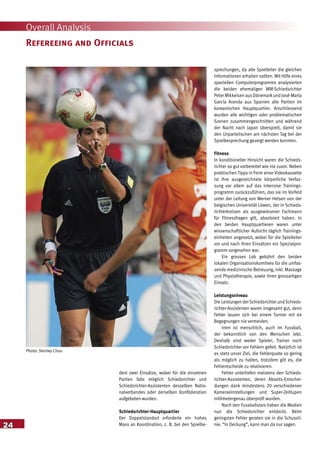
  • 42.
    41 de mini conférencesde presse improvisées avec certains joueurs ainsi que l’opportunité de face-à-face lors des passages des joueurs dans la zone mixte ont fourni aux médias quantité de citations. Parallèlement, les ten- tatives d’amélioration de l’accès des médias aux équipes lors des jours de repos (accès aux entraînements pour les 15 premières minutes au moins) ont bien fonctionné avec la majo- rité des équipes, bien que certaines équipes ou certains joueurs se soient montrés assez opaques à une coopération normale avec les médias. La production télévisée a atteint de nou- veaux standards grâce au professionnalisme d’une équipe internationale menée par le PDG d’HBS, Francis Tellier. Le projet inno- vateur de production d’HBS n’avait rien de révolutionnaire dans un domaine où il reste peu à inventer, mais a cependant produit des images d’une impressionnante qualité. La mise en place de l’EBIF (extended basic international feed) a permis à HBS de fournir aux partenaires de diffusion un plus grand choix de matériel avant, pendant et après la compétition, améliorant ainsi la diffusion au- delà de l’action pure. De manière générale, grâce non seule- ment à la coopération entre la FIFA et les COLs (avec l’aide considérable des deux armées de bénévoles déterminés), mais aussi grâce au travail conjoint de ces parties et des médias eux-mêmes, la compétition s’est déroulée sans incident majeur et à la grande satisfac- tion d’un cercle des médias réputé pour son exigence. Los medios de comunicación supusieron un enorme desafío para los organizadores de la Copa Mundial de la FIFA 2002™. Y si la prueba de fuego para obtener el éxito radica – como debería ser – en las opiniones de los 11,500 representantes que utilizan las instalacio- nes, la FIFA y los dos comités organizadores pueden estar satisfechos de su labor. La cooperación fue la clave. Durante casi cuatro años, la FIFA, JAWOC y KOWOC se reunieron periódicamente, junto con los HBS (servicios de la emisora local), para planificar esta compleja operación, garantizando así un tratamiento equitativo a todos los represen- tantes de los medios mundiales. Sin embargo, ningún plan habría dado frutos sin el genuino espíritu de mutuo apoyo que demostraron ambos comités organizadores, los cuales compartieron algunas tareas organizativas, especialmente en el área de la acreditación de los medios: JAWOC se hizo cargo de 3,000 periodistas y 1,000 fotógrafos, y KOWOC coor- dinó a un total de 3,000 empleados del HBS y a 4,500 representantes de las radiodifusoras. La infraestructura a disposición y la cali- dad de los servicios no tenían precedentes: 20 centros de prensa en los estadios (SMC), completamente equipados, y dos Centros Internacionales de los Medios (IMC) para la prensa y radiodifusores, uno en Seúl y otro en Yokohama. Se pudo ver que los SMC estaban a reventar en los días de partido, mientras que los IMC generalmente no llegaban a llenarse. Las razones de esto aún se deben analizar en detalle, pero, sin duda, una de las principales es la evolución en el sector tecnológico, y que, con el acceso a la información en línea, los medios dependen menos de un punto cen- tralizado para obtener información. Con miras al 2006, se deberá estudiar detenidamente si el incremento del apoyo tecnológico debe hacerse conforme a las necesidades de los servicios de los medios. Los sitios en la red despedazan récords La FIFA movilizó a un equipo de oficiales de los medios en las 20 sedes; hubo un mínimo de tres oficiales en cada partido. Además,
  • 43.
    42 Overall Analysis estuvieron adisposición el MIS-INFO 2002, un servicio de información que gozó de alta estima, el familiar sitio fifa.com y el sitio espe- cializado fifaworldcup.com. Este último tuvo un éxito rotundo y prácticamente hizo añicos todos los récords conocidos en la red mun- dial, acumulando un total de dos mil millones de consultas durante toda la competición. Las reuniones de información que la FIFA celebró a diario, una continuación del con- cepto introducido eficazmente en 1998, fue muy útil para mantener un flujo de informa- ción de actualidad para los medios estaciona- dos en Seúl y Yokohama, amén de ofrecer a la FIFA datos sobre los temas de interés inme- diato. En un agradable ambiente exento de violencia pública, los medios se concentraron principalmente en las dificultades causadas por las operaciones de entradas, así como en las actuaciones de los árbitros y sus asisten- tes. La FIFA aprovechó sus reuniones a las 11 a.m. para tratar a fondo estos temas y otros asuntos de interés. Tal como en 1998, la distribución de entradas a los medios se vio obstaculizada debido a la reserva de entradas para un gran número de periodistas que se ausentaban a última hora. Para los próximos torneos se deberá pasar revista a esta actitud que mues- tra cierta falta de profesionalismo . Actividades después del partido Se modificaron las operaciones en la zona mixta al término del partido con la intro- ducción de un estudio para entrevistas, que resultó muy útil, especialmente cuando reinaba la tensión tras un encuentro. La combinación de estas entrevistas con: confe- rencias de prensa espontáneas y muy breves a jugadores selectos en la misma zona mixta, aparte de la oportunidad de las entrevistas individuales en la misma zona, garantizaron un servicio de primera a los medios. Por otra parte, los intentos de brindar acceso a los equipos en los días en que no había partido (incluido el acceso al entrenamiento al menos durante los primeros 15 minutos) funcionaron generalmente con la mayoría de los equipos, pese a que algunos equipos o individuos se resistieron a cooperar con los medios. El baremo para los estándares de la pro- ducción televisiva se ha puesto en un nuevo nivel gracias al profesionalismo de un equipo internacional dirigido por el Director Ejecutivo de HBS Francis Tellier. Puede ser que el inno- vador plan de producción de HBS no haya causado una revolución en un área en la que casi no hay nada nuevo que inventar, pero, de cualquier forma, produjo imágenes de una calidad e impacto admirables. La introduc- ción de la técnica llamada EBIF (señal básica internacional ampliada) dio a HBS la oportu- nidad de ofrecer a los socios de radiodifusión un material variado antes, durante y después de cada partido, llevando así el alcance de la transmisión más allá de la simple acción. En suma, gracias a la cooperación entre la FIFA y los COL (con la enorme asistencia de dos armadas de animosos voluntarios), y también a la colaboración de estas partes con los medios mismos, la competición no sólo se desarrolló sin contratiempos, sino que también satisfizo a la exigente clientela de los medios. Im Medienbereich gab es beim FIFA-Weltpokal 2002™ wohl die grössten organisatorischen Herausforderungen zu bewältigen. Nimmt Media Photo: Empics
  • 44.
    43 man das Echoder 11’500 Medienvertreter als Massstab – und das sollte man –, können die FIFA und die beiden Organisationskomitees auch hier eine positive Bilanz ziehen. Zusammenarbeit wurde grossgeschrie- ben. Während fast vier Jahren schafften die FIFA gemeinsam mit JAWOC, KOWOC und HBS (Host Broadcast Services) die Vorraussetzun- gen, damit kein Medienvertreter benachteiligt wurde. Doch ohne die beispielhafte Koordina- tion zwischen den beiden LOC wäre die Mühe umsonst gewesen. Eine strikte Aufgabentei- lung erwies sich etwa bei den Medienakkre- ditierungen als Patentrezept: Das JAWOC war für 3000 Journalisten und 1000 Fotografen zuständig, während beim KOWOC die Fäden für 3000 HBS-Angestellte und 4500 Fernseh- mitarbeiter zusammenliefen. Die 20 Stadien-Medienzentren (SBC) und die beiden internationalen Medienzentren (für Presse und Fernsehen, IBC) in Seoul und Yokohama läuteten bezüglich Einrichtung und Service eine neue Ära ein. Während der Andrang in den SBC an den Spieltagen jeweils enorm war, liess die Auslastung der IBC in der Regel zu wünschen übrig. Für ein abschlies- sendes Urteil ist es zwar noch zu früh, doch die rasante technologische Entwicklung ist bestimmt einer der Hauptgründe. Die Me- dienvertreter können sich dank dem Internet jederzeit und überall die Informationen beschaffen, die sie gerade benötigen. Diesen Punkt gilt es für 2006 bei der Abstimmung des IT-Supports auf die Wünsche der Medien zu beachten. Rekord-Website An den Spieltagen dienten an den einzelnen Spielorten mindestens drei FIFA-Medien- verantwortliche als Ansprechpartner. Für das hoch geschätzte Informationssystem MIS-INFO 2002 und die Aktualisierung der Verbands-Website fifa.com und der äusserst beliebten WM-Homepage fifaworldcup.com, die mit insgesamt über zwei Milliarden Hits während des Turniers alle Rekorde brach, wurde ein eigenes Team eingesetzt. Mit den täglichen Medienbriefings, die auf der Grundlage des erfolgreichen Konzepts von 1998 nochmals ausgeweitet wurden, konnte die FIFA die Medienvertreter in Seoul und Yokohama aus erster Hand informieren und auf brennende Fragen eingehen. Durch das Ausbleiben von Fanausschreitungen standen vor allem die anfänglichen Probleme beim Kartenverkauf sowie die Leistungen der Schiedsrichter undSchiedsrichter-Assistenten im Zentrum des Medieninteresses. In ihren Briefings, die jeweils auf 11.00 Uhr angesetzt waren, nahm die FIFA zu diesen und anderen Themen ausführlich Stellung. Wie schon 1998 wurde die Verwaltung des Ticketkontingents für die Medienvertreter dadurch erschwert, dass viele Journalisten trotz vorgängiger Reservierung nicht zu den Spielen erschienen – ein äusserst unpro- fessionelles Verhalten, das für die nächsten Turniere nicht ohne Folgen bleiben wird. Nach Spielende In der gemischten Zone bewährte sich eine Änderung ganz besonders: In der Hektik boten die Studiointerviews die gewünschte Ruhe. Hinzu kamen die improvisierten Mini-Medienkonferenzen mit ausgewählten Spielern in der gemischten Zone selbst und die Kurzinterviews mit den Spielern, während diese die gemischte Zone durchquerten, wodurch die Journalisten eine Vielzahl von Spieler- und Trainerstimmen einfangen konn- ten. Die meisten Teams gewährten den Medi- envertretern vermehrt auch an spielfreien Tagen Zutritt (öffentliches Training während den ersten 15 Minuten), obwohl einige Mann- schaften oder Personen weiterhin nicht zu einer Zusammenarbeit im üblichen Rahmen bereit waren. Die Fernsehproduktion setzte dank der Professionalität des internationalen Teams unter der Leitung von Francis Tellier, CEO von HBS, neue Massstäbe. Auch wenn im Fernsehbereich das Rad längst erfunden ist, setzte HBS bei seiner Planung nicht nur auf konventionelle Produktionsmethoden, sondern zeigte sich auch sehr innovativ, wodurch bei der Bildqualität eine weitere, bis anhin undenkbare Steigerung erreicht werden konnte. Mit Hilfe eines neuen Systems, des so genannten EBIF (Extended Basic Internati- onal Feed), konnte HBS den Fernsehanstalten während und nach den Spielen mehr Bildma- terial anbieten, wodurch diese vermehrt auch Szenen abseits des eigentlichen Spielgesche- hens einfangen konnten. Dank der Zusammenarbeit zwischen der FIFA und den LOC (mit dem tollen Einsatz von unzähligen Freiwilligen) und nicht zuletzt der Kooperationsbereitschaft der Medien verlief das Turnier ohne grössere Zwischenfälle – noch viel wichtiger: Auch die anspruchsvollen Medienvertreter waren mit der Organisation äusserst zufrieden. Photos: Christian Liewig, Daniel Motz
  • 45.
    44 Overall Analysis Marketing andPartners Guido Tognoni, Presidential Adviser for Marketing Matters As the biggest and most popular worldwide sporting event, the FIFA World Cup™ also rep- resents a unique global marketing opportunity for FIFA’s commercial partners. The unique nature of this event can be explained by two distinct factors – the worldwide popularity of football transcends all geographical, cultural and social barriers, and the extraordinary pas- sion so evident at the tournament is an ideal opportunity for the advertising strategies of FIFA’s partners. The first FIFA World Cup™ of the new millennium also saw fans find a new way to display their passion for the game, with mil- lions following the action on giant television screens. In Korea, countless people swarmed onto the streets and squares to watch the Korean national team’s matches together and to celebrate in exuberant and colourful street parties. In Tokyo, 45,000 people filled the Olympic Stadium while the Japanese team played in Osaka and Miyagi. More than 7 million people in Korea are estimated to have watched the public broadcasts of their team’s semi-final show- down with Germany, with 2.5 million people in Seoul alone passionately following their idols’ fortunes on the big screens. They simply preferred to celebrate in high spirits in a huge street party. This potential to bring people together was also witnessed in countless other coun- tries, albeit to a lesser extent than in Korea. Consequently, the FIFA World Cup™ continues to attract more and more interest outside of its more traditional fan base. Evaluations of the television data, for example, showed that more and more women tuned into match cov- erage. The worldwide TV ratings also showed that the popularity of football not only remains as great as ever, but has also enjoyed a dra- matic increase in countries that were once classed as “fringe areas” for the game. This is especially true for the whole of Asia, and Japan, Korea and China in particular. In terms of marketing, the increase in the number of football fans around the world has led to a rejection of traditional forms of com- munication. Sponsors now demand outlets via which they can reach their various target groups in a more direct manner. The market- ing concept for the 2002 FIFA World Cup™ therefore encompassed individual and inno- vative ways for companies with interests and requirements beyond football to make their mark. A prime example of this trend was the event logo, which was variable and allowed companies to use it in a number of different ways. FIFA’s partners took advantage of the opportunity to introduce individual market- ing activities. Some sponsors even increased their effective budget for special promo- tions by 300% in comparison to France ’98. The innovative commercial programme for Korea/Japan 2002 was on the whole a great success. Despite the turbulent developments in the area of marketing, the programme still provided for traditional marketing activities by sponsors, such as in the technical study group (TSG) of FIFA experts, for example. Such partnerships included the selection of the MasterCard Allstar Team and the nomination of 10 candidates for the adidas Golden Ball, the award presented to the best player of the tournament. For the first time ever, the TSG also bestowed the title of “Budweiser Man of the Match” on the most outstanding player in each game. Premier événement sportif international par sa taille et sa popularité, la Coupe du Monde de la FIFA™ offre une plate-forme de marke- ting globale unique en son genre aux parte- naires commerciaux de la FIFA. La singularité de cette manifestation tient principalement à deux facteurs: d’une part, l’engouement
  • 46.
    45 universel pour lefootball transcendant toutes les barrières géographiques, culturelles et sociales, d’autre part, l’extraordinaire con- tenu émotionnel de ce rendez-vous offrant un cadre idéal aux messages publicitaires des partenaires de la FIFA. Lors de cette première Coupe du Monde de la FIFA™ du millénaire, l’euphorie suscitée par le football a même trouvé un nouveau support qui a fait fureur sur la planète entière. Ainsi, des millions de supporters ont-ils suivi les retransmissions publiques des matches sur grand écran. En Corée, une foule immense a envahi les rues et les places pour regarder les rencontres de l’équipe nationale et parti- ciper à la liesse populaire. A Tokyo, 45 000 spectateurs étaient réunis au stade olympi- que lorsque la sélection japonaise a joué à Osaka et à Miyagi. Selon les estimations des forces de l’ordre, plus de sept millions de personnes auraient suivi les retransmissions publiques de la demi-finale Corée – Allemagne. Rien qu’à Séoul, quelque 2,5 millions de sup- porters des Diables Rouges sont descendus célébrer leur équipe dans la rue, soucieux de partager en communauté la joie et l’émotion de la foule dans toute la capitale. Le grand potentiel d’intégration social que recouvre un tel mouvement s’est égale- ment fait sentir, quoique dans une moindre mesure, dans d’autres pays qu’en Corée. C’est en partie ce qui explique l’intérêt croissant suscité par la Coupe du Monde de la FIFA™ au-delà du cercle traditionnel des supporters. D’après l’indice d’écoute, cela vaut notam- ment pour les femmes. L’audience télévisée mondiale atteste en outre que, loin de perdre
  • 47.
    46 Overall Analysis Marketing andPartners de sa popularité, le football voit même le nombre des pays intéressés progresser nettement. Ce phénomène est marqué dans toute l’Asie, notamment au Japon, en Corée et en Chine. Dans le secteur du marketing, cette diver- sification des supporters invite à se détourner des formes de communication uniformes originelles. Aujourd’hui, les plate-formes pour des actions de sponsoring permettant de toucher directement les différents groupes cibles sont de plus en plus recherchées. Or, l’une des grandes caractéristiques du concept de marketing de la Coupe du Monde de la FIFA 2002™ a été d’offrir une plus grande marge de manœuvre pour faire valoir de nouveaux intérêts et besoins individuels dépassant le sport. Une tendance qui se reflète clairement dans le logo de l’événement, adaptable et donc polyvalent. Les partenaires de la FIFA ont fait abon- damment usage du nouveau champ d’action mis à leur disposition pour leurs initiatives individuelles. Par rapport à France 98, cer- tains sponsors ont triplé leur budget consa- cré aux promotions spécifiques. Dans l’ensemble, le programme commercial novateur de Corée/Japon 2002 peut être con- sidéré comme très réussi. Malgré l’évolution turbulente qu’a connue le secteur du marke- ting dans son ensemble, les partenaires ont également pu mener des actions tradition- nelles telles que celles auxquelles contri- buent les experts du Groupe d’Etude Techni- que de la FIFA. L’élection de l’équipe Allstar MasterCard, la nomination de 10 candidats pour le ballon d’or adidas, la distinction des trois meilleurs joueurs du tournoi en sont quelques exemples. Le GET a également attri- bué pour la première fois le titre d’homme du match (Budweiser) au meilleur joueur de chaque match. Al ser el acontecimiento deportivo más grande y popular del mundo, la Copa Mundial de la FIFA™ sirve también de excepcional plataforma mercadotécnica para los socios comerciales de la FIFA. La excelencia de este torneo radica, fundamentalmente, en dos fac- tores: por un lado, la enorme popularidad del fútbol, que salva todas las barreras geográfi- cas, culturales y sociales; por otro, la enorme carga emotiva de la competición, que ofrece un escenario perfecto para los mensajes publicitarios de los socios de la FIFA.
  • 48.
    47 En este mundialdel milenio ha surgido una novedad que ha despertado el interés del público mundial: millones de personas con- gregadas frente a pantallas gigantes instala- das en zonas públicas. En Corea, por ejemplo, millones de personas fluyeron a las plazas y calles para seguir en comunidad los parti- dos de su equipo, y celebrar posteriormente multitudinarias fiestas populares. En Tokio, 45,000 personas se congregaron en el esta- dio Olímpico para disfrutar de los partidos de su selección en Osaka y en Miyagi. A la transmisión pública en todo el país de la semifinal Corea-Alemania asistieron, según la estimación de las fuerzas del orden, más de 7 millones de personas. En Seúl, cerca de 2,5 millones de aficionados prefirieron dar rienda suelta a su pasión futbolística en la calle, y manifestar su alegría en una enorme fiesta popular y comunal, llena de pasión, colorido y emoción. Esta increíble expresión integradora del espíritu comunal se pudo ver también, aunque en menor medida que en Corea, en otros muchos países. Constatamos así que la Copa Mundial de la FIFA™ ha despertado mucho más interés público que el habitual, reducido a los círculos futbolísticos. Como indican los índices de telespectadores, el inte- rés femenino ha sido la gran sorpresa de esta Copa. Además, estos mismos índices mundia- les indican que la popularidad del fútbol no sólo mantiene su vigencia, sino que en algu- nas zonas del orbe, menos tradicionales en el mundo del fútbol, el interés por el balompié ha crecido exponencialmente. Un ejemplo es Asia, y especialmente Japón, Corea y China. En el campo de la mercadotecnia, este aumento del público futbolístico ha supuesto el abandono de las vías de comunicaciones más tradicionales y unidireccionales. Hoy día se buscan plataformas publicitarias espe- cíficas, dirigidas a un público concreto. El concepto mercadotécnico de la Copa Mundial de la FIFA Corea/Japón 2002™ se caracterizó por permitir un margen de maniobra para su utilización en campañas individualizadas, orientadas a través del deporte hacia intere-
  • 49.
    48 Overall Analysis ses ynecesidades más generales. El logotipo del torneo, variable y flexible, simboliza de forma ejemplar esta nueva tendencia. Los socios de la FIFA explotaron al máximo este novedoso margen de maniobra para la presentación individualizada de sus produc- tos. Algunos patrocinadores triplicaron, en comparación con Francia 98, su presupuesto para promociones específicas. En líneas generales, podemos calificar de muy exitoso el novedoso e innovador programa comercial de Corea y Japón. A pesar del tempestuoso desarrollo del ámbito mercadotécnico, los actos tradicionales de los socios también tuvieron cabida en el torneo. Un ejemplo es la contribución de los expertos de la FIFA en- globados en el Grupo de estudio técnico (GET): la elección del equipo estelar Master- Card, el nombramiento de 10 candidatos para el“Balón de oro” de adidasyla elección de los tres mejores jugadores del torneo. Además, el GET otorgó por primera vez el galardón de “Jugador Budweiser del partido” al futbolista más destacado de cada encuentro. Als grösstes und weltweit populärstes Sport- ereignis ist der FIFA-Weltpokal™ auch eine einzigartige globale Marketing-Plattform für die kommerziellen Partner der FIFA. Die Ein- zigartigkeit dieses Events beruht vor allem auf zwei Faktoren: einerseits die weltum- spannende Popularität des Fussballs über alle geographischen, kulturellen und sozialen Barrieren hinweg, andererseits stellt der aus- serordentliche Emotionsgehalt des Events ein ideales Umfeld für die Werbebotschaften der FIFA-Partner dar. Eine neuartige Ausdrucksform der Fuss- ballbegeisterung sorgte beim ersten FIFA- Weltpokal™ dieses Jahrtausends gar weltweit für Aufsehen: Das Millionenpublikum bei öffentlichen Übertragungen auf Grossleinwän- den. In Korea strömten Millionen auf Strassen und Plätze, um die Spiele des Heimteams gemeinsam zu verfolgen und gleichzeitig rauschende Volksfeste zu feiern. In Tokio füll- ten 45 000 Zuschauer das Olympiastadion, als die japanische Auswahl in Osaka und in Miyagi spielte. Den öffentlichen Übertragungen des Halbfinals Südkorea – Deutschland wohnten gemäss Schätzungen der Ordnungskräfte lan- desweit über 7 Millionen Personen bei. Allein in Seoul waren es rund 2,5 Millionen, welche die Begeisterung über die Leistungen des ein- heimischen Teams ins Freie trieb. Sie zogen es vor, ihre Emotionen im Rahmen einer riesigen öffentlichen Party phantasievoll und fröhlich in der Gemeinschaft zu zelebrieren. Das damit verbundene grosse gesell- schaftliche Integrationspotenzial kam, wenn auch in kleinerem Ausmass als in Korea, in zahlreichen anderen Ländern zum Ausdruck. Eine Folge davon ist, dass der FIFA-Welt- pokal™ weit über die Kreise der traditionellen Fussballfans hinaus auf immer mehr Interesse stösst. Insbesondere ist dies bei den Frauen der Fall, wie die Auswertungen der TV-Daten augenfällig illustrieren. Zudem dokumentie- ren die weltweiten TV-Zahlen, dass die Popu- larität des Fussballs nicht nur ungebrochen anhält, sondern in bisherigen “Randregionen” des Fussballs markant gestiegen ist. Dies gilt ausgeprägt für ganz Asien, insbesondere für Japan, Korea und China. Im Bereich des Marketings führt diese Pluralisierung des Fussballpublikums zu einer Abkehr von den herkömmlichen, eher ein- förmigen Kommunikationsformen. Vermehrt gefragt sind heute Plattformen für Sponsoring- auftritte, über welche die unterschiedlichen Zielgruppen gezielter angesprochen werden können. Mehr Spielraum für individuelle, auf neue, über den Sport hinausreichende Inte- ressen und Bedürfnisse ausgerichtete Profilie- rungsmöglichkeiten war denn auch eines der wichtigen Merkmale des Marketingkonzepts für den FIFA-Weltpokal 2002™. Das variabel und damit vielseitig verwendbare Eventlogo symbolisiert diesen Trend augenfällig. Der gewonnene Spielraum für individu- elle Auftritte wurde von den FIFA-Partnern rege genutzt. Einzelne Sponsoren haben ihr Implementierungs-Budget für spezifische Pro- motionen gegenüber France 98 verdreifacht. Insgesamt kann das innovative kommerzielle Programm von Korea/Japan als sehr erfolg- reich bezeichnet werden. Trotz der insgesamt stürmischen Entwicklung im Marketingbereich hatten auch traditionelle Partneraktionen ihren Platz. So auch jene, zu welchen die FIFA-Experten der technischen Studiengruppe (TSG) ihre Beiträge leisteten. Es sind dies die Wahl des MasterCard Allstar Teams sowie die Nomination der 10 Kandidaten für den “Gol- denen Ball” von adidas, die Auszeichnung für die drei besten Einzelspieler des Turniers. Erstmals vergab die TSG zudem den Titel des “Budweiser Man of the Match” für den besten Spieler der Partie. Marketing and Partners
  • 50.
    49 Man of theMatch Photo: Alfieri 01 France vs Senegal DIOUF El Hadji (SEN, 11) 02 Rep. of Ireland vs Cameroon HOLLAND Matt (IRL, 8) 03 Uruguay vs Denmark TOMASSON Jon Dahl (DEN, 9) 04 Germany vs Saudi Arabia KLOSE Miroslav (GER, 11) 05 England vs Sweden CAMPBELL Sol (ENG, 6) 06 Paraguay vs South Africa ARCE Francisco (PAR, 2) 07 Argentina vs Nigeria VERON Juan (ARG, 11) 08 Spain vs Slovenia RAUL (ESP, 7) 09 Croatia vs Mexico LUNA Braulio (MEX, 11) 10 Brazil vs Turkey RIVALDO (BRA, 10) 11 Italy vs Ecuador VIERI Christian (ITA, 21) 12 China PR vs Costa Rica GOMEZ Ronald (CRC, 11) 13 Japan vs Belgium INAMOTO Junichi (JPN, 5) 14 Korea Republic vs Poland YOO Sang Chul (KOR, 6) 15 Russia vs Tunisia NIKIFOROV Yuri (RUS, 3) 16 USA vs Portugal MCBRIDE Brian (USA, 20) 17 Germany vs Rep. of Ireland KEANE Robbie (IRL, 10) 18 France vs Uruguay BARTHEZ Fabien (FRA, 16) 19 Cameroon vs Saudi Arabia ETOO Samuel (CMR, 9) 20 Denmark vs Senegal FADIGA Khalilou (SEN, 10) 21 Sweden vs Nigeria LARSSON Henrik (SWE, 11) 22 Spain vs Paraguay MORIENTES Fernando (ESP, 9) 23 Argentina vs England SCHOLES Paul (ENG, 8) 24 South Africa vs Slovenia FORTUNE Quinton (RSA, 7) 25 Italy vs Croatia RAPAIC Milan (CRO, 5) 26 Brazil vs China PR ROBERTO CARLOS (BRA, 6) 27 Mexico vs Ecuador TORRADO Gerardo (MEX, 6) 28 Costa Rica vs Turkey WANCHOPE Paulo (CRC, 9) 29 Japan vs Russia INAMOTO Junichi (JPN, 4) 30 Korea Republic vs USA FRIEDEL Brad (USA, 1) 31 Tunisia vs Belgium BOUZAIENE Raouf (TUN, 12) 32 Portugal vs Poland PAULETA (POR, 9) 33 Denmark vs France ZIDANE Zinedine (FRA, 10 34 Senegal vs Uruguay DIOP Papa Bouba (SEN, 19) 35 Cameroon vs Germany KLOSE Miroslav (GER, 11) 36 Saudi Arabia vs Rep. of Ireland DUFF Damien (IRL, 9) 37 Sweden vs Argentina MJALLBI Johan (SWE, 4) 38 Nigeria vs England CAMPBELL Sol (ENG, 6) 39 South Africa vs Spain RAUL (ESP, 7) 40 Slovenia vs Paraguay ARCE Francisco (PAR, 2) 41 Costa Rica vs Brazil JUNIOR (BRA, 16) 42 Turkey vs China PR SAS Hasan (TUR, 11) 43 Mexico vs Italy BLANCO Cuauhtemoc (MEX, 10) 44 Ecuador vs Croatia MENDEZ Edison (ECU, 19) 45 Tunisia vs Japan NAKATA Hidetoshi (JPN, 10) 46 Belgium vs Russia WILMOTS Marc (BEL, 7) 47 Portugal vs Korea Republic PARK Ji SUNG (KOR, 21) 48 Poland vs USA KRZYNOWEK Jacek (POL, 18) 49 Germany vs Paraguay JEREMIES Jens (GER, 16) 50 Denmark vs England FERDINAND Rio (ENG, 5) 51 Sweden vs Senegal CAMARA Henri (SEN, 7) 52 Spain vs Rep. of Ireland IKER CASILLAS (ESP, 1) 53 Mexico vs USA DONOVAN Landon (USA, 21) 54 Brazil vs Belgium RIVALDO (BRA, 10) 55 Japan vs Turkey OZALAN Alpay (TUR, 5) 56 Korea Republic vs Italy AHN Jung Hwan (KOR, 19) 57 England vs Brazil RIVALDO (BRA, 10) 58 Germany vs USA REYNA Claudio (USA, 10) 59 Spain vs Korea Republic LEE Woon Jae (KOR, 1) 60 Senegal vs Turkey SAS Hasan (TUR, 11) 61 Germany vs Korea Republic BALLACK Michael (GER, 13) 62 Brazil vs Turkey RONALDO (BRA, 9) 63 Korea Republic vs Turkey SUKUR Hakan (TUR, 9) 64 Germany vs Brazil RONALDO (BRA, 9)
  • 51.
    50 52 Overall Analysis 60Statistics Overview 64 Confederations’ Analysis 74 Playing Systems 79 Goalkeeping 84 The Final 88 Key Scene of the Final 90 Interview with Luiz Felipe Scolari 102 Official FIFA Awards
  • 52.
  • 53.
    52 Technical and TacticalAnalysis Overall Analysis nent is disorganised and has allowed space to appear between and behind their midfield and defensive players. Solo Play Approximately one-fifth of the 161 goals scored during the competition were the product of individual actions (i.e. long-range shots, direct free kicks, individual dribbling and shooting). Good examples of this key element in top-level football included Robert Carlos’ ‘ballistic’ free kick against China, Dario Rodriguez’s long-range volley for Uru- guay versus Denmark, and Henrik Larsson’s evasive run and calm finish for Sweden in the match with Nigeria. The importance of the soloist has increased as efficiency in defend- ing has improved – sometimes the only way to beat the defensive block is through powerful, long-range shooting or individual wizardry. Set Piece Play Set pieces accounted for around 30% of all the goals scored in the championship, with the biggest return coming from corners. There was an extensive variety of corner kicks on show (corners played short, to the front or back post, or even outside of the box) and the delivery of both inswingers and outswingers was particularly impressive. Free kicks from wide positions were also noteworthy, with the ball being curled both towards and away from the goal with pace and head-high preci- sion. Surprising moves on free kicks from the edge of the box, à la Argentina versus England in 1998, were non-existent. A lack of privacy and obsessive spying has inhibited today’s coaches, and consequently there is a reluc- tance to spend time on ‘clever’ free kicks that might only be used on one occasion. Pressing The pressing game, particularly in midfield, was employed by many teams despite the strength-sapping weather. Many pressed the ball and doubled up on the ball carrier, some were efficient at collective pressing (i.e. co- ordinated group pressure), and a number of sides were also able to condense the space by playing as a compact, mobile team unit – Ireland, Sweden, USA, Denmark, Turkey, England, Japan and Korea were outstanding at applying this tactic. The stamina and speed endurance required to enforce a high-inten- sity pressing game was particularly impres- sive in the case of Ireland, the USA and Korea, The Fine Line At the top level of football, in an era when teams are often evenly matched, the fine line between winning and losing can be the result of any of the following: • a decision by a coach, e.g. Senol Gunes, the Turkish coach, made a pivotal decision when he replaced his captain, Hakan Sukur, with Ilhan Mansiz, after 67 minutes, against Senegal – Mansiz proved to be the match- winner with his Golden Goal strike; • an individual action, e.g. Ronaldo’s solo effort against Turkey in the semi-final (play- ers who can make and take chances without assistance are vital in the modern game); • a counter-attack, e.g. Senegal’s winner in the opening game against France; • a set piece, e.g. Batistuta’s winning header from a back-post corner against Nigeria; • a mistake, e.g. miskick by Turkish goal- keeper Rustu that led to Brazil’s match-win- ning penalty in Ulsan. For the national coach, the importance of these elements is considerable. Counter-Attack Approximately 20% of the goals scored from open play in Korea/Japan 2002 came as the result of a counter-attack. In addition, it must not be forgotten that many set pieces, which resulted in goals, were gained following a counter. Some teams operated a counter-attack- ing policy – a style of play based on defend- ing deeply and breaking forward when the opportunity presents itself. Others, and this includes most of the more successful teams, played a balanced game, but used counter- attacking moves as part of their repertoire. For many teams, such as England and Germany, the ‘traditional’ counter-attack (where the ball is played long to one or two attackers, in a big space, and against a few defenders) was used effectively. There were also excellent examples of ‘collective counters’ (where a group of players break, and combine to form a wave of attack, before the opponent can fully regroup), and this was particularly well illustrated by a number of teams, including Brazil and Senegal. In today’s sophisticated game, nobody gives space for free, and therefore counter-attacking ability is vital to exploit the fleeting moments when an oppo-
  • 54.
    53 to name butthree. In the case of Korea, their capacity to take the initiative (i.e. attacking with and without the ball), to operate their ‘Dutch’ 3-4-3 system, and to dominate for the bulk of each match, was astonishing. Four months of full-time training certainly paid dividends for the Koreans. Combination Play Combination play (i.e. two, three or four play- ers exchanging short, quick passes, usually in the central attacking area of the field) was highly developed and demonstrated to great effect by many teams, including Spain, Denmark, Argentina, Mexico and Turkey. When analysing combination play, two types must be considered: the predictable and the unpredictable. In the former category, which is based on well-developed training methods, the Germans, Italians, and Americans were fine exponents. In contrast, the Brazilians, Costa Ricans, Senegalese, and other ‘flam- boyant’ types, those with a flair for inventive- ness and unconventional technique, often put together combinations that mesmerised and surprised the defending team. Tactical Flexibility The ability to change structure, and some- times style, during a match, or from match to match is an important component in a team’s armoury. When Korea were losing to Italy, Guus Hiddink changed his approach and went from his adventurous 3-4-3 to an ultra-risk-taking 3-2-5 – it worked, because he saved the game, and then saw Ahn Jung-Hwan score the Golden Goal to win him and Korea the match. Brazil outclassed Costa Rica, but their organisation lacked balance, and Scolari introduced a two-man midfield screen in front of the back three for the quarter-final against England. Examples of tactical flexibility were plentiful. Technical Quality In the 2002 FIFA World Cup™, teamwork, emphasising compactness in defence and attack and involving a minimum of 7 or 8 players, often overshadowed the individual. However, the technical ability of most play- ers, including many defenders, was of a high standard. It has become a necessity for play- ers to break from the back, to ‘give and go’, and thus increase the numbers in the attack- ing area. Brazil’s back three were all capable of springing from their defensive positions and joining in the creative build-up. The same applied to players from Senegal, Spain, Turkey, Argentina, Costa Rica and a number of others. Team-oriented skills were the norm, with functionality, accuracy, and speed the priorities. Some, however, transcended the conventional, and this was particularly true of many players playing in the hole between attack and midfield (i.e. second strikers), such as Rivaldo, Ronaldinho, Sas, Raúl, Totti, Photo: Christian Liewig
  • 55.
    54 Technical and TacticalAnalysis Wilmots, Tomasson, Recoba, Verón, and Aimar. The technical quality of those who played in this free role was remarkable, but with freedom comes responsibility, and these players had to make a difference in each match in order to justify their special role. Yes, we were impressed with the fast, clever feet of the top players, but equally, we recognised the trend towards quick thinking, particularly during the transition from defence to attack and vice versa. Total players, those who can rotate position without losing their effective- ness (e.g. the Brazilians and Koreans), have become a valuable commodity in the modern game. La différence Dans les compétitions au plus haut niveau, les éléments suivants départagent générale- ment les équipes: • les décisions de l’entraîneur. Celle de Senol Gunes, l’entraîneur turc, de remplacer Hakan Sukur par Ilhan Mansiz à la 67e minute, contre le Sénégal, s’est avérée cruciale: la Tur- quie a gagné grâce au but en or de Mansiz; • les actions individuelles, telles que celle de Ronaldo contre la Turquie en demi-finale. Aujourd’hui, les joueurs capables de créer et de réaliser des occasions sans assistance sont indispensables; • les contre-attaques, témoin la victoire du Sénégal sur la France en match d’ouverture; • les coups de pied arrêtés. La tête de Batistuta, au deuxième poteau sur un corner, contre le Nigeria en est un bon exemple; • les fautes. Ainsi, le tir raté du gardien turc Rustu a-t-il entraîné le penalty qui a permis au Brésil de remporter la victoire à Ulsan. Les entraîneurs sont très attentifs aux éléments suivants: Contre-attaque Environ 20% des buts marqués en cours de jeu – et la plupart de ceux inscrits sur des coups de pied arrêtés – résultaient d’une contre-attaque. Certaines équipes ont adopté une stra- tégie de contre-attaque, reposant sur une défense précoce et des percées en fonction des occasions. D’autres équipes, dont la plu- part de celles qui ont obtenu de bons résul- tats, ont pratiqué un football équilibré non sans recourir aux contre-attaques. Pour de nombreuses équipes, telles que l’Angleterre et l’Allemagne, la “traditionnelle” contre-atta- que (longues passes à un ou deux attaquants, dans un vaste espace et contre des attaquants peu nombreux) a été utilisée efficacement. D’excellentes “contre-attaques collectives” (un groupe de joueurs fait une percée et forme une vague offensive avant que l’adversaire ne puisse se regrouper pleinement), ont été observées, notamment de la part du Brésil et du Sénégal. Dans le football tel qu’il est pra- tiqué aujourd’hui, aucun espace n’est jamais libéré sans contrepartie, aussi la capacité de contre-attaquer est-elle vitale pour exploiter les flottements où l’adversaire, désorganisé, laisse des espaces se former entre, et derrière le milieu de terrain et la défense. Jeu individuel Sur les 161 buts inscrits durant la compéti- tion, environ un sur cinq était le fruit d’ac- tions individuelles (tirs de loin, coups francs directs, dribbles et tirs individuels). Le coup franc “balistique” de Robert Carlos contre la Chine, la longue volée de Dario Rodriguez pour l’Uruguay contre le Danemark ainsi que la course folle et la réalisation en douceur de Henrik Larsson pour la Suède contre le Nigeria offrent de bons exemples de cet élément clé du football de haut niveau. Les actions indi- viduelles ont gagné en importance: du fait que la défense est devenue plus efficace, les tirs puissants et longs ou l’ingéniosité indivi- duelle s’avèrent parfois la seule manière de vaincre le bloc défensif. Coups de pied arrêtés Les coups de pied arrêtés représentent quelque 30% des bus marqués durant la compétition, principalement sur des corners. De multiples variations de corners ont été Overall Analysis Brazil 64 (18/10) Germany 54 (14/12) Turkey 38 (10/8) Spain 35 (10/5) Korea Republic 27 (8/3) Senegal 26 (7/5) Belgium 23 (6/5) USA 23 (6/5) England 22 (6/4) Rep. of Ireland 22 (6/4) Top Ten Total Points Scorers and Assists 1. 2. 3. 4. 5. 6. 7. 8. 9. 10. Own goals: 3
  • 56.
    55 dénombrées (passes courtes,au 1er ou au 2e poteau ou hors de la surface de réparation) et les corners rentrants et sortants étaient particulièrement impressionants. Certains coups francs décalés avec des tirs directs et indirects précis en hauteur étaient également remarquables. Aucune action par surprise sur les coups francs depuis la limite de la surface, comme lors du match Argentine-Angleterre, en 1998, n’a eu lieu. Aujourd’hui, les entraî- neurs sont inhibés par un manque d’intimité et un espionnage obsessionnel, d’où leur réti- cence à passer du temps sur les coups francs “trop réfléchis” qui ne pourraient être utilisés que dans de rares occasions. Pressing De nombreuses équipes ont pratiqué le pressing, notamment au centre, malgré les conditions climatiques fatigantes avec deux joueurs marquant le porteur du ballon, ou un pressing collectif efficace, (la pression coordonnée du groupe). Certaines équipes sont aussi parvenues à réduire les espaces en jouant comme une entité compacte, mobile – l’Irlande, la Suède, les USA, le Danemark, la Turquie, l’Angleterre, le Japon et la Corée excellaient à ce jeu. L’Irlande, les Etats-Unis et la Corée pour n’en citer que trois ont brillé par leur endurance, une qualité nécessaire pour pratiquer un pressing très intensif. La capacité d’initiative des Coréens (atta- que avec et sans ballon), leur capacité d’opérer selon leur système “hollandais” 3-4-3 et leur domination pendant la majeure partie de chaque match étaient étonnantes. Leurs quatre mois d’entraîne- ment intensif ont porté leurs fruits. Enchaînements Les enchaînements (passes courtes et rapides entre deux, trois ou quatre joueurs, généralement dans la partie offensive au centre du terrain) ont été couramment pratiqués et se sont avérés très efficaces dans de nombreuses équipes, telles que l’Espagne, le Danemark, l’Argentine, le Mexique et la Turquie. Dans l’analyse, il convient de distinguer deux types d’enchaînements: les prévisibles et les impré- visibles. LesAllemands, lesItaliensetlesAmé- ricains ont beaucoup fait usage des premiers, basés sur des méthodes d’entraînement bien développées. Les Brésiliens, Costa Ricains, Sénégalais, et autres joueurs ‘flamboyants’, pratiquant un football non conventionnel, ont souvent imaginé des enchaînements qui ont surpris la défense adverse. Flexibilité tactique La capacité de changer de structure voire de style, durant un match ou d’un match à l’autre est un atout important. Alors que la Corée était en train de perdre face à l’Italie, Guus Hiddink est passé d’un système risqué 3-4-3 à une configuration ultra-risquée 3-2-5. Cela a fonctionné car il a ainsi préservé le match avant que Ahn Jung-Hwan ne marque le but en or qui a apporté la victoire à son équipe. Le Brésil a surpassé le Costa Rica mais son organisation Photo: Christian Liewig
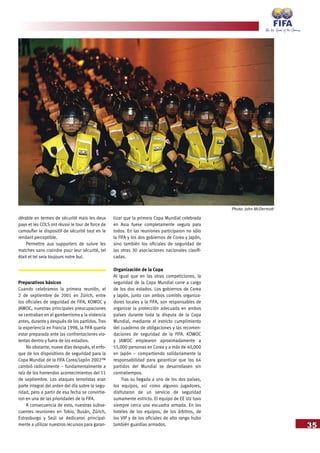
  • 57.
    Overall Analysis 56 Technical andTactical Analysis n’était pas équilibrée et Scolari a introduit un bouclier de deux joueurs centraux devant les 3 arrières lors du quart de finale avec l’Angle- terre. Les exemples de flexibilité tactique ne manquent pas. Qualité technique Durant la Coupe du Monde de la FIFA 2002™, l’esprit d’équipe, renforçant la compacité du jeu en défense et en attaque avec au moins 7 ou 8 joueurs a souvent prévalu sur les prestations individuelles. Reste que les qua- lités techniques de la plupart des joueurs, y compris de nombreux défenseurs, étaient de haut niveau. Il est devenu nécessaire de percer depuis l’arrière, de ‘donner et d’accé- lérer’ et d’occuper la surface offensive en plus grand nombre. Les trois arrières brésiliens étaient tous capables de quitter leur position défensive pour construire le jeu de manière créative. On peut en dire autant du Sénégal, de l’Espagne, de la Turquie, de l’Argentine, et du Costa Rica. Les compétences collectives étaient la norme, avec l’accent sur la fonc- tionnalité, la précision et la vitesse. Certains, tels que Rivaldo, Ronaldinho, Sas, Raúl, Totti, Wilmots, Tomasson, Recoba, Verón et Aimar ont cependant innové, notamment en se plaçant dans le trou entre l’attaque et le milieu du terrain (le deuxième attaquant). Les qualités techniques des joueurs qui ont ainsi évolué librement étaient remarquables, mais la liberté confère une responsabilité et ils ont dû faire la différence à chaque match pour justifier leur rôle particulier. La rapidité et l’agilité des joueurs vedettes étaient impres- sionnantes, de même que leur capacité à réfléchir vite, notamment lors du passage de la défense à l’attaque et inversement. Les joueurs complets, qui peuvent changer de position sans perdre en efficacité (comme les Brésiliens et les Coréens) sont très précieux aujourd’hui. El estrecho margen En el profesionalizado mundo del fútbol, en una era de partidos sumamente igualados, el estrecho margen que separa la victoria de la derrota puede hallarse en uno de los siguien- tes aspectos: • la decisión de un entrenador, p. ej. Senol Gunes, el técnico turco, quien reemplazó en el partido contra Senegal a su capitán Hakan Sukur con Ilhan Mansiz en el minuto 67. Mansiz demostró ser un ganador con su gol de oro en la prórroga; • una acción individual, p. ej. la jugada de Ronaldo contra Turquía en la semifinal (los jugadores capaces de crear y aprovechar oca- siones de gol sin ayuda son fundamentales en el fútbol actual); • un contraataque, p. ej. el de la victoria de Senegal en el partido inaugural contra Fran- cia; • una jugada ensayada, p. ej. el cabezazo de Batistuta en el saque de esquina contra Nigeria; • un error, p. ej. el mal lanzamiento del portero turco Rustu, que provocó el penal ganador de Brasil en Ulsán. Para los seleccionadores nacionales, estos factores son muy importantes. Contraataques Cerca de un 20% de los tantos marcados en juego en Corea/Japón 2002 fueron resultado de un contraataque. Y no podemos olvidar que muchas jugadas ensayadas, que acaba- ron en gol, se iniciaron en un contraataque. Algunos jugadores basaron su juego en esta técnica – que tiene como fundamento una defensa compacta y un veloz desplie- gue en cuanto se presenta una oportunidad. Otros, entre los que se incluyen los equipos con más éxito, jugaron de forma más equi- librada, aunque utilizaron el contraataque cuando pudieron, como parte de su reperto- rio. Para muchos equipos, como Inglaterra y Alemania, las contras ‘tradicionales’ (pase largo a un delantero con espacio por delante) fueron sumamente efectivas. También hubo excelentes muestras de contraataques colectivos (un grupo de jugadores combinan rápidamente para formar una ola ofensiva, sin conceder tiempo al adversario para reagru- parse). Podemos destacar en este aspecto a equipos como Brasil y Senegal. En el sofisti- cado fútbol de hoy, nadie regala espacios por nada, así que la habilidad para contragolpear es vital a la hora de explotar los momentos de debilidad que se producen cuando el adver- sario está desorganizado y no ha cubierto bien los espacios entre el medio campo y la línea defensiva. Jugadas individuales Casi una quinta parte de los 161 tantos del torneo fueron producto de jugadas indivi- duales (como tiros a larga distancia, libres Photos: L’Equipe; Alberto Sabattini
  • 58.
    57 directos, regates ydisparos). Ejemplos de este elemento fundamental del fútbol son las acciones de Roberto Carlos, con un cañonazo de tiro libre contra China, de Darío Rodríguez, con una volea contra Dinamarca, y de Henrik Larsson, con una carrera solitaria y un gol pausado en el partido de Suecia contra Nige- ria. La importancia de los individualistas se ha incrementado a la par que la mejora defen- siva – a menudo, la única forma de derribar una muralla infranqueable es con disparos lejanos o con magia personal. Jugadas ensayadas Las jugadas preparadas están en el naci- miento de casi un 30% de todos los goles del torneo, la mayoría en los saques de esquina, que fueron muy variados en su realización (en corto, al primer o segundo palo, e incluso fuera del área penal). El rendimiento de los extremos fue especialmente impresionante. También se destacaron los lanzamientos de tiro libre desde varias posiciones, con el balón tomando los efectos más extremos y unos lanzamientos sumamente precisos. No existieron los pases sorpresa en los tiros libres, tipo los de Argentina contra Ingla- terra en 1998. La falta de privacidad en el entrenamiento y el control obsesivo de los movimientos del contrario han provocado que los entrenadores actuales se repriman y, por tanto, sean más reluctantes a la hora de elaborar tiros libres ‘inteligentes’, que quizás sólo puedan utilizarse en una ocasión. Presión Muchos equipos utilizaron la presión, espe- cialmente en el mediocampo y a pesar del mal tiempo, que desgasta las fuerzas. Muchos equipos seguían al balón y presionaban a quien lo llevase, otros eran más efectivos con una presión colectiva (es decir, coordinada en grupo), y otros más pudieron achicar espa- cios jugando como una unidad compacta y móvil – Irlanda, Suecia, EE UU, Dinamarca, Turquía, Inglaterra, Japón y Corea aplicaron esta técnica con maestría. Los equipos que más se destacaron en este aspecto, por la resistencia y velocidad desplegadas y nece- sarias para mantener una presión constante, fueron Irlanda, EE UU y Corea. La habilidad de Corea a la hora de tomar la iniciativa del juego (atacar con y sin balón), utilizar el sistema ‘holandés’ 3-4-3 y dominar los espacios, fue absolutamente sorprendente. Cuatro meses de intenso entrenamiento dieron su fruto. Juego de combinaciones El juego de combinaciones fue magnífico (2, 3 ó 4 jugadores intercambiando pases rápidos en corto, habitualmente en el centro de la zona ofensiva del terreno), y utilizado con profusión por muchos equipos, como España, Dinamarca, Argentina, México y Tur- quía. Para analizar este tipo de juego, deben tenerse en cuenta dos cosas: si los pases son predecibles o si no lo son. Los equipos que utilizaron los primeros, surgidos de un buen entrenamiento, fueron Alemania, Italia y EE UU. Por contra, Brasil, Costa Rica, Senegal y otros equipos valientes, con gusto por la improvisación, combinaron con efectos a veces hipnóticos para el otro equipo. Flexibilidad táctica La capacidad de cambiar estructuras, y a veces estilos, durante un mismo partido o de un partido a otro, es un componente fun- damental de la organización de un equipo. Cuando Corea perdía frente a Italia, Guus Hiddink cambió la táctica de un sistema valiente 3-4-3 a uno sumamente arriesgado, 3-2-5 – y le funcionó, ya que logró remontar el encuentro. Finalmente, Ahn Jung-Hwan anotó el gol de oro y dio el triunfo a Corea. Brasil batió a Costa Rica, pero en su organización faltaba equilibrio, motivo por el cual Scolari introdujo una pantalla de dos hombres en el medio campo para el partido de segunda ronda contra Inglaterra. Hubo muchos ejem- plos de flexibilidad táctica. Calidad técnica En este mundial, el trabajo de equipo y una defensa y ataque compactos con más de 7 u 8 jugadores eclipsaron a menudo el juego individual. No obstante, la calidad y habilidad técnica de muchos jugadores, y también de muchos defensores, fueron excelentes. Hoy día es necesario que los jugadores irrum- pan desde atrás, que ‘pasen y corran’ para aumentar el número de efectivos en la zona contraria. Los tres jugadores más rezagados de Brasil eran más que capaces de abandonar sus posiciones defensivas para incorporarse a la zona de creación. Lo mismo se puede afirmar de los jugadores de Senegal, España, Turquía, Argentina, Costa Rica y otros más. El juego de equipo predominó, un juego práctico y veloz, pero algunos jugadores trascendieron las convenciones, especialmente los que jugaban en la zona entre el mediocampo y el ataque (los segundos delanteros), como
  • 59.
    58 Technical and TacticalAnalysis Rivaldo, Ronaldinho, Sas, Raúl, Totti, Wil- mots, Tomasson, Recoba, Verón, y Aimar. La calidad técnica de estos jugadores ‘libres’ fue destacable, pero de la mano de la libertad viene la responsabilidad, y esos jugadores tenían que justificar su libertad en todos los partidos. Nos impresionó la velocidad de los mejores, pero más la capacidad de pensar rápido, sobre todo en la transición defensa- ataque y viceversa. Los jugadores ‘totales’, los más completos, los que pueden cambiar de posición sin perder un ápice de su efecti- vidad (p. ej. los brasileños o los coreanos), se han convertido en el gran comodín del fútbol moderno. Das Zünglein an der Waage Da die Spitze im Fussball immer breiter wird, entscheiden zunehmend Kleinigkeiten über Sieg oder Niederlage: • eine Trainerentscheidung, z. B. Senol Gunes’ Wechsel in der 67. Minute im Spiel Türkei gegen Senegal: Ilhan Mansiz – der spä- tere Schütze des Golden Goals – für Kapitän Hakan Sükür; • eine Einzelaktion, z. B. Ronaldos Tor gegen dieTürkei im Halbfinale (der moderne Fussball lebt von Spielern, die sich Chancen erarbeiten und diese auch verwerten können); • ein Konterangriff, z. B. Senegals Siegestor im Eröffnungsspiel gegen Frankreich; • eine Standardsituation, z. B. Batistutas spielentscheidendes Kopfballtor gegen Nige- ria nach einem auf den langen Pfosten geziel- ten Eckball; • ein Fehler, z. B. der missratene Abstoss des türkischen Torwarts Rüstü, der im Grup- penspiel gegen Brasilien schliesslich zum verhängnisvollen Strafstoss führte. Gegenangriffe Ungefähr 20 % der Tore aus dem Spiel heraus fielen nach Gegenstössen. Auch vielen Tref- fern aus Standardsituationen gingen Konter- angriffe voraus. Einige Teams pflegten ein ausgeprägtes Konterspiel mit einer massierten Abwehr, die bei sich bietenden Gelegenheiten blitz- schnell einen Gegenangriff einleitete. Bei den besseren Teams, wie auch England und Deutschland, waren Konterangriffe eine der möglichen taktischen Waffen, die sich als äusserst effizient erwies (langer Pass auf den oder die Angreifer in den freien Raum). Brasi- lien und Senegal lancierten auch kollektive Gegenstösse (Angriff mit mehreren Spielern, bevor sich die gegnerische Abwehr formie- ren kann). Da auf diesem Niveau um jeden Meter verbissen gekämpft wird, sind schnelle Konterangriffe, die in der gegnerischen Hinter- mannschaft zeitweilig für Verwirrung sorgen, oftmals die einzige Möglichkeit für Raumge- winne. Einzelaktionen Ungefähr ein Fünftel der 161 Treffer resultier- ten aus Einzelaktionen (d. h. Distanzschüsse, direkte Freistösse, Dribblings): z. B. Roberto Carlos’ unglaublicher Freistoss gegen China, Dario Rodriguez’ Distanz-Volleyschuss in der Partie Uruguay gegen Dänemark sowie Henrik Larssons kaltblütiger Abschluss gegen Nigeria nach seinem Sololauf. Herausragende Einzel- leistungen sind umso wichtiger, da sie neben Weitschüssen bisweilen die einzige Möglich- keit sind, die gegnerische Verteidigung zu knacken. Standardsituationen 30 % der Tore fielen aus Standardsituationen, meistens nach Eckbällen, wobei verschiedene Varianten zu sehen waren (kurz gespielt, auf den kurzen oder langen Pfosten gezielt oder gar eine Flanke auf einen Spieler ausserhalb des Strafraums). Beeindruckend war ins- besondere, wie präzise die Eckstösse nach innen wie nach aussen gezogen wurden. Auch die Freistösse hatten es in sich: nach innen oder aussen gedreht, scharf geschossen oder als Flanke gespielt. Es fehlte einzig das Über- raschungsmoment an der Strafraumgrenze – so wie England 1998 von Argentinien wurde diesmal keine Mannschaft düpiert. Originelle Freistossvarianten lassen sich sowieso kaum mehr geheim halten. Pressing Ungeachtet der schwierigen klimatischen Bedingungen störten viele Teams den Gegner bereits im Mittelfeld am Spielaufbau. Wäh- rend einige vor allem den ballführenden Spie- ler attackierten, zogen andere gar ein Pressing mit mehreren Spielern auf, das den Gegner in seiner Entfaltung empfindlich störte – Irland, Schweden, die USA, Dänemark, die Türkei, England, Japan und Korea beherrschten dieses System in Perfektion. Ein konsequen- tes Pressing, wie es Irland, die USA und Korea betrieben, stellte hohe Anforderungen an die Ausdauer und die Schnelligkeit der Spieler. Overall Analysis Photo: Bongarts
  • 60.
    59 Vor allem dieKoreaner waren ein Phänomen: Sie übernahmen die Initiative (ständige Stör- arbeit) und waren mit ihrem holländischen 3-4-3-System dem Gegner zumeist überlegen. Der verdiente Lohn für die disziplinierte vier- monatige Vorbereitung. Kombinationsspiel Das gepflegte Kombinationsspiel (d. h. kurze, schnelle Pässe zwischen zwei, drei oder vier Spielern, normalerweise im Angriffszentrum) war bei den meisten Teams, insbesondere Spanien, Dänemark, Argentinien, Mexiko und der Türkei, ein wichtiger Bestandteil des taktischen Konzepts, wobei sich zwei Arten unterscheiden lassen: das berechenbare und das unberechenbare Kombinationsspiel. Deutschland, Italien und die USA waren Meis- ter des kalkulierbaren Spiels, das intensives Training voraussetzt. Andere Teams, allen voran Brasilien, Costa Rica und Senegal, setzten auf Spielwitz und eine unorthodoxe Technik, womit sie die gegnerische Abwehr immer wieder in Verlegenheit brachten. Taktische Flexibilität Wer Erfolg haben will, darf sich in kein tak- tisches Korsett zwängen lassen. Die Teams müssen in einem Spiel oder zwischen zwei Partien jederzeit reagieren können. Als Korea gegen Italien im Rückstand lag, setzte Guus Hiddink alles auf eine Karte: Er stellte von einer bereits sehr gewagten 3-4-3-Formation auf ein schon fast selbstmörderisches 3-2-5- System um – mit Erfolg, wie das Golden Goal von Ahn Jung-Hwan zeigen sollte. Trotz gros- ser Überlegenheit offenbarten die Brasilianer gegen Costa Rica organisatorische Schwä- chen, die Scolari zum Handeln zwangen. Im Viertelfinale gegen England trat die Seleção mit zwei defensiven Mittelfeldspielern an, welche die Dreierabwehr verstärkten. Technische Qualitäten Am FIFA-Weltpokal 2002™ wurde das Kol- lektiv, d. h. kompakte Abwehr- und Angriffs- reihen mit mindestens sieben oder acht Spielern, beschworen. Ballzauberer standen hingegen nicht gerade hoch im Kurs. Diese Baisse wirkte sich jedoch keineswegs auf das technische Niveau der Spieler, inkl. Vertei- digern, aus. Der traditionelle Verteidiger hat sowieso ausgedient. Bestes Beispiel dafür sind die drei brasilianischen Verteidiger, die sich immer wieder in den Angriff einschalte- ten. Dieser neue Verteidigertyp war etwa auch bei Senegal, Spanien, der Türkei, Argentinien und Costa Rica zu sehen. Die Spieler dieser Weltmeisterschaft mussten mannschaftsdien- lich, variabel und schnell sein sowie über die nötige Präzision verfügen. Einige Spieler, die in der Regel hinter den Spitzen agierten, setz- ten diesem Turnier Glanzlichter auf: Rivaldo, Ronaldinho, Sas, Raúl, Totti, Wilmots, Tomas- son, Recoba, Verón und Aimar. Sie genossen grosse Freiheiten, die es aber in jedem Spiel aufs Neue zu rechtfertigen galt. Die schnellen Antritte und Tricks dieser Stars waren eine Augenweide. Dieses Turnier hat eindrucksvoll gezeigt, dass komplette Spieler, die mühelos ihre Position wechseln können (z. B. die Brasi- lianer und Koreaner), über Sein oder Nichtsein im modernen Fussball entscheiden. Photo: Empics
  • 61.
    60 Technical and TacticalAnalysis Statistics Overview 161 goals were scored in this World Cup, at an average of 2.51 per game, which represents a significant drop in comparison to France ’98 (171 goals, an average of 2.67). However, such a difference could not have been pre- dicted after the group stages (130 goals, aver- age of 2.71) as opposed to 126 (average of 2.63) at the same stage four years previously. Likewise, the number of successful set pieces also fell from 62 (36.3%) to 45 (28%). On the other hand, of that number, goals scored from direct free kicks rose to 11 (24.4%), compared to the 6 (9.7%) scored in France ’98. A total of 18 penalties were awarded, the same number as in the previous World Cup, but this time, the goalkeepers came out on top on five occasions, with the USA custodian Friedel supreme in matches versus Korea and Poland. Four years ago, only one penalty was missed, with one unfortunate player striking the woodwork. Headers accounted for 37 goals, with only 31 scored in 1998. Two games were decided by penalty shoot- outs, with Spain involved both times, defeating Ireland but losing to Korea. A golden goal represented the fine line between delight and despair on three occasions, Senegal beat- ing Sweden, Korea defeating Italy, and Turkey overcoming Senegal. In Korea/Japan, scoring the open- ing goal was by no means a guar- antee of success. Quite the opposite in fact, as the team that scored first eventually lost the match on nine separate occasions. Brazil were the only team to win when a man down, defeating England in the quarter-finals with ten men. When up against opposition with ten men, teams tended to have the upper hand, scoring eight goals including two penalties and one golden goal. In the play-off for third place, Hakan Sukur of Turkey scored the fastest ever goal at a World Cup finals. Although Korea kicked off the match, he required just 11 seconds to fire his team into an early lead. Likewise, we should not ignore the feat of Morales (Uruguay). Having entered the fray as a half-time substitute againstSenegal, he broughthisteam back into contention by reducing the arrears to 1-3 within a minute of joining the action. As in France ’98, the greater proportion of goals (60, 37.3%) were scored between the goalarea and the penalty spot (France ’98: 64, 37.4%). There were also virtually as many goals within the goal area (39, 24.2%) as in France (41, 24%), whereas the number of goals scored from long distance increased slightly, with 25 (15.5%) such attempts hitting the target. In France ’98, the final 15 minutes represented the period with the most goals (45, 25.7%), whereas in this World Cup, the goals were spread more evenly over the 90 minutes of play. In fact, teams only experienced a lull in scoring between the 16th and 30th minutes, when 19 goals were scored as opposed to between 25 and 31 in all other periods of the match. Substitutes scored a total of 21 goals, with prime examples of successful tactical changes coming from Morientes of Spain (two goals versus Paraguay) and Cuevas of Paraguay, who scored twice against Slovenia having started on the bench. However, Turkish coach Senol Gunes made the most effective substi- tution, as his 75th minute decision to replace his star striker Hakan Sukur with Ilhan Mansiz in the quarter-final against Senegal was the turning point of the match. Mansiz repaid Gunes’ faith by scoring the golden goal that fired Turkey into the World Cup semi-finals for the first time in their history. Ronaldo scored eight goals in Korea/Japan, and his two in the final were goals number 1915 and 1916 in the history of the FIFA World Cup™, first held in 1930. With 12 goals in his World Cup appearances, the Brazilian striker now sits proudly alongside compatriot Pelé in third place in the all-time scoring table. Germany’s Oliver Kahn (Germany) is also the first ever goalkeeper to win the Golden Ball, the award for the best player that was intro- duced in 1982. Previous winners of this acco- lade are Rossi (Italy), Maradona (Argentina), Schillaci (Italy), Romario (Brazil) and Ronaldo (Brazil). Kahn also received the “Lev Yashin Award”, bestowed upon the top goalkeeper. Belgium pipped Sweden to the Fair Play Award, while Korea were voted Most Entertain- ing Team of the 2002 FIFA World Cup™.Photo: John McDermott
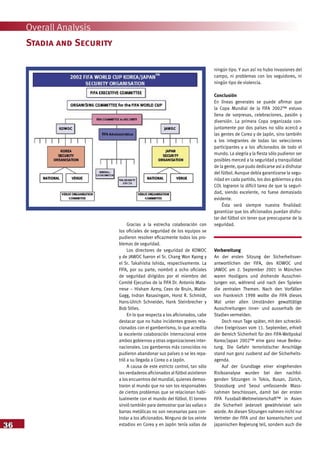
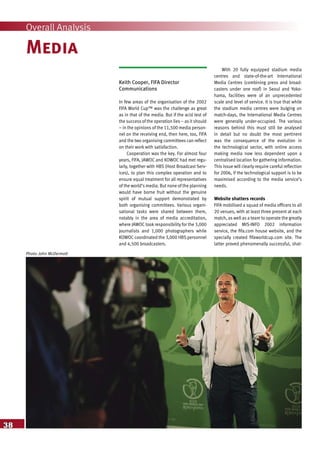
  • 62.
    61 En Corée/Japon, 161buts (soit 2,51 par match) ont été marqués, soit moins qu’en France 98 (171 buts, 2,67 de moyenne). A l’issue des matches de groupes (130 buts, soit 2,71 par match en Corée/Japon contre 126 (2,63) en France), un tel résultat n’était pas prévisible. Le nombre de réalisations sur des situations standard a également clairement chuté: 45 buts (28%) contre 62 (36, 3%). Seuls les tirs sur coup franc direct ont progressé avec 11 buts (24,4%) contre 6 (9,7%) il y a quatre ans. Le nombre de coups de pied de réparation est resté inchangé (18). En revanche, cette année, les gardiens en sont sortis vainqueurs à cinq reprises (le gardien américain, Friedel, à deux reprises, contre la Corée et la Pologne). En France, seul un tireur avait échoué sur le cadre des buts. 37 buts ont été marqués de la tête, contre 31 en 1998. Lors de deux matches, il a fallu avoir recours aux tirs au but, les deux impliquant l’Espagne, une fois vainqueur (contre l’Irlande) avant de s’incliner contre la Corée. Trois rencontres ont été décidées sur un “but en or” (le Sénégal contre la Suède, la Corée contre l’Italie et la Turquie contre le Sénégal). En Corée/Japon, l’avantage 1-0 au score n’a pas revêtu une importance trop marquée. Au contraire, l’équipe ayant inscrit le premier but a quitté le terrain en perdante à neuf reprises. Le Brésil (contre l’Angleterre) est la seule équipe à s’être imposée en infériorité numé- rique. Huit buts, dont deux coups de pied de réparation et un “but en or” ont été marqués à 11 contre 10. Le but le plus rapide marqué lors d’une Coupe du Monde de la FIFA™ est à mettre sur le compte du Turc Hakan Sukur. Dans le match pour la troisième place contre la Corée, il a marqué après onze secondes de jeu sur mise en jeu adverse. L’Uruguayen Morales mérite également d’être mentionné ici: entré au début de la deuxième mi-temps contre le Sénégal, il a réduit la marque à 1-3 à la 46ème minute. La zone des onze mètres devant les buts reste la surface de prédilection des buteurs: 60 buts (37,3%) contre 64 (37,4%) en France, ont été marqués de cette distance. Le nombre de buts inscrits à l’intérieur de la surface de réparation reste stable (39 buts, 24,2% contre 41 buts, 24% en France 98). En revanche, plus de buts ont été inscrits de loin (25, soit 15,5%) cette année. Tandis qu’en 1998, la plupart des buts (45 buts, 25,7%) avaient été marqués dans le dernier quart d’heure de jeu du temps régle- mentaire, cette année, la joie du buteur s’est davantage répartie sur l’ensemble des 90 minutes. Entre la 16ème et la 30ème minute de jeu, les tentatives offensives se sont avé- rées moins efficaces (19 buts contre 25 à 31 le reste du temps). Au total, 21 buts ont été inscrits par des joueurs entrés en cours de match. Les exemples les plus marquants sont ceux de Morientes (Espagne, deux buts contre le Paraguay) et Cuevas (Paraguay, deux buts contre la Slovénie). Mais les changements tactiques les plus décisifs sont l’œuvre de l’entraîneur turc, Senol Gunes, qui a remplacé son joueur clé Hakan Sukur par Ilhan Mansiz à la 75ème minute du quart de finale contre le Sénégal. Mansiz, en marquant le « but en or » à la 94ème minute, a propulsé son équipe en demi-finale pour la première fois de son histoire. Les deux buts en finale de Ronaldo (buteur à huit reprises au total en Corée/Japon) étaient les 1915ème et 1916ème de l’histoire de la Coupe du Monde de la FIFA™, dont la pre- mière édition a eu lieu en 1930. Le Brésilien rejoint ainsi Pelé à la troisième place du pal- marès des meilleurs buteurs avec 12 buts. Oliver Kahn (Allemagne) est devenu le premier gardien de but à recevoir le Ballon d’Or du meilleur joueur. Cette distinction, introduite en 1982, a récompensé des joueurs comme Rossi (Italie), Maradona (Argentine), Schillaci (Italie), Romario et Ronaldo (tous les deux Brésil). Kahn a naturellement également reçu le prix Lev Yashin du meilleur gardien. La Belgique a remporté de justesse devant la Suède la Distinction du Fair-play tandis que la Corée a été élue l’équipe la plus attrayante du tournoi. Photo: Bongarts
  • 63.
    62 Technical and TacticalAnalysis Con 161 goles, o lo que es lo mismo, 2,51 tantos por encuentro, en esta Copa se anota- ron bastantes menos goles que en Francia 98 (171, 2,67). Una vez concluidos los partidos de grupo en Corea y en Japón (130, 2,71 por encuentro), frente a Francia 98 (126, 2,63), nada hacía augurar este resultado final. El número de tantos en jugadas ensayadas, con 45 (28%), fue, igualmente comparado con Francia, sensiblemente inferior (62, 36,3%). Sólo los goles de tiros libres directos (11 goles, 24,4%) fueron más que los de la Copa anterior (6, 9,7%). Los 18 penales lanzados fueron los mismos que cuatro años antes. No obstante, en esta ocasión los porteros vencie- ron a sus oponentes en cinco ocasiones (el americano Friedel dos veces, frente a Corea y Polonia). En Francia hubo una estadística inferior: los 37 goles de cabeza superaron a los 31 de 1998. Dos partidos concluyeron con el lanzamiento de tiros penales, y en ambos participó España: exitosamente contra Irlanda, y con derrota contra Corea. Por tres veces fue el gol de oro el que estableció la diferencia entre el cielo y el infierno (Senegal contra Suecia, Corea ante Italia y Turquía contra Senegal). La importancia de adelantarse en el marcador no fue muy relevante en Corea y Japón. Al contrario, en nueve ocasiones el equipo que marcó primero abandonó cabizbajo el terreno de juego. Brasil (ante Inglaterra) fue la única escuadra que venció estando en inferioridad numérica. Cuando se enfrentaron once contra diez jugadores se marcaron ocho goles, dos de ellos tiros penales y otro un gol de oro. El gol más rápido en la historia de la Copa Mundial de la FIFA™ lo anotó el turco Hakan Sukur en el encuentro por la tercera plaza que le enfrentó a Corea. Tras el saque del equipo adversario, este jugador necesitó sólo once segundos para adelantar a su equipo en el marcador. También el uruguayo Morales merece una mención especial: tras entrar en el equipo en la segunda parte, en el mismo minuto 46 logró anotar un primer gol (1 a 3). La zona entre el área de meta y el punto penal sigue siendo la franja del terreno desde donde se anotan la mayoría de goles (60, 37,3% – Francia 98: 64, 37,4%). También dentro del área de meta (39, 24,2%) lograron los jugadores anotar un número de goles similar al de Francia (41, 24%). El número de goles conseguidos en lanzamientos lejanos fue algo superior al de cuatro años antes, con 25 (15,5%). En 1998 se anotaron muchísimos goles en los últimos quince minutos de los encuentros, exactamente 45 (25,7%), mientras que esta vez la alegría de los goles se repartió equi- tativamente a lo largo de los 90 minutos. Tan sólo entre el minuto 16 y el 30 tuvieron menos éxito los ataques de las escuadras (19 frente a 25 – 31 en los restantes períodos de tiempo). Los jugadores substitutos anotaron un total de 21 goles. Los ejemplos más impresionan- tes fueron los de Morientes (España, dos goles anotados contra Paraguay) y Cuevas (Paraguay, dos tantos contra Eslovenia). La jugada magistral surgió, no obstante, de la cabeza del entrenador turco Senol Gunes, quien sustituyó a su estrella Hakan Sukur por Ilhan Mansiz en el minuto 75 del partido de cuartos de final contra Senegal. Este jugador logró, al anotar el gol de oro en el minuto 94, que el equipo turco pasase a la historia clasi- ficándose para semifinales. Los dos goles de Ronaldo en la final (en total anotó en ocho ocasiones) fueron los números 1,915 y 1,916 en la historia de la Copa Mun- dial iniciada en 1930. El brasileño se coloca así a la altura de los más grandes en la histo- ria de la Copa, como Pelé (3º con 12 goles). El guardameta Oliver Kahn (Alemania) recibió, como primer portero en la historia, el galardón del Balón de Oro. Los honrados con esta dis- tinción son, desde su introducción en 1982, Rossi (Italia), Maradona (Argentina), Schillaci (Italia), Romario y Ronaldo (Brasil). Lógica- mente, Kahn también recibió el “Premio Lev Yashin” al mejor guardameta. Por un escaso margen de diferencia, Suecia se adelantó a Bélgica en la clasificación de la deportividad y recibió el Premio Fair Play, mientras que Corea fue elegida la escuadra más atractiva e intere- sante del torneo. Statistics Overview Photo: Liewig
  • 64.
    63 Mit 161 oder2,51 Toren pro Spiel wurden deutlich weniger Treffer erzielt als bei France 98 (271, 2,67). Nach den Gruppenspielen (130, 2,71 pro Spiel) in Korea/Japan gegenü- ber 126 (2,63) war ein solcher Ausgang noch nicht abzusehen. Der Anteil an Standardsitu- ationen ist mit 45 Toren (28 %) gegenüber 62 Treffern (36,3 %) ebenfalls deutlich gesunken. Einzig die Schützen direkter Freistösse waren mit 11 Toren (24,4 %) erfolgreicher als noch vor vier Jahren (6, 9,7 %). Mit 18 Elfmetern wurde die gleiche Anzahl Strafstösse verge- ben wie 1998. Allerdings blieben diesmal die Torhüter in fünf Fällen Sieger (der Ameri- kaner Friedel gleich zweimal gegen Korea und Polen). In Frankreich war lediglich ein Schütze an der Torumrandung gescheitert. 37 Treffer (1998: 31) wurden mit dem Kopf erzielt. Zwei Spiele mussten im Elfmeterschiessen entschieden werden. Spanien war mit je einem Sieg (gegen Irland) und einer Nieder- lage (gegen Korea) beide Male involviert. Dreimal entschied das “Golden Goal” über das Erreichen der nächsten Runde (Senegal – Schweden, Korea – Italien und Türkei – Senegal). Die Bedeutung des Führungstreffers zum 1:0 war in Korea/Japan zweitrangig. Die Mannschaft, die den ersten Treffer erzielte, musste gar in neun Fällen als Verlierer vom Platz. Brasilien (gegen England) siegte als einzige Mannschaft bei numerischer Unterle- genheit. Acht Tore, wovon zwei Elfmeter und ein “Golden Goal”, fielen mit elf Spielern gegen zehn. Das schnellste je an einem FIFA-Weltpokal™ erzielte Tor gelang dem Türken Hakan Sükür im Spiel um den dritten und vierten Platz gegen Korea. Er benötigte – bei Anspiel des Gegners – lediglich elf Sekunden, um seine Mannschaft in Führung zu bringen. Auch der Uruguayer Morales verdient spezielle Erwäh- nung. Zu Beginn der zweiten Halbzeit gegen Senegal eingewechselt, traf er noch in der gleichen Minute (46.) zum Anschlusstreffer (1:3). Zwischen Torraum und Elfmeterpunkt werden immer noch am meisten Treffer erzielt (60, 37,3 % – France 98: 64, 37,4 %). Auch inner- halb des Torraumes (39, 24,2 %) waren die Schützen in etwa gleich erfolgreich wie bei France 98 (41, 24 %). Die Anzahl der Tore aus grosser Distanz war mit 25 Toren (15,5 %) leicht höher als noch vor vier Jahren. Während 1998 mit 45 Treffern (25,7 %) die mit Abstand meisten Treffer in der letzten Viertelstunde der regulären Spielzeit erzielt wurden, verteilte sich der Torjubel diesmal gleichmässiger auf die gesamten 90 Minuten. Einzig zwischen der 16. und 30. Minute waren die Offensivbemühungen der Teams etwas weniger erfolgreich (19 gegenüber 25 bis 31 Toren in den übrigen Zeitabschnitten). Insgesamt 21 Tore wurden durch eingewech- selte Spieler erzielt. Als beeindruckendste Beispiele sind die Auftritte von Morientes (Spanien, zweifacher Torschütze gegen Paraguay) und Cuevas (Paraguay, zweifacher Torschütze gegen Slowenien) zu nennen. Den erfolgreichsten und schliesslich spielent- scheidenden Schachzug machte jedoch der türkische Trainer Senol Gunes, der seinen Star Hakan Sükür im Viertelfinale gegen Senegal durch Ilhan Mansiz ersetzte (75. Minute). Dieser Mansiz brachte seine Mannschaft dann mit dem in der 94. Minute erzielten “Golden Goal” zum ersten Mal in der Geschichte des türkischen Fussballs in die Halbfinals. Die beiden Finaltreffer durch Ronaldo (insgesamt war er in Korea/Japan achtmal erfolgreich) bedeuten die Tore Nummer 1915 und 1916 in der seit 1930 bestehenden Geschichte des FIFA-Weltpokals™. Der Brasi- lianer hat sich in der ewigen Torschützenliste auf die gleiche Stufe wie Pelé gehievt (3. Rang mit 12 Toren). Mit Oliver Kahn (Deutschland) wurde zum ersten Mal seit der Vergabe des Goldenen Balles ein Torhüter zum besten Spieler gewählt. Die früheren Gewinner der 1982 eingeführten Ehrung sind Rossi (Italien), Maradona (Argentinien), Schillaci (Italien), Romario und Ronaldo (beide Brasilien). Selbstverständlich erhielt Kahn auch den “Lev-Jaschin-Preis” für den besten Torhüter. Mit hauchdünnem Vorsprung vor Schweden gewann Belgien den Fairplay-Preis, während Korea zur attraktivsten Mannschaft des Tur- niers gewählt wurde. Photo: John McDermott
  • 65.
    64 Technical and TacticalAnalysis Confederations’ Analysis a coach on a long-term basis with patience and perseverance, and granting him the time to mould the many talented players into a solid team is rarely favoured in the Kingdom, but such a philosophy may well be worth the investment. Many other Asian teams such as Iran and Iraq have the talent, but an immediate over- haul of their structural set-ups is essential if they want to realise their full potential. CAF There were high hopes for the five African representatives at the 2002 FIFA World Cup™. Cameroon and Nigeria above all seemed good bets to advance to the second round. However, it was debutants Senegal that saved the honour of the African continent, as only a golden goal from Turkey denied the Senegalese a semi-final berth, which would have marked the best ever FIFA World Cup™ performance by an African nation. Although the African teams could not live up to the high expectations, the progress made since France ’98 was unmistakable. With 90% of the African players at the tourna- ment playing for European clubs, the interna- tional experience that has been gained was clear to see. While previously it was primarily the Africans’ outstanding technical skills that attracted attention, at this competition they also shone in tactical terms. None of the teams crumbled when they fell behind, tactical roles were adhered to consistently, and there was a strong focus on teamwork. Fortunately, the tactics employed did not sup- press the African players’ individual class or their passion for the game. Three of the five African teams were led by coaches from their own respective nations - firm evidence of the increased trust in local coaching talent and the advances made in the training of coaches within Africa. CONCACAF The CONCACAF representatives, Costa Rica, Mexico and USA, were surprisingly impres- sive, not just in terms of their results, but also AFC The performances of Korea and Japan at the 2002 FIFA World Cup Korea/Japan™ open a new chapter in the history of Asian football and show signs of greater promise in the new millennium for the Asian continent. The sterling efforts of these two teams serve as an eye-opener for other Asian nations who could emulate their achievements with dedication, planning, sound organisation, and efficient, effective development structures and pro- grammes in place. Japan and Korea had set their house in order with well-structured national asso- ciations, highly competitive professional and national leagues, and substantial financial support for coaching programmes and youth development. The appointment of Philippe Troussier and Guus Hiddink by the respective national associations shows their far-sighted- ness and wisdom in wanting to be equal or better than their continental rivals. During his four years of blood, sweat and tears as Japanese national coach, Troussier transformed his team into a cohesive unit with great flair and creativity, while maintaining great tactical discipline built around Nakata, Inamoto and Shinji Ono. The drastic transformation of Korea’s “Taegeuk Warriors” under strong leadership and team management, based on fortitude, fair treatment, belief in fundamentals, self- confidence, and faith in players with the same vision and philosophy as Hiddink, reaped enormous rewards. China were first-time qualifiers at the 2002 FIFA World Cup™ and celebrated the event with great pomp and gaiety. Reaching the World Cup finals seemed to be enough for the Chinese, as they did not appear to have made much progress since then. China has the population, talent, and resolve to succeed and should get their priorities in order. Saudi Arabia did not seem to have learnt from their experience at the 1998 FIFA World Cup France™. The importance of employing
  • 66.
    65 their performances. Theteams have made enormous progress. There are many reasons for this development – improved training and competition, the creation of strong domestic leagues, improved youth coaching systems, more international matches – to name but a few. Many players now also play for top clubs in Europe and South America. The Americans played with a lot of self- confidence and used a number of formations. They were also powerful, full of energy and good on the counter-attack. However, they were unfortunate to lose to Germany in the quarter-finals, missing a golden opportunity to reach the semi-finals. The new young gen- eration, with players such as Donovan, Beas- ley and McBride, has breathed new life into the American team, and they can now look forward to the future with confidence. Mexico employed a tactical formation that was tailored to the team’s abilities, a deci- sion that bore fruit as it led to victories over fancied Italy and Croatia in the group stages. However, despite dominating neighbours USA in their round of 16 duel, they could not take advantage of their many chances and ulti- mately paid the price. Costa Rica only just failed to qualify for the round of 16, Turkey’s better goal differ- ence taking them through at the Costa Ricans’ expense, who would live to regret missing the many chances carved out against eventual world champions Brazil. The team played attractive football and was athletic and well organised. The three teams were fine repre- sentatives for the CONCACAF confederation and it will be interesting to follow their future progress. CONMEBOL The performances of the five CONMEBOL representatives fall into two distinctive cat- egories, but Brazil’s fifth title ensured that the trophy found its way to South American shores for the ninth time. Coach Luiz Felipe Scolari’s team was unrecognisable from the one that eventually booked its ticket to Korea/ Japan in the final qualifier against Venezuela. Their extraordinary attacking prowess, with 18 goals in just seven games, as well as the talents of Ronaldo, Rivaldo and Ronaldinho, more than compensated for the lack of unity and defensive cohesion in the team. Brazil were the bright spark in the South American quintet, whose combined performance was noticeably worse than in France ’98, when four teams reached the round of 16. Rely- ing heavily on the counter-attack, Paraguay pipped South Africa to a round of 16 spot on goal difference, but lost 1-0 to Germany in a close encounter. Argentina, drawn in pos- sibly the strongest group alongside England, Sweden and Nigeria, strived to live up to their fans’ high expectations. However, the team did not seem able to cope with the pressure and bowed out in the group stage, rueing their missed chances and misfortune at decisive moments. World Cup debutants Ecuador fin- ished their tournament with a surprise 1-0 vic- tory over Croatia despite lacking international experience at this level, but Uruguay, who bat- tled back impressively from 3-0 down to 3-3 in their final group match against Senegal, must once again take solace from past triumphs on the world stage. UEFA The 15 European teams at the 2002 FIFA World Cup™ had very mixed fortunes in the competition. Their story was a surprising mixture of shocks, major disappointments, and bad luck, in addition to some excellent performances, in a competition riddled with the unexpected. Taking into account the pre- tournament FIFA/Coca-Cola World Ranking and the teams’ actual results in Korea/Japan 2002, the European teams fell, basically, into five general categories: 1. The highly ranked / highly successful (i.e. Germany, Spain, England) 2. The highly ranked / unsuccessful (i.e. France, Portugal and Italy) 3. The moderately ranked / highly successful (i.e. Turkey) 4. The moderately ranked / moderately suc- cessful (i.e. Belgium, Ireland, Sweden and Denmark) 5. The moderately ranked / unsuccessful (i.e. Croatia, Russia, Poland and Slovenia). Of the teams that made an early exit, the demise of reigning FIFA World Champions France was the biggest upset for European aspirations. In the frantic search for answers, words like fatigue, complacency and mis- fortune have been offered. But there is no doubt that the loss of Zinedine Zidane for the first two games had an adverse impact on the effectiveness of the team. One man, they say, does not make a team; however, for the French, the loss of their talisman was a debili- tating blow which had serious repercussions, particularly as influential playmaker Robert
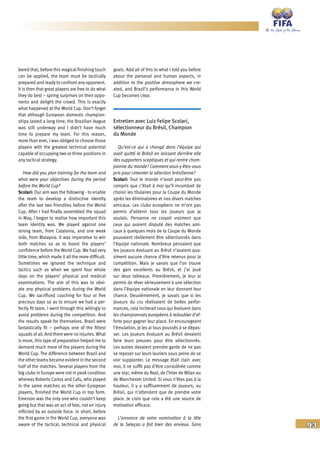
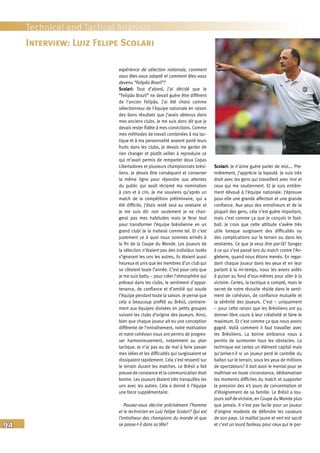
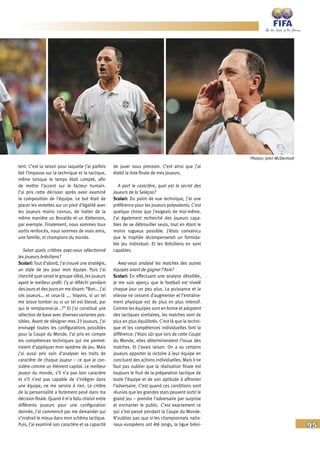
  • 67.
    66 Technical and TacticalAnalysis Confederations’ Analysis Pires, who was injured while playing for Arse- nal before the World Cup, was not available to take over as the orchestrator–in–chief. Europe’s two most successful sides were Germany and Turkey. The former has an illustrious history in the competition, and although the team lacked some of the star names of the past, Rudi Völler’s squad were uncompromising, defensively solid, strong in the air, and hard to beat, especially with charismatic shot-stopper Oliver Kahn in superb form. If Germany’s capacity for sur- vival surprised nobody, then Turkey’s remark- able achievement in reaching the semi-finals astonished everybody, except, probably, the Turks themselves. This was a squad of players well-schooled in the competitive nuances of top-level European club football and therefore well-equipped to handle the pressure and demands of FIFA’s elite competition. AFC Les performances de la Corée et du Japon lors de la Coupe du Monde de la FIFA, Corée/Japon 2002™ ouvrent un nouveau chapitre de l’histoire du football asiatique en promettant un bel avenir. Les efforts solides de ces deux équipes servent de révélateur aux autres nations qui pourraient tenter d’égaler ces performances avec de l’engagement, une pla- nification conséquente, ainsi que des struc- tures et des programmes de développement efficaces en place. Des associations nationales bien organi- sées, des ligues professionnelles nationales compétitives et un soutien financier de pro- grammes de formation des entraîneurs et de développement du sport auprès des jeunes avaient permis au Japon et à la Corée de se préparer de façon adéquate. La nomination de Philippe Troussier et de Guus Hiddink par les associations nationales respectives montre leur clairvoyance et leur sagesse dans leur volonté de se mettre à la hauteur de leurs rivaux continentaux. Durant ses quatre années difficiles en tant que sélectionneur national japonais,Troussier a fait de son équipe une unité créative, tout en maintenant la discipline tactique autour de Nakata, Inamoto et Shinji Ono. La métamorphose des “Guerriers” coréens basée sur le courage, l’équité, la confiance en Photo: Christian Liewig
  • 68.
    67 soi et lacroyance en les joueurs, qui partagent la vision et la philosophie de Hiddink, sélec- tionneur ferme et collectif, a porté ses fruits. La Chine participait à sa première phase finale d’une Coupe du Monde, et a célébré cet événement en grande pompe. La qualification pour la phase finale semblait suffire aux Chi- nois, puisqu’ils n’ont pas montré de progrès depuis. La Chine dispose de la population, du talent et de la volonté pour réussir, mais devrait se fixer des priorités. L’Arabie Saoudite a semblé ne pas avoir appris de son expérience de la Coupe du Monde de la FIFA France 98™. L’importance d’employer un entraîneur à long terme, avec patience et persévérance, et de lui laisser le temps de former les nombreux talents en une équipe solide est rarement privilégiée dans le Royaume, et pourtant, cette philosophie pourrait valoir l’investissement. De nombreuses autres équipes asiati- ques comme l’Iran ont le talent, mais il leur est essentiel de restructurer les bases afin d’atteindre leur potentiel. CAF Les espoirs placés dans les cinq représen- tants africains étaient importants. D’une part, le Cameroun et le Nigeria, qui semblaient capables d’atteindre le deuxième tour et de continuer au-delà. D’autre part, le Sénégal, qui participait là à sa première phase finale de Coupe du Monde de la FIFA. C’est finale- ment lui qui a porté haut les couleurs du con- tinent. La qualification pour les demi-finales était même à sa portée – mais le but en or de la Turquie l’aura empêché de réaliser le meilleur résultat africain de l’histoire. Bien que les attentes n’aient pas été totalement remplies, la mesure des progrès accomplis ces quatre dernières années a pu être prise. 90% des joueurs sont sous contrat dans des clubs européens et l’expérience internationale dont ils disposent est indiscu- table. Les équipes africaines se distinguaient par leurs qualités techniques individuelles, désormais, elles convainquent aussi par leur tactique. Aucune équipe n’a cédé une fois menée au score. Les instructions tactiques ont été globalement respectées et le succès a été visé grâce à un travail d’équipe. Heureuse- ment, les consignes tactiques des entraîneurs laissaient suffisamment de place à la classe individuelle et à la joie de jouer. Trois des cinq équipes africaines étaient emmenées par des entraîneurs locaux. Cela prouve la confiance croissante accordée aux spécialistes locaux et les progrès réalisés dans la formation des entraîneurs africains. CONCACAF Les performances des trois représentants de la CONCACAF, à savoir le Costa Rica, le Mexi- que et les Etats-Unis ont surpris. Non seule- ment en termes de résultats, mais surtout par la manière dont elles ont vu le jour. Le niveau s’est considérablement élevé. L’amélioration des conditions d’entraînement et de compé- tition conjuguée à l’introduction de ligues nationales professionnelles, une stimulation accrue des juniors et des matches internatio- naux plus nombreux expliquent ces progrès. Enfin, de nombreux joueurs évoluent dans des clubs européens et sud-américains. L’équipe nationale des Etats-Unis est apparue très sûre d’elle. Variant leur tactique, dynamiques, mobiles et forts en contre-atta- que, les Américains ne se sont inclinés qu’en quarts de finale contre l’Allemagne, après un beau match et non sans quelques occasions de se propulser en demi-finale. La jeune génération des Donovan, Beasley et McBride, pour n‘en citer que quelques-uns, a redonné à l’équipe américaine une identité, qui lui permet d’aborder l’avenir avec confiance. En usant d’une tactique intelligente, parfaitement adaptée aux compétences de l’équipe, le Mexique a fini premier de son groupe devant l’Italie et la Croatie qui étaient favorites. Le Mexique a certes dominé le hui- tième de finale qui l’opposait à une équipe de sa propre confédération, sans toutefois parve- nir à traduire cette suprématie en buts. Le Costa Rica a vu la qualification pour le deuxième tour lui échapper au profit de la Turquie sur le seul critère de la différence de buts. Il n’a pas su concrétiser les nombreuses occasions qui se sont présentées face au futur champion du monde, le Brésil. L’équipe a fait montre d’un football attractif, athlétique, et bien organisé. Elle appartenait à une solide fraction de la CONCACAF dont il sera intéres- sant de suivre l’évolution. CONMEBOL Les résultats des cinq représentants de la CONMEBOL sont assez mitigés, même si le Brésil, en s’imposant pour la cinquième fois, apporte son neuvième titre à la confédération sud-américaine. La sélection de Luiz Felipe Scolari n’a plus rien laissé paraître de l’équipe qui dut s’assurer son billet pour l’Asie dans
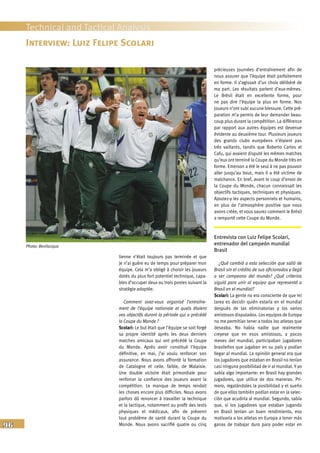
  • 69.
    68 Technical and TacticalAnalysis le dernier match de qualification contre le Venezuela. Son potentiel impressionnant en attaque (18 buts en sept matches) et ses joueurs exceptionnels comme Ronaldo, Rivaldo et Ronaldinho, ont permis de com- penser le manque d’unité dans l’équipe et les lacunes en défense. La performance du Brésil illumine un bilan sud-américain pour- tant considérablement moins positif qu’en France 98 (quatre équipes au deuxième tour). Le Paraguay est parvenu à se qualifier de jus- tesse pour les huitièmes de finale (0-1 contre l’Allemagne) grâce à une tactique orientée sur le contre et à une meilleure différence de buts que l’Afrique du Sud. L’Argentine, placée dans le groupe certainement le plus difficile, a tout tenté pour se montrer à la hauteur des attentes de ses supporters. Mais la pression sembla trop forte et le manque de réalisme et de chance dans les situations décisives entraînèrent son élimination prématurée à l’issue des matches de groupes. L’Equateur, encore inexpérimenté au niveau internatio- nal (première participation à la phase finale d’une Coupe du Monde) conclut sa perfor- mance honorable sur une victoire 1-0 contre la Croatie, tandis que l’Uruguay, malgré une remontée impressionnante dans le dernier match de groupes face au Sénégal (de 0-3 à 3-3), doit se contenter de vivre avec les souve- nirs des exploits passés. EUROPE Les 15 équipes européennes ont connu des fortunes diverses lors de la Coupe du Monde de la FIFA 2002™: un mélange de surprises, de grandes déceptions, de malchance, mais aussi d’excellentes performances dans une compétition marquée par les surprises. En prenant en considération le classe- ment FIFA/Coca-Cola avant la compétition et les résultats des équipes lors de celle-ci, les formations européennes peuvent être clas- sées en cinq catégories principales: 1. équipes bien classées/très bonne perfor- mance (Allemagne, Espagne, Angleterre) 2. équipes bien classées/mauvaise perfor- mance (France, Portugal, Italie) 3. équipes moyennement bien classées/très bonne performance (Turquie) 4. équipes moyennement bien classées/ performance moyenne (Belgique, Irlande, Suède, Danemark) et 5. équipes moyennement bien placées/ mauvaise performance (Croatie, Russie, Polo- gne et Slovénie). Parmi les équipes éliminées prématu- rément, l’échec de la France, championne du monde en titre, constitua la plus grande déception européenne. En quête de répon- ses, on parla de fatigue, de suffisance et de malchance. Mais il est clair que l’absence de Zinedine Zidane dans les deux premiers matches a pesé sur l’efficacité de l’équipe. Le proverbe dit qu’un homme ne suffit pas à faire une équipe. Pourtant, pour les Français, la perte de leur perle rare fut un choc aux répercussions considérables, d’autant que le meneur de jeu, Robert Pirès, blessé avec Arsenal avant la Coupe du Monde, n’était pas disponible pour reprendre le rôle du meneur. Les deux meilleurs résultats européens sont à mettre sur le compte de l’Allemagne et de la Turquie. La première jouit d’un passé glorieux dans la compétition et malgré l’ab- sence de certaines des stars du passé, la sélection de Rudi Völler s’est montrée intran- sigeante, solide en défense, habile dans les duels aériens et difficile à battre, notamment grâce à son charismatique gardien, Oliver Kahn, à son meilleur niveau. Si la capacité de survie de l’Allemagne n’a surpris personne, la performance de la Turquie, demi-finaliste, a étonné tout le monde, sauf peut-être les Turcs eux-mêmes. Cette équipe, composée de joueurs formés dans les clubs des meilleurs championnats européens, fut apte à gérer la pression et les exigences de cette compéti- tion. AFC El rendimiento de Corea y Japón en la Copa Mundial de la FIFA Corea/Japón 2002™ ha abierto un nuevo capítulo en la historia del fútbol asiático, además de crear nuevas esperanzas para el futuro futbolístico de este gran continente. El excelente trabajo de estos dos equipos ha abierto los ojos a las demás naciones asiáticas, que tratarán de emular su eficiencia con dedicación, planificación, buena organización, unas estructuras eficien- tes y prácticas y programas adecuados. Japón y Corea se han estructurado de forma moderna, con ligas profesionales y competitivas, así como con una generosa asistencia para los programas de capacitación y entrenamiento juvenil. El nombramiento de Philippe Troussier y Guus Hiddink por parte de estas asociaciones nacionales demuestra Confederations’ Analysis
  • 70.
    69 su excelente visiónde futuro y sabiduría a la hora de tratar de equipararse a sus rivales directos. Durante estos cuatro años de sangre, sudor y lágrimas como seleccionador nacio- nal japonés, Troussier transformó a su equipo en un conjunto disciplinado, que mantuvo su gran disciplina táctica a pesar de mejo- rar enormemente en el aspecto creativo. El armazón de su esquema: Nakata, Inamoto y Shinji Ono. La drástica transformación de los “Tae- geuk Warriors” de Corea, con un liderazgo fuerte, basada en la equidad, confianza y fe de unos jugadores que compartían la misma filosofía que Hiddink, aportó unos beneficios casi inesperados. China se clasificó por primera vez en su historia en una Copa Mundial de la FIFA™, un hecho que se celebró en este gran país con gran pompa. Disputar la competición final del Mundial pareció ser suficiente recompensa para los chinos, ya que no progresaron mucho después de alcanzar la clasificación. China tiene suficiente población, talento y ganas de triunfar, por lo que debe encontrar el camino adecuado para dirigir su progreso. Arabia Saudí no parece haber aprendido la lección de Francia 1998. En este Reino no se concede importancia, aparentemente, a emplear un entrenador a largo plazo, con paciencia y perseverancia, otorgándole el tiempo necesario para moldear a los numero- sos jugadores talentosos de los que dispone el país. Quizás sea importante cambiar esta manera de actuar. Otros equipos asiáticos, como Irán e Irak, tienen el talento necesario, pero no las estruc- turas imprescindibles. CAF Los cinco representantes africanos habían depositado enormes esperanzas en la Copa Mundial de la FIFA Corea/Japón 2002™. Se esperaba que Camerún y Nigeria, los dos favoritos, pasasen sin problemas a la segunda ronda. Pero resultó ser un recién llegado a la competición final del mundial, Senegal, el encargado de salvar el honor del continente negro, ya que llegó a acariciar con los dedos la clasificación a semifinales – el gol de oro turco impidió a los senegaleses hacer realidad ese sueño. Aunque los africanos no pudieron triunfar como hubiesen deseado, sí se pudo observar una apreciable mejora frente al Mundial de cuatro años antes. El 90% de los jugadores africanos tienen contrato con clubes euro- peos, lo que mejoró su experiencia interna- cional: anteriormente, su fútbol se basaba en la excelente técnica individual, en tanto que los equipos actuales demuestran una evidente mejoría táctica. Ningún equipo se desorganizó cuando se encontró en desven- taja, y continuó cumpliendo con las directri- ces tácticas y buscando el empate a través del juego colectivo. Afortunadamente, a pesar de la rigidez táctica recién adquirida, los jugado- res hicieron gala de la maestría individual y alegría futbolística que les caracteriza desde hace muchos años. Tres de los cinco equipos africanos esta- ban dirigidos por entrenadores nacionales. Una prueba más de la nueva confianza que demuestran estos países: fe en sus propios entrenadores y en su sistema de enseñanza y capacitación. Concacaf El rendimiento de los representantes de Con- cacaf (Costa Rica, México y EE UU) sorprendió a propios y extraños, y no sólo por los exce- lentes resultados, sino especialmente por la forma en que los consiguieron. La calidad de estas selecciones ha aumentado enor- memente. A este desarrollo han contribuido la mejora en el entrenamiento y las compe- ticiones, así como la introducción de ligas nacionales profesionales, el apoyo a la capa- citación juvenil y el aumento de los partidos internacionales. Además, no hay que olvidar que numerosos jugadores de esta confedera- ción tienen contrato con importantes clubes europeos y sudamericanos. El equipo estadounidense se mostró siempre muy seguro de sí mismo. Con una gran disciplina táctica, jugadores dinámicos y un enorme despliegue físico, el único que pudo frenar su ascendente carrera fue Ale- mania, en cuartos de final. La nueva genera- ción, con jugadores como Donovan, Baisley, McBride, por nombrar tan sólo a unos cuan- tos, permite a la asociación de fútbol encarar el futuro con optimismo. México, con una táctica inteligente y per- fectamente adaptada a las características de los jugadores, triunfó en su grupo por delante de adversarios temibles como Italia y Croacia. En el duelo fratricida entre México y EE UU, el primero logró dominar el ritmo del encuentro, pero no logró plasmar su superioridad en el marcador final. Photo: Gavin Barker
  • 71.
    70 Technical and TacticalAnalysis Costa Rica fracasó en conseguir la clasifi- cación para la segunda fase, pero sólo por la diferencia de goles adversa frente a Turquía. Las numerosas oportunidades malogradas contra el campeón Brasil pesaron demasiado en la clasificación final. Aun así, la selección tica demostró ser capaz de desplegar un fútbol atlético, atractivo y bien organizado. Como tal, fue digna representante de la repre- sentación de Concacaf, cuyos futuros progre- sos seguiremos con evidente interés. Conmebol El rendimiento de los cinco representantes de Conmebol no ha sido plenamente satisfacto- rio, a pesar de que el quinto triunfo de Brasil supuso la novena corona sudamericana. Los pupilos de Luiz Felipe Scolari no tuvieron nada que ver con el equipo que consiguió el pase al mundial en el último momento, en el partido contra Venezuela. Con su rico caudal ofensivo (18 goles en siete partidos) y grandes talentos como Ronaldo, Rivaldo y Ronaldinho, compen- saron con creces las deficiencias defensivas y en el juego colectivo. Brasil maquilló una floja actuación sudamericana, bastante peor que en Francia 98 (cuatro equipos clasificados para la segunda ronda). Paraguay logró el pase a la segunda fase, aunque de forma ajustada, merced a una táctica pragmática, basada en el contragolpe, y a una mejor diferencia de goles con Sudáfrica. En octavos de final perdió 0 a 1 ante Alemania. Argentina, sorteada en el grupo más duro con Inglaterra, Suecia y Nigeria, hizo todo lo posible para complacer a su público. Pero la presión que recaía sobre los hombros de sus jugadores fue excesiva: desaprovecha- ron demasiadas ocasiones de gol y no tuvieron la suerte necesaria en momentos decisivos, por lo que se apearon del torneo tras los par- tidos de grupo. Ecuador, poco experimentado internacionalmente (era su primera participa- ción en la fase final de un mundial), concluyó su participación con un gran triunfo ante Croacia (1-0), mientras que Uruguay, a pesar de una gran remontada en el último partido de la primera fase ante Senegal (de 0-3 a un 3-3 definitivo), continúa viviendo en los triunfos de un glorioso, aunque ya lejano, pasado. UEFA El balance de la actuación de los 15 equi- pos europeos en la Copa Mundial de la FIFA 2002 es una mezcla de fuertes impresiones, grandes decepciones e infortunios inauditos, además de algunas actuaciones excelentes en un torneo en que predominó lo inesperado. Si comparamos la tabla mundial de la FIFA previa al torneo con los resultados finales de Corea/ Japón 2002, podemos ordenar a los equipos europeos en cinco categorías generales: 1. Los altamente cotizados y con gran éxito (Alemania, España e Inglaterra) 2. Los altamente cotizados y sin éxito (Fran- cia, Portugal e Italia) 3. Los medianamente cotizados y con gran éxito (Turquía) 4. Los medianamente cotizados y con un éxito moderado (Bélgica, Irlanda, Suecia y Dinamarca) 5. Los medianamente cotizados y sin éxito (Croacia, Rusia, Polonia y Eslovenia). De los equipos que habían triunfado anteriormente, la pérdida de Francia, campeón mundial, fue el mayor revés a las aspiraciones europeas. En la búsqueda desesperada de explicaciones, se han escuchado palabras como“fatiga”,“complacencia”y“malasuerte”. Pero no hay duda de que la ausencia de Zine- dine Zidane en los dos primeros partidos tuvo un efecto adverso en la eficacia del equipo. Se dice que un solo hombre no hace un equipo; sin embargo, para los franceses, la pérdida de su talismán fue un golpe muy duro y de serias consecuencias, sobre todo porque el presti- gioso creador de juego Robert Pires, lesionado en un partido con el Arsenal antes de la Copa Mundial, no estuvo disponible para asumir la responsabilidad de armar el juego galo. Los dos competidores europeos de mayor éxito fueron Alemania y Turquía. El primero posee un historial ilustre en la competición y, pese a que carecía de estrellas como en otros tiempos, el once de Rudi Völler fue inflexible, sólido en la defensa, bueno en el juego aéreo y difícil de subyugar, especialmente con el popular arquero Oliver Kahn, cuyo rendi- miento fue realmente excepcional. Si la tena- cidad alemana no causó ninguna sorpresa, el notable ascenso de Turquía a las semifinales dejó boquiabierto a todo el mundo, quizá con excepción de los turcos mismos. Este plantel, bien adiestrado en las competiciones de los mejores clubes europeos, supo cómo enfren- tarse a la presión y exigencias de la máxima competición de la FIFA. AFC Korea und Japan haben mit ihren Erfolgen am FIFA-Weltpokal Korea/Japan 2002™ im Confederations’ Analysis
  • 72.
    71 asiatischen Fussball eineneue, verheis- sungsvolle Ära eingeläutet. Andere asiatische Länder können sich an den beiden Teams ein Beispiel nehmen, die bewiesen haben, dass mit einer intensiven Vorbereitung, sorgfältiger und langfristiger Planung sowie einem geziel- ten Nachwuchskonzept der Anschluss an die Spitze zu schaffen ist. Japan und Korea haben ihre Hausaufga- ben gemacht: Die Nationalverbände haben sich professionelle Strukturen gegeben, konkurrenzfähige Profi- und Landesligen wurden gegründet sowie viel Geld in Trai- ningsprogramme und in die Nachwuchs- förderung investiert. Die Verpflichtung von Philippe Troussier bzw. Guus Hiddink als Nationalcoach zeugt ebenfalls von Weitsicht. Die beiden Verbände wollten alles daran setzen, in die asiatische Spitze vorzudringen und schliesslich zur Nummer eins auf dem Kontinent zu werden. In vier Jahren gelang es Troussier trotz zahlreicher Rückschläge, seinen spielwitzigen und kreativen Spielern taktische Disziplin ein- zuimpfen und um Nakata, Inamoto und Shinji Ono ein verschworenes Team zu formen. Ein Umdenken hat auch in Korea stattge- funden. Vater des Erfolgs der roten Teufel ist zweifellos der strenge, aber faire Hiddink, der mit seiner Philosophie frischen Wind in den hiesigen Fussball brachte und den Spielern viel Selbstvertrauen gab. Die Chinesen feierten ihre erstmalige Qualifikation für eine WM-Endrunde wie einen Weltmeistertitel. Vielleicht zu viel des Guten, denn China konnte sich in der Folge nicht mehr steigern. Das Reich der Mitte ist mit seinem unerschöpflichen Reservoir an Talenten aber zweifelsfrei ein Versprechen für die Zukunft. Saudi-Arabien scheint seine Lehren aus der letzten Weltmeisterschaft immer noch nicht gezogen zu haben. Geduld gilt im Königreich weiterhin als Untugend. Doch nur mit der nötigen Zeit kann ein Trainer aus den vielen talentierten Spielern auch wirklich eine schlagkräftige Truppe formen. Andere asiatische Mannschaften, wie der Iran und der Irak, besitzen ebenfalls Poten- zial, das sie jedoch nur ausschöpfen können, wenn die erforderliche Umstrukturierung an die Hand genommen wird. CAF Die Erwartungen an die fünf afrikanischen Vertreter waren hoch. Vor allem Kamerun und Nigeria traute man ein Vorstossen bis ins Achtel- oder gar ins Viertelfinale zu. Es war dann allerdings Senegal, das erstmals an der Endrunde eines FIFA-Weltpokals™ teilnahm, das die Ehre des afrikanischen Kontinentes rettete. Sogar die Halbfinalqualifikation lag in Griffweite – das Golden Goal der Türkei ver- hinderte das beste je von einer afrikanischen Mannschaft erzielte Resultat. Obwohl die hohen Erwartungen nicht ganz erfüllt werden konnten, waren Fort- schritte gegenüber den Auftritten vor vier Jahren festzustellen. 90 % aller Spieler stehen bei europäischen Klubs unter Ver- trag. Die dadurch gewonnene internationale Erfahrung war unverkennbar. Waren es bisher fast ausschliesslich die herausragen- den individuellen technischen Fähigkeiten, die bei den afrikanischen Mannschaften positiv auffielen, konnten sie nun auch tak- tisch überzeugen. Keine Mannschaft fiel auseinander, wenn sie in Rückstand geriet. Die taktischen Vorgaben wurden in den Photo: Takashi Ito Photo: Stanley Chou
  • 73.
    72 Technical and TacticalAnalysis meisten Fällen konsequent eingehalten, und den Erfolg strebte man als Mannschaft an. Glücklicherweise kamen aber trotz den von den Trainern vorgegebenen taktischen Anweisungen die individuelle Klasse und die Spielfreude nicht zu kurz. Drei der fünf afrikanischen Teams wurden von einheimischen Trainern geführt. Ein Beweis für das gesteigerte Vertrauen in die einheimischen Techniker und die Fortschritte, die in der afrikanischen Trainerausbildung erzielt worden sind. CONCACAF Die Leistungen der CONCACAF-Vertreter Costa Rica, Mexiko und USA überraschten. Nicht nur die Resultate als solches, sondern vor allem wie sie zustande kamen. Das Niveau ist enorm gestiegen. Verbesserte Trainings- und Wettkampfmöglichkeiten, kombiniert mit der Einführung von nationalen Ligen, die berufs- sportmässig funktionieren, eine verbesserte Nachwuchsförderung sowie mehr Spiele auf internationaler Ebene haben zu dieser Ent- wicklung geführt. Ebenso stehen zahlreiche Spieler bei europäischen und südamerikani- schen Klubmannschaften unter Vertrag. Die Mannschaft der USA trat sehr selbst- bewusst auf. Taktisch variabel, dynamisch, lauf- und konterstark, scheiterte das Team erst im Viertelfinale gegen Deutschland nach einer starken Leistung und der Möglichkeit, gar das Halbfinale zu erreichen. Die junge Generation mit Spielern wie Donovan, Baisley, McBride, um nur einige zu nennen, haben der ameri- kanischen Mannschaft eine neue Identität gegeben, die den Verband zuversichtlich in die Zukunft blicken lässt. Mit einer klugen, auf die Fähigkeiten der Mannschaft zugeschnittenen Taktik erreichte Mexiko den Gruppensieg vor Italien und Kro- atien, die höher eingeschätzt worden waren. Im innerkontinentalen Achtelfinal-Duell gegen die USA war Mexiko zwar überlegen, konnte diese Dominanz aber resultatmässig nicht umsetzen. Costa Rica verpasste die Qualifikation für die zweite Runde nur aufgrund der schlech- teren Tordifferenz gegenüber der Türkei. Die vielen gegen den späteren Weltmeister Bra- silien herausgespielten Chancen wurden zu wenig genutzt. Die Mannschaft zeigte einen attraktiven, athletischen und gut organisier- ten Fussball. Sie war Teil einer starken CONCA- CAF-Fraktion, auf deren weitere Entwicklung man gespannt sein darf. CONMEBOL Das Abschneiden der fünf Vertreter der CONMEBOL war eher zwiespältig, obwohl der fünfte Titel Brasiliens die insgesamt neunte Krone für die südamerikanische Konföde- ration bedeutete. Die Schützlinge von Luiz Felipe Scolari liessen in nichts mehr an die Mannschaft erinnern, die sich erst im letzten Qualifikationsspiel gegen Venezuela endgül- tig die Fahrkarte nach Korea/Japan gesichert hatte. Mit ihrem imponierenden offensiven Potenzial (18 Tore in sieben Spielen) und Ausnahmekönnern wie Ronaldo, Rivaldo und Ronaldinho konnten sie mangelnde mann- schaftliche Geschlossenheit und Defizite im Abwehrverhalten kompensieren. Brasilien überstrahlte eine südamerikanische Bilanz, Confederations’ Analysis Photo: Bongarts
  • 74.
    73 die gegenüber Frankreich98 (vier Teams in der zweiten Runde) deutlich schlechter ausfiel. Paraguay konnte sich dank einer gut funktionierenden, auf Konterfussball ausgerichteten Taktik und dem besseren Torverhältnis gegenüber Südafrika knapp für die Achtelfinals qualifizieren (0:1-Nie- derlage gegen Deutschland). Argentinien, der vielleicht stärksten Gruppe mit England, Schweden und Nigeria zugelost, versuchte alles, um die hohen Erwartungen seiner Fans zu erfüllen. Der Druck schien jedoch zu gross – mangelnde Chancenauswertung und fehlendes Glück in spielentscheidenden Situ- ationen führten u. a. zum frühen Scheitern in den Gruppenspielen. Das international noch unerfahrene Ecuador (erste Teilnahme an der Endrunde eines Weltpokals) konnte sein Auftreten mit einem Achtungserfolg gegen Kroatien (1:0-Sieg) abschliessen, wogegen Uruguay trotz einer imposanten Aufholjagd im dritten Gruppenspiel gegen Senegal (vom 0:3 zum 3:3) weiterhin von den in der Vergangen- heit erzielten Erfolgen leben muss. UEFA Der FIFA-Weltpokal 2002™ hielt auch für die 15 europäischen Teams einige unliebsame Überraschungen bereit. Nach dem unerwartet frühen Ausscheiden einiger Mannschaften sass der Schock tief, die Spieler kämpften mit den Tränen und haderten mit dem Schicksal. Doch es gab auch glückliche Gesichter. Nimmt man die letzte FIFA-Weltrangliste vor der WM und die WM-Resultate zur Hand, kristalli- sieren sich bei den Europäern fünf Gruppen heraus: 1. Topplatzierung / Spitzenergebnis (z. B. Deutschland, Spanien, England) 2. Topplatzierung/ enttäuschendes Abschnei- den (z. B. Frankreich, Portugal und Italien) 3. Platz im Mittelfeld / Spitzenergebnis (z. B. die Türkei) 4. Rangierung im Mittelfeld / mässiges Ergebnis (z. B. Belgien, Irland, Schweden und Dänemark) sowie 5. Platz im Mittelfeld / enttäuschendes Abschneiden (z. B. Kroatien, Russland, Polen und Slowenien). Frankreich als amtierender Weltmeister und einer der grössten europäischen Hoff- nungsträger strauchelte ausgerechnet als einer der Ersten in den Gruppenspielen. Gründe wie Müdigkeit, Überheblichkeit und Pech werden für das frühe Aus ins Feld geführt, doch der eigentliche Knackpunkt war der verletzungsbedingte Ausfall von Zinedine Zidane. Ein Star allein ist zwar noch kein Erfolgsgarant, doch im französischen Team konnte niemand die Lücke füllen, musste doch ausgerechnet die andere Teamstütze, Robert Pires von Arsenal, aufgrund einer Ver- letzung seine WM-Teilnahme absagen. Die Deutschen und Türken schnitten von den Europäern am besten ab. Im deutschen Team fehlten zwar die grossen Namen, doch Rudi Völlers Truppe besann sich auf ihre Stär- ken und schrieb so ein weiteres Kapitel in der glorreichen WM-Geschichte. Die Mannschaft spielte kompromisslos, stand kompakt, war kopfballstark, hatte in Oliver Kahn aber vor allem einen charismatischen Torhüter in Höchstform. Zur eigentlichen Sensation wurden aber die Türken, die wohl niemand – vielleicht mit Ausnahme ihrer Landsleute – auf der Rechnung hatte. Doch die türkischen Spieler waren dank ihrer Erfahrung bei euro- päischen Spitzenklubs dem Erfolgsdruck am Kronjuwel der FIFA-Wettbewerbe gewachsen und sorgten mit ihrem unbekümmerten Spiel für Furore. Photo: Gavin Barker
  • 75.
    74 Technical and TacticalAnalysis Playing systems – flexible frameworks During Korea/Japan 2002, some teams used their team organisation to emphasise a posi- tive philosophy, while others concentrated on the collective compactness of the team unit, in order to deny the opposition time and space, thus minimising their attacking options. Of the 32 participating teams, the vast majority took the former view, and this was one reason why most matches in the competition were free-flowing, attractive encounters. Approximately a dozen different playing systems were used during the 2002 FIFA World Cup™, but all of them could be grouped into two general categories: those based on the conventional 4-4-2 formation, and those with their roots in the traditional 3-5-2. Twenty-four teams (75%) chose the first approach, and eight of them operated with two lines of four, plus two strikers. It must be emphasised at this point that many teams changed their set-up during certain matches for tactical reasons, while others altered their for- mation from game to game, often because of necessity. Some using 4-4-2 defended with 5- 4-1, or changed to that arrangement when the game demanded a less adventurous approach (e.g. England in the second half against Argen- tina when they fought to maintain their one- goal advantage). Other formations employed were variations on the basic 4-4-2 theme including 4-4-1-1 as operated by Spain, Italy and the USA, 4-3-1-2 (e.g. Uruguay), 4-5-1 (e.g. Russia), 4-3-2-1 (e.g. Senegal), and also the formation that evolved at EURO 2000 and con- tinues to increase in popularity, consisting of a four-man backline, two central midfielders (the defensive screen), and an attacking “diamond” (one striker, two wide attackers, and a creative orchestrator between midfield and attack, à la Zidane or Wilmots). Argentina also favoured the attacking dia- mond, but coach Marcelo Bielsa elected to play with three-man defensive and midfield units, thus producing a formation that could be inter- preted as 3-3-3-1. Including Argentina, 40% of the teams used three central defenders, with most trying to hold a flat line – the days of the detached libero seem to be numbered. While Germany, Costa Rica and Cameroon based their organisation on the “tried and tested” 3- 5-2 system, another eight teams devised varia- tions on this basic theme. Brazil, for example, employed an attack-orientated formation of 3-4-2-1, in which only four players could be classed as defence-minded (i.e. the back three and Silva, the anchorman in midfield). Ronaldo led the attack, and was ably supported from the second line by Rivaldo and Ronaldinho, and from the middle and wide positions by Juninho, Cafu and Roberto Carlos. The coaches of Korea, Slovenia and Turkey opted for a similar pattern to the Brazilians, while the Japanese and Mexi- cans modified their approach to create a 3-4-1- 2 configuration, with traditional twin strikers. A number of trends, relating to team organisation, were observed during the 32- team final tournament in Korea and Japan. Although a slight majority of teams selected two strikers, the use of one target player, or pivot of the attack, was also common (e.g. Hakan Sukur, Morientes, Batistuta, Hwang). Those teams with a clearly defined lone striker exploited the attacking space with mid- field runners, using lightning-fast counters or quick combinations; while those with a strik- ing partnership often had one speedy, mobile front player feeding off a powerful partner – cross-over runs and back-to-front movement were common in such arrangements. Playing systems Photos: Carlos Alberto Parreira
  • 76.
    75 With many teamsemploying powerful central midfield players as a defensive wall, the creative schemer, once the dominating force in the middle of the field, was seen mainly in wide positions (e.g. Beckham, Okocha, Ortega, Schneider and Fadiga) or between the middle and front lines (e.g. Zidane, Veron, Recoba, Wilmots, Nakata and Olembe). Irrespective of their starting posi- tion, these midfield playmakers dictate the pace and the flow of the game, and during the World Cup such players had a major influence on the fortunes of their respective teams. In Korea/Japan 2002, some teams were loyal to their well-established system of play (e.g. Germany, Ireland and South Africa); some adhered to the pattern dictated and designed by the coach (e.g. Korea, Argentina and Senegal); some built their teams around key players (e.g. France, Brazil and Japan); and some adapted, depending on the tactical situation (e.g. Croatia from game to game, or England within a particular match). On the evi- dence of the 2002 FIFA World Cup™, the eter- nal question for coaches – should the players fit the system of should the system suit the players? – remains open for debate. Systèmes de jeu à géométrie variable Durant Corée/Japon 2002, certaines équipes ont exprimé à travers leur configuration une conception du jeu généreuse, tandis que d’autres privilégiaient le jeu collectif compact pour priver l’adversaire de temps et d’espace, limitant du même coup leurs actions offensi- ves. La majorité des 32 finalistes ont choisi la première option et c’est l’une des raisons expliquant le caractère attractif et débridé de la plupart des rencontres. Une douzaine de systèmes de jeu diffé- rents ont été appliqués durant la Coupe du Monde de la FIFA 2002™, mais ils peuvent être regroupés en 2 grandes catégories, à savoir 4-4-2 et 3-5-2. Vingt-quatre équipes (75%) ont adopté la première approche, dont huit avec deux lignes de quatre et deux attaquants. Il con- vient de souligner que de nombreuses sélec- tions ont modifié leur configuration pour des raisons tactiques lors de certains matches, tandis que d’autres s’organisaient plutôt au coup par coup. Certaines équipes évoluant en 4-4-2 passaient au système 5-4-1 en défense ou lorsqu’une approche moins offensive était exigée: l’Angleterre qui s’est attachée à conserver son but d’avance face à l’Argentine dans la seconde mi-temps en est un exemple. D’autres sélections ont pratiqué des varia- tions autour de la formation principale 4-4-2, à savoir 4-4-1-1 pour l’Espagne, l’Italie et les USA, 4-3-1-2 pour l’Uruguay, 4-5-1 pour la Russie, 4-3-2-1 pour le Sénégal. Le système pratiqué lors de l’EURO 2000, soit quatre arrières, deux milieux de terrain centraux (for- mant un bouclier défensif) et un “diamant” offensif (un attaquant, deux ailiers offensifs, et un meneur de jeu inspiré à la Zidane ou Wilmots pour faire le lien) s’est avéré de plus en plus populaire. L’Argentine aussi a fait abondamment usage du diamant offensif, mais son entraîneur Marcelo Bielsa a opté pour des groupes de 3 défenseurs et 3 milieux de terrain, une configu- ration pouvant être interprétée comme 3-3-3-1. Argentine comprise, 40% des équipes se sont appuyées sur 3 défenseurs centraux, la plupart essayant de maintenir une défense en ligne – les jours du libero semblent donc comptés. Tandis que l’Allemagne, le Costa Rica et le Cameroun évoluaient selon un système 3-5-2
  • 77.
    76 Technical and TacticalAnalysis éprouvé, huit autres équipes ont pratiqué des variations sur cette formation principale. Ainsi, le Brésil s’est-il appuyé sur une configuration 3-4-2-1 offensive, selon laquelle seuls quatre joueurs (les trois arrières et Silva, le pivot au milieu du terrain) avaient une vocation défen- sive. Ronaldo menait l’attaque, avec le soutien efficace de Rivaldo et Ronaldinho en deuxième ligne, et de Juninho, Cafu et Roberto Carlos au centre et sur les côtés. La Corée, la Slovénie et la Turquie ont opté pour un schéma analogue à celui des Brésiliens tandis que les Japonais et les Mexicains lui préféraient le système 3-4-1- 2 avec la traditionnelle combinaison de deux attaquants de pointe. Différentes tendances se sont dégagées parmi les 32 finalistes de la compétition. Bien qu’une courte majorité d’équipes ait fonctionné avec deux attaquants de pointe, nombreuses ont fait appel à un pivot claire- ment désigné, tel que Hakan Sukur, Morien- tes, Batistuta ou Hwang. Dans ce cas, elles ont exploité l’espace offensif avec les milieux de terrain mobiles, recourant à des contre- attaques fulgurantes ou à des enchaînements rapides. Au contraire, dans les sélections qui fonctionnaient avec des attaquants en duo, un joueur de pointe rapide et mobile servait généralement un partenaire puissant. Les permutations et les déplacements vers l’avant étaient fréquents dans ce type de schéma. Comme bon nombre d’équipes s’ap- puyaient sur un mur défensif de milieux de ter- rain centraux, le meneur de jeu créatif, une fois en position de domination au centre du terrain, évoluait le plus souvent sur les côtés, comme Beckham, Okocha, Ortega,Schneider etFadiga, ou entre les lignes avant et du milieu, à l’instar de Zidane, Veron, Recoba, Wilmots, Nakata et Olembe. Indépendamment de leur position ini- tiale, ces milieux de terrain dictaient le rythme et le déroulement du match et ont souvent scellé le destin de leurs équipes. Lors de Corée/Japon 2002, certaines équi- pes sont restées fidèles à leur système de jeu bien établi, comme l’Allemagne, l’Irlande et l’Afrique du Sud, tandis que d’autres, comme la Corée, l’Argentine et le Sénégal, adoptaient un schéma concocté par leur entraîneur. Des équipes comme la France, le Brésil et le Japon se sont organisées autour d’un joueur clé, d’autres ont fait preuve de pragmatisme comme la Croatie qui s’adaptait d’un match à l’autre ou l’Angleterre, au sein d’un même match. Reste qu’à l’issue de la compétition, la grande question des entraîneurs – est-ce aux joueurs de s’adapter au système ou au système de s’adapter aux joueurs – reste ouverte. Sistemas de juego – esquemas flexibles Durante Corea/Japón 2002, algunos equipos utilizaron su sistema organizativo para des- tacar valores positivos, mientras que otros se concentraron en lograr una unidad más compacta con el fin de cerrar los espacios a sus adversarios y minimizar sus opciones de ataque. De los 32 equipos participantes, la gran mayoría optó por el primer plantea- miento, uno de los motivos por el cual la mayoría de los encuentros del torneo fue muy abierta y atractiva. Se utilizó aproximadamente una docena de sistemas de juego, aunque todos se pueden englobar en dos categorías genera- les: los basados en el convencional 4-4-2 y los que entroncan con el tradicional 3-5-2. Veinticuatro equipos (75%) eligieron la primera táctica, con ocho operando con dos líneas de cuatro y dos delanteros. No obs- tante, cabe recordar que muchas escuadras cambiaron su sistema durante algunos parti- dos por motivos tácticos, mientras que otras alteraron su formación de un partido a otro, a menudo por obligación. Algunos equipos que utilizaron un 4-4-2 defendían con un 5-4-1 ó cambiaban a este sistema cuando el partido necesitaba una actitud menos arriesgada (p. ej. Inglaterra en la segunda mitad contra Argentina, cuando trataba de conservar su Playing systems
  • 78.
    77 ventaja de ungol). Otras variaciones del sis- tema básico 4-4-2 fueron un 4-4-1-1, como el utilizado por España, Italia y EE UU; un 4-3-1-2(Uruguay);un4-5-1(Rusia);un4-3-2-1 (Senegal); la estructura utilizada en el EURO 2000 – una línea de cuatro hombres, dos centrocampistas en el medio (zona defen- siva), y un ataque en forma de diamante (un delantero, dos extremos y un creador de juego del tipo de Zidane o Wilmots). Este último sis- tema continúa ganando adeptos. Argentina optó también por un ataque en diamante, aunque el entrenador Marcelo Bielsa prefirió jugar con tres hombres de contención, lo que se tradujo en una forma- ción que podríamos interpretar como 3-3-3-1. Además de Argentina, un 40% de las seleccio- nes utilizaron tres defensas centrales, normal- mente situados en línea – los días de un líbero rezagado parecen estar contados. Mientras que Alemania, Costa Rica y Camerún basaron su organización en el famoso y reconocido sis- tema 3-5-2, ocho equipos variaron sobre este mismo esquema. Brasil, por ejemplo, jugó con una estructura 3-4-2-1 orientada al ataque, en la cual sólo cuatro jugadores podían conside- rarse de tipo defensivo (lostresmásrezagados y Silva, el enlace en el medio campo). Ronaldo condujo las maniobras ofensivas, apoyado en segunda línea por Rivaldo y Ronaldinho y en el centro y en posiciones más abiertas por Juninho, Cafú y Roberto Carlos. Los entrena- dores de Corea, Eslovenia y Turquía optaron por un esquema similar al de los brasileños, mientras que los japoneses y los mexicanos modificaron su estructura original para elabo- rar una configuración 3-4-1-2, con una pareja atacante tradicional. En el torneo se pudieron observar nuevas tendencias. Aunque la mayoría de equipos utilizaron a dos delanteros, lo más común fue recurrir a un solo jugador de referencia en punta, un pívot en posiciones ofensivas (como Hakan Sukur, Morientes, Batistuta, Hwang). Las escuadras que tuvieron un solo delantero aprovechaban los espacios vacíos con centrocampistas de largo recorrido, mediante vertiginosos contraataques o rápi- das combinaciones; en cambio, aquellas con una pareja atacante tuvieron a menudo un jugador principal, veloz y raudo, que surtía de balones a su compañero, más lento y fuerte físicamente – con esta disposición, lo más frecuente eran pases largos y movimientos continuos de adelante a atrás. Como muchos equipos colocaron sobre el terreno a centrocampistas de gran forta- leza, en funciones de muralla defensiva, fue frecuente que los creadores de juego, los organizadores, se desplazasen a posiciones más abiertas (Beckham, Okocha, Ortega, Sch- neider, Fadiga) o se colocasen entre la línea media y el ataque (Zidane, Verón, Recoba, Wilmots, Nakata, Olembe). No importa dónde comiencen el encuentro, los orquestadores dictan el ritmo y el flujo del juego. Durante la Copa Mundial, estos jugadores fueron decisi- vos en el juego de sus equipos. En Corea/Japón 2002 algunos grupos se aferraron a su tradicional sistema de juego (Alemania, Irlanda, Sudáfrica); algunos siguieron fielmente el esquema diseñado y Photos: Panoramic
  • 79.
    78 Technical and TacticalAnalysis dictado por el entrenador (Corea, Argentina, Senegal); otros construyeron el equipo sobre los hombros de sus jugadores clave (Francia, Brasil, Japón); y unos pocos se adaptaron a la situación técnica imperante (Croacia de un partido a otro, Inglaterra en un encuentro determinado). Finalizada la Copa Mundial de la FIFA 2002™, sigue pendiente la eterna duda del mundo del fútbol: ¿deben adaptarse los jugadores al sistema, o el sistema a los jugadores? Spielsysteme – Flexibilität als Konstante Am FIFA-Weltpokal Korea/Japan 2002™ trafen zwei Fussballphilosophien aufeinander: eine eher konstruktive Spielweise und ein ganz aufs Kollektiv ausgerichtetes System, das dem Gegner wenig Raum lässt und ihn am Spielaufbau hindern soll, unter dem aber auch die eigene Offensive leidet. Die 32 Teil- nehmer setzten mehrheitlich auf die kreative Karte und boten den Zuschauern flüssigen und attraktiven Kombinationsfussball. Ungefähr ein Dutzend Spielsysteme waren auszumachen, die sich grob in zwei Kategorien einteilen lassen: die konventionel- len 4-4-2-Formationen und die traditionellen 3-5-2-Systeme. 24 Mannschaften (75 %) spielten eine Art 4-4-2-System, wobei acht Teams auf die klassische Variante mit zwei Viererketten plus zwei Stürmern setzten. Auffallend war, dass die Trainer während einer Partie oder zwischen den Begegnungen zu taktischen Umstellungen gezwungen waren. So bewährte sich insbesondere der Wechsel zu einer 5-4-1- Formation, wenn die Teams in der Defensive waren oder das Ergebnis halten wollten (z. B. England nach der 1:0-Führung gegen Argentinien). Als weitere Abwandlungen des 4-4-2-Systems waren zu beobachten: 4-4- 1-1 (Spanien, Italien und die USA), 4-3-1-2 (z. B. Uruguay), 4-5-1 (z. B. Russland), 4-3-2-1 (z. B. Senegal). Eine weitere Variante, welche die EURO 2000 mit nachhaltigem Erfolg her- vorgebracht hatte, war die Viermannabwehr mit zwei zentralen Mittelfeldspielern (defen- siv ausgerichtet) und dem diamantförmigen Angriff (eine Spitze, zwei Flügelstürmer und ein Spielmacher à la Zidane oder Wilmots hinter den Spitzen). Auch Argentinien spielte das Diamant- system, allerdings mit je einer Dreierkette in der Verteidigung und im Mittelfeld, eine Art 3-3-3-1. 40 % der Teams spielten mit einer Dreierkette im zentralen Mittelfeld – die Tage des Liberos sind offenbar endgültig gezählt. Insgesamt elf Mannschaften wählten zumin- dest teilweise ein 3-5-2-System. Während Deutschland, Costa Rica und Kamerun auf die klassische Variante setzten, nahmen andere Teams gewisse Anpassungen vor. So etwa die Brasilianer, die eine offensive 3-4- 2-1-Formation mit lediglich vier nominellen Verteidigern (eine Dreierkette und Silva, ein zurückhängender Mittelfeldspieler) bevor- zugten. Ronaldo war die einzige Sturmspitze. Dahinter spielten Rivaldo und Ronaldinho. Durch die Mitte und über die Flügel schalteten sich Juninho, Cafú und Roberto Carlos in den Angriff mit ein. Ganz ähnlich agierten Korea, Slowenien und die Türkei, während Japan und Mexiko mit einer 3-4-1-2-Formation mit einem klassischen Zweimannsturm antraten, der von den meisten Trainern favorisiert wurde. Die beiden Angreifer, ein wendiger und ein kräftiger Stürmer, lösten sich in der Spitze ab und wechselten permanent die Seiten. Aber auch die Einmannspitze (z. B. Hakan Sükür, Morientes, Batistuta, Hwang) mit einem eher offensiv ausgerichteten Mittelfeld war verbreitet. Auch im zentralen Mittelfeld liess sich ein Trend ablesen: Bildung eines ersten Abwehr- riegels mit eher stämmigen Spielern. Der klassische Mittelfeld-Regisseur wich entwe- der auf die Flügel aus (z. B. Beckham, Okocha, Ortega, Schneider und Fadiga) oder agierte direkt hinter den Spitzen (z. B. Zidane, Verón, Recoba, Wilmots, Nakata und Olembe). In einem Punkt waren sich aber alle Spielmacher gleich: Sie bestimmten das Tempo und letzt- endlich auch das Schicksal ihrer Mannschaft. Für die Wahl ihrer Spielsysteme hatten die Mannschaften ganz verschiedene Gründe: Deutschland, Irland und Südafrika hielten am bewährten taktischen Konzept fest, Korea, Argentinien und Senegal machten sich die Philosophie ihres Trainers zu Eigen, Frank- reich, Brasilien und Japan richteten ihr System auf ihre Schlüsselspieler aus, Kroatien legte sich nicht grundsätzlich fest, sondern wech- selte von Spiel zu Spiel, und England nutzte seinen taktischen Spielraum und stellte im Verlauf der Partie seine Formation beliebig um. So oder so, die Trainer waren stets in der Zwickmühle: systembedingte Spielernominie- rungen oder doch ein massgeschneidertes Konzept für die Spieler? Es darf weiter gerät- selt werden. Playing systems Photos: Panoramic; Danielsson
  • 80.
    79 Maybe it wasthe effects of the rainy season, with humidity and heavy downpours of rain to be dealt with, or maybe it was just plain nervousness, with the intense pressure of avoiding errors in front of a judgmental, worldwide audience of football aficionados. Whatever the reason, many of the 36 partici- pating goalkeepers (Nigeria, Paraguay, Poland and Slovenia all used two) became punchers rather than catchers. For some, this had noth- ing to do with technical ability: punching the ball away, following a corner or a free-kick, particularly when the goalkeeper is under pressure in a crowded penalty box, is common practice. But in Korea/Japan the punch was often the preferred option, with goalkeepers electing to minimise the risk on shots, crosses and diagonal balls, and take a chance on any rebounds or follow-up strikes. Oliver Kahn of Germany illustrated this point perfectly in the match against Paraguay when he chose to punch away a long, diagonal free kick from his opposite number, José Luis Chilavert, although he was not directly challenged and the conditions were perfect. Goalkeepers, cautious by nature, were even more so during Korea/Japan 2002. Michel Platini once said that his greatest gift was his ability to read the game. Many of the top goalkeepers at the 2002 FIFA World Cup™ were also blessed with this important quality, although their perception of the game was, of course, based on their specialist role. Despite his moment of misfortune against Brazil, England’s David Seaman, the oldest goalkeeper in the competition at 38 years old, read the game excellently and often simplified his task by anticipating opponents’ actions, particularly on crosses and through passes. Other senior members of the goalkeeping fraternity, such as Oliver Kahn, José Luis Chi- lavert, Fabien Barthez, and Ike Shorunmu, showed the value of experience and a well- developed eye for the game. Although half of the goalkeepers at the tournament were under 30 years of age, some of them were mature well beyond their years: Iker Casillas of Spain (the youngest at 21) and Gianluigi Buffon of Italy (24) proved that exceptional young goalkeepers, who are professionally Goalkeeping – The New Libero Photo: Stanley Chou
  • 81.
    80 Technical and TacticalAnalysis trained at top clubs, can blossom early, even on a World Cup stage. One advantage the youngsters have over the elder statesmen of the goalkeeping union is an education and training focused on the problems of the back-pass rule. Many of the new generation are able to perform both as a player and as a shot-stopper, whereas older players have had to adapt, to develop their technical ability with both feet and hands. José Luis Chilavert, with his brilliant left foot, has had no problem becoming a footballer (his eight goals for the national team confirm this), but for others, it has been more prob- lematic, particularly when they receive the ball on their “wrong” foot. With some World Cup keepers not being first choice at their clubs, others not playing at the very top level, and a few struggling with fitness and form, it was not surprising that a number of goalkeepers failed to produce world-class displays. However, there were some outstanding performances, particularly amongst those who reached the knock-out phases. Speed, mobility, good handling techniques, bravery, instinctive reactions, throwing and kicking skills (the South Ameri- cans love a side volley), and a comprehensive knowledge of angles and defending principles were demonstrated by the leading performers in Korea/Japan. While these elements will remain the basis of goalkeeping develop- ment, the best performers at the 2002 FIFA World Cup™ underlined that an ability to read the game and the skill to distribute the ball quickly and effectively, both in a traditional sense and as a footballer, are fundamental attributes for the modern, top-class goal- keeper, and therefore are skills which must be focused on in the training and education of future talents. With most top clubs and national teams employing a flat-line defence, the goalkeeper’s role as the last defender has become as important as his ability to make the spectacular save. Effectively, he has become the new libero, a player receiving passes, helping the team to keep possession, and, when appropriate, initiating the fast counter-attack. Le gardien de but, nouveau libero Etaient-ce l’humidité et les pluies torrentielles qui ont caractérisé la saison ou la nervosité causée par le souci du sans-faute face au jury international des supporters? Sur les 36 gardiens de Corée/Japon 2002 (deux pour le Nigeria, le Paraguay, la Pologne et la Slo- vénie), la plupart ont plus dégagé le ballon du poing qu’ils ne l’ont attrapé. Et ce, indé- pendamment de leurs qualités techniques: les dégagements du poing après corner ou coup franc sont courants, notamment sous pression, lorsque la surface de réparation est envahie. Mais les gardiens ont souvent privi- légié cette pratique, choisissant de minimiser les risques liés aux tirs, aux centres et aux transversales et d’en prendre sur tout rebond ou reprise. Témoin la rencontre Allemagne – Paraguay, où Oliver Kahn a repoussé du poing un long coup franc diagonal de son homologue, José Luis Chilavert, malgré des conditions parfaites et l’absence de menace. Durant la Coupe du Monde de la FIFA 2002™, les gardiens ont redoublé de prudence. Les meilleurs gardiens ont été nombreux à s’illustrer par leur bonne lecture du jeu – quoique dictée par leur fonction – à l’instar de Michel Platini qui l’avait définie comme sa plus grande force. Malgré sa brève infor- tune face au Brésil, David Seaman, le doyen anglais des gardiens de la compétition, à 38 ans, s’est souvent simplifié la tâche en anticipant les actions de l’adversaire, en Goalkeeping – The New Libero Photo: John McDermott
  • 82.
    81 particulier les centreset les passes en profon- deur. D’autres vieux renards de la confrérie des gardiens, tels que Oliver Kahn, José Luis Chilavert, Fabien Barthez et Ike Shorunmu, ont fait la différence grâce à leur expérience et à leur regard aiguisé. Si la moitié des gardiens avaient moins de 30 ans, certains d’entre eux faisaient preuve d’une grande maturité. Le benjamin, Iker Casillas (Espagne), 21 ans, et Gianluigi Buffon (Italie), 24 ans, ont prouvé que des gardiens de but extrêmement jeunes, formés professionnellement dans les meilleurs clubs, peuvent s’épanouir très vite, même en Coupe du Monde. Ils possèdent sur leurs aînés l’avantage d’une formation et d’un entraînement ciblés sur les problèmes de la règle de la passe en retrait. La nouvelle génération de gardiens est généralement capable d’endosser la double casquette de joueur et de gardien, tandis que les plus âgés ont dû s’adapter et développer leurs qualités techniques impliquant à la fois l’usage de leurs jambes et de leurs mains. Grâce à son exceptionnel pied gauche, José Luis Chilavert n’a eu aucune difficulté à se lancer sur le terrain (pour preuve les huit buts qu’il a inscrits pour son équipe nationale), mais tel n’est pas toujours le cas, en particu- lier pour les joueurs recevant le ballon sur leur “mauvais“ pied. Certains gardiens n’étaient pas titulaires dans leurs propres clubs, d’autres n’ont pas joué leur meilleur football ou ont rencontré des difficultés sur les deux plans, tous n’ont donc pas brillé. Certaines performances remarquables ont néanmoins été observées, notamment au deuxième tour de la compé- tition. Les plus grandes vedettes de Corée/ Japon 2002 pouvaient se prévaloir de qualités telles que la rapidité, la mobilité, un bon jeu de ballon de la main, la bravoure, l’intuition, la maîtrise du dégagement et du coup de pied (les Sud-Américains adorent les volées laté- rales), ainsi que d’une parfaite gestion des angles et des principes de défense. S’il s’agit là de l’arsenal de base des gardiens, les stars de la Coupe du Monde 2002™ ont montré qu’une bonne lecture du jeu et une distribu- tion du ballon rapide et efficace, à la fois dans les cages et sur le terrain, seront des éléments clés de la future élite des gardiens de but sur lesquels il convient par conséquent d’insister durant l’entraînement et la formation. Comme la plupart des grands clubs et des équipes nationales recourent à une défense en ligne, le rôle d’ultime défenseur du gardien de but a acquis autant d’importance que sa capacité à réaliser des parades spectaculaires. Il est bel et bien devenu le nouveau libero, un joueur capable de recevoir des passes, d’aider son équipe à garder le ballon et à lancer de rapi- des contre-attaques lorsque cela s’impose. Guardametas – los nuevos líberos Quizá sean los efectos de la temporada de lluvias, con su excesiva humedad y frecuentes precipitaciones; o quizá sean, lisa y llana- mente, simples nervios, con la enorme pre- sión de no cometer errores ante un tribunal inconmensurable, formado por la audiencia mundial de aficionados. Sea cual sea la razón, muchos de los 36 guardametas participantes en la Copa (Nigeria, Paraguay, Polonia y Eslo- venia cambiaron al portero) despejaron más que atraparon el balón. Para algunos, esto no tiene nada que ver con la habilidad técnica: despejar el balón en un saque de esquina o tiro libre, cuando el portero está presionado por los numerosos jugadores en el área penal, es completamente habitual. Pero en Corea/Japón los despejes fueron la opción preferencial de los guardianes de meta, quie- nes optaron por minimizar los riesgos de los disparos, pases o balones diagonales y jugár- sela con los posibles rebotes. El alemán Oliver Kahn ilustró esta actitud a la perfección en el partido contra Paraguay, cuando decidió des- pejar un tiro libre en diagonal, muy lejano, de su homólogo paraguayo José Luis Chilavert, aunque su portería no estaba amenazada y la opción más sencilla era atrapar el balón. Los guardametas, de por sí muy cautelosos, fueron exquisitamente cuidadosos en sus intervenciones durante la Corea/Japón 2002. Michel Platini declaró en una ocasión que su mayor habilidad consistía en “leer el partido”. Muchos de los porteros de esta copa han sido agraciados con este mismo don, aunque impregnado, lógicamente, con el juego típico de un especialista. Salvo con ocasión del infortunio contra Brasil, el inglés David Seaman, a sus 38 años el más veterano de los guardametas, entiende el juego a la perfección, y simplifica su labor anticipando la acción de sus adversarios, especialmente en los pases. Otros veteranos como Oliver Kahn, José Luis Chilavert, Fabien Barthez e Ike Shorunmu demostraron también que la expe- riencia es un grado. Aunque la mitad de los porteros eran menores de 30 años, muchos Photo: Empics
  • 83.
    82 Technical and TacticalAnalysis demostraron una madurez impropia de su edad: Iker Casillas, España (21 años, el más joven), y Gianluigi Buffon, Italia (24), demos- traron que los grandes porteros, entrenados profesionalmente por los mejores clubes del mundo, florecen a edad temprana, incluso aunque afronten la responsabilidad de un mundial. Una ventaja de la juventud frente a la experiencia es la formación sobre los proble- mas de la regla del “pase atrás”. Muchos de la nueva generación pueden funcionar como jugador y como guardameta, mientras que los más veteranos tiene que adaptarse y desa- rrollar nuevas habilidades con pies y manos. José Luis Chilavert, con un magnífico pie izquierdo, no tuvo problemas en la reconver- sión (algo que confirman sus ocho goles con la escuadra nacional), pero para otros ésta ha sido más difícil, especialmente cuando recibían el balón con la ‘pata de palo’. Con muchos guardianes que no son titu- lares en sus clubes, otros que no juegan en las mejores ligas y algunos bajos de forma, no resulta sorprendente que algunos porte- ros no estuviesen siempre a la altura de las circunstancias. No obstante, hubo magnífi- cas actuaciones, especialmente en aquellos equipos que accedieron a la segunda ronda. Los mejores guardametas demostraron velocidad, movilidad, excelentes manos, bravura, reacciones rápidas e instintivas, buena técnica de pateado y lanzamiento de balón (a los sudamericanos les encantan las voleas laterales), así como un amplio conoci- miento de los principios defensivos. Aunque estos elementos continuarán configurando la formación principal de los guardametas, los mejores de la Copa Mundial de la FIFA 2002™ demostraron que la habilidad a la hora de entender y “leer” el juego, así como la capacidad de distribuir rápida y efecti- vamente el balón, tanto con los pies como con las manos, son atributos fundamenta- les de un buen portero moderno. Son, por tanto, habilidades que deben fomentarse en el entrenamiento y la capacitación de los jóvenes talentos. Como los mejores clubes y selecciones utilizan frecuentemente una defensa en línea, el papel del guardameta como último hombre se reviste de una importancia especial, tan fundamental como realizar grandes paradas. Los porteros se han convertido en los nuevos líberos, jugadores que reciben pases de sus compañeros, que ayudan a su escuadra a mantener la posesión de la pelota y, siempre que resulta necesario, a lanzar fulgurantes contraataques. Torhüter – der neue Libero Die Faustabwehr erlebte an dieser Weltmeis- terschaft ihr grosses Revival. Vielleicht mag es mit der hohen Luftfeuchtigkeit, den heftigen Regenfällen, der Nervosität der Akteure oder deren Angst, sich auf der Weltbühne des Fussballs zu blamieren, zusammenhängen, dass die 36 WM-Torhüter (bei Nigeria, Para- guay, Polen und Slowenien kamen jeweils zwei zum Einsatz) stets auf Nummer sicher gingen. Zumal sich diese Vorliebe kaum mit technischen Mängeln erklären lässt. Statt nur bei Eck- oder Freistössen, wo die Torhüter im Goalkeeping – The New Libero Photos: John McDermott; Panoramic; Bongarts; Christian Liewig
  • 84.
    83 Strafraum hart bedrängtwerden, fausteten sie auch Schüsse und Flanken weg und nahmen stattdessen das Risiko von Abprallern und Nachschüssen in Kauf, wie auch Oliver Kahn in der Partie gegen Paraguay: Trotz idealen Bedingungen und geringer unmittelbarer Torgefahr entschied er sich bei einem langen, diagonalen Freistoss seines Torhüterkollegen José Luis Chilavert für eine Faustabwehr. Die Torhüter huldigten an dieser Weltmeister- schaft noch mehr als sonst dem Grundsatz “Vorsicht ist die Mutter der Porzellankiste”. Die Fähigkeit, das Spiel lesen zu können, zeichnet einen Topspieler aus, so auch viele Spitzentorhüter an dieser Endrunde, deren Spielverständnis sich natürlich auf ihre spezifische Rolle beschränkte. Ausser bei seinem Missgeschick gegen Brasilien bewies Englands David Seaman, mit 38 Jahren der älteste Torwart dieses Turniers, dass er insbe- sondere bei Flanken und Querpässen einen ausgeprägten Spielinstinkt besitzt. Andere erfahrene Keeper wie Oliver Kahn, José Luis Chilavert, Fabien Barthez und Ike Shorunmu zeigten ebenfalls, wie viel ein gutes Auge wert ist. Doch auch die Jüngeren (die Hälfte der Torhüter war noch unter 30 Jahren) verfüg- ten teilweise bereits über eine erstaunliche Reife: Iker Casillas (Spanien, mit 21 Jahren der Jüngste) und Gianluigi Buffon (Italien, 24) bewiesen, dass sich junge Torhüter bei Spitzenklubs durchsetzen und sogar an einer Weltmeisterschaft teilnehmen können, wenn sie professionell betreut werden. Einen Vorteil gegenüber den alten Hasen haben sie jedoch: Sie sind mit der Rückpassre- gel bestens vertraut und können mit dem Ball dank gezieltem Training auch mit dem Fuss bestens umgehen. Die Routiniers mussten sich solche fussballerische Fähigkeiten auf ihre alten Tage hin erst noch mühsam erar- beiten – mit unterschiedlichem Erfolg. José Luis Chilavert ist für seine brillanten Schüsse mit links gefürchtet (acht Tore für sein Natio- nalteam), andere werden dagegen von ihren Mitspielern bisweilen auf dem “falschen” Fuss erwischt. Einige Torhüter zeigten an dieser End- runde eine eher mässige Leistung, da sie in ihren Vereinen keinen Stammplatz haben oder angeschlagen nach Asien reisten. Doch nach den Gruppenspielen trennte sich die Spreu vom Weizen. Nun waren ausschliess- lich Weltklassetorhüter am Werk. Bezüglich Schnelligkeit, Wendigkeit, Ballfertigkeit, Mut, Reaktionsschnelligkeit, Abwurf- und Abstoss- technik(bei den Südamerikanern erfreute sich der Volley-Abwurf grosser Beliebtheit) sowie Winkel- und Abwehrspiel gab es bei ihnen nichts auszusetzen. Hinzu kam das besagte Spielverständnis, dem in der Nachwuchsar- beit besondere Beachtung geschenkt werden muss. Neben den traditionellen Abstössen und Abwürfen muss der Torwart den Ball auch mit dem Fuss schnell und genau weiterleiten können. Da die meisten Topvereine und Nati- onalmannschaften in der Verteidigung inzwi- schen auf einer Linie spielen, hat der Torwart mehr und mehr die klassische Liberofunktion übernommen. Einfach seinen Kasten rein halten, reicht heute nicht mehr. Ein Torwart muss auch Pässe spielen, den Ball halten und einen schnellen Gegenstoss einleiten können, wenn sich die Chance dazu bietet.
  • 85.
    84 Technical and TacticalAnalysis Final – Class Counts Brazil, the most successful nation in interna- tionalfootball, won their fifth FIFAWorld Cup™ title by beating Germany 2-0 in Yokohama. The charismatic Ronaldo was the scoring hero with both goals, but in this, the 17th FIFA final, the Brazilians, as a team, gave substance to the theory that technical ability and attacking flair normally make the difference. If the Brazilians had the three Rs (Ron- aldo, Rivaldo and Ronaldinho), then the Ger- mans had three aces of their own: team spirit, aerial power and Oliver Kahn. It was German spirit that set the tone for the final, as Rudi Völler’s men surprised everyone by taking the initiative. Operating a 3-4-1-2 system with Bernd Schneider in the floating role behind the strikers, the Germans squeezed the space between their back and middle lines, and pushed up in order to keep their team unit as compact as possible. However, this was not just a pressing game by the Germans, there was quality in their passing, and they con- structed the play at pace on the wet surface. In fact, the Europeans actually dominated possession during the first half (56%), and Schneider and Oliver Neuville caught the eye with some lively, skilful attacking play. During the opening 45 minutes, Brazil were often pinned back, yet they still pro- duced the best chances of the half: Ronald- inho, an artist who smiles at his work, twice put Ronaldo in the clear with incisive through passes, butthe Brazilian number 9 failed to hit the target with his first effort, and was denied by Kahn on the second opportunity. Kleberson then took matters into his own hands, but his long-range shot cannoned off the crossbar. The half ended with no goals, but with Brazil beginning to look menacing. One minute into the second period and Germany could have, should have, taken the lead: from a Neuville corner on the left, Jeremies had a free header from close range, but the Bayern Munich man’s effort was well blocked by Edmilson. Two minutes later, Neuville had the 69,000 crowd gasping as he forced a magnificent one-handed save from the Brazilian keeper, following a 25-metre free kick – the ball crashed off the post and sped away to safety. The rain poured down and the slippery ball was passed with greater ease, as space began to open up. Brazil’s Kleberson, contrary to popular belief, is a free-spirited attacking midfield player, and he, in harmony with ‘wing wizards’ Cafu and Roberto Carlos, began to offer greater support to the irresist- ible Rs in the Brazilian front line. With 23 minutes left to play, Ronaldo lost the ball, won it back from Dietmar Hamann, slipped it to Rivaldo, and sprinted towards goal in anticipation of a rebound. Rivaldo’s long-range shot inexplicably ricocheted off Oliver Kahn’s chest, and there was the exuber- ant Ronaldo to power the ball into the net. It was the beginning of the end. Twelve minutes after the first goal, Brazil scored again: Kle- berson broke down the right-hand side, and played a firm, angled pass in the direction of Rivaldo and Ronaldo. The former’s awareness of the speed on the ball and the match situa- tion encouraged him to let it run through his legs to his waiting team-mate – Ronaldo took the pace off the ball and then guided it into the bottom corner of the net. Between the goals, Rudi Völler had intro- duced Oliver Bierhoff and Gerald Asamoah to the fray, but neither could reverse the inevitable, as a sea of yellow poured over the white German wall. Ronaldo left the stage to tumultuous applause, and for the final few minutes, his replacement, Denilson, gave an exhibition of trickery, as the Brazilians pro- duced counters galore. Referee Pierluigi Collina, a master crafts- man in his own right, blew for full-time, and Luiz Felipe Scolari allowed his tough image to evaporate as he hugged his victorious team of The Final Photo: Bongarts
  • 86.
    85 talents. Rudi Völler,unfolded his arms, and offered them in consolation to his crestfallen, battle-weary players. In the final analysis, Brazil had the firepower, the technical ability, and the flair which made the difference. Finale – une question de classe Le Brésil, qui affiche le plus prestigieux palmarès international, a remporté son cin- quième titre de champion du monde grâce à sa victoire 2-0 sur l’Allemagne à Yoko- hama. L’auteur du doublé, le charismatique Ronaldo, fut célébré en héros mais lors de cette 17e finale, la Seleçao illustra la théorie selon laquelle les qualités techniques et le sens de l’attaque font la différence. Aux 3 R des Brésiliens (Ronaldo, Rivaldo et Ronaldhino), les Allemands opposaient leur esprit d’équipe, leur puissance aérienne et leur gardien, Oliver Kahn. Les protégés de Völler dominèrent le début de la rencontre, créant la surprise en prenant l’initiative. Evoluant selon un schéma 3-4-1-2 avec Bernd Schneider comme lien derrière les attaquants de pointe, ils réduisaient l’espace entre l’ar- rière et le centre et remontaient pour rester compacts. Mais leur jeu ne se limitait pas au pressing. Effectuant d’excellentes passes, ils dictaient le rythme sur le terrain mouillé. Durant la première mi-temps, les Européens furent le plus souvent en possession du ballon (56%) et le remarquable jeu offensif de Schneider et Oliver Neuville retint l’attention. Souvent confiné dans sa moitié de terrain durant les 45 premières minutes, le Brésil se créa néanmoins les meilleures occasions de cette mi-temps. Lancé à deux reprises par les passes précises d’un Ronaldinho tout sourire, Ronaldo effectua d’abord un tir mal ajusté, puis un autre contré par Kahn. Kleberson prit alors le relais, mais son tir puissant s’écrasa sur la transversale. La mi-temps fut sifflée sur un score nul, mais la montée en puissance du Brésil était visible. A la première minute de la seconde mi-temps, l’Allemagne aurait pu, aurait dû prendre la tête: sur un corner de Neuville sur la gauche, Jens Jeremies, du Bayern de Munich, avait tenté une tête de près, mais elle fut contrée par Edmilson. Deux minutes plus tard, Neuville mettait les 69 000 spec- tateurs en émoi, en tentant un coup franc de 25 mètres, détourné du bout des doigts par le gardien brésilien – le ballon rebondit sur le poteau. La pluie facilitait les passes, les espa- ces commençant à s’ouvrir. Contrairement à une idée répandue, le Brésilien Kleberson est un milieu de terrain offensif imaginatif et avec Cafu et Roberto Carlos, les brillants ailiers, il offrit un solide soutien aux irrésistibles R de la première ligne brésilienne. A 23 minutes de la fin, Ronaldo perdait le ballon, le récupérait de Dietmar Hamann, le passait à Rivaldo et se précipitait vers le but, anticipant un rebond. Inexplicablement, le tir puissant de Ronaldo ricochait sur la poitrine d’Oliver Kahn et l’exubérant Ronaldo n’avait plus qu’à le pousser dans les filets. C’était le début de la fin. Douze minutes plus tard, il doublait la mise. Kleberson filait le long du couloir droit et centrait en direction de Rivaldo et de Ronaldo. Compte tenu de la vitesse du ballon et de la configuration, Rivaldo le lais- sait passer entre ses jambes, au profit de son coéquipier – Ronaldo interceptait le ballon pour conclure. Entre les deux buts, Rudi Völler avait fait entrer Oliver Bierhoff et Gerald Asamoah mais ni l’un ni l’autre ne put empêcher l’inévitable, lorsqu’une marée jaune partit à l’assaut de la muraille allemande. Ronaldo quitta le terrain sous des applaudissements enfiévrés et durant les dernières minutes, son rempla- çant, Denilson fit une démonstration de foot- ball balle au pied, tandis que les Brésiliens enchaînaient les contres. L’arbitre Pierluigi Collina, lui-même passé maître dans sa discipline, sifflait la fin du match. Tandis que Luiz Felipe Scolari sans égard pour son image de dur, serrait les vainqueurs dans ses bras, Rudi Völler ouvrait quant à lui les bras à ses vaillants joueurs. Au final, le Brésil avait le feu sacré, l’aptitude technique et l’intuition qui font la différence. Final – la clase es lo que cuenta Brasil, la nación con más triunfos en la escena internacional, cosechó su quinto título mun- dialista tras derrotar 2 a 0 a Alemania en Yoko- hama. El carismático Ronaldo fue el héroe de la noche al anotar dos goles, aunque en esta 17ª final de la Copa Mundial de la FIFA™ fueron todos los brasileños, como equipo, quienes demostraron al mundo la famosa teoría de que la habilidad técnica y el juego de ataque dan buenos resultados en el fútbol. Si los brasileños tenían tres R (Ronaldo, Rivaldo y Ronaldinho), los alemanes tenían Photo: Alfieri
  • 87.
    86 Technical and TacticalAnalysis tres ases propios: conjunción, fortaleza en el juego aéreo y Oliver Kahn. El espíritu teutón impregnó al equipo en la final, ya que la escuadra entrenada por Rudi Völler sorpren- dió a propios y extraños al tratar de llevar la iniciativa en el partido. Con un sistema 3-4- 1-2, y con Bernd Schneider flotando detrás de los atacantes, los alemanes cerraron los espacios entre la defensa y la zona media y empujaron hacia delante para mantener la compacta unidad del equipo. No obstante, no se limitaron a presionar, sino que demostra- ron su calidad en los pases, en la forma que elaboraron el juego, en el ritmo adaptado a las superficies mojadas... De hecho, tuvieron mayor posesión del esférico en la primera parte (56%), y Schneider y Oliver Neuville eclipsaron a los astros brasileiros con varias fulgurantes y magníficas jugadas ofensivas. Durante los primeros 45 minutos, Brasil se vio obligado a retroceder, y aún así creó las mejores oportunidades de gol: Ronaldinho, un artista con una sonrisa perenne, concedió a Ronaldo dos grandes oportunidades con pases incisivos, pero el nueve brasileño falló en la primera oportunidad y se topó con el gran Kahn en la segunda. Kleberson se puso entonces manos a la obra, pero su cañonazo lejano golpeó el travesaño. La primera parte terminó sin goles, pero con un Brasil ense- ñando los dientes. En el primer minuto de la reanudación Alemania podría, debería, haberse puesto por delante en un saque de esquina de Neu- ville por la izquierda, rematado de cabeza por Jeremies. Edmilson se encargó de bloquear la amenaza. Dos minutos más tarde, Neuville puso el corazón en un puño a los 69,000 espectadores obligando al guardameta brasileño a salvar a una mano un magnífico lanzamiento de falta de 25 metros – el balón se estrelló luego en el poste. La lluvia, imper- turbable, continuó cayendo, el balón resba- laba cada vez más y los pases fluían mejor según avanzaba el encuentro y se abrían más espacios. Kleberson, al contrario de la opi- nión popular, es un centrocampista de corte ofensivo, y fue el encargado, junto con los magos de las bandas Cafú y Roberto Carlos, de apoyar coherentemente a las grandes R colocadas en primera línea de ataque. A tan sólo 23 minutos del final, Ronaldo perdió el balón, lo recuperó de Dietmar Hamann, lo pasó a Rivaldo y se adelantó rau- damente hacia la meta esperando un rebote. El disparo de Rivaldo, muy lejano, rebotó inex- plicablemente en el pecho de Kahn, momento que aprovechó el exuberante Ronaldo para machacar el balón a la red. Fue el principio del fin. Doce minutos después del primer gol, Brasil golpeó de nuevo: Kleberson rompió por la banda derecha y centró en dirección de Rivaldo y de Ronaldo. La gran visión de juego del primero, sabiendo que el balón venía demasiado rápido, provocó que dejase pasar el balón entre las piernas... Ronaldo calculó el movimiento y coloco el esférico en la esquina interior de la meta. Entre un gol y otro, Rudi Völler metió en la batalla a Oliver Bierhoff y Gerald Asamoah, pero ni uno ni otro pudo evitar lo inevitable, ya que la marea verde-amarilla resultó impa- rable. Ronaldo abandonó el terreno para recibir un multitudinario aplauso. En los últimos minutos, su sustituto, Denilson, dio un recital de habilidad y malabarismo con el balón, con numerosas oportunidades para los brasileños. El árbitro Pierluigi Collina, un artista por derecho propio, silbó el fin del encuentro y permitió que Luiz Felipe Scolari borrase su imagen de frío con su alegría. Rudi Völler abrió los brazos para consolar a sus ángeles caídos, exhaustos por la batalla final y la decepción. Resumiendo, en la batalla final fue Brasil quien tuvo la fortaleza, la habilidad y la magia necesarias para llevarse el gato al agua. Finale – Triumph der spielerischen Klasse Mit Brasilien gewann in Yokohama dank eines 2:0-Finalsieges gegen Deutschland die erfolg- reichste Fussballnation ihren fünften FIFA- WeltpokalTM . Der Held des 17. WM-Endspiels war mit seinen zwei Toren der charismatische Ronaldo, doch die eigentlichen Wegbereiter des Erfolgs waren die stupende Technik und die Offensivqualitäten der Brasilianer. Während die Brasilianer ihre drei R (Ronaldo, Rivaldo und Ronaldinho) hatten, stachen bei den Deutschen ebenfalls drei Asse: Teamgeist, Kopfballstärke und Oliver Kahn. Rudi Völlers Truppe begann ohne jeden Respekt und übernahm überraschenderweise gleich die Initiative. Die Deutschen, mit Bernd Schneider im 3-4-1-2-System hinter den Spitzen, standen kompakt und rückten konsequent auf, so dass den Südamerikanern im Mittelfeld wenig Platz blieb. Die Deutschen hatten aber noch mehr im Sinn: Sie liessen den Ball trotz des feuchten Bodens gekonnt The Final Photo: John McDermott Photo: Bongarts
  • 88.
    87 laufen und warenin der ersten Halbzeit somit mehrheitlich in Ballbesitz (56 %). Bernd Schneider und Oliver Neuville sorgten zudem immer wieder für Verwirrung in der brasiliani- schen Hintermannschaft. Obwohl die Brasilianer in den ersten 45 Minuten mehrheitlich in der Verteidigung waren, hatten sie die besseren Chancen: Doch Ronaldo konnte die beiden Zuckerpässe von Ballkünstler Ronaldinho, der stets ein Lächeln auf den Lippen hat, nicht verwerten; das erste Malverzog die Nr. 9, und daszweite Mal konnte Torhüter Kahn klären. Dann fasste sich Kleber- son ein Herz, doch traf er mit seinem Distanz- schuss nur die Querlatte. Trotz brasilianischem Schlussfurioso stand es zur Halbzeit 0:0. In der zweiten Hälfte erwischten wie- derum die Deutschen den besseren Start. Nach einem Eckball von Neuville in der 46. Minute kam Jens Jeremies frei zum Kopfball, doch Verteidiger Edmilson rettete kurz vor der Linie. Nur gerade zwei Minuten später stockte den 69‘000 Zuschauern erneut der Atem: Torhüter Marcos konnte den von Neuville aus 25 Metern getretenen Traum-Freistoss mit den Fingerspitzen gerade noch an den Aus- senpfosten lenken. Trotz strömendem Regen kamen die Brasilianer nun besser ins Spiel, da ihnen die Deutschen etwas mehr Platz liessen. Es war wiederum Kleberson, der zum Angriff blies. Der offensive Mittelfeldspieler, dem zu Unrecht mangelnde Inspiration nachgesagt wird, war eine ideale Ergänzung zu den beiden Aussenläufern Cafú und Roberto Carlos sowie eine wertvolle Stütze der drei unwiderstehli- chen R im brasilianischen Angriff. 23 Minuten vor Schluss hatte Ronaldo seinen grossen Auftritt: Er erkämpfte sich von Dietmar Hamann den Ball zurück und spielte ihn auf Rivaldo, dessen Schuss Oliver Kahn unerklärlicherweise abprallen liess. Ronaldo war zur Stelle und staubte aus kurzer Distanz ab. Das war der Anfang vom Ende. Zwölf Minu- ten später fiel die endgültige Entscheidung: Kleberson setzte sich auf der rechten Seite durch und passte in die Mitte zu Rivaldo, der Übersicht bewies und den Ball zwischen den Beinen durchliess. Ronaldo stand wiederum goldrichtig und liess Kahn mit einem Schuss in die rechte untere Ecke keine Chance. Auch die eingewechselten Oliver Bierhoff und Gerald Asamoah konnten die Wende nicht mehr herbeiführen. Wenige Minuten vor Abpfiff verliess Ronaldo unter tosendem Applaus für Denilson den Platz. Mit zwei Toren Vorsprung spielten die Brasilianer jetzt nur noch für die Galerie und liessen selbst beste Konterchancen ungenutzt. Nach dem Abpfiff durch den überra- genden Pierluigi Collina konnte Luiz Felipe Scolari seinen Emotionen endlich freien Lauf lassen. Während sich Scolari und seine Spie- ler in den Armen lagen, versuchte Rudi Völler, seinen niedergeschlagenen und erschöpften Schützlingen Trost zu spenden. Brasiliens Schlagkraft, seiner Technik und seinem Flair hatten die Deutschen diesmal zu wenig ent- gegenzusetzen. Photo: John McDermott
  • 89.
    88 Technical and TacticalAnalysis Keyscene of the Final Photo: Bongarts
  • 90.
  • 91.
    90 Technical and TacticalAnalysis Interview: Luiz Felipe Scolari Interview with Luiz Felipe Scolari, coach of Brazil’s World Champions What actually changed in this squad that had left Brazil to much scepticism from the fans and returned as world champions? What criteria did you use to unite the team that rep- resented Brazil in the World Cup? Scolari: People did not realise that it was my duty to decide who would be in the World Cup after the qualifiers and the various friendlies we had played. The European teams did not allow me to have all of the players I wanted. Nobody really believed that those players from domestic clubs who had played in friendlies a few months before the World Cup would actually be selected for the final squad. Most people thought that the players in Brazil had virtually no chance of making it to the World Cup. But I knew something important: in Brazil there are great players whom I use in two ways. First of all, I give them the chance and let them dream that they too can feature in the World Cup squad. Secondly, I knew that if the footballers playing in Brazil had a good record, this would motivate those in Europe to work even harder to be selected for our squad. It was a way of motivating the players in Europe to be chosen for the final selection. This was the way I managed to raise every- one’s morale. Those in Brazil had to dem- onstrate their potential to find a place in the final group. And those in Europe had to play at full strength and not rest on their laurels simply because they are stars. The message was clear: for me, it is not enough to enjoy star status, regardless of whether you play for Real or Milan or Manchester United. If someone is not playing well or the way I like it, there are other players in Brazil ready to take his place. I believe that this motivation worked well. When you agreed to become Brazil’s national coach you were the object of great envy from the fans. But as a club coach with- out experience of national teams how did you adapt and how did you become “Felipão Brazil”? Scolari:Well, firstofall, I decided that“Felipão Brazil”wouldnotbeverydifferentfromFelipão of the former clubs. If people wanted me in the squad it is because I had worked well with clubs before that. I was successful at the clubs by following my convictions so I felt obliged to follow the same road. I thought that because I had applied working methods combined with my tactics and my personality in the clubs, I did not need to change but, rather, I had to make sure I did nothing differently from what had helped me win two Copas Libertadores, various Brazilian league championship titles and other awards. I had to be consistent and keep up my method of working because it was the public, the fans who cried out for me to be appointed. I remember after one game in the qualifying round that we struggled to get through I was alone in the dressing-room for a while and I thought: not only will I not change my habits but, on the contrary, I’ll try to transform the Brazilian squad into a great club! I’ll work with the squad as if it were a club. And what we discovered at the end of the World Cup was just that. It didn’t seem like a chosen group of players who never get together but, on the contrary, they were all happy and united as if they had been sports- men belonging to the same club for the whole year. This was my struggle - to try to create the atmosphere prevalent in a club, with the feeling of belonging, trust and friendship that lasts throughout the season. I think this made a great impression in Brazil, compared to other squads that had drawn players from dif- ferent clubs who formed cliques that split the squad. And I made sure this did not happen to us. So, whenever we trained, although each one had his own ideas about training, we managed to make effortless progress with a unified tactical approach thanks to the mutual feeling of togetherness and motivation. I passed my ideas on to the boys with ease and any difficulties that arose soon faded away. This translated to the pitch during the game. Brazil played consistently and communication with the players was easy. And they were very relaxed with one another. This gave the Brazil- ian squad extra strength. Howwouldyou describe Luiz Felipe Scolari’s technical and personal characteristics exactly? Who is the coach of the world champions and how does he think? Scolari: I don’t enjoy talking about myself very much … First of all, I value loyalty. I am very loyal to whoever works with me and to whoever is at my side. And I put my whole heart into this squad. I felt great affection for them as well as trust. Some coaches and many people do not attach much importance to this factor but this is the way I view football.
  • 92.
    91 I believe thatthis attitude is very useful when it is necessary to overcome difficulties or com- plications on the pitch or in the dressing-room. What do I mean by that? Just remember what happened in the match against England, when we were one goal down. By looking each one of the players in the eyes during the half-time break and talking to them, we managed to gather the strength that led us to victory. Of course, we worked on tactics but the secret of our success lay in the feeling of unity, mutual trust and, above all, the sense of calm that this feeling engendered in the hearts and heads of the players. So it was because of this – and nothing else – that the Brazilians released their creativity loose and played in top form. That was the way we won the match. That is how you have to work with Brazilian football. We surmounted every obstacle because of the good atmosphere among us. I must say that technique is important and must be well thought out but technique alone is not enough. What happens if a player miscontrols the ball in a move on the pitch, watched by mil- lions of people? His emotional reaction must be calmed quickly with constant encourage- ment so as to smooth away the tricky moments in a game and to alleviate the 45 days of con- centration and pressure without seeing his family. Brazil always feels the need to win and in a World Cup this pressure is multiplied by a factor of one thousand. It is not easy for a player from a humble background to defend his country. This yellow and green jersey is sacred and a heavy burden for those who wear it. That is why I sometimes put technique and tactics aside, even when there was not much time to work, to concentrate on the human ele- ment. I reached this decision after examining the components in the squad. The intention was to place the big stars on an equal footing with the less well-known, for instance, treating a Ronaldo the same as a Kleberson. In the end, all of us ended up stronger, as true friends, like a family. And world champions. What criteria did you use to choose the Brazilian players? Scolari: Well, the main criterion was the fol- lowing. First of all, I devised a strategy, a style of play for my team. Then I imagined the ideal group, the ideal players for the positions in the team. I pondered this point for ages, tell- ing myself: “So... I have those players... and those..., then, if this one lets me down or that one is injured, who will I take...?” And I began Photo: John McDermott
  • 93.
    92 Technical and TacticalAnalysis to set up a basic formation with different alter- natives. Before calling up the final 23 players, I worked out every possible configuration for the World Cup. I used very technical methods to make the choice, trying to give substance to the idea that I had in mind. But at the same time, I carefully analysed each player’s personal traits– something that I believe is of fundamental importance. The player can be the best in the world but if he does not have a good character, good personality and the ability to gel with a group, he can’t help me. The personal element carried a lot of weight in my final decision. Let’s imagine the following situation. I had to choose between two play- ers for a certain position. First of all, I analysed who would best fit into my tactical scheme. Then I examined his character and ability to work under pressure. This is how I built up my final list of players. But, apart from character, what is the secret of this group of players? Scolari: From the technical point of view, I preferred the player capable of easing into two or more positions in my tactical plan. It was something I demanded of myself. What is more, I looked for players capable of coping with the game themselves and the least rough and tough candidates possible – the opposite of what most people expect. I was convinced that this World Cup would be won through great individual play. And Brazil have the play- ers capable of playing this way. Did you analyse the international game before leaving for Asia? Scolari: I carried out a detailed analysis. I real- ised that football is levelling out as each day goes by. There is more power, more speed and endless physical training. There are more and more well balanced games because the teams are physically fit and tactically similar. This is where individual and technical skills count. I was absolutely convinced of one thing - that in this World Cup, individual skills would decide the matches. And so it was. Something that everybody noticed was that some footballers scored after solo moves and clinched victory for the team in this way. But it must be remem- Interview: Luiz Felipe Scolari Photo: Bongarts
  • 94.
    93 bered that, beforethis magical finishing touch can be applied, the team must be tactically prepared and ready to confront any opponent. It is then that great players are free to do what they do best – spring surprises on their oppo- nents and delight the crowd. This is exactly what happened at the World Cup. Don’t forget that although European domestic champion- ships lasted a long time, the Brazilian league was still underway and I didn’t have much time to prepare my team. For this reason, more than ever, I was obliged to choose those players with the greatest technical potential capable of occupying two or three positions in any tactical strategy. How did you plan training for the team and what were your objectives during the period before the World Cup? Scolari: Our aim was the following - to enable the team to develop a distinctive identity after the last two friendlies before the World Cup. After I had finally assembled the squad in May, I began to realise how important this team identity was. We played against one strong team, from Catalonia, and one weak side, from Malaysia. It was imperative to win both matches so as to boost the players’ confidence before the World Cup. We had very little time, which made it all the more difficult. Sometimes we ignored the technique and tactics such as when we spent four whole days on the players’ physical and medical examinations. The aim of this was to obvi- ate any physical problems during the World Cup. We sacrificed coaching for four or five precious days so as to ensure we had a per- fectly fit team. I went through this willingly to avoid problems during the competition. And the results speak for themselves. Brazil were fantastically fit – perhaps one of the fittest squads of all. And there were no injuries. What is more, this type of preparation helped me to demand much more of the players during the World Cup. The difference between Brazil and the other teams became evident in the second half of the matches. Several players from the big clubs in Europe were not in peak condition whereas Roberto Carlos and Cafu, who played in the same matches as the other European players, finished the World Cup in top form. Emerson was the only one who couldn’t keep going but that was an act of fate, not an injury inflicted by an outside force. In short, before the first game in the World Cup, everyone was aware of the tactical, technical and physical goals. Add all of this to what I told you before about the personal and human aspects, in addition to the positive atmosphere we cre- ated, and Brazil’s performance in this World Cup becomes clear. Entretien avec Luiz Felipe Scolari, sélectionneur du Brésil, Champion du Monde Qu’est-ce qui a changé dans l’équipe qui avait quitté le Brésil en laissant derrière elle des supporters sceptiques et qui rentre cham- pionne du monde? Comment vous-y êtes-vous pris pour cimenter la sélection brésilienne? Scolari: Tout le monde n’avait peut-être pas compris que c’était à moi qu’il incombait de choisir les titulaires pour la Coupe du Monde après les éliminatoires et nos divers matches amicaux. Les clubs européens ne m’ont pas permis d’obtenir tous les joueurs que je voulais. Personne ne croyait vraiment que ceux qui avaient disputé des matches ami- caux à quelques mois de la Coupe du Monde pouvaient réellement être sélectionnés dans l’équipe nationale. Nombreux pensaient que les joueurs évoluant au Brésil n’avaient qua- siment aucune chance d’être retenus pour la compétition. Mais je savais que l’on trouve des gars excellents au Brésil, et j’ai joué sur deux tableaux. Premièrement, je leur ai permis de rêver sérieusement à une sélection dans l’équipe nationale en leur donnant leur chance. Deuxièmement, je savais que si les joueurs du cru réalisaient de belles perfor- mances, cela inciterait ceux qui évoluent dans les championnats européens à redoubler d’ef- forts pour gagner leur place. En encourageant l’émulation, je les ai tous poussés à se dépas- ser. Les joueurs évoluant au Brésil devaient faire leurs preuves pour être sélectionnés. Les autres devaient prendre garde de ne pas se reposer sur leurs lauriers sous peine de se voir supplanter. Le message était clair: avec moi, il ne suffit pas d’être considérée comme une star, même du Real, de l’Inter de Milan ou de Manchester United. Si vous n’êtes pas à la hauteur, il y a suffisamment de joueurs, au Brésil, qui n’attendent que de prendre votre place. Je crois que cela a été une source de motivation efficace. L’annonce de votre nomination à la tête de la Seleçao a fait bien des envieux. Sans
  • 95.
    94 Technical and TacticalAnalysis expérience de sélection nationale, comment vous êtes-vous adapté et comment êtes-vous devenu “Felipão Brazil”? Scolari: Tout d’abord, j’ai décidé que le “Felipão Brazil” ne devait guère être différent de l’ancien Felipão. J’ai été choisi comme sélectionneur de l’équipe nationale en raison des bons résultats que j’avais obtenus dans mes anciens clubs. Je me suis donc dit que je devais rester fidèle à mes convictions. Comme mes méthodes de travail combinées à ma tac- tique et à ma personnalité avaient porté leurs fruits dans les clubs, je devais me garder de rien changer et plutôt veiller à reproduire ce qui m’avait permis de remporter deux Copas Libertadores et plusieurs championnats brési- liens. Je devais être conséquent et conserver la même ligne pour répondre aux attentes du public qui avait réclamé ma nomination à cors et à cris. Je me souviens qu’après un match de la compétition préliminaire, qui a été difficile, j’étais resté seul au vestiaire et je me suis dit: non seulement je ne chan- gerai pas mes habitudes mais je ferai tout pour transformer l’équipe brésilienne en un grand club! Je la traiterai comme tel. Et c’est justement ce à quoi nous sommes arrivés à la fin de la Coupe du Monde. Les joueurs de la sélection n’étaient pas des individus isolés s’ignorant les uns les autres, ils étaient aussi heureux et unis que les membres d’un club qui se côtoient toute l’année. C’est pour cela que je me suis battu – pour créer l’atmosphère qui prévaut dans les clubs, le sentiment d’appar- tenance, de confiance et d’amitié qui soude l’équipe pendant toute la saison. Je pense que cela a beaucoup profité au Brésil, contraire- ment aux équipes divisées en petits groupes suivant les clubs d’origine des joueurs. Ainsi, bien que chaque joueur ait eu une conception différente de l’entraînement, notre motivation et notre cohésion nous ont permis de progres- ser harmonieusement, notamment au plan tactique. Je n’ai pas eu de mal à faire passer mes idées et les difficultés qui surgissaient se dissipaient rapidement. Cela s’est ressenti sur le terrain durant les matches. Le Brésil a fait preuve de constance et la communication était bonne. Les joueurs étaient très tranquilles les uns avec les autres. Cela a donné à l’équipe une force supplémentaire. Pouvez-vous décrire précisément l’homme et le technicien en Luiz Felipe Scolari? Qui est l’entraîneur des champions du monde et que se passe-t-il dans sa tête? Scolari: Je n’aime guère parler de moi…. Pre- mièrement, j’apprécie la loyauté. Je suis très droit avec les gens qui travaillent avec moi et ceux qui me soutiennent. Et je suis entière- ment dévoué à l’équipe nationale. J’éprouve pour elle une grande affection et une grande confiance. Aux yeux des entraîneurs et de la plupart des gens, cela n’est guère important, mais c’est comme ça que je conçois le foot- ball. Je crois que cette attitude s’avère très utile lorsque surgissent des difficultés ou des complications sur le terrain ou dans les vestiaires. Ce que je veux dire par-là? Songez à ce qui s’est passé lors du match contre l’An- gleterre, quand nous étions menés. En regar- dant chaque joueur dans les yeux et en leur parlant à la mi-temps, nous les avons aidés à puiser au fond d’eux-mêmes pour aller à la victoire. Certes, la tactique a compté, mais le secret de notre réussite réside dans le senti- ment de cohésion, de confiance mutuelle et la sérénité des joueurs. C’est – uniquement – pour cette raison que les Brésiliens ont pu donner libre cours à leur créativité et faire le maximum. Et c’est comme ça que nous avons gagné. Voilà comment il faut travailler avec les Brésiliens. La bonne ambiance nous a permis de surmonter tous les obstacles. La technique est certes un élément capital mais qu’arrive-t-il si un joueur perd le contrôle du ballon sur le terrain, sous les yeux de millions de spectateurs? Il doit avoir le mental pour se maîtriser en toute circonstance, dédramatiser les moments difficiles du match et supporter la pression des 45 jours de concentration et d’éloignement de sa famille. Le Brésil a tou- jours soif de victoire, en Coupe du Monde plus que jamais. Il n’est pas facile pour un joueur d’origine modeste de défendre les couleurs de son pays. Le maillot jaune et vert est sacré et c’est un lourd fardeau pour ceux qui le por- Interview: Luiz Felipe Scolari
  • 96.
    95 tent. C’est laraison pour laquelle j’ai parfois fait l’impasse sur la technique et la tactique, même lorsque le temps était compté, afin de mettre l’accent sur le facteur humain. J’ai pris cette décision après avoir examiné la composition de l’équipe. Le but était de placer les vedettes sur un pied d’égalité avec les joueurs moins connus, de traiter de la même manière un Ronaldo et un Kleberson, par exemple. Finalement, nous sommes tous sortis renforcés, nous sommes de vrais amis, une famille, et champions du monde. Selon quels critères avez-vous sélectionné les joueurs brésiliens? Scolari: Tout d’abord, j’ai trouvé une stratégie, un style de jeu pour mon équipe. Puis j’ai cherché quel serait le groupe idéal, les joueurs ayant le meilleur profil. J’y ai réfléchi pendant des jours et des jours en me disant: “Bon... j’ai ces joueurs… et ceux-là …. Voyons, si un tel me laisse tomber ou si un tel est blessé, par qui le remplacerai-je...?” Et j’ai constitué une sélection de base avec diverses variantes pos- sibles. Avant de désigner mes 23 joueurs, j’ai envisagé toutes les configurations possibles pour la Coupe du Monde. J’ai pris en compte les compétences techniques qui me permet- traient d’appliquer mon système de jeu. Mais j’ai aussi pris soin d’analyser les traits de caractère de chaque joueur – ce que je con- sidère comme un élément capital. Le meilleur joueur du monde, s’il n’a pas bon caractère et s’il n’est pas capable de s’intégrer dans une équipe, ne me servira à rien. Le critère de la personnalité a fortement pesé dans ma décision finale. Quand il m’a fallu choisir entre différents joueurs pour une configuration donnée, j’ai commencé par me demander qui s’insérait le mieux dans mon schéma tactique. Puis, j’ai examiné son caractère et sa capacité de jouer sous pression. C’est ainsi que j’ai établi la liste finale de mes joueurs. A part le caractère, quel est le secret des joueurs de la Seleçao? Scolari: Du point de vue technique, j’ai une préférence pour les joueurs polyvalents. C’est quelque chose que j’exigeais de moi-même. J’ai également recherché des joueurs capa- bles de se débrouiller seuls, tout en étant le moins rugueux possible. J’étais convaincu que le trophée récompenserait un formida- ble jeu individuel. Et les Brésiliens en sont capables. Avez-vous analysé les matches des autres équipes avant de gagner l’Asie? Scolari: En effectuant une analyse détaillée, je me suis aperçu que le football est nivelé chaque jour un peu plus. La puissance et la vitesse ne cessent d’augmenter et l’entraîne- ment physique est de plus en plus intensif. Comme les équipes sont en forme et adoptent des tactiques similaires, les matches sont de plus en plus équilibrés. C’est là que la techni- que et les compétences individuelles font la différence. J’étais sûr que lors de cette Coupe du Monde, elles détermineraient l’issue des matches. Et j’avais raison. On a vu certains joueurs apporter la victoire à leur équipe en concluant des actions individuelles. Mais il ne faut pas oublier que la réalisation finale est toujours le fruit de la préparation tactique de toute l’équipe et de son aptitude à affronter l’adversaire. C’est quand ces conditions sont réunies que les grandes stars peuvent sortir le grand jeu – prendre l’adversaire par surprise et enchanter le public. C’est exactement ce qui s’est passé pendant la Coupe du Monde. N’oubliez pas que si les championnats natio- naux européens ont été longs, la ligue brési- Photos: John McDermott
  • 97.
    96 Technical and TacticalAnalysis lienne n’était toujours pas terminée et que je n’ai guère eu de temps pour préparer mon équipe. Cela m’a obligé à choisir les joueurs dotés du plus fort potentiel technique, capa- bles d’occuper deux ou trois postes suivant la stratégie adoptée. Comment avez-vous organisé l’entraîne- ment de l’équipe nationale et quels étaient vos objectifs durant la période qui a précédé la Coupe du Monde ? Scolari: Le but était que l’équipe se soit forgé sa propre identité après les deux derniers matches amicaux qui ont précédé la Coupe du Monde. Après avoir constitué l’équipe définitive, en mai, j’ai voulu renforcer son assurance. Nous avons affronté la formation de Catalogne et celle, faible, de Malaisie. Une double victoire était primordiale pour renforcer la confiance des joueurs avant la compétition. Le manque de temps rendait les choses encore plus difficiles. Nous avons parfois dû renoncer à travailler la technique et la tactique, notamment au profit des tests physiques et médicaux, afin de prévenir tout problème de santé durant la Coupe du Monde. Nous avons sacrifié quatre ou cinq précieuses journées d’entraînement afin de nous assurer que l’équipe était parfaitement en forme. Il s’agissait d’un choix délibéré de ma part. Les résultats parlent d’eux-mêmes. Le Brésil était en excellente forme, pour ne pas dire l’équipe la plus en forme. Nos joueurs n’ont subi aucune blessure. Cette pré- paration m’a permis de leur demander beau- coup plus durant la compétition. La différence par rapport aux autres équipes est devenue évidente au deuxième tour. Plusieurs joueurs des grands clubs européens n’étaient pas très vaillants, tandis que Roberto Carlos et Cafu, qui avaient disputé les mêmes matches qu’eux ont terminé la Coupe du Monde très en forme. Emerson a été le seul à ne pas pouvoir aller jusqu’au bout, mais il a été victime de malchance. En bref, avant le coup d’envoi de la Coupe du Monde, chacun connaissait les objectifs tactiques, techniques et physiques. Ajoutez-y les aspects personnels et humains, en plus de l’atmosphère positive que nous avons créée, et vous saurez comment le Brésil a remporté cette Coupe du Monde. Entrevista con Luiz Felipe Scolari, entrenador del campeón mundial Brasil ¿Qué cambió a esta selección que salió de Brasil sin el crédito de sus aficionados y llegó a ser campeona del mundo? ¿Qué criterios siguió para unir al equipo que representó a Brasil en el mundial? Scolari: La gente no era consciente de que mi tarea es decidir quién estaría en el mundial después de las eliminatorias y los varios amistosos disputados. Los equipos de Europa no me permitían tener a todos los atletas que deseaba. No había nadie que realmente creyese que en esos amistosos, a pocos meses del mundial, participaban jugadores brasileños que jugaban en su país y podían llegar al mundial. La opinión general era que los jugadores que estaban en Brasil no tenían casi ninguna posibilidad de ir al mundial. Y yo sabía algo importante: en Brasil hay grandes jugadores, que utilice de dos maneras. Pri- mero, regalándoles la posibilidad y el sueño de que ellos también podían estar en la selec- ción que acudiría al mundial. Segundo, sabía que, si los jugadores que estaban jugando en Brasil tenían un buen rendimiento, eso motivaría a los atletas en Europa a tener más ganas de trabajar duro para poder estar en Interview: Luiz Felipe Scolari Photo: Bevilacqua
  • 98.
    97 nuestra selección. Setrataba de que los juga- dores en Europa estuviesen motivados para poder entrar en la selección final. De este modo, he logrado levantar la moral de todos. Los de Brasil tenían que mostrar todo su potencial para encontrar un lugar en el grupo final. Y los de Europa tenían que rendir al máximo y no quedarse tranquilos sólo porque son estrellas. El mensaje era claro: conmigo, ser una estrella no es suficiente, no importa si juegas en el Real, en el Milán o en Manche- ster. Si uno no juega bien y como yo quiero, hay en Brasil otros jugadores preparados para ocupar su lugar. Creo que esta motivación ha funcionado. Cuando aceptó ser entrenador nacional de Brasil se convirtió en el hombre más envidiado por los aficionados. Pero era un entrenador de clubes, sin experiencia en selecciones nacionales, ¿cómo se adaptó y cómo pasó a ser “Felipão-Brasil”? Scolari: Bueno, ante todo decidí que “Felipão- Brasil” no debía ser muy diferente del Felipão de los clubes anteriores. Si la gente me quería en la selección es porque he trabajado bien en los equipos anteriores. Tuve éxito en los clubes trabajando a mi manera, así que tenía la obligación de seguir por el mismo camino. Pensé que si en los clubes impuse una manera de trabajar, con mis tácticas y mi personalidad, no sólo no debo cambiar, sino que tengo que estar muy atento para no hacer nada que difiera de lo que me ha hecho ganar dos Copas Libertadores de América, varios títulos de campeón de la liga brasileña y otras cosas más. Tengo que ser constante y man- tener mi manera de trabajar, porque fue la gente, fueron los aficionados quienes clama- ron para que se me incluyese en la selección. Recuerdo que después de un partido en estas eliminatorias tan sufridas que hemos pasado, en un momento en el cual me quede solo en el vestuario, pensé: no sólo no voy cambiar mi modo de ser, sino que incluso ¡voy tratar de convertir a la selección de Brasil en un gran club! Voy a trabajar en la selección como si fuera un club. Y lo que constatamos todos al final del mundial fue exactamente eso: no se parecía en nada a una selección, con jugado- res que nunca están juntos, al contrario, todos estaban felices, unidos, como si hubiesen sido atletas de un mismo club durante todo el año. Ésta fue mi batalla: intentar instaurar en la selección el ambiente que reina en un club, con la unidad, la confianza y la amistad que impera durante toda la temporada. Creo que esto impresionó mucho en Brasil, al compararse con otras selecciones que traían jugadores de varios clubes y se mantenían en grupos, divididos internamente. Yo no permití que esto ocurriera. Así pues, en los entrena- mientos, a pesar de que cada uno tenía sus propias ideas sobre el entrenamiento, gracias a la unión y motivación de todos, pudimos desarrollar con facilidad un trabajo táctico unificado. Yo pasaba mis ideas a los chicos con toda tranquilidad y las dificultades dismi- nuyeron. Eso se trasladó a la cancha durante los partidos. Brasil tuvo una manera uniforme de jugar, y la comunicación con los jugadores fue fácil. Y entre ellos era aun más relajada. Eso ha hecho de la selección de Brasil un equipo con una fuerza superior. ¿Cuál sería la lista de características que podrían definir exactamente a Luiz Felipe Scolari, técnica y personalmente? ¿Quién es y qué piensa el entrenador del campeón del mundo? Scolari: No me gusta mucho hablar de mí mismo... En primer lugar, me gusta la fideli- dad. Soy muy fiel con quien trabaja conmigo, con quien está a mi lado. Y en esta selección puse todo mi corazón: cariño y confianza con el equipo. A algunos entrenadores y a mucha gente todo esto no les parece importante, pero es mi manera de ver el fútbol, creo que este tipo de sentimientos sirve muchísimo cuando es necesario superar dificultades o momentos complicados en la cancha o en los vestuarios. ¿Qué quiero decir? Pues imagínense lo que pasó en el partido contra Inglaterra, cuando perdíamos por 1 a 0. Allí, mirando a cada uno a los ojos durante la pausa del medio tiempo, hablando con ellos, encontramos todos juntos la fuerza que nos dio la victoria. Claro que trabajamos también el lado táctico, pero el triunfo se debía a la unión, a la confianza que cada uno tenía en el otro y, principalmente, a la calma que estos sentimientos ponían en el corazón y la cabeza de los jugadores. Así, sólo así, pueden los brasileños desarrollar su creatividad y jugar de la mejor manera. En ese momento gana- mos el partido. Así hay que trabajar con el fútbol brasileño. Superamos las dificultades gracias al buen ambiente reinante. Es impor- tante decirlo, la parte técnica tiene que existir y estar bien concebida, pero la parte técnica no es suficiente. ¿Qué pasa si un jugador, en un movimiento en la cancha, no toca bien
  • 99.
    98 Technical and TacticalAnalysis el balón delante de millones de personas? Hay que trabajar la vertiente emocional el máximo tiempo posible, buscando fortalecer al jugador, para que solvente los momentos difíciles en un partido o sobrelleve los 45 días de concentración, sin ver a la familia, bajo presión. Brasil tiene la obligación de ganar siempre, y en un mundial esta presión se mul- tiplica por mil. No es fácil para un jugador de origen humilde defender a su país. Esta cami- seta amarillo-verde es sagrada, y una carga pesada para quienes deben vestirla. Por eso, en muchas ocasiones, incluso cuando tuve poco tiempo para trabajar, dejé un poco de lado el aspecto técnico-táctico para desarro- llar un poco más el humano. Tomé esta deci- sión después de estudiar a los componentes de esta selección. La idea era colocar en un plano de igualdad a las grandes estrellas con los menos famosos, poner a un mismo nivel a Ronaldo y a Kleberson. Al final, todos salimos fortalecidos, verdaderos amigos, como una familia. Y campeones del mundo. ¿Cuáles fueron los criterios para la elección de los jugadores brasileños? Scolari: Bueno, el criterio principal fue el siguiente: primero me plantee un esquema, un estilo de juego para mi equipo. Después ima- giné el grupo ideal, los jugadores ideales para las posiciones del equipo. Estuve cavilando mucho tiempo, mientras me decía a mí mismo: “bueno... tengo estos jugadores... y éstos..., después, si esto me falla o aquél se lesiona, ¿a quién traigo...?” Y empecé a configurar una for- mación básica, con varias alternativas. Antes de llamar los 23 jugadores definitivos pensé en todas las alternativas posibles para el mun- dial. Utilicé criterios altamente técnicos para la elección, buscando hacer realidad la idea de juego que tenía en mente. Pero, al mismo tiempo, analicé cuidadosamente las caracte- rísticas personales de cada jugador, algo que para mí es fundamental. El jugador puede ser el mejor del mundo, pero si no tiene un buen carácter, una buena personalidad y la capaci- dad de desarrollarse positivamente dentro de un grupo, no me sirve. El aspecto personal tuvo mucho peso en mi decisión final. Planteé- monos la siguiente situación: en una posición específica tenia que elegir entre dos jugadores para el mundial; bien, en primer lugar anali- zaba quién se adecuaba más a mi esquema táctico. Después, estudiaba su personalidad y capacidad de trabajar bajo presión. Así elaboré la lista definitiva de jugadores. Pero, además de la personalidad, ¿cuál es el secreto de este grupo de jugadores? Scolari: Técnicamente, mi preferencia era el jugador capaz de desenvolverse en dos o más posiciones de mi esquema táctico. Fue algo que me exigí a mí mismo. Además busqué a aquellos jugadores capaces de solventar por sí solos los partidos, jugadores lo menos fuertes y brutos posible, al contrario de lo que pensaron muchos. Estaba convencido de que este mundial se ganaría a través de grandes jugadas individuales. Y Brasil tiene a los juga- dores capaces de hacer estas jugadas. ¿Analizó el fútbol mundial antes de partir a Asia? Scolari: Hice un análisis muy serio. Me di cuenta de que el fútbol es, cada día que pasa, más parecido. Hay mucha fuerza, mucha velocidad, mucha preparación física. Cada vez hay más partidos equilibrados porque los equipos tienen parecidas condiciones físicas y tácticas. Aquí es donde entra en juego el potencial individual y técnico. Mi conven- cimiento era absoluto: en este mundial, la calidad individual solucionaría los partidos. Y así fue. Algo que todos pudieron constatar es que algunos jugadores marcaron en juga- das individuales y consiguieron el triunfo del equipo. Aunque no cabe olvidar que, antes de que pueda aparecer esa pincelada de magia, el equipo debe estar preparado tácticamente y en condiciones de enfrentarse a cualquier rival. En ese momento tienen libertad los grandes jugadores para hacer lo que mejor saben, sorprender a los rivales y deleitar al público. En el mundial pasó exactamente esto. Tampoco hay que olvidar que los cam- peonatos europeos duraron mucho tiempo, que la liga brasileña seguía en marcha y que me faltaba tiempo para preparar a mi equipo. Por eso, más que nunca, tuve que elegir a jugadores de la máxima capacidad técnica, que pudiesen ocupar dos ó tres posiciones en cualquier esquema táctico. ¿Cómo planteó los entrenamientos, qué objetivos se marcó en el periodo previo al mundial? Scolari: Nuestro objetivo era el siguiente: con- seguir que el equipo tuviese una personalidad propia tras los dos últimos amistosos previos al mundial. En el mes de mayo, cuando tuve el equipo definitivo entre mis manos, empecé a darme cuenta de la importancia de la perso- nalidad. Nos enfrentamos a un equipo fuerte, Interview: Luiz Felipe Scolari
  • 100.
    99 la selección deCataluña, y a otro débil, la selección de Malaisia. Se trataba de ganar ambos partidos y que los jugadores ganasen confianza antes del mundial. Teníamos muy poco tiempo, lo que hacía el trabajo más difícil. En ocasiones abandonamos el aspecto técnico-táctico, como cuando estuvimos 4 días enteros centrados en los exámenes físi- cos y médicos de los jugadores. El objetivo era no tener problemas físicos durante el mundial. Sacrificamos el trabajo de entrena- dor durante 4 ó 5 preciosos días, con tal de tener un equipo en perfectas condiciones físicas. Lo hice con gusto, porque no quería problemas durante el torneo. Y los resultados cantan: Brasil ha estado fantástico física- mente, quizás haya sido una de las mejores selecciones en este aspecto. Ni siquiera hubo lesiones. Además, esta forma de preparación me sirvió para exigir mucho más a los jugado- res durante el mundial. En el segundo tiempo de los partidos se constataba la diferencia entre Brasil y otros equipos. Muchos jugado- res de grandes clubes europeos no estaban en buenas condiciones físicas; en cambio, observen a Roberto Carlos o a Cafú, que juga- ron los mismos partidos que otros jugadores europeos, pero terminaron el mundial en perfectas condiciones. Emerson fue el único que no pudo seguir, pero fue una fatalidad, no una lesión. Resumiendo, antes del primer partido del mundial los objetivos tácticos, técnicos y físicos estaban claros para todos. Únase a todo esto lo que conté antes sobre los aspectos personales y humanos, más el ambiente positivo que creamos, y entenderán el rendimiento de Brasil en este mundial. Interview mit Luiz Felipe Scolari, Trainer von Weltmeister Brasilien Nach der mühevollen Qualifikation zählte Brasilien nicht zu den WM-Favoriten. An der WM spielte das Team wie ausgewechselt. Wie haben Sie es geschafft, in so kurzer Zeit eine schlagkräftige Truppe zusammenzustellen? Scolari: Ich wollte den endgültigen WM-Kader ganz bewusst erst nach der Qualifikation und den verschiedenen Freundschaftsspielen zu- Photo: John McDermott
  • 101.
    100 Technical and TacticalAnalysis sammenstellen. Aufgrund des Widerstandes der europäischen Vereine konnte ich gar nie mit meiner Wunschformation antreten. Nie- mand glaubte, dass von den Spielern, die in Brasilien spielten und bei den Freundschafts- spielen so kurz vor der WM zum Einsatz kamen, einer den Sprung ins WM-Team schaffen würde, denn alle rechneten mit einer reinen “Söldner- mannschaft” – ich nicht, und zwar aus zwei Gründen: Zum einen gibt es in Brasilien viele gute Spieler, die nur darauf brennen, zu einer WM-Endrunde zu fahren. Zum andern sollten die Legionäre in Europa begreifen, dass nur die Leistung zählte. Ich wollte nur motivierte Spieler in meinem Team, und so konnten sich alle Hoffnungen machen. Während die Spieler in Brasilien alles daran setzten, sich noch ins Team zu spielen, mussten mir die Legionäre beweisen, dass sie wirklich in Bestform waren. Sie wussten, dass ein grosser Name oder ein Stammplatz bei Real Madrid, AC Milan oder Manchester United kein Garant für ein WM- Aufgebot war. Den europäischen Legionären sassen die Spieler in Brasilien im Nacken. Bei den brasilianischen Fans gilt das Amt des Nationaltrainers als Traumjob. Als Vereinscoach haben Sie Trainer-Neuland betreten. Wie fühlen und sehen Sie sich als “Felipão-Brasil”? Scolari: Der “Felipão-Brasil” sollte sich vom “Vereins-Felipão” nicht gross unterscheiden. Ich wurde ja aufgrund meines Leistungsaus- weises verpflichtet. Ich hatte mit meiner Art Erfolg, also gab es keinen Grund, vom bewähr- ten Konzept abzurücken. Der Erfolg gab mir Recht. Ich gewann zwei Copa Liber-tadores de América und weitere Titel, u. a. in der bra- silianischen Meisterschaft. Ich durfte weder an mir selbst noch an meinen taktischen Vorstellungen etwas ändern. Ich war es auch den Fans schuldig, die sich für mich eingesetzt hatten. Nach einem Spiel während unserer beschwerlichen Qualifikation sass ich allein in der Kabine und sagte zu mir: “Ich halte an meinem Arbeitsstil fest und mache aus der brasilianischen Auswahl eine grosse Ver- einsmannschaft! Von nun an trainiere ich die Seleção wie ein Klubteam.” Mit Erfolg, denn wir waren an der Weltmeisterschaft nicht ein- fach ein Team aus Einzelspielern, sondern eine fröhliche Truppe, die so eingespielt war, als hätte sie in dieser Besetzung die abgelaufene Meisterschaft bestritten. Die Nationalspieler sollten wie in ihren Vereinen ein Zusammenge- hörigkeitsgefühl, Vertrauen und Freundschaft spüren. Mit dieser Philosophie habe ich mir in Brasilien viel Anerkennung verschafft. Meine Mannschaft sollte ungeachtet der Vereins- zugehörigkeit der einzelnen Spieler auf wie neben dem Platz eine Einheit bilden. Dank des internen Zusammenhalts und unserer Motiva- tion konnten wir gerade im taktischen Bereich trotz zum Teil unterschiedlicher Ansichten sehr konzentriert arbeiten. Ich erklärte den Spie- lern in aller Ruhe meine Vorstellungen, und mit jedem Spiel klappte es besser. Das Team trat geschlossen auf, weil sich die Spieler gut verstanden, auf wie neben dem Platz. Das war das brasilianische Erfolgsgeheimnis. Wer ist Luiz Felipe Scolari? Wie denkt der Weltmeistertrainer? Scolari: Ich spreche nicht gerne über mich... Treue ist mir wichtig, auch in meinem Beruf. In diese Mannschaft steckte ich viel Herzblut: Ich gab ihr viel und vertraute auf sie. Für viele ist das nicht wichtig, doch das ist meine Fussballphilosophie, mit der Probleme oder Konflikte auf dem Spielfeld oder in der Kabine leichter gelöst werden können. Nehmen wir als Beispiel dasSpiel gegen England, als wir zuerst in Rückstand gerieten. In der Halbzeitpause blickte ich jedem Spieler in die Augen und sagte dann, dass wir als Mannschaft die Partie noch gewinnen könnten. Nicht die taktischen Umstellungen, die ich natürlich auch vornahm, sondern die mannschaftliche Geschlossenheit, das gegenseitige Vertrauen und unsere Ruhe sicherten uns schliesslich den Sieg. Die Brasili- anermüsseneinenfreienKopfhaben,damitsie den Ball laufen lassen, ihren besten Fussball zeigen und schliesslich gewinnen können. Das ist das A und O. Mit einer positiven Stimmung werden viele Probleme überwunden. Natürlich müssen auch die technischen und taktischen Voraussetzungen stimmen, aber erst die posi- tive Stimmung innerhalb des Teams bringt eine Mannschaft auf die Siegerstrasse. Die mentale Komponente ist enorm wichtig. Auch ein Patzer vor einer Millionenkulisse darf einen Spieler nicht verunsichern. Nur mit einem gesunden Selbstvertrauen kann er schwierige Situatio- nen auf dem Platz meistern, den 45-tägigen WM-Einsatz fern seiner Familie durchstehen und dem Druck standhalten. Brasilien muss immer gewinnen, insbesondere an der Welt- meisterschaft. Eine schwere Bürde für die Spieler, die im heiligen gelb-grünen Leibchen ihrem Land alle Ehre machen möchten. Trotz Zeitdruck habe ich mich daher auf das Mensch- liche konzentriert und die technisch-taktische Interview: Luiz Felipe Scolari
  • 102.
    101 Seite etwas vernachlässigt.Ich fällte diesen Entscheid, nachdem ich mir lange überlegte, wie das Gesicht dieser Auswahl aussehen sollte. Ich wollte gleich lange Spiesse in meiner Mannschaft. Die weniger bekannten Spieler, wie Kleberson, sollten sich an den Leistungen der grossen Stars, z. B. Ronaldo, orientieren können und zu ihnen aufschliessen. Das hat uns gestärkt und zusammengeschweisst: eine Familie und erst noch Weltmeister. Nach welchen Kriterien haben Sie den WM- Kader nominiert? Scolari: Ich hatte ein Spielsystem im Kopf. Anhand der Idealbesetzung für die einzel- nen Positionen stellte ich mein Wunschteam zusammen. Doch meine Gedankenspiele führ- ten schliesslich in eine Sackgasse: “Also... ich habe diese Spieler... und jene ..., und was, wenn mir dieser einen Korb gibt und sich jener verletzt? Wer soll nachrücken?” Ich überlegte mir deshalb eine Grundformation mit ver- schiedenen Alternativen. Vor der endgültigen Nominierung der 23 Spieler analysierte ich die möglichen Varianten. Als erster Massstab dienten strenge technische Kriterien, die für mein Spielsystem erfüllt sein mussten. Die nächste Messlatte war die Persönlichkeit der Spieler. Ein Weltklasse-Fussballer mit Charak- terschwächen, der zudem nicht teamfähig ist, hat keinen Platz in meinem Team. Schliesslich lief das Auswahlprozedere folgendermassen ab: Ich wählte diejenigen Spieler, die am besten in mein taktisches Konzept passten, und schätzte anschliessend ihren Charakter sowie ihre Belastbarkeit ein. Was ist neben der Persönlichkeit der Spieler das Erfolgsrezept des Teams? Scolari: Mein taktisches Konzept erfordert variable Spieler, die auf mindestens zwei Positionen einsetzbar sind. Ich suchte auch Spieler, die eine Partie im Alleingang ent- scheiden können. Muskelpakete hatten bei mir keine Chance, denn diese Weltmeister- schaft, davon war ich fest überzeugt, würde durch Einzelaktionen entschieden. Und Brasi- lien hatte die entsprechenden Spieler. Haben Sie vor der Weltmeisterschaft auch den internationalen Fussball analysiert? Scolari: Ja, sehr eingehend sogar. Mir wurde bewusst, dass der Fussball immer ausgegli- chener wird. Kraft, Schnelligkeit und Athletik bilden die Basis des Fussballs, die bei allen Mannschaften vorhanden ist. Auch taktisch kann man seinem Gegner nichts mehr vor- machen. Der Erfolg eines Teams hängt ins- besondere beim Weltpokal massgeblich von der Klasse seiner Spieler ab. Die WM war der Beweis dafür. Oftmals wurden Spiele durch Tore entschieden, die nach Einzelaktionen erzielt worden waren. Solche Geniestreiche setzten aber eine souveräne taktische und physische Leistung der ganzen Mannschaft voraus, die ihre Stars entlastete und ihnen den Freiraum für Überraschungsaktionen und Kabinettstückchen erst ermöglichte. Die Vorbereitung war extrem kurz, weil die euro- päischen Meisterschaften spät endeten und der Spielbetrieb in der brasilianischen Liga andauerte. Ich vertraute nicht zuletzt deshalb auf technisch versierte Spieler, die auf zwei oder drei Positionen einsetzbar sind. Welche Akzente setzten Sie im Training? Welche Ziele hatten sie in der Vorbereitung? Scolari: Ich wollte, dass die Mannschaft mit Charakter spielte. Im Mai, als der WM-Kader feststand, standen zwei Freundschaftsspiele auf dem Programm: gegen die starke Auswahl aus Katalonien und die etwas schwächeren Malaysier. Zwei Siege waren Pflicht, denn die Spieler sollten mit viel Selbstvertrauen nach Asien reisen. Leider blieb uns für die Vorbe- reitung wenig Zeit. Das technisch-taktische Training musste deshalb zeitweilig der phy- sischen Vorbereitung weichen: Ich gab den Ärzten vier Tage Zeit, um alle erforderlichen medizinischen Tests vorzunehmen. Zu diesem Opfer war ich gerne bereit, denn ich wollte für die WM eine Mannschaft in Topform. Dies sollte kein frommer Wunsch bleiben. Das bra- silianische Team gehörte konditionell zu den Besten. Zudem blieben wir von Verletzungen verschont. Ich konnte von der Mannschaft während des Turniers auch mehr verlangen. Brasilien war seinen Gegnern in der zweiten Halbzeit stets überlegen. Die meisten Spieler der europäischen Spitzenklubs wirkten müde und ausgebrannt; nichtso Roberto Carlosoder Cafú, die trotz europäischem Mammutpro- gramm während des ganzen Turniers hervor- ragende Leistungen zeigten. Emersons Ausfall war einfach Pech. Wir reisten mit klaren tak- tischen, technischen und physischen Zielen nach Asien. Die Persönlichkeit der Spieler und der Teamgeist waren die weiteren Bausteine des brasilianischen Erfolgs. Interview conducted by Ricardo Setyon (Brazil).
  • 103.
    102 Technical and TacticalAnalysis Official FIFA Awards adidas Golden Ball 1. KAHN Oliver Germany 2. RONALDO Brazil 3. HONG Myung Bo Korea Republic adidas Golden Shoe 1. RONALDO Brazil 8 Goals 2. KLOSE Miroslav Germany 5 Goals RIVALDO Brazil 5 Goals Yashin Award for the best Goalkeeper KAHN Oliver Germany Fair Play Award 1. BELGIUM 2. SWEDEN 3. JAPAN Entertainment Award KOREA REPUBLIC Ronaldo Myung Bo Hong Rivaldo Korea Republic Miroslav Klose
  • 104.
    103 MasterCard All-Star Team KeeperKAHN Oliver Germany RECBER Rustu Turkey Defenders CAMPBELL Sol England HIERRO Fernando Spain HONG Myung Bo Korea Republic OZALAN Alpay Turkey ROBERTO CARLOS Brazil Midfielders BALLACK Michael Germany REYNA Claudio USA RIVALDO Brazil RONALDINHO Brazil YOO Sang Chul Korea Republic Attackers DIOUF El Hadji Senegal KLOSE Miroslav Germany RONALDO Brazil SAS Hasan Turkey In addition, the Technical Study Group mentioned another seven players who would be added to a theoretical squad of 23 players CAFU Brazil DONOVAN Landon USA HAMANN Dietmar Germany IKER CASILLAS Spain JOAQUIN Spain NAKATA Hidetoshi Japan WILMOTS Marc Belgium Oliver Kahn Photos: Bongarts (3), Alfieri (2), Christian Liewig (1), Stanley Chou (1)
  • 105.
    104 Technical and TacticalAnalysis In the Lands of Fair Play Fair Play seemed to come easy to the 32 teams playing in two countries where smiles and courtesy are a way of life. The gentle respect showed by the hosts appeared to rub off on many of the players and coaches and the 64 matches unfolded without serious incident – a fact belied, perhaps, by the overall number of red and yellow cards, but in reality borne out by the willingness of players to reciprocate gestures of sincere sporting behaviour. The FIFA Fair Play Award was awarded to Belgium, who finished a mere point ahead of Sweden, with Japan in third place. The trophy, medals, diploma and adidas voucher for USD 50,000 worth of equipment for youth football development marked the first time that Bel- gium had won this award at a FIFA competi- tion, with the points system based upon the customary evaluation of behaviour on and off the field. Symbolically, however, many other teams shared in Belgium’s distinction. The final four matches in particular were noteworthy for a spirit that showed the world that even when there is everything at stake in a football match, the players can – and should – still display a level of Fair Play worthy of the sport. Turkish and Korean players sharing a joint lap of honour after the play-off for third place is one of many positive abiding memories of a tournament where Fair Play once again played its part. Au pays du fair-play Il a paru naturel aux 32 équipes évoluant dans deux pays où le sourire et l’hospitalité font partie du quotidien d’adopter d’entrée une attitude fair-play. Le respect des hôtes a semblé influencer de nombreux joueurs et entraîneurs, et les 64 matches se sont déroulés sans incident majeur – un fait en apparence démenti par le nombre total élevé de cartons jaunes et rouges, mais confirmé par le comportement des joueurs, prêts à répondre à des gestes de sportivité. Official FIFA Awards – Fair Play 2. Sweden 3. Japan 1. Belgium Photos: John McDermott (1), Alfieri (1), Bongarts (2)
  • 106.
    105 La Distinction Fair-playde la FIFA a été attribuée à la Belgique (pour un point!) devant la Suède et le Japon. C’est la première fois que ce pays remporte cette distinction dans une compétition de la FIFA. Trophée, médailles, diplômes et un bon adidas d’un montant de USD 50 000 valable pour l’achat d’équi- pement pour les jeunes récompensent cette performance, jugée selon une évaluation du comportement sur le terrain et en dehors. Symboliquement cependant, plusieurs équipes ont partagé la performance de la Belgique. Les quatre derniers matches notamment se sont déroulés dans un excel- lent esprit, montrant au monde entier que malgré les enjeux d’un match de football, ses participants peuvent – et devraient – tou- jours afficher une sportivité digne du jeu. Le tour d’honneur conjoint des joueurs turcs et coréens à la fin du match pour la troisième place est l’un des nombreux souvenirs posi- tifs d’un tournoi où le fair-play aura une fois de plus joué son rôle. En los países de la cortesía La deportividad parecía algo natural en los 32 equipos participantes, originada quizás por las costumbres de los dos países organizado- res, en donde la sonrisa y la cortesía, más que un hábito, parecen ser una forma de vida. El respeto y la gentileza de los anfitriones parecieron adherirse a la mayoría de jugadores y entrenadores, y los 64 encuentros del torneo se desarrollaron sin incidentes – un hecho aparentemente desmentido por el número total de tarjetas amarillas y rojas, pero refren- dado, en realidad, por la abundancia de gestos de deportividad entre los jugadores. El Galardón FIFA Fair Play fue a parar a Bélgica, que derrotó a Suecia por un estre- chísimo margen (¡tan sólo un punto!). Japón ocupó la tercera plaza. Ha sido la primera oca- sión en que Bélgica se ha hecho acreedor, en una competición de la FIFA, a este trofeo, las medallas, el diploma y el cheque de adidas por un monto de USD 50,000, que debe emplearse en equipamiento para el fútbol juvenil. El sistema de puntuación fue el habi- tual, que evalúa el comportamiento dentro y fuera del terreno de juego. No obstante, muchos equipos pueden compartir la distinción otorgada a Bélgica. Los últimos cuatro partidos, especialmente, sirvieron para mostrar al mundo que, aunque los equipos se juegan mucho, los deportis- tas pueden – y deben – mostrar una ética deportiva que no desmerezca el deporte que practican. La vuelta de honor compartida por turcos y coreanos después del partido por el tercer puesto ha sido una de esas hermosas imágenes que perdurarán en la memoria. Ha sido el mundial del fair play. Fairplay grossgeschrieben In den beiden Ländern des Lächelns schien für die 32 Teams Fairplay eine Selbstver- ständlichkeit zu sein. Die Höflichkeit der Gastgeber färbte offenbar auf die meisten Spieler und Trainer ab, so dass die 64 Spiele ohne grössere Zwischenfälle über die Bühne gingen. Auch die grosse Zahl gelber und roter Karten kann diese positive Bilanz nicht trüben, da die Spieler mit vielen sportlichen Gesten wahre Fairness bewiesen. Die FIFA-Fairplay-Auszeichnung, d. h. eine Trophäe, Medaillen, Diplome und ein Scheck im Wert von USD 50’000 für adidas- Fussballausrüstung zur Nachwuchsförde- rung, ging zum ersten Mal an Belgien, das Schweden (nur ein Punkt dahinter!) und Japan auf die Ränge zwei und drei verwies. Für die Wertung zählte das Verhalten der Spieler auf wie neben dem Platz. Erfreulicherweise waren Fairplay und Fairness auch in der entscheidenden Turnierphase, insbesondere in den letzten vier Spielen, keine leeren Worte. Die besten vier Mannschaf- ten des Turniers haben bewiesen, dass Fairplay auch dann nicht auf der Strecke bleiben muss, wenn es um alles oder nichts geht. Die türkischen und koreanischen Spie- ler begaben sich nach dem Abpfiff des Spiels um den dritten Rang auf eine gemeinsame Ehrenrunde und krönten damit ein Tur- nier, bei dem Fairplay kein frommer Wunsch blieb.
  • 107.
  • 108.
    107 108 The Venuesand Stadia 110 Rankings and Results 112 Basic Match Data 128 Goals and Scorers 134 Preliminary Competitions 146 Team Data and Analysis 278 All-Time Rankings
  • 109.
    Statistics 108 KOREA Busan Asiad MainStadium Capacity: 54,534 3 group matches Average per match: 37,412 Daegu World Cup Stadium Capacity: 65,857: 54 534 3 group matches Match for the third place Average per match: 53,747 Daejeon World Cup StadiumCap Capacity: 41,000y: 54 53 2 group matches 1 match in the round of 16 Average per match: 32,031 Gwangju World Cup Stadium Capacity: 42,880 2 group matches 1 quarter final Average per match: 32,643 Incheon Munhak Stadium Capacity: 50,324 3 group matches Average per match: 46,879 Jeonju World Cup Stadium Capacity: 42,477 2 group matches 1 match in the round of 16 Average per match: 30,460 Seogwipo, Jeju World Cup Stadium Capacity: 42,256 2 group matches 1 match in the round of 16 Average per match: 30,701 Seoul World Cup Stadium Capacity: 64,677 2 group matches (incl. opening match) 1 semifinal Average per match: 57,141 Suwon World Cup Stadium Capacity: 43,188 3 group matches 1 match in the round of 16 Average per match: 37,094 Ulsan Munsu Football Stadium Capacity: 43,512 2 group matches 1 quarter final Average per match: 33,779 The Venues and Stadia
  • 110.
    109 JAPAN Ibaraki Prefectual Kashima SoccerStadium Capacity: 41,800 3 group matches Average per match: 35,459 Kobe Wing Stadium Capacity: 42,000 2 group matches 1 match in the round of 16 Average per match: 35,864 Niigata Stadium Big Swan Capacity: 42,300 2 group matches 1 match in the round of 16 Average per match: 35,500 Oita Stadium Big Eye Capacity: 43,000 2 group matches 1 match in the round of 16 Average per match: 39,579 Osaka Nagai Stadium Capacity: 50,000 2 group matches 1 quarter final Average per match: 44,770 Miyagi Stadium Capacity: 49,133 2 group matches 1 match in the round of 16 Average per match: 45,684 Saitama Stadium 2002 Capacity: 63,700 3 group matches 1 semifinal Average per match: 55,341 Sapporo Dome Capacity: 42,585 3 group matches Average per match: 33,075 Shizuoka Stadium Ecopa Capacity: 51,349 2 group matches 1 quarter final Average per match: 47,054 International Stadium Yokohama Capacity: 72,370 3 group matches final match Average per match: 66,580 Photos: Gavin Barker, Takaoshi Ito
  • 111.
    Statistics 110 Rankings and ResultsFirst Stage A 31.05.02 Seoul France – Senegal 0-1 (0-1) 01.06.02 Ulsan Uruguay – Denmark 1-2 (0-1) 06.06.02 Daegu Denmark – Senegal 1-1 (1-0) 06.06.02 Busan France – Uruguay 0-0 11.06.02 Incheon Denmark – France 2-0 (1-0) 11.06.02 Suwon Senegal – Uruguay 3-3 (3-0) Group A France, Senegal, Uruguay, Denmark 1. Denmark 3 2 1 0 5-2 7 2. Senegal 3 1 2 0 5-4 5 3. Uruguay 3 0 2 1 4-5 2 4. France 3 0 1 2 0-3 1 B 02.06.02 Busan Paraguay – South Africa 2-2 (1-0) 02.06.02 Gwangju Spain – Slovenia 3-1 (1-0) 07.06.02 Jeonju Spain – Paraguay 3-1 (0-1) 08.06.02 Daegu South Africa – Slovenia 1-0 (1-0) 12.06.02 Daejeon South Africa – Spain 2-3 (1-2) 12.06.02 Seogwipo Slovenia – Paraguay 1-3 (1-0) Group B Spain, Slovenia, Paraguay, South Africa 1. Spain 3 3 0 0 9-4 9 2. Paraguay 3 1 1 1 6-6 4 3. South Africa 3 1 1 1 5-5 4 4. Slovenia 3 0 0 3 2-7 0 E F 02.06.02 Saitama England – Sweden 1-1 (1-0) 02.06.02 Ibaraki Argentina – Nigeria 1-0 (0-0) 07.06.02 Kobe Sweden – Nigeria 2-1 (1-1) 07.06.02 Sapporo Argentina – England 0-1 (0-1) 12.06.02 Miyagi Sweden – Argentina 1-1 (0-0) 12.06.02 Osaka Nigeria – England 0-0 Group F Argentina, Nigeria, England, Sweden 1. Sweden 3 1 2 0 4-3 5 2. England 3 1 2 0 2-1 5 3. Argentina 3 1 1 1 2-2 4 4. Nigeria 3 0 1 2 1-3 1 01.06.02 Niigata Rep. of Ireland – Cameroon 1-1 (0-1) 01.06.02 Sapporo Germany – Saudi Arabia 8-0 (4-0) 05.06.02 Ibaraki Germany – Rep. of Ireland 1-1 (1-0) 06.06.02 Saitama Cameroon – Saudi Arabia 1-0 (0-0) 11.06.02 Shizuoka Cameroon – Germany 0-2 (0-0) 11.06.02 Yokohama Saudi Arabia – Rep. of Ireland 0-3 (0-1) Group E Germany, Saudi Arabia, Rep. of Ireland, Cameroon 1. Germany 3 2 1 0 11-1 7 2. Republic of Ireland 3 1 2 0 5-2 5 3. Cameroon 3 1 1 1 2-3 4 4. Saudi Arabia 3 0 0 3 0-12 0 G H 04.06.02 Saitama Japan – Belgium 2-2 (0-0) 05.06.02 Kobe Russia – Tunisia 2-0 (0-0) 09.06.02 Yokohama Japan – Russia 1-0 (0-0) 10.06.02 Oita Tunisia – Belgium 1-1 (1-1) 14.06.02 Osaka Tunisia – Japan 0-2 (0-0) 14.06.02 Shizuoka Belgium – Russia 3-2 (1-0) Group H Japan, Belgium, Russia, Tunisia 1. Japan 3 2 1 0 5-2 7 2. Belgium 3 1 2 0 6-5 5 3. Russia 3 1 0 2 4-4 3 4. Tunisia 3 0 1 2 1-5 1 03.06.02 Niigata Croatia – Mexico 0-1 (0-0) 03.06.02 Sapporo Italy – Ecuador 2-0 (2-0) 08.06.02 Ibaraki Italy – Croatia 1-2 (0-0) 09.06.02 Miyagi Mexico – Ecuador 2-1 (1-1) 13.06.02 Oita Mexico – Italy 1-1 (1-0) 13.06.02 Yokohama Ecuador – Croatia 1-0 (0-0) Group G Italy, Ecuador, Croatia, Mexico 1. Mexico 3 2 1 0 4-2 7 2. Italy 3 1 1 1 4-3 4 3. Croatia 3 1 0 2 2-3 3 4. Ecuador 3 1 0 2 2-4 3 C D 04.06.02 Busan Korea Republic – Poland 2-0 (1-0) 05.06.02 Suwon USA – Portugal 3-2 (3-1) 10.06.02 Daegu Korea Republic – USA 1-1 (0-1) 10.06.02 Jeonju Portugal – Poland 4-0 (1-0) 14.06.02 Incheon Portugal – Korea Republic 0-1 (0-0) 14.06.02 Daejeon Poland – USA 3-1 (2-0) Group D Korea Republic, Poland, USA, Portugal 1. Korea Republic 3 2 1 0 4-1 7 2. USA 3 1 1 1 5-6 4 3. Portugal 3 1 0 2 6-4 3 4. Poland 3 1 0 2 3-7 3 03.06.02 Ulsan Brazil – Turkey 2-1 (0-1) 04.06.02 Gwangju China PR – Costa Rica 0-2 (0-0) 08.06.02 Seogwipo Brazil – China PR 4-0 (3-0) 09.06.02 Incheon Costa Rica – Turkey 1-1 (0-0) 13.06.02 Suwon Costa Rica – Brazil 2-5 (1-3) 13.06.02 Seoul Turkey – China PR 3-0 (2-0) Group C Brazil, Turkey, China PR, Costa Rica 1. Brazil 3 3 0 0 11-3 9 2. Turkey 3 1 1 1 5-3 4 3. Costa Rica 3 1 1 1 5-6 4 4. China PR 3 0 0 3 0-9 0
  • 112.
    111 Second Stage 15.06.02 SeogwipoGermany – Paraguay 1-0 (0-0) 15.06.02 Niigata Denmark – England 0-3 (0-3) 16.06.02 Oita Sweden – Senegal 1-2, 1-1 (1-1) 104’ (golden goal) 16.06.02 Suwon Spain – Rep. of Ireland 1-1, 1-1 (1-0) 3-2, penalty kicks 17.06.02 Jeonju Mexico – USA 0-2 (0-1) 17.06.02 Kobe Brazil – Belgium 2-0 (0-0) 18.06.02 Miyagi Japan – Turkey 0-1 (0-1) 18.06.02 Daejeon Korea Republic – Italy 2-1, 1-1 (0-1) 117’ (golden goal) Round of 16 21.06.02 Shizuoka England – Brazil 1-2 (1-1) 21.06.02 Ulsan Germany – USA 1-0 (1-0) 22.06.02 Gwangju Spain – Korea Republic 0-0 3-5, penalty kicks 22.06.02 Osaka Senegal – Turkey 0-1, 0-0 94’ (golden goal) Quarter-Finals Third Stage 25.06.02 Seoul Germany – Korea Republic 1-0 (0-0) Semifinals Match for third place 29.06.02 Daegu Korea Republic – Turkey 2-3 (1-3) Final 30.06.02 Yokohama Germany – Brazil 0-2 (0-0) Finals Ranking 1. Brazil 2. Germany 3. Turkey 4. Korea Republic 5. Spain 6. England 7. Senegal 8. USA 9. Japan 10. Denmark 11. Mexico 12. Republic of Ireland 13. Sweden 14. Belgium 15. Italy 16. Paraguay 17. South Africa 18. Argentina 19. Costa Rica 20. Cameroon 21. Portugal 22. Russia 23. Croatia 24. Ecuador 25. Poland 26. Uruguay 27. Nigeria 28. France 29. Tunisia 30. Slovenia 31. China PR 32. Saudi Arabia
  • 113.
    Statistics – BasicMatch Data 112 France – Senegal 0-1 (0-1) 1 31.05.2002 20:30 Seoul 62,561 FRA: 3 LIZARAZU, 4 VIEIRA, 6 DJORKAEFF, 8 DESAILLY (C), 11 WILTORD, 12 HENRY, 15 THURAM, 16 BARTHEZ, 17 PETIT, 18 LEBOEUF, 20 TREZEGUET. SEN: 1 SYLVA, 2 DAF, 4 DIOP Papa Malick, 6 CISSE (C), 10 FADIGA, 11 DIOUF, 13 DIATTA, 14 NDIAYE Moussa, 15 DIAO, 17 COLY, 19 DIOP Papa Bouba. Scorers: 0-1 30’ DIOP Papa Bouba Referee: BUJSAIM Ali (UAE) Assistant Refs: AL TRAIFI Ali (KSA), RATTALINO Jorge (ARG) 4th Official: RAMOS RIZO Felipe (MEX) Substitutions: FRA: 60’ out DJORKAEFF (6), in DUGARRY (21) 81’ out WILTORD (11), in CISSE (9) SEN: – Cautions: FRA: 47’+ PETIT (17) SEN: 51’ CISSE (6) Expulsions: – Uruguay – Denmark 1-2 (0-1) 3 01.06.2002 18:00 Ulsan 30,157 URU: 1 CARINI, 2 MENDEZ, 4 MONTERO (C), 5 GARCIA, 6 RODRIGUEZ, 7 GUIGOU, 8 VARELA, 9 SILVA, 13 ABREU, 14 SORONDO, 20 RECOBA. DEN: 1 SORENSEN, 2 TOFTING, 3 HENRIKSEN, 4 LAURSEN, 5 HEINTZE (C), 6 HELVEG, 7 GRAVESEN, 8 GRONKJAER, 9 TOMASSON, 11 SAND, 19 ROMMEDAHL. Scorers: 0-1 45’ TOMASSON (9), 1-1 47’ RODRIGUEZ (6), 1-2 83’ TOMASSON (9) Referee: MANE Saad (KUW) Assistant Refs: HASSOUNEH Awni (JOR), DANTE Dramane (MLI) 4th Official: MORENO Byron (ECU) Substitutions: URU: 80’ out RECOBA (20), in REGUEIRO(17) 87’ out RODRIGUEZ (6), in MAGALLANES (11) 88’ out ABREU (13), in MORALES (18) DEN: 58’ out HEINTZE (5), in JENSEN Niclas (12), 70’ out GRONKJAER (8), in JORGENSEN (10), 89’ out SAND (11), in POULSEN (17) Cautions: URU: 25’ MENDEZ (2) DEN: 34’ HEINTZE (5), 51’ LAURSEN(4) Expulsions: – Denmark – Senegal 1-1 (1-0) Senegal – Uruguay 3-3 (3-0) 34 11.06.2002 15:30 Suwon 33,618 SEN: 1 SYLVA, 2 DAF, 4 DIOP Papa Malick, 5 NDOUR, 6 CISSE (C), 7 CAMARA Henri, 10 FADIGA, 11 DIOUF, 13 DIATTA, 17 COLY, 19 DIOP Papa Bouba. URU: 1 CARINI, 3 LEMBO, 4 MONTERO (C), 5 GARCIA, 6 RODRIGUEZ, 8 VARELA, 9 SILVA, 13 ABREU, 14 SORONDO, 16 ROMERO, 20 RECOBA. Scorers: 1-0 20’ FADIGA (10) pen., 2-0 26’ DIOP Papa Bouba (19), 3-0 38’ DIOP Papa Bouba (19), 3-1 46’ MORALES (18), 3-2 69’ FORLAN (21), 3-3 88’ RECOBA (20) pen. Referee: WEGEREEF Jan (NED) Assistant Refs: POOL Jaap (NED), SZEKELY Ferenc (HUN) 4th Official: VASSARAS Kyros (GRE) Substitutions: SEN: 63’ out COLY (17), in BEYE (21), 67’ out CAMARA Henri (7), in NDIAYE Moussa (14), 76’ out NDOUR (5), in FAYE (12) URU: 32’ out SORONDO (14), in REGUEIRO (17), 46’ out ABREU (13), in FORLAN (21), 46’ out ROMERO (16), in MORALES (18) Cautions: SEN: 2’ CAMARA Henri (7), 4’ DAF (2), 39’ COLY (17), 69’ DIOP Papa Bouba (19), 82’ DIOUF (11), 87’ FADIGA (10), 87’ BEYE (21) URU: 8’ ROMERO (16), 19’ CARINI (1), 35’ GARCIA (5), 40’ RODRIGUEZ (6), 82’ MONTERO (4) Expulsions: – Denmark – France 2-0 (1-0) 33 11.06.2002 15:30 Incheon 48,100 DEN: 1 SORENSEN, 2 TOFTING, 3 HENRIKSEN (C), 4 LAURSEN, 6 HELVEG, 7 GRAVESEN, 9 TOMASSON, 10 JORGENSEN, 12 JENSEN Niclas, 17 POULSEN, 19 ROMMEDAHL. FRA: 2 CANDELA, 3 LIZARAZU, 4 VIEIRA, 7 MAKELELE, 8 DESAILLY (C), 10 ZIDANE, 11 WILTORD, 15 THURAM, 16 BARTHEZ, 20 TREZEGUET, 21 DUGARRY. Scorers: 1-0 22’ ROMMEDAHL (19), 2-0 67’ TOMASSON (9) Referee: MELO PEREIRA Vitor (POR) Assistant Refs: MATOS Carlos (POR), DORIRI Elise (VAN) 4th Official: MICHEL Lubos (SVK) Substitutions: DEN: 46’ out JORGENSEN (10), in GRONKJAER (8) 76’ out POULSEN (17), in BOGELUND (20) 79’ out TOFTING (2), in NIELSEN (23) FRA: 54’ out DUGARRY (21), in CISSE (9) 71’ out VIEIRA (4), in MICOUD (22) 83’ out WILTORD (11), in DJORKAEFF (6) Cautions: DEN: 27’ POULSEN (17), 71’ JENSEN Niclas (12) FRA: 8’ DUGARRY (21) Expulsions: – 20 06.06.2002 15:30 Daegu 43,500 DEN: 1 SORENSEN, 2 TOFTING, 3 HENRIKSEN, 4 LAURSEN, 5 HEINTZE (C), 6 HELVEG, 7 GRAVESEN, 8 GRONKJAER, 9 TOMASSON, 11 SAND, 19 ROMMEDAHL. SEN: 1 SYLVA, 2 DAF, 3 SARR, 4 DIOP Papa Malick (C), 10 FADIGA, 11 DIOUF, 13 DIATTA, 14 NDIAYE Moussa, 15 DIAO, 17 COLY, 19 DIOP Papa Bouba. Scorers: 1-0 16’ TOMASSON (9) pen., 1-1 52’ DIAO (15) Referee: BATRES Carlos (GUA) Assistant Refs: SZEKELY Ferenc (HUN), KRISHNAN Visva (SIN) 4th Official: KIM Young Joo (KOR) Substitutions: DEN: 50’ out GRONKJAER (8), in JORGENSEN (10) 62’ out GRAVESEN (7), in POULSEN (17) 89’ out ROMMEDAHL (19), in LOVENKRANDS (18) SEN: 45’ out SARR (3), in CAMARA Henri (7), 45’ out NDIAYE Moussa (14), in CAMARA Souleymane (9) 83’ out CAMARA Souleymane (9), in BEYE (21) Cautions: DEN: 7’ SAND (11), 20’ TOMASSON (9), 82’ HELVEG (6), 84’ POULSEN (17) SEN: 10’ FADIGA (10), 62’ DIAO (15) Expulsions: SEN: 80’ DIAO (15) France – Uruguay 0-0 18 06.06.2002 20:30 Busan 38,289 FRA: 3 LIZARAZU, 4 VIEIRA, 8 DESAILLY (C), 11 WILTORD, 12 HENRY, 15 THURAM, 16 BARTHEZ, 17 PETIT, 18 LEBOEUF, 20 TREZEGUET, 22 MICOUD. URU: 1 CARINI, 3 LEMBO, 4 MONTERO (C), 5 GARCIA, 6 RODRIGUEZ, 8 VARELA, 9 SILVA, 13 ABREU, 14 SORONDO, 16 ROMERO, 20 RECOBA. Scorers: – Referee: RAMOS RIZO Felipe (MEX) Assistant Refs: FERNANDEZ Vladimir (SLV), CHARLES Curtis (ATG) 4th Official: MEIER Urs (SUI) Substitutions: FRA: 16’ out LEBOEUF (18), in CANDELA (2) 81’ out TREZEGUET (20), in CISSE (9) 93’ out WILTORD (11), in DUGARRY (21) URU: 60’ out SILVA (9), in MAGALLANES (11) 71’ out ROMERO (16), in DE LOS SANTOS (22) 72’ out RODRIGUEZ (6), in GUIGOU (7) Cautions: FRA: 47’+ PETIT (17) URU: 11’ GARCIA (5), 47’+ ABREU (13), 48’+ ROMERO (16), 47’ SILVA (9) Expulsions: FRA: 25’ HENRY (12) AGroup France, Senegal, Uruguay, Denmark
  • 114.
    113 BGroup Spain, Slovenia, Paraguay,South Africa Paraguay – South Africa 2-2 (1-0) 6 02.06.2002 16:30 Busan 25,186 PAR: 2 ARCE, 4 GAMARRA (C), 5 AYALA, 6 STRUWAY, 8 ALVARENGA, 9 SANTA CRUZ, 10 ACUNA, 11 CAMPOS, 18 CACERES, 21 CANIZA, 22 TAVARELLI. RSA: 2 NZAMA, 3 CARNELL, 4 MOKOENA Aaron, 6 SIBAYA, 7 FORTUNE, 12 MOKOENA Teboho, 13 ISSA, 15 ZUMA, 16 ARENDSE, 17 MC CARTHY, 19 RADEBE (C). Scorers: 1-0 39’ SANTA CRUZ (9), 2-0 55’ ARCE (2), 2-1 63’ MOKOENA Teboho (12), 2-2 91’ FORTUNE (7) pen. Referee: MICHEL Lubos (SVK) Assistant Refs: SRAMKA Igor (SVK), CHARLES Curtis (ATG) 4th Official: DALLAS Hugh (SCO) Substitutions: PAR: 66’ out ALVARENGA (8), in GAVILAN (14) 72’ out CAMPOS (11), in MORINIGO (16) 86’ out STRUWAY (6), in FRANCO (17) RSA: 27’ out ISSA (13), in MUKANSI (9) 78’ out MC CARTHY (17), in KOUMANTARAKIS (23) Cautions: PAR: 35’ CACERES (18), 65’ CANIZA (21), 90’ TAVARELLI (22), 93’ FRANCO (17) RSA: 3’ MOKOENA Aaron (4), 9’ ISSA (13), 38’ MC CARTHY (17), 47’+ ZUMA (15) Expulsions: – Spain – Slovenia 3-1 (1-0) 8 02.06.2002 20:30 Gwangju 28,598 ESP: 1 IKER CASILLAS, 3 JUANFRAN, 5 PUYOL, 6 HIERRO (C), 7 RAUL, 8 BARAJA, 10 TRISTAN, 11 DE PEDRO, 17 VALERON, 20 NADAL, 21 LUIS ENRIQUE. SVN: 1 SIMEUNOVIC, 3 MILINOVIC, 5 GALIC, 6 KNAVS, 7 NOVAK, 8 CEH Ales (C), 9 OSTERC, 10 ZAHOVIC, 11 PAVLIN, 13 RUDONJA, 19 KARIC. Scorers: 1-0 44’ RAUL (7), 2-0 74’ VALERON (17), 2-1 82’ CIMIROTIC (21), 3-1 87’ HIERRO (6) pen. Referee: GUEZZAZ Mohamed (MAR) Assistant Refs: TOMUSANGE Ali (UGA), BEREUTER Egon (AUT) 4th Official: CODJIA Coffi (BEN) Substitutions: ESP: 67’ out TRISTAN (10), in MORIENTES (9) 74’ out LUIS ENRIQUE (21), in HELGUERA (4) 82’ out JUANFRAN (3), in ROMERO (15) SVN: 57’ out OSTERC (9), in CIMIROTIC (21) 63’ out ZAHOVIC (10), in ACIMOVIC (18) 77’ out NOVAK (7), in GAJSER (14) Cautions: ESP: 36’ VALERON (17) SVN: 46’+ KARIC (19), 65’ CIMIROTIC (21) Expulsions: – Spain – Paraguay 3-1 (0-1) 22 07.06.2002 18:00 Jeonju 24,000 ESP: 1 IKER CASILLAS, 3 JUANFRAN, 5 PUYOL, 6 HIERRO (C), 7 RAUL, 8 BARAJA, 10 TRISTAN, 11 DE PEDRO, 17 VALERON, 20 NADAL, 21 LUIS ENRIQUE. PAR: 1 CHILAVERT (C), 2 ARCE, 4 GAMARRA, 5 AYALA, 9 SANTA CRUZ, 10 ACUNA, 13 PAREDES, 14 GAVILAN, 18 CACERES, 20 CARDOZO, 21 CANIZA. Scorers: 0-1 10’ PUYOL (5) own goal, 1-1 53’ MORIENTES (9), 2-1 69’ MORIENTES (9), 3-1 83’ HIERRO (6) pen. Referee: GHANDOUR Gamal (EGY) Assistant Refs: FARAG Wagih (EGY), MUDZAMIRI Brighton (ZIM) 4th Official: GUEZZAZ Mohamed (MAR) Substitutions: ESP: 46’ out TRISTAN (10), in HELGUERA (4) 46’ out LUIS ENRIQUE (21), in MORIENTES (9) 85’ out VALERON (17), in XAVI (19) PAR: 63’ out CARDOZO (20), in CAMPOS (11) 78’ out CANIZA (21), in STRUWAY (6) Cautions: ESP: 9’ BARAJA (8) PAR: 43’ ARCE Francisco (2), 60’ GAVILAN Diego (14), 80’ SANTA CRUZ Roque (9) Expulsions: – South Africa – Slovenia 1-0 (1-0) 24 08.06.2002 15:30 Daegu 47,226 RSA: 2 NZAMA, 3 CARNELL, 4 MOKOENA Aaron, 6 SIBAYA, 7 FORTUNE, 12 MOKOENA Teboho, 14 NOMVETHE, 15 ZUMA, 16 ARENDSE, 17 MC CARTHY, 19 RADEBE (C). SVN: 1 SIMEUNOVIC, 3 MILINOVIC, 4 VUGDALIC, 6 KNAVS, 7 NOVAK, 8 CEH Ales (C), 11 PAVLIN, 13 RUDONJA, 18 ACIMOVIC, 19 KARIC, 21 CIMIROTIC. Scorers: 1-0 4’ NOMVETHE (14) Referee: SANCHEZ Angel (ARG) Assistant Refs: RATTALINO Jorge (ARG), AL TRAIFI Ali (KSA) 4th Official: WEGEREEF Jan (NED) Substitutions: RSA: 71’ out NOMVETHE (14), in BUCKLEY (18) 80’ out MC CARTHY (17), in KOUMANTARAKIS (23) 84’ out FORTUNE (7), in PULE (11) SVN: 41’ out CIMIROTIC (21), in OSTERC (9) 60’ out KNAVS (6), in BULAJIC (23) 60’ out ACIMOVIC (18), in CEH Nastja (20) Cautions: RSA: 12’ RADEBE (19), 59’ MOKOENA Teboho (12) SVN: 35’ VUGDALIC (4), 52’ MILINOVIC (3), 62’ CEH Ales (8), 75’ PAVLIN(11) Expulsions: – South Africa – Spain 2-3 (1-2) 39 12.06.2002 20:30 Daejeon 31,024 RSA: 2 NZAMA, 3 CARNELL, 4 MOKOENA Aaron, 6 SIBAYA, 7 FORTUNE, 12 MOKOENA Teboho, 14 NOMVETHE, 15 ZUMA, 16 ARENDSE, 17 MC CARTHY, 19 RADEBE (C). ESP: 1 IKER CASILLAS, 2 CURRO TORRES, 4 HELGUERA, 7 RAUL, 9 MORIENTES, 14 ALBELDA, 15 ROMERO, 16 MENDIETA, 19 XAVI, 20 NADAL (C), 22 JOAQUIN. Scorers: 0-1 4’ RAUL (7), 1-1 31’ MC CARTHY (17), 1-2 46’+ MENDIETA (16), 2-2 53’ RADEBE (19), 2-3 56’ RAUL (7) Referee: MANE Saad (KUW) Assistant Refs: RATTALINO Jorge (ARG), HASSOUNEH Awni (JOR) 4th Official: GUEZZAZ Mohamed (MAR) Substitutions: RSA: 74’ out NOMVETHE (14), in KOUMANTARAKIS (23) 80’ out RADEBE (19), in MOLEFE (22), 83’ out FORTUNE (7), in LEKGETHO (5) ESP: 53’ out ALBELDA (14), in SERGIO (18) 77’ out MORIENTES (9), in LUQUE (12) 82’ out RAUL (7), in LUIS ENRIQUE (21) Cautions: RSA: 16’ NZAMA (2), 67’ CARNELL (3), 69’ NOMVETHE (14), 81’ MOKOENA Aaron (4) ESP: – Expulsions: – Slovenia – Paraguay 1-3 (1-0) 40 12.06.2002 20:30 Seogwipo 30,176 SVN: 3 MILINOVIC, 7 NOVAK, 8 CEH Ales (C), 9 OSTERC, 11 PAVLIN, 12 DABANOVIC, 15 TAVCAR, 18 ACIMOVIC, 19 KARIC, 21 CIMIROTIC, 23 BULAJIC. PAR: 1 CHILAVERT (C), 2 ARCE, 4 GAMARRA, 5 AYALA, 8 ALVARENGA, 9 SANTA CRUZ, 10 ACUNA, 13 PAREDES, 18 CACERES, 20 CARDOZO, 21 CANIZA. Scorers: 1-0 46’+ ACIMOVIC (18), 1-1 65’ CUEVAS (23), 1-2 73’ CAMPOS (11), 1-3 84’ CUEVAS (23) Referee: RAMOS RIZO Felipe (MEX) Assistant Refs: LINDBERG Leif (SWE), KRISHNAN Visva (SIN) 4th Official: KIM Young Joo (KOR) Substitutions: SVN: 40’ out PAVLIN (11), in RUDONJA (13) 62’ out ACIMOVIC (18), in CEH Nastja (20) 77’ out OSTERC (9), in TIGANJ (16) PAR: 53’ out ALVARENGA (8), in CAMPOS (11) 61’ out CARDOZO (20), in CUEVAS (23) 92’ out CUEVAS (23), in FRANCO (17) Cautions: SVN: 15’ PAVLIN (11), 68’ KARIC (19), 69’ RUDONJA (13), 79’ MILINOVIC (3) PAR: 4’ PAREDES Carlos (13) Expulsions: SVN: 81’ CEH Nastja (20) PAR: 22’ PAREDES (13) (second Yellow)
  • 115.
    Statistics – BasicMatch Data 114 CGroup Brazil, Turkey, China PR, Costa Rica Brazil – Turkey 2-1 (0-1) 10 03.06.2002 18:00 Ulsan 33,842 BRA: 1 MARCOS, 2 CAFU (C), 3 LUCIO, 4 ROQUE JUNIOR, 5 EDMILSON, 6 ROBERTO CARLOS, 8 GILBERTO SILVA, 9 RONALDO, 10 RIVALDO, 11 RONALDINHO, 19 JUNINHO PAULISTA. TUR: 1 RECBER, 3 KORKMAZ, 4 AKYEL, 5 OZALAN, 8 KERIMOGLU, 9 SUKUR (C), 10 BASTURK, 11 SAS, 16 OZAT, 20 UNSAL, 21 BELOZOGLU. Scorers: 0-1 47’+ SAS (11), 1-1 50’ RONALDO (9), 2-1 87’ RIVALDO (10) pen. Referee: KIM Young Joo (KOR) Assistant Refs: KRISHNAN Visva (SIN), FERNANDEZ Vladimir (SLV) 4th Official: MELO PEREIRA Vitor (POR) Substitutions: BRA: 67’ out RONALDINHO (11), in DENILSON (17) 72’ out JUNINHO PAULISTA (19), in VAMPETA (18) 73’ out RONALDO (9), in LUIZAO (21) TUR: 66’ out KORKMAZ (3), in MANSIZ (17) 66’ out BASTURK (10), in DAVALA (22) 88’ out KERIMOGLU (8), in ERDEM (6) Cautions: BRA: 73’ DENILSON (17) TUR: 21’ AKYEL (4), 24’ UNSAL (20), 44’ OZALAN (5) Expulsions: 86’ OZALAN (5), 94’ UNSAL (20), (second Yellow) China PR – Costa Rica 0-2 (0-0) 12 04.06.2002 15:30 Gwangju 27,217 CHN: 4 WU, 5 FAN, 7 SUN, 8 LI Tie, 9 MA, 10 HAO, 14 LI Weifeng, 18 LI Xiaopeng, 20 YANG Chen, 21 XU, 22 JIANG (C). CRC: 1 LONNIS (C), 3 MARIN, 4 WRIGHT, 5 MARTINEZ, 7 FONSECA, 8 SOLIS, 9 WANCHOPE, 10 CENTENO, 11 GOMEZ, 15 WALLACE, 22 CASTRO. Scorers: 0-1 61’ GOMEZ Ronald (11), 0-2 65’ WRIGHT Mauricio (4) Referee: VASSARAS Kyros (GRE) Assistant Refs: MATOS Carlos (POR), POOL Jaap (NED) 4th Official: FRISK Anders (SWE) Substitutions: CHN: 26’ out SUN (7), in QU (16) 66’ out YANG Chen (20), in SU (12) 74’ out FAN (5), in YU (11) CRC: 57’ out FONSECA (7), in MEDFORD (17) 70’ out WALLACE (15), in BRYCE (16) 80’ out WANCHOPE (9), in LOPEZ (6) Cautions: CHN: 60’ LI Tie (8), 72’ XU (21), 77’ LI Xiaopeng (18) CRC: 15’ MARIN (3), 17’ SOLIS (8), 79’ GOMEZ (11), 85’ CENTENO (10) Expulsions: – Brazil – China PR 4-0 (3-0) Turkey – China PR 3-0 (2-0) 42 13.06.2002 15:30 Seoul 43,605 TUR: 1 RECBER, 2 ASIK, 3 KORKMAZ, 4 AKYEL, 8 KERIMOGLU, 9 SUKUR (C), 10 BASTURK, 11 SAS, 20 UNSAL, 21 BELOZOGLU, 22 DAVALA. CHN: 3 YANG Pu, 4 WU, 8 LI Tie, 10 HAO, 14 LI Weifeng, 15 ZHAO, 17 DU, 18 LI Xiaopeng, 20 YANG Chen, 21 XU, 22 JIANG (C). Scorers: 1-0 6’ SAS (11), 2-0 9’ KORKMAZ (3), 3-0 85’ DAVALA (22) Referee: RUIZ Oscar (COL) Assistant Refs: TOMUSANGE Ali (UGA), CHARLES Curtis (ATG) 4th Official: MORENO Byron (ECU) Substitutions: TUR: 35’ out RECBER (1), in CATKIC (12), 70’ out BASTURK (10), in MANSIZ (17), 84’ out KERIMOGLU (8), in HAVUTCU (14) CHN: 46’ out WU (4), in SHAO (6) 73’ out HAO (10), in YU (11) 73’ out YANG Chen (20), in QU (16) Cautions: TUR: 19’ ASIK (2), 30’ BELOZOGLU (21), 81’ SAS (11) CHN: 46’+ YANG Pu (3), 62’ LI Weifeng (14) Expulsions: CHN 58’ SHAO (6) Costa Rica – Brazil 2-5 (1-3) 41 13.06.2002 15:30 Suwon 38,524 CRC: 1 LONNIS (C), 3 MARIN, 4 WRIGHT, 5 MARTINEZ, 6 LOPEZ, 8 SOLIS, 9 WANCHOPE, 10 CENTENO, 11 GOMEZ, 15 WALLACE, 22 CASTRO. BRA: 1 MARCOS, 2 CAFU (C), 3 LUCIO, 5 EDMILSON, 8 GILBERTO SILVA, 9 RONALDO, 10 RIVALDO, 14 ANDERSON POLGA, 16 JUNIOR, 19 JUNINHO PAULISTA, 20 EDILSON. Scorers: 0-1 10’ RONALDO (9), 0-2 13’ RONALDO (9), 0-3 38’ EDMILSON (5), 1-3 39’ WANCHOPE (9), 2-3 56’ GOMEZ (11), 2-4 62’ RIVALDO (10), 2-5 64’ JUNIOR (16) Referee: GHANDOUR Gamal (EGY) Assistant Refs: BEREUTER Egon (AUT), FARAG Wagih (EGY) 4th Official: MICHEL Lubos (SVK) Substitutions: CRC: 46’ out WALLACE (15), in BRYCE (16) 65’ out SOLIS (8), in FONSECA (7) 74’ out MARTINEZ (5), in PARKS (12) BRA: 57’ out EDILSON (20), in KLEBERSON (15) 61’ out JUNINHO PAULISTA (19), in RICARDINHO (7) 72’ out RIVALDO (10), in KAKA (23) Cautions: CRC: – BRA: 93’ CAFU (2) Expulsions: – 26 08.06.2002 20:30 Seogwipo 36,750 BRA: 1 MARCOS, 2 CAFU (C), 3 LUCIO, 4 ROQUE JUNIOR, 6 ROBERTO CARLOS, 8 GILBERTO SILVA, 9 RONALDO, 10 RIVALDO, 11 RONALDINHO, 14 ANDERSON POLGA, 19 JUNINHO PAULISTA. CHN: 4 WU, 8 LI Tie, 9 MA, 10 HAO, 14 LI Weifeng, 15 ZHAO, 17 DU, 18 LI Xiaopeng, 19 QI, 21 XU, 22 JIANG (C). Scorers: 1-0 15’ ROBERTO CARLOS (6), 2-0 32’ RIVALDO (10), 3-0 45’ RONALDINHO (11) pen., 4-0 55’ RONALDO (9) Referee: FRISK Anders (SWE) Assistant Refs: LINDBERG Leif (SWE), FIERRO Bomer (ECU) 4th Official: BUJSAIM Ali (UAE) Substitutions: BRA: 46’ out RONALDINHO (11), in DENILSON (17), 70’ out JUNINHO PAULISTA (19), in RICARDINHO (7), 72’ out RONALDO (9), in EDILSON (20) CHN: 62’ out MA (9), in YANG Pu (3), 66’ out QI (19), in SHAO (6), 75’ out HAO (10), in QU (16) Cautions: BRA: 25’ RONALDINHO (11), 69’ ROQUE JUNIOR (4) CHN: – Expulsions: – Costa Rica – Turkey 1-1 (0-0) 28 09.06.2002 18:00 Incheon 42,299 CRC: 1 LONNIS (C), 3 MARIN, 4 WRIGHT, 5 MARTINEZ, 6 LOPEZ, 8 SOLIS, 9 WANCHOPE, 10 CENTENO, 11 GOMEZ, 15 WALLACE, 22 CASTRO. TUR: 1 RECBER, 2 ASIK, 4 AKYEL, 8 KERIMOGLU, 9 SUKUR (C), 10 BASTURK, 11 SAS, 16 OZAT, 18 PENBE, 21 BELOZOGLU, 22 DAVALA. Scorers: 0-1 56’ BELOZOGLU (21), 1-1 86’ PARKS (12) Referee: CODJIA Coffi (BEN) Assistant Refs: DANTE Dramane (MLI), MUDZAMIRI Brighton (ZIM) 4th Official: RUIZ Oscar (COL) Substitutions: CRC: 66’ out CENTENO (10), in MEDFORD (17) 77’ out WALLACE (15), in BRYCE (16) 77’ out LOPEZ (6), in PARKS (12) TUR: 75’ out SUKUR (9), in MANSIZ (17) 79’ out BASTURK (10), in KAHVECI (15) 88’ out KERIMOGLU (8), in ERDEM (6) Cautions: CRC: 24’ MARTINEZ (5) 43’ CASTRO (22) TUR: 20’ ASIK (2), 45’ KERIMOGLU (8), 89’ BELOZOGLU (21) Expulsions: –
  • 116.
    115 DGroup Korea Republic, Poland,USA, Portugal Korea Republic – Poland 2-0 (1-0) 14 04.06.2002 20:30 Busan 48,760 KOR: 1 LEE Woon Jae, 4 CHOI Jin Cheul, 5 KIM Nam Il, 6 YOO, 7 KIM Tae Young, 9 SEOL, 13 LEE Eul Yong, 18 HWANG, 20 HONG (C), 21 PARK, 22 SONG. POL: 1 DUDEK, 4 ZEWLAKOW Michal, 6 HAJTO, 7 SWIERCZEWSKI, 10 KALUZNY, 11 OLISADEBE, 15 WALDOCH (C), 18 KRZYNOWEK, 19 ZURAWSKI, 20 BAK Jacek, 21 KOZMINSKI. Scorers: 1-0 26’ HWANG (18), 2-0 53’ YOO (6) Referee: RUIZ Oscar (COL) Assistant Refs: DORIRI Elise (VAN), LINDBERG Leif (SWE), 4th Official: SANCHEZ Angel (ARG) Substitutions: KOR: 50’ out HWANG (18), in AHN (19) 61’ out YOO (6), in LEE Chun Soo (14) 89’ out SEOL (9), in CHA (16) POL: 46’ out ZURAWSKI (19), in KRYSZALOWICZ (9) 50’ out BAK Jacek (20), in KLOS (2) 64’ out KALUZNY (10), in ZEWLAKOW Marcin (14) Cautions: KOR: 70’ PARK (21), 90’ CHA (16) POL: 31’ KRZYNOWEK (18), 79’ HAJTO (6), 84’ SWIERCZEWSKI (7) Expulsions: – USA – Portugal 3-2 (3-1) 16 05.06.2002 18:00 Suwon 37,306 USA: 1 FRIEDEL, 2 HEJDUK, 4 MASTROENI, 5 O BRIEN, 8 STEWART (C), 12 AGOOS, 17 BEASLEY, 20 MC BRIDE, 21 DONOVAN, 22 SANNEH, 23 POPE. POR: 1 VITOR BAIA, 2 JORGE COSTA, 5 FERNANDO COUTO (C), 7 LUIS FIGO, 8 JOAO PINTO, 9 PAULETA, 10 RUI COSTA, 11 SERGIO CONCEICAO, 20 PETIT, 22 BETO, 23 RUI JORGE. Scorers: 1-0 4’ O BRIEN (5), 2-0 29’ JORGE COSTA (2) own goal, 3-0 36’ MC BRIDE (20), 3-1 39’ BETO (22), 3-2 71’ AGOOS (12) own goal Referee: MORENO Byron (ECU) Assistant Refs: HASSOUNEH Awni (JOR), FIERRO Bomer (ECU) 4th Official: MANE Saad (KUW) Substitutions: USA: 45’ out STEWART (8), in JONES (13) 75’ out DONOVAN (21), in MOORE (9) 80’ out POPE (23), in LLAMOSA (16) POR: 69’ out RUI JORGE (23), in PAULO BENTO (17) 73’ out JORGE COSTA (2), in JORGE ANDRADE (13) 80’ out RUI COSTA (10), in NUNO GOMES (21) Cautions: USA: 92’ BEASLEY (17) POR: 4’ BETO (22), 52’ PETIT (20) Expulsions: – Korea Republic – USA 1-1 (0-1) 30 10.06.2002 15:30 Daegu 60,778 KOR: 1 LEE Woon Jae, 4 CHOI Jin Cheul, 5 KIM Nam Il, 6 YOO, 7 KIM Tae Young, 9 SEOL, 13 LEE Eul Yong, 18 HWANG, 20 HONG (C), 21 PARK, 22 SONG. USA: 1 FRIEDEL, 2 HEJDUK, 5 O BRIEN, 10 REYNA (C), 11 MATHIS, 12 AGOOS, 17 BEASLEY, 20 MC BRIDE, 21 DONOVAN, 22 SANNEH, 23 POPE. Scorers: 0-1 24’ MATHIS (11), 1-1 78’ AHN (19) Referee: MEIER Urs (SUI) Assistant Refs: BEREUTER Egon (AUT), TOMUSANGE Ali (UGA) 4th Official: GHANDOUR Gamal (EGY) Substitutions: KOR: 38’ out PARK (21), in LEE Chun Soo (14) 56’ out HWANG (18), in AHN (19) 69’ out YOO (6), in CHOI Yong Soo (11) USA: 75’ out BEASLEY (17), in LEWIS (7) 82’ out MATHIS (11), in WOLFF (15) Cautions: KOR: 80’ HONG(20) USA: 30’ HEJDUK (2), 39’ AGOOS (12) Expulsions: – Portugal – Poland 4-0 (1-0) 32 10.06.2002 20:30 Jeonju 31,000 POR: 1 VITOR BAIA, 2 JORGE COSTA, 5 FERNANDO COUTO (C), 7 LUIS FIGO, 8 JOAO PINTO, 9 PAULETA, 11 SERGIO CONCEICAO, 17 PAULO BENTO, 18 FRECHAUT, 20 PETIT, 23 RUI JORGE. POL: 1 DUDEK, 4 ZEWLAKOW Michal, 6 HAJTO, 7 SWIERCZEWSKI, 9 KRYSZALOWICZ, 10 KALUZNY, 11 OLISADEBE, 15 WALDOCH (C), 18 KRZYNOWEK, 19 ZURAWSKI, 21 KOZMINSKI. Scorers: 1-0 14’ PAULETA (9), 2-0 65’ PAULETA (9), 3-0 77’ PAULETA (9), 4-0 88’ RUI COSTA (10) Referee: DALLAS Hugh (SCO) Assistant Refs: SRAMKA Igor (SVK), FARAG Wagih (EGY) 4th Official: BATRES Carlos (GUA) Substitutions: POR: 60’ out JOAO PINTO (8), in RUI COSTA (10) 63’ out FRECHAUT (18), in BETO (22) 69’ out SERGIO CONCEICAO (11), in CAPUCHO (19) POL: 16’ out KALUZNY (10), in BAK Arkadiusz (17) 56’ out ZURAWSKI (19), in ZEWLAKOW Marcin (14) 71’ out ZEWLAKOW Michal (4), in RZASA (5) Cautions: POR: 25’ FRECHAUT (18), 27’ JORGE COSTA (2), 31’ RUI JORGE (23) POL: 21’ SWIERCZEWSKI (7), 39’ BAK Arkadiusz (17) Expulsions: – Portugal – Korea Republic 0-1 (0-0) 47 14.06.2002 20:30 Incheon 50,239 POR: 1 VITOR BAIA, 2 JORGE COSTA, 5 FERNANDO COUTO (C), 7 LUIS FIGO, 8 JOAO PINTO, 9 PAULETA, 11 SERGIO CONCEICAO, 17 PAULO BENTO, 20 PETIT, 22 BETO, 23 RUI JORGE. KOR: 1 LEE Woon Jae, 4 CHOI Jin Cheul, 5 KIM Nam Il, 6 YOO, 7 KIM Tae Young, 9 SEOL, 10 LEE Young Pyo, 19 AHN, 20 HONG (C), 21 PARK, 22 SONG. Scorers: 0-1 70’ PARK (21) Referee: SANCHEZ Angel (ARG) Assistant Refs: AL TRAIFI Ali (KSA), SZEKELY Ferenc (HUN) 4th Official: VASSARAS Kyros (GRE) Substitutions: POR: 69’ out PAULETA (9), in JORGE ANDRADE (13) 73’ out RUI JORGE (23), in ABEL XAVIER (3) 77’ out PETIT (20), in NUNO GOMES (21) KOR: 93’ out AHN (19), in LEE Chun Soo (14) Cautions: POR: 22’ BETO (22), 83’ JORGE COSTA (2) KOR: 24’ KIM Tae Young (7), 57’ SEOL (9), 74’ KIM Nam Il (5), 93’ AHN Jung Hwan (19) Expulsions: POR: 27’ JOAO PINTO (8), 66’ BETO (22) (second Yellow) Poland – USA 3-1 (2-0) 48 14.06.2002 20:30 Daejeon 26,482 POL: 2 KLOS, 3 ZIELINSKI (C), 8 KUCHARSKI, 9 KRYSZALOWICZ, 11 OLISADEBE, 12 MAJDAN, 13 GLOWACKI, 16 MURAWSKI, 18 KRZYNOWEK, 19 ZURAWSKI, 21 KOZMINSKI. USA: 1 FRIEDEL, 2 HEJDUK, 5 O BRIEN, 8 STEWART, 10 REYNA (C), 11 MATHIS, 12 AGOOS, 20 MC BRIDE, 21 DONOVAN, 22 SANNEH, 23 POPE. Scorers: 1-0 3’ OLISADEBE (11), 2-0 5’ KRYSZALOWICZ (9), 3-0 66’ ZEWLAKOW Marcin (14), 3-1 83’ DONOVAN (21) Referee: LU Jun (CHN) Assistant Refs: FIERRO Bomer (ECU), POOL Jaap (NED) 4th Official: CODJIA Coffi (BEN) Substitutions: POL: 65’ out KUCHARSKI (8), in ZEWLAKOW Marcin (14) 86’ out OLISADEBE (11), in SIBIK (23) 89’ out KLOS (2), in WALDOCH (15) USA: 36’ out AGOOS (12), in BEASLEY (17) 58’ out MC BRIDE (20), in MOORE (9) 68’ out STEWART (8), in JONES (13) Cautions: POL: 44’ MAJDAN (12), 46’ KOZMINSKI (21), 63’ KUCHARSKI (8), 86’ OLISADEBE (11) USA: 72’ HEJDUK (2) Expulsions: –
  • 117.
    Statistics – BasicMatch Data 116 EGroup Germany, Saudi Arabia, Republic of Ireland, Cameroon Republic of Ireland – Cameroon 1-1 (0-1) 2 01.06.2002 15:30 Niigata 33,679 IRL: 1 GIVEN, 3 HARTE, 5 STAUNTON (C), 7 MCATEER, 8 HOLLAND, 9 DUFF, 10 KEANE Robbie, 11 KILBANE, 12 KINSELLA, 14 BREEN, 18 KELLY Gary. CMR: 1 ALIOUM, 2 TCHATO, 3 WOME, 4 SONG (C), 5 KALLA, 8 GEREMI, 9 ETOO, 10 MBOMA, 12 LAUREN, 17 FOE, 20 OLEMBE. Scorers: 0-1 39’ MBOMA (10), 1-1 52’ HOLLAND (8) Referee: KAMIKAWA Toru (JPN) Assistant Refs: AWANG HAMAT Mat Lazim (MAS), VAN NYLEN Roland (BEL) 4th Official: PRENDERGAST Peter (JAM) Substitutions: IRL: 46’ out MCATEER (7), in FINNAN (2) 77’ out HARTE (3), in REID (21) CMR: 69’ out MBOMA (10), in SUFFO (18) Cautions: IRL: 30’ MCATEER (7), 51’ FINNAN (2), 82’ REID (21) CMR: 89’ KALLA (5) Expulsions: – Germany – Saudi Arabia 8-0 (4-0) 4 01.06.2002 20:30 Sapporo 32,218 GER: 1 KAHN (C), 2 LINKE, 5 RAMELOW, 6 ZIEGE, 8 HAMANN, 9 JANCKER, 11 KLOSE, 13 BALLACK, 19 SCHNEIDER, 21 METZELDER, 22 FRINGS. KSA: 1 AL DEAYEA, 3 TUKAR, 4 ZUBROMAWI, 8 NOOR, 9 AL JABER (C), 12 AL DOSARI Ahmed Dukhi, 13 SULIMANI, 16 AL DOSSARI, 17 AL SHAHRANI Abdullah Alwaked, 18 AL TEMYAT, 20 AL YAMI Al. Scorers: 1-0 20’ KLOSE (11), 2-0 25’ KLOSE (11), 3-0 40’ BALLACK (13), 4-0 46’+ JANCKER (9), 5-0 70’ KLOSE (11), 6-0 73’ LINKE (2), 7-0 84’ BIERHOFF (20), 8-0 91’ SCHNEIDER (19) Referee: AQUINO Ubaldo (PAR) Assistant Refs: GIACOMUZZI Miguel (PAR), RAGOONATH Michael (TRI) 4th Official: ORTUBE Rene (BOL) Substitutions: GER: 46’ out RAMELOW (5), in JEREMIES (16) 67’ out JANKER (9), in BIERHOFF (20) 76’ out KLOSE (11), in NEUVILLE (7) KSA: 46’ out AL DOSSARI (16), in AL SHAHRANI Ibrahim (7) 46’ out AL TEMYAT (18), in KHATHRAN (14) 77’ out AL YAMI (20), in AL DOSARY (15) Cautions: GER: 43’ ZIEGE (6), 83’ HAMANN (8) KSA: 91’ NOOR (8) Expulsions: – Germany – Republic of Ireland 1-1 (1-0) Saudi Arabia – Republic of Ireland 0-3 (0-1) 36 11.06.2002 20:30 Yokohama 65,320 KSA: 1 AL DEAYEA (C), 2 AL JAHANI, 3 TUKAR, 4 ZUBROMAWI, 6 AL SHEHRI, 7 AL SHAHRANI Ibrahim, 13 SULIMANI, 14 KHATHRAN, 16 AL DOSSARI, 18 AL TEMYAT, 20 AL YAMI. IRL: 1 GIVEN, 2 FINNAN, 3 HARTE, 5 STAUNTON (C), 8 HOLLAND, 9 DUFF, 10 KEANE Robbie, 11 KILBANE, 12 KINSELLA, 14 BREEN, 18 KELLY Gary. Scorers: 0-1 7’ KEANE Robbie (10), 0-2 61’ BREEN (14), 0-3 87’ DUFF (9) Referee: NDOYE Falla (SEN) Assistant Refs: WIERZBOWSKI Maciej (POL), ARNAULT Frederic (FRA) 4th Official: LU Jun (CHN) Substitutions: KSA: 67’ out KHATHRAN (14), in AL SHLHOUB (10) 68’ out ZUBROMAWI (4), in AL DOSARY (15) 79’ out AL JAHANI (2), in AL DOSARI Ahmed Dukhi (12) IRL: 46’ out HARTE (3), in QUINN (17) 80’ out KELLY Gary (18), in MCATEER (7) 89’ out KINSELLA (12), in CARSLEY (22) Cautions: KSA: 61’ AL TEMYAT (18) IRL: 70’ STAUNTON (5) Expulsions: – Cameroon – Germany 0-2 (0-0) 35 11.06.2002 20:30 Shizuoka 47,085 CMR: 1 ALIOUM, 2 TCHATO, 3 WOME, 4 SONG (C), 5 KALLA, 8 GEREMI, 9 ETOO, 10 MBOMA, 12 LAUREN, 17 FOE, 20 OLEMBE. GER: 1 KAHN (C), 2 LINKE, 5 RAMELOW, 6 ZIEGE, 8 HAMANN, 9 JANCKER, 11 KLOSE, 13 BALLACK, 19 SCHNEIDER, 21 METZELDER, 22 FRINGS. Scorers: 0-1 50’ BODE (17), 0-2 79’ KLOSE (11) Referee: LOPEZ NIETO Antonio (ESP) Assistant Refs: SAEED Mohamed (MDV), OLIVEIRA Jorge (BRA) 4th Official: COLLINA Pierluigi (ITA) Substitutions: CMR: 53’ out TCHATO (2), in SUFFO (18) 64’ out OLEMBE (20), in NGOM KOME (23) 80’ out MBOMA (10), in JOB (21) GER: 46’ out JANCKER (9), in BODE (17) 80’ out SCHNEIDER (19), in JEREMIES (16) 84’ out KLOSE (11), in NEUVILLE (7) Cautions: CMR: 8’ FOE (17), 42’ SONG (4), 44’ TCHATO (2), 56’ GEREMI (8), 58’ OLEMBE (20), 60’ SUFFO (18), 81’ LAUREN (12) GER: 9’ JANCKER (9), 29’ HAMANN (8), 31’ BALLACK (13), 37’ RAMELOW (5), 42’ KAHN (1), 72’ ZIEGE (6), 74’ FRINGS (22) Expulsions: CMR: 77’ SUFFO (18) (second Yellow) GER: 40’ RAMELOW (5) (second Yellow) 17 05.06.2002 20:30 Ibaraki 35,854 GER: 1 KAHN (C), 2 LINKE, 5 RAMELOW, 6 ZIEGE, 8 HAMANN, 9 JANCKER, 11 KLOSE, 13 BALLACK, 19 SCHNEIDER, 21 METZELDER, 22 FRINGS. IRL: 1 GIVEN, 2 FINNAN, 3 HARTE, 5 STAUNTON (C), 8 HOLLAND, 9 DUFF, 10 KEANE Robbie, 11 KILBANE, 12 KINSELLA, 14 BREEN, 18 KELLY Gary. Scorers: 1-0 19’ KLOSE (11), 1-1 92’ KEANE Robbie (10) Referee: NIELSEN Kim Milton (DEN) Assistant Refs: LARSEN Jens (DEN), AMLER Evzen (CZE) 4th Official: DAAMI Mourad (TUN) Substitutions: GER: 75’ out JANCKER (9), in BIERHOFF (20) 85’ out KLOSE (11), in BODE (17) 89’ out SCHNEIDER (19), in JEREMIES (16) IRL: 73’ out HARTE (3), in QUINN (17) 73’ out KELLY Gary (18), in REID (21) 87’ out STAUNTON (5), in CUNNINGHAM (4) Cautions: – Expulsions: – Cameroon – Saudi Arabia 1-0 (0-0) 19 06.06.2002 18:00 Saitama 52,328 CMR: 1 ALIOUM, 2 TCHATO, 3 WOME, 4 SONG (C), 5 KALLA, 8 GEREMI, 9 ETOO, 10 MBOMA, 12 LAUREN, 17 FOE, 23 NGOM KOME. KSA: 1 AL DEAYEA (C), 2 AL JAHANI, 3 TUKAR, 4 ZUBROMAWI, 6 AL SHEHRI, 7 AL SHAHRANI Ibrahim, 11 AL DOSARI Obaid, 13 SULIMANI, 14 KHATHRAN, 17 AL SHAHRANI Abdullah Alwaked, 18 AL TEMYAT. Scorers: 1-0 66’ ETOO (9) Referee: HAUGE Terje (NOR) Assistant Refs: VAN NYLEN Roland (BEL), WIERZBOWSKI Maciej (POL) 4th Official: SIMON Carlos (BRA) Substitutions: CMR: 46’ out NGOM KOME (23), in OLEMBE (20) 74’ out MBOMA (10), in NDIEFI (11) 84’ out WOME (3) in NJANKA (6) KSA: 35’ out AL DOSARI (11), in AL YAMI (20) 72’ out ZUBROMAWI (4), in AL DOSARY (15) 86’ out KHATHRAN (14), in NOOR (8) Cautions: CMR: 10’ WOME (3) KSA: 59’ AL YAMI Al (20) Expulsions: –
  • 118.
    117 FGroup Argentina, Nigeria, England,Sweden England – Sweden 1-1 (1-0) 5 02.06.2002 18:30 Saitama 52,721 ENG: 1 SEAMAN, 2 MILLS, 3 COLE Ashley, 5 FERDINAND, 6 CAMPBELL, 7 BECKHAM (C), 8 SCHOLES, 10 OWEN, 11 HESKEY, 18 HARGREAVES, 20 VASSELL. SWE: 1 HEDMAN, 2 MELLBERG, 4 MJALLBY (C), 6 LINDEROTH, 7 ALEXANDERSSON, 9 LJUNGBERG, 10 ALLBACK, 11 LARSSON, 15 JAKOBSSON, 16 LUCIC, 17 SVENSSON Magnus. Scorers: 1-0 24’ CAMPBELL (6), 1-1 59’ ALEXANDERSSON (7) Referee: SIMON Carlos (BRA) Assistant Refs: OLIVEIRA Jorge (BRA) DUPANOV Yuri (BLR) 4th Official: SHIELD Mark (AUS) Substitutions: ENG: 63’ out BECKHAM (7), in DYER (23) 74’ out VASSELL (20), in COLE Joe (19) SWE: 56’ out SVENSSON Magnus (17), in SVENSSON Anders (8) 80’ out ALLBACK (10), in ANDERSSON Andreas (22) Cautions: ENG: 12’ CAMPBELL (6) SWE: 47’+ ALLBACK (10), 73’ JAKOBSSON (15) Expulsions: – Argentina – Nigeria 1-0 (0-0) 7 02.06.2002 14:30 Ibaraki 34,050 ARG: 3 SORIN, 4 POCHETTINO, 6 SAMUEL, 7 LOPEZ Claudio, 8 ZANETTI, 9 BATISTUTA, 10 ORTEGA, 11 VERON (C), 12 CAVALLERO, 13 PLACENTE, 14 SIMEONE. NGA: 1 SHORUNMU, 2 YOBO, 3 BABAYARO, 4 KANU, 5 OKORONKWO, 6 WEST, 9 OGBECHE, 10 OKOCHA (C), 11 LAWAL, 16 SODJE, 17 AGHAHOWA. Scorers: 1-0 63’ BATISTUTA (9) Referee: VEISSIERE Gilles (FRA) Assistant Refs: ARNAULT Frederic (FRA), MULLER Heiner (GER) 4th Official: MERK Markus (GER) Substitutions: ARG: 46’ out LOPEZ Claudio (7), in GONZALEZ (18) 78’ out VERON (11), in AIMAR (16) 81’ out BATISTUTA (9), in CRESPO (19) NGA: 48’ out KANU (4), in IKEDIA (7) 73’ out SODJE (16), in CHRISTOPHER (15) Cautions: ARG: 51’ SAMUEL (6), 90’ SIMEONE (14) NGA: 73’ SODJE (16) Expulsions: – Sweden – Nigeria 2-1 (1-1) 21 07.06.2002 15:30 Kobe 36,194 SWE: 1 HEDMAN, 2 MELLBERG, 4 MJALLBY (C), 6 LINDEROTH, 7 ALEXANDERSSON, 8 SVENSSON Anders, 9 LJUNGBERG, 10 ALLBACK, 11 LARSSON, 15 JAKOBSSON, 16 LUCIC. NGA: 1 SHORUNMU, 2 YOBO, 3 BABAYARO, 5 OKORONKWO, 6 WEST, 9 OGBECHE, 10 OKOCHA (C), 14 UDEZE, 15 CHRISTOPHER, 17 AGHAHOWA, 21 UTAKA. Scorers: 0-1 27’ AGHAHOWA (17), 1-1 35’ LARSSON (11), 2-1 63’ LARSSON (11, pen.) Referee: ORTUBE Rene (BOL) Assistant Refs: GIACOMUZZI Miguel (PAR), AWANG HAMAT Mat Lazim (MAS) 4th Official: KAMIKAWA Toru (JPN) Substitutions: SWE: 64’ out ALLBACK (10), in ANDERSSON Andreas (22) 83’ out SVENSSON Anders (8), in SVENSSON Magnus (17) NGA: 65’ out BABAYARO (3), in KANU (4) 70’ out OGBECHE (9), in IKEDIA (7) Cautions: SWE: 31’ MJALLBY (4), 69’ ALEXANDERSSON (7) NGA: 80’ WEST (6) Expulsions: – Argentina – England 0-1 (0-1) 23 07.06.2002 20:30 Sapporo 35,927 ARG: 3 SORIN, 4 POCHETTINO, 6 SAMUEL, 8 ZANETTI, 9 BATISTUTA, 10 ORTEGA, 11 VERON (C), 12 CAVALLERO, 13 PLACENTE, 14 SIMEONE, 18 GONZALEZ. ENG: 1 SEAMAN, 2 MILLS, 3 COLE Ashley, 5 FERDINAND, 6 CAMPBELL, 7 BECKHAM (C), 8 SCHOLES, 10 OWEN, 11 HESKEY, 18 HARGREAVES, 21 BUTT. Scorer: 0-1 44’ BECKHAM (7, pen.) Referee: COLLINA Pierluigi (ITA) Assistant Refs: VERGARA Hector (CAN), SAEED Mohamed (MDV) 4th Official: HALL Brian (USA) Substitutions: ARG: 46’ out VERON (11), in AIMAR (16) 60’ out BATISTUTA (9), in CRESPO (19) 64’ out GONZALEZ (18), in LOPEZ Claudio (7) ENG: 19’ out HARGREAVES (18), in SINCLAIR (4) 54’ out HESKEY (11), in SHERINGHAM (17) 80’ out OWEN (10), in BRIDGE (14) Cautions: ARG: 13’ BATISTUTA (9) ENG: 29’ COLE Ashley (3), 50’ HESKEY (11) Expulsions: – Sweden – Argentina 1-1 (0-0) 37 12.06.2002 15:30 Miyagi 45,777 SWE: 1 HEDMAN, 2 MELLBERG, 4 MJALLBY (C), 6 LINDEROTH, 7 ALEXANDERSSON, 8 SVENSSON Anders, 10 ALLBACK, 11 LARSSON, 15 JAKOBSSON, 16 LUCIC, 17 SVENSSON Magnus. ARG: 3 SORIN, 4 POCHETTINO, 5 ALMEYDA, 6 SAMUEL, 7 LOPEZ Claudio, 8 ZANETTI, 9 BATISTUTA (C), 10 ORTEGA, 12 CAVALLERO, 16 AIMAR, 22 CHAMOT. Scorers: 1-0 59’ SVENSSON Anders (8), 1-1 88’ CRESPO (19) Referee: BUJSAIM Ali (UAE) Assistant Refs: MULLER Heiner (GER), RAGOONATH Michael (TRI) 4th Official: PRENDERGAST Peter (JAM) Substitutions: SWE: 46’ out ALLBACK (10), in ANDERSSON Andreas (22) 68’ out SVENSSON Anders (8), in JONSON (18) 88’ out LARSSON (11), in IBRAHIMOVIC (21) ARG: 58’ out BATISTUTA (9), in CRESPO (19) 63’ out SORIN (3), in VERON (11) 63’ out ALMEYDA (5), in GONZALEZ (18) Cautions: SWE: 65’ SVENSSON Magnus (17), 78’ LARSSON (11) ARG: 55’ CHAMOT (22), 58’ ALMEYDA (5), 75’ GONZALEZ (18) Expulsions: ARG: 47’+ CANIGGIA (R, 21) Nigeria – England 0-0 38 12.06.2002 15:30 Osaka 44,864 NGA: 2 YOBO, 5 OKORONKWO, 10 OKOCHA (C), 14 UDEZE, 15 CHRISTOPHER, 16 SODJE, 17 AGHAHOWA, 18 AKWUEGBU, 20 OBIORAH, 22 ENYEAMA, 23 OPABUNMI. ENG: 1 SEAMAN, 2 MILLS, 3 COLE Ashley, 4 SINCLAIR, 5 FERDINAND, 6 CAMPBELL, 7 BECKHAM (C), 8 SCHOLES, 10 OWEN, 11 HESKEY, 21 BUTT. Scorers: – Referee: HALL Brian (USA) Assistant Refs: VERGARA Hector (CAN), AMLER Evzen (CZE) 4th Official: KAMIKAWA Toru (JPN) Substitutions: NGA: 86’ out OPABUNMI (23), in IKEDIA (7) ENG: 69’ out HESKEY (11), in SHERINGHAM (17) 77’ out OWEN (10), in VASSELL (20) 85’ out COLE Ashley (3), in BRIDGE (14) Cautions: – Expulsions: –
  • 119.
    Statistics – BasicMatch Data 118 GGroup Italy, Ecuador, Croatia, Mexico Croatia – Mexico 0-1 (0-0) 9 03.06.2002 15:30 Niigata 32,239 CRO: 1 PLETIKOSA, 3 SIMUNIC, 4 TOMAS, 6 ZIVKOVIC, 8 PROSINECKI, 9 SUKER (C), 10 KOVAC Niko, 11 BOKSIC, 14 SOLDO, 17 JARNI, 21 KOVAC Robert. MEX: 1 PEREZ, 4 MARQUEZ (C), 5 VIDRIO, 6 TORRADO, 7 MORALES, 9 BORGETTI, 10 BLANCO, 11 LUNA, 13 MERCADO, 16 CARMONA, 19 CABALLERO. Scorers: 0-1 60’ BLANCO (10, pen.) Referee: LU Jun (CHN) Assistant Refs: SANKAR Komaleeswaran (IND), ADJENGUI Taoufik (TUN) 4th Official: NDOYE Falla (SEN) Substitutions: CRO: 46’ out PROSINECKI (8), in RAPAIC (5) 64’ out SUKER (9), in SARIC (15) 67’ out BOKSIC (11), in STANIC (13) MEX: 68’ out BORGETTI (9), in HERNANDEZ (15) 79’ out BLANCO (10), in PALENCIA (17) Cautions: CRO: – MEX: – Expulsions: CRO: 59’ ZIVKOVIC (6) Italy – Ecuador 2-0 (2-0) 11 03.06.2002 20:30 Sapporo 31,081 ITA: 1 BUFFON, 2 PANUCCI, 3 MALDINI (C), 5 CANNAVARO, 10 TOTTI, 11 DONI, 13 NESTA, 14 DI BIAGIO, 17 TOMMASI, 19 ZAMBROTTA, 21 VIERI. ECU: 1 CEVALLOS, 2 POROSO, 3 HURTADO, 4 DE LA CRUZ, 5 OBREGON, 6 GUERRON, 10 AGUINAGA (C), 11 DELGADO, 16 CHALA, 19 MENDEZ, 20 TENORIO Edwin. Scorers: 1-0 7’ VIERI (21), 2-0 27’ VIERI (21) Referee: HALL Brian (USA) Assistant Refs: VERGARA Hector (CAN), SHARP Philip (ENG) 4th Official: HAUGE Terje (NOR) Substitutions: ITA: 64’ out DONI (11), in DI LIVIO (16) 69’ out DI BIAGIO (14), in GATTUSO (8) 74’ out TOTTI (10), in DEL PIERO (7) ECU: 46’ out AGUINAGA (10), in TENORIO Carlos (18) 59’ out TENORIO Edwin (20), in AYOVI Marlon (15) 85’ out CHALA (16), in ASENCIO (7) Cautions: ITA: 81’ CANNAVARO (5) ECU: 14’ POROSO (2), 49’ DE LA CRUZ (4), 54’ CHALA (16) Expulsions: – Italy – Croatia 1-2 (0-0) Ecuador – Croatia 1-0 (0-0) 44 13.06.2002 20:30 Yokohama 65,862 ECU: 1 CEVALLOS, 2 POROSO, 3 HURTADO (C), 4 DE LA CRUZ, 5 OBREGON, 6 GUERRON, 11 DELGADO, 15 AYOVI Marlon, 16 CHALA, 18 TENORIO Carlos, 19 MENDEZ. CRO: 1 PLETIKOSA, 3 SIMUNIC, 4 TOMAS, 5 RAPAIC, 10 KOVAC Niko, 11 BOKSIC, 15 SARIC, 17 JARNI (C), 18 OLIC, 20 SIMIC, 21 KOVAC Robert. Scorers: 1-0 48’ MENDEZ (19) Referee: MATTUS William (CRC) Assistant Refs: GIACOMUZZI Miguel (PAR), VAN NYLEN Roland (BEL) 4th Official: SHIELD Mark (AUS) Substitutions: ECU: 40’ out OBREGON (5), in AGUINAGA (10) 76’ out TENORIO Carlos (18), in KAVIEDES (9) CRO: 52’ out SIMIC (20), in VUGRINEC (7) 59’ out KOVAC Niko (10), in VRANJES (16) 68’ out SARIC (15), in STANIC (13) Cautions: ECU: 86’ CHALA (16) CRO: 72’ TOMAS (4), 92’ SIMUNIC (3) Expulsions: – Mexico – Italy 1-1 (1-0) 43 13.06.2002 20:30 Oita 39,291 MEX: 1 PEREZ, 4 MARQUEZ (C), 5 VIDRIO, 6 TORRADO, 7 MORALES, 9 BORGETTI, 10 BLANCO, 11 LUNA, 16 CARMONA, 18 RODRIGUEZ Joahan, 21 ARELLANO. ITA: 1 BUFFON, 2 PANUCCI, 3 MALDINI (C), 5 CANNAVARO, 6 ZANETTI, 9 INZAGHI, 10 TOTTI, 13 NESTA, 17 TOMMASI, 19 ZAMBROTTA, 21 VIERI. Scorers: 1-0 34’ BORGETTI (9), 1-1 85’ DEL PIERO (7) Referee: SIMON Carlos (BRA) Assistant Refs: OLIVEIRA Jorge (BRA), AWANG HAMAT Mat Lazim (MAS) 4th Official: HAUGE Terje (NOR) Substitutions: MEX: 76’ out MORALES (7), in CABALLERO (19) 76’ out RODRIGUEZ Joahan (18), in GARCIA (3) 80’ out BORGETTI (9), in PALENCIA (17) ITA: 55’ out INZAGHI (9), in MONTELLA (20) 63’ out PANUCCI (2), in COCO (4) 78’ out TOTTI (10), in DEL PIERO (7) Cautions: MEX: 2’ ARELLANO (21), 84’ PEREZ (1) ITA: 5’ CANNAVARO (5), 10’ PANUCCI (2), 43’ TOTTI (10), 55’ ZAMBROTTA (19), 57’ MONTELLA (20) Expulsions: – 25 08.06.2002 18:00 Ibaraki 36,472 ITA: 1 BUFFON, 2 PANUCCI, 3 MALDINI (C), 5 CANNAVARO, 6 ZANETTI, 10 TOTTI, 11 DONI, 13 NESTA, 17 TOMMASI, 19 ZAMBROTTA, 21 VIERI. CRO: 1 PLETIKOSA, 3 SIMUNIC, 4 TOMAS, 5 RAPAIC, 7 VUGRINEC, 10 KOVAC Niko, 11 BOKSIC, 14 SOLDO, 15 SARIC, 17 JARNI (C), 21 KOVAC Robert. Scorers: 1-0 55’ VIERI (21), 1-1 73’ OLIC (18), 1-2 76’ RAPAIC (5) Referee: POLL Graham (ENG) Assistant Refs: SHARP Philip (ENG), LARSEN Jens (DEN) 4th Official: MATTUS William (CRC) Substitutions: ITA: 24’ out NESTA (13) in MATERAZZI (23) 79’ out DONI (11) in INZAGHI (9) CRO: 57’ out VUGRINEC (7) in OLIC (18) 62’ out SOLDO (14) in VRANJES (16) 79’ out RAPAIC (5) in SIMIC (20) Cautions: ITA: 51’ VIERI (21) CRO: 39’ KOVAC Robert (21) Expulsions: – Mexico – Ecuador 2-1 (1-1) 27 09.06.2002 15:30 Miyagi 45,610 MEX: 1 PEREZ, 4 MARQUEZ (C), 5 VIDRIO, 6 TORRADO, 7 MORALES, 9 BORGETTI, 10 BLANCO, 11 LUNA, 16 CARMONA, 18 RODRIGUEZ Joahan, 21 ARELLANO. ECU: 1 CEVALLOS, 2 POROSO, 3 HURTADO (C), 4 DE LA CRUZ, 5 OBREGON, 6 GUERRON, 9 KAVIEDES, 11 DELGADO, 16 CHALA, 19 MENDEZ, 20 TENORIO Edwin. Scorers: 0-1 5’ DELGADO (11), 1-1 28’ BORGETTI (9), 2-1 57’ TORRADO (6) Referee: DAAMI Mourad (TUN) Assistant Refs: ADJENGUI Taoufik (TUN), KOLEIT Haidar (LIB) 4th Official: NIELSEN Kim Milton (DEN) Substitutions: MEX: 77’ out BORGETTI (9), in HERNANDEZ (15) 87’ out RODRIGUEZ Joahan (18), in CABALLERO (19) 93’ out BLANCO (10), in MERCADO (13) ECU: 35’ out TENORIO Edwin (20), in AYOVI Marlon (15) 53’ out KAVIEDES (9), in TENORIO Carlos (18) 58’ out OBREGON (5), in AGUINAGA (10) Cautions: MEX: 65’ TORRADO (6) ECU: 15’ KAVIEDES (9), 27’ CEVALLOS (1), 49’ GUERRON (6), 61’ TENORIO Carlos (18), 87’ DELGADO (11) Expulsions: –
  • 120.
    119 HGroup Japan, Belgium, Russia,Tunisia Japan – Belgium 13 04.06.2002 18:00 Saitama 55,256 JPN: 3 MATSUDA, 4 MORIOKA (C), 5 INAMOTO, 7 NAKATA Hidetoshi, 11 SUZUKI, 12 NARAZAKI, 13 YANAGISAWA, 16 NAKATA Koji, 18 ONO, 21 TODA, 22 ICHIKAWA. BEL: 1 DE VLIEGER, 4 VAN MEIR, 6 SIMONS, 7 WILMOTS (C), 8 GOOR, 10 WALEM, 11 VERHEYEN, 12 VAN DER HEYDEN, 15 PEETERS, 16 VAN BUYTEN, 18 VANDERHAEGHE. Scorers: 0-1 57’ WILMOTS (7), 1-1 59’ SUZUKI (11), 2-1 67’ INAMOTO (5), 2-2 75’ VAN DER HEYDEN (12) Referee: MATTUS William (CRC) Assistant Refs: KOLEIT Haidar (LIB), DUPANOV Yuri (BLR) 4th Official: POLL Graham (ENG) Substitutions: JPN: 64’ out ONO (18), in SANTOS (14) 68’ out SUZUKI (11), in MORISHIMA (8) 71’ out MORIOKA (4), in MIYAMOTO (17) BEL: 68’ out WALEM (10), in SONCK (9) 83’ out VERHEYEN (11), in STRUPAR (20) Cautions: JPN: 31’ TODA (21), 54’ INAMOTO (5) BEL: 21’ VAN DER HEYDEN (12), 62’ VERHEYEN (11), 82’ VAN MEIR (4) Expulsions: – Russia – Tunisia 2-0 (0-0) 15 05.06.2002 15:30 Kobe 30,957 RUS: 1 NIGMATULLIN, 2 KOVTUN, 3 NIKIFOROV, 5 SOLOMATIN, 6 SEMSHOV, 7 ONOPKO (C), 8 KARPIN, 9 TITOV, 11 BESCHASTNYKH, 19 PIMENOV, 20 IZMAILOV. TUN: 1 BOUMNIJEL, 2 BADRA, 4 MKACHER, 5 JAZIRI, 6 TRABELSI, 8 GABSI, 11 SELLIMI (C), 12 BOUZAIENE, 13 BOUAZIZI, 15 JAIDI, 18 BEN ACHOUR. Scorers: 1-0 59’ TITOV (9), 2-0 64’ KARPIN (8, pen.) Referee: PRENDERGAST Peter (JAM) Assistant Refs: RAGOONATH Michael (TRI), SMITH Paul (NZL) 4th Official: LOPEZ NIETO Antonio (ESP) Substitutions: RUS: 46’ out SEMSHOV (6), in KHOKHLOV (21) 55’ out BESCHASTNYKH (11), in SYCHEV (22) 78’ out IZMAILOV (20), in ALENICHEV (15) TUN: 67’ out SELLIMI (11), in BAYA (3) 67’ out GABSI (8), in MHADHBI (7) 84’ out BADRA (2), in ZITOUNI (20) Cautions: RUS: 27’ SEMSHOV (6), 88’ ALENICHEV (15) TUN: 50’ GABSI (8), 75’ JAZIRI (5) Expulsions: – Japan – Russia 1-0 (0-0) 29 09.06.2002 20:30 Yokohama 66,108 JPN: 3 MATSUDA, 5 INAMOTO, 7 NAKATA Hidetoshi, 11 SUZUKI, 12 NARAZAKI, 13 YANAGISAWA, 16 NAKATA Koji, 17 MIYAMOTO (C), 18 ONO, 20 MYOJIN, 21 TODA. RUS: 1 NIGMATULLIN, 2 KOVTUN, 3 NIKIFOROV, 4 SMERTIN, 5 SOLOMATIN, 6 SEMSHOV, 7 ONOPKO (C), 8 KARPIN, 9 TITOV, 19 PIMENOV, 20 IZMAILOV. Scorer: 1-0 51’ INAMOTO (5) Referee: MERK Markus (GER) Assistant Refs: MULLER Heiner (GER), AMLER Evzen (CZE) 4th Official: AQUINO Ubaldo (PAR) Substitutions: JPN: 72’ out SUZUKI (11), in NAKAYAMA (10) 75’ out ONO (18), in HATTORI (6) 85’ out INAMOTO (5), in FUKUNISHI (15) RUS: 46’ out PIMENOV (19), in SYCHEV (22) 52’ out IZMAILOV (20), in KHOKHLOV (21) 57’ out SMERTIN (4), in BESCHASTNYKH (11) Cautions: JPN: 15’ MIYAMOTO (17), 42’ NAKATA Koji (16), 91’ NAKAYAMA (10) RUS: 13’ PIMENOV (19), 38’ SOLOMATIN (5), 60’ KHOKHLOV (21) Expulsions: – Tunisia – Belgium 1-1 (1-1) 31 10.06.2002 18:00 Oita 39,700 TUN: 1 BOUMNIJEL, 2 BADRA (C), 5 JAZIRI, 6 TRABELSI, 8 GABSI, 10 GHODHBANE, 12 BOUZAIENE, 13 BOUAZIZI, 15 JAIDI, 18 BEN ACHOUR, 21 MELKI. BEL: 1 DE VLIEGER, 2 DEFLANDRE, 3 DE BOECK, 6 SIMONS, 7 WILMOTS (C), 8 GOOR, 11 VERHEYEN, 12 VAN DER HEYDEN, 16 VAN BUYTEN, 18 VANDERHAEGHE, 20 STRUPAR. Scorers: 0-1 13’ WILMOTS (7), 1-1 17 ’ BOUZAIENE (12) Referee: SHIELD Mark (AUS) Assistant Refs: SMITH Paul (NZL), SANKAR Komaleeswaran (IND) 4th Official: VEISSIERE Gilles (FRA) Substitutions: TUN: 67’ out GABSI (8), in SELLIMI (11) 77’ out JAZIRI (5), in ZITOUNI (20) 88’ out MELKI (21), in BAYA (3) BEL: 46’ out VERHEYEN (11), in SONCK (9) 46’ out STRUPAR (20), in VERMANT (14) 74’ out SIMONS (6), in MPENZA (22) Cautions: TUN: 22’ GABSI (8), 43’ GHODHBANE (10), 68’ TRABELSI (6), 69’ MELKI (21) BEL: 40’ VAN BUYTEN (16) Expulsions: – Tunisia – Japan 0-2 (0-0) 45 14.06.2002 15:30 Osaka 45,213 TUN: 1 BOUMNIJEL, 2 BADRA (C), 5 JAZIRI, 6 TRABELSI, 10 GHODHBANE, 12 BOUZAIENE, 13 BOUAZIZI, 15 JAIDI, 18 BEN ACHOUR, 21 MELKI, 23 CLAYTON. JPN: 3 MATSUDA, 5 INAMOTO, 7 NAKATA Hidetoshi, 11 SUZUKI, 12 NARAZAKI, 13 YANAGISAWA, 16 NAKATA Koji, 17 MIYAMOTO (C), 18 ONO, 20 MYOJIN, 21 TODA. Scorers: 0-1 48’ MORISHIMA (8), 0-2 75’ NAKATA Hidetoshi (7) Referee: VEISSIERE Gilles (FRA) Assistant Refs: ARNAULT Frederic (FRA), KOLEIT Haidar (LIB) 4th Official: ORTUBE Rene (BOL) Substitutions: TUN: 46’ out MELKI (21), in BAYA (3) 61’ out CLAYTON (23), in MHADHBI (7) 78’ out BOUZAIENE (12), in ZITOUNI (20) JPN: 46’ out INAMOTO (5), in MORISHIMA (8) 46’ out YANAGISAWA (13), in ICHIKAWA (22) 84’ out NAKATA Hidetoshi (7), in OGASAWARA (19) Cautions: TUN: 21’ BOUAZIZI (13), 81’ BADRA (2) JPN: – Expulsions: – Belgium – Russia 3-2 (1-0) 46 14.06.2002 15:30 Shizuoka 46,640 BEL: 1 DE VLIEGER, 3 DE BOECK, 5 VAN KERCKHOVEN, 7 WILMOTS (C), 8 GOOR, 10 WALEM, 11 VERHEYEN, 15 PEETERS, 16 VAN BUYTEN, 18 VANDERHAEGHE, 22 MPENZA. RUS: 1 NIGMATULLIN, 2 KOVTUN, 3 NIKIFOROV, 4 SMERTIN, 5 SOLOMATIN, 7 ONOPKO (C), 8 KARPIN, 9 TITOV, 11 BESCHASTNYKH, 15 ALENICHEV, 21 KHOKHLOV. Scorers: 1-0 7’ WALEM (10), 1-1 52’ BESCHASTNYKH (11), 2-1 78’ SONCK (9), 3-1 82’ WILMOTS (7), 3-2 88’ SYCHEV (22) Referee: NIELSEN Kim Milton (DEN) Assistant Refs: SHARP Philip (ENG), SANKAR Komaleeswaran (IND) 4th Official: COLLINA Pierluigi (ITA) Substitutions: BEL: 70’ out MPENZA (22), in SONCK (9) 78’ out VERHEYEN (11), in SIMONS (6) 92’ out DE BOECK (3), in VAN MEIR (4) RUS: 34’ out SMERTIN (4), in SYCHEV (22) 43’ out NIKIFOROV (3), in SENNIKOV (18) 82’ out KARPIN (8), in KERZHAKOV (16) Cautions: BEL: 39’ VANDERHAEGHE (18) RUS: 12’ SOLOMATIN (5), 14’ SMERTIN (4), 64’ ALENICHEV (15), 84’ SENNIKOV (18) Expulsions: –
  • 121.
    Statistics – BasicMatch Data 120 Standing after Group Matches A 1. Denmark 3 2 1 0 5-2 7 2. Senegal 3 1 2 0 5-4 5 3. Uruguay 3 0 2 1 4-5 2 4. France 3 0 1 2 0-3 1 Goal scored 14 Cautions 31 Two yellow cards in one match – Expulsions 2 B 1. Spain 3 3 0 0 9-4 9 2. Paraguay 3 1 1 1 6-6 4 3. South Africa 3 1 1 1 5-5 4 4. Slovenia 3 0 0 3 2-7 0 Goal scored 22 Cautions 30 Two yellow cards in one match 1 Expulsions 1 E F 1. Sweden 3 1 2 0 4-3 5 2. England 3 1 2 0 2-1 5 3. Argentina 3 1 1 1 2-2 4 4. Nigeria 3 0 1 2 1-3 1 Goal scored 9 Cautions 17 Two yellow cards in one match – Expulsions 1 1. Germany 3 2 1 0 11-1 7 2. Republic of Ireland 3 1 2 0 5-2 5 3. Cameroon 3 1 1 1 2-3 4 4. Saudi Arabia 3 0 0 3 0-12 0 Goal scored 18 Cautions 25 Two yellow cards in one match 2 Expulsions – G H 1. Japan 3 2 1 0 5-2 7 2. Belgium 3 1 2 0 6-5 5 3. Russia 3 1 0 2 4-4 3 4. Tunisia 3 0 1 2 1-5 1 Goal scored 16 Cautions 27 Two yellow cards in one match – Expulsions – 1. Mexico 3 2 1 0 4-2 7 2. Italy 3 1 1 1 4-3 4 3. Croatia 3 1 0 2 2-3 3 4. Ecuador 3 1 0 2 2-4 3 Goal scored 12 Cautions 22 Two yellow cards in one match – Expulsions 1 C D 1. Korea Republic 3 2 1 0 4-1 7 2. USA 3 1 1 1 5-6 4 3. Portugal 3 1 0 2 6-4 3 4. Poland 3 1 0 2 3-7 3 Goal scored 18 Cautions 27 Two yellow cards in one match 1 Expulsions 1 1. Brazil 3 3 0 0 11-3 9 2. Turkey 3 1 1 1 5-3 4 3. Costa Rica 3 1 1 1 5-6 4 4. China PR 3 0 0 3 0-9 0 Goal scored 21 Cautions 24 Two yellow cards in one match 1 Expulsions 2
  • 122.
    121 Photos: Gavin Barker(1), Empics (1), Alfieri (2)
  • 123.
    Statistics – BasicMatch Data 122 Round of 16 Sweden – Senegal 1-2 Golden Goal (1-1, 1-1) 51 16.06.2002 15:30 Oita 39,747 SWE: 1 HEDMAN, 2 MELLBERG, 4 MJALLBY (C), 6 LINDEROTH, 7 ALEXANDERSSON, 8 SVENSSON Anders, 10 ALLBACK, 11 LARSSON, 15 JAKOBSSON, 16 LUCIC, 17 SVENSSON Magnus. SEN: 1 SYLVA, 2 DAF, 4 DIOP Papa Malick, 6 CISSE (C), 7 CAMARA Henri, 11 DIOUF, 12 FAYE, 13 DIATTA, 17 COLY, 18 THIAW, 19 DIOP Papa Bouba. Scorers: 1-0 11’ LARSSON (11), 1-1 37’ CAMARA Henri (7), 1-2 104’ CAMARA Henri (7) Referee: AQUINO Ubaldo (PAR) Assistant Refs: GIACOMUZZI Miguel (PAR), VERGARA Hector (CAN) 4th Official: SIMON Carlos (BRA) Substitutions: SWE: 65’ out ALLBACK (10), in ANDERSSON Andreas (22) 76’ out ALEXANDERSSON (7), in IBRAHIMOVIC (21) 99’ out SVENSSON Magnus (17), in JONSON (18) SEN: 66’ out DIOP Papa Malick (4), in BEYE (21) Cautions: SWE: – SEN: 73’ COLY (17), 94’ THIAW (18) Expulsions: – Spain – Rep. of Ireland 1-1, 1-1 (1-0) PSO 3-2 52 16.06.02 20:30 Suwon 38,926 ESP: 1 IKER CASILLAS, 3 JUANFRAN, 4 HELGUERA, 5 PUYOL, 6 HIERRO (C), 7 RAUL, 8 BARAJA, 9 MORIENTES, 11 DE PEDRO, 17 VALERON, 21 LUIS ENRIQUE. IRE: 1 GIVEN, 2 FINNAN, 3 HARTE, 5 STAUNTON (C), 8 HOLLAND, 9 DUFF, 10 KEANE Robbie, 11 KILBANE, 12 KINSELLA, 14 BREEN, 18 KELLY Gary. Scorers: 1-0 8’ MORIENTES (9), 1-1 90’ KEANE Robbie (10) pen. Penalty kicks: 0-1 KEANE Robbie, 1-1 HIERRO, 1-1 HOLLAND (missed), 2-1 BARAJA, 2-1 CONNOLLY (saved), 2-1 JUANFRAN (missed), 2-1 KILBANE (saved), 2-1 VALERON (missed), 2-2 FINNAN, 3-2 MENDIETA. Referee: FRISK Anders (SWE) Assistant Refs: LINDBERG Leif (SWE), SRAMKA Igor (SVK) 4th Official: MEIER Urs (SUI) Substitutions: ESP: 66’ out DE PEDRO (11), in MENDIETA (16) 72’ out MORIENTES (9), in ALBELDA (14) 80’ out RAUL (7), in LUQUE (12) IRE: 50’ out STAUNTON (5), in CUNNINGHAM (4) 55’ out KELLY Gary (18), in QUINN (17) 82’ out HARTE (3), in CONNOLLY (13) Cautions: ESP: 62’ JUANFRAN (3), 87’ BARAJA (8), 89’ HIERRO (6) IRE: – Expulsions: – Germany – Paraguay 1-0 (0-0) 49 15.06.2002 15:30 Seogwipo 25,176 GER: 1 KAHN (C), 2 LINKE, 3 REHMER, 7 NEUVILLE, 11 KLOSE, 13 BALLACK, 16 JEREMIES, 17 BODE, 19 SCHNEIDER, 21 METZELDER, 22 FRINGS. PAR: 1 CHILAVERT (C), 2 ARCE, 4 GAMARRA, 5 AYALA, 6 STRUWAY, 9 SANTA CRUZ, 10 ACUNA, 15 BONET, 18 CACERES, 20 CARDOZO, 21 CANIZA. Scorers: 1-0 88’ NEUVILLE (7) Referee: BATRES Carlos (GUA) Assistant Refs: CHARLES Curtis (ATG), DANTE Dramane (MLI) 4th Official: DALLAS Hugh (SCO) Substitutions: GER: 46’ out REHMER (3), in KEHL (15) 60’ out METZELDER (21) in BAUMANN (4) 93’ out NEUVILLE (7), in ASAMOAH (14) PAR: 29’ out SANTA CRUZ (9), in CAMPOS (11) 84’ out BONET (15), in GAVILAN (14) 91’ out STRUWAY (6), in CUEVAS (23) Cautions: GER: 35’ SCHNEIDER (19), 71’ BAUMANN (4), 92’ BALLACK (13) PAR: 26’ ACUNA (10), 50’ CARDOZO (20) Expulsions: PAR: 92’ ACUNA (10) Denmark – England 0-3 (0-3) 50 15.06.2002 20:30 Niigata 40,582 DEN: 1 SORENSEN, 2 TOFTING, 3 HENRIKSEN (C), 4 LAURSEN, 6 HELVEG, 7 GRAVESEN, 8 GRONKJAER, 9 TOMASSON, 11 SAND, 12 JENSEN Niclas, 19 ROMMEDAHL. ENG: 1 SEAMAN, 2 MILLS, 3 COLE Ashley, 4 SINCLAIR, 5 FERDINAND, 6 CAMPBELL, 7 BECKHAM (C), 8 SCHOLES, 10 OWEN, 11 HESKEY, 21 BUTT. Scorers: 0-1 5’ FERDINAND (5), 0-2 22’ OWEN (10), 0-3 44’ HESKEY (11) Referee: MERK Markus (GER) Assistant Refs: MULLER Heiner (GER), AMLER Evzen (CZE) 4th Official: DAAMI Mourad (TUN) Substitutions: DEN: 7’ out HELVEG (6), in BOGELUND (20), 58’ out TOFTING (2), in JENSEN Claus (14) ENG: 46’ out OWEN (10), in FOWLER (9) 49’ out SCHOLES (8), in DYER (23) 69’ out HESKEY (11), in SHERINGHAM (17) Cautions: DEN: 24’ TOFTING (2) ENG: 50’ MILLS (2) Expulsions: – Photos: Bongarts (2), Daniel Motz (1), Bevilacqua (1)
  • 124.
    123 Mexico – USA0-2 (0-1) 53 17.06.02 15:30 Jeonju 36,380 MEX: 1 PEREZ, 4 MARQUEZ (C), 5 VIDRIO, 6 TORRADO, 7 MORALES, 9 BORGETTI, 10 BLANCO, 11 LUNA, 16 CARMONA, 18 RODRIGUEZ Joahan, 21 ARELLANO. USA: 1 FRIEDEL, 3 BERHALTER, 4 MASTROENI, 5 O BRIEN, 7 LEWIS, 10 REYNA (C), 15 WOLFF, 20 MC BRIDE, 21 DONOVAN, 22 SANNEH, 23 POPE. Scorers: 0-1 8’ MC BRIDE (20), 0-2 65’ DONOVAN (21) Referee: MELO PEREIRA Vitor (POR) Assistant Refs: MATOS Carlos (POR), BEREUTER Egon (AUT) 4th Official: WEGEREEF Jan (NED) Substitutions: MEX: 28’ out MORALES (7), in HERNANDEZ (15) 46’ out VIDRIO (5), in MERCADO (13) 78’ out TORRADO (6), in GARCIA ASPE (8) USA: 59’ out WOLFF (15), in STEWART (8) 79’ out MC BRIDE (20), in JONES (13) 92’ out MASTROENI (4), in LLAMOSA (16) Cautions: MEX: 37’ VIDRIO (5), 67’ HERNANDEZ (15), 70’ BLANCO (10), 81’ GARCIA ASPE (8) 84’ CARMONA (16) USA: 26’ POPE (23), 47’ MASTROENI (4), 50’ WOLFF (15), 53’ BERHALTER (3), 83’ FRIEDEL Brad (1) Expulsions: MEX: 88’ MARQUEZ (4) Brazil – Belgium 2-0 (0-0) 54 17.06.02 20:30 Kobe 40,440 BRA: 1 MARCOS, 2 CAFU (C), 3 LUCIO, 4 ROQUE JUNIOR, 5 EDMILSON, 6 ROBERTO CARLOS, 8 GILBERTO SILVA, 9 RONALDO, 10 RIVALDO, 11 RONALDINHO, 19 JUNINHO PAULISTA. BEL: 1 DE VLIEGER, 5 VAN KERCKHOVEN, 6 SIMONS, 7 WILMOTS (C), 8 GOOR, 10 WALEM, 11 VERHEYEN, 15 PEETERS, 16 VAN BUYTEN, 18 VANDERHAEGHE, 22 MPENZA. Scorers: 1-0 67’ RIVALDO (10), 2-0 87’ RONALDO (9) Referee: PRENDERGAST Peter (JAM) Assistant Refs: DUPANOV Yuri (BLR), SAEED Mohamed (MDV) 4th Official: KAMIKAWA Toru (JPN) Substitutions: BRA: 57’ out JUNINHO PAULISTA (19), in DENILSON (17), 81’ out RONALDINHO (11), in KLEBERSON (15), 90’ out RIVALDO (10), in RICARDINHO (7) BEL: 72’ out PEETERS (15), in SONCK (9) Cautions: BRA: 28’ ROBERTO CARLOS (6) BEL: 24’ VANDERHAEGHE (18) Expulsions: – Korea Rep. – Italy 2-1 Golden Goal (1-1, 0-1) 56 18.06.2002 20:30 Daejeon 38,588 KOR: 1 LEE Woon Jae, 4 CHOI Jin Cheul, 5 KIM Nam Il, 6 YOO, 7 KIM Tae Young, 9 SEOL, 10 LEE Young Pyo, 19 AHN, 20 HONG (C), 21 PARK, 22 SONG. ITA: 1 BUFFON, 2 PANUCCI, 3 MALDINI (C), 4 COCO, 6 ZANETTI, 7 DEL PIERO, 10 TOTTI, 15 IULIANO, 17 TOMMASI, 19 ZAMBROTTA, 21 VIERI. Scorers: 0-1 18’ VIERI (21), 1-1 88’ SEOL (9), 2-1 117’ AHN (19) Referee: MORENO Byron (ECU) Assistant Refs: RATTALINO Jorge (ARG), SZEKELY Ferenc (HUN) 4th Official: GUEZZAZ Mohamed (MAR) Substitutions: KOR: 63’ out KIM Tae Young (7), in HWANG (18) 68’ out KIM Nam Il (5), in LEE Chun Soo (14) 83’ out HONG (20), in CHA (16) ITA: 61’ out DEL PIERO (7), in GATTUSO (8) 72’ out ZAMBROTTA (19), in DI LIVIO (16) Cautions: KOR: 17’ KIM Tae Young (7), 80’ SONG (22), 99’ LEE Chun Soo (14), 115’ CHOI Jin Cheul (4) ITA: 4’ COCO (4), 22’ TOTTI (10), 55’ TOMMASI (17), 59’ ZANETTI (6) Expulsions: ITA 103’ TOTTI (10) (second yellow) Japan – Turkey 0-1 (0-1) 55 18.06.02 15:30 Miyagi 45,666 JPN: 3 MATSUDA, 5 INAMOTO, 7 NAKATA Hidetoshi, 9 NISHIZAWA, 12 NARAZAKI, 14 SANTOS, 16 NAKATA Koji, 17 MIYAMOTO (C), 18 ONO, 20 MYOJIN, 21 TODA. TUR: 1 RECBER, 3 KORKMAZ, 4 AKYEL, 5 OZALAN, 8 KERIMOGLU, 9 SUKUR (C), 10 BASTURK, 11 SAS, 18 PENBE, 20 UNSAL, 22 DAVALA. Scorers: 0-1 12’ DAVALA (22) Referee: COLLINA Pierluigi (ITA) Assistant Refs: WIERZBOWSKI Maciej (POL), SMITH Paul (NZL) 4th Official: POLL Graham (ENG) Substitutions: JPN: 46’ out INAMOTO (5), in SUZUKI (11) 46’ out SANTOS (14), in ICHIKAWA (22) 86’ out ICHIKAWA (22), in MORISHIMA (8) TUR: 74’ out DAVALA (22), in KAHVECI (15) 85’ out SAS (11), in HAVUTCU (14) 90’ out BASTURK (10), in MANSIZ (17) Cautions: JPN: 45’ TODA (21) TUR: 21’ OZALAN (5), 44’ PENBE (18), 91’ SUKUR (9) Expulsions: – Round of 16
  • 125.
    Statistics – BasicMatch Data 124 Quarter-Finals England – Brazil 1-2 (1-1) 57 21.06.02 15:30 Shizuoka 47,436 ENG: 1 SEAMAN, 2 MILLS, 3 COLE Ashley, 4 SINCLAIR, 5 FERDINAND, 6 CAMPBELL, 7 BECKHAM (C), 8 SCHOLES, 10 OWEN, 11 HESKEY, 21 BUTT. BRA: 1 MARCOS, 2 CAFU (C), 3 LUCIO, 4 ROQUE JUNIOR, 5 EDMILSON, 6 ROBERTO CARLOS, 8 GILBERTO SILVA, 9 RONALDO, 10 RIVALDO, 11 RONALDINHO, 15 KLEBERSON. Scorers: 1-0 23’ OWEN (10), 1-1 47’+ RIVALDO (10), 1-2 50’ RONALDINHO (11) Referee: RAMOS RIZO Felipe (MEX) Assistant Refs: VERGARA Hector (CAN), SAEED Mohamed (MDV) 4th Official: BUJSAIM Ali (UAE) Substitutions: ENG: 56’ out SINCLAIR (4), in DYER (23) 79’ out OWEN (10), in VASSELL (20) 80’ out COLE Ashley (3), in SHERINGHAM (17) BRA: 70’ out RONALDO (9), in EDILSON (20) Cautions: ENG: 75’ SCHOLES (8), 86’ FERDINAND (5) BRA: – Expulsions: ENG: – BRA: 57’ RONALDINHO (11) Germany – USA 1-0 (1-0) 58 21.06.02 20:30 Ulsan 37,337 GER: 1 KAHN (C), 2 LINKE, 6 ZIEGE, 7 NEUVILLE, 8 HAMANN, 11 KLOSE, 13 BALLACK, 15 KEHL, 19 SCHNEIDER, 21 METZELDER, 22 FRINGS. USA: 1 FRIEDEL, 2 HEJDUK, 3 BERHALTER, 4 MASTROENI, 5 O BRIEN, 7 LEWIS, 10 REYNA (C), 20 MC BRIDE, 21 DONOVAN, 22 SANNEH, 23 POPE. Scorers: 1-0 39’ BALLACK (13) Referee: DALLAS Hugh (SCO) Assistant Refs: SHARP Philip (ENG), AL TRAIFI Ali (KSA) 4th Official: SHIELD Mark (AUS) Substitutions: GER: 60’ out SCHNEIDER (19), in JEREMIES (16) 80’ out NEUVILLE (7), in BODE (17), 88’ out KLOSE (11), in BIERHOFF (20) USA: 58’ out MC BRIDE (20), in MATHIS (11) 65’ out HEJDUK (2), in JONES (13) 80’ out MASTROENI (4), in STEWART (8) Cautions: GER: 66’ KEHL (15), 68’ JEREMIES (7) USA: 40’ LEWIS (7), 41’ POPE (23), 68’ REYNA (10), 69’ MASTROENI (4) 70’ BERHALTER (3) Expulsions: GER: – USA: – Spain – Korea Republic 0-0 A.E.T PSO 3-5 59 22.06.02 15:30 Gwangju 42,114 ESP: 1 IKER CASILLAS, 4 HELGUERA, 5 PUYOL, 6 HIERRO (C), 8 BARAJA, 9 MORIENTES, 11 DE PEDRO, 15 ROMERO, 17 VALERON, 20 NADAL, 22 JOAQUIN. KOR: 1 LEE Woon Jae, 4 CHOI Jin Cheul, 5 KIM Nam Il, 6 YOO, 7 KIM Tae Young, 9 SEOL, 10 LEE Young Pyo, 19 AHN, 20 HONG (C), 21 PARK, 22 SONG. Scorers: – Penalty kicks: 0-1 HWANG, 1-1 HIERRO, 1-2 PARK, 2-2 BARAJA, 2-3 SEOL, 3-3 XAVI, 3-4 AHN, 3-4 JOAQUIN (saved), 3-5 HONG. Referee: GHANDOUR Gamal (EGY) Assistant Refs: TOMUSANGE Ali (UGA), RAGOONATH Michael (TRI) 4th Official: MANE Saad (KUW) Substitutions: ESP: 70’ out DE PEDRO (11), in MENDIETA (16) 80’ out VALERON (17), in LUIS ENRIQUE (21) 93’ out HELGUERA (4), in XAVI (19) KOR: 32’ out KIM Nam Il (5), in LEE Eul Yong (13) 60’ out YOO (6), in LEE Chun Soo (14) 90’ out KIM Tae Young (7), in HWANG (18) Cautions: ESP: 53’ DE PEDRO (11), 111’ MORIENTES (9) KOR: 52’ YOO (6) Expulsions: – Senegal – Turkey 0-1 Golden Goal (0-0, 0-0) 60 22.06.2002 20:30 Osaka 44,233 SEN: 1 SYLVA, 2 DAF, 4 DIOP Papa Malick, 6 CISSE (C), 7 CAMARA Henri, 10 FADIGA, 11 DIOUF, 13 DIATTA, 15 DIAO, 17 COLY, 19 DIOP Papa Bouba. TUR: 1 RECBER, 3 KORKMAZ, 4 AKYEL, 5 OZALAN, 8 KERIMOGLU, 9 SUKUR (C), 10 BASTURK, 11 SAS, 18 PENBE, 21 BELOZOGLU, 22 DAVALA. Scorers: 0-1 94’ MANSIZ (17) Referee: RUIZ Oscar (COL) Assistant Refs: RATTALINO Jorge (ARG), GIACOMUZZI Miguel (PAR) 4th Official: VEISSIERE Gilles (FRA) Substitutions: SEN: – TUR: 67’ out SUKUR (9), in MANSIZ (17) 91’ out BELOZOGLU (21), in ERDEM (6) Cautions: SEN: 12’ DAF (2), 63’ CISSE (6) TUR: 22’ BELOZOGLU, 87’ MANSIZ (17) Expulsions: – Photos: Bongarts (1), Daniel Motz (3), Bevilacqua (1), Stanley Chou (1)
  • 126.
    125 Semifinals and Finals Brazil– Turkey 1-0 (0-0) 62 26.06.02 20:30 Saitama 61,058 BRA: 1 MARCOS, 2 CAFU (C), 3 LUCIO, 4 ROQUE JUNIOR, 5 EDMILSON, 6 ROBERTO CARLOS, 8 GILBERTO SILVA, 9 RONALDO, 10 RIVALDO, 15 KLEBERSON, 20 EDILSON. TUR: 1 RECBER, 3 KORKMAZ, 4 AKYEL, 5 OZALAN, 8 KERIMOGLU, 9 SUKUR (C), 10 BASTURK, 11 SAS, 18 PENBE, 21 BELOZOGLU, 22 DAVALA. Scorers: 1-0 49’ RONALDO (9) Referee: NIELSEN Kim Milton (DEN) Assistant Refs: WIERZBOWSKI Maciej (POL), SRAMKA Igor (SVK) 4th Official: HALL Brian (USA) Substitutions: BRA: 68’ out RONALDO (9), in LUIZAO (21) 75’ out EDILSON (20), in DENILSON (17) 85’ out KLEBERSON (15), in BELLETTI (13) TUR: 62’ out BELOZOGLU (21), in MANSIZ (17) 74’ out DAVALA (22), in IZZET (13) 88’ out BASTURK (10), in ERDEM (6) Cautions: BRA: 41’ GILBERTO SILVA (8) TUR: 59’ KERIMOGLU (8), 90’ SAS (11) Expulsions: – Korea Republic – Turkey 2-3 (1-3) 63 29.06.02 20:00 Daegu 63,483 KOR: 1 LEE Woon Jae, 6 YOO, 9 SEOL, 10 LEE Young Pyo, 13 LEE Eul Yong, 14 LEE Chun Soo, 15 LEE Min Sung, 19 AHN, 20 HONG (C), 21 PARK, 22 SONG. TUR: 1 RECBER, 3 KORKMAZ, 4 AKYEL, 5 OZALAN, 8 KERIMOGLU, 9 SUKUR (C), 10 BASTURK, 17 MANSIZ, 18 PENBE, 21 BELOZOGLU, 22 DAVALA. Scorers: 0-1 1’ SUKUR (9), 1-1 9’ LEE Eul Yong (13), 1-2 13’ MANSIZ (17), 1-3 32’ MANSIZ (17), 2-3 93’ SONG (22) Referee: MANE Saad (KUW) Assistant Refs: AL TRAIFI Ali (KSA), VERGARA Hector (CAN) 4th Official: RAMOS RIZO Felipe (MEX) Substitutions: KOR: 6’ out HONG (20), in KIM Tae Young (7) 65’ out LEE Eul Yong (13), in CHA (16) 79’ out SEOL (9), in CHOI (8) TUR: 41’ out BELOZOGLU (21), in UNSAL (20) 76’ out DAVALA (22), in BURUK (7) 86’ out BASTURK (10), in HAVUTCU (14) Cautions: KOR: 23’ LEE Eul Yong (13) TUR: 50’ KERIMOGLU (8), 83’ RECBER (1) Expulsions: – Semifinal1 Semifinal2 ForthirdPlace Germany – Brazil 0-2 (0-0) 64 30.06.02 20:00 Yokohama 69,029 GER: 1 KAHN (C), 2 LINKE, 5 RAMELOW, 7 NEUVILLE, 8 HAMANN, 11 KLOSE, 16 JEREMIES, 17 BODE, 19 SCHNEIDER, 21 METZELDER, 22 FRINGS. BRA: 1 MARCOS, 2 CAFU (C), 3 LUCIO, 4 ROQUE JUNIOR, 5 EDMILSON, 6 ROBERTO CARLOS, 8 GILBERTO SILVA, 9 RONALDO, 10 RIVALDO, 11 RONALDINHO, 15 KLEBERSON. Scorers: 0-1 67’ RONALDO (9), 0-2 79’ RONALDO (9) Referee: COLLINA Pierluigi (ITA) Assistant Refs: LINDBERG Leif (SWE), SHARP Philip (ENG) 4th Official: DALLAS Hugh (SCO) Substitutions: GER: 74’ out KLOSE (11), in BIERHOFF (20) 77’ out JEREMIES (16), in ASAMOAH (14) BRA: 85’ out RONALDINHO (11), in JUNINHO PAULISTA (19) 90’ out RONALDO (9), in DENILSON (17) Cautions: GER: 9’ KLOSE (11) BRA: 6’ ROQUE JUNIOR (4) Expulsions: – Final Germany – Korea Republic 1-0 (0-0) 61 25.06.02 20:30 Seoul 65,256 GER: 1 KAHN (C), 2 LINKE, 5 RAMELOW, 7 NEUVILLE, 8 HAMANN, 11 KLOSE, 13 BALLACK, 17 BODE, 19 SCHNEIDER, 21 METZELDER, 22 FRINGS. KOR: 1 LEE Woon Jae, 4 CHOI Jin Cheul, 6 YOO, 7 KIM Tae Young, 10 LEE Young Pyo, 14 LEE Chun Soo, 16 CHA, 18 HWANG, 20 HONG (C), 21 PARK, 22 SONG. Scorers: 1-0 75’ BALLACK (13) Referee: MEIER Urs (SUI) Assistant Refs: ARNAULT Frederic (FRA), AMLER Evzen (CZE) 4th Official: VEISSIERE Gilles (FRA) Substitutions: GER: 70’ out KLOSE (11), in BIERHOFF (20) 85’ out SCHNEIDER (19), in JEREMIES (16) 88’ out NEUVILLE (7), in ASAMOAH (14) KOR: 54’ out HWANG (18), in AHN (19) 56’ out CHOI Jin Cheul (4), in LEE Min Sung (15) 80’ out HONG (20), in SEOL (9) Cautions: GER: 71’ BALLACK (13), 85’ NEUVILLE (7) KOR: 94’ LEE Min Sung (15) Expulsions: –
  • 127.
    Statistics – BasicMatch Data 126 Date No. Match Actual playing time 31.05. 1 FRA vs SEN 55’00’’ 01.06. 2 IRL vs CMR 49’00’’ 3 URU vs DEN 55’00’’ 4 GER vs KSA 59’00’’ 02.06. 5 ENG vs SWE 59’00’’ 6 PAR vs RSA 56’00’’ 7 ARG vs NGA 47’00’’ 8 ESP vs SVN 44’00’’ 03.06. 9 CRO vs MEX 51’00’’ 10 BRA vs TUR 52’00’’ 11 ITA vs ECU 53’00’’ 04.06. 12 CHN vs CRC 46’00’’ 13 JPN vs BEL 48’00’’ 14 KOR vs POL 47’00’’ 05.06. 15 RUS vs TUN 51’00’’ 16 USA vs POR 49’00’’ 17 GER vs IRL 52’00’’ 06.06. 18 FRA vs URU 58’00’’ 19 CMR vs KSA 57’00’’ 20 DEN vs SEN 48’00’’ 07.06. 21 SWE vs NGA 56’00’’ 22 ESP vs PAR 55’00’’ 23 ARG vs ENG 48’00’’ 08.06. 24 RSA vs SVN 52’00’’ 25 ITA vs CRO 51’00’’ 26 BRA vs CHN 58’00’’ 09.06. 27 MEX vs ECU 54’00’’ 28 CRC vs TUR 58’00’’ 29 JPN vs RUS 49’00’’ 10.06. 30 KOR vs USA 49’00’’ 31 TUN vs BEL 50’00’’ 32 POR vs POL 47’00’’ 11.06. 33 DEN vs FRA 62’00’’ 34 SEN vs URU 51’00’’ 35 CMR vs GER 43’00’’ 36 KSA vs IRL 63’00’’ Actual Time played 12.06. 37 SWE vs ARG 47’00’’ 38 NGA vs ENG 60’00’’ 39 RSA vs ESP 57’00’’ 40 SVN vs PAR 45’00’’ 13.06. 41 CRC vs BRA 57’00’’ 42 TUR vs CHN 51’00’’ 43 MEX vs ITA 57’00’’ 44 ECU vs CRO 60’00’’ 14.06. 45 TUN vs JPN 51’00’’ 46 BEL vs RUS 56’00’’ 47 POR vs KOR 56’00’’ 48 POL vs USA 55’00’’ Average actual time after 48 matches: 52’47’’ Comparison with FRANCE 98: 60’34’’ 15.06. 49 GER vs PAR 42’00’’ 50 DEN vs ENG 56’00’’ 16.06. 51 SWE vs SEN 55’00’’ (incl.extra-time) 52 ESP vs IRL 80’00’’ (incl.extra-time) 17.06. 53 MEX vs USA 54’00’’ 54 BRA vs BEL 54’00’’ 18.06. 55 JPN vs TUR 50’00’’ 56 KOR vs ITA 66’00’’ (incl.extra-time) 21.06. 57 ENG vs BRA 53’00’’ 58 GER vs USA 53’00’’ 22.06. 59 ESP vs KOR 60’00’’ (incl.extra-time) 60 SEN vs TUR 58’00’’ (incl.extra-time) 25.06. 61 GER vs KOR 54’00’’ 26.06. 62 BRA vs TUR 54’00’’ 29.06. 63 KOR vs TUR 59’00’’ 30.06. 64 GER vs BRA 50’00’’ Average actual time in the 2nd and 3rd stage: 56’07’’ Comparison with FRANCE 98: 64’42’’ Average actual time matches 1 to 64: 54’28’’ Comparison with FRANCE 98: 62’38’’ Date No. Venue Match No. of specators 31.05. 1 Seoul FRA vs SEN 62,561 01.06. 2 Niigata IRL vs CMR 33,679 3 Ulsan URU vs DEN 30,157 4 Sapporo GER vs KSA 32,218 02.06. 5 Saitama ENG vs SWE 52,721 6 Busan PAR vs RSA 25,186 7 Ibaraki ARG vs NGA 34,050 8 Gwangju ESP vs SVN 28,598 03.06. 9 Niigata CRO vs MEX 32,239 10 Ulsan BRA vs TUR 33,842 11 Sapporo ITA vs ECU 31,081 04.06. 12 Gwangju CHN vs CRC 27,217 13 Saitama JPN vs BEL 55,256 14 Busan KOR vs POL 48,760 Attendances Yellow cards: Group matches 203 Second and third stage 63 Red cards (second yellow): Group matches 5 Second and third stage 1 Red cards: Group matches 8 Second and third stage 3 Recapitulation: Yellow cards 266 Red cards (second yellow) 6 Red cards 11 Cautions and Expulsions
  • 128.
    127 05.06. 15 KobeRUS vs TUN 30,957 16 Suwon USA vs POR 37,306 17 Ibaraki GER vs IRL 35,854 06.06. 18 Busan FRA vs URU 38,289 19 Saitama CMR vs KSA 52,328 20 Daegu DEN vs SEN 43,500 07.06. 21 Kobe SWE vs NGA 36,194 22 Jeonju ESP vs PAR 24,000 23 Sapporo ARG vs ENG 35,927 08.06. 24 Daegu RSA vs SVN 47,226 25 Ibaraki ITA vs CRO 36,472 26 Seogwipo BRA vs CHN 36,750 09.06. 27 Miyagi MEX vs ECU 45,610 28 Incheon CRC vs TUR 42,299 29 Yokohama JPN vs RUS 66,108 10.06. 30 Daegu KOR vs USA 60,778 31 Oita TUN vs BEL 39,700 32 Jeonju POR vs POL 31,000 11.06. 33 Incheon DEN vs FRA 48,100 34 Suwon SEN vs URU 33,618 35 Shizuoka CMR vs GER 47,085 36 Yokohama KSA vs IRL 65,320 12.06. 37 Miyagi SWE vs ARG 45,777 38 Osaka NGA vs ENG 44,864 39 Daejeon RSA vs ESP 31,024 40 Seogwipo SVN vs PAR 30,176 13.06. 41 Suwon CRC vs BRA 38,524 42 Seoul TUR vs CHN 43,605 43 Oita MEX vs ITA 39,291 44 Yokohama ECU vs CRO 65,862 14.06. 45 Osaka TUN vs JPN 45,213 46 Shizuoka BEL vs RUS 46,640 47 Incheon POR vs KOR 50,239 48 Daejeon POL vs USA 26,482 Total 1,969,683 Comparison FRANCE 98: 1,988,000 Average attendance after 48 matches: 41,035 Comparison FRANCE 98: 41,477 15.06. 49 Seogwipo GER vs PAR 25,176 50 Niigata DEN vs ENG 40,582 16.06. 51 Oita SWE vs SEN 39,747 52 Suwon ESP vs IRL 38,926 17.06. 53 Jeonju MEX vs USA 36,380 54 Kobe BRA vs BEL 40,440 18.06. 55 Miyagi JPN vs TUR 45,666 56 Daejeon KOR vs ITA 38,588 21.06. 57 Shizuoka ENG vs BRA 47,436 58 Ulsan GER vs USA 37,337 22.06. 59 Gwangju ESP vs KOR 42,114 60 Osaka SEN vs TUR 44,233 25.06. 61 Seoul GER vs KOR 65,256 26.06. 62 Saitama BRA vs TUR 61,058 29.06. 63 Daegu KOR vs TUR 63,483 30.06. 64 Yokohama GER vs BRA 69,029 Total 735,451 Comparison FRANCE 98: 797,100 Total Total Average Venue Stadium games spectators spectators Daegu Daegu World Cup 4 214,987 53,747 Saitama Saitama 2002 4 221,363 55,341 Suwon Suwon World Cup 4 148,374 37,094 Yokohama International Yokohama 4 266,319 66,580 Busan Busan Asiad Main 3 112,235 37,412 Daejeon Daejeon World Cup 3 96,094 32,031 Gwangju Gwangju World Cup 3 97,929 32,643 Ibaraki Prefectual Kashima Soccer 3 106,376 35,459 Incheon Incheon Munhak 3 140,638 46,879 Jeonju Jeonju World Cup 3 91,380 30,460 Kobe Kobe Wing 3 107,591 35,864 Miyagi Miyagi 3 137,053 45,684 Niigata Niigata – Big Swan 3 106,500 35,500 Oita Oita – Big Eye 3 118,738 39,579 Osaka Osaka Nagai 3 134,310 44,770 Sapporo Sapporo Dome 3 99,226 33,075 Seogwipo Jeju World Cup 3 92,102 30,701 Seoul Seoul World Cup 3 171,422 57,141 Shizuoka Shizuoka – Ecopa 3 141,161 47,054 Ulsan Munsu Football 3 101,336 33,779 Attendances per Venue/Stadium Total number Number Average Year Country of spectators of matches per match 1930 Uruguay 434,500 18 24,139 1934 Italy 395,000 17 23,235 1938 France 483,000 18 26,833 1950 Brazil 1,337,000 22 60,773 1954 Switzerland 943,000 26 36,269 1958 Sweden 868,000 35 24,800 1962 Chile 776,000 32 24,250 1966 England 1,614,677 32 50,459 1970 Mexico 1,673,975 32 52,312 1974 Germany 1,774,022 38 46,685 1978 Argentina 1,610,215 38 42,374 1982 Spain 1,856,277 52 35,698 1986 Mexico 2,407,431 52 46,297 1990 Italy 2,517,348 52 48,411 1994 USA 3,587,538 52 68,991 1998 France 2,785,100 64 43,517 2002 Korea/Japan 2,705,134 64 42,268 Spectators in World Cups 1930-2002 Total matches 1 to 64: 2’705’134 Comparison FRANCE 98: 2’785’100 Average attendance in the 2nd and 3rd stage: 45’966 Comparison FRANCE 98: 49’819 Average attendance of matches 1-64: 42’268 Comparison FRANCE 98: 43’517
  • 129.
    Statistics – Goalsand Scorers 128 Player Goals 1. RONALDO (BRA, 9) 8 2. KLOSE Miroslav (GER, 11) 5 RIVALDO (BRA, 10) 5 4. TOMASSON Jon Dahl (DEN, 9) 4 VIERI Christian (ITA, 21) 4 6. BALLACK Michael (GER, 13) 3 DIOP Papa Bouba (SEN, 19) 3 KEANE Robbie (IRL, 10) 3 LARSSON Henrik (SWE, 11) 3 MANSIZ Ilhan (TUR, 17) 3 MORIENTES Fernando (ESP, 9) 3 PAULETA (POR, 9) 3 RAUL (ESP, 7) 3 WILMOTS Marc (BEL, 7) 3 15. AHN Jung Hwan (KOR, 19) 2 BORGETTI Jared (MEX, 9) 2 CAMARA Henri (SEN; 7) 2 CUEVAS Nelson (PAR, 23) 2 DAVALA Umit (TUR, 22) 2 DONOVAN Landon (USA, 21) 2 GOMEZ Ronald (CRC, 11) 2 HIERRO Fernando (ESP, 6) 2 INAMOTO Junichi (JPN, 5) 2 MC BRIDE Brian (USA, 20) 2 OWEN Michael (ENG, 10) 2 RONALDINHO (BRA, 11) 2 SAS Hasan (TUR, 11) 2 28. ACIMOVIC Milenko (SVN, 18) 1 AGHAHOWA Julius (NGA, 17) 1 ALEXANDERSSON Niclas (SWE, 7) 1 ARCE Francisco (PAR, 2) 1 BATISTUTA Gabriel (ARG, 9) 1 BECKHAM David (ENG, 7) 1 BELOZOGLU Emre (TUR, 21) 1 BESCHASTNYKH Vladimir (RUS, 11) 1 BETO (POR, 22) 1 BIERHOFF Oliver (GER, 20) 1 BLANCO Cuauhtemoc (MEX, 10) 1 BODE Marco (GER, 17) 1 BOUZAIENE Raouf (TUN, 12) 1 BREEN Gary (IRL, 14) 1 CAMPBELL Sol (ENG, 6) 1 CAMPOS Jorge (PAR, 11) 1 CIMIROTIC Sebastjan (SVN, 21) 1 CRESPO Hernan (ARG, 19) 1 DEL PIERO Alessandro (ITA, 7) 1 DELGADO Agustin (ECU, 11) 1 DIAO Salif (SEN, 15) 1 DUFF Damien (IRL, 9) 1 EDMILSON (BRA, 5) 1 ETOO Samuel (CMR, 9) 1 FADIGA Khalilou (SEN, 10) 1 FERDINAND Rio (ENG, 5) 1 FORLAN Diego (URU, 21) 1 FORTUNE Quinton (RSA, 7) 1 HESKEY Emile (ENG, 11) 1 HOLLAND Matt (IRL, 8) 1 HWANG Sun Hong (KOR, 18) 1 JANCKER Carsten (GER, 9) 1 JUNIOR (BRA, 16) 1 KARPIN Valery (RUS, 8) 1 KORKMAZ Bulent (TUR, 3) 1 KRYSZALOWICZ Pawel (POL, 9) 1 LEE Eul Yong (KOR, 13) 1 LINKE Thomas (GER, 2) 1 MATHIS Clint (USA, 11) 1 MBOMA Patrick (CMR, 10) 1 MC CARTHY Benedict (RSA, 17) 1 MENDEZ Edison (ECU, 19) 1 MENDIETA Gaizka (ESP, 16) 1 MOKOENA Teboho (RSA, 12) 1 MORALES Richard (URU, 18) 1 MORISHIMA Hiroaki (JPN, 8) 1 NAKATA Hidetoshi (JPN, 7) 1 NEUVILLE Oliver (GER, 7) 1 NOMVETHE Siyabonga (RSA, 14) 1 O BRIEN John (USA, 5) 1 OLIC Ivica (CRO, 18) 1 OLISADEBE Emmanuel (POL, 11) 1 PARK Ji Sung (KOR, 21) 1 PARKS Winston (CRC, 12) 1 RADEBE Lucas (RSA, 19) 1 RAPAIC Milan (CRO, 5) 1 RECOBA Alvaro (URU, 20) 1 ROBERTO CARLOS (BRA, 6) 1 RODRIGUEZ Dario (URU, 6) 1 ROMMEDAHL Dennis (DEN, 19) 1 RUI COSTA (POR, 10) 1 SANTA CRUZ Roque (PAR, 9) 1 SCHNEIDER Bernd (GER, 19) 1 SEOL Ki Hyeon (KOR, 9) 1 SONCK Wesley (BEL, 9) 1 SONG Chong Gug (KOR, 22) 1 SUKUR Hakan (TUR, 9) 1 SUZUKI Takayuki (JPN, 11) 1 SVENSSON Anders (SWE, 8) 1 SYCHEV Dmitri (RUS, 22) 1 TITOV Egor (RUS, 9) 1 TORRADO Gerardo (MEX, 6) 1 VALERON Juan Carlos (ESP, 17) 1 VAN DER HEYDEN Peter (BEL, 12) 1 WALEM Johan (BEL, 10) 1 WANCHOPE Paulo (CRC, 9) 1 WRIGHT Mauricio (CRC, 4) 1 YOO Sang Chul (KOR, 6) 1 ZEWLAKOW Marcin (POL, 14) 1 Own goals: POR 1; USA 1; ESP 1 Total (64 matches) 161 Average per match 2.52 Leading Goalscorers
  • 130.
    129 (Goal scored: 3points, assist: 1 point) Player Goals Assists Total 1. RONALDO (BRA, 9) 8 0 24 2. KLOSE Miroslav (GER, 11) 5 1 16 RIVALDO (BRA, 10) 5 1 16 4. BALLACK Michael (GER, 13) 3 4 13 5. TOMASSON Jon Dahl (DEN, 9) 4 0 12 VIERI Christian (ITA, 21) 4 0 12 7. MANSIZ Ilhan (TUR, 17) 3 1 10 8. DIOP Papa Bouba (SEN, 19) 3 0 9 KEANE Robbie (IRL, 10) 3 0 9 LARSSON Henrik (SWE, 11) 3 0 9 MORIENTES Fernando (ESP, 9) 3 0 9 PAULETA (POR, 9) 3 0 9 RAUL (ESP, 7) 3 0 9 WILMOTS Marc (BEL, 7) 3 0 9 RONALDINHO (BRA, 11) 2 3 9 16 CAMARA Henri (SEN, 7) 2 2 8 SAS Hasan (TUR, 11) 2 2 8 18 DAVALA Umit (TUR, 22) 2 1 7 GOMEZ Ronald (CRC, 11) 2 1 7 20 AHN Jung Hwan (KOR, 19) 2 0 6 BORGETTI Jared (MEX, 9) 2 0 6 CUEVAS Nelson (PAR, 23) 2 0 6 DONOVAN Landon (USA, 21) 2 0 6 HIERRO Fernando (ESP, 6) 2 0 6 INAMOTO Junichi (JPN, 5) 2 0 6 MC BRIDE Brian (USA, 20) 2 0 6 OWEN Michael (ENG, 10) 2 0 6 BECKHAM David (ENG, 7) 1 3 6 JUNIOR (BRA, 16) 1 3 6 SCHNEIDER Bernd (GER, 19) 1 3 6 31 LEE Eul Yong (KOR, 13) 1 2 5 SUKUR Hakan (TUR, 9) 1 2 5 SYCHEV Dmitri (RUS, 22) 1 2 5 34 ACIMOVIC Milenko (SVN, 18) 1 1 4 ARCE Francisco (PAR, 2) 1 1 4 BLANCO Cuauhtemoc (MEX, 10) 1 1 4 DELGADO Agustin (ECU, 11) 1 1 4 ETOO Samuel (CMR, 9) 1 1 4 FADIGA Khalilou (SEN, 10) 1 1 4 FORTUNE Quinton (RSA, 7) 1 1 4 HOLLAND Matt (IRL, 8) 1 1 4 NOMVETHE Siyabonga (RSA, 14) 1 1 4 O BRIEN John (USA, 5) 1 1 4 RUI COSTA (POR, 10) 1 1 4 SVENSSON Anders (SWE, 8) 1 1 4 WALEM Johan (BEL, 10) 1 1 4 WANCHOPE Paulo (CRC, 9) 1 1 4 WRIGHT Mauricio (CRC, 4) 1 1 4 49 AGHAHOWA Julius (NGA, 17) 1 0 3 49 ALEXANDERSSON Niclas (SWE, 7) 1 0 3 BATISTUTA Gabriel (ARG, 9) 1 0 3 BELOZOGLU Emre (TUR, 21) 1 0 3 BESCHASTNYKH Vladimir (RUS, 11) 1 0 3 BETO (POR, 22) 1 0 3 BIERHOFF Oliver (GER, 20) 1 0 3 BODE Marco (GER, 17) 1 0 3 BOUZAIENE Raouf (TUN, 12) 1 0 3 BREEN Gary (IRL, 14) 1 0 3 CAMPBELL Sol (ENG, 6) 1 0 3 CAMPOS Jorge (PAR, 11) 1 0 3 CIMIROTIC Sebastjan (SVN, 21) 1 0 3 CRESPO Hernan (ARG, 19) 1 0 3 DEL PIERO Alessandro (ITA, 7) 1 0 3 DIAO Salif (SEN, 15) 1 0 3 DUFF Damien (IRL, 9) 1 0 3 EDMILSON (BRA, 5) 1 0 3 FERDINAND Rio (ENG, 5) 1 0 3 FORLAN Diego (URU, 21) 1 0 3 HESKEY Emile (ENG, 11) 1 0 3 HWANG Sun Hong (KOR, 18) 1 0 3 JANCKER Carsten (GER, 9) 1 0 3 KARPIN Valery (RUS, 8) 1 0 3 KORKMAZ Bulent (TUR, 3) 1 0 3 KRYSZALOWICZ Pawel (POL, 9) 1 0 3 LINKE Thomas (GER, 2) 1 0 3 MATHIS Clint (USA, 11) 1 0 3 MBOMA Patrick (CMR, 10) 1 0 3 MC CARTHY Benedict (RSA, 17) 1 0 3 MENDEZ Edison (ECU, 19) 1 0 3 MENDIETA Gaizka (ESP, 16) 1 0 3 MOKOENA Teboho 8RSA, 12) 1 0 3 MORALES Richard (URU, 18) 1 0 3 MORISHIMA Hiroaki (JPN, 8) 1 0 3 NAKATA Hidetoshi (JPN, 7) 1 0 3 NEUVILLE Oliver (GER, 7) 1 0 3 OLIC Ivica (CRO, 18) 1 0 3 OLISADEBE Emmanuel (POL, 11) 1 0 3 PARK Ji Sung (KOR, 21) 1 0 3 PARKS Winston (CRC, 12) 1 0 3 RADEBE Lucas (RSA, 19) 1 0 3 RAPAIC Milan (CRO, 5) 1 0 3 RECOBA Alvaro (URU, 20) 1 0 3 ROBERTO CARLOS (BRA, 6) 1 0 3 RODRIGUEZ Dario (URU, 6) 1 0 3 ROMMEDAHL Dennis (DEN, 19) 1 0 3 SANTA CRUZ Roque (PAR, 9) 1 0 3 SEOL Ki Hyeon (KOR, 9) 1 0 3 SONCK Wesley (BEL, 9) 1 0 3 SONG Chong Gug (KOR, 22) 1 0 3 SUZUKI Takayuki (JPN, 11) 1 0 3 TITOV Egor (RUS, 9) 1 0 3 TORRADO Gerardo (MEX, 6) 1 0 3 VALERON Juan Carlos (ESP, 17) 1 0 3 VAN DER HEYDEN Peter (BEL, 12) 1 0 3 List of Goalscorers and Assists
  • 131.
    Statistics – Goalsand Scorers 130 YOO Sang Chul (KOR, 6) 1 0 3 ZEWLAKOW Marcin (POL, 14) 1 0 3 DE PEDRO (ESP, 11) 0 3 3 ZIEGE Christian (GER, 6) 0 3 3 109 GRONKJAER Jesper (DEN, 8) 0 2 2 KLEBERSON (BRA, 15) 0 2 2 KRZYNOWEK Jacek (POL, 18) 0 2 2 TOTTI Francesco (ITA, 10) 0 2 2 VAN MEIR Eric (BEL, 4) 0 2 2 YANAGISAWA Atsushi (JPN, 13) 0 2 2 115 BASTURK Yildiray (TUR, 10) 0 1 1 BRYCE Steven (CRC, 16) 0 1 1 BUTT Nicky (ENG, 21) 0 1 1 CAFU (BRA, 2) 0 1 1 CANIZA Denis (PAR, 21) 0 1 1 CAPUCHO (POR, 19) 0 1 1 DE LA CRUZ Ulises (ECU, 4) 0 1 1 DI BIAGIO Luigi 8ITA, 14) 0 1 1 DIOUF El Hadji (SEN 11) 0 1 1 DONI Cristiano (ITA, 11) 0 1 1 FRINGS Torsten (GER, 22) 0 1 1 GARCIA Pablo (URU, 5) 0 1 1 GEREMI (CMR, 8) 0 1 1 GOOR Bart (BEL, 8) 0 1 1 ICHIKAWA Daisuke (JPN, 22) 0 1 1 JARNI Robert (CRO, 17) 0 1 1 JOAO PINTO (POR, 8) 0 1 1 JOAQUIN (ESP, 22) 0 1 1 JORGENSEN Martin (DEN, 10) 0 1 1 KELLY Gary (IRL, 18) 0 1 1 KERZHAKOV Alexander (RUS, 16) 0 1 1 KOVAC Niko (CRO, 10) 0 1 1 KOZMINSKI Marek (POL, 21) 0 1 1 LEE Chun Soo (KOR, 14) 0 1 1 LEWIS Eddie (USA, 7) 0 1 1 LJUNGBERG Freddie (SWE, 9) 0 1 1 LUIS FIGO (POR, 7) 0 1 1 MEDFORD Hernan (CRC, 17) 0 1 1 MONTELLA Vincenzo (ITA, 20) 0 1 1 MORALES Ramon (MEX, 7) 0 1 1 ONO Shinji (JPN, 18) 0 1 1 PENBE Ergun (TUR, 18) 0 1 1 PUYOL (ESP, 5) 0 1 1 QUINN Niall (IRL, 17) 0 1 1 SANNEH Anthony (USA, 22) 0 1 1 STAUNTON Steve (IRL, 5) 0 1 1 STEWART Earnie (USA, 8) 0 1 1 STRUPAR Branko (BEL, 20) 0 1 1 THIAW Pape (SEN 18) 0 1 1 TOFTING Stig (DEN, 2) 0 1 1 VERON Juan (ARG, 11) 0 1 1 WOLFF Josh (USA, 15) 0 1 1 YOBO Joseph (NGA, 2) 0 1 1 Date Match No. Player 2.6. PAR vs RSA 6 FORTUNE (RSA, 7) scored (2-2) 2.6. ESP vs SVN 8 HIERRO (ESP, 6) scored (3-1) 3.6. CRO vs MEX 9 BLANCO (MEX, 10) scored (1-0) 3.6. BRA vs TUR 10 RIVALDO (BRA,10) scored (2-1) 5.6. RUS vs TUN 15 KARPIN (RUS, 8) scored (2-0) 6.6. DEN vs SEN 20 TOMASSON (DEN, 9) scored (1-0) 7.6. SWE vs NGA 21 LARSSON (SWE, 11) scored (2-1) 7.6. ESP vs PAR 22 HIERRO (ESP, 6) scored (3-1) 7.6. ARG vs ENG 23 BECKHAM (ENG, 7) scored (1-0) 8.6. BRA vs CHN 26 RONALDINHO (BRA, 11) scored (3-0) 10.6. KOR vs USA 30 LEE Eul Yong (KOR, 13) saved by GK 11.6. SEN vs URU 34 FADIGA (SEN, 10) scored (1-0) 11.6. SEN vs URU 34 RECOBA (URU, 20) scored (3-3) 12.6. SWE vs ARG 37 ORTEGA (ARG, 10) saved by GK 14.6. POL vs USA 48 ZURAWSKI (POL, 19) saved by GK 16.6. ESP vs IRL 52 HARTE (IRL, 3) saved by GK KEANE (IRL, 10) scored (1-1) 18.6. KOR vs ITA 56 AHN (KOR, 19) saved by GK Recapitulation: Number of penalties given: 18 – converted 13 – missed 0 – saved by Goalkeeper 5 Penalties Match No. Res. Player Min. Min. GER vs KSA 4 8-0 BIERHOFF (GER, 20) 67’ 84’ (7-0) ESP vs SVN 8 3-1 CIMIROTIC (SVN, 21) 57’ 82’ (2-1) ESP vs PAR 22 3-1 MORIENTES (ESP, 9) 46’ 53’ (1-1) MORIENTES (ESP, 9) 69’ (2-1) ITA vs CRO 25 1-2 OLIC (CRO, 18) 57’ 73’ (1-1) CRC vs TUR 28 1-1 PARKS (CRC, 12) 77’ 86’ (1-1) KOR vs USA 30 1-1 AHN (KOR, 19) 56’ 78’ (1-1) POR vs POL 32 4-0 RUI COSTA (POR, 10) 60’ 88’ (4-0) SEN vs URU 34 3-3 MORALES (URU, 18) 46’ 46’ (3-1) FORLAN (URU, 21) 46’ 69’ (3-2) CMR vs GER 35 0-2 BODE (GER, 17) 46’ 50’ (0-1) SWE vs ARG 37 1-1 CRESPO (ARG, 19) 58’ 88’ (1-1) SVN vs PAR 40 1-3 CUEVAS (PAR, 23) 61’ 65’ (1-1) CUEVAS (PAR, 23) 84’ (1-3) SVN vs PAR 40 1-3 CAMPOS (PAR, 11) 53’ 73’ (1-2) MEX vs ITA 43 1-1 DEL PIERO (ITA, 7) 78’ 85’ (1-1) TUN vs JAP 45 0-2 MORISHIMA (JPN, 8) 46’ 48’ (0-1) BEL vs RUS 46 3-2 SONCK (BEL, 9) 70’ 78’ (2-1) SYCHEV (RUS, 22) 34’ 88’ (3-2) POL vs USA 48 3-1 ZEWLAKOW (POL, 14) 65’ 66’ (3-0) SEN vs TUR 60 0-1 MANSIZ (TUR, 17) 67’ 94’ (0-1) golden goal Goals scored by Players who came on as Substitutes
  • 132.
    131 KOR/JPN 02 FRANCE98 Group matches (48 matches) (48 matches) Total goals scored: 130 100.0% 126 100.0% – 1st and 15th minute: 17 13.1% 16 12.7% – 16th and 30th minute: 16 12.3% 12 9.5% – 31st and 45th minute: 20 15.4% 19 15.1% – 46th and 60th minute: 26 20.0% 23 18.3% – 61st and 75th minute: 26 20.0% 20 15.9% – 76th and 90th minute: 25 19.2% 36 28.6% Number of goals scored in additional time: – 1st half (after 45 min.) 4 3.1% 5 4.0% – 2nd half (after 90 min.) 2 1.5% 7 5.6% Last 16 Total goals scored: 17 100.0% 23 100.0% – 1st and 15th minute: 5 29.4% 5 21.7% – 16th and 30th minute: 2 11.8% 3 13.0% – 31st and 45th minute: 2 11.8% 4 17.4% – 46th and 60th minute: 0 0.0% 3 13.0% – 61st and 75th minute: 2 11.8% 3 13.0% – 76th and 90th minute: 4 23.5% 4 17.4% – 91st and 105th minute: 1 5.9% 0 0.0% – 106th and 120th minute: 1 5.9% 1 4.3% Number of goals scored in additional time: – 1st half (after 45 min.) 0 0.0% 3 13.1% – 2nd half (after 90 min.) 0 0.0% 1 4.3% – 1st half extra time: 1 5.9% 0 0.0% – 2nd half extra time: 1 5.9% 0 0.0% Quarter-Finals Total goals scored: 5 100.0% 11 100.0% – 1st and 15th minute: 0 0.0% 3 27.3% – 16th and 30th minute: 1 20.0% 2 18.2% – 31st and 45th minute: 2 40.0% 1 9.1% – 46th and 60th minute: 1 20.0% 2 18.2% – 61st and 75th minute: 0 0.0% 0 0.0% – 76th and 90th minute: 0 0.0% 3 27.3% – 91st and 105th minute: 1 20.0% 0 0.0% – 106th and 120th minute: 0 0.0% 0 0.0% Number of goals scored in additional time: – 1st half (after 45 min.) 1 20.0% 1 9.1% – 2nd half (after 90 min.) 0 0.0% 0 0.0% – 1st half extra time: 0 0.0% 0 0.0% – 2nd half extra time: 0 0.0% 0 0.0% Semifinals and Finals Total goals scored: 9 100.0% 11 100.0% – 1st and 15th minute: 3 33.3% 1 9.1% – 16th and 30th minute: 0 0.0% 2 18.2% – 31st and 45th minute: 1 11.1% 2 18.2% – 46th and 60th minute: 1 11.1% 3 27.3% – 61st and 75th minute: 2 22.2% 1 9.1% – 76th and 90th minute: 2 22.2% 2 18.2% – 91st and 105th minute: 0 0.0% 0 0.0% – 106th and 120th minute: 0 0.0% 0 0.0% Number of goals scored in additional time: – 1st half (after 45 min.) 0 0.0% 1 9.1% – 2nd half (after 90 min.) 1 11.1% 1 9.1% – 1st half extra time: 0 0.0% 0 0.0% – 2nd half extra time: 0 0.0% 0 0.0% Recapitulation Total goals scored: 161 100.0% 171 100.0% – 1st and 15th minute: 25 15.5% 25 14.6% – 16th and 30th minute: 19 11.8% 19 11.1% – 31st and 45th minute: 25 15.5% 26 15.2% – 46th and 60th minute: 28 17.4% 31 18.1% – 61st and 75th minute: 30 18.6% 24 14.0% – 76th and 90th minute: 31 19.3% 45 26.3% – 91st and 105th minute: 2 1.2% 0 0.0% – 106th and 120th minute: 1 0.6% 1 0.6% Number of goals scored in additional time: 10 6.2% 14 8.2% – 1st half (after 45 min.) 5 3.1% 5 2.9% – 2nd half (after 90 min.) 3 1.9% 8 4.7% – 1st half extra time: 1 0.6% 0 0.0% – 2nd half extra time: 1 0.6% 1 0.6% When the Goals were scored KOR/JPN 02 FRANCE 98 Group matches (48 matches) (48 matches) Total goals scored: 130 100.0% 126 100.0% – Inside goal area: 32 24.6% 33 26.2% – Between goal area and penalty spot: 50 38.5% 45 35.7% – Between penalty spot and edge of the penalty area: 17 13.1% 22 17.5% – Outside the penalty area: 19 14.6% 13 10.3% – Penalties 12 9.2% 13 10.3% Last 16 – Total goals scored: 17 100.0% 23 100.0% – Inside goal area: 6 35.3% 6 26.1% – Between goal area and penalty spot: 5 29.4% 9 39.1% – Between penalty spot and edge of the penalty area: 2 11.8% 3 13.0% – Outside the penalty area: 3 17.6% 1 4.3% – Penalties 1 5.9% 4 17.4% From what Distance the Goals were scored
  • 133.
    Statistics – Goalsand Scorers 132 Quarter-Finals – Total goals scored: 5 100.0% 11 100.0% – Inside goal area: 0 0.0% 0 0.0% – Between goal area and penalty spot: 2 40.0% 5 45.5% – Between penalty spot and edge of the penalty area: 2 40.0% 1 9.1% – Outside the penalty area: 1 20.0% 5 45.5% – Penalties 0 0.0% 0 0.0% Semifinals and Finals – Total goals scored: 9 100.0% 11 100.0% – Inside goal area: 1 11.1% 2 18.2% – Between goal area and penalty spot: 3 33.3% 5 45.5% – Between penalty spot and edge of the penalty area: 3 33.3% 3 27.3% – Outside the penalty area: 2 22.2% 1 9.1% – Penalties 0 0.0% 0 0.0% Recapitulation – Total goals scored: 161 100.0% 171 100.0% – Inside goal area: 39 24.2% 41 24.0% – Between goal area and penalty spot: 60 37.3% 64 37.4% – Between penalty spot and edge of the penalty area: 24 14.9% 29 17.0% – Outside the penalty area: 25 15.5% 20 11.7% – Penalties 13 8.1% 17 9.9% KOR/JPN 02 FRANCE 98 Group matches (48 matches) (48 matches) Total goals scored: 130 100.0% 126 100.0% From the run of play: 93 71.5% 77 61.1% – Passing run or breakthrough in the middle: 34 36.6% 29 37.7% – Passing run or breakthrough on the wings: 53 57.0% 36 46.8% – left side: 28 52.8% 18 50.0% – right side: 25 47.2% 18 50.0% – Solo performance: 6 6.5% 12 15.6% From standard situations: 37 28.5% 49 38.9% – After a corner-kick: 12 32.4% 18 36.7% – left side: 9 75.0% 10 55.6% – right side: 3 25.0% 8 44.4% – After a free-kick 4 10.8% 10 20.4% – After a throw-in: 0 0.0% 2 4.1% – From a direct free-kick 9 24.3% 6 12.2% – From a penalty: 12 32.4% 13 26.5% Shots: 86 66.2% 85 67.5% Headers: 29 22.3% 24 19.0% Penalties: 12 9.2% 13 10.3% Own goals: 3 2.3% 4 3.2% Last 16 Total goals scored: 17 100.0% 23 100.0% From the run of play: 12 70.6% 13 56.5% How the Goals were scored – Passing run or breakthrough in the middle: 4 33.3% 7 53.8% – Passing run or breakthrough on the wings: 8 66.7% 5 38.5% – left side: 3 37.5% 1 20.0% – right side: 5 62.5% 4 80.0% – Solo performance: 0 0.0% 1 7.7% From standard situations: 5 29.4% 10 43.5% – After a corner-kick: 4 80.0% 1 10.0% – left side: 3 75.0% 1 100.0% – right side: 1 25.0% 0 0.0% – After a direct free-kick 0 0.0% 5 50.0% – After a throw-in: 0 0.0% 0 0.0% – From a direct free-kick 0 0.0% 0 0.0% – From a penalty: 1 20.0% 4 40.0% Shots: 9 52.9% 15 65.2% Headers: 7 41.2% 4 17.4% Penalties: 1 5.9% 4 17.4% Own goals: 0 0.0% 0 0.0% Quarter-Finals Total goals scored: 5 100.0% 11 100.0% From the run of play: 3 60.0% 10 90.9% – Passing run or breakthrough in the middle: 1 33.3% 6 60.0% – Passing run or breakthrough on the wings: 2 66.7% 1 10.0% – left side: 0 0.0% 1 100.0% – right side: 2 100.0% 0 0.0% – Solo performance: 0 0.0% 3 30.0% From standard situations: 2 40.0% 1 9.1% – After a corner-kick: 0 0.0% 0 0.0% – left side: 0 0.0% 0 0.0% – right side: 0 0.0% 0 0.0% – After a direct free-kick 1 50.0% 1 100.0% – After a throw-in: 0 0.0% 0 0.0% – From a direct free-kick 1 50.0% 0 0.0% – From a penalty: 0 0.0% 0 0.0% Shots: 4 80.0% 11 100.0% Headers: 1 20.0% 0 0.0% Penalties: 0 0.0% 0 0.0% Own goals: 0 0.0% 0 0.0% Semifinals and Finals Total goals scored: 9 100.0% 11 100.0% From the run of play: 8 88.9% 9 81.8% – Passing run or breakthrough in the middle: 5 62.5% 5 55.6% – Passing run or breakthrough on the wings: 3 37.5% 2 22.2% – left side: 1 33.3% 1 50.0% – right side: 2 66.7% 1 50.0% – Solo performance: 0 0.0% 2 22.2% From standard situations: 1 11.1% 2 18.2% – After a corner-kick: 0 0.0% 2 100.0% – left side: 0 0.0% 1 50.0% – right side: 0 0.0% 1 50.0% – After a direct free-kick 0 0.0% 0 0.0% – After a throw-in: 0 0.0% 0 0.0%
  • 134.
    133 – From adirect free-kick 1 100.0% 0 0.0% – From a penalty: 0 0.0% 0 0.0% Shots: 9 100.0% 8 72.7% Headers: 0 0.0% 3 27.3% Penalties: 0 0.0% 0 0.0% Own goals: 0 0.0% 0 0.0% Recapitulation Total goals scored: 161 100.0% 171 100.0% From the run of play: 116 72.0% 109 63.7% – Passing run or breakthrough in the middle: 44 37.9% 47 43.1% – Passing run or breakthrough on the wings: 66 56.9% 44 40.4% – left side: 32 48.5% 21 47.7% – right side: 34 51.5% 23 52.3% – Solo performance: 6 5.2% 18 16.5% From standard situations: 45 28.0% 62 36.3% – After a corner-kick: 16 35.6% 21 33.9% – left side: 12 75.0% 12 57.1% – right side: 4 25.0% 9 42.9% – After a direct free-kick 5 11.1% 16 25.8% – After a throw-in: 0 0.0% 2 3.2% – From a direct free-kick 11 24.4% 6 9.7% – From a penalty: 13 28.9% 17 27.4% Shots: 108 67.1% 119 69.6% Headers: 37 23.0% 31 18.1% Penalties: 13 8.1% 17 9.9% Own goals: 3 1.9% 4 2.3% KOR/JPN 02 FRANCE 98 Group matches (48 matches) (48 matches) Total goals scored: 130 100.0% 126 100.0% – Strikers: 67 51.5% 66 52.4% – Midfielders: 44 33.8% 47 37.3% – Defenders: 16 12.3% 9 7.1% – Own goals: 3 2.3% 4 3.2% Last 16 – Total goals scored: 17 100.0% 23 100.0% – Strikers: 12 70.6% 14 60.9% – Midfielders: 4 23.5% 5 21.7% – Defenders: 1 5.9% 4 17.4% – Own goals: 0 0.0% 0 0.0% Quarter-Finals – Total goals scored: 5 100.0% 11 100.0% – Strikers: 3 60.0% 8 72.7% – Midfielders: 2 40.0% 3 27.3% – Defenders: 0 0.0% 0 0.0% – Own goals: 0 0.0% 0 0.0% Semifinals and Finals – Total goals scored: 9 100.0% 11 100.0% – Strikers: 6 66.7% 5 45.5% – Midfielders: 3 33.3% 4 36.4% – Defenders: 0 0.0% 2 18.2% – Own goals: 0 0.0% 0 0.0% Recapitulation – Total goals scored: 161 100.0% 171 100.0% – Strikers: 88 54.7% 93 54.4% – Midfielders: 53 32.9% 59 34.5% – Defenders: 17 10.6% 15 8.8% – Own goals: 3 1.9% 4 2.3% From whom the Goals were scored Total number Number Average Year Country of goals scored of matches per match 1930 Uruguay 70 18 3.89 1934 Italy 70 17 4.11 1938 France 84 18 4.66 1950 Brazil 88 22 4.00 1954 Switzerland 140 26 5.38 1958 Sweden 126 35 3.60 1962 Chile 89 32 2.78 1966 England 89 32 2.78 1970 Mexico 95 32 2.96 1974 Germany 97 38 2.55 1978 Argentina 102 38 2.68 1982 Spain 146 52 2.80 1986 Mexico 132 52 2.54 1990 Italy 115 52 2.21 1994 USA 141 52 2.71 1998 France 171 64 2.67 2002 Korea/Japan 161 64 2.52 Goals scored in World Cups 1930-2002 KOR/JPN 02 FRANCE 98 Number of goals scored: 161 171 Average par match: 2.52 2.67 Number of wins: 48 45 Number of draws: 16 19 Number of decicions by penalty-kicks: 2 3 Number of penaltys awarded: 18 18 Number of games ending 1-0: 15 12 Number of games ending 0-0: 3 4 Highest score: 8-0 6-1 (GER vs KSA) (ESP-BGR) Number of goals scored by substitutes: 21 15 Number of games won by numercally inferior teams: 1 2 Number of wins after conceding 1st goal: 9 6 Comparison Korea/Japan 02 and France 98
  • 135.
    Statistics – PreliminaryCompetitions 134 30.04.01 Oman – Laos 12-0 (8-0) AMMAR, LIB 30.04.01 Syria – Philippines 12-0 (5-0) BAKHSHI, IRN 04.05.01 Philippines – Syria 1-5 (0-1) JANG, PRK 04.05.01 Laos – Oman 0-7 (0-5) SHRESTHA, NEP 07.05.01 Oman – Philippines 7-0 (2-0) AL DELAWAR, BHR 07.05.01 Syria – Laos 11-0 (4-0) ABU KHADIJEH, JOR 11.05.01 Laos – Syria 0-9 (0-3) MAMEDOV, TKM 11.05.01 Philippines – Oman 0-2 (0-1) TSAREGRADSKIY, KAZ 18.05.01 Syria – Oman 3-3 (1-1) LU, CHN 19.05.01 Laos – Philippines 2-0 (1-0) VO, VIE 25.05.01 Oman – Syria 2-0 (1-0) OKADA, JPN 26.05.01 Philippines – Laos 1-1 (1-0) HIDAYAT, IDN Team P W D L Goals Points 1 Oman 6 5 1 0 33-3 16 2 Syria 6 4 1 1 40-6 13 3 Laos 6 1 1 4 3-40 4 4 Philippines 6 0 1 5 2-29 1 Group 1 Preliminary Competitions Group Matches 24.11.00 Iran – Guam 19-0 (8-0) NAJM, LIB 26.11.00 Tajikistan – Guam 16-0 (7-0) BALLAN, QAT 28.11.00 Iran – Tajikistan 2-0 (0-0) AL RIFAEE, SYR Team P W D L Goals Points 1 Iran 2 2 0 0 21-0 6 2 Tajikistan 2 1 0 1 16-2 3 3 Guam 2 0 0 2 0-35 0 Group 2 04.03.01 Qatar – Malaysia 5-1 (2-1) KAMIKAWA, JPN 04.03.01 Hong Kong – Palestine 1-1 (0-0) HAN, KOR 08.03.01 Palestine – Qatar 1-2 (0-1) TANADDERNKAO, THA 08.03.01 Malaysia – Hong Kong 2-0 (0-0) 11.03.01 Palestine – Malaysia 1-0 (1-0) TAJUL ISLAM, BAN 11.03.01 Qatar – Hong Kong 2-0 (1-0) KAMIKAWA, JPN 20.03.01 Palestine – Hong Kong 1-0 (0-0) AL ZAID, KSA 20.03.01 Malaysia – Qatar 0-0 (0-0) RAHIMI MOGHADAM, IRN 23.03.01 Qatar – Palestine 2-1 (2-1) FUSE, JPN 23.03.01 Hong Kong – Malaysia 2-1 (1-0) AL MUFLAH, OMA 25.03.01 Hong Kong – Qatar 0-3 (0-1) HAJ KHADER, SYR 25.03.01 Malaysia – Palestine 4-3 (1-2) AL ZAID, KSA Team P W D L Goals Points 1 Qatar 6 5 1 0 14-3 16 2 Palestine 6 2 1 3 8-9 7 3 Malaysia 6 2 1 3 8-11 7 4 Hong Kong 6 1 1 4 3-10 4 Group 3 03.02.01 Bahrain – Kuwait 1-2 (0-0) KIM, KOR 03.02.01 Singapore – Kyrgyzstan 0-1 (0-0) AL DOKHAIL, KSA 06.02.01 Bahrain – Kyrgyzstan 1-0 (0-0) MATSUMURA, JPN 06.02.01 Kuwait – Singapore 1-1 (0-0) SRINIVASAN, IND 09.02.01 Kyrgyzstan – Kuwait 0-3 (0-0) ZHU, CHN 09.02.01 Singapore – Bahrain 1-2 (0-2) MATSUMURA, JPN 21.02.01 Kyrgyzstan – Bahrain 1-2 (1-1) PARK, KOR 21.02.01 Singapore – Kuwait 0-1 (0-0) YOSHIDA, JPN 24.02.01 Kuwait – Kyrgyzstan 2-0 (1-0) ZHANG, CHN 24.02.01 Bahrain – Singapore 2-0 (2-0) AL AQILY, KSA 27.02.01 Kyrgyzstan – Singapore 1-1 (0-0) RAKIB, BAN 27.02.01 Kuwait – Bahrain 0-1 (0-0) ZHANG, CHN Team P W D L Goals Points 1 Bahrain 6 5 0 1 9-4 15 2 Kuwait 6 4 1 1 9-3 13 3 Kyrgyzstan 6 1 1 4 3-9 4 4 Singapore 6 0 2 4 3-8 2 Group 4 13.05.01 Lebanon – Pakistan 6-0 (2-0) ABDUL HAMID, MAS 13.05.01 Thailand – Sri Lanka 4-2 (1-1) GONG, CHN 15.05.01 Thailand – Pakistan 3-0 (1-0) KASIM KHALAF, IRQ 15.05.01 Lebanon – Sri Lanka 4-0 (1-0) ABDUL HAMID, MAS 17.05.01 Pakistan – Sri Lanka 3-3 (0-1) GONG, CHN 17.05.01 Lebanon – Thailand 1-2 (1-2) KIM, KOR 26.05.01 Pakistan – Lebanon 1-8 (1-4) KUMBALINGAM, SIN 26.05.01 Sri Lanka – Thailand 0-3 (0-1) ZHANG, CHN 28.05.01 Sri Lanka – Lebanon 0-5 (0-2) KAMIKAWA, JPN 28.05.01 Pakistan – Thailand 0-6 (0-1) AL MARZOUQI, UAE 30.05.01 Sri Lanka – Pakistan 3-1 (2-1) KOLPAKOV, KGZ 30.05.01 Thailand – Lebanon 2-2 (0-1) KAMIKAWA, JPN Team P W D L Goals Points 1 Thailand 6 5 1 0 20-5 16 2 Lebanon 6 4 1 1 26-5 13 3 Sri Lanka 6 1 1 4 8-20 4 4 Pakistan 6 0 1 5 5-29 1 Group 5 12.04.01 Nepal – Kazakhstan 0-6 (0-3) KOUSA, SYR 12.04.01 Iraq – Macao 8-0 (4-0) HANLUMYAUNG, THA 14.04.01 Kazakhstan – Macao 3-0 (1-0) KIM, KOR 14.04.01 Nepal – Iraq 1-9 (1-5) HUANG, CHN 16.04.01 Nepal – Macao 4-1 (2-1) SENHOUB, YEM 16.04.01 Kazakhstan – Iraq 1-1 (1-1) KIM, KOR 21.04.01 Macao – Iraq 0-5 (0-1) RUNGKLAY, THA 21.04.01 Kazakhstan – Nepal 4-0 (1-0) AL BANNAI, UAE 23.04.01 Macao – Kazakhstan 0-5 (0-0) BALU, IND 23.04.01 Iraq – Nepal 4-2 (3-1) MOHD SALLEH, MAS 25.04.01 Iraq – Kazakhstan 1-1 (1-1) RUNGKLAY, THA 25.04.01 Macao – Nepal 1-6 (0-1) MORADI, IRN Team P W D L Goals Points 1 Iraq 6 4 2 0 28-5 14 2 Kazakhstan 6 4 2 0 20-2 14 3 Nepal 6 2 0 4 13-25 6 4 Macao 6 0 0 6 2-31 0 Group 6 AFC
  • 136.
    135 23.04.01 Turkmenistan –Jordan 2-0 (0-0) KWON, KOR 23.04.01 Uzbekistan – Chinese Taipei 7-0 (5-0) AL SAEEDI, UAE 25.04.01 Chinese Taipei – Jordan 0-2 (0-1) KATAYAMA, JPN 25.04.01 Uzbekistan – Turkmenistan 1-0 (0-0) MORADI, IRN 27.04.01 Chin. Taipei – Turkmenistan 0-5 (0-2) KWON, KOR 27.04.01 Uzbekistan – Jordan 2-2 (0-2) SUPIAN, MAS 03.05.01 Jordan – Chinese Taipei 6-0 (1-0) SUBRAMANIAM, MAS 03.05.01 Turkmenistan – Uzbekistan 2-5 (2-2) ARAMBEKADE G. C., SRI 05.05.01 Chin. Taipei – Uzbekistan 0-4 (0-1) SADEQ, KUW 05.05.01 Jordan – Turkmenistan 1-2 (1-1) NAGALINGAM N., SIN 07.05.01 Turkmenistan – Chin. Taipei 1-0 (1-0) TANABE, JPN 07.05.01 Jordan – Uzbekistan 1-1 (0-0) SADEQ, KUW Team P W D L Goals Points 1 Uzbekistan 6 4 2 0 20-5 14 2 Turkmenistan 6 4 0 2 12-7 12 3 Jordan 6 2 2 2 12-7 8 4 Chinese Taipei 6 0 0 6 0-25 0 Group 7 07.04.01 Brunei Darussalam – Yemen 0-5 (0-1) HSU, TPE 08.04.01 India – U. Arab Emirates 1-0 (0-0) SUN, CHN 14.04.01 Brunei Darussalam – UAE 0-12 (0-5) FONG Yau Fat HKG 15.04.01 India – Yemen 1-1 (0-1) PIROMYA Chalach THA 26.04.01 U. Arab Emirates – India 1-0 (0-0) ABDUL HAMID, MAS 27.04.01 Yemen – Brunei Darussalam1-0 (0-0) AL–KHORI, QAT 04.05.01 Yemen – India 3-3 (2-2) ABO ALLO, SYR 04.05.01 UAE – Brunei Darussalam 4-0 (1-0) REDHA FALAH, IRQ 11.05.01 Yemen – U. Arab Emirates 2-1 (0-1) MANSOUR, LIB 12.05.01 Brunei Darussalam – India 0-1 (0-0) AL AJMI, OMA 18.05.01 U. Arab Emirates – Yemen 3-2 (3-1) SHABAN, KUW 20.05.01 India – Brunei Darussalam 5-0 (3-0) LUTFULLIN, UZB Team P W D L Goals Points 1 U. Arab Emirates 6 4 0 2 21-5 12 2 Yemen 6 3 2 1 14-8 11 3 India 6 3 2 1 11-5 11 4 Brunei Darussalam 6 0 0 6 0-28 0 Group 8 01.04.01 Maldives – Cambodia 6-0 (1-0) YAPA, SRI 08.04.01 Indonesia – Maldives 5-0 (2-0) NAGALINGAM N., SIN 15.04.01 Cambodia – Maldives 1-1 (0-0) U TUN HLA, MYA 22.04.01 China PR – Maldives 10-1 (4-0) KIM, PRK 22.04.01 Indonesia – Cambodia 6-0 (2-0) ANDRES, PHI 28.04.01 Maldives – China PR 0-1 (0-1) ABU LOOM, JOR 29.04.01 Cambodia – Indonesia 0-2 (0-0) ANDREWS, IND 06.05.01 Maldives – Indonesia 0-2 (0-1) AL AALAQ, BHR 06.05.01 Cambodia – China PR 0-4 (0-2) SHAMSUZZAMAN, BAN 13.05.01 China PR – Indonesia 5-1 (0-1) KAMIKAWA, JPN 20.05.01 China PR – Cambodia 3-1 (2-1) GURUNG, NEP 27.05.01 Indonesia – China PR 0-2 (0-1) MANE, KUW Team P W D L Goals Points 1 China PR 6 6 0 0 25-3 18 2 Indonesia 6 4 0 2 16-7 12 3 Maldives 6 1 1 4 8-19 4 4 Cambodia 6 0 1 5 2-22 1 Group 9 08.02.01 Vietnam – Bangladesh 0-0 AL–HARRASI, OMA 08.02.01 Saudi Arabia – Mongolia 6-0 (4-0) AL HAIL, QAT 10.02.01 Mongolia – Vietnam 0-1 (0-1) ABU ELAISH, PAL 10.02.01 Bangladesh – Saudi Arabia 0-3 (0-1) AL MARZOUQI, UAE 12.02.01 Mongolia – Bangladesh 0-3 (0-1) AL–KHAMESY, YEM 12.02.01 Saudi Arabia – Vietnam 5-0 (2-0) AL KHABBAZ, BHR 15.02.01 Bangladesh – Vietnam 0-4 (0-0) BATHAEI NAEENI, IRN 17.02.01 Vietnam – Mongolia 4-0 (3-0) AL MARZOUQI, UAE 17.02.01 Saudi Arabia – Bangladesh 6-0 (6-0) AL–HARRASI, OMA 15.02.01 Mongolia – Saudi Arabia 0-6 (0-4) MUJGHEF, JOR 19.02.01 Vietnam – Saudi Arabia 0-4 (0-1) MUJGHEF, JOR 19.02.01 Bangladesh – Mongolia 2-2 (0-1) BATHAEI NAEENI, IRN Team P W D L Goals Points 1 Saudi Arabia 6 6 0 0 30-0 18 2 Vietnam 6 3 1 2 9-9 10 3 Bangladesh 6 1 2 3 5-15 5 4 Mongolia 6 0 1 5 2-22 1 Group 10 2nd Round 17.08.01 Saudi Arabia – Bahrain 1-1 (0-1) MANE , KUW 17.08.01 Iraq – Thailand 4-0 (1-0) OKADA, JPN 23.08.01 Bahrain – Iraq 2-0 (0-0) DALU, SYR 24.08.01 Iran – Saudi Arabia 2-0 (0-0) MICALLEF, AUS 31.08.01 Saudi Arabia – Iraq 1-0 (1-0) LU, CHN 01.09.01 Thailand – Iran 0-0 BUJSAIM, UAE 06.09.01 Bahrain – Thailand 1-1 (1-0) KIM, KOR 07.09.01 Iraq – Iran 1-2 (1-1) RAMOS RIZO, MEX 14.09.01 Iran – Bahrain 0-0 (0-0) MOHD SALLEH, MAS 15.09.01 Thailand – Saudi Arabia 1-3 (1-0) FUSE, JPN 21.09.01 Bahrain – Saudi Arabia 0-4 (0-3) BUJSAIM, UAE 22.09.01 Thailand – Iraq 1-1 (1-0) SUN, CHN 28.09.01 Saudi Arabia – Iran 2-2 (1-1) SIMON, BRA 28.09.01 Iraq – Bahrain 1-0 (1-0) KIM, KOR 05.10.01 Iran – Thailand 1-0 (1-0) FARES, SYR 05.10.01 Iraq – Saudi Arabia 1-2 (1-1) RUIZ, COL 12.10.01 Iran – Iraq 2-1 (1-0) KIM, KOR 16.10.01 Thailand – Bahrain 1-1 (1-0) ABDUL HAMID, MAS 21.10.01 Saudi Arabia – Thailand 4-1 (1-0) HALL, USA 21.10.01 Bahrain – Iran 3-1 (2-0) BATRES, GUA Team P W D L Goals Points 1 Saudi Arabia 8 5 2 1 17-8 17 2 Iran 8 4 3 1 10-7 15 3 Bahrain 8 2 4 2 8-9 10 4 Iraq 8 2 1 5 9-10 7 5 Thailand 8 0 4 4 5-15 4 Group A 16.08.01 Qatar – Oman 0-0 EBRAHIM , BHR 17.08.01 UAE – Uzbekistan 4-1 (3-1) KIM, KOR 25.08.01 China PR – U. Arab Emirates 3-0 (3-0) RUNGKLAY, THA 26.08.01 Uzbekistan – Qatar 2-1 (1-0) MAIDIN, SIN 31.08.01 U. Arab Emirates – Qatar 0-2 (0-0) AL ZAID, KSA 31.08.01 Oman – China PR 0-2 (0-0) SUPIAN, MAS Group B
  • 137.
    Statistics – PreliminaryCompetitions 136 3rd Round 25.10.01 Iran – United Arab Emirates 1-0 (1-0) KIM, KOR 31.10.01 United Arab Emirates – Iran 0-3 (0-1) KAMIKAWA, JPN CAF 07.04.00 Mauritania – Tunisia 1-2 (0-0) SOWE, GAM 22.04.00 Tunisia – Mauritania 3-0 (2-0) BENDADA, ALG 08.04.00 Guinea-Bissau – Togo 0-0 (0-0) MONTEIRO DUARTE, CPV 23.04.00 Togo – Guinea-Bissau 3-0 (1-0) OKOAMPAH, GHA 09.04.00 Cape Verde Isl. – Algeria 0-0 (0-0) DIOUF, SEN 21.04.00 Algeria – Cape Verde Isl. 2-0 (2-0) SILLAH, GAM 09.04.00 Benin – Senegal 1-1 (1-1) OLANIYAN, NGA 23.04.00 Senegal – Benin 1-0 (0-0) SEYDOU, MTN 09.04.00 Gambia – Morocco 0-1 (0-0) CAMARA, GUI 22.04.00 Morocco – Gambia 2-0 (2-0) AHMAD, LBY Group A 1st Round 08.04.00 Botswana – Zambia 0-1 (0-1) MUKUNA, ZIM 22.04.00 Zambia – Botswana 1-0 (0-0) ALFREDO, MOZ 08.04.00 Madagascar – Gabon 2-0 (1-0) WILLIAMS, RSA 22.04.00 Gabon – Madagascar 1-0 (1-0) MBONE NDINGA, CMR 09.04.00 Lesotho – South Africa 0-2 (0-1) SENAI, BOT 22.04.00 South Africa – Lesotho 1-0 (0-0) NKOLE, ZAM 09.04.00 Swaziland – Angola 0-1 (0-0) MOCHUBELA, RSA 23.04.00 Angola – Swaziland 7-1 (4-0) SENAI, BOT 09.04.00 Sudan – Mozambique 1-0 (1-0) TESHOME, ERI 23.04.00 Mozambique – Sudan 2-1 (1-0) TANGAWARIMA, ZIM Group B 08.04.00 Sao Tome e P. – Sierra Leone 2-0 (1-0) NJIKE, CMR 22.04.00 Sierra Leone – Sao Tome e P. 4-0 (1-0) KABA, LBR 09.04.00 Equatorial Guinea – Congo 1-3 (1-2) MOUNGUENGUI, GAB 23.04.00 Congo – Equatorial Guinea 2-1 (1-0) NJIKE, CMR 09.04.00 Libya – Mali 3-0 (1-0) SAHLI, TUN 23.04.00 Mali – Libya 3-1 (0-1) SINKO Zeli CIV 09.04.00 Rwanda – Cote d’Ivoire 2-2 (0-1) ABDULKADIR, TAN 23.04.00 Cote d’Ivoire – Rwanda 2-0 (1-0) CHUKWUJEKWU, NGA 09.04.00 C. African Rep. – Zimbabwe 0-1 (0-1) HISSENE, CHA 23.04.00 Zimbabwe – C. African Rep. 3-1 (2-1) GADAGA, MWI Group C 07.04.00 Djibouti – Congo DR 1-1 (1-0) MOHAMED MOHAMUD, SOM 23.04.00 Congo DR – Djibouti 9-1 (4-1) HISSENE, CHA 08.04.00 Seychelles – Namibia 1-1 (1-1) SOHAN, MRI 22.04.00 Namibia – Seychelles 3-0 (2-0) URBATRO, REU 09.04.00 Eritrea – Nigeria 0-0 (0-0) AUDA, EGY 22.04.00 Nigeria – Eritrea 4-0 (2-0) MONTEIRO DUARTE, CPV 19.04.00 Somalia – Cameroon 0-3 (0-3) BOKO, BEN 23.04.00 Cameroon – Somalia 3-0 (2-0) MOUNGUENGUI, GAB 20.04.00 Mauritius – Egypt 0-2 (0-1) GUIRAT, TUN 23.04.00 Egypt – Mauritius 4-2 (1-1) BOUKTHIR, TUN Group D Preliminary Competitions 07.09.01 Qatar – China PR 1-1 (1-0) KAMIKAWA, JPN 08.09.01 Uzbekistan – Oman 5-0 (2-0) MORADI, IRN 14.09.01 Oman – U. Arab Emirates 1-1 (0-1) MARSHOUD, JOR 15.09.01 China PR – Uzbekistan 2-0 (0-0) KWON, KOR 22.09.01 Uzbekistan – UAE 0-1 (0-1) OKADA, JPN 27.09.01 U. Arab Emirates – China PR 0-1 (0-1) PRENDERGAST, JAM 28.09.01 Qatar – Uzbekistan 2-2 (1-1) RUNGKLAY, THA 04.10.01 Qatar – U. Arab Emirates 1-2 (0-1) AL DOKHAIL, KSA 07.10.01 China PR – Oman 1-0 (1-0) MAIDIN, SIN 13.10.01 China PR – Qatar 3-0 (2-0) ARCHUNDIA, MEX 13.10.01 Oman – Uzbekistan 4-2 (0-2) OKADA, JPN 19.10.01 U. Arab Emirates – Oman 2-2 (1-2) MANDANI, KUW 19.10.01 Uzbekistan – China PR 1-0 (0-0) BADILLA SEQUEIRA, CRC 21.09.01 Oman – Qatar 0-3 (0-2) SHABAN, KUW Team P W D L Goals Points 1 China PR 8 6 1 1 13-2 19 2 U. Arab Emirates 8 3 2 3 10-11 11 3 Uzbekistan 8 3 1 4 13-14 10 4 Qatar 8 2 3 3 10-10 9 5 Oman 8 1 3 4 7-16 6 Play–off AFC/UEFA 10.11.01 Republic of Ireland - Iran 2:0 (1:0) PEREIRA DA SILVA, BRA 15.11.01 Iran - Republic of Ireland 1:0 (0:0) MATTUS, CRC
  • 138.
    137 08.04.00 Uganda –Guinea 4-4 (0-1) TESSEMA, ETH 23.04.00 Guinea – Uganda 3-0 (0-0) MAGASSA, MLI 08.04.00 Malawi – Kenya 2-0 (0-0) PHOMANE, LES 22.04.00 Kenya – Malawi 0-0 HICUBURUNDI, BDI 08.04.00 Tanzania – Ghana 0-1 (0-1) ALFREDO, MOZ 23.04.00 Ghana – Tanzania 3-2 (2-1) DIOUF, SEN 09.04.00 Chad – Liberia 0-1 (0-1) DJINGAREY, NIG 23.04.00 Liberia – Chad 0-0 KAMARA, SLE 09.04.00 Ethiopia – Burkina Faso 2-1 (0-0) ITUR, KEN 23.04.00 Burkina Faso – Ethiopia 3-0 (3-0) CODJIA, BEN Group E 2nd Round 18.06.00 Angola – Zambia 2-1 (0-1) MATHABELA, RSA 18.06.00 Libya – Cameroon 0-3 (0-1) DAAMI, TUN 08.07.00 Zambia – Togo 2-0 (1-0) TESSEMA, ETH 09.07.00 Cameroon – Angola 3-0 (1-0) GUEZZAZ, MAR 28.01.01 Angola – Libya 3-1 (0-1) TANGAWARIMA, ZIM 28.01.01 Togo – Cameroon 0-2 (0-0) NDOYE, SEN 23.02.01 Libya – Togo 3-3 (2-2) BELQOLA, MAR 25.02.01 Cameroon – Zambia 1-0 (1-0) GHANDOUR, EGY 10.03.01 Zambia – Libya 2-0 (2-0) SENAI, BOT 11.03.01 Togo – Angola 1-1 (0-0) CHUKWUJEKWU, NGA 21.04.01 Zambia – Angola 1-1 (0-1) ABDULKADIR, TAN 22.04.01 Cameroon – Libya 1-0 (0-0) MATHABELA, RSA 06.05.01 Angola – Cameroon 2-0 (0-0) WILLIAMS, RSA 06.05.01 Togo – Zambia 3-2 (0-1) EL ARJOUN, MAR 29.06.01 Libya – Angola 1-1 (1-0) BOUCHARDEAU, NIG 01.07.01 Cameroon – Togo 2-0 (1-0) CHUKWUJEKWU, NGA 14.07.01 Zambia – Cameroon 2-2 (0-0) EL-BELTAGY, EGY 15.07.01 Togo – Libya 2-0 (2-0) DIOUF Abdou, SEN 27.07.01 Libya – Zambia 2-4 (2-1) BOUKTHIR, TUN 29.07.01 Angola – Togo 1-1 (1-1) TANGAWARIMA, ZIM Team P W D L Goals Points 1 Cameroon 8 6 1 1 14-4 19 2 Angola 8 3 4 1 11-9 13 3 Zambia 8 3 2 3 14-11 11 4 Togo 8 2 3 3 10-13 9 5 Libya 8 0 2 6 7-19 2 Group A 17.06.00 Nigeria – Sierra Leone 2-0 (2-0) SILLAH, GAM 18.06.00 Sudan – Liberia 2-0 (0-0) EL–BELTAGY, EGY 09.07.00 Ghana – Sierra Leone 5-0 (1-0) SOWE, GAM 09.07.00 Liberia – Nigeria 2-1 (1-1) GUIRAT, TUN 27.01.01 Nigeria – Sudan 3-0 (0-0) GHANDOUR, EGY 28.01.01 Ghana – Liberia 1-3 (0-1) GUEZZAZ, MAR 25.02.01 Sudan – Ghana 1-0 (0-0) TESSEMA, ETH 25.02.01 Liberia – Sierra Leone 1-0 (0-0) SILLAH, GAM 11.03.01 Ghana – Nigeria 0-0 TANGAWARIMA, ZIM 10.03.01 Sierra Leone – Sudan 0-2 (0-2) YACOUBI, TUN 21.04.01 Sierra Leone – Nigeria 1-0 (1-0) ABOUBACAR, CIV Group B 22.04.01 Liberia – Sudan 2-0 (1-0) CODJIA, BEN 05.05.01 Sierra Leone – Ghana 1-1 (0-1) DIOUF, SEN 05.05.01 Nigeria – Liberia 2-0 (1-0) LIM KEE CHONG, MRI 01.07.01 Sudan – Nigeria 0-4 (0-1) ABDULKADIR, TAN 01.07.01 Liberia – Ghana 1-2 (1-1) BERBER, ALG 14.07.01 Sierra Leone – Liberia 0-1 (0-0) SOWE, GAM 15.07.01 Ghana – Sudan 1-0 (1-0) BOUCHARDEAU, NIG 29.07.01 Nigeria – Ghana 3-0 (3-0) GUIRAT, TUN 29.07.01 Sudan – Sierra Leone 3-0 (2-0) AWUYE, UGA Team P W D L Goals Points 1 Nigeria 8 5 1 2 15-3 16 2 Liberia 8 5 0 3 10-8 15 3 Sudan 8 4 0 4 8-10 12 4 Ghana 8 3 2 3 10-9 11 5 Sierra Leone 8 1 1 6 2-15 4 16.06.00 Algeria – Senegal 1-1 (1-1) MAGASSA Sidi, MLI 17.06.00 Namibia – Morocco 0-0 SENAI, BOT 09.07.00 Senegal – Egypt 0-0 LIM KEE CHONG, MRI 09.07.00 Morocco – Algeria 2-1 (0-1) SAHLI, TUN 26.01.01 Algeria – Namibia 1-0 (1-0) GUIRAT, TUN 28.01.01 Egypt – Morocco 0-0 SHELMANI, LBY 24.02.01 Namibia – Egypt 1-1 (0-0) MATHABELA, RSA 24.02.01 Morocco – Senegal 0-0 TANGAWARIMA, ZIM 10.03.01 Senegal – Namibia 4-0 (2-0) TESSEMA, ETH 11.03.01 Egypt – Algeria 5-2 (3-2) LIM KEE CHONG, MRI 21.04.01 Senegal – Algeria 3-0 (1-0) SHELMANI, LBY 21.04.01 Morocco – Namibia 3-0 (0-0) COULIBALY, MLI 04.05.01 Algeria – Morocco 1-2 (1-1) GUIRAT, TUN 06.05.01 Egypt – Senegal 1-0 (0-0) BOUCHARDEAU, NIG 30.06.01 Namibia – Algeria 0-4 (0-3) WILLIAMS, RSA 30.06.01 Morocco – Egypt 1-0 (1-0) SENAI, BOT 13.07.01 Egypt – Namibia 8-2 (5-0) ABDALLA, LBY 14.07.01 Senegal – Morocco 1-0 (1-0) MATHABELA, RSA 21.07.01 Algeria – Egypt 1-1 (0-0) CODJIA, BEN 21.07.01 Namibia – Senegal 0-5 (0-3) RAVELONTSALAMA, MAD Team P W D L Goals Points 1 Senegal 8 4 3 1 14-2 15 2 Morocco 8 4 3 1 8-3 15 3 Egypt 8 3 4 1 16-7 13 4 Algeria 8 2 2 4 11-14 8 5 Namibia 8 0 2 6 3-26 2 Group C 17.06.00 Madagascar – Congo DR 3-0 (1-0) LIM KEE CHONG, MRI 18.06.00 Côte d’Ivoire – Tunisia 2-2 (1-2) AUDA, EGY 08.07.00 Tunisia – Madagascar 1-0 (1-0) OLANIYAN, NGA 09.07.00 Congo DR – Congo 2-0 (1-0) TANGAWARIMA, ZIM 28.01.01 Madagascar – Côte d’Ivoire 1-3 (0-1) MOTAU, RSA 28.01.01 Congo – Tunisia 1-2 (1-1) BELQOLA, MAR 25.02.01 Tunisia – Congo DR 6-0 (3-0) GUEZZAZ, MAR 10.03.01 Congo DR – Côte d’Ivoire 1-2 (0-2) BOUCHARDEAU, NIG 22.04.01 Côte d’Ivoire – Congo 2-0 (1-0) QUARTEY, GHA 22.04.01 Congo DR – Madagascar 1-0 (1-0) CHUKWUJEKWU, NGA 28.04.01 Congo – Madagascar 2-0 (1-0) WILLIAMS, RSA Group D
  • 139.
    Statistics – PreliminaryCompetitions 138 05.05.01 Madagascar – Tunisia 0-2 (0-0) LABROSSE, SEY 06.05.01 Congo – Congo DR 1-1 (1-0) HISSENE, CHA 20.05.01 Tunisia – Côte d’Ivoire 1-1 (0-1) TANGAWARIMA, ZIM 01.07.01 Côte d’Ivoire – Madagascar 6-0 (2-0) LIM KEE CHONG, MRI 01.07.01 Tunisia – Congo 6-0 (3-0) BELQOLA, MAR 15.07.01 Congo – Côte d’Ivoire 1-1 (0-0) TESSEMA, ETH 15.07.01 Congo DR – Tunisia 0-3 (0-1) COULIBALY, MLI 29.07.01 Madagascar – Congo 1-0 (0-0) MAILLET, SEY 29.07.01 Côte d’Ivoire – Congo DR 1-2 (0-1) MANA, NGA Team P W D L Goals Points 1 Tunisia 8 6 2 0 23-4 20 2 Côte d’Ivoire 8 4 3 1 18-8 15 3 Congo DR 8 3 1 4 7-16 10 4 Madagascar 8 2 0 6 5-15 6 5 Congo 8 1 2 5 5-15 5 18.06.00 Guinea – Zimbabwe 3-0 (1-0) CHUKWUJEKWU, NGA 17.06.00 Malawi – Burkina Faso 1-1 (1-1) ABDULKADIR, TAN 09.07.00 Zimbabwe – South Africa 0-2 (0-1) NDOYE, SEN 09.07.00 Burkina Faso – Guinea 2-3 (1-2) SINKO, CIV 28.01.01 Guinea – Malawi 1-1 (1-0) CHUKWUJEKWU, NGA 27.01.01 South Africa – Burkina Faso 1-0 (1-0) LIM KEE CHONG, MRI 25.02.01 Malawi – South Africa 1-2 (0-1) MASOLE, BOT 24.02.01 Burkina Faso – Zimbabwe 1-2 (1-2) CHUKWUJEKWU, NGA 11.03.01 Zimbabwe – Malawi 2-0 (1-0) AUDA, EGY 21.04.01 Burkina Faso – Malawi 4-2 (1-1) NJIKE, CMR 05.05.01 South Africa – Zimbabwe 2-1 (2-0) EL–BELTAGY, EGY 01.07.01 Burkina Faso – South Africa 1-1 (0-1) QUARTEY, GHA 14.07.01 South Africa – Malawi 2-0 (1-0) MAILLET, SEY 15.07.01 Zimbabwe – Burkina Faso 1-0 (1-0)AHMED MOHAMED SALIH, SUD 28.07.01 Malawi – Zimbabwe 0-1 (0-0) GASINGWA Michel RWA Team P W D L Goals Points 1 South Africa 6 5 1 0 10-3 16 2 Zimbabwe 7 4 0 3 7-8 12 3 Guinea 3 2 1 0 7-3 7 4 Burkina Faso 7 1 2 4 9-11 5 5 Malawi 7 0 2 5 5-13 2 Group E CONCACAF 05.03.00 Cuba – Cayman Islands 4-0 (1-0) THOMPSON,l JAM 19.03.00 Cayman Islands – Cuba 0-0 BROHIM, DMA 05.03.00 Barbados – Grenada 2-2 (1-0) DUPON, SKN 18.03.00 Grenada – Barbados 2-3 AET (2-3, 1-2) RAMDHAN, TRI 05.03.00 St. Lucia – Surinam 1-0 (0-0) EGAN, ATG 19.03.00 Surinam – St. Lucia 1-0 AET (1-0, 0-0) PSO 3-1 VILLAR–POLO, ARU 11.03.00 Aruba – Puerto Rico 4-2 (0-2) GURLEY, VIN 18.03.00 Puerto Rico – Aruba 2-2 (2-2) FANEYTE Urvin ANT Caribbean 1 Carribbean, 1st Round 05.03.00 St. Vincent/Gren. – US Virgin Isl. 9-0 (5-0) ALEXANDER, LCA 19.03.00 US Virgin Isl. – St. Vincent/Gren. 1-5 (0-3) FORDE, BRB 05.03.00 British Virgin Islands – Bermuda 1-5 (0-3) MC NAB, BAH 19.03.00 Bermuda – British Virgin Islands 9-0 (2-0) GRANT, HAI 18.03.00 St. Kitts a. Nevis – Turks a. Caicos 8-0 (2-0) BRYAN, AIA 21.03.00 Turks a. Caicos – St. Kitts a. Nevis 0-6 (0-2) Caribbean 2 04.03.00 Trin. & Tob. – Neth. Antilles 5-0 (2-0) SABILLON SABILLON, HON 18.03.00 Neth. Antilles – Trin. & Tob. 1-1 (1-0) PRENDERGAST, JAM 05.03.00 Anguilla – Bahamas 1-3 (0-3) CROCKWELL, BER 19.03.00 Bahamas – Anguilla 2-1 (1-1) BEDEAU, GRN 05.03.00 Dominican Rep. – Montserrat 3-0 (3-0) YERO RODRIGUEZ, CUB 19.03.00 Montserrat – Dominican Rep. 1-3 (0-1) ROJAS CORBEAS, CUB 11.03.00 Haiti – Dominica 4-0 (0-0)RICHARD CONTRERAS, DOM 19.03.00 Dominica – Haiti 1-3 (1-0) HARRISON, JAM Caribbean 3 01.04.00 Aruba – Barbados 1-3 (0-2) HAZELWOOD, VIN 16.04.00 Barbados – Aruba 4-0 (1-0) RAMDHAN, TRI 02.04.00 Cuba – Surinam 1-0 (1-0) PRENDERGAST, JAM 16.04.00 Surinam – Cuba 0-0 SAINT–CLAIR, HAI Caribbean 1 Carribbean, 2nd Round 16.04.00 Antigua & Barbuda – Bermuda 0-0 CHARLES, DMA 23.04.00 Bermuda – Antigua & Barbuda 1-1 (0-0) WILLIAMS, LCA 16.04.00 St. Vincent/Gren. – St. Kitts & Nevis 1-0 (0-0) EGAN, ATG 22.04.00 St. Kitts & Nevis – St. Vincent/Gren. 1-2 (0-1) BYNOE, TRI Caribbean 2 Preliminary Competitions
  • 140.
    139 01.04.00 Haiti –Bahamas 9-0 (6-0) ALFARO ZEPEDA, SLV 16.04.00 Bahamas – Haiti 0-4 (0-1) FORDE, BRB 02.04.00 Trin. & Tob. – Dominican Rep. 3-0 (0-0) CROCKWELL, BER 16.04.00 Dominican Rep. – Trin. & Tob. 0-1 (0-0) STOTT, USA Caribbean 3 07.05.00 Cuba – Barbados 1-1 (1-1) RICHARD CONTRERAS, DOM 21.05.00 Barbados – Cuba 1-1 AET (1-1, 0-0) PSO 5-4 BYNOE, TRI Caribbean 1 Carribbean, 3rd Round 21.05.00 St. Vincent/Gren. – Antigua & Barb. 4-0 (1-0) FORDE, BRB 07.05.00 Antigua & Barb. – St. Vincent/Gren. 2-1 (1-0) RAMDHAN, TRI Caribbean 2 07.05.00 Trinidad & Tobago – Haiti 3-1 (1-0) PRENDERGAST, JAM 19.05.00 Haiti – Trinidad & Tobago 1-1 (0-1) ALCALA PINEDA, MEX Caribbean 3 04.06.00 Cuba – Canada 0-1 (0-1) CARRANZA SOTO, HON 11.06.00 Canada – Cuba 0-0 RODRIGUEZ PORTILLO, SLV Group 1 Carribbean/Central American Play-off 11.06.00 Antigua & Barb. – Guatemala 0-1 (0-1) STOTT, USA 18.06.00 Guatemala – Antigua & Barb. 8-1 (4-0) RANGEL PEREZ, MEX Group 2 03.06.00 Honduras – Haiti 4-0 (2-0) ROBLES, MEX 17.06.00 Haiti – Honduras 1-3 (0-1) HALL, USA Group 3 05.03.00 El Salvador – Belize 5-0 (2-0) CALIX TURCIOS, HON 19.03.00 Belize – Guatemala 1-2 (1-1) PEDROZA, PAN 02.04.00 Guatemala – El Salvador 0-1 (0-0) MARRUFO MENDOZA, MEX 16.04.00 Belize – El Salvador 1-3 (0-1) MIRANDA GUADAMUZ, NCA 07.05.00 El Salvador – Guatemala 1-1 (1-1) BADILLA SEQUEIRA, CRC 19.05.00 Guatemala – Belize 0-0 CARRANZA SOTO, HON Team P W D L Goals Points 1 El Salvador 4 3 1 0 10-2 10 2 Guatemala 4 1 2 1 3-3 5 3 Belize 4 0 1 3 2-10 1 Group A Central American Round 04.03.00 Honduras – Nicaragua 3-0 (2-0) ARGUETA ARIAS, SLV 19.03.00 Nicaragua – Panama 0-2 (0-1) JONES, BLZ 02.04.00 Panama – Honduras 1-0 (0-0) AMORES CALVO, CRC 16.04.00 Nicaragua – Honduras 0-1 (0-0) CASTILLO, GUA 07.05.00 Honduras – Panama 3-1 (1-0) RAMIREZ ARIAS, GUA 21.05.00 Panama – Nicaragua 4-0 (0-0) SIBRIAN, SLV Team P W D L Goals Points 1 Panama 4 3 0 1 8-3 9 2 Honduras 4 3 0 1 7-2 9 3 Nicaragua 4 0 0 4 0-10 0 Group B 16.07.00 Canada – Trinidad & Tob. 0-2 (0-1) SIBRIAN, SLV 16.07.00 Panama – Mexico 0-1 (0-0) HALL, USA 23.07.00 Trinidad & Tob. – Mexico 1-0 (0-0) STOTT, USA 23.07.00 Panama – Canada 0-0 RICHARD CONTRERAS, DOM 15.08.00 Mexico – Canada 2-0 (0-0) MATTUS, CRC 16.08.00 Trinidad & Tob. – Panama 6-0 (3-0) PRENDERGAST, JAM 03.09.00 Mexico – Panama 7-1 (3-0) CALIX TURCIOS, HON 03.09.00 Trinidad & Tob. – Canada 4-0 (2-0) MEJIAS OVARES, CRC 08.10.00 Mexico – Trinidad & Tob. 7-0 (4-0) BATRES, GUA 09.10.00 Canada – Panama 1-0 (0-0) ALFARO ZEPEDA, SLV 15.11.00 Panama – Trinidad & Tob. 0-1 (0-1) SIBRIAN, SLV 15.11.00 Canada – Mexico 0-0 RICHARD CONTRERAS, DOM Team P W D L Goals Points 1 Trinidad & Tobago 6 5 0 1 14-7 15 2 Mexico 6 4 1 1 17-2 13 3 Canada 6 1 2 3 1-8 5 4 Panama 6 0 1 5 1-16 1 Group C Semifinal Round 16.07.00 El Salvador – Honduras 2-5 (1-3) BATRES, GUA 16.07.00 St. Vincent/Gren. – Jamaica 0-1 (0-1) BYNOE, TRI 23.07.00 El Salvador – St. Vincent/Gren. 7-1 (2-1) RAMOS RIZO, MEX 23.07.00 Jamaica – Honduras 3-1 (1-1) WEYLAND, USA 16.08.00 Jamaica – El Salvador 1-0 (1-0) RANGEL PEREZ, MEX 16.08.00 Honduras – St. Vincent/Gren. 6-0 (3-0) FARIAS MARTINEZ, CAN 02.09.00 Honduras – El Salvador 5-0 (2-0) BURGOS ESCOBAR, GUA 03.09.00 Jamaica – St. Vincent/Gren. 2-0 (1-0) RAMDHAN, TRI 08.10.00 St. Vincent/Gren. – El Salvador 1-2 (0-1) FANEYTE, ANT 08.10.00 Honduras – Jamaica 1-0 (0-0) VALENZUELA, USA 14.11.00 St. Vincent/Gren. – Honduras 0-7 (0-2) EGAN, ATG 15.11.00 El Salvador – Jamaica 2-0 (2-0) SAHELI, USA Team P W D L Goals Points 1 Honduras 6 5 0 1 25-5 15 2 Jamaica 6 4 0 2 7-4 12 3 El Salvador 6 3 0 3 13-13 9 4 St. Vincent/Gren. 6 0 0 6 2-25 0 Group D
  • 141.
    Statistics – PreliminaryCompetitions 140 CONCACAF Semifinal Round 16.07.00 Barbados – Costa Rica 2-1 (0-0) NAVARRO, CAN 16.07.00 Guatemala – USA 1-1 (0-1) ARCHUNDIA, MEX 22.07.00 Guatemala – Barbados 2-0 (1-0) SEIFERT, CAN 23.07.00 Costa Rica – USA 2-1 (1-0) PRENDERGAST, JAM 15.08.00 Costa Rica – Guatemala 2-1 (1-0) SABILLON SABILLON, HON 16.08.00 USA – Barbados 7-0 (3-0) PINEDA FERNANDEZ, HON 03.09.00 Costa Rica – Barbados 3-0 (2-0) BRIZIO CARTER, MEX 03.09.00 USA – Guatemala 1-0 (0-0) RANGEL PEREZ, MEX 08.10.00 Barbados – Guatemala 1-3 (1-2) RAMOS RIZO, MEX 11.10.00 USA – Costa Rica 0-0 RAMDHAN, TRI 15.11.00 Guatemala – Costa Rica 2-1 (0-0) MARRUFO MENDOZA, MEX 15.11.00 Barbados – USA 0-4 (0-0) BYNOE, TRI Team P W D L Goals Points 1 USA 6 3 2 1 14-3 11 2 Costa Rica 6 3 1 2 9 -6 10 3 Guatemala 6 3 1 2 9-6 10 4 Barbados 6 1 0 5 3-2 3 Play–off for Group E 06.01.01 Costa Rica – Guatemala 5-2 (2-1) SIBRIAN, SLV Group D Final Round 28.02.01 Jamaica – Trinidad & Tob. 1-0 (1-0) BATRES, GUA 28.02.01 Costa Rica – Honduras 2-2 (0-1) BUJSAIM, UAE 28.02.01 USA – Mexico 2-0 (0-0) SIBRIAN, SLV 25.03.01 Mexico – Jamaica 4-0 (2-0) NAVARRO, CAN 28.03.01 Honduras – USA 1-2 (0-1) BURGOS ESCOBAR, GUA 28.03.01 Costa Rica – Trinidad & Tob. 3-0 (0-0) KIM, KOR 25.04.01 Jamaica – Honduras 1-1 (0-0) SIMON Carlos BRA 25.04.01 USA – Costa Rica 1-0 (0-0) LARRIONDA PIETRAFIESA, URU 25.04.01 Trinidad & Tob. – Mexico 1-1 (1-0) MANE, KUW 16.06.01 Jamaica – USA 0-0 AQUINO, PAR 16.06.01 Mexico – Costa Rica 1-2 (1-0) BATRES, GUA 16.06.01 Trinidad & Tob. – Honduras 2-4 (0-2) NAVARRO, CAN 20.06.01 Honduras – Mexico 3-1 (1-0) ELIZONDO, ARG 20.06.01 USA – Trinidad and Tobago 2-0 (2-0) BUJSAIM, UAE 20.06.01 Costa Rica – Jamaica 2-1 (2-1) TORO RENDON, COL 30.06.01 Trinidad & Tob. – Jamaica 1-2 (1-1) MENDEZ GONZALEZ, URU 01.07.01 Mexico – USA 1-0 (1-0) KIM, KOR 01.07.01 Honduras – Costa Rica 2-3 (2-2) RUIZ, COL 01.09.01 USA – Honduras 2-3 (1-1) NAVARRO, CAN 01.09.01 Trinidad & Tob. – Costa Rica 0-2 (0-2) KOUSA, SYR 02.09.01 Jamaica – Mexico 1-2 (1-0) GHANDOUR, EGY 05.09.01 Honduras – Jamaica 1-0 (0-0) SHABAN, KUW 05.09.01 Mexico – Trinidad & Tob. 3-0 (2-0) FARIAS MARTINEZ, CAN 05.09.01 Costa Rica – USA 2-0 (1-0) BATRES, GUA 07.10.01 Honduras – Trinidad & Tob. 0-1 (0-0) SEIFERT, CAN 07.10.01 Costa Rica – Mexico 0-0 PEREIRA DA SILVA, BRA 07.10.01 USA – Jamaica 2-1 (1-1) SIBRIAN, SLV 11.11.01 Trinidad and Tobago – USA 0-0 PRENDERGAST, JAM 11.11.01 Mexico – Honduras 3-0 (0-0) BATRES, GUA 11.11.01 Jamaica – Costa Rica 0-1 (0-1) RAMDHAN, TRI Team P W D L Goals Points 1 Costa Rica 10 7 2 1 17-7 23 2 Mexico 10 5 2 3 16-9 17 3 USA 10 5 2 3 11-8 17 4 Honduras 10 4 2 4 17-17 14 5 Jamaica 10 2 2 6 7-14 8 6 Trinidad & Tobago 10 1 2 7 5-18 5 CONMEBOL 28.03.00 Colombia – Brazil 0-0 MENDEZ GONZALEZ, URU 29.03.00 Ecuador – Venezuela 2-0 (1-0) GAMBOA MARTINEZ, CHI 29.03.00 Uruguay – Bolivia 1-0 (1-0) PEREIRA DA SILVA, BRA 29.03.00 Argentina – Chile 4-1 (2-1) MORENO RUALES, ECU 29.03.00 Peru – Paraguay 2-0 (0-0) ELIZONDO, ARG 26.04.00 Bolivia – Colombia 1-1 (1-1) ARANA VILLAMONTE, PER 26.04.00 Paraguay – Uruguay 1-0 (1-0) SANCHEZ, ARG 26.04.00 Venezuela – Argentina 0-4 (0-2) AMARILLA DEMARQUI, PAR 26.04.00 Chile – Peru 1-1 (1-1) GONZALEZ CHAVEZ, PAR 26.04.00 Brazil – Ecuador 3-2 (2-1) CERVANTES JIMENEZ, COL 03.06.00 Uruguay – Chile 2-1 (2-1) TROXLER AYALA, PAR 03.06.00 Paraguay – Ecuador 3-1 (2-0) GALLESIO GRECO, URU 04.06.00 Argentina – Bolivia 1-0 (0-0) REZENDE FREITAS, BRA 04.06.00 Peru – Brazil 0-1 (0-1) GIMENEZ, ARG 04.06.00 Colombia – Venezuela 3-0 (2-0) GODOI, BRA 28.06.00 Venezuela – Bolivia 4-2 (2-0) ZAMBRANO ALCIVAR, ECU 28.06.00 Brazil – Uruguay 1-1 (0-1) RUIZ, COL 29.06.00 Ecuador – Peru 2-1 (1-0) SIMON, BRA 29.06.00 Chile – Paraguay 3-1 (2-0) MARTIN, ARG 29.06.00 Colombia – Argentina 1-3 (1-2) LARRIONDA PIETRAFIESA, URU 18.07.00 Uruguay – Venezuela 3-1 (1-1) ORTUBE BETANCOURT, BOL 18.07.00 Paraguay – Brazil 2-1 (1-0) LARRIONDA PIETRAFIESA, URU 19.07.00 Bolivia – Chile 1-0 (0-0) TORO RENDON, COL 19.07.00 Argentina – Ecuador 2-0 (1-0) BELLO ROTUNNO, URU 19.07.00 Peru – Colombia 0-1 (0-0) SANCHEZ YANTEN, CHI 25.07.00 Ecuador – Colombia 0-0 AQUINO, PAR 25.07.00 Venezuela – Chile 0-2 (0-0) BALDASSI, ARG 26.07.00 Uruguay – Peru 0-0 GODOI, BRA 26.07.00 Brazil – Argentina 3-1 (2-1) MENDEZ GONZALEZ, URU 27.07.00 Bolivia – Paraguay 0-0 ALMEIDA, BRA 15.08.00 Colombia – Uruguay 1-0 (0-0) GIMENEZ, ARG 15.08.00 Chile – Brazil 3-0 (2-0) GONZALEZ CHAVEZ, PAR 16.08.00 Ecuador – Bolivia 2-0 (1-0) SOLORZANO TORRES, VEN 16.08.00 Peru – Venezuela 1-0 (0-0) MORENO RUALES, ECU 16.08.00 Argentina – Paraguay 1-1 (0-0) PEREIRA DA SILVA, BRA 02.09.00 Paraguay – Venezuela 3-0 (3-0) PANIAGUA ARANDIA, BOL 02.09.00 Chile – Colombia 0-1 (0-0) GALLESIO GRECO, URU 03.09.00 Uruguay – Ecuador 4-0 (2-0) CERVANTES JIMENEZ, COL 03.09.00 Brazil – Bolivia 5-0 (1-0) AROS ALVARADO, CHI Qualifying Tournament Preliminary Competitions
  • 142.
    141 03.09.00 Peru –Argentina 1-2 (0-2) RUIZ, COL 07.10.00 Colombia – Paraguay 0-2 (0-1) ELIZONDO, ARG 08.10.00 Venezuela – Brazil 0-6 (0-5) AQUINO, PAR 08.10.00 Bolivia – Peru 1-0 (1-0) CARPIO GUEVARA, ECU 08.10.00 Ecuador – Chile 1-0 (0-0) TORO RENDON, COL 08.10.00 Argentina – Uruguay 2-1 (2-0) REZENDE FREITAS, BRA 15.11.00 Brazil – Colombia 1-0 (0-0) LARRIONDA PIETRAFIESA, URU 15.11.00 Bolivia – Uruguay 0-0 ELIZONDO, ARG 15.11.00 Venezuela – Ecuador 1-2 (0-2) LECCA BETANCOURT, PER 15.11.00 Paraguay – Peru 5-1 (3-0) GIMENEZ, ARG 15.11.00 Chile – Argentina 0-2 (0-1) AMARILLA DEMARQUI, PAR 27.03.01 Colombia – Bolivia 2-0 (0-0) SOUZA, BRA 27.03.01 Peru – Chile 3-1 (0-0) SANCHEZ, ARG 28.03.01 Ecuador – Brazil 1-0 (0-0) RAMOS RIZO, MEX 28.03.01 Uruguay – Paraguay 0-1 (0-0) GARCIA ARANDA, ESP 28.03.01 Argentina – Venezuela 5-0 (2-0) HIDALGO ZAMORA, PER 24.04.01 Ecuador – Paraguay 2-1 (1-1) SANCHEZ, ARG 24.04.01 Venezuela – Colombia 2-2 (1-0) AROS ALVARADO, CHI 24.04.01 Chile – Uruguay 0-1 (0-1) ELIZONDO, ARG 25.04.01 Bolivia – Argentina 3-3 (1-1) RUIZ, COL 25.04.01 Brazil – Peru 1-1 (0-0) AL ZAID, KSA 02.06.01 Peru – Ecuador 1-2 (1-1) MARRUFO MENDOZA, MEX 02.06.01 Paraguay – Chile 1-0 (0-0) BADILLA SEQUEIRA, CRC 03.06.01 Argentina – Colombia 3-0 (3-0) SANCHEZ YANTEN, CHI 03.06.01 Bolivia – Venezuela 5-0 (3-0) CARPIO GUEVARA, ECU 01.07.01 Uruguay – Brazil 1-0 (1-0) DALLAS, SCO 14.08.01 Venezuela – Uruguay 2-0 (0-0) MARRUFO MENDOZA, MEX 14.08.01 Chile – Bolivia 2-2 (1-1) GIMENEZ, ARG 15.08.01 Ecuador – Argentina 0-2 (0-2) BRASCHI, ITA 15.08.01 Brazil – Paraguay 2-0 (1-0) KRUG, GER 16.08.01 Colombia – Peru 0-1 (0-0) RAMOS RIZO, MEX 04.09.01 Chile – Venezuela 0-2 (0-0) ORTUBE, BOL 04.09.01 Peru – Uruguay 0-2 (0-2) FRISK, SWE 05.09.01 Paraguay – Bolivia 5-1 (2-1) SOLORZANO TORRES, VEN 05.09.01 Argentina – Brazil 2-1 (0-1) MEIER, SUI 05.09.01 Colombia – Ecuador 0-0 AL AQILY, KSA 06.10.01 Bolivia – Ecuador 1-5 (0-2) SANCHEZ, ARG 06.10.01 Venezuela – Peru 3-0 (0-0) SANCHEZ YANTEN, CHI 07.10.01 Brazil – Chile 2-0 (0-0) ELIZONDO, ARG 07.10.01 Uruguay – Colombia 1-1 (1-0) COLLINA, ITA 07.10.01 Paraguay – Argentina 2-2 (0-0) HIDALGO ZAMORA, PER 07.11.01 Colombia – Chile 3-1 (1-1) GIMENEZ, ARG 07.11.01 Ecuador – Uruguay 1-1 (0-1) RAMOS RIZO, MEX 07.11.01 Bolivia – Brazil 3-1 (1-1) SOLORZANO TORRES, VEN 08.11.01 Argentina – Peru 2-0 (0-0) LARRIONDA PIETRAFIESA, URU 08.11.01 Venezuela – Paraguay 3-1 (3-1) ELIZONDO, ARG 14.11.01 Peru – Bolivia 1-1 (1-0) BALDASSI, ARG 14.11.01 Chile – Ecuador 0-0 PANIAGUA ARANDIA, BOL 14.11.01 Paraguay – Colombia 0-4 (0-2) POLL, ENG 14.11.01 Uruguay – Argentina 1-1 (1-1) MERK, GER 14.11.01 Brazil – Venezuela 3-0 (3-0) GIMENEZ, ARG Team P W D L Goals Points 1 Argentina 18 13 4 1 42-15 43 2 Ecuador 18 9 4 5 23-20 31 3 Brazil 18 9 3 6 31-17 30 4 Paraguay 18 9 3 6 29-23 30 5 Uruguay 18 7 6 5 19-13 27 6 Colombia 18 7 6 5 20-15 27 7 Bolivia 18 4 6 8 21-33 18 8 Peru 18 4 4 10 14-25 16 9 Venezuela 18 5 1 12 18-44 16 10 Chile 18 3 3 12 15-27 12 20.11.01 Australia – Uruguay 1-0 (0-0) CESARI, ITA 25.11.01 Uruguay – Australia 3-0 (1-0) BUJSAIM, UAE Play-off CONMEBOL/OFC OFC 07.04.01 Samoa – Tonga 0-1 (0-0) LEAUSTIC, TAH 07.04.01 Fiji – American Samoa 13-0 (8-0) RUGG, NZL 09.04.01 Tonga – Australia 0-22 (0-10) ATISSON, VAN 09.04.01 American Samoa – Samoa 0-8 (0-3) PRECIOUS, NZL 11.04.01 Samoa – Fiji 1-6 (1-3) ATISSON, VAN 11.04.01 Australia – American Samoa 31-0 (16-0) LEAUSTIC, TAH 14.04.01 Fiji – Australia 0-2 (0-1) RUGG, NZL 14.04.01 American Samoa – Tonga 0-5 (0-2) PRECIOUS, NZL 16.04.01 Australia – Samoa 11-0 (3-0) PRECIOUS, NZL 16.04.01 Tonga – Fiji 1-8 (0-4) LEAUSTIC, TAH Team P W D L Goals Points 1 Australia 4 4 0 0 66-0 12 2 Fiji 4 3 0 1 27-4 9 3 Tonga 4 2 0 2 7-30 6 4 Samoa 4 1 0 3 9-18 3 5 American Samoa 4 0 0 4 0-57 0 1st Round – Group 1 1st Round – Group 2 04.06.01 Vanuatu – Tahiti 1-6 (0-3) SHAH, FIJ 04.06.01 Solomon Islands – Cook Islands 9-1 (3-1) HUGO, AUS 06.06.01 Tahiti – New Zealand 0-5 (0-1) IRVINE, NIR 06.06.01 Cook Islands – Vanuatu 1-8 (1-3) BREEZE, AUS 08.06.01 Vanuatu – Solomon Islands 2-7 (1-1) LENNIE, AUS 08.06.01 New Zealand – Cook Islands 2-0 (0-0) HUGO, AUS 11.06.01 Solomon Islands – New Zealand 1-5 (0-2) SHAH, FIJ 11.06.01 Cook Islands – Tahiti 0-6 (0-3) LENNIE, AUS 13.06.01 New Zealand – Vanuatu 7-0 (5-0) IRVINE, NIR 13.06.01 Tahiti – Solomon Islands 2-0 (1-0) BREEZE, AUS Team P W D L Goals Points 1 New Zealand 4 4 0 0 19-1 12 2 Tahiti 4 3 0 1 14-6 9 3 Solomon Islands 4 2 0 2 17-10 6 4 Vanuatu 4 1 0 3 11-21 3 5 Cook Islands 4 0 0 4 2-25 0 2nd Round 20.06.01 New Zealand – Australia 0-2 (0-1) OKADA, JPN 24.06.01 Australia – New Zealand 4-1 (2-1) KWON, KOR